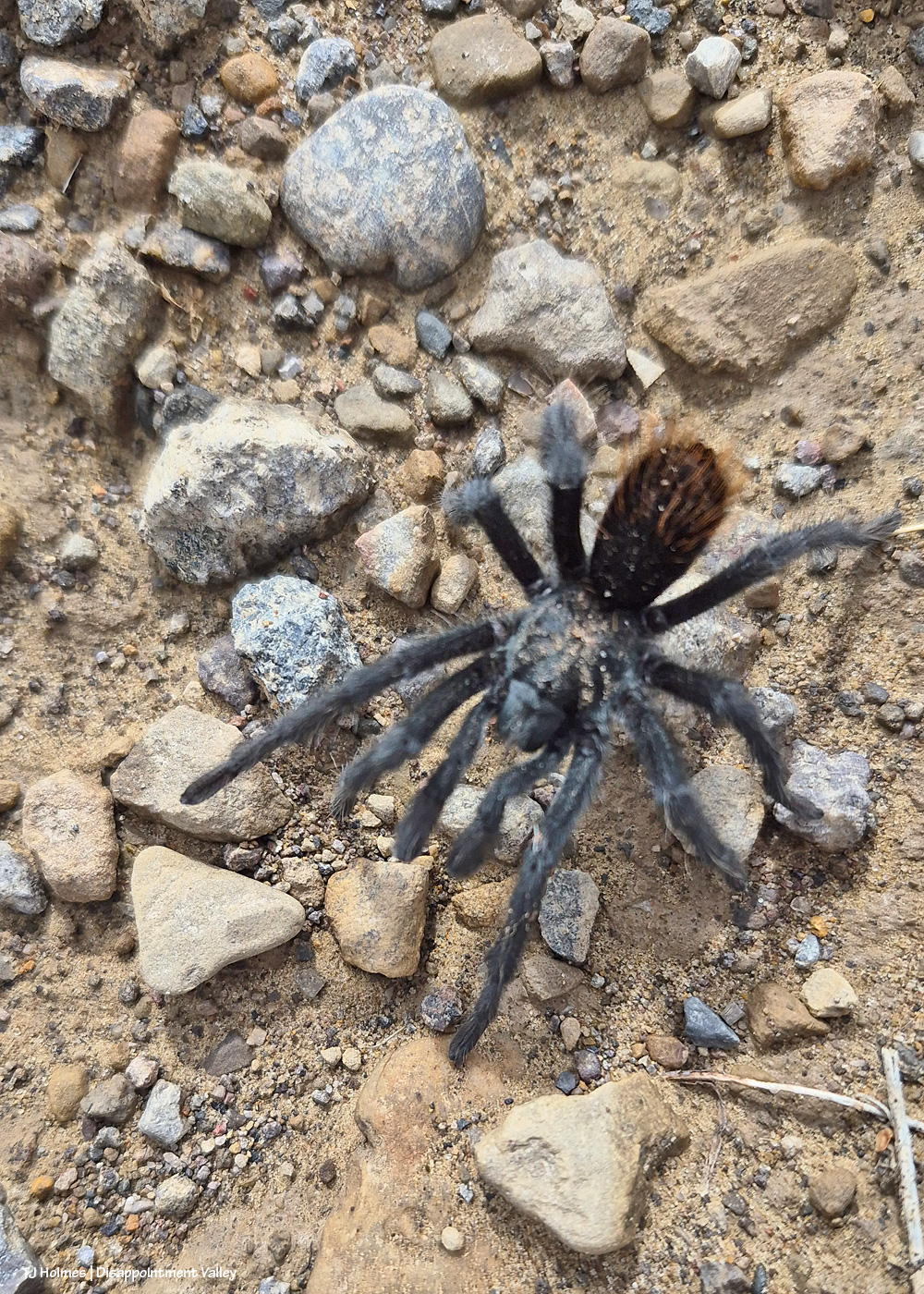
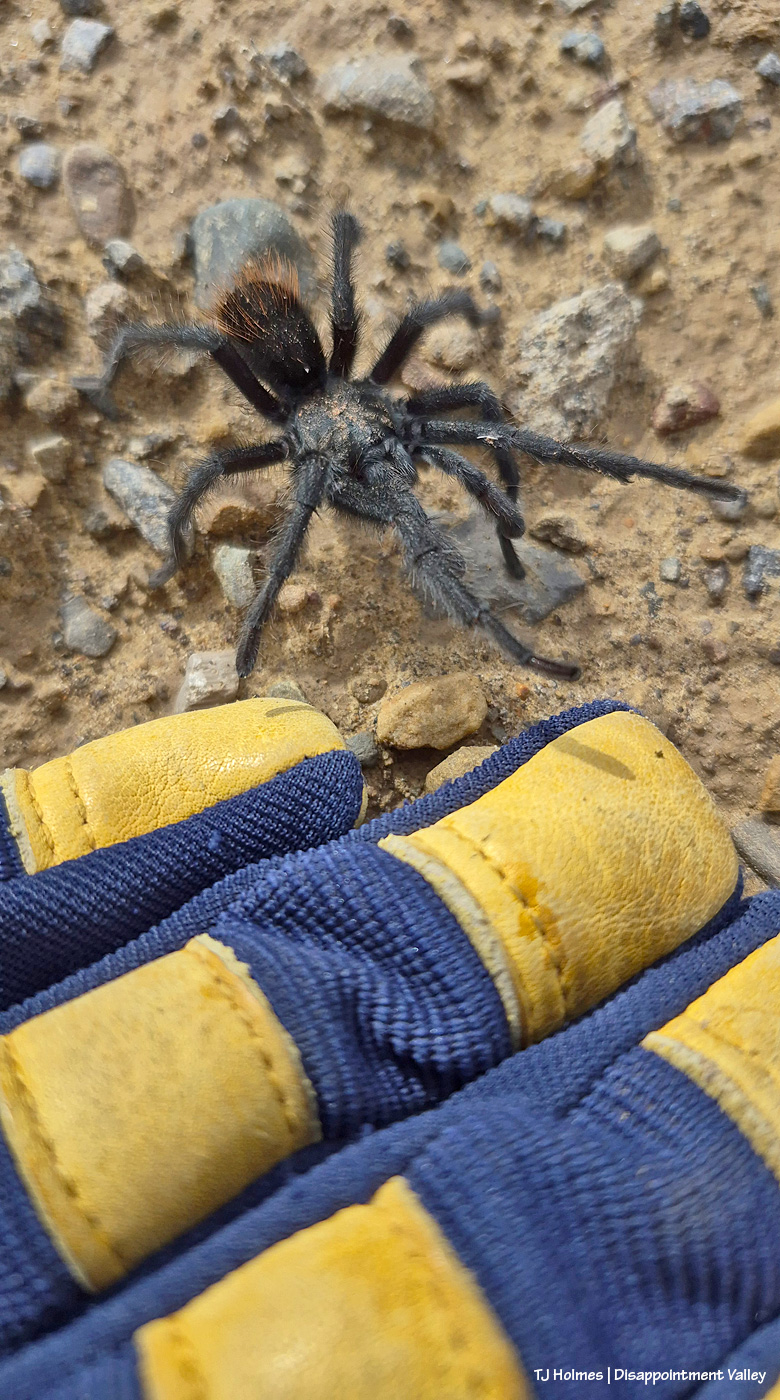
‘Tis the season for tarantulas to look for mates, and this little fellow (they’re the ones who do the looking) was crossing Disappointment Road recently on just such a mission.
I stopped for a hopeful introduction (not like THAT!), but he was singleminded in his search, and clearly, my giant blue and yellow-leather glove did not at all look like what he was looking for. 🙂
According to the Google machine:
Every fall, thousands of male Oklahoma brown tarantulas wander across southeastern Colorado to search for mates.
What is Happening
Not a Migration: People call it a migration, but it is actually a mating trek.
Only Males Walk: Mature male tarantulas (ages 8 to 10) leave their underground burrows for the first and only time in their lives to find females.
Staying Put: Female tarantulas stay safely inside their permanent burrows and rarely come out.
When and Where to Watch
Timing: Peak activity happens from mid-September through October.
Best Hour: The hour just before sunset is the best time to spot them as temperatures drop.
Location: Look around the Comanche National Grassland near La Junta, especially along Highways 109, 10, and 350.
Safety and Facts
Harmless to Humans: Their venom is weak and feels like a simple bee sting. They only bite if physically grabbed.
Main Hazard: The biggest danger to the spiders is vehicle traffic on rural roads.
*****
I’m glad I didn’t call it a migration! They’re on a *mating trek*. 🙂
I even searched for “Southwest Colorado” tarantulas and got almost the same info as above with this addition: “often called Colorado browns.” And this disclaimer (?): “Tarantula mating season happens every fall in southeastern Colorado (near La Junta and the Comanche National Grassland), rather than in the southwest part of the state.” Um. With all due respect, monsieur Google, they ARE doing the same thing over here, and they do it every year.
It’s a *thing*, and I look forward to seeing the little guys. And while I watch carefully for them on the gravel and paved roads, it’s not always easy to avoid the poor critters. Wherever they are, watch for them and wish them well and lucky in love!
Actually, curious about how long that “luck” extends after mating, I put my musings to Google (aware that it’s already let me down by (as so many do) ignoring Southwest Colorado):
No, female tarantulas do not automatically kill the males after mating, though it absolutely can happen. The idea that a female always eats her mate is a common myth that is often exaggerated.
Whether a male survives depends on a mix of survival mechanics, biology, and timing:
The Mechanics of Survival
During mating, male tarantulas are fully aware of the danger. They have evolved physical adaptations specifically designed to keep them alive:
Tibial hooks: When a male approaches a female, he uses specialized hooks on his front legs to catch and pin back the female’s fangs.
The quick getaway: This hook system locks the female in place just long enough for the male to transfer his sperm. The moment he finishes, he releases her and runs away as fast as possible before she can react.
Why a Female Might Attack
If the male isn’t fast enough, or if the female is highly aggressive, sexual cannibalism does occur:
Hunger: If the female hasn’t eaten recently, she simply views the male as a highly convenient food source.
Nutritional boost: Consuming a male provides the female with a massive dose of protein and lipids. Studies show that females who eat a suitor often produce larger, healthier egg sacs.
Personality: Research has shown that a tarantula’s individual genetics dictate aggressiveness. Some aggressive females fail to distinguish between a mate and prey, attacking the male indiscriminately.
Ultimately, in the wild, many males successfully escape to find another mate. However, even if they escape the female, a male’s lifespan after reaching maturity is exceptionally short – usually less than a year –as they quickly succumb to exhaustion, predators, or the elements.
*****
I hope that gave you a bit of a chuckle while reading. I particularly appreciated that “the moment he finishes, he releases her and runs away as fast as possible before she can react”! And also, “if the female hasn’t eaten recently, she simply (simply!) views the male as a highly convenient food source”! I mean … the ladies are definitely at the top of the tarantula world, eh?!
*****
Hurricane Polo finally came through for us here in Southwest Colorado (speaking of being ignored, I watched a Denver weather woman nearly completely ignore us while talking about the rain coming into Colorado from Arizona and New Mexico via the hurricane; the closest she got was a brief mention of “the San Juans,” the mountain range east of our actual southwestern-most corner; she absolutely ignored the Western Slope and northwestern Colorado).
The soft, gentle, “female” rain as the Diné (Navajo) call it is an absolute godsend. Maybe it will still give us some growth this fall. … We can hope (we’re pretty good at hope here in the Southwest :)).
Next year, this date – Sept. 19 – will mark 20 years since I started documenting Spring Creek Basin’s mustangs.
TWENTY. YEARS.
Sometime next fall (I don’t remember that exact date now), I’ll mark *25* years since the first time I visited Spring Creek Basin – in the rain, in a van full of people I didn’t know, and we didn’t see horses because we never actually got *into* the basin (even if it had been dry, a van might not have been the best choice of vehicle?!). I went back soon after that by myself … and, well, now it’s been 24 years *this* fall. You know that saying “blood, sweat and tears”? Yeah … it’s been ALL of that … a whole lotta alla that.
That means this fall marks my 19th (today) and 24th anniversaries. I still find that pretty shocking to say out loud.
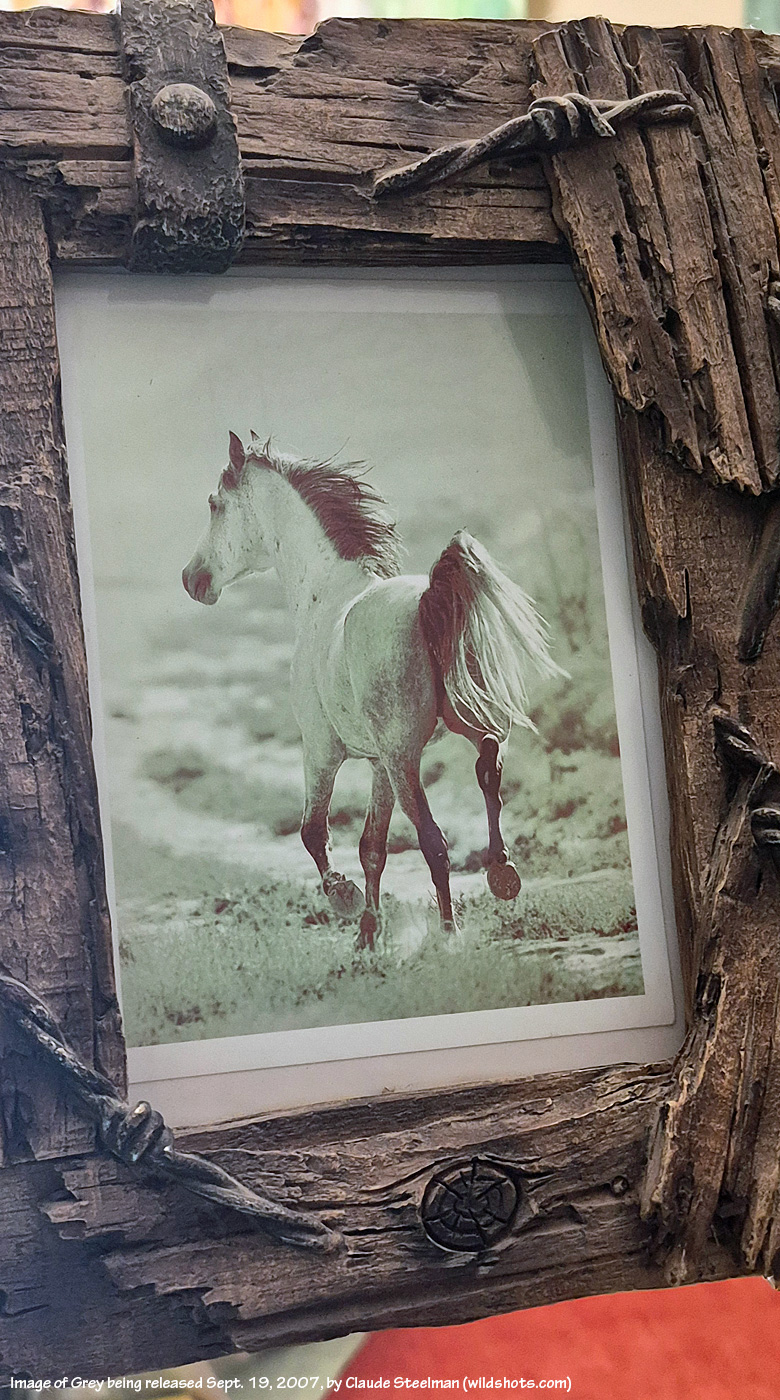
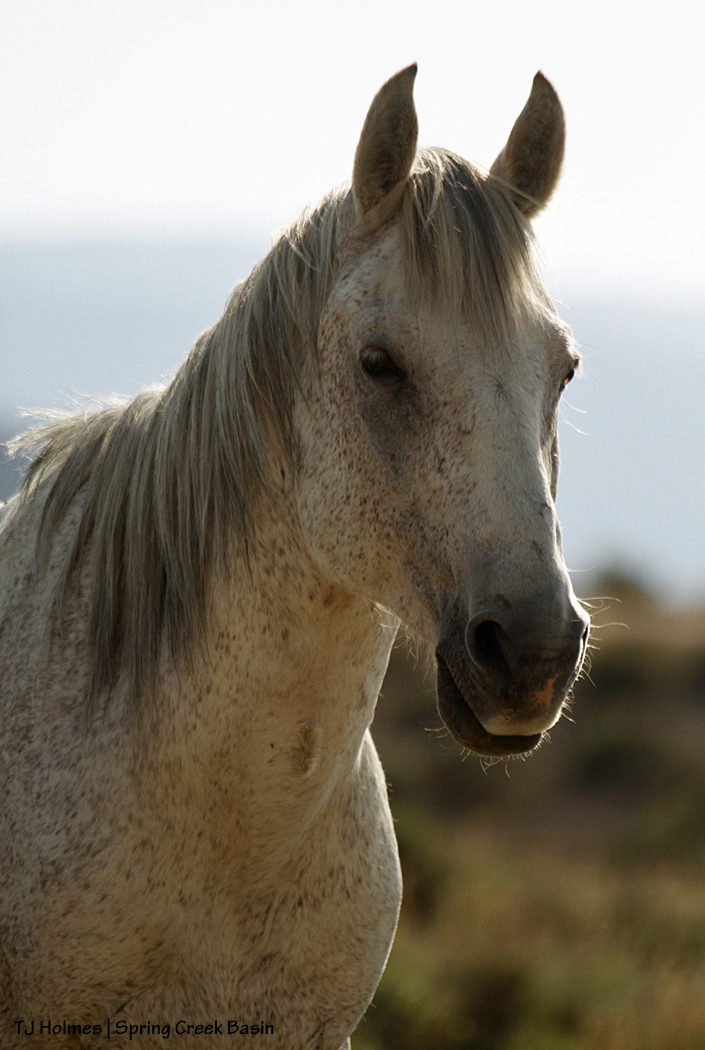
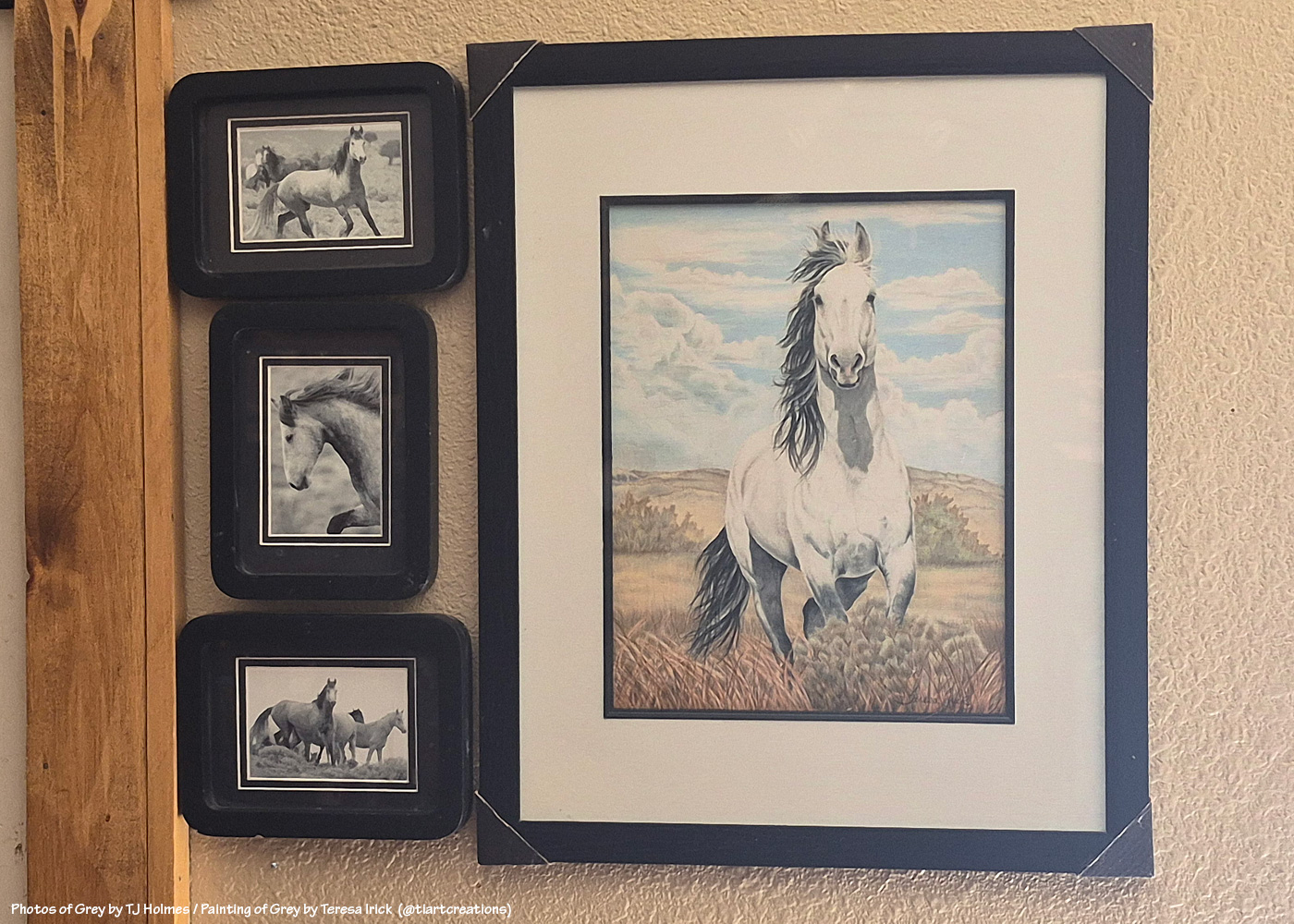
Two thousand seven was a roundup year in Spring Creek Basin. It was the third that decade (and we still had 2011 to come). BLM said the stallion known to most as Traveler (to me as Grey) would stay. They promised. … One guy broke that promise. … One guy made it right. Grey went to Cañon City, and about a week after he had been removed, we brought him back to Southwest Colorado, where his two-week quarantine turned into three weeks (courtesy of the promise-breaker). Four weeks after he left Spring Creek Basin, David and Pati Temple returned Grey/Traveler to the basin, Pati opened the trailer door, and he returned to his wild life, where he lived until his passing a few years ago.
Photo print of Grey by Claude Steelman moments after he was released Sept. 19, 2007, into Spring Creek Basin
“He’ll never have a band again,” the BLM promise-breaker said dismissively at the time. Within a month and a half, Grey had a band again.
Grey’s Return Day was Sept. 19, 2007. After the pomp of Grey’s momentous release (a couple of other people also were there, including renowned Durango-based wildlife photographer Claude Steelman), I stayed in the basin to start documenting every mustang I found. It took three months of weekends. Nineteen wild and crazy – and now, immensely satisfying – years ago.
Grey, toward the end of his life; we thought he was close to 30
So today, I celebrate both the anniversary of Grey’s return and release and the day I started documenting my beloved mustangs, what has become the path of my heart through this lifetime.
My *wall of Grey*; photos of Grey by me circa 2003-2004? Gorgeous painting of Grey by talented Colorado artist Teresa Irick (@tiartcreations on Instagram) based on a photo by me
When I first started this mustang-advocacy journey, 20 years into the future felt like some random date that would never arrive. Now, wow.
I want to do something kinda fun to mark the occasion next year, and this is a head’s up. A few of you have read and commented and shared the mustangs for a lot of years now, and I’d like to send you each a photo print of the mustangs. I probably haven’t taken it yet, but I have a year (!), and I’ll let you choose. You might know who you are. 🙂 I thought I’d also ask readers – on that date, and don’t worry, I’ll remind ya’ll ahead of time – to leave a comment on that post, and I’ll put all your names in a hat and mix ’em all up, and I’ll have a mustang friend pick a name and send that person a pic, too. I want to celebrate YOU who support and love these mustangs, too! There also are a handful of people who have been with me for long years on this mustang journey, and I want to recognize them, too (more about them next year).
Hollywood and his mares, 2019; Hollywood and Houdini are both gone now … Shane, Alegre and Maia are still together
When you’re starting a thing, you never know where that thing is going to go, how it’s going to go, how long it’ll go on. When you have a burning desire to do something strong, something worthwhile, again, you just never know. That’s the future. … That’s LIFE.
So many people have had a hand (even just some fingers) in the accomplishments realized for bettering the management and preservation of Spring Creek Basin’s mustangs, and I can’t even imagine (and I don’t wanna) what path my life would have followed if I hadn’t discovered this herd and all the amazing people I’ve met along the way. We’ve all shared something: love of horses. Love of WILD horses. Love of mustangs.
Remember that promise-breaker? I realized several years ago that I’m *grateful* to him. I definitely couldn’t see it at the time of what felt like deep betrayal by the system, but if not for that guy, would my Irish stubbornness have come to the fore and would I have dug my boots and heart so deep into ground I’d never known but has become my rooted ground?? As I said: *grateful*.
Winona with sons Cheveyo and Lyra; Lyra is gone now, and Cheveyo is a band stallion; Winona, of course, is one of our wise ones
And you know what? Holy … horse. 🙂 Spring Creek Basin Herd Management Area today is one of the best managed herds in the country (if not the best? forgive me a tiny bit of bias, please, but I don’t know of any others quite like ours). I am so grateful to the BLM folks at Tres Rios Field Office who made that happen and continue to work with our shared goal in mind.
Because we shared a dream and a goal and got to work doing it, not sitting by waiting for someone else to come along and dig in and get ‘er done. I sure didn’t start that dream for Spring Creek Basin, but I tip my visor to those who did … those who welcomed me to the fold so I could join the journey to the goal. And in that time, we have gotten done EVERYTHING we’ve aimed to achieve … bar one that we haven’t gone full force on, and that’s in the hands of bureaucrats, really, which is unfortunate, but it’s still possible.
Comanche’s band in the dust of early summer, 2020
I’ll probably (of course I will) write another long-winded post about this on my actual 20th anniversary, but on this, my 19th, *thank you* to every single person who has given even the tiniest bit of love to Spring Creek Basin’s mustangs. My love and gratitude to each one of you.
And hang on for (at least!) another year, with the mustangs and me, to celebrate the big 2-0. 🙂 No worries: The 20th won’t be anywhere close to the end. To paraphrase something I heard someone say someone told him: I will continue to make as positive an impact as I can in all the time I’m given in and for Spring Creek Basin and its mustangs.
I’m so glad you’re here, with us.
*Grateful*
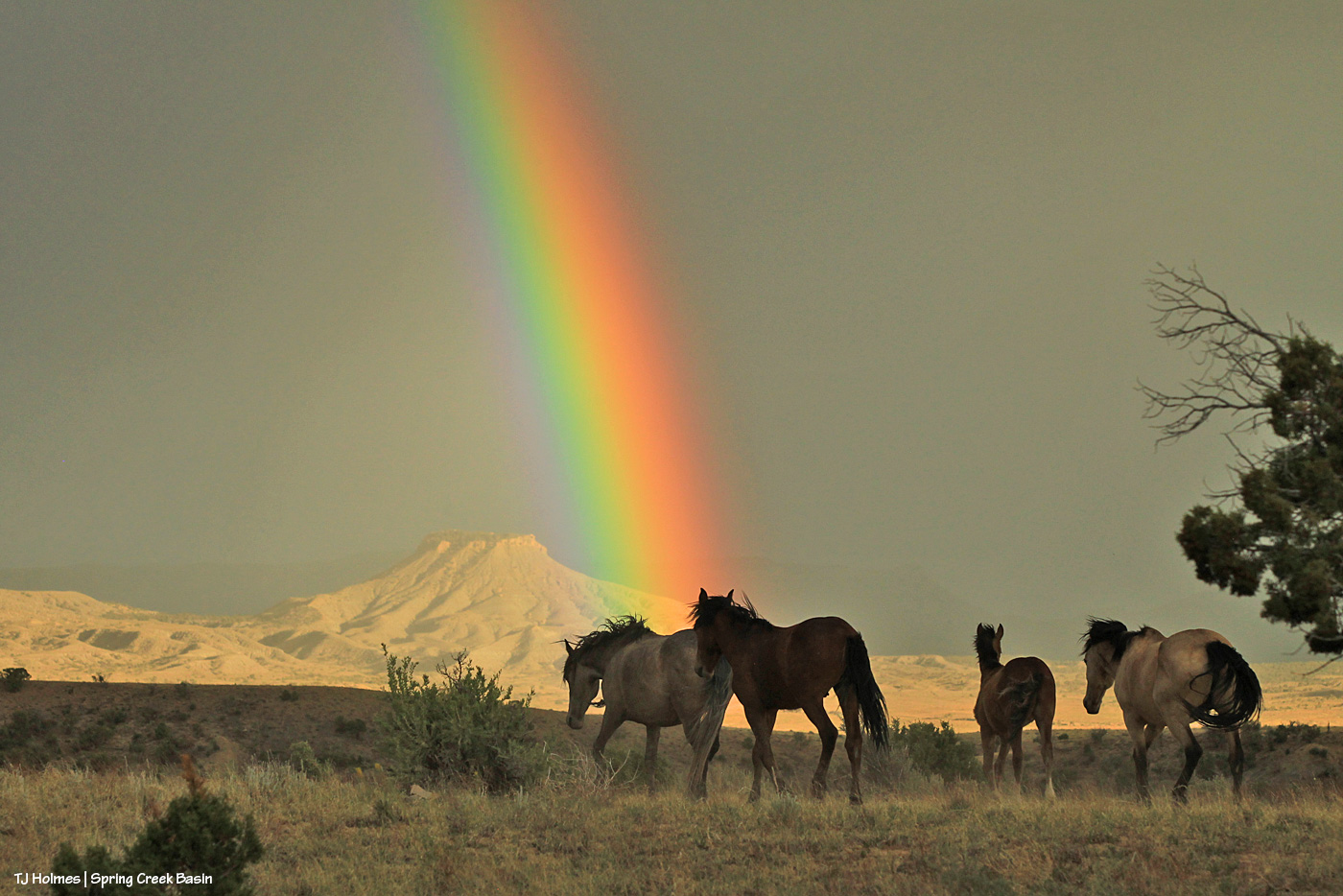
Comanche’s band, under the rainbow, 2020; Comanche also is gone now
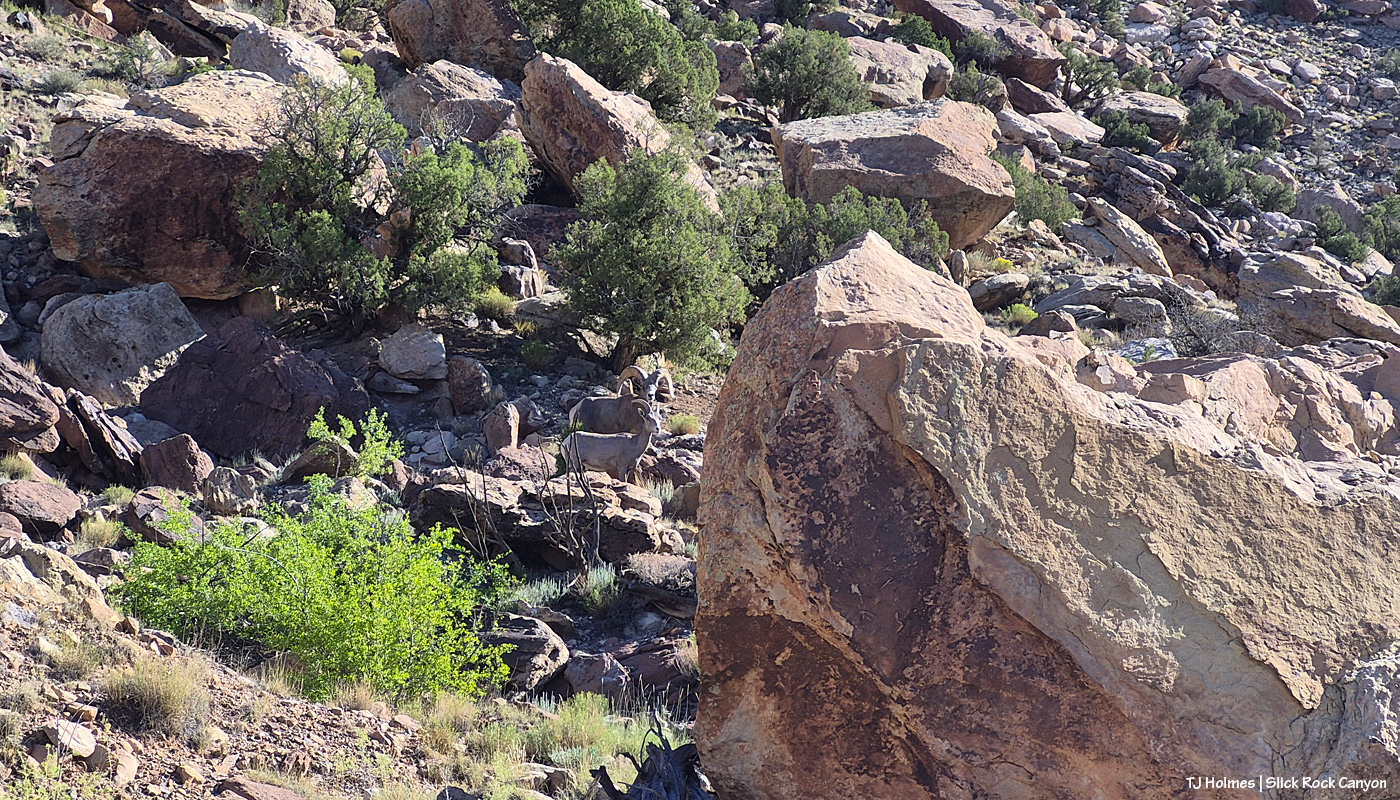
What a cool surprise to find along the highway near Slick Rock, just west of Disappointment Valley above the Dolores River.
**Belated mistake correction: I did just a quick search before I started processing the pix … and after I’d typed “Slick Rock Canyon” on all the below images, I did a better search and realized that this area, while very close to Slick Rock, making it a *canyon near Slick Rock*, it is NOT Slick Rock Canyon. Slick Rock Canyon actually is downriver from Big Gypsum Valley, which is farther downriver from Slick Rock (which used to host a post office and cafe; now consists of a bunk house and corrals). Rather than go back and re-edit all the pix, I’m gonna live with the mistake … just so you know!
It’s a good thing that Colorado Highway 141 is lightly traveled. By the time I got my phone turned on after spotting a small group of desert bighorn sheep, they had moved a bit higher into the rocks.
I found a place to pull off the asphalt. Sorry to the guy who slowed to pass me in the opposite direction as I had my vehicle’s flashers flashing, probably wondering what the heck I was looking at. … Not really that sorry. 🙂
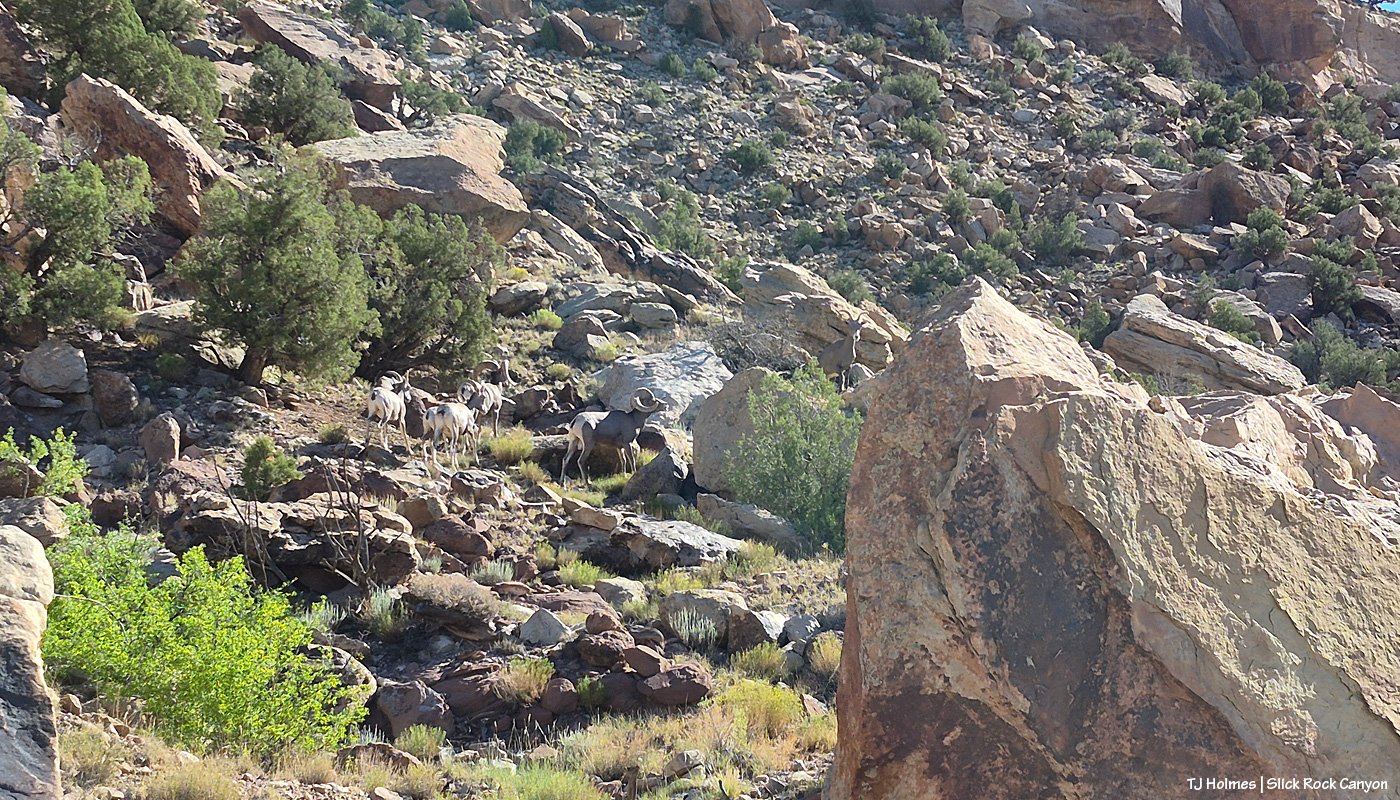
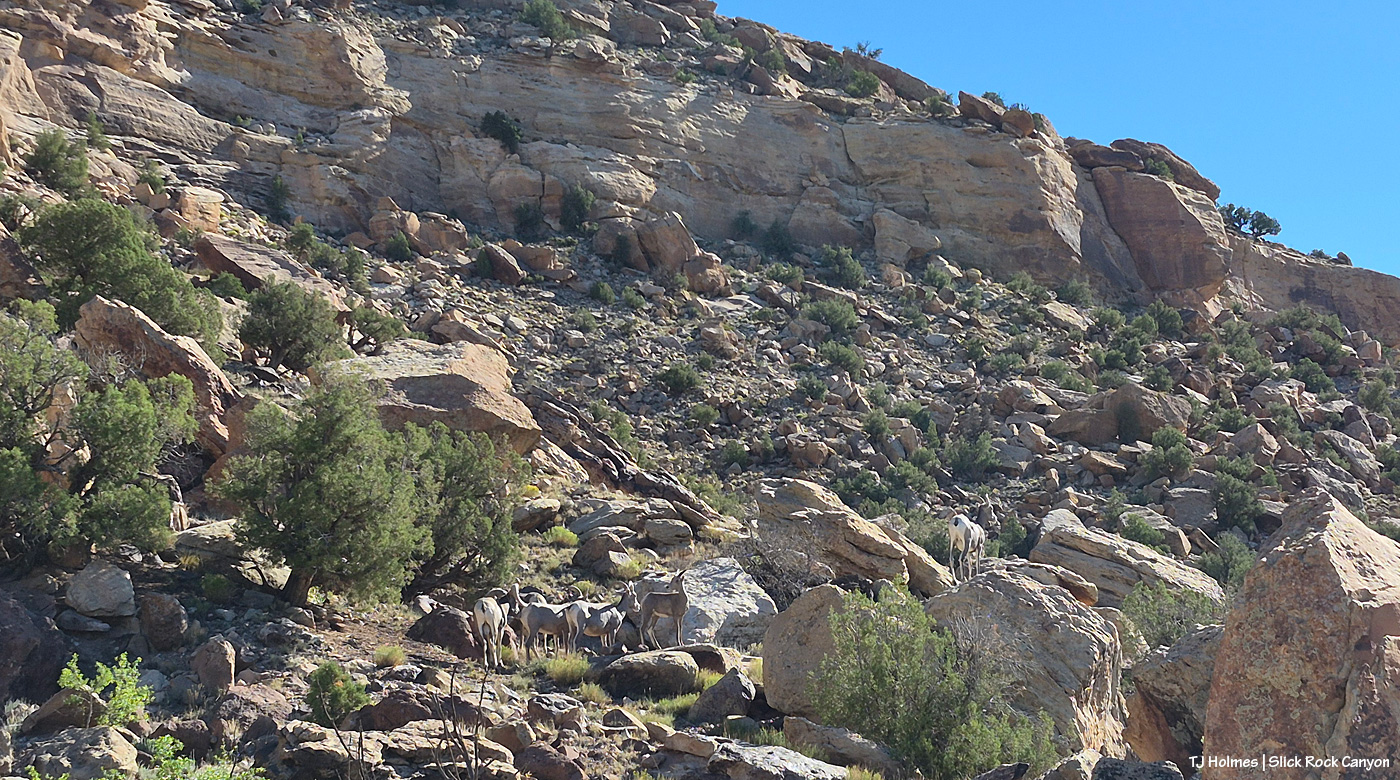
Two big rams were with the few ewes. I think there were six bighorns total.
You start to see why bighorns are so adapted to rocky habitats.
Note “queen of the hill” at right. 🙂
Wow, I wish I’d had my big camera and lens. I rarely see bighorn sheep in this stretch; the last time I saw a group, they were across the river (which is horribly, terrifyingly low now). Some people are lucky to see the bighorns more often through this area; any time I see them, I count it as a lucky sighting!
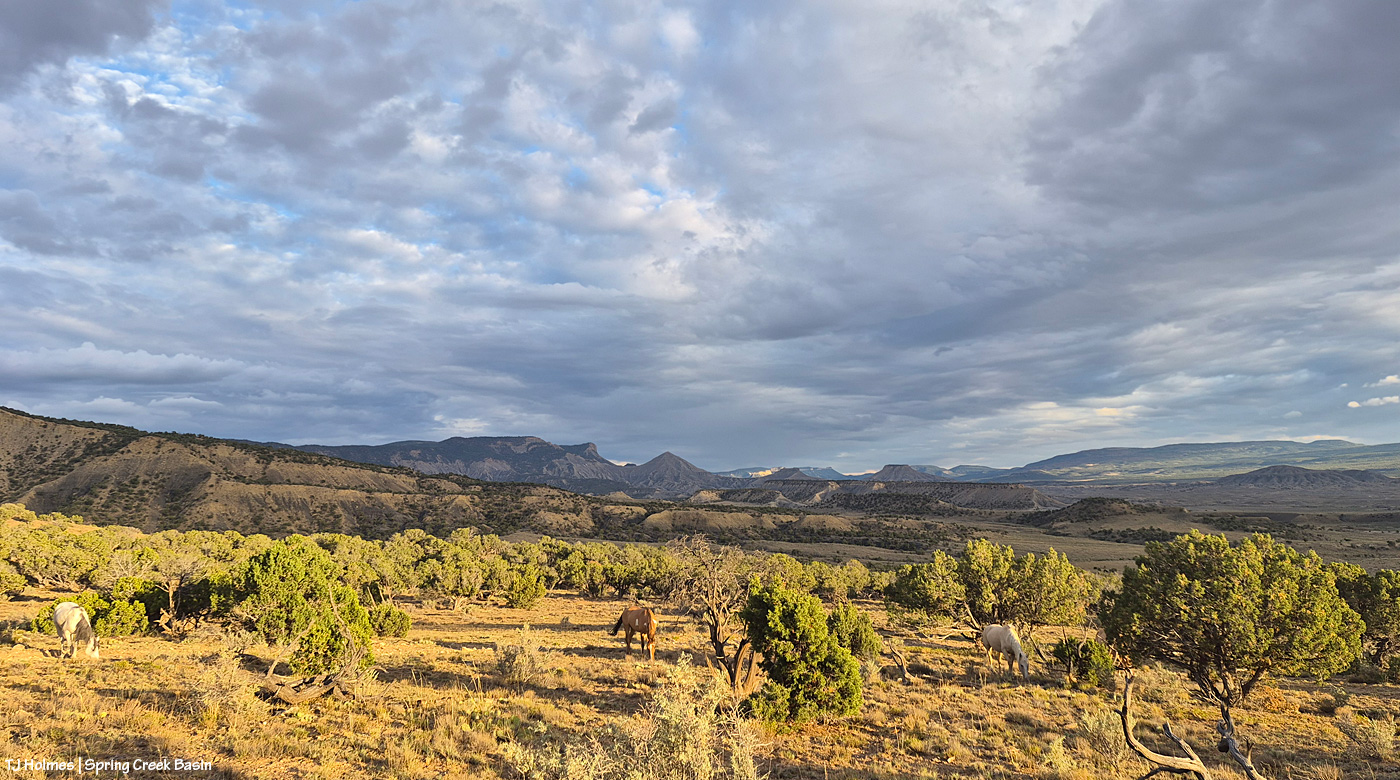
Some beautiful light over Buckeye’s band on a recent evening, looking southeast. Buckeye at left, Aiyanna at center, Rowan at right and … see if you can spot Dundee behind the tree at far right. No rain, but the temps have dropped, and the cloud cover has been an absolute relief.
Bonus:
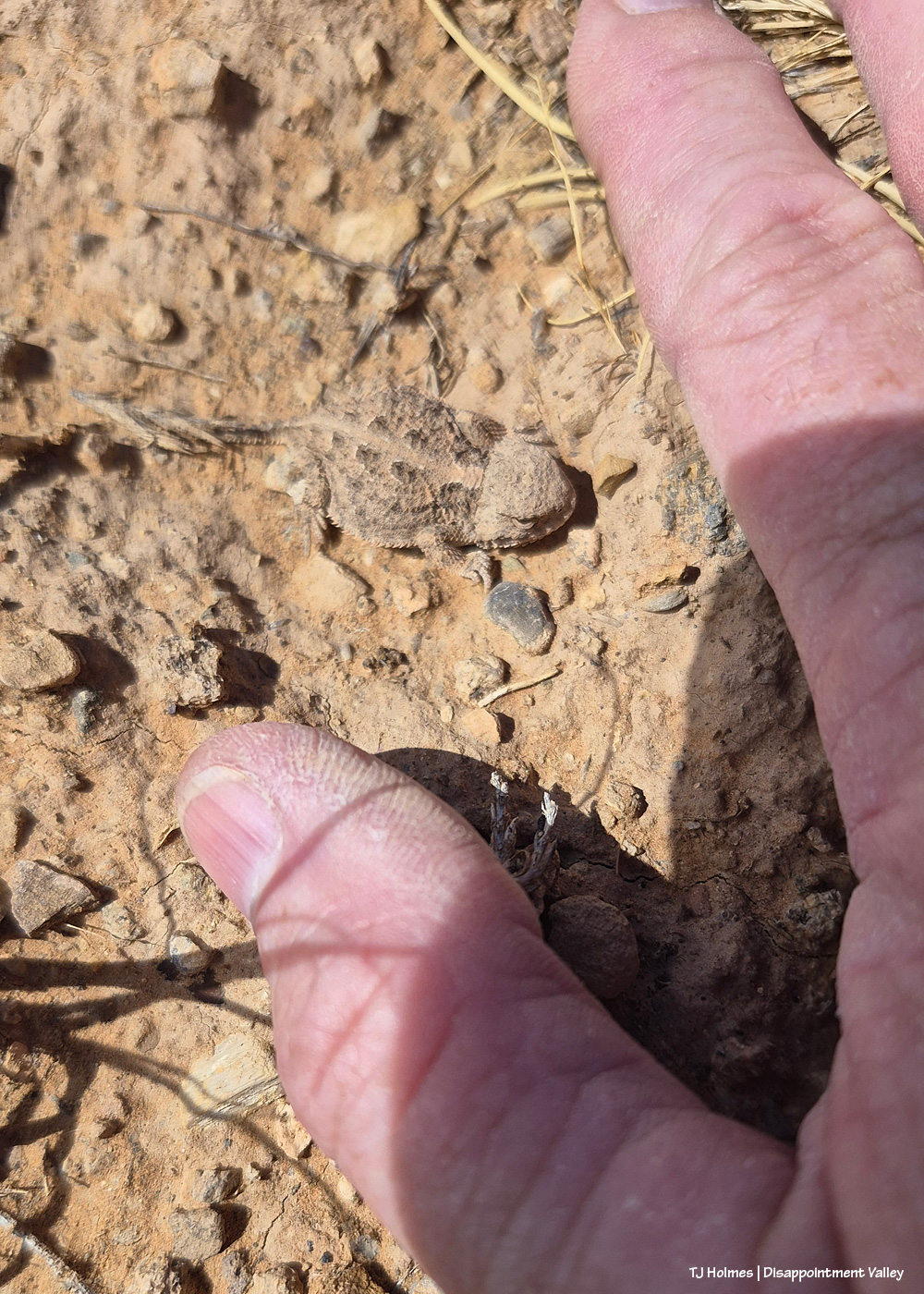
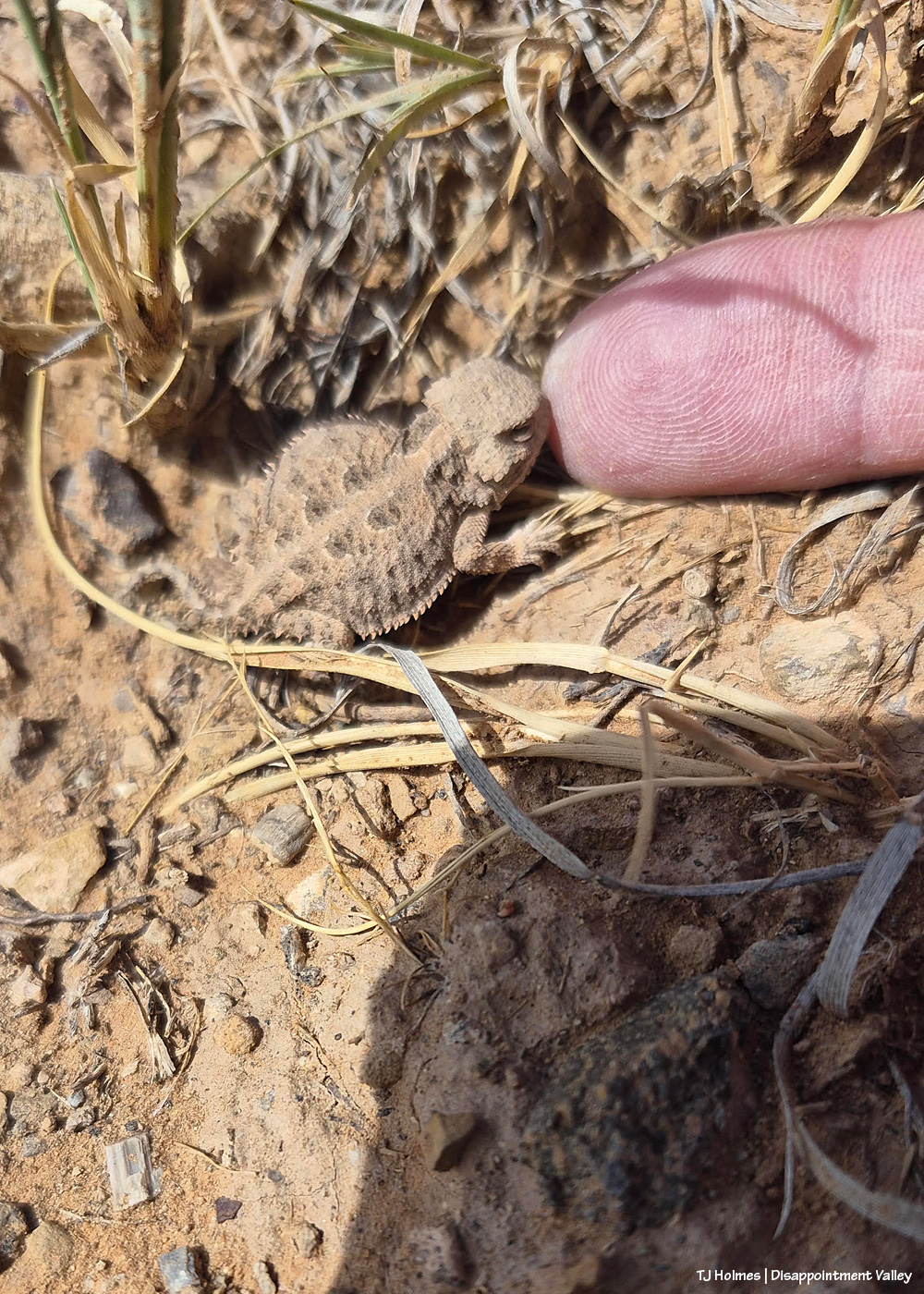
Met this teeny tiny little friend on a hike in a different part of Disappointment Valley.
Super itty bitty! Catching its movement is the only way I saw it. That’s some good camo!
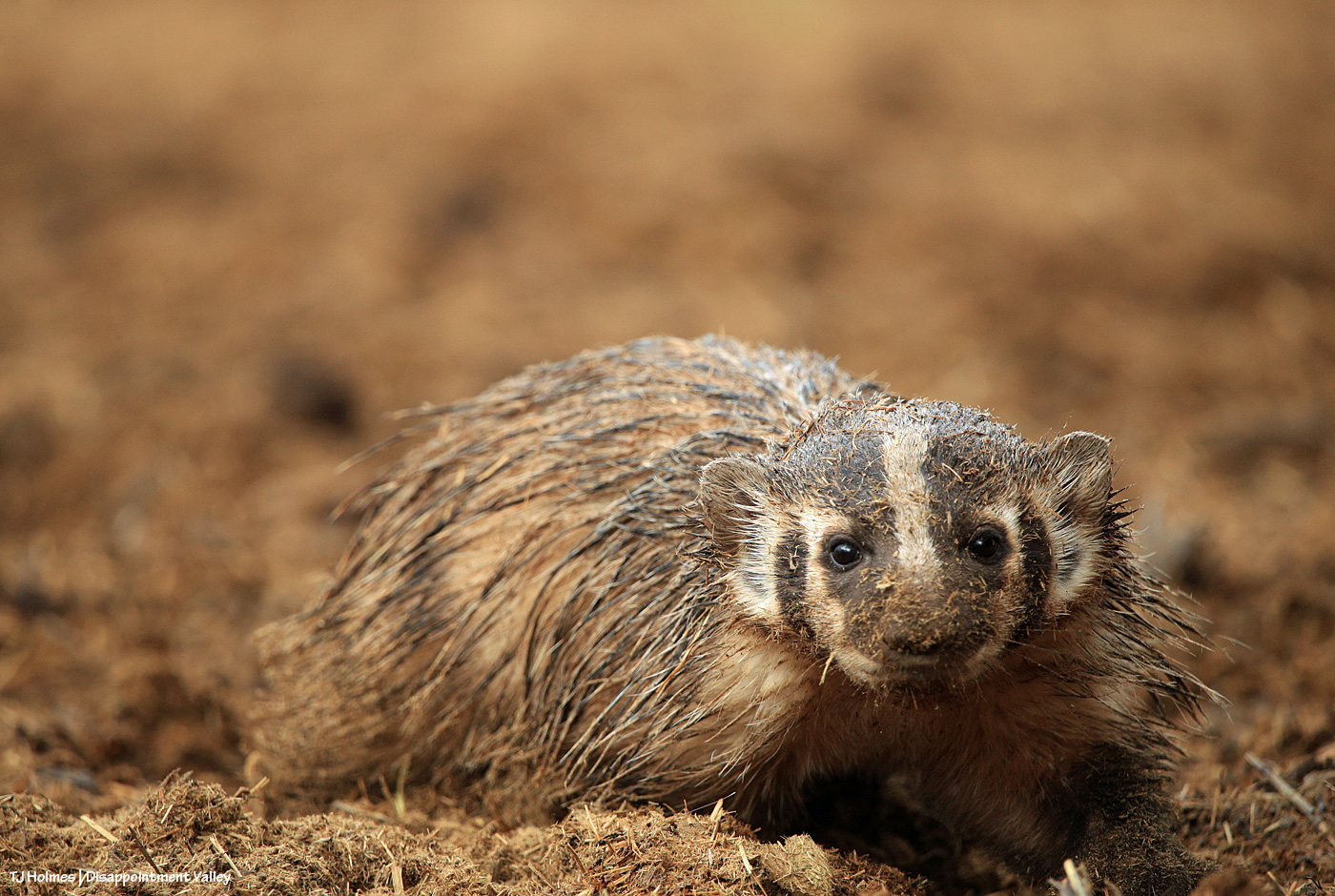
I treat badgers like I treat rattlesnakes: carefully and with respect.
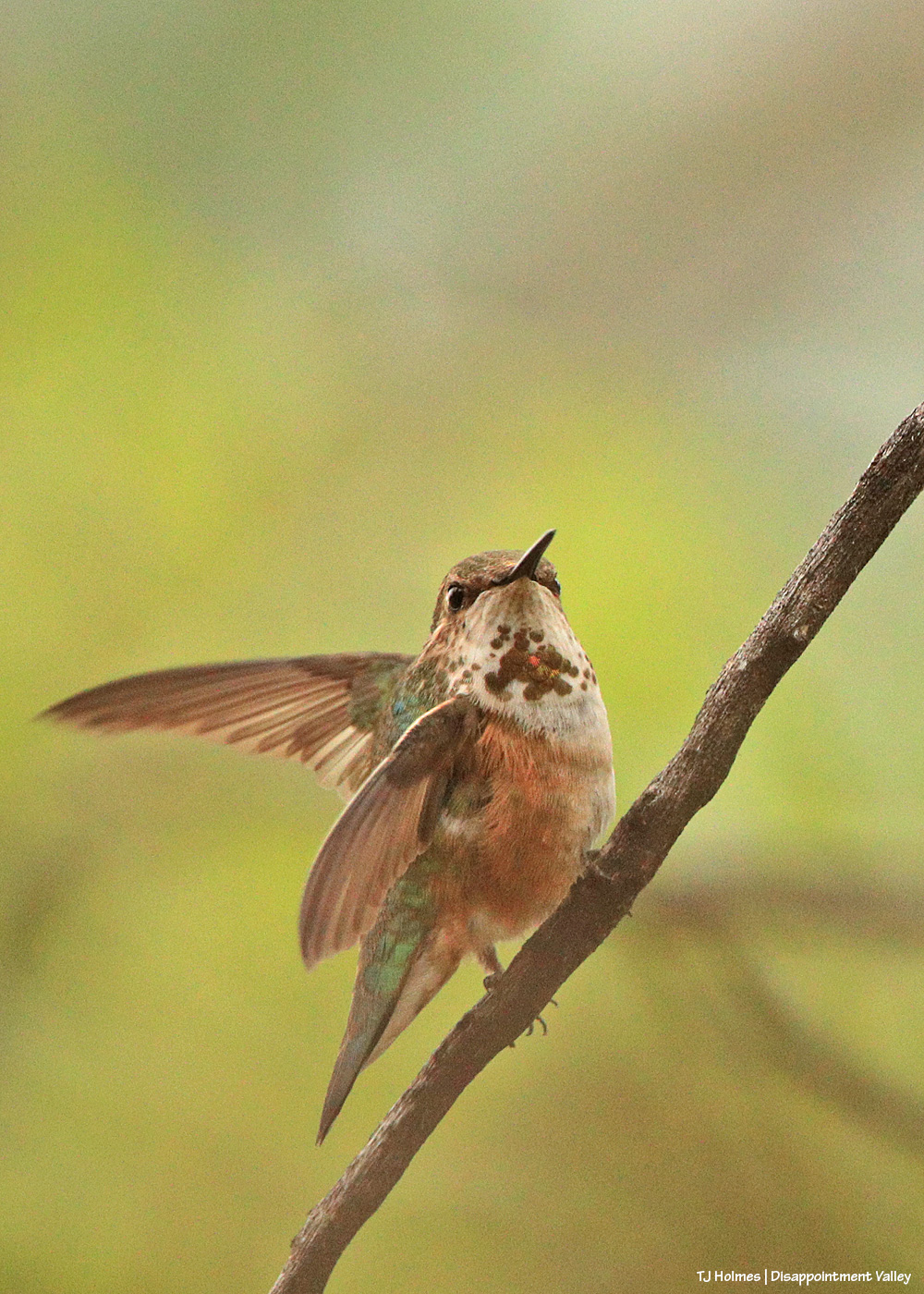
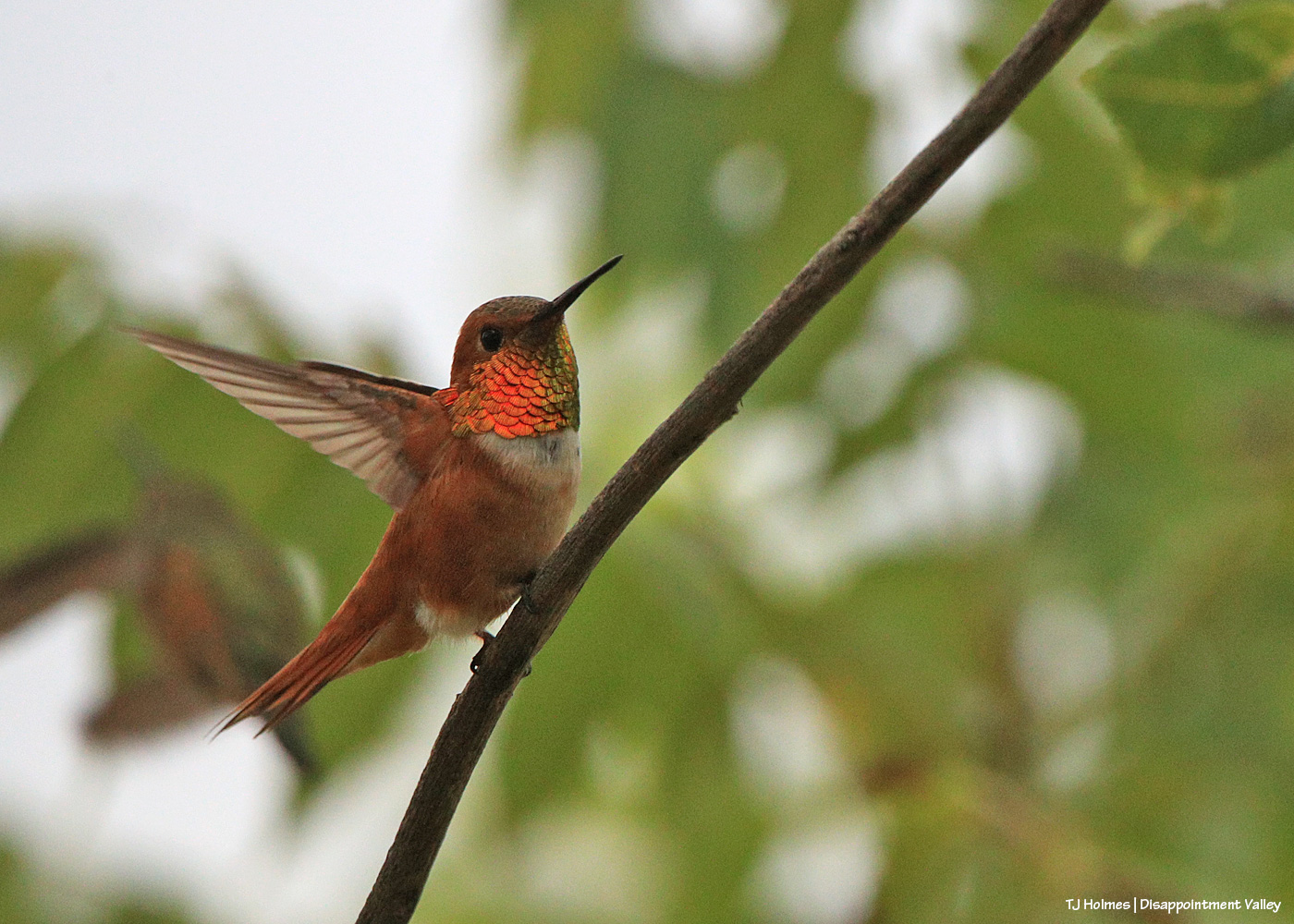
Pretty little ball of energy. Does anyone know what kind of hummingbird this is?
Rufous hummingbird? That orange! When it turned its (his?) head even slightly away, that glittering orange completely disappeared.
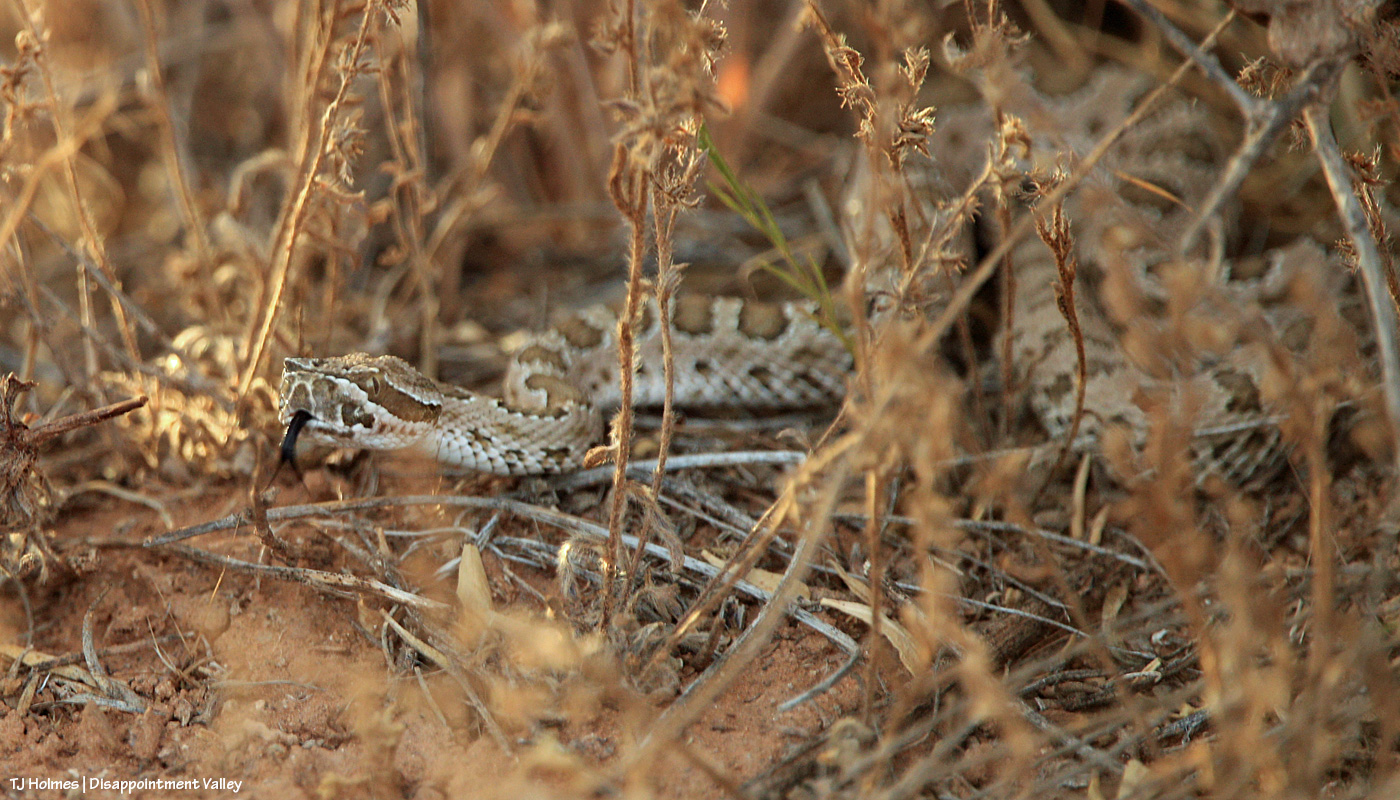
Did someone mention rattlesnakes? … Carefully … and with respect. 🙂
Not all from the same day or same areas of Disappointment Valley.
In big news: We’ve had rain! Finally, Mother Nature is shedding some tears of pity over us, and Tuesday night, there was (I think) pretty widespread rain over the valley. Because of intermittent rain throughout the day (!), I didn’t make it into Spring Creek Basin, but I look forward to soon documenting the run of water through Spring Creek. Hallelujah!
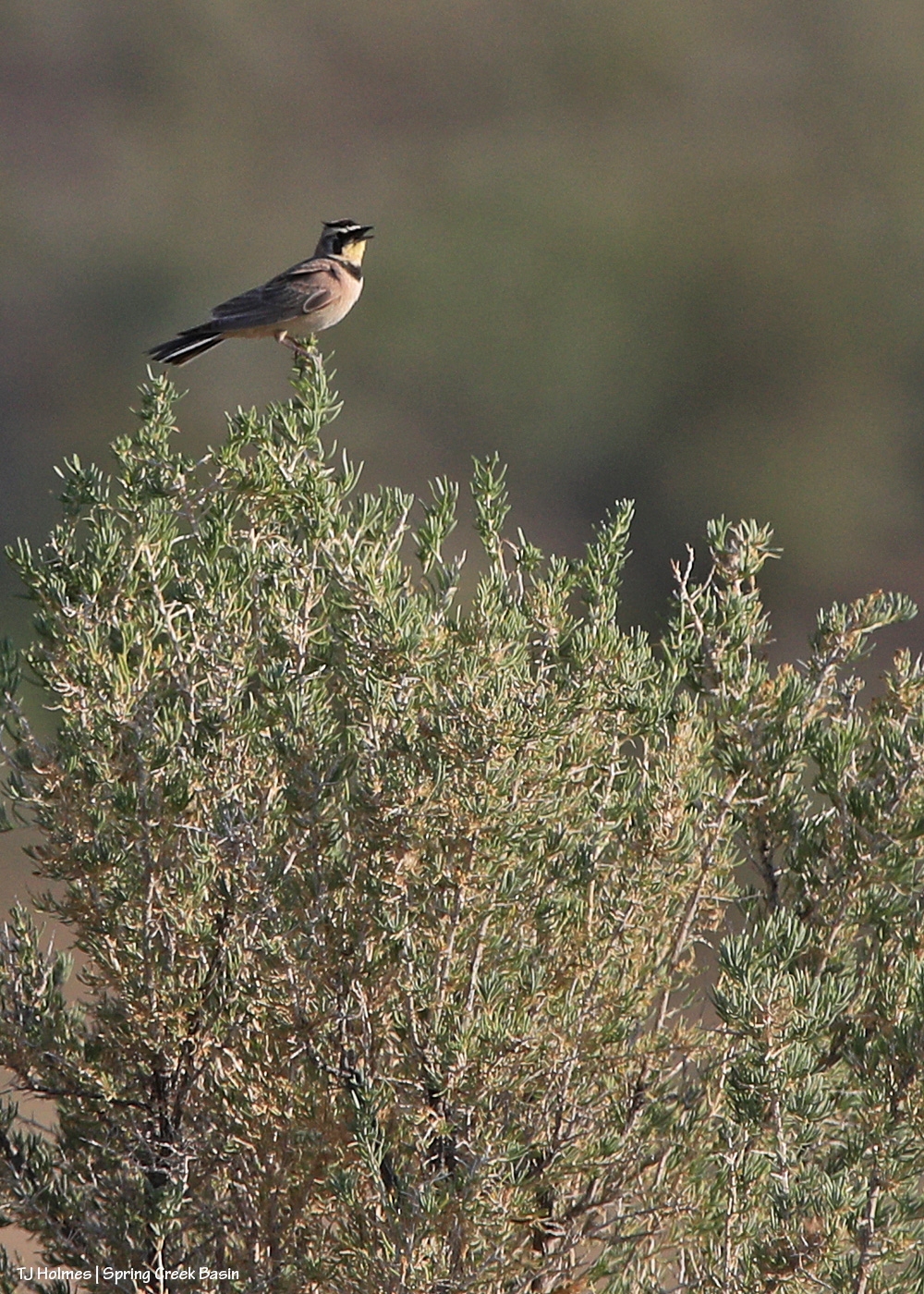
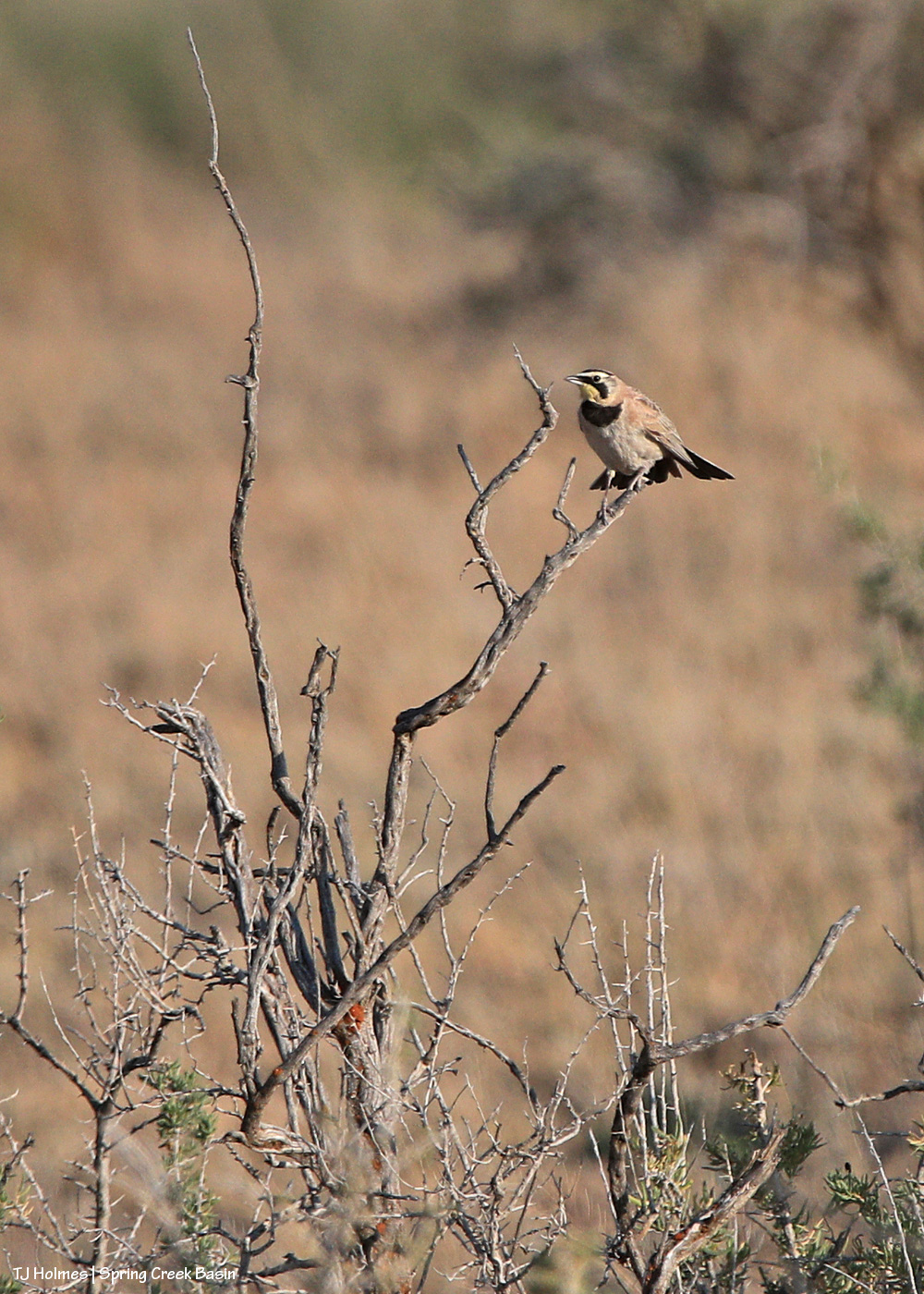
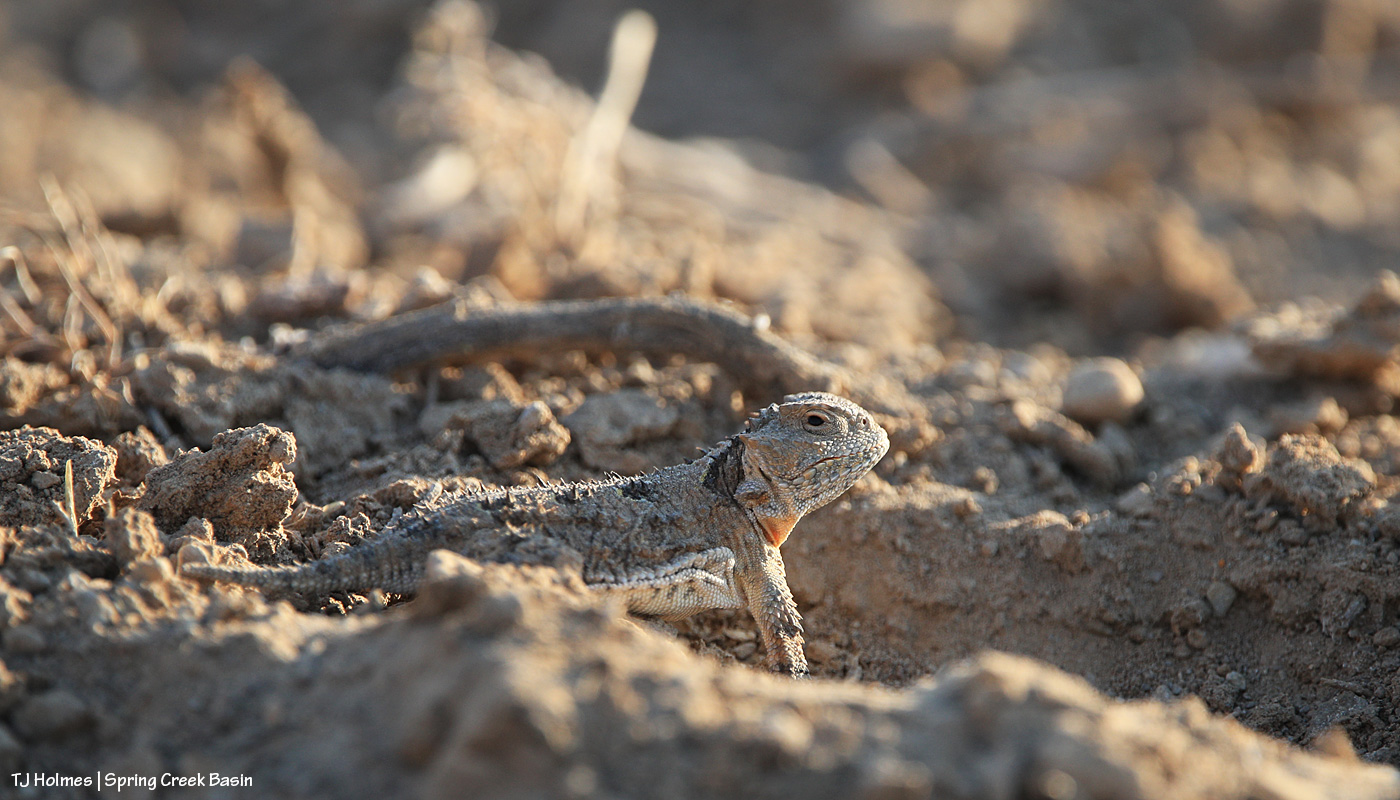
Both of these critters were seen on the evening of summer solstice. Both are named for their “horns.” One has feathers; one has scales. Both are desert beauties.
Horned larks are one of the first birds I learned to identify. Lots of them seem to call Spring Creek Basin home. See his little “horn” tufts?
Same lark. Maybe it was the presence of the mustangs behind me that made him feel comfortable enough to land on nearby greasewood to check me out.
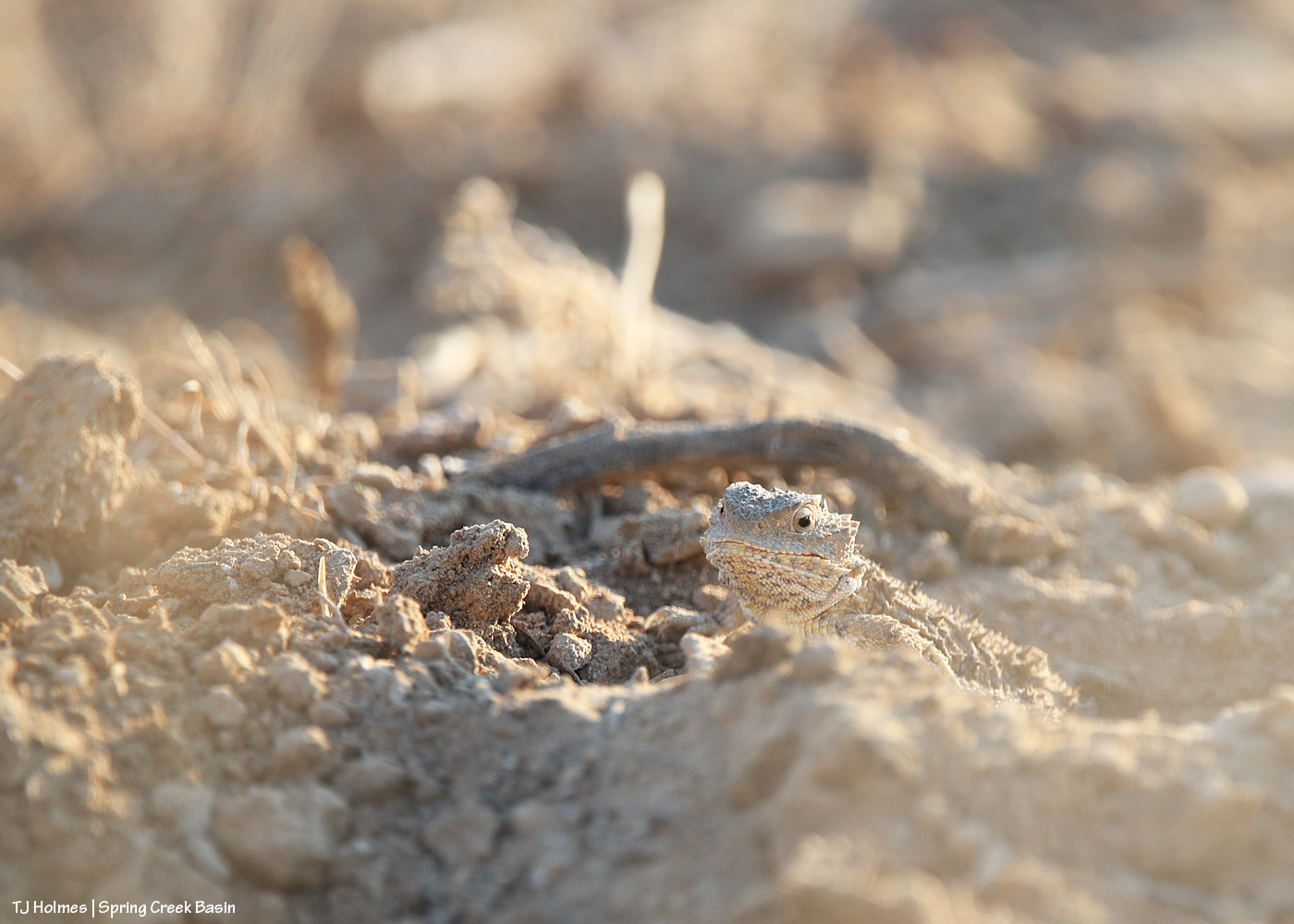
While following those same mustangs away from the road, this little fellow (fellarina?) caught my eye. (Much nicer to see a horned lizard scuttle away underfoot than the longer, more slithery kind!)
I didn’t realize it at first, but it was hunting around an ant hill.
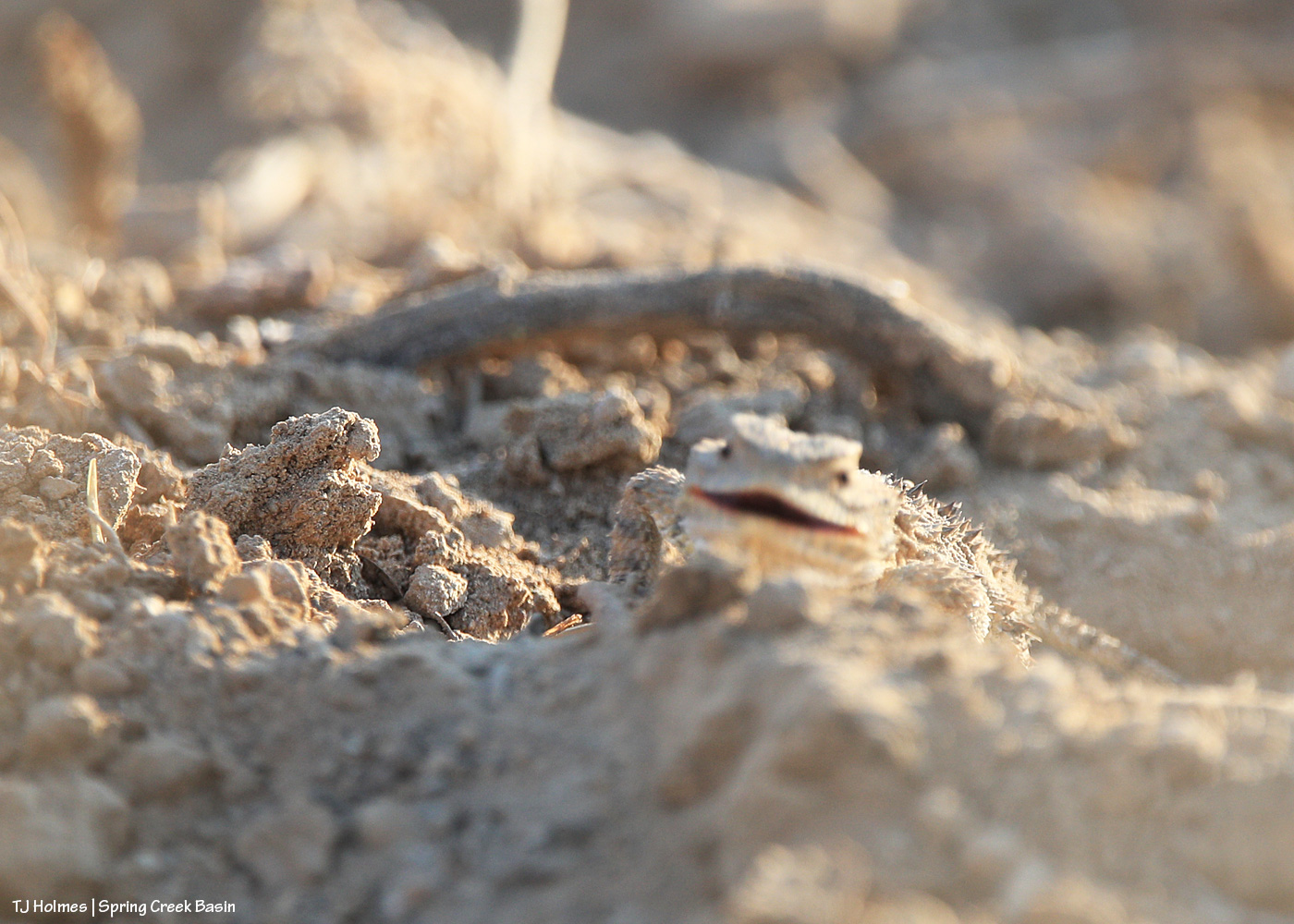
I started to see it darting forward, and that’s what alerted me that it was going after something on the ground, presumably insects. Too bad it’s out of focus, but it helps the story!
You might think this one is out of focus – I did, too – but look at that little dirt ball in front of the lizard. See the bug? It didn’t last long!
Is it just me, or does that look like a satisfied little lizard? 🙂
Tuesday was a wild and crazy day … and that was just the weather. It was ultimately a successful day, though at least one part left me shaking my head at, well, how life unfolds. And it was a reminder that sometimes the smallest things, and the simplest things, are the most enjoyable of all.
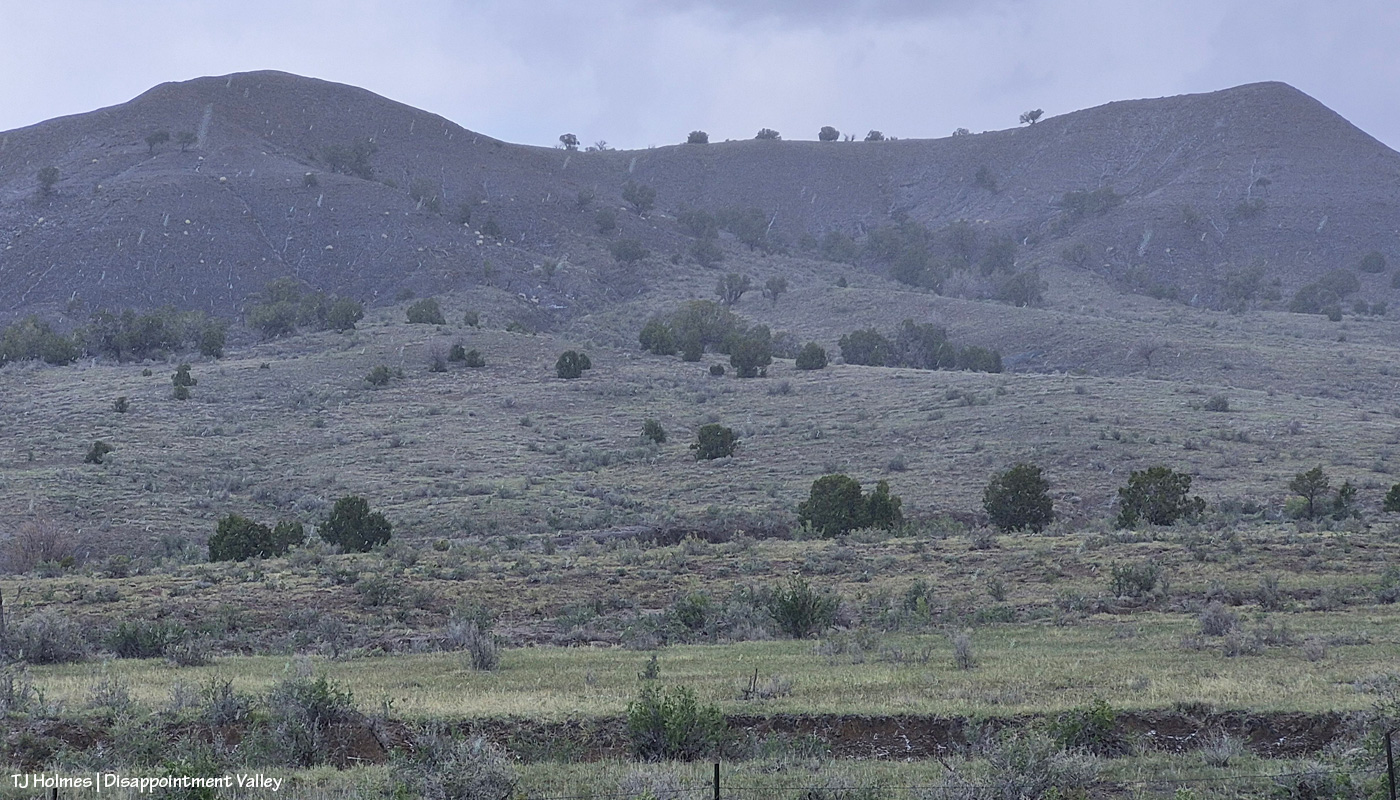
From yesterday’s post, are you wondering what graupel looks like? (Thanks, Valerie, for your comment that led to this post!)
What? I hear you asking. That looks like snow or rain, you’re saying (zoom in to see the streaks). Look on the ground in the lower right corner. I was backed in under a (dead) tree to sit out one wave of it (it wasn’t very hard, and it didn’t last long) at that little side “road” to Disappointment Road, which is across the whole pic. See the little white “balls”?
AI says this: “Graupel, or soft hail, forms when supercooled water droplets freeze onto falling snowflakes, creating soft, small white pellets (2-5 mm) that resemble Dippin’ Dots or Styrofoam. These fragile, slushy particles are often called snow pellets and, unlike hard hail, crumble easily. They occur during wintry mix scenarios, causing sudden, slick conditions, and are identified in aviation reports as ‘GS’.”
I liked this part: Types of Graupel While commonly called graupel, it is sometimes referred to as:
Matsaaruti: A term used in the Nunavik region of Canada to describe wet, soft snow pellets.
Another pic from the same location as the first pic, looking pretty much straight north at what I call west-of-favorite hill (because it’s, you know, west of what I call favorite hill, which I so-named because once upon a very long time ago, “the pintos” really favored that hill and could very often be found atop it).
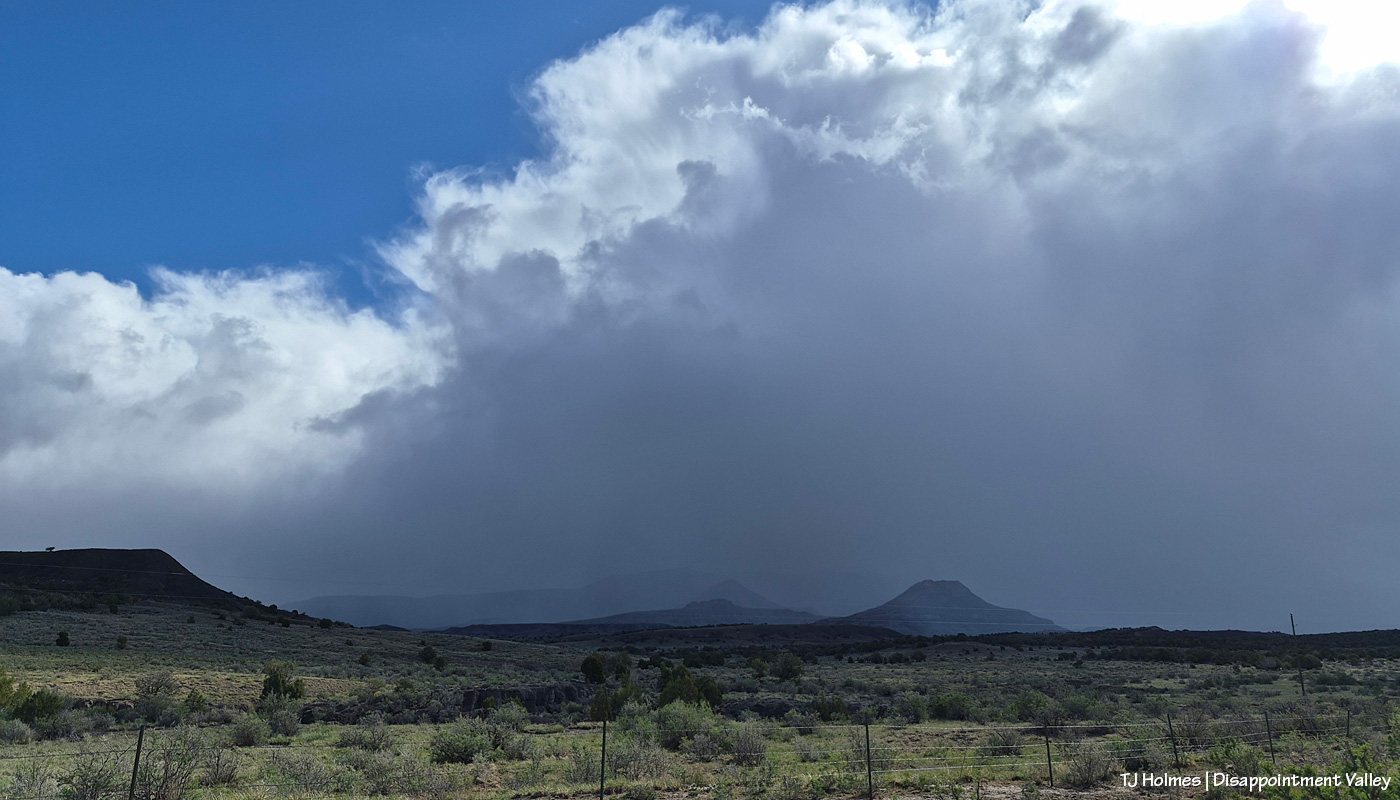
Also from the same spot, looking eastish again as the graupel wave recedes, driven by a strong out-of-the-south wind (I lost track, but at least three, maybe four went over us Tuesday morning). You can see Brumley Point very distinctly, submarine ridge and McKenna Peak to the left it it, and you can’t quite make out Temple Butte. If you slide back up to the first pic, Temple Butte is juuuuuust barely visible at far left, just under the power lines. And yes, the sunshine IS coming back out over the rest of us while the wave pushes north to the east.
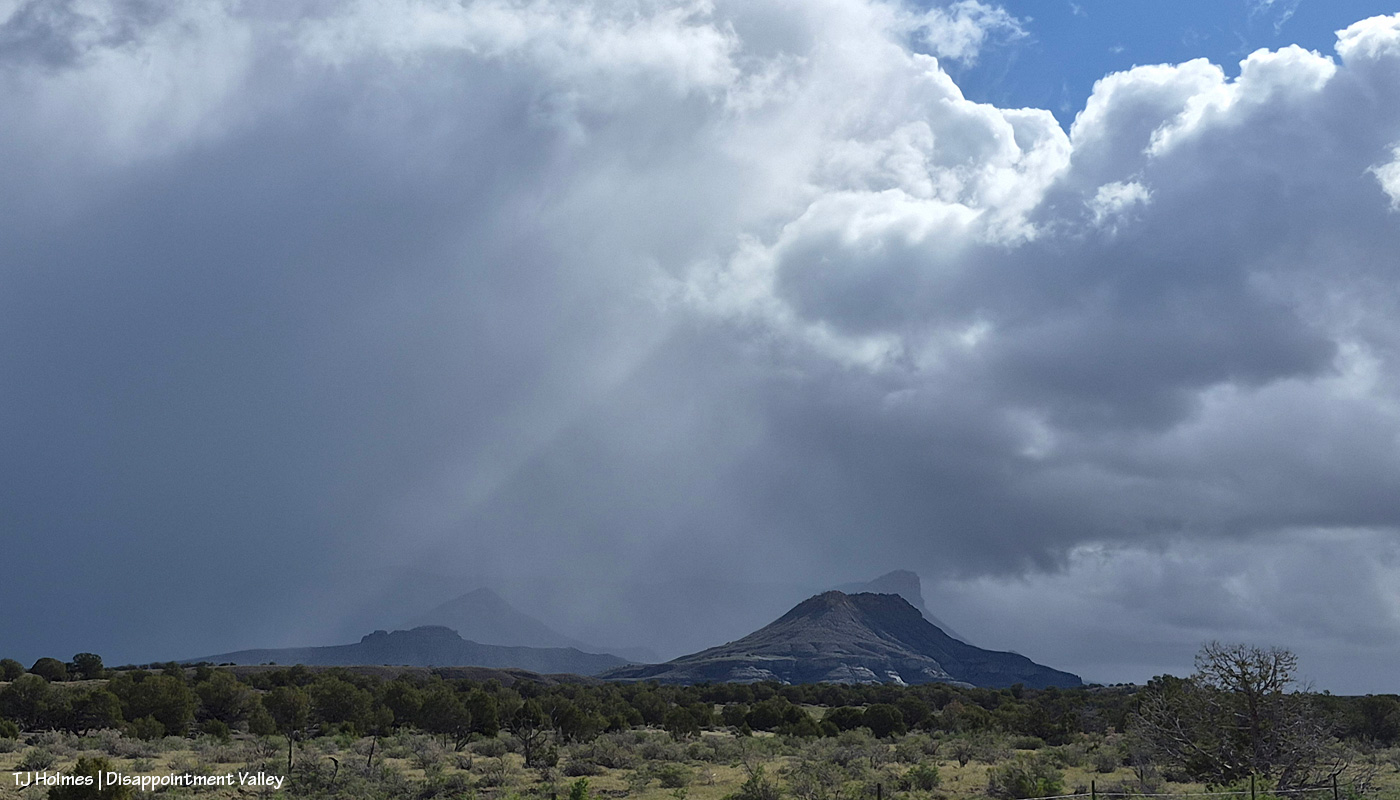
With Artemis II and its remarkable human beings on board, their mission, their accomplishments, the images they sent back, from space looking home, in mind … and realizing the absolute tiny-ness of this one itty-bitty part of our great, wide, wild, wonderful, big blue marble … ain’t Earth gorgeous? Now you can see Temple Butte’s promontory emerging from behind Brumley Point (see the graupel/moisture evidence shining below its rimrocks?) and submarine ridge and McKenna Peak. And though you can’t see them in this pic, there were two groups of mustangs out there. Across the road and on the other side of that fence IS Spring Creek Basin.
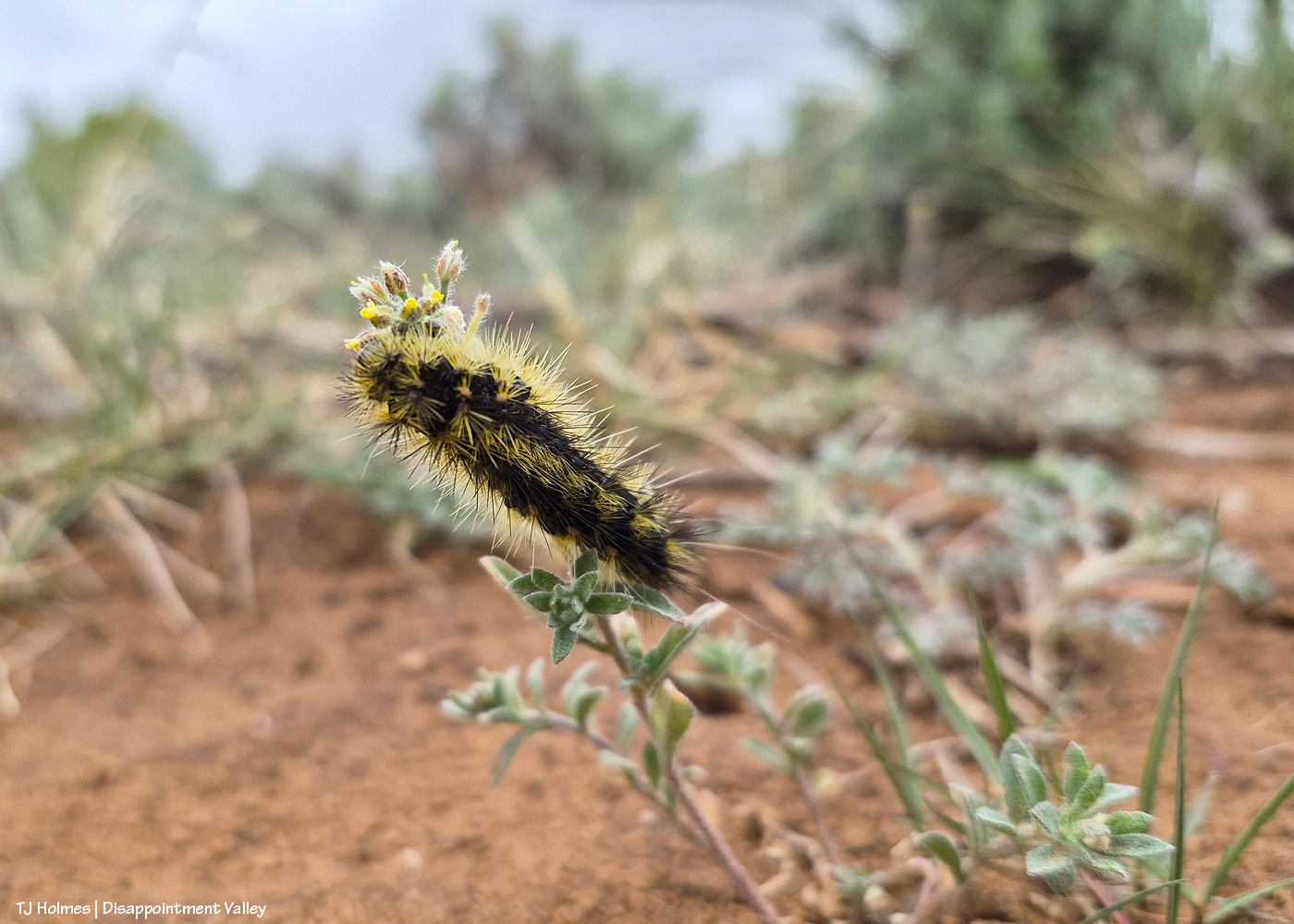
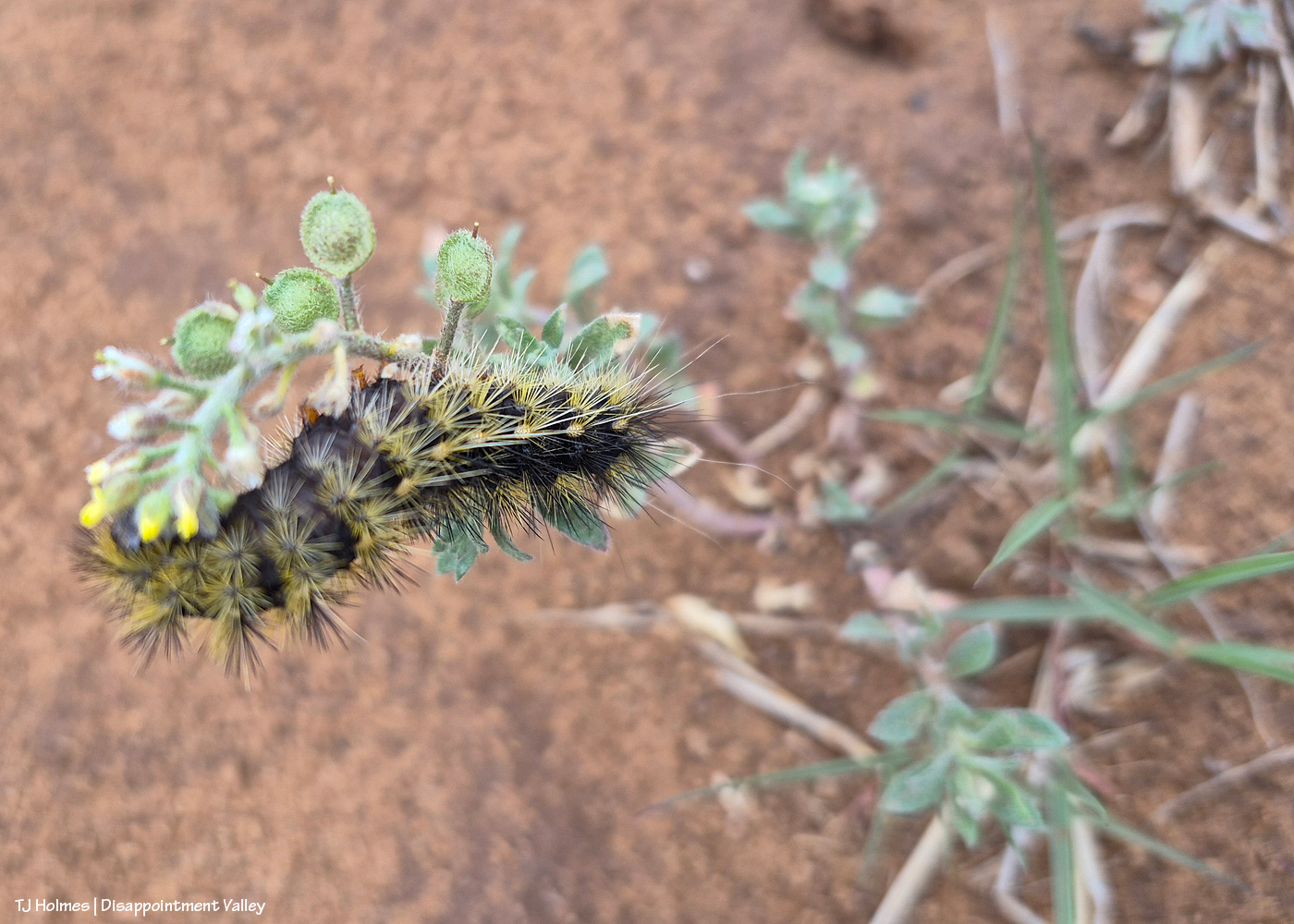
Anybody know what this prickly little caterpillar is called? I’m not sure of the plant it’s on, either.
I tried a lot, but I could NOT get the eye end (far left – is that an eye?) in focus. Of course, I didn’t know that in the field, not having my eyeball glasses on and looking through the glare of my phone screen, but I did try a number of shots with high hopes. One of our BLM range guys recently posted a pic of the same caterpillar, but he’s a plant guy (and an extraordinarily awesome one), not a bug guy, so I’m sure he can tell me the plant, if not the bug (!). If I reach him for an ID before this posts (or even after), I’ll update.
** Update from Ryan, BLM rangeland management specialist and all-around plant guy!:
“Cool that you’re seeing the same caterpillar! [He saw the same kind recently in Canyons of the Ancients National Monument, southwest of Spring Creek Basin.] I’m very curious as to what species of butterfly/moth they will turn into, I’m not good at insect ID but will ask Nate West [BLM wildlife biologist]. The plant that those are on is a mustard species called Alyssum simplex, commonly just called madwort. It’s a pretty prevalent non-native annual that is really common around here, unfortunately. It’s a beautiful picture of the hair-structure on the caterpillar!” Thanks, Ryan!
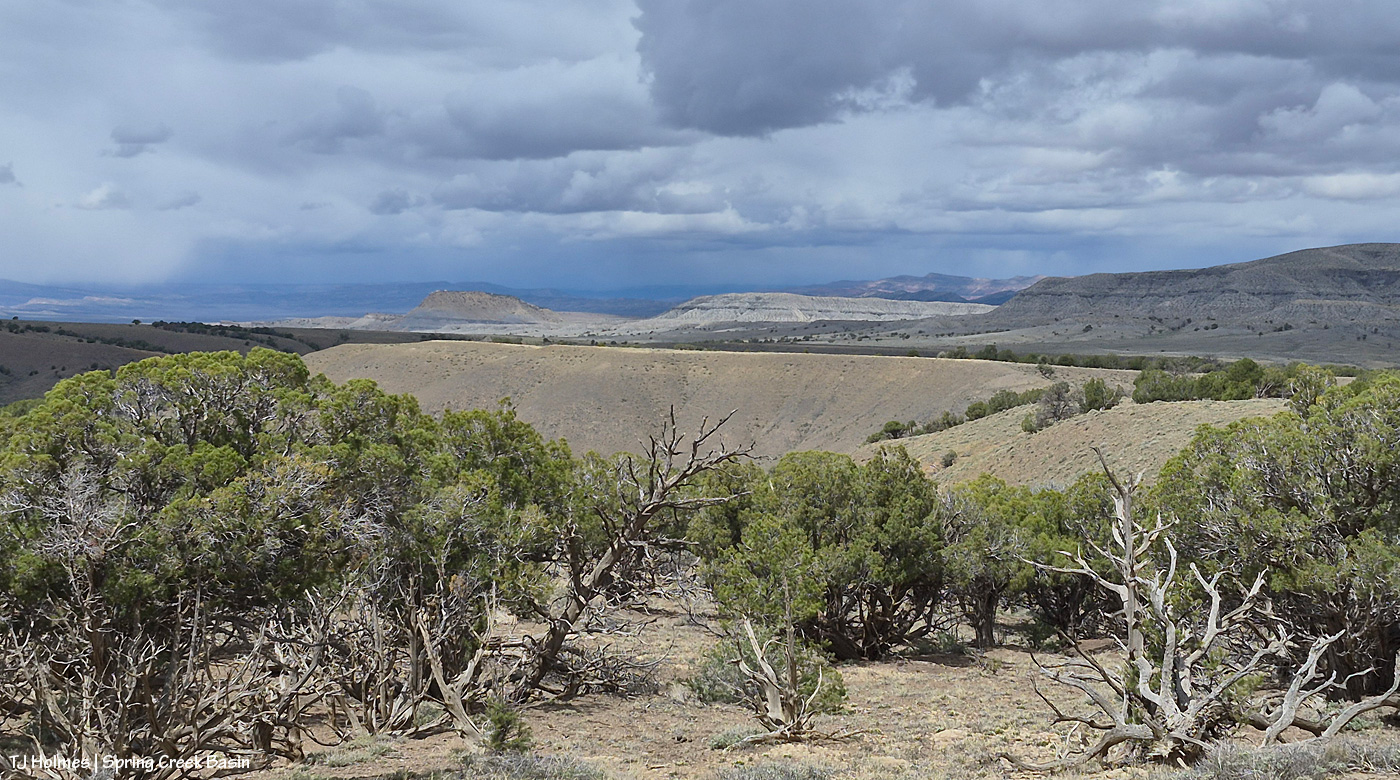
The reason you can’t see Utah’s La Sal Mountains in this pic – way northwest of Spring Creek Basin, from the very far southeastern part of Spring Creek Basin – is because the rain/graupel/snow wasn’t through sending waves over them. 🙂 You CAN see, from right to left, Round Top, Flat Top (looks sloping), Filly Peak and the south-facing rimrocks. Disappointment Road is over to the left somewhere (not far)
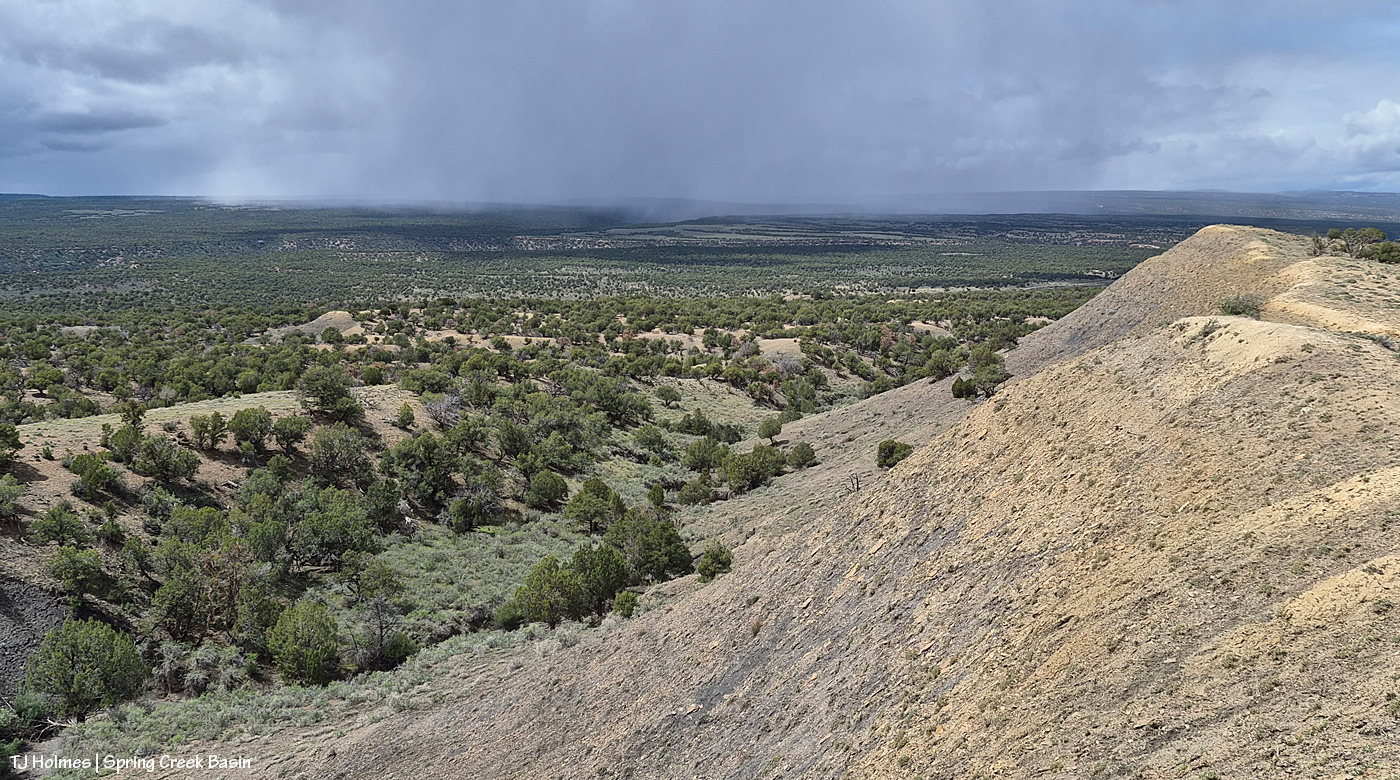
From here, we’re looking over not much of the southern part of Spring Creek Basin Herd Management Area (the pic above this one has a perspective to the right of this one) but a lot of the south/southwestern part of Disappointment Valley (most but not all of the pinon-juniper woodlands as far as the eye can see). The near pinon-juniper is within Spring Creek Basin.
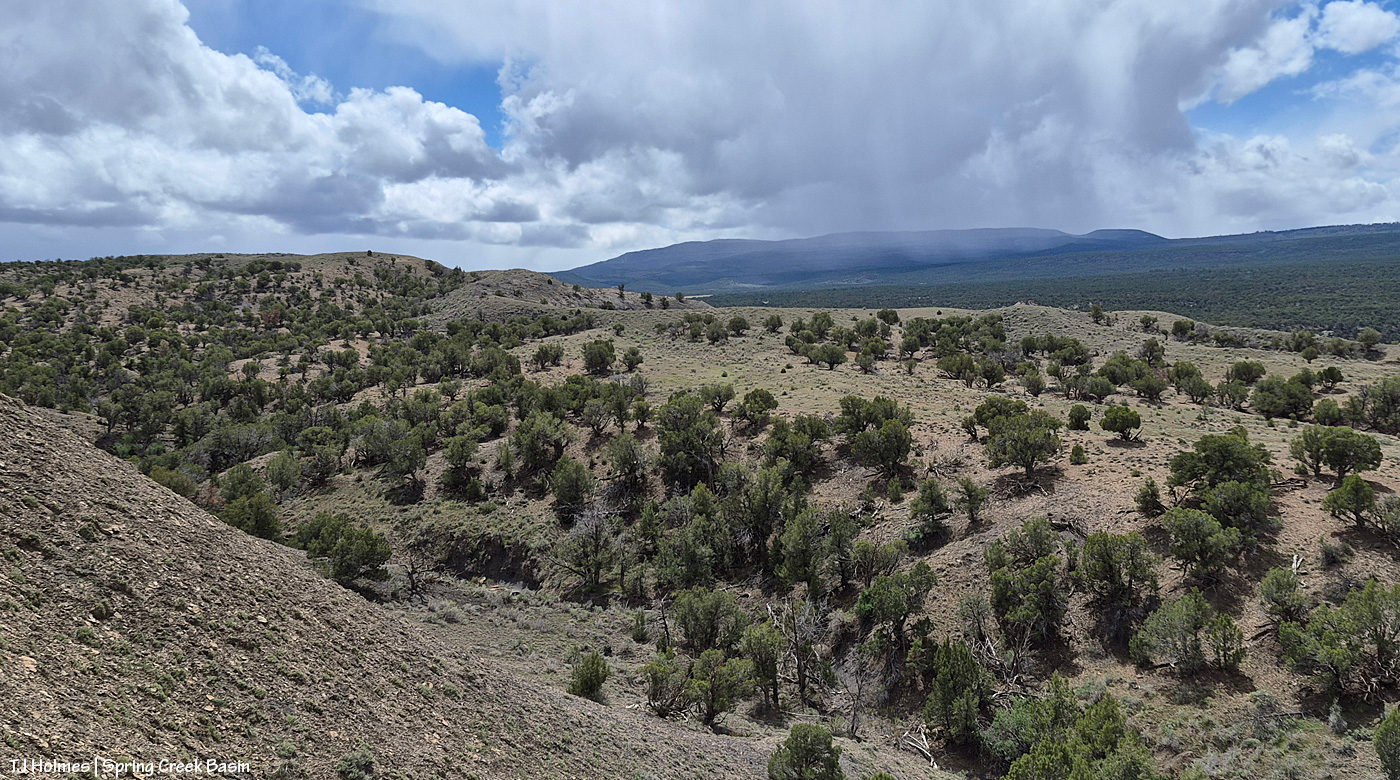
From the same spot now looking back to the south/southeast at another little rain/snow/graupel-fall, toward the Glade and Benchmark Lookout (hi, Rick and Linda! (I think they’re not at the fire lookout tower quite yet)). The near hills and pinon-juniper are all within Spring Creek Basin. The far, thickly treed ridges are partly (middle-ish ground) part of upper Disappointment Valley and partly (farther) part of San Juan National Forest lands beyond Disappointment Valley and its watershed.
And what the heck was I doing at the high end of a long drop? See the horse trail? 🙂 I was following where the sure-footed have gone before me (and not for the first time).
The above are in order of how I took them … hours apart from first to last.
And because you came here for the mustangs …
Mysterium, modeling her scruffy-chic look (fashion designers, take note – ha!) below Temple Butte. 🙂 Yes, those are a couple of cuts on the inside of her left hind leg, but she’ll heal quickly, as mustangs do!
Thanks, as always, for coming along for glimpses of this special world. 🙂
If you don’t like snakes, this post is not for you. Important note: No snake or human was harmed either hiking past or in the taking of these pix. 🙂
I’ve been looking for a particular band for about a week now. They showed up … then they disappeared again. That’s not unusual; even in only-22,000-acre Spring Creek Basin, there are lots of places for the ponies to roam out of sight of human eyes (and given the high ATV/UTV activity lately, including terrible, destructive off-road behavior, much better for them). But I was curious: Were they going south and taking advantage of the pond below/south of Round Top … or were they going deep east and taking advantage of the east-pocket pond? I’d seen water glinting in the RT pond a couple of weeks ago, but because of the very rough road and lack of loop access (because of bad washouts), I don’t often go back as far as the east pocket anymore (which is too bad because it’s one of my favorite areas of the basin).
So curiosity led to a hike up to the tip-top of Round Top. … From the bottom, I always say, “I’ll just go to the ‘bench’ and look from there … and then, if I don’t see anybody, I’ll complete the trek up to the top.” So that’s what I did. … You know I didn’t see anybody from the bench (well, I did see one band, but I knew where to look for them) and had to go all the way up. 🙂 It’s not a bad hike, and it’s really not long, and it does lift you high above the basin and gives TREMENDOUS views, and I love it up there. So I really need to do it more often. (According to my Strava details, it’s only 1.46 miles up and back, with an elevation gain of almost 360 feet, which included my brief stroll around the top to glass.)
I like to go to the different directions at the top – amazingly, it’s not that big – sit and glass. Not only is it fun to look for mustangs, but I like to reminisce about all the hikes I’ve done here, there and (almost) everywhere to find and get to them!
So I’d done my looking, and I’d even done some seeing of various bands that I’d already seen from “ground level.” But I didn’t see the particular band I wanted to see. To be fair, the view to the south is a lot more wide open than to the north/east/northeastish, so I was pretty sure they weren’t south at all.
The hike is enough of an exertion that you want to take your time at the top, and I’ve learned that if I *wait* and don’t get too impatient, something – or somebodies – might reveal itself or themselves.
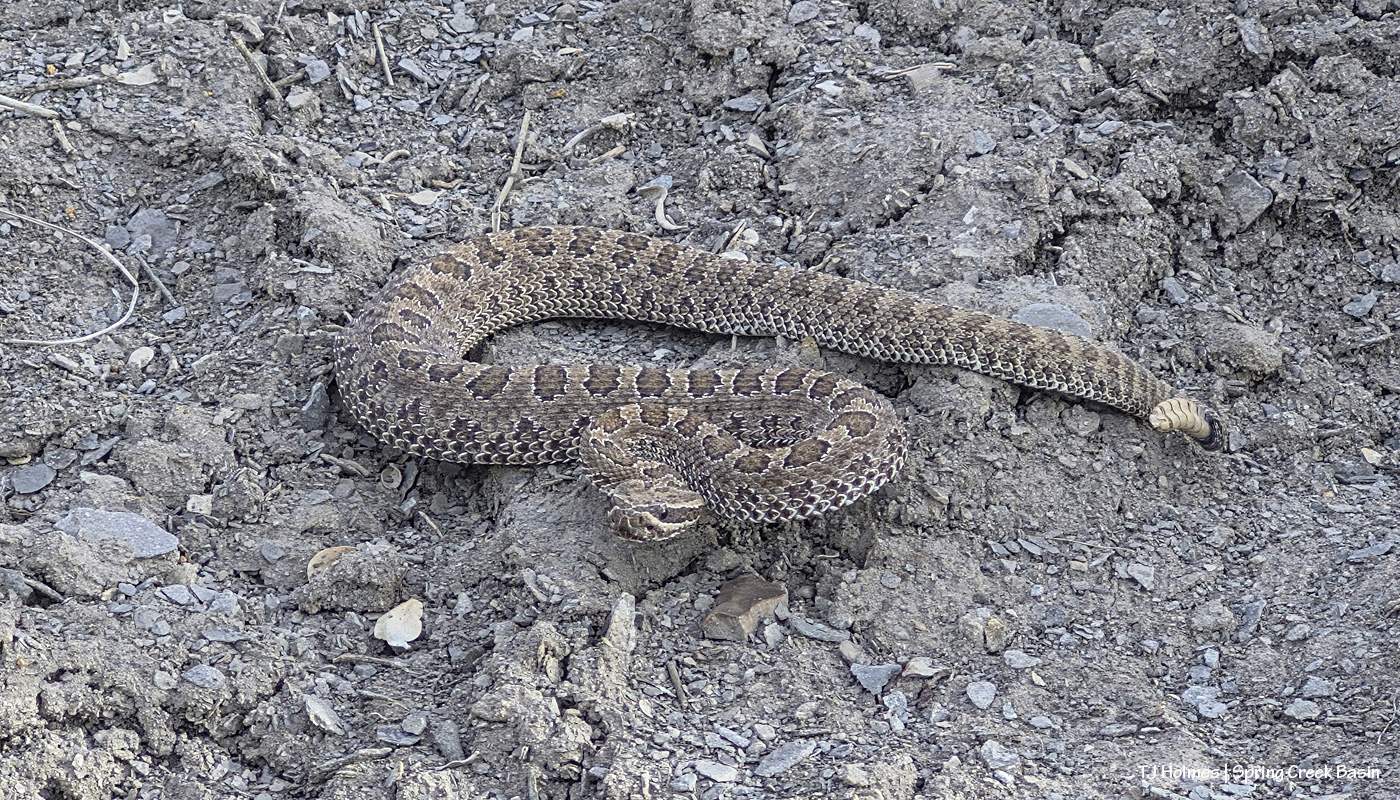
Bingo. 🙂 I had stood up and stepped a few steps when I looked back *one last time*. It’s always that *one last time* when you see what you want to see! Way up in the east pocket. Boom; ponies. So I started the trek back down, half-running, eyes glued to the trail so I didn’t miss my footing. … I was within 40 yards (?) of the end of the trail and end of the road (which is where the trail starts, and this is a horse/deer/elk trail, not a trail-trail) when I heard the soft rattle.
It took a moment for the sound to reach my ears, to reach my brain, for my brain to process it, for me to stop my thoughts-elsewhere forward rush and to look back at the bush (small, a four-wing saltbush, maybe) I’d just passed. Was it entwined around the base? Uh, no. Then I spotted it. (I think I’ve written enough to warn you if you’re at all snake-squeamish??)
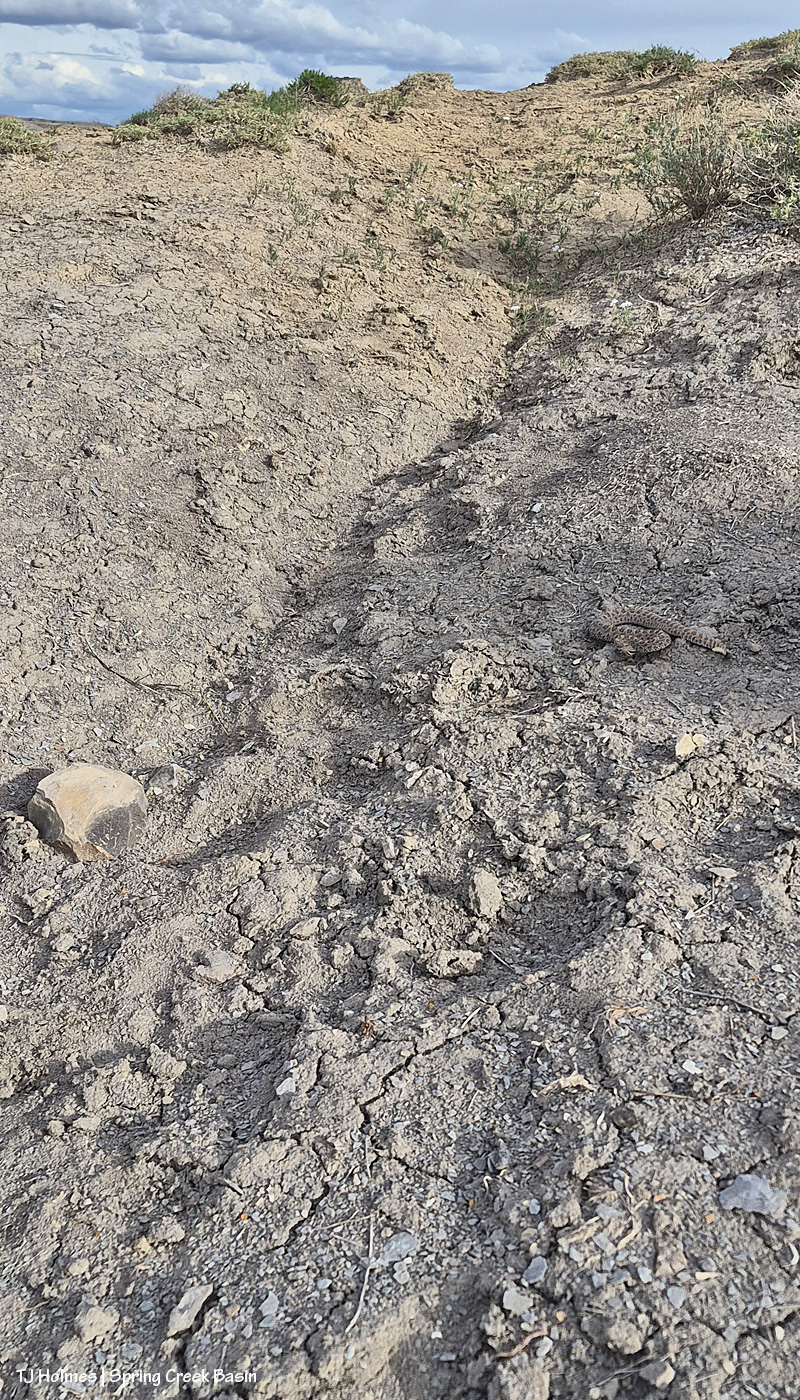
Do you see it?
The trail here looks more like a bit of an erosion channel than what most people think of as a *trail*. The pic is looking UP the trail – the trailhead (so to speak) is about 40 yards behind me – and I had come DOWN the trail. The bush isn’t included in this pic, but you can see the faint shadow of it over the rattler. The rock is immediately on the left side of the trail.
Because I was on a scouting mission to the top of Round Top, I had taken my binocs but not my camera, with its very long, very safe lens. So I took a pic first from “behind” the snake.
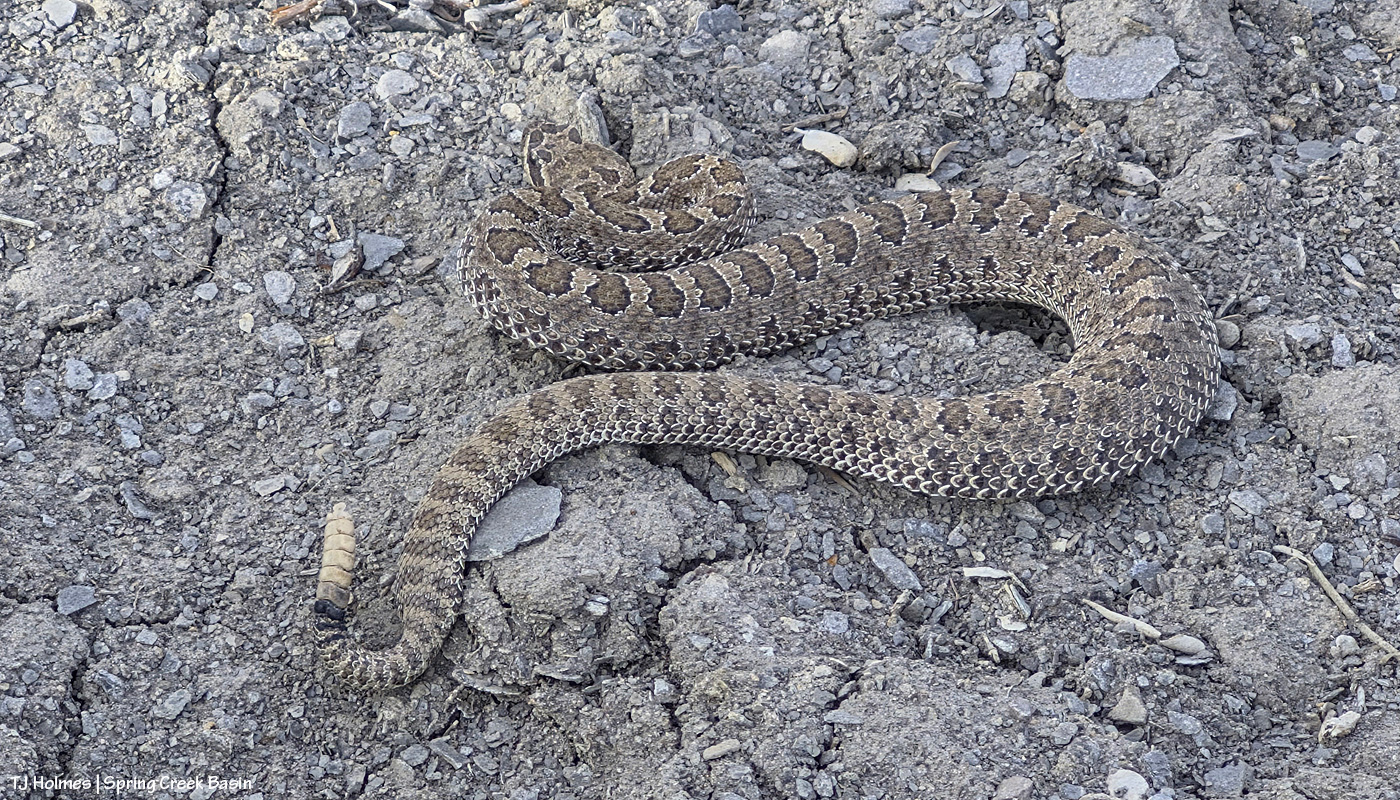
It seemed pretty relaxed, so I chanced a front version (you know, you CAN also zoom in with your phone camera!).
Interestingly about our little rattlers out here, you can see by its buttons that it’s not a super young snake. What you really maybe can’t tell from the pix (and no, I wasn’t going to put my hand out for a side-by-side comparison! oh, you silly readers! :)) is that it probably wasn’t more than a foot long. The rock in the first pic is bigger than my two fists held together.
What we have are the midget faded rattlesnakes (“western rattlesnakes”) or faded midget rattlesnakes (the recovering copy editor in me can’t stand non-consistent identifications! Looking at you, CPW). Check out this link to information from Colorado Parks and Wildlife … or this one from the Southeastern Hot Herp Society, written by an undergraduate student at Oklahoma State University. I was particularly interested in this little tidbit from the latter article: “The venom of the Midget Faded Rattlesnake is composed of a much higher neurotoxin than one would assume. … In fact concolor is the most toxic out of the (Western Rattlesnake clade, Crotalus oreganus).”
To paraphrase my dad (who likes bears): DO NOT MOLEST THE MIDGET FADED WESTERN RATTLESNAKES!
Seriously. I love them … from afar. 🙂 And in my experience, they are very (anthropomorphism alert) forgiving of random, idiot humans who nearly step on them in a brainless rush. … Pay attention out there. Every wild being and wild place deserves respect.
And because my day had an extremely happy ending, I’ll end it with this:
What an ending, right? 🙂 (And yes, I did find the ponies, and they’ll grace the blog in future posts.)
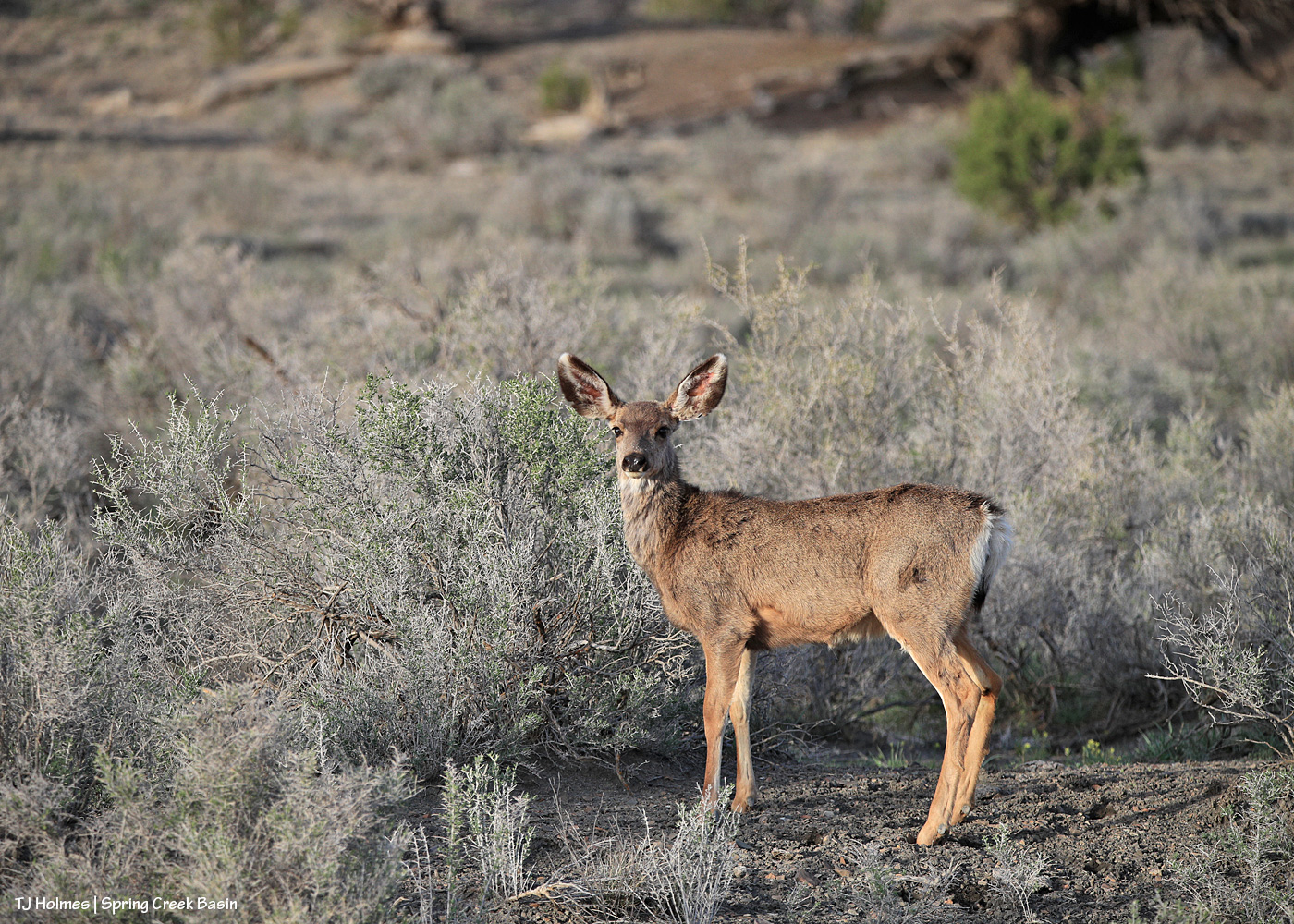
Wait, that’s not a mustang, I hear you thinking. 🙂 Correct! That’s a young mule deer, and s/he starts the journey of this particular blog post (which doesn’t include a mustang in sight). S/he was, in fact, inside Spring Creek Basin Herd Management Area, and I was on the road.
But let’s back up a moment.
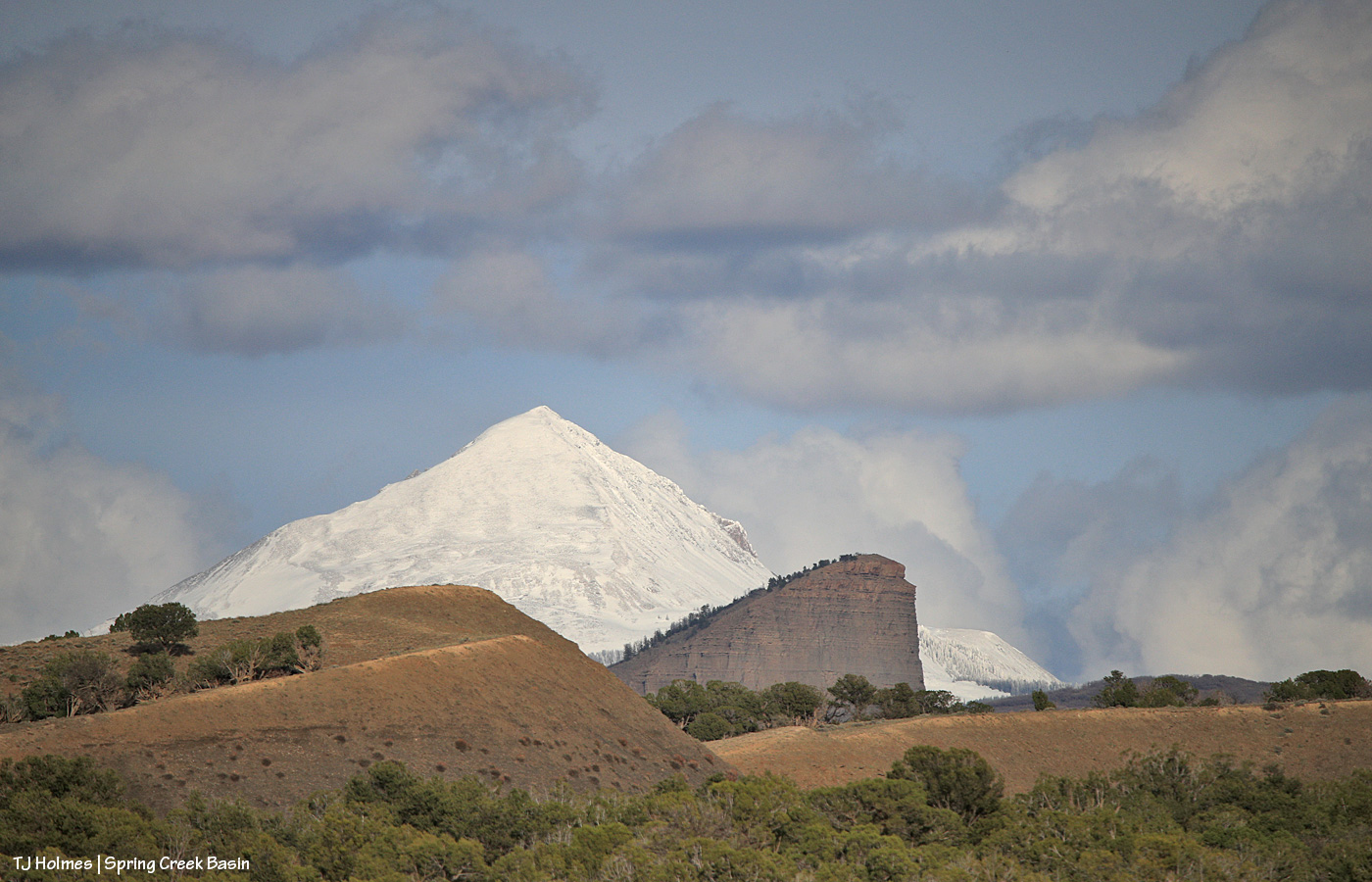
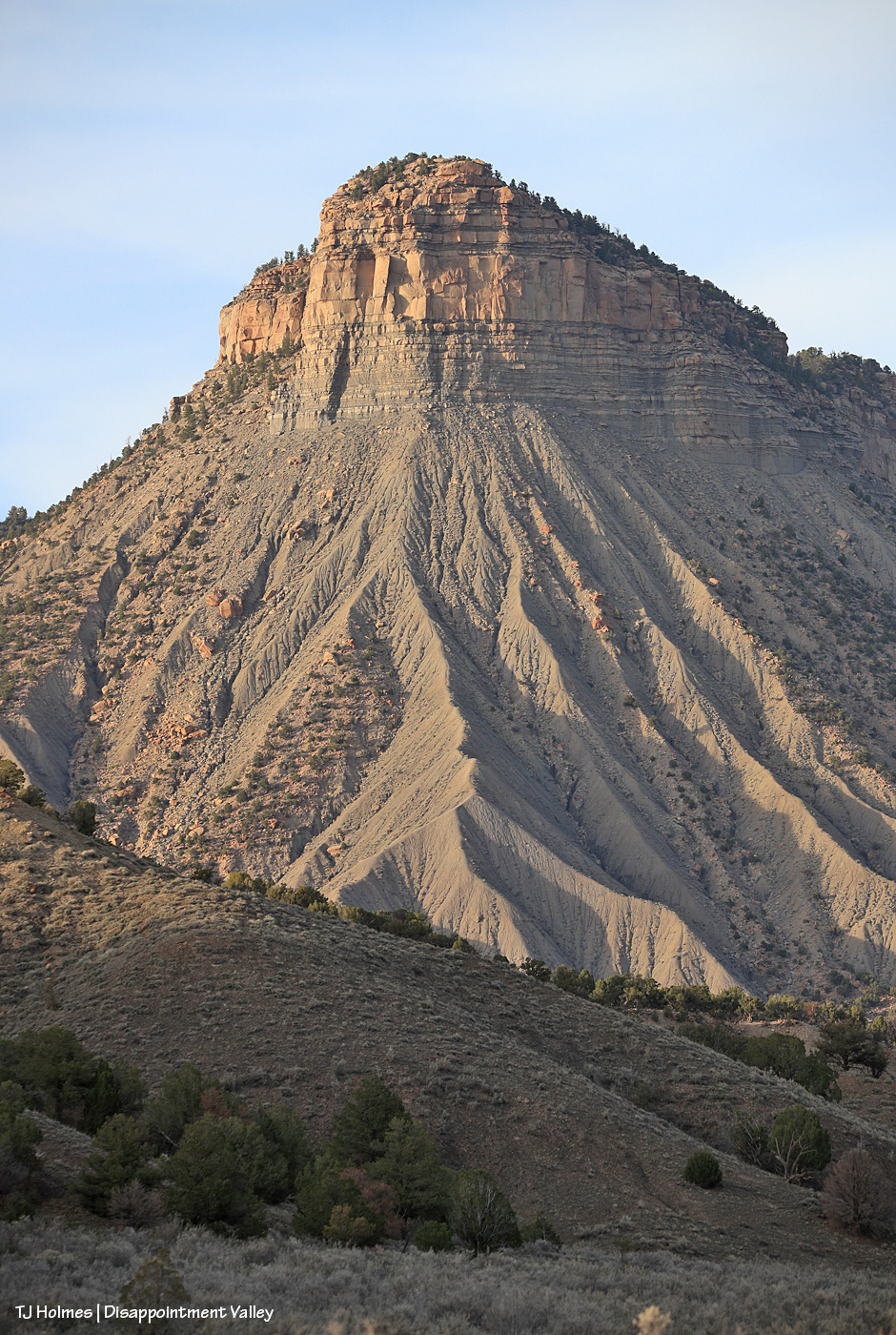
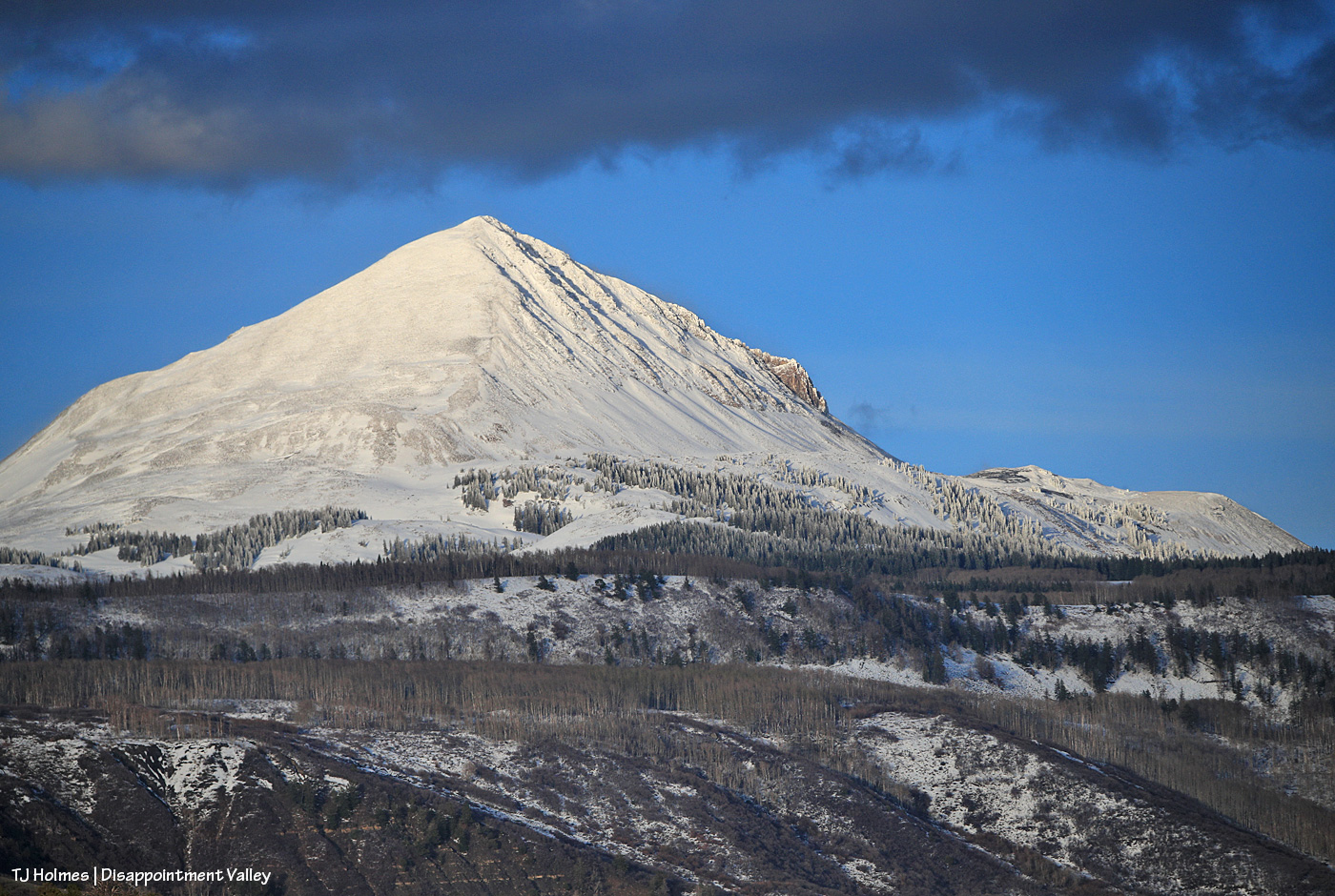
This is where my short trip up-Disappointment-Valley actually started: Seeing snow completely covering nearby Lone Cone from just within the southern part of Spring Creek Basin (not quite as far south/southeast as the mule deer). Except for the very southern area, Lone Cone isn’t visible from most of the basin. (And that promontory in the distance isn’t Temple Butte, which is closer and to my left out of frame.)
Much, most – all?? – of the region got blissful, sweet, rejuvenating rain (at least) on Wednesday. Obviously, higher elevations got some welcome snow. I write a lot about how dry it is in Disappointment Valley and, specifically, Spring Creek Basin. I’ve been writing a lot this “winter” about how dry it has been this past non-winter. It gives me no pleasure and a lot of terror to note that folks are now calling this the “worst [winter] on record,” according to The Colorado Sun. How bad is it?
So consider this post part education, part joy at seeing Lone Cone covered in snow (at least for a little while). The words or phrases in blue (and possibly underlined) indicate links to outside sources. It’s going to be a little bit of a long post, too (sorry to bury the lede!), so grab your brew of choice and come along with me – and also, I should tell you now that this spans back-to-back days, an evening (Thursday) and the following morning (Friday). You’ll see why as we follow the snow. 🙂
I love Temple Butte. I loved Pati Temple, for whom the butte is named. Previously and for several years, I called it the unnamed promontory, and because it was unnamed, officially, we were able to apply to the U.S. Geological Survey, five years after her passing, to start the process to honor Pati and her dedicated devotion to Spring Creek Basin’s mustangs. Huge thanks to Kat Wilder for coming up with “Temple Butte” as a name, and especially ginormous thanks to Ann Bond (retired from the U.S. Forest Service) for diving deep into the computer work to get that done – undying gratitude! Now it is *officially* Temple Butte, though it’s hard to find maps yet with it marked as such. Our new kiosk at the main western entrance to Spring Creek Basin has a map that shows it (thanks, BLM!!), but when I did a Google search, although I came up with other Temple Butte(s) (!), I found only this reference to ours. It’s a super cool sort of AI rendition of looking at the region as though you’re on top of the butte. Move the view around, and you can see numerous named points of view, including McKenna Peak and Brumley Point. I’ve never been atop either Temple Butte or McKenna Peak, or Brumley Point, though I’ve been way up its sides, but I imagine you can’t help but have noticed that Temple Butte and McKenna Peak (at least) favor heavily in a lot of my images of Spring Creek Basin’s mustangs from all over the basin. 😉
I continued driving up-valley. …
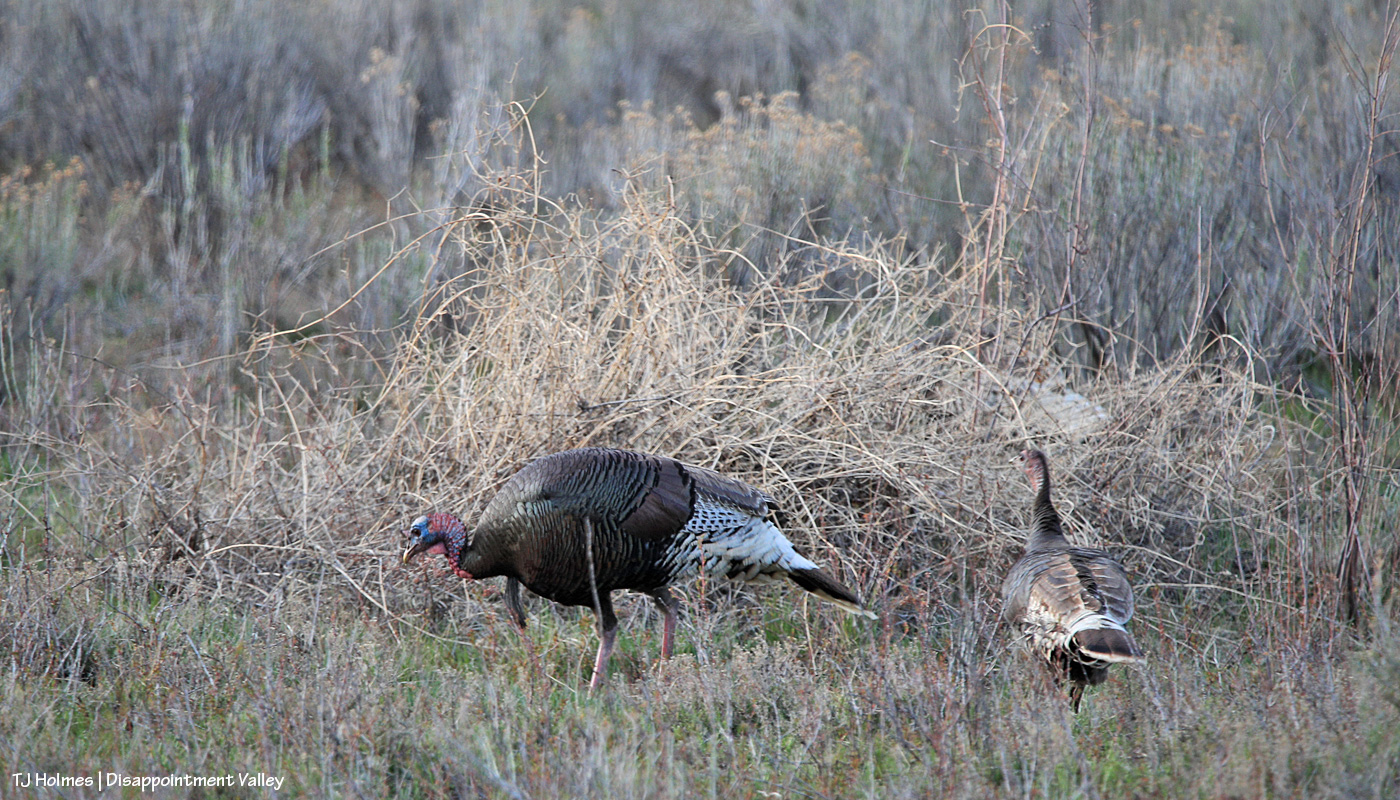
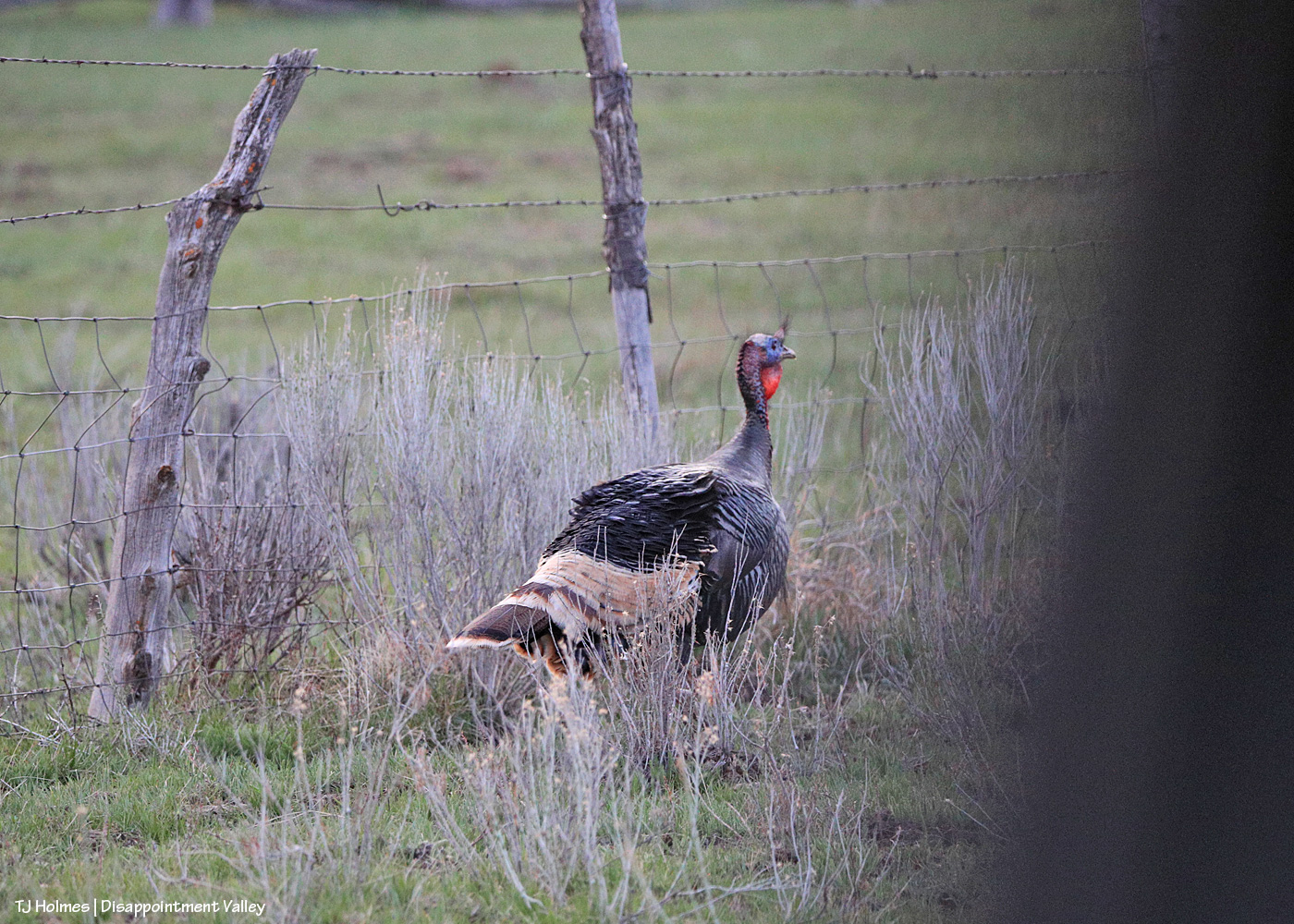
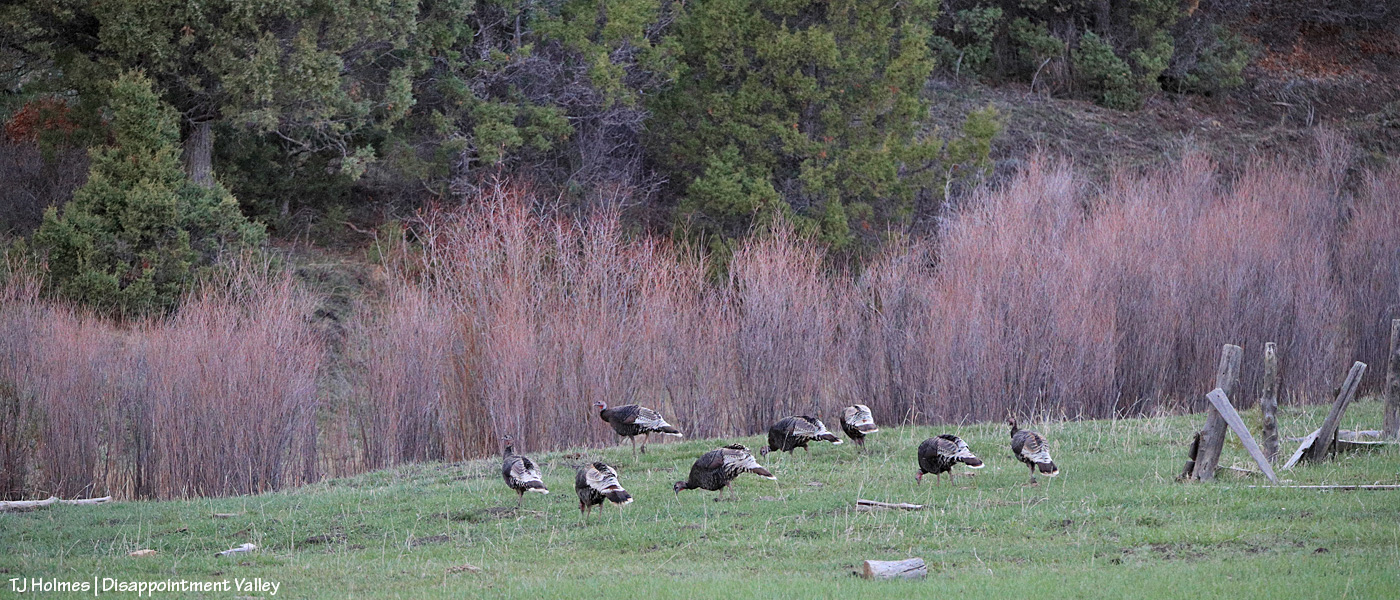
I was so surprised to see this flock of turkeys that I almost didn’t realize at first what I was seeing!
Question: Why are turkeys SO hard to photograph?? Even when I’ve seen them close, my pix of them are almost always blurry. You’d think that with a bird THAT huge, they’d be a cinch. … Yeah, but those tiny heads are, well, tiny! I do love that you can see the color in this tom’s head and some of the greenish iridescence of his gorgeous feathers. There might have been eight to 12 birds in this flock?
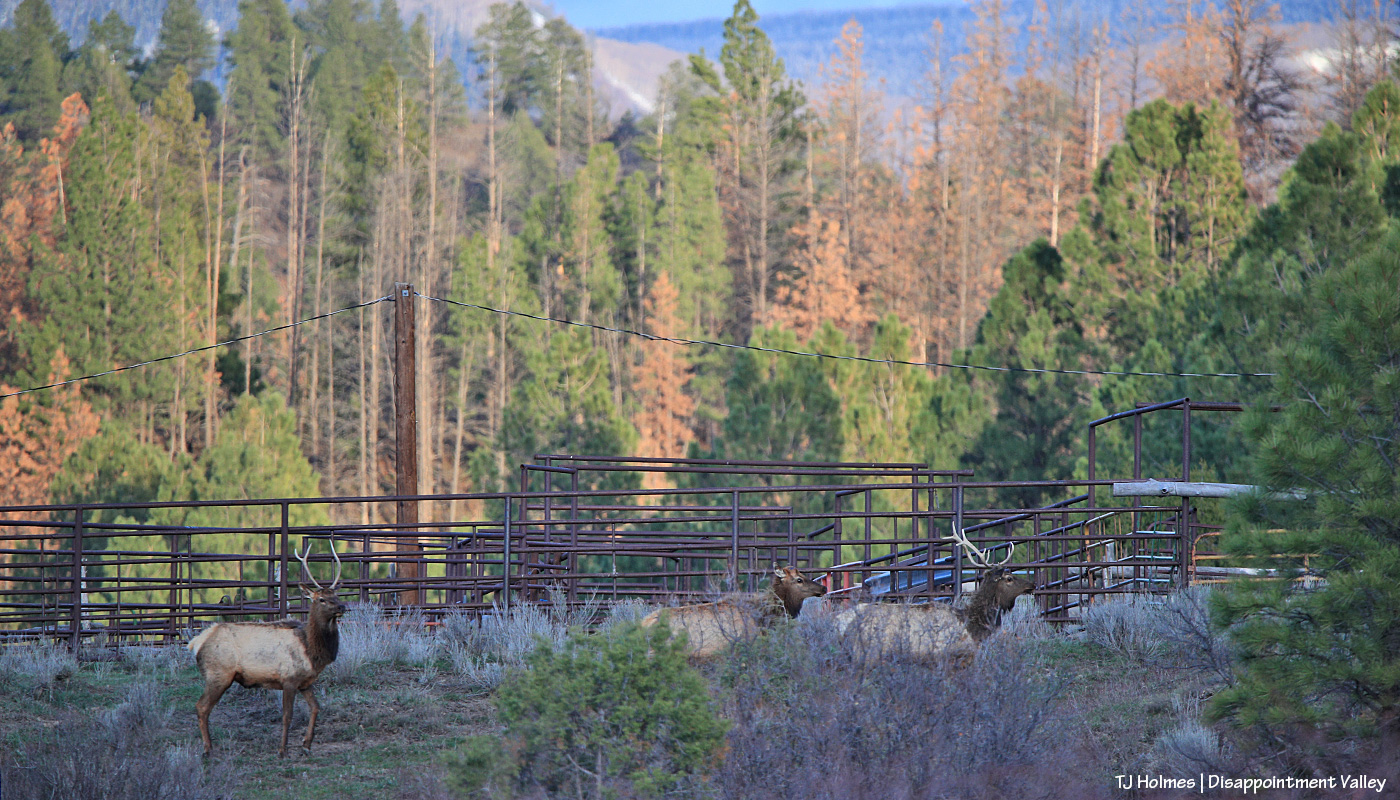
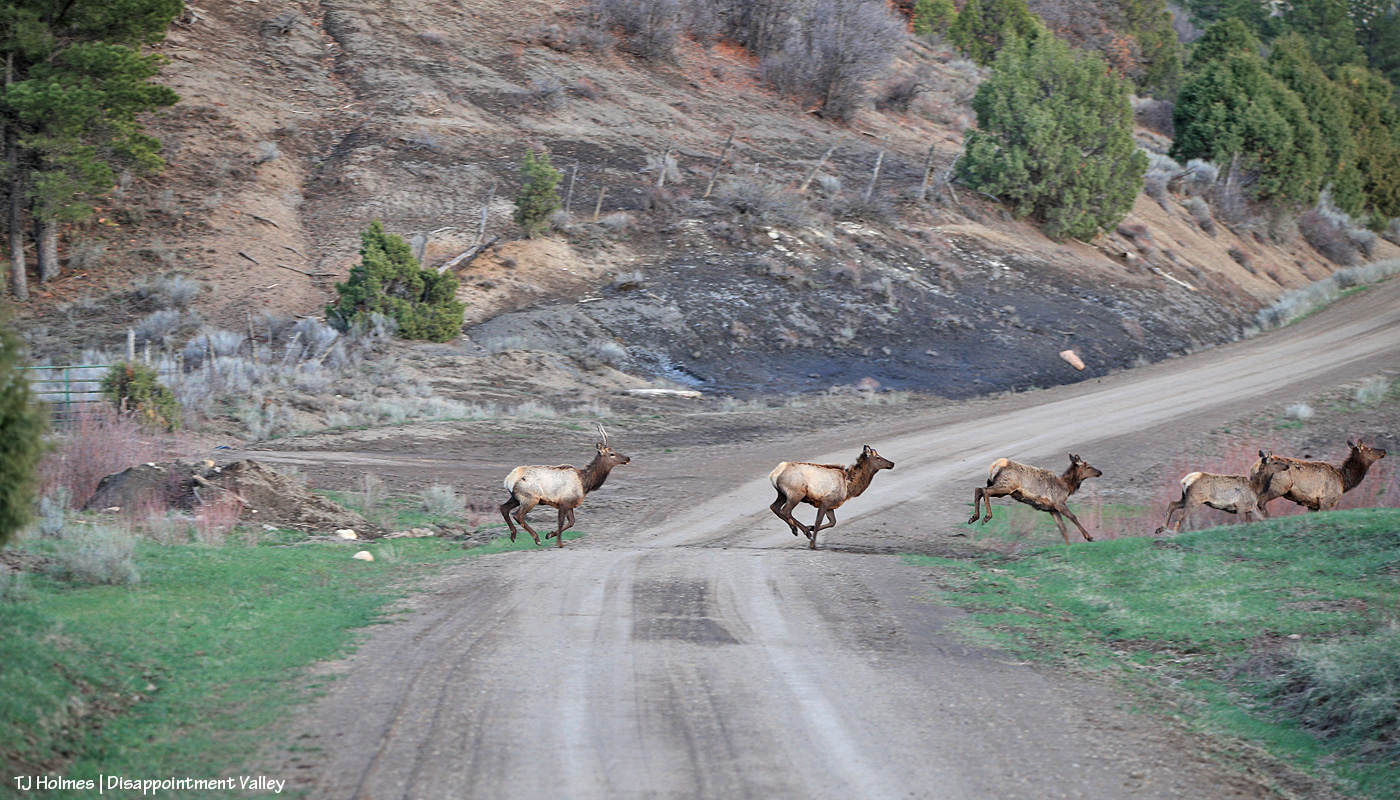
Not much farther, I stopped in the middle of the road and shot over the hood to try to catch these two young bull elk and a cow as they raced across the road and into the trees near some cattle pens belonging to up-valley neighbors. Note the “orange” pines in the background. Not even in Southwest Colorado are we escaping the deaths of ponderosas (and other conifers) across Colorado and the West because of drought and insects.
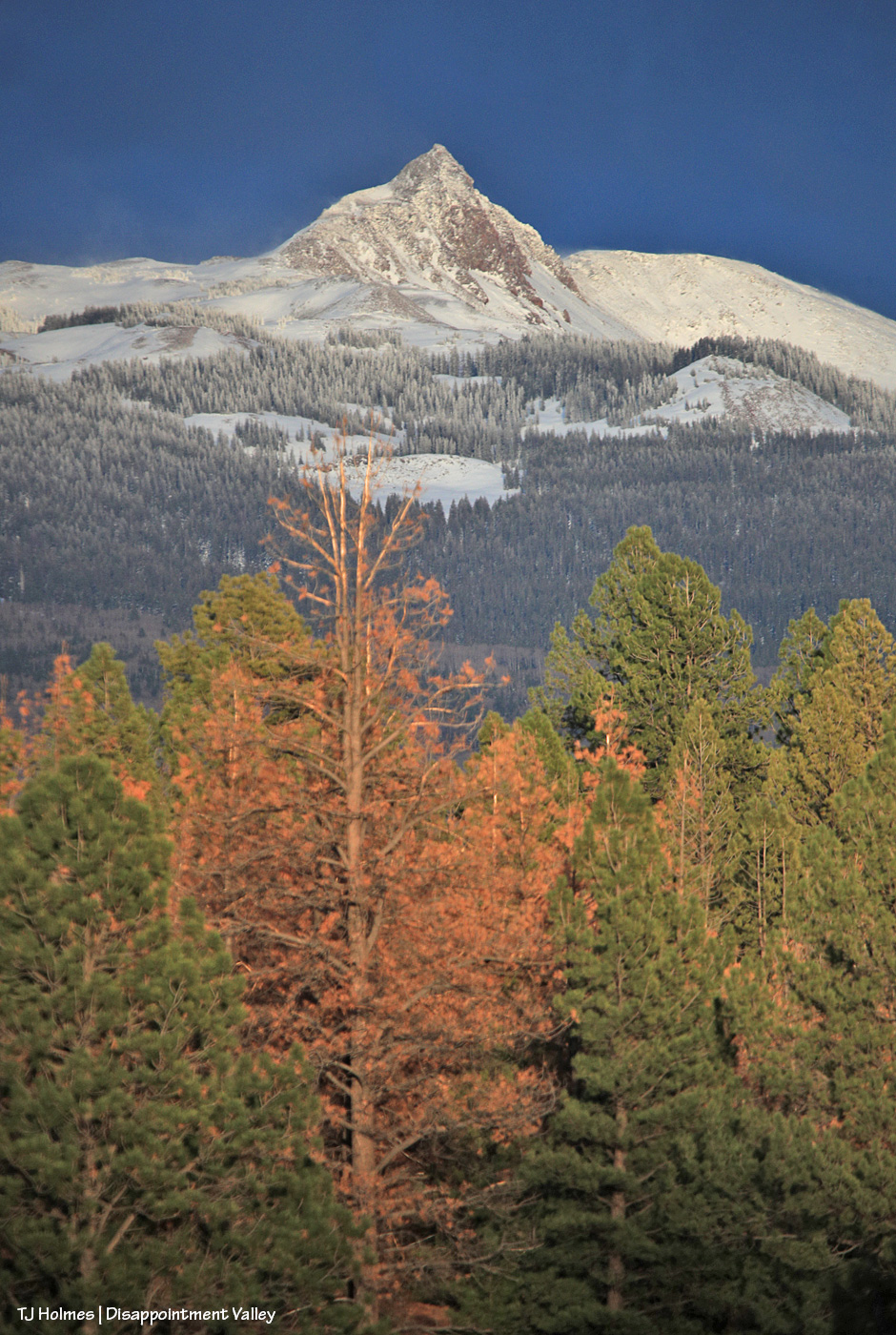
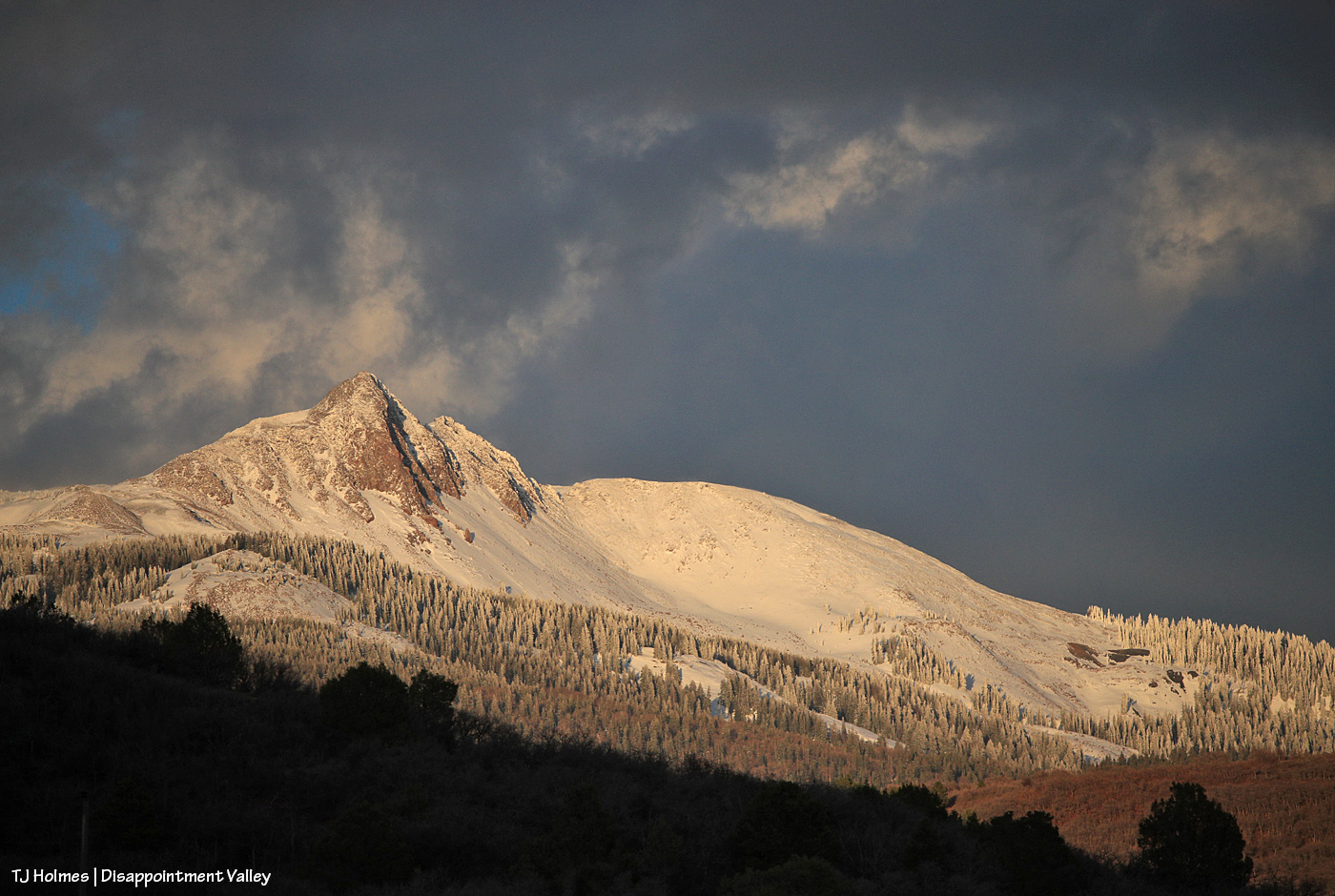
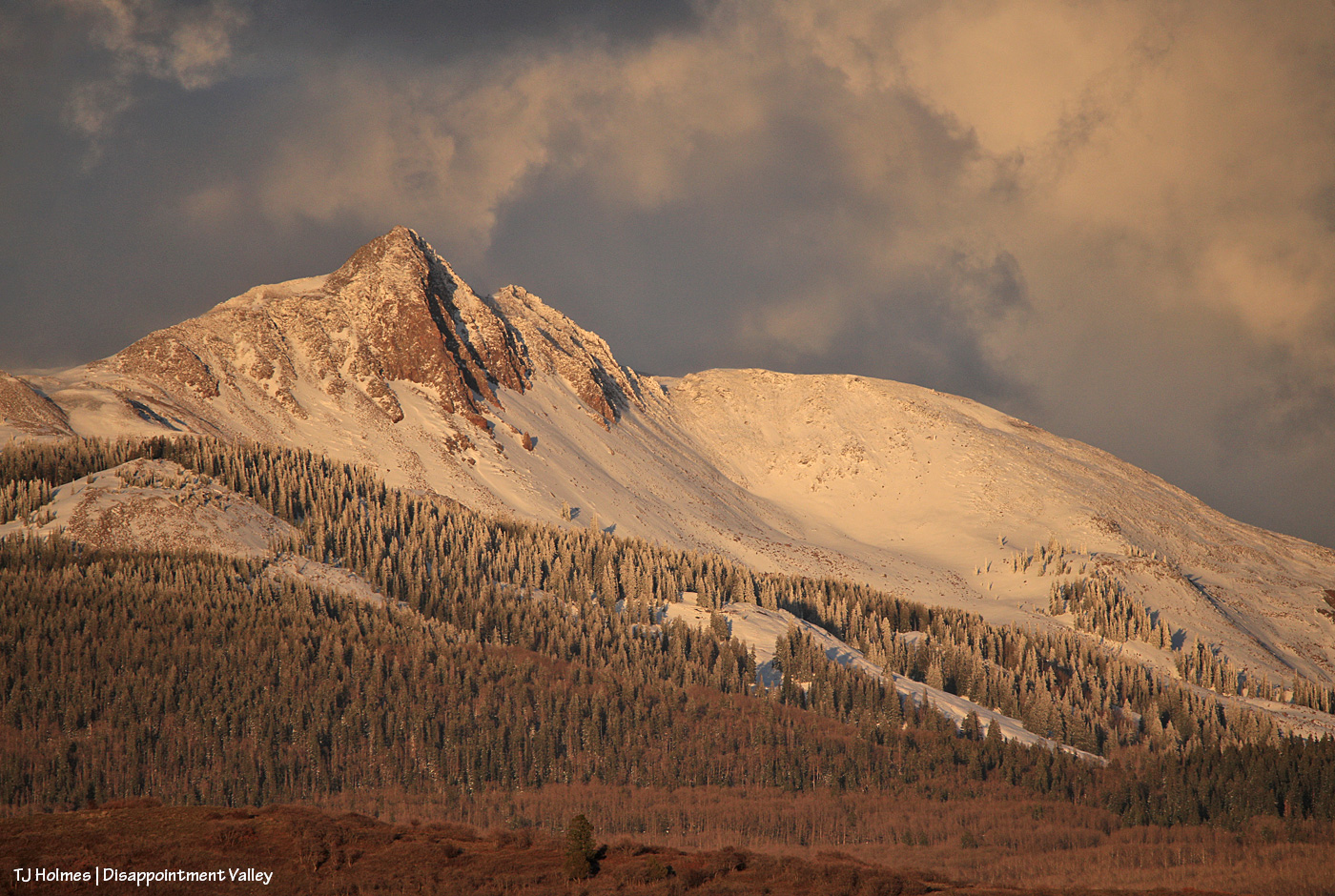
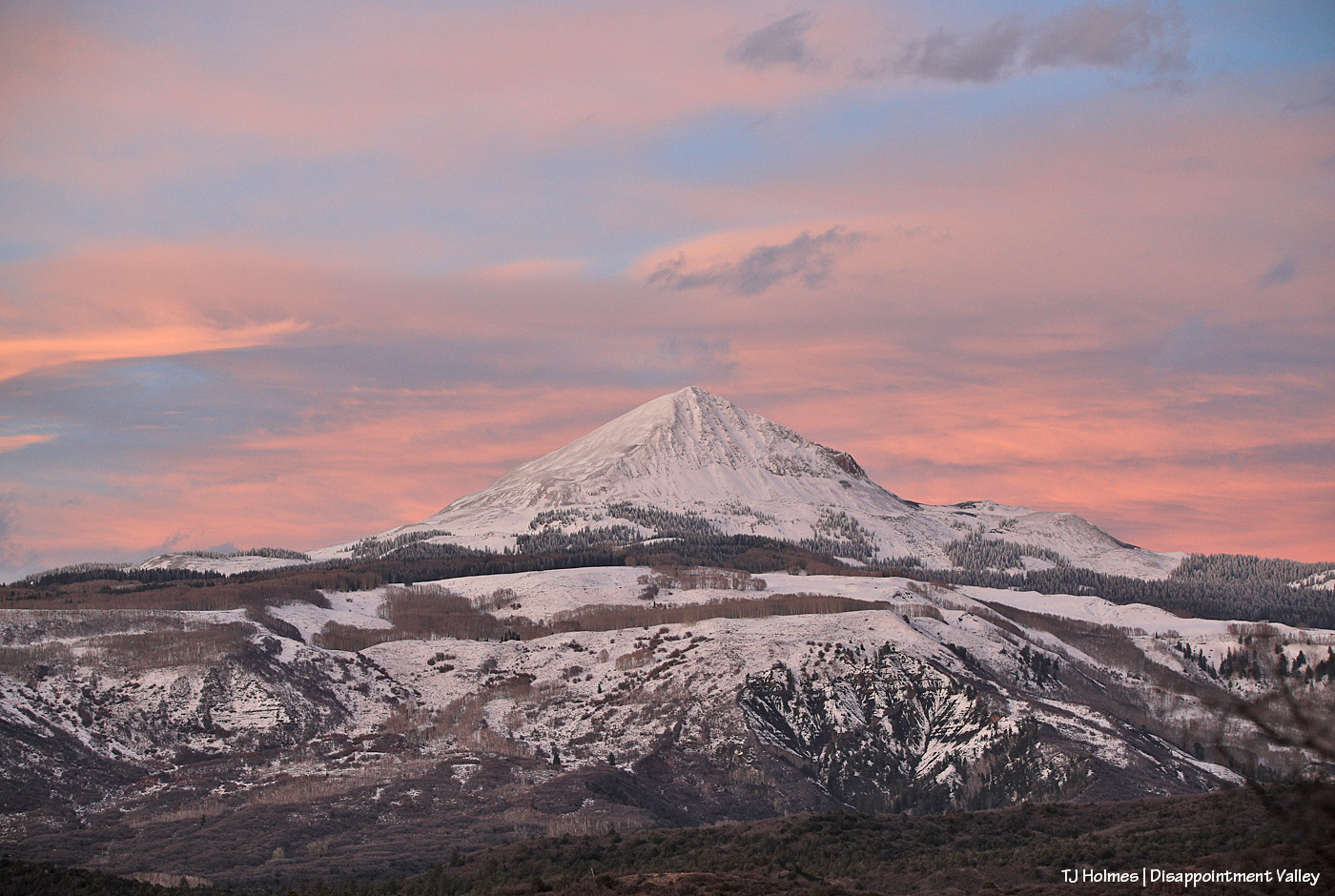
Thankfully, there also are many live ponderosas. At this point, way up-valley, I was starting to get amazing views of Groundhog Mountain. “Groundhog” in this neck of the woods generally refers more to Groundhog Reservoir, where there’s a store and rental cabins and a tiny community of summer cabins. From this view of Groundhog Mountain, those are over yonder on the other side. In the view above – and also of Lone Cone – I was fascinated to see that the trees on the lower shoulders of both mountains were still cloaked in snow. And if you look closely at the above image, you can see that crazy ol’ wind blowing snow from the peak.
Looks pretty wintry, eh? But I think you can tell, even from this distance, that the snow layer is thin. The lower stands of trees are aspen, which are only just beginning to bud and leaf out (depending on elevation; I did see a couple of small pockets of aspen wearing their brand-new bright-green spring leaves).
Traffic jam! Disappointment-Valley-style. 🙂 Look at that GREEN. GRASS!
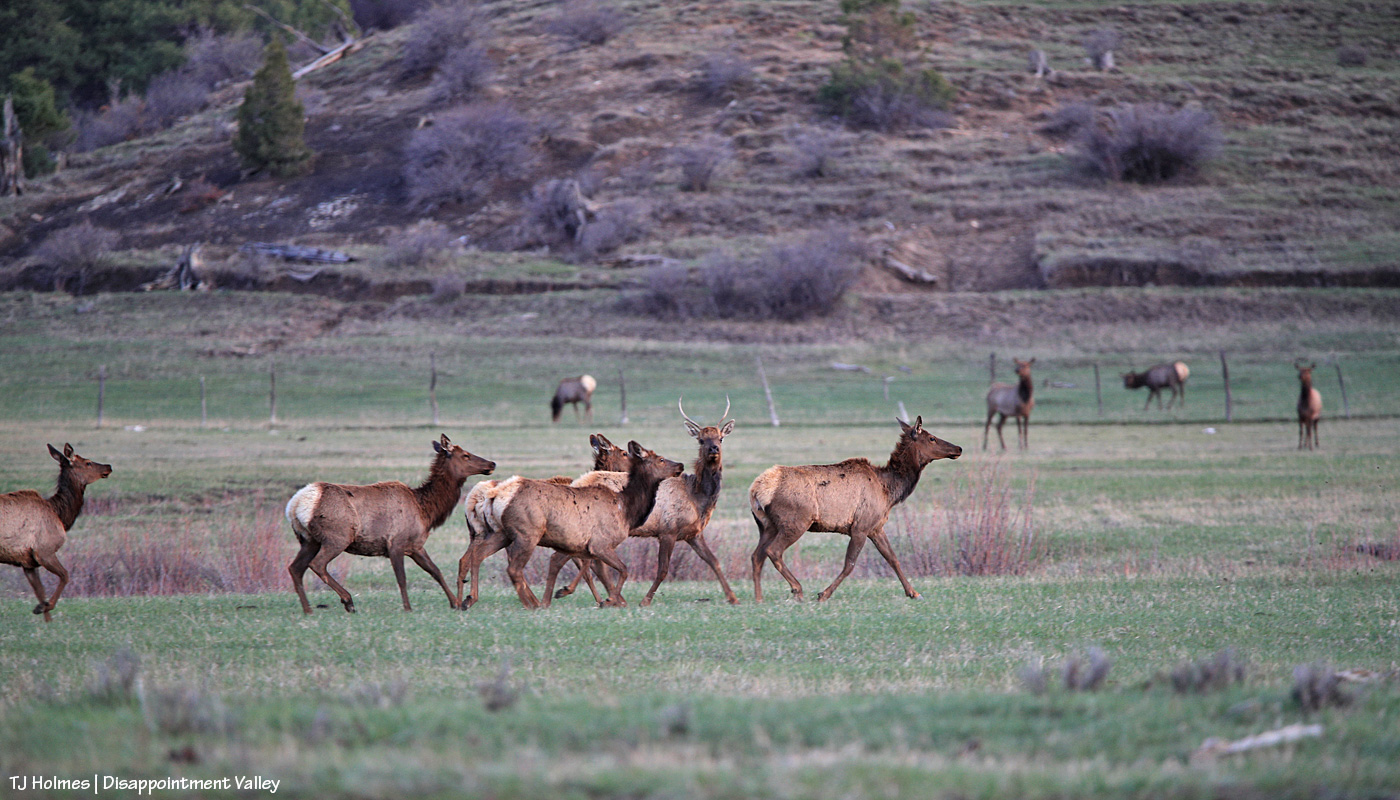
The elk didn’t cross the road to get to the green grass (there was plenty where they’d crossed from) but because the other side of the road features wide-open meadows and more of their friends and family. Almost all I saw in this crowd were cows and youngsters with some young bulls still hanging onto associations with mamas and aunties. There weren’t a huge number of them … fewer than 75, I’d guess.
What a contrast, right? The “ugly” head – but those colors! love! – with the absolutely gorgeous feathers. (The darkness at right is the back of my back truck window.) They’re also hard to photograph because they’re faster than you think they should be. This poor guy and another one were “stuck” on the road side of the fence …
… but they very quickly flapped and flew those big bodies over the fence to rejoin their flock. (I can’t get over how green it is up-valley. This is just several miles above the south end of Spring Creek Basin.)
The sun was quickly nearing the western horizon when I took this and the next couple of pix. Great timing, especially with some stormy clouds still swirling above and beyond Groundhog Mountain.
That light! That snow. 🙂 (You can see how not very far down it isn’t there at all.)
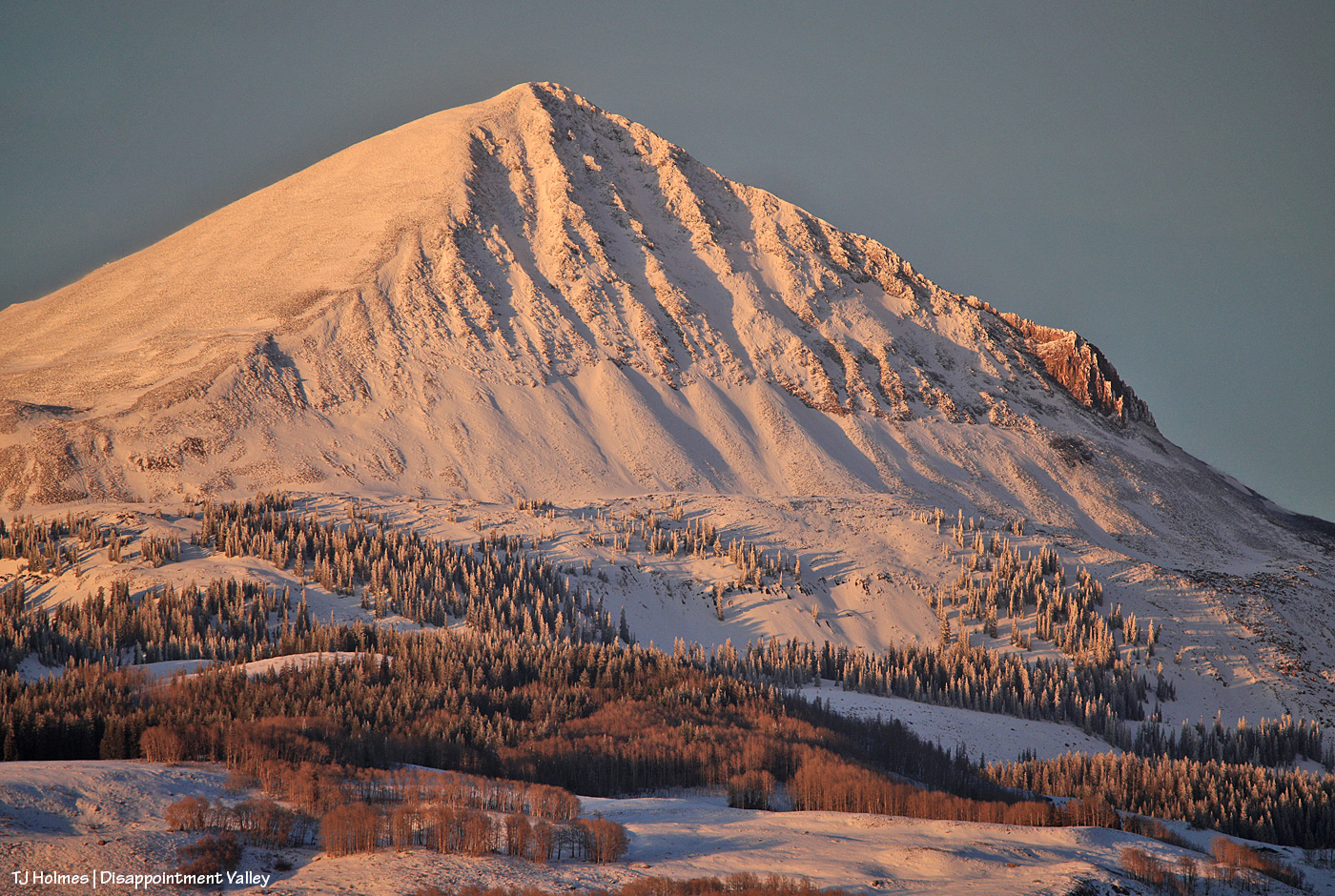
It’s still winter somewhere. 🙂 For a little bit longer. Lone Cone snow provides the water that eventually flows down Disappointment Creek, so the more snow, the better. That water doesn’t benefit the mustangs in Spring Creek Basin, but it benefits numerous other species of wildlife from way up high all the way to the canyons of the Dolores River at the far lower end of Disappointment Valley.
Admit it, you didn’t think it could get better. 🙂 When I first was at the upper end of the valley, the clouds were giving Groundhog Mountain the dramatic, bold light and color. This was pretty immediately post-sunset, and the clouds had drifted over to light up the sky above Lone Cone (Groundhog Mountain is farther to the right from this perspective). Um, WOW.
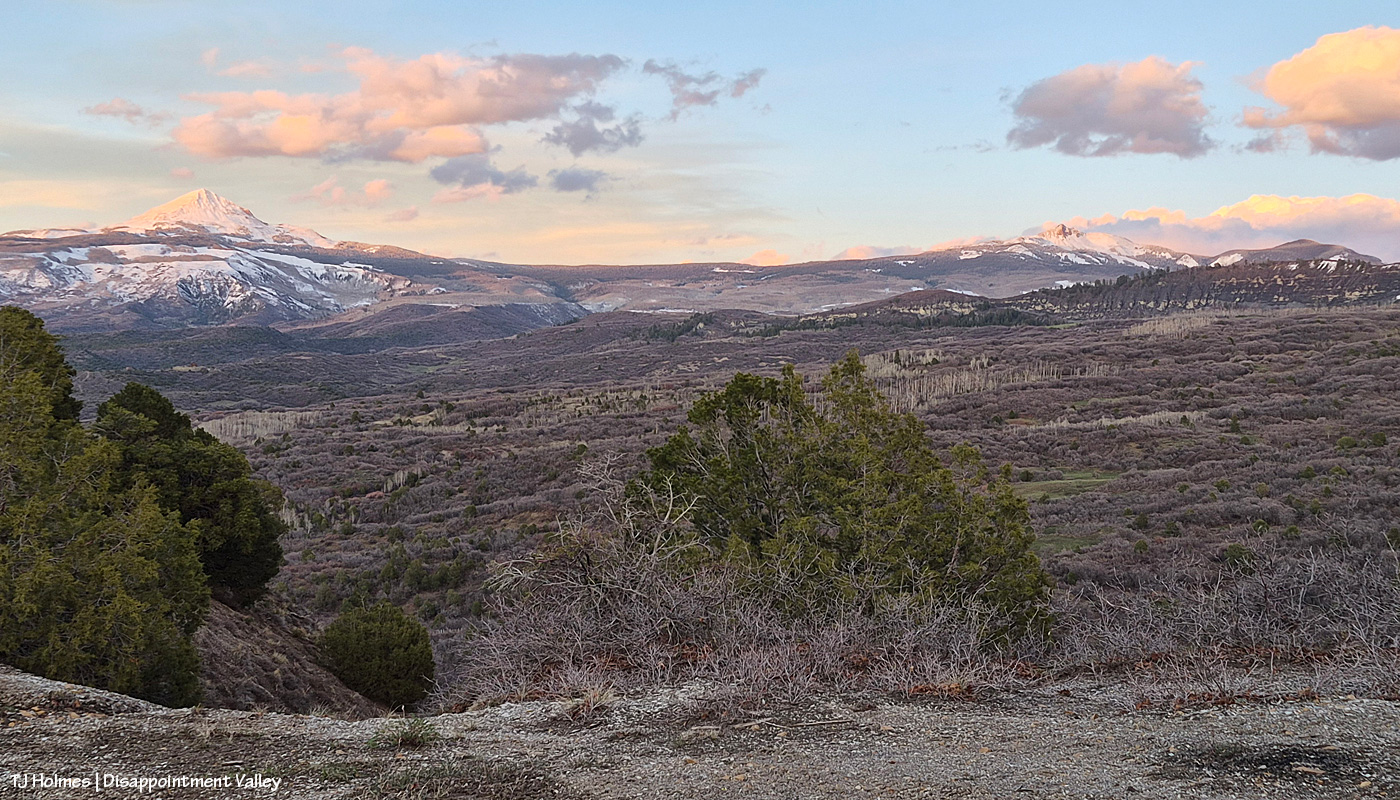
Here we go: A cellphone pic from the “lookout curve” on the switchbacks that lead up and out of Disappointment Valley on the Dolores-Norwood Road (toward Dolores) shows Lone Cone at left and Groundhog Mountain at right at just about last light. I couldn’t have timed that better (the curve was my ultimate destination) if I’d tried (and I did!).
Then it was a down-valley drive as the light faded. Fortunately, though I watched hard, no kamikaze elk or turkeys (or even deer) shared the road with me. I missed full-moonrise this month because of the weather (if you think I’m complaining, please allow me to reiterate my eternal gratitude for the mostly daylong rainfall!!!), and although there were some colorful clouds, they were mostly drifting along the horizons by dark, so I thought maybe I’d get to see the night-after-full-moonrise from farther down-valley. …
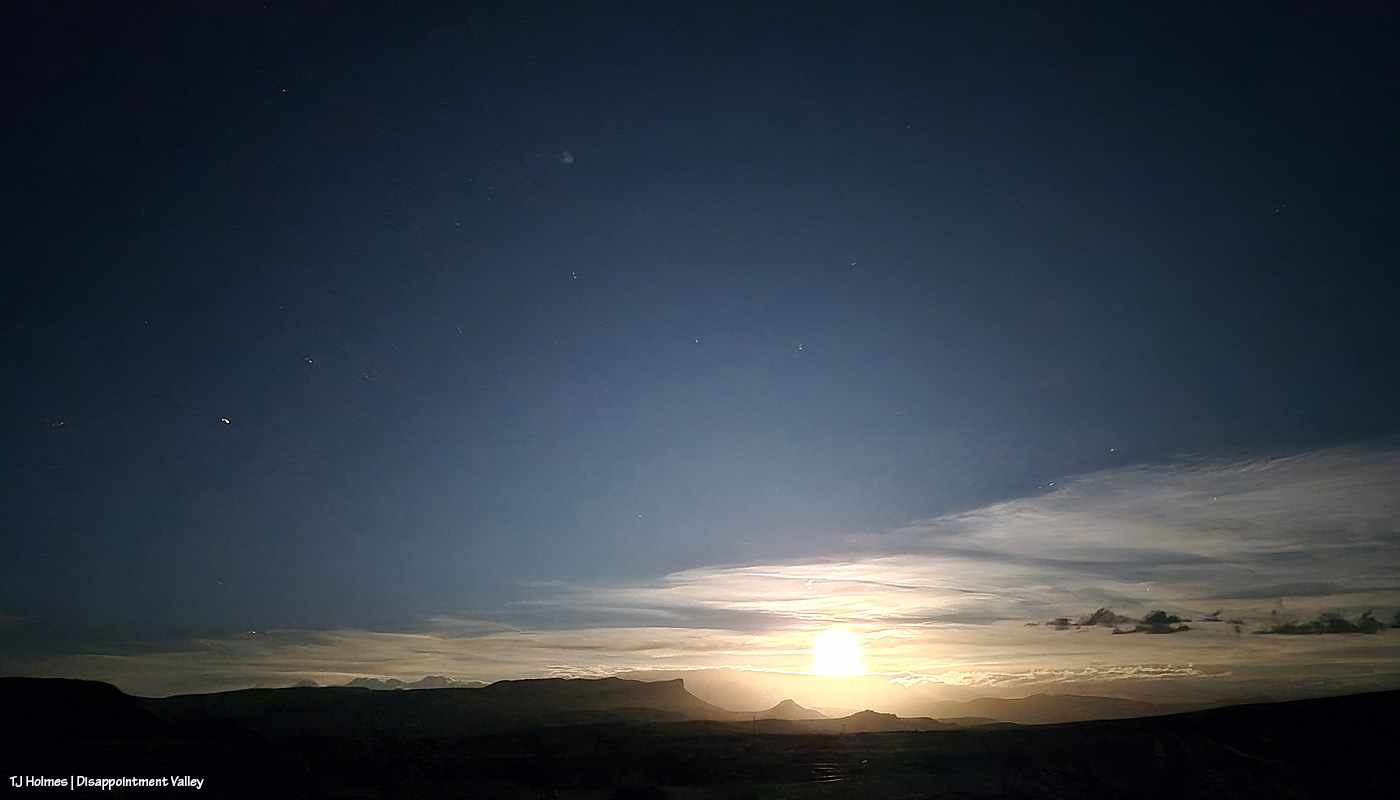
This is from my phone (!): Moonrise over Disappointment Valley. WoWoWoWoW!!!
It took a bit for the moon to clear the horizon clouds, but holy wow. You can clearly see Temple Butte and Brumley Point under the glow of the moon. While I’m sure the view of space FROM space (lookin’ at ya’ll, Artemis II astronauts!) is, ahem, otherworldly, I kinda think the above is pretty damn cool (and from my *phone*!). This might be my favorite image from the entire day/night.
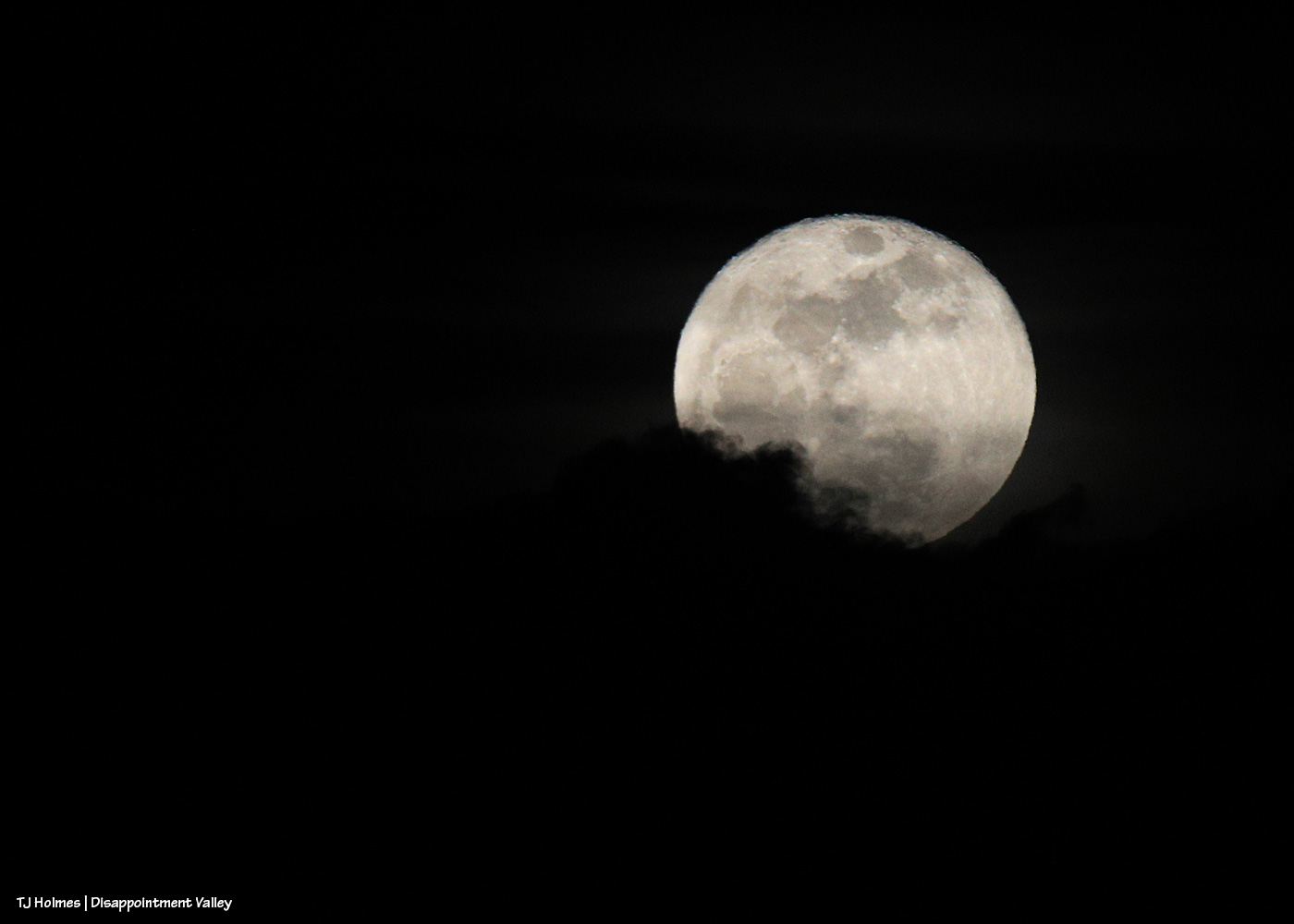
Because I couldn’t resist trying to capture it with my camera, too. 🙂 Those are clouds at lower left as the moon was rising out of the cloud bank.
What a day, right?! And that was literally just about the last three hours of it.
And then the next morning came. … My phone’s weather app’s radar showed spots of snow over Disappointment Valley. Oh, you liar, thought I (because it so usually does lie). … And then I went out into the world.
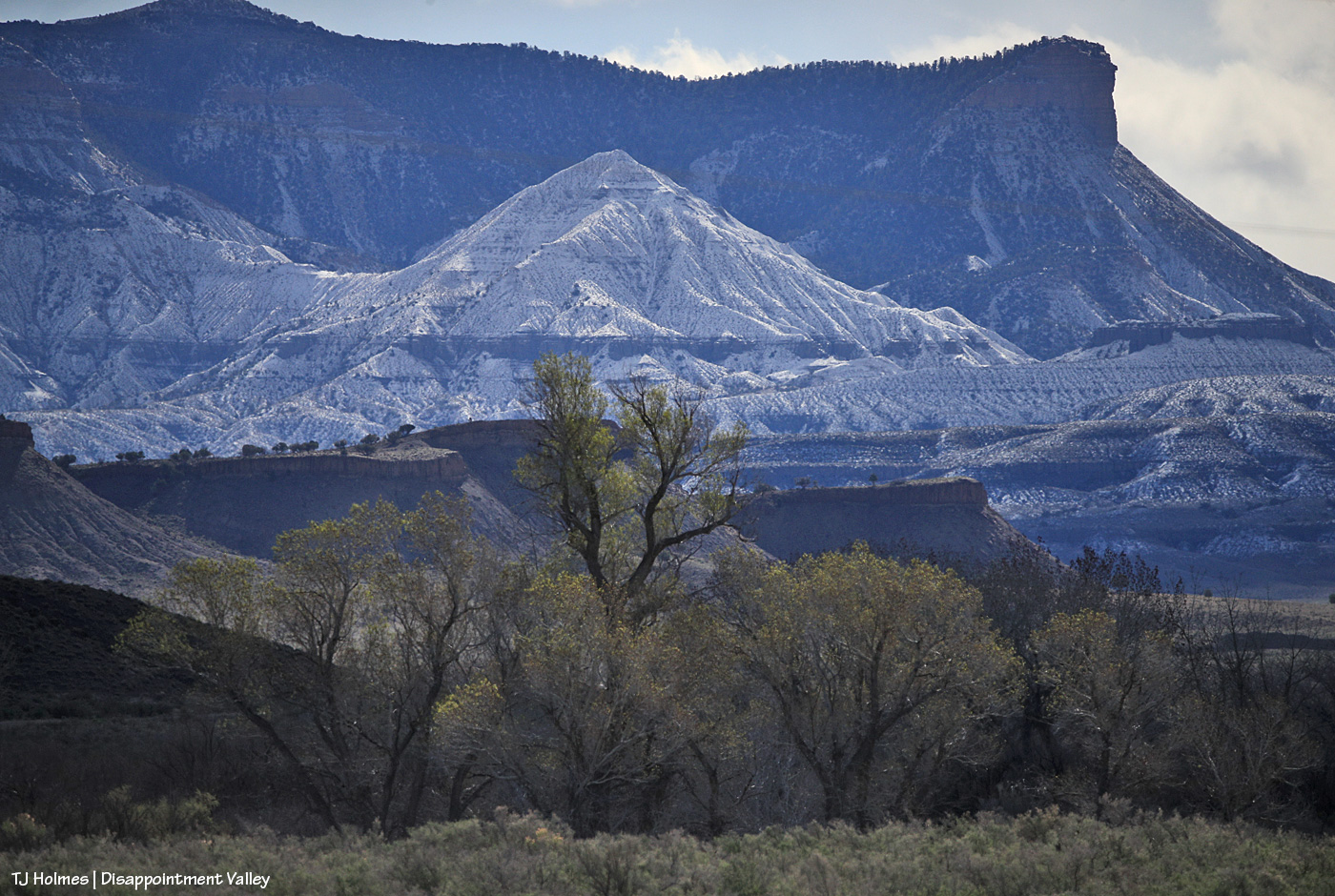
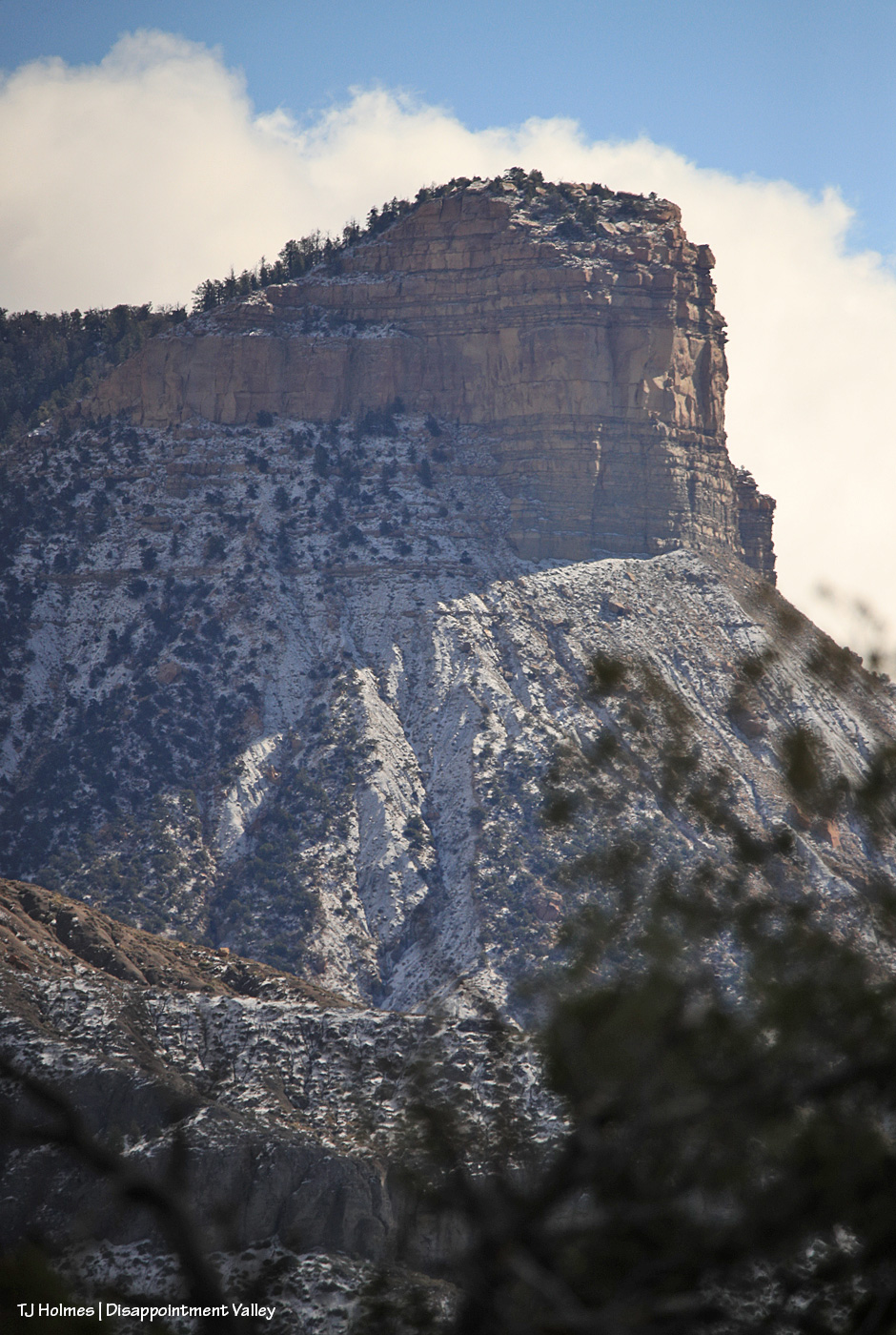
Well, knock me over with a feather! It DID snow … up-valley, not mid- or lower valley (nor did it rain). In the foreground are very newly leafed-out cottonwoods along Disappointment Creek, and in the midground are part of the rimrocks that form the southwestern boundary of Spring Creek Basin. In the background, starting at far right: Flat Top, Round Top and submarine ridge; smack dab in the middle, McKenna Peak; and towering o’er all, Temple Butte.
And from up-valley:
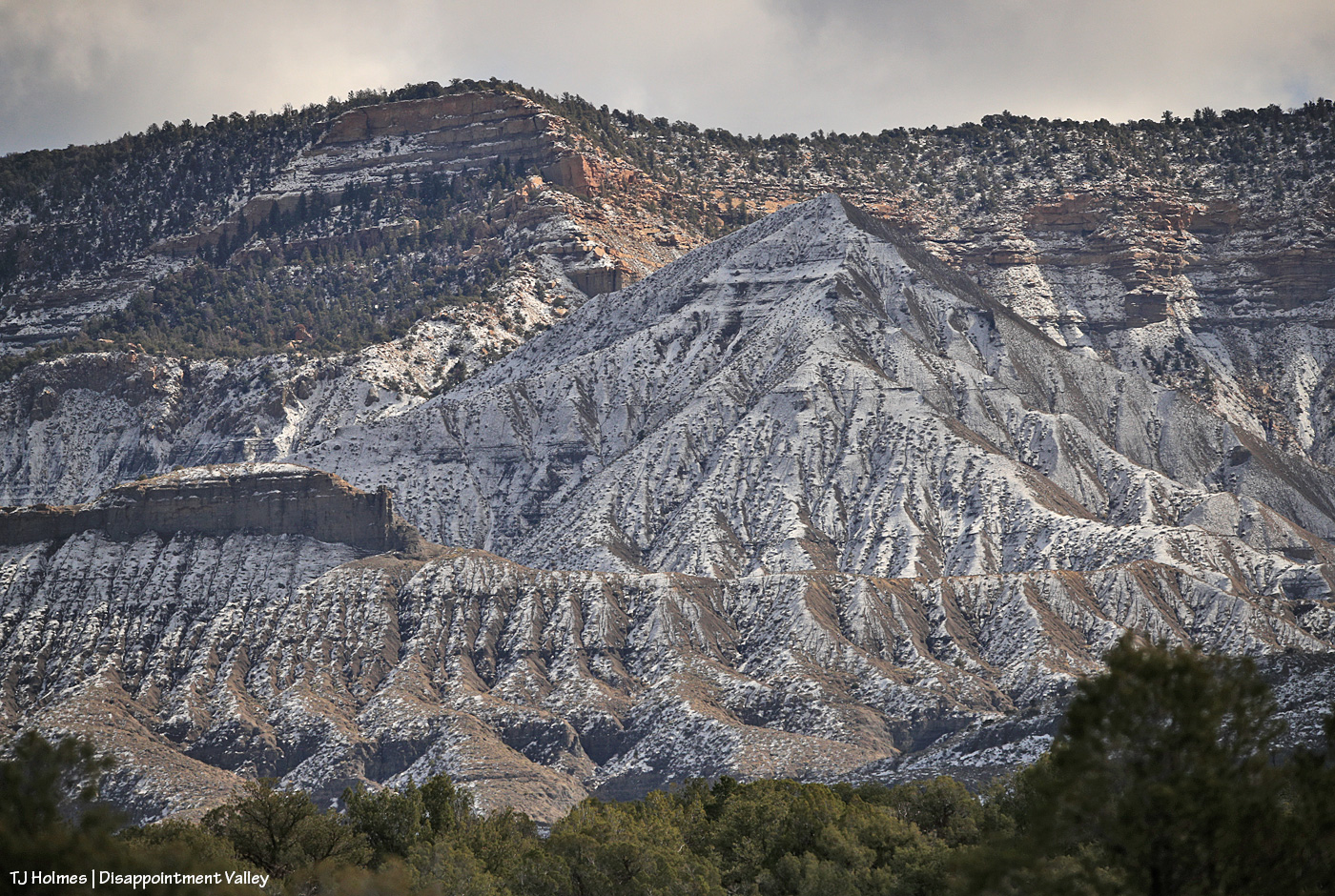
What I call submarine ridge at far left … and McKenna Peak just right of dead center. The very top/back ridge, if you follow it right, ends in Temple Butte.
Voila!
That snow will soak in; it’s not enough to produce runoff. And it was windy again, which further contributes to drying.
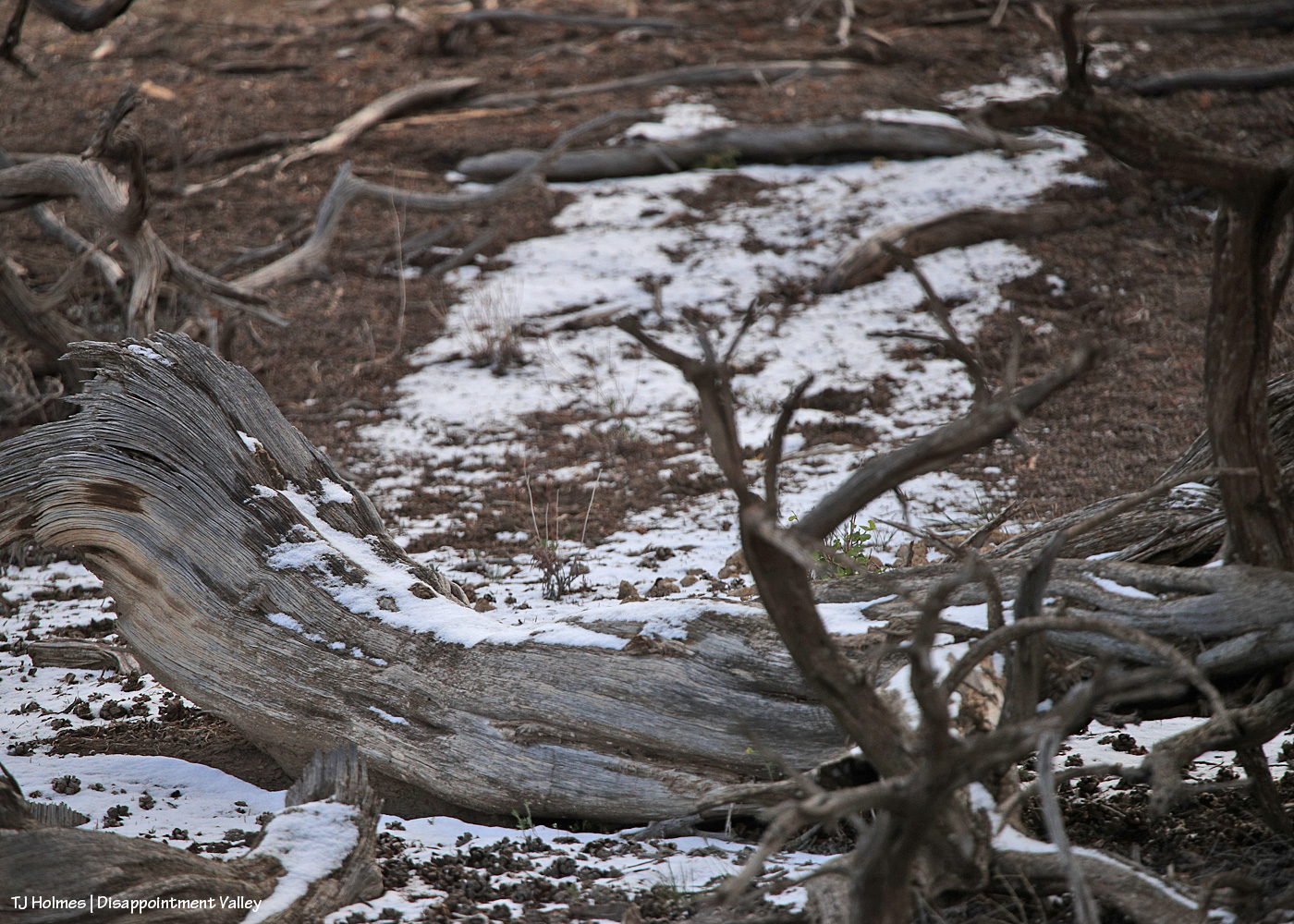
The tiniest bit of a tiny dusting still lingered in shady places under trees (this was just inside the Spring Creek Basin boundary from up-valley along Disappointment Road). Evidence that it HAD, in fact, snowed in the area.
And one last view, of Groundhog Mountain, through a curtain of snow!
It’s a crazy world. 🙂
It’s a crazy BEAUTIFUL world! 🙂
Thanks for coming along. Hope you enjoyed our (temporary) retreat to winter. Snow or rain, we need any and/or all that Mother Nature wishes to bestow.
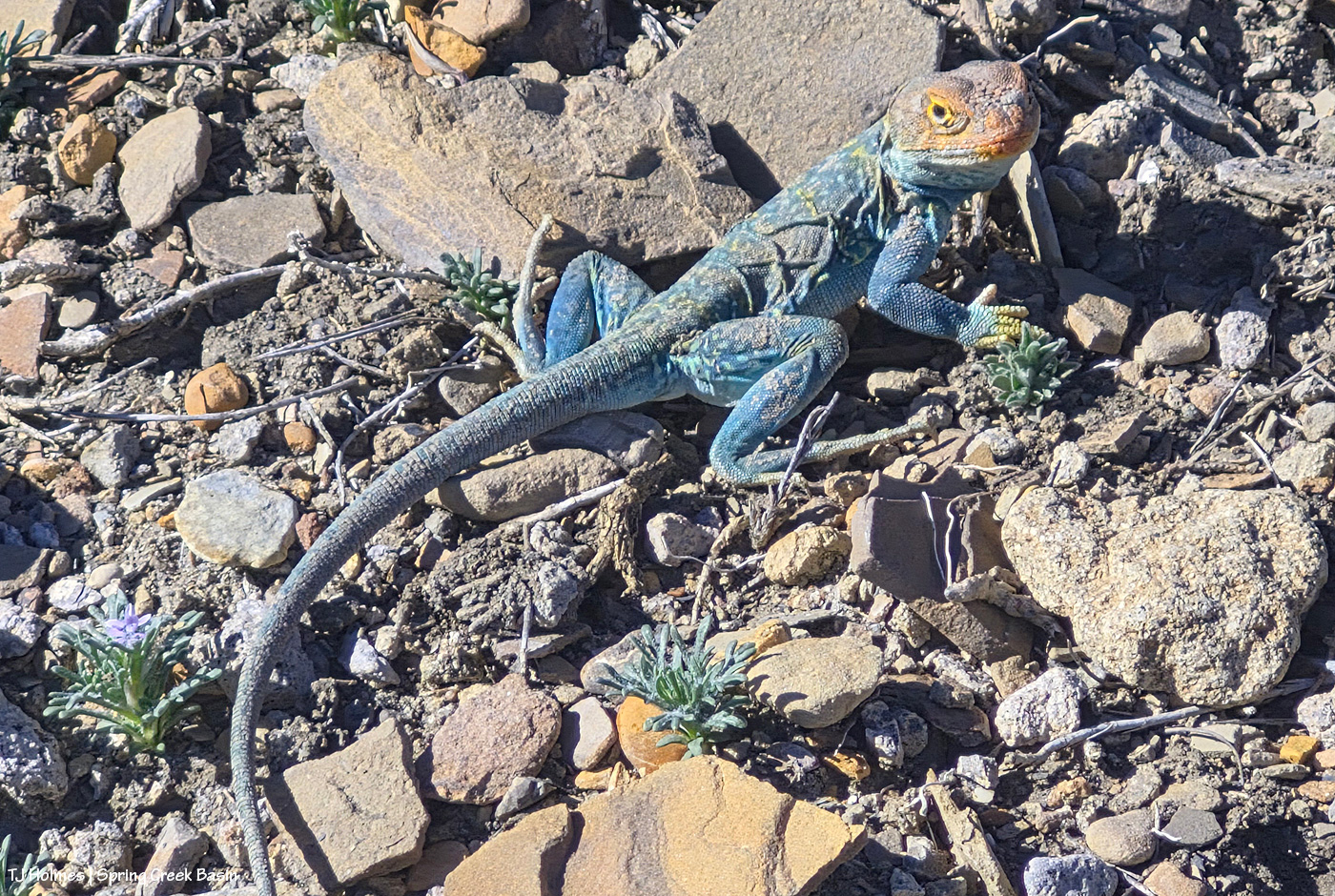
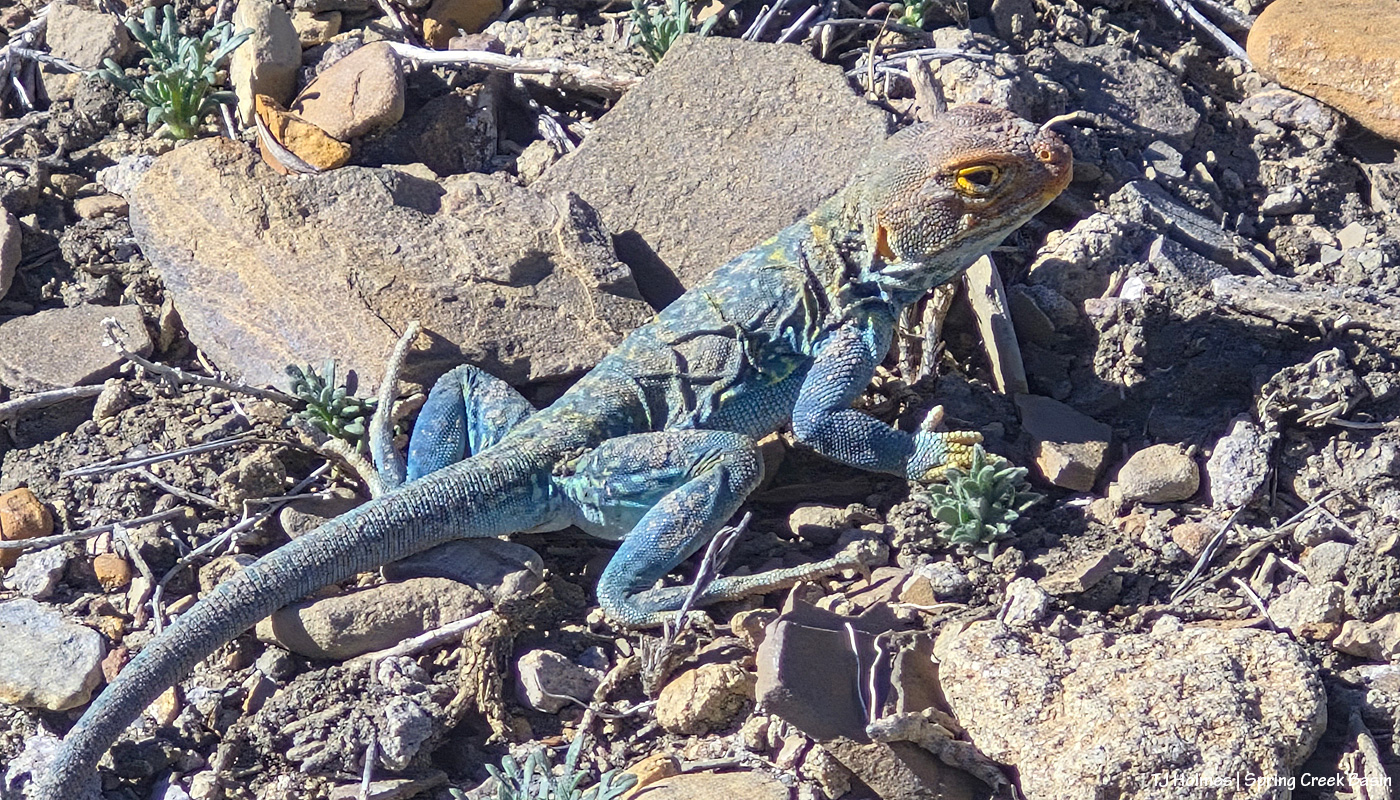
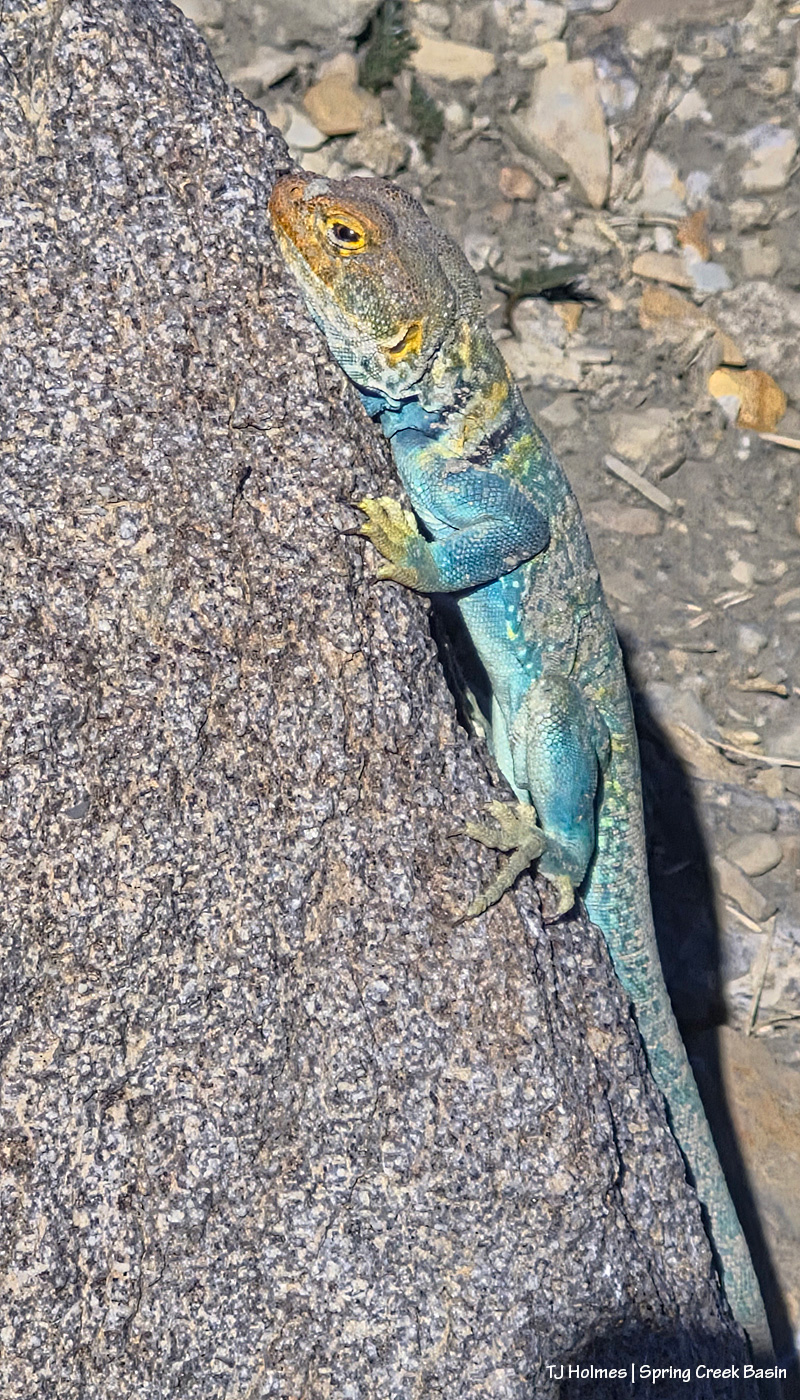
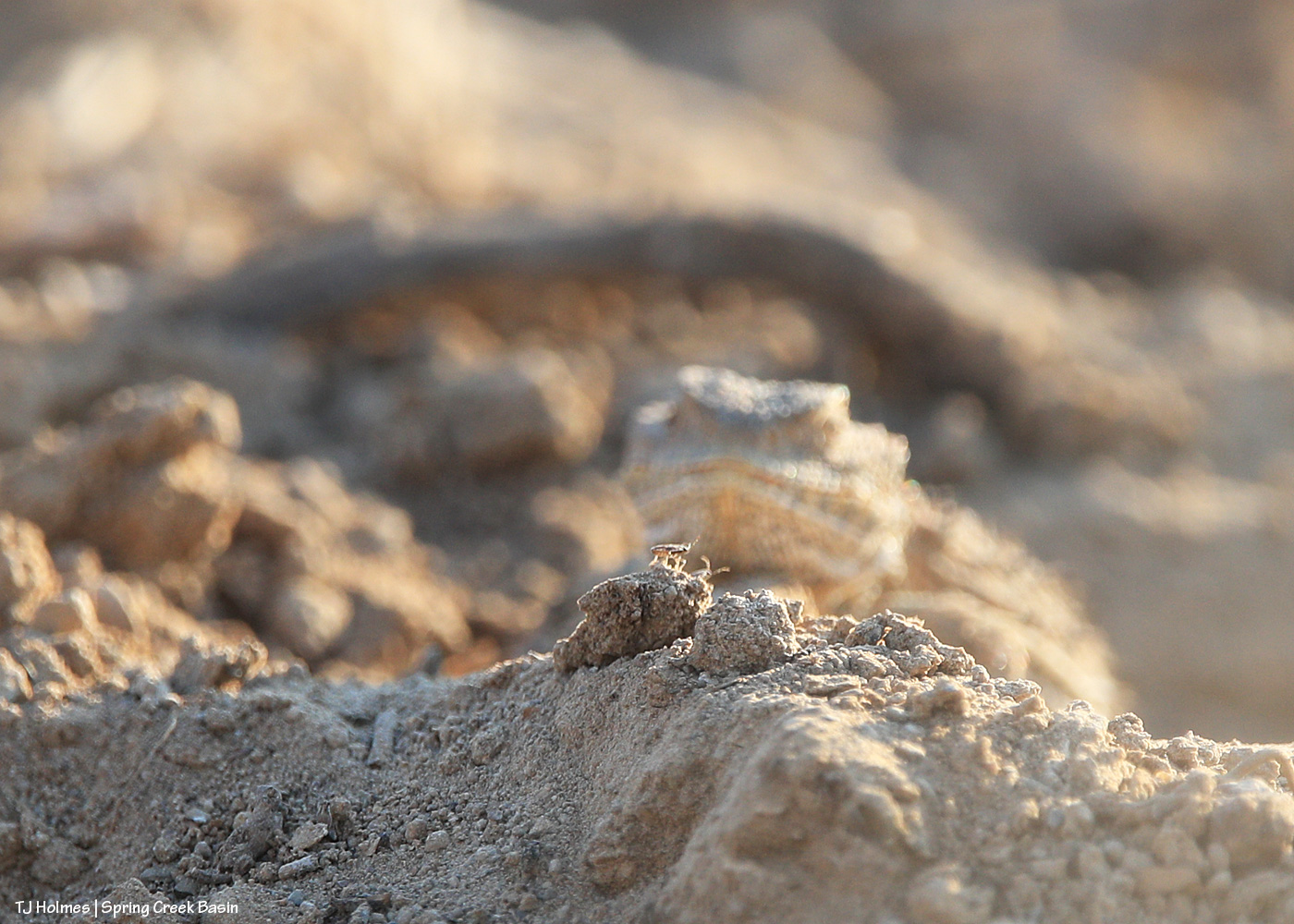
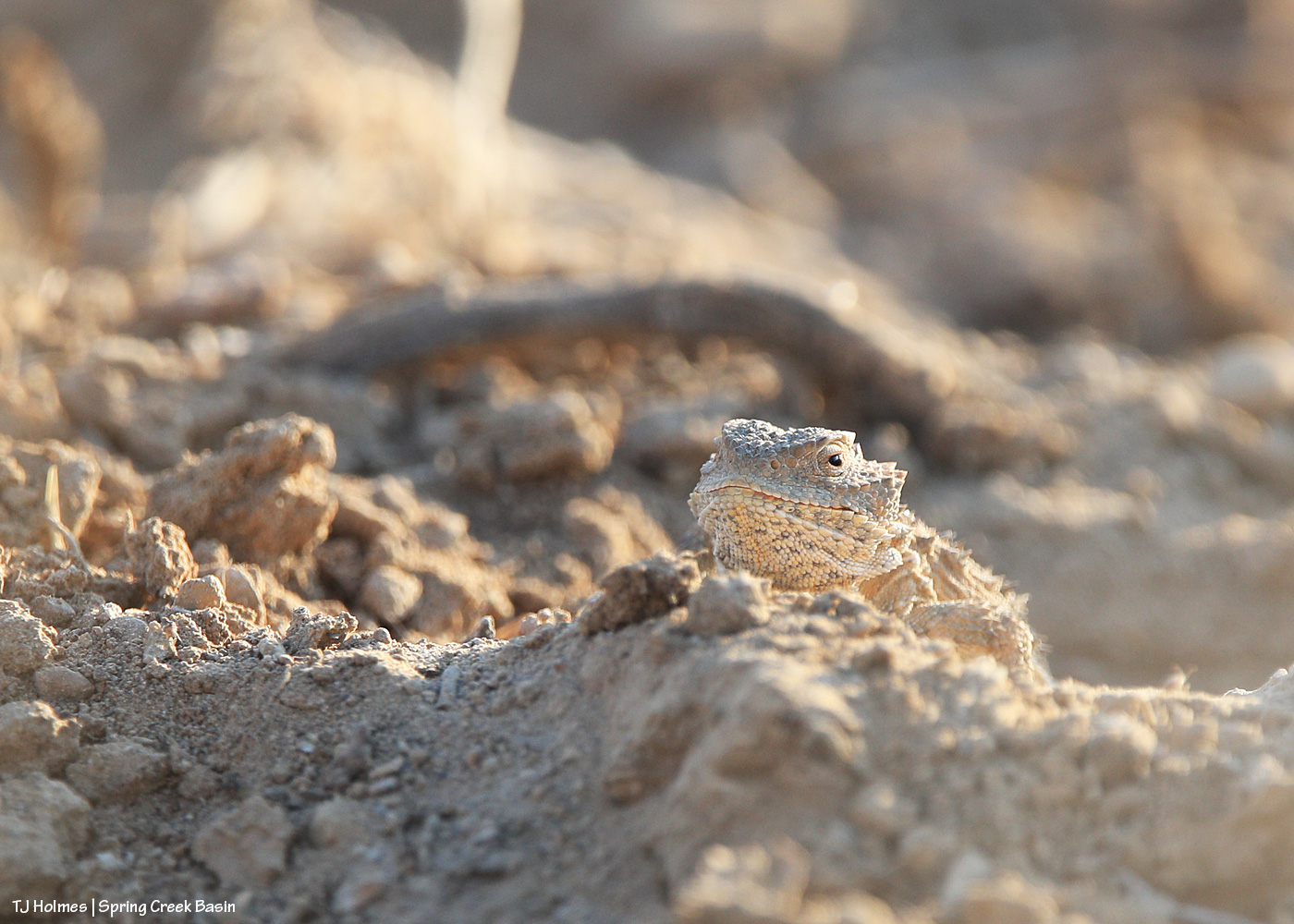
Whaaaaaaaaaaaaaaaat the heck are you doing out in mid-March?!
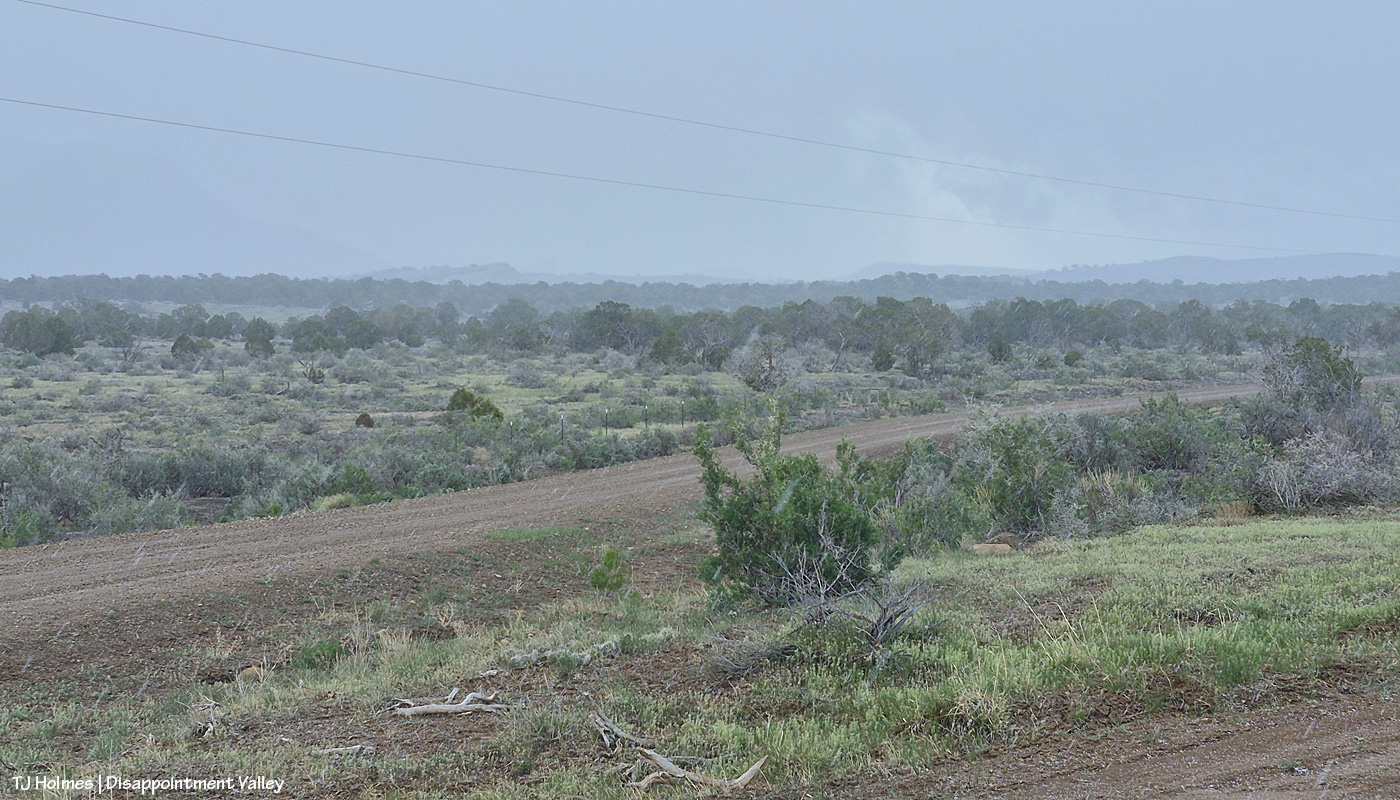
I don’t know what minimum temperature these little critters need to pop out into the open wide world, but it was at least 74F in Disappointment Valley yesterday.
Not quite 80 … but the weather(wo)man says it’s coming. 😦
I love seeing these lizards – they’re my favorites! – but I never think about seeing them in the middle of March. (Yes, yes, I am starting to watch for the first snakes of the season … !)


 2-
2- 5
5 mm) that resemble Dippin’ Dots or Styrofoam. These fragile, slushy particles are often called snow pellets and, unlike hard hail, crumble easily. They occur during wintry mix scenarios, causing sudden, slick conditions, and are identified in aviation reports as ‘GS’.”