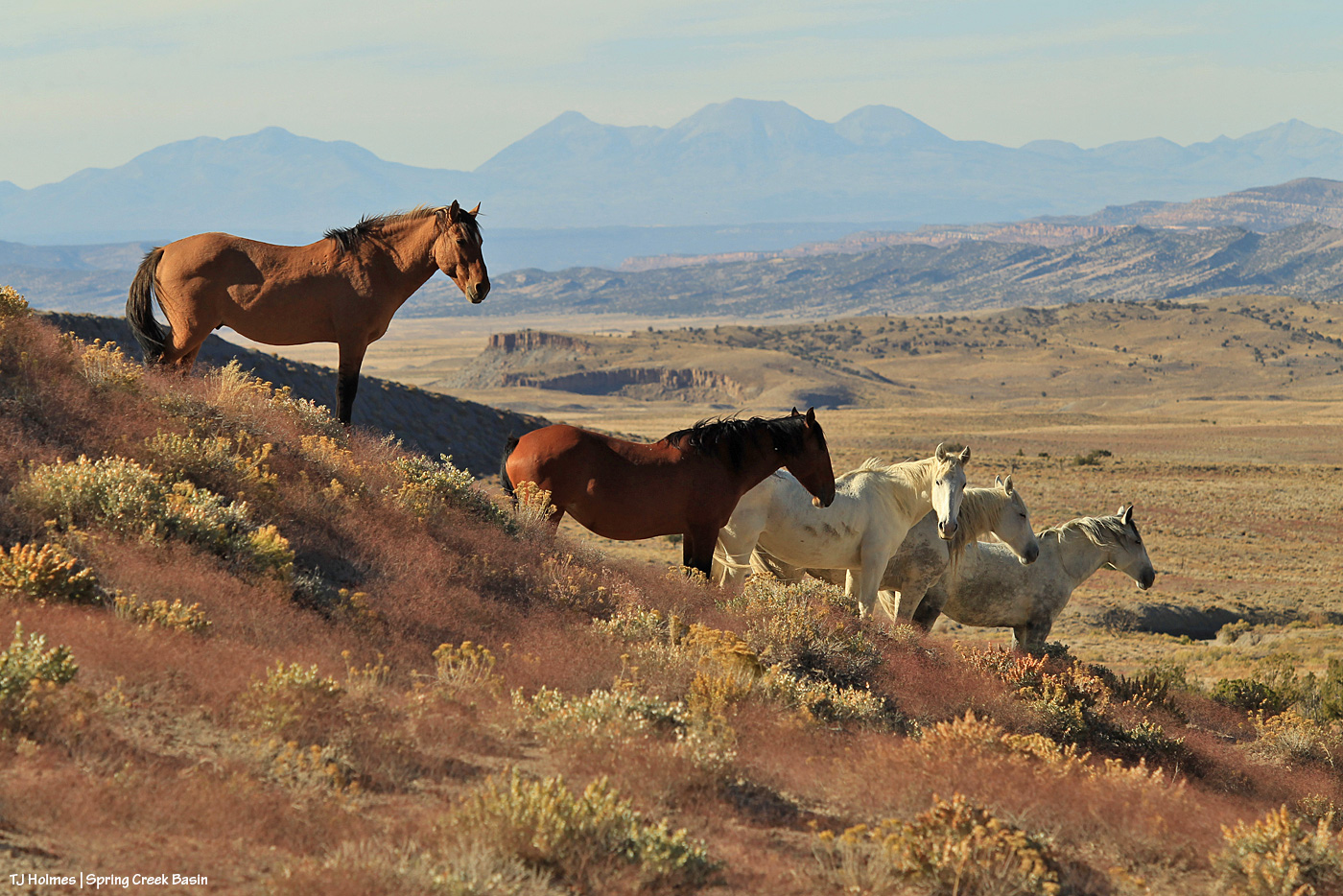
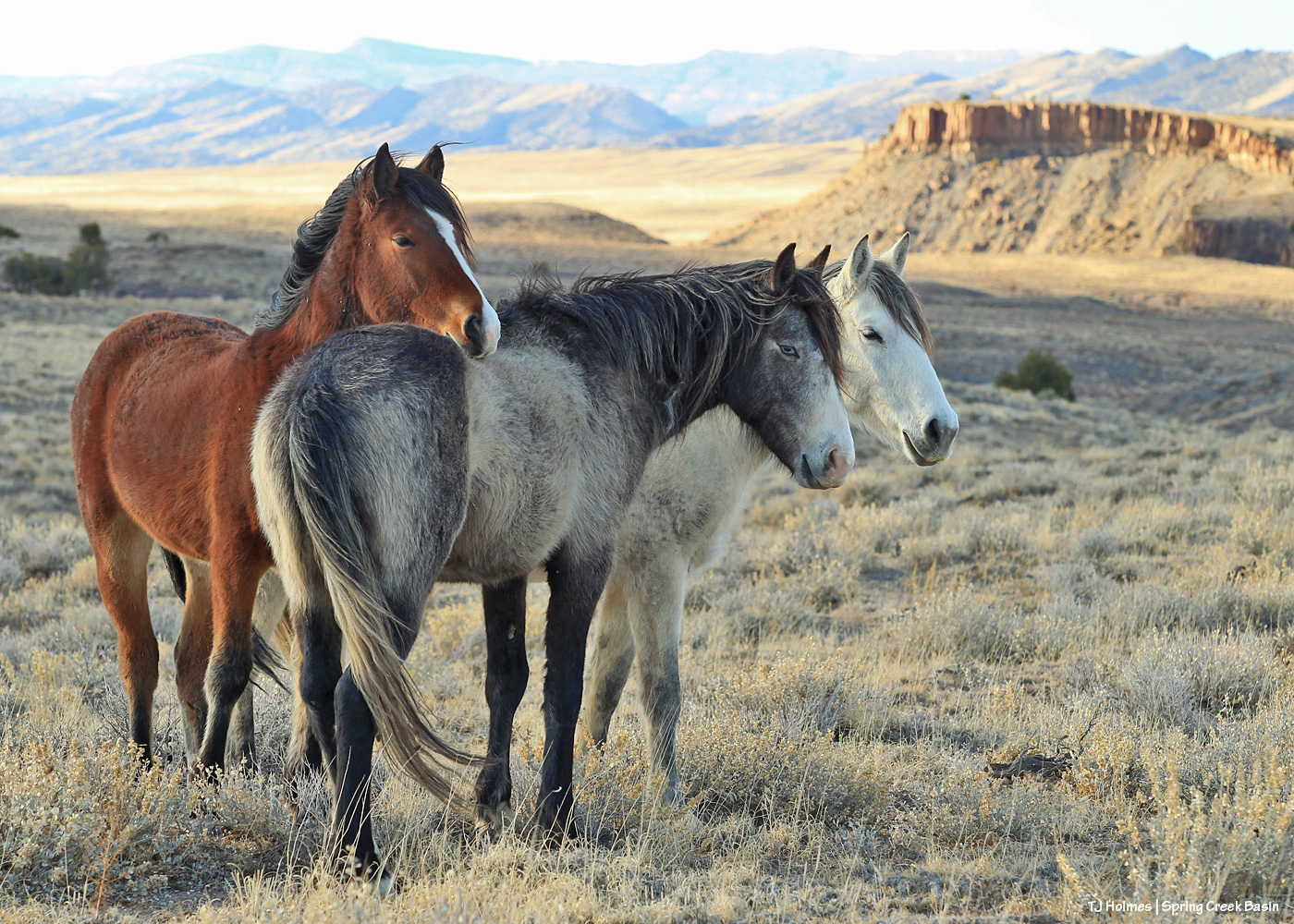
“Follow the … ” mustangs! (No, not spiders; that’s Harry Potter, and we weren’t looking for a basilisk.)
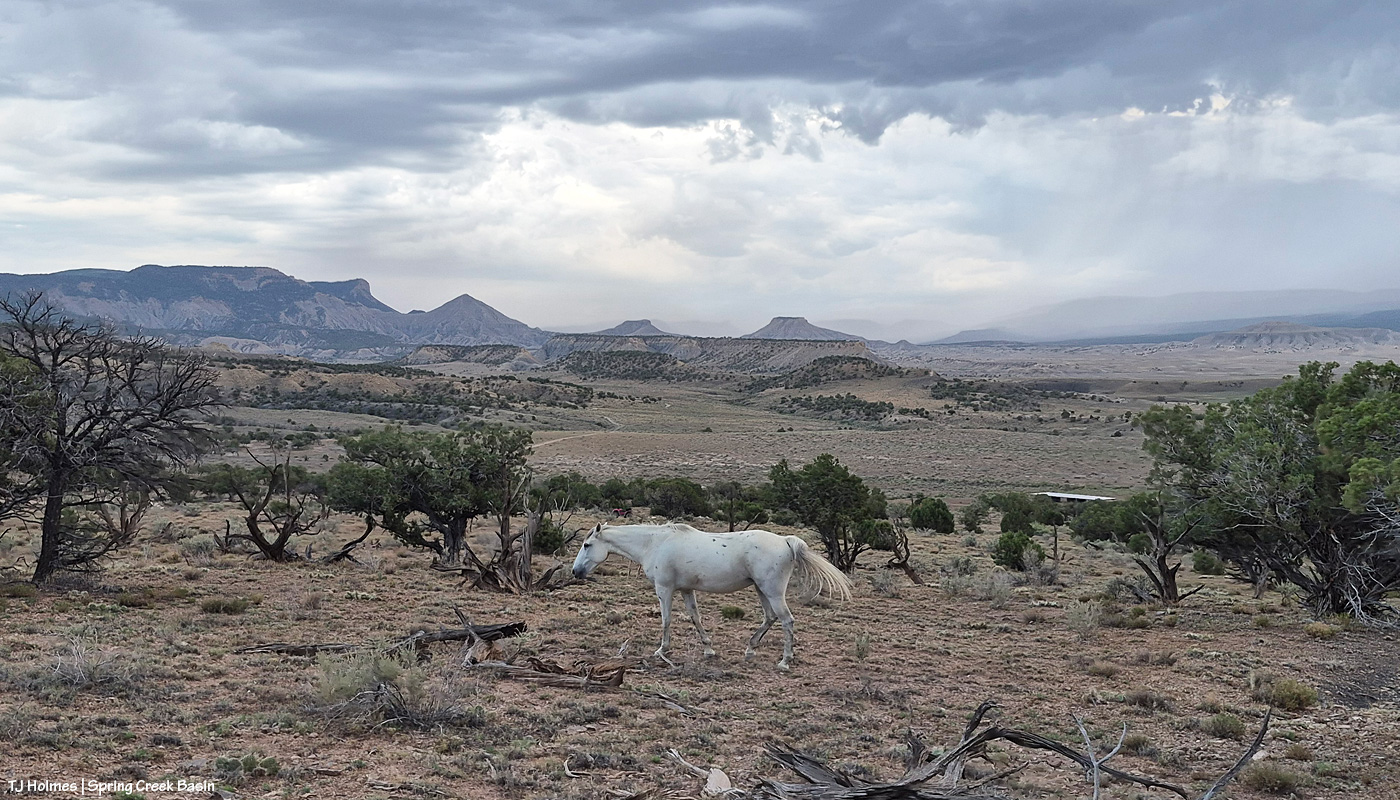
Most of the coolest things I’ve found in Spring Creek Basin are a result of following the mustangs. They know all the best places.
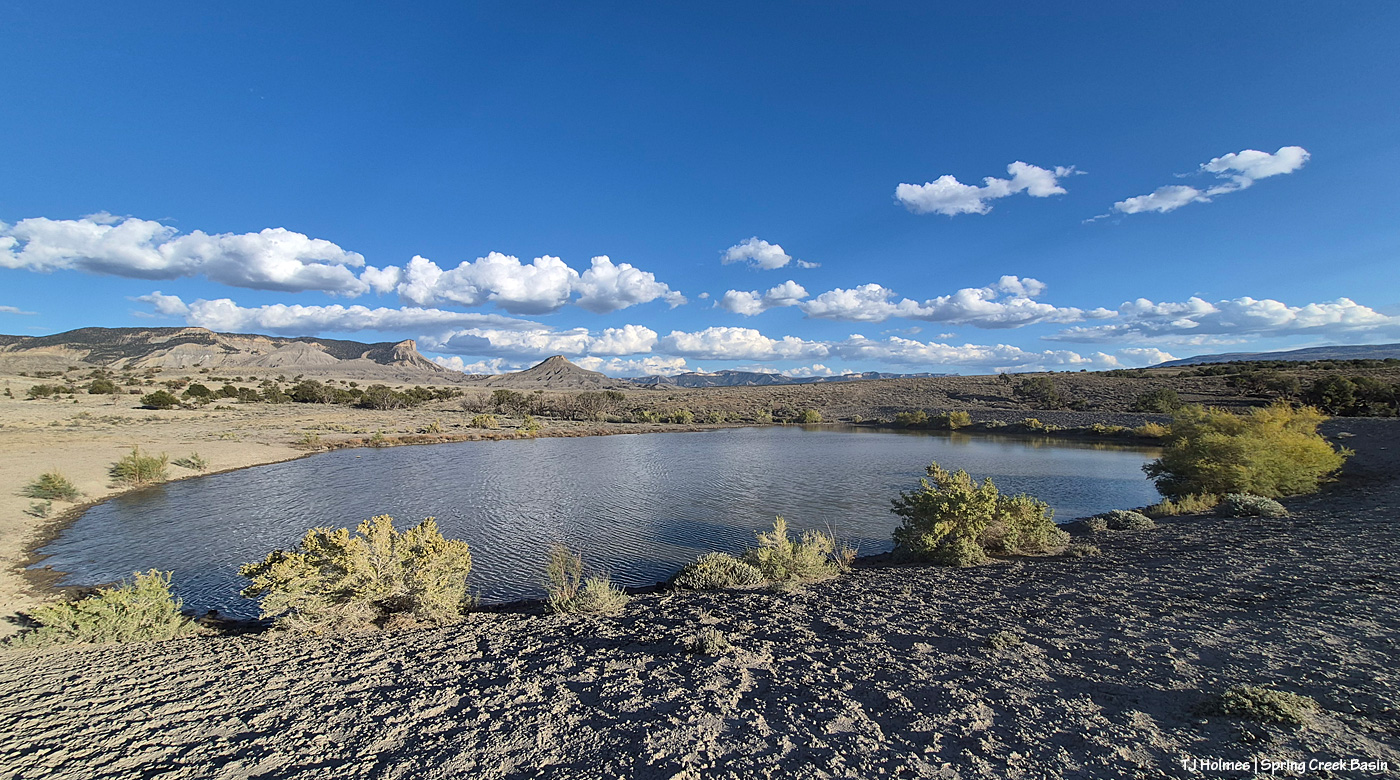
Am I right, or am I right?! The last time I’d been to this pond was much earlier in the summer, and it was dry.
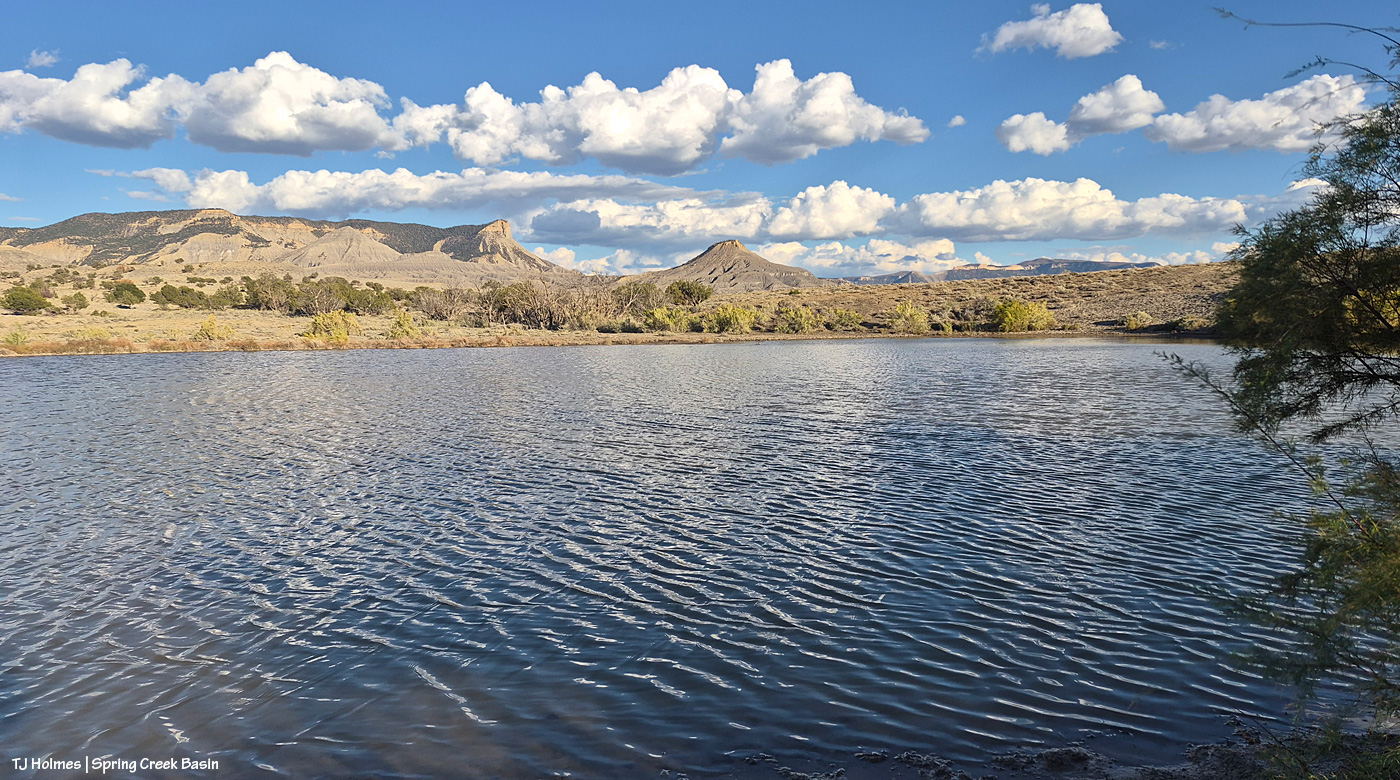
Isn’t it a divine sight, all that lovely, rippling water?
Water is gold in the West. To know that we’ve gotten enough rain now this year to fill this pond fills ME with immense joy and relief and gratitude.
The horses drank their fill and moseyed farther on to chase the green. … And speaking of green …
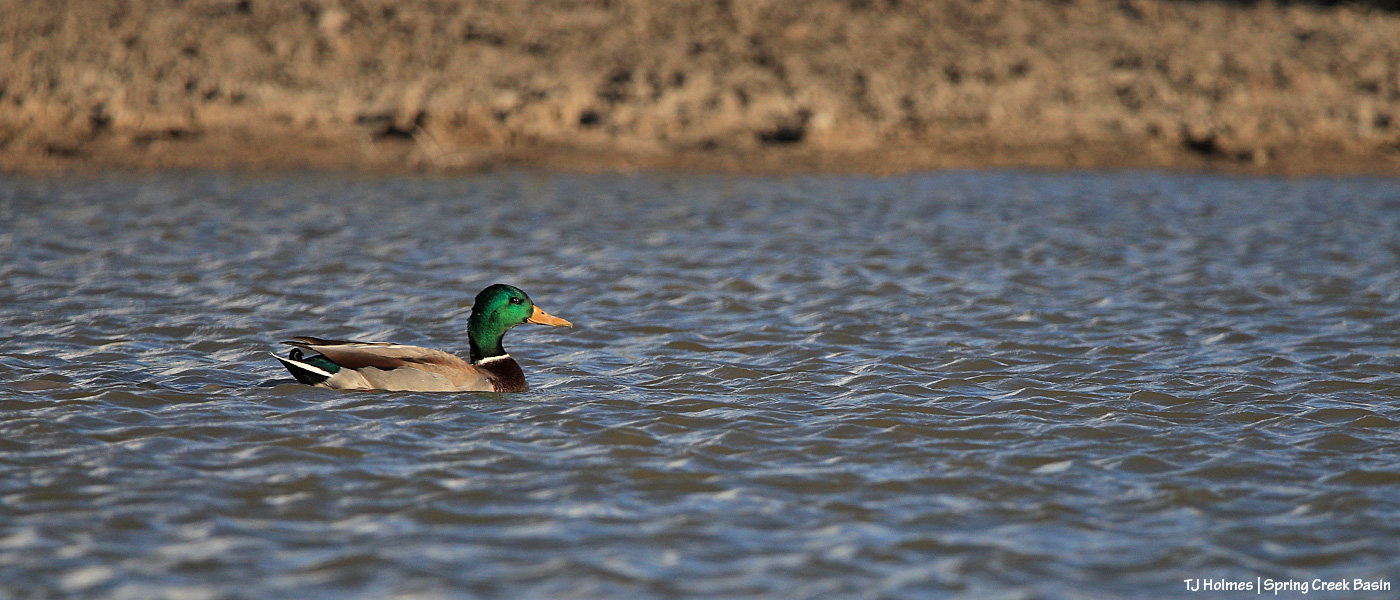
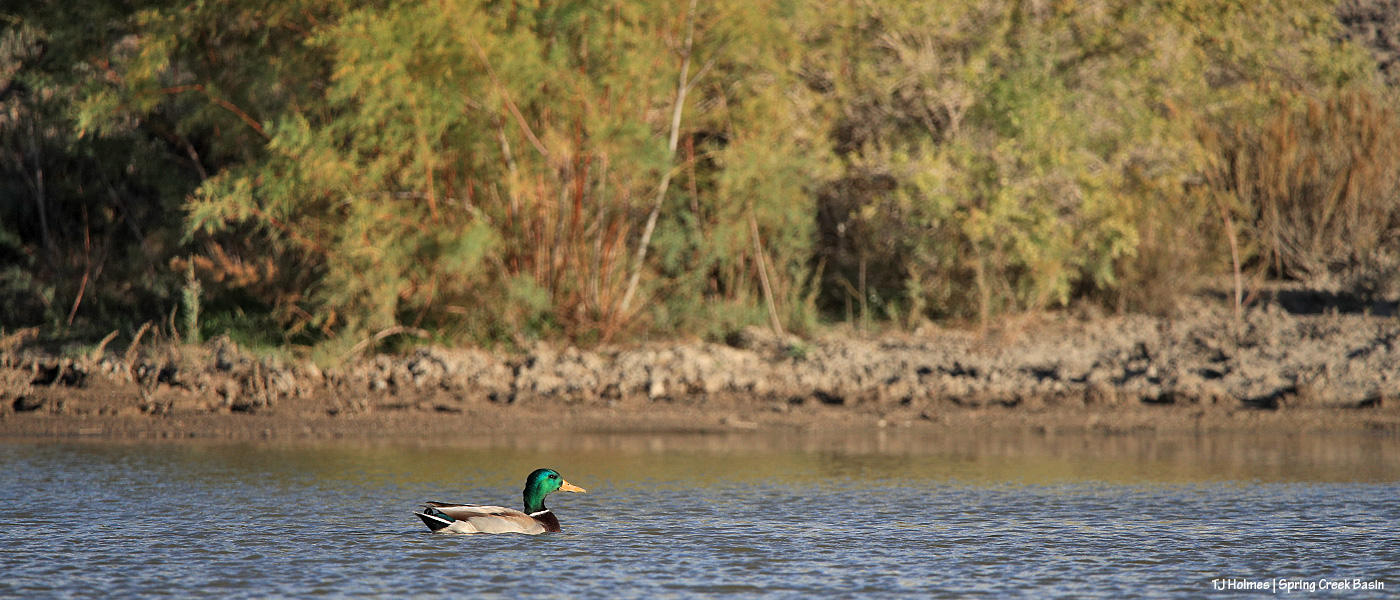
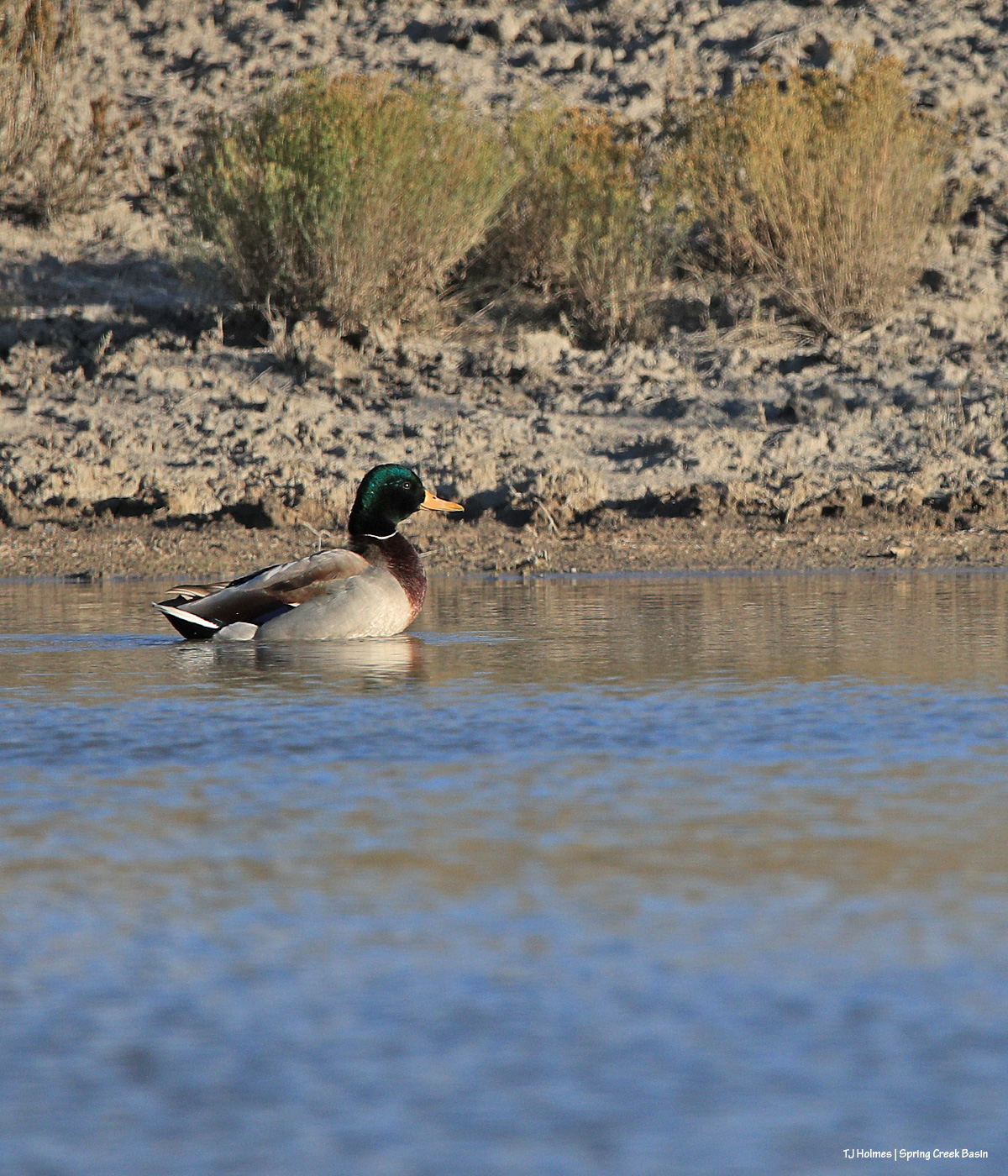
To my surprise (the horses weren’t phased), this mallard drake landed on the water right in front of us!
No matter how many times I see ducks on our desert ponds, I think I will never cease being surprised! And grateful that they find an oasis in the otherwise dry landscape.
The sun was fairly low on the western horizon, and fortunately, he was still lit by sunlight despite the berm/bank of the pond and a distant hill between us and that horizon. Depending on how he turned, his head feathers flashed iridescent green or nearly black. No hen landed with him, and I didn’t see one circling.
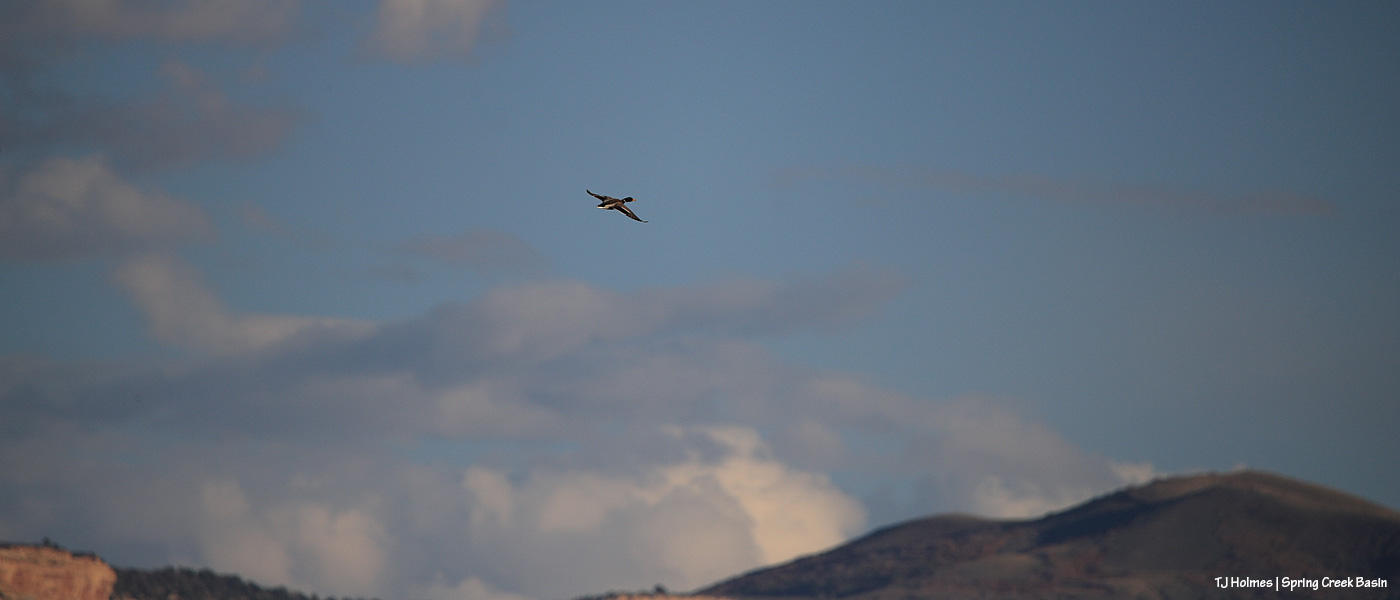
Unfortunately, the sun was sinking as fast as it does, and I had a fair walk back to the road, and when I stood up, the drake lifted off from the water into the sky.
I hope he returned to that place of safety … maybe with a hen.
As I type the draft of this post, it’s raining, which means more fresh water for the ponds, the catchments, the vegetation, even recharging the seeps …
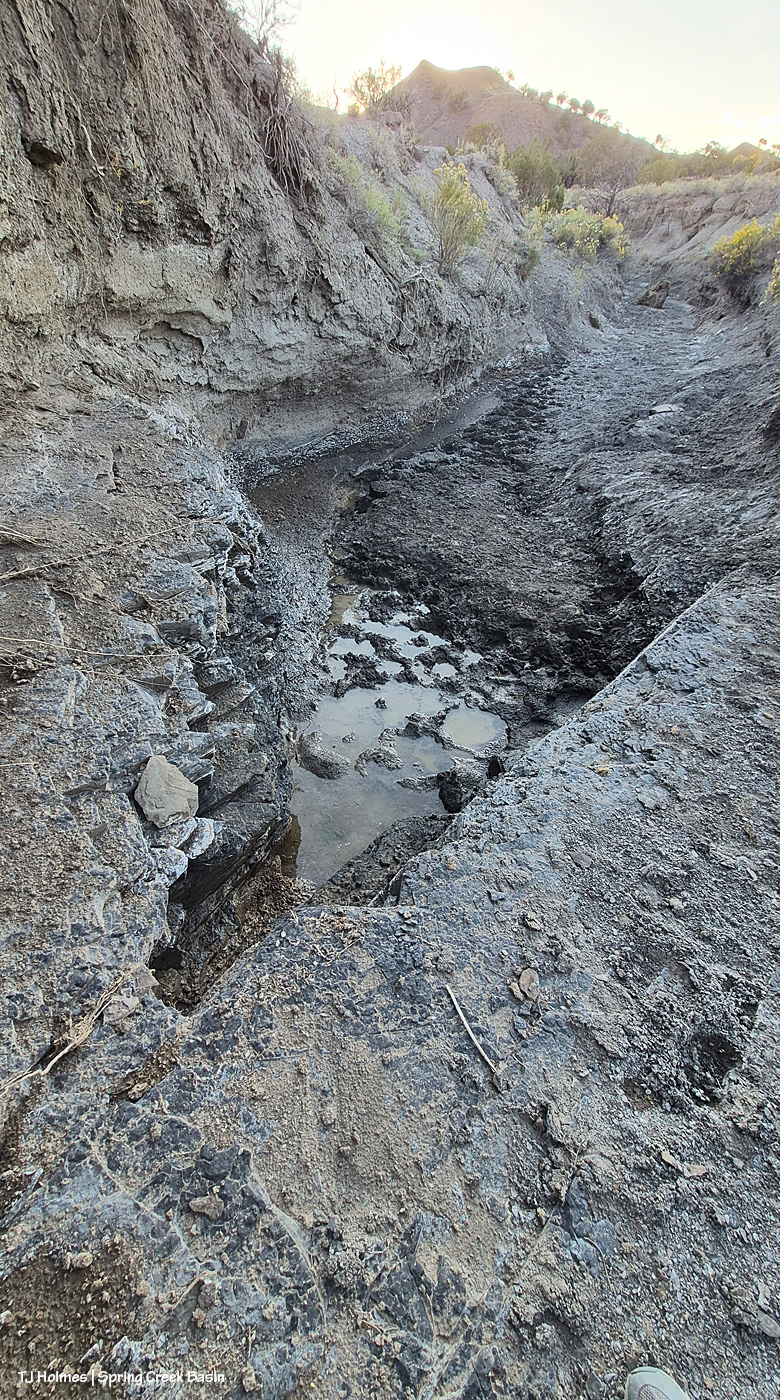
… like this one. That’s bedrock, a layer of shale (?) in the foreground (see my toe), and you can see the layer of it around the left side in the lower wall of the arroyo. Underground water hits these rock layers and comes to the surface, and the horses make good use of that water (note the hoofprints; a band had been drinking there as I walked up to the pond). There’s at least a 2-foot drop between the rock I’m standing on and the water in the bed of the arroyo as it continues, where it runs down a slight slope, as it might (hopefully) do with this rain!
If these kids are representative of the country’s young folks, we’re all gonna be OK. 🙂
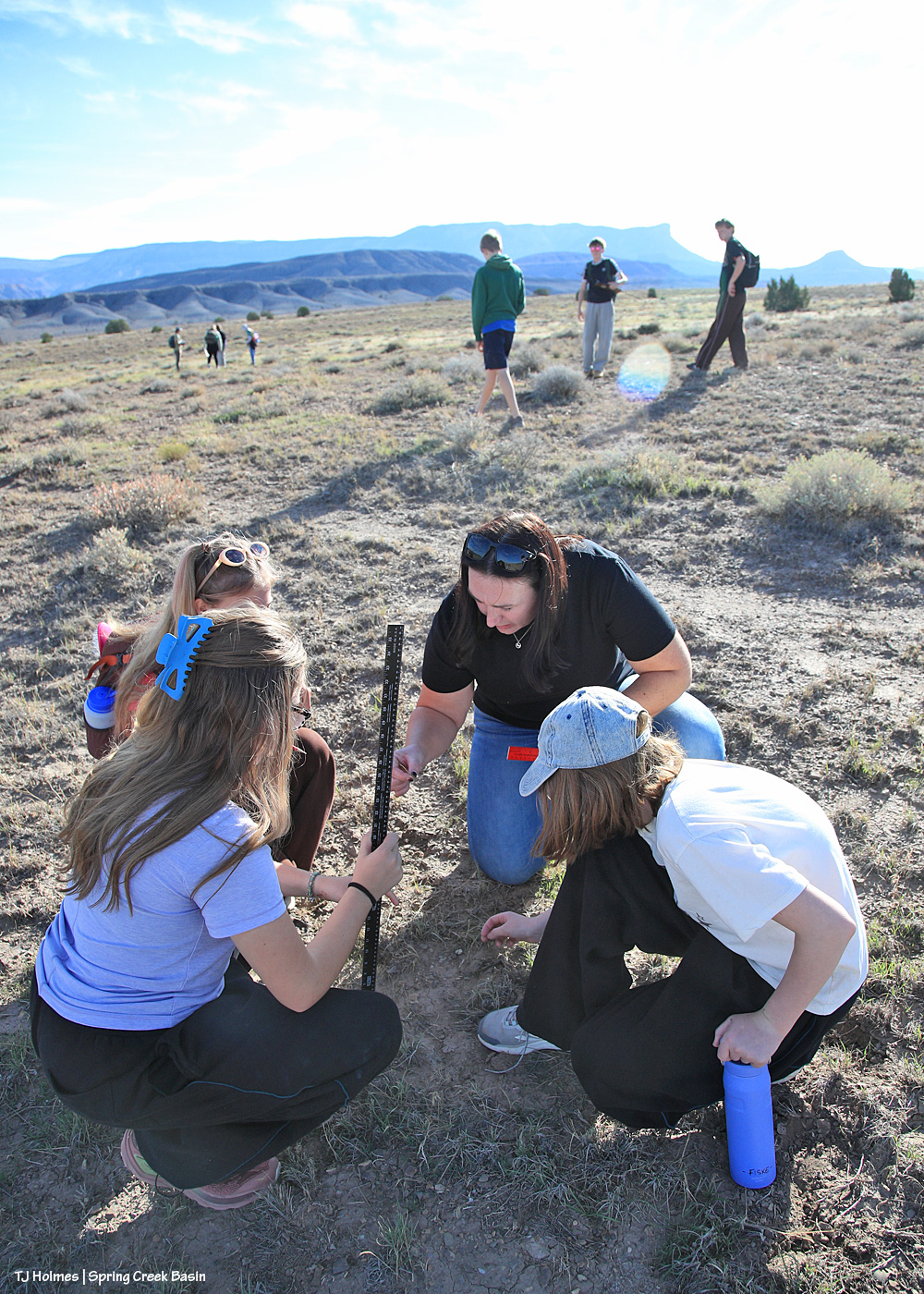
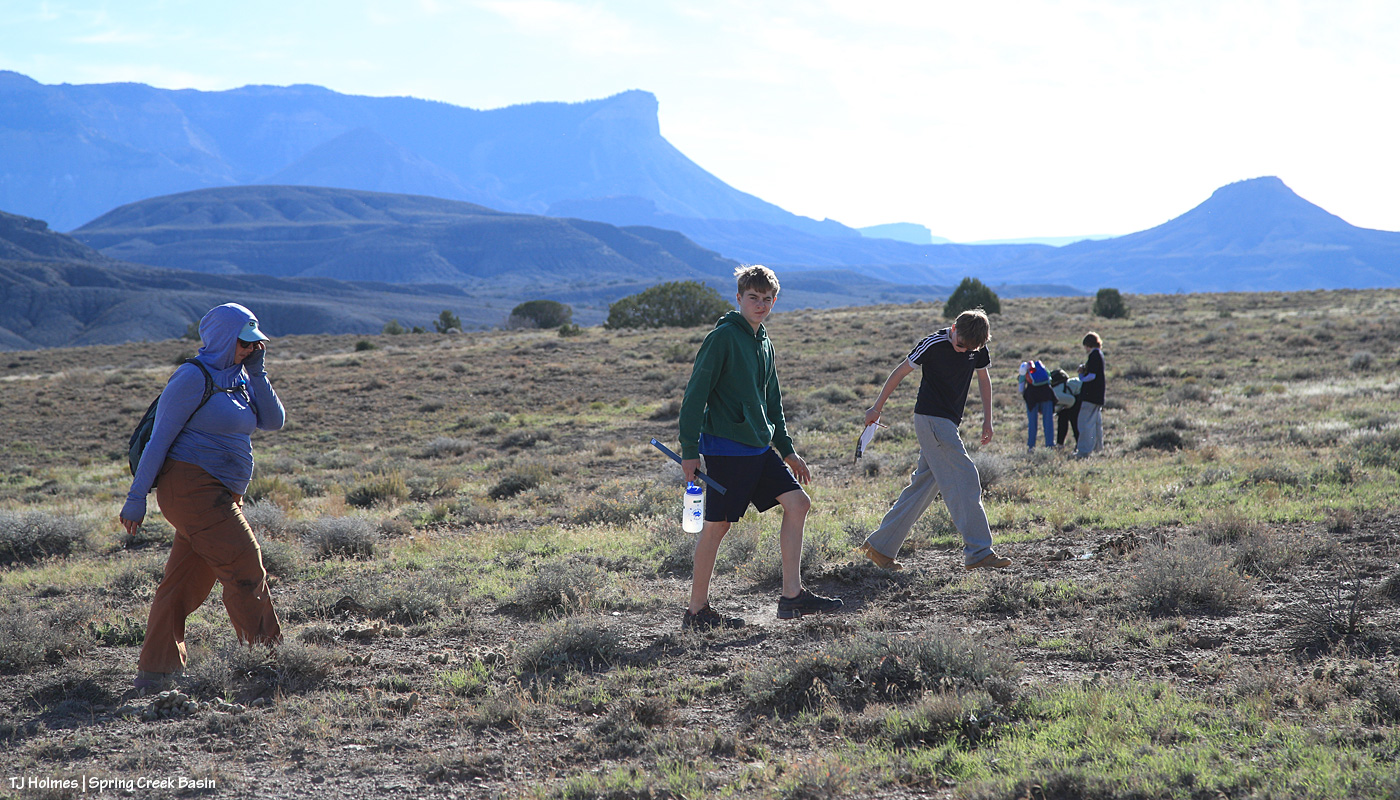
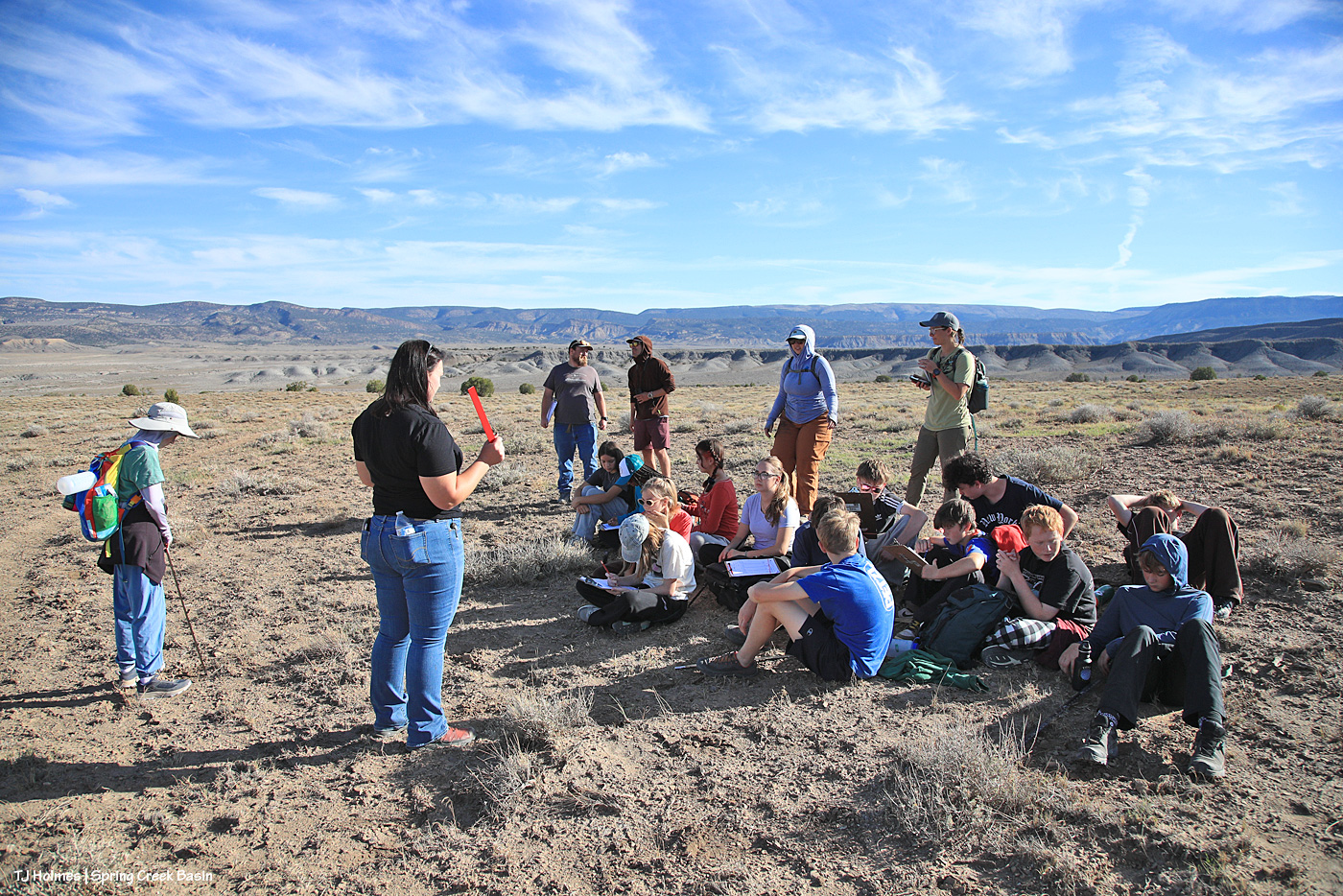
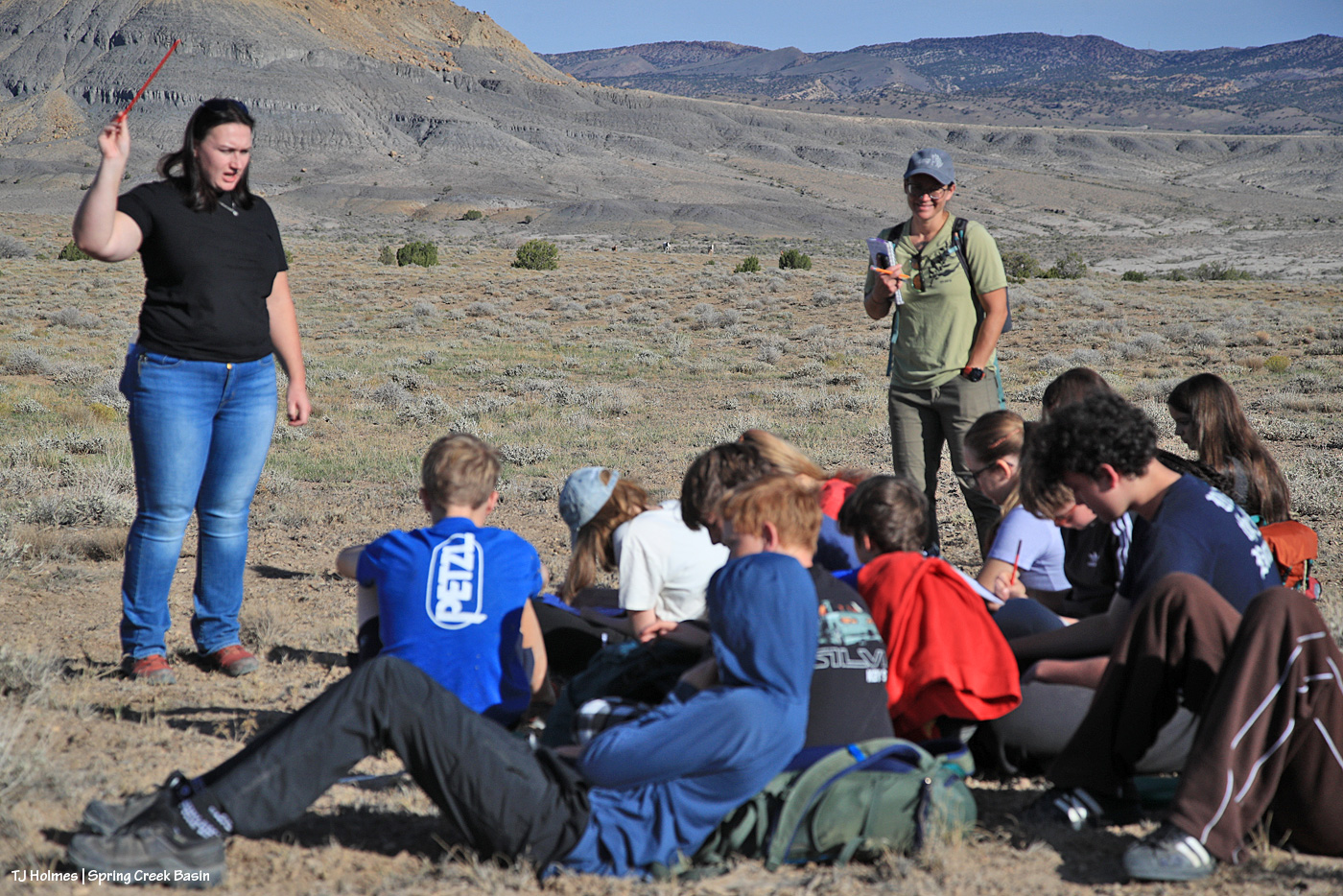
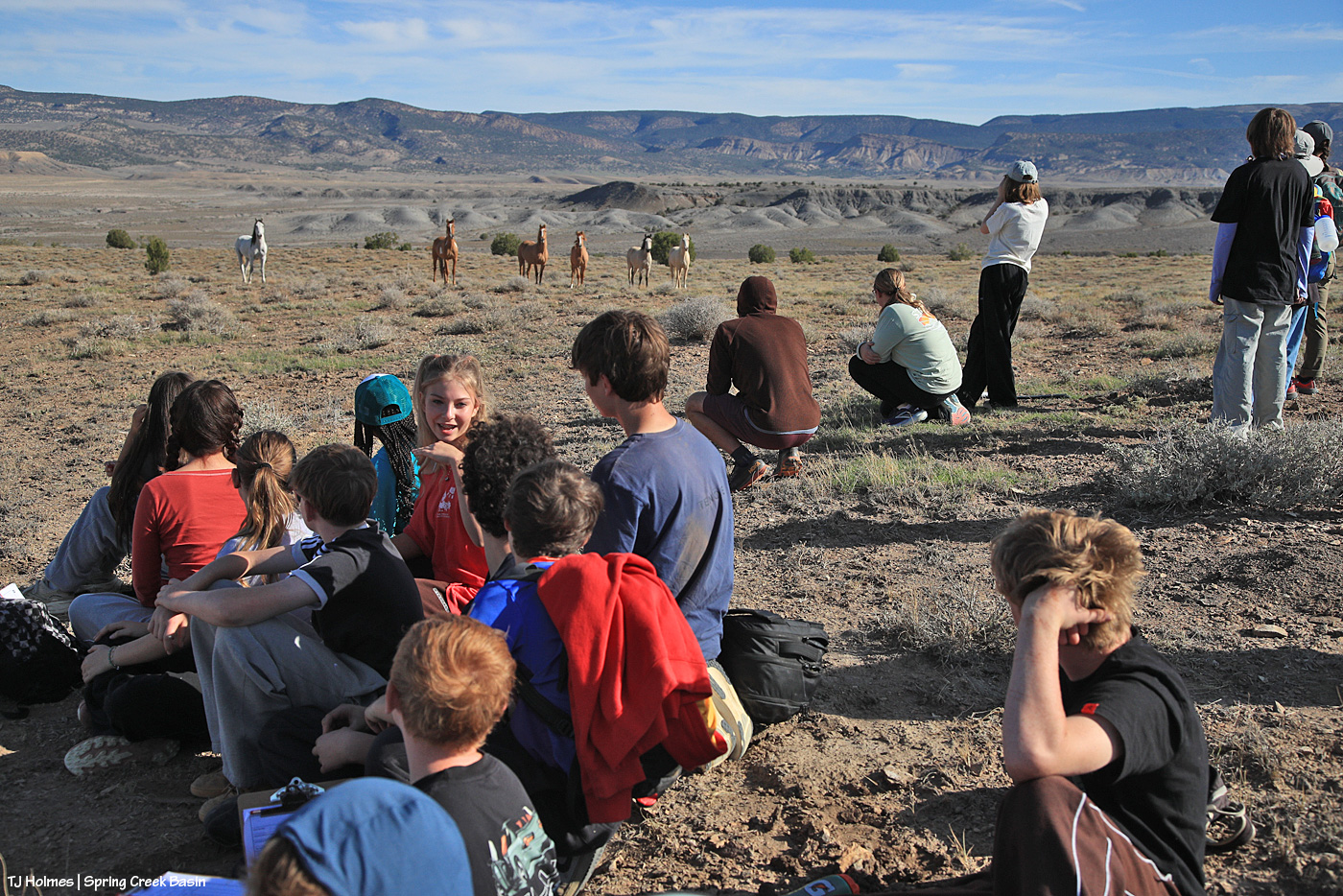
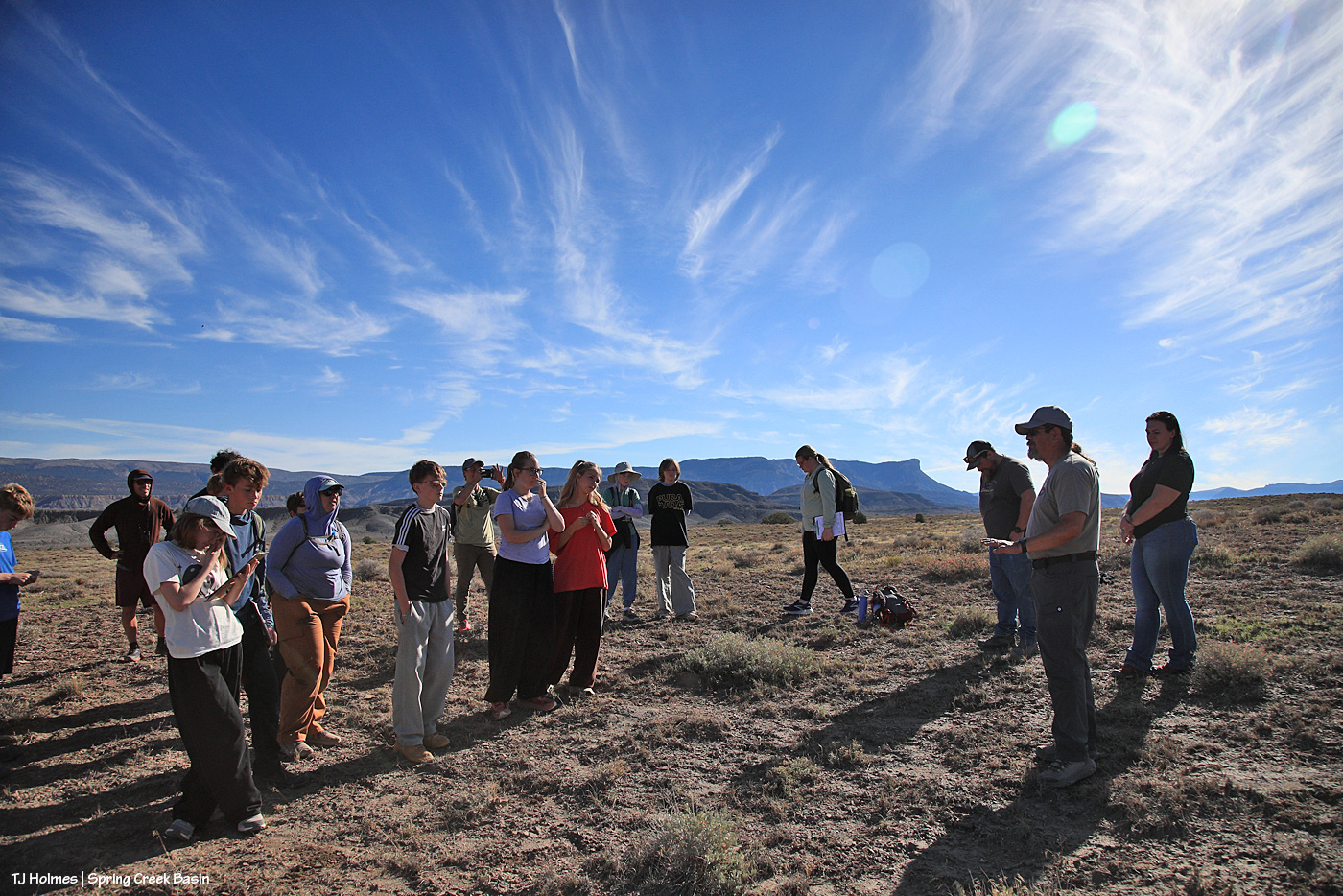
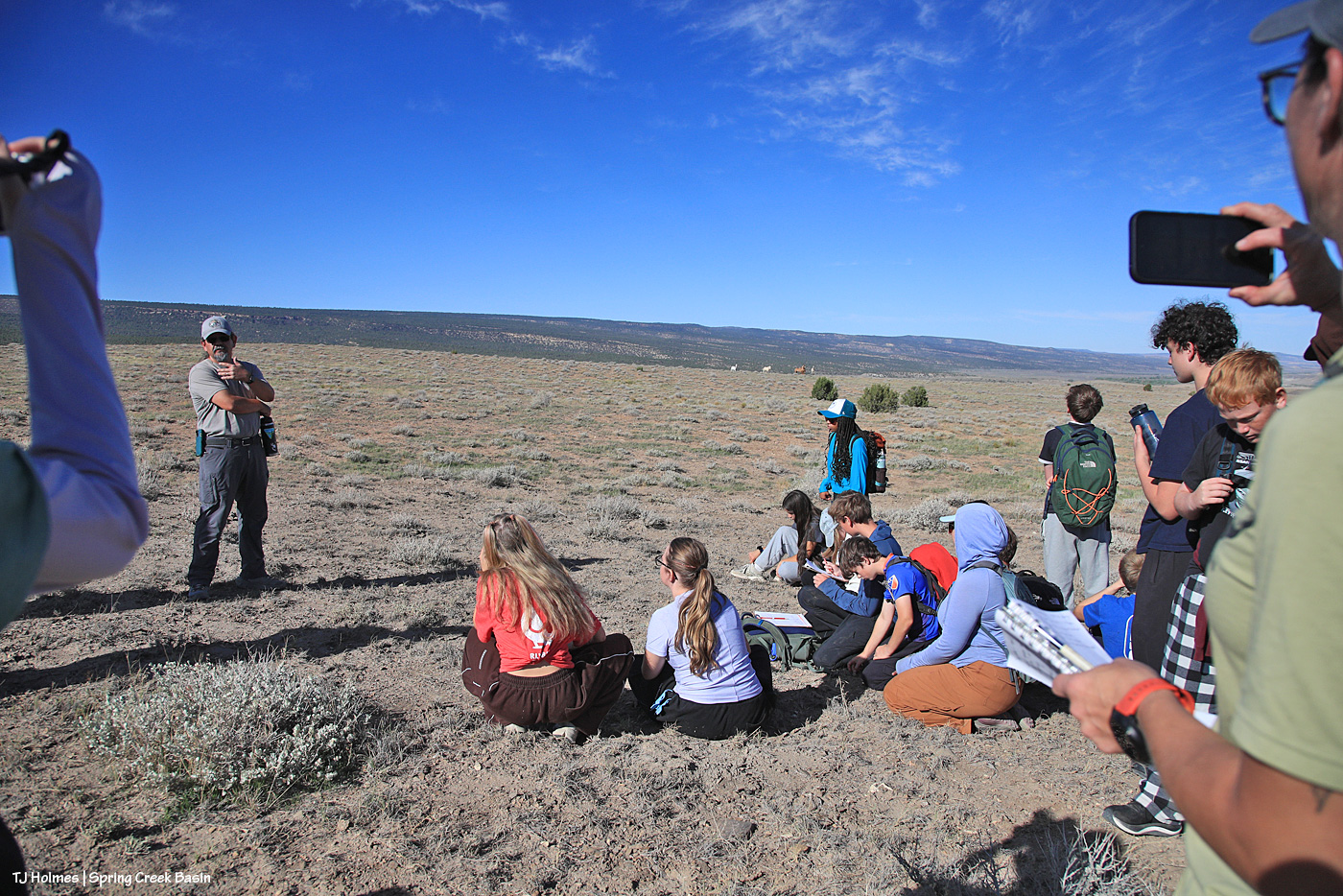
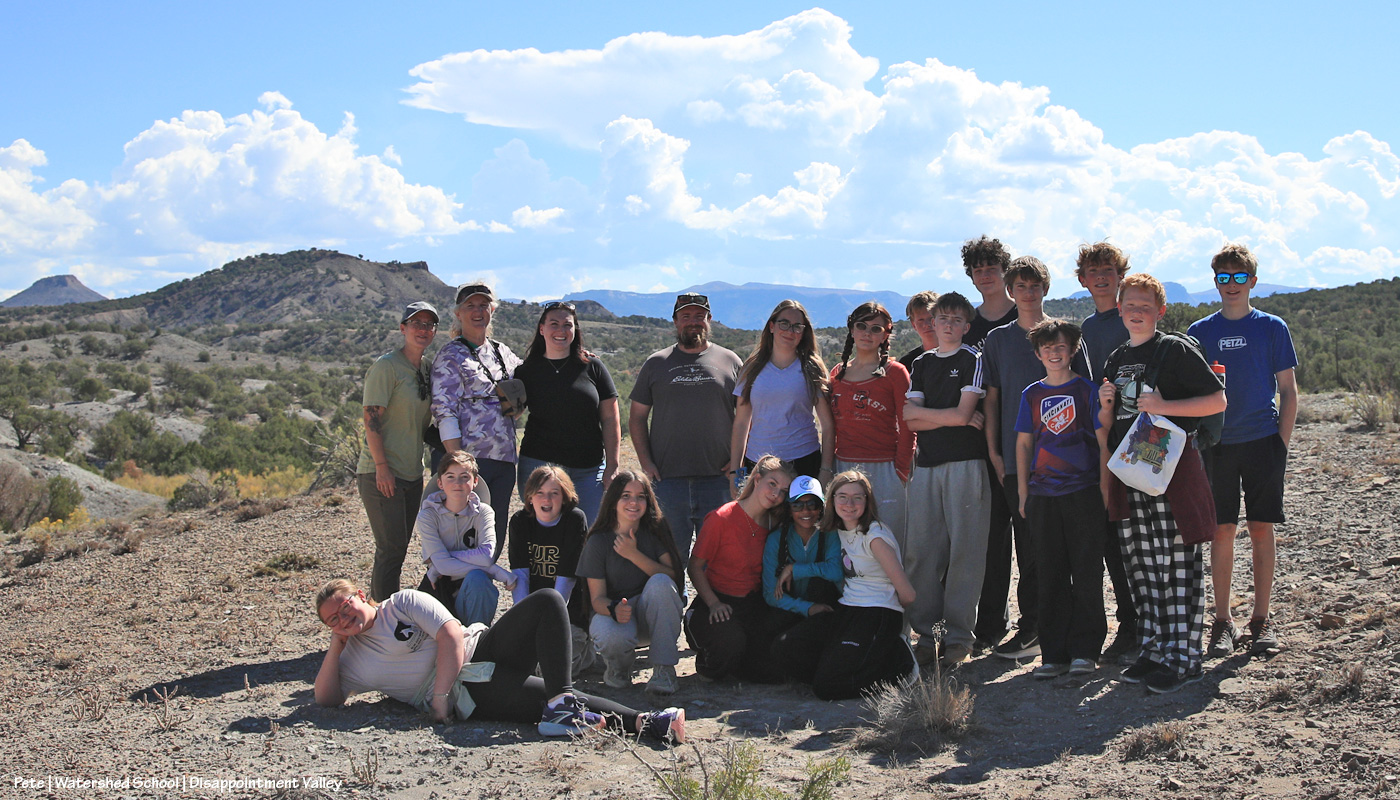
Earlier this week, Disappointment Valley and Spring Creek Basin – and one mustang band! – played host to a group of eighth-graders from Boulder’s Watershed School and three of their teachers. They got to see Buckeye’s band after a long drive from Meeker, where they’d camped after a great visit to the Wild Horse Refuge near Craig. Then they camped above Disappointment Creek, just outside Spring Creek Basin. In the morning, BLM range specialist and herd manager Anton Rambur and range tech Laura Heaton arrived to lead the students in a vegetation-monitoring project up the same hill. Tres Rios Field Office Manager Derek Padilla also came out to see and talk to the kids about the variety of land management that happens throughout BLM public lands in Southwest Colorado.
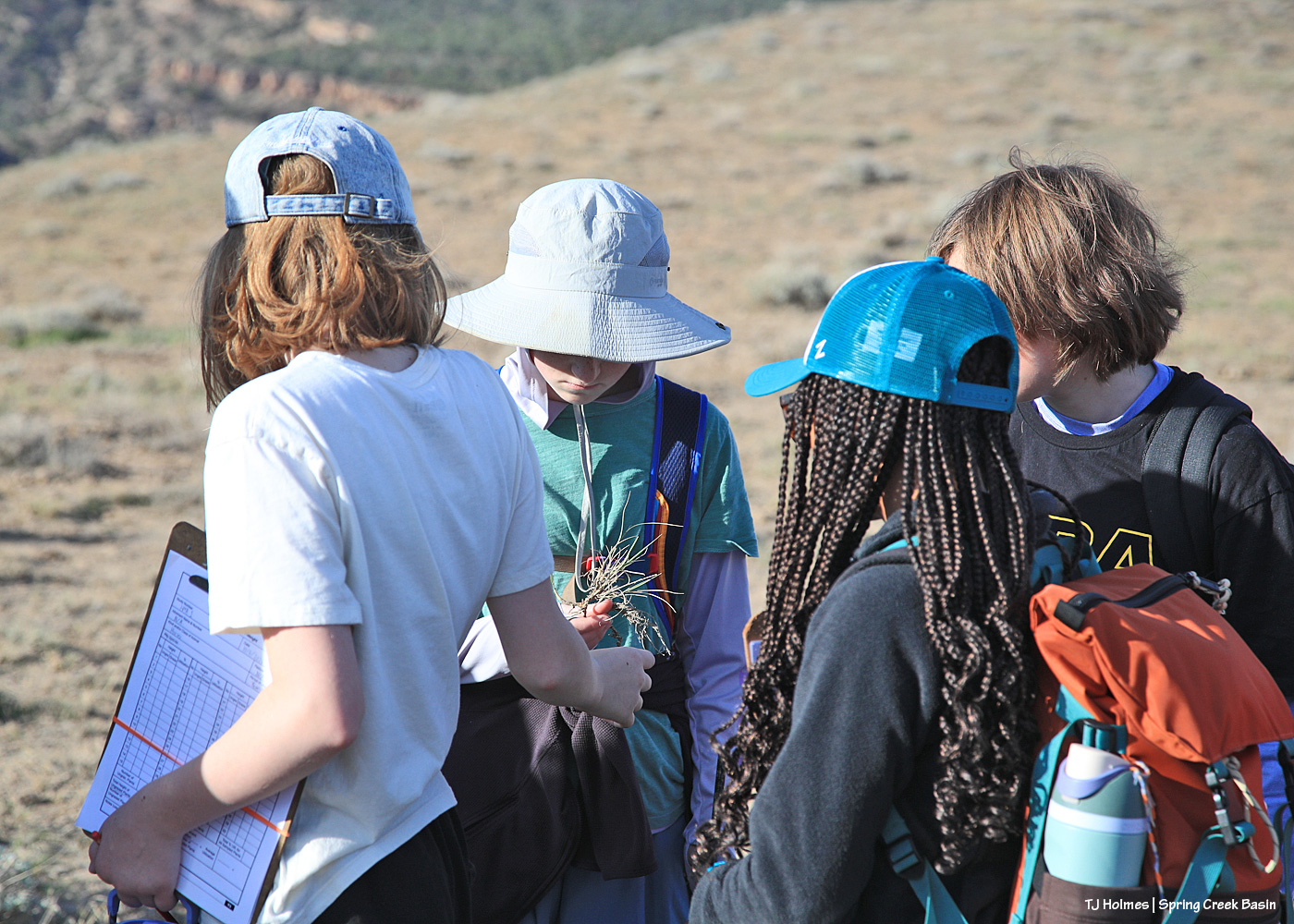
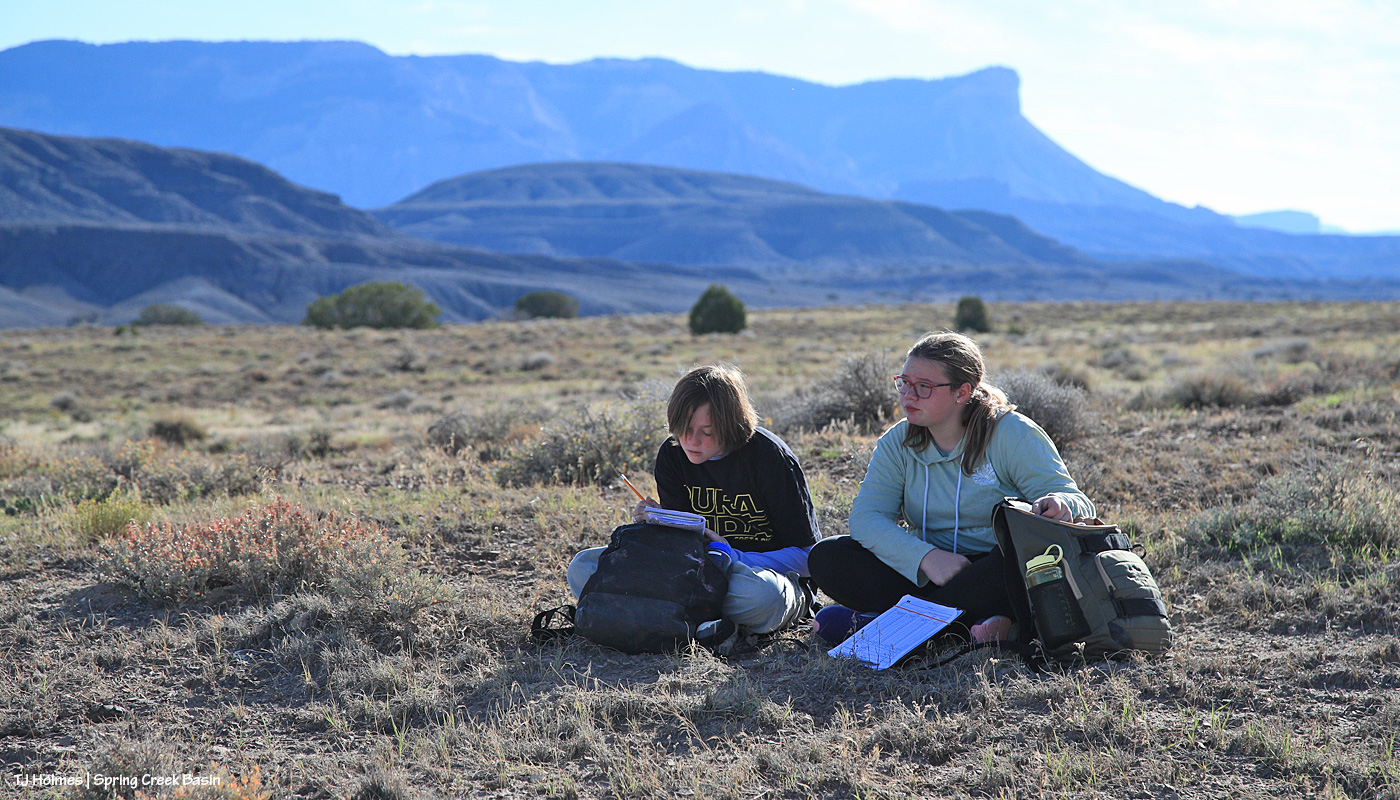
The kids spread out in small groups and pairs to conduct their utilization (grazed/ungrazed bits of galleta (a native, warm-season grass that’s growing after the recent rains) along lines of five steps at a time) under the watchful eye of Buckeye and the band.
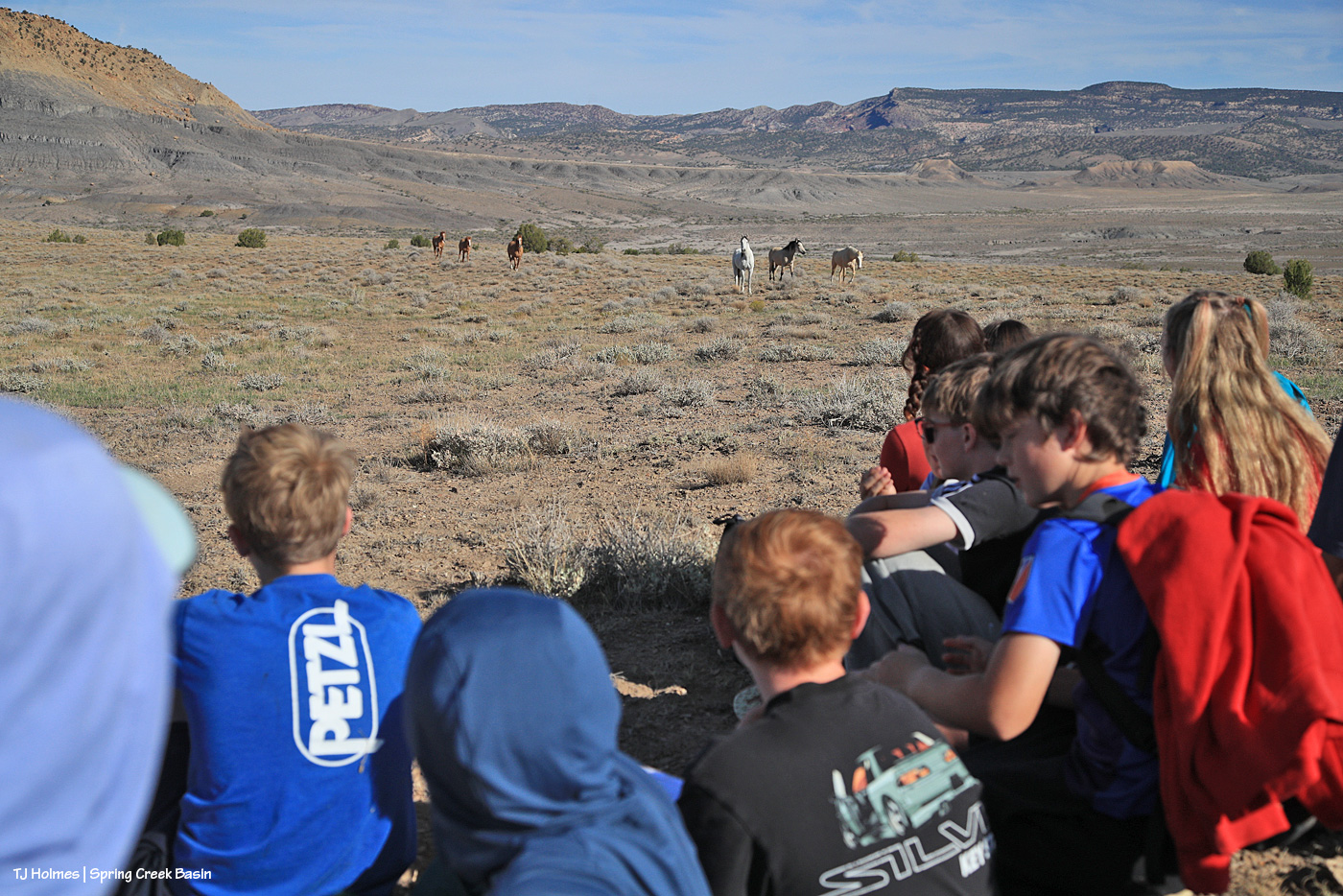
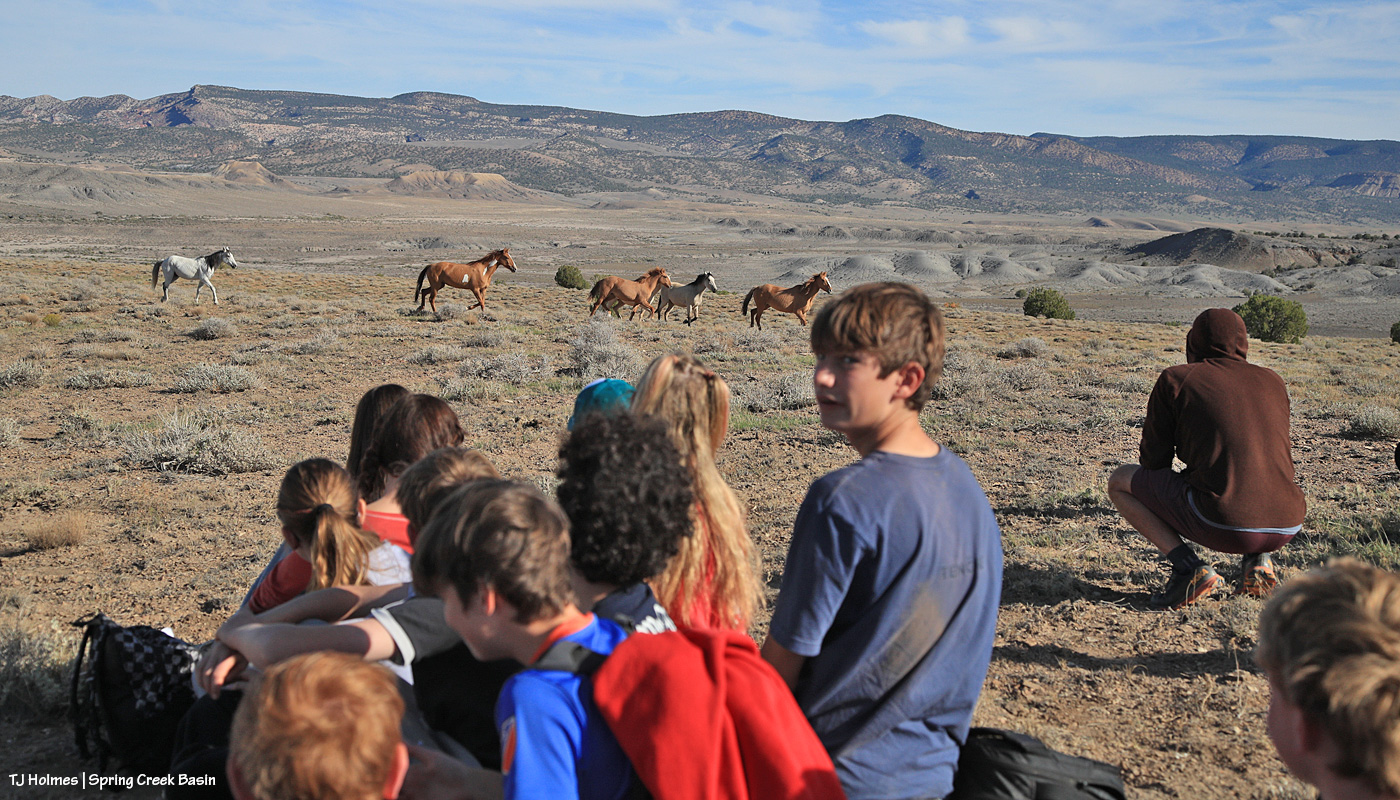
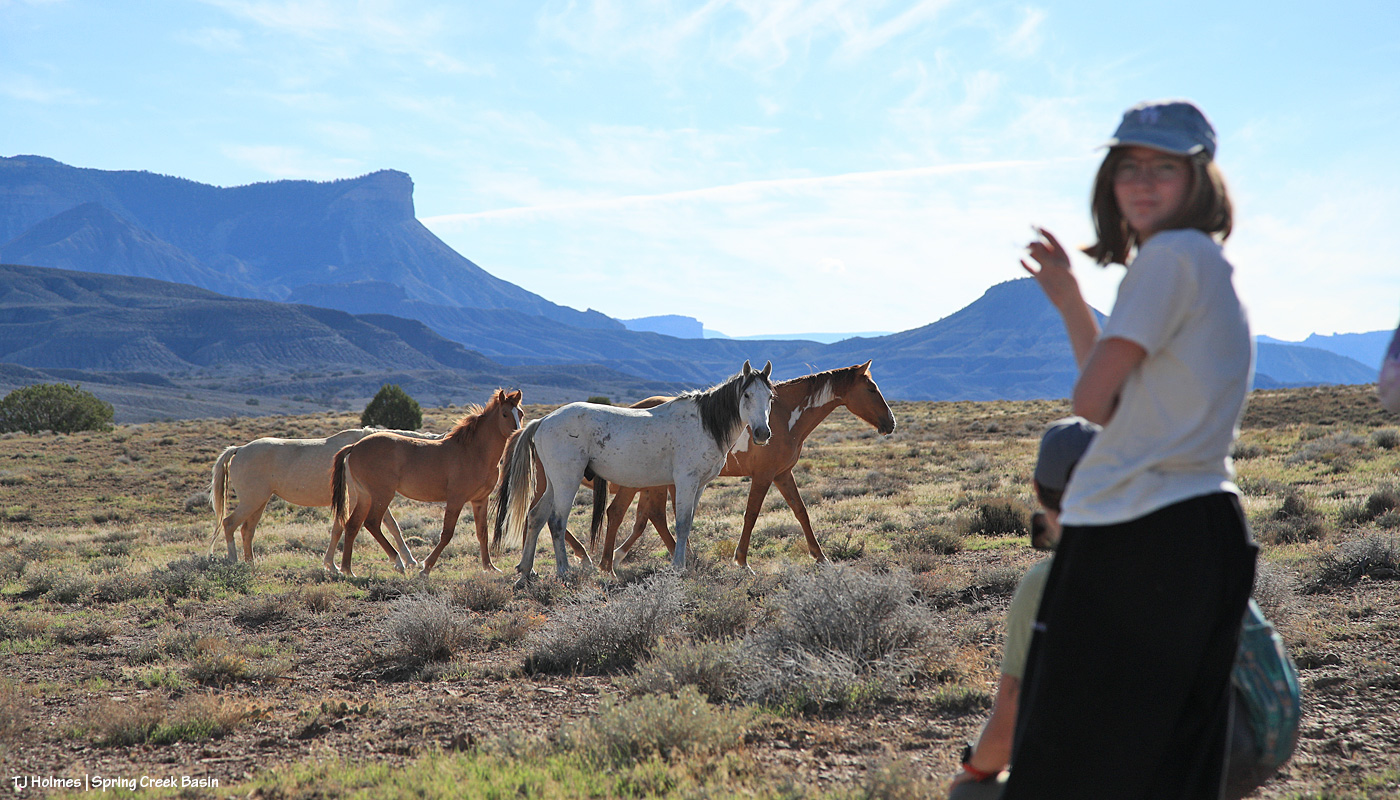
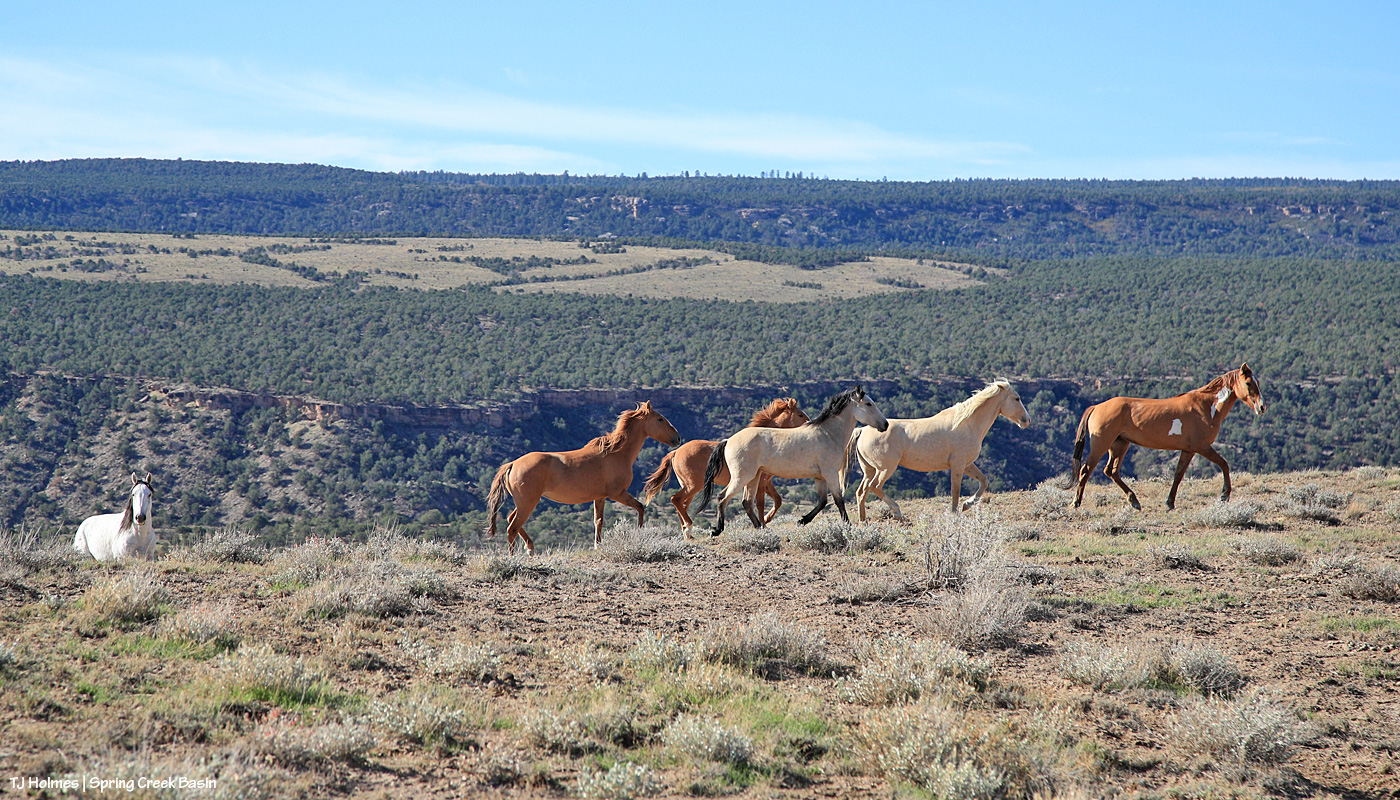
And then, while they listened to Laura and Anton guide them about how to fill out their sheets with the information they’d gathered, Buckeye decided that he and the band were ready for their morning drink … which meant ambling up the trail … and giving the kids a good check-over … before heading down the other side of the hill to the water catchment.
Top THAT, any other school trip ever, anywhere! 🙂
We stayed up top to listen to Derek and give the horses a chance to get down the hill, to the catchment to drink the lovely fresh rainwater in the trough … and they came up a different trail back to the top of the hill, checked us out again and returned to grazing.
Oh, my lovely, wonderful, awesome and amazing mustangs. 🙂 You do me SO proud!
Then back down to the corrals and buses, where Anton and Laura helped them do the math involved in figuring out how much the horses are grazing in that area of the basin. At the end, I heard numbers ranging anywhere from 7 percent to 50 percent use/grazed plants, so even in our drought, we’re in good shape for the horses not eating everything in their paths. And the students learned a little bit about what BLM folks are looking at to manage the rangelands that support wild horses – and other grazing/browsing wildlife like elk, deer and pronghorns.
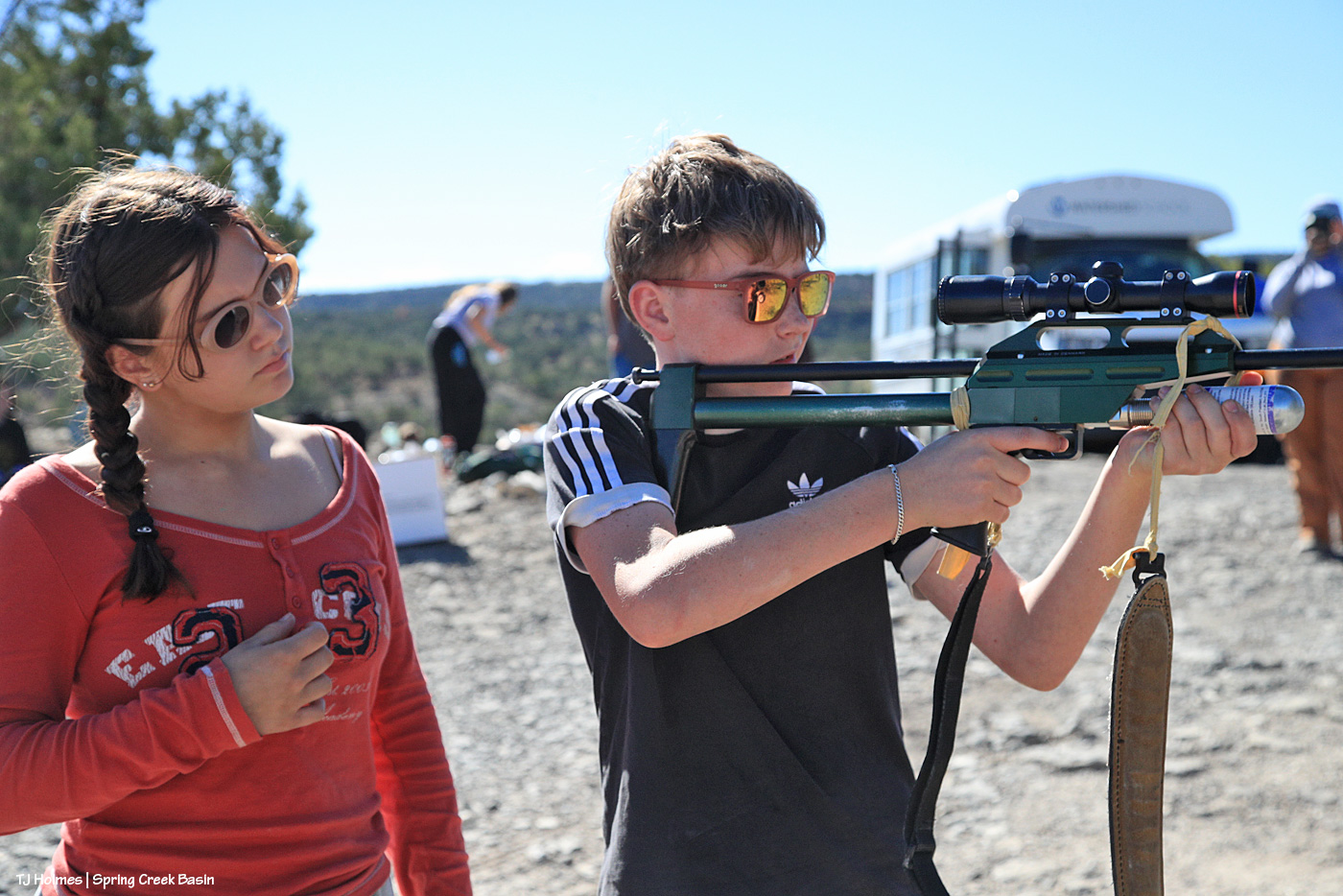
I got to talk more about PZP and show off my darting rifle and let some of the kids see how light it is and how quiet (no darts involved!). And I marveled the whole time at the insightful, curious questions the kids asked and the answers Anton and Laura gave to provide the kids with a well-rounded picture of what it takes to manage a herd of wild horses on public land in Colorado.
Ahhhhhhhhhhhhhhhhhhhhhh-mazing!
Here follow a load of pix of Watershed School students and teachers Amy, Diana and Pete, BLM’ers Laura, Anton and Derek … and the mustangs they got to see:
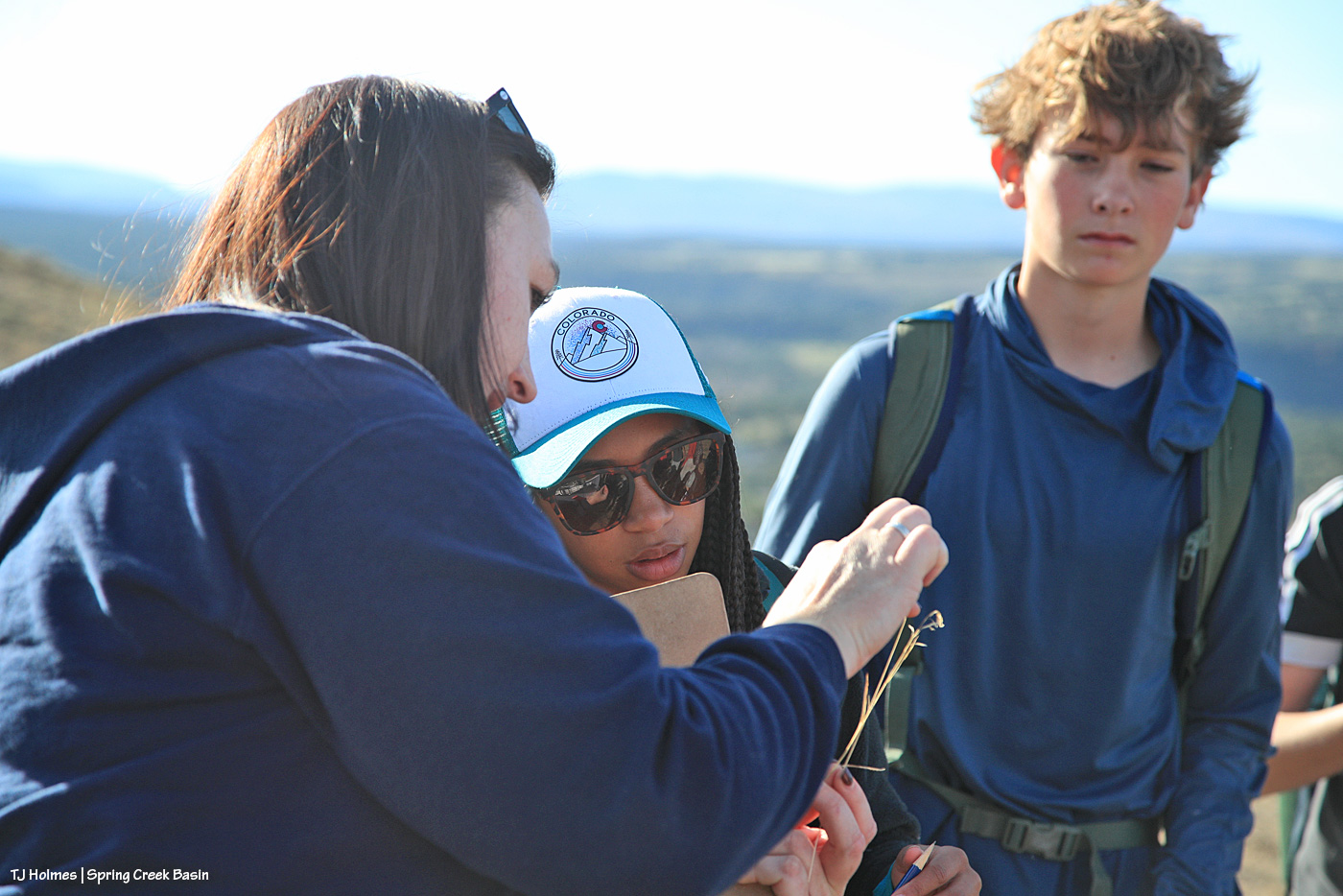
Laura points out characteristics of grasses to students. We saw past-prime cheat grass, and they concentrated on newly growing galleta. (We also saw Indian ricegrass, grama grass, alkali sacaton and/or sand dropseed (my hat is off to you if you can look at the latter two and tell them apart!)
Students examine a clump of grass that shows last year’s growth as well as recent growth.
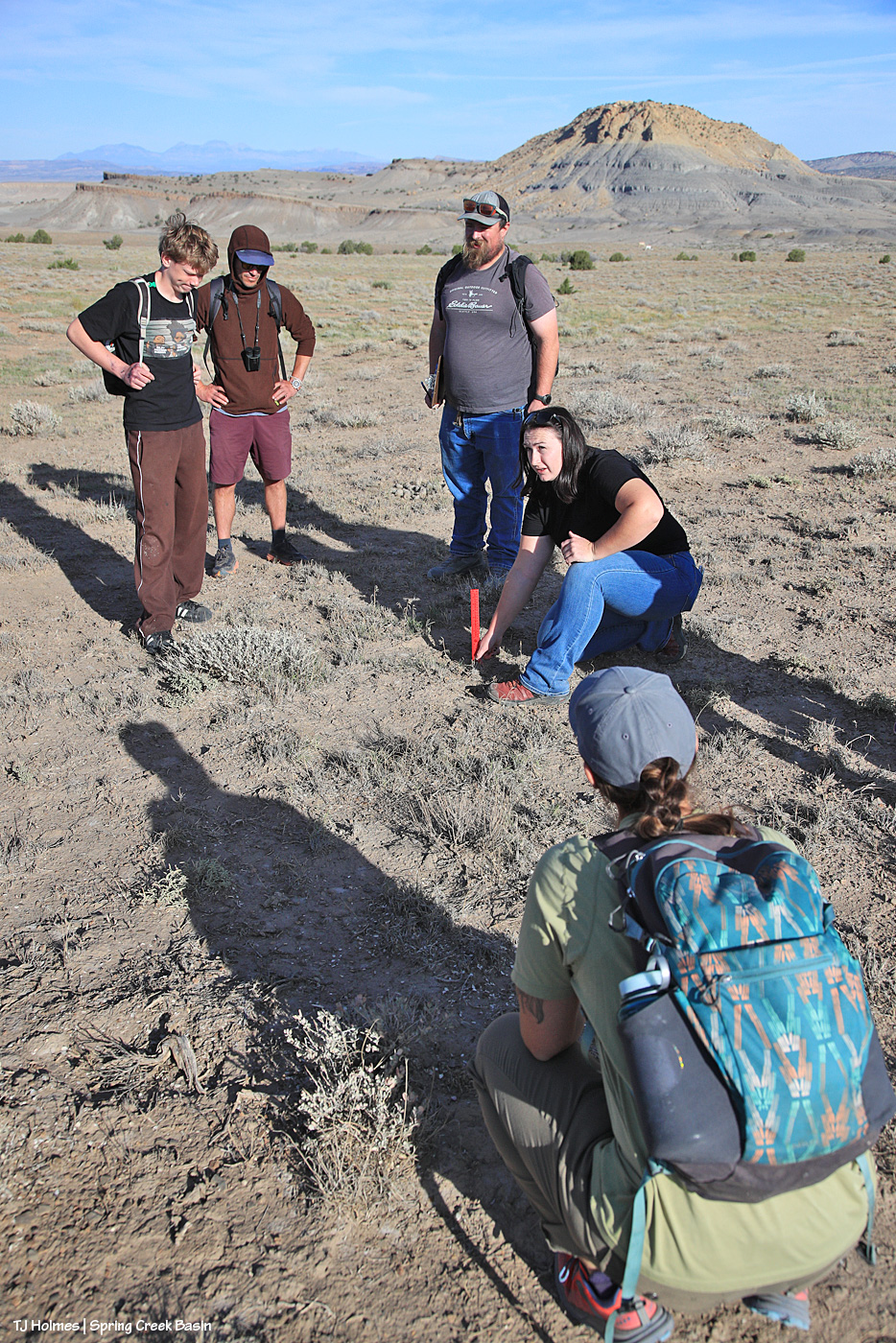
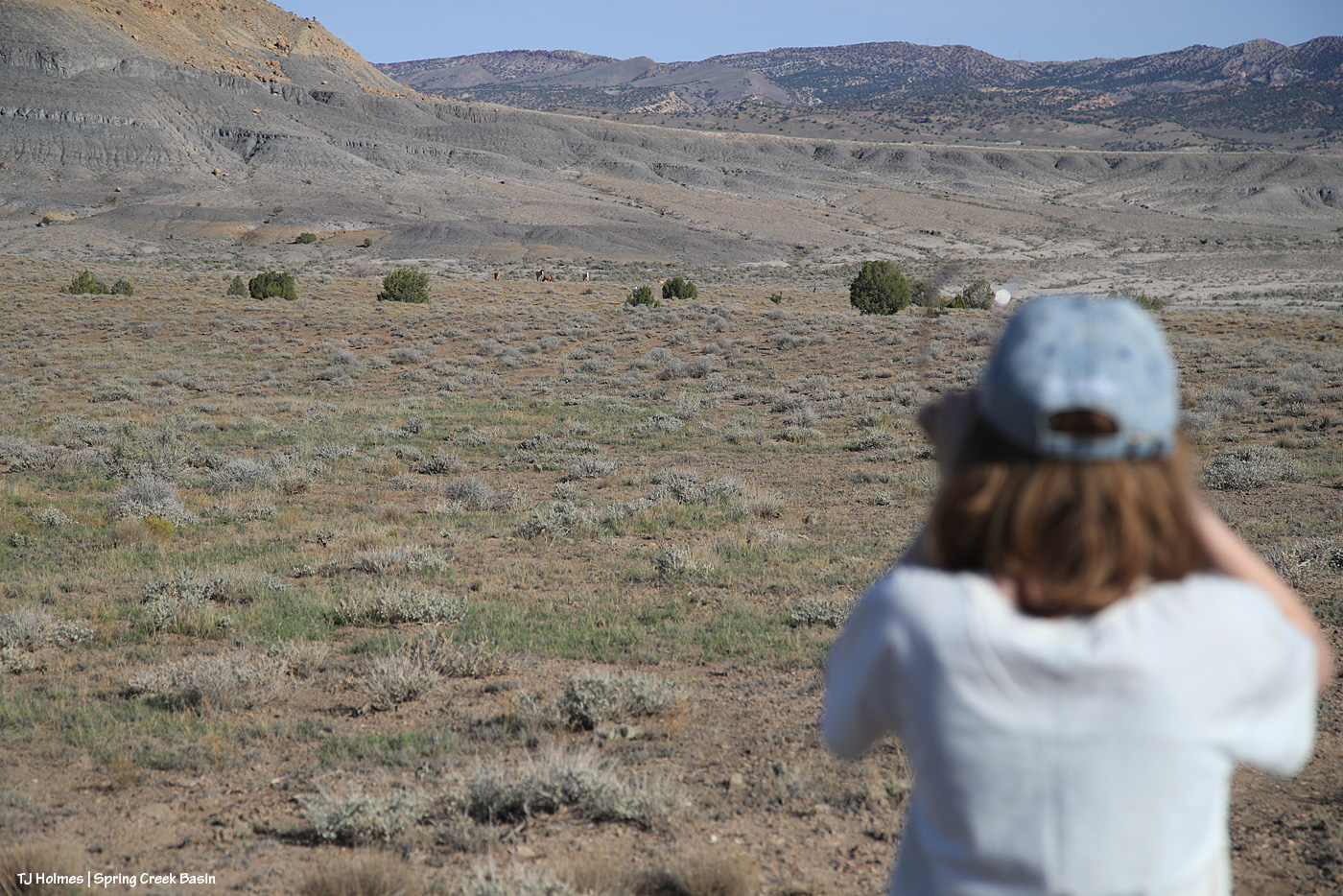
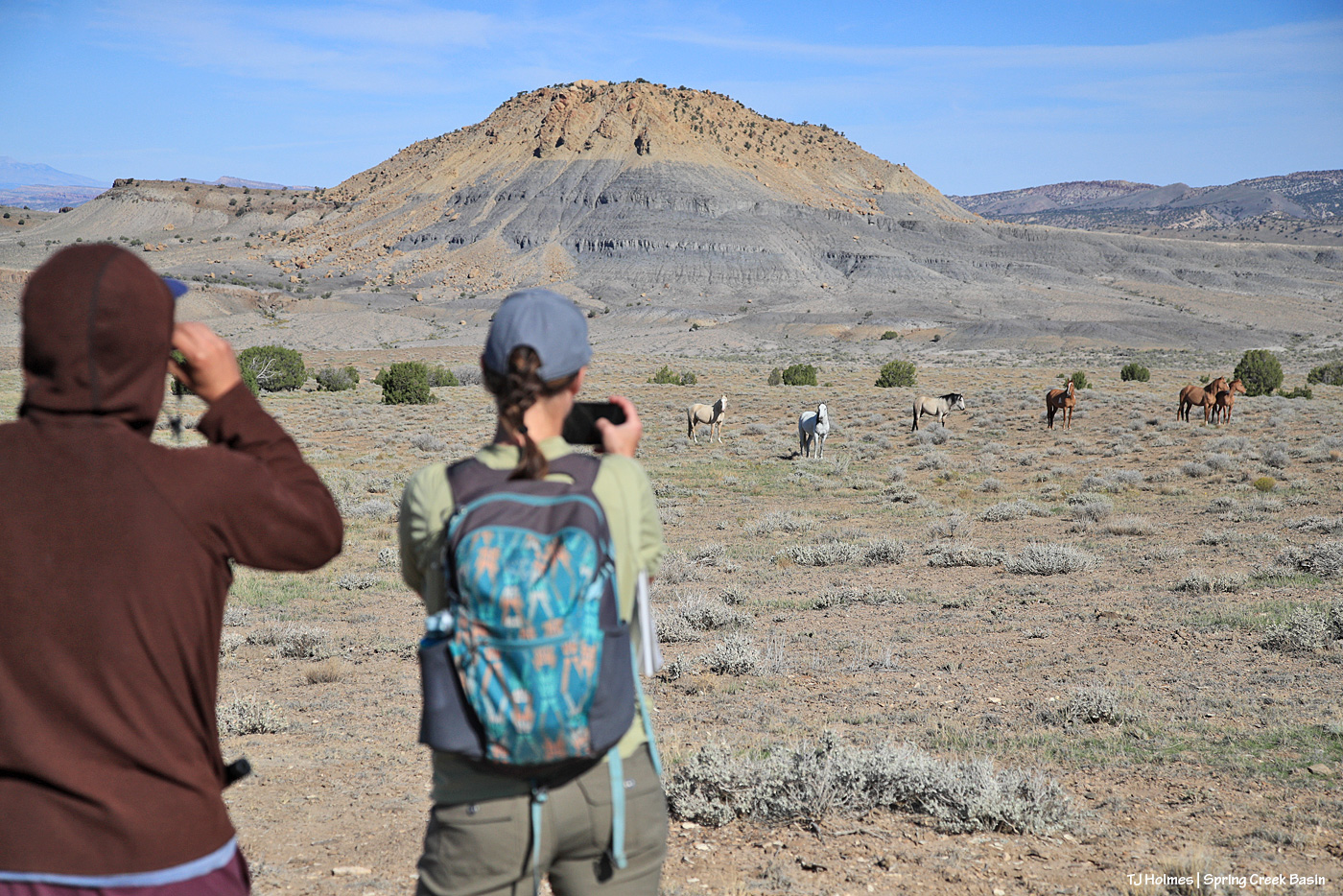
Laura and Anton talk about how to measure clumps of grass. The idea was that the students walked five steps in a line, measured galleta at their toe or within reach … then another five steps … until they’d measured 10 samples. Teacher Amy is in the foreground (this is the second time she has brought one of her eighth-grade humanities classes to Spring Creek Basin; the last time, it poured rain! as you can see in these pix, they lucked out with spectacular October weather), and teacher Pete is in the brown hoodie and camp. … Start to notice the “little white dots” in the distance.
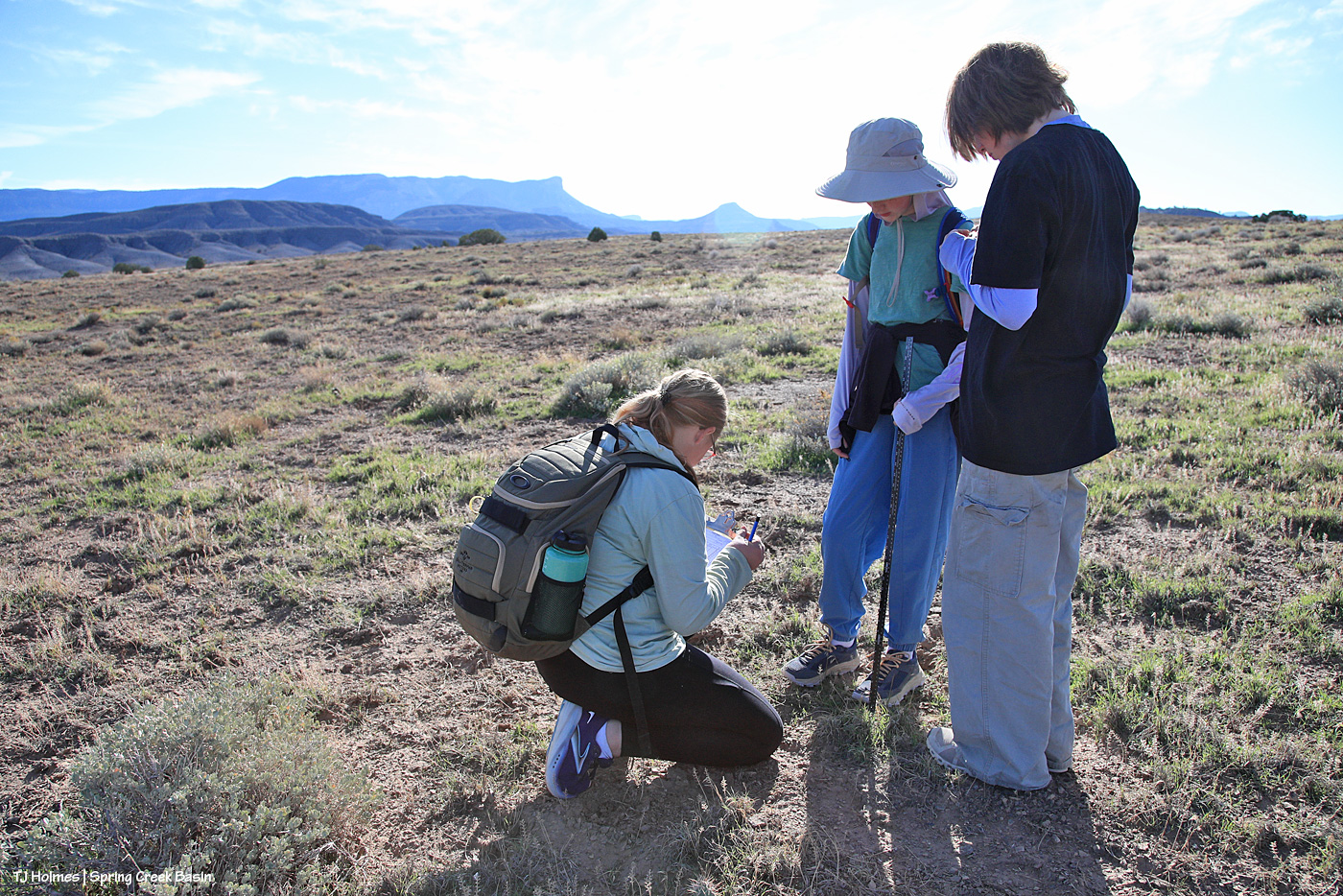
Teacher Diana is at right while the students watch Laura measure the grass clump. For a little perspective, I’m facing nearly directly north toward the main, west-ish part of Spring Creek Basin.
No mistaking that horizon. 🙂 Laura helps one of the small groups of students with their monitoring while two other groups walk their lines in the background.
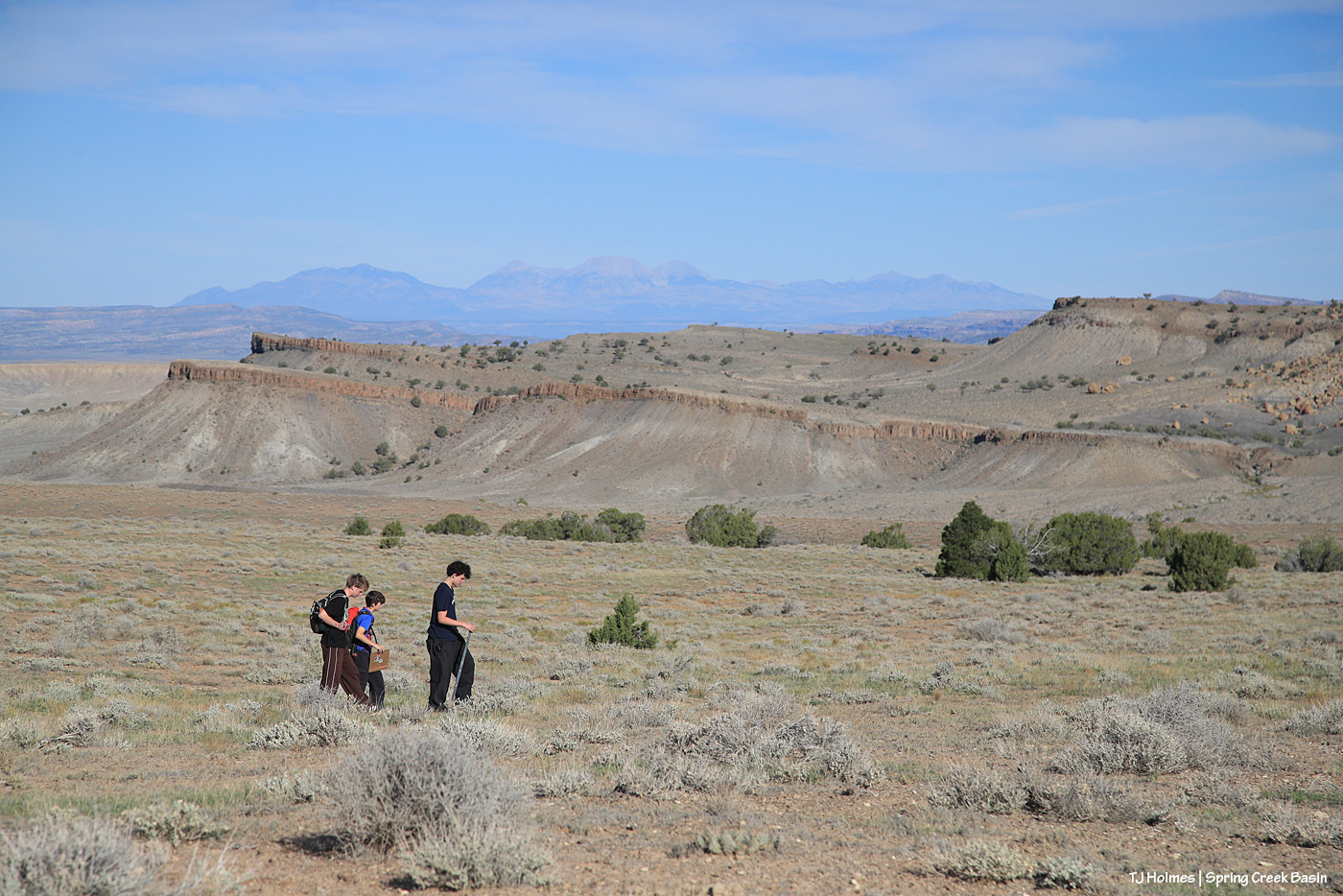
Boys walk their line with the basin’s south-facing rimrocks in the near distance and Utah’s La Sal Mountains in the far distance.
It’s hard to get a whole lot farther from Boulder than Disappointment Valley (OK, we’re not the *farthest* southwest corner of the state), but students were focused on the vegetation and their project. How cool is it that they’re able to take trips like this instead of learning from books only, only in a classroom?
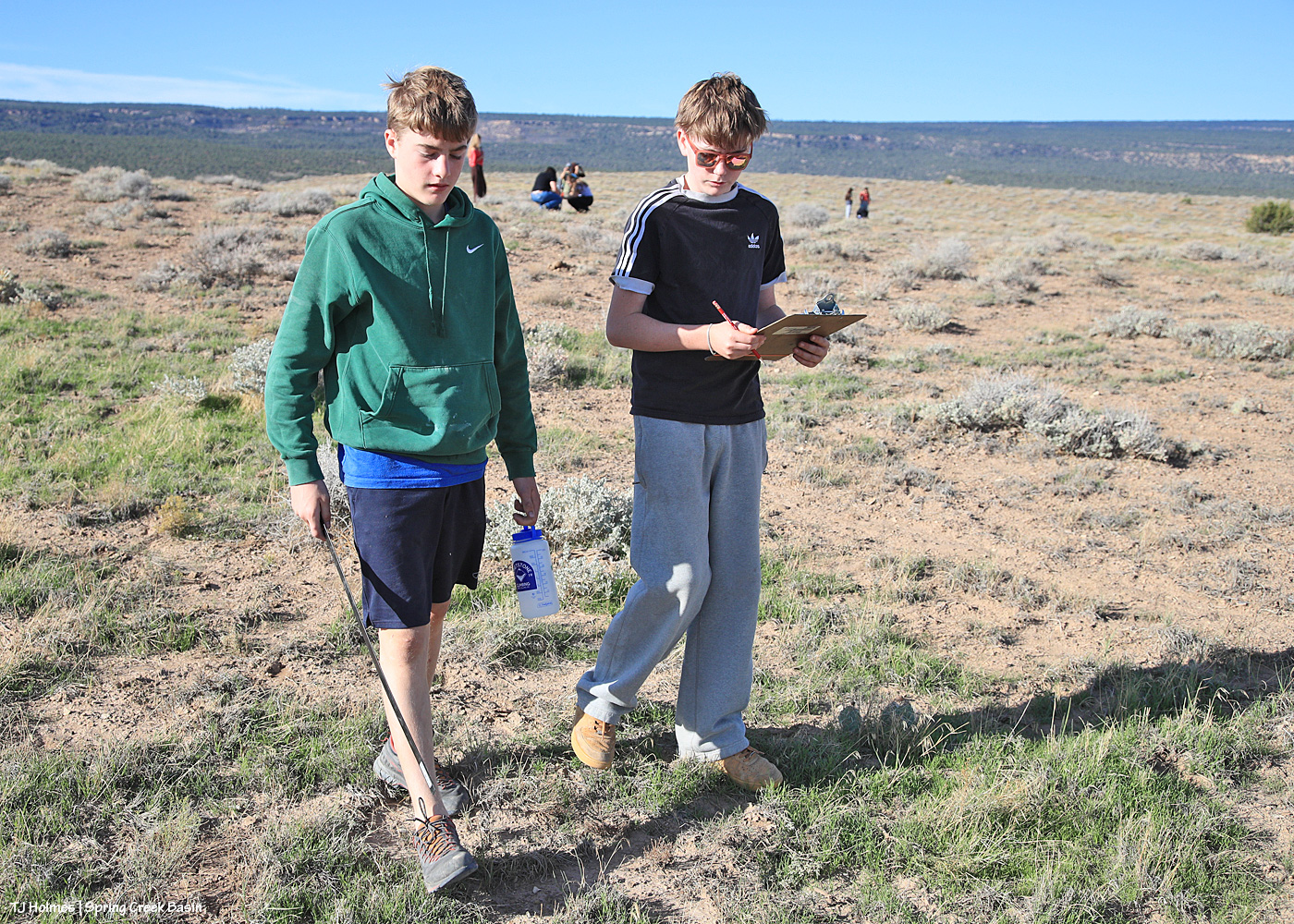
Another pair walking their line with other groups in the distance. See that GREEN grass? Yeah, thank you, RAIN! A little goes a long way in this high desert.
Diana follows the boys back up the hill after they finished their line. Can’t get enough of that scenery.
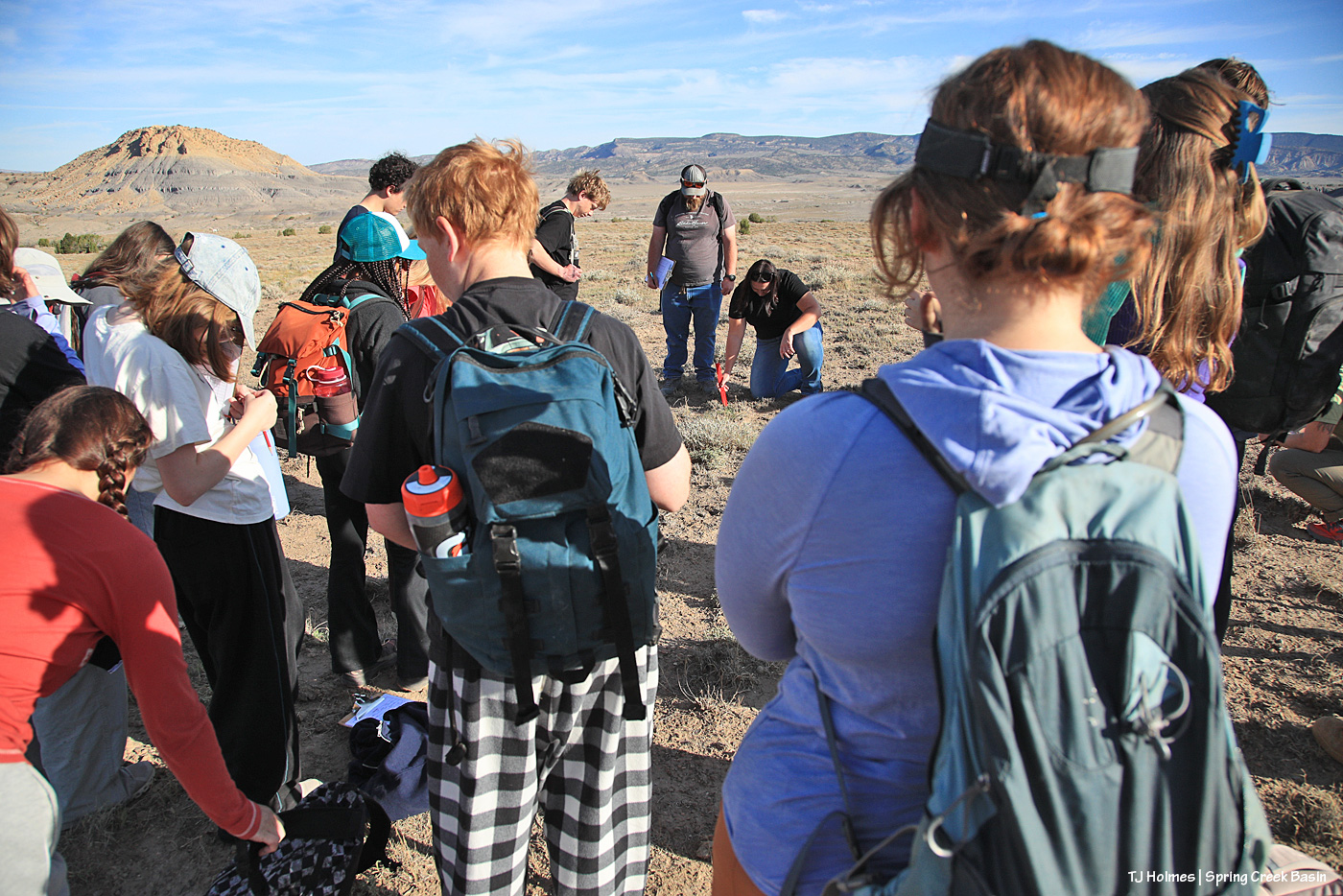
All gathered again to ensure they’d filled out their sheets well. … There was math to come!
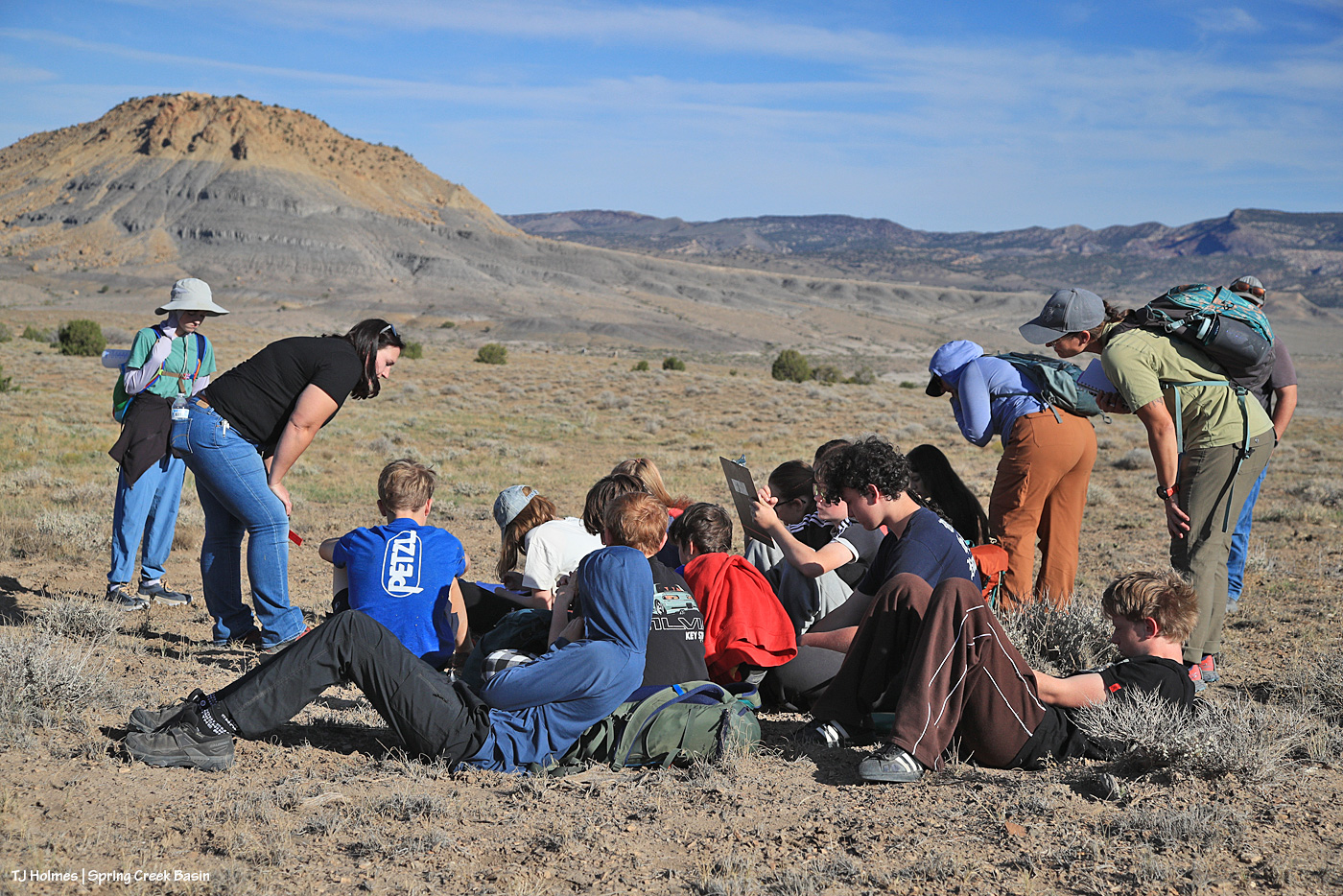
These city students were not afraid to drop to the ground among the grasses and shadscale and four-wing saltbush – and cacti!
Laura, left, and teachers Amy and Diana helped the kids with their utilization sheets (these are the same that BLM employees use while out monitoring rangelands). They’re a little hard to see (wide-angle lens, not my big gun), but look straight out over the kids’ heads. …
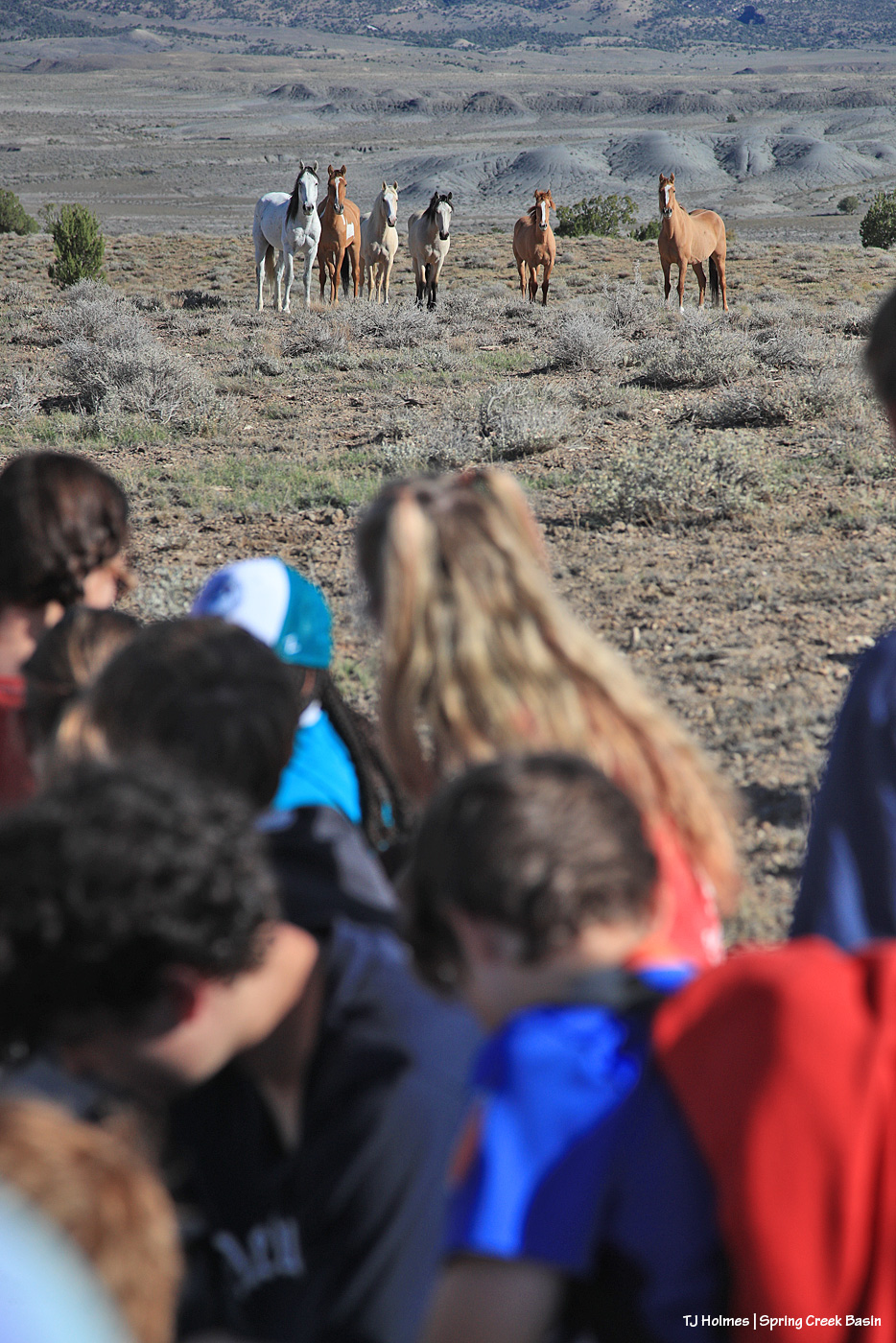
We were being watched!
Just like the evening before, Buckeye’s band was over the top of this hill, down toward the north. Here, they’re a little east of where they’d been previously. The previous evening, after they arrived, I hiked the kids out to the trees – there’s a little arroyo that starts there – and we picked up the trail to the west, which we took a bit farther left of where the horses are seen here.
I’m not sure how long we’d been on the hill, but we weren’t in a hurry, and the students were absorbed in their project. While they worked, I took pix and kept an eye on Buckeye’s band to gauge their comfort level (they were at least a few hundred yards away from us). By about this time, as the students were nearing the completion of the monitoring part of their project, I started to notice that the full band was appearing, and Buckeye was inching a bit closer. … And then it hit me: They want to make a trip up and over the hill and down to the catchment trough for their morning drink. Sure enough, they walked on up the trail, but where I thought they’d veer off more to the west and go down the trail I brought the kids up the evening before, those curious ponies came right up the trail to where the students were gathered! I cautioned everybody to just sit tight and stay fairly quiet and let the horses explore this mass of humanity on their usual empty route to water.
And the gathered group of students and adults got the mustang sighting of their lives. 🙂
Pretty amazing, eh? 🙂
While we were watching Buckeye’s band watching US, Tres Rios Field Office Manager Derek Padilla hiked up the hill to join us. He talked to the students about the variety of jobs available with the Bureau of Land Management (and U.S. Forest Service, where he spent the first 27 years of his 30-year land-management career) and the variety of ways BLM’ers manage the multiples uses that happen on public lands.
He and Buckeye might have worked it out between themselves because the band had plenty of time to head down the hill to water, drink and then return up a different trail.
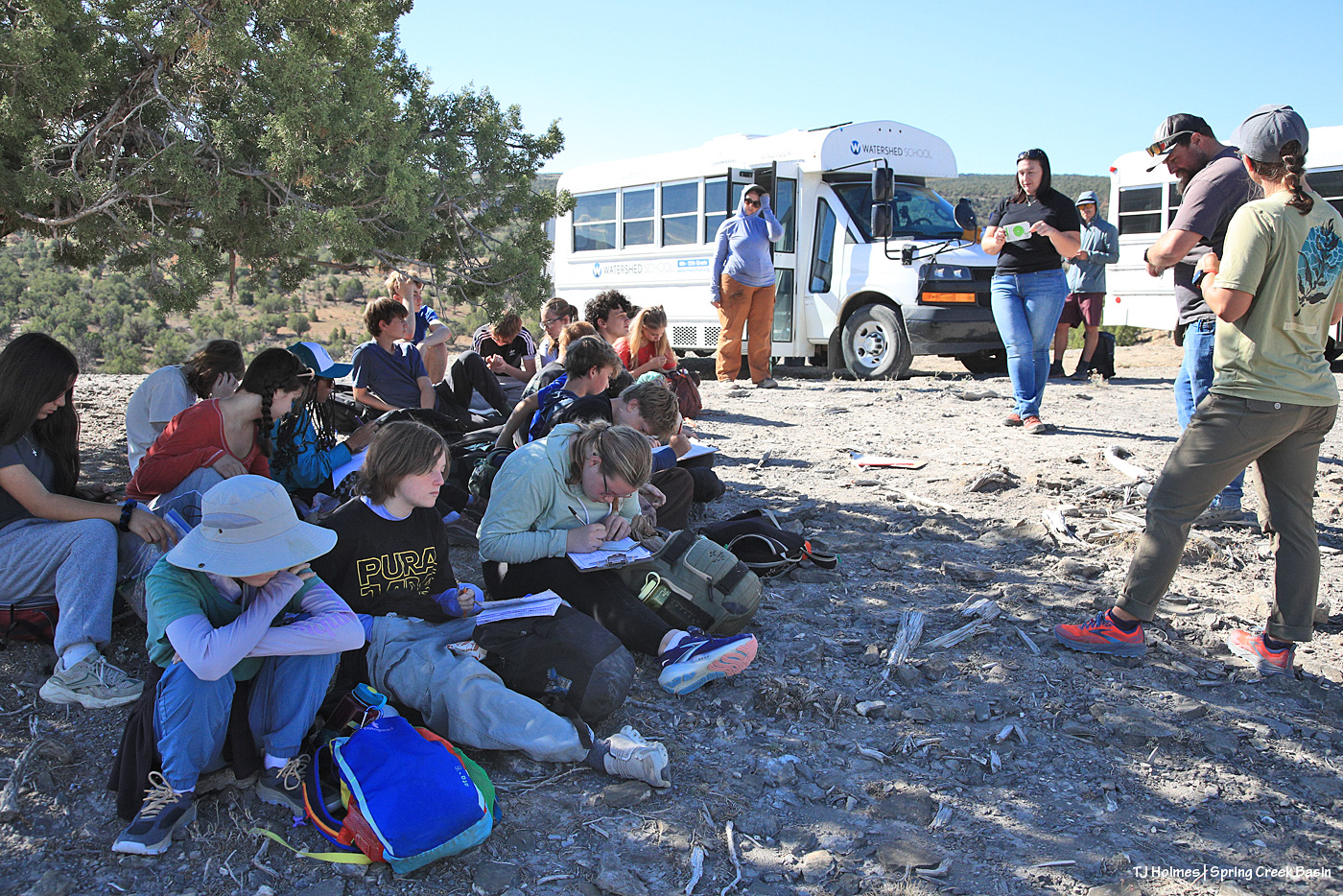
After one last farewell to the ponies, the group returned down the hill to the buses to complete the math (!) part of the project and have some lunch and a last round of questions and answers with Laura and Anton.
Yes, math does have real-world applications. 🙂 Laura and Anton helped students with the formulas to calculate the results of their utilization (grazed/ungrazed) survey. Results: The horses have plenty of forage, even after our stressful droughty summer. Whew.
Before they left, at least one of the teachers and a few of the students got to check out my darting rifle. It’s very lightweight, and it fires off of a CO2 cartridge (pressurized to the distance of a mare). NOTE: NO DARTS WERE IN THE RIFLE. I let them put some air in the rifle and pull the trigger to hear the sound and have the feel of it. A surprise to a couple: No kick. 🙂
Kudos to these kids and their teachers for thinking outside the box and creating the experiential learning experiences Watershed School is known for. *I* sure never got to visit wild horses as part of any class trip, and I attended lots of schools in many states and Germany! They are super curious and intelligent and asked some of the best questions I’d ever heard – and I get a LOT of questions and have a lot of answers. Speaking for myself (I’m sure Laura and Anton and Derek would agree): We had a blast introducing these young folks to Disappointment Valley, Spring Creek Basin and (at least a few of) our amazing mustangs. 🙂
You’re welcome back any time!
Thank you so much to these Watershed School teachers and students, and to Anton, Laura and Derek, and (I have to say it) to my boy Buckeye and his girls, for making this a fantastic visit and learning experience in Spring Creek Basin!
Next year, this date – Sept. 19 – will mark 20 years since I started documenting Spring Creek Basin’s mustangs.
TWENTY. YEARS.
Sometime next fall (I don’t remember that exact date now), I’ll mark *25* years since the first time I visited Spring Creek Basin – in the rain, in a van full of people I didn’t know, and we didn’t see horses because we never actually got *into* the basin (even if it had been dry, a van might not have been the best choice of vehicle?!). I went back soon after that by myself … and, well, now it’s been 24 years *this* fall. You know that saying “blood, sweat and tears”? Yeah … it’s been ALL of that … a whole lotta alla that.
That means this fall marks my 19th (today) and 24th anniversaries. I still find that pretty shocking to say out loud.
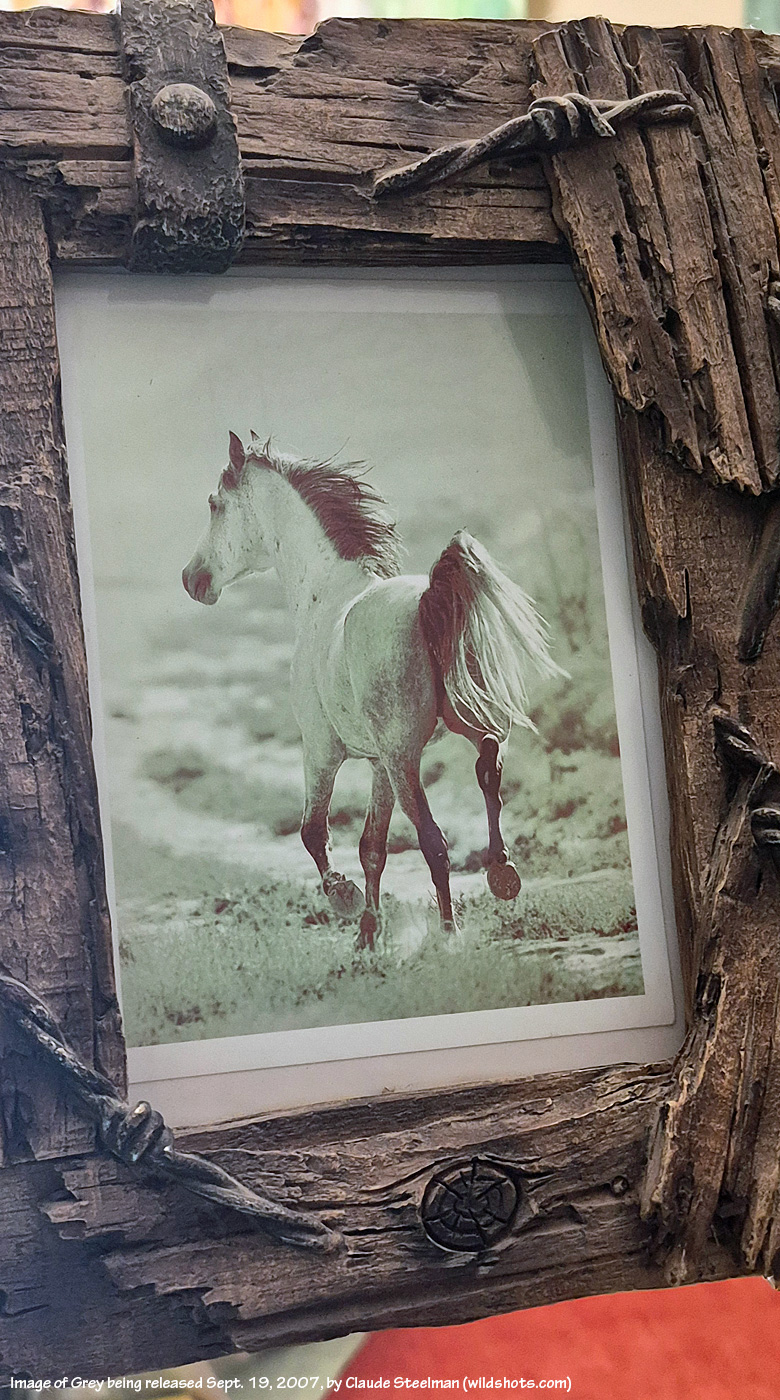
Two thousand seven was a roundup year in Spring Creek Basin. It was the third that decade (and we still had 2011 to come). BLM said the stallion known to most as Traveler (to me as Grey) would stay. They promised. … One guy broke that promise. … One guy made it right. Grey went to Cañon City, and about a week after he had been removed, we brought him back to Southwest Colorado, where his two-week quarantine turned into three weeks (courtesy of the promise-breaker). Four weeks after he left Spring Creek Basin, David and Pati Temple returned Grey/Traveler to the basin, Pati opened the trailer door, and he returned to his wild life, where he lived until his passing a few years ago.
Photo print of Grey by Claude Steelman moments after he was released Sept. 19, 2007, into Spring Creek Basin
“He’ll never have a band again,” the BLM promise-breaker said dismissively at the time. Within a month and a half, Grey had a band again.
Grey’s Return Day was Sept. 19, 2007. After the pomp of Grey’s momentous release (a couple of other people also were there, including renowned Durango-based wildlife photographer Claude Steelman), I stayed in the basin to start documenting every mustang I found. It took three months of weekends. Nineteen wild and crazy – and now, immensely satisfying – years ago.
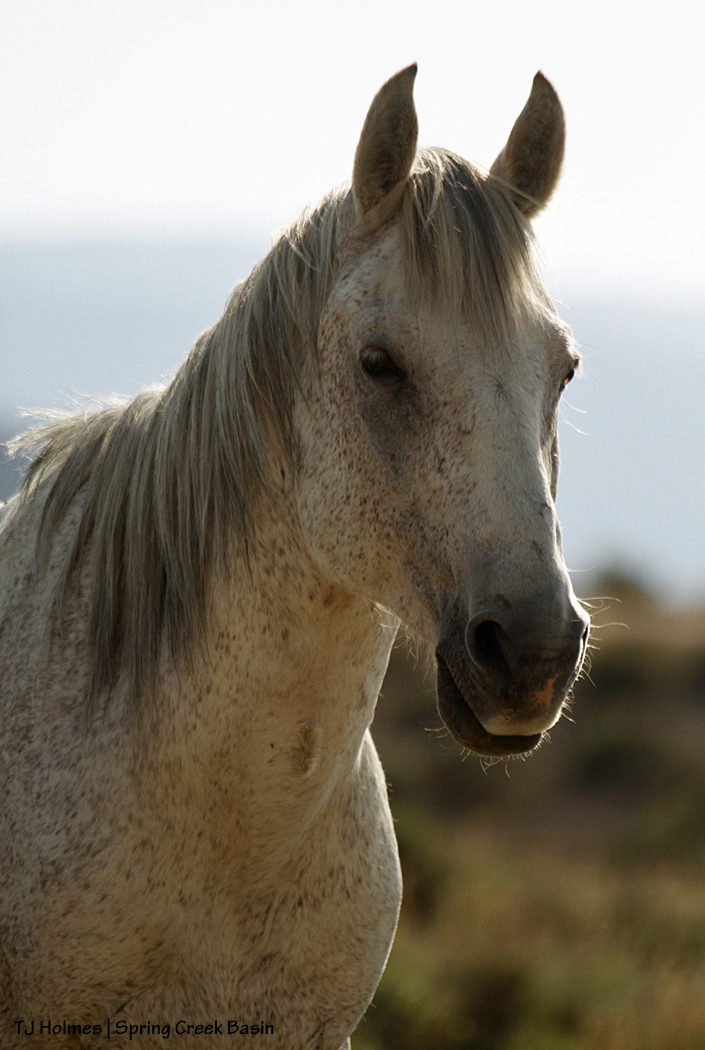
Grey, toward the end of his life; we thought he was close to 30
So today, I celebrate both the anniversary of Grey’s return and release and the day I started documenting my beloved mustangs, what has become the path of my heart through this lifetime.
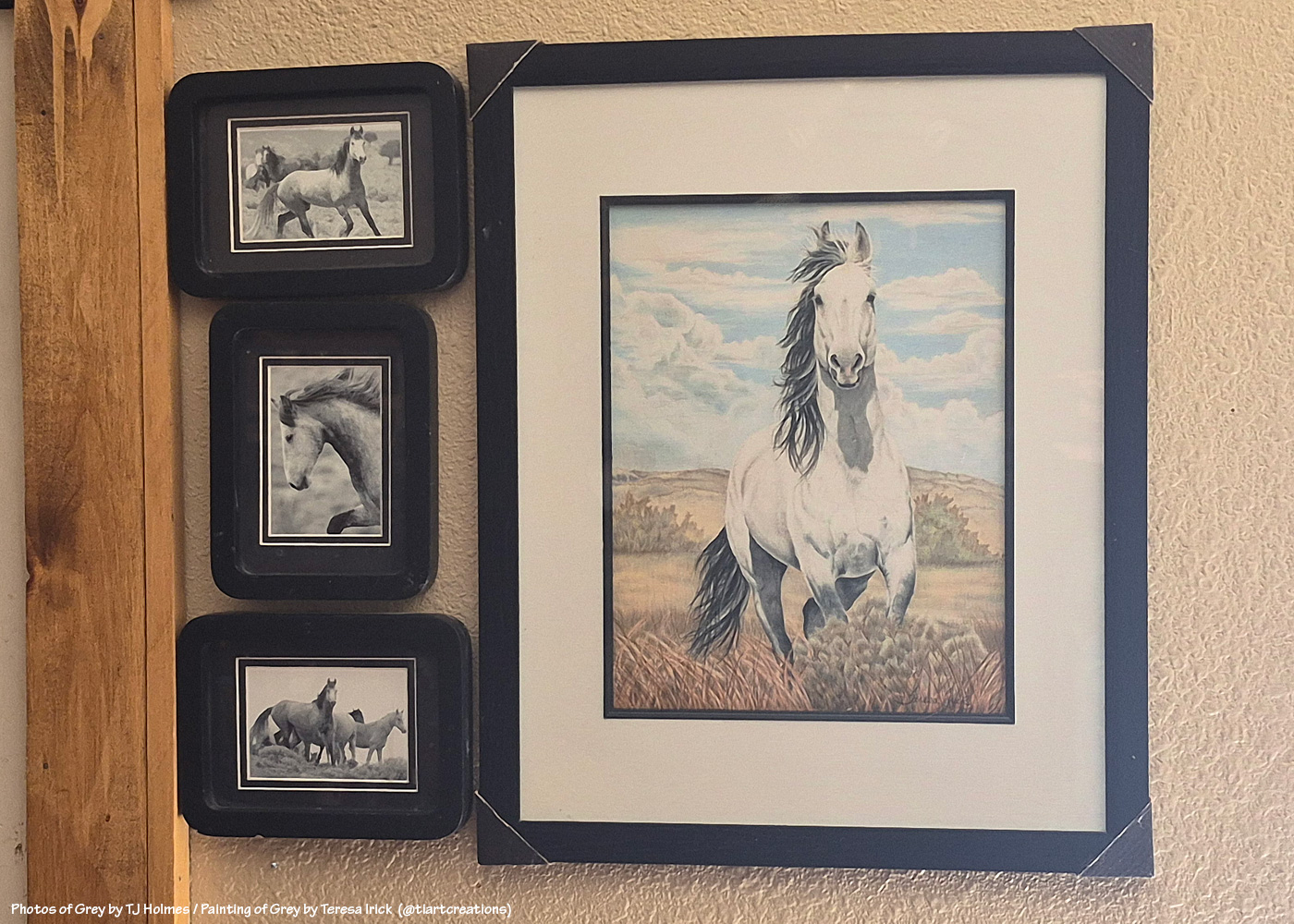
My *wall of Grey*; photos of Grey by me circa 2003-2004? Gorgeous painting of Grey by talented Colorado artist Teresa Irick (@tiartcreations on Instagram) based on a photo by me
When I first started this mustang-advocacy journey, 20 years into the future felt like some random date that would never arrive. Now, wow.
I want to do something kinda fun to mark the occasion next year, and this is a head’s up. A few of you have read and commented and shared the mustangs for a lot of years now, and I’d like to send you each a photo print of the mustangs. I probably haven’t taken it yet, but I have a year (!), and I’ll let you choose. You might know who you are. 🙂 I thought I’d also ask readers – on that date, and don’t worry, I’ll remind ya’ll ahead of time – to leave a comment on that post, and I’ll put all your names in a hat and mix ’em all up, and I’ll have a mustang friend pick a name and send that person a pic, too. I want to celebrate YOU who support and love these mustangs, too! There also are a handful of people who have been with me for long years on this mustang journey, and I want to recognize them, too (more about them next year).
Hollywood and his mares, 2019; Hollywood and Houdini are both gone now … Shane, Alegre and Maia are still together
When you’re starting a thing, you never know where that thing is going to go, how it’s going to go, how long it’ll go on. When you have a burning desire to do something strong, something worthwhile, again, you just never know. That’s the future. … That’s LIFE.
So many people have had a hand (even just some fingers) in the accomplishments realized for bettering the management and preservation of Spring Creek Basin’s mustangs, and I can’t even imagine (and I don’t wanna) what path my life would have followed if I hadn’t discovered this herd and all the amazing people I’ve met along the way. We’ve all shared something: love of horses. Love of WILD horses. Love of mustangs.
Remember that promise-breaker? I realized several years ago that I’m *grateful* to him. I definitely couldn’t see it at the time of what felt like deep betrayal by the system, but if not for that guy, would my Irish stubbornness have come to the fore and would I have dug my boots and heart so deep into ground I’d never known but has become my rooted ground?? As I said: *grateful*.
Winona with sons Cheveyo and Lyra; Lyra is gone now, and Cheveyo is a band stallion; Winona, of course, is one of our wise ones
And you know what? Holy … horse. 🙂 Spring Creek Basin Herd Management Area today is one of the best managed herds in the country (if not the best? forgive me a tiny bit of bias, please, but I don’t know of any others quite like ours). I am so grateful to the BLM folks at Tres Rios Field Office who made that happen and continue to work with our shared goal in mind.
Because we shared a dream and a goal and got to work doing it, not sitting by waiting for someone else to come along and dig in and get ‘er done. I sure didn’t start that dream for Spring Creek Basin, but I tip my visor to those who did … those who welcomed me to the fold so I could join the journey to the goal. And in that time, we have gotten done EVERYTHING we’ve aimed to achieve … bar one that we haven’t gone full force on, and that’s in the hands of bureaucrats, really, which is unfortunate, but it’s still possible.
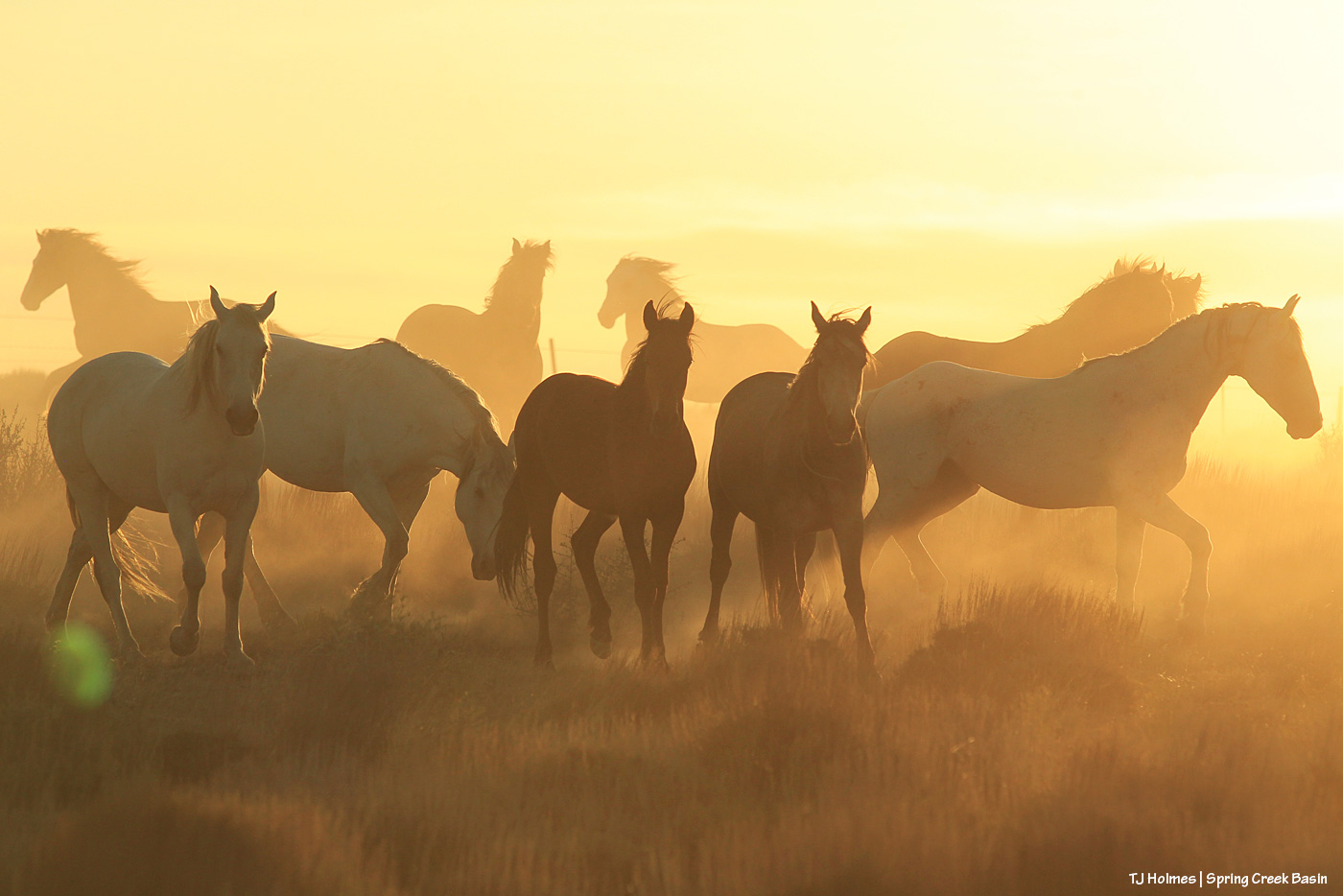
Comanche’s band in the dust of early summer, 2020
I’ll probably (of course I will) write another long-winded post about this on my actual 20th anniversary, but on this, my 19th, *thank you* to every single person who has given even the tiniest bit of love to Spring Creek Basin’s mustangs. My love and gratitude to each one of you.
And hang on for (at least!) another year, with the mustangs and me, to celebrate the big 2-0. 🙂 No worries: The 20th won’t be anywhere close to the end. To paraphrase something I heard someone say someone told him: I will continue to make as positive an impact as I can in all the time I’m given in and for Spring Creek Basin and its mustangs.
I’m so glad you’re here, with us.
*Grateful*
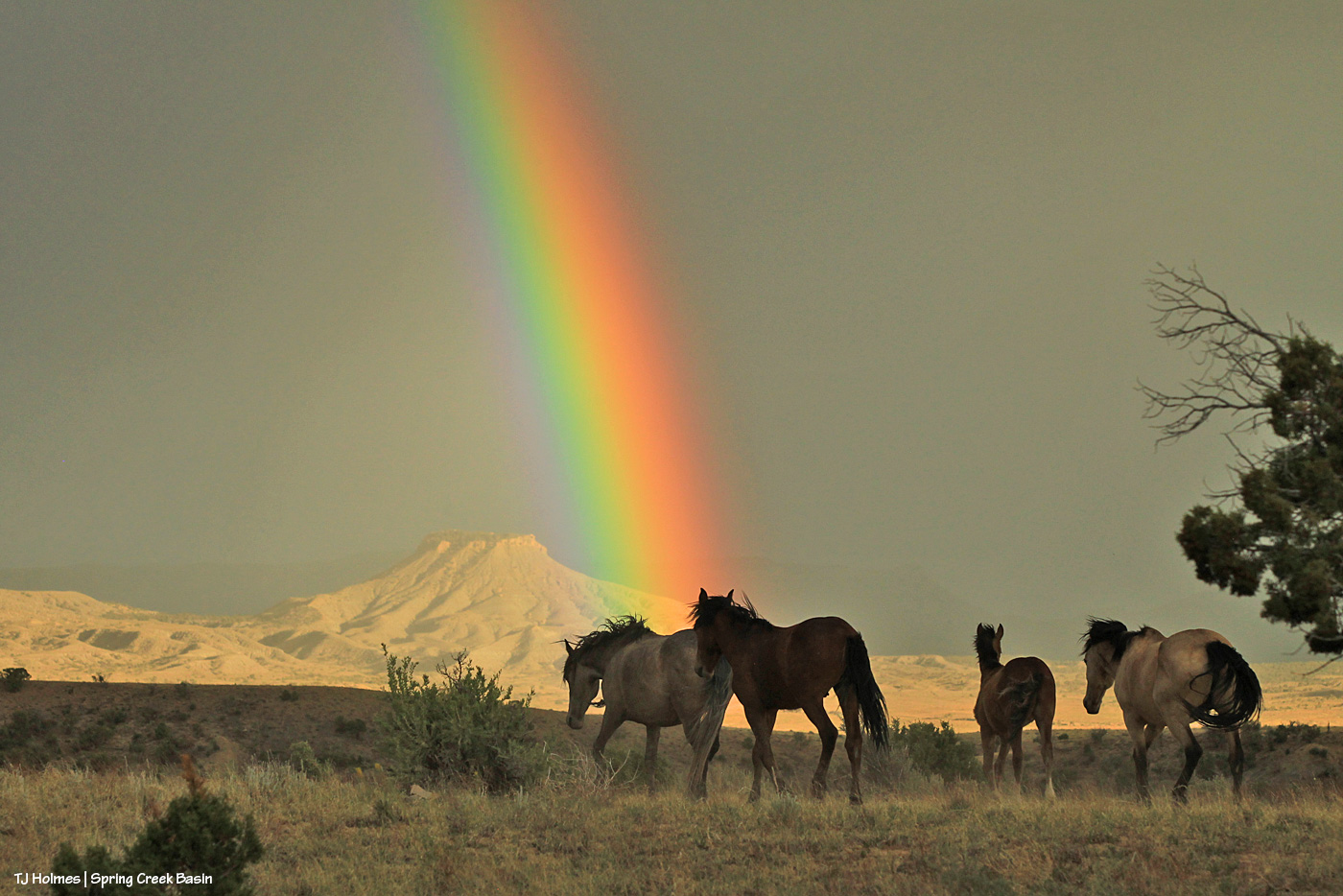
Comanche’s band, under the rainbow, 2020; Comanche also is gone now
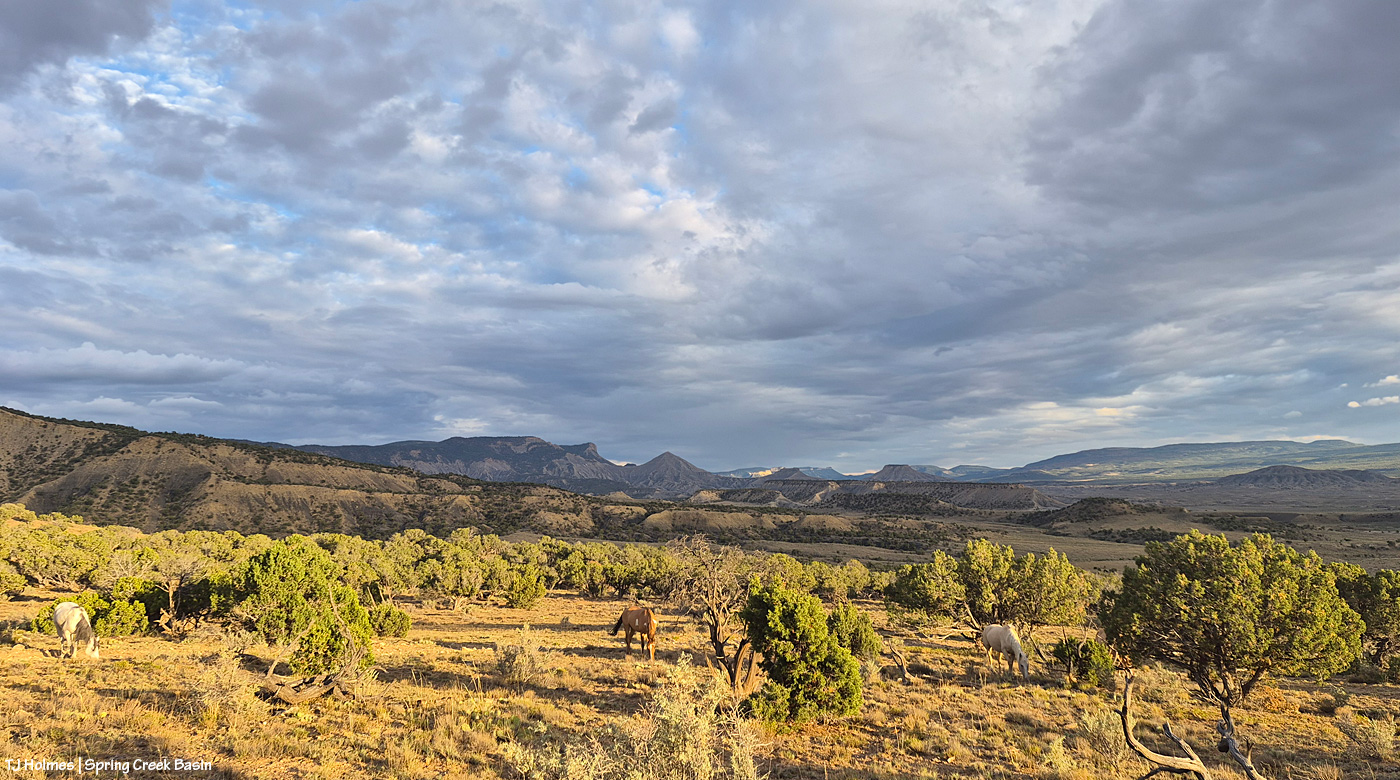
Some beautiful light over Buckeye’s band on a recent evening, looking southeast. Buckeye at left, Aiyanna at center, Rowan at right and … see if you can spot Dundee behind the tree at far right. No rain, but the temps have dropped, and the cloud cover has been an absolute relief.
Bonus:
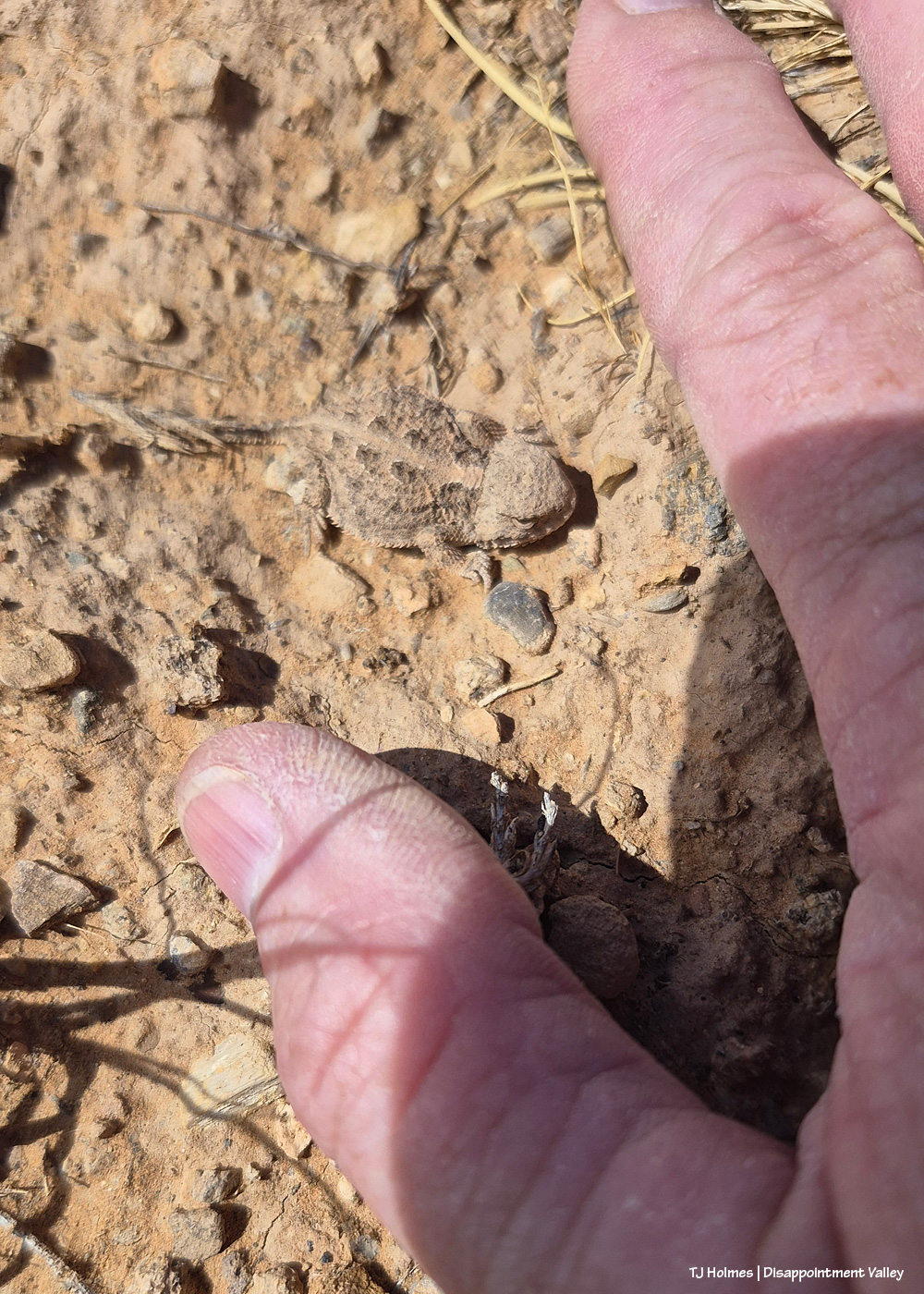
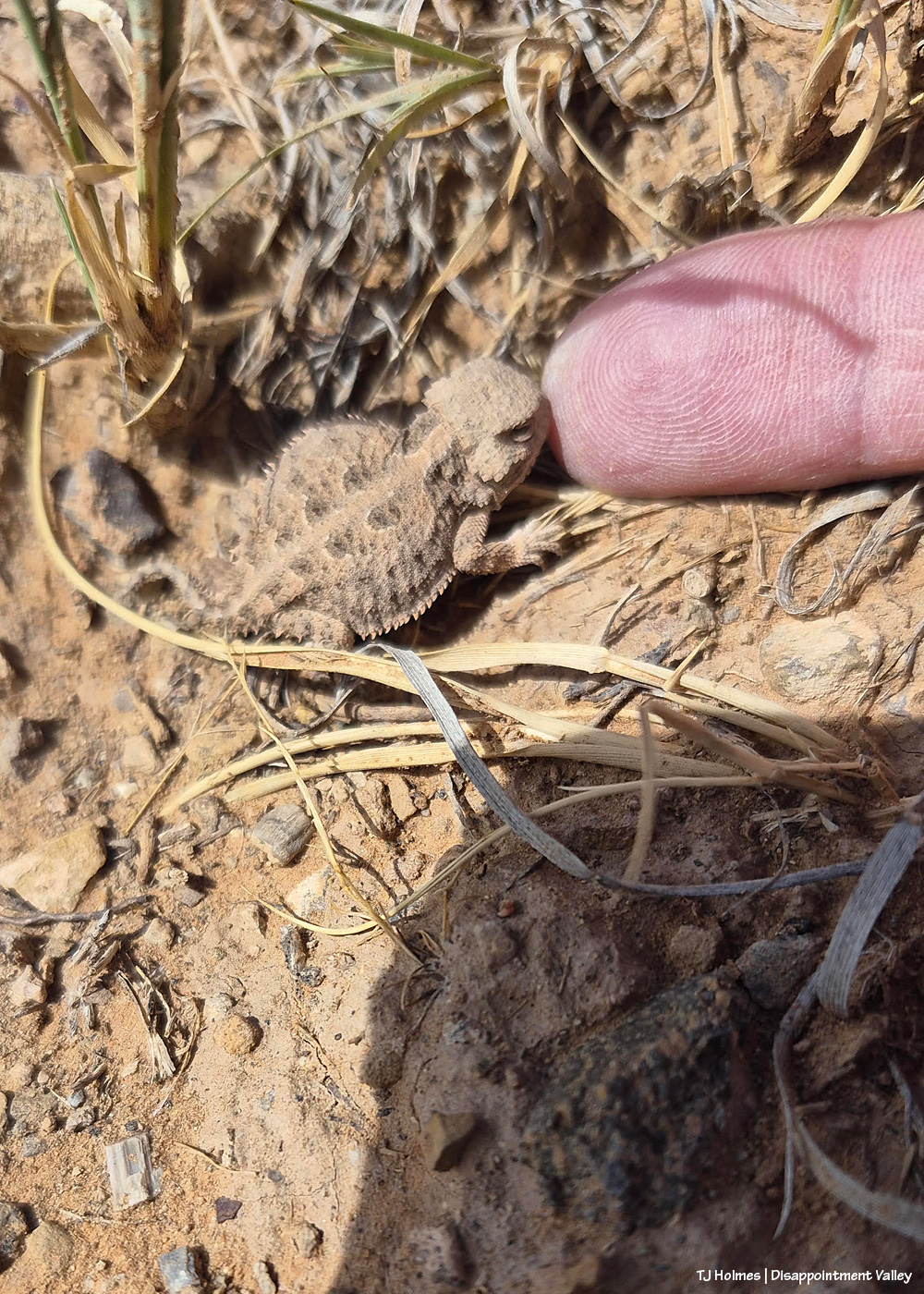
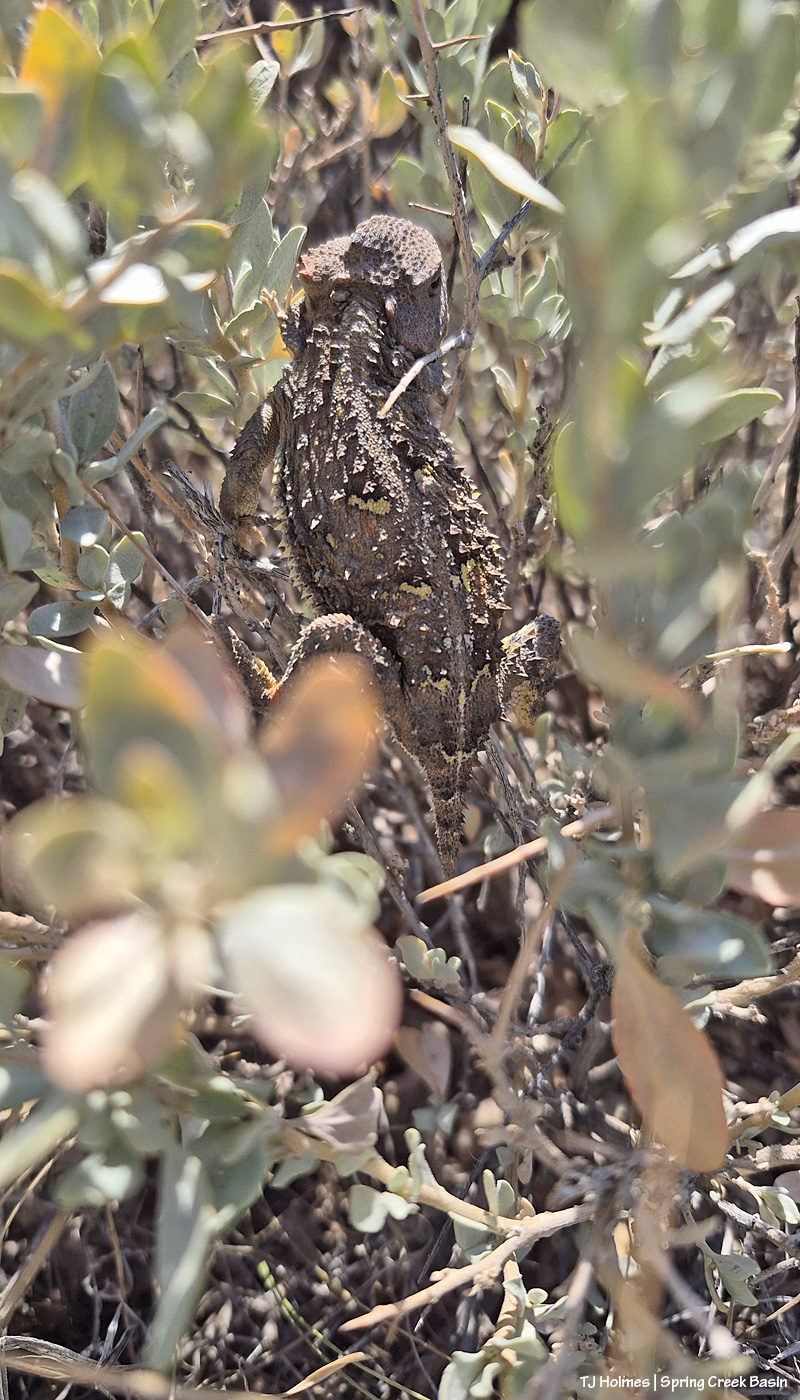
Met this teeny tiny little friend on a hike in a different part of Disappointment Valley.
Super itty bitty! Catching its movement is the only way I saw it. That’s some good camo!
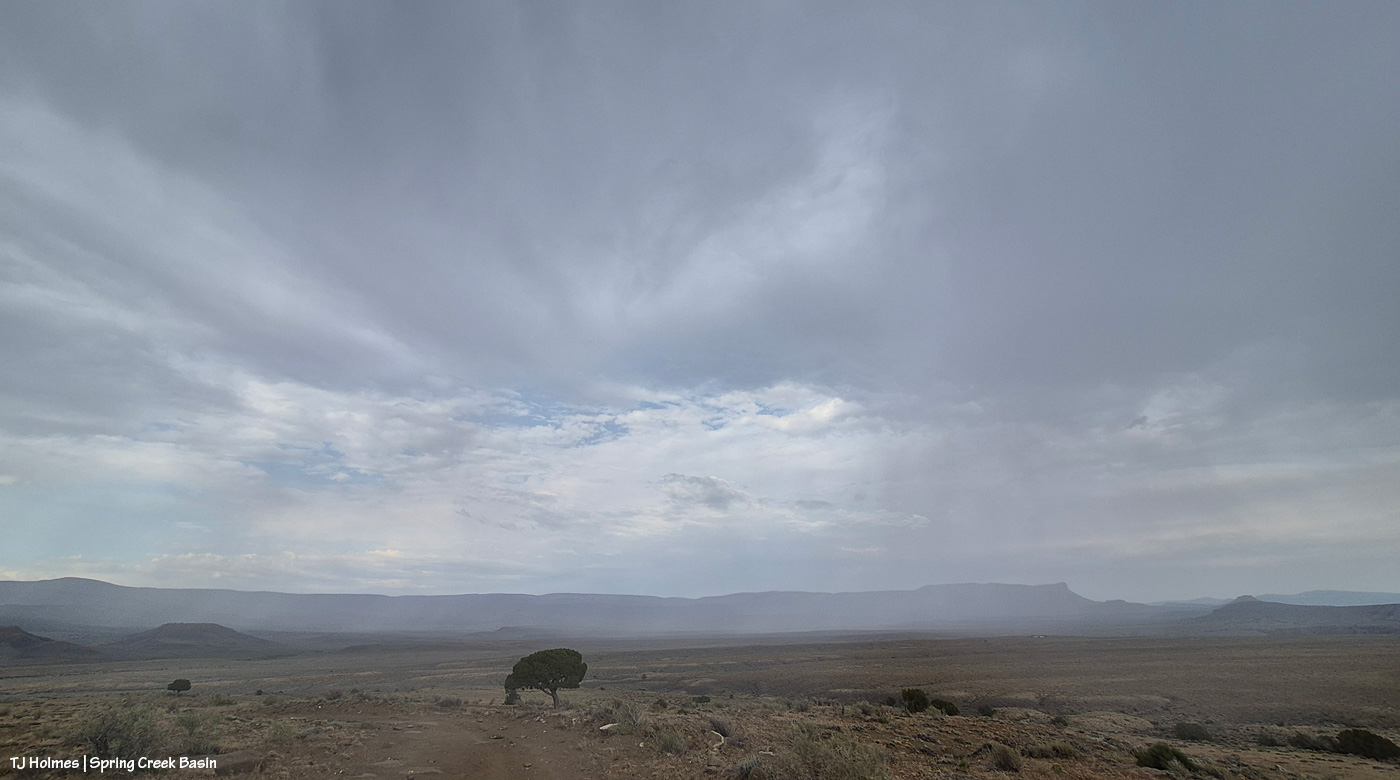
Apologies for the late post this morning; last night’s storms took out my electricity! Very glad of the rain … shown above making its way into Disappointment Valley southeast of southeastern Spring Creek Basin. Seneca really didn’t think she wanted to help show off the view and the rain, but she did an amazing job of it, of course. 🙂
The great thing about the rain is that it wasn’t even in the forecast, so it was a *very* pleasant (understatement) surprise!
This little fellow or gal scrambled into the middle of a four-wing saltbush (I think? I didn’t stop to ID it at the time). Very shy but maybe one of the bigger horned lizards I’ve seen – and certainly recently. Probably about the size/length of the palm of my hand. I think each individual is different with its coloration/patterns, too. Check out the cool yellowish spots on the dorsal side of this one; they made me think of a butterfly’s markings, so they might be to deter predators?
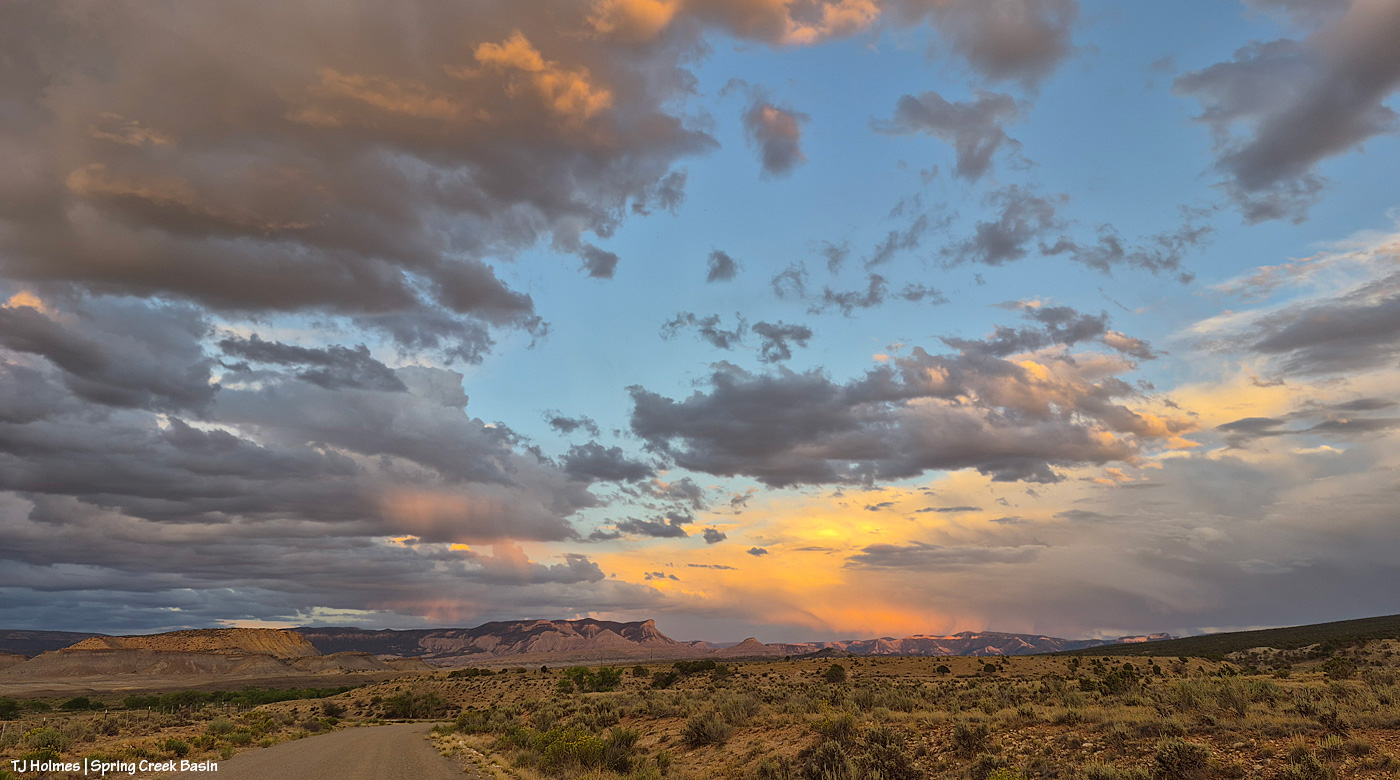
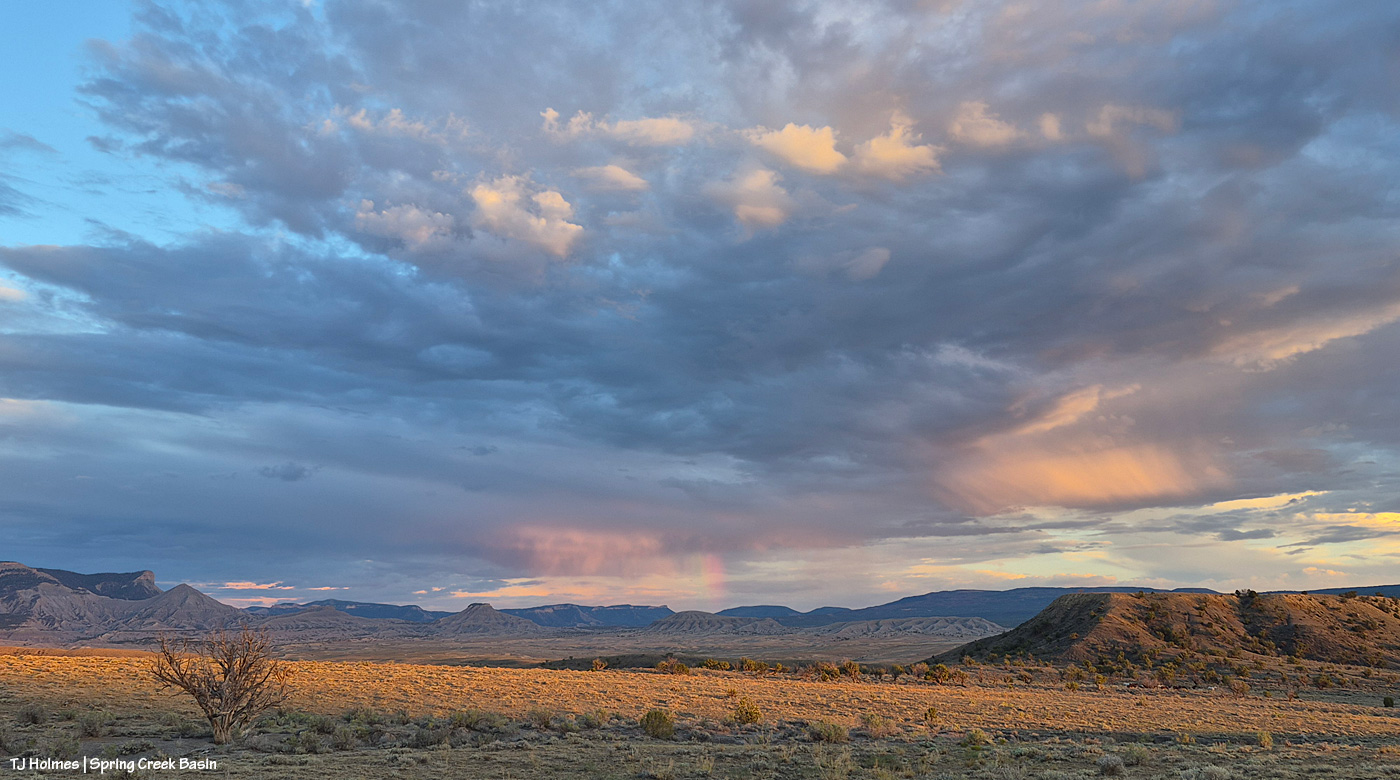
I had just walked back up the hill to the road from visiting with a couple of bands when the sun sank into a low cloud right above the horizon, and I thought (silly me!) that was sunset. … But THEN … the sun found a sliver of a break between cloud and horizon and sent its good-night-world light across Spring Creek Basin. See the partial rainbow at nearly center over Round Top in the low distance? And if you look closely, there’s a band of horses (anOTHER) band of horses) that appeared walking west across the northern base of what I call the east twin butte at lower right.
Note to self: The light’s not done till it’s DONE.
Not much of a theme to the post today … just a couple of glimpses of Spring Creek Basin this past weekend. 🙂
This pic, taken Sunday from between the main/original water catchment and Filly Peak in Spring Creek Basin, is looking southeast toward the Glade and Benchmark Lookout. A few days before, I’d seen the red swaths of retardant across the trees while looking at smoke up there, but I didn’t manage to get a decent pic that showed it. While fire continues to smoke in that area (that’s the Ferris Fire’s northeastern edge), clearly firefighters and aircraft pilots have been hard at work. So hugely grateful! Rick and Linda Freimuth, who staff the tower during the fire season (!!!) hope get the green light to return this week. The mustangs and I (you know they would if they could) will be cheering their return.
Now, some taken yesterday (Monday):
Storm brewing to the east. Spring Creek Basin’s western rimrocks and Filly Peak (lower left) are in sunshine, while Temple Butte, McKenna Peak, Brumley Point and the basin’s eastern ridges are shadowed by rain! Woo-the-heck-hoo!
Looking back to the west from the same spot as above. More rain! What looks like white smoke on the horizon at left IS smoke from the Ferris Fire … and I hope it got a good dose of the wet stuff. It wasn’t a high-rain-chance day, but toss the forecast and let ‘er rain!
Methinks the weather wizards were outsmarted by Ma Nature herself. 😉 RAIN, BABY, RAIN! This is from Chrome’s Point in western Spring Creek Basin, looking eastish at a curtain of rain that DID, as I was taking pix, make its way west. Unfortunately, I didn’t get tooooo wet. Ha – I would not have minded!
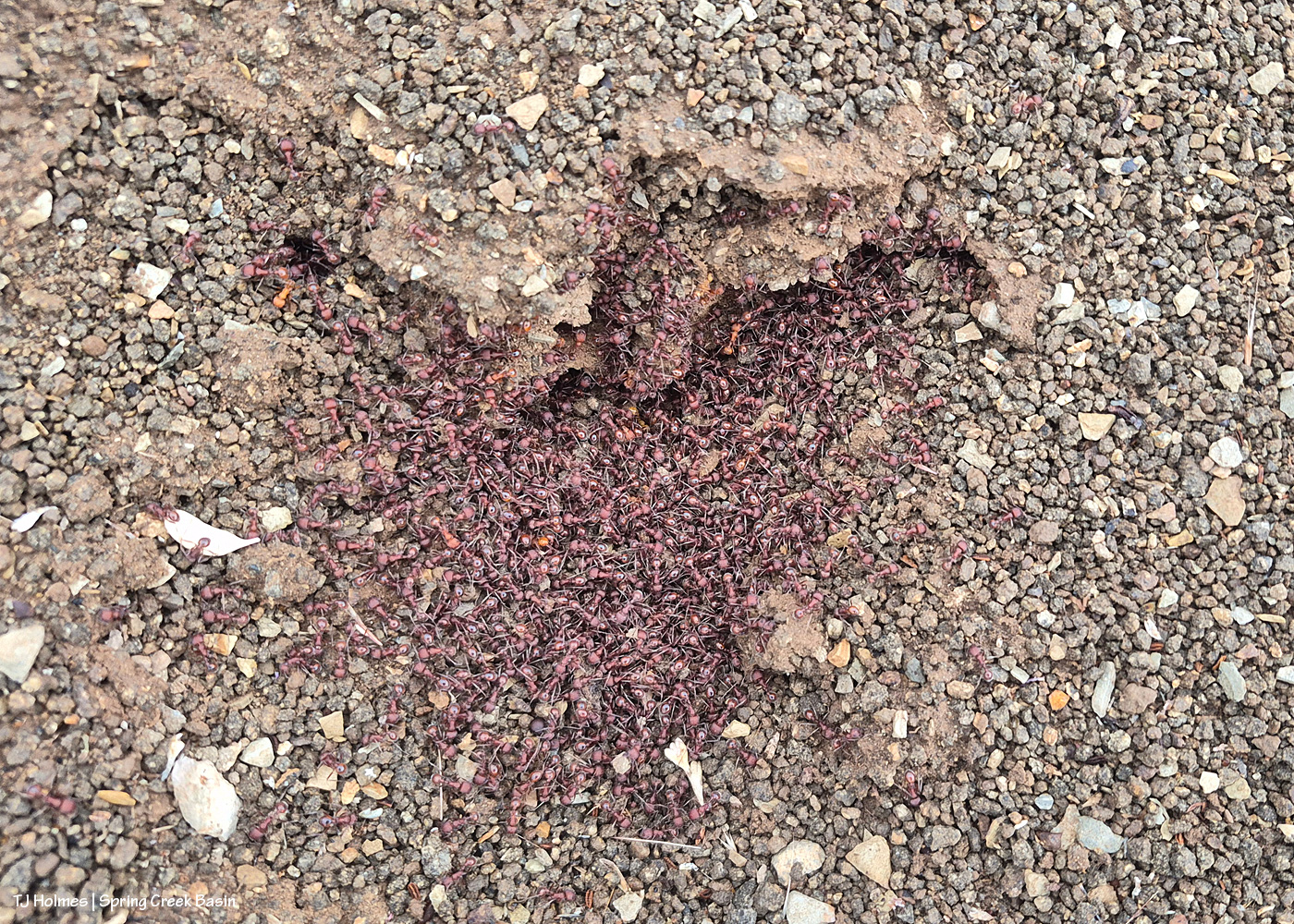
Ants congregating at the entrance to their mound. Apparently, “Ants congregate at their mound entrances after rain primarily to survive flooding. When underground tunnels fill with water, the colony is forced to evacuate. They move the queen, larvae, and food upward to escape the saturation, using the surface or mound entrance as a temporary, elevated sanctuary.” Interestingly, these ants and others I saw doing the same thing in the same relative area happened to be on some of the highest ground in the basin, near the western boundary. I guess that when you’re an ant, everything is at the elevation of ground level (ha ha!).
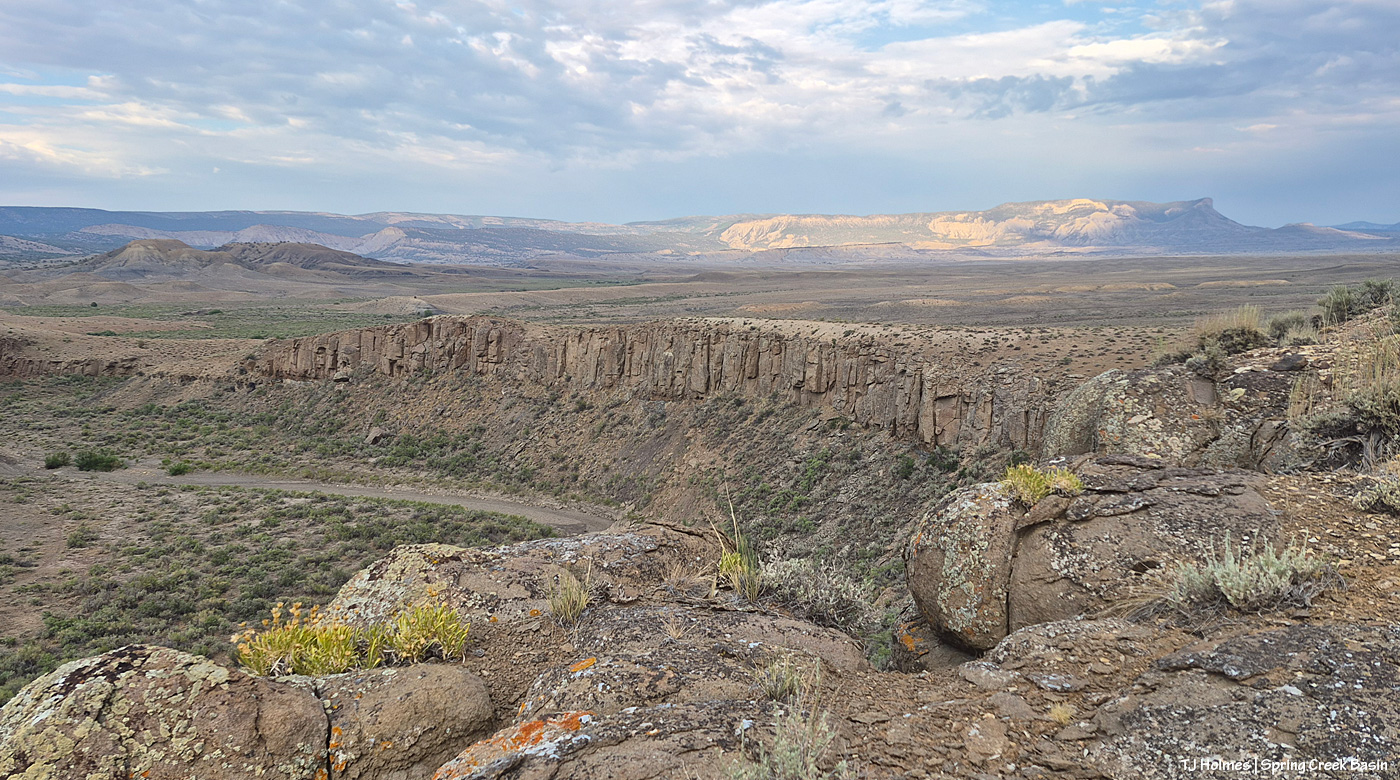
From the south wall of Spring Creek canyon looking eastish after the rain (it didn’t last very long, unfortunately).
Hope you don’t mind this view! It’s pretty spectacular. No, that’s not a road down there in the canyon; that’s Spring Creek arroyo, and just beyond (lower left), it leaves Spring Creek Basin to cross lower-ish Disappointment Valley on its way to join Disappointment Creek (neither of which are carrying water at the moment).
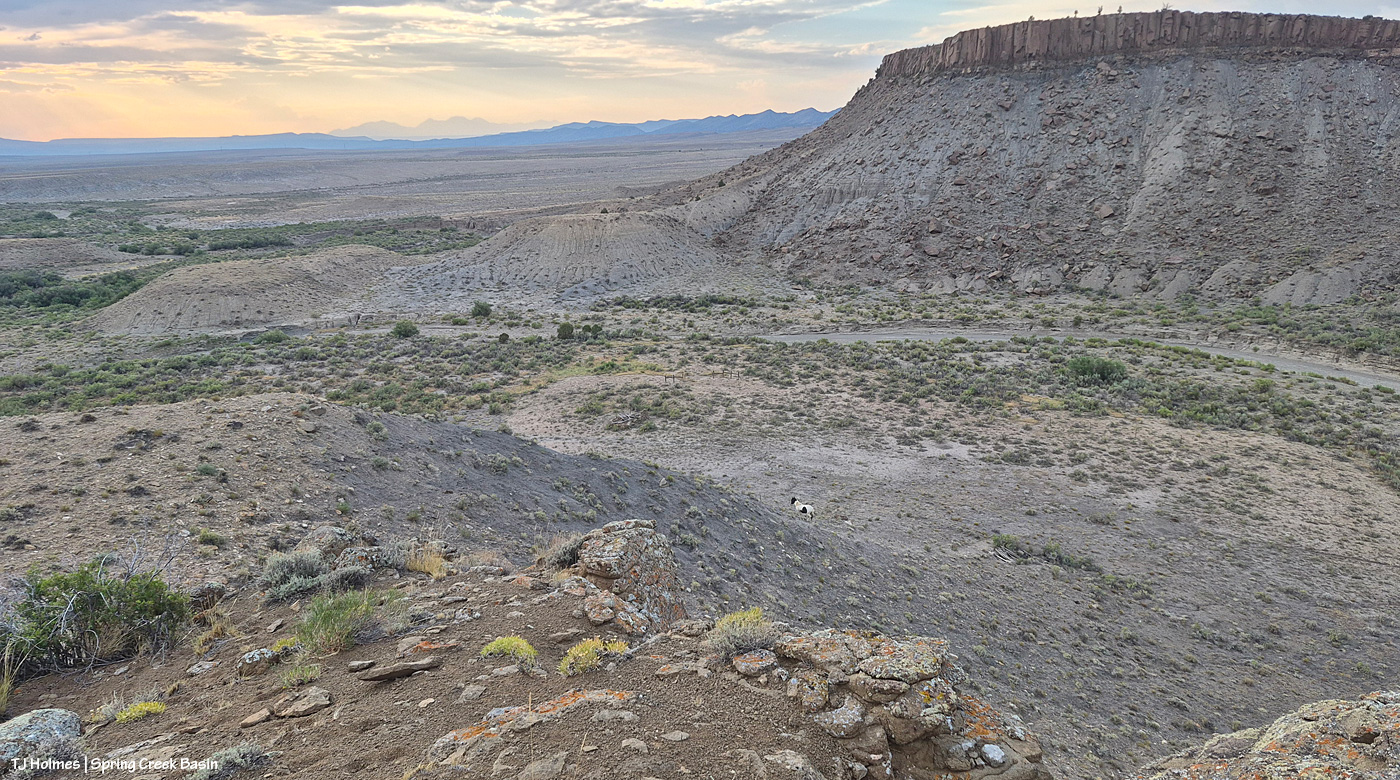
See the pinto pony? This is from the same point as the above two pix, looking generally northwestish across lower Disappointment Valley toward Utah’s La Sal Mountains. There’s a fence across this lower end of the canyon to keep the mustangs within Spring Creek Basin, and there’s a water gap (hanging PVC pipes to move when water DOES flow) across the Spring Creek arroyo. There are a couple of manmade structures down there, one behind McKenna and one kind of in front of him.
As it turned out, though he and his pal and a band were in the vicinity – and the reason I walked out – it was something else entirely that actually took me all the way to the canyon rim. … And that will wait for another post because I got some pix that knocked even my socks off.
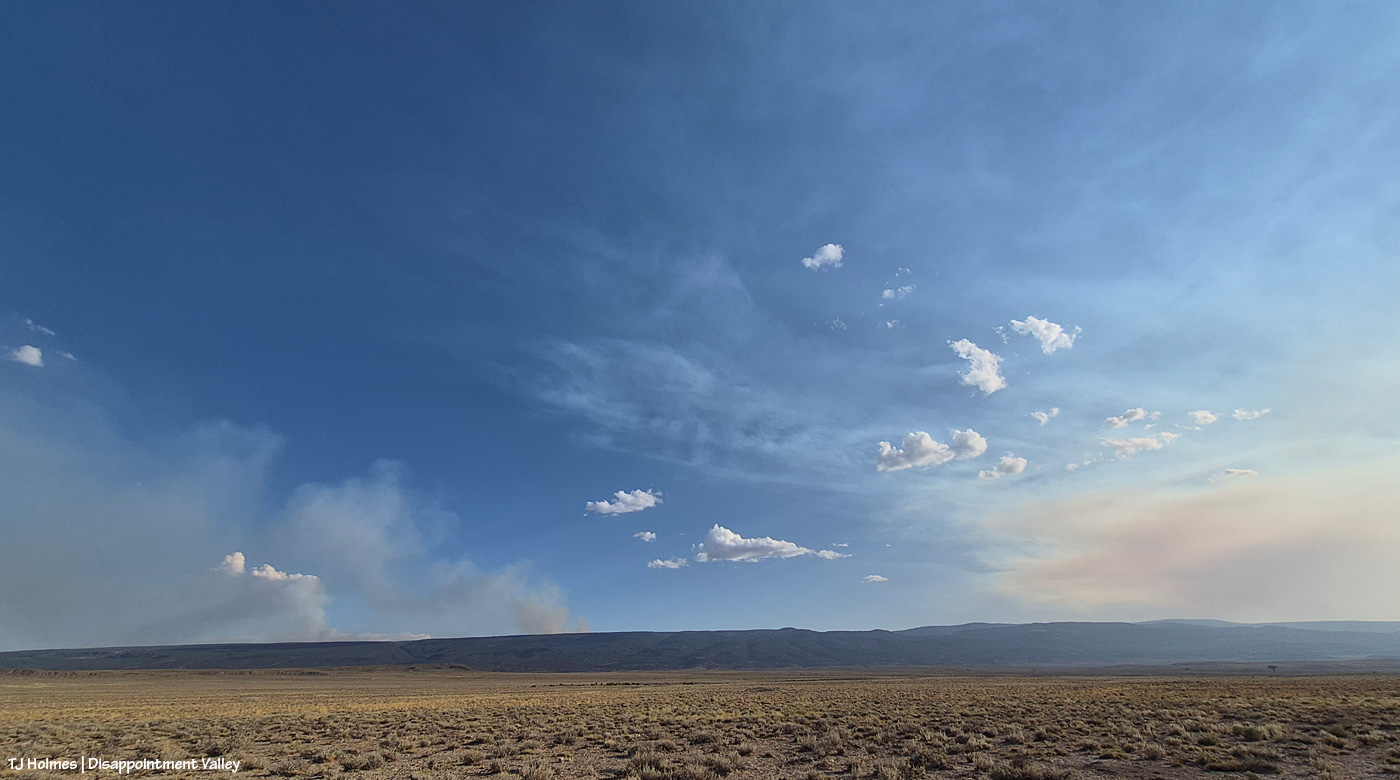
After some reports from different sources of tiny bits of rain here and there (Tuesday day/night, maybe some drips Wednesday), the sky was much more our normal and beloved Colorado-blue than we’ve seen in a run of smoky days. Ferris Fire (60,104 acres as of Wednesday night) smoke at left; Babylon Fire (101,073 acres) smoke at right. Looking mostly south.
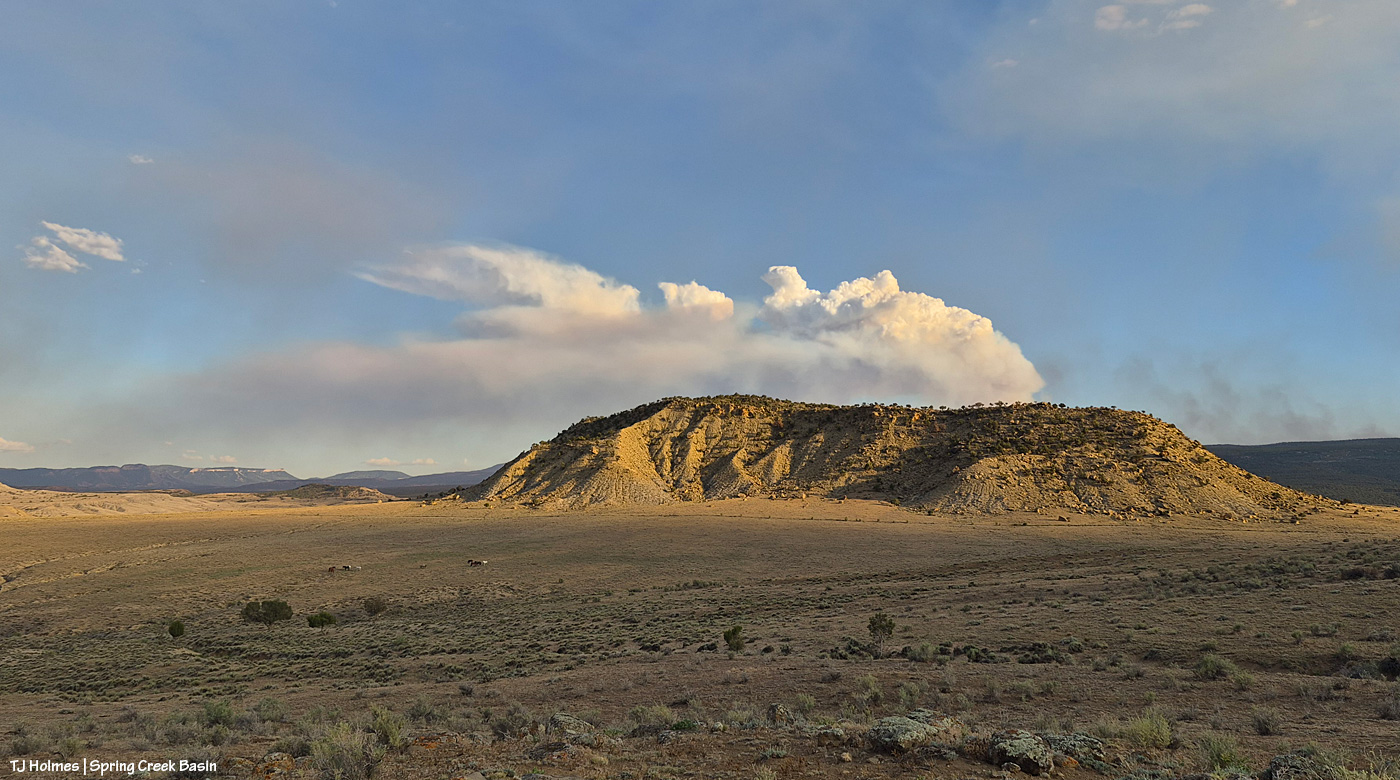
The fire must have gotten into some new, untouched fuels by evening because by 7 p.m. or later, it was really sending up a plume. That’s Filly Peak in the near background, and you can see a bit how perspective matters: Not only is the fire not directly behind it, it’s not *super* closely behind/south of Disappointment Valley’s south ridges. (I did still see a little line of smoke in the Ryman Creek area a bit later.) Mustang ponies in the middle ground, napping.
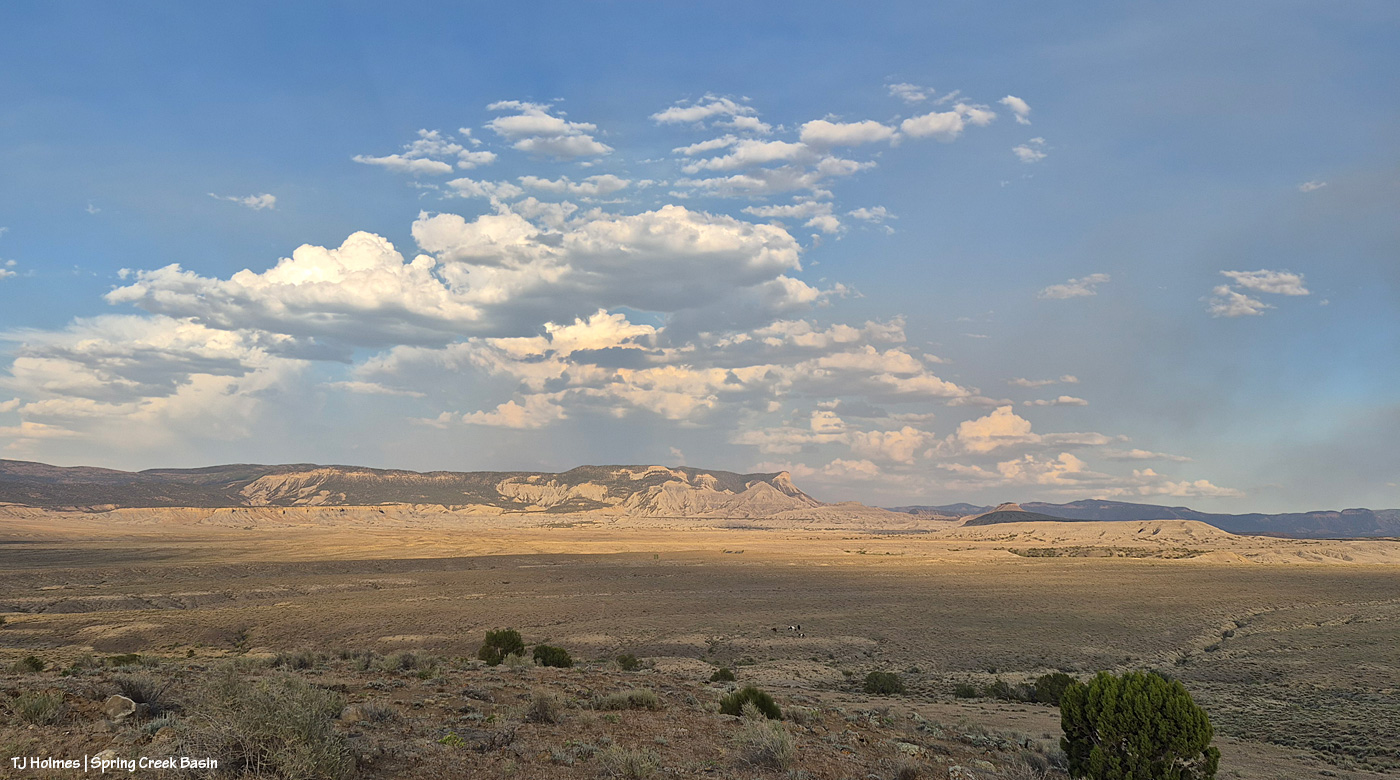
This and the above pic toward Filly Peak were taken from the same vantage point: Chrome’s Point in Spring Creek Basin’s far western region (not far from the rimrocked western boundary). This one is looking slightly leftish of Filly Peak and southeast/east. The smoke is fairly faint … a MUCH better sight than we’ve had the last many days.
Those are more clouds than smokedrift, though, of course, there’s still smoke there from Utah’s huge Babylon Fire, now more than 101,000 acres. … Mother Nature is trying to stir up the clouds into delivering rain.
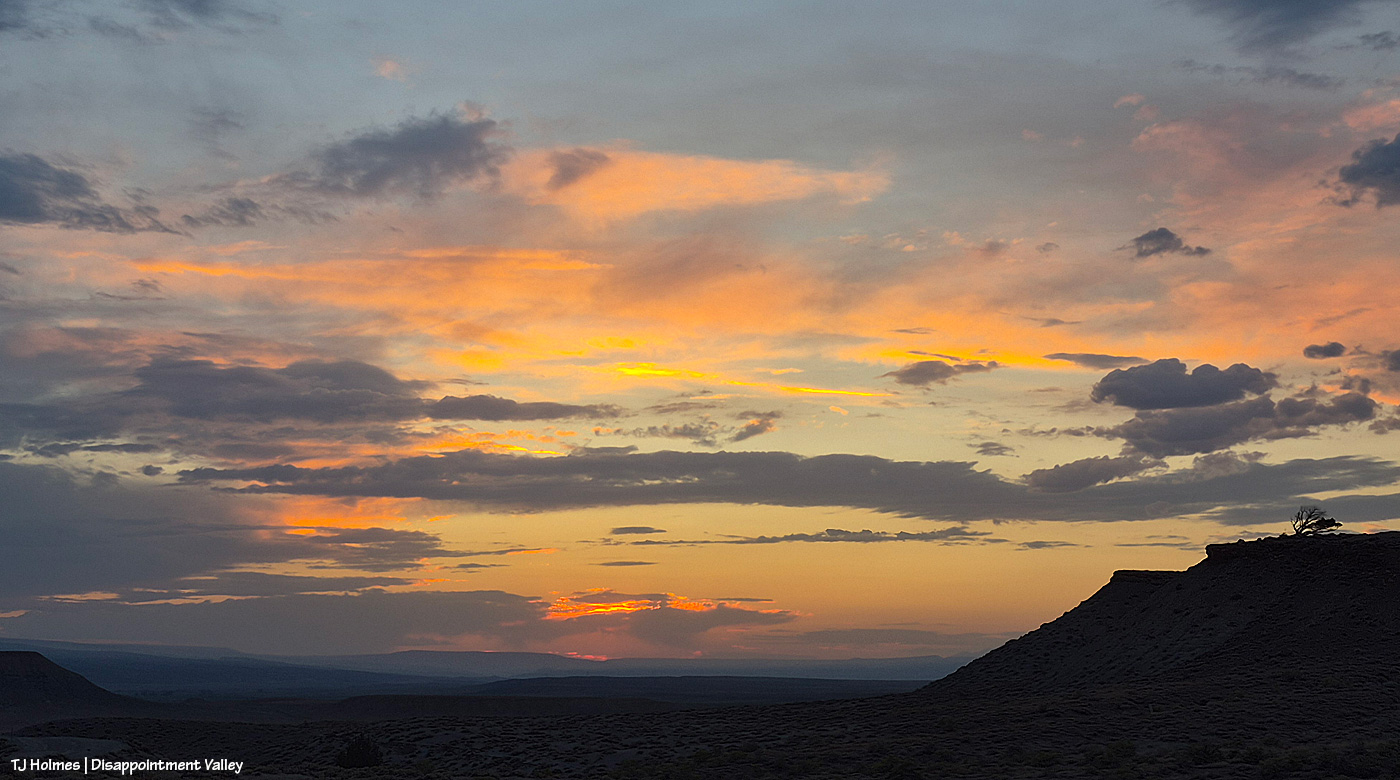
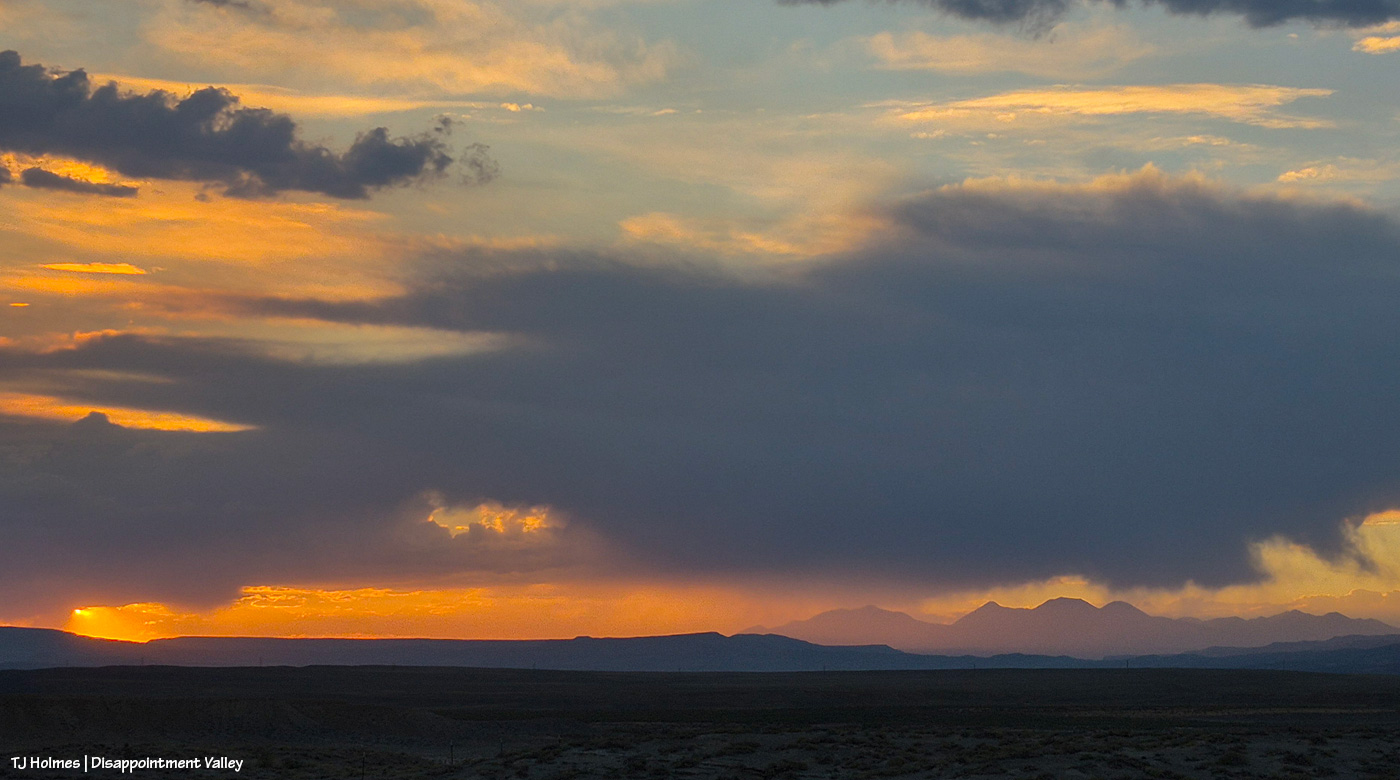
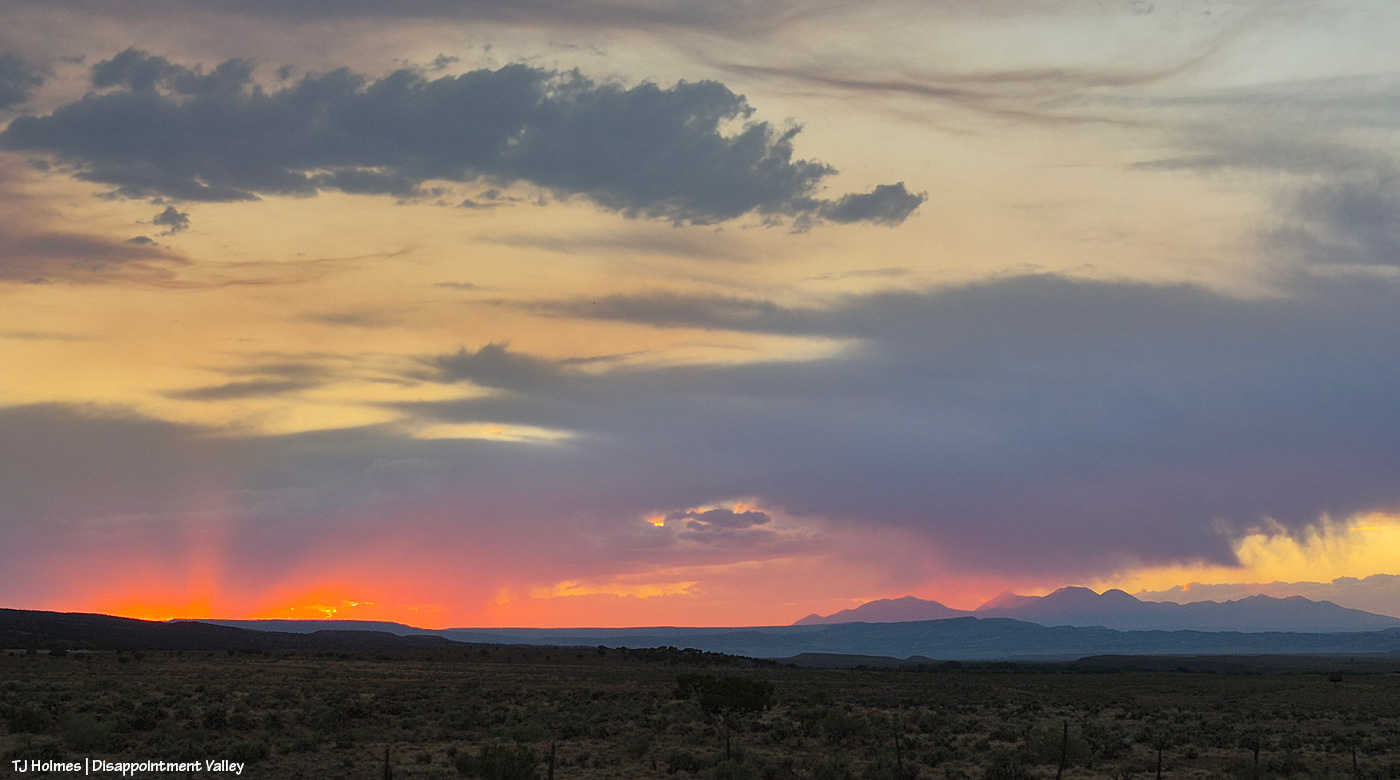
See the pillars of sunset glow at left? I love it when the sun waves goodnight to us like that.
A couple of links to articles I’ve found interesting recently:
“Monsoon rains are on the horizon,” say the weather wizards, err, experts. We can only hope they’re finally going to be proved right. Some super heat is on tap first.