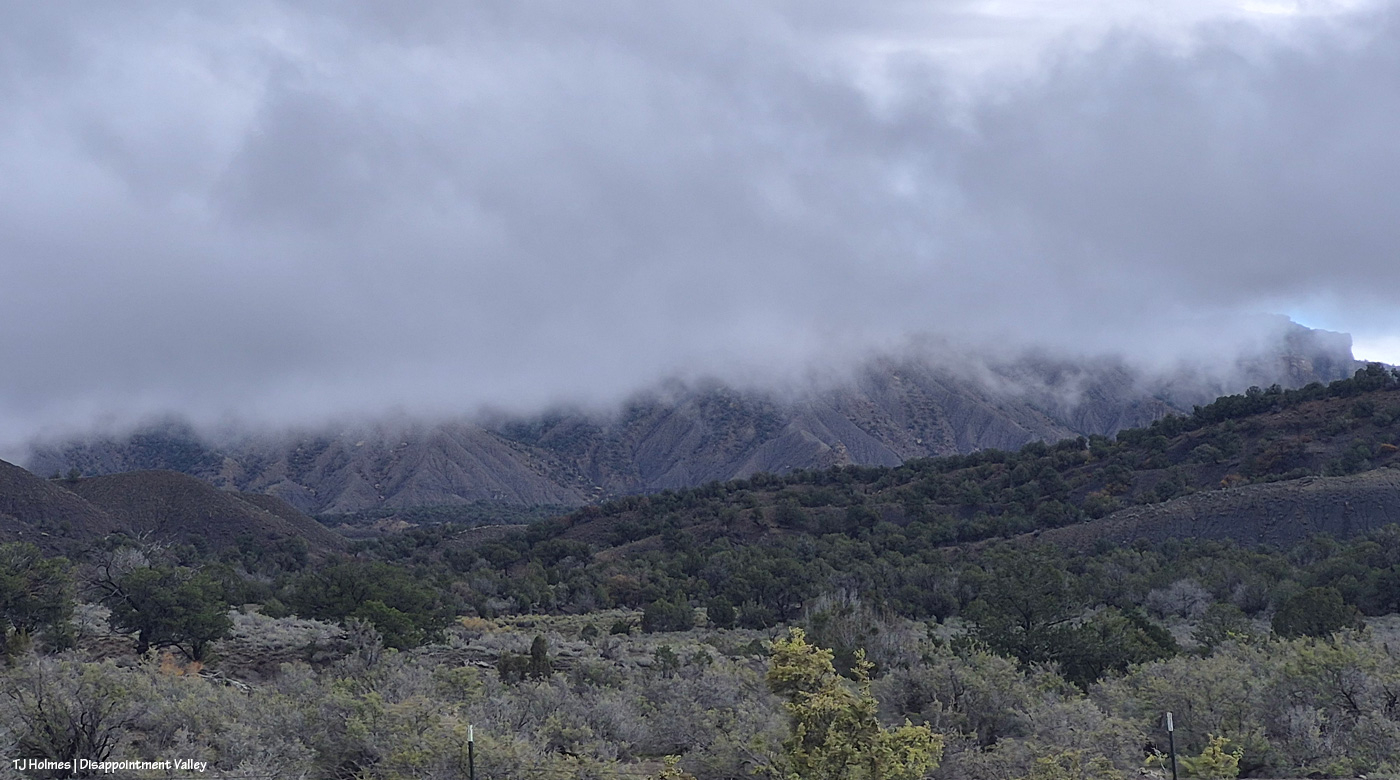
How often do we have fog in Disappointment Valley?
I won’t say nevvvvvvvvvvvvvvvvvvvvvvvver. But it’s very, super, pretty incredibly rare.
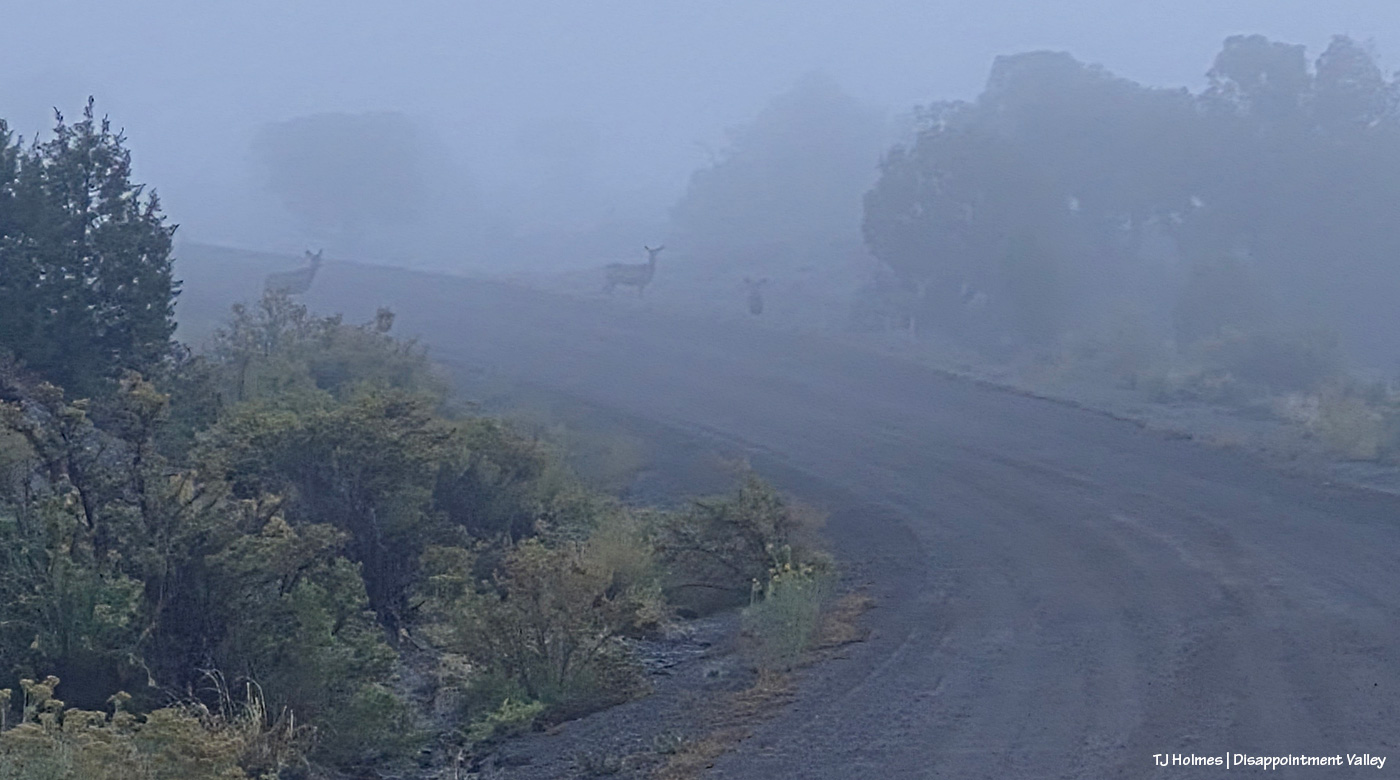
When I went out to see what I could see – FOG! – I found some critters looking back at me!
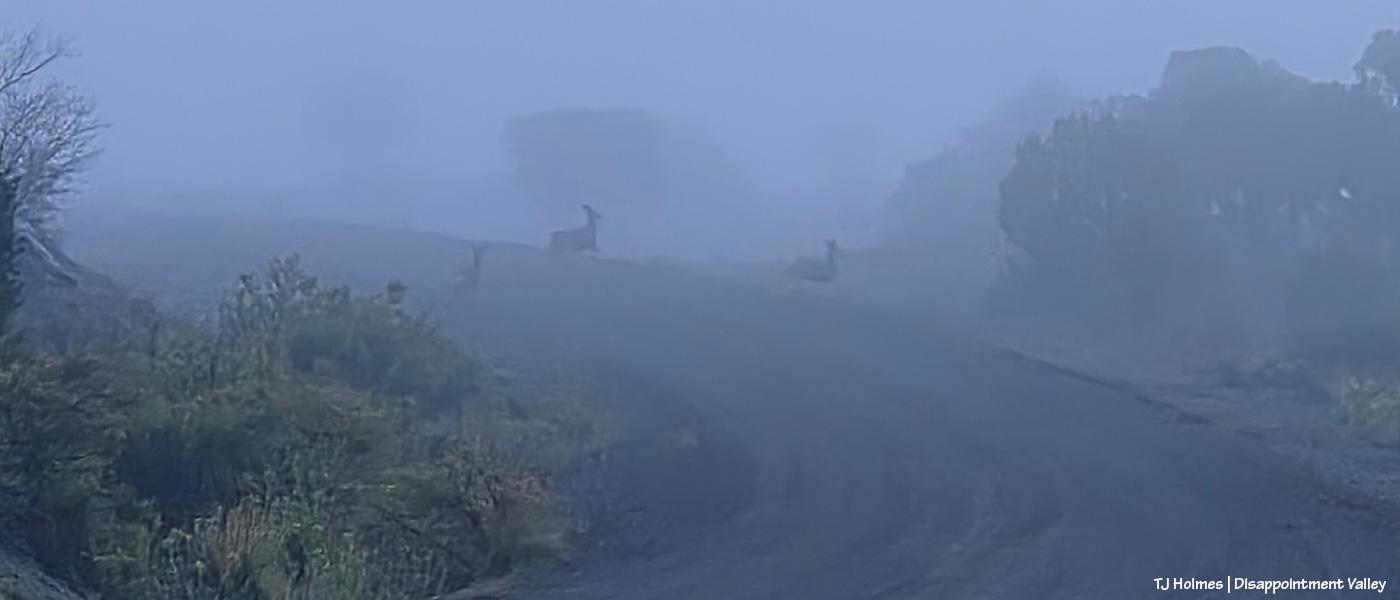
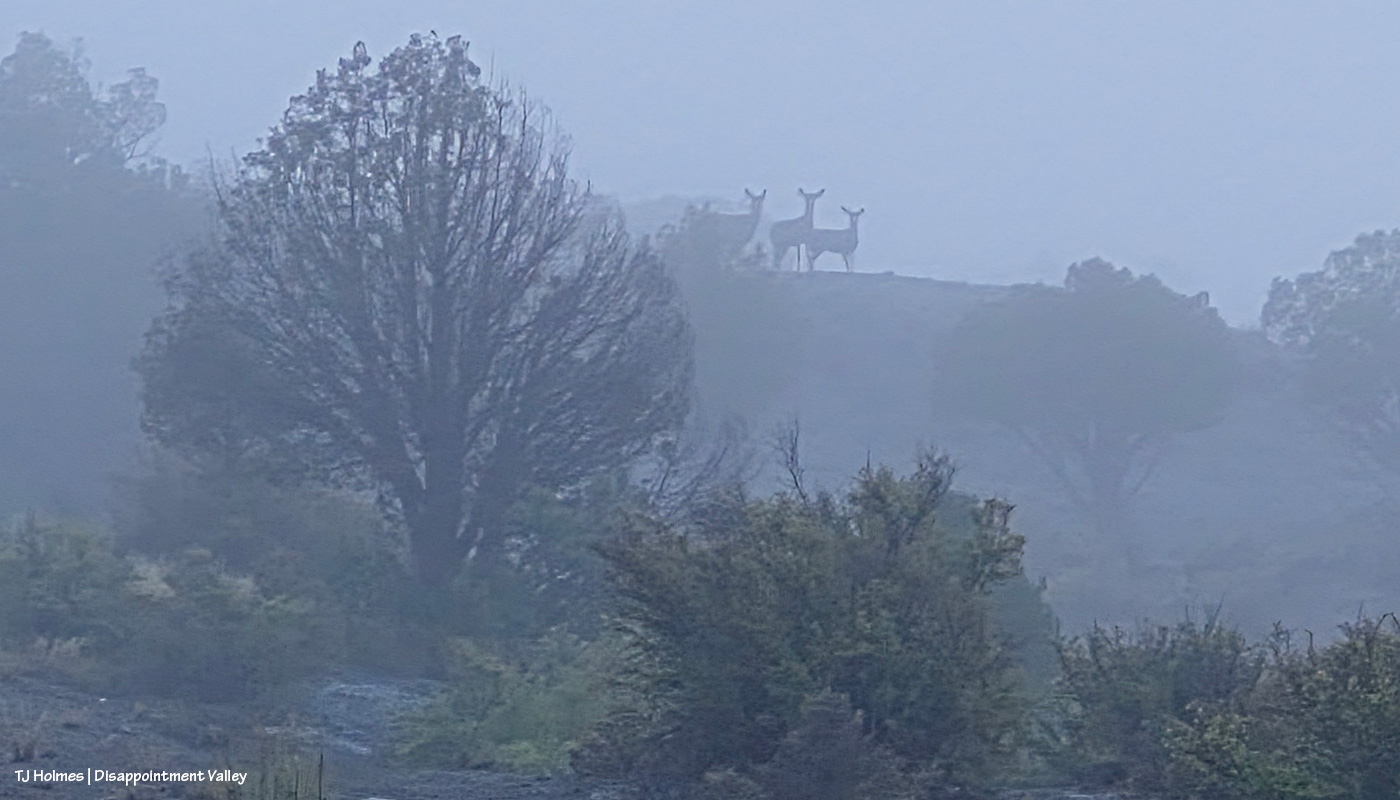
At the noise of a truck coming, they disappeared into the … fog! There were more deer than I’d realized, probably at least half a dozen.
Ah! They didn’t actually disappear (at least yet). The fog makes even familiar landscape look completely different!
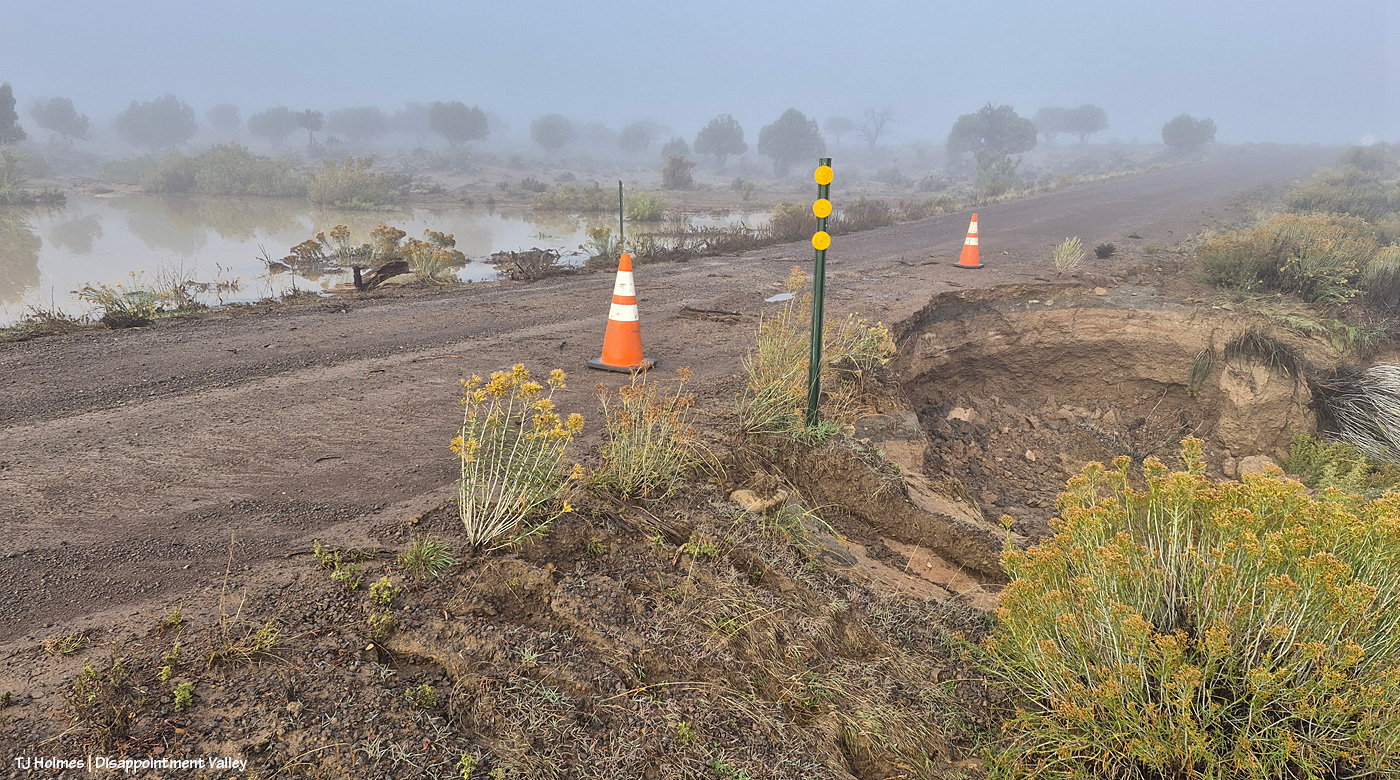
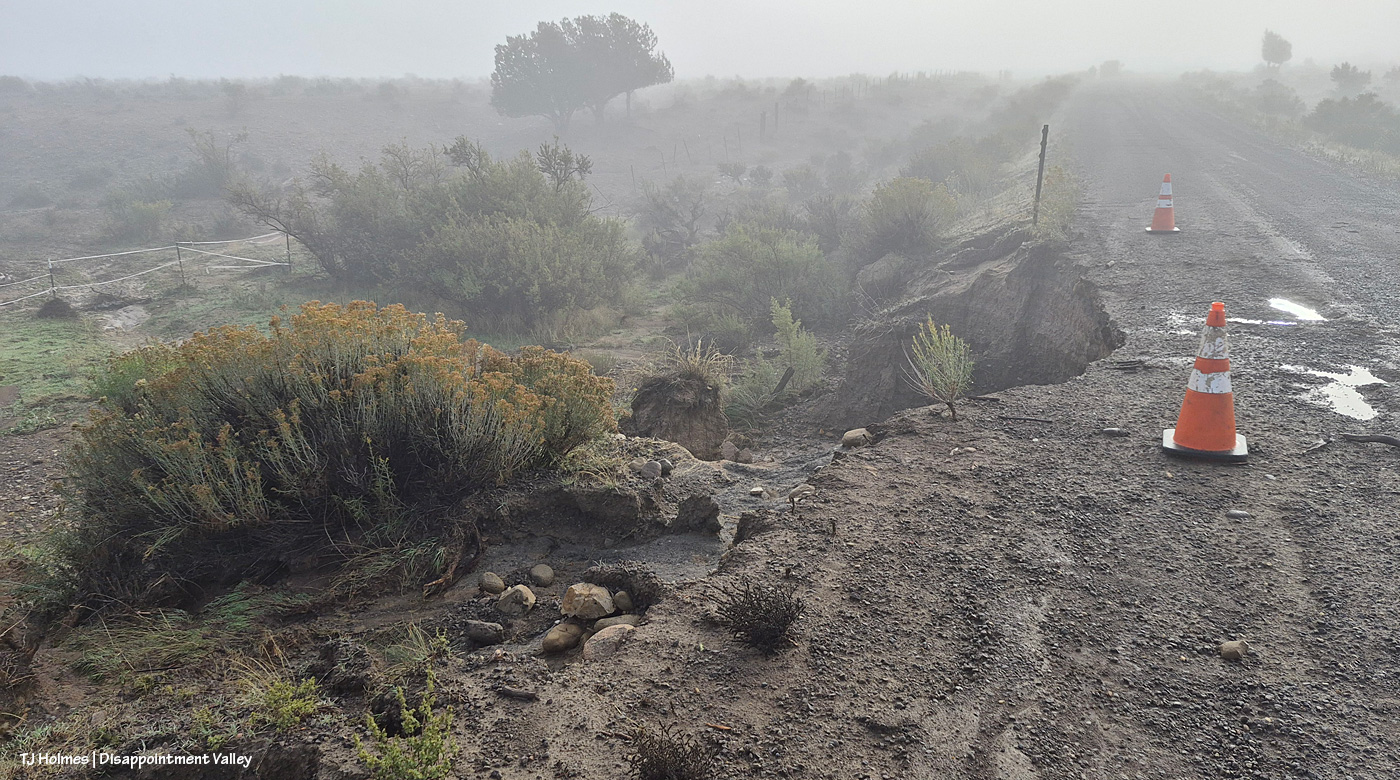
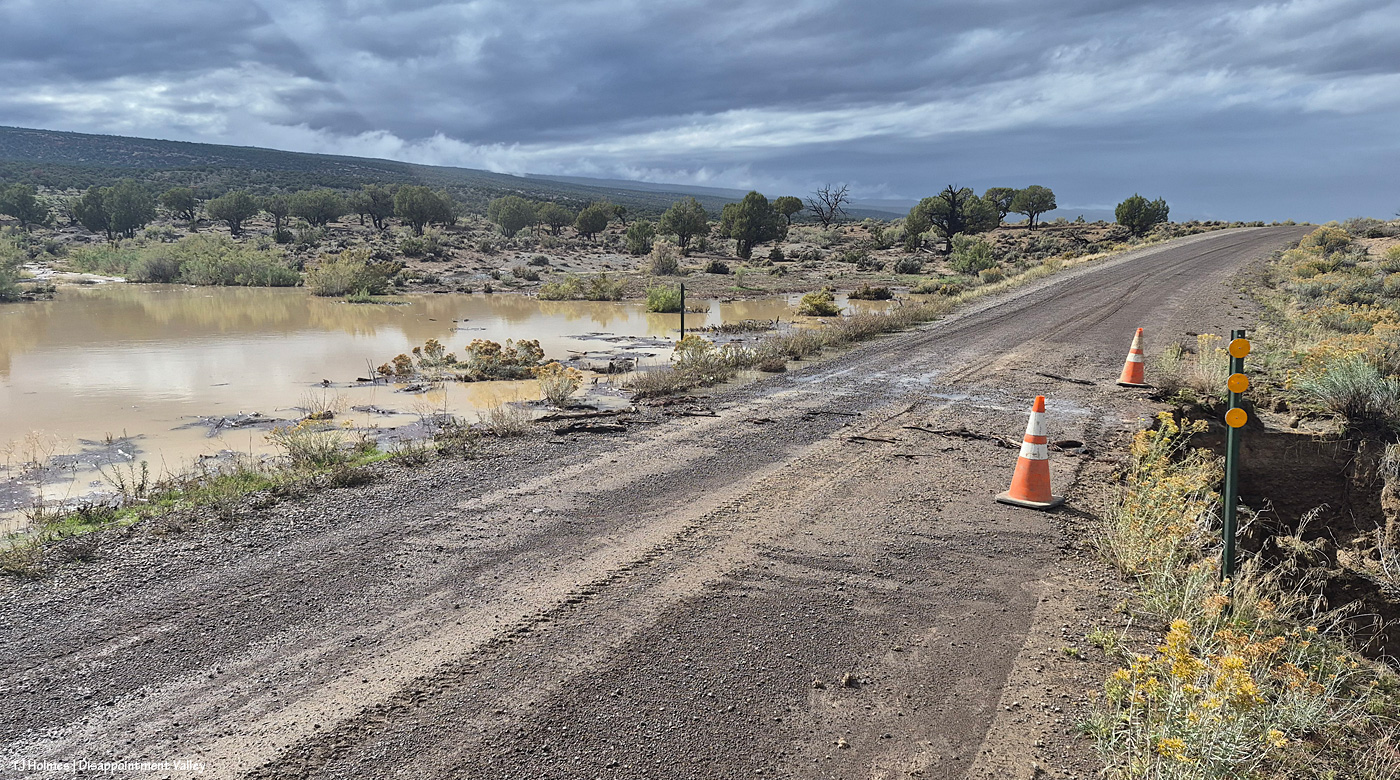
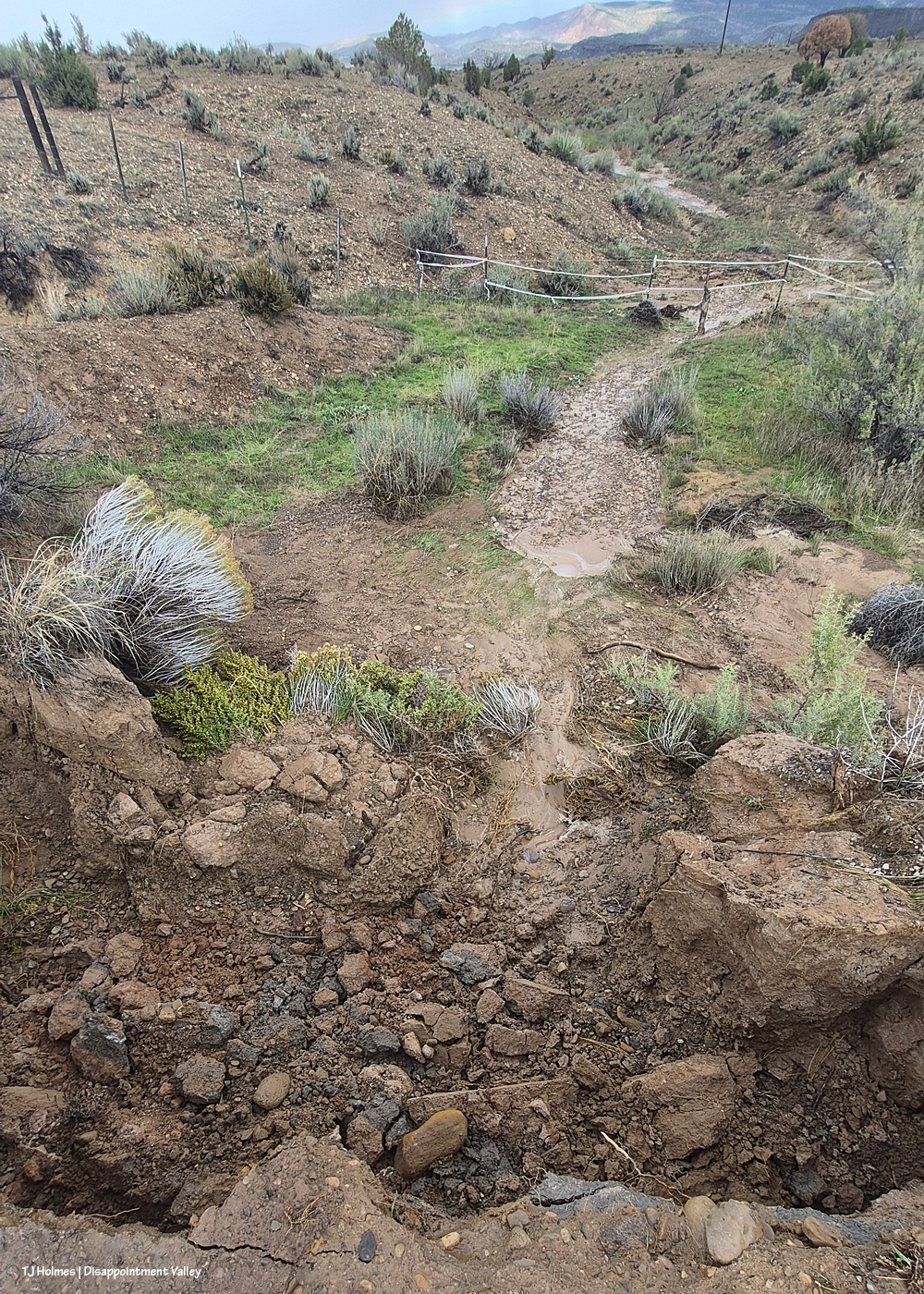
I wanted to check on the erosion spot again. … A county road-and-bridge guy came out later; he was out both Saturday and Sunday! And they’ve had someone checking every day. It’s narrow, but it’s well-marked. This is from the northeast side looking southwest.
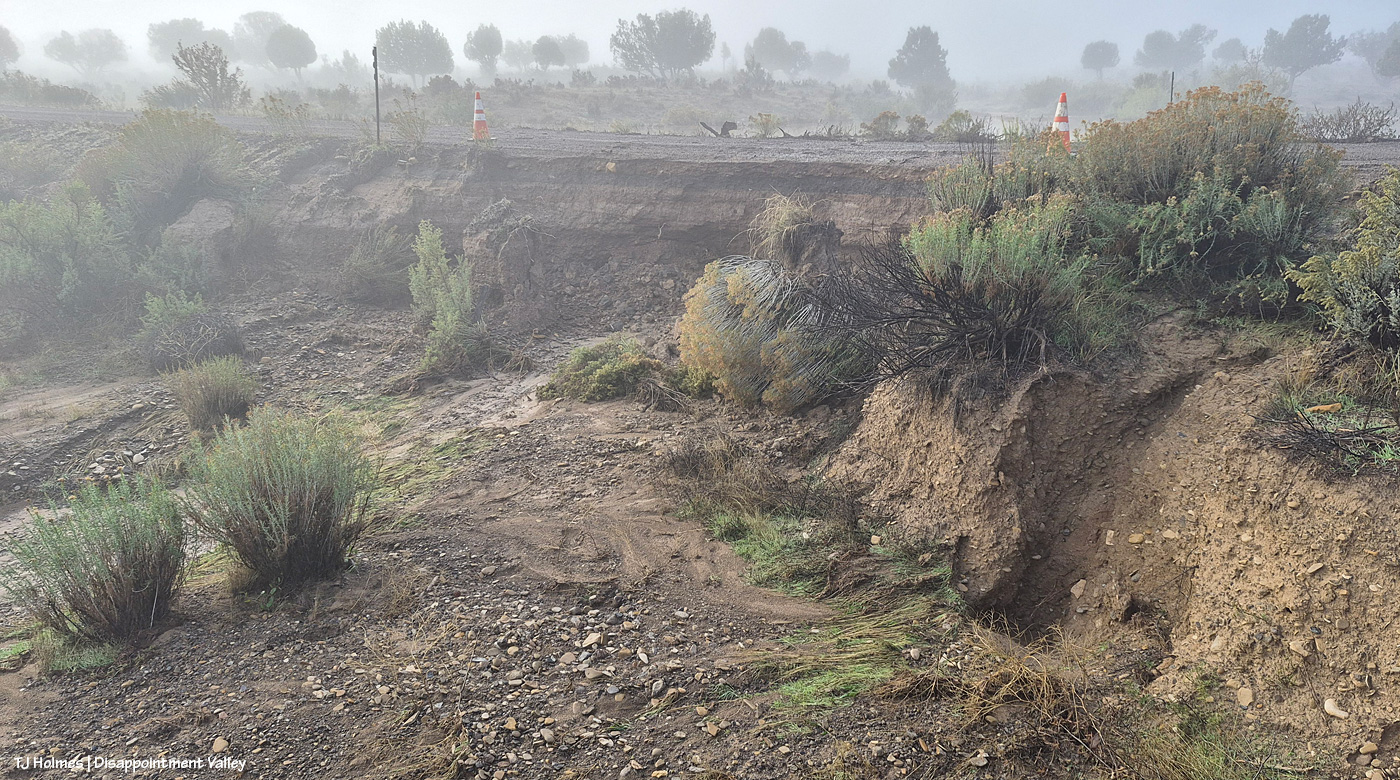
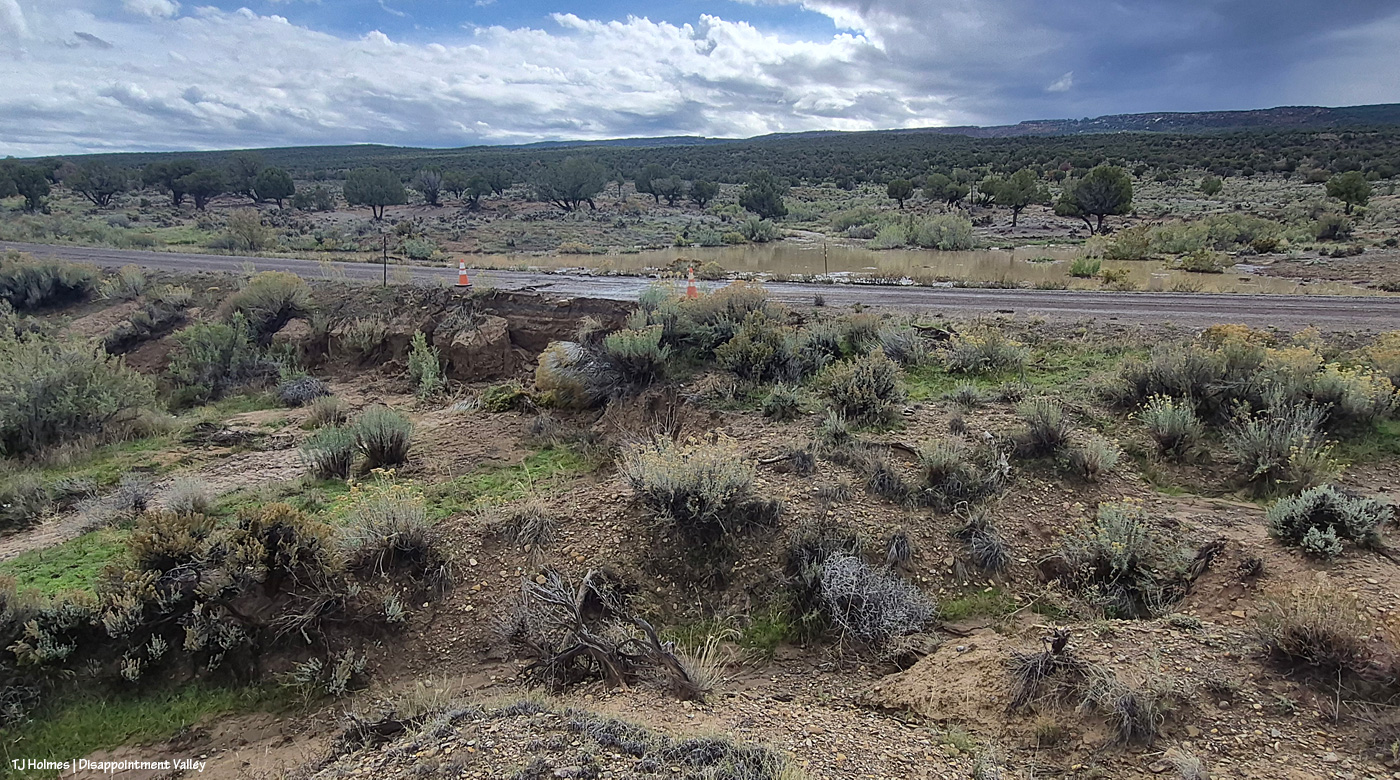
Now I’m on the north side of the road looking eastish.
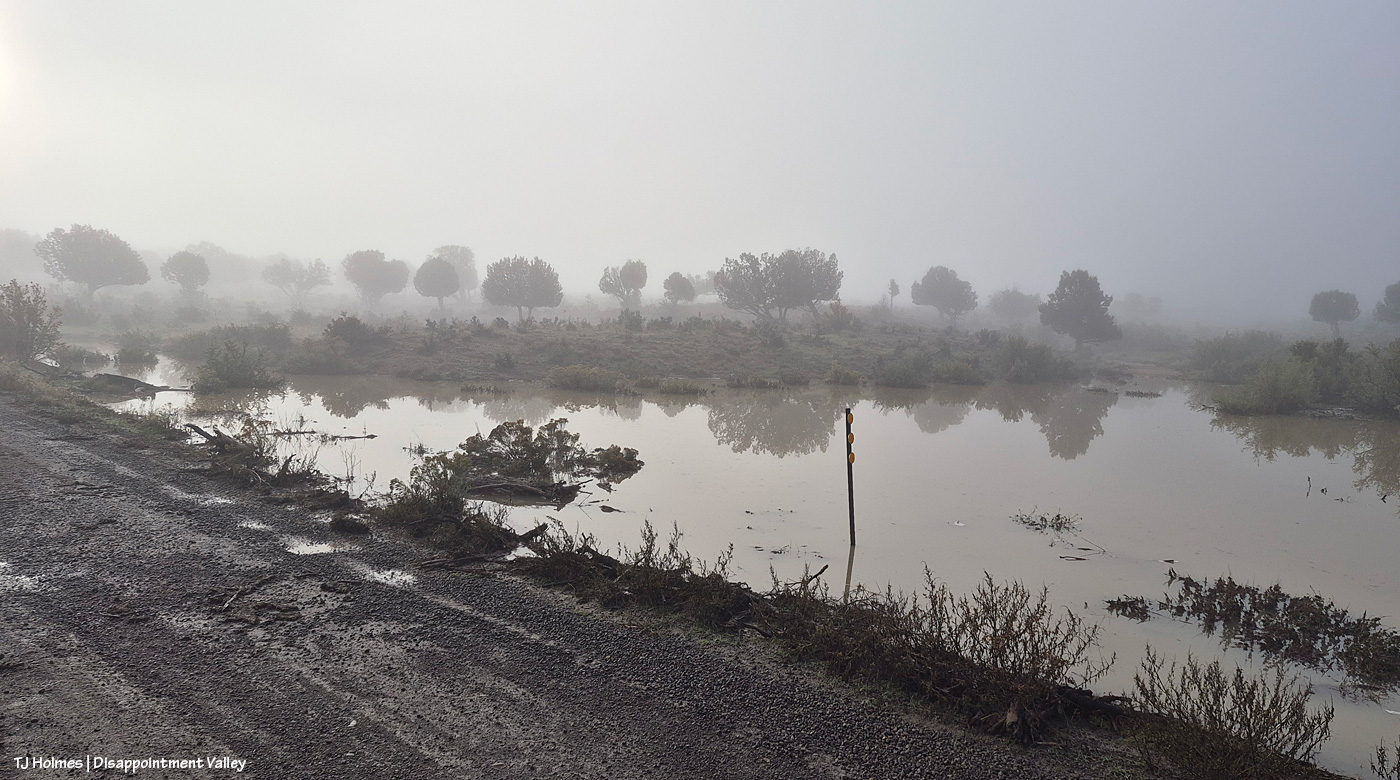
Meanwhile, Lake Disappointment (har har) continues to hold water. All I needed here were some ducks. 🙂
I’m 5 foot 10; standing in the bottom, the level of the road is just above my head. I’m not sure you can tell, but there are now two “hoodoos” – free-standing “pillars” – one nearly directly below the left cone, and one has the chamisa/rabbitbrush growing sideways out of it.
Mother Nature has been giving the gifts supremely freely the last few days (destruction in some places; there’s been a lot of flooding of towns and homes in southwestern/southern Colorado, northwestern New Mexico and southern/southeastern Utah (just that I know about)).
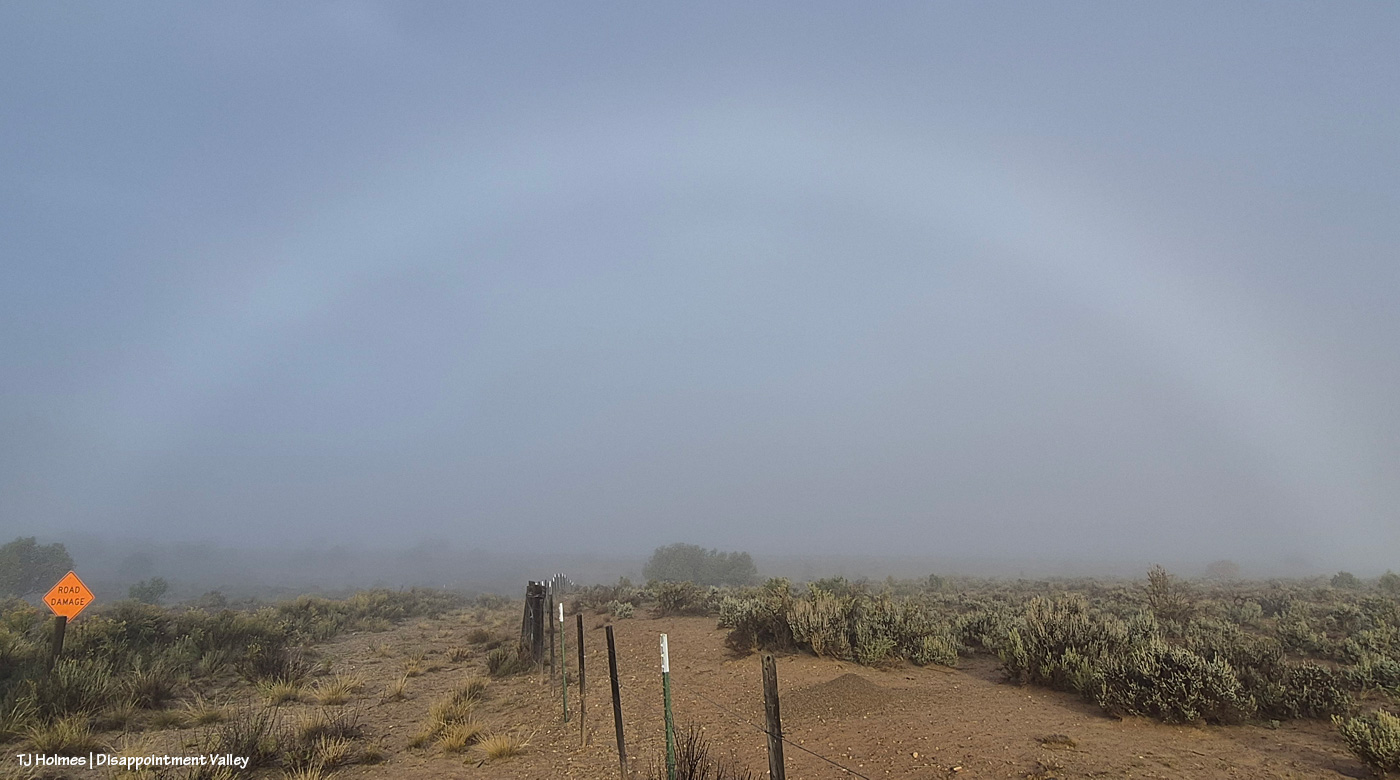
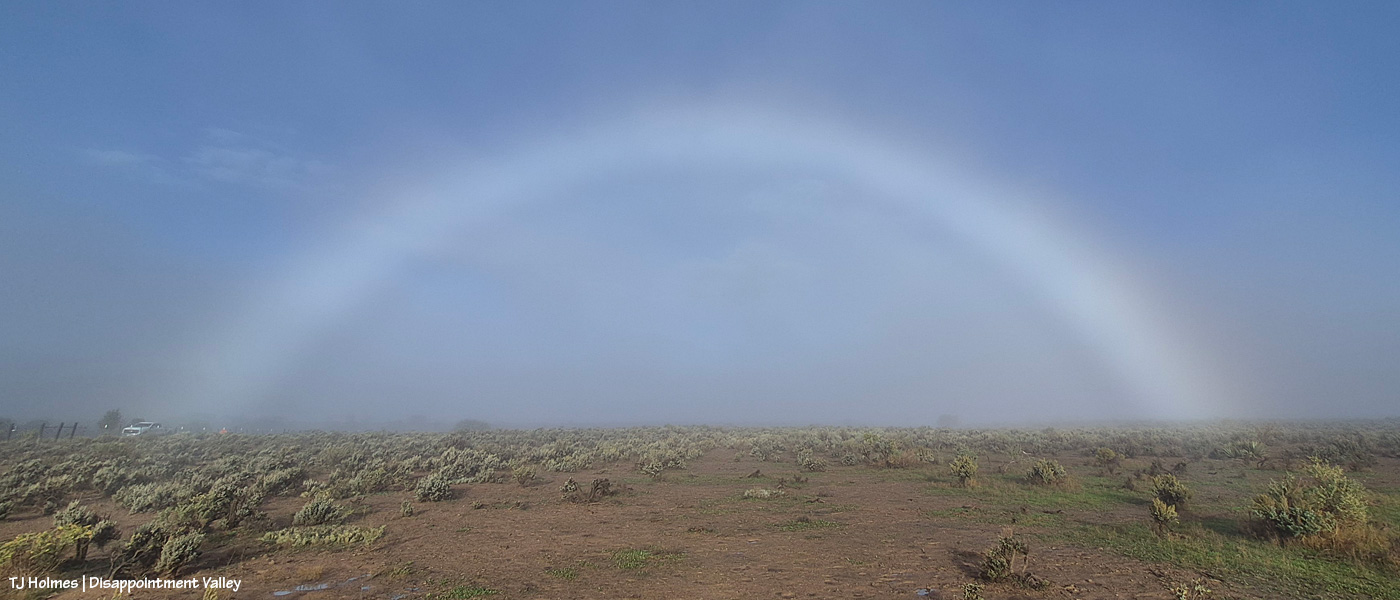
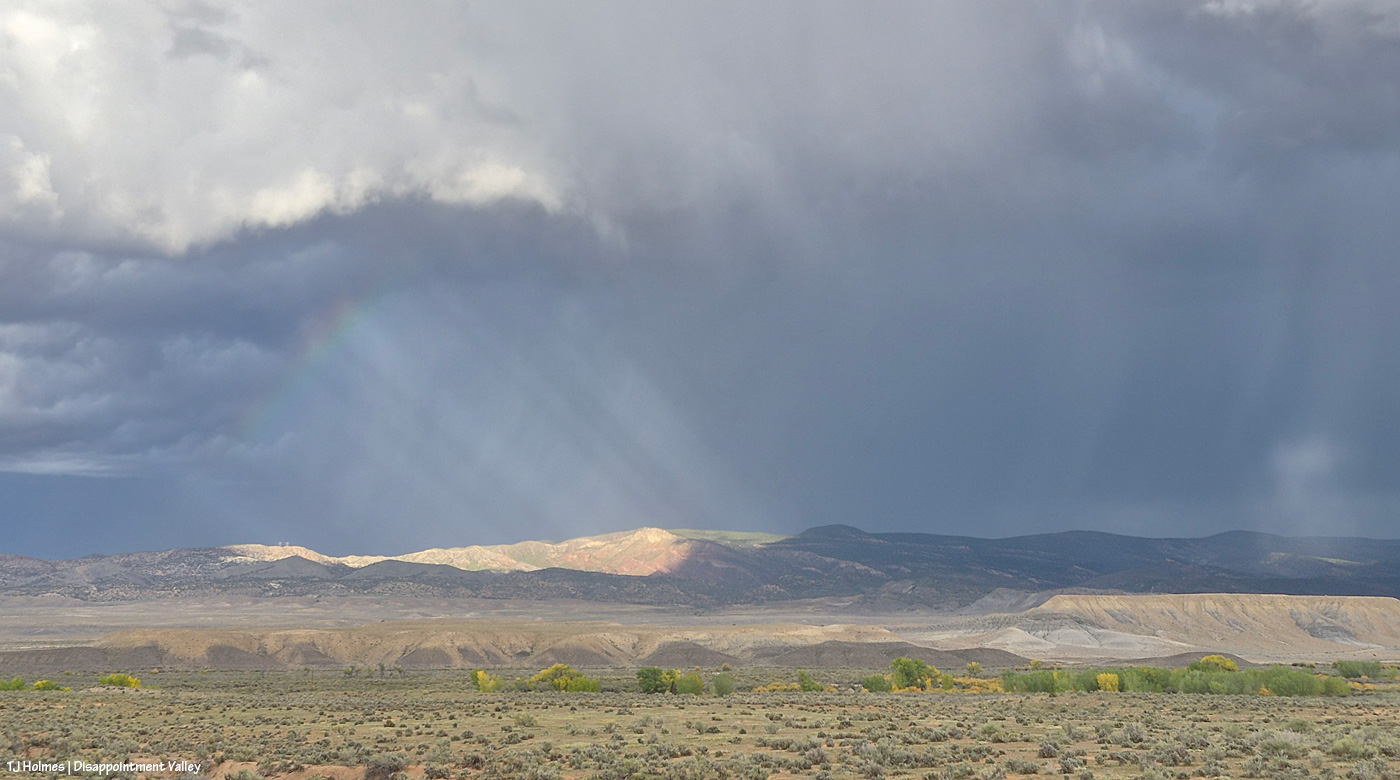
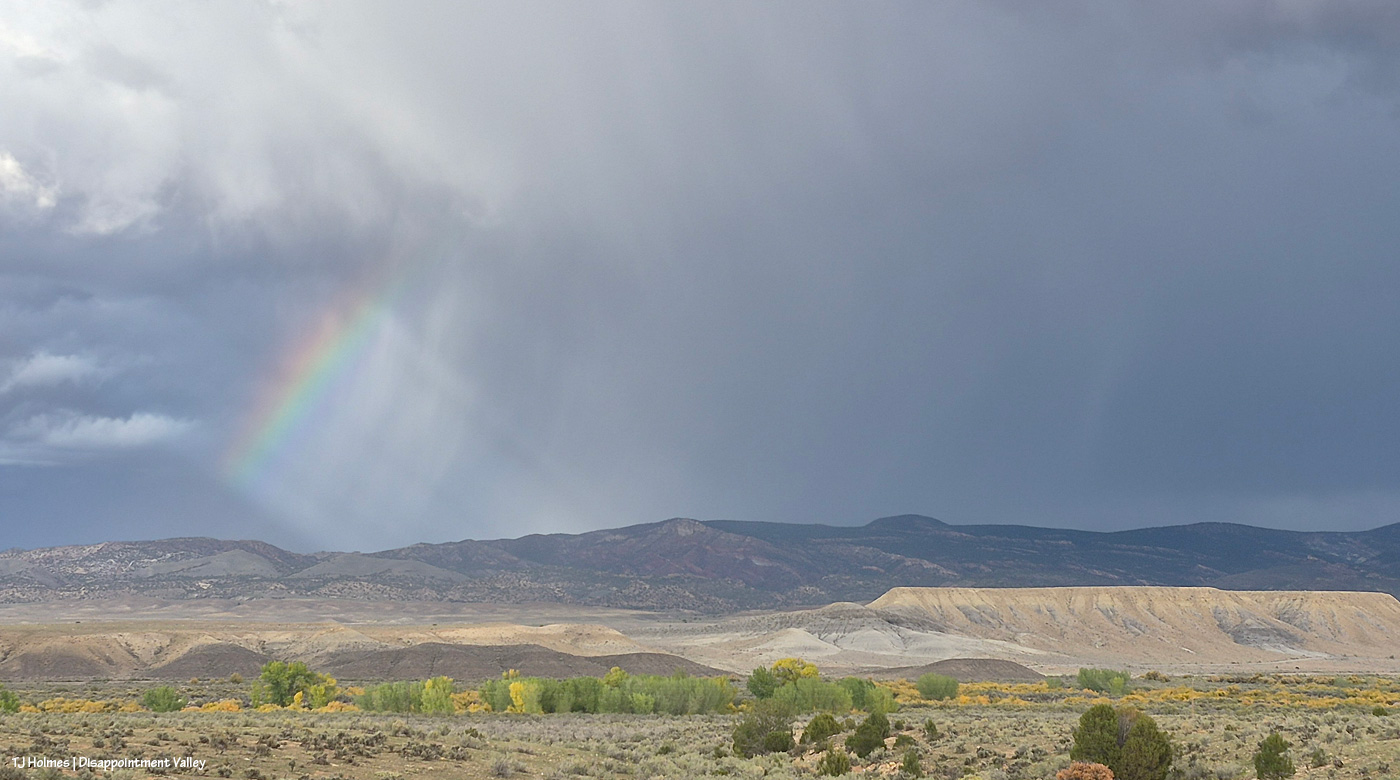
Just as I was thinking of heading on, I noticed something a little different about the sky. … My eyes followed it up and over and down the other side. … HOLY MOLY!
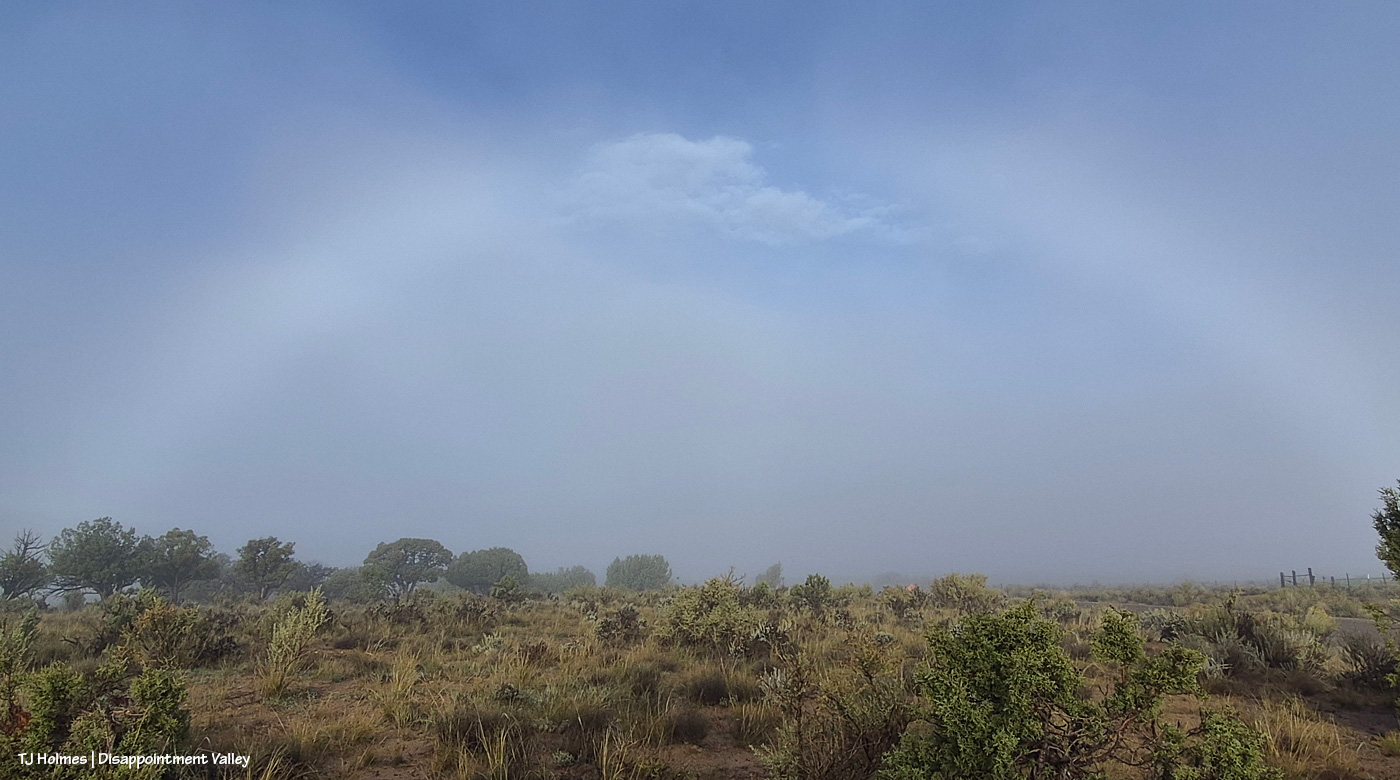
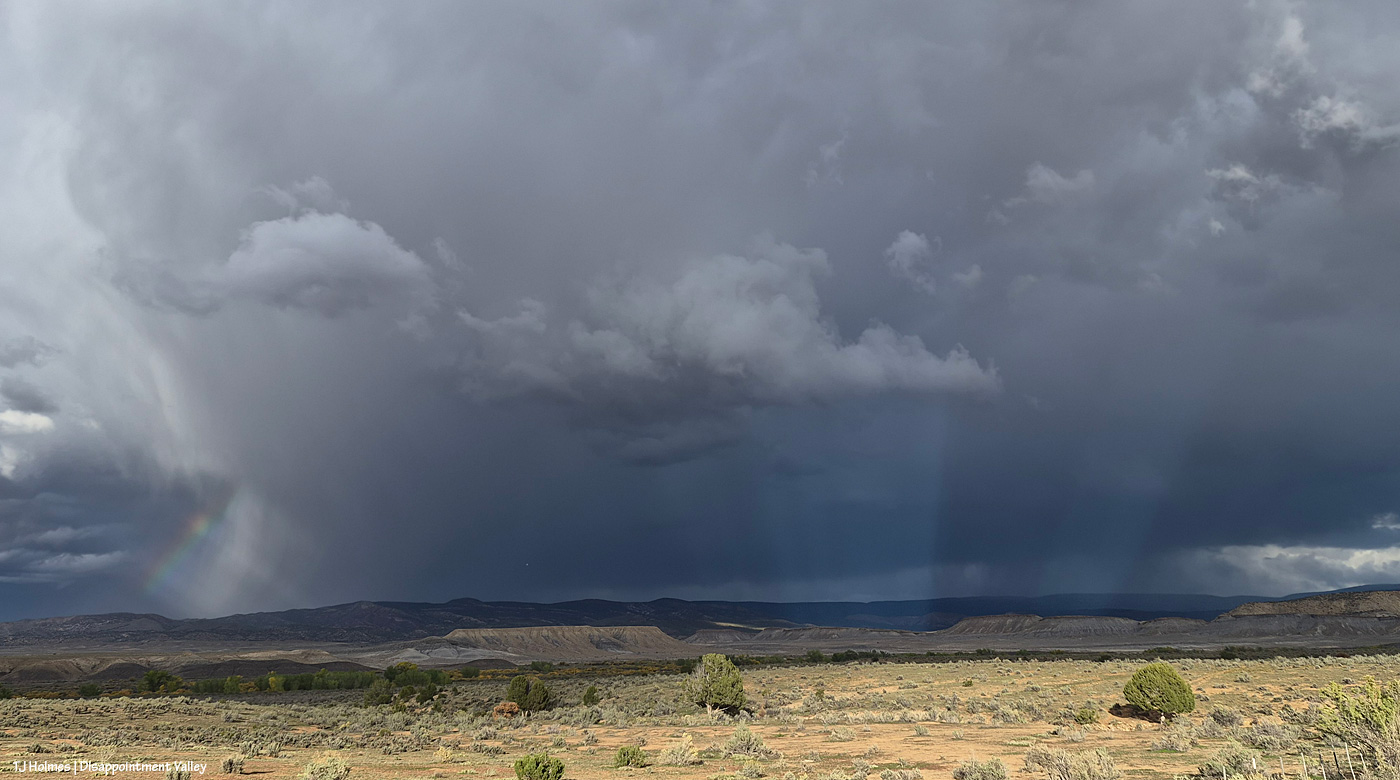
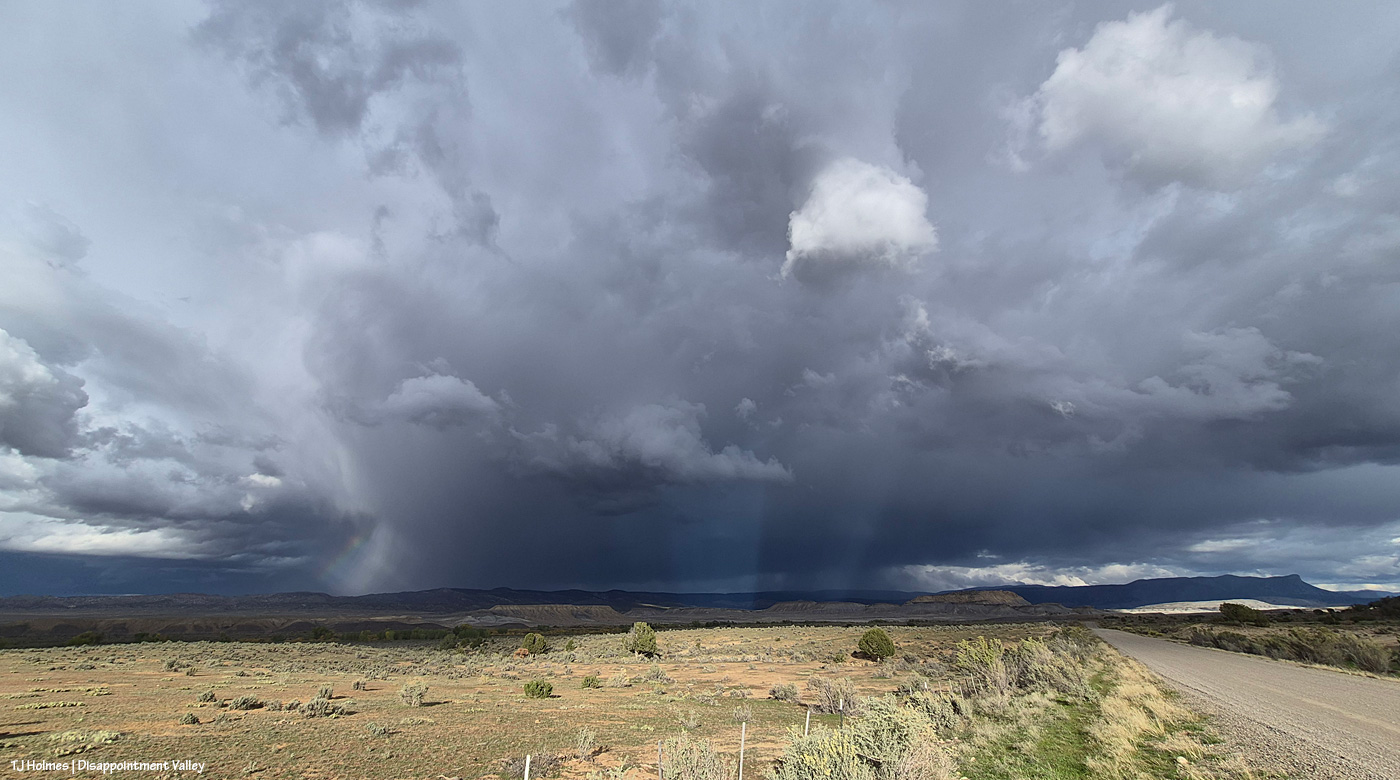
OK, I might be a total weather nerd, but I’m not sure I’ve ever seen a fog bow (or fogbow?). It’s not like we get a lot of fog in Disappointment Valley (see above). 🙂
From this angle, the fogbow broke a little so I could see the little cloud beyond it.
This is what ol’ AI says about fogbows:
A fogbow (or white rainbow) is a meteorological phenomenon that appears as a ghostly, pale, or completely white arc in a bank of fog or mist.
How It Works
Droplet Size: Traditional rainbows form when light refracts through large raindrops (several millimeters wide). A fogbow forms when sunlight or moonlight interacts with tiny water droplets in fog or mist that are typically less than 0.05 mm (or 10 to 1,000 times smaller than raindrops).
Diffraction vs. Refraction: Because the droplets are so small, light undergoes strong diffraction rather than clean refraction. This spreads out and overlaps the individual wavelengths of light, smearing the colors together into a milky-white band.
Faint Colors: You might occasionally see a very faint red outer edge and a faint blue inner edge because those wavelengths are the least smeared.
How to Spot One
Positioning: You must stand with the sun or moon behind you and look forward into the fog or mist.
Conditions: It requires a delicate balance—fog that is dense enough to catch the light, but not so thick that it completely obscures visibility.
Other Names: At sea, mariners sometimes call them “sea-dogs,” and versions seen from high-altitude aircraft are called “cloud bows”. When created by moonlight, it is a “lunar fog bow”.
Is it amazing, or is it ahhhhhhhhhhhhhhhhhhhhhhh-mazing?! 🙂
The fog lifted … then returned – or clouds did. More rain, too. After Wednesday, Thursday, Saturday and Sunday, I’ve gotten almost 3.7 inches of rain. Absolutely incredible! Friends near Dove Creek (southwest of Disappointment Valley) said they got between 5 and 7 inches! WOWOW.
I’m trying to keep this post a little shorter, but I have more pix from the day. It’s still very, very soggy out. Denny from San Miguel County was out Sunday (and Saturday, too! and other guys earlier in the week) checking on the road erosion. They are very much keeping an eye on it, but if you’re in the area, take care!
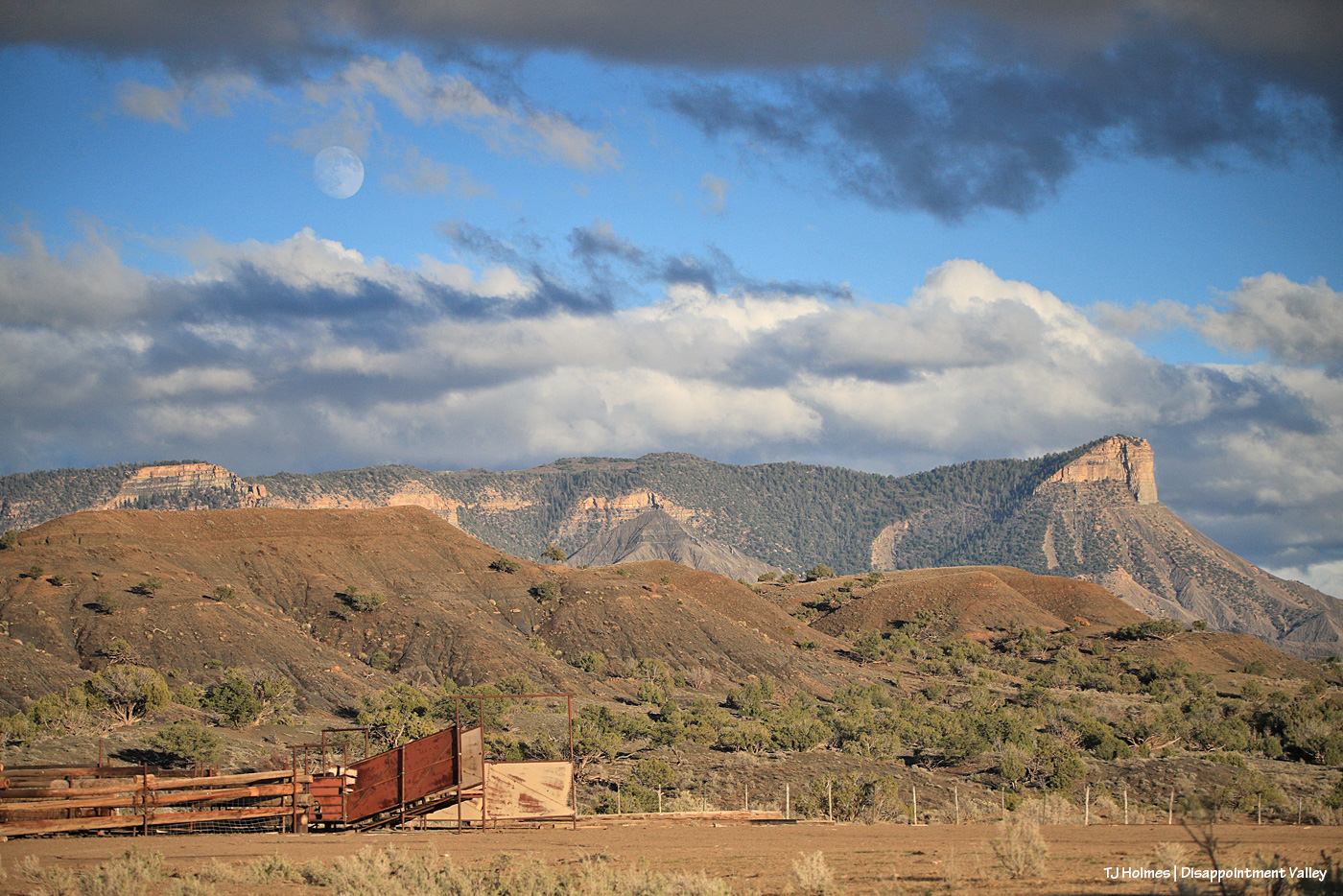
Every month, about mid-month, I make a list for myself of moonrise times leading to the full moon (which, these days (months!), is toward the ends of the months). If you’ve been reading for any length of time, you might have realized how much I adore that ol’ moon. 🙂 What I find fascinating is that, while I’m hunting particular images of it rising from a particularly interesting stretch of far ridge-horizon-line, there are an infinite number of places from which to shoot it – and get it rising over that particular far ridge-horizon-line!
In the above image, I’m on Disappointment Road, and those are the old Perkins corrals (with modern improvements from the current permittee, who has the allotment OUTSIDE Spring Creek Basin to the south. The corrals date from the days when Mr. Perkins (and another fellow/family) had one of the two (yes, two originally) allotments to graze cattle in Spring Creek Basin. The basin boundary fence is to my left along the road, and the fence you see straight ahead, right of the chute, is the boundary fence as it goes to the road. The corrals now are sometimes used to bring cattle out to a central point to release in the spring … and then collect them in the fall to truck back out.
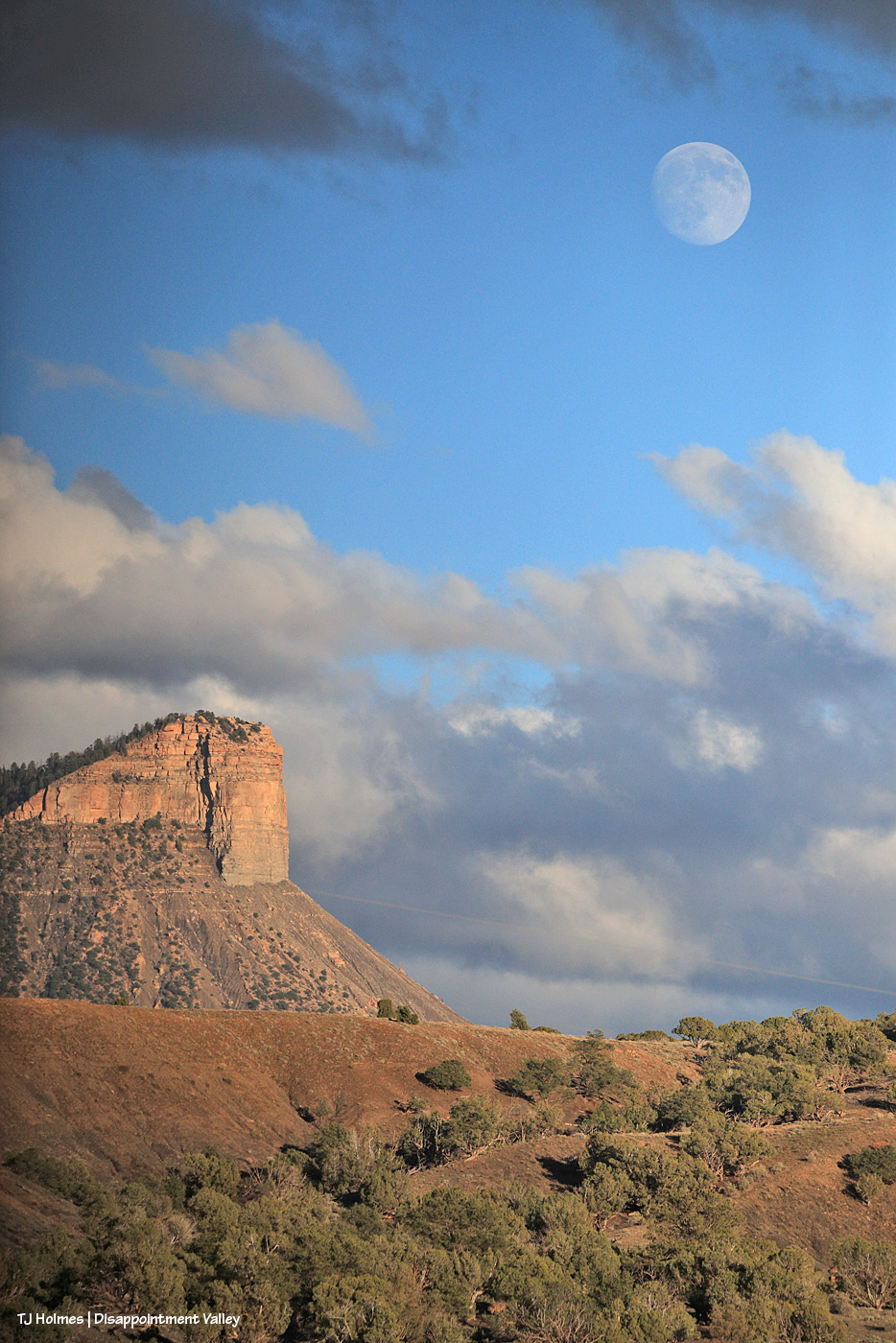
Now I’m farther up-valley to show the moon a bit closer to the point of the promontory that is Temple Butte. (After years of calling it the unnamed promontory, we got it officially named with USGS in 2018 for Pati Temple, a much-beloved mentor and grand, long-time advocate for the mustangs with her husband, David. Thank you, Ann Bond, for bearing the load of that process!)
With all the storms and clouds and rain and thus-invisible sky lately, all thoughts of the moon had completely left my brain. These pix, taken at just right the time where the moon is between clouds, were completely the result of luck and being there. 🙂
I’m not going into the interior of Spring Creek Basin just now, and may not be able to get in for another few-some days. It has been SUCH a different few days, and the mustangs haven’t really been front and center of Mother Nature’s shenanigans (for me), so I beg your patience and forgiveness, and I promise a return to mustang pix as soon as possible!
Well, yesterday was pretty quiet, weather-wise. Nice and sunny with fluffy, pretty clouds in a sharp blue sky. I made it down-valley to check on Disappointment Creek where it crosses under Disappointment Road on its way farther west, and I also watched happily as Spring Creek ran with muddy water in its broad arroyo a bit farther north.
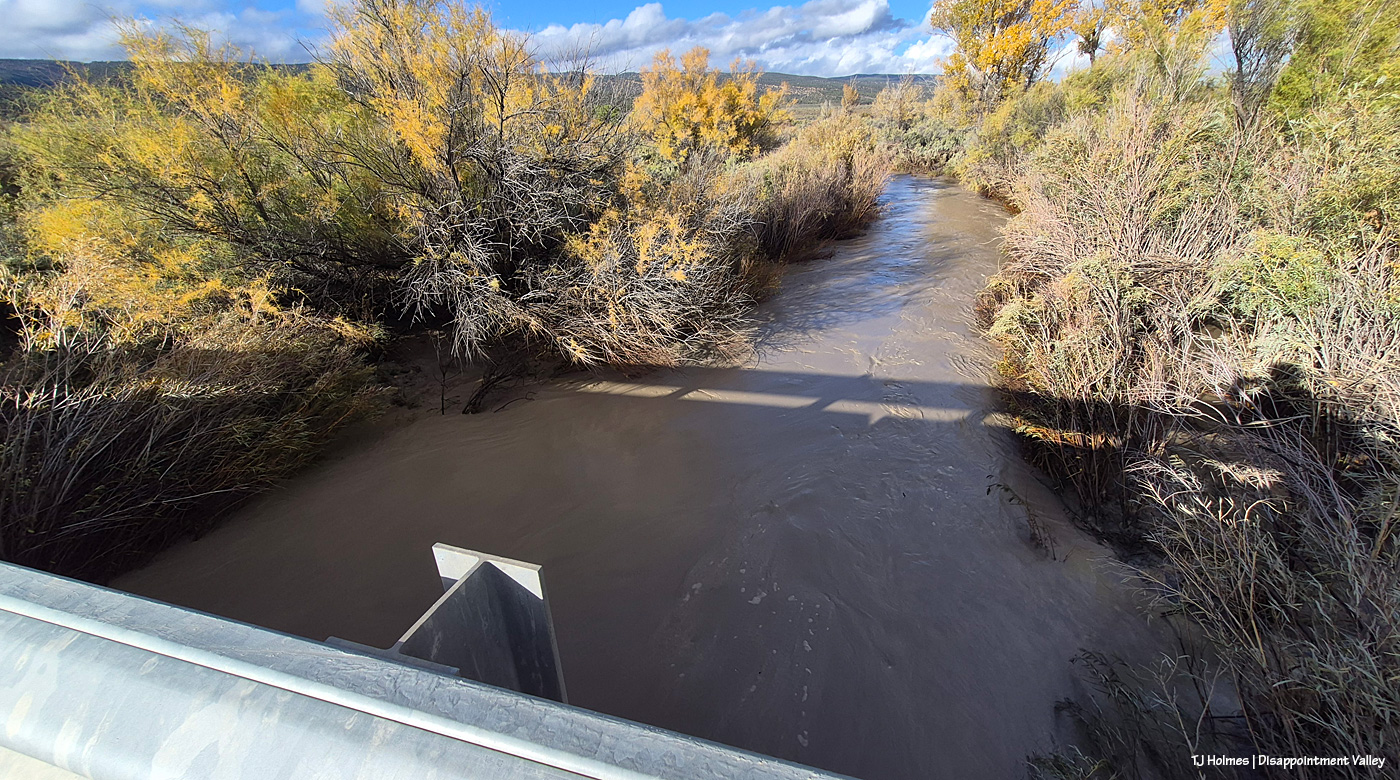
This is a view of the still very swollen Disappointment Creek from what’s known locally as the Daddy Williams bridge (nope, I don’t know who Daddy Williams was). Looking upstream as the water flows toward me. Temple Butte is at just about center WAY back east.
And from the west side of the bridge as the water swirls and flows away toward the Dolores River.
Then farther north, past Road K20E to Spring Creek Basin – muddy and still puddled with rain water! – to check on Spring Creek. Oh, the anticipation! Would it still be running??
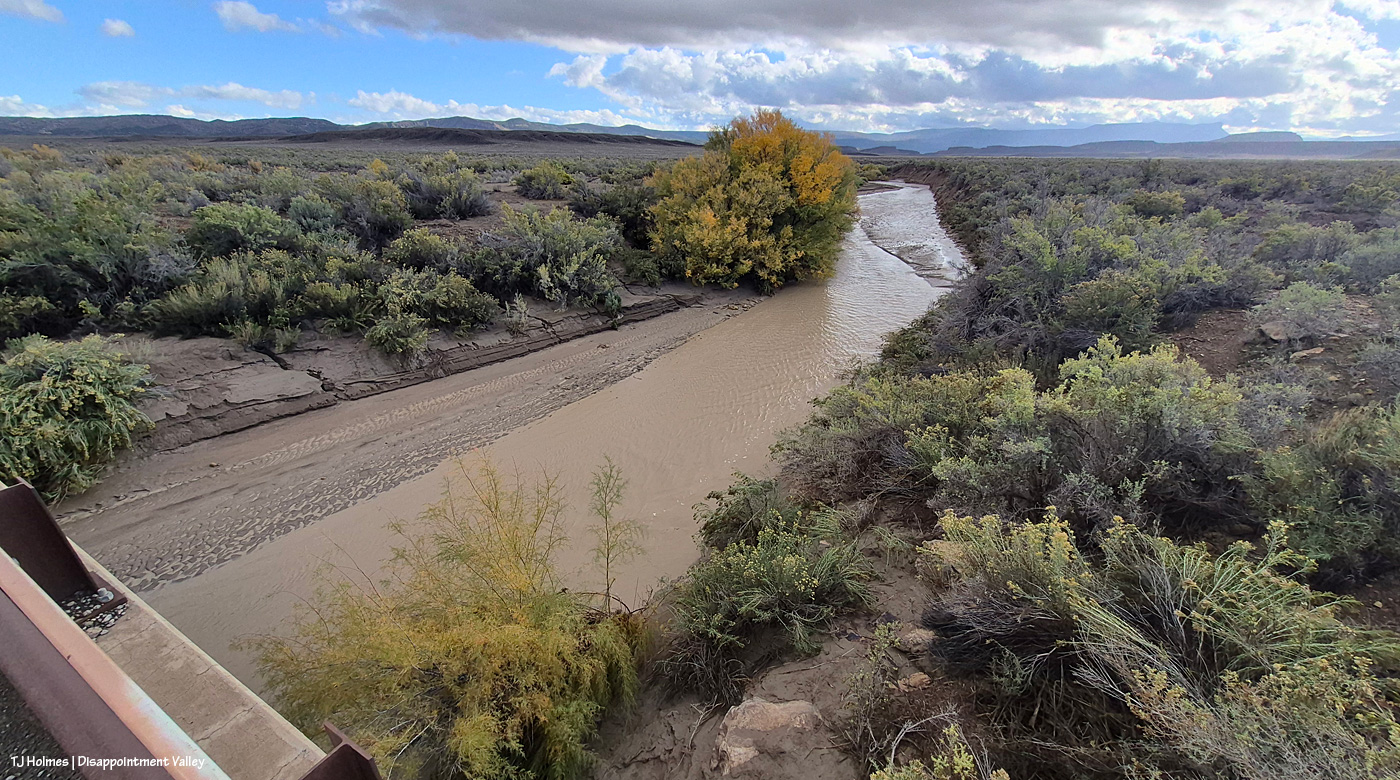
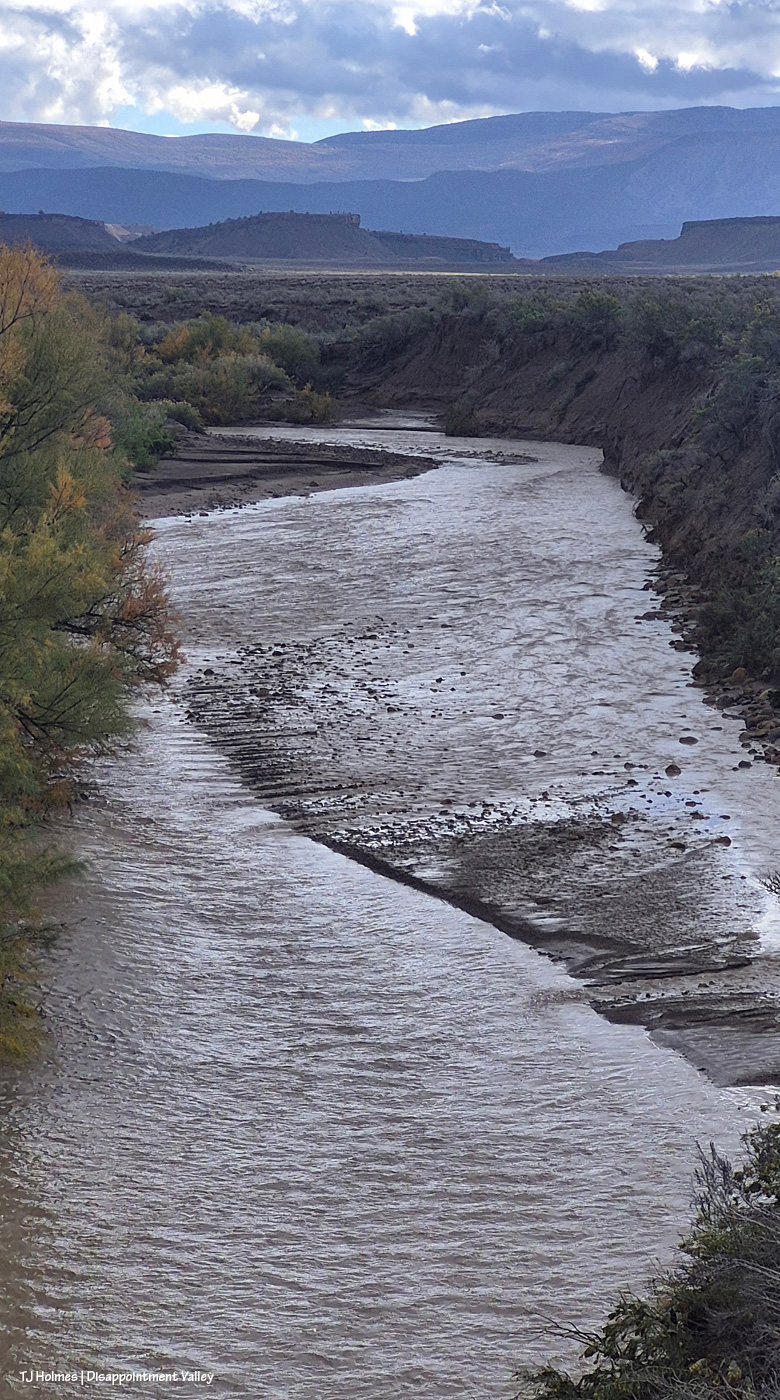
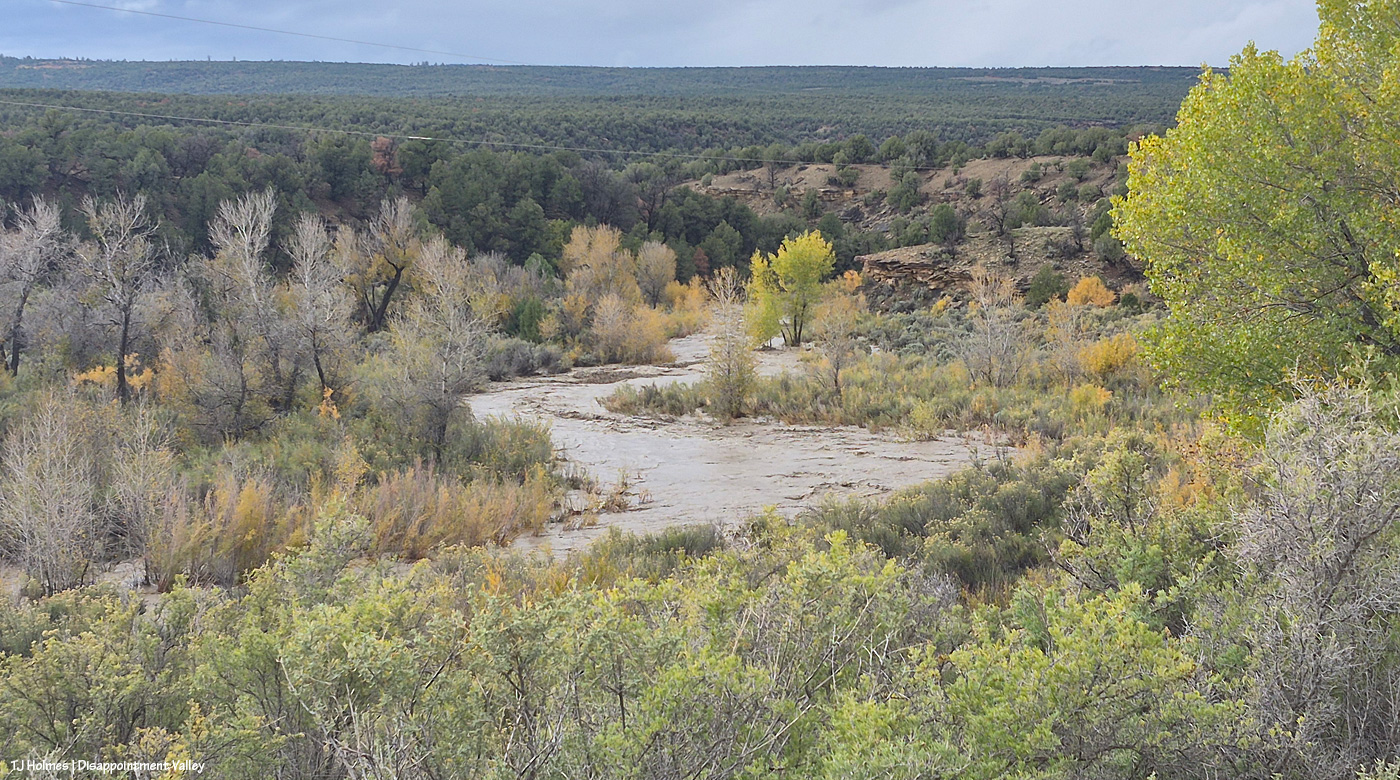
Spring Creek is much broader than Disappointment Creek at pretty close to the same elevation. You can see on the other side of the creek how high the water had risen along the creek bank and how much it had receded. By step-measurement, that was about 15 feet. Spring Creek Basin, the arroyos of which gather all this water into the lowest, main arroyo – Spring Creek – is visible in the distance to the east.
Spring Creek flowing out of Spring Creek Basin, through Spring Creek canyon, visible just right of center in the low background.
Looking nice and lovely and broad – and pretty shallow by this time – on the west side of this bridge, Spring Creek flows on west to join Disappointment Creek.
The rain should return today. Oh, and the total for the two full days between 8 a.m. Wednesday and 8 a.m. Friday: 2.74 amazing inches. Absolutely outstanding!
Well, I’d planned to have another sunset-glowing mustang for today’s post, but that had to be postponed for the below post. I’ll try to update the amount of rain, but as of about 3:30 p.m. Thursday, we’d gotten at least 1.97 inches. For those of you in rain-rich areas, that’s, like, potentially MONTHS worth of rain here in Disappointment Valley, Colorado.
There’s not a lot of sky color in the below pix, but there’s some gold in the way of cottonwoods more yellow than they were a few days ago.
Try to imagine the NOISE of an immense amount of water rockin’ and rollin’ and bustin’ its banks, and enjoy! (Oh, and while I was starting to process pix, um, we got some color …! 🙂 *wait till the end*!)
Well, THIS is interesting. I came from the west, which is the direction I’m looking in this pic; I drove past the bad place and walked back. So on the left/south is a pond that’s not usually there (!). And on the right/north, the continuation of the drainage – much deeper/broader/bigger – down to Disappointment Creek. If you’re paying attention from last time, that might confuse you, when the creek was south of the road. At this part of the valley, it has crossed under the road a bit up-valley of this location, and now it’s running west, north of Disappointment Road, which, here, runs northwest-to-southeast (or vice versa). The road eventually runs straight north to the highway, and Disappointment Creek runs under it again. If that’s completely confusing, well … here’s the map of Spring Creek Basin, which shows the area around it, but I’m not sure it’ll be more helpful?
Now I’m at the fenceline, trying to get a bit higher for a better overall view, looking south.
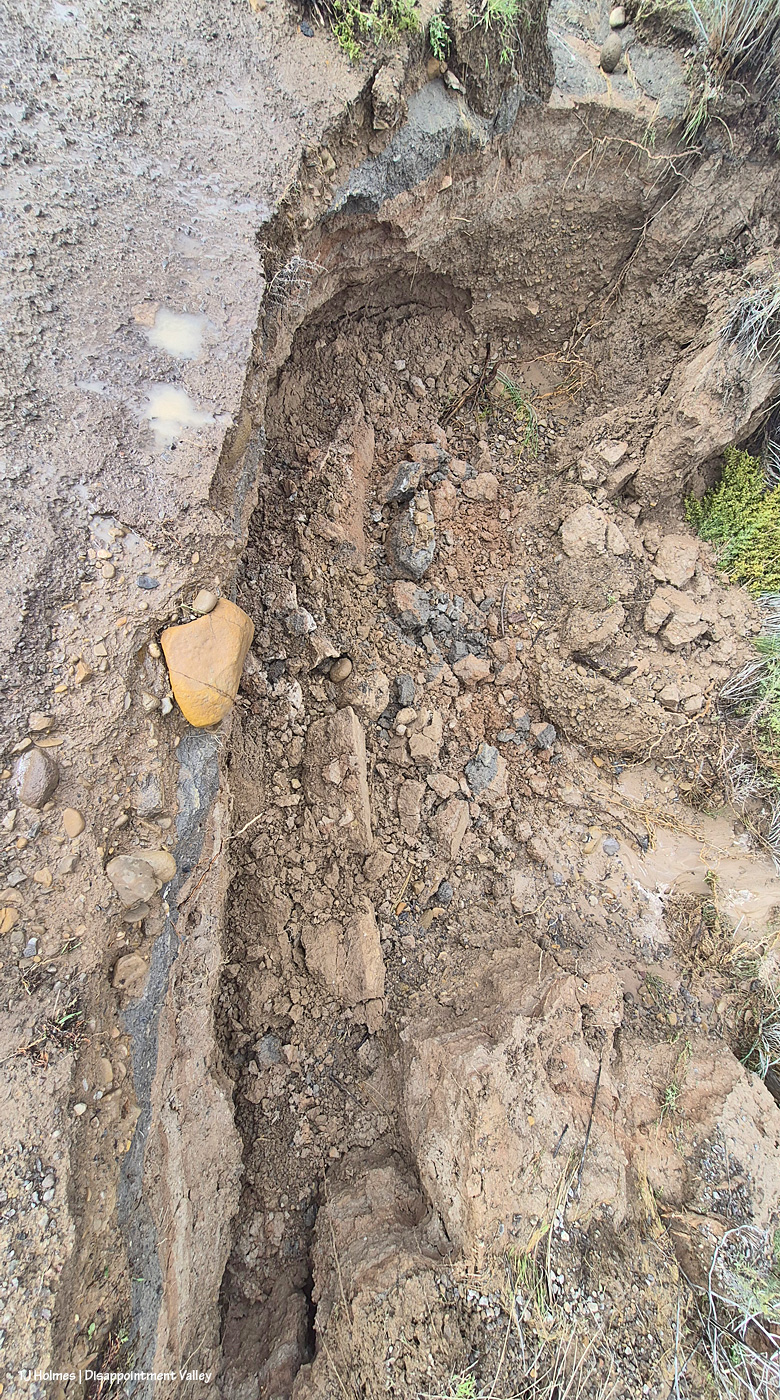
The road is wet and actively crumbling (this was probably around 2:30 p.m.). See the orange rock at left? It’s just on the edge of the road.
See the rock at bottom center? That’s the same rock, about 10 minutes later, down in the bottom of the hole after it slipped off the road from the water-caused crumbling.
If you’re driving in/out/up/down Disappointment Valley, take more than the usual care! For locals, this is maybe almost to the 9 mile marker.
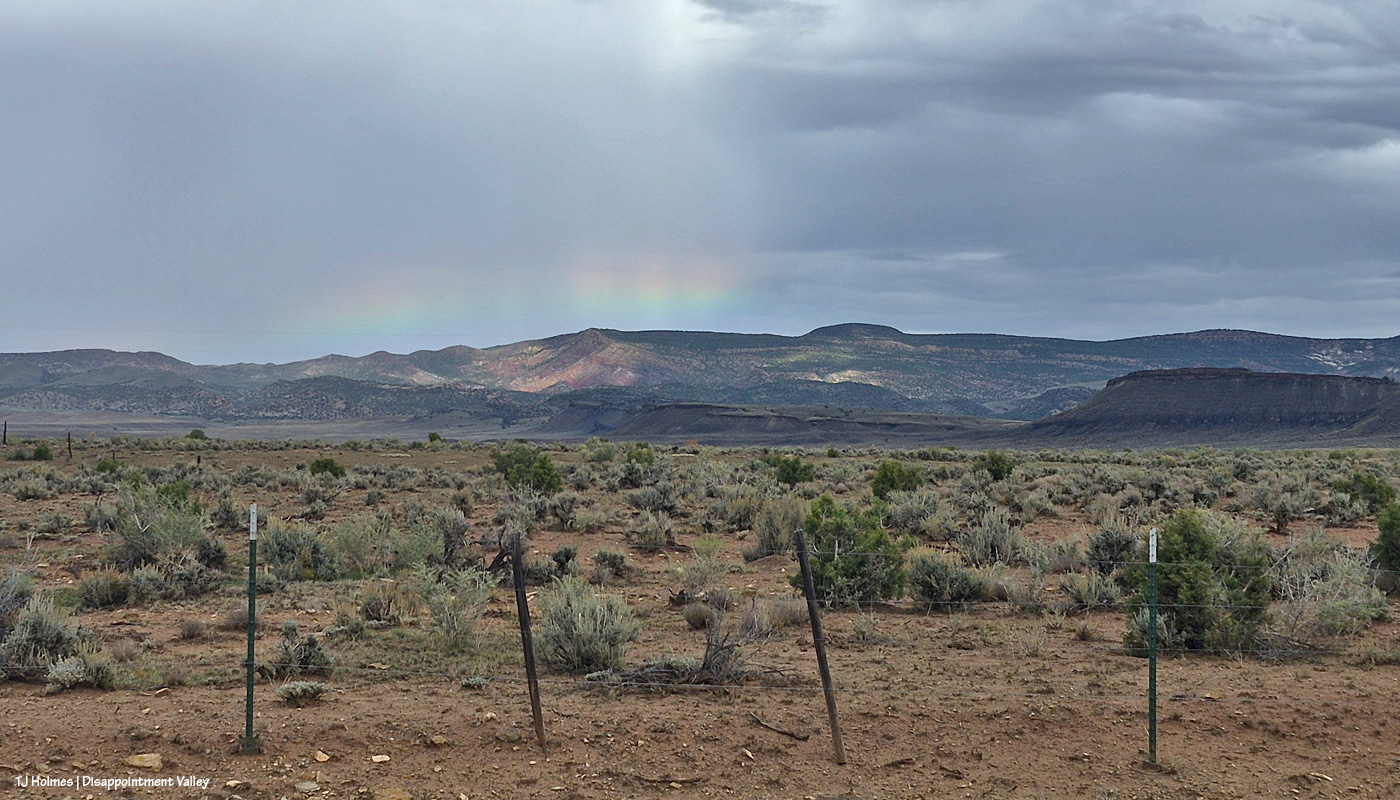
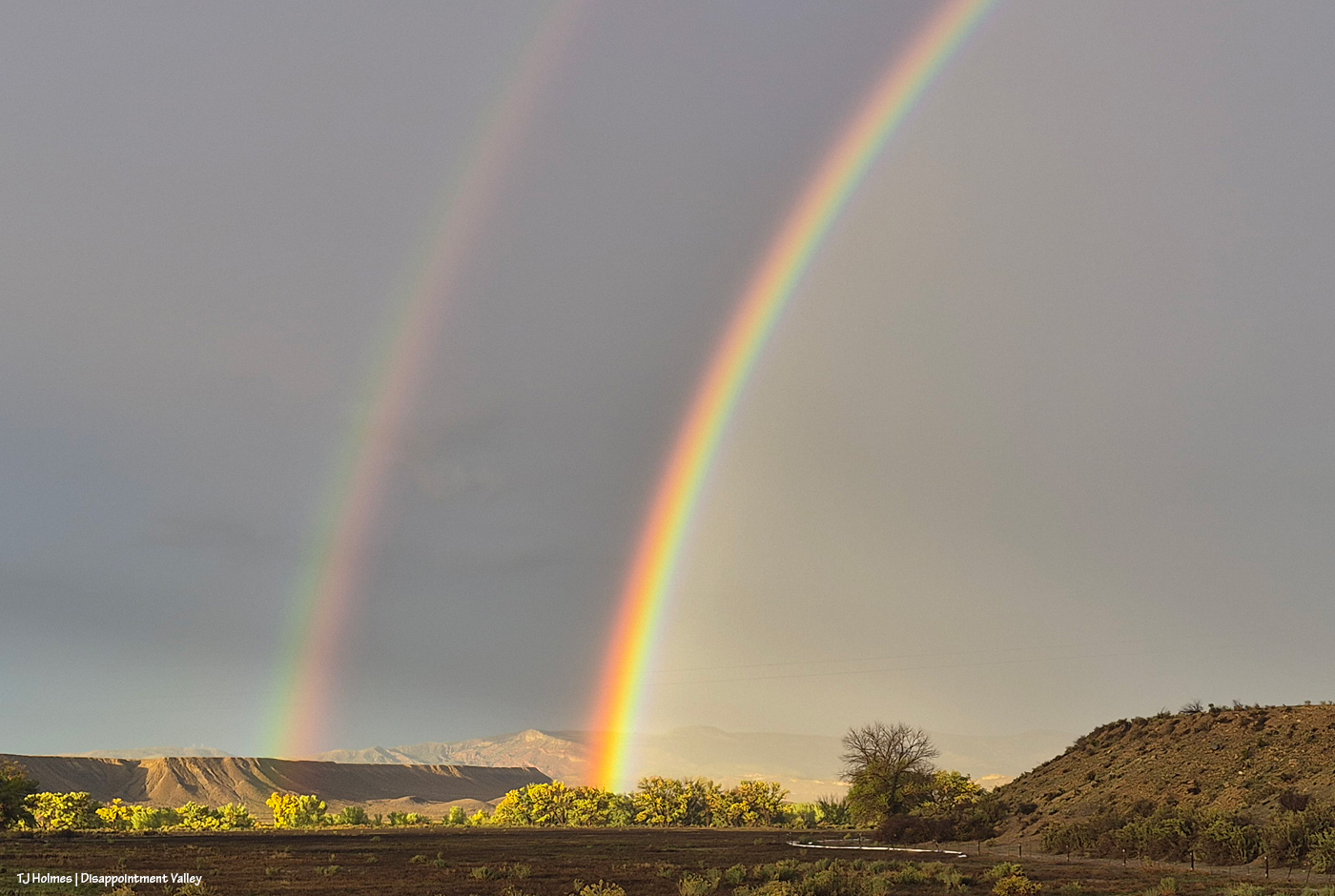
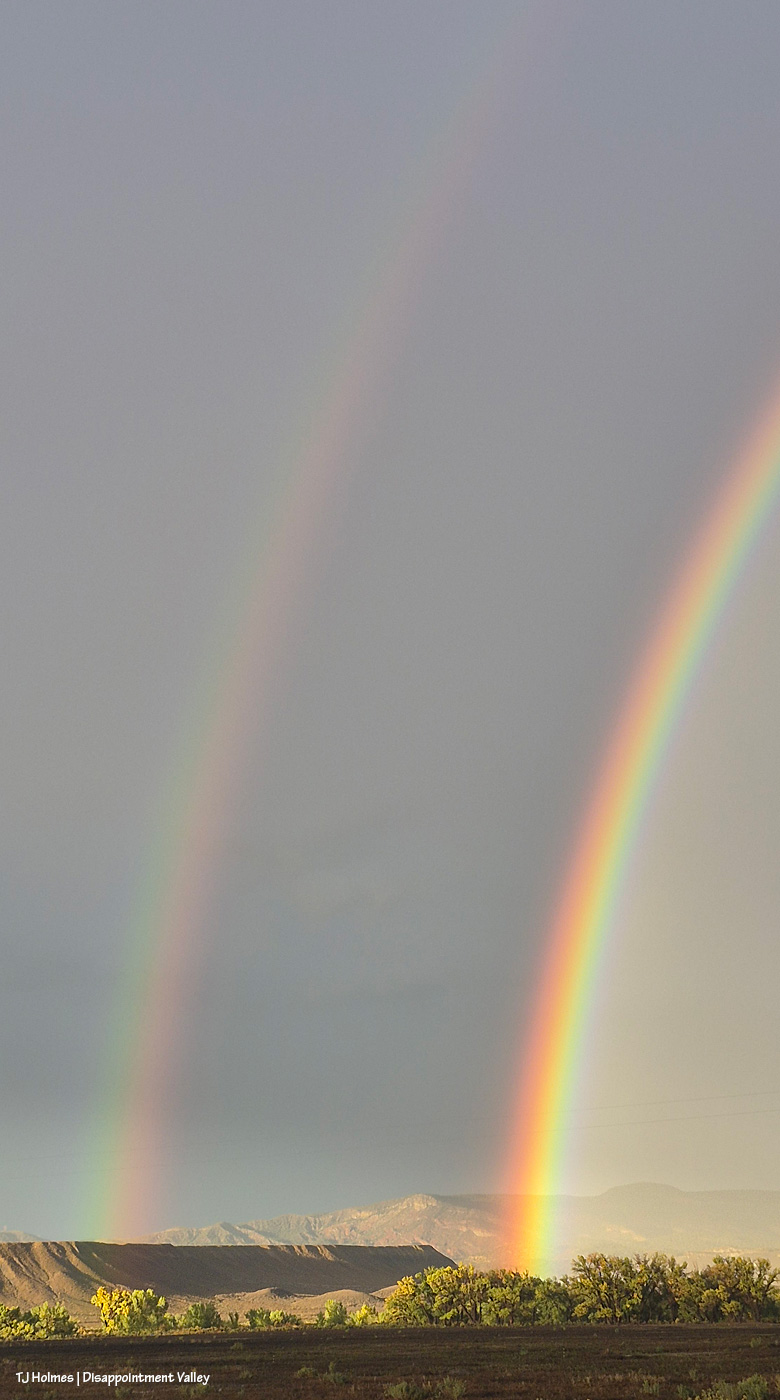
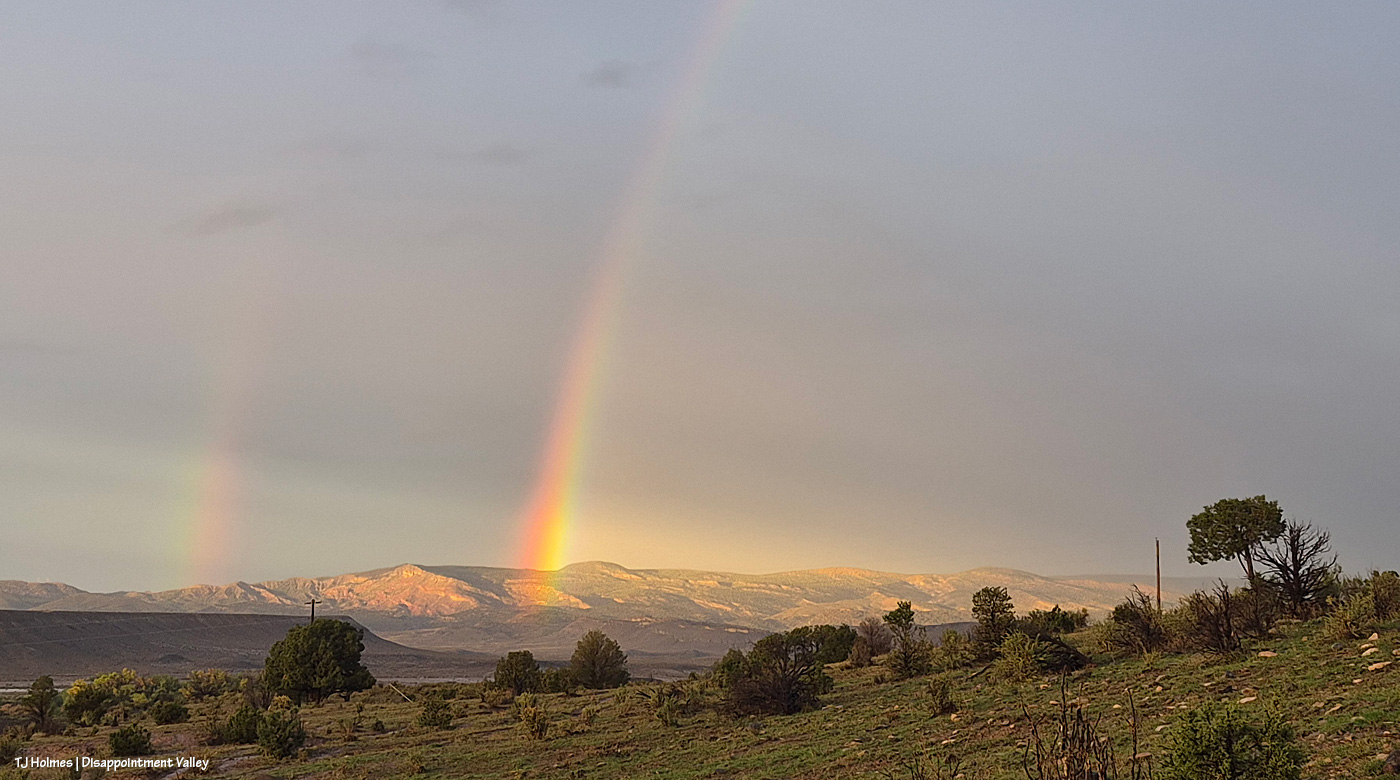
Just as I was driving on up-valley, then, that little bright bit of loveliness caught my eye. Have you ever seen such a low bow?
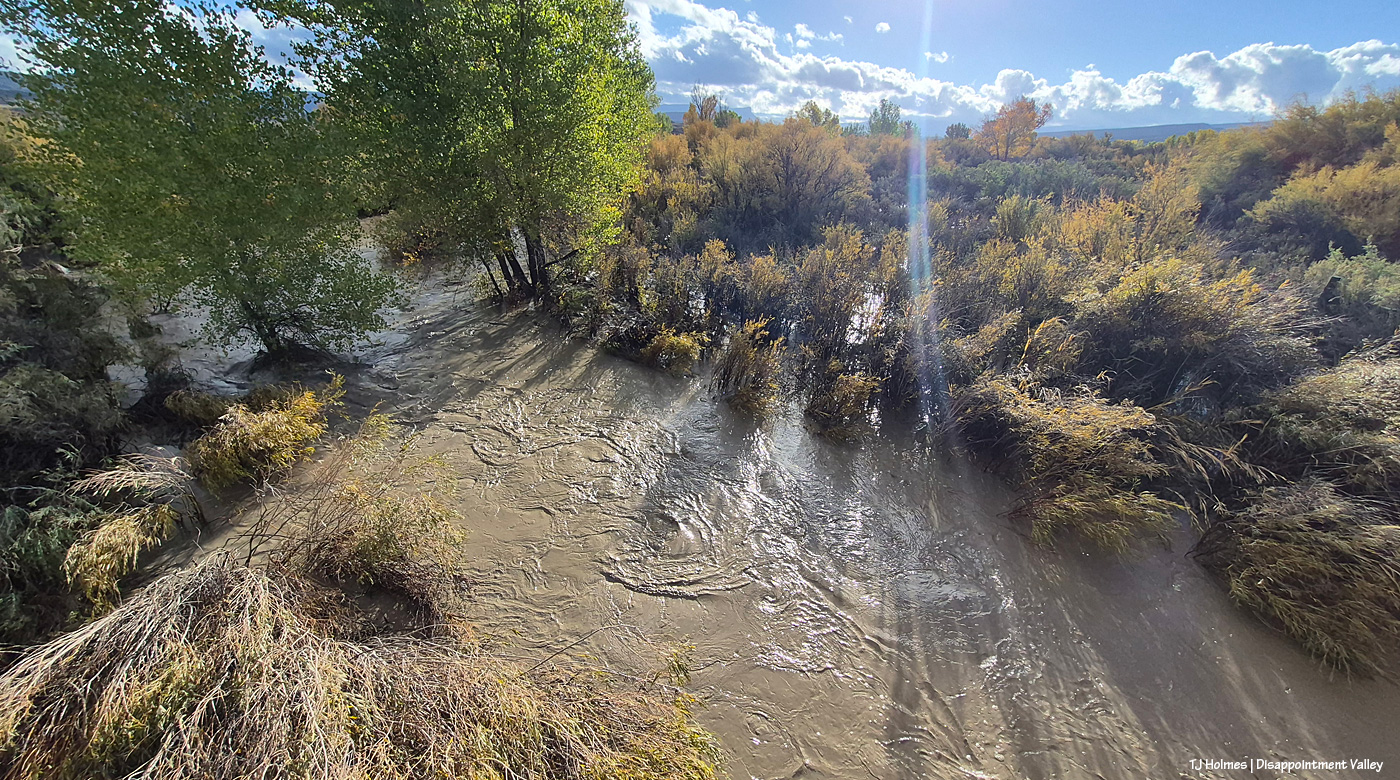
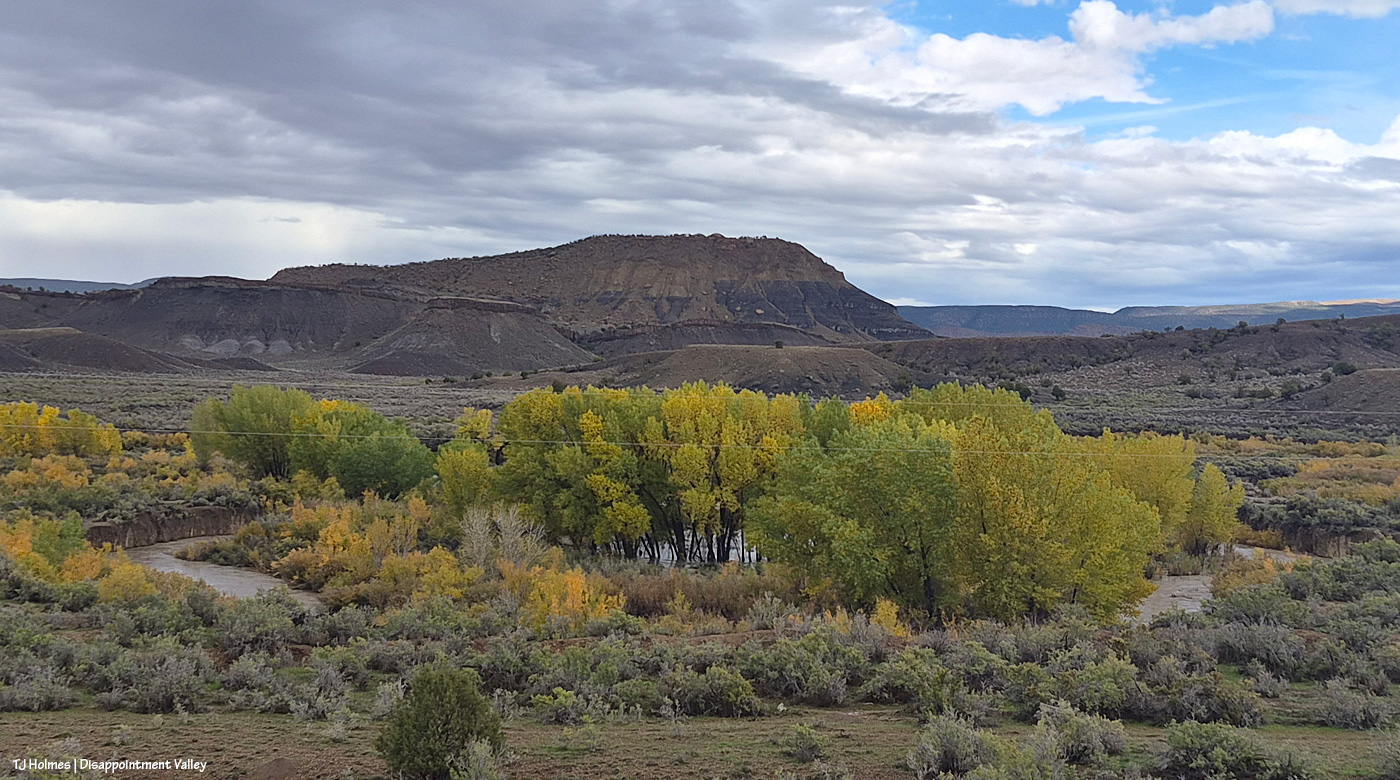
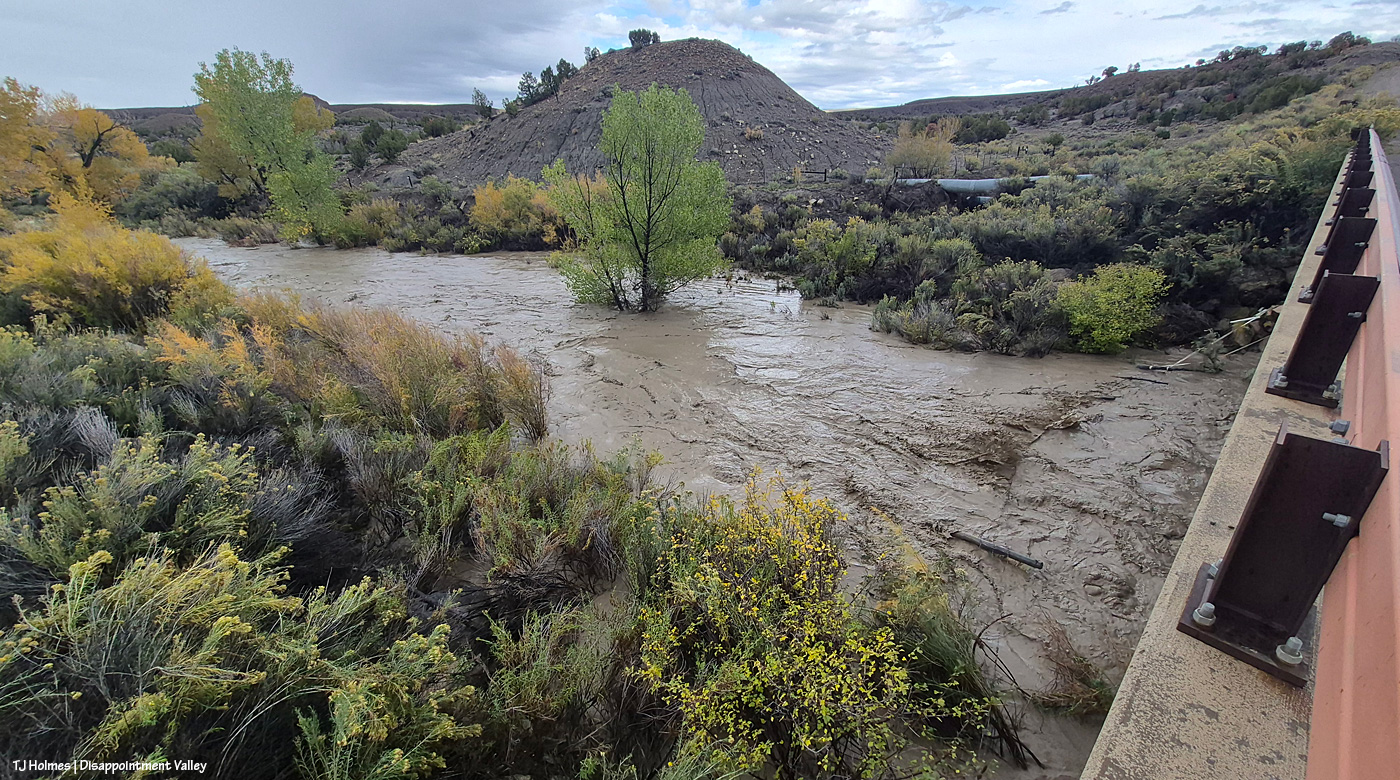
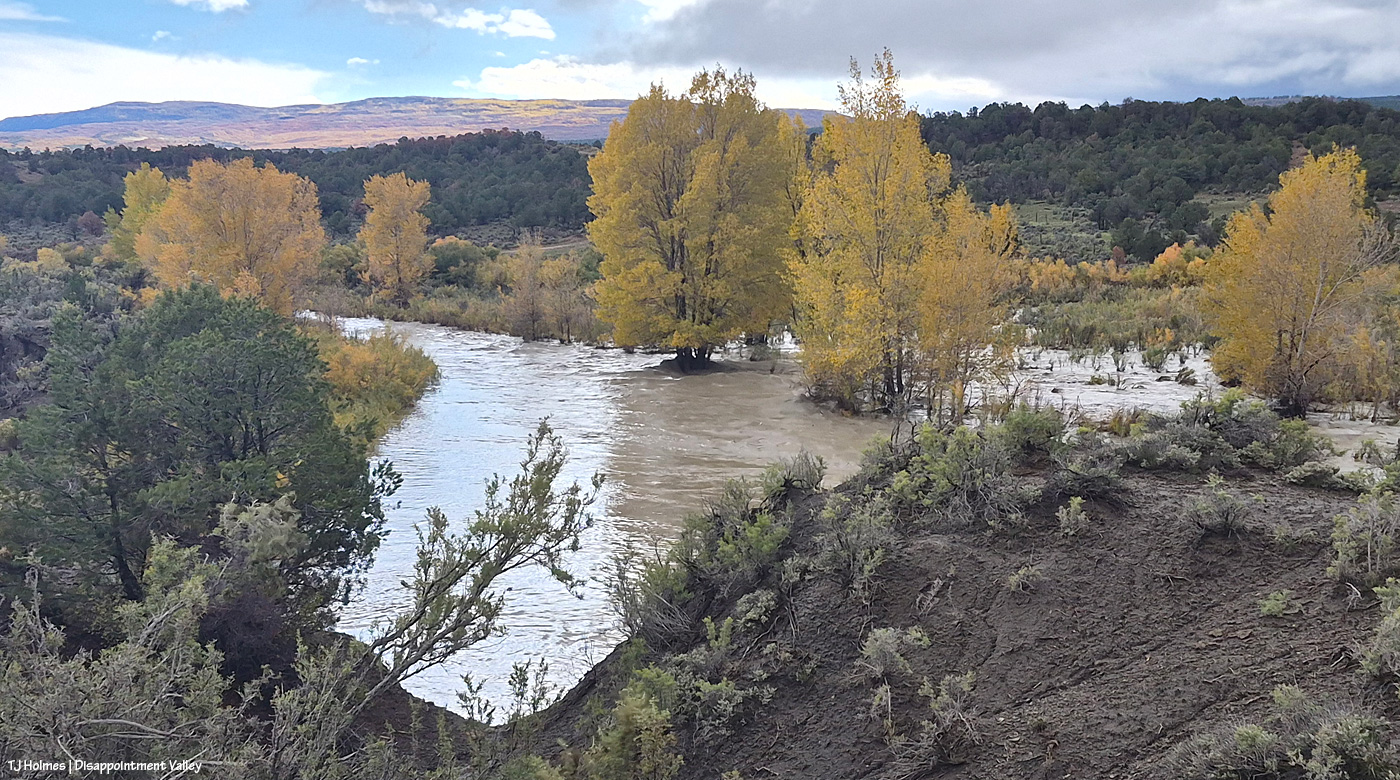
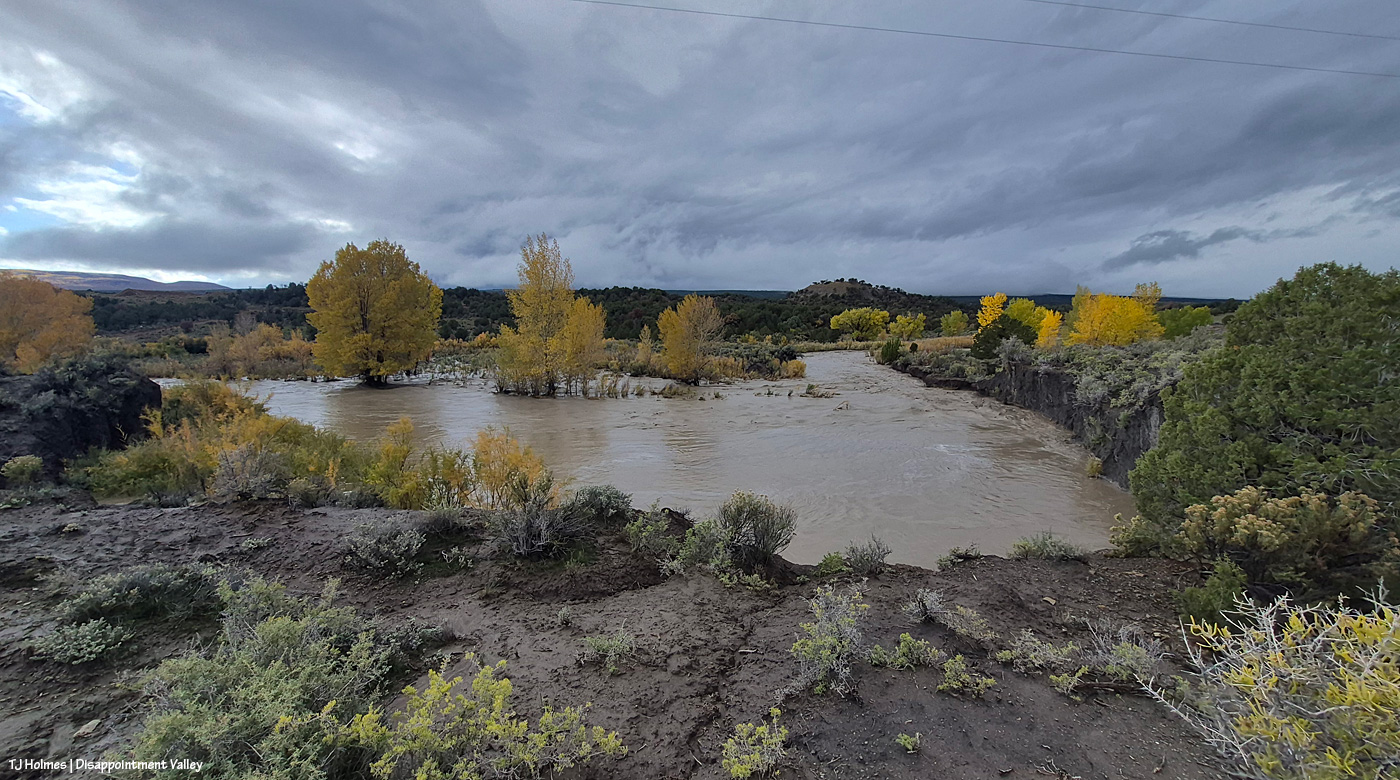
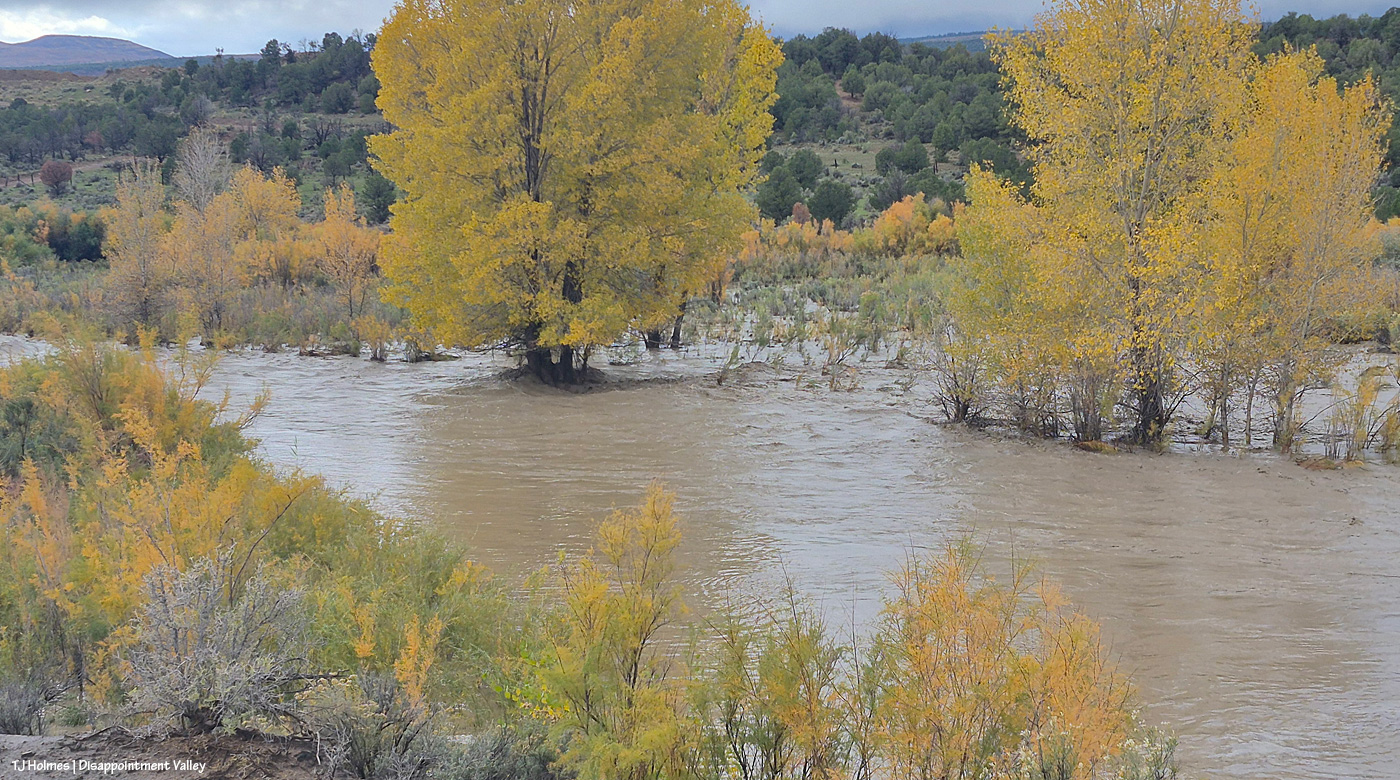
Usually, Disappointment Creek makes a big half-circle around that stand of cottonwoods. Usually, the cottonwoods are not standing in water (floodwater or otherwise). Usually, there’s no water in the creek bed. Usually, even if there IS water, you can barely see it from the road. THAT is a lotta water, my friends. It’s flowing downstream from right (southeast) to left (northwest).
Holy moly high water. This is looking upstream – the water is flowing toward me as I stand on the road/bridge looking south. The water is WAY above and wider than its usual banks. That’s also BLM land.
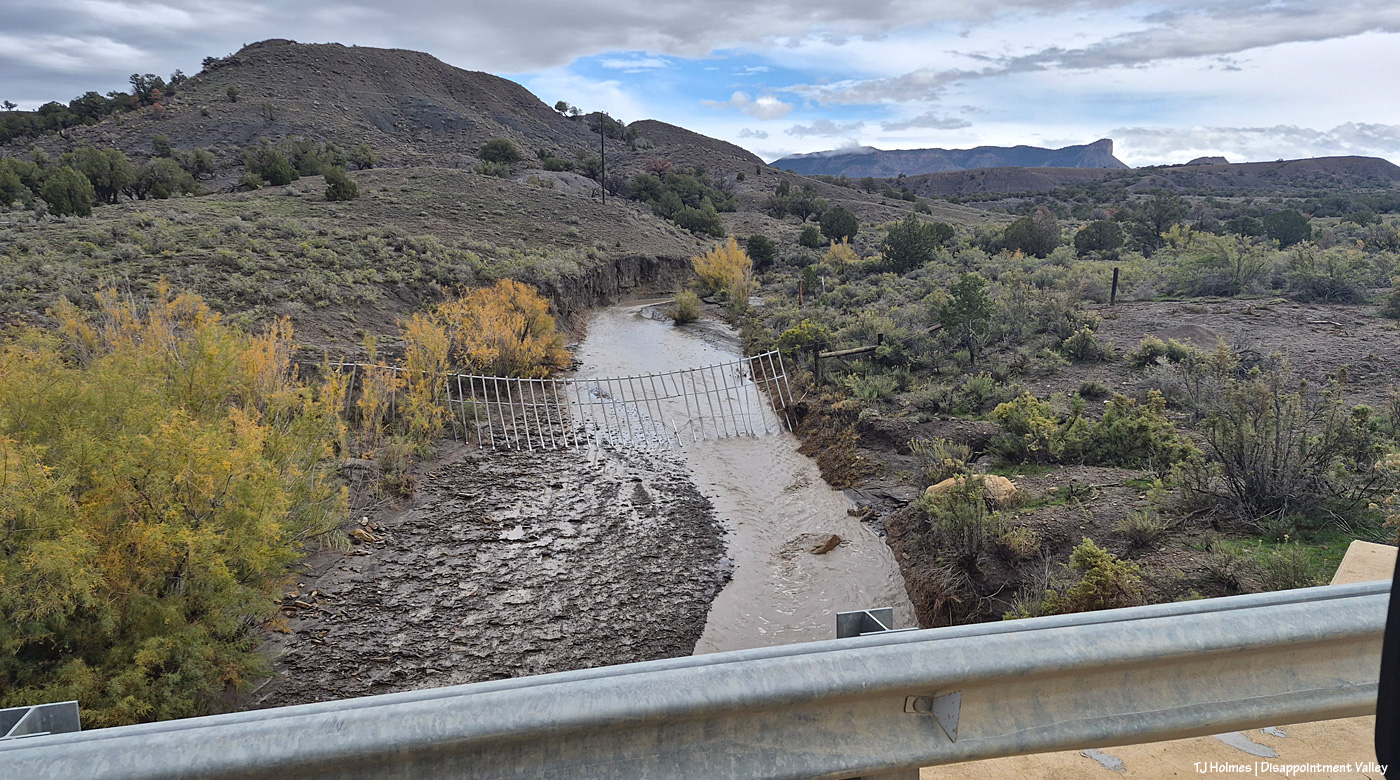
And on the north side of the bridge, the water is, well, rollin’ like a rollickin’ river. I’m actually looking eastish/northeastish, and the basin is the farthest land you can see on the other side of that weird knobby hill above/behind the green cottonwoods. Here, though, the creek is running into private property. That clump of green cottonwoods in the middle of the pic is NOT usually in the middle of the creek. It’s not usually in the creek bed at all. The half-moon thing at right, under the bridge, is the very sad “water-gap fence.” A friend and I fixed it a year or so ago, and it was in good shape then. … I think it’s gonna need some more work. 🙂
Continuing up-valley, beyond that fence is Spring Creek Basin, and the arroyo is what I call the county-line drainage. The road is going southeast here, so although the county line between Dolores County (south) and San Miguel County (north) is east-west, it doesn’t cross the road that neatly. In any case, water from this arroyo flows straight into Disappointment Creek, which is behind me, south of Disappointment Road here. Disappointment Creek does NOT flow through Spring Creek Basin at all. And that’s what a fairly decent water gap is supposed to look like (minus the broken piece of PVC in the middle). The idea is that the poles flow with the force of water but discourage cows from getting through into the basin (or horses from getting out). I will tell you that it works much better on the horses than it does on cows.
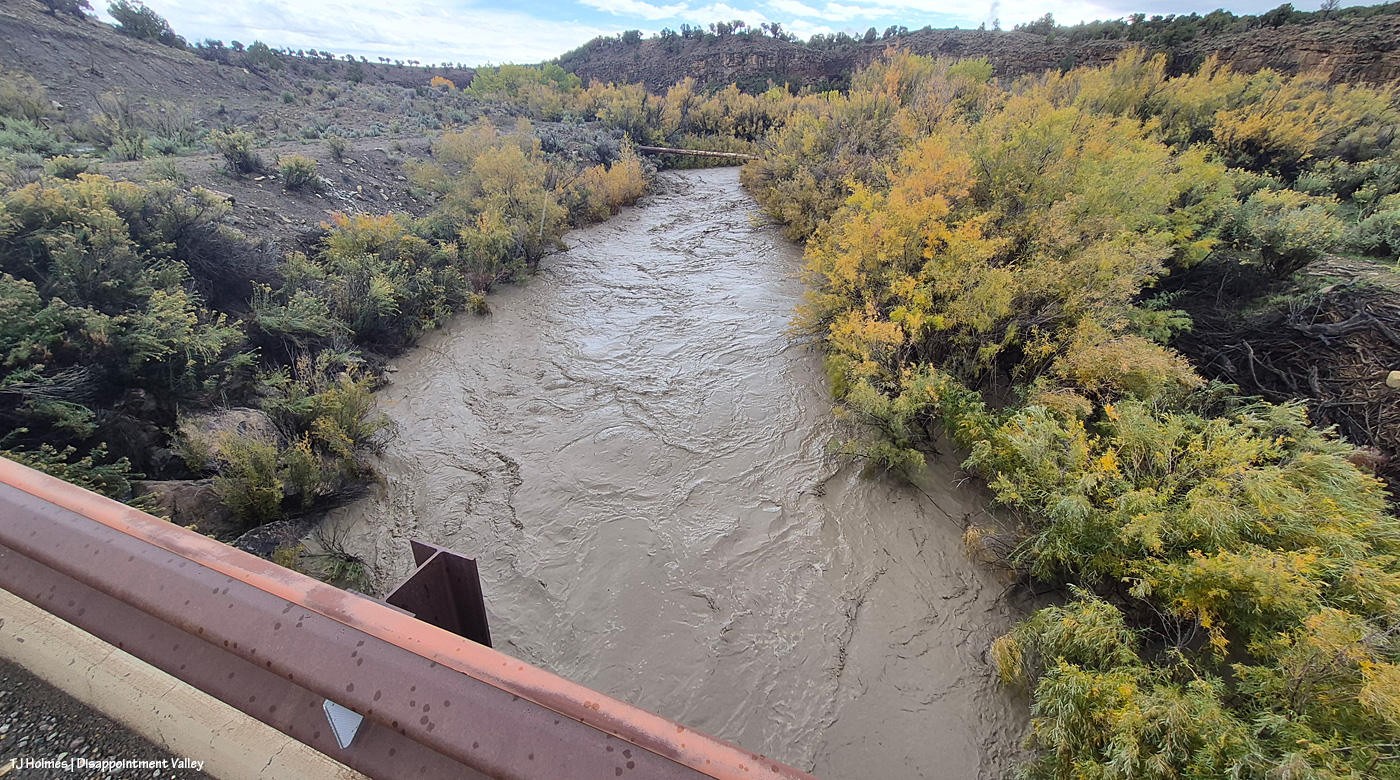
Disappointment Creek just absolutely flooding, running downstream. This is on the south side of the road looking southish … maybe a bit southwestish.
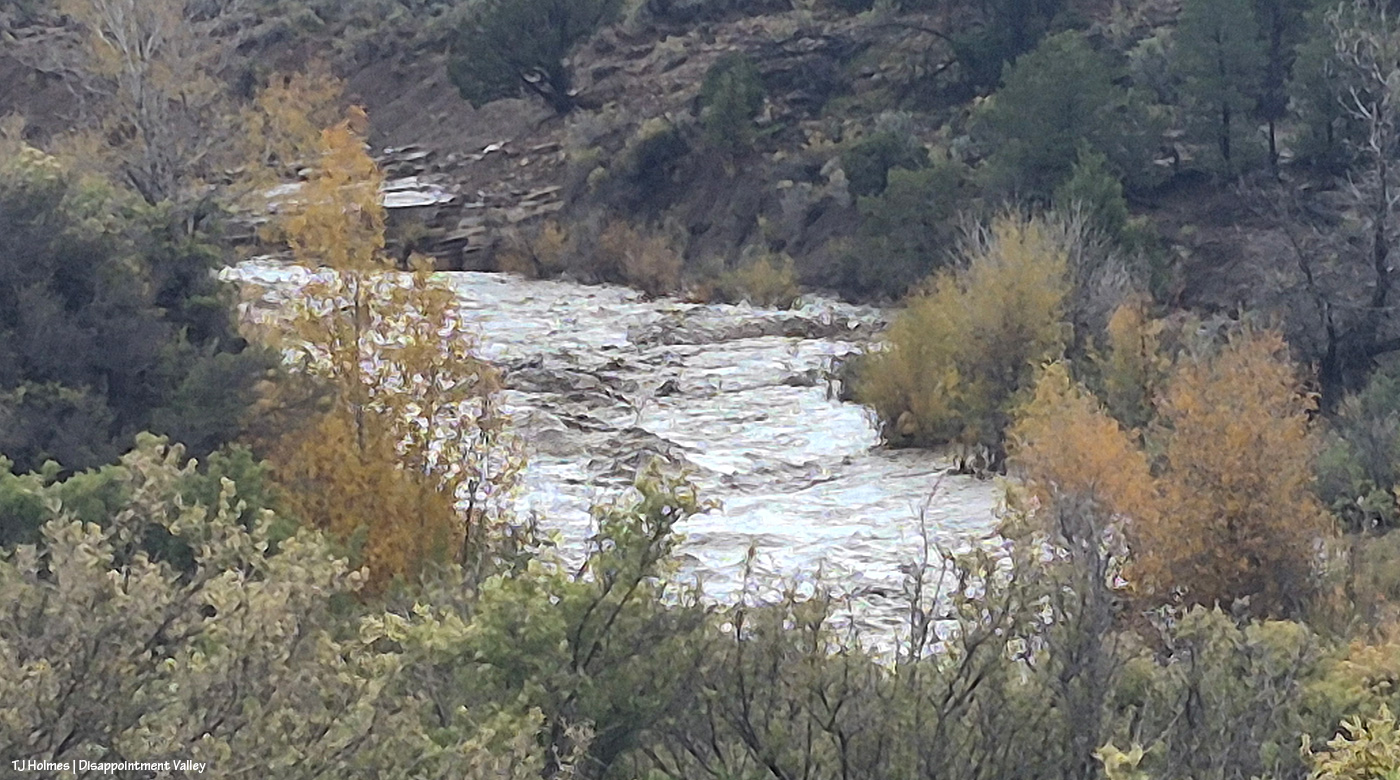
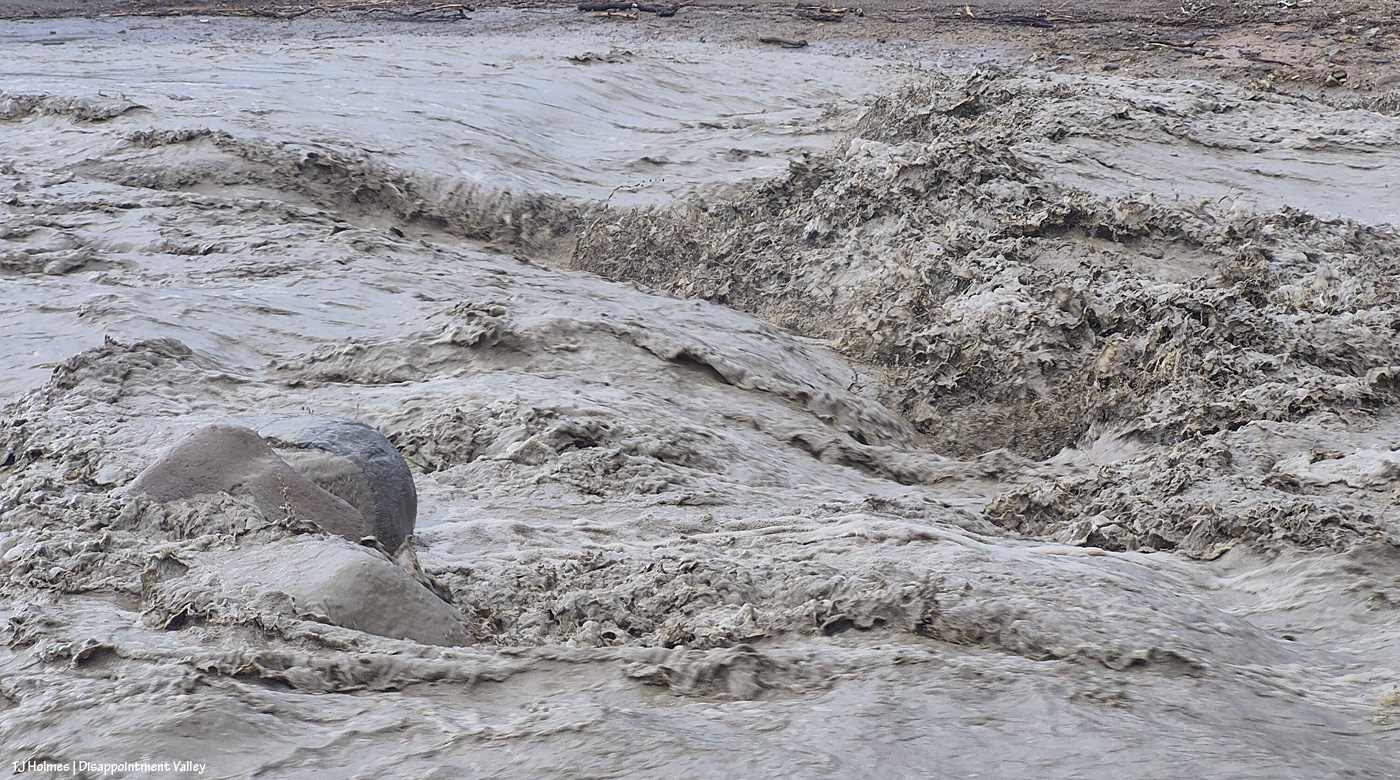
I’m in about the same place for this one, but now looking upstream to the left (water flowing toward me). Zoomed in, which is the reason for the painterly look. But just look at those waves! Big rocks under that water.
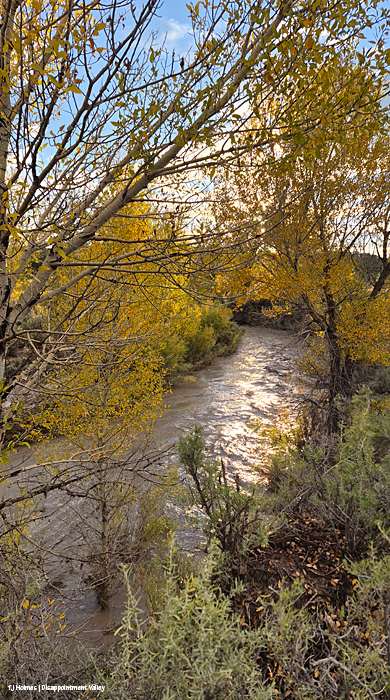
Do the trees look more gold? This was just three days after the pix from the big photo post. And look way out yonder to the Glade. 🙂 Gorgeous (that gold is aspen).
No, that’s not a pond. 🙂 A pic from just about this same spot was in that earlier post. Wow.
I hope those cottonwoods are taking up a lotta, lotta water through their big ol’ deep roots.
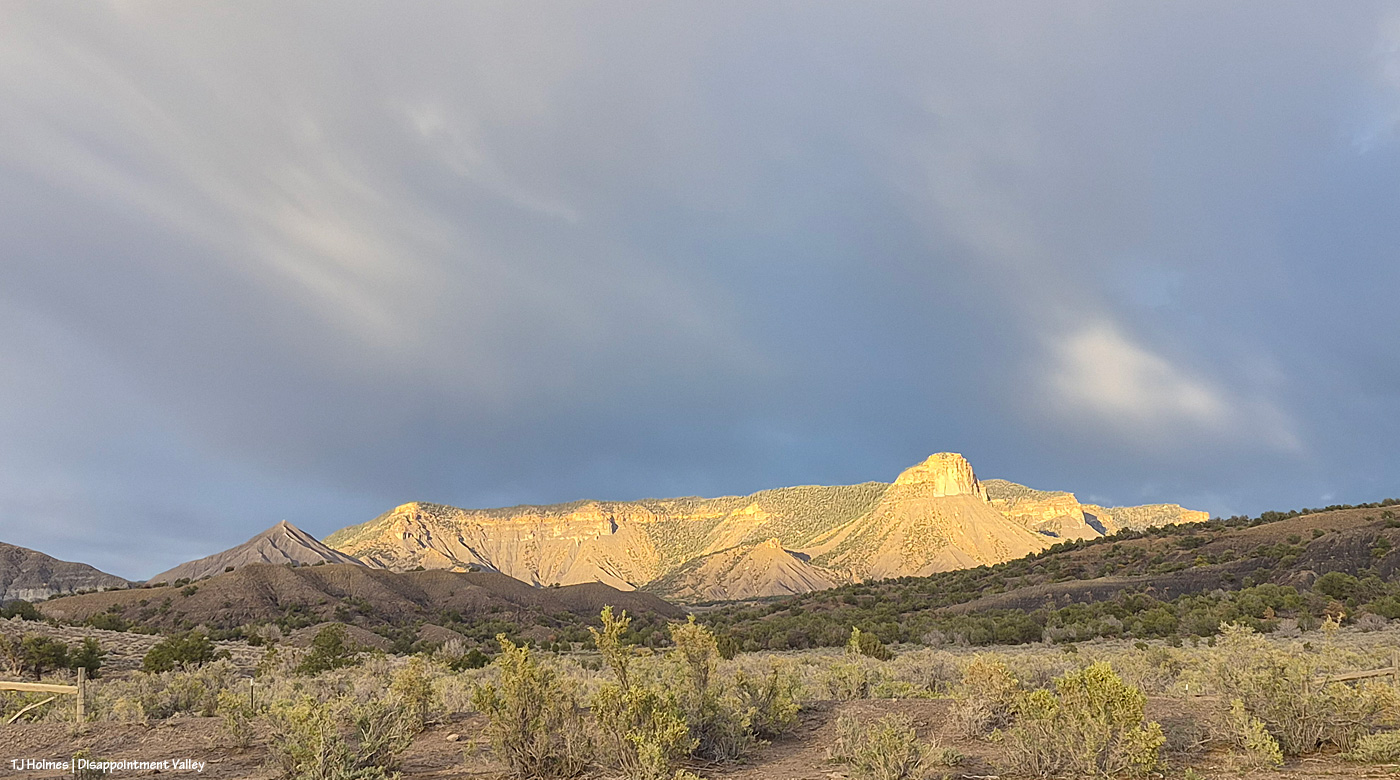
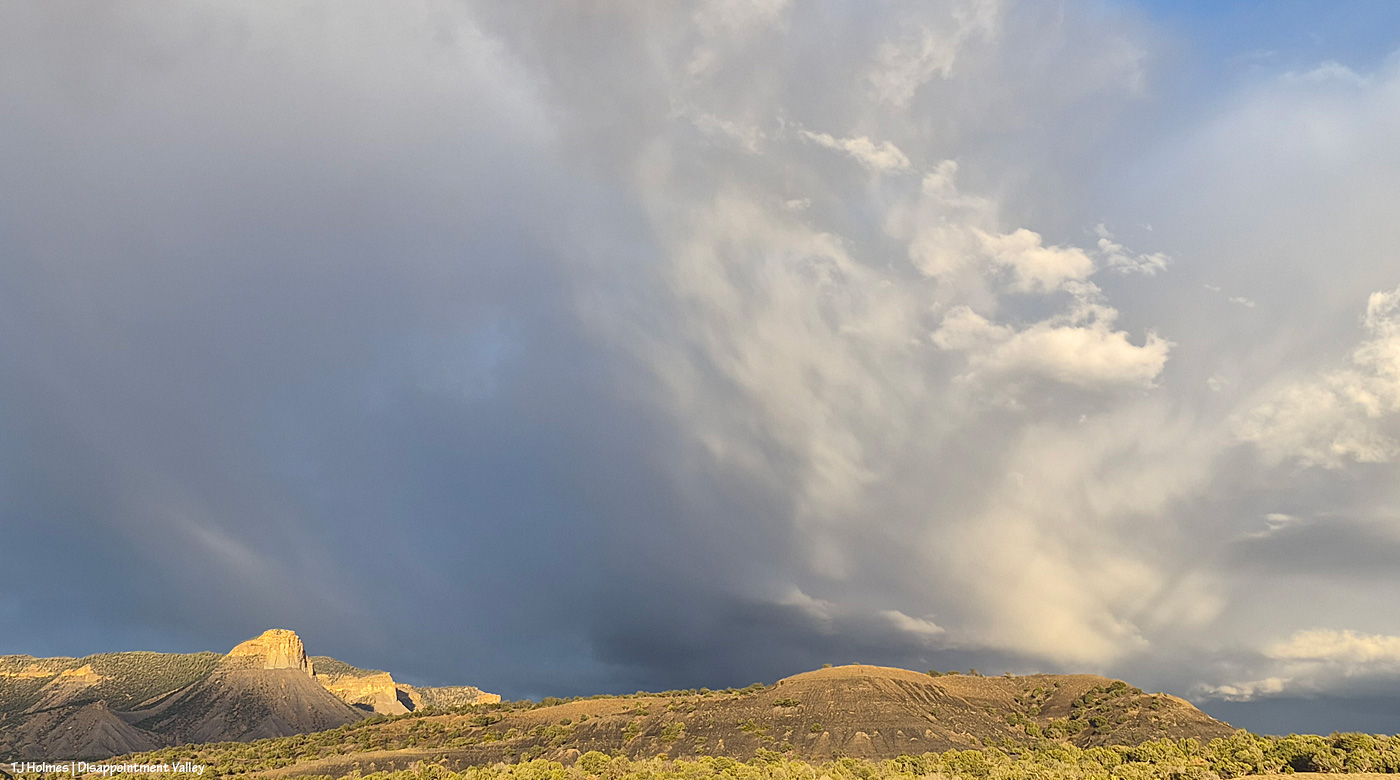
And just a little bit later, I was up at Black Snag Road again. Do you wonder about this pic? Well, um, Temple Butte is there … in that CLOUD. There’s a pic from this spot (basically) in the earlier post, too, with Temple Butte glowing golden in sunlight.
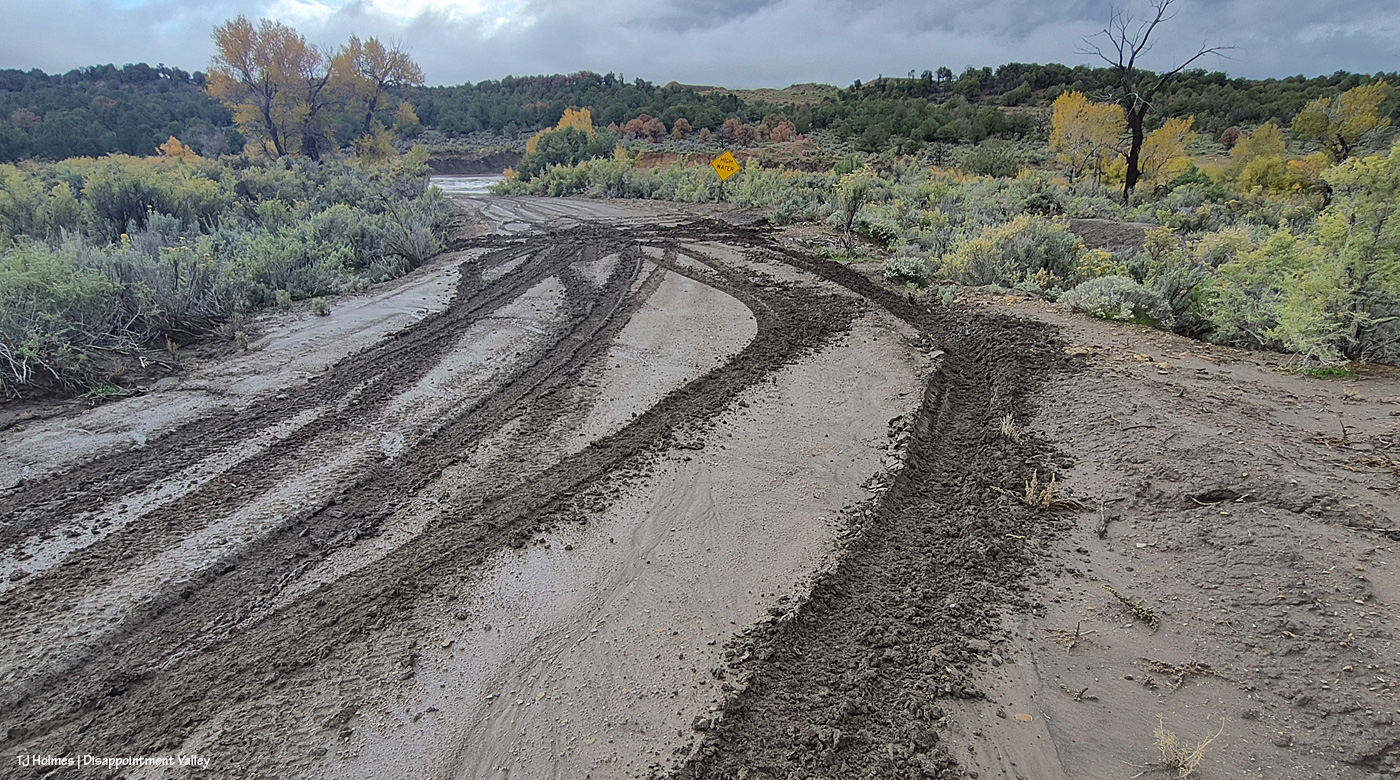
Oooopsie. Important note: THOSE ARE NOT MY TRACKS. I’m not that crazy. 🙂 Disappointment Road isn’t too far behind me; ahead of me … do you see the creek already?
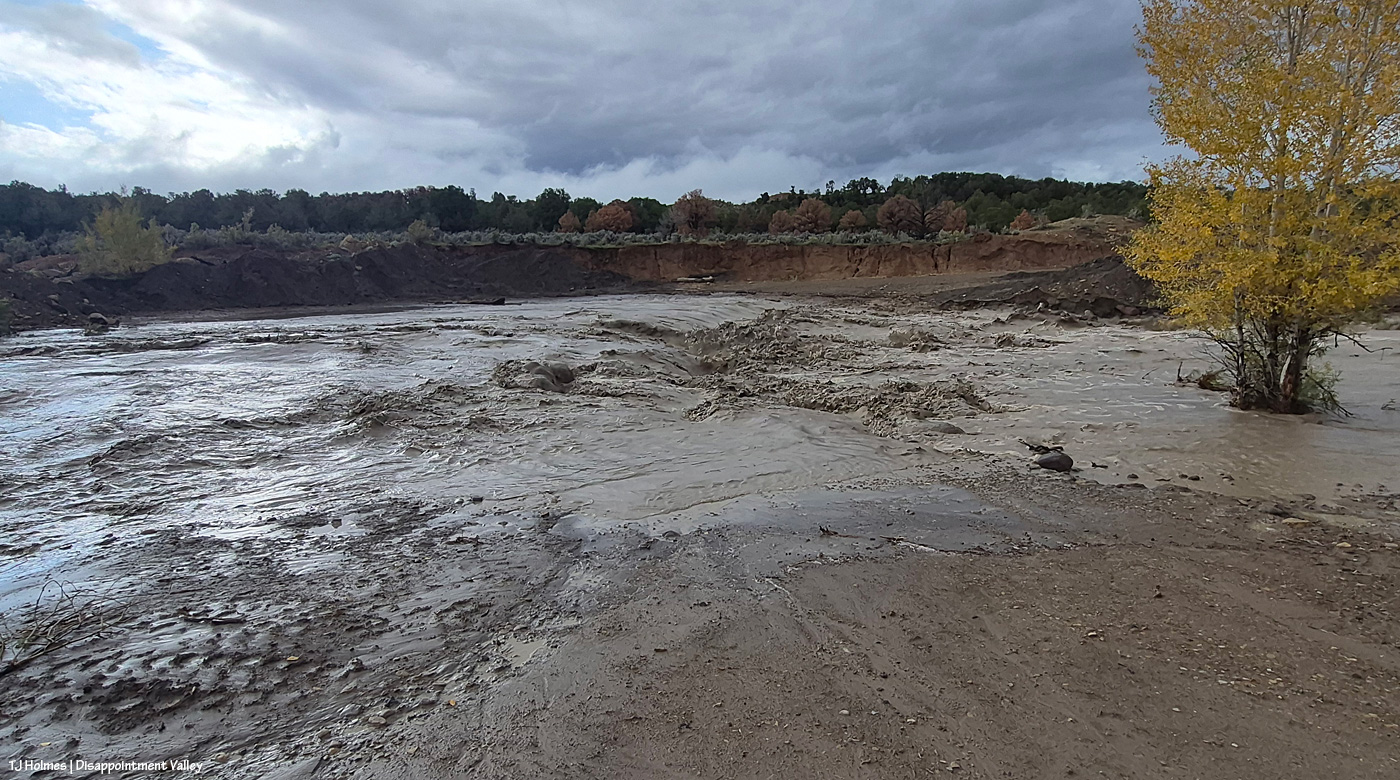
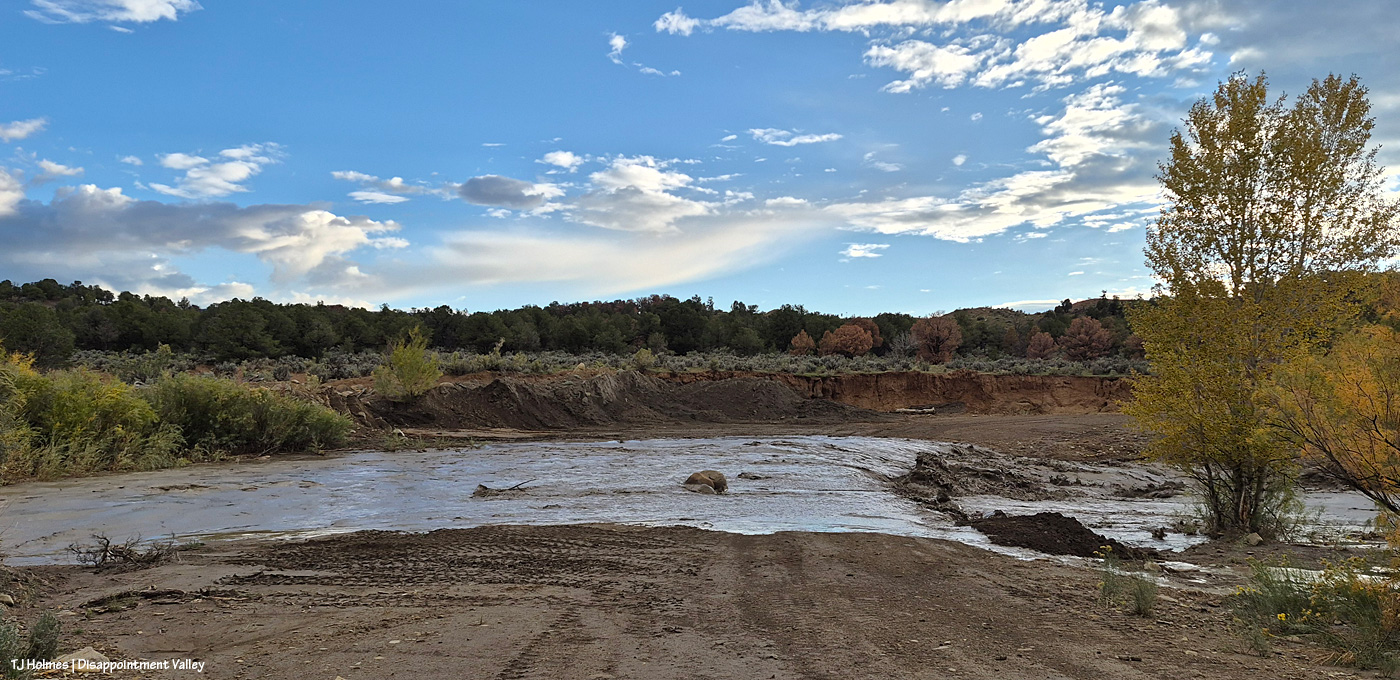
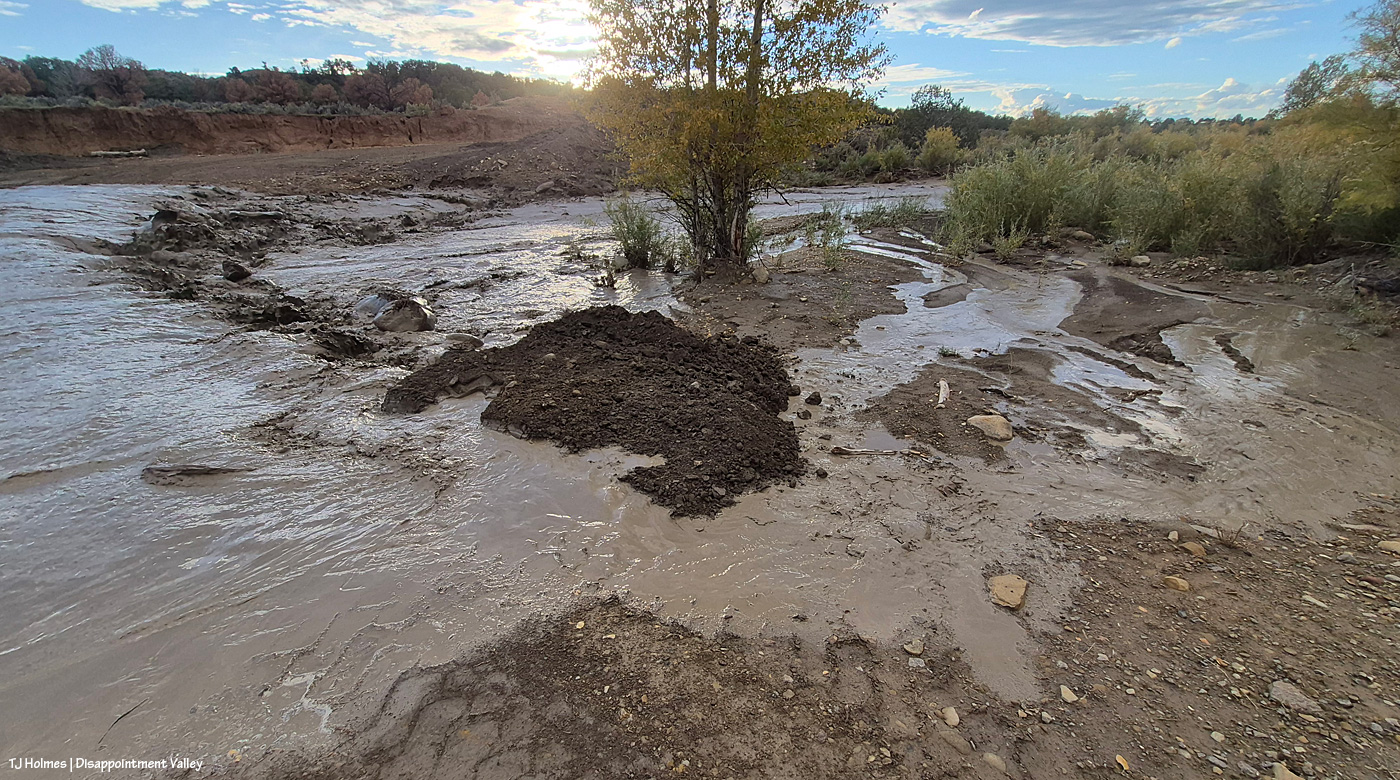
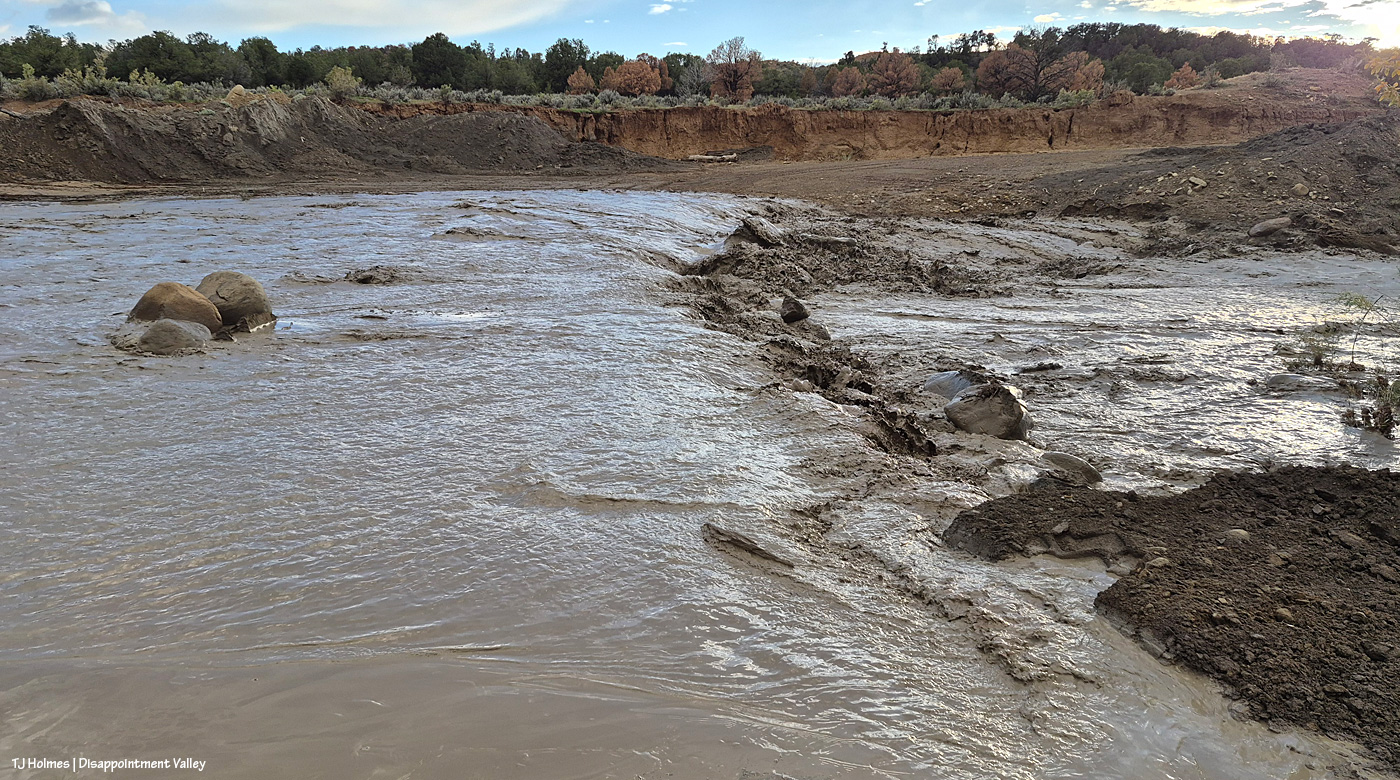
Remember what this looked like before? It’s really hard to convey the scope of the water in a still image. Remember the pile of dark dirt? Yeah, that’s gone.
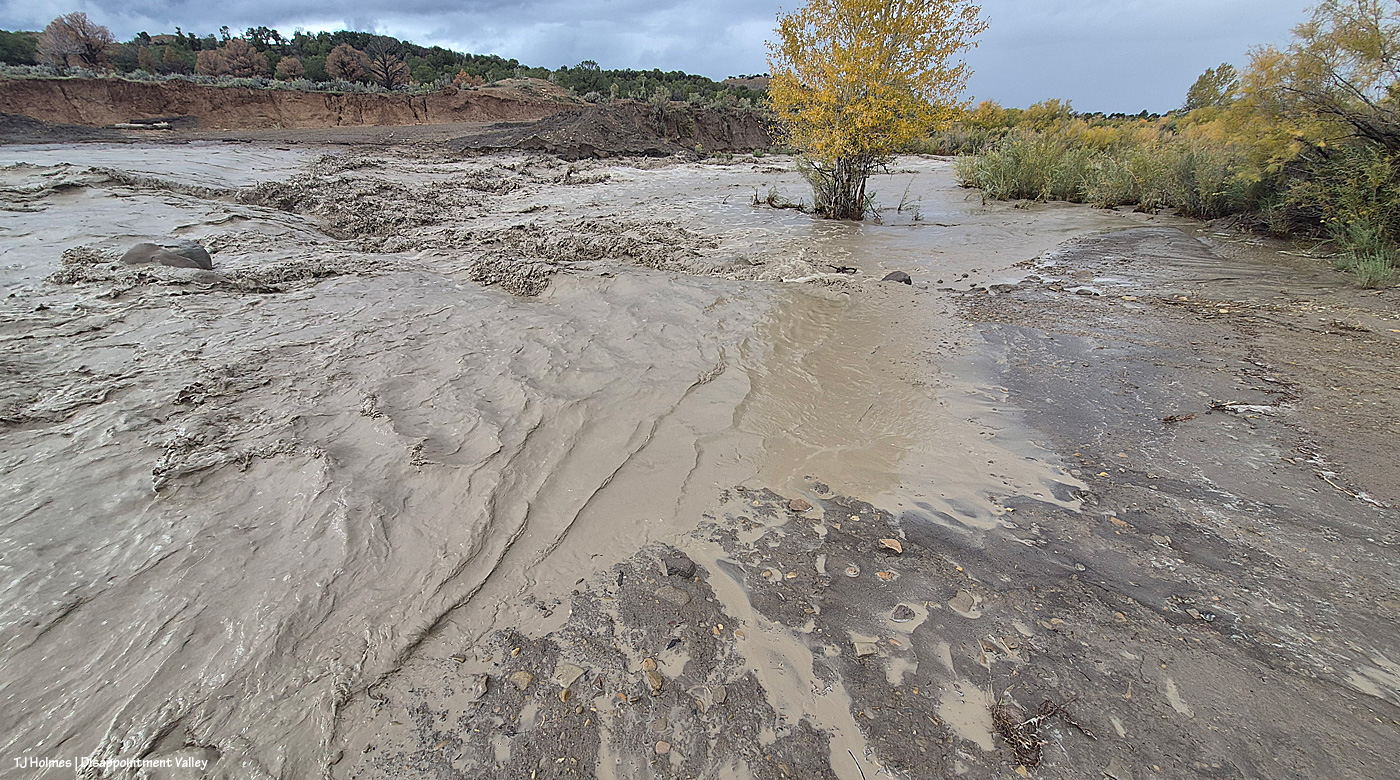
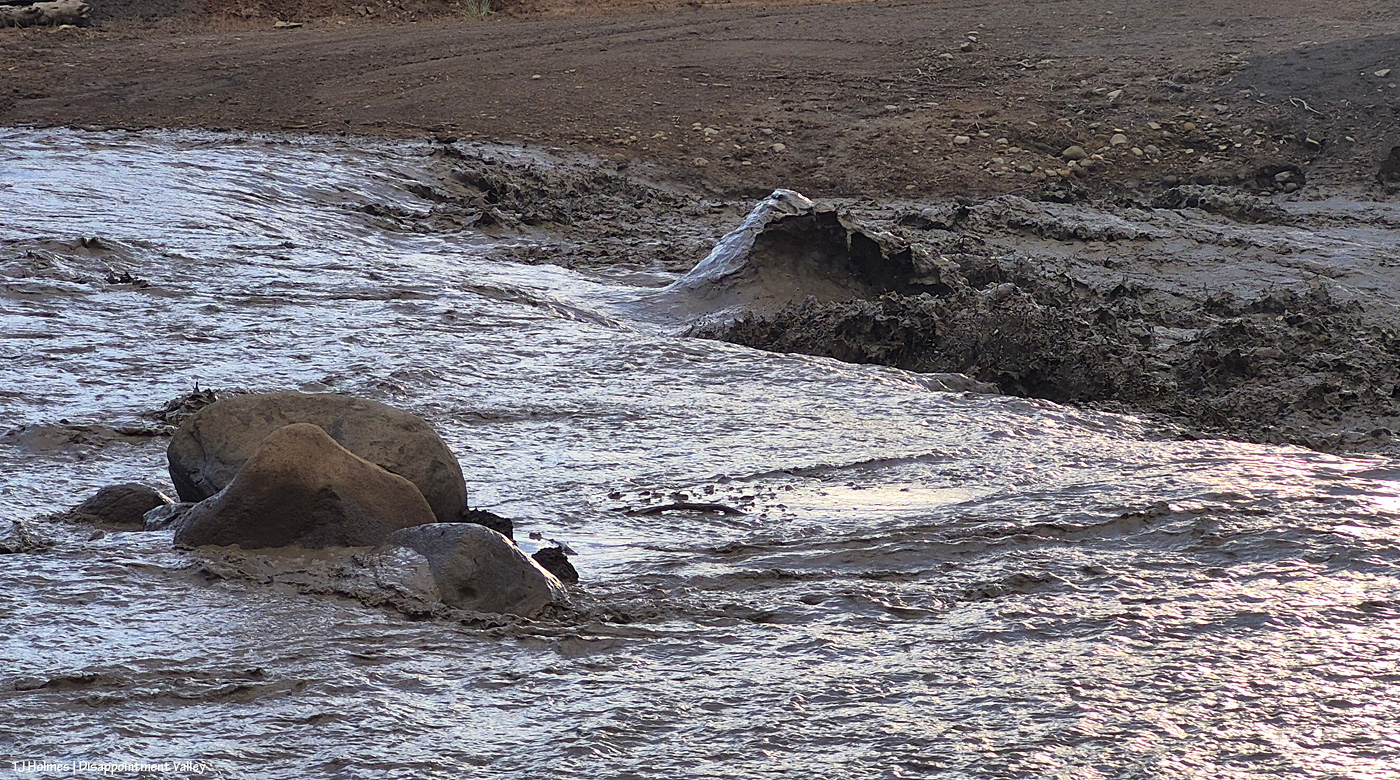
Remember the rocks? I’m sort of astonished that they’re still there. … But I think you can tell that the road is basically now gone. But look across the creek (I mean river) at the darkish dirt – see the erosion? That’s from THIS recent flooding. The road goes up between the red-dirt bank and that darker dirt.
Rock ‘n roll.
You can see the erosion damage at the far side of the creek (river) better here at upper right. That is not going to be pretty when the waters recede. Pretty awe-inspiring currently!
I’d left the truck at Disappointment Road. Again, I was NOT going to risk getting stuck in the mud, so I didn’t drive down there; I walked! Then headed back down-valley, where I already knew I’d be driving back into the next wave of rain.
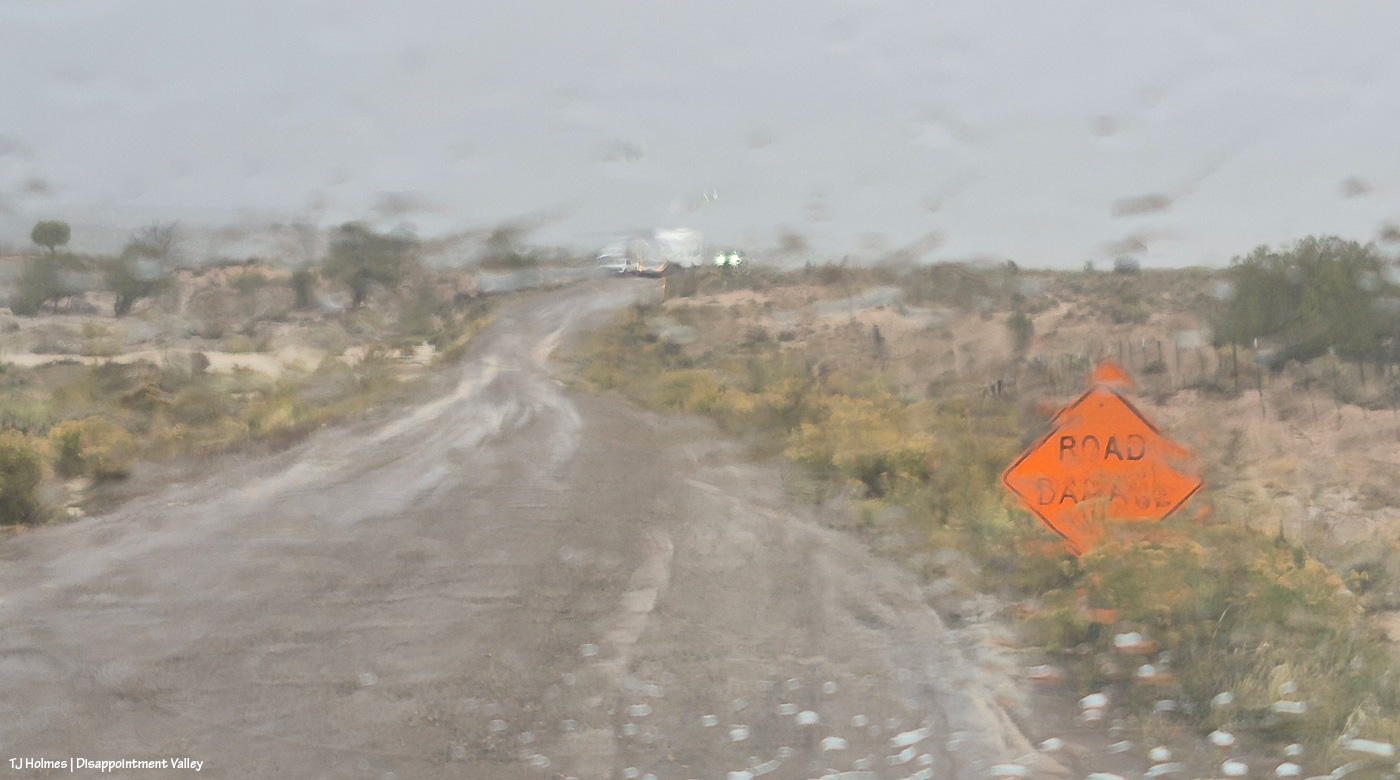
Painterly effect now caused by rain on the windshield between wipes. The road damage from the beginning of this post is between me and the oncoming vehicles. The folks in one truck came out Tuesday, when the road was dry. … Family members were hauling the camper and following, and they were consulting about the narrowed road. They didn’t have any trouble driving past the area, but I can’t help but wonder how they fared trying to park the camper farther up-valley.
And that was it. … Or was it.
You know that saying about the fat lady? I wouldn’t presume to know Mother Nature’s proportions, but Mama sings loudest and last. 🙂
Yes. She. DID!
Sing, Lady, sing.
I can’t make this up, and I wouldn’t know how to make it AI if you paid or threatened me.
Love. 🙂
I don’t know the final tally as of about 9:30 p.m., but as of about sunset (which was the above!), we were sitting at about 2.36 inches of rain since about 8 a.m. Wednesday, when it started. It is soggy. It is sloppy. It is saturated. Travel is NOT easy (or particularly recommended).
It. Is. SPECTACULAR. 🙂
** Update: The total amount of rain, in one particular location in Disappointment Valley, west of Spring Creek Basin, between 8 a.m. Wednesday and 8 a.m. Friday, was 2.74 inches. I think we didn’t get even that much moisture out of our snow last winter. It’s hard to convey, but that is an *enormous* amount of rain in two days from one system. Happy. 🙂
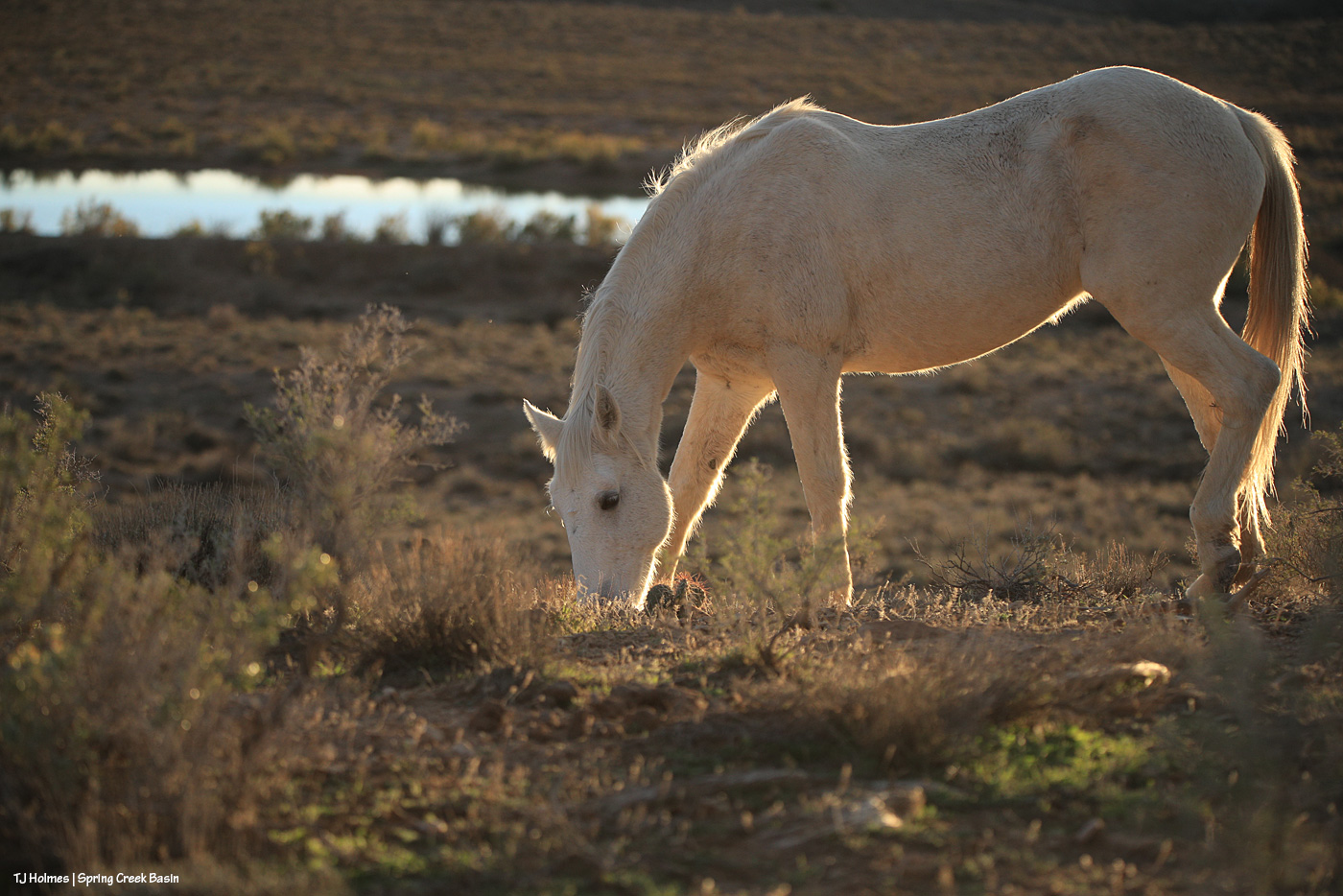
Piedra grazes above another pond in Spring Creek Basin that has been filled by the recent rains!
It rained nearly all of yesterday, and we are slogging (thankfully!) through mud again. Maybe next year, we’ll get this bounty throughout the year. 🙂 We can hope.
In yesterday’s post, I promised for today’s post pix of a fairly stunning storm system that blew up over Disappointment Valley in the mid-or-so afternoon through sunset. This will be a photo-heavy (heavy on the heavy) post. The pix also are all from my phone. The immense scale simply wasn’t possible to capture with my long lens and narrow range of view. A few times, I wished I’d gone to the effort of getting my camera out of my backpack … but most of the time, I was too afraid to miss one second of what was happening, and, again, the sheer width of scale of the storm’s coverage across the horizon(s) was just too, well, wide.
I hate to be one of those telling you to “read through till the end” for the best part, but … well, let me know whether the final pix, of sunset light in the EAST, were worth waiting for.
Onward!
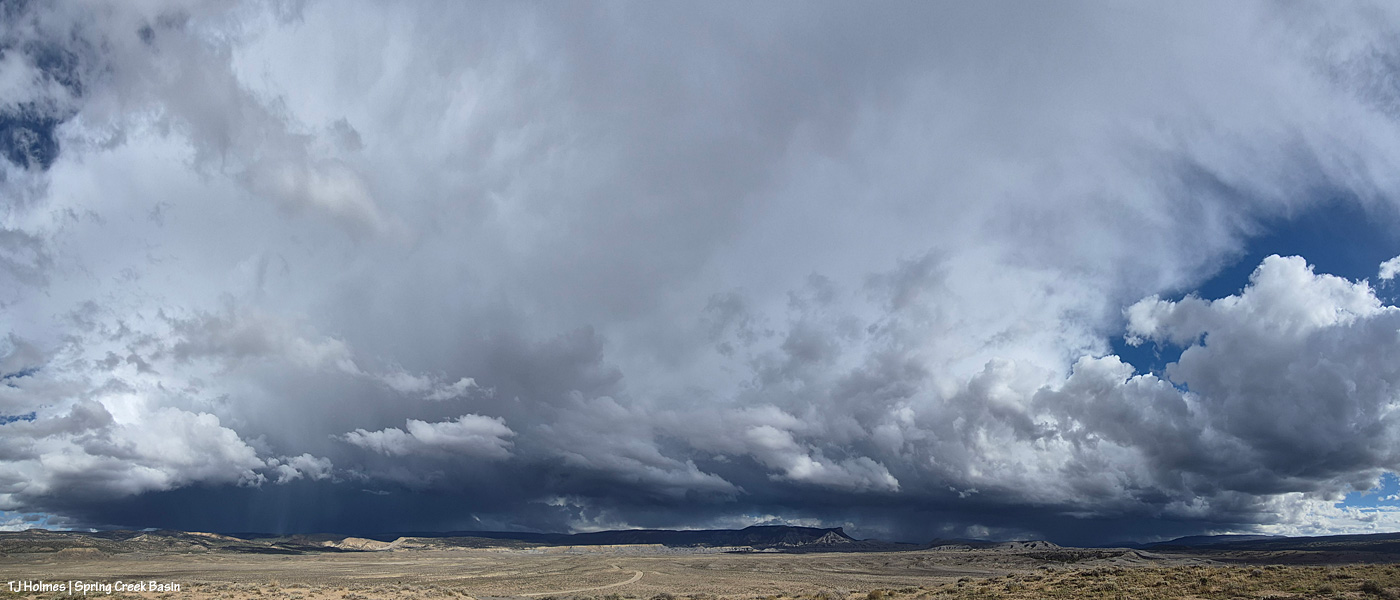
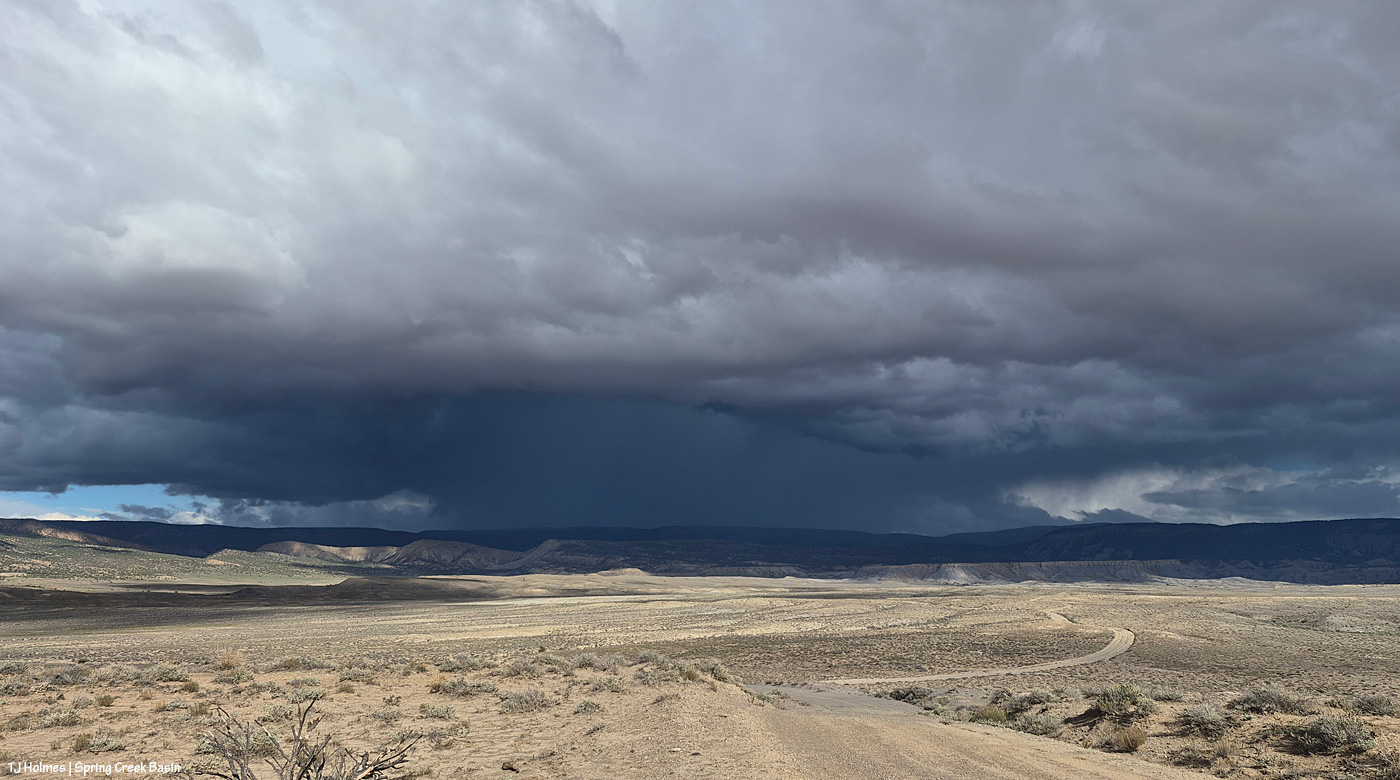
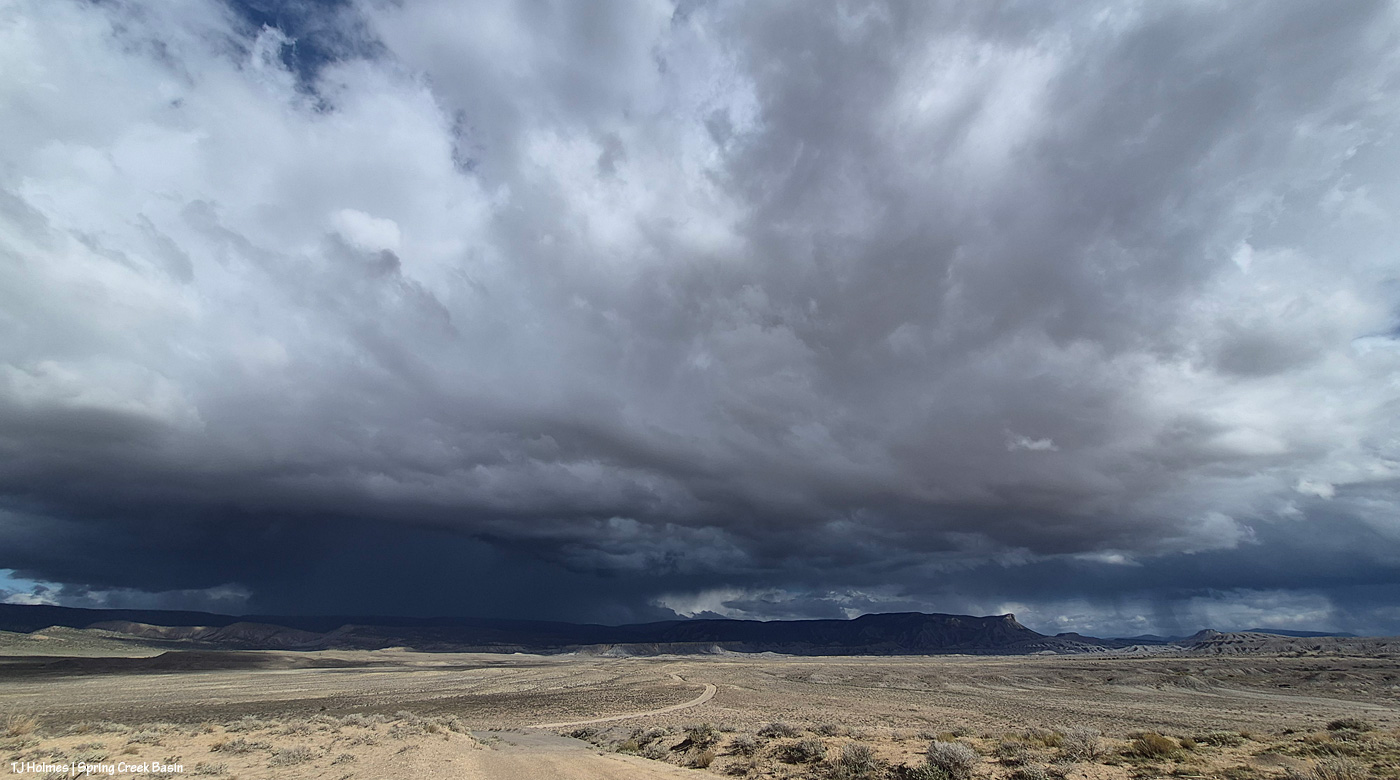
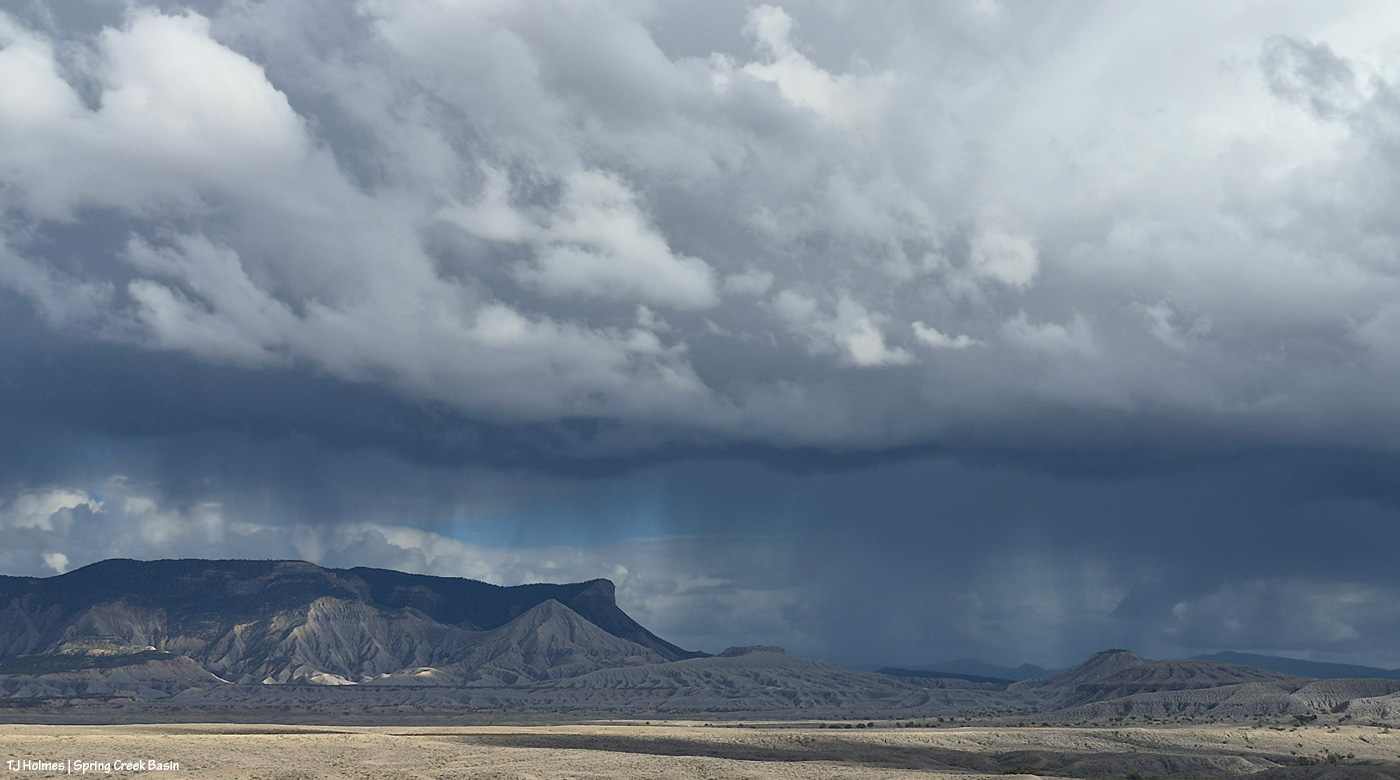
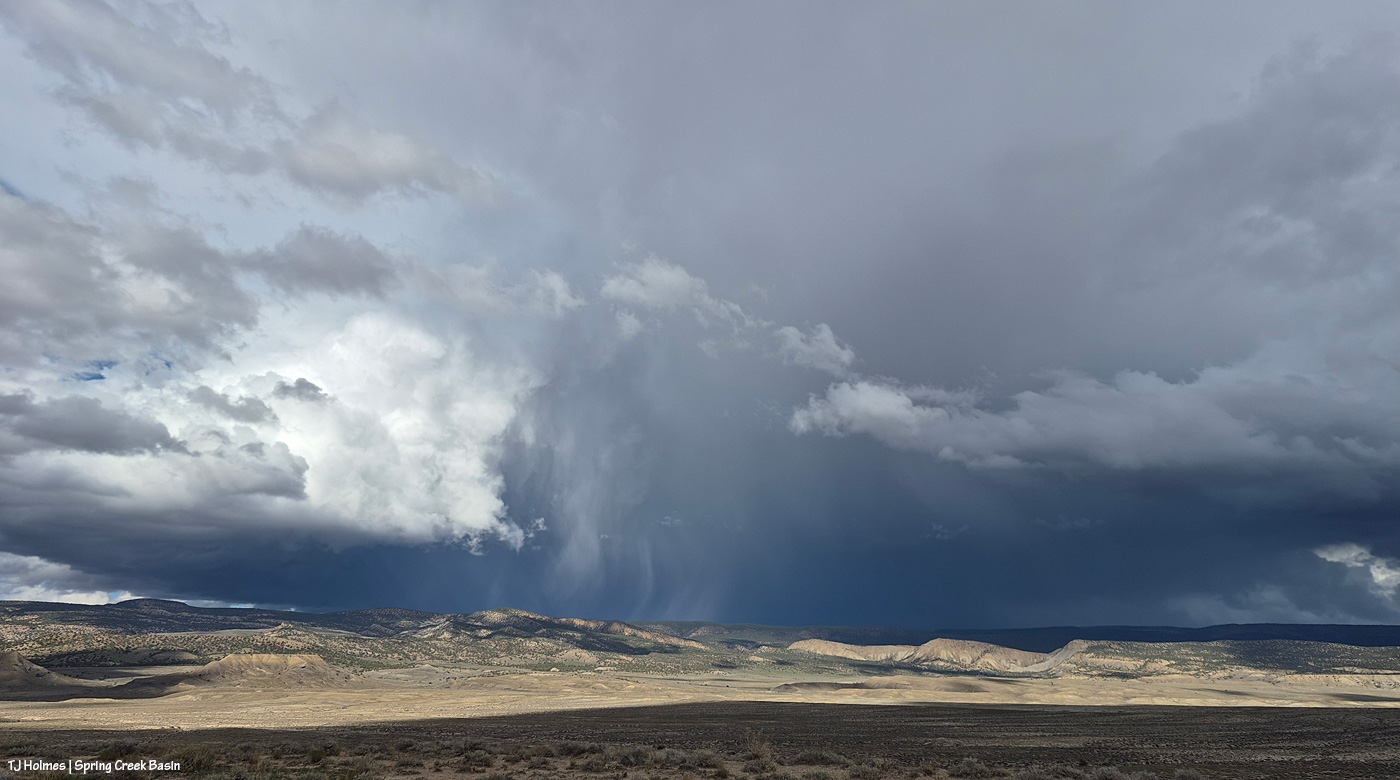
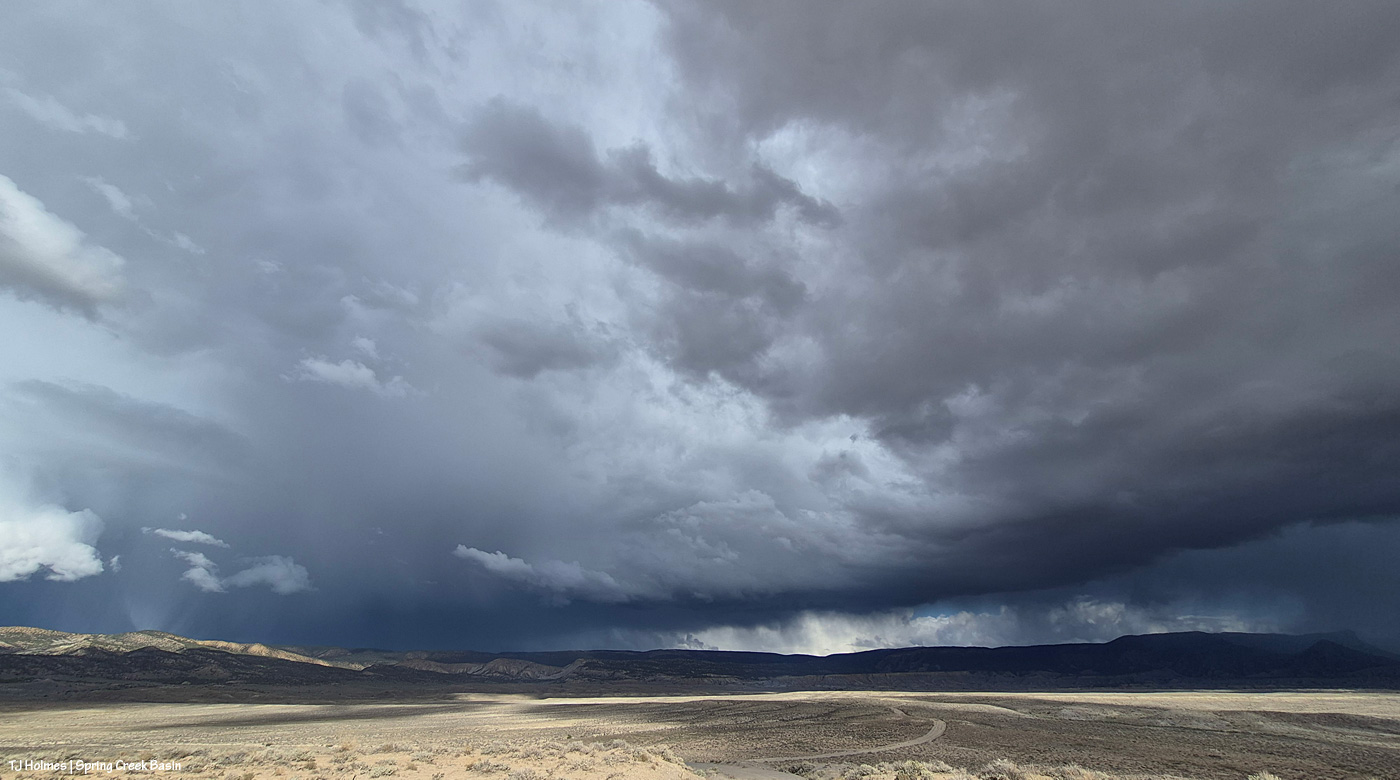
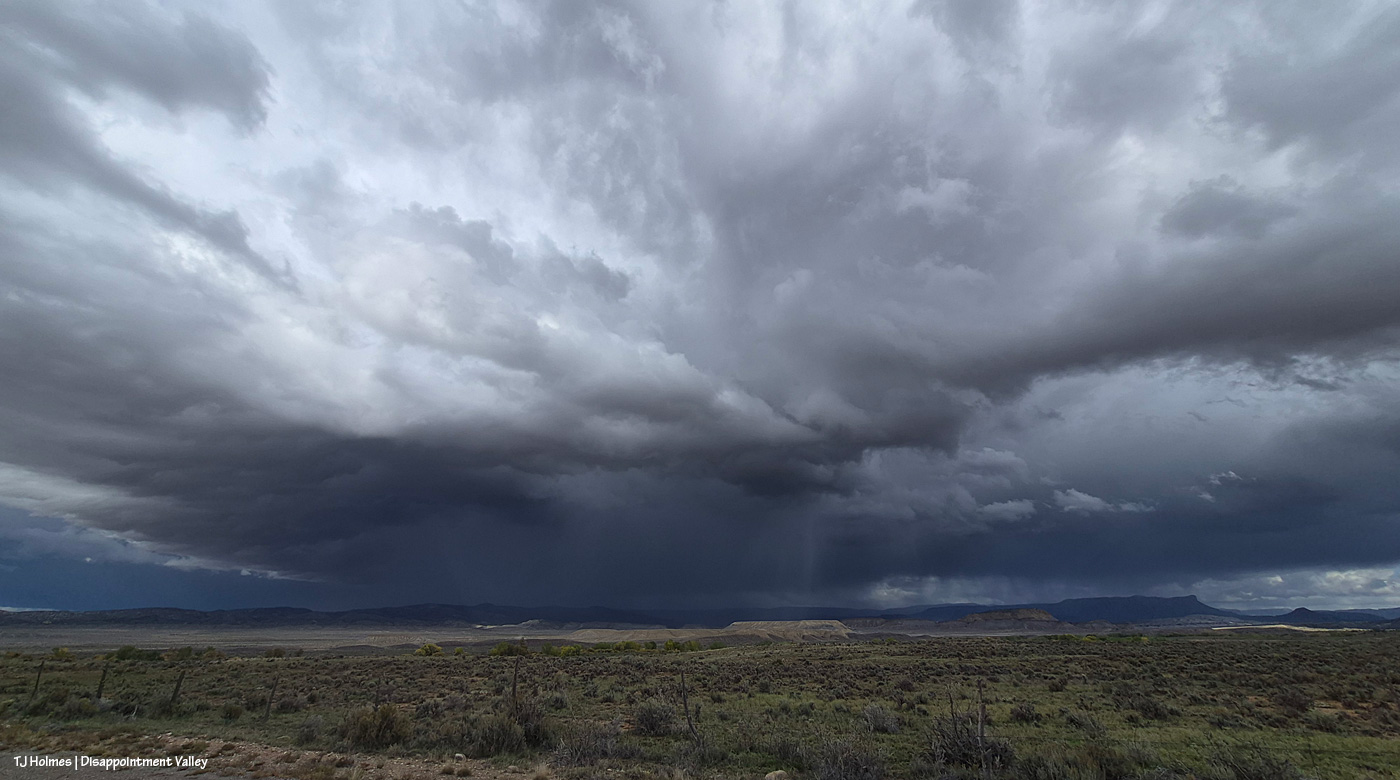
As wide a field of view as my phone can capture, it took four images, stitched into a panorama, to produce this image, looking from southeast at right to north-northeast at left. So if possible, imagine the scene not as a flat, two-dimensional view but as a curved (?) view. The storm definitely was coming from the southeast and moving north (left) … and around/beyond the basin, across the north, to the west? I sat for a long time at the main/original catchment watching it and taking pix as the sky evolved – in sunshine the entire time.
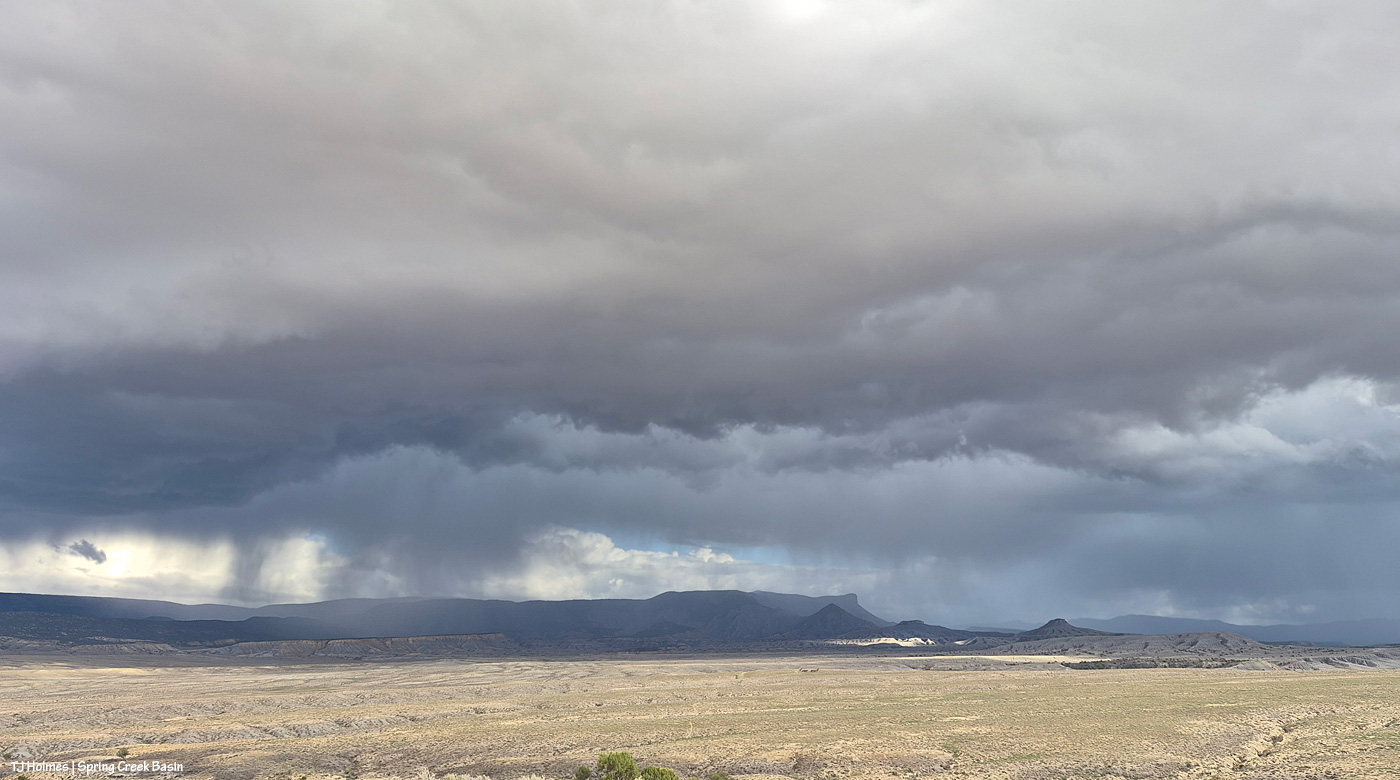
This was the first pic I actually took. There’s a pretty obvious downpour straight ahead, which is basically east-northeastish. It was not raining over Spring Creek Basin at this point, but the clouds were definitely shading the far, whole eastern horizon. Thunder was rumbling now and then, but I never saw lightning. The vast majority of the basin was under sunlight. There ARE mustangs way, way out, at the leftish side of the image.
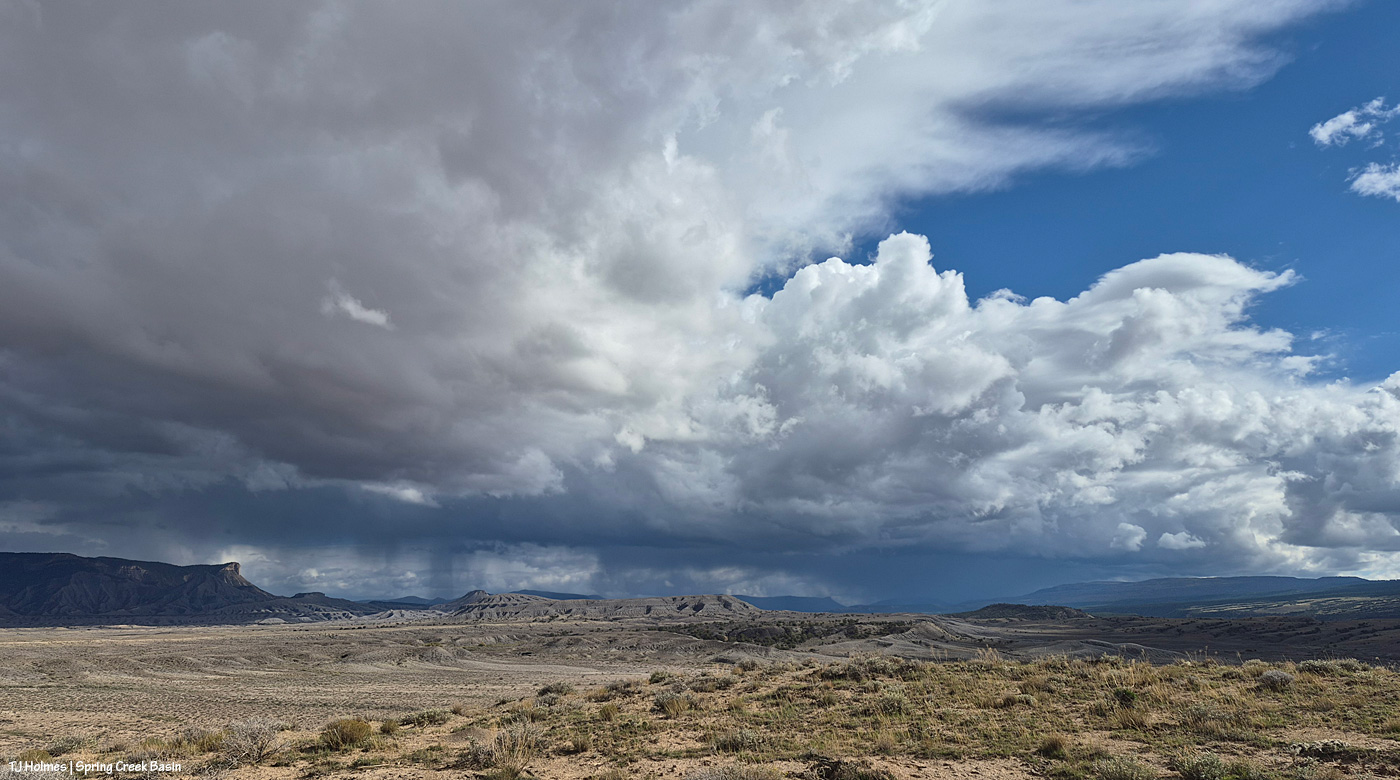
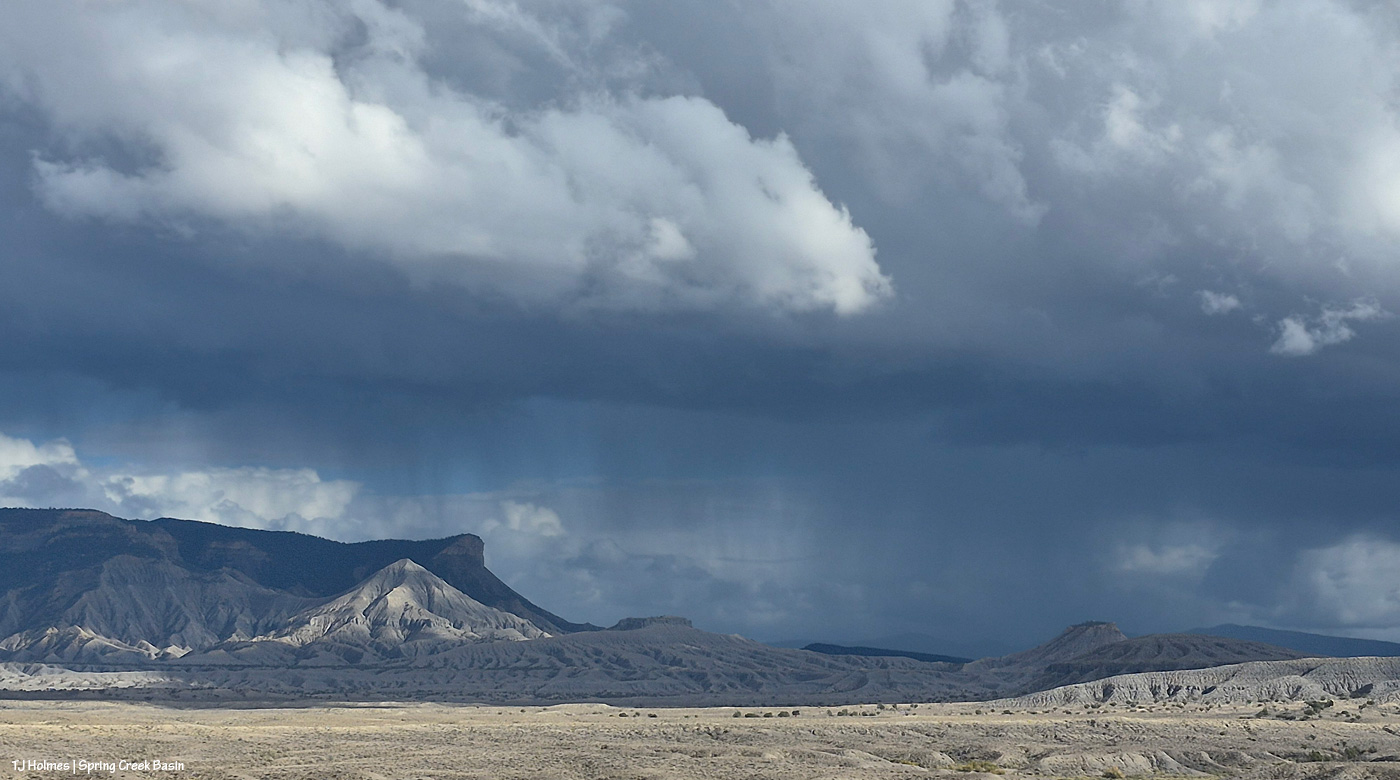
A little more detail of the rain running across the landscape from near/over (?) Benchmark Lookout (at the leftish side of the dark hump of “hill” at far right) across upper Disappointment Valley and beyond Temple Butte (the edge of the promontory is just spotlit by a bit of sunlight).
And swinging a bit more to look east.
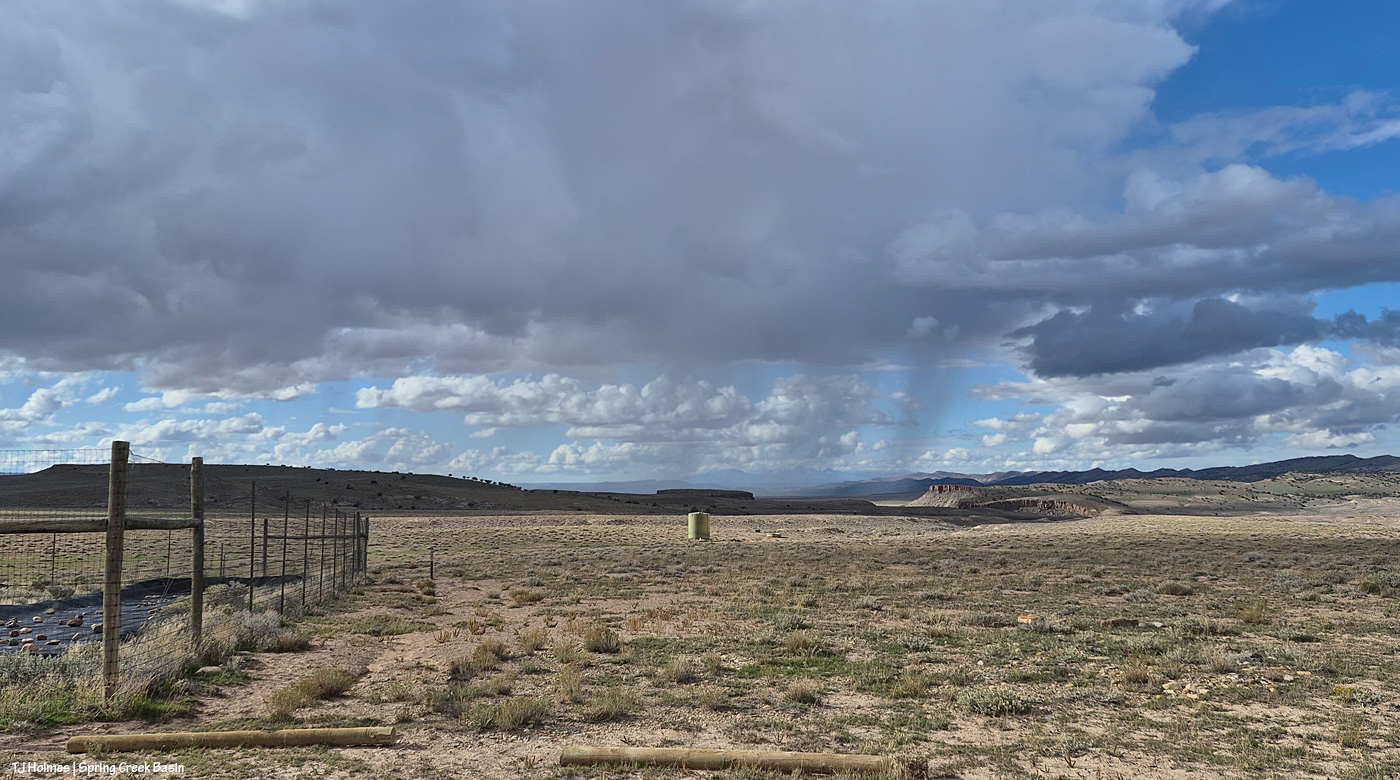
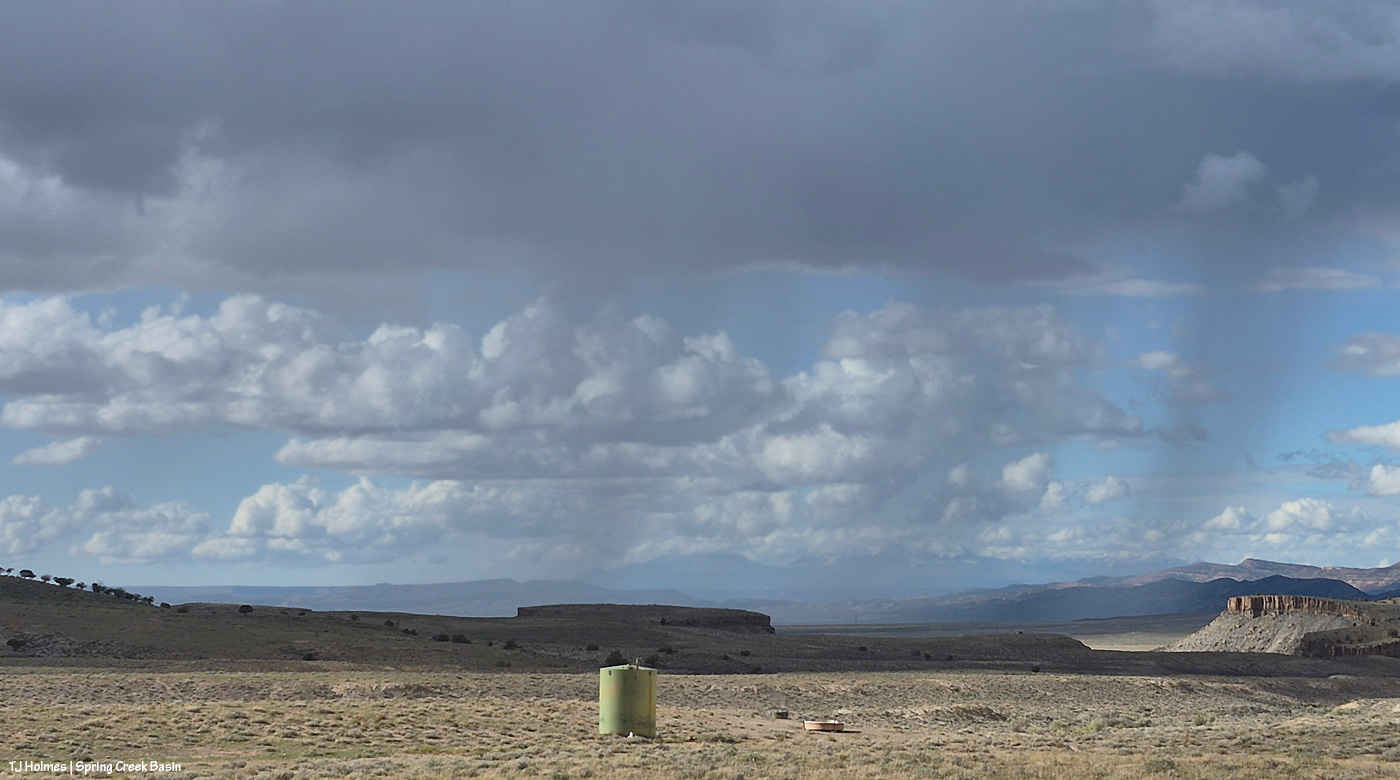
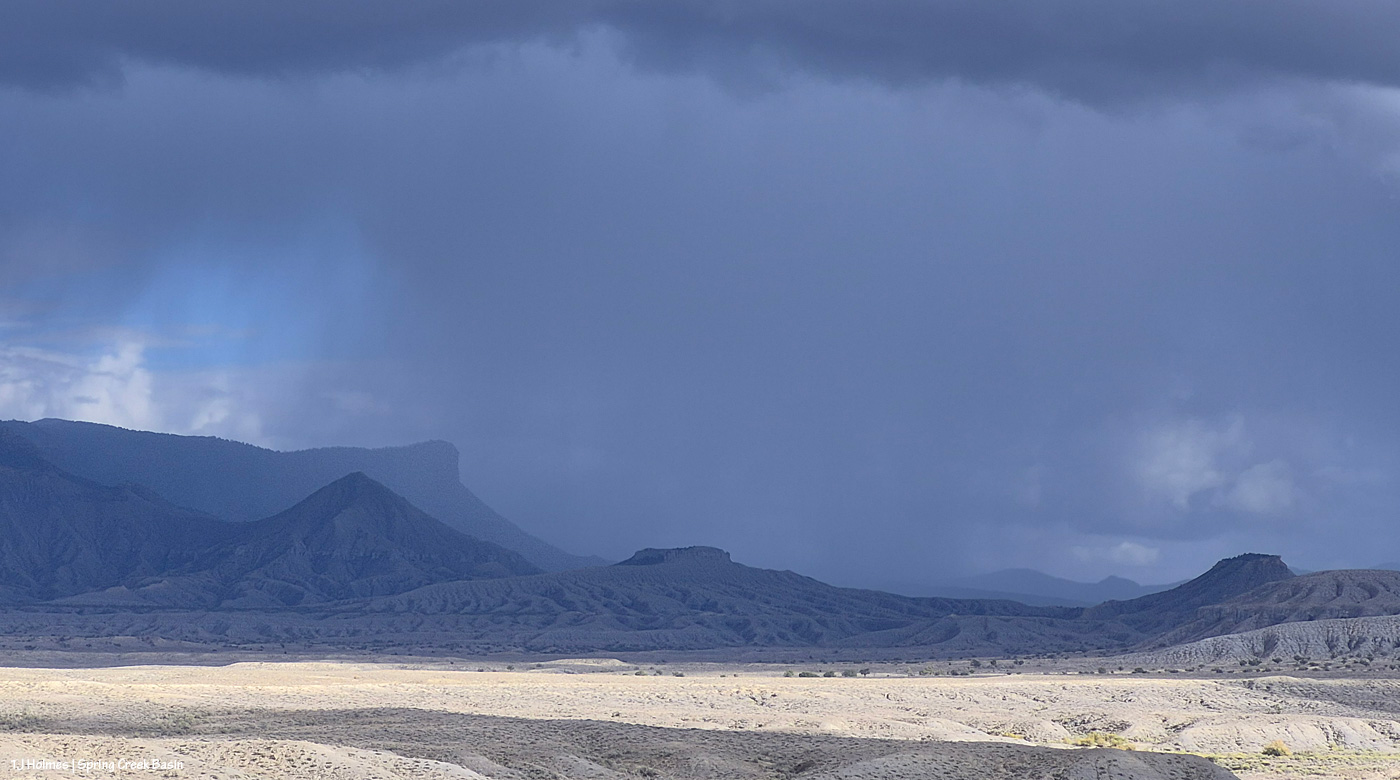
Meanwhile, a lighter rain system was moving north to the northWEST. You might be able to make out Utah’s La Sal Mountains through the curtain of rain (way) beyond Spring Creek canyon.
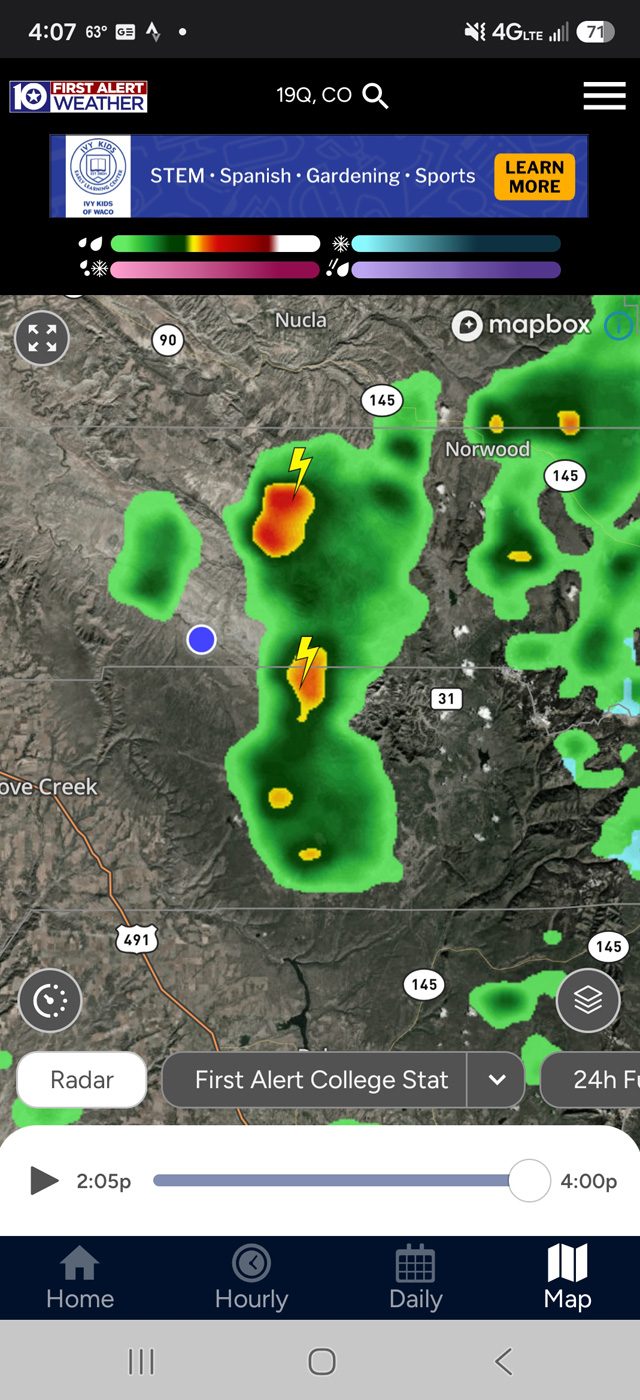
This is roughly what that looked like on the radar (a little delayed, I think). The blue dot was me, in the middle, in the sunshine. 🙂
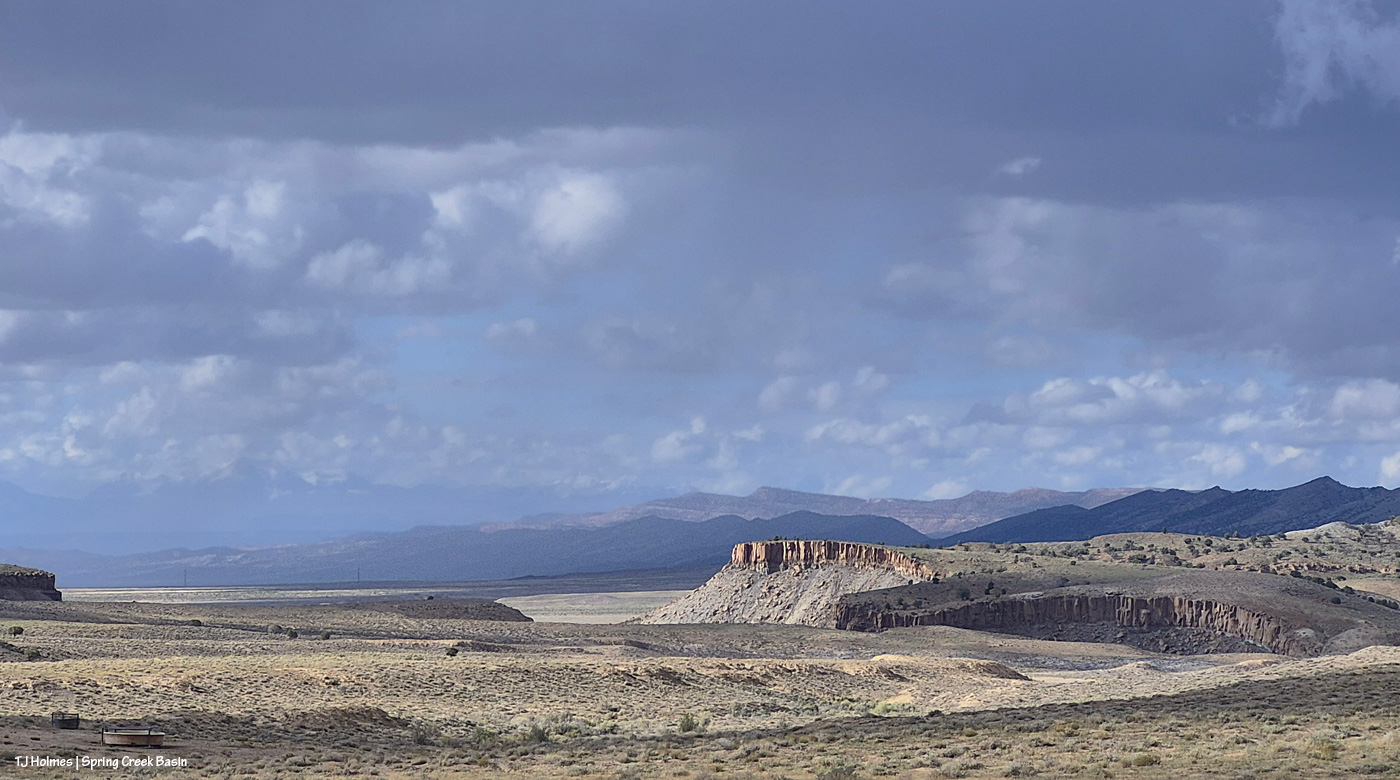
There are the mountains; see ’em? I think the rain was moving across lower Disappointment Valley and maybe/probably not quite as far west as Utah. I’ve been in the same place taking all these pix (I sat there for quite a long time): at the road by the fenced-enclosed aprons that catch rain (and snow in the winter) and direct that water down to the 12,000-gallon green steel tank … and from there to the main water trough you can see downhill and to the right of the tank. (The farther, smaller, black trough is wired off because it’s a lot smaller, and darker, and the horses don’t prefer it. The big trough is the main trough. You can’t quite tell from this distance, but it has a triangular metal cover over it that enables the horses to get to the water and also helps prevent evaporation (or better than it would be if uncovered).)
And looking southeastish again. Apologies (not really) for the redundant pix … but this is one of my favorite views in the whole, great, wide and wild world … especially when it includes rain!
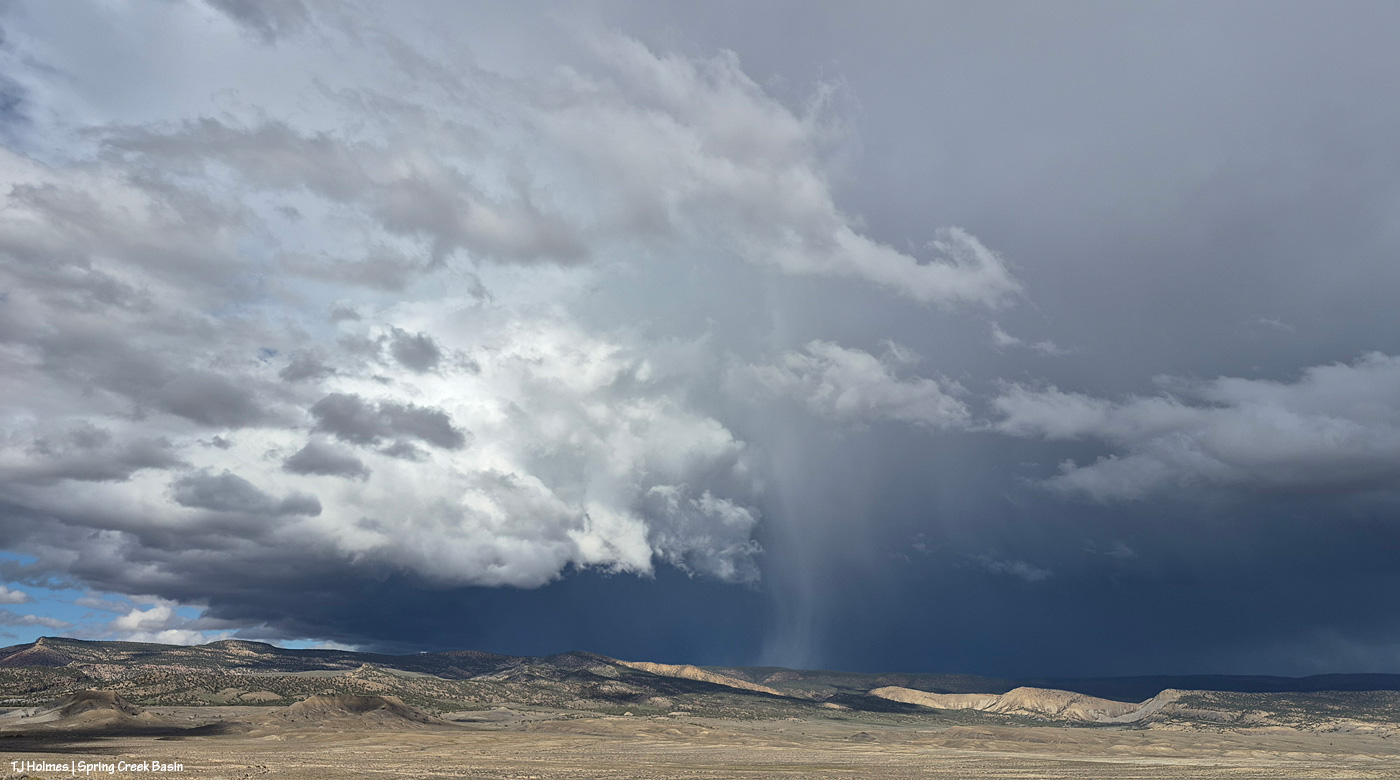
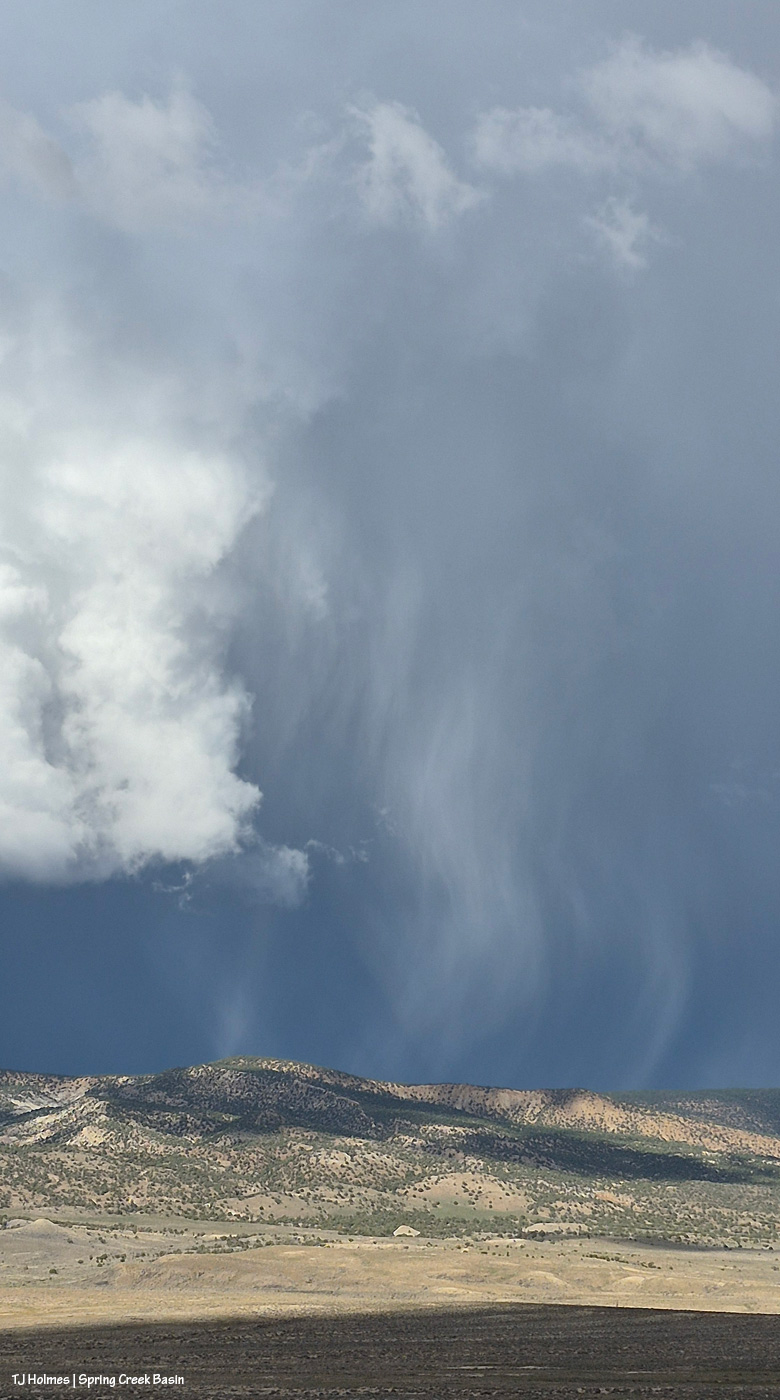
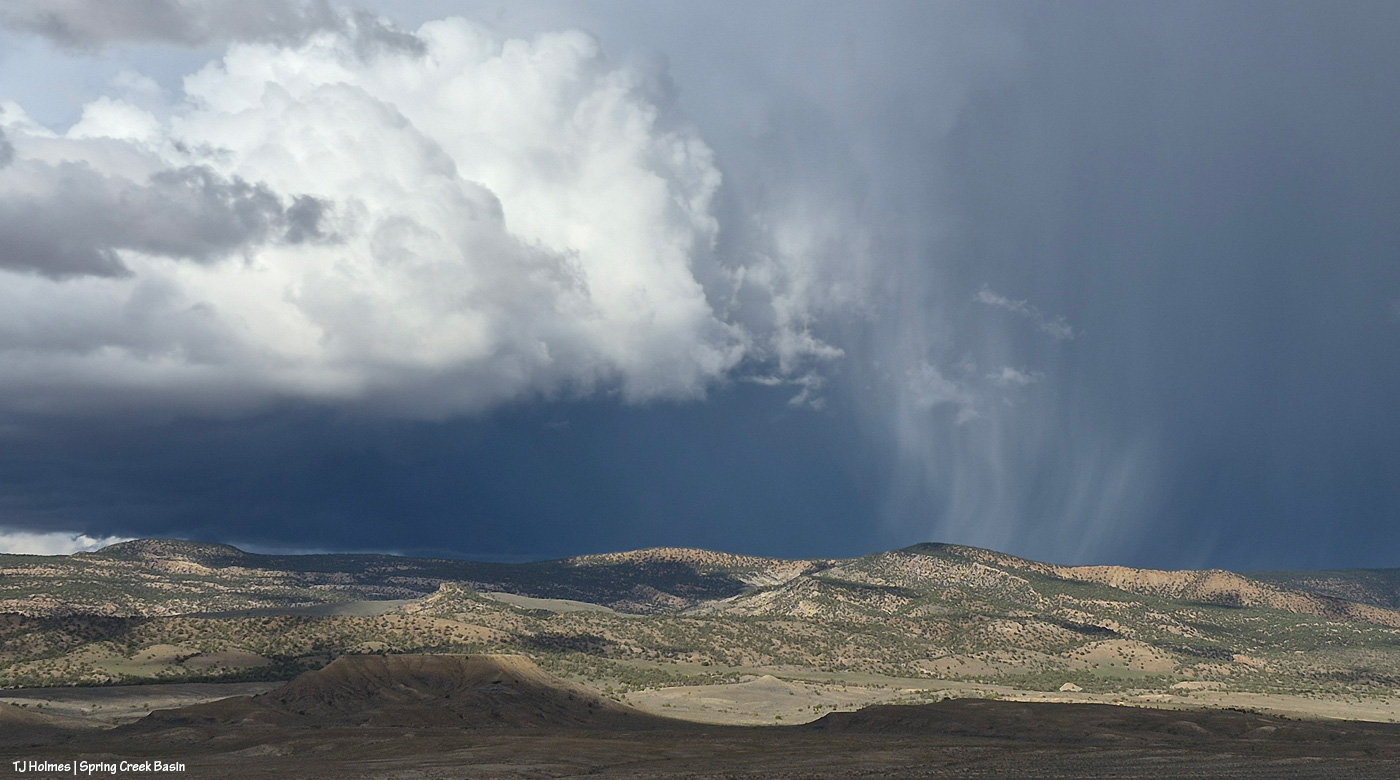
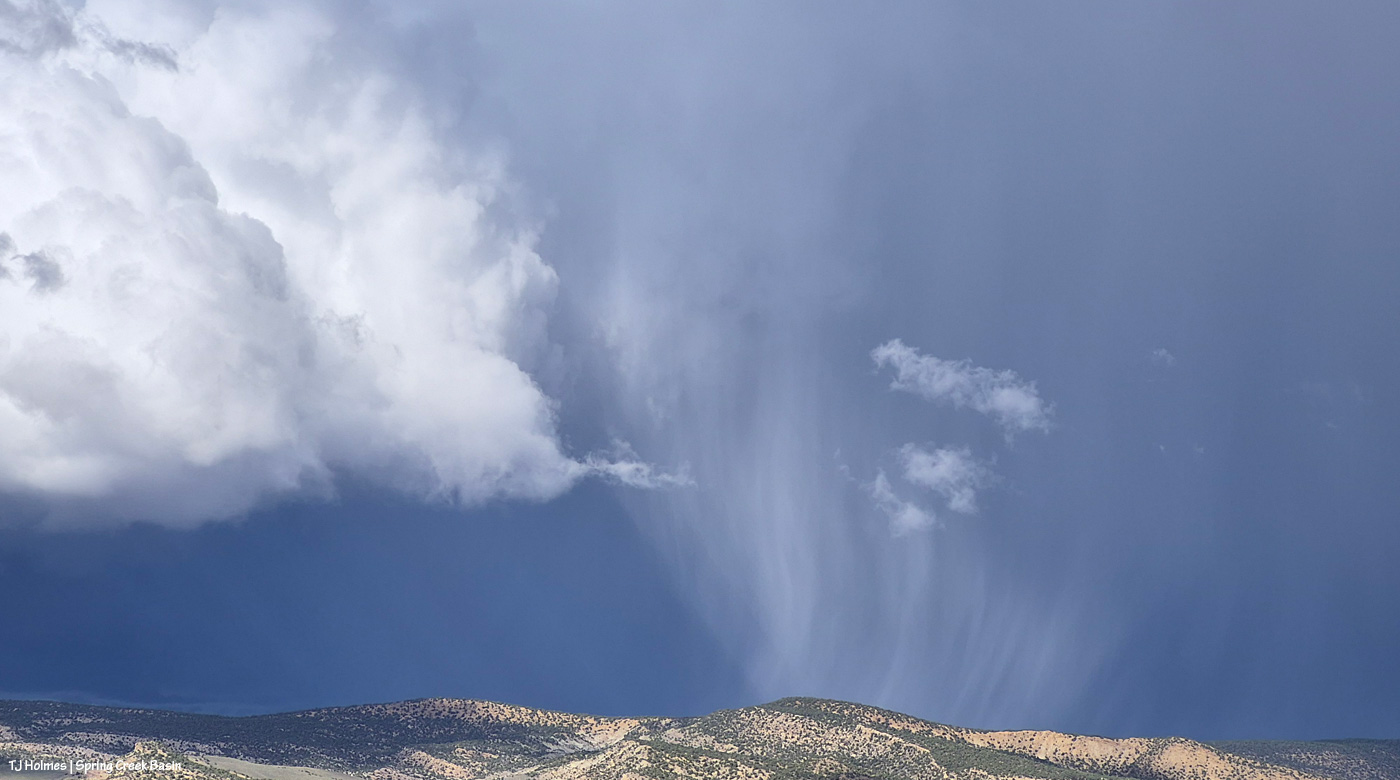
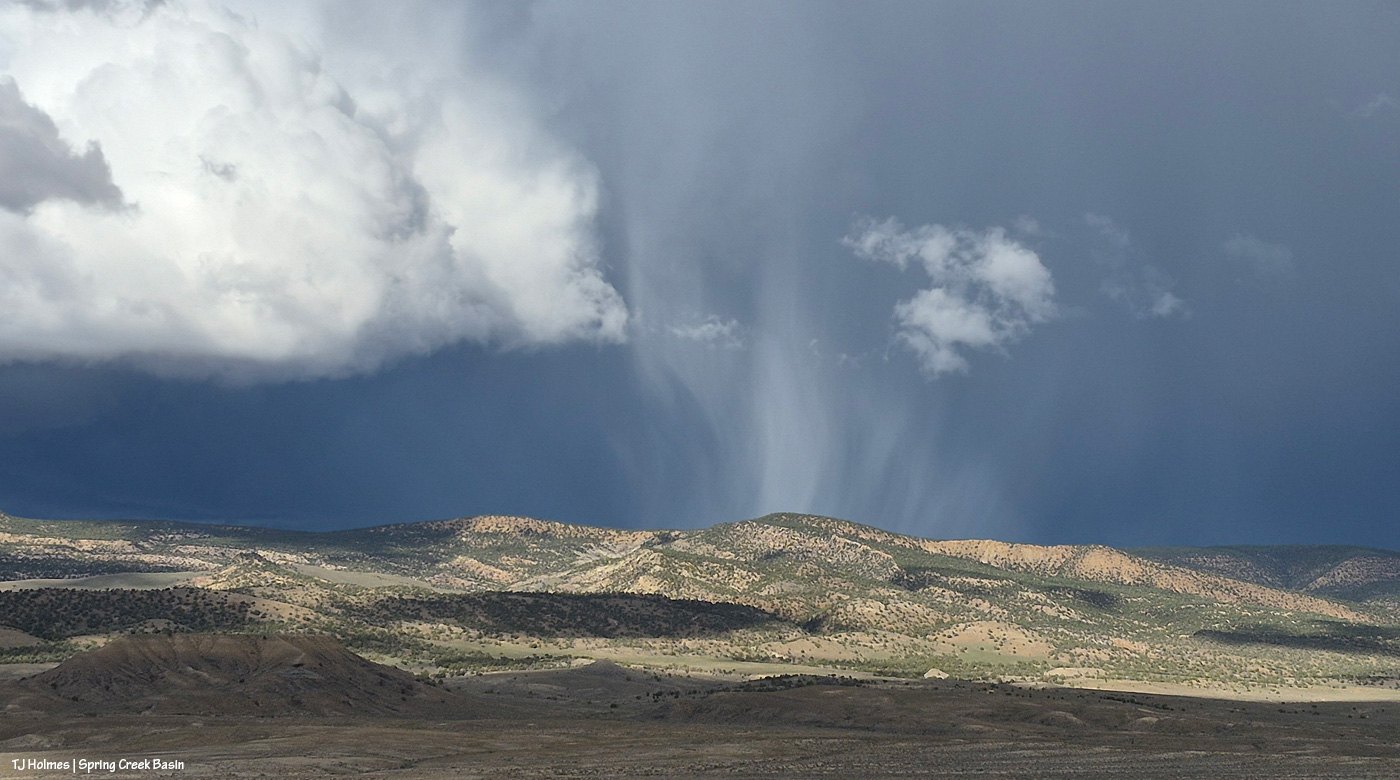
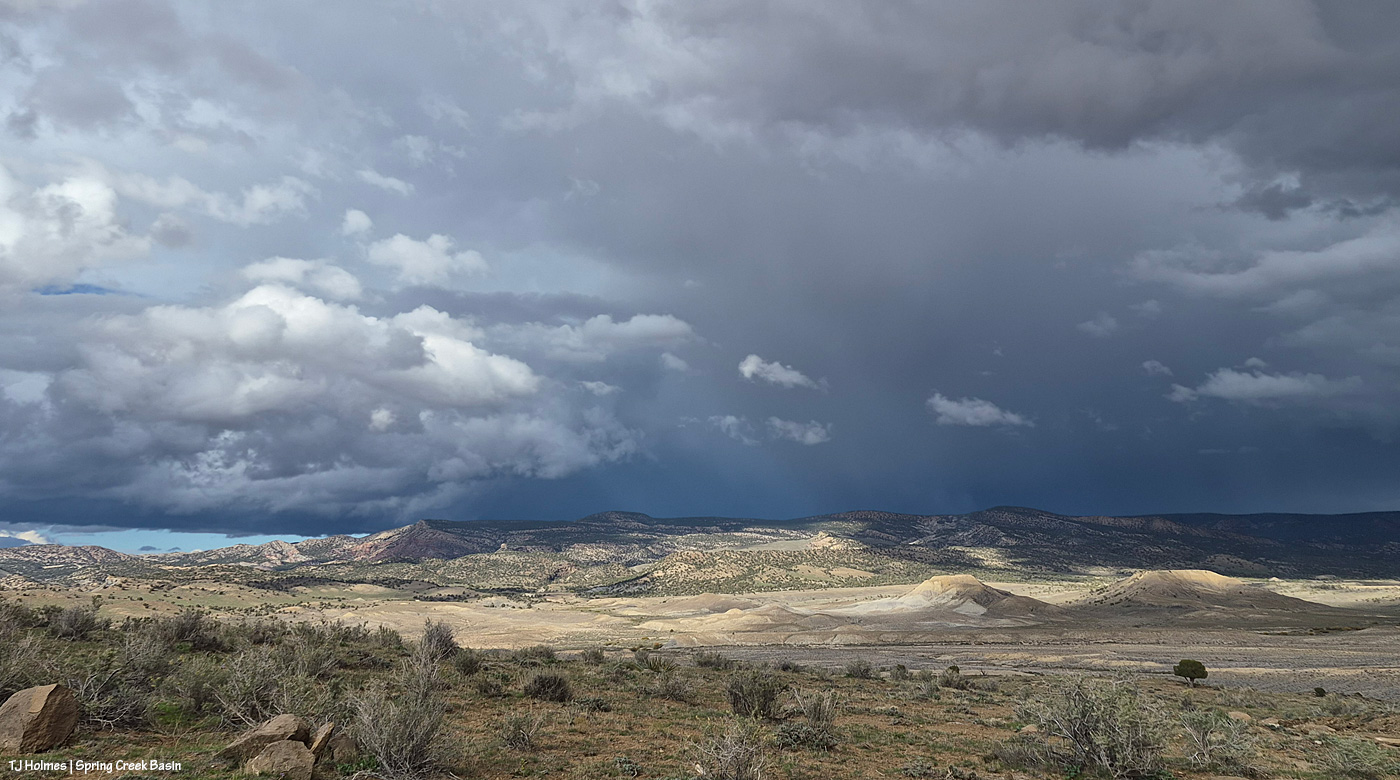
See how DARK it got to the northeast? Again, that’s beyond Spring Creek Basin – at least at this point (spoiler alert). But see that lit “column” of rain? Wild? I spent a lot of time and phone space taking pix of that cool thing as it moved with the storm system across the northern horizon toward the west (and I was in sunshine all the while).
Checking the progress of the rain to the east-southeast again. At this point, I think it was getting closer to Temple Butte – the rain, not just the shade of the rain clouds.
Another look up to the northeastish at that remarkable flame of spotlit rain. Notice, too, that we’re starting to get a great shadow of clouds over a great portion of the basin now. (I promise there were mustangs out there; I was watching about five bands way, way out while I watched the spectacular sky-show.)
I mean …
… it was …
… just soooooo …
… COOL!
Checking northwest again, over the canyon. That’s the north side at right, and you can just see part of the south side at far left. It’s not that wide; it curves a lot.
Ah! Rain has made it far enough west to cover Temple Butte (the promontory), at least, and maybe reaching McKenna Peak (the pyramid) and the eastern part of Spring Creek Basin. But note how sunny it still is.
Another very wide-angle view (just one frame). At farthest right, definitely getting rained on now: Temple Butte and McKenna Peak. At left, the remnants of that crazy … I don’t even know what to call that?! Looking like someone was shining a gigantic spotlight from the ground to the heavens. And still, I’m sitting in the sunshine.
At that point, I decided to head out. I wasn’t sure about crossing the V-arroyo (it gets pretty pillowy-muddy in heavy rain and is difficult to impossible to cross in that state), and most of the horses were well north of that point – and that’s before you even get to the first Spring Creek crossing. While thunder had been rumbling like a slightly disgruntled giant, I hadn’t seen any lightning, but in the wide open, I have a healthy respect for it (and a recent encounter of a near-simultaneous lightning-strike-thunder-CRACK is pretty close to front of mind lately).
Now I’m at Chrome’s Point in the far western part of Spring Creek Basin, and rain definitely is falling within the basin’s boundaries to the east. If you zoom in on Temple Butte and McKenna Peak, below the left base of McKenna in the golden-landscape area, you’ll see the fenced-in water-catchment aprons (looks a bit like a tennis court). On the road, just left of the far side of the fence corner is where I sat to take all the photos above this one.
And from Chrome’s Point looking northish (leftish is almost directly northish). Can you tell that the storm was moving across our north to the west (left)? I know that if you’re not familiar with the area, it’s hard!
So I left the basin thinking “what a great show put on by Mother Nature!” And also that at least the eastern-northeastern part of the basin looked to be getting some of the good wet stuff (which was not in the forecast, by the way). …
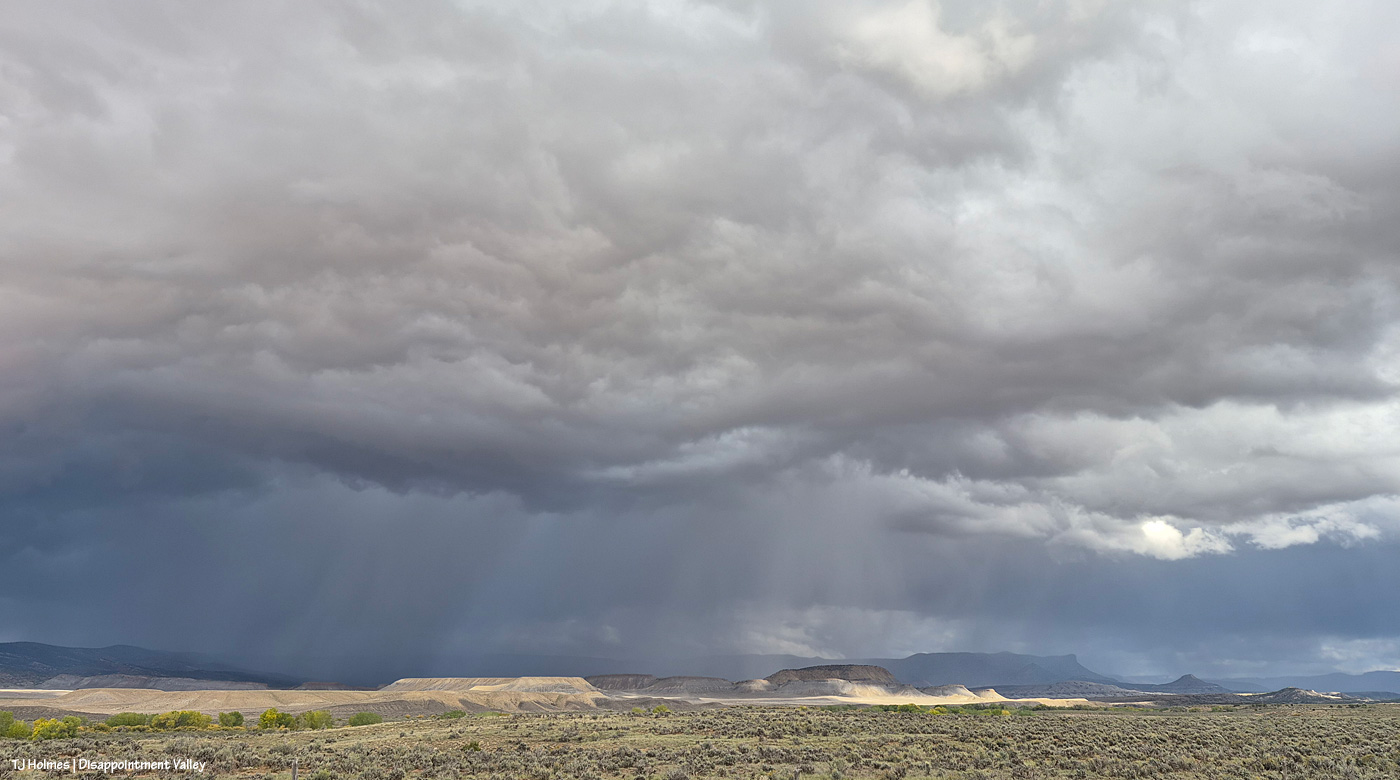
Yowza! That’s RAIN. Over SPRING CREEK BASIN! This is looking east while heading south on Disappointment Road, well west of the basin. …
Wait. What is that … ?
What that, you ask? THAT that!
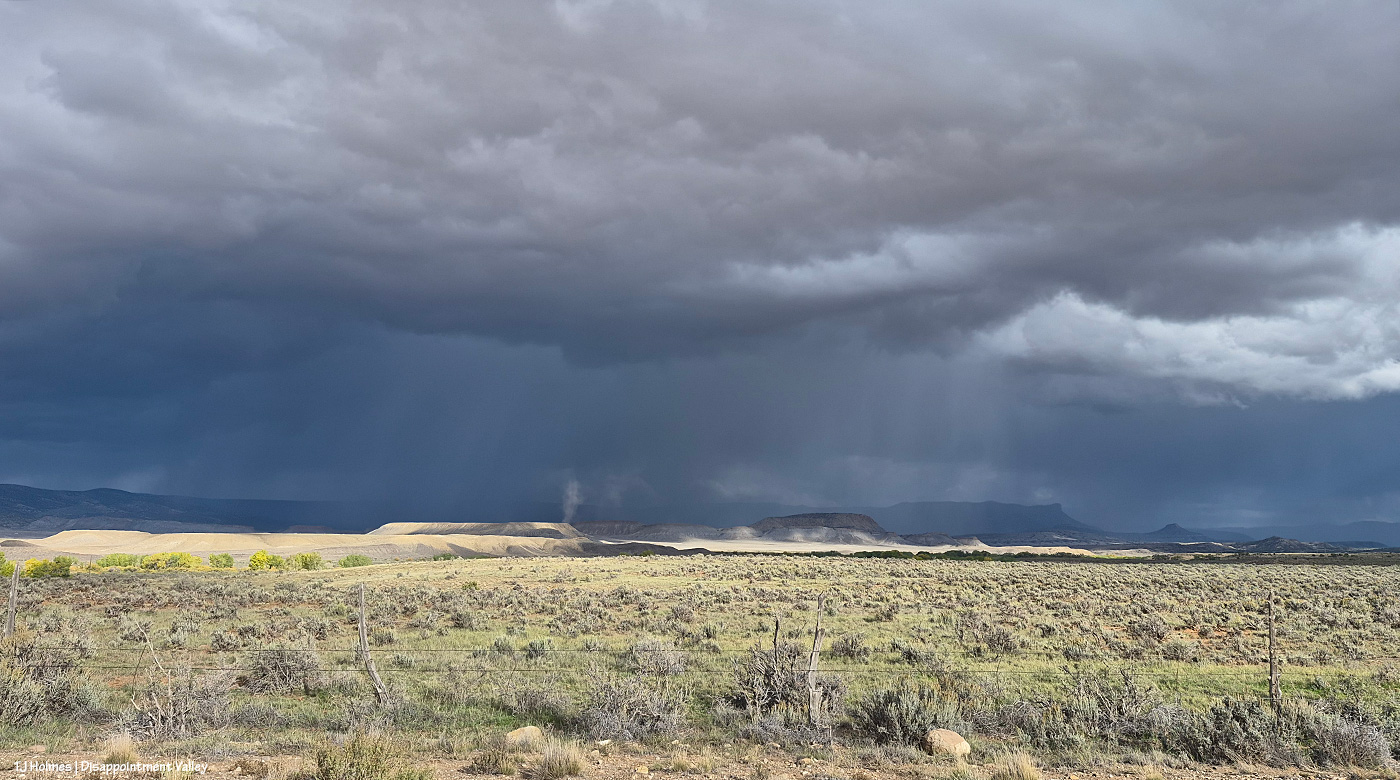
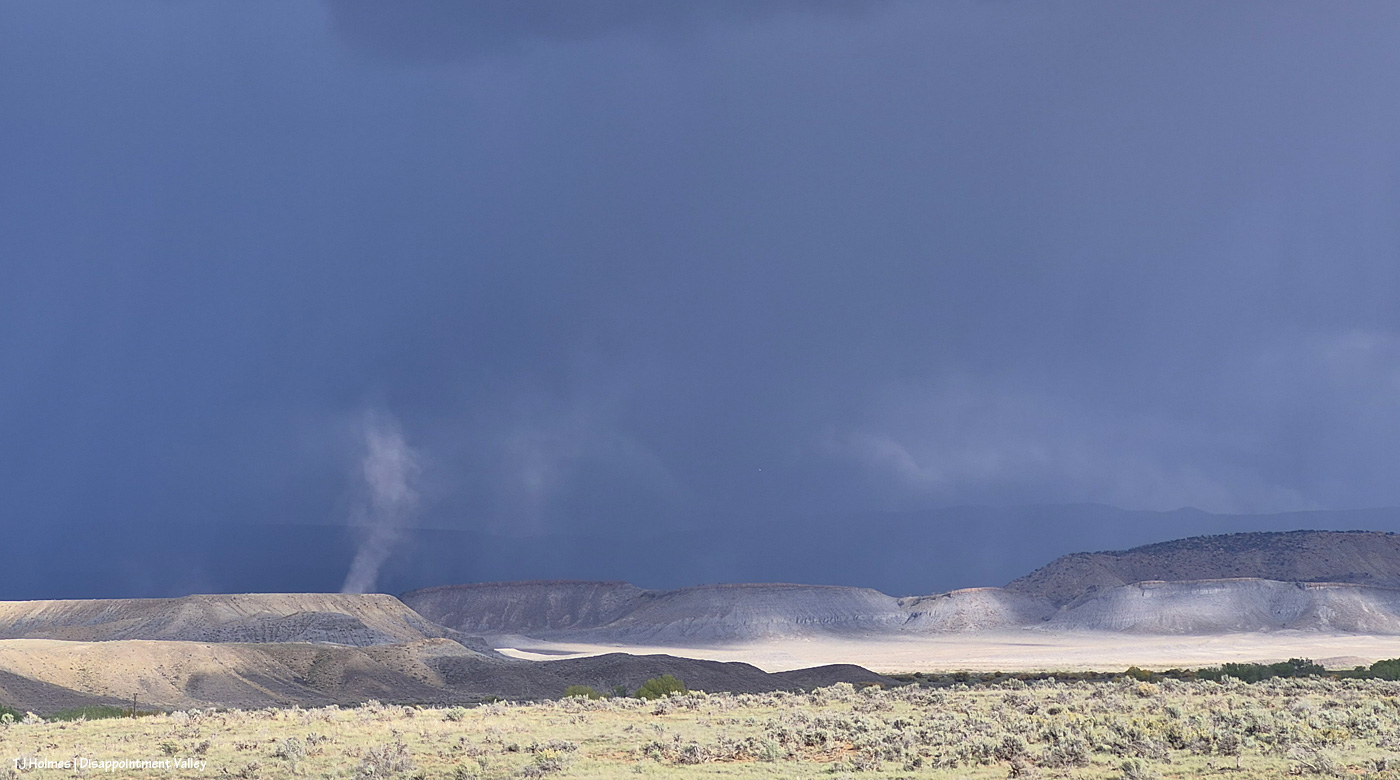
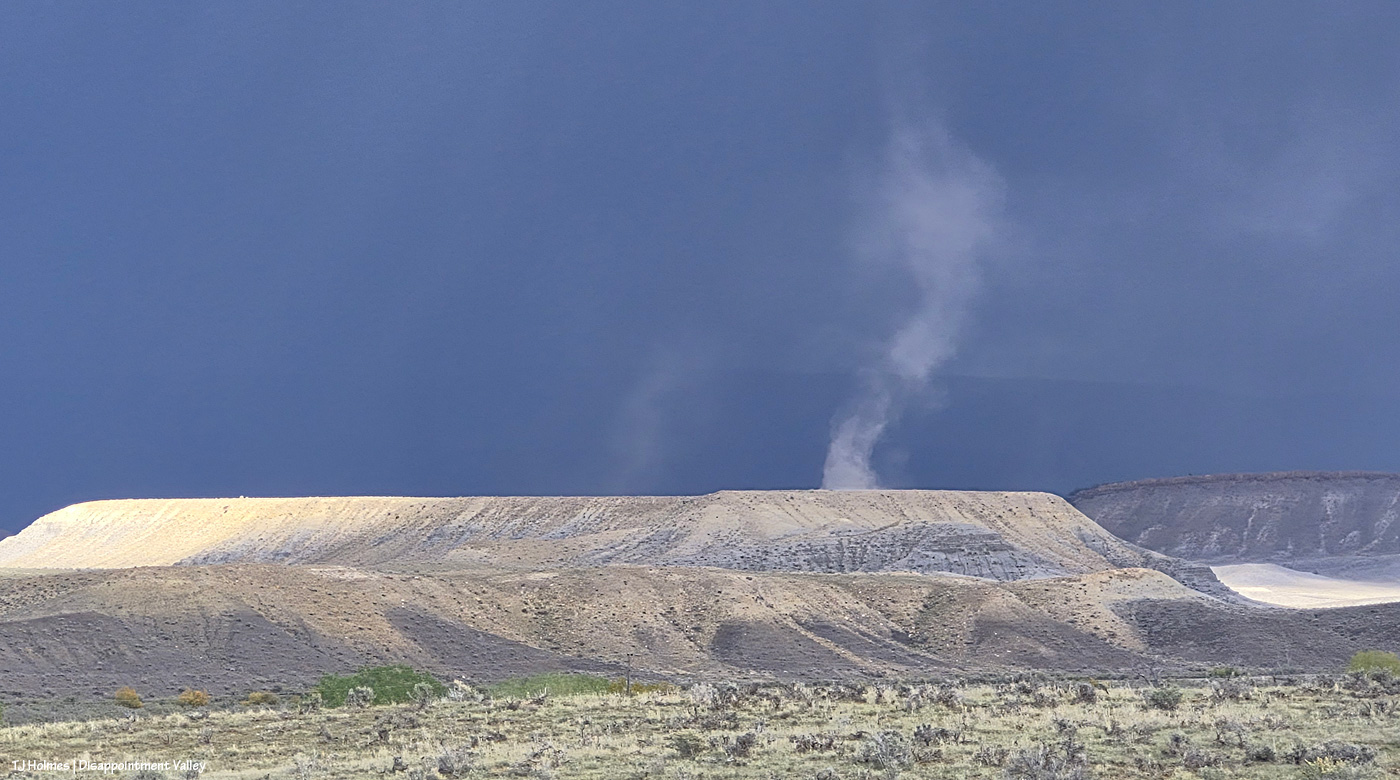
It’s a DUST DEVIL. … With pouring rain in the background! Just like the weird rain column seen earlier from inside Spring Creek Basin, this dust devil was illuminated by the sunlight hitting that part of Disappointment Valley west of Spring Creek Basin (the ridge topped by rimrock at far right is part of the basin’s western boundary). See the far-far ridgeline curtained by rain? That’s the very same northeastern ridge that meets the sky in the previous pix taken within Spring Creek Basin.
I was so wowed that I was standing in the middle of the road holding my phone up and out in the classic pose as a truck was approaching. Fortunately, it was someone who knows me and knows my photo-centricity, and he kindly did not run me over. 🙂
Kinda great for zilch on the rain front in the forecast, eh? 🙂 And I will tell you that the ground was still satisfyingly damp out in the basin last night (as you read this), and now we have another day or three or five (who really knows?!) of rain chances in the forecast.
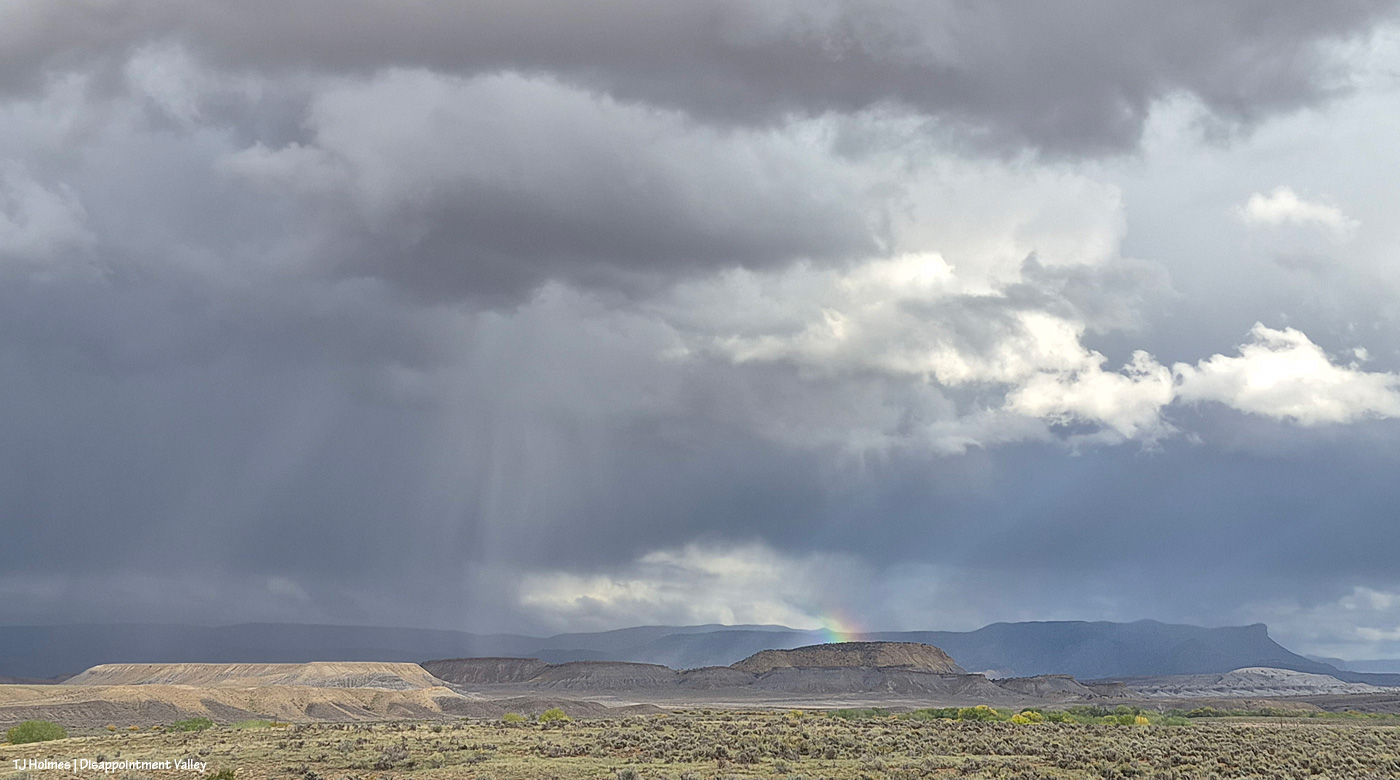
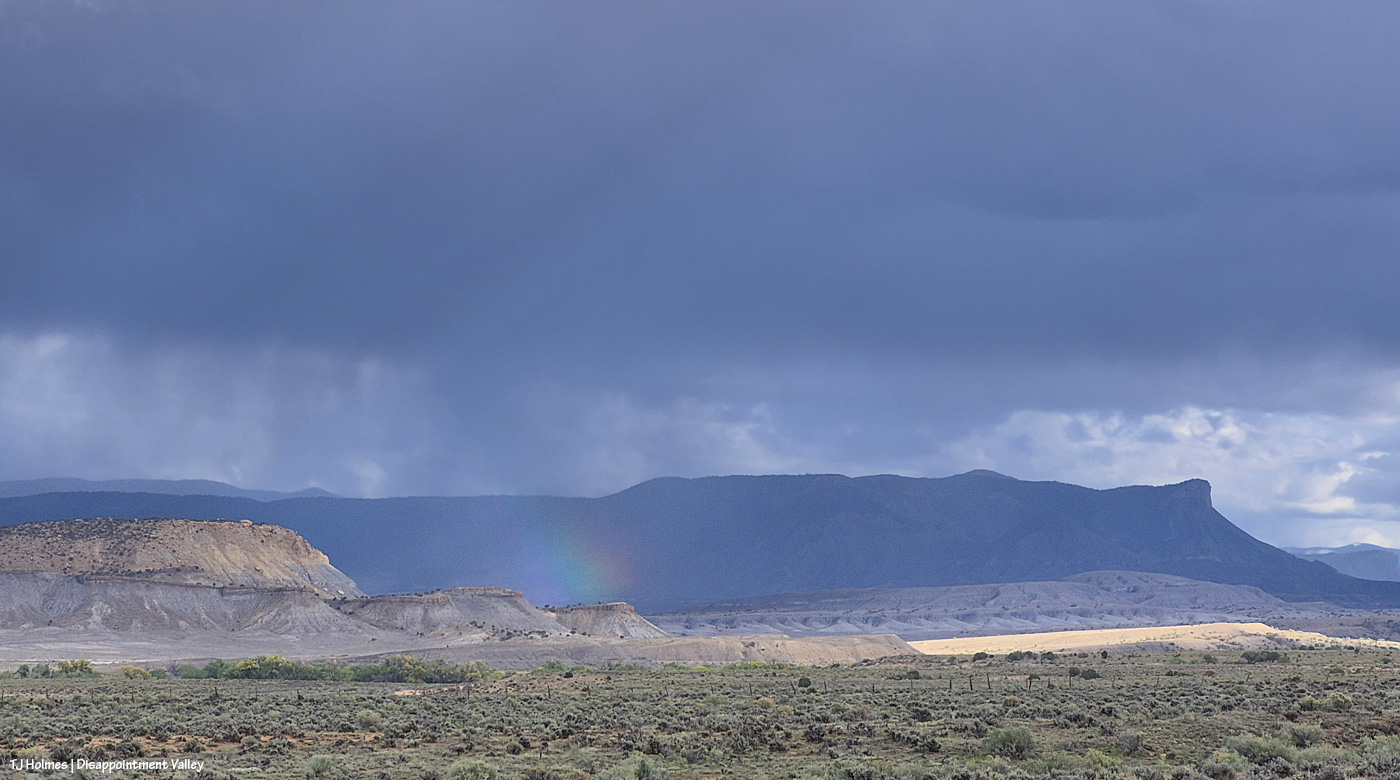
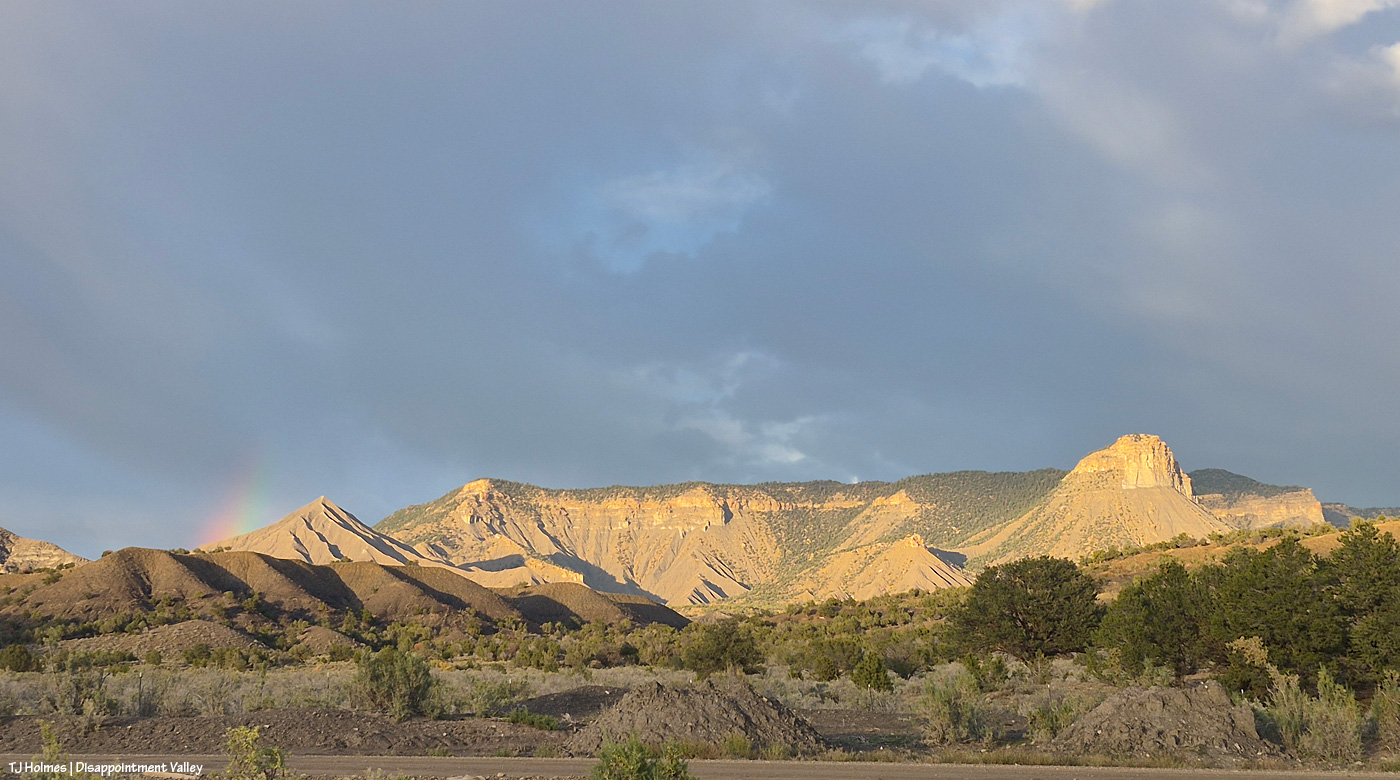
See the rainbow prism? That’s directly over Filly Peak in Spring Creek Basin.
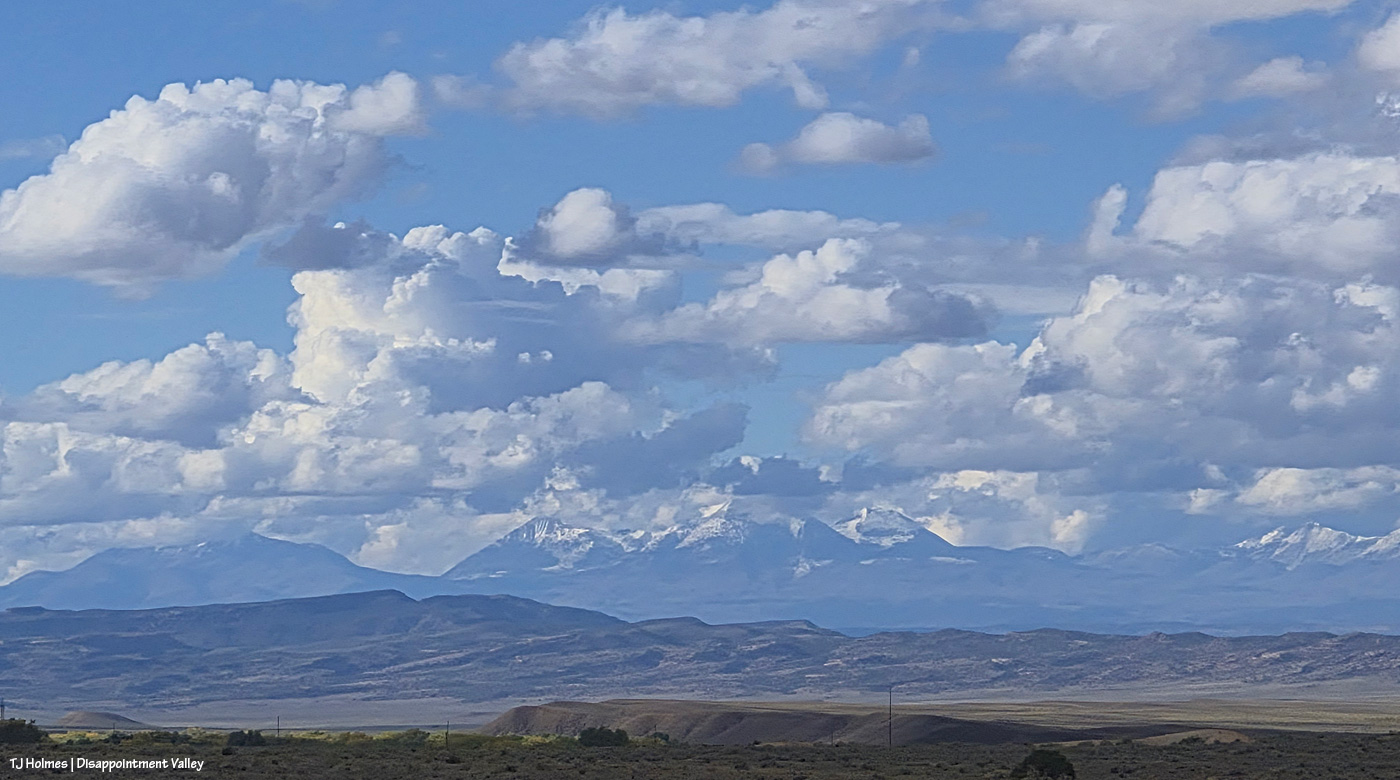
Did I mention there’s snow again on the mountains on our northwestern horizon (Utah’s La Sals)? As a point of interest, Mount Peale is the highest peak in the range at “12,721 to 12,726 feet.” Moab is on the other side.
There was just about every bit of light imaginable during the time I watched the storm pass: glorious sunlight to dappled light to ominous rain-darkness. Something else interesting? I never got so much as sprinkled on, no matter where I was.
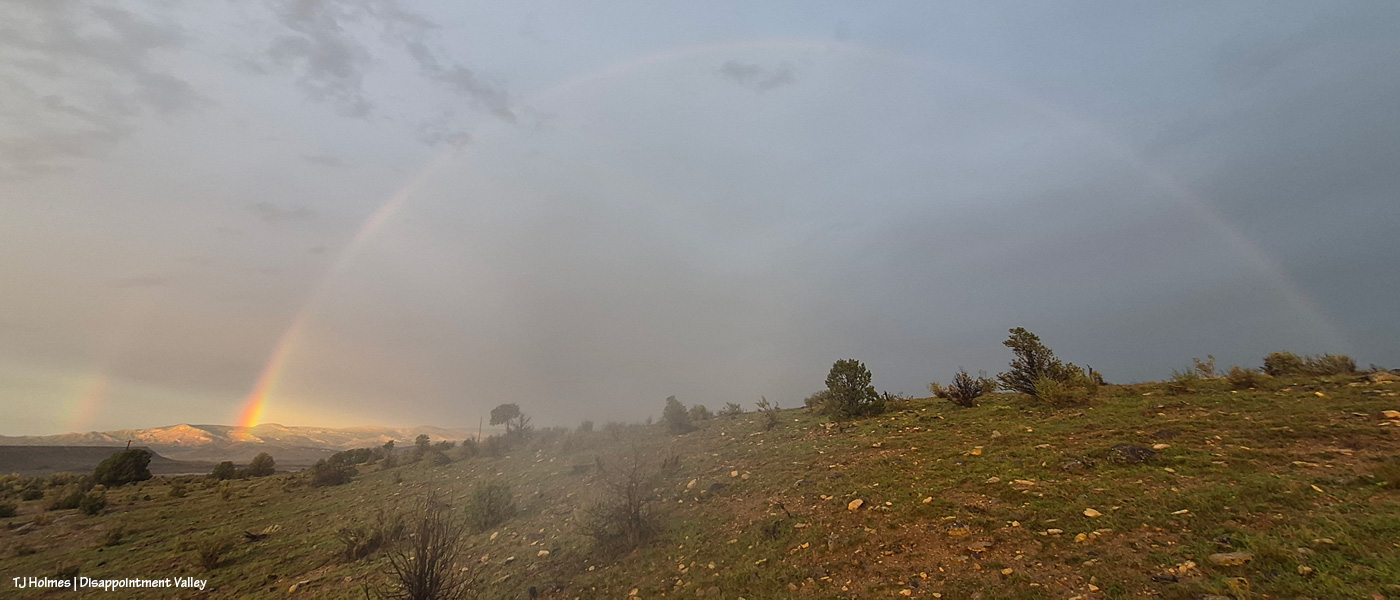
Oh yeah, and the light that produced multi-colored rainbow prisms (can you call it a rainbow if it doesn’t form a bow?). I think there were at least five, maybe six of these prisms. None formed a complete rainbow (if you can believe it), and none of them lasted very long … except this next one:
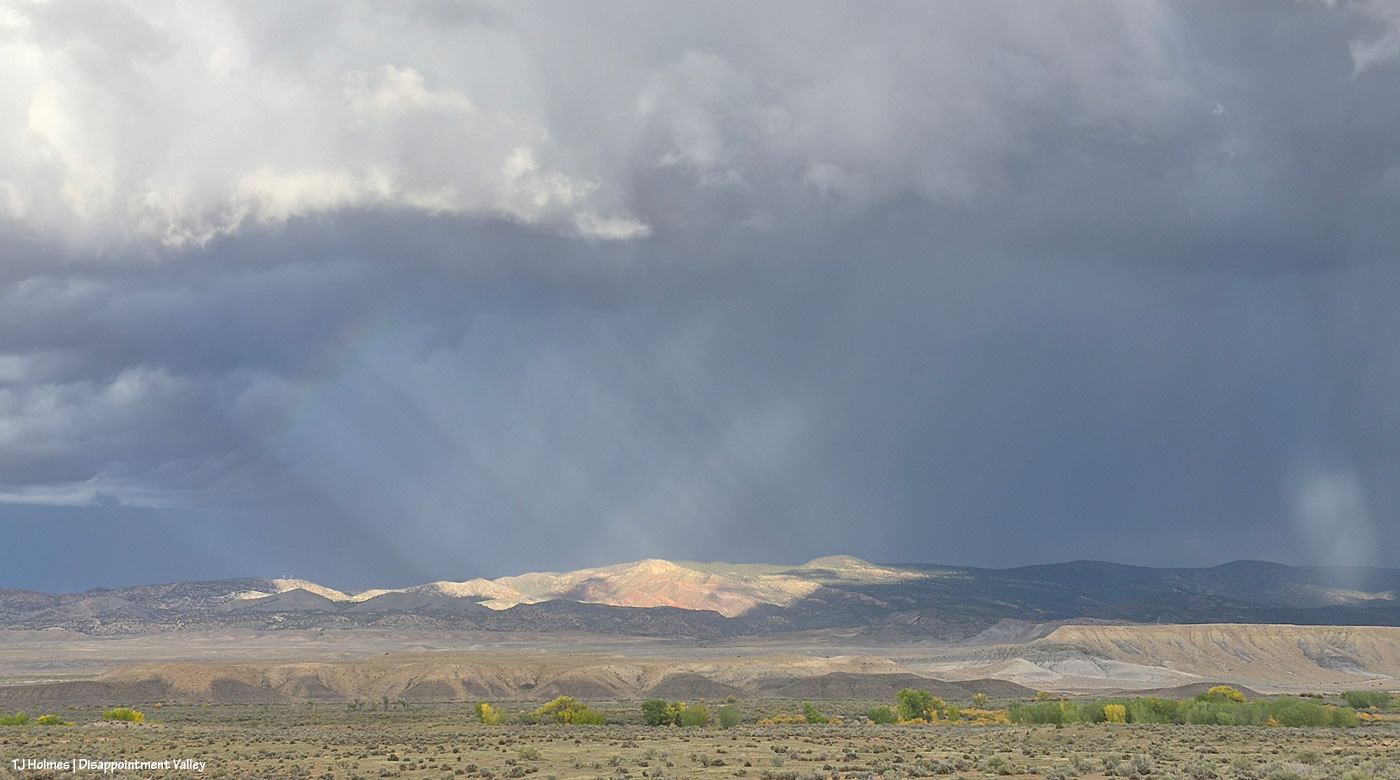
See the rainbow forming at upper left? (And check out that spotlight at farthest right!) Unfortunately, the prism was faint while the spotlight was on Buck Knob and its vibrant redrock layers, but, um, WOW.
It’s getting a little more visible …
The. Light. Was. Phenomenal.
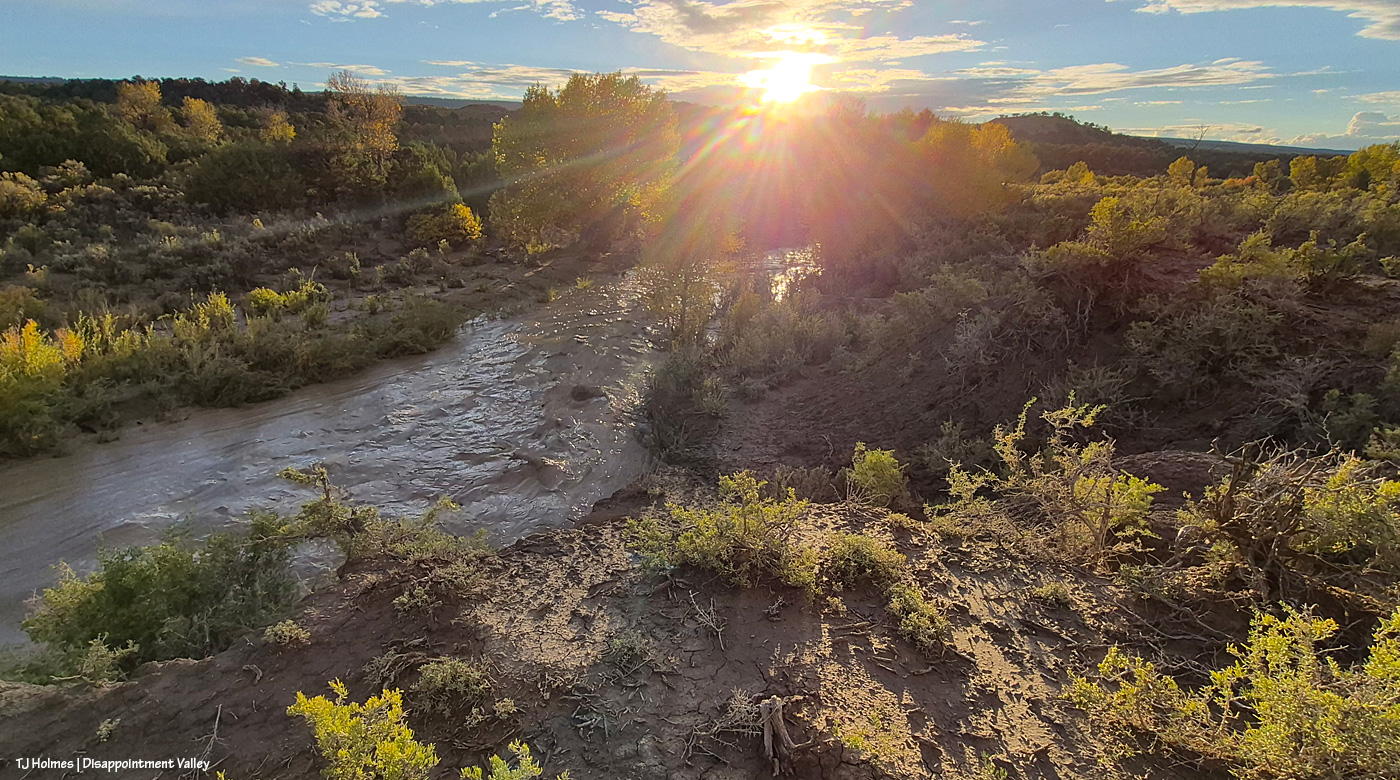
The cottonwoods along the bottom of this pic line Disappointment Creek. Spring Creek is farther north, running out of Spring Creek Basin, which is to the right/east. They both run westish; Spring Creek runs into Disappointment Creek, and, eventually, FARTHER west, Disappointment Creek carries all its salt and sediment into the Dolores River. This view is looking purty near north. The shorter, yellow-y-er (that’s a word, creatively speaking) vegetation is willow and maybe some rabbitbrush/chamisa, too. The cottonwoods at this elevation are just starting to go gold.
Do you start to see why there are so many pix in this post?! The light KEPT CHANGING. What the heck are those beams right of center?! I never did figure it out.
Wide-wide view for perspective. The road runs straight east here.
And on I went up-valley (to the southeast). I mean, who knew what else Mother Nature had in store?
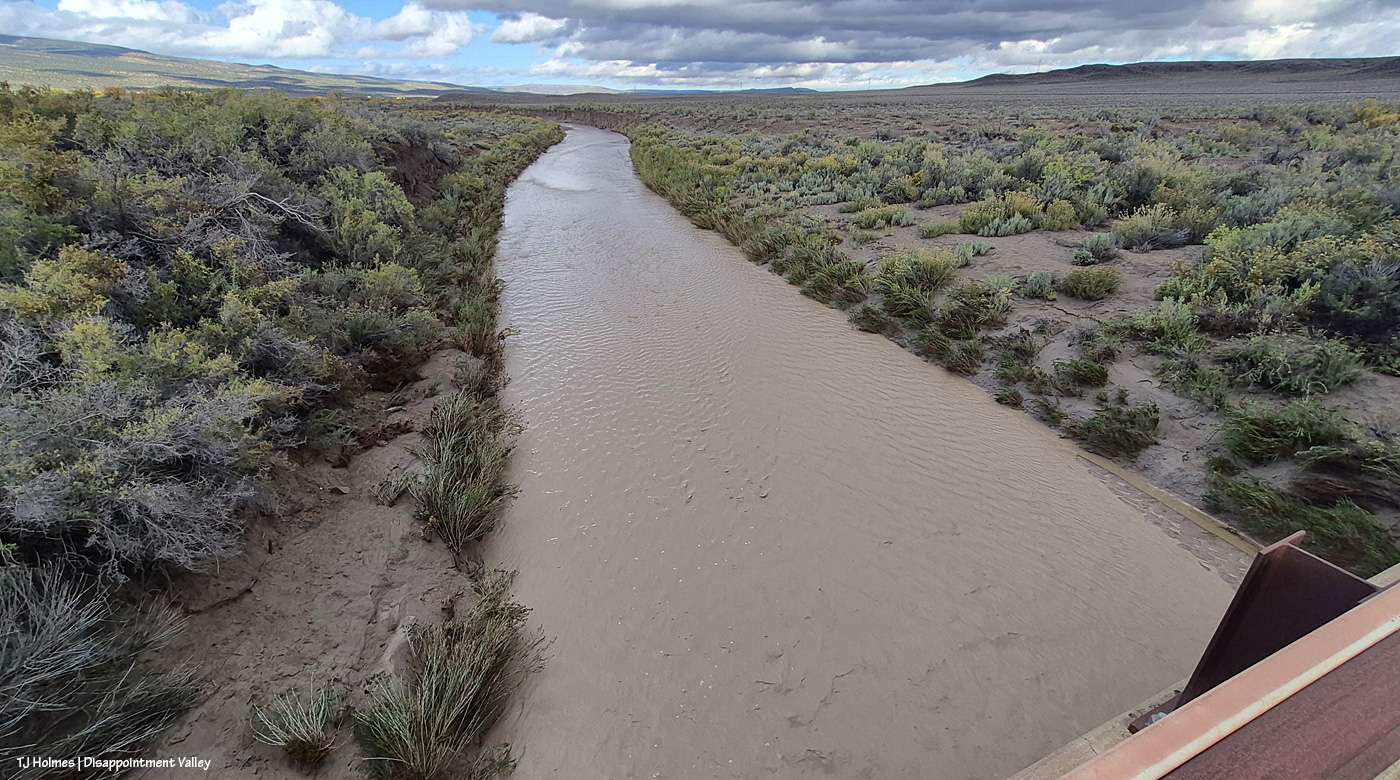
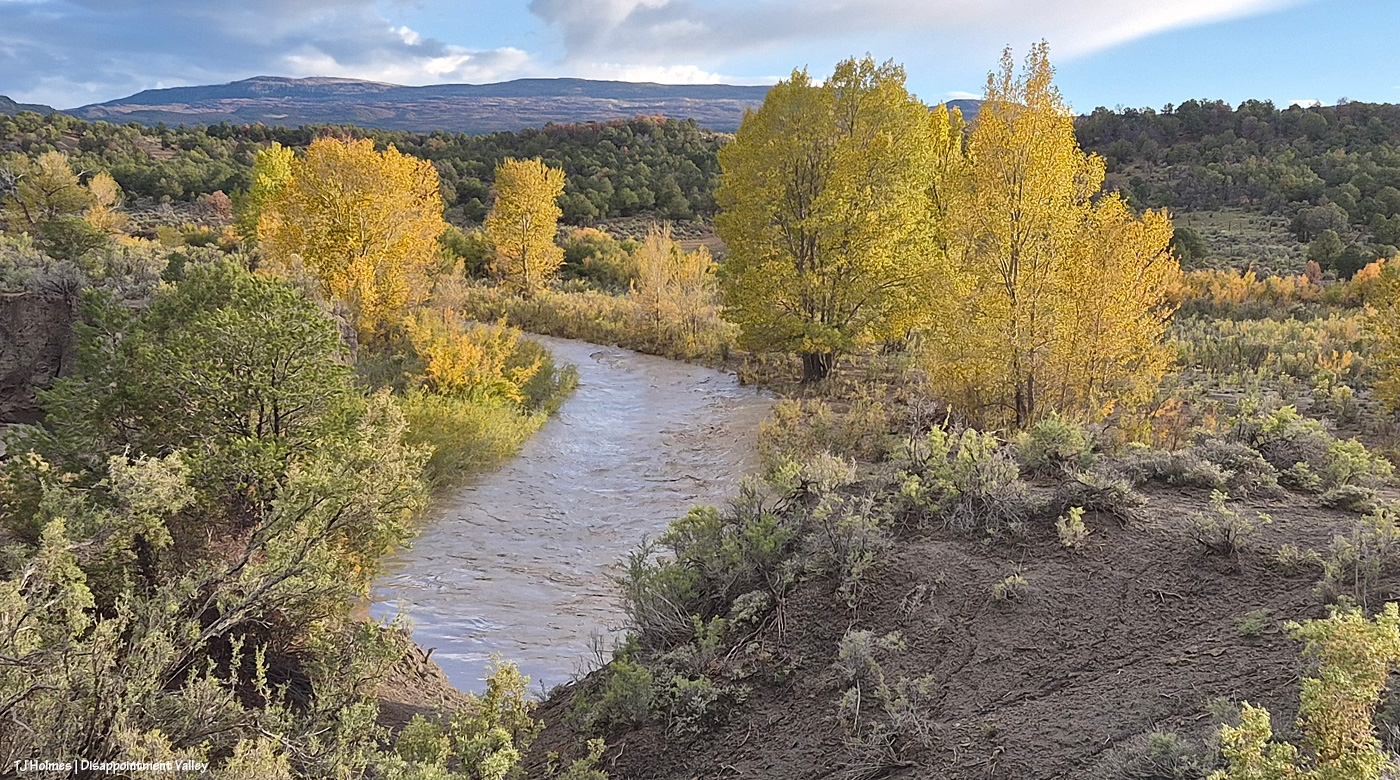
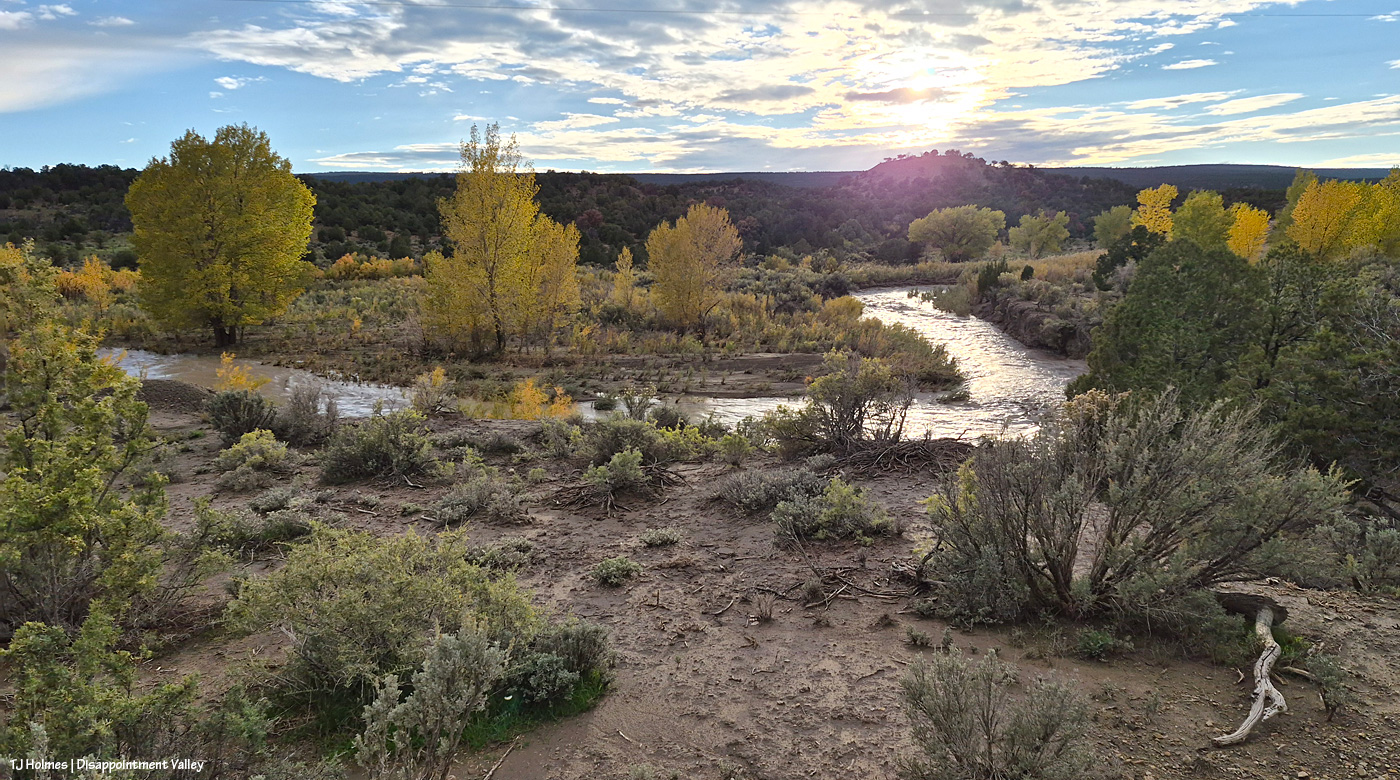
Disappointment Creek. Picture NO water here, and that’s what it usually looks like. This was when I first realized how heavy the rain must have been that I’d seen earlier … remember the very first pix at the top of this post? Spring Creek Basin is across the road (that I’m on) to the left.
It’s really hard to understand how this is such an astounding view if you don’t know what it usually looks like, but for one thing, there are usually giant rocks visible in the creek bed there.
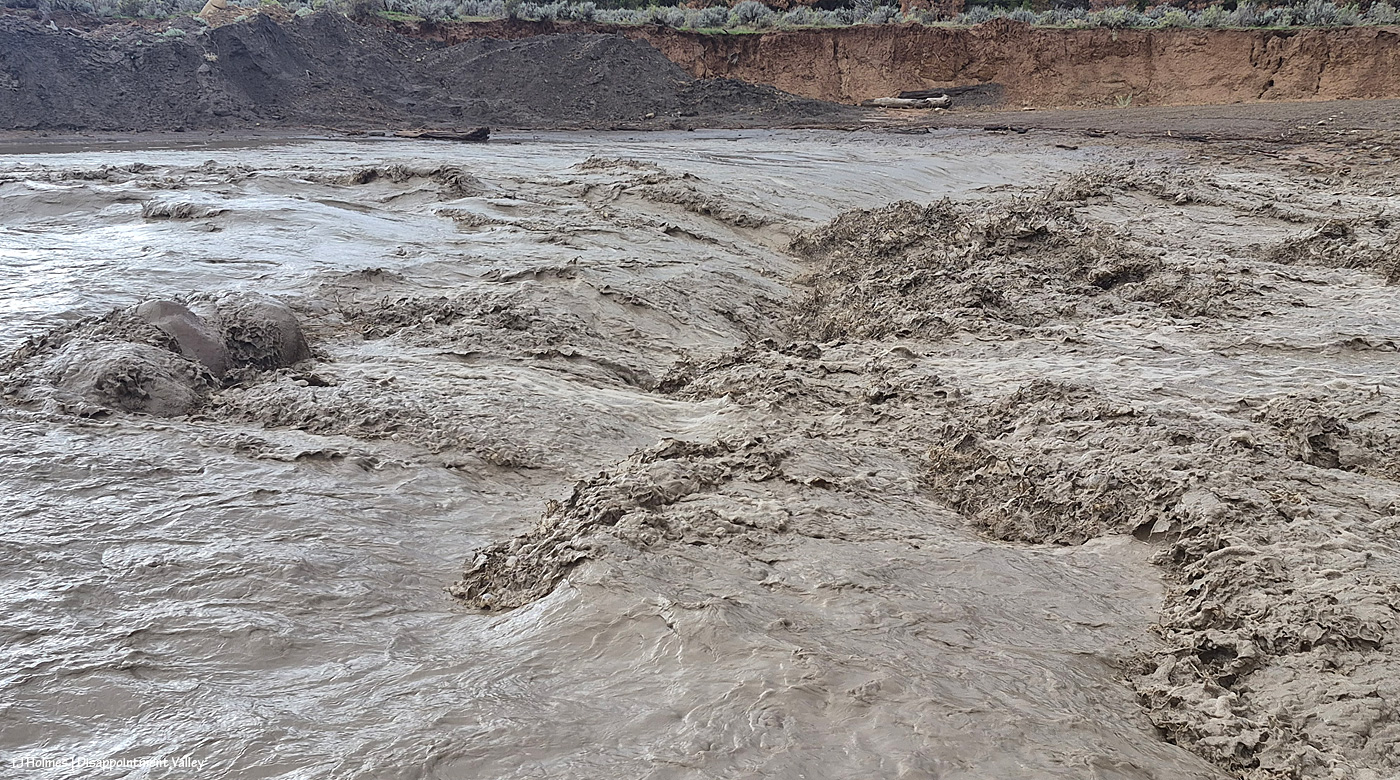
This is Black Snag Road; Disappointment Road is about 100 yards behind me. … Actually, this is Disappointment Creek – err, river – making fun of the idea of there being a road under that rollin’ water (let alone a culvert … ha ha ha!?). This is where I wish I was adept at video and/or even knowing how to insert it. Because the sheer volume of NOISE (let alone water) was INCREDIBLE. Larry W. is the Dolores County road guy for this part of Disappointment Road; I couldn’t help but think of him while I watched this; it will fall to him to fix this … eventually.
That pile of dark dirt is sort of the edge of … well … where the water shouldn’t have gone around?! Seriously, do not mess with Mother Nature. She makes her own paths.
I’m not entirely sure where those rocks would have come from. I hadn’t been down to look at the crossing for quite a while until this moment, but the road is sort of … there.
It was hard to take a still pic that conveyed the noise and just sheer quantity of water rolling through the *ahem* creek bed. You see the rocks … and up to the right is a WAVE of mud-water. I think the culvert is sort of in that area? And/or rocks meant to stabilize it and the edge of the road.
Disappointment River. 🙂 Seriously.
Meanwhile, this was happening behind me (as I looked at the river, err, creek crossing); looking in this direction, the creek is behind me. Disappointment Road runs across the base of the pic; down-valley (northwestish) is left, and up-valley (southeastish) is right. The fence along the road – the boundary of Spring Creek Basin – is visible at left and right. The foreground is part of Spring Creek Basin Herd Management Area, but Temple Butte – lit up at right – is outside the basin, as is McKenna Peak, the tip and eroded slopes of which are visible at left.
Nope, it was not over!
Disappointment Creek flowing downstream from just upstream of the Black Snag Road crossing.
It was *this* close to sunset. 🙂
Mother Nature wasn’t close to done for the day.
I mean … can you die of absolute, heart-bursting joy at the gorgeousity of the world?! Hopefully not; too much yet to see. I hope you’ve stuck with me. … Really, it gets BETTER.
Are you sitting down? You might want to sit down.
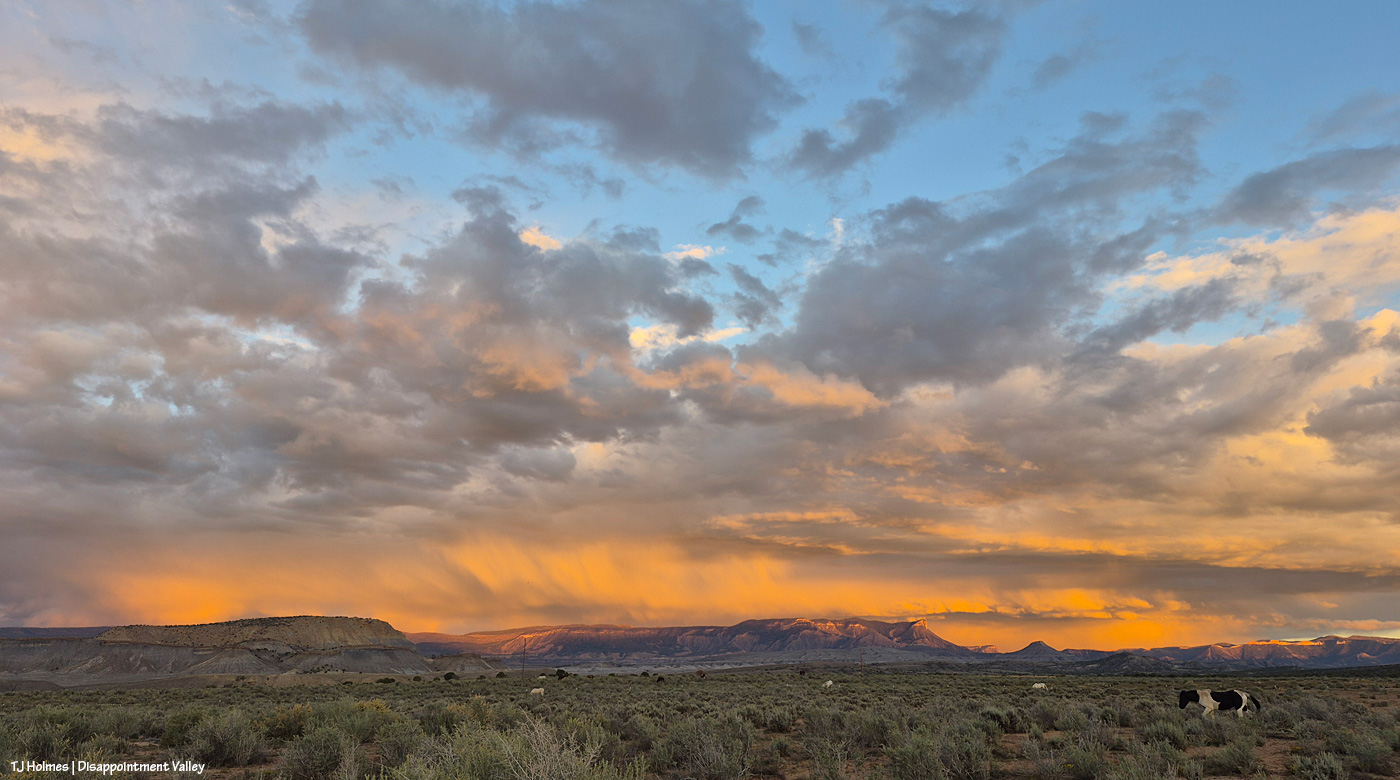
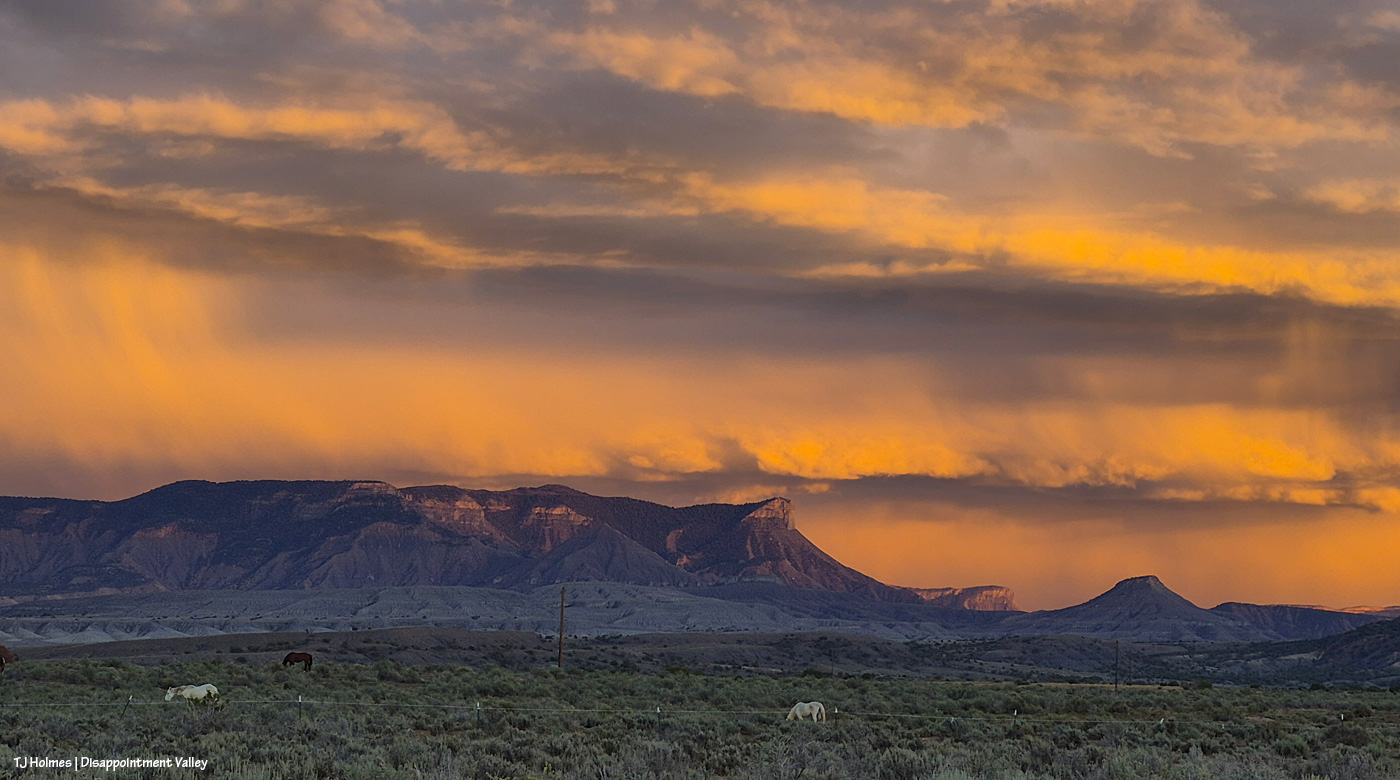
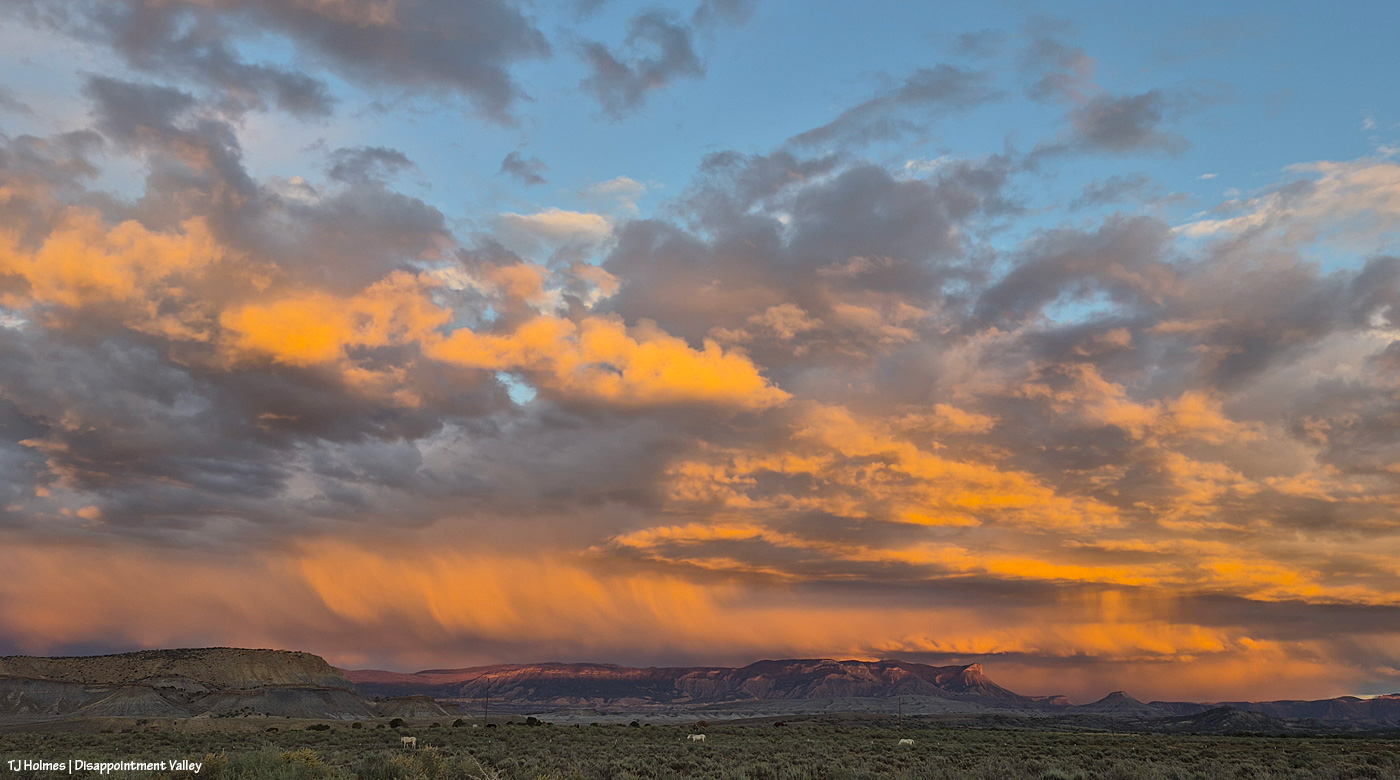
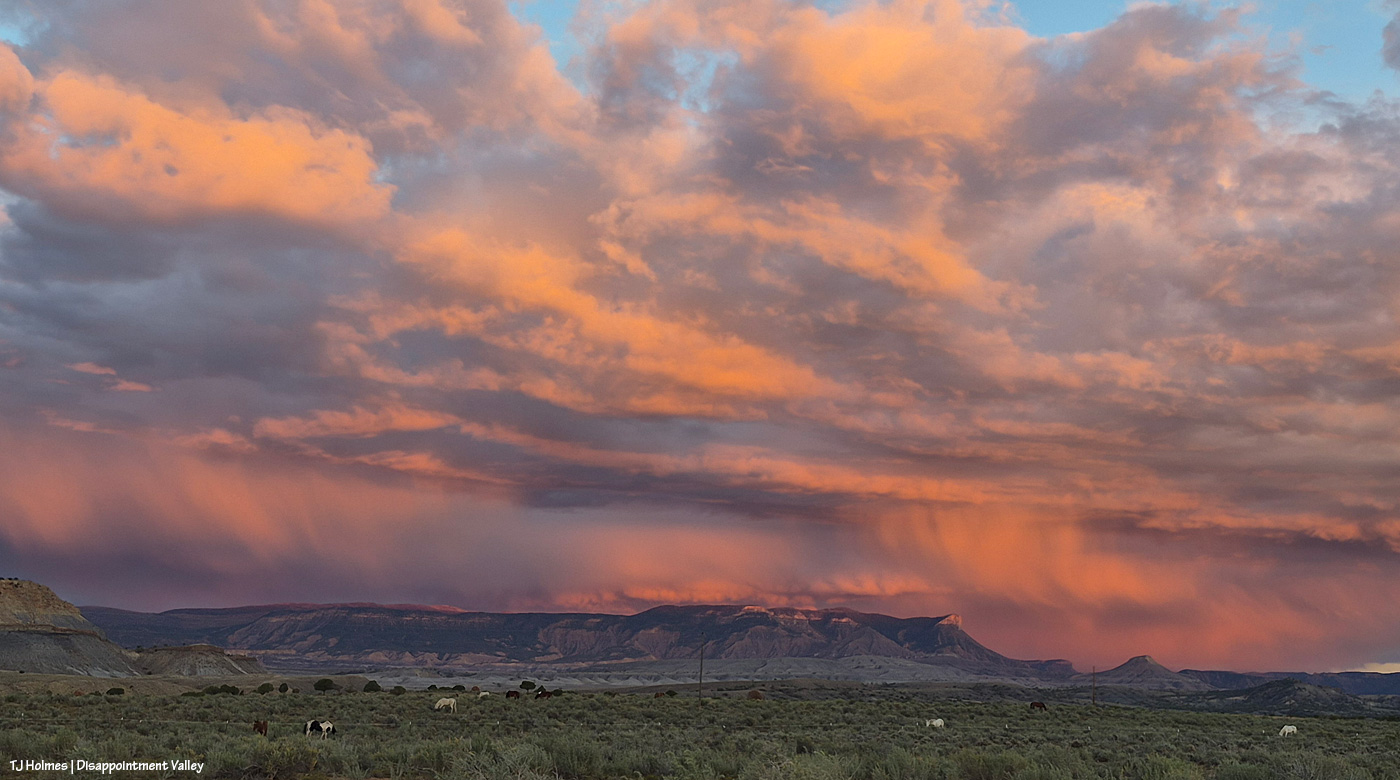
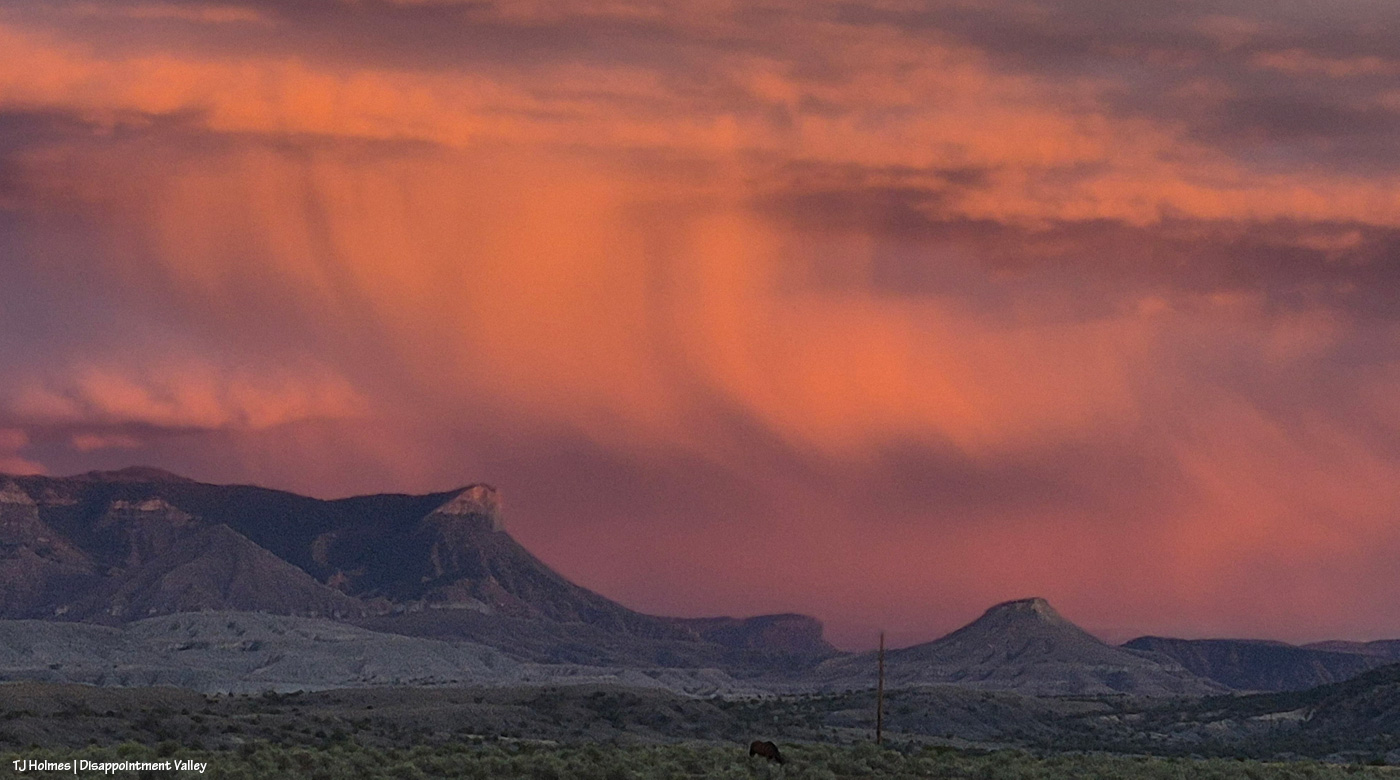
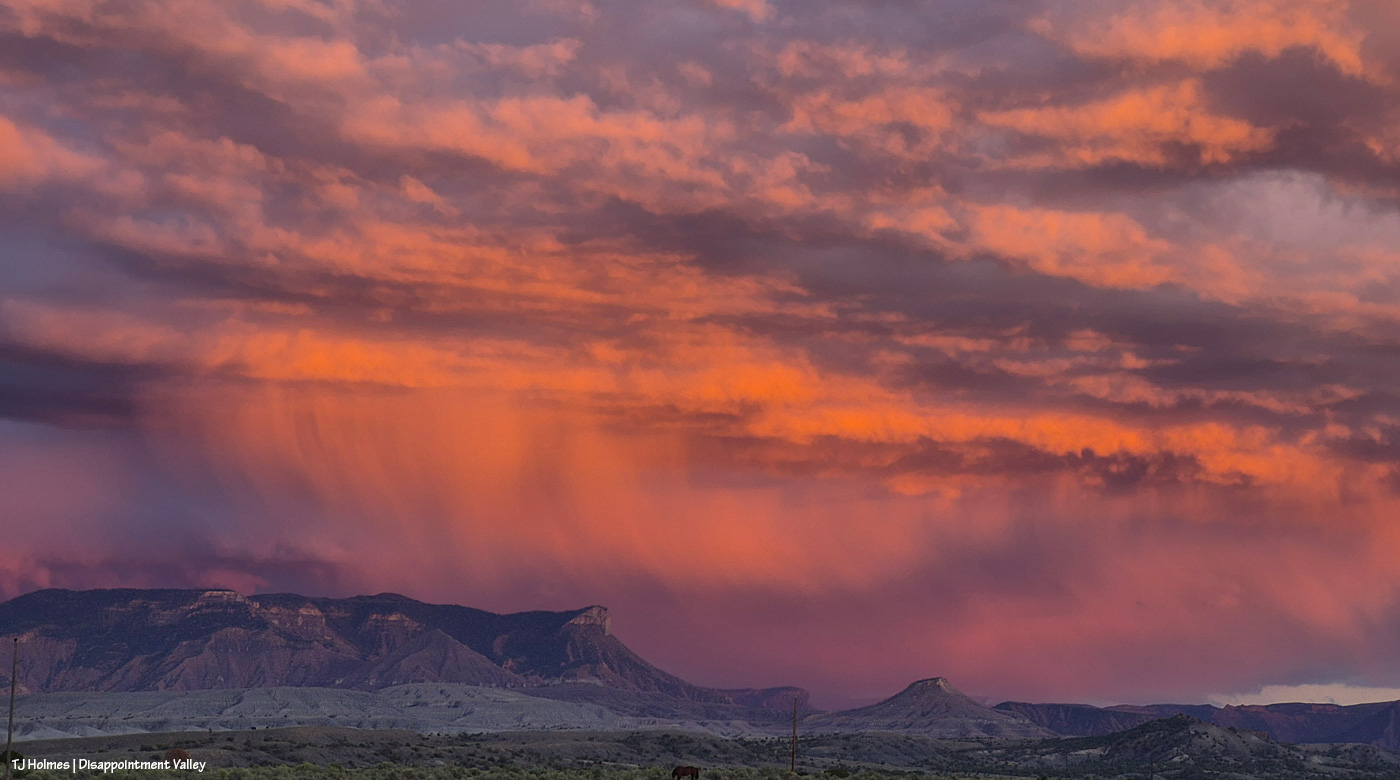
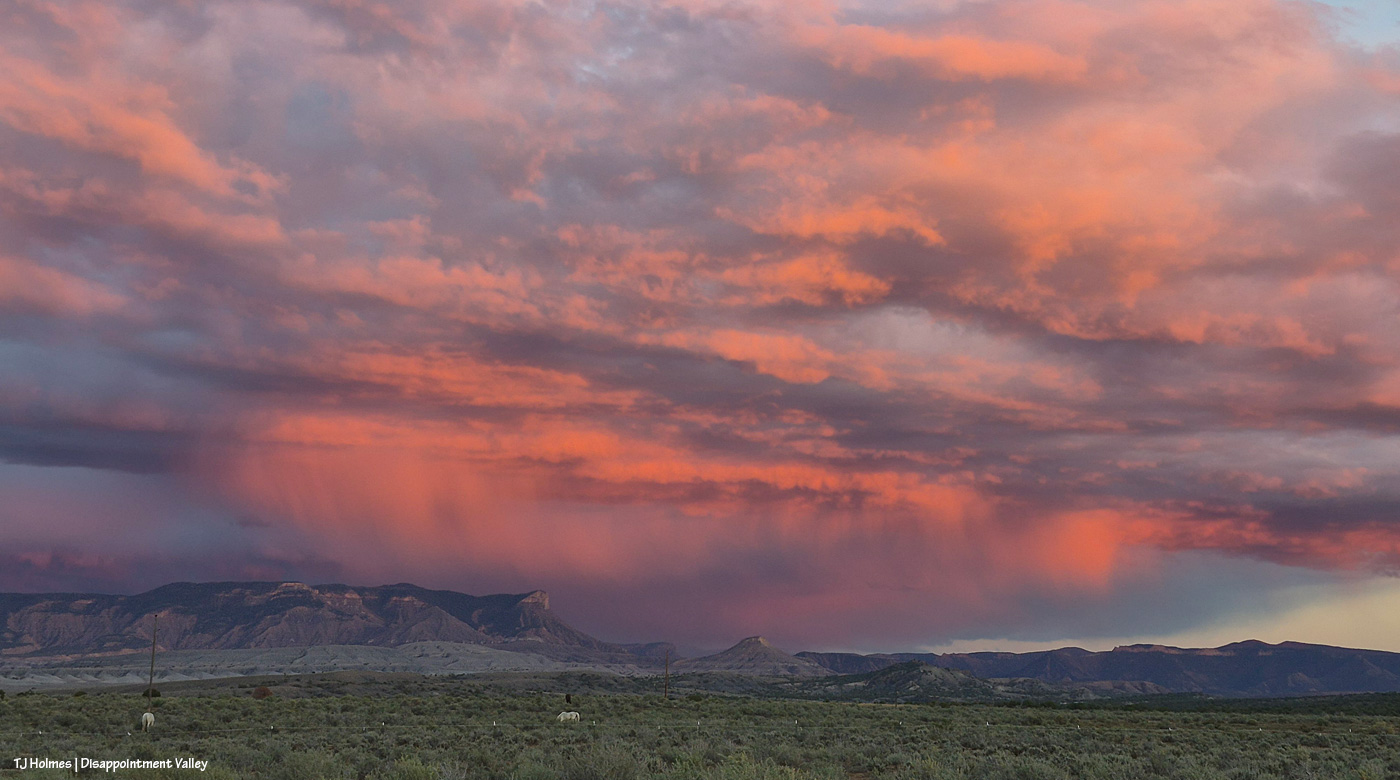
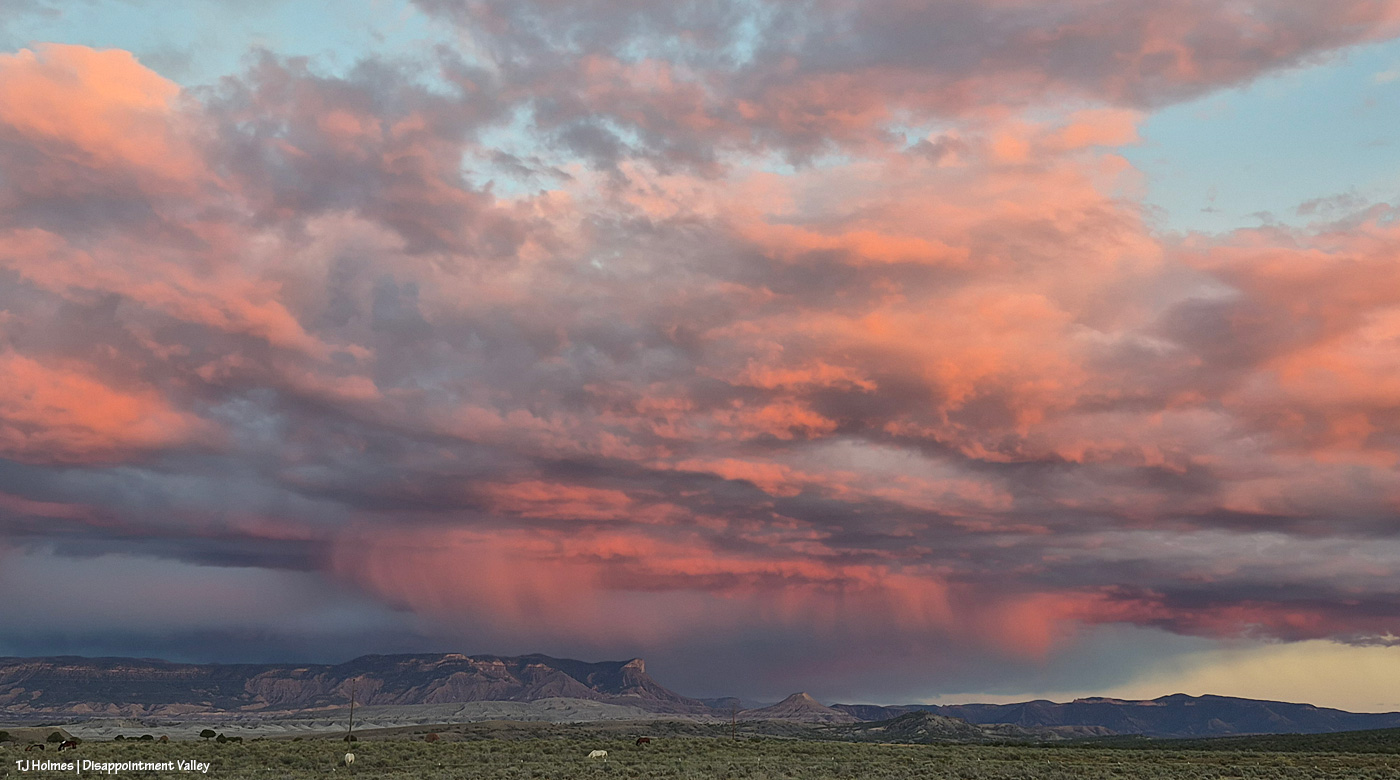
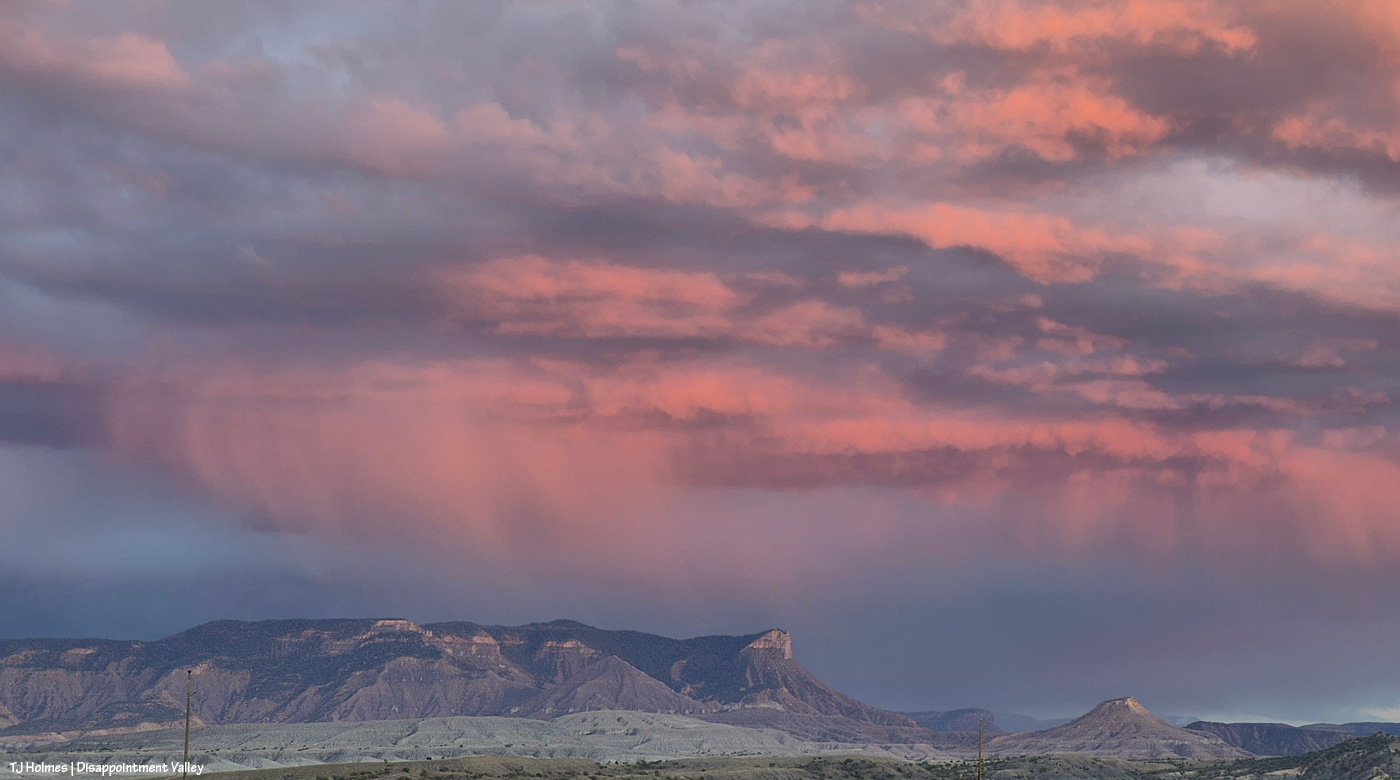
As I went back down-valley, THAT was happening behind me. Ahead of me (behind me as I take these pix), to the west, the clouds were nearly gone, the sky nearly clear again. The color was all back to the east. (Note: These horses are not in Spring Creek Basin. I’ve never crossed over here, but this sunset was too amazing not to share, and this is where I was when I saw it.)
My jaw might have been on the ground. I hope you find these colors and cloud shapes impressive. … The pix don’t really do it justice; it was one of the top most spectacular sunsets I’ve seen in my life.
I might finally have run out of words.
Was it worth it? 🙂
WHAT. A. DAY!!!!!!!!!!!!!!!!!!!!!!!!!!!!!!!!
Mama Nature, I never cease to be amazed. Keep on rockin’, Lady.
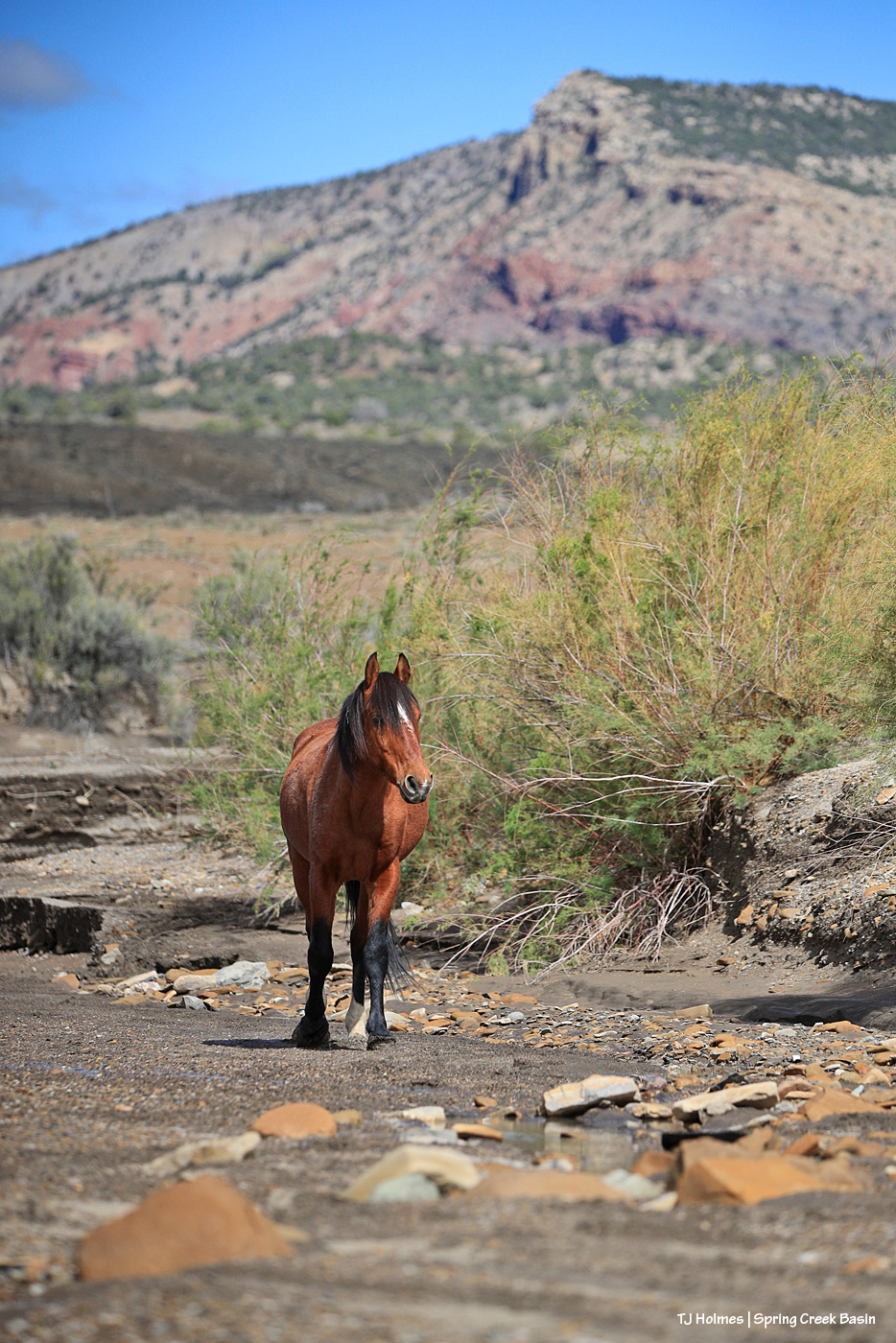
Tenaz was feasting on greasewood during the band’s unhurried mosey toward water, so he was a little late to the drinks party in Spring Creek, but he made it. He’s looking up on the bank as some horses have already had a tasty slurp and have cleared the way.
Above is the same featured day as the last few pix – the day the clouds cleared after five days of glorious rain. For the next couple of days, we had the same bluebird sky you can see in the pic above … and now we’ve returned to clouds in anticipation of the next wave of rainy days!
Last night as you read this (earlier tonight as I’m typing), I can’t even put into words the crazy-awesome spectacularity of the storm sky, especially at sunset. There were at least four partial rainbows (a couple of them were very faint), and it rained so hard across upper Disappointment Valley that by the time I got out of the basin and up-valley a fair distance, alongside the basin, Disappointment Creek (which does NOT run through Spring Creek Basin) was rollin’ like a RIVER!
I already had the above pic of Tenaz ready to go, and I just don’t have time for all the processing of pix from today (yesterday as you’re reading), but hopefully by tomorrow’s post (as you’re reading), I’ll have some pix that won’t begin to do justice to the outstandingness of Mother Nature when she lets rip.
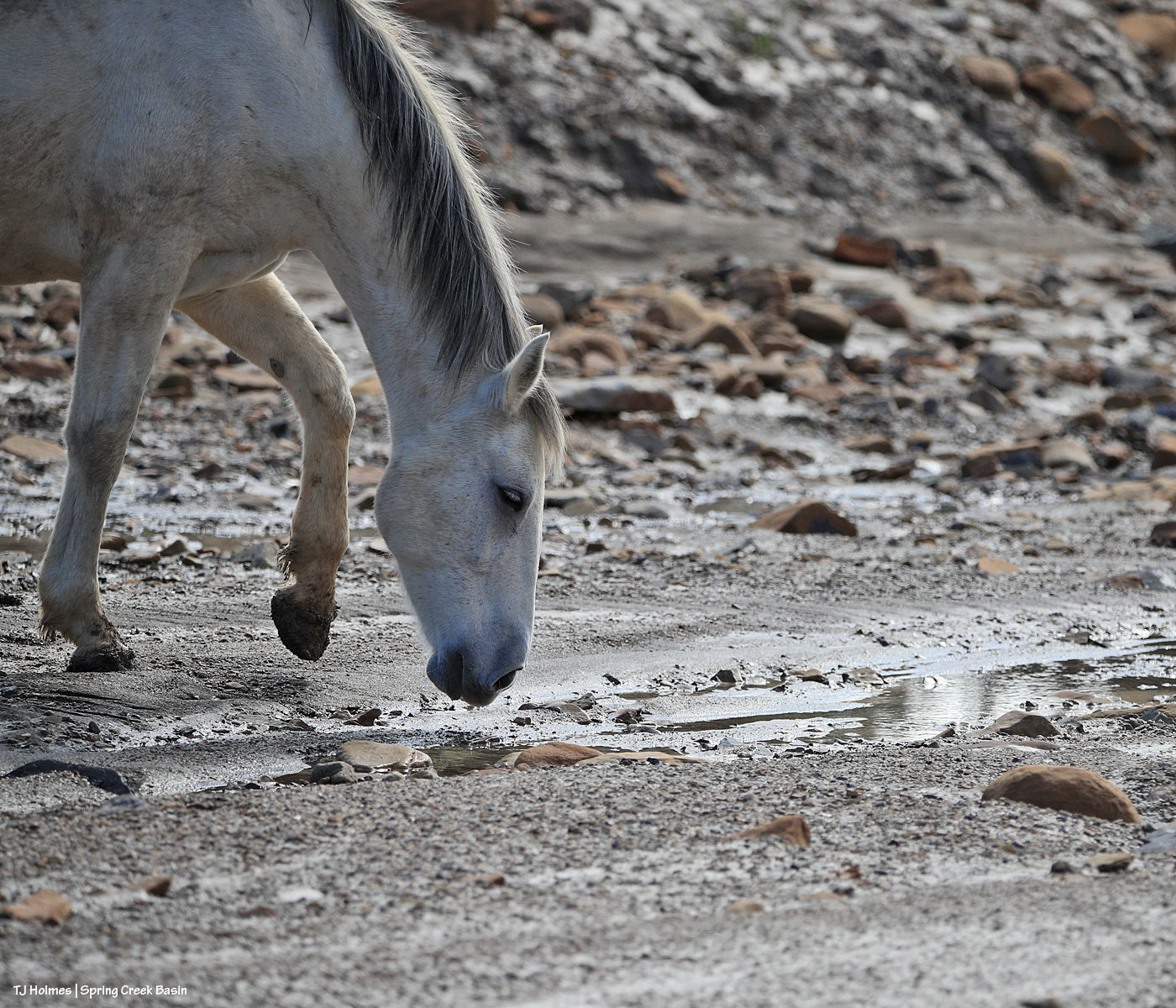
This is another one from the day of clearing after the amazing five-day run of rain last week, and this is Temple in Spring Creek, just upstream of the canyon. Water most definitely had run through the arroyo (probably multiple times during the frequent rains over Spring Creek Basin), and there were big puddles in places (along with a lot of very deep, pillowy mud). This little stream in the arroyo was fresh, trickling water, which the horses definitely seemed to appreciate.
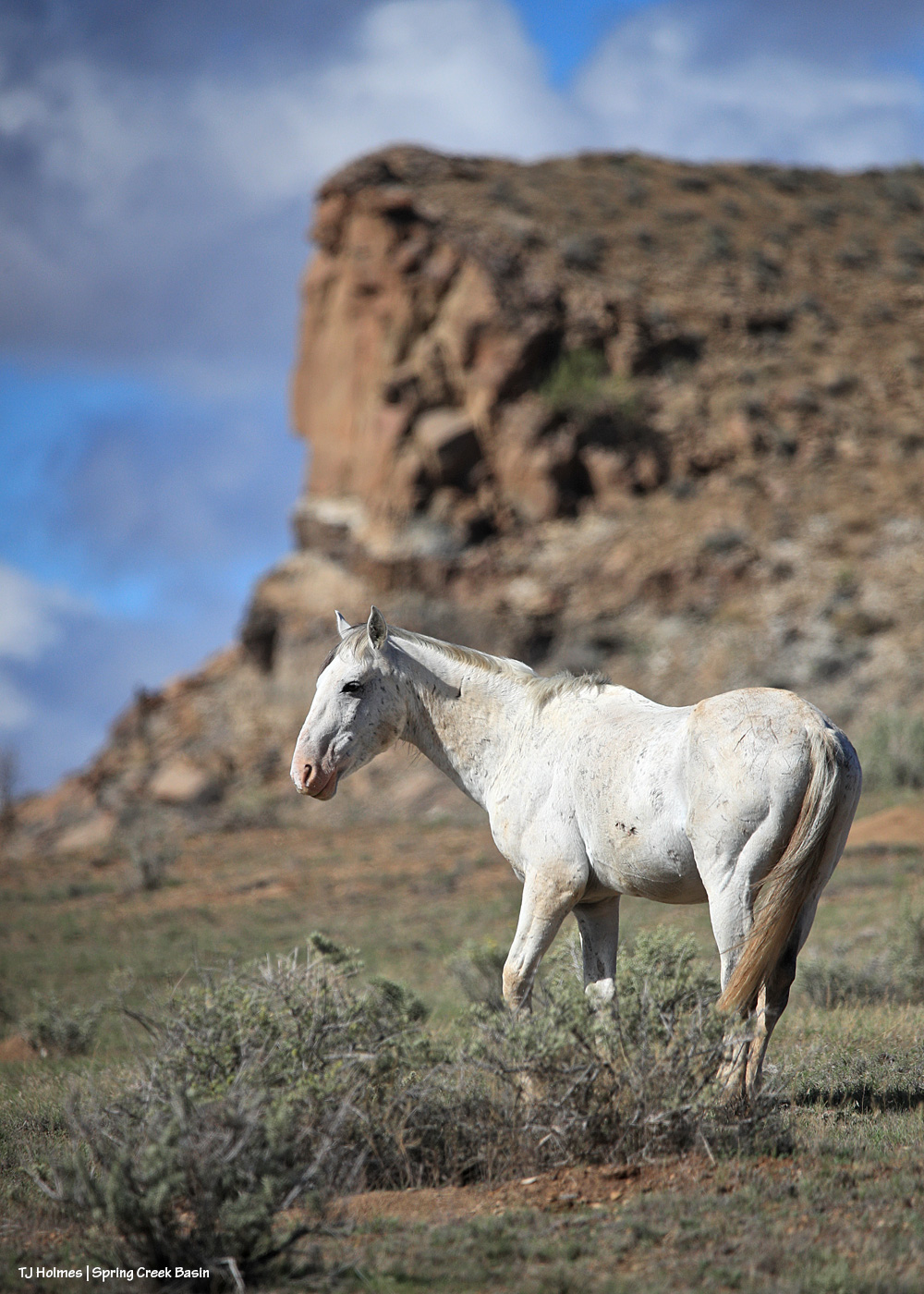
As the day was clearing from five days of clouds and multiple waves of rain, I found Skywalker and his band mates up in the northwestern part of Spring Creek Basin above Spring Creek canyon. The horses were grazing, napping, moseying, napping, grazing from high near the rimrocks at the basin’s western boundary as they gradually made their way down to the canyon to drink at the arroyo. It’s so weird to see the greenup now, in mid-October, and it’s also super gratifying to see the benefits of all that rain!
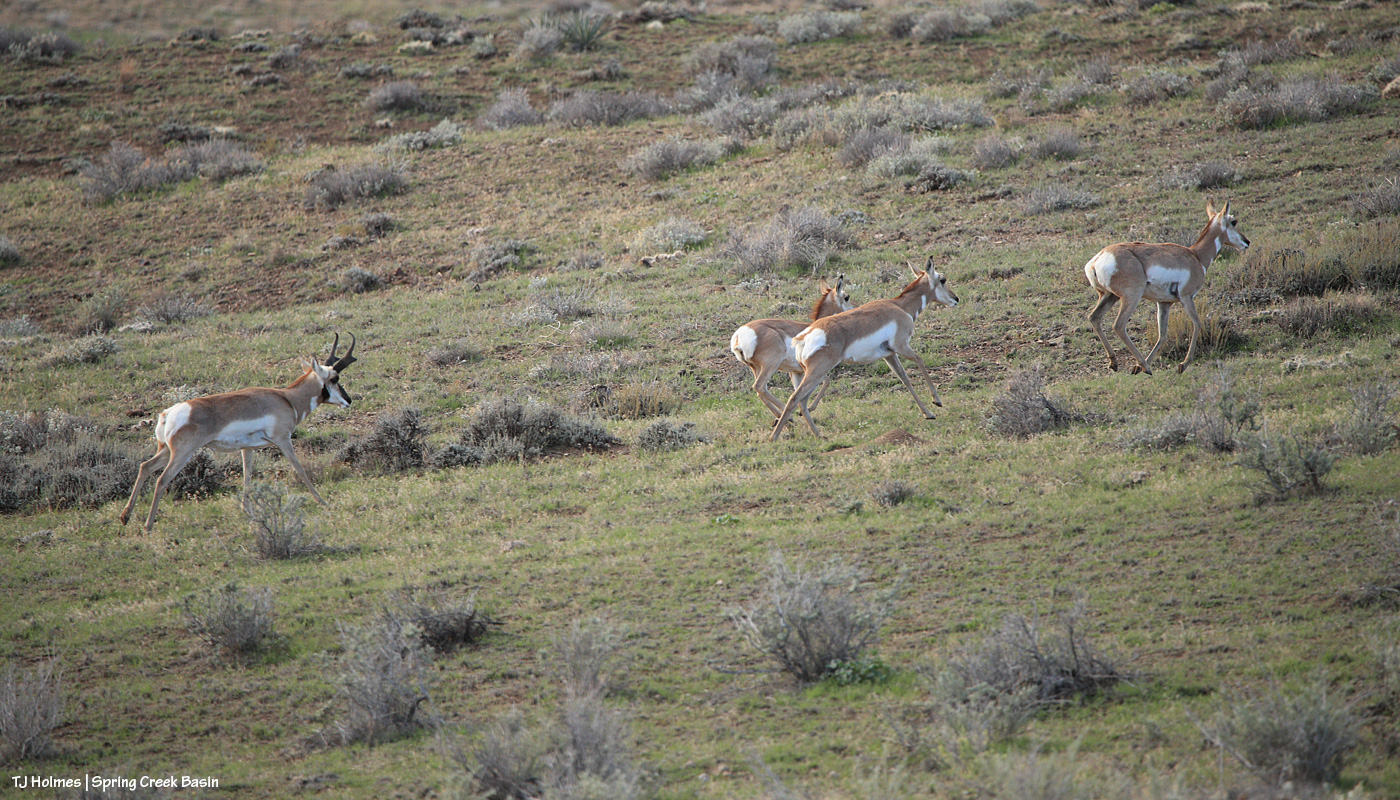
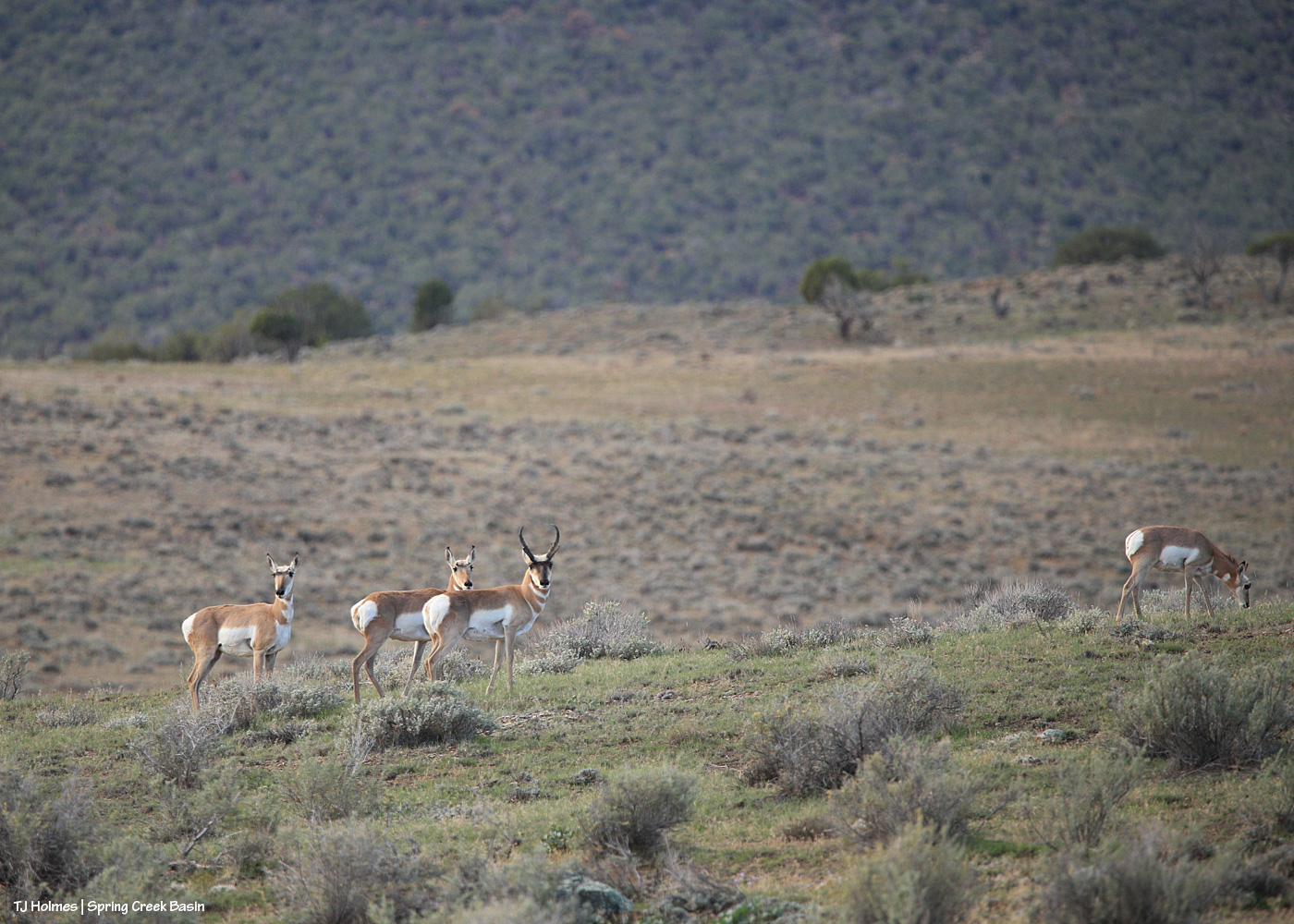
This, I think, is a different group of pronghorns than the ones I saw (and posted) a short while ago. At least three other pronghorn does scampered before I could fumble my pack off my back and my camera out of my pack. And, I think, the two middle pronghorns in the pic above are youngsters, though they may be a year apart (?).
Any time I can “catch” a group of speedgoats (aka pronghorns), I’m happy!
And look at that *green* … in the foreground, at least. It’s astounding how beneficial that rain was, just about immediately.