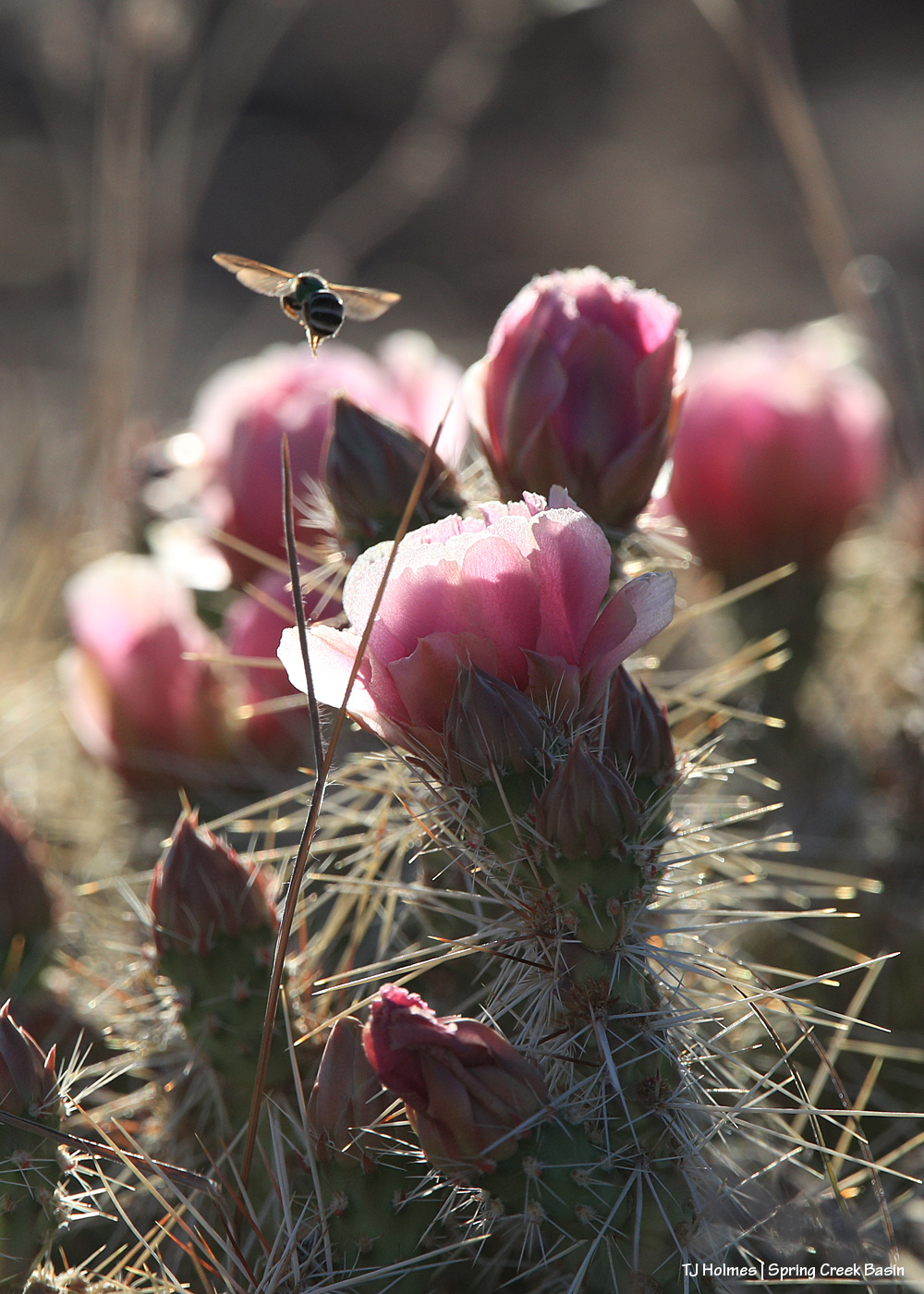
This busy little bee was visiting all the blooms in the vicinity when I stopped for a quick visit on my way to see a band.
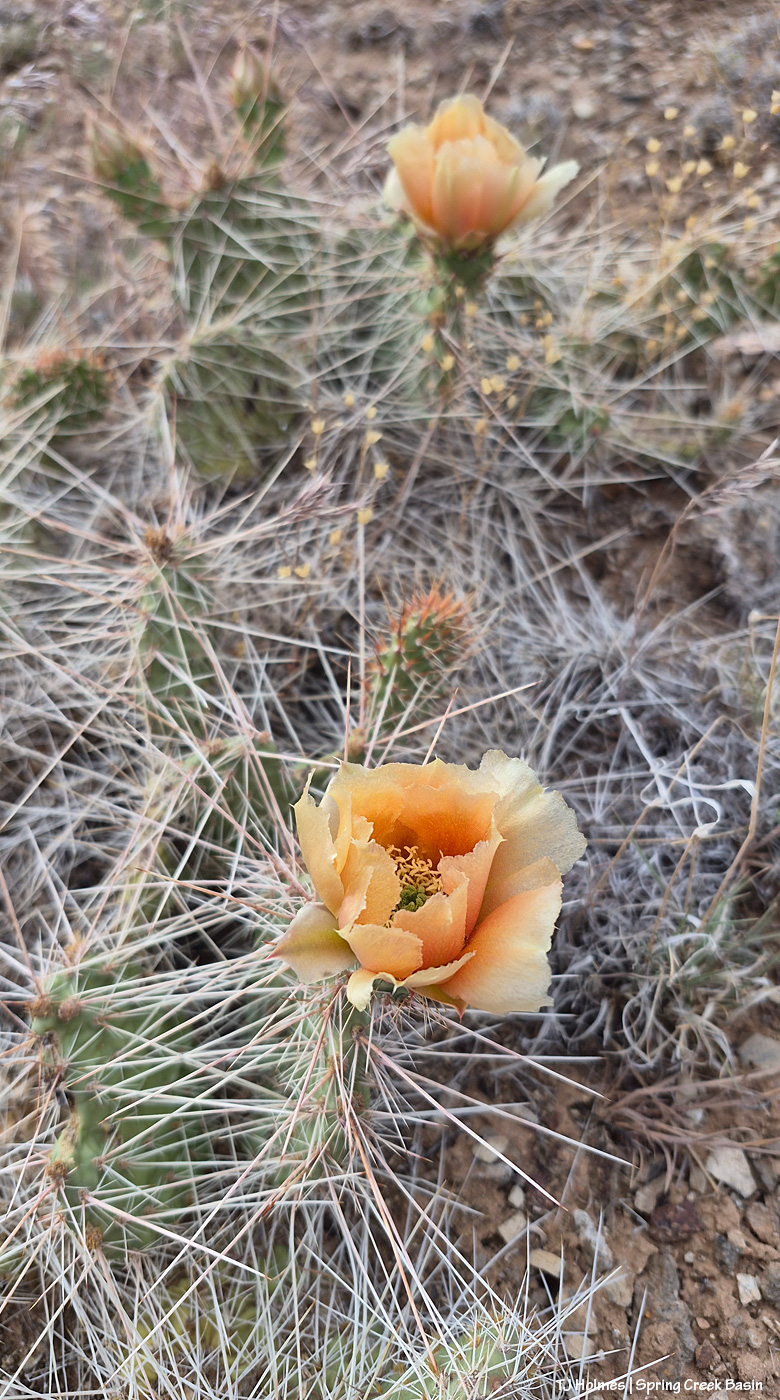
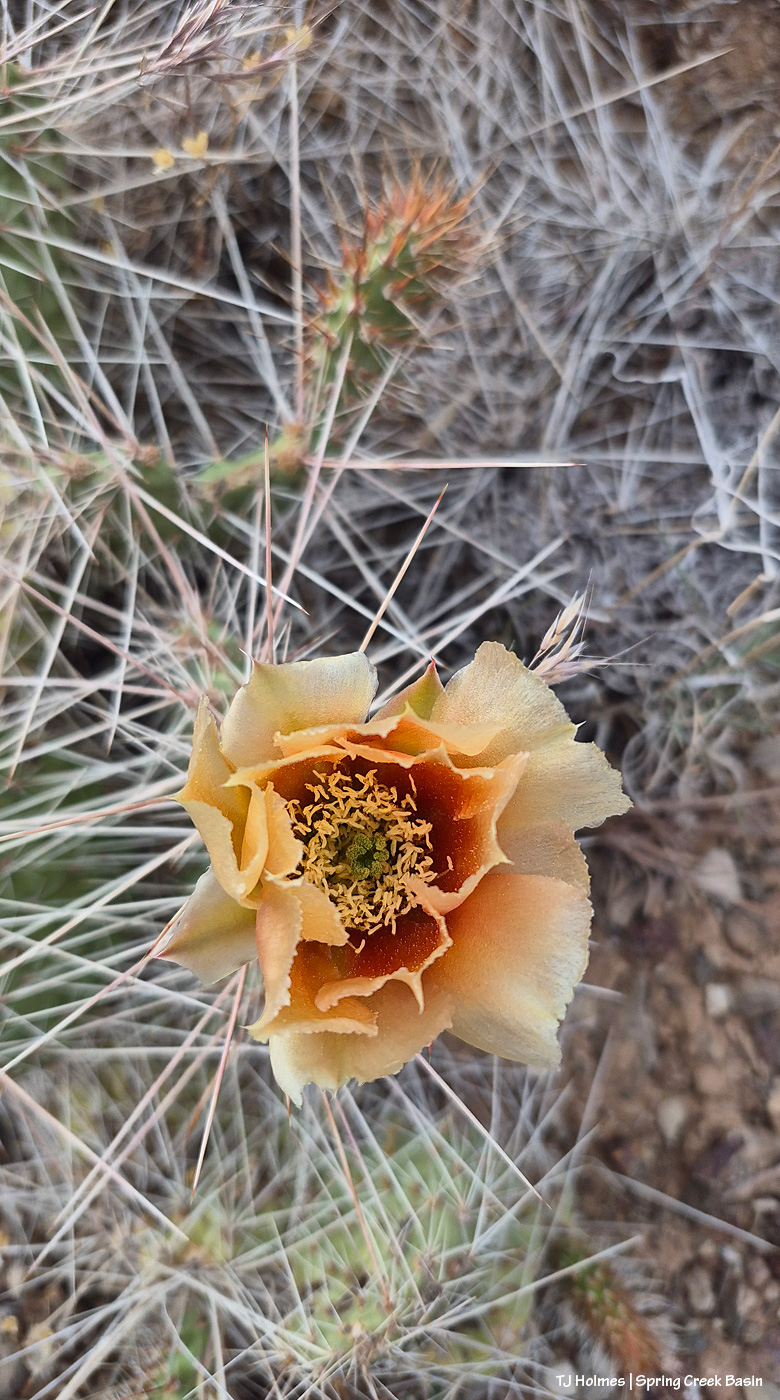
Most of the prickly pear cacti in Spring Creek Basin feature those peachy blooms or pretty yellow flowers, but now and then, there’s a pretty pink-flowering cluster.
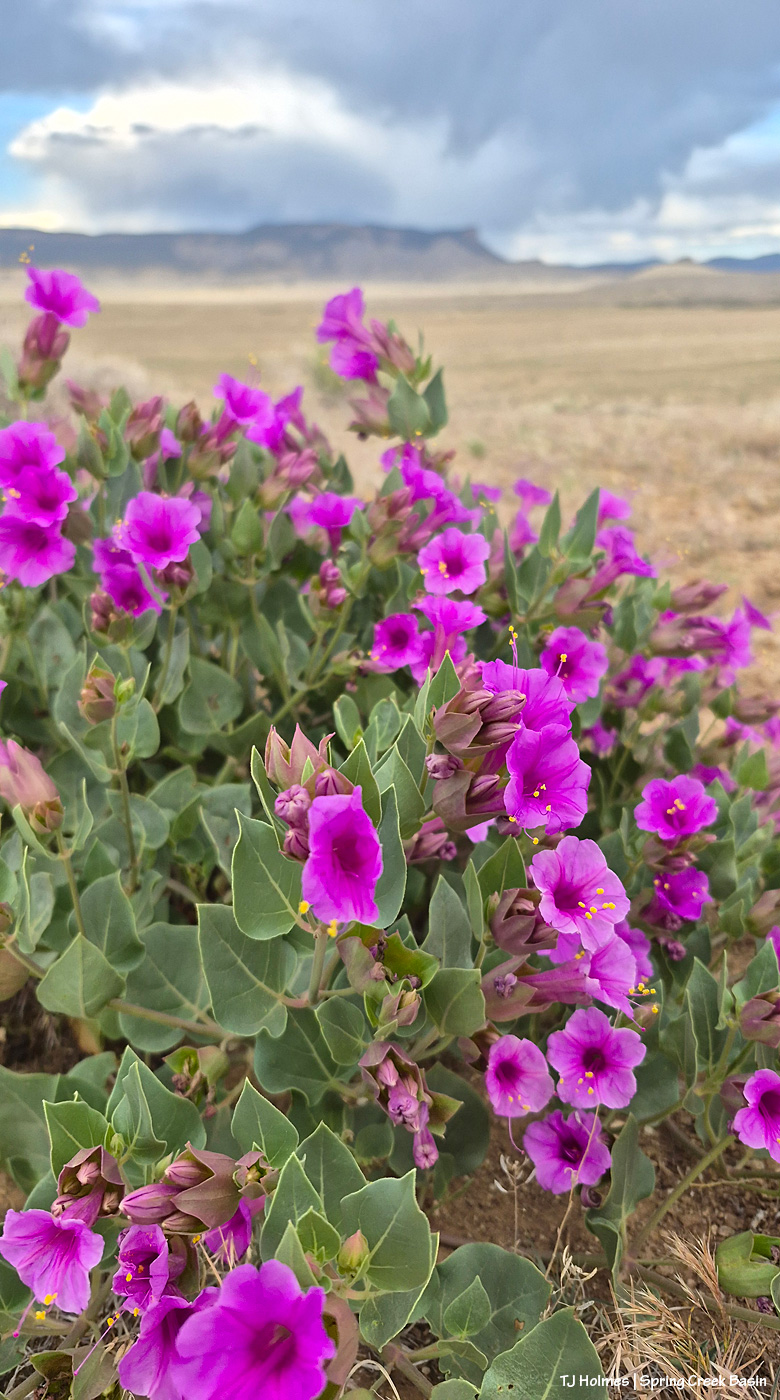
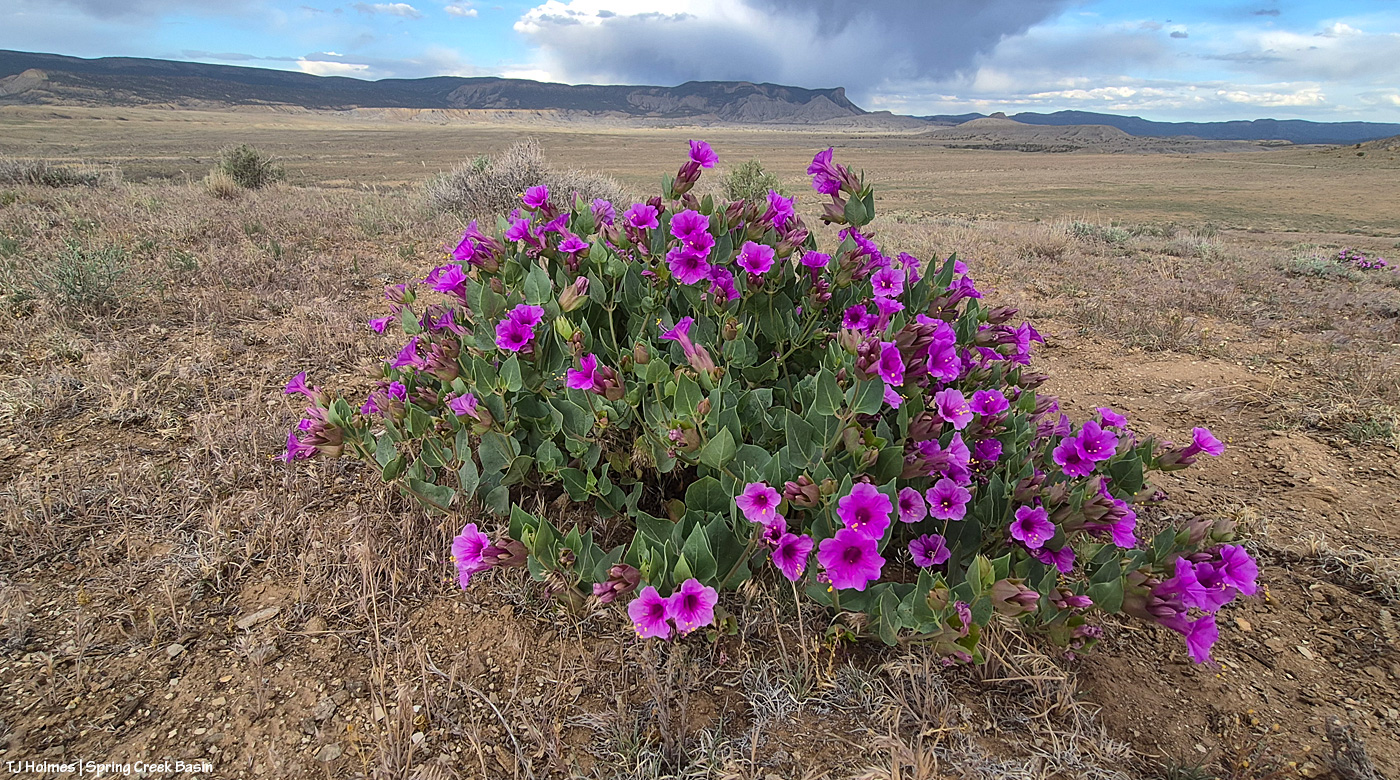
The four o’clock flowers are blooming now in Spring Creek Basin’s Chrome’s Point area (western area), and the prickly pear cacti have started opening their flowers. It’s a nice and welcome bit of color in the desert while we wait for monsoons to bring the land to life.
Promising clouds … but they didn’t drop rain on the basin.
The whole big plant, and this *is* a big one.
Very spiky prickly pear (I don’t know the actual kind) with the most delicate, peachy blossoms.
Lots of goodness in there for the bees and other buzzers!
What follows is a random selection of cellphone pix from a couple of evenings ago in wild, woolly and very windy Spring Creek Basin.
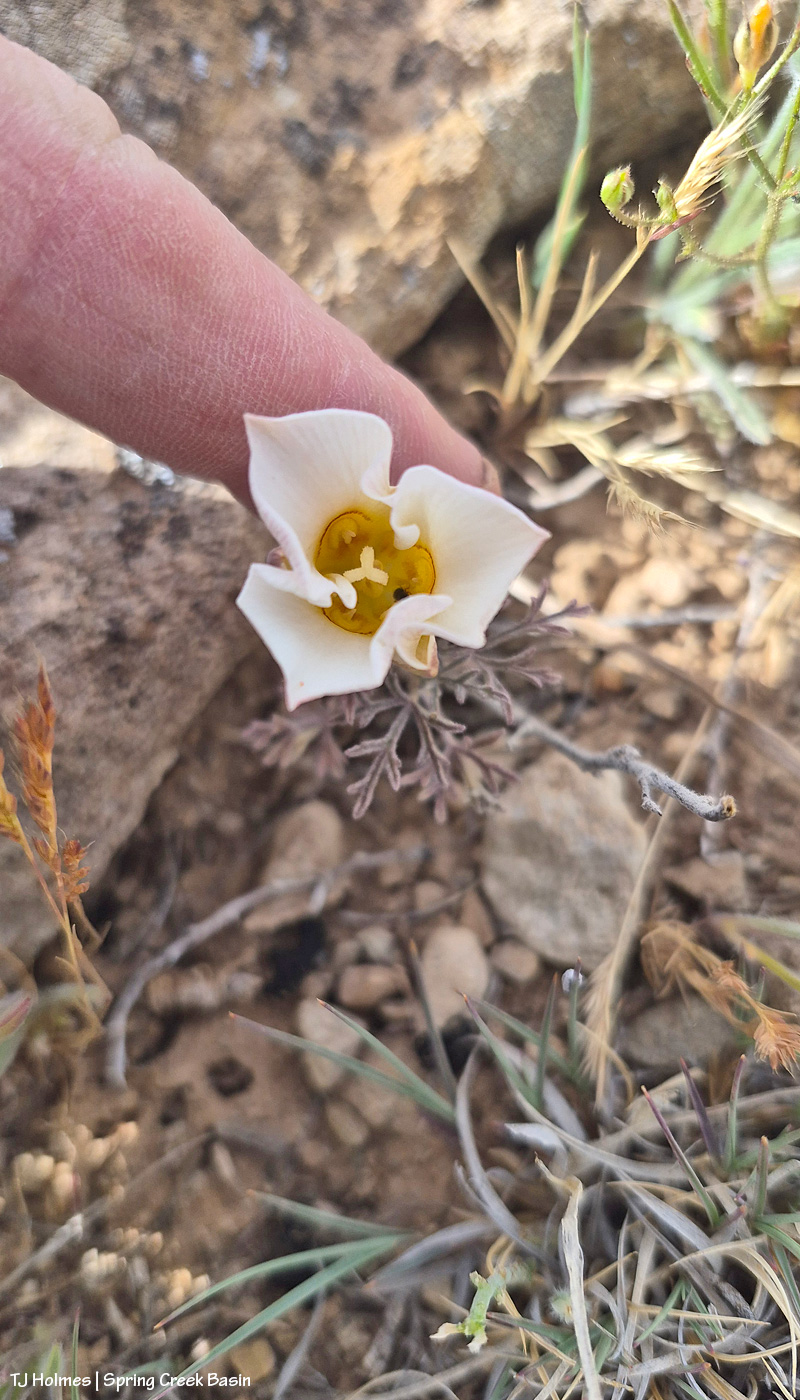
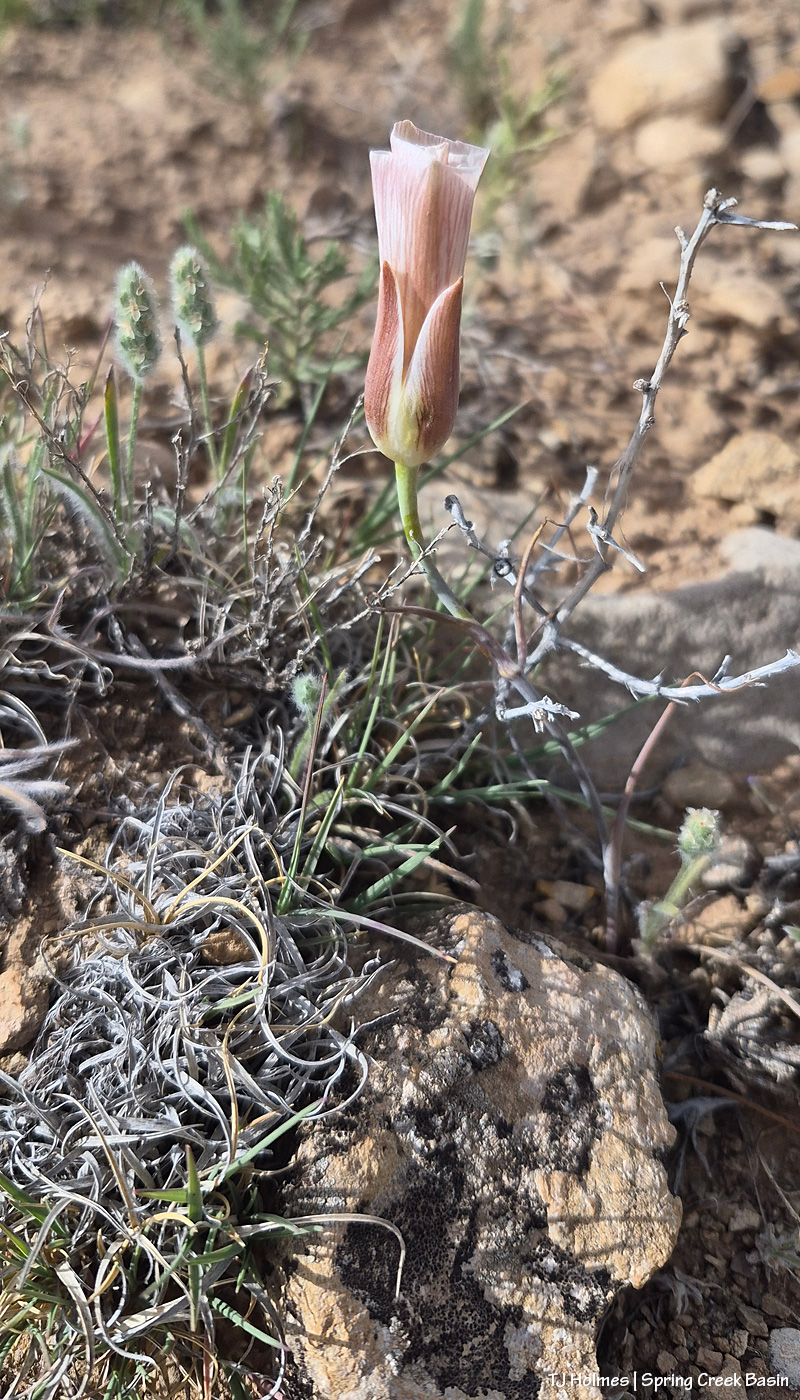
First sego lily of the season! That I’ve seen, anyway. It was SO windy, the flower was whipping around like crazy, so I tried to hold it still for my phone. It’s always a bit of a crap shoot to try to take pix of small things with my phone because I can’t see at all whether the *thing* is in focus or whether it’s the background.
Case in point: I took several pix of this beauty, within a couple of feet of the first one, and only the last one was in focus (that could have been the wind). I adore these lilies – in the desert! These seemed smaller than usual, but I’m glad to see them.
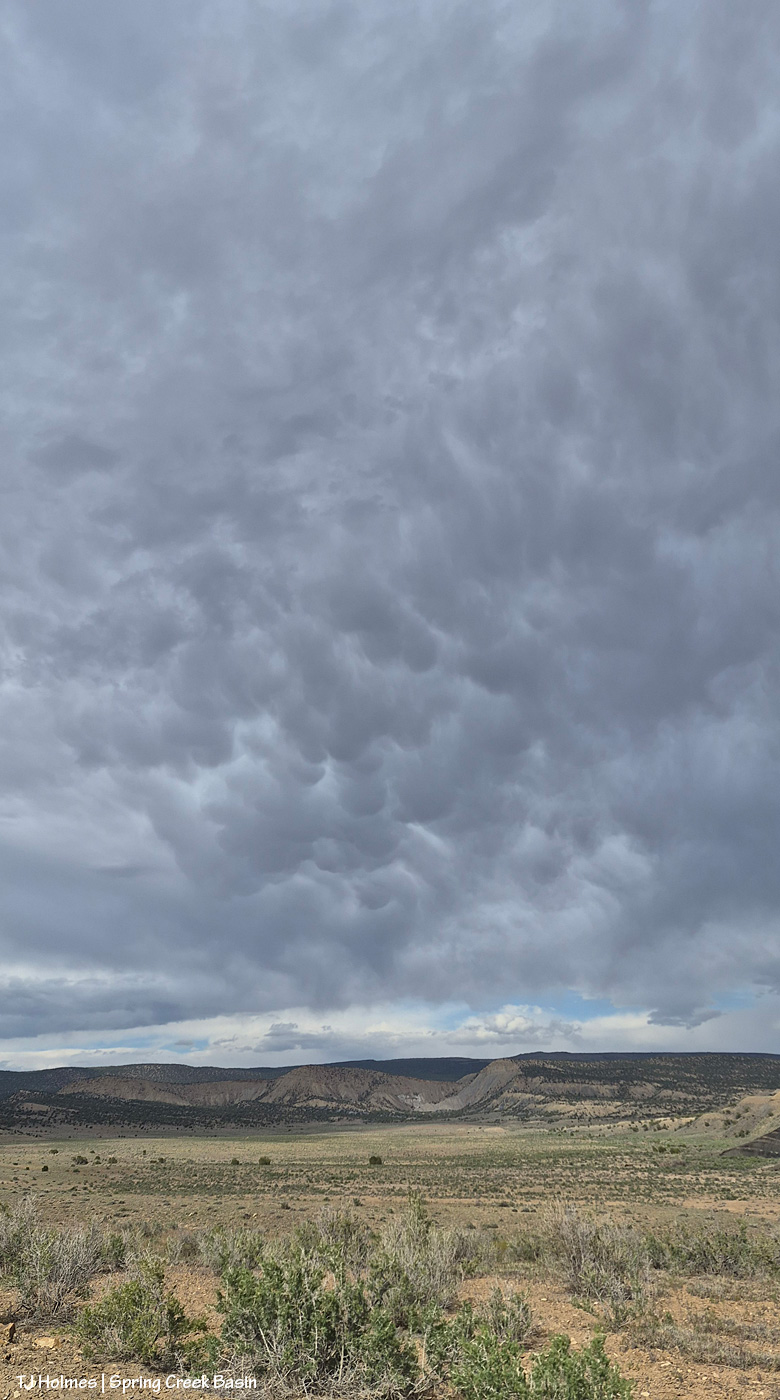
While the pix of the sego lilies seem to suggest that it was sunny, mostly we had these crazy, wildly dramatic clouds looming over the basin. These are mammatus clouds. Looking eastish-northeastish.
Google AI says:
Mammatus clouds are distinct, pouch-like cloud protrusions that hang downward from the base of a larger cloud, usually a towering cumulonimbus. Named after the Latin word for “udder” or “breast”, these stunning formations are fascinating for their unique shape and the rare meteorological process that creates them.
How They Form
Unlike most clouds, which are created by rising air (updrafts), mammatus clouds are formed by sinking air (downdrafts). [1]
The Process: Pockets of cold, dense air saturated with heavy ice crystals and precipitation sink downward from the parent cloud (usually the “anvil” of a thunderstorm).
The Shape: As these dense, cool pockets of air descend into warmer, drier air beneath the cloud, the ice and water begin to evaporate. This evaporation cools the air even more, causing the pockets to sink further, creating the characteristic rounded, bubble-like pouches. [1, 2, 3]
What They Indicate
While their ominous, alien-like appearance might make them look like the beginning of a severe storm or tornado, mammatus clouds are generally a sign that the worst part of the storm has already passed or is off in the distance.
Severe Weather Link: They are most commonly spotted in the vicinity of strong thunderstorms. If you spot them during the summer months, it usually means there are powerful storm cells nearby.
Safe or Not: Mammatus clouds themselves do not produce severe weather and are not dangerous to anyone on the ground. However, pilots are warned to avoid them because the sinking air can cause intense turbulence.
Key Characteristics
Composition: Because they hang high in the atmosphere, they are primarily composed of ice crystals rather than liquid water droplets.
Lifespan: They are relatively short-lived, typically appearing and dissipating within 10 to 30 minutes.
The Best Time to See Them: They are particularly striking at sunset or sunrise, when the low angle of the sun illuminates the underside of the pouches, turning them brilliant shades of gold, orange, pink, or deep blue.
In our case, they appeared around three hours before sunset, so we didn’t get the color, but they’re still pretty amazing to see, even if they also did NOT bring us any rain.
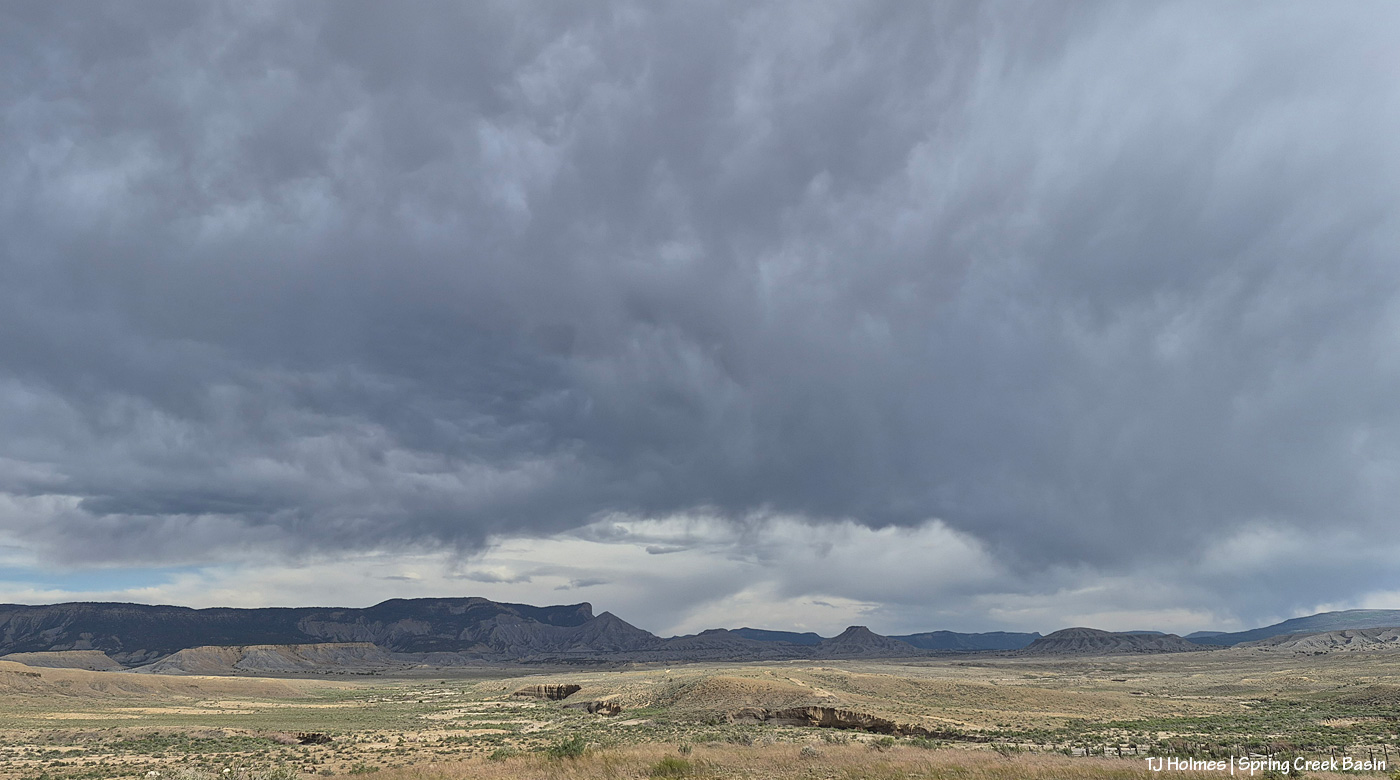
This was taken at about the same time, now looking eastish to southeastish. And quite a bit later, it looked REALLY rainy out beyond our local horizon. So hopefully somebody somewhere got some wet stuff.
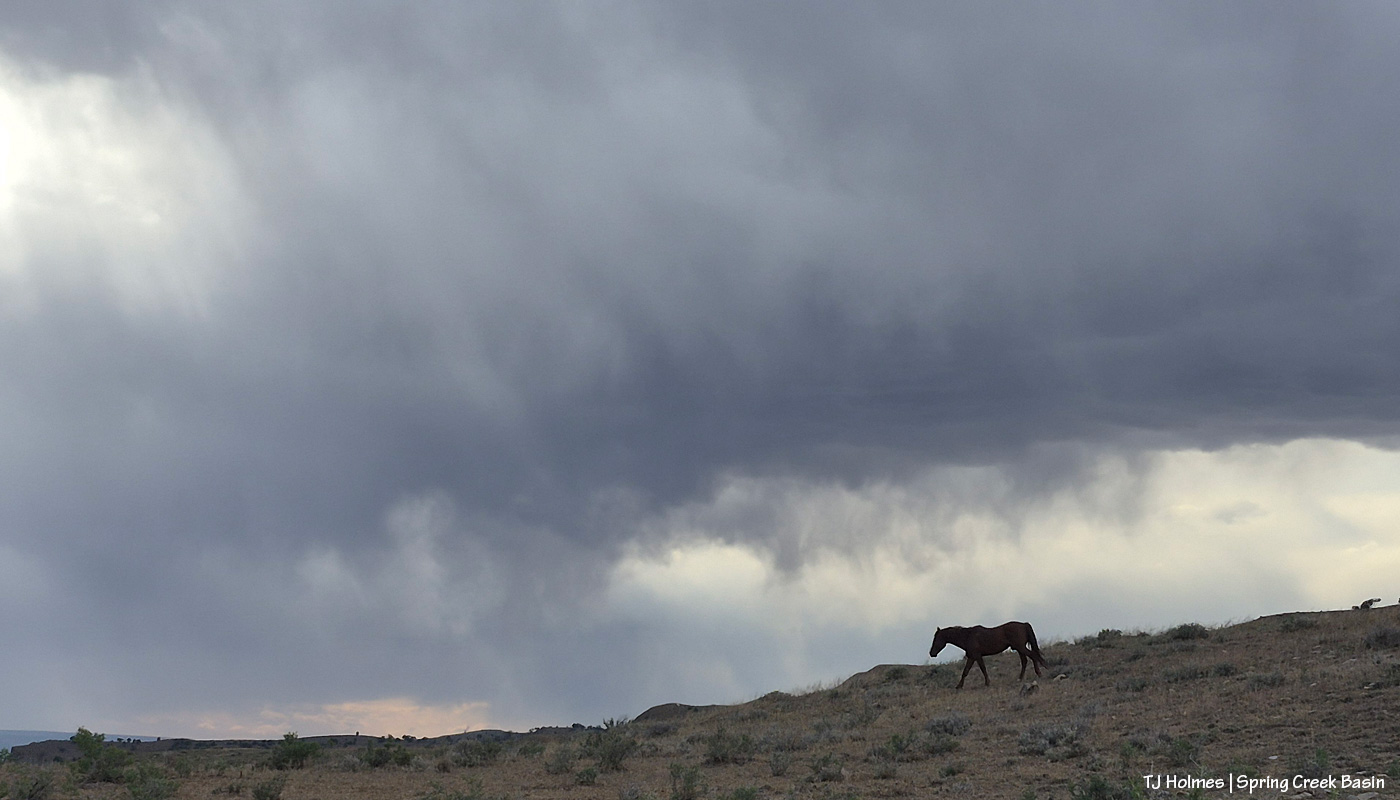
Have to have a pony walking the skyline. 🙂 He was heading to the Spring Creek arroyo (down to the left), and pretty soon, his band followed. Looked like it was raining somewhere out in that direction, too (westish-southwestish).
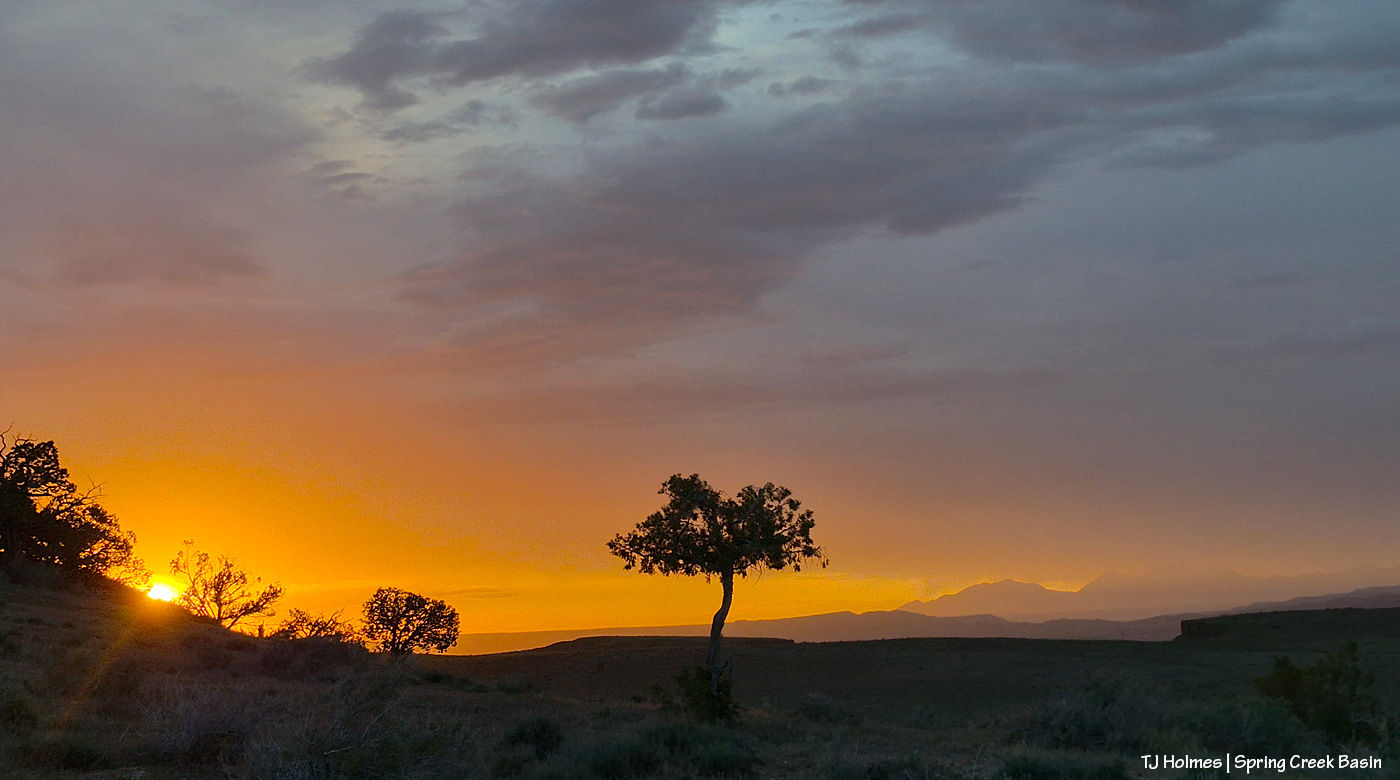
And at the very end of the day (an hour or more later than the last pic), a pretty glorious and somewhat unexpected (and *very* brief) shot of sunset brilliance from the west end of the basin looking westish-northwestish. There were horses immediately behind me, but they were already in the shade of the hill, and that side was already fairly darkrainydusty (? did I mention the howling wind?).
Even under the “worst” conditions, there’s always such beauty. 🙂
Tuesday was a wild and crazy day … and that was just the weather. It was ultimately a successful day, though at least one part left me shaking my head at, well, how life unfolds. And it was a reminder that sometimes the smallest things, and the simplest things, are the most enjoyable of all.
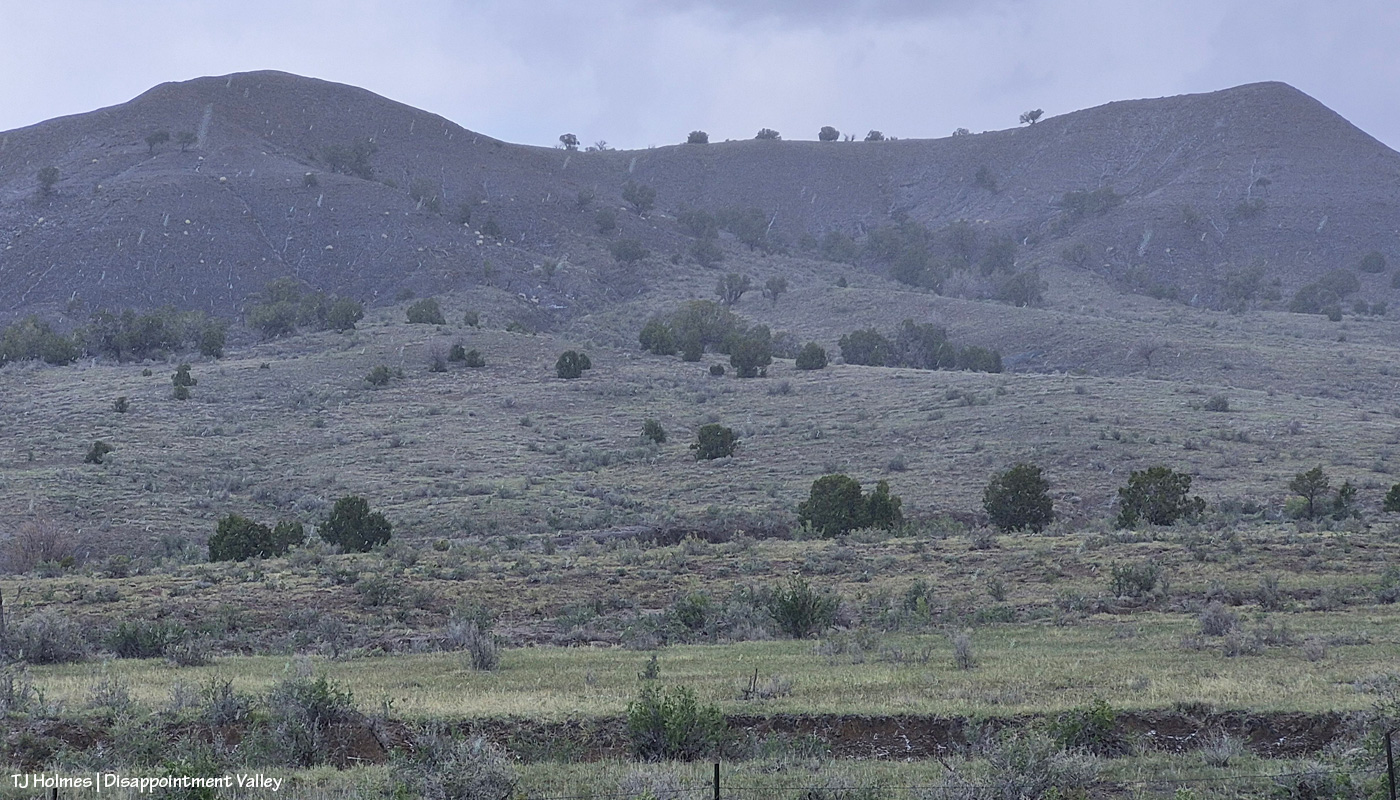
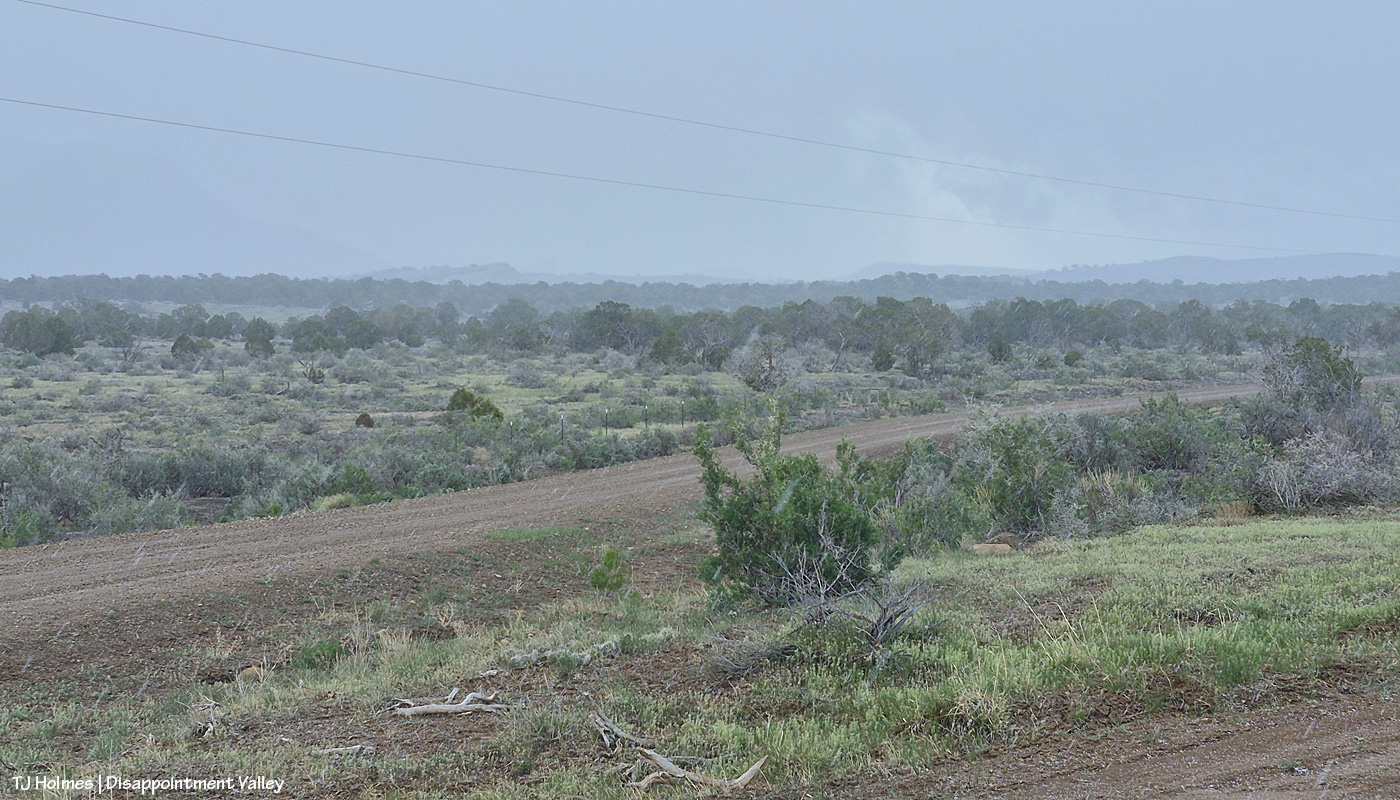
From yesterday’s post, are you wondering what graupel looks like? (Thanks, Valerie, for your comment that led to this post!)
What? I hear you asking. That looks like snow or rain, you’re saying (zoom in to see the streaks). Look on the ground in the lower right corner. I was backed in under a (dead) tree to sit out one wave of it (it wasn’t very hard, and it didn’t last long) at that little side “road” to Disappointment Road, which is across the whole pic. See the little white “balls”?
AI says this: “Graupel, or soft hail, forms when supercooled water droplets freeze onto falling snowflakes, creating soft, small white pellets (2-5 mm) that resemble Dippin’ Dots or Styrofoam. These fragile, slushy particles are often called snow pellets and, unlike hard hail, crumble easily. They occur during wintry mix scenarios, causing sudden, slick conditions, and are identified in aviation reports as ‘GS’.”
I liked this part: Types of Graupel While commonly called graupel, it is sometimes referred to as:
Matsaaruti: A term used in the Nunavik region of Canada to describe wet, soft snow pellets.
Another pic from the same location as the first pic, looking pretty much straight north at what I call west-of-favorite hill (because it’s, you know, west of what I call favorite hill, which I so-named because once upon a very long time ago, “the pintos” really favored that hill and could very often be found atop it).
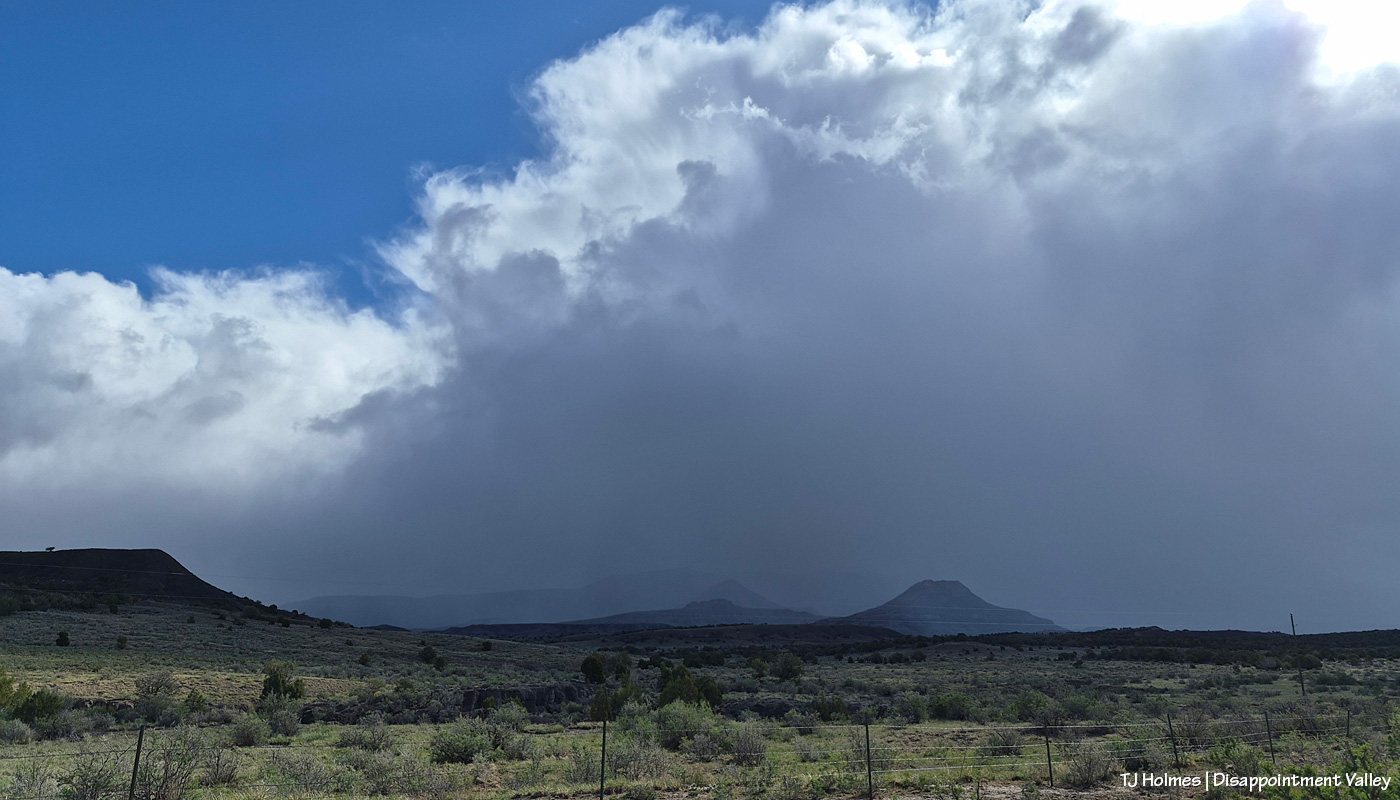
Also from the same spot, looking eastish again as the graupel wave recedes, driven by a strong out-of-the-south wind (I lost track, but at least three, maybe four went over us Tuesday morning). You can see Brumley Point very distinctly, submarine ridge and McKenna Peak to the left it it, and you can’t quite make out Temple Butte. If you slide back up to the first pic, Temple Butte is juuuuuust barely visible at far left, just under the power lines. And yes, the sunshine IS coming back out over the rest of us while the wave pushes north to the east.
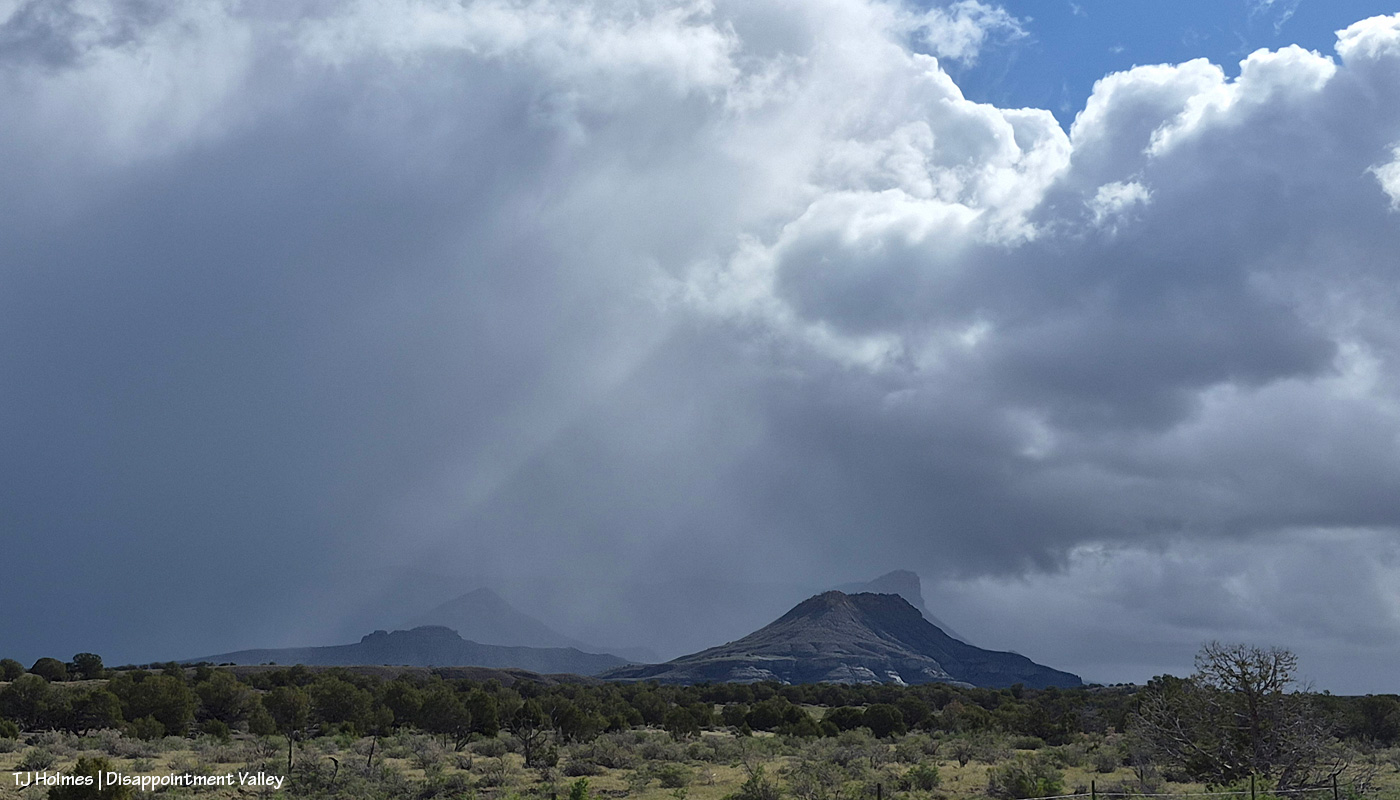
With Artemis II and its remarkable human beings on board, their mission, their accomplishments, the images they sent back, from space looking home, in mind … and realizing the absolute tiny-ness of this one itty-bitty part of our great, wide, wild, wonderful, big blue marble … ain’t Earth gorgeous? Now you can see Temple Butte’s promontory emerging from behind Brumley Point (see the graupel/moisture evidence shining below its rimrocks?) and submarine ridge and McKenna Peak. And though you can’t see them in this pic, there were two groups of mustangs out there. Across the road and on the other side of that fence IS Spring Creek Basin.
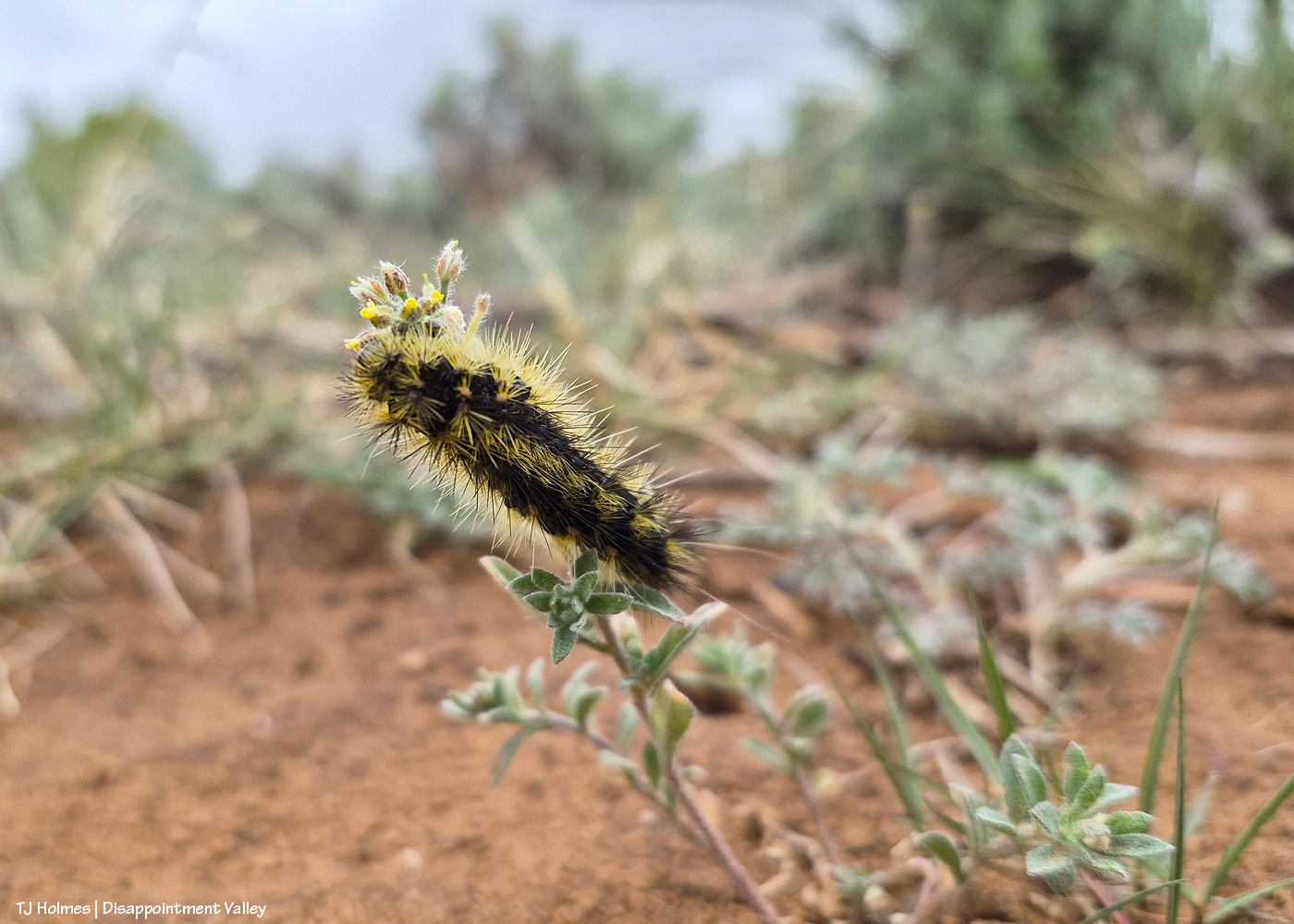
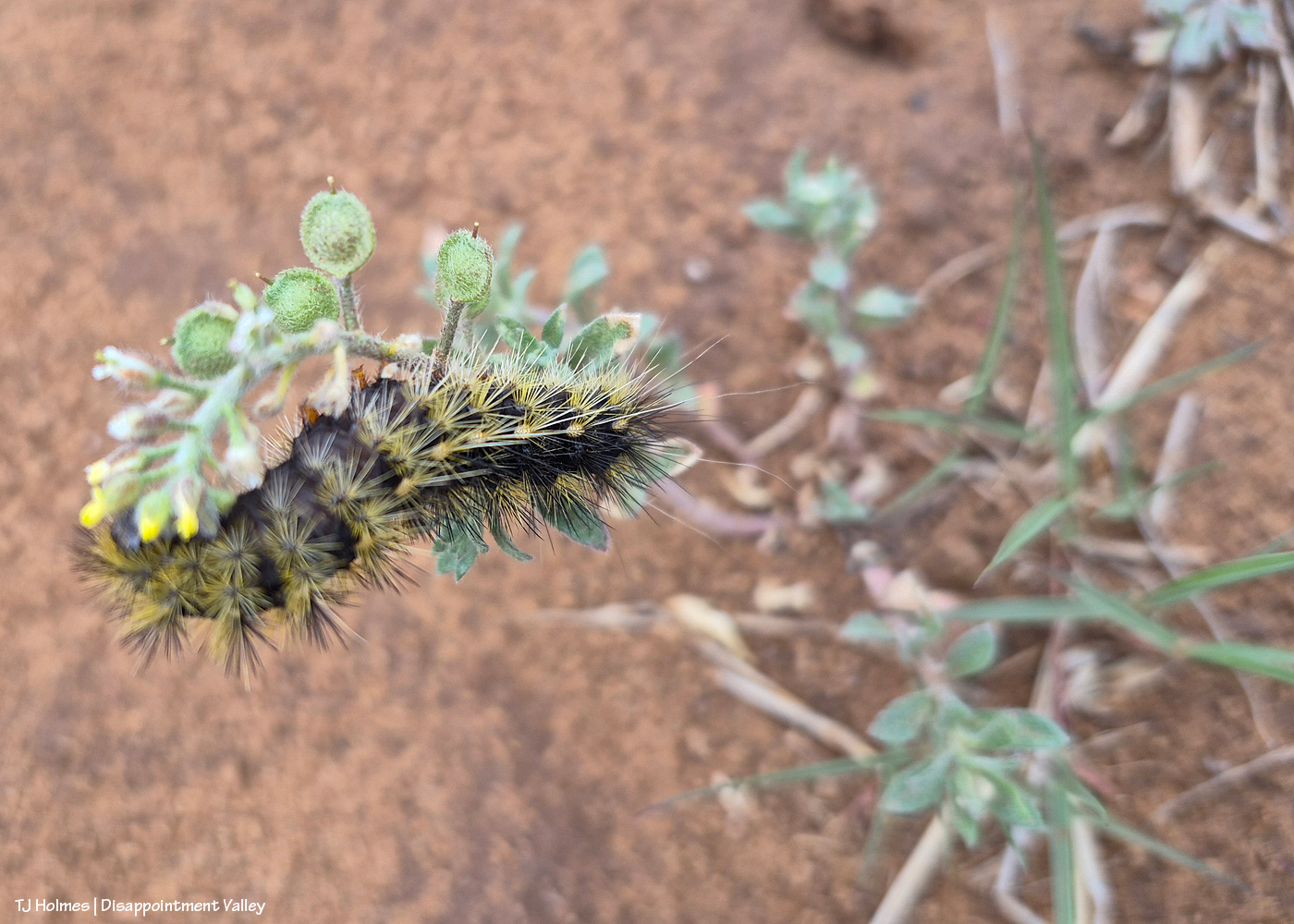
Anybody know what this prickly little caterpillar is called? I’m not sure of the plant it’s on, either.
I tried a lot, but I could NOT get the eye end (far left – is that an eye?) in focus. Of course, I didn’t know that in the field, not having my eyeball glasses on and looking through the glare of my phone screen, but I did try a number of shots with high hopes. One of our BLM range guys recently posted a pic of the same caterpillar, but he’s a plant guy (and an extraordinarily awesome one), not a bug guy, so I’m sure he can tell me the plant, if not the bug (!). If I reach him for an ID before this posts (or even after), I’ll update.
** Update from Ryan, BLM rangeland management specialist and all-around plant guy!:
“Cool that you’re seeing the same caterpillar! [He saw the same kind recently in Canyons of the Ancients National Monument, southwest of Spring Creek Basin.] I’m very curious as to what species of butterfly/moth they will turn into, I’m not good at insect ID but will ask Nate West [BLM wildlife biologist]. The plant that those are on is a mustard species called Alyssum simplex, commonly just called madwort. It’s a pretty prevalent non-native annual that is really common around here, unfortunately. It’s a beautiful picture of the hair-structure on the caterpillar!” Thanks, Ryan!
The reason you can’t see Utah’s La Sal Mountains in this pic – way northwest of Spring Creek Basin, from the very far southeastern part of Spring Creek Basin – is because the rain/graupel/snow wasn’t through sending waves over them. 🙂 You CAN see, from right to left, Round Top, Flat Top (looks sloping), Filly Peak and the south-facing rimrocks. Disappointment Road is over to the left somewhere (not far)
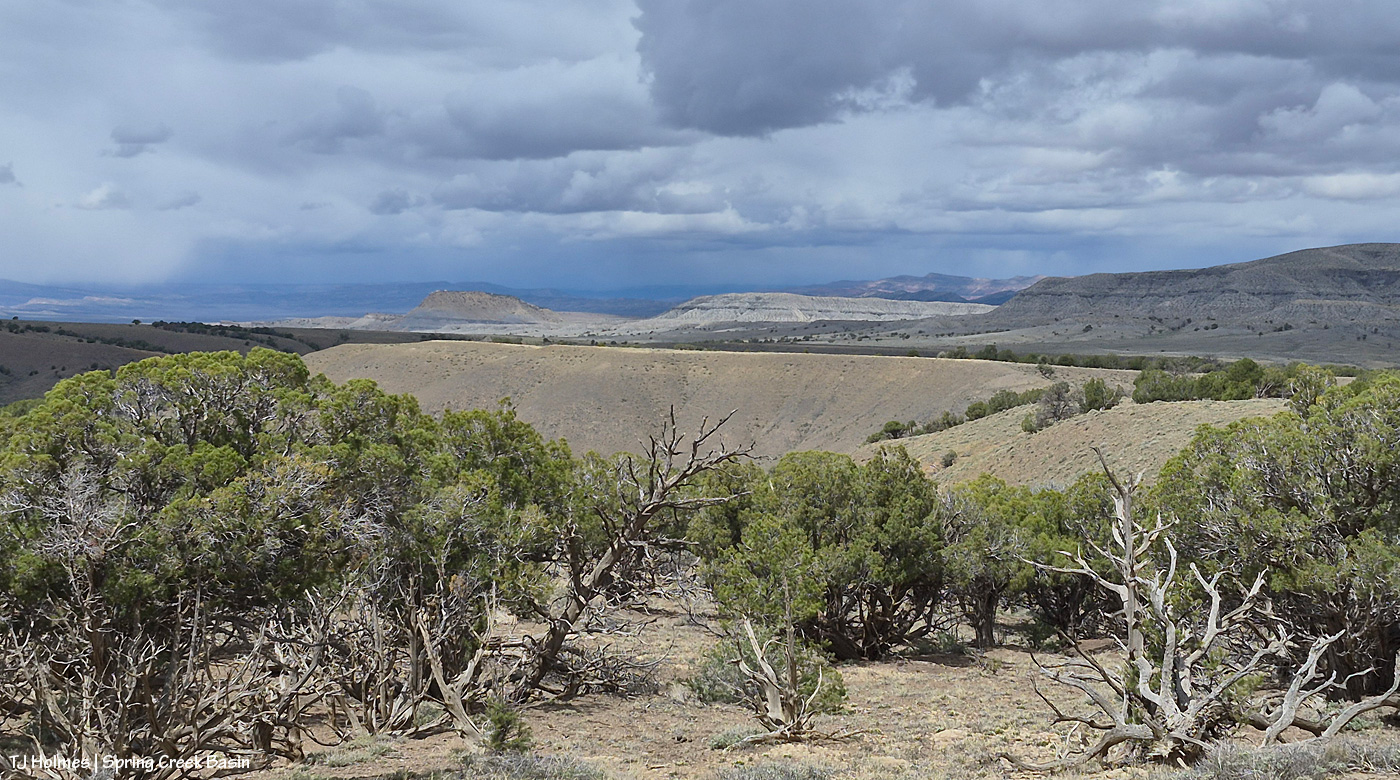
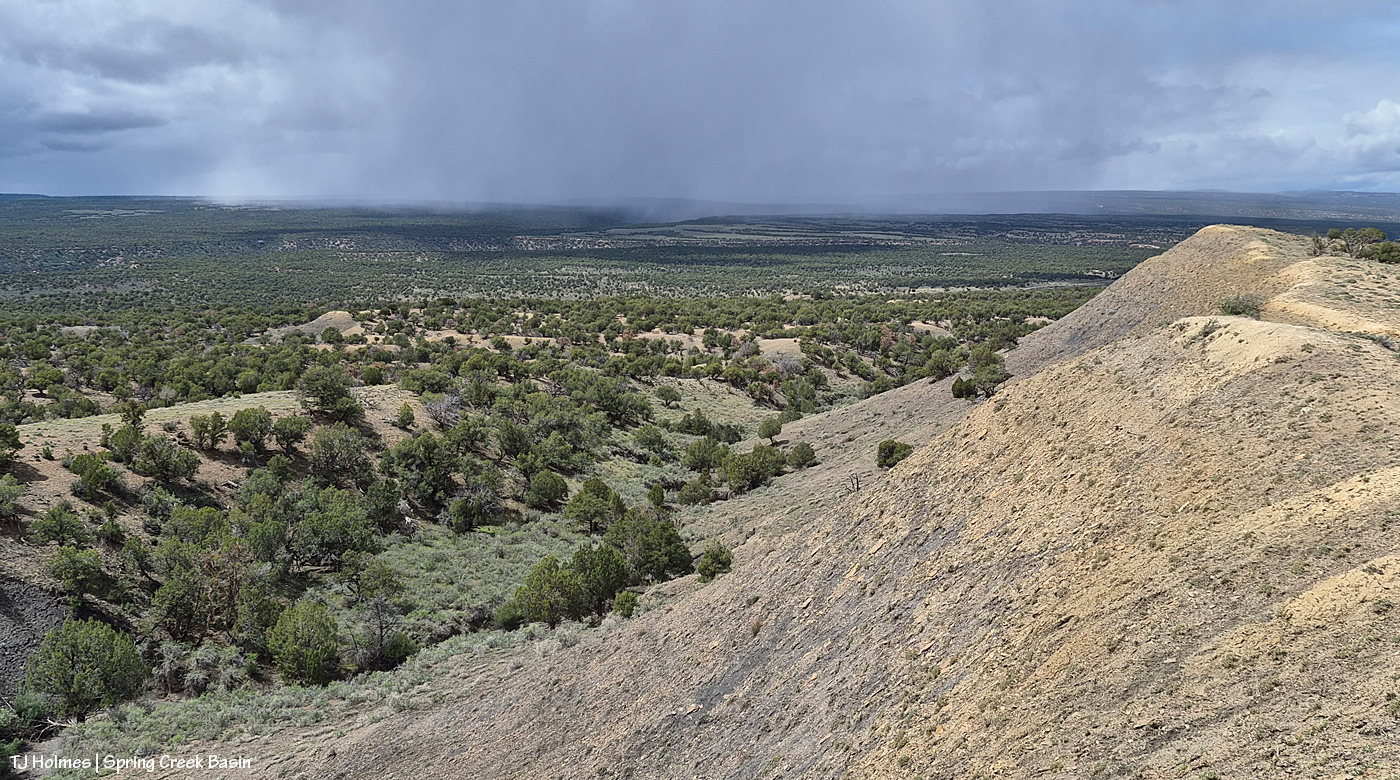
From here, we’re looking over not much of the southern part of Spring Creek Basin Herd Management Area (the pic above this one has a perspective to the right of this one) but a lot of the south/southwestern part of Disappointment Valley (most but not all of the pinon-juniper woodlands as far as the eye can see). The near pinon-juniper is within Spring Creek Basin.
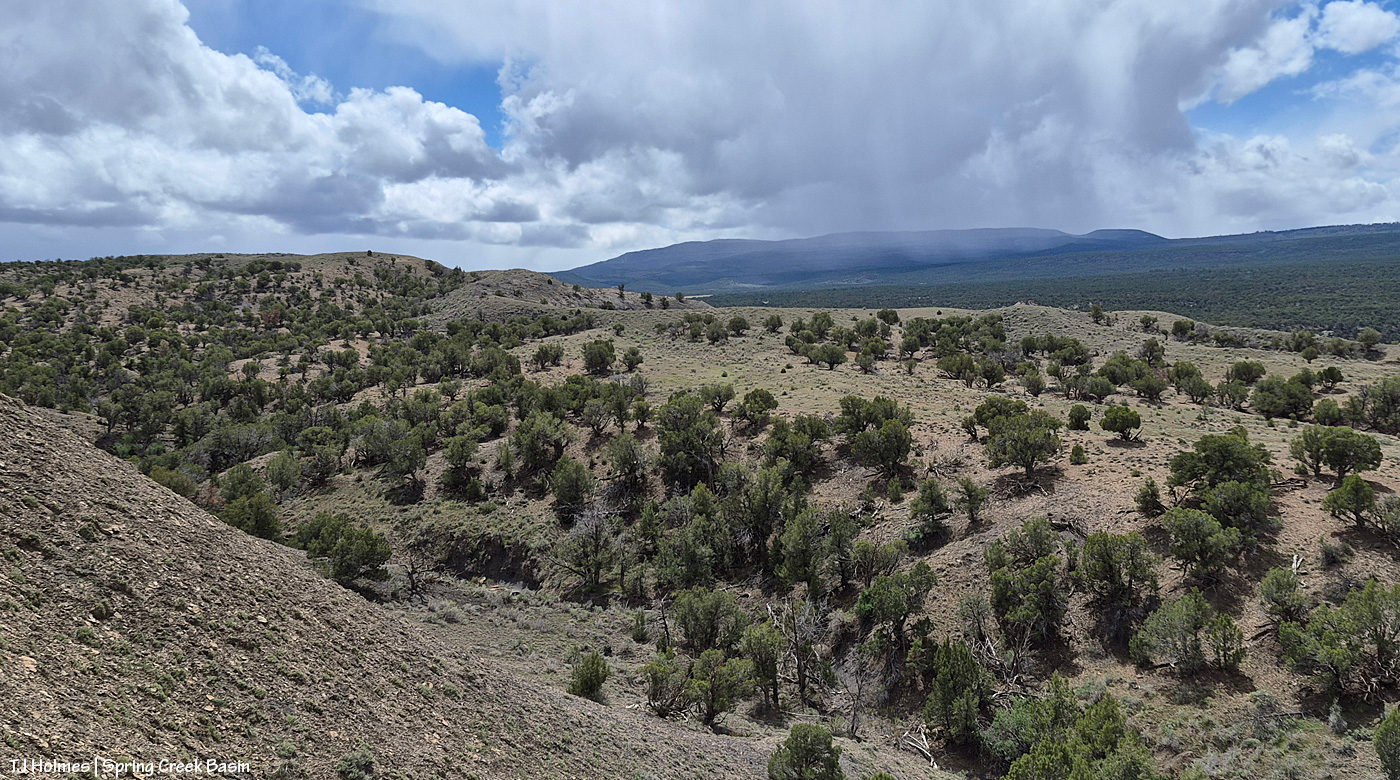
From the same spot now looking back to the south/southeast at another little rain/snow/graupel-fall, toward the Glade and Benchmark Lookout (hi, Rick and Linda! (I think they’re not at the fire lookout tower quite yet)). The near hills and pinon-juniper are all within Spring Creek Basin. The far, thickly treed ridges are partly (middle-ish ground) part of upper Disappointment Valley and partly (farther) part of San Juan National Forest lands beyond Disappointment Valley and its watershed.
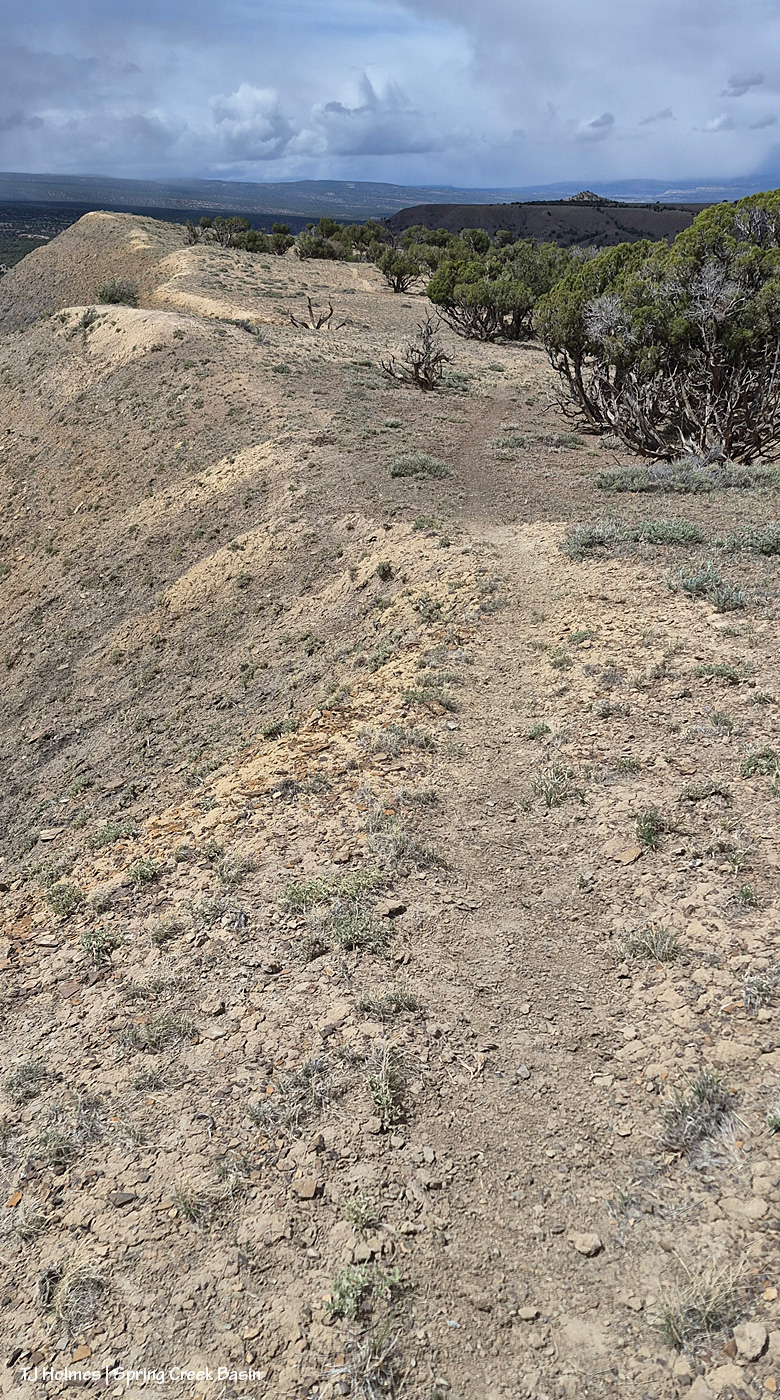
And what the heck was I doing at the high end of a long drop? See the horse trail? 🙂 I was following where the sure-footed have gone before me (and not for the first time).
The above are in order of how I took them … hours apart from first to last.
And because you came here for the mustangs …
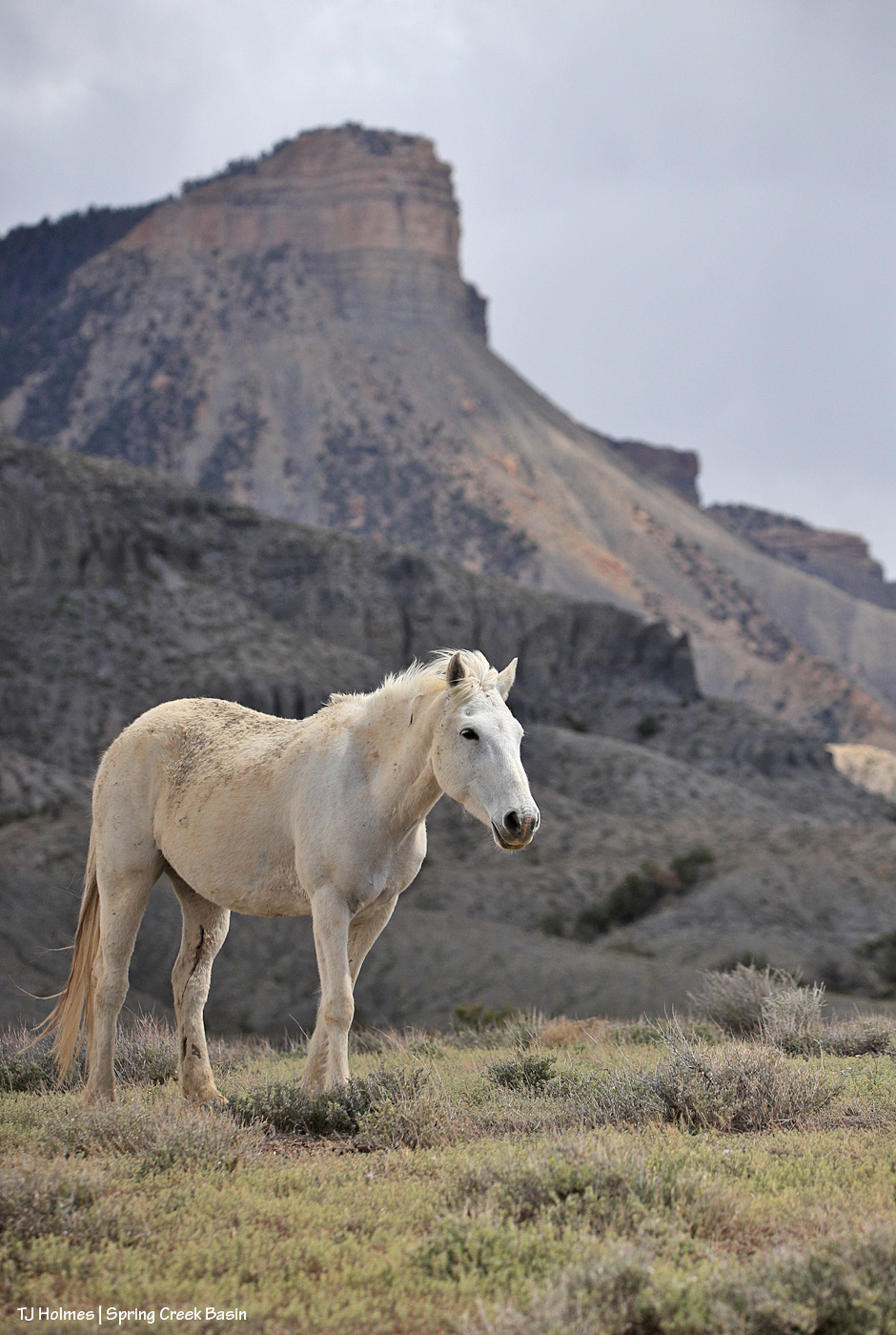
Mysterium, modeling her scruffy-chic look (fashion designers, take note – ha!) below Temple Butte. 🙂 Yes, those are a couple of cuts on the inside of her left hind leg, but she’ll heal quickly, as mustangs do!
Thanks, as always, for coming along for glimpses of this special world. 🙂
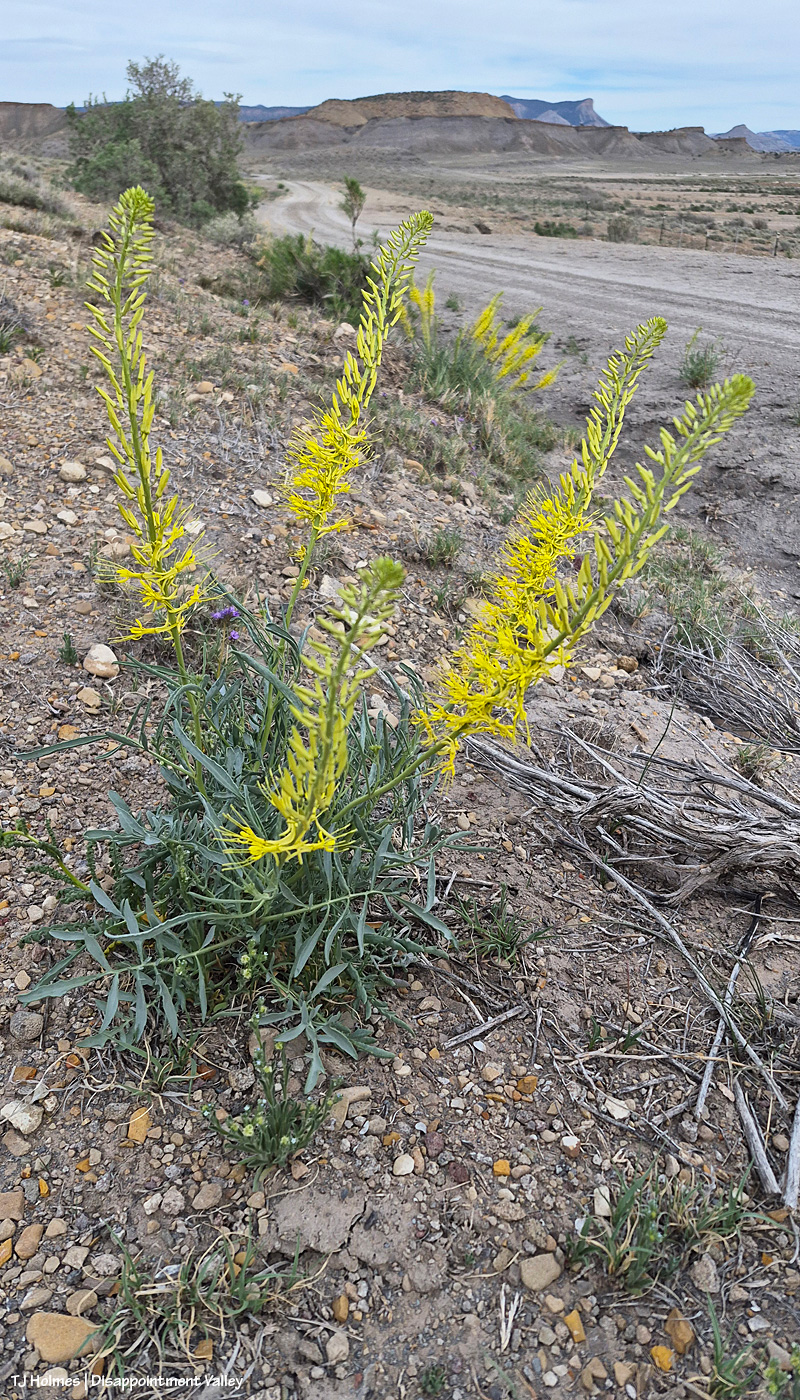
Heading TO Spring Creek Basin, I found the prince’s plume plants in full, crazy bloom. Why is this crazy, I hear you asking? Because they don’t usually bloom until May. IN Spring Creek Basin, the prince’s plumes I saw were a little behind these along Road K20E toward the basin, which makes sense as the basin is a bit higher elevation than along this road.
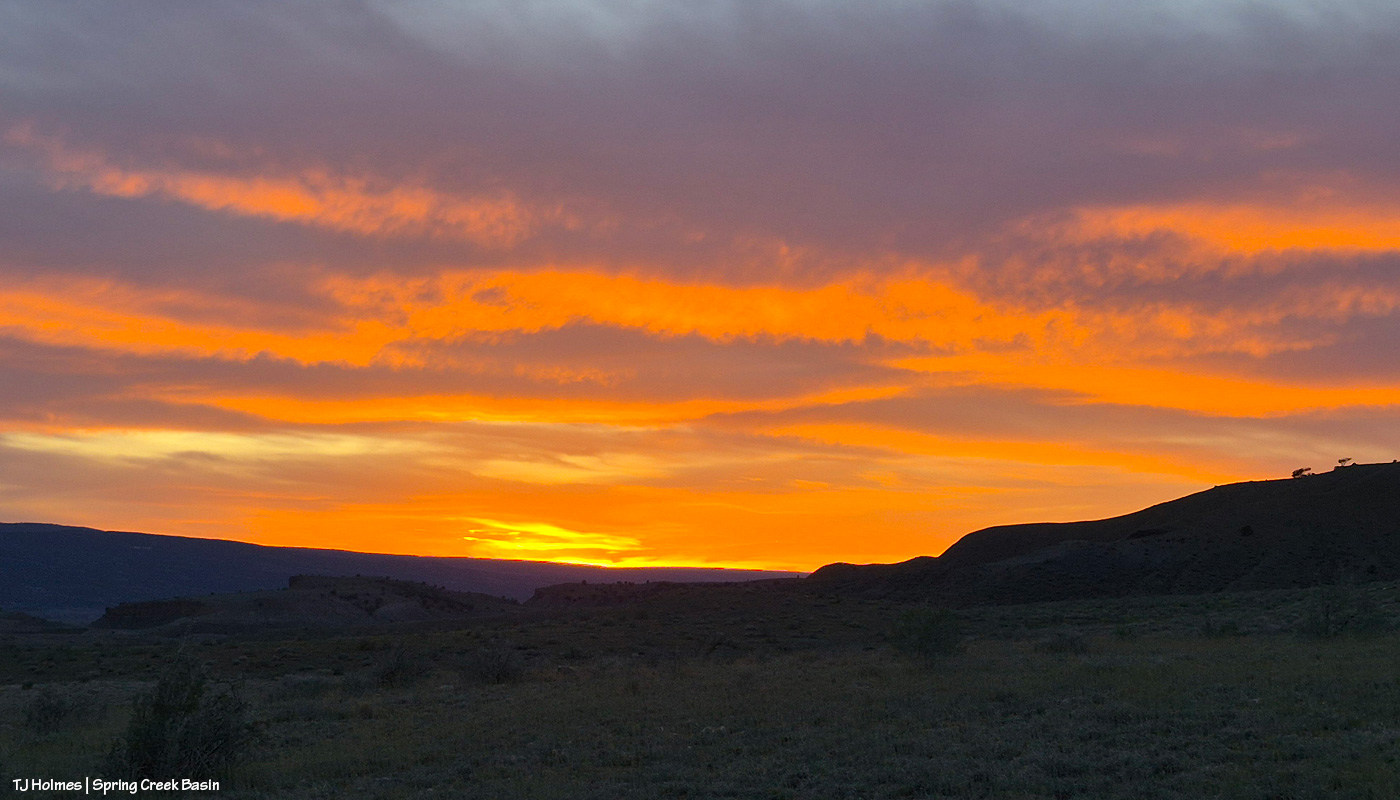
Heading OUT of Spring Creek Basin, the grey sky exploded with color at and post-sunset! Wowza. The weather wizards are giving us a whopping NINETY PERCENT chance of rain Wednesday. Do you know what Wednesday is? Wednesday is April 1, otherwise known as April Fools’ Day. Call me a fool a million times over, and please, please, PLEASE, let it RAINRAINRAIN!!!
If I’d been on the ball realizing the date and the holiday-tomorrow – when it was yesterday – I’d have stopped to take some pix of the budding greasewood. But I never know what day it is, let alone what holiday is near and/or almost upon us, so instead, for some St. Patrick’s Day greenery, enjoy these early(!)-blooming wildflowers that I took pix of late last week:
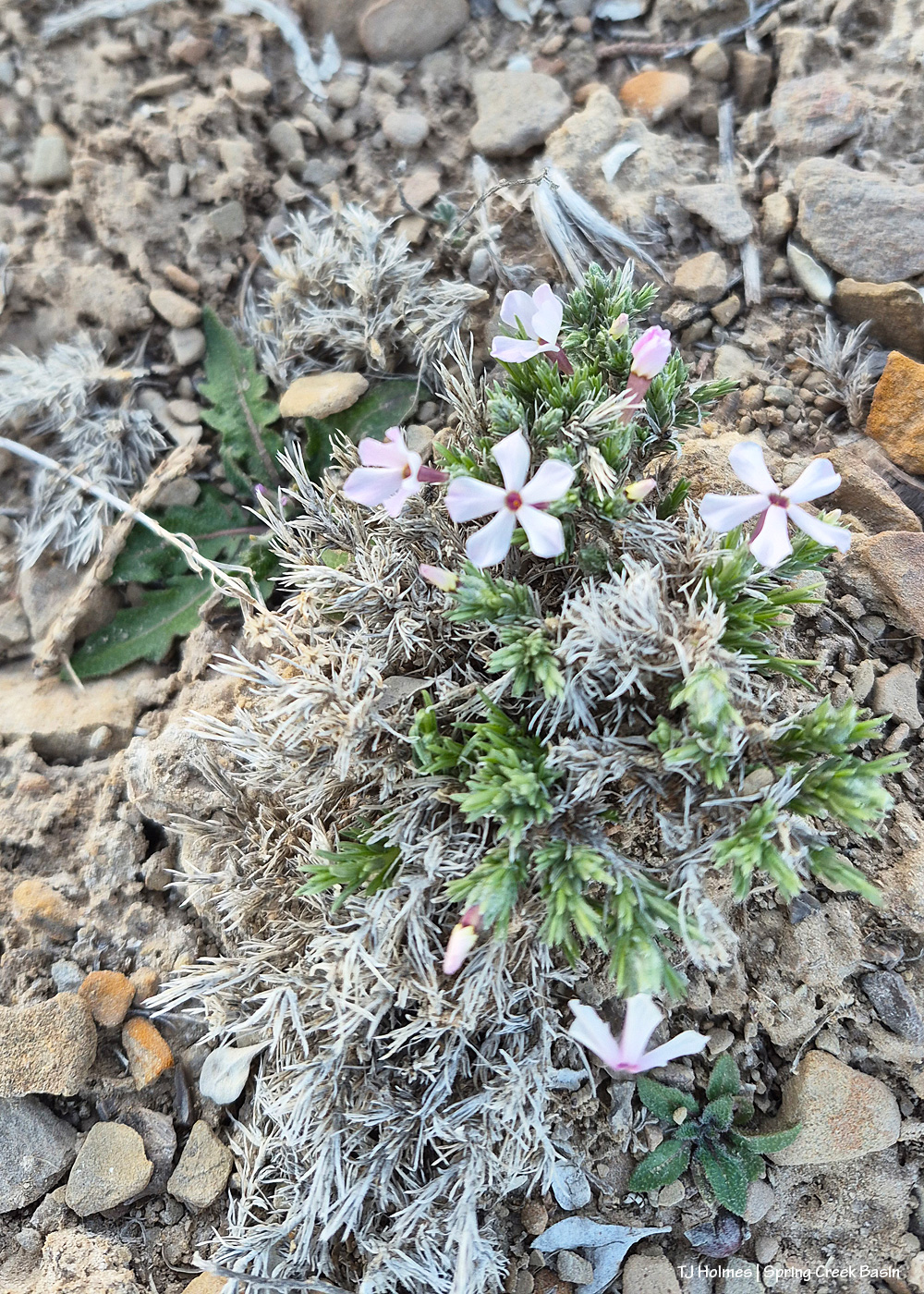
This is phlox (don’t ask me the specific kind or the scientific name). It’s almost always the very first little wildflower we see every year.
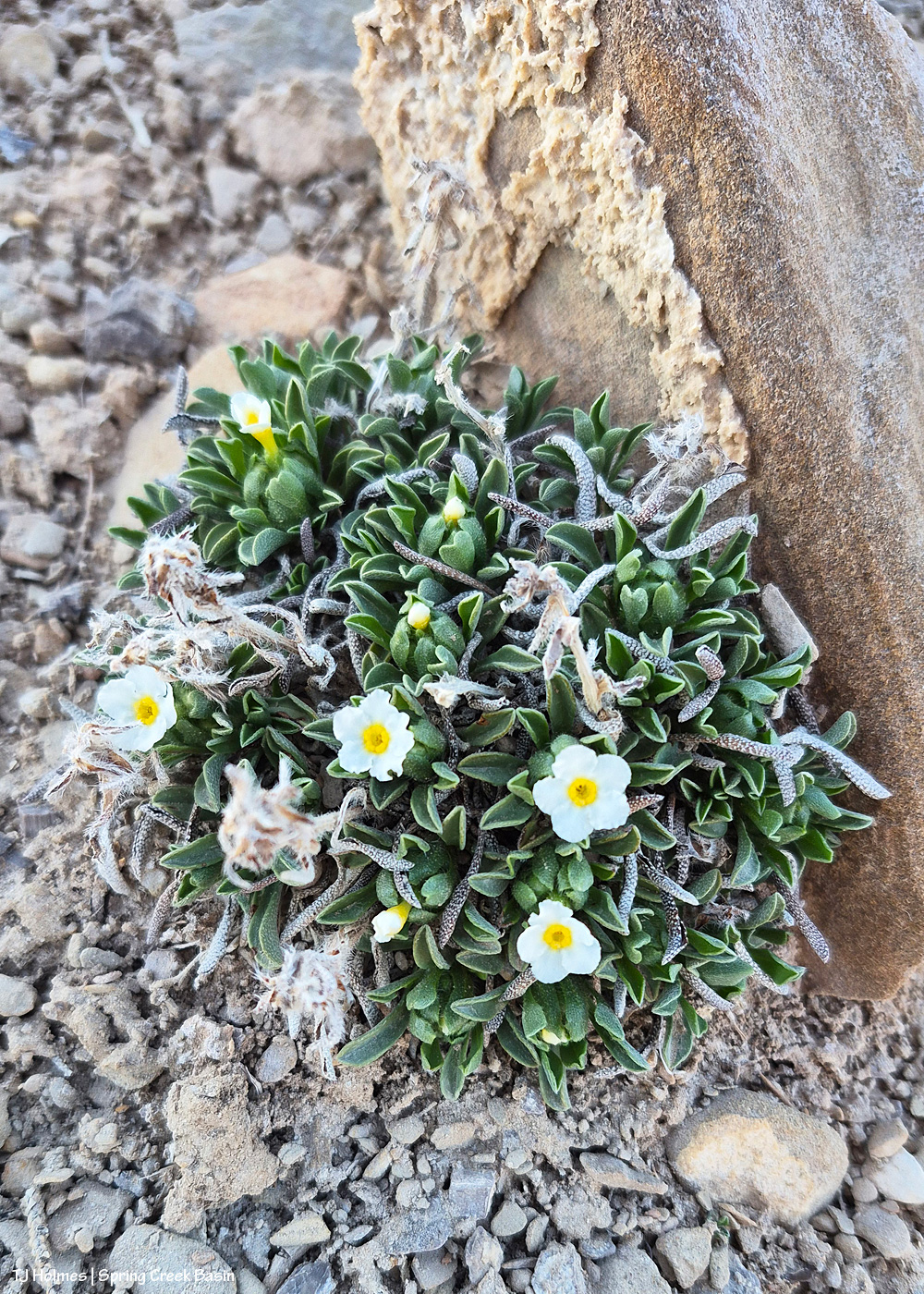
And (they were very near each other) this is a cat’s eye. Not any ol’ cat’s eye but a special kind that may be found only in this relative area of Southwest Colorado. I can’t remember exactly, but BLM range/plant guy Ryan Schroeder has confirmed it with the state BLM plant people. It is *special* and was the cause of great excitement last year when they realized we not only have it in Spring Creek Basin but it’s maybe not as rare-ish as they thought it was. In my wanderings, I see it everywhere, but I’ve also since realized that we have at least a couple of other types of cat’s eyes, too.
There’s just the faintest hint of a super-slight green blush across the basin. … C’mon, March rains!
And happy St. Paddy’s Day to all who celebrate your Irish. 🙂
A couple of nights ago, as I was walking away from mustangs to leave the basin post-sunset, I saw, for the THIRD time, a hummingbird on a cluster of wild flowers!
The first time was a hummer on claret cup cacti flowers a couple of weeks or so ago.
The second time was a hummer on a gorgeous bouquet of prickly pear flowers (this is the year of the prickly pear flowers; I am NOT kidding) a few days ago.
The third time was a hummer on a beautiful bunch of 4 o’clock flowers (which are just coming out with the rain/moisture of the last week) just a couple of days ago. All of these were in Disappointment Valley; the last/most recent one was in Spring Creek Basin.
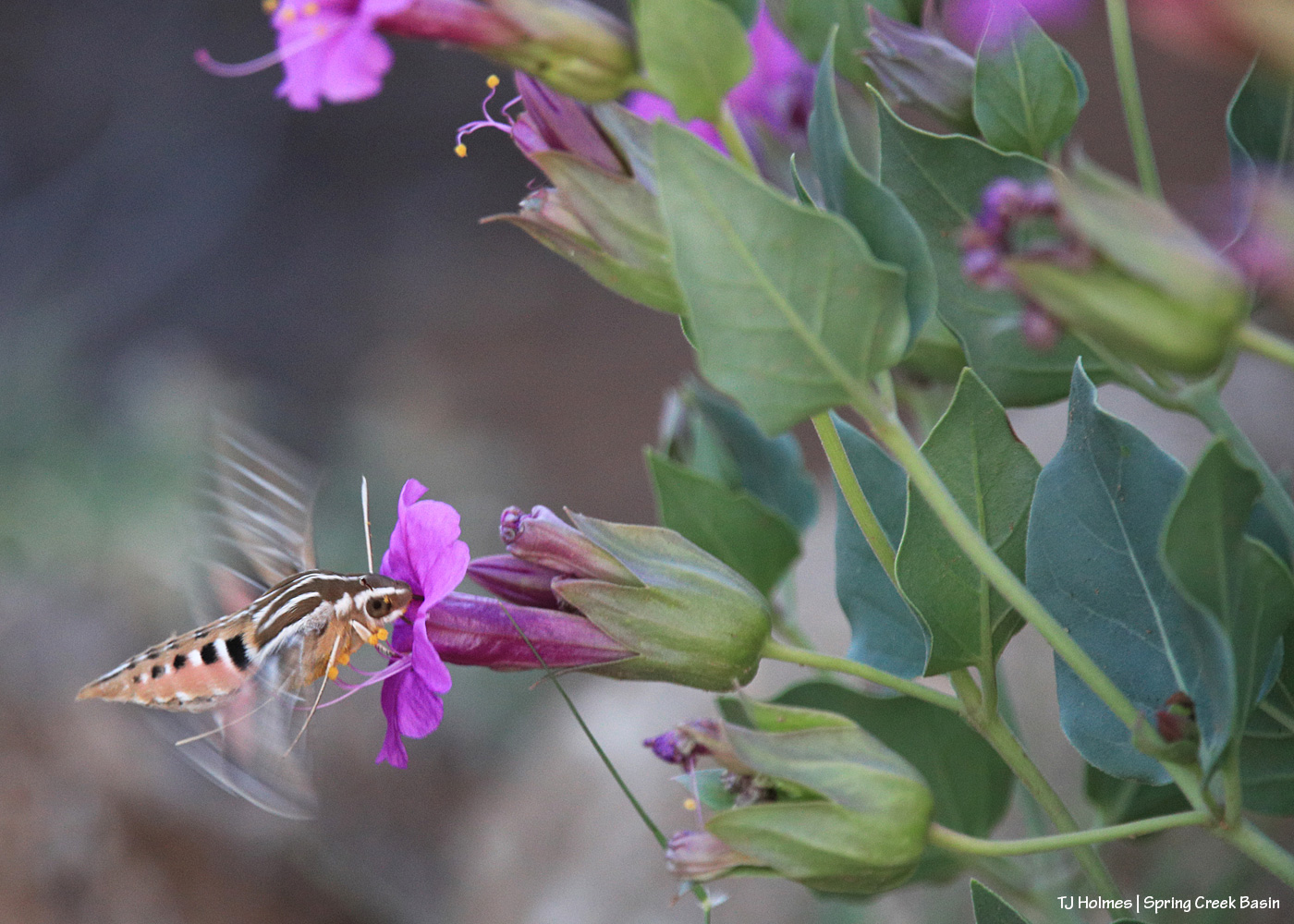
Note: The above moth (?!?!) is NOT a hummingbird. 🙂 That hummer, like the two previous ones, had no patience for a silly photographer who either didn’t have her camera, didn’t have her camera ready and/or didn’t have her camera in-hand because “the good light” had slipped over the west hill from evening toward night and she (I) was already packed away. DOH. (Note to self: “You miss 100 percent of the shots you don’t take.” I don’t remember who said that, but it’s so true.)
The moths were particularly hard to photograph. (There ended up being at least two that came back to the 4 o’clock, but the above is the same moth.) They were fast. They were the very definition of flutter-bys – impossible to predict their flight patterns (and focus). The light was very low.
I am holding high hopes to be READY for the fourth hummingbird visitor – on any kind of flower – and you can be sure that I will share if I *catch* that, I will share that moment with all of you. 🙂
If you know what kinds of moths these are, please let me know? They were REALLY large, and I’m not at all sure they’re a “moth,” though they’re some kind of insect.
*** Update: ChicoRey left a comment about the bee a couple of posts ago that made me look up “sphinx moth,” and sure enough, I got a hit that makes me think what I saw were “white-lined sphinx moths.” Thanks, Maggie, for IDing these moths before I’d even posted! (This post was scheduled a few days ago. :))
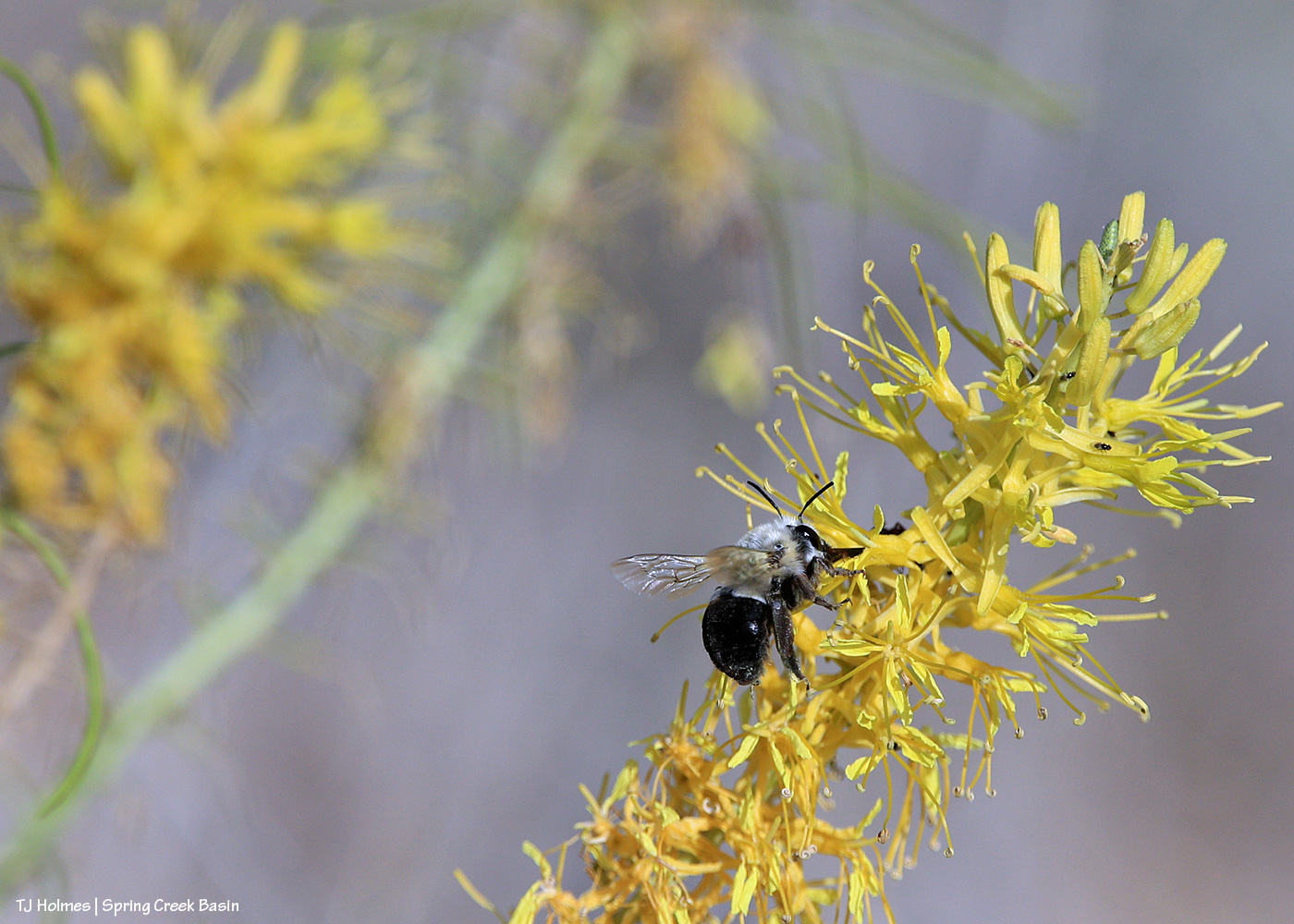
In all my excitement about the rainbow over the mustangs that came at the end (nearly) of my visit in Spring Creek Basin a few days ago, I nearly forgot about this busy little buzzer that I spent a fair time focused on (trying, anyway) as it buzzed around some rain-reinvigorated prince’s plume in the northern part of the basin. There were big ants on several of the plumes, along with much tinier little bugs (dreaded gnats?).
There were several smallish plumes growing from this one plant, and the bee diligently visited them all.
If you’re not a fan of bees on pretty spring desert flowers, I assure you that mustangs will return tomorrow. … I was quite fascinated with this little bee, and (to nerd out for a minute) I’m stoked at how well my camera and lens captured all its little details! I mean … NATURE! Am I right?! 🙂
You already know that I’m going to say that these flowers – such delicate beauty surrounded by such fierce thorns! – are one of my favorite signs of spring. 🙂 Even as temps soar into the lower 90s (argh).
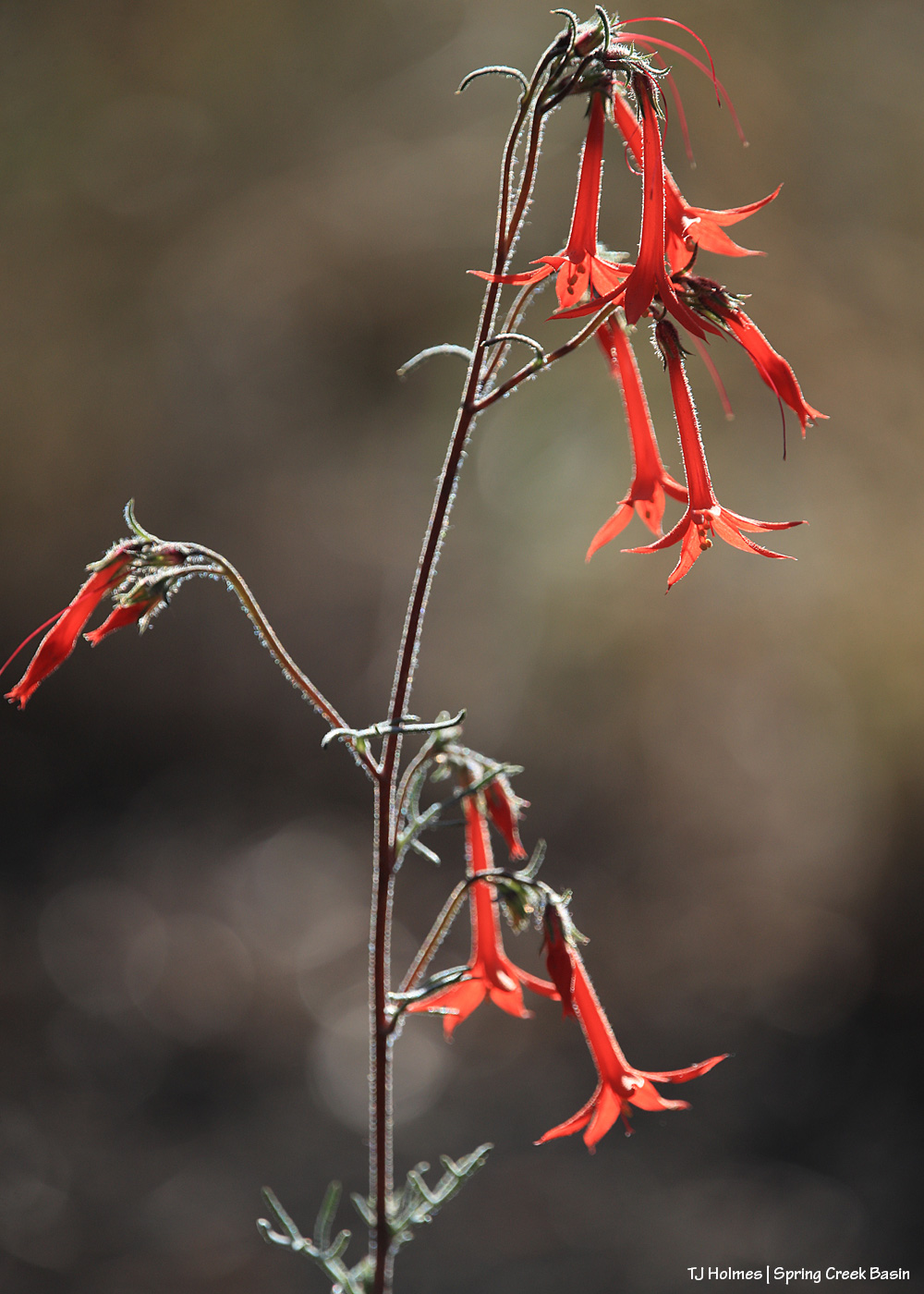
I was surprised and delighted to see four (seriously, just four) scarlet gilia flowering plants the other day in Spring Creek Basin.
The Southwest Colorado Wildflowers website says they’re in the phlox family, interestingly. Our phlox are always THE first things to bloom in the spring in the basin. They are very low-growing and small, and very widespread. They usually have white petals, but they can also be a soft pink or even purplish color. I would say that by sight, anyway, they don’t resemble at all their scarlet gilia … cousins? 🙂
I’ve only ever seen scarlet gilia at higher elevations in the San Juan Mountains, but apparently, they’re quite widespread over a variety of elevations, happily for admirers of these pretty, bright red flowers!
 2-
2- 5
5 mm) that resemble Dippin’ Dots or Styrofoam. These fragile, slushy particles are often called snow pellets and, unlike hard hail, crumble easily. They occur during wintry mix scenarios, causing sudden, slick conditions, and are identified in aviation reports as ‘GS’.”