With this post, the blog and reality are caught up and meshed!
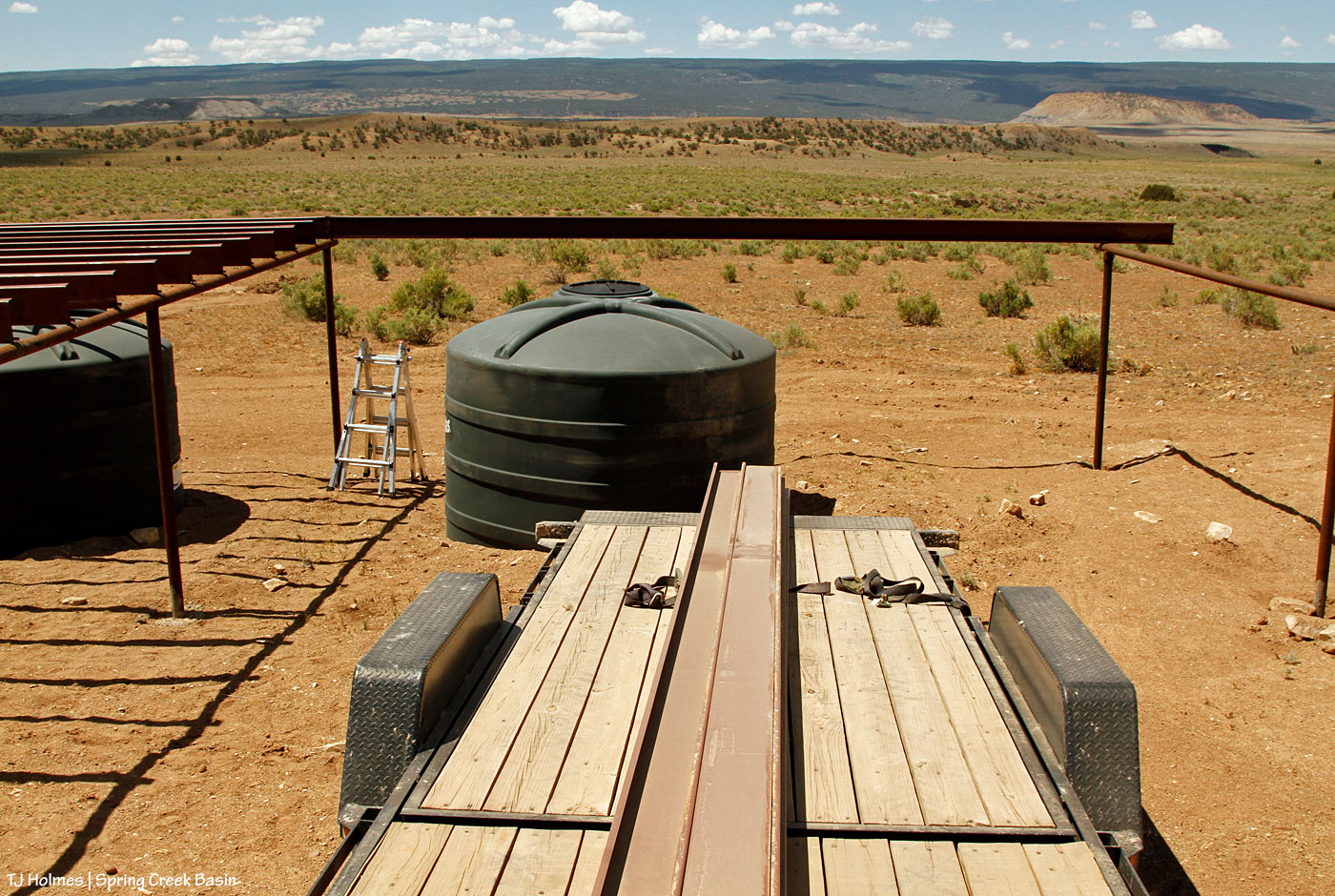
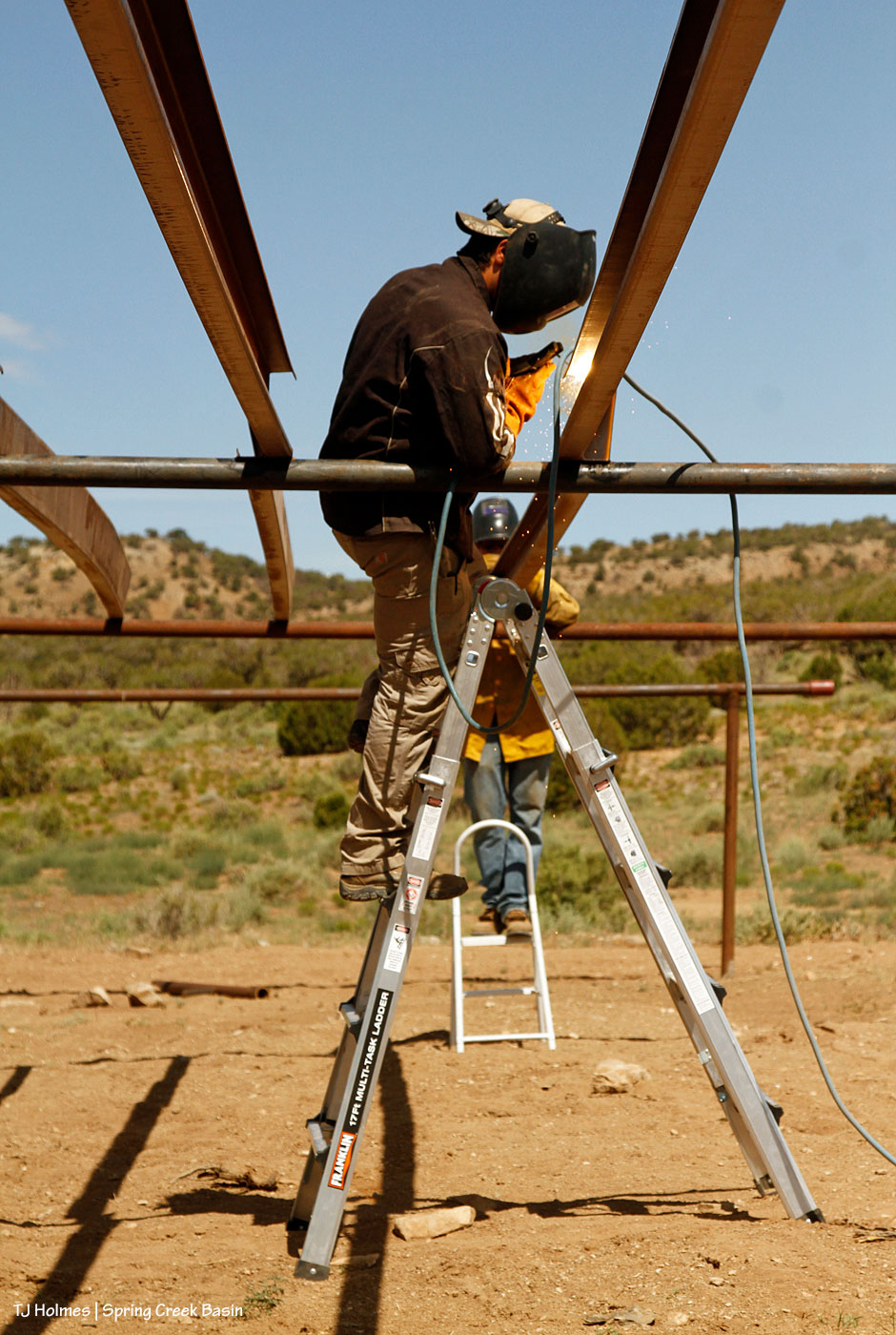
The guys showed up with the flatbed full of purlins – the last purlins required to weld to the roof structure on which to screw down the propanel sheets – and backed it right into the last section.
It was hot. Already. But they still had welding to do, which meant leather and Nomex and helmets for safety. Which meant – did I mention already? – hot.
Bonus: Backing the flatbed in under the structure meant that the purlins were close to where the guys hefted them into place on the steel pipes, and I had a higher vantage from which to take documentary photos. π AND – on which to help hold the purlins steady (with my great and amazing strength!) while the guys welded them into place on either end. I’m tall, but I found it helpful to use one of the readily available rocks around to stand on for a couple extra inches to hold each of the purlins. The flatbed gave me a couple of extra FEET.
WIN!
You’ve seen the guys weld in multiple previous posts, so with this pic, fast forward a bit: All the purlins are welded in place across the whole roof structure! … So what the heck are those BLM’ers doing now?!
The last/top purlin is to Garth’s right. The pipe Daniel’s working on is the west-end pipe of the roof structure. (Note: There’s currently a fair amount of “extra,” which means that we can add purlins and propanel in the future for an even bigger roof surface.) Whatever they’re doing, it has the undivided attention of all three of us!
Our guys are craftsmen, and they’re rightly proud of their work. So Daniel “signed” it in beads of weld. π That’s Garth in the pic, “chipping” the welds flat.
And he put the year on it, too. Forget the trials of 2020; 2021 is the year we’ll remember as the origin of the basin’s third water catchment for the mustangs.
We’ve thrown around a couple of name ideas for this particular catchment. It’s in the eastern end of wildcat valley (my name), beyond what we call wildcat spring. Wildcat catchment? With the new shade from the propanel, we were able to eat lunch right there – instead of up the hill under a tree. The whole structure is kind of a box. Lunchbox catchment? But I think we might have a winner here: BLM’ers marching, leading lines across the foreground … Abbey Road catchment, anyone? π (Hey, we do like to laugh!)
Daniel got to work with the zz-zz.
And Garth got to work with the zz-zz.
Now I want to take you on a bit of a walk around the project, so you can see it from multiple directions.
This is basically at the southwestern corner looking northeastish.
Looking a bit more eastish. The road is just to my left.
Here, the road is just below me (you can see it at lower left … and as it continues on around the loop right in the center of the pic), and we’re looking southeastish toward McKenna Peak and Temple Butte.
An even bigger view … from near our previous lunch spot. π
And this is looking back to the southish (ever so slightly southwestish). That’s Filly Peak in the background, and if you know where to look, you can see the top of the tank at the main, original water catchment in Spring Creek Basin. π
Did I mention that it was hot? There might be some clouds over the horizons in these pix, but that didn’t mean any of those clouds were over our heads, over the basin. Hopefully, Mother Nature will take some pity on us before the next work day.
With that, we’re all caught up, and the blog reflects reality. Next steps: Finishing the propanel across the rest of the roof structure and installing the gutter across the front and the pipes from it to the tanks!
We’re now up to about phase 4 on the basin’s newest water-catchment project, though the phases are sort of, kind of starting to overlap a bit. It’s a big project! And my blogging is slightly behind our actual work, which is ongoing (it is hotter ‘n hell out there, I’m not kidding … last weekend, the mercury hit at least 104 in lower Disappointment Valley, which didn’t even set a record in the state of Colorado (because it was even hotter elsewhere, and other records WERE broken)).
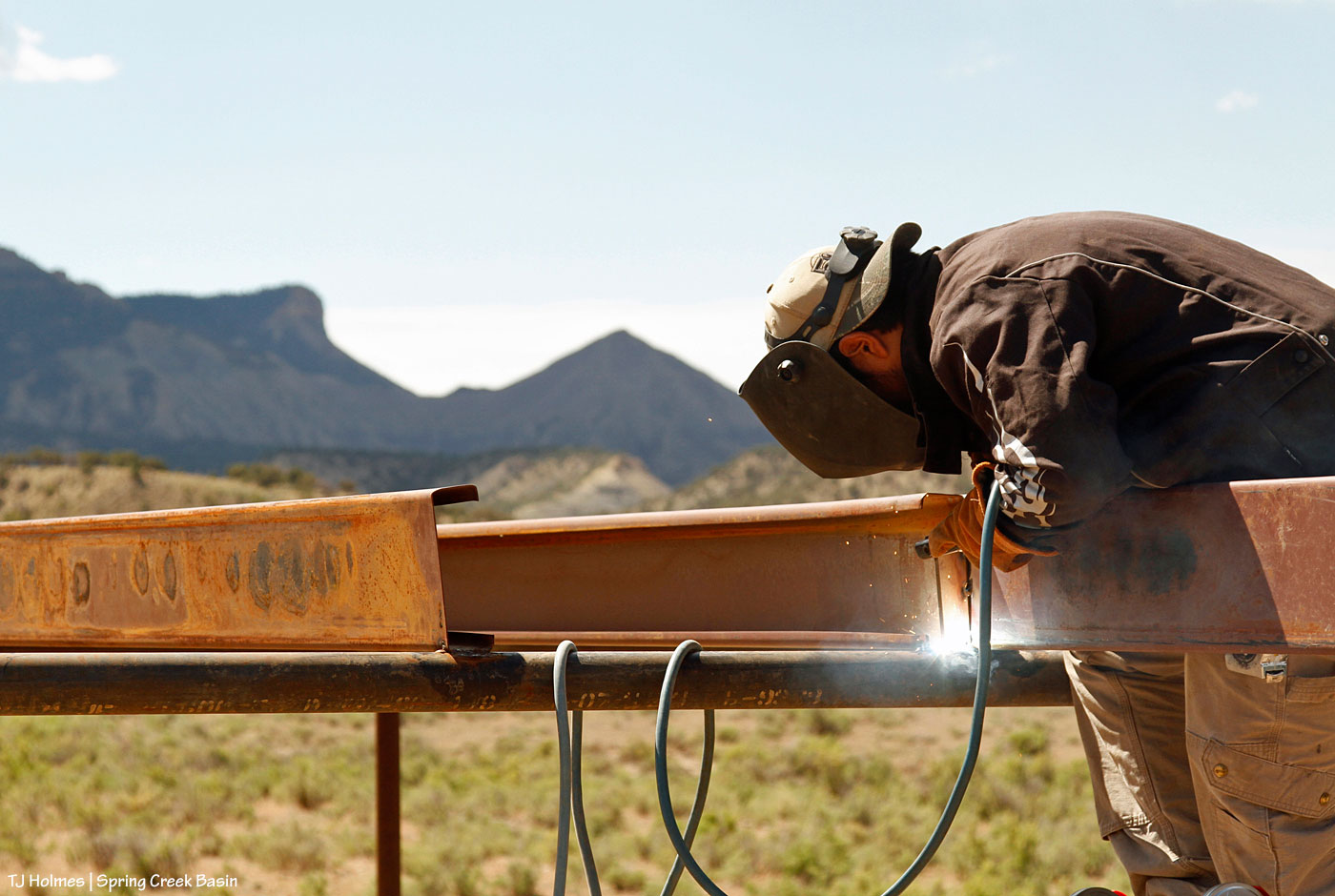
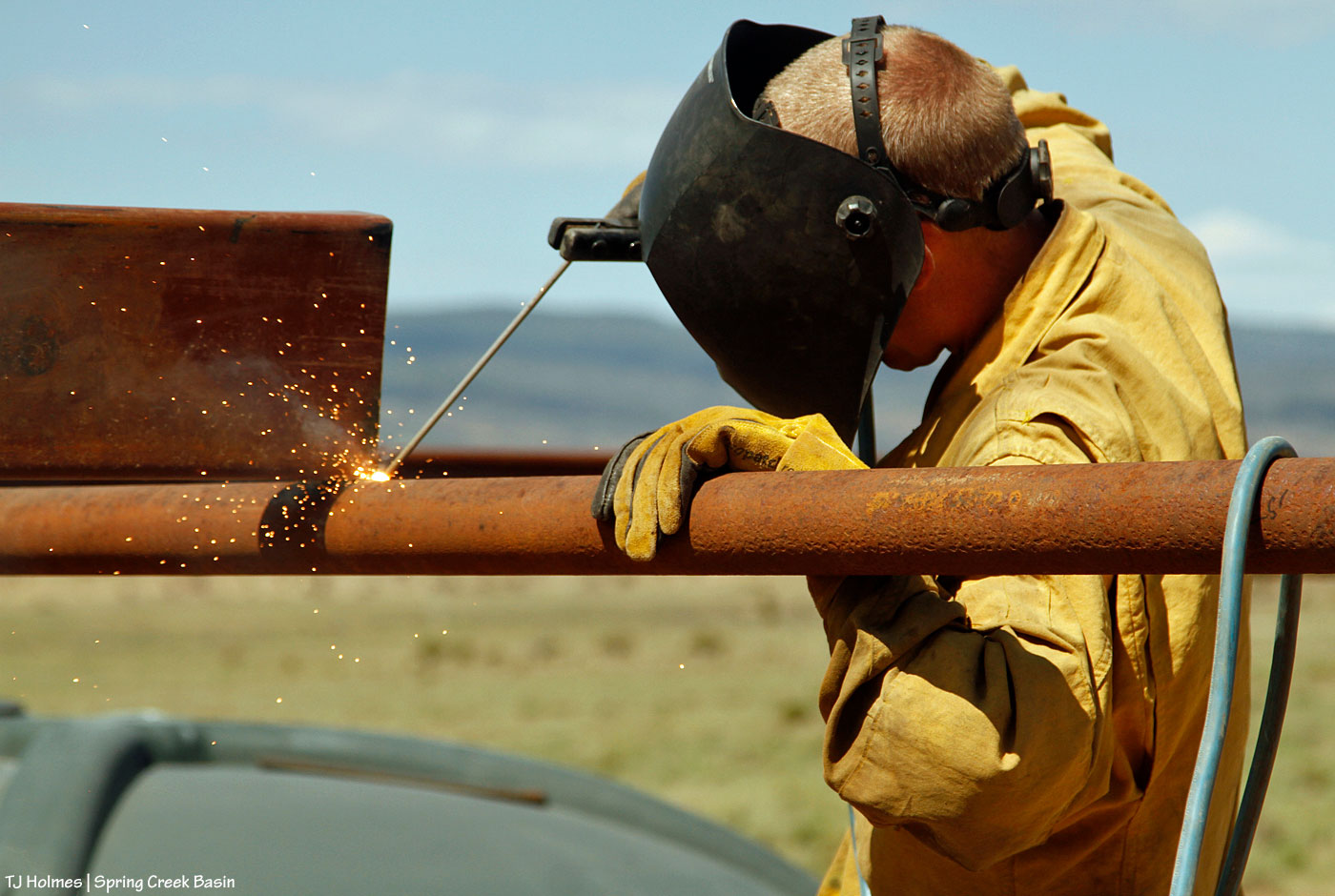
On this day, Garth Nelson and Daniel Chavez, two of our BLM’ers-extraordinaire, welded the purlins in place that they’d previously brought out to the site. They wanted to make sure that the roof structure is super-solid and secure, so they welded them at fairly close intervals. This will come as a shock to … absolutely no one: It gets windy out here! The roof needs to be uber tight.
So Daniel got to welding.
And Garth got to welding. (By the way, for those worried about fire danger, the ground below the whole structure still is very much dirt. We are VERY aware of potential fire risk.)
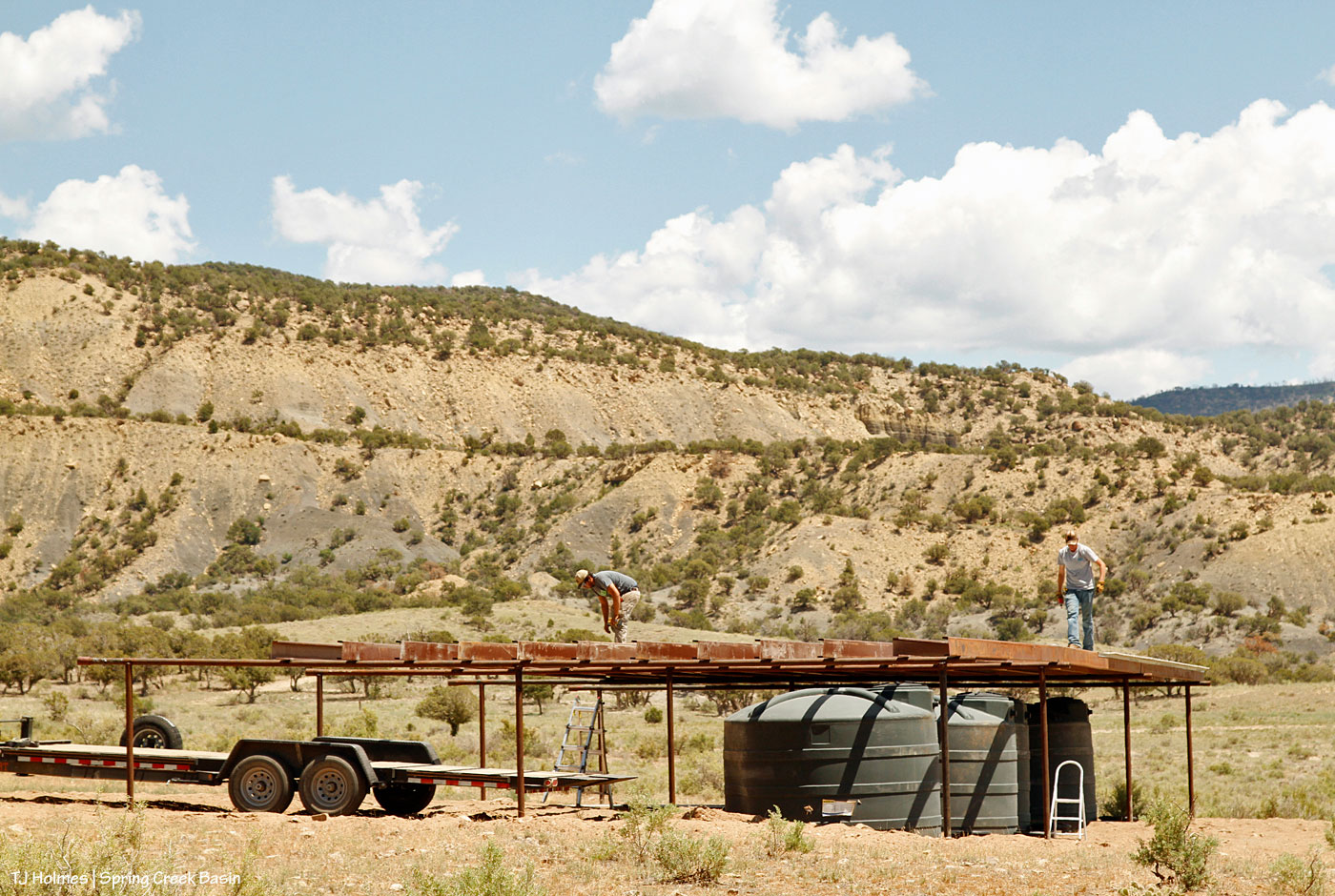
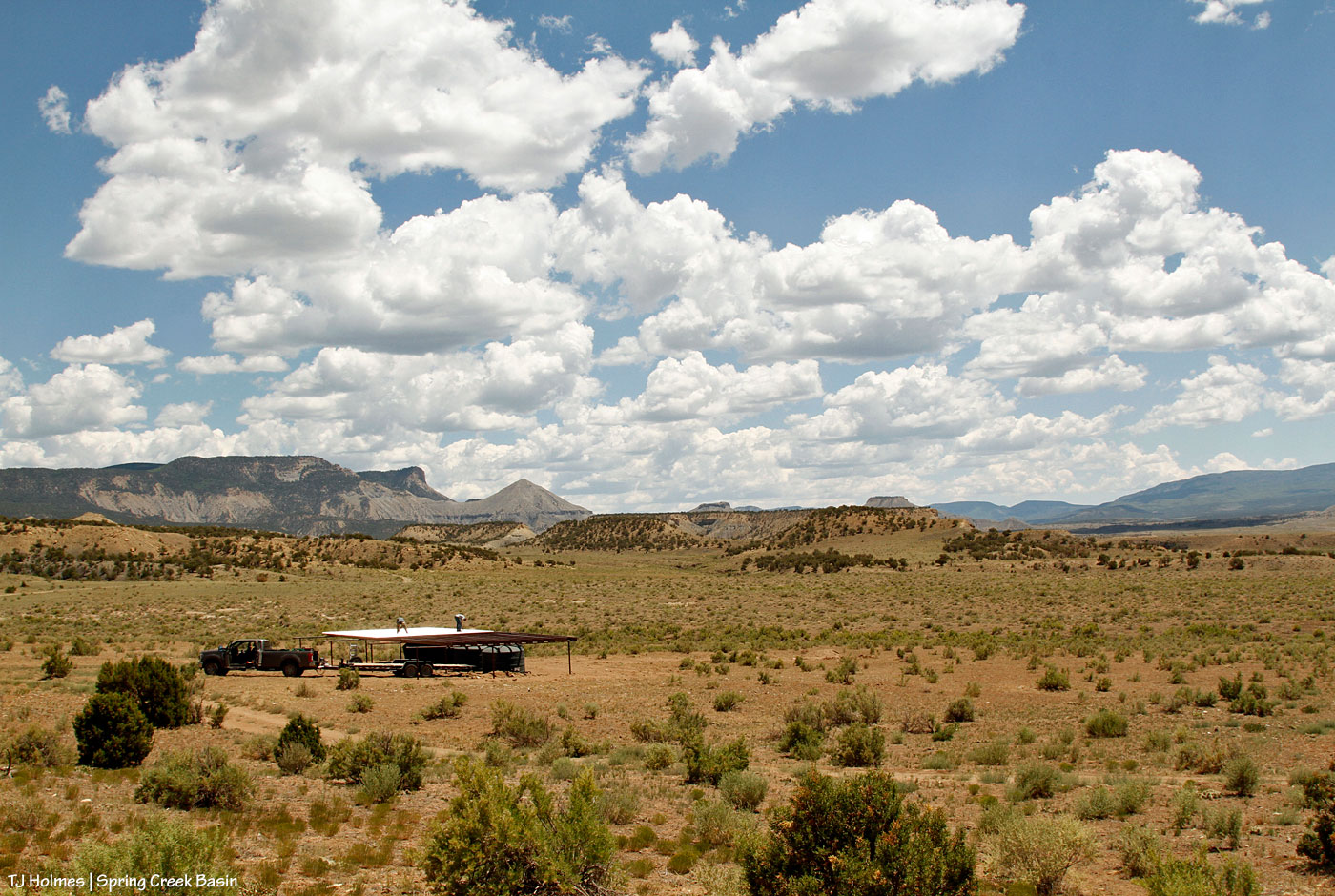
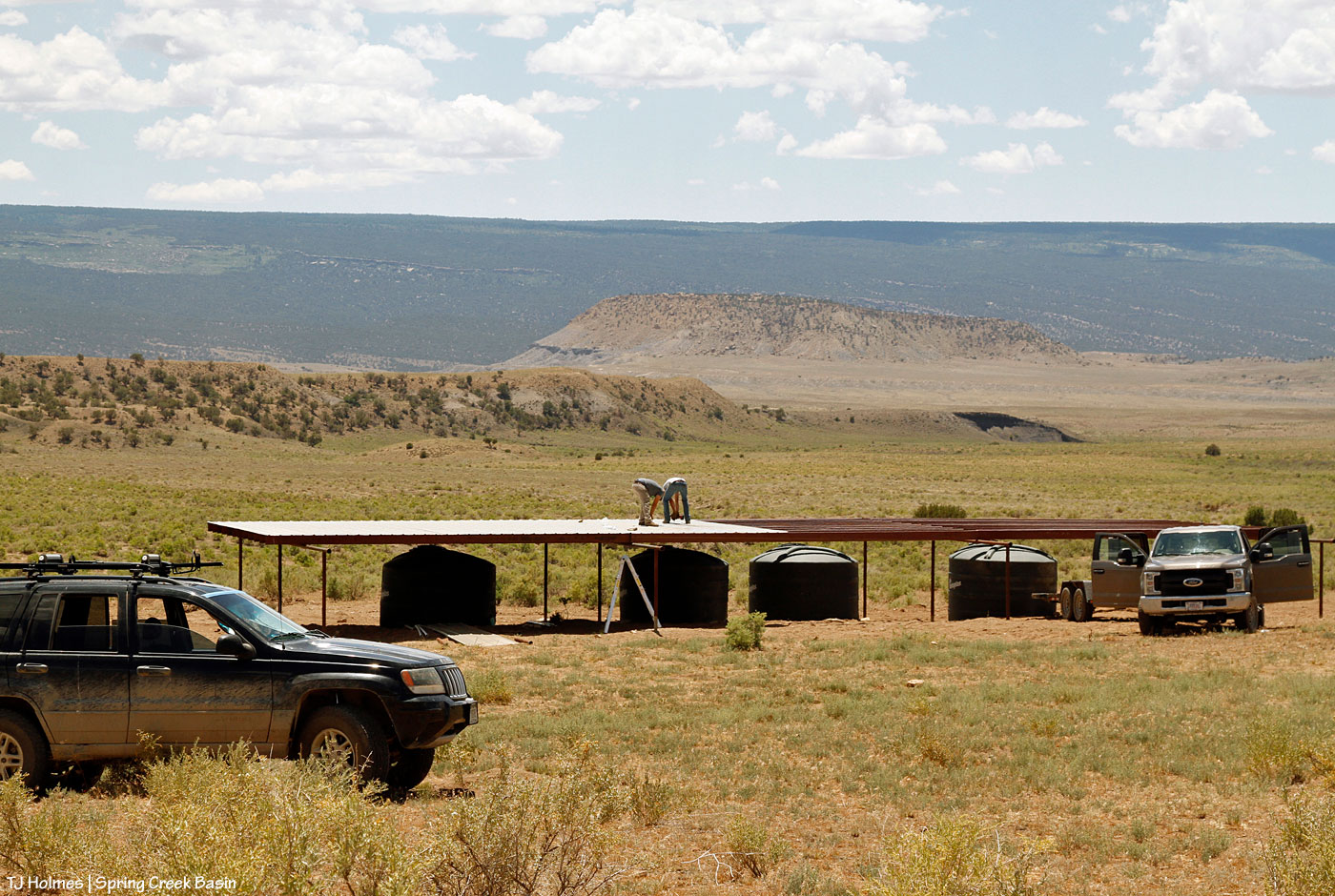
Here’s an overview of where we were in the building process. It’s a bit hard to see from this perspective (and I’ve been trying to take pix from various perspectives!), but they’re just finishing the purlins across the middle section of the roof section. That’s the longest span – across the two middle tanks. West is behind Garth, and that part is done *now* … but at the time of this work day, they still had to get the remaining purlins from Durango (steel shortages affect everyone!).
In a project like this, there are loads of leading lines …
… and graphic lines! And it’s fun to take advantage of those arty bits, even in a serious project like this one. π Behind Garth there, you can see the third/western section of the roof structure, which got “purlin’d” another day (that post is coming!).
When Garth and Daniel got the middle section of purlins welded, they started on the ROOF! These are the propanel (metal) sheets that will catch the rain and snow and convert it to drinkable water for the mustangs (via the gutter and pipes and other pipes and trough and float (!)). Exciting stuff!
Now, I have to tell you one of the most interesting things that I did NOT photograph about the getting of the propanel sheets to the basin. The day Daniel hauled out the pile of sheets (they’re 25 feet long from the top (right side of the pic) to where Garth is measuring in the pic above), he got stymied at the first Spring Creek crossing in Spring Creek Basin (which is probably about six-ish miles from the main county road). Why, you ask?
BECAUSE SPRING CREEK WAS RUNNING WITH WATER!!!!!!!!!!! π It rained in the eastern part of the basin, and the creek arroyo ran for a little while.
So on this day, after the purlins were welded in place, we went back to get the propanel sheets and take them to the catchment site. Right before lunch. Perfect. π (Also interesting note: Until we got the propanel sheets in place, which provided shade, our lunch spot was a short distance away, across the road and up a little slope under a lovely juniper tree. On our last work day, when it was almost a billion degrees, we lunched in the shade of the roof structure. :))
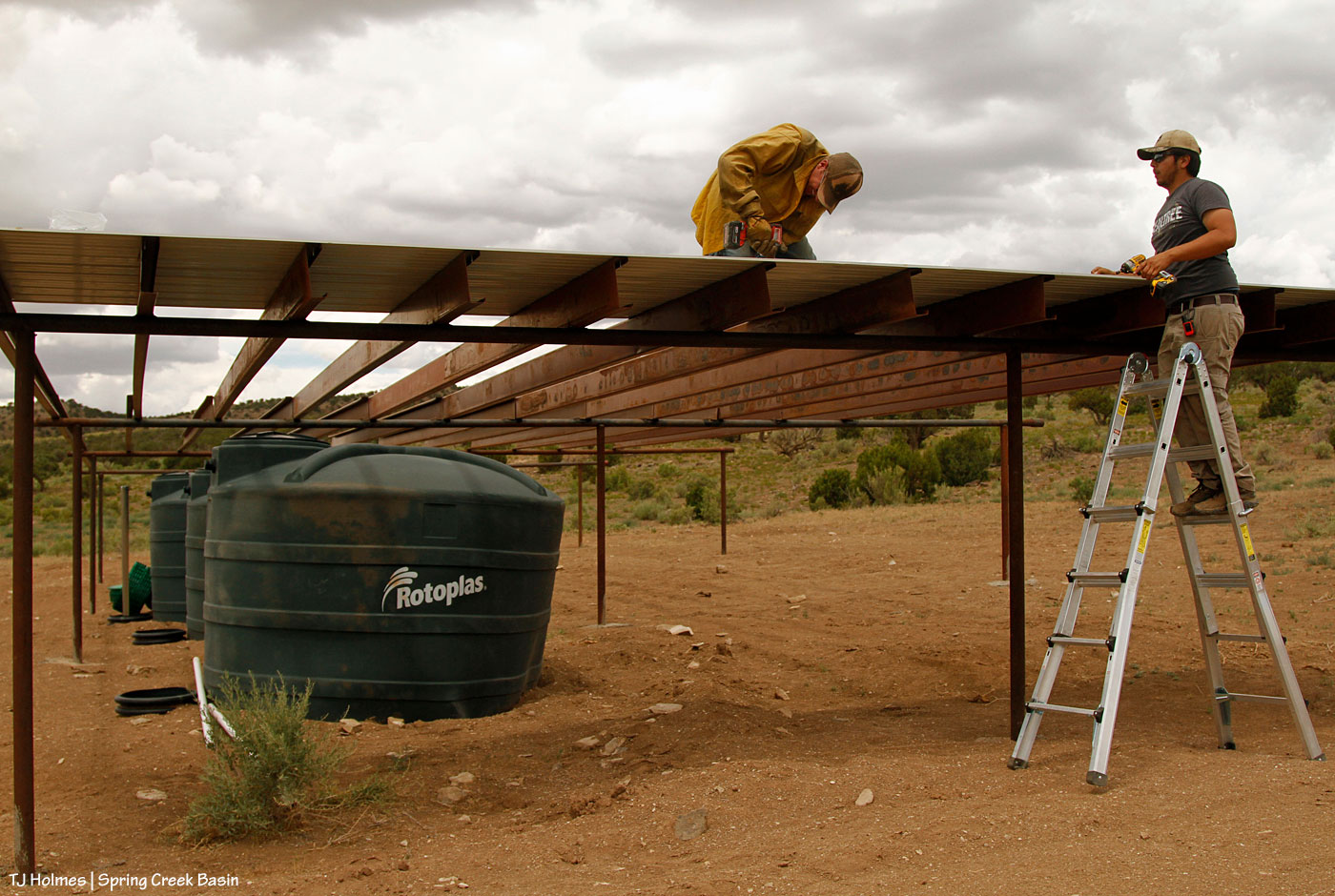
The first sheet, of course, was important to get screwed down straight on the frame to the steel purlins.
See those round green pieces? Those are going to be the lids for the black culvert pieces in front of each tank, at the bottom of which are the valves. The guys, those master welders, even made me a custom “key” so I can turn the valves on and off without crawling down on my belly to stick my arm down into the spider holes (they’re too deep for that anyway!). (I’ll get a pic of that key later.) The thicker green part will be a “riser” to go over the culvert, and the lid (with the white ring) will screw down on top. What are the silver “sticks” sticking up out of the culvert? Those are “drip edge” pieces of thin aluminum that will go all along the front line of purlins, under the propanel sheets. On another project like this that the guys have built, they found that rain water would sometimes just splash over/under the edge, missing the gutter. They installed these, and voila – problem solved. So we’re putting these edges under the propanel as we go along.
Interesting factoid: There’s still a bit of “bounce” to the roof, so being up there and walking around – staying on the purlins – was a little like walking on a trampoline. Daniel’s best quote from the entire project (thus far): “Now we know the roof can support 300 pounds of dude.” π And they’ve said that about an inch of rain on this span of roof will put about 1,000 gallons of water in the tanks. There’s a particular formula – don’t ask me because I am NOT a math person – but Daniel and Garth ARE super smart dudes, and if they say it, I believe them! (Now we just need a whole gosh-darned inch of rain! … Wait … after the gutter is installed and piped to the tanks!)
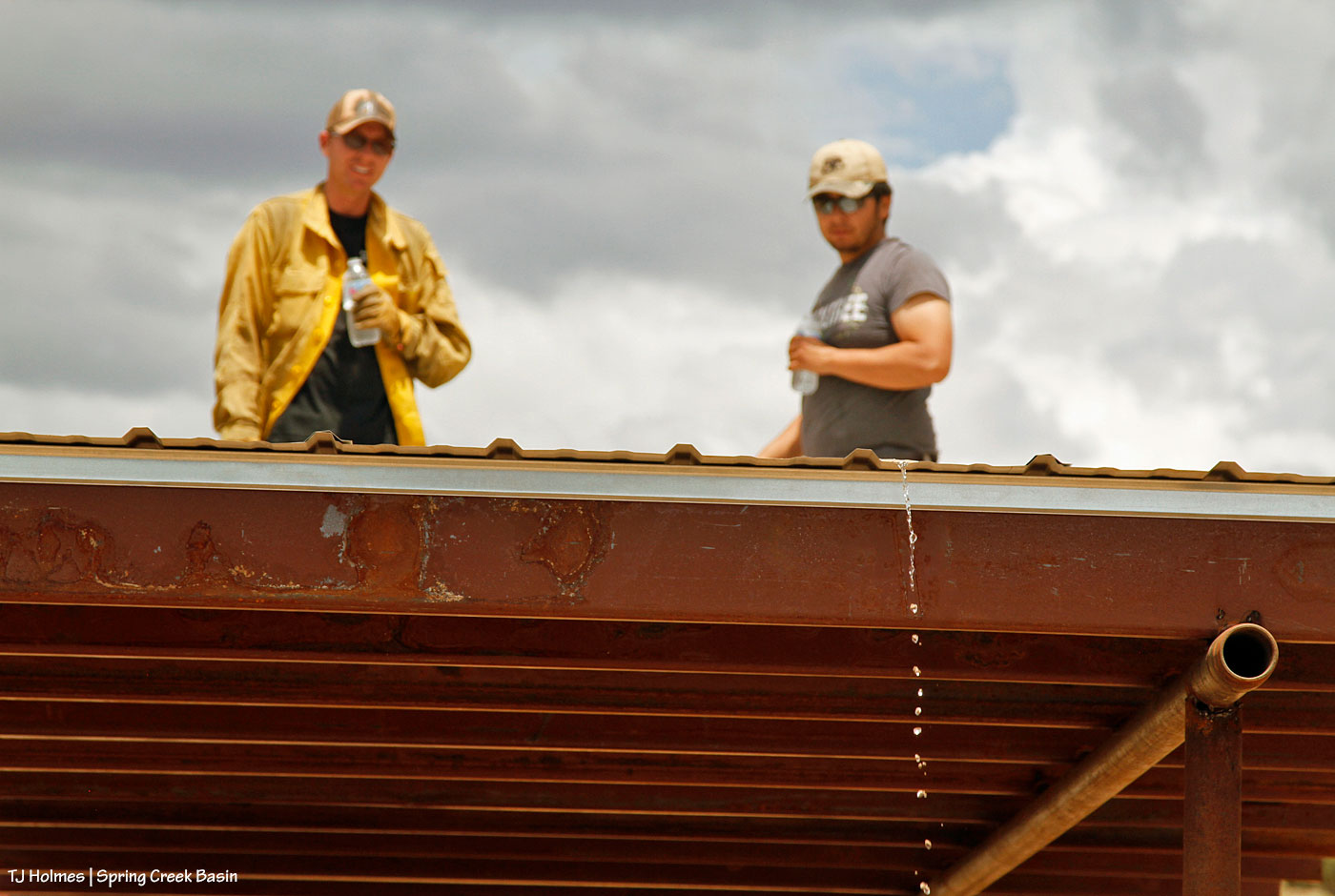
And the water test. Yep! (Bonus, you can see the silver drip edge here, too.) You just have to imagine the gutter at this point… !
With a sky like that, I tried to get the guys to do their best Superman impressions. … They were too shy for that, but they’re still super heroes to me – and to the mustangs! π
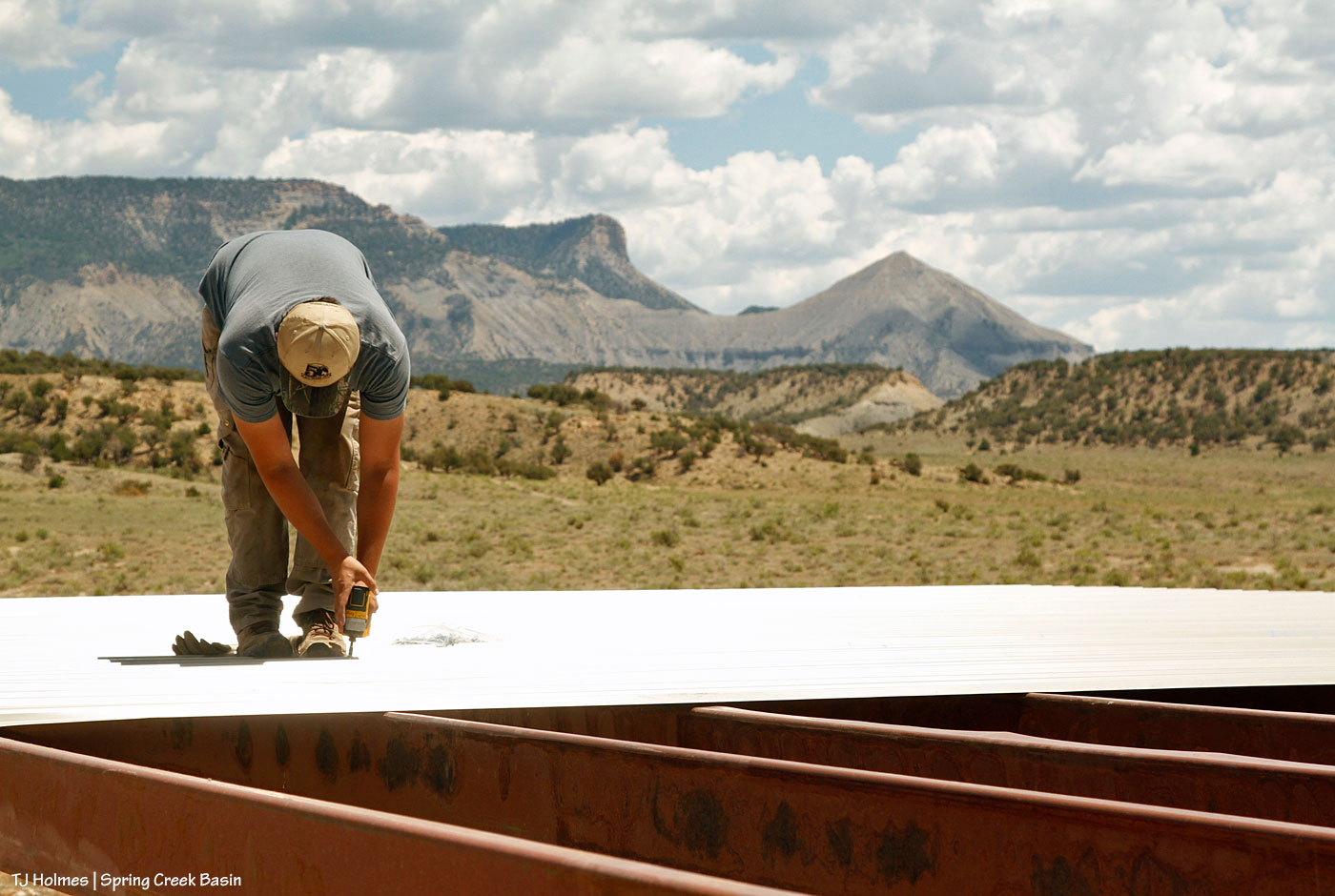
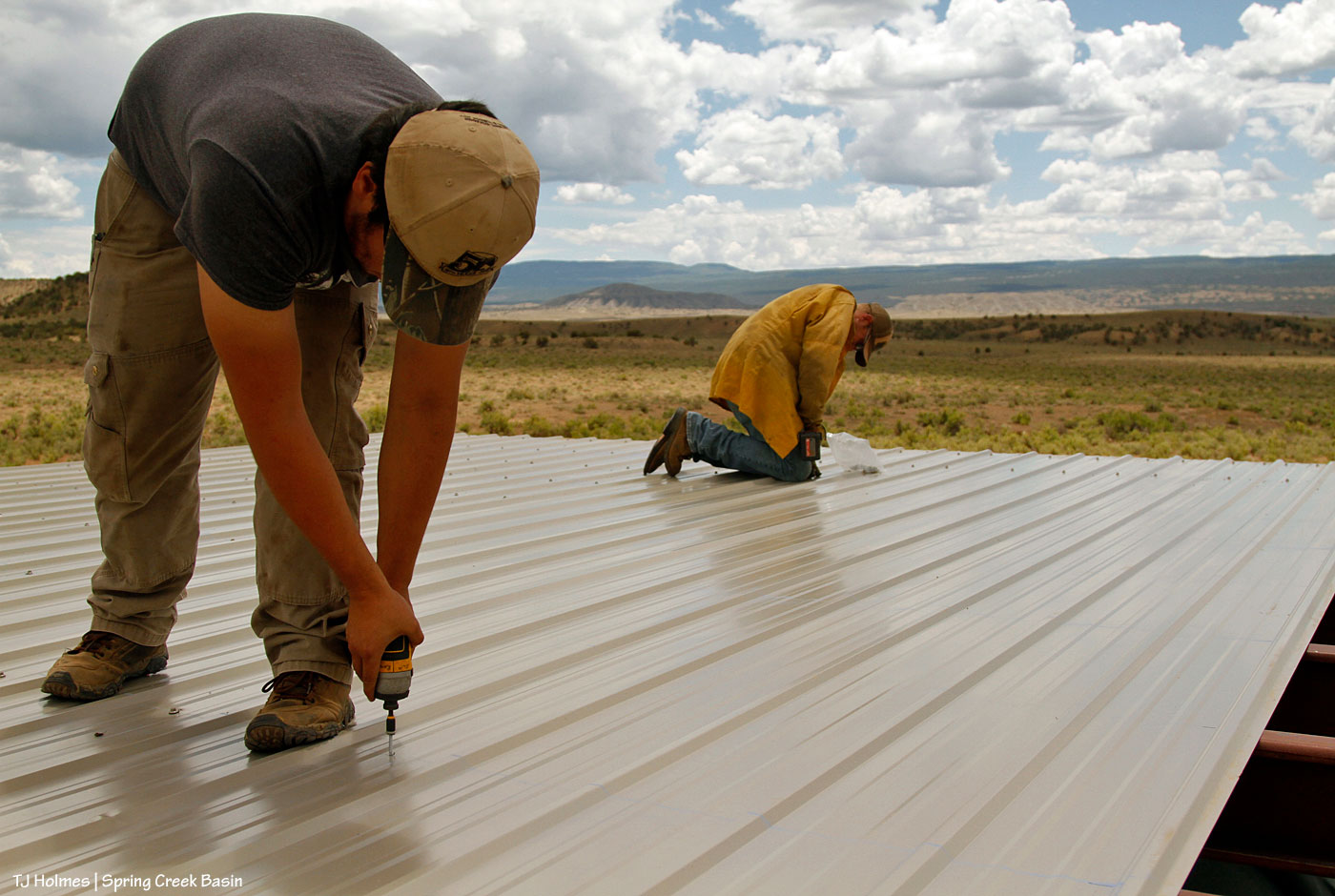
On this particular day, we SUPER lucked out with the cloud cover and breeze that kept things relatively cool (OK, at least not HOT). With the two of them up there, zz-zzing the screws that fastened the propanel to the purlins beneath, it went pretty quickly.
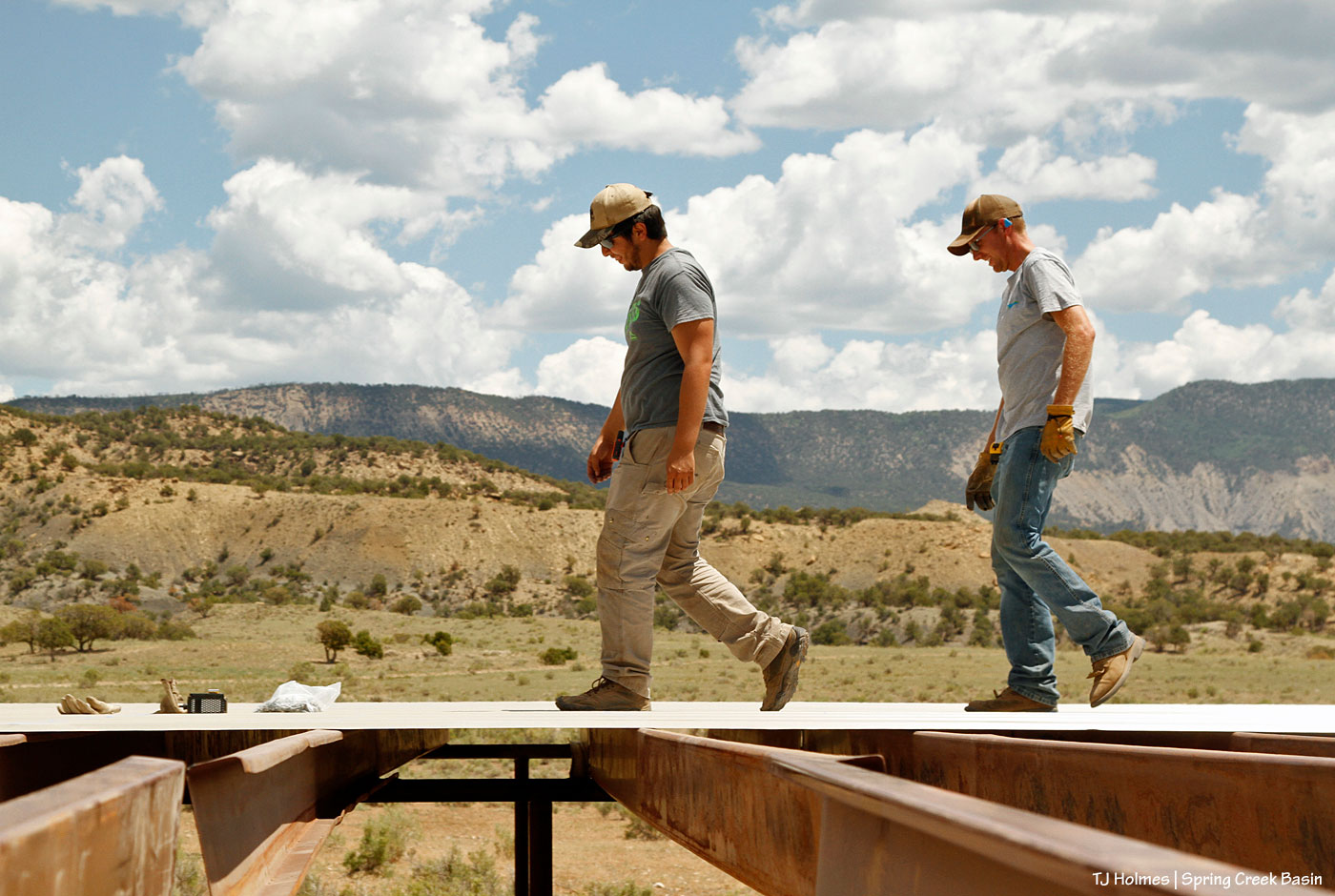
Teamwork. π Another of my favorite pix of the project! And that pole sticking out in the foreground of the pic marks the eastern third of the roof, which means that on just the first day of roof-attachment, they got a third of the panels in place.
Lest you all think it’s all work and no fun, let me disabuse you of that notion right now. π Laughter is a big part of our camaraderie. I’m not totally sure what Daniel was doing here – I think the edge of the propanel sheet was just barely on enough of the purlin edge for Garth to tap a screw into, and the purlins, though welded, still have some give to them (hence the trampoline effect mentioned earlier), so he’s using his great and amazing strength (!) to pull the end (top) purlin closer to help Garth with the attachment.
The next day we worked in the basin (which was this past week) was crazy hot, but the guys showed up smiling, as always, and we got the rest of the purlins welded, and now the roof is just more than half covered in propanel sheets. Depending on continuing heat (the forecast shows some relief coming …) and availability, work will continue on the propanel attachment and getting the gutter in place and piped to the tops of the tanks.
One more little tidbit: I arrived first the last day we worked because the guys had to go to Durango to get the remaining purlins (to be welded) – from Dolores – and then all the way back out to Disappointment Valley. A band of horses was at the far east end of the little “mini valley” in this part of Spring Creek Basin, and their hoofprints were on the road, which is just, maybe, 50 yards from the catchment. … And not only there, but some brave pony or ponies came within about 10 yards of the eastern end of the structure. Eventually, we’re going to put up a fence around the structure so the horses won’t rub on things and chew on things, but they’re curious! … Gettin’ closer with each work day. π
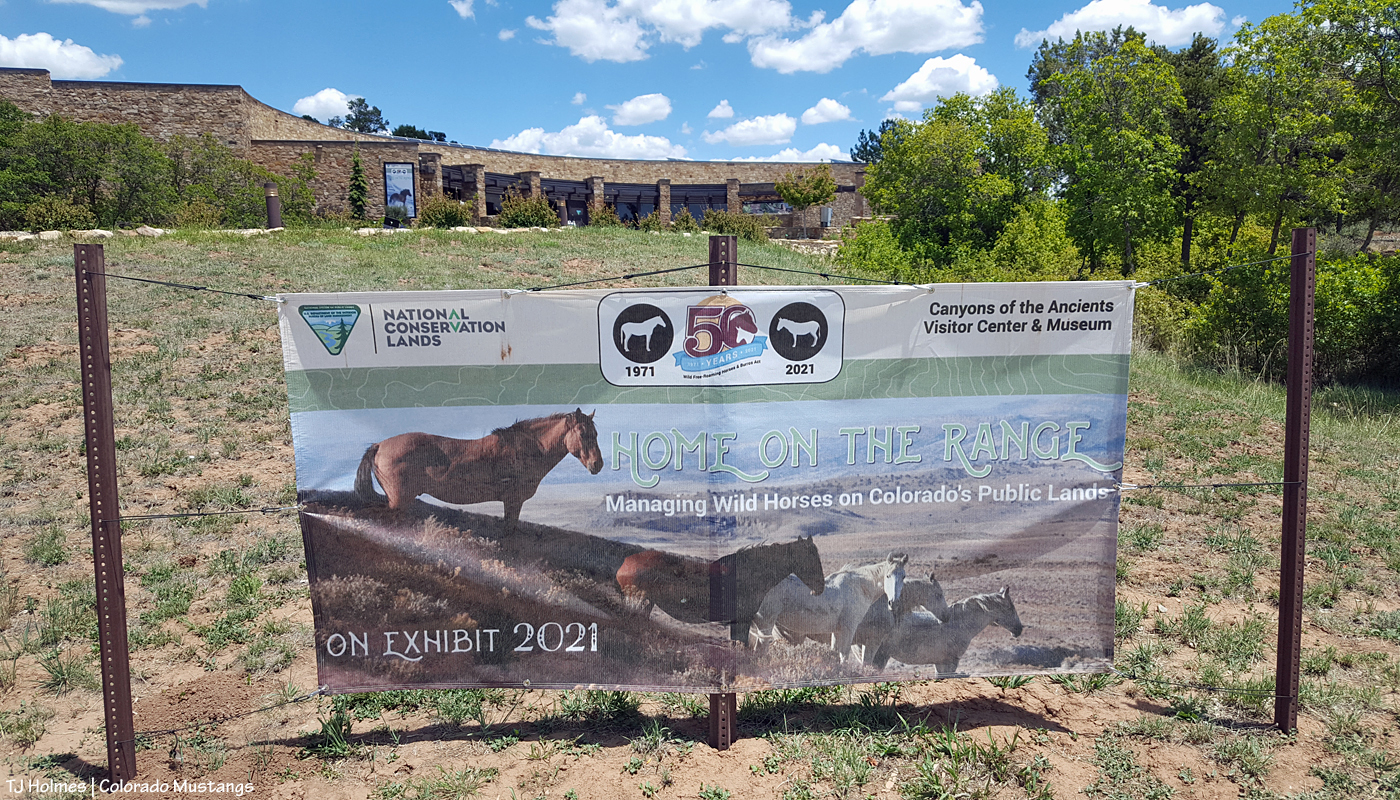
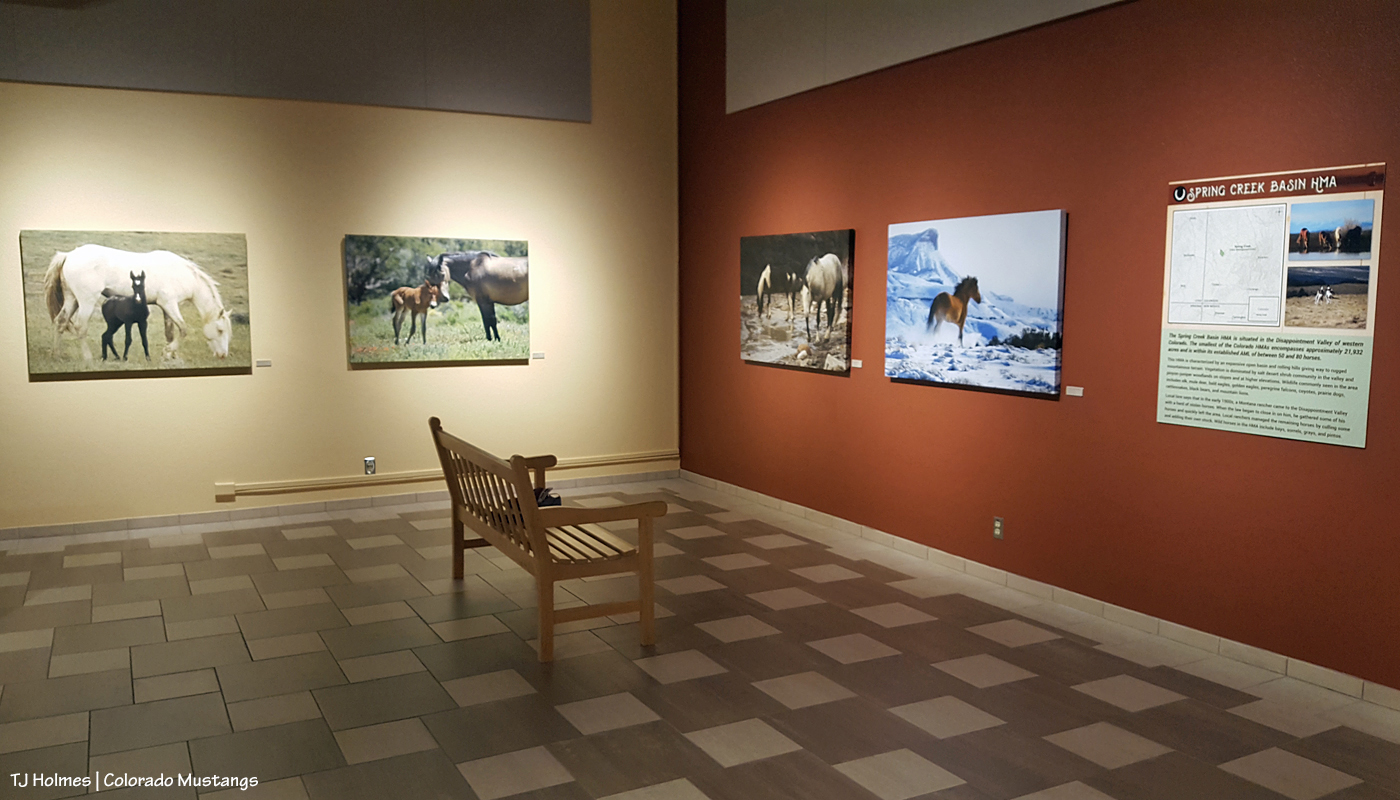
On the heels of this week’s feel-good good-news stories, here’s another one to end your week on a high: Through the end of the year, Canyons of the Ancients Visitor Center and Museum (formerly called Anasazi Heritage Center) will host βHome on the Range: Managing Wild Horses on Coloradoβs Public Lands,β an exhibit to celebrate the 50th anniversary of the Wild Free-Roaming Horses and Burros Act. Images and information about Coloradoβs three herd management areas (Spring Creek Basin, Sand Wash Basin and Piceance-East Douglas) and one wild horse range (Little Book Cliffs) are included in the exhibit, as well as an adopters corner, which highlights a few awesome adopters of some of Spring Creek Basinβs awesome mustangs with a poster and short video. (Thank you to Tif Rodriguez and Whisper, Keith Bean and Skipper, Alice Billings and Liberty, Steve and Teresa Irick and Breeze and Sage, and Olivia Winter Holm and Ellie!)
The exhibit is a collaboration between CANM (Bridget Ambler), our local Tres Rios Field Office (Mike Jensen and Connie Clementson) and Colorado BLM’s Wild Horse and Burro Program (Ben Smith and Eric Coulter). I can’t begin to describe how incredible it looks. I walked through the doors, stopped dead in my tracks and burst into happy tears! The poor CANM employee who showed me in waited ever-so-politely for me to regain my senses (it took a little while). It’s THAT beautiful!
The center/museum is located on Colorado Highway 184 above the town of Dolores and McPhee Reservoir. If youβre in Southwest Colorado this year, please stop by to view the exhibit and the rest of the museum for a glimpse of ancient life here on the Colorado Plateau!
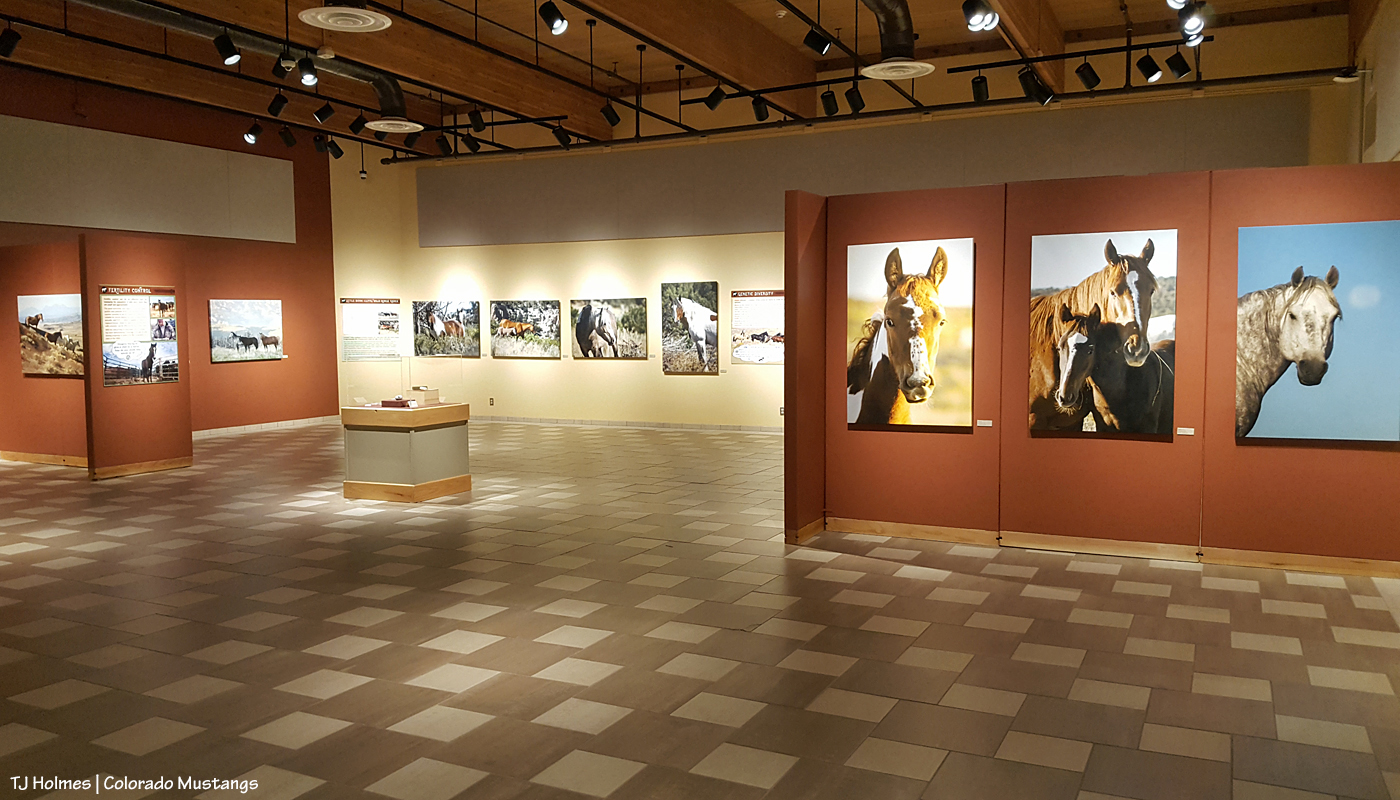
Below is a selection of photos of the exhibit. Really, it’s best viewed in person!
If you know me, you know that I’m the biggest emotional softie when it comes to my mustangs. Therefore, it will surprise none of you to read that when I drove up the road to the parking area below the building and saw handsome Hollywood and his beautiful mares, that was the first burst-into-tears event of the visit. Notice also the vertical sign on the side of the building in the background – also Hollywood. (Really, this guy should have his own star on a walk of fame!)
This was the next – and biggest – burst-into-tears moment: when I first walked into the exhibit hall and saw all those beautiful mustang faces. At right: Sand Wash Basin mustangs. In the background: Little Book Cliffs mustangs. At farthest left: Spring Creek Basin mustangs (the pic they used on the outside banner). Piceance-East Douglas mustang fans, don’t worry; your ponies are around the Sand Wash Basin wall. And the little section out of frame to the far left is the rest of the Spring Creek Basin area.
Right around the corner from the doors into the exhibit hall, the adopters are featured. Belatedly, I realized the mistake about Steve’s and Teresa’s mustangs: They’re both geldings. But I love the photos and quotes from everyone! These people all recognize the beauty and value of America’s mustangs (particularly our Spring Creek Basin mustangs), and I’m so glad BLM wanted to highlight their horses and parts of their stories. (The mustangs were adopted in 2005, 2007 and 2011.)
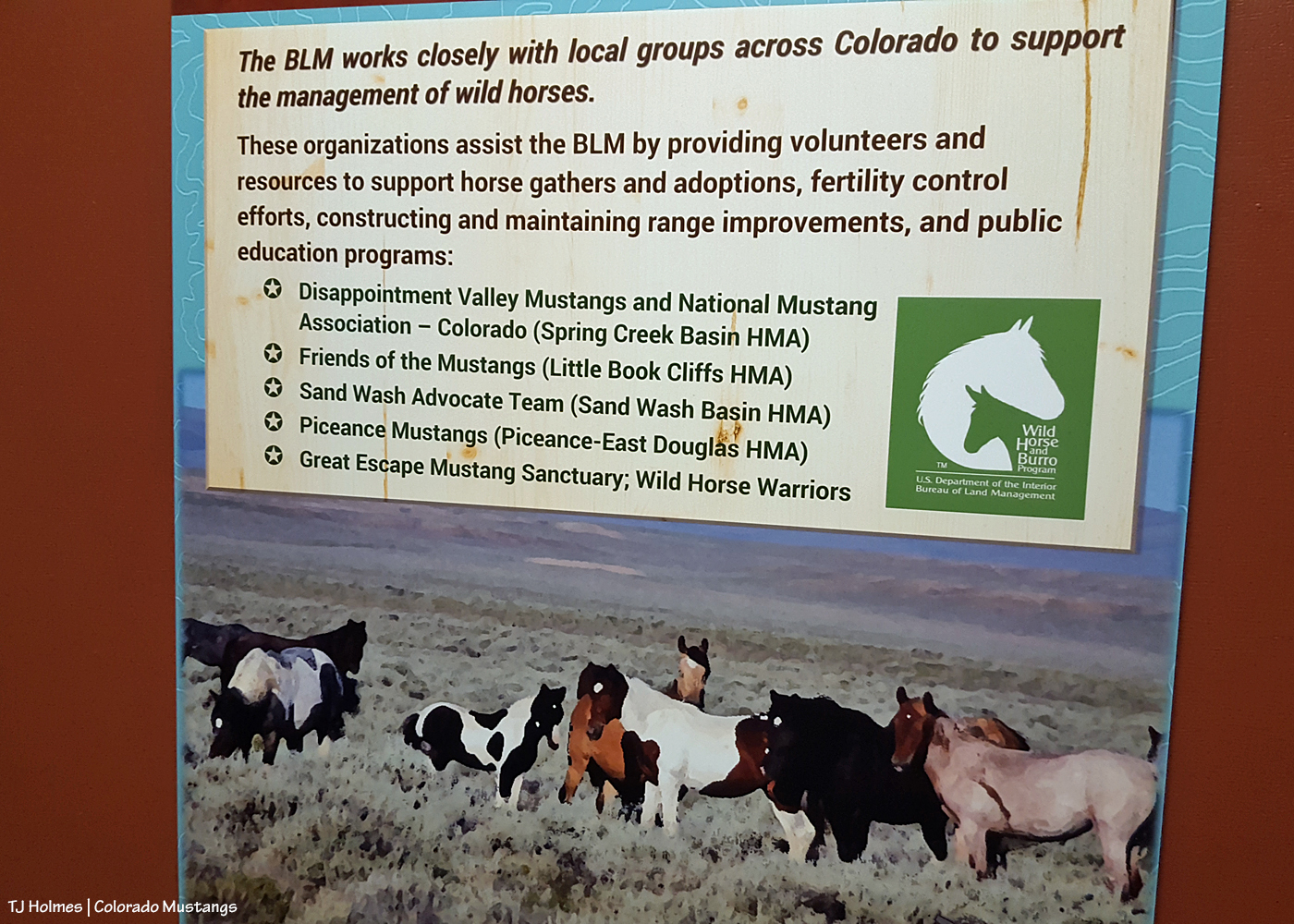
The exhibit also pays tribute to Colorado’s mustang advocacy groups – at least one for each herd in the state! Our mustangs are blessed to have people involved in every aspect of their observation and management (of course, we advocates know that WE are the blessed ones!).
No exhibit of mustang management in Colorado would be complete without a display of some of the tools of our fertility-control trade (on the wall across from this is an info-graphic panel about fertility control). We use CO2-powered darting rifles in Sand Wash Basin and in Spring Creek Basin, and they use .22-type rifles to dart in Little Book Cliffs. At upper left is a teeny branding tool for foals. Hopefully coming soon is a darting program in Piceance-East Douglas; all the pieces are being put in place.
Let’s see some pix of the pix (they are beautifully printed on canvas; each of them will go to the respective offices (Tres Rios, Grand Junction, White River and Little Snake) when the exhibit closes at the end of the year):
One of the walls of Piceance-East Douglas beauties.
A cozy corner of Little Book Cliffs mustangs with some of the astounding scenery shown. Part of Little Book Cliffs also is a wilderness study area (like McKenna Peak in Spring Creek Basin).
Some lovelies of Sand Wash Basin.
And of course, my most-beloved Spring Creek Basin wildies.
Deep, heartfelt gratitude to Bridget and Mike and everyone who conceived of and then brought this exhibit to reality. It didn’t open in January as planned because, you know, Covid, but it’s been open since mid-April and will be open the rest of the year (check the link at top of the page for visitor center/museum hours). (As of this writing, they’re following safety protocols with limited capacity in the building and social distancing.)
If you’re coming to or through Southwest Colorado in 2021, please, please, pretty-pretty please make a stop at Canyons of the Ancients Visitor Center and Museum and take time to walk through, and/or sit, and very most definitely enjoy this exhibit of some of the mustangs that call Colorado home. We are SO proud of our mustangs!
Lexi and Mason from SMA brought five interested – and interesting – people to see this area that’s in the same county as Telluride (San Miguel) … and a world away climate- and geology- and geography-wise.
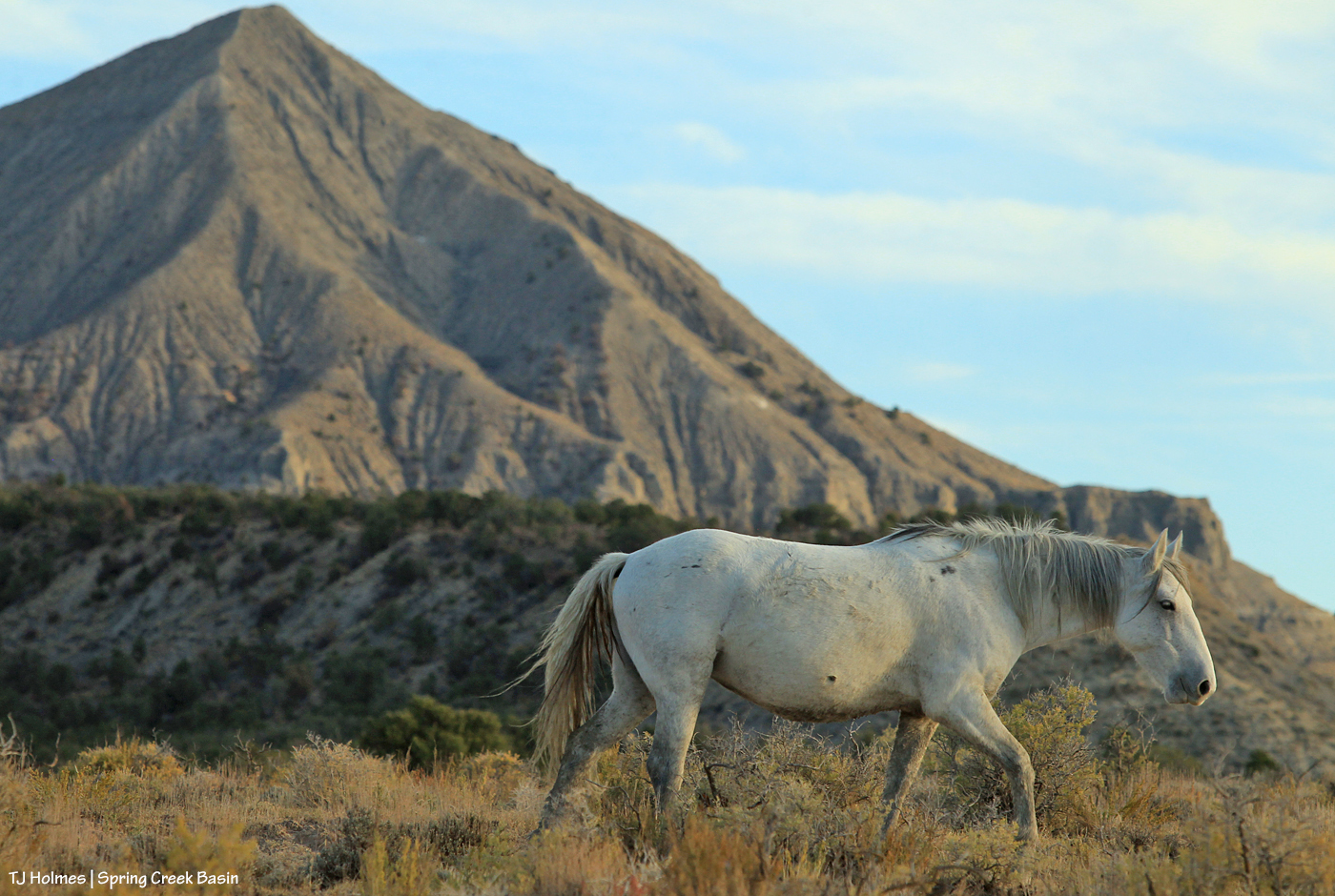
Disclaimer: The pic above of Juniper walking past McKenna Peak was NOT taken during our hike. π
We didn’t see any of our fabulous mustangs during our hike in the far southeastern part of the basin, but we did see a couple of tarantulas and lots of cool fossils (including a couple of faint but awesome nautilus impressions!). I got to talk about my favorite subject ever (I bet none of you can guess what that is … ;)), and Lexi talked to us about McKenna Peak and the CORE Act – the Colorado Recreation and Economy Act.
From the website:
“The CORE Act is the most significant and broadly-supported effort to protect Colorado’s most cherished lands, waters, and forests in a generation. The legislation would protect roughly 400,000 acres of public lands in Colorado, ensuring that future generations can always enjoy our state’s mountains, rivers and wildlife.”
McKenna Peak Wilderness Study Area is proposed for inclusion in the San Juan Mountains area. This link shows the locations of the areas; scroll down to read a little more about McKenna Peak and see where it’s located. The entire WSA isn’t included, just the part in San Miguel County. As with anything else, politics plays a part. Our San Miguel County commissioners are fully supportive of this inclusion, just as they were of the naming of Temple Butte, which is in San Miguel County.
Regular readers know the shape of both McKenna Peak and Temple Butte as icons of our Spring Creek Basin horizon. Given our location and lack of specific trails, I don’t think we’ll be overrun with visitors. But how cool would it be to see the status of even part of this amazing landscape go from wilderness study area to full wilderness area? It’s protected from motorized/mechanized-vehicle use currently, which enables it to feel secluded and protected to the wild horses and other lives that know its wildness (even us humans).
Being able to share it with another few like-minded humans gave me great enjoyment. To see their wonder and appreciation of this landscape I love … well, to be perfectly honest, it made me happy. π
Background: The 2015 RMP directed BLM to revise and update the 1994 Spring Creek Basin HMAP. This updated analysis and plan will incorporate specific goals, objectives, and techniques for guiding the long-term management of wild horses within the HMA consistent with the resource direction contained in the new RMP.
Decision: I have decided to select Alternative A, the Proposed Action for implementation as described in the Spring Creek Basin Herd Management Area Plan (HMAP) Revision (DOI-BLM-CO-S010-2020-0009-EA). Based on my review of the Environmental Assessment (EA) and project record, I have concluded that the Proposed Action was analyzed in sufficient detail to allow me to make an informed decision. This decision 1) establishes an Appropriate Management Level (AML) of 50 to 80 adult wild horses that is in balance with the ecosystem and available forage; 2) implements the use of BLM approved fertility control measures to slow the annual rate of growth of the wild horse herd; 3) establishes monitoring criteria for initiating the removal of excess wild horses; 4) utilizes bait trapping as the preferred removal technique; 5) maintains genetic viability expressed as observed heterozygosity within the wild horse herd by periodically introducing outside horses from other similar herd management areas; 6) manages the wild horse herd to achieve a diverse age class and natural sex ratio; 7) establishes vegetation monitoring objectives for maintaining good ecological and forage conditions; and 8) authorizes additional new water developments for improving wild horse distribution across the HMA.
Overall, implementation of this decision will provide long-term management guidance for sustaining a healthy wild horse herd in balance with the ecosystem, while ensuring that Public Land Health Standards developed for Colorado are being achieved.
Not too much earlier before I took this shot, the weather radar showed another lovely green blob right over us. … What we *really* had was a whole lotta blue in the big ol’ sky! I think it comes down to this: The weather gurus are just as hopeful as we are. (Otherwise, there are seriously some techy gremlins in their weather equipment.)
In very good and wonderful news, Connie Clementson, manager of Tres Rios Field Office, released a letter Monday saying that after “thoughtful consideration of the analysis and comments received” (thank you!), she has chosen the preferred alternative – Alternative A – presented by our herd manager, Mike Jensen, for our Spring Creek Basin Herd Management Area Plan revision. π π π
Now there’s a 30-day appeal period, then the decision record becomes final, and all that we’ve worked for these last many years is the official management plan in Spring Creek Basin. Documentation, bait trapping, PZP-based fertility control, AML increase … it’s all there.
I can’t begin to articulate my gratitude and overall feelings of relief. Thank you to all those who made this happen. You know who you are, and you know you are appreciated!
The world is kinda one big crazy-town right now, but all I have to do is drive into the basin, spot some horses, walk out, plop myself on the ground (dry as it is … watching for cacti and slitheries, of course) … and all that crazy melts away.
Nature and wild horses truly are the best medicine for what ails us (somebody said that once upon a time, I’m sure of it!), and I am so blessed and thankful to have huge dollops of both in my life.
As if we needed more proof that our mustangs are divine and under the shine of a higher power!
As May comes to a close, I want to remind readers that the comment period for our Spring Creek Basin Herd Management Area Plan EA is coming to a close (Saturday, May 30). If you’ve already submitted your comment letter, thank you! If you’ve procrastinated, now is the time to type out a letter of positive support regarding Tres Rios Field Office’s HMAP EA. It will guide the management of our mustangs for the next couple of decades and ensure that they are managed and protected to our highest standards.
Here’s the link to BLM’s eplanning site, on which you can find the draft HMAP EA and the button that will allow you to comment through that site:
Or you can send an email to our excellent herd manager (and author of the HMAP EA), Mike Jensen, at m50jense at blm dot gov.
Please note that you support Alternative A – Proposed Action. If you have personal knowledge of our herd and mustangs – whether by visits or even through this blog – please let them know.
Do you see the little bird, taking flight in front of Raven?
Do you see the head and ears of the horse below and beyond Raven?
Do you see Raven, divine wild girl, in all that delicious evening light?
Do you feel the magic?
********************
My friends, my fellow lovers of Spring Creek Basin’s marvelous mustangs, the draft HMAP EA is out for comments. (That’s herd management area plan environmental assessment in non-acronym-speak, and it lays out the overall plan for the next umpteen years of management of our Spring Creek Basin mustangs.)
It’s kinda huge.
OK, in the grand scheme of all that’s going on in the country, in the world, right now, it’s a blip. And I do not make light of those who are suffering terribly now, in so many ways.
This EA represents countless hours and days and weeks and months – the last couple of years – of work by our uber-respected BLM herd manager, Mike Jensen, at Tres Rios Field Office in Dolores, Colorado. It represents field work (vegetation monitoring, land-health assessments), and it represents computer time. It represents a career spent doing good things, positive things, for the ranges he has managed during his work with BLM. It represents gathering facts, lining up the science, listening to partners, speaking to a wide variety of people … and honoring the good management we’ve achieved, together, for Spring Creek Basin’s mustangs, these descendants of horses from cavalry, Native American, settler stock and beyond, and ensuring that what we have worked so hard to achieve will be set down in the herd management area plan going forward for Spring Creek Basin Herd Management Area.
I cannot overstate the enormity of this document and what it represents. I cannot overstate the positivity of what this document represents.
It means our Spring Creek Basin mustangs will be as well managed as possible, protected, the range on which they depend will be protected, and we will continue to do all in our power to ensure that they live long, healthy lives, as wild and free as they were born to be.
There’s a lot of crazy in the world, yes. BUT. Spring Creek Basin, as so many have discovered, is a place of peace and beauty and magic and partnership, and our goals, set so long ago, are coming to fruition.
Among other things, Alternative A (preferred, of course) sets the appropriate management level (AML) at 50 to 80 adult horses, an increase from the current 35 to 65 adult horses. As Mike said, the science (the vegetation monitoring, the land-health assessments, the PZP fertility-control program) supports it. This is absolutely what I have hoped and prayed and worked so hard to have happen … for what seems like a million years.
Don’t worry – we will continue to introduce mares periodically to ensure the viability of our small herd’s genetic health. And don’t forget: Spring Creek Basin is almost 22,000 acres of high-desert, low-rainfall, kinda-scrubby, perfect-for-wild-horses geography. Translation: It’s small in terms of ranges, and we worry about water even in good years. Also keep in mind that BLM closed the allotment to livestock grazing a few years ago, and with PZP treatments keeping our foal crops low each year, we CAN increase the AML a bit and not fear that it will reduce the current quality of the range. That’s a win-win.
BLM also will continue the current, natural, 50-50 stallions-to-mares ratio. Also good.
Here’s the link to the eplanning site (the above link will take you directly to the PDF): go.usa.gov/xpJKn
Once there, click on the “Documents” link on the left side of the page. Then click the “Draft EA and Appendices” link. (Below that is the link to the scoping letter that we commented on a couple of months ago.) Then click the PDF icon to the left of “Document Name: Draft DOI-BLM-CO-S010-2020-0009-EA.pdf.” A new tab will open in your browser with the PDF document of the draft HMAP EA.
There are only two “Proposed Actions and Alternatives”: “Alternative A – Preferred Action” and “Alternative B – No Action.” We, of course, prefer the preferred Alternative A. π
Please comment as you have before (the deadline is May 30), for the mustangs. For all the work and blood and sweat and tears (I was crying (with joy) so hard when I called my mom yesterday morning, she couldn’t understand me and thought something was wrong!) freely given from all of us who have worked so hard to get to this point. For Mr. Mike Jensen, BLM herd manager and range specialist extraordinaire, who created this management plan that includes all our hopes for our mustangs’ futures.
This is a shining ray of light in the way things can be done for our mustangs. We are so grateful.
Thank you, thank you and thank you.
For this little guy and all those that were born to be wild and free in Spring Creek Basin – and all those yet to come into their wild world.
Same basic, iconic view … different day, different grey!
**********
As most regular readers of this humble blog know, we have worked closely and for many years with BLM managers of Spring Creek Basin Herd Management Area. Our partnership is one to be envied; we have great respect for our BLM folks – especially herd manager Mike Jensen – and the health of our mustangs and the range they call home is directly because of that partnership.
We have accomplished almost everything on our big-goal to-do list for Spring Creek Basin’s mustangs, including the commitment to using bait-trapping if/when we need to remove horses in the future and our successful fertility-control program using native PZP. How successful is it? We’re celebrating our NINTH year of NO roundups and removals in Spring Creek Basin. I’d say that qualifies. π
All of the things we have done and are doing – and the fact that our current one is 26 years oldΒ – means we’ve come to another big goal: updating Spring Creek Basin’s herd management area plan. Mike Jensen has been working on that for a while now, and a LOT goes into it.
So to *start* the process (see above where I note that a LOT goes into it, including time in the field doing vegetation monitoring over the last few years, archaeological-site assessments, ongoing data collection about our PZP program, etc.), we come to the scoping process for updating the herd management area plan, otherwise known as the HMAP.
At the first link, read the information (the other two links will take you directly to the page to access the document link and the comment link, and the letter itself):
“The BLM is preparing an Environmental Assessment (EA) pursuant to the National Environmental Policy Act of 1969, as amended (NEPA) to analyze the proposed action and alternatives to that action.
“What: Name/Type of Proposed Project: Spring Creek Basin Herd Management Area Plan (HMAP) Revision.
“Where: General and Legal: This Spring Creek Basin Herd Management Area (HMA) is located within the Spring Creek Basin portion of Disappointment Valley in Southwest Colorado. The HMA is approximately 21,932 acres is size and lies within both Dolores and San Miguel Counties.
“Disturbance: Estimated Disturbance (acres/area) Description: The HMAP Revision will include the proposal for constructing two water catchment structures which will result in approximately 1.0 acres of total of ground disturbance.
“When: Expected Implementation and Duration: The Herd Management Area Plan would be implemented immediately following the issuance of the Final Decision.”
**********
On to the letter.
What it’s TELLING you is that Tres Rios Field Office (where Mike is employed as a rangeland management specialist and Spring Creek Basin’s herd manager) is “seeking input on a proposal to revise the 1994 Spring Creek Basin Herd Management Area Plan (I just realized, on typing that, that they swapped a couple of words) for the Spring Creek Basin Wild Horse Herd Management Area in Dolores and San Miguel Counties, Colorado. …”
In addition to advising interested parties about potential disturbance of about an acre of land total for the construction of two (more) water-catchment structures, this is the stated “purpose and need” of the HMAP revision:
“The BLM is proposing to revise the 1994 Spring Creek Basin HMAP. Herd Area Management Plans (again, word swap!) identify specific management actions, goals, objectives and monitoring for managing wild horses and /or burro herds and their habitat. Therefore, the proposed HMAP revision will identify goals, objectives and monitoring to address 1) existing appropriate management level (AML) of wild horses; 2) rangeland health conditions; 3) population control measures; 4) removal criteria and gather techniques; 5) genetics; 6) population dynamics; 7) range improvements; and 8) sustaining healthy populations of wild horses.”
What it’s ASKING is for the public to offer comments about those issues along the lines of answering these basic questions:
Do you agree with those topics/issues BLM has identified?
Are there additional topics/issues you might like to see identified/addressed in the revised HMAP?
The comment deadline is Feb. 19, and as you’ll see in the letter, there are a variety of ways of delivering those comments: There’s a “Comment on Document” button on one of the pages linked above; send an email to Mike (address in the letter); send your comments via USPS mail to the office (address in the letter).
**********
Now some suggestions.
First of all, do we want Spring Creek Basin’s HMAP revised and updated? Yes, please! π
Do we want a couple of new water-catchment structures? Yes, please!
So let’s look at each of the topics from the letter.
Existing AML. We would like to raise this slightly, and based on vegetation monitoring conducted the last few years, as well as the use of PZP fertility control and the slow, measured growth of the population during the last nine years since the 2011 roundup and removal, we believe this is reasonable. Also a contributing factor to potentially raising the AML: No livestock grazing allotment exists within Spring Creek Basin; the remaining permit was relinquished and the allotment closed in accordance with BLM TRFO’s 2015 resource management plan. The current AML is 35 to 65 adult horses.
Rangeland health conditions. Having participated in vegetation monitoring in Spring Creek Basin the last few years, including the Rangeland Health Assessment, itβs important to note that by and large, the condition of the range in Spring Creek Basin has improved (even during extreme drought situations) since previous monitoring was completed and is continuing to improve. This can be attributed to management of the herdβs population growth with the use of fertility-control vaccine PZP.
Population control measures. Native PZP continues to be extremely effective in managing the population growth of Spring Creek Basinβs mustang herd, and we urge its continued use.
Removal criteria and gather techniques. As one of the authors of the bait-trapping proposal that was accepted and signed as an EA by BLM in 2018, I urge that bait trapping continue to be the gather technique of choice in Spring Creek Basin. Many discussions have been held about the viability and potential success of this method in the geography of Spring Creek Basin, with our well-documented mustangs. Removal criteria should continue to reflect current documented age and genetics dynamics, as explored elsewhere in this document.
Genetics. Because Spring Creek Basin Herd Management Area is small (almost 22,000 acres) and its herd is correspondingly small, genetics is an extremely important topic to consider with regard to the sustainability of this herd and its health. Introducing mares periodically, as was done in 2008 and in 2001 (and stallions, less successfully, in the 1990s), should continue at intervals that reflect current management practices in Spring Creek Basin, and the ages and offspring of previously introduced mares β all of which are known from the 2008 introduction because of documentation since 2007.
Population dynamics. To have a healthy herd, we must have a healthy mix of stallions and mares, as well as age groups within the herd. Currently, we have a fair number of horses older than 10, as well as horses filling every age year from 2007 and younger. We favor a healthy, natural relationship dynamic of a roughly evenly mixed stallions-to-mares ratio. Keeping this ratio natural with the use of native PZP is an attained goal.
Range improvements. During the last 20-plus years, advocates have partnered with BLM to improve Spring Creek Basin’s range with various projects including fencing, weed identification and location, water-enhancement projects, identification of ponds to be dug out (because of silt and sedimentation buildup), and vegetation monitoring, all of which enhance our knowledge of the range and how the horses use it. We are proud to partner with Tres Rios Field Office managers to keep our horses and range healthy and urge the continuation of the same partnership, which has become a model in the BLM-citizen-advocacy community.
Sustaining healthy populations of wild horses. Keeping our horses healthy depends on keeping our range healthy, and we remain committed to helping BLM ensure the continuation of both with volunteer projects including PZP darting, documentation, vegetation monitoring and help with all range projects.
Regarding the disturbance expected for approximately 1 acre for the proposed construction of two water guzzlers/catchment structures: Herd manager Mike Jensen explored two potential sites with an archaeologist from Tres Rios Field Office and found no cultural resources at either site, leading to acknowledgement of both sites as good for guzzler placements. In addition to providing two additional sources of clean water for the mustangs, siting the guzzlers in those locations will help with the dispersal of the horses to currently under-used grazing areas within Spring Creek Basin.
**********
If you made it this far, you deserve another pic of our beauties. π
Thank you for reading this far!
To reiterate a very important fact: We work very closely with Mike Jensen and our Tres Rios BLM folks for the good management of our Spring Creek Basin mustangs, and have for a very long time.
Much of that work is the fun stuff: In-the-field, boots-on-the-dry/dusty/muddy/snowy-ground, mustangs-near-and-far, under-blue-sky-in-the-great-wide-open awesomeness. Some of that work involves paper (and computer) work.
We thank you for following along with our Spring Creek Basin mustangs and for your support during these many years. If you’d take a few moments to send comments to Mike about this scoping letter, we’d sure appreciate it! If you’ve visited Spring Creek Basin and the mustangs, say so. If you know the horses and our advocacy work through this blog or elsewhere, say so. Say that these mustangs are important to you, and please say how much you appreciate BLM’s partnership with advocates on behalf of Spring Creek Basin’s mustangs.
Thank you all in advance for helping us achieve our goals for our beloved mustangs. We know how much you love them, too!