Up and coming

9 10 2026

If these kids are representative of the country’s young folks, we’re all gonna be OK. 🙂

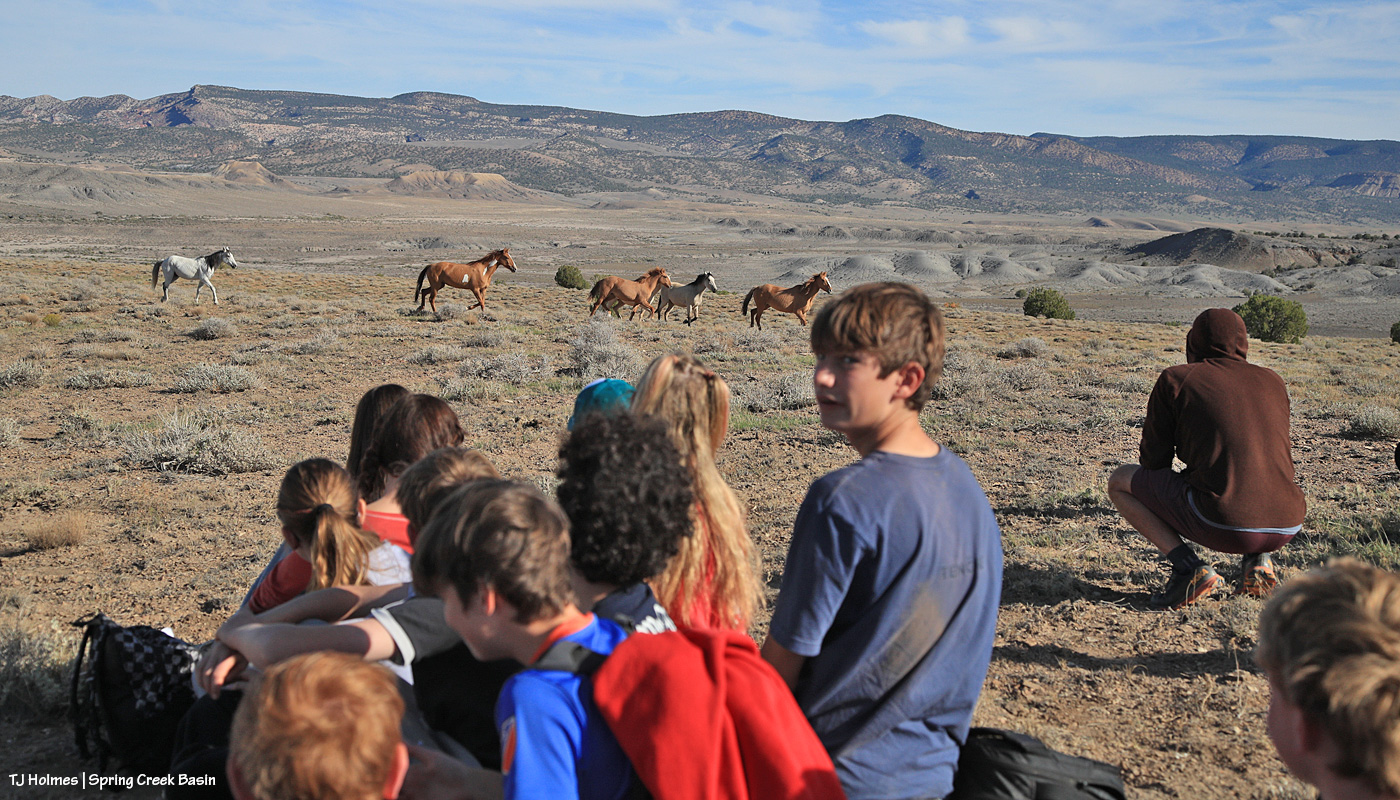
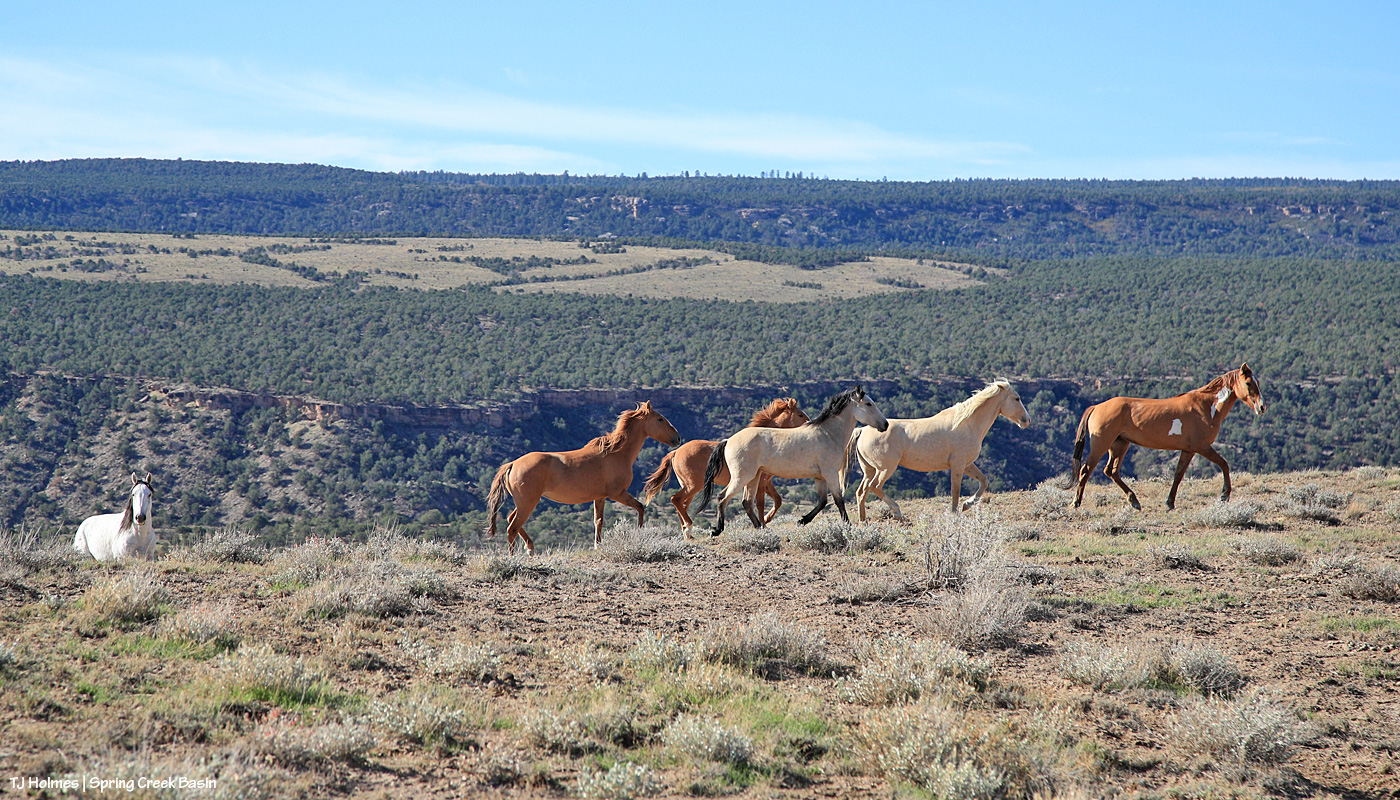
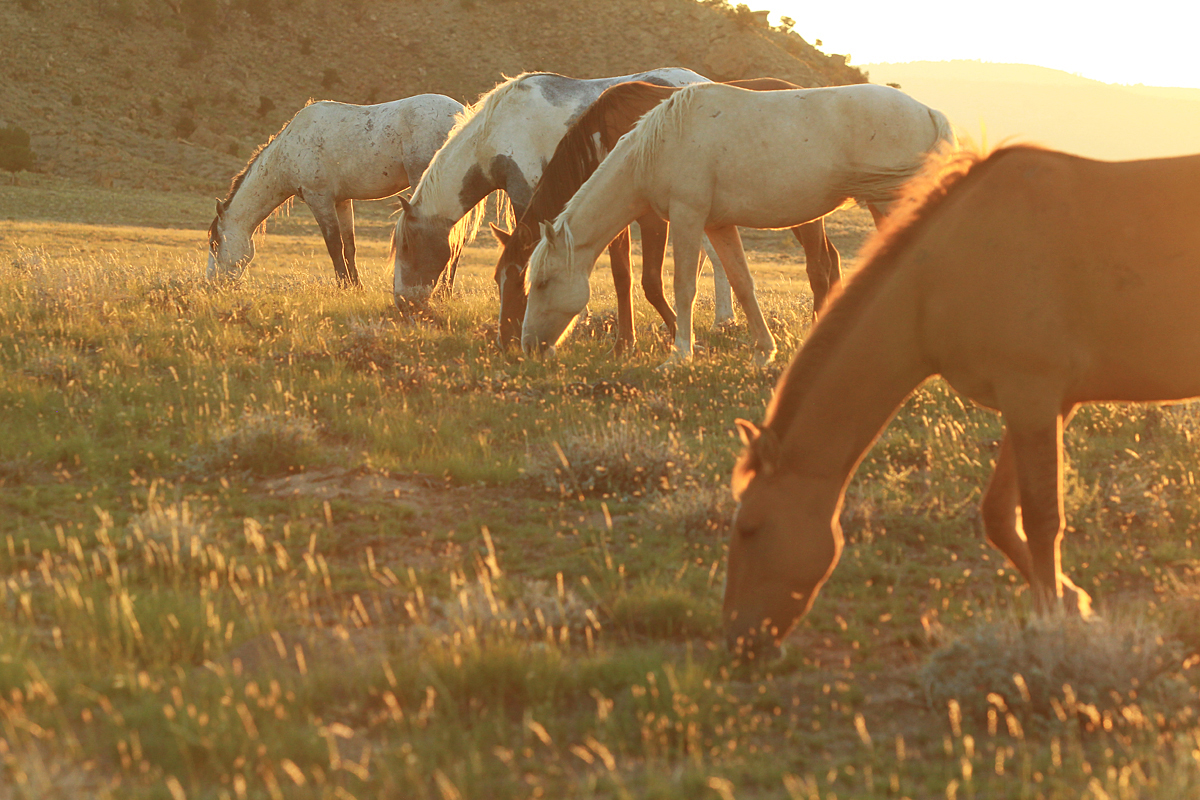
Earlier this week, Disappointment Valley and Spring Creek Basin – and one mustang band! – played host to a group of eighth-graders from Boulder’s Watershed School and three of their teachers. They got to see Buckeye’s band after a long drive from Meeker, where they’d camped after a great visit to the Wild Horse Refuge near Craig. Then they camped above Disappointment Creek, just outside Spring Creek Basin. In the morning, BLM range specialist and herd manager Anton Rambur and range tech Laura Heaton arrived to lead the students in a vegetation-monitoring project up the same hill. Tres Rios Field Office Manager Derek Padilla also came out to see and talk to the kids about the variety of land management that happens throughout BLM public lands in Southwest Colorado.

The kids spread out in small groups and pairs to conduct their utilization (grazed/ungrazed bits of galleta (a native, warm-season grass that’s growing after the recent rains) along lines of five steps at a time) under the watchful eye of Buckeye and the band.

And then, while they listened to Laura and Anton guide them about how to fill out their sheets with the information they’d gathered, Buckeye decided that he and the band were ready for their morning drink … which meant ambling up the trail … and giving the kids a good check-over … before heading down the other side of the hill to the water catchment.

Top THAT, any other school trip ever, anywhere! 🙂

We stayed up top to listen to Derek and give the horses a chance to get down the hill, to the catchment to drink the lovely fresh rainwater in the trough … and they came up a different trail back to the top of the hill, checked us out again and returned to grazing.

Oh, my lovely, wonderful, awesome and amazing mustangs. 🙂 You do me SO proud!

Then back down to the corrals and buses, where Anton and Laura helped them do the math involved in figuring out how much the horses are grazing in that area of the basin. At the end, I heard numbers ranging anywhere from 7 percent to 50 percent use/grazed plants, so even in our drought, we’re in good shape for the horses not eating everything in their paths. And the students learned a little bit about what BLM folks are looking at to manage the rangelands that support wild horses – and other grazing/browsing wildlife like elk, deer and pronghorns.

I got to talk more about PZP and show off my darting rifle and let some of the kids see how light it is and how quiet (no darts involved!). And I marveled the whole time at the insightful, curious questions the kids asked and the answers Anton and Laura gave to provide the kids with a well-rounded picture of what it takes to manage a herd of wild horses on public land in Colorado.

Ahhhhhhhhhhhhhhhhhhhhhh-mazing!

Here follow a load of pix of Watershed School students and teachers Amy, Diana and Pete, BLM’ers Laura, Anton and Derek … and the mustangs they got to see:
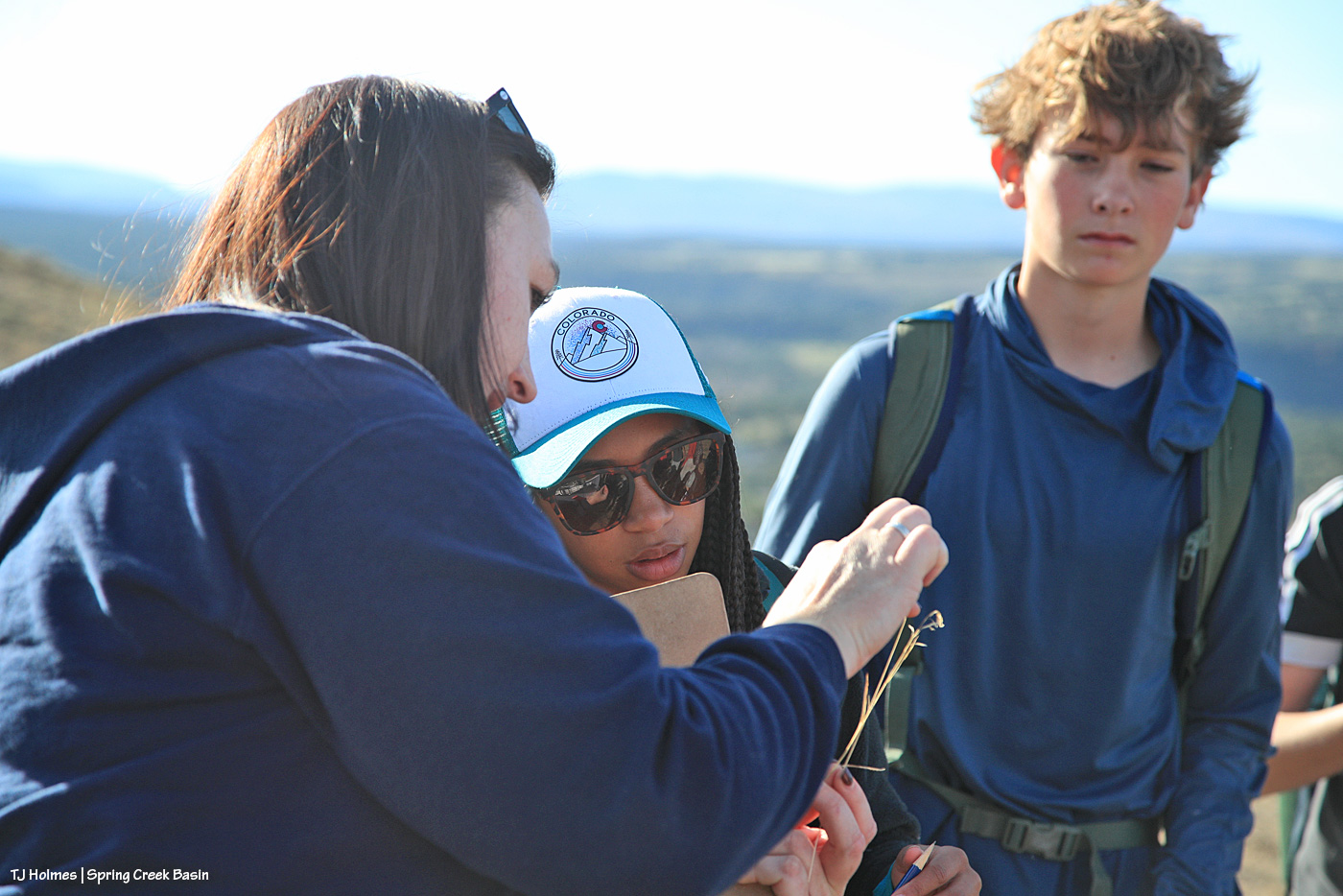
Laura points out characteristics of grasses to students. We saw past-prime cheat grass, and they concentrated on newly growing galleta. (We also saw Indian ricegrass, grama grass, alkali sacaton and/or sand dropseed (my hat is off to you if you can look at the latter two and tell them apart!)
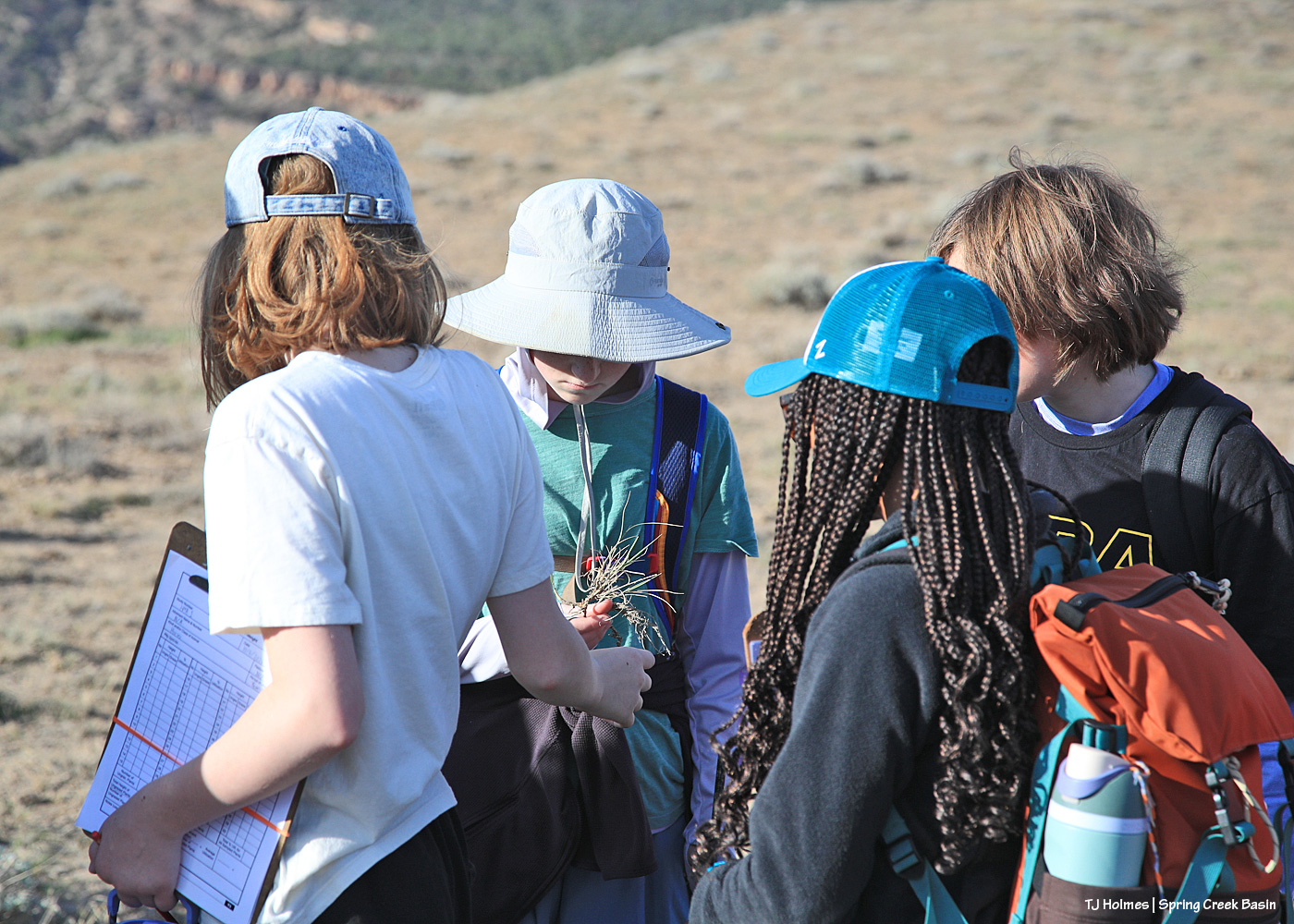
Students examine a clump of grass that shows last year’s growth as well as recent growth.
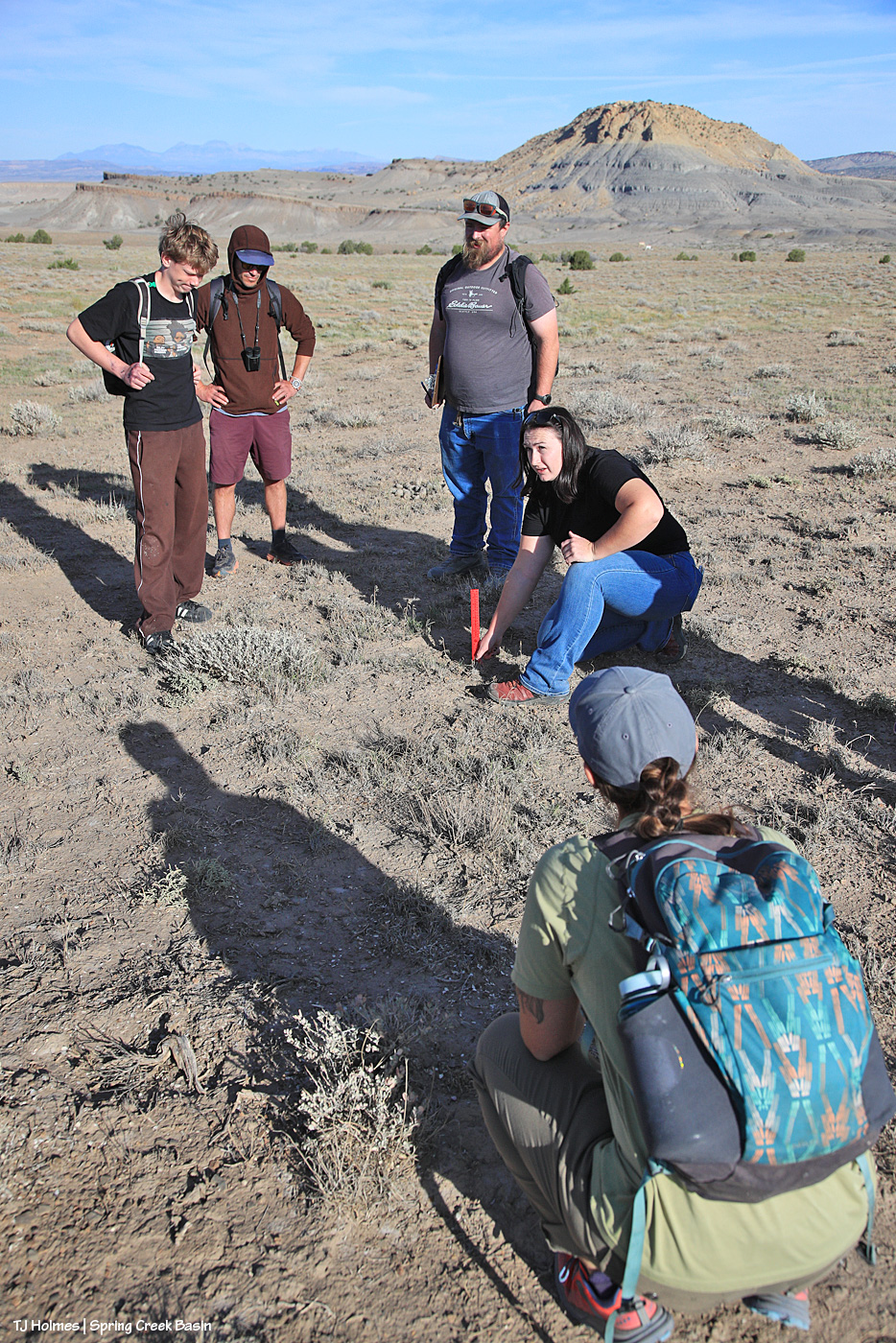
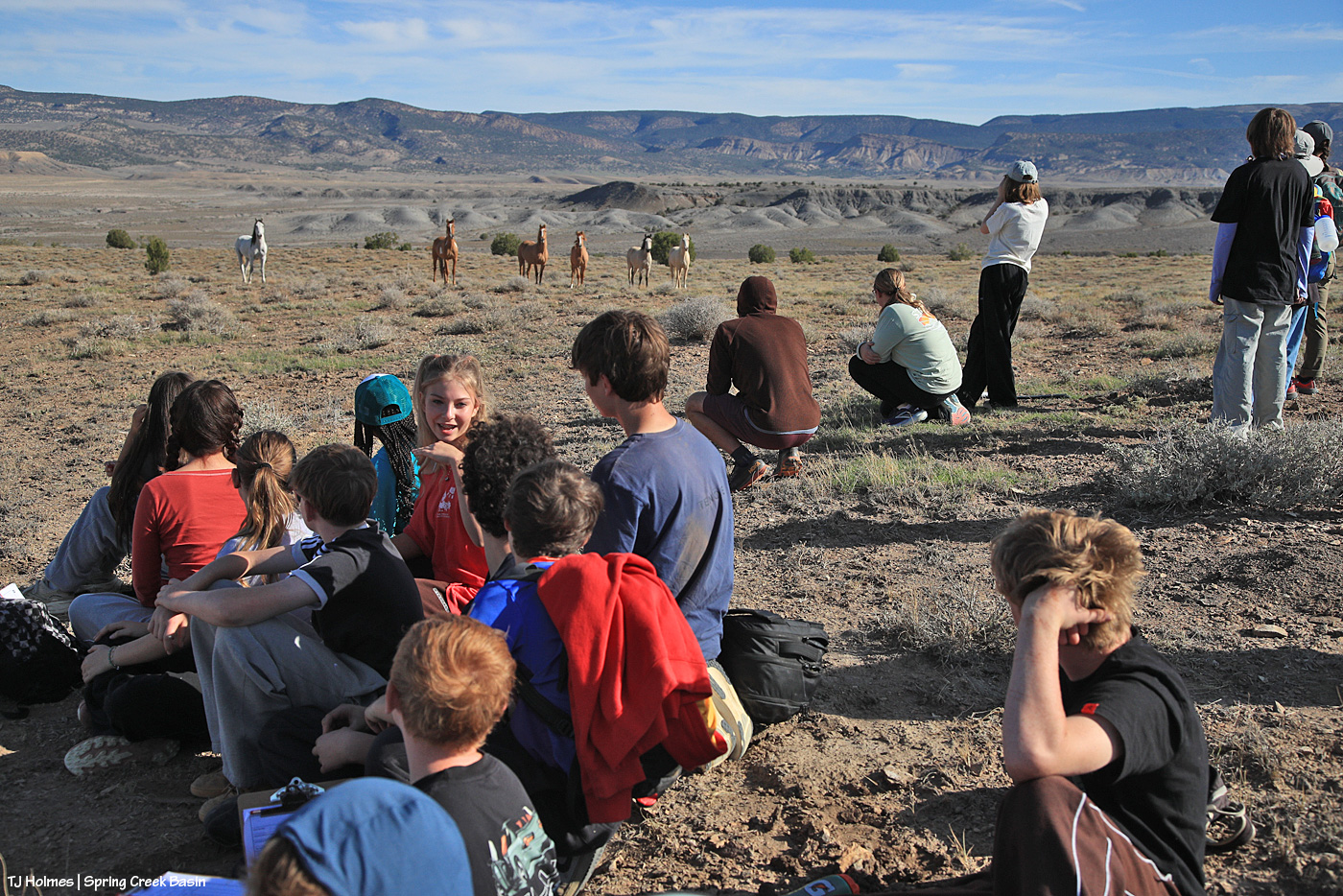
Laura and Anton talk about how to measure clumps of grass. The idea was that the students walked five steps in a line, measured galleta at their toe or within reach … then another five steps … until they’d measured 10 samples. Teacher Amy is in the foreground (this is the second time she has brought one of her eighth-grade humanities classes to Spring Creek Basin; the last time, it poured rain! as you can see in these pix, they lucked out with spectacular October weather), and teacher Pete is in the brown hoodie and camp. … Start to notice the “little white dots” in the distance.
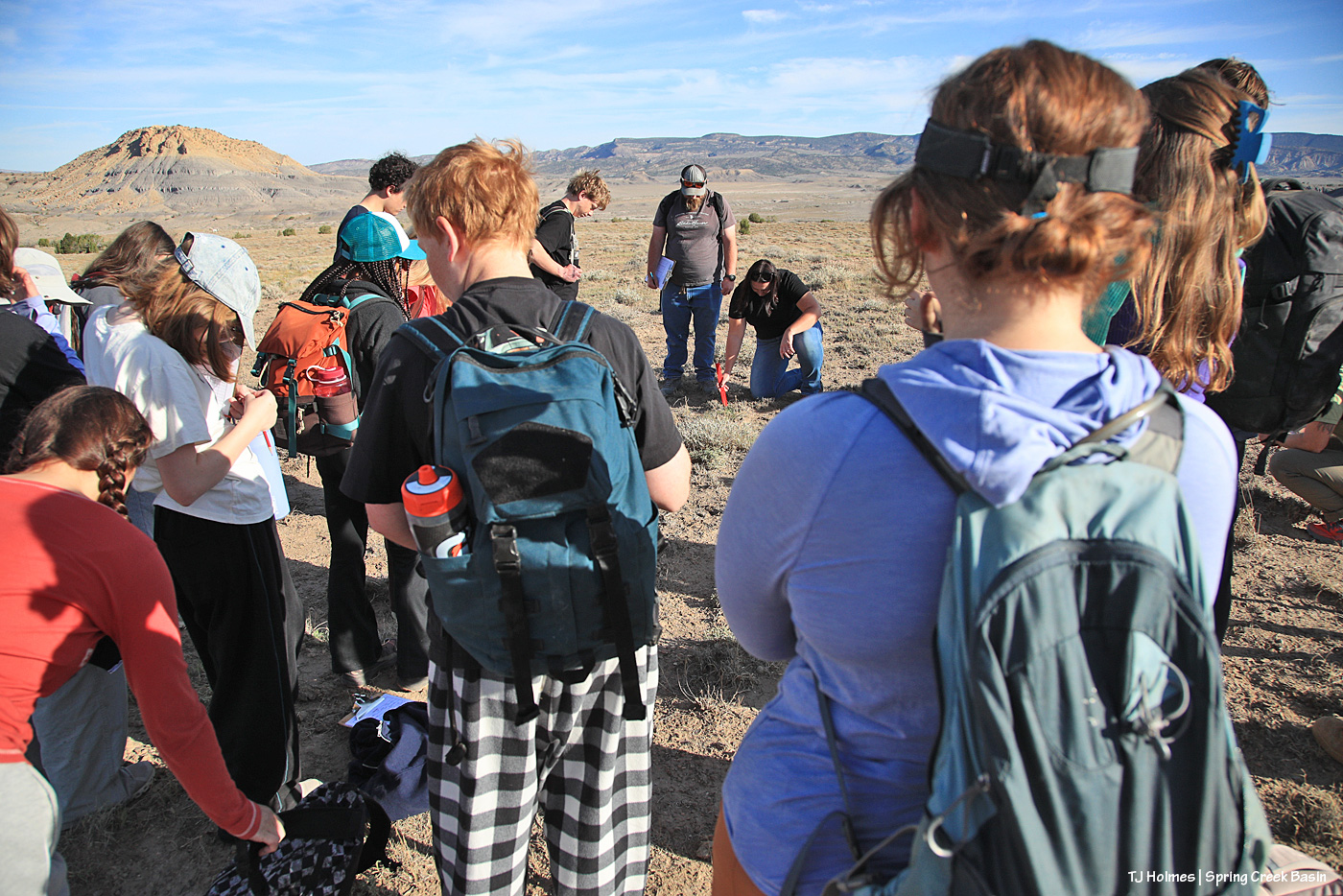
Teacher Diana is at right while the students watch Laura measure the grass clump. For a little perspective, I’m facing nearly directly north toward the main, west-ish part of Spring Creek Basin.
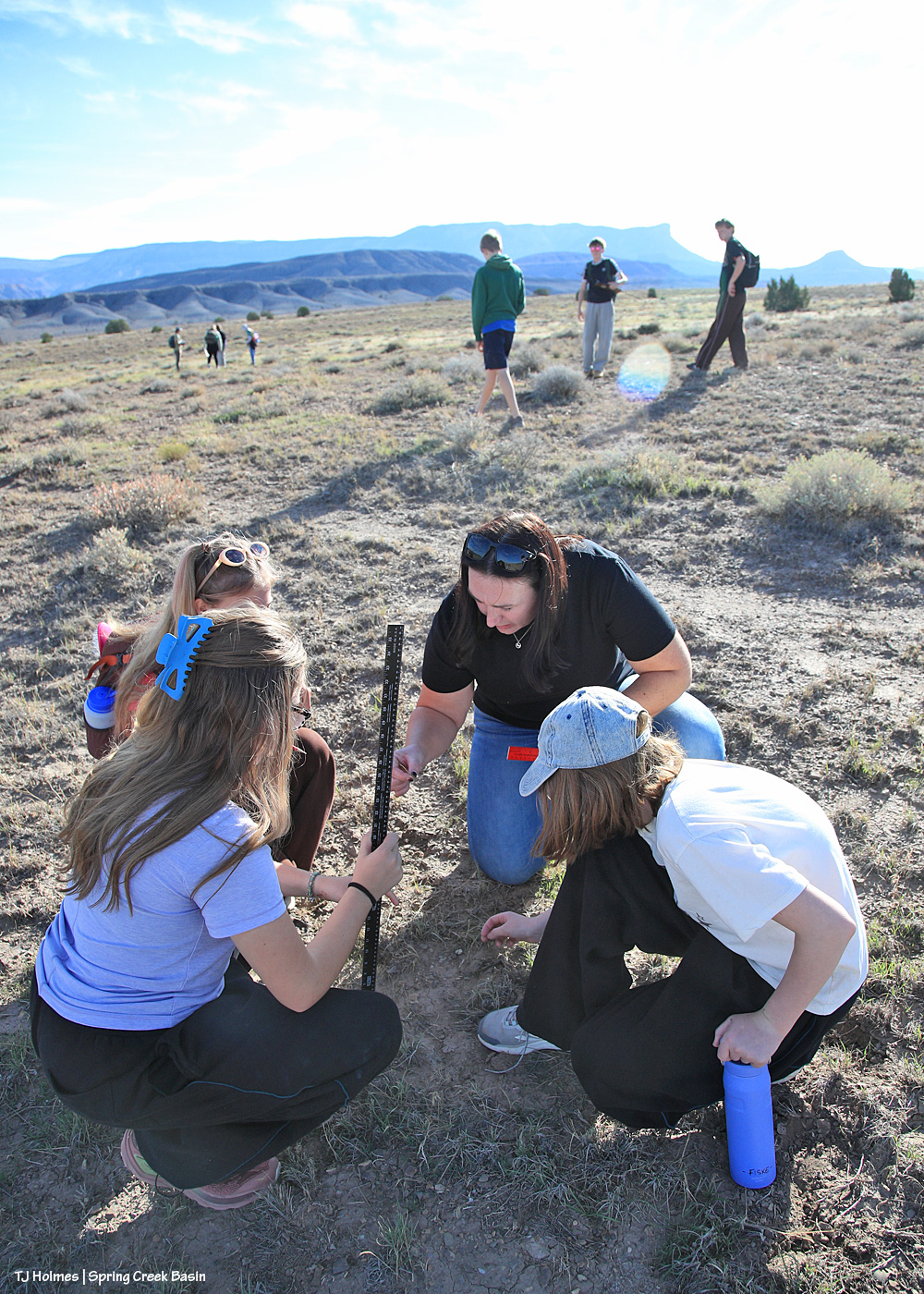
No mistaking that horizon. 🙂 Laura helps one of the small groups of students with their monitoring while two other groups walk their lines in the background.
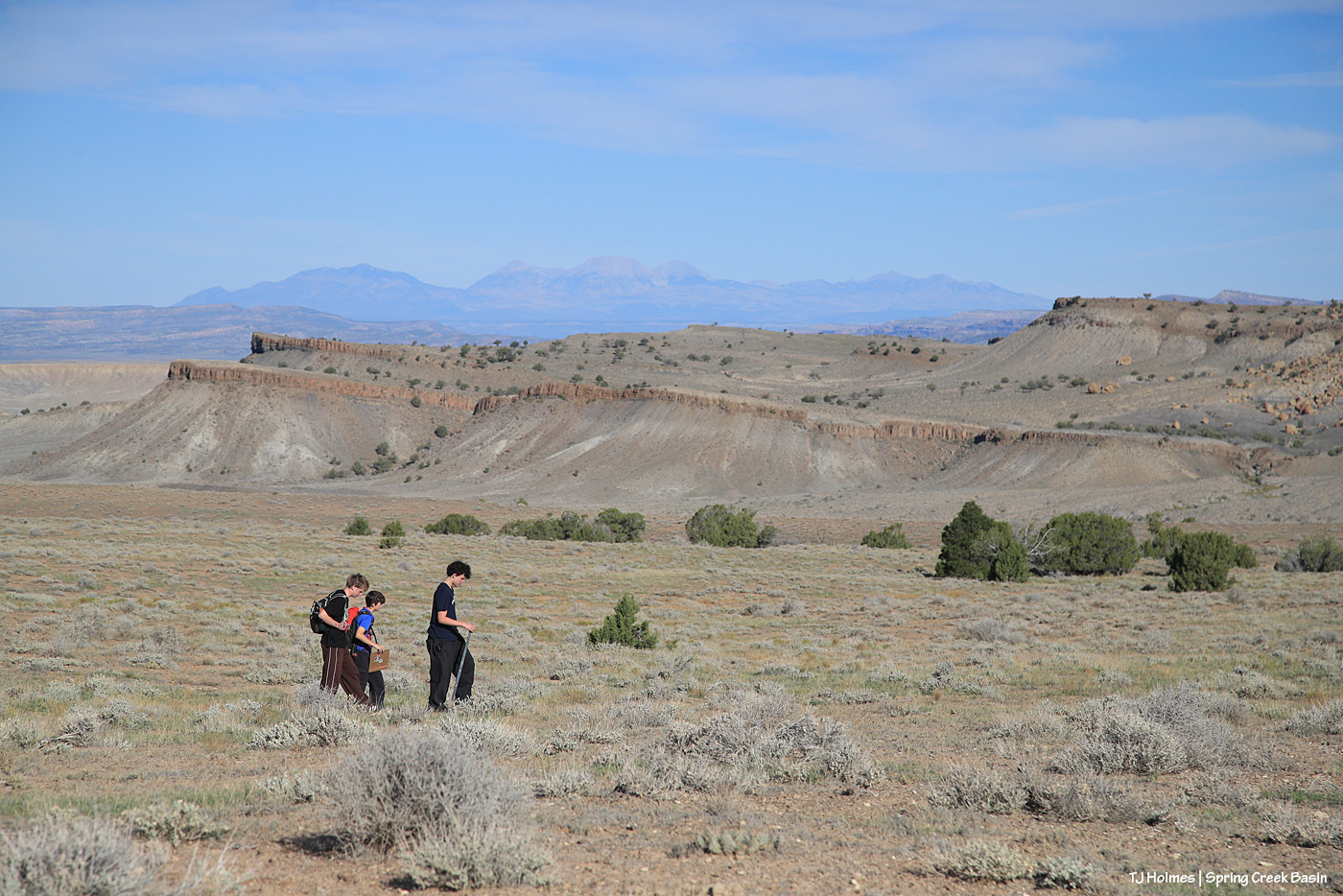
Boys walk their line with the basin’s south-facing rimrocks in the near distance and Utah’s La Sal Mountains in the far distance.
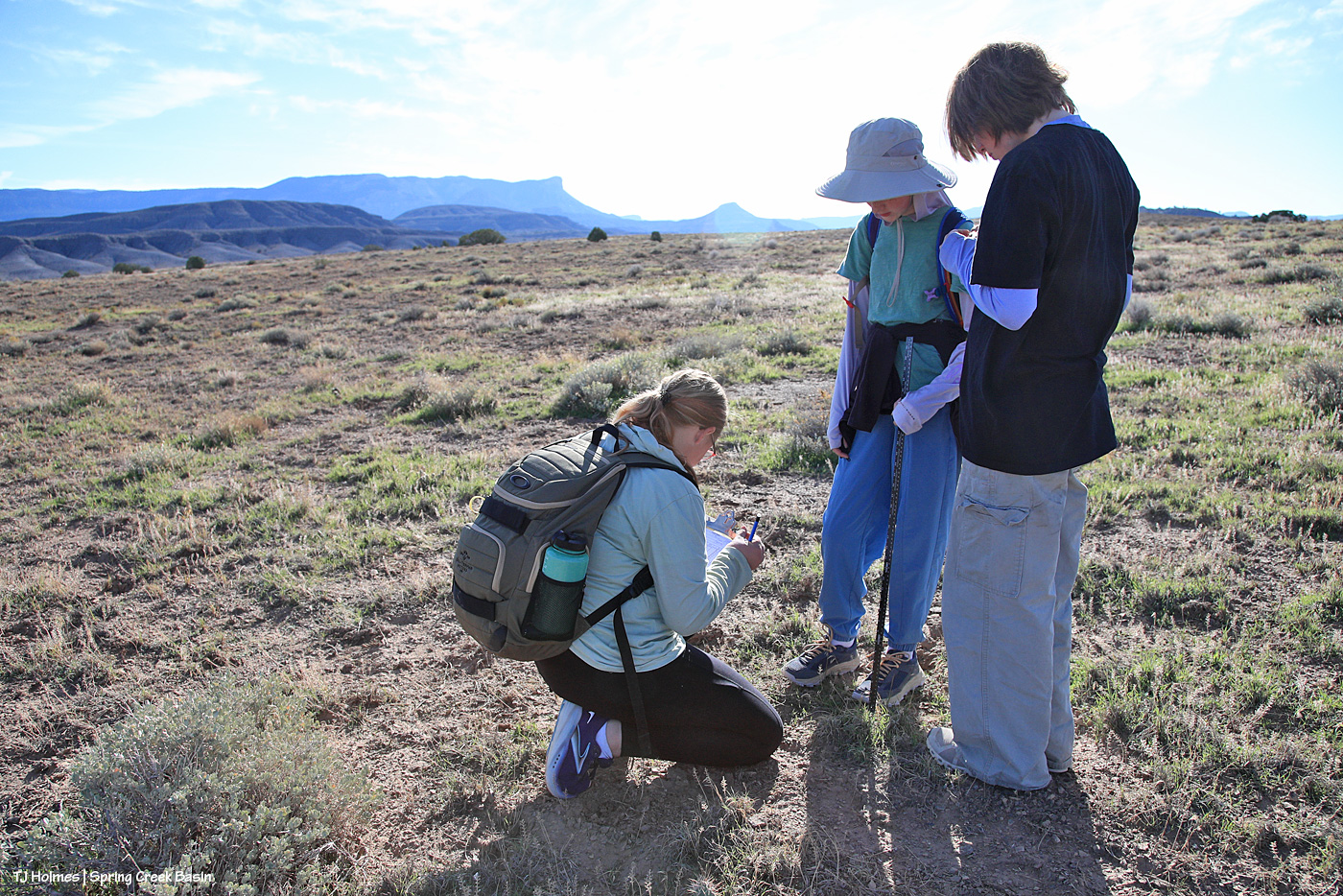
It’s hard to get a whole lot farther from Boulder than Disappointment Valley (OK, we’re not the *farthest* southwest corner of the state), but students were focused on the vegetation and their project. How cool is it that they’re able to take trips like this instead of learning from books only, only in a classroom?
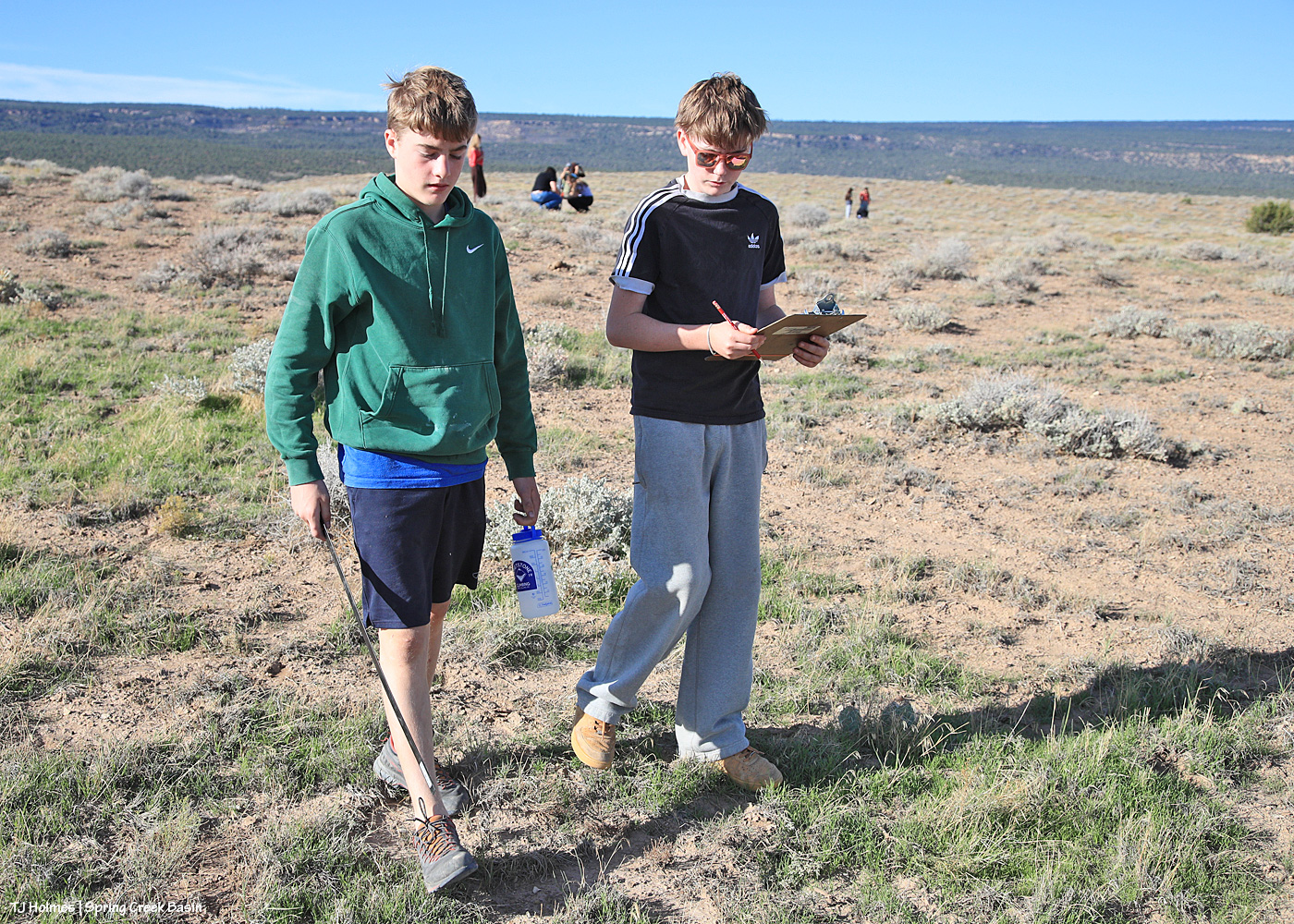
Another pair walking their line with other groups in the distance. See that GREEN grass? Yeah, thank you, RAIN! A little goes a long way in this high desert.
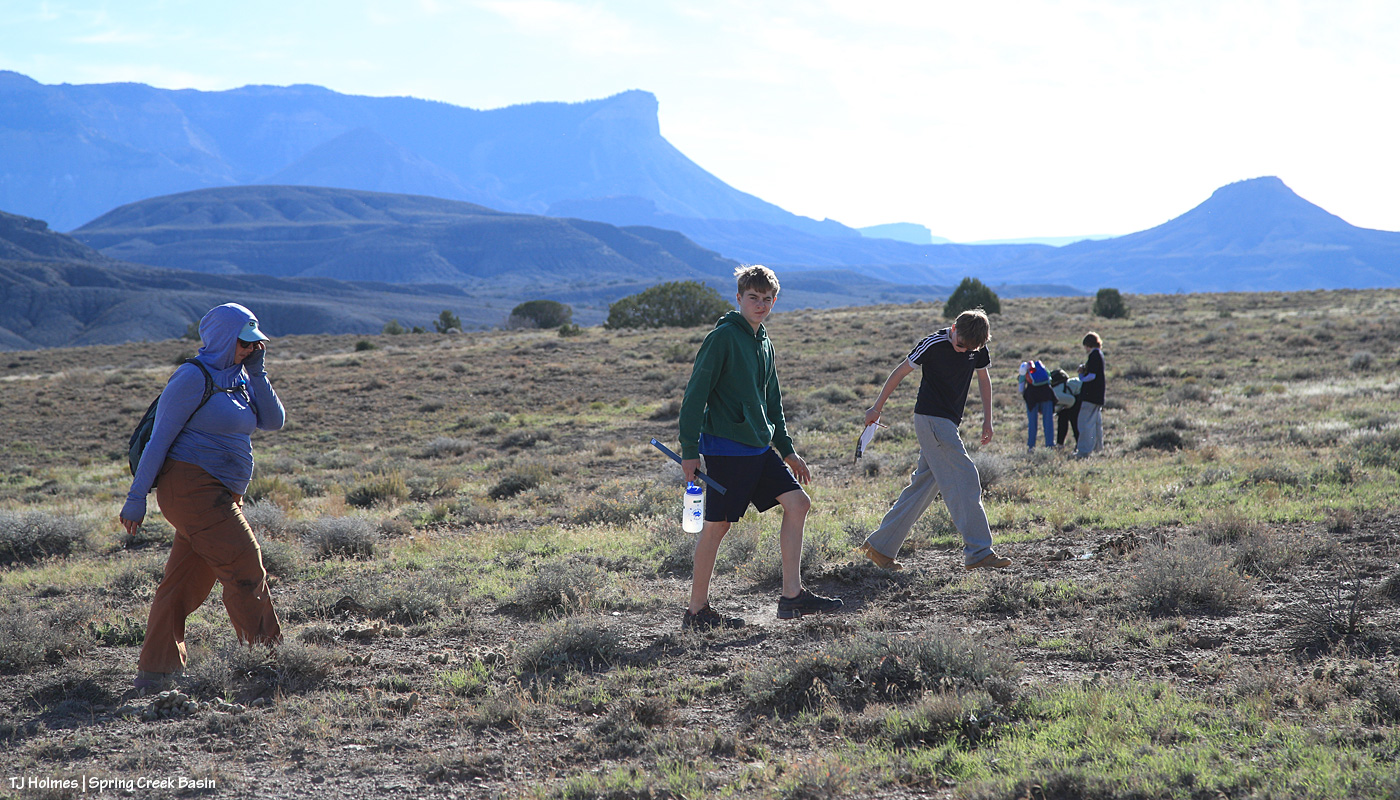
Diana follows the boys back up the hill after they finished their line. Can’t get enough of that scenery.
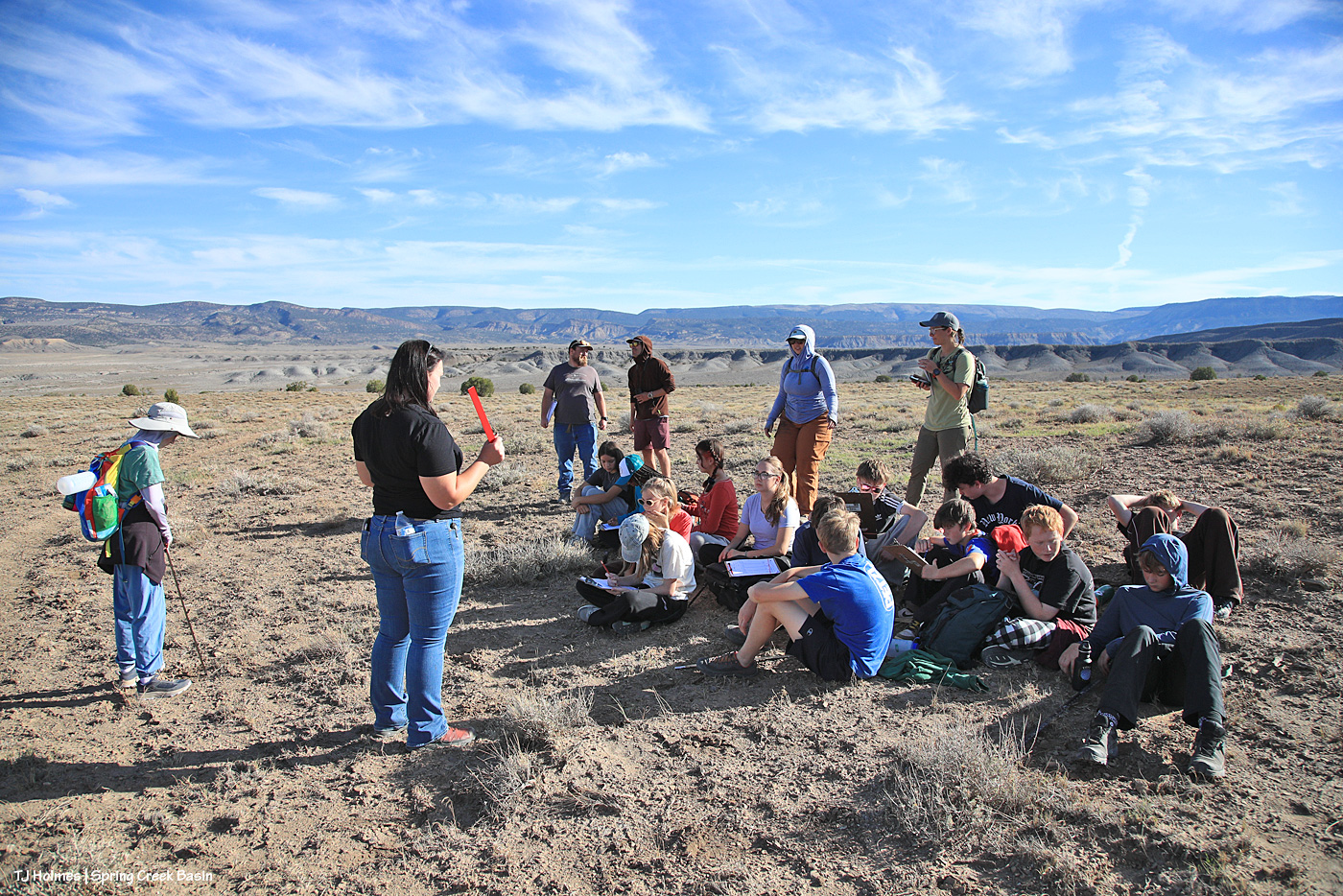
All gathered again to ensure they’d filled out their sheets well. … There was math to come!
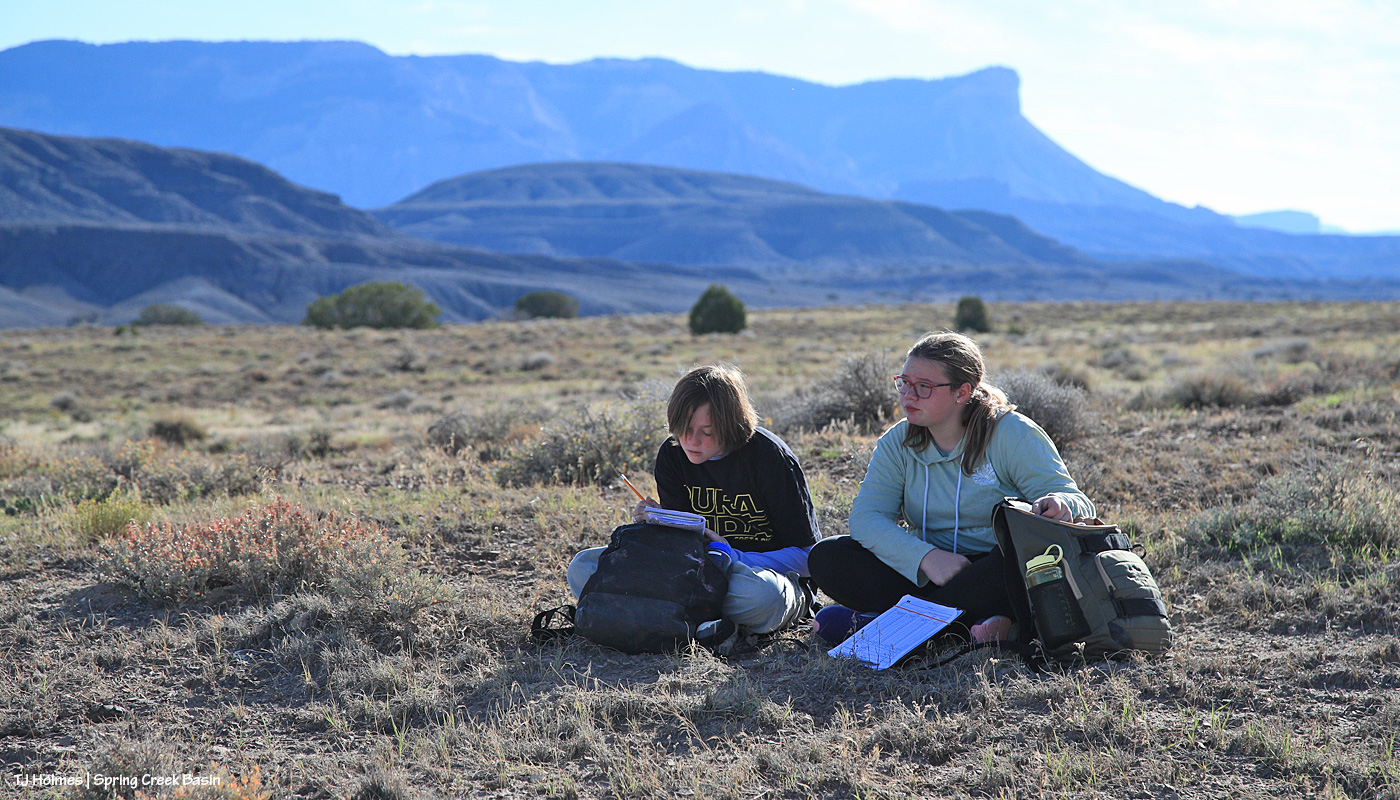
These city students were not afraid to drop to the ground among the grasses and shadscale and four-wing saltbush – and cacti!
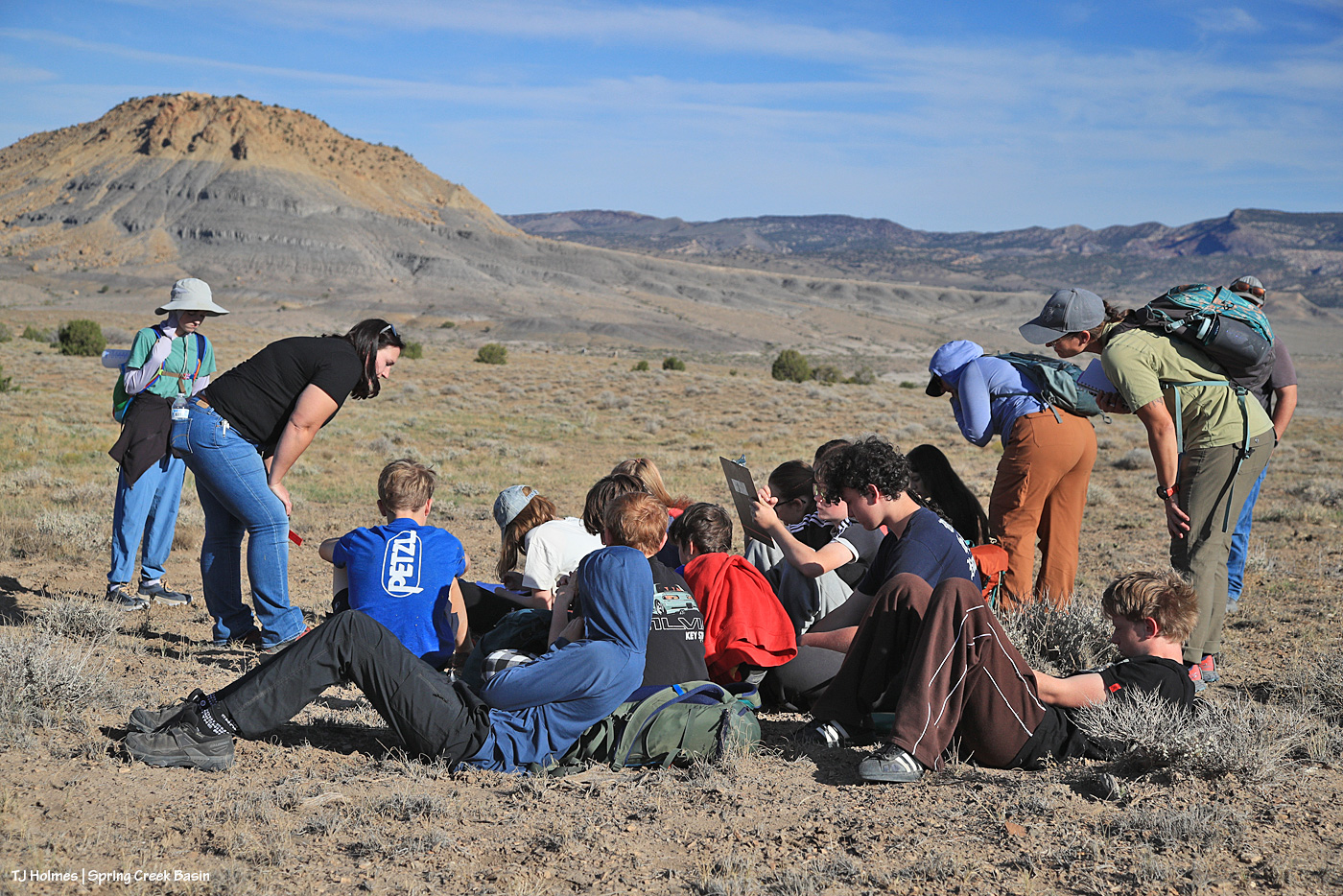
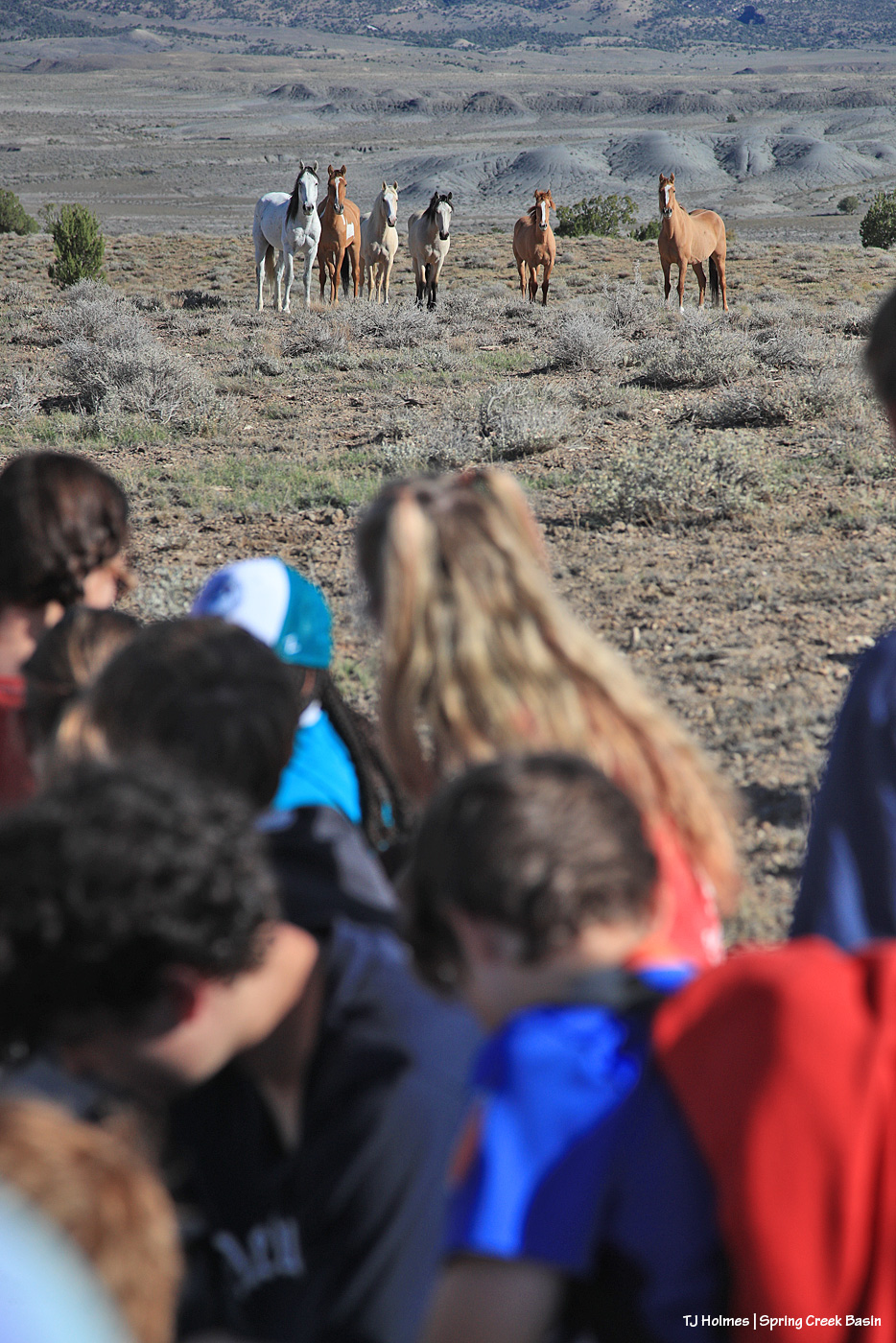
Laura, left, and teachers Amy and Diana helped the kids with their utilization sheets (these are the same that BLM employees use while out monitoring rangelands). They’re a little hard to see (wide-angle lens, not my big gun), but look straight out over the kids’ heads. …
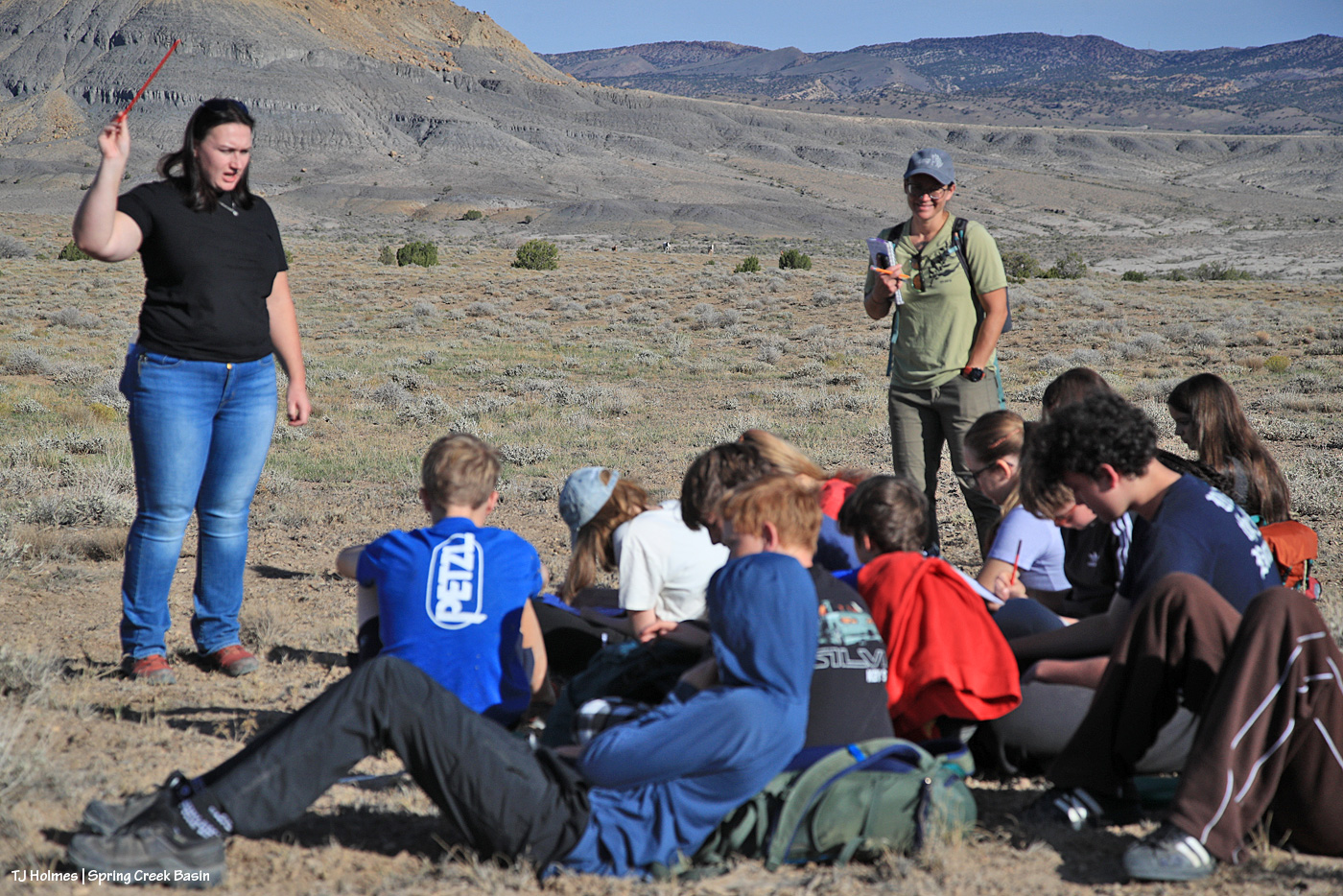
We were being watched!
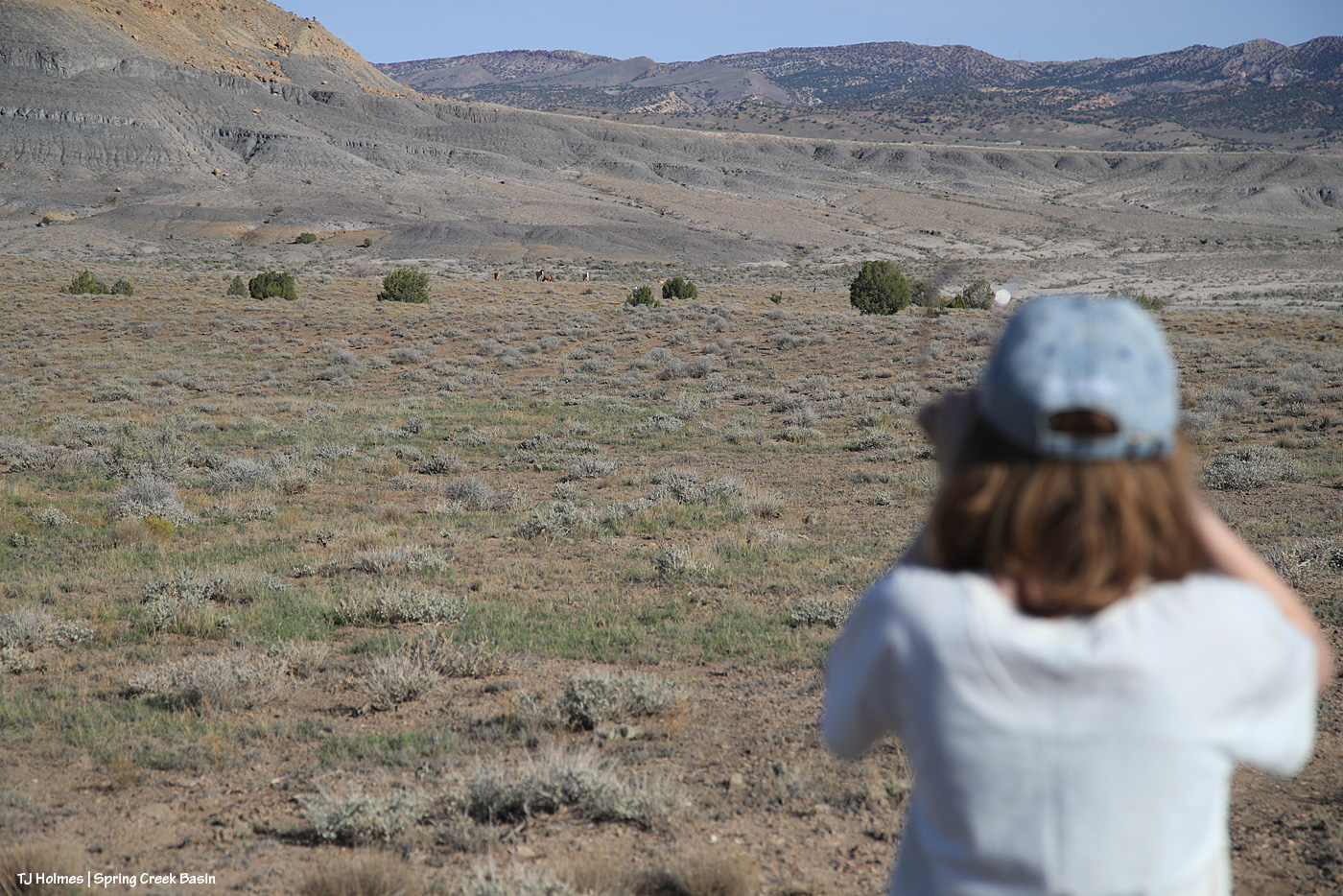
Just like the evening before, Buckeye’s band was over the top of this hill, down toward the north. Here, they’re a little east of where they’d been previously. The previous evening, after they arrived, I hiked the kids out to the trees – there’s a little arroyo that starts there – and we picked up the trail to the west, which we took a bit farther left of where the horses are seen here.

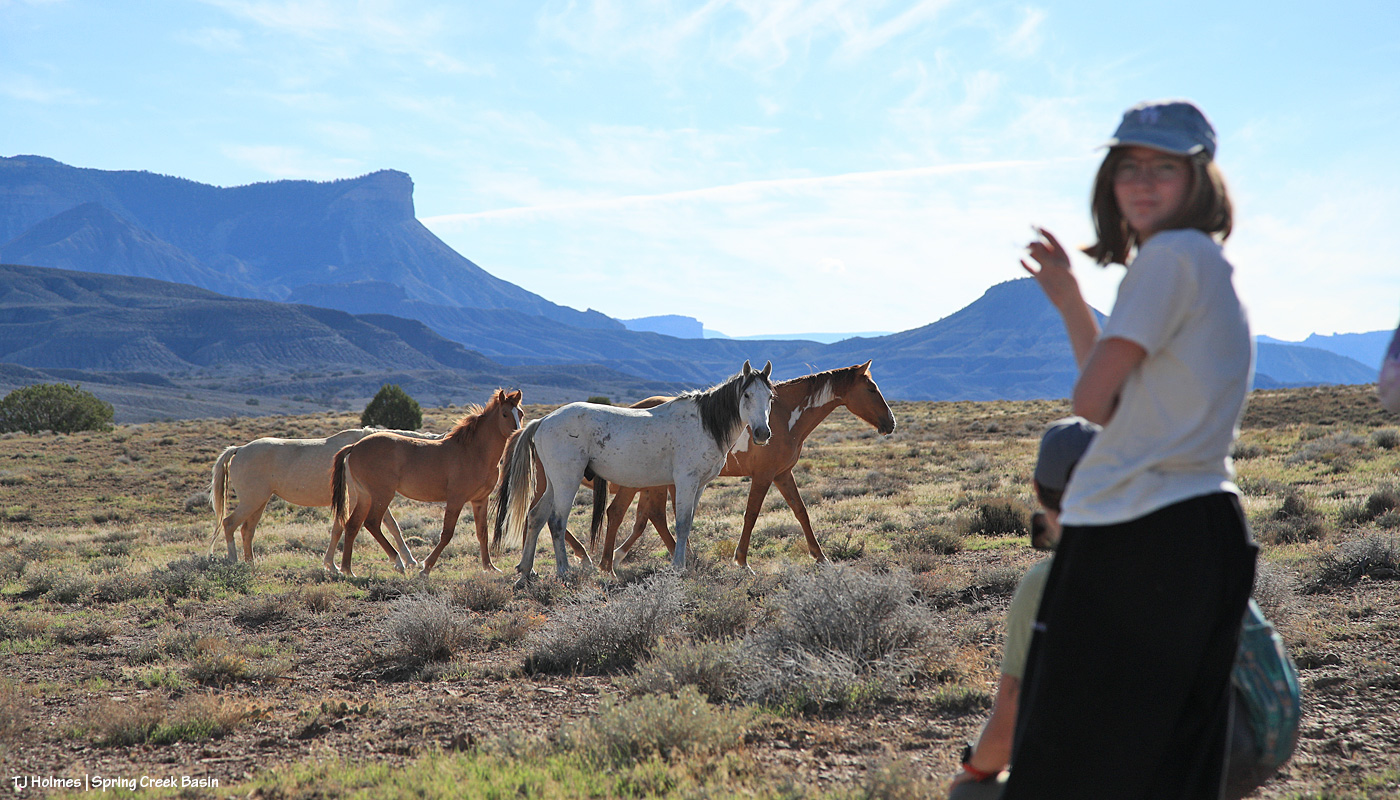
I’m not sure how long we’d been on the hill, but we weren’t in a hurry, and the students were absorbed in their project. While they worked, I took pix and kept an eye on Buckeye’s band to gauge their comfort level (they were at least a few hundred yards away from us). By about this time, as the students were nearing the completion of the monitoring part of their project, I started to notice that the full band was appearing, and Buckeye was inching a bit closer. … And then it hit me: They want to make a trip up and over the hill and down to the catchment trough for their morning drink. Sure enough, they walked on up the trail, but where I thought they’d veer off more to the west and go down the trail I brought the kids up the evening before, those curious ponies came right up the trail to where the students were gathered! I cautioned everybody to just sit tight and stay fairly quiet and let the horses explore this mass of humanity on their usual empty route to water.

And the gathered group of students and adults got the mustang sighting of their lives. 🙂
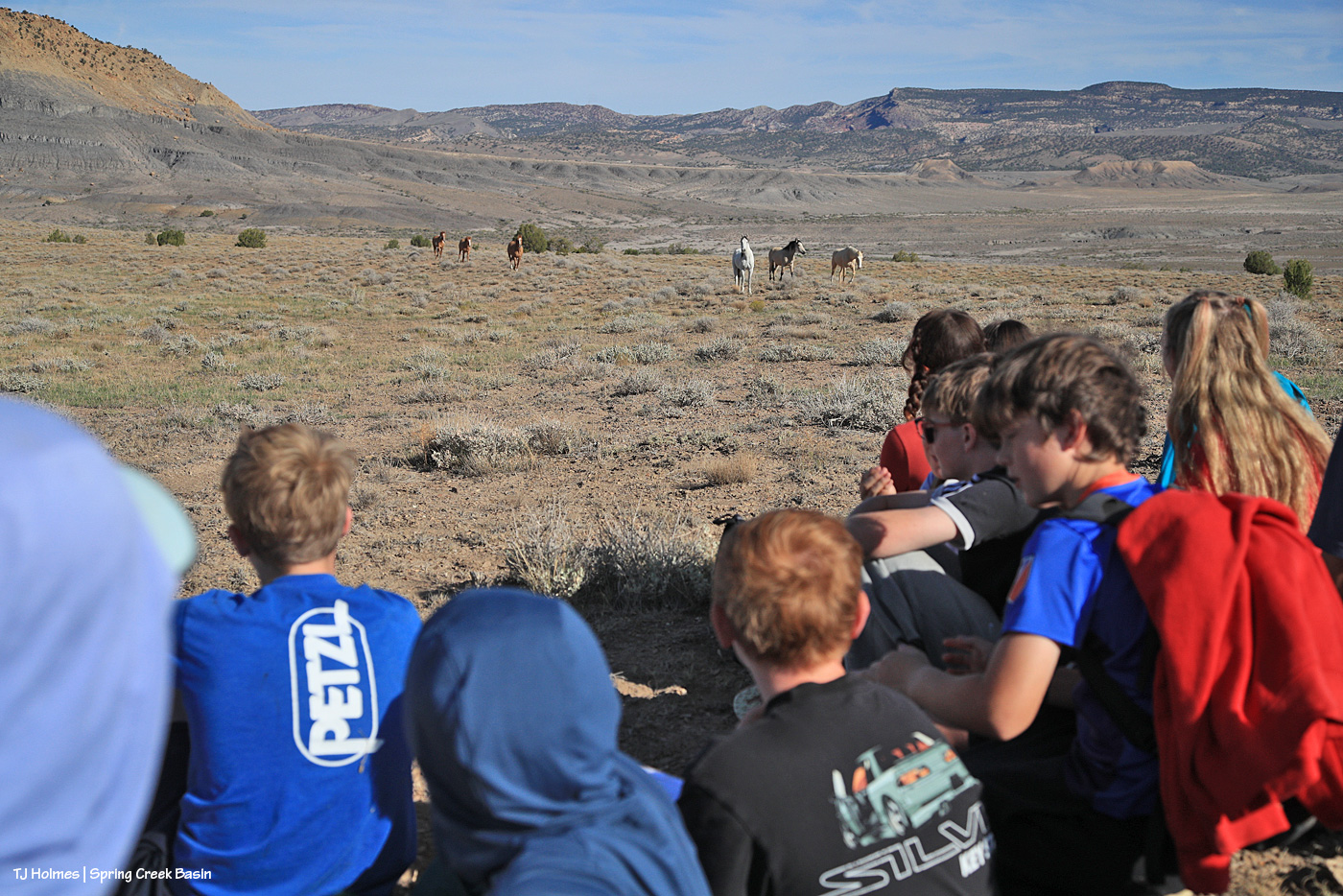
Pretty amazing, eh? 🙂
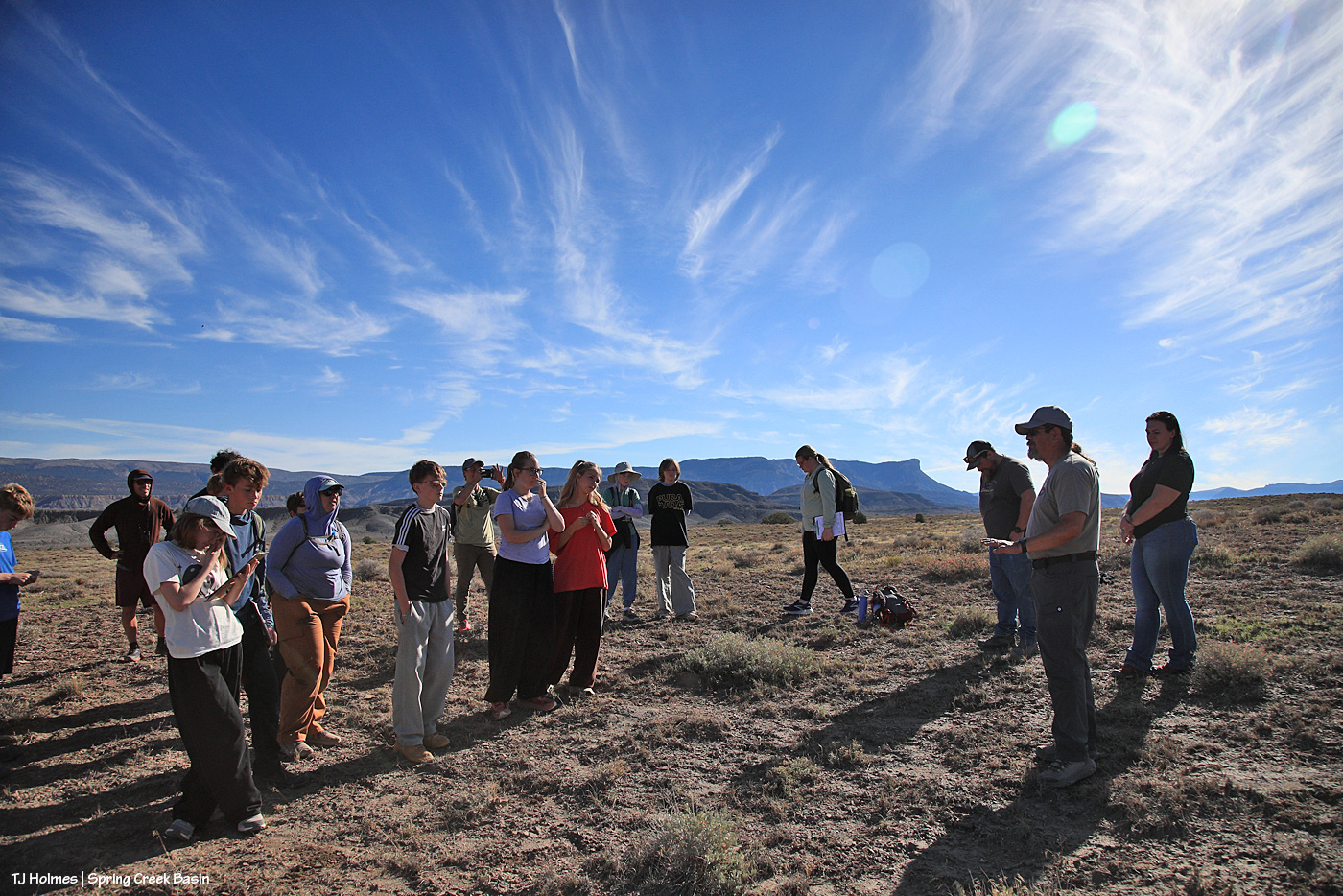
While we were watching Buckeye’s band watching US, Tres Rios Field Office Manager Derek Padilla hiked up the hill to join us. He talked to the students about the variety of jobs available with the Bureau of Land Management (and U.S. Forest Service, where he spent the first 27 years of his 30-year land-management career) and the variety of ways BLM’ers manage the multiples uses that happen on public lands.
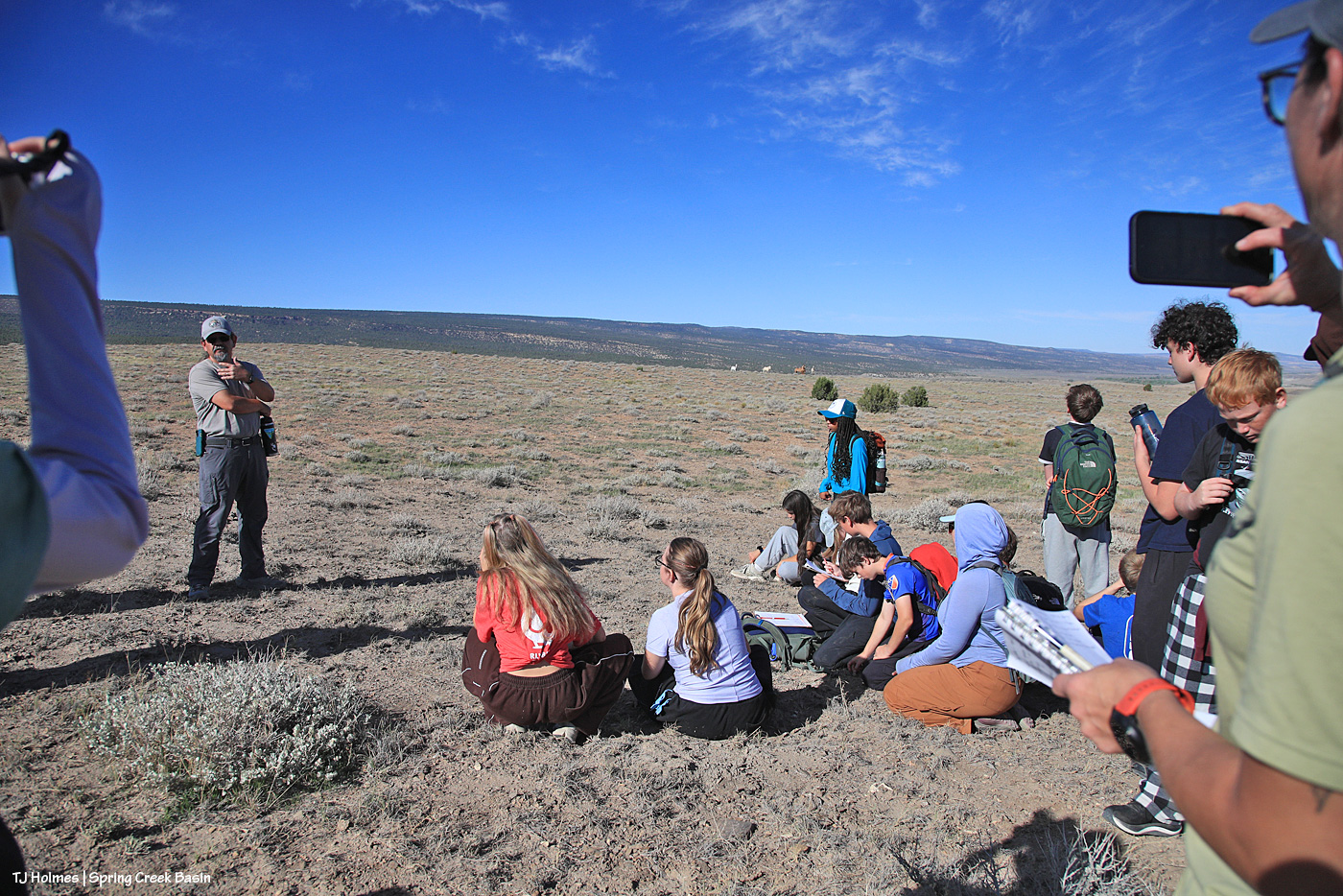
He and Buckeye might have worked it out between themselves because the band had plenty of time to head down the hill to water, drink and then return up a different trail.
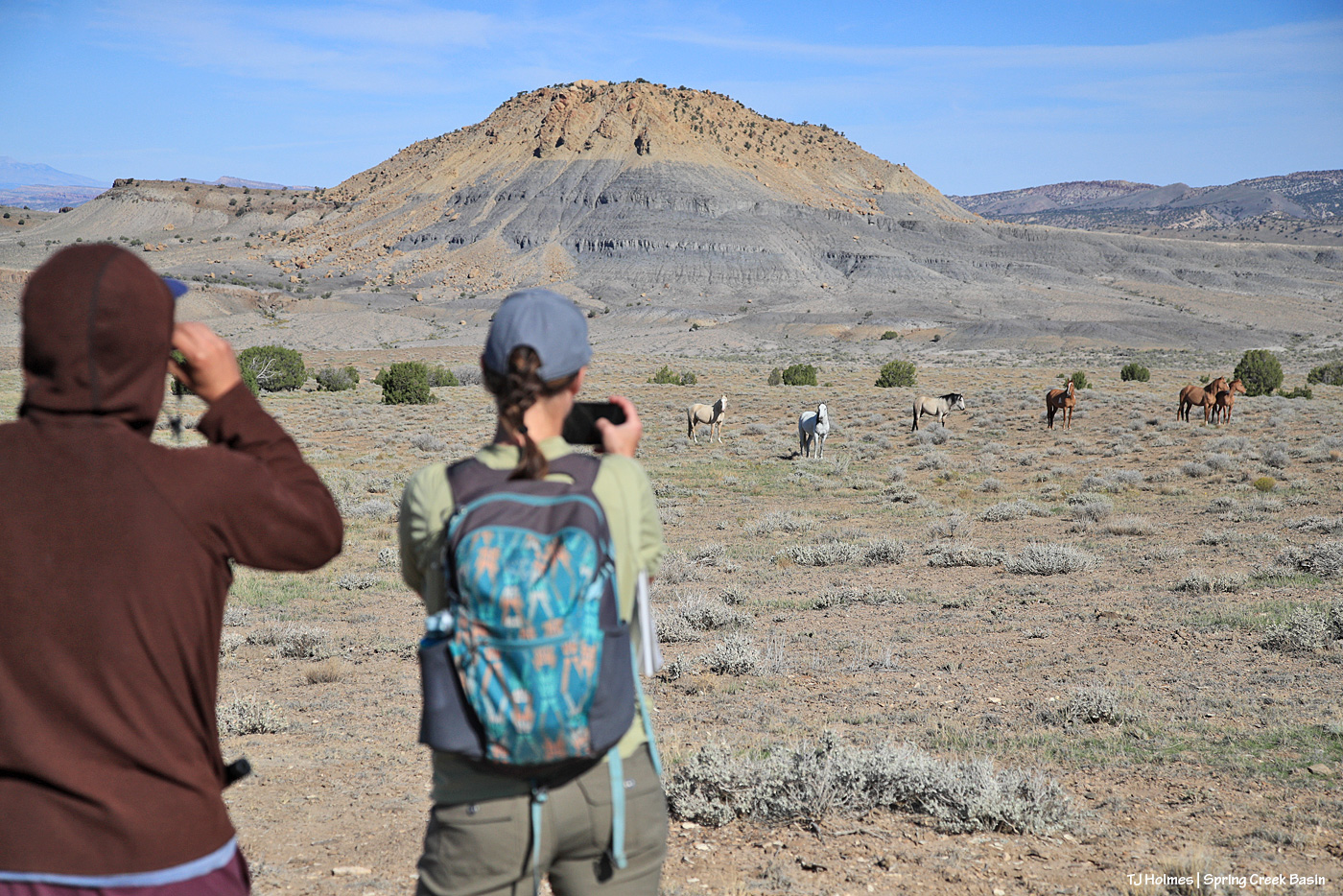
After one last farewell to the ponies, the group returned down the hill to the buses to complete the math (!) part of the project and have some lunch and a last round of questions and answers with Laura and Anton.
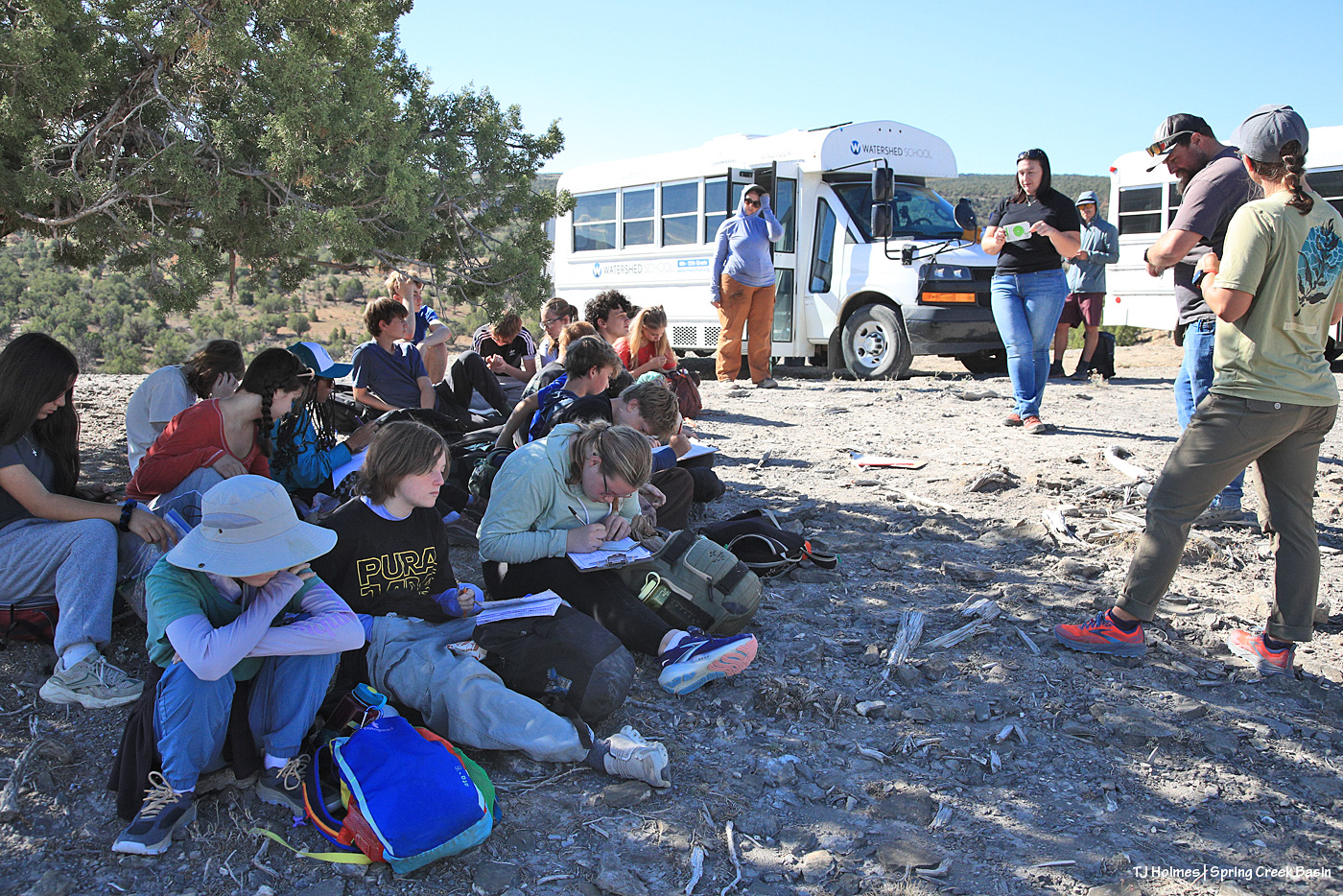
Yes, math does have real-world applications. 🙂 Laura and Anton helped students with the formulas to calculate the results of their utilization (grazed/ungrazed) survey. Results: The horses have plenty of forage, even after our stressful droughty summer. Whew.
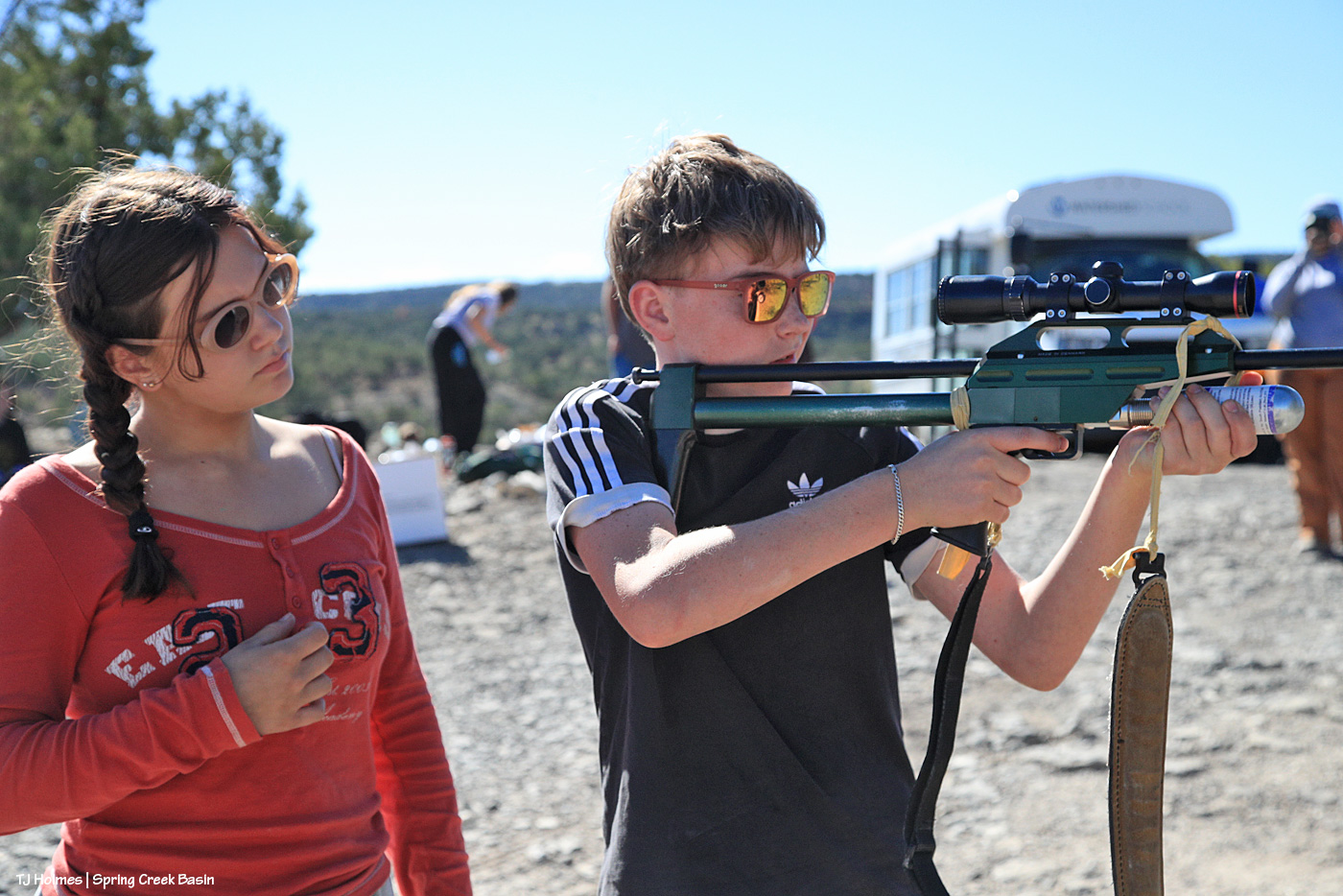
Before they left, at least one of the teachers and a few of the students got to check out my darting rifle. It’s very lightweight, and it fires off of a CO2 cartridge (pressurized to the distance of a mare). NOTE: NO DARTS WERE IN THE RIFLE. I let them put some air in the rifle and pull the trigger to hear the sound and have the feel of it. A surprise to a couple: No kick. 🙂

Kudos to these kids and their teachers for thinking outside the box and creating the experiential learning experiences Watershed School is known for. *I* sure never got to visit wild horses as part of any class trip, and I attended lots of schools in many states and Germany! They are super curious and intelligent and asked some of the best questions I’d ever heard – and I get a LOT of questions and have a lot of answers. Speaking for myself (I’m sure Laura and Anton and Derek would agree): We had a blast introducing these young folks to Disappointment Valley, Spring Creek Basin and (at least a few of) our amazing mustangs. 🙂

You’re welcome back any time!
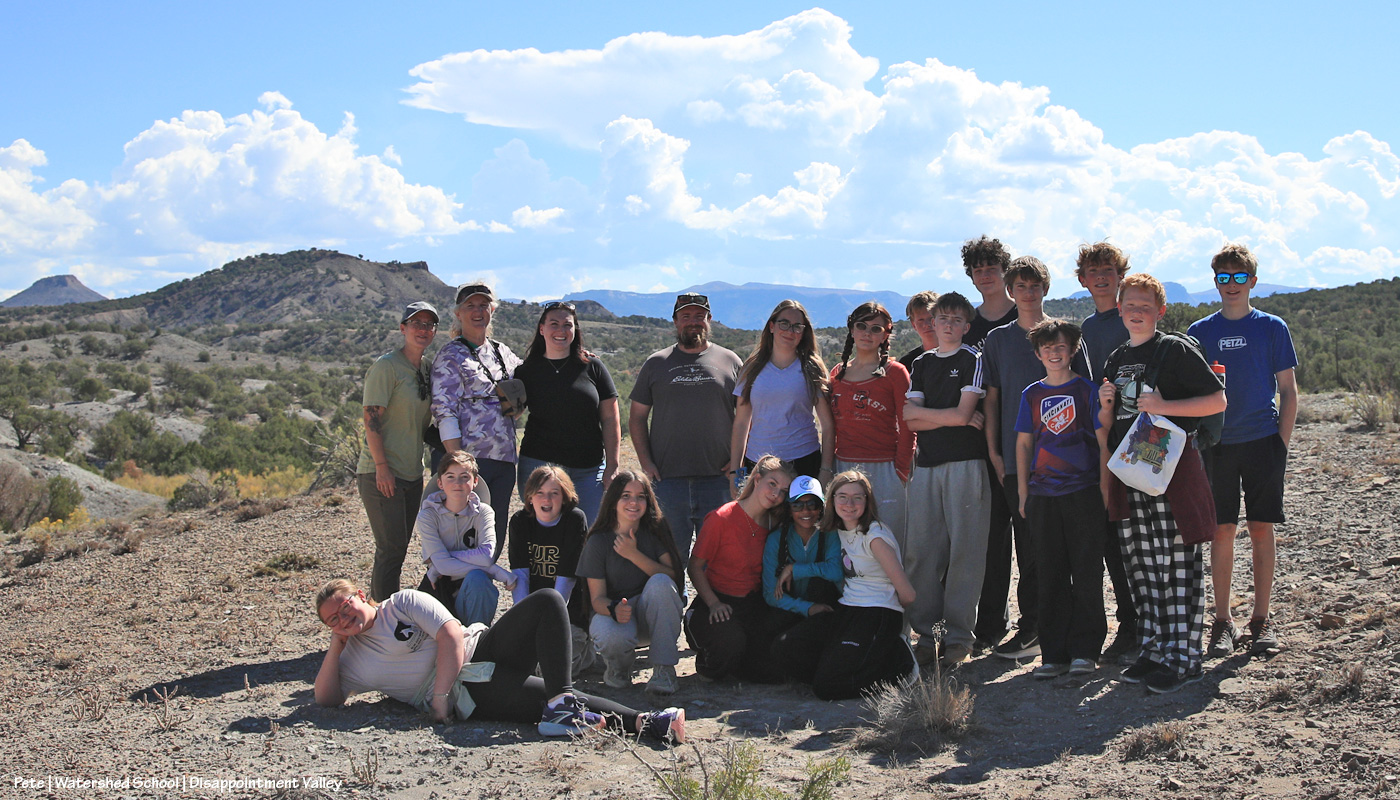
Thank you so much to these Watershed School teachers and students, and to Anton, Laura and Derek, and (I have to say it) to my boy Buckeye and his girls, for making this a fantastic visit and learning experience in Spring Creek Basin!


‘A resource with a beating heart’

2 05 2022

We had such a great time with the mustangs and visitors Saturday at Canyons of the Ancients Visitor Center and Museum!

A little background: Last year was the 50th anniversary of the Wild Free-Roaming Horses and Burros Act. CANM had a wonderful special exhibit all year that celebrated mustangs – especially our Colorado herds in Spring Creek Basin, Little Book Cliffs, Sand Wash Basin and Piceance-East Douglas. To help promote that, we were invited to a very special one-day event last fall, to introduce a couple of our local adopters of Spring Creek Basin mustangs, have advocate and author Kathryn Wilder read from her memoir, Desert Chrome (published in May), and take limited numbers of visitors (still under Covid protocols) through the exhibit inside the museum.

It was such a success, Amala Posey-Monk, supervisory park ranger with CANM, asked if we’d like to make it an annual event. How fast could we say YES?!

So Kat returned and read again from Desert Chrome, which is being sold in the new bookstore area in the visitor center and museum (which looks fantastic, by the way; drop by and see (among the museum’s other wonderful exhibits about the cultural history of our area) the particular wall full of ways to appreciate our very dark skies). She also signed copies of her book for folks who were there to visit the mustangs.

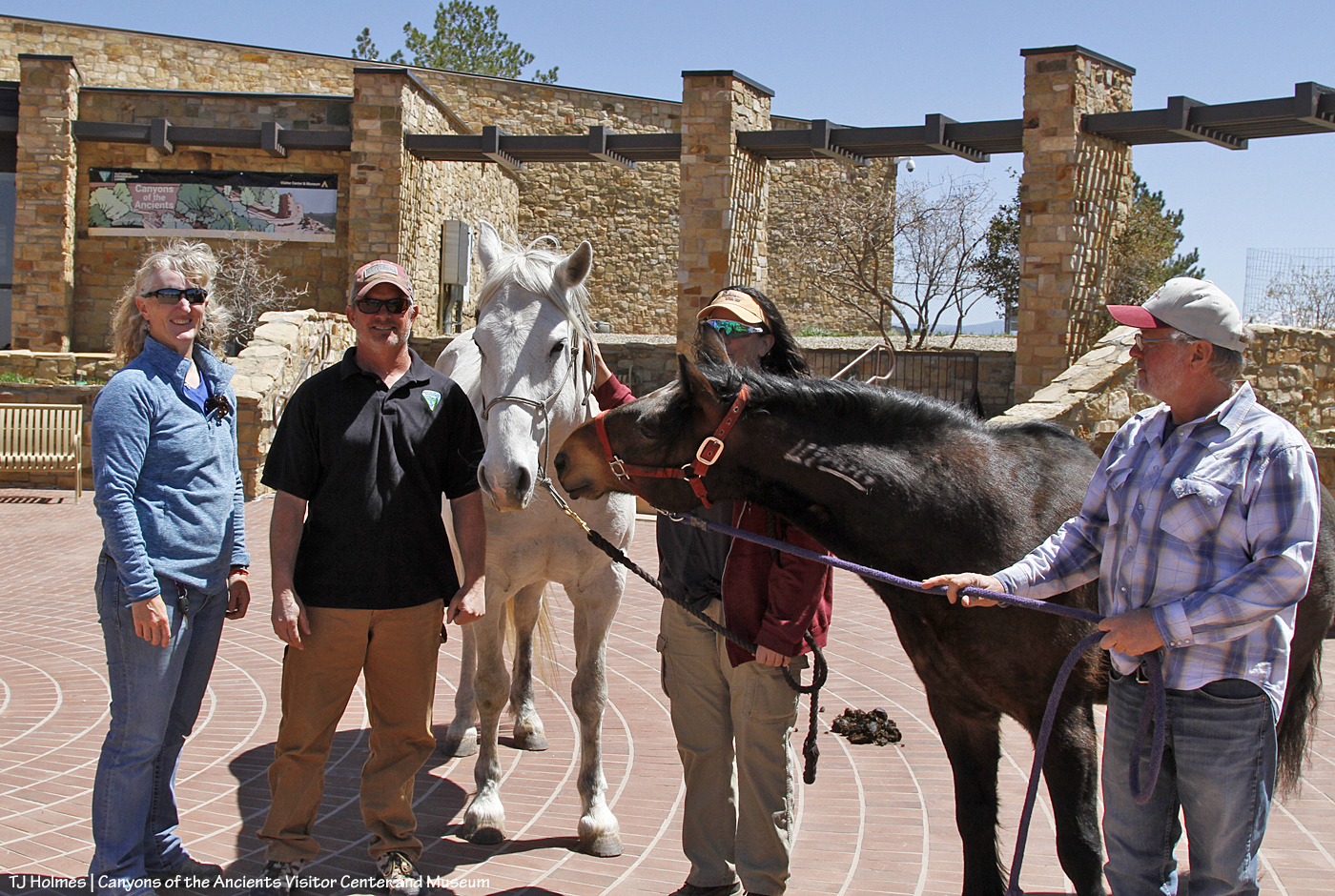
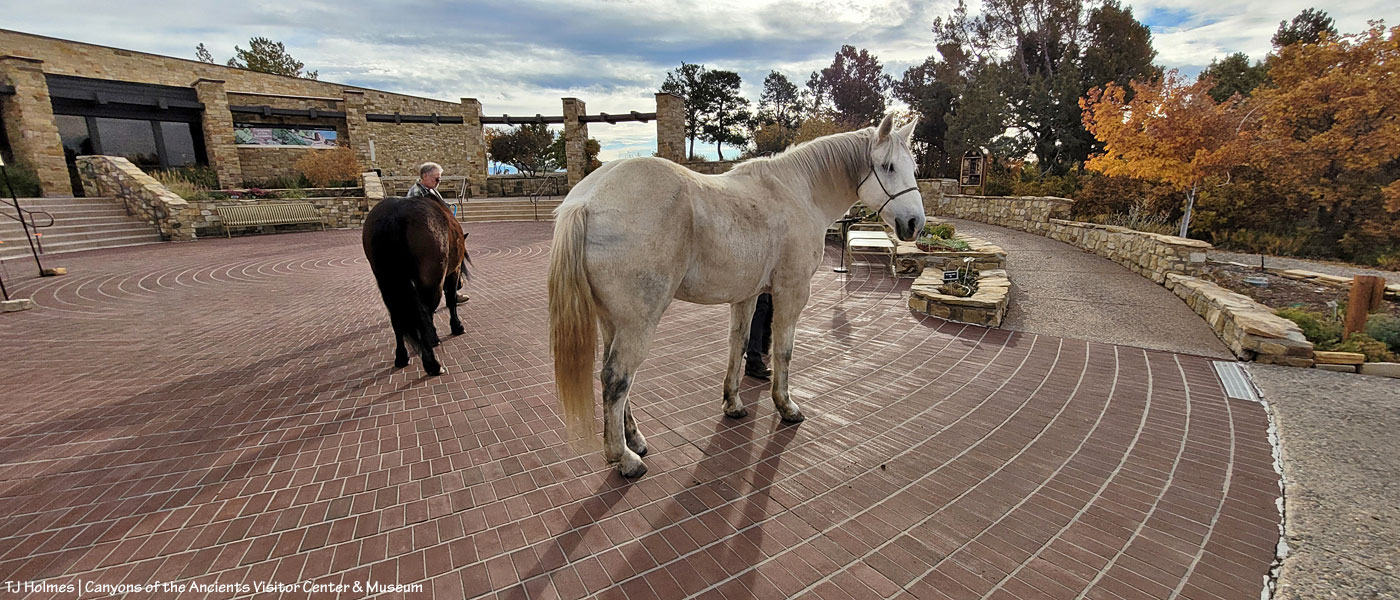
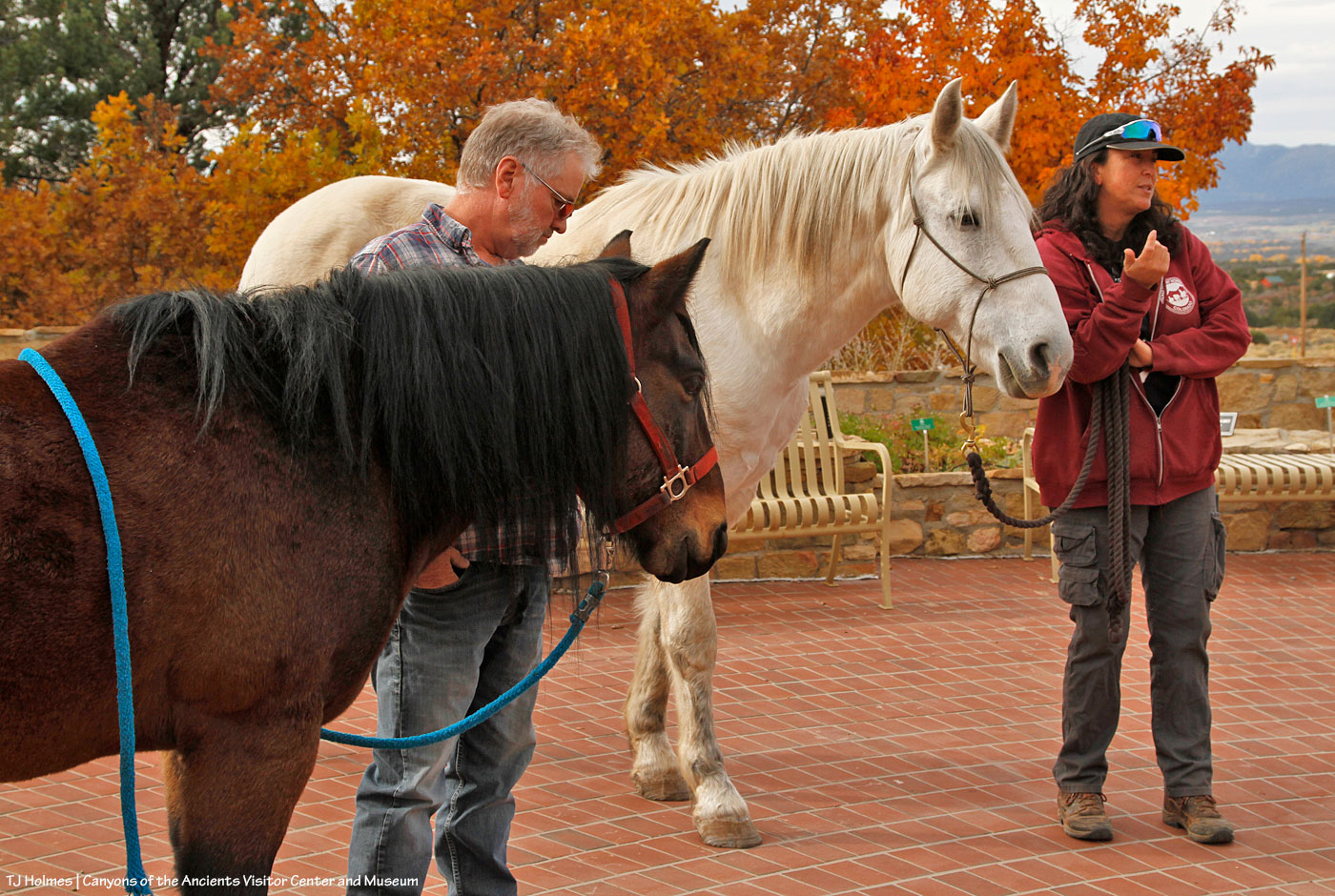
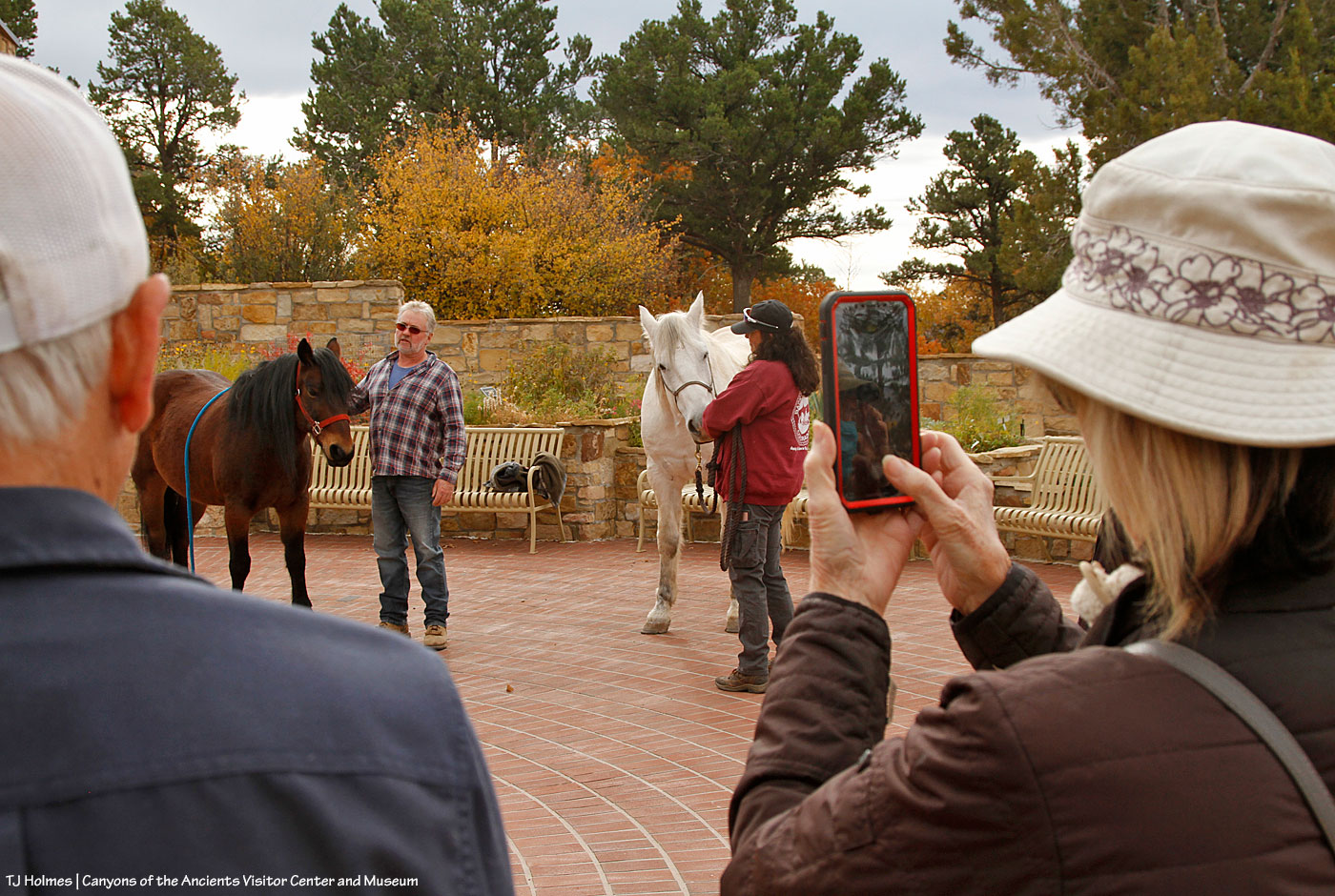
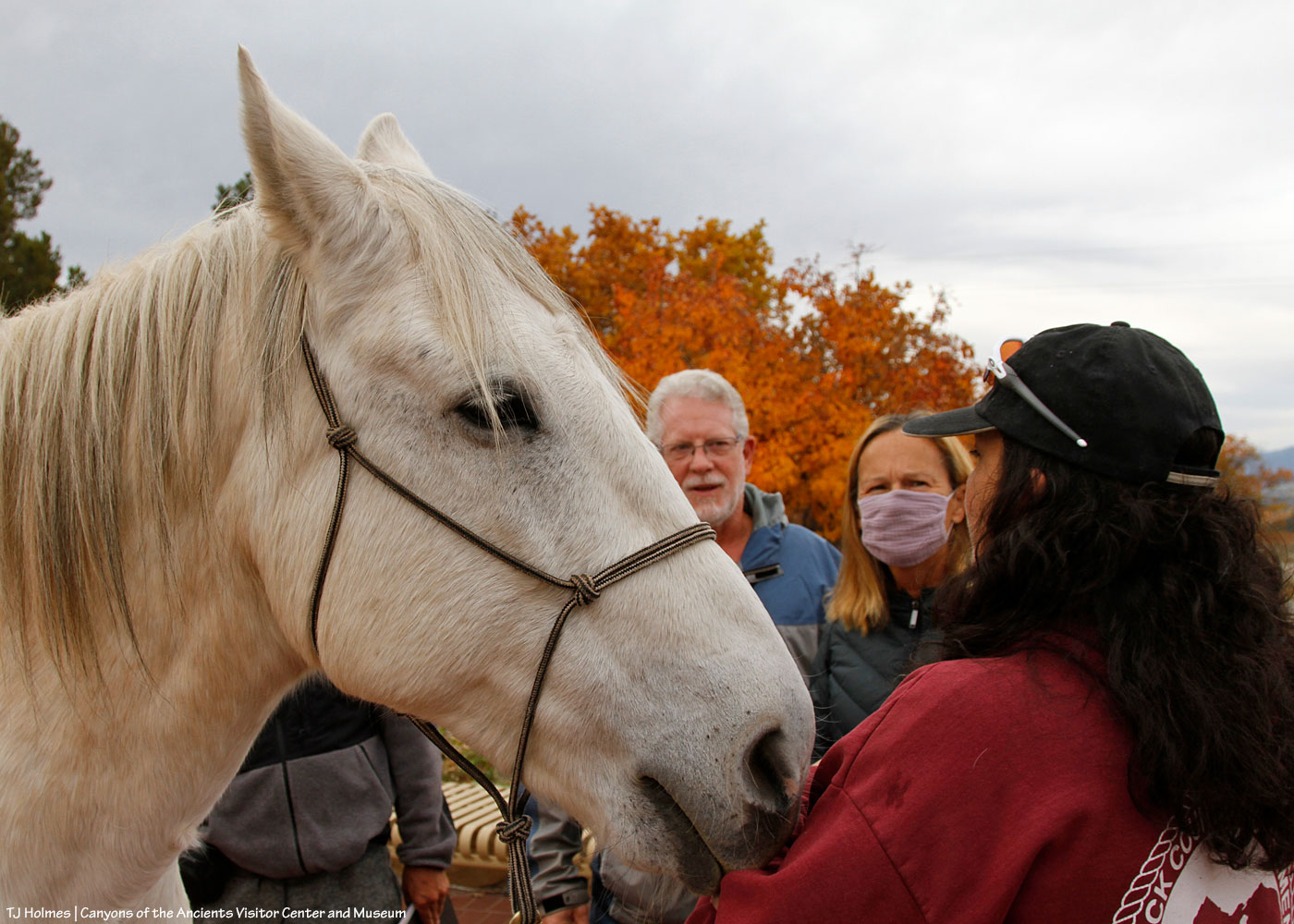
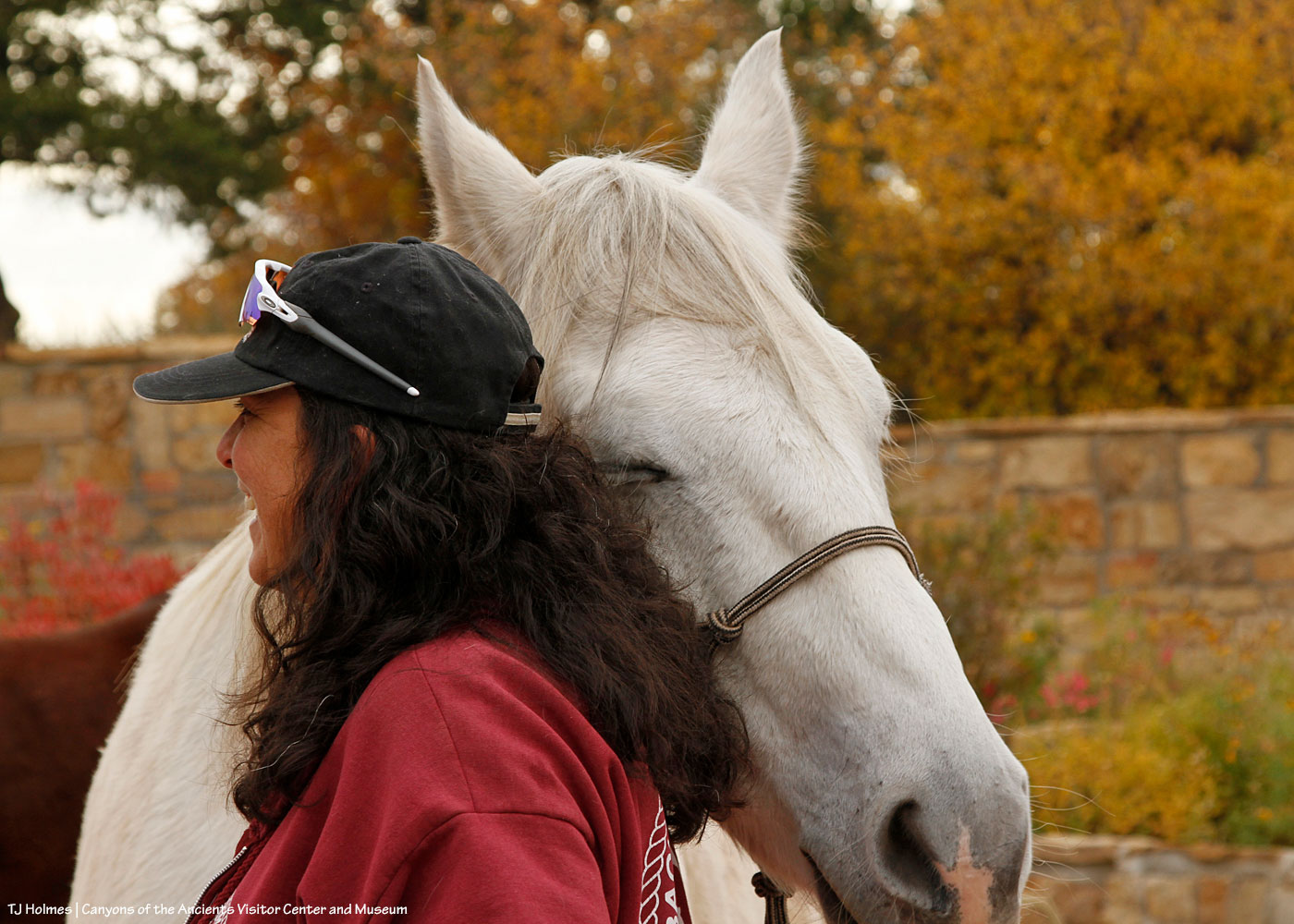
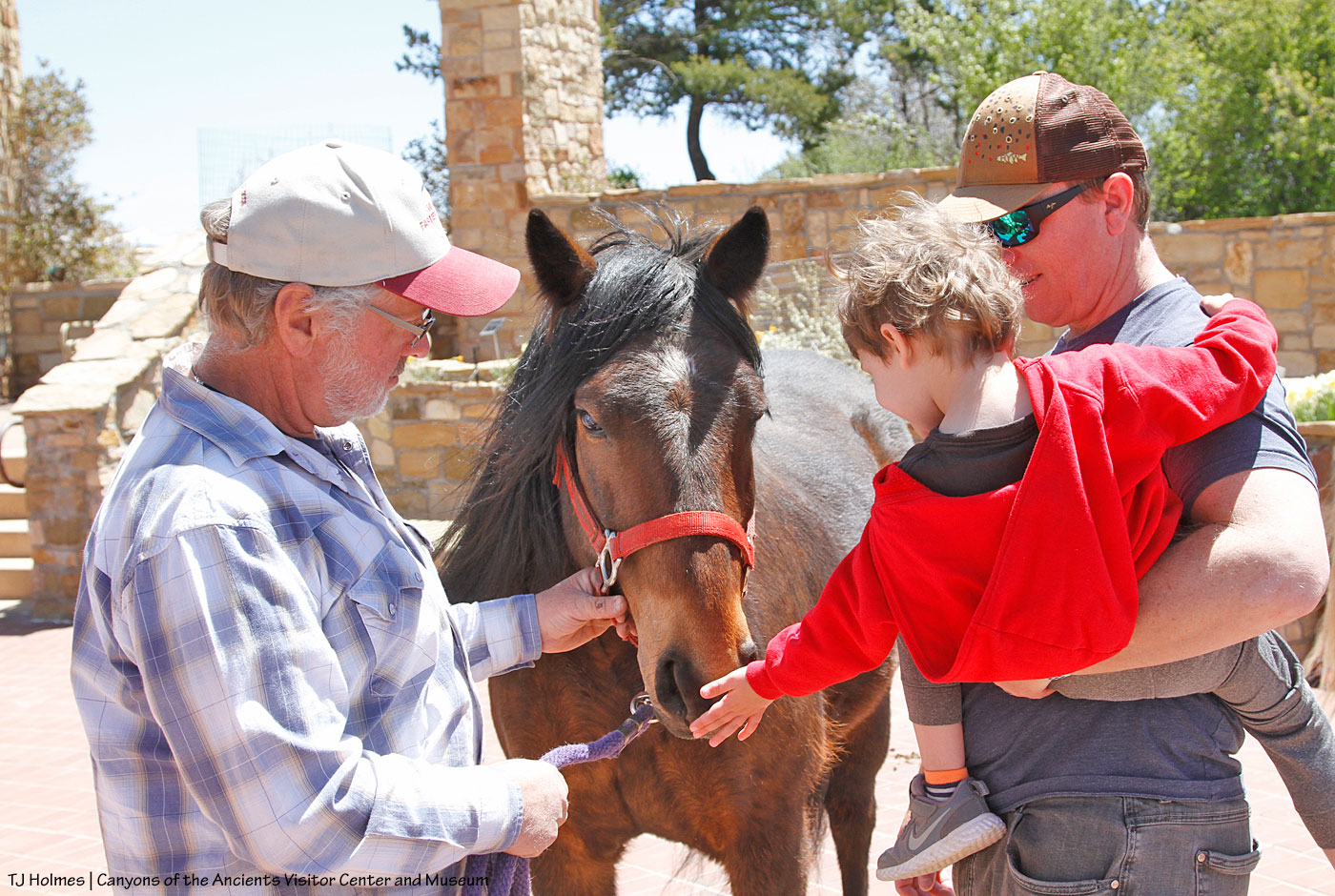
Tif Rodriguez brought her gentle giant, Whisper, and Keith Bean brought his teddy bear, Skipper, who are so calm and willing to meet lots of admiring strangers! We had one little incident before the event started when the wind caught the little popup tent, but as Keith said, most domestic horses would have catapulted into any of the nearby states if they’d been there. Skipper and Whisper were very startled, but they hardly left the plaza. 🙂 Tif and Keith answered questions and talked about numerous topics related to mustangs and adoptions, and Skipper and Whisper greeted everyone from seniors to the littlest visitors.

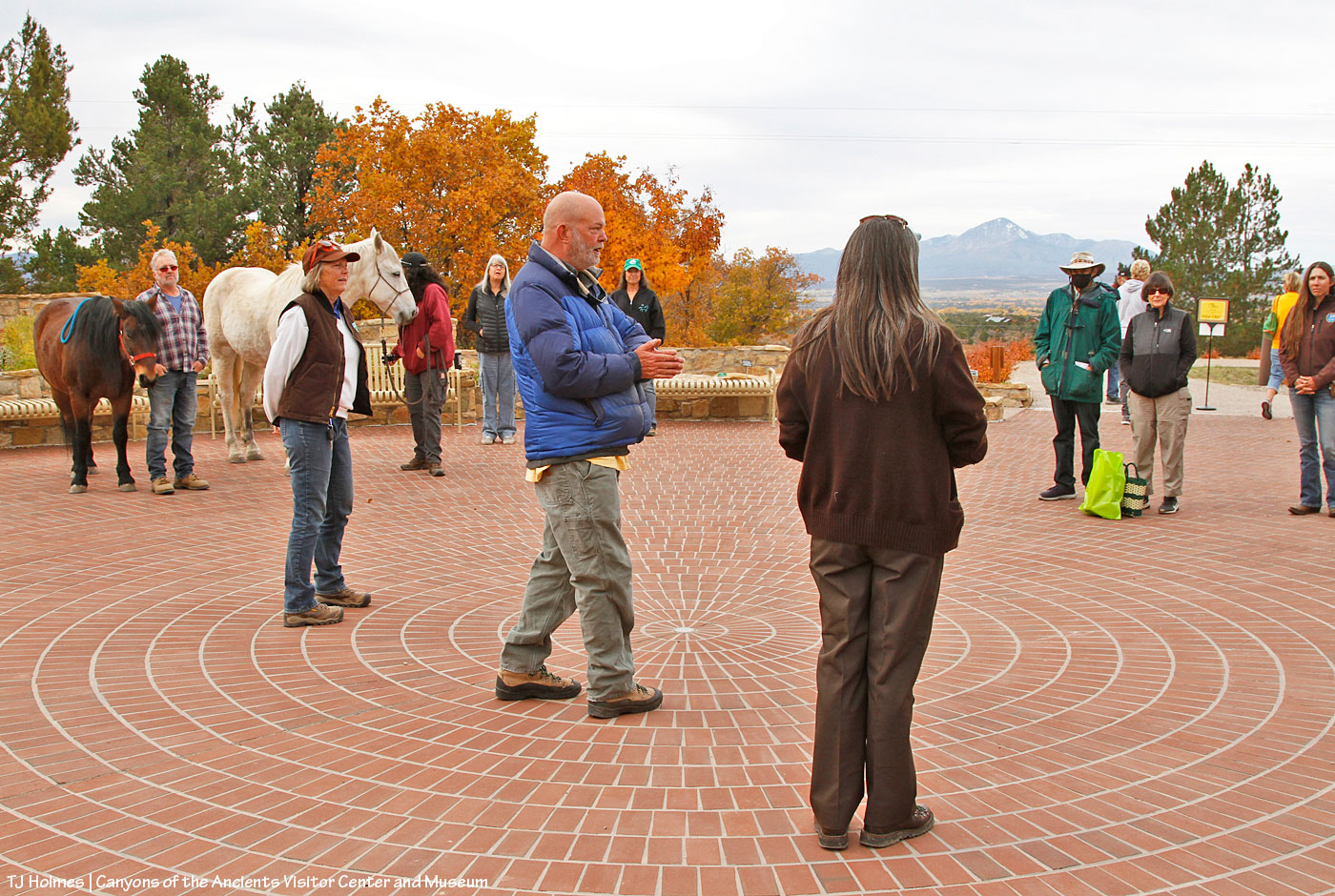
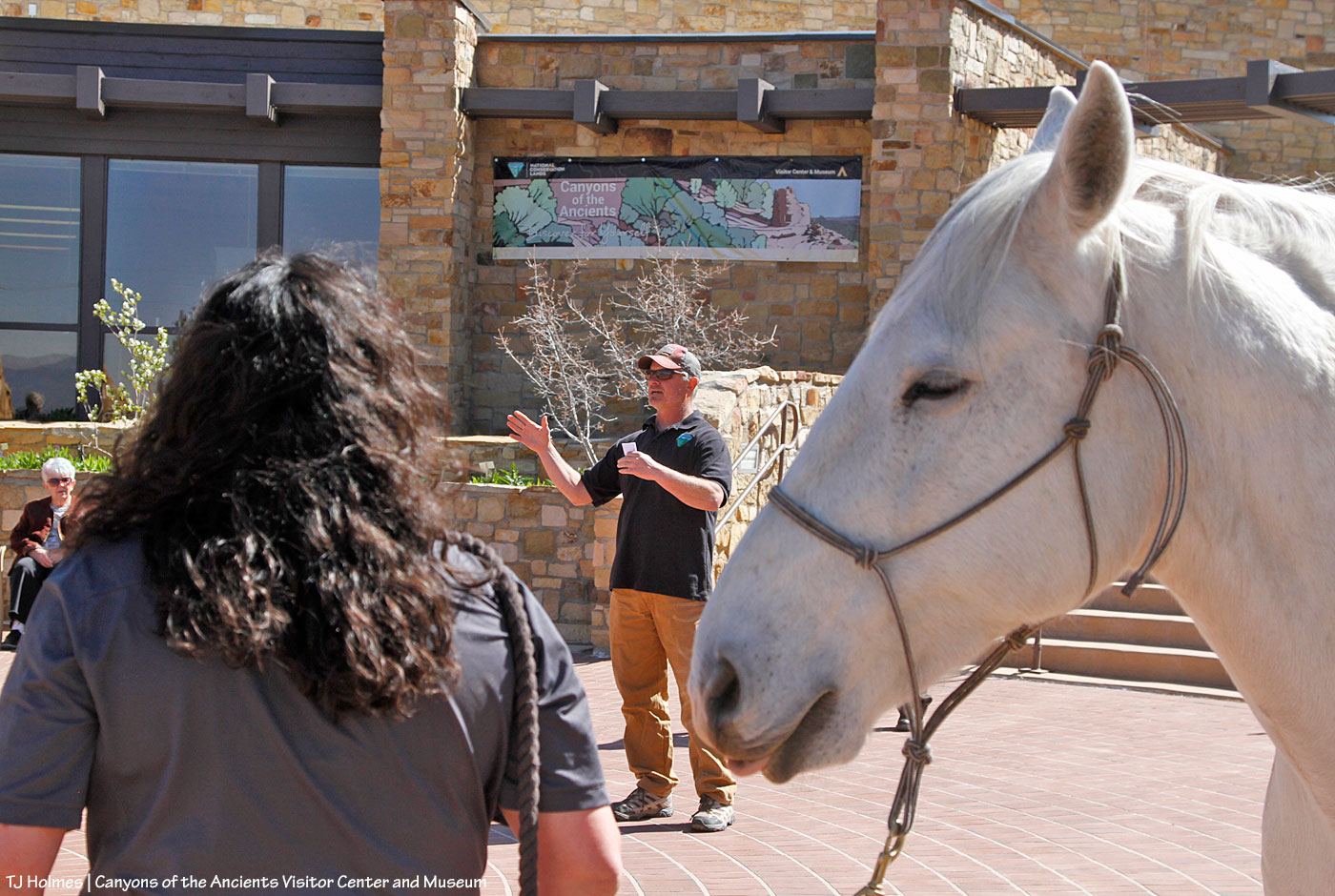
Our excellent herd manager, Mike Jensen, kicked off the day with an introduction to BLM wild horse management, particularly in Spring Creek Basin, and also answered lots of questions from visitors. As he said, mustangs are the only resources BLM manages that have beating hearts. 🙂

Mike talks about mustangs at the beginning of the event.

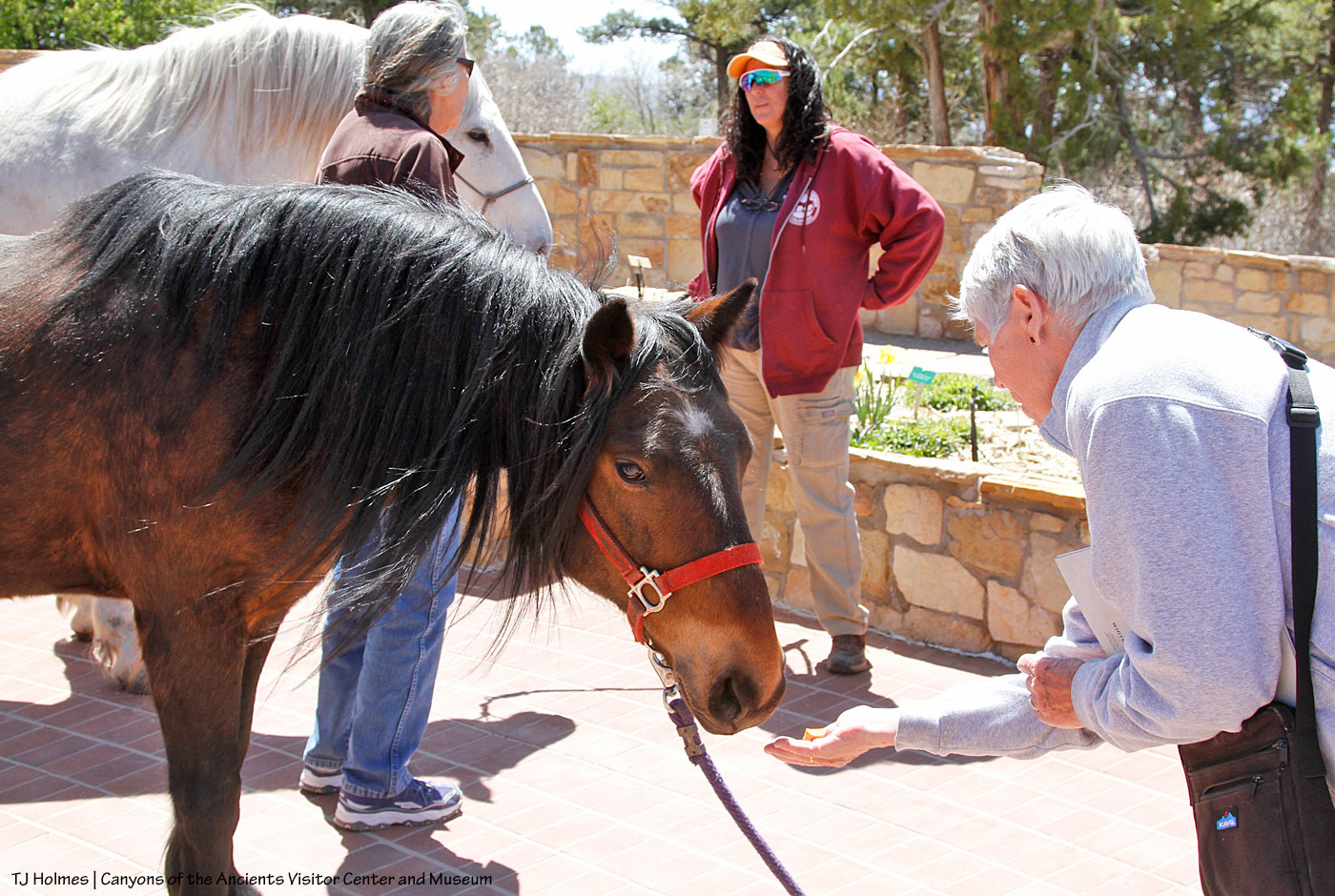
Keith says that seeing Skipper without something to eat in his mouth is unusual. Tif’s mom (not pictured), Lyn Rowley, brought snacks for both people and horses, which were particularly appreciated by Skipper. 🙂

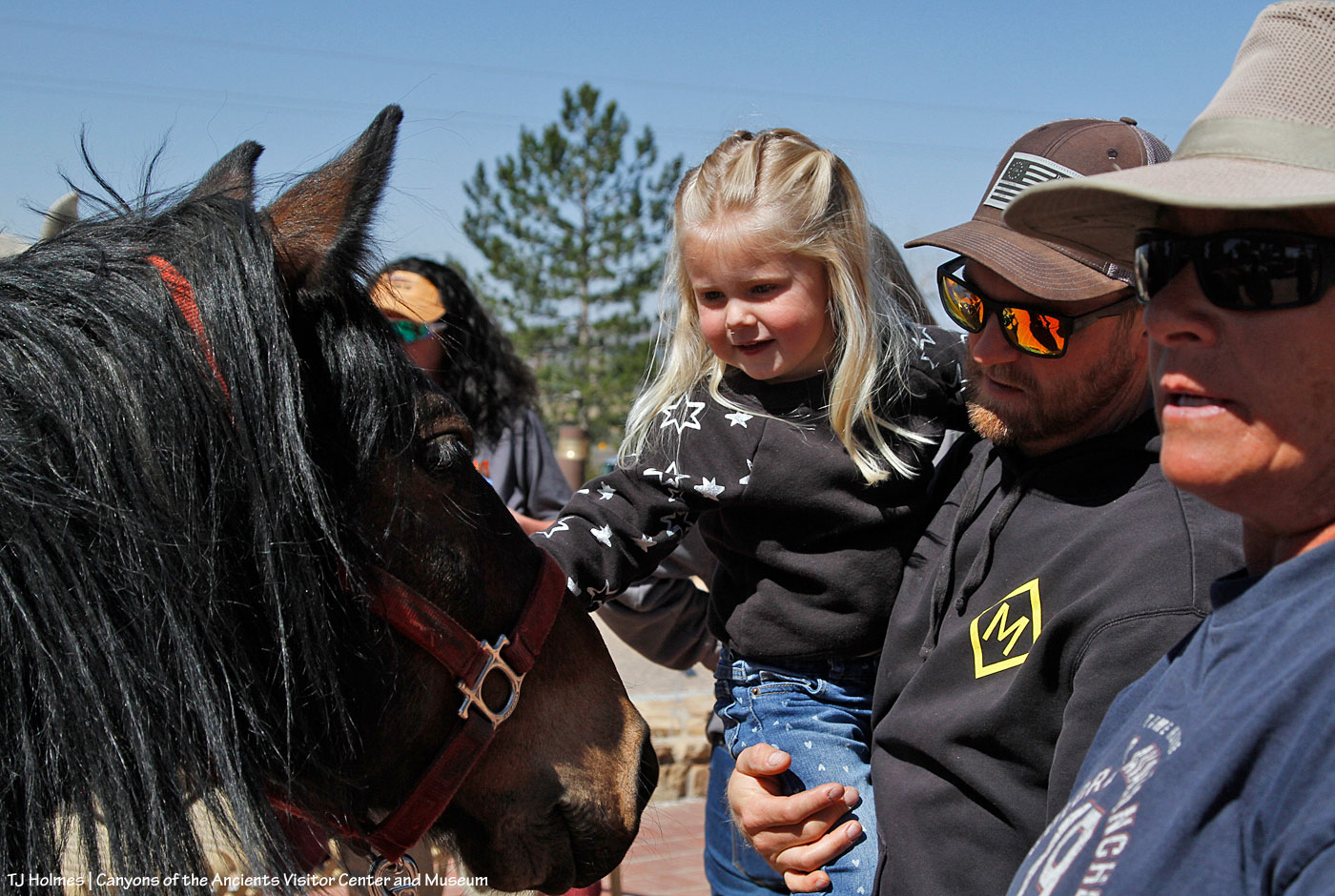
Amala and her 4.5-year-old daughter, Geneva (who came with husband/father and baby sister), also got to meet the mustangs.

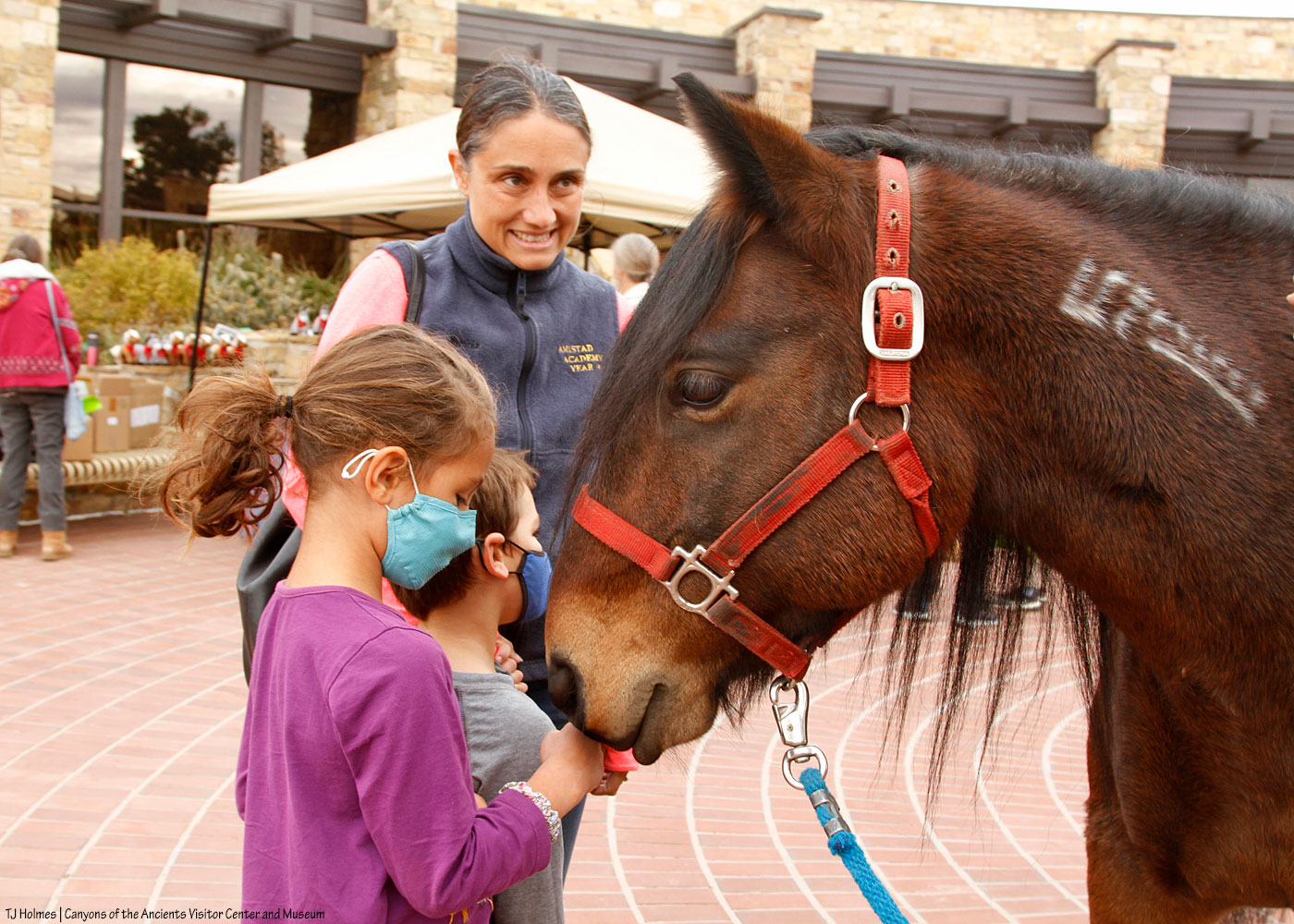
Skipper may have liked his treats from little hands best of all. See the very end of the carrot? 🙂 (Lyn pictured in the background.)

And a couple of pairs of little hands are even better!

I know. I should have prepared ya’ll for the overload of cuteness. 🙂

Skipper and Whisper spend a lot of time on the trail together every year with Tif and Keith as they do miles and hours of trail work on public lands (both BLM and Forest Service). Little Skipper is the guy in charge, apparently … and he also evidently loves his big friend!

Thanks to one of our visitors for taking these pix of me, Mike, Whisper, Tif, Skipper and Keith. Unfortunately, we missed getting Kat corralled for this group pic; Mike was trying to get home to his family for Saturday activities, and Kat was signing books inside the museum.

And I’ve been so long out of the journalism game (and my computer-driven slideshow while she was reading was giving me fits), I completely spaced taking any pix of her reading from Desert Chrome in the museum’s wonderful theater. She read excerpts about her first meeting with Maka, the big bay mustang from Divide Basin, Wyoming, that she adopted from Cañon City, then bringing him home. People asked some great questions. A couple of visitors had bought Kat’s book a day or two earlier, then came back to hear her read and get their books signed! This is a pic of her reading last year:

If you haven’t read it yet, find it at your local bookstore or order from Torrey House Press!

To close out this post, a little humor from wiseacre Whisper:

There’s always one. 😀

Our deepest appreciation and gratitude to everyone from CANM who made this event possible (Amala, Anna and Nick, at least), to Mike, to Kat, to Lyn, to Tif and Whisper, and Keith and Skipper, and to all the visitors to came, whether drawn by interest in the gems of cultural history found in this part of the Colorado Plateau or particularly by the opportunity to meet two amazing Spring Creek Basin mustangs!


Mustangs at the Dolores Public Library

10 04 2022

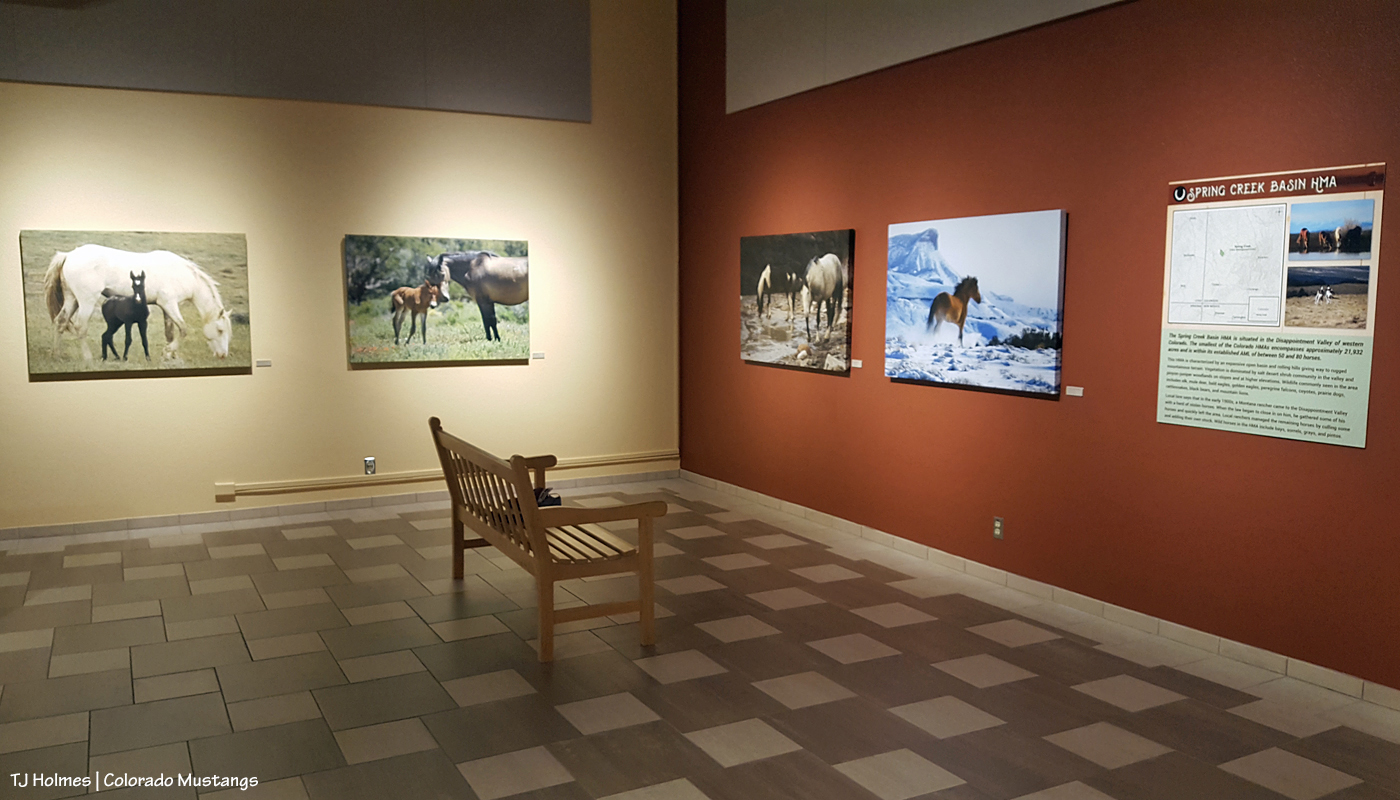
The display of photos featuring Spring Creek Basin’s mustangs at the Dolores Public Library in Dolores, Colorado, looks fabulous! The big canvas-wrapped images are on loan from BLM’s Tres Rios Field Office (which is located just above the town of Dolores); they were part of last year’s special exhibit at Canyons of the Ancients Visitor Center and Museum to commemorate the 50th anniversary of the Wild Free-Roaming Horses and Burros Act. I’m so pleased that the library will display them through the month of April!

Special thanks to Emily Mason, director of adult programming for the library, who secured the loan of the photos and did such a wonderful job with hanging them and with designing the fliers to announce their exhibit at the library; Tracy Murphy with Canyons of the Ancients Visitor Center and Museum, who facilitated the packaging and delivery; and Connie Clementson, manager of Tres Rios Field Office, who agreed to this special partnership!

**Update**

The 11×14-inch prints on the right are the images in the silent auction to benefit the library.


12 from 2021

31 12 2021

Another year comes to a close. Another year is poised to begin. The older I get, the more I wonder about endings and beginnings, and our perspectives about where we are in the middle.

That maudlin attitude aside (!), it’s a pretty good time to roll out some favorite images and a little explanation that goes along with them. Because, collectively, who doesn’t need a little more time at the computer (or phone or tablet) to look at a few more images from this little blue marble-in-space that we’re supremely fortunate to call home? 🙂 I’m kidding about that, of course, and I hope you all enjoy the extra offerings of Spring Creek Basin wild ones!

As I typed for a similar post last year: What follows is one photo for each month of the last year. Some have been on the blog previously; others have not. Onward.

January

In the year’s first month, we had snow to cover the basin with blessed white, also known as frozen gold in our neck of the drought-stricken woods. I found Hayden’s band back in the east pocket, calm as fuzzy, fully winterized mustangs can be. My presence wasn’t any deterrent from the serious business of looking for tasty bits as the snowflakes covered us all.

*****

February

I don’t think Hollywood thinks he’s a comedian as much as *I* think he has the potential to be! Wild stallions, after all, are very serious about the business of survival and protecting their families. This particular day in the basin brought several inches of snow, and I was on snowshoes. Fortunately, it was months before I would roll my ankle because the hike out to his band, which wouldn’t have caused a sweat in dry conditions, was about as difficult and wearying as any I’ve ever done. It was worth it (of course) to see the horses looking good and finding edibles … even if they did sometimes come up looking as though they’d been snorkeling.

*****

March

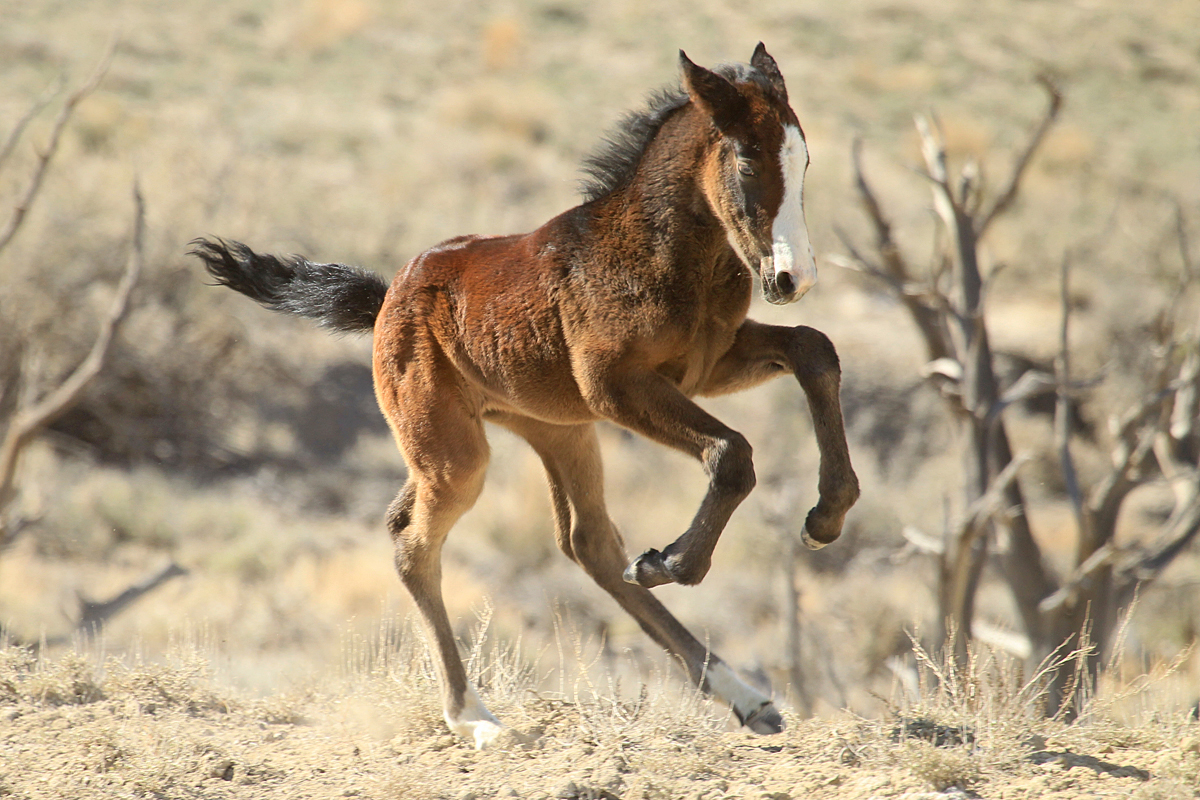
In March, this little cutie was the first arrival of the year to grace the herd. He’s sire Corazon’s mini me and growing up just as handsome. The band was keeping to one area so the little one didn’t have to go far on those wobbly legs, and I was able to sit with them and observe respectfully. Mama seems pretty proud of her little one, and she took to motherhood like a natural (of course she did!).

*****

April

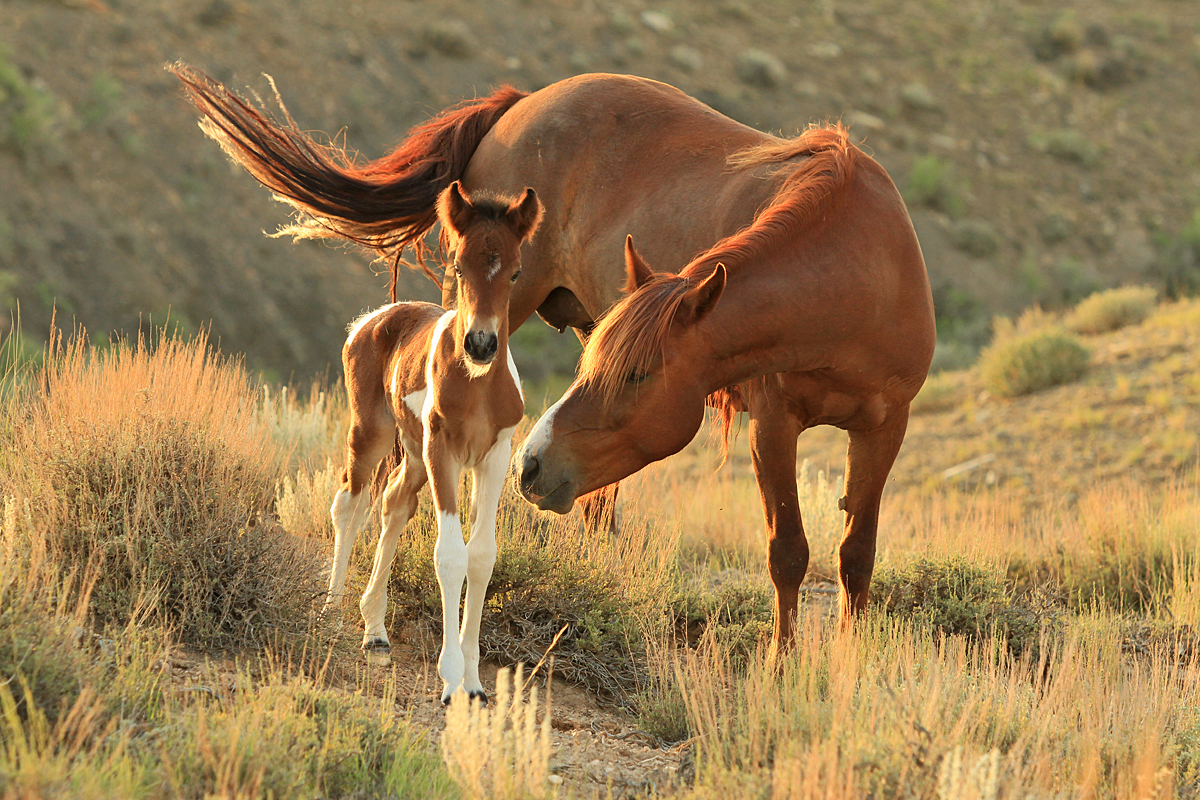
In April, we welcomed baby No. 2, and she was big and feisty right from the get-go! Most readers know that we use fertility-control vaccine PZP in Spring Creek Basin, and it is THE reason we haven’t had a roundup in 10-plus years. I read an article this fall in which a person was quoted as saying that because of PZP, our herd would be extinct in 10 years. … Well, probably, that person hadn’t seen this little darling, or any of our other foals (or other young horses, or maybe even any other-age horse!). And it’s too bad that they’d rather have roundups. For my part, to see more of THIS (which is to say, healthy foals that grow up to be wild and free mustangs) and fewer roundups, I’ll stick with PZP, thanks!

*****

May

We didn’t have as many wildflowers as we’ve had some other years because of our ongoing drought (we were still in the “exceptional” category at that point in the year; that’s the worst category), but we had a few spots of color to brighten the desert. Bursts of color and the shedding of shaggy coats lets us know winter is in our rearview … but it also heralds anxiety and sky-watching (for clouds, particularly dark ones).

*****

June

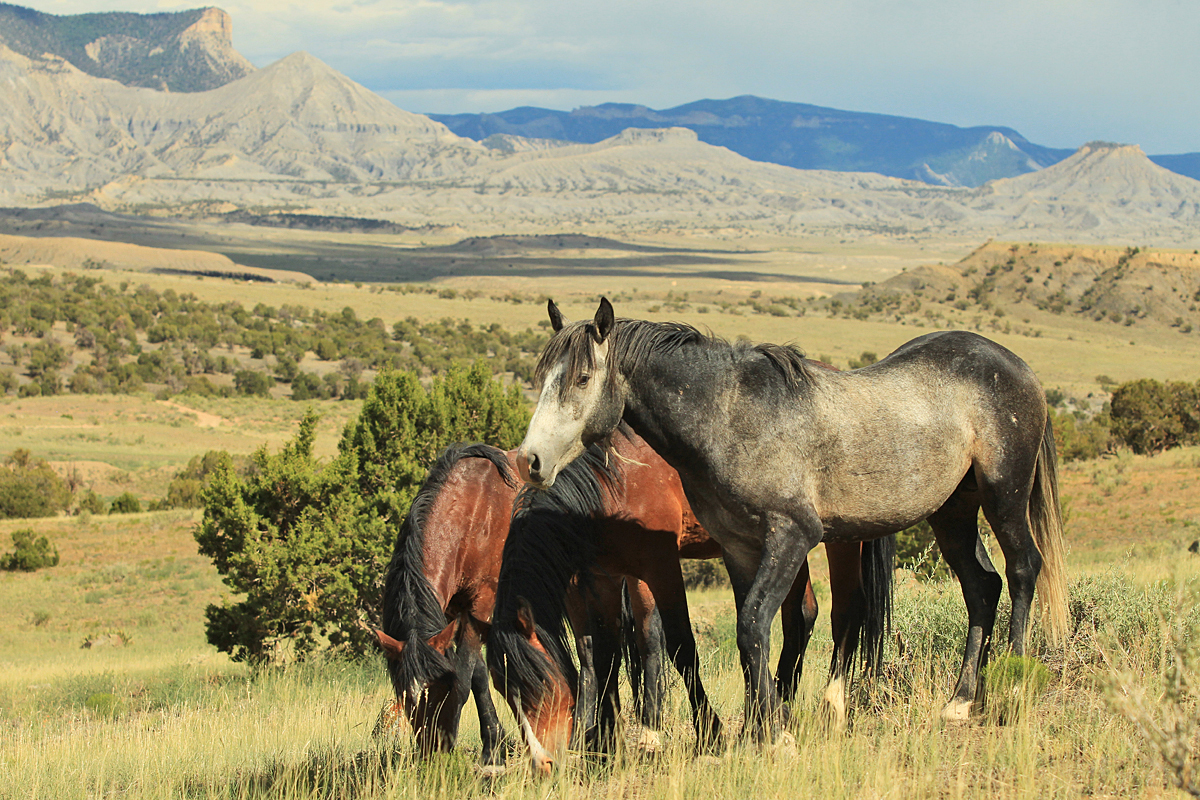
“Drought?!” you may be asking yourself. “What the heck is she talking about? Look at that grass!” And it WAS good in June (and then later, after the monsoons finally found us) … before it got hot(ter) and dry(er), and the grasses withered and shrank and turned crunchy underhoof and -foot. This day, pictured, was one of the loveliest days and memories with a little group of young bachelor stallions, recently on their own for the first time. Look at those shiny, slick coats! In the northwestern part of the basin, a mustang (and a human) can see for … well, a pretty long way! To know that our mustangs can roam almost all the land pictured (not the very farthest, pinon-juniper covered hills and ridges), it’s worth everything. … Everything.

*****

July

This little treasure graced us just as the monsoon rains did this summer. With soaring birds on each shoulder, she zoomed right into our hearts from first glance. It had been several years (I’d lost track) since we had an actual monsoon weather pattern over Disappointment Valley, and in the midst of our excruciating drought (that might be a “better” term than “exceptional”), more welcome than I can even express. Those rains set us up for a less-anxious autumn than we would otherwise have had.

*****

August

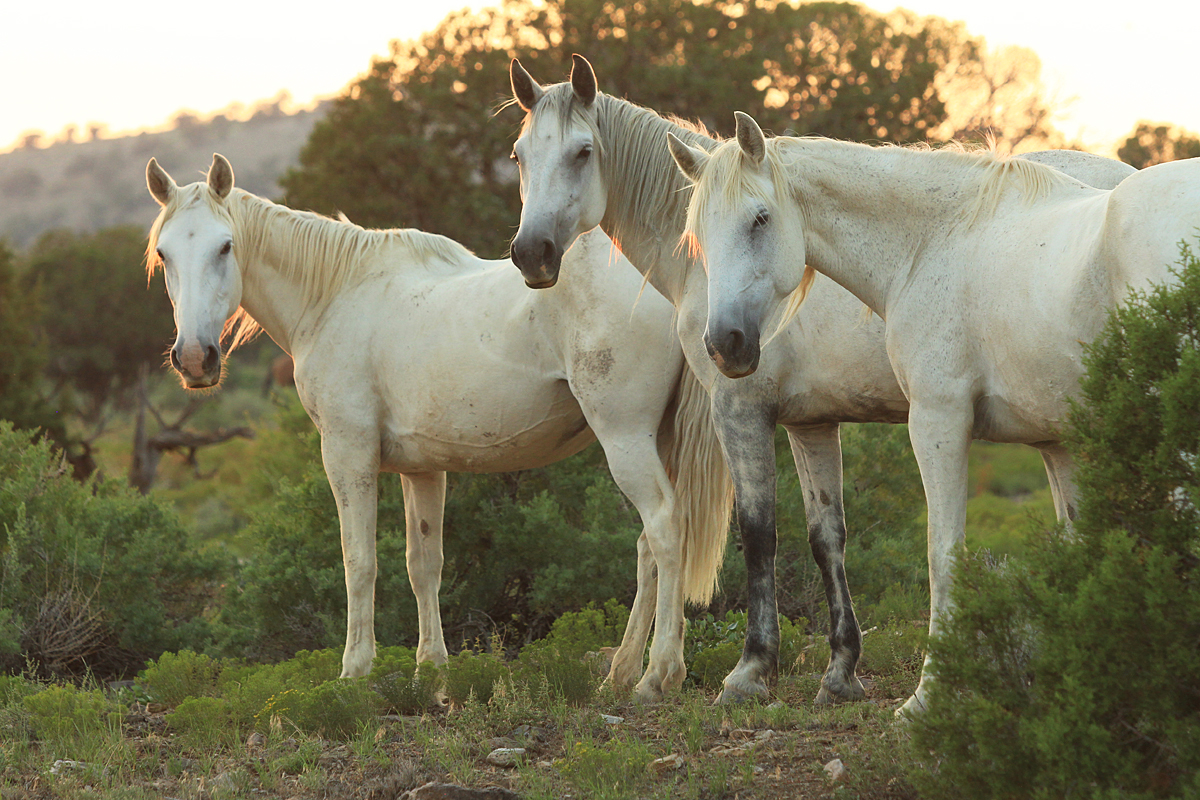
If you read any of the blog this past year, surely you caught at least a glimpse of one of the posts about the new water catchment our excellent BLM guys built in Spring Creek Basin this summer. We started it at the end of April, I think, and finished by the end of August. Lots of hot, hot, HOT welding work with heavy steel posts and purlins and reflective metal roof sheets. The new catchment gives us the potential to catch and store 14,000 gallons of fresh rainwater and snowmelt for the mustangs in the northern-ish part of the basin. While we were still in the building phase, a few bands of mustangs occasionally meandered through the area to check things out. The image above came together as three of our most perfect grey girls turned to look just as the sun was setting. On the left, our venerable Houdini is most likely in her third decade of life – wild and free on the range where she was born (and birthed many babies).

*****

September

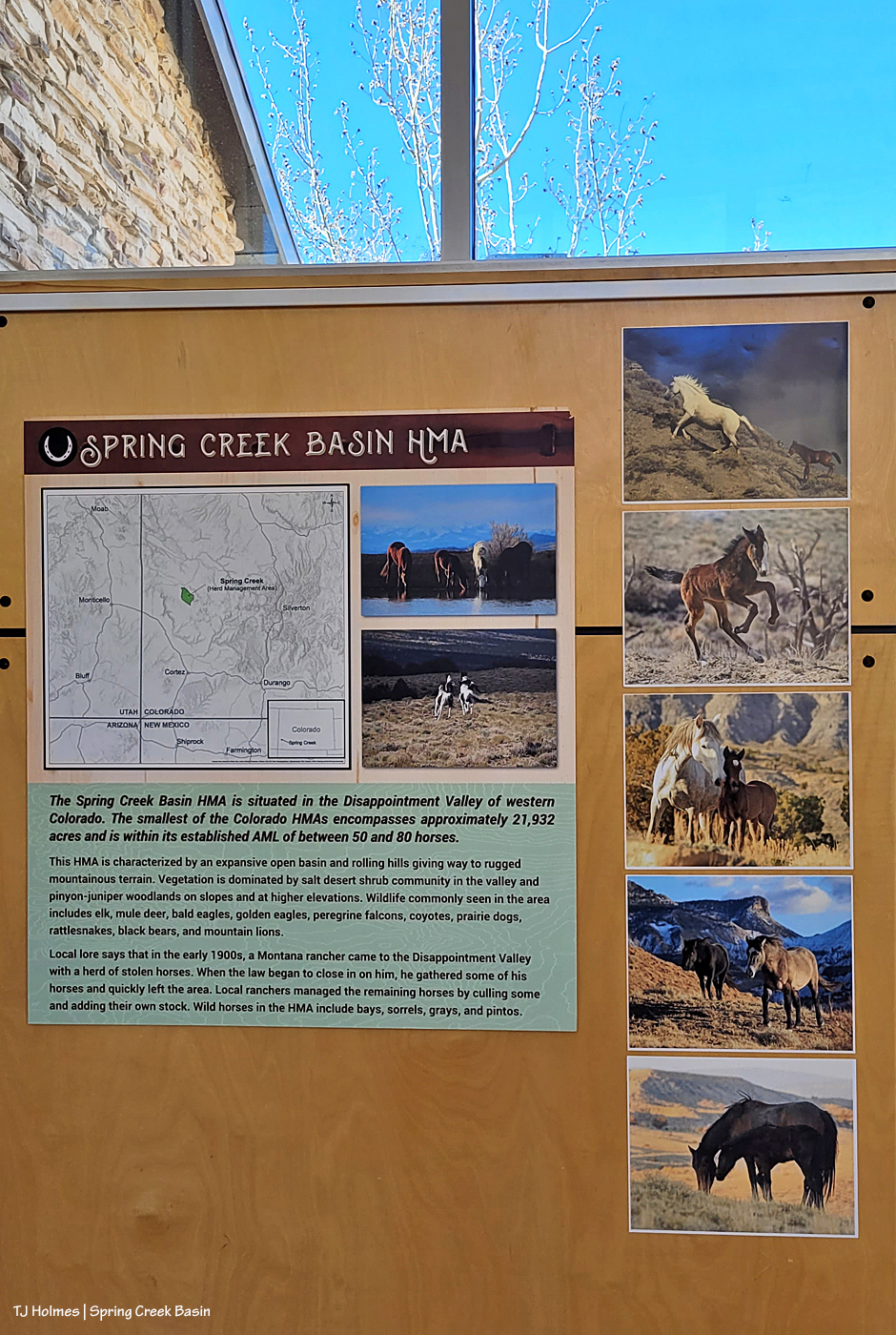
Another big milestone of 2021 happened in September, when we welcomed three young mares from Sand Wash Basin to Spring Creek Basin. Because Spring Creek Basin is small (almost 22,000 acres) and the herd correspondingly small, we periodically introduce mustangs from other herds to contribute to its genetic viability. The grey-and-white pinto stallion was the first to greet the girls, and he had them for their first week and a half here. Then his uncle, the grey stallion, acquired the mares, and they’re happily (so I like to think) with him still. The youngster is hanging out with another young bachelor and a veteran stallion. He’ll have more many chances to win more mares!

*****

October

This beautiful girl is a daughter of Storm-my-love. After growing up in the best of bands, she finally left daddy’s band this fall and joined another stallion and his mare, where – interestingly – she has taken on a bit of a lookout/protector role. She’s much more interested in the goings-on than the very sedate stallion and his low-key mare. Maybe it’s a bit less energy than her natal band, but I think she is enjoying her new family.

*****

November

Our little spotted girl with her daddy, curiously watching a nearby band near a wonderfully full pond. I love to see babies with their steadfast sires, and I love to see ponds with water, rippling gently at the shore. Some of our ponds have even had mallard ducks on them this autumn. Starting the year with dry ponds was awfully awful; finishing the year with water (or even ice) is such an enormous relief.

*****

December

Readers will remember this image of our fabulous elder lady, Houdini, because it wasn’t all that long ago that I took it and posted it here on the blog! She should have full immunity as an ambassador, but I don’t think she would like that title because, truth be known, she really doesn’t like or trust humans all that much. Who can blame her? Though her last 10 years (have to) have been the most peaceful of her life. And to have been part of that … ? Well, I can’t begin to tell you all how happy I am to have played a part in *that*. What better life for a wild horse than to live it fully IN THE WILD?

*****

Bonus

Because, as always, who doesn’t love bonus content? Readers also know how I adore backlighting. … Why? Please see above. 🙂 We did have some wildfire smoke in our skies this year, again. And we had a lot of love and family. If it started relatively dry, and Mother Nature made us wait, anxiously, for moisture, she did come through rather well this summer. Then we had a very dry autumn, and winter didn’t make a very auspicious start. But the last few days, we’ve had a nice little contribution from the heavens: Rain in some areas, a rather large amount of snow in other areas! All of it begs the question: Are we at the start or end or in the middle of our weather year? 🙂 We hope more is to come; it’s all a cycle, after all!

*****

Thank you all so much for following our Spring Creek Basin mustangs this year! Many quarters of this ol’ world endure so much violence and strife and endless struggles that threaten to tear apart people and wild things alike. The very planet is threatened as never before. Observing and acknowledging the beauty of our home rock in the universe has to be a foundation of working to preserve it for all those here and those to come. Just as we strive here to continue our mustangs’ peaceful existence, surely it will take all of us, working together, to preserve life FOR us all.

Peace on Earth, goodwill toward humans and animals and plants alike.
We are not alone (no matter how hermitlike we may favor being).
Here’s to 2022 being a year more steeped in love than hate, more in peace than violence. Here’s to the power of wild and the healing qualities all around us.


50

15 12 2021

Today is the 50th anniversary of the Wild Free-Roaming Horses and Burros Act.

We still have a lot of work to do to promote and ensure the protection and good management of America’s wild horses and burros.

Readers of this blog know that we’re doing good things for our mustangs in Spring Creek Basin. We = our BLM range staff, led by herd manager Mike Jensen, and advocates.

We’ve had our own challenges in the time I’ve been involved (since 2007), but any ONE of our achievements is something to celebrate … let alone our LIST of achievements … topped last year by the update of our herd management area plan, which raised the appropriate management level for our herd, continues PZP darting and promotes bait trapping over helicopters if the need comes in the future.

The biggest thing to celebrate in this 50th anniversary year is that we set out with common goals, and we achieved each of those. It took a while; it took a community of us. We did it for the good of the mustangs that are our responsibility by the simple fact of being *managed*, which we choose to prioritize as *protection*.

With sincere gratitude to Mike and our other BLM folks, and to our long-time, steadfast cadre of loyal volunteers (you know who you are!), for our mustangs: Happy anniversary, and thank you.


Lilt

2 12 2021

Maiku the mighty returns to his band after a little chat with a fellow lieutenant.

**********

If you’ve been to Canyons of the Ancients Visitor Center and Museum this year to see the special exhibit dedicated to Colorado’s wild horses in this 50th anniversary year of the Wild Free-Roaming Horses and Burros Act, you’ve seen this video. If you haven’t been and you’d like to watch the video, watch it at this link! (And if you haven’t been and are even somewhat local, what are you waiting for? It’s open just through this last month of the year. Next year, a new special yearlong exhibit celebrating some other wonderful resource of our Colorado Plateau region!)


*Special* special event

25 10 2021

As far as we know, Canyons of the Ancients Visitor Center and Museum‘s special exhibit this year celebrating Colorado’s mustangs and highlighting the 50th anniversary of the Wild Free-Roaming Horses and Burros Act is the only one of its kind in the country.

From the museum’s website:

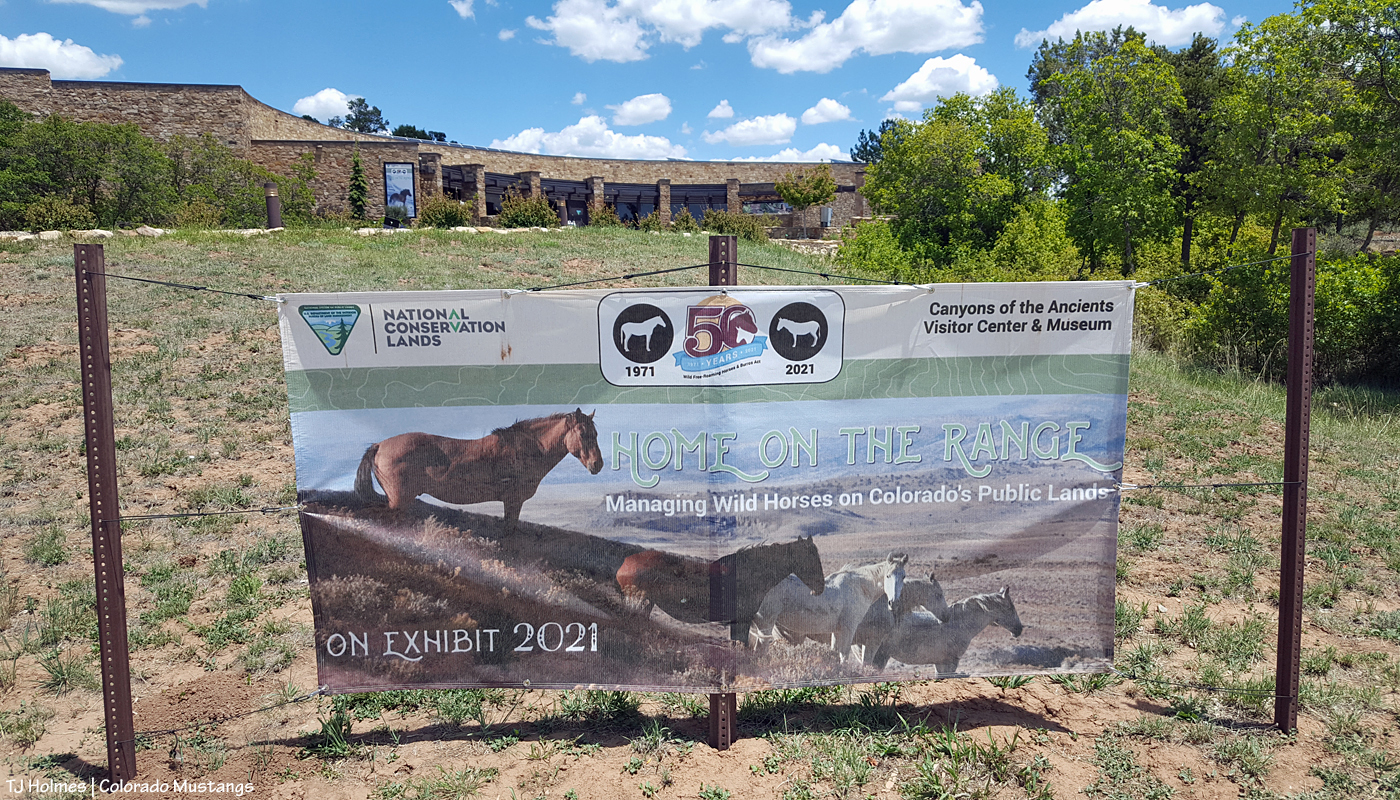
*The BLM Canyons of the Ancients Museum and Visitor Center is proud to announce our new exhibit, “Home on the Range; Managing Wild Horses on Colorado Public Lands” opening to visitors in 2021. The exhibit celebrates the 50th anniversary of the “Wild Free-Roaming Horses and Burros Act” of 1971 through captivating photographs and in-depth information about the BLM Wild Horse and Burro Program. The exhibit features information about Colorado’s four BLM Herd Management Areas and stunning photographs by TJ Holmes. Visitors will learn about BLM’s work to manage wild horses, unique traits of different herds, and how the public can get involved in stewardship and adoption. The BLM will announce public programs in 2021 to engage visitors and celebrate the 50th anniversary of the Act.*

While we are hyper aware of the enormous challenges surrounding the management of wild horses and burros on America’s public lands, we’re also very well aware of the positive management going on in our own backyard: Spring Creek Basin Herd Management Area in Disappointment Valley. Humbly, it is the celebration of these positives and understanding of the challenges that has led us to what we consider to be one of the best managed herds in the country. Why *wouldn’t* we celebrate that? And why wouldn’t we celebrate America’s wild horses (and burros, though none of Colorado’s wild herds include burros), their beauty and diversity and strength and the way they bring us together? THAT is the real message of this very special exhibit of Colorado’s mustangs in a very special visitor center and museum in Southwest Colorado.

Thank you, particularly, to all the visitors who came yesterday, whether you came specifically to see the mustangs or whether your travels brought you at just the right time and day. We very much enjoyed meeting all of you and talking about our hearts’ dearest subjects: our mustangs.

Being the high-desert mustangs they are, Whisper (left, with Tif Rodriguez) and Skipper (right, with Keith Bean) walked willingly onto the cobbled walkway that leads from the parking area to the plaza, but those brick pavers caused the horses to take a bit of a pause. After much encouragement from Tif and more than a few glances at his pal to see what Skipper thought of the while thing, Whisper was the first to set hooves on the bricks. Skipper, however, was the first to follow Keith fully onto the brick plaza at the base of the museum building.

The plaza is hollow underneath to allow for heating elements that keep it clear of snow in the winter. The horses took a few tentative steps across it at first, but it must not have sounded too different from crossing a trail bridge over a mountain stream – which these guys are well used to from all their backcountry travel and trail work – and pretty soon, they were right at home. (And yes, the size difference between gentle-giant Whisper and super-pony Skipper really is that great!)

Museum curator Bridget Ambler (responsible for printing all the amazing images and information panels and designing the special exhibit), who has horses of her own, got to meet Skipper before the visitors arrived.

What he really wanted was to check out her mask. No mask-wearing qualms here!

For people unfamiliar with horses, as many of the visitors were, this sign listed basic etiquette to help keep mustangs and people safe.

Tres Rios Field Office Manager Connie Clementson talks with Lyn Rowley and Tif Rodriguez, left, and Marianne Mate and Keith Bean. Interesting side note: Marianne was mayor of Dolores when I was editor of the Dolores Star.

Whisper was kind enough to pose with a poster of Hollywood on the outside wall of the visitor center and museum. Whisper is the son of Bounce (who passed away a few years ago) and Alegre, who is still wild in the basin – with Hollywood’s band!

Canyons of the Ancients National Monument Manager Ray O’Neil, with Connie Clementson at left and the visitor center and museum’s Amala Posey-Monk at right, welcomed visitors and gave them a brief introduction to the exhibit and why we were all gathered: to celebrate mustangs!

A very large portion of my gratitude goes to Bridget Ambler, supervisory museum curator, for working so diligently to select images and work with me and Spring Creek Basin herd manager Mike Jensen (who unfortunately couldn’t attend the day’s event) for captions for each, and for designing the exhibit hall, which, as I mentioned in a previous blog post, stopped me in my tracks the moment I first walked through the doors and caused me to bawl my eyes out! Kat Wilder and one of Ray O’Neil’s daughters listen in the background.

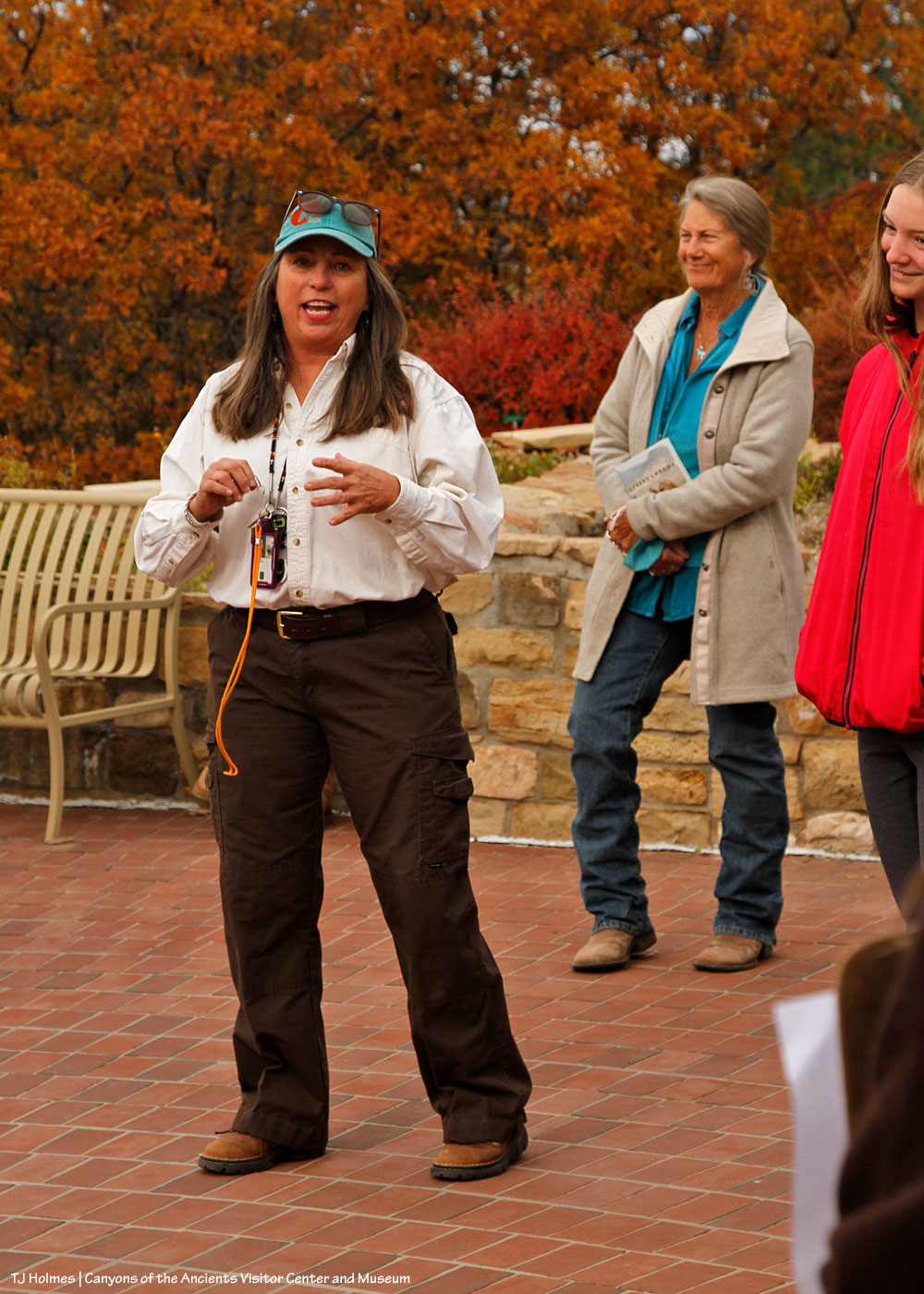
Amala Posey-Monk, visitor services and recreation program manager at the visitor center and museum, did an excellent job keeping us on schedule and bringing new groups of people into the special exhibit hall where Kat and I extolled all the virtues of Colorado’s wild horses – and adopters! Here, she’s introducing Kat, who read a couple of excerpts from her book, “Desert Chrome: Water, a Woman, and Wild Horses in the West,” in the museum’s theater. (If you’re interesting in purchasing a copy of Kat’s book, contact her through her blog! She’ll even autograph it for you!)

I’m afraid I didn’t take a lot of photos (OK, any) of the tours of people inside the exhibit, but you can see some of it again on my original post from back in June: ‘Home on the Range.’

Mostly, I wanted to take pix of the visitors greeting the mustangs, Whisper and Skipper. 🙂

Skipper and Whisper listen attentively as Keith and Tif introduced themselves and their mustangs to the crowd of visitors.

Skipper wonders what the heck I’m DOING back there! 🙂

Visitors were equally attentive, soaking up all the information given by Tif and Keith about their mustangs.

Skipper particularly enjoyed meeting all the pretty girls. 🙂

And the kids. 🙂 I haven’t met a mustang yet that didn’t love kids.

Big boy Whisper had his share of fans.

Most of all, he loves his mama Tif! 🙂

Skipper was having too much fun being admired to leave Keith’s side. This image of the crowd of visitors was taken as introductions were being made at the beginning of the event. I’d love to know the total count of people who came to see the mustangs and the exhibit; we guessed at least 60?! Pretty good crowd for a crisp autumn day in Southwest Colorado!

These two were among our favorite visitors! Whether you’re new to the blog or go way back, you’ll recognize Sue Story’s name as an everyday commenter on the posts. 🙂 She and her husband, Dennis, are local to Southwest Colorado, and they came by in the afternoon to meet the mustangs and see the exhibit. Most recently, we’d met almost head-on (! no, no, we were all going pretty slowly 🙂 ) on a quiet and golden forest road while out looking at the glorious autumn aspen!

Karen Keene Day (left) had the quick thought to ask Amala to capture us and Alice Billings (right) in the exhibit hall for a photo in front of one of photos (Hollywood and his band). I’m so glad these ladies joined us from Ridgway!

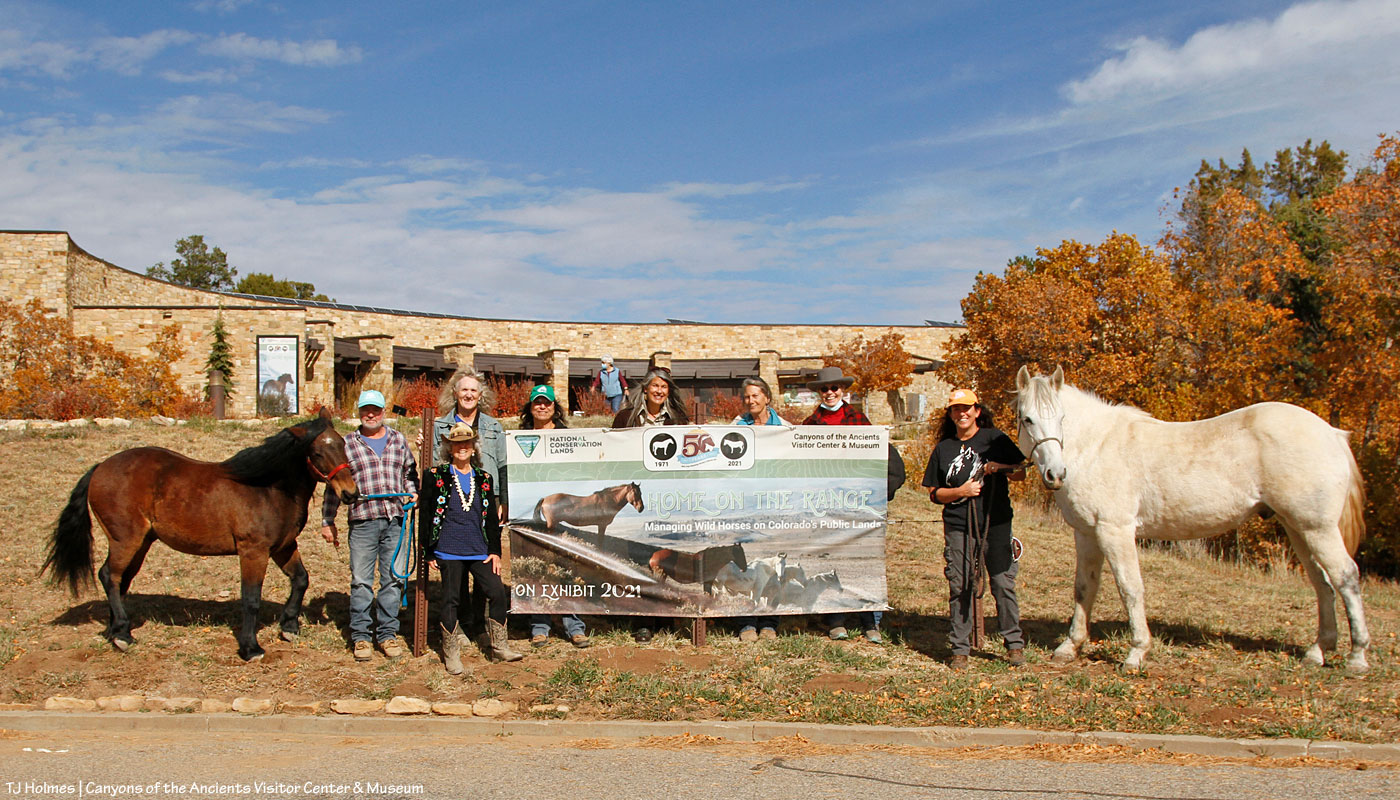
A couple of key people had left for the day by the time we quit yakking and took a group pic in front of the banner below Canyons of the Ancients Visitor Center and Museum. From left: Skipper, Keith Bean, Alice Billings, yours truly, Lyn Rowley, Amala Posey-Monk, Kat Wilder, Karen Keene Day, Tif Rodriguez and Whisper.

We want to extend our sincere, grateful and enthusiastic gratitude, respect and love for everyone who made this special exhibit and special event, well, SPECIAL.

Thank you, thank you and more thank yous!
It takes a herd, and we have the best herd in the country. 🙂


The *special* in special exhibit

24 10 2021

Yesterday, Saturday, we were so privileged to have the opportunity to talk about Colorado’s wild horses – and Spring Creek Basin’s, in particular – at a special event tied to the yearlong special exhibit at Canyons of the Ancients Visitor Center and Museum.

Several of our longtime advocates and adopters were at the event to talk to visitors about adoption, management, fertility control, helicopters vs. bait trapping roundups, wild vs. feral, responsibilities of management, documentation, the rainbow of mustang (equine!) colors, etc. Tif Rodriguez brought Whisper and Keith Bean brought Skipper – both rounded up in 2011 – to meet-n-greet visitors, and they were the undisputed stars of the show! They arrived around 9 a.m. and were there until at least 3 p.m. (the event was officially from 10 a.m. to 2 p.m.), standing on the paved plaza of the museum and allowing many hands to reach out and touch their fuzzy faces, necks, shoulders. I cannot give enough enormous praise to these boys (both 12 years old), who were so good, so calm, so accepting of it all. How many domestic horses could have been so patient?! Tif’s mom, Lyn Rowley, helped with the horses and talking to visitors.

Kathryn Wilder also was there to do a couple of readings from her book, “Desert Chrome: Water, a Woman, and Wild Horses in the West,” in the museum’s theater. Her family (two sons, daughter-in-law and two grandchildren from Dolores and sister from Oregon) was in attendance as well. 🙂 She also talked to many people about a variety of topics mustang-related.

Artist and advocate Karen Keene Day came with artist, advocate and mustang adopter (Spring Creek Basin’s Liberty among several others) Alice Billings to greet visitors and talk about adoptions and visiting mustangs on the range.

Tres Rios Field Office Manager Connie Clementson welcomed visitors and introduced folks to the visitor center, followed by Canyons of the Ancients National Monument Manager Ray O’Neil, museum curator Bridget Ambler (who was so instrumental in all the organizational aspects of getting the images printed and info panels created and designing the exhibit), and visitor services and recreation program manager Amala Posey-Monk. For all their contributions to the partnerships we so enjoy here in Southwest Colorado, we thank them hugely!

And with that, I’m going to share some teaser photos … because it’s late, and it was a long and wonderful day, and we were around more people than I see in a double handful of months (! all masked and observing Covid protocols). So you’ll have to wait another day for more pix of a couple of gorgeous Spring Creek Basin mustangs welcoming all those many people into the world of mustang lovers.

Because … how could people NOT fall in love with them? Because … that’s part of their magic. Because … mustangs. 🙂

Connie Clementson (brown vest) welcomes visitors to Canyons of the Ancients Visitor Center and Museum. Amala Posey-Monk is behind her; Ray O’Neil is in the blue jacket; Bridget Ambler is in the white shirt beyond Whisper’s forehead; Tif Rodriguez and Whisper are at left, and Keith Bean and Skipper are at right.

Kat Wilder reads from “Desert Chrome” in the museum’s theater to a crowd of early attendees while a slideshow of Spring Creek Basin mustangs runs on the screen above her.

Skipper greets Ray O’Neil’s daughters and wife at the event. Is this guy a schmoozer or what?! 🙂

More to come!


Our home range

17 10 2021

If you’re local – or even if you’re not local but will be in the area – please join us from 10 a.m. to 2 p.m. Saturday, Oct. 23, at Canyons of the Ancients Visitor Center and Museum, a couple of miles outside Dolores, Colorado, for an event to celebrate the yearlong exhibit of Colorado’s mustangs and the 50th anniversary of the Wild Free-Roaming Horses and Burros Act. (Click on that “flyer-final” link above to see the PDF of the announcement.)

If you go: Tres Rios Field Office Manager Connie Clementson will give an introductory presentation and be there to answer questions. You’ll get to meet adopted Spring Creek Basin mustangs Whisper and Skipper (also featured in the exhibit on the panel of adopters and in the short film) with their humans, Tif Rodriguez and Keith Bean. In addition to providing the opportunity to meet these stellar ambassadors of Spring Creek Basin, Tif and Keith will talk about their adoption experiences and give tips about how to adopt a mustang. Kathryn Wilder will read excerpts from her book “Desert Chrome: Water, a Woman, and Wild Horses in the West.” Books won’t be available for sale at the event, but her tantalizing readings will leave you wanting information on how to purchase “Desert Chrome,” which she will happily provide. Visitors also can sign up to go through the exhibit in the museum with me and learn more about Colorado’s wild horses.

Hope to see a lot of mustang folks there!


‘Home on the Range’

4 06 2021

“Managing Wild Horses on Colorado’s Public Lands”

On the heels of this week’s feel-good good-news stories, here’s another one to end your week on a high: Through the end of the year, Canyons of the Ancients Visitor Center and Museum (formerly called Anasazi Heritage Center) will host “Home on the Range: Managing Wild Horses on Colorado’s Public Lands,” an exhibit to celebrate the 50th anniversary of the Wild Free-Roaming Horses and Burros Act. Images and information about Colorado’s three herd management areas (Spring Creek Basin, Sand Wash Basin and Piceance-East Douglas) and one wild horse range (Little Book Cliffs) are included in the exhibit, as well as an adopters corner, which highlights a few awesome adopters of some of Spring Creek Basin’s awesome mustangs with a poster and short video. (Thank you to Tif Rodriguez and Whisper, Keith Bean and Skipper, Alice Billings and Liberty, Steve and Teresa Irick and Breeze and Sage, and Olivia Winter Holm and Ellie!)

The exhibit is a collaboration between CANM (Bridget Ambler), our local Tres Rios Field Office (Mike Jensen and Connie Clementson) and Colorado BLM’s Wild Horse and Burro Program (Ben Smith and Eric Coulter). I can’t begin to describe how incredible it looks. I walked through the doors, stopped dead in my tracks and burst into happy tears! The poor CANM employee who showed me in waited ever-so-politely for me to regain my senses (it took a little while). It’s THAT beautiful!

The center/museum is located on Colorado Highway 184 above the town of Dolores and McPhee Reservoir. If you’re in Southwest Colorado this year, please stop by to view the exhibit and the rest of the museum for a glimpse of ancient life here on the Colorado Plateau!

Below is a selection of photos of the exhibit. Really, it’s best viewed in person!

If you know me, you know that I’m the biggest emotional softie when it comes to my mustangs. Therefore, it will surprise none of you to read that when I drove up the road to the parking area below the building and saw handsome Hollywood and his beautiful mares, that was the first burst-into-tears event of the visit. Notice also the vertical sign on the side of the building in the background – also Hollywood. (Really, this guy should have his own star on a walk of fame!)

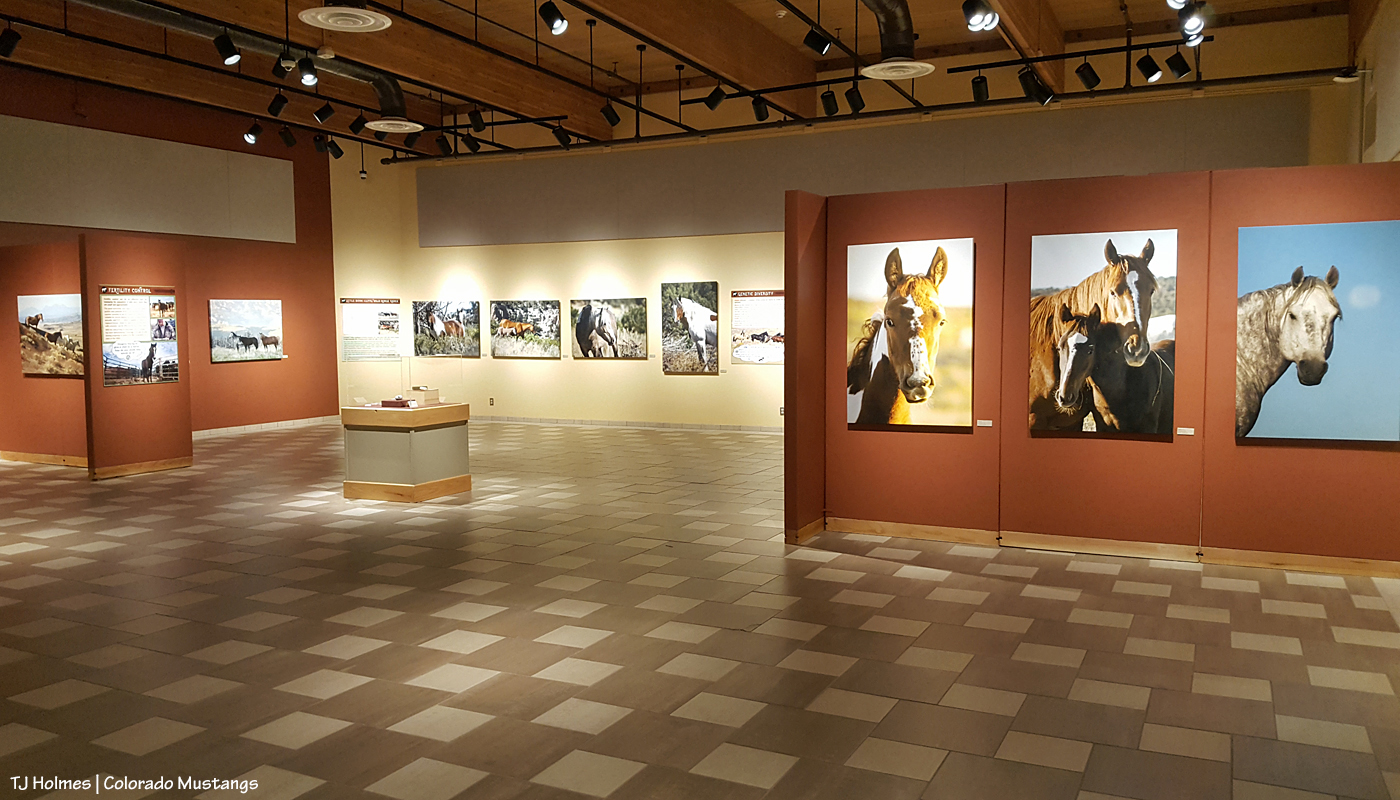
This was the next – and biggest – burst-into-tears moment: when I first walked into the exhibit hall and saw all those beautiful mustang faces. At right: Sand Wash Basin mustangs. In the background: Little Book Cliffs mustangs. At farthest left: Spring Creek Basin mustangs (the pic they used on the outside banner). Piceance-East Douglas mustang fans, don’t worry; your ponies are around the Sand Wash Basin wall. And the little section out of frame to the far left is the rest of the Spring Creek Basin area.

Right around the corner from the doors into the exhibit hall, the adopters are featured. Belatedly, I realized the mistake about Steve’s and Teresa’s mustangs: They’re both geldings. But I love the photos and quotes from everyone! These people all recognize the beauty and value of America’s mustangs (particularly our Spring Creek Basin mustangs), and I’m so glad BLM wanted to highlight their horses and parts of their stories. (The mustangs were adopted in 2005, 2007 and 2011.)

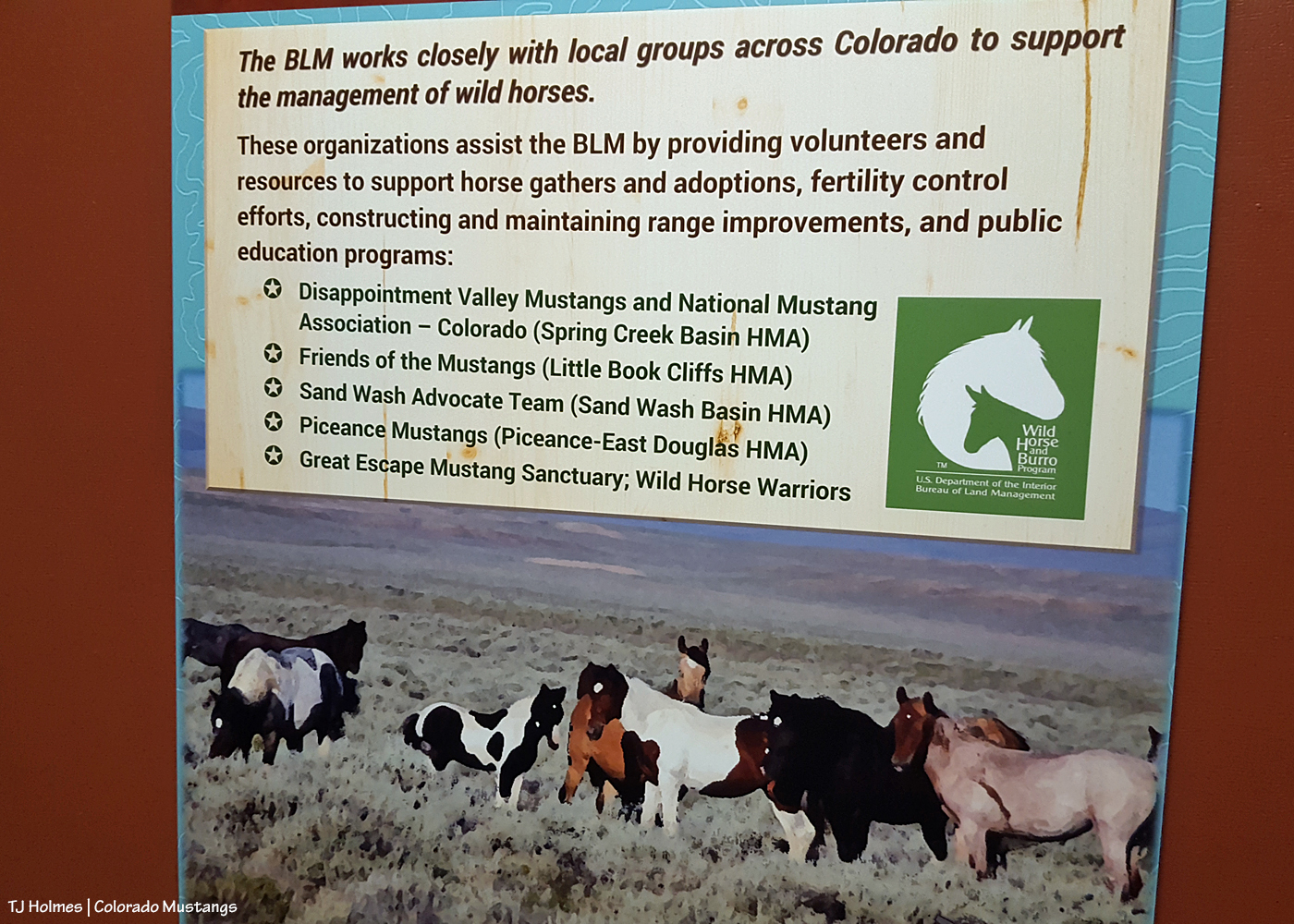
The exhibit also pays tribute to Colorado’s mustang advocacy groups – at least one for each herd in the state! Our mustangs are blessed to have people involved in every aspect of their observation and management (of course, we advocates know that WE are the blessed ones!).

No exhibit of mustang management in Colorado would be complete without a display of some of the tools of our fertility-control trade (on the wall across from this is an info-graphic panel about fertility control). We use CO2-powered darting rifles in Sand Wash Basin and in Spring Creek Basin, and they use .22-type rifles to dart in Little Book Cliffs. At upper left is a teeny branding tool for foals. Hopefully coming soon is a darting program in Piceance-East Douglas; all the pieces are being put in place.

Let’s see some pix of the pix (they are beautifully printed on canvas; each of them will go to the respective offices (Tres Rios, Grand Junction, White River and Little Snake) when the exhibit closes at the end of the year):

One of the walls of Piceance-East Douglas beauties.

A cozy corner of Little Book Cliffs mustangs with some of the astounding scenery shown. Part of Little Book Cliffs also is a wilderness study area (like McKenna Peak in Spring Creek Basin).

Some lovelies of Sand Wash Basin.

And of course, my most-beloved Spring Creek Basin wildies.

Deep, heartfelt gratitude to Bridget and Mike and everyone who conceived of and then brought this exhibit to reality. It didn’t open in January as planned because, you know, Covid, but it’s been open since mid-April and will be open the rest of the year (check the link at top of the page for visitor center/museum hours). (As of this writing, they’re following safety protocols with limited capacity in the building and social distancing.)

If you’re coming to or through Southwest Colorado in 2021, please, please, pretty-pretty please make a stop at Canyons of the Ancients Visitor Center and Museum and take time to walk through, and/or sit, and very most definitely enjoy this exhibit of some of the mustangs that call Colorado home. We are SO proud of our mustangs!