You’ve heard the phrase “doughnut hole” in weather-related conversation? How one place or another is in a “doughnut hole” of NOT getting weather the surrounding area or region is getting or has gotten?
Disappointment Valley (at least the lower part) got a skiff or less of snow Thursday morning (no measurable liquid). It was gone (melted) before you could even say “doughnut hole.” A friend west of Cortez (south of Disappointment) got 4 inches of snow. A friend right in Durango got 6 inches! Friends in Aztec, New Mexico (northern New Mexico not far south of Durango), got 3.5 inches of snow. … You see where I’m going with this?
Yeah, it’s a thing.
That’s Disappointment Road looking south. This is the afternoon of the morning it snowed – “snowed” – ha.
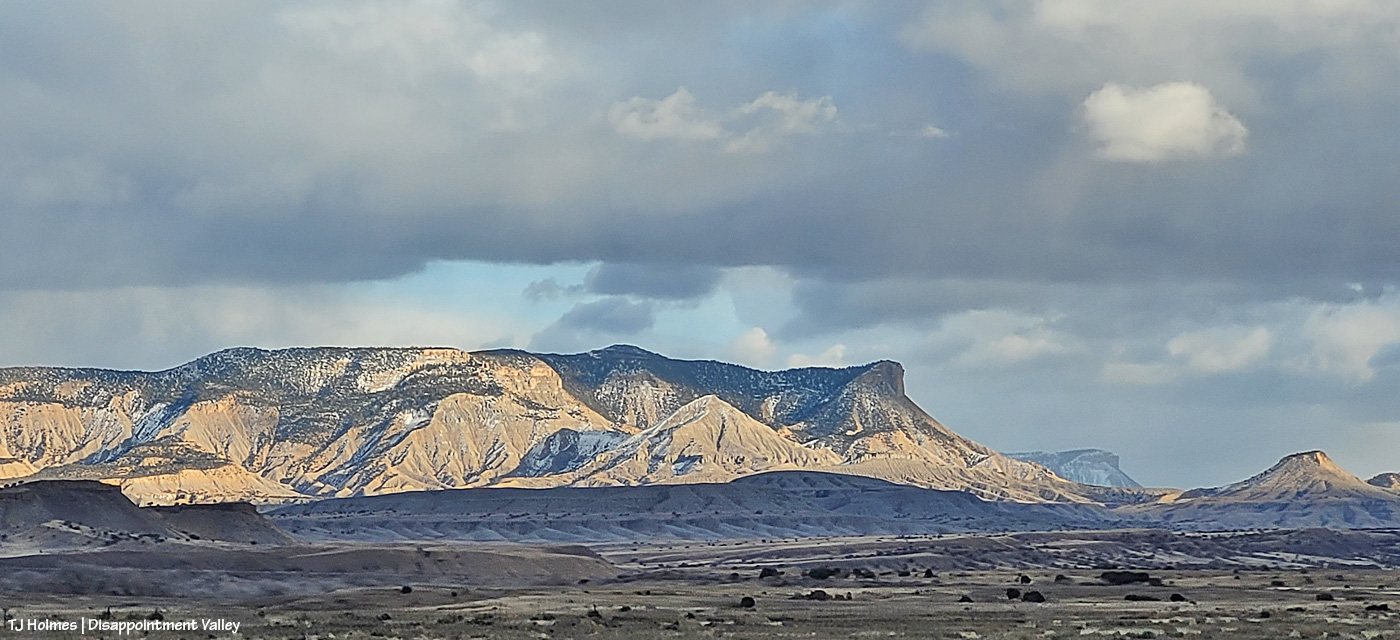
‘Course, at the same time, we had THIS view (to the east-southeastish). 🙂 (Note the lack of snow.) That could be a definition of “silver lining.” 😉
Yes, it really is (still) that dry in Spring Creek Basin and most of the rest of southwestern Colorado. Pooh on the U.S. Drought Monitor for thinking (erroneously in my oh-so-very-humble opinion) that we’re only “moderately dry.”
And: proof that mustangs and mountain goats have a common ancestor (!). 🙂
That’s Sundance (and one of his mares) on a finger of a ridge at the very southeastern end of what we call Knife Edge (which actually is fairly broad on top). This pic, taken with my phone as I hiked out to a series of hills to get up to the ridge that snaked down to where his band was, isn’t even wide enough to show how far to the right I had to go to get to that access area – where I could bypass the rimrocks. The other side of this ridge features a little cove, where a couple of the horses were grazing as I drove up the road to the point where I started hiking, but it’s all rimrock-locked. In other words, the only way TO that point is back up the way they got TO it in the first place.
OK, a third thing: You know I’m going to show you all some scenery from up on that ridge, don’t you? 🙂 (Here’s a crazy thing: As much hiking as I’ve done in Spring Creek Basin during the last 21 (starting to inch up on 22?!) years, I’ve never been up on that particular ridge or on the very top of Knife Edge. … The horses are very good guides at getting me to new places. :))
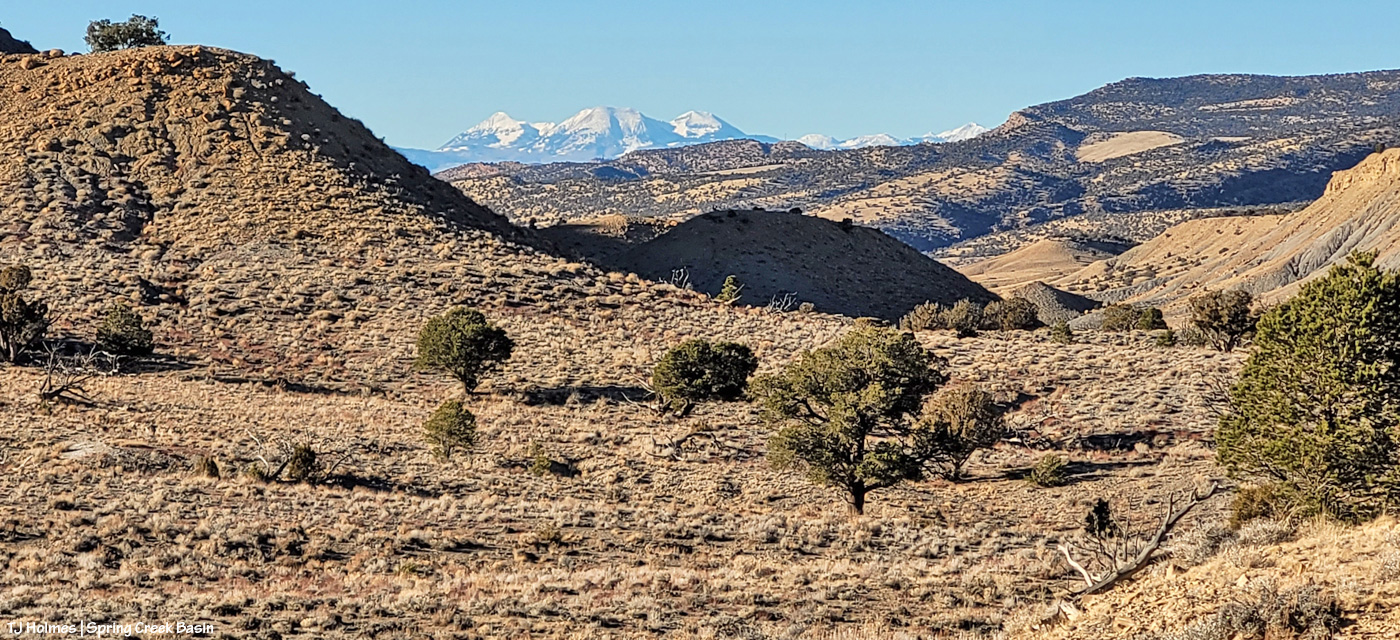
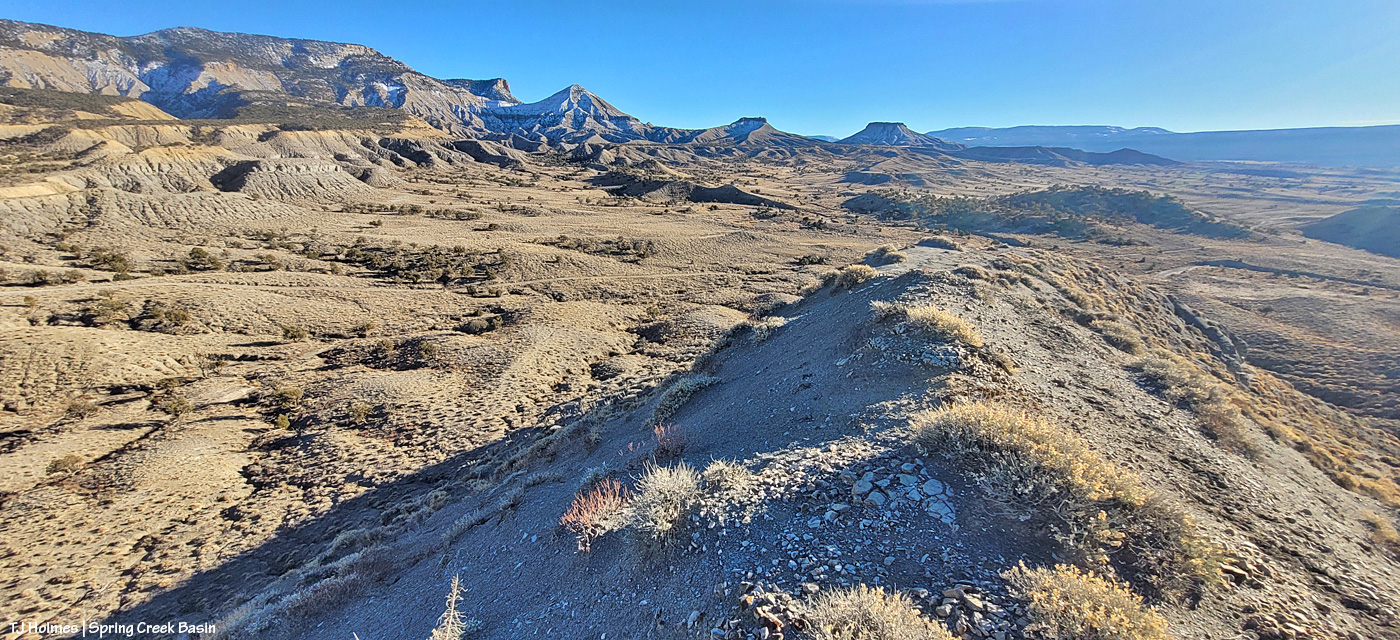
Upon leaving my buggy to start my hike (the big ridge and Sundance’s band are directly to my left), this was the first view that made me reach for my phone (aka easy-to-access camera). I’m just south of an area of Spring Creek Basin that I call the east pocket. Knife Edge is basically to about my 11 o’clock, and the sandy-colored ridges at the right of the image are what I call Valentine Mesa. The mountains are a stone’s throw away (!) in Utah; from the ridge I was later on with the horses, they’re mostly blocked by the bulk of Knife Edge.
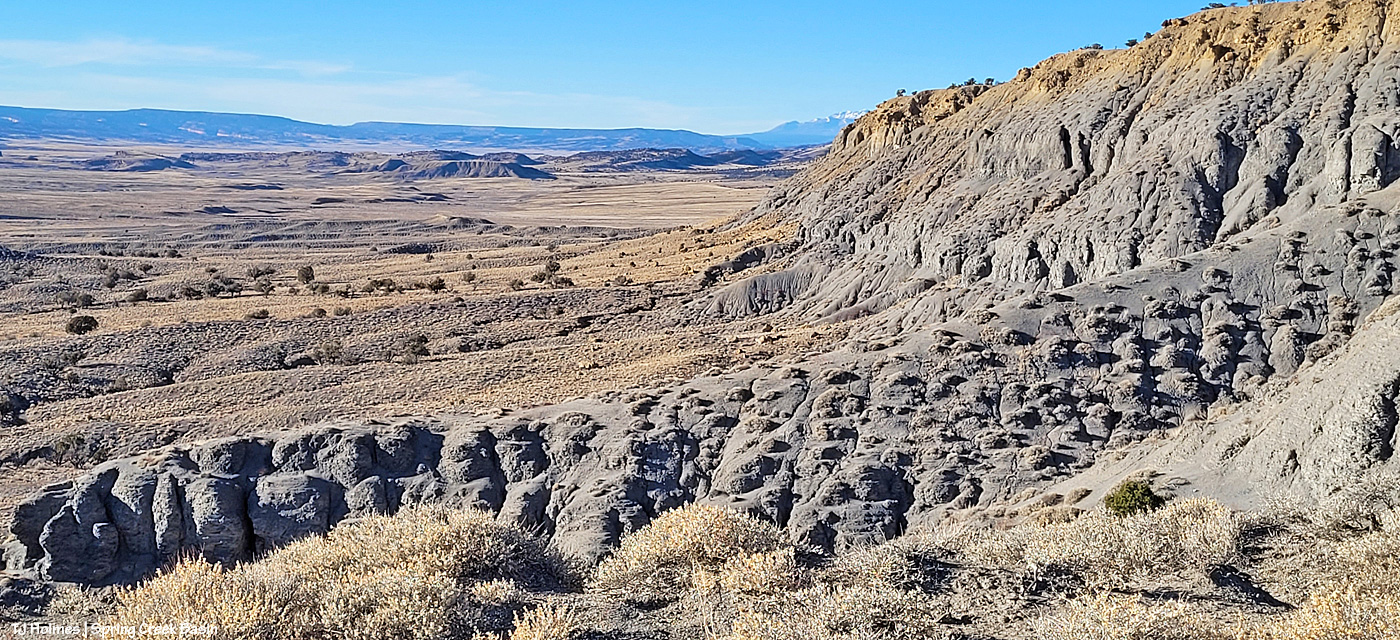
I’m up on the ridge that leads to the horses’ location farther down at the fingertip end of it. That big rise of grey Mancos shale and orangier (!) sandstone is Knife Edge. The southern peaks of the mountains are just visible way, way out against the turquoise sky. Spring Creek canyon is visible at far left. That’s the basin’s western boundary; the farthest treed ridges are the southern/southwestern boundary of Disappointment Valley above the Dolores River and its canyons.
Looking left-ish from the above pic, that’s Spring Creek cutting through Spring Creek Basin in the middle ground. What I call the “weeping wall” is down there, and it provides a pretty constant source of trickling water for the mustangs. At far upper right is the eastern end of Filly Peak in the basin’s western region, and straight out is Flat Top. Round Top is barely visible at left. In about the middle ground – shadowed on its northeastish length – is the ridge I call rollercoaster (though it doesn’t look very rollercoastery from this perspective). … And see the glimmer just above/beyond it? That’s the rollercoaster ridge pond, still decently full of water (semi-frozen, depending on conditions). That’s the pond from the “Reflections” post recently. … And what do McKenna Peak and Temple Butte look like from THIS perspective?
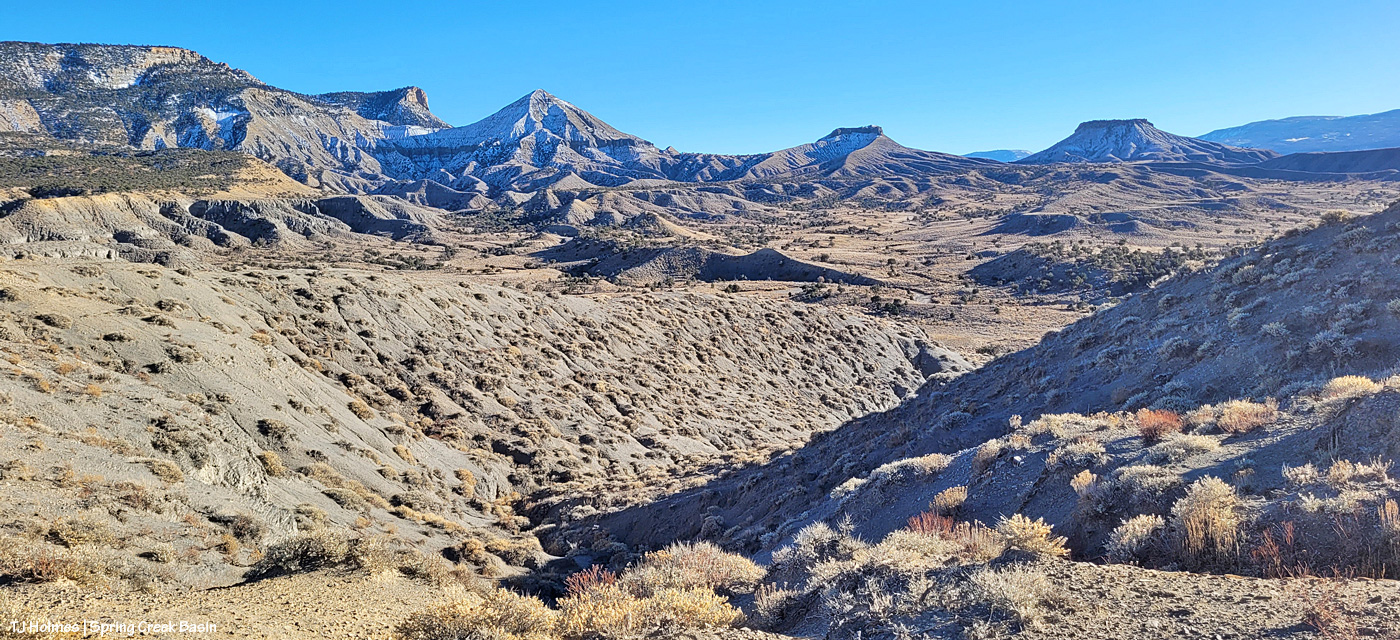
I’m so glad you wondered! 🙂 From a little right of left: Temple Butte, McKenna Peak, what I call submarine ridge (you can see the two “arm” ridges of the actual feature from here) and Brumley Point, on Spring Creek Basin’s southeastern boundary. The Glade is in the far distance, touching the sky. A little closer – middle ground – is Spring Creek and part of the basin’s loop road (rough, and I would not recommend driving a vehicle on this section). The ridge down to the horses starts to the left and runs through the nearer middle of the pic. Sundance was actually partially visible (his back), but I don’t think he shows up very well in this pic.
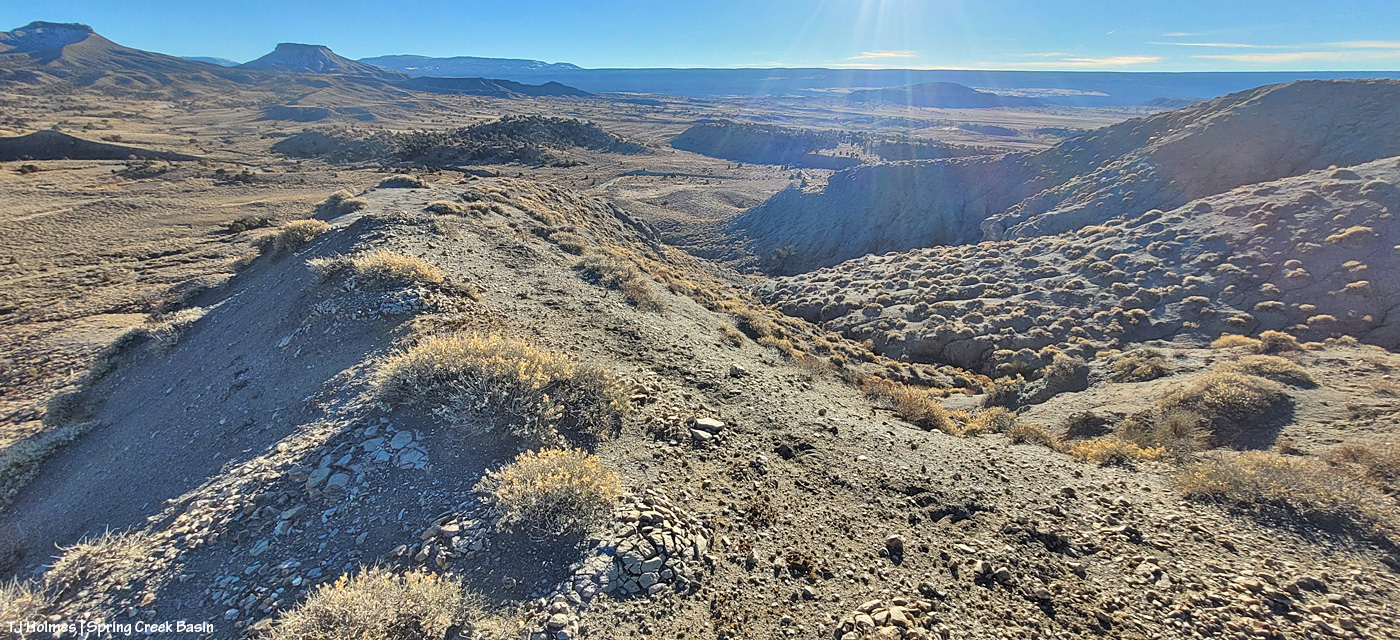
This pic (left) and the next (right) were taken from the same vantage point, but when I tried to stitch them together into a bit of a panorama in Photoshop, it didn’t work out so well. So, using the ridge in front of me as your guide, you’ll have to use your imagination a bit as you scroll up and down to look left and right (!).
If you can find the ribbon of road, out there in sort of the middle, heading uphill (to the left from this perspective), is where I was when I looked up and horses appeared, much to my wondering eyes! (Magic isn’t just the domain of Santa, folks.) If I’d been going the other way around the loop, downhill, which is my usual direction and preference given some fairly challenging road issues (!), I don’t think I’d have seen them because I’d have had to look back over my shoulder and up. I try to look in that area because I’ve seen Sundance’s band in that relative vicinity before, but see the little “cove” down to the right in the second pic (the one right above)? That’s where a couple of the horses were when I first spotted them from below, and if I’d been in a different place, I wouldn’t – couldn’t – have seen them there from the road.
Another lesson: Perspective often is everything. 🙂
Pretty dry out there. The forecast is starting to show us some glimmers of hope for coming snow. We got kind of skunked over Christmas, but fingers and hooves are crossed that our winter will start picking up in this newest part of the new year.
As usual, it’s hard to believe that another year has come to an end and another is starting.
As usual, there’s been good news and bad. … Much of the time, it seems like bad news is all the news that is news.
We need to know what’s going on in the world – from our local communities to the wider global community – but the constant onslaught very often has the effect of hurting the heart (as an understatement). Wouldn’t it be crazy if good news so dominated the headlines that bad news was relegated to the “inside pages” – or not at all? A good kinda crazy, for sure.
With this blog, I strive (in part) to provide a positive counter to the negativity that’s so easily found. If you’re here, reading, you’re looking for that positivity, and I’m so glad you’ve found it with our Spring Creek Basin mustangs. 🙂 If you get to visit the basin for yourself, so much the better. There’s truth in the phrase that the outside of a horse is good for the inside of a … let’s say human.
What follows is one photo for each month of the past year. Some have been on the blog previously; others have not. All pix were taken in the month they represent. Onward.
January
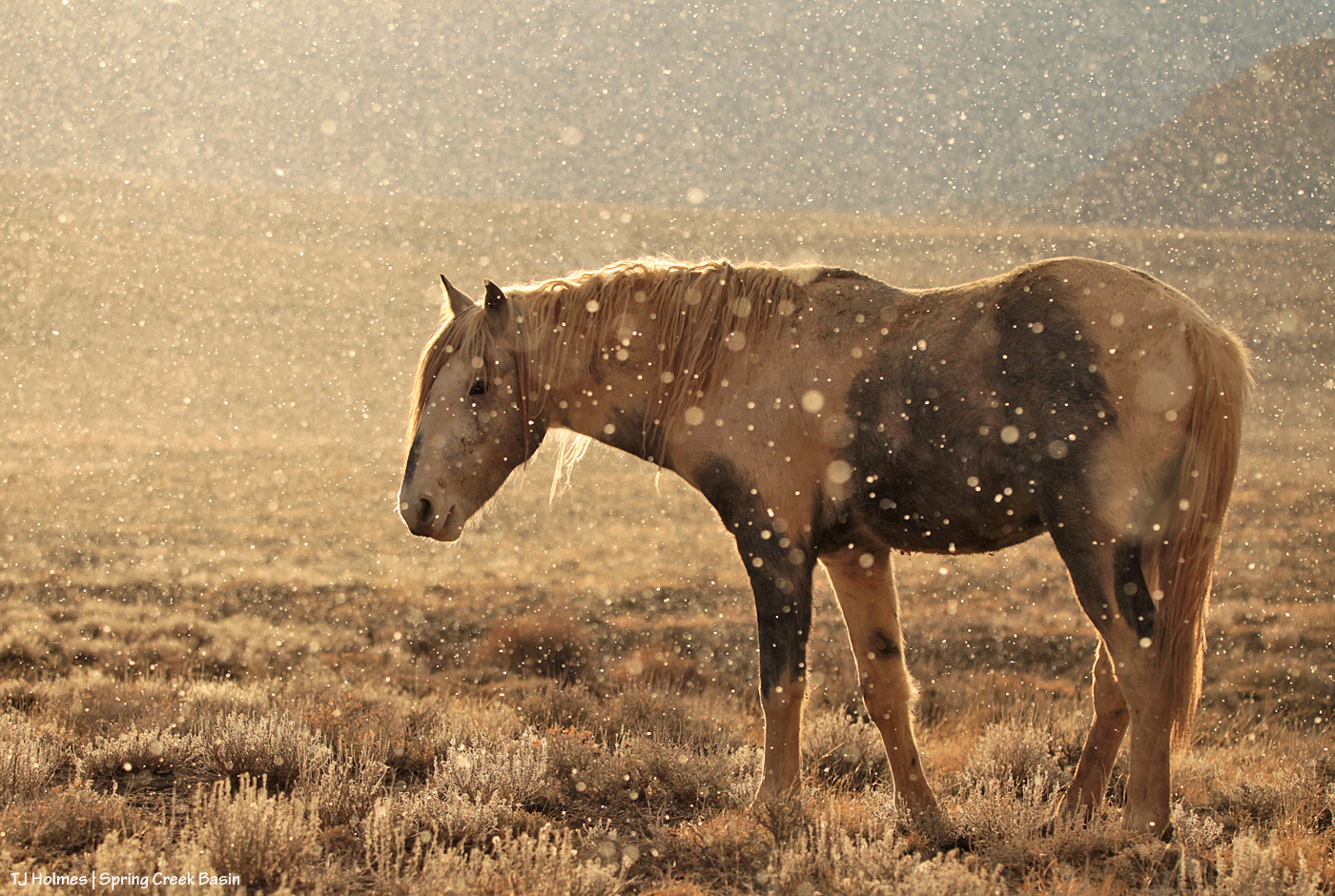
While photographing Flash and some bachelor pals, snow started floating through the air while the sunshine illuminated every single flake. I mean, GORGEOUS! The bachelor boys are famous for mostly ignoring me, but that light and those flakes demanded photographic proof. Fortunately, Flash paused his grazing – and chewing – just long enough to look at his pals, and I snapped the shutter on a magical moment. The snow ended very soon after I did so – or maybe it was the light on the snow.
*****
February
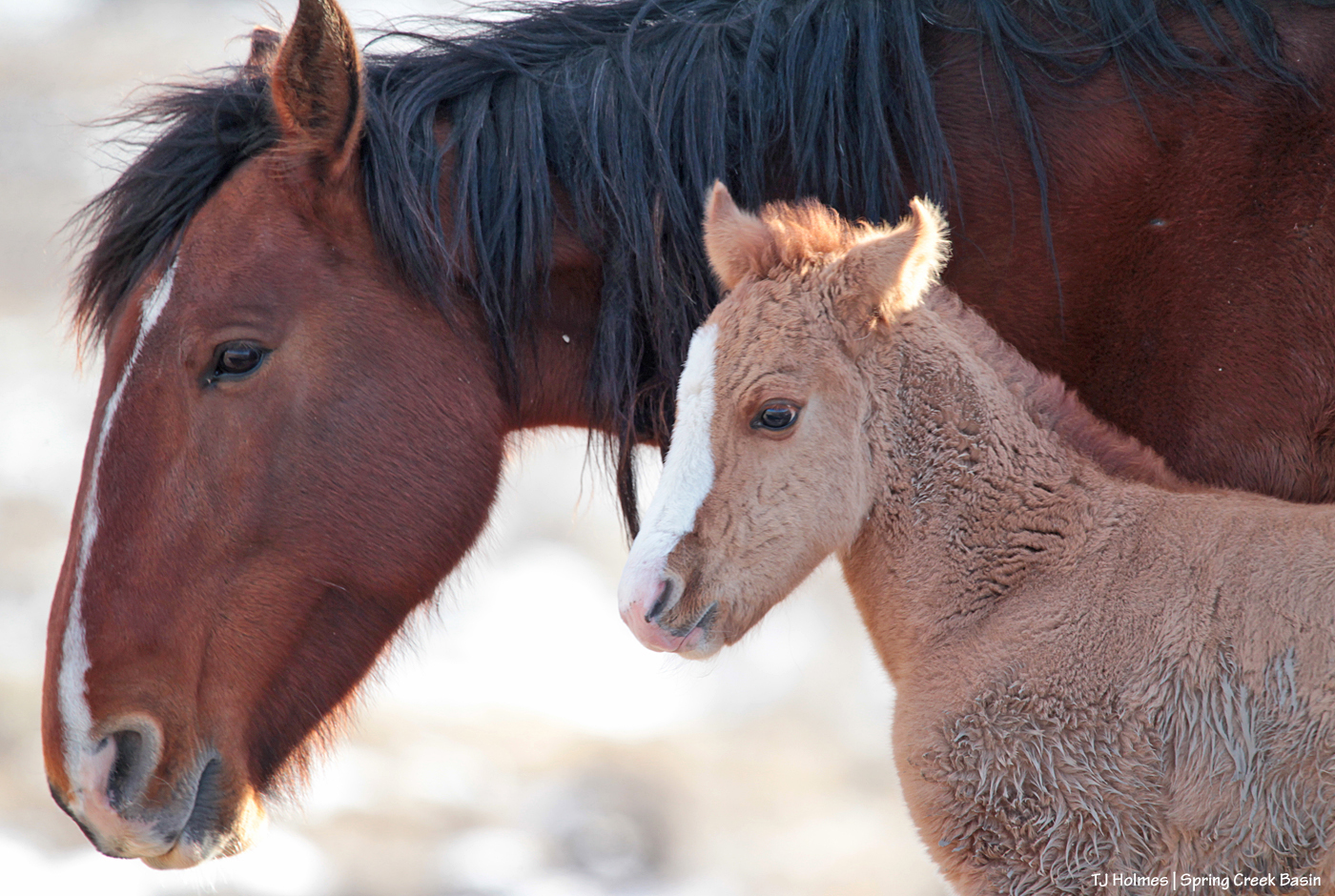
In February, we welcomed a long-awaited addition: Hollywood’s and Shane’s son, Odin. He was at least a week old when I found him and just as cute and fuzzy and stout as I could have hoped. He is growing so well and is as cute and stout – and fuzzy, again! – as can be! Hollywood no longer has his band, but his legacy continues in his son. This is still one of my very favorite pix of Odin and Shane.
*****
March
I couldn’t have been more thrilled when Dundee, one of the three introduced mares from Sand Wash Basin, had her very big first colt by Buckeye: Ranger. A couple of weeks later, Aiyanna delivered her delicate little filly – also by Buckeye – Bia. Unfortunately, we lost Ranger at about a month and a half old to unknown circumstances. Bia continues to do very well and is growing into a very lovely filly. She’s the spitting image of her mama – though she’s bay and mama is dun. She is adored by her entire band.
*****
April
As I remember, we had a nice, lingering spring. As spring was springing, love was in the air. Above, one of our young(ish) stallions, Zeb, was flirting with one of his mares. Really, who can resist his handsomeness or the flirty swish of his tail?!
*****
May
With the decent winter, we had a nice wildflower season, but it sure took its sweet time in arriving (or so I thought at the time, being, as usual, impatient). I visited my parents for Mother’s Day and left Disappointment Valley still brown and drab. When I returned, holy green! And then came the wildflowers. And once again, Flash proved a fabulous model among the larkspur (it was a bad larkspur year for the cattle folk), globemallow, wild onion and other lovelies. And the grass, of course. Green is my favorite color. 🙂
*****
June
That light! That grass! Those pinto girls! I saw Reya’s band only rarely this year, but they make every visit worthwhile. Mama and daughter Chuska: lookalike girls!
*****
July
That. LIGHT! Terra and her stallion, Venture, enjoyed a quiet moment during the height of summer. I think he adores her, and I think this moment in time illustrates that perfectly.
*****
August
Oh, this was another of those beautiful evenings in Spring Creek Basin. Buckeye’s band was napping on a hillside in an area that wasn’t usual for them. Another band was grazing down in a little cove among the hills. I walked up to take advantage of the view, then waited. Baby Bia had been napping between her auntie Rowan and mama Aiyanna. My waiting paid off when Bia ducked under mama’s neck on her way to nurse, and Aiyanna gave her a quick little casual “hug” as she did. Click went the shutter on one of those moments you never forget.
*****
September
On a stormy evening that didn’t bring rain (to us), Buckeye was guarding his band from a nearby band on the flanks of Filly Peak. (He appears to be napping, but he was alert, I assure you.) His band is to my left – and they really were napping, secure in his watchfulness. Beyond him is his mother, Winona. Her band was mostly out of sight in a little low place between here and there. The photo for this month was a tossup between this one and another photo from that same evening. Quiet, peaceful, lovely.
*****
October
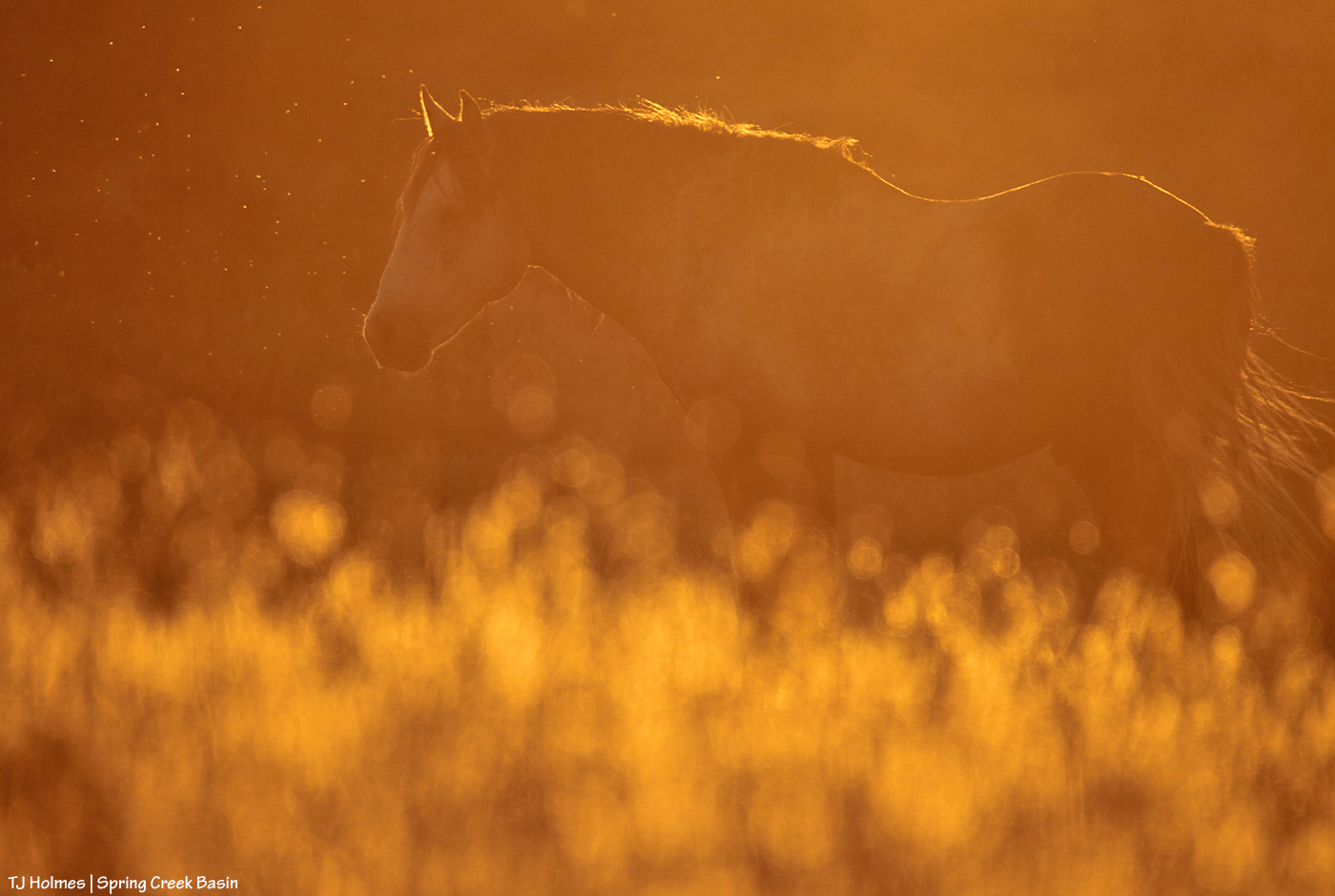
Young stallion Cheveyo was in just the right place at just the right time for the very low sun to highlight him against the far, shadowed, hill and turn the foreground grasses to dancing flames of light. I’ve said it before, but it bears repeating: I adore backlighting!
*****
November
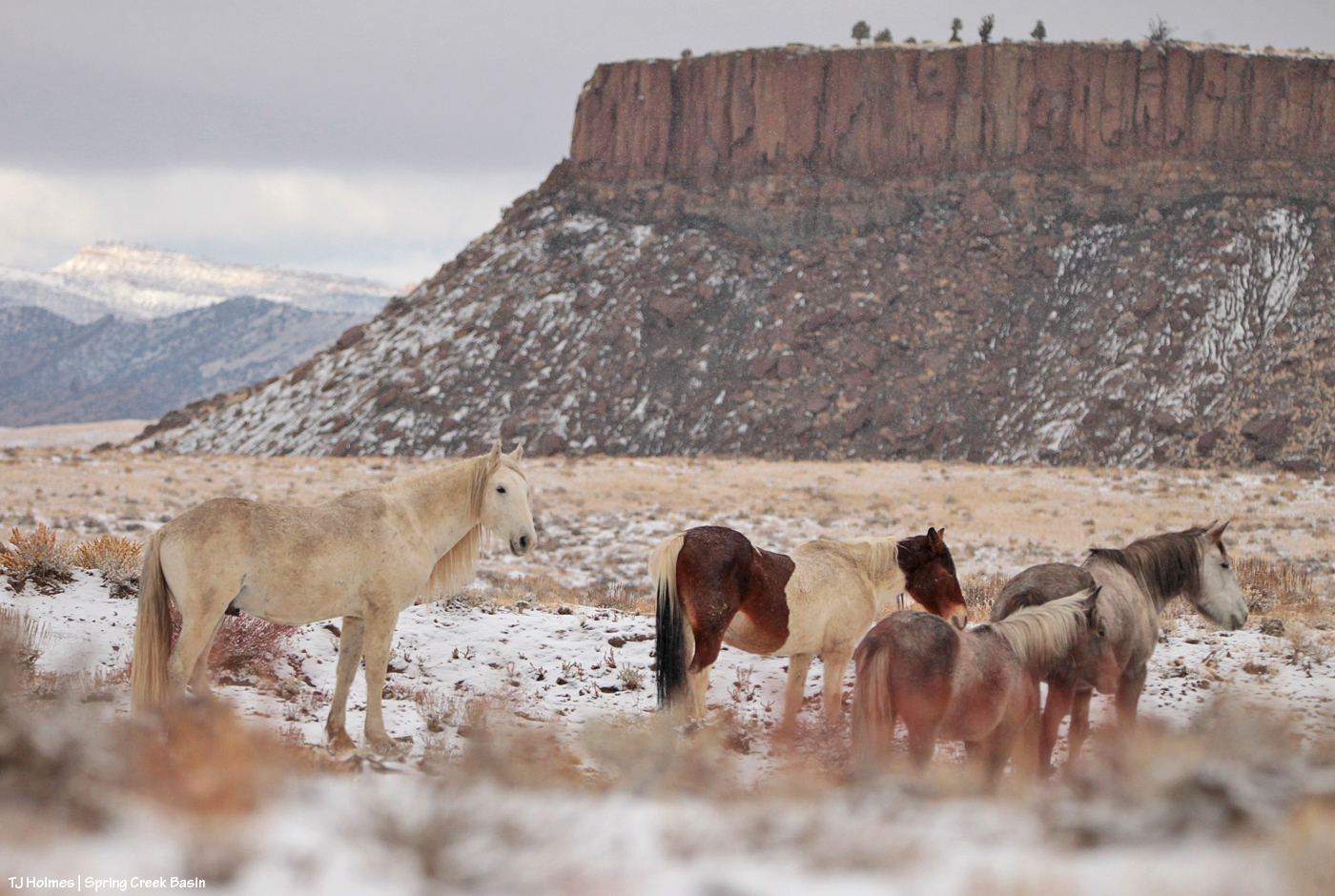
This was the first snowfall of the season, and I was happy to find Remy’s band grazing in the western part of the basin. The sun was flirting with the clouds. A great wave of light would sweep across Disappointment Valley, followed quickly by the greyer light – the kind of light that keeps photographers hopping (and hoping). Light snow also was falling and stopping and drifting and stopping and floating and stopping. A small band of young bachelors was nearby, but they weren’t too interested in Remy’s girls. Remy took his band to water in Spring Creek canyon (the rimrocks are seen in the background), and I called it a (beautiful) day.
*****
December
Our Hollywood, beloved and storied elder stallion, rounds out the year. This was the second snowfall of the season (and our last to date, as it happens). The snow was a little deeper, and it stayed pristine a little longer, than the first. The day was glorious for a hike, and that’s how I found Hollywood – originally drinking at a nearby pond. Here, he’d walked away from the pond before he stopped for a nap. As hard as it is to see the aging process at work on him, and missing his loyal mares, it’s always good to see this wonderful wild stallion.
*****
Bonus
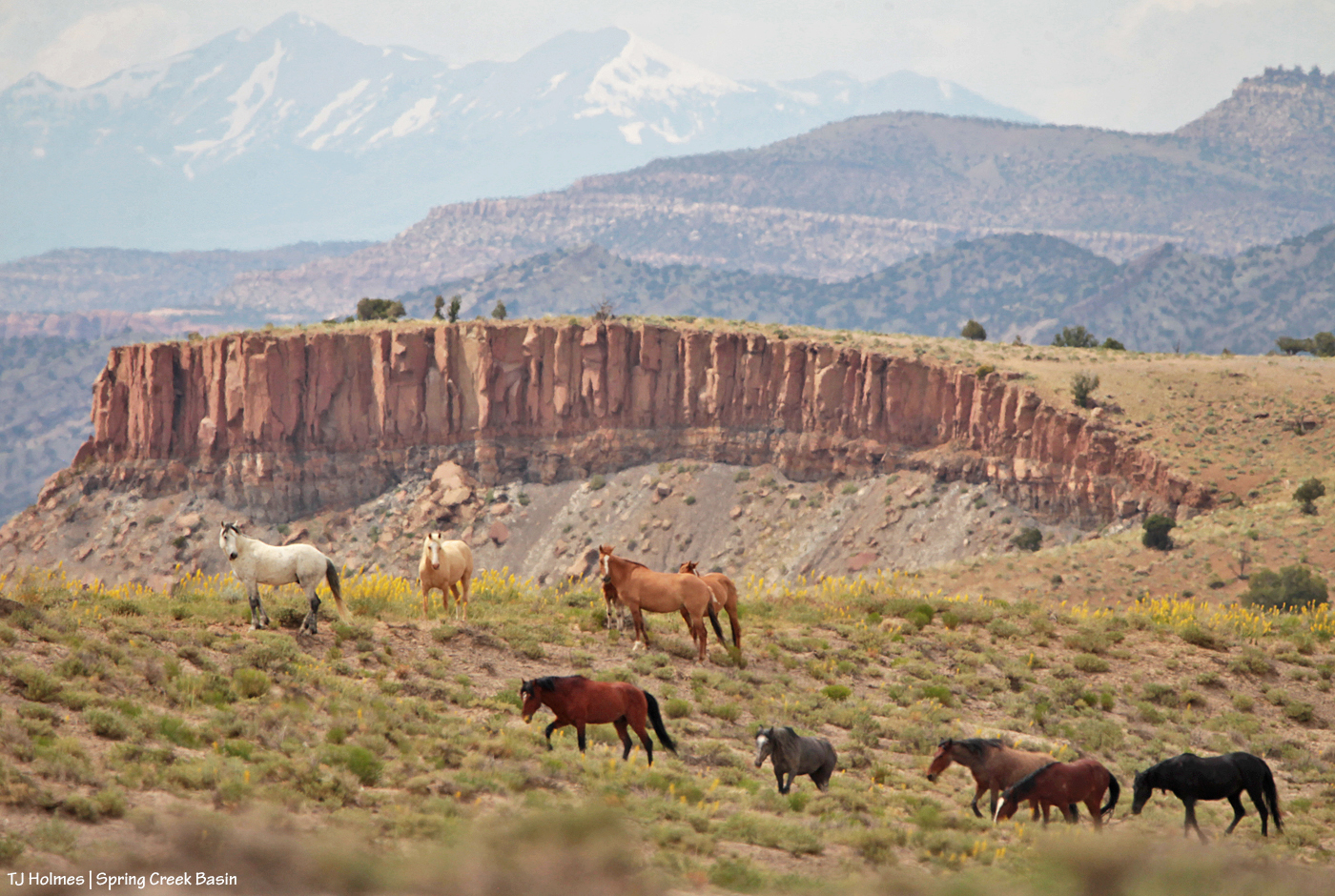
Taken from very far away, I love all the layers in this image of Buckeye’s band – with prince’s plume! – and Tenaz and the band he escorts. A dear friend was with me at the time, and the enjoyment was doubled to have her along for the visit.
*****
Happy New Year’s Eve, everyone! Best wishes to you all for a happy, healthy and positive 2024!
Wow. That’s some serious mud immersion! She and her band weren’t far from a pond that still has good water. Hopefully we have some rain coming this weekend. It is dry, dry, dusty dry.
In good news: Today is the last day of third rifle season.
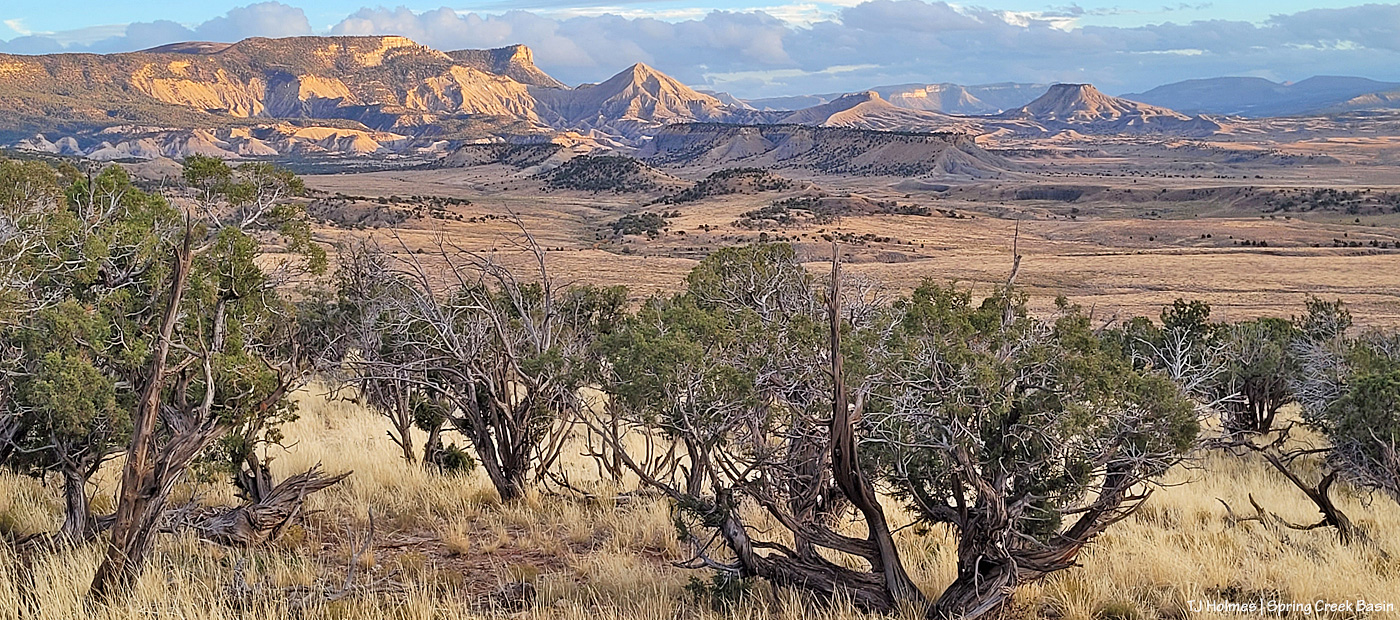
From Spring Creek Basin’s “north hills,” the views are tremendous:
Do you see the mustangs? Admittedly, they’re a long way away. 🙂 (Look between the tallest fingers of the dead tree in the foreground.)
I. LOVE. THAT. VIEW!
And in the right light, it’s more painting than reality … except that the very best thing is that it IS reality! I realize that the above three pix are very similar; I couldn’t decide among them to pick just one. 🙂
From nearly the same vantage point, looking in the other direction, off the top:
Wild country. Available to the mustangs, but I’ve never seen any down/back there … of course, it would be a lucky combination to be in the right place at the right time (both/all of us!).
A little Spring Creek Basin potpourri for today’s post. The inspiration was this little guy/gal:
S/he was little bitty, and my first thought was the usual “chipmunk,” maybe “ground squirrel.” There were a couple of little holes, the nearest right behind the critter. While researching just what s/he IS for this blog post, I realized that I don’t give these ubiquitous little busybodies much thought, though I see them all the time. I looked up the above terms and compared those pix with my pix … nope, definitely not either. Then I spotted a pic of an “antelope squirrel,” which fit the bill. Who knew?! There are several regional kinds, and I don’t know which particular species this little one is, but s/he was awfully adorable and fairly curious about the giant (how must we seem to such tiny creatures?) with the clicking box.
From the very top of the western boundary of Spring Creek Basin – the rimrocks you see as you approach the basin’s western boundary *from* the west – this is a view looking to the northwest out over Disappointment Valley:
Utah’s La Sal Mountains are those peaks on the horizon. This was taken right from the fence line at a little saddle. In most places, the sheer cliffs of the band of rimrocks form a natural boundary for the basin. In other places, where the horses could wander right on over, there’s fencing to keep them home and safe. In the very foreground, you can see some old wire from a previous fence; I’m standing right at the current fence (not seen). Between Spring Creek canyon (down to my left) – which is the drainage outflow of Spring Creek Basin – and what I call the northwest valley (simply the farthest little “valley” in the northwestern part of the basin, where our newest water catchment is located; up to my right), there are a series of what I call “bowls” – little “micro-valleys” between hills/ridges, for lack of a better term. The above pic was taken from the top of one of those bowls.
Now facing the exact opposite direction, looking back into Spring Creek Basin, a little lower, near where I made my little friend:
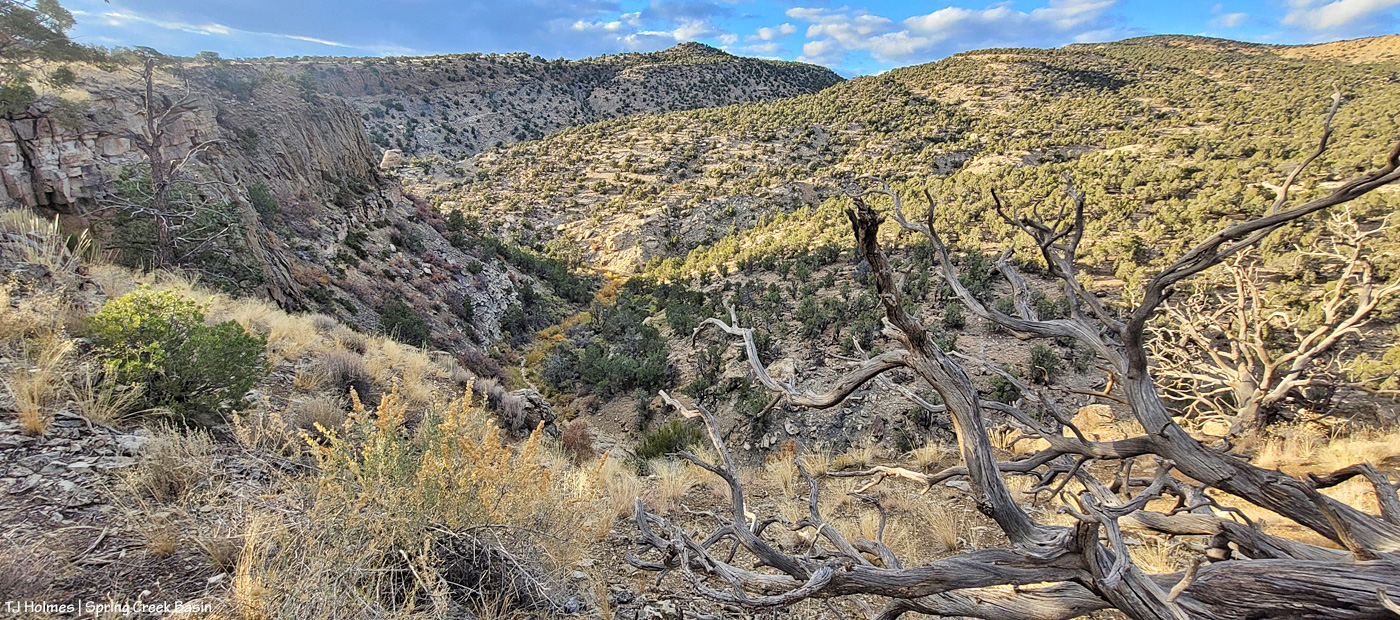
This wonderful sculpture of an old juniper just begged to be used as a frame for this view of the basin, looking southeast. Note the grey mustang at lower right; she was grazing with her band and two others just below the height of the bowl. Visible across the background are landmarks often to irregularly featured in other images posted on the blog: Temple Butte above McKenna Peak (framed right through the upper part of the old tree), submarine ridge, Brumley Point (just right of the farthest top-right branch), Round Top and Flat Top. The snaking shadow-line at mid-right, above the mustang, is a low ridge along the south bank of Spring Creek. The canyon is downstream, farther right and out of this frame.
Would you like to see a bit closer look?
Of course! A marvelous view and a marvelous old grandfather (mother?) tree – what a view it has (imagine!!)!
Have I mentioned lately the fantabulous grass in the basin? Those ponies are eating like bears in hyperphagia (I’m only partially kidding). It’s pretty glorious – and incredibly satisfying to just hang out listening to the horses snip and crop and chew.
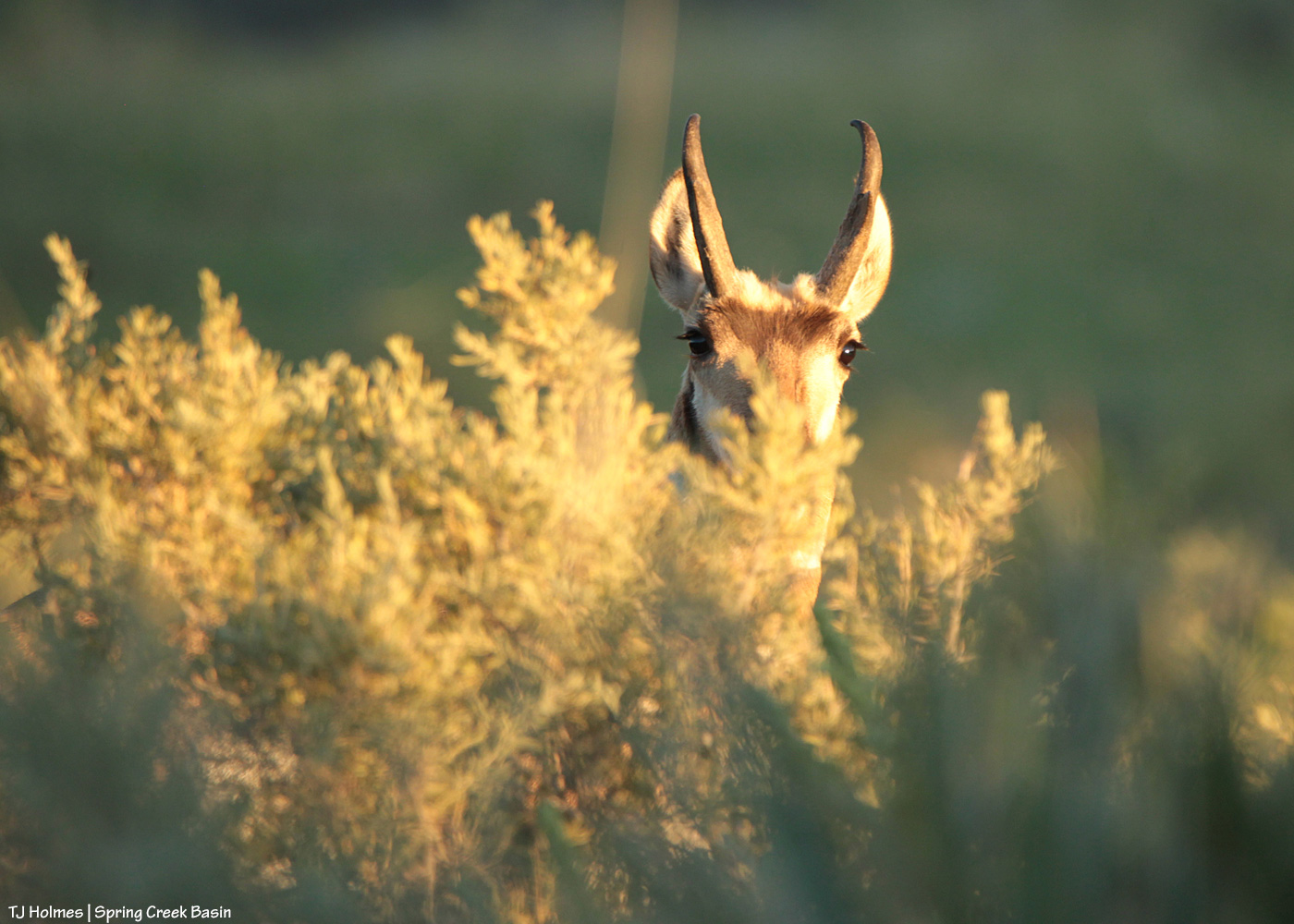
I’d been delighted by the ponies, charmed by the antelope squirrel, filled with gratitude by the bounty of grass (native grama, galleta, sand dropseed and alkali sacaton, if you want to know specifics (links may or may not be to the *specific* types that we have)), but the evening had more thrills in store. I’d noticed that the attention of a couple of horses was caught by something I couldn’t see, but as that happens quite a lot, and I was *focused* on framing the basin in the arms (branches) of the ancient juniper, it was a moment or three before another captivating face caught my eye:
One face but two somethings!
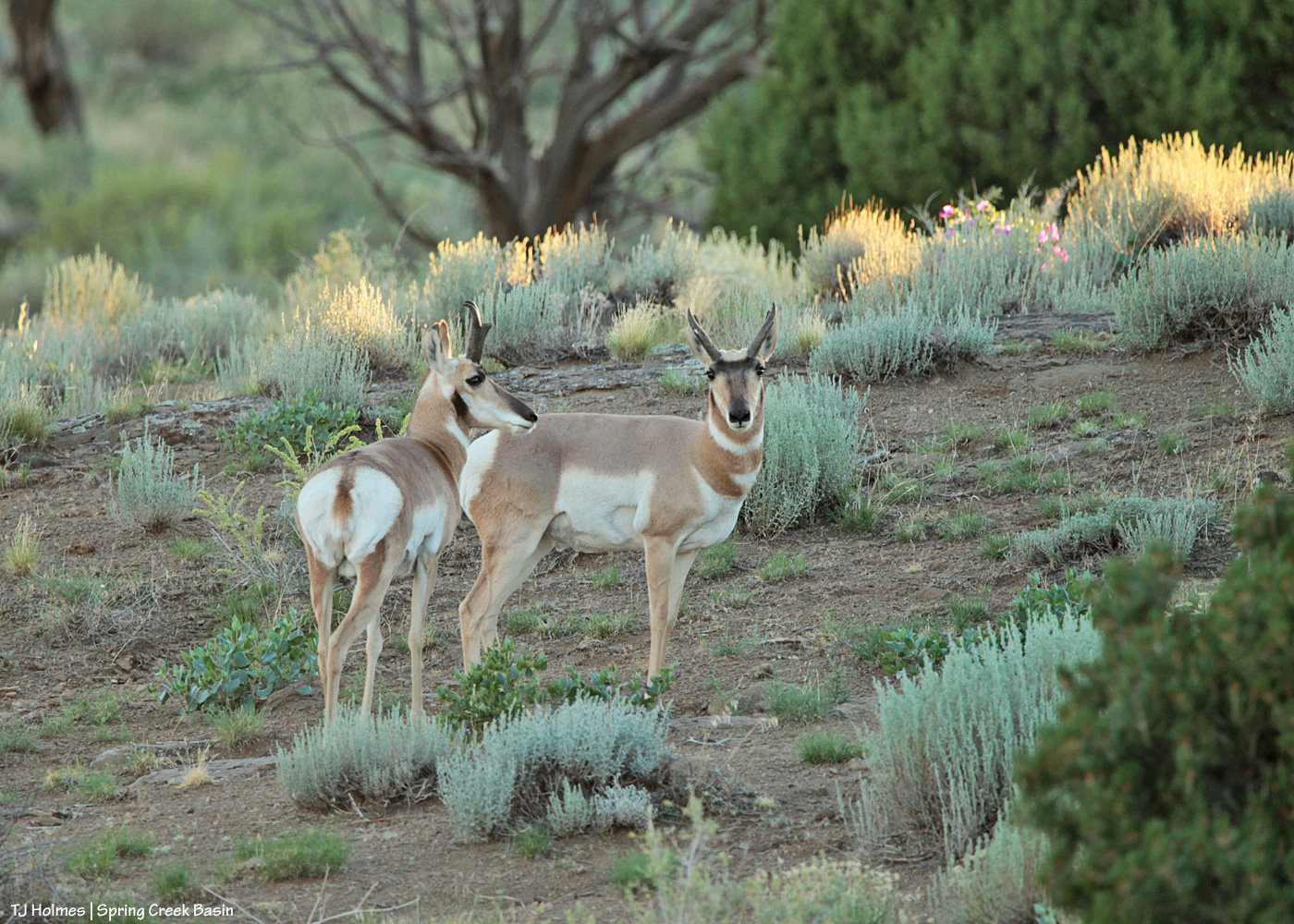
Now here’s a thing: Antelope squirrels may be called antelope squirrels (one wonders why?), but pronghorns are not actually antelope, despite the fact that they’re called antelope by most people. Kinda like the buffalo/bison thing. In any case, I didn’t know at the time about “antelope squirrels,” but I was thrilled to see these pronghorn buddies. I think they’re both young bucks, but females also have horns, which are smaller than the males’, and these weren’t super big. (I have seen females recently, with fawns.) Another interesting tidbit: Pronghorns aren’t hunted in most of Colorado. Despite being just about everywhere in states such as Wyoming (nickname: speed goats, which always tickles me), they’re not common in Colorado, especially this area of Colorado. We do have a fairly stable – and fairly small, 25-30ish animals? purely local observation – population in Disappointment Valley/Spring Creek Basin.
One …
… the other.
Thank goodness for long lenses and the quiet of inattention!
The curious stares lasted a few moments, then with a burst of speed too fast for this human to follow (with a camera …!), the boys put on a burst of their famous speed up the hill past a couple of unbothered mustangs (!).
Pronghorns could give humans lessons in sprints and interval training. As fast as they can hustle, they come to a walk or even stop just as quickly. All the better to check you out again, my dears. … Note the four o’clock blooming in the sunlight in the background. Most of the four o’clock plants/flowers are not currently blooming.
And they usually just as quickly lose interest in such slowsters as humans and mustangs. (Note the wonderfully healthy juniper trees branching over the buck and in the background. We’re losing a lot of trees to drought and teeny beetle-bugs.)
No trek above Spring Creek and the canyon would be complete without taking note of Spring Creek itself, which is trickling in places …
… and not a glimpse of water immediately downstream of the above pic. The creek makes a sharp bend to the left there and enters the canyon, just out of frame to the left.
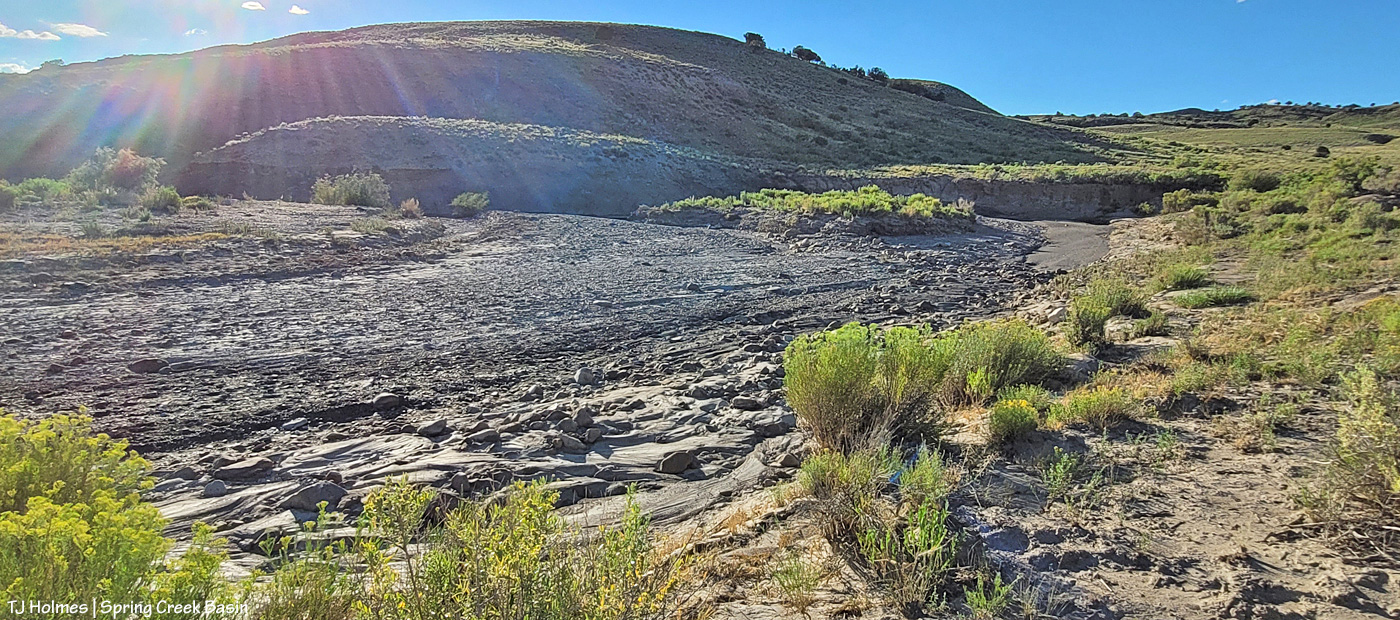
We have an interesting phenomenon (is it a phenomenon when/where it’s normal?) here where water will run above ground (in the creek/arroyo bed), then disappear underground, then reappear (sometimes, in some places) above ground, in the creek/arroyo bed, downstream. With the geology and stone stratigraphy of Spring Creek canyon, there almost always are some little pools of water between the walls of the canyon itself. (A reminder: Spring Creek and its tributary arroyos drain Spring Creek Basin. That water then flows out of the basin, across part of lower Disappointment Valley and joins Disappointment Creek, which eventually empties into the spectacular Dolores River. Spring Creek is ephemeral; it runs only when we get a big (or sometimes not-even-so-big) rain event. This water is from the big rain(s) we got about a week ago, making its way downstream.)
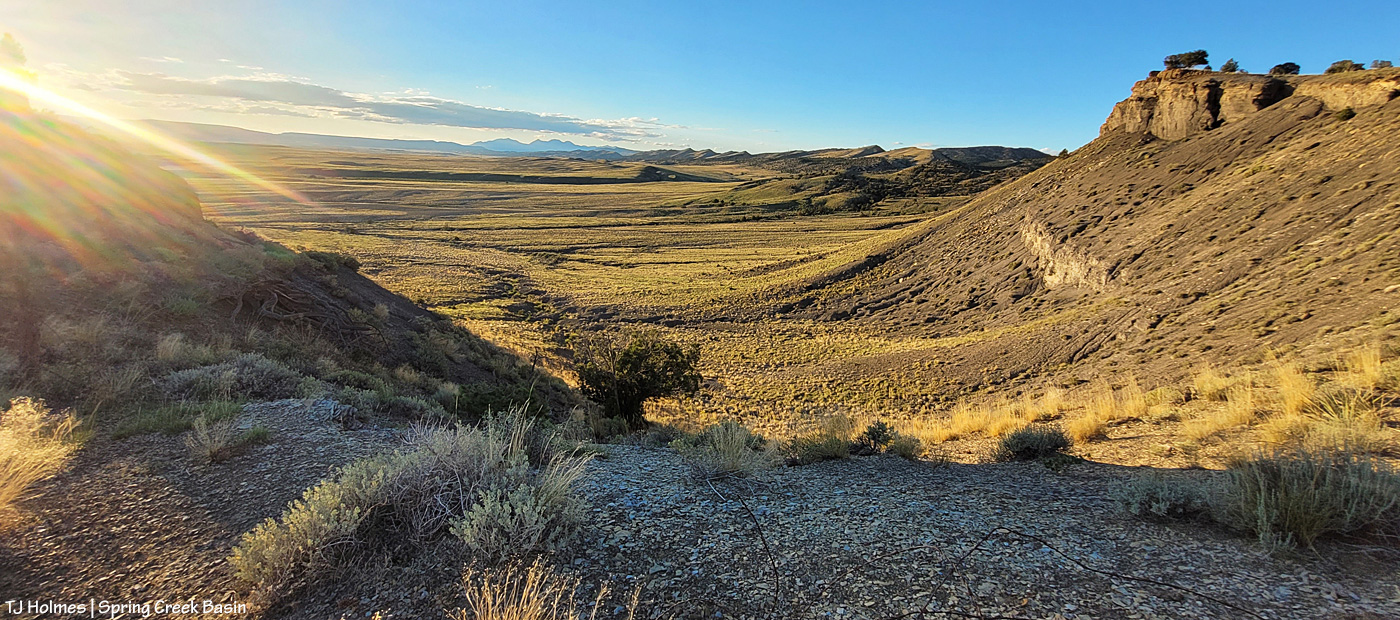
And I’ll leave you all with the glorious panorama that is Spring Creek Basin, from the northwest looking east/southeast/south:
Spring Creek Basin from high atop the northwestern hills/western boundary/rimrocks of Spring Creek Basin Herd Management Area. Visible: Valentine Mesa, Temple Butte, McKenna Peak, submarine ridge, Brumley Point, Round Top, Flat Top, Filly Peak and, in the center, Spring Creek. (Click on the pic to bring it up in a separate window and enjoy it the better.)
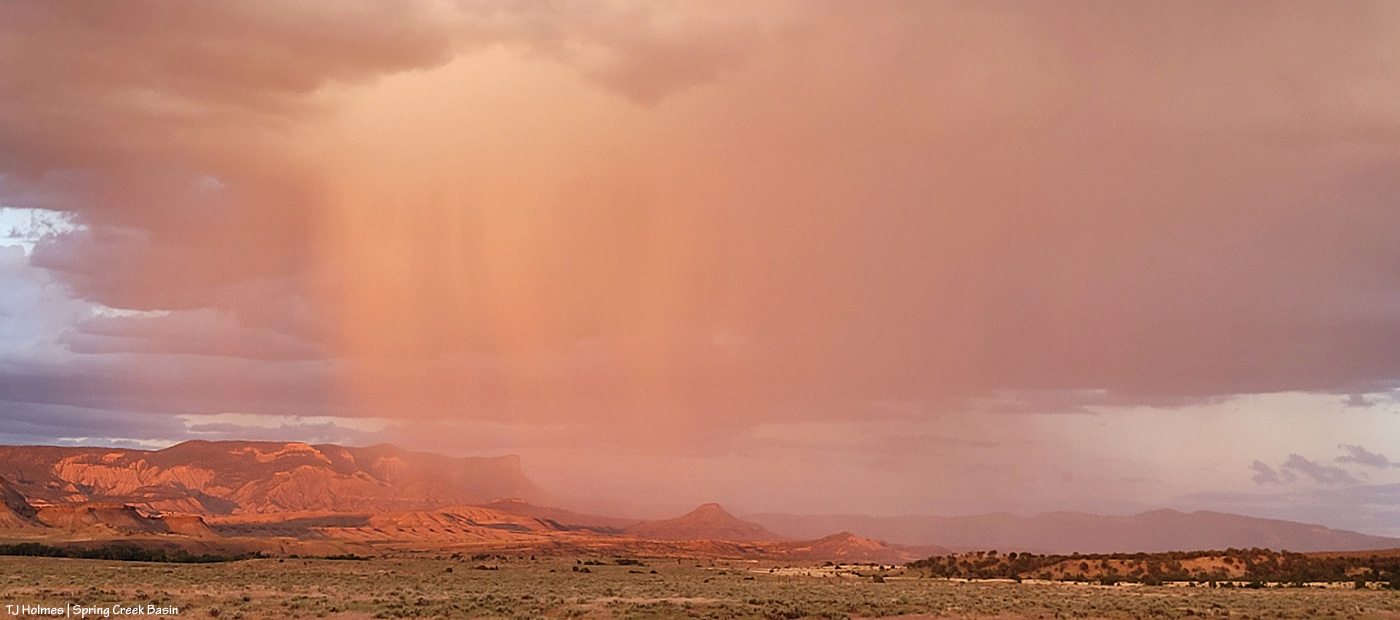
The almost-supermoon (technically rising today, Aug. 1) would have risen slightly out of frame to the left; you can see how there was no way it was going to be visible through that heavy rain-cloud layer.
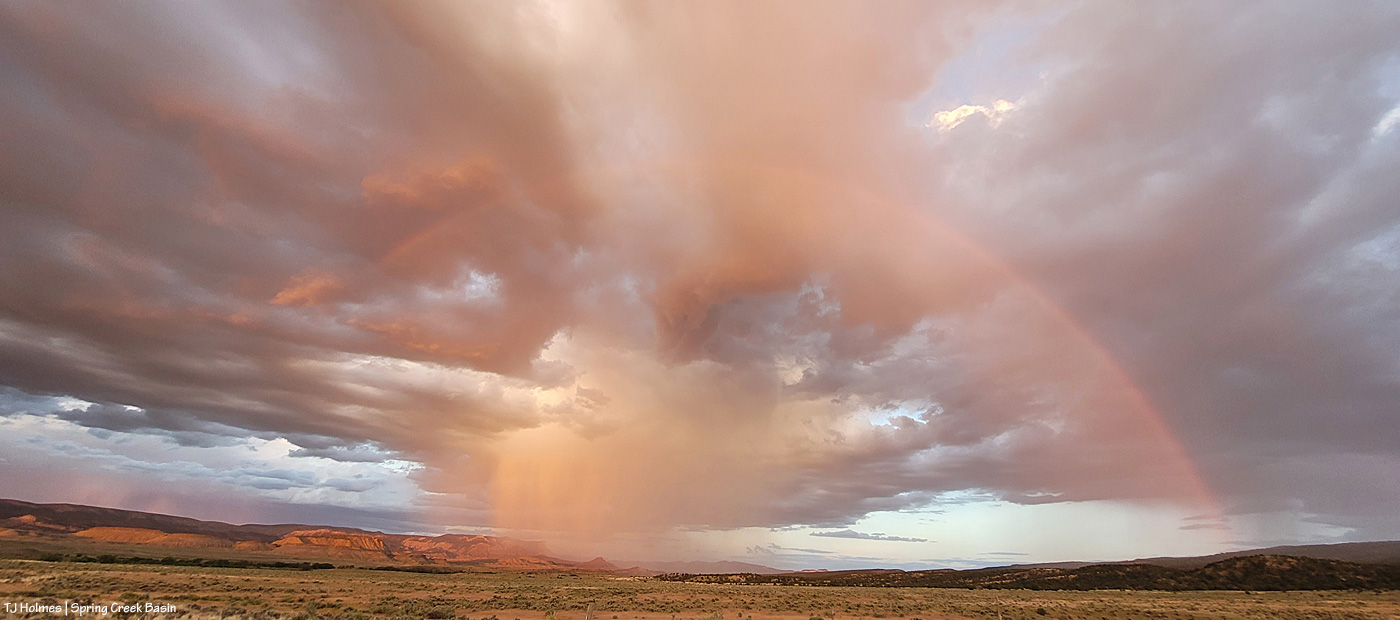
There never was a fully-arched rainbow, and the intensity varied depending on sunshine/clouds from the west (the above is looking southeast), but it wasn’t till late in the show when the faint second arc appeared.
The lesson is clear: Mustangs are always the gold. 🙂
The upper atmosphere is trying to gear up to potentially, eventually, maybe – at some point – give us some rain. Soon (we hope).
The evening was punctuated with a few small, very faint rainbows, catching some elusive liquid suspended in the air. The above – do you see it? – was not only the biggest I saw, it was the first of the evening.
Long-maned Sundance, napping, which is to say, perhaps, waiting impatiently for the sun to set, relieving us all with a bit of … if not coolness, at least a cessation of boiling heat. The background was so gorgeously beautiful, but I had to use my phone (as opposed to my camera with its long lens) for the wide view.
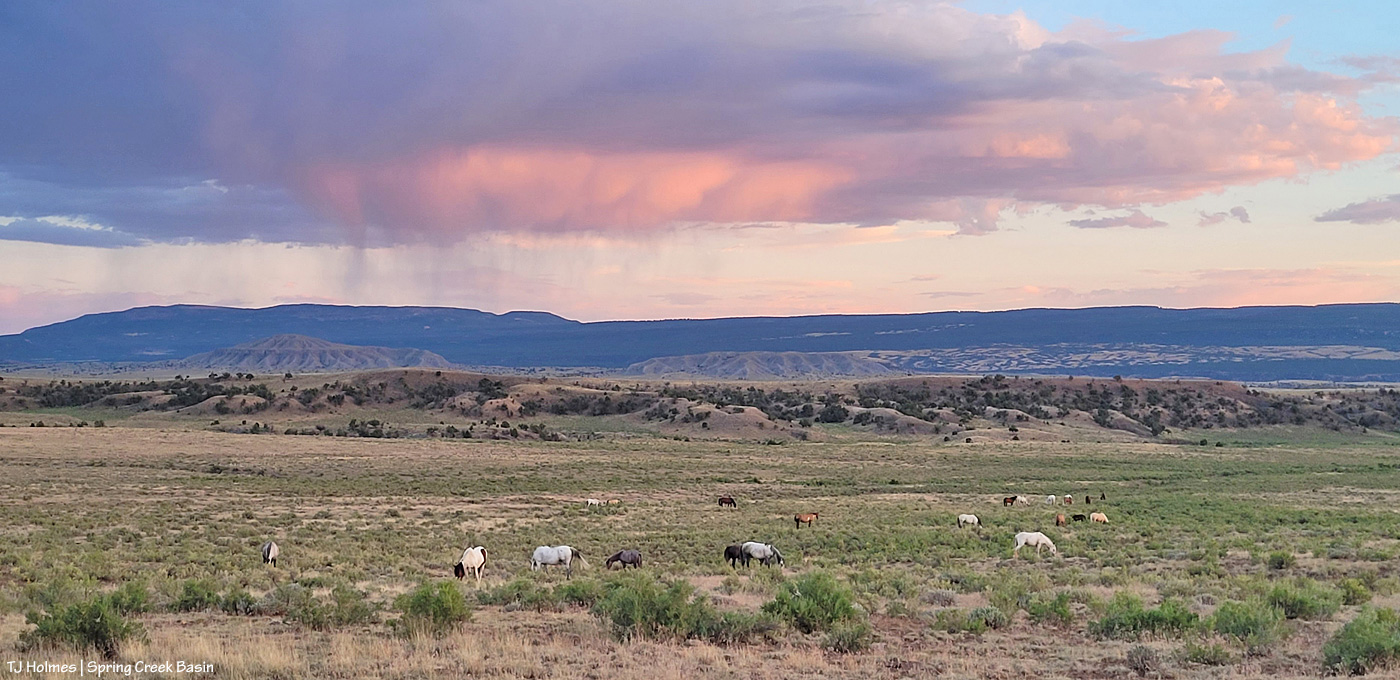
Post-sunset in Spring Creek Basin’s wildcat valley, bands were peacefully grazing while rain fell (or seemed to fall) over the Glade to the south.
And as I left them to their evening repast, I found this guy:
Hollywood alone, within sight of the horses in the image above.
Just another low-key evening in Spring Creek Basin. 🙂 The moon is about half-full. Who’s ready for the full, super sturgeon moon?!
For the last very long – days and days and days and weeks and days and weeks – we’ve had solid blue skies. Every. Single. Day.
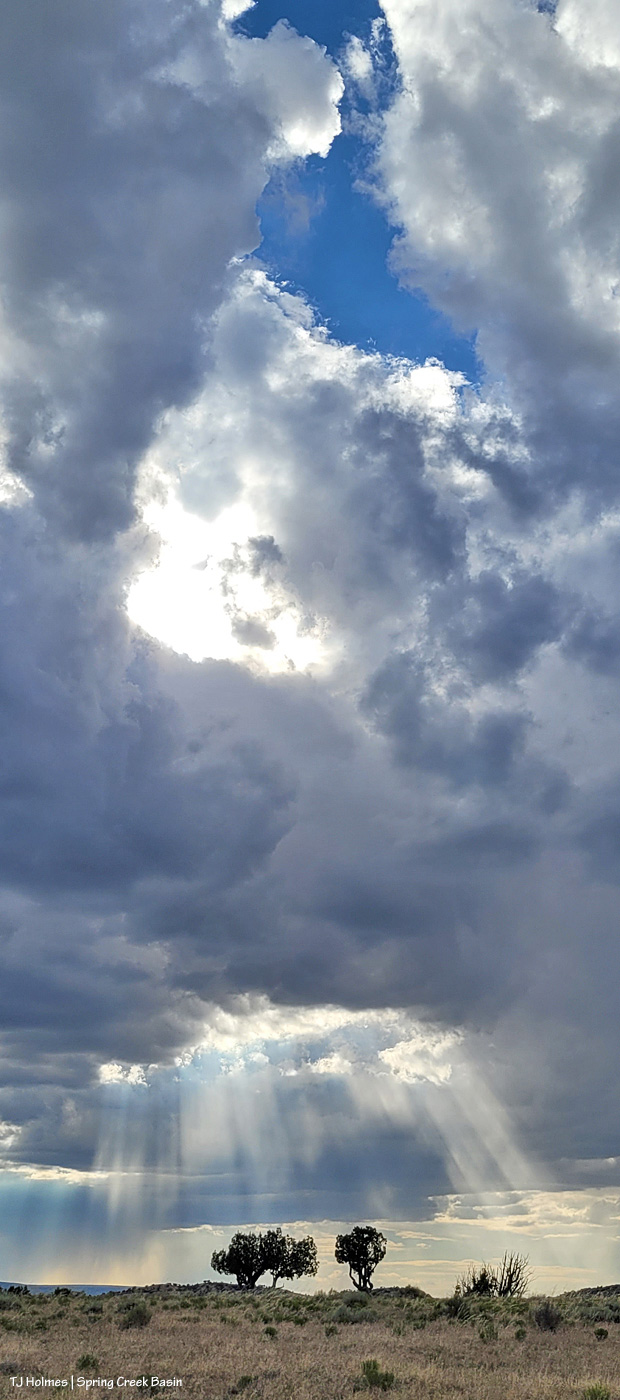
We finally got some clouds. And when Disappointment Valley does clouds, boy, does it do spectacular clouds.
In order of appearance from around 5:30 or close to 6 p.m. to after sunset:
Looking west.
Mustangs grazing and napping under the relief of clouds.
Silver linings.
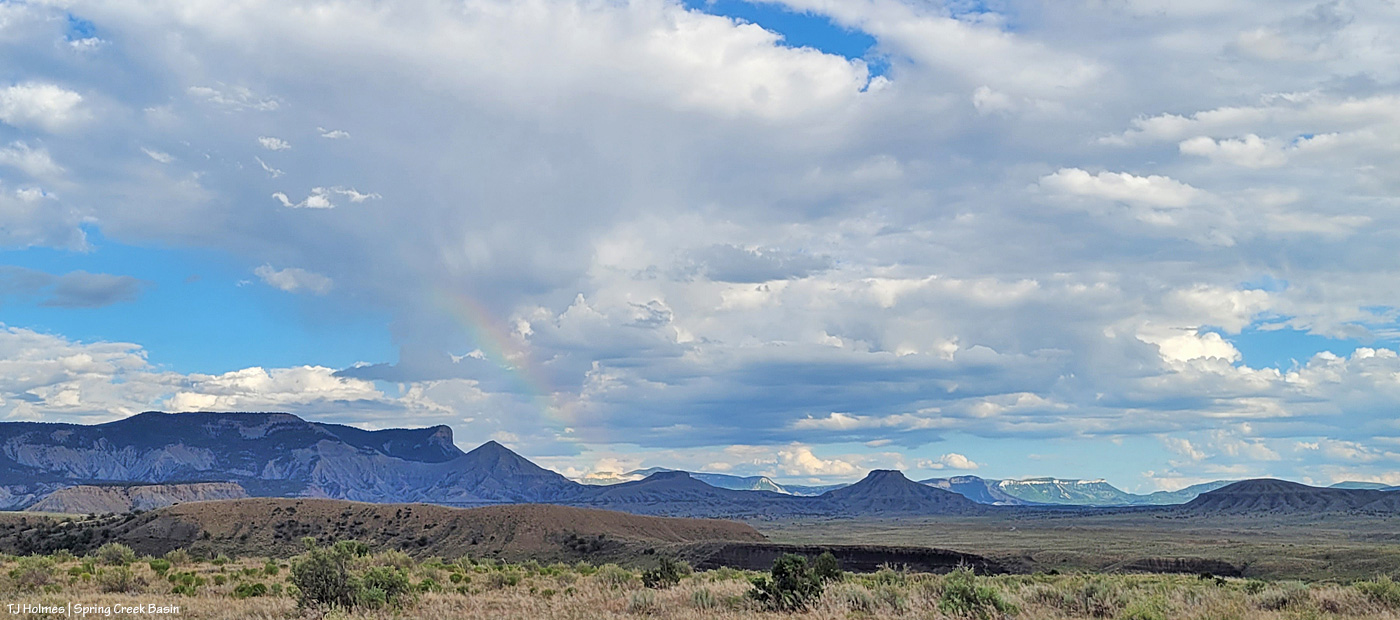
Do you see the rainbow?
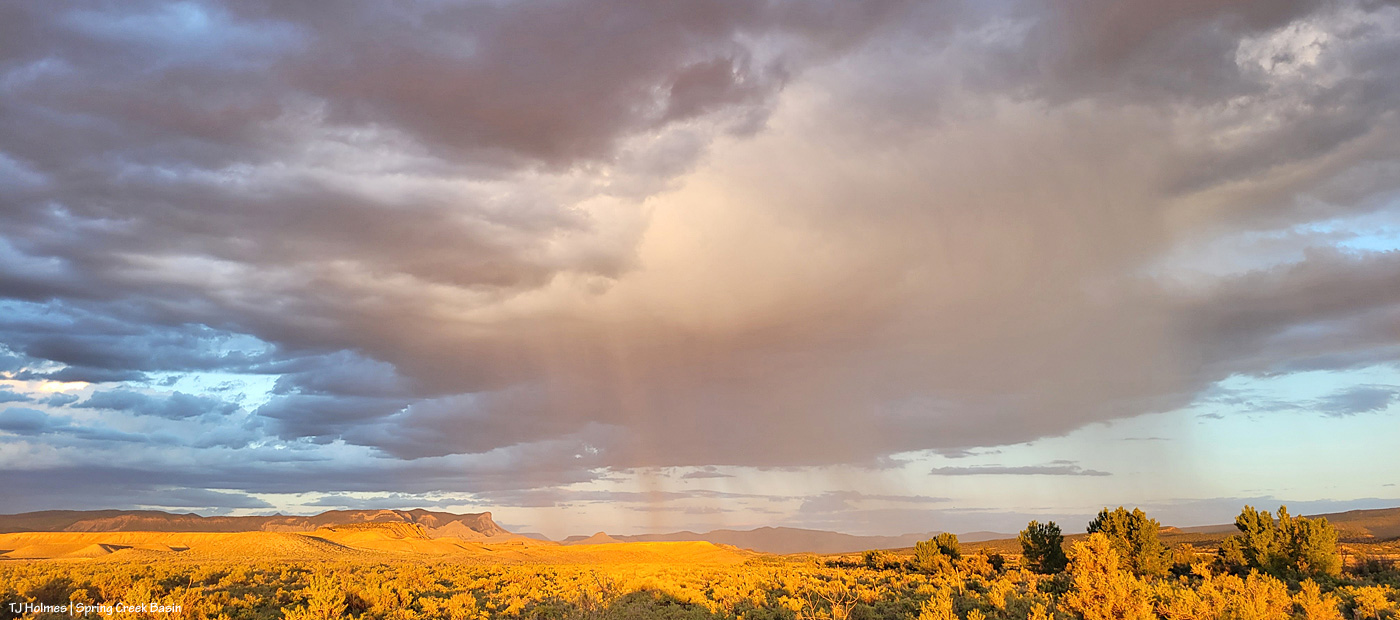
Rain – or at least virga – to the west.
More mustangs. More napping.
When I left the bands pictured above, I thought I might have a chance at any late surprise light with the bands pictured higher above. But they had moved quite a bit, and the clouds were heavy, and sunset was imminent. But as I left Spring Creek Basin, rain was drifting eastish along the southern ridges of Disappointment Valley. Then I dropped below the rimrocks (the basin’s western boundary), and holy rainbow! You’ll have to take my word for it that it was SUPER intense, and the photo above doesn’t do it justice.
By the time I got to the main road, that “surprise” light was glowing, and the rain had moved away from the southern ridges.
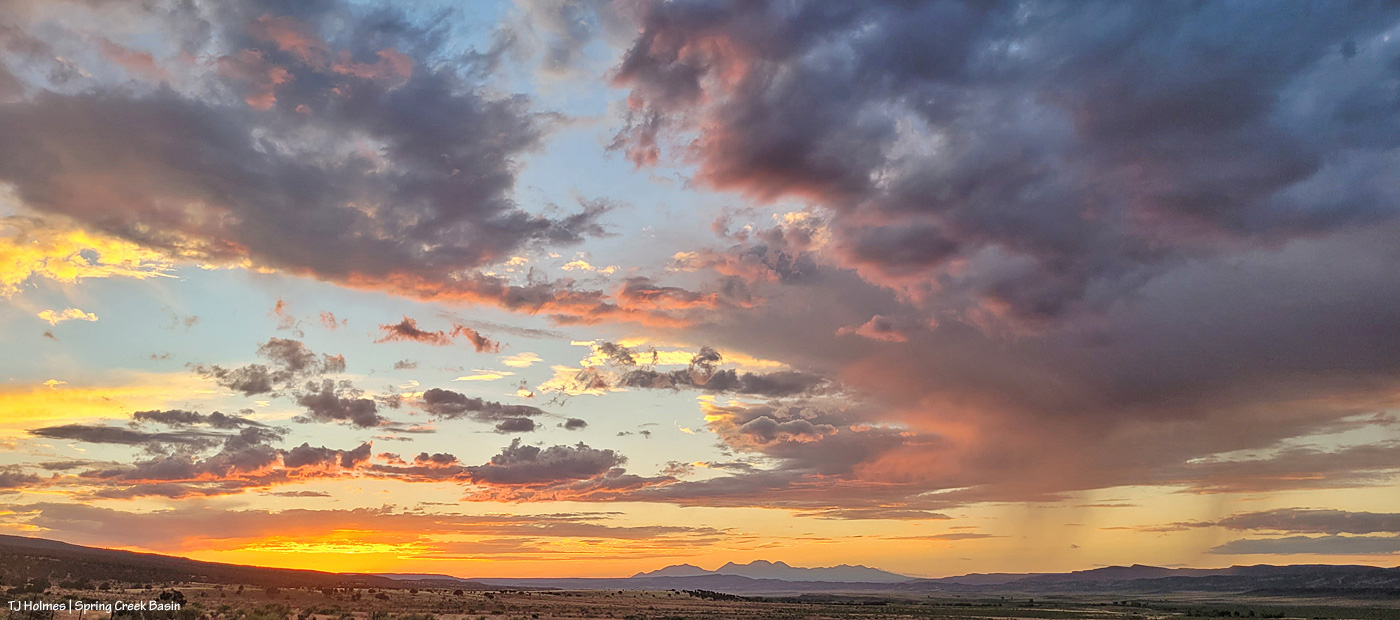
Meanwhile, to the west … this!
Bit closer view of the mountains.
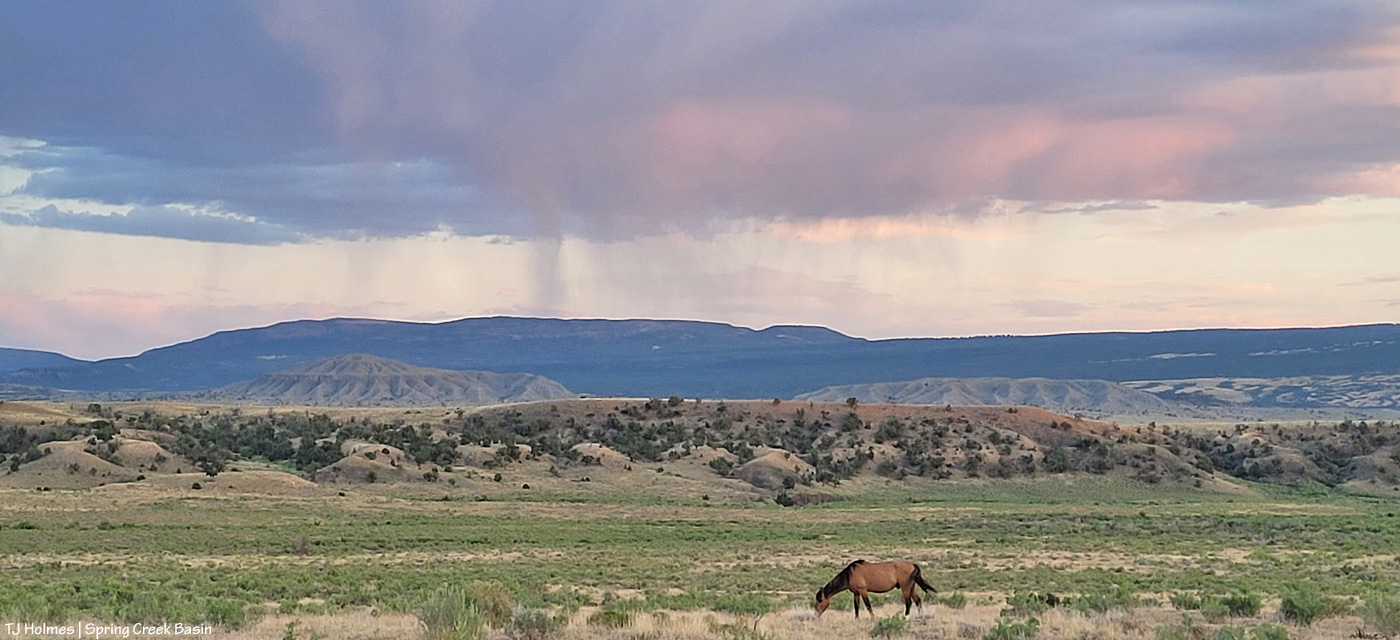
Back to the southeastish, rain was actually falling over the southern/southeastern part of Spring Creek Basin.
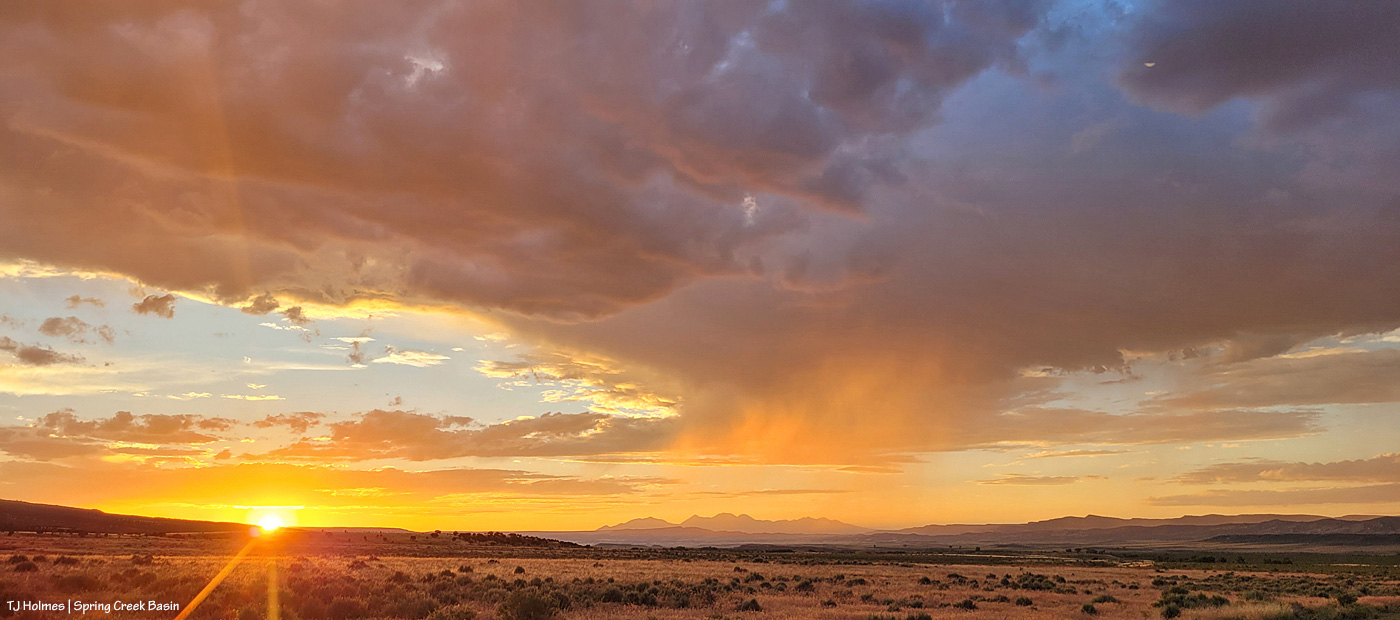
And THIS happened. I’m not sure I’ve ever been so glad and grateful to have a cell phone that doubles as a very wide-angle camera.
We ended the day with some post-sunset magic.
And 0.01 inch of rain. 🙂 Enough to make part of the road … actually … WET!
























 Spring Creek Basin Mustangs