Recap of 2025

31 12 2025

To remember how I did this post last year, I had to go all the way back to Valentine’s Day to find the post recapping the previous year (2024, then) in images. This year (for 2025), I’m happy to announce that for once, though I procrastinated, it wasn’t THAT long, and it was in plenty of time (OK, one day to spare) to make the Dec. 31 deadline.

Deep breath: This was a hard year. Last winter was rough (read: bad dry), which meant the rest of the year was rough (read: really bad horrible awful dry) in terms of drought. Monsoons didn’t hit their stride over Southwest Colorado, so we didn’t get much rain, either. Federal employees were hard hit, too, and one of our young BLM’ers was illegally fired from the new job he loved.

But we also had some good-news happenings: Thankfully, he was reinstated, and we have a strong range team in Ryan, Anton and Laura. We got some new signs installed, including the replacement of the old, sun-bleached, weather-beaten interpretive sign for the new information “kiosk” that greets visitors upon entering Spring Creek Basin. Fertility control (native PZP) continues to be an extraordinary benefit to our herd in terms of management and keeping roundups and removals at bay.

In wider Colorado mustang news, the BLM short-term holding facility at the Cañon City prison complex closed in November, BLM and Colorado Department of Corrections being unable to reach a contract agreement. That’s not-great news in terms of uncertainty for rounded up and removed Colorado mustangs. Where will they go? In semi-balanced decent news (?), all of the Colorado mustangs that were in holding there (about 100 at the time) were adopted or went to private sanctuary or are currently in foster situations for a planned adoption in March (and that all happened despite federal employees, including BLM’ers, being out of work (or working without pay) because of the government shutdown).

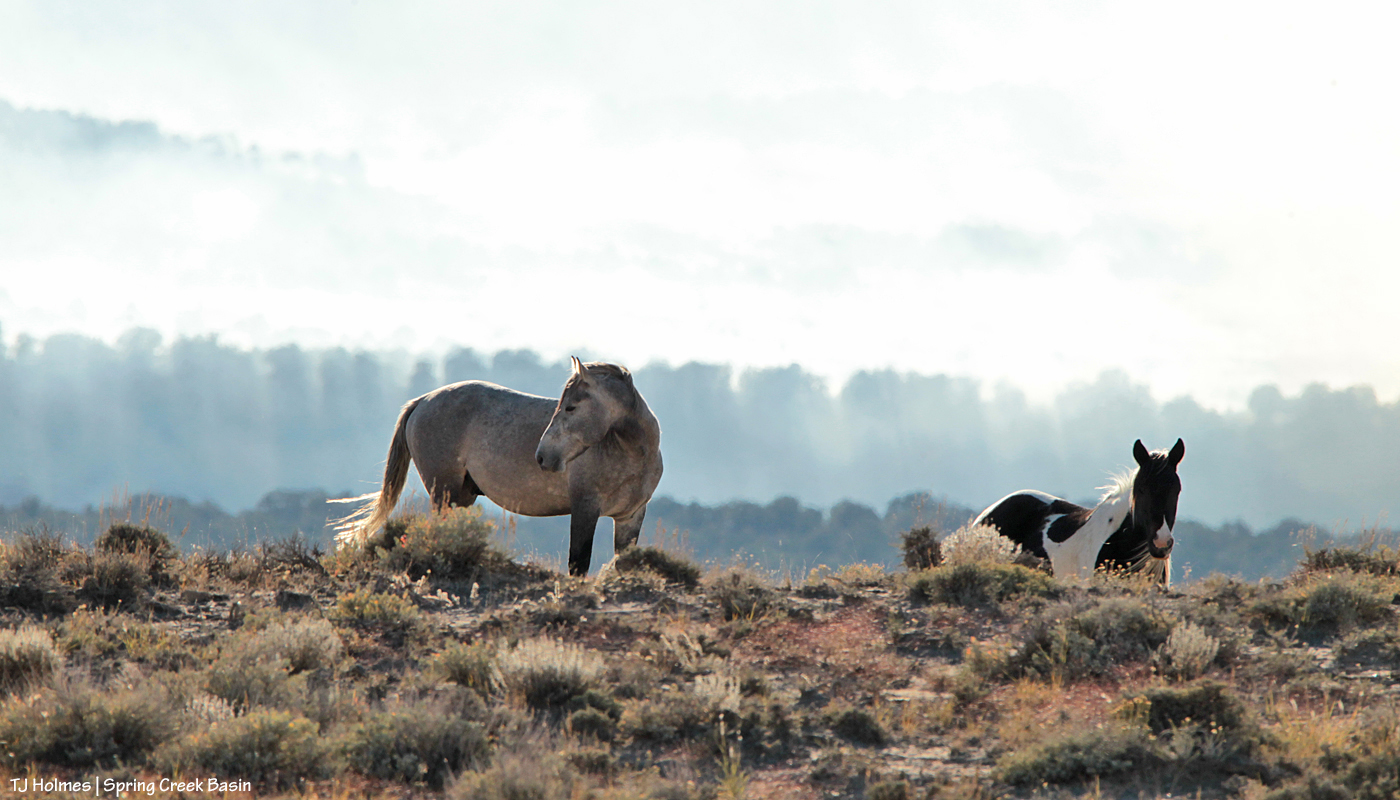
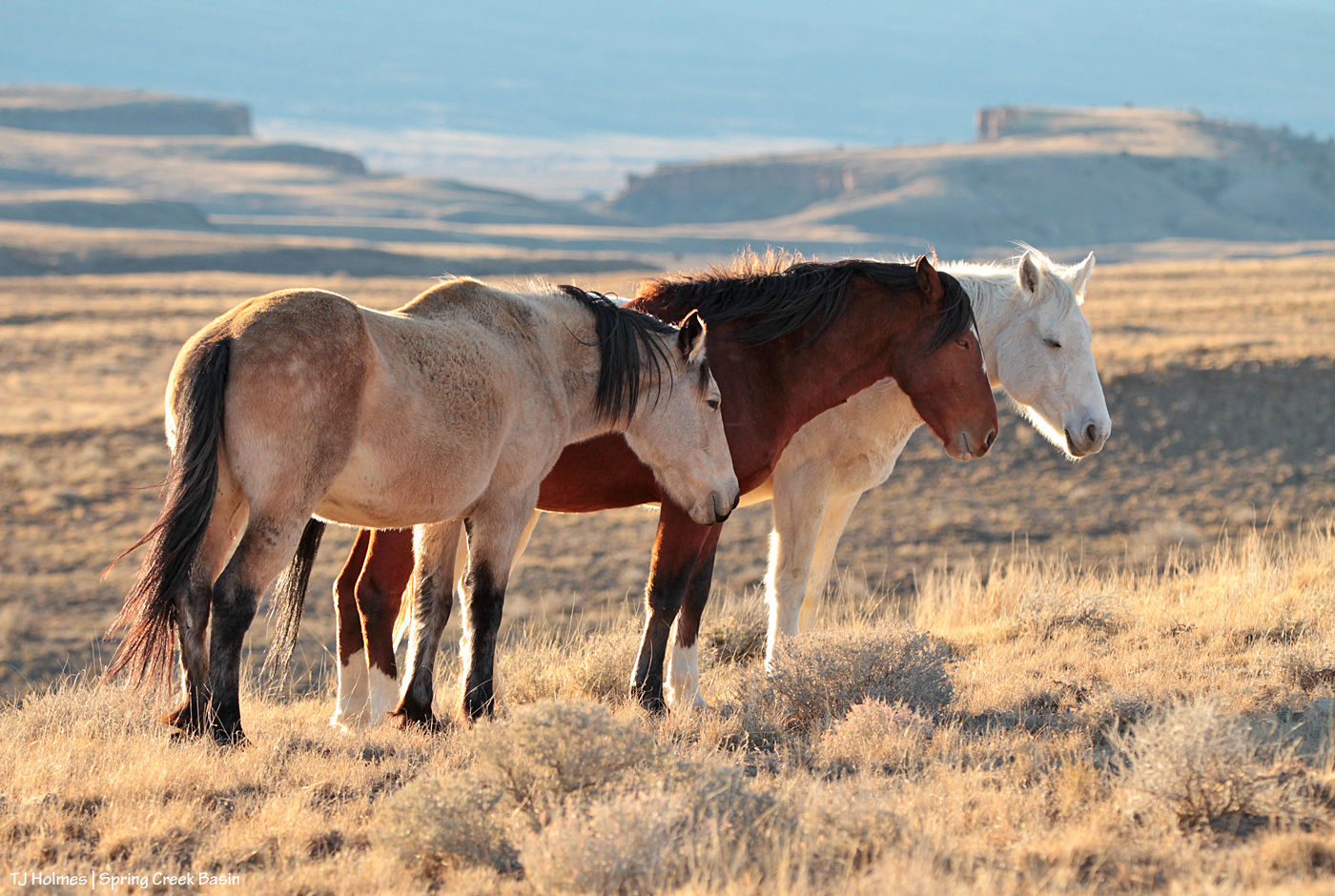
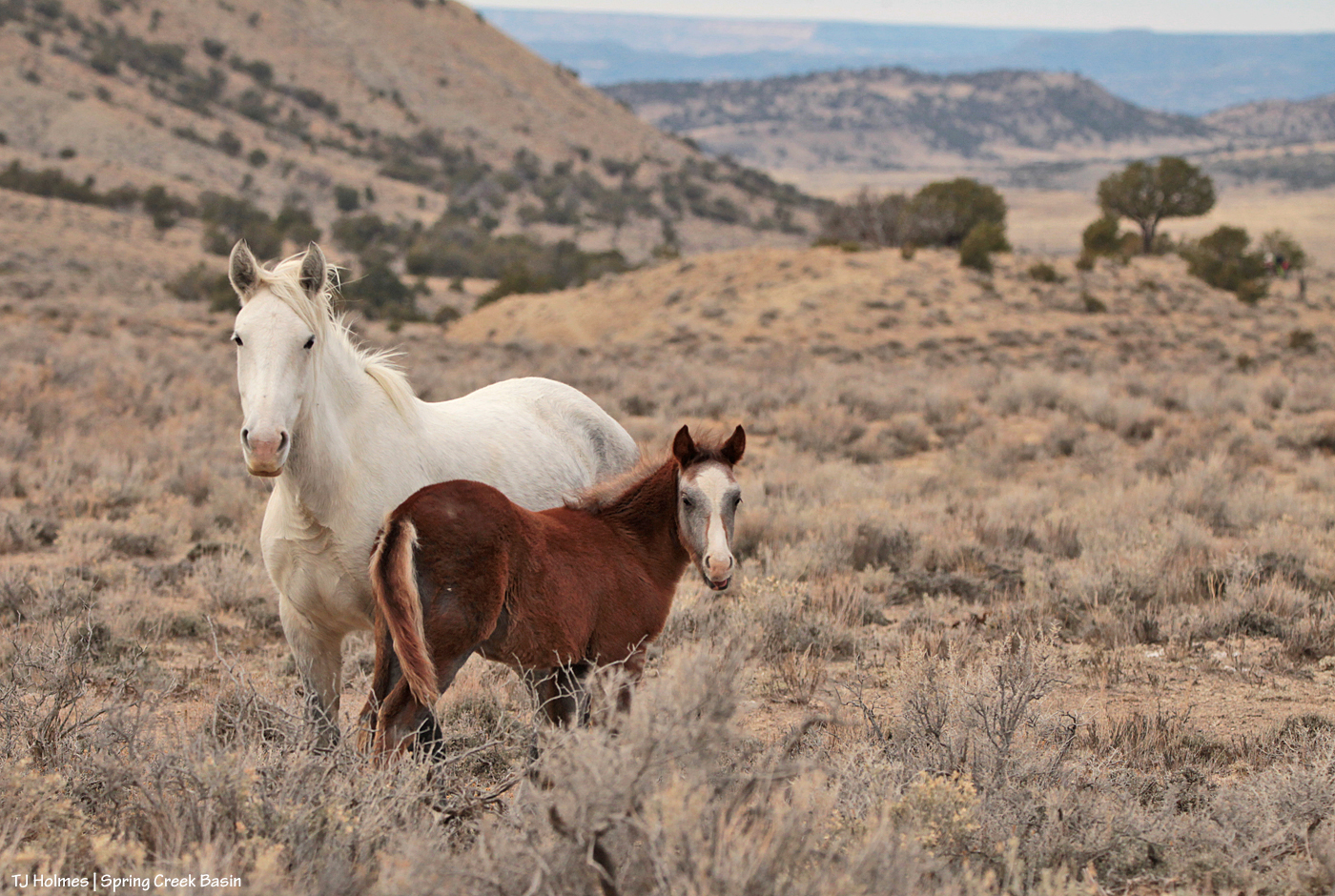
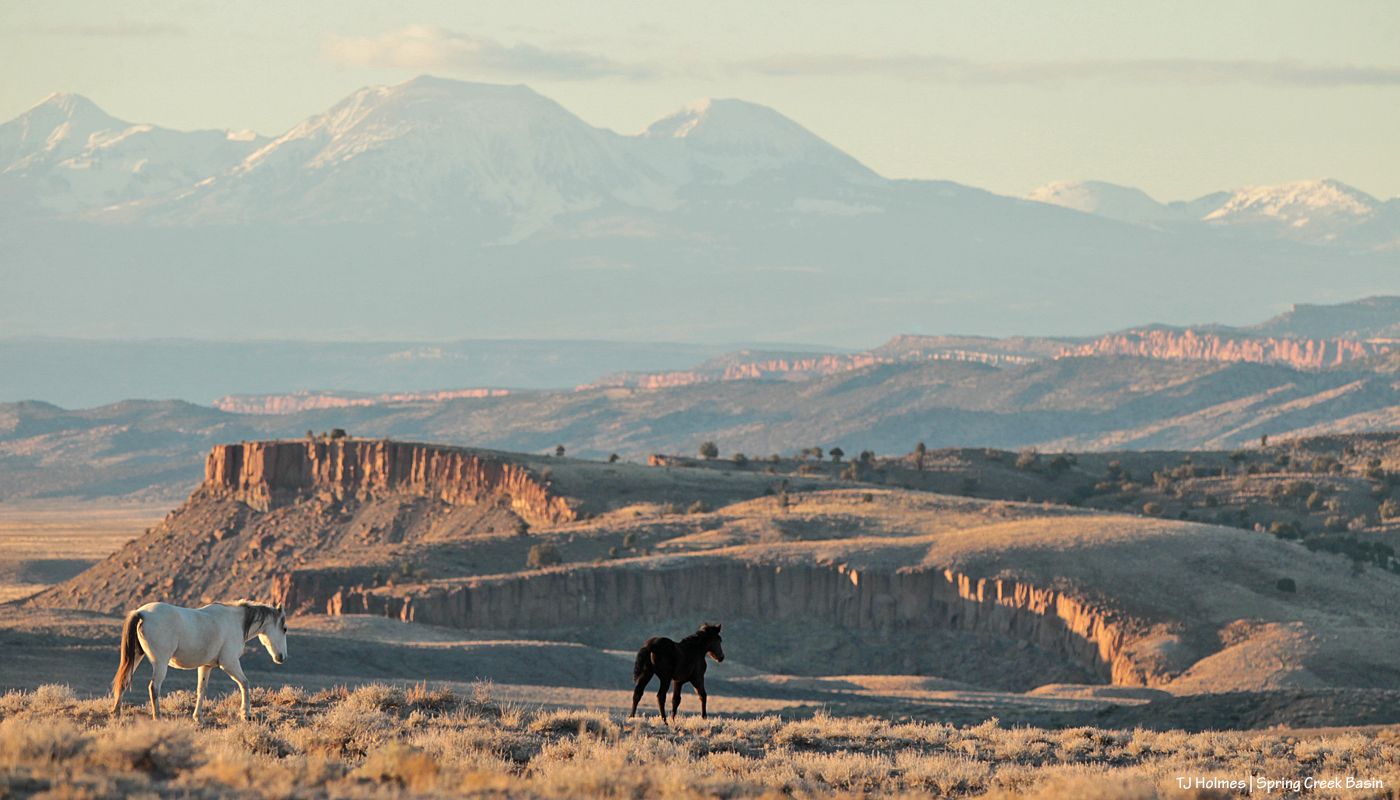
What follows is a pic from each month of the past year and a bit of reminiscence of what was happening when I captured the image of a mustang or mustangs. Many of these pix have been featured previously on the blog; some haven’t. If you make it to the end, there’s a bonus pic … one of my favorite of the past year.
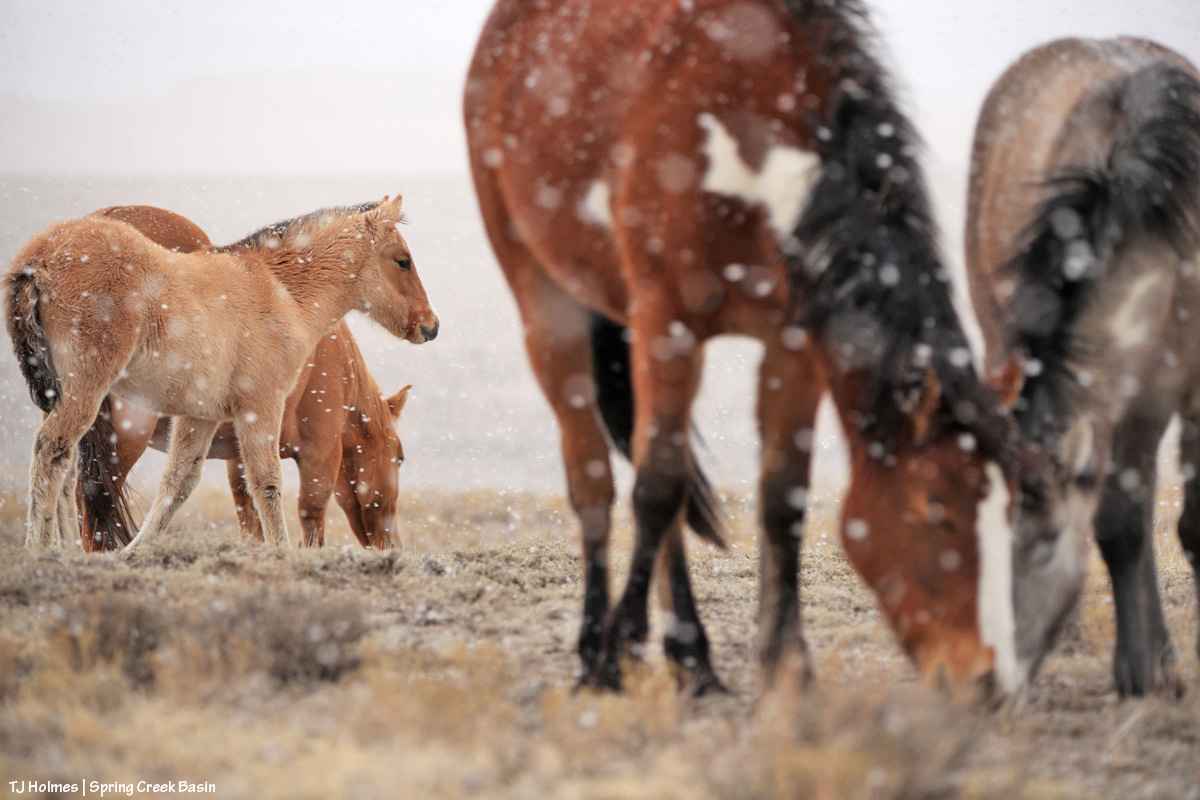
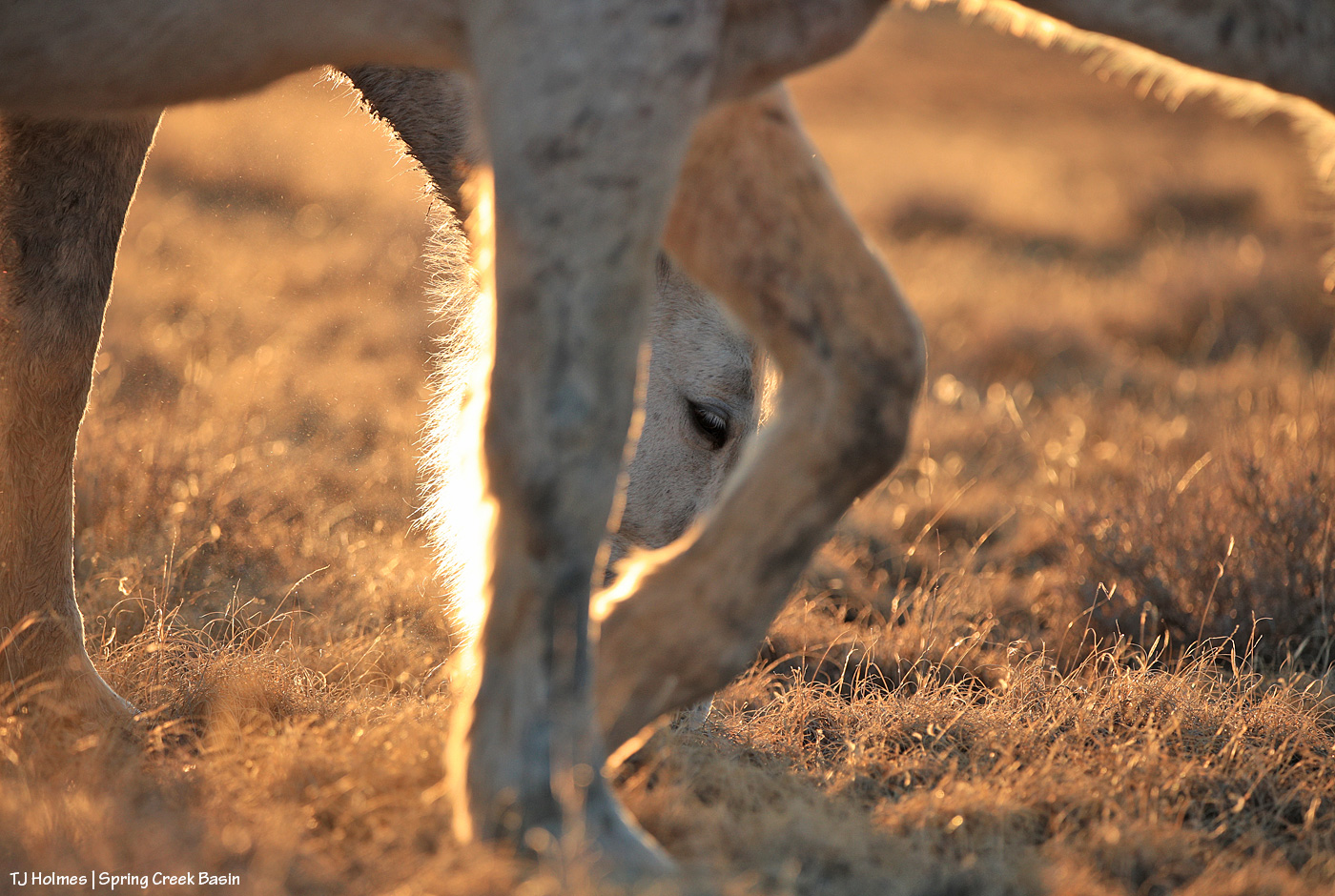
This is one of my very most favorite pix of the entire year. I love it so much, it’s the background image on my computer. I’m aware that I likely post a lot of images of Buckeye’s family; you won’t be surprised to know that they’re among my most favorite mustangs. I considered this image as the *bonus* image … but it was one wildly beautiful day of snow (well, I was out with the horses, watching the snow coming for at least two hours before it finally reached us), and it didn’t match the otherwise very dry *year*. … So it gets the January title.
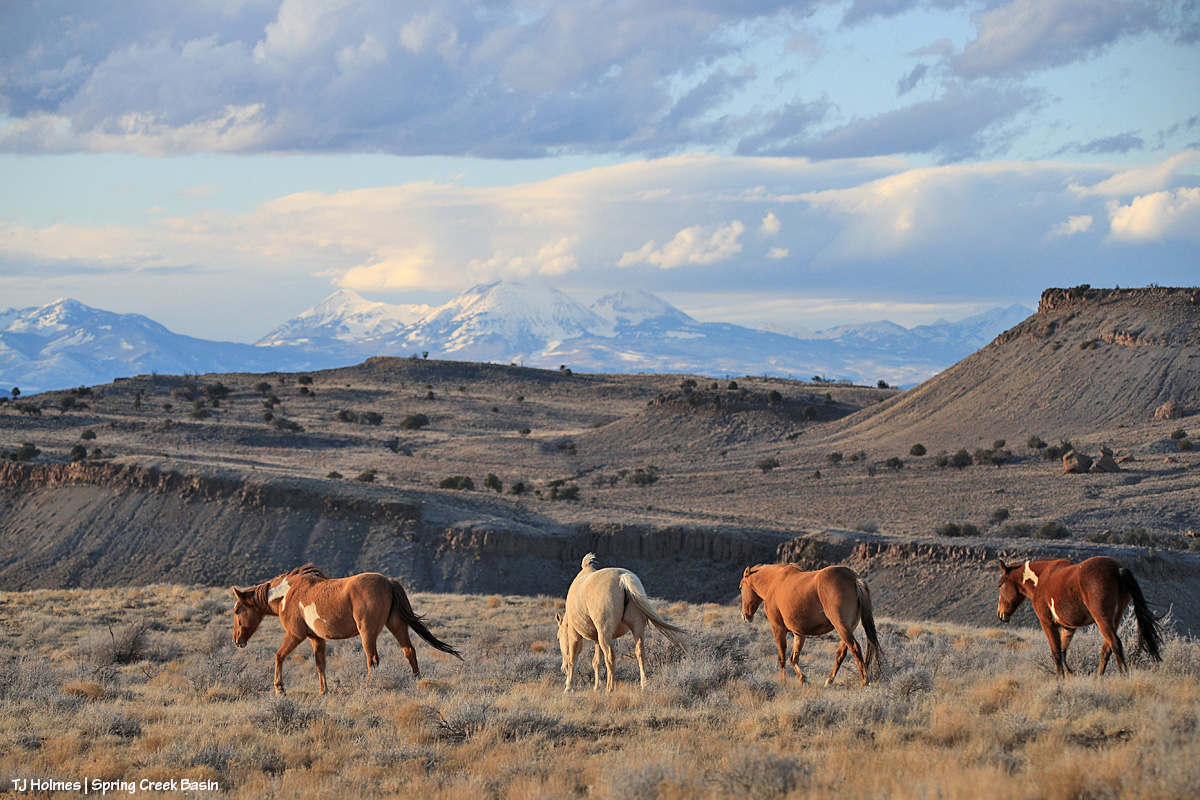
Did I say that I love Buckeye’s family? You can forgive me for singling them out, right? The three mares weren’t born here, but gosh, they are treasures from our sister herd in Sand Wash Basin, and I’m so grateful that we have them. And yes, that was February. Utah’s La Sal Mountains may not have been the *closest* snow, but we sure didn’t have much.

March is still fuzzy-coat weather with signs of approaching spring, especially in the high desert of Southwest Colorado. Fortunately, we had ponds early in the year. They’d all go dry before some rain this past fall put water back in a couple of them, including the one pictured above with Chipeta. This pond is nicely full currently – and has mustangs taking advantage of its water.
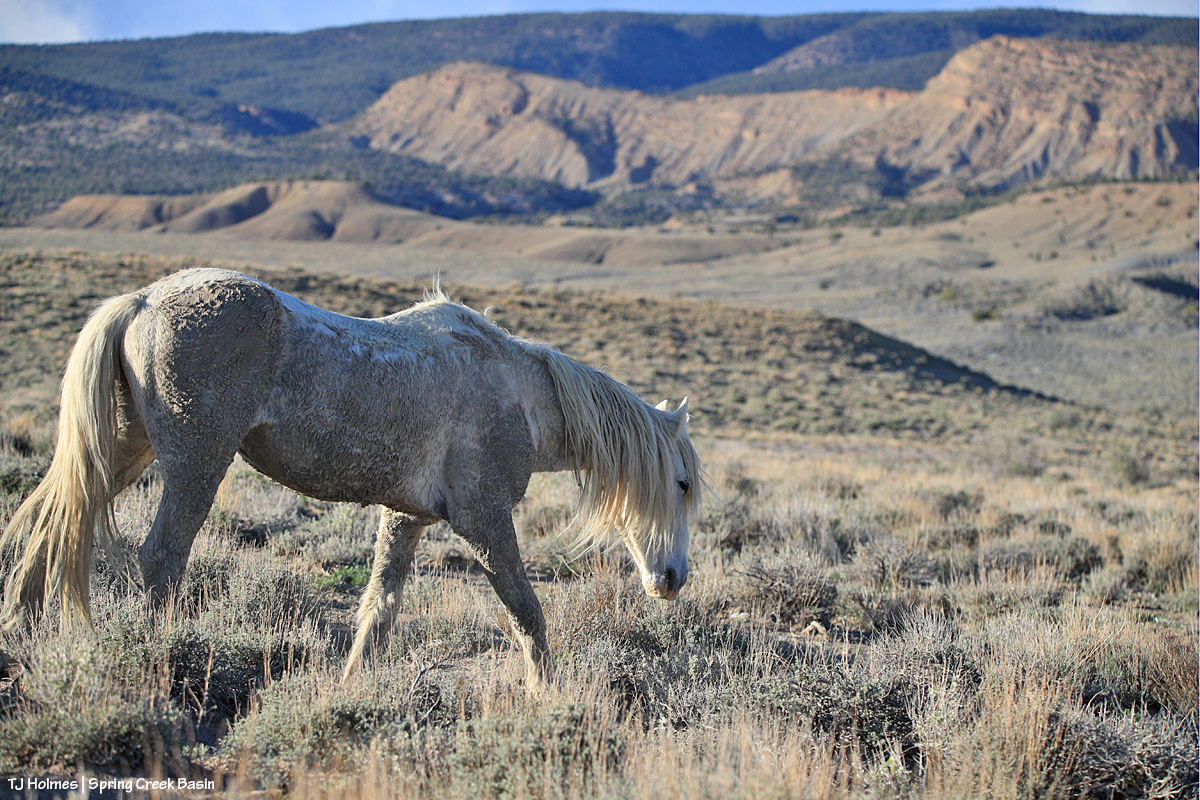
April found Sundance not far from the pond pictured above, and he still had his band at that time. Later in the year, he lost them, and he’s been by himself since then. He has wandered a bit, following vegetation and available water. The stately ol’ guy is still around … I see him now and then, napping in the sunshine or grazing on the side of a ridge.
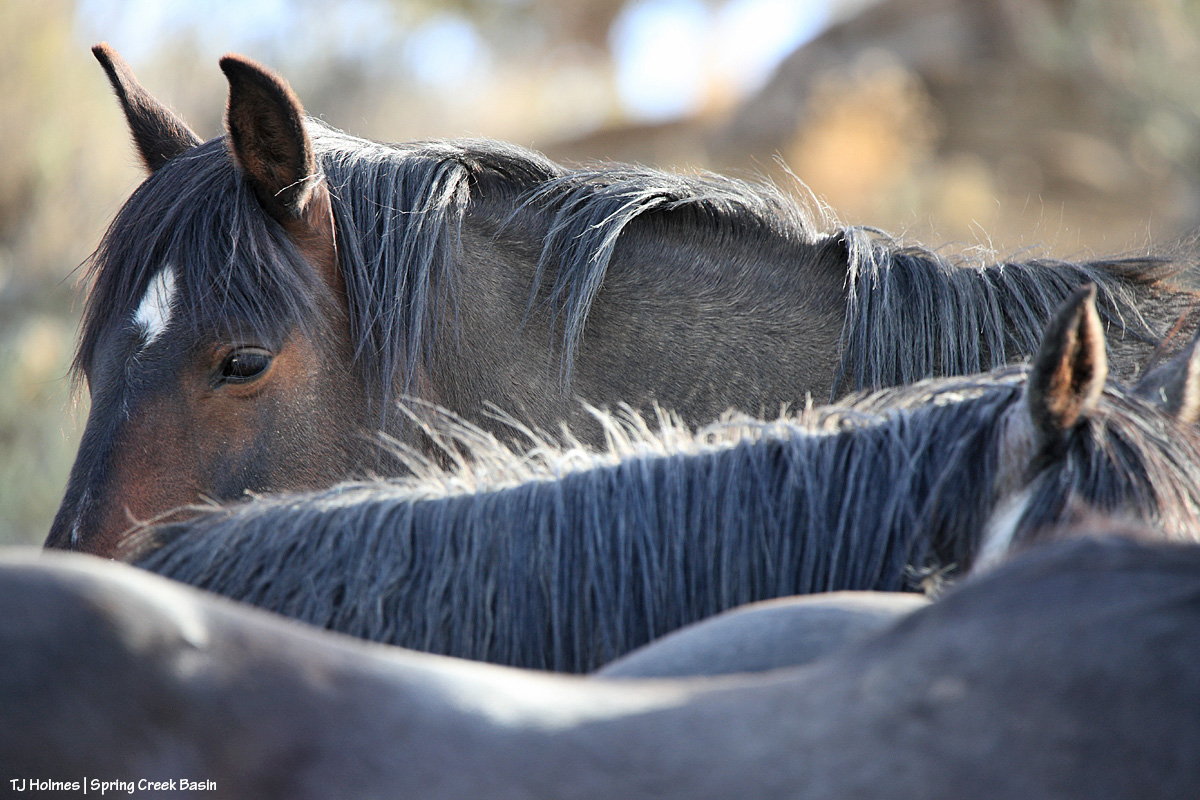
This wasn’t especially the best pic I took in May, but I love both the perspective and the sort of inside joke that Cassidy Rain always likes to be the farthest away from the two-legged. That day was a pretty warm one, and the band was in an area of basin where I rarely find them. It’s not a place with a lot of trees (in fact, there are very few), but they had found a couple, and were comfortable together in the shade near sunset.

My best boy Storm made a brief appearance in the northern part of the basin in June … one of the first times I’d seen him since he’d lost his band the previous autumn. Bittersweet. I haven’t seen him since about July, when he was at a water source with another band as I was trying to shoot the rising moon.
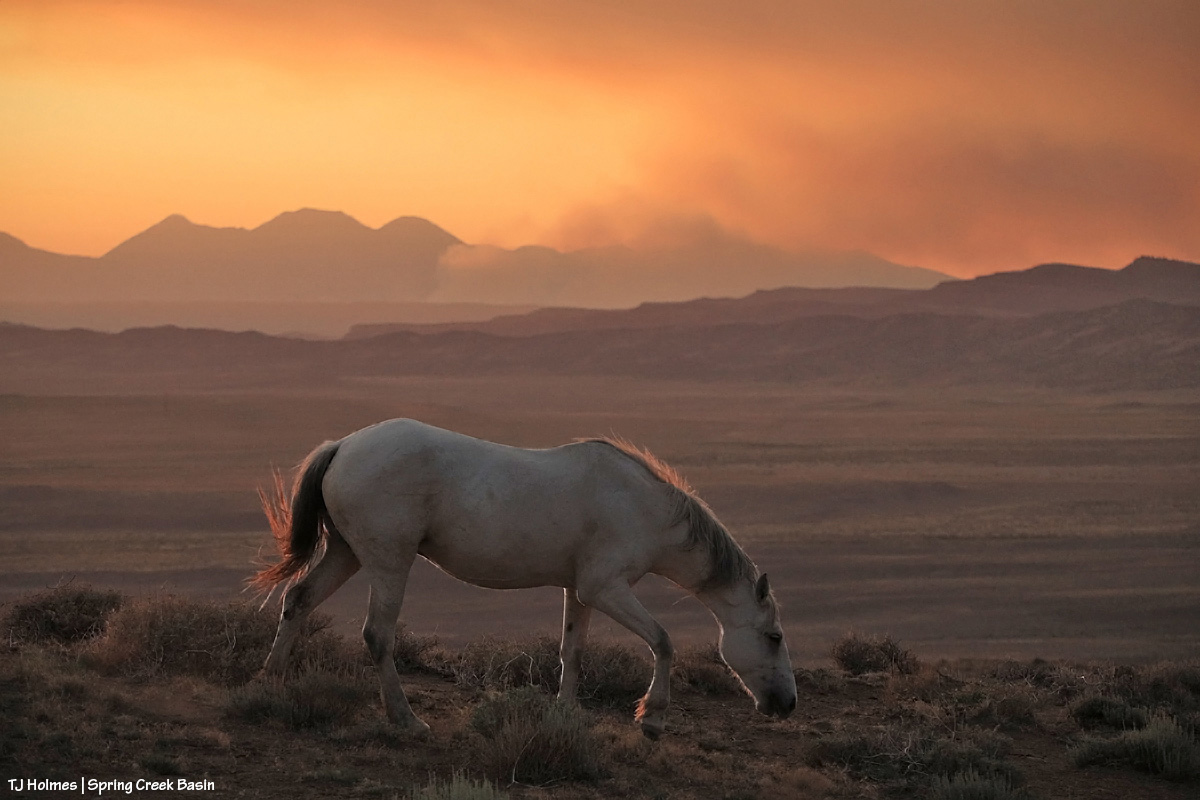
Ah, July, the month the Deer Creek Fire at the base of Utah’s La Sal Mountains sparked. It wasn’t the biggest wildfire of the season, and it wasn’t even the biggest with smoke visible from Spring Creek Basin and Disappointment Valley, but it was uncomfortably close to home. It was a reminder (as if we need any more) that it’s hotter and dryer out there, and we all need to be super aware and careful.
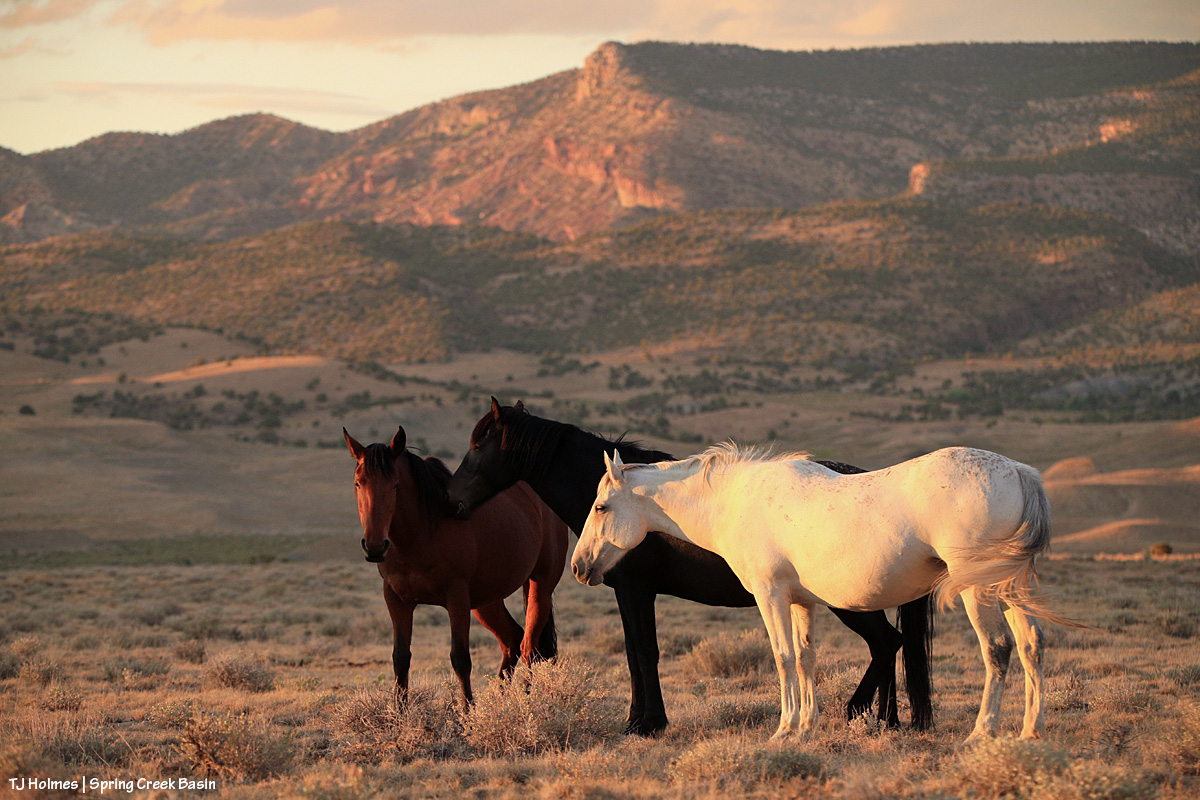
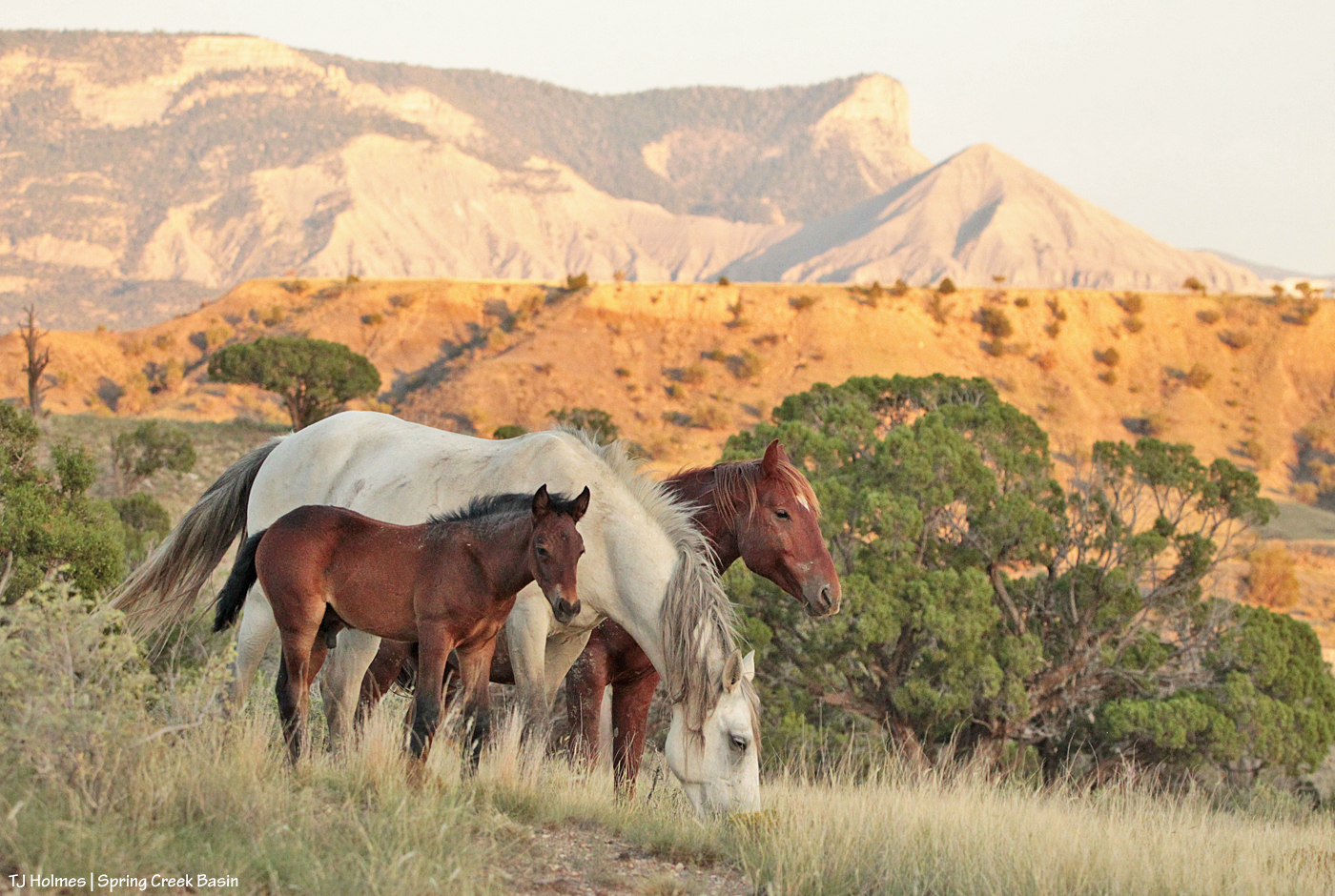
Fortunately, the mustangs live in the moment (while the humans obsess over the wildfire updates), and they still enjoyed peaceful days such as this: Three mares content with their world and each other.
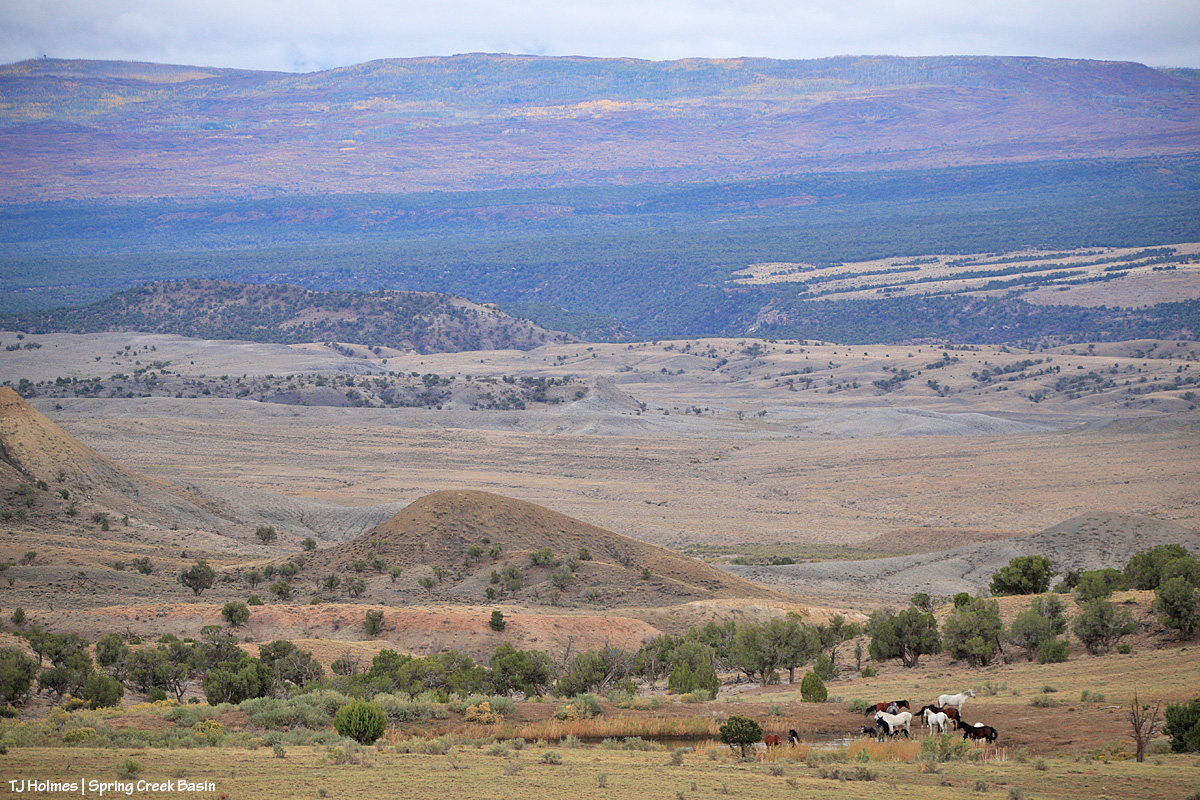
Finally, as summer gave way to fall, Mother Nature cried her best tears and filled some ponds for the mustangs. THAT brought huge relief to us all (if I may speak for my four-legged friends as well as myself). Interestingly, visible at upper left in this image is Benchmark Lookout, a U.S. Forest Service wildfire-watch tower staffed during the critical seasons of the year (which includes September). In this backcountry, we are massively grateful for those who watch for and provide critical information about wildfires, as well as those who work to contain them, allowing them to provide some benefit in some cases while trying to keep property and lives intact.
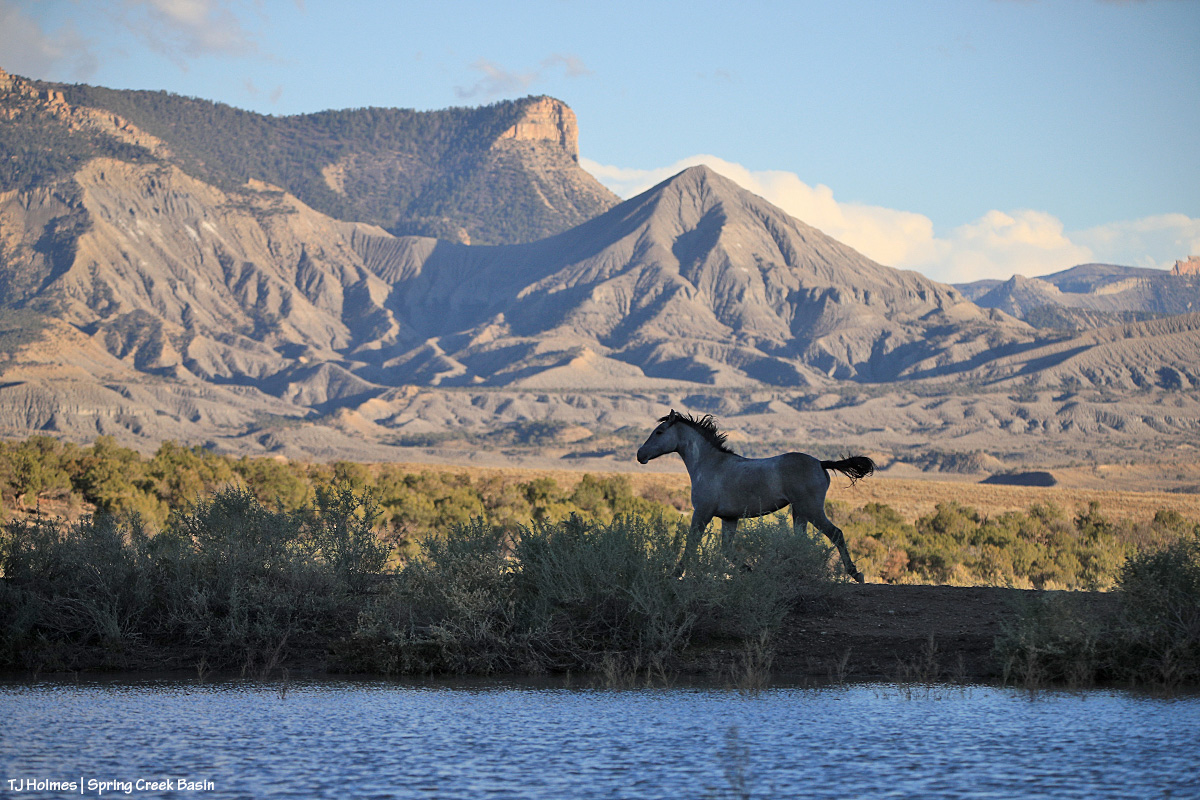
It might be about now in the list that you’re thinking, “for talking about dry it was, she sure included a lot of pix of ponds.” It’s not because we had so much water; it’s because we’re massively grateful for the water we had.
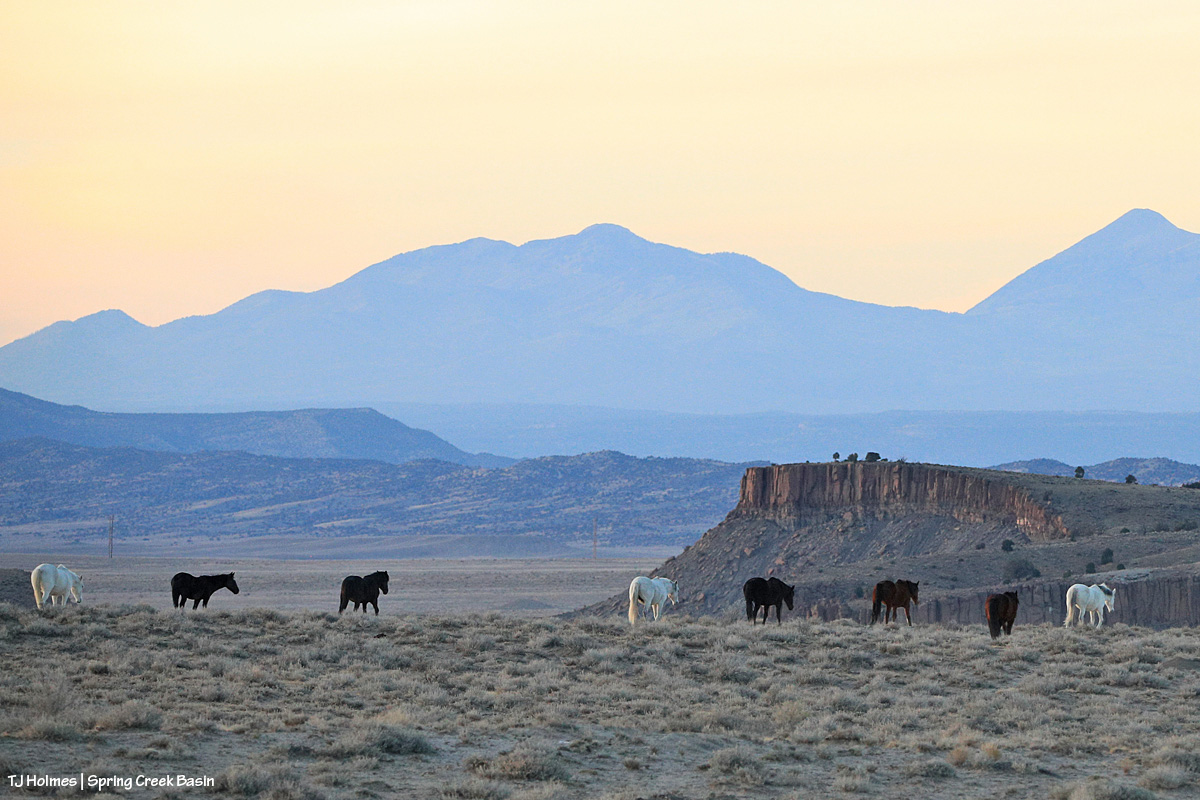
There’s no water in this image – and it was November, before snow graced the peaks on our northwestern horizon – but the ponies are lined out on their way out to graze after drinking at a little place I call the marsh. This is post-sunset, but wow was it gorgeous under the autumn light. … And it’s not UNgorgeous at blue hour.
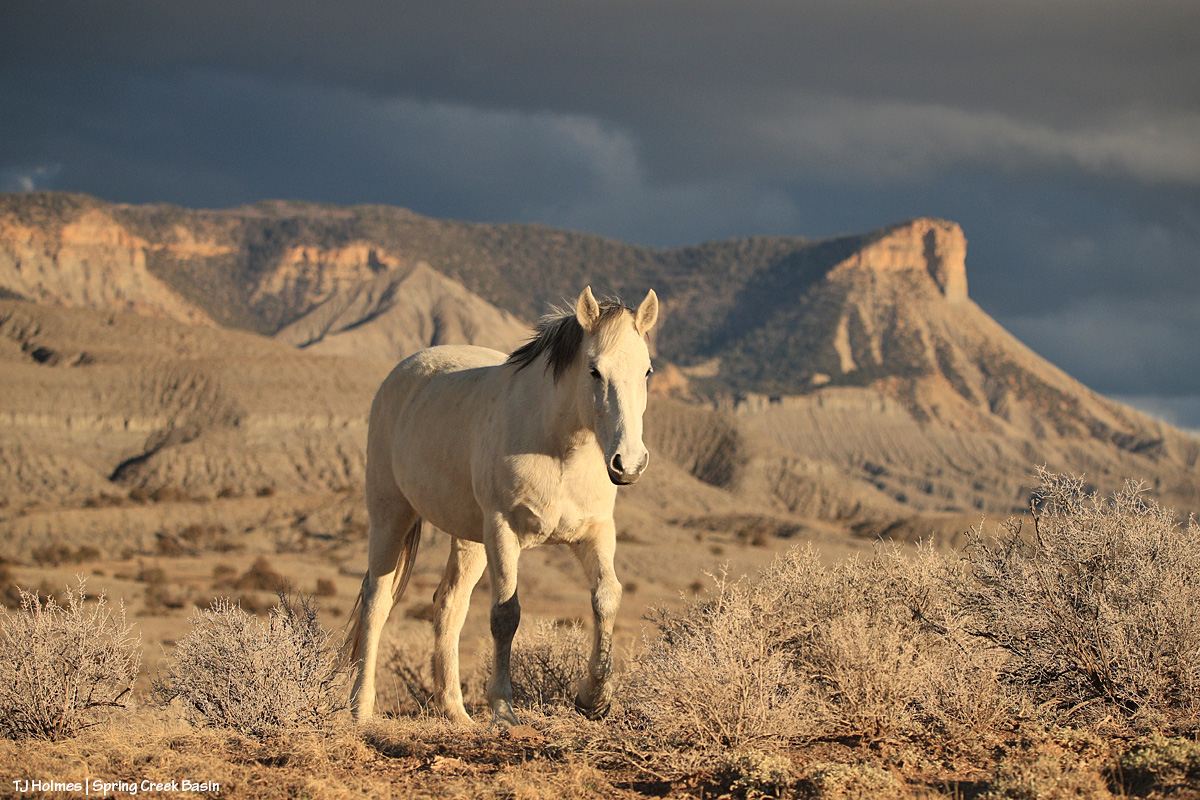
You’ve just seen this image of Temple with Temple (yes, the same) Butte and McKenna Peak in the background under a stream of stormy-looking (they didn’t produce a drop over us) clouds. I decided not to choose a pic from the bit of snow we got at the very beginning of December because the above is what we saw the whole rest of the month. The weather has been warm and dry … and that’s awfully nice for getting around and playing outdoors (60s! in Colorado!! in December!!?!) … but if things don’t change in the next few months, I’m going to be singing the same ol’ why-won’t-it-snow song that seems to be stuck on repeat.

And your bonus:
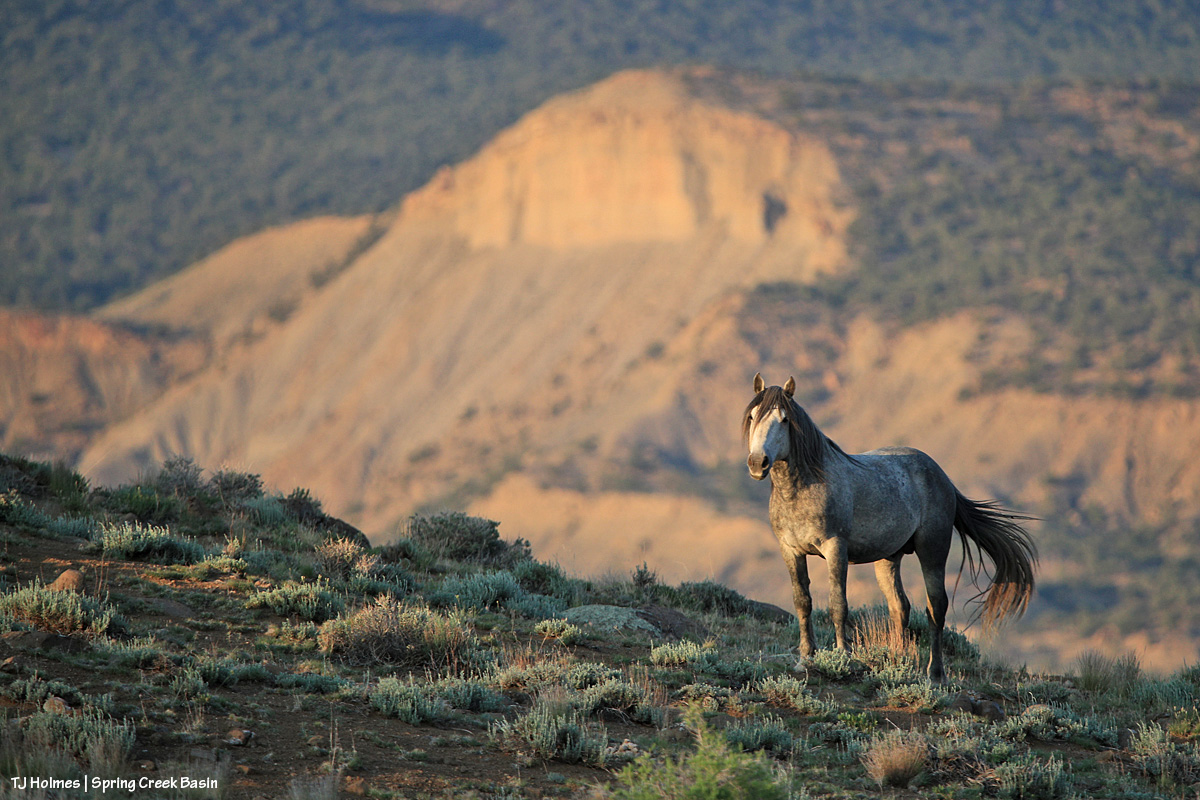
This was an evening in June. Nobody wanted to pose much, and I was going bananas, trying to get somebody – anybody – in front of that background in that subtle, delicious light. Finally, this young stallion obliged. And it seems to sum things up a bit: Hot this year? Yes. Dry? Gosh, yeah. Anxiety-inducing? Pretty much like always … with an extra edge. But! Beautiful, peaceful, a place of escape from the world’s ills (at least the headline type). Kind of a promise that it’s there … out there … and sometimes we don’t have to search all that far for it.

And there you (kinda) have it: 2025 in the rearview. It’s always hard to select just one pic for each month (plus a bonus!), but I hope you enjoyed this little recap.

In best-of-all news, I spent a lot of time (again) with my beloved mustangs in the best place on Earth (in my ever-so-humble opinion). 🙂

And close to that is my gratitude for all of you readers who follow the mustangs and our pictorial journal of peaceful, wild, beautiful life here in Spring Creek Basin. Thank you so much, and I hope you all have a peaceful, wild, beautiful 2026 (with lots more moisture!!!!!!!!!!!!!)!

Be kind to each other! 🙂


Sign history

5 04 2025

This is what the original interpretive sign looked like (I know you were wondering!), courtesy of Kathe Hayes, who retired a few years ago after working many years for San Juan Mountains Association as the volunteer coordinator. Long-time readers will remember Kathe’s name associated especially with the alternative spring break program, which brought in college students from the University of Missouri every year to work on various projects in Spring Creek Basin and other public lands (both BLM and U.S. Forest Service) around Southwest Colorado.

When Kathe read about the new kiosk installation, she sent me a text and some emails about the history of the FIRST sign installation at the west basin boundary:

“Excited to see that Laura [Heaton] was involved in the installation of the new sign in Spring Creek Basin. As you know as a child, she was involved in the installation of the first sign along with a group of college students from the University of Missouri and Ranger Rick from BLM. I remember Laura and I climbing up the side of the hill and rolling large rocks down so that we could surround the sign so cars would not drive over the sign. A lot of hard work and dedication went into the original sign, and I was sad to see that it had disintegrated. But I am grateful for the new sign and the information it portrays about the wonderful Spring Creek Basin. Thanks for your help in this, TJ.”

Also:

“I was really excited to read about the installation of the new sign. I believe the old one was installed around 2008. It prompted me to resurrect a photo of the original. Laura was involved in the installation of the original sign, as a young kid working alongside the University of Missouri students and Ranger Rick Ryan (BLM). Wow, such good memories for me.

“Attached is the original sign photo. It was a lot of work back then, getting that sign created and approved.”

Not much has changed in that respect. 😉 I asked Kathe if I could share the image of the original sign and her words about the history of it.

“I remember this about installing the original sign. Rick Ryan (Ranger Rick) had been mixing cement in a wheelbarrow and then pouring it into the hole to secure the base of the sign as we all watched curiously as to how this was all going to work. Laura said that that’s not how my dad would do it [Laura’s dad is well-known rancher Al Heaton; their family is well respected in the entire region of Southwest Colorado. She is, quite literally, a local!] and I just laughed. Laura‘s family was instrumental in the success of the Alternative Spring break program. I doubt I would have continued without their support. And Laura was my little shadow since she was about 6 years old. Her parents let me drag her all over the place. She loved being with the college students who loved playing games especially spoons.”

Wild and crazy how things come back around full circle, eh? 🙂

Thanks so much for the history, Kathe! We miss the alternative spring break program (I think it lasted almost 20 years with Kathe’s guidance?), but we sure loved each year’s crop of students and all the work they did for us in Spring Creek Basin! And we now have Laura as one of our BLM range team members, carrying on that good work!


Here’s yer sign!

3 04 2025

[Nate West, Brian Yaquinto, Jon Whitehead, Laura Heaton, Anton Rambur, Ryan Schroeder, TJ Holmes]

I cannot begin to tell you all how much I *LOVE* this new information/map sign kiosk JUST installed at the western entrance/boundary of Spring Creek Basin.

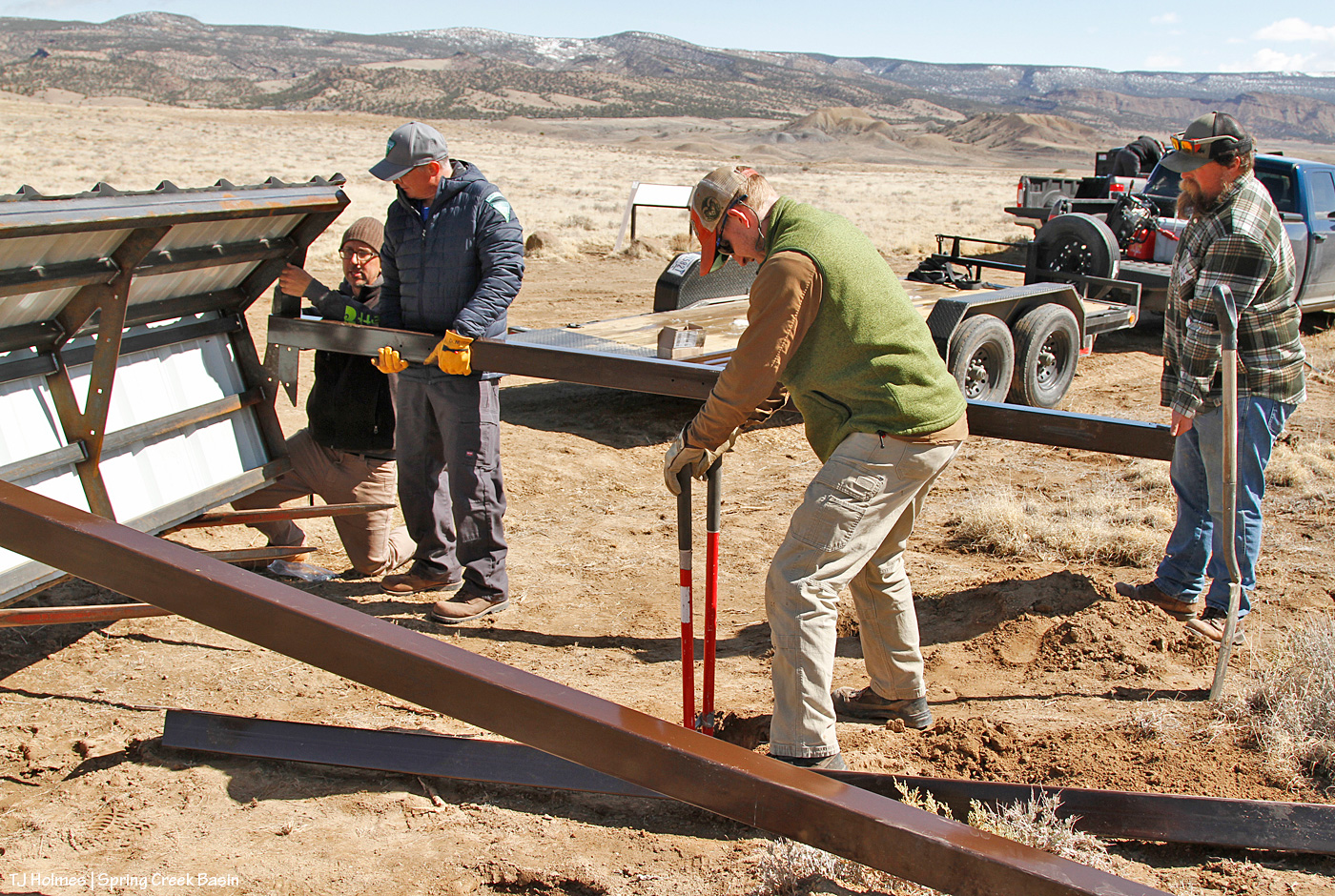
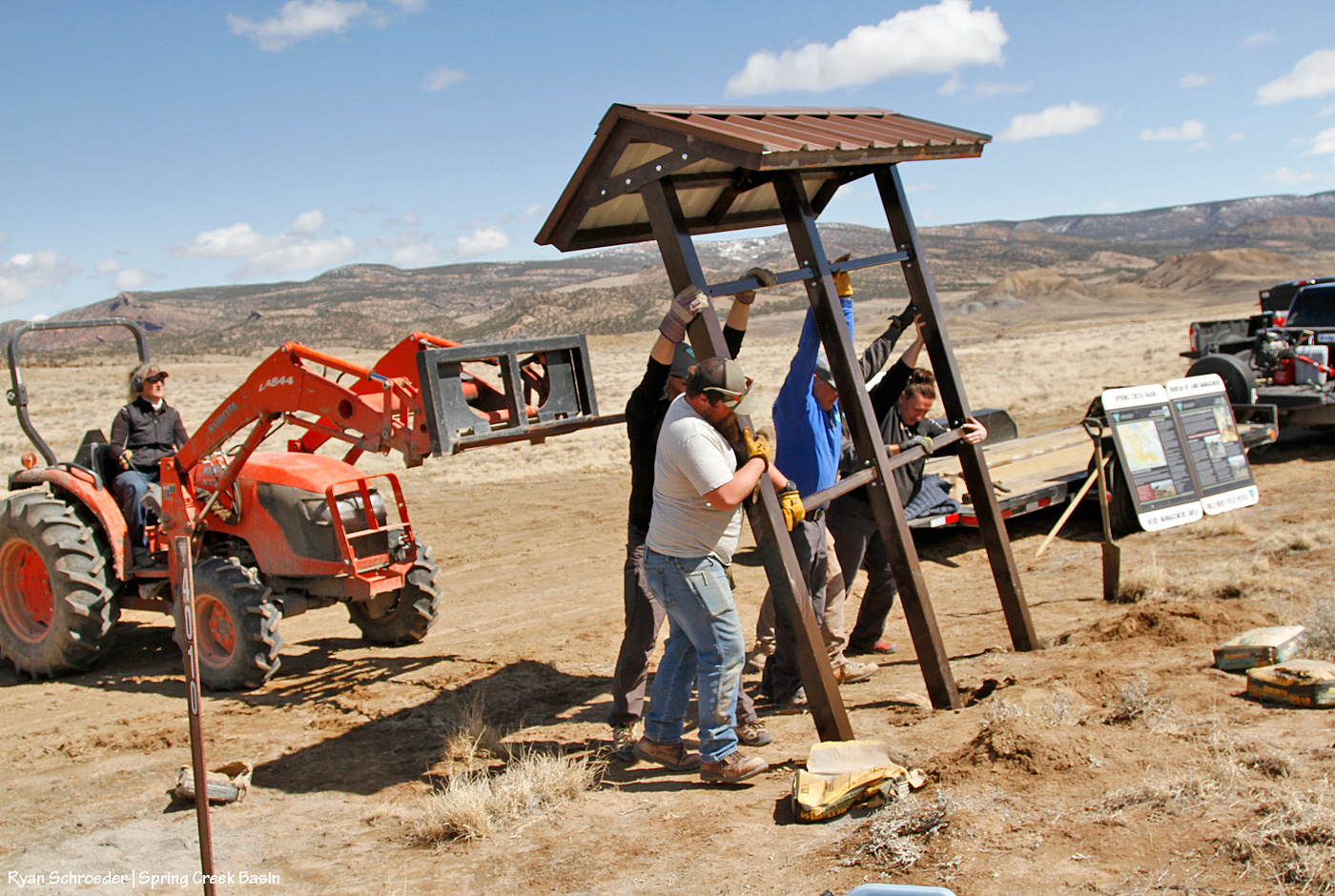
It has been in the works for at least the last year. On April Fool’s Day, rangeland management specialists Ryan Schroeder and Anton Rambur came out to augur and dig out the holes for the three posts for the kiosk (in the snow and greasy-muddy road, I might add). The day after April Fool’s Day (gorgeous but nippy), we were joined by Laura Heaton (range tech), Nate West (wildlife biologist), Brian Yaquinto (archaeologist) and Jon Whitehead (recreation) to put the whole thing together and set it upright in the holes (shout-out to my awesome little Kubota tractor!) and cement it in place.

Let me also mention that this was Ryan’s third day back to work. I never anticipated that I’d be RE-introducing him when I introduced our new range team, but there it is, and here they are. 🙂 I’m so stoked to be working now – again – with all three of them.

A couple of (OK, several) images of the construction and installation of our brand-spanking-new, kick-ass kiosk in Spring Creek Basin:

Actually, let’s start with the old interpretive sign, familiar to anyone who has driven into Spring Creek Basin. You might think the sign looks white because of glare or overexposure by the camera. …

But no. It really is that blank. The high-elevation, Southwest Colorado sunshine will do a number on just about anything. … Hence the new sign. 🙂 (Note the scratches at the top and (at least) left side. What made those scratches, you ask? Horse teeth, I tell you.)

Laura and Ryan check out the new map and info signs. OMG! They are SOOO COOL!

Who took the images for the signs? I’m so glad you asked. 🙂 I am BEYOND proud! (While all of the BLM folks were gathered around to look at the signs, I ID’d for them all the mustangs in the pix. Above: Hollywood, Shane, Houdini, Alegre and Maia. I’m also hugely grateful that our dearly retired herd manager, Mike Jensen, and the BLM’er who put the signs together, Jason Byrd, allowed me to dust off my copy-editing skills in service of both the info panel and the map. I realize now that I didn’t take a close-up pic, but Temple Butte is noted on the map, the first time I’ve seen the name on any map since we got it officially named by USGS in late 2018.)

While Ryan digs out the edges of the middle post hole just a little bit more, Brian, Nate and Anton started attaching the posts to the roof structure, resting on the forks of the tractor.

With all the vertical posts attached to the roof structure and the cross pieces (to which the sign boards would bolt), Jon arrived with the Qwikcrete and water to mix into a slurry in the post holes to help support the posts for a very long time to come.

And up she goes! OK, this doesn’t really show the tractor doing the heavy lifting, but it did. 🙂 Thanks, Ryan, for taking the camera while I worked the tractor!

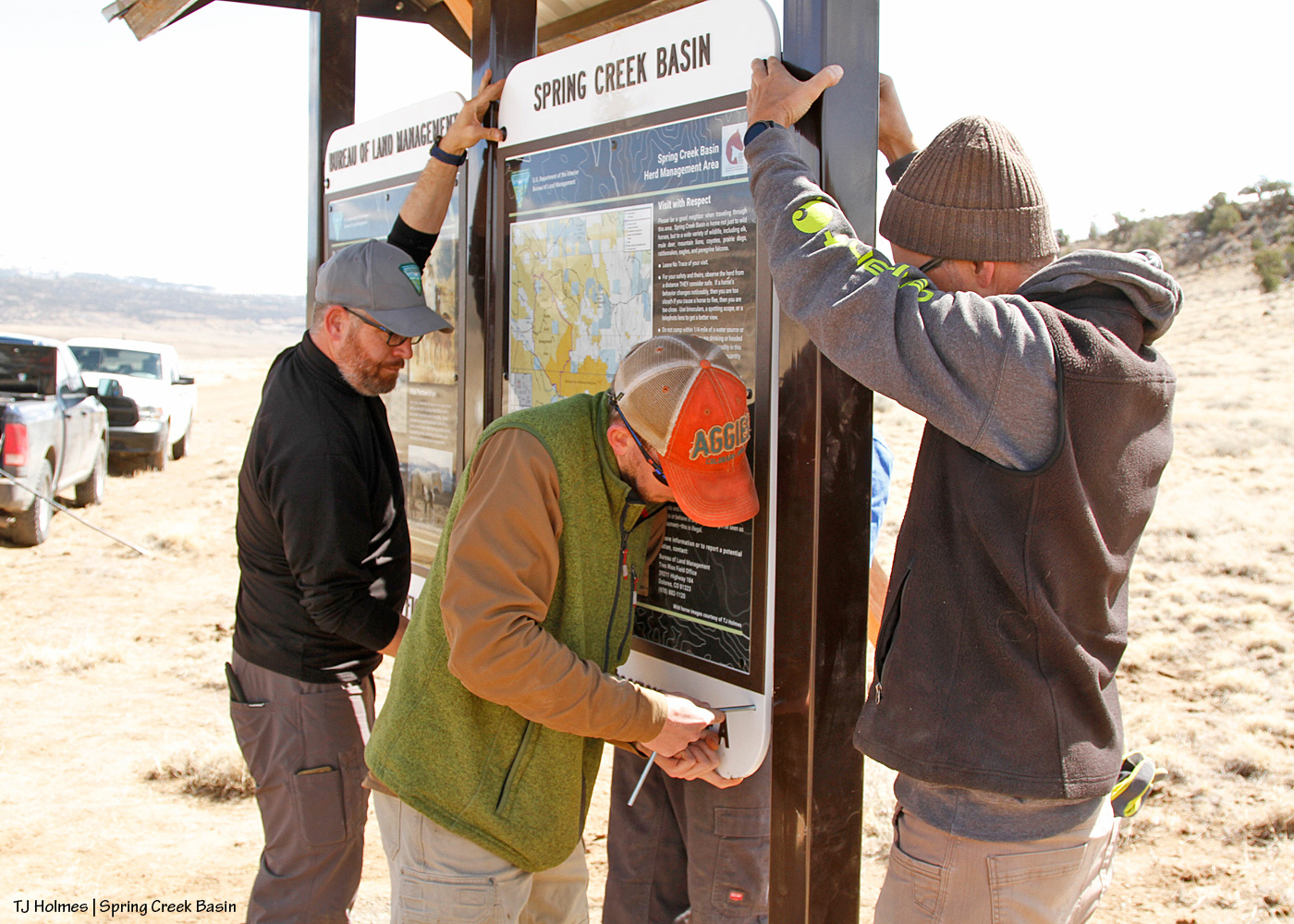
In go the bolts for the first sign panel! (Yes, we did joke about how many BLM’ers it takes to screw bolts into a sign. 🙂 You almost can’t see him, but Jon is holding the sign behind Brian while he and Ryan thread the first bolts and Anton holds the left side of the sign.)

Anton holds the second panel while Jon (left) and Brian insert bolts to attach the sign to the frame.

Eagle-eyed readers will note that the sign very correctly welcomes visitors to Spring Creek *Basin*!

I want to express my enthusiastic gratitude to our particularly awesome BLM’ers for making this new info/map kiosk come to life in Spring Creek Basin. It has been, I think, a little more than a year from conception to standing tall at the west basin boundary to greet visitors to Spring Creek Basin, magical home of our mustangs. Pictured, left to right: Nate West, Brian Yaquinto, Jon Whitehead, Laura Heaton, Anton Rambur, Ryan Schroeder and yours truly (I actually brought my tripod so I could be part of the picture record!).

Huge gratitude also to Mike Jensen (retired but never forgotten), who offered me the opportunity to share some of my favorite images of the mustangs and my copy-editing skills (and texted this in reply to telling him about the new sign: “Wow awesome that looks great. See no worries I left you in good hands.” :)); Doug Vilsack, Colorado BLM director, who agreed that we needed a new sign when he first visited Spring Creek Basin in 2023; Derek Padilla, Tres Rios Field Office manager, who has been super supportive of Spring Creek Basin from the get-go; Joe Manning, TRFO assistant manager, also incredibly supportive and who agreed that it was a project worthy of funding; and Jason Byrd, recreation specialist (?) at TRFO who designed the signs with my images and all my edits and made the most gorgeous informative panels in all of BLM-dom.

Thank you, ALL! And now, when any of you visit Spring Creek Basin, you know the story of how our fabulous mustang kiosk came to be!


Playing in the soil

2 04 2025

I am giddy with excitement and anticipation. 🙂 First of all, we have our full BLM range team back together again! As of Monday, rangeland management specialist Ryan Schroeder is fully reinstated and back to work with range specialist Anton Rambur and range tech Laura Heaton at Tres Rios Field Office. And he got to get his hands dirty – literally – with Anton (Laura was under the weather) out in Spring Creek Basin yesterday to …

…uh … just what the heck WERE these guys doing?!

A hint is in the background. 🙂

Leave a guess in the comments and let me know just what the heck you think these funny guys were doing!

All will be revealed soon, and it’s going to be awesome!


The importance of people

24 02 2025

** Update from Tuesday morning, after the so-called “meeting” in Dolores: Who showed up? Hundreds of people concerned about local, regional and national issues – including the firing of BLM, Forest Service and National Park Service employees (including our range specialist Ryan Schroeder). Who did NOT show up? Rep. Hurd’s representative, with whom the meeting was scheduled.

Not cool.

The (Cortez) Journal has the story: “Hundreds gather in Dolores to meet with Rep. Jeff Hurd staffer; Republican’s regional director never showed up

**********

By now, I’m sure most readers of this blog have heard/seen/read about the mass firings of hundreds or thousands of federal employees with the National Park Service, U.S. Forest Service and Bureau of Land Management (among other agencies).

Many of you probably even know some of those folks, who work hard for America’s public lands so that American citizens as well as visitors from other countries are able to enjoy these lands. America is the birthplace of this idea of protecting nature and natural resources for future generations. It’s not all dollar-driven extraction industries, though those play a part. But the great, far-seeing vision of the people who envisioned protected lands, available to all citizens, was to ensure that those lands belong to all of us and that we have a part in protecting and preserving them, in addition to enjoying them and all the natural wonders they offer.

Perhaps no collective group of people feel that mission more strongly than the employees who work for little pay, in harsh conditions (and I’m not talking about just rough country), for the love of the land and – !!! – for the very people who also love those lands.

Two days after I was able to speak to one of my BLM folks in person – asking her “are you all safe??” (her answer then was yes) – I learned that when she got back to the office, they were NOT. One of our two new range specialists had gotten the “you’re fired” letter that afternoon, citing as the “reason” that during his probationary period, he had “failed to demonstrate fitness or qualifications for continued employment because your subject matter knowledge, skills, and abilities do not meet the Department’s current needs …”

In his own words and with his permission, I’m going to share here the letter Ryan Schroeder wrote that demonstrates that not only do his “subject matter knowledge, skills, and abilities” FULLY meet the current needs of Tres Rios Field Office and that of BLM state- and nationwide, they FAR exceed those criteria … as only a bureaucrat in the nation’s Capitol could fail to understand at a glance.

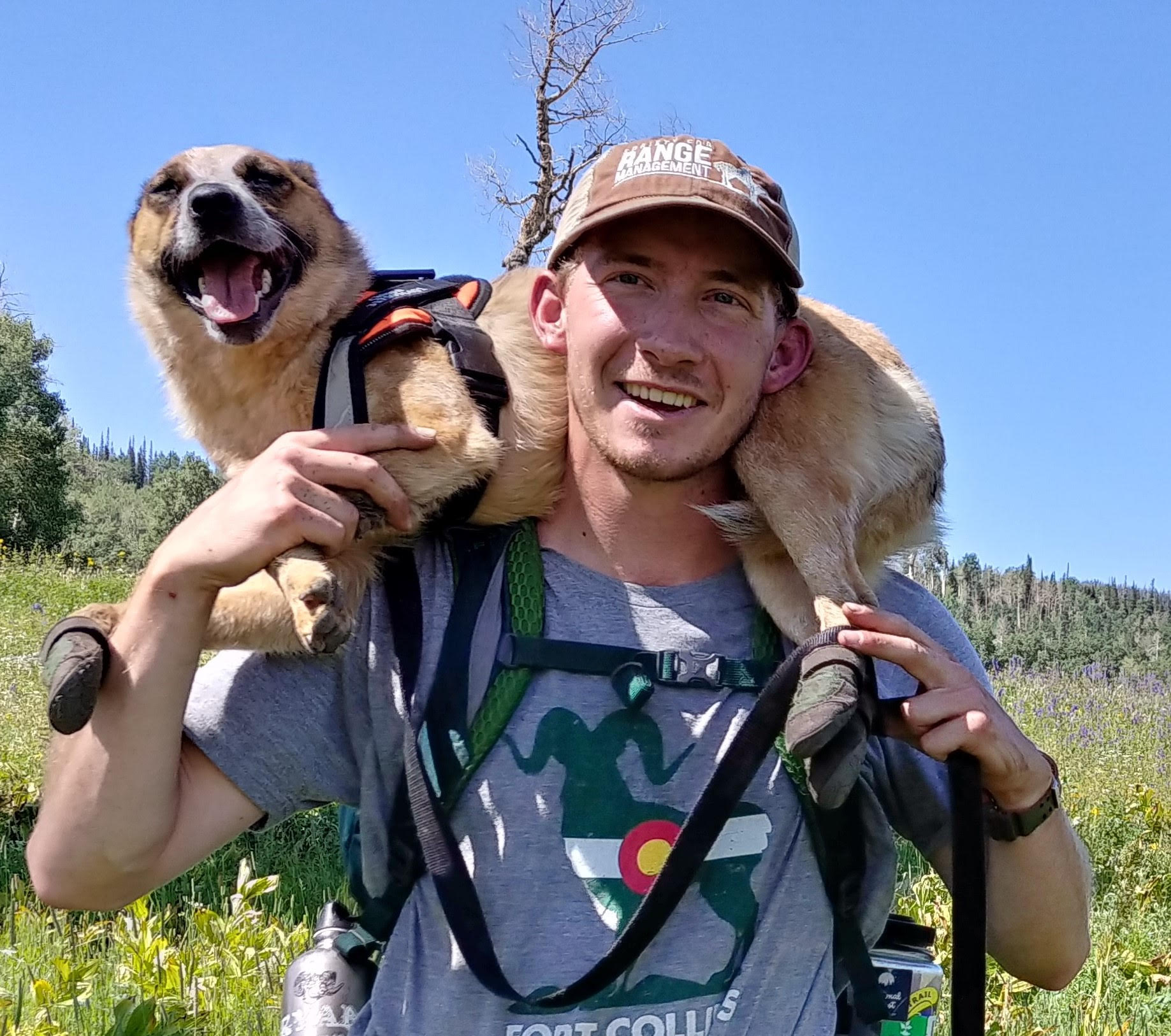
Ryan Schroeder and Chispa (Spanish for “spark,” a fitting name because of Ryan’s previous work as a firefighter), his rescue pup from the Mora, New Mexico, area.

Hi TJ,

This is Ryan Schroeder, I am the (now) former Rangeland Management Specialist (GS-11) down here for the Bureau of Land Management Tres Rios Field Office and Canyons of the Ancients National Monument in the Dolores, CO area. Thank you for wanting to share my story to say what happened to me on Tuesday Feb. 18, 2025 when I was terminated after less than 60 days on the job. I have written below the most concise way I can think to write about what has happened, and what it may mean for public lands and the people of this state that depend upon them. 

A lot has happened in a little more than two months… I finished my PhD at the University of Montana on Dec. 13, 2024; moved nearly 800 miles south to SW Colorado where my Significant Other and I moved in together after being long-distance for over 4 years; started working at my dream job as a Rangeland Management Specialist with the Bureau of Land Management, working to promote and sustain healthy rangelands and habitats for all Americans; …and less than 60 days after being hired I was terminated for a “cause” that is a lie.

The Department has determined that you have failed to demonstrate fitness or qualifications for continued employment because your subject matter knowledge, skills, and abilities do not meet the Department’s current needs…” (excerpt from my termination letter dated Feb. 18, 2025; I have attached my termination letter in full).

Rangeland Management Specialists such as myself review, renew, and update grazing permits for private ranchers and entities to graze their livestock on public rangelands, as well as work with our partners to manage Wild Horse Management Areas such as Spring Creek Basin in the Disappointment Valley south of Naturita. To do this, we are mandated by federal statute and regulation to conduct Land Health Assessments, go through the National Environmental Policy Act (NEPA) process, and work not just with our permittees but all other resources (cultural, wildlife, hydrology, fuels, recreation, and minerals) and other interested publics as part of Interdisciplinary Teams to try and use science to balance grazing habitat use alongside other public land uses, minimize negative environmental impacts while producing food and fiber for America, and use grazing as a tool for habitat improvement.

I have gone to school and worked for 11 years to be qualified for this position (resume attached), one of the most difficult positions to fill in Public Lands Management Agencies. I have gained experience, knowledge, and qualifications from Montana, Wyoming, Colorado, and New Mexico rangelands to rise to the tasks given to me; which, when I signed my performance plan 7 days prior to receiving my termination notice, seemed daunting but doable, and a way to grow in my career and be a steward of the amazing public resources we all own as Americans. If I am not “fit or qualified” for the needs of the Department [BLM], then it appears to me that the Mission of the Department [BLM] has fundamentally changed without the knowledge of the public and those who have been with the agency more than one year…

My position, a GS-11 Rangeland Management Specialist, in the Tres Rios Field Office had been vacant following the retirement of Mike Jensen, a Rangeland Management Specialist who had been with the Tres Rios F.O. for more than a decade, and who had developed great relationships with grazing permittees and other interested publics, and it took nearly a year to fill the position. In that short time, there became a backlog of statutorily required Land Health Assessments throughout the 600,000 acre Field Office and Canyons of the Ancients National Monument areas, as well as grazing permits that were soon to expire and be renewed. By law, the revised Federal Lands Policy and Management Act (FLPMA), the BLM is obligated to issue grazing permits and renew expired ones. Those expired grazing permits (often with a 10-year permit period) can either be renewed with a few clicks on a computer, without any modification or updates to the “Terms and Conditions” in the permit, or go through a “Fully Processed” update and renewal to incorporate the latest science, up-to-date on-the-ground Land Health conditions, and adaptive management strategies into new “Terms and Conditions” to not just manage livestock but manage the habitat for the benefit of all resources. My supervisor, Joe Manning (Assistant Field Manager for the Tres Rios F.O.), and Laria Lovec (Colorado State Range Program lead) had brought me on to help address that backlog and incorporate more science of rangeland ecology and ecological restoration into these grazing permit renewals; be an advocate for the rangeland resources when advising on other proposed actions (by private citizens/companies or the BLM) to occur on BLM Public Lands; and continue to steward and sustain positive relationships between the Agency, our partners, and the land.

I fear, that with my termination, effective Feb. 18th, 2025, after less than 60 days on the job, the planning we in the Range Program at the Tres Rios Field Office had done to start addressing the backlog of permit renewals, Land Health Assessments, and other projects requiring NEPA this year will not be able to be done, or not incorporate up-to-date science and on-the-ground data to help the agency and the private permittees adapt to challenges faced on the ground, and will be forced to renew most permits without any changes or adequate information. Many of the grazing permits that are up for renewal were originally written in the late 1980’s through the early 2000’s. Conditions on the ground throughout the Tres Rios F.O. and Canyons of the Ancients N.M. have changed since then, and it is not appropriate to renew grazing permits without understanding what changes in the resource base or resource potential have occurred, how they can be mitigated to sustain appropriate grazing use, and how to adaptively manage in response to unpredictable environmental conditions and to promote and sustain both big-game populations, horse herds, sensitive wildlife and plant species, and cultural resources that occur throughout our grazing allotments and Field Office. Thus, if the “new” Mission of the BLM has no need for science, knowledge, stewardship, and passion thereof, as indicated in my termination letter, I fear that public lands projects (not just grazing permits) will be rubber-stamped without careful consideration of on-the-ground conditions, science, lawfully-required public input, and adaptive management techniques due to continued short-staffing of the Field Office, and lead to degradation of Colorado’s public lands and resources and increased vulnerability to external factors such as droughtshifting market conditions, and altered public perception of our rangeland and habitat resources.

Further, I do not think that my termination, in addition to at least two other BLM Colorado employees (effective Feb. 18, 2025), are the last that the agency will experience given the on-going circumstances. I do not know who is on the chopping-block next, but I worry that the BLM and other Public Land Management Agencies will continue down a crisis of confidence, a crisis of leadership, and a crisis of adequate staffing to complete the Mission(s) as they have been known and mandated by Congress and the American people. Those who remain in the agency at the State, District, and Field Office (local) levels are being silenced (both actively and passively) from speaking up about what is occuring, in fear of losing their jobs next. I fear those losses will be inevitable if things do not change, whether they speak up or not, further degrading our Public Lands Management Agencies’ abilities and our public resources in the near term and in the future. 

Thank you for your time and consideration of this important matter.

**********

Later this winter or early in the spring, I was hoping to introduce you all to our new team of Anton Rambur (rangeland management specialist), Laura Heaton (range tech who worked with Mike Jensen and replaced Daniel Chavez in that position) and Ryan Schroeder. Anton and Ryan stepped into their positions just last October and December, hired to fill the positions left vacant by Mike and by Garth Nelson. We’re getting a new interpretive sign at the western boundary/entrance to Spring Creek Basin, and I thought that happy event would be a great way to introduce you all to our new BLM’ers.

Now, when that happens, we’ll be missing a key member of our team – Ryan.

From the above letter, you know that Ryan is incredibly well educated and has a significant knowledge of his subject matter. From the additional information he sent me, let me share what he accomplished in the Tres Rios Field Office in less than 60 days:

U.S.D.I. – Bureau of Land Management, CO – Rangeland Management Specialist Dec. 29 2024 – Feb. 18 2025
▪ Duty Station: Tres Rios Field Office & Canyons of the Ancients National Monument, Dolores, CO
▪ Supervisor’s phone #: Joe Manning, A.F.M. 970-***-**** (Permission granted for reference check)
▪ Developed a prioritization plan to strategically address a two-year backlog of Land Health Assessments,
grazing permit renewals, and grazing permit updates (requiring the NEPA process) to focus efforts in
Gunnison Sage Grouse Habitat and Areas of Critical Environmental Concern within the Field Office area.
▪ Collaborated with grazing permitees to plan livestock grazing and land management actions on BLM lands
▪ Contributed to BLM Interdisciplinary Teams as the Field Office lead range program specialist for proposed actions on BLM lands requiring NEPA review, findings of potential impacts, and mitigation techniques
▪ Responded to Freedom of Information Act (FOIA) requests in a timely manner
▪ Worked with Agency partners including non-profits, local governments, tribal nations, and private citizens to respond to and advise on rangeland habitat, livestock, and Wild Horse Management Area issues
▪ Inspected and maintained range improvements within the Field Office and Canyons of the Ancients N.M.

**********

With all due respect (not much) to the bureaucrat(s) who took the time to type up (or more likely copy and paste) his termination letter and find him in Dolores, Colorado, does that sound like someone who doesn’t know their subject matter AND also doesn’t have the “skills and abilities” to meet the needs of the range department at Tres Rios Field Office for an area of Southwest Colorado covering 600,000 surface acres of incredibly diverse landscape between Silverton to the north, New Mexico to the south and Utah to the west?!

If you’re local to our area, please make time to attend a “town hall” with a representative of newly elected U.S. Rep. Jeff Hurd (R-Colo) at 4 p.m. today at the Dolores Public Library.

BLM, as well as the U.S. Forest Service and National Park Service, is *chronically* understaffed and underfunded. We know from Mike and Garth and Daniel that when you have good people, you hate to see them go (to retirement and the USFS, respectively – that agency lured away two great guys!) … and when you get new people who have the promise to keep your level of partnership and quality of work at an excellent level, you want to hang on to them. Our elected officials need to know how important people like Ryan are to our public lands and our communities.

I’ve worked with Laura since she started with TRFO, and she’s already proved to be a great addition to our team (she’s been in the office about a year and a half and learned under Mike). I’ve met Anton a few times and gotten him into the basin to see the mustangs both with Laura, and with Laura and Ryan; he is a welcome addition to Spring Creek Basin’s herd management (he comes to us from Nevada, and we’re eager to show him how wild-horse management is successful!). Ryan impressed me the second time I met him (on that basin tour), especially when he was able to immediately identify a plant I’ve been wondering about for nearly 18 years (!). We look forward to *continuing* to work with Ryan just as soon as we can get him reinstated in his very necessary position.


Not good-bye, fare thee well

24 06 2024

Readers of this blog know that I/we have enjoyed a particularly good partnership with our BLM folks for the last nearly decade, in huge part because of rangeland management specialist and Spring Creek Basin herd manager Mike Jensen.

Our PZP program was implemented during the 2011 roundup, before Mike returned to herd manager duties (he was herd manager here first in the early 2000s), but Mike has been an absolutely staunch supporter of the program. It was under Mike’s leadership that we were able to get bait trapping solidified as the capture method of choice (when the time comes), and because of Mike’s dedication to vegetation monitoring, for the 2020 herd management area plan update, we had the data necessary to allow the increase in AML (appropriate management level) from 35 to 65 adult horses to 50 to 80 adult horses. That, combined with the very successful PZP program, has meant an astounding 13 years to date since the last roundup and removal of any Spring Creek Basin mustangs.

Mike is the BLM partner every advocate wishes for and we have been so very fortunate to have.

Under Mike’s leadership, Spring Creek Basin Herd Management Area is a model that other BLM managers and advocates can aspire to. (That’s not arrogance; that’s pure gratitude.)

As I described in yesterday’s post, last week, Mike and Tres Rios Field Office Manager Derek Padilla came to Spring Creek Basin for the field trip with Colorado Wild Horse Working Group members. I take every opportunity offered to describe Mike’s work ethic, partnership and support of our mustangs to anyone who will listen, but this was the first opportunity for group members and our Colorado advocates to see him in action as he talked about the history of Spring Creek Basin as a herd management area and our accomplishments in both herd management and the projects we’ve completed for the benefit of the mustangs. Naturally, everyone wants a Mike clone for their areas. 🙂

By the time we reached the day’s end goal and turnaround spot – the northwest-valley water catchment we built in 2022 – we were down to our local advocates and a Jeep-full of advocates from the other herds.

And because Mike retires Friday from a long (30 years) career with the Bureau of Land Management, we local advocates wanted to take advantage of the last opportunity we’d likely have Mike in Spring Creek Basin to mark the occasion, wish him well and give him a token of our appreciation.

Left to right: Mike Jensen, Frank Amthor, Tif Rodriguez, Pat Amthor and yours truly.

Thank you, Mike, for being such a champion for wild horse management here in Spring Creek Basin, for being a true partner, for being one of the people I respect most in this world. We wish you well in retirement! Don’t be a stranger. 🙂


12 from 2022

31 12 2022

Looking back helps us look forward (*when* it helps? sometimes I think looking forward is the only way to go … though I’m not very good at this myself). I think this is the third year of the (admittedly borrowed, in my case) tradition of posting 12 pix at the end of the year that represent each of the previous months. It has been a good year in Spring Creek Basin. After another less-than-positive winter and a dry spring, we had a second-in-a-row summer monsoon season and a relatively rainy early fall. Then things got dry again before we finally started to get snow a couple of weeks before Christmas.

Our excellent BLM partners – Mike Jensen, Garth Nelson and Daniel Chavez – put their enviable skills to work and built a second water catchment in the basin, starting in early summer and finishing in the fall. It’s another (our fourth) such project to catch and store liquid gold and bank it against continuing drought conditions; with the newest catchment, we have the storage capacity for 50,500 gallons of water. That’s really quite enormous (!). (Of course, we need Mother Nature’s continuing help in the form of snow and rain!)

We lost some horses (as we do every year), and we had some foals (as we do every year), and the herd and the range are in excellent and very good condition overall. In September, we celebrated our 11th anniversary since the last roundup. Fertility-control treatments continue apace, and because of the efficacy of the native PZP that we use, and the aforementioned good condition of horses and range, there’s (thankfully) nothing (no removals) on the horizon.

Without further ado, as 2022 comes to an end, let’s remember some scenes of Spring Creek Basin and its fabulous mustangs to carry us ahead into 2023 (some have been previously published here; others are new to the blog):

Tenaz (showing off his rarely-seen generous star with wind whipping aside his forelock) and the mustangs rang in the first day of 2022 with fresh snow! A handsome bay mustang does look rich and supremely healthy in new snow. I know I write that a lot with regard to bay mustangs, but really, have you ever seen a better color combination!? OK, OK … all of the other equine colors look pretty fabulous, too. 🙂

******

Even baby horses like Lluvia love to catch fluttering snowflakes on their lips! They do make me laugh, these ponies (see yesterday’s post about laughing with friends!). 🙂 With their thick, insulating coats, mustangs are well adapted to winters in high desert areas such as Spring Creek Basin. Our winters are fairly mild, though we do have some frigid days … and snow!

******

Dundee, Rowan and Aiyanna came from Sand Wash Basin in September 2021 and were welcomed here with monsoon-grown grasses. They filled out nicely that fall, but by March, they were a bit on the lean side. I think that had to do with their youth: Dundee was 2, and Rowan and Aiyanna were yearlings – all three still growing. They all blossomed throughout this year, as you’ve seen from recent pix of the girls. On this particular evening, they were high on a ridge on the west side of Filly Peak when another band appeared below, sending them into a gallop that I was thrilled to “capture” in that glorious golden light!

******

We may not have gotten much snow last winter and not much rain in the spring, but because of the previous summer’s monsoon rains – which, after a period of tense waiting, filled all the ponds – we came through winter and into spring with full ponds, which meant fantastic water in April. One of the greatest joys of watching mustangs is seeing them splash and play in water in nearly-belly-deep ponds – and then drink long, thirst-quenching draughts. Again, these ponies do make me laugh!

******

Corazon works his classic mustang-silhouette-at-sunset pose. He has really come into his own as a steady band stallion these last few years, and his son and daughter adore him. His son, in particular, is a mini-me who inherited both his black-and-white coat and his flank heart. Though Corazon’s namesake heart isn’t visible in this image, I think it’s one that does cause one’s heart to soar, just to see a mustang free in the wild, the glowing horizons fading into infinity.

******

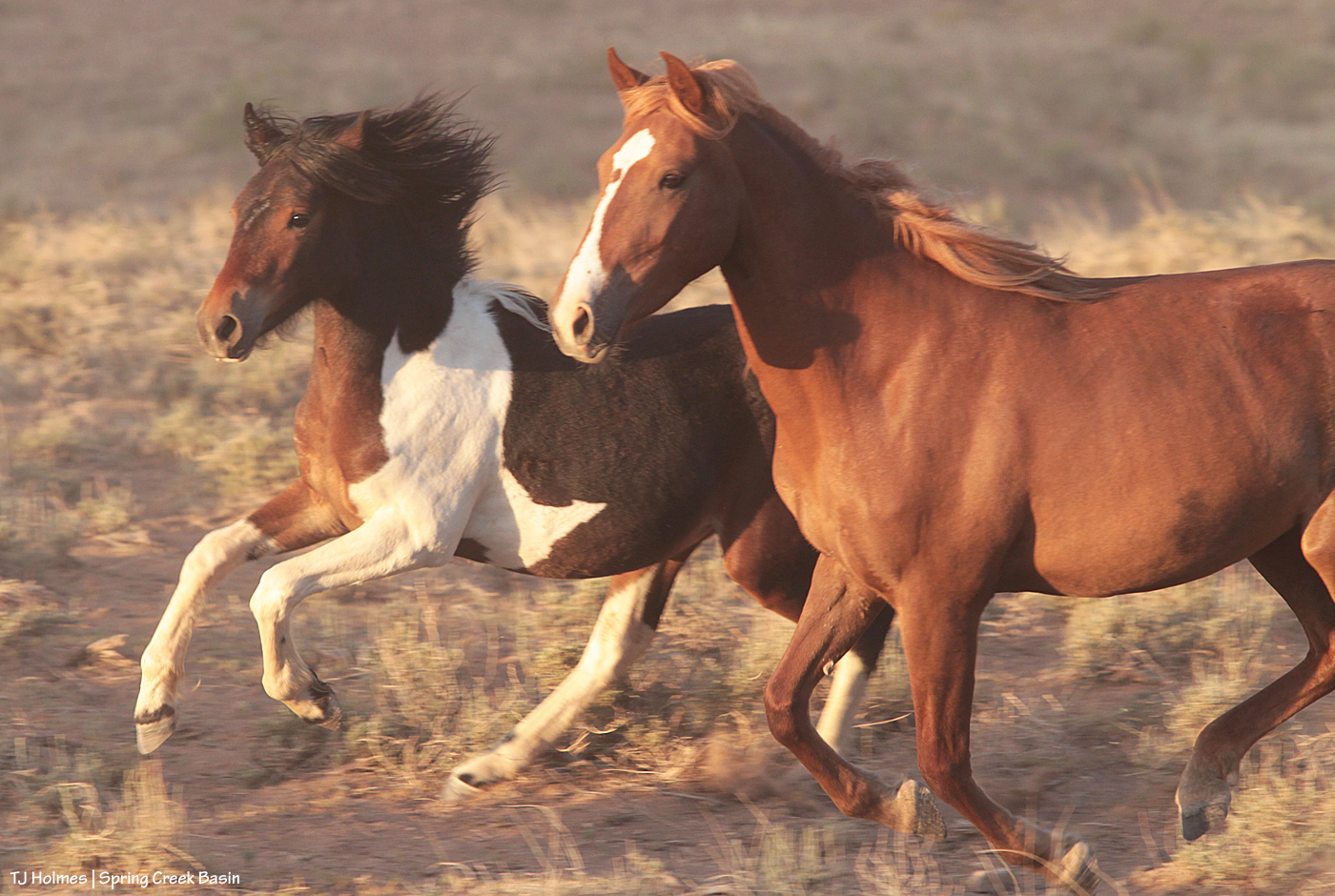
You’d never know it to look at them, but these sprightly creatures are sisters! Their mama was lovely Tesora, whom we sadly lost in February. She lives on in their spirit and beauty. Lluvia sticks close to big sister TaylorK, whom she knows more as an auntie. Family is – always – everything. (As they run, do you see the soaring bird in the pattern on Lluvia’s shoulder? She has another on her right shoulder.)

******

With green all around him as the summer days advanced through July, Sundance made clear to another stallion, who was a bit closer than Sundance thought was appropriate, that his proximity was NOT appropriate. He does look rather intimidating, doesn’t he? Sundance is one of the most laid-back stallions out there (and really, they’re all fairly easy going, most of the time), and he’s also very protective – just like all of them. All it usually takes is a bit of posturing, sometimes some sniffing and nudging and squealing, and points are made! Successful conversation … without a word spoken.

******

Speaking of proximity issues … ! These two boys are former longtime BFFs, with the sorrel previously the lieutenant of the grey. But then those roles reversed, and sorrel Braveheart wasn’t so generous as to allow Pitch to be HIS lieutenant. The more things change … eh?! Our bands are generally very stable, but the horses are wild, after all, and young stallions do grow up and seek families of their own – as do the fillies.

******

Stepdaddy Braveheart is quite proud of and protective of his family of Winona and Reuben. (Remember that amazing grass this fall after the monsoon rains?!) This was a beautiful, warm evening when a few bands had gathered together (but not *too* close together), and I moseyed along with them as they grazed and moved from the northwest valley toward Spring Creek canyon. When the little threesome paused in the most photogenic spot possible, with iconic McKenna Peak and Temple Butte in the background, I couldn’t press the shutter fast or long enough! This is the photo I gave Connie Clementson upon her retirement as manager of Tres Rios Field Office in Dolores.

******

In October, BLM wildland firefighters along with some Forest Service (San Juan National Forest) partners from around the region (including a crew from Monticello, Utah (Manti-La Sal National Forest)), conducted a prescribed burn to help maintain wildlife habitat on the ridge south of Spring Creek Basin that forms part of the southern reach of Disappointment Valley. Because of the moisture we had earlier in the summer, the three-day burn moved slowly and was well monitored by at least 30 firefighters. I don’t know what the total acreage was, but it wasn’t a huge area, and it mainly consisted of burning piles of old, fallen pinon and juniper trees so grasses can grow. To clarify, the burn was NOT in the basin. But the slowly drifting smoke – which was visible from the basin but didn’t blow over the basin – made for some dramatic scenes. As I remember, it rained a couple of days after the end of the burning, and our sky returned to its usual clear turquoise.

******

Napping with pals is just about the best, most peaceful way to spend a lovely fall day in November. There were two bands and a group of young bachelors in fairly close proximity to each other when I hiked out to visit with them all, and it was such a soft, quiet, gentle evening among friends. The horses draw such comfort from each other … and I gain such amazing comfort from them. On these days, especially, I wish such peace was something that could be bottled and shot into space to rain down on people and places less fortunate than us.

******

In early December, we were still pretty dry in the basin, but we had this little cherub to brighten the days. 🙂 She’s a classic example of grey foals being born a color (sorrel, bay, black, etc. – my family even has a grey Quarter Horse mare that was born palomino) and *greying out* – though our grey foals don’t often grey out as fast as this little girl. Mama Echo was born black. I think I’ve mentioned before that grey is the dominant color among the mustangs of Spring Creek Basin. In that way, too, these two are classics. 🙂

******

As in years past, how about a bonus pic?

Winona and her son Reuben and one of the many amazing views from Spring Creek Basin, looking out across far lower Disappointment Valley to Utah’s La Sal Mountains, snowclad once again from fall onward. If that scene doesn’t scream (ever so quietly, of course) *peace*, I’m not sure what could. Their band and a couple of others had gathered at a pond, and they were walking away. I was trying to anticipate horses walking *across* that view, but mostly, they were lined straight out away from me as they left the water to return to their evening grazing. When I saw Winona – with confident baby Reuben leading the way – I was somewhat disappointed that they were so far away. … Then I realized that, to capture *that* view, my long lens needed the space of distance. Truly, sometimes it really *does* all come together!

******

Thank you all for reading about and enjoying our Spring Creek Basin mustangs this year. Many special thanks to those of you who faithfully come up with comments every day (sometimes, it must be nearly as hard as it is to come up with blog-post titles)!

Here’s to a coming year with plenty of moisture (!), and full ponds and catchments, and forage that grows ’em up strong and healthy. To take to heart a lesson from the mustangs and other wildlife: Be present in the moment! Some times (sometimes? many times?), that’s ever so much better than looking back or worrying about what’s ahead. 🙂

Happy New Year’s Eve!


Water catchment 2 – phase 2, day 5

26 11 2022

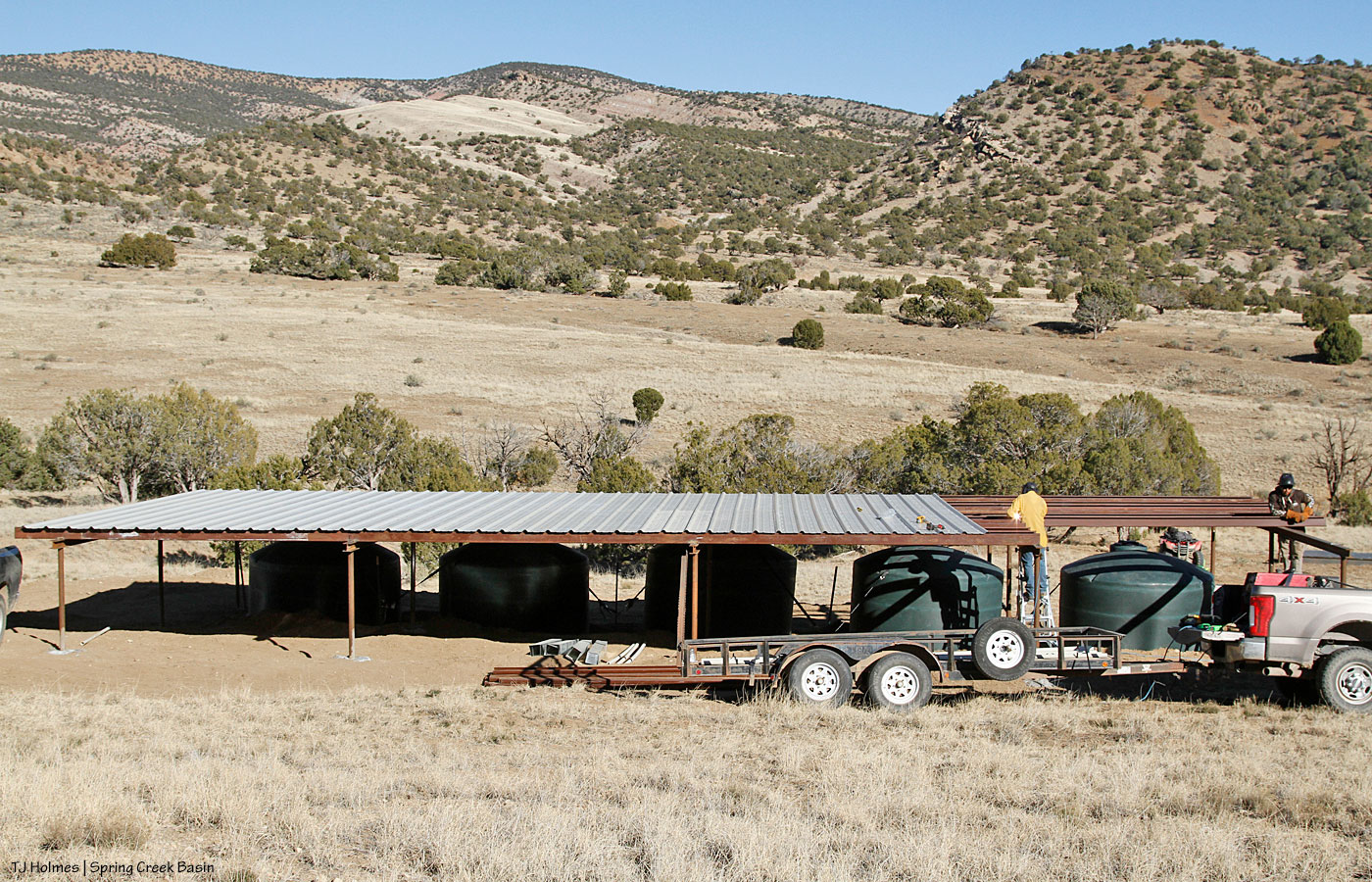
As previously announced, our newest water-catchment project is finished! Now we just need snow (which, according to the forecast, is coming Monday night/Tuesday). And to continue the theme of gratitude this Thanksgiving weekend, we couldn’t be more grateful!

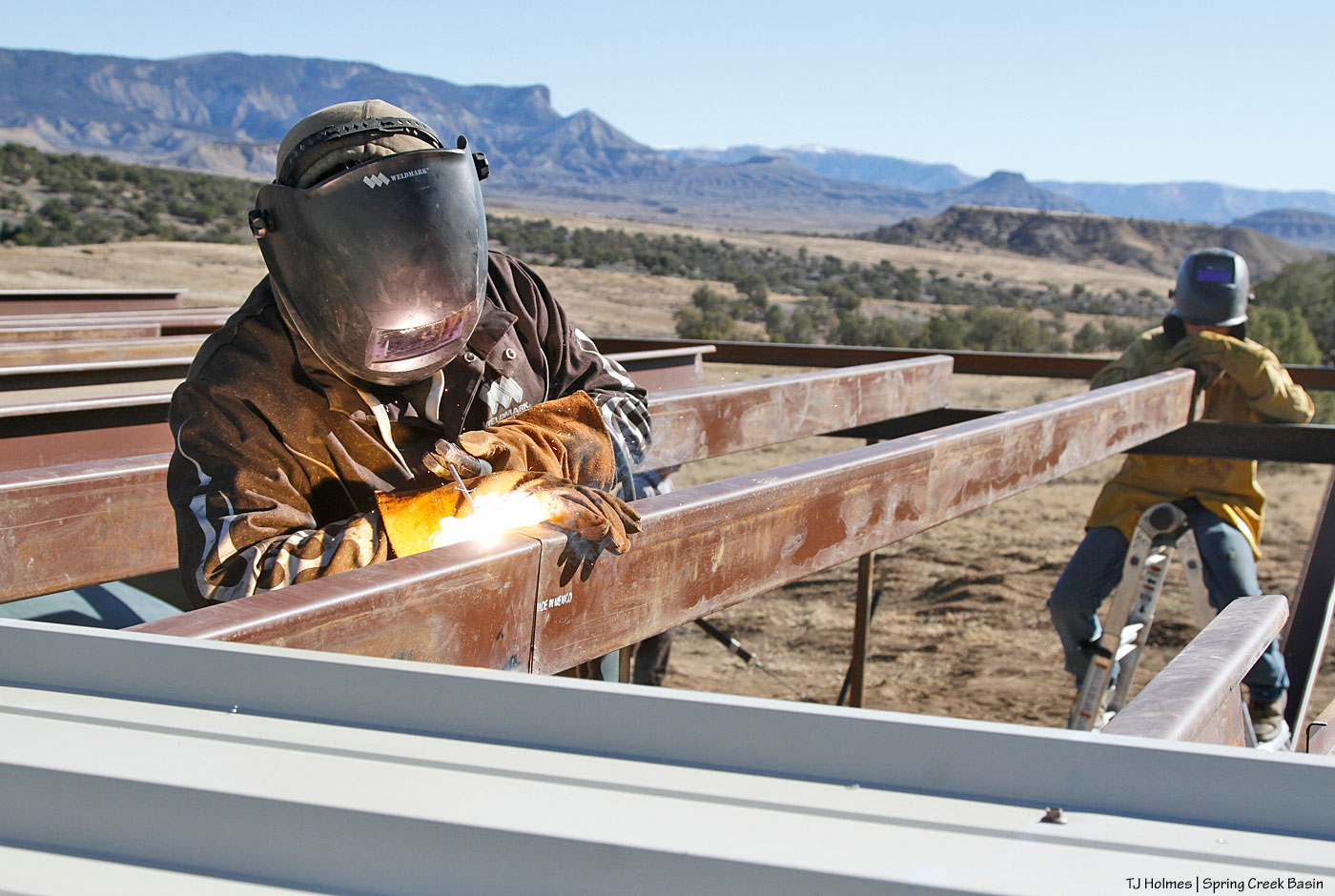
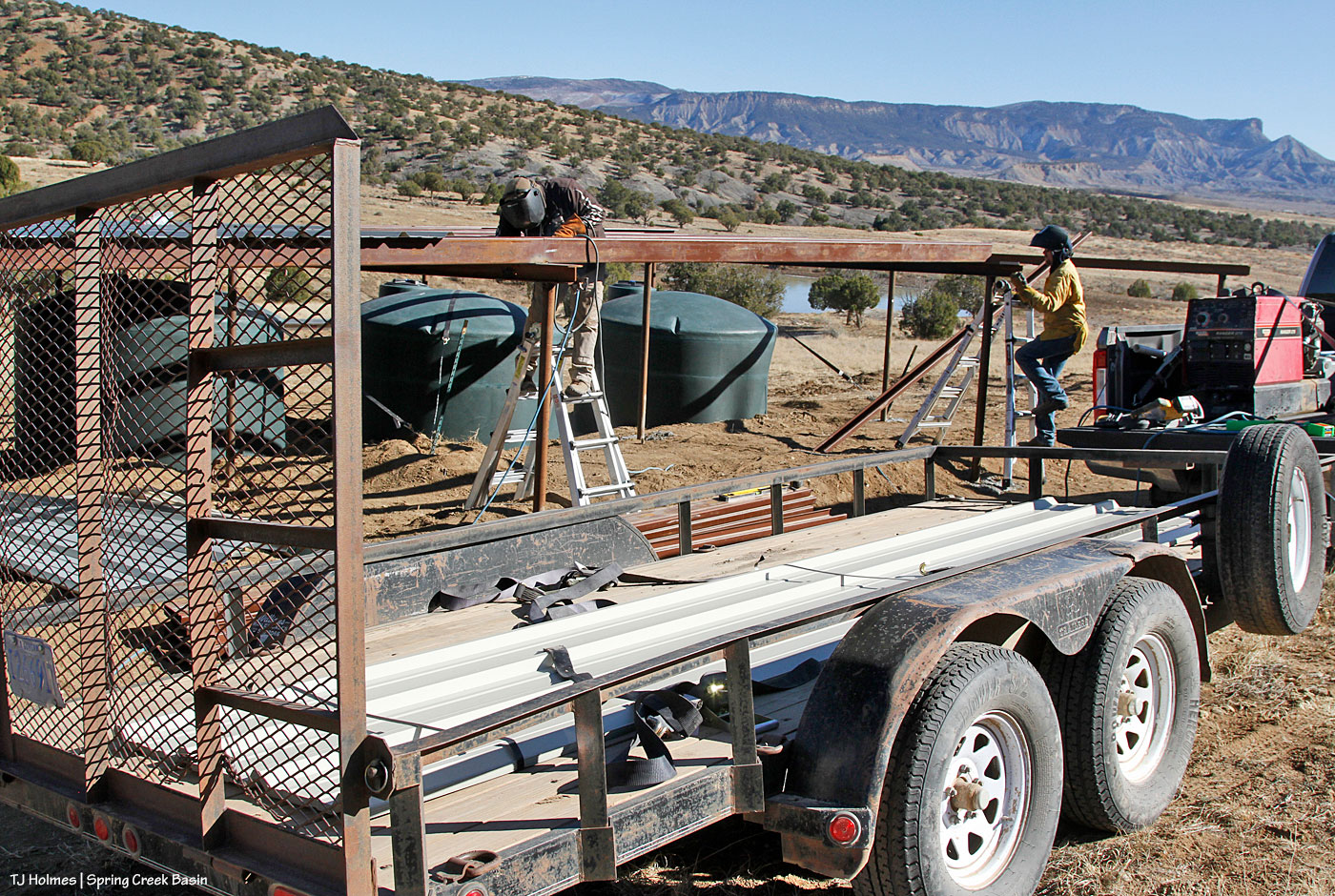
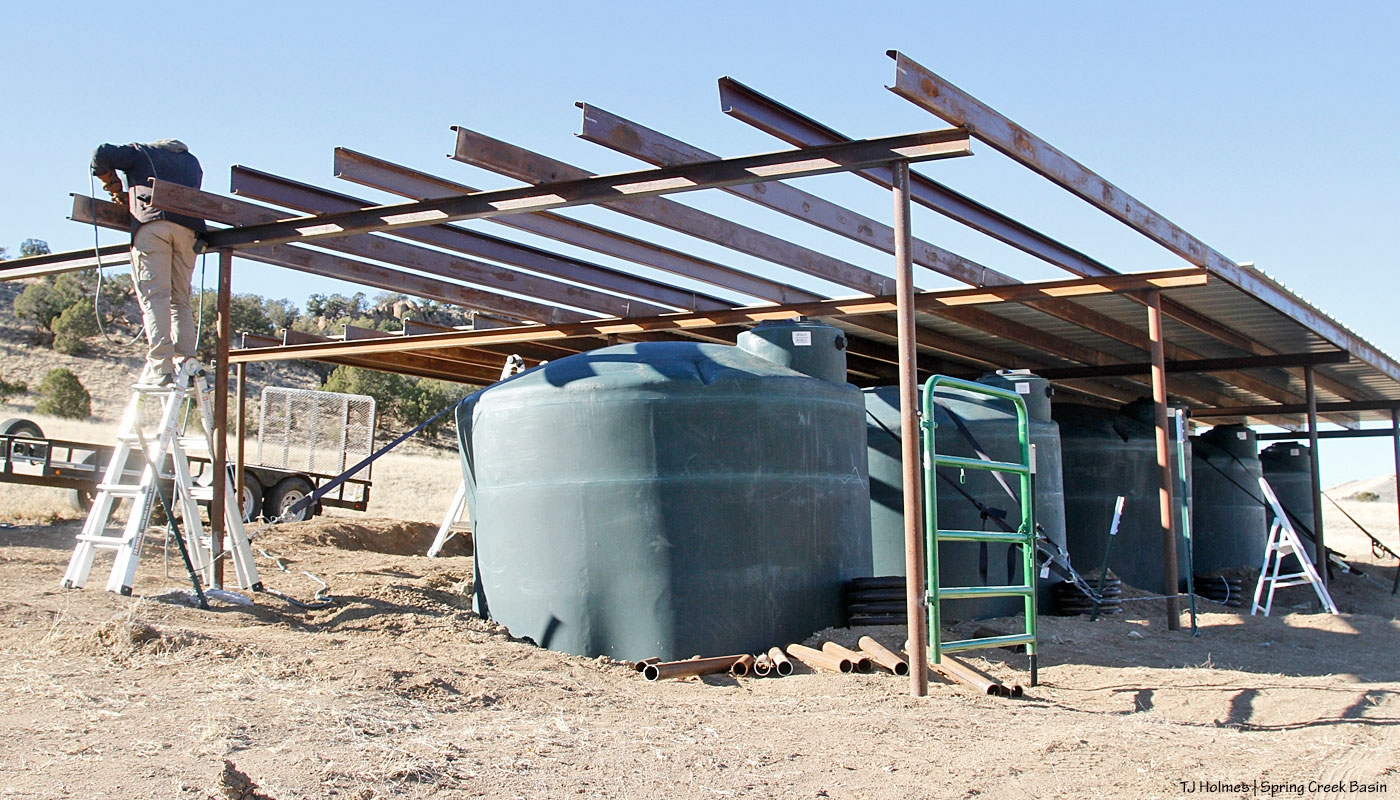
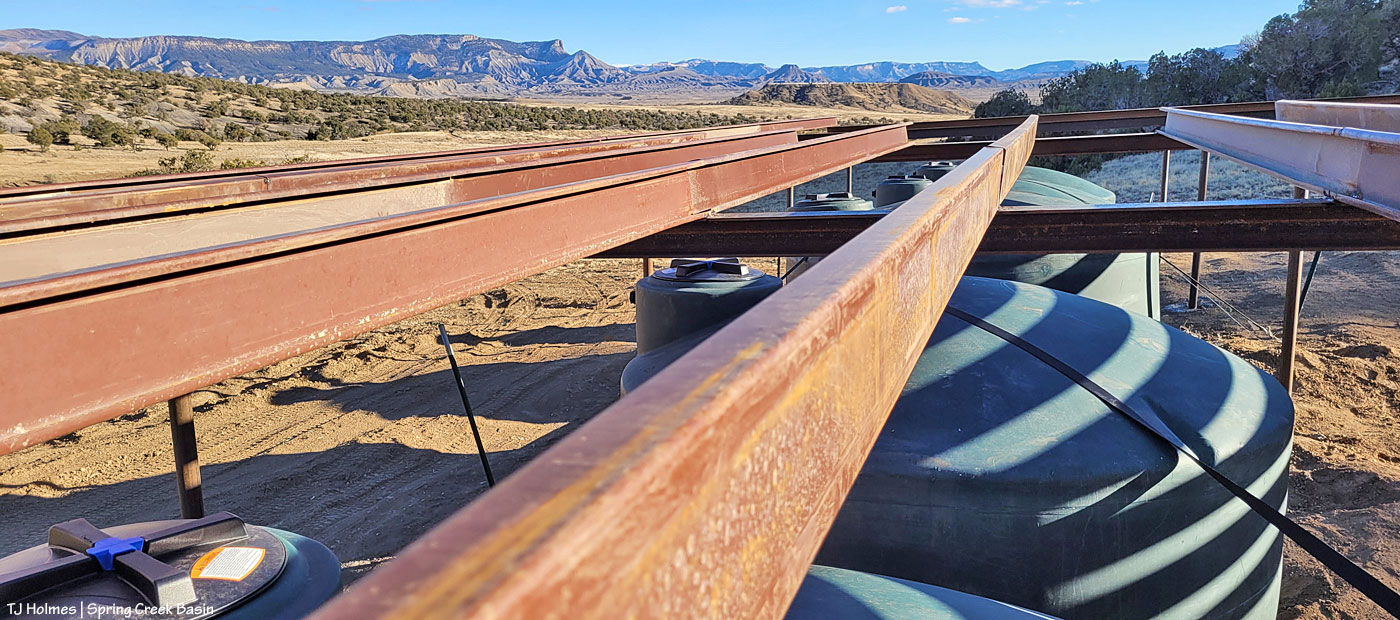
Last Thursday (exactly a week before Thanksgiving), this was about all that remained to finish the roof: Garth Nelson and Daniel Chavez had a few more purlins to weld to the I-beams, and Mike Jensen and I had a few more propanel roof sheets to screw down to the purlins.

One reason I love to highlight these work projects our BLM guys do in Spring Creek Basin is, of course, to highlight the work they do for our mustangs. Another, related, big reason, is to highlight our partnership in doing so. … And because these three guys – Mike, Garth and Daniel – work as well or better together than any three people I know. It’s pretty amazing to be around their creativity and can-do attitudes. So my photographer’s heart was really stoked when a particular purlin required Garth (right) and Daniel to literally put their heads together to get it welded to the I-beam.

Again, you really can’t beat our “office” scenery.

The unmasking. 🙂

All three guys working together. 🙂 After we finished the roof, it was time to put the gutter up along the front of the structure!

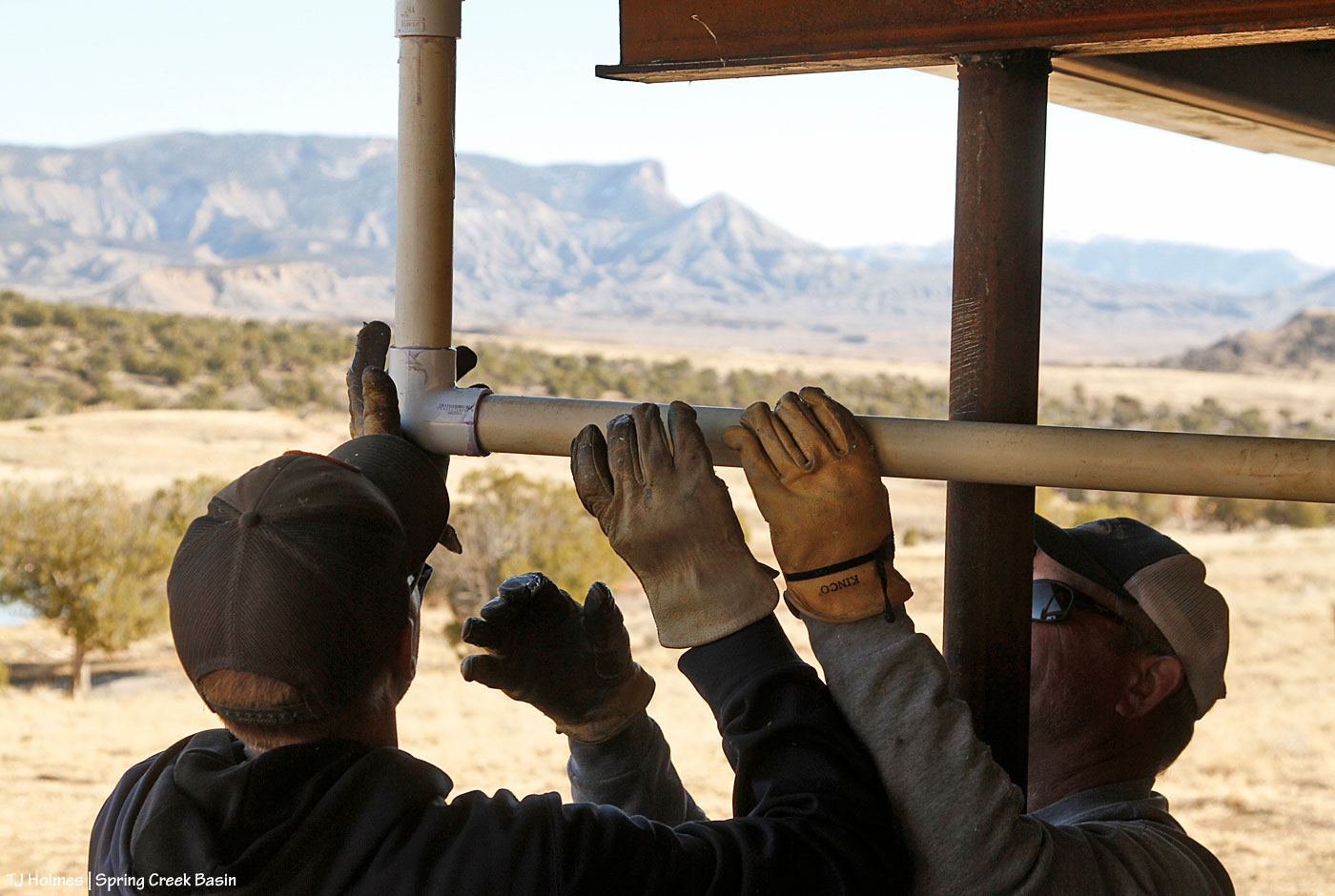
When the gutter was in place all along the front of the structure and secured, we switched up our pairings: Mike and Garth got to work on measuring and cutting and gluing the pipes from holes drilled in the bottom of the gutter to each of the tanks, and Daniel and I worked to put more spacers and long screws through the gutter to the front beam (Daniel handled the measuring and drilling; I did the handing of spacers and screws … and photo documentation :)). I didn’t take a pic of those “spacers,” but they were about 6-inch long pieces of small-diameter metal tubing, through which the screws ran, the function of which was to keep the sides of the gutter from collapsing when the screws were run through the gutter.

Gotta make sure all the pieces fit together tightly!

I didn’t get Mike’s face in this one with Garth and Daniel because he was holding the part of the fitting inside the gutter while Garth tightens it at the underside of the gutter, but I still like this shot of all the guys working together. Mike and Garth were working from the northwest to the southeast side of the gutter and tanks, and after we got the gutter up with a minimum number of spacers and screws, Daniel and I were working back from southeast to northwest – this is where we met “in the middle.”

Measuring the pipes before gluing.

Great work in the foreground. Great scenery in the background. 🙂

Moving toward conclusion.

The gutter comes in pieces that overlap, so Mike and Garth caulked each seam as well as under the fittings for the pipes inside the gutter.

And they also used a spray-on sealant along the outer seams of the gutter pieces and to coat the outer parts of the pipes. That will help protect the PVC pipe as well as give it a little more help in absorbing the sun’s warming rays during the winter.

The green things seen in front of each tank are two pieces: One is a ring that goes around the top, exposed part of the culverts that protect the below-ground valves for each tank, and the other (see it leaning against the farthest tank?) is the lid to keep critters (like snakes) out of the holes.

One final piece to show you readers (in two pix):

Garth welded his name onto the top of one of the I-beams, and …

… Daniel welded “2022,” “TJ,” “MLJ” and “D. Chavez” into the southeast-end beam of the structure. 🙂 Last year, he welded “BLM 2021” into one of the end-facing pipes.

When we finished the new water catchment, before we left Spring Creek Basin, we went over to last year’s new catchment and welded that little walk-through gate to the pipe (see the post about the previous day of work). Until then, it was secured with wires and didn’t swing. Now, access is as easy as unchaining the gate and swinging it open. Panels like those pictured eventually will enclose the newest structure to keep the horses from rubbing on the tanks or messing with the culvert caps.

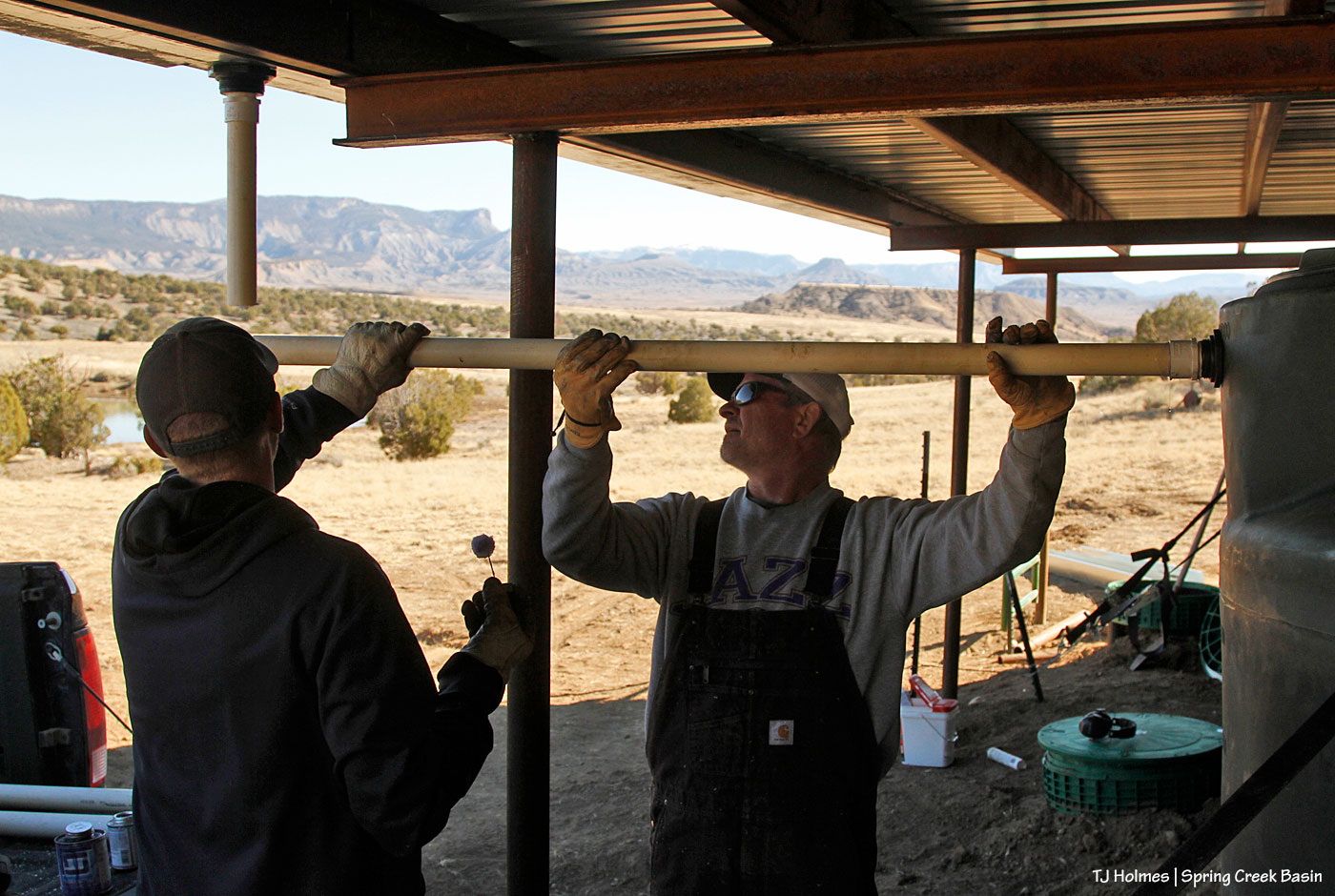
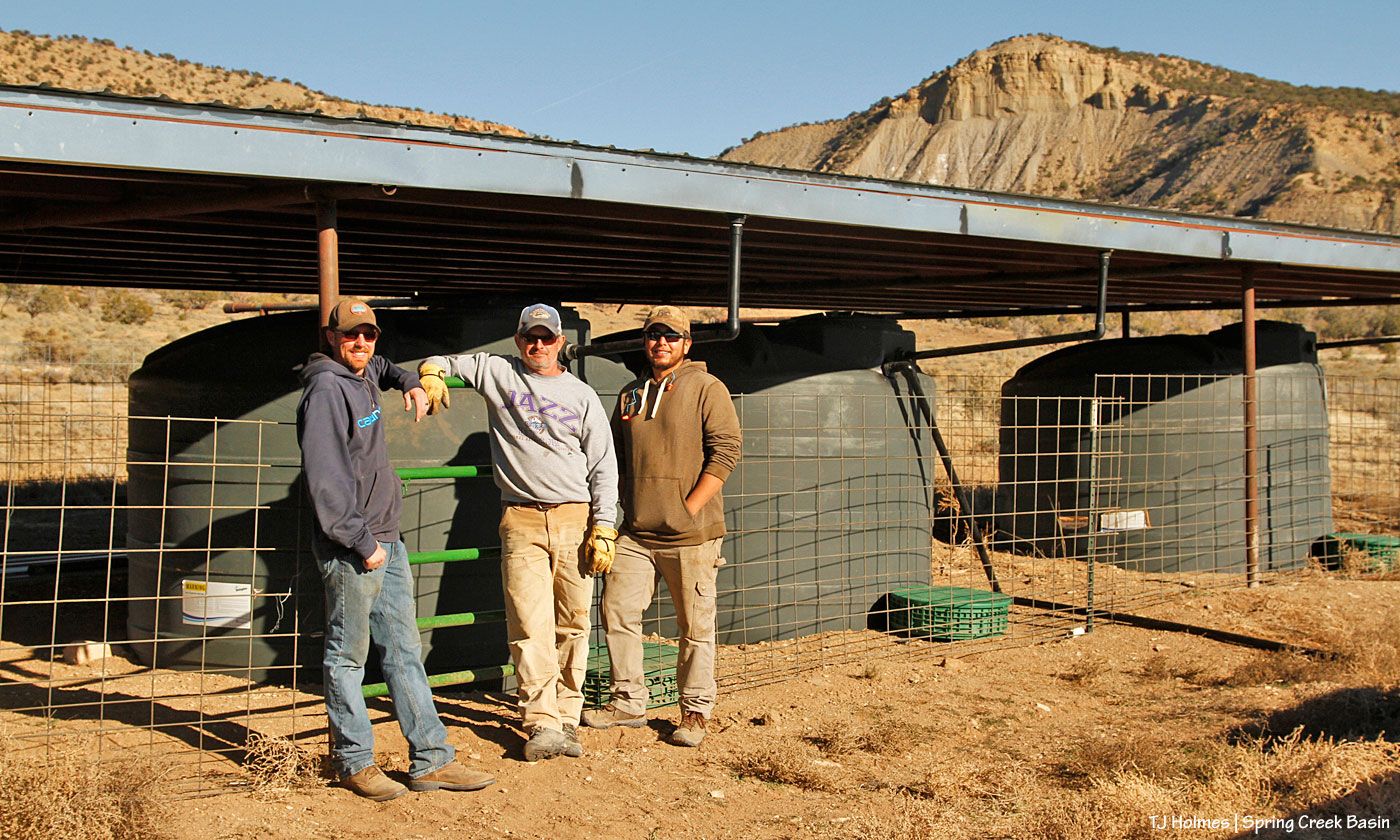
Best of all, this pic of Garth, Mike and Daniel shows some hard-working BLM guys who put a lot of thought and effort into ensuring that our mustangs have good water (quantity and quality) in Spring Creek Basin! With the addition of these two new water catchments in the last two years, our ability to store water that is clean (not salty or silty) and not subject to evaporation increases from 24,000 gallons (two 12,000-gallon tanks for each of the other two catchments) to 50,500 gallons!

This Thanksgiving weekend, especially, we are SO thankful. 🙂 Thanks to our amazing BLM partners for all they do for our mustangs!


Water catchment 2 – phase 2, day 4

21 11 2022

It’s finished!

In terms of pix and storytelling, that’s jumping the gun a bit, but I am so excited and proud of this project (as I am of all the projects we do in Spring Creek Basin for our mustangs), that it seemed appropriate to start with the best part of the news.

What follows – in this post and one more future post – are pix of the last two days of work that take this water-catchment project from nearly done to ready to catch snow and rain!

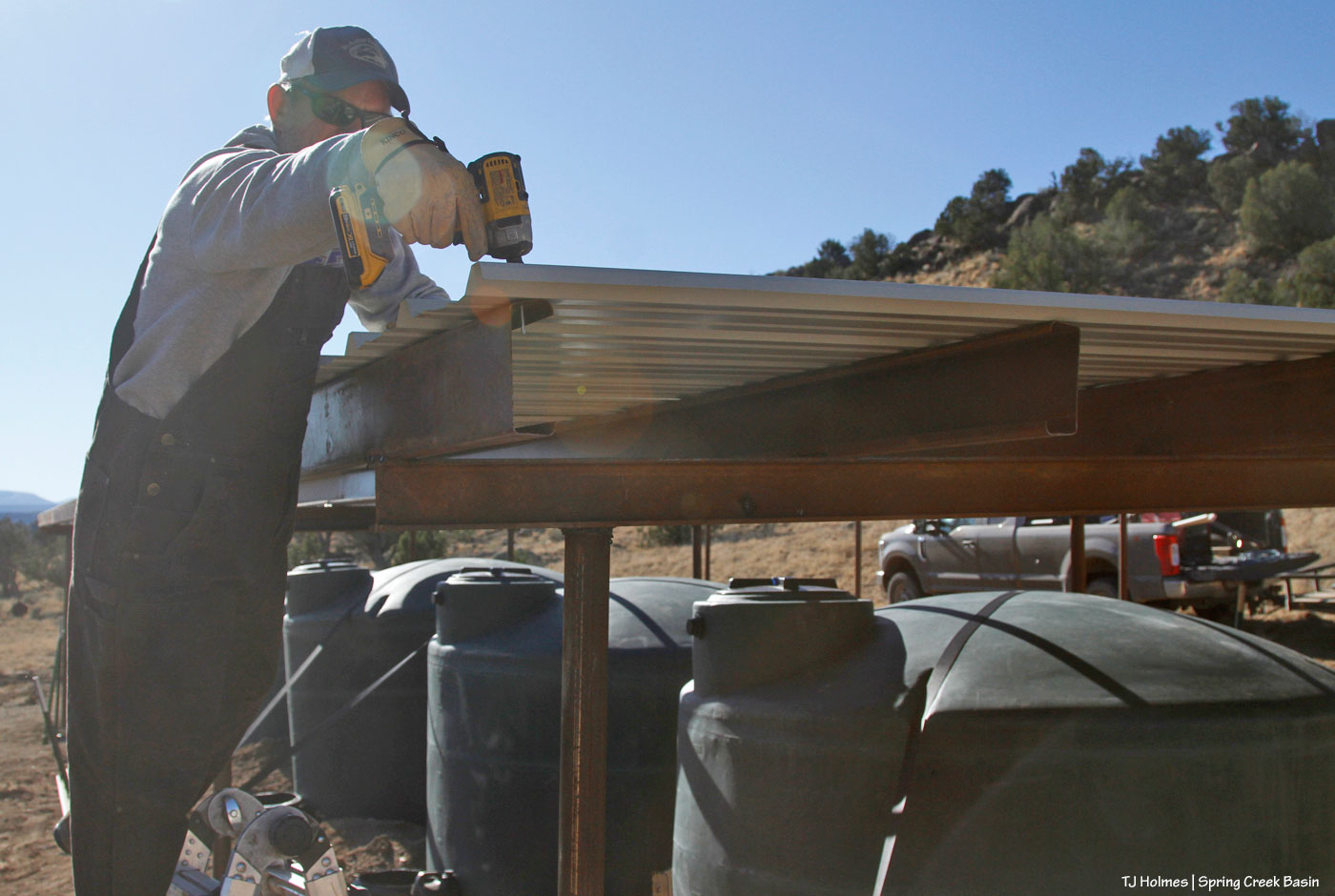
Early last week, Garth Nelson and Daniel Chavez sneaked out to the basin with the purlins needed to weld onto the I-beams and got started welding them into place. Wednesday – the day featured in these images – Mike Jensen and I joined them to start putting the propanel (metal) roof sheets into place and screwing them into place atop the purlins. Above, Mike puts the first screws in place to hold the first sheet down!

Garth and Mike align the front edges of the roof sheets – which will just overhang the gutter – and screw them into place while Daniel watches.

As the first roof sheets were laid down, Daniel and Garth returned to their partnership of setting the purlins in place and welding them to the I-beams.

Mike and I got the roof sheets up and screwed down pretty quickly and then would wait while Garth and Daniel methodically welded each purlin in place.

Mike had the yellow drill, and I had the red. … I was pretty fond of that little tool over the two days. 🙂 Note how the purlins face in different directions. Garth and Daniel did that on purpose. Because the purlins had some “bend” to them, they reasoned that alternating the directions of the purlins would increase stability. Mike and I, walking about and drilling on that roof, can attest to the stability!

The purlins met atop the I-beams, to which Daniel and Garth welded them.

As Daniel welded, Garth held his end of the purlin in place, and vice versa, as you can see a couple of pix above.

As always, the guys used their portable welder on the back of the truck. The propanel roof sheets were on the flatbed trailer, and Mike and I would lift a few of those to the roof at a time, then climb back up on the roof (using their second truck as our “ladder”) and screw them down.

Closing in on the end of the roof!

I was happy to grab photos while Mike and I waited for Garth and Daniel to weld their purlins.

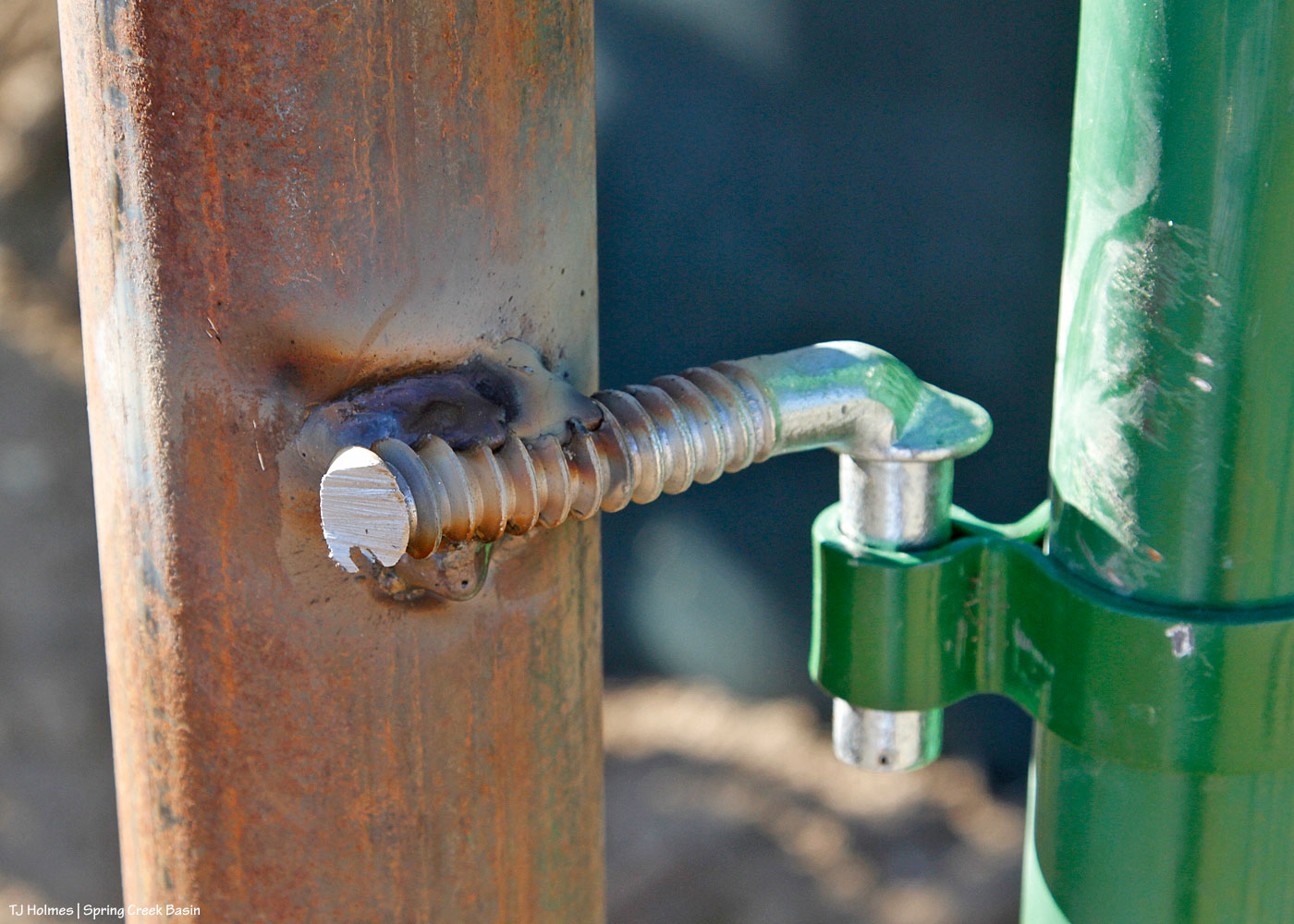
And we found ways to fill our time and stay busy. That little walk-through gate will eventually allow us to access the “interior” of the water catchment – under the roof – to do any maintenance or attend to valves at the tanks, etc. The panel “fencing” will go up later. How do you attach hinges to round steel pipe?

The welders weld the hinges to the pipe, of course!

And so the ends wouldn’t stick out to catch an unwary mustang, Mike sawed them off. 🙂 Always thinking about the horses, these guys!

This view is from up the hill, “behind” the water catchment, looking down the hill. You can juuuuust see the trough at far right behind Daniel.

And about here is where Wednesday’s work ended.

Our weather has been sunny and cold (teens) in the early mornings, followed by highs in the 40s or so – warm enough when you’re working! And among the benefits, remember: No gnats! 😉

As Paul Harvey used to say – at the end of the story – “the rest of the story” will be coming soon!


Water catchment 2 – phase 2, day 3

16 11 2022

We may not have snow, but the temps are telling us that winter is nigh! Garth Nelson and Daniel Chavez were in the basin this week, working in the cold wind to get the first batch of purlins in place and welded to the I-beams. They said they saw more vehicles in the basin the last two days than in the last year. … Have I mentioned that third rifle season here is like Grand Central Station? … Fortunately, not for much longer; it’s over half an hour after sunset Friday.

Every little bit brings the project closer to completion!