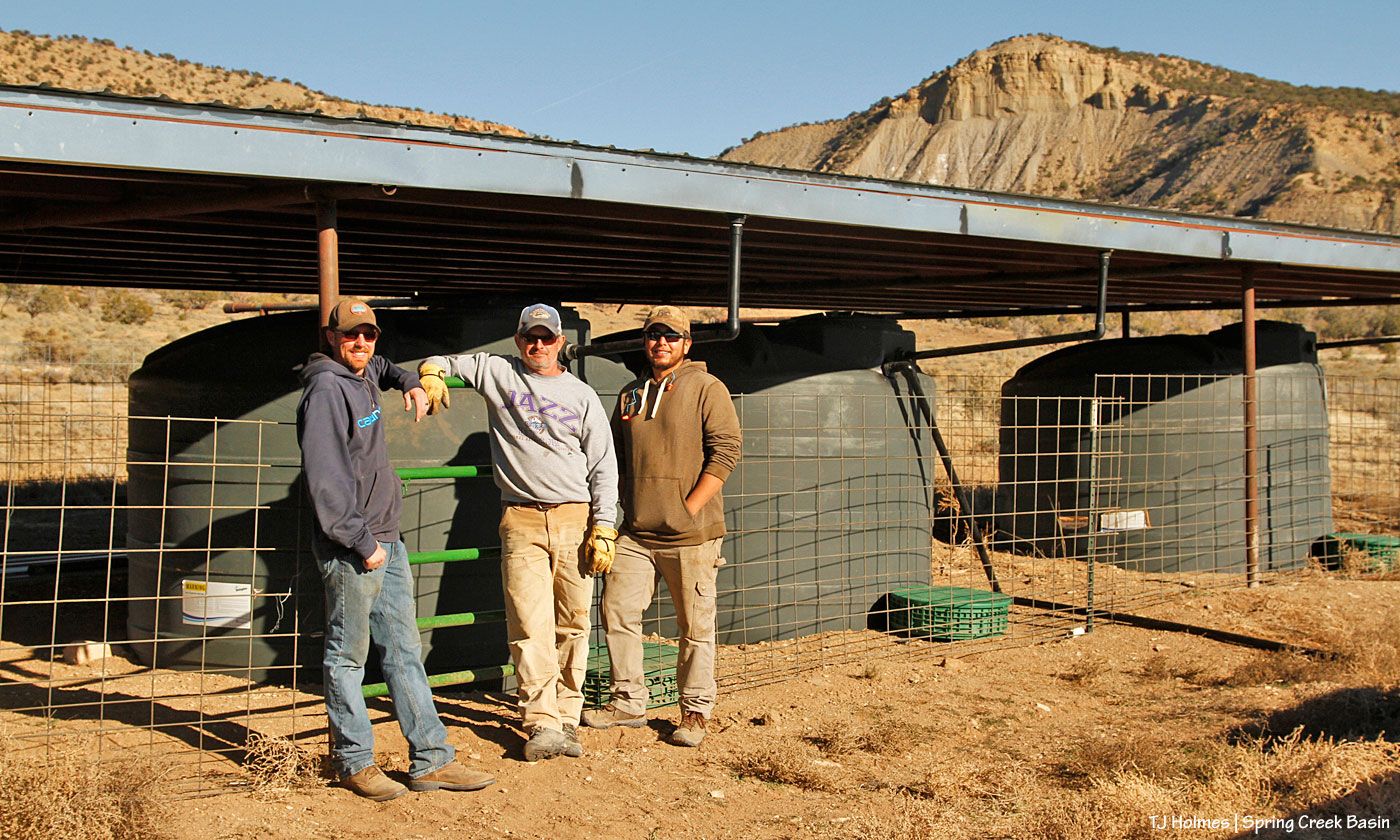
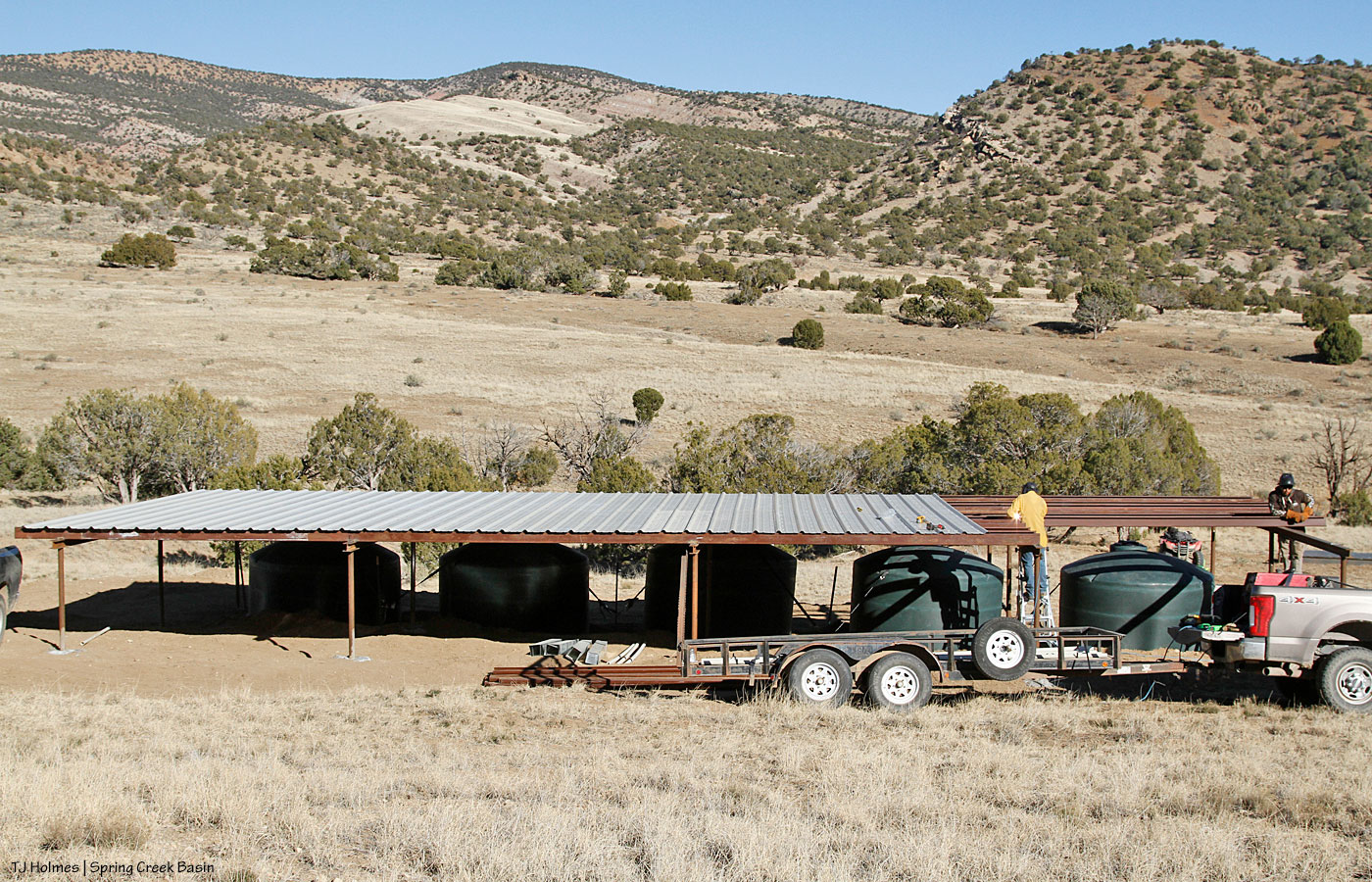
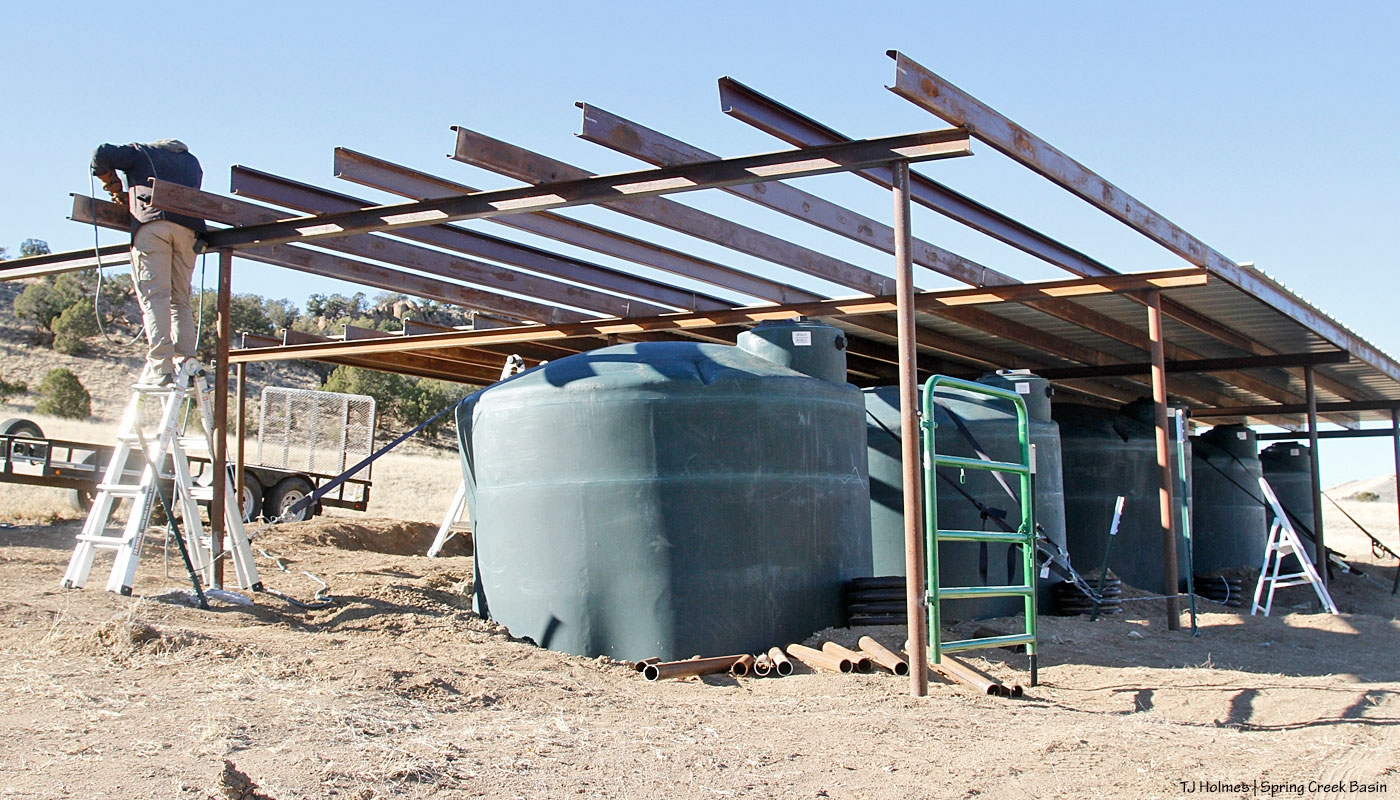
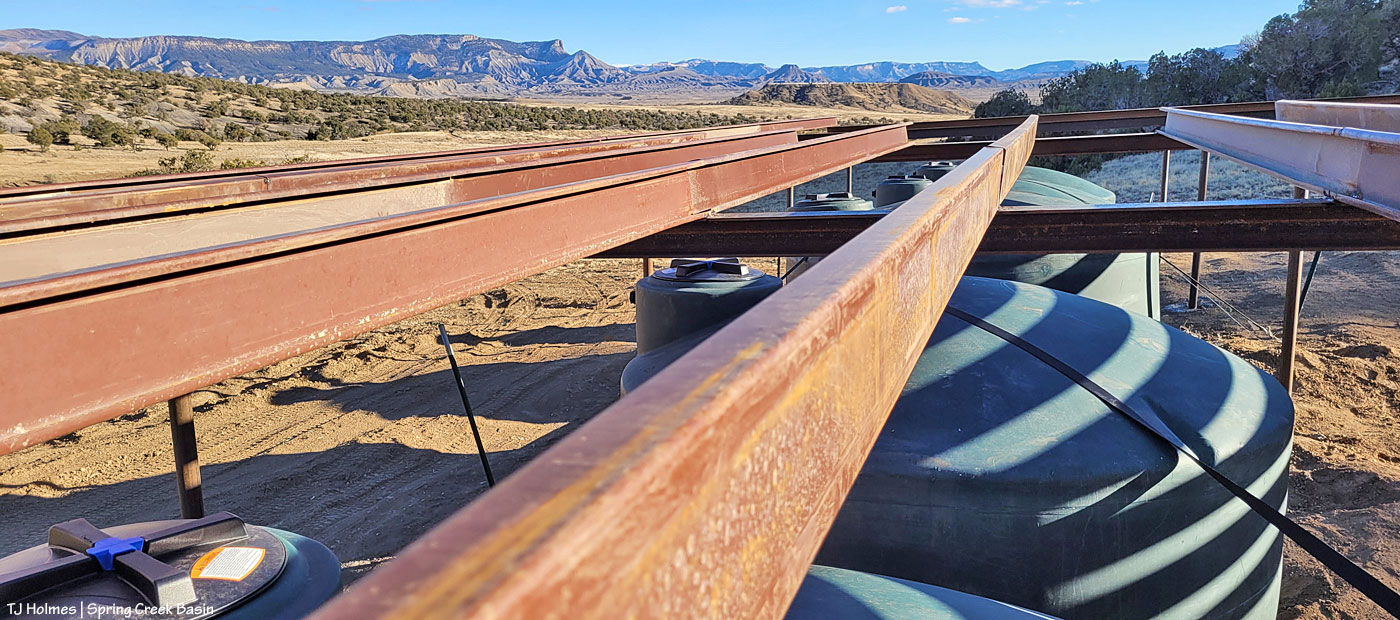
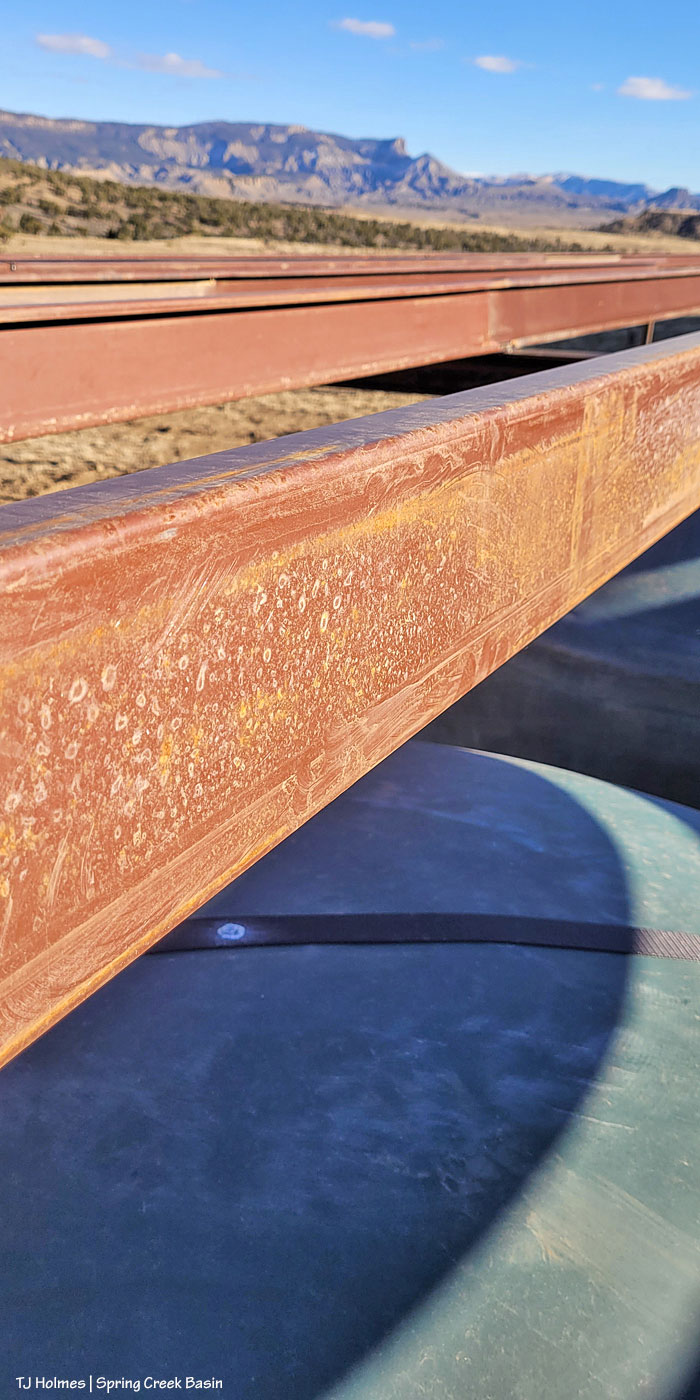
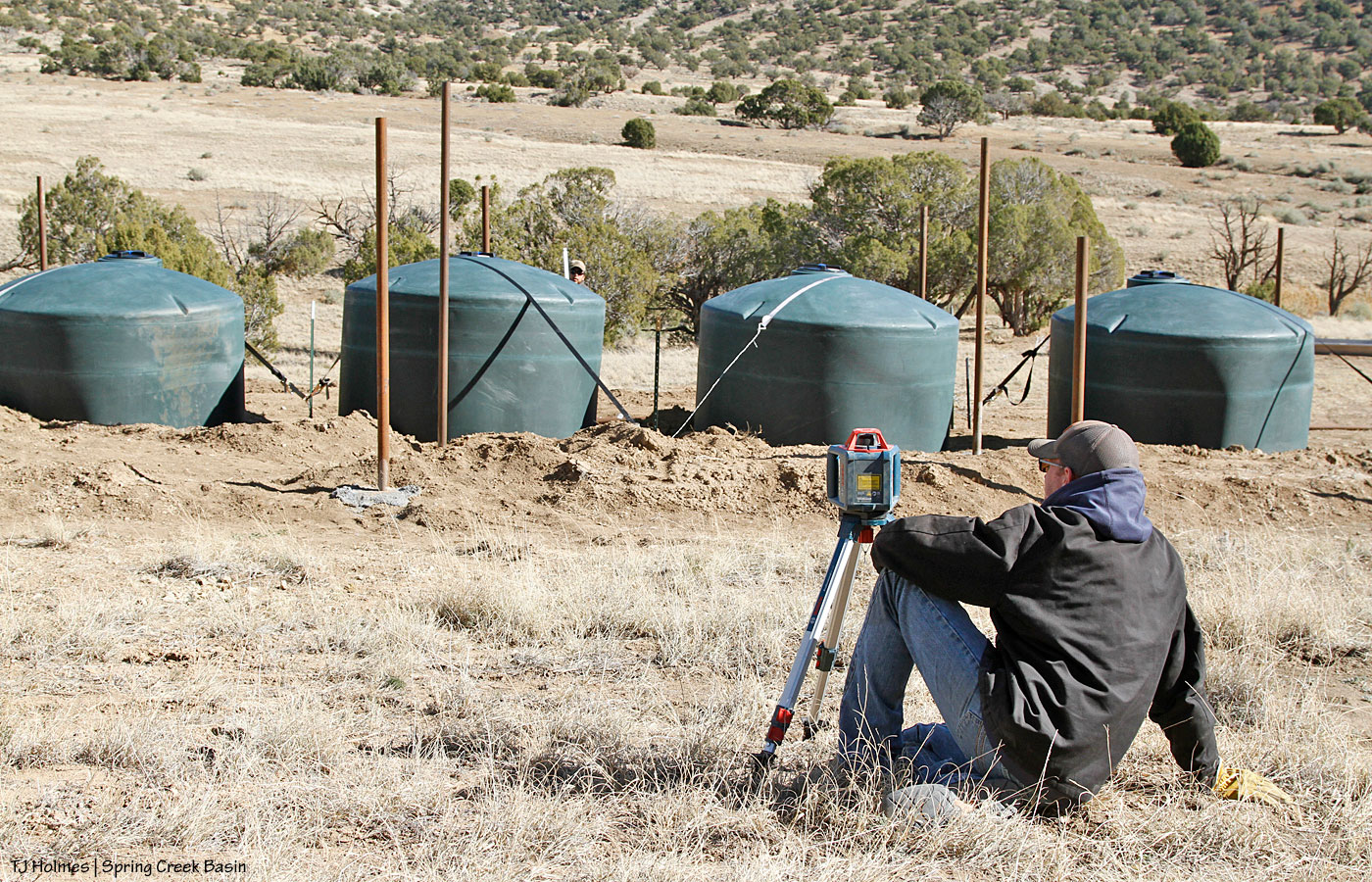
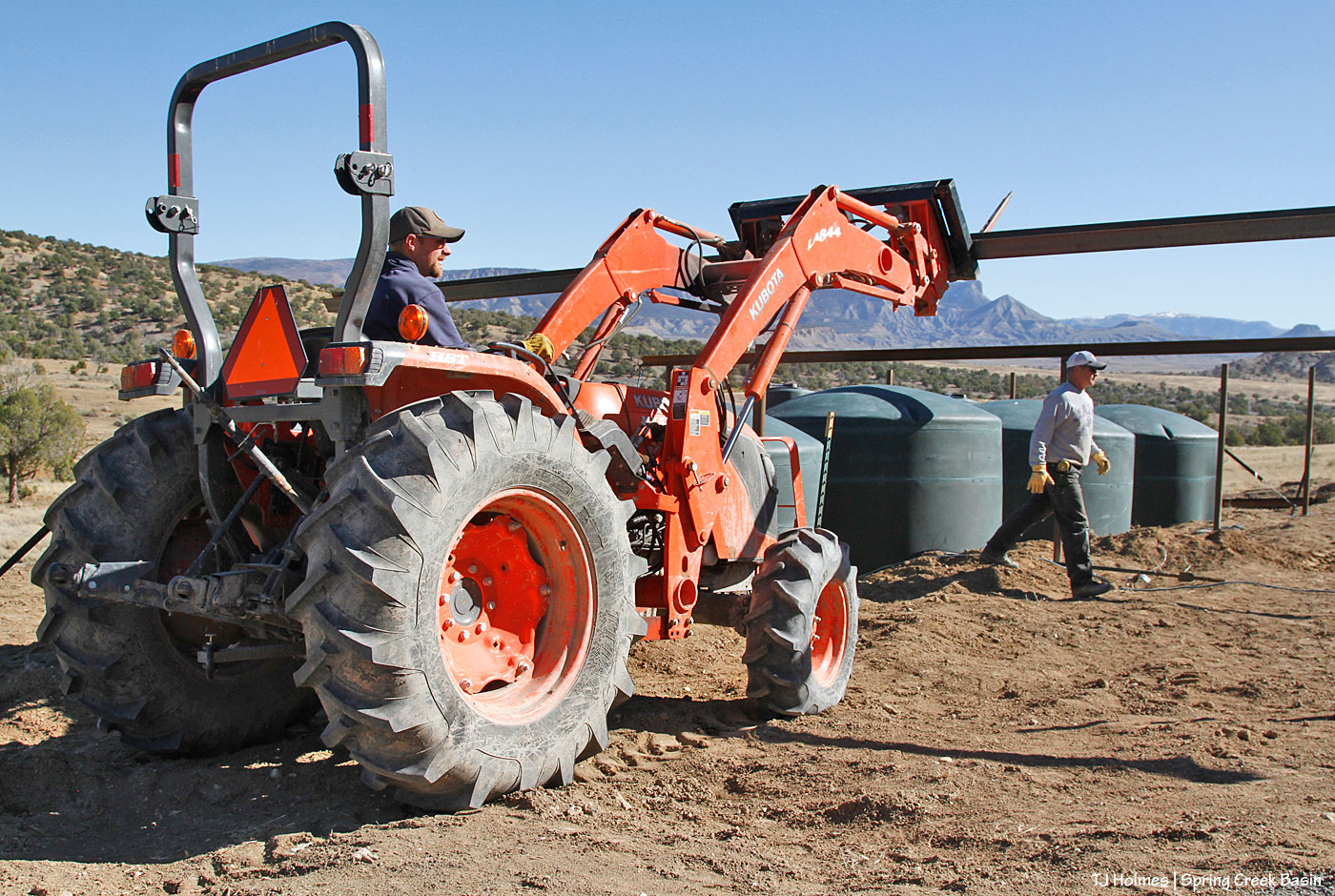
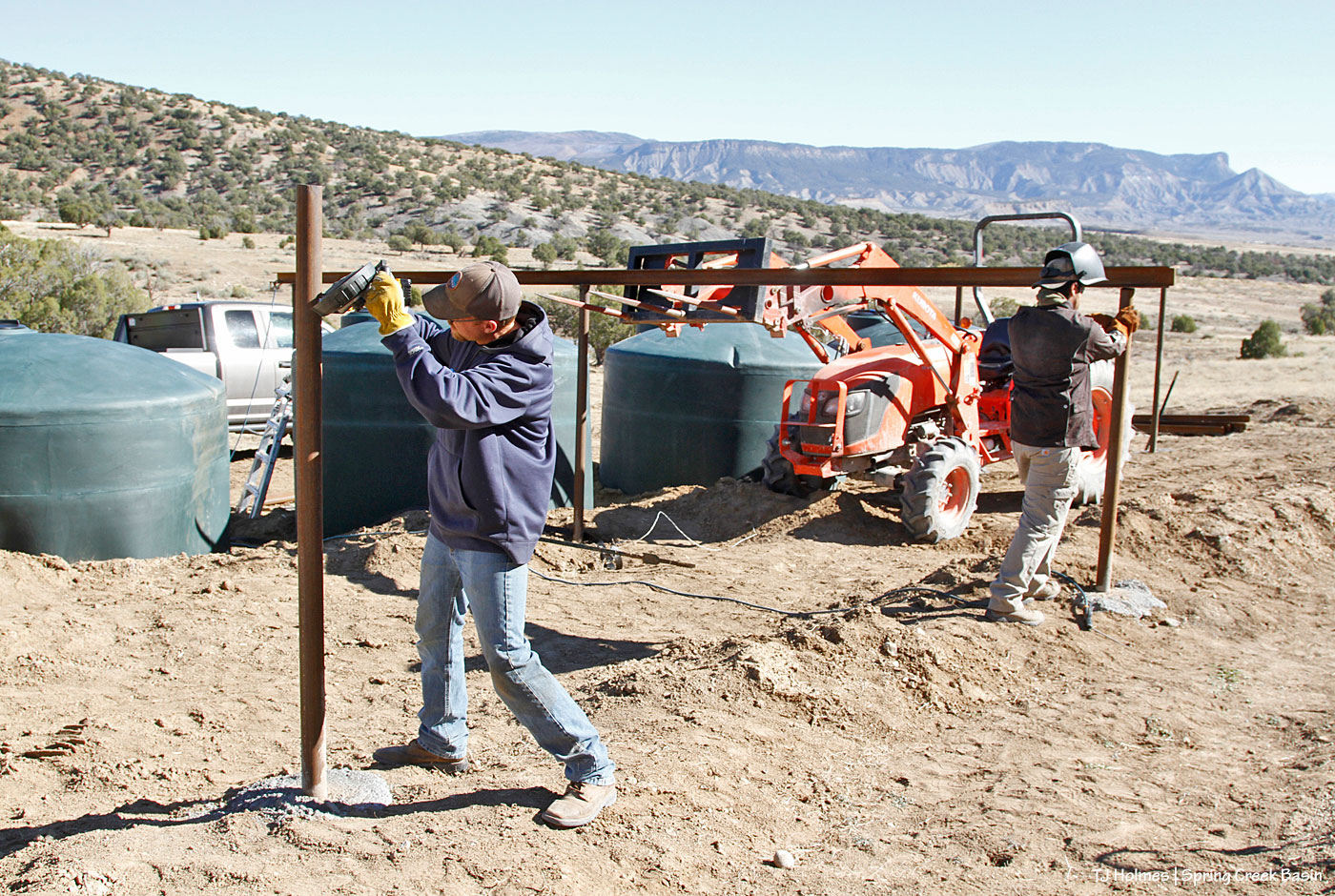
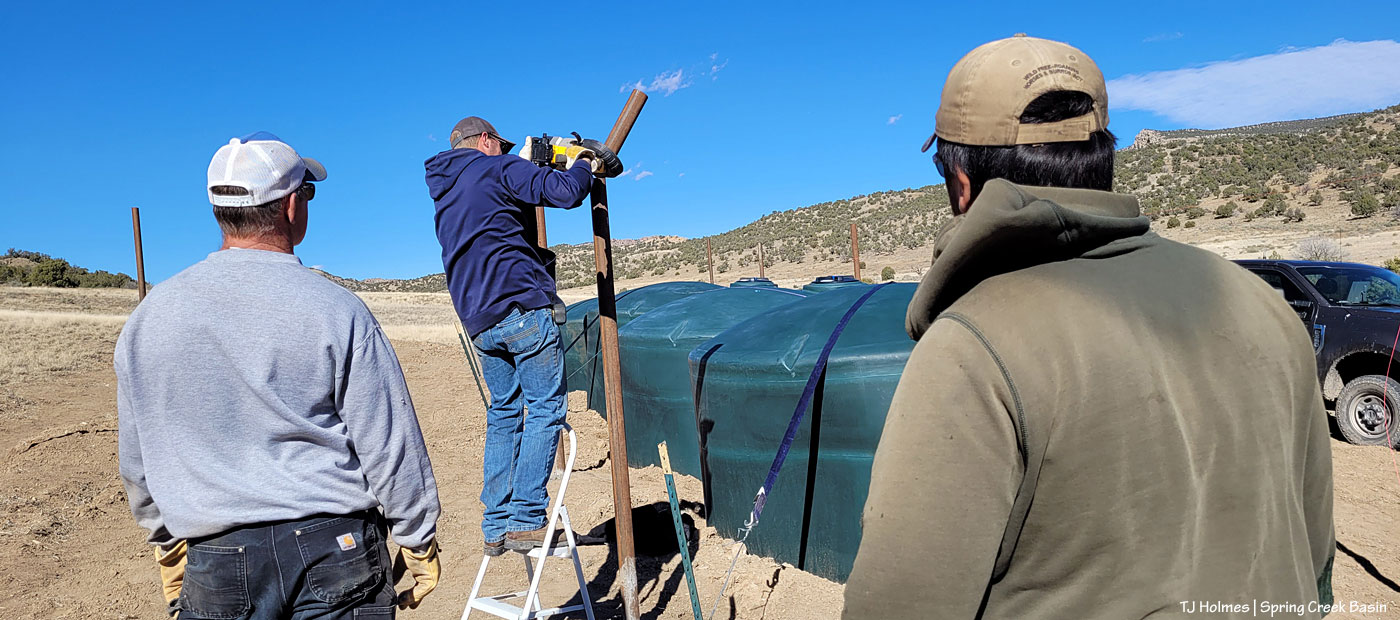
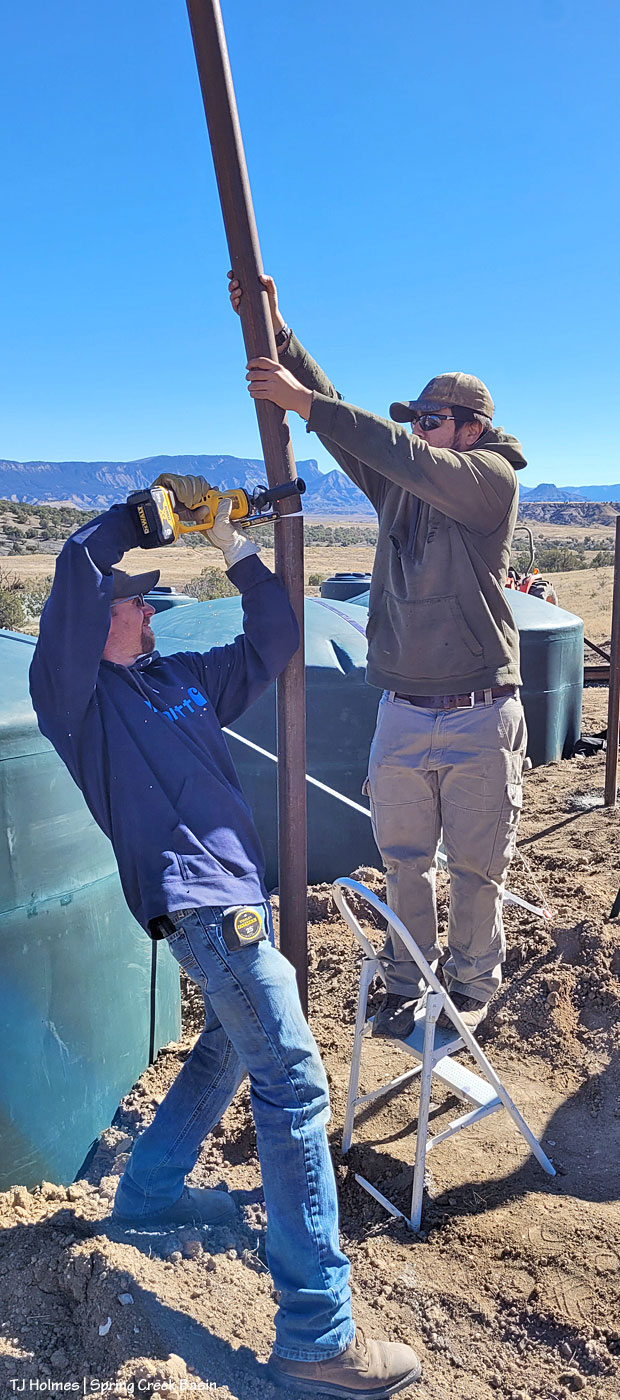
In terms of pix and storytelling, that’s jumping the gun a bit, but I am so excited and proud of this project (as I am of all the projects we do in Spring Creek Basin for our mustangs), that it seemed appropriate to start with the best part of the news.
What follows – in this post and one more future post – are pix of the last two days of work that take this water-catchment project from nearly done to ready to catch snow and rain!
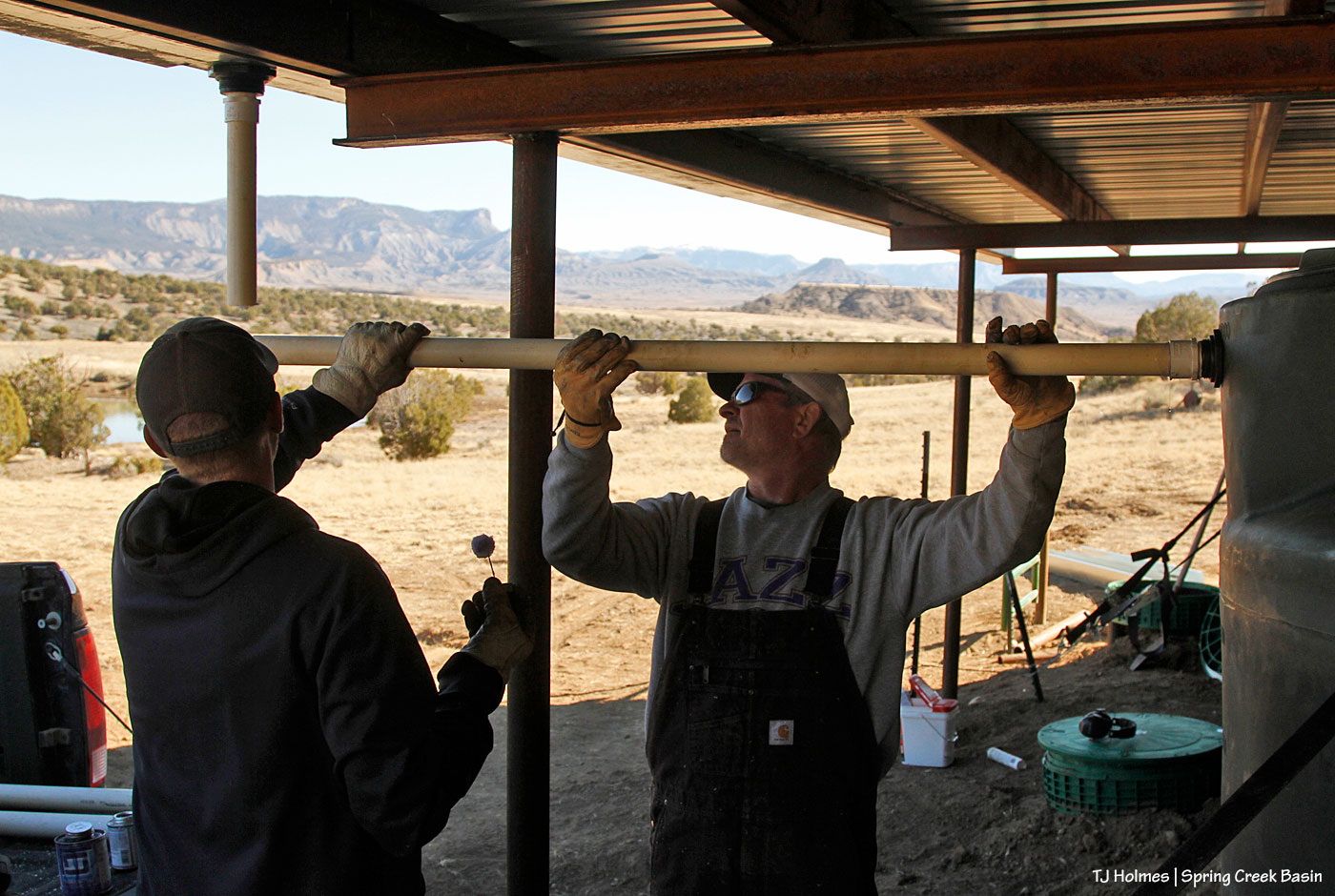
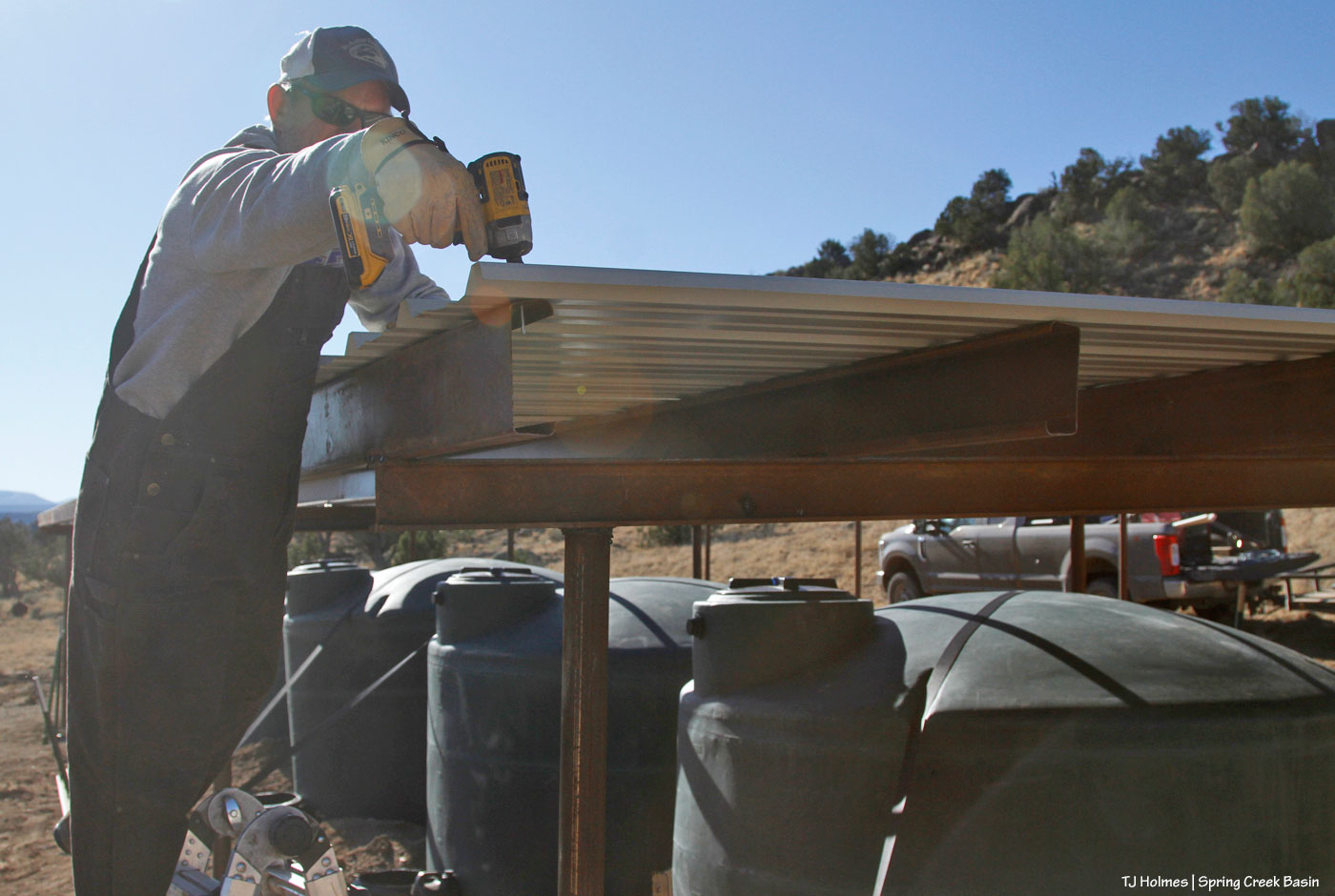
Early last week, Garth Nelson and Daniel Chavez sneaked out to the basin with the purlins needed to weld onto the I-beams and got started welding them into place. Wednesday – the day featured in these images – Mike Jensen and I joined them to start putting the propanel (metal) roof sheets into place and screwing them into place atop the purlins. Above, Mike puts the first screws in place to hold the first sheet down!
Garth and Mike align the front edges of the roof sheets – which will just overhang the gutter – and screw them into place while Daniel watches.
As the first roof sheets were laid down, Daniel and Garth returned to their partnership of setting the purlins in place and welding them to the I-beams.
Mike and I got the roof sheets up and screwed down pretty quickly and then would wait while Garth and Daniel methodically welded each purlin in place.
Mike had the yellow drill, and I had the red. … I was pretty fond of that little tool over the two days. 🙂 Note how the purlins face in different directions. Garth and Daniel did that on purpose. Because the purlins had some “bend” to them, they reasoned that alternating the directions of the purlins would increase stability. Mike and I, walking about and drilling on that roof, can attest to the stability!
The purlins met atop the I-beams, to which Daniel and Garth welded them.
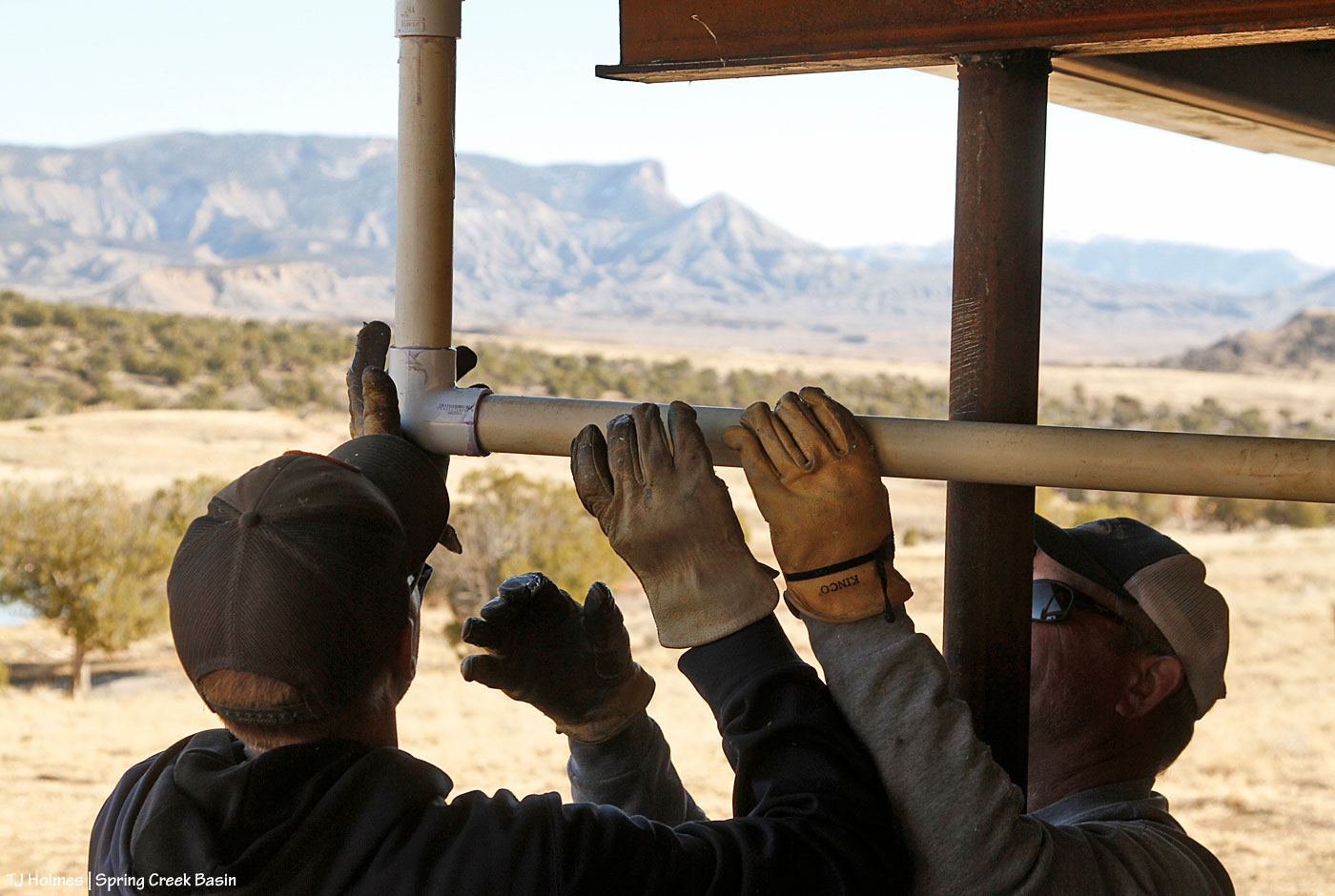
As Daniel welded, Garth held his end of the purlin in place, and vice versa, as you can see a couple of pix above.
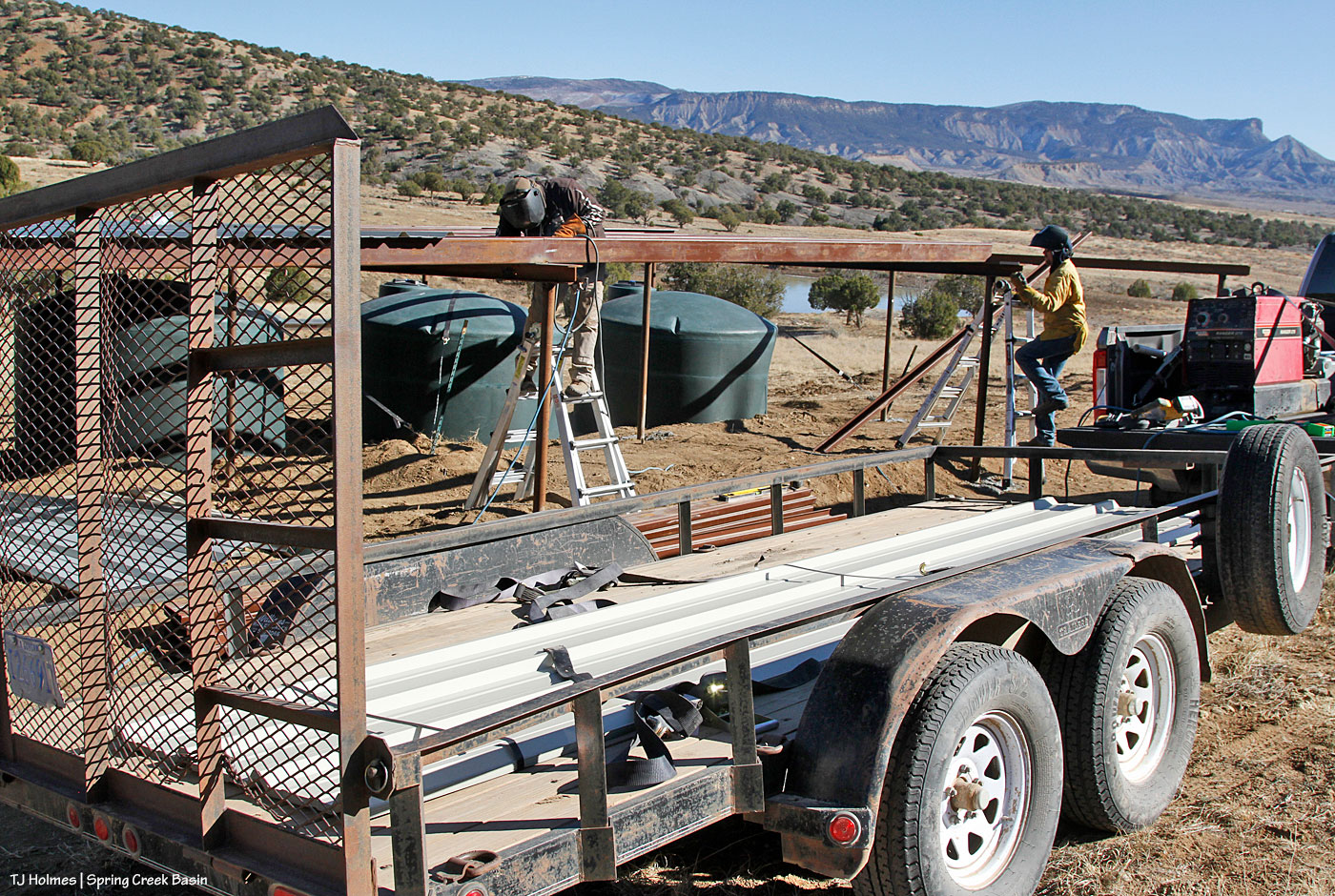
As always, the guys used their portable welder on the back of the truck. The propanel roof sheets were on the flatbed trailer, and Mike and I would lift a few of those to the roof at a time, then climb back up on the roof (using their second truck as our “ladder”) and screw them down.
Closing in on the end of the roof!
I was happy to grab photos while Mike and I waited for Garth and Daniel to weld their purlins.
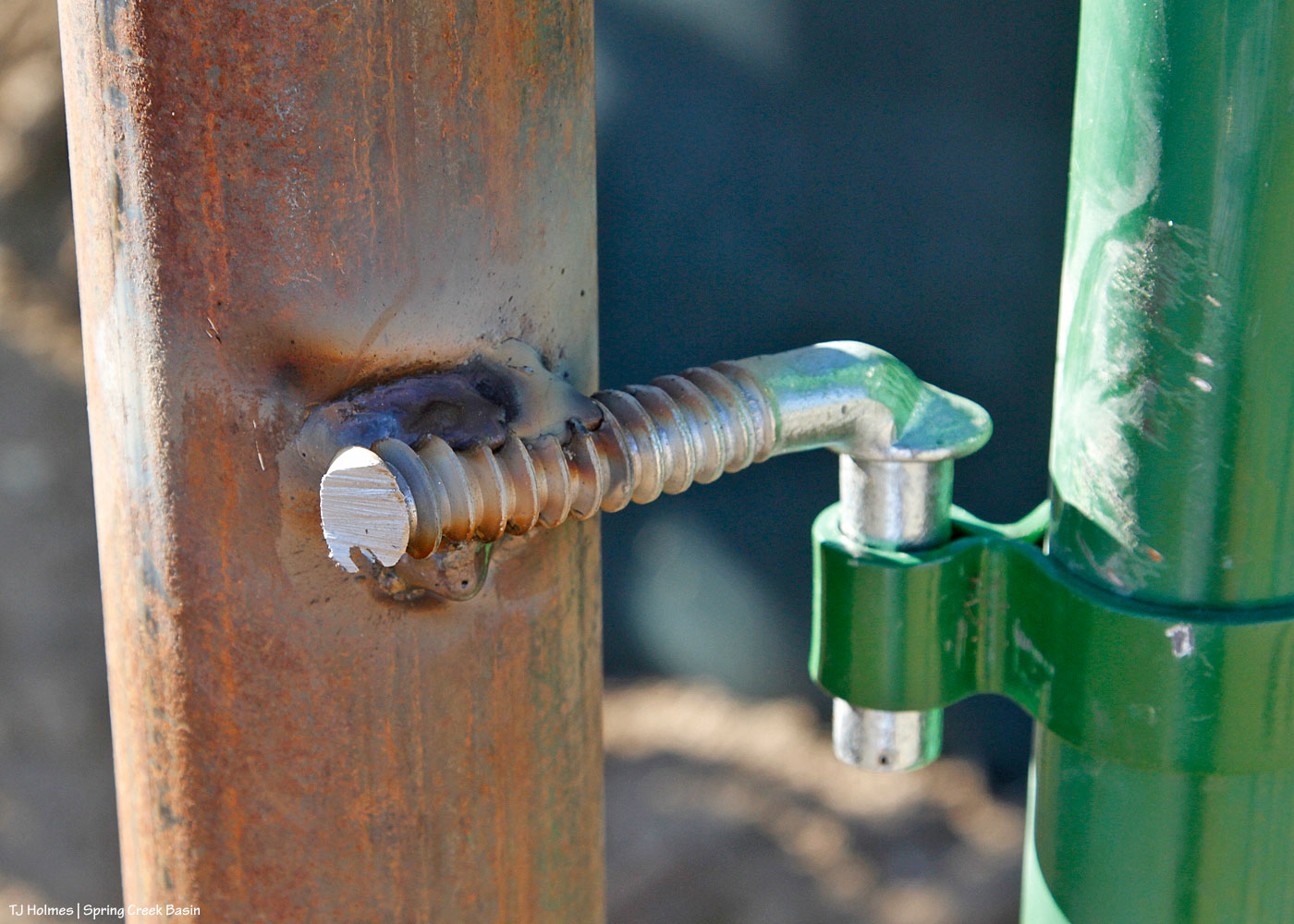
And we found ways to fill our time and stay busy. That little walk-through gate will eventually allow us to access the “interior” of the water catchment – under the roof – to do any maintenance or attend to valves at the tanks, etc. The panel “fencing” will go up later. How do you attach hinges to round steel pipe?
The welders weld the hinges to the pipe, of course!
And so the ends wouldn’t stick out to catch an unwary mustang, Mike sawed them off. 🙂 Always thinking about the horses, these guys!
This view is from up the hill, “behind” the water catchment, looking down the hill. You can juuuuust see the trough at far right behind Daniel.
And about here is where Wednesday’s work ended.
Our weather has been sunny and cold (teens) in the early mornings, followed by highs in the 40s or so – warm enough when you’re working! And among the benefits, remember: No gnats! 😉
As Paul Harvey used to say – at the end of the story – “the rest of the story” will be coming soon!
We may not have snow, but the temps are telling us that winter is nigh! Garth Nelson and Daniel Chavez were in the basin this week, working in the cold wind to get the first batch of purlins in place and welded to the I-beams. They said they saw more vehicles in the basin the last two days than in the last year. … Have I mentioned that third rifle season here is like Grand Central Station? … Fortunately, not for much longer; it’s over half an hour after sunset Friday.
Every little bit brings the project closer to completion!
As promised a few days ago, here are some more pix of the work on the newest water catchment in Spring Creek Basin. 🙂
You won’t ever catch our BLM guys sitting down on the job! As I mentioned in the last post about the project, the guys started by setting up the laser level to mark the heights of the steel pipes that will hold the I-beams, which will support the purlins, which will be topped by the roof, which will catch the rain and snow to fill the tanks to water the mustangs! So here, Garth Nelson is setting the laser in a place where it will be high enough to shoot over the tops of the tanks so the pipes can all be marked. Not sitting down so much as getting the eyeball view!
While Garth set up the laser level, Daniel Chavez held the little doohickey that caught the laser at the right height at all the pipes and marked the appropriate levels.
Measure many times and many ways before the final cut, goes the saying? Garth and Mike Jensen also ran string lines to ensure the levels.
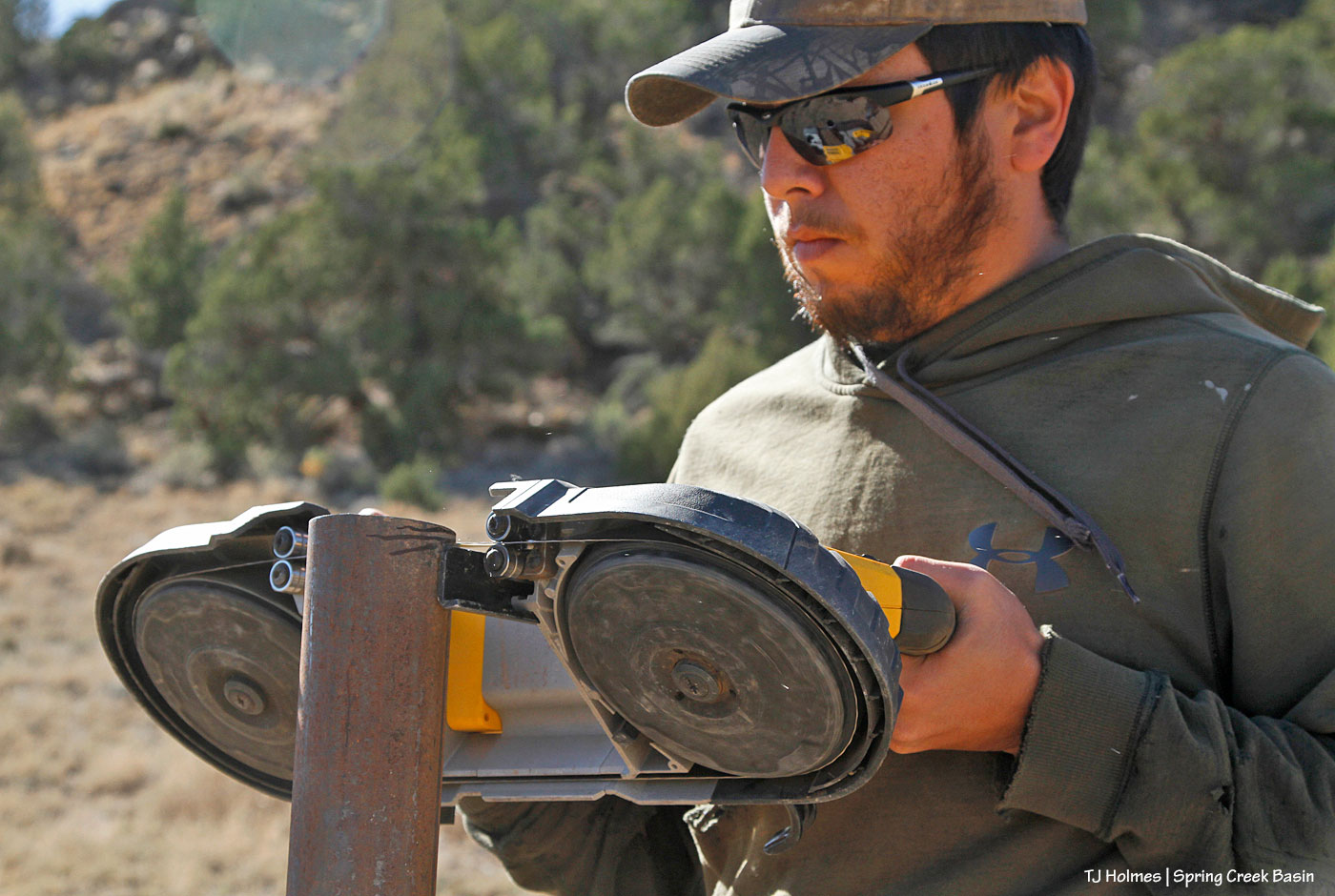
Most of the pipes required a fair bit to be cut off, but this one needed just a little sliver. … It also was the pipe that started to alert the guys that something was amiss with the blade(s) on their nifty little saw – and this pic of Daniel using it gives a little better glimpse of that tool.
For those of you interested in such things, here’s another angle of one of the guys’ favorite tools. The “blade” is a band that goes around those black wheels on the underside of the tool. Usually, it saws through heavy “stem pipe” almost like a hot knife through butter (a bit slower, but steel is, after all, steel!), but the first couple-few blades they tried – brand new out of the package – were just dulling the teeth on the blades within minutes. NOT working. That’s what led to the double-tool whammy of using the grinder tool as well as this tool – and then finding the blade that worked, which worked for all the rest of the pipes.
Using the tractor to carry the heavy I-beams to set atop the pipes.
While Daniel got started welding the first I-beam to the pipes in the middle of the catchment structure, Garth finished cutting the pipes to height/length.
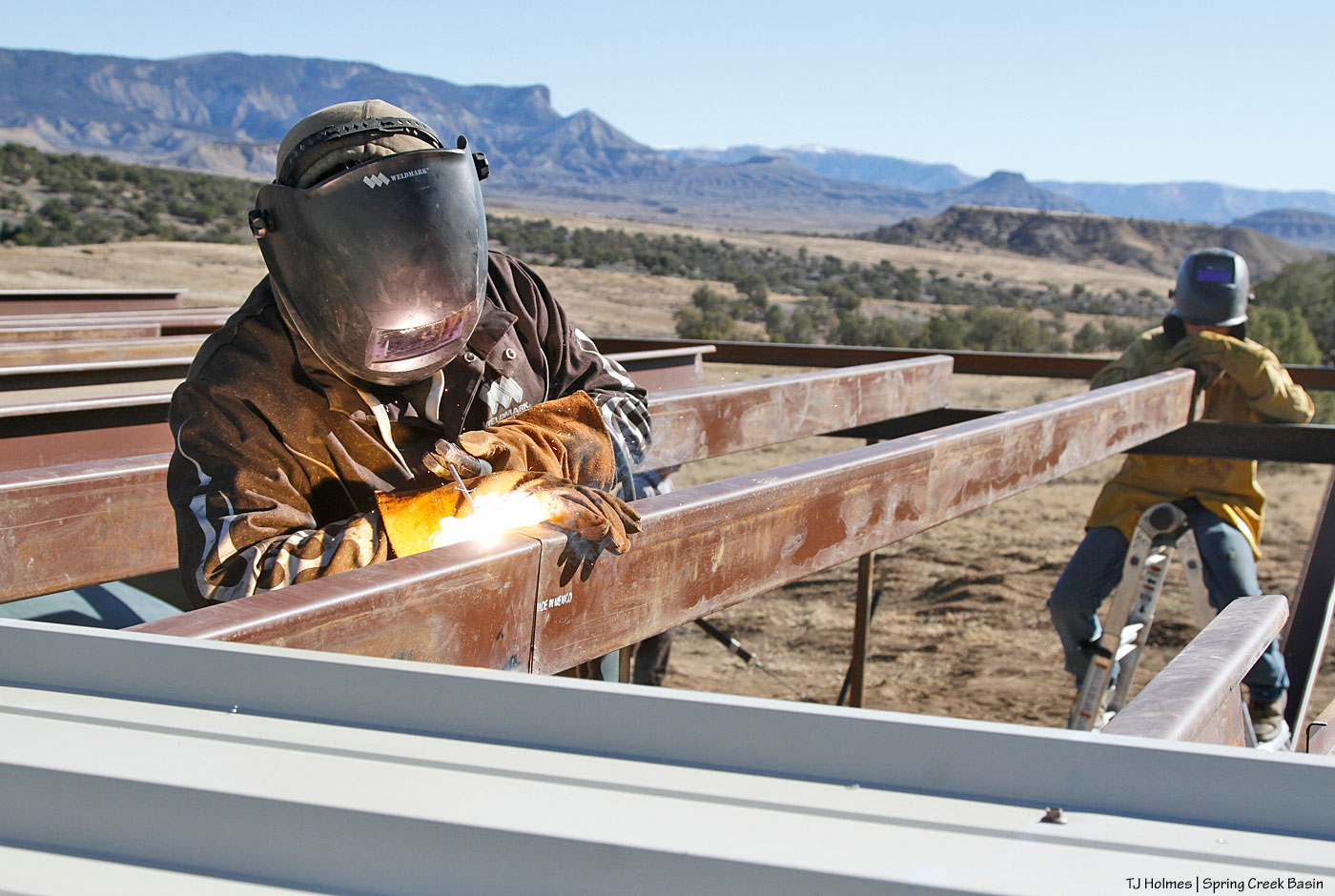
The welding process fascinates me …!
The A-team!
Sparks flying – another good reason to wait till cooler weather for the completion of the project. 🙂
Garth holds the I-beam steady and level while Daniel makes the first weld to hold it in place.
Garth finished the welding on the last beam.
Working in Spring Creek Basin does have the perks of fabulous scenery. 🙂
Next up should be welding the purlins atop the I-beams!
Work resumed this week on the water catchment in Spring Creek Basin’s northwest valley. We were ahead of the snow that came Wednesday, and although we had an absolutely beautiful day, it was windy. We joked that Wyomingites would consider it merely *breezy*. We did gratefully note that there were no gnats. 😉 By Wednesday (and even Tuesday afternoon as we left the basin), I thought maybe we shouldn’t have joked about the wind, as it got *really* strong. … But … no gnats. There’s always a silver lining!
Once we got out to the site, the guys used the laser level to start measuring the heights of the steel pipes to ensure they would level length-wise (across the hill) and sloping width-wise (down the hill). We all converged to mark them by laser level, string and tape-measure methods at the appropriate heights, then Daniel Chavez (front right) and Garth Nelson (on the step stool) started cutting while Mike Jensen (left) and I stood by to help. … But shortly, they realized there was a problem with the nifty cutting tool that Garth is using in the pic above: The blade wasn’t really getting the job done. And I’ll be the first to tell you that THAT tool is one of their favorite tools for the *usual* ease with which it cuts through that heavy steel pipe.
One of the greatest things about Spring Creek Basin is, of course, its distance off the beaten path. But that also makes it a far distance from things such as, say, shops that sell tools – including new/sharp saw blades that don’t go dull within moments!
But our guys are as resilient as they are creative and engineering-minded and hard working! One of the other tools they had was a grinder-type of thing. While it wasn’t quite the tool for the job, they did have a cutting disc that could slice into the pipes, to be followed by the bigger saw. So they did that for several pipes … changing blades on the bigger saw a few times. Then, finally, the last blade was the ticket. Garth still cut into each pipe at the appropriate mark, and Daniel finished them off.
Here, they worked together: Daniel had gotten most of the way through one of the pipes, and Garth returned with the grinder tool to get through the last little bit … and then …
Look out below!
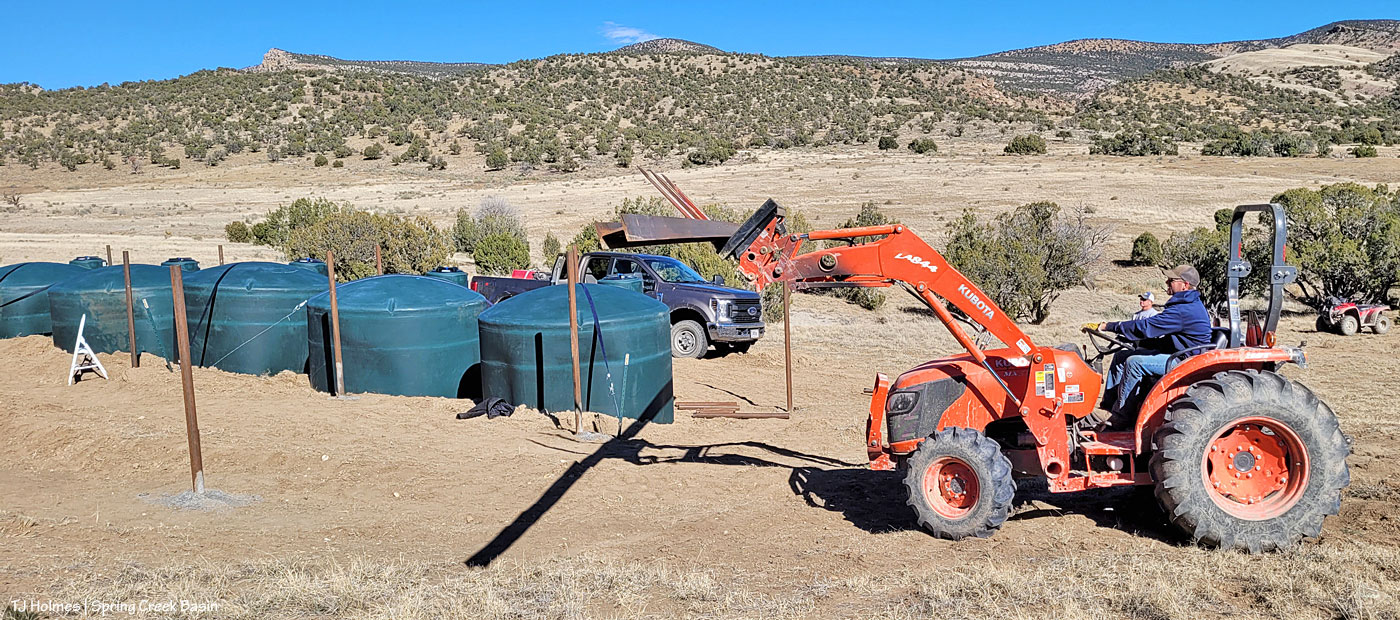
When all the pipes were cut to the right length/height, it was time to bring in the little orange muscle – the tractor! Last year, you’ll remember that the guys welded the purlins to the pipes, then screwed down the roof sheets onto those. This time, they brought out five I-beams. Those are the step between the pipes and the purlins the guys added to this year’s project. The I-beams will give them a wider and steadier base on which to set/weld the purlins in the near future. But those suckers are much heavier than the purlins, so some mechanized muscle was needed.
The first beam went to the middle, then we worked outward from either end.
With the beam supported by the tractor, the guys were able to get the beam(s) in place atop the pipes. Then it was just a matter of shoving (!) the beams forward to the mark(s) Mike and I made so each had an overhang of a foot from the front pipes. Along the front of the tanks, just below the roof – soon – we’ll run the gutter.
Once the beams were in place atop the pipes, and the level and slope checked, Daniel welded them in place.
Daniel did most of the welding, but he had to leave early, so Garth donned the welding gear and finished the job. (How great is it to have not one handy welder but two!)
The day’s work started with some camera issues (in addition to those tool issues mentioned above), so I used my phone … then (fortunately) checked my camera again and noticed and corrected a couple of settings. The above are all from my phone (which did a respectable job!). I’ll process some of those camera pix to post soon – just because I love to highlight the good work our BLM guys do in support of our mustangs!
In the meantime …
From last week’s work ^ – note the pipes …
… to this week’s progress ^ – note the beams atop the pipes!
Well, we outlasted the summer heat, the gnats, the dust, the wind, the dust, the gnats, the heat, the dust (you get the picture), and it’s time to finish our second new water-catchment project for our mustangs of Spring Creek Basin!
Last week, after waiting out the drying roads and before the next round of moisture (soaking rain and big, fat flakes of snow that didn’t stick but added to the moisture), Mike Jensen, Garth Nelson and Daniel Chavez – our BLM range heroes! – came out with tools and supplies, and we got started on phase 2 to get the catchment finalized to take advantage of hoped-for winter snow.
If you need a quick refresher about our work to install the tanks and piping and trough, click on June 2022 over on the right under Archives, then scroll down to find the posts about that work.
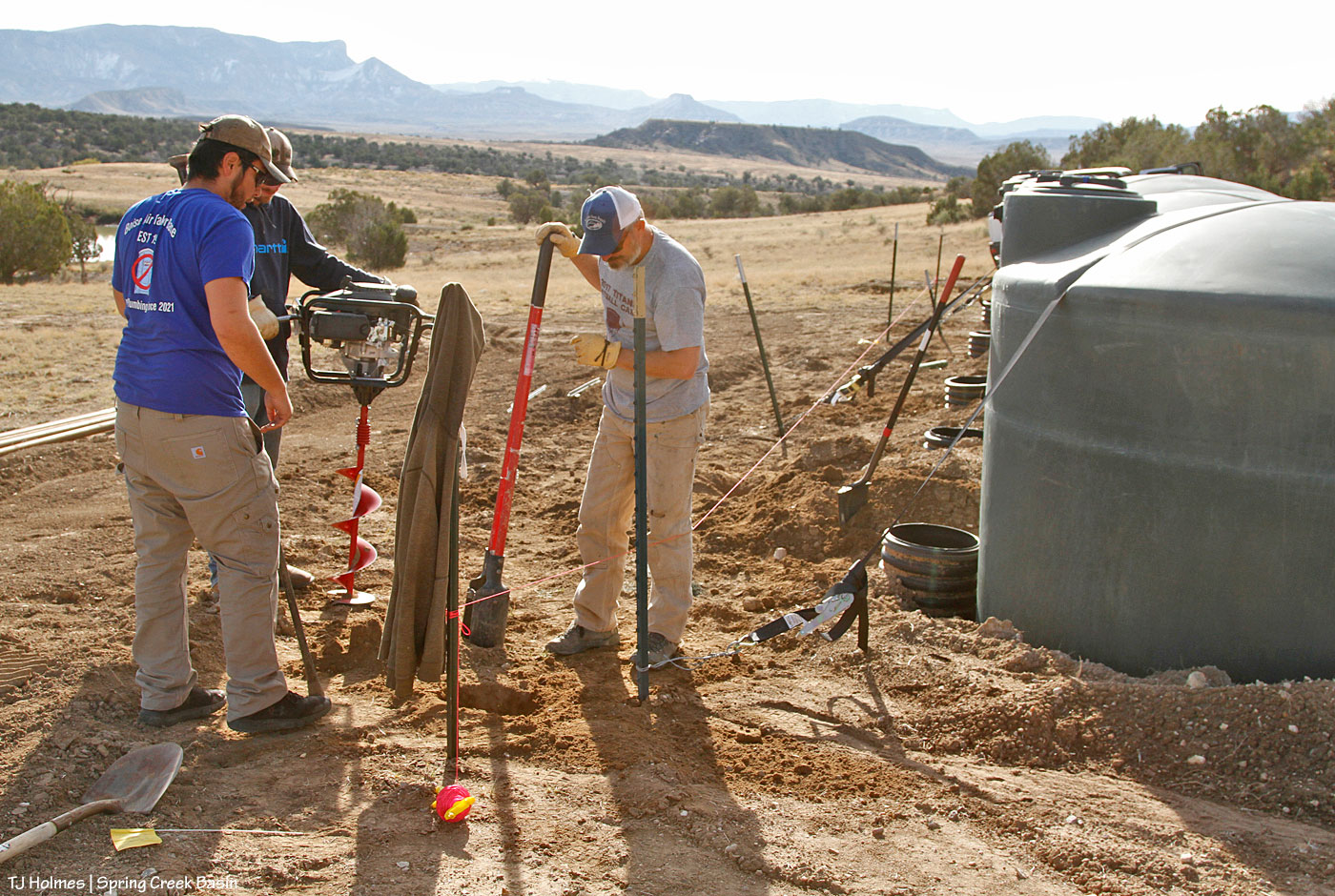
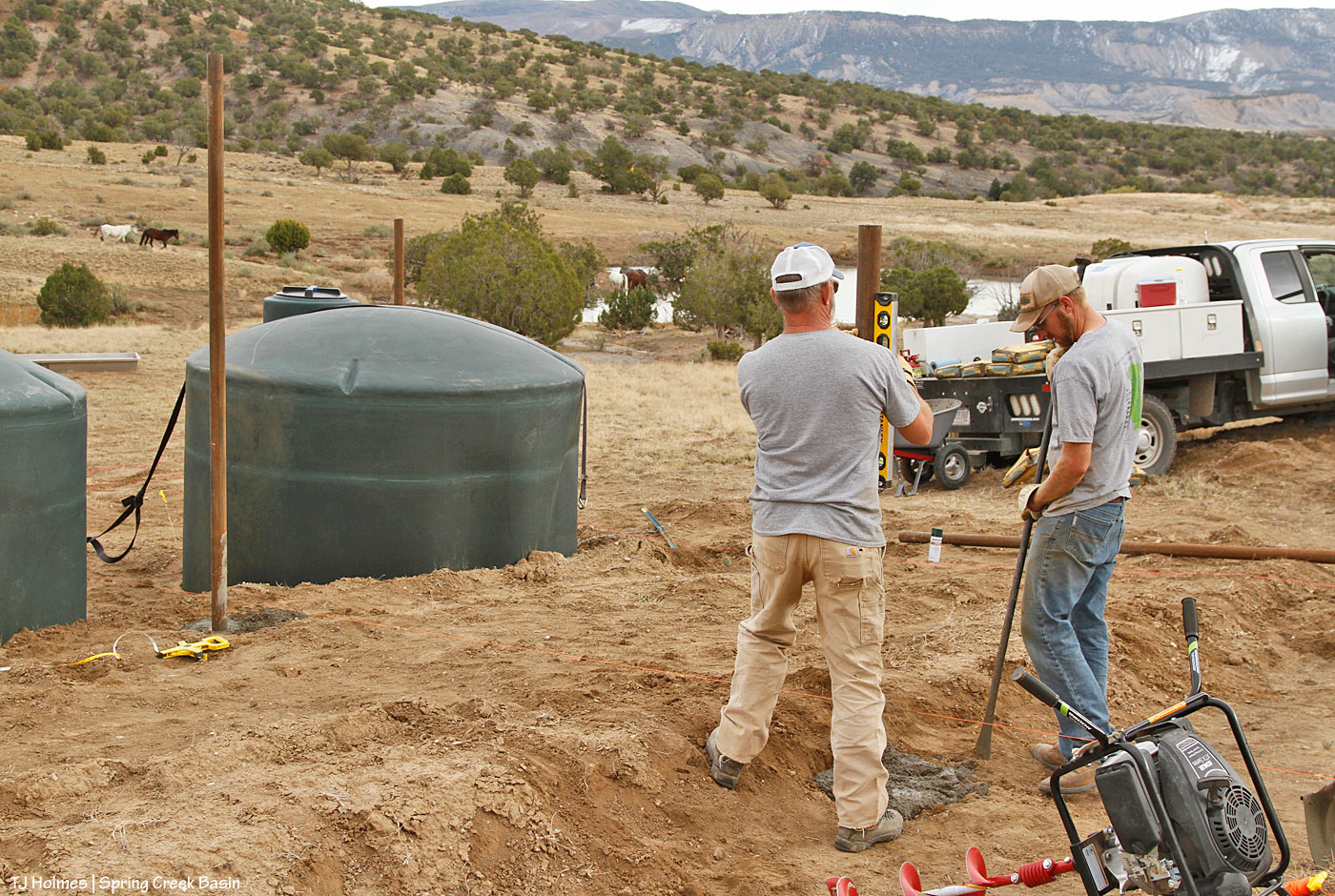
It all starts with the first post (pipe) hole! Well, it really all starts with running a string (see the pink line across the tanks?) to dig the holes so the line of steel pipes – to support the roof structure – will be in a straight line. Garth (left) and Daniel are on the gas-powered augur (what a difference that makes to digging holes! especially as many as this project requires), and Mike supervises. He would later do the lion’s share of work with the post-hole digger (far left) and tamp bar when the augur wasn’t quite enough to break through the calcium layer of soil.
Moving right along. You can see by their bodies that Garth and Daniel are putting their weight and strength over the augur to dig deep into the soil.
This was the last hole across the front line of the tanks.
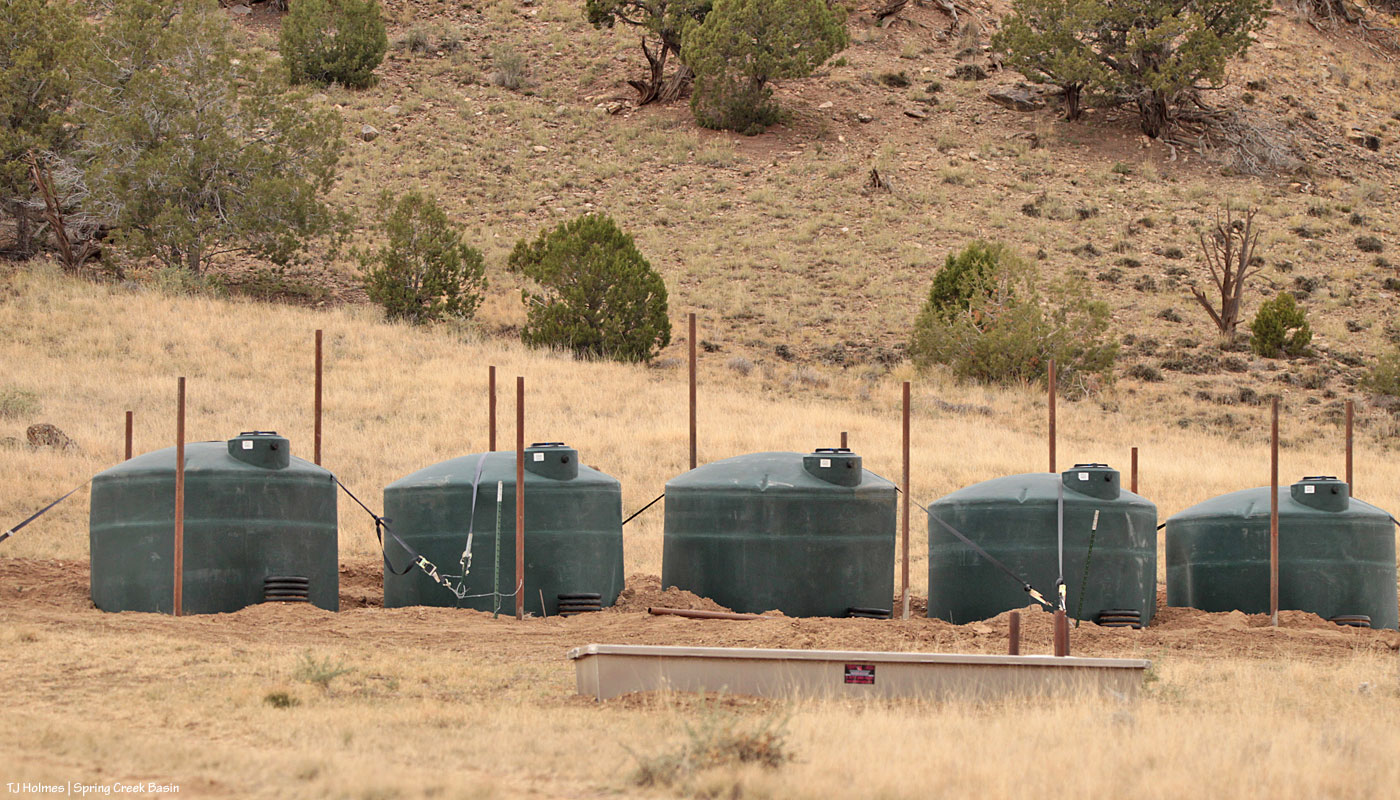
Have you noticed the black straps over the tops of the tanks? As you might remember, we had another good monsoon year (heck, we HAD monsoons again this year after *not* for a few years). After the tanks were in the ground (in June) – piped together at the bottom, the dirt covered back over – at least one of those big rains poured off the hill behind and above the tanks and ran across the not-so-settled dirt around them … and sort of UPROOTED at least two of the tanks – and broke at least one pipe connection! The BLM guys had to come back and fix that little issue (no pix of that because the designated photographer/documenter (that’s me) was on vacation in Wyoming at the time). The straps over the tanks – snugged to T-posts driven into the ground – were to hold them in place in case of another gully washer – which seems to have worked.
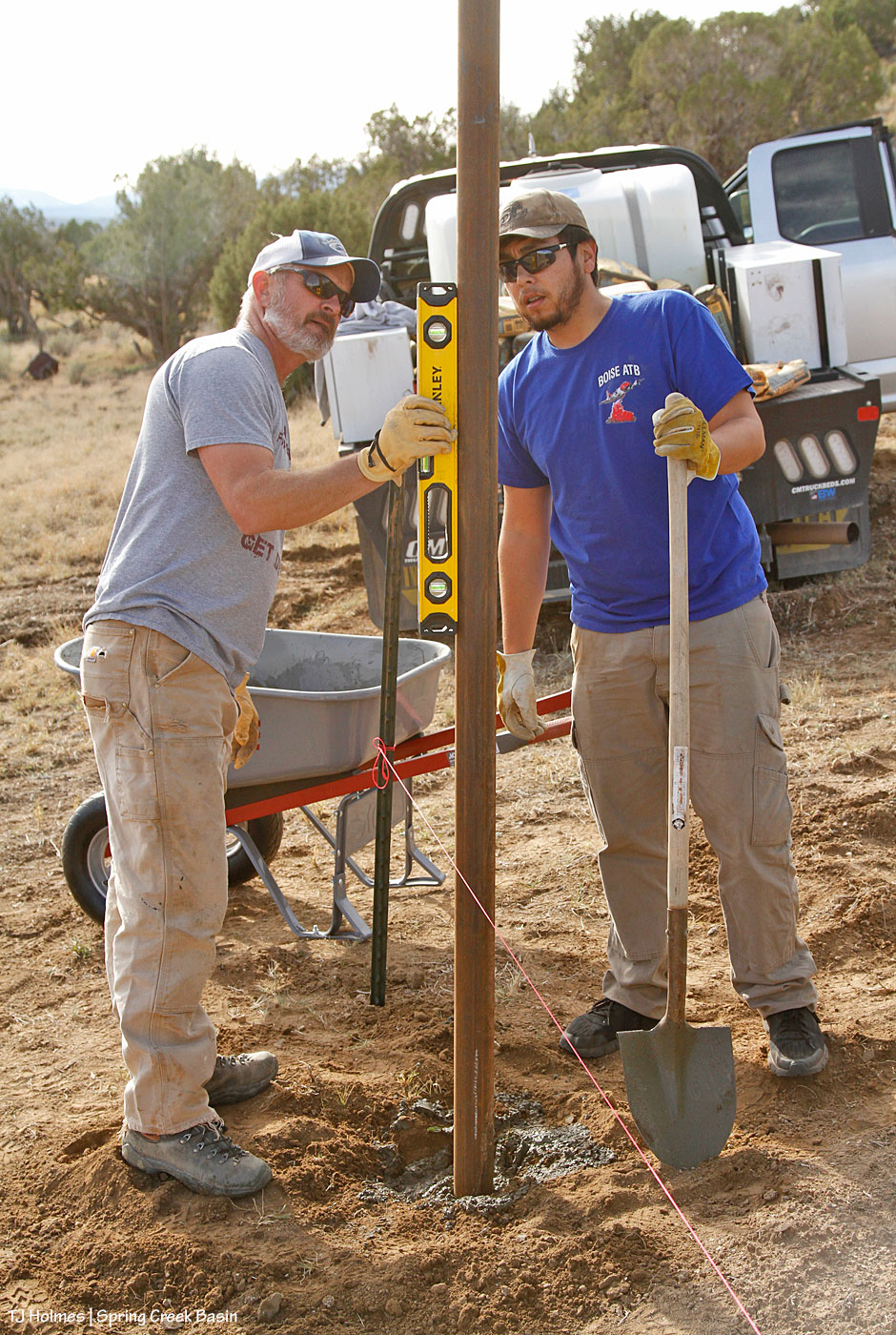
Mike checks the level of the pipe while Daniel finagles the concrete to straighten the tilt.
Right on the money! These pipes will be holding an immense weight to support the propanel roof sheets, so the guys filled all the holes with concrete to ensure the longevity of the pipes in our erosion-prone soil.
While Mike and Daniel were mixing and pouring the concrete, Garth was cutting the pipes into sections to place in the holes that the guys had dug with the augur. I went back and forth, lending a hand wherever needed and taking pix of the work (because all good work should be documented!).
The guys work together to shovel the concrete into one of the holes to stabilize one of the pipes.
Getting close to end end of hole-auguring on the back side (uphill side) of the tanks. Of note: The white on the far ridges, including McKenna Peak and Temple Butte, IS, in fact, snow. That seems at odds with the guys wearing T-shirts, but it was warmish until the wind picked up. And did I note that it wasn’t HOT, and there were no gnats and no dust?
Here, you can see the pipes that we’ve already placed – and concreted in place – that will serve as supports for the roof.
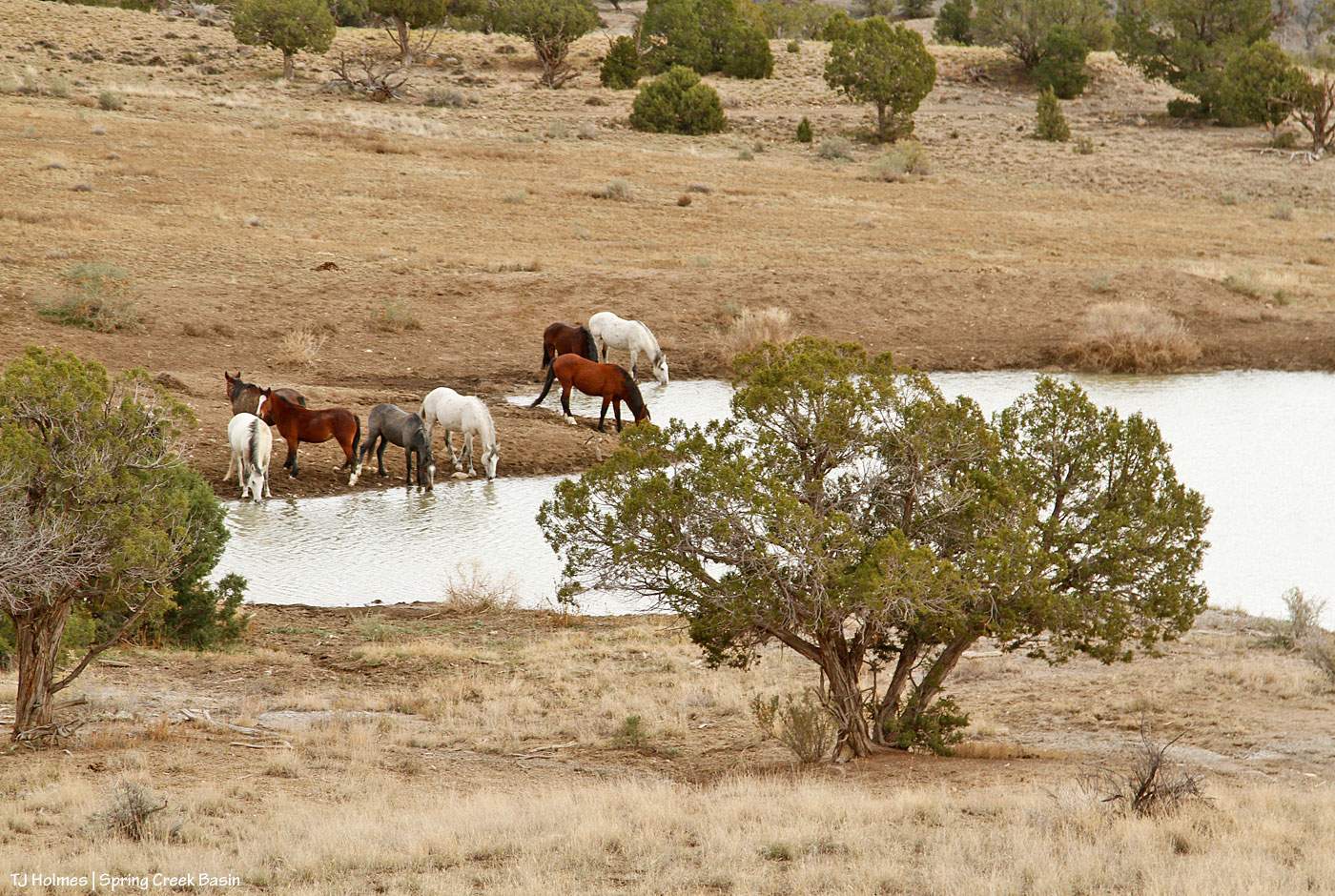
And then, as we were getting close to placing the last pipes, THIS happened: A couple of bands came down the hill from the northwest bowls (little “swales” in the northwestern part of Spring Creek Basin, above Spring Creek canyon) to drink at the pond in this area that I call the northwest valley. Why are we building a water catchment in an area that has a pond, you ask? Because, other than this year (of course), that pond only rarely has water in it, which meant that this area – usually dry – is a really GOOD location for a water catchment. And it has proved to be a good location – this year – for showing us that the horses will use this area – and graze it – when there’s water there to drink!
The guys used a couple of methods to ensure straightness of the posts (not just the straightness of each individual pipe but all of them related to all the others in lines up and across), including the string line (pink, tied to the short bit of rebar between Mike and Garth); measuring distance with a tape measure between the posts pictured, as well as those to the left, out of sight; and Daniel, shown here employing the eyeball method – sighting along the three pipes.
Mike and Garth level the pipe while the horses decide there’s not much to worry about and go on to the pond.
Peace on both sides, horse and human.
More of the same. I so loved that the horses, after their initial shock at seeing us at their watering hole, pretty quickly decided that we weren’t doing anything upsetting at all.
And the last pipe is in place!
It’s a good-size pond, and when it holds water, it holds a fair quantity!
Shortly after this, we were done with all the pipe placement and started cleaning up tools and supplies. The horses drank and wandered off to graze in the little valley. Even when the guys rumbled out in their trucks, the horses weren’t bothered. I stayed to take some pix. Before I left, two trucks with sightseers (importantly, not hunters (the end of today marks the end of the second rifle season … two more to go …)) drove up into the northwest valley. The horses had drifted and were grazing right along the road, but the visitors moved super slowly and respectfully, and the horses gave them a marvelous view for pictures right through their passenger-side windows!
We’ll continue work on the roof structure over the tanks as weather allows. Another moisture-bearing system is headed our way by Tuesday night. 🙂
Connie Clementson, manager of Tres Rios Field Office in Dolores, is retiring after 37 years of public-lands service. For the last 11 years, she has been the head of BLM public lands in Southwest Colorado. We first met her at the 2011 Spring Creek Basin roundup when she was still with the Forest Service and served here as the then-acting district ranger for the Dolores District of San Juan National Forest. We’re glad she was able to finish her three-plus decades of service here in our corner of Colorado.
Our herd manager, Mike Jensen, gets a lot of the well-deserved credit for our recent management accomplishments in Spring Creek Basin, and we know that’s because he has had the support of the top boss – Connie – and her confidence that he was making best decisions for our herd.
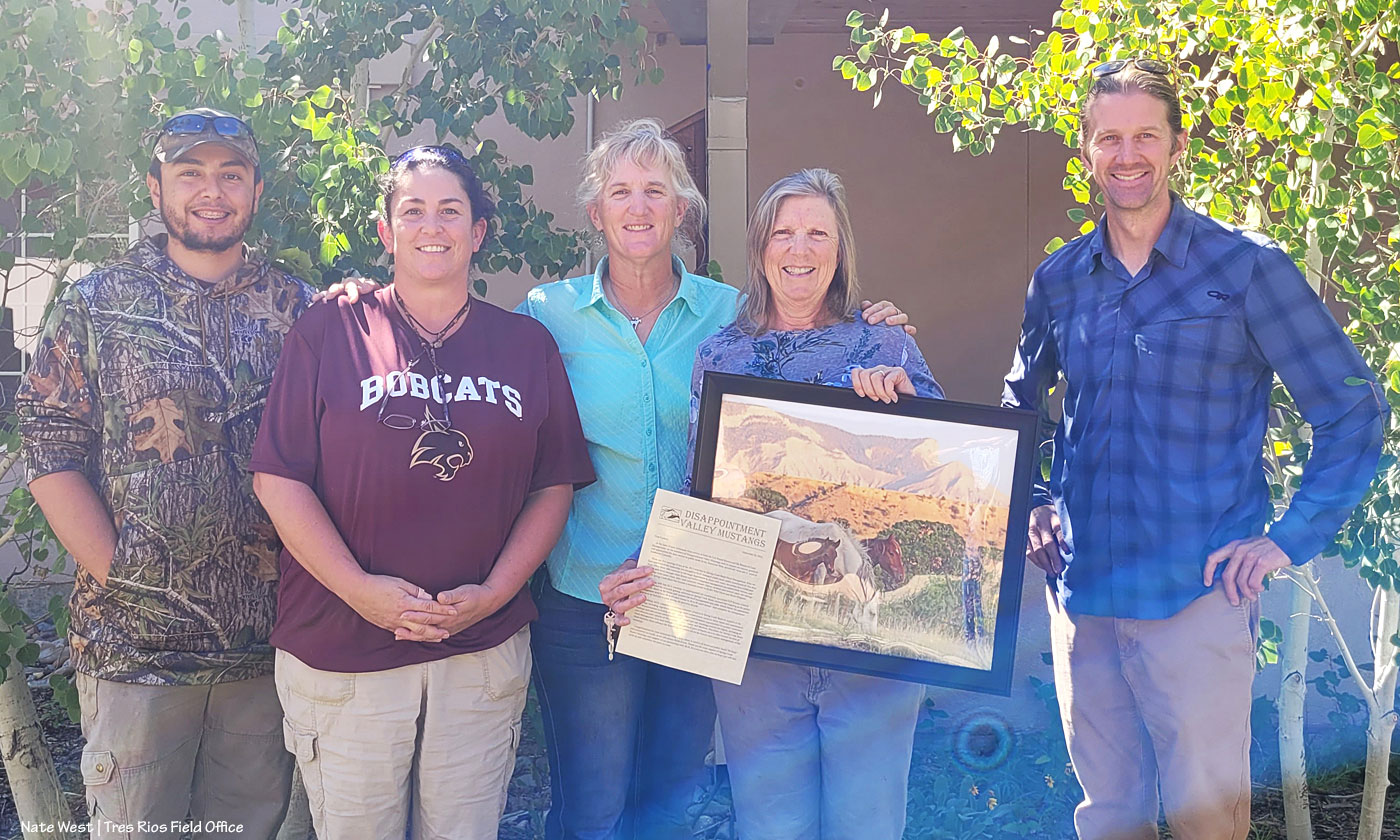
Monday, Tif Rodriguez, long-time advocate for Spring Creek Basin mustangs as well as for protecting rights and rights-of-way for horsemen and horse (and other pack stock such as mules) use on public lands, and I went to Tres Rios Field Office, where Joe Manning, assistant field office manager (who also has a lot to do with our confidence-inspiring herd management), had scheduled us into a rare gap in Connie’s last-week schedule. Daniel Chavez, range tech who works with Mike (and Garth Nelson), joined us in Mike’s absence (he was returning from a trip with his daughter).
We presented Connie with a photo of Spring Creek Basin mustangs and a letter from our Disappointment Valley Mustangs group (which includes Pat and Frank Amthor, David and Nancy Holmes, and Kathryn Wilder, in addition to me and Tif) in appreciation for her years of service – specifically here and especially for our mustangs. While we chatted, she reminded us that she said 11 years ago at the roundup that she didn’t ever want to do that again in Spring Creek Basin. And because of her 100 percent support of the PZP fertility-control program in the basin, we haven’t.
In the photo above, from right to left: Joe Manning, Connie Clementson, yours truly, Tif Rodriguez and Daniel Chavez.
We’re so grateful for Connie’s leadership and partnership these many years, and we wish all the best to Connie (and her family) during her well-earned retirement!
Yesterday was toasty. I never did see triple digits, but on my way out of the basin, the temp was a solid 99 degrees. We felt the heat, but until I *saw* it, I wasn’t quite feeling it the way I did after my poor brain recognized the numbers. The gnats were, well, the same: bad.
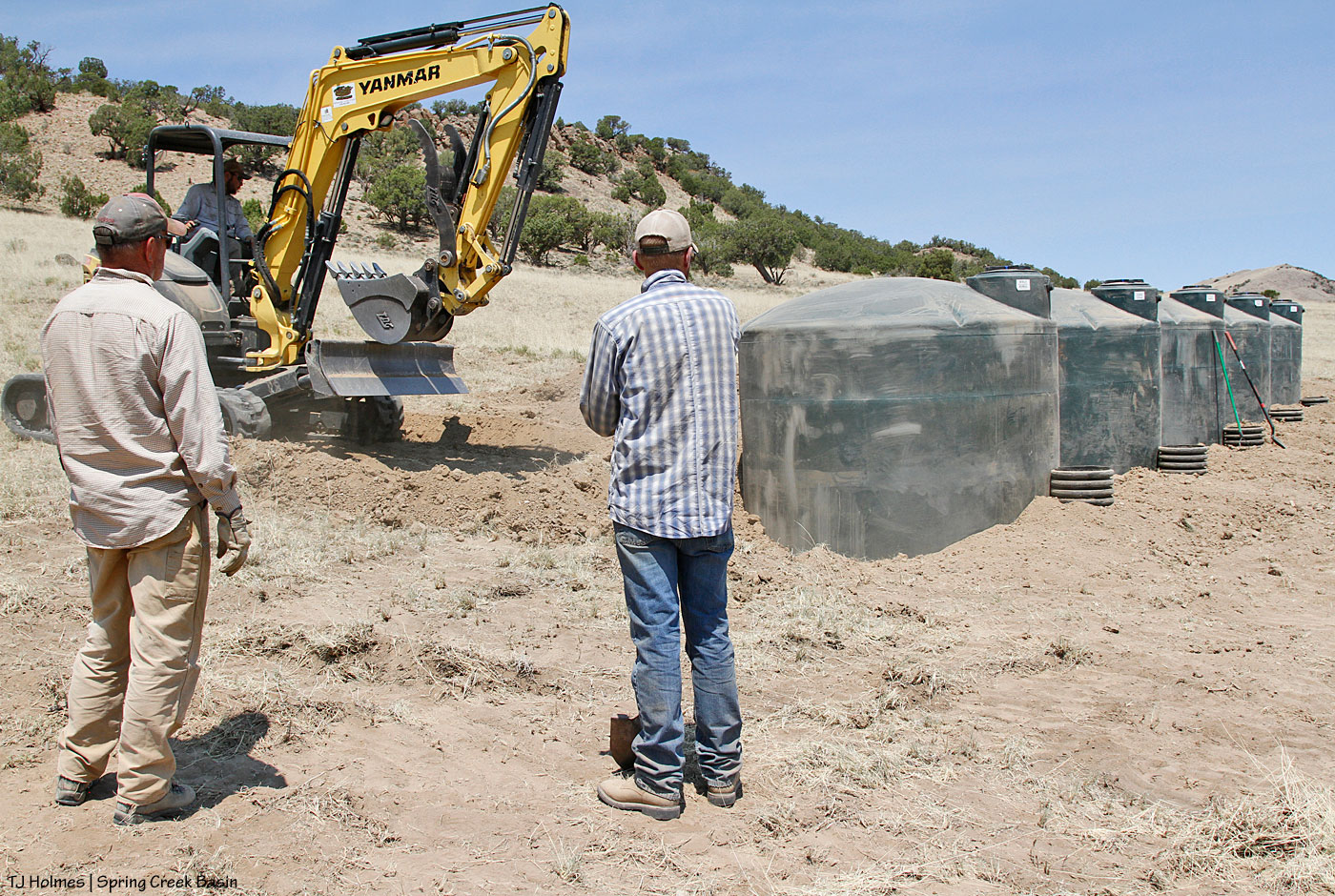
We got right to work finishing up the plumbing bits. Above, Mike is shoveling dirt around the vertical culvert we put in over the valve at the trough. The brown pipes are steel pieces like we used for the roof structure last year; they’re meant to protect the culvert (which will have a lid) from the horses messing with it. Daniel is on the mini excavator, filling the trench that holds the “flexible line” from the tanks.
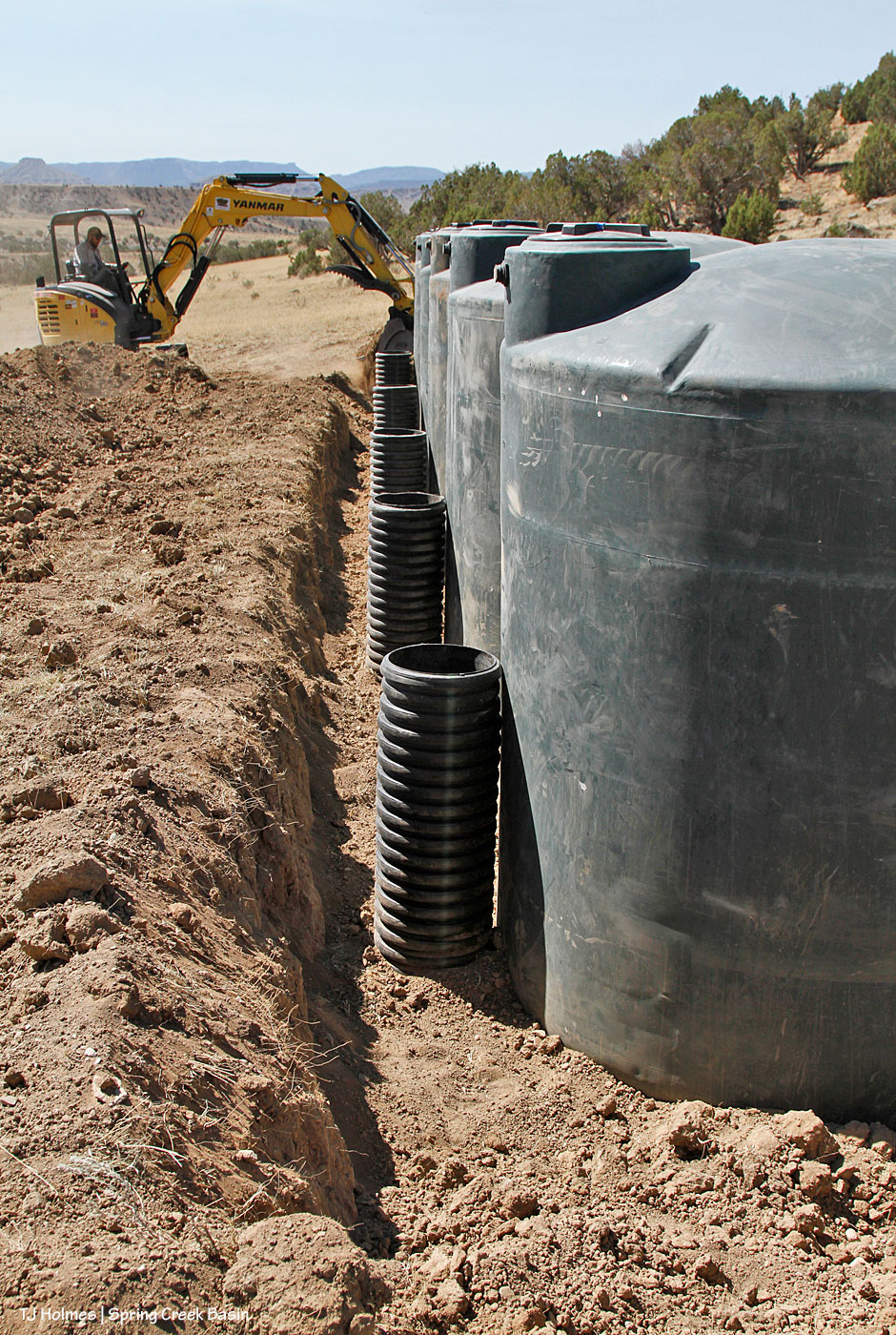
Meanwhile, Garth was up at the end tank, measuring and cutting out the “mouse holes” in the bottom of the last culvert to accommodate the valve and pipe. We cut and placed the other culverts over the other tank valves the day before.
This is what it looked like before filling (we had shoveled dirt into the hole around each of the culverts to hold them in place before Daniel started filling with the machine). Look at the line-up! Like we had run a plumb line to make them straight. … We didn’t. There was some measuring and a lotta eye-balling. … Mike, Garth and Daniel have the know-how for this kind of thing, for sure. 🙂
Let the filling commence!
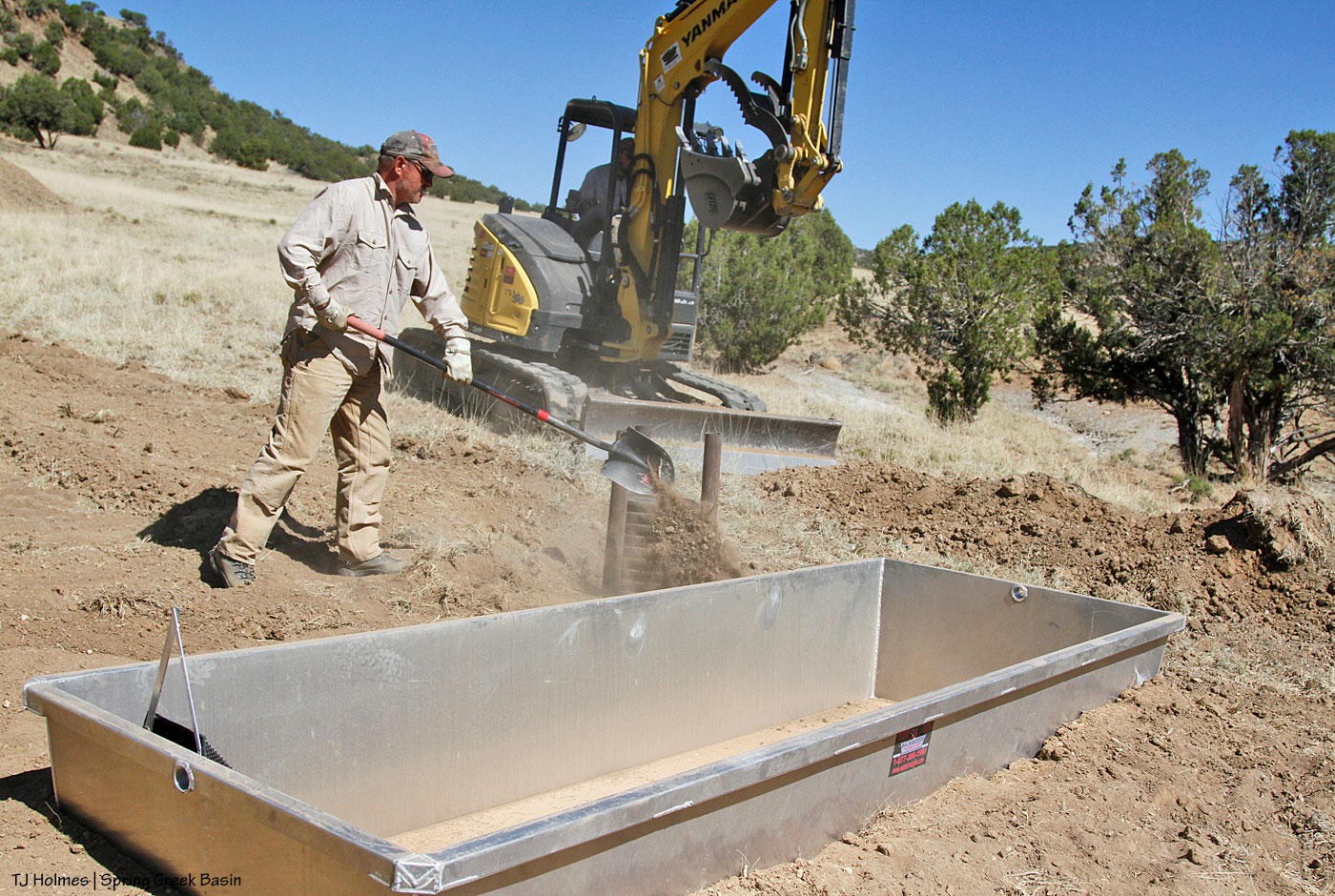
While Daniel was filling and Mike was shoveling, Garth installed a nifty little critter ladder in the trough down the hill. How cool is it! The metal tabs are bent over the edge of the trough, then screwed into the lip to hold it in place. Then he sawed off the ends so they don’t pose sharp-edge hazards. At the end of the day, we also installed one of these in last year’s catchment trough – very handy now that we have water in that one!
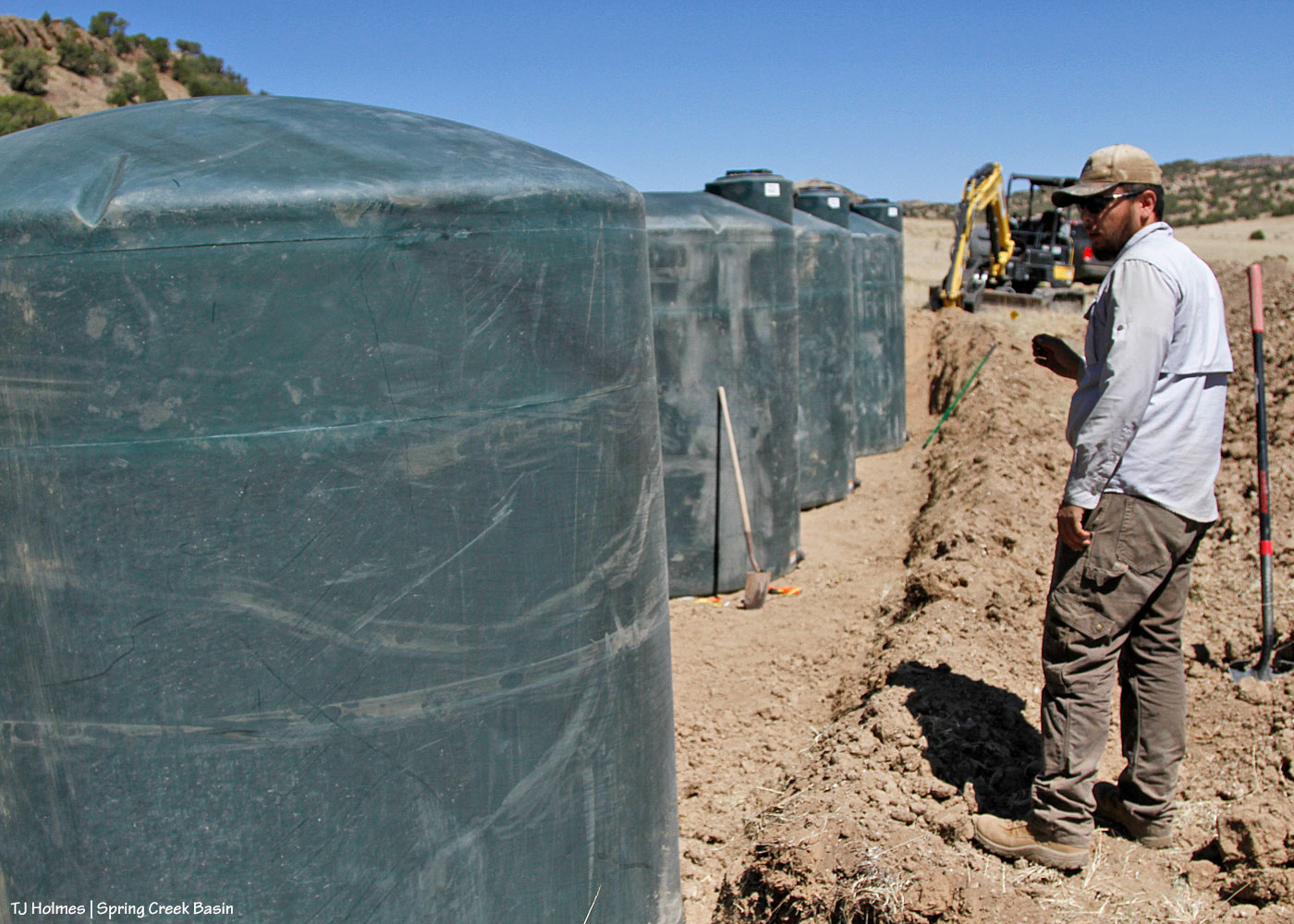
More filling of the hole around the tanks. …
Looking good, right?
Admiring their job well done!
This phase of our new water-catchment project went pretty quickly, which I’m sure is a relief to us all, given the heat and gnatty hordes (!). This fall, we’ll get to work on the roof structure, complete with gutter, and start catching some rain. … Speaking of rain, we’re on day 55 (today) *without* rain.
That’s the dry news; the good news is that the forecast is looking promising, starting with possible storms later today. … Lightning, we can do WITHOUT. Rain … BRING IT ON!!!!!
Thanks hugely to our awesome BLM team: Mike, Garth and Daniel!
Partnership is the name of the game with our wonderful BLM guys: Mike Jensen, Garth Nelson and Daniel Chavez. We got a lot done on the water-catchment project yesterday, and there are a lot of pix; let’s get to it!
The above was the first tank to go in the hole dug the day before by Garth. Daniel was back with us, which was a good thing; we needed lotsa muscle.
Pretty soon, things were looking like this at the site.
Then the guys got right to work installing the valves to each tank. (What the heck is Mike doing, you ask? Did I mention yesterday that the gnats were out? Yours truly wore my handy-dandy head net, and I helpfully provided some bug spray for all three delicious-to-gnats BLM’ers (reapplyment was necessary frequently). Garth and Daniel made the extraordinary scientific discovery that plumbing primer and glue is most excellent gnat bait.)
Some extra tweaking and digging out and fine-tuning of the space was necessary (which gives you readers another fine view!). To repeat from yesterday, this catchment features five 2,500-gallon tanks, compared with the four 3,500-gallon tanks in last year’s project. They’re a couple of feet shorter (so the hole doesn’t have to be quite as deep (and we bury them to help keep the water inside from freezing during the winter)), and the walls/plastic is a bit thicker, so they’re a bit more sturdy.
Once again, as with last year’s project, we used lengths of culvert to protect the valves at the base of each tank. The hole will be filled in around the tanks tomorrow, and with these culverts – set vertically – we’ll still be able to access each valve. While Mike and I cut out holes at the base of each for the valves and pipe that links each of the tanks, Garth and Daniel …
… got busy gluing all the valves to the pipe that will link them each and thus allow water to run down the hill to the trough.
Here’s a view of the culverts in place over the valves for each tank.
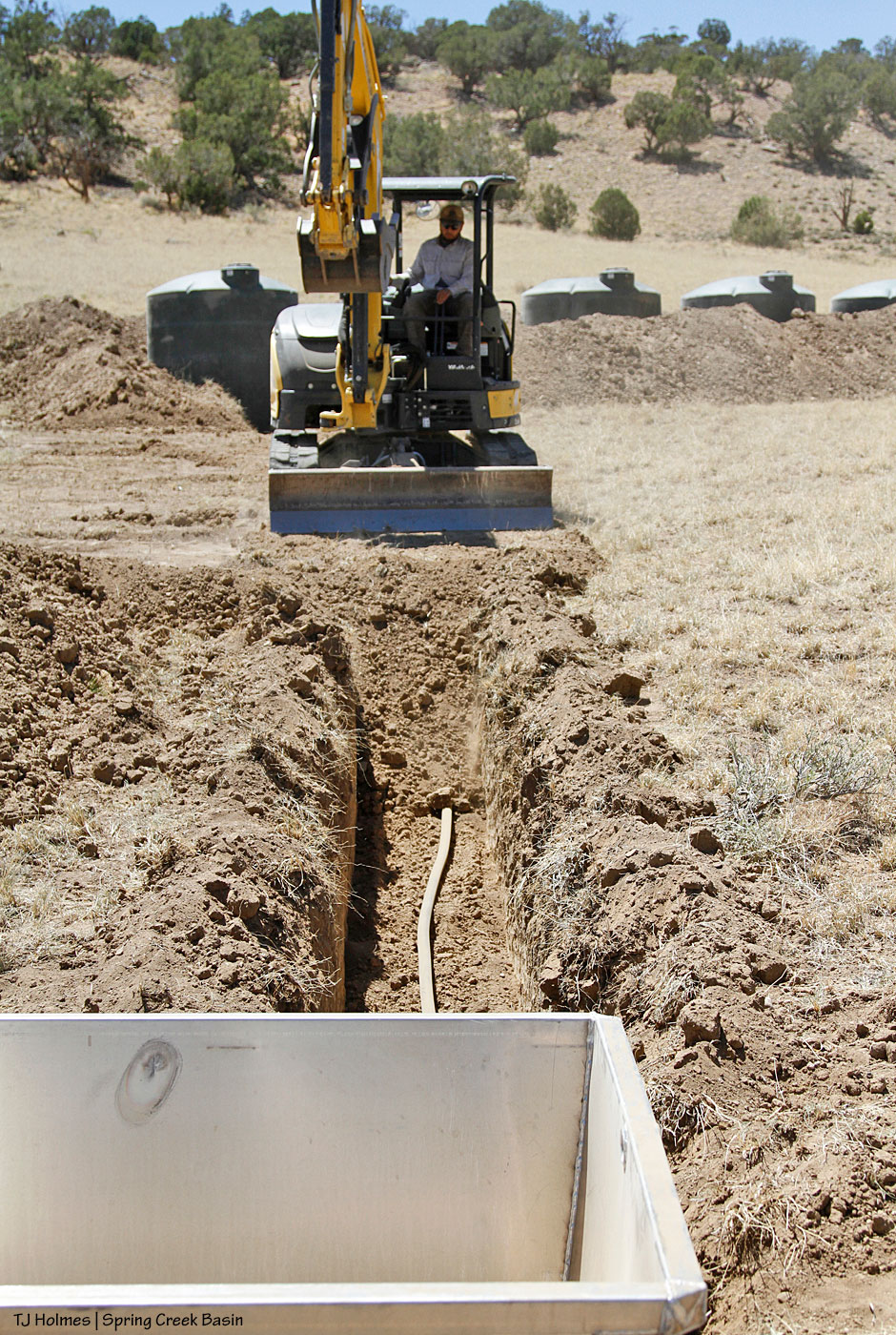
Then the guys moved right into digging the trench from the end tank down the hill to the trough spot. Garth is carrying the 100-foot length of “flexible line” (that’s a technical term meaning I don’t have a clue what it’s actually called) that will run from the tanks to the trough.
This pic, just because I like seeing all three of our guys in their element: doing what they do for the mustangs of Spring Creek Basin. 🙂
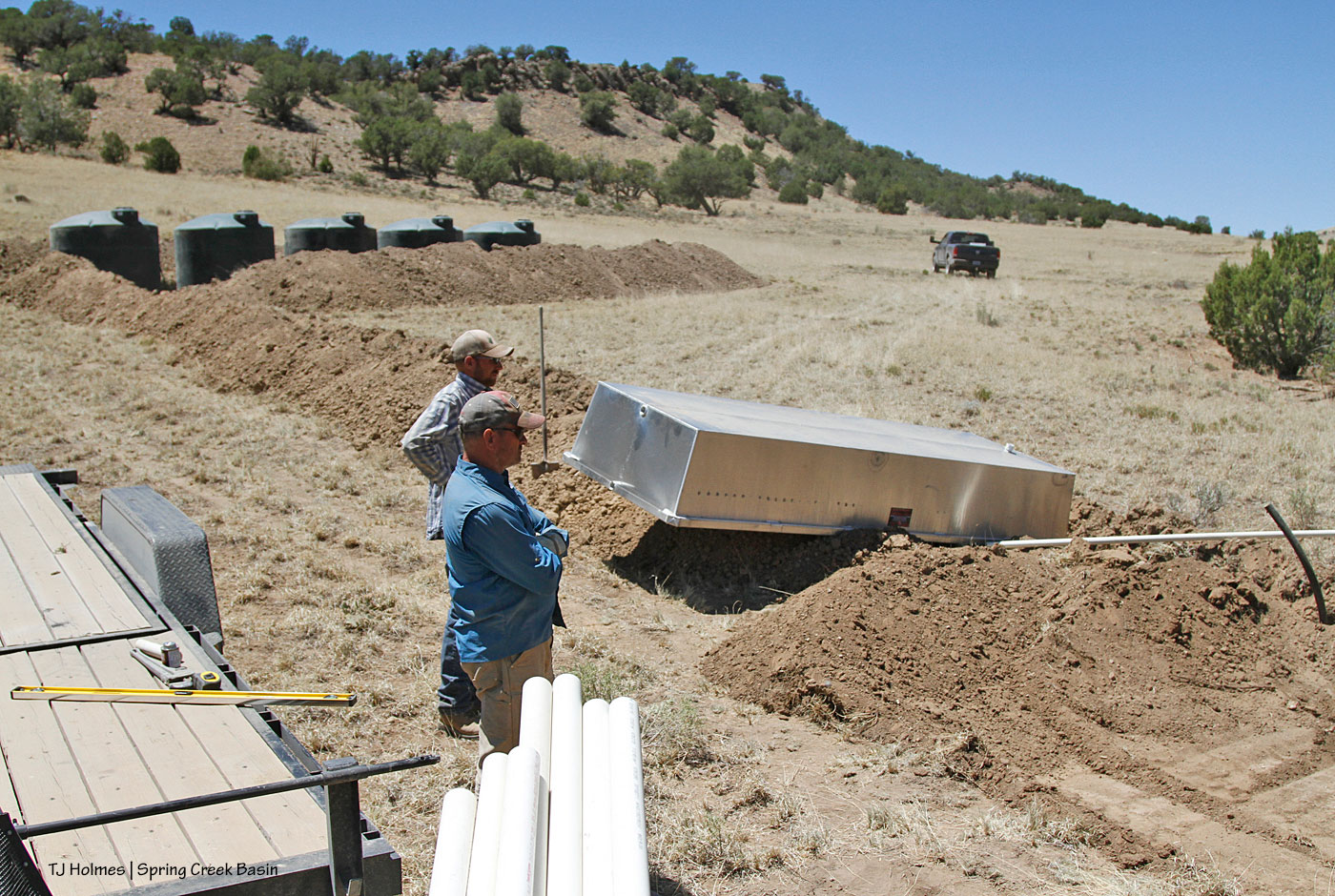
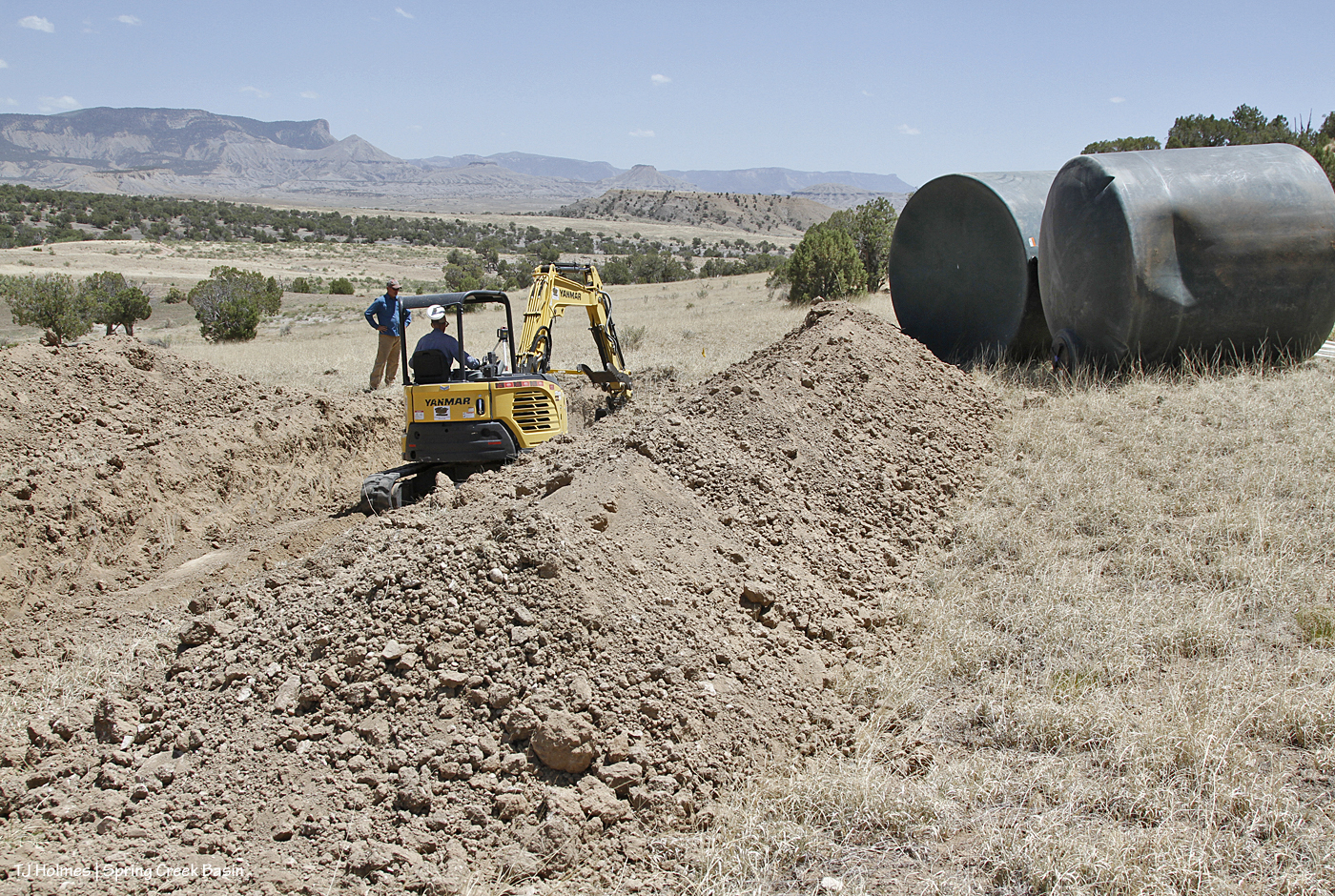
Overall view of the project site: Daniel has dug the length of the trench, and he was leveling out the spot for the trough. At farthest right, you can see the end of the flexible line sticking up from the trench. That will tie into another couple of sections of PVC pipe, from horizontal through an “elbow” to a vertical piece to come up into the trough from the bottom (see the little white bit at the right side of the overturned trough?).
Checking the level of the trough, which is acting like a giant reflector to put light on Daniel’s and Mike’s faces under their ball caps (as a photographer, I appreciated that very much!).
We got the trough set and piped/connected, and here, Daniel is covering the line and part of the trench while Mike stands by to do some shovel work. Today, we’ll set another length of culvert over the valve just barely visible and attach that flexible line to the tanks above.
We got a lot done yesterday!
Today will see the end of this phase of work, and then we’ll wait out the very hot months and build the roof structure over the tanks this fall. We’re tough, but the forecast calls for a high temp of 98 degrees. Yesterday, the forecast was for a high of 88, and it was 94 when I drove out of the basin. Following that mathematical formula, we could exceed 100 degrees today? Yeah – it’s a good idea to wait to work on welding steel pipes and steel purlins and a metal roof. 🙂
In relative-news updates: The water trough at last year’s new catchment has been turned on, and we’re waiting for the ponies to find it. They haven’t yet, but at least a few bands are in the rough vicinity.
We had a huge relief from the smoke yesterday, and the gale-force winds dropped to merely breezes … which gave the gnats license to descend. (Note Mike’s hand at his neck, below his ear. Gnats are no joke, folks, and they are out. I highly recommend head nets.)
Daniel had to help his wife with their sick baby, so Garth brought out two more water tanks, and Mike and I delivered two more that Garth had brought a week ago to a site nearby for easier transport (the flatbed carries two at a time). They’ll bring the fifth today. This year, the catchment will be built with five 2,500-gallon tanks, compared with the four 3,500-gallon tanks we used last year. These are a bit thicker-walled, and they’re shorter (8 feet tall compared with 10 feet tall), meaning the hole for them doesn’t have to be as deep.
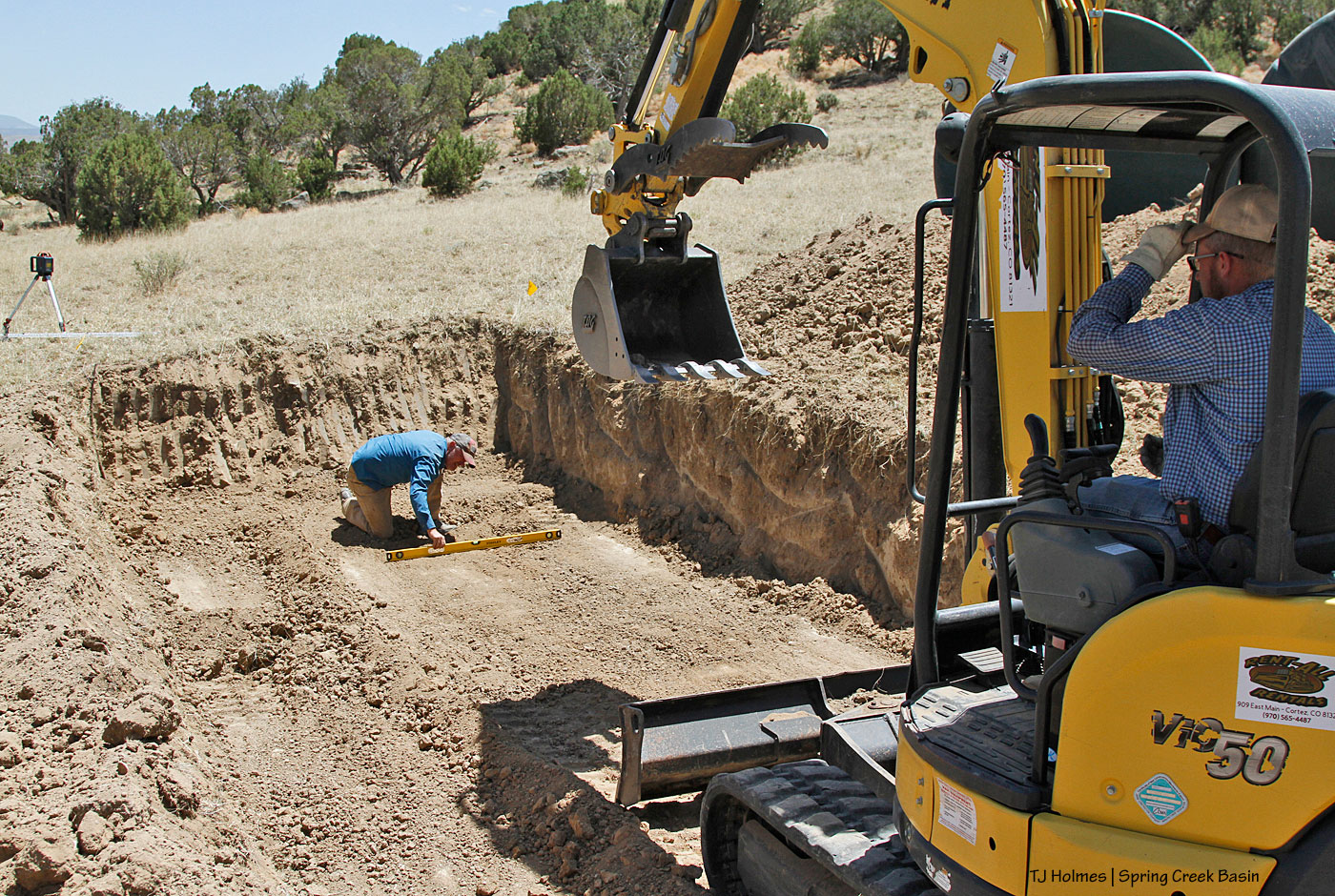
In the pic above, Garth is checking for uniform depth across the bottom of the hole with a laser level so the tanks will have a level base. As before, the tanks, with a roof to be built over their tops, are on high ground, and water will run downhill with gravity to the trough, to be maintained with a float.
Note Mike, still brushing at gnats. 🙂 This time, Garth dug one big hole to accommodate both the tanks and the plumbing (instead of doing one hole for the tanks and then a parallel trench for the pipe to connect the pipes from each tank, as they did for the first catchment of this design, last year). Again, the tanks will be buried about half deep to prevent the water inside from freezing during the winter months.
This catchment is in the far northwestern corner of Spring Creek Basin, which boasts a tremendous and far-reaching view.
Digging and leveling and digging and leveling were the big missions of the day.
For the fine work of filling here and digging there, Mike wielded the shovel while Garth manned the mini excavator.
For those of you wondering just how Garth was going to get that machine out of that hole, there’s a little bit of a ramp that he left under the digger (bucket?). 🙂 Here, he was extending it a bit after we measured the length of the hole to ensure it would hold the five tanks. Two tanks are on the ground behind him, and before we left for the day, we unloaded the two from the flatbed.
Another year comes to a close. Another year is poised to begin. The older I get, the more I wonder about endings and beginnings, and our perspectives about where we are in the middle.
That maudlin attitude aside (!), it’s a pretty good time to roll out some favorite images and a little explanation that goes along with them. Because, collectively, who doesn’t need a little more time at the computer (or phone or tablet) to look at a few more images from this little blue marble-in-space that we’re supremely fortunate to call home? 🙂 I’m kidding about that, of course, and I hope you all enjoy the extra offerings of Spring Creek Basin wild ones!
As I typed for a similar post last year: What follows is one photo for each month of the last year. Some have been on the blog previously; others have not. Onward.
January
In the year’s first month, we had snow to cover the basin with blessed white, also known as frozen gold in our neck of the drought-stricken woods. I found Hayden’s band back in the east pocket, calm as fuzzy, fully winterized mustangs can be. My presence wasn’t any deterrent from the serious business of looking for tasty bits as the snowflakes covered us all.
*****
February
I don’t think Hollywood thinks he’s a comedian as much as *I* think he has the potential to be! Wild stallions, after all, are very serious about the business of survival and protecting their families. This particular day in the basin brought several inches of snow, and I was on snowshoes. Fortunately, it was months before I would roll my ankle because the hike out to his band, which wouldn’t have caused a sweat in dry conditions, was about as difficult and wearying as any I’ve ever done. It was worth it (of course) to see the horses looking good and finding edibles … even if they did sometimes come up looking as though they’d been snorkeling.
*****
March
In March, this little cutie was the first arrival of the year to grace the herd. He’s sire Corazon’s mini me and growing up just as handsome. The band was keeping to one area so the little one didn’t have to go far on those wobbly legs, and I was able to sit with them and observe respectfully. Mama seems pretty proud of her little one, and she took to motherhood like a natural (of course she did!).
*****
April
In April, we welcomed baby No. 2, and she was big and feisty right from the get-go! Most readers know that we use fertility-control vaccine PZP in Spring Creek Basin, and it is THE reason we haven’t had a roundup in 10-plus years. I read an article this fall in which a person was quoted as saying that because of PZP, our herd would be extinct in 10 years. … Well, probably, that person hadn’t seen this little darling, or any of our other foals (or other young horses, or maybe even any other-age horse!). And it’s too bad that they’d rather have roundups. For my part, to see more of THIS (which is to say, healthy foals that grow up to be wild and free mustangs) and fewer roundups, I’ll stick with PZP, thanks!
*****
May
We didn’t have as many wildflowers as we’ve had some other years because of our ongoing drought (we were still in the “exceptional” category at that point in the year; that’s the worst category), but we had a few spots of color to brighten the desert. Bursts of color and the shedding of shaggy coats lets us know winter is in our rearview … but it also heralds anxiety and sky-watching (for clouds, particularly dark ones).
*****
June
“Drought?!” you may be asking yourself. “What the heck is she talking about? Look at that grass!” And it WAS good in June (and then later, after the monsoons finally found us) … before it got hot(ter) and dry(er), and the grasses withered and shrank and turned crunchy underhoof and -foot. This day, pictured, was one of the loveliest days and memories with a little group of young bachelor stallions, recently on their own for the first time. Look at those shiny, slick coats! In the northwestern part of the basin, a mustang (and a human) can see for … well, a pretty long way! To know that our mustangs can roam almost all the land pictured (not the very farthest, pinon-juniper covered hills and ridges), it’s worth everything. … Everything.
*****
July
This little treasure graced us just as the monsoon rains did this summer. With soaring birds on each shoulder, she zoomed right into our hearts from first glance. It had been several years (I’d lost track) since we had an actual monsoon weather pattern over Disappointment Valley, and in the midst of our excruciating drought (that might be a “better” term than “exceptional”), more welcome than I can even express. Those rains set us up for a less-anxious autumn than we would otherwise have had.
*****
August
If you read any of the blog this past year, surely you caught at least a glimpse of one of the posts about the new water catchment our excellent BLM guys built in Spring Creek Basin this summer. We started it at the end of April, I think, and finished by the end of August. Lots of hot, hot, HOT welding work with heavy steel posts and purlins and reflective metal roof sheets. The new catchment gives us the potential to catch and store 14,000 gallons of fresh rainwater and snowmelt for the mustangs in the northern-ish part of the basin. While we were still in the building phase, a few bands of mustangs occasionally meandered through the area to check things out. The image above came together as three of our most perfect grey girls turned to look just as the sun was setting. On the left, our venerable Houdini is most likely in her third decade of life – wild and free on the range where she was born (and birthed many babies).
*****
September
Another big milestone of 2021 happened in September, when we welcomed three young mares from Sand Wash Basin to Spring Creek Basin. Because Spring Creek Basin is small (almost 22,000 acres) and the herd correspondingly small, we periodically introduce mustangs from other herds to contribute to its genetic viability. The grey-and-white pinto stallion was the first to greet the girls, and he had them for their first week and a half here. Then his uncle, the grey stallion, acquired the mares, and they’re happily (so I like to think) with him still. The youngster is hanging out with another young bachelor and a veteran stallion. He’ll have more many chances to win more mares!
*****
October
This beautiful girl is a daughter of Storm-my-love. After growing up in the best of bands, she finally left daddy’s band this fall and joined another stallion and his mare, where – interestingly – she has taken on a bit of a lookout/protector role. She’s much more interested in the goings-on than the very sedate stallion and his low-key mare. Maybe it’s a bit less energy than her natal band, but I think she is enjoying her new family.
*****
November
Our little spotted girl with her daddy, curiously watching a nearby band near a wonderfully full pond. I love to see babies with their steadfast sires, and I love to see ponds with water, rippling gently at the shore. Some of our ponds have even had mallard ducks on them this autumn. Starting the year with dry ponds was awfully awful; finishing the year with water (or even ice) is such an enormous relief.
*****
December
Readers will remember this image of our fabulous elder lady, Houdini, because it wasn’t all that long ago that I took it and posted it here on the blog! She should have full immunity as an ambassador, but I don’t think she would like that title because, truth be known, she really doesn’t like or trust humans all that much. Who can blame her? Though her last 10 years (have to) have been the most peaceful of her life. And to have been part of that … ? Well, I can’t begin to tell you all how happy I am to have played a part in *that*. What better life for a wild horse than to live it fully IN THE WILD?
*****
Bonus
Because, as always, who doesn’t love bonus content? Readers also know how I adore backlighting. … Why? Please see above. 🙂 We did have some wildfire smoke in our skies this year, again. And we had a lot of love and family. If it started relatively dry, and Mother Nature made us wait, anxiously, for moisture, she did come through rather well this summer. Then we had a very dry autumn, and winter didn’t make a very auspicious start. But the last few days, we’ve had a nice little contribution from the heavens: Rain in some areas, a rather large amount of snow in other areas! All of it begs the question: Are we at the start or end or in the middle of our weather year? 🙂 We hope more is to come; it’s all a cycle, after all!
*****
Thank you all so much for following our Spring Creek Basin mustangs this year! Many quarters of this ol’ world endure so much violence and strife and endless struggles that threaten to tear apart people and wild things alike. The very planet is threatened as never before. Observing and acknowledging the beauty of our home rock in the universe has to be a foundation of working to preserve it for all those here and those to come. Just as we strive here to continue our mustangs’ peaceful existence, surely it will take all of us, working together, to preserve life FOR us all.
Peace on Earth, goodwill toward humans and animals and plants alike. We are not alone (no matter how hermitlike we may favor being). Here’s to 2022 being a year more steeped in love than hate, more in peace than violence. Here’s to the power of wild and the healing qualities all around us.