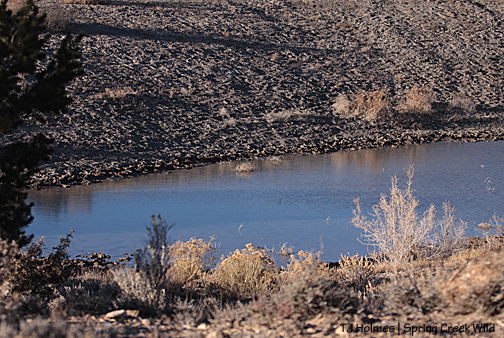
Rain = gooooooooood!

30 07 2014

And we finally got rain …

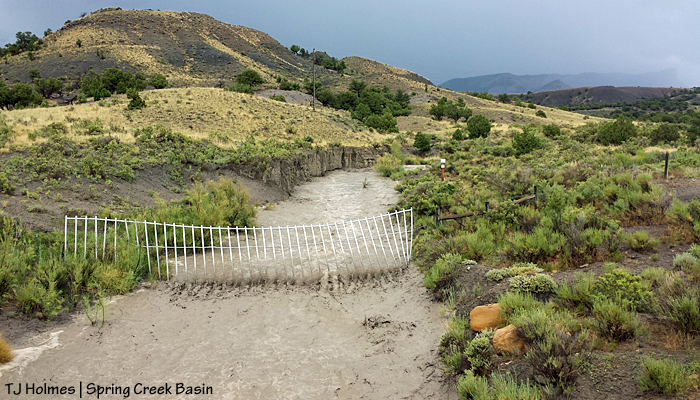
County line drainage during the big flow.

This drainage coming out of Spring Creek Basin usually is wide and dry.Β  The water gap is in case of episodes such as this! The PVC pipe creates a visible barrier for the horses in the fence line, but it swings with the force of water when it flows. This pic was taken from the Disappointment Road looking northeast into the basin. The unnamed promontory is barely visible through rain at far back right. The horses already were taking advantage of the rain and running arroyos; three bands were to the east and north of this point.

County line drainage after the big flow.

A couple of hours later, the big flow was a memory. But I bet the memory lives on in the form of some ultra-full ponds!

Spring Creek during the surge from a massive rain event.

Here’s a shot of the usually-dry Spring Creek arroyo that runs under the Disappointment Road in the northern part of the valley – west of Spring Creek Basin. In the background, you can see the rimrocks that form the basin’s western boundary and beyond, the unnamed promontory. (Yes, that’s dreaded tamarisk along the left bank of the creek.)

Spring Creek after the surge.

And this is Spring Creek a coupla-few hours later after the above peak. Still high but receding.

The above two pix of Spring Creek are together for comparison purposes. The below two photos were taken inside Spring Creek Basin after the first of those two photos were taken.

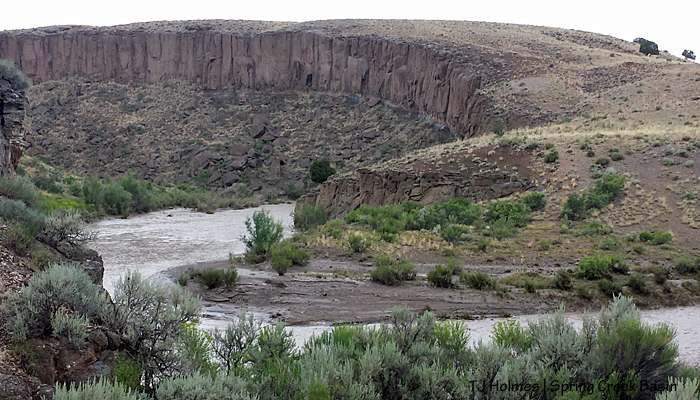
Spring Creek flowing high and wide through Spring Creek Basin.

This is the entrance to Spring Creek canyon – site of previous roundups. Spring Creek flows west out of Spring Creek Basin after collecting water from multiple arroyos and drainages in the basin and eventually joins Disappointment Creek, which joins the Dolores River, which joins the Colorado River. Cool, huh? Spring Creek flows only during major rain events like the one today. Spring Creek and Spring Creek Basin are not interchangeable terms.

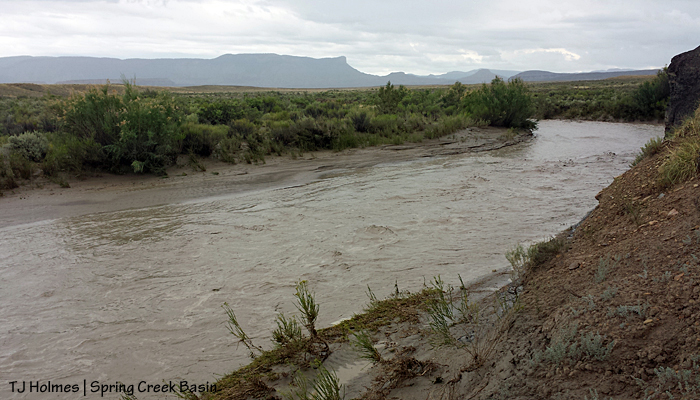
Spring Creek flowing high and wide through Spring Creek Basin.

Looking upstream, sort of east-southeast. It was raining when I took these photos, so I didn’t stay long.

Rain. Lifeblood of the desert and its inhabitants. I cry at its lack, and I cry for joy when it falls. My heart is happy for Spring Creek Basin’s mustangs and other residents.


Green ‘n water

20 07 2013

Northwest pond has water.

+

Trapsite pond has water!

=

happy.

πŸ™‚

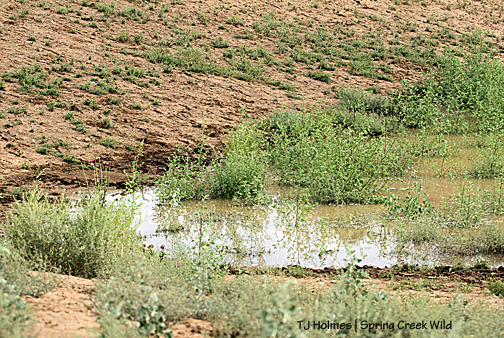
Two different ponds, previously dry. Both dug out last year.

Mustangs already have found both.


Water for mustangs

30 06 2013

Not elephants. Although, as this drought continues, it’s beginning to look a lot like the sere plains of Africa out here.

I call this photo “La Sals, Imagination”:

062813greyswatch

Whaddya mean you can’t see the mountains … through the smoke? Use your imagination. πŸ™‚ Although Grey/Traveler’s band seems to also be looking for the mountains, they were watching Chrome’s band walking toward them on their way to the water catchment.

Smoke from this fire – way, way, way east of here – apparently has drifted into New Mexico then blown back north and west into Colorado. But it’s not the only fire burning in the region.

Earlier, Grey/Traveler’s band had been drinking at the water catchment’s trough:

062813greystrough

Maia, clearly at her leisure, worried me; I thought the worst, that the storage tank had drained and the trough was empty, and she was waiting for someone to come fill it, darnit!

Not to fear.

Water trough at the catchment in Spring Creek Basin, looking toward the road.

The trough was full of water. Whew. (The big green tank is the storage tank that holds water from either rain or snow or direct-fill.)

Because of the drought, BLM has been checking to ensure that the horses have enough water sources, and we – National Mustang Association/Colorado – recently got the green light to deliver a load of water – 4,000 gallons – to the catchment tank. Donors and silent-auction-item buyers at the Pati Temple Memorial Benefit Bash, this is the first use of the money you helped us raise! Interestingly, the area of the catchment is used primarily by Chrome’s band and rarely by other bands. But some other bands have started to find the water – and the good forage in this area. Water is a good way to disperse the horses’ grazing and get them to use under-used areas.

062813chromesdrink1

Chrome’s band at the catchment trough, drinking clean water. This is an important water source because it’s the only clean source of water in the basin. The others are high in alkalinity and salt because of the basin’s soils. The dusky, hazy color cast is because of the smoke.

The temperature hit 110 degrees Friday. On Thursday, the high was 108. Smoke, wind, heat, zero moisture = ugh.

Cecil Foster, owner of Foster’s Water, to the rescue.

062813watertank2

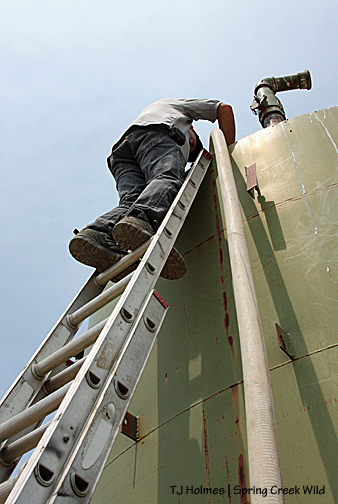
The storage tank is about 15 feet tall, so Cecil brings his ladder to access the hatch at the top. At right is the hose from his water truck.

062813watertank3

Seen here are his water truck, the hose to the tank and the water trough in the background at right.

062813watertank1

Thanks, Cecil! He also donated a load of water for the benefit’s silent auction. Cecil is a super nice man, and a friend of the mustangs of Spring Creek Basin.

Thank you, NMA/CO, for the delivery of water to the mustangs!


How does your donation to NMA/CO help the Spring Creek Basin mustangs?

28 05 2013

This question was asked recently, and answering it gives me another chance to let local folks know about the Pati Temple Memorial Benefit Bash we will hold next week, Monday, June 3, at the Kennebec Cafe in Hesperus, Colo. Follow that link for the details and to purchase tickets if you haven’t and plan to attend.

NMAPosterFinal3(100)

Now, on to an answer(s) to the question!

First, see this page, compiled last year by Pati, for a list of the National Mustang Association, Colorado chapter’s past accomplishments: http://www.nationalmustangassociationcolorado.org/nmaco-accomplishments.html

As it says, NMA/CO has spent nearly $100,000 to date on projects that directly benefit the mustangs of Spring Creek Basin! We rarely do fundraisers, relying mostly on memberships and donations. Administrative expenses are low, mostly what we put toward mailing newsletters. We had T-shirts and hats printed for the adoption in 2011, and we’ll soon have a link to purchase them through the website.

Fence repair and maintenance is ongoing through volunteer labor. As a result of their partnership with us as part of Disappointment Wild Bunch Partners, BLM received $25,000 last year through the Director’s Challenge grant, which purchased some materials to be used in a project on the basin’s southeastern boundary line (read about alternative spring break and University of Missouri students’ work here – https://springcreekwild.wordpress.com/2013/03/26/alternative-spring-break-day-1/ – and here – https://springcreekwild.wordpress.com/2013/03/27/12368/). I fix fences as needed while I’m in the basin doing documentation. Sometimes we use materials provided by BLM, other times by ourselves.

We also are continually encouraging BLM to look at water-enhancement projects. More than a decade ago, NMA/CO paid for a water catchment to be built in Spring Creek Basin, and it supplies the mustangs’ only clean source of water (all others being extremely alkaline, at least). We have a signed agreement from about 12 or 13 years ago with BLM to construct at least one more catchment, but it has never been built. I think the catchment cost about $10,000. Several years ago, we also started talking to BLM about water guzzlers (such as those installed on Pryor Mountain Wild Horse Range) to add to the horses’ quality of water. Those are about $8,000-plus. NMA/CO also has purchased parts for the catchment’s troughs, which work on floats.

NMA/CO contributes funds to combat noxious/invasive weeds in Spring Creek Basin (knapweed, tamarisk, musk thistle, etc.).

A decade or more ago, NMA/CO was able to purchase the cattle AUMs from one of the two ranchers who held permits in Spring Creek Basin. With the help of the National Mustang Association, we were able to retire those AUMs permanently. In the process, BLM conducted a grazing EA (not sure the exact reference) and then drastically reduced the remaining AUMs and changed the timing to dormant-season grazing only – Dec. 1 through Feb. 28. For the last several years, NMA/CO has been trying to buy or trade for the permit in Spring Creek Basin to also retire those AUMs, with the goal of no cattle grazing in the basin. As BLM itself says, managing wild horses is easier when the mustangs are the priority. The permittee is willing, so we are trying to work with BLM to accomplish this goal.

NMA/CO also is asking BLM to consider the use of bait trapping in the basin, instead of helicopter-driven roundups to complement the use of fertility control. We submitted a proposal for a program using native PZP that was implemented at the 2011 roundup. To bait trap requires the use of a facility in which to hold horses as they are trapped. This facility requires a chute and pens. We recently purchase a chute ($18,000) with donated funds from the National Mustang Association (of which we are a chapter). Our primary goal in fundraising currently is to purchase the required infrastructure for this facility so BLM won’t have only the option of using a helicopter and won’t need to transport one or two horses at a time – as they’re trapped – to Canon City, which is full, as most/all of BLM’s facilities seem to be. NOTE: NO ROUNDUP CURRENTLY IS PLANNED FOR SPRING CREEK BASIN. We are planning this now to have the facility in place so a future EA can include it in the planning process. As BLM said in 2011, bait trapping was not considered because it wasn’t in the EA. It wasn’t in the EA because no facility was available. However, note that we started asking specifically for bait trapping in 2008.

Enhancing water sources, retiring the remaining cattle AUMs, establishing a fertility control program and making bait trapping the priority for roundups all were Pati Temple’s goals for the Spring Creek Basin herd. In addition to the accomplishments made for the mustangs during Pati’s lifetime, we plan to accomplish these goals in her honor.


Where the water is …

8 04 2013

… the wild things are:

040713sundtrickle1

Raven, Sundance, Skywalker, Kootenai and Mysterium drink at the trickle, which still is trickling. Corona was waiting her turn.

Lots of deer tracks here, too.


Reflections

29 03 2013

031813greysbanddrink

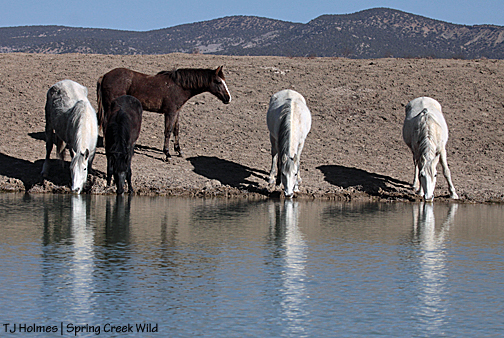
Grey/Traveler, center, drinks from a pond with his band, from left: Alegre, Maia, Mariah and Houdini. Water is the most precious resource of all in this high desert region.


Congratulations!

2 12 2012

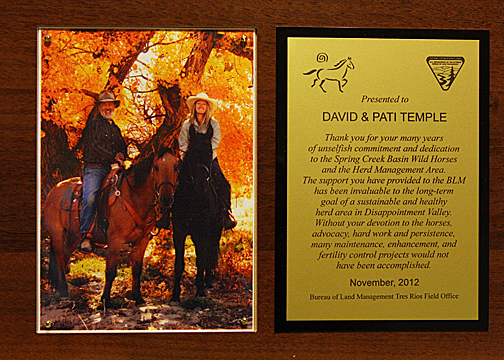
The Tres Rios Field Office in Dolores, Colo., has honored Pati and David Temple with an award that recognizes their dedication during the last 15 years to the mustangs of Spring Creek Basin.
In 1997, Pati and David joined the board of the newly formed Colorado chapter of the National Mustang Association. They have served continuously on the board since then.

Some major projects have been completed in Spring Creek Basin Herd Management Area at Pati and David’s urging:

* The water catchment in the basin was funded by NMA/CO – about $18,000. Although there are several ponds and seeps/springs, the catchment provides the horses with the only clean water source in Spring Creek Basin (the others being, at the least, very salty because of the alkaline soil).
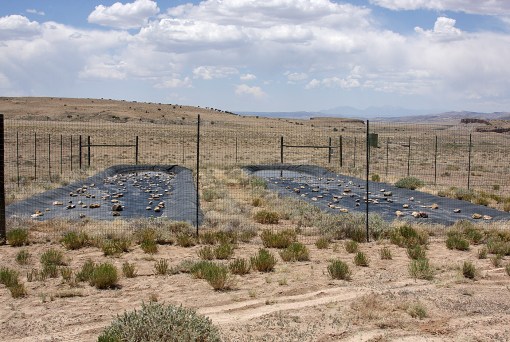
* About a decade ago, NMA/CO raised $40,000 to buy cattle AUMs from a rancher who held grazing rights in the basin and, after a five-year struggle, succeeded in retiring those AUMs. Not only that, a grazing EA was prompted, which reduced the remaining AUMs and changed the grazing season to dormant-season grazing only (Dec. 1 until Feb. 28). The National Mustang Association, based in Utah, was instrumental in finally accomplishing this goal.

* Because of Pati and David, magazine subscriptions, horsemanship training videos and countless pairs of boots have been donated by NMA/CO to the inmate training program at the Canon City prison facility, where BLM has a short-term holding facility.

* Pati and David have assisted with the removal of old fences and wire from within the basin as well as construction of new boundary fences and the repair and maintenance of fences.

* For close to a decade, San Juan Mountains Association has hosted University of Missouri students during alternative spring break, which has included projects in the basin. David is an arborist, and NMA/CO regularly has funded chemical spray (Garlon) for tamarisk removal. David (pictured below at right) also has volunteered his time and expertise to help with eradication efforts.

0323asb-group

* Because of Pati’s single-minded determination and her refusal to give up on him, when Grey/Traveler was sent to Canon City at the end of the 2007 roundup, we got him back. Pati and David hosted him at their ranch for three weeks (quarantine) until he could be returned to Spring Creek Basin (pictured below). Long-time readers of this blog will know that he not only rebuilt a band, he has the largest band in the basin at the tender age of “aged,” as aged at the last (2011) roundup.

0919greygone

* Pati and David represent NMA/CO in our coalition advocacy group Disappointment Wild Bunch Partners. They bring to Wild Bunch – and BLM – all their historical knowledge of BLM management of Spring Creek Basin Herd Management Area, as well as modern visions that fit with our advocacy goals, which they use to encourage new projects to benefit the horses. With the previous herd manager, one project Pati and David suggested and we convinced BLM to undertake was digging out ponds to increase storage capacity. Some hadn’t been dug out since the 1980s. In 2009, two ponds were dug out. In 2010, three ponds were dug out. In 2012, three ponds were dug out. All but two ponds in the basin have been dug out, and at least one of those still is on the priority list to BE dug out. Currently, in a desperately dry year, all but three ponds have water. To further illustrate how impressive this is – how visionary – ranchers throughout the region are hauling water to their cattle because water sources on their grazing allotments are dry.

112112doublepond

* Also as members of Wild Bunch, Pati and David are an integral part of the partnership with BLM that resulted in the Tres Rios Field Office being awarded $25,000 as part of the Director’s Challenge this year.

* NMA/CO always has championed the use of fertility control. In 2007, NMA/CO paid for five doses of PZP-22 to be administered to the released mares. In 2010, NMA/CO signed on to the proposal submitted to BLM for the implementation of a program to use native PZP in Spring Creek Basin to slow population growth and reduce the need for frequent roundups. Also in 2010, NMA/CO paid for my PZP training at the Science and Conservation Center in Billings, Mont. Then they paid for the darting rifle. When fertility control using native PZP was approved for the Spring Creek Basin herd ahead of the 2011 roundup, we were ready to volunteer.

* Pati and David have adopted several mustangs over many years (including those they’re riding in the photo of the plaque above). In 2011, they adopted yearling Rio (Grey/Traveler or Twister x Two Boots) and renamed him Sherwood, in honor of one of the founding members of NMA/CO. Pati is a genius at groundwork, and at 2 years old, Sherwood loads readily into a trailer and accepts a cinched saddle, among other things.

sherwood2

* In 2012, Hollywood and Piedra had a filly. She was named Temple in honor of Pati and David.

Temple, foreground; Madison, background.

Pati and David are true mustang angels in every sense of the words. Their passion about and commitment to mustangs, particularly Spring Creek Basin mustangs, is legendary in our part of the world. Personally, I am grateful to Pati and David a million-fold for their support and friendship. Their work has laid the foundation for the excellent health of the herd today and into the future. This list hits just the highlights, but I hope it conveys how inspiring they are and should be to mustang advocates everywhere. In addition, they are two of the nicest, most generous people you’ll ever know.

The plaque reads: Presented to David and Pati Temple. Thank you for your many years of unselfish commitment and dedication to the Spring Creek Basin Wild Horses and the Herd Management Area. The support that you have provided to the BLM has been invaluable to the long-term goal of a sustainable and healthy herd area in Disappointment Valley. Without your devotion to the horses, advocacy, hard work and persistence, many maintenance, enhancement and fertility control projects would not have been accomplished. November 2012. Bureau of Land Management Tres Rios Field Office.

The photo on the plaque, taken by Durango photographer Claude Steelman and featured in his book Colorado’s Wild Horses, shows Pati on Bandolier and David on Concho, their Sulphur Springs mustangs.

With appreciation beyond words and always grateful for you both, thank you, Pati and David, for your generosity, commitment and passion. It is contagious and has infected us all! And thank you, Tres Rios, for honoring Pati and David for all they have done for our mustangs.


Bay beauty

23 11 2012

Had a welcome sighting of this handsome bay boy:

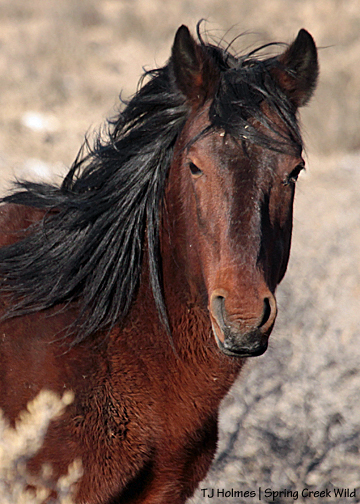
Poco, sporting his fuzzy winter coat!

While I was taking pix of him, I hiked over to look at the double ponds to check the water status.

Good news!

The pond that was dug out in 2009 has good water! The second double pond – which was not dug out – has no water, but the center is muddy.

Interestingly, some of the ground between the road and the good pond was moist on the surface. Given that we haven’t had any moisture for a couple of weeks (and that, not much), that’s just something to “make ya go hmm.” Most of the ponds do still have water, and as noted in a couple of previous posts, there are some water-producing seeps in arroyos.

Keep dancing. Mother Nature, like BLM, moves at her own pace. πŸ™‚


On the run to water

20 11 2012

Evening drink time:

Gaia, Cassidy Rain, Killian and Roja run down a slope to join Storm at a water seep in an arroyo!

Love the rich colors of their fuzzy coats in diffuse sunset light.

It’s so dry – still. Seeing them drink was a welcome sight. Ranchers are hauling water to their cattle that still are on the range (not Spring Creek Basin but in nearby areas). All rain and/or snow dances welcome!


Die, thistle, die!

6 10 2012

To follow up from the knapweed spraying seen at the northwest pond, here are some pix of sprayed musk thistle at the east-pocket pond:

On the western edge of the pond.

On the south edge of the pond – and dying already! (Note the water.)

Dying musk thistle, full pond – what’s not to love?

Did I mention full pond? The east-pocket pond now is one of only two ponds in the basin that have not gotten dug out in recent years. It did go dry this year but rebounded (a couple of times) with rain. And the Sorrel Flats pond,Β which was dug out in 2010, is just to the south.

Thank you to the Forest Service and BLM for your continued partnership with Four Corners Back Country Horsemen and Disappointment Wild Bunch Partners in managing Spring Creek Basin Herd Management Area to the best of its potential! It’s fantastic to come back and see the fruits of our labors – GPS’ing sites in the spring – come to fruition in the fall!