Better late than never, and when I finally got my act together, I thought Valentine’s Day would be the best day for this rundown.
As usual, these are 12 (and a bonus) images from the last year that came from each month. This year, I think, most of these photos have been on the blog previously. A little reminiscence of the events surrounding each image will follow the photos. Sometimes it’s those emotions and memories that make a particular image special for the photographer, and these are no exception to that. Just being out with the mustangs, in Spring Creek Basin, no matter the weather, is the very best part of what is impossible to share.
Enjoy … and please consider this is my love letter to Spring Creek Basin and its mustangs from 2024. 🙂
January last year was at least somewhat snowy (this year was very much NOT snowy). Skywalker had been a bachelor with a couple of bands until sometime last year, and here he is with some horses from one of those bands. Completing the composition is part of the Spring Creek canyon rimrocks in the near background and Utah’s La Sal Mountains in the far background. (I wish they were that snowy this year.)
This was a magical February visit with Mariah and her band. The low-angle sunshine made each snowflake a visible bit of earthly magic, and when she looked back at somebody – shazam. Magic captured.
Couldn’t pass up this snowy March day in the basin with Temple! Clearly, she had been enjoying the moisture and excuse to roll in the mud. I love the sunshine on her and the falling snow blurring the background.
I had so many opportunities with the mustangs in April, but this image of Hollywood was just *the one*. You all know exactly what I mean. (To update, I haven’t seen him again since the image I posted earlier this winter. It doesn’t mean anything other than I haven’t seen him. …)
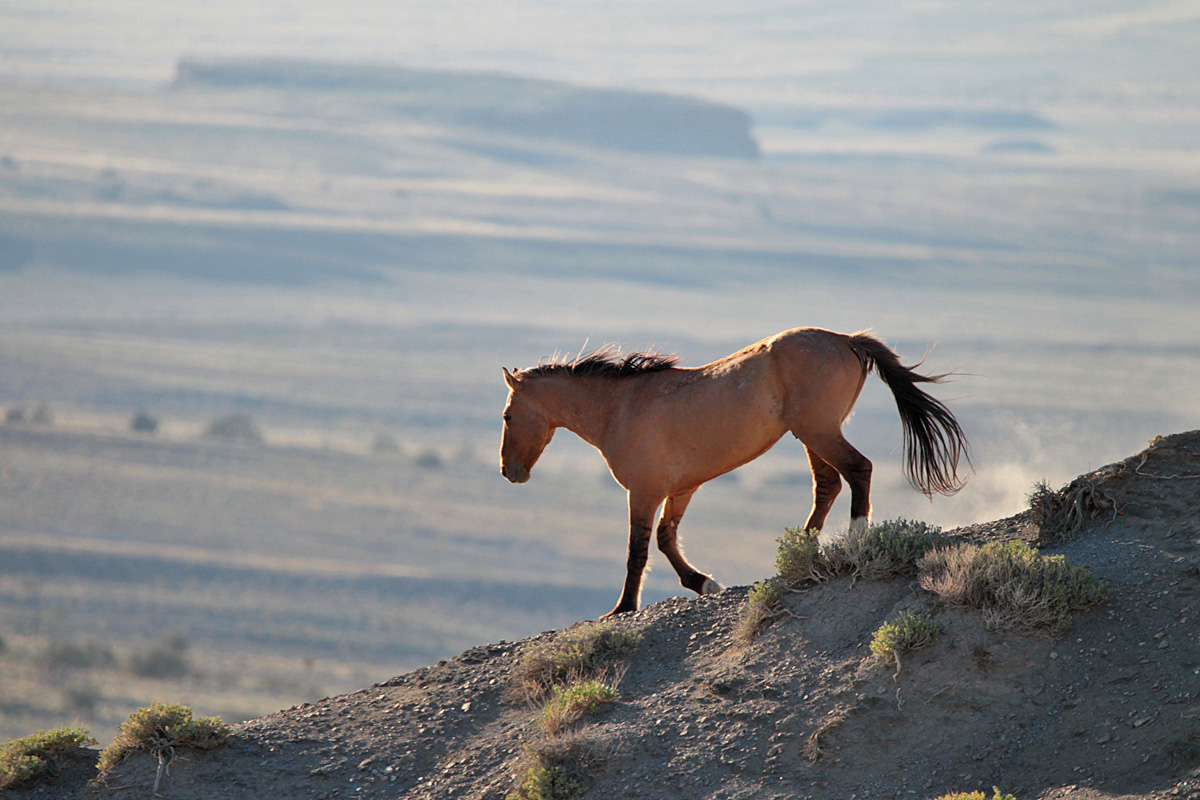
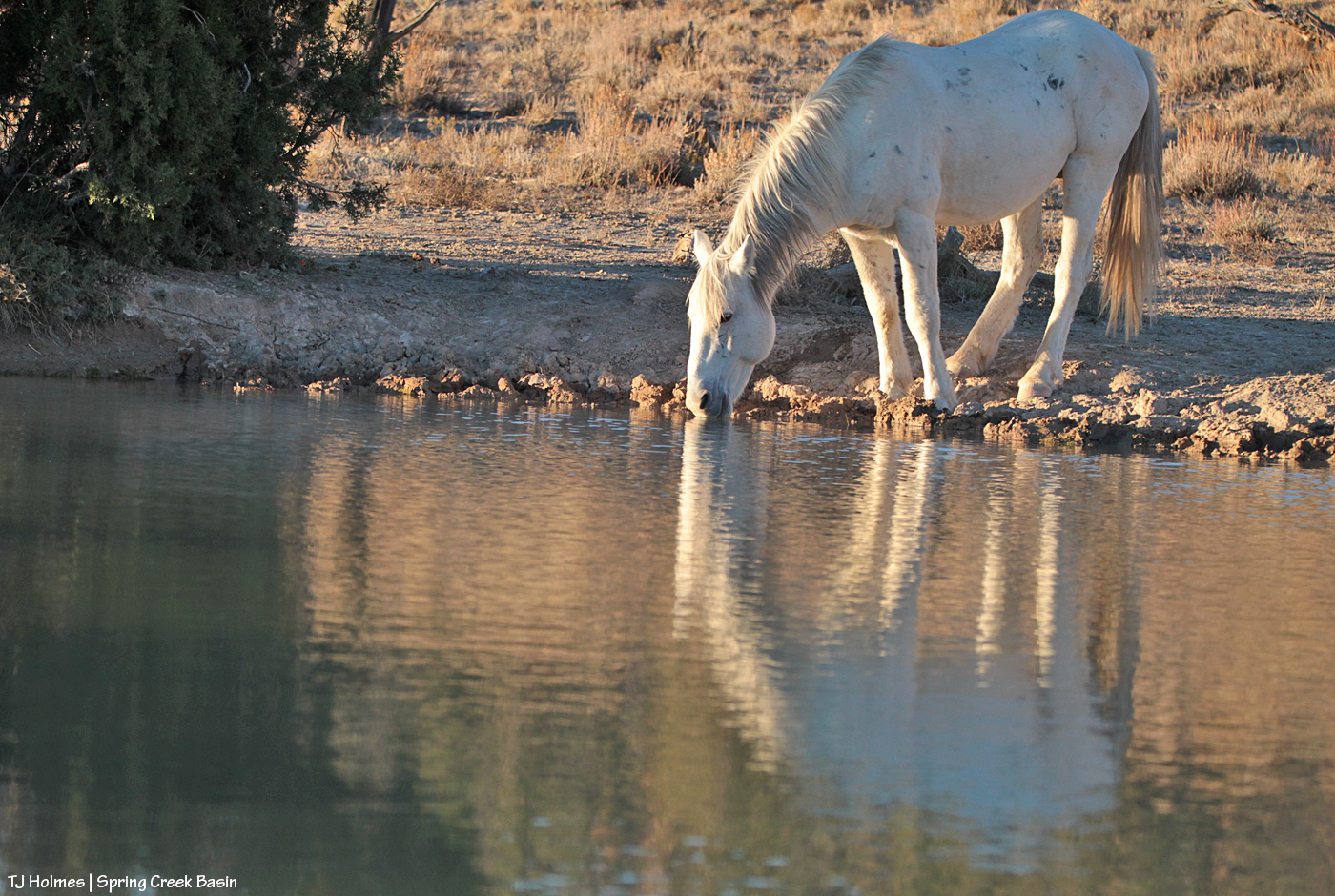
When Spring Creek is running with rainwater, that is a time not to miss photographing it because it doesn’t happen often and water doesn’t run in the arroyo bed for very long. When Skywalker moseyed to the edge of the creek in May, just upstream of the canyon, the scene came alive with story: mustang drinking from an ephemeral stream in the desert.
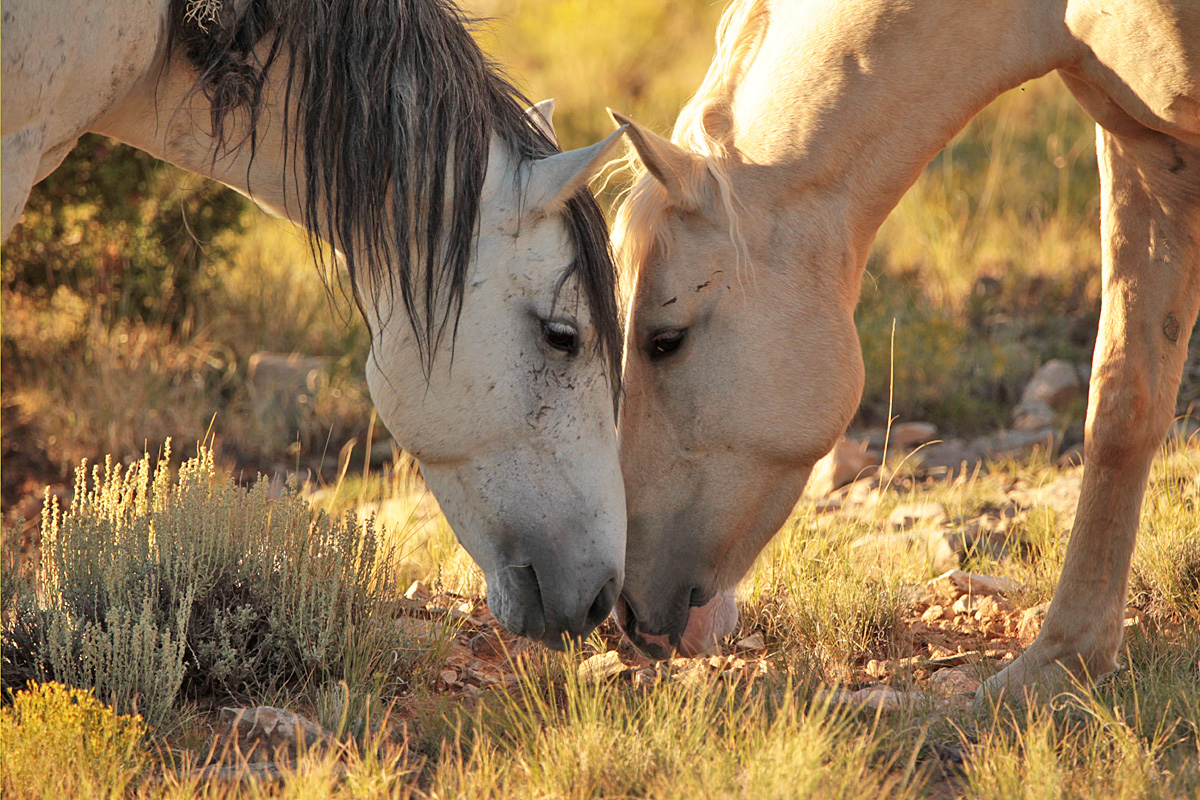
In June, I was lucky to catch Sundance’s band near Odin’s band … and luckier still to see Sundance and Odin having a friendly little chat! Elder stallion and growing young stallion; what a moment. I’d love to know what wisdom Sundance was imparting to young Odin.
Terra’s stallion adores her. And I mean *adores* her. They travel with another band, but Venture has eyes only for Terra. This image is from July, when it’s hot and dry and the horses just like to doze.
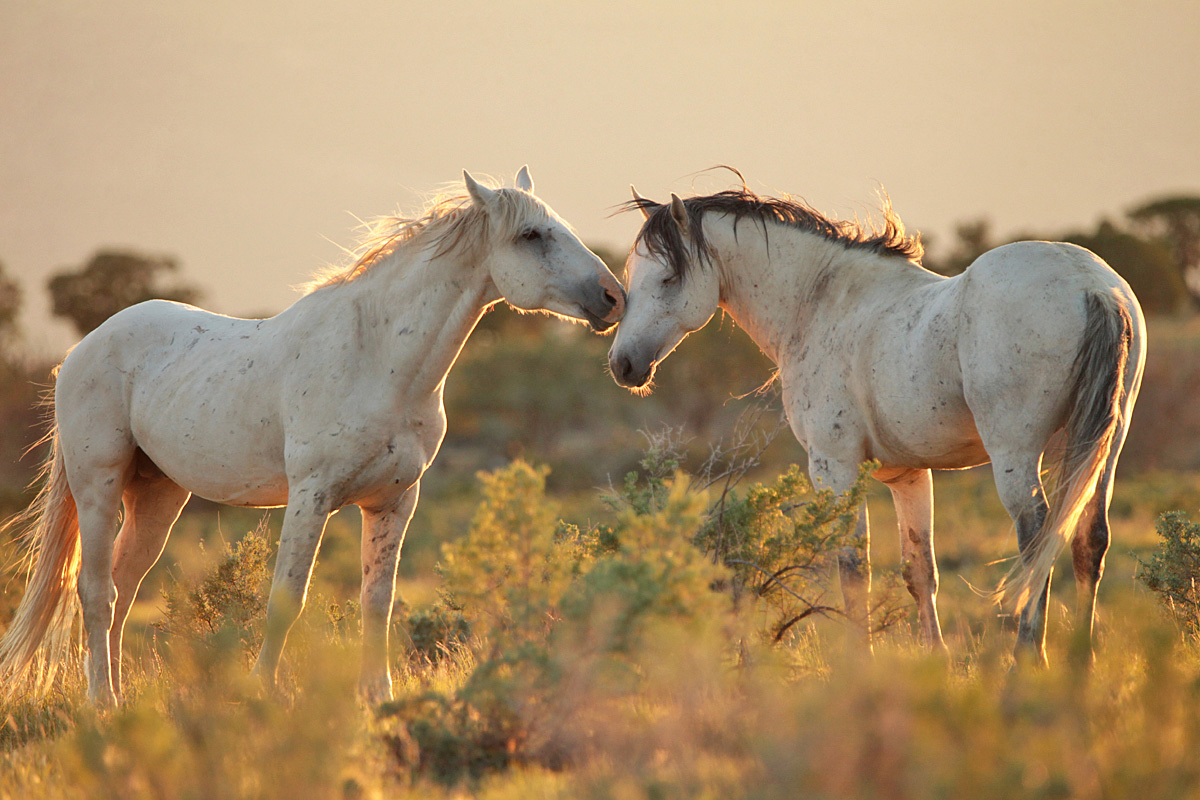
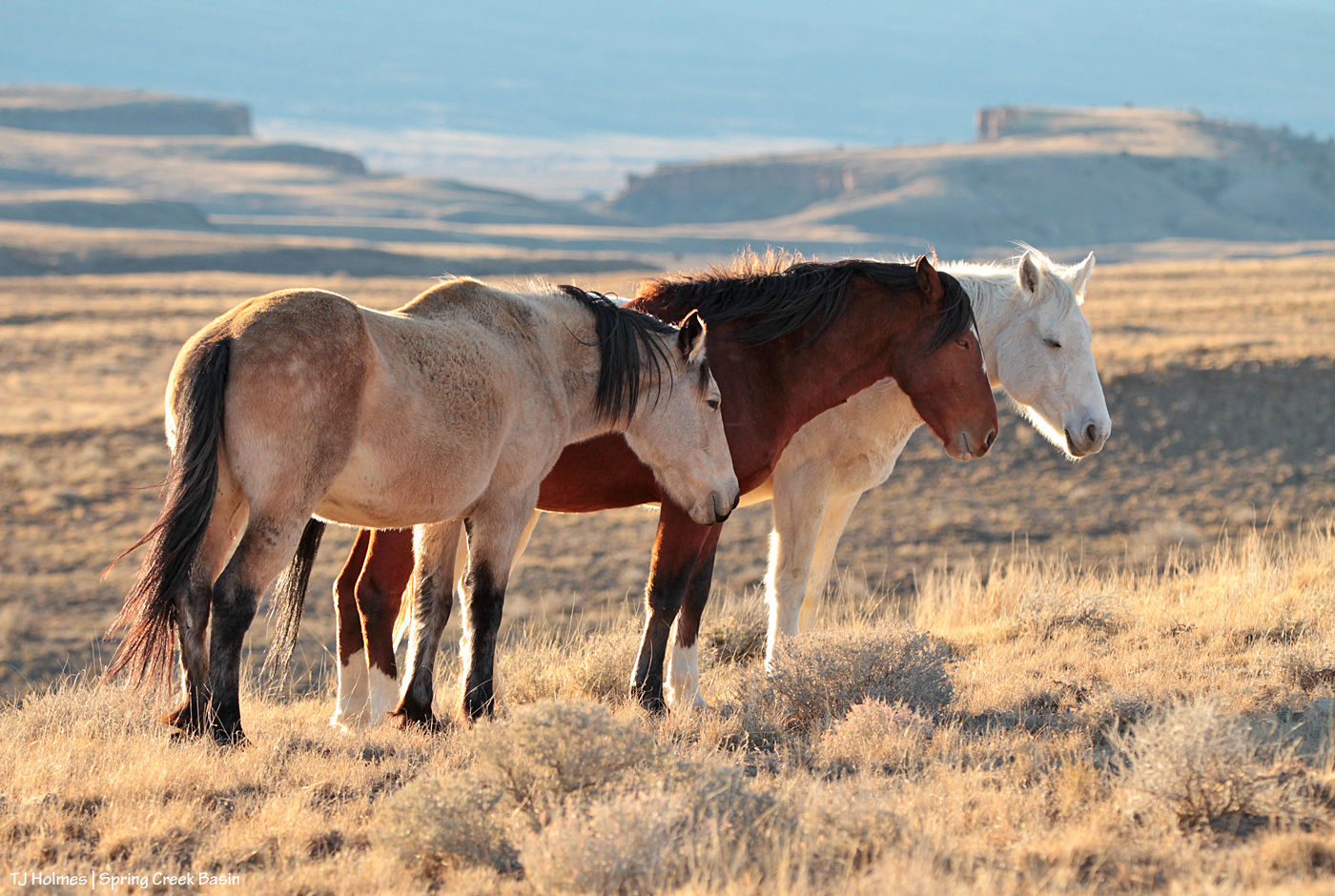
Personally, this is one of my favorite images of the year because those are two of my favorite stallions: Storm and Buckeye. With their bands grazing nearby on this warm August evening, the boys greeted each other quietly and respectfully before returning to their mares.
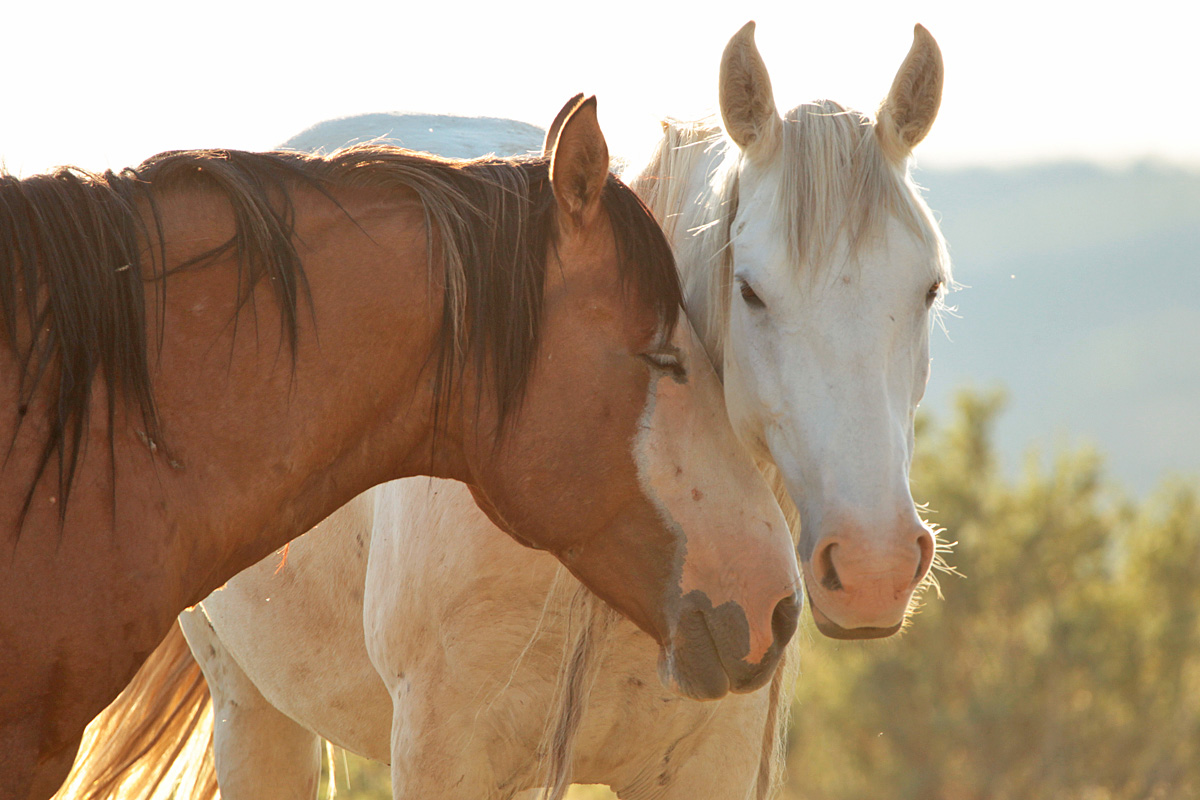
Here’s your Valentine’s Day image, taken last September. 🙂 Buckeye and Rowan, especially, seem to have a special fondness for each other.
After Storm lost his band in October, the mares went through a couple of younger stallions that couldn’t seem to keep them. Flash ended up with Gaia … then also with Mysterium. And finally, as you know now, he gathered all of Storm’s girls (which, I think, probably was due more to them wanting to be together and evading the youngster that had them than to any particular skill Flash had at stealing them!). (I’ve seen Storm just once since he lost the band, way deep in the southeastern part of the basin.)
Last November, we had some great snow, and we were so optimistic for the winter to come! … And that was pretty much it. Here it is February, and we’re desperate for moisture of any kind while we watch the dirt turn to dust, to powder. But in November, Terra was a gorgeous girl in the sunlit snow, and life was good.
We had more lovely light in December – as seen glowing around lovely Winona – but not a heckuva lot of snow.
And as usual, a bonus:
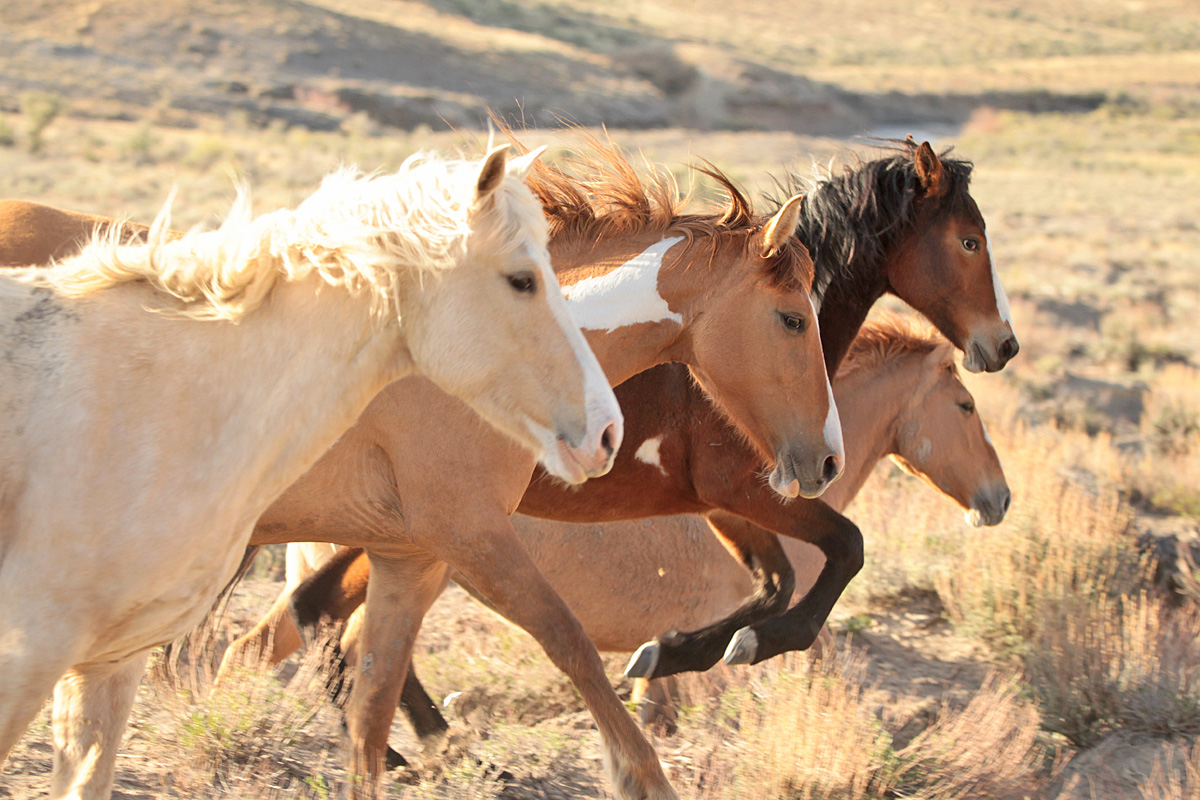
Buckeye’s girls. 🙂 I don’t remember what caused them to run right past me, but I was stoked to capture this image of them nearly in a row, especially just as Bia was leaping a bit of sage or saltbush!
Thanks for following along, happy Valentine’s Day to you and your loved ones, and if we can have a bit of a love(ly) wish … more snow, please! 🙂
*** Update Friday morning: Disappointment Valley is getting RAIN! Not snow, RAIN. In February. In Colorado. Well, you know we’re in desperate need of moisture, so I’ll take it. (But 38F is hard on the wildlife under rain.)
When I was a young Coloradan, newly moved to Durango from Texas, my then-co-workers at The Durango Herald can attest to the fact that the first time snow fell that winter, I went a little bonkers with excitement.
Not much has changed, 22-plus years later. 🙂
We had another great (rain to) snowfall overnight, and it was a wonderland of white this morning – and muddymuddymuddy underneath. The snow is nearly all melted – at least down-valley – now, but rather than wait for tomorrow, here’s a peek at the Thanksgiving-Eve bounty in Spring Creek Basin:
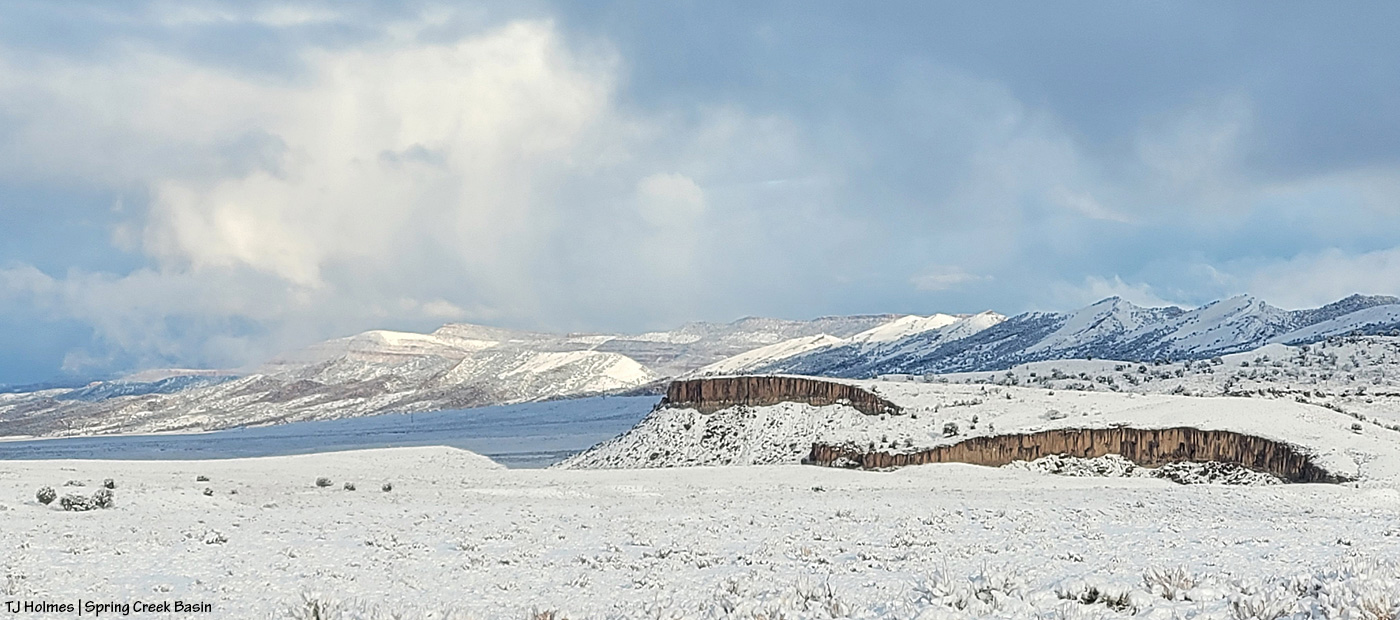
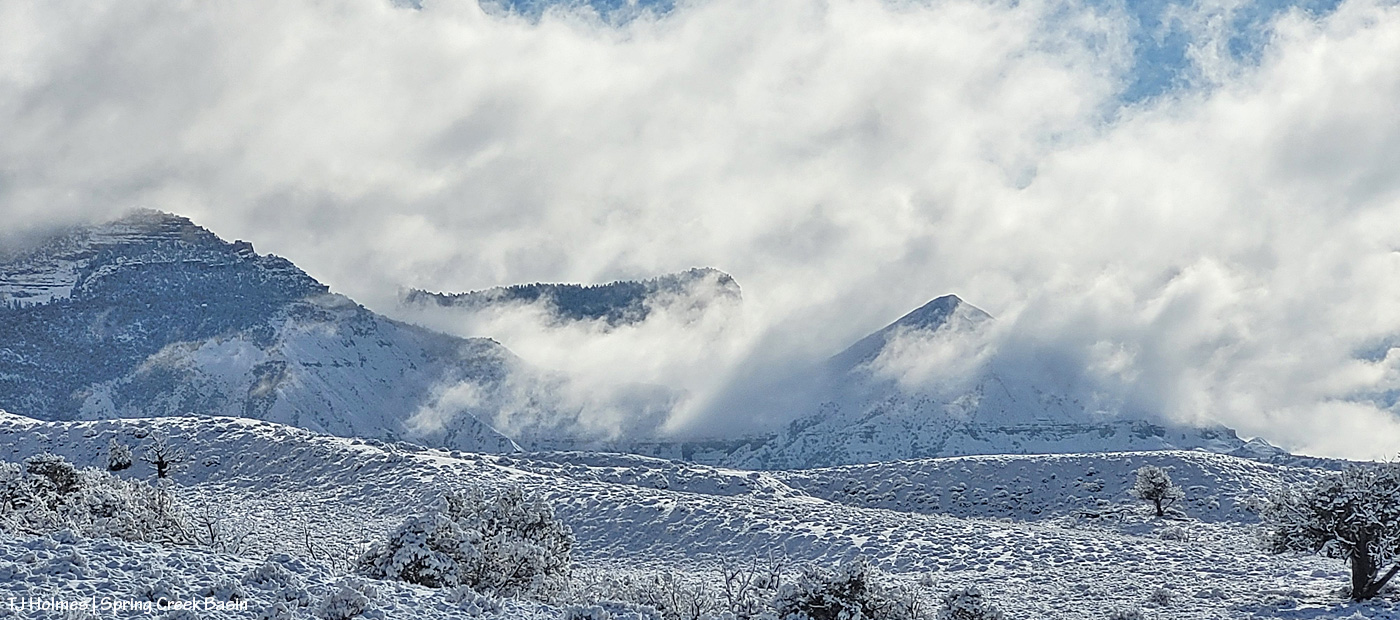
Shortly after sunrise, Chrome’s Point, looking south-southeastish. Flat Top and Round Top are at left in the distance, and Filly Peak is at right.
Looking back north-northwestish, the difference in light is dramatic (this was maybe only 10-15 minutes after the first pic?) as the clouds linger at the higher elevations south and east of Spring Creek Basin and have started clearing to the west and north (though the mountains were engulfed in clouds the whole time I was out).
Holy heavenly light. If I’d been able to see that spotlight of light, with my own eyeballs, at the time, I would have brought out the big gun (these are all from my phone – handy little pocket cam that it is). Wow. Knife Edge is ahead to the left; Brumley Point is visible at far right. Temple Butte and McKenna Peak are still completely within the clouds.
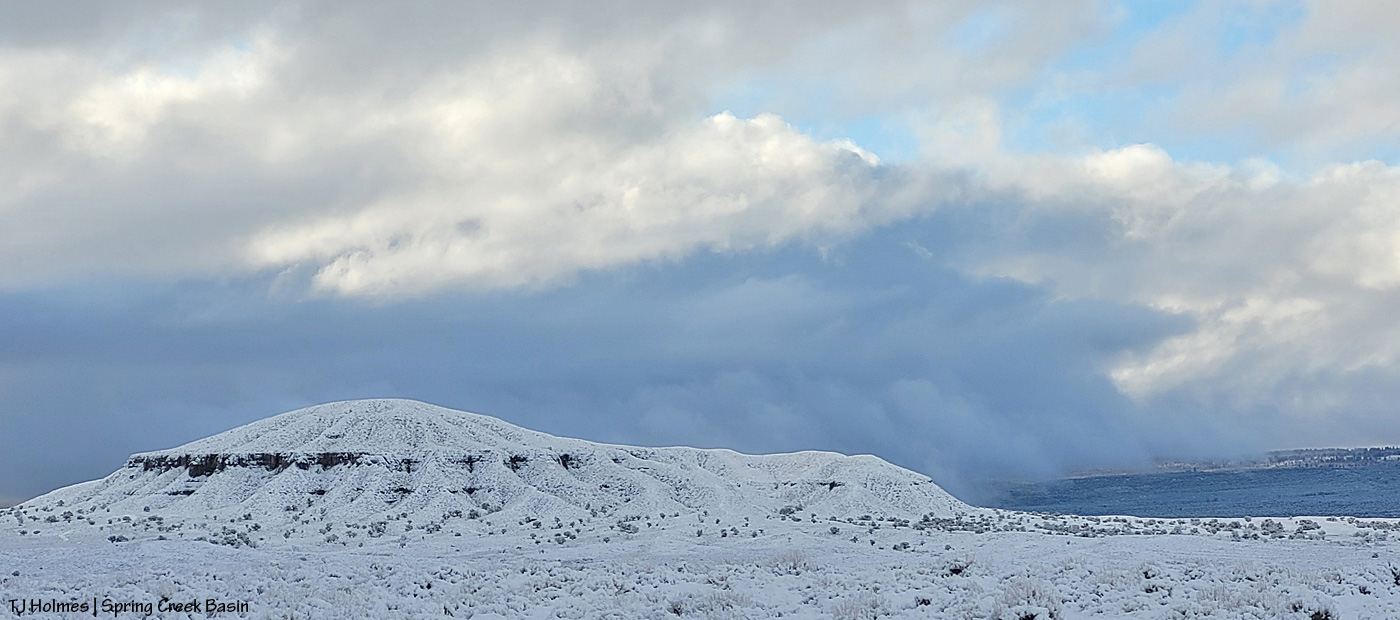
Round Top – aka Saucer (as in flying) Hill – with snow still pouring from the moisture-laden clouds to the southern ridges of Disappointment Valley and beyond to the Glade.
I was just below the base of Knife Edge with mustangs when Temple Butte and McKenna Peak were starting to emerge from the still-billowing clouds. Dramatic much?!?
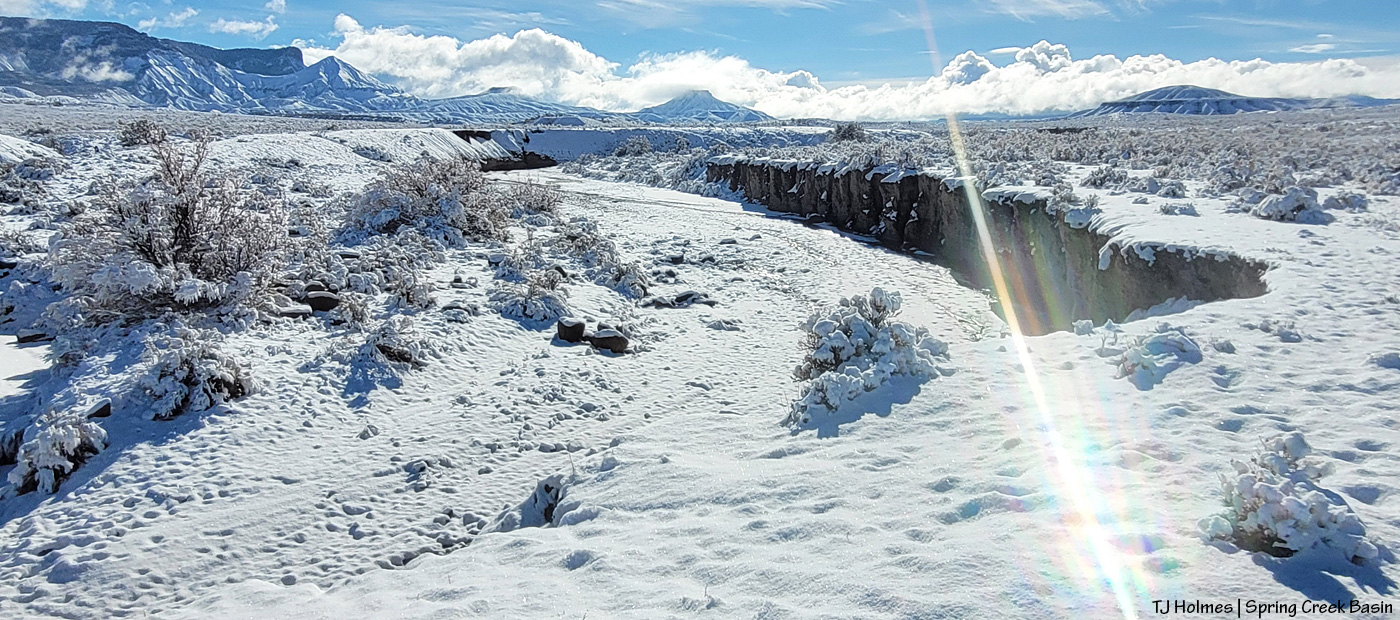
Heading back to my buggy and the road, looking upstream at the Spring Creek arroyo toward its source at McKenna Peak … Temple Butte behind it … submarine ridge to the right … Brumley Point straight ahead (it sits right on the basin’s southeast boundary) … Round Top at far right. Water WAS trickling through the bed of the arroyo in some places (like where I crossed).
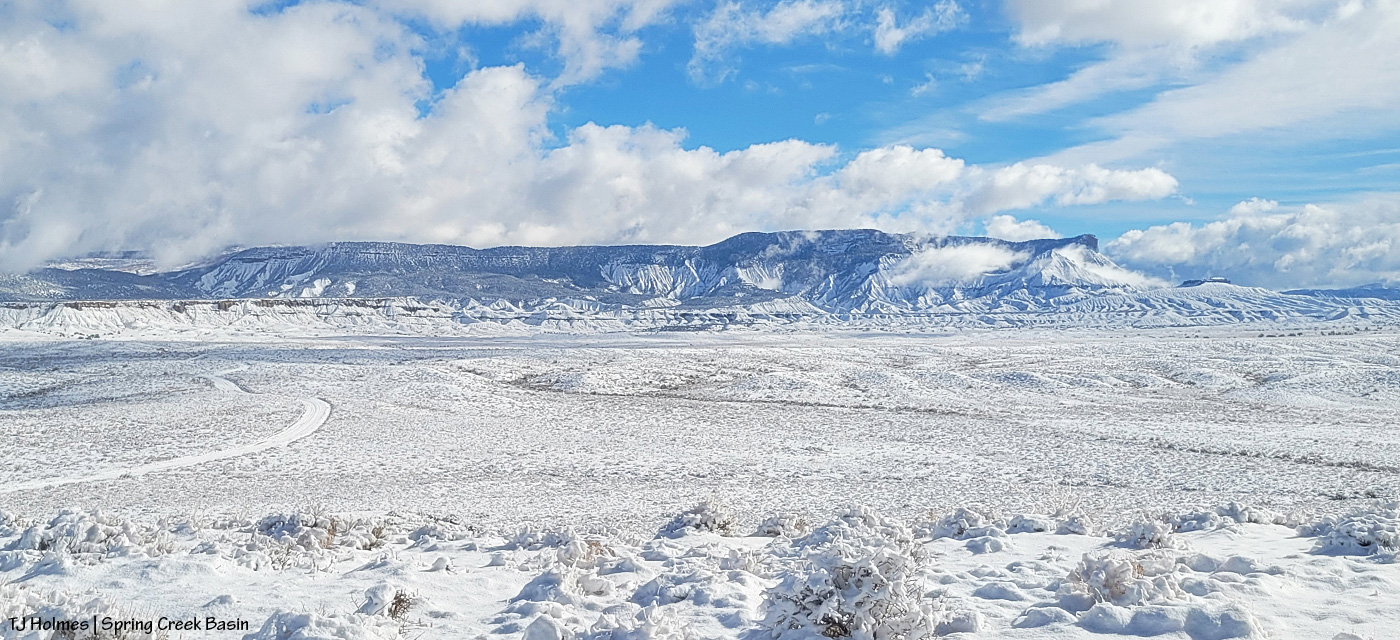
From the ridge at the main/original water catchment (oh, how I hope this snow provided lots and lots of water for our catchments!), looking eastish across the basin. I mean … who DOESN’T get giddy at the sight of snow?! 🙂 Knife Edge is the ridge at far left with the top rim just barely free of snow. See the trees at the base of the ridge at almost farthest left? That’s where the ponies are (the ones I visited, anyway).
This one’s a little out of order, but it sums it all up. 🙂 I love mustangs; I love snow; I love Spring Creek Basin and its mustangs in the snow!
That’s our water. Our moisture. Our lifeblood for growing things.
So, so, so, SOOOOO grateful this Thanksgiving Eve. Happy gratitude to all you wonderful readers and your families on this, my very favorite holiday. Hope you all get to spend it with those you love, in places you love. 🙂
Hold onto your paddles, folks, have I got some rainwater for you. 🙂
Brought to you courtesy of Mother Nature –> Southwest Colorado –> Disappointment Valley –> Spring Creek Basin:
A full water-catchment trough is always a good sign. Fortunately, though low (in the tank, uphill behind me), we’ve had enough rain lately to keep this trough full – and there have been a fair number of horses drinking here with the amazing grass around (don’t let the pic fool you; the galleta, in particular, is bonkers this year, along with the alkali sacaton). I may have explained this in the past, but it bears repeating: The triangular sheet of metal over the trough is an evaporation cover, designed to help slow evaporation of precious water in our (usually) dry climate. The shape of the cover is triangular so the horses have plenty of room to drink at the sides of the round trough.
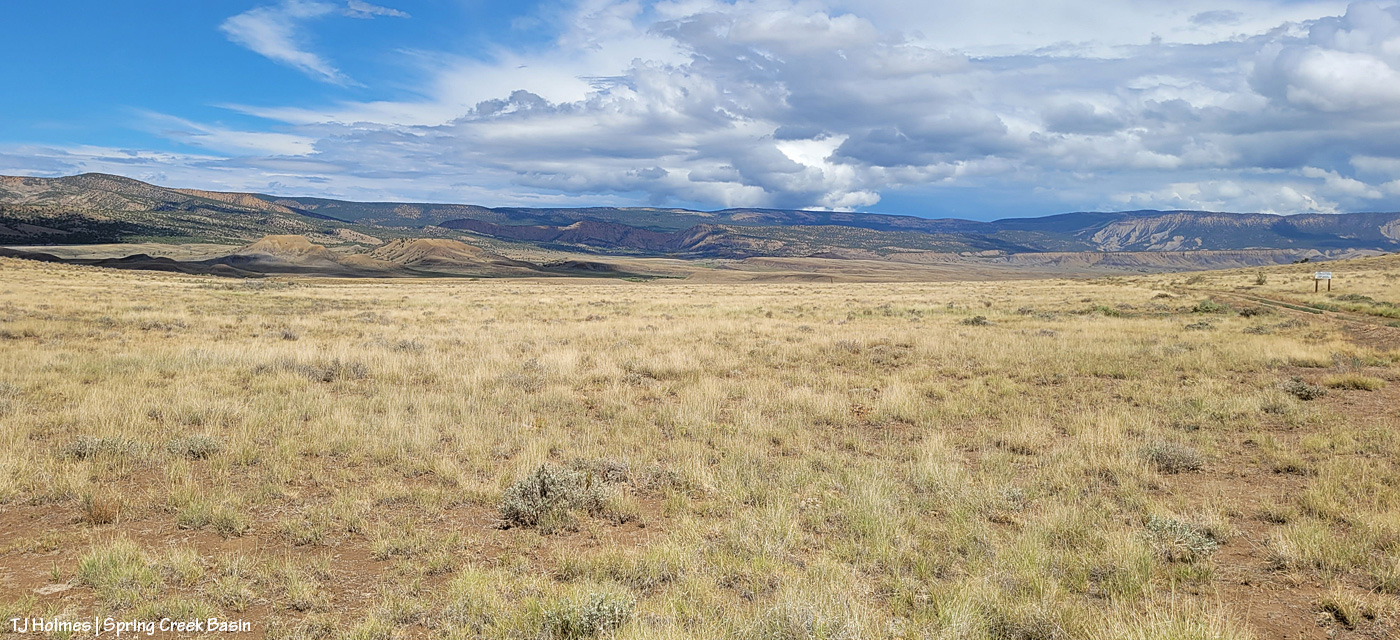
The Flat Top pond looks small in this wide-angle view looking eastish across Spring Creek Basin, but although it has gotten pretty shallow in recent years, it’s a pretty good size.
Good thing I scouted the V-arroyo before I tried to cross it. Those are my tentative footprints in the pillowy, shoe-grabbing – and tire-stopping – mud in the center bottom of the pic. You might not think it’s too bad, but there’s a lot of water in/under that surface mud still, and it is NOT friendly to tires or shoes until it has a chance to seep deeper into the soil and dry out from the bottom up. Along the left side of the pic is the arroyo – we’re looking upstream. The bottom of the arroyo, where I’m standing on relatively firm ground, isn’t very wide (hence my name of the “V”-arroyo), and the road rises to my left – up a little water-carved bank that’s nothing like the wall still in place on the other side of the first Spring Creek crossing.
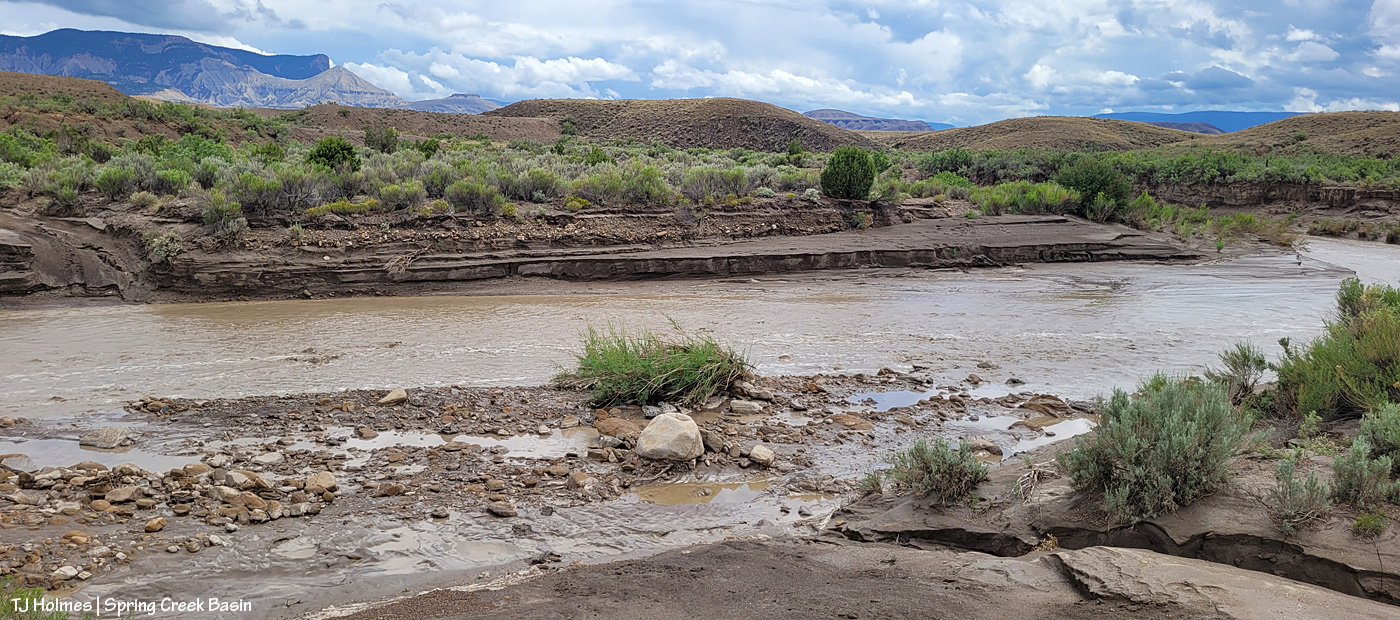
Holy Spring, err, RIVER! I know it’s hard to tell, but this is the first crossing of the usually-dry arroyo that is Spring Creek (when it’s not masquerading as a rainwater-swollen river). Yes, the other side is a road. 🙂 Well, it’s mostly a two-tiered wall; the right side of it is where I dug a channel in the wall the last time the creek ran (back in June) so I could get my ATV across and up and over. It has been widened by crazy people in a truck (I don’t know who … I don’t know anyone that silly/stupid/nutso), but it’s greatly eroded again and is going to need some custom shovel work. (And lowering of the water level. :)) The width here is probably about 25 yards? (Good darting distance.) And this water level is at least 4-5 feet below where it was at its highest/widest mark, behind me, so it’s already running with less volume than at its peak. (WoW!)
I took a lot of pix from here, and I wish I knew how to embed video; I’m still on a super-high from seeing all that water. Bear with me as I show you some upstream and downstream and high-vantage pix. (If you don’t think water in the desert is A BIG DEAL, you don’t live in a desert.)
Looking downstream. Note the two-tiered wall across the creek where the road is (should be). Most of the rocks at left are from previous flooding. But I will tell you, that kind of water can move BIG rocks. I have seen it, and I have moved big (enough) rocks out of the way of crossing in a vehicle or ATV. This is why the powers that be warn people against crossing flooded roads; that water literally grooves arroyos into our salt-desert landscape (milennia ago, this was under a giant ocean!).
Arroyo as defined by Merriam Webster: plural arroyos. 1. : a waterway (as a creek) in a dry region. 2. : an often dry gully or channel carved by water.). … Arroyos are a desert’s proof of water movement – that far bank/wall is much taller than I am. The wall where the road used to be is proof that they’re always changing – with more water.
Looking upstream. Note the water at far right; it was still finding ways to trickle along downstream.
A bit wider view from back up the road a bit. I mean … ?! 🙂 I knew, before ever I got there, that I wouldn’t be able to cross, but I did NOT know how river-esque Spring Creek would be. I love, love, love this place.
Similar view, but this shows the bend in the creek at right. … Try to follow me upstream: See McKenna Peak (the pyramid-shaped pointy peak)? Way back there is the source/start of Spring Creek, which – as you all know, being loyal, wonderful readers of this blog – drains Spring Creek BASIN (along with all its multitude of widely (and narrowly) and wildly variable tributary arroyos). As you may or may not know, the creek doesn’t roll in a straight line from there to here (or beyond/behind/downstream of me). So that bend goes around to the left – upstream of the southernmost *major* drainage/arroyo in the basin – and past another creek/arroyo crossing (below the dugout, if you’ve visited). It comes from the eastish side of the basin – with the northernmost *major* drainage/arroyo entering from the northish to also run back to (really from) the northeast. Are you still with me? There are three *major* drainages in Spring Creek Basin with Spring Creek being the lowest, middle drainage – named as the very-most-major drainage and namesake of the basin it drains.
Water is important here. Knowing how it flows is part of the importance. Back in the very-long-ago day, some other silly people – who apparently didn’t know about arroyos and the highly-erodable quality of the salt-desert soil – tried to dam Spring Creek just below the confluence of the third major arroyo. Thinking they would create a reservoir out of which to irrigate land for farming (what WERE they thinking?), they built a dam and dredged miles of irrigation ditch; the remains of both can still be seen. As the story goes, the first major rain of the (likely monsoon?) season brought water rolling like a river down every tiny arroyo, down to and through the big drainages, blasted a hole in the dam that likely had cost boatloads of blood and sweat and resulted in tears (!) … and they went away *disappointed* (har har). … Mother Nature always wins, folks.
Well, I knew better than to attempt the crossing of Spring Creek Basin’s *river* (without more rain … which we’re getting again as I type … the creek would likely be done flowing within 24 hours … though the water will last in pockets and seeps for a good long while), so despite the big group of a couple of bands of mustangs not far away, I headed out, already on a great big, marvelous high.
What you’re looking at in the pic above is our crazy-good grass, which amazes me because of the little – but always valuable – rain we’ve gotten this summer (this year, really; it’s been pretty darn dry since *last* year). The galleta grass is particularly bonkers this year, along with the sand dropseed and/or alkali sacaton (very similar in appearance). This is from right inside the basin’s main/western boundary entrance looking eastish.
From here, my next destination was the south rim of Spring Creek canyon, through which water runs out of Spring Creek Basin, out across lower Disappointment Valley and into Disappointment Creek, which delivers water – along with a “healthy” (aka large) dose of salt and sediment (apologies) – to the grand and spectacular Dolores River.
Spring Creek, draining Spring Creek Basin. 🙂 Around the near (left) bend, before the far bend, there’s a fence across the wide-open low ground and a water gap across the creek; that’s the basin’s western boundary. Way yonder, on the horizon, on the far side of the farthest rimrock and even beyond that blue-grey tide of rain, is the south shoulder of eastern Utah’s La Sal Mountains.
Not even my phone’s widest angle is wide enough to take in all the gorgeousity of Spring Creek through its canyon, so here’s another bit of view that takes in more of the upstream canyon area. Spring Creek Basin stretches north (straight ahead of me) and east (to my right) and south (behind me) from this perspective on the canyon’s south rim.
Those layers. The canyon is neither super deep nor particularly long. But it is so gorgeous.
In just the short time I walked out and spent along the rim, the storm to the west was already passing.
Looking upstream across the heart of Spring Creek Basin, where another storm loomed on the northeastern/eastern/southeastern horizon.
And because this is a blog about the wild horses of Spring Creek Basin, there IS a mustang out there, though I’m not sure he’s visible. As far as I know, the young mister is the only one to have crossed the creek (within view, anyway). 🙂
Grow, grass, grow!
Better late than never (this was the last day of specific rain in the forecast). I think we can be said to have gotten some monsoon rains this summer. Despite all the worry leading to this day (yesterday), soooo amazingly grateful. 🙂
* Thanks to Charley Pride for the inspiration behind this post’s title – “(High on a) Mountain of Love.”
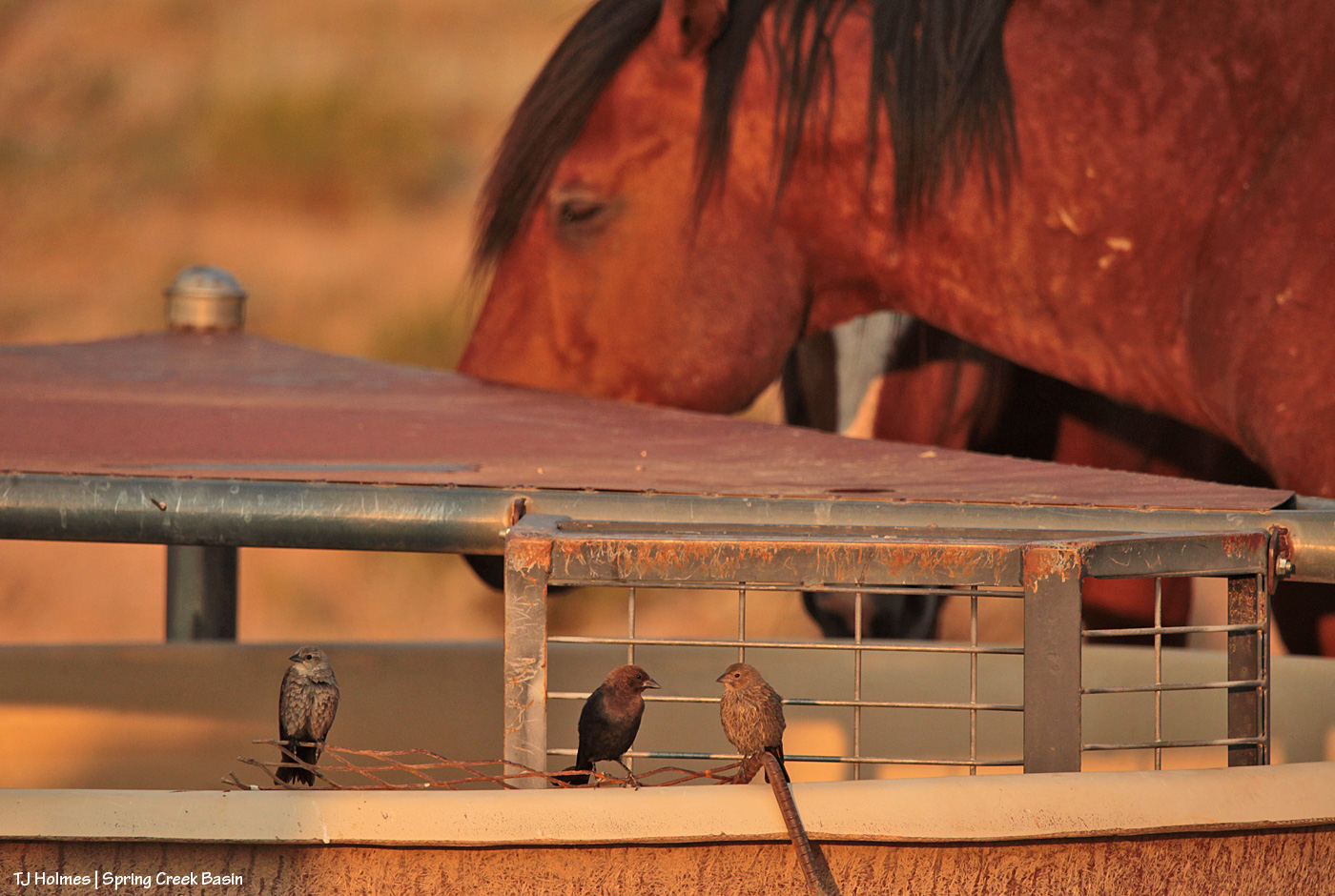
I *think* that’s a male brown-headed cowbird in the center, possibly flanked by females or juveniles. Please DO correct me if you know the correct ID. Birds – especially LBJs – aren’t even on my list of known-about critters.
Speaking of critters, they’re on the “critter ladder” in the trough at the main/original water catchment in Spring Creek Basin, built 20-plus years ago. The “ladder” is a bit of metal mesh that allows birds, ground squirrels – critters – to get to the water to drink without drowning. I was super tickled to see them using it with horses (that’s Tenaz in the background) napping around it after an evening mosey to the water cooler, err, trough. (All of the troughs at all four water catchments in the basin have some form of critter ladder.)
Fun bonus pic of the male actually standing on the rim of the trough as photographed through the legs of a napping mustang. 🙂
Everything in the wild needs water. Mother Nature could be a little (!) more helpful in the delivery of said water, but we do our best to ensure that it gets where it needs to go.
I think – I hope – that these pix truly are worth 1,000 (or more!) words … but I’m going to give you a few more anyway. 🙂
This is the east-pocket pond, aptly named as it’s located in Spring Creek Basin’s east pocket. This isn’t the only pond that suddenly has water after Thursday’s tremendous downpour, but it’s the only one of which I have a “before” pic.
“Before” was a little after noon on June 27, a few hours before the four-hour deluge. “After” was about 26 hours later on June 28.
Maybe, if you look closely, you can see a band of greys at far distant left in the pond-now-full pic. Fortunately, the horses have multiple sources of water now. It’s amazing how quickly things change (for the better, in this case!).
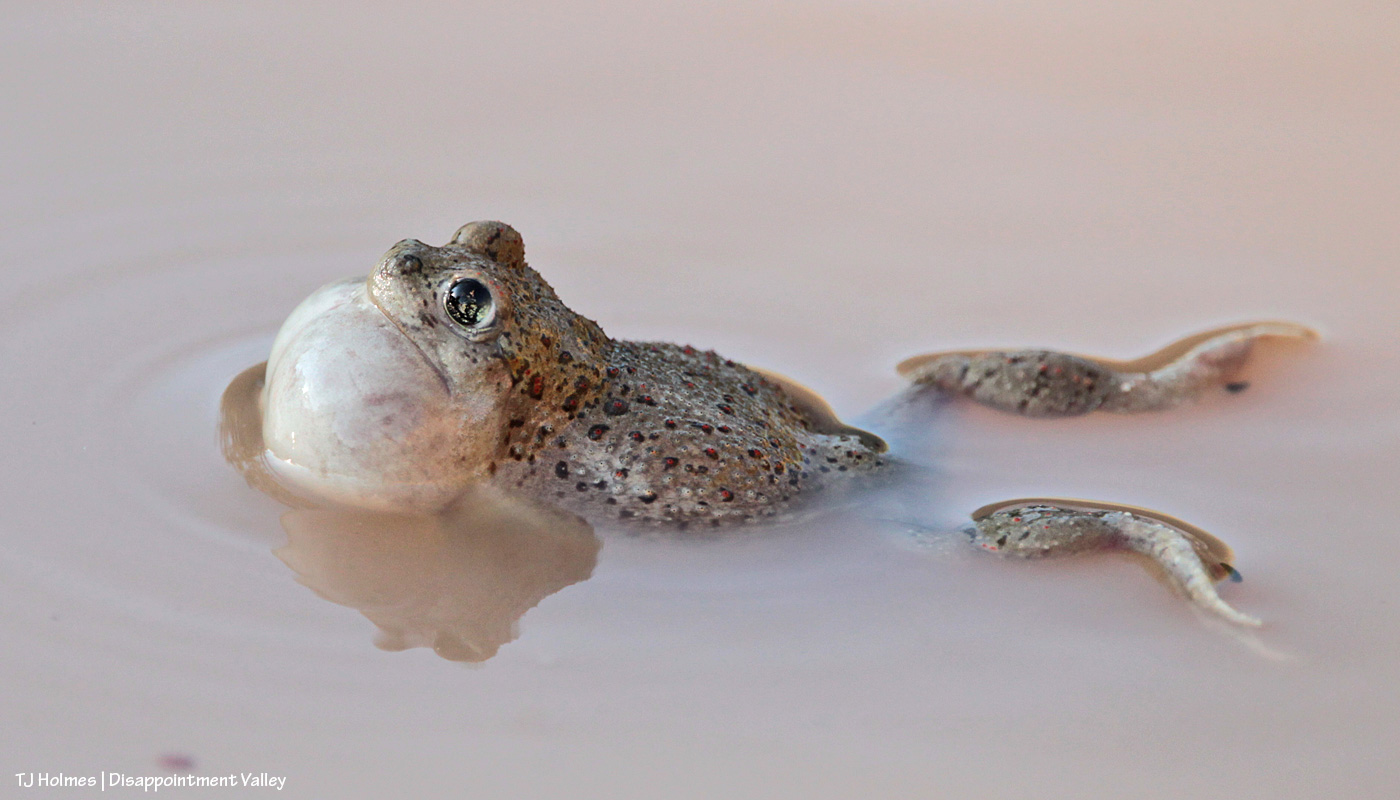
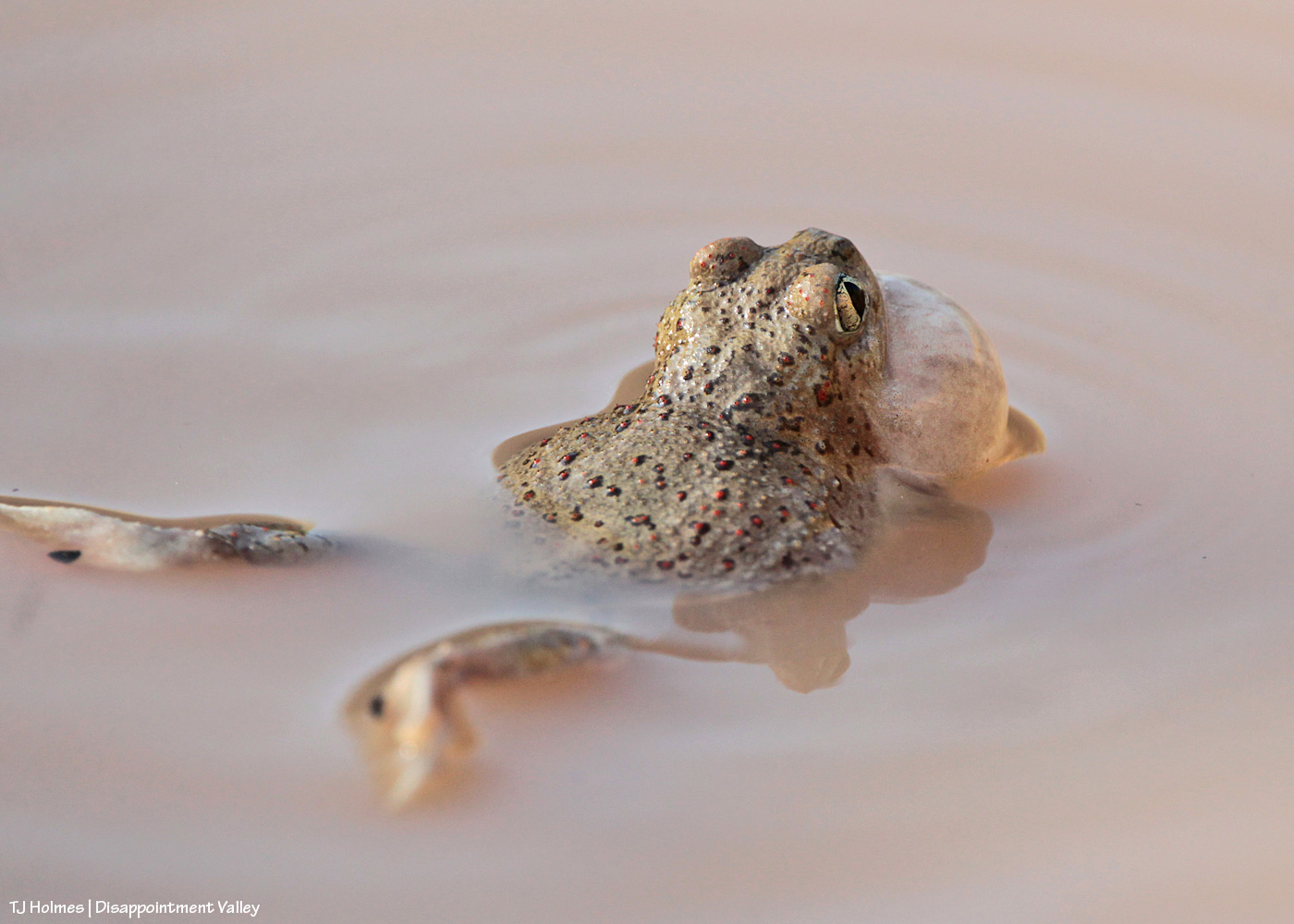
When you get only a bit more than half an inch in almost three months, then you get enough rain in two consecutive days to push that above an inch … THEN you get 1.66 inches of rain in four hours … the toads start thrumming their joy. Sure, sure, it’s mating season (dependent on water?!), but I’m pretty sure they’re happy to finally have some water.
*I’M* happy to have water, for the toads and the mustangs and all of the critters who depend on water in the desert.
If this pic of pretty Mysterium up to her knees in the east-pocket pond doesn’t help you feel refreshed and relieved … sit with it a while. … It’ll come. 🙂
This pond may be one of the basin’s smallest, but it’s wonderful to see it still holding water this late in the (another) dry year.
While Storm’s band drank, Storm went off to have a chat with the stallion of the band who preceded them to the pond. Storm then returned for his own long slurp before following his band out to graze nearby.
Looking back helps us look forward (*when* it helps? sometimes I think looking forward is the only way to go … though I’m not very good at this myself). I think this is the third year of the (admittedly borrowed, in my case) tradition of posting 12 pix at the end of the year that represent each of the previous months. It has been a good year in Spring Creek Basin. After another less-than-positive winter and a dry spring, we had a second-in-a-row summer monsoon season and a relatively rainy early fall. Then things got dry again before we finally started to get snow a couple of weeks before Christmas.
Our excellent BLM partners – Mike Jensen, Garth Nelson and Daniel Chavez – put their enviable skills to work and built a second water catchment in the basin, starting in early summer and finishing in the fall. It’s another (our fourth) such project to catch and store liquid gold and bank it against continuing drought conditions; with the newest catchment, we have the storage capacity for 50,500 gallons of water. That’s really quite enormous (!). (Of course, we need Mother Nature’s continuing help in the form of snow and rain!)
We lost some horses (as we do every year), and we had some foals (as we do every year), and the herd and the range are in excellent and very good condition overall. In September, we celebrated our 11th anniversary since the last roundup. Fertility-control treatments continue apace, and because of the efficacy of the native PZP that we use, and the aforementioned good condition of horses and range, there’s (thankfully) nothing (no removals) on the horizon.
Without further ado, as 2022 comes to an end, let’s remember some scenes of Spring Creek Basin and its fabulous mustangs to carry us ahead into 2023 (some have been previously published here; others are new to the blog):
Tenaz (showing off his rarely-seen generous star with wind whipping aside his forelock) and the mustangs rang in the first day of 2022 with fresh snow! A handsome bay mustang does look rich and supremely healthy in new snow. I know I write that a lot with regard to bay mustangs, but really, have you ever seen a better color combination!? OK, OK … all of the other equine colors look pretty fabulous, too. 🙂
******
Even baby horses like Lluvia love to catch fluttering snowflakes on their lips! They do make me laugh, these ponies (see yesterday’s post about laughing with friends!). 🙂 With their thick, insulating coats, mustangs are well adapted to winters in high desert areas such as Spring Creek Basin. Our winters are fairly mild, though we do have some frigid days … and snow!
******
Dundee, Rowan and Aiyanna came from Sand Wash Basin in September 2021 and were welcomed here with monsoon-grown grasses. They filled out nicely that fall, but by March, they were a bit on the lean side. I think that had to do with their youth: Dundee was 2, and Rowan and Aiyanna were yearlings – all three still growing. They all blossomed throughout this year, as you’ve seen from recent pix of the girls. On this particular evening, they were high on a ridge on the west side of Filly Peak when another band appeared below, sending them into a gallop that I was thrilled to “capture” in that glorious golden light!
******
We may not have gotten much snow last winter and not much rain in the spring, but because of the previous summer’s monsoon rains – which, after a period of tense waiting, filled all the ponds – we came through winter and into spring with full ponds, which meant fantastic water in April. One of the greatest joys of watching mustangs is seeing them splash and play in water in nearly-belly-deep ponds – and then drink long, thirst-quenching draughts. Again, these ponies do make me laugh!
******
Corazon works his classic mustang-silhouette-at-sunset pose. He has really come into his own as a steady band stallion these last few years, and his son and daughter adore him. His son, in particular, is a mini-me who inherited both his black-and-white coat and his flank heart. Though Corazon’s namesake heart isn’t visible in this image, I think it’s one that does cause one’s heart to soar, just to see a mustang free in the wild, the glowing horizons fading into infinity.
******
You’d never know it to look at them, but these sprightly creatures are sisters! Their mama was lovely Tesora, whom we sadly lost in February. She lives on in their spirit and beauty. Lluvia sticks close to big sister TaylorK, whom she knows more as an auntie. Family is – always – everything. (As they run, do you see the soaring bird in the pattern on Lluvia’s shoulder? She has another on her right shoulder.)
******
With green all around him as the summer days advanced through July, Sundance made clear to another stallion, who was a bit closer than Sundance thought was appropriate, that his proximity was NOT appropriate. He does look rather intimidating, doesn’t he? Sundance is one of the most laid-back stallions out there (and really, they’re all fairly easy going, most of the time), and he’s also very protective – just like all of them. All it usually takes is a bit of posturing, sometimes some sniffing and nudging and squealing, and points are made! Successful conversation … without a word spoken.
******
Speaking of proximity issues … ! These two boys are former longtime BFFs, with the sorrel previously the lieutenant of the grey. But then those roles reversed, and sorrel Braveheart wasn’t so generous as to allow Pitch to be HIS lieutenant. The more things change … eh?! Our bands are generally very stable, but the horses are wild, after all, and young stallions do grow up and seek families of their own – as do the fillies.
******
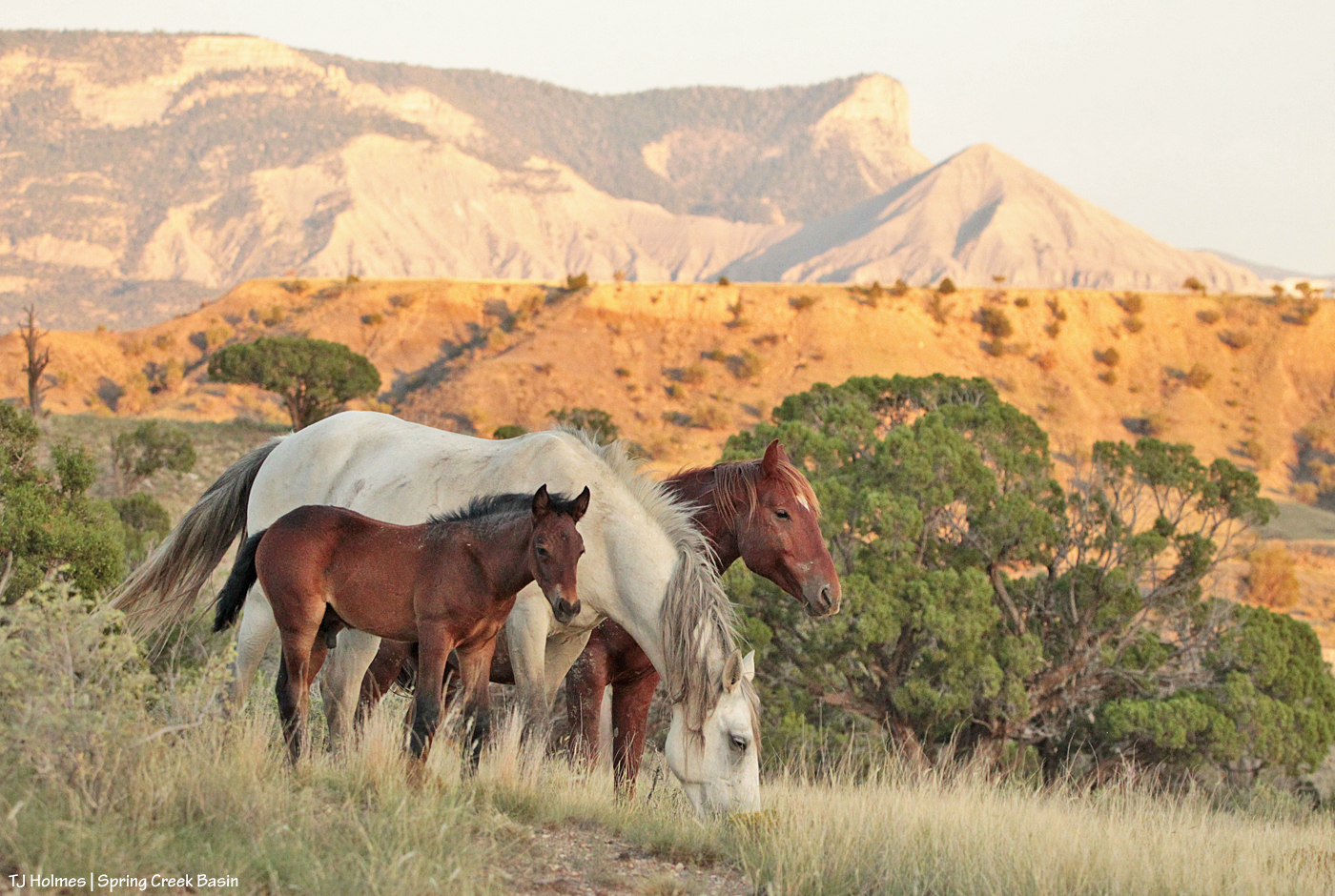
Stepdaddy Braveheart is quite proud of and protective of his family of Winona and Reuben. (Remember that amazing grass this fall after the monsoon rains?!) This was a beautiful, warm evening when a few bands had gathered together (but not *too* close together), and I moseyed along with them as they grazed and moved from the northwest valley toward Spring Creek canyon. When the little threesome paused in the most photogenic spot possible, with iconic McKenna Peak and Temple Butte in the background, I couldn’t press the shutter fast or long enough! This is the photo I gave Connie Clementson upon her retirement as manager of Tres Rios Field Office in Dolores.
******
In October, BLM wildland firefighters along with some Forest Service (San Juan National Forest) partners from around the region (including a crew from Monticello, Utah (Manti-La Sal National Forest)), conducted a prescribed burn to help maintain wildlife habitat on the ridge south of Spring Creek Basin that forms part of the southern reach of Disappointment Valley. Because of the moisture we had earlier in the summer, the three-day burn moved slowly and was well monitored by at least 30 firefighters. I don’t know what the total acreage was, but it wasn’t a huge area, and it mainly consisted of burning piles of old, fallen pinon and juniper trees so grasses can grow. To clarify, the burn was NOT in the basin. But the slowly drifting smoke – which was visible from the basin but didn’t blow over the basin – made for some dramatic scenes. As I remember, it rained a couple of days after the end of the burning, and our sky returned to its usual clear turquoise.
******
Napping with pals is just about the best, most peaceful way to spend a lovely fall day in November. There were two bands and a group of young bachelors in fairly close proximity to each other when I hiked out to visit with them all, and it was such a soft, quiet, gentle evening among friends. The horses draw such comfort from each other … and I gain such amazing comfort from them. On these days, especially, I wish such peace was something that could be bottled and shot into space to rain down on people and places less fortunate than us.
******
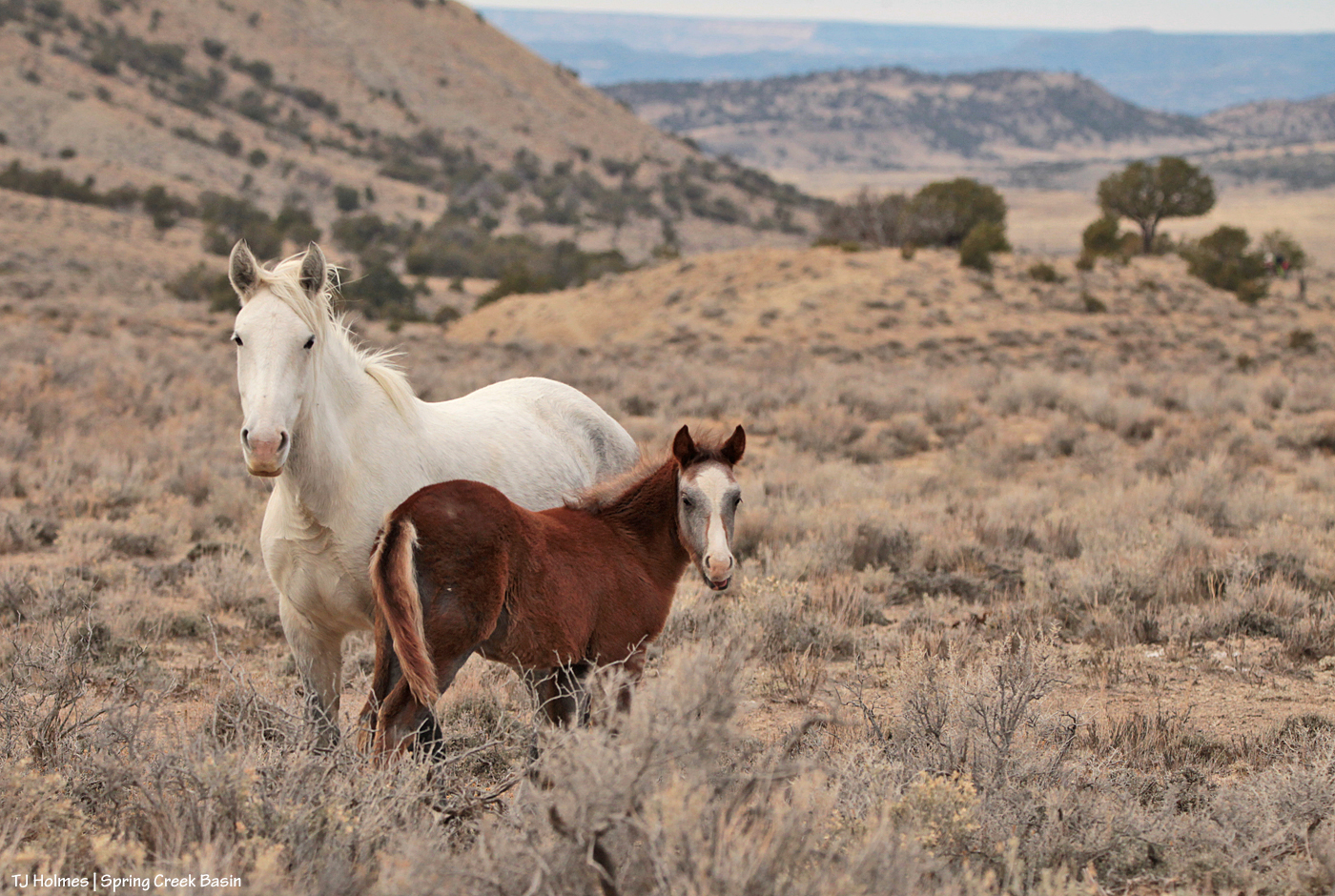
In early December, we were still pretty dry in the basin, but we had this little cherub to brighten the days. 🙂 She’s a classic example of grey foals being born a color (sorrel, bay, black, etc. – my family even has a grey Quarter Horse mare that was born palomino) and *greying out* – though our grey foals don’t often grey out as fast as this little girl. Mama Echo was born black. I think I’ve mentioned before that grey is the dominant color among the mustangs of Spring Creek Basin. In that way, too, these two are classics. 🙂
******
As in years past, how about a bonus pic?
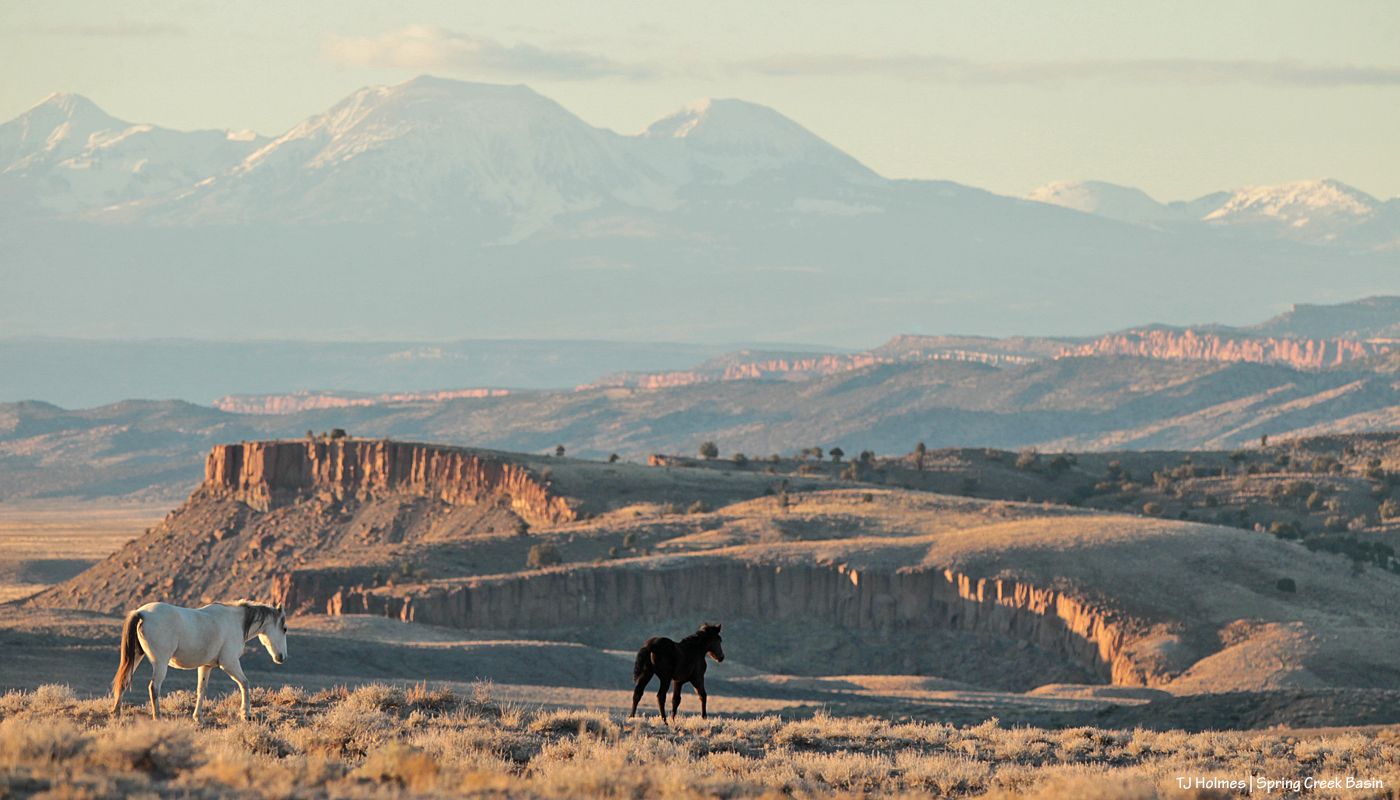
Winona and her son Reuben and one of the many amazing views from Spring Creek Basin, looking out across far lower Disappointment Valley to Utah’s La Sal Mountains, snowclad once again from fall onward. If that scene doesn’t scream (ever so quietly, of course) *peace*, I’m not sure what could. Their band and a couple of others had gathered at a pond, and they were walking away. I was trying to anticipate horses walking *across* that view, but mostly, they were lined straight out away from me as they left the water to return to their evening grazing. When I saw Winona – with confident baby Reuben leading the way – I was somewhat disappointed that they were so far away. … Then I realized that, to capture *that* view, my long lens needed the space of distance. Truly, sometimes it really *does* all come together!
******
Thank you all for reading about and enjoying our Spring Creek Basin mustangs this year. Many special thanks to those of you who faithfully come up with comments every day (sometimes, it must be nearly as hard as it is to come up with blog-post titles)!
Here’s to a coming year with plenty of moisture (!), and full ponds and catchments, and forage that grows ’em up strong and healthy. To take to heart a lesson from the mustangs and other wildlife: Be present in the moment! Some times (sometimes? many times?), that’s ever so much better than looking back or worrying about what’s ahead. 🙂
Well, we outlasted the summer heat, the gnats, the dust, the wind, the dust, the gnats, the heat, the dust (you get the picture), and it’s time to finish our second new water-catchment project for our mustangs of Spring Creek Basin!
Last week, after waiting out the drying roads and before the next round of moisture (soaking rain and big, fat flakes of snow that didn’t stick but added to the moisture), Mike Jensen, Garth Nelson and Daniel Chavez – our BLM range heroes! – came out with tools and supplies, and we got started on phase 2 to get the catchment finalized to take advantage of hoped-for winter snow.
If you need a quick refresher about our work to install the tanks and piping and trough, click on June 2022 over on the right under Archives, then scroll down to find the posts about that work.
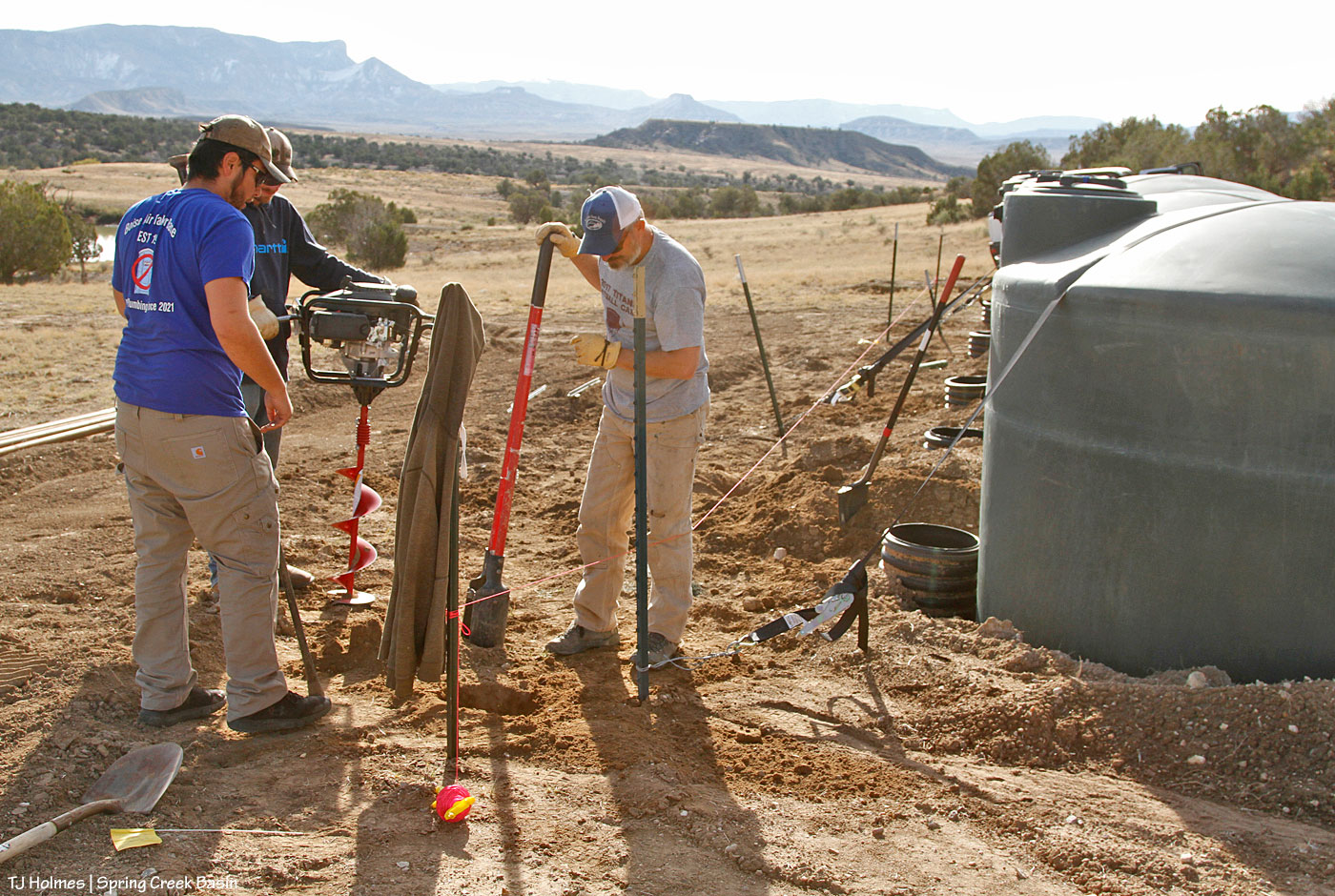
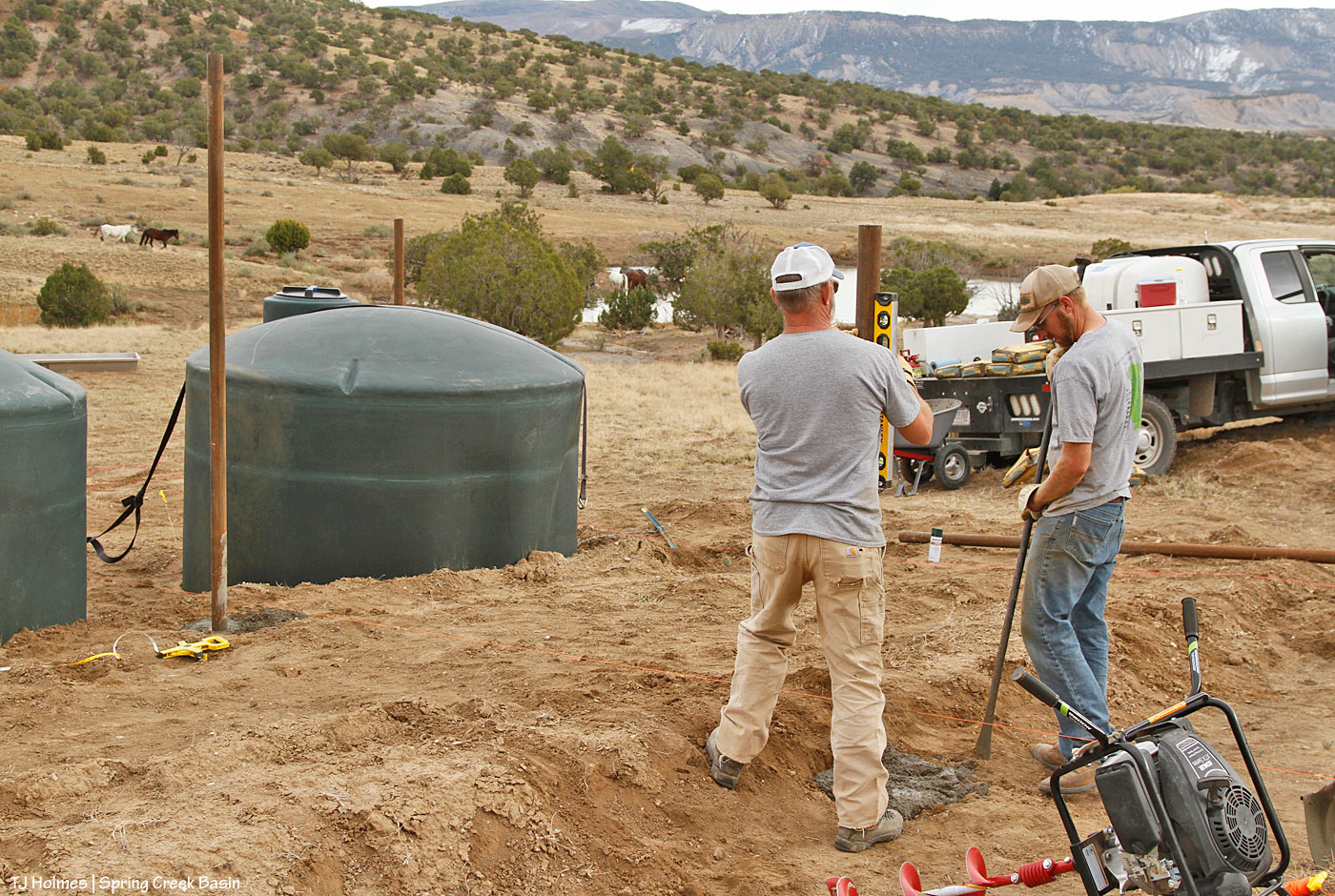
It all starts with the first post (pipe) hole! Well, it really all starts with running a string (see the pink line across the tanks?) to dig the holes so the line of steel pipes – to support the roof structure – will be in a straight line. Garth (left) and Daniel are on the gas-powered augur (what a difference that makes to digging holes! especially as many as this project requires), and Mike supervises. He would later do the lion’s share of work with the post-hole digger (far left) and tamp bar when the augur wasn’t quite enough to break through the calcium layer of soil.
Moving right along. You can see by their bodies that Garth and Daniel are putting their weight and strength over the augur to dig deep into the soil.
This was the last hole across the front line of the tanks.
Have you noticed the black straps over the tops of the tanks? As you might remember, we had another good monsoon year (heck, we HAD monsoons again this year after *not* for a few years). After the tanks were in the ground (in June) – piped together at the bottom, the dirt covered back over – at least one of those big rains poured off the hill behind and above the tanks and ran across the not-so-settled dirt around them … and sort of UPROOTED at least two of the tanks – and broke at least one pipe connection! The BLM guys had to come back and fix that little issue (no pix of that because the designated photographer/documenter (that’s me) was on vacation in Wyoming at the time). The straps over the tanks – snugged to T-posts driven into the ground – were to hold them in place in case of another gully washer – which seems to have worked.
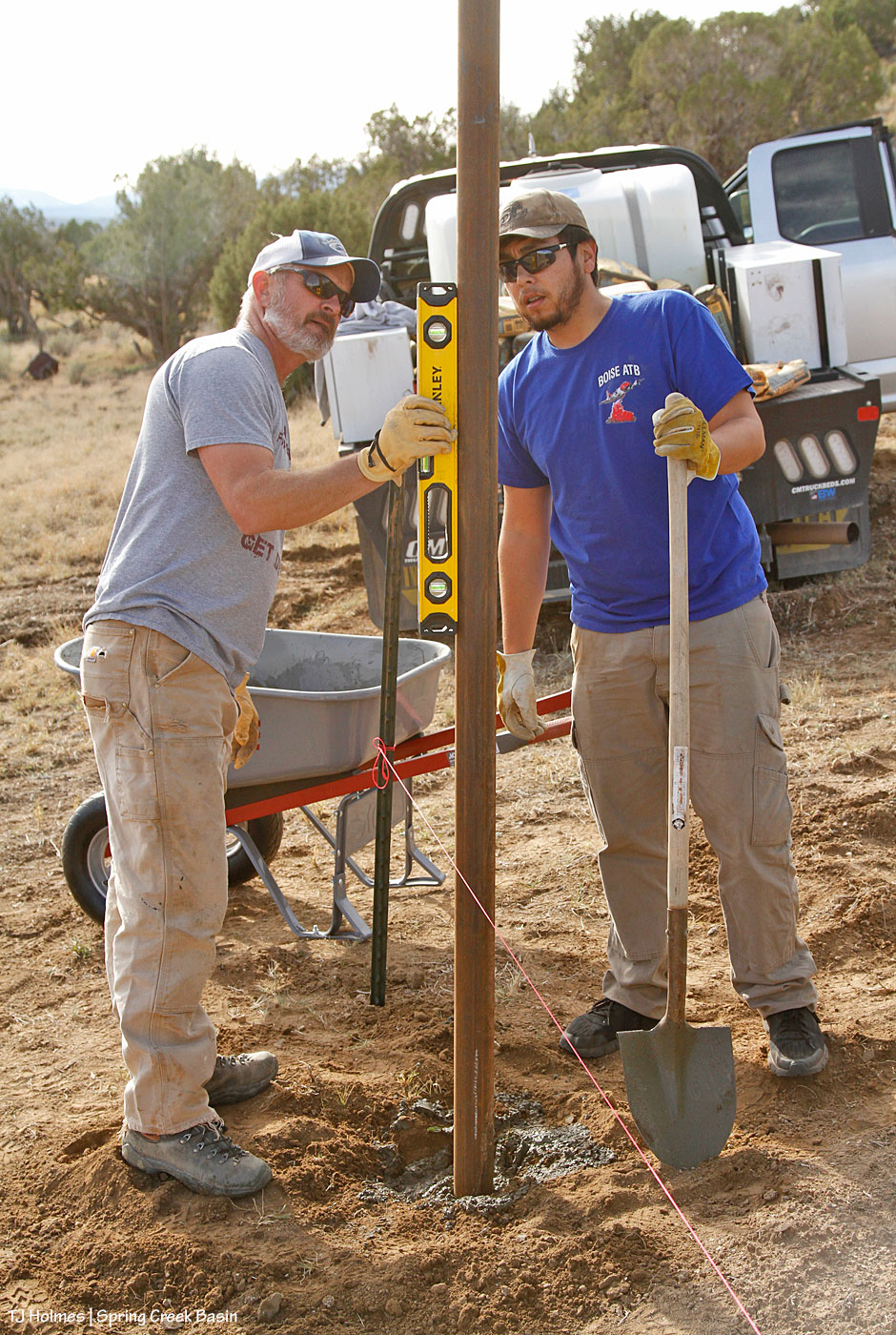
Mike checks the level of the pipe while Daniel finagles the concrete to straighten the tilt.
Right on the money! These pipes will be holding an immense weight to support the propanel roof sheets, so the guys filled all the holes with concrete to ensure the longevity of the pipes in our erosion-prone soil.
While Mike and Daniel were mixing and pouring the concrete, Garth was cutting the pipes into sections to place in the holes that the guys had dug with the augur. I went back and forth, lending a hand wherever needed and taking pix of the work (because all good work should be documented!).
The guys work together to shovel the concrete into one of the holes to stabilize one of the pipes.
Getting close to end end of hole-auguring on the back side (uphill side) of the tanks. Of note: The white on the far ridges, including McKenna Peak and Temple Butte, IS, in fact, snow. That seems at odds with the guys wearing T-shirts, but it was warmish until the wind picked up. And did I note that it wasn’t HOT, and there were no gnats and no dust?
Here, you can see the pipes that we’ve already placed – and concreted in place – that will serve as supports for the roof.
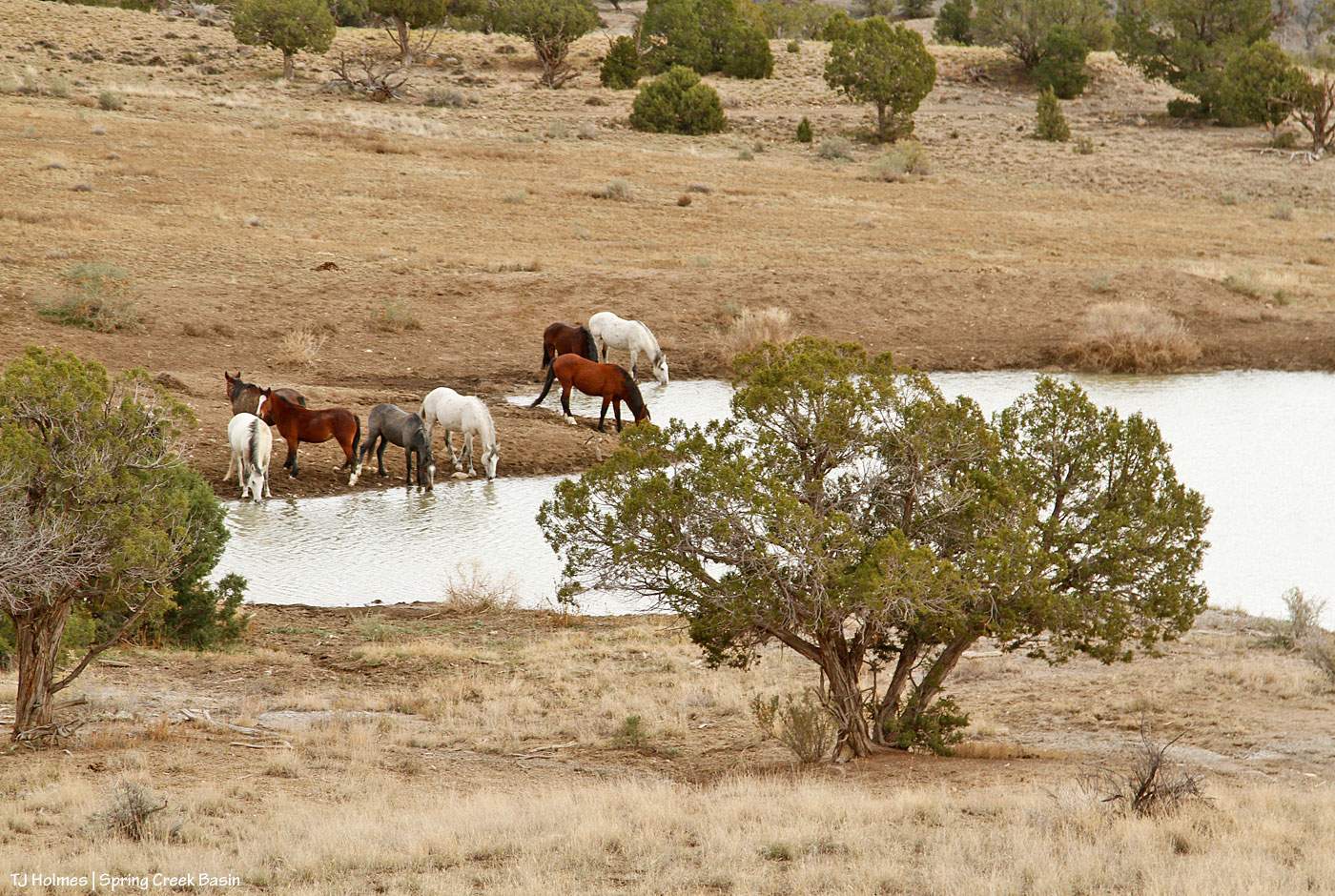
And then, as we were getting close to placing the last pipes, THIS happened: A couple of bands came down the hill from the northwest bowls (little “swales” in the northwestern part of Spring Creek Basin, above Spring Creek canyon) to drink at the pond in this area that I call the northwest valley. Why are we building a water catchment in an area that has a pond, you ask? Because, other than this year (of course), that pond only rarely has water in it, which meant that this area – usually dry – is a really GOOD location for a water catchment. And it has proved to be a good location – this year – for showing us that the horses will use this area – and graze it – when there’s water there to drink!
The guys used a couple of methods to ensure straightness of the posts (not just the straightness of each individual pipe but all of them related to all the others in lines up and across), including the string line (pink, tied to the short bit of rebar between Mike and Garth); measuring distance with a tape measure between the posts pictured, as well as those to the left, out of sight; and Daniel, shown here employing the eyeball method – sighting along the three pipes.
Mike and Garth level the pipe while the horses decide there’s not much to worry about and go on to the pond.
Peace on both sides, horse and human.
More of the same. I so loved that the horses, after their initial shock at seeing us at their watering hole, pretty quickly decided that we weren’t doing anything upsetting at all.
And the last pipe is in place!
It’s a good-size pond, and when it holds water, it holds a fair quantity!
Shortly after this, we were done with all the pipe placement and started cleaning up tools and supplies. The horses drank and wandered off to graze in the little valley. Even when the guys rumbled out in their trucks, the horses weren’t bothered. I stayed to take some pix. Before I left, two trucks with sightseers (importantly, not hunters (the end of today marks the end of the second rifle season … two more to go …)) drove up into the northwest valley. The horses had drifted and were grazing right along the road, but the visitors moved super slowly and respectfully, and the horses gave them a marvelous view for pictures right through their passenger-side windows!
We’ll continue work on the roof structure over the tanks as weather allows. Another moisture-bearing system is headed our way by Tuesday night. 🙂

























 Spring Creek Basin Mustangs