Mother Nature blanketed Spring Creek Basin with at least a couple of inches of snow! The amount varies a bit, but I’d guess there’s an average of at least 2 inches of the golden white stuff covering the range. It came in on a fairly warm wind, and the snow was nice and wet. Now, our temps are going to drop significantly, with highs in the 30s – much more seasonal for Colorado in December than the 40s and 50s we’d been enjoying lately.
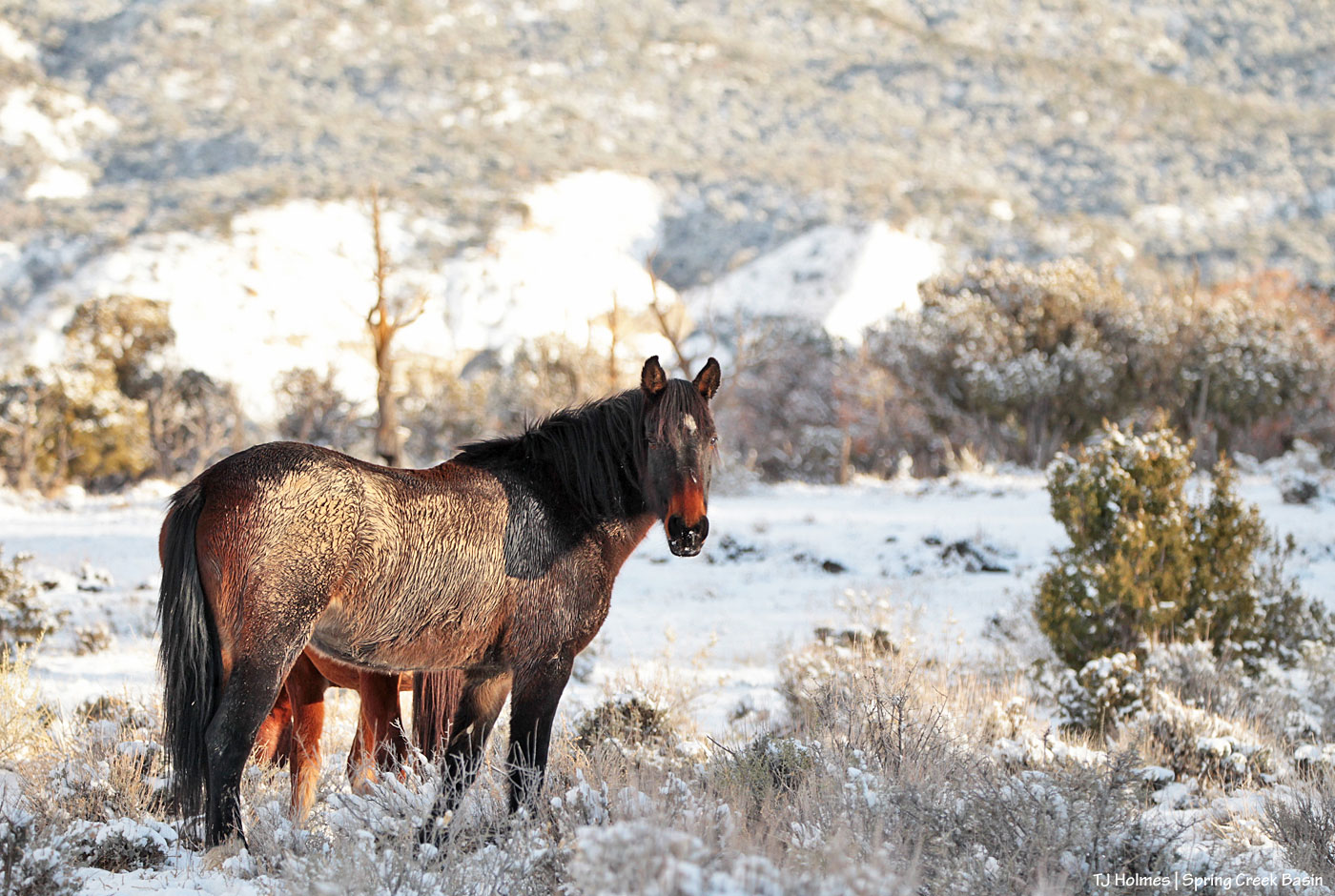
Mostly, the horses seemed to be sheltering in out-of-the-way places, and I didn’t see many bands, but Cassidy Rain and her family were happy to visit briefly (well, maybe *I* was the one happy to visit?). 🙂
Now, let me take you on a little tour around Spring Creek Basin, seen under a pristine cover of fresh snow:
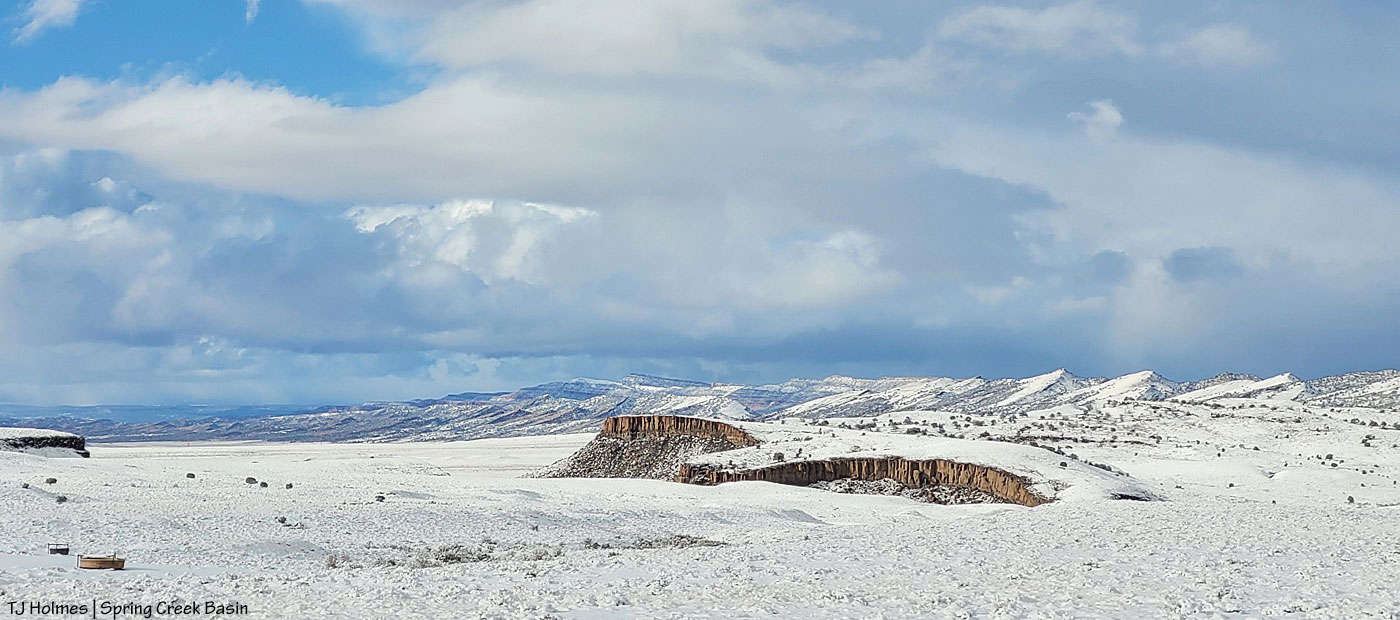
From near the original water catchment looking northwest over the rimrocks above Spring Creek canyon over northern/northwestern Disappointment Valley. Utah’s La Sal Mountains are usually visible along the horizon in the distance … but it was still snowing over them while the clouds over us were breaking and giving us that brilliant Colorado sunshine.
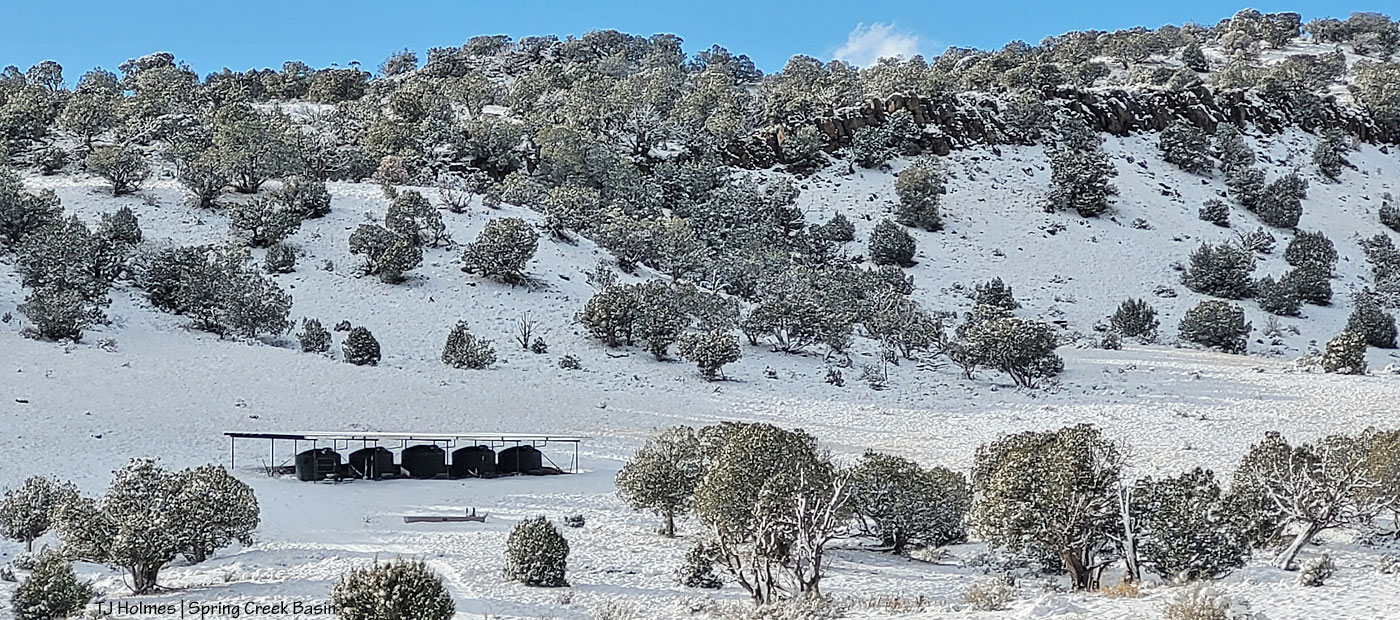
Our newest water catchment got a good dose of snow to start melting and filling the tanks!
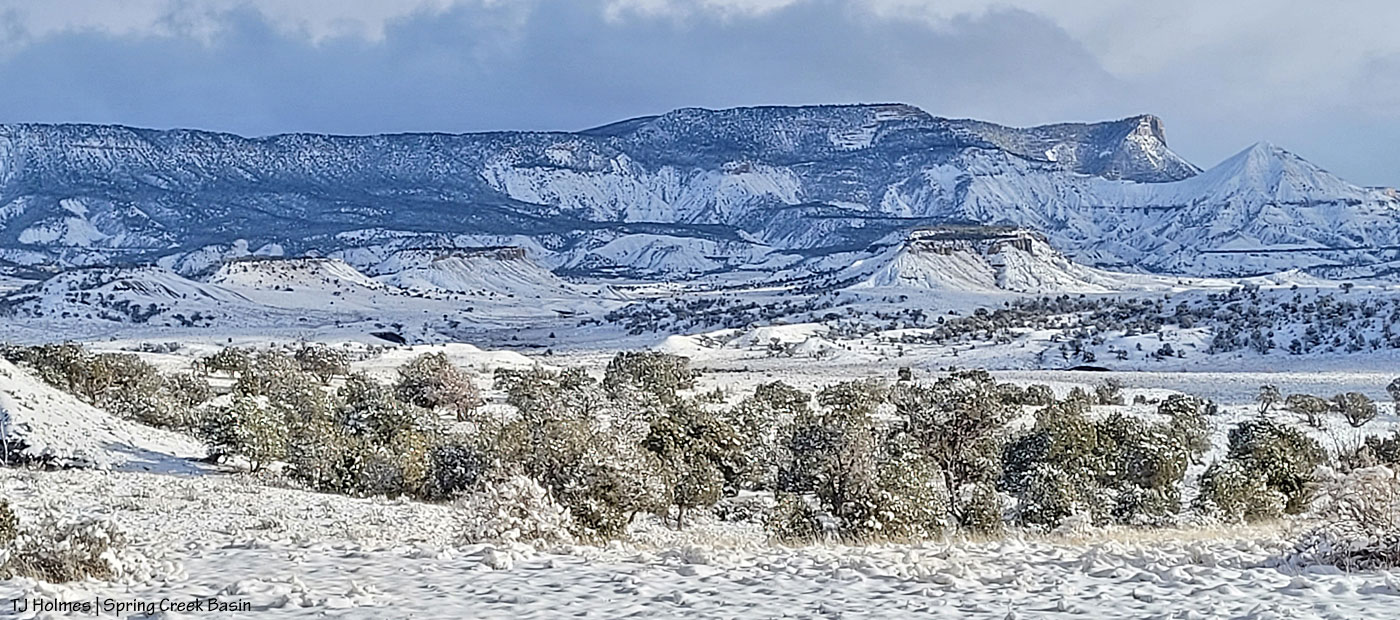
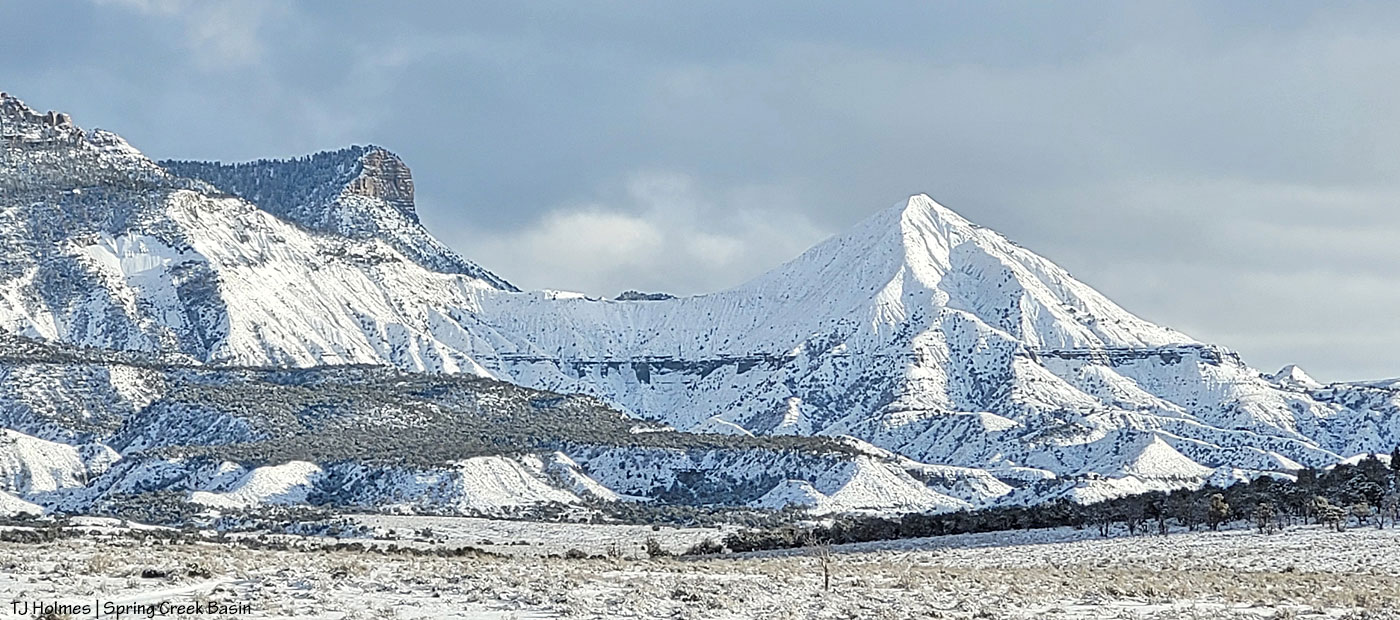
From the north(ish) part of the basin, looking southeast toward McKenna Peak and Temple Butte. Look at all that pillowy white frozen goodness!
Approaching the basin’s east pocket: Juniper and her family – and the rest of us – got our snowy wish. 🙂
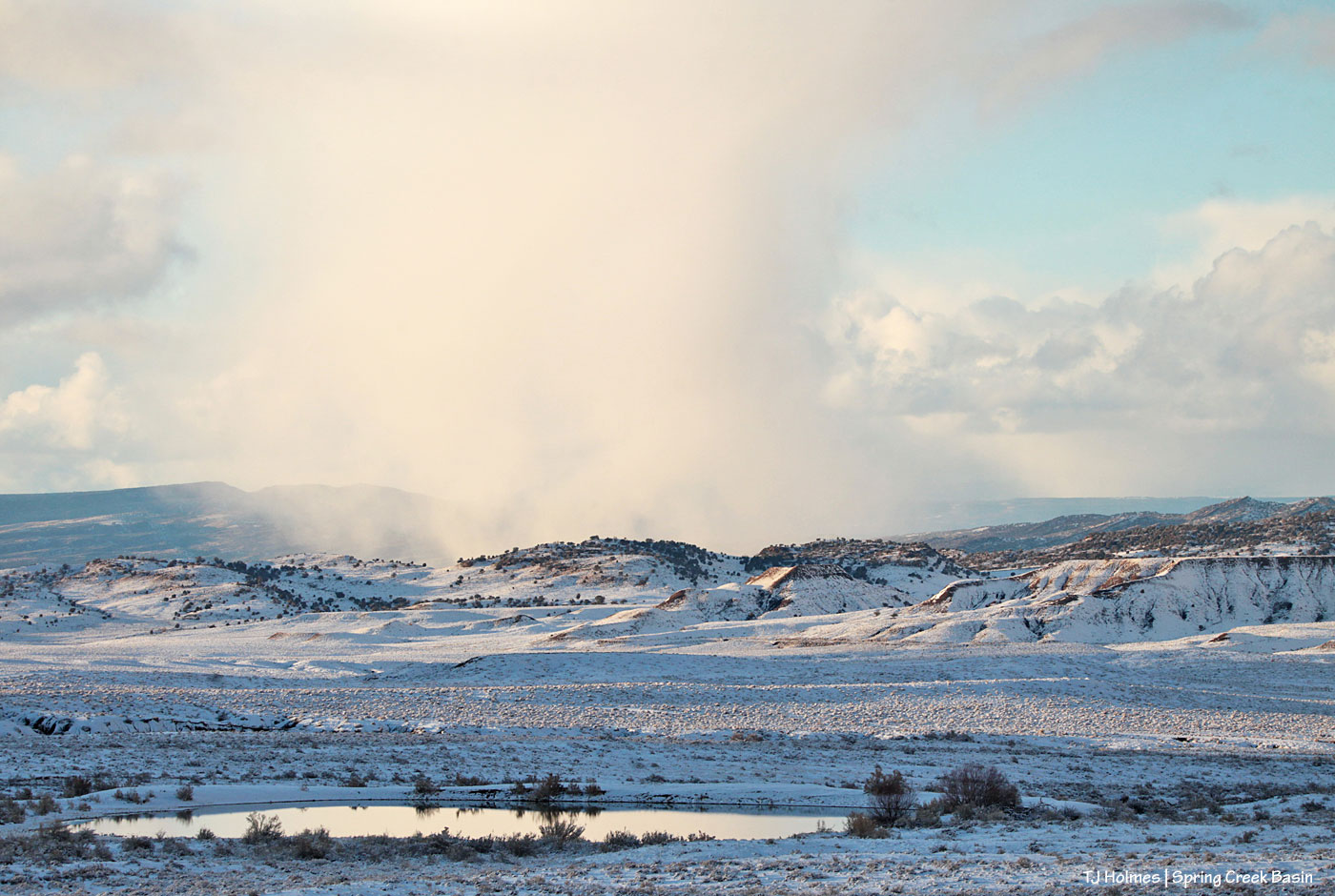
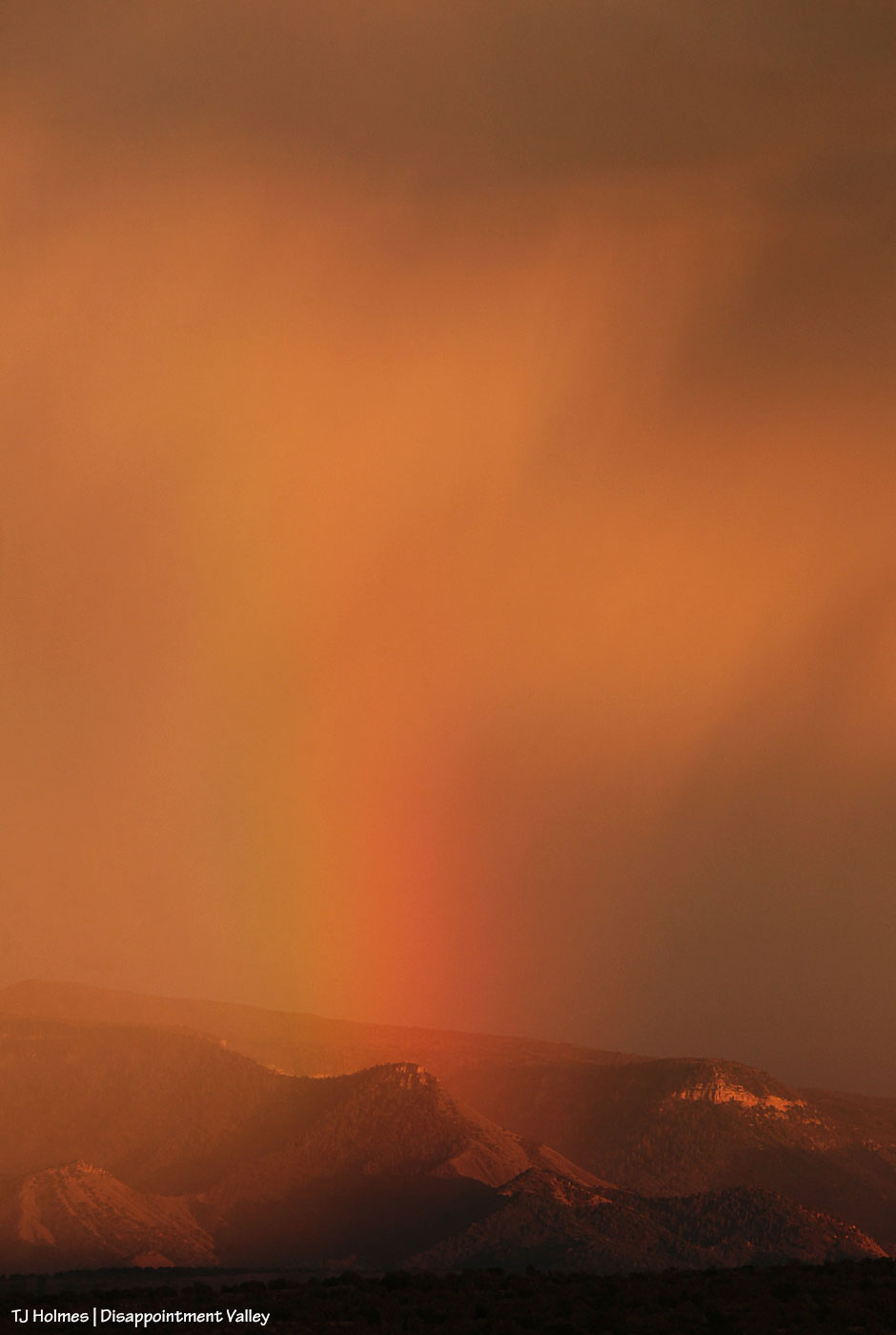
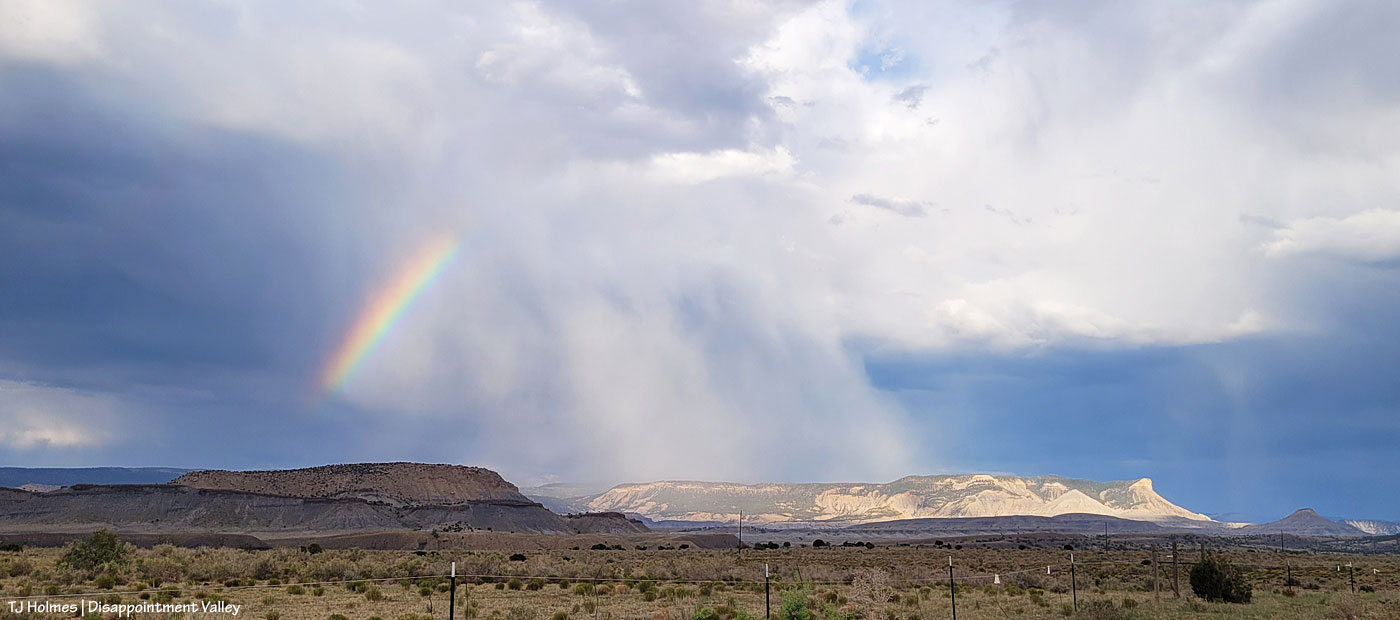
As I was heading out of the basin, just as the sun was sinking into a cloud bank above the valley’s southern ridges, I stopped on rollercoaster ridge to photograph a wild little snowburst over western Disappointment Valley beyond Spring Creek Basin – from a single crazy cloud! And yes, in the foreground is a pond, still – still! – nearly full to the brim.
Despite the coming frigid temps, I think we’re all pretty happy about the snowfall. 🙂
Did I mention that Spring Creek Basin and Disappointment Valley got rain?
And then we got snow. 🙂 And before Halloween!
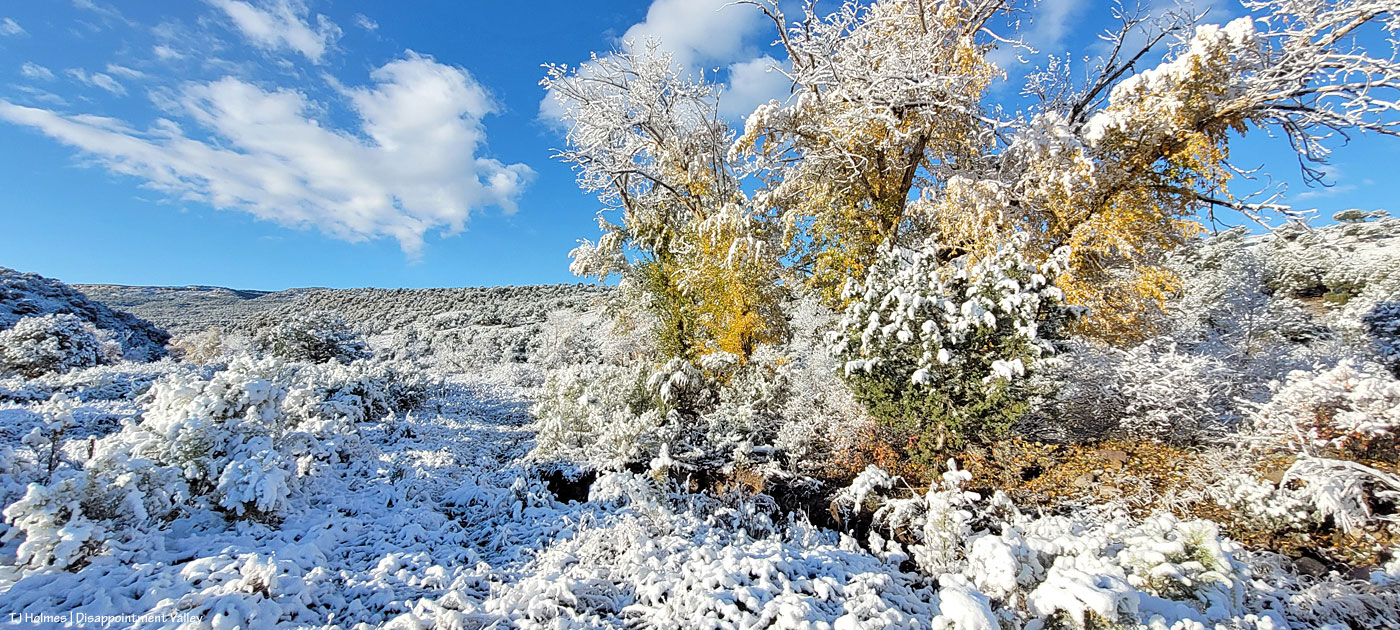
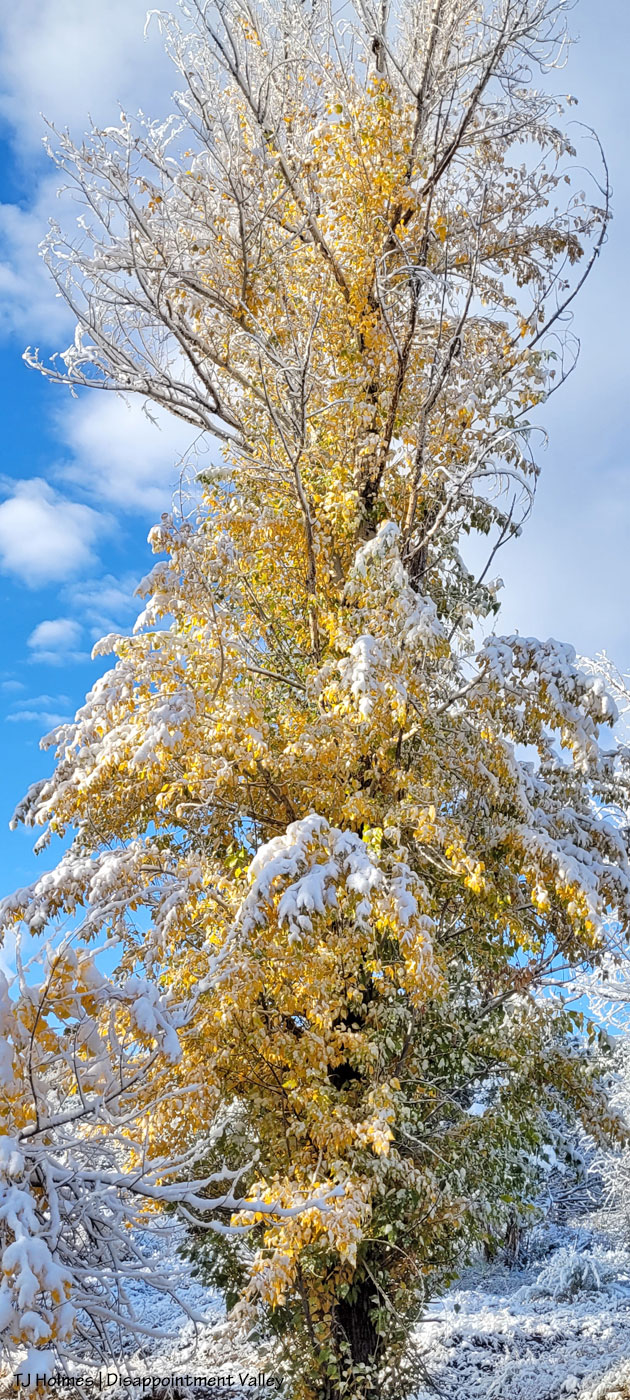
This was yesterday morning in Disappointment Valley, just beyond the rimrocks and southwest of Spring Creek Basin. No ponies-in-snow pix; too muddy, and that snow was melting fast! For fare somewhat different than you usually expect to see on this blog, please enjoy this mix of pix of golden cottonwoods crowned with good-as-gold moisture:
Another little dose of fall color – this time, cottonwoods along Disappointment Creek, which is *outside* Spring Creek Basin.
Winona and the mustangs are still finding plenty of grass – some even still green, as the cottonwoods turn gold – this fall, and that’s pretty awesome.
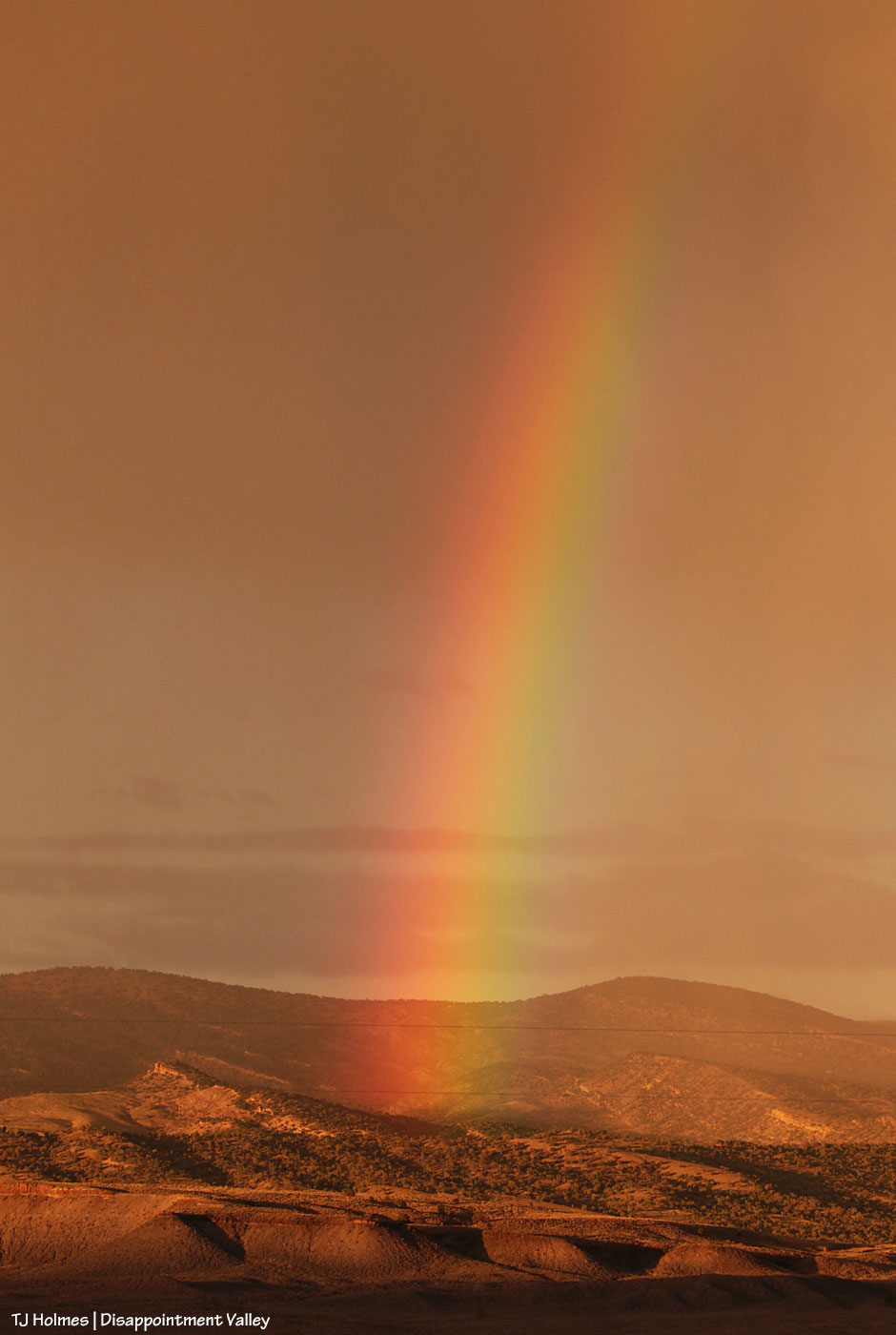
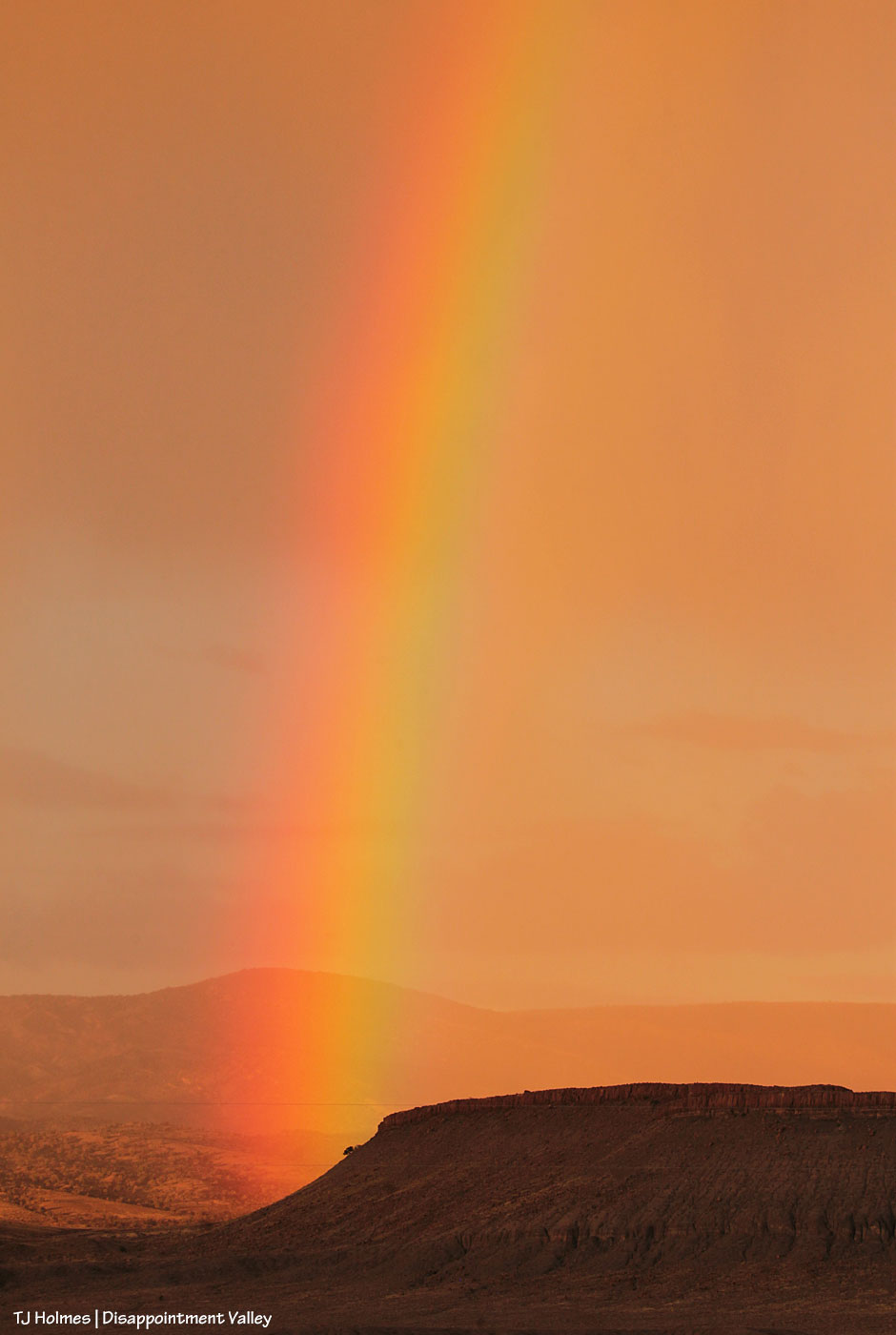
(These images were taken from outside Spring Creek Basin, southwest of the western boundary. The first three pix are looking far to the southeast. The last two are looking northeastish; the rimrocks form the basin’s western boundary, and the middle-ground treed ridge(s) are in the northwestern region of Spring Creek Basin. After sunset and and faded rainbows, a curtain of rain swept through the basin and on across the northern hills of Disappointment Valley. All kinds of perfect!)
Connie Clementson, manager of Tres Rios Field Office in Dolores, is retiring after 37 years of public-lands service. For the last 11 years, she has been the head of BLM public lands in Southwest Colorado. We first met her at the 2011 Spring Creek Basin roundup when she was still with the Forest Service and served here as the then-acting district ranger for the Dolores District of San Juan National Forest. We’re glad she was able to finish her three-plus decades of service here in our corner of Colorado.
Our herd manager, Mike Jensen, gets a lot of the well-deserved credit for our recent management accomplishments in Spring Creek Basin, and we know that’s because he has had the support of the top boss – Connie – and her confidence that he was making best decisions for our herd.
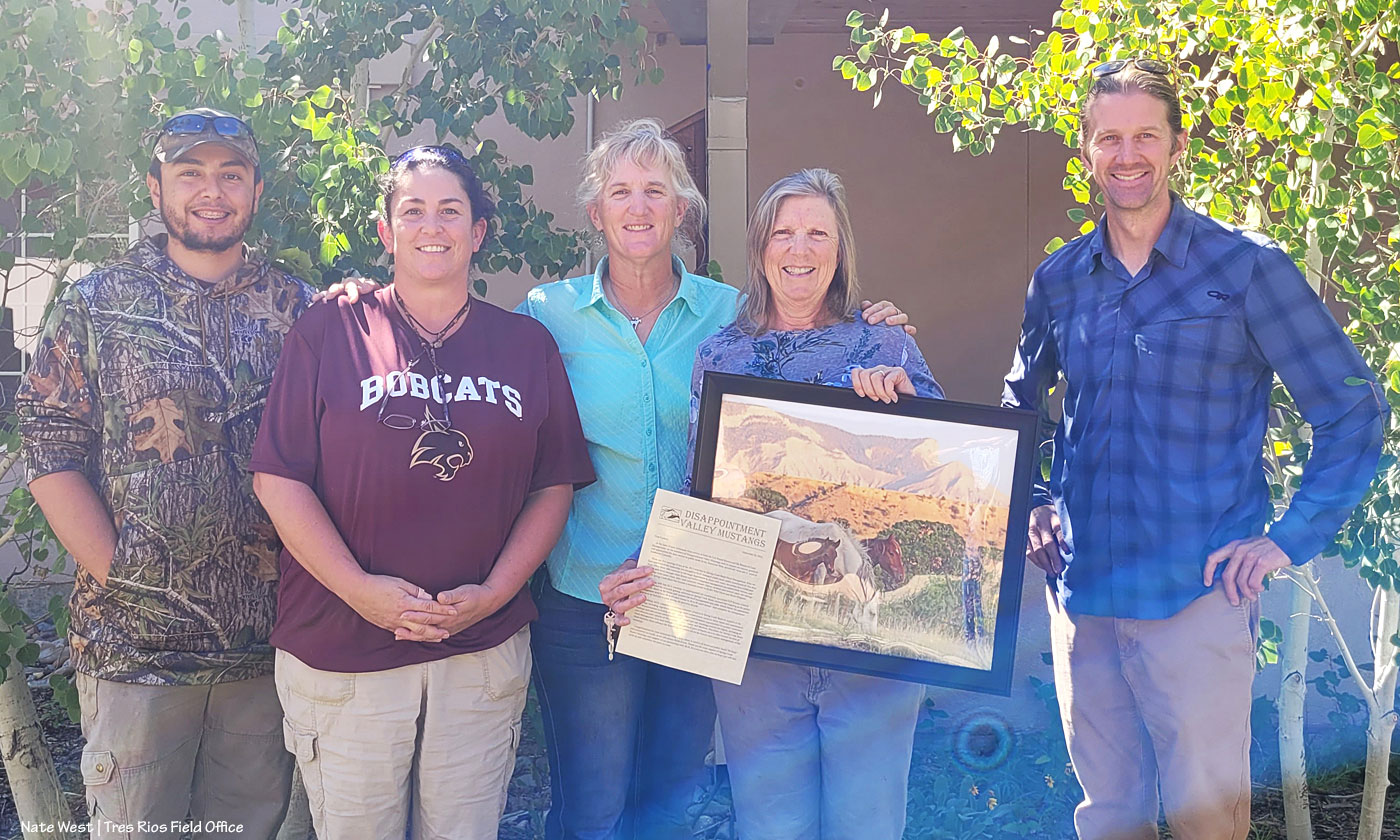
Monday, Tif Rodriguez, long-time advocate for Spring Creek Basin mustangs as well as for protecting rights and rights-of-way for horsemen and horse (and other pack stock such as mules) use on public lands, and I went to Tres Rios Field Office, where Joe Manning, assistant field office manager (who also has a lot to do with our confidence-inspiring herd management), had scheduled us into a rare gap in Connie’s last-week schedule. Daniel Chavez, range tech who works with Mike (and Garth Nelson), joined us in Mike’s absence (he was returning from a trip with his daughter).
We presented Connie with a photo of Spring Creek Basin mustangs and a letter from our Disappointment Valley Mustangs group (which includes Pat and Frank Amthor, David and Nancy Holmes, and Kathryn Wilder, in addition to me and Tif) in appreciation for her years of service – specifically here and especially for our mustangs. While we chatted, she reminded us that she said 11 years ago at the roundup that she didn’t ever want to do that again in Spring Creek Basin. And because of her 100 percent support of the PZP fertility-control program in the basin, we haven’t.
In the photo above, from right to left: Joe Manning, Connie Clementson, yours truly, Tif Rodriguez and Daniel Chavez.
We’re so grateful for Connie’s leadership and partnership these many years, and we wish all the best to Connie (and her family) during her well-earned retirement!
I’m not normally a person given to repeating quotes, but I saw this one the other day, and it resonated with me deeply:
“The grand essentials to happiness in this life are something to do, something to love and something to hope for.” Attributed to Joseph Addison.
For me, happiness centers around mustangs, in particular, the mustangs of Spring Creek Basin and Disappointment Valley. They give me so much more than mere happiness. 🙂
Have I mentioned the recent GREEN in Spring Creek Basin? Yes? Oh, good. … ‘Cuz it’s there. 🙂
Along with a little of this:
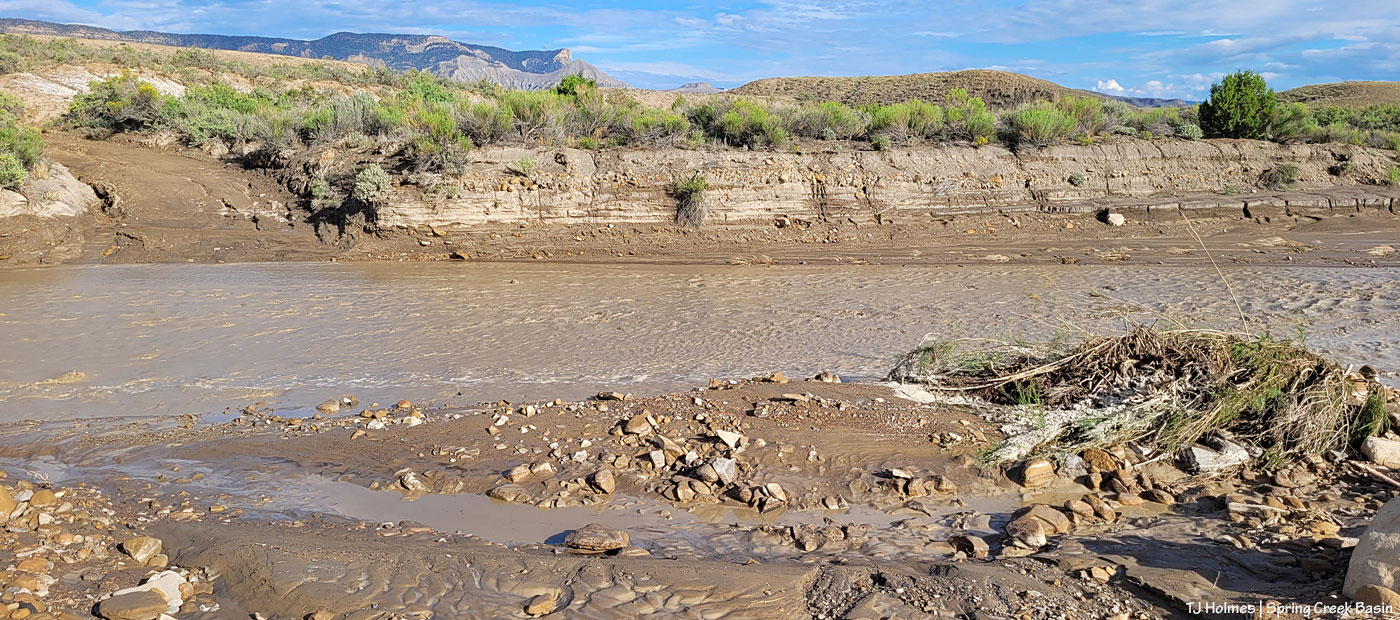
Two perspectives of Spring Creek, flowing with rainwater, the day before yesterday. The first image is directly as the road crosses the creekbed/arroyo; the second is just to the right – water flowing toward us. Interestingly, the road was dry to this point, but clearly it had rained in the northern and eastern (at least) regions of Spring Creek Basin. By this point, the major arroyos of the basin have converged (though there are still some that feed the creek’s westward drainage). The water was neither high (deep) nor terribly fast, but I didn’t cross. There are times to respect Mother Nature’s obstacles, and I deemed this to be one of those times.
Also a good bit of this:
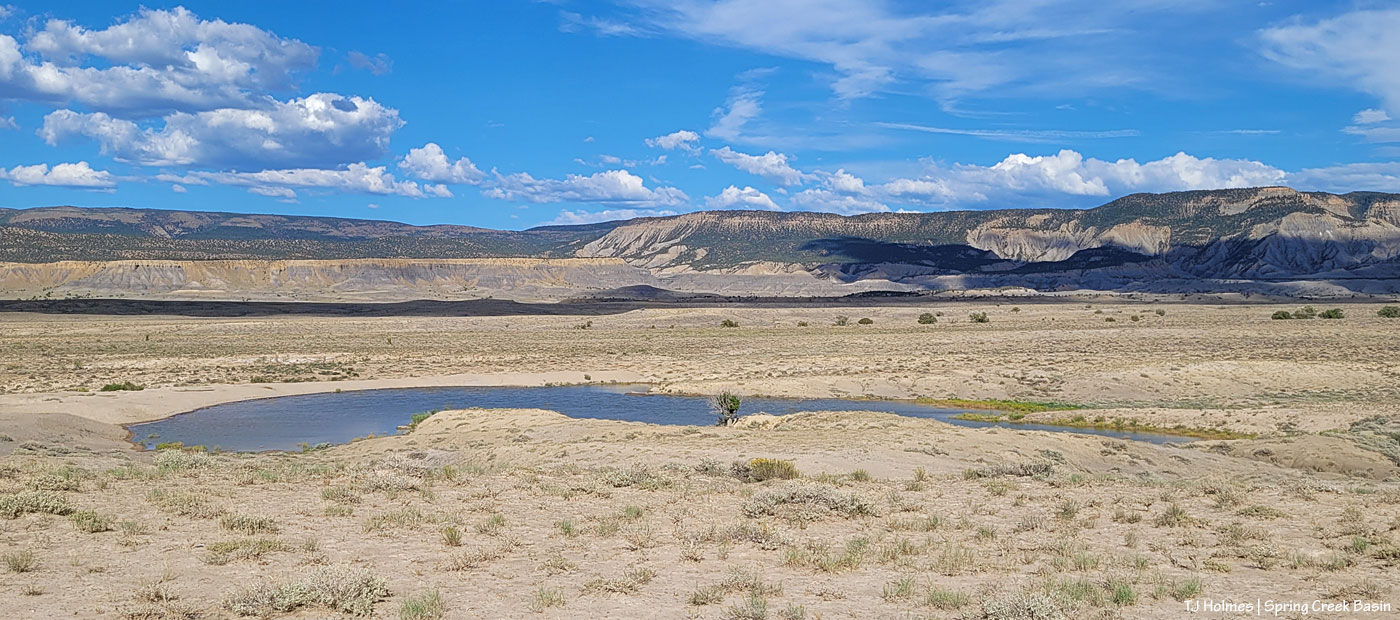
This is the pond near the hill we call Flat Top. It’s rare to see it so full of water that it backs up so far to the right.
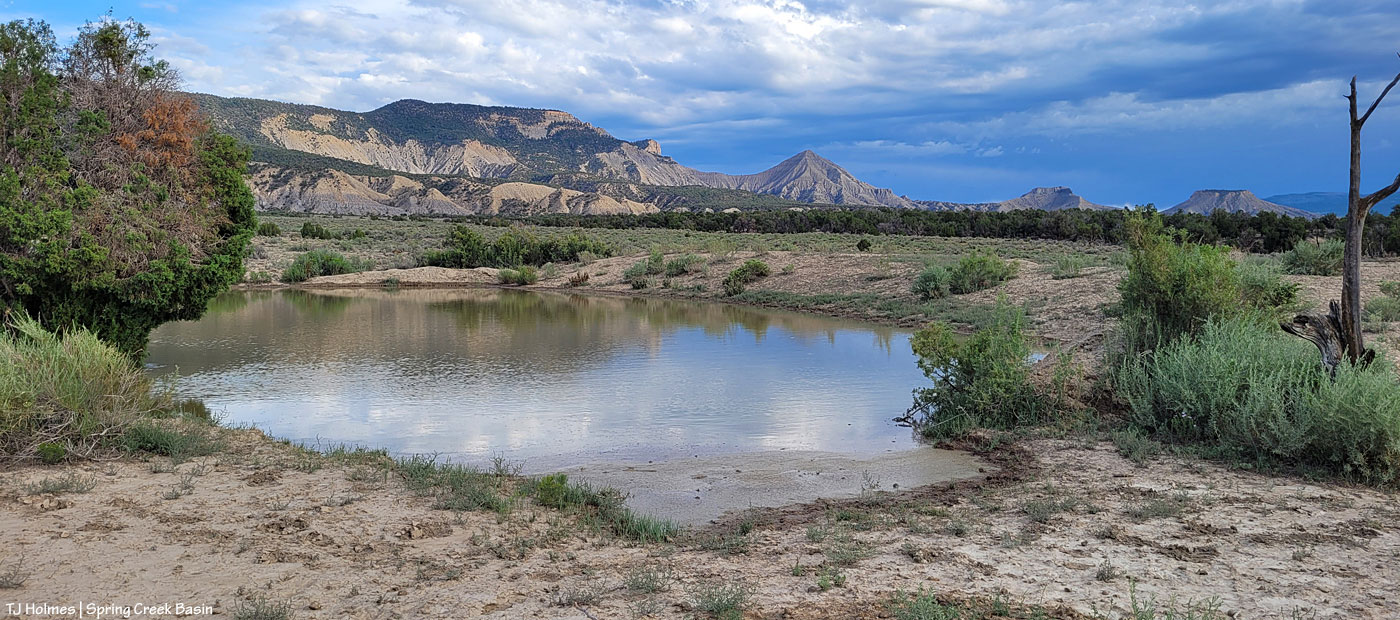
And this is the east-pocket pond, way back in the far eastern region of Spring Creek Basin, also full to the gills.
The pond pix were taken the day before those of Spring Creek running, which was the day after I got soaked going into the basin and getting caught in a lovely little drenching that did NOT go ’round. 😉
All the ponds are so excellently full; the above two are just examples.
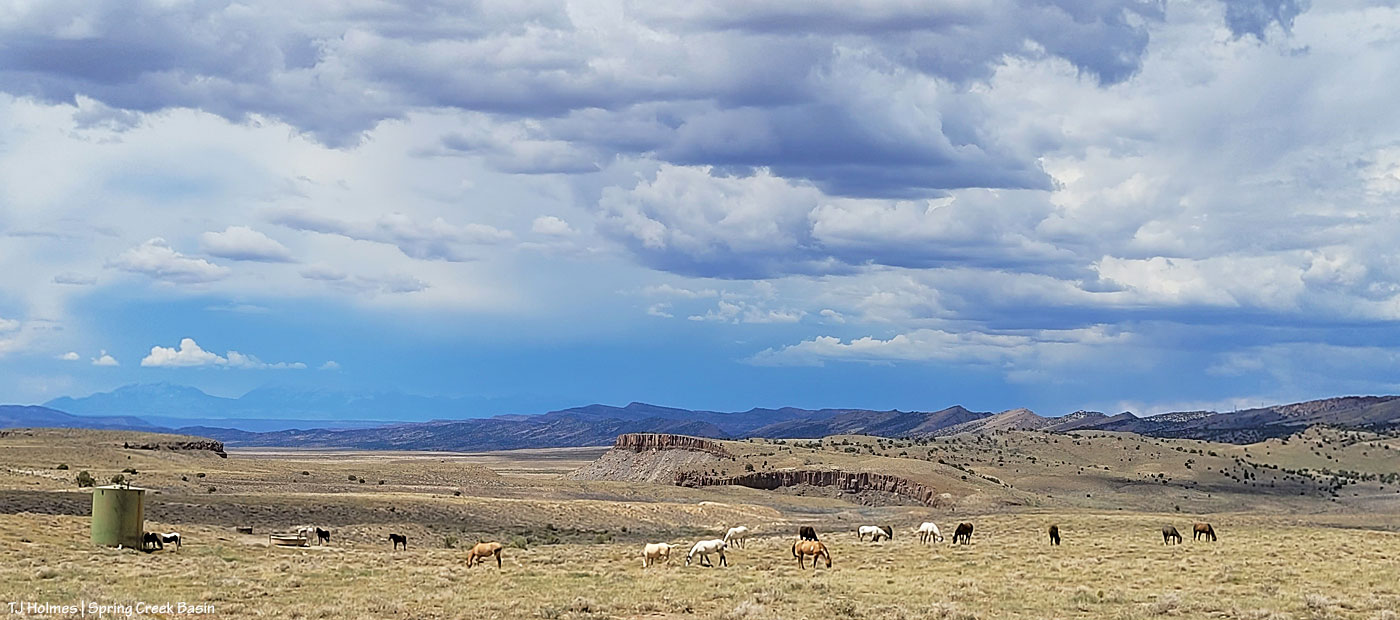
Bands taking advantage of good grass and good, clean water at Spring Creek Basin’s main/original water catchment (tank at far left, trough just a bit to the right of it).
This is looking basically northwest … rain falling over Utah’s La Sal Mountains and monsoon clouds shading part of lower Disappointment Valley. There’s a hint of green in them thar hills … and for that, we are grateful beyond words.
At least somebody’s getting rain. 🙂 Our forecast perks up with moisture in another couple of days, but we wouldn’t mind it sooner than later. Cooler temps ARE much appreciated.











 Spring Creek Basin Mustangs