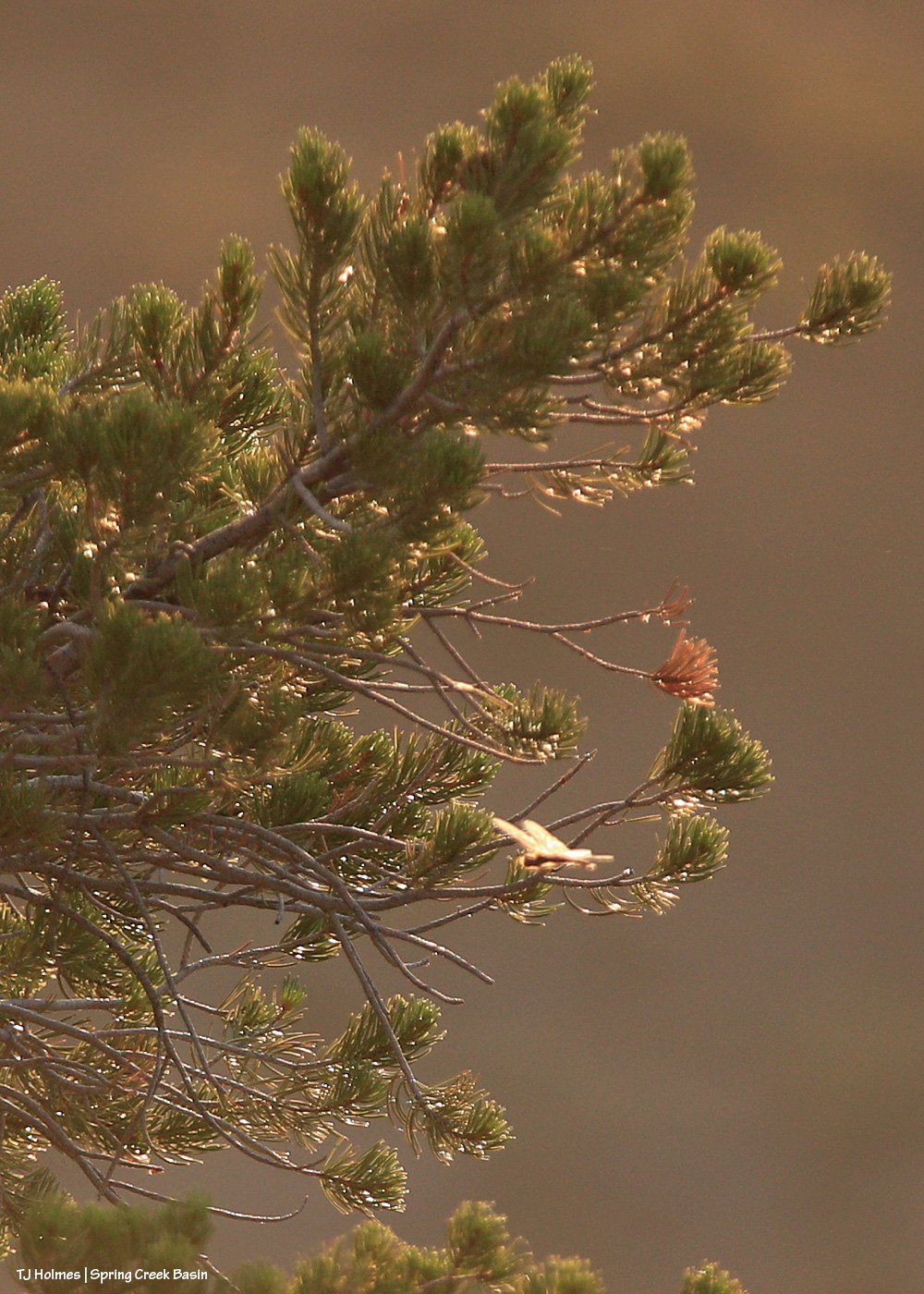
These pix all are significantly cropped, and as previously mentioned, I am no bird photographer! But wow. I’m extremely grateful to this extraordinarily handsome gentleman for perching close enough and giving me enough time to get several sharp shots before he took off (he dodged off to the (my) right, despite the fact that he launched first to the left).
This is what the original interpretive sign looked like (I know you were wondering!), courtesy of Kathe Hayes, who retired a few years ago after working many years for San Juan Mountains Association as the volunteer coordinator. Long-time readers will remember Kathe’s name associated especially with the alternative spring break program, which brought in college students from the University of Missouri every year to work on various projects in Spring Creek Basin and other public lands (both BLM and U.S. Forest Service) around Southwest Colorado.
When Kathe read about the new kiosk installation, she sent me a text and some emails about the history of the FIRST sign installation at the west basin boundary:
“Excited to see that Laura [Heaton] was involved in the installation of the new sign in Spring Creek Basin. As you know as a child, she was involved in the installation of the first sign along with a group of college students from the University of Missouri and Ranger Rick from BLM. I remember Laura and I climbing up the side of the hill and rolling large rocks down so that we could surround the sign so cars would not drive over the sign. A lot of hard work and dedication went into the original sign, and I was sad to see that it had disintegrated. But I am grateful for the new sign and the information it portrays about the wonderful Spring Creek Basin. Thanks for your help in this, TJ.”
Also:
“I was really excited to read about the installation of the new sign. I believe the old one was installed around 2008. It prompted me to resurrect a photo of the original. Laura was involved in the installation of the original sign, as a young kid working alongside the University of Missouri students and Ranger Rick Ryan (BLM). Wow, such good memories for me.
“Attached is the original sign photo. It was a lot of work back then, getting that sign created and approved.”
Not much has changed in that respect. 😉 I asked Kathe if I could share the image of the original sign and her words about the history of it.
“I remember this about installing the original sign. Rick Ryan (Ranger Rick) had been mixing cement in a wheelbarrow and then pouring it into the hole to secure the base of the sign as we all watched curiously as to how this was all going to work. Laura said that that’s not how my dad would do it [Laura’s dad is well-known rancher Al Heaton; their family is well respected in the entire region of Southwest Colorado. She is, quite literally, a local!] and I just laughed. Laura‘s family was instrumental in the success of the Alternative Spring break program. I doubt I would have continued without their support. And Laura was my little shadow since she was about 6 years old. Her parents let me drag her all over the place. She loved being with the college students who loved playing games especially spoons.”
Wild and crazy how things come back around full circle, eh? 🙂
Thanks so much for the history, Kathe! We miss the alternative spring break program (I think it lasted almost 20 years with Kathe’s guidance?), but we sure loved each year’s crop of students and all the work they did for us in Spring Creek Basin! And we now have Laura as one of our BLM range team members, carrying on that good work!
[Nate West, Brian Yaquinto, Jon Whitehead, Laura Heaton, Anton Rambur, Ryan Schroeder, TJ Holmes]
I cannot begin to tell you all how much I *LOVE* this new information/map sign kiosk JUST installed at the western entrance/boundary of Spring Creek Basin.
It has been in the works for at least the last year. On April Fool’s Day, rangeland management specialists Ryan Schroeder and Anton Rambur came out to augur and dig out the holes for the three posts for the kiosk (in the snow and greasy-muddy road, I might add). The day after April Fool’s Day (gorgeous but nippy), we were joined by Laura Heaton (range tech), Nate West (wildlife biologist), Brian Yaquinto (archaeologist) and Jon Whitehead (recreation) to put the whole thing together and set it upright in the holes (shout-out to my awesome little Kubota tractor!) and cement it in place.
Let me also mention that this was Ryan’s third day back to work. I never anticipated that I’d be RE-introducing him when I introduced our new range team, but there it is, and here they are. 🙂 I’m so stoked to be working now – again – with all three of them.
A couple of (OK, several) images of the construction and installation of our brand-spanking-new, kick-ass kiosk in Spring Creek Basin:
Actually, let’s start with the old interpretive sign, familiar to anyone who has driven into Spring Creek Basin. You might think the sign looks white because of glare or overexposure by the camera. …
But no. It really is that blank. The high-elevation, Southwest Colorado sunshine will do a number on just about anything. … Hence the new sign. 🙂 (Note the scratches at the top and (at least) left side. What made those scratches, you ask? Horse teeth, I tell you.)
Laura and Ryan check out the new map and info signs. OMG! They are SOOO COOL!
Who took the images for the signs? I’m so glad you asked. 🙂 I am BEYOND proud! (While all of the BLM folks were gathered around to look at the signs, I ID’d for them all the mustangs in the pix. Above: Hollywood, Shane, Houdini, Alegre and Maia. I’m also hugely grateful that our dearly retired herd manager, Mike Jensen, and the BLM’er who put the signs together, Jason Byrd, allowed me to dust off my copy-editing skills in service of both the info panel and the map. I realize now that I didn’t take a close-up pic, but Temple Butte is noted on the map, the first time I’ve seen the name on any map since we got it officially named by USGS in late 2018.)
While Ryan digs out the edges of the middle post hole just a little bit more, Brian, Nate and Anton started attaching the posts to the roof structure, resting on the forks of the tractor.
With all the vertical posts attached to the roof structure and the cross pieces (to which the sign boards would bolt), Jon arrived with the Qwikcrete and water to mix into a slurry in the post holes to help support the posts for a very long time to come.
And up she goes! OK, this doesn’t really show the tractor doing the heavy lifting, but it did. 🙂 Thanks, Ryan, for taking the camera while I worked the tractor!
In go the bolts for the first sign panel! (Yes, we did joke about how many BLM’ers it takes to screw bolts into a sign. 🙂 You almost can’t see him, but Jon is holding the sign behind Brian while he and Ryan thread the first bolts and Anton holds the left side of the sign.)
Anton holds the second panel while Jon (left) and Brian insert bolts to attach the sign to the frame.
Eagle-eyed readers will note that the sign very correctly welcomes visitors to Spring Creek *Basin*!
I want to express my enthusiastic gratitude to our particularly awesome BLM’ers for making this new info/map kiosk come to life in Spring Creek Basin. It has been, I think, a little more than a year from conception to standing tall at the west basin boundary to greet visitors to Spring Creek Basin, magical home of our mustangs. Pictured, left to right: Nate West, Brian Yaquinto, Jon Whitehead, Laura Heaton, Anton Rambur, Ryan Schroeder and yours truly (I actually brought my tripod so I could be part of the picture record!).
Huge gratitude also to Mike Jensen (retired but never forgotten), who offered me the opportunity to share some of my favorite images of the mustangs and my copy-editing skills (and texted this in reply to telling him about the new sign: “Wow awesome that looks great. See no worries I left you in good hands.” :)); Doug Vilsack, Colorado BLM director, who agreed that we needed a new sign when he first visited Spring Creek Basin in 2023; Derek Padilla, Tres Rios Field Office manager, who has been super supportive of Spring Creek Basin from the get-go; Joe Manning, TRFO assistant manager, also incredibly supportive and who agreed that it was a project worthy of funding; and Jason Byrd, recreation specialist (?) at TRFO who designed the signs with my images and all my edits and made the most gorgeous informative panels in all of BLM-dom.
Thank you, ALL! And now, when any of you visit Spring Creek Basin, you know the story of how our fabulous mustang kiosk came to be!
I am giddy with excitement and anticipation. 🙂 First of all, we have our full BLM range team back together again! As of Monday, rangeland management specialist Ryan Schroeder is fully reinstated and back to work with range specialist Anton Rambur and range tech Laura Heaton at Tres Rios Field Office. And he got to get his hands dirty – literally – with Anton (Laura was under the weather) out in Spring Creek Basin yesterday to …
…uh … just what the heck WERE these guys doing?!
A hint is in the background. 🙂
Leave a guess in the comments and let me know just what the heck you think these funny guys were doing!
All will be revealed soon, and it’s going to be awesome!
Do you know how hard it is to photograph bees buzzing around just-flowered apricot buds?
It’s hard. 🙂
Harder than photographing birds!
I wish I could photograph the *sound* of the buzzing of the bees around the apricot tree. That, my friends, is the very sound of spring.
With temps very near 80F the last couple of days, and all manner of singing spring signs, I’d say spring is well and truly here. … Now if only we could get some April showers …!
A young bull elk and a cow elk check me out from right above Disappointment Creek, which still is not running yet this year. They still look awfully fuzzy don’t they? The temp was at least 67F in the valley yesterday. Spring is here.
You might think this is a peaceful scene, but see the rocks just to Aiyanna’s right? That is the edge of the rimrock layer that forms the western boundary of Spring Creek Basin. See it out in the middle distance, basically above her head and neck? If we were over there, looking back this way, THAT’S what it looks just just to her right.
It was *ahhhhhhmazing* to be with the mustangs up there … and also my old-person brain was going “get away from that edge RIGHT NOW!”
Buckeye, who has been fearless all his life, had me especially sweating buckets as he grazed literally right along the edge looking north (this image basically is looking south).
But mustangs, as I’ve long believed, are closely related to bighorn sheep and mountain goats, and they really are very sure-footed and know *where they are*. That said, I’ve also blocked trails of theirs that are crumblingly close to the edges of arroyos as they shift and erode and disappear. I’m sure they don’t NEED my interference, but wowza, have a heart for a human’s delicate sensibilities. 🙂 (As a kid, *I* was the one being told to “get away from the edge RIGHT NOW.” … Now, it gives me the weak-legged willies to see children, dogs, horses at drop-off edges.)
And wow, is it gorgeous up there and *from* up there. 🙂
Spotlit by heaven’s sunshine is Temple Butte. You’re not used to seeing it from this vantage point, are you?
That’s because when I took this image, I was way up high among the ridges that form the southern boundary of Disappointment Valley, and I’m looking uppish-valley (!). Snow was still blowing through the region, and the sunlight was finding different and varied windows through the clouds … and
IT
WAS
SPECTACULAR!
Every time I’m up there, I’m reminded anew how absolutely gorgeous is this part of the world. Spring Creek Basin is back to the leftish, and with the clouds and sunlight and waves of snow … it was more painting than reality. But it WAS reality, and by gosh, it was gorgeous.
(I even saw a band of mustangs from up there, but they were very far away and nearly impossible to see other than through binoculars. I think I did take a pic with them in it, but they’re not in this pic.)
** Update from Tuesday morning, after the so-called “meeting” in Dolores: Who showed up? Hundreds of people concerned about local, regional and national issues – including the firing of BLM, Forest Service and National Park Service employees (including our range specialist Ryan Schroeder). Who did NOT show up? Rep. Hurd’s representative, with whom the meeting was scheduled.
By now, I’m sure most readers of this blog have heard/seen/read about the mass firings of hundreds or thousands of federal employees with the National Park Service, U.S. Forest Service and Bureau of Land Management (among other agencies).
Many of you probably even know some of those folks, who work hard for America’s public lands so that American citizens as well as visitors from other countries are able to enjoy these lands. America is the birthplace of this idea of protecting nature and natural resources for future generations. It’s not all dollar-driven extraction industries, though those play a part. But the great, far-seeing vision of the people who envisioned protected lands, available to all citizens, was to ensure that those lands belong to all of us and that we have a part in protecting and preserving them, in addition to enjoying them and all the natural wonders they offer.
Perhaps no collective group of people feel that mission more strongly than the employees who work for little pay, in harsh conditions (and I’m not talking about just rough country), for the love of the land and – !!! – for the very people who also love those lands.
Two days after I was able to speak to one of my BLM folks in person – asking her “are you all safe??” (her answer then was yes) – I learned that when she got back to the office, they were NOT. One of our two new range specialists had gotten the “you’re fired” letter that afternoon, citing as the “reason” that during his probationary period, he had “failed to demonstrate fitness or qualifications for continued employment because your subject matter knowledge, skills, and abilities do not meet the Department’s current needs …”
In his own words and with his permission, I’m going to share here the letter Ryan Schroeder wrote that demonstrates that not only do his “subject matter knowledge, skills, and abilities” FULLY meet the current needs of Tres Rios Field Office and that of BLM state- and nationwide, they FAR exceed those criteria … as only a bureaucrat in the nation’s Capitol could fail to understand at a glance.
Ryan Schroeder and Chispa (Spanish for “spark,” a fitting name because of Ryan’s previous work as a firefighter), his rescue pup from the Mora, New Mexico, area.
Hi TJ,
This is Ryan Schroeder, I am the (now) former Rangeland Management Specialist (GS-11) down here for the Bureau of Land Management Tres Rios Field Office and Canyons of the Ancients National Monument in the Dolores, CO area. Thank you for wanting to share my story to say what happened to me on Tuesday Feb. 18, 2025 when I was terminated after less than 60 days on the job. I have written below the most concise way I can think to write about what has happened, and what it may mean for public lands and the people of this state that depend upon them.
A lot has happened in a little more than two months… I finished my PhD at the University of Montana on Dec. 13, 2024; moved nearly 800 miles south to SW Colorado where my Significant Other and I moved in together after being long-distance for over 4 years; started working at my dream job as a Rangeland Management Specialist with the Bureau of Land Management, working to promote and sustain healthy rangelands and habitats for all Americans; …and less than 60 days after being hired I was terminated for a “cause” that is a lie.
“The Department has determined that you have failed to demonstrate fitness or qualifications for continued employment because your subject matter knowledge, skills, and abilities do not meet the Department’s current needs…” (excerpt from my termination letter dated Feb. 18, 2025; I have attached my termination letter in full).
Rangeland Management Specialists such as myself review, renew, and update grazing permits for private ranchers and entities to graze their livestock on public rangelands, as well as work with our partners to manage Wild Horse Management Areas such as Spring Creek Basin in the Disappointment Valley south of Naturita. To do this, we are mandated by federal statute and regulation to conduct Land Health Assessments, go through the National Environmental Policy Act (NEPA) process, and work not just with our permittees but all other resources (cultural, wildlife, hydrology, fuels, recreation, and minerals) and other interested publics as part of Interdisciplinary Teams to try and use science to balance grazing habitat use alongside other public land uses, minimize negative environmental impacts while producing food and fiber for America, and use grazing as a tool for habitat improvement.
I have gone to school and worked for 11 years to be qualified for this position (resume attached), one of the most difficult positions to fill in Public Lands Management Agencies. I have gained experience, knowledge, and qualifications from Montana, Wyoming, Colorado, and New Mexico rangelands to rise to the tasks given to me; which, when I signed my performance plan 7 days prior to receiving my termination notice, seemed daunting but doable, and a way to grow in my career and be a steward of the amazing public resources we all own as Americans. If I am not “fit or qualified” for the needs of the Department [BLM], then it appears to me that the Mission of the Department [BLM] has fundamentally changed without the knowledge of the public and those who have been with the agency more than one year…
My position, a GS-11 Rangeland Management Specialist, in the Tres Rios Field Office had been vacant following the retirement of Mike Jensen, a Rangeland Management Specialist who had been with the Tres Rios F.O. for more than a decade, and who had developed great relationships with grazing permittees and other interested publics, and it took nearly a year to fill the position. In that short time, there became a backlog of statutorily required Land Health Assessments throughout the 600,000 acre Field Office and Canyons of the Ancients National Monument areas, as well as grazing permits that were soon to expire and be renewed. By law, the revised Federal Lands Policy and Management Act (FLPMA), the BLM is obligated to issue grazing permits and renew expired ones. Those expired grazing permits (often with a 10-year permit period) can either be renewed with a few clicks on a computer, without any modification or updates to the “Terms and Conditions” in the permit, or go through a “Fully Processed” update and renewal to incorporate the latest science, up-to-date on-the-ground Land Health conditions, and adaptive management strategies into new “Terms and Conditions” to not just manage livestock but manage the habitat for the benefit of all resources. My supervisor, Joe Manning (Assistant Field Manager for the Tres Rios F.O.), and Laria Lovec (Colorado State Range Program lead) had brought me on to help address that backlog and incorporate more science of rangeland ecology and ecological restoration into these grazing permit renewals; be an advocate for the rangeland resources when advising on other proposed actions (by private citizens/companies or the BLM) to occur on BLM Public Lands; and continue to steward and sustain positive relationships between the Agency, our partners, and the land.
I fear, that with my termination, effective Feb. 18th, 2025, after less than 60 days on the job, the planning we in the Range Program at the Tres Rios Field Office had done to start addressing the backlog of permit renewals, Land Health Assessments, and other projects requiring NEPA this year will not be able to be done, or not incorporate up-to-date science and on-the-ground data to help the agency and the private permittees adapt to challenges faced on the ground, and will be forced to renew most permits without any changes or adequate information. Many of the grazing permits that are up for renewal were originally written in the late 1980’s through the early 2000’s. Conditions on the ground throughout the Tres Rios F.O. and Canyons of the Ancients N.M. have changed since then, and it is not appropriate to renew grazing permits without understanding what changes in the resource base or resource potential have occurred, how they can be mitigated to sustain appropriate grazing use, and how to adaptively manage in response to unpredictable environmental conditions and to promote and sustain both big-game populations, horse herds, sensitive wildlife and plant species, and cultural resources that occur throughout our grazing allotments and Field Office. Thus, if the “new” Mission of the BLM has no need for science, knowledge, stewardship, and passion thereof, as indicated in my termination letter, I fear that public lands projects (not just grazing permits) will be rubber-stamped without careful consideration of on-the-ground conditions, science, lawfully-required public input, and adaptive management techniques due to continued short-staffing of the Field Office, and lead to degradation of Colorado’s public lands and resources and increased vulnerability to external factors such as drought, shifting market conditions, and altered public perception of our rangeland and habitat resources.
Further, I do not think that my termination, in addition to at least two other BLM Colorado employees (effective Feb. 18, 2025), are the last that the agency will experience given the on-going circumstances. I do not know who is on the chopping-block next, but I worry that the BLM and other Public Land Management Agencies will continue down a crisis of confidence, a crisis of leadership, and a crisis of adequate staffing to complete the Mission(s) as they have been known and mandated by Congress and the American people. Those who remain in the agency at the State, District, and Field Office (local) levels are being silenced (both actively and passively) from speaking up about what is occuring, in fear of losing their jobs next. I fear those losses will be inevitable if things do not change, whether they speak up or not, further degrading our Public Lands Management Agencies’ abilities and our public resources in the near term and in the future.
Thank you for your time and consideration of this important matter.
**********
Later this winter or early in the spring, I was hoping to introduce you all to our new team of Anton Rambur (rangeland management specialist), Laura Heaton (range tech who worked with Mike Jensen and replaced Daniel Chavez in that position) and Ryan Schroeder. Anton and Ryan stepped into their positions just last October and December, hired to fill the positions left vacant by Mike and by Garth Nelson. We’re getting a new interpretive sign at the western boundary/entrance to Spring Creek Basin, and I thought that happy event would be a great way to introduce you all to our new BLM’ers.
Now, when that happens, we’ll be missing a key member of our team – Ryan.
From the above letter, you know that Ryan is incredibly well educated and has a significant knowledge of his subject matter. From the additional information he sent me, let me share what he accomplished in the Tres Rios Field Office in less than 60 days:
U.S.D.I. – Bureau of Land Management, CO – Rangeland Management Specialist Dec. 29 2024 – Feb. 18 2025 ▪ Duty Station: Tres Rios Field Office & Canyons of the Ancients National Monument, Dolores, CO ▪ Supervisor’s phone #: Joe Manning, A.F.M. 970-***-**** (Permission granted for reference check) ▪ Developed a prioritization plan to strategically address a two-year backlog of Land Health Assessments, grazing permit renewals, and grazing permit updates (requiring the NEPA process) to focus efforts in Gunnison Sage Grouse Habitat and Areas of Critical Environmental Concern within the Field Office area. ▪ Collaborated with grazing permitees to plan livestock grazing and land management actions on BLM lands ▪ Contributed to BLM Interdisciplinary Teams as the Field Office lead range program specialist for proposed actions on BLM lands requiring NEPA review, findings of potential impacts, and mitigation techniques ▪ Responded to Freedom of Information Act (FOIA) requests in a timely manner ▪ Worked with Agency partners including non-profits, local governments, tribal nations, and private citizens to respond to and advise on rangeland habitat, livestock, and Wild Horse Management Area issues ▪ Inspected and maintained range improvements within the Field Office and Canyons of the Ancients N.M.
**********
With all due respect (not much) to the bureaucrat(s) who took the time to type up (or more likely copy and paste) his termination letter and find him in Dolores, Colorado, does that sound like someone who doesn’t know their subject matter AND also doesn’t have the “skills and abilities” to meet the needs of the range department at Tres Rios Field Office for an area of Southwest Colorado covering 600,000 surface acres of incredibly diverse landscape between Silverton to the north, New Mexico to the south and Utah to the west?!
If you’re local to our area, please make time to attend a “town hall” with a representative of newly elected U.S. Rep. Jeff Hurd (R-Colo) at 4 p.m. today at the Dolores Public Library.
BLM, as well as the U.S. Forest Service and National Park Service, is *chronically* understaffed and underfunded. We know from Mike and Garth and Daniel that when you have good people, you hate to see them go (to retirement and the USFS, respectively – that agency lured away two great guys!) … and when you get new people who have the promise to keep your level of partnership and quality of work at an excellent level, you want to hang on to them. Our elected officials need to know how important people like Ryan are to our public lands and our communities.
I’ve worked with Laura since she started with TRFO, and she’s already proved to be a great addition to our team (she’s been in the office about a year and a half and learned under Mike). I’ve met Anton a few times and gotten him into the basin to see the mustangs both with Laura, and with Laura and Ryan; he is a welcome addition to Spring Creek Basin’s herd management (he comes to us from Nevada, and we’re eager to show him how wild-horse management is successful!). Ryan impressed me the second time I met him (on that basin tour), especially when he was able to immediately identify a plant I’ve been wondering about for nearly 18 years (!). We look forward to *continuing* to work with Ryan just as soon as we can get him reinstated in his very necessary position.