“The American republic was founded on a set of beliefs that were tested during the Revolutionary War. Among them was the idea that all people are created equal, whether European, Native American, or African American, and that these people have fundamental rights, such as liberty, free speech, freedom of religion, due process of law, and freedom of assembly. America’s revolutionaries openly discussed these concepts. Many Americans agreed with them but some found that the ideology was far more acceptable in the abstract than in practice.”
Two hundred fifty years on, the “ideology” must be acceptable in *practice* for the United States of America to succeed.
Celebrate safely, my friends.
**********
In fire news, the Ferris Fire now exceeds 33,000 acres and is 9 percent contained. Lots of growth has occurred on the southwest/west side, where it has crossed the Dolores River. A northeastern finger of the fire is pointing northeastish and has passed Benchmark Lookout. Friends in the upper part of Disappointment Valley are at “set” status to evacuate should the need arise. Spring Creek Basin’s mustangs continue to be safe and doing well. Smoke is at times dense as it settles overnight and greets us in the morning. The forecast continues to deny the region much-needed rain.
Holding firefighters, evacuees and residents close to the fire’s perimeters in prayers. (I looked for donation opportunities but found just a generic reference to Red Cross. If I find better options in the future, I’ll list those.)
It should go without saying: Every day, the fire – and the smoke – is different. The Ferris Fire is up to 28,801 acres and 10 percent contained. As Watch Duty says, “That still leaves a lot of uncontained perimeter, but fire crews are still on the line this hour [6:42 p.m.] working to increase that number and there will be personnel working overnight again tonight [Thursday, July 2].”
Yesterday morning, Disappointment Valley was pretty socked in with dense smoke again, but it cleared faster than the day before (which is still relative, as smoke still lingered closer to the ground into early afternoon). Fortunately, it’s lifting by late afternoon and evening.
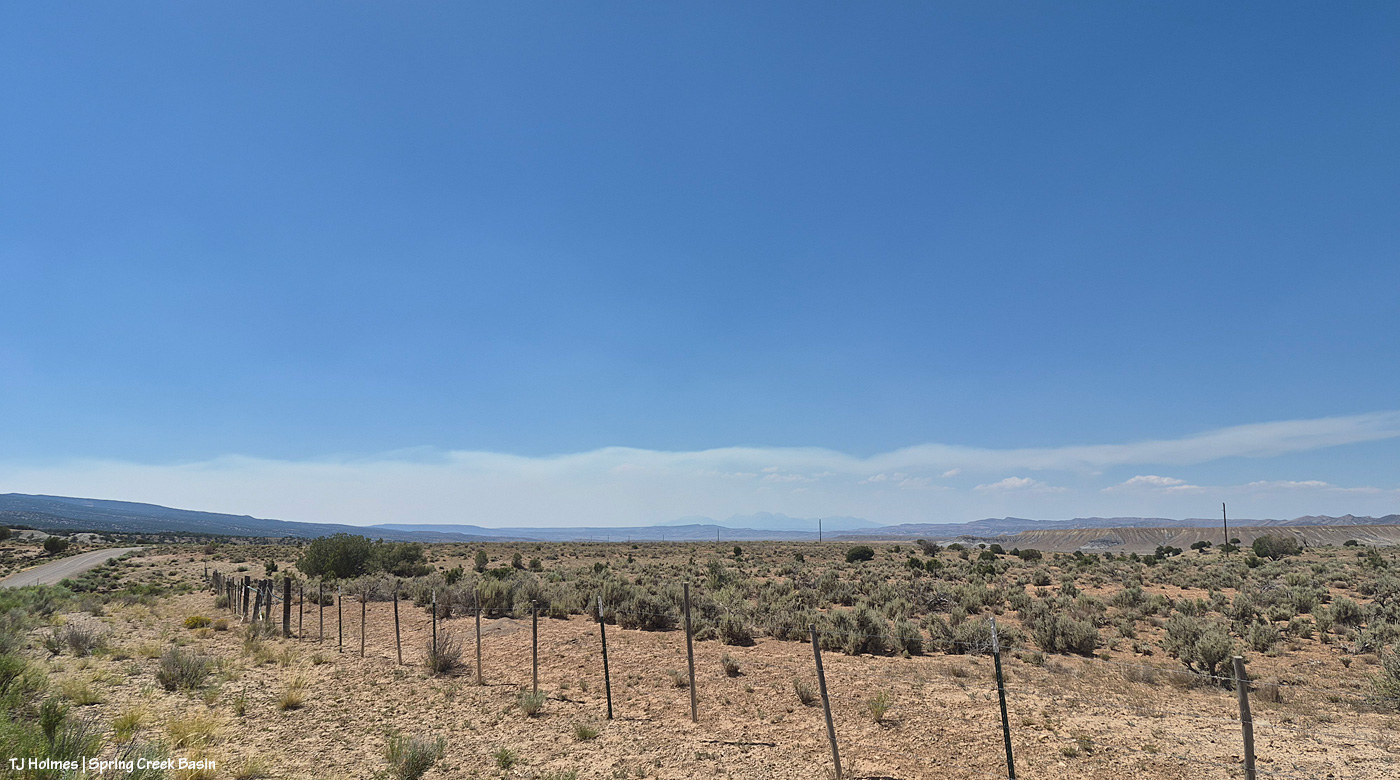
Yesterday afternoon, it became, as noted, a tale of two skies: smoke across the entire east, from south to north from the Ferris Fire; low smoke across the western horizon from the Babylon Fire in southeastern Utah (81,494 acres!) and clear blue sky above, south/southwest across the west to the north.
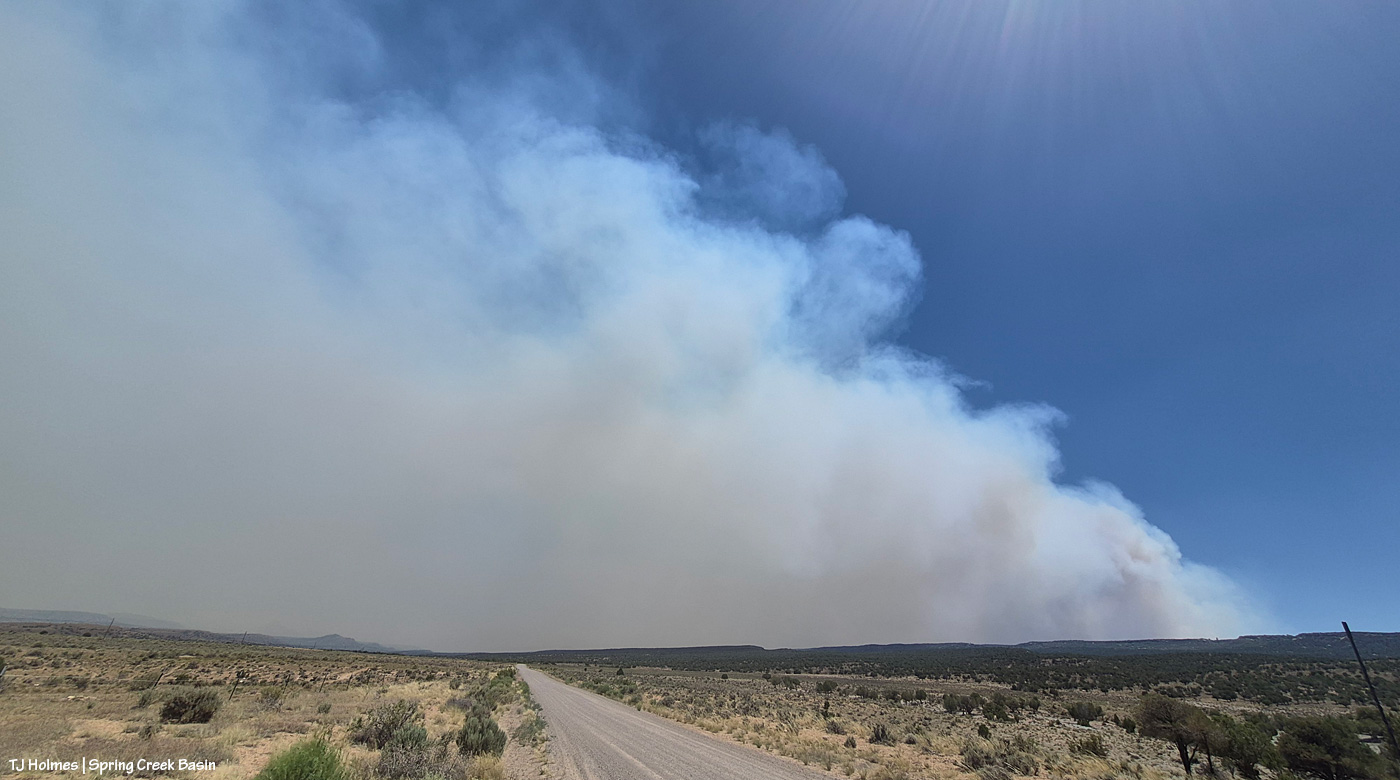
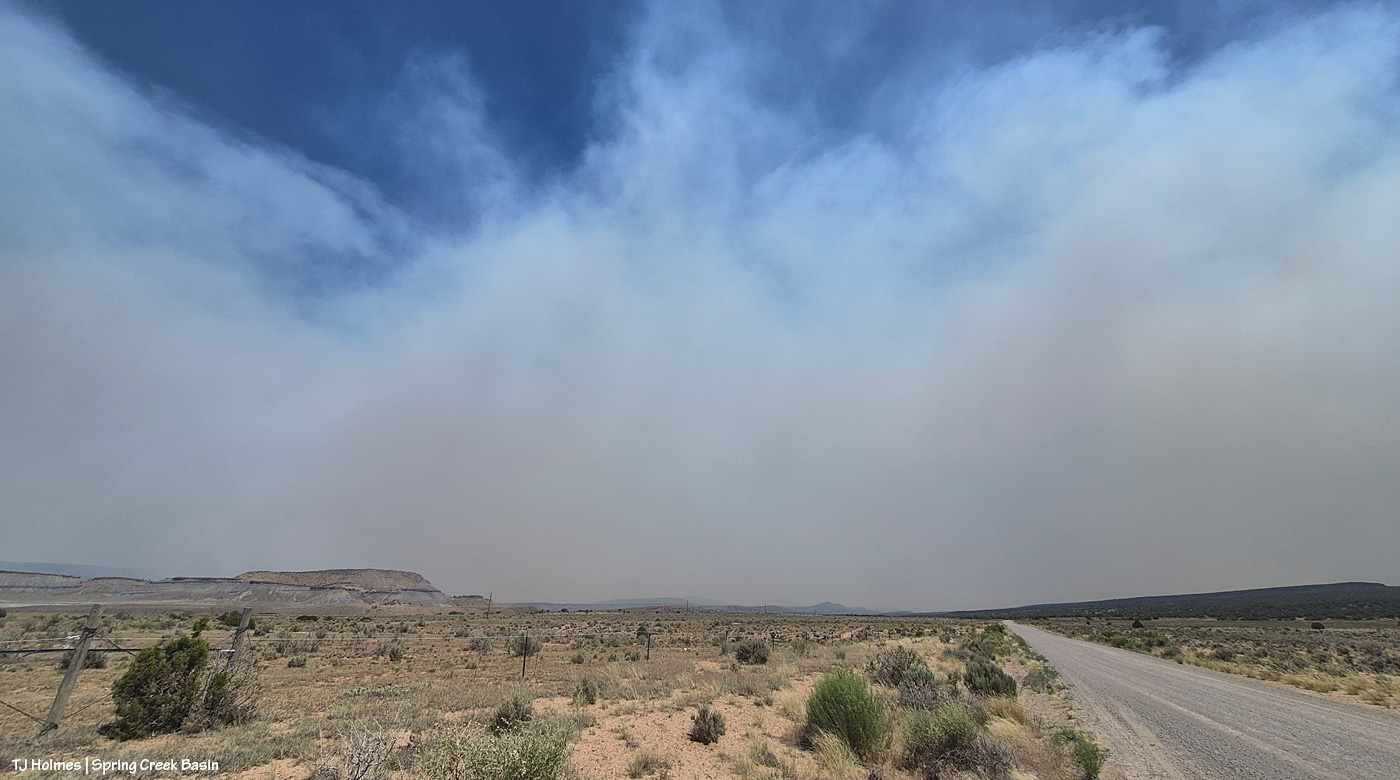
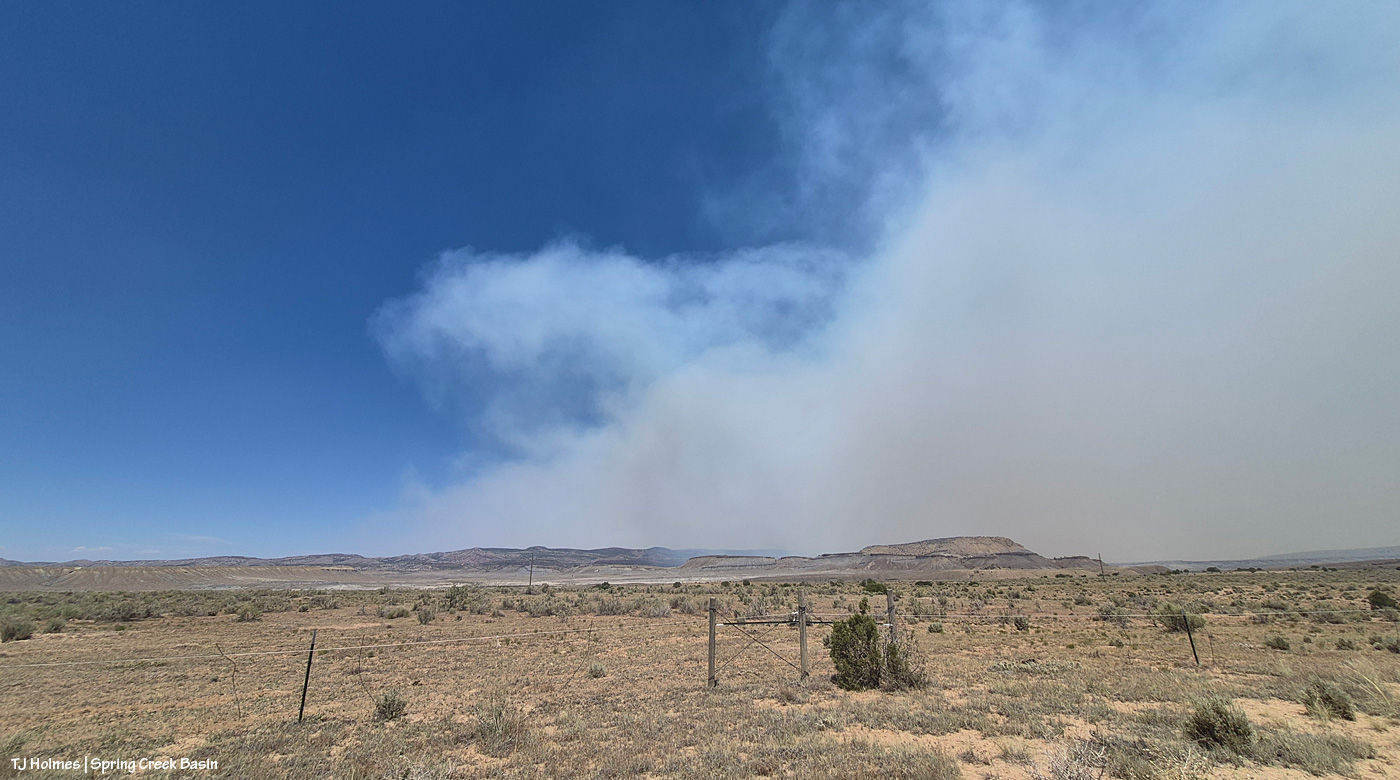
These next three pix are the Ferris Fire smoke:
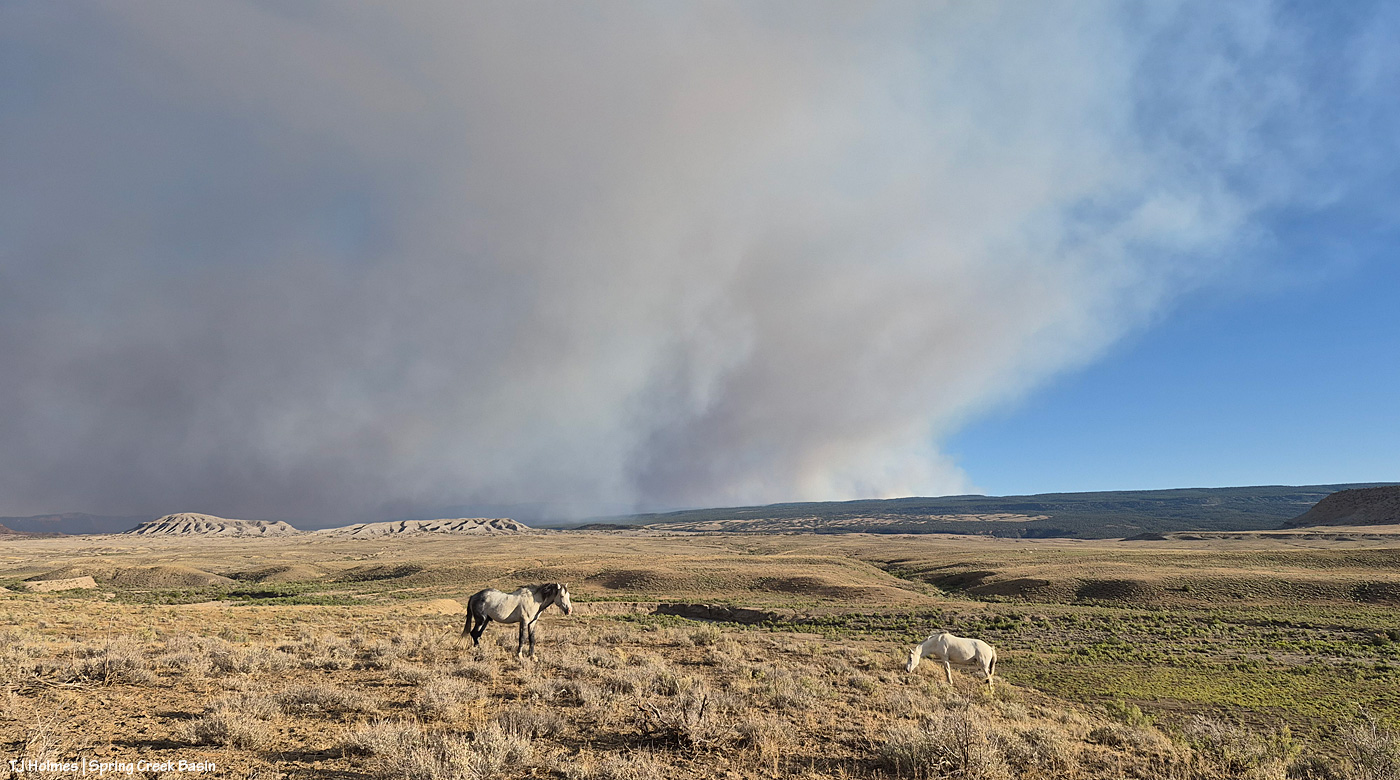
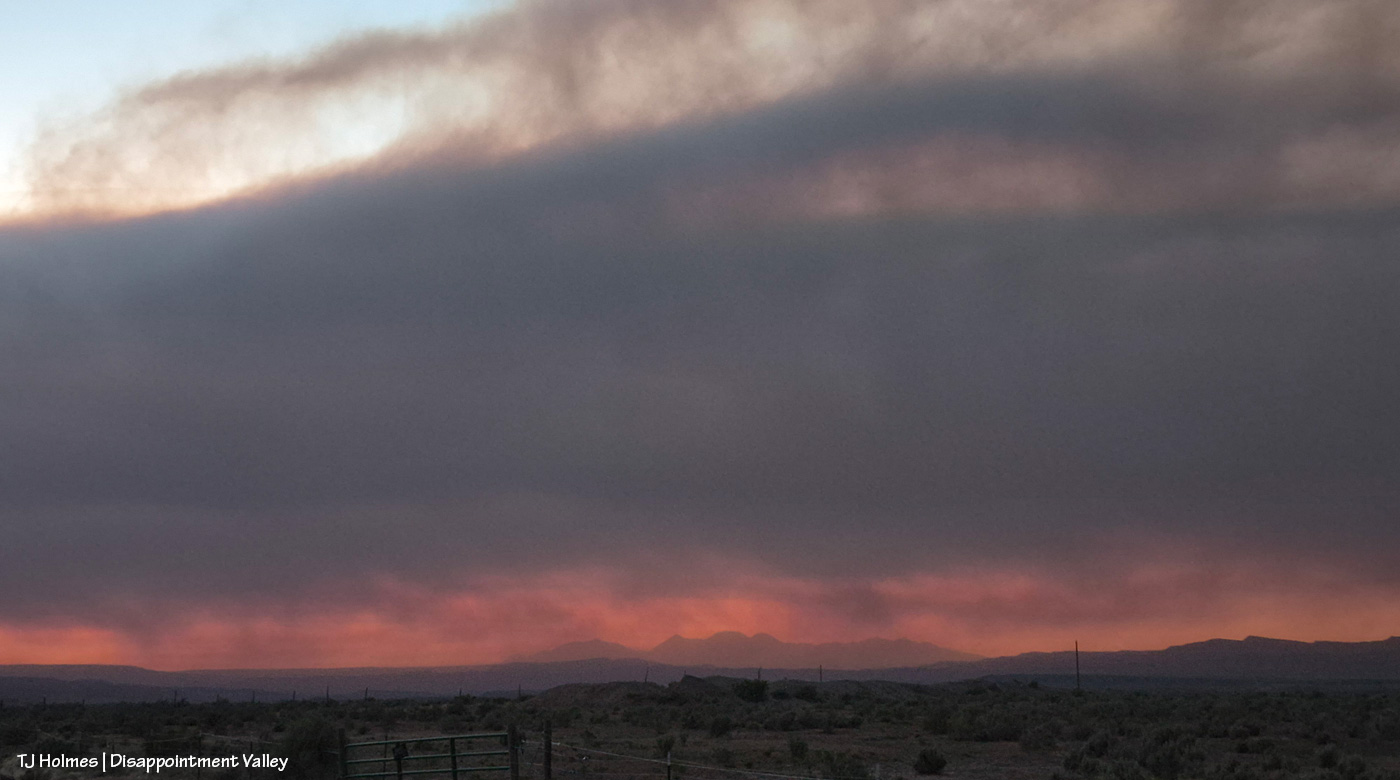
That’s the southern – probably southwestern – edge of the Ferris fire, south of Disappointment Valley (more the upper valley than the lower valley, which is behind me). The smoke is drifting to the left, which is north.
Looking southeast/eastish straight up-valley and up Disappointment Road from southwest of Spring Creek Basin. (I know, it’s weird; up-valley in Disappointment Valley is up/higher elevation, and it’s southeast, which people usually refer to as “down”!) The rimrocks at lower left form the western boundary of Spring Creek Basin, and that’s Filly Peak, within the basin, just above them. On a clear day, you could see Temple Butte and McKenna Peak and Brumley Point from this vantage point.
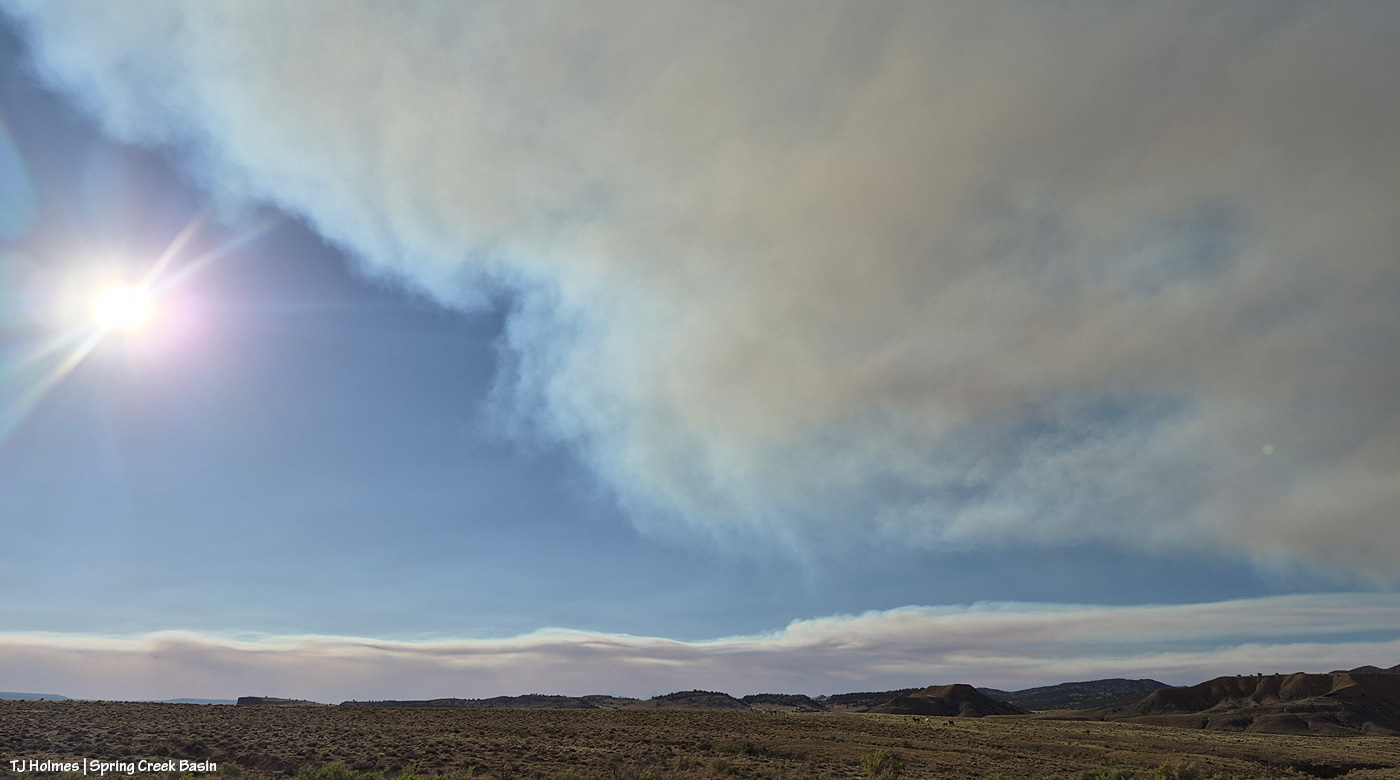
This is looking east/northeast/north. Even with my phone’s widest angle, I can’t get the entire smoke-drift in one image, south to north, basically. See that blue sky at left in the photo above and to the right in the first pic?
Now let’s turn directly around and look west/northwest, and this was the view: mostly blue sky above the low smoke layer, mingling with some low clouds, from the Babylon Fire, drifting again from south to north across our western horizon. Quite a difference in the two halves of the sky, eh?
Now a couple of evening pix, looking at the changed smoke from the fires:
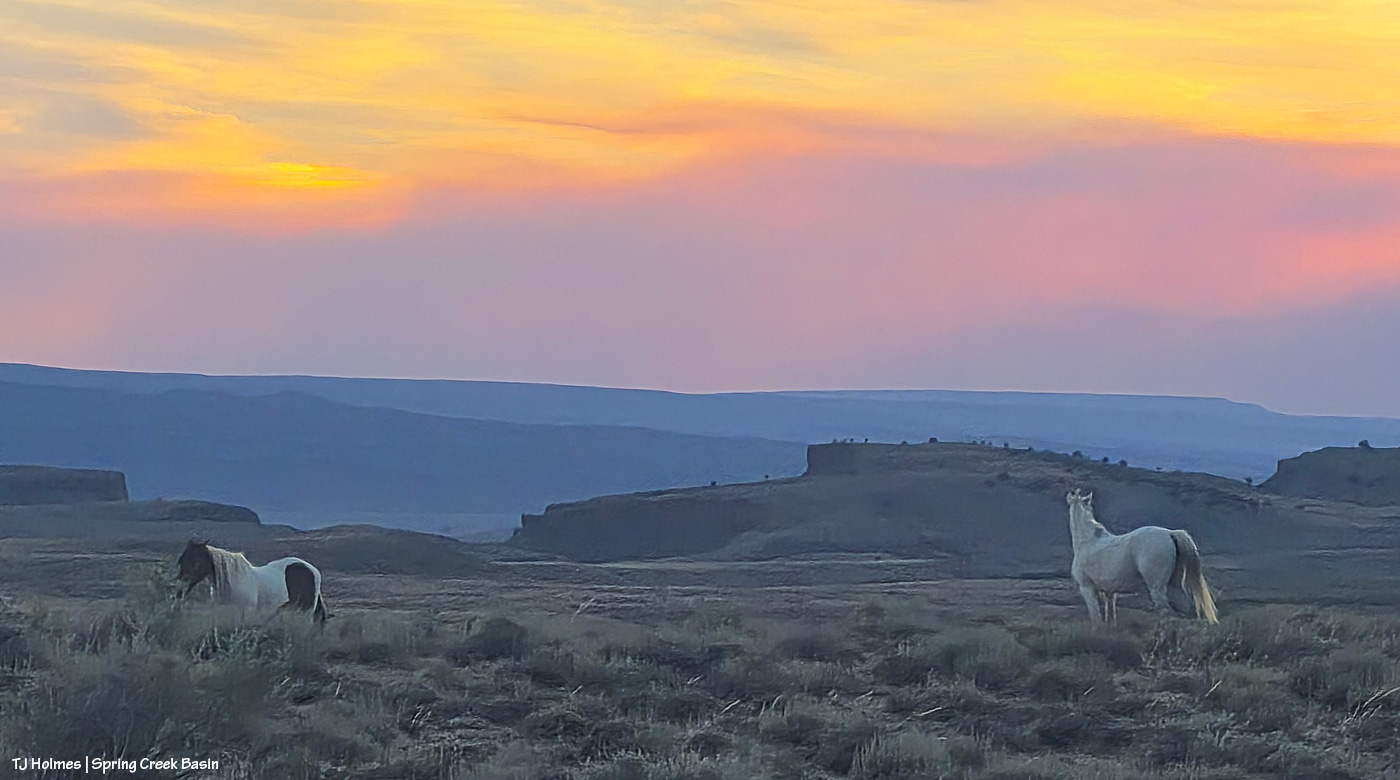
Seneca and Chipeta, looking west toward Spring Creek canyon, sunset and the Babylon Fire smoke.
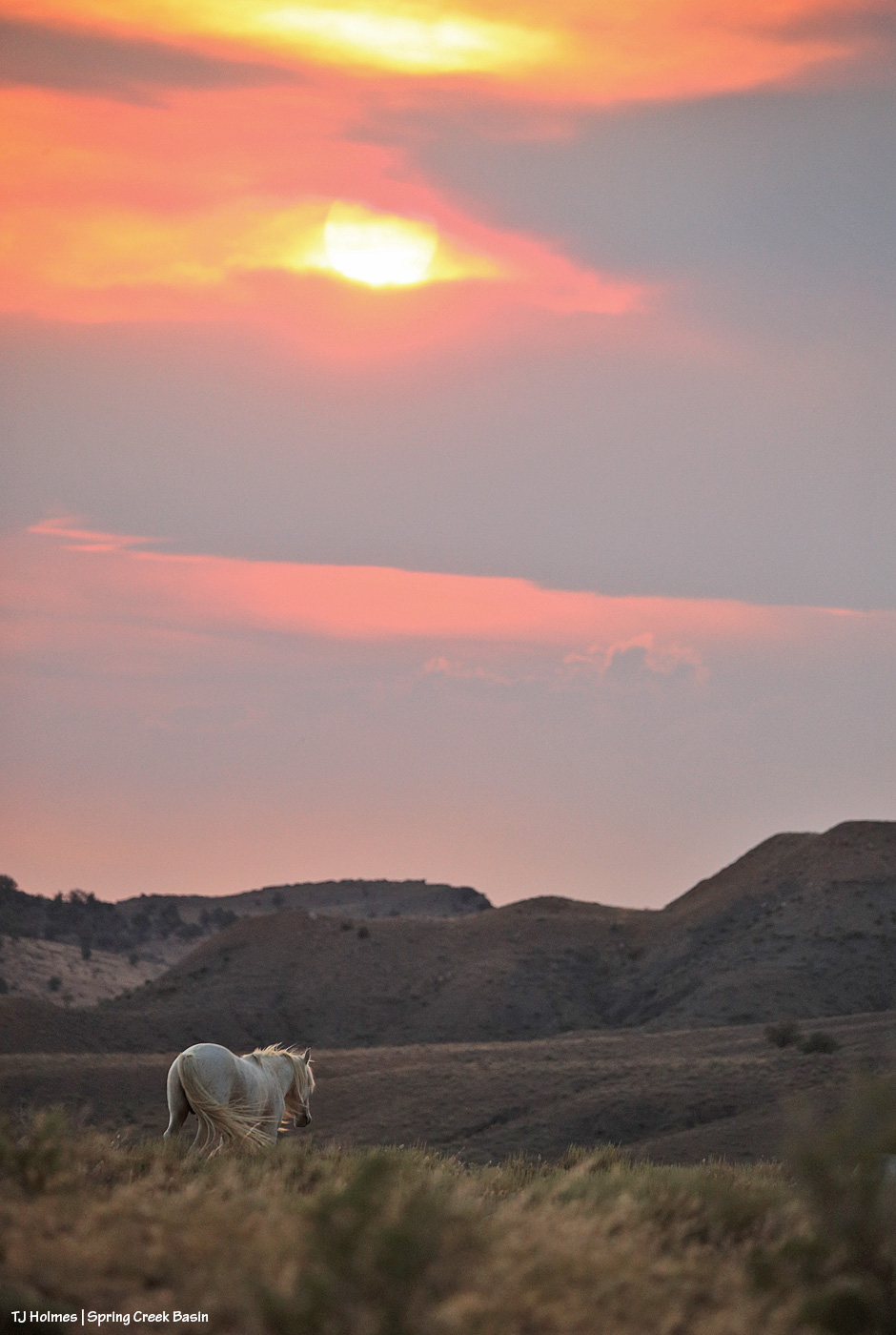
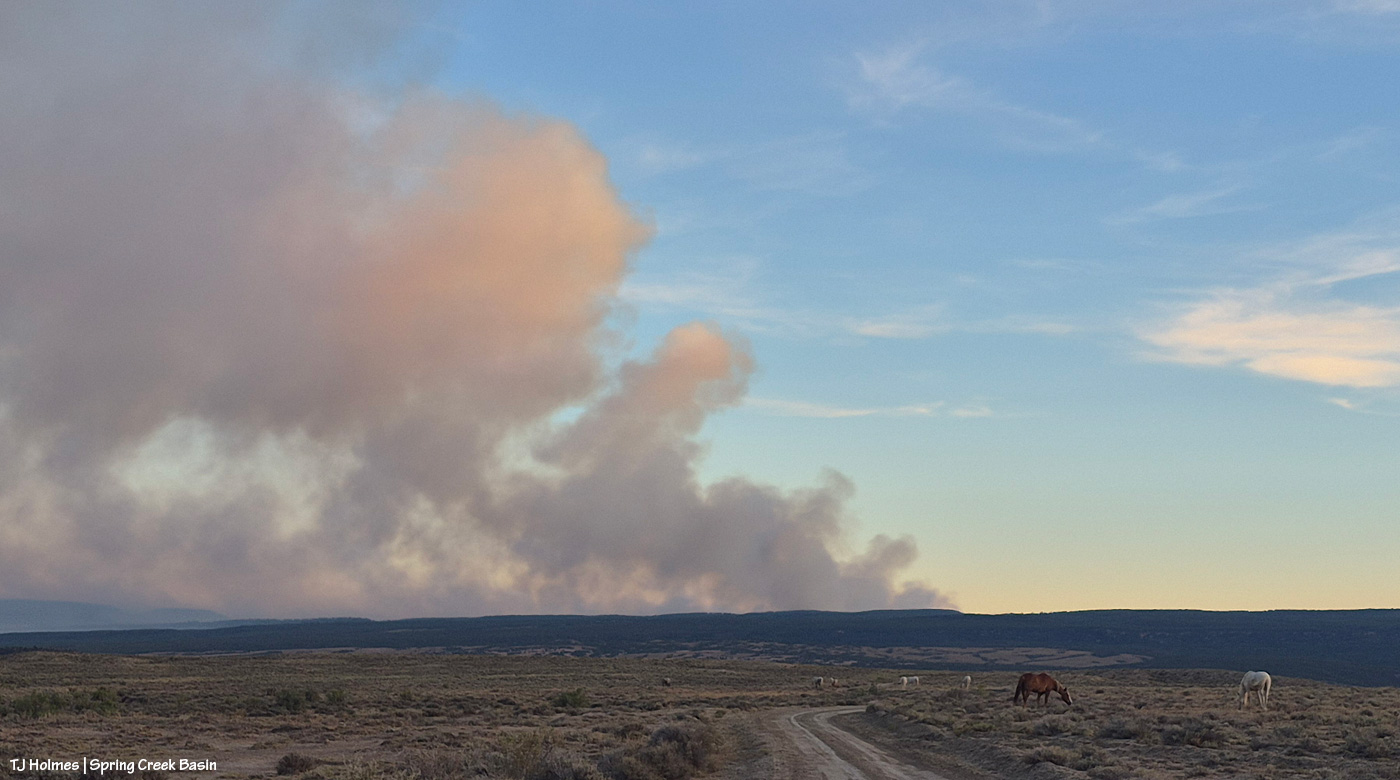
Flash’s band, looking south to the sunset-colored smoke from the Ferris Fire.
Yesterday was not the prettiest day under the smoke layers. … In fact, until late afternoon/early evening, it was pretty downright ugly (!). The fire moved toward the Dolores River canyon on its west side, and those delicious new fuels sent up a great deal of smoke. Morning found us super socked in … and it just didn’t lift or drift until much later in the day, which was – you guessed it –another red-flag-warning day. Today, the same.
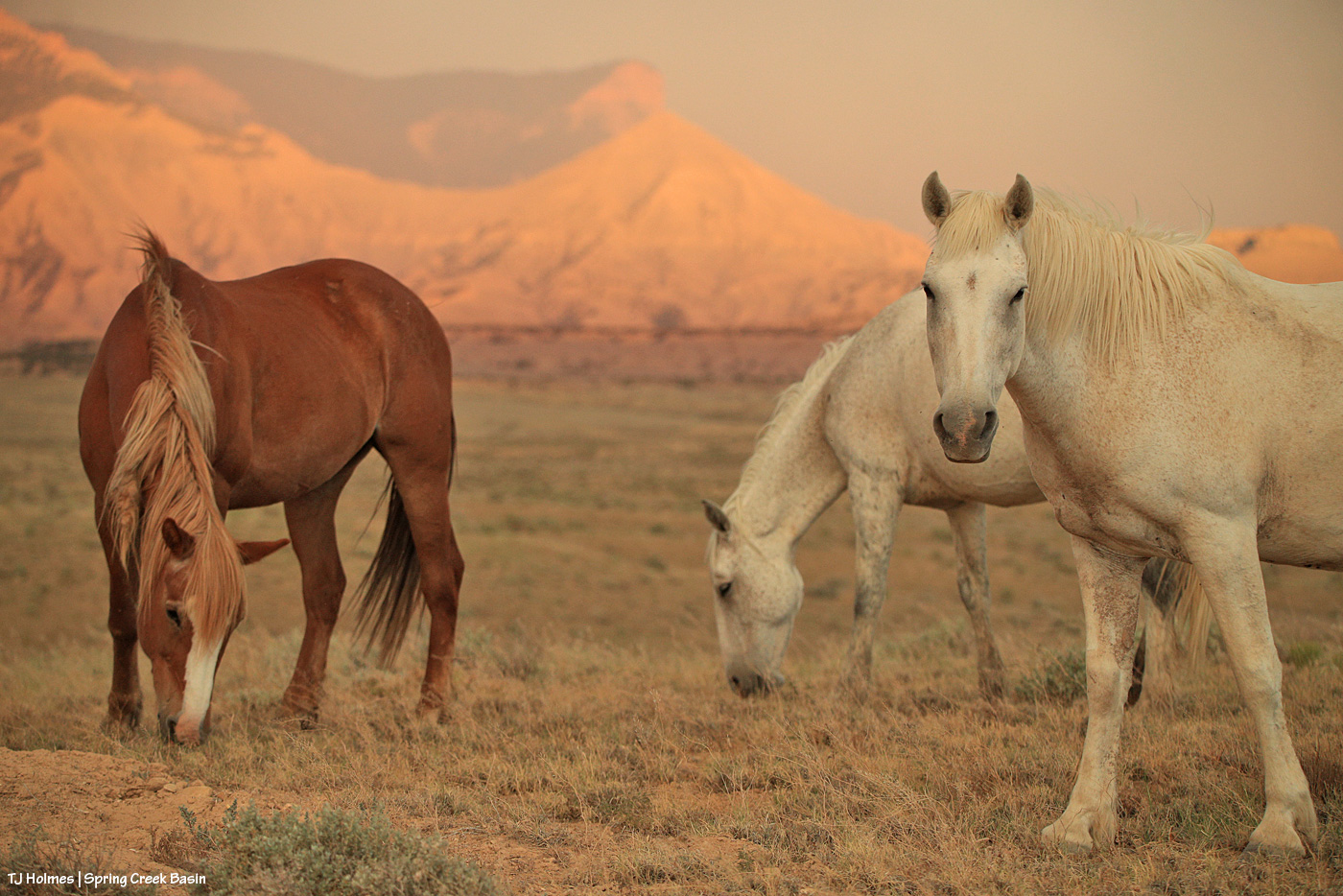
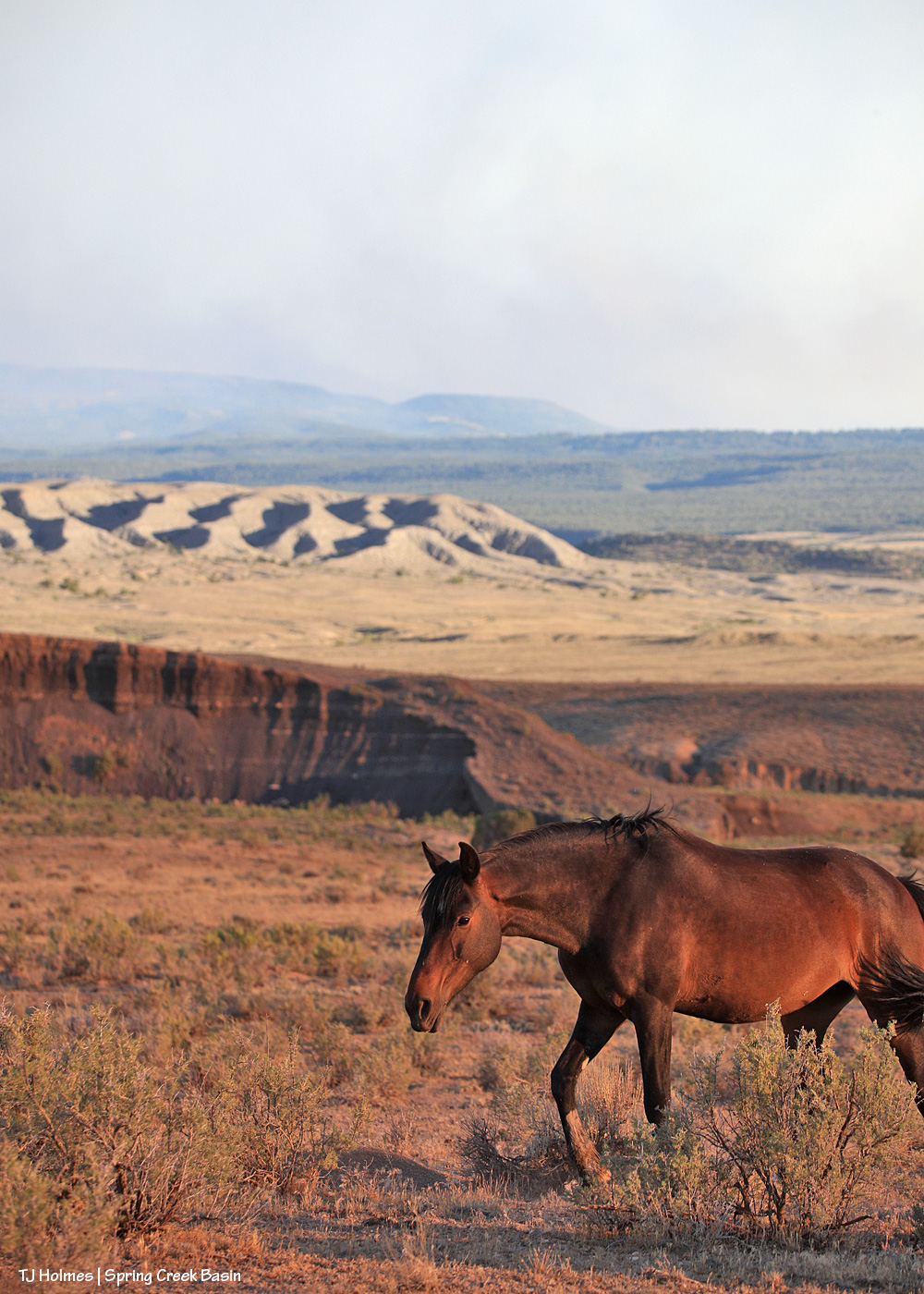
The mustangs continue to fare well through it all. They have forage, they have water, they have each other. When it comes right down to it, they have the important things kinda nailed. Mysterium, Gaia and Maple above.
If you’re using the Watch Duty app, you can find the below information there. I thought the updates Wednesday night for earlier in the day were informative, so I’m going to post them here (and huge thanks to those folks doing the updating?!). There has been a massive amount of work done by firefighting ground crews as well as air attack. It’s humbling to know those folks are out there giving every ounce of their strength to fighting this fire. The Ferris Fire apparently has its own Facebook page, but that’s beyond my knowledge.
Michael Silvester • Senior Manager of Operations & Standards
22 minutes ago • Jul 1 at 9:58 PM
The Ferris Fire is expected to reach the Dolores River Canyon tonight as it backs down Doe Canyon. Fire crews will continue monitor this area closely tonight and will be in close communication with Dolores County out of an abundance of caution.
Tomorrow [today, July 2], a number of engines will staff the west side of the canyon. The Incident Management Team is also coordinating closely with the local fire protection.
Michael Silvester • Senior Manager of Operations & Standards
3 minutes ago • Jul 1 at 9:32 PM
Zone 8 [I believe this is directly west of the fire] is now on “Set” status & the parameters for that zone can be seen above, per the update from Dolores County Office of Emergency Management on Facebook. SET Means Be Ready to Leave & means there’s a wildfire in the area, and conditions could change quickly. It’s time to be alert, stay informed, and be ready to leave at a moment’s notice.
When you’re SET:
– Load your go-kit into your vehicle.
– Park facing out for a quicker departure.
– Follow updates from official fire and emergency channels.
– Review your evacuation routes and know where you’ll go.
– Get pets and livestock ready to leave with you.
Being SET doesn’t mean you need to leave yet.
Total acreage: 25,814 Total personnel: 282
Today [yesterday, July 1], the Arroyo Grande Hotshots continued to dig containment line on the northeast corner of the fire nearest to private lands. An additional dozer and hotshot crew will be in place tomorrow to continue this mission. Favorable weather conditions will allow overnight burnout operations to continue this evening.
Dozer work on the southwest corner of the fire was completed. Firefighters will continue improving and developing containment line in this area.
The west side of the fire, closest to the Dolores River Canyon, continues to present challenges for direct engagement. Additional divisions were added to respond to this expected growth.
Susan Perney • Coverage Reporter
About 4 hours ago • Jul 1 at 5:42 PM
Three Type 1’s and one smaller helicopter are working the various hotspots around the fire. Air tankers have also been dropping retardant to slow the fire’s growth on the southern end where Doe Canyon meets the Dolores River Canyon.
A second interagency Hotshot Crew (IHC) will be arriving later today. Current plans call for them to assist with creating fire line in rugged terrain on the fire’s northeast corner near the lookout. The goal is to prevent the fire from reaching and threatening homes and private property in the Glade Ranch Subdivision and to protect the lookout itself. Despite several large fires in Colorado and surrounding states we are continuing to get more resources to support the crews on the ground and in the air. 280 firefighters and support personnel are now assigned to the fire.
**********
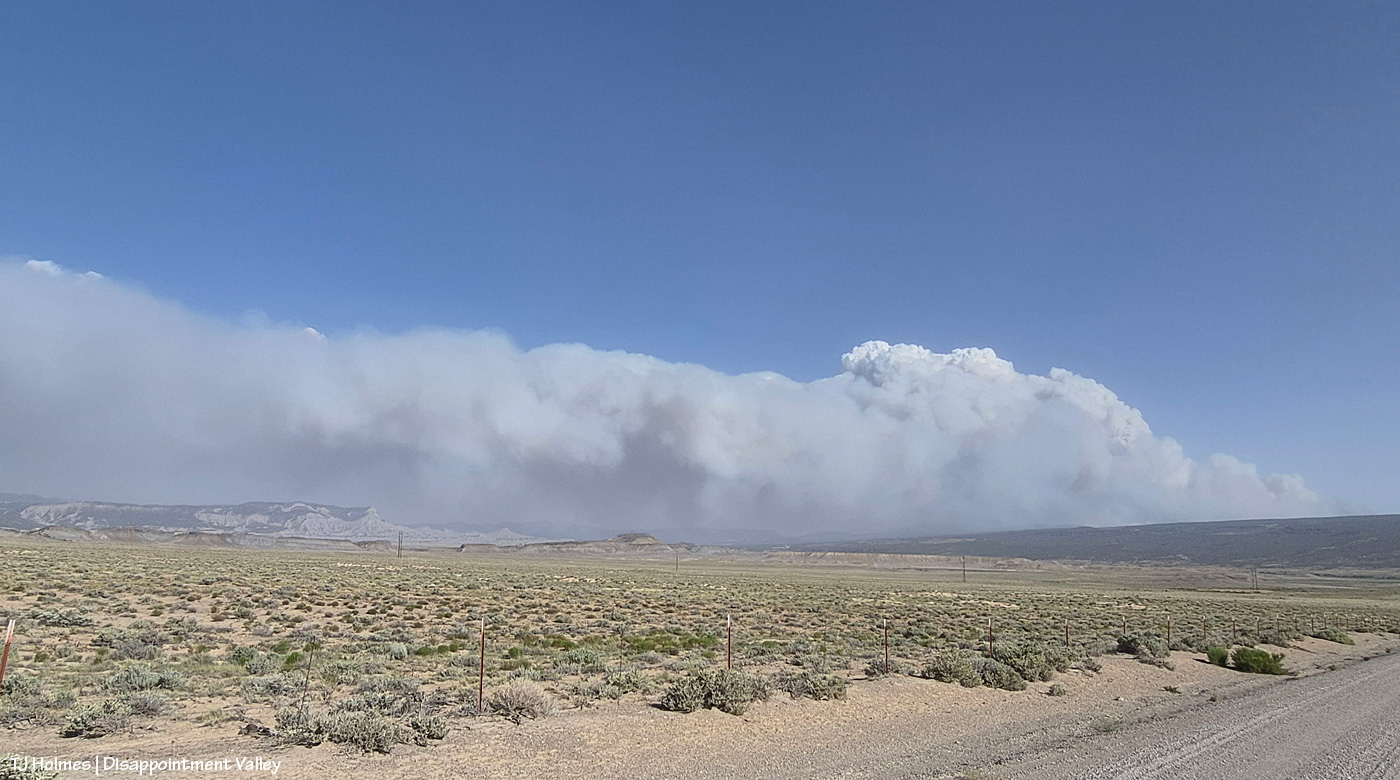
That Montana-shaped smoke is from the Ferris Fire, which has moved north and northwest and is overlapping the western-horizon smoke from Southwest Colorado and Utah fires.
Smoke in the pic is NOT as close as it seems, nor as awful as it looks. I mean, it IS awful where it is, but it is not super close to Spring Creek Basin. I actually debated showing this pic, and I decided to do it, not for drama factor, which I’m aware that it has, but because that was the scene toward sunset looking south/southeast, and I think it helps tell the story. A recovering journalist, still, I am.
We remain incredibly grateful to all the firefighters and folks supporting the crews working on the Ferris Fire *AND* all the other fires burning near and not-so-near. I particularly value my partnership with my local BLM folks, which includes this challenging time, during which they are, as you might guess, super busy. Thanks (again!) to Ryan for taking the time to keep me updated about goings-on; you can’t imagine how grateful I am.
And thank you also to everyone who has messaged me asking about the safety of the mustangs; I appreciate that immensely.
After a pretty smoky early morning, the wind blew it east and away again most of the rest of the day. The wind still is switching between southwest and southeast and south. Cassidy Rain and her band were just leaving water; you can see the mud on her right front leg.
This is a very wide view (cell phone) from the main/original water catchment looking south/southeast. The source (ish?) of the Ferris Fire is at far right. I think it might have been the wind that had the smoke so ragged; clouds were actually visible low to the horizon, through the smoke. (Is that weird? It seems weird; the smoke on the horizon(s) has been so dense that it seems unusual to see anything beyond it, whether that’s the far ridges or even clouds.) You can see how clear it is between here and there. Fortunately for the mustangs, they’re not dealing with a lot of smoke.
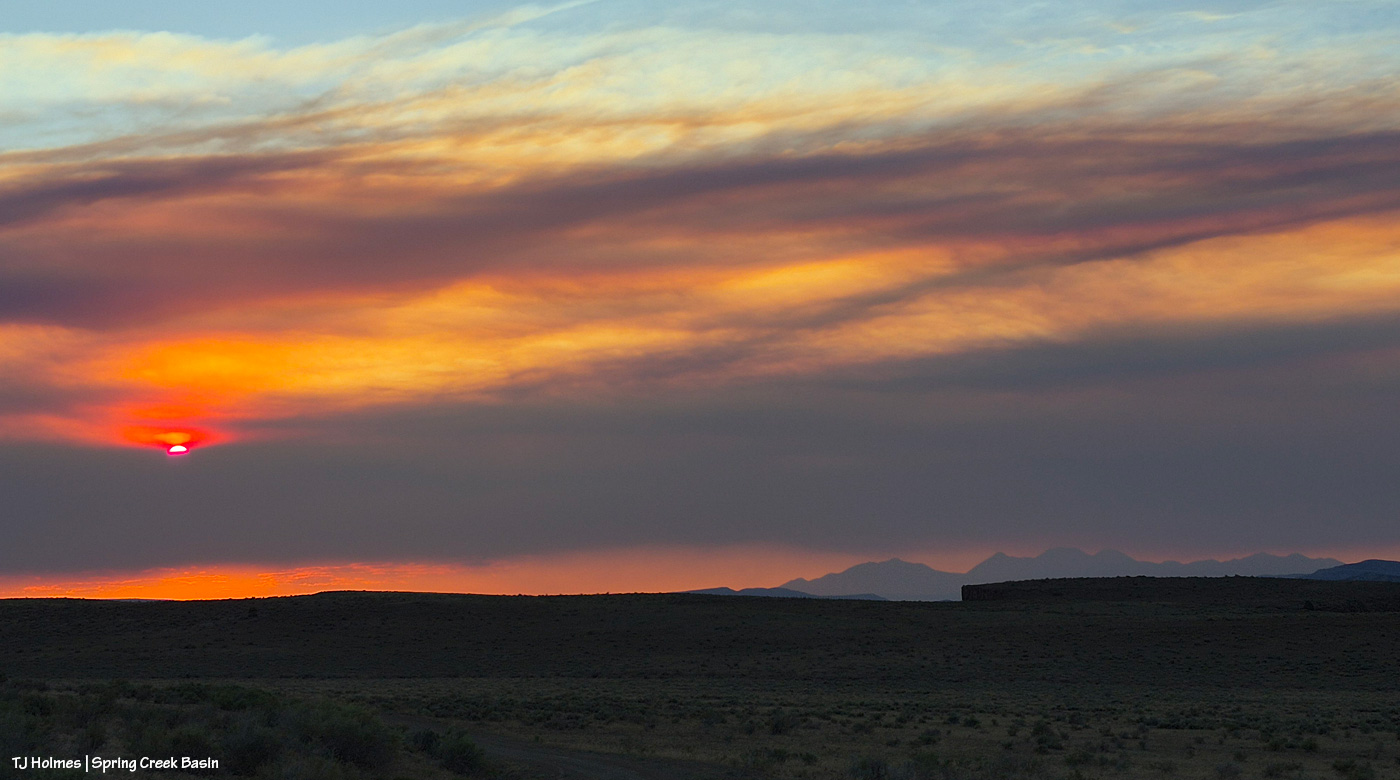
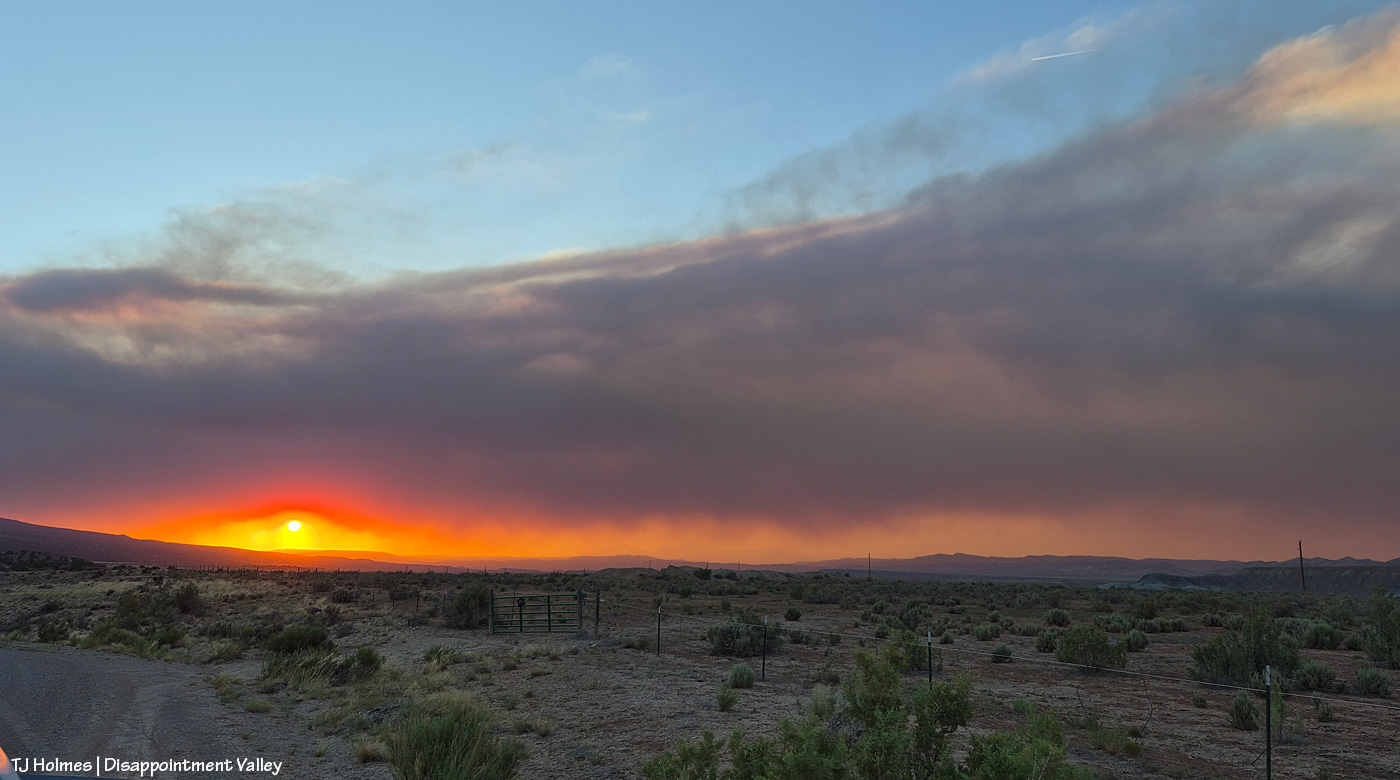
From near the western boundary of Spring Creek Basin, looking west/northwest as the sun drops into a bank of smoke drifting from the Utah fires and maybe some farther southwest of Disappointment Valley in Colorado. Earlier in the day, the mountains were fully visible and the smoke was behind (west) of them. Then there was a period during the day when the mountains were fully obscured by smoke again. And here, at the end of the day, they were visible below the band of smoke. I think that great band of smoke was from the southern fires and joining smoke from the northern fires (like the Snyder Mesa Fire).
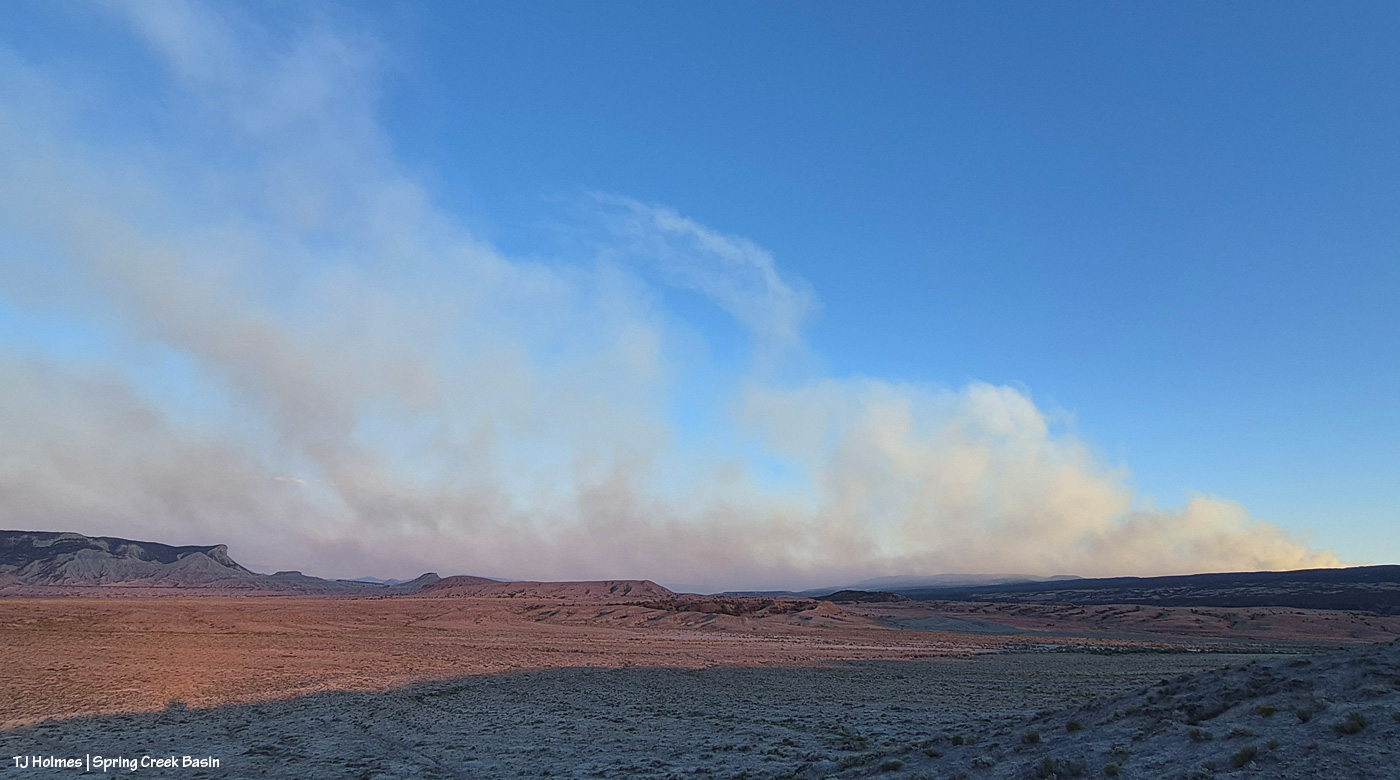
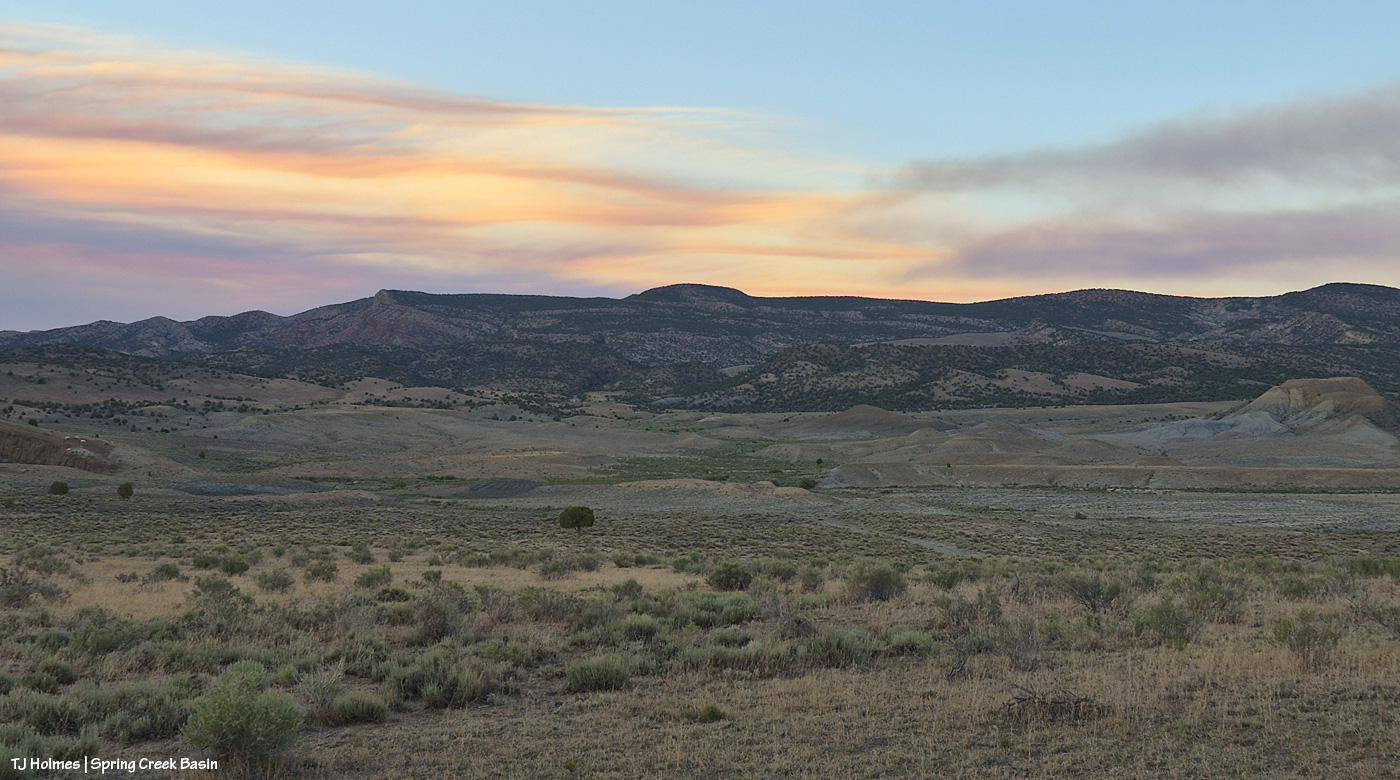
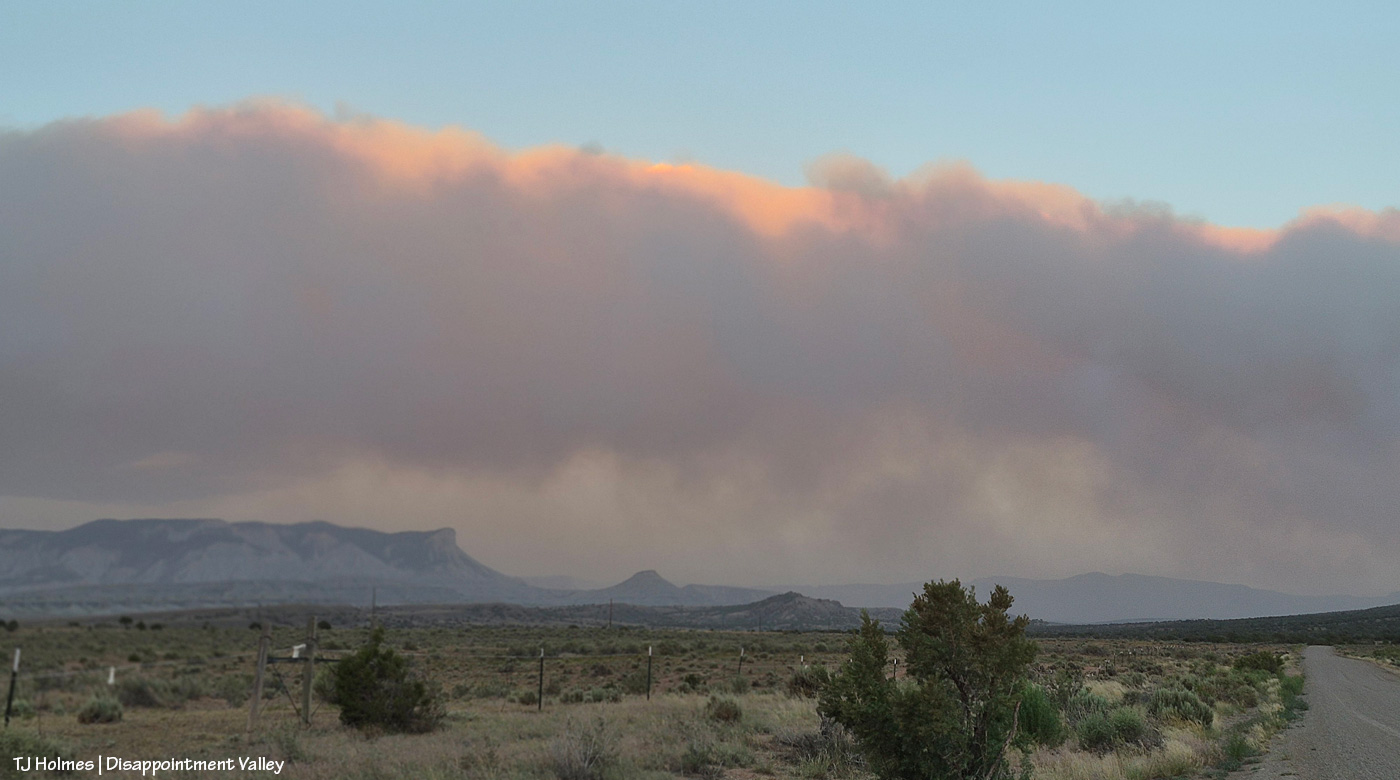
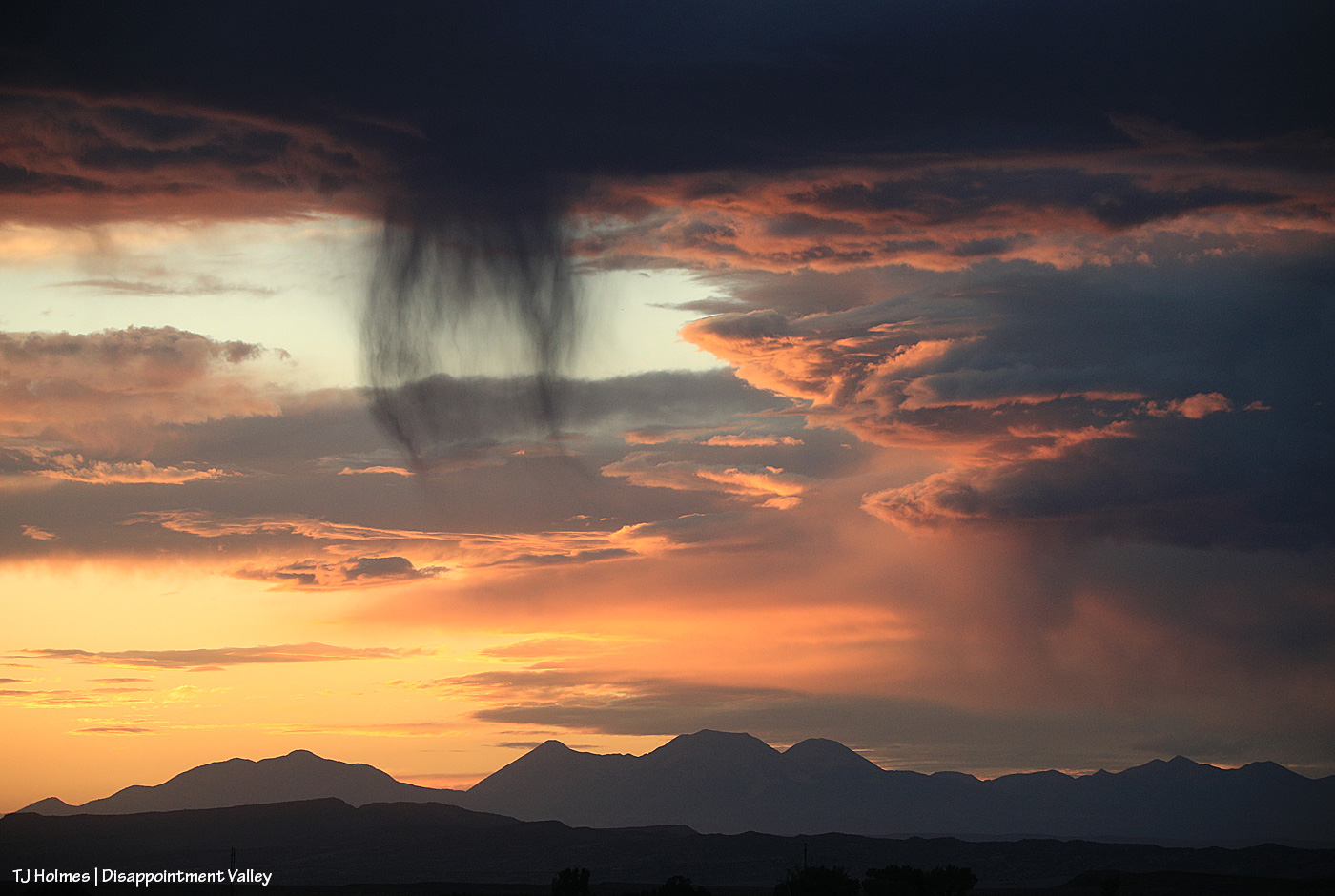
This last image is from about the same place as the one above, but now we’re looking nearly directly north. See the painterly smoke from left that fingers to the right, right of center? That’s from the western fires. See the greyer smoke at right? That’s from the Ferris Fire. Straight south and to the southwest, we’ve had a clear sky, and straight-ish north, we’ve had a clear sky. Tonight, the smokes from west and east have joined in the north. Wild, right? (If you look closely, those white dots at center left, on the sloping edge of the northern Spring Creek canyon side, are mustangs. :))
We continue to be very lucky in location, and the mustangs are doing very well.
Gratefully, while the Ferris Fire burns 20,560 acres to the southeast and the McCloud Fire and Horse Head Fire burn 113 and 530 acres, respectively, to the southwest (and that smoke is joined from the Snyder Mesa Fire (30,163 acres) to our north/northwest, drifting southish), Spring Creek Basin and lower Disappointment Valley were mostly smoke-free yesterday.
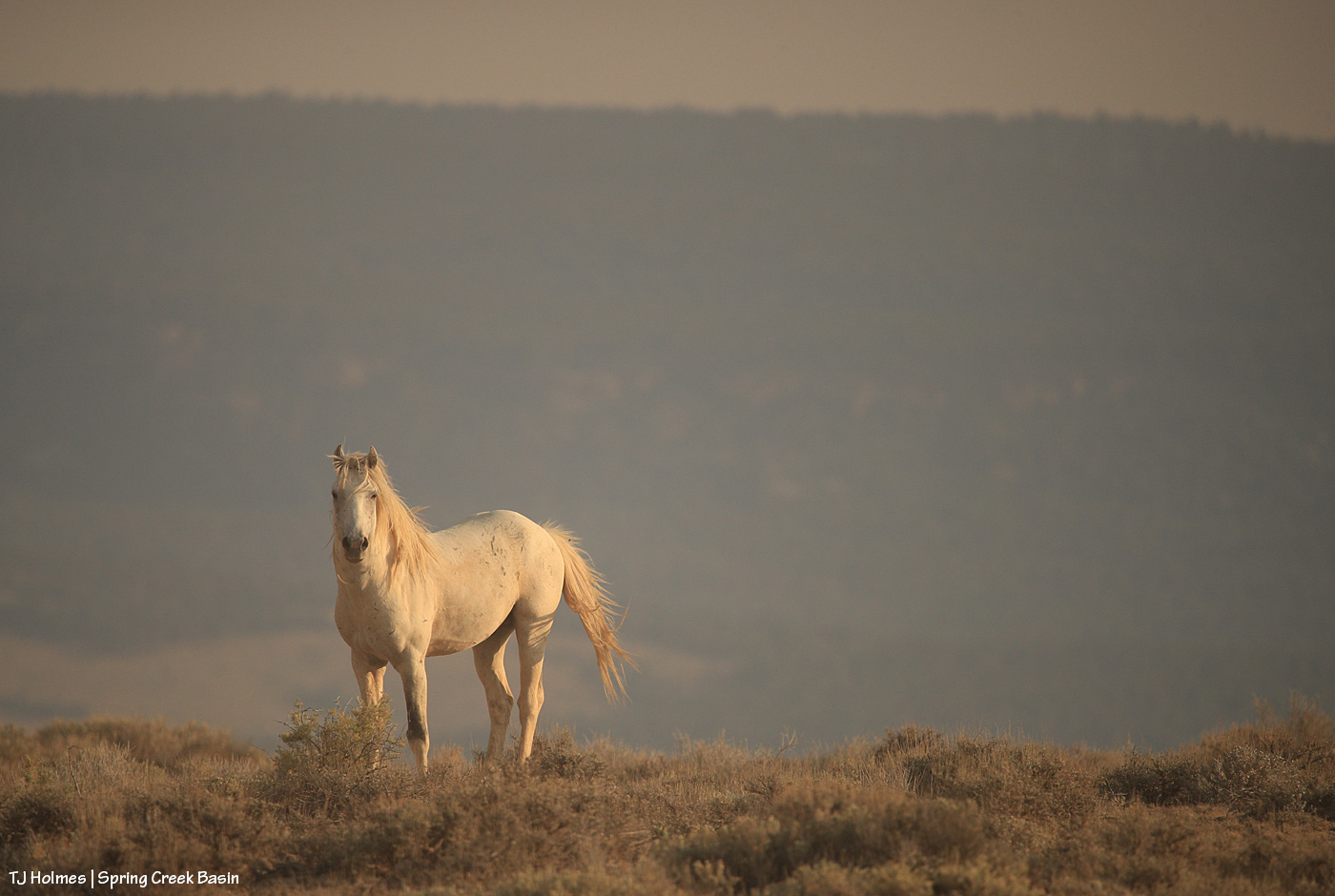
In the pic above, Tenaz and Skywalker, grazing with their band almost at the western boundary of the basin, are highlighted by that drifting smoke to the west. It’s fairly far away, but I haven’t seen Utah’s La Sal Mountains for at least a few days now as the smoke obscures any sight of them.
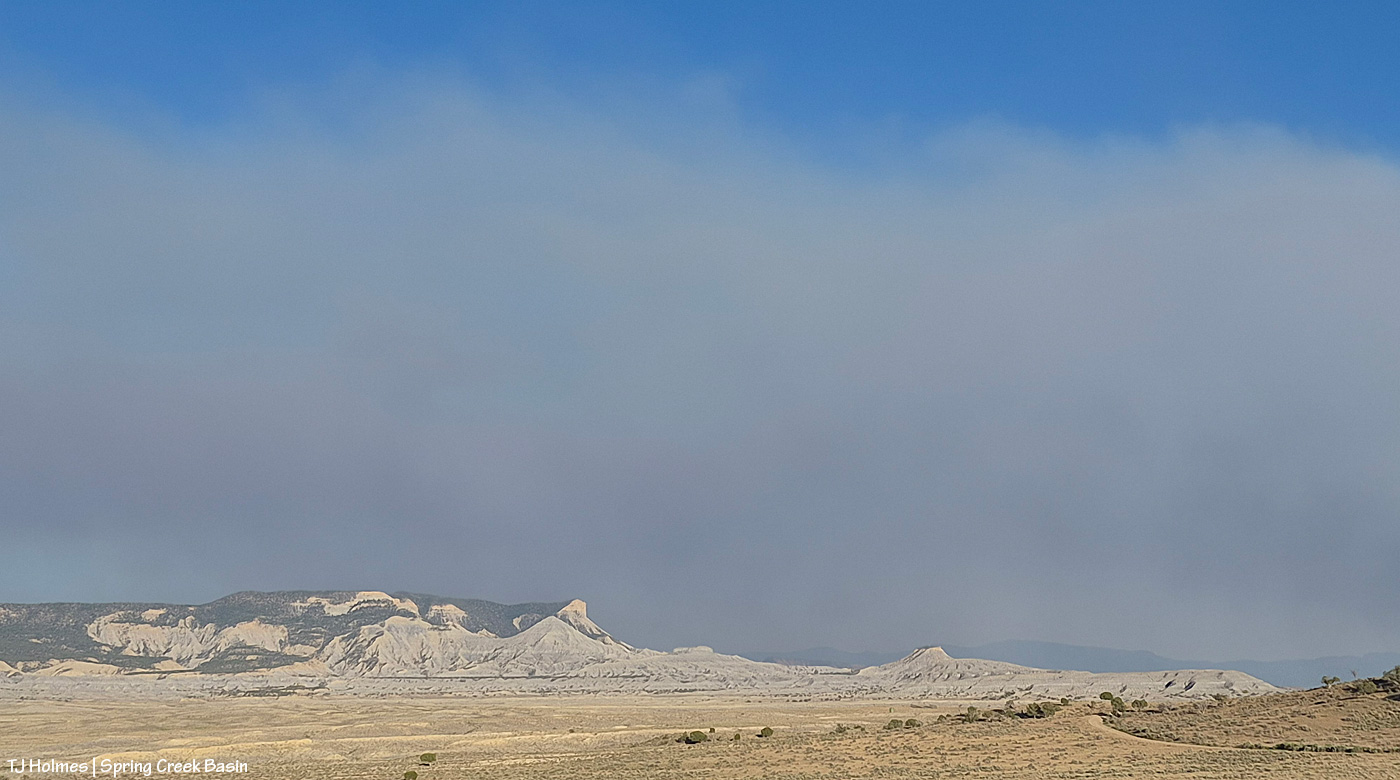
Now looking east/southeast, that’s the smoke from the Ferris Fire (the Doe Canyon, Far Draw and Ferris fires all have merged and are now being collectively called the Ferris Fire). But see how clear it is between here and there? Not great for folks and critters in that direction … but (again, gratefully), a huge relief for my beloved center-of-the-world Spring Creek Basin.
Huge thanks to sheriff’s deputies from both Dolores and San Miguel counties (Disappointment Valley spans both counties, and Disappointment Road runs from Colorado Highway 141 at the lower north end to the Dolores-Norwood Road at the upper southeast end) who have been diligent in keeping an eye on the fire’s approach: Branson, Todd, Derek, Jeremy and Nick. Also to my BLM folks, especially Ryan and Laura, for keeping an eye on the situation and updating me with information. Anton was on one of the fire crews pulled back Saturday for safety on the Doe Canyon Fire, and he might still be on a fire crew on the merged fire.
The fire(s) and smoke continue to move in a northeasterly direction, and mid-lower Disappointment Valley and Spring Creek Basin actually are not nearly as smoky as upper Disappointment Valley.
The mustangs are OK. Really, they’re pretty unphased, as far as I can tell. I spent time last evening with Flash’s band, and I saw several other bands going about their business of grazing and moving to and away from water sources.
The Gold Mountain Fire also started Saturday in Ouray County, near the town of Ouray, and a stretch of U.S. Highway 550 is closed in that area. Friends we visited in Ridgway on Saturday could see flames from that fire from their respective homes after we left.
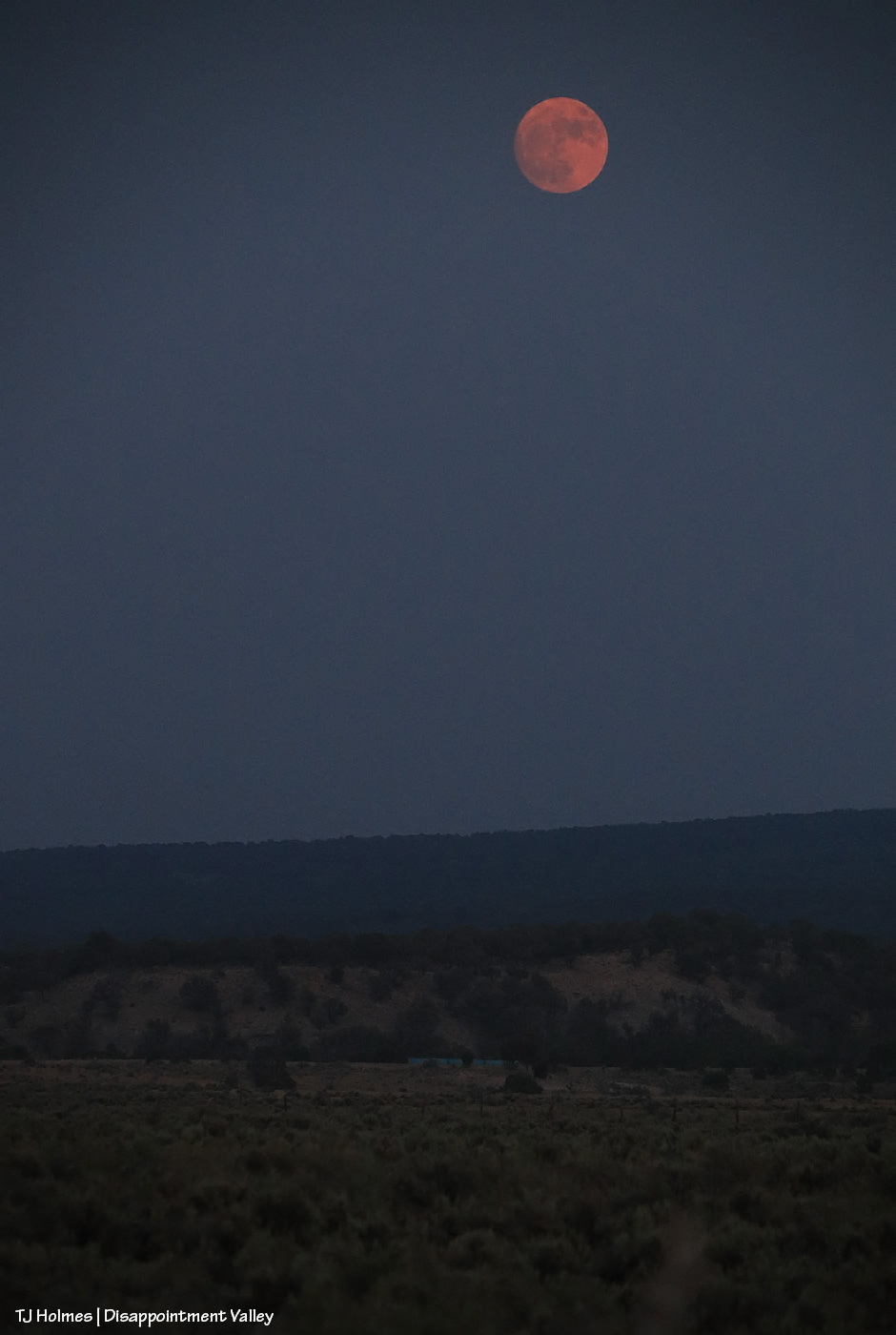
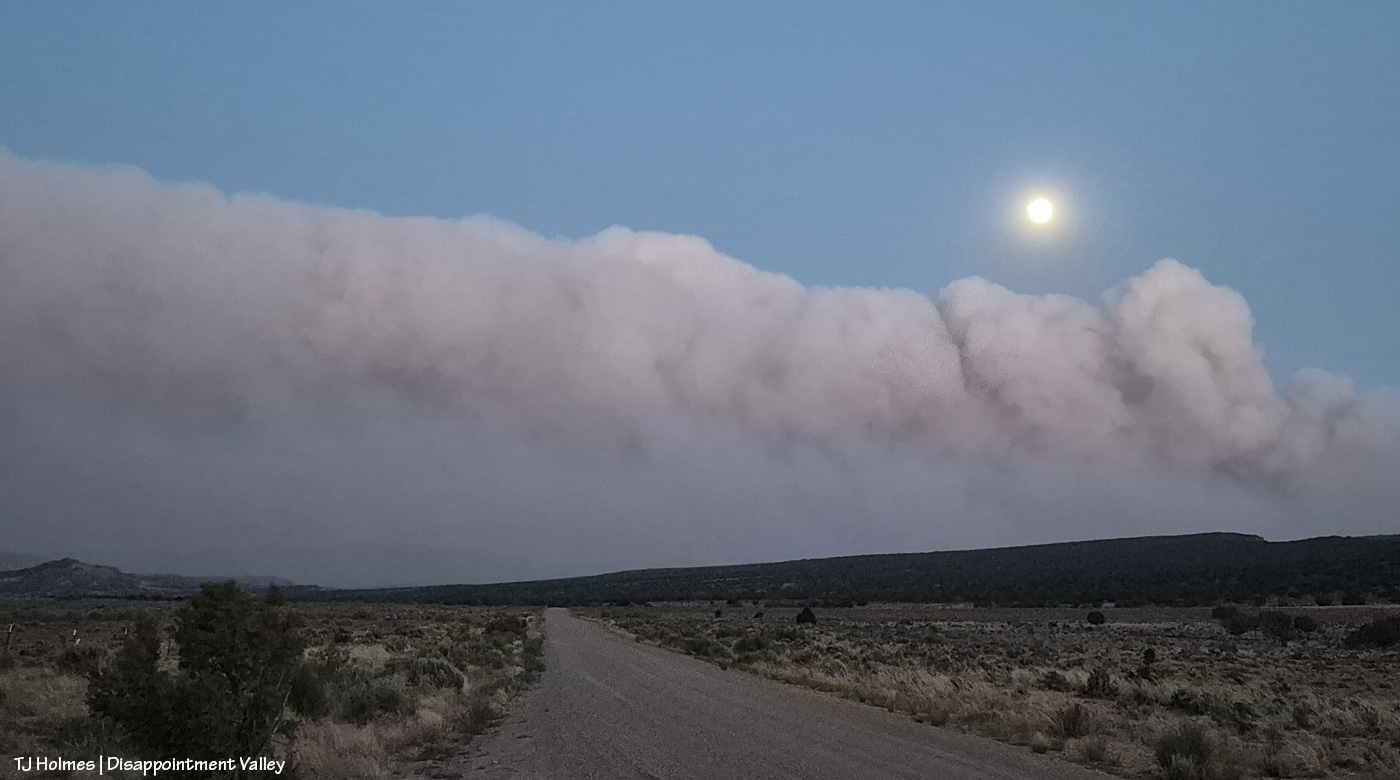
The smoke isn’t really discernible in this pic post-sunset (hard to tell as the sun sank again into a smokebank), but that rising moon, nearly full, is red through a layer of smoke. Noooooootttt the moonrise pic I had pictured for this month.
The mustangs are OK, and we’re watching the progress of the fires and keeping an eye on that smoke. Firefighters should make some progress when the horriblebadawful wind dies down. Think safety for all involved.
This won’t be an easy post to either read or view.
*THE MUSTANGS ARE SAFE*
That’s the important thing (as far as the main topic of this blog, anyway).
Yesterday, Saturday, June 27, at least three wildfires of significance roared to life directly south of Disappointment Valley: Ferris Fire (4,777 acres as of Saturday evening), Far Draw Fire (651 acres) and Doe Canyon Fire (385 acres). There’s also the Horse Head Fire (200 acres) burning to the southwest, in Utah, and the Snyder Fire (28,264 acres) burning north-northwest of here, almost directly west of Grand Junction and just inside Utah.
Red-flag warnings; check.
Wind advisories; check.
Bad air quality; check.
Critical fire weather; check.
Stage 2 fire restrictions in San Miguel and Montrose counties; check (these might extend to other nearby counties, but these are the ones I know about, and most of Spring Creek Basin is in San Miguel County, with the southern/southeastern portion in Dolores County).
Kentucky is flooded, and the West is on fire. Friday night, we had a swift little storm pass through Disappointment Valley – 0.04 inch from four minutes of rain. My guess (guess only; I don’t know yet the cause of these fires) is that they started from lightning strikes. It is one giant tinder box out there. Until the little bit of rain Wednesday, it hadn’t rained here for more than a month.
If images of wildfire smoke bother you (it bothers me), the rest of this post isn’t for you … and the pictures, as usual, don’t convey the bad-ness of the beast. … Again, please know that the mustangs are SAFE. I can’t say what the fires will or will not do, but for now, the horses are OK and not in danger.
I spent most of Saturday in Ridgway with mustang friends, and this is what greeted me and Kat Wilder upon our return to Disappointment Valley. This is from the northern part of the valley, a few miles south of Colorado Highway 141, looking southeast.
Looking west at sunset; this smoke is from the Utah fires.
The majority of the smoke seems to be passing east of the eastern side of Spring Creek Basin; McKenna Peak, Temple Butte and Brumley Point are all visible. … The smoke ain’t great up-valley; it smells like you’re in the middle of a campfire (and by the way, campfires and any other kind of fires are strictly verboten (that means forbidden!), not to mention dumb as hell).
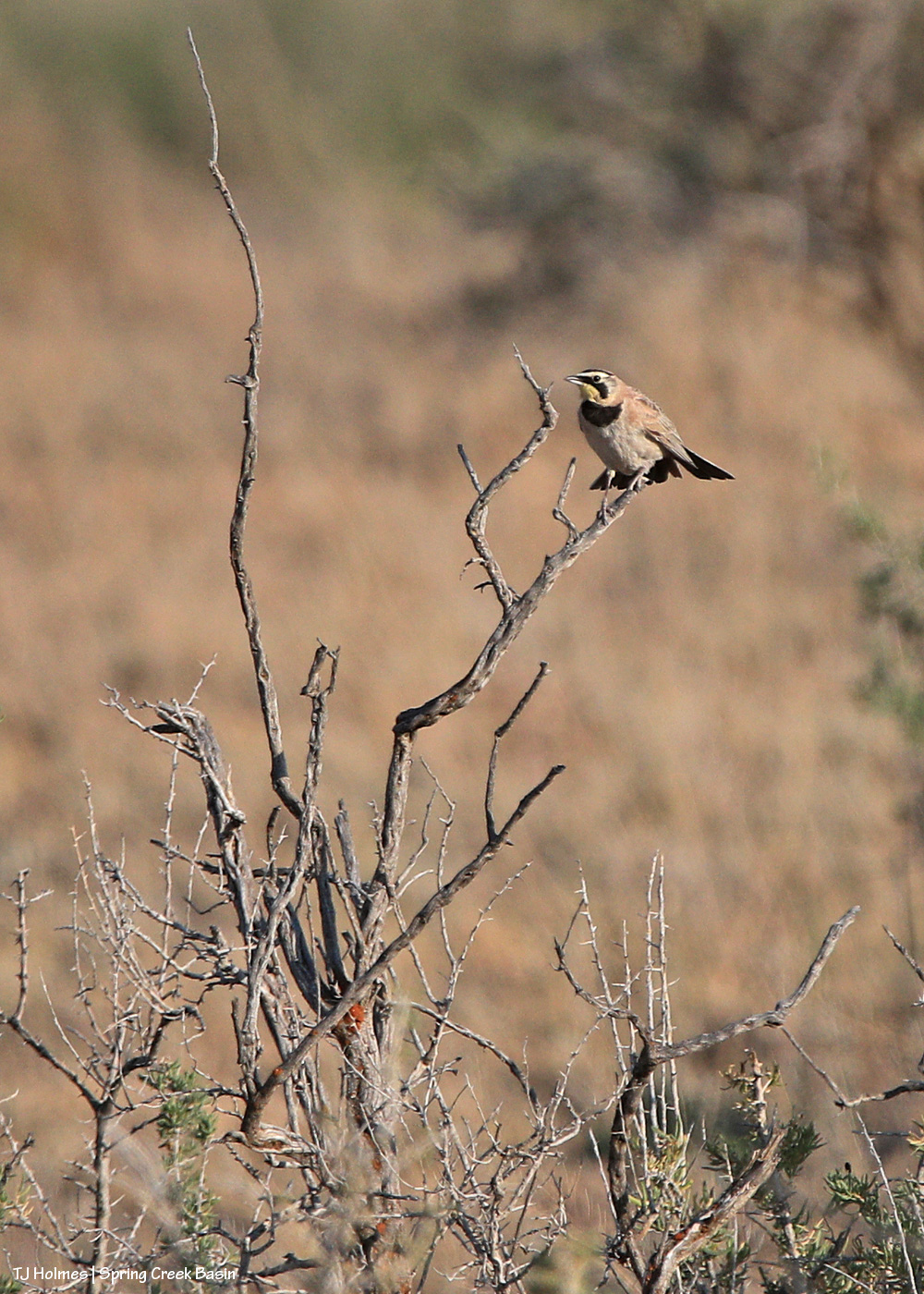
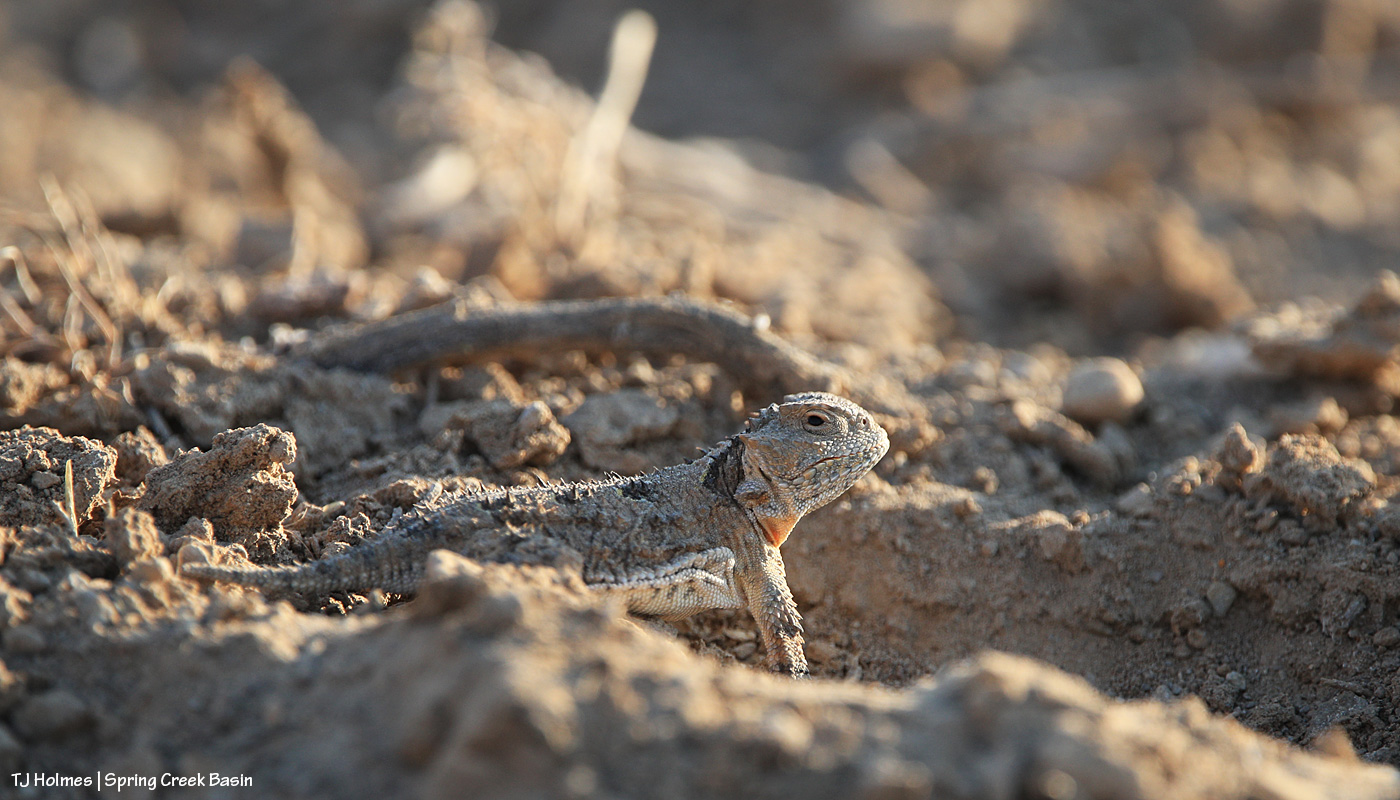
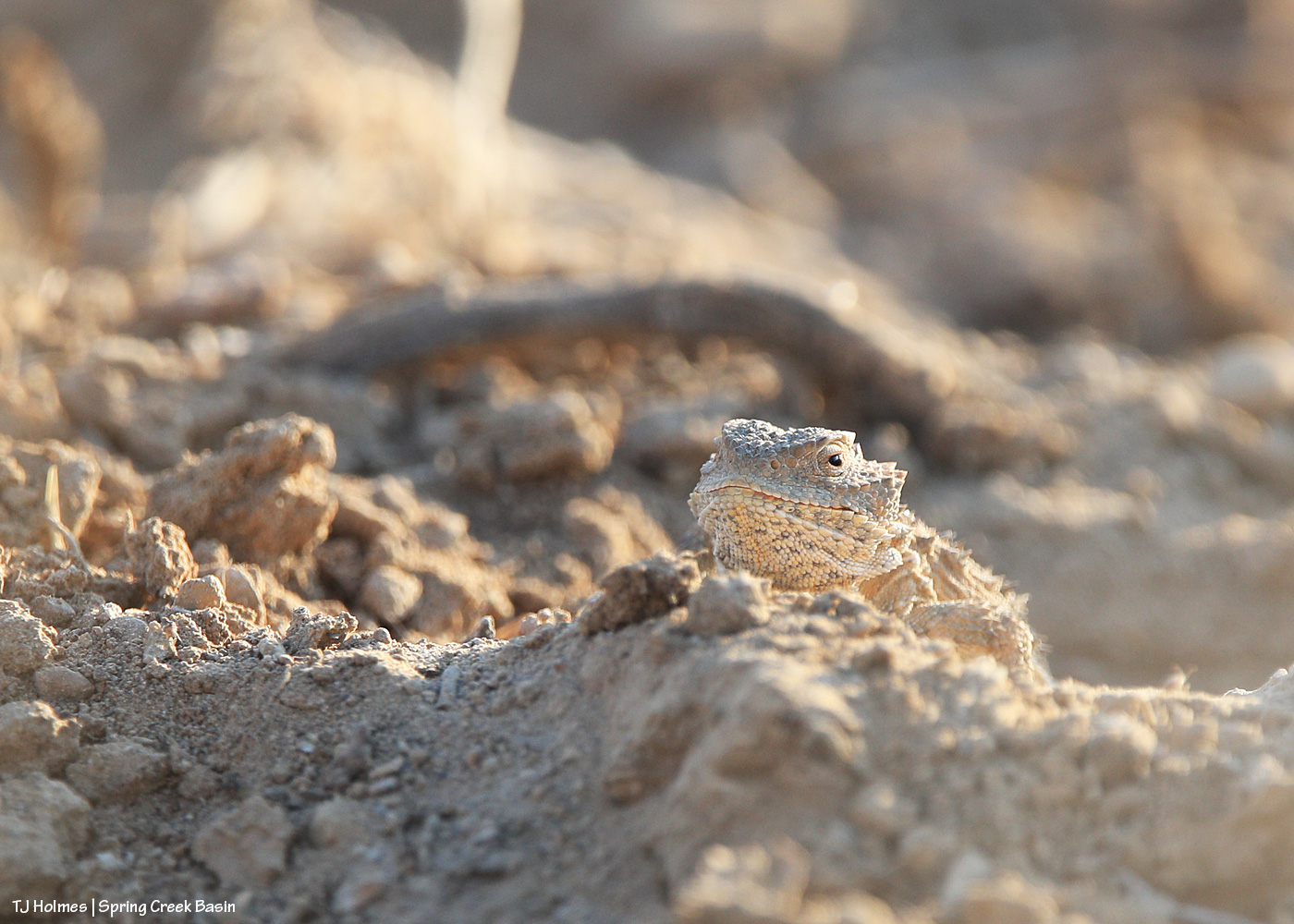
Both of these critters were seen on the evening of summer solstice. Both are named for their “horns.” One has feathers; one has scales. Both are desert beauties.
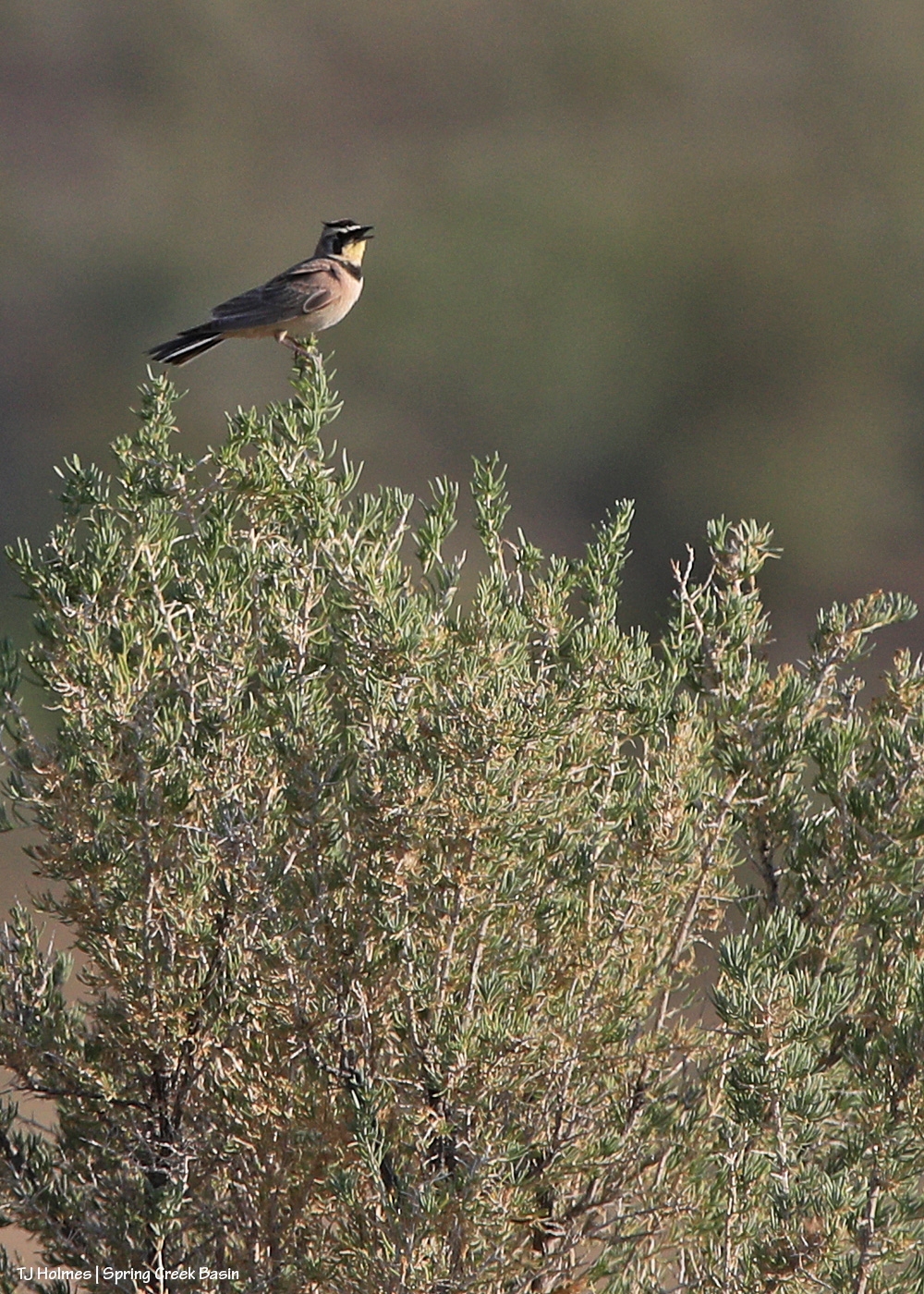
Horned larks are one of the first birds I learned to identify. Lots of them seem to call Spring Creek Basin home. See his little “horn” tufts?
Same lark. Maybe it was the presence of the mustangs behind me that made him feel comfortable enough to land on nearby greasewood to check me out.
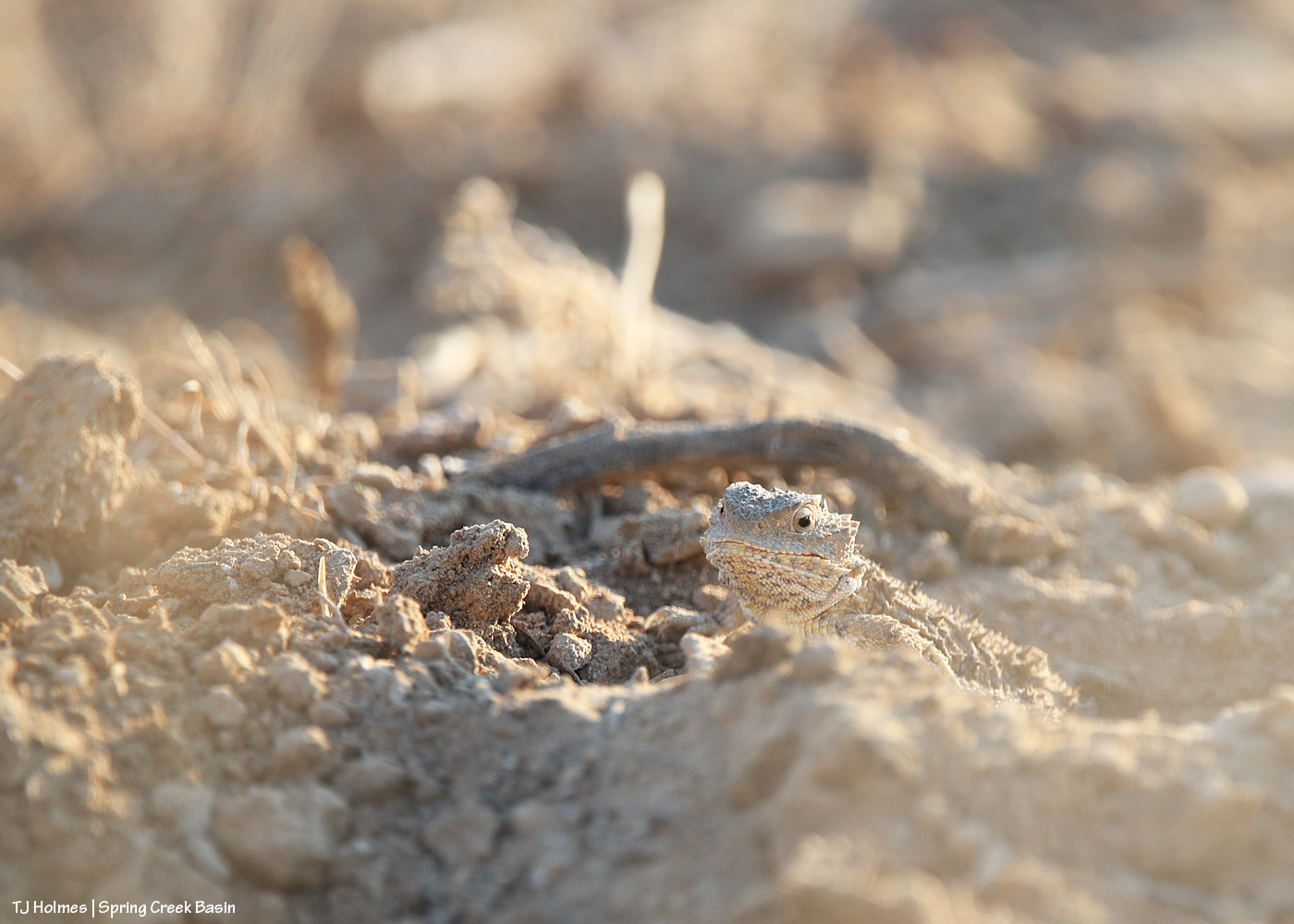
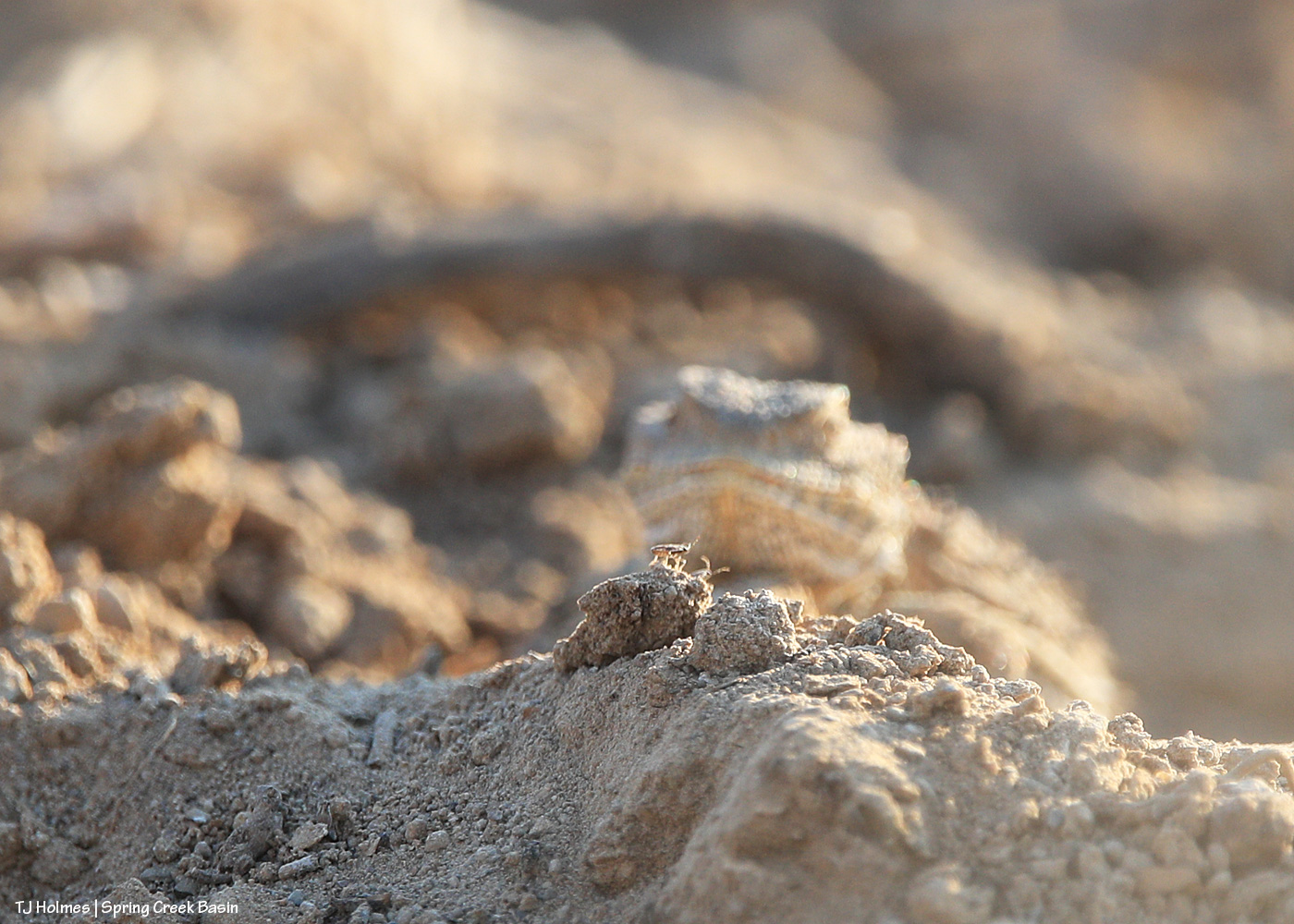
While following those same mustangs away from the road, this little fellow (fellarina?) caught my eye. (Much nicer to see a horned lizard scuttle away underfoot than the longer, more slithery kind!)
I didn’t realize it at first, but it was hunting around an ant hill.
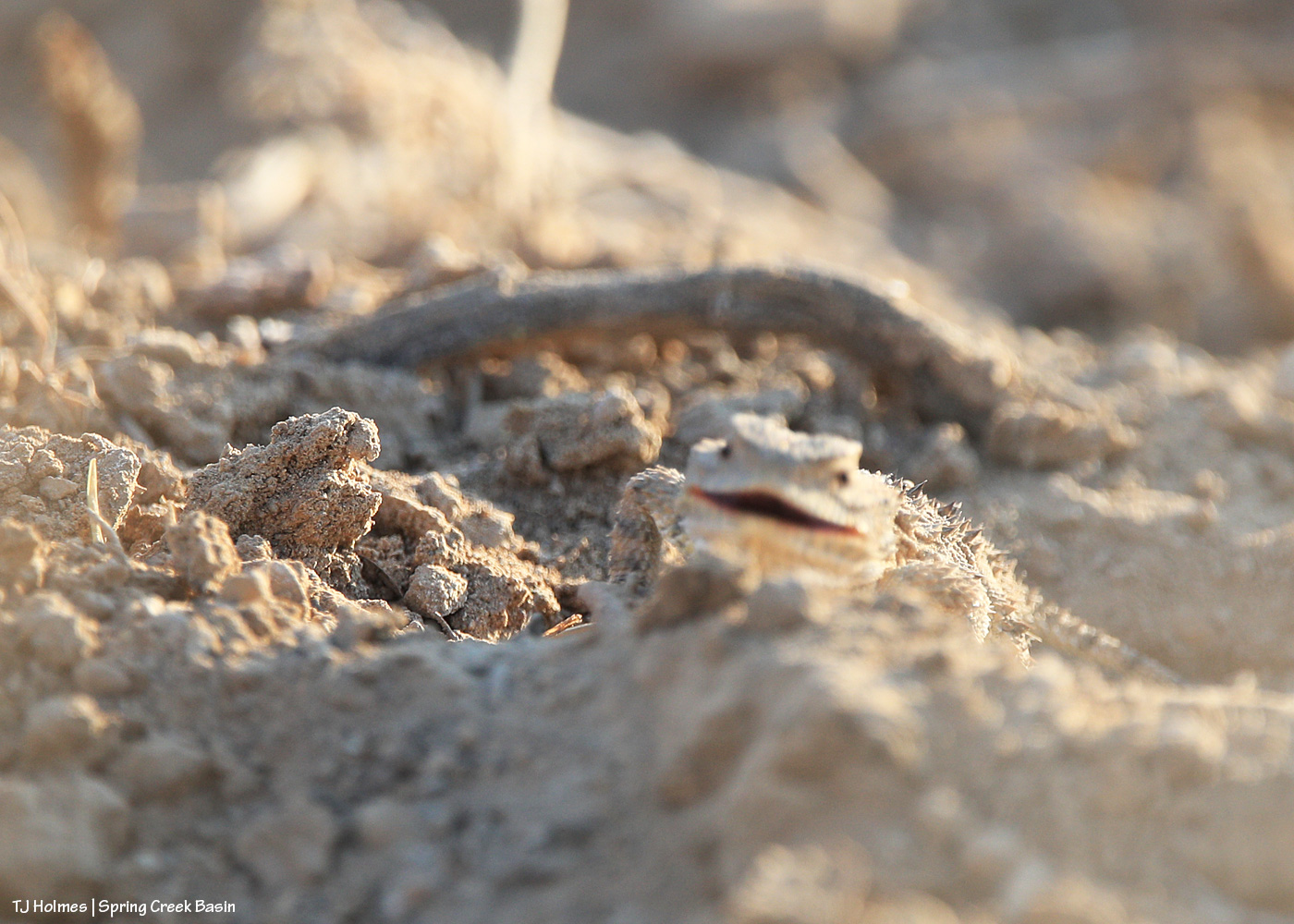
I started to see it darting forward, and that’s what alerted me that it was going after something on the ground, presumably insects. Too bad it’s out of focus, but it helps the story!
You might think this one is out of focus – I did, too – but look at that little dirt ball in front of the lizard. See the bug? It didn’t last long!
Is it just me, or does that look like a satisfied little lizard? 🙂
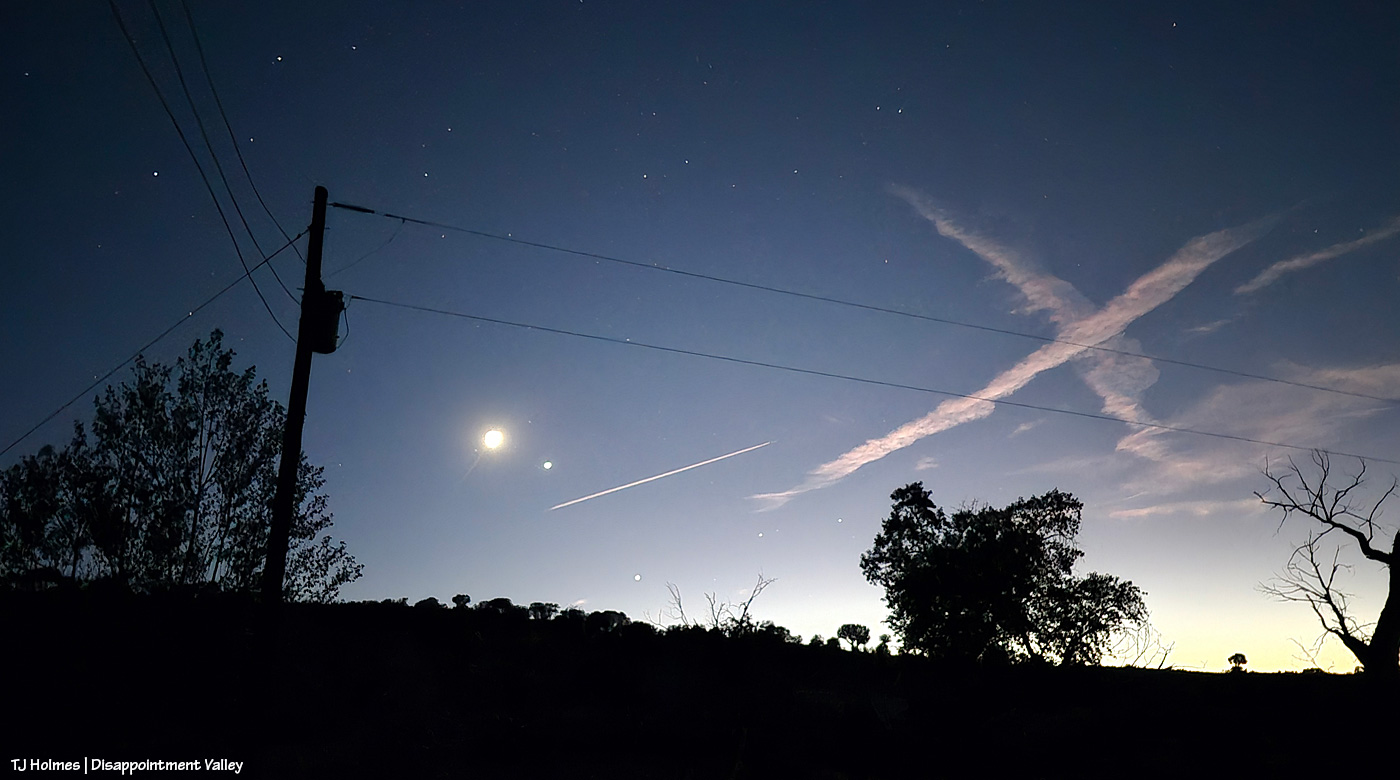
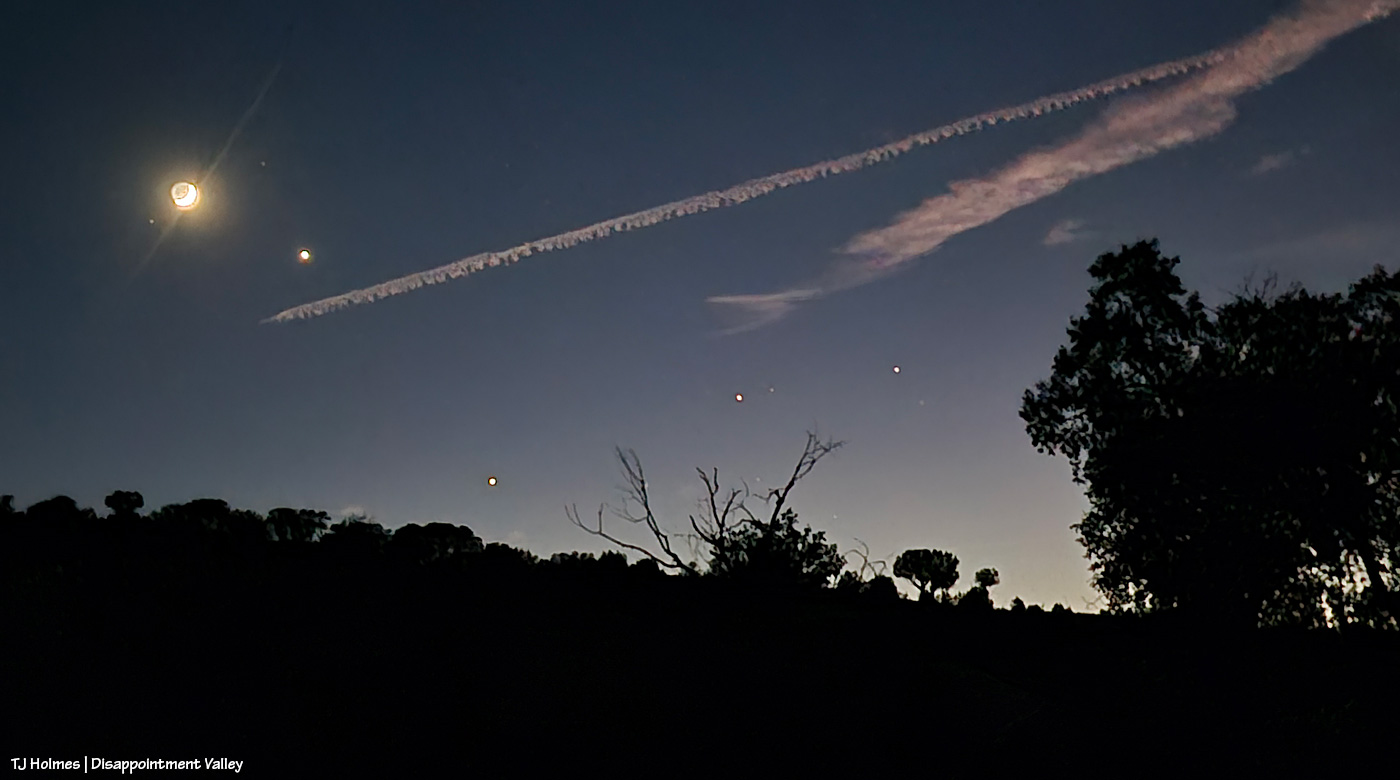
Are you folks seeing this planetary parade in your evening sky?
My phone says these were taken about 10 minutes till 10 p.m., and I took them Wednesday night. It still amazes me that my phone takes such decent pix of the night sky, though I’ll admit that it’s hard to tell that’s a waxing and very delicate crescent moon (setting).
I’ve been watching at least a couple of planets the last several evenings – enjoying, not photographing or even attempting to. Then I remembered that my phone isn’t too shabby at taking night-sky pix. And you have to know by now that I’m a sucker for the moon. 🙂
AI Google says this to explain the above:
You are witnessing a spectacular “mini planet parade” featuring a slender, waxing crescent Moon aligning with the brilliant planets Venus and Jupiter, along with Mercury. [1, 2]
The bright “stars” you are seeing are actually these inner and outer planets, which always shine exceptionally bright and steady compared to twinkling stars. The details of this cosmic alignment include: [1, 2, 3]
The Planets:Venus is by far the brightest, hanging lowest in the sky. Jupiter, the largest planet, is shining brightly nearby, while elusive Mercury sits lowest on the horizon, fading as twilight sets in. [1, 2, 3, 4, 5]
The Moon: The delicate crescent is gliding near this trio and is beautifully illuminated by earthshine—sunlight reflecting off Earth’s oceans and clouds. [1, 2]
The Stars: If you have an unobstructed view and clear skies, you might also spot the twin stars of Gemini (Castor and Pollux) or the Beehive Star Cluster framing the scene higher up. [1, 2]
For the best viewing experience, find a location with a wide, flat, and dark western horizon right after sunset. Binoculars can help you spot Mercury before it slips below the horizon, and they will transform the crescent Moon’s backdrop into a glittering swarm of stars in the Beehive Cluster. [1, 2]
I don’t know about ya’ll, but I still don’t know which is which; is it Venus, “by far the brightest, hanging lowest in the sky” … or Mercury, sitting “lowest on the horizon”? I mean, if they’re both the lowest, which is the *lowest*? Ha. Venus must be the bright “star” just to the lower right of the moon? Expert stargazers, please help me!