Playing in water

16 06 2012

And now some light-hearted water fun. 🙂

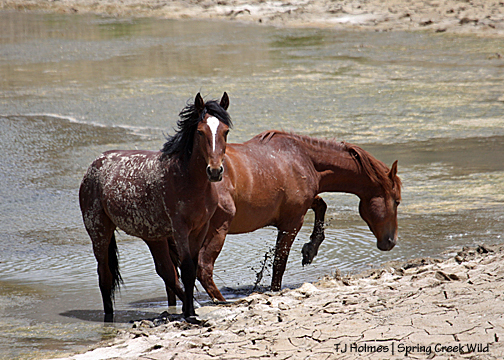
Apollo gets ready to walk out of the pond while Hayden tests the splashability. I’m taking this from my Jeep up on the road. This is the Sorrel Flats pond back in the eastern part of the basin.

Zoomed out to show more of the pond. As part of my documentation of the horses these last few years, I keep track of how much water the ponds have and when they go dry – and when they fill back up with the summer rains. Now that we have a herd manager who is interested, I share that information with him. The pond just north of here – the east-pocket pond – went dry just a week or so ago, just a few days after our herd manager saw it with very shallow water.

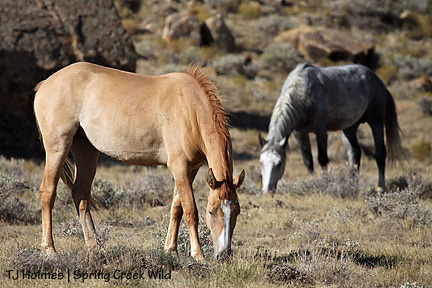
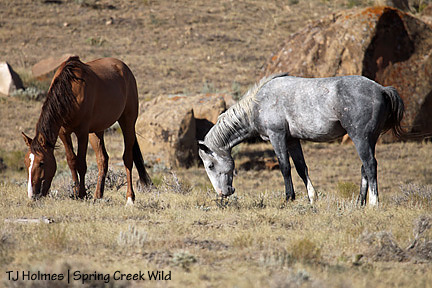
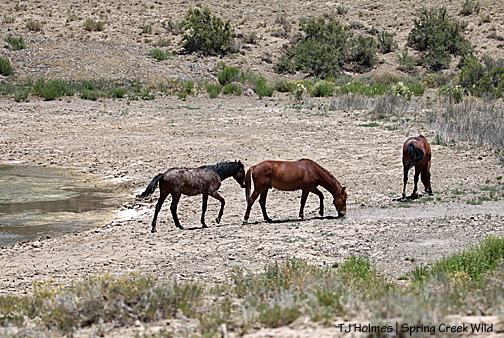
Apollo, Hayden and Tenaz grazing on the flats just above the pond. I should have some better photos of these boys soon tweaked and posted.There’s not a lot of surface area here, but the middle is a little deeper than it seems.

Storm has hooked up with the boys (though possibly not permanently; he wasn’t with them the other day). He followed them out of the wooded “island” and down to the pond to drink. I’ll have more pix of him soon, too.


Water for mustangs

16 06 2012

It’s dry out there, folks.

That’s neither new news nor surprising news.

We haven’t had any rain since late April, and the forecast for the forseeable future shows perfect yellow balls of sunshine and highs in the 90s. On July 1, we’re supposed to hit 99.

Bleak. That’s what I call that forecast.

Three ponds have water. Wildcat Spring has water. The trickle is trickling. There are random seeps and springs around in arroyos – all small, all not-so-good to poor quality. The ponds all have gone dry in previous years – last year, the year before, that I’ve documented – but the monsoons always come. Some years better than others, but they always come. This year promises to get worse before we get those monsoons.

Our BLM folks at the Tres Rios Field Office in Dolores are well aware of the drought conditions and are taking steps to ensure the horses have water to get through the worst of the dry season.

Among the things our recently awarded Director’s Challenge grant money will fund here: water enhancement projects. From 2009 to 2010, five ponds were dug out (made deeper; they silt in – get shallow – because of the erodable soil), and two more are scheduled to be dug out this year (hopefully before the monsoons come!). We’re talking about water guzzlers, solar pumps on wells (something we’re looking at to enhance “the trickle” into something with a bit more flow) and possibly a second water catchment.

I get a lot of questions about our water catchment. What it is, how it works, how it benefits the horses.

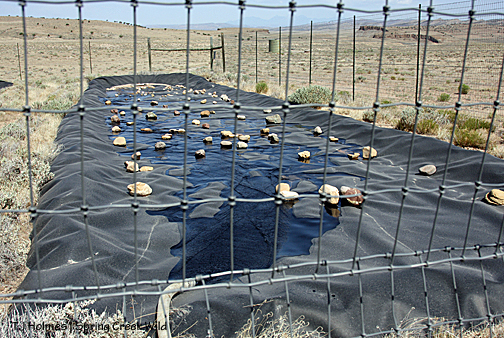
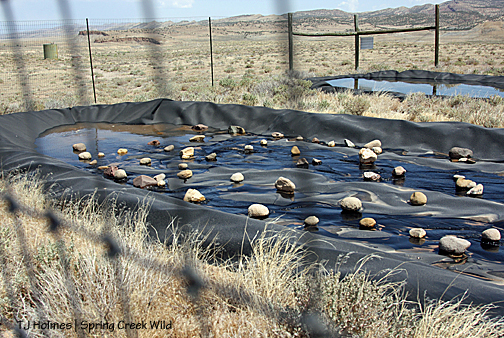
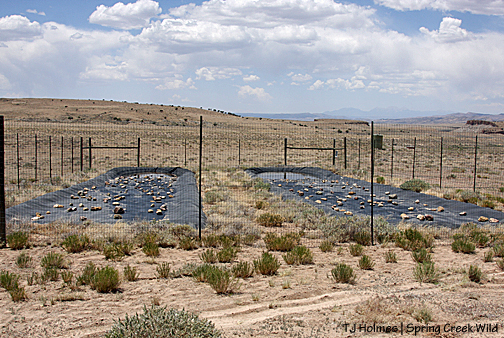
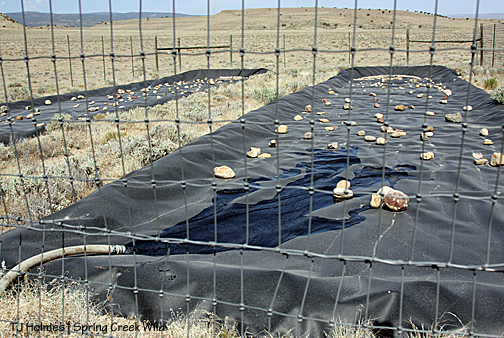
Two aprons are laid out on a slope and fenced (to keep sharp-hooved wildlife out). Water in the form of rain or snow falls on the aprons and drains down to filters, then into a pipeline that runs down to a 16,000-gallon storage tank. From there, lines carry water to two troughs, which hold water controlled by floats. I turn the valve on when the weather starts warming up in early spring, and I turn it off when it starts to freeze at the start of winter (so the lines don’t freeze and break).

This is the only clean water to which the horses have access.

Because of the alkaline quality of the soil, the water is highly saline. I also get questions about the “white soil.” That’s salt on the surface of the soil. Crazy but true. The horses, of course, have adapted. It’s also muddy, and at times like this, sure, there are seeps – where the water comes up and fills salty, muddy hoof-print-size puddles. Not a lot of quantity, let alone quality.

Are you still with me?

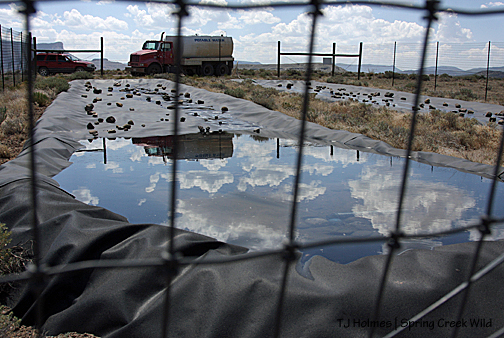
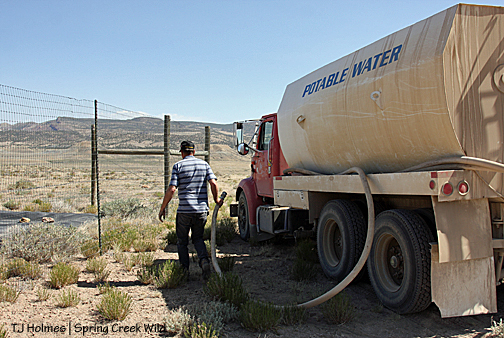
This weekend, BLM ordered the first delivery of 4,000 gallons (what the truck holds; more coming) to the catchment, which is about a quarter full after the mild winter and no rain since April and horses drinking.

Can I get a yahooooooooooooooooooooooo? 🙂

Here’s Cecil Foster of Foster’s Water preparing to drain water onto one of the aprons. Cecil has been hauling water to the catchment for years. In recent years, deliveries were paid for by the National Mustang Association, Colorado chapter. NMA/CO paid for the water catchment to be built more than a decade ago, and there are a couple of signs on the fence that say so. (Remember Pati and David Temple, for whom baby Temple is named? This is one of many projects they have honcho’d over the years through NMA/CO.)

Water starting to flow. This pic shows both aprons.

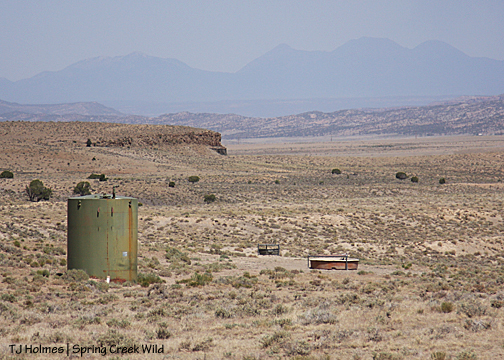
In this pic, you can see the green storage tank and the drinking troughs (very small in this image, barely visible – they’re to the right of the tank) in the background.

This is the perspective from the lower end looking up toward the road. The filters are apparently a little clogged; the water shouldn’t pool so much before draining. We need to get them cleaned out before the rains DO hit. The rocks on the aprons are just to hold it down.

Looking across the aprons to the northwest. One of the troughs is a little more visible in this image.

And a better view of the tank and troughs.

The two aprons of the catchment, side by side.

So that’s what they are, how they work and how they benefit the horses. One slight negative is the location – most of the horses are not in this area. Chrome’s band has consistently called this area home for the last couple of years, and they’re the only ones I know of that drink here consistently. That’s good, but it’s also one of the reasons we’re looking at potential locations for a second catchment (and have been the last several years).

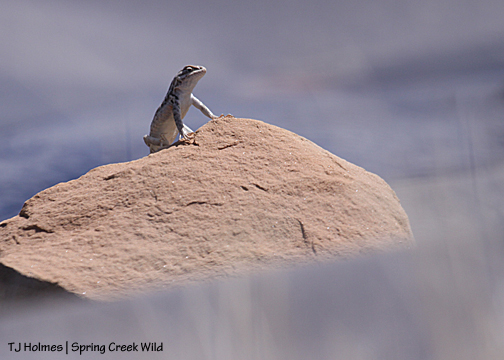
Good water benefits more wildlife than just the horses. 🙂 This little guy (gal?) is perched on a rock on one of the aprons. In the foreground is the blurred berm of the apron; just behind the lizard’s rock is the water from Cecil’s truck flowing down to the filter on its way to the tank to become drinking water for the horses.

Good stuff. Thanks, BLM. 🙂


Mapping weeds and counting horses

21 05 2012

For 13 years now, members of the Durango-based Four Corners Back Country Horsemen have been visiting Spring Creek Basin every spring to help BLM monitor the mustangs. Members often set up work projects during the count weekends, and this year was no different, with help from Mike Jensen, the Tres Rios Field Office’s weed guru (I don’t know his actual title? he also was a former manager of SCB), and Kathe Hayes with San Juan Mountains Association. Mike gave a great talk Friday evening about the particulars of knapweed, in particular. Kathe readied maps and record sheets for the groups and led the horseback riders Saturday.

Special thanks to Pat and Frank Amthor, long-time 4CBCH members and organizers for most of the last 13 years of the count. Their knowledge and experience is invaluable! (And I have to give a special nod not only to the food in general but specifically to Frank’s awesome homemade strawberry ice cream!)

We had one group of horseback riders and one of vehicle drivers (horseless but not clueless – ha!). Between our groups, we mapped 14 sites for weeds – knapweed, musk thistle and tamarisk – so BLM can cut, dig, spray and/or “de-weed.”

One highlight of the weekend – besides the food (oh, the food!) – was the Irick family of Denver (area), who came with their Spring Creek Basin mustangs, Breeze (adopted in 2005) and Sage (adopted in 2007). Brother Luke stayed home, but Teresa and Steve rode with the group, and daughter Sara rode with our vehicle group and helped with recording the weeds.

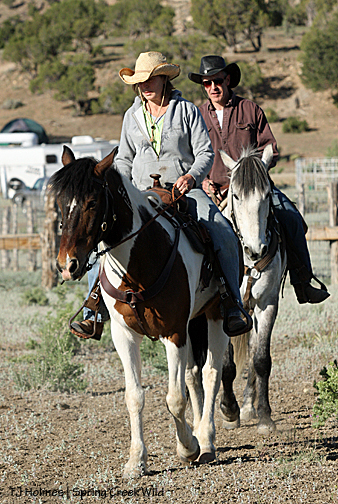
Teresa and Steve riding out on Breeze, pinto, and Sage.

It was an emotional ride, Teresa said afterward, seeing the boys remember their home. They’re not the first who have brought their adopted mustangs home to the basin, and I hope they won’t be the last! These boys are so loved and cared for – part of their family.

I didn’t take any pix of the horseless few, but here are the rest of horse folks who rode their horses to inventory weeds:

Kathe giving the safety talk at the beginning of the ride. Crow has obviously heard it all before!

Todd and Judy and their horses, Red and Dandy.

Nancy and Aspen, who came all the way from Corrales, N.M., where Aspen holds the distinction of “pet mayor”!

4CBCH president Bob and his lovely horse – whose name I’m embarrassed to say I didn’t ask, though I was very taken with this handsome fellow (regular readers may know my fascination with dark bay horses!). Just a young guy – 5 – but he did very well.

Riders heading out in the morning.

Riding into the sunrise.

Thank you to the Four Corners Back Country Horsemen, BLM and SJMA – and to Mother Nature for the truly excellent weather. After Friday night’s wind and chill, Saturday and Sunday were simply spectacular! Weed inventorying and eradication is part of our partnership objective with BLM under the Director’s Challenge grant we recently received. What a great start!


U of Mizzou

30 03 2012

Students rock!

Thank you a million times for coming to Southwest Colorado for your spring break and putting your muscles to work on behalf of our Spring Creek Basin mustangs!

This week, among other projects, students from the University of Missouri rebuilt a big section of fence on one of the basin’s boundaries where places were cut before last fall’s roundup. The students hiked in and out (a mile and a half or so one way) with fence materials and equipment to complete the project. No motorized help in McKenna Peak Wilderness Study Area! And at the end of the day, they got to see some of the wild horses their work benefits!

Forget college spring break cliches. These motivated students raise money to travel here from Missouri and work hard while they’re here. In addition to Spring Creek Basin, they will work at Mud Springs at the base of Sleeping Ute Mountain and at Lowry Pueblo north of Cortez. They may go home with a tan (that may have started as a sunburn), but it’s not from lounging on the beach! Guaranteed, they’ll go home with memories of an experience they’ll be proud to share!

Alternative spring break here is a partnership between San Juan Mountains Association, BLM’s Tres Rios Field Office, the Forest Service (Dolores Public Lands Office), Canyons of the Ancients National Monument, the two local Back Country Horsemen groups (Mesa Verde and Four Corners), National Mustang Association/Colorado and other locals and local businesses to bring U of Mizzou students to the area for work projects on San Juan public lands. This was the 12th year of partnership!

Thank you to local volunteers Tif (MVBCH and NMA/CO), Joan (SJMA) and Bob (4CBCH), high school student volunteer Laura (who has been involved with this project for several years and will head to college later this year!), SJMA folks Kathe and MK, the Forest Service’s Tom and Ben – and pack horses Trapper and Zip! – and, never least, BLM’s Tom and Kiley!

Thank you, thank you, thank you to all the students. Your hard work is so much appreciated for the safety of our mustangs. Have fun with the rest of your visit, and come back soon! As Kathe said, there is a special place in heaven for all of you. 🙂


Piece of the pie

22 03 2012

“Nearly $US300,000 in funding has been approved by the Bureau of Land Management for 12 projects aimed at improving Western rangeland conditions where wild horses and burros roam.”

“* Tres Rios Field Office, Southwest District, Colorado, Spring Creek Basin HMA: This project is aimed at expanding the ongoing successful partnership with the Disappointment Wild Bunch Partners to include such actions as herd monitoring, fence repairs, invasive weed inventory and treatments, illegal route closures, and travel management sign installation. Funding amount from the Director’s Challenge: $25,000”

The Grand Junction Field Office also was awarded $25,000 for ongoing partnership with Friends of the Mustangs for the Little Book Cliffs herd. Congratulations!!

Read more about it.

Thanks to Wild Bunch’s Tif (adopter of Ze and Asher) for this news!


As the world turns and seasons change

12 04 2010

As we ease deeper into spring and the season of growth and life, I realize I need to bring up some harsh realities of wild horse life, particularly as it relates to the basin. In writing this blog about the lives of the Spring Creek Basin wild horses, I have tried to focus on them, their interactions and bonds and behaviors, and though I occasionally post something of wider wild horse interest, I try to keep the attitude on this blog – it’s mine, after all, *I* write it – upbeat and positive.

But it’s not all sunshine and paintbrush.

The next likely roundup of Spring Creek Basin wild horses will be in September 2011. The population of the herd will be at more than 100, which is nearly double the top end of our AML (35-65). I have some suspicions about why it is allowed to get that high that I won’t go into (yet, maybe), but from a manager’s point of view, especially when a concern – a stated concern – is the health of the range, I can’t for the life of me understand this management. Especially when the exact population of the herd is known absolutely. But it will be nearly exactly the same as the roundup of 2007 in numbers, when numbers where only guessed at (from a flyover count). Oddly enough, the local Back Country Horsemen’s count that spring of roughly 120 horses seems to have been closer than the BLM’s flyover count of 97 (according to my numbers, which change because BLM’s seem to change, there were 109-119 horses in the basin before August 2007).

*** It is important to note that probably most of the foals born this year, likely all the foals born next year and many of the young horses born last year and the year before will not only be rounded up, they’ll be removed – because of BLM’s view of their “adoptability.” (And there is some truth in that.) So while I am – always – excited about new life in the basin, it is tempered by sadness.

In 2007, 77-87 (again, BLM numbers) were rounded up. Ten were released at the end of the roundup, and Grey/Traveler was released later for a total post-roundup population of 43 horses. In 2011, we’ll be there again. With Roja’s foal, we stand at 60 horses currently. (BLM doesn’t count foals, but contractors do, which, I suspect, has something to do with the number discrepancy and keeps the confusion level high.) I expect at least 13 foals this year, more than 20 next year. Are you following the math? Say 60 horses total are removed. Even if all this year’s and next year’s foals are removed (~35?), about half the current number of horses will be removed. Say half of last year’s foal crop (5-6) and half the crop of the year before  (3), we’ll say good-bye to at least 20 of the current *mature* horses living in Spring Creek Basin. Hopefully the adoption in 2011 will attract as many adopters as observers (fewer than half the horses offered for adoption in2007 were adopted), but in this economy?

Yes, foals are fabulous news, in and of themselves … but readers should be aware of the ultimate end game BLM plays. Spring Creek Basin is not immune from roundups. In fact, because we’re so small – both in geographic area (SCB encompasses a little less than 22,000 acres – very small) and herd size, it is imperative to manage for a balance between the horse herd with the quality of the range – which, like most, ain’t that great. Occasional removal of horses is – I hate to say it – necessary, especially according to BLM’s current game plan, which involves, strictly, limited understanding of skewing gender ratios, roundups and hopeful adoptions. The herd area is fenced and/or bounded by natural barriers. Water is very limited and pretty poor quality. We got more moisture this winter than last, and I am surprised how little corresponding water is in the basin right now, in April.

There are many complex issues to this discussion, and I welcome any questions that I can try to answer to the best of my ability and on-the-ground knowledge. I guess I’m saying “don’t get too attached.”

Our local advocacy group is working on a proposal that explains two things: How to save BLM (a lot of) money (bottom line) and how to save horses (which saves a lot of money and is, of course, our group’s focus). It involves PZP. Again, I refer you to Matt Dillon’s excellent series on PZP on his blog: Pryor Wild

In a nutshell, we estimate BLM can save at least $100,000 per decade in roundup costs and more than $2 million per group of horses sent to long-term holding per roundup by using PZP to slow the population growth (we do not aim to *stop* population growth). PZP cost = a few hundred dollars per year. Labor cost = zero because of volunteers like yours truly and our local group members.

I’ll write more about this as it develops, but I want readers to know a couple of things: 1) I am already struggling mightily with the emotional effects of next year’s status quo roundup (and it may (will) affect what I write about and how I write it), and 2) we are very actively working on a plan to change status quo and save more Spring Creek Basin horses. It also is important to know that we are not creating precedent here but following well-established and/or newly re-established PZP programs (using one-year PZP doses, not PZP-22 or other multi-year fertility control).


Visiting dignitaries

6 09 2009
That’s certainly what I consider them: Dan Elkins and Karen Herman, who visited Spring Creek Basin in mid-August to tour the herd area and meet some Wild Bunch members and our BLM herd area manager and answer questions we had about gathering horses via bait trapping and about PZP.

In June, I wrote about Dan and Karen administering the first PZP doses to mares from the Carson National Forest: https://springcreekwild.wordpress.com/2009/06/02/pzp-partnership-in-the-carson-national-forest-nm/

Learn more about Karen’s Sky Mountain Wild Horse Sanctuary here: http://skymountainwild.org/

Direct link to a story about Dan and Karen using PZP (also linked from Karen’s Web site): http://www.santafenewmexican.com/Local%20News/carson-national-forest-Forest-first-to-use-contraceptive-on-wil

We learned that Karen was able to get a grant to fund the PZP program for the Carson NF mares, and that set our wheels in motion. Now we have to write a proposal asking the BLM to allow us to pursue funding to implement a PZP program – which could start as soon as this coming spring! – and agree to have Dan and Karen come back to administer it. This is the good news I alluded to when I broke the bad news about Chipeta’s colt, Joven. Best of all, Dan and Karen get their PZP doses directly from ZooMontana in Billings, so we won’t have to worry about the PZP changing hands and freezing and thawing and re-freezing and re-thawing so many times during BLM transport.

Also, our herd population stands at 49 horses (BLM does not count foals till they’re a year old), we’re still well within our AML (35-65), and so we were told the next gather likely will not be until at least 2011. In the meantime, I hope our BLM is watching the goings-on at Pryor Mountain. One thing I’m happy about there is that bands are being kept together. Also, with Matt Dillon’s documentation of the horses and MOU between the Pryor Mountain Wild Mustang Center and BLM that they provide herd information, I’m hoping we can duplicate that partnership when it comes time to round up and remove some of our horses. I’ll never be happy about that, but I also will never condone horses starving on an overgrazed range when it could be prevented. A PZP program here will hopefully slow the population growth of the herd, allowing more horses to stay wild longer. And knowing about Dan and his method, I hope we’ll never again hear helicopter blades churning over Spring Creek Basin.

Dan and Karen are awesome. Extremely knowledgeable and friendly – it was like meeting old friends from our first handshake. My hope is that someday every herd manager in the country will know Dan and Karen. I hope a contract between them and our BLM is in our immediate future, for the horses’ sake.

Here are some random pix from that day, taken in the morning before everyone arrived:

Hannah and Sable

Hannah and Sable

Butch and Storm

Butch and Storm

Pinon

Pinon

Mouse and Steeldust

Mouse and Steeldust

Sage

Sage

Hollywood

Hollywood

Mona, Kootenai and Kreacher

Mona, Kootenai and Kreacher

Kootenai and Kreacher

Kootenai and Kreacher

Kootenai

Kootenai

Mona and Kreacher

Mona and Kreacher

As soon as I say this, they’ll leave, but if you’re in the area to visit Spring Creek Basin, I would be surprised if, out of all those 49-plus (with foals) horses, you did NOT see this little threesome. They have been hanging out in the area surrounding the water catchment for months now. The grazing is not the best, but the water is. The other bands seem to have been going for forage over quality of water, and the only other horses I’m pretty sure have used the catchment recently are Traveler’s band and the bachelors Cinch and Bruiser. Hollywood’s band has been in that general area the past two weekends; I have not seen them at the catchment. Most recently, I saw Hollywood trying to drink from the pond area off the road to the old trap site. I did not see any water from the road, and I did not go closer … Poco and Roach followed the band past the “pond” without even stopping to try to drink.


Before the count, part 2

21 05 2009

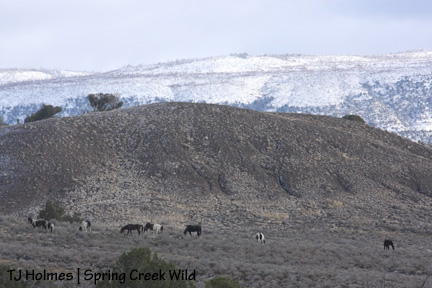
The pintos had gone unvisited (seen from a distance a couple of times from Round Top) for quite a while – since the start of foaling season – so I decided to check in with them Friday morning. I hiked in at dysfunction junction, but they weren’t on “their” hill. They were quite a bit farther southwest, on a hill kind of above the road, as it turned out.

They’re all still together, and Copper still seems to be the dominant stallion. Mesa is still low man on the totem pole, so he gets the duty of being first contact, while Ty and Corazon freely (mostly) wander with the band and bug Copper.

Hmm. WordPress doesn’t seem to like my first picture. Moving on …

Mesa

Mesa

Look at his face. Does he remind you of anyone? Same color and same lack of markings, but the similar faces have had me thinking for a while that Mesa is Poco’s son.

Spook and Kiowa

Spook and Kiowa

Spook’s birthday was May 1, and Kiowa hasn’t had a foal this year (and shouldn’t). I love how shiny and healthy she looks.

Kiowa and Chipeta

Kiowa and Chipeta

Kiowa again (Spook behind her) and Chipeta. This is Chipeta’s second season without a foal; so far, the PZP is doing its job.

All but one

All but one

This was the first one I tried to post. Only Ty is missing from this picture. From left, Reya, Spook with Kiowa’s back just visible over hers, Chipeta being followed by Copper, Corazon with the heart on his side and Mesa at right.

Ty and Corazon

Ty and Corazon

My black boy Ty has a grey tail and mane, and his face is getting pretty “grizzled” as well. I’ve been calling him black, but he’s always had this not-quite-black look. He’s surely the darkest grey I’ve ever seen at this age – and I don’t know how old he is, just that I’ve never seen a grey horse this mature still this dark! They’re shiny, healthy boys, though, huh?

After I left the pintos, I stopped at the corrals to visit with the Back Country Horsemen early arrivers. As my visit stretched on past noon, the place started filling up with trucks and trailers, people and horses! The small contingent from the Mesa Verde Back Country Horsemen, based in Montezuma County, arrived, and it was great to see them. I never know how much human info to reveal on this blog, but T with MVBCH and P with 4CBCH are representatives to our Wild Bunch group. P and her husband, F, started the wild horse count partnership with the BLM about 11 years ago, and they continue to organize the annual outing. T really came up with the idea of all our groups getting together for the horses and has been a source of great information and ideas. She let me ride her fantastic pinto Curly horse last spring during a camping trip to the basin!

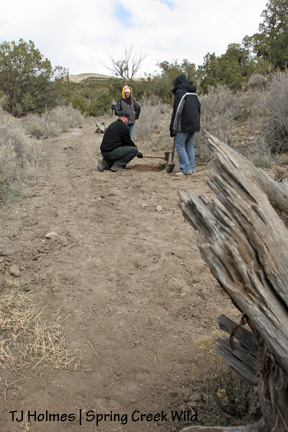
K with our group also came for the day. I think she’s a member of each group represented, and she organized work projects Friday. She brought her husband and a friend, and they and I and P and Claude Steelman (he’s already famous!) dug post holes and set posts (husband B and friend D), and we put our backs and McLeods to some illegal routes people have driven in. Claude pounded in three new carsonite signs, and K attached the “No Motor Vehicles” stickers. We also had more fun than should be allowed with such work, rolling rocks and pulling old tree trunks down the hill and making a former trashed “campsite” look as inhospitable to setting up a tent as possible. That was back in the Wildcat Spring area. The reclaimed road – work done by fabulous University of Missouri students back in March – still looks awesome.

Not a bad bit of work for a couple of hours in the sunshine and company of wild horses! On our way to Wildcat Spring, we were treated to an up-close and personal view of Raven and baby Corona when they popped up from below the road between the two intersections! K and P were with me, and we got the best view! Yes, Duke is still with them. I’d say he was “leading” the band, but mostly he just follows wherever Raven goes – ha! Hollywood and his band, with Poco and Roach (!), were up in the meadow by the second intersection. Baby Sage is such a darling, and I’ll have more pix of him later in the program.

There is quite a bit of water at Wildcat Spring (relatively speaking), and while it smells less than stellar as usual, there is water trickling through, although the actual stream bed is dry from just below the spring. 

We split after our work; I continued on east, and the other workers went back to the corrals. Steeldust’s and Bounce’s bands were still in the area of the east-pocket pond, but Grey/Traveler’s band was out toward the gap between Knife Edge and Lizard Mesa, so I went toward them. This becomes fairly important later on (that I saw them), but at the time, I just parked the Jeep to watch (no pix). Ahh, the sunshine was so warm and lovely. There was just enough breeze to keep the bugs away – I didn’t think they were bad yet this year? (I did remember, though, the next day at Round Top that we were battling them last year.) I snoozed right there in the Jeep, and by the time the back buckle of my visor was digging into my head too much to ignore, the ponies had crossed over to the greenery of  “sorrel flats,” one of the pond areas to be dug out this spring in the hopes that it will fill with water when the monsoons come. That’s on track to happen; we just don’t know exactly when.

So I went back to visit with the other horses and see how week-old Whisper and Sage were getting along.

Whisper and Alegre

Whisper and Alegre

Just a handsome bugger!

Charmer!

Charmer!

Daddy Bounce

Daddy Bounce

And no wonder! This is Whisper’s handsome daddy!

Gaia

Gaia

Baby girl seems to have gotten over her shock at not being Mama’s one-and-only anymore. Here she’s giving me the weird-eye. In color and markings, she does look like J and V’s Spring Creek Basin mustangs – which they bring back and ride during the count weekends! – but her “look” and conformation are different.
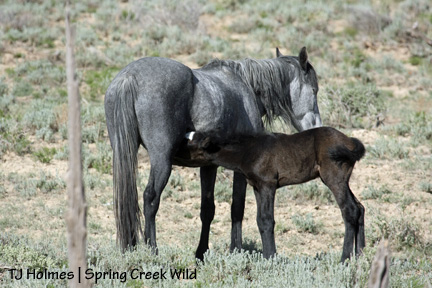
Nourishment

Nourishment

In this pic, you can see his not-quite-black sheen.

In-bound

In-bound

What had their attention? Steeldust’s band was heading toward the pond for their evening drink.

Shades of ... grey

Shades of ... grey

I guess Mahogany wanted to be part of the “in” crowd, so she gave herself a coloring! I didn’t really think about it until I looked at this picture on the computer and realized they were all “grey”! That’s Alpha beside her and Steeldust at right.

Mouse

Mouse

Lt. Mouse was actually first to drink, as the band milled around between the pond and Bounce’s band still just up on the little hill.

Family?

Family?

Those boys – that’s Sundance at right and Butch second from right – do stick close to Luna … The shorty red trying to squeeze in is actually Storm, not Ember. Hannah was pawing at the water – everybaby (!) knows it tastes better when you splash it a few times!

Storm

Storm

Here’s Stormy Jones trying his best to impersonate a shedding bison! But under that curly winter hair and mud, look how grey he has become.

Hannah

Hannah

Super model girl. 🙂

Size comparison

Size comparison

Check out the green grass, and check out the size/angles of Sable and Hannah. Sable was a week and a day old here; Hannah was about a month and a week old.

Brother, sister, Mama

Brother, sister, Mama

See, I don’t *forget* to take pix of Pinon … he’s just always around other horses! He had just celebrated his 1-year birthday.

Awwwww

Awwwww

Sable discovered mud.

Horseplay I

Horseplay I

Storm and Pinon. You can see Storm still has his red shade in the sunlight, but check out how grey his face is.

Horseplay II

Horseplay II

I saw this sign in a science lab this week at a local school … I smiled and wondered, when did “horseplay” become a bad thing? 😉

Mystery belly

Mystery belly

I’ve been ignoring this little bulge on 2-year-old Kestrel for the past few weeks, hoping she takes after her mother – butterball buckskin Luna – and/or that she’s really getting a lot to eat this spring.

Kestrel

Kestrel

Something happened Saturday to make me REALLY start to wonder …

All in good time.

Dust to dust

Dust to dust

After they drank, they followed the doubletrack right back the way they had come, back out to open meadows of green.

I headed out as well and thought I might get to see Hollywood’s family again on my way out. (Sorry, Aspen, but I’m glad he got his girls back!)

Just past Wildcat, I saw movement up on the hill that turned out to be Kreacher and the girls. Kreacher-feature was trying to snake them toward the trail to the spring, and the girls were oh-so-politely and resolutely refusing.

Kreacher

Kreacher

Taking a break under the scrutinizing eye of the photographer.

Mona and Kootenai

Mona and Kootenai

Love that soft light? The girls were fixated on *something* out of sight, and there are a lot of pinon-juniper in that area, so I wondered if maybe Hollywood had already brought his group to that area to drink at the spring. So I walked back and up the hill we rolled the rocks down and looked down at the spring, but there was nary a horse to be seen. I walked over and looked to the southeast, too – nada.

When I got back to the Jeep, the girls and the boy had resumed their dance. Boy insistent; girls refusing!

I found Hollywood and his lot down to the east of that section of road between the intersections. Poco and Roach still with them. The boys had a little tat for about two seconds, then settled. Far different cry than the frantic running, running, running when Roach was temporarily with Steeldust.

Poco

Poco

He’s looking at the band. This isn’t a good angle to compare him to Mesa, but I’m telling you, it’s there.
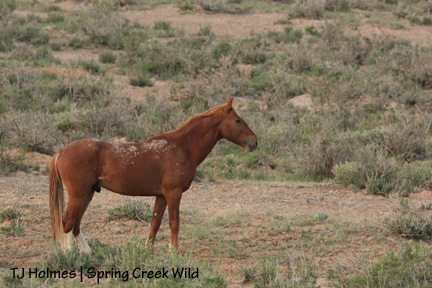
Roach

Roach

Looking at … something else? Poco and the band were behind him.

Sage, Mama and Daddy

Sage, Mama and Daddy

Invitation to play, but they weren’t buying.

Baylee was back to the left, so he went back to show off for Auntie.

And hes off!

And hes off!

To set the scene, Baylee was to the left, and Piedra and Hollywood were about the same distance to the right. Baylee was the start/finish line.
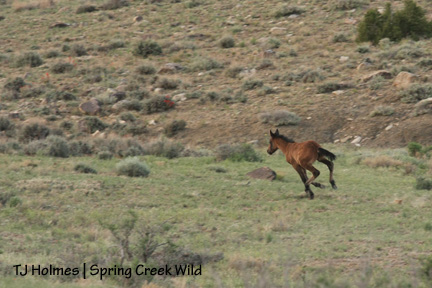
051509sagebend

And he rounds the bend, looking for the home stretch!

051509sageleap

And it’s a leap over four-wing saltbush on his way to the finish line! Can he keep his momentum?!
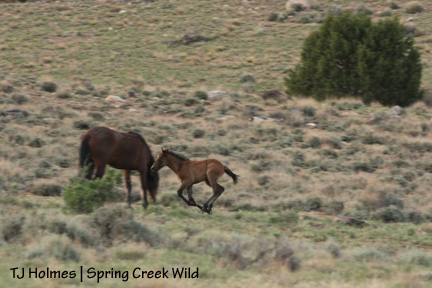
051509sagerunbaylee

And the winnah is Sage by a mile!

Too bad I don’t have a video camera – he was fantastic! 🙂
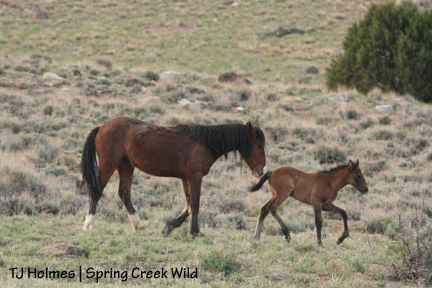
Baylee and Sage

Baylee and Sage

Bayles is a super auntie and babysitter for the young mister. He has just finished his race, and now he’s taking her back to Mama and Daddy so he can be congratulated.

Need-a-snack

Need-a-snack

Of course, racehorses need good nutrition …

Nap time

Nap time

… and plenty of rest. 🙂

Check out his dorsal stripe. He has faint little leg stripes, too, mostly visible on his front legs now. I’m kinda holding my peace on what might be his actual color …

Hollywood

Hollywood

Terribly concerned, the elder mister would raise his head to look at me for about 2.7 seconds – long enough for me to straighten my camera but not enough to do that and focus, too – then go back to grazing. So what you see is (mostly) what he did!

Such a peaceful visit – and entertaining!

Sweet boy

Sweet boy

Just the sweetest little heart!

And with that, I left the ponies and called it another beautiful day in the basin. My oh my. How can you not believe in the absolute magic gift of life seeing a colt so overjoyed just to RUN?! I do love these ponies. 🙂 I smiled all the way back to camp.


Happy hands make light work

26 03 2009

After a day that ended like this …

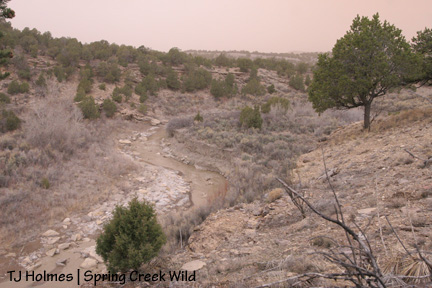
Dusty rose

Dusty rose

… I awoke to a morning like this …

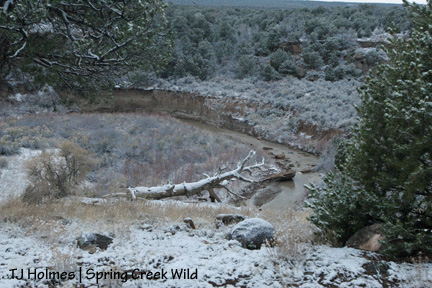
White as snow

White as snow

That’s what we get in March in Colorado! Both are views of Disappointment Creek, outside the herd area.

It snowed on and off all morning, which left me wondering if we would even be able to get into the basin for the scheduled work day. The sky started clearing to the west, and sunlight hit the far hills, then the sun finally broke free of the clouds and lit the area, revealing dust-free air.

Snowy sentinels

Snowy sentinels

Gotta love that light! That promontory on the left is the big prominent peak you can see from almost anywhere in the basin down to the southeast. (Photo taken from outside the basin.)

Again with the spots

Again with the spots

On the way up the county road toward the basin entrance, I spied the pinto band again! The sunshine hadn’t quite reached their hill (actually their “pinto hill” is across this little valley to the southeast), but you can see it on the hills to the east across the basin.

By now you may be wondering why I was still in the basin at the beginning of the work week. If the wind and dust didn’t run me off, the threat of snow should have (though, as you could see from the photos, it wasn’t heavy, it melted quickly, and it didn’t impede vehicle traffic at all). Sunday’s visit was for pleasure; Monday’s visit was “work.”

Every year for nine years now, Kathe Hayes with the San Juan Mountains Association (nonprofit partner with our local Forest Service and BLM) has led the “alternative spring break” program, which, in our case, brings University of Missouri students to San Juan public lands in Southwest Colorado to do work projects earmarked for them in cooperation with FS and BLM employees. Those folks tell Kathe what projects need done, and she makes it happen with student labor – and hopefully the students get something out of it, too.

Spring Creek Basin Herd Management Area falls within San Juan public lands, and students spend a day or two of their weeklong visit in the basin working on various projects, which have included old-fence removal, fence repair, illegal-road reclamation, sign installation and tamarisk destruction. For those of you not familiar with tamarisk, it’s also known as “salt cedar,” and it is a non-native, invasive species, originally introduced to the Colorado Plateau around the turn of the last century for erosion control in riparian areas and as an ornamental plant (like a lot of terribly dangerous beasties, when it flowers, it’s guiltily pretty to look at) – so said BLM weed specialist Mike Jensen (and former herd area manager) when he talked to the students at the work area that morning. It sucks up gallons and gallons of ground water, and that’s not good for the native plant species in the vicinity, not to mention the wildlife trying to find water to drink in this arid country. Tamarisk, of course, likes wet areas like ponds and stream and river banks. It’s a scourge of the West, and a lot of work has been put into getting rid of it. (One of those biological control methods gone awry, eh?)

Our Colorado chapter of the National Mustang Association provides the herbicide used each year to spray the stumps of the tamarisk the students cut. It has the deliciously sci-fi-cool name Garlon 4. It works pretty well, but tamarisk is stubborn (Texans might be able to equate it somewhat with mesquite), and it can send up tenacious stems/branches/sprouts/whatever. So the students have been working in the Wildcat Spring drainage area (at least) for a few years, and that’s where they concentrated Monday.

With the help of Mike and three Forest Service folks (acting as sawyers for bigger-than-lop-size tamarisk and Garlon sprayers and reclamation workers), nine Mizzou students and one local high school freshman whose dad is a fifth-generation local rancher (Kathe said “she’s been coming out here since she was this high”), a lot of tamarisk got cut and sprayed, and part of the illegal road to Wildcat Spring was sent artistically back to nature (take that, you nasty littering people whose trash everybody BUT you has carried out!). WOW!

I covered their story last spring, and I was back to do the same this spring. Gotta tell ya, those kids are my heroes. And check this out: Two were back for their second year, and one was back for his third! Did you all read the posts and see the pix of younger-than-now Raven and Kootenai sent by Amanda Conner, Mizzou graduate? Mr. Third Trip is Miss Conner’s hard-working fiancee. 🙂 I’ve already used her name in conjunction with those pix, but to protect the innocent in case they want to be, I won’t use the students’ names here, but if ya’ll read this, know I’m grateful for the work you did!

I took some pix, too, where the students are not identifyable, but they show a little bit of what they accomplished – and with great attitudes despite the cold temperatures and intermittent waves of snow that came with welcome sunshine!

Below the spring

Below the spring

Here, a couple of Mizzou students are working as a team to cut and spray tamarisk just below the old dam site below Wildcat Spring. You can see the stumps of alternative spring breaks past! Most of the sprouts the students were cutting in this drainage were no bigger than a fat finger. The water collects naturally above the students and toward the center of the photo. Above that, it runs into a tight canyon upstream. This is in the east side of the herd area.

Road work

Road work

Here’s the “road” at the start of the reclamation work. Students also cleaned up the campsite at the end of the “road” toward the spring by scattering rocks that had been arranged into a fire ring and collecting wood and old tree stumps to use in the reclamation process. Students in the photo are digging a shallow hole so they can “plant” a stump like the one in the foreground of the picture.

The picture I most loved to take all day is one I can’t (won’t) use because it shows faces, but it’s of one of the Forest Service guys hauling out a “toilet box.” Seriously! Can people be any more disgusting?! When I cleaned up the site last fall after the hunters spent their time there, two rolls of toilet paper that had been left on branches right beside that horrible box were among the items that went into the five bags of trash I carried out. Believe me when I tell you it made my YEAR to see that box being carried away, and the FS guy who carried it out is my new favorite FS guy. 🙂 (In case you wondered, they have trucks; as much as I hated that box, no way it was going in my Jeep!) New favorite FS guy also buried the, ahem, “leftovers” from that box AND a handicap toilet chair that had been left standing above a bucket-without-a-bottom over another hole filled with “stuff.” They hauled those items (chair and bucket) away, too.

Thank you for letting me rant. (YAYAYAY – good riddance yucky box!)

On the road to reclamation

On the road to reclamation

Huh!? Whaddya think now? Road no more. Thanks – you know who you are – for the “artistry”!

Doaneventhinkaboutit

Doaneventhinkaboutit

New sign to reinforce the message. And later this summer, one of our National Mustang Association guys and our herd area manager will place a line of boulders across the “road” in front of this area, and then the stretch between the sign and boulders and the real road will be reclaimed. Good stuff!

The good trail

The good trail

Job well done, guys and gals! Thank you so much for choosing Colorado for your spring break. I hope you all had a great time here; I sure enjoyed having you here.