Assessing the land health of Spring Creek Basin

21 06 2017

Baby, it’s hot out there.

The mercury hit at least 100 degrees Tuesday in Disappointment Valley. Might be hotter today.

But we don’t shirk our duties when it comes to assessing the health of our range – which directly affects the health of our mustangs – in Spring Creek Basin. 🙂

062017natemikeSCB1

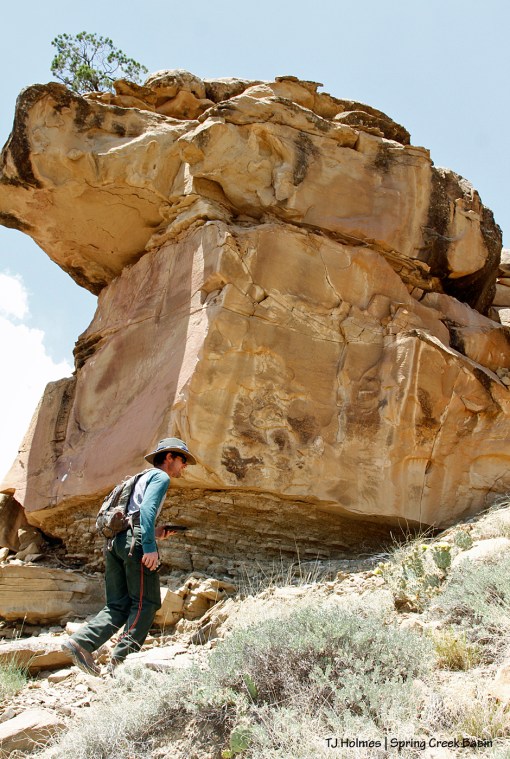
Don’t let the long sleeves fool you. This was our last site of the day, and it was toasty out there. We were glad for every bit of brief cloud cover that came our way. On the right is our excellent herd manager, Mike Jensen (rangeland management specialist), and on the left is wildlife biologist Nate West, both with Tres Rios Field Office. In the background, of course, are McKenna Peak and Temple Butte.

062017justinnatemikeSCB1

Here, Mike and Nate – and our range tech, Justin Hunt – are checking examples of particular things that we were looking for, depending on what kind of site we were assessing – here, “basin shale.”

At each of the five sites we did (we have more to do), we completed a 17-point checklist to assess such things as “presence of water flow patterns,” “bare ground,” “amount of litter movement,” “effect of plant community composition and spatial distribution on infiltration and runoff,” “functional/structural groups” (what kinds of plants – annual/perennial grasses, shrubs, forbs – we should expect to find), “expected annual production” (which we are supporting with actual vegetation monitoring studies) and “potential invasive (including noxious) species (native and nonnative).” Each site has a list of expected standards that we should find according to soil types, including “basin shale,” “clayey salt desert” and “salt flats.”

Pretty fascinating, really! For the most part, my civilian observation is that our range is pretty healthy in Spring Creek Basin.

Our mustangs do seem to support that assessment. 🙂

Thanks to Mike, Justin and Nate for trekking to the basin on the hottest days of the year to perform these assessments that positively affect the good management of our mustangs!


To arms

28 05 2017

Spirit

By now, you all must have heard about the explosion of disbelief and outrage about the 2018 budget proposal. No one seems to be happy … and wild horse and burro advocates are no exception.

My friend Pam Nickoles has a succinct post with pertinent links on her blog.

More information is available on all the major advocacy sites, and news sites are covering the issue as well.

Surely we can work together for better treatment and management for our wildlife.


Celebration in Piceance-East Douglas

11 05 2017

Last weekend, BLM folks from the White River Field Office in Meeker hosted a “celebration” of the mustangs in the Piceance (“pee-antz”)-East Douglas Herd Management Area. An unofficial count of around 40 people made the trip to talk to each other and BLM range specialists and managers, and take tours of this amazing – 190,000-plus acres! – range in northwestern Colorado.

The wildlife in this area of the state is abundant and varied. It also – until recently – had a widespread oil-and-gas presence (still there, just not as widespread). Interestingly, friends say that those workers are among the friendliest they encounter while looking for mustangs, and they’re always happy to point out the locations of horses for my friends to find and photograph. Cattle and sheep ranching also is abundant in the area, and my friends pass on information about livestock and fences to the ranchers via BLM.

During this celebration, three tours were offered throughout the day, and we had the opportunity to speak with people from all backgrounds: oil-and-gas workers, ranchers, mustang advocates, local and not-so-local BLM employees, and others. We all have a stake in preserving Colorado’s public lands and wild places, and the wildlife those lands shelter, so it was a good coming together of people and ideas and planning to see how those interests can merge and move forward for the benefit of all involved.

This wasn’t my first visit to Piceance-East Douglas, and it certainly won’t be the last. BLM does want to conduct a roundup and removal of horses here (population estimate is 400-plus horses). But it also wants to start a PZP program, which would mean that – at that point – all of Colorado’s mustang herds would be managed with scientifically-sound fertility control, enabling more horses to live wild and free on their home ranges.

My friends Tom and Pam Nickoles have been visiting the area since 2006, learning about the mustangs, learning about the area … learning all the intricacies. They work closely with the BLM range specialist and herd manager, Melissa Kindall, as well as a local woman who has been documenting the mustangs for many years, Dona Hilkey. Friends of the Mustangs, the advocacy group that helps BLM with the Little Book Cliffs herd near Grand Junction, also had members present, and they might be able to provide human power and some funding to help establish a local advocacy group for the Piceance-East Douglas mustangs.

Good things are going on in Piceance-East Douglas and all around Colorado!

Not too many photos from this last visit, as I was more interested in looking wide-eyed at everything, but here are a few of the gorgeous mustangs that call Piceance-East Douglas home:

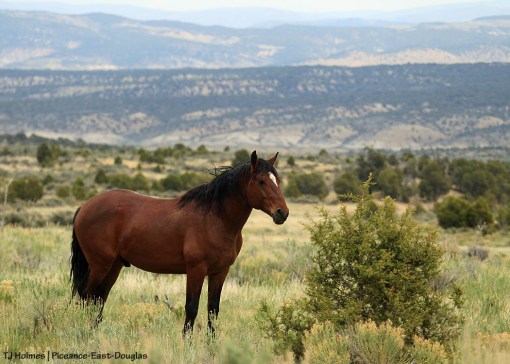
050617baystallion1

This handsome guy was with a young grey stallion and an older sorrel mare. This was the only photo I came away with that shows some of the long views available from this herd management area.

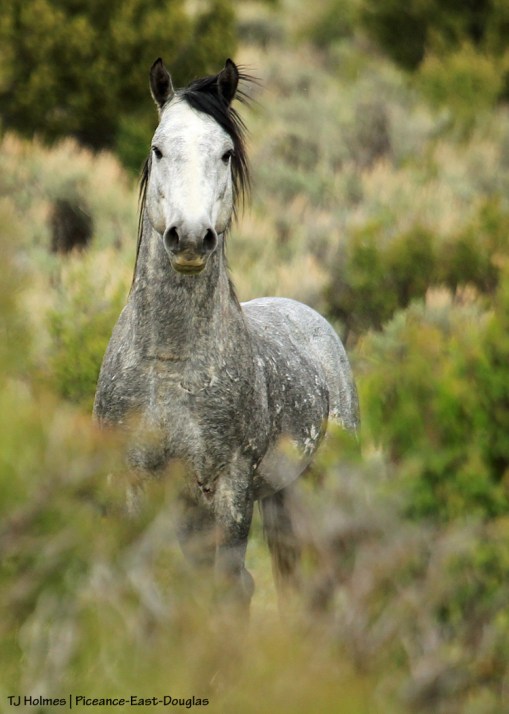
050617younggreystallion1

This is the young grey friend of the above stallion, showing the *short* sagebrush. Most of the sage in this region is TALL – as in, jungle-tall. Sometimes it’s hard to see any more of horses (or cows) than their ears. No pix of the mare because – ironically – she was too close for my lens. Most of the Piceance-East Douglas mustangs are extremely wild and wary, which is awesome! But challenging for photos. 🙂

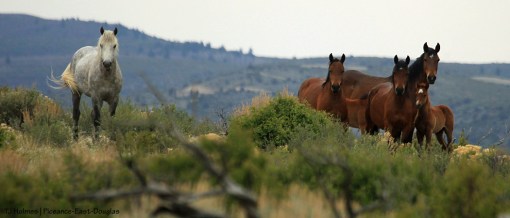
050617herculesband1

Case in point: This handsome family was pretty OK to watch us from a distance while we stood at the Jeep, photographing from the road. But when I took a few steps away from the vehicle, to get a better view across/over the sage and other vegetation, that was enough of a trigger for them to bid us farewell.

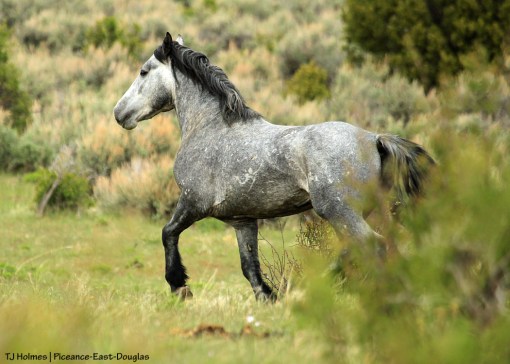
Young grey stallion by himself in Piceance-East Douglas Herd Management Area.

This hunky young guy was all alone. We walked out into the sage a short distance (also mindful of ticks!), and he came to investigate …

Young grey stallion by himself in Piceance-East Douglas Herd Management Area.

… then high-tailed it away from the two clicky ladies. 🙂 Isn’t he magnificent?

Some take-away facts from Piceance-East Douglas Herd Management Area:

  • The mustangs are gorgeous with a capital G.
  • The region is large. Huge. Ginormous. There are a lot of roads. The roads are in relatively good condition (probably in large part because of the oil-and-gas access), but, as everywhere, beware wet conditions.
  • The scenery is large. Huge. Ginormous. Especially as seen from Cathedral Bluffs – and other places. 🙂
  • The sage is tall and thick, and sometimes it’s hard to see even a few feet beyond the road.
  • What an amazing place to explore!


Partnering for mustangs

18 10 2016

101716apronfencecrew1

Yep, once again, volunteers showed up to support Spring Creek Basin’s mustangs! This is the apron project to provide a second source of clean water for our mustangs – now fenced to protect the apron from the horses walking on it. They’ve sure enough found the water in the trough below the tank, which is below this apron.

This crew has a lot to smile about because in just a few short hours, these awesome folks built a four-strand smooth-twisted-wire fence around the apron! Our BLM guys snuck out of the office last week and dug holes for almost all the heavy wooden posts – which serve as H-braces and the nifty new gate – and that was most of the hard work.

In the photo above, left to right: Laura and Bob Volger (Four Corners Back Country Horsemen), Kat Wilder, yours truly giving the thumbs’-up, Frank Amthor (4CBCH), Mike Jensen and Garth Nelson (range specialists; Mike is the herd manager), and Kat’s son Ken Lausten, fence-builder extraordinaire. Always-present Pat Amthor relieved me of my camera to take this pic of our hard-working crew. 🙂

Some more pix below before I got caught up in the efficient assembly line of pounding posts, wire stringing and stretching, and clipping wire strands to posts:

101716garthfrankhbrace1

Garth (left) and Frank work together to set the horizontal braces in the, you know, H-braces. Luckily for us, Garth and Mike Jensen already had done most of the hard work, digging holes and setting most of the wooden posts during a jail break, err, an escape from the office last week. In the background, Mike (left) and Bob Volger are digging a hole for another post to complete that H-brace.
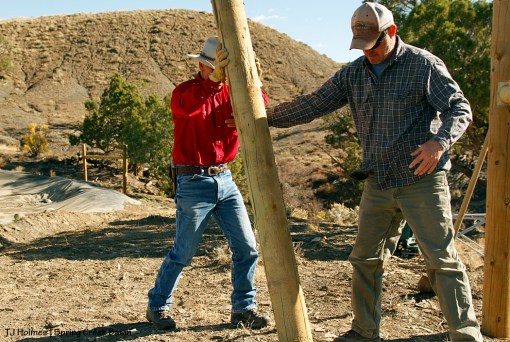
101716mikebobhbrace1

Here’s a closer look at Mike and Bob setting their post.

101716kenkatmike1

As soon as Garth and Frank had finished this H-brace, Ken and Kat got right to work stringing wire. Mike’s running a T-post through the wire to unroll the next strand down to the next brace.

101716kenmikekat1

Comin’ through! (The apron is to the left.)
101716kenkatmike2

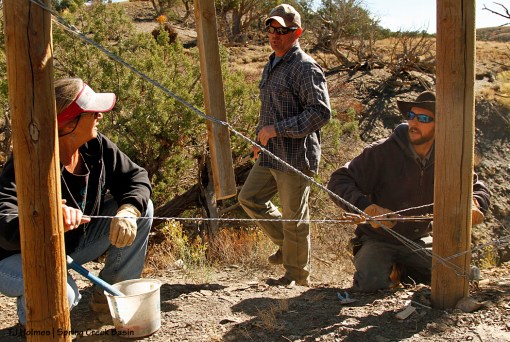
Ken stretches the end of the lower strand of wire, helped by his mom, Kat. At a diagonal, you can see the wire already tensioned into place by Mike and Garth. (That’s probably not really a word, but the diagonally-wrapped wire holds tension on the two vertical posts, so the one posts helps the other hold the horizontal wires stretched between H-braces.)
101716mikebob1

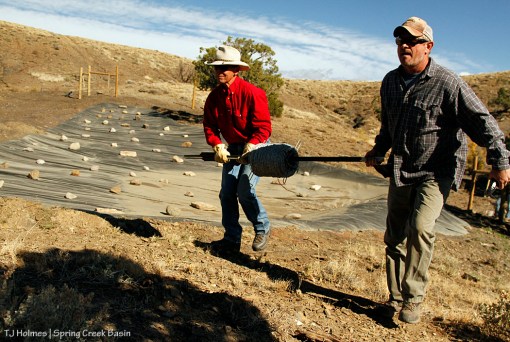
And this is a good view of the apron, which we laid out in June – the object that we’re protecting from sharp mustang hooves. Why yes, it IS already working to funnel what little rainwater we’ve received down the newly laid pipe to the catchment tank AND to the trough, which is up-to-the brim full of water for the mustangs (held level by a float ball). 🙂

101716garthmikebobfrankposts1

Garth pounds a T-post between H-braces while (in the background) Bob and Frank dig a hole for another post to serve as an anchor in a slight depression between H-braces so it will hold the wire tight without pulling the T-posts out of the ground.
101716lauramike1

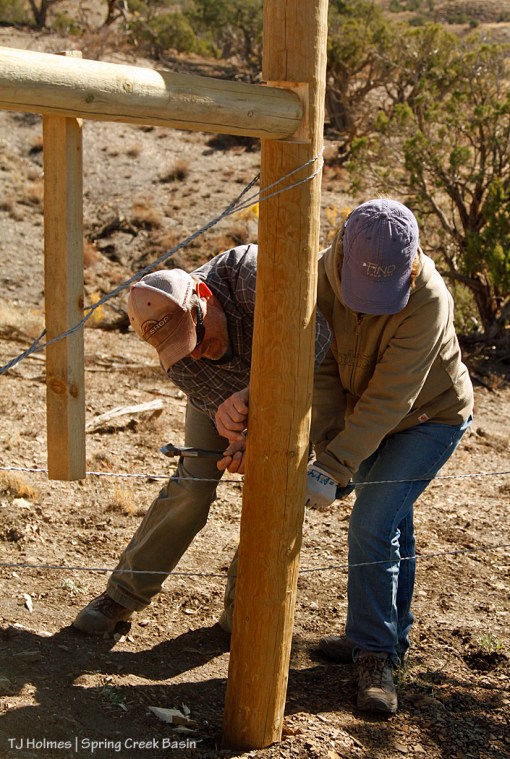
Laura Volger (4CBCH) helps Mike hold a wire strand in place so he can staple it to the post. We set our wires at consistent heights all the way around.

And things continued in just such a manner until the apron was all fenced in and protected.

This was another fabulous project in Spring Creek Basin with BLM employees and volunteers, all working together for the benefit of our beloved mustangs!

Just in case you thought it was all work and no good food, Pat Amthor brought homemade apple cake made with home-grown (Durango area) apples. You better believe we all polished that off and sent Pat home with an empty cake pan! (Sorry – no pix. It went from pan to bellies too fast!)

Thank you, thank you, once again to our committed BLM range specialists and our dedicated volunteers. With your help, our Spring Creek Basin mustangs continue to thrive on their home range!



Golden faces

15 10 2016

Voodoo and Braley

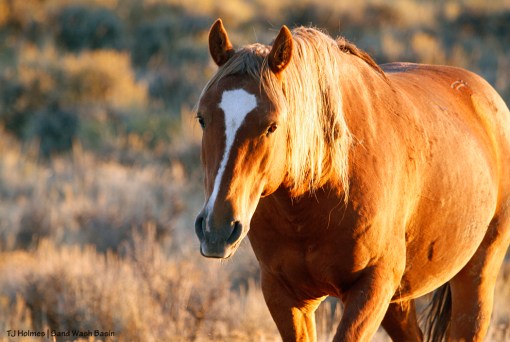
A little girl and her daddy (maybe – same band, anyway). They kicked off a beautiful morning with a most excellent visit.


Big, bad Voodoo daddy

14 10 2016

Voodoo

“Bad” meaning, of course, so good and handsome.


Black velvet

12 10 2016

Mare in Voodoo's band

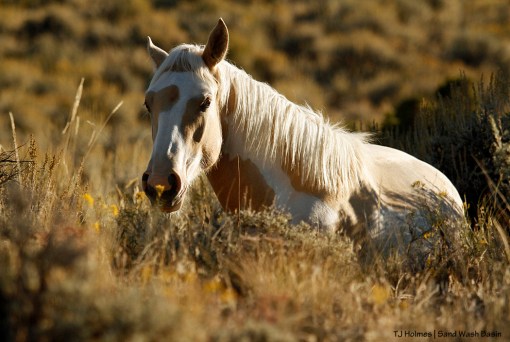
Look at this plump black beauty, glowing russet in the first light of morning in Sand Wash Basin. She’s one of Voodoo’s mares.


Can’t be bothered

11 10 2016

Meteor, yearling colt in Star's band.

Meteor, yearling colt in Star’s band: Um. Trying to nap here.

He was so bothered – not – that I was able to walk all the way around him (giving him a respectful wide berth) to photograph his big hunky daddy (?) from several angles, and then move on to another nearby band. He never rose from his nap, watched over faithfully by Star and his mare, Meteor’s mama. 🙂

Isn’t he super cute?!


Seeing spots

9 10 2016

Flashy pinto colt and sorrel stallion in Sand Wash Basin.

Are you noticing a theme? The pintos in Sand Wash Basin are flashy and splashy and gorgeous!

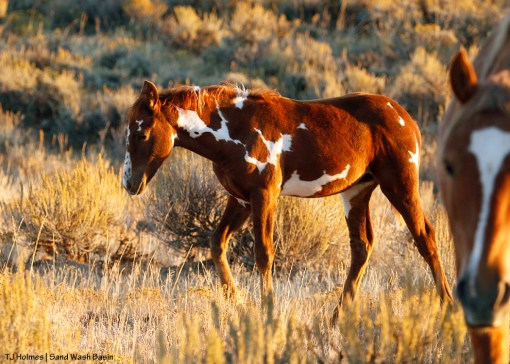
That’s filly Braley, granddaughter of the one and only Picasso. Just at right is her band stallion (and sire?) Voodoo.

Don’t you love the spots even in her little blaze??


Flashes

8 10 2016

Young pinto stallion in Sand Wash Basin.

This flashy young guy is going to steal all the girls’ hearts in Sand Wash Basin!