Remembering a giant

16 12 2025

Today is the 10th anniversary of the passing of Dr. Jay Kirkpatrick, beloved fertility-control advocate (and so much more) for wild horses and burros (many species of wildlife, actually). I remember that when I got the news in an email from a friend, though it was December, I thought it was some kind of cruel April Fool’s joke.

I met Dr. Jay in August 2010, when I showed up at the Science and Conservation Center in Billings, Montana, for a PZP training course. I also remember that it took me a long time to work up the courage to follow the advice of a couple of friends and contact him; he was a rock star to me. Legendary. Untouchable. Unapproachable!

Except that neither of those last two words was true.

I finally worked up the gumption to email him … and sign up for training – BEFORE we got approval to implement a PZP program in Spring Creek Basin. I tentatively approached the lab, on the grounds of ZooMontana, the day before the class officially started, to see what I was getting myself into. When Jay appeared, I didn’t ask for an autograph (!), I asked if I could give him a hug. I still remember that, while he laughed, he indulged me. … Wow, I miss him.

Jay was one of the friendliest, most down-to-earth people I’ve ever met, all the more amazing because he was also one of the very most obviously crazy-intelligent people I’ve ever met (to this day). He had this way of making everyone welcome and like you were IN ON IT with him, even as he explained his “why wouldn’t you do it this way” philosophy surrounding better management … some of which you might never quite have thought of but was so wonderfully simple – and, according to his same philosophy, attainable.

Dr. Jay was one of the best, most inspiring, most humble, most committed and dedicated people I’ve ever known, and I feel so blessed to have known him, even briefly. He trained me not only to mix and dart with PZP, the *why* behind doing it, the keeping of records (back at a time when it was particularly challenging for us in Spring Creek Basin) but also the importance of having optimism and a plan … and persevering.

I got to know him for five years, and he encouraged me through the sometimes rocky start of Spring Creek Basin’s PZP program. Even now, 14 years and only one roundup later (in 2011, when we started our PZP program), I think of him quite a lot. He’s one of the three (at least) angels watching over Spring Creek Basin, and I hope he’s proud of what we’ve accomplished here.

Friends Celeste Carlisle and Kayla Grams, along with Melissa Esser (whom I haven’t yet met but already greatly respect) visited Rocky Mountain National Park during their trip to Colorado for the Pathways 2025 Human Dimensions of Wildlife conference. Celeste wrote this blog post for Return to Freedom.


Hope and future

3 10 2025

Ladies ‘n lads, there’s a whole lot going on in the world right now.

None of you need me to tell you that.

What I do want to tell you is that there is a hard-working core group of folks (some of whom don’t even know and/or aren’t involved with each others’ work … and many working in great collaborations) who are dedicated to Colorado’s mustangs, on and off their home ranges. I can list our on-range groups easily (Friends of the Mustangs, Little Book Cliffs; Sand Wash Advocate Team and Wild Horse Warriors for Sand Wash Basin, Sand Wash Basin; Piceance Mustangs, Piceance-East Douglas), but I don’t want to try with the off-range-focused groups for fear of leaving some/any out. Believe me: They are out there, and they are dedicated.

As much as so many are divided these days, we mustang advocates are united in our love of our mustangs and goals of securing good management or good off-range lives – and sometimes both at the same time.

This post is late because I forgot to schedule one ahead of time (and/or I may have thought I’d have time to do it when I got home …), but I was just visiting a sanctuary and herd in northwestern Colorado where beautiful mustangs roam, and there are people as dedicated to protecting them and providing safety and wild futures for them as I am here for my Spring Creek Basin beauties.

The trip renewed my sense of hope that, at least in this, we have options and opportunities to continue the important work of advocating for our mustangs, wherever they might be in Colorado, with people who are united in doing the same (however differently).

That’s pretty cool.

(This golden eagle indulged our visit right along the road for many wonderful moments, and s/he seemed to be an excellent example of the sentiment of hope that goes with this post.)


Book recommendations

15 05 2025

After posting the information about Kathryn Wilder’s forthcoming (in November) book, The Last Cows, I thought I’d do a “pay it forward” post and recommend another couple of books that I’ve recently added to my library.

I’ve been lucky enough to know Barb Kiipper for many years during our mustang advocacy journeys. She’s the founder and director of Jicarilla Mustang Heritage Alliance, a group that advocates for the mustangs of the Carson National Forest’s Jicarilla Wild Horse Territory in northwestern New Mexico. She has poured heart, sweat, blood and tears into the challenge of working toward good management for that herd, getting many, many mustangs adopted to good homes along the way. I met Michele Bell only recently and have been inspired about her approach to taming and training mustangs from a variety of places (the Jicarilla, BLM-managed herds and Mesa Verde National Park).

Why A Mustang is part memoir of their journeys, part philosophy about working with mustangs and what these amazing horses have taught these women about themselves and mustangs, specifically and in general. It’s a bit of an addictive read (and if you’ve been involved with horses and/or mustangs as long as I have, absolutely fascinating with insights about behaviors and taming/training techniques), and I highly recommend it.

Also …

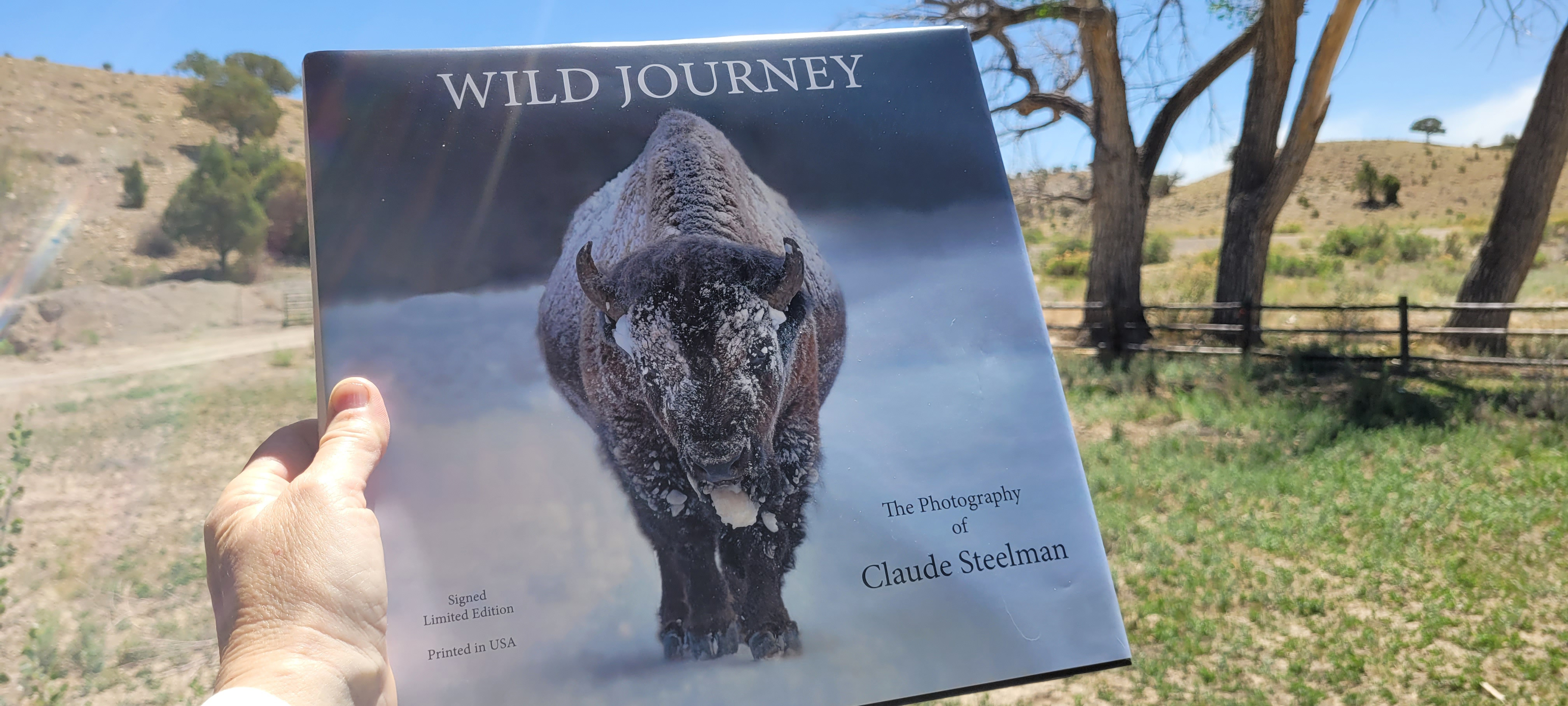
Long-time friend and amazing nature/wildlife photographer Claude Steelman visited the other day on his way to Spring Creek Basin, and he gifted me a copy of his newest book, Wild Journey: The Photography of Claude Steelman. I don’t see this book on his website, so I’m not sure of its availability. Claude had a gallery in Durango for a number of years and currently has downsized to a studio just above Main Avenue – so he can be out shooting more! This wonderful book is a sort of compendium of his travels and experiences across the West (and beyond) during his 40-plus years (!) as a photographer chasing natural light and wildness. Mostly images, only a little text; his photography truly speaks volumes.

As you would expect from the photographer who published Colorado’s Wild Horses, there’s a section in this book about mustangs, which includes images from Spring Creek Basin, including the above gorgeous scene. 🙂

Claude says people ask him when he’s going to retire, and I love his phrase at the end of the book that indicates that if he retired, he’d “just go take pictures, so why bother” retiring!? Find your passion, indeed!

I have been so fortunate along this journey to not only meet and spend time with “my” own mustangs but also many like-minded humans. The mustangs and these people keep me grounded on my own path.


Sign history

5 04 2025

This is what the original interpretive sign looked like (I know you were wondering!), courtesy of Kathe Hayes, who retired a few years ago after working many years for San Juan Mountains Association as the volunteer coordinator. Long-time readers will remember Kathe’s name associated especially with the alternative spring break program, which brought in college students from the University of Missouri every year to work on various projects in Spring Creek Basin and other public lands (both BLM and U.S. Forest Service) around Southwest Colorado.

When Kathe read about the new kiosk installation, she sent me a text and some emails about the history of the FIRST sign installation at the west basin boundary:

“Excited to see that Laura [Heaton] was involved in the installation of the new sign in Spring Creek Basin. As you know as a child, she was involved in the installation of the first sign along with a group of college students from the University of Missouri and Ranger Rick from BLM. I remember Laura and I climbing up the side of the hill and rolling large rocks down so that we could surround the sign so cars would not drive over the sign. A lot of hard work and dedication went into the original sign, and I was sad to see that it had disintegrated. But I am grateful for the new sign and the information it portrays about the wonderful Spring Creek Basin. Thanks for your help in this, TJ.”

Also:

“I was really excited to read about the installation of the new sign. I believe the old one was installed around 2008. It prompted me to resurrect a photo of the original. Laura was involved in the installation of the original sign, as a young kid working alongside the University of Missouri students and Ranger Rick Ryan (BLM). Wow, such good memories for me.

“Attached is the original sign photo. It was a lot of work back then, getting that sign created and approved.”

Not much has changed in that respect. 😉 I asked Kathe if I could share the image of the original sign and her words about the history of it.

“I remember this about installing the original sign. Rick Ryan (Ranger Rick) had been mixing cement in a wheelbarrow and then pouring it into the hole to secure the base of the sign as we all watched curiously as to how this was all going to work. Laura said that that’s not how my dad would do it [Laura’s dad is well-known rancher Al Heaton; their family is well respected in the entire region of Southwest Colorado. She is, quite literally, a local!] and I just laughed. Laura‘s family was instrumental in the success of the Alternative Spring break program. I doubt I would have continued without their support. And Laura was my little shadow since she was about 6 years old. Her parents let me drag her all over the place. She loved being with the college students who loved playing games especially spoons.”

Wild and crazy how things come back around full circle, eh? 🙂

Thanks so much for the history, Kathe! We miss the alternative spring break program (I think it lasted almost 20 years with Kathe’s guidance?), but we sure loved each year’s crop of students and all the work they did for us in Spring Creek Basin! And we now have Laura as one of our BLM range team members, carrying on that good work!


The importance of people

24 02 2025

** Update from Tuesday morning, after the so-called “meeting” in Dolores: Who showed up? Hundreds of people concerned about local, regional and national issues – including the firing of BLM, Forest Service and National Park Service employees (including our range specialist Ryan Schroeder). Who did NOT show up? Rep. Hurd’s representative, with whom the meeting was scheduled.

Not cool.

The (Cortez) Journal has the story: “Hundreds gather in Dolores to meet with Rep. Jeff Hurd staffer; Republican’s regional director never showed up

**********

By now, I’m sure most readers of this blog have heard/seen/read about the mass firings of hundreds or thousands of federal employees with the National Park Service, U.S. Forest Service and Bureau of Land Management (among other agencies).

Many of you probably even know some of those folks, who work hard for America’s public lands so that American citizens as well as visitors from other countries are able to enjoy these lands. America is the birthplace of this idea of protecting nature and natural resources for future generations. It’s not all dollar-driven extraction industries, though those play a part. But the great, far-seeing vision of the people who envisioned protected lands, available to all citizens, was to ensure that those lands belong to all of us and that we have a part in protecting and preserving them, in addition to enjoying them and all the natural wonders they offer.

Perhaps no collective group of people feel that mission more strongly than the employees who work for little pay, in harsh conditions (and I’m not talking about just rough country), for the love of the land and – !!! – for the very people who also love those lands.

Two days after I was able to speak to one of my BLM folks in person – asking her “are you all safe??” (her answer then was yes) – I learned that when she got back to the office, they were NOT. One of our two new range specialists had gotten the “you’re fired” letter that afternoon, citing as the “reason” that during his probationary period, he had “failed to demonstrate fitness or qualifications for continued employment because your subject matter knowledge, skills, and abilities do not meet the Department’s current needs …”

In his own words and with his permission, I’m going to share here the letter Ryan Schroeder wrote that demonstrates that not only do his “subject matter knowledge, skills, and abilities” FULLY meet the current needs of Tres Rios Field Office and that of BLM state- and nationwide, they FAR exceed those criteria … as only a bureaucrat in the nation’s Capitol could fail to understand at a glance.

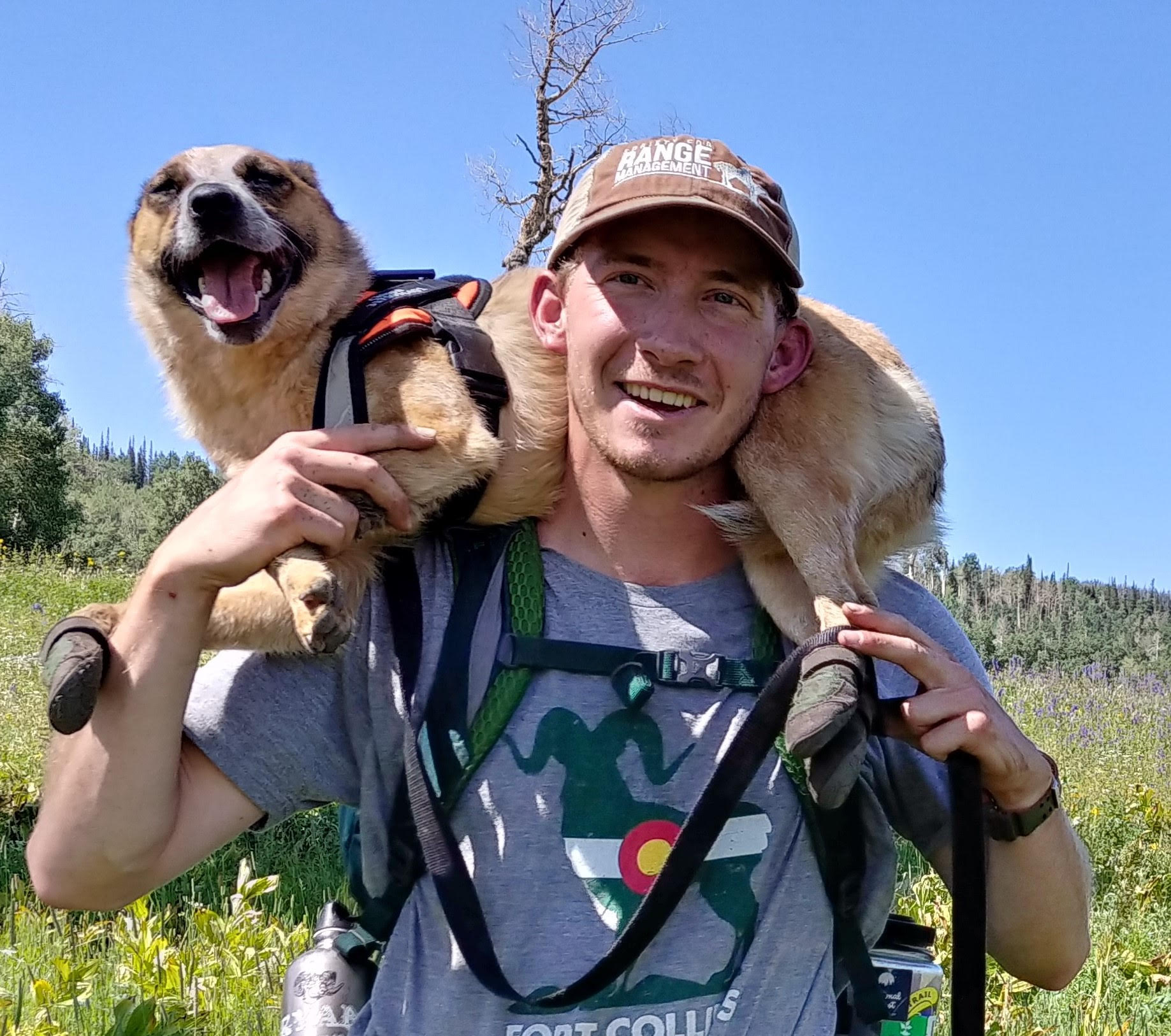
Ryan Schroeder and Chispa (Spanish for “spark,” a fitting name because of Ryan’s previous work as a firefighter), his rescue pup from the Mora, New Mexico, area.

Hi TJ,

This is Ryan Schroeder, I am the (now) former Rangeland Management Specialist (GS-11) down here for the Bureau of Land Management Tres Rios Field Office and Canyons of the Ancients National Monument in the Dolores, CO area. Thank you for wanting to share my story to say what happened to me on Tuesday Feb. 18, 2025 when I was terminated after less than 60 days on the job. I have written below the most concise way I can think to write about what has happened, and what it may mean for public lands and the people of this state that depend upon them. 

A lot has happened in a little more than two months… I finished my PhD at the University of Montana on Dec. 13, 2024; moved nearly 800 miles south to SW Colorado where my Significant Other and I moved in together after being long-distance for over 4 years; started working at my dream job as a Rangeland Management Specialist with the Bureau of Land Management, working to promote and sustain healthy rangelands and habitats for all Americans; …and less than 60 days after being hired I was terminated for a “cause” that is a lie.

The Department has determined that you have failed to demonstrate fitness or qualifications for continued employment because your subject matter knowledge, skills, and abilities do not meet the Department’s current needs…” (excerpt from my termination letter dated Feb. 18, 2025; I have attached my termination letter in full).

Rangeland Management Specialists such as myself review, renew, and update grazing permits for private ranchers and entities to graze their livestock on public rangelands, as well as work with our partners to manage Wild Horse Management Areas such as Spring Creek Basin in the Disappointment Valley south of Naturita. To do this, we are mandated by federal statute and regulation to conduct Land Health Assessments, go through the National Environmental Policy Act (NEPA) process, and work not just with our permittees but all other resources (cultural, wildlife, hydrology, fuels, recreation, and minerals) and other interested publics as part of Interdisciplinary Teams to try and use science to balance grazing habitat use alongside other public land uses, minimize negative environmental impacts while producing food and fiber for America, and use grazing as a tool for habitat improvement.

I have gone to school and worked for 11 years to be qualified for this position (resume attached), one of the most difficult positions to fill in Public Lands Management Agencies. I have gained experience, knowledge, and qualifications from Montana, Wyoming, Colorado, and New Mexico rangelands to rise to the tasks given to me; which, when I signed my performance plan 7 days prior to receiving my termination notice, seemed daunting but doable, and a way to grow in my career and be a steward of the amazing public resources we all own as Americans. If I am not “fit or qualified” for the needs of the Department [BLM], then it appears to me that the Mission of the Department [BLM] has fundamentally changed without the knowledge of the public and those who have been with the agency more than one year…

My position, a GS-11 Rangeland Management Specialist, in the Tres Rios Field Office had been vacant following the retirement of Mike Jensen, a Rangeland Management Specialist who had been with the Tres Rios F.O. for more than a decade, and who had developed great relationships with grazing permittees and other interested publics, and it took nearly a year to fill the position. In that short time, there became a backlog of statutorily required Land Health Assessments throughout the 600,000 acre Field Office and Canyons of the Ancients National Monument areas, as well as grazing permits that were soon to expire and be renewed. By law, the revised Federal Lands Policy and Management Act (FLPMA), the BLM is obligated to issue grazing permits and renew expired ones. Those expired grazing permits (often with a 10-year permit period) can either be renewed with a few clicks on a computer, without any modification or updates to the “Terms and Conditions” in the permit, or go through a “Fully Processed” update and renewal to incorporate the latest science, up-to-date on-the-ground Land Health conditions, and adaptive management strategies into new “Terms and Conditions” to not just manage livestock but manage the habitat for the benefit of all resources. My supervisor, Joe Manning (Assistant Field Manager for the Tres Rios F.O.), and Laria Lovec (Colorado State Range Program lead) had brought me on to help address that backlog and incorporate more science of rangeland ecology and ecological restoration into these grazing permit renewals; be an advocate for the rangeland resources when advising on other proposed actions (by private citizens/companies or the BLM) to occur on BLM Public Lands; and continue to steward and sustain positive relationships between the Agency, our partners, and the land.

I fear, that with my termination, effective Feb. 18th, 2025, after less than 60 days on the job, the planning we in the Range Program at the Tres Rios Field Office had done to start addressing the backlog of permit renewals, Land Health Assessments, and other projects requiring NEPA this year will not be able to be done, or not incorporate up-to-date science and on-the-ground data to help the agency and the private permittees adapt to challenges faced on the ground, and will be forced to renew most permits without any changes or adequate information. Many of the grazing permits that are up for renewal were originally written in the late 1980’s through the early 2000’s. Conditions on the ground throughout the Tres Rios F.O. and Canyons of the Ancients N.M. have changed since then, and it is not appropriate to renew grazing permits without understanding what changes in the resource base or resource potential have occurred, how they can be mitigated to sustain appropriate grazing use, and how to adaptively manage in response to unpredictable environmental conditions and to promote and sustain both big-game populations, horse herds, sensitive wildlife and plant species, and cultural resources that occur throughout our grazing allotments and Field Office. Thus, if the “new” Mission of the BLM has no need for science, knowledge, stewardship, and passion thereof, as indicated in my termination letter, I fear that public lands projects (not just grazing permits) will be rubber-stamped without careful consideration of on-the-ground conditions, science, lawfully-required public input, and adaptive management techniques due to continued short-staffing of the Field Office, and lead to degradation of Colorado’s public lands and resources and increased vulnerability to external factors such as droughtshifting market conditions, and altered public perception of our rangeland and habitat resources.

Further, I do not think that my termination, in addition to at least two other BLM Colorado employees (effective Feb. 18, 2025), are the last that the agency will experience given the on-going circumstances. I do not know who is on the chopping-block next, but I worry that the BLM and other Public Land Management Agencies will continue down a crisis of confidence, a crisis of leadership, and a crisis of adequate staffing to complete the Mission(s) as they have been known and mandated by Congress and the American people. Those who remain in the agency at the State, District, and Field Office (local) levels are being silenced (both actively and passively) from speaking up about what is occuring, in fear of losing their jobs next. I fear those losses will be inevitable if things do not change, whether they speak up or not, further degrading our Public Lands Management Agencies’ abilities and our public resources in the near term and in the future. 

Thank you for your time and consideration of this important matter.

**********

Later this winter or early in the spring, I was hoping to introduce you all to our new team of Anton Rambur (rangeland management specialist), Laura Heaton (range tech who worked with Mike Jensen and replaced Daniel Chavez in that position) and Ryan Schroeder. Anton and Ryan stepped into their positions just last October and December, hired to fill the positions left vacant by Mike and by Garth Nelson. We’re getting a new interpretive sign at the western boundary/entrance to Spring Creek Basin, and I thought that happy event would be a great way to introduce you all to our new BLM’ers.

Now, when that happens, we’ll be missing a key member of our team – Ryan.

From the above letter, you know that Ryan is incredibly well educated and has a significant knowledge of his subject matter. From the additional information he sent me, let me share what he accomplished in the Tres Rios Field Office in less than 60 days:

U.S.D.I. – Bureau of Land Management, CO – Rangeland Management Specialist Dec. 29 2024 – Feb. 18 2025
▪ Duty Station: Tres Rios Field Office & Canyons of the Ancients National Monument, Dolores, CO
▪ Supervisor’s phone #: Joe Manning, A.F.M. 970-***-**** (Permission granted for reference check)
▪ Developed a prioritization plan to strategically address a two-year backlog of Land Health Assessments,
grazing permit renewals, and grazing permit updates (requiring the NEPA process) to focus efforts in
Gunnison Sage Grouse Habitat and Areas of Critical Environmental Concern within the Field Office area.
▪ Collaborated with grazing permitees to plan livestock grazing and land management actions on BLM lands
▪ Contributed to BLM Interdisciplinary Teams as the Field Office lead range program specialist for proposed actions on BLM lands requiring NEPA review, findings of potential impacts, and mitigation techniques
▪ Responded to Freedom of Information Act (FOIA) requests in a timely manner
▪ Worked with Agency partners including non-profits, local governments, tribal nations, and private citizens to respond to and advise on rangeland habitat, livestock, and Wild Horse Management Area issues
▪ Inspected and maintained range improvements within the Field Office and Canyons of the Ancients N.M.

**********

With all due respect (not much) to the bureaucrat(s) who took the time to type up (or more likely copy and paste) his termination letter and find him in Dolores, Colorado, does that sound like someone who doesn’t know their subject matter AND also doesn’t have the “skills and abilities” to meet the needs of the range department at Tres Rios Field Office for an area of Southwest Colorado covering 600,000 surface acres of incredibly diverse landscape between Silverton to the north, New Mexico to the south and Utah to the west?!

If you’re local to our area, please make time to attend a “town hall” with a representative of newly elected U.S. Rep. Jeff Hurd (R-Colo) at 4 p.m. today at the Dolores Public Library.

BLM, as well as the U.S. Forest Service and National Park Service, is *chronically* understaffed and underfunded. We know from Mike and Garth and Daniel that when you have good people, you hate to see them go (to retirement and the USFS, respectively – that agency lured away two great guys!) … and when you get new people who have the promise to keep your level of partnership and quality of work at an excellent level, you want to hang on to them. Our elected officials need to know how important people like Ryan are to our public lands and our communities.

I’ve worked with Laura since she started with TRFO, and she’s already proved to be a great addition to our team (she’s been in the office about a year and a half and learned under Mike). I’ve met Anton a few times and gotten him into the basin to see the mustangs both with Laura, and with Laura and Ryan; he is a welcome addition to Spring Creek Basin’s herd management (he comes to us from Nevada, and we’re eager to show him how wild-horse management is successful!). Ryan impressed me the second time I met him (on that basin tour), especially when he was able to immediately identify a plant I’ve been wondering about for nearly 18 years (!). We look forward to *continuing* to work with Ryan just as soon as we can get him reinstated in his very necessary position.


12 from 2024

14 02 2025

Better late than never, and when I finally got my act together, I thought Valentine’s Day would be the best day for this rundown.

As usual, these are 12 (and a bonus) images from the last year that came from each month. This year, I think, most of these photos have been on the blog previously. A little reminiscence of the events surrounding each image will follow the photos. Sometimes it’s those emotions and memories that make a particular image special for the photographer, and these are no exception to that. Just being out with the mustangs, in Spring Creek Basin, no matter the weather, is the very best part of what is impossible to share.

Enjoy … and please consider this is my love letter to Spring Creek Basin and its mustangs from 2024. 🙂

January last year was at least somewhat snowy (this year was very much NOT snowy). Skywalker had been a bachelor with a couple of bands until sometime last year, and here he is with some horses from one of those bands. Completing the composition is part of the Spring Creek canyon rimrocks in the near background and Utah’s La Sal Mountains in the far background. (I wish they were that snowy this year.)

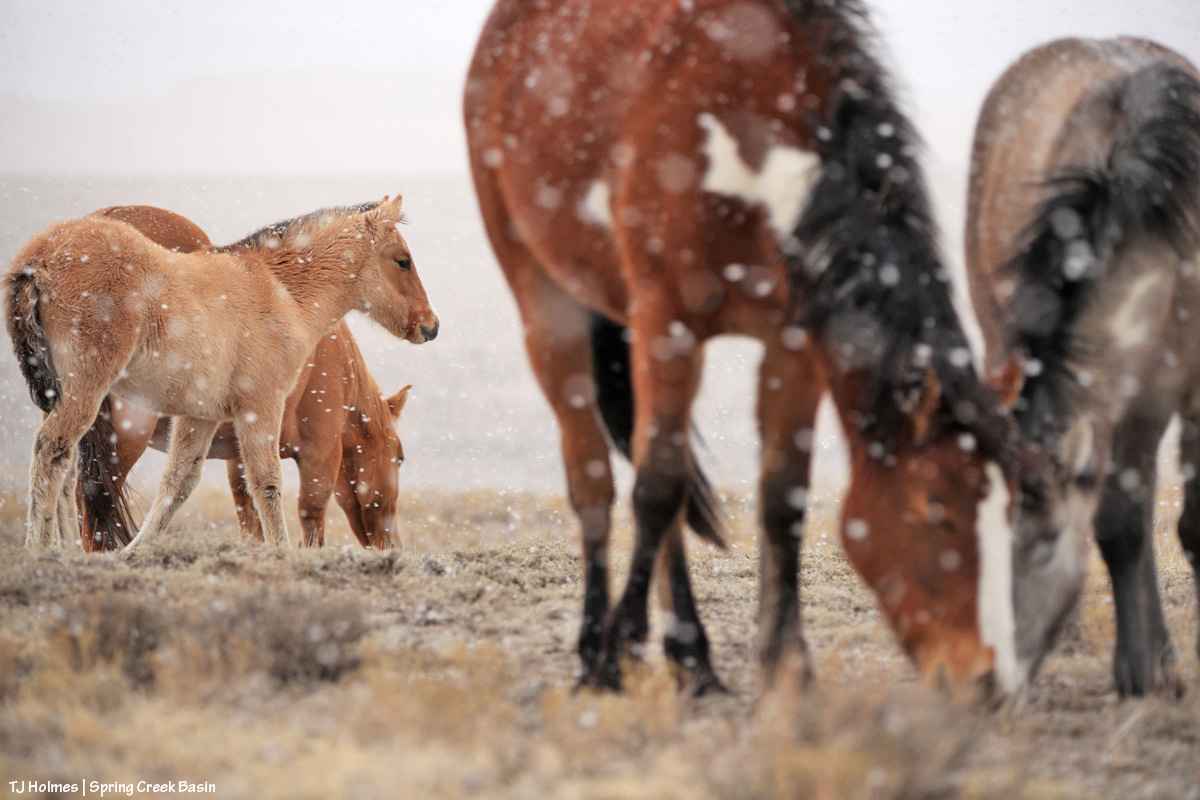
This was a magical February visit with Mariah and her band. The low-angle sunshine made each snowflake a visible bit of earthly magic, and when she looked back at somebody – shazam. Magic captured.

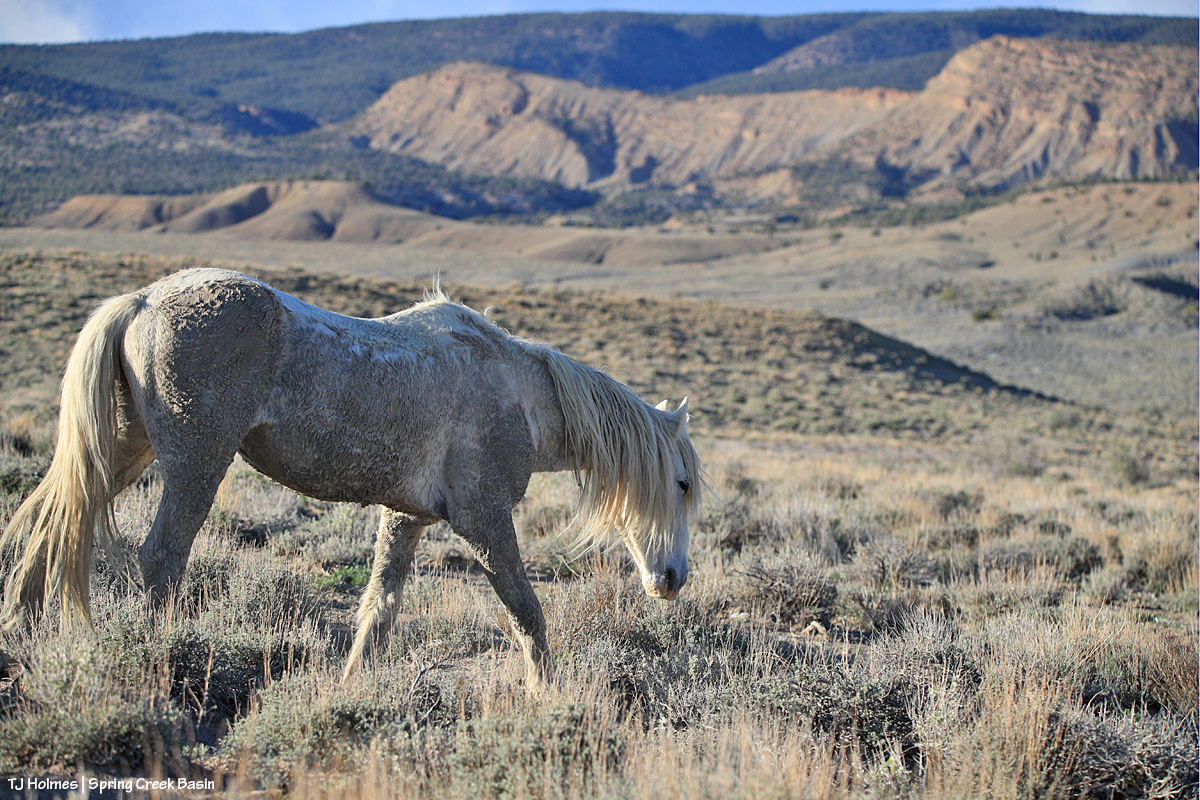
Couldn’t pass up this snowy March day in the basin with Temple! Clearly, she had been enjoying the moisture and excuse to roll in the mud. I love the sunshine on her and the falling snow blurring the background.

I had so many opportunities with the mustangs in April, but this image of Hollywood was just *the one*. You all know exactly what I mean. (To update, I haven’t seen him again since the image I posted earlier this winter. It doesn’t mean anything other than I haven’t seen him. …)

When Spring Creek is running with rainwater, that is a time not to miss photographing it because it doesn’t happen often and water doesn’t run in the arroyo bed for very long. When Skywalker moseyed to the edge of the creek in May, just upstream of the canyon, the scene came alive with story: mustang drinking from an ephemeral stream in the desert.

In June, I was lucky to catch Sundance’s band near Odin’s band … and luckier still to see Sundance and Odin having a friendly little chat! Elder stallion and growing young stallion; what a moment. I’d love to know what wisdom Sundance was imparting to young Odin.

Terra’s stallion adores her. And I mean *adores* her. They travel with another band, but Venture has eyes only for Terra. This image is from July, when it’s hot and dry and the horses just like to doze.

Personally, this is one of my favorite images of the year because those are two of my favorite stallions: Storm and Buckeye. With their bands grazing nearby on this warm August evening, the boys greeted each other quietly and respectfully before returning to their mares.

Here’s your Valentine’s Day image, taken last September. 🙂 Buckeye and Rowan, especially, seem to have a special fondness for each other.

After Storm lost his band in October, the mares went through a couple of younger stallions that couldn’t seem to keep them. Flash ended up with Gaia … then also with Mysterium. And finally, as you know now, he gathered all of Storm’s girls (which, I think, probably was due more to them wanting to be together and evading the youngster that had them than to any particular skill Flash had at stealing them!). (I’ve seen Storm just once since he lost the band, way deep in the southeastern part of the basin.)

Last November, we had some great snow, and we were so optimistic for the winter to come! … And that was pretty much it. Here it is February, and we’re desperate for moisture of any kind while we watch the dirt turn to dust, to powder. But in November, Terra was a gorgeous girl in the sunlit snow, and life was good.

We had more lovely light in December – as seen glowing around lovely Winona – but not a heckuva lot of snow.

And as usual, a bonus:

Buckeye’s girls. 🙂 I don’t remember what caused them to run right past me, but I was stoked to capture this image of them nearly in a row, especially just as Bia was leaping a bit of sage or saltbush!

Thanks for following along, happy Valentine’s Day to you and your loved ones, and if we can have a bit of a love(ly) wish … more snow, please! 🙂

*** Update Friday morning: Disappointment Valley is getting RAIN! Not snow, RAIN. In February. In Colorado. Well, you know we’re in desperate need of moisture, so I’ll take it. (But 38F is hard on the wildlife under rain.)


Can’t-be-contained bonus

27 11 2024

When I was a young Coloradan, newly moved to Durango from Texas, my then-co-workers at The Durango Herald can attest to the fact that the first time snow fell that winter, I went a little bonkers with excitement.

Not much has changed, 22-plus years later. 🙂

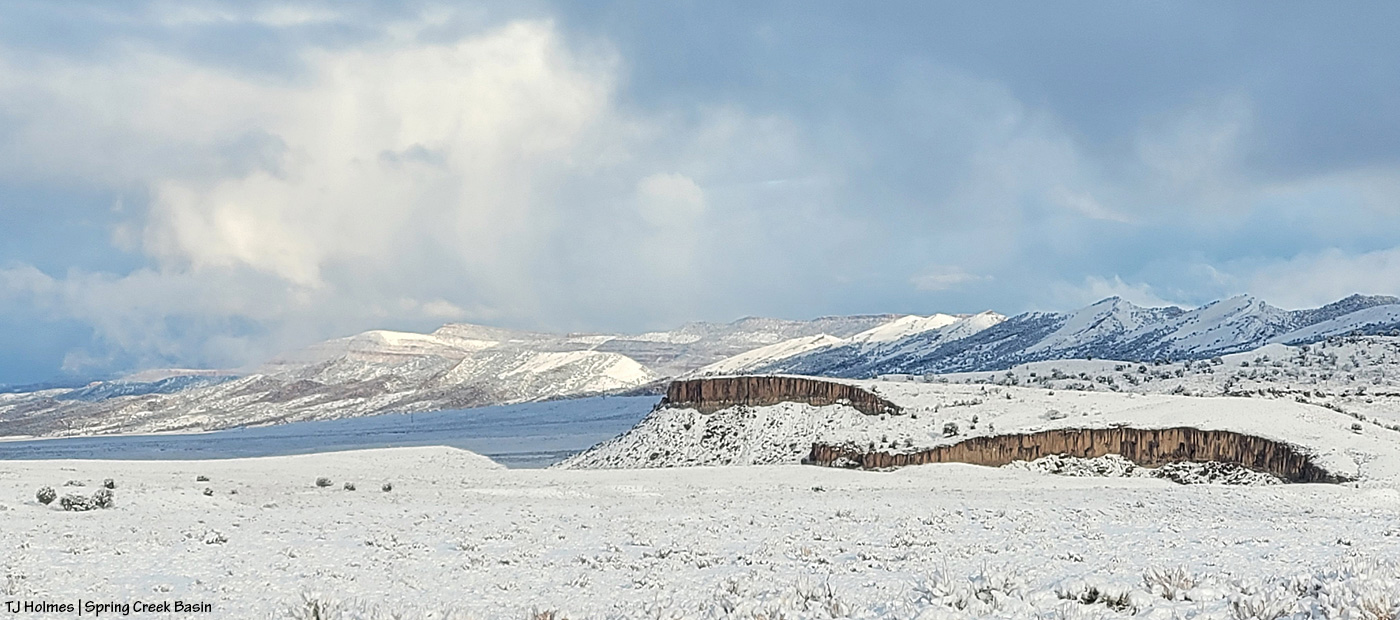
We had another great (rain to) snowfall overnight, and it was a wonderland of white this morning – and muddymuddymuddy underneath. The snow is nearly all melted – at least down-valley – now, but rather than wait for tomorrow, here’s a peek at the Thanksgiving-Eve bounty in Spring Creek Basin:

Shortly after sunrise, Chrome’s Point, looking south-southeastish. Flat Top and Round Top are at left in the distance, and Filly Peak is at right.

Looking back north-northwestish, the difference in light is dramatic (this was maybe only 10-15 minutes after the first pic?) as the clouds linger at the higher elevations south and east of Spring Creek Basin and have started clearing to the west and north (though the mountains were engulfed in clouds the whole time I was out).

Holy heavenly light. If I’d been able to see that spotlight of light, with my own eyeballs, at the time, I would have brought out the big gun (these are all from my phone – handy little pocket cam that it is). Wow. Knife Edge is ahead to the left; Brumley Point is visible at far right. Temple Butte and McKenna Peak are still completely within the clouds.

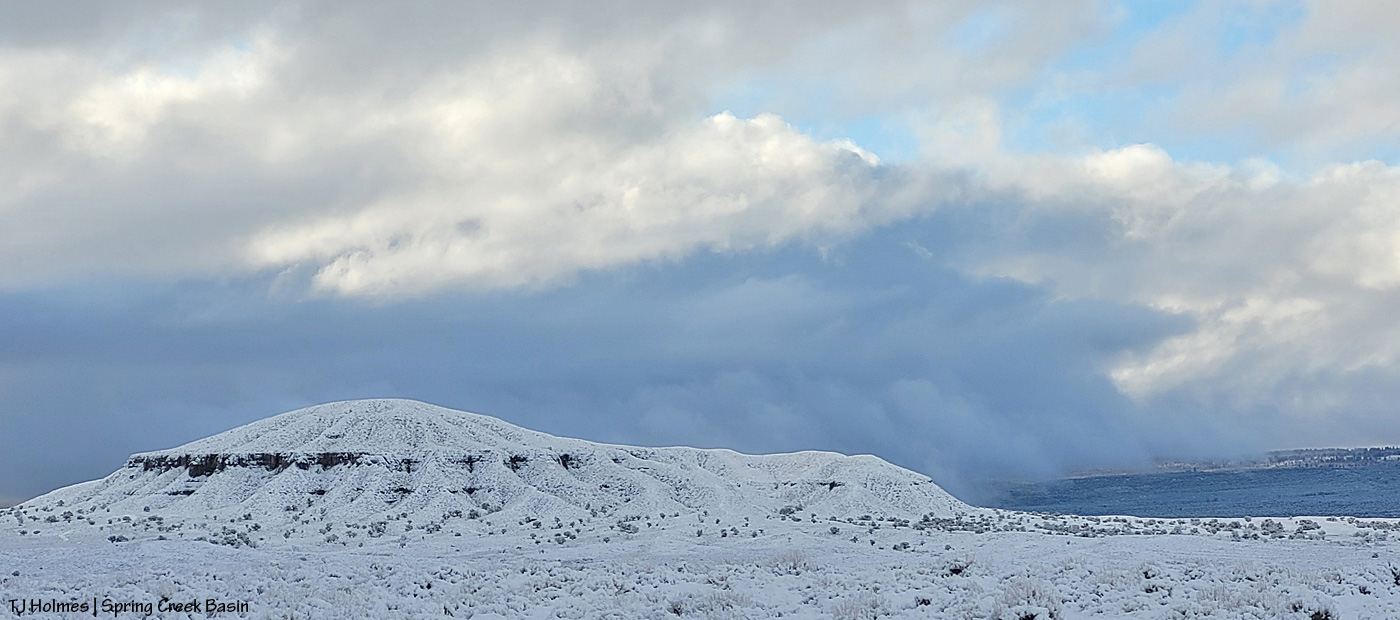
Round Top – aka Saucer (as in flying) Hill – with snow still pouring from the moisture-laden clouds to the southern ridges of Disappointment Valley and beyond to the Glade.

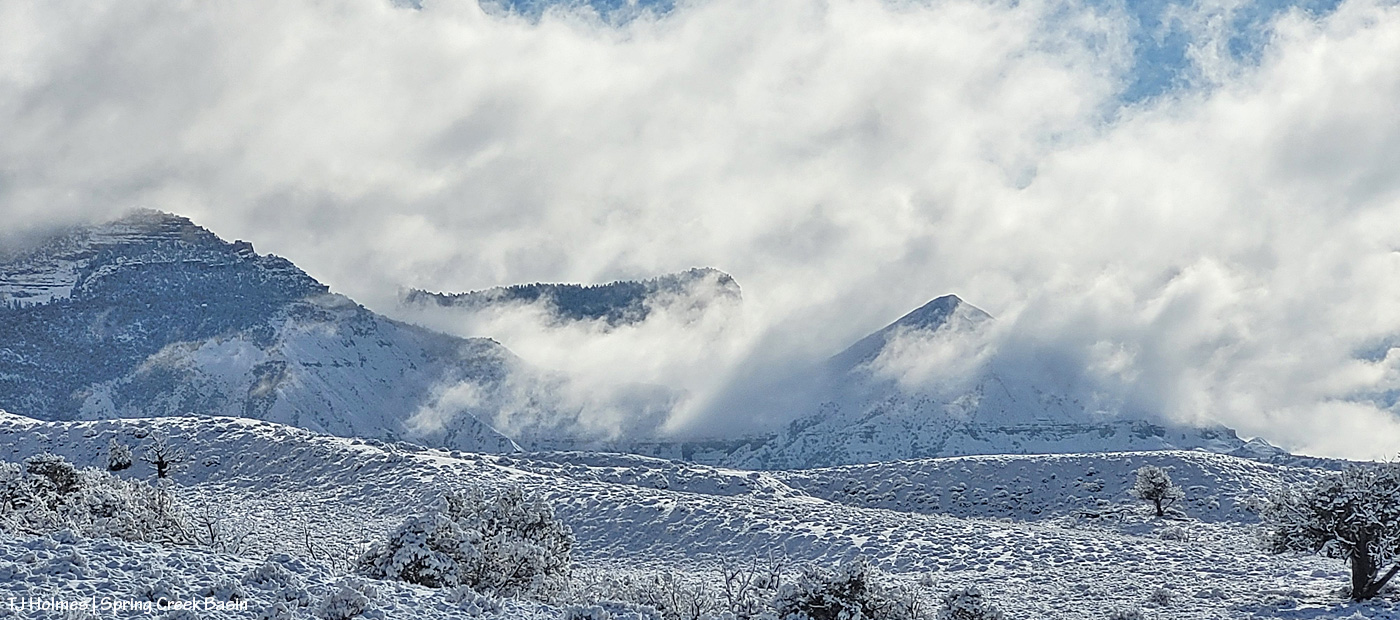
I was just below the base of Knife Edge with mustangs when Temple Butte and McKenna Peak were starting to emerge from the still-billowing clouds. Dramatic much?!?

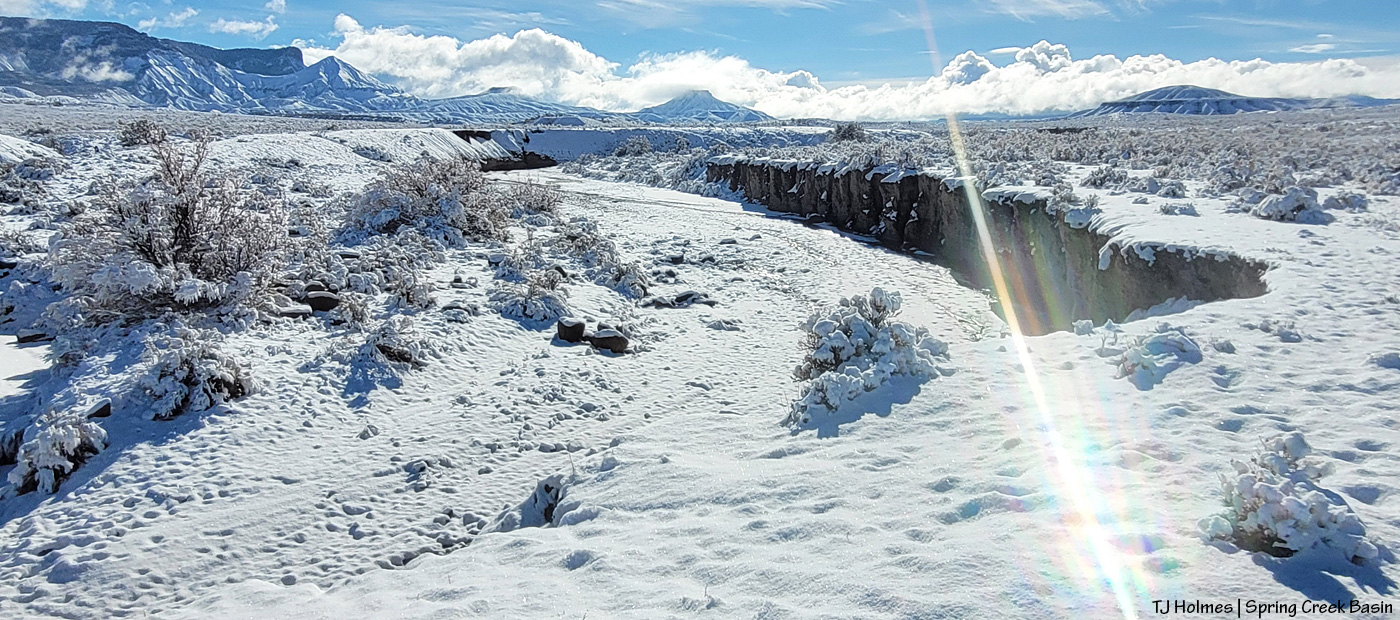
Heading back to my buggy and the road, looking upstream at the Spring Creek arroyo toward its source at McKenna Peak … Temple Butte behind it … submarine ridge to the right … Brumley Point straight ahead (it sits right on the basin’s southeast boundary) … Round Top at far right. Water WAS trickling through the bed of the arroyo in some places (like where I crossed).

From the ridge at the main/original water catchment (oh, how I hope this snow provided lots and lots of water for our catchments!), looking eastish across the basin. I mean … who DOESN’T get giddy at the sight of snow?! 🙂 Knife Edge is the ridge at far left with the top rim just barely free of snow. See the trees at the base of the ridge at almost farthest left? That’s where the ponies are (the ones I visited, anyway).

This one’s a little out of order, but it sums it all up. 🙂 I love mustangs; I love snow; I love Spring Creek Basin and its mustangs in the snow!

That’s our water. Our moisture. Our lifeblood for growing things.

So, so, so, SOOOOO grateful this Thanksgiving Eve. Happy gratitude to all you wonderful readers and your families on this, my very favorite holiday. Hope you all get to spend it with those you love, in places you love. 🙂


Not good-bye, fare thee well

24 06 2024

Readers of this blog know that I/we have enjoyed a particularly good partnership with our BLM folks for the last nearly decade, in huge part because of rangeland management specialist and Spring Creek Basin herd manager Mike Jensen.

Our PZP program was implemented during the 2011 roundup, before Mike returned to herd manager duties (he was herd manager here first in the early 2000s), but Mike has been an absolutely staunch supporter of the program. It was under Mike’s leadership that we were able to get bait trapping solidified as the capture method of choice (when the time comes), and because of Mike’s dedication to vegetation monitoring, for the 2020 herd management area plan update, we had the data necessary to allow the increase in AML (appropriate management level) from 35 to 65 adult horses to 50 to 80 adult horses. That, combined with the very successful PZP program, has meant an astounding 13 years to date since the last roundup and removal of any Spring Creek Basin mustangs.

Mike is the BLM partner every advocate wishes for and we have been so very fortunate to have.

Under Mike’s leadership, Spring Creek Basin Herd Management Area is a model that other BLM managers and advocates can aspire to. (That’s not arrogance; that’s pure gratitude.)

As I described in yesterday’s post, last week, Mike and Tres Rios Field Office Manager Derek Padilla came to Spring Creek Basin for the field trip with Colorado Wild Horse Working Group members. I take every opportunity offered to describe Mike’s work ethic, partnership and support of our mustangs to anyone who will listen, but this was the first opportunity for group members and our Colorado advocates to see him in action as he talked about the history of Spring Creek Basin as a herd management area and our accomplishments in both herd management and the projects we’ve completed for the benefit of the mustangs. Naturally, everyone wants a Mike clone for their areas. 🙂

By the time we reached the day’s end goal and turnaround spot – the northwest-valley water catchment we built in 2022 – we were down to our local advocates and a Jeep-full of advocates from the other herds.

And because Mike retires Friday from a long (30 years) career with the Bureau of Land Management, we local advocates wanted to take advantage of the last opportunity we’d likely have Mike in Spring Creek Basin to mark the occasion, wish him well and give him a token of our appreciation.

Left to right: Mike Jensen, Frank Amthor, Tif Rodriguez, Pat Amthor and yours truly.

Thank you, Mike, for being such a champion for wild horse management here in Spring Creek Basin, for being a true partner, for being one of the people I respect most in this world. We wish you well in retirement! Don’t be a stranger. 🙂


Out in the field with a lotta folks

23 06 2024

Six vehicles. One ATV. Twenty-six bipedal humans. Most bands in Spring Creek Basin.

Crazily excellent weather (temps in the comfortable 80s, not blistering 90s or sizzling 100s). Perfect breeze. … NO GNATS (how that’s even possible, I don’t begin to know).

Earlier this week, I was joined in the basin by several members of the Colorado Wild Horse Working Group and associated people, including BLM herd manager Mike Jensen and Tres Rios Field Office Manager Derek Padilla, and (very) long-time Spring Creek Basin advocates and amazing friends Pat and Frank Amthor and Tif Rodriguez.

Some background: In May 2023, Colorado Gov. Jared Polis signed Senate Bill 23-275 into existence. In a nutshell, “in 2023 the Colorado legislature passed Senate Bill 23-275 to provide resources and support efforts to ensure the long-term sustainability of Colorado’s wild horse herds and rangelands.”

Among other things, the bill created this working group, made up of a wide variety of “stakeholders,” to share information and consolidate that knowledge into specific recommendations to legislators in the Colorado Legislature and to the governor. To that end, the working group started meeting last October, and members will offer a first (draft?) report of recommendations by Nov. 1, 2024. Among other folks from other groups and state and federal agencies, representatives of each of Colorado’s herd management areas and wild horse range are members of the group: Stella Trueblood with Sand Wash Advocate Team (Sand Wash Basin Herd Management Area); Cindy Wright with Wild Horse Warriors for Sand Wash Basin; Judy Cady with Friends of the Mustangs (Little Book Cliffs Wild Horse Range); Kathy Degonia with Piceance Mustangs (Piceance-East Douglas Herd Management Area); and yours truly for Spring Creek Basin (and you know that I truly took advantage of the geographic field trip to hammer the difference between Spring Creek and Spring Creek Basin!).

At our meeting in swanky Telluride the day before, our group members, excellently facilitated by Heather Bergman with Peak Facilitation Group, started to more narrowly define what we would like to present to legislators and the governor as recommendations to best support BLM’s management of wild horses on federal lands in Colorado … AS WELL AS populations of wild/feral/trespass horses in the San Luis Valley in south-central Colorado, the Southern Ute Reservation, the Ute Mountain Ute Reservation and Canyons of the Ancients National Monument, where horses from both the Ute Mountain Ute Reservation and the Navajo Nation are crossing state, tribal and monument lines drawn (by humans) in the desert rock and sand to roam without benefit of legal protections or management.

These include the creation of a state-funded and staffed wild horse program, possibly within the Colorado Department of Agriculture (through which the working group is currently led by Wayne East, ag/wildlife program manager with CDA); staff/monetary support for fertility-control efforts and the same for adoptions and adopter success with their mustangs; an advisory board for the aforementioned wild horse program within the state; and the potential creation of a state wild horse preserve.

To quote a BLM manager at a different event, the wild horse (and burro) situation is … prickly. It’s thorny. It’s controversial. It’s complicated. It is surrounded by passionate folks. Seemingly, there’s not a lot of (noticeable?) compromise. I think that at its base, our goal is collaboration supported by the compromises that are essential. Colorado probably leads the nation (or at least the 10 Western states that have herds of wild horses and burros) in support of our mustangs. Each of our herds has an associated advocacy group working for the long-term good, successful management of those herds and their ranges. That’s not to say there aren’t challenges or that more support wouldn’t be welcomed and isn’t essential. It’s a big issue, folks, and “black and white” doesn’t begin to describe the myriad of other issues involved and necessary to consider. I will say that this Colorado Wild Horse Working Group is the among the best I’ve been part of in working toward compromises and collaborations – and best management practices – for our mustangs. And I’ve been in this world for a very long time (nearly 17 years).

I was happy – and also nervous – to welcome folks to my sacred space, my happy place, my HEART place … to see the valley and basin I call home and the horses that are the loves of my life. Spring Creek Basin is so very dry right now, but Mother Nature cooled the air and brightened our vistas (red-flag warnings the previous three days in a row meant the dust level was high) and – amazingly – quelled the gnats (!). And the horses. … I can’t tell you how many people thought I was “communicating” with my mustangs to present the very best wild horse experience imaginable. 🙂

Those weren’t all the folks present, just those associated with the working group. At the end of the field trip, my advocate friends and I had a little something special for Mike Jensen, who retires at the end of this month after 30 years with the Bureau of Land Management. To say we are losing someone respected and essential is to do a grave injustice to the end of an era and his partnership and leadership. That’s for another post.

Thank you, everyone. I hope you enjoyed your visit with our mustangs in the very best place (if one of the driest?! (and I don’t mean to overlook or disparage other places in even worse drought than we’re in)) in the universe.

Pictured in the first image at the top of this post (with titles as accurate as I can remember or look up), left to right: Derek Padilla, Tres Rios Field Office manager; Lynae Rogers, on-range wild horse lead for BLM in Colorado (she also juggles a lot of off-range duties); Kathy Degonia, Piceance Mustangs; Tracy Scott, Steadfast Steeds; Sandra Solin, American Wild Horse Conservation; Judy Cady, Friends of the Mustangs; Stella Trueblood, Sand Wash Advocate Team; Tessa Archibald, Homes for Horses Coalition; Abe Medina, Colorado State Board of Land Commissioners; Will Benkelman, Peak Facilitation Group; Mike Jensen, BLM rangeland management specialist and Spring Creek Basin herd manager; Elise Lowe-Vaughn, Rewilding America Now; TJ Holmes, Spring Creek Basin darter and documenter; Wayne East, ag/wildlife programs manager, Colorado Department of Agriculture and leader of the working group; Maggie Baldwin, Colorado state veterinarian with CDA; Tim Brass, Colorado Department of Natural Resources; Lucy and Trish Menchaca, alternative livestock & special permits coordinator, CDA; Emily Blizzard, acting director (?), APHIS, U.S. Dept. of Agriculture.


Superior service

2 02 2024

United States Department of Interior
Honor Award
Michael L Jensen
is hereby awarded this certificate of honor for Superior Service

For … the certificate doesn’t specifically mention … his outstanding work for the mustangs of Spring Creek Basin Herd Management Area. It’s been a long time coming – at least three years since we started trying to get some kind of BLM award to recognize Mike for his – literally – superior service and partnership.

We advocates had a small celebration for him a few years ago during an informal gathering of ourselves and Mike and his wife, Shawna (a Forest Service hydrologist), but it was really satisfying to see Mike recognized among his peers at a BLM meeting this week in Mancos. Stephanie Connolly, BLM Colorado’s Southwest District manager, also was in attendance (and took the above pic). Derek Padilla, our new Tres Rios Field Office manager, led the meeting (which wasn’t about awards until the end), and it was Joe Manning (pictured above at left), assistant TRFO manager, who introduced the award and Mike.

As Joe said, the wild horse and burro situation is “thorny,” and it is that and more. We’ve had our own challenges in Spring Creek Basin with (very much) less than “superior” service (!). Mike has smoothed out the rough edges and been a partner in every sense since his return to the herd’s helm almost (?) 10 years ago.

Mike is retiring this summer after 30 years with BLM – most of those spent in Dolores at what is now called Tres Rios Field Office. In the pic above, yours truly is grinning like a fool because 1) I was so happy for Mike to get this recognition, and 2) I was trying not to cry (which, as anyone who knows me can attest, even if they weren’t there, I completely failed to NOT do).

Mike says we’ll be OK – and we WILL be. Because of his leadership and vision in getting projects done such as the two new water catchments and his diligent work at updating our herd management area plan, which is stellar among such things. I’m not gonna miss him until I have to miss him (he laughs when I say (repeatedly) that I’m going to chain him to the cattle guard at the basin’s entrance so we don’t lose him), and I will write more later, but damn, I’m going to miss him.

Congrats, Mike. Your service IS superior, and we all are grateful for it.

Thanks to Stephanie Connolly, Derek Padilla, Joe Manning and, of course, Mike Jensen.

In attendance (Mike is pointing them out in the pic above) were VERY long-time (since the 1990s) volunteers and supporters of Spring Creek Basin mustangs Pat and Frank Amthor (who traveled from their home in New Mexico), and Kat Wilder, author of Desert Chrome and neighbor of the mustangs. Tif Rodriquez, another long-time supporter, advocate AND adopter of Spring Creek Basin mustangs Whisper and Asher (and other mustangs), unfortunately was feeling awful and wasn’t able to attend. (Thank you so much, Joe, for letting us know about Mike’s award so we could be there to support HIM!)