The fence is right*

28 03 2018

For the many-th year (20?), we welcomed University of Missouri students to Spring Creek Basin once again to celebrate spring. And as absolutely always, we love these kids!

They bring their enthusiasm and energy across the country from Columbia, Mo., to Southwest Colorado, to complete beneficial projects on public land managed by the Bureau of Land Management and the U.S. Forest Service.

We started restoring Spring Creek Basin’s southeastern boundary fence, in McKenna Peak Wilderness Study Area, way back in 2012. This year, we didn’t have two work days as in years past. We didn’t get snowed out like we did the last two years (we did get a little work done those years). We DID get basically to the end of the project (the base of a steep hill where a Southwest Conservation Corps crew took over a couple of years ago).

Wow.

University of Missouri students can take proud, beautiful credit for this strong, beautiful fence, and we are SO proud of them for all the work each of these students brought to the benefit of our beautiful mustangs.

We also give a special shout out to San Juan Mountains Association’s Kathe Hayes, who is “semi-retired” and enjoying winter with her horses in Arizona. For all the years of alternative spring break’s history in Southwest Colorado, Kathe headed the program. MK Gunn has stepped strongly into those big shoes left by Kathe, and we’re happy to have her (you might recognize her from years past, helping with alternative spring break). *The title of this blog post comes from MK. 🙂

Now on to some pix.

032718asb1

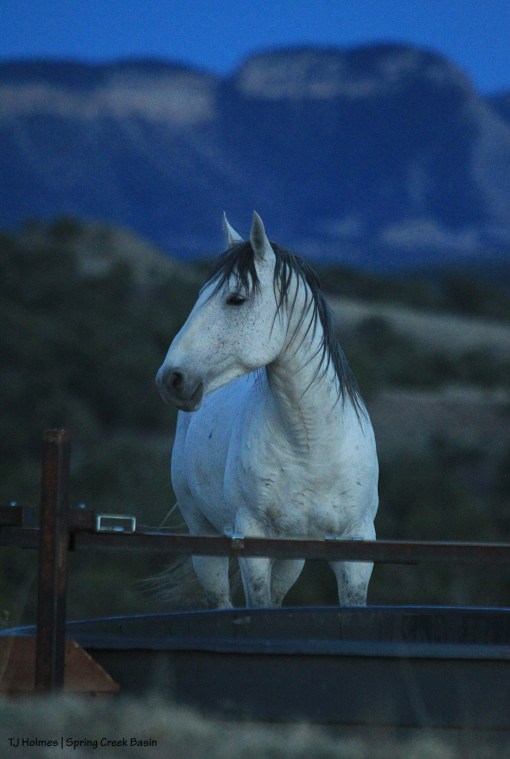
Wild stallion Ty (see him? just right of center) made an appearance as students hiked to the work site yesterday morning.

032718asb2

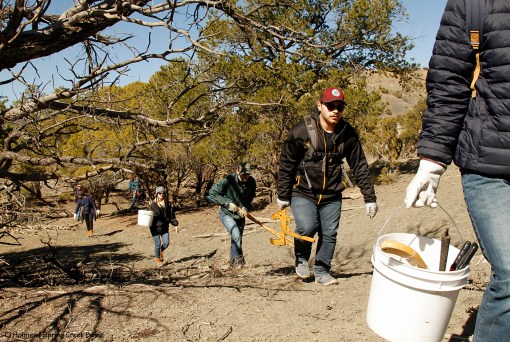
Because of the work by the Forest Service mule pack string last year, the students carried just tools in and old wire out. Pictured are Austin (with the bucket), Xavier, Jim, Erin, Gracie and a couple of others.

032718asb3

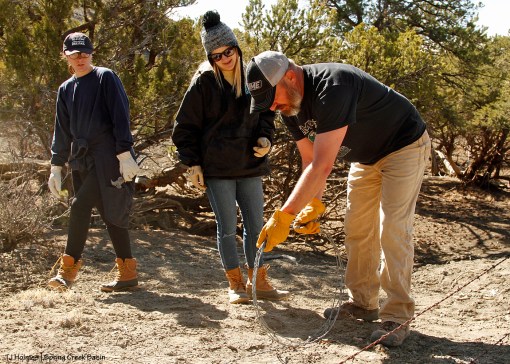
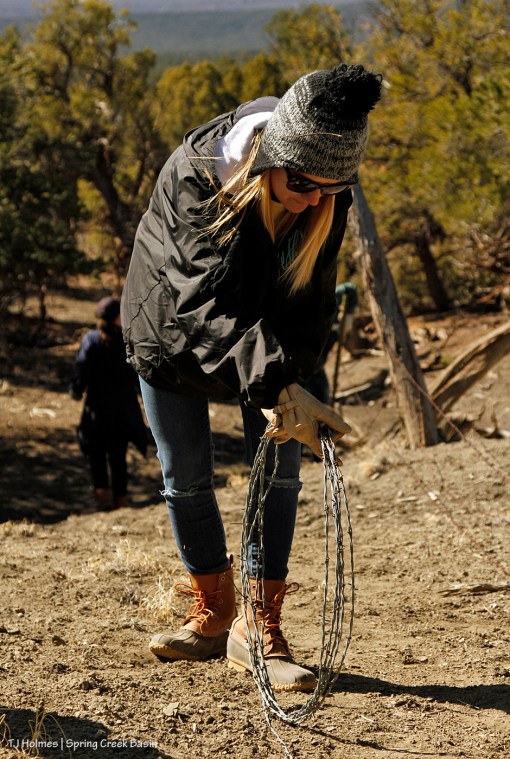
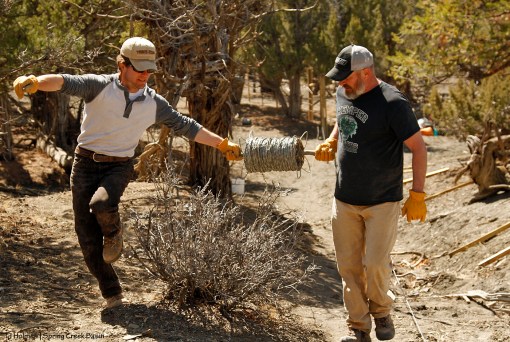
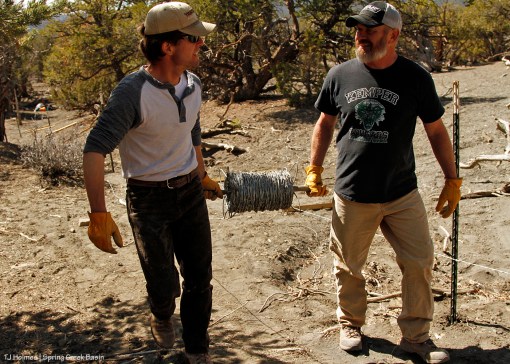
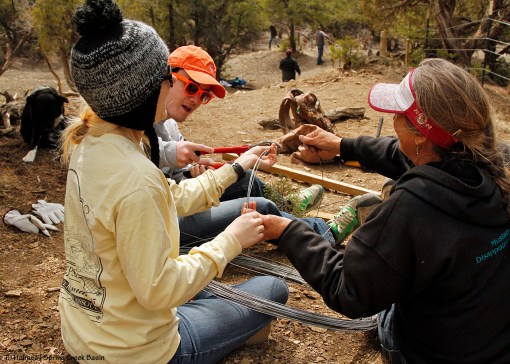
Our esteemed herd manager, Mike Jensen, modeled a full beard for this year’s alternative spring break. We like it! But apparently, his family doesn’t. 🙂 Erin was starting to roll a strand of old wire …

032718asb4

… and Mike came up the hill to show Erin and Gracie how to roll the barbed wire to get it to stick together.

032718asb5

And then they were pros! (If you don’t believe me, check out the last photo in this post.)

032718asb6

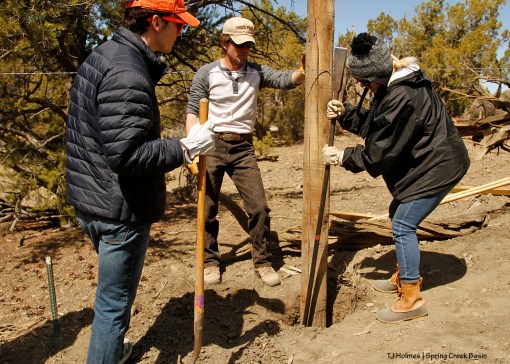
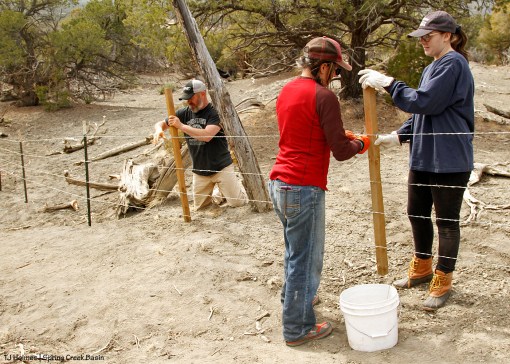
In this last stretch of fence line, we needed to remove some old T-posts and pound new ones to replace old juniper posts, so Erin stepped off the distances between posts, and Xavier dropped the posts where she indicated.

032718asb13

Range tech Justin Hunt (left) watches range specialist Garth Nelson as he saws off the end of the horizontal post of a new H-brace held by Mike while our trio of awesome BLM guys built the H-brace at the end of the line. The post was bolted at both ends and then cross-wrapped with wire to hold the tension of the wire strands.

032718asb16

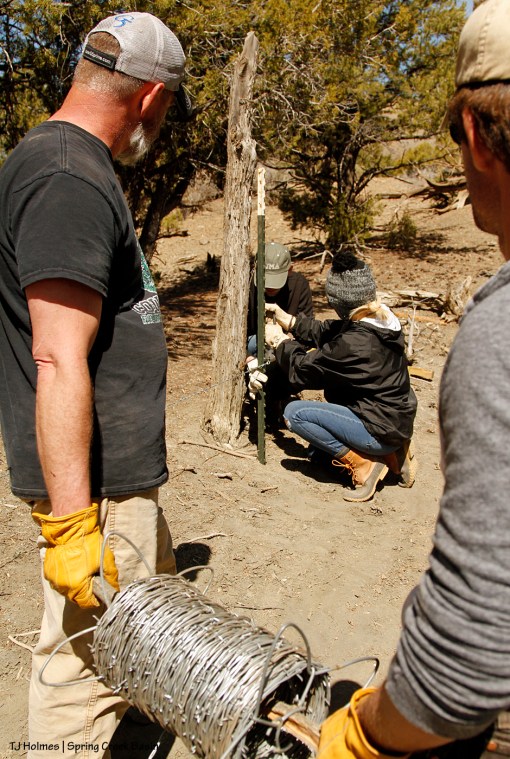
Because there was a steep little drop from the end H-brace (to the right), Justin helped Erin and Austin dig a hole for a big post to help hold the tension of the wires.

032718asb19

We have used these measuring sticks for a lot of years now. We start with the bottom wire and roll them out and tighten them and clip them from the bottom up. The measurements are wildlife friendly, so elk calves and deer fawns can crawl underneath the bottom, smooth-twisted wire, and adults don’t get caught between wires when they jump. The top strand also is smooth-twisted wire. The middle two strands are barbed wire, to keep cattle (outside the basin) from pushing against it.

032718asb20

Mike and Justin unroll another strand of wire from down the hill up the hill.

032718asb21

And I had to include this pic that shows the camaraderie between our BLM guys. We’re really grateful to have all three of our guys. They make the work fun. 🙂

032718asb22

Here, Mike and Justin paused for a minute to let Erin and Jim attach a clip to the last T-post so they didn’t get tangled in the next strand. A great thing about having many hands for a project like this is that we’re always busy with the next step, and it goes really fast!

032718asb23

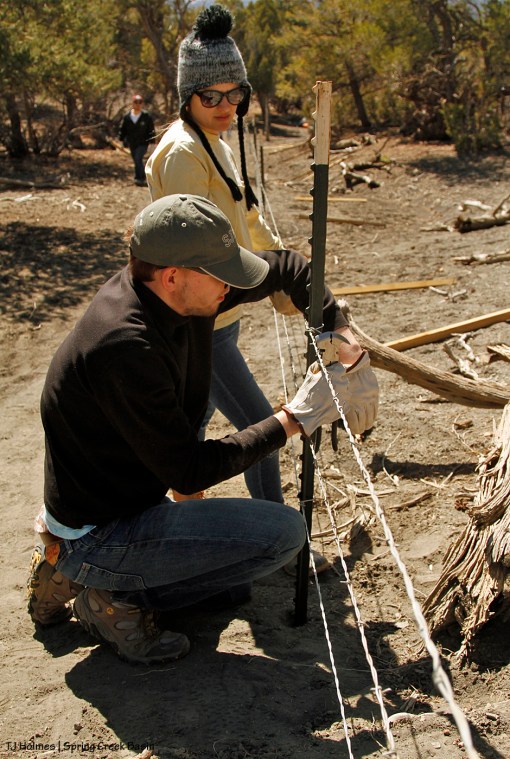
Here, Jim and Erin are up to the third wire strand. Notice the wood staves laid out on the ground along the fence. Students put those in place so they’d be ready when all the wires were tightened, clipped (to T-posts) and stapled (to wood posts).

032718asb24

And there’s the new fence – all four strands. Gracie and Austin are rightfully proud of their work!

032718asb25

One of the last steps of the process was to cut pieces of wire in order to secure the wooden staves to the wire strands. Advocate Kat Wilder (left) helps Erin and Austin cut pieces of uniform length while Xavier visits with Jessi, one of Kat’s canine companions.

032718asb26

This is a closer look at the wire-piece cutting, looking down at the fence the students just built. We set up a system where the other students, MK, Garth, Justin and Mike were wiring the staves to the strands while Kat, Erin and Austin cut the wire pieces for some students to carry down the hill. They cut about 100 pieces to attach the staves in this last stretch of fence!

032718asb27

Gracie and MK and Mike wire staves to the fence strands. The staves help support the fence and keep the strands at the same spacing. Plus, they provide a very visible barrier for the horses and other wildlife.

032718graciejessi1

The pups were definitely a hit with the students. 🙂 This is Gracie and Jessi.
032718mizzoucrew2018

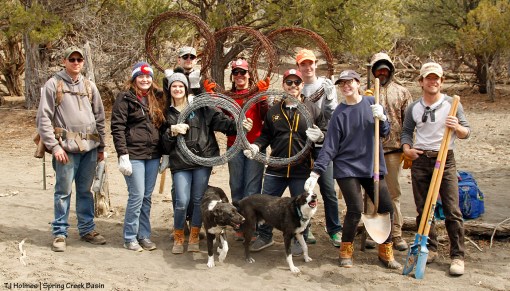
Mizzou students, once again, we thank you, thank you, thank you all for your work! We love the alternative spring break program and the benefits it brings to our mustangs (and other areas of our public lands). We really couldn’t have done this without ya’ll!

In honor of this year of the Winter Olympics, students show off the old wire rolls that they carried out of the basin at the end of their day of work. From left to right: Garth Nelson, Jessica (who is getting over being sick; we hope she feels better to enjoy her trip!), Erin, Jim, MK Gunn, Xavier, Austin, Gracie, fun-loving Mike Jensen and Justin Hunt. Also pictured are Jessi and Bow, who got and gave more cuddles than anyone all day. 🙂

THANK YOU, MIZZOU!!!!!!!!!!!!

We hope you enjoy your week of beneficial work in Southwest Colorado. We are so grateful that you chose to spend your vacation helping us preserve and protect our beautiful public lands, including Spring Creek Basin. 🙂


Steadfast

22 03 2018

Shane, Hollywood

From American Wild Horse Campaign:

The Omnibus spending bill is finally out, and America’s horses are protected for the next six months!

This is huge! Congress heard the voice of the American people and maintained protections for wild horses and burros against slaughter and mass killing. The spending bill also maintains the de facto ban on U.S. horse slaughter by continuing the prohibition for federal funding of USDA horsemeat inspections.


Holding that peace

20 03 2018

Band

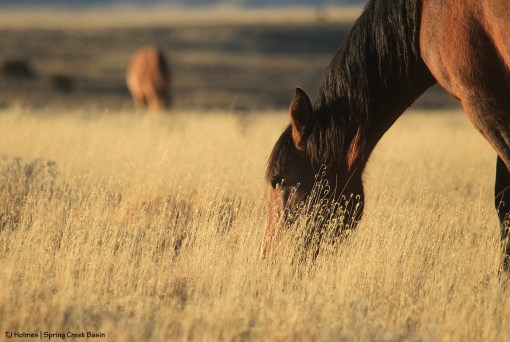
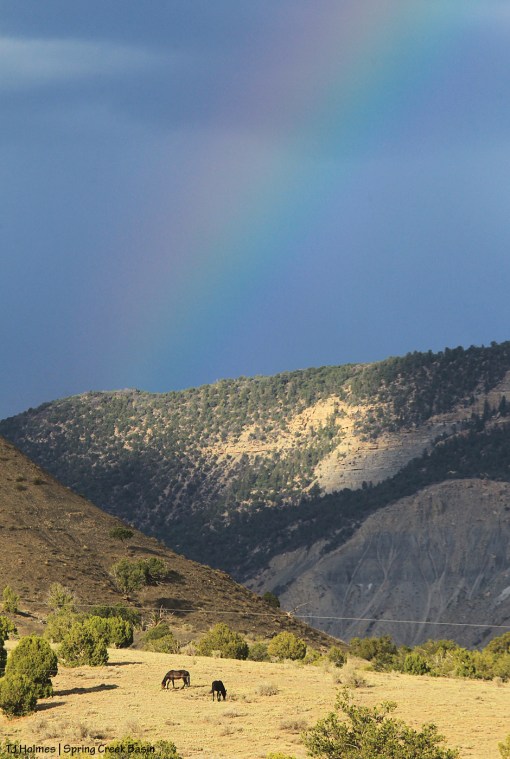
This isn’t an image I would ordinarily consider sharing on the blog. … But the quality of the light, matching the peace of the quietly grazing mustang mares is simply divine.

And that is infinitely worth sharing.

****************************************

From American Wild Horse Campaign:

Since we’re expecting some sort of action on either Thursday or Friday of next week in Congress, we thought it might be a good idea to have a final, collective push to urge our supporters to contact their Congressperson as well as leadership.

We could call it Take Action Tuesday and have the push on Tuesday, March 20. The Call to Action would be:

1. Call the Leadership of the House and Senate. See numbers below. Simply deliver this message (or however your group would specifically like to word it):

 “I’m calling to urge Senator/Representative _____ to keep horse slaughter out of 2018 spending legislation by maintaining the Senate versions of Agriculture and Interior Appropriations bills. Please stand with the 80% of Americans who oppose horse slaughter and want our wild horses and burros protected and humanely managed, not killed or slaughtered.”

  1. Contact your own Representative and Senators now. Tell them that you stand with the 80% of Americans who oppose killing wild horses and burros and want them protected and humanely managed on our public lands. 202-224-3121


Doing good work

19 01 2018

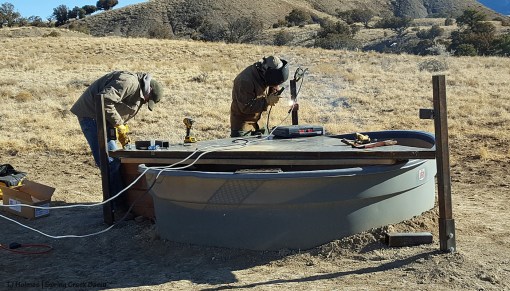
A couple of days ago, we met up with our fabulous BLM guys to install the evaporation cover over the new trough – connected to the new water catchment apron – that we installed in 2016.

011717troughcover1

BLM rangeland management specialist Garth Nelson, left, figures out which drill bit to use to drill holes through the metal of the evaporation cover to attach it to the supports BLM range tech Justin Hunt is welding to the vertical posts. The post at right already has a piece welded to it.

011717troughcover2

See the metal thing inside the trough in front of Garth? That’s the critter ladder the guys built. It allows birds to get to the water or an animal that falls into the water to get out. Garth drilled a couple of holes and wired it to the edge of the trough.

011717troughcover3

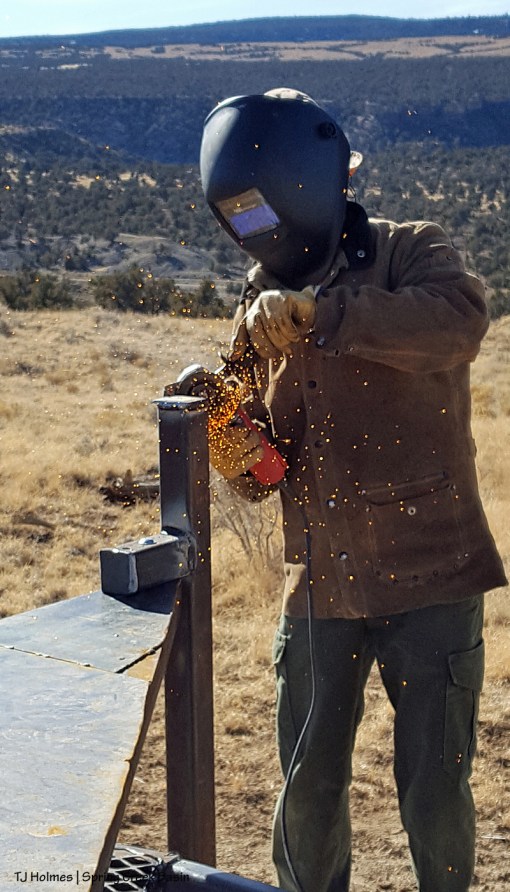
Once everything was in place, Justin attached small square plates to the tops of the three vertical posts and welded them into place, then used the grinder to smooth the square edges. At the near corner, you can see the “trap door” the guys built into the cover so the float below it is accessible for any work or replacement that needs to be done. In the background, range specialist and herd manager Mike Jensen, right, talks with Garth while visiting with Bow, one of Kat Wilder’s dogs.

011717troughcover4

Sparks fly as Justin grinds the edges of the post caps to smooth roundness.

These guys thought of everything!

The cover will help preserve the water in the trough from evaporating so quickly. And with its installation, the new water-catchment project is officially complete. In warm weather, this will provide a second source of clean water for the horses.

Snow is in Saturday’s forecast. Please send good thoughts. This dry weather has to end.


Glad tidings!

4 01 2018

S'aka

S’aka wants to help ring in the new year. 🙂

************************

In other news, for those of you in the Denver area, please check out the following comment the blog received yesterday from Longmont librarian Devon Yost-Smith:

Hello,

I am a Librarian at the Longmont Public Library. We have invited Pulitzer Prize-winning author and national correspondent for The New York Times, Dave Philipps, to come speak at the Library about his book “Wild Horse Country: The History, Myth, and Future of the Mustang”. He will outline the history and myth of the wild horse, how both helped create the current debacle, what science can tell us about sustainable ways to preserve the wild horse, and some of the last wild places in the west where the herds live.

I was hoping you might be interested or might pass on the word to your
readers.

The event takes place on February 1 (**note date change**) from 7-8pm at the Longmont Public Library.

Registration is required, it is free, and additional info is available on our website.

Thank you.


If you’re in the area, please show your support for wild horses and burros! Note that the event is free, but you need to register (click here to go to the library’s event site).


They’re totally rock stars

12 08 2017

080917SCBphotoBLMoffice1

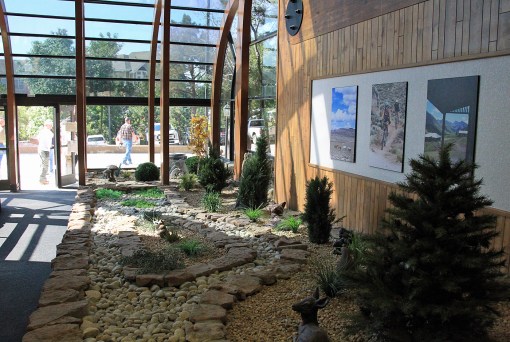
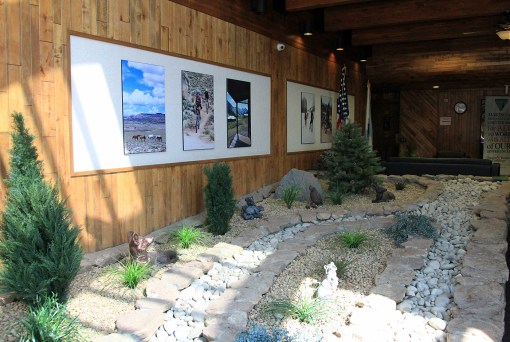
Earlier this week, I visited the BLM state office in Denver (Lakewood). As we walked into the entry way … I was drawn to the photo of mustangs on the wall (naturally, right?!).

080917SCBphotoBLMoffice2

Photos also were on the opposite wall, but the mustangs catch your eye (of course!). (Above: Already out the door is BLM’s Ben Smith, wild horse and burro specialist based in Grand Junction, and holding the door while yours truly geeked out taking photos of a mustang photo is Jim Hyrup, president of Friends of the Mustangs, which is the group that advocates for Little Book Cliffs mustangs near Grand Junction.)

080917SCBphotoBLMoffice3

This is the view of the photo as we walked into the building. It’s the view EVERYONE has as they walk into BLM’s state office!

I stopped to look closer … and was about to ask if anyone recognized the horses … when *I* suddenly did.

I might have gotten a little loud. 🙂

Pictured are Hayden, Jif, Chrome, Two Boots and Rio (now named Legado, owned by an NMA/CO board member). The BLM people didn’t know who took the photo, but it had to have been taken in 2010.

Because our wild beautiful ponies are just that famous. 🙂

In other pretty awesome news, we were there to support friends who advocate and volunteer and partner and collaborate with BLM for the good management of our Colorado mustangs on Colorado’s herd management areas and wild horse range: Sand Wash Basin, Little Book Cliffs, Spring Creek Basin (specifically) and Piceance-East Douglas (coming soon, we hope!). BLM folks, including Laria Lovec (on-range management), Steve Leonard (off-range management) and Ben Smith (wild horse and burro specialist based in Grand Junction), were there to recognize folks including Michelle Sander and Aleta Wolf (with Great Escape Mustang Sanctuary and Sand Wash Advocate Team), and Jim Hyrup (president of Friends of the Mustangs).

FOM has been involved with Little Book Cliffs mustangs for more than 30 years and have been using PZP for more than a decade. SWAT and GEMS are about 5 years old, and advocates have been darting in Sand Wash Basin for at least the last three years. We are so happy and proud to support their efforts and call them friends and heroes/heroines for mustangs!

080917BLMwildhorsepartners1

Left to right: Steve Leonard, Laria Lovec, moi, Michelle Sander, Aleta Wolf, Jim Hyrup and Ben Smith.

Many of our valued volunteers couldn’t attend the meeting, but Stella Trueblood and Connie Wagner (SWAT), Marty Felix and Billie Hutchings (FOM), and Pat and Frank Amthor and Kat Wilder (Disappointment Wild Bunch Partners) are standout folks who spend hours working for our mustangs – and have done so for years and years. Marty earns the longevity award for more than FORTY years with Little Book Cliffs’ mustangs! Pat and Frank Amthor have logged TWENTY years supporting Spring Creek Basin’s mustangs!

In the “coming soon” category, Dona Hilkey and Pam and Tom Nickoles have been visiting, photographing and documenting Piceance-East Douglas’ mustangs for at least 12 years. They’ve been working closely with BLM, and folks are close to forming an advocacy group for that herd (and perhaps casting an umbrella over West Douglas as well). When that happens, it will mean every mustang herd in Colorado will have the support of volunteer advocates!

THANK YOU to every one of our dedicated volunteers!

And THANK YOU to BLM for recognizing and appreciating their work for our Colorado mustangs!


Assessments, Day 2

22 06 2017

Yesterday was Day 2 of the Land Health Assessment in Spring Creek Basin.

Yep, it was hot. Yep, the gnats were still bad (but yours truly remembered her head net).

Mike Jensen, Justin Hunt and Nate West were back to assess more of Spring Creek Basin’s land health. We did some great sites, and a couple of them were higher, which allowed for great views!

062117mikejustinsite1

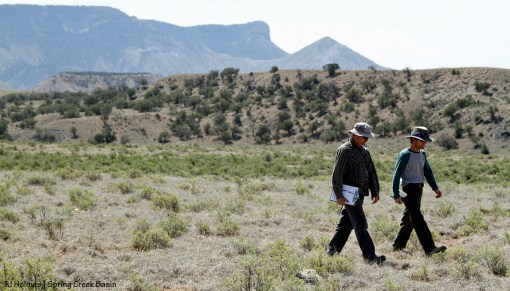
BLM range management specialist Mike Jensen and range tech Justin Hunt walk a site in Spring Creek Basin with views of McKenna Peak and Temple Butte.

062117justinmikephoto1

At the end of each site assessment, Justin and Mike took pix in two directions for future comparisons.

062117justinmikephoto2

We don’t have many trees in Spring Creek Basin, so many of the sites were the wide-open places (as in the photos above). But we had a couple of sites that were in pinon-juniper woodlands. This site (and the one pictured above) had really great grass.

062117justinboulder1

And then we headed uphill for our last site of the day.

Spring Creek Basin

Which led to an amazing view. Straight ahead is Brumley Point, and at the farthest left is one side of McKenna Peak.

062117justinmikehikecliff1

Those who go up must go down! Especially when the truck is at the bottom. 🙂

062117justinmikenate1

Big thanks to BLM’s Mike Jensen, Justin Hunt and Nate West for persevering on these hot days to assess the land health of Spring Creek Basin. Again, as far as I can tell, we’re in pretty good shape.

Horny toad held by BLM wildlife biologist Nate West in Spring Creek Basin.

We think this little guy (gal?) might agree. 🙂


Assessing the land health of Spring Creek Basin

21 06 2017

Baby, it’s hot out there.

The mercury hit at least 100 degrees Tuesday in Disappointment Valley. Might be hotter today.

But we don’t shirk our duties when it comes to assessing the health of our range – which directly affects the health of our mustangs – in Spring Creek Basin. 🙂

062017natemikeSCB1

Don’t let the long sleeves fool you. This was our last site of the day, and it was toasty out there. We were glad for every bit of brief cloud cover that came our way. On the right is our excellent herd manager, Mike Jensen (rangeland management specialist), and on the left is wildlife biologist Nate West, both with Tres Rios Field Office. In the background, of course, are McKenna Peak and Temple Butte.

062017justinnatemikeSCB1

Here, Mike and Nate – and our range tech, Justin Hunt – are checking examples of particular things that we were looking for, depending on what kind of site we were assessing – here, “basin shale.”

At each of the five sites we did (we have more to do), we completed a 17-point checklist to assess such things as “presence of water flow patterns,” “bare ground,” “amount of litter movement,” “effect of plant community composition and spatial distribution on infiltration and runoff,” “functional/structural groups” (what kinds of plants – annual/perennial grasses, shrubs, forbs – we should expect to find), “expected annual production” (which we are supporting with actual vegetation monitoring studies) and “potential invasive (including noxious) species (native and nonnative).” Each site has a list of expected standards that we should find according to soil types, including “basin shale,” “clayey salt desert” and “salt flats.”

Pretty fascinating, really! For the most part, my civilian observation is that our range is pretty healthy in Spring Creek Basin.

Our mustangs do seem to support that assessment. 🙂

Thanks to Mike, Justin and Nate for trekking to the basin on the hottest days of the year to perform these assessments that positively affect the good management of our mustangs!


To arms

28 05 2017

Spirit

By now, you all must have heard about the explosion of disbelief and outrage about the 2018 budget proposal. No one seems to be happy … and wild horse and burro advocates are no exception.

My friend Pam Nickoles has a succinct post with pertinent links on her blog.

More information is available on all the major advocacy sites, and news sites are covering the issue as well.

Surely we can work together for better treatment and management for our wildlife.


Celebration in Piceance-East Douglas

11 05 2017

Last weekend, BLM folks from the White River Field Office in Meeker hosted a “celebration” of the mustangs in the Piceance (“pee-antz”)-East Douglas Herd Management Area. An unofficial count of around 40 people made the trip to talk to each other and BLM range specialists and managers, and take tours of this amazing – 190,000-plus acres! – range in northwestern Colorado.

The wildlife in this area of the state is abundant and varied. It also – until recently – had a widespread oil-and-gas presence (still there, just not as widespread). Interestingly, friends say that those workers are among the friendliest they encounter while looking for mustangs, and they’re always happy to point out the locations of horses for my friends to find and photograph. Cattle and sheep ranching also is abundant in the area, and my friends pass on information about livestock and fences to the ranchers via BLM.

During this celebration, three tours were offered throughout the day, and we had the opportunity to speak with people from all backgrounds: oil-and-gas workers, ranchers, mustang advocates, local and not-so-local BLM employees, and others. We all have a stake in preserving Colorado’s public lands and wild places, and the wildlife those lands shelter, so it was a good coming together of people and ideas and planning to see how those interests can merge and move forward for the benefit of all involved.

This wasn’t my first visit to Piceance-East Douglas, and it certainly won’t be the last. BLM does want to conduct a roundup and removal of horses here (population estimate is 400-plus horses). But it also wants to start a PZP program, which would mean that – at that point – all of Colorado’s mustang herds would be managed with scientifically-sound fertility control, enabling more horses to live wild and free on their home ranges.

My friends Tom and Pam Nickoles have been visiting the area since 2006, learning about the mustangs, learning about the area … learning all the intricacies. They work closely with the BLM range specialist and herd manager, Melissa Kindall, as well as a local woman who has been documenting the mustangs for many years, Dona Hilkey. Friends of the Mustangs, the advocacy group that helps BLM with the Little Book Cliffs herd near Grand Junction, also had members present, and they might be able to provide human power and some funding to help establish a local advocacy group for the Piceance-East Douglas mustangs.

Good things are going on in Piceance-East Douglas and all around Colorado!

Not too many photos from this last visit, as I was more interested in looking wide-eyed at everything, but here are a few of the gorgeous mustangs that call Piceance-East Douglas home:

050617baystallion1

This handsome guy was with a young grey stallion and an older sorrel mare. This was the only photo I came away with that shows some of the long views available from this herd management area.

050617younggreystallion1

This is the young grey friend of the above stallion, showing the *short* sagebrush. Most of the sage in this region is TALL – as in, jungle-tall. Sometimes it’s hard to see any more of horses (or cows) than their ears. No pix of the mare because – ironically – she was too close for my lens. Most of the Piceance-East Douglas mustangs are extremely wild and wary, which is awesome! But challenging for photos. 🙂

050617herculesband1

Case in point: This handsome family was pretty OK to watch us from a distance while we stood at the Jeep, photographing from the road. But when I took a few steps away from the vehicle, to get a better view across/over the sage and other vegetation, that was enough of a trigger for them to bid us farewell.

Young grey stallion by himself in Piceance-East Douglas Herd Management Area.

This hunky young guy was all alone. We walked out into the sage a short distance (also mindful of ticks!), and he came to investigate …

Young grey stallion by himself in Piceance-East Douglas Herd Management Area.

… then high-tailed it away from the two clicky ladies. 🙂 Isn’t he magnificent?

Some take-away facts from Piceance-East Douglas Herd Management Area:

  • The mustangs are gorgeous with a capital G.
  • The region is large. Huge. Ginormous. There are a lot of roads. The roads are in relatively good condition (probably in large part because of the oil-and-gas access), but, as everywhere, beware wet conditions.
  • The scenery is large. Huge. Ginormous. Especially as seen from Cathedral Bluffs – and other places. 🙂
  • The sage is tall and thick, and sometimes it’s hard to see even a few feet beyond the road.
  • What an amazing place to explore!