(BLM rangeland management specialist Garth Nelson pushes dirt into a trench laid with pipe from the water tanks while herd manager Mike Jensen, range tech Daniel Chavez and seasonal weed-sprayer Jim Cisco shovel dirt into the trench along the “front” of the tanks to cover the pipe. A roof with a gutter will pipe rainwater/snow into the tanks, and the pipe in the trench directly in front of me as I take this pic will run water to the trough, which will be on a float.)
We’ve had some big doin’s out in Spring Creek Basin recently.
Remember when our BLM folks (herd manager Mike Jensen and Tres Rios Field Office Manager Connie Clementson) updated our herd management area plan last year? Remember the two new water catchments that were proposed (and approved) in that EA?
Our first tanks for the first of those water catchments are in the ground. 🙂 That’s phase one of the project; phase two is coming. It will take me a bit to consolidate several days of work into a nice little post to detail their work. That’s coming, too. But just in case you wondered what the heck our BLM guys are doing out in Spring Creek Basin these days … this is a bit of an answer. 🙂
And in best of all news, we actually got a decent drizzle of rain in Disappointment Valley yesterday! No, the catchment isn’t at the point of catching that rain, but soon. … Hopefully very, very soon … !
**********
If you’re in Norwood, Colorado, this evening, join us at The Livery (1555 Lucerne St.) for Kat Wilder’s first in-person reading to celebrate the publication of her memoir, “Desert Chrome”! Folks will start to gather around 6 p.m. Bring your own camp chair, picnic and beverage for an outdoor gathering. San Miguel County and Colorado state Covid protocols will be followed.
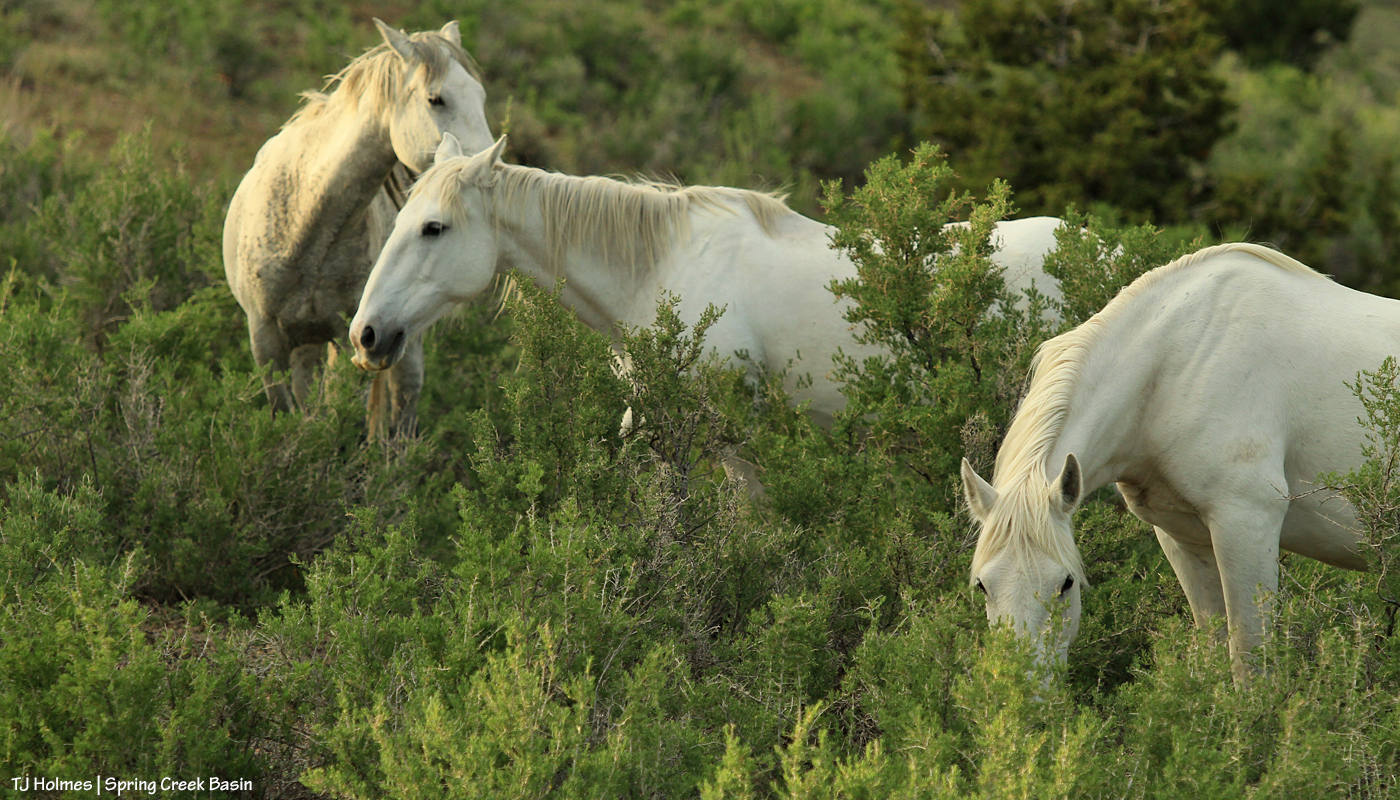
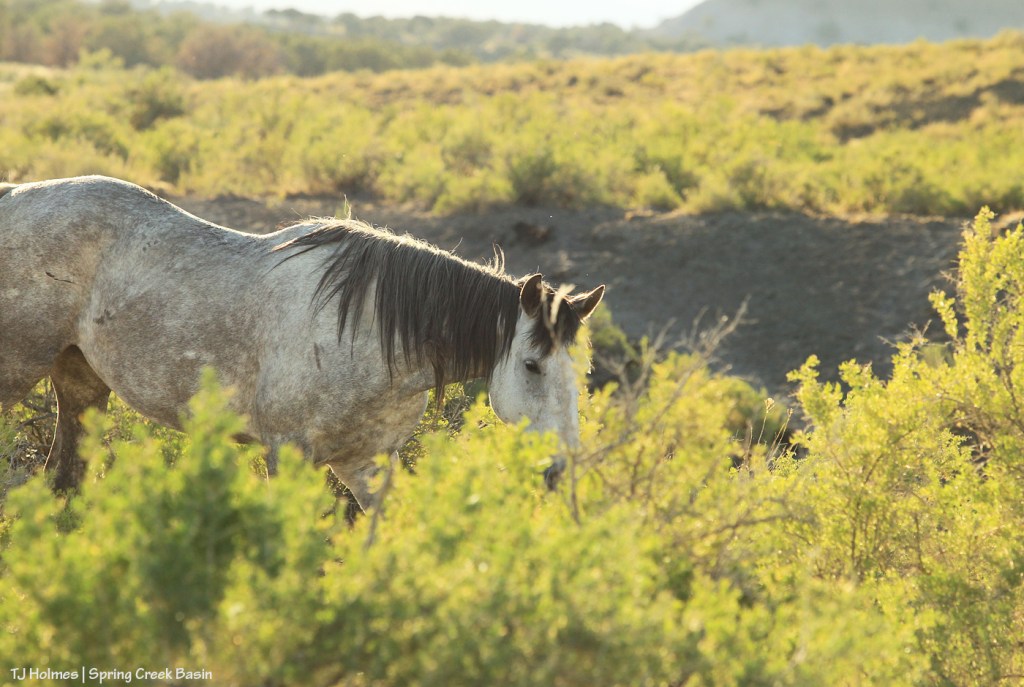
The grey amiga girls – Alegre, Maia and Houdini – were having a greasewood feast a couple of evenings ago. I recently learned that greasewood is a source of keratin, which contains protein, and maybe that’s why the horses like it so much. … I still think it’s cuz it tastes like ice cream. 🙂
**********
In other news, don’t forget that Maria’s Bookshop in Durango, Colorado, will be hosting Kat Wilder for a reading of her new book, “Desert Chrome” – which is on bookstore shelves now! – starting at 6:30 p.m. Mountain Time. Go to Maria’s Events Calendar page, then scroll down just a bit to find the Zoom and Facebook Live links to Kat’s reading.
Garcia Street Books did an interview with Kat, and she reads snippets from “Desert Chrome” while talking about observations that led to organization, etc. Watch here.
And the Durango Herald (disclaimer: the Herald is the former employer of this blogger) published a wonderful review of “Desert Chrome.” Read it here! Then order your copy and read it for yourself!
Longtime readers will recognize Kat’s name as an advocate for Spring Creek Basin mustangs. In this vulnerable, deeply touching and wide-ranging memoir, she recounts her life’s journey that eventually led her to Disappointment Valley and Spring Creek Basin – among earlier and parallel events that shaped her among heartbreak, water and wilderness. About the mustangs, she writes about getting to know them and the great strides we’ve made in the management of our herd with the use of PZP.
Kirkus Reviews calls it “testimony to the healing power of wildness” and “a spirited and impassioned chronicle.” And it is, without a doubt, all of that.
Suzanne Roy, fierce director of the American Wild Horse Campaign, wrote: “Kat Wilder’s beautifully written memoir takes us on a journey of a life lived on the move, full of love, loss and searching, finally finding peace among a herd of mustangs in Colorado’s magnificent Disappointment Valley. Wilder’s insight into the wild horses, why they’re worth saving and how to save them, will be of interest to anyone concerned with preserving the West’s last remaining wild spaces and the wild animals that inhabit them. A must read.”
Maria’s virtual event for “Desert Chrome” will start at 6:30 p.m. Thursday, May 20, on Zoom and Facebook Live. Check Maria’s events calendar page for details.
Kat’s first live reading will be from about 6 to about 7:45 p.m. Saturday, May 22, at The Livery in Norwood. This is basically our backyard! Head over to Between the Covers’ Facebook page to find out more.
On Thursday, June 10, Ridgway’s Sherbino Theater will host Kat for a live reading from 7 to 8:30 p.m. Visit the website for tickets, on sale 30 days before the event. Ridgway’s also fairly local to us, and several mustang friends call it home.
If you’re in Torrey, Utah, on Saturday, June 26, stop by the Entrada Institute for a live reading.
Be sure to find and follow Kat on Facebook to keep up with other events as they’re scheduled, and I’ll post reminders about the above readings close to their happening dates.
(Kathryn Wilder’s “Desert Chrome” with Chrome’s newest grandson, Jasper, with Brumley Point and Temple Butte in the background; Spring Creek Basin Herd Management Area, Disappointment Valley, Southwest Colorado)
It seems to be a *thing* for people to highlight memories from the year as the year comes to a close. It’s natural to want to remember those beautiful times, which our photos are particularly primed to help us do. That’s the ultimate goodness of *pictures*.
Over the years, I’ve gotten away from long, rambling explanations and photo-heavy blog posts in favor of single photos and a sprinkling of words – every day – to highlight a moment in a day on the range with the mustangs. So today’s post, at the end of a long year that challenged our endurance, is a way to give a little better explanation of what was happening in the instant the shutter snapped on that moment. They also serve as a challenge to find ways to show my beloved mustangs in their natural beauty … and all the infinite reasons why they should be valued and preserved (in general), in addition to explaining why I do what I do to protect this herd in Spring Creek Basin (in particular).
What follows is one photo for each month. Some have been on the blog previously; others have not. Onward.
January
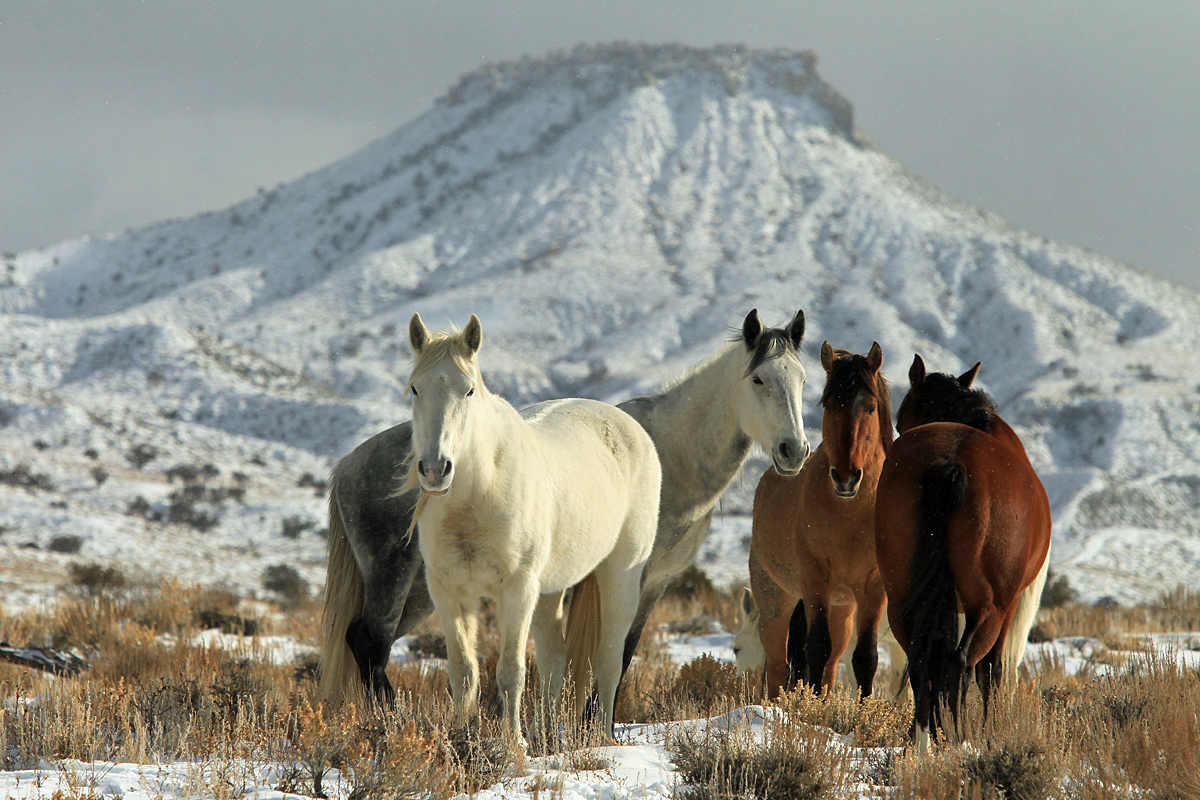
In January, we had fresh snow, and I was happy to find Hollywood’s band in the scenic eastern part of the basin, a short hike from the road (I may even have strapped on my snowshoes). McKenna Peak and Temple Butte are iconic landmarks, and I love to feature them in photos behind/above the horses. Because of the way they were standing, however, Brumley Point, seen here, made the obvious background (the peak and butte are farther to the left). Even though Shane had her rear toward me, the horses were so relaxed, their winter coats so velvety thick and glowing in the low winter sunshine, their demeanor so peaceful, this became one of my favorite images of the day (and month).
*****
February
We knew we were in trouble early in the winter when Mother Nature simply didn’t give us the amount of snow – aka moisture – we would need for the rest of the year. … For plants to grow, for ponds to fill, for creeks to flow (for very long). Sure, it made getting around – driving and hiking – a piece of cake, but in the case of Colorado (and much of the Rocky Mountain West), where we absolutely depend on winter white for summer green, it was looking bleak. I had hiked out to an area where a couple of bands were grazing, and later, as they started to line out toward a pond, back toward the road, I meandered along with them. … And then the sky exploded. When that happens, you’re a) glad you’re with mustangs, b) ecstatic to see Mother Nature’s art come to life and c) uber-aware of time and how it flies. The horses were following a trail, so I picked a likely spot and left the trail and set up the shot. As the horses trotted by – following some and followed by others – I hoped I remembered everything about photography that I’d ever learned … and then I hoped the computer would reveal that everything had literally trotted into place in even one rectangular, finite image. … Voila. 🙂
*****
March
Most people know that, as a volunteer for BLM, I dart (some of) the mares of Spring Creek Basin every spring with fertility-control vaccine PZP. Does it work? In September, we will celebrate a full decade of NO ROUNDUPS in Spring Creek Basin. Do we still have foals? Yes, a handful or so every year. I have my own reasons for not showing them on the blog. PZP figures into this explanation because Sundance is the band stallion of the mare I darted the day I took this photo. It’s worth slowing down, even in the face of a job to be done, to appreciate peace … and the mustangs who bring so much peace to me.
*****
April
Speaking of foals, this is our first of the year. Born on Easter Sunday, she is mother Mariah’s second foal. I moseyed about with them for a fair amount of time as they grazed. As the sun was nudging the far western rim of our little world, the horses paused on a ridge trail on their way to water, and Mariah checked that all was well with her baby girl. The most fleeting moment in time. The most beautiful. The most treasured. … The most natural that goes on around the world with mothers and babies of every hue and color and species. Because I know this mother and this baby, that one moment seemed super, ultra, amazingly special.
*****
May
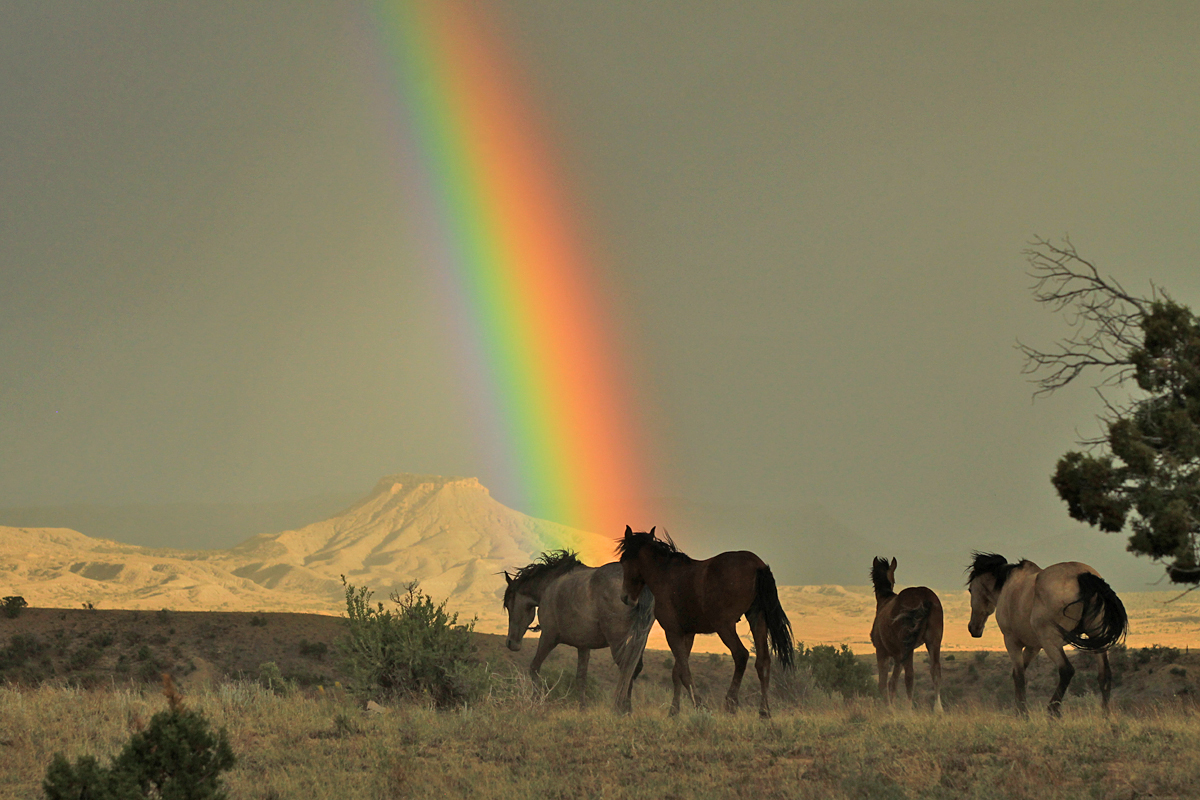
This – THIS! – was one of those astounding moments when you literally are in the most best place at the very most bestest time, and you cannot believe your luck and goodness and that karma is smiling on you. … And then the horses won’t cooperate. 🙂 There was not one but TWO utterly spectacular rainbows against a sky promising even more rain (the second arch was out of the frame to the right). It was windy, and the horses were edgy. There were (and are) a couple of bachelors with the band, and that energy, combined with the storm, meant that they really weren’t in the mood to line up with ears up showing perfect conformation stances against the wild wonder of Spring Creek Basin and a rare rainfall. … So I “caught” them as they were walking on, and it was enough to remember the day and their wildness and their freedom to move under the magic.
*****
June
This is an image that happened almost without me being there to see it, let alone capture it on digital media. I was with a couple of bachelors on a hill far, far (enough) away, thinking they were my last quiet visit of the evening. But one of the bachelors was interested in something besides me (ah, the story of my single life!), and as he focused on *it*, I heard a sudden, sharp whinny in the distance. One whinny, three bands – plus a bachelor after my guy trotted out to meet them. I had to hustle back to the Jeep and drive closer, and then hurry out to them as the sun was sinking (neither planetary roll nor mustang waits for the photographer to get her act together – or close the gap in distance). And although it was terribly dry in June (as it had been and would be), it’s not often (almost never) that enough horses are together – and moving enough – to cause enough dust to rise for a shot like this to even be possible in the basin. So, even from drought, something beautiful.
*****
July
Maybe readers know (or maybe they don’t) that Storm is one of my very best most absolute favoritest stallions in the basin. From the time he appeared with his curled ear tips, big blaze, stockings almost to his hocks and shining like a polished penny next to his mother, still with the blood of his birth on her hocks and tail, he has had my heart curled around his perfect hooves. … Which means that – of course – Storm’s band is one of, if not THE, most elusive bands in the basin (!). Every sighting of them is like a dream. That said, I spent a fair amount of time with them this summer, and they led me into some heretofore rarely visited areas and showed me seeps I never knew existed. Though there are few of our iconic landmarks in the great expanse of background in this photo (Filly Peak and Flat Top are there), the soft light (we did have some smoke this summer …) and Storm’s handsome face alert as he checked on his band members, already at the top of a ridge that he was grazing his way up, seem to represent everything that I love about Spring Creek Basin and its wildest back of beyond.
*****
August
Did someone mention smoke? Haze from wildfires burning, burning, burning in Colorado and across the West was the story of our summer in some (many) ways. The drought that allowed (caused!) the fires to start and burn was unrelenting and brutal (and is ongoing). Still, the mustangs persevered and continued to show their resilience and beauty. Piedra, loveliest of mares, is a goddess of grace. Another image of beauty plucked from a reality not so pretty.
*****
September
In September, the heat starts to relent, the angle of light starts its descent, and still we pray for rain. The band I was with this day was grazing their way across a hillside, above an arroyo. The stallion had descended to the arroyo, and a couple of mares had followed and were already across. I looked up to check on this mare and her yearling, and though I couldn’t see beyond the scree of rock where they stood, apparently she didn’t like the look of what SHE could see. Here, she’s turning around, so after I took this shot, I went farther down the hill with the others to encourage her to find a path she liked better. Not long after this, that ol’ sun disappeared behind the long ridge on the other side of this narrow valley, and the golden light was dimmed at the close of another day.
*****
October
In October, we got a heavy, wet snowstorm that lasted roughly half a second. … OK, maybe a liiiiitttttttttttlllle longer than that (but not by much). The ponies did as the ponies do, and soon, they were grazing about in mud, not snow, and I like to think none of us minded one little bit. Although it makes the camera hunt for auto-focus, I love to be out with the horses while it’s snowing because in addition to the flakes in the air and on the horses’ noses and eyelashes, it’s just plain beautiful.
*****
November
Lingering snow, lengthening drought, a mature stallion and an up-n-comer. Life goes on, even as the calendar’s days get shorter. In all these years of photographing the mustangs, it is the late – and late-in-the-year – light that I love the best. If I worry and fret (and I do) about lack of moisture and what the coming days and seasons and year will bring, still, I seek that beauty and these amazing horses that allow me brief visits and journeys along their paths – even, sometimes, while they are making the tracks. In my fortunate gratitude, I even find it.
*****
December
We might even close out 2020 with (a little) snow on the ground, and how wonderful would that be? I like to start the year with the things I hope to fill/find/expand on in the coming year, so horses, and snow, and love, and beauty, and days in Spring Creek Basin surely are on my agenda (which I try not to make!). As the soft light filtered through a smokeless sky on this day in December, the horses browsed for the dry stuff palatable enough to eat through the thin blanket of snow. They didn’t seem to mind the cold, or that maybe there was a bit less than in some previous years, or that a human being moseyed along with them, steadying a clicking black box on a black stick, sometimes talking, sometimes singing, mostly wondering how I could be so blessed in this life.
*****
Bonus
Because who doesn’t like – or need – a little extra? And to leave you with a hopeful thought: Just when you think it can’t get any better … maybe it can. 🙂
*****
Thank you *all* for reading along and following the mustangs of Spring Creek Basin. Together, we are a community of people who value wild life and all the beauty that unfolds within it.
Lexi and Mason from SMA brought five interested – and interesting – people to see this area that’s in the same county as Telluride (San Miguel) … and a world away climate- and geology- and geography-wise.
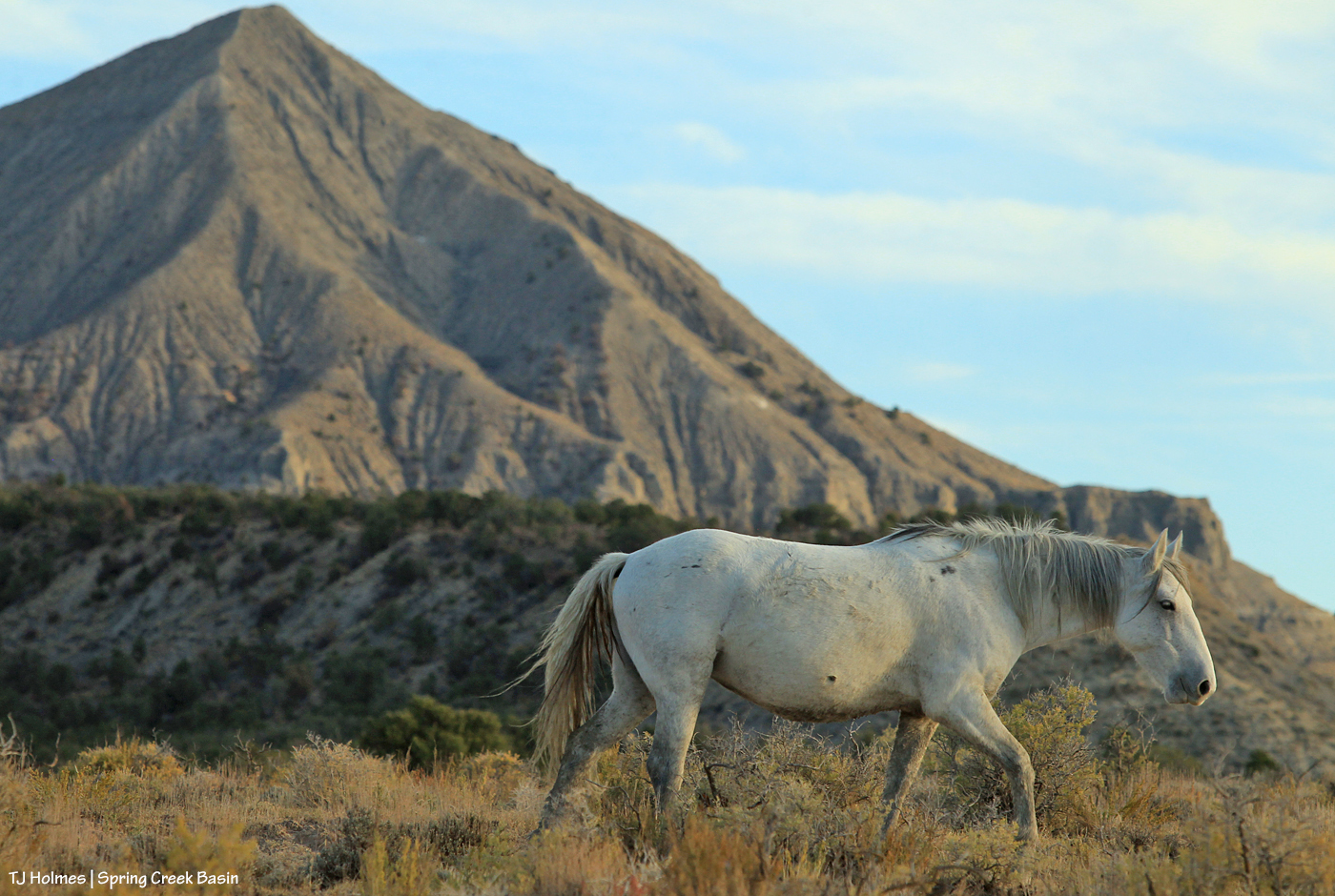
Disclaimer: The pic above of Juniper walking past McKenna Peak was NOT taken during our hike. 🙂
We didn’t see any of our fabulous mustangs during our hike in the far southeastern part of the basin, but we did see a couple of tarantulas and lots of cool fossils (including a couple of faint but awesome nautilus impressions!). I got to talk about my favorite subject ever (I bet none of you can guess what that is … ;)), and Lexi talked to us about McKenna Peak and the CORE Act – the Colorado Recreation and Economy Act.
From the website:
“The CORE Act is the most significant and broadly-supported effort to protect Colorado’s most cherished lands, waters, and forests in a generation. The legislation would protect roughly 400,000 acres of public lands in Colorado, ensuring that future generations can always enjoy our state’s mountains, rivers and wildlife.”
McKenna Peak Wilderness Study Area is proposed for inclusion in the San Juan Mountains area. This link shows the locations of the areas; scroll down to read a little more about McKenna Peak and see where it’s located. The entire WSA isn’t included, just the part in San Miguel County. As with anything else, politics plays a part. Our San Miguel County commissioners are fully supportive of this inclusion, just as they were of the naming of Temple Butte, which is in San Miguel County.
Regular readers know the shape of both McKenna Peak and Temple Butte as icons of our Spring Creek Basin horizon. Given our location and lack of specific trails, I don’t think we’ll be overrun with visitors. But how cool would it be to see the status of even part of this amazing landscape go from wilderness study area to full wilderness area? It’s protected from motorized/mechanized-vehicle use currently, which enables it to feel secluded and protected to the wild horses and other lives that know its wildness (even us humans).
Being able to share it with another few like-minded humans gave me great enjoyment. To see their wonder and appreciation of this landscape I love … well, to be perfectly honest, it made me happy. 🙂
Background: The 2015 RMP directed BLM to revise and update the 1994 Spring Creek Basin HMAP. This updated analysis and plan will incorporate specific goals, objectives, and techniques for guiding the long-term management of wild horses within the HMA consistent with the resource direction contained in the new RMP.
Decision: I have decided to select Alternative A, the Proposed Action for implementation as described in the Spring Creek Basin Herd Management Area Plan (HMAP) Revision (DOI-BLM-CO-S010-2020-0009-EA). Based on my review of the Environmental Assessment (EA) and project record, I have concluded that the Proposed Action was analyzed in sufficient detail to allow me to make an informed decision. This decision 1) establishes an Appropriate Management Level (AML) of 50 to 80 adult wild horses that is in balance with the ecosystem and available forage; 2) implements the use of BLM approved fertility control measures to slow the annual rate of growth of the wild horse herd; 3) establishes monitoring criteria for initiating the removal of excess wild horses; 4) utilizes bait trapping as the preferred removal technique; 5) maintains genetic viability expressed as observed heterozygosity within the wild horse herd by periodically introducing outside horses from other similar herd management areas; 6) manages the wild horse herd to achieve a diverse age class and natural sex ratio; 7) establishes vegetation monitoring objectives for maintaining good ecological and forage conditions; and 8) authorizes additional new water developments for improving wild horse distribution across the HMA.
Overall, implementation of this decision will provide long-term management guidance for sustaining a healthy wild horse herd in balance with the ecosystem, while ensuring that Public Land Health Standards developed for Colorado are being achieved.
Not too much earlier before I took this shot, the weather radar showed another lovely green blob right over us. … What we *really* had was a whole lotta blue in the big ol’ sky! I think it comes down to this: The weather gurus are just as hopeful as we are. (Otherwise, there are seriously some techy gremlins in their weather equipment.)
In very good and wonderful news, Connie Clementson, manager of Tres Rios Field Office, released a letter Monday saying that after “thoughtful consideration of the analysis and comments received” (thank you!), she has chosen the preferred alternative – Alternative A – presented by our herd manager, Mike Jensen, for our Spring Creek Basin Herd Management Area Plan revision. 🙂 🙂 🙂
Now there’s a 30-day appeal period, then the decision record becomes final, and all that we’ve worked for these last many years is the official management plan in Spring Creek Basin. Documentation, bait trapping, PZP-based fertility control, AML increase … it’s all there.
I can’t begin to articulate my gratitude and overall feelings of relief. Thank you to all those who made this happen. You know who you are, and you know you are appreciated!
The world is kinda one big crazy-town right now, but all I have to do is drive into the basin, spot some horses, walk out, plop myself on the ground (dry as it is … watching for cacti and slitheries, of course) … and all that crazy melts away.
Nature and wild horses truly are the best medicine for what ails us (somebody said that once upon a time, I’m sure of it!), and I am so blessed and thankful to have huge dollops of both in my life.
Rather than allowing our “differences” to divide us, why can’t we celebrate all the wonderful colors and shades and nuances that make us *unique* – and beautiful?
When did “different” become “bad”? And who gets to decide that they are the baseline of “normal” so that “different” from “normal” also is “bad”?? So what, then, is “DIFFERENT” – and when the heck did it become something to hate and bully and demean? Is that “just” human nature? With all the diversity of this planet … what possible evolutionary advantage is there in being same?
What a world this would be if LOVE ruled our human behaviors. If “different” means that we’re only HUMAN, after all, only one species among many on this big blue (and yellow and red and pink and purple and green and brown and tan and orange and grey and turquoise and black and white) ball. If “different” means engaging our curiosity and asking “how can I get to know you better than I *think* I already do?”
As a journalist, I always thought I was a bit of a square peg trying to fit into a round hole because I never was a “news hound” for “if it bleeds, it leads” type news. My favorite tenure during my journalism days was my time as editor of the Dolores Star, during which I got to learn about people in the community, which also meant celebrating the community and those who lived in it. I liked telling positive stories about the people I met, doing all the interesting things they were doing.
A collaborator once accused me of being a cheerleader. I was cheered by that label, though I never would have embraced it in high school (and I wasn’t; I was in sports and band, and, of course, a horse girl) because it means that I embrace the positive; I embrace collaboration; I embrace partnership; I embrace the successes that come from all of it.
If we *embrace* more – more people, more love, more diversity, more hope – we can celebrate more … more people, more love, more diversity, more hope. See how that all comes around full circle?
Even during COVID-19 – maybe even especially during this time – can’t we achieve all of that? All of anything we want to achieve in the name of love?
Let’s NOT be color-*blind*.
Let’s be open to all the colors and shades brilliant and illuminated in the world.
As if we needed more proof that our mustangs are divine and under the shine of a higher power!
As May comes to a close, I want to remind readers that the comment period for our Spring Creek Basin Herd Management Area Plan EA is coming to a close (Saturday, May 30). If you’ve already submitted your comment letter, thank you! If you’ve procrastinated, now is the time to type out a letter of positive support regarding Tres Rios Field Office’s HMAP EA. It will guide the management of our mustangs for the next couple of decades and ensure that they are managed and protected to our highest standards.
Here’s the link to BLM’s eplanning site, on which you can find the draft HMAP EA and the button that will allow you to comment through that site:
Or you can send an email to our excellent herd manager (and author of the HMAP EA), Mike Jensen, at m50jense at blm dot gov.
Please note that you support Alternative A – Proposed Action. If you have personal knowledge of our herd and mustangs – whether by visits or even through this blog – please let them know.
Do you see the little bird, taking flight in front of Raven?
Do you see the head and ears of the horse below and beyond Raven?
Do you see Raven, divine wild girl, in all that delicious evening light?
Do you feel the magic?
********************
My friends, my fellow lovers of Spring Creek Basin’s marvelous mustangs, the draft HMAP EA is out for comments. (That’s herd management area plan environmental assessment in non-acronym-speak, and it lays out the overall plan for the next umpteen years of management of our Spring Creek Basin mustangs.)
It’s kinda huge.
OK, in the grand scheme of all that’s going on in the country, in the world, right now, it’s a blip. And I do not make light of those who are suffering terribly now, in so many ways.
This EA represents countless hours and days and weeks and months – the last couple of years – of work by our uber-respected BLM herd manager, Mike Jensen, at Tres Rios Field Office in Dolores, Colorado. It represents field work (vegetation monitoring, land-health assessments), and it represents computer time. It represents a career spent doing good things, positive things, for the ranges he has managed during his work with BLM. It represents gathering facts, lining up the science, listening to partners, speaking to a wide variety of people … and honoring the good management we’ve achieved, together, for Spring Creek Basin’s mustangs, these descendants of horses from cavalry, Native American, settler stock and beyond, and ensuring that what we have worked so hard to achieve will be set down in the herd management area plan going forward for Spring Creek Basin Herd Management Area.
I cannot overstate the enormity of this document and what it represents. I cannot overstate the positivity of what this document represents.
It means our Spring Creek Basin mustangs will be as well managed as possible, protected, the range on which they depend will be protected, and we will continue to do all in our power to ensure that they live long, healthy lives, as wild and free as they were born to be.
There’s a lot of crazy in the world, yes. BUT. Spring Creek Basin, as so many have discovered, is a place of peace and beauty and magic and partnership, and our goals, set so long ago, are coming to fruition.
Among other things, Alternative A (preferred, of course) sets the appropriate management level (AML) at 50 to 80 adult horses, an increase from the current 35 to 65 adult horses. As Mike said, the science (the vegetation monitoring, the land-health assessments, the PZP fertility-control program) supports it. This is absolutely what I have hoped and prayed and worked so hard to have happen … for what seems like a million years.
Don’t worry – we will continue to introduce mares periodically to ensure the viability of our small herd’s genetic health. And don’t forget: Spring Creek Basin is almost 22,000 acres of high-desert, low-rainfall, kinda-scrubby, perfect-for-wild-horses geography. Translation: It’s small in terms of ranges, and we worry about water even in good years. Also keep in mind that BLM closed the allotment to livestock grazing a few years ago, and with PZP treatments keeping our foal crops low each year, we CAN increase the AML a bit and not fear that it will reduce the current quality of the range. That’s a win-win.
BLM also will continue the current, natural, 50-50 stallions-to-mares ratio. Also good.
Here’s the link to the eplanning site (the above link will take you directly to the PDF): go.usa.gov/xpJKn
Once there, click on the “Documents” link on the left side of the page. Then click the “Draft EA and Appendices” link. (Below that is the link to the scoping letter that we commented on a couple of months ago.) Then click the PDF icon to the left of “Document Name: Draft DOI-BLM-CO-S010-2020-0009-EA.pdf.” A new tab will open in your browser with the PDF document of the draft HMAP EA.
There are only two “Proposed Actions and Alternatives”: “Alternative A – Preferred Action” and “Alternative B – No Action.” We, of course, prefer the preferred Alternative A. 🙂
Please comment as you have before (the deadline is May 30), for the mustangs. For all the work and blood and sweat and tears (I was crying (with joy) so hard when I called my mom yesterday morning, she couldn’t understand me and thought something was wrong!) freely given from all of us who have worked so hard to get to this point. For Mr. Mike Jensen, BLM herd manager and range specialist extraordinaire, who created this management plan that includes all our hopes for our mustangs’ futures.
This is a shining ray of light in the way things can be done for our mustangs. We are so grateful.
Thank you, thank you and thank you.
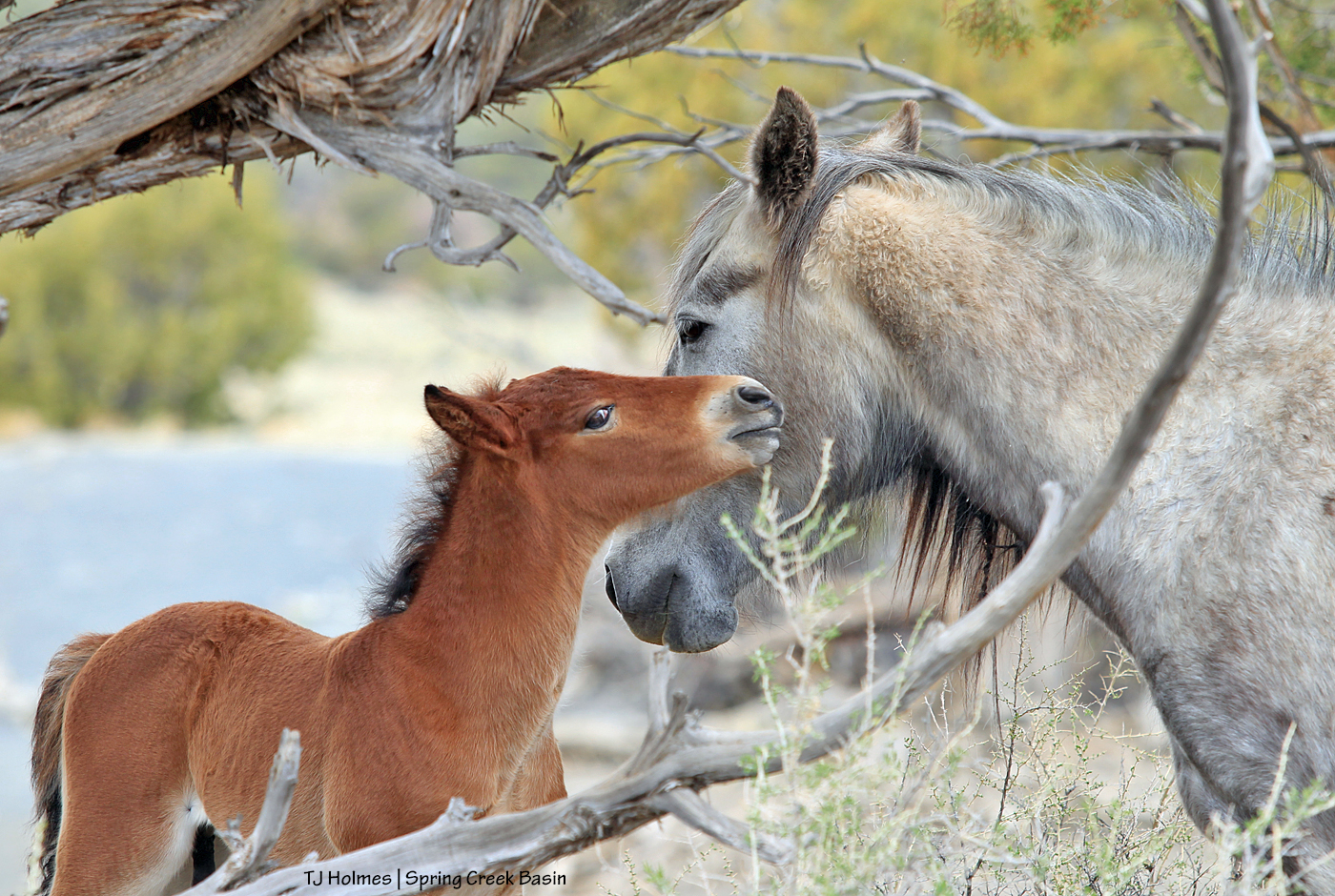
For this little guy and all those that were born to be wild and free in Spring Creek Basin – and all those yet to come into their wild world.










 Spring Creek Basin Mustangs