Water catchment: phase 1, day 1

31 05 2021

First, let me refresh your collective memories:

Last year, Spring Creek Basin Herd Management Area herd manager (and all-around great guy) Mike Jensen put the finishing touches on the new, updated herd management area plan (updated from 1994!) that he worked on for two years. If you follow that time-machine link back to July 2020, you’ll see that Tres Rios Field Office Manager Connie Clementson’s decision included eight items. No. 8 was to authorize “additional new water developments for improving wild horse distribution across the HMA.”

We had hoped to start the first catchment last fall, but Mother Nature had other ideas for the week Mike had rented the machine to do the digging. And as winter approached, the project got pushed to this spring.

Fast forward to this spring (which was two weeks ago!), our BLM dream-range-team of Mike, Garth Nelson (also a rangeland management specialist), Daniel Chavez (range tech) and seasonal weed sprayer Jim Cisco broke ground on phase 1 of the first of two new water catchments in Spring Creek Basin.

This week on the blog will be devoted to the progression of the project. So today’s photos depict that Monday’s work; Tuesday’s post will depict that Tuesday’s work, etc.

On to the dirt work!

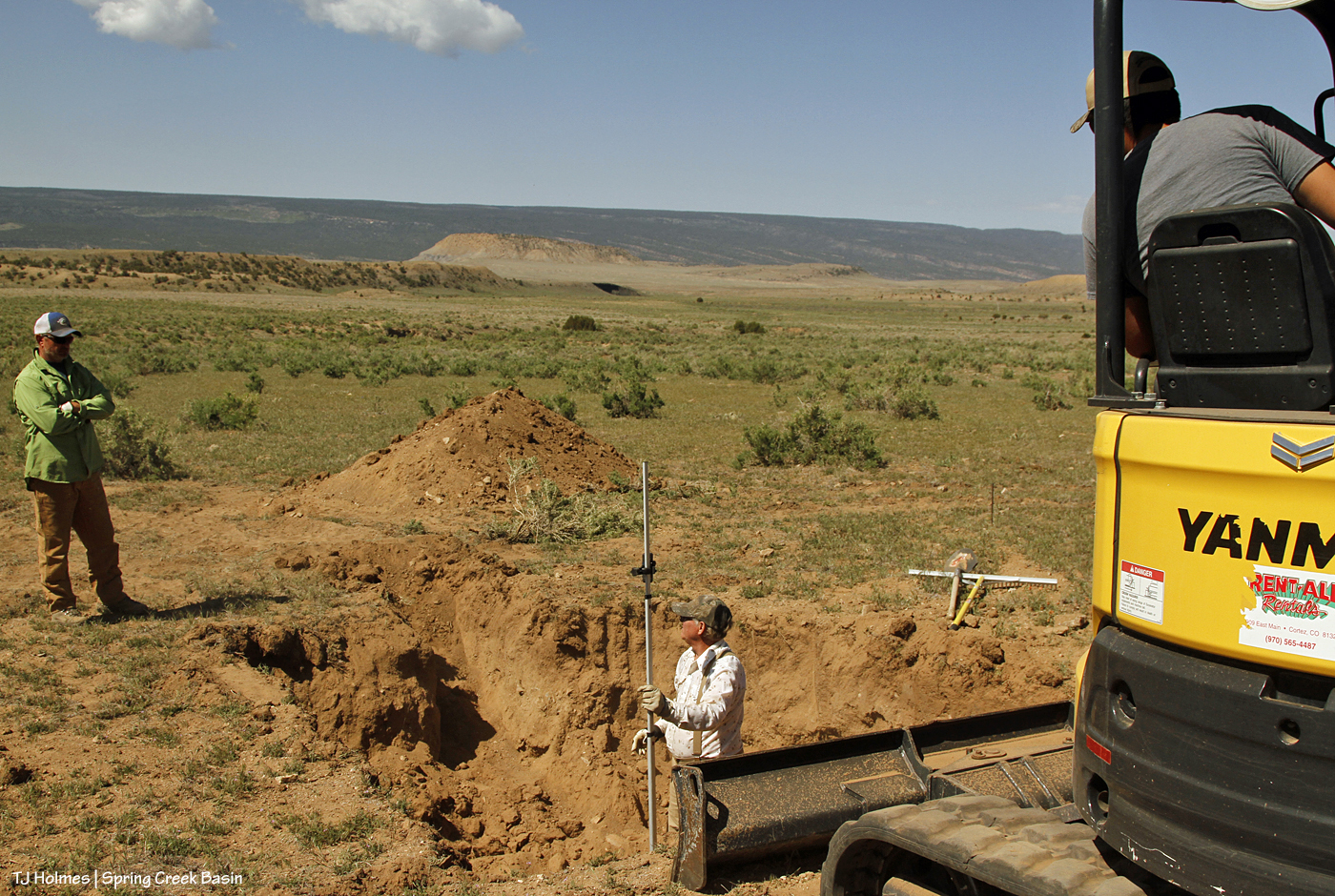
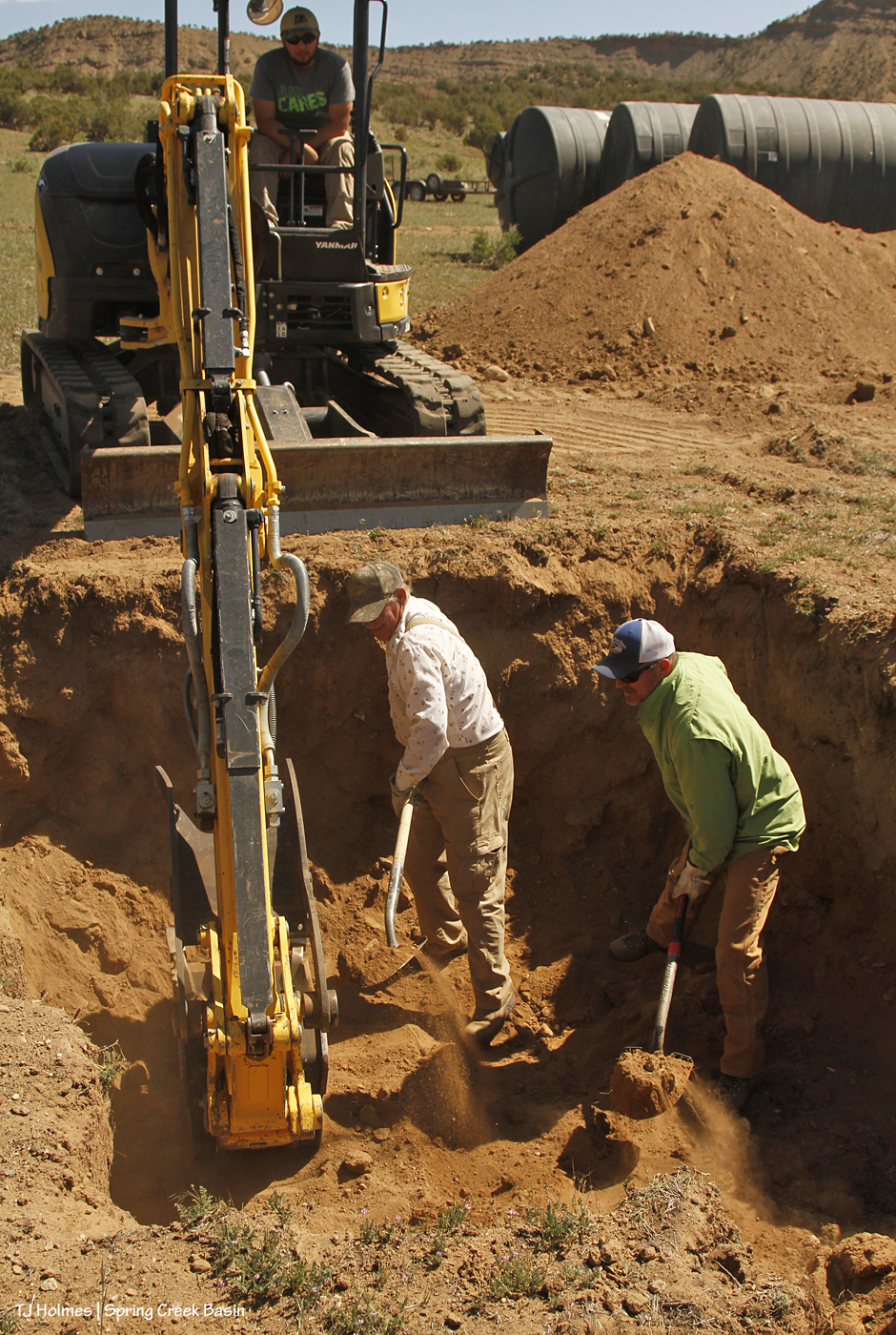
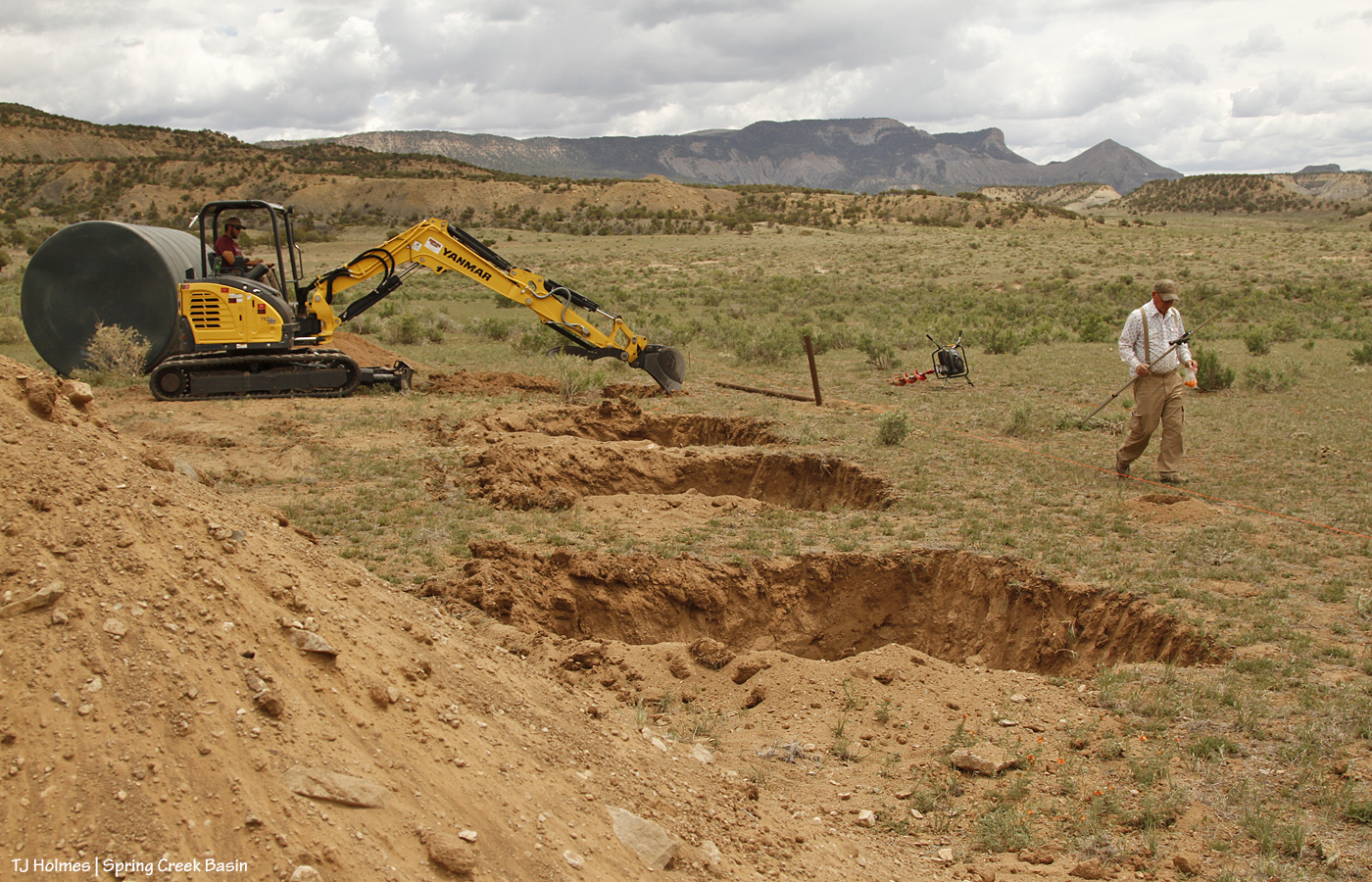
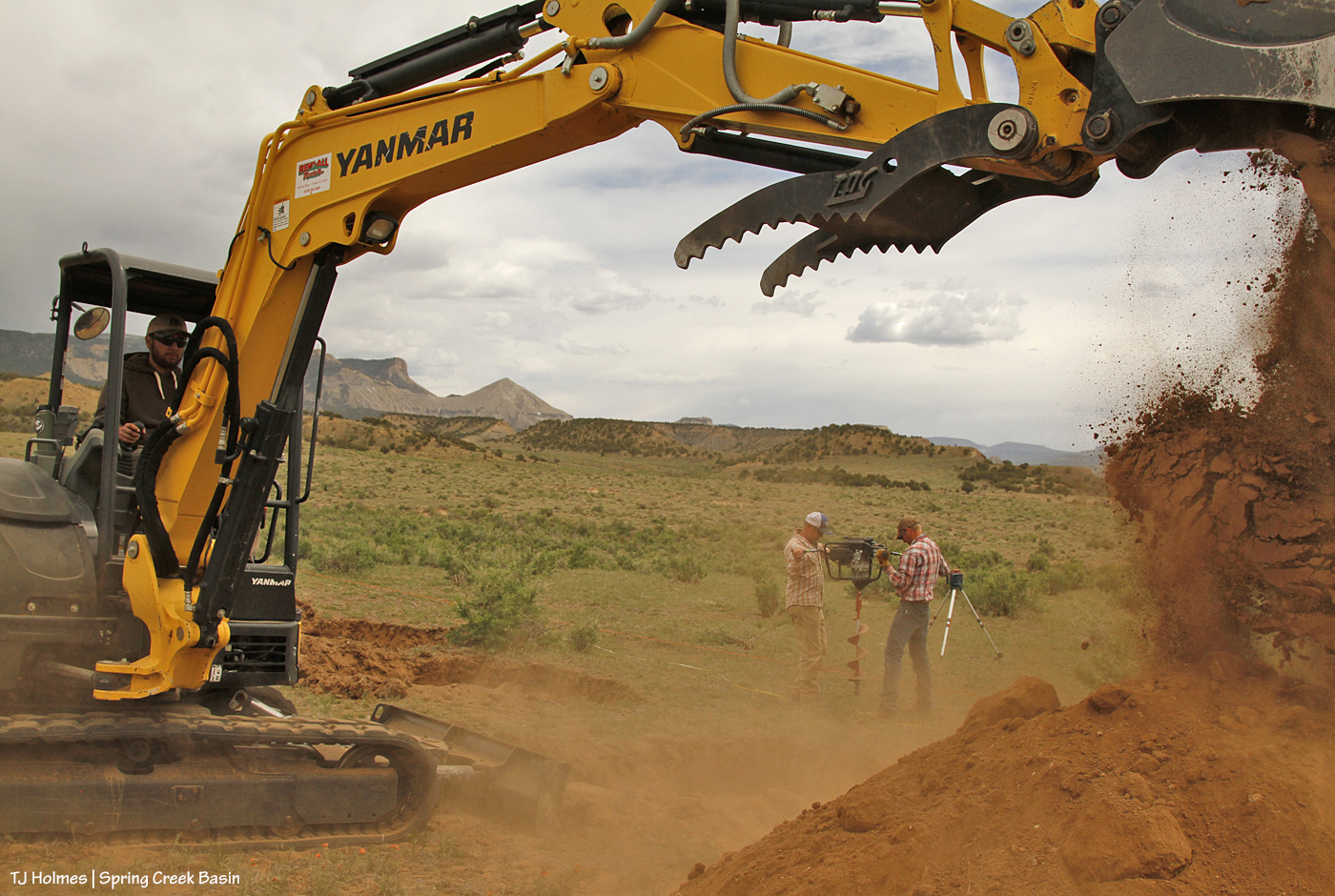
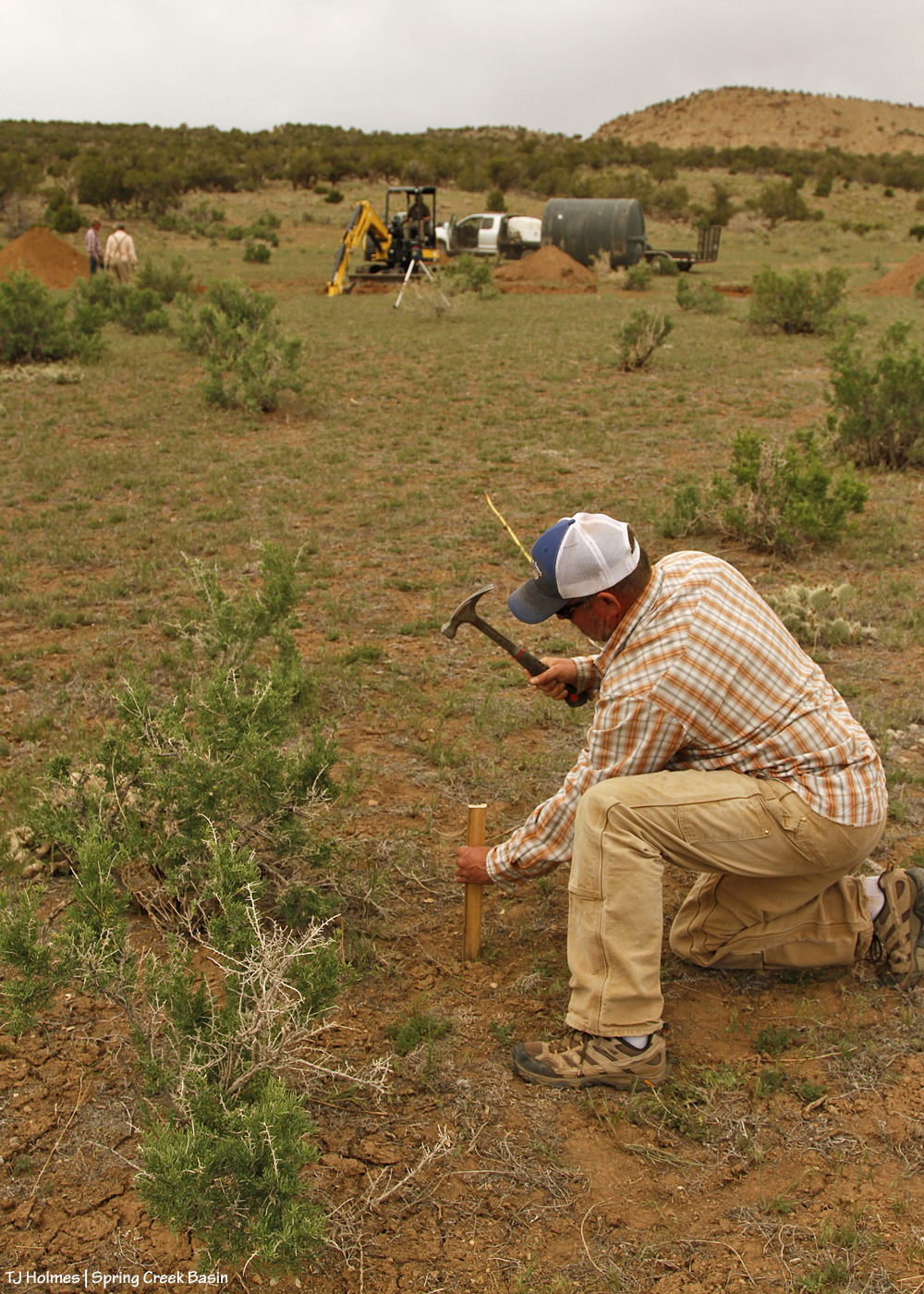
Daniel, the youngest of our range team, ran the mini excavator to dig holes for four 3,500-gallon poly (heavy plastic) water tanks while Mike and Garth used an augur to drill holes for the support posts for the roof system that will go over the tanks to catch rainwater and snow.

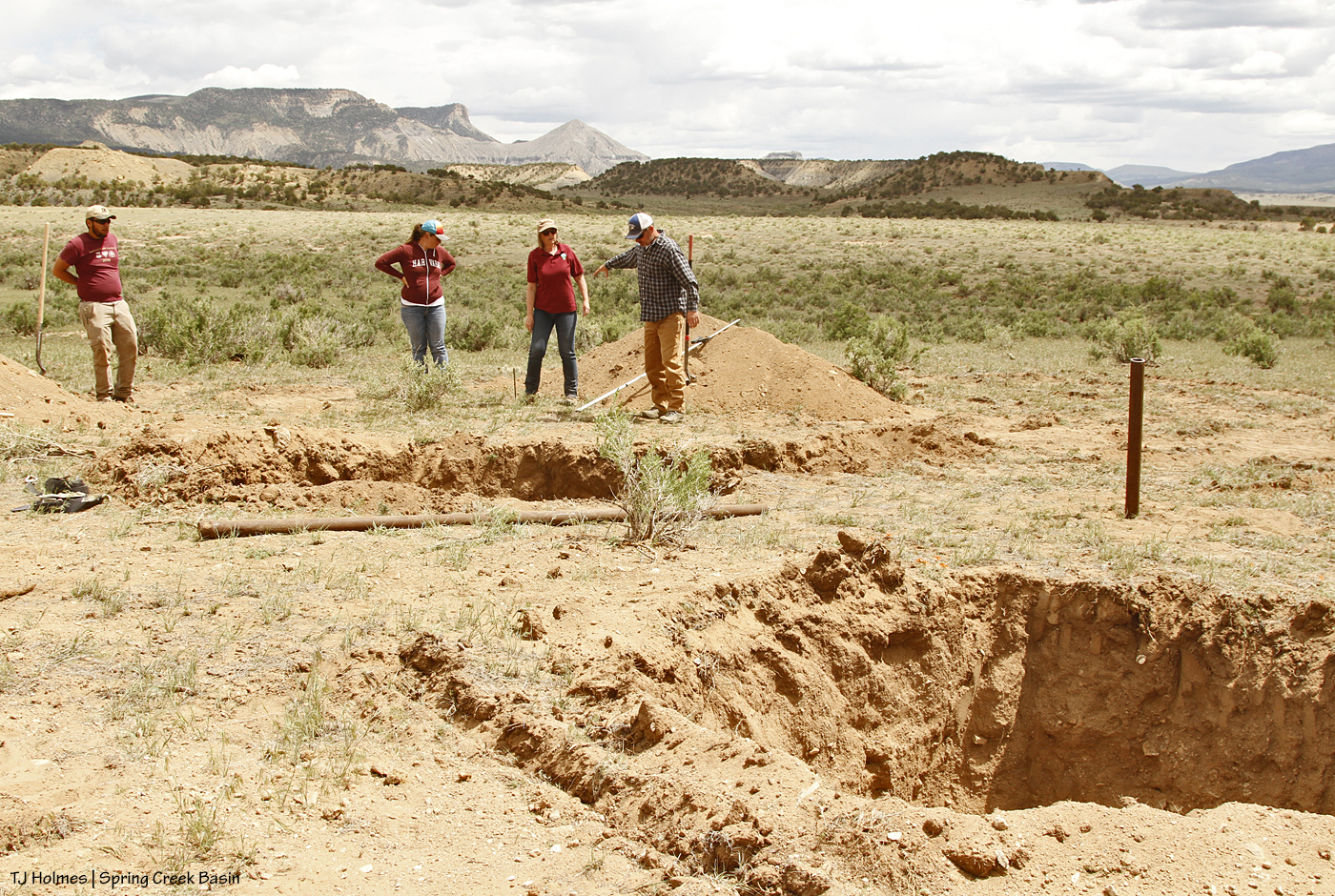
While the digging was under way, Jim readied the laser level in order to ensure the holes are all at the same depth. Then he used it to measure the run down to the eventual location of the water trough. That laser level got a workout (as did Jim) during the week. Garth would give Daniel breaks from running the mini-ex. Like Daniel said, it was a bit dizzying to scoop (to dig) and swing (to deposit). Here’s a sad thing: They dug down about 4 feet to bury the tanks about halfway, and the dirt is dry, dry, dry, all the way down.

Here’s a closeup of Garth and Mike using an augur to drill holes for the support posts for the roof over the tanks.

As it turned out, they decided on different locations for the posts to stand, but these first holes gave us the straight line on which to align the tank holes. Another sad note: Garth later used a post-hole digger to clean out the holes … and the dirt was SO dry, it all just slid right out of the digger’s “jaws.” (Also of note, of all tools in existence, I despise post-hole diggers the most!)

Did I mention the laser level? They used it to ensure that all the tanks were buried to the same depth and were level, and they also had to make sure there was enough “drop” down the slope (which doesn’t look like much of a slope, does it?) so gravity will do the work of allowing water to flow from the tanks (even when the water level is low) to the trough. As with our other two troughs, there will be a float to keep the water level constant. And the guys also will add an evaporation cover. In the pic is Jim, master of the laser level.

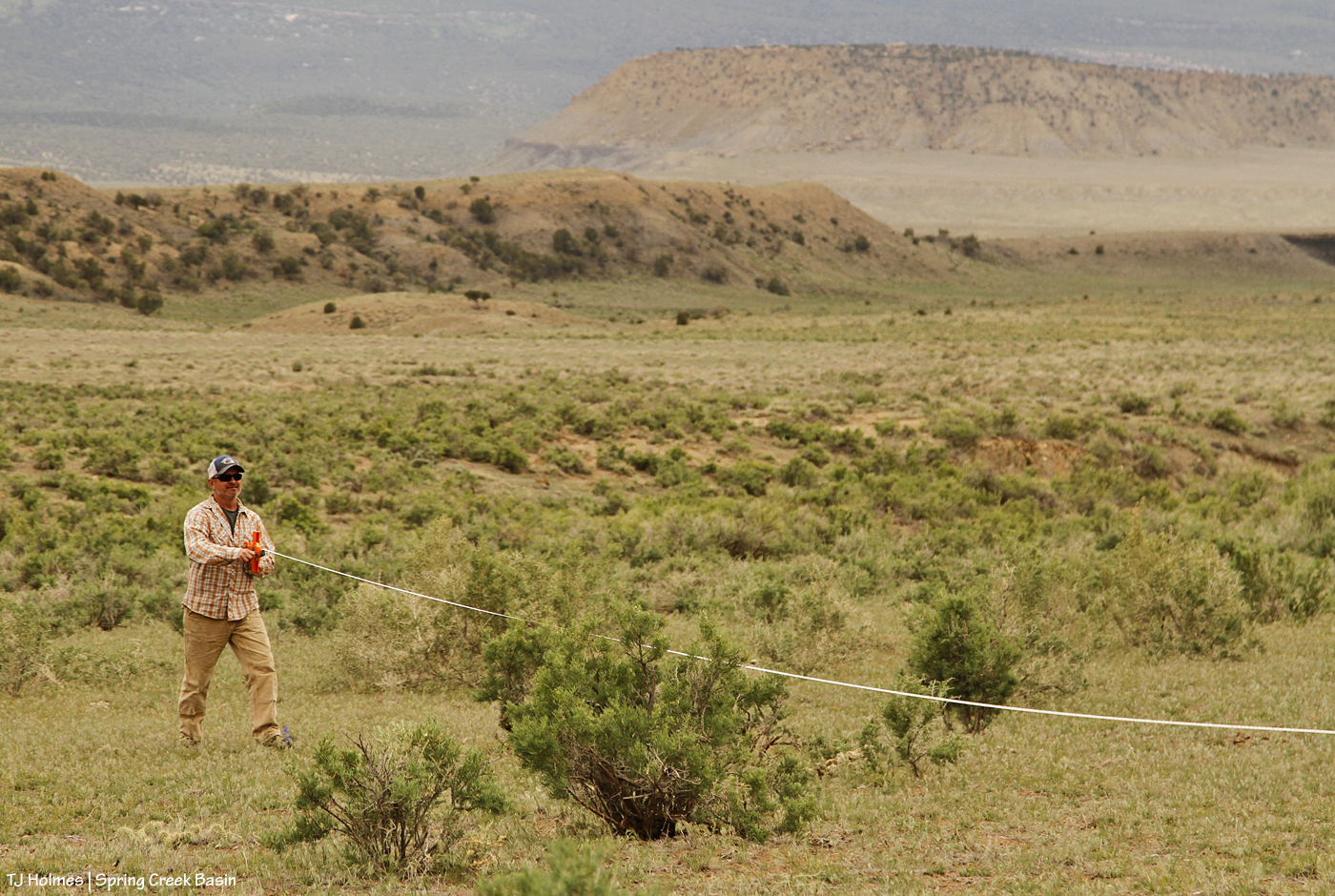
Zoom in on this pic. See Mike? See Mike smiling? He’s measuring out the distance from the tanks to the trough location. Mike is always smiling! 🙂

Mark it! This will be the basic location of the trough, and this perspective is looking back up toward the tanks. You can see the first one that we delivered on the flatbed trailer behind it. Also, see the white thing behind the truck cab? That’s a 200-gallon water tank (the truck is Jim’s weed-spraying rig), and the guys filled it with water each day before they left Dolores, and each day, we emptied it to one of the aprons at the main (and original) catchment, for a total of 800 gallons! (Friday, Ma Nature graced us with rain, so there was no work that day, and she provided the water!)

Tomorrow: A bit more digging, a bit more leveling, and the holes will be ready for the tanks!

**********

Also today, Memorial Day, we remember all those members of the U.S. Armed Forces who died in service to their country. Though they did not make it home to family and loved ones, their service and sacrifice cannot be forgotten by those of us *at* home, for whom they fought and died.


Teamwork

30 05 2021

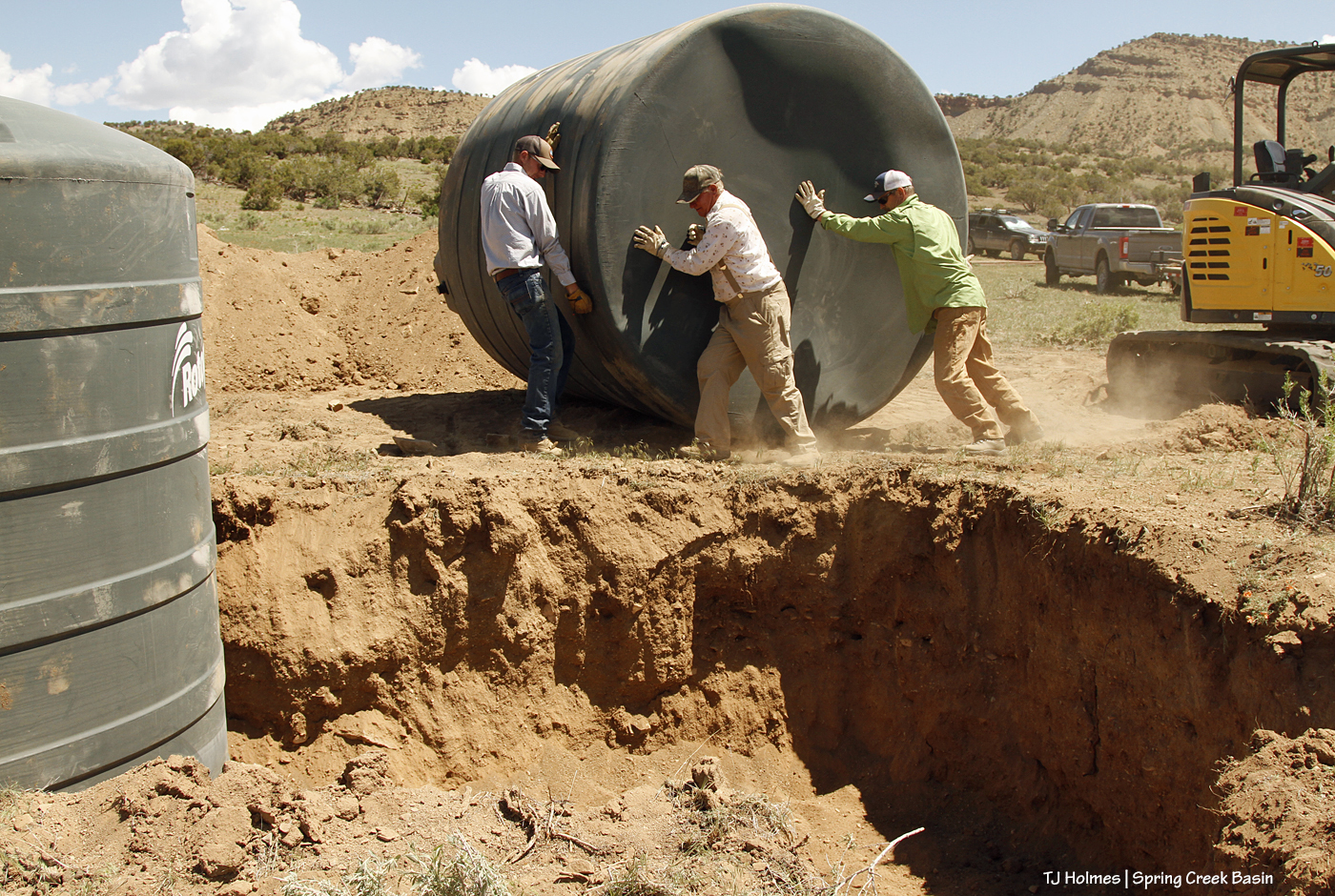
I love this pic of our guys working together to push a water tank into a hole dug last week in Spring Creek Basin!

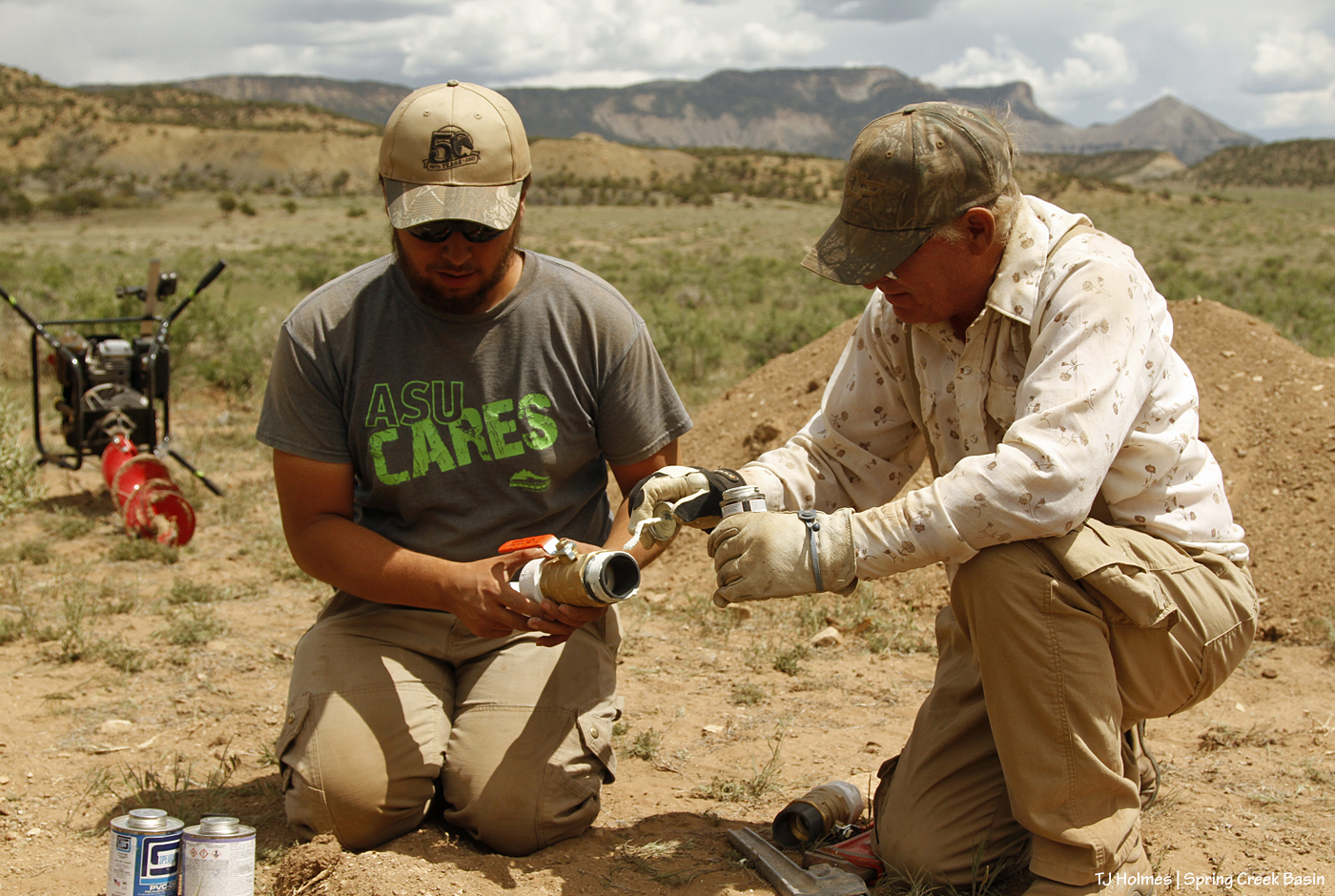
This was part of phase one of the first of two new water-catchment projects for the mustangs: digging holes for tanks, digging trenches for pipes, placing the tanks in the holes, placing and putting together the valves and pipes in the trenches (including down to the eventual trough). Next up: auguring holes and setting the supports for the roof over the tanks that will funnel rain and snow. (I really do have hopes of doing at least a brief post about phase one …!)

Left to right above: Mike Jensen, Garth Nelson, Daniel Chavez and Jim Cisco – excellent BLM’ers all!


What are they up to out there?

22 05 2021
(BLM rangeland management specialist Garth Nelson pushes dirt into a trench laid with pipe from the water tanks while herd manager Mike Jensen, range tech Daniel Chavez and seasonal weed-sprayer Jim Cisco shovel dirt into the trench along the “front” of the tanks to cover the pipe. A roof with a gutter will pipe rainwater/snow into the tanks, and the pipe in the trench directly in front of me as I take this pic will run water to the trough, which will be on a float.)

We’ve had some big doin’s out in Spring Creek Basin recently.

Remember when our BLM folks (herd manager Mike Jensen and Tres Rios Field Office Manager Connie Clementson) updated our herd management area plan last year? Remember the two new water catchments that were proposed (and approved) in that EA?

Our first tanks for the first of those water catchments are in the ground. 🙂 That’s phase one of the project; phase two is coming. It will take me a bit to consolidate several days of work into a nice little post to detail their work. That’s coming, too. But just in case you wondered what the heck our BLM guys are doing out in Spring Creek Basin these days … this is a bit of an answer. 🙂

And in best of all news, we actually got a decent drizzle of rain in Disappointment Valley yesterday! No, the catchment isn’t at the point of catching that rain, but soon. … Hopefully very, very soon … !

**********

If you’re in Norwood, Colorado, this evening, join us at The Livery (1555 Lucerne St.) for Kat Wilder’s first in-person reading to celebrate the publication of her memoir, “Desert Chrome”! Folks will start to gather around 6 p.m. Bring your own camp chair, picnic and beverage for an outdoor gathering. San Miguel County and Colorado state Covid protocols will be followed.


More little things

29 05 2020

As if we needed more proof that our mustangs are divine and under the shine of a higher power!

As May comes to a close, I want to remind readers that the comment period for our Spring Creek Basin Herd Management Area Plan EA is coming to a close (Saturday, May 30). If you’ve already submitted your comment letter, thank you! If you’ve procrastinated, now is the time to type out a letter of positive support regarding Tres Rios Field Office’s HMAP EA. It will guide the management of our mustangs for the next couple of decades and ensure that they are managed and protected to our highest standards.

Here’s the link to BLM’s eplanning site, on which you can find the draft HMAP EA and the button that will allow you to comment through that site:

Or you can send an email to our excellent herd manager (and author of the HMAP EA), Mike Jensen, at m50jense at blm dot gov.

Please note that you support Alternative A – Proposed Action. If you have personal knowledge of our herd and mustangs – whether by visits or even through this blog – please let them know.

Read more at my initial post about the draft HMAP EA at https://springcreekbasinmustangs.com/2020/05/02/little-things/.

And thank you. 🙂 We so appreciate your support.


He’s bold, he’s red

31 01 2020

122119Hayden1

He’s Master Hayden.

**********

FYI: Local (Cortez) newspaper The Journal published an article about the HMAP-revision scoping period in its Thursday online edition.

And in case you missed it, here’s the link to my previous blog post about “Revising our HMAP.”


Revising our HMAP

22 01 2020

012020Skywalker1

Same basic, iconic view … different day, different grey!

**********

As most regular readers of this humble blog know, we have worked closely and for many years with BLM managers of Spring Creek Basin Herd Management Area. Our partnership is one to be envied; we have great respect for our BLM folks – especially herd manager Mike Jensen – and the health of our mustangs and the range they call home is directly because of that partnership.

We have accomplished almost everything on our big-goal to-do list for Spring Creek Basin’s mustangs, including the commitment to using bait-trapping if/when we need to remove horses in the future and our successful fertility-control program using native PZP. How successful is it? We’re celebrating our NINTH year of NO roundups and removals in Spring Creek Basin. I’d say that qualifies. 🙂

All of the things we have done and are doing – and the fact that our current one is 26 years old  – means we’ve come to another big goal: updating Spring Creek Basin’s herd management area plan. Mike Jensen has been working on that for a while now, and a LOT goes into it.

So to *start* the process (see above where I note that a LOT goes into it, including time in the field doing vegetation monitoring over the last few years, archaeological-site assessments, ongoing data collection about our PZP program, etc.), we come to the scoping process for updating the herd management area plan, otherwise known as the HMAP.

Here, you will find that scoping letter on BLM’s eplanning website.

At the left side of the page, click the “Documents” link. On the next page, under “Document Name,” click the link for “Spring Creek Basin HMA Interested Parties Letter.”

At the first link, read the information (the other two links will take you directly to the page to access the document link and the comment link, and the letter itself):

“The BLM is preparing an Environmental Assessment (EA) pursuant to the National Environmental Policy Act of 1969, as amended (NEPA) to analyze the proposed action and alternatives to that action.

“What: Name/Type of Proposed Project: Spring Creek Basin Herd Management Area Plan (HMAP) Revision.

“Where: General and Legal: This Spring Creek Basin Herd Management Area (HMA) is located within the Spring Creek Basin portion of Disappointment Valley in Southwest Colorado. The HMA is approximately 21,932 acres is size and lies within both Dolores and San Miguel Counties.

“Disturbance: Estimated Disturbance (acres/area) Description: The HMAP Revision will include the proposal for constructing two water catchment structures which will result in approximately 1.0 acres of total of ground disturbance.

“When: Expected Implementation and Duration: The Herd Management Area Plan would be implemented immediately following the issuance of the Final Decision.”

**********

On to the letter.

What it’s TELLING you is that Tres Rios Field Office (where Mike is employed as a rangeland management specialist and Spring Creek Basin’s herd manager) is “seeking input on a proposal to revise the 1994 Spring Creek Basin Herd Management Area Plan (I just realized, on typing that, that they swapped a couple of words) for the Spring Creek Basin Wild Horse Herd Management Area in Dolores and San Miguel Counties, Colorado. …”

In addition to advising interested parties about potential disturbance of about an acre of land total for the construction of two (more) water-catchment structures, this is the stated “purpose and need” of the HMAP revision:

“The BLM is proposing to revise the 1994 Spring Creek Basin HMAP. Herd Area Management Plans (again, word swap!) identify specific management actions, goals, objectives and monitoring for managing wild horses and /or burro herds and their habitat. Therefore, the proposed HMAP revision will identify goals, objectives and monitoring to address 1) existing appropriate management level (AML) of wild horses; 2) rangeland health conditions; 3) population control measures; 4) removal criteria and gather techniques; 5) genetics; 6) population dynamics; 7) range improvements; and 8) sustaining healthy populations of wild horses.”

What it’s ASKING is for the public to offer comments about those issues along the lines of answering these basic questions:

Do you agree with those topics/issues BLM has identified?

Are there additional topics/issues you might like to see identified/addressed in the revised HMAP?

The comment deadline is Feb. 19, and as you’ll see in the letter, there are a variety of ways of delivering those comments: There’s a “Comment on Document” button on one of the pages linked above; send an email to Mike (address in the letter); send your comments via USPS mail to the office (address in the letter).

**********

Now some suggestions.

First of all, do we want Spring Creek Basin’s HMAP revised and updated? Yes, please! 🙂

Do we want a couple of new water-catchment structures? Yes, please!

So let’s look at each of the topics from the letter.

  • Existing AML. We would like to raise this slightly, and based on vegetation monitoring conducted the last few years, as well as the use of PZP fertility control and the slow, measured growth of the population during the last nine years since the 2011 roundup and removal, we believe this is reasonable. Also a contributing factor to potentially raising the AML: No livestock grazing allotment exists within Spring Creek Basin; the remaining permit was relinquished and the allotment closed in accordance with BLM TRFO’s 2015 resource management plan. The current AML is 35 to 65 adult horses.
  • Rangeland health conditions. Having participated in vegetation monitoring in Spring Creek Basin the last few years, including the Rangeland Health Assessment, it’s important to note that by and large, the condition of the range in Spring Creek Basin has improved (even during extreme drought situations) since previous monitoring was completed and is continuing to improve. This can be attributed to management of the herd’s population growth with the use of fertility-control vaccine PZP.
  • Population control measures. Native PZP continues to be extremely effective in managing the population growth of Spring Creek Basin’s mustang herd, and we urge its continued use.
  • Removal criteria and gather techniques. As one of the authors of the bait-trapping proposal that was accepted and signed as an EA by BLM in 2018, I urge that bait trapping continue to be the gather technique of choice in Spring Creek Basin. Many discussions have been held about the viability and potential success of this method in the geography of Spring Creek Basin, with our well-documented mustangs. Removal criteria should continue to reflect current documented age and genetics dynamics, as explored elsewhere in this document.
  • Genetics. Because Spring Creek Basin Herd Management Area is small (almost 22,000 acres) and its herd is correspondingly small, genetics is an extremely important topic to consider with regard to the sustainability of this herd and its health. Introducing mares periodically, as was done in 2008 and in 2001 (and stallions, less successfully, in the 1990s), should continue at intervals that reflect current management practices in Spring Creek Basin, and the ages and offspring of previously introduced mares – all of which are known from the 2008 introduction because of documentation since 2007.
  • Population dynamics. To have a healthy herd, we must have a healthy mix of stallions and mares, as well as age groups within the herd. Currently, we have a fair number of horses older than 10, as well as horses filling every age year from 2007 and younger. We favor a healthy, natural relationship dynamic of a roughly evenly mixed stallions-to-mares ratio. Keeping this ratio natural with the use of native PZP is an attained goal.
  • Range improvements. During the last 20-plus years, advocates have partnered with BLM to improve Spring Creek Basin’s range with various projects including fencing, weed identification and location, water-enhancement projects, identification of ponds to be dug out (because of silt and sedimentation buildup), and vegetation monitoring, all of which enhance our knowledge of the range and how the horses use it. We are proud to partner with Tres Rios Field Office managers to keep our horses and range healthy and urge the continuation of the same partnership, which has become a model in the BLM-citizen-advocacy community.
  • Sustaining healthy populations of wild horses. Keeping our horses healthy depends on keeping our range healthy, and we remain committed to helping BLM ensure the continuation of both with volunteer projects including PZP darting, documentation, vegetation monitoring and help with all range projects.

Regarding the disturbance expected for approximately 1 acre for the proposed construction of two water guzzlers/catchment structures: Herd manager Mike Jensen explored two potential sites with an archaeologist from Tres Rios Field Office and found no cultural resources at either site, leading to acknowledgement of both sites as good for guzzler placements. In addition to providing two additional sources of clean water for the mustangs, siting the guzzlers in those locations will help with the dispersal of the horses to currently under-used grazing areas within Spring Creek Basin.

**********

011020Hollsband2

If you made it this far, you deserve another pic of our beauties. 🙂

Thank you for reading this far!

To reiterate a very important fact: We work very closely with Mike Jensen and our Tres Rios BLM folks for the good management of our Spring Creek Basin mustangs, and have for a very long time.

Much of that work is the fun stuff: In-the-field, boots-on-the-dry/dusty/muddy/snowy-ground, mustangs-near-and-far, under-blue-sky-in-the-great-wide-open awesomeness. Some of that work involves paper (and computer) work.

We thank you for following along with our Spring Creek Basin mustangs and for your support during these many years. If you’d take a few moments to send comments to Mike about this scoping letter, we’d sure appreciate it! If you’ve visited Spring Creek Basin and the mustangs, say so. If you know the horses and our advocacy work through this blog or elsewhere, say so. Say that these mustangs are important to you, and please say how much you appreciate BLM’s partnership with advocates on behalf of Spring Creek Basin’s mustangs.

Thank you all in advance for helping us achieve our goals for our beloved mustangs. We know how much you love them, too!

011920Madison1


Drinking, calm

13 09 2018

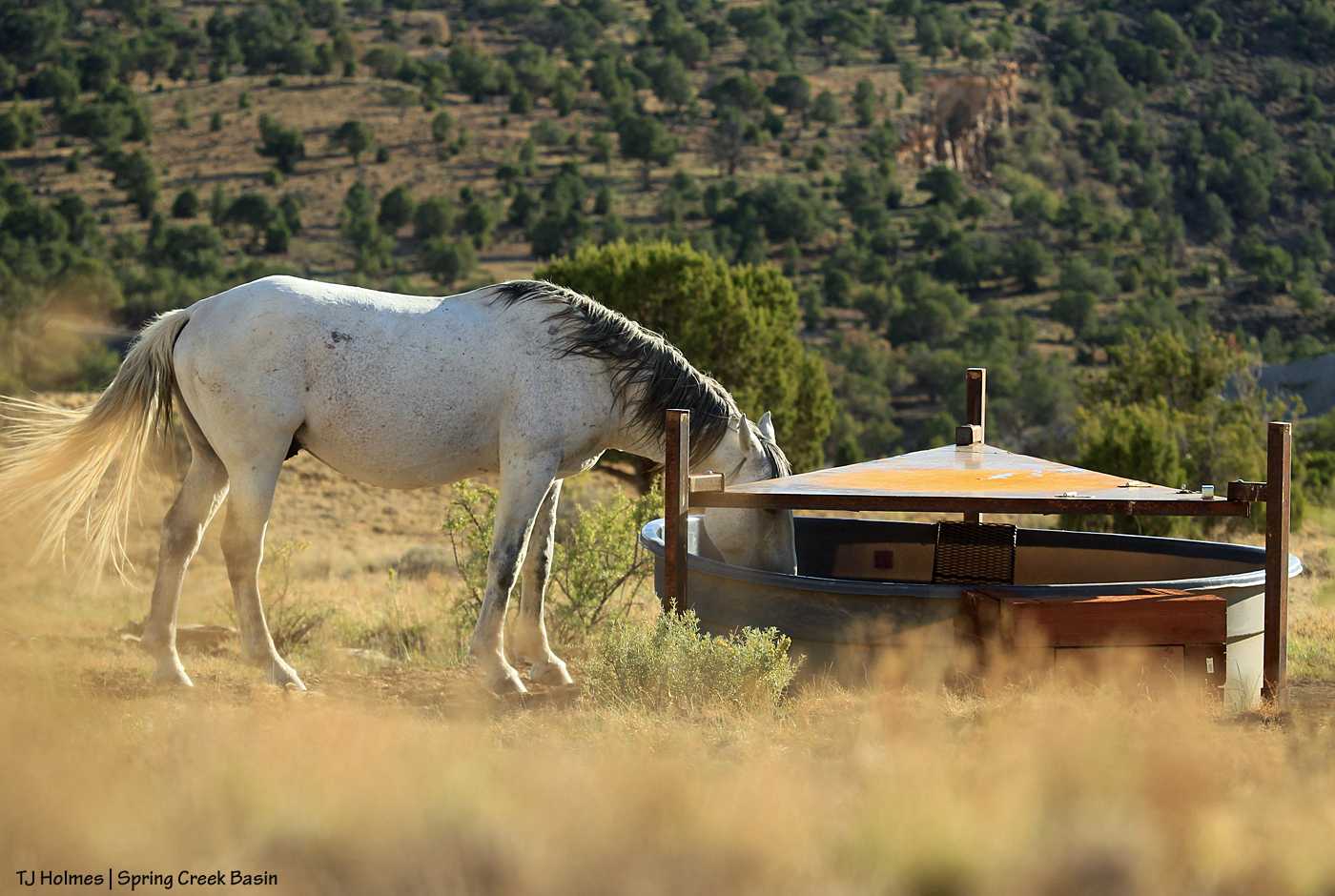
Comanche drinking at the corral catchment.

After Comanche was sure the interloper meant no harm to his girls, he returned to the trough for a lonnnnnnnnnnnnggggggg drink of water. 🙂

I sat uphill from the trough to stay out of the way and had to get the camera low to see any of his eye (the eyes make the photos, they say, but even so, only part of his eye is visble) below the evaporation cover. That’s why there’s a soft layer of unfocused vegetation in the lower foreground.

The black square-looking thing in the center of the trough is actually a long rectangle made of steel mesh on a steel frame. It’s a critter ladder that provides a perch for birds and little beasts to get a drink without drowning. The stacked wood outside the trough slightly to the right is where the pipe from the tank comes out of the ground and into the trough. It’s filled with dirt to insulate it in the winter (when the water is turned off).


Attentive

12 09 2018

090918piedrakestrel1

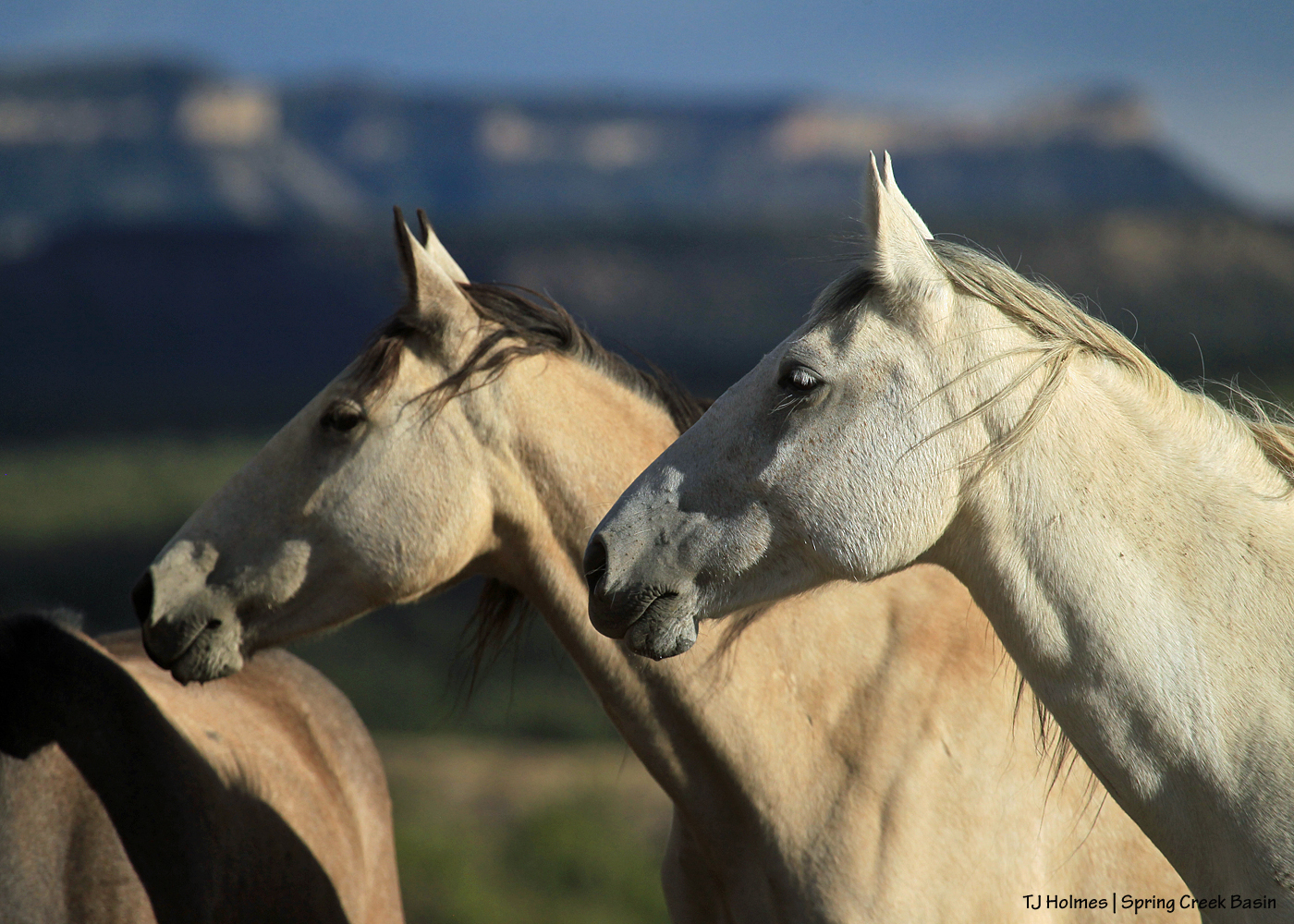
Piedra and Kestrel pause during drinking to focus their full attention on the pronghorn visitor on the hill.


Prongs on the hill

11 09 2018

Pronghorn buck on corral hill.

Our mustangs aren’t the only ones taking advantage of the basin’s water catchments. This handsome fellow waited on the hill for Comanche’s band to drink at the corral catchment (built just two years ago). The horses were VERY interested in him.


Best. Water. Man. Ever.

4 06 2018

060318stevewaterSCB1

Spring Creek Basin’s mustangs are fortunate to have Steve Heath – Heath Water Service – in their corner when it comes to delivering water in this time of terrible drought. This isn’t the first time we’ve relied on Steve (and Cecil Foster before him) to deliver water to the basin’s catchment so the horses have a consistent source of water in that trough seen in the background of this photo. It’s one of only two clean sources of water in the basin, the others being silty, salty and fairly low quantity. Two ponds still have water, and there are some other small sources, but they’re shrinking rapidly.

060318stevewaterSCB2

Steve on top of the storage tank putting the hose into the hatch to pump water.

060318stevewaterSCB3

Best. Water. Man. Ever. 🙂

We are so grateful for his dedication and willingness to deliver water to our mustangs!

The Colorado chapter of the National Mustang Association is helping BLM pay for water deliveries to the mustangs during this drought.

Horse Park Fire update: Inciweb lists the fire still at 1,221 acres and 90 percent contained, but by the lack of activity – and smoke – the last couple of days I think they have it pretty much nailed. 🙂 And big news: The area got about 0.15 inch of rain yesterday! For us, that’s huge. It doesn’t ease the drought, but it gave us a little relief.