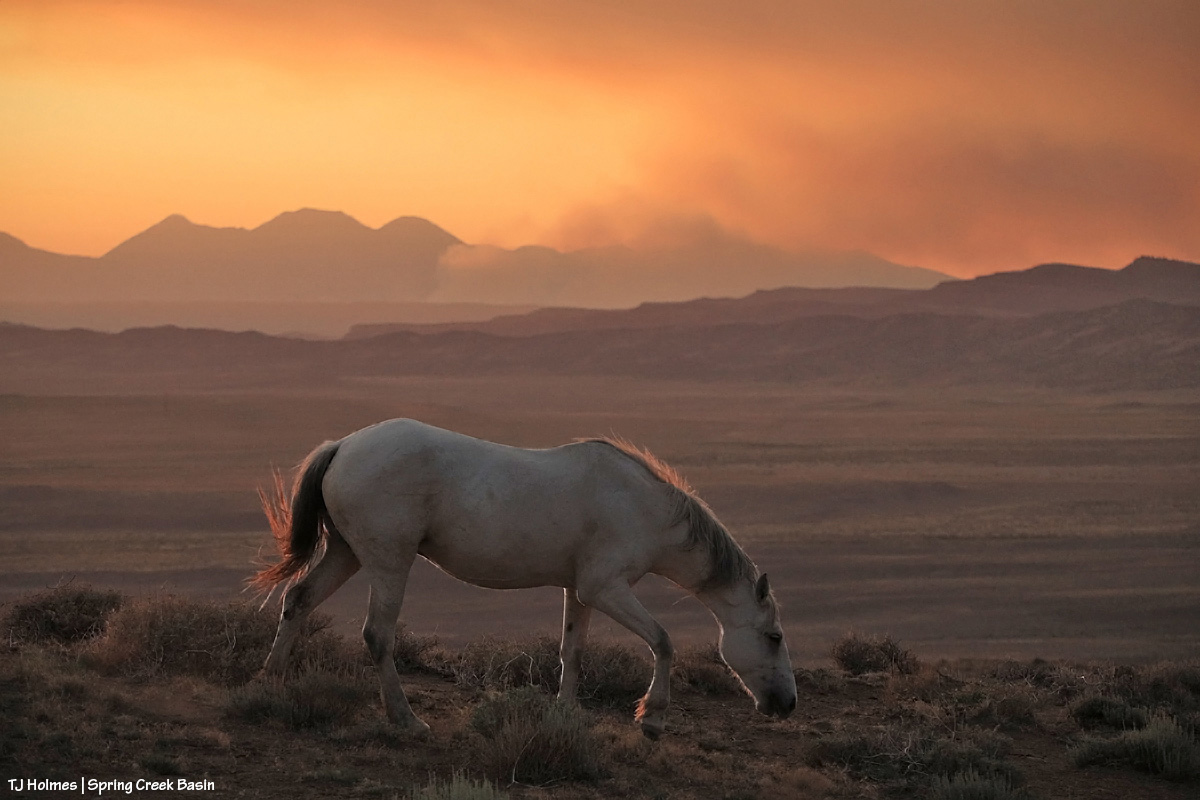
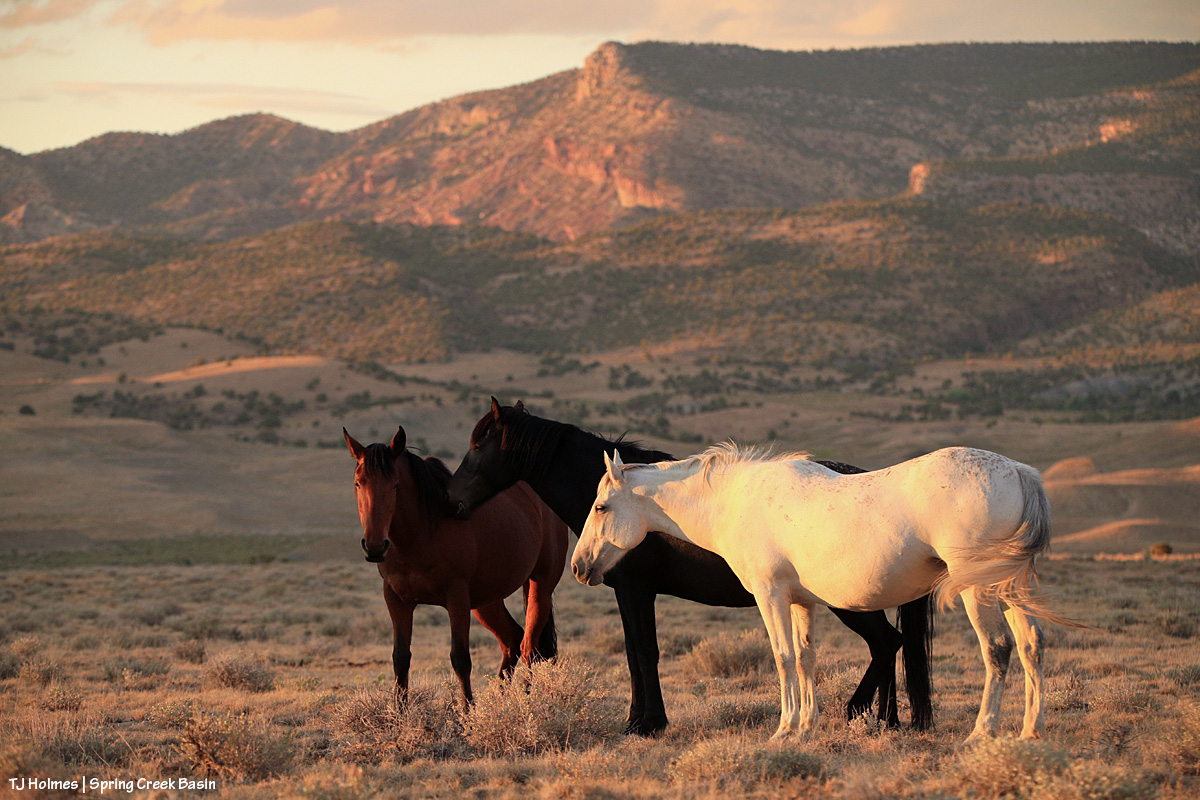
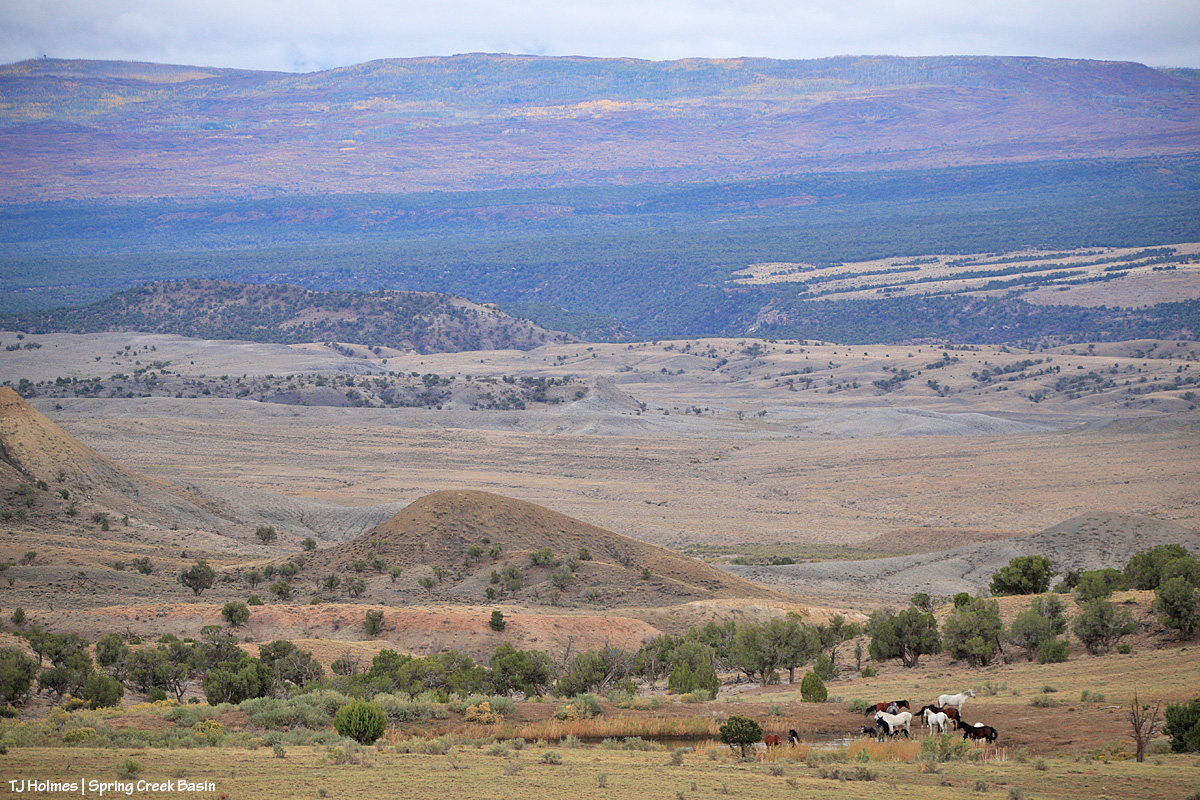
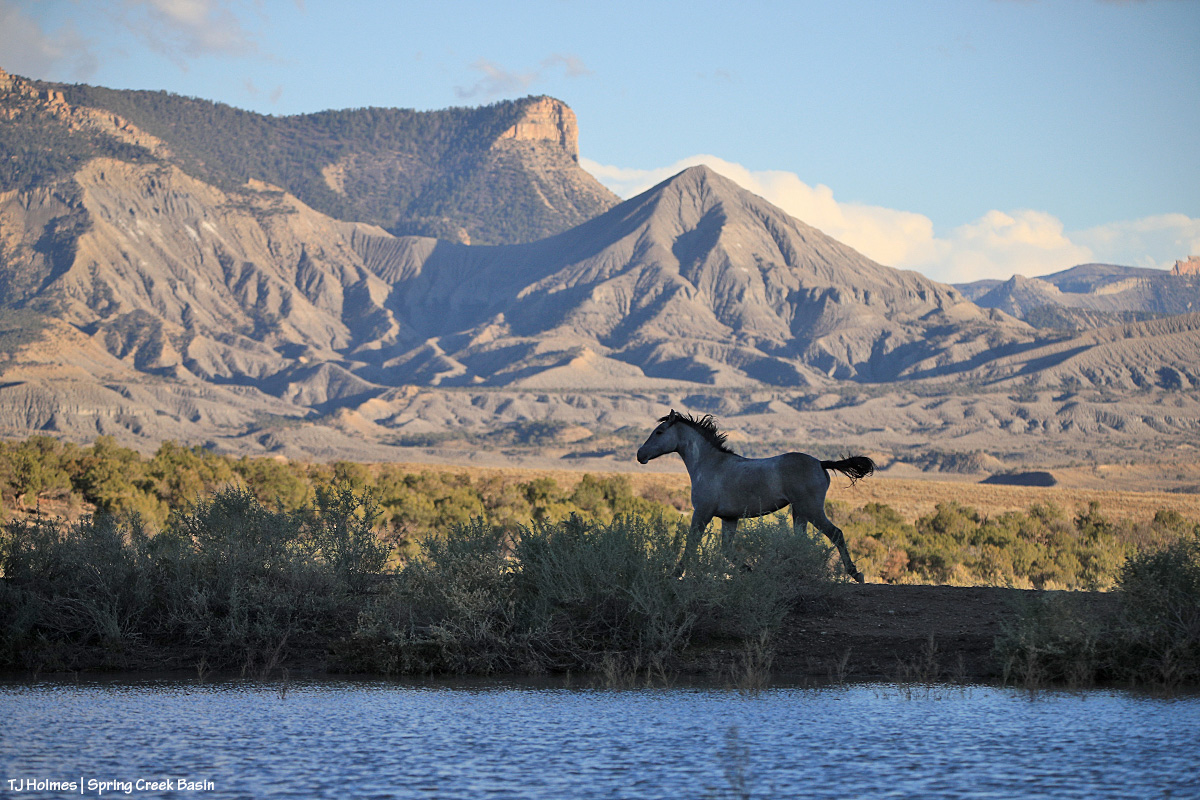
Today is the 10th anniversary of the passing of Dr. Jay Kirkpatrick, beloved fertility-control advocate (and so much more) for wild horses and burros (many species of wildlife, actually). I remember that when I got the news in an email from a friend, though it was December, I thought it was some kind of cruel April Fool’s joke.
I met Dr. Jay in August 2010, when I showed up at the Science and Conservation Center in Billings, Montana, for a PZP training course. I also remember that it took me a long time to work up the courage to follow the advice of a couple of friends and contact him; he was a rock star to me. Legendary. Untouchable. Unapproachable!
Except that neither of those last two words was true.
I finally worked up the gumption to email him … and sign up for training – BEFORE we got approval to implement a PZP program in Spring Creek Basin. I tentatively approached the lab, on the grounds of ZooMontana, the day before the class officially started, to see what I was getting myself into. When Jay appeared, I didn’t ask for an autograph (!), I asked if I could give him a hug. I still remember that, while he laughed, he indulged me. … Wow, I miss him.
Jay was one of the friendliest, most down-to-earth people I’ve ever met, all the more amazing because he was also one of the very most obviously crazy-intelligent people I’ve ever met (to this day). He had this way of making everyone welcome and like you were IN ON IT with him, even as he explained his “why wouldn’t you do it this way” philosophy surrounding better management … some of which you might never quite have thought of but was so wonderfully simple – and, according to his same philosophy, attainable.
Dr. Jay was one of the best, most inspiring, most humble, most committed and dedicated people I’ve ever known, and I feel so blessed to have known him, even briefly. He trained me not only to mix and dart with PZP, the *why* behind doing it, the keeping of records (back at a time when it was particularly challenging for us in Spring Creek Basin) but also the importance of having optimism and a plan … and persevering.
I got to know him for five years, and he encouraged me through the sometimes rocky start of Spring Creek Basin’s PZP program. Even now, 14 years and only one roundup later (in 2011, when we started our PZP program), I think of him quite a lot. He’s one of the three (at least) angels watching over Spring Creek Basin, and I hope he’s proud of what we’ve accomplished here.
Friends Celeste Carlisle and Kayla Grams, along with Melissa Esser (whom I haven’t yet met but already greatly respect) visited Rocky Mountain National Park during their trip to Colorado for the Pathways 2025 Human Dimensions of Wildlife conference. Celeste wrote this blog post for Return to Freedom.
How good are *my* BLM folks? THIS GREAT *arms spread wide*!
Allow me to highlight:
Days before the end of the shutdown, toward the end of third rifle season, when I was feeling very tired and hard done by at the sheer volume of humanity in a usually very quiet, very peaceful place, one of our law-enforcement rangers, Matt Abraham, came into Disappointment Valley to check on Spring Creek Basin. Um, wow! But that’s who these guys are and have been since I started volunteering 18 years ago (I’ve known at least five).
The day (?) the shutdown ended, herd manager Anton Rambur was out in Disappointment Valley to check on things. The muddy road prevented him from accessing Spring Creek Basin, but that this was one of his priorities at his return to work … ???!!! He wanted to know what was happening and what I needed.
Later that afternoon, I got a call from the other range specialist, Ryan Schroeder, asking – again – what HE could do for ME and the MUSTANGS/BASIN.
Upon returning to the computer, I had an email from range tech Laura Heaton asking what SHE could do for us!
Like, um, I don’t even have words to express my crazy-level appreciation and gratitude for these excellent human beings!
One of my mentions to all three of them was that it would be great to have (more) signs to deter the illegal route-making in the basin – as reader Sue calls them, “rogue roads.” I had one very particular place in mind (and have for the two years people have been driving around a particular washout … only to get stymied within half a mile by a washout they CAN’T cross …). …
The following day, I had a message from BLM park ranger Jon Whitehead asking for details about what signs we need! And Wednesday, he and Ryan brought promised signs and stickers to Spring Creek Basin to erect in areas to hopefully stop already-done resource damage and continue to prevent it in places where the signs, with their sun-faded stickers, have worked for nearly or more than 18 years.
Please follow along in pix:
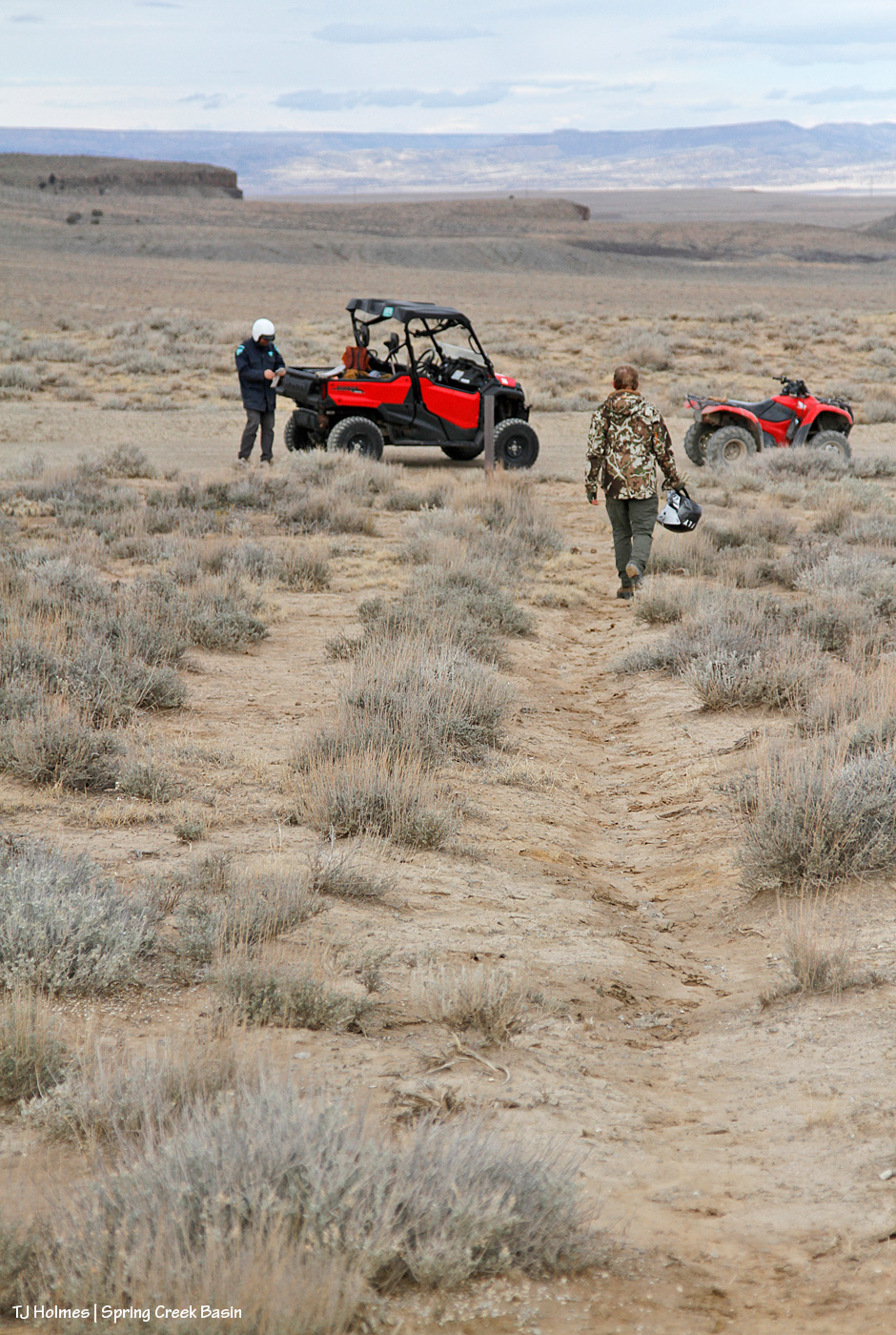
We have to start at the start: That’s Jon driving and Ryan riding shotgun (unfortunately, both Anton and Laura had duties elsewhere that day) at Road 19Q (behind them – and look! it’s being graded! thanks, Denny from San Miguel County!) and Road K20E to Spring Creek Basin. (Also note the water at right; that’s from Sunday’s rain.) Safety first!
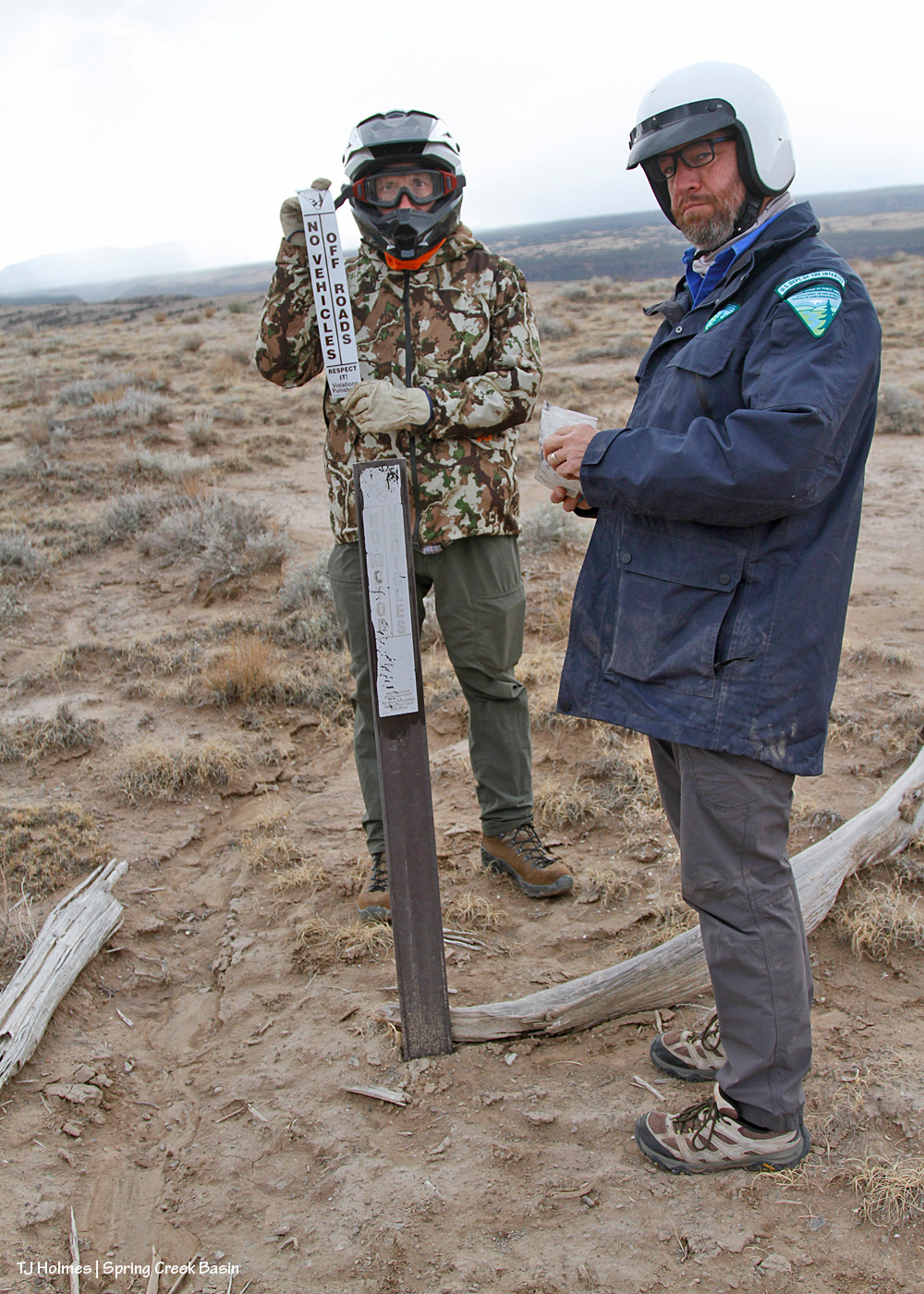
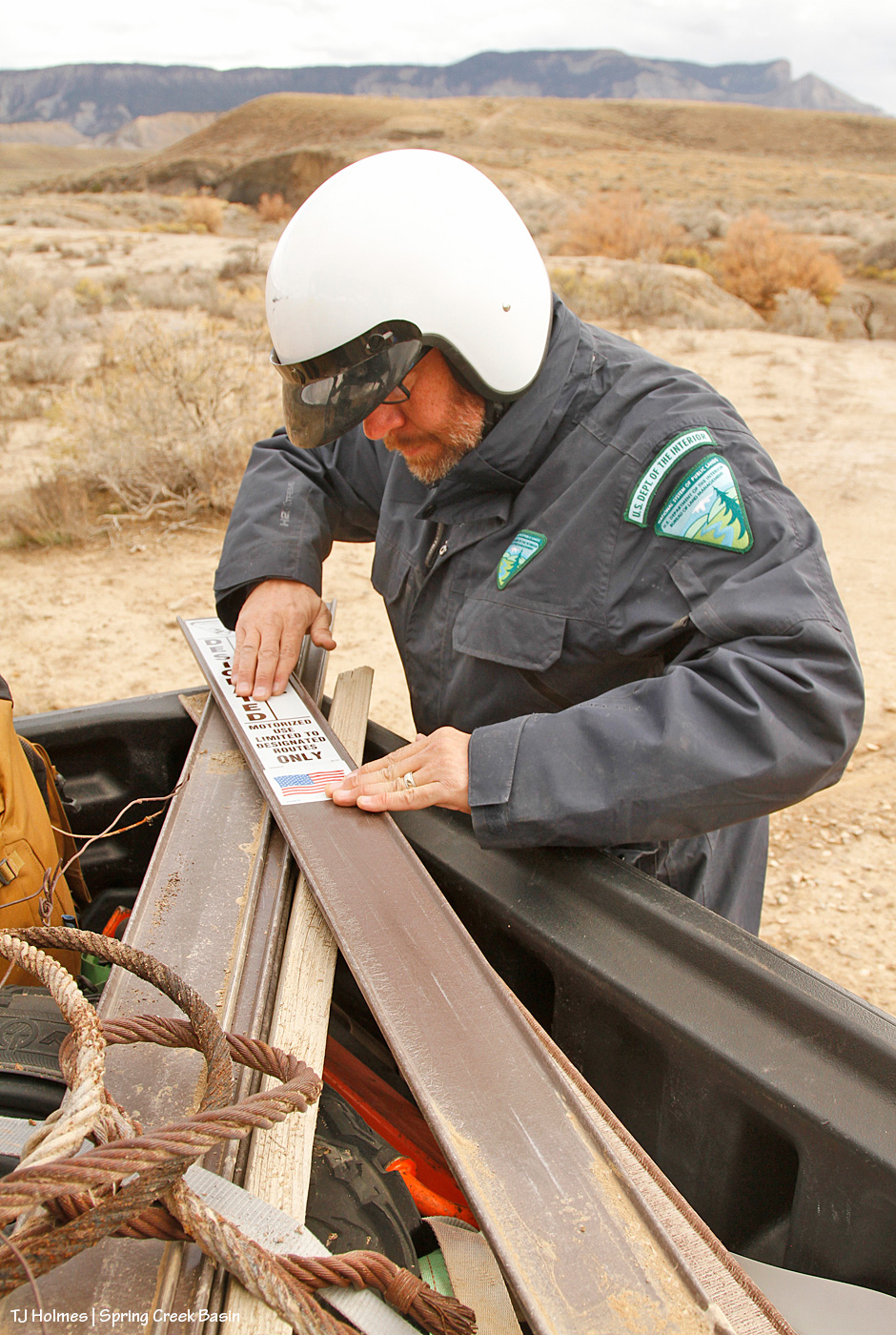
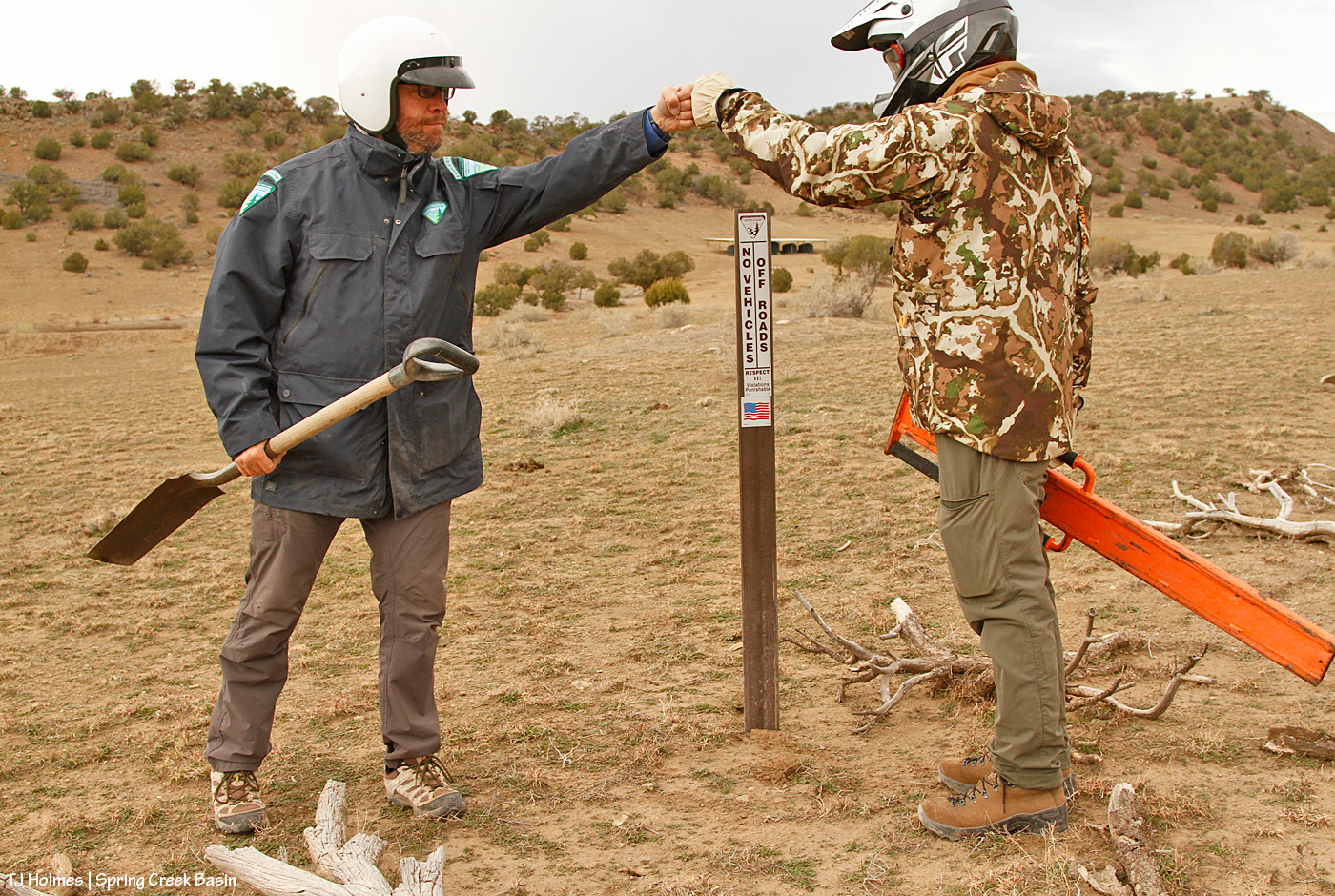
The *serious* BLM faces as they’re about to prep an existing carsonite sign for a new sticker. …
They couldn’t maintain those stoic faces for more than a couple of seconds. 🙂 We shouldn’t have so much fun “working” … should we?? 😉 Note the snow over the Glade in the background! We got a drizzle later, but we agreed that was likely snow at higher elevation.
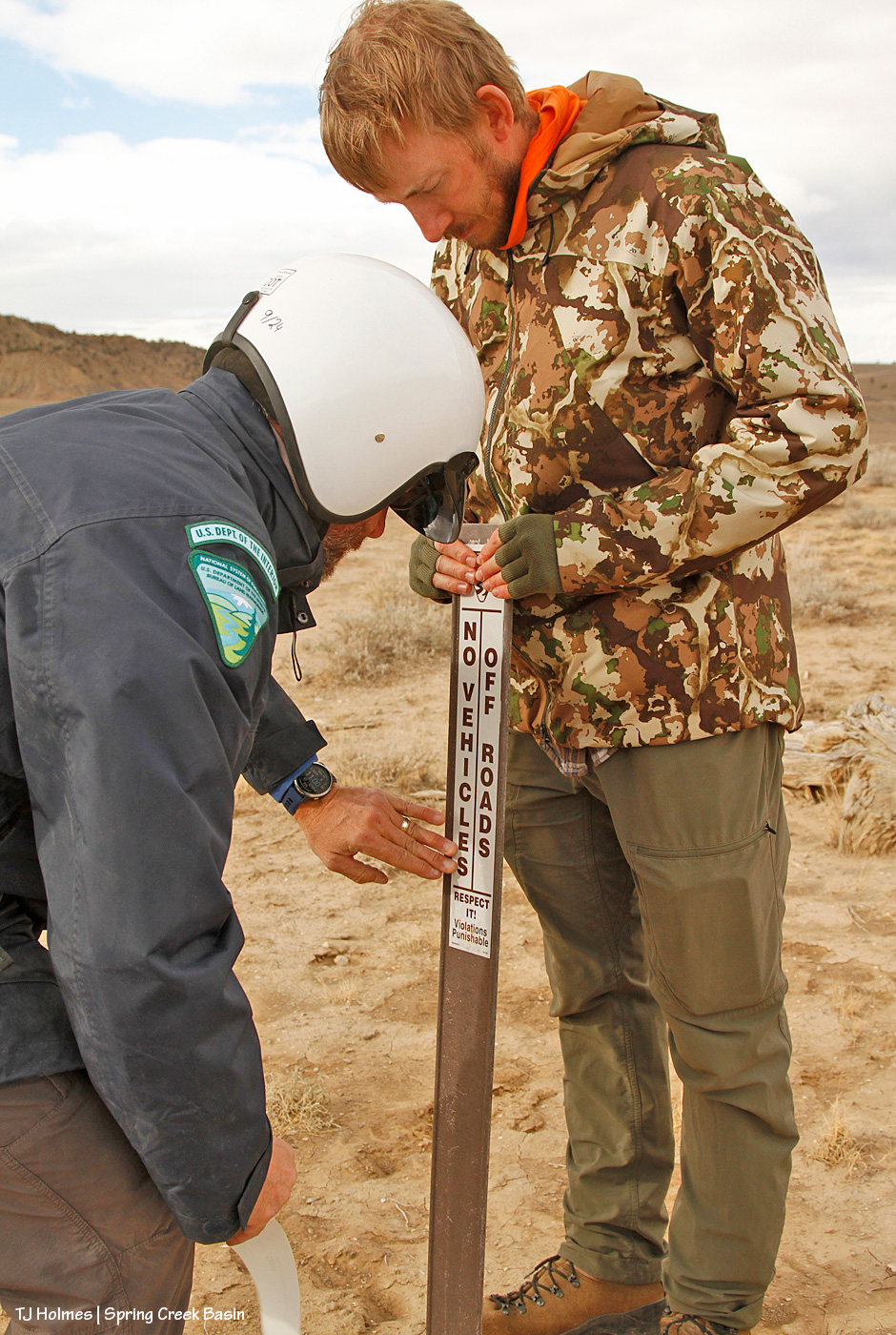
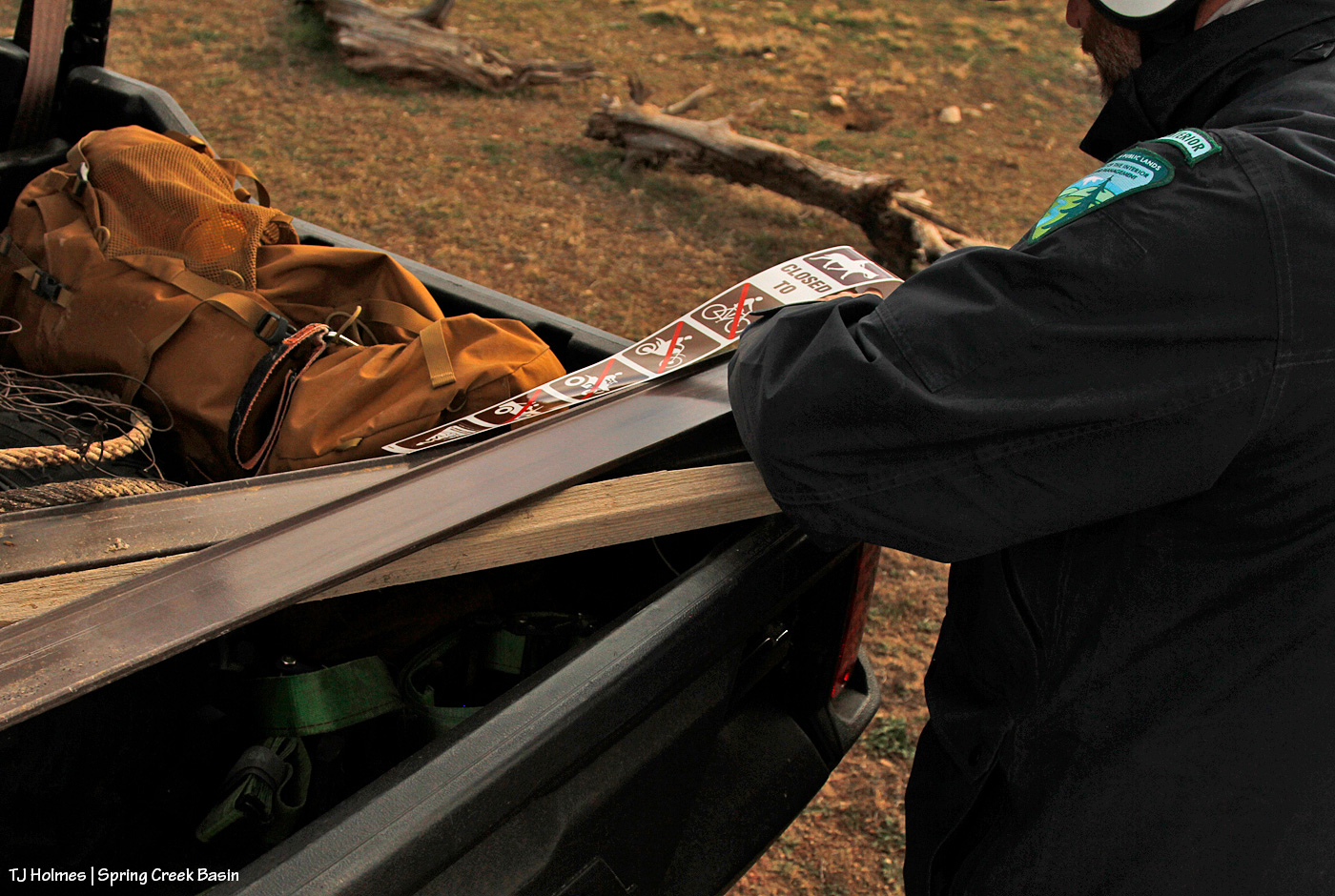
Wonder what “carsonite” is? Apparently, it’s a brand, which means that I should be capitalizing it, but I think I’m going to leave it because we refer to it somewhat generically. It’s like fiberglass, and as Jon will tell you, don’t (try not to) touch it with your bare hands/fingers.
And on goes the new sticker over the old, faded one!
This is a place on a curve in the road, and the edge of this level of ground is less than 50 yards away. … But it had been just too tempting for people to DRIVE over there to look over the edge as opposed to leaving their vehicles or buggies at the road, getting off their butts and WALKING over to look over the edge. So that’s why we had placed the sign there years ago – and why I’d “reinforced” the message with the old branches you see on the ground. There are any number of places in the basin where I have seen tire tracks that lead from the road to the edge of a ridge or place where the ground falls off, including this last driving (aka “hunting”) season. It makes me craaaaaaaaaaaaaazy.
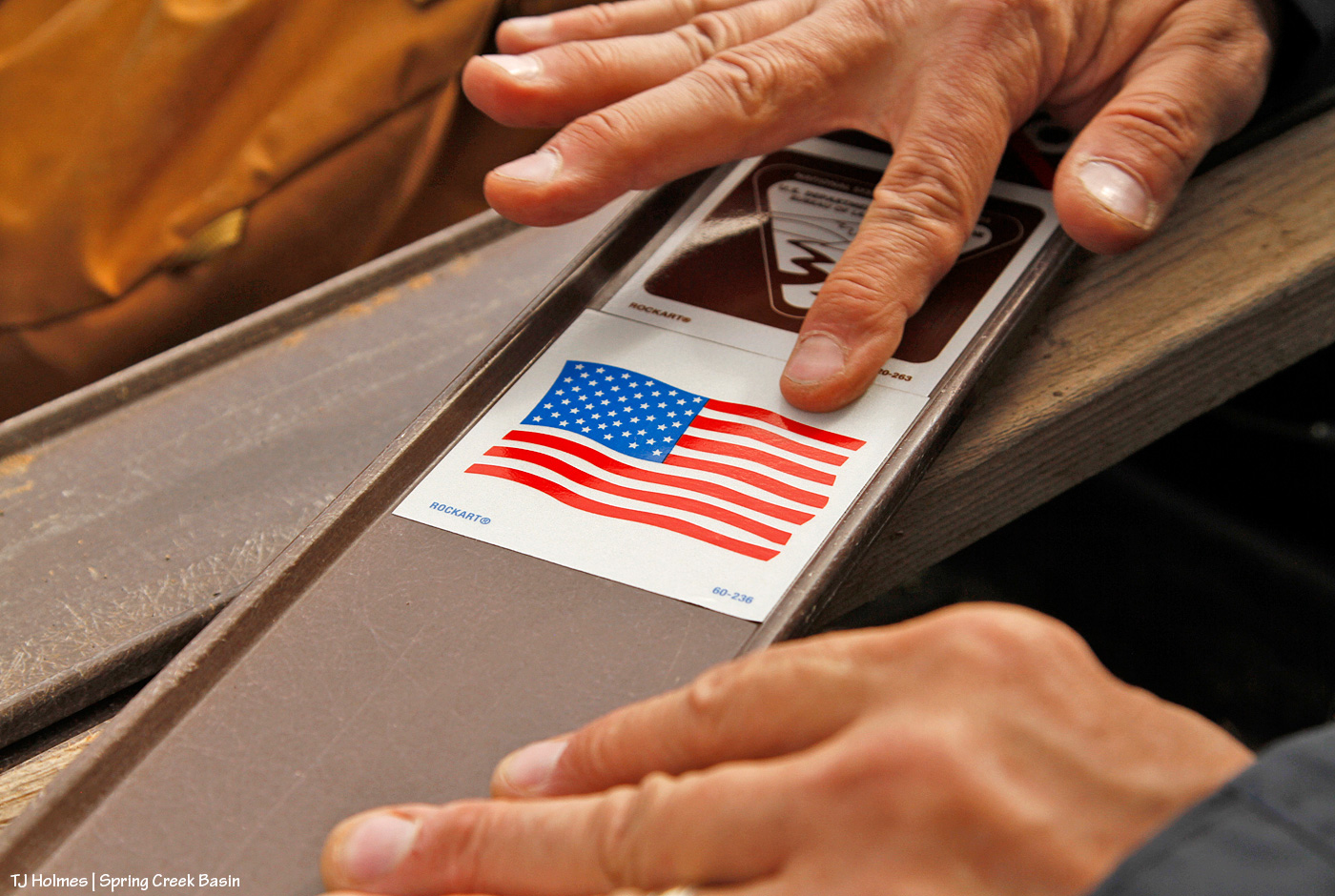
No less important in terms of the sign stickers and their meanings: the American flag. These are America’s public lands! Respect them, no matter how you use them!
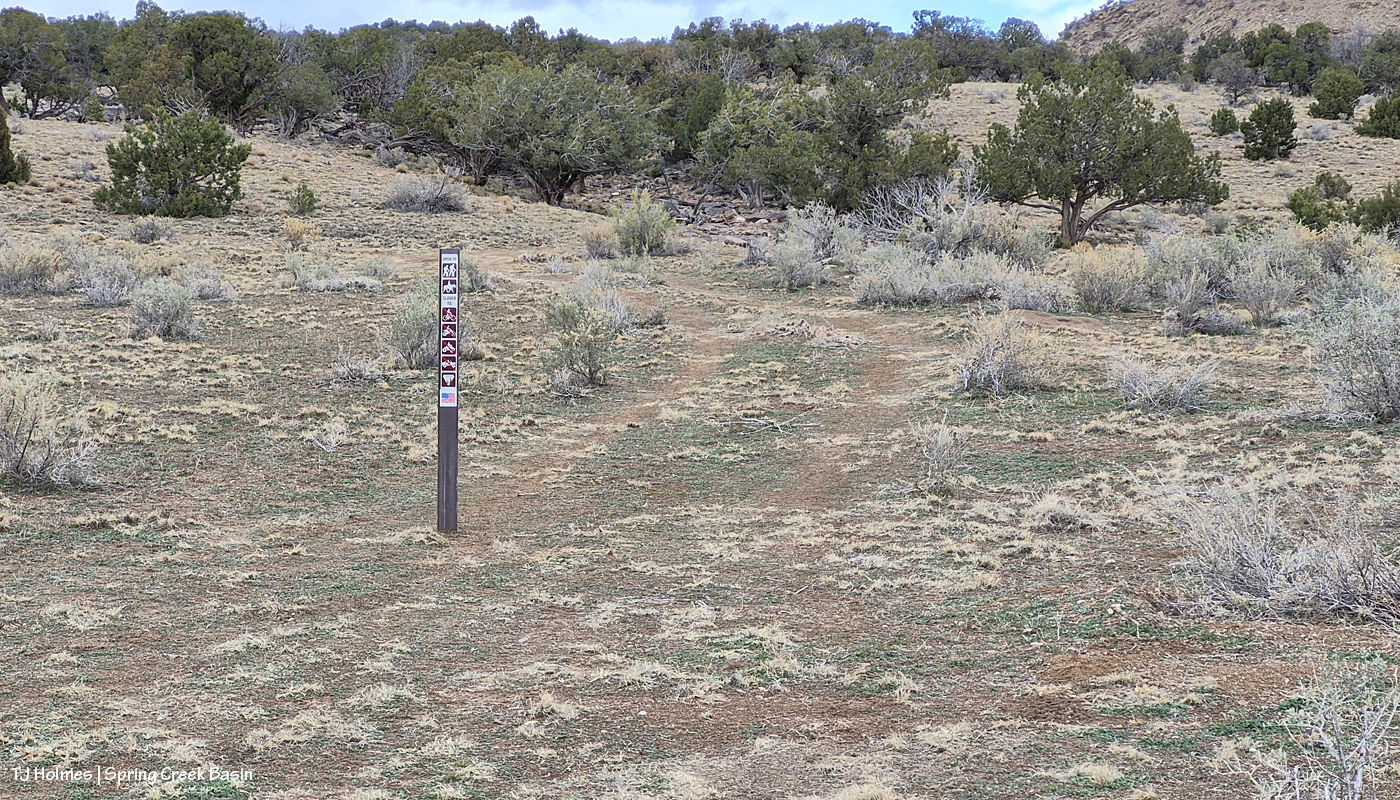
On to our next location, a reminder to not handle these signs with bare hands: splinters! This is the location of an old “Y,” driven in by people too lazy to use the actual road (up the hill) to get to the main road, which comes out not even 75 yards away. Interestingly, this is the site of one of my very first volunteer projects for BLM in Spring Creek Basin; shout out to Kathe Hayes, retired long-time volunteer coordinator for San Juan Mountains Association, who spent countless hours shepherding excellent projects in the basin (including the much-loved alternative spring break program with University of Missouri students). You might have heard that Colorado gets 300 days of sunshine every year. In Disappointment Valley, we take pride in the fact that we likely get about *600* days a year of sunshine (har har). Remember the faded information board that led to the installation (with our most-excellent BLM folks!) of the new kiosk earlier this year? Yeah. You laugh, but we know how much sunshine we get! These signs were due for updated and easier-to-read stickers.
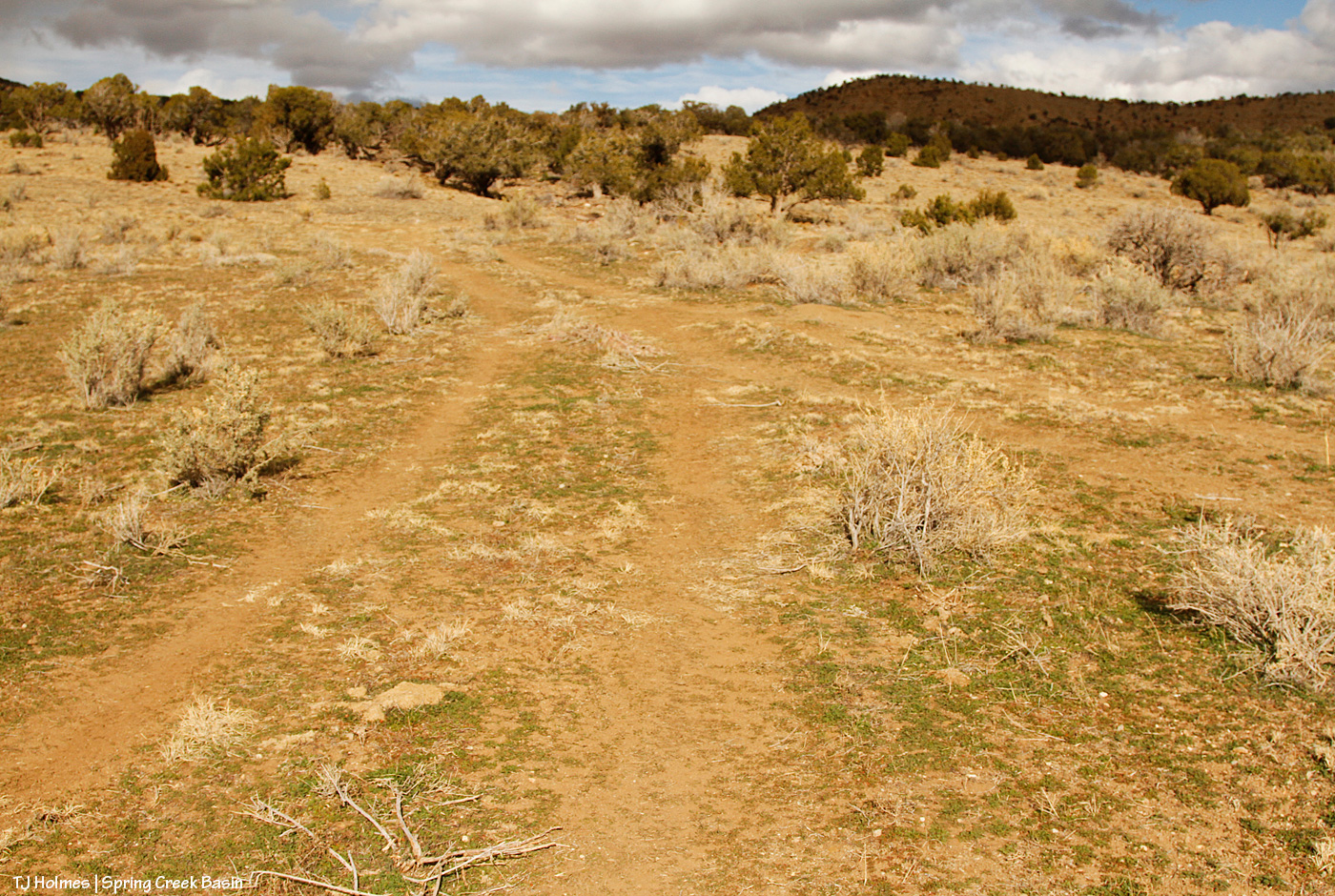
This image really illustrates why it’s so important to protect the resources of Spring Creek Basin, specifically, and many of the West’s drought-fragile landscapes in general: We closed this route 17-18 years ago? It STILL bears the traces of the drivers who ignored that fragility and made a new route because they were too lazy to use the established road – a “designated route,” as BLM calls them.
Every illegal “Y” has its other end, so here are the guys adhering a new sticker to the carsonite sign at the top of the hill. The actual road is right behind Jon.
On to our next location! This was the first installation of the day of a new sign, and we put it at the dugout intersection, which marks the start (or end, or both!) of “the loop,” which is no longer completable (is that a word?!) by vehicle or even most UTVs/ATVs because of washouts (which was the main impetus behind the day and the signs, as you’ll see later). Note the rusty old cable; a bonus to attaching the new stickers to the signs at either end of the old “Y” was that I spotted both old wire clumps and this length of old cable, starting to erode out of the soil, where it had been for … decades? At least nearly 18 years.
This sign, at an intersection, reminds travelers to stay on designated routes. Jon lamented this need, as there are no fewer than THREE big signs from just south of the highway to just before to just inside Spring Creek Basin’s western boundary (and main entrance) that warn that exact message (along with similar signs all along Disappointment Road). … I think of them as just another pretty-please reminder.
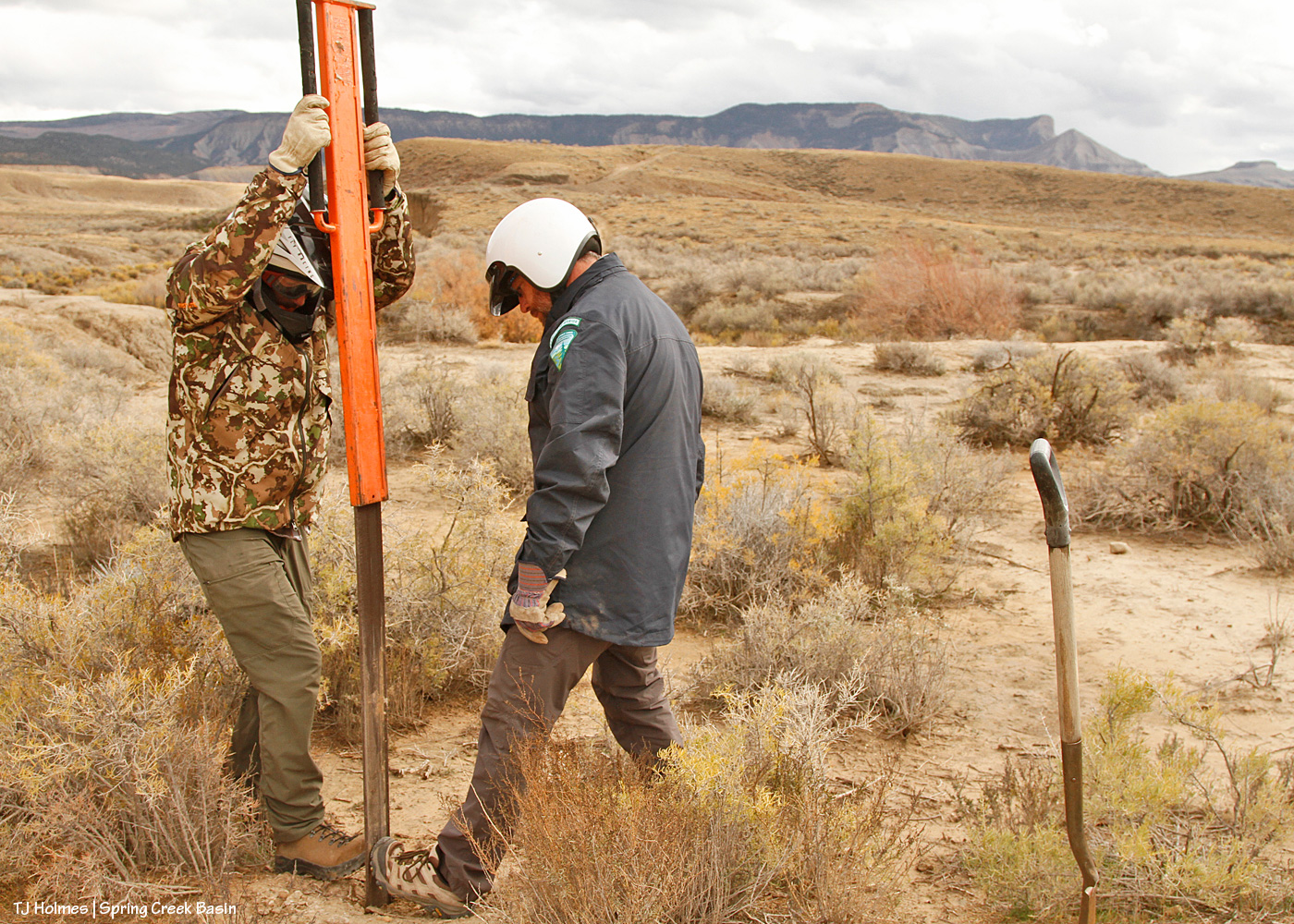
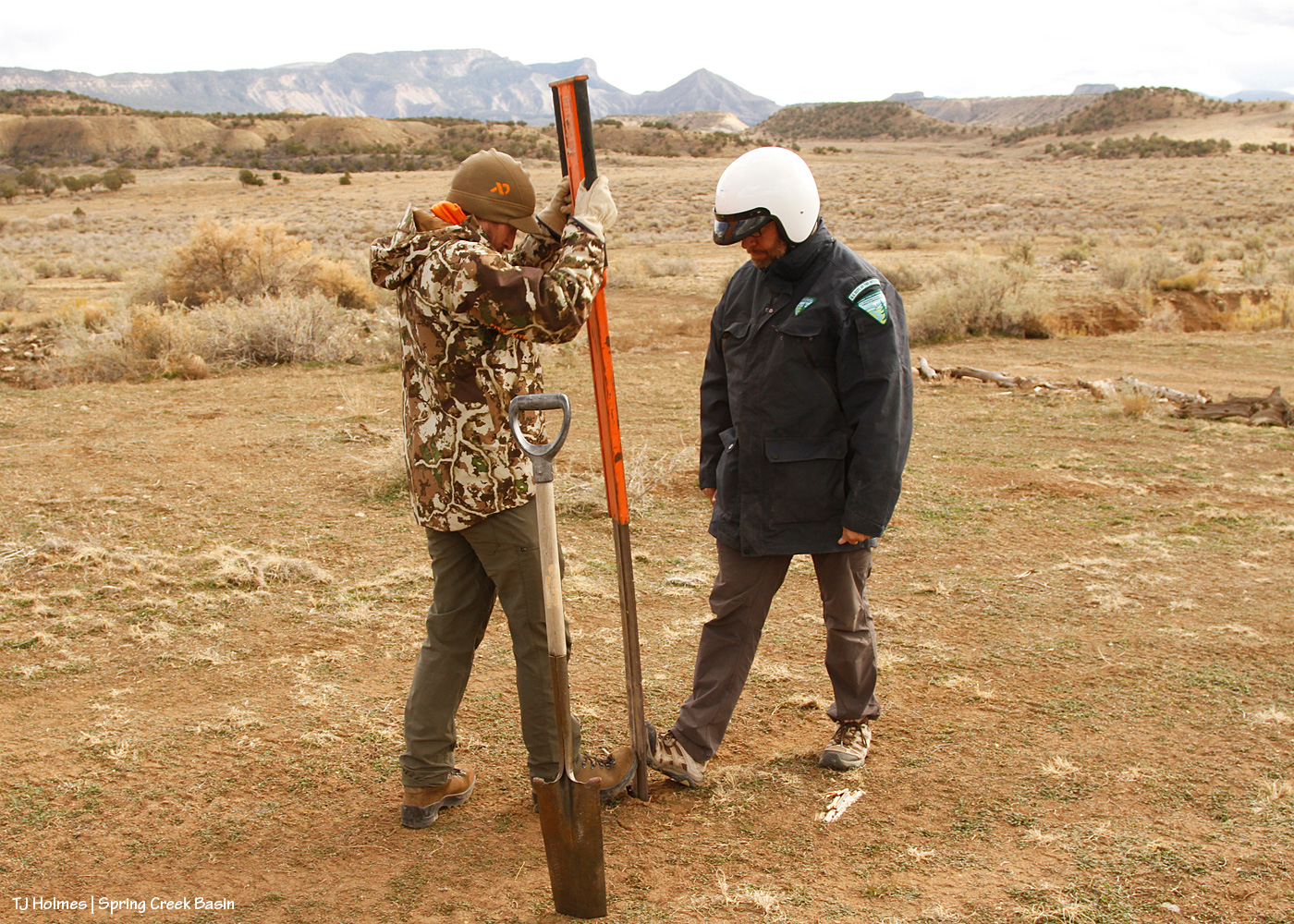
Wonder how the heck one of those narrow, flimsy signs is installed, aka pounded into the ground?
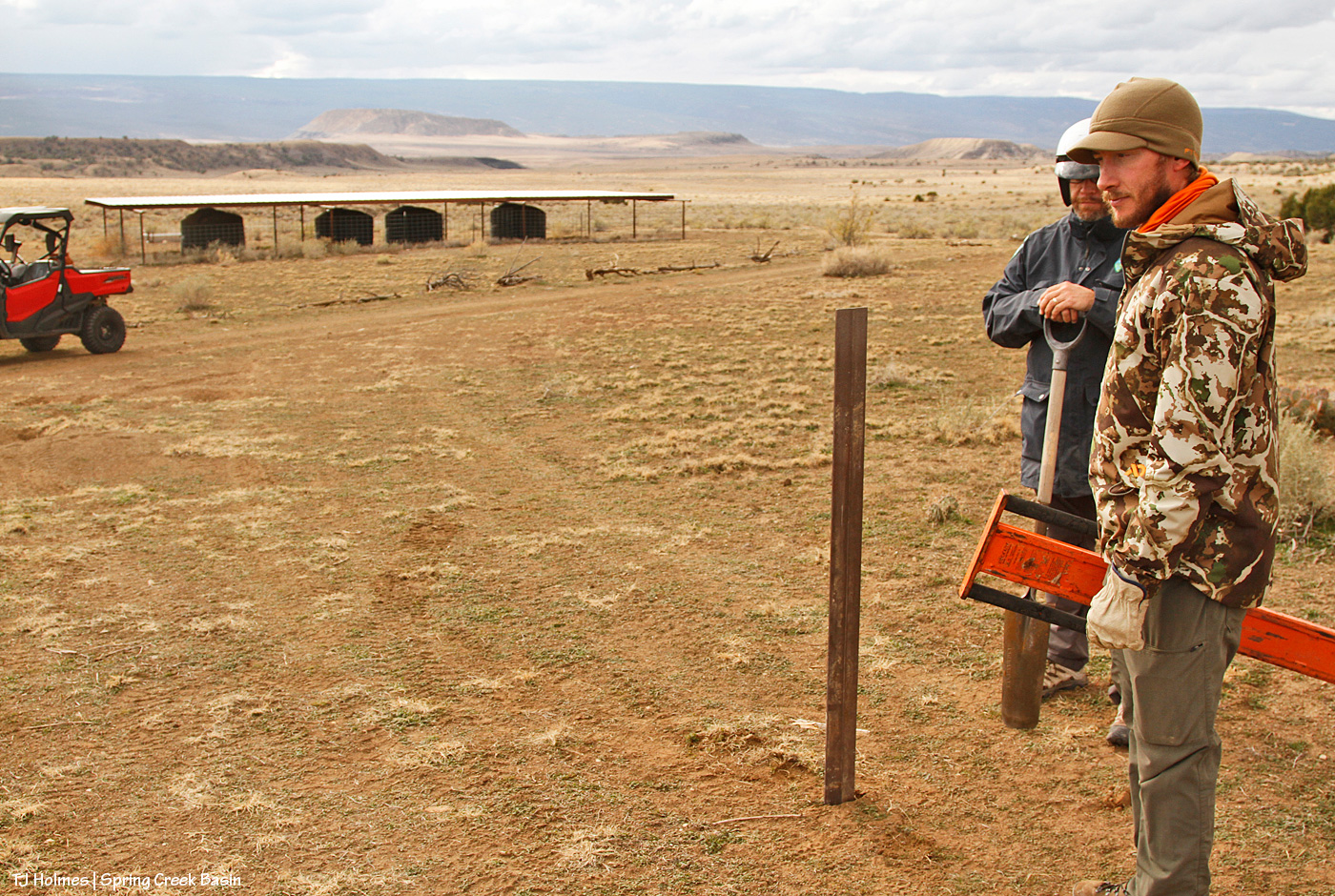
It requires a specialized “pounder.” First, you need the “tile spade” pictured at right, to create a “slit” in the ground and test for out-of-sight rocks (and with our recent rain, the damp ground was very accommodating!) to ensure you *don’t* hit rock. As Jon said, if you pound that flimsy, floppy carsonite sign and it hits rock, the whole thing is wrecked. Then the pounder does the rest. I’ve wielded my fair (or more than fair?!) share of T-post pounders, where you have to hold the post steady or have an unflinching friend do it so it doesn’t twist. Note the men’s toe-to-toe technique on either side of the base of the carsonite; that was to prevent it buckling as it entered the ground.
Now we’re getting to the new water catchments and where I really, really wanted the signs. This one, pictured, was the second one built by Mike Jensen, Garth Nelson, Daniel Chavez and me (the first one included Jim Cisco), in 2022. People really can’t help themselves (!) from driving where they shouldn’t, including over not only fragile ground that doesn’t recover quickly (see above) but also the very limited vegetation on which the mustangs AND deer AND elk AND pronghorn graze and browse. You can see by the wood scattered around that I’ve tried to block it using natural means; people just drive across the ground from somewhere else (at least three other places that I’ve tried to block at this location). And not only directly to the water trough and tanks but to the pond (which, thankfully, is holding water!). … Like, WHY??? I get the curiosity; but have some respect and WALK.
And now we’ve reached the last stop, and, to/for me, the most important.
The 2021 water catchment is behind Jon, not 50 yards away. See the wood on the ground behind him? Over the last two years, I’ve dragged a number of old branches and trunks down from the trees up the hill to line the edge of the road to prevent lookie-loos from lazily driving down to and around the water trough, downhill from the roofed catchment tanks. It has mostly worked, though I’ve had to add more as people, too lazy to even move the blocks, find a “hole” and think that’s OK to drive past/through/around. (And we still found old tracks that indicate people are still doing it. Sigh.)
But in 2024, when we had big, flooding rains in early summer, the road, directly ahead of the UTV in the pic, washed out, leaving a gaping chasm where the road had been (you can see the line of it in the pic). That, effectively, ended the road right there. … Until hunting season, which was wet last year, and people repeatedly drove around the washout to continue, driving-in a rogue and illegal route and damaging resources – again, the vegetation upon which the wildlife depend. I literally cried. And put up more blockade branches and trunks on that side … which people continued to ignore and drove either over or past.
When we arrived at the location, which I hadn’t visited at all this past hunting season as my heart just couldn’t take it, sure enough, people had left my last blockade intact … and just created yet another new route to get around the washout – which is even worse now and even washed away their “shorter shortcut” (which I’d also attempted repeatedly to block).
But I didn’t cry at the destruction this time because I had guys with me who were about to justify my upsettedness at the lazy-ness of man (to be fair, most of them have been men), and we were about to proclaim in more certain terms than dead-pinon/juniper trunks/branches and big rocks that YOU SHALL NOT PASS! (I do love a fellow LOTR fan! Thanks, Ryan!)
The sticker going on the carsonite for the sign you saw in yesterday’s post.
Along with:
I really kinda love this pic. Those are hands that belong to someone who cares deeply about our public lands, their value and their sacredness. And though they’re the hands of only one, *I* know, and I tell you with all sincerity, that hands just like that belong to every person at Tres Rios Field Office (at least).
Sign inserted into pounder; check. Note the tire marks Jon and Ryan are standing on. The road is immediately behind Jon.
Pounding commencing; check. At right, you can see my blockade – untouched because the drivers just shifted to driving where Jon and Ryan are installing the sign – and above that, the washout. It starts at the left (literally) and runs right/south/downhill to join a bigger arroyo/drainage downhill of the catchment.
Now looking back to the road (on which the UTV is parked), my blockade along the road to try to protect the water catchment. The silver trough is just visible to the left of the leftmost tank. Yes, it’s THAT close to the road. NO need to drive down there when it’s so easily walkable to get a better/closer look! The tire tracks on the rogue route are really distinct in this image.
For a better look at the rogue route and the resource damage caused (after only two years):
The track at right is where people first started driving off the road to get around the washout. Directly ahead is where they shifted so as to ignore the blockade that plainly (!?) was meant to deter people from driving illegally over our precious and drought-limited grasses and other vegetation (cacti and four-wing saltbush are among the most destroyed).
From where they crossed the “head” of the washout, over bedrock, to return to the actual road, which is semi-visible along where this illegal route makes its last curve.
Why ELSE is this rogue route so infuriating (as if destruction of resources and the vegetation the mustangs and other wildlife depend on weren’t enough)? Within a short distance (less than a quarter-mile?) is another, bigger drainage and semi-washout (that has been hunter-filled with rocks to make it crossable). But just another quarter-or-less-mile past THAT is a washout that isn’t crossable except by walking, riding a bike or a horse or a motorbike or perhaps jigging a relatively small ATV around – and that was the last time I saw it. With the more recent rains, it’s possible that even jigging isn’t possible anymore. Either way, it’s a risky or not-possible-to-cross washout, so why destroy resources just to continue driving another half-mile??? ARGH! It has made me craaaaaaaaaaaaazy!
While out in wildcat valley a few days ago, during third rifle season, I sat with a band and literally watched a truck drive up to the washout, see the washout, back up and drive around the washout to continue on … to the washout they couldn’t pass. … Then return. Following the tracks made by others. I know these people are *just* trying to access public lands, and I am not inherently anti-hunting (though I am very against the *driving* culture that seems to be “the way to do it” out here). I believe *respect* is key, and animals are trying to survive on this fragile landscape. Please, please respect the land AND the wildlife!
I am keen to say that I’ve noticed that other signs such as those we put up Wednesday have been very much honored in the basin regarding non-designated and please-don’t-drive-on routes. I hope these signs also are honored, and I hope it indicates to visitors that we have land managers here who give a damn about the land and the herd and the way our natural resources are treated.
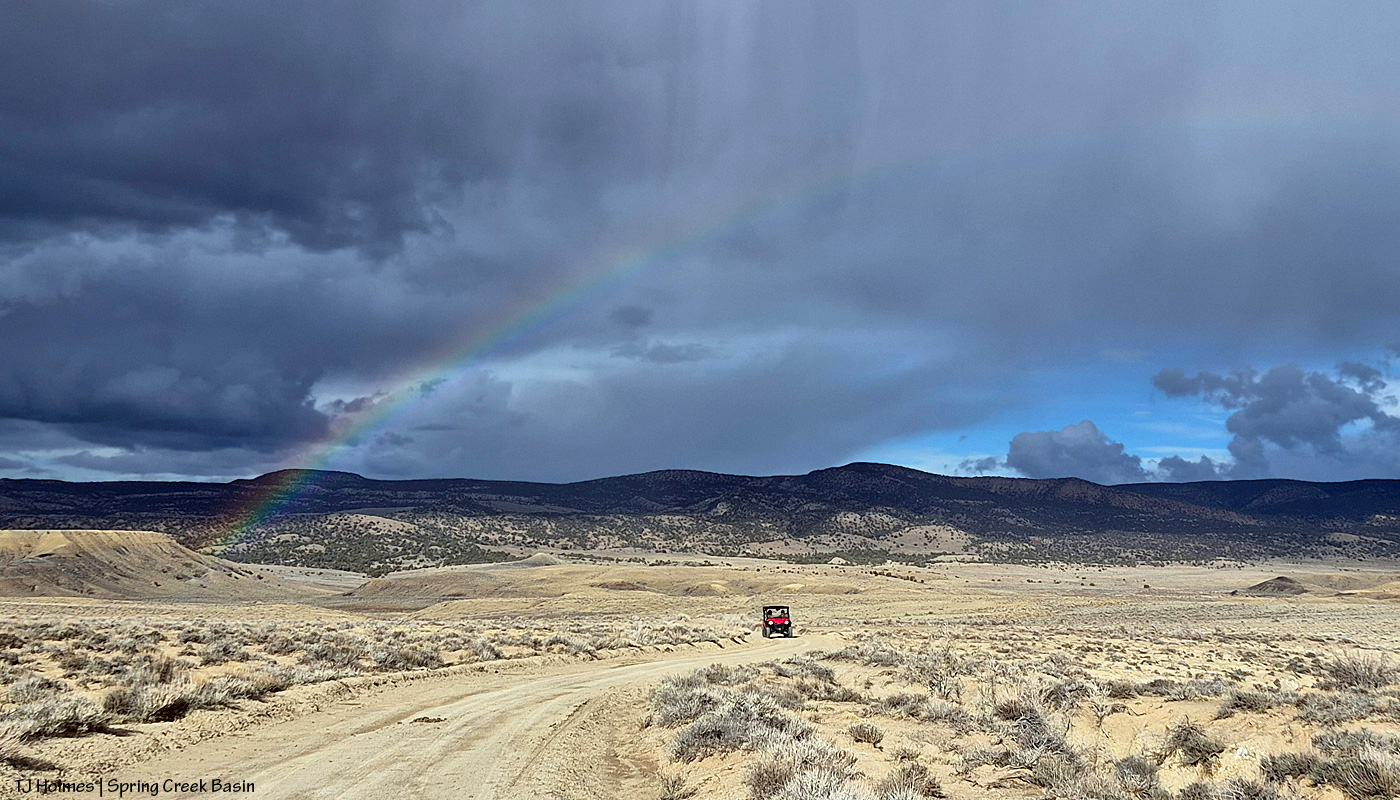
No joke: THIS happened over Jon and Ryan as we were leaving. 🙂 AND I found an old horseshoe while we were installing another sign (I didn’t think to take a pic, but it was a much better find than the rusty old wire and rusty old cable). If those aren’t *signs* that Mother Nature herself is happy with our work, I sure don’t know what are.
Absolute heartfelt gratitude to all who made this happen, including and hugely Jon and Ryan! This was a very long post about seemingly very little things, but those little signs have the potential to signal big impacts for the preservation of Spring Creek Basin and its vegetation resources for generations to come of mustangs (as well as deer, elk and pronghorns, and no, I do NOT apologize for hammering this point!), not to mention all those living their best lives right now. 🙂
A dramatic background any time, but wow, did we get some dramatic light on McKenna Peak and Temple Butte to perfectly highlight Maiku and his compadres.
“We” were these fine folks from Four Corners Back Country Horsemen, who came out for a visit to Spring Creek Basin:
They didn’t bring horses to ride, but they saw a fair number of our fair mustangs. 🙂
Left to right: Marlo and Gail; Tim and Linda; yours truly; Patty Ann and her daughter, Chelsea; Larry and riding partner Jeff.
I do love showing off Spring Creek Basin and our wonderful mustangs, and a couple of bands gave us a good look!
Note: Images are from Tuesday, Aug. 5. Yes, I’m in Spring Creek Basin for the below (cell-phone) images, and yes, the fire is fairly close as the eagle soars (the next county south, which is Dolores County; the basin is mostly in San Miguel County but does extend south into northern Dolores County). However, the horses are not in danger; there’s actually a lotta country between there and and the basin.
If you’ve visited Spring Creek Basin, you’ll recognize this cattle guard at the intersection of Road 19Q (Disappointment Road) and Road K20E. What you most likely and very fortunately have NOT seen as you head east toward Spring Creek Basin is a giant, nuclear-cloud-looking smoke plume. 😦 That’s the newly started Stoner Mesa Fire. (This is the Durango Herald link; you may hit a paywall, or you may get a free read of three articles (?).)
I won’t lie; I nearly had a heart attack when I saw that plume. Back in 2002, I was working at the aforementioned Durango Herald, and when I drove to work each afternoon (copy editor/page designer shift of 3 p.m. to midnight), the nuclear-plume of smoke from the Missionary Ridge Fire greeted me with heart-stopping awesomeness (and not in a good way) every time I topped Hesperus Hill to descend toward Durango.
This is from the area we call Chrome’s Point in western Spring Creek Basin, looking east-southeast. Yes, those dark-and-white spots at far left, left of the main/original water catchment aprons (looks like a tennis court) and tank are mustangs. Thankfully, they seemed completely and totally oblivious. The air was hot and smoky: Dragon Bravo Fire, Sharp Canyon Fire, Turner Gulch Fire (smoke still visible from it, too), Waters Canyon Fire … and who knows what other fires contributing to our air dis-quality (!?)) – more hazy than seems apparent from these images.
Moonrise over McKenna Peak and Temple Butte from farther north in the basin. Most of the smoke was blocked by the eastern horizon of ridges from this perspective.
Sunset through smoke. Pretty … but it is violently, dangerously dry out there.
This is a hot, bad, dry (and very-bad-dry) summer, folks. Please be mindful of anything that could spark a flame, stay safe, and support your firefighters … local, regional, state and national. And rain dances are *ALWAYS* appreciated. 🙂
(I went with my phone pix for this post, but I may have some from my big camera in coming days. … May …)
[Nate West, Brian Yaquinto, Jon Whitehead, Laura Heaton, Anton Rambur, Ryan Schroeder, TJ Holmes]
I cannot begin to tell you all how much I *LOVE* this new information/map sign kiosk JUST installed at the western entrance/boundary of Spring Creek Basin.
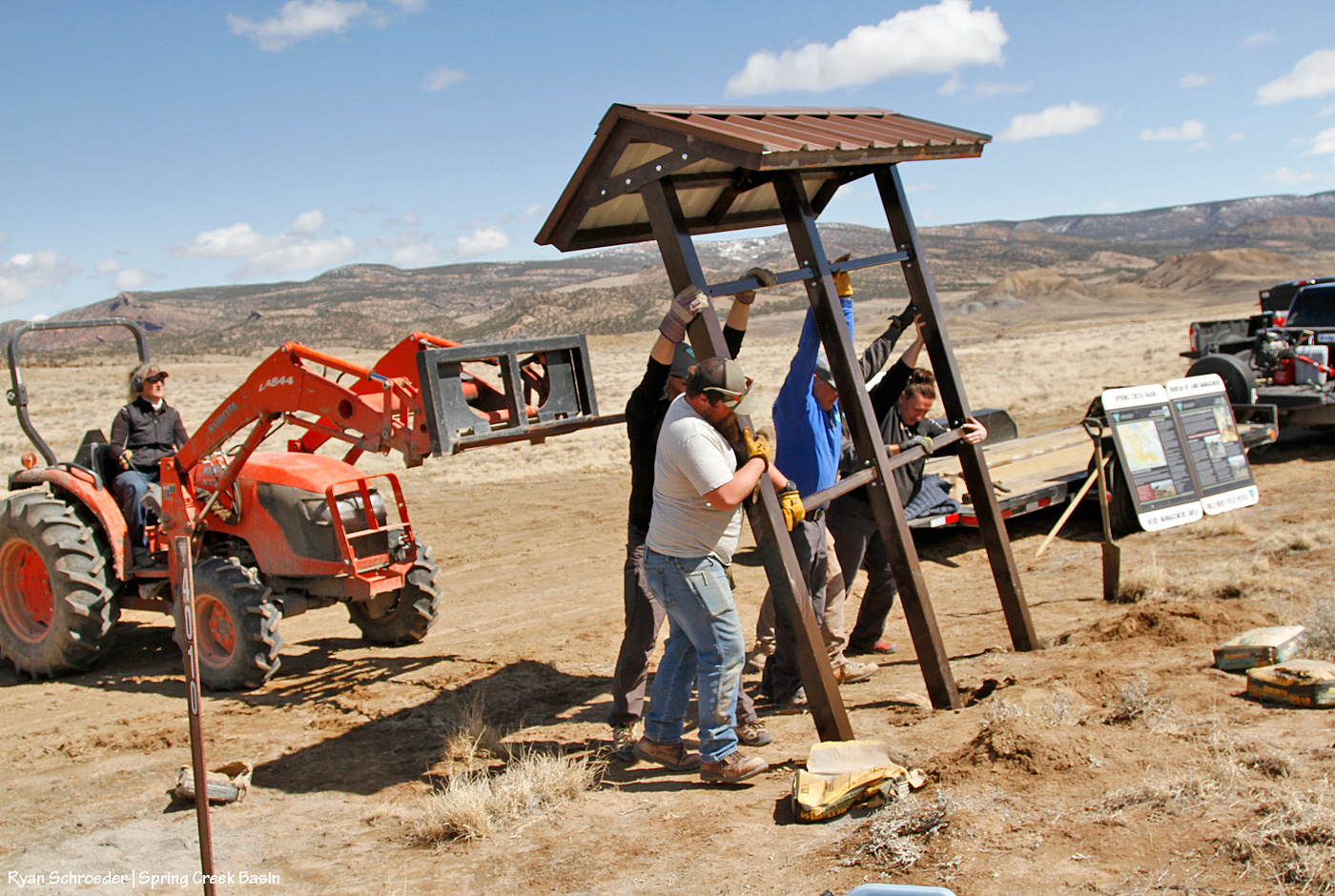
It has been in the works for at least the last year. On April Fool’s Day, rangeland management specialists Ryan Schroeder and Anton Rambur came out to augur and dig out the holes for the three posts for the kiosk (in the snow and greasy-muddy road, I might add). The day after April Fool’s Day (gorgeous but nippy), we were joined by Laura Heaton (range tech), Nate West (wildlife biologist), Brian Yaquinto (archaeologist) and Jon Whitehead (recreation) to put the whole thing together and set it upright in the holes (shout-out to my awesome little Kubota tractor!) and cement it in place.
Let me also mention that this was Ryan’s third day back to work. I never anticipated that I’d be RE-introducing him when I introduced our new range team, but there it is, and here they are. 🙂 I’m so stoked to be working now – again – with all three of them.
A couple of (OK, several) images of the construction and installation of our brand-spanking-new, kick-ass kiosk in Spring Creek Basin:
Actually, let’s start with the old interpretive sign, familiar to anyone who has driven into Spring Creek Basin. You might think the sign looks white because of glare or overexposure by the camera. …
But no. It really is that blank. The high-elevation, Southwest Colorado sunshine will do a number on just about anything. … Hence the new sign. 🙂 (Note the scratches at the top and (at least) left side. What made those scratches, you ask? Horse teeth, I tell you.)
Laura and Ryan check out the new map and info signs. OMG! They are SOOO COOL!
Who took the images for the signs? I’m so glad you asked. 🙂 I am BEYOND proud! (While all of the BLM folks were gathered around to look at the signs, I ID’d for them all the mustangs in the pix. Above: Hollywood, Shane, Houdini, Alegre and Maia. I’m also hugely grateful that our dearly retired herd manager, Mike Jensen, and the BLM’er who put the signs together, Jason Byrd, allowed me to dust off my copy-editing skills in service of both the info panel and the map. I realize now that I didn’t take a close-up pic, but Temple Butte is noted on the map, the first time I’ve seen the name on any map since we got it officially named by USGS in late 2018.)
While Ryan digs out the edges of the middle post hole just a little bit more, Brian, Nate and Anton started attaching the posts to the roof structure, resting on the forks of the tractor.
With all the vertical posts attached to the roof structure and the cross pieces (to which the sign boards would bolt), Jon arrived with the Qwikcrete and water to mix into a slurry in the post holes to help support the posts for a very long time to come.
And up she goes! OK, this doesn’t really show the tractor doing the heavy lifting, but it did. 🙂 Thanks, Ryan, for taking the camera while I worked the tractor!
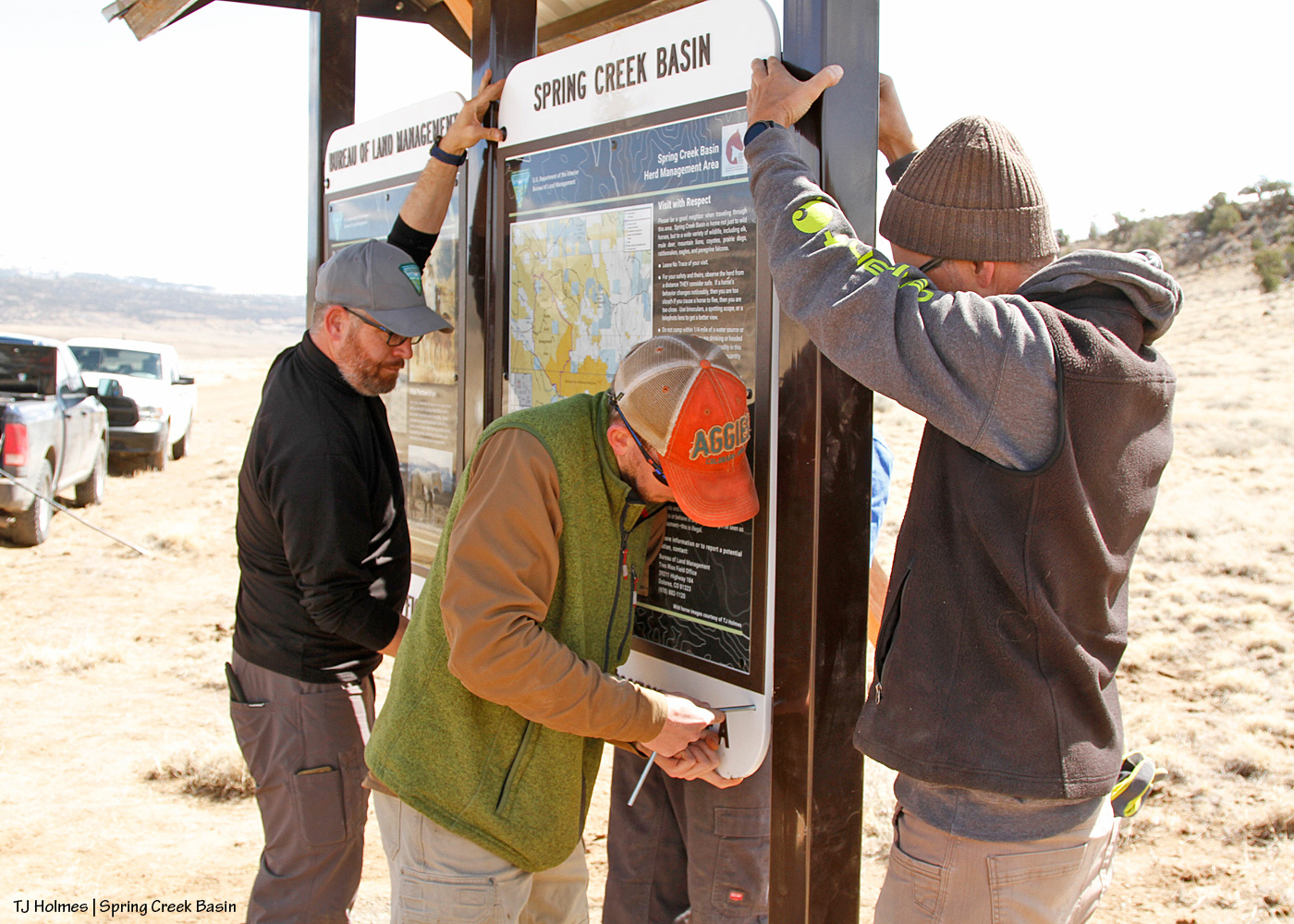
In go the bolts for the first sign panel! (Yes, we did joke about how many BLM’ers it takes to screw bolts into a sign. 🙂 You almost can’t see him, but Jon is holding the sign behind Brian while he and Ryan thread the first bolts and Anton holds the left side of the sign.)
Anton holds the second panel while Jon (left) and Brian insert bolts to attach the sign to the frame.
Eagle-eyed readers will note that the sign very correctly welcomes visitors to Spring Creek *Basin*!
I want to express my enthusiastic gratitude to our particularly awesome BLM’ers for making this new info/map kiosk come to life in Spring Creek Basin. It has been, I think, a little more than a year from conception to standing tall at the west basin boundary to greet visitors to Spring Creek Basin, magical home of our mustangs. Pictured, left to right: Nate West, Brian Yaquinto, Jon Whitehead, Laura Heaton, Anton Rambur, Ryan Schroeder and yours truly (I actually brought my tripod so I could be part of the picture record!).
Huge gratitude also to Mike Jensen (retired but never forgotten), who offered me the opportunity to share some of my favorite images of the mustangs and my copy-editing skills (and texted this in reply to telling him about the new sign: “Wow awesome that looks great. See no worries I left you in good hands.” :)); Doug Vilsack, Colorado BLM director, who agreed that we needed a new sign when he first visited Spring Creek Basin in 2023; Derek Padilla, Tres Rios Field Office manager, who has been super supportive of Spring Creek Basin from the get-go; Joe Manning, TRFO assistant manager, also incredibly supportive and who agreed that it was a project worthy of funding; and Jason Byrd, recreation specialist (?) at TRFO who designed the signs with my images and all my edits and made the most gorgeous informative panels in all of BLM-dom.
Thank you, ALL! And now, when any of you visit Spring Creek Basin, you know the story of how our fabulous mustang kiosk came to be!
I am giddy with excitement and anticipation. 🙂 First of all, we have our full BLM range team back together again! As of Monday, rangeland management specialist Ryan Schroeder is fully reinstated and back to work with range specialist Anton Rambur and range tech Laura Heaton at Tres Rios Field Office. And he got to get his hands dirty – literally – with Anton (Laura was under the weather) out in Spring Creek Basin yesterday to …
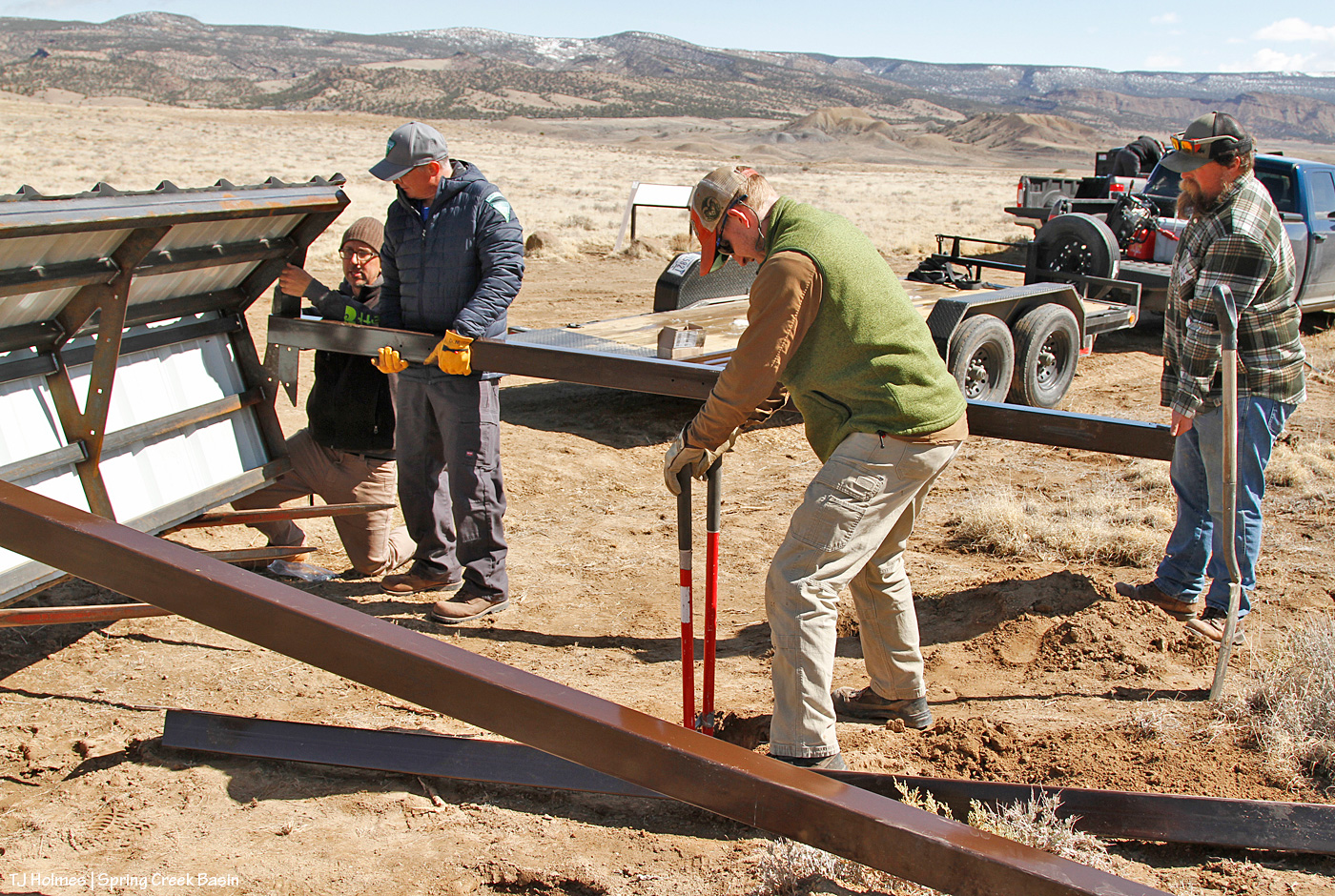
…uh … just what the heck WERE these guys doing?!
A hint is in the background. 🙂
Leave a guess in the comments and let me know just what the heck you think these funny guys were doing!
All will be revealed soon, and it’s going to be awesome!
On Wednesday, BLM rangeland management specialist Ryan Schroeder texted that he had been reinstated at his job at Tres Rios Field Office in Dolores, Colorado!!!!!!
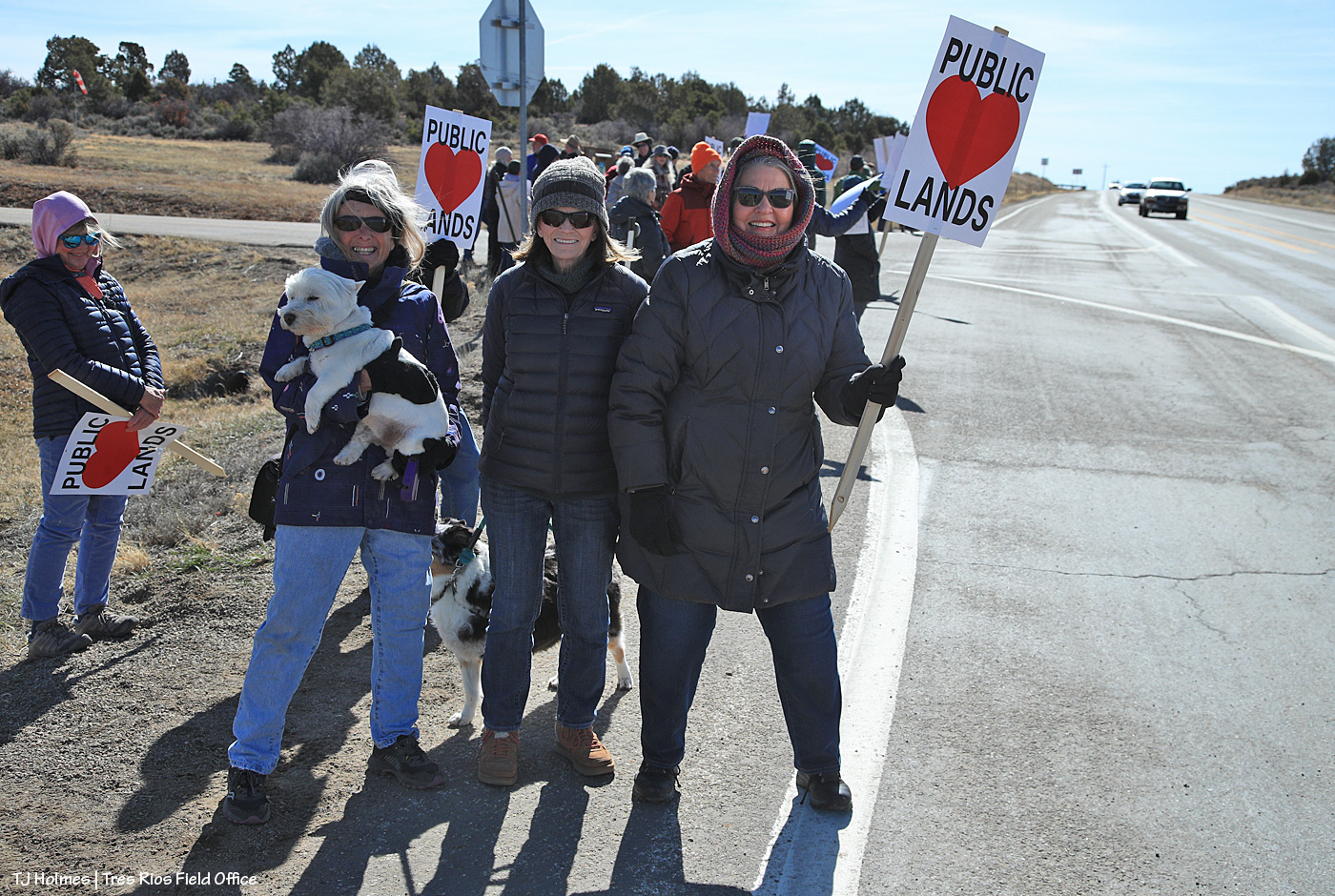
On Friday, rallies to support public lands and federal employees were held at Tres Rios Field Office (also known as Dolores Public Lands Office; BLM and U.S. Forest Service), Canyons of the Ancients Visitor Center and Museum (national monument), and at Mesa Verde National Park. Those rallies were followed by a combined rally at the intersection of U.S. Highway 160 and Colorado Highway 184 in Mancos.
I’d call that excellent timing. 🙂
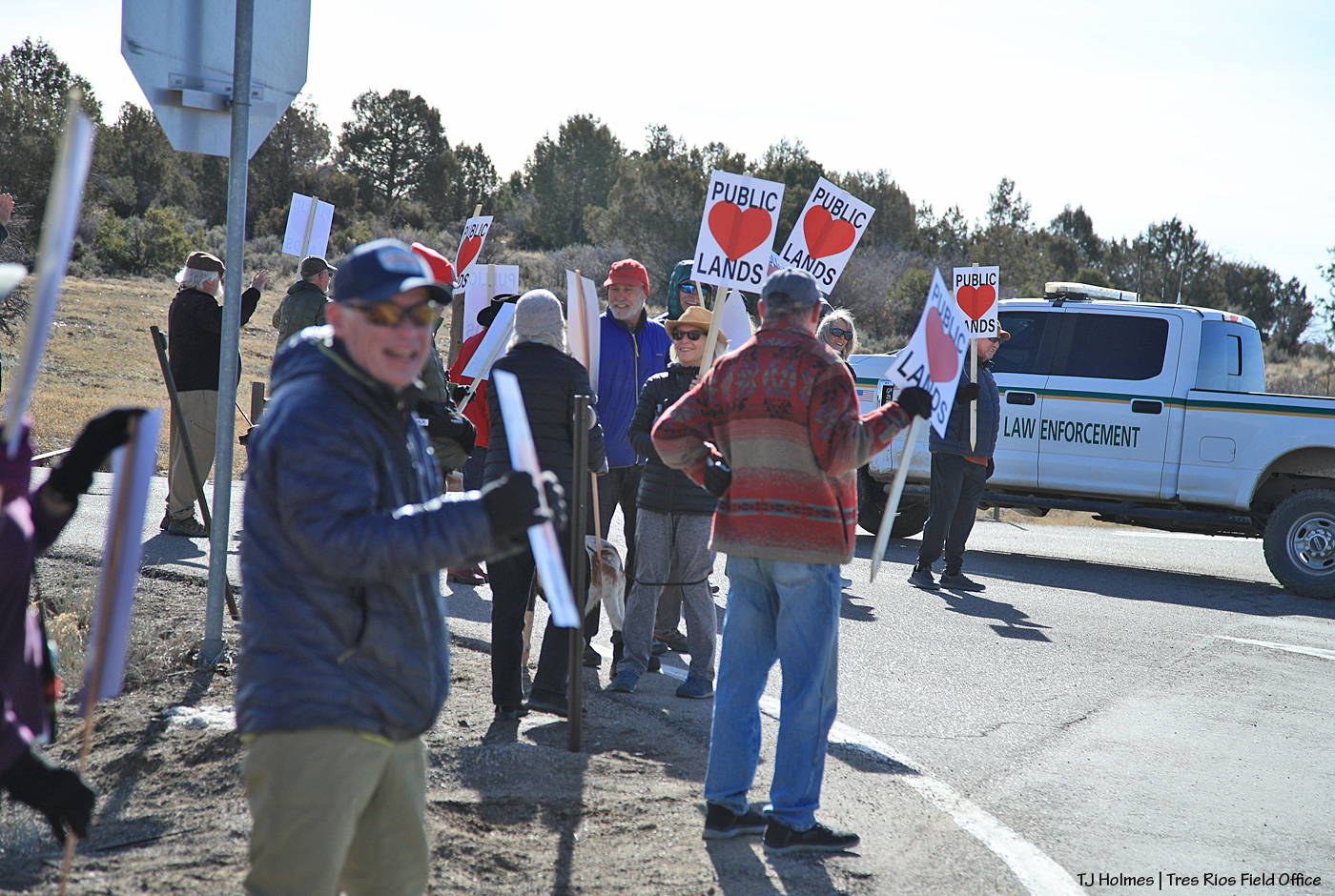
Folks gathering and collecting their signs in the parking lot of TRFO/DPLO.
A law-enforcement ranger pulling in, greeted by a crowd of supporters. I believe this was a Forest Service ranger, but I’d like to give a shout out to our BLM law-enforcement rangers, who are absolutely the best. I’ve worked with a handful of different rangers, and absolutely every one of them has been stellar. At least one of them was just in Disappointment Valley this past week. Two BLM rangers have an enormous chunk of ground to cover – all of Southwest Colorado, something like five or six counties? – and they have told me they make it a point to patrol through Spring Creek Basin and Disappointment Valley as often as possible. Hats off to those guys!
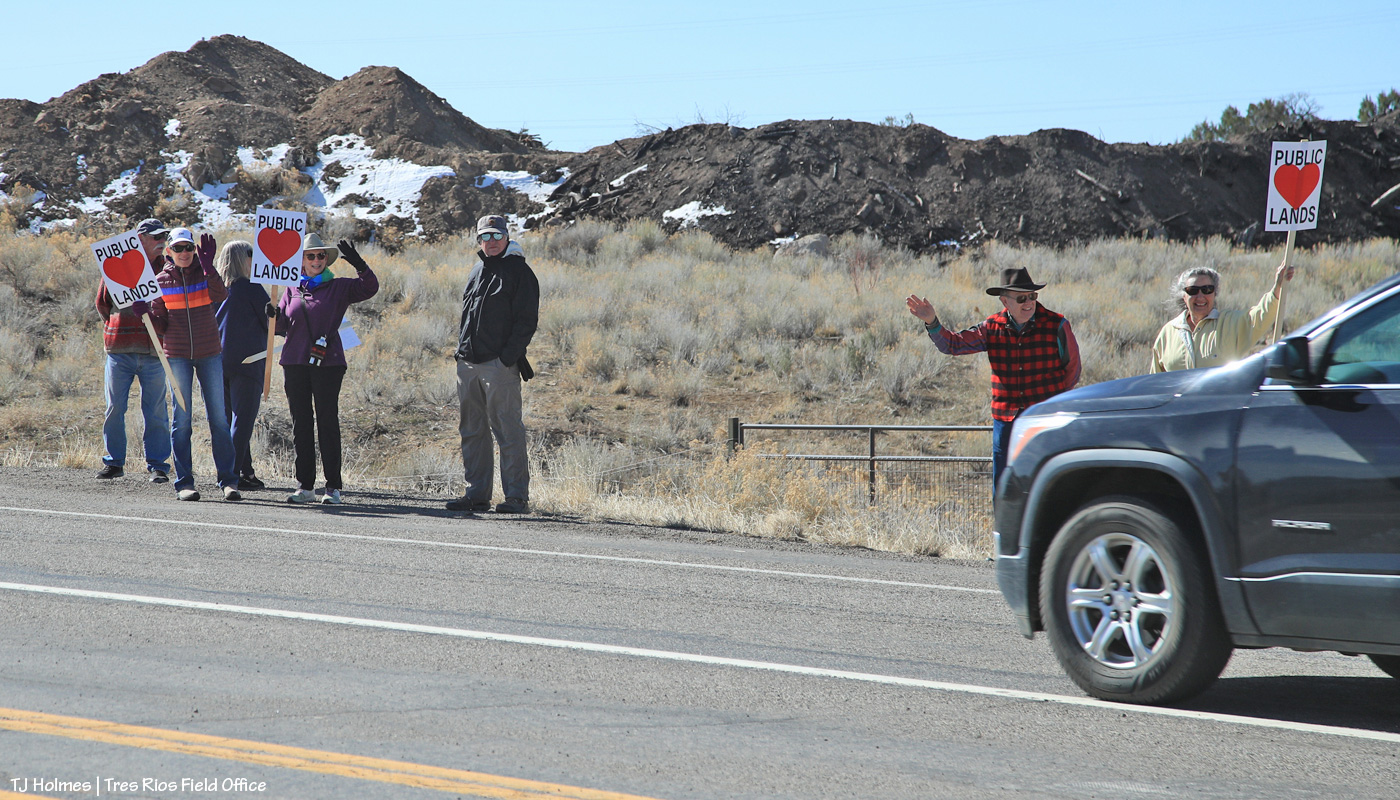
Supporters crowded both sides of the entrance to the DPLO/TRFO, as well as across Highway 184. Lots of folks honked and waved in support of the public lands in Southwest Colorado and elsewhere. I don’t know the percentages, but this region IS public lands! Agriculture (cattle and sheep grazing), timber, oil and gas, hunting and fishing, wild horses, recreation – hiking, mountain biking, camping, backpacking, horseback riding, birding, kayaking, rafting, etc., etc. – all depend on BLM, Forest Service, national monument and national park lands. Jobs aren’t limited to federal employees; they are interconnected among a wide variety of livelihoods. And those folks are our friends, our neighbors; they are part of our communities.
I would hazard a guess that at least (at LEAST!) 95 percent of the people who drove by – whether they honked/waved in support or not – use public lands. We saw vehicles with mountain bikes on racks, sprinter vans, trucks hauling campers and stock trailers, dump trucks, utility trucks, big rigs (one driver from Los Angeles actually pulled his rig to the shoulder and asked what was going on … then gave the supporter who talked to him a bottle of Gatorade!). Vehicles with Colorado plates, Texas plates, California plates, New Mexico plates, Wyoming plates. To say we all use our public lands in these vast reaches of the West – let alone Southwest Colorado – is super simplification. We all have our own uses, and we all should value these lands set aside for us to enjoy and treasure.
Bonnie Candelaria (right) and friends Joy and Lisa (?) were supporters at the event. Bonnie runs the store and cabin rentals at Groundhog Reservoir between Disappointment Valley and Dolores. Every single person she talks to there is using public lands: San Juan National Forest (at least), which surrounds Groundhog.
It was wonderful to see such a great and HAPPY turnout of support for our public lands and federal lands employees. Ryan is the only one I know personally, but the Forest Service side at the Dolores Public Lands Office lost some employees to the rash of terminations, too. I hope those folks also get reinstated ASAP.
We counted at least 65 people – including some youngsters! – at this rally. Simultaneous rallies were being held yesterday morning at both Canyons of the Ancients Visitor Center and Museum and at Mesa Verde National Park. Then, at noon, folks converged at the highway intersection in Mancos (it’s literally a one-stoplight town :)), and Ryan (who was at CANM for the morning rally) texted me later that an estimated 150 to 200 people were there to show their support!
Huge appreciation to the organizers (I’m not entirely sure if there was a main group, but I think League of Women Voters of Montezuma County, Great Old Broads for Wilderness and Dolores River Boating Advocates, at least, had a hand in it). It was fantastic to join like-minded people in our appreciation of the amazing treasure that is our public lands.
** Update from Tuesday morning, after the so-called “meeting” in Dolores: Who showed up? Hundreds of people concerned about local, regional and national issues – including the firing of BLM, Forest Service and National Park Service employees (including our range specialist Ryan Schroeder). Who did NOT show up? Rep. Hurd’s representative, with whom the meeting was scheduled.
By now, I’m sure most readers of this blog have heard/seen/read about the mass firings of hundreds or thousands of federal employees with the National Park Service, U.S. Forest Service and Bureau of Land Management (among other agencies).
Many of you probably even know some of those folks, who work hard for America’s public lands so that American citizens as well as visitors from other countries are able to enjoy these lands. America is the birthplace of this idea of protecting nature and natural resources for future generations. It’s not all dollar-driven extraction industries, though those play a part. But the great, far-seeing vision of the people who envisioned protected lands, available to all citizens, was to ensure that those lands belong to all of us and that we have a part in protecting and preserving them, in addition to enjoying them and all the natural wonders they offer.
Perhaps no collective group of people feel that mission more strongly than the employees who work for little pay, in harsh conditions (and I’m not talking about just rough country), for the love of the land and – !!! – for the very people who also love those lands.
Two days after I was able to speak to one of my BLM folks in person – asking her “are you all safe??” (her answer then was yes) – I learned that when she got back to the office, they were NOT. One of our two new range specialists had gotten the “you’re fired” letter that afternoon, citing as the “reason” that during his probationary period, he had “failed to demonstrate fitness or qualifications for continued employment because your subject matter knowledge, skills, and abilities do not meet the Department’s current needs …”
In his own words and with his permission, I’m going to share here the letter Ryan Schroeder wrote that demonstrates that not only do his “subject matter knowledge, skills, and abilities” FULLY meet the current needs of Tres Rios Field Office and that of BLM state- and nationwide, they FAR exceed those criteria … as only a bureaucrat in the nation’s Capitol could fail to understand at a glance.
Ryan Schroeder and Chispa (Spanish for “spark,” a fitting name because of Ryan’s previous work as a firefighter), his rescue pup from the Mora, New Mexico, area.
Hi TJ,
This is Ryan Schroeder, I am the (now) former Rangeland Management Specialist (GS-11) down here for the Bureau of Land Management Tres Rios Field Office and Canyons of the Ancients National Monument in the Dolores, CO area. Thank you for wanting to share my story to say what happened to me on Tuesday Feb. 18, 2025 when I was terminated after less than 60 days on the job. I have written below the most concise way I can think to write about what has happened, and what it may mean for public lands and the people of this state that depend upon them.
A lot has happened in a little more than two months… I finished my PhD at the University of Montana on Dec. 13, 2024; moved nearly 800 miles south to SW Colorado where my Significant Other and I moved in together after being long-distance for over 4 years; started working at my dream job as a Rangeland Management Specialist with the Bureau of Land Management, working to promote and sustain healthy rangelands and habitats for all Americans; …and less than 60 days after being hired I was terminated for a “cause” that is a lie.
“The Department has determined that you have failed to demonstrate fitness or qualifications for continued employment because your subject matter knowledge, skills, and abilities do not meet the Department’s current needs…” (excerpt from my termination letter dated Feb. 18, 2025; I have attached my termination letter in full).
Rangeland Management Specialists such as myself review, renew, and update grazing permits for private ranchers and entities to graze their livestock on public rangelands, as well as work with our partners to manage Wild Horse Management Areas such as Spring Creek Basin in the Disappointment Valley south of Naturita. To do this, we are mandated by federal statute and regulation to conduct Land Health Assessments, go through the National Environmental Policy Act (NEPA) process, and work not just with our permittees but all other resources (cultural, wildlife, hydrology, fuels, recreation, and minerals) and other interested publics as part of Interdisciplinary Teams to try and use science to balance grazing habitat use alongside other public land uses, minimize negative environmental impacts while producing food and fiber for America, and use grazing as a tool for habitat improvement.
I have gone to school and worked for 11 years to be qualified for this position (resume attached), one of the most difficult positions to fill in Public Lands Management Agencies. I have gained experience, knowledge, and qualifications from Montana, Wyoming, Colorado, and New Mexico rangelands to rise to the tasks given to me; which, when I signed my performance plan 7 days prior to receiving my termination notice, seemed daunting but doable, and a way to grow in my career and be a steward of the amazing public resources we all own as Americans. If I am not “fit or qualified” for the needs of the Department [BLM], then it appears to me that the Mission of the Department [BLM] has fundamentally changed without the knowledge of the public and those who have been with the agency more than one year…
My position, a GS-11 Rangeland Management Specialist, in the Tres Rios Field Office had been vacant following the retirement of Mike Jensen, a Rangeland Management Specialist who had been with the Tres Rios F.O. for more than a decade, and who had developed great relationships with grazing permittees and other interested publics, and it took nearly a year to fill the position. In that short time, there became a backlog of statutorily required Land Health Assessments throughout the 600,000 acre Field Office and Canyons of the Ancients National Monument areas, as well as grazing permits that were soon to expire and be renewed. By law, the revised Federal Lands Policy and Management Act (FLPMA), the BLM is obligated to issue grazing permits and renew expired ones. Those expired grazing permits (often with a 10-year permit period) can either be renewed with a few clicks on a computer, without any modification or updates to the “Terms and Conditions” in the permit, or go through a “Fully Processed” update and renewal to incorporate the latest science, up-to-date on-the-ground Land Health conditions, and adaptive management strategies into new “Terms and Conditions” to not just manage livestock but manage the habitat for the benefit of all resources. My supervisor, Joe Manning (Assistant Field Manager for the Tres Rios F.O.), and Laria Lovec (Colorado State Range Program lead) had brought me on to help address that backlog and incorporate more science of rangeland ecology and ecological restoration into these grazing permit renewals; be an advocate for the rangeland resources when advising on other proposed actions (by private citizens/companies or the BLM) to occur on BLM Public Lands; and continue to steward and sustain positive relationships between the Agency, our partners, and the land.
I fear, that with my termination, effective Feb. 18th, 2025, after less than 60 days on the job, the planning we in the Range Program at the Tres Rios Field Office had done to start addressing the backlog of permit renewals, Land Health Assessments, and other projects requiring NEPA this year will not be able to be done, or not incorporate up-to-date science and on-the-ground data to help the agency and the private permittees adapt to challenges faced on the ground, and will be forced to renew most permits without any changes or adequate information. Many of the grazing permits that are up for renewal were originally written in the late 1980’s through the early 2000’s. Conditions on the ground throughout the Tres Rios F.O. and Canyons of the Ancients N.M. have changed since then, and it is not appropriate to renew grazing permits without understanding what changes in the resource base or resource potential have occurred, how they can be mitigated to sustain appropriate grazing use, and how to adaptively manage in response to unpredictable environmental conditions and to promote and sustain both big-game populations, horse herds, sensitive wildlife and plant species, and cultural resources that occur throughout our grazing allotments and Field Office. Thus, if the “new” Mission of the BLM has no need for science, knowledge, stewardship, and passion thereof, as indicated in my termination letter, I fear that public lands projects (not just grazing permits) will be rubber-stamped without careful consideration of on-the-ground conditions, science, lawfully-required public input, and adaptive management techniques due to continued short-staffing of the Field Office, and lead to degradation of Colorado’s public lands and resources and increased vulnerability to external factors such as drought, shifting market conditions, and altered public perception of our rangeland and habitat resources.
Further, I do not think that my termination, in addition to at least two other BLM Colorado employees (effective Feb. 18, 2025), are the last that the agency will experience given the on-going circumstances. I do not know who is on the chopping-block next, but I worry that the BLM and other Public Land Management Agencies will continue down a crisis of confidence, a crisis of leadership, and a crisis of adequate staffing to complete the Mission(s) as they have been known and mandated by Congress and the American people. Those who remain in the agency at the State, District, and Field Office (local) levels are being silenced (both actively and passively) from speaking up about what is occuring, in fear of losing their jobs next. I fear those losses will be inevitable if things do not change, whether they speak up or not, further degrading our Public Lands Management Agencies’ abilities and our public resources in the near term and in the future.
Thank you for your time and consideration of this important matter.
**********
Later this winter or early in the spring, I was hoping to introduce you all to our new team of Anton Rambur (rangeland management specialist), Laura Heaton (range tech who worked with Mike Jensen and replaced Daniel Chavez in that position) and Ryan Schroeder. Anton and Ryan stepped into their positions just last October and December, hired to fill the positions left vacant by Mike and by Garth Nelson. We’re getting a new interpretive sign at the western boundary/entrance to Spring Creek Basin, and I thought that happy event would be a great way to introduce you all to our new BLM’ers.
Now, when that happens, we’ll be missing a key member of our team – Ryan.
From the above letter, you know that Ryan is incredibly well educated and has a significant knowledge of his subject matter. From the additional information he sent me, let me share what he accomplished in the Tres Rios Field Office in less than 60 days:
U.S.D.I. – Bureau of Land Management, CO – Rangeland Management Specialist Dec. 29 2024 – Feb. 18 2025 ▪ Duty Station: Tres Rios Field Office & Canyons of the Ancients National Monument, Dolores, CO ▪ Supervisor’s phone #: Joe Manning, A.F.M. 970-***-**** (Permission granted for reference check) ▪ Developed a prioritization plan to strategically address a two-year backlog of Land Health Assessments, grazing permit renewals, and grazing permit updates (requiring the NEPA process) to focus efforts in Gunnison Sage Grouse Habitat and Areas of Critical Environmental Concern within the Field Office area. ▪ Collaborated with grazing permitees to plan livestock grazing and land management actions on BLM lands ▪ Contributed to BLM Interdisciplinary Teams as the Field Office lead range program specialist for proposed actions on BLM lands requiring NEPA review, findings of potential impacts, and mitigation techniques ▪ Responded to Freedom of Information Act (FOIA) requests in a timely manner ▪ Worked with Agency partners including non-profits, local governments, tribal nations, and private citizens to respond to and advise on rangeland habitat, livestock, and Wild Horse Management Area issues ▪ Inspected and maintained range improvements within the Field Office and Canyons of the Ancients N.M.
**********
With all due respect (not much) to the bureaucrat(s) who took the time to type up (or more likely copy and paste) his termination letter and find him in Dolores, Colorado, does that sound like someone who doesn’t know their subject matter AND also doesn’t have the “skills and abilities” to meet the needs of the range department at Tres Rios Field Office for an area of Southwest Colorado covering 600,000 surface acres of incredibly diverse landscape between Silverton to the north, New Mexico to the south and Utah to the west?!
If you’re local to our area, please make time to attend a “town hall” with a representative of newly elected U.S. Rep. Jeff Hurd (R-Colo) at 4 p.m. today at the Dolores Public Library.
BLM, as well as the U.S. Forest Service and National Park Service, is *chronically* understaffed and underfunded. We know from Mike and Garth and Daniel that when you have good people, you hate to see them go (to retirement and the USFS, respectively – that agency lured away two great guys!) … and when you get new people who have the promise to keep your level of partnership and quality of work at an excellent level, you want to hang on to them. Our elected officials need to know how important people like Ryan are to our public lands and our communities.
I’ve worked with Laura since she started with TRFO, and she’s already proved to be a great addition to our team (she’s been in the office about a year and a half and learned under Mike). I’ve met Anton a few times and gotten him into the basin to see the mustangs both with Laura, and with Laura and Ryan; he is a welcome addition to Spring Creek Basin’s herd management (he comes to us from Nevada, and we’re eager to show him how wild-horse management is successful!). Ryan impressed me the second time I met him (on that basin tour), especially when he was able to immediately identify a plant I’ve been wondering about for nearly 18 years (!). We look forward to *continuing* to work with Ryan just as soon as we can get him reinstated in his very necessary position.