Water catchment: phase 1, day 4

3 06 2021

This was the last day of work a couple of days ago because – wonder of wonders! – we got nearly a full day of drizzle that Friday. To catch you up, the tanks are now installed, and the trenches mostly dug, so the guys put together the pipes from the tanks to a main line, then connected that line to a line down to the location where the trough will be located.

The guys brought a length of heavy-duty plastic culvert, and Daniel and I cut it in 4.5-foot lengths to serve as valve protectors. He also cut little “mouse holes” so the pipe could sit down on the dirt over the valve and pipe.
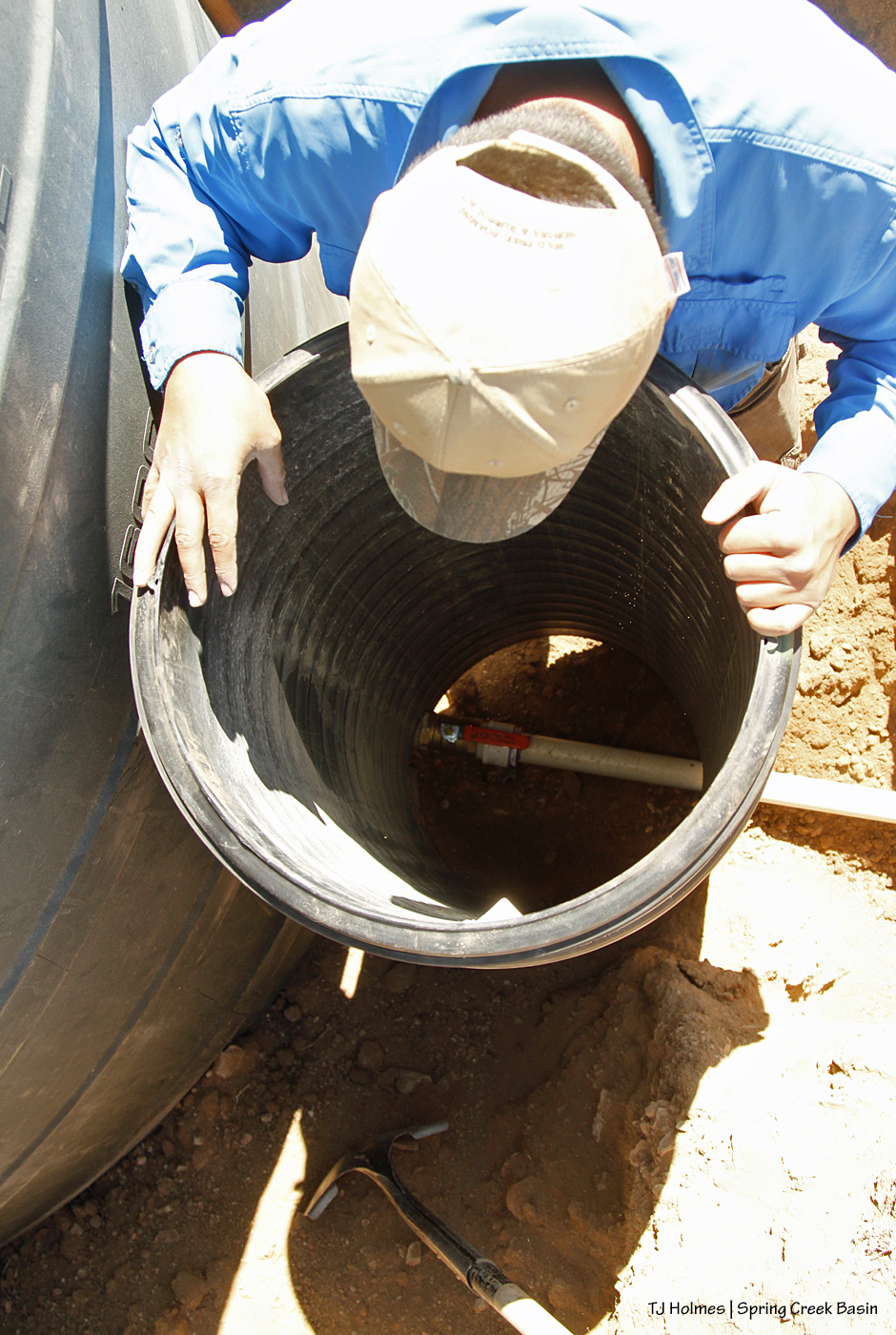
See how it goes? The dirt around the tanks then was filled to just below the top of the culvert section, and Daniel will construct lids so no critters fall in (remember snakey?).

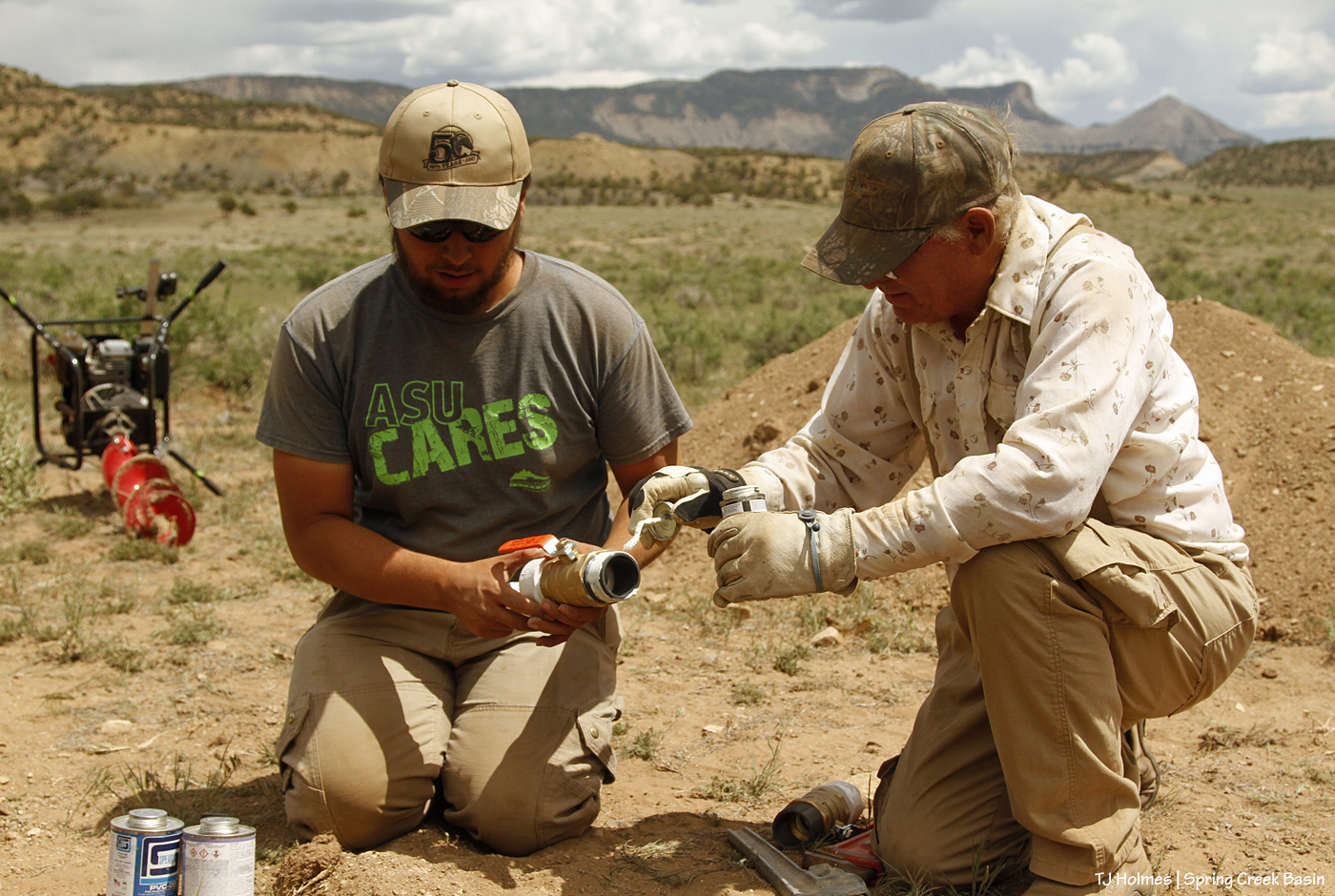
There’s Jim with the tools of the piping trade: primer and glue and the sawzall for cutting lengths of PVC pipe.
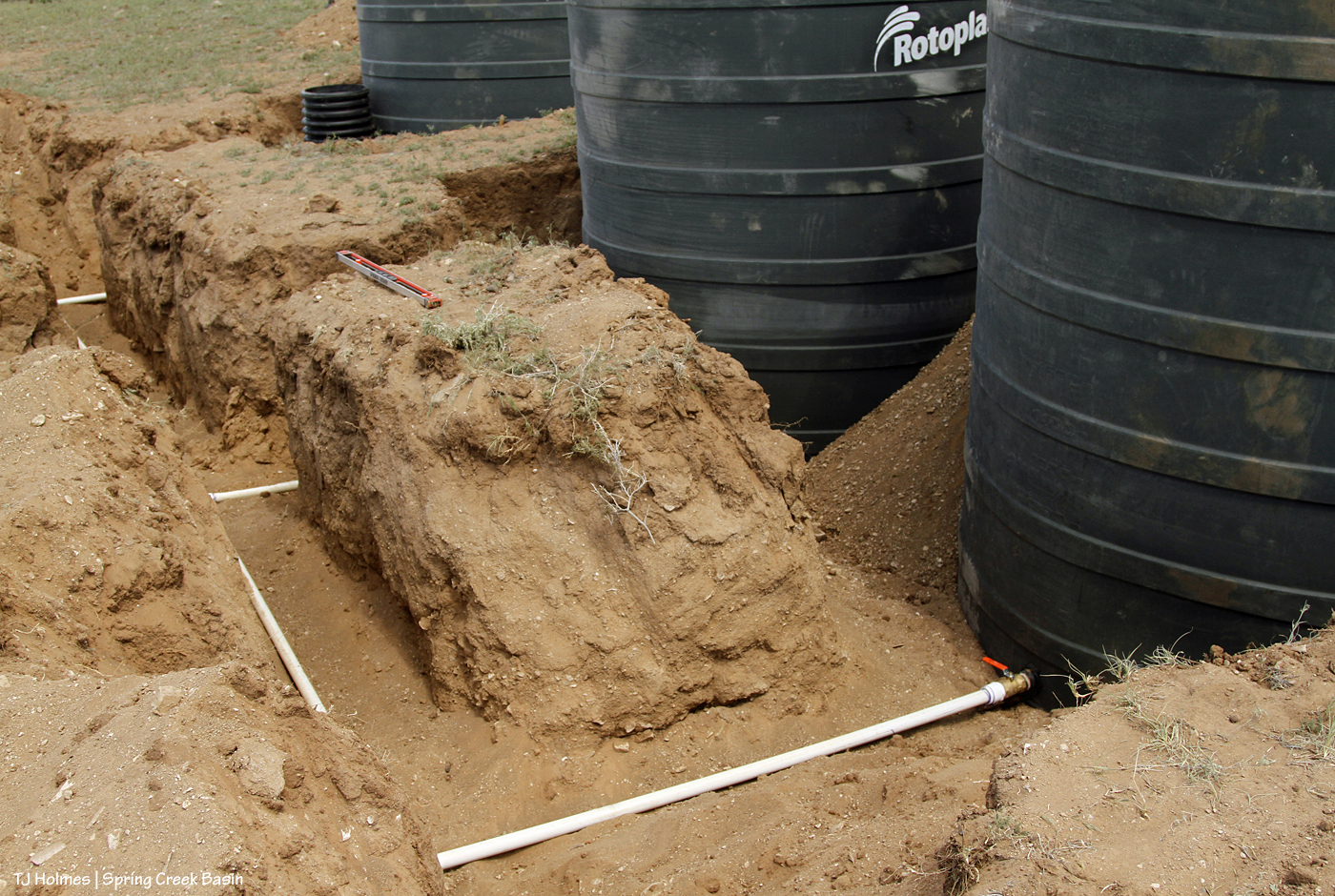
See how it’s all going together? Culverts like that seen at the end tank will go over the rest of the tanks, too.
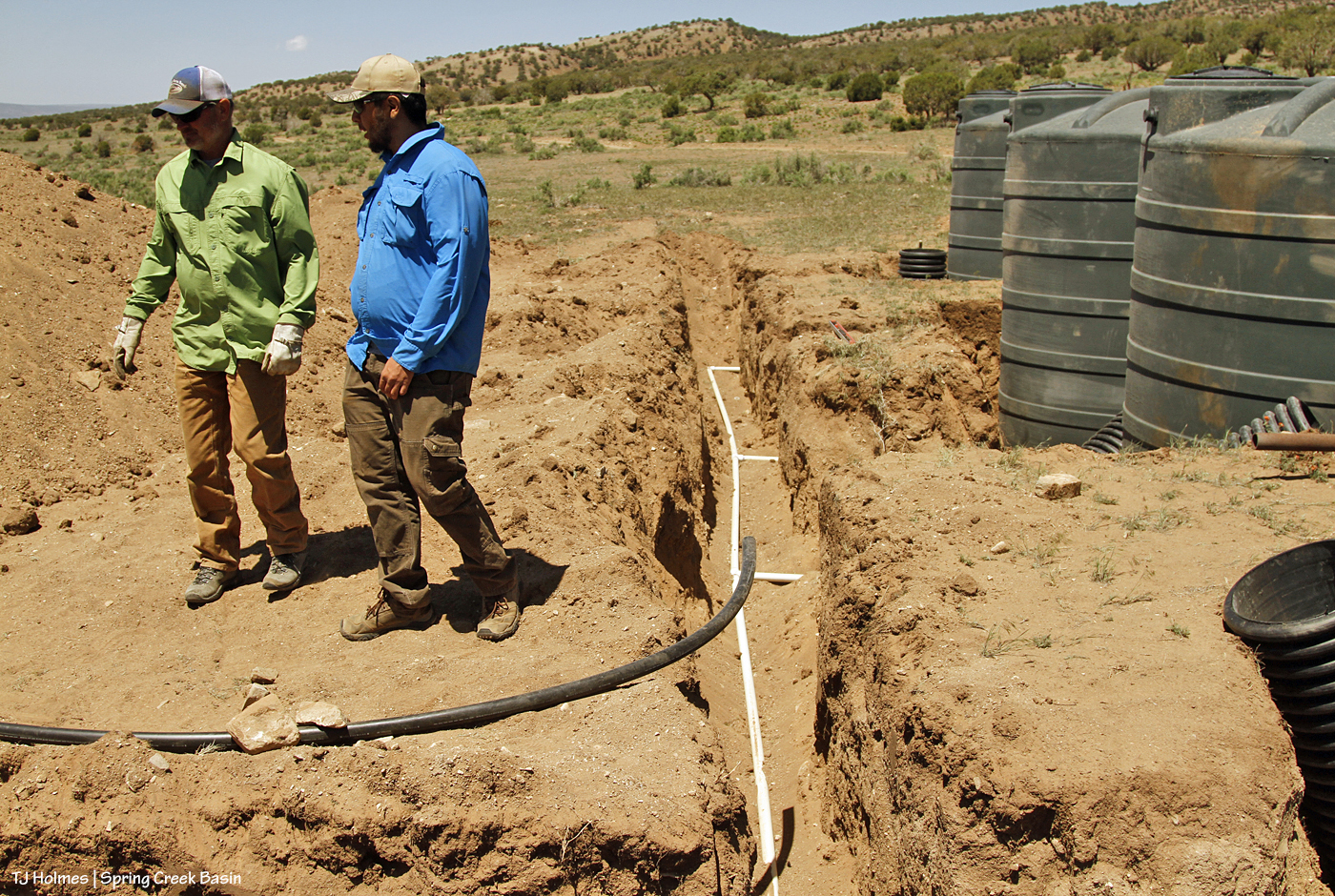
Mike and Daniel then talked about how to attach the black hose (not as supple as a garden hose, bendier than the PVC). That’s the one that will run from the end of the pipe – which comes straight out of the tank at my immediate right and is immediately below me – down the slope to the eventual trough.

Daniel and Jim attached the black hose and tightened it with clamps while Mike supervised.

It should be noted that it was EXTRAORDINARILY WINDY that day, and the dust and dirt and sand and silt was in the glue and primer. Hopefully that will just make the “welds” extra sticky (!?).

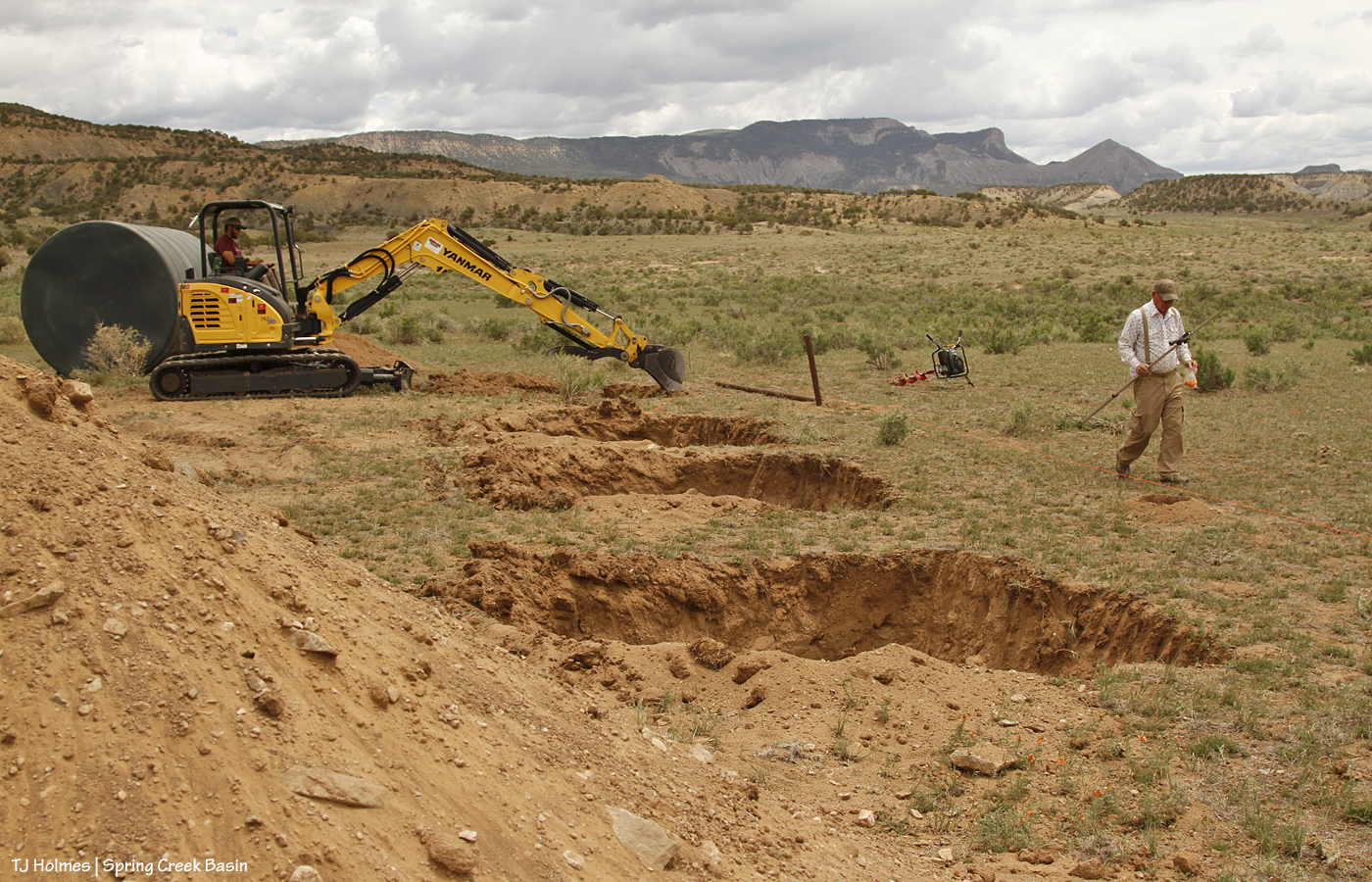
Here we are looking down the slope (it doesn’t look like much, does it?) along the trench from the tanks (behind me) to the location of the trough. The last piece of culvert will help protect the pipe and fittings as it comes up out of the ground … from, you know, freezing weather … curious mustangs … that kind of thing. 🙂

Mike and Garth had their coordinated shoveling in sync to fill in the trench over the pipe from the tanks. You can see a bit of the dust from the wind, as well as the culverts in place over each valve at each tank.

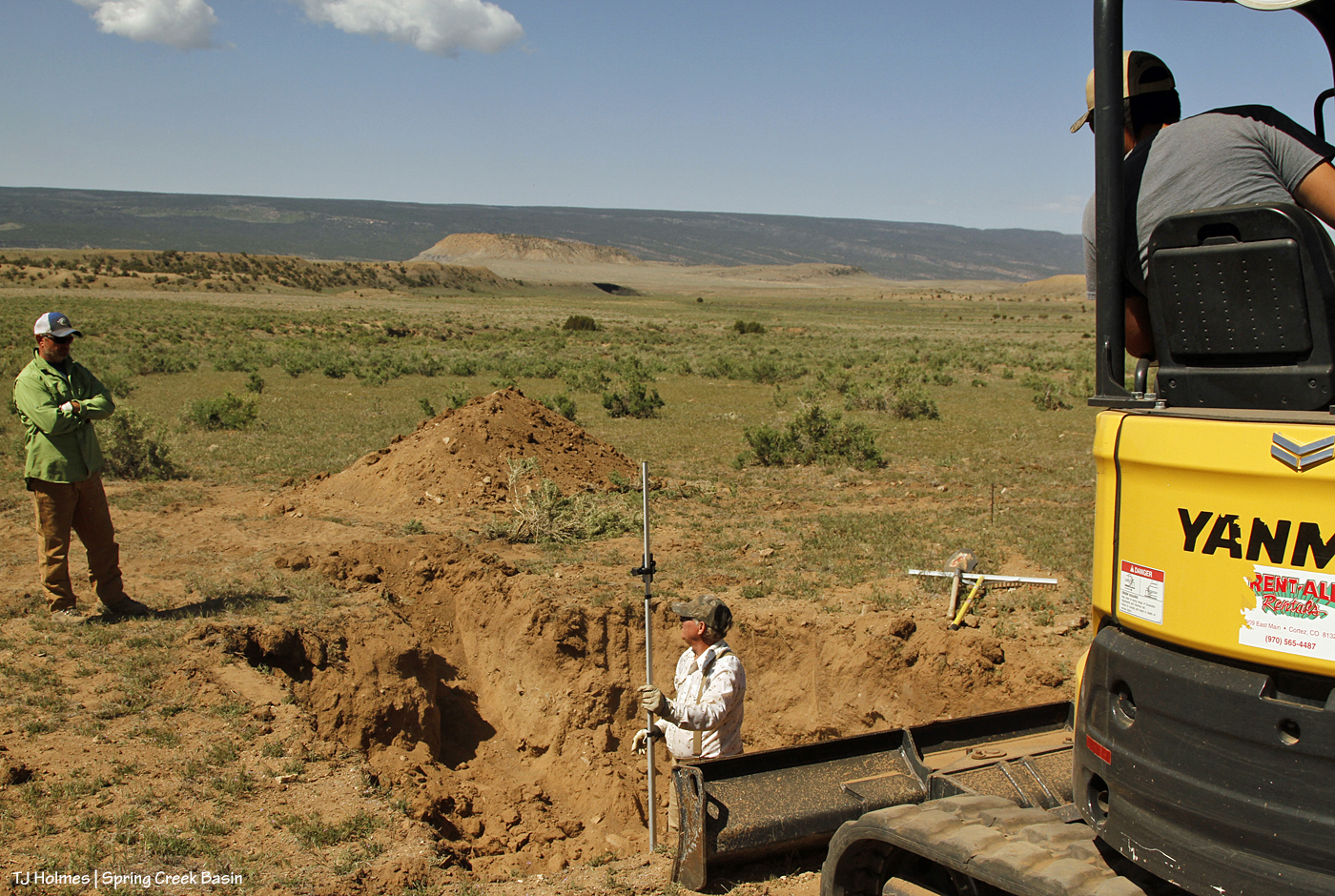
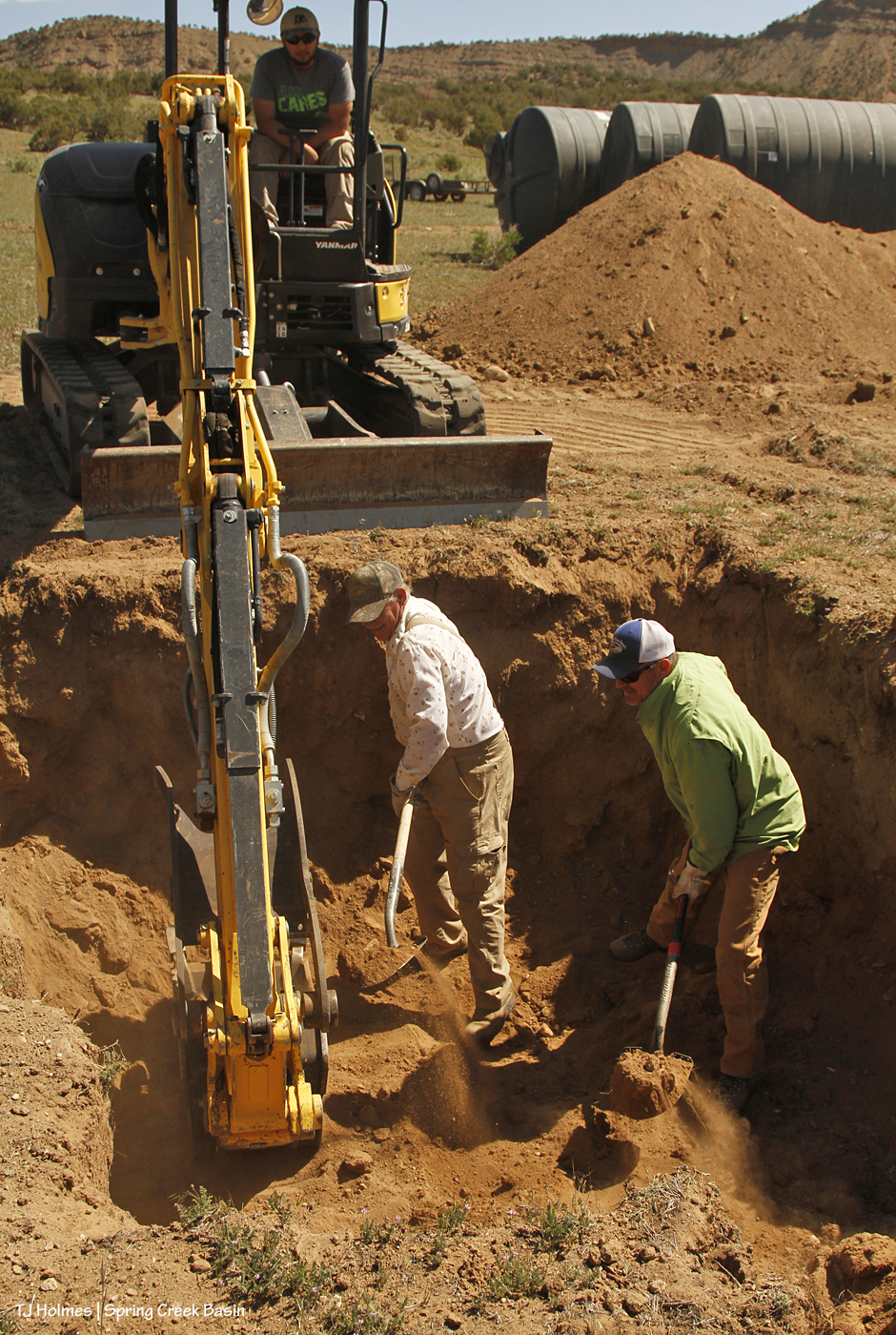
Now all four of our guys – Mike at left, Jim and Garth at right and Daniel on the excavator – are working to cover the pipe trench (this is looking back up the slope from the trough location to the tanks) and the holes where the tanks sit.

The tanks and their valve-protector culverts in place, still to be filled with dirt.

Get to shovelin’, Daniel! 🙂
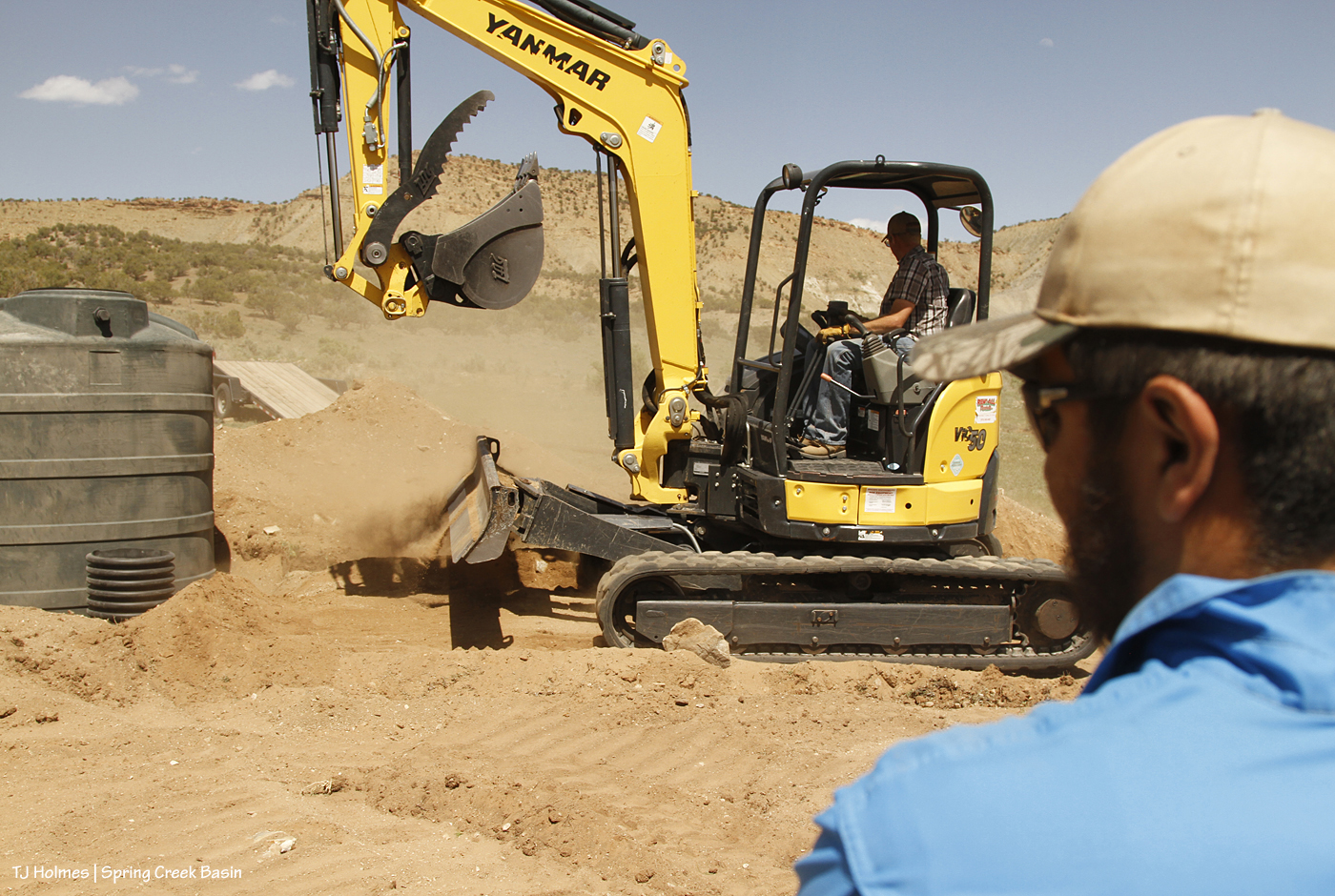
Garth was back on the excavator to push dirt over the pipe trench and into the tank holes. They had to be careful not to crumple the plastic tanks. By this time of working at the site, the dirt was sooooo powdery.

And *just like that* (!), the guys were almost done with phase 1 of the newest water-catchment project in Spring Creek Basin! I want to be sure to mention that all the trenches and holes were covered before they left. They did some more smoothing of the dirt Monday when they returned to retrieve the excavator.

Just a few days later, the first band of horses was checking things out:

There’s no water yet, ponies, but soon!

The next phase will be the construction of the roof structure over the tanks.

Huge thanks to Mike Jensen (our most excellent herd manager), Garth Nelson, Daniel Chavez and Jim Cisco for all their work! We really do have the BLM’s best here in Disappointment Valley! The sun was bright, the wind was strong, but the gnats were blown away (!). Phase 2 will be a little toastier … !



Water catchment: phase 1, day 3

2 06 2021

The third day of the water-catchment build story finds us back in Spring Creek Basin with the full team. Daniel used the excavator to widen the holes for the tanks, and the other guys used shoves and rakes to clean out the crumbly bits (into the excavator’s bucket). Then the holes were primed – literally – for the dumping and aligning of the tanks.

Let’s get to work!

Daniel had already combined the two middle holes to one and is cleaning out more dirt, and Jim checked the depth.

Mike and Jim took a quick check of the depth of the hole (and this image gives readers a better look at the ingress/egress ramp).

Mike and Jim had to get in the hole to do some finesse digging of the sandy dirt crumblies. By this time, the dirt was approaching the consistency of powder. (I’m not sure whether I’ve ever mentioned on this blog, but it’s dry out there … !)

In addition to cleaning out the holes, Mike and Garth checked the level of the bottom to make sure it was prepared for the tanks to sit level right when they went in the holes.

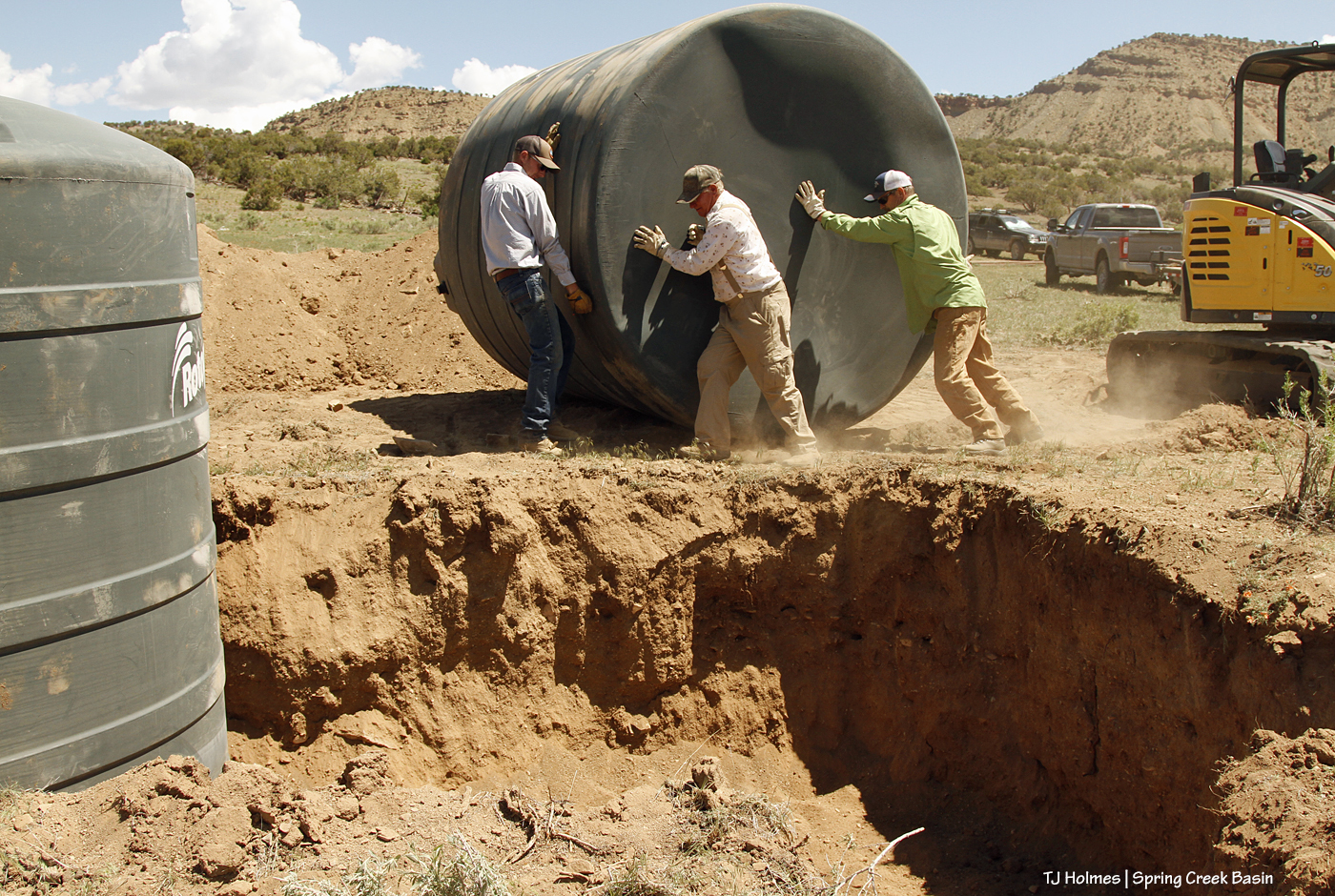
Lots of dust is created by powdery dirt when a 3,500-gallon water tank drops over the edge after four brawny guys push it into a hole! Don’t worry, the tank won’t sit like that. This is a capture of a split second before the tank rocked back to flat on its base.

While Garth took over the controls of the excavator, Daniel and Jim were in the hole to do some fine digging.

The guys had to roll the tanks from where we’d off-loaded them from the flatbed to the edge of the hole, then maneuver them to topple into the hole (this is the middle hole, with one tank already in it), in a controlled manner so the valves faced forward.

More fine work from Mike, Garth and Jim. …

This is one of my favorite pix of the whole project so far. All our BLM guys, working together for the benefit of our Spring Creek Basin mustangs. 🙂 Priceless.

When the tanks were all placed in the ground, it was time to dig the trench for the pipe.

Daniel and Jim were all over the putting together of the valves for each of the tanks. Those went in place by the end of the day …

… helped by Mike, using (I think) Daniel’s grandpa’s aluminum wrench!

Thursday: last work day (because of Friday’s rain), on which the pipes were attached to the valves, and each other, and down to the eventual location of the trough.


Water catchment: phase 1, day 2

1 06 2021

If you missed yesterday’s post, a brief recap: I’m telling the story of the first phase of the building of the first of Spring Creek Basin’s two new water catchments. In this first phase, don’t think building UP so much as digging DOWN (the up-ness will come in phase 2). There were some holes to dig before the pretty stuff – the water tanks – could be placed, and the tanks had to be placed before the moisture-gathering roof can be built.

Day 2 started with more digging of the holes. Though they measured side to side and other side to other side, to contain the roundness of the big tanks, because of the crumbliness (that’s a highly technical term in the world of dirt-hole digging) of the dry dirt, they really had to overdig, and the middle two holes eventually became one rectangular hole. Daniel is at the controls of the mini-ex, and Jim has the laser level “stick.” (For the first half of this day, Mike was meeting another group at another range site, and Garth had the day off to attend the graduation of his kindergartner!)

In the afternoon, Mike arrived with Tres Rios Field Office Manager Connie Clementson and BLM employee Whitney Carnahan (I knew her when she was a seasonal and don’t know her married name) to show off and explain the project. Daniel and Jim were just about to use the excavator to pick up the first water tank and lower it into the first hole.

Daniel and Jim finagled a way to strap the tank through the holes in the top in order to lift it with the excavator. Destination: hole in the foreground.

Once again, we had Jim in the hole (inside joke) while he steadied the tank and Mike directed Daniel. Jim’s left hand is on the lower valve opening, and straight above that is the top valve opening. There’s a much bigger hole on top of the tank (which has a screw-top lid), and those were the holes the guys used to run the strap through and lift the big bugger. Those valves also had to “face front” to align with the pipe-’em-all-together pipe that would run across the “front” of the tanks, then down to the trough.

Because of the off-center location of the top holes, though, it was hard to get the trough quite settled in the hole.

This was kinda when they realized the holes needed to be a wee bit bigger to accommodate the dirt crumbliness. I also want to point out Daniel at lower right: he dug little entrance/exit ramps into the holes for easy(er) access. As it turned out, he ended up digging the holes out a fair bit bigger for really good access, which they needed in order to align the tanks with the valve holes in the right spots after they dropped the tanks into the holes.

Tomorrow (which is to say that day’s tomorrow), they used the UTV to drag out the tank to enlarge the hole (along with the other holes) and commenced the dropping of the tanks!


Water catchment: phase 1, day 1

31 05 2021

First, let me refresh your collective memories:

Last year, Spring Creek Basin Herd Management Area herd manager (and all-around great guy) Mike Jensen put the finishing touches on the new, updated herd management area plan (updated from 1994!) that he worked on for two years. If you follow that time-machine link back to July 2020, you’ll see that Tres Rios Field Office Manager Connie Clementson’s decision included eight items. No. 8 was to authorize “additional new water developments for improving wild horse distribution across the HMA.”

We had hoped to start the first catchment last fall, but Mother Nature had other ideas for the week Mike had rented the machine to do the digging. And as winter approached, the project got pushed to this spring.

Fast forward to this spring (which was two weeks ago!), our BLM dream-range-team of Mike, Garth Nelson (also a rangeland management specialist), Daniel Chavez (range tech) and seasonal weed sprayer Jim Cisco broke ground on phase 1 of the first of two new water catchments in Spring Creek Basin.

This week on the blog will be devoted to the progression of the project. So today’s photos depict that Monday’s work; Tuesday’s post will depict that Tuesday’s work, etc.

On to the dirt work!

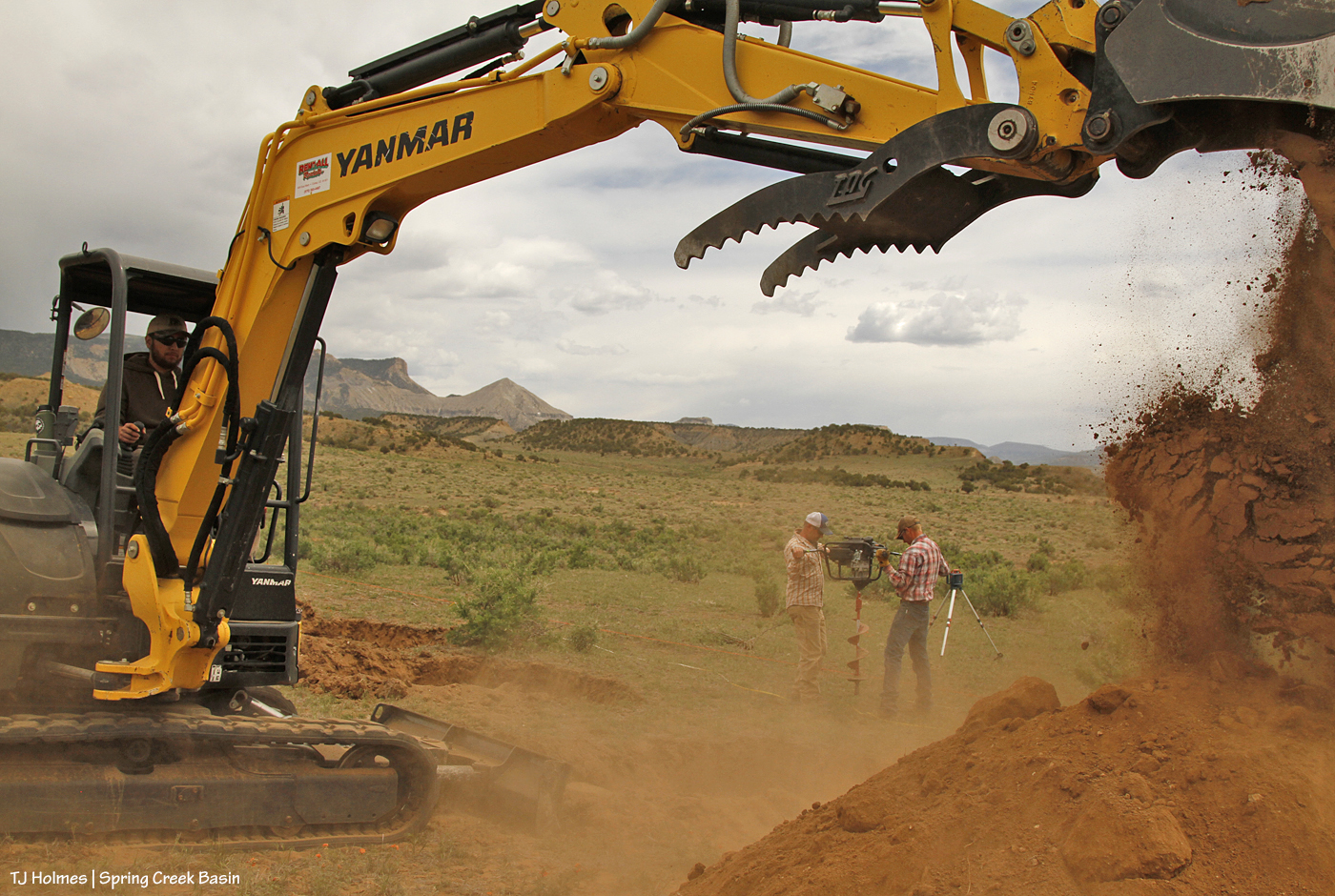
Daniel, the youngest of our range team, ran the mini excavator to dig holes for four 3,500-gallon poly (heavy plastic) water tanks while Mike and Garth used an augur to drill holes for the support posts for the roof system that will go over the tanks to catch rainwater and snow.

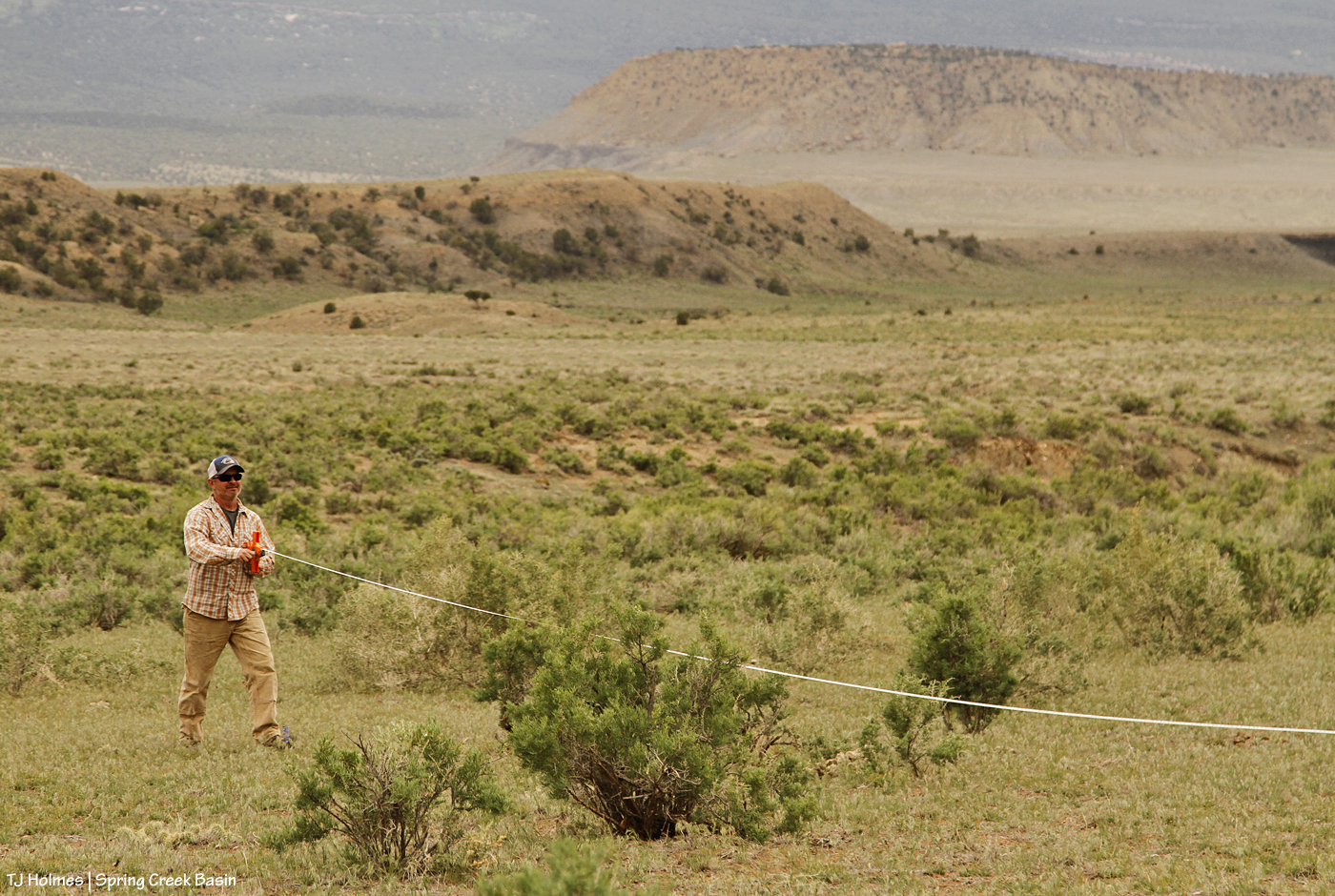
While the digging was under way, Jim readied the laser level in order to ensure the holes are all at the same depth. Then he used it to measure the run down to the eventual location of the water trough. That laser level got a workout (as did Jim) during the week. Garth would give Daniel breaks from running the mini-ex. Like Daniel said, it was a bit dizzying to scoop (to dig) and swing (to deposit). Here’s a sad thing: They dug down about 4 feet to bury the tanks about halfway, and the dirt is dry, dry, dry, all the way down.

Here’s a closeup of Garth and Mike using an augur to drill holes for the support posts for the roof over the tanks.

As it turned out, they decided on different locations for the posts to stand, but these first holes gave us the straight line on which to align the tank holes. Another sad note: Garth later used a post-hole digger to clean out the holes … and the dirt was SO dry, it all just slid right out of the digger’s “jaws.” (Also of note, of all tools in existence, I despise post-hole diggers the most!)

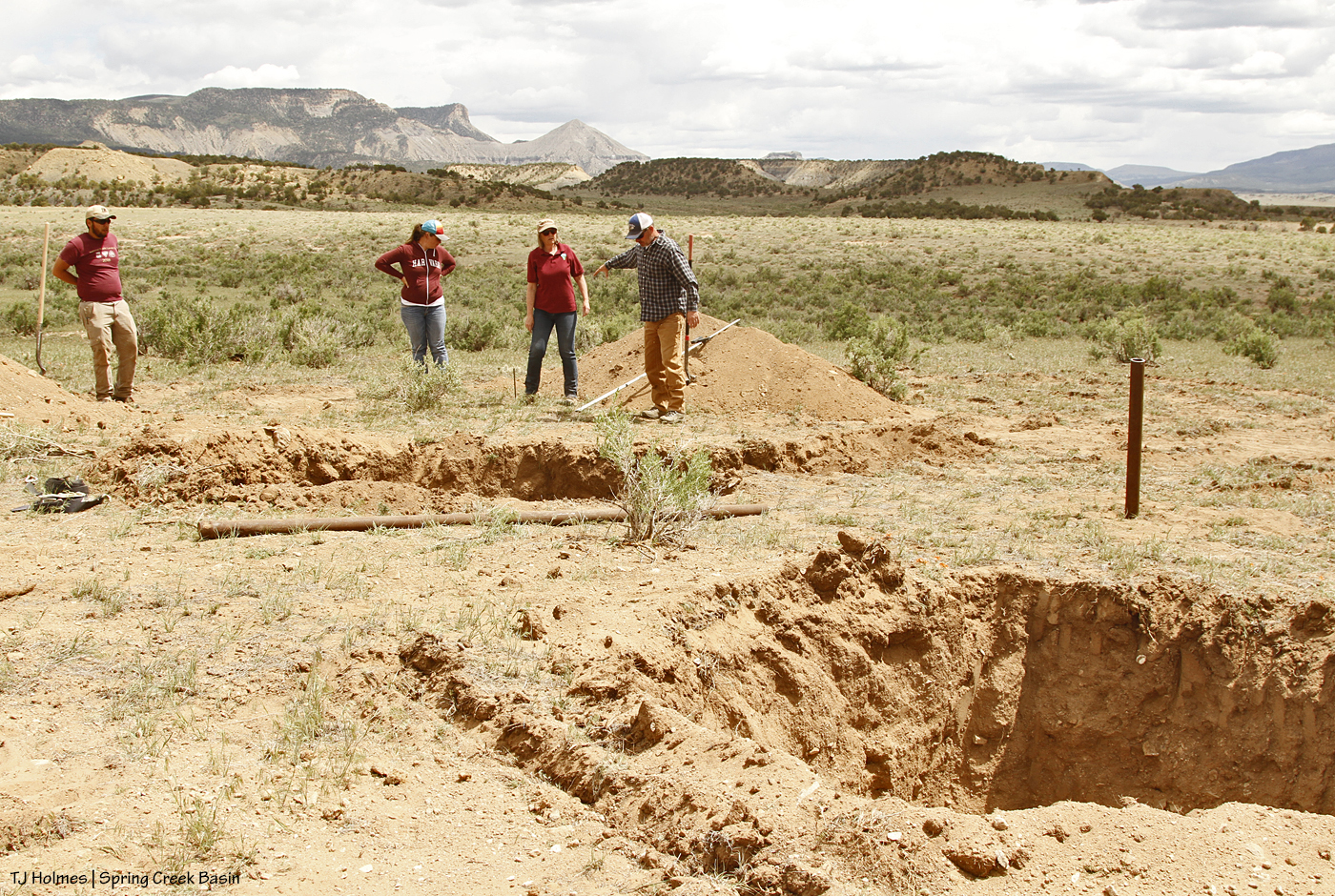
Did I mention the laser level? They used it to ensure that all the tanks were buried to the same depth and were level, and they also had to make sure there was enough “drop” down the slope (which doesn’t look like much of a slope, does it?) so gravity will do the work of allowing water to flow from the tanks (even when the water level is low) to the trough. As with our other two troughs, there will be a float to keep the water level constant. And the guys also will add an evaporation cover. In the pic is Jim, master of the laser level.

Zoom in on this pic. See Mike? See Mike smiling? He’s measuring out the distance from the tanks to the trough location. Mike is always smiling! 🙂

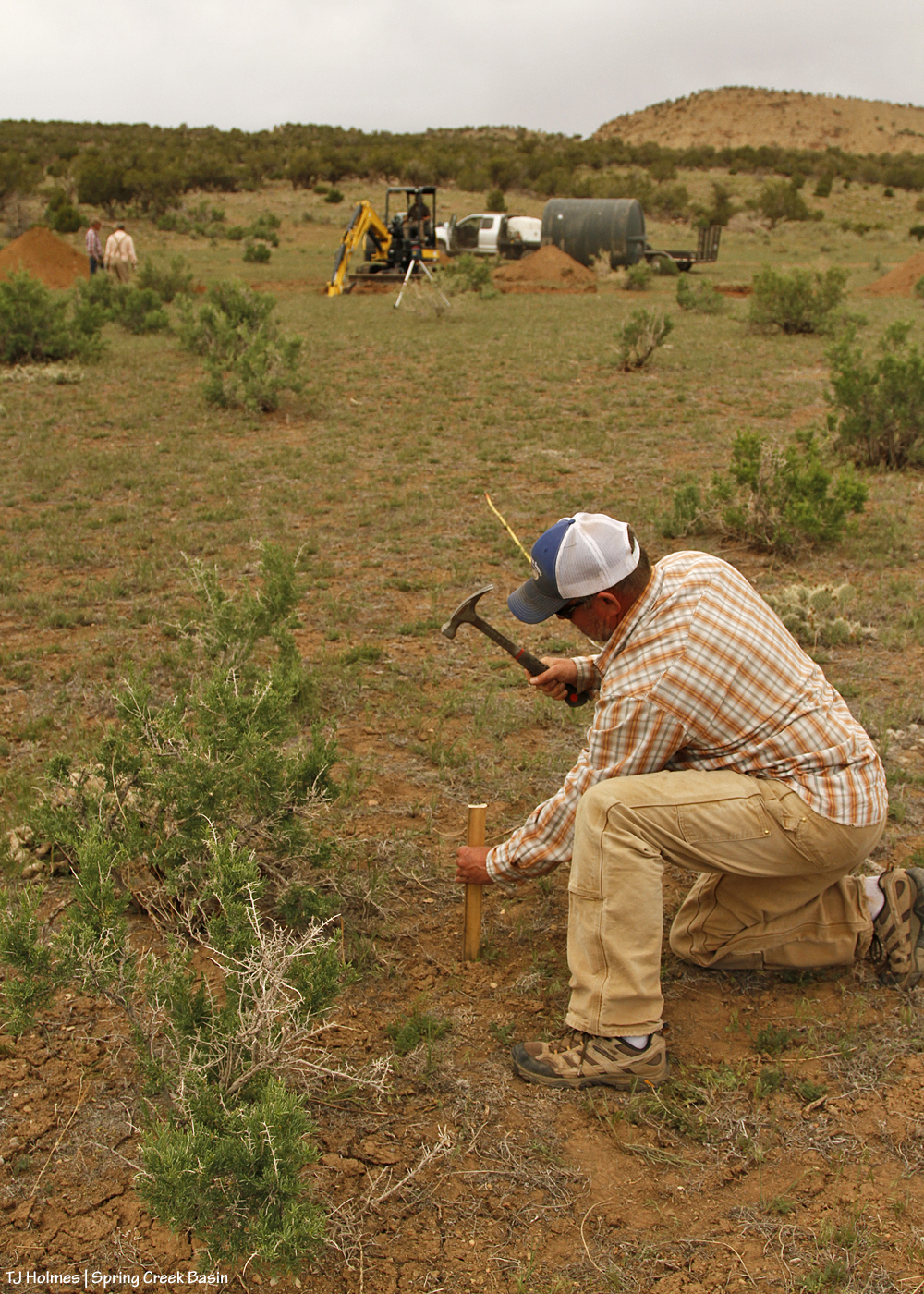
Mark it! This will be the basic location of the trough, and this perspective is looking back up toward the tanks. You can see the first one that we delivered on the flatbed trailer behind it. Also, see the white thing behind the truck cab? That’s a 200-gallon water tank (the truck is Jim’s weed-spraying rig), and the guys filled it with water each day before they left Dolores, and each day, we emptied it to one of the aprons at the main (and original) catchment, for a total of 800 gallons! (Friday, Ma Nature graced us with rain, so there was no work that day, and she provided the water!)

Tomorrow: A bit more digging, a bit more leveling, and the holes will be ready for the tanks!

**********

Also today, Memorial Day, we remember all those members of the U.S. Armed Forces who died in service to their country. Though they did not make it home to family and loved ones, their service and sacrifice cannot be forgotten by those of us *at* home, for whom they fought and died.


Super full flower moon

29 05 2021

Is there a “correct” string of those words? I’ve seen ’em all different ways. Here’s the particulars:

It was nearly full.

As May’s full moon, it’s also known as the “flower moon,” because this is the month of spring flowers and we DO have wildflowers now.

And it was a supermoon because of its close(r) proximity to Earth.

It WAS super, and as quickly as it appeared, it disappeared into the clouds.

A craziness: I didn’t even realize the band was out there until I stopped shooting, so gobsmacked by the amazing moonrise was I!

(The pic was taken Tuesday night.)


Just about dark

21 05 2021

Though we got clouds a couple of nights ago, the clouds refused to leak. Pretty Gaia carried on with her greasewood grazing. I hope she knows something we don’t know … that it WILL rain again!


Lookout

17 05 2021

Maiku watches a band across an arroyo while Corazon moseys on after the band. Maiku has been Corazon’s loyal lieutenant for at least a few years now.


Spirit, untamed

11 05 2021

Apparently, there’s a new “Spirit” movie almost out called “Spirit Untamed.” 🙂

Our little Spirit is living, breathing proof of the untameable spirit of mustangs.


Getting the gleam

4 05 2021

The last time Tenaz appeared on the blog, he was looking a bit rough, in the throes of the latter stages of shedding his winter coat for his summer shorts. So when I saw him the other evening and was practically squinting in the glare of his shine from the angle of the setting sun, I set about trying to capture the full gloriousness of his bayness (!).

But while they are looking fabulous as the days warm suddenly into 80-degree territory, they’re also almost frantically hunting the elusive green (it’s not necessarily elusive … there’s just not a lot of it (… yet?)). So there’s kind of a whole lotta domesticity going on in the basin these days while the horses, well, simply graze. (In other words, he wasn’t quite willing to strike a “handsome-mustang” pose!)

This area of the basin is cut by several shallow arroyos that run down to join the Spring Creek arroyo, so thinking I’d try something different, I stepped into it and tried to photograph Tenaz with the band through his legs in the background.

He did seem at least slightly interested to know why I was suddenly half my normal height. 🙂

But it didn’t stop him from seeking the green!


‘Desert Chrome’

2 05 2021

‘Water, a Woman, and Wild Horses in the West’

(Photo courtesy of Kathryn Wilder)

Kathryn Wilder‘s debut book, “Desert Chrome,” will be published in mid-May by Torrey House Press!

Longtime readers will recognize Kat’s name as an advocate for Spring Creek Basin mustangs. In this vulnerable, deeply touching and wide-ranging memoir, she recounts her life’s journey that eventually led her to Disappointment Valley and Spring Creek Basin – among earlier and parallel events that shaped her among heartbreak, water and wilderness. About the mustangs, she writes about getting to know them and the great strides we’ve made in the management of our herd with the use of PZP.

Kirkus Reviews calls it “testimony to the healing power of wildness” and “a spirited and impassioned chronicle.” And it is, without a doubt, all of that.

Suzanne Roy, fierce director of the American Wild Horse Campaign, wrote: “Kat Wilder’s beautifully written memoir takes us on a journey of a life lived on the move, full of love, loss and searching, finally finding peace among a herd of mustangs in Colorado’s magnificent Disappointment Valley. Wilder’s insight into the wild horses, why they’re worth saving and how to save them, will be of interest to anyone concerned with preserving the West’s last remaining wild spaces and the wild animals that inhabit them. A must read.”

Pre-order the book from Torrey House Press, your local independent bookstore or from Amazon.

Kat will be doing numerous readings, both virtual – Garcia Street Books in Santa Fe, and Maria’s Bookshop and Cortez Public Library here in Southwest Colorado – and in person at Sherbino Theater in Ridgway and Entrada Institute in Torrey, Utah.

Here are some particular deets:

Maria’s virtual event for “Desert Chrome” will start at 6:30 p.m. Thursday, May 20, on Zoom and Facebook Live. Check Maria’s events calendar page for details.

Kat’s first live reading will be from about 6 to about 7:45 p.m. Saturday, May 22, at The Livery in Norwood. This is basically our backyard! Head over to Between the Covers’ Facebook page to find out more.

The Cortez Public Library will have an online reading with Kat starting at 6 p.m. Wednesday, May 26.

On Thursday, June 10, Ridgway’s Sherbino Theater will host Kat for a live reading from 7 to 8:30 p.m. Visit the website for tickets, on sale 30 days before the event. Ridgway’s also fairly local to us, and several mustang friends call it home.

If you’re in Torrey, Utah, on Saturday, June 26, stop by the Entrada Institute for a live reading.

Be sure to find and follow Kat on Facebook to keep up with other events as they’re scheduled, and I’ll post reminders about the above readings close to their happening dates.

(Kathryn Wilder’s “Desert Chrome” with Chrome’s newest grandson, Jasper, with Brumley Point and Temple Butte in the background; Spring Creek Basin Herd Management Area, Disappointment Valley, Southwest Colorado)