It may not be the tale she wanted to tell, but Kat Wilder’s latest “Mustang Tales,” written exclusively for American Wild Horse Preservation Campaign, tells a tale that mustang adopters should read.

Maka
It may not be the tale she wanted to tell, but Kat Wilder’s latest “Mustang Tales,” written exclusively for American Wild Horse Preservation Campaign, tells a tale that mustang adopters should read.
Maka
Welcome back! The following is the report of work on the second day of our apron-installation project in Spring Creek Basin. (Day 3 was just some finish work; no photos.)
Make sure you have plenty of water or Gatorade, a hat, sunscreen, lip balm, more water, neck rag or shirt to soak for evaporative coolness, more water to drink – it’s HOT out there! – and let’s get started. We have a lot of ground to cover – literally!
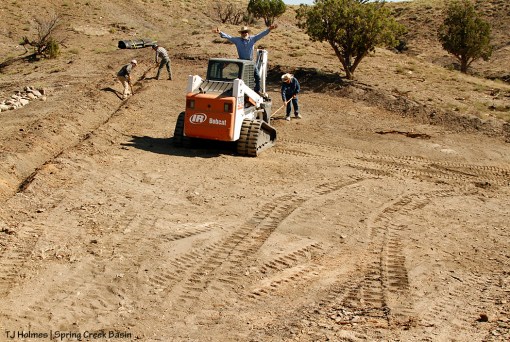
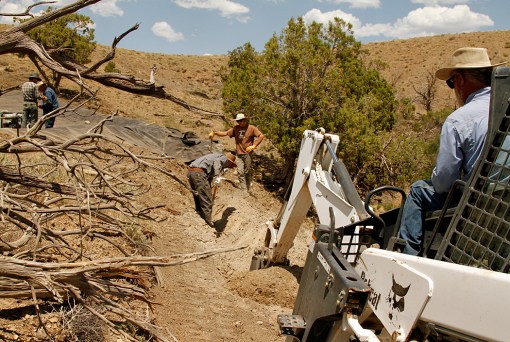
To reintroduce you to some of our cast of characters, that’s NMA/CO president David Temple atop the Bobcat, mugging for the camera again; Mike Jensen and Justin Hunt, BLM range specialist/herd manager and range tech, respectively; and Four Corners Back Country Horsemen/Wild Bunch volunteer Frank Amthor. Did I mention that this was *weekend* work? The BLM guys are cleaning up the trench that the edges of the apron will go over and be buried into, and Frank is helping David dig out the stump of the lone (small) tree that had been standing in the way of progress.
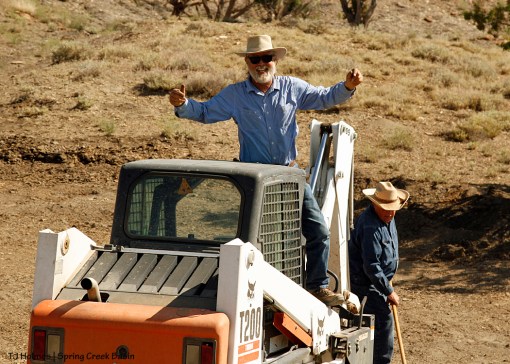
Let’s take a closer look at that big ’ol mustang-love grin. 🙂 David has been waiting a long time to make this project happen for Spring Creek Basin mustangs!
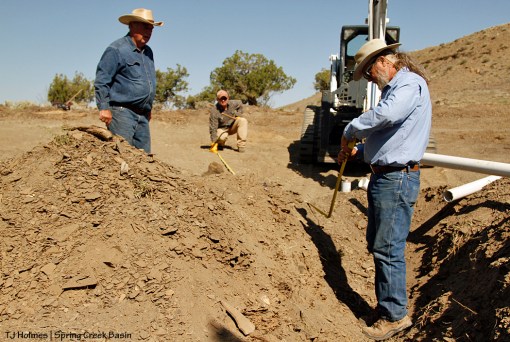
There was a lot of measuring going on. The apron was 40 feet by 100 feet and consisted of narrow strips seamed together. The edges go over dirt berms and are then buried in dirt along those outer edges. The site was irregular because of the hill, which made for a good place of drainage with a couple of points from which water could hit and drain to the lowest point.
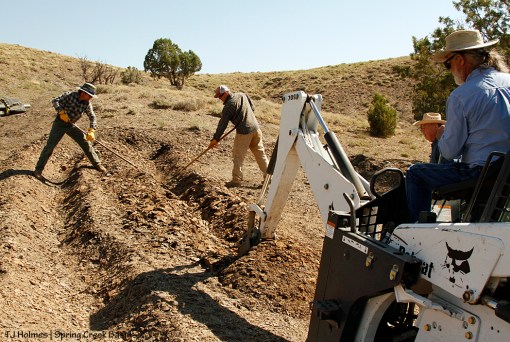
That irregular hill also made for some challenging measurements, and the guys decided to dig a second trench along one side to ensure apron coverage. This was hot, dusty work, and we went through gallons of water and Gatorade.
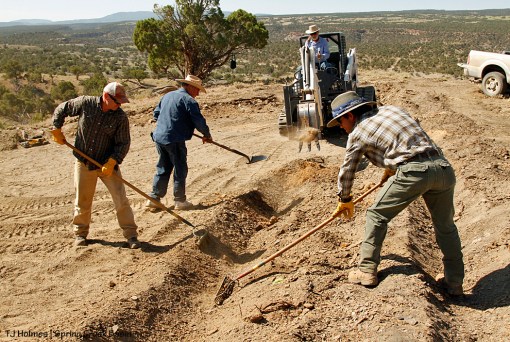
Here’s another view of the trench work. Yours truly did put down the camera and make use of the shovel in my other hand, but someone has to pull double duty and document the awesomeness! 🙂 Multitasking, don’cha know!
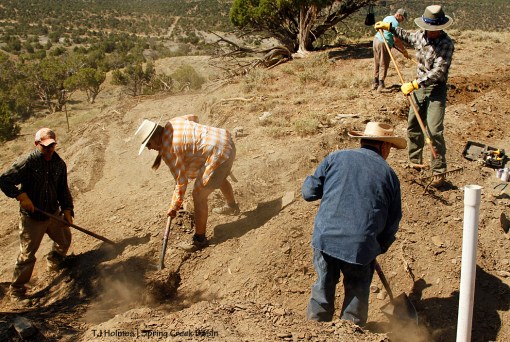
Yet another view and additions to our cast of characters: Advocate Kat Wilder in the center and 4CBCH volunteer/Wild Bunch rep Pat Amthor at back upper right. The pipe standing vertically at lower right is the location of the drain in the apron. When all was said and done, the pipe wasn’t that tall, of course. Behind Kat is the eventual trail of the pipe down the hill to the water tank. Please allow me this moment to point out that Pat will be 70 in a couple of months, and Frank is 73. Our volunteers rock!

Here, we’re looking back up the hill while David fills in the berm around the drain pipe. This is a good opportunity to mention that David is an absolute wizard with that machine. He joked that he needed the last 20 years to perfect his technique and be ready for this project, but that’s all to say that he has had LOTS of experience. We’d consider hiring him out if he wasn’t already so darn busy. 🙂
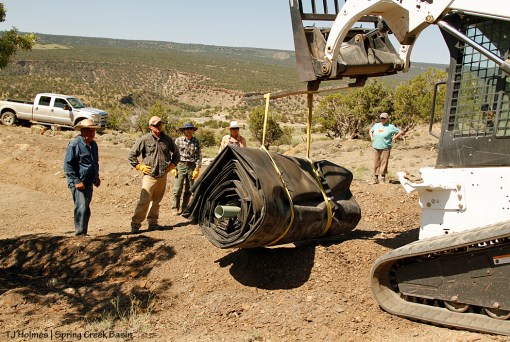
There’s still a lot of work to be done at this point, but this was a pretty big moment: The apron ready to be unrolled and positioned on the site. Then the big question: In which direction does it unroll??

As it turned out, not this direction. But we didn’t get too far along before we realized it. At right, Justin is handing the all-important “boot” – for the drain pipe – to Pat for safekeeping.

Did I mention that the whole thing weighs 1,000 pounds?
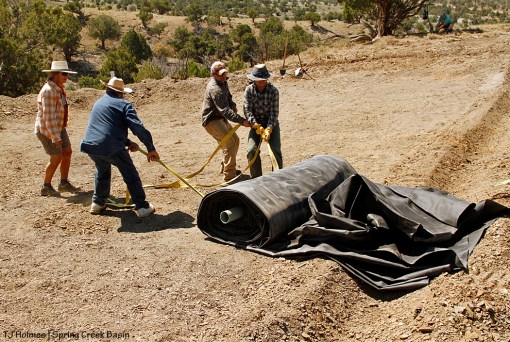
Now we’re cookin’ in the right direction.

While photo-documenting, I might have shed a few tears of sheer happiness at the sight of this apron moving into place. The water it will provide for our mustangs in this area of Spring Creek Basin will have a hugely positive impact on their ability to comfortably graze this area.

For good measure, here’s one more photo of the unrolling process.
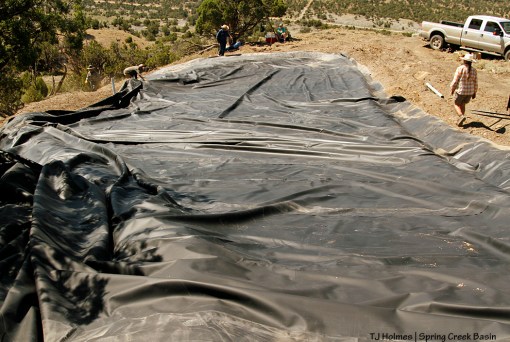
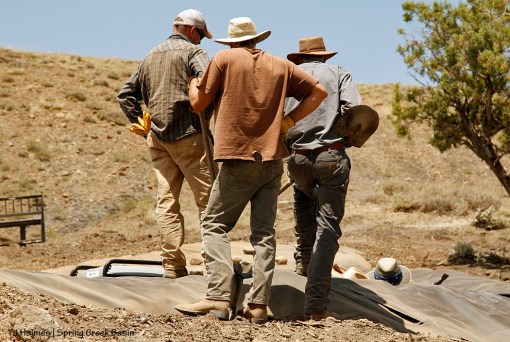
Then it was all hands on deck to (wo)manhandle the giant apron into place so it covered the whole site – yes, it was heavy, and yes, that black plastic got hot fast. The perspective: I’m at the top of the hill, Kat is walking downhill along the edge opposite the drain, Frank is at the bottom – which has a slight slope from which rain water also can drain – and Mike and Justin are at the drain-side edge. The pipe was then fitted together and laid into a trench around the side of the hill (behind Justin) and down to the tank.
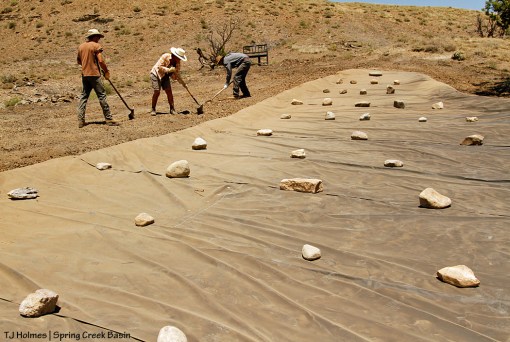
Fast forward through the work of spreading and flattening and placing rocks and filling trenches to cover apron edges … and also introducing additional volunteers: Kat Wilder’s sons, Tyler (left) and Ken Lausten. This perspective is taken from the bottom (where Frank was in the previous photo) looking uphill. The drain is to the right.
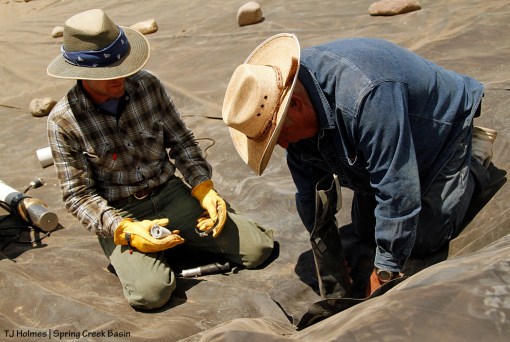
Now Justin and Frank start the process of measuring the “boot” to fit over the drain pipe (which has been cut down to size in this photo – remember it very tall in earlier photos?). Behind Justin is the filter that will attach to the top of the pipe and allow water down the pipe but keep out other debris.

David starts digging the trench from the apron to the water-storage tank while Ken and Tyler are at the ready to do finer shovel work. At right, out of the frame, Justin and Frank are working on the drain pipe in the apron.
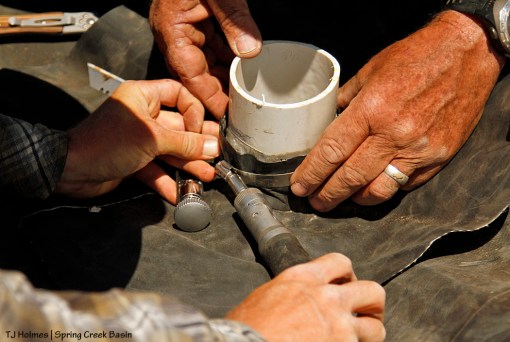
Old hands and young hands. Volunteer hands and BLM hands. Hands doing work for mustangs. YEAH! (Those helping hands are the property of Frank Amthor and Justin Hunt. 🙂 )

We love it when a plan comes together! Justin and Frank are working on the drain pipe in the apron; Ken, David, Mike and Tyler are working on the trench to hold the pipe that will carry the water; and Kat and Pat are supervising. (And I’m loving the whole blessed project!)

As volunteer photo-documenter and volunteer shoveler, one of my most solemn multitasking duties is to accept heckling – and then put it on the blog for all to see. 🙂 Fabulous job, David, Ken and Tyler!
Because, really, we absolutely cannot let all this hard, hot, dry, amazing and amazingly appreciated work go unnoticed or undocumented! We do small projects for the horses throughout the year every year that are documented for our local folks, but this was big – and it was huge – and let me say again how incredibly appreciative we are of our BLM folks and all our advocates and volunteers who make projects like this happen – through funding, through buckets of sweat (it’s “dry” heat, right?!) and through lots of tears of happiness while we try to make sure photos are in focus. 🙂
Because people are watching to see how we have made Spring Creek Basin’s mustang-management style a model. It takes hard work, but it IS possible to work in partnership for our mustangs – and we’re proving it – and our horses are worth every bit of that effort.
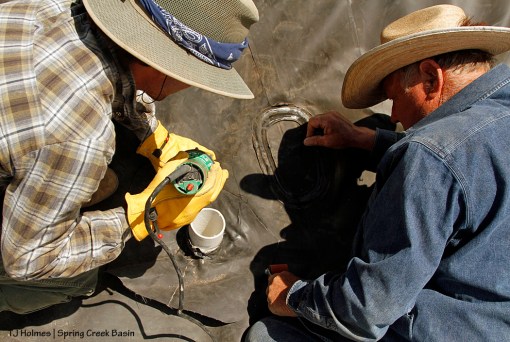
This work was hard to illustrate. The “boot” had to be sealed to the apron liner so water will go through the filter to the pipe, not leak out around the edges where the pipe comes through the apron. Justin is using a tool that directs heat (it’s plugged into a portable generator), and Frank is using a little roller to press the heated boot plastic to the apron plastic. As if it weren’t hot enough (did anyone actually look? the air temp may have been in the upper 90s, but on that black plastic, it probably was at least 115 degrees), they’re applying *more* heat. All in the name of gettin’ ’er done for our mustangs.

Ahh! Thanks, Kat! Pat brought the umbrella … and no, we were not expecting rain.
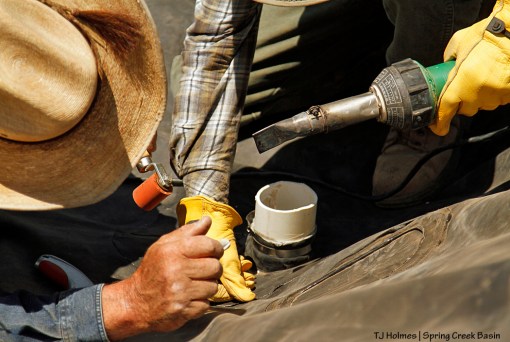
This angle shows a little better what’s going on with that plastic boot and the heat gun.
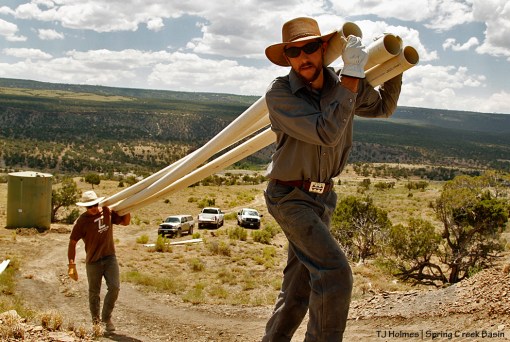
Meanwhile, work on the trench had progressed to the point that allowed Ken and Tyler to start carrying lengths of pipe up the hill to glue together and place in the trench. In this view, you can see the water-storage tank. Also hard to illustrate is just how steep is this part of the hill. Barely in view down the hill at left are the pipes Ken and Tyler carried on their *other* shoulders to that point from the pile in front of the trucks farther downhill.

Ken and Tyler get right to work gluing pipe together for the long run to the tank.
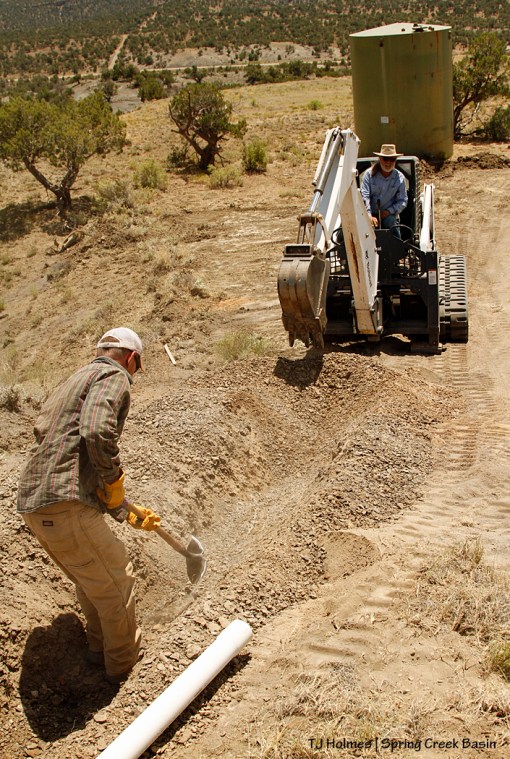
And David and Mike continue digging the trench down the hill to the tank.
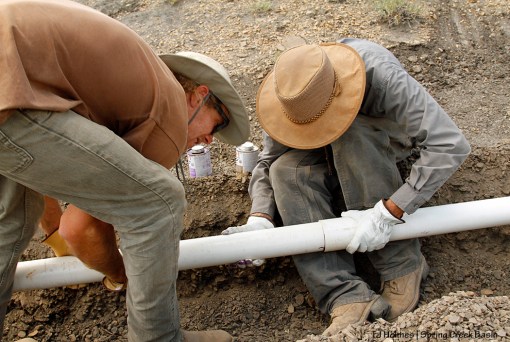
And Tyler and Ken glue more pipe.
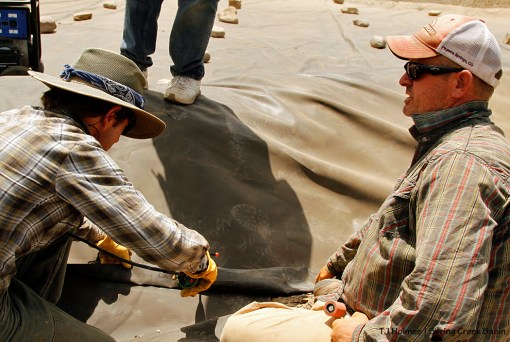
Using the technique perfected by Justin and Frank, Mike helps Justin attach another section of apron to the main apron in order to have more surface to bury over the berm in the trench. Because our site isn’t rectangular, we trimmed plastic in a couple of areas and added those pieces to a couple of areas for mo’ bettah coverage in places where needed.
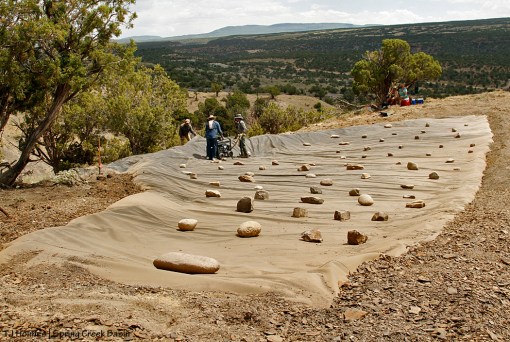
My oh mustang my! Doesn’t that look like it will catch and carry a lotta water for our wild ponies??
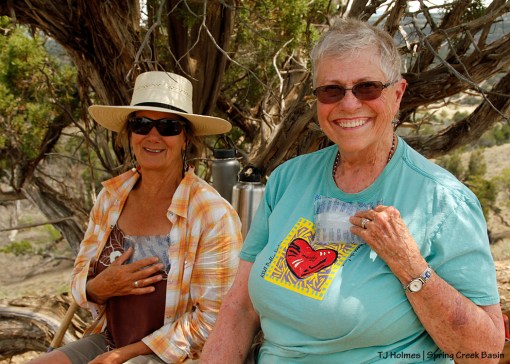
It hasn’t yet been mentioned how HOT it was (! OK, it miiiiiight have been mentioned) during this weekend work project. It hadn’t rained in weeks (possibly close to two months), and it was as hot and dry as Southwest Colorado can be (and given our location as high-elevation desert, it can be pretty toasty with temps into the 100s, which we’ve seen already). Fortunately, it was generally breezy enough to keep the gnats at bay. Here, awesome lady advocates Pat and Kat are using ice packs to stay cool under the shade of a handy juniper at the work site.
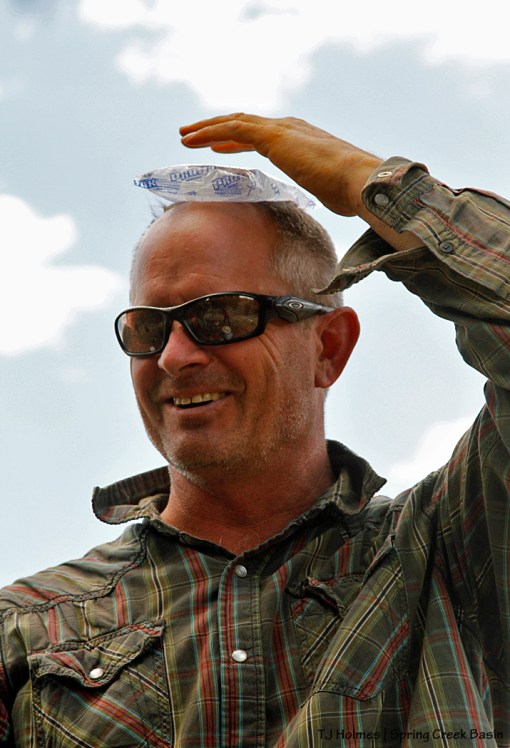
Mike also thought that was a pretty terrific idea.
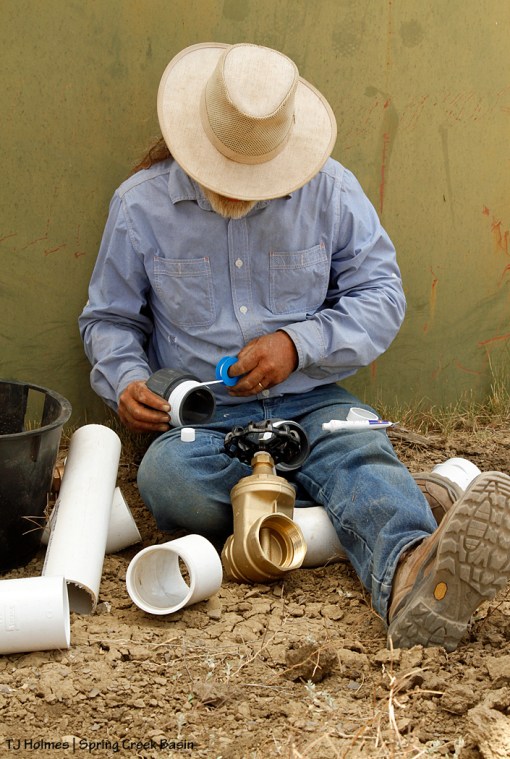
David was glad to get off of his bucking Bobcat and start putting together valve parts in the shade of the water tank. The pipe-filled trench gets to the tank immediately to the right of where he’s sitting.
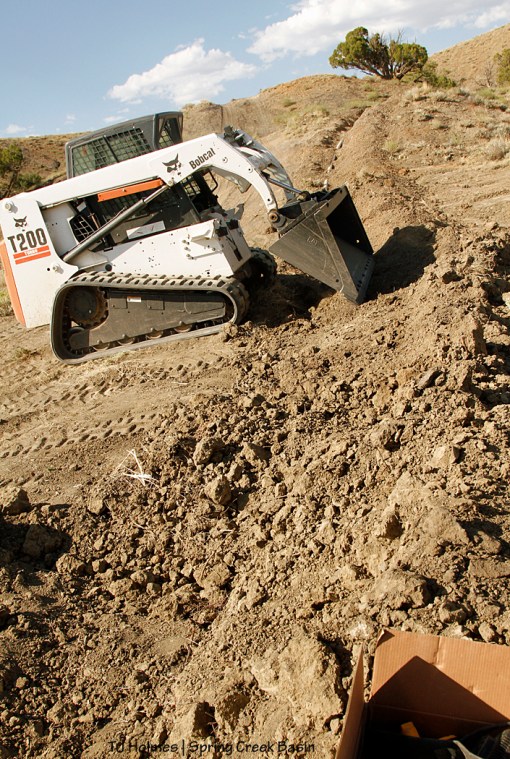
Of course, he had to get right back on that pony – err, Bobcat – and finish the job to end the ride on a positive note: filling the trench and covering the new pipeline, which is worth its (considerable) weight in gold.
Camera-holding and other hands were needed to wrestle the final pipe sections into place to get in line with the tank’s existing steel fitting, so the photos end here. David did quite a bit more work around the apron and installed some water-erosion ditches on the access road this day and the next (third) day, and we also removed the tractor tire (which had served as a trough with a bentonite-and-soil bottom) to put in place a new water trough provided by BLM. As it turned out (after we got our first little rain showers to test – yahoo!), the steel fitting that was at the tank had cracked and was leaking a bit (Colorado’s freeze-and-thaw action at work), so we’ll replace that as well.
After the holiday, BLM folks and volunteers will return to the site of our big achievement to replace that steel fitting, scatter seeds of native grasses around the apron and along the covered pipeline (disturbed areas), and install the new trough to the existing pipeline downhill from the tank.
And once again, it’s imperative that we thank all the people who provided all the hands and funds and supportive efforts that made this water project happen for our Spring Creek Basin mustangs: BLM range staff, Wild Bunch members, unaffiliated advocates and family members (including the ones who allowed us weekend time with their husbands and daddies). Specifically, for your labor and engineering and exemplary work ethic, thank you to Mike Jensen, Justin Hunt, Garth Nelson, David Temple, Pat and Frank Amthor, Kat Wilder, Ken Lausten and Tyler Lausten. For your organization and funding and support behind the scenes, thank you to Connie Clementson, Tif Rodriguez, Lyn Rowley, Lynda Larsen, Sandie Simons, Nancy Schaufele, Karen Keene Day, David and Nancy Holmes, and the Serengeti Foundation.
In spirit, always, thank you, Pati Temple, for our cherished memories of your mustang advocacy and for continuing to watch over and guide us in this work. (I’m pretty sure you had a hand in the recent, blessed rains we have received!)
Everyone, we appreciate your planning, your work, your funding, your organization and your love for our most beloved Spring Creek Basin mustangs.
THANK YOU!!!!!!!!!!!!!!!!!!!!!!!!!!!!!!!!!!!!!!!!!!!!!!!!!!!!!!
It takes a village … to manage a mustang herd. And for Spring Creek Basin’s mustangs, our village includes Mike Jensen, Garth Nelson and Justin Hunt with BLM’s Tres Rios Field Office.
We are so grateful to have an excellent partnership with BLM and Disappointment Wild Bunch Partners (which includes the Colorado chapter of the National Mustang Association, Four Corners Back Country Horsemen and Mesa Verde Back Country Horsemen), as well as unaffiliated advocates who simply love the mustangs. We do a lot of small projects for the horses – water enhancement, fence repair and rebuilding, trash pickup, etc. – and now and then, we do something big.
Last weekend, we did something big that, as NMA/CO president David Temple noted, was about 20 years in the making.
Spring Creek Basin has a water catchment. Actually, we have two – and the second one is the subject of this post. But let me explain the first catchment first: Twenty or so years ago, NMA/CO and then-Spring Creek Basin herd manager Wayne Werkmeister partnered to install a couple of water-storage tanks that were provided by an oil-and-gas company. At the catchment in the main area of Spring Creek Basin, volunteers and BLM also installed two heavy-plastic “aprons,” laid out on a slope to catch rain and snow and funnel it to the tank, and from there to a float-controlled trough from which the horses can drink. That catchment system (aprons to tank to trough) provides the horses’ only clean water in the basin.
The second catchment consisted of a water-storage tank and a big tractor tire-as-trough (bentonite was mixed with the soil at the bottom to keep water in the tire). Water had to come from a truck delivery – or not at all. And it hadn’t come for all the years I’ve been involved.
Our existing catchment has been hugely beneficial to the horses; now our second catchment has its own apron to deliver water to the tank and from there to a new trough. NMA/CO purchased the supplies, including the apron and pipe, and BLM purchased the new trough. Labor during the weekend project was provided by BLM range staff, Wild Bunch volunteers and unaffiliated advocates.
Read on for pix from the first day of our big weekend of work, and please join me in sending huge thanks to our BLM range staff and our volunteers – all of whom are working together for the benefit of our beloved mustangs of Spring Creek Basin!
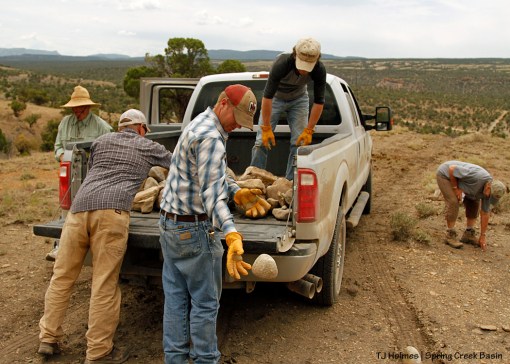
When you grow up in Texas, you grow up with these words: “Don’t put your hands where you can’t see them.” That translates to “watch out for snakes in rocks.” Mike found a snake while we were collecting these rocks to eventually place on top of the apron; fortunately, a red-tailed hawk already had gotten to it.

Some people – David – show off a little when you point a camera in their direction. 🙂 All that pipe would eventually go in the ground to carry water from the apron downhill to the tank.
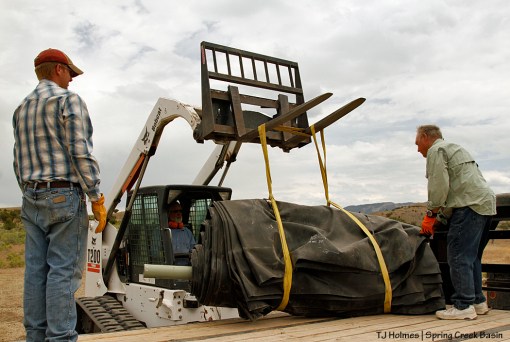
The rolled-up apron, custom made in Mancos, Colo., weighs 1,000 pounds.

We can’t start work without the obligatory safety talk. David Temple, left, talks to Garth Nelson, Pat Amthor, Justin Hunt, Mike Jensen and Frank Amthor.

Who says safety talks can’t be fun? (Note Temple Butte in the background.)

It wasn’t all sitting around watching David move dirt with his awesome little Bobcat. On day 2, we did a lot of shovel work and pipe-fitting and more shovel work, and remember that 1,000-pound apron? We spread it out and (wo)manhandled it into position.
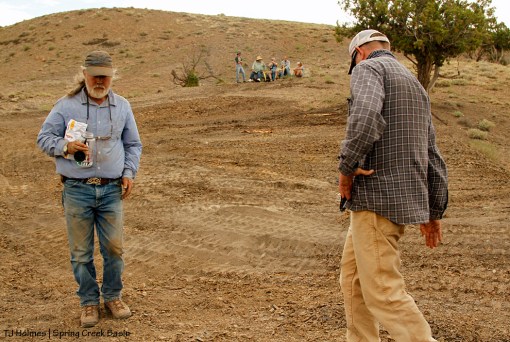
David takes a drink-n-snack break from dirt work to discuss the site layout with Mike.

Well, hello, awesome BLM’ers and volunteers! From left, Justin Hunt (BLM range tech), Frank and Pat Amthor (4CBCH), Garth Nelson (BLM range specialist) and advocate Kat Wilder. Note that they’re sitting on the rolled-up apron – the foundation of the whole fabulous project.
Huge, huge, HUGE thanks to all of you!
Day 2 pix and report to come as soon as I can get through the photos!
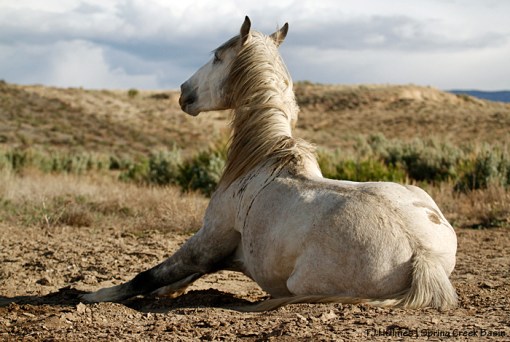
Here’s a chuckle for your morning commute.
The appeal of the soft-silt dry bed of a pond (still carrying some water in the deepest part) was too alluring for Kwana to worry about a crazy ol’ human, so he laid down and rolled – right in front of me! Then he performed a quick equine yoga move before he got back to his feet to continue playing with his pals.
**********************************************************************
In serious good news (and our mustangs need every bit they can get these days), the second “Mustang Tales” column by Kat Wilder went up on the American Wild Horse Preservation Campaign website yesterday. This one is called “Happy Trails,” and its chief message is an incredible and heartfelt tribute to Dr. Jay Kirkpatrick.

Jaunty, shaggy, feisty, muddy pinto pony! Some of the horses seem nearly fully shed out; others still are long-haired. All in good time.
Disappointment Valley and Spring Creek Basin got an awesome soaker of a rain system Friday and a little more Saturday evening, so presumably the ponies are even muddier – and the seeps and springs and ponds are even fuller! We are relieved and grateful that the “omega block” brought much-needed moisture to our corner of the world!
******************************
Also in the grateful category, thanks to Kat Wilder and to Suzanne Roy of American Wild Horse Preservation Campaign for posting the first in Kat’s series of “Mustang Tales: Bringing the Reader to the Range”! This first post records our meeting with Jen Maramonte and Suzanne last summer in Spring Creek Basin, where we were privileged to introduce them to the range and to several bands of our amazing mustangs. 🙂
Suzanne and the AWHPC team work tirelessly to keep advocates informed about threats to our wild horses and burros, as well as highlighting the good work being done by countless volunteers across the West (and elsewhere). Kat is working on a variety of “tales,” in a variety of formats, to highlight challenges faced by – and successes made by – advocates and BLM managers on behalf of the now-wild equines whose ancestors were instrumental in developing this country.
Join Kat on the (digital) range with the mesteños!
Once upon a time in a place far, far away from civilization – better known as Spring Creek Basin – it snowed during alternative spring break. And then we had many, many years of pretty excellent weather, during which we completed many projects for the benefit of our mustangs that call this faraway place their home on the range.

Tuesday would have been the first day of the annual two-day work project for alternative-spring-break partiers in Spring Creek Basin. However, Ma Nature had other plans, and she sent howling winds and blowing snow to this southwestern corner of Colorado.

Yesterday was the second day of our Spring Creek Basin project. Despite a light skiff of snow on the ground in the morning, we got a fairly decent start, and students carried several loads of materials and tools to the work site – which now is about mile from the road up the southeastern fence line.

BLM range tech Justin Hunt gives a safety talk before Mizzou students carry tools and supplies to the work site.

University of Missouri students pick up materials to carry to the work site from BLM range specialist Garth Nelson.
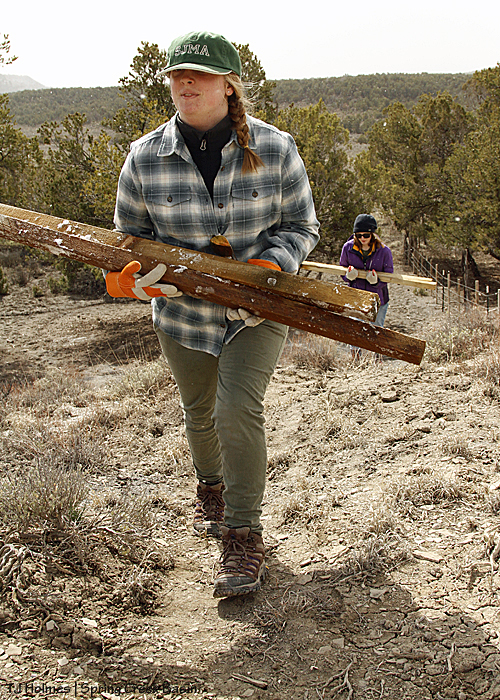
Libby and Nina carry staves up the big hill.
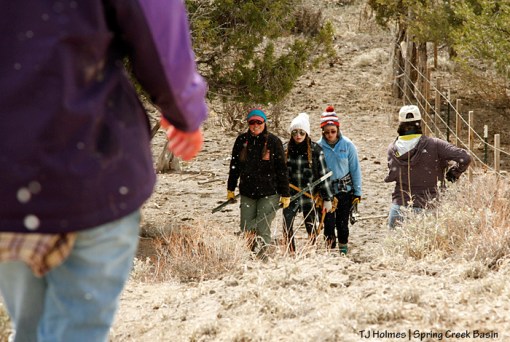
Nina (left) walks back to the truck for more supplies while SJMA’s Kathe Hayes leads Jenna and Bailey to the work site with a second load of tools. SJMA’s MK Gunn is at far right.
And then it snowed again.
At first, they were lovely little flakes floating on the breeze.
Then those flakes got bigger and heavier, and they started sticking to the ground, and the dirt started getting damp and started sticking to the bottoms of our hiking boots.
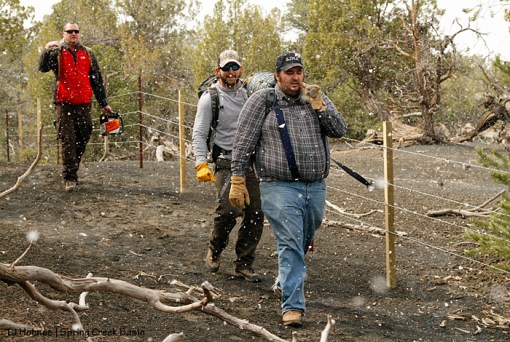
Mizzou’s Chalen helps Southwest Conservation Corps-BLM GIS intern Josh Ryan carry wire to the work site along Spring Creek Basin’s southeastern boundary during alternative spring break. BLM’s Sean Waggoner follows with the chainsaw and T-posts.

University of Missouri students Luke and Jessica carry staves about a mile to the work site while snowflakes start to fall.
About noon, we made the decision to call it a day. By the time we got back to the road, the snow had stopped … but the next wave was on its way.
Between the waves of snow, students carried armloads of T-posts and staves, buckets of tools and handfuls of tools, stretched a string to straighten the next section of fence, built an H-brace, pounded T-posts and cut wood away from the path of the new fence line (actually done by our BLM range tech). A couple of them even got as far as dropping posts and staves along the line. But we didn’t have time to take down old wire and string and stretch new wire.

Garth pounds a spike into a cross brace held by Chalen in the H-brace built before the snow really came down.

Garth helps Chalen and Luke tighten the wire holding an H-brace together.
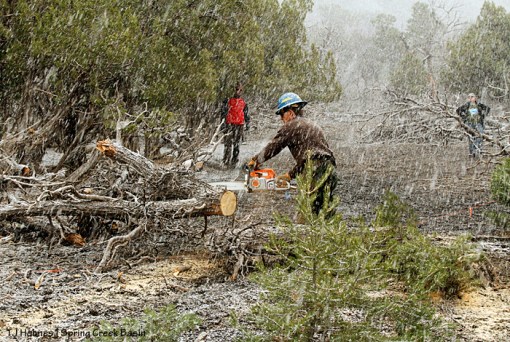
Justin cuts a tree away from the fence. Sean and Mizzou’s Megan serve as safety spotters. We learned that while we can’t cut even dead trees to use as posts in McKenna Peak Wilderness Study Area, we can use chainsaws to clear such trees from a fence line.
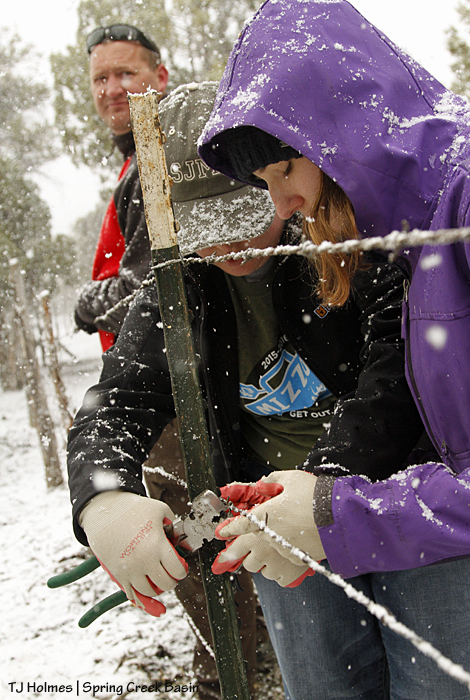
Sean holds wire while Nina and Megan attach strands to a T-post when the snowfall got heavy.
We’ll continue this project on other (sunny) days. 🙂
We sincerely thank this year’s Mizzou crew for being hearty and willing to brave the elements to tackle this ongoing project! It was great to meet you all … and there’s always next year! We also thank SJMA’s Kathe Hayes for her ever-cheerful organizational skills and taking care of the students, as well as members of the Colorado chapter of the National Mustang Association and Disappointment Wild Bunch Partners (who represent NMA/CO, Four Corners Back Country Horsemen and Mesa Verde Back Country Horsemen) for helping with funding.

University of Missouri students gather with BLM and SJMA employees in front of Temple Butte, just outside Spring Creek Basin in McKenna Peak Wilderness Study Area, during alternative spring break. From left to right: Justin Hunt, Bailey, MK Gunn, Josh Ryan, Jenna, Nina, Jessica, Megan, Luke, Libby, Kathe Hayes, Garth Nelson, Chalen and Sean Waggoner.
Thanks to Kat Wilder for her Writers on the Range op-ed in High Country News. 🙂
It’s getting harder and harder to deny PZP and its success!
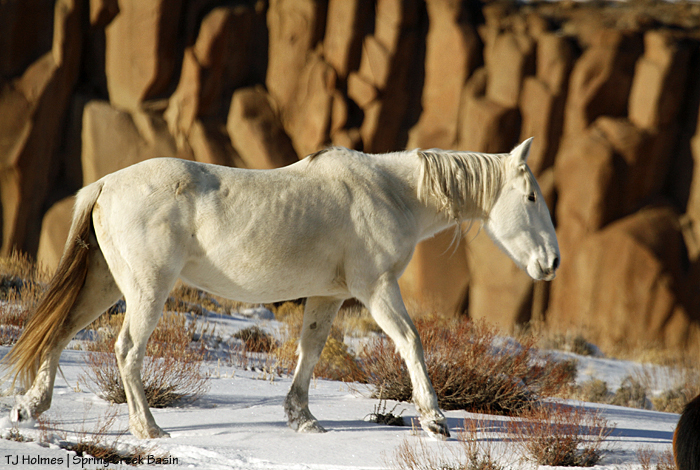
This is Houdini, who, at best guess, is somewhere north of 25 years old. She shows her age but otherwise looks great. She has contributed her genetics to Spring Creek Basin and has daughters and granddaughters and grandsons (at least) still wild in Spring Creek Basin.
I’ve known at least two elder mares that have had foals in the spring and died that fall, leaving their weanlings as orphans. Houdini has contributed her genetics and deserves a long, healthy life as the wild, wise mustang mare she is, adding her knowledge to the whole herd.
PZP makes that possible.

From American Wild Horse Preservation Campaign:
“It is with deep sadness that we inform you of the passing of Dr. Jay Kirkpatrick, a true pioneer in the field of humane wildlife management. Dr. Kirkpatrick, the founder of the Science and Conservation Center, passed away earlier this week from a brief but serious illness. He will be greatly missed.
“His passing is a terrible loss for the wild horse community. Our deepest condolences go to his wife and his colleagues at the Science and Conservation Center who are like family to AWHPC, as Dr. Kirkpatrick was.
“Jay was a rare ‘scientist with a heart’ and he dedicated his life to reducing the suffering of wild animals by developing a humane alternative to lethal management practices. The PZP fertility control vaccine that he developed and perfected (as affirmed by 30 years of published science) has kept countless wild animals – from wild horses to deer to bison and even elephants – wild and free by protecting them from capture and killing.
“‘I’m not a bunny hugger, but I’ll never attend another gather as long as I live. They’re flat-out inhumane,’ he told National Geographic in 2009 describing BLM wild horse roundups. ‘There are three reasons why these gathers are an unsatisfactory solution to the problem of numbers. Firstly, it’s genetically irresponsible to be constantly pulling off young horses whose genes will never get expressed; secondly, every time you pull horses out, the reproductive efficiency of the horses that remain increases. And thirdly, the behavioral consequences for the horses are profound.’
“Jay was a visionary, a humanitarian and a shining example of what one person can accomplish in his lifetime. We are so proud to have called him a friend and a colleague. Measures have been taken by the Science and Conservation Center to prepare for this transition and the seamless continuation of the work that he was dedicated to for 45 years.”
Godspeed, Dr. Jay. You trained many angels, and we honor you and your legacy to preserve mustangs and wild burros with every dart we fire.
Thank you, thank you, thank you.
Caution: Scenery- and work-project-heavy post ahead.
Thursday was the last day of work for the SCC crew – a short amount of time for a big – steep – job.
The day started with some clouds, cleared to sunshine, then returned to clouds. (More) Rain started Thursday night. (Have we been blessed by rain the last couple of weeks or what?!) So the crew had good conditions for their final day of work on Spring Creek Basin’s southeastern boundary fence.
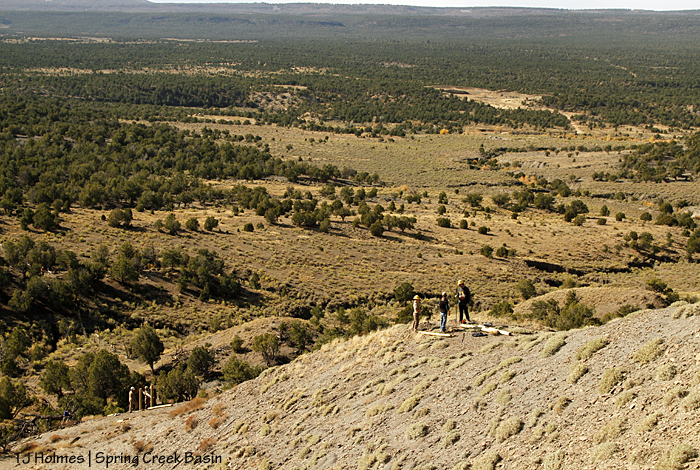
Let’s start with a scenic overview. There we were, on the basin’s far southeastern boundary looking southwestish over the basin’s “last” drainage toward Disappointment Road, the cottonwoods along Disappointment Creek and to more pinon-juniper covered BLM land beyond the basin to San Juan National Forest Service land to the horizon. Note the two groups, both working on H-braces on the near ridge – aka “the steep hill.” If you click to make the photo larger, you may be able to see the silver fence at the left; that’s the part of the fence that the crew already had rebuilt. It runs into the fence rebuilt by Mizzou students (we left a section for the students to work on in the spring).

Next, let’s take a look at the sad old fence that serves as an example of what the Mizzou students and the SCC crew have rebuilt and are rebuilding. We figure that fence has been around for 40 or more years.
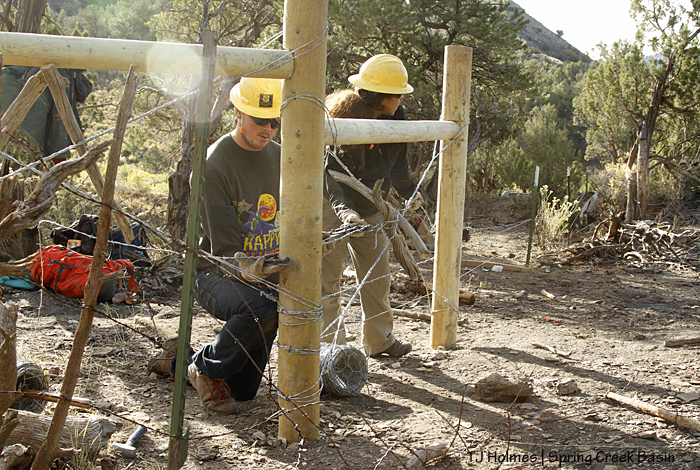
Toby and Zoe tighten another wire strand to a corner H-brace. Their rebuilt fence comes in from straight ahead, up from the arroyo shown in the previous post; the steep hill starts steps to the left.

Meanwhile, up the steep hill (hey, it really IS steep), Aaron and Eric dug holes for another H-brace. If you look closely, you can see the H-brace Toby and Zoe were working on below the hill at right.
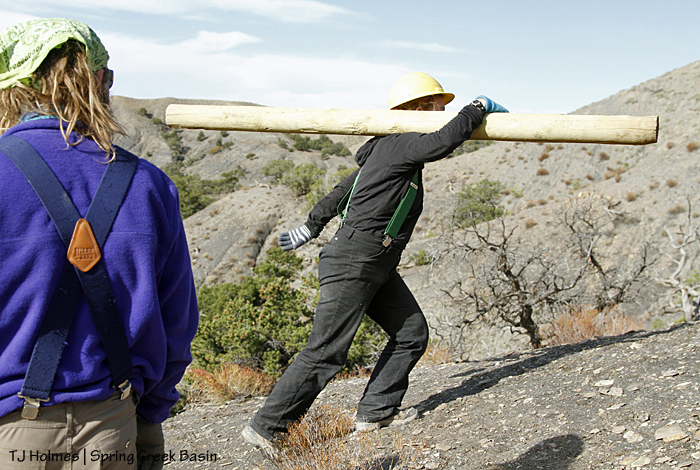
Photographic proof of the steepness (in a two-dimensional photo, it’s hard to convey just how steep this hill is): Sarah carries a post up the hill to the site of the next H-brace.
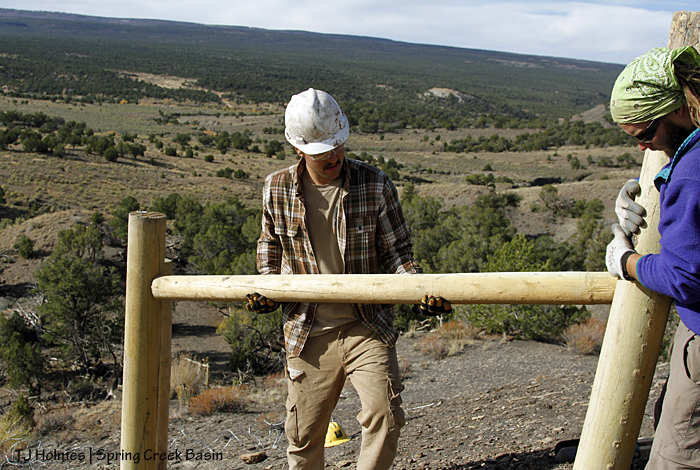
This photo does double duty: Partners Eric and Aaron measure the setting of an H-brace post with the cross post, AND you get another dose of scenery.

Toby and Sarah stand ready as Abby uses the post-hole digger to dig yet another hole for yet another H-brace on their journey to the top of the steep hill. Eric and Aaron in the photos above are below on the hill. The scenery here is part of McKenna Peak Wilderness Study Area – which overlaps into Spring Creek Basin Herd Management Area; in this view, it’s all wilderness study area.
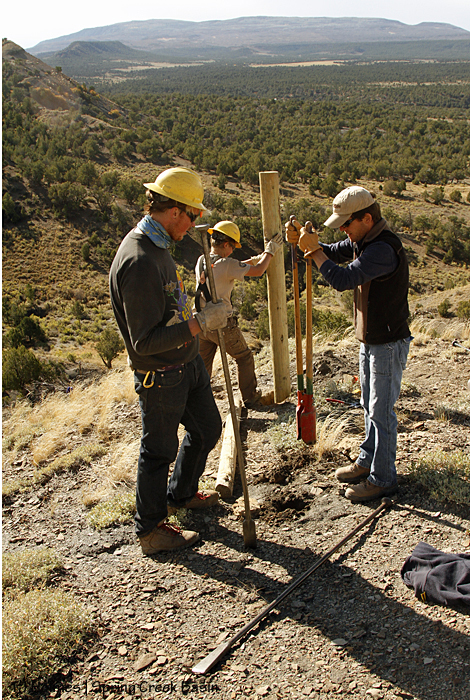
Another view of the same H-brace site, this time with BLM range tech Justin Hunt helping to dig the second post hole. How steep is the hill? The H-brace Eric and Aaron are working on is 100 yards or less below this site – and completely out of view of this little knob in the hill.

From the side, here’s a view of Eric’s and Aaron’s H-brace. Abby and group are up the hill to the right. In the very first photo in this post, you can see both groups. Their rebuilt fence as it crosses the arroyo is very visible in this photo.
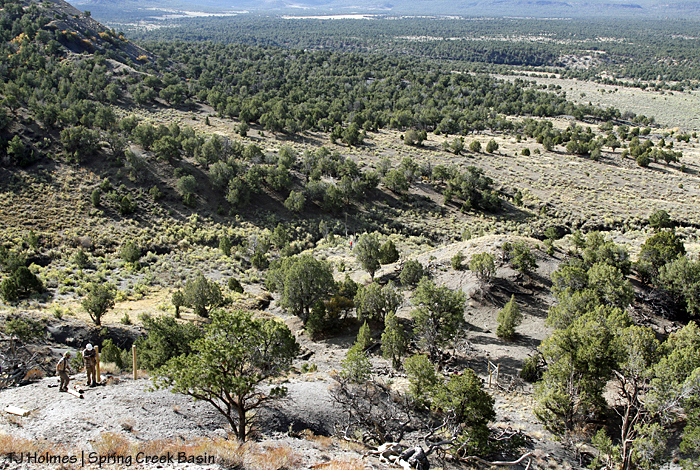
Another gratuitous scenery shot – ain’t it grand?
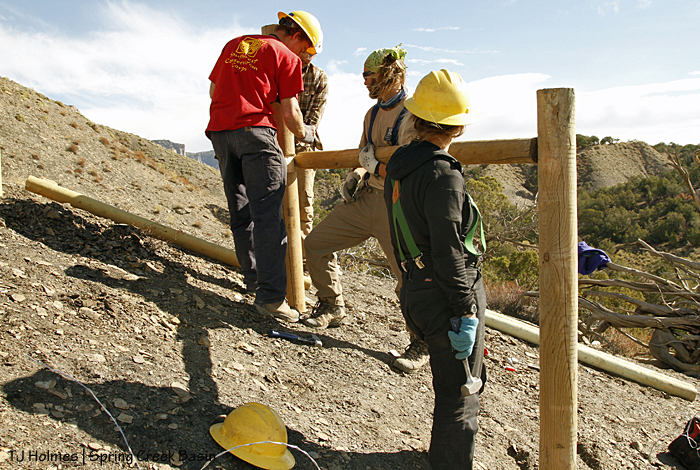
Returning to Eric’s and Aaron’s H-brace, now they have help from Sarah and co-crew leader Dillon to mark the first cross post. We had some debate about the levelness of these cross posts because the ground is so steep. Keeping the cross pieces strictly level would have had the post normal height on the downhill side of the brace but only about mid-thigh high on the uphill side! So crew members mirrored the slope a bit and cut their notches to reflect the angles of the posts’ ends.
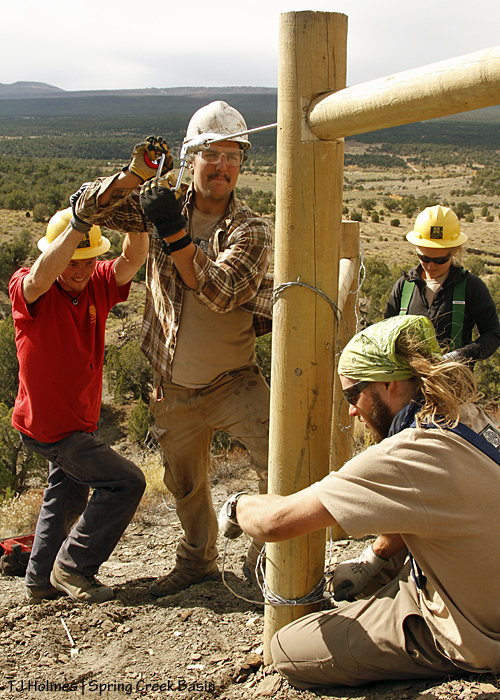
It’s easy to ramble on about the partnerships we enjoy for the benefit of the basin’s mustangs, but here it is in living color: Dillon lends weight to Eric’s drill while he drills a hole in the H-brace into which he’ll later pound a spike. Ain’t it grand?! 🙂 Wrapping wires to create the “X” to further bind the brace posts together are Aaron and Sarah.
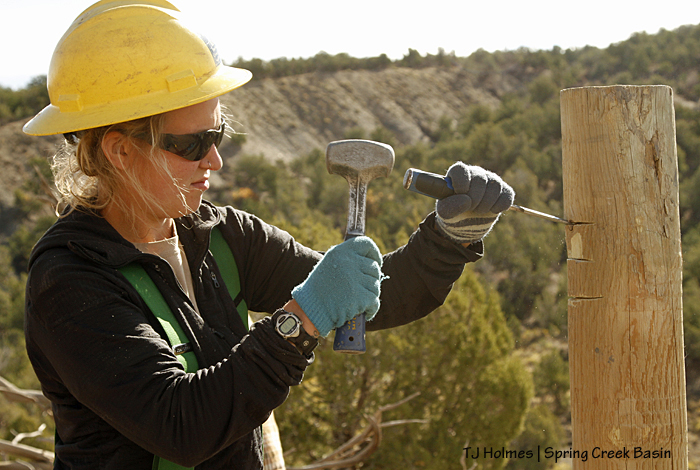
Sarah chips out the notch that will hold the cross posts even steadier in the vertical H-brace posts.
In case the steepness of “the steep hill” hasn’t been mentioned or illustrated clearly, these next photos should do the trick:
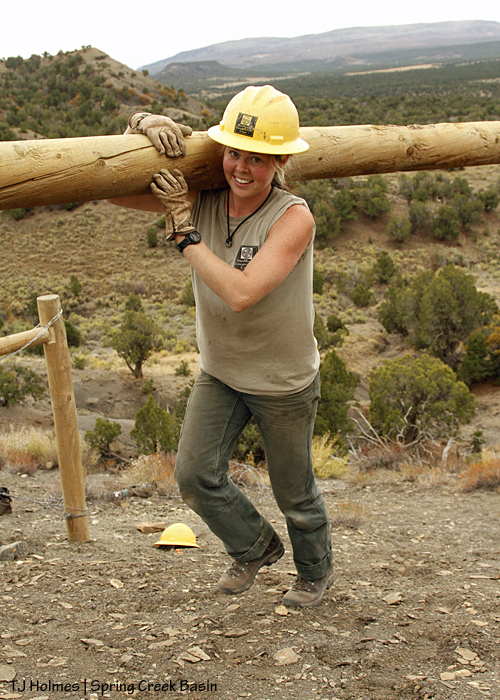
Co-crew leader Sarah carries an H-brace post up the steep hill. She’s passing the first H-brace, and she’ll pass the next H-brace before getting to her destination – and they had at least one more H-brace to build after that. Still all-smiles on Day 4!

Justin follows Sarah on the way to the second H-brace up the steep hill, where Dillon is making cuts to start the notching process.

And here’s Zoe carrying another post from basically the base of the steep hill (scroll back up to the beginning of this post and the H-brace where she and Toby were tightening a strand of wire).

From the bottom looking up.
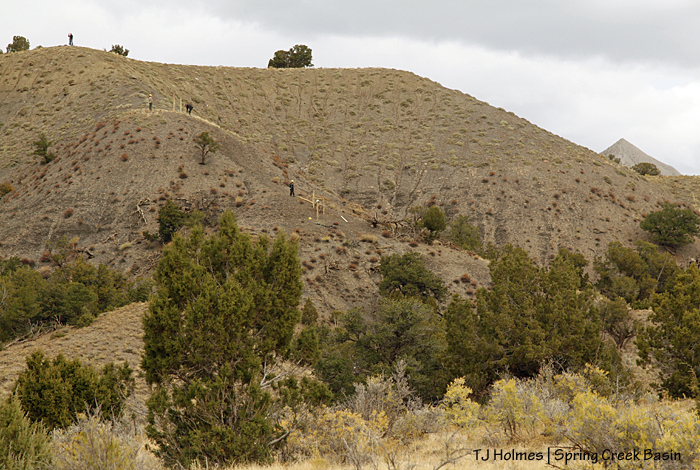
And from down toward the arroyo looking up at the steep hill. Um, wowowow?! The wilderness study area’s namesake McKenna Peak shows its point at far right.
Sarah, Dillon, Eric, Aaron, Sarah, Zoe, Abby and Toby, we thank you, thank you, thank you for your service on behalf of our mustangs! We hope your last hitch of the season was your best. Thankfully, you saw some mustangs along the way between camp site and work site, and if you can, please come back soon to see more of the mustangs protected and kept safe by your work!
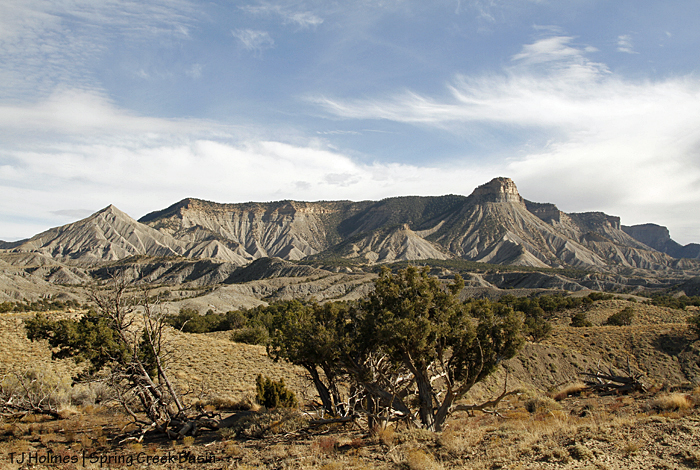
View from the top. 🙂

Right here, this is the reason (OK, one reason) we love SJMA‘s Kathe Hayes: She brings homemade chocolate-chip cookies as mini mid-work thank-yous! Here she offers cookies to Abby as she and Zoe dig post holes for the next H-brace in the SCC crew’s brand-new fence section.
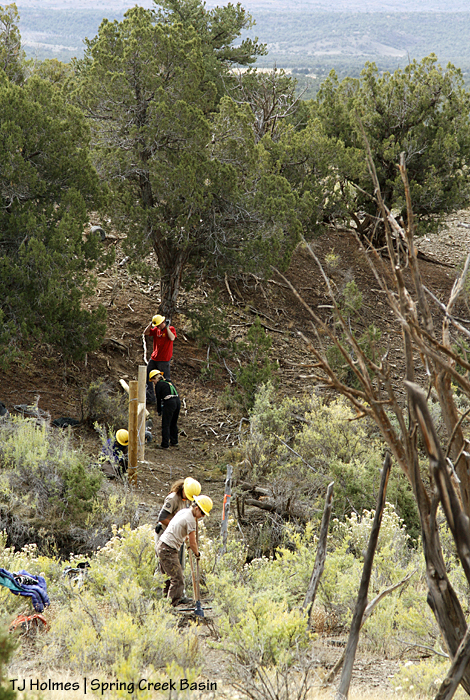
The crew has made excellent progress in their section of fence line – building five H-braces since Monday and working on the sixth as of the above photo. In the foreground, Abby and Zoe dig post holes for the next H-brace, while in the background, Aaron and Sarah and co-crew leader Dillon complete the previous H-brace. Harder to see is the little arroyo – no more than a few feet deep but steep-sided – between the two groups.

Here’s a closer look at the arroyo. Note Kathe in the background, approaching with her awesome cookies.

Kathe makes her cookie offering while Dillon, Sarah and Aaron complete their H-brace. Eric and Toby and co-crew leader Sarah, not pictured because they were working on different sections of fence, also got cookies, hand-delivered by Kathe, and she left the whole bin. 🙂

Kathe shows Aaron photos of the pack horses that hauled fence supplies to the work site a few weeks ago while Sarah and Dillon finish their H-brace. Temple Butte watches over the crew from the background.

This is where they are; that’s where they’re going! And that’s why they’re here. Mizzou students … you’re welcome! 🙂
 Spring Creek Basin Mustangs