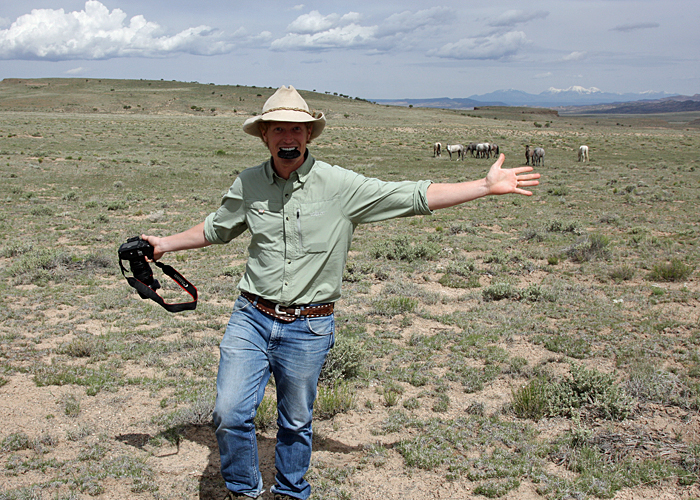
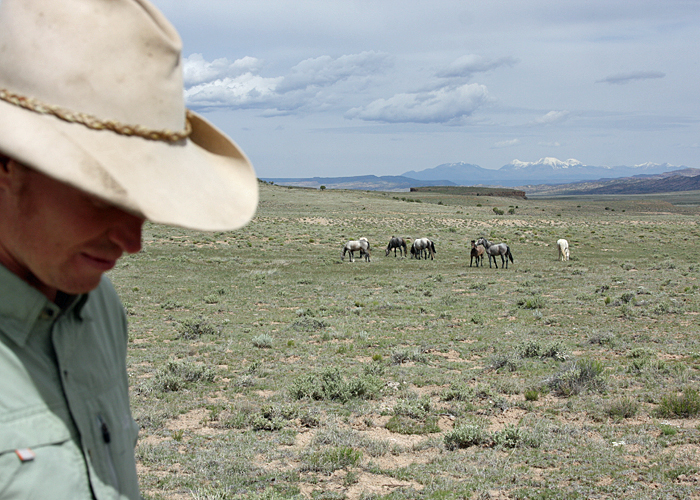
‘PZP: Where hope, science and mustangs meet’

6 01 2016

Thanks to Kat Wilder for her Writers on the Range op-ed in High Country News. πŸ™‚

It’s getting harder and harder to deny PZP and its success!
Houdini

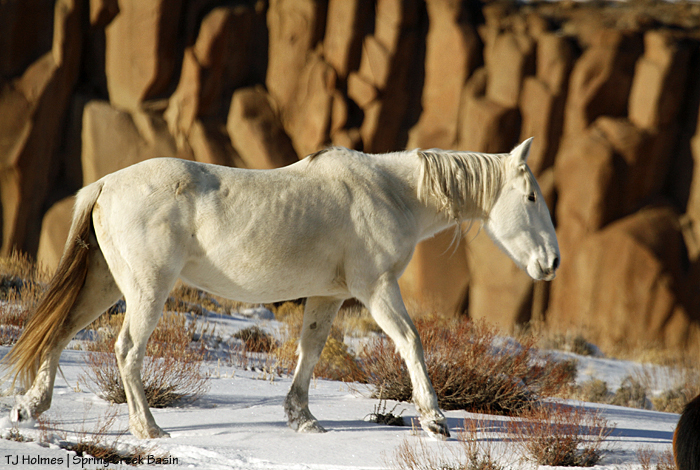
This is Houdini, who, at best guess, is somewhere north of 25 years old. She shows her age but otherwise looks great. She has contributed her genetics to Spring Creek Basin and has daughters and granddaughters and grandsons (at least) still wild in Spring Creek Basin.

I’ve known at least two elder mares that have had foals in the spring and died that fall, leaving their weanlings as orphans. Houdini has contributed her genetics and deserves a long, healthy lifeΒ  as the wild, wise mustang mare she is, adding her knowledge to the whole herd.

PZP makes that possible.


Steep work, great views

31 10 2015

Caution: Scenery- and work-project-heavy post ahead.

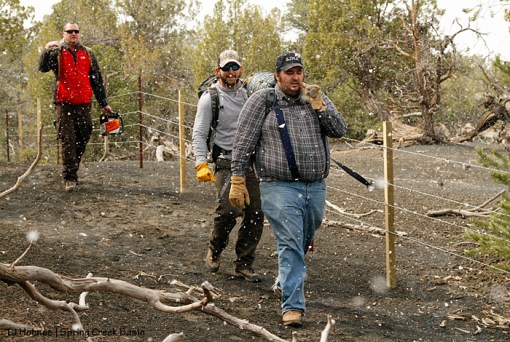
Thursday was the last day of work for the SCC crew – a short amount of time for a big – steep – job.

The day started with some clouds, cleared to sunshine, then returned to clouds. (More) Rain started Thursday night. (Have we been blessed by rain the last couple of weeks or what?!) So the crew had good conditions for their final day of work on Spring Creek Basin’s southeastern boundary fence.

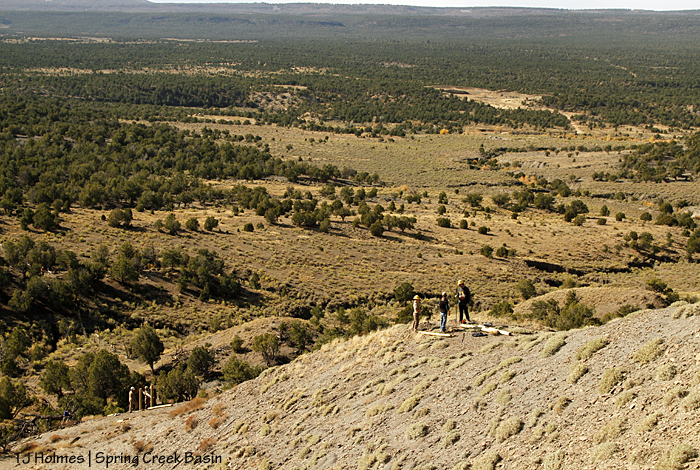
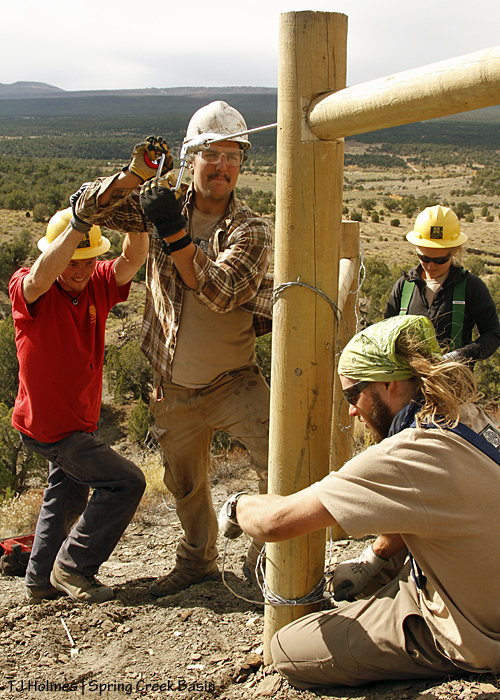
Southwest Conservation Corps crew members build H-braces on a steep hill along Spring Creek Basin's southeastern boundary. From this vantage, one looks across the last drainage in the basin toward Disappointment Road.

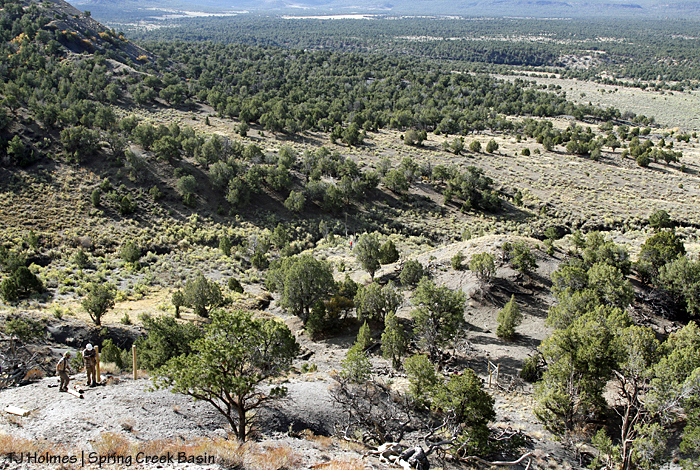
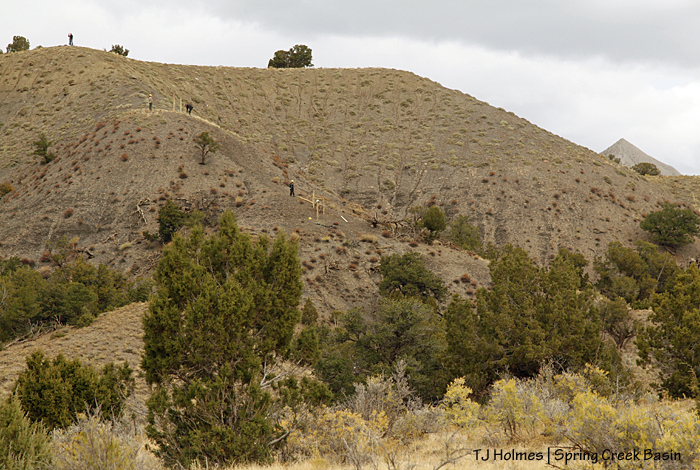
Let’s start with a scenic overview. There we were, on the basin’s far southeastern boundary looking southwestish over the basin’s “last” drainage toward Disappointment Road, the cottonwoods along Disappointment Creek and to more pinon-juniper covered BLM land beyond the basin to San Juan National Forest Service land to the horizon. Note the two groups, both working on H-braces on the near ridge – aka “the steep hill.” If you click to make the photo larger, you may be able to see the silver fence at the left; that’s the part of the fence that the crew already had rebuilt. It runs into the fence rebuilt by Mizzou students (we left a section for the students to work on in the spring).

Southwest Conservation Corps members are replacing this fence along Spring Creek Basin's southeastern boundary.

Next, let’s take a look at the sad old fence that serves as an example of what the Mizzou students and the SCC crew have rebuilt and are rebuilding. We figure that fence has been around for 40 or more years.

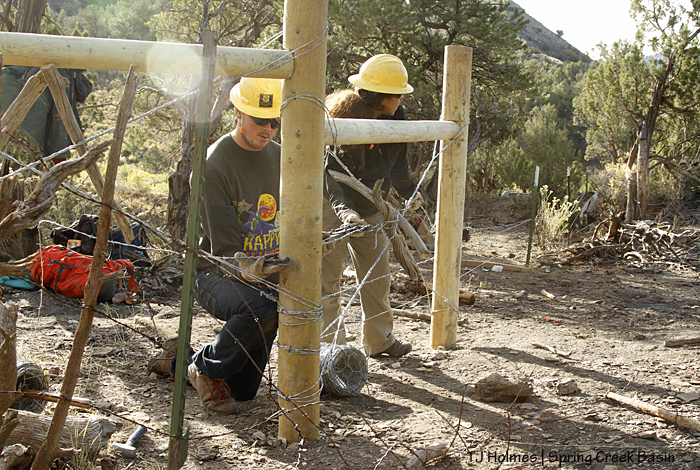
Southwest Conservation Corps crew members Toby and Zoe finish an H-brace at the base of the steep hill to along Spring Creek Basin's southeastern boundary.

Toby and Zoe tighten another wire strand to a corner H-brace. Their rebuilt fence comes in from straight ahead, up from the arroyo shown in the previous post; the steep hill starts steps to the left.

Southwest Conservation Corps members Eric and Aaron dig a hole while building an H-brace on the steep hill on Spring Creek Basin's southeastern boundary.

Meanwhile, up the steep hill (hey, it really IS steep), Aaron and Eric dug holes for another H-brace. If you look closely, you can see the H-brace Toby and Zoe were working on below the hill at right.

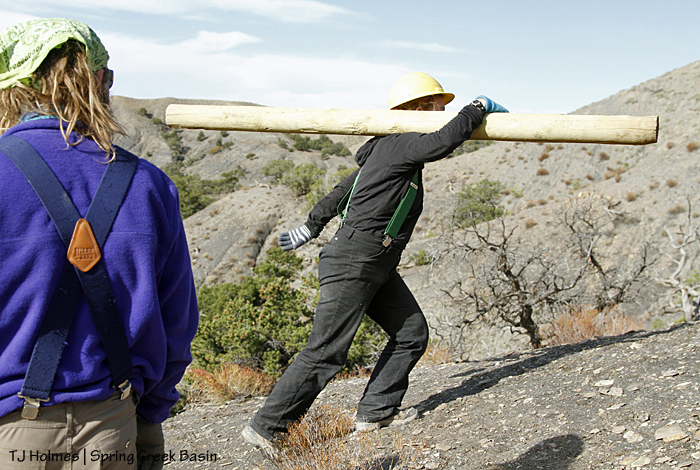
Southwest Conservation Corps member Aaron watches Sarah carry an H-brace post up the steep hill on Spring Creek Basin's southeastern boundary.

Photographic proof of the steepness (in a two-dimensional photo, it’s hard to convey just how steep this hill is): Sarah carries a post up the hill to the site of the next H-brace.

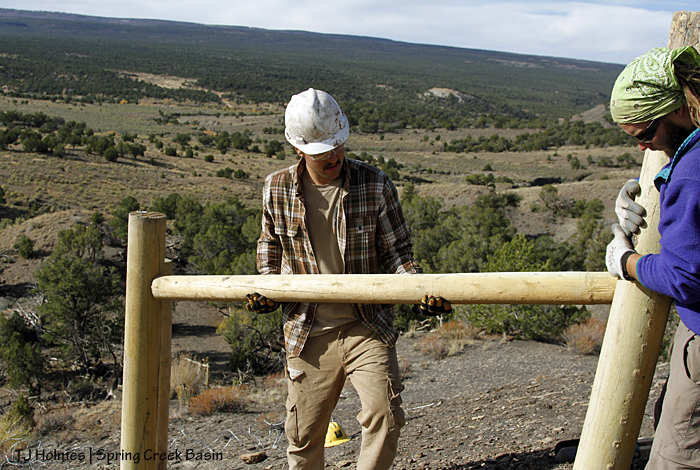
Southwest Conservation Corps members Eric and Aaron check the cross post while building an H-brace on the steep hill on Spring Creek Basin's southeastern boundary.

This photo does double duty: Partners Eric and Aaron measure the setting of an H-brace post with the cross post, AND you get another dose of scenery.

Southwest Conservation Corps members Toby, Sarah and Abby take turns digging a hole for an H-brace post on the steep hill on Spring Creek Basin's southeastern boundary.

Toby and Sarah stand ready as Abby uses the post-hole digger to dig yet another hole for yet another H-brace on their journey to the top of the steep hill. Eric and Aaron in the photos above are below on the hill. The scenery here is part of McKenna Peak Wilderness Study Area – which overlaps into Spring Creek Basin Herd Management Area; in this view, it’s all wilderness study area.

BLM range tech Justin Hunt helps dig a post hole for an H-brace on the steep hill with SCC crew members Toby and Abby on Spring Creek Basin's southeastern boundary.

Another view of the same H-brace site, this time with BLM range tech Justin Hunt helping to dig the second post hole. How steep is the hill? The H-brace Eric and Aaron are working on is 100 yards or less below this site – and completely out of view of this little knob in the hill.

The fence the Southwest Conservation Corps built. Up the hill in the foreground and across the small drainage in the lower background, beyond the photo, the crew left a section for the Mizzou students on alternative spring break next year.

From the side, here’s a view of Eric’s and Aaron’s H-brace. Abby and group are up the hill to the right. In the very first photo in this post, you can see both groups. Their rebuilt fence as it crosses the arroyo is very visible in this photo.

Southwest Conservation Corps members rebuild the fence up a steep hill on Spring Creek Basin's southeastern boundary.

Another gratuitous scenery shot – ain’t it grand?

Southwest Conservation Corps crew members Sarah, Aaron and Eric help co-crew leader Dillon complete an H-brace they built on a steep hill on Spring Creek Basin's southeastern boundary.

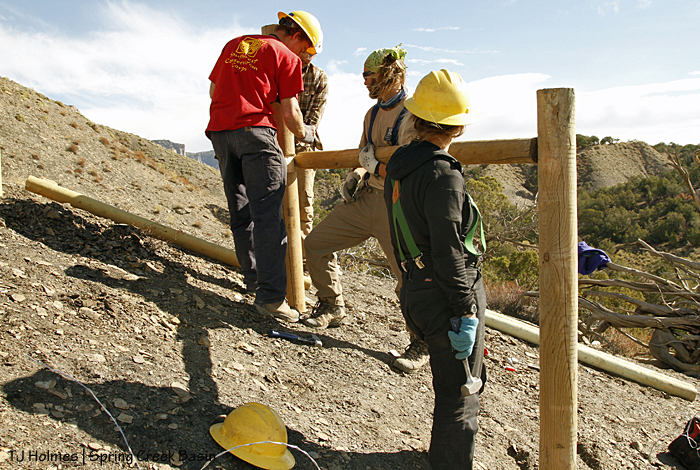
Returning to Eric’s and Aaron’s H-brace, now they have help from Sarah and co-crew leader Dillon to mark the first cross post. We had some debate about the levelness of these cross posts because the ground is so steep. Keeping the cross pieces strictly level would have had the post normal height on the downhill side of the brace but only about mid-thigh high on the uphill side! So crew members mirrored the slope a bit and cut their notches to reflect the angles of the posts’ ends.

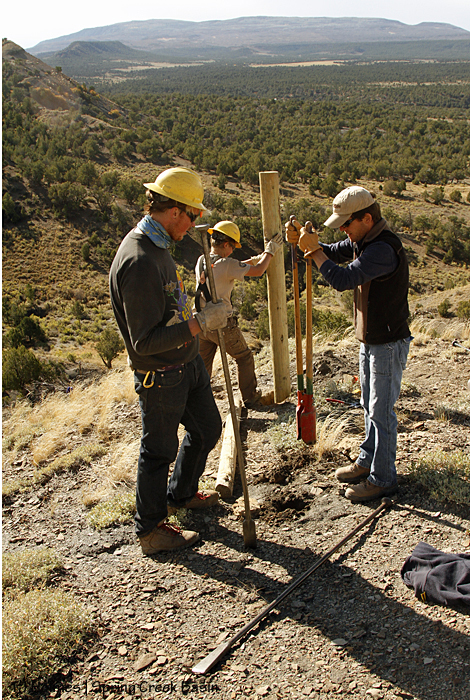
Southwest Conservation Corps co-crew leader Dillon lends weight to the manual drill wielded by Eric as he drills a hole for a spike in the H-brace pictured. Aaron and Sarah, who dug the post holes, thread wire to anchor the braces on Spring Creek Basin's southeastern fence line.

It’s easy to ramble on about the partnerships we enjoy for the benefit of the basin’s mustangs, but here it is in living color: Dillon lends weight to Eric’s drill while he drills a hole in the H-brace into which he’ll later pound a spike. Ain’t it grand?! πŸ™‚ Wrapping wires to create the “X” to further bind the brace posts together are Aaron and Sarah.

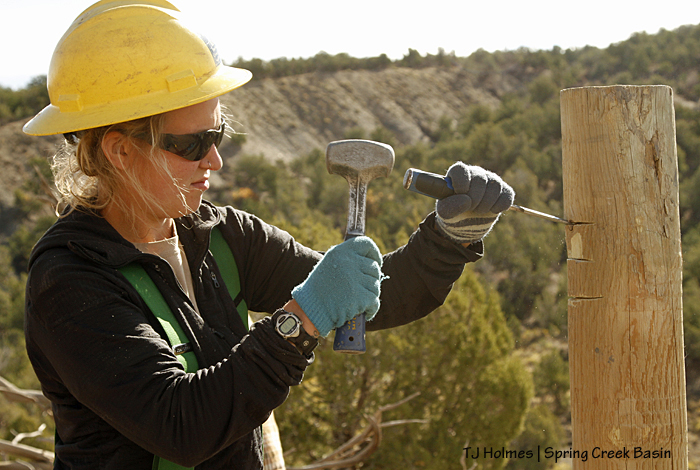
Southwest Conservation Corps crew member Sarah uses a chisel to create a notch for a cross bar in an H-brace in Spring Creek Basin's southeastern fence line.

Sarah chips out the notch that will hold the cross posts even steadier in the vertical H-brace posts.

In case the steepness of “the steep hill” hasn’t been mentioned or illustrated clearly, these next photos should do the trick:

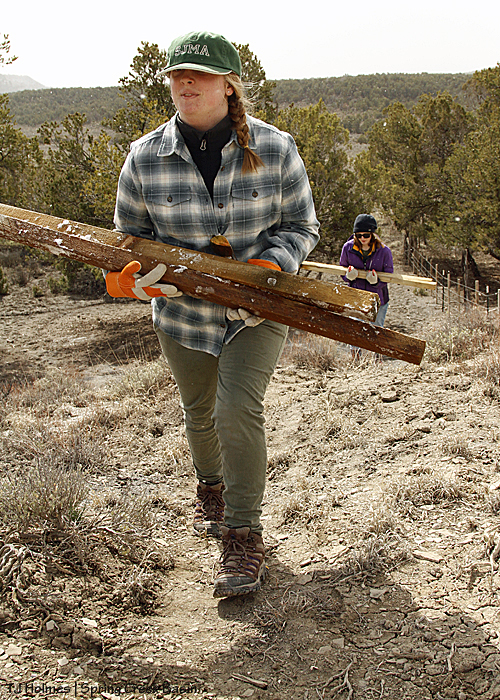
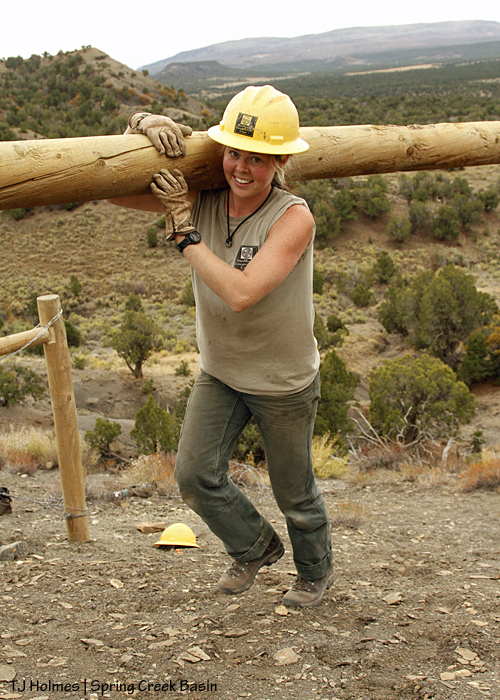
Southwest Conservation Corps co-crew leader Sarah carries a post up the steep hill to build an H-brace in Spring Creek Basin's southeastern fence line. All smiles on Day 4!

Co-crew leader Sarah carries an H-brace post up the steep hill. She’s passing the first H-brace, and she’ll pass the next H-brace before getting to her destination – and they had at least one more H-brace to build after that. Still all-smiles on Day 4!

BLM range tech Justin Hunt carries a post up the steep hill behind SCC co-crew leader Sarah on the way to build a new H-brace above the one pictured, with co-crew leader Dillon, on Spring Creek Basin's southeastern boundary.

Justin follows Sarah on the way to the second H-brace up the steep hill, where Dillon is making cuts to start the notching process.

Southwest Conservation Corps crew member Zoe carries a post up the steep hill to use as part of an H-brace along Spring Creek Basin's southeastern fence line.

And here’s Zoe carrying another post from basically the base of the steep hill (scroll back up to the beginning of this post and the H-brace where she and Toby were tightening a strand of wire).

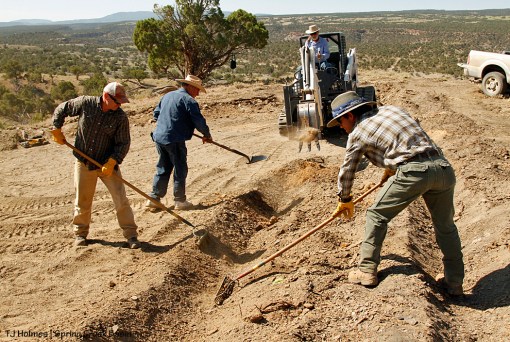
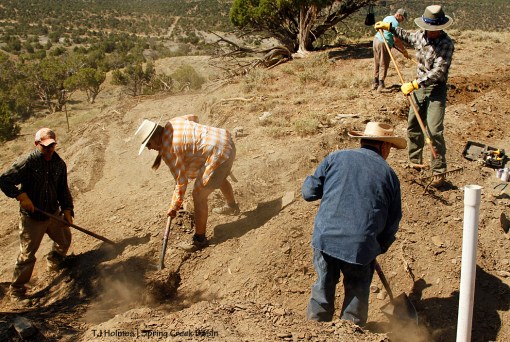
Southwest Conservation Corps crew members construct H-braces in the new fence along Spring Creek Basin's southeastern boundary. That steep hill is why they were hired!

From the bottom looking up.

Southwest Conservation Corps crew members construct a new fence along Spring Creek Basin's southeastern boundary. That steep hill is why they were hired!

And from down toward the arroyo looking up at the steep hill. Um, wowowow?! The wilderness study area’s namesake McKenna Peak shows its point at far right.

Sarah, Dillon, Eric, Aaron, Sarah, Zoe, Abby and Toby, we thank you, thank you, thank you for your service on behalf of our mustangs! We hope your last hitch of the season was your best. Thankfully, you saw some mustangs along the way between camp site and work site, and if you can, please come back soon to see more of the mustangs protected and kept safe by your work!

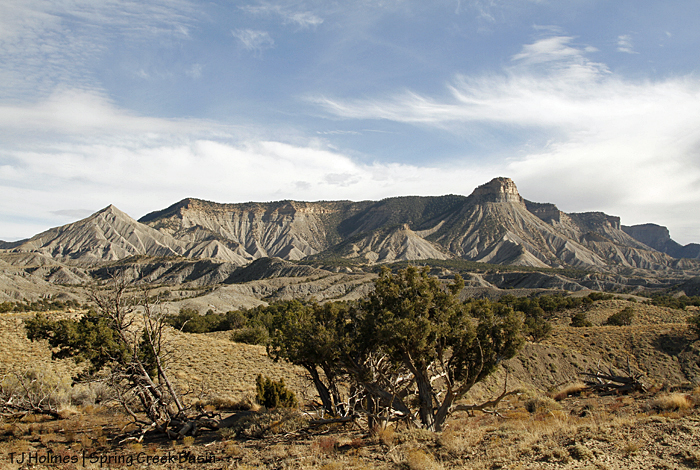
Beyond Spring Creek Basin in McKenna Peak Wilderness Study Area: McKenna Peak at far left and Temple Butte toward the right. Outside Spring Creek Basin, they are two of the basin's most recognizable landmarks.

View from the top. πŸ™‚


Special visitors

31 05 2015
Katie and Ben Masters in Spring Creek Basin with Chrome's band.

Katie and Ben Masters in Spring Creek Basin.

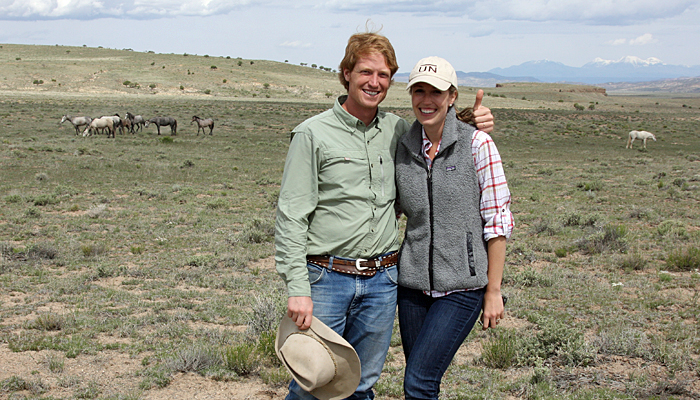
The “Unbranded” crew may not have ridden through Colorado, but ahead of Telluride’s Mountainfilm festival last weekend, Ben Masters and his very lovely wife, Katie, came to Spring Creek Basin to see our “beautiful” mustangs.

We talked about wild horses and wild burros and public lands and challenges and solutions. As you might imagine, Ben’s mustangs, partners in his and friends’ trip of a lifetime, have made him a mustang advocate. “Unbranded” has catapulted him into a unique position of being respected by a variety of disparate interests.

Ben Masters checks out the NMA/CO sign on the water catchment in Spring Creek Basin with wife Katie. Chrome's band is beyond.

Ben checks out the NMA/CO sign on the water catchment in Spring Creek Basin with Katie.

One does not travel from Mexico to Canada with mustangs and friends alone. It requires preparation and support from numerous people along the way. When traveling across public lands with a pack string and a camera man (at least one), one needs permits from the government: the Forest Service, the Bureau of Land Management, the National Park Service. Observant travelers notice the tread of others on those lands, and Ben and Ben and Thomas and Jonny were no different. To say they made the most of their observations and appreciation of America’s remarkable public lands is a huge understatement.

Katie and Ben Masters in Spring Creek Basin's east pocket with Comanche's, Aspen's and Hollywood's bands.

Katie and Ben enjoy a wonderful visit with beautiful mustangs in the basin.

“Unbranded” is a journey story, and like all good journeys, it includes challenges and obstacles and perseverance and education. While their physical journey may have ended at the Canada border, their education is ongoing, and their search for solutions for America’s wild horses and burros likewise is ongoing.

Ben Masters with Chrome's band in Spring Creek Basin.

Ben was pretty stoked by his visit with our mustangs!

Not surprisingly to the sold-out crowds fortunate enough to see “Unbranded” in Telluride (350 people in line were turned away from the Saturday showing after the theater filled), the film won the Audience Award.

This was the second film festival for “Unbranded”; it was the second Audience Award. Ahhhhhhhhhh-mazing!

When you get the chance to see “Unbranded,” see it. It’s not the typical mustang film. It will leave you wanting more – more mustangs, more conservation of public lands, more involvement, more “what can I do.”

Ben Masters with Chrome's band in Spring Creek Basin.

Ben … mustangs … a wide-open place.

We were so fortunate to meet Ben and Katie Masters and some of the rest of the “Unbranded” crew. What an amazing film. They’re carrying an important message, as Ben says, to show the worth of America’s mustangs.


Scoping period’s deadline extended to Feb. 28

9 01 2015

Kudos to all whoΒ already have sent letters and emails in response to BLM’s request for comments about future bait trapping in Spring Creek Basin! We are so appreciative.

For you procrastinators out there (you’re in good company with yours truly), BLM has extended the deadline to comment. It’s now Feb. 28.

To repeat some information, the scoping letter and National Mustang Association/Colorado chapter- and Disappointment Wild Bunch Partners-submitted bait-trapping proposal are linked at NMA/CO’s website.

When you comment, please consider including your address to be added to BLM’s mailing list for future contact about issues related to our Spring Creek Basin mustangs – including the forthcoming EA. The scoping notice is the step that will lead to an EA that should include the potential to use bait trapping in Spring Creek Basin – in the future, when needed.

It is important to know that NO ROUNDUP is scheduled in Spring Creek Basin this year, and with the success of our PZP program, we shouldn’t need one for at least a year or two.

This is a very positive step forward in the evolution of good management of Spring Creek Basin’s mustangs. We already are using native PZP to slow the population growth of the herd. Bait trapping will provide a means of safe “gathering” and removal of horses when needed to keep the herd’s size in balance with the resources of Spring Creek Basin. In our fragile, high-desert environment, we must protect the range for the good of all generations of our mustangs.

Please pass the word, and send those comments! Thank you!

Maia, Alegre and Houdini


There be magic

29 09 2014

Rainbow over Spring Creek Basin.

We know that, of course. The mustangs are the gold at the end of that rainbow. πŸ™‚

This photo was taken from the Disappointment Road looking eastish toward Spring Creek Basin. The rimrocks in the foreground form the basin’s western boundary. Also visible are two of our main landmarks: McKenna Peak and the unnamed promontory.

Rain today. The entire Western Slope was a giant blob of green on the radar (and the higher ridges and peaks got snow!). Rain be magic, too.


SCC crew cutting tamarisk

1 06 2014

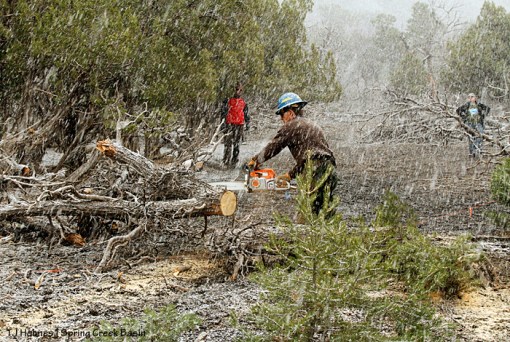
Last week, a Southwest Conservation Corps crew spent four days in Spring Creek Basin cutting and spraying tamarisk. Kathe Hayes with San Juan Mountains Association played a big part in getting the crew here for this project, which – I think – was funded out of the Director’s Challenge grant our Tres Rios Field Office was awarded a couple of years ago.

Crew members are from Fort Defiance, Ariz. Several of them have been together since March, and a couple of them volunteered to join the crew for this project in the basin. Crew leader Lance Hubbard said this is his fourth or fifth season with SCC. Most of those have been spent doing irrigation, wash restoration and trail work; this was his first season to do chainsaw work. From here, they’ll head back to Ganado, Ariz., for all of the above.

Tamarisk eradication has been done off and on for many years in the basin. Some of our University of Missouri students have worked on it during alternative spring breaks with Kathe. Also working in the basin last week was a Forest Service sprayer, Gary, working in some of the main arroyos.

052914SCCfive

Five guys and one woman, ranging in age from 20 to 25, were on the crew (I couldn’t get them all in one frame until I made them pose for me at the end because they were all constantly in motion). Two wielded chain saws, cutting tamarisk as close to the ground as possible so the stumps wouldΒ pose as little hazard as possible to the horses. Three cleared the branches and carried them to slash piles for later burning. And one sprayed the stumps with “Habitat” to prevent the tamarisk from growing back. Crew members traded spraying, carrying and cutting duties each day.

052914SCCshoanyah1

Shoanyah Halwood wielded one of the chainsaws. My back ached just watching her!

052914SCCmatthewadrian

Matthew Begay wielded the other chainsaw. Adrian Benally was his partner to clear and carry branches to the slash piles.

052914SCCadrianmatthew

Another one of Adrian and Matthew working together. Sprayed stumps are visible in the foreground.

Alonzo Moses, 23, carries cut tamarisk branches to a pile to be burned later.

Alonzo Moses carries branches that Shoanyah cut to a slash pile.

052914SCClance

Crew leader Lance Hubbard also carried branches to slash piles.

052914SCCrolando

Rolando Billie handled spraying duties on the crew’s last day in the basin. It was pretty warm during their week, but they had a little bit of cloud cover toward the end that helped.

052914SCCcrew1

From left: Adrian, Matthew, Rolando, Lance, Shoanyah and Alonzo. They’re standing where a big clump (grove?) of tamarisk once grew.

Getting rid of moisture-leaching, salt-depositing tamarisk is a big, worthwhile project in Spring Creek Basin, and we appreciate their work on behalf of our mustangs! They did see a couple of bands during the week and thought the horses were pretty cool. πŸ™‚ Thanks to this hard-working crew!


4CBCH annual wild horse count

30 05 2014

On May 17, members of the Four Corners Back Country Horsemen came to Spring Creek Basin for their annual wild horse count. This was their 14th year!

This is an important, ongoing partnership between 4CBCH and BLM. In addition to counting mustangs in Spring Creek Basin and getting an idea of the makeup of bands, members traditionally complete a work project during the weekend. Previous projects have included fence maintenance, packing out old wire and weed surveys. The last couple of years, the Forest Service has sent a weed-spraying crew to the basin to spray some of the locations we’ve surveyed.

In years past, horseless members of the group would drive to the base of Round Top and hike to the summit, then use binoculars and spotting scopes to search for mustangs. Radio communication between horseback groups and the hikers would help with locations and identifications. Now, we have horseback folks and folks who take “horseless carriages” around the loop road in the basin to look for horses, completing projects on the way.

Again this year, we surveyed ponds for the presence of knapweed and musk thistle. Fortunately, we found little of either type of weed at all the locations we checked.

Between the riders and the drivers, we saw almost all the horses! And a few of the bands put on a show by being in close proximity to each other, which was great for everyone to see so many of our mustangs!

Pat (president of 4CBCH) and Frank Amthor were the weekend’s leaders, as usual, and as always, they hosted a wonderful event full of horses, stories of past mustang sightings and terrific food. A highlight this year was meeting a Spring Creek Basin mustang, Tipi (spelling?), adopted in 2005. He reminded me completely of Bruiser – minus the spots!

Lisa Cribbs, Travis, Cathy Roberts, Cindy, Adrian and Mikayla

Lisa and her son, Travis, lead the way into the basin from the campsite off the Disappointment Road. Travis has attended most counts since he was 6 years old!

Travis, Cathy Roberts, Mikayla, Adrian, Kat Wilder

Eva Duvillard and Tipi

Eva and her Spring Creek Basin mustang, Tipi. (Yes, the gnats are out!)

Adrian and mustang Reno

Eva’s husband, Adrian, also rode a mustang, Reno. They recently adopted a third mustang. These are true mustang supporters!

Cathy Roberts and Shenoah (sp?)

Cathy is 4CBCH’s vice president; this was her first count. Her lovely mom, Millie, came from California and joined us to see mustangs from the vehicles.

Cindy

This also was the first count for Cindy and her daughter.

Mikayla and Saphira

Daughter Mikayla (sp?) and her little mare Sapphira made a great pair.

Lisa Cribbs on Bullseye

Lisa is a past 4CBCH president, and she has attended numerous counts – and has lots of great stories about the mustangs they’ve encountered!

Travis, Lisa Cribbs, Cathy Roberts and Mikayla

As noted, Travis has been coming to Spring Creek Basin since heΒ  was 6. He’s now 20!

Bob Volger on Buckley

Bob is another past 4CBCH president who has ridden in the basin several times. He also has packed old wire out using his horses.

Kat Wilder on Kua

Kat is one of our NMA/CO board members, and this was her first count. It probably won’t be her last!

Thank you to all involved for your camaraderie and super enthusiasm for our Spring Creek Basin mustangs! We’ll see you next spring!


Alternative spring break – day 2

27 03 2014

Not only are these University of Missouri students good workers, they’re good luck!

They arrived with smiles and good cheer and high energy, and we know why.

Chalen was the group leader for the second year this year. Last year, rumor had it that Chalen was up at 4 at least one morning (!) to cook breakfast for his crew. Kyla confirmed that while most UM alternative spring break groups are eating Cheerios and granola for breakfast and scrounging dinner on their own, Chalen is making sure his charges not only eat, they eat well! Kathe Hayes, with San Juan Mountains Association, sets up a couple of dinners for the students during the week each year, but I have it on good authority that the kids dined on steaks last night, courtesy of Chef Chalen. Niiiiice! (They deserve it!)

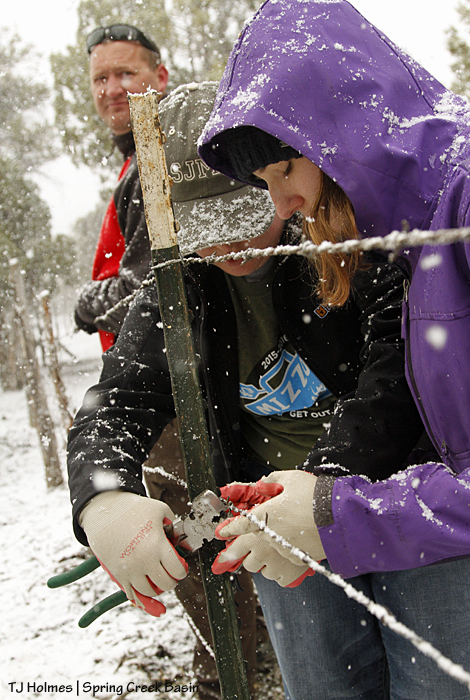
Wednesday’s stretch of fence work was fairly short, especially compared with Tuesday’s stretch. The goal was to finish relatively early, then take the students to the interior of Spring Creek Basin to see the reason for the work: the mustangs!

Tuesday’s work ended at a little arroyo that flows (when it rains) under the fence. The approach is fairly flat, but the north side is steep – and shaley (read: slippery). Tuesday, students built an H-brace on the flat side.

032614relay1

Wednesday, students ran wire up the steep slope to a newly-built H-brace (pictured is the brace built Tuesday). Students set up an impromptu relay system while carrying staves up the hill. Jake to Kyla in front, Sam to Dustin below, Casey and Chase bringing up the rear. It worked!

032614kevinchriskyla

Forest Service firefighters Kevin and Chris helped with the work Wednesday. Kyla photobombed. Again. πŸ™‚

032614tifkathemk

From there, students removed wire and ran new wire to the next stop – a big juniper that students padded with 2-by-4s (to protect it from wire). This photo actually shows the female fence leadership in place Wednesday: Tif, Kathe and MK. They tied off the second strand of wire (you can see the first, bottom strand already in place and tight). Go, girls!

Removed wire: Check.

032614mktom

Ran new wire, four strands: Check. MK and Tom, both with San Juan Mountains Association, ran the last strand of wire from the padded tree to the H-brace while Grace, back right, helps channel the wire.

032614chalenchris

Dug post holes and built another H-brace: Check (oh yeah, and they carried these two thick, treated posts from the road just for this brace, at the top of the steep arroyo hill, to anchor the rest of the fence). Check, check! Here’s Chalen tightening the cross wires to strengthen the brace and Chris pounding in a spike (in a hole drilled earlier by Kevin) to secure the post to the cross piece.

032614kevinchristif

Ran wire up the steep arroyo hill to then tighten and attach to T-posts: Check and check. Kevin carries the wire up the hill while Tif, Chris and Kyla tie it off at the H-brace below.

032614kevinwire

One more to show the steepness of the hill. Thank goodness it was just a short stretch!

032614marksophiakyla

Installed staves: Check. Mark, Sophia and Kyla made quick work of it.

032614lunchbreak

Stopped for lunch: Check! πŸ™‚

032614mkchasetom

Here’s a shot of MK standing right in the bottom of the little arroyo while she attaches a stave to the wires. Tom and Chase are just up the slope. It’s just a narrow little thing, as you can see from the edge of the H-brace at the right edge of the photo.

032614tomchasemark

And one more project to finish off the whole deal: Dustin, Chase and Tom installed a “dead person.” Back story: Most fence-building crews call these a “dead man” – “dead men”? But being the modern folks we are, and not to exclude an entire gender, in the last couple of years, with fence-building guru Tom Kelly – recently retired from the Forest Service – we started calling them “dead persons.” We’re innovative like that. This old tree trunk fit the bill perfectly; it will block the gap below the wire, and it will swing with any seasonal flows that wash through the arroyo.

Fairly early in the work, we had a couple of visitors:

032614kathekevinSCC

Kevin Heiner with Southwest Conservation Corps brought his daughter, Mariah, to check a potential work project for one of his crews next year in Spring Creek Basin. Kathe Hayes with San Juan Mountains Association is trying to raise funds to bring a crew here to tackle a VERY steep – and long – hill coming up on the fence line. The hope is that the SCC crew might work at the same time as next year’s alternative spring break crew from Mizzou in order to add another dimension to the partnership.

032614kevinUMstudents

While they were here, Kevin and his “executive director” also talked to students (Casey, Sophia, Mark, Chase and Grace pictured) about internship opportunities. Baby Mariah looks like a future outdoorswoman who will complete numerous projects on our public lands, doesn’t she?

032614finale

Grand finale: Tif and Kathe follow the students to the vehicles after two days of work well done. How awesome is that fence??

Wednesday’s weather was quite a bit different than Tuesday’s: Somewhat cloudy, windy, cooler. Grey skies greeted us as we drove east with the idea to drive into the basin to look for mustangs to show the students. We saw Ty’s band at a distance from the road. By the time we got to Road K20E, we decided that the grey we were seeing was dust, not rain, so in we went. Chrome’s band delighted us by being a little closer to view!

And here’s where the good luck comes in. While it cut short our potential viewing of wild horses, the wind that stirred the dust also brought rain. Just a little. Enough to make the road the tiniest bit tacky. That’s more than we’ve had for weeks. Niiiiiiiiiiiiiiice!

So, dear students, thank you, thank you again, from all of us, on behalf of our mustangs – which belong to all of you, too! Please enjoy the rest of your stay – Sand Canyon today? Travel safely back to Missouri. Come back and see us! We so appreciate all your hard work!

032614asbfencecrew

Back row from left: Mark, Kathe, Chalen, Chase, Casey, Dustin and Sam. Front row from left: Damon, Grace, Sophia, Tif, Jake and Kyla.

Thanks. πŸ™‚ You all rock!


Alternative spring break – 2014

26 03 2014

We had sunshine. We had short sleeves. We had the flush of sunburn on winter-white arms and faces. We had, uh, shale?

No beaches, but we had hard workers and fantastic attitudes. As usual, Mizzou sent some – 10 – excellent students to continue the fence-rebuilding project on Spring Creek Basin’s southeastern fence line as part of alternative spring break. Leader Chalen said the number of groups working this spring break is 52 – up from 38 last year. If all you’ve heard about the next generation is a not-so-hearty endorsement, these students made myth of such statements.

They ranged from freshmen to seniors, from undecided majors to finance, to animal science/pre-vet to fisheries and wildlife, to journalism.

Every year, we’re grateful and excited to welcome them, and every year, a new group of students humbles us with their willingness to work on public lands very far from their Missouri campus.

032514haulingposts

The sweatshirts didn’t last long. It was a gorgeous day in Disappointment Valley, and we were down to T-shirts in no time at all. Right to left: Grace, Sam, Chase, Sophia, Casey and Kyla.

032514mikejakecross

BLM range specialist and former herd manager Mike Jensen helps Mizzou student Jake set a cross piece into an H-brace at the start of the project.

032514chasemark

Students Chase, left, and Mark attach boards to a tree to protect it from wire fence strands biting into it. This is just up the line from the H-brace Mike and Jake are working on in the previous pic.

032514chalenposthole

Student leader Chalen – who also was last year’s group leader – drew the short straw in digging this post hole with Sam. See all that rock? See the tamp bar? The only other tool they used was a post-hole digger.

032514sophiachalensam

Same post hole – post in! Sam, right, tamps it in while Chalen and fellow student Sophia admire the work.

032514mkwirerolls

MK Thompson with San Juan Mountains Association carries out old wire strands that the students removed and rolled. A local Girl Scouts troop will pick up the old wire to recycle and earn some money! How about that for both recycling and partnership among local groups?

032514damonpost

Herd manager Damon Corley pounded his fair share of T-posts. Part of the fence line was relocated to a straighter route, so posts were lifted out and reused or replaced. The lower wire strand was left in place temporarily to help align the new posts.

032514kyladustin

Sorry, Dustin! While he was hard at work with a shorty tamp bar, Kyla bombed his photo – but gave his hard work an enthusiastic thumbs-up! They and Casey (whose foot appears at bottom left)Β  – and Sophia helped, too – dug two holes for an H-brace at the bottom of this steep little arroyo toward the end of the day’s work project.

032514kylasophiabrace

Sophia, right, and Kyla set the cross piece into the notches of the posts they dug holes to place. Kathe Hayes, mastermind of the alternative spring break week for many, many years (did I hear 17 years, Kathe??), supervises.

032514dustintomdrill

The Forest Service’s Tom Rice helps Dustin drill a hole for a spike to secure the soon-to-be-upright juniper post to the cross piece, as seen in the previous pic. Remember, in McKenna Peak Wilderness Study Area, no mechanized tools are allowed.

032514caseydustinbrace

On this end of the brace, Dustin hammers home the spike while Casey steadies the cross piece.

032514tiffence

NMA/CO executive director and volunteer Tif attaches a clip to a T-post to secure a wire strand. Only the top strand to go! The top and bottom strands are smooth twisted wire, and the the middle strands are barbed.

032514caseyjakemeasure

We’re using wildlife-friendly wire spacing on this entire line (I think that’s usual now for Forest Service and BLM fences). Jake holds one of the measuring sticks used by students toΒ  attach the wires at the right spacing while Casey attaches a strand to the T-post with a metal clip.

032514fencework

The students were so “on the ball” that hardly had a wire strand been tightened and tied off at the H-brace than they were attaching the strands to posts and staves to wire. Wow, they were fast! Some of the students have fence-building experience, but most don’t. Quick learners, these college students!

032514fencework-v

This shot is a little out of order, but it’s a good contrast to the previous pic, which shows the nearly-finished fence. In this pic, taken from about halfway up the steep bank of the arroyo at the end of the day’s work section, you can see Kyla and Tom drilling a hole in one of the juniper H-brace posts while Dustin, Kathe, Casey and Sophia have set their post and are getting ready to tamp dirt in around it. When the H-brace is completed, wire will be strung – from the bottom wire up – clips will be placed, staves will be set, and we’ll call it a day well spent!

032514sophiagracedamonpost

One of the last things to do was to dig a hole and place this tall, stout juniper post (cut Saturday during work prep) about midway up that steep arroyo bank. Sophia, Grace and Damon carried it to its place, and they and other students dug the hole and placed it and tamped it steady before we hit the trail for the trucks …

032514ASBcrew1

… where we took the obligatory group shot. Back row from left: Damon, Mike, Kyla, Sophia, Dustin, Casey, Chase, Grace, Chalen, Sam, Mark and Jake. Front row from left: Tom, Connie, Kathe, Tif and MK.

We really can’t say “thank you” too many times. Mike, Tom and Connie won’t be joining us for the second day of work, but the students, Kathe, Tif and MK will return along with a couple of wildland firefighters Kathe conned encouraged to come.


Water for mustangs

30 06 2013

Not elephants. Although, as this drought continues, it’s beginning to look a lot like the sere plains of Africa out here.

I call this photo “La Sals, Imagination”:

062813greyswatch

Whaddya mean you can’t see the mountains … through the smoke? Use your imagination. πŸ™‚ Although Grey/Traveler’s band seems to also be looking for the mountains, they were watching Chrome’s band walking toward them on their way to the water catchment.

Smoke from this fire – way, way, way east of here – apparently has drifted into New Mexico then blown back north and west into Colorado. But it’s not the only fire burning in the region.

Earlier, Grey/Traveler’s band had been drinking at the water catchment’s trough:

062813greystrough

Maia, clearly at her leisure, worried me; I thought the worst, that the storage tank had drained and the trough was empty, and she was waiting for someone to come fill it, darnit!

Not to fear.

Water trough at the catchment in Spring Creek Basin, looking toward the road.

The trough was full of water. Whew. (The big green tank is the storage tank that holds water from either rain or snow or direct-fill.)

Because of the drought, BLM has been checking to ensure that the horses have enough water sources, and we – National Mustang Association/Colorado – recently got the green light to deliver a load of water – 4,000 gallons – to the catchment tank. Donors and silent-auction-item buyers at the Pati Temple Memorial Benefit Bash, this is the first use of the money you helped us raise! Interestingly, the area of the catchment is used primarily by Chrome’s band and rarely by other bands. But some other bands have started to find the water – and the good forage in this area. Water is a good way to disperse the horses’ grazing and get them to use under-used areas.

062813chromesdrink1

Chrome’s band at the catchment trough, drinking clean water. This is an important water source because it’s the only clean source of water in the basin. The others are high in alkalinity and salt because of the basin’s soils. The dusky, hazy color cast is because of the smoke.

The temperature hit 110 degrees Friday. On Thursday, the high was 108. Smoke, wind, heat, zero moisture = ugh.

Cecil Foster, owner of Foster’s Water, to the rescue.

062813watertank2

The storage tank is about 15 feet tall, so Cecil brings his ladder to access the hatch at the top. At right is the hose from his water truck.

062813watertank3

Seen here are his water truck, the hose to the tank and the water trough in the background at right.

062813watertank1

Thanks, Cecil! He also donated a load of water for the benefit’s silent auction. Cecil is a super nice man, and a friend of the mustangs of Spring Creek Basin.

Thank you, NMA/CO, for the delivery of water to the mustangs!