Hannah’s hooves, reprisal

10 01 2013

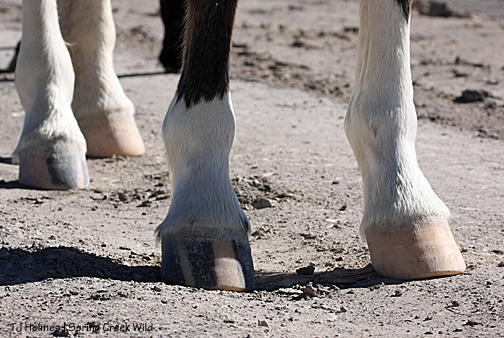
Awhile ago, someone asked about the mustangs’ hooves. I was reminded right away of a pic I took of Hannah’s hooves when the horses were on a road in the basin. I looked but couldn’t find the pic, and then I kinda forgot – until I found it while looking for other pix (RIP, sweet Winky-girl, our almost-28-year-old Quarter Horse mare at home in Texas; she was born at my grandparents’ in Ohio; she was loved, always).

The mustangs’ hooves fascinate me with their perfection. Their hooves are usually difficult to see through the low vegetation, but the prints they leave in the earth of their home never fail to make me stop and look closer.

Hannah's hooves

Note the “mustang roll” at the toes. White hooves soft? Not these pony toes!

This photo was taken in November 2010. Hannah was rounded up and adopted in September 2011. The original post can be found here.


Others

9 01 2013

The mustangs share Spring Creek Basin with other wildlife, including these beauties I saw during my last visit:

Elk in Spring Creek Basin

Elk in Spring Creek Basin

They were in a big group, too spread out to capture them all in one photo!

I came over the crest of a hill and saw them – and they saw me! – and off they went. Naturally, I took photos while I waited for them to put some distance between us! You can see the road in the background of the lower photo.

Disappointment Valley is a major wintering area for mule deer and elk. Seeing deer is nearly an everyday occurrence, but it’s pretty cool to see elk – and this many at one time!


Assateague & Chincoteague

8 01 2013

In the interest of clearing up what may be common confusion about Chincoteague and Assateauge islands and the wild horses that live there, Kay Frydenborg, author of Wild Horse Scientists, agreed to write a guest post about the topic. Yes, these East Coast islands are most of a continent and a world away from the West’s wild horses, but population management and fertility control are common topics. So here we go. I hope you’ll leave any questions for Kay in the comments!

Sorting Out the Wild Horses of Assateague Island

Since writing Wild Horse Scientists, I’ve run into a lot of folks who are a bit confused about the famous Chincoteague ponies, and that confusion is well-founded. It is confusing. For starters, the animals most people think of when they think of Chincoteague ponies are not ponies, technically, but small horses. And except for a few days each July during Pony Penning (which many people know about from Marguerite Henry’s classic children’s book Misty of Chincoteague and the movie that was adapted from the book), the wild ponies don’t live on the island of Chincoteague, but rather on the larger, uninhabited nearby island of Assateague.

To further complicate things, Assateague Island straddles two states (Maryland and Virginia), and two different federal agencies are in charge of overseeing the wild horses in each state (National Park Service in Maryland, U.S. Fish & Wildlife Service in Virginia). On top of that, the wild “ponies” on the Virginia side of the island are legally the property of the Chincoteague Volunteer Fire Company, which has been running the famous round-up, the swim across the channel to Chincoteague, and the foal auction for many years.  The horses are not only rounded up for this annual event (which provides needed funds for the fire company and much tourism for the town), but they are also gathered at other times and given routine immunizations and veterinary and farrier care. Their population is kept at a maximum of about 150 by means of the foal auction alone; no contraceptives are used to limit the herd size in Virginia.

On the Maryland side of Assateague, home of the Assateague Island National Seashore (as well as a Maryland state park within the national park!), the wild horses are managed quite differently. They’re called horses here, not ponies, and managed in a mostly hands-off manner, with no human handling and no roundups. Unless a horse becomes gravely ill or injured and the Park Service determines urgent medical care or euthanasia is required to spare undue suffering, the only human intervention in the lives of these horses is the remote darting (via special rifles) of the contraceptive PZP. Over the 25-plus years that PZP has been used as the sole management tool, the numbers of horses has gradually stabilized to sustainable levels. At the same time, these horses are observed closely from a distance, and careful records are kept for the purposes of effective management of the PZP program and ensuring that a viable gene pool is maintained among the horses.

Though all of the wild horses of Assateague Island descend from the same original herd, after the island was split with the National Seashore designation in 1962, these different management strategies on the two sides of Assateague have resulted in some real differences in the makeup of the herds. You can read much more about these differences, and the 300-plus year history of these unique wild horses, in my book. I hope you’ll check it out!


In the canyon

7 01 2013

A return to an old friend:

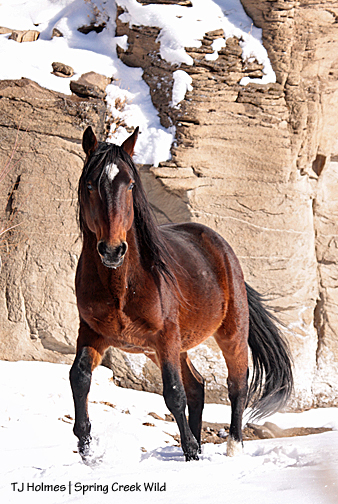
Duke (with Kreacher) in Spring Creek Canyon, drinking.

Duke, caught in the act of turning. It makes him look more animated than this usually calm boy acts, and I love the swish of his tail, the wave of his mane, his gorgeous, rich, thick bay coat against the rock wall of the canyon, topped by snow. And I love this bachelor boy – in case you couldn’t tell. 🙂


Wild Horse Scientists

6 01 2013

wildhorsecover-300

Behind the scenes and out of the public spotlight – the way they like it – are a number of people – scientists – working to improve wild horse management. A new book by Kay Frydenborg, Wild Horse Scientists, published in November by Houghton Mifflin, looks at a couple of these scientists: Dr. Jay Kirkpatrick and Dr. Ron Keiper.

Dr. Kirkpatrick is director of the Science and Conservation Center in Billings, Mont., where PZP is made and darters are trained. His work has proved especially invaluable with the wild horses managed on Assateague Island National Seashore. Dr. Keiper came up with a system of identifying the Assateague Island horses when research and fertility control started there around 25 years ago.

The book is aimed at children 10 and older, but given the myths and misconceptions I still hear about fertility control and wild horses, it’s likely appropriate for all age levels. Also, the idea that science IS being applied to the management of wild horses – particularly on Assateague, where the population is controlled only by the use of fertility control and a roundup hasn’t been conducted in many years (?) – is important and has applications that readers of all ages can appreciate.

Hoping to get more kids aware of the mustangs of Spring Creek Basin, our National Mustang Association/Colorado chapter and Disappointment Wild Bunch Partners are working with the Telluride Institute to get schoolkids to the basin. This book could become an important part of their unit about good, in-the-wild management of these horses.

For more information, see Kay’s website: http://www.kayfrydenborg.com/

From her website:

“Dr. Ron Keiper and Dr. Jay Kirkpatrick have both, in their own unique way, made the wild horses of Assateague Island, Maryland their lives’ work. Experience Dr. Keiper’s handwritten notes—taken over countless watchful hours in the field—which are both a diary and a scientific log that chart the lives of his equine subjects, some of nature’s greatest survivors. And follow Dr. Kirkpatrick from the lab to the field as he works tirelessly to find a way to manage the horse population with a birth control vaccine, and helps keep the precarious balance of Assateague’s ecosystem intact.

“Descriptive prose meets solid science as author Kay Frydenborg offers a rare glimpse into the wild herds of Assateague, sharing beautiful photos of the Assateague herds in their island home and of both of the scientists at work—some of them never seen before.”

Also visit the website where Houghton Mifflin promotes authors, photographers and conservationists who highlight all kinds of topics to get kids interested in science: http://www.sciencemeetsadventure.com/

Find the book on Amazon. I just ordered mine.


Chrome on white and blue

4 01 2013

Chrome

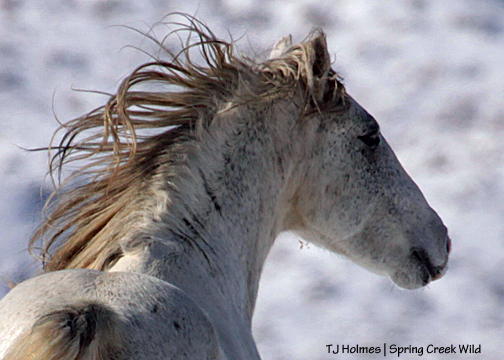
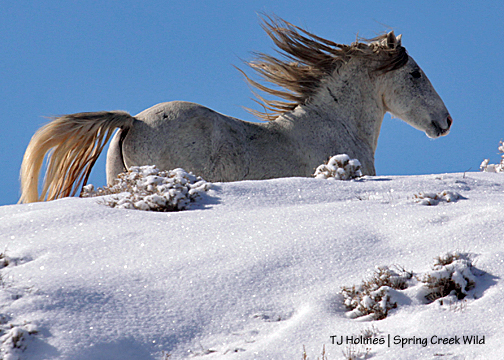
It’s early in the year, but so far, Chrome wins the “best mane flying in the wind” award!

Chrome

Sometimes you just have to sit back and be amazed by the beauty in our natural, wild world.


Pals

3 01 2013

Duke and Kreacher share an interesting past – and current friendhip. And if they could tell their story, it would be richer than I even know.

Since I started documenting the horses after the 2007 roundup, Duke has had a family (Raven and her first foal, Corona) just once – and for just about six months. Otherwise, he has been a bachelor, sometimes with a friend or friends, mostly alone. He seems to be particularly suited to “mentoring” young bachelors.

When I met Kreacher, he had Molly and Roja (likely mother and daughter from photos I have seen; elder Molly died in the fall of 2009). When Grey/Traveler stole Houdini, her daughter Two Boots and orphan Twister from (his likely son) Seven in the early spring of 2008, Seven stole Molly and Roja from Kreacher, leaving Kreacher to take Grey’s place in the “Bachelor 7,” as I called that group of single fellows. Kreacher was a low-man bachelor until early December that year, when he picked up the three beauties introduced that October from Sand Wash Basin: Raven, Mona and Kootenai. During an April visit in 2009, I found Kreacher, Mona and Kootenai, but Raven was missing; I found her – and her new filly, named after her Sand Wash Basin sire, Corona – with Duke. Duke had them until that fall. I found Kootenai with them one day, then got a report that Raven, Corona and Kootenai were back with Kreacher (and Mona), and Duke was injured. Duke nursed that injury for most of the next year. Right before or right after Mona had her filly, Shane (sired by Kreacher), in September 2010, Seven acquired her. She has been with Hollywood – and Shane – the last several months. Kreacher lost Raven and Apollo (their 2011 son) and Kootenai and Mysterium (their 2011 daughter) to Sundance the day before the roundup last fall, and Sundance still has the two mares and Mysterium and Raven’s and Kreacher’s 2012 colt, Skywalker (Apollo became a bachelor at the tender age of 1 and has been with Hayden and Tenaz since).

Are you still with me? 🙂

After Kreacher lost his band, he found and started trailing (at a distance originally) Duke, who sometimes was alone and sometimes was with other bachelors. These two apparently have adopted a “forgive and forget,” “together is better than alone” attitude and almost always can be seen together. Duke likely is in the 15-plus-year-old category, and Kreacher probably is around 10-12 or so.

When I saw them the other day on my way out of the basin, it was too perfect an opportunity not to stop and say hello.
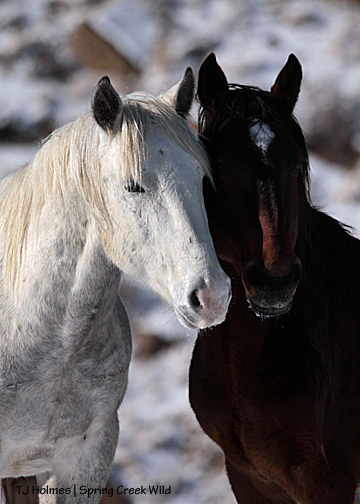
Kreacher and Duke above Spring Creek Canyon.

That Kreacher is such a lover.

Kreacher and Duke above Spring Creek Canyon.

Behind them is a wall of Spring Creek Canyon. They drank from a little open hole of water down in the bottom.
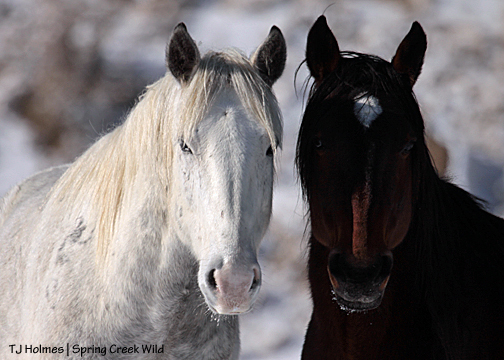
Kreacher and Duke above Spring Creek Canyon.

Such handsome wild faces!

Kreacher and Duke above Spring Creek Canyon.

Kreacher definitely is not shy about public displays of affection – and he’s the more demonstrative of the two.

Fuzzy and fit and well-equipped for winter! I love seeing these boys together. Though I can’t help but remember the strife they once caused each other, now what I think about most is their enduring friendship.



Day 1

2 01 2013

The year 2013 had an auspicious start in Disappointment Valley: Golden winter sunlight followed by clouds and snow followed by brilliant winter sunshine that set the snow sparkling in a million colors. This followed nearly a full day yesterday of snow! That added up to maybe 5 inches of the moist white stuff in the lower Disappointment. For the time being, it leaves us pretty in white!

010113kwana1

Little mister blue-eyes might win the designation as the crop of 2012’s “class clown”! His family found a bit of water – unfrozen – in the bottom of a pond. While mama drank (out of the frame to the lower left), Kwana made funny faces to “auntie” Winona with a bit of phragmites (I think that’s what they are; more seen in the background).


Happy 2013!

1 01 2013

Skywalker and Musterium

Brother Skywalker and sister Mysterium. Their sire is Kreacher.

For all of us, I wish a beautiful year full of compassion, peace and happiness.


Myth debunkment

29 12 2012

“Stallions will kill any foal not theirs.”

122012comanchetemple

Not true.

Special circumstances? Sure. But in general, this is a myth. I can’t tell you how many people have told me this as absolute, general fact … and then I point (still) to moments like this: Comanche with Temple, who not only is not his daughter, she is not in his band. She’s the daughter of Hollywood and Piedra and still is perfectly fine and dependent upon mama – in her daddy’s band.

Temple and Comanche

I’ve seen more ears back and teeth bared from mamas telling wandering babies to go home than I’ve seen any kind of violence toward foals from stallions. I know I tend to repeat this, but it’s one of my pet peeves, and I love when the horses give me an opportunity to show that the opposite is true.