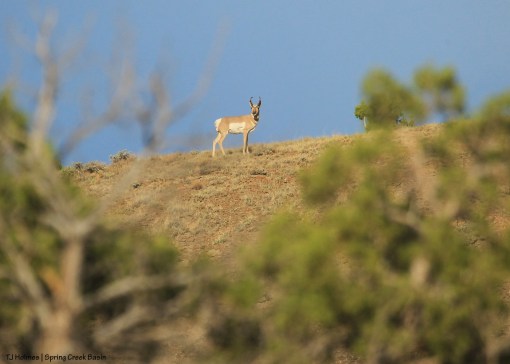
Our mustangs aren’t the only ones taking advantage of the basin’s water catchments. This handsome fellow waited on the hill for Comanche’s band to drink at the corral catchment (built just two years ago). The horses were VERY interested in him.
Our mustangs aren’t the only ones taking advantage of the basin’s water catchments. This handsome fellow waited on the hill for Comanche’s band to drink at the corral catchment (built just two years ago). The horses were VERY interested in him.
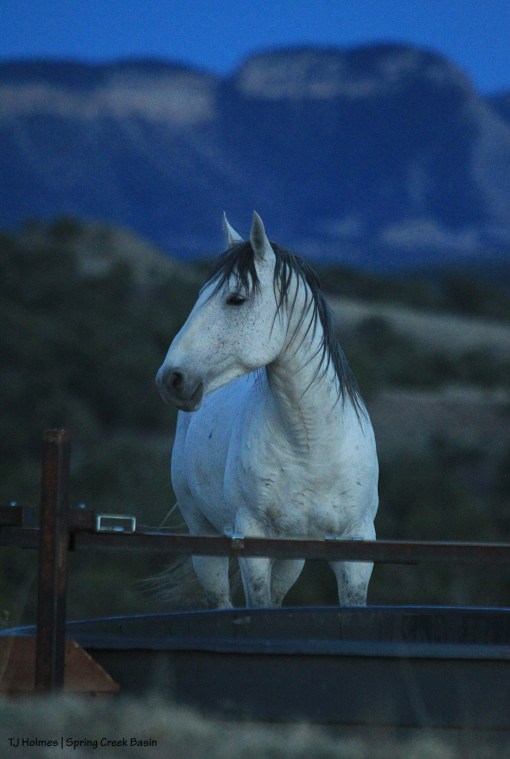
Comanche and his band have found the “new” catchment trough (where we installed the apron and new trough two summers ago and the evaporation cover last fall).
The horses have two ponds and the two catchments as water sources, as well as numerous (if not high quality) seeps in various arroyos throughout the basin. Our BLM herd manager (Mike Jensen) is committed to closely watching the drought situation (we’re in the D4 category now – exceptional drought). Our awesome water hauler (Steve Heath) is able to pump water directly into the storage tanks. In the next week or so, we’ll be scouting locations that his water truck can reach to pump water into big troughs – supplied by BLM – elsewhere in the basin if conditions warrant.
Local ranchers have been hauling water continuously already this spring because it’s so dry.
And that wind – that howling, awful wind – is leaching away the moisture we don’t have, day after day.
It’s tough, folks, for wildlife and for livestock, and certainly not only in Disappointment Valley. That said, please know that the mustangs do not seem to be stressed. They have decent forage, as well as water sources, and they’re well dispersed throughout their range, not sticking to certain places as they would if they were stressed about sustenance/water.
Members of Disappointment Wild Bunch Partners are monitoring conditions closely, and the Colorado chapter of the National Mustang Association has offered to help pay for water deliveries to Spring Creek Basin.
We are so grateful (as always) to our Tres Rios BLM guys for being committed to the well-being of our mustangs!
For the many-th year (20?), we welcomed University of Missouri students to Spring Creek Basin once again to celebrate spring. And as absolutely always, we love these kids!
They bring their enthusiasm and energy across the country from Columbia, Mo., to Southwest Colorado, to complete beneficial projects on public land managed by the Bureau of Land Management and the U.S. Forest Service.
We started restoring Spring Creek Basin’s southeastern boundary fence, in McKenna Peak Wilderness Study Area, way back in 2012. This year, we didn’t have two work days as in years past. We didn’t get snowed out like we did the last two years (we did get a little work done those years). We DID get basically to the end of the project (the base of a steep hill where a Southwest Conservation Corps crew took over a couple of years ago).
Wow.
University of Missouri students can take proud, beautiful credit for this strong, beautiful fence, and we are SO proud of them for all the work each of these students brought to the benefit of our beautiful mustangs.
We also give a special shout out to San Juan Mountains Association’s Kathe Hayes, who is “semi-retired” and enjoying winter with her horses in Arizona. For all the years of alternative spring break’s history in Southwest Colorado, Kathe headed the program. MK Gunn has stepped strongly into those big shoes left by Kathe, and we’re happy to have her (you might recognize her from years past, helping with alternative spring break). *The title of this blog post comes from MK. 🙂
Now on to some pix.

Wild stallion Ty (see him? just right of center) made an appearance as students hiked to the work site yesterday morning.
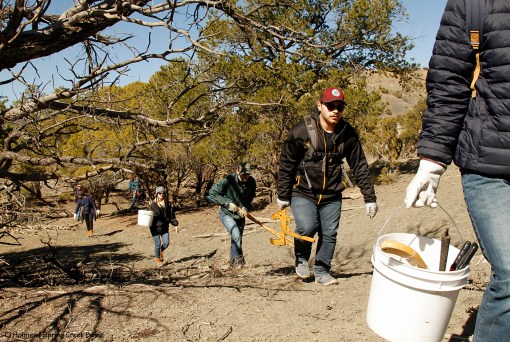
Because of the work by the Forest Service mule pack string last year, the students carried just tools in and old wire out. Pictured are Austin (with the bucket), Xavier, Jim, Erin, Gracie and a couple of others.

Our esteemed herd manager, Mike Jensen, modeled a full beard for this year’s alternative spring break. We like it! But apparently, his family doesn’t. 🙂 Erin was starting to roll a strand of old wire …
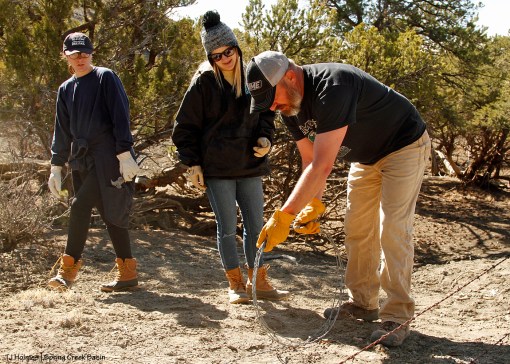
… and Mike came up the hill to show Erin and Gracie how to roll the barbed wire to get it to stick together.
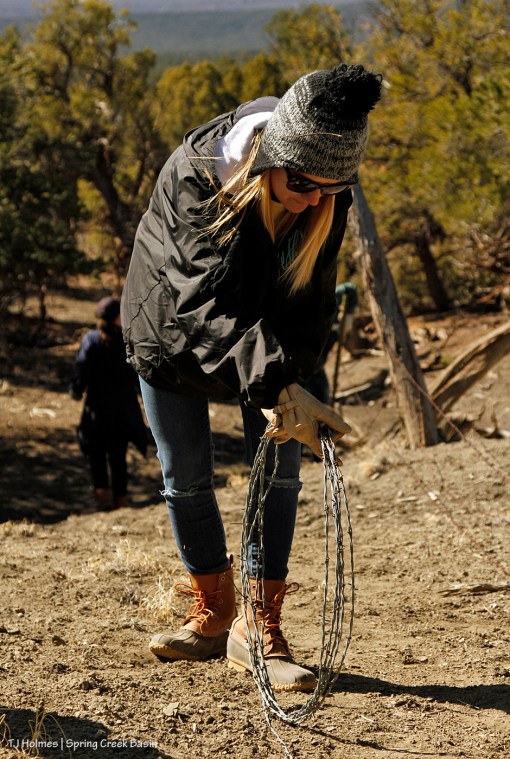
And then they were pros! (If you don’t believe me, check out the last photo in this post.)

In this last stretch of fence line, we needed to remove some old T-posts and pound new ones to replace old juniper posts, so Erin stepped off the distances between posts, and Xavier dropped the posts where she indicated.

Range tech Justin Hunt (left) watches range specialist Garth Nelson as he saws off the end of the horizontal post of a new H-brace held by Mike while our trio of awesome BLM guys built the H-brace at the end of the line. The post was bolted at both ends and then cross-wrapped with wire to hold the tension of the wire strands.
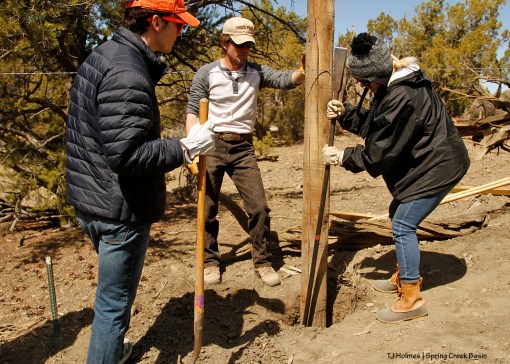
Because there was a steep little drop from the end H-brace (to the right), Justin helped Erin and Austin dig a hole for a big post to help hold the tension of the wires.

We have used these measuring sticks for a lot of years now. We start with the bottom wire and roll them out and tighten them and clip them from the bottom up. The measurements are wildlife friendly, so elk calves and deer fawns can crawl underneath the bottom, smooth-twisted wire, and adults don’t get caught between wires when they jump. The top strand also is smooth-twisted wire. The middle two strands are barbed wire, to keep cattle (outside the basin) from pushing against it.
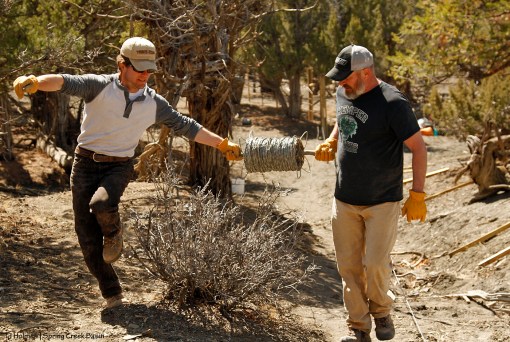
Mike and Justin unroll another strand of wire from down the hill up the hill.
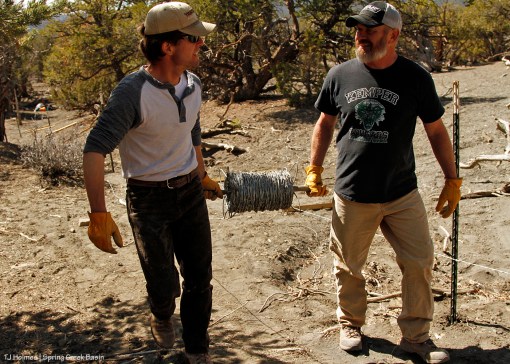
And I had to include this pic that shows the camaraderie between our BLM guys. We’re really grateful to have all three of our guys. They make the work fun. 🙂
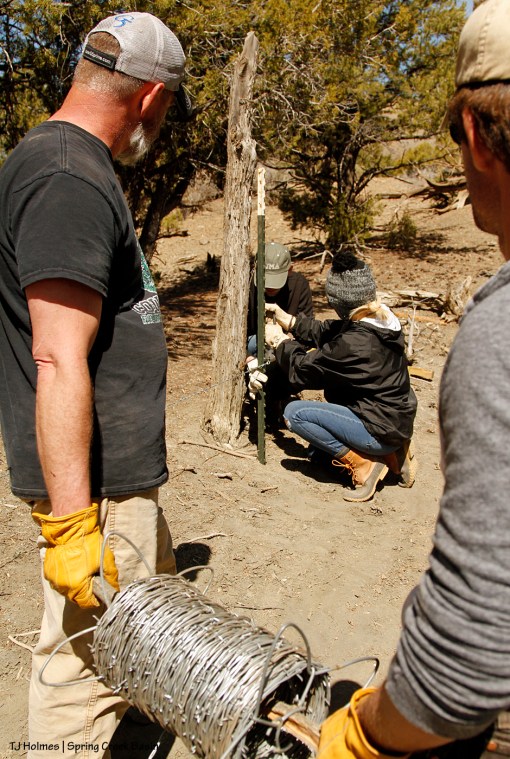
Here, Mike and Justin paused for a minute to let Erin and Jim attach a clip to the last T-post so they didn’t get tangled in the next strand. A great thing about having many hands for a project like this is that we’re always busy with the next step, and it goes really fast!
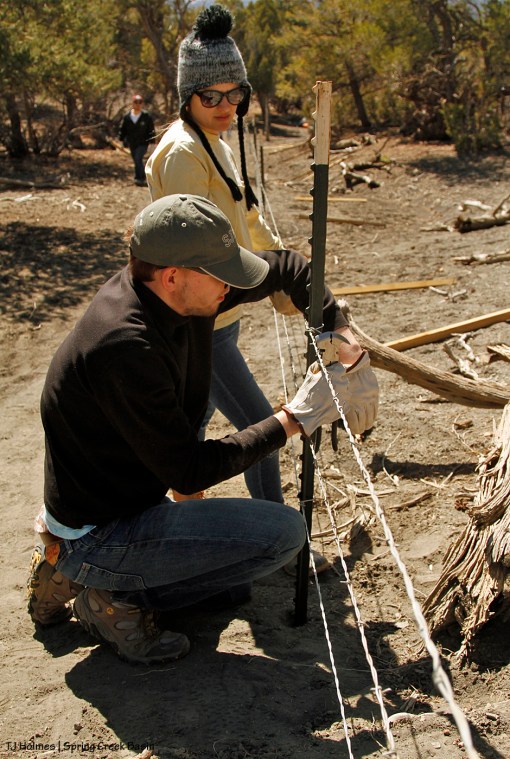
Here, Jim and Erin are up to the third wire strand. Notice the wood staves laid out on the ground along the fence. Students put those in place so they’d be ready when all the wires were tightened, clipped (to T-posts) and stapled (to wood posts).

And there’s the new fence – all four strands. Gracie and Austin are rightfully proud of their work!

One of the last steps of the process was to cut pieces of wire in order to secure the wooden staves to the wire strands. Advocate Kat Wilder (left) helps Erin and Austin cut pieces of uniform length while Xavier visits with Jessi, one of Kat’s canine companions.
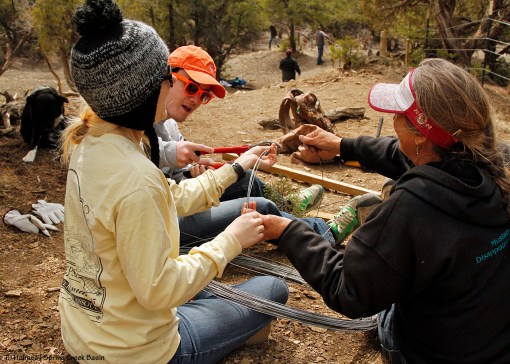
This is a closer look at the wire-piece cutting, looking down at the fence the students just built. We set up a system where the other students, MK, Garth, Justin and Mike were wiring the staves to the strands while Kat, Erin and Austin cut the wire pieces for some students to carry down the hill. They cut about 100 pieces to attach the staves in this last stretch of fence!
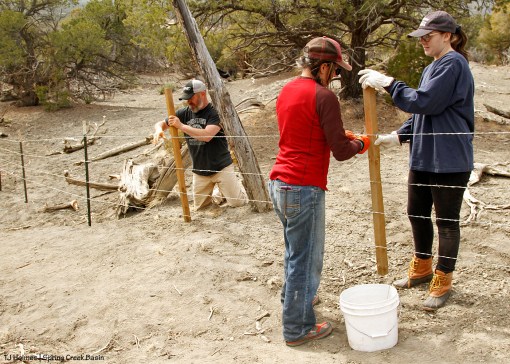
Gracie and MK and Mike wire staves to the fence strands. The staves help support the fence and keep the strands at the same spacing. Plus, they provide a very visible barrier for the horses and other wildlife.

The pups were definitely a hit with the students. 🙂 This is Gracie and Jessi.
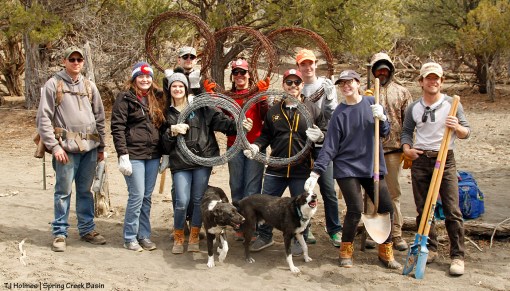
Mizzou students, once again, we thank you, thank you, thank you all for your work! We love the alternative spring break program and the benefits it brings to our mustangs (and other areas of our public lands). We really couldn’t have done this without ya’ll!
In honor of this year of the Winter Olympics, students show off the old wire rolls that they carried out of the basin at the end of their day of work. From left to right: Garth Nelson, Jessica (who is getting over being sick; we hope she feels better to enjoy her trip!), Erin, Jim, MK Gunn, Xavier, Austin, Gracie, fun-loving Mike Jensen and Justin Hunt. Also pictured are Jessi and Bow, who got and gave more cuddles than anyone all day. 🙂
THANK YOU, MIZZOU!!!!!!!!!!!!
We hope you enjoy your week of beneficial work in Southwest Colorado. We are so grateful that you chose to spend your vacation helping us preserve and protect our beautiful public lands, including Spring Creek Basin. 🙂
A couple of days ago, we met up with our fabulous BLM guys to install the evaporation cover over the new trough – connected to the new water catchment apron – that we installed in 2016.
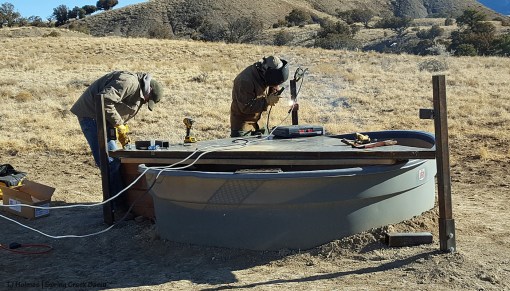
BLM rangeland management specialist Garth Nelson, left, figures out which drill bit to use to drill holes through the metal of the evaporation cover to attach it to the supports BLM range tech Justin Hunt is welding to the vertical posts. The post at right already has a piece welded to it.

See the metal thing inside the trough in front of Garth? That’s the critter ladder the guys built. It allows birds to get to the water or an animal that falls into the water to get out. Garth drilled a couple of holes and wired it to the edge of the trough.

Once everything was in place, Justin attached small square plates to the tops of the three vertical posts and welded them into place, then used the grinder to smooth the square edges. At the near corner, you can see the “trap door” the guys built into the cover so the float below it is accessible for any work or replacement that needs to be done. In the background, range specialist and herd manager Mike Jensen, right, talks with Garth while visiting with Bow, one of Kat Wilder’s dogs.
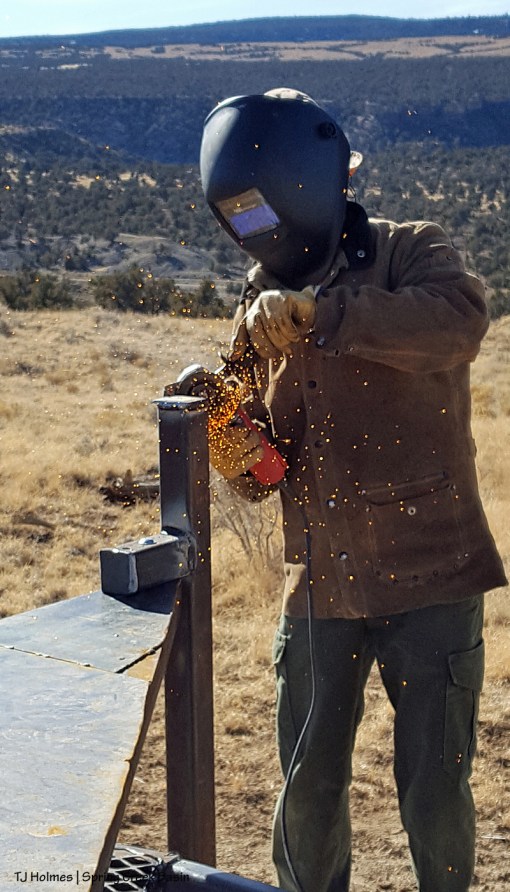
Sparks fly as Justin grinds the edges of the post caps to smooth roundness.
These guys thought of everything!
The cover will help preserve the water in the trough from evaporating so quickly. And with its installation, the new water-catchment project is officially complete. In warm weather, this will provide a second source of clean water for the horses.
Snow is in Saturday’s forecast. Please send good thoughts. This dry weather has to end.
We have our fair share of good-news stories here in Spring Creek Basin. In the wake of the National Advisory Board’s recommendations last week, it’s a good thing we have more good news to share.
We’re no strangers to partnerships with the Southwest Conservation Corps, based in Durango. Most recently, readers may remember a fence project on the basin’s southeastern boundary line two years ago. Crew members hoofed (!) materials and wire up a steep, steep hill beyond where University of Missouri students have been slowly but surely rebuilding the fence north from Disappointment Road. This has long been a project in partnership with San Juan Mountains Association, alternative spring break (with Mizzou), Colorado chapter of the National Mustang Association and Disappointment Wild Bunch Partners. ** I nearly forgot to mention the awesome work by the U.S. Forest Service’s mule packing team, which delivered materials to the site earlier this spring!
And beyond the steep hill, the fence cross the bends of an S-arroyo that brings water into the basin when it rains. Since 2011, we’ve been talking about rerouting the fence there so it crosses just one bend, goes up and beyond the arroyo and ties into the fence as it continues toward Brumley Point.
I hadn’t seen their work until yesterday, and boy was I wowed!

This is now the fence over one bend of the S-arroyo. The branches are wired to the fence but aren’t embedded in the ground so they can give when water flows through. That’s Brumley Point in the background.

From the bottom of the arroyo, this was my first view of the crew, hard at work.

Crew members were putting the finishing touches on the end of the rerouted fence, adding wooden staves between metal T-posts and wiring the existing fence to the new H-brace. Pictured are Molly, Sara, Nicole and Mike.

Lance has his work flow down as he wires a stave to the fence strands.
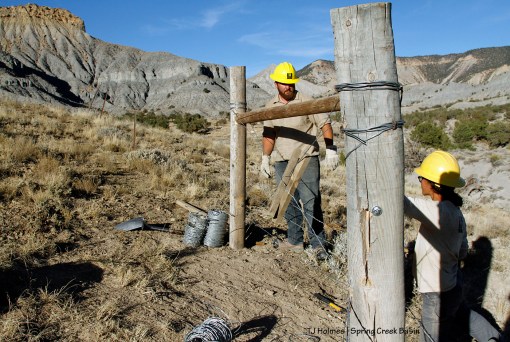
Mike and Nicole attached the wire strands of the existing fence to their new H-brace, which tied the new fence to the old fence. Brumley Point is at back left, and McKenna Peak is visible behind Mike.

A longer shot, showing McKenna Peak and Temple Butte. The new fence is that good-looking thing at left, and the old fence is visible (a couple of T-posts) straight ahead. To the right, down the hill, is the S-arroyo.

Crew co-leader Sara carries extra wire and tools back along the fence at the end of the day.

Sara (right) and her co-leader Alycia had just a few more staves to wire in …

… with Molly (left) and Lance before the end of the work day. Here, you can look down the hill to the arroyo. At far right, you can see just a bit of their new fence going down the hill to cross the bend (first photo in this post). The fence used to run across the drainage at far right across the bend, through the trees to the left, across the first bend (as the water flows) and up the hill.
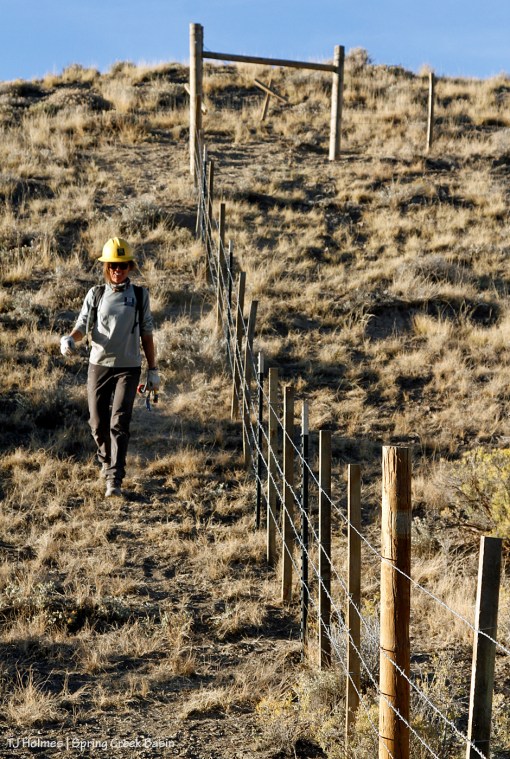
Alycia walks down the hill along the crew’s new fence at the end of the day … and a job well done! (The crew still has a couple of days left in their hitch and will work on patching some saggy places in the fence line.)

This perspective is taken from the south looking north. The fence is coming from behind my right shoulder, down to and across the arroyo, then up the hill to the left. It makes a corner toward the top of the hill (see pic above this one with Alycia) and runs across the hill above the arroyo – cutting the middle of the pic – to where it ties back into the existing fence above the first bend of the arroyo.

Big kudos to this small group of huge-working young folks! This fence reroute will serve to keep our mustangs safe on their home range by ensuring that the fence doesn’t wash away during rain events that flood the arroyo. We’re so happy to have the help of (left to right) Mike, Sara, Nicole, Molly, Alycia and Lance!
THANK YOU!
Yesterday was Day 2 of the Land Health Assessment in Spring Creek Basin.
Yep, it was hot. Yep, the gnats were still bad (but yours truly remembered her head net).
Mike Jensen, Justin Hunt and Nate West were back to assess more of Spring Creek Basin’s land health. We did some great sites, and a couple of them were higher, which allowed for great views!
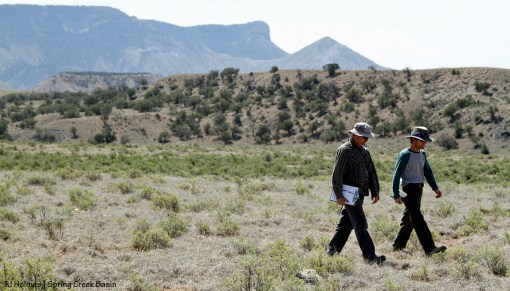
BLM range management specialist Mike Jensen and range tech Justin Hunt walk a site in Spring Creek Basin with views of McKenna Peak and Temple Butte.

At the end of each site assessment, Justin and Mike took pix in two directions for future comparisons.

We don’t have many trees in Spring Creek Basin, so many of the sites were the wide-open places (as in the photos above). But we had a couple of sites that were in pinon-juniper woodlands. This site (and the one pictured above) had really great grass.
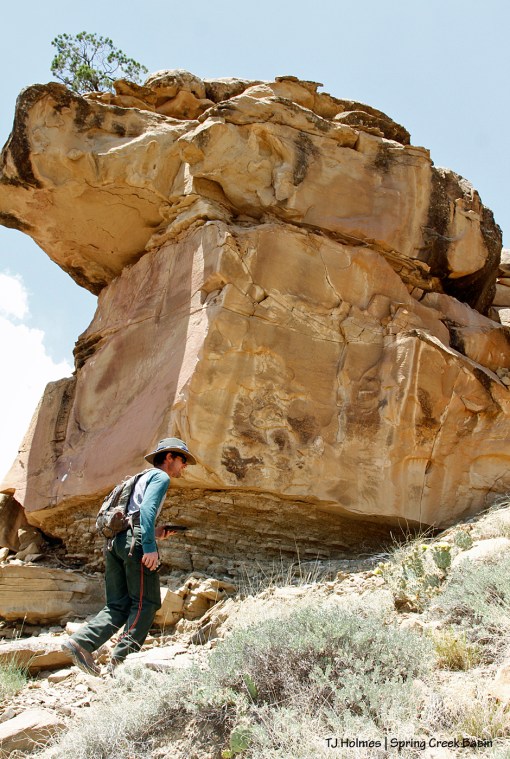
And then we headed uphill for our last site of the day.

Which led to an amazing view. Straight ahead is Brumley Point, and at the farthest left is one side of McKenna Peak.

Those who go up must go down! Especially when the truck is at the bottom. 🙂

Big thanks to BLM’s Mike Jensen, Justin Hunt and Nate West for persevering on these hot days to assess the land health of Spring Creek Basin. Again, as far as I can tell, we’re in pretty good shape.

We think this little guy (gal?) might agree. 🙂
Baby, it’s hot out there.
The mercury hit at least 100 degrees Tuesday in Disappointment Valley. Might be hotter today.
But we don’t shirk our duties when it comes to assessing the health of our range – which directly affects the health of our mustangs – in Spring Creek Basin. 🙂

Don’t let the long sleeves fool you. This was our last site of the day, and it was toasty out there. We were glad for every bit of brief cloud cover that came our way. On the right is our excellent herd manager, Mike Jensen (rangeland management specialist), and on the left is wildlife biologist Nate West, both with Tres Rios Field Office. In the background, of course, are McKenna Peak and Temple Butte.

Here, Mike and Nate – and our range tech, Justin Hunt – are checking examples of particular things that we were looking for, depending on what kind of site we were assessing – here, “basin shale.”
At each of the five sites we did (we have more to do), we completed a 17-point checklist to assess such things as “presence of water flow patterns,” “bare ground,” “amount of litter movement,” “effect of plant community composition and spatial distribution on infiltration and runoff,” “functional/structural groups” (what kinds of plants – annual/perennial grasses, shrubs, forbs – we should expect to find), “expected annual production” (which we are supporting with actual vegetation monitoring studies) and “potential invasive (including noxious) species (native and nonnative).” Each site has a list of expected standards that we should find according to soil types, including “basin shale,” “clayey salt desert” and “salt flats.”
Pretty fascinating, really! For the most part, my civilian observation is that our range is pretty healthy in Spring Creek Basin.
Our mustangs do seem to support that assessment. 🙂
Thanks to Mike, Justin and Nate for trekking to the basin on the hottest days of the year to perform these assessments that positively affect the good management of our mustangs!
Many hands DO make the work go faster, and with nine University of Missouri students, two San Juan Mountains Association people, four BLM’ers and yours truly, we had plenty of hands to make the most of one day on Spring Creek Basin’s southeastern fence line during alternative spring break.
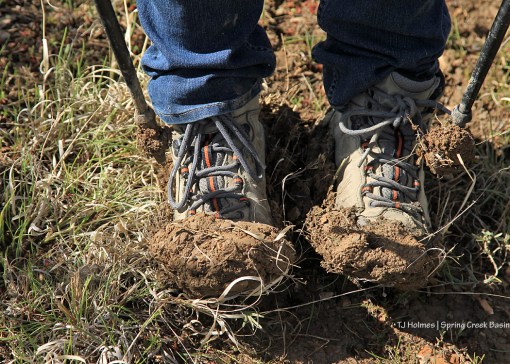
Speaking of hands, let’s start with feet (!). 🙂 After hiking to the fence line with the tools of our trade, all our shoes looked like this! (We did get some lovely rain!) Those hiking boots belong to Kathe Hayes, volunteer coordinator extraordinaire. She has been leading the students to projects on San Juan public lands (in partnership with BLM and the Forest Service) for nearly 20 years.

Students got right to work removing old wire in the next section up the line. The H-brace in the background is where students stopped last year (we had SNOW last year). Here, Gabby, Katy, Natalie and Angela receive guidance from Kathe (in purple jacket).

Then, of course, we had rusty ol’ barbed wire to roll. Take a gander at Katy’s boots.
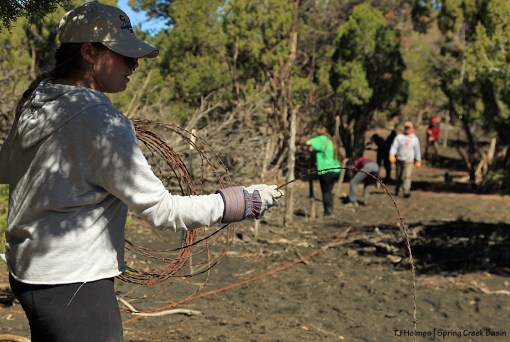
Natalie rolls more old wire while students continue removing strands.
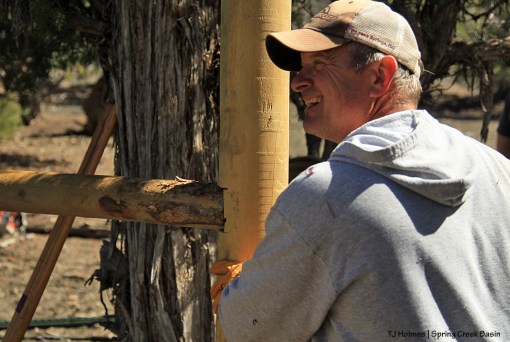
Meanwhile, our herd manager, Mike Jensen …
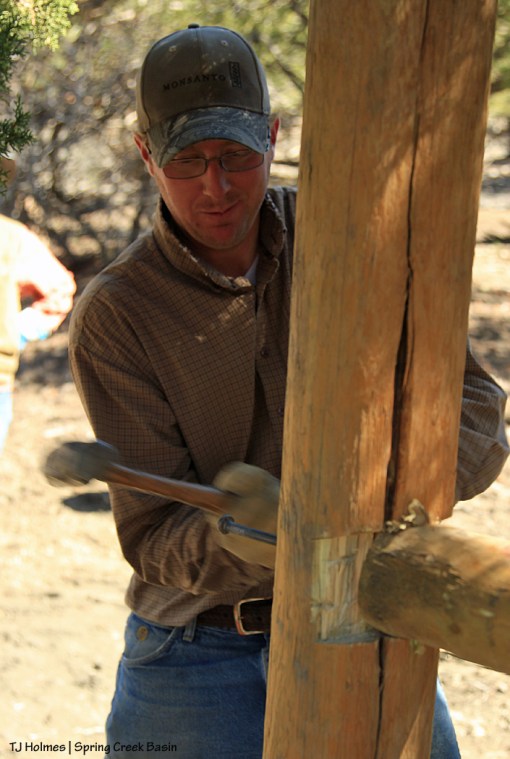
… and Garth Nelson, also a rangeland management specialist, tackled the new H-brace at the other end of our day’s fence section with Brian, Blake, Chris and Matthew. (I missed most of their building while helping the girls remove and roll the old wire.)

The original fence line was a little cattywampus (!), so we had to do some straightening. The orange string indicates a straight line between last year’s H-brace and this year’s H-brace. Some T-posts had to be uprooted and repounded. One good thing about the mud: It was pretty easy to pull the T-posts out AND pound them back into the soft ground.

The Mikes – Mike Schmidt, left, BLM wildlife biologist, and Mike Jensen, herd manager – unrolled new wire between the H-braces. You can see the first strand already in place and tightened.

We did give students a few minutes to sit down and eat lunch. 🙂 Left to right: Natalie, Angela, Katy and Gabby.
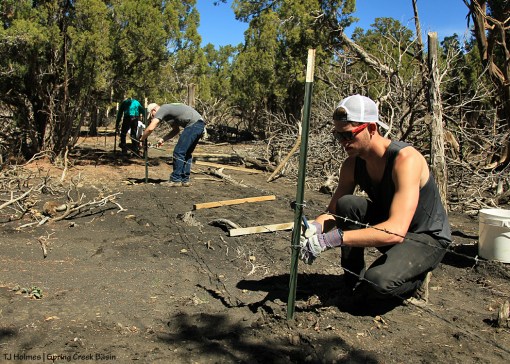
Then it was back to work. Blake and Chris start clipping wires to T-posts using metal “clips” made specifically for the task.

Brian demonstrates good clip-attaching technique to Katy and Angela while Blake (behind him) also watches.
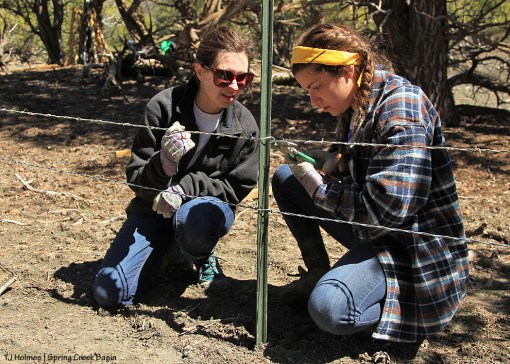
Then Angela and Katy were pros!

Chris and Natalie use one of the measuring sticks to ensure wildlife-friendly spacing of the wires before they clip them to the T-post.
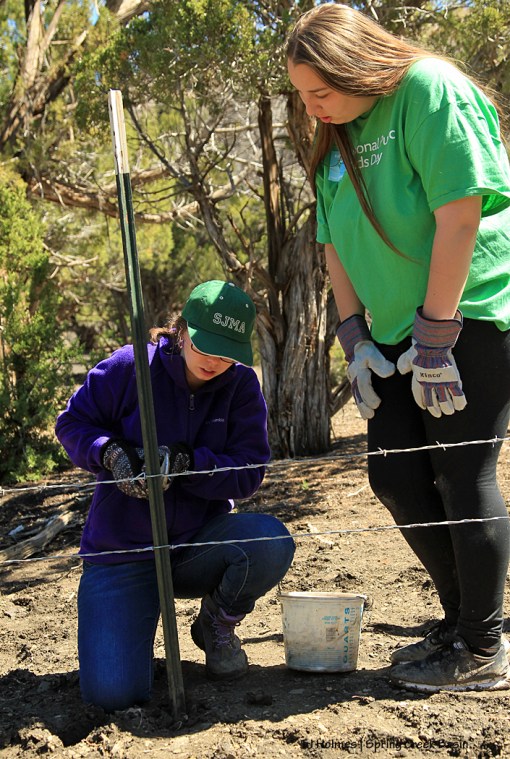
Gabby and Caitlin did their share of wire clipping.

Brian holds the measuring stick while Jessica clips the wire. Jessica made her second trip in two years to Southwest Colorado for alternative spring break. This year, she’s the student leader.
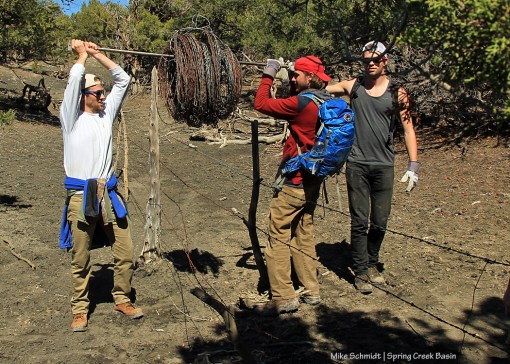
To end the day, Mike S. grabbed my camera to nail this shot of Brian and Matthew hoisting the old wire over the next stretch of old fence while Garth and I wired the gap after the new H-brace. You can see why we’re keen to replace this whole fence line for the security of our mustangs.
Then we trekked back through mud to the vehicles and well-deserved snacks, courtesy of Kathe.

Thanks again to all of you wonderful Mizzou students and BLM’ers and SJMA’ers who worked hard to continue our tradition of keeping our mustangs safe and protected within Spring Creek Basin! We’re super appreciative of your efforts – all done with smiles and enthusiasm!
THANK YOU!

Ma Nature struck again this year and delivered rain on the first of our two-day alternative spring break project in Spring Creek Basin! So the above smiles are on day 2 … *after* walking (slogging) through messy, slippery mud to get to the fence line.
(But they carried just one roll of wire for supplies – the rest being tools – so we were also smiling about the mule-packed fence materials, which made our one day even easier!)
I ran out of time to get to pix for a full morning-after post, so you get just the one today … and hopefully a fuller post tomorrow. 🙂
Above, by the H-brace they built (!), the two girls seated are (left to right) Angela and Gabby. Beside/above them in front of the H-brace are Natalie, Katy and Chris. Behind the H-brace are Brian, Blake, Caitlin, Matthew (assistant to Kathe), Kathe Hayes (volunteer coordinator with San Juan Mountains Association), Jessica (student leader; this is her second trip to Southwest Colorado from Mizzou), Garth Nelson (BLM range specialist) and Mike Schmidt (BLM wildlife biologist). Not pictured but much appreciated are Mike Jensen (our awesome herd manager) and Keith Fox (BLM).
THANK YOU, Missourians! We decided that we rebuilt a quarter-mile of fence under excellent sunny skies across drying muddy ground. Definitely not muddy enough to dampen enthusiasm. You guys ROCKED the fence! Your work helps keep our mustangs safe and protected in Spring Creek Basin, and we are grateful to you all!

We do have water in the desert, in spite of our very dry late-winter conditions.

The Forest Service’s Rocky Mountain Regional Specialty Packstring is Glenn Ryan’s baby; he has been the head honcho and mule packer since 2004.
This link and this one to the crew will give you more information, and if you Google it, you’ll find all kinds of articles about the amazing work this outfit does throughout the West, including this one last fall in The Durango Herald.

Katy Bartzokis is a permanent seasonal employee with BLM, based in and around the Steens Mountain Wilderness Area of Oregon. She’s the only BLM packer she or we know about. She’s definitely the best one we know. 🙂
If you’re packing in and out of wilderness areas, these are the folks, and these are the mules, you want on your trail (if you even have a trail; we flagged one through the greasewood and over and through and down into and up out of arroyos).

Here’s the full string, led by Katy, who led three mules, and Glenn, who led the last two. Our BLM range tech Justin Hunt is visible at the back. This was shortly after we left the trailer – loading site – and you can see Disappointment Road in the background. The big Forest Service rig may have drawn a few curious glances from the few travelers who passed by during our work days. 🙂
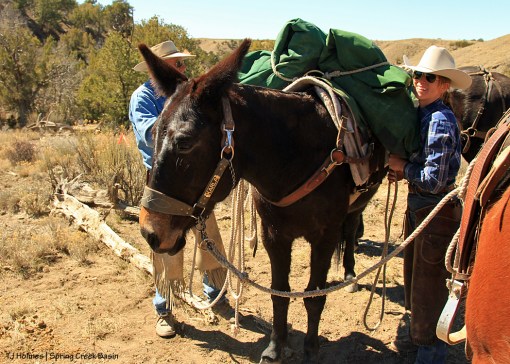
To highlight a couple of the mules, this is sweet Karla. Katy and Glenn had folded the now-empty “mantis” and bundled the ropes and then manti’d them and were tying them on Karla’s pack saddle for the trip back to the trailer (we’re at the drop site in this photo). A “manti” is what you or I would call a tarp or square of canvas. Packers like Glenn and Katy use them to wrap bundles of taped-together staves and T-posts. Very neat – and I don’t just mean “keen.” 🙂 Usually, the folded mantis went back in the emptied panniers (which carried wrapped wire rolls), but on this particular trip, we had just staves, which were packed and roped and tied like you see in the photos above. So even bundles of mantis and ropes were themselves manti’d and tied on for the return trip.

And this is big Skid – the only mule with a forelock and one of only two boys (johns?) in the string. Sweet boy!
All the mules have their personalities, of course, and all marched right along – this was their first job out of winter pasture – to carry a LOT of pounds worth of fencing supplies into McKenna Peak Wilderness Study Area to help with our fence-maintenance projects. We love them all. 🙂
Mucho big thanks again to Glenn and Katy, Joey, Karla, Lena, Roz and Skid, Karmel and Sly, for all your work and patience with us! We’re so incredibly grateful for your skilled, amazing work – here and elsewhere on America’s public lands!
Thank you also to our BLM range folks Mike Jensen, Justin Hunt and Garth Nelson; our Spring Creek Basin mustang herd management is so good thanks to you all. Thank you to BLM’s Mike Schmidt and Keith Fox, who took time away from their regular duties to help us one day. Thank you to SJMA’s volunteer coordinator Kathe Hayes, who keeps us rolling on these projects. And thank you to advocate and volunteer Kat Wilder, who does it all when it comes to working for mustangs. 🙂
 Spring Creek Basin Mustangs