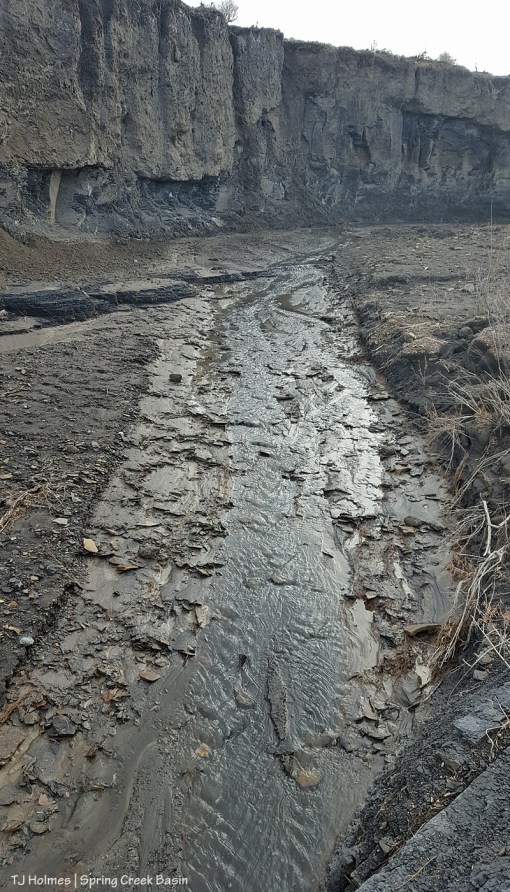

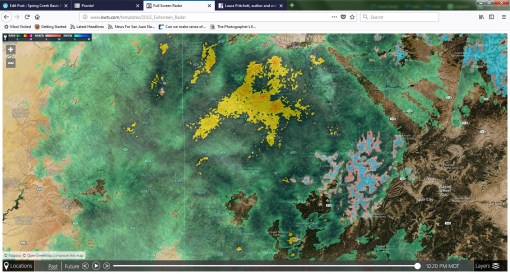
Yeah.
It’s a little bit like that. 🙂
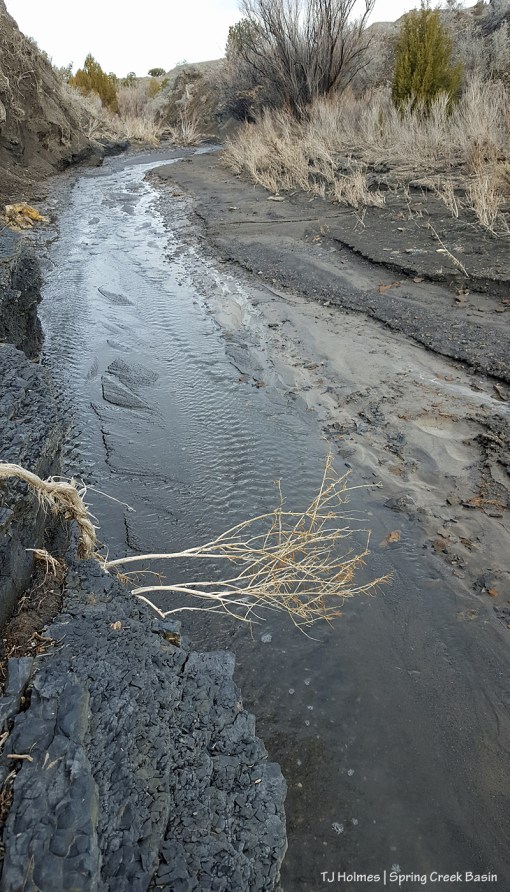
Yeah.
It’s a little bit like that. 🙂

The little blue “square” in the middle is just east of McKenna Peak Wilderness Study Area (labeled), which is east of and in the eastern part of Spring Creek Basin Herd Management Area.
I’m wearing a smile as big and broad as lower Disappointment Valley. 🙂
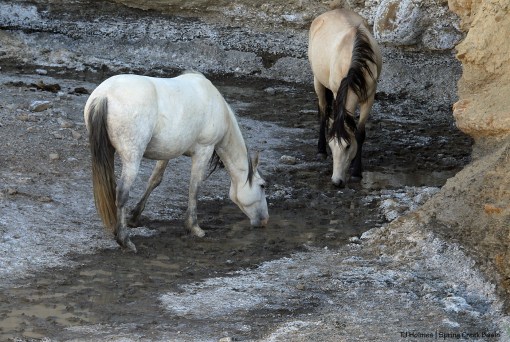
Terra and Kestrel drink from an arroyo seep that has been quietly and consistently producing water during these hot, terribly dry days.
Most of the curve of the arroyo is in the shade, and part of it runs into the sunshine. This photo was taken in the late evening, but even during these long summer days, with the sun high overhead, I think this little nook is mostly shaded.
I had been wanting to explore this area for the last several weeks, knowing from previous years that a seep was here, but it wasn’t until I saw Kestrel leading her band that I knew where she was likely headed – and had time to follow them.
Particular note: If the horses had been at all bothered by my presence, I would have left immediately. I spend a lot of time with these mustangs, always quietly and at their direction (paying close attention to their comfort level). This is already a stressful time for them, and under no circumstances would I add to that stress. While I watched from a distance (I have a long lens!), three different bands came to drink. The first band stallion chased away the second momentarily, then the second and third bands drank together. They were still in the arroyo when I slipped away.

Spring Creek Basin’s mustangs are fortunate to have Steve Heath – Heath Water Service – in their corner when it comes to delivering water in this time of terrible drought. This isn’t the first time we’ve relied on Steve (and Cecil Foster before him) to deliver water to the basin’s catchment so the horses have a consistent source of water in that trough seen in the background of this photo. It’s one of only two clean sources of water in the basin, the others being silty, salty and fairly low quantity. Two ponds still have water, and there are some other small sources, but they’re shrinking rapidly.
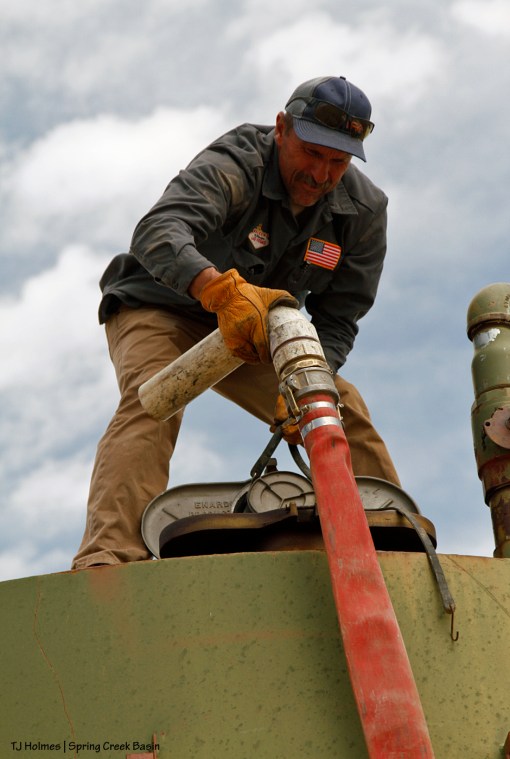
Steve on top of the storage tank putting the hose into the hatch to pump water.

Best. Water. Man. Ever. 🙂
We are so grateful for his dedication and willingness to deliver water to our mustangs!
The Colorado chapter of the National Mustang Association is helping BLM pay for water deliveries to the mustangs during this drought.
Horse Park Fire update: Inciweb lists the fire still at 1,221 acres and 90 percent contained, but by the lack of activity – and smoke – the last couple of days I think they have it pretty much nailed. 🙂 And big news: The area got about 0.15 inch of rain yesterday! For us, that’s huge. It doesn’t ease the drought, but it gave us a little relief.
The first thing to know is the most important: Spring Creek Basin’s mustangs are OK.
Horse Park is immediately north of Spring Creek Basin. The Horse Park Fire started Saturday night by a lightning strike, and firefighters were on it pretty much immediately. The fire is outside the basin’s northeastern boundary and moving basically northward, pushed by strong winds from the south/southeast.
Early in the day, I was with Steve Heath (Heath Water Service) in the basin to show him the roads. There’s a big difference in go-to-ability between his loaded water truck and my nimble Jeep, and we wanted to see where he can go with his truck to deliver water farther into the basin than the catchment when the drought situation requires it.
Good news on that front, too: Steve is confident that he can get his water truck to the places where we might set water troughs for the horses (in addition to the water catchment).
It was interesting – and a little (a lot) sobering – that while we were scouting for water locations, this fire blew up on the basin’s northeastern horizon. As of the 10 o’clock news on the Denver CBS 4 station, the Horse Park Fire was at 1,000 acres with 0 percent containment.
Following are some photos from the day:

Several planes were in the air all day, small planes like this one (above) and big planes like the one below:
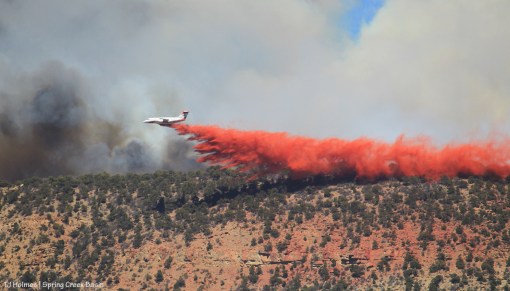
Part of the fire was in McKenna Peak Wilderness Study Area, where fire retardant is forbidden, one of the BLM fire guys told me. Once the fire moved north from the WSA, three big air tankers started dropping the familiar red material.

This is the same plane as the closer photo above, a few seconds later. Looks pretty crazy, huh?
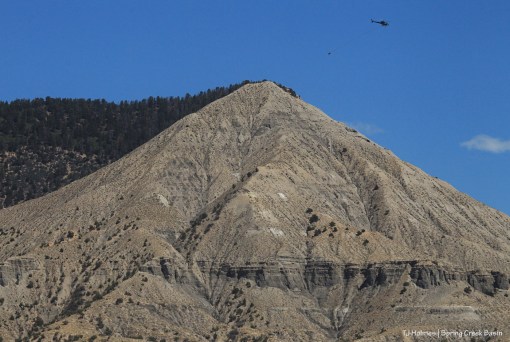
At least two helicopters were carrying water buckets from what appeared to be numerous sources to sites that were burning on top of the ridge. The main feature here is McKenna Peak. Perfectly placed behind McKenna from this vantage point (the eastern end of roller-coaster ridge), Temple Butte is mostly blocked. The fire is to the left – north.
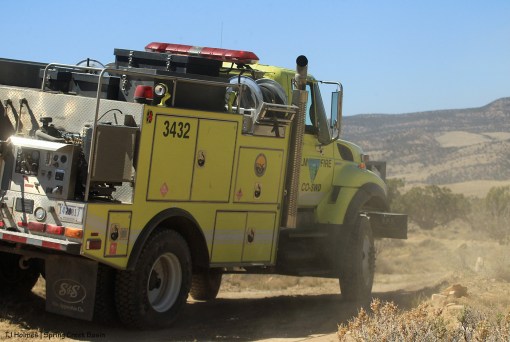
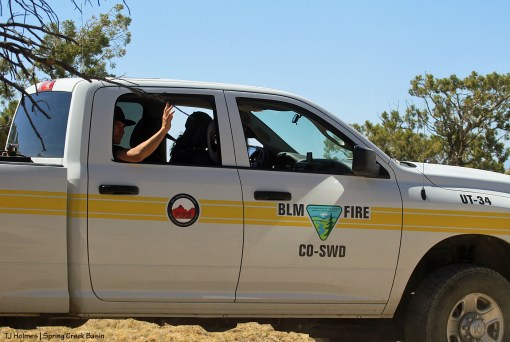
I was glad to find these guys on roller-coaster ridge, watching the fire from the basin side. Crew leader Dan was helpful with information, as was Patrick Seekins, BLM fire management officer, who called within 15 minutes of me calling dispatch in the morning to report the smoke. They had been aware of the fire and mobilizing pretty much since it started the previous night.
Unofficially, by my observations and from information given by Patrick and Dan, there was a lot of activity on this fire: a crew of smoke jumpers and a crew of hot shots; a fire team out of Norwood; BLM firefighters from Dolores; three big air tankers (resupplying in Durango, Cortez and Grand Junction, I think Dan said); at least four, maybe five, smaller planes dropping retardant; at least two helicopters carrying water buckets; at least one aircraft coordinating all the others (there were a lot of “birds” in the sky!).
Here’s a link to an article about the Durango Air Tanker Base in The Durango Herald. Planes like the one pictured with the article definitely were flying above the Horse Park Fire and dropping retardant.
It is incredibly dry out there in this land of no rain. Really, really, REALLY dry. This is not the first fire in the region, and it won’t be the last.
Fire restrictions are in place pretty much everywhere. PLEASE be super careful.

I asked Dan to please pass along to his colleagues the thanks of Spring Creek Basin’s mustangs and their human admirers. 🙂 There seems to be very little chance that the fire will burn down into the basin, but it’s close enough to raise the anxiety level.
The mustangs are in good shape – living in the moment, doing what they do. 🙂
P.S. Happy Memorial Day. It is a day to remember the service of others! Thankfully, those in my family who served their country came home. Today, we remember and honor those who did not make it home to their loved ones.
Comanche and his band have found the “new” catchment trough (where we installed the apron and new trough two summers ago and the evaporation cover last fall).
The horses have two ponds and the two catchments as water sources, as well as numerous (if not high quality) seeps in various arroyos throughout the basin. Our BLM herd manager (Mike Jensen) is committed to closely watching the drought situation (we’re in the D4 category now – exceptional drought). Our awesome water hauler (Steve Heath) is able to pump water directly into the storage tanks. In the next week or so, we’ll be scouting locations that his water truck can reach to pump water into big troughs – supplied by BLM – elsewhere in the basin if conditions warrant.
Local ranchers have been hauling water continuously already this spring because it’s so dry.
And that wind – that howling, awful wind – is leaching away the moisture we don’t have, day after day.
It’s tough, folks, for wildlife and for livestock, and certainly not only in Disappointment Valley. That said, please know that the mustangs do not seem to be stressed. They have decent forage, as well as water sources, and they’re well dispersed throughout their range, not sticking to certain places as they would if they were stressed about sustenance/water.
Members of Disappointment Wild Bunch Partners are monitoring conditions closely, and the Colorado chapter of the National Mustang Association has offered to help pay for water deliveries to Spring Creek Basin.
We are so grateful (as always) to our Tres Rios BLM guys for being committed to the well-being of our mustangs!
We’ve had grey skies lately. Tonight – Saturday night – we’re reaping the rewards of those clouds: RAIN.
Life-giving and so needed.

She gets a perfect 10 for nailing her landing. 🙂
And she totally knows how to rock a pose.

Not quite synchronized, but we’ll give them props for interspecies partnership. 🙂
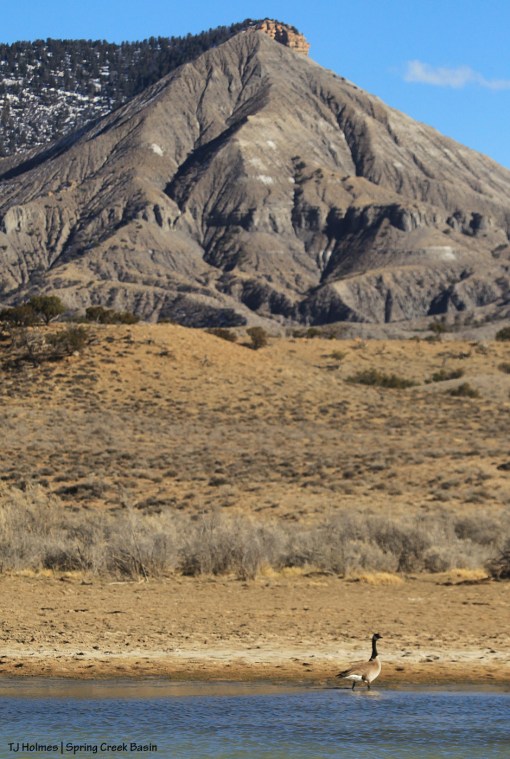
Two bands were at the pond with the goose (and though I called it “her” and “she,” I don’t actually know its gender), and they were very interested in her bold vocalizations. She was by herself; hopefully her mate (?) will join her soon. Tis the season.

Yep, once again, volunteers showed up to support Spring Creek Basin’s mustangs! This is the apron project to provide a second source of clean water for our mustangs – now fenced to protect the apron from the horses walking on it. They’ve sure enough found the water in the trough below the tank, which is below this apron.
This crew has a lot to smile about because in just a few short hours, these awesome folks built a four-strand smooth-twisted-wire fence around the apron! Our BLM guys snuck out of the office last week and dug holes for almost all the heavy wooden posts – which serve as H-braces and the nifty new gate – and that was most of the hard work.
In the photo above, left to right: Laura and Bob Volger (Four Corners Back Country Horsemen), Kat Wilder, yours truly giving the thumbs’-up, Frank Amthor (4CBCH), Mike Jensen and Garth Nelson (range specialists; Mike is the herd manager), and Kat’s son Ken Lausten, fence-builder extraordinaire. Always-present Pat Amthor relieved me of my camera to take this pic of our hard-working crew. 🙂
Some more pix below before I got caught up in the efficient assembly line of pounding posts, wire stringing and stretching, and clipping wire strands to posts:

Garth (left) and Frank work together to set the horizontal braces in the, you know, H-braces. Luckily for us, Garth and Mike Jensen already had done most of the hard work, digging holes and setting most of the wooden posts during a jail break, err, an escape from the office last week. In the background, Mike (left) and Bob Volger are digging a hole for another post to complete that H-brace.
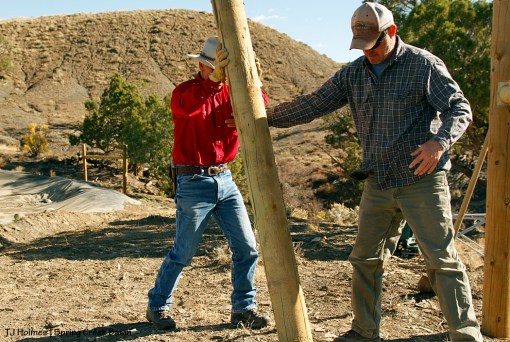
Here’s a closer look at Mike and Bob setting their post.

As soon as Garth and Frank had finished this H-brace, Ken and Kat got right to work stringing wire. Mike’s running a T-post through the wire to unroll the next strand down to the next brace.

Comin’ through! (The apron is to the left.)
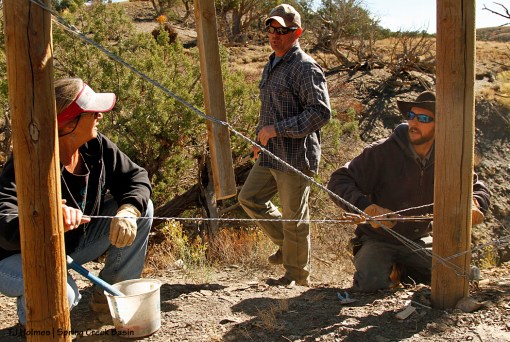
Ken stretches the end of the lower strand of wire, helped by his mom, Kat. At a diagonal, you can see the wire already tensioned into place by Mike and Garth. (That’s probably not really a word, but the diagonally-wrapped wire holds tension on the two vertical posts, so the one posts helps the other hold the horizontal wires stretched between H-braces.)
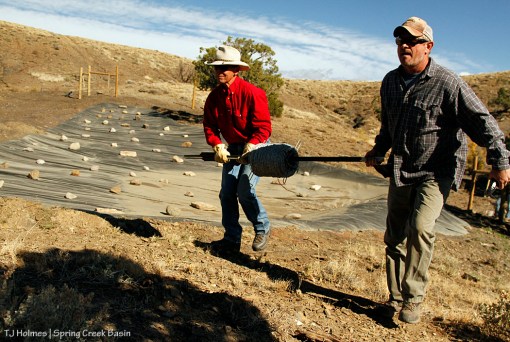
And this is a good view of the apron, which we laid out in June – the object that we’re protecting from sharp mustang hooves. Why yes, it IS already working to funnel what little rainwater we’ve received down the newly laid pipe to the catchment tank AND to the trough, which is up-to-the brim full of water for the mustangs (held level by a float ball). 🙂

Garth pounds a T-post between H-braces while (in the background) Bob and Frank dig a hole for another post to serve as an anchor in a slight depression between H-braces so it will hold the wire tight without pulling the T-posts out of the ground.
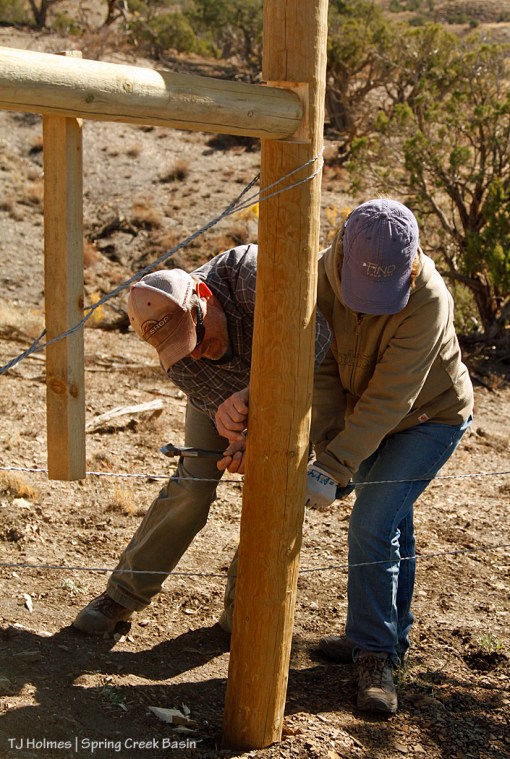
Laura Volger (4CBCH) helps Mike hold a wire strand in place so he can staple it to the post. We set our wires at consistent heights all the way around.
And things continued in just such a manner until the apron was all fenced in and protected.
This was another fabulous project in Spring Creek Basin with BLM employees and volunteers, all working together for the benefit of our beloved mustangs!
Just in case you thought it was all work and no good food, Pat Amthor brought homemade apple cake made with home-grown (Durango area) apples. You better believe we all polished that off and sent Pat home with an empty cake pan! (Sorry – no pix. It went from pan to bellies too fast!)
Thank you, thank you, once again to our committed BLM range specialists and our dedicated volunteers. With your help, our Spring Creek Basin mustangs continue to thrive on their home range!
Welcome back! The following is the report of work on the second day of our apron-installation project in Spring Creek Basin. (Day 3 was just some finish work; no photos.)
Make sure you have plenty of water or Gatorade, a hat, sunscreen, lip balm, more water, neck rag or shirt to soak for evaporative coolness, more water to drink – it’s HOT out there! – and let’s get started. We have a lot of ground to cover – literally!
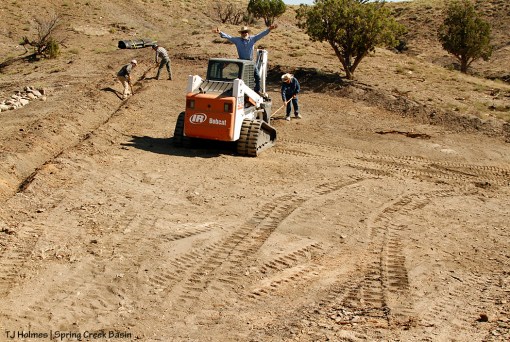
To reintroduce you to some of our cast of characters, that’s NMA/CO president David Temple atop the Bobcat, mugging for the camera again; Mike Jensen and Justin Hunt, BLM range specialist/herd manager and range tech, respectively; and Four Corners Back Country Horsemen/Wild Bunch volunteer Frank Amthor. Did I mention that this was *weekend* work? The BLM guys are cleaning up the trench that the edges of the apron will go over and be buried into, and Frank is helping David dig out the stump of the lone (small) tree that had been standing in the way of progress.
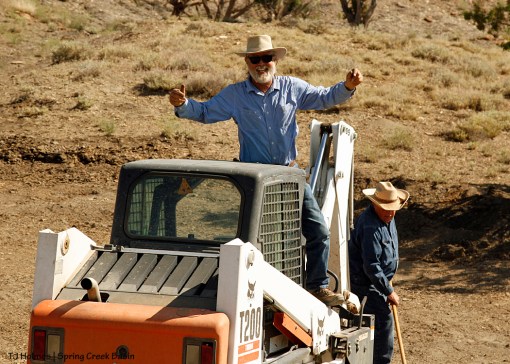
Let’s take a closer look at that big ’ol mustang-love grin. 🙂 David has been waiting a long time to make this project happen for Spring Creek Basin mustangs!
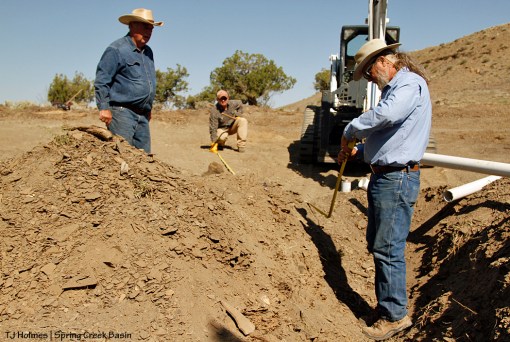
There was a lot of measuring going on. The apron was 40 feet by 100 feet and consisted of narrow strips seamed together. The edges go over dirt berms and are then buried in dirt along those outer edges. The site was irregular because of the hill, which made for a good place of drainage with a couple of points from which water could hit and drain to the lowest point.
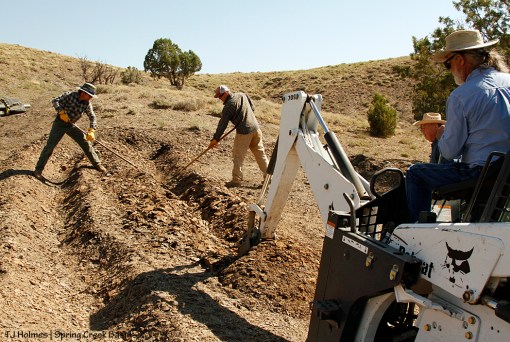
That irregular hill also made for some challenging measurements, and the guys decided to dig a second trench along one side to ensure apron coverage. This was hot, dusty work, and we went through gallons of water and Gatorade.
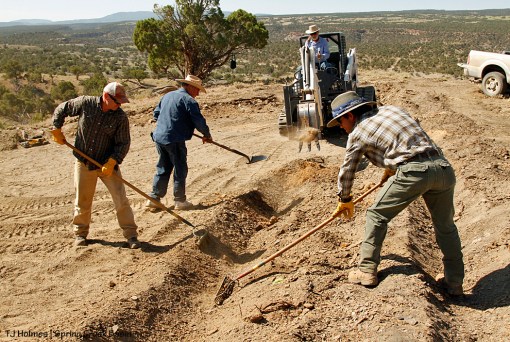
Here’s another view of the trench work. Yours truly did put down the camera and make use of the shovel in my other hand, but someone has to pull double duty and document the awesomeness! 🙂 Multitasking, don’cha know!
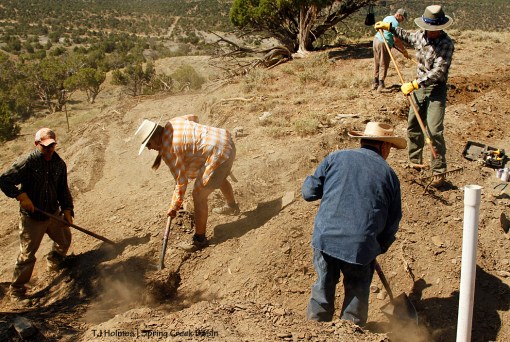
Yet another view and additions to our cast of characters: Advocate Kat Wilder in the center and 4CBCH volunteer/Wild Bunch rep Pat Amthor at back upper right. The pipe standing vertically at lower right is the location of the drain in the apron. When all was said and done, the pipe wasn’t that tall, of course. Behind Kat is the eventual trail of the pipe down the hill to the water tank. Please allow me this moment to point out that Pat will be 70 in a couple of months, and Frank is 73. Our volunteers rock!

Here, we’re looking back up the hill while David fills in the berm around the drain pipe. This is a good opportunity to mention that David is an absolute wizard with that machine. He joked that he needed the last 20 years to perfect his technique and be ready for this project, but that’s all to say that he has had LOTS of experience. We’d consider hiring him out if he wasn’t already so darn busy. 🙂
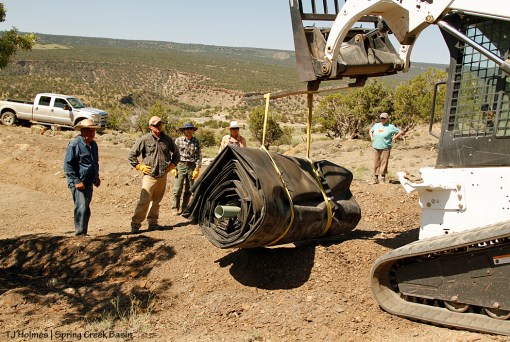
There’s still a lot of work to be done at this point, but this was a pretty big moment: The apron ready to be unrolled and positioned on the site. Then the big question: In which direction does it unroll??

As it turned out, not this direction. But we didn’t get too far along before we realized it. At right, Justin is handing the all-important “boot” – for the drain pipe – to Pat for safekeeping.

Did I mention that the whole thing weighs 1,000 pounds?
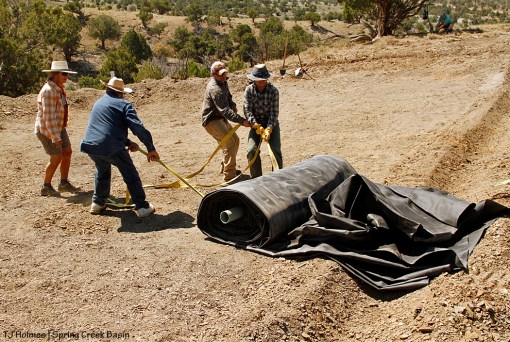
Now we’re cookin’ in the right direction.

While photo-documenting, I might have shed a few tears of sheer happiness at the sight of this apron moving into place. The water it will provide for our mustangs in this area of Spring Creek Basin will have a hugely positive impact on their ability to comfortably graze this area.

For good measure, here’s one more photo of the unrolling process.
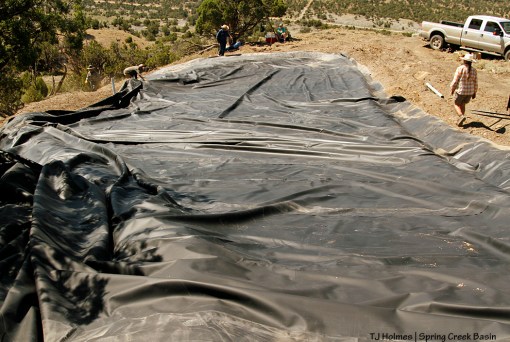
Then it was all hands on deck to (wo)manhandle the giant apron into place so it covered the whole site – yes, it was heavy, and yes, that black plastic got hot fast. The perspective: I’m at the top of the hill, Kat is walking downhill along the edge opposite the drain, Frank is at the bottom – which has a slight slope from which rain water also can drain – and Mike and Justin are at the drain-side edge. The pipe was then fitted together and laid into a trench around the side of the hill (behind Justin) and down to the tank.
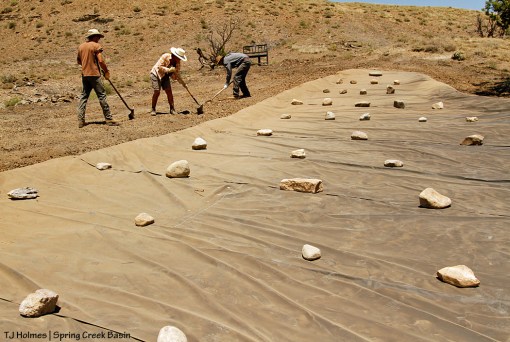
Fast forward through the work of spreading and flattening and placing rocks and filling trenches to cover apron edges … and also introducing additional volunteers: Kat Wilder’s sons, Tyler (left) and Ken Lausten. This perspective is taken from the bottom (where Frank was in the previous photo) looking uphill. The drain is to the right.
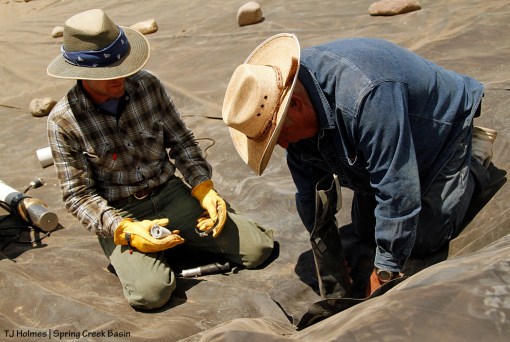
Now Justin and Frank start the process of measuring the “boot” to fit over the drain pipe (which has been cut down to size in this photo – remember it very tall in earlier photos?). Behind Justin is the filter that will attach to the top of the pipe and allow water down the pipe but keep out other debris.

David starts digging the trench from the apron to the water-storage tank while Ken and Tyler are at the ready to do finer shovel work. At right, out of the frame, Justin and Frank are working on the drain pipe in the apron.
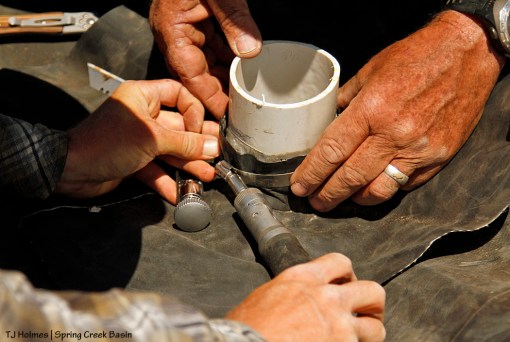
Old hands and young hands. Volunteer hands and BLM hands. Hands doing work for mustangs. YEAH! (Those helping hands are the property of Frank Amthor and Justin Hunt. 🙂 )

We love it when a plan comes together! Justin and Frank are working on the drain pipe in the apron; Ken, David, Mike and Tyler are working on the trench to hold the pipe that will carry the water; and Kat and Pat are supervising. (And I’m loving the whole blessed project!)

As volunteer photo-documenter and volunteer shoveler, one of my most solemn multitasking duties is to accept heckling – and then put it on the blog for all to see. 🙂 Fabulous job, David, Ken and Tyler!
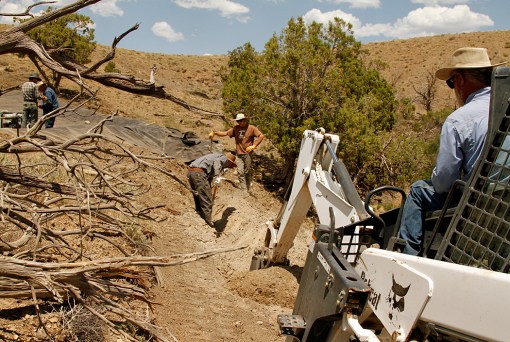
Because, really, we absolutely cannot let all this hard, hot, dry, amazing and amazingly appreciated work go unnoticed or undocumented! We do small projects for the horses throughout the year every year that are documented for our local folks, but this was big – and it was huge – and let me say again how incredibly appreciative we are of our BLM folks and all our advocates and volunteers who make projects like this happen – through funding, through buckets of sweat (it’s “dry” heat, right?!) and through lots of tears of happiness while we try to make sure photos are in focus. 🙂
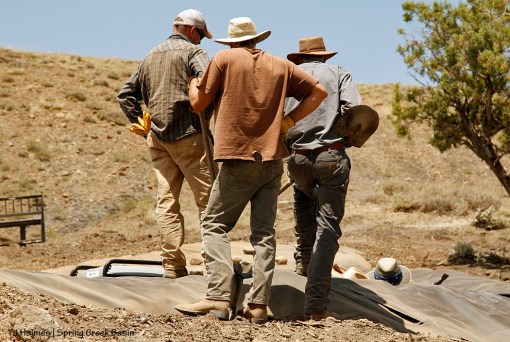
Because people are watching to see how we have made Spring Creek Basin’s mustang-management style a model. It takes hard work, but it IS possible to work in partnership for our mustangs – and we’re proving it – and our horses are worth every bit of that effort.
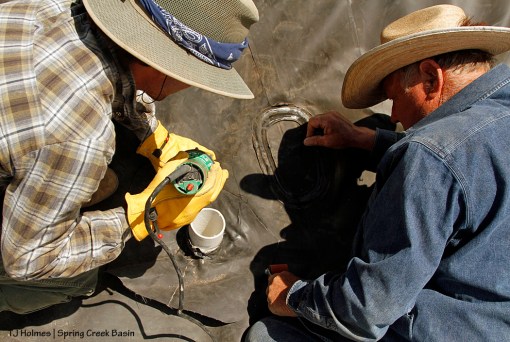
This work was hard to illustrate. The “boot” had to be sealed to the apron liner so water will go through the filter to the pipe, not leak out around the edges where the pipe comes through the apron. Justin is using a tool that directs heat (it’s plugged into a portable generator), and Frank is using a little roller to press the heated boot plastic to the apron plastic. As if it weren’t hot enough (did anyone actually look? the air temp may have been in the upper 90s, but on that black plastic, it probably was at least 115 degrees), they’re applying *more* heat. All in the name of gettin’ ’er done for our mustangs.

Ahh! Thanks, Kat! Pat brought the umbrella … and no, we were not expecting rain.
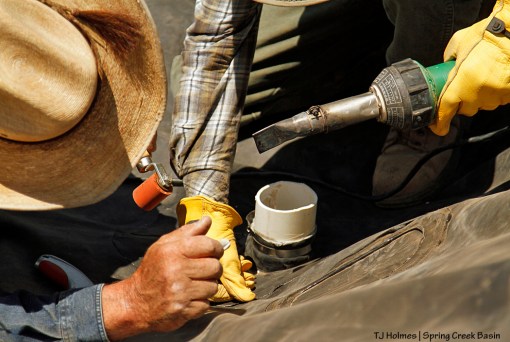
This angle shows a little better what’s going on with that plastic boot and the heat gun.
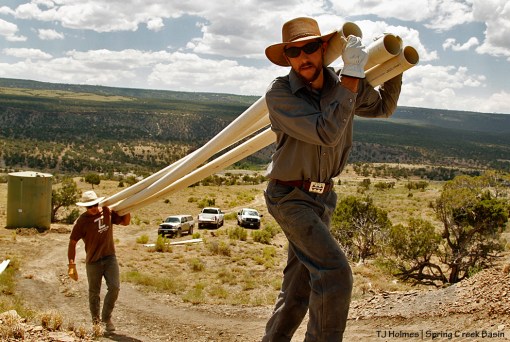
Meanwhile, work on the trench had progressed to the point that allowed Ken and Tyler to start carrying lengths of pipe up the hill to glue together and place in the trench. In this view, you can see the water-storage tank. Also hard to illustrate is just how steep is this part of the hill. Barely in view down the hill at left are the pipes Ken and Tyler carried on their *other* shoulders to that point from the pile in front of the trucks farther downhill.

Ken and Tyler get right to work gluing pipe together for the long run to the tank.
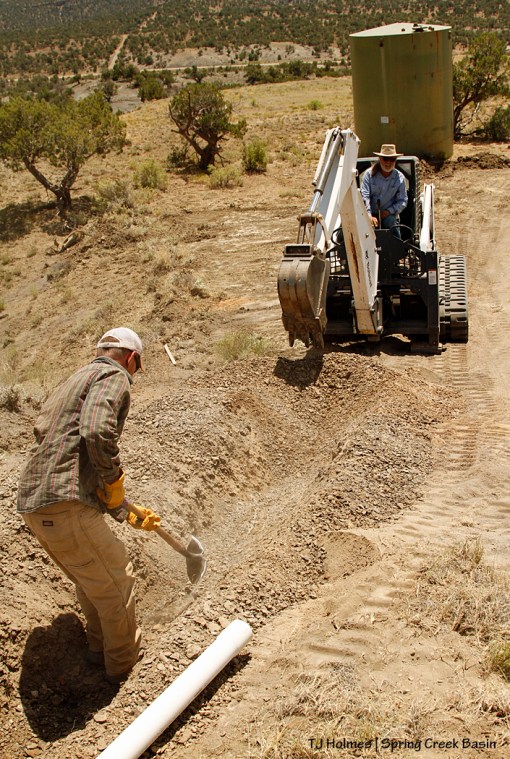
And David and Mike continue digging the trench down the hill to the tank.
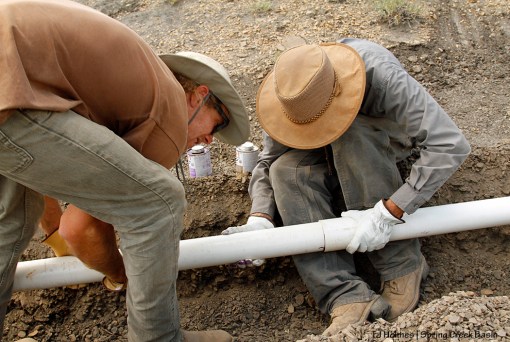
And Tyler and Ken glue more pipe.
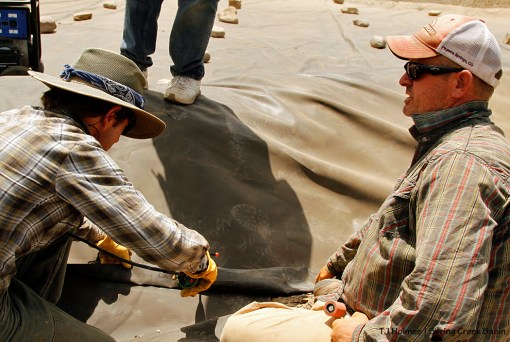
Using the technique perfected by Justin and Frank, Mike helps Justin attach another section of apron to the main apron in order to have more surface to bury over the berm in the trench. Because our site isn’t rectangular, we trimmed plastic in a couple of areas and added those pieces to a couple of areas for mo’ bettah coverage in places where needed.
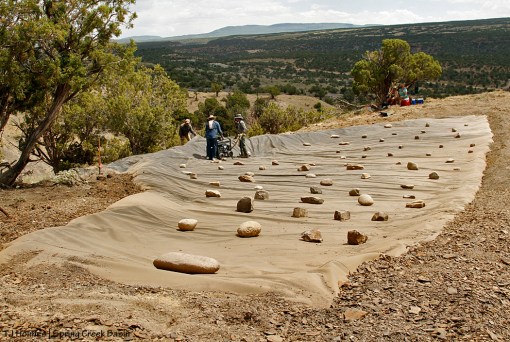
My oh mustang my! Doesn’t that look like it will catch and carry a lotta water for our wild ponies??
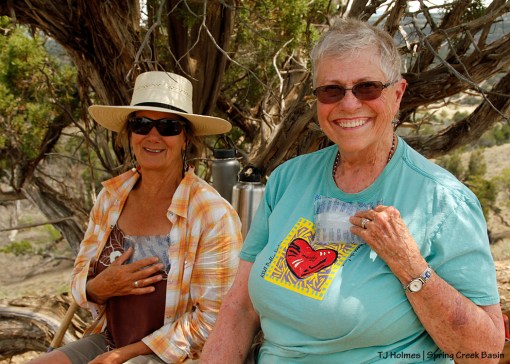
It hasn’t yet been mentioned how HOT it was (! OK, it miiiiiight have been mentioned) during this weekend work project. It hadn’t rained in weeks (possibly close to two months), and it was as hot and dry as Southwest Colorado can be (and given our location as high-elevation desert, it can be pretty toasty with temps into the 100s, which we’ve seen already). Fortunately, it was generally breezy enough to keep the gnats at bay. Here, awesome lady advocates Pat and Kat are using ice packs to stay cool under the shade of a handy juniper at the work site.
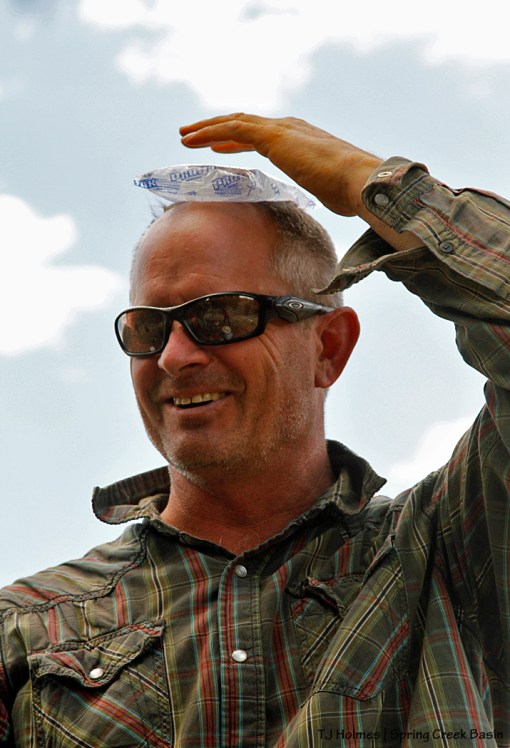
Mike also thought that was a pretty terrific idea.
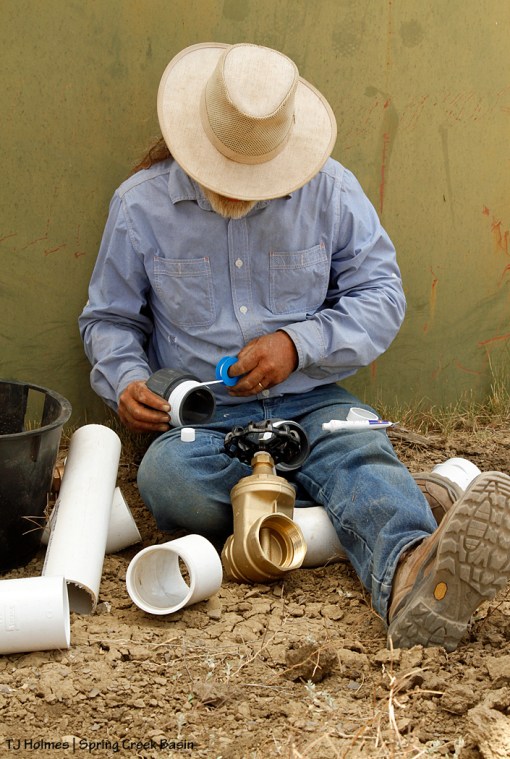
David was glad to get off of his bucking Bobcat and start putting together valve parts in the shade of the water tank. The pipe-filled trench gets to the tank immediately to the right of where he’s sitting.
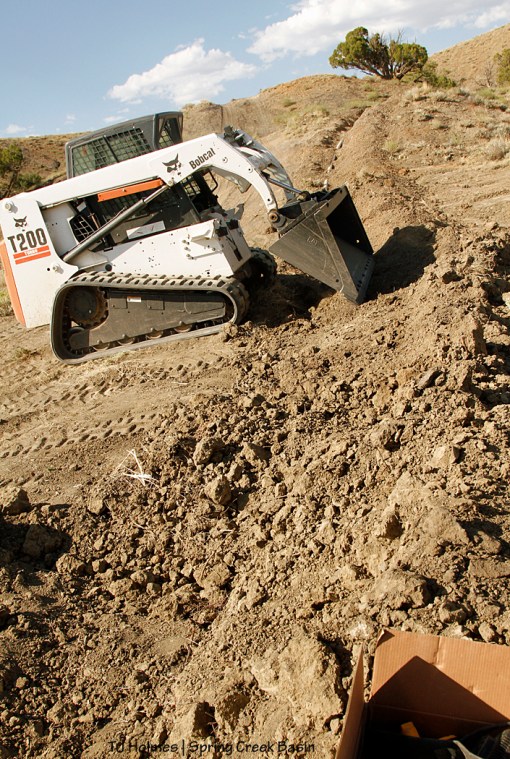
Of course, he had to get right back on that pony – err, Bobcat – and finish the job to end the ride on a positive note: filling the trench and covering the new pipeline, which is worth its (considerable) weight in gold.
Camera-holding and other hands were needed to wrestle the final pipe sections into place to get in line with the tank’s existing steel fitting, so the photos end here. David did quite a bit more work around the apron and installed some water-erosion ditches on the access road this day and the next (third) day, and we also removed the tractor tire (which had served as a trough with a bentonite-and-soil bottom) to put in place a new water trough provided by BLM. As it turned out (after we got our first little rain showers to test – yahoo!), the steel fitting that was at the tank had cracked and was leaking a bit (Colorado’s freeze-and-thaw action at work), so we’ll replace that as well.
After the holiday, BLM folks and volunteers will return to the site of our big achievement to replace that steel fitting, scatter seeds of native grasses around the apron and along the covered pipeline (disturbed areas), and install the new trough to the existing pipeline downhill from the tank.
And once again, it’s imperative that we thank all the people who provided all the hands and funds and supportive efforts that made this water project happen for our Spring Creek Basin mustangs: BLM range staff, Wild Bunch members, unaffiliated advocates and family members (including the ones who allowed us weekend time with their husbands and daddies). Specifically, for your labor and engineering and exemplary work ethic, thank you to Mike Jensen, Justin Hunt, Garth Nelson, David Temple, Pat and Frank Amthor, Kat Wilder, Ken Lausten and Tyler Lausten. For your organization and funding and support behind the scenes, thank you to Connie Clementson, Tif Rodriguez, Lyn Rowley, Lynda Larsen, Sandie Simons, Nancy Schaufele, Karen Keene Day, David and Nancy Holmes, and the Serengeti Foundation.
In spirit, always, thank you, Pati Temple, for our cherished memories of your mustang advocacy and for continuing to watch over and guide us in this work. (I’m pretty sure you had a hand in the recent, blessed rains we have received!)
Everyone, we appreciate your planning, your work, your funding, your organization and your love for our most beloved Spring Creek Basin mustangs.
THANK YOU!!!!!!!!!!!!!!!!!!!!!!!!!!!!!!!!!!!!!!!!!!!!!!!!!!!!!!
 Spring Creek Basin Mustangs