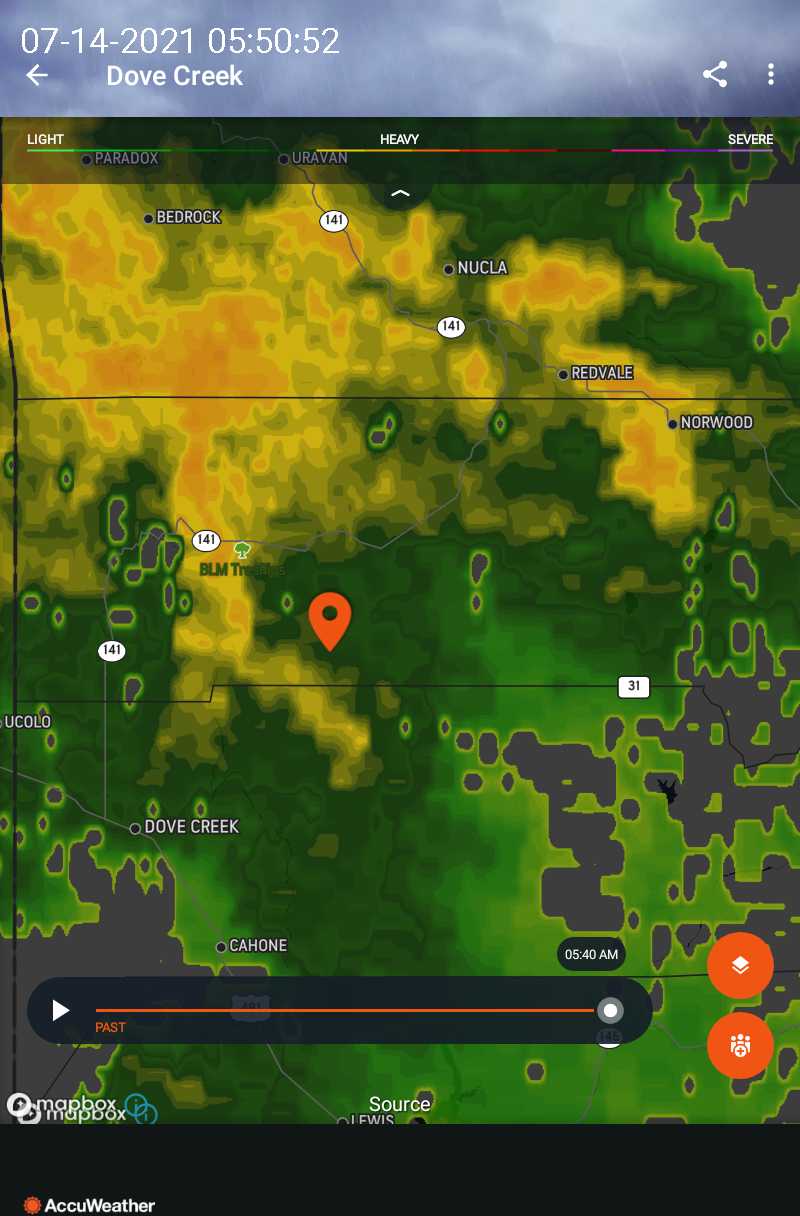
This screen capture from my Kindle showing the rain all over our wonderful (and parched) Southwest Colorado region stands alone and is worthy in itself of relief and rejoicing. 🙂 But, even as the post immediately below this one claimed to be updated as to the new catchment project, as of Monday afternoon (I drafted and scheduled it on Sunday), it was already outdated again. 🙂
So – spoiler alert – Garth Nelson and Jim Cisco came Monday and installed the gutter pieces all across the front of the new catchment and installed pipes to three of the four tanks, AND tested it with 200 gallons of water pumped up and sprayed over the roof (which now covers more than half the structure). Daniel Chavez and his wife, Destiny, had their baby (!), and Mike Jensen is engaged in less interesting but also important office work, and Garth wanted to get the gutter in place to start catching water and storing it before he heads north for a couple of weeks on a fire detail. … !!! Can you say perfect timing?!
So this morning, when I awoke to the musical and wonderful and what-the-heck-is-that-strange-noise sound of rain on my firewood box roof (also propanel, interestingly enough), I. Was. STOKED! 🙂 I’ve already cried to see the water flowing into the gutter from the water Garth and Jim sprayed up on the roof – and you’ll see it, too, when I can get the post composed – and this … well, let me just say there might have been some more moisture this morning, flowing inside the house. 🙂
Huge thanks again to all our BLM folks, for the roles they’ve played in every step of this process … to catch rainwater for our mustangs. 🙂 And thanks, of course, to Mother Nature, for the RAIN. Such a blessed relief!
(P.S. Spring Creek Basin is a bit eastish of the pin in the map above. And at 7:38 a.m. Colorado time, the sprinkles are only now slowing. It’s been raining since well before light.)
With this post, the blog and reality are caught up and meshed!
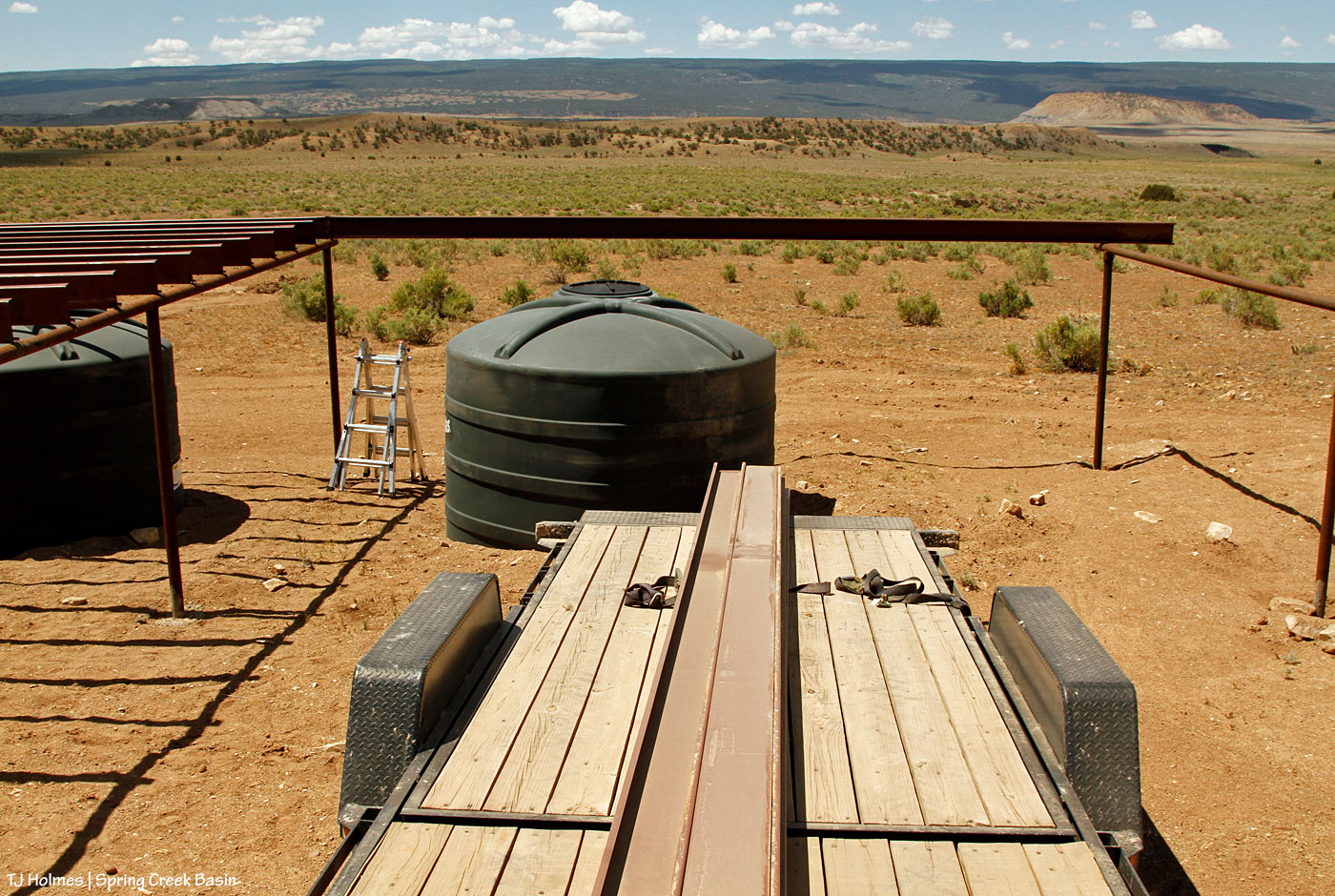
The guys showed up with the flatbed full of purlins – the last purlins required to weld to the roof structure on which to screw down the propanel sheets – and backed it right into the last section.
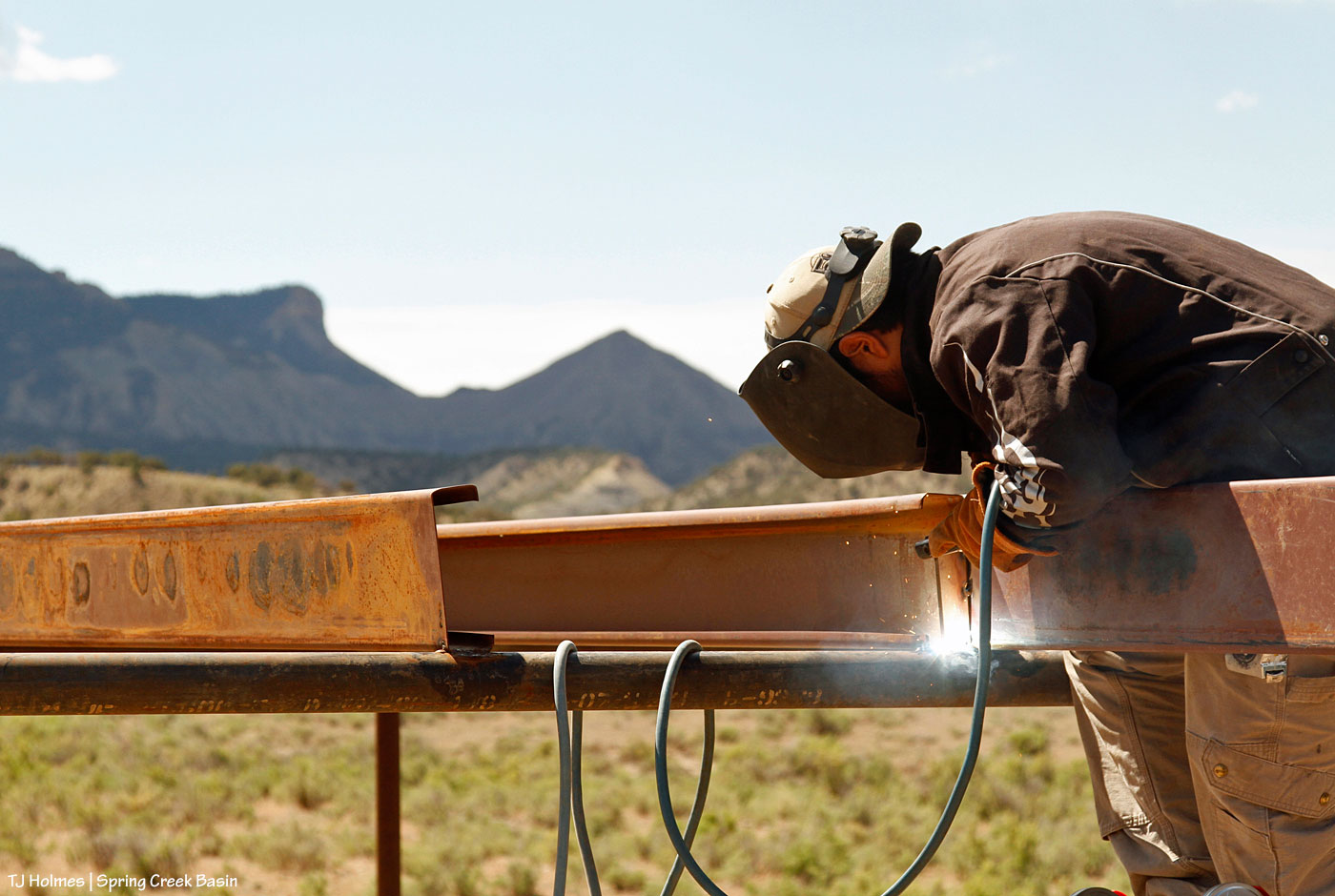
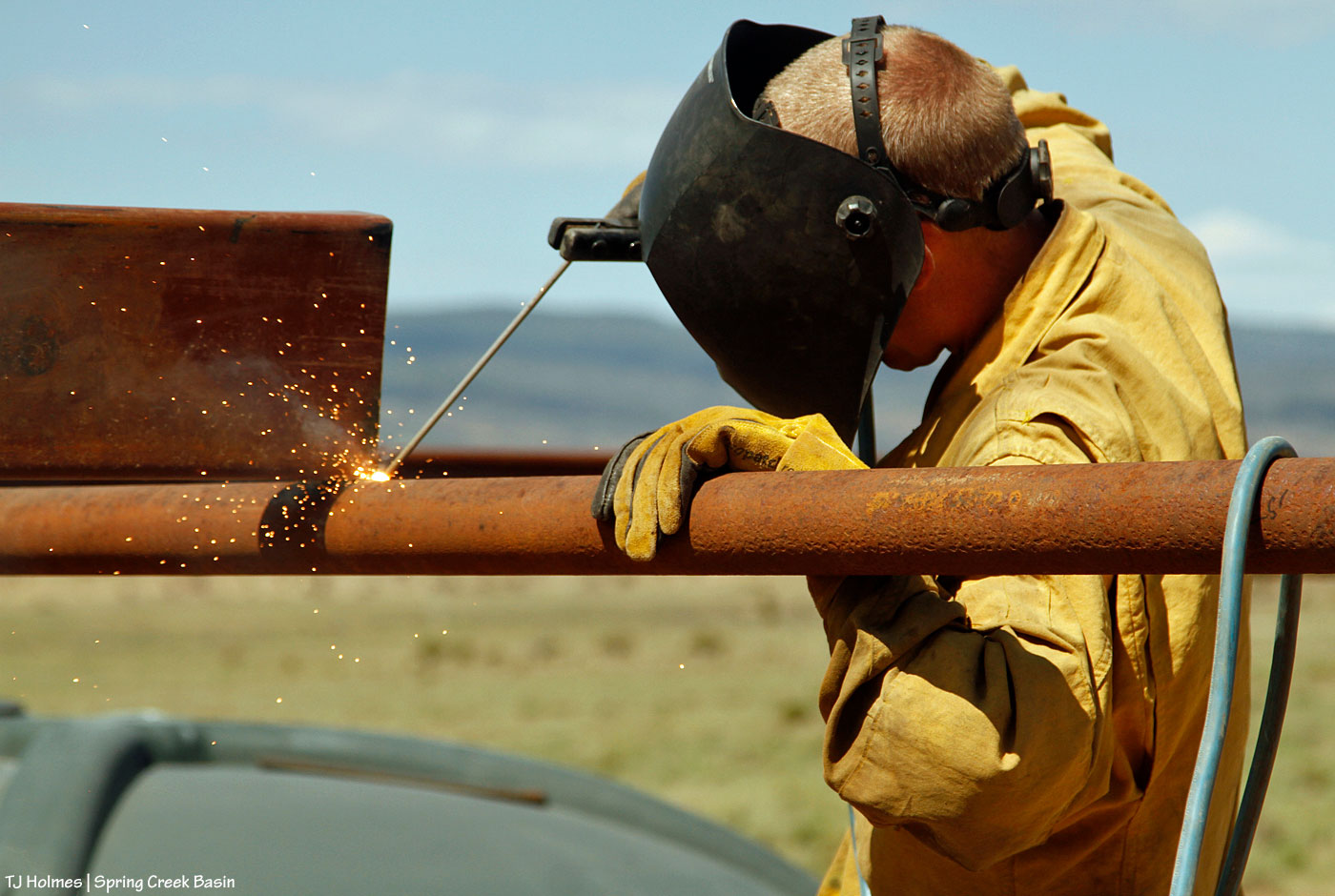
It was hot. Already. But they still had welding to do, which meant leather and Nomex and helmets for safety. Which meant – did I mention already? – hot.
Bonus: Backing the flatbed in under the structure meant that the purlins were close to where the guys hefted them into place on the steel pipes, and I had a higher vantage from which to take documentary photos. 🙂 AND – on which to help hold the purlins steady (with my great and amazing strength!) while the guys welded them into place on either end. I’m tall, but I found it helpful to use one of the readily available rocks around to stand on for a couple extra inches to hold each of the purlins. The flatbed gave me a couple of extra FEET.
WIN!
You’ve seen the guys weld in multiple previous posts, so with this pic, fast forward a bit: All the purlins are welded in place across the whole roof structure! … So what the heck are those BLM’ers doing now?!
The last/top purlin is to Garth’s right. The pipe Daniel’s working on is the west-end pipe of the roof structure. (Note: There’s currently a fair amount of “extra,” which means that we can add purlins and propanel in the future for an even bigger roof surface.) Whatever they’re doing, it has the undivided attention of all three of us!
Our guys are craftsmen, and they’re rightly proud of their work. So Daniel “signed” it in beads of weld. 🙂 That’s Garth in the pic, “chipping” the welds flat.
And he put the year on it, too. Forget the trials of 2020; 2021 is the year we’ll remember as the origin of the basin’s third water catchment for the mustangs.
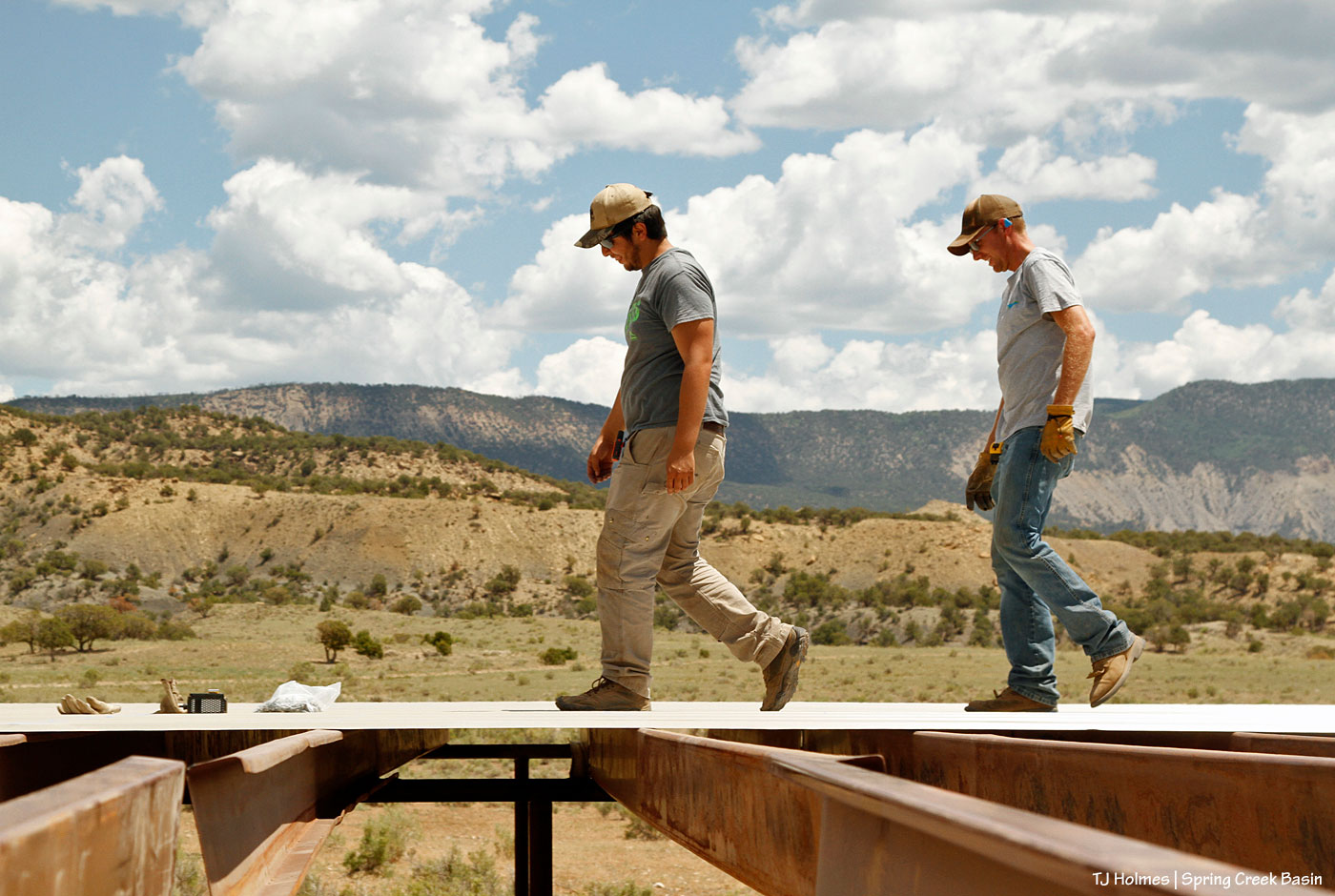
We’ve thrown around a couple of name ideas for this particular catchment. It’s in the eastern end of wildcat valley (my name), beyond what we call wildcat spring. Wildcat catchment? With the new shade from the propanel, we were able to eat lunch right there – instead of up the hill under a tree. The whole structure is kind of a box. Lunchbox catchment? But I think we might have a winner here: BLM’ers marching, leading lines across the foreground … Abbey Road catchment, anyone? 🙂 (Hey, we do like to laugh!)
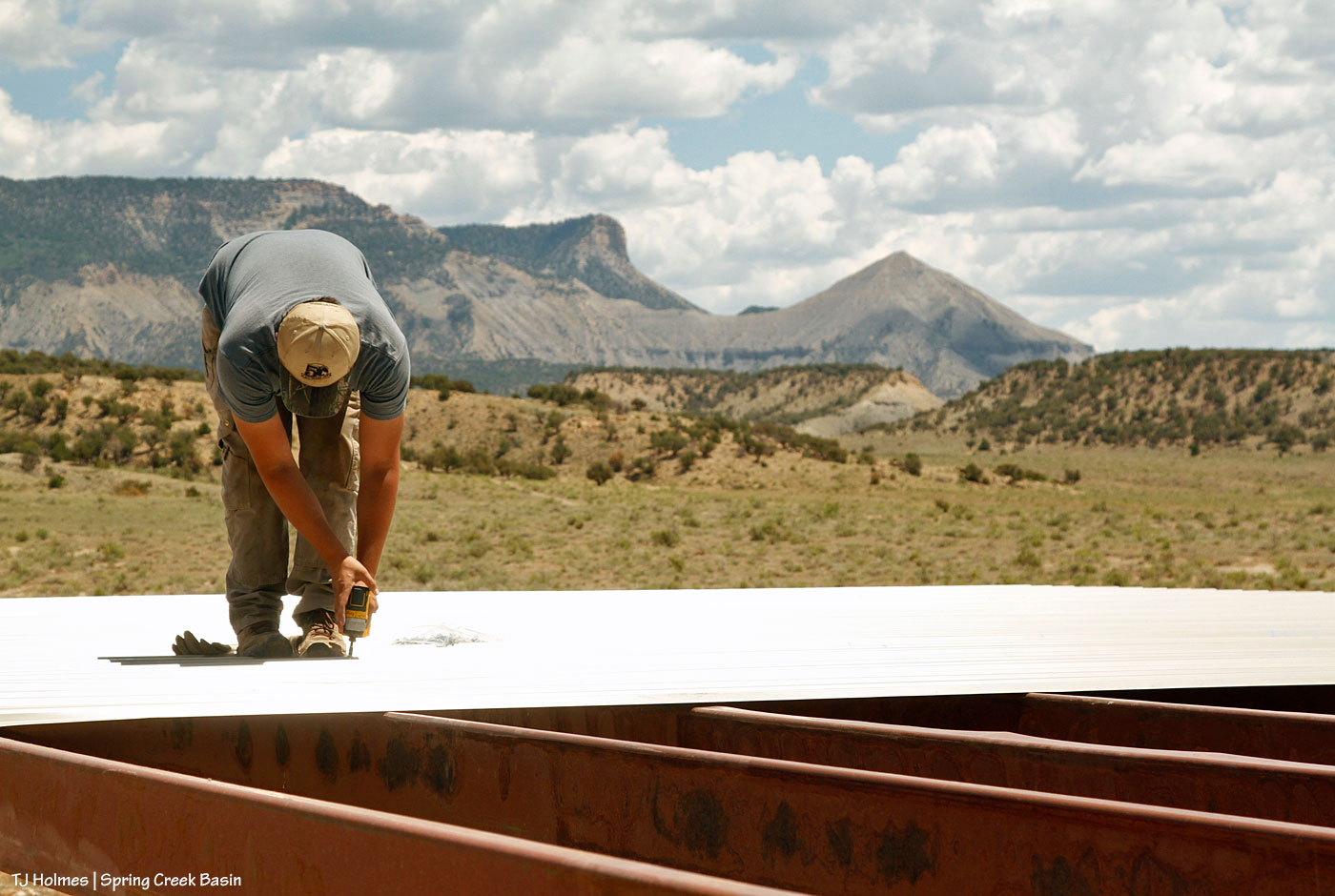
Daniel got to work with the zz-zz.
And Garth got to work with the zz-zz.
Now I want to take you on a bit of a walk around the project, so you can see it from multiple directions.
This is basically at the southwestern corner looking northeastish.
Looking a bit more eastish. The road is just to my left.
Here, the road is just below me (you can see it at lower left … and as it continues on around the loop right in the center of the pic), and we’re looking southeastish toward McKenna Peak and Temple Butte.
An even bigger view … from near our previous lunch spot. 🙂
And this is looking back to the southish (ever so slightly southwestish). That’s Filly Peak in the background, and if you know where to look, you can see the top of the tank at the main, original water catchment in Spring Creek Basin. 🙂
Did I mention that it was hot? There might be some clouds over the horizons in these pix, but that didn’t mean any of those clouds were over our heads, over the basin. Hopefully, Mother Nature will take some pity on us before the next work day.
With that, we’re all caught up, and the blog reflects reality. Next steps: Finishing the propanel across the rest of the roof structure and installing the gutter across the front and the pipes from it to the tanks!
Our Daniel Chavez and his wife, Destiny, welcomed a baby girl to their family on Sunday! Her name is Amelia, and she weighed a very healthy 7 pounds, 10 ounces. 🙂
We wish you a beautiful life, baby Amelia, full of wild things and wild places, and forever watched over by the spirit of the mustangs!
Congratulations, Daniel and Destiny, on your baby girl! Your lives will never be the same. 🙂
We’re now up to about phase 4 on the basin’s newest water-catchment project, though the phases are sort of, kind of starting to overlap a bit. It’s a big project! And my blogging is slightly behind our actual work, which is ongoing (it is hotter ‘n hell out there, I’m not kidding … last weekend, the mercury hit at least 104 in lower Disappointment Valley, which didn’t even set a record in the state of Colorado (because it was even hotter elsewhere, and other records WERE broken)).
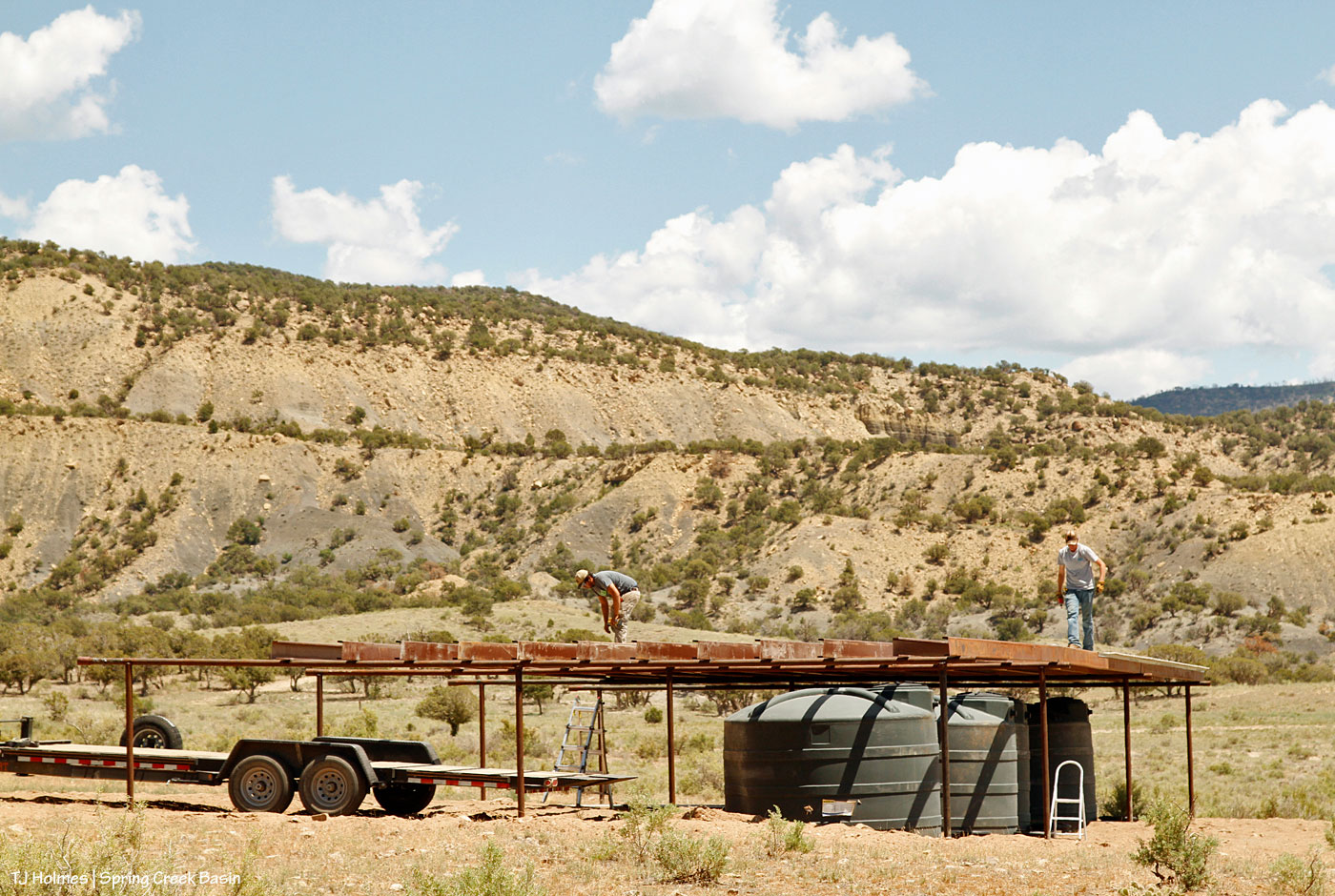
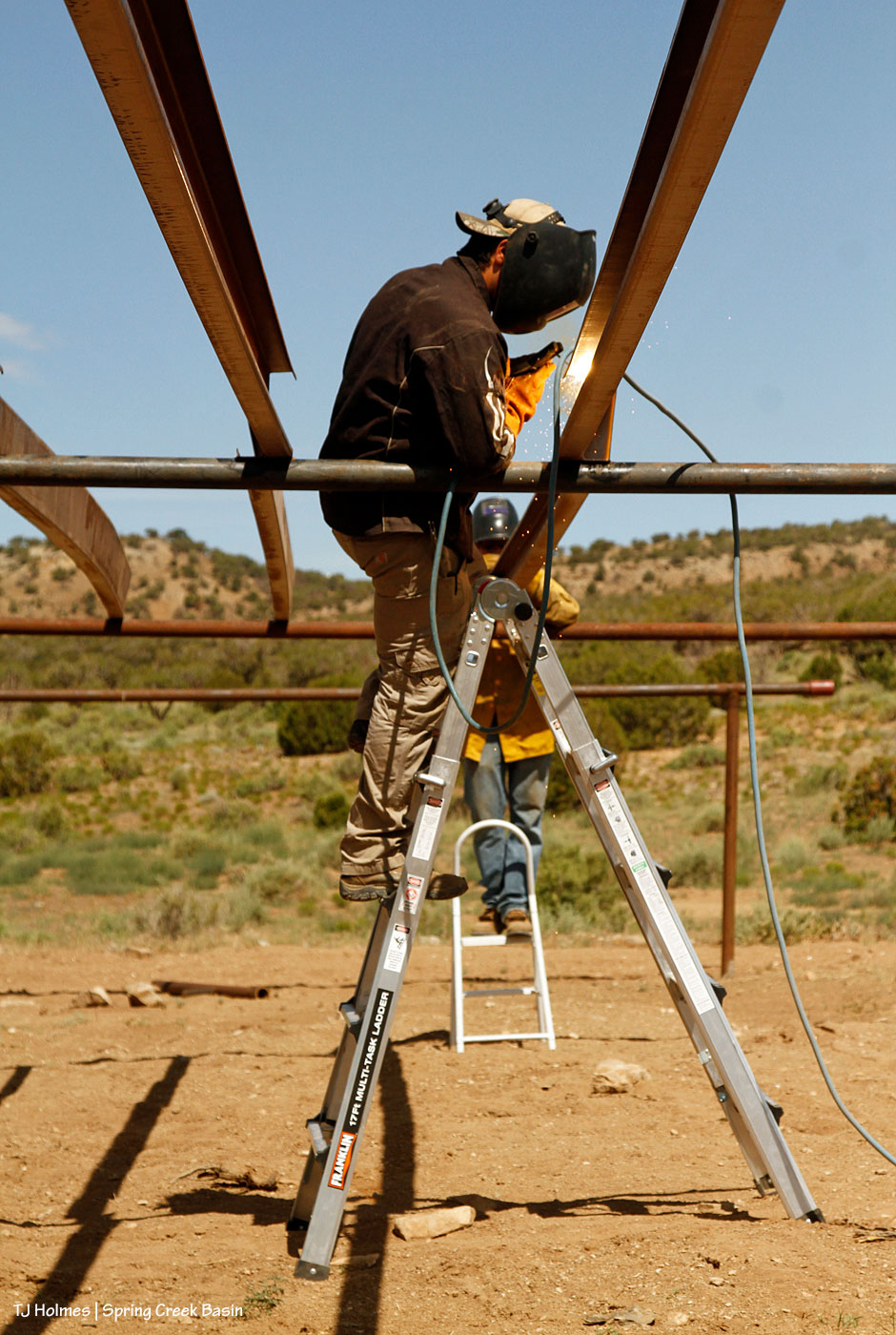
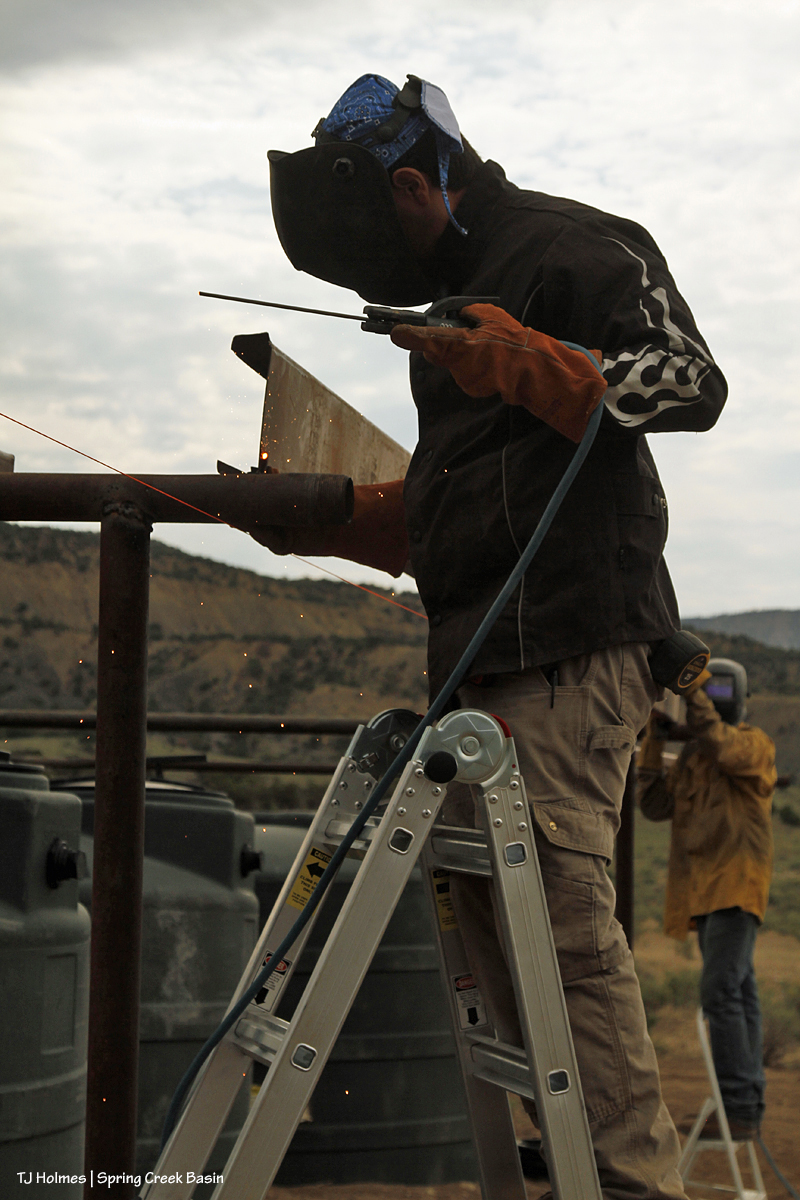
On this day, Garth Nelson and Daniel Chavez, two of our BLM’ers-extraordinaire, welded the purlins in place that they’d previously brought out to the site. They wanted to make sure that the roof structure is super-solid and secure, so they welded them at fairly close intervals. This will come as a shock to … absolutely no one: It gets windy out here! The roof needs to be uber tight.
So Daniel got to welding.
And Garth got to welding. (By the way, for those worried about fire danger, the ground below the whole structure still is very much dirt. We are VERY aware of potential fire risk.)
Here’s an overview of where we were in the building process. It’s a bit hard to see from this perspective (and I’ve been trying to take pix from various perspectives!), but they’re just finishing the purlins across the middle section of the roof section. That’s the longest span – across the two middle tanks. West is behind Garth, and that part is done *now* … but at the time of this work day, they still had to get the remaining purlins from Durango (steel shortages affect everyone!).
In a project like this, there are loads of leading lines …
… and graphic lines! And it’s fun to take advantage of those arty bits, even in a serious project like this one. 🙂 Behind Garth there, you can see the third/western section of the roof structure, which got “purlin’d” another day (that post is coming!).
When Garth and Daniel got the middle section of purlins welded, they started on the ROOF! These are the propanel (metal) sheets that will catch the rain and snow and convert it to drinkable water for the mustangs (via the gutter and pipes and other pipes and trough and float (!)). Exciting stuff!
Now, I have to tell you one of the most interesting things that I did NOT photograph about the getting of the propanel sheets to the basin. The day Daniel hauled out the pile of sheets (they’re 25 feet long from the top (right side of the pic) to where Garth is measuring in the pic above), he got stymied at the first Spring Creek crossing in Spring Creek Basin (which is probably about six-ish miles from the main county road). Why, you ask?
BECAUSE SPRING CREEK WAS RUNNING WITH WATER!!!!!!!!!!! 🙂 It rained in the eastern part of the basin, and the creek arroyo ran for a little while.
So on this day, after the purlins were welded in place, we went back to get the propanel sheets and take them to the catchment site. Right before lunch. Perfect. 🙂 (Also interesting note: Until we got the propanel sheets in place, which provided shade, our lunch spot was a short distance away, across the road and up a little slope under a lovely juniper tree. On our last work day, when it was almost a billion degrees, we lunched in the shade of the roof structure. :))
The first sheet, of course, was important to get screwed down straight on the frame to the steel purlins.
See those round green pieces? Those are going to be the lids for the black culvert pieces in front of each tank, at the bottom of which are the valves. The guys, those master welders, even made me a custom “key” so I can turn the valves on and off without crawling down on my belly to stick my arm down into the spider holes (they’re too deep for that anyway!). (I’ll get a pic of that key later.) The thicker green part will be a “riser” to go over the culvert, and the lid (with the white ring) will screw down on top. What are the silver “sticks” sticking up out of the culvert? Those are “drip edge” pieces of thin aluminum that will go all along the front line of purlins, under the propanel sheets. On another project like this that the guys have built, they found that rain water would sometimes just splash over/under the edge, missing the gutter. They installed these, and voila – problem solved. So we’re putting these edges under the propanel as we go along.
Interesting factoid: There’s still a bit of “bounce” to the roof, so being up there and walking around – staying on the purlins – was a little like walking on a trampoline. Daniel’s best quote from the entire project (thus far): “Now we know the roof can support 300 pounds of dude.” 🙂 And they’ve said that about an inch of rain on this span of roof will put about 1,000 gallons of water in the tanks. There’s a particular formula – don’t ask me because I am NOT a math person – but Daniel and Garth ARE super smart dudes, and if they say it, I believe them! (Now we just need a whole gosh-darned inch of rain! … Wait … after the gutter is installed and piped to the tanks!)
And the water test. Yep! (Bonus, you can see the silver drip edge here, too.) You just have to imagine the gutter at this point… !
With a sky like that, I tried to get the guys to do their best Superman impressions. … They were too shy for that, but they’re still super heroes to me – and to the mustangs! 🙂
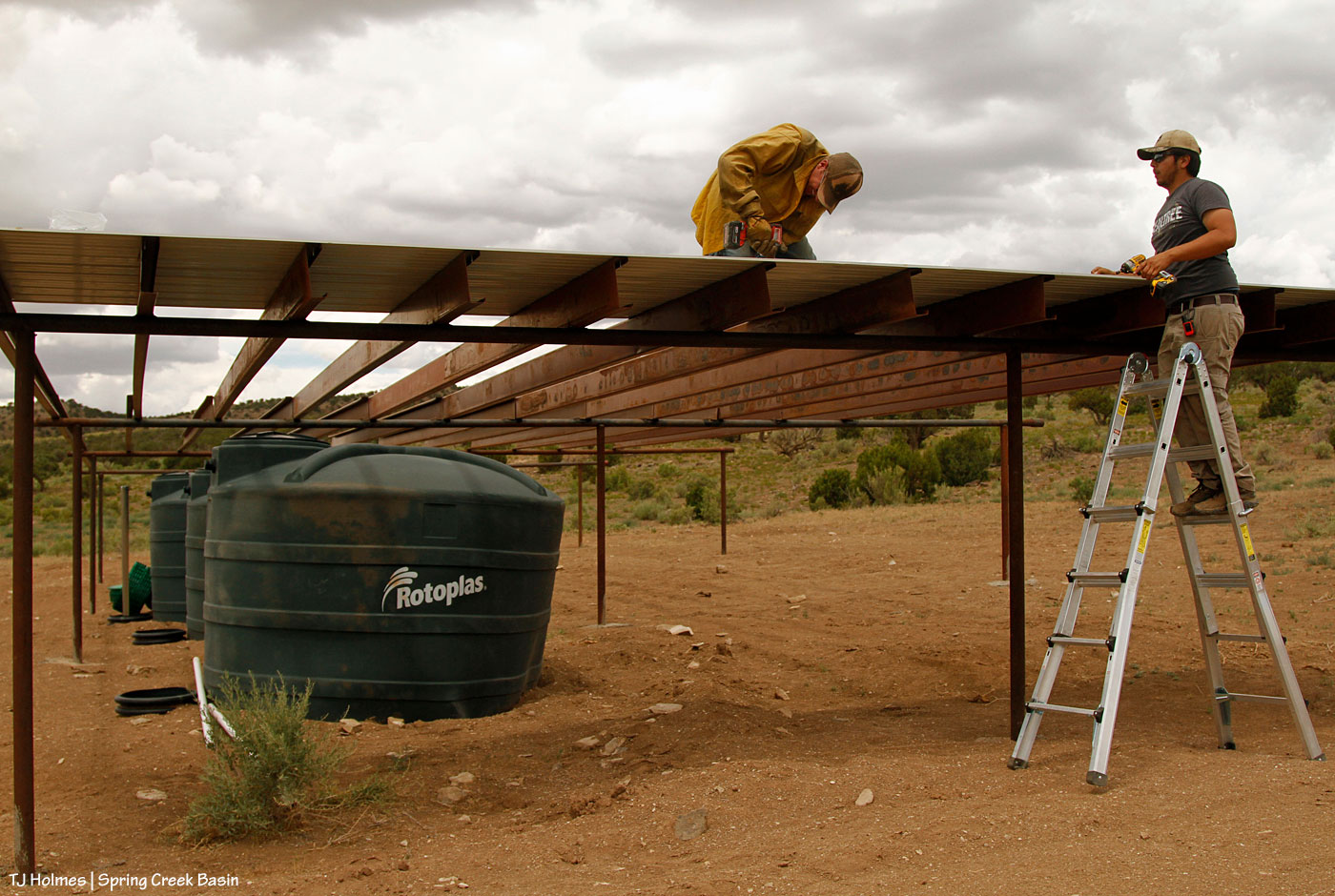
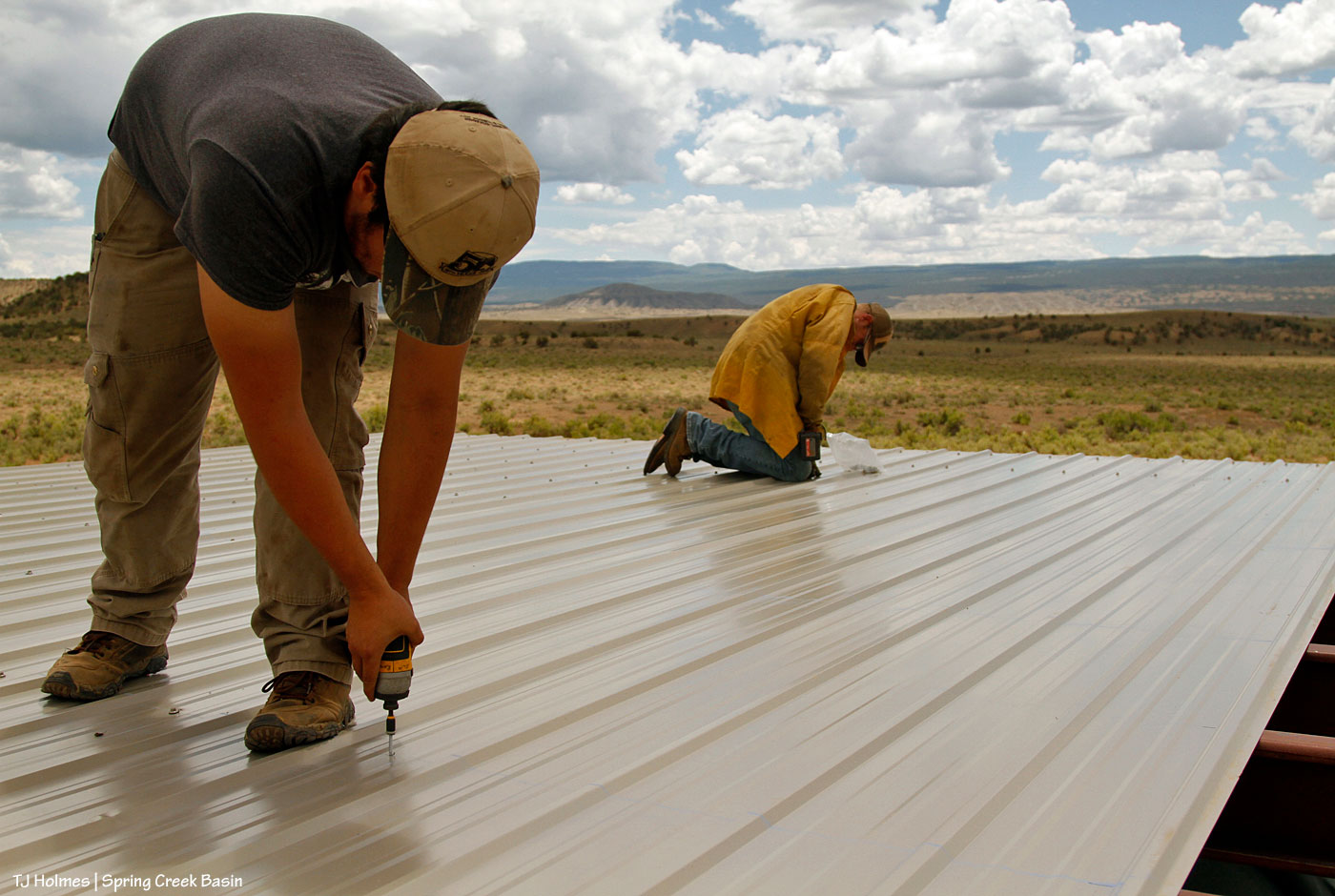
On this particular day, we SUPER lucked out with the cloud cover and breeze that kept things relatively cool (OK, at least not HOT). With the two of them up there, zz-zzing the screws that fastened the propanel to the purlins beneath, it went pretty quickly.
Teamwork. 🙂 Another of my favorite pix of the project! And that pole sticking out in the foreground of the pic marks the eastern third of the roof, which means that on just the first day of roof-attachment, they got a third of the panels in place.
Lest you all think it’s all work and no fun, let me disabuse you of that notion right now. 🙂 Laughter is a big part of our camaraderie. I’m not totally sure what Daniel was doing here – I think the edge of the propanel sheet was just barely on enough of the purlin edge for Garth to tap a screw into, and the purlins, though welded, still have some give to them (hence the trampoline effect mentioned earlier), so he’s using his great and amazing strength (!) to pull the end (top) purlin closer to help Garth with the attachment.
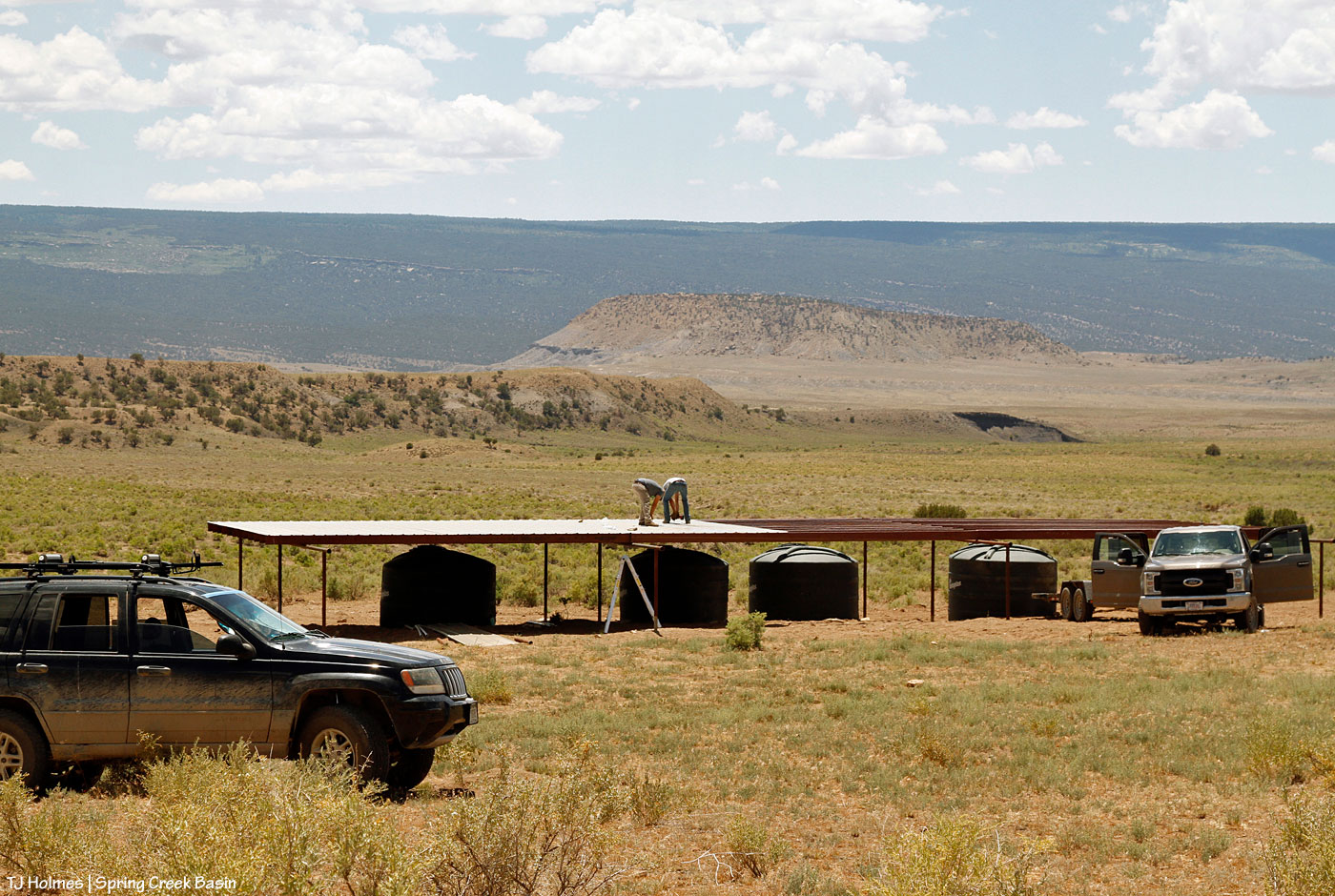
The next day we worked in the basin (which was this past week) was crazy hot, but the guys showed up smiling, as always, and we got the rest of the purlins welded, and now the roof is just more than half covered in propanel sheets. Depending on continuing heat (the forecast shows some relief coming …) and availability, work will continue on the propanel attachment and getting the gutter in place and piped to the tops of the tanks.
One more little tidbit: I arrived first the last day we worked because the guys had to go to Durango to get the remaining purlins (to be welded) – from Dolores – and then all the way back out to Disappointment Valley. A band of horses was at the far east end of the little “mini valley” in this part of Spring Creek Basin, and their hoofprints were on the road, which is just, maybe, 50 yards from the catchment. … And not only there, but some brave pony or ponies came within about 10 yards of the eastern end of the structure. Eventually, we’re going to put up a fence around the structure so the horses won’t rub on things and chew on things, but they’re curious! … Gettin’ closer with each work day. 🙂
To catch you up, dear readers, this is where we last left off in the ongoing project that is Spring Creek Basin’s newest water catchment for the mustangs:
None of the purlins had been welded to the steel pipes yet in the photo above, but you can see the front three purlins resting atop the pipes (left side, which is the downhill side). It looks a lot different now, in reality, because in reality, if not in blog-time, we’re up to phase 4 now.
Here, Garth and Daniel are about to turn the first purlin on its edge to start welding it in place across the front of the roof structure. Eventually, the gutter will run along the length of it.
Daniel is the range department’s chief welder (!), and both he and Garth did welding on the purlins – one at each end – which made the project go a lot faster.
No pic of any work in the basin would be complete without two of our most iconic landmarks: McKenna Peak and Temple Butte. Fortunately, this location has great views.
Garth welded the third purlin into place across the front of the roof structure, and then it was weld, weld, weld, all the way up the east section of the roof structure!
How’d they get those heavy steel purlins up there anyway?
A little like this …
… and a bit more like this. 🙂
Once they got the first line of purlins up, we got into a rhythm, and they got the rest (on the east end) welded pretty quickly. Their measurements of where they placed all the steel pipes was spot on. I was impressed. 🙂
And pretty soon, it was looking like this!
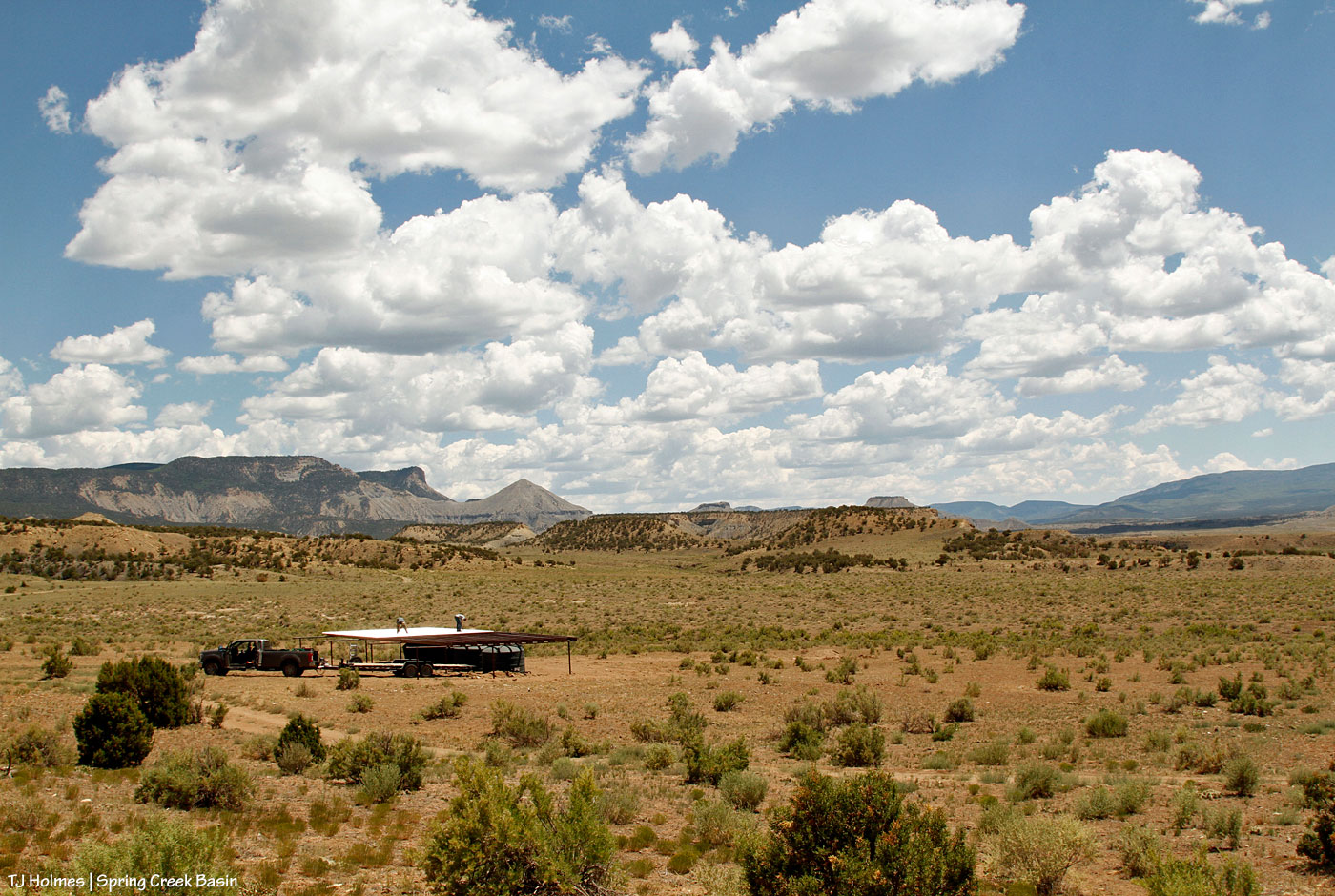
Here’s a bit wider view. This east end has all the purlins welded now (in reality-time), and the middle section (over the two middle tanks) has a few purlins welded across. This east end also now has all the propanel (metal) sheets in place and screwed down. The guys needed more purlins and maybe more propanel sheets, which they get in Durango. The Durango supplier was out (it’s that steel-is-limited thing), so they were going to get more this week and come back out. With the mercury creeping higher again, please say a prayer and give a wish for clouds for our hard-working BLM guys!
What in Spring Creek Basin have our wily and handy BLM’ers been up to lately?
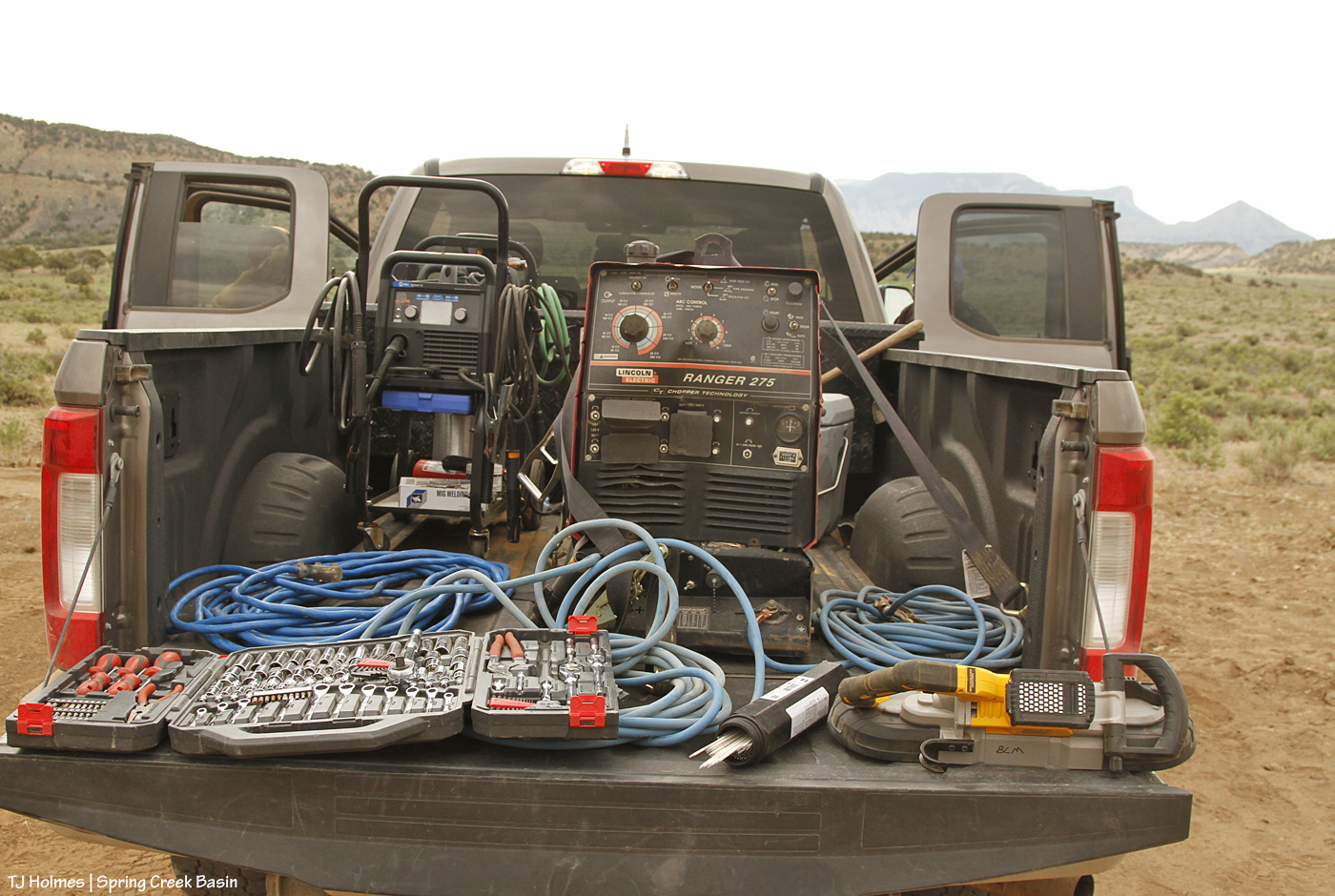
I’d been out of the valley for a little while, visiting my folks for the first time since the pandemic started (they had visited me just *before* the pandemic started), and I came back to find two of my favorite BLM guys wandering toward the basin one morning with a little tractor in tow! I had some chores to catch up on, so I didn’t meet up with them until their last day of work last week. There was a little crowding of tools and things in the bed of their pickup.
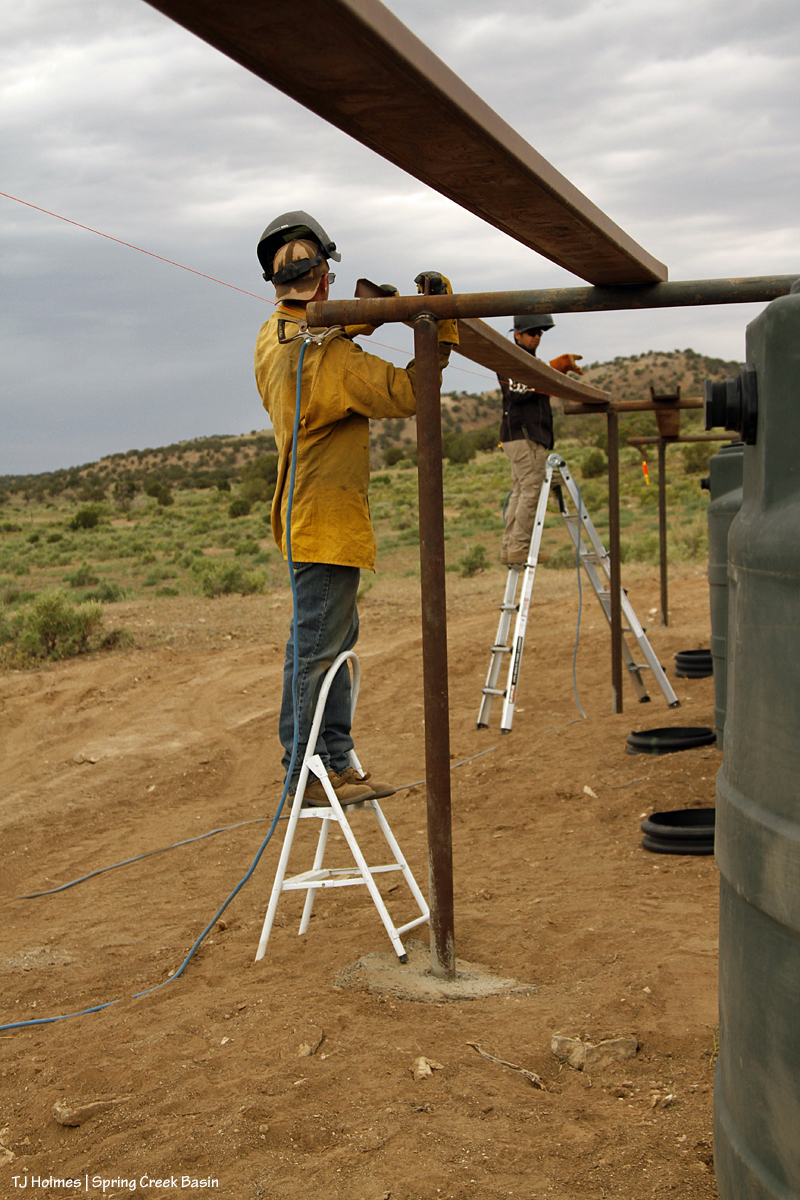
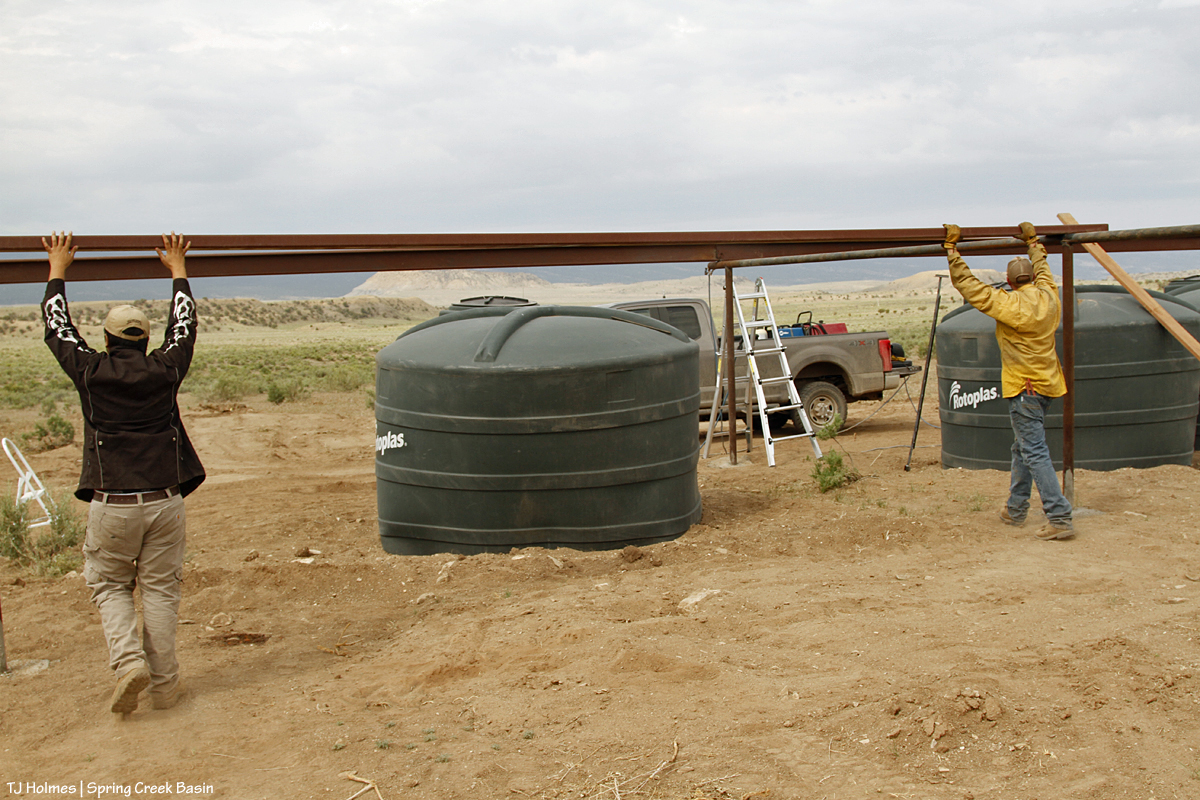
After stretching a string from one end of the roof structure to the other (new horizontal steel-pipe post pieces had appeared since I’d been there last!), Daniel Chavez (pictured) and Garth Nelson got to work welding purlins to those pipes.
They welded three purlins over the three sections of roof structure over the four tanks. As they said, that line of purlins was critical to get straight because the gutter will go under the roof under those purlins. Into that gutter will go the rainwater and melted snow … life-giving water from heaven … into pipes into the tanks into the trough for the mustangs!
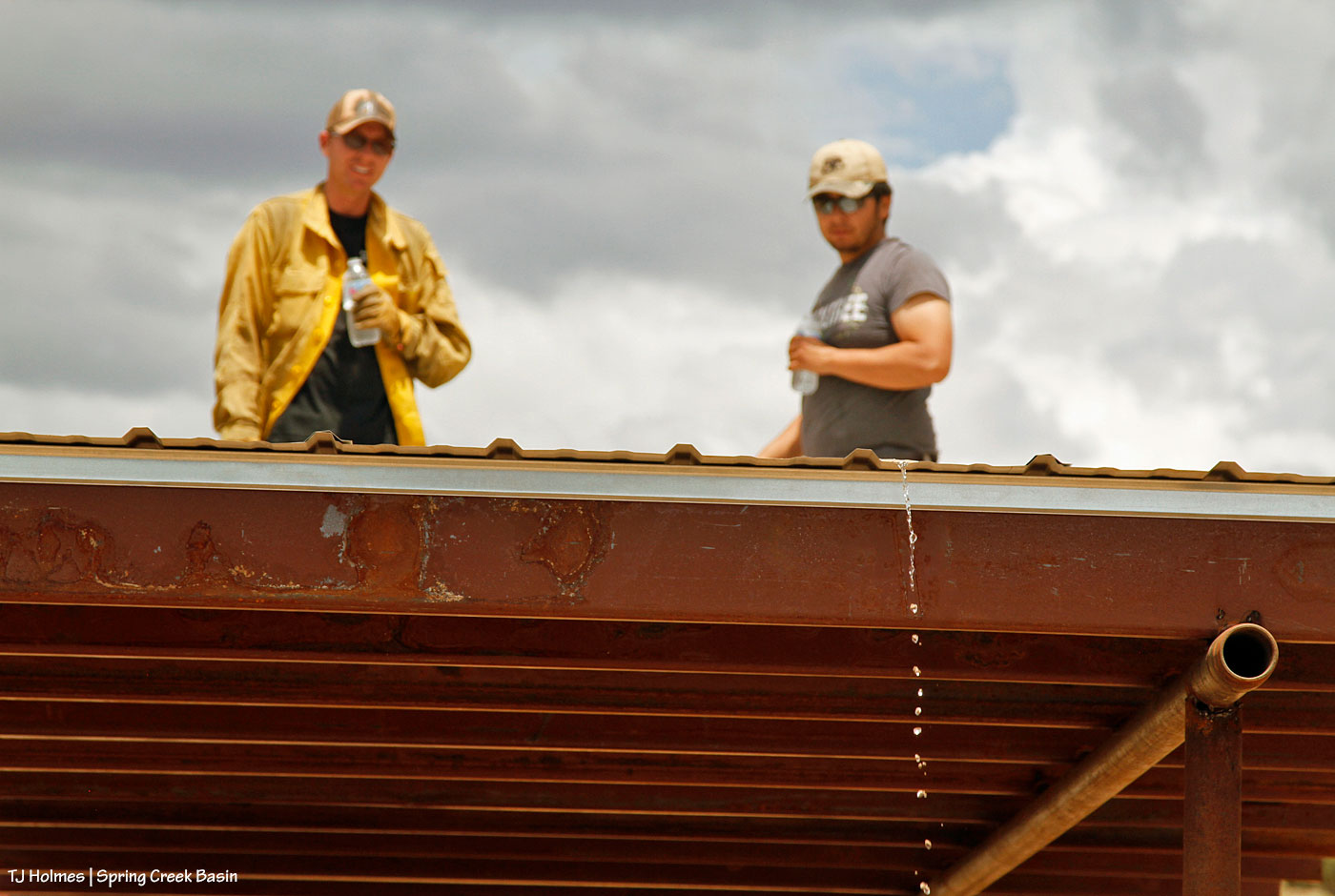
Because of my slow-Internet issues that make drafting blog posts a long-term commitment these days (!), this is a short teaser post about what they’ve been doing. I do promise at least another post to show the progression of purlin welding (because it’s fascinating and shows how handy our guys are!)! This last-for-now pic shows water dripping out of the steel pipe at one end of the roof structure after Garth poured some of his water in from the top end. When the project is all done and the roof is on, water will NOT flow through these steel-pipe posts; it’ll hit the roof and flow to the gutter and thus to the tanks. But he and Daniel illustrated that there IS a slope to the roof (though it deceivingly looks fairly flat), and you can see the now-welded-in-place purlins across this section of roof structure and Garth grinning in the background, and it’s never a bad sight to see water dripping from above in the desert. 🙂
More to come. Promise.
Another highlight of note: Did you notice the cloudy sky in some of the pix? Thankfully for Daniel and Garth, it was cloudy and relatively cool most of the day while they were in their welding jacket and Nomex (?) shirt for welding. I wore my headnet to keep the gnats at bay (they were worse some times than other times) while I helped hold purlins in place with my great and amazing strength (!) until the welds held (!). The previous two days – and the whole of the previous week! – had been HOT (like, 100-degrees hot). … And at the end of this day and the evening after the next day, we got some sprinkles from Mother Nature. Welcome relief. 🙂
This was a short day because of the concrete in the post holes. It has to set/cure before more work can be done. Our part of the world is heating up, one of the guys will be on fire detail, and another person will be on vacation, and there’s monitoring to do on a lotta range – not just Spring Creek Basin.
So without further ado, let’s continue with the last bit of work that happened in the basin a week ago.
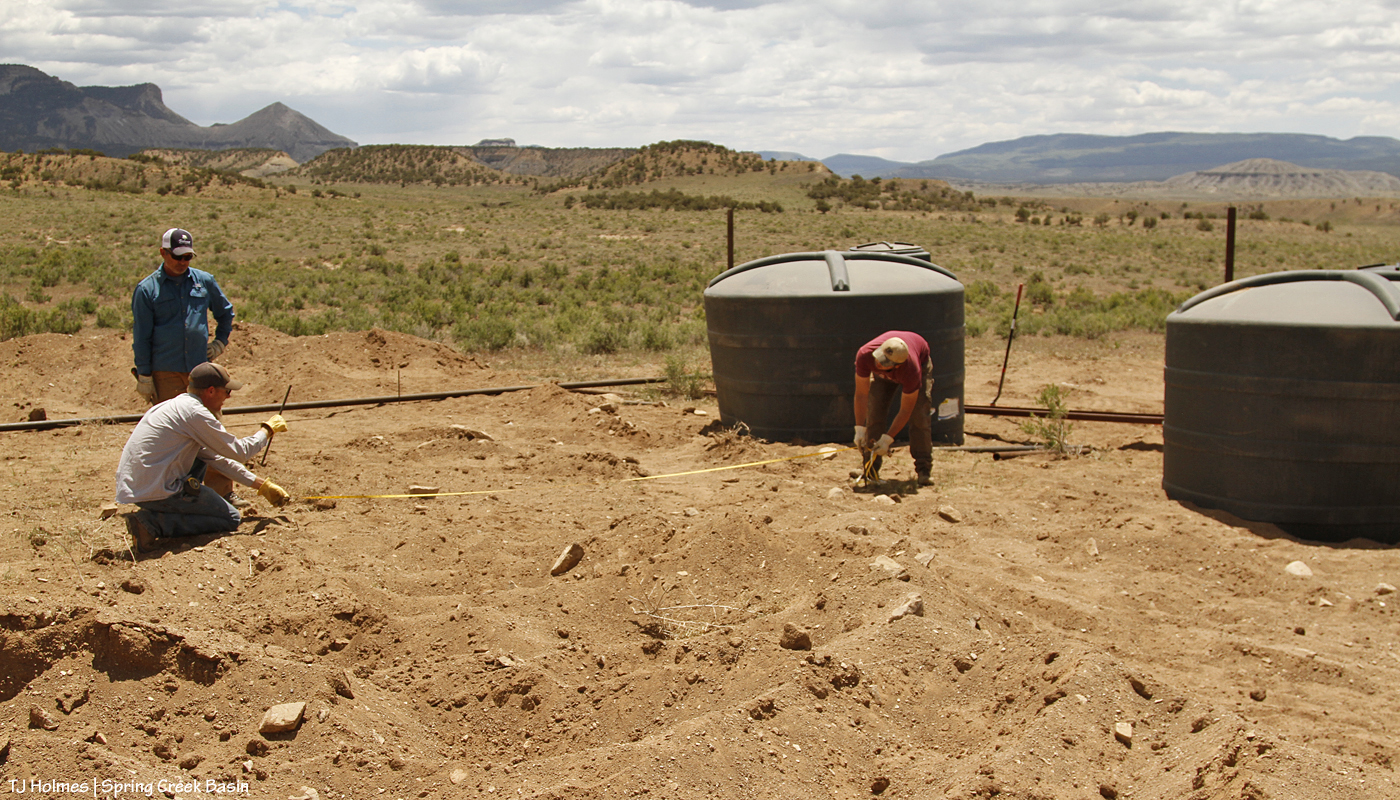
More measuring had to happen to ensure that the structure will be “square” in its rectangular layout. I can’t remember the dimensions, but there’s going to be a lot of roof space on which to catch rain and snow!
Also the inner measurements had to be taken.
Then more drilling and more cutting. …
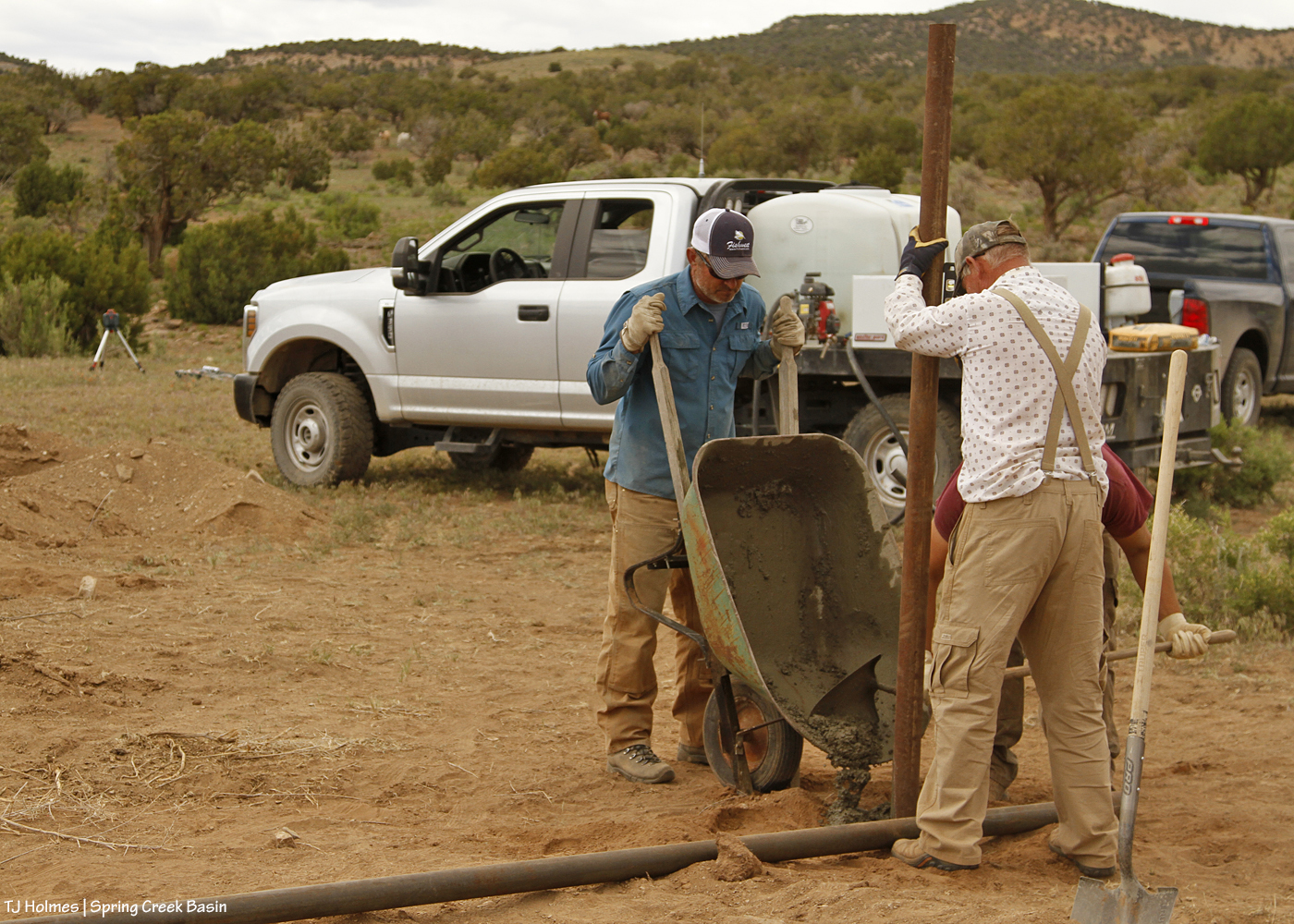
And more concrete pouring (and Jim was back from his weed spraying).
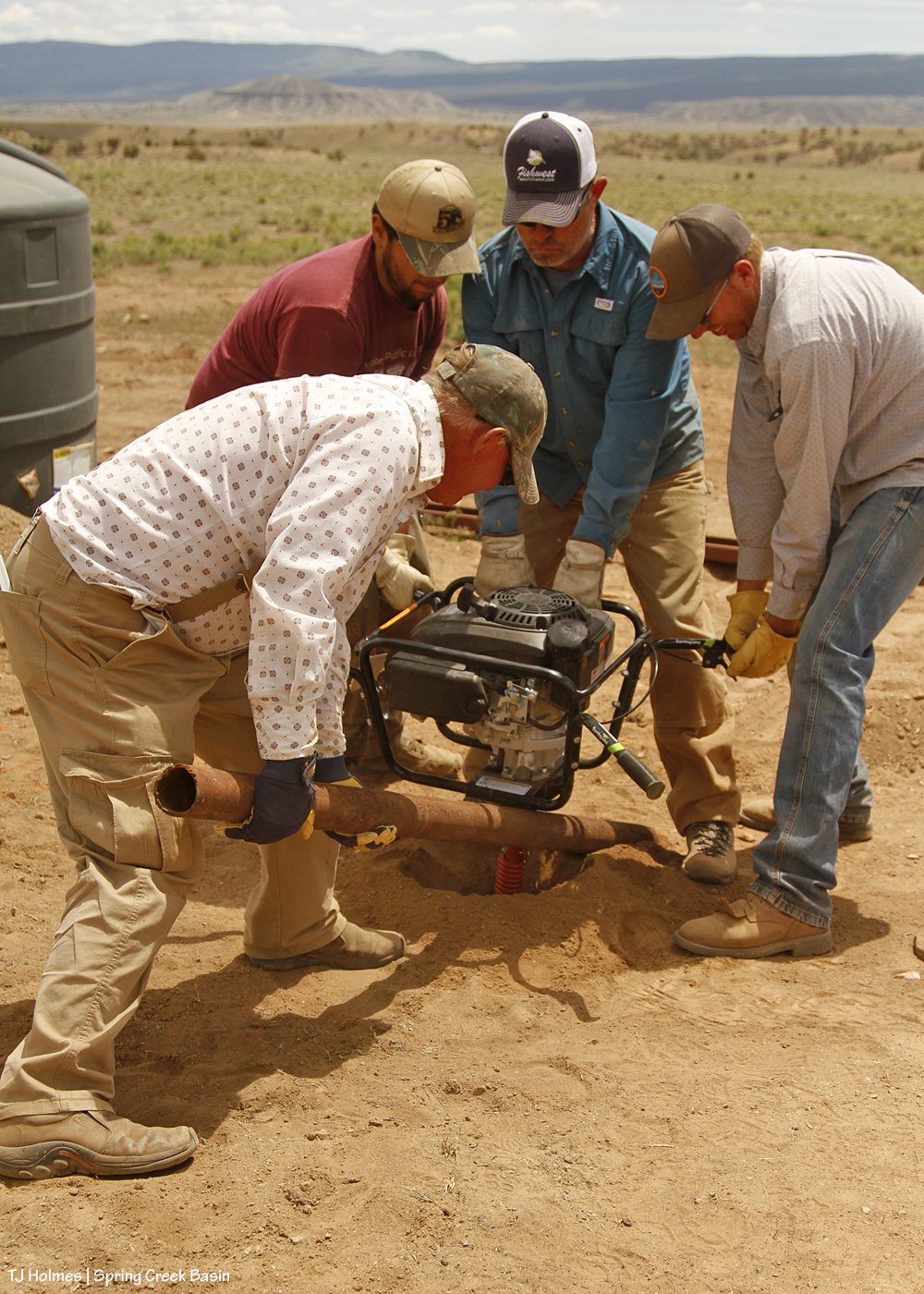
We did have a bit of excitement when the augur got stuck in the hole. They used the section of steel pipe to try to leverage it out of the hole, and even I lent my muscles to the task (now THAT would have been a pic – all five of us heaving on the augur, which was stuck fast in the hole). in the end, they had to dig it out from where it had gotten stuck on rocks.
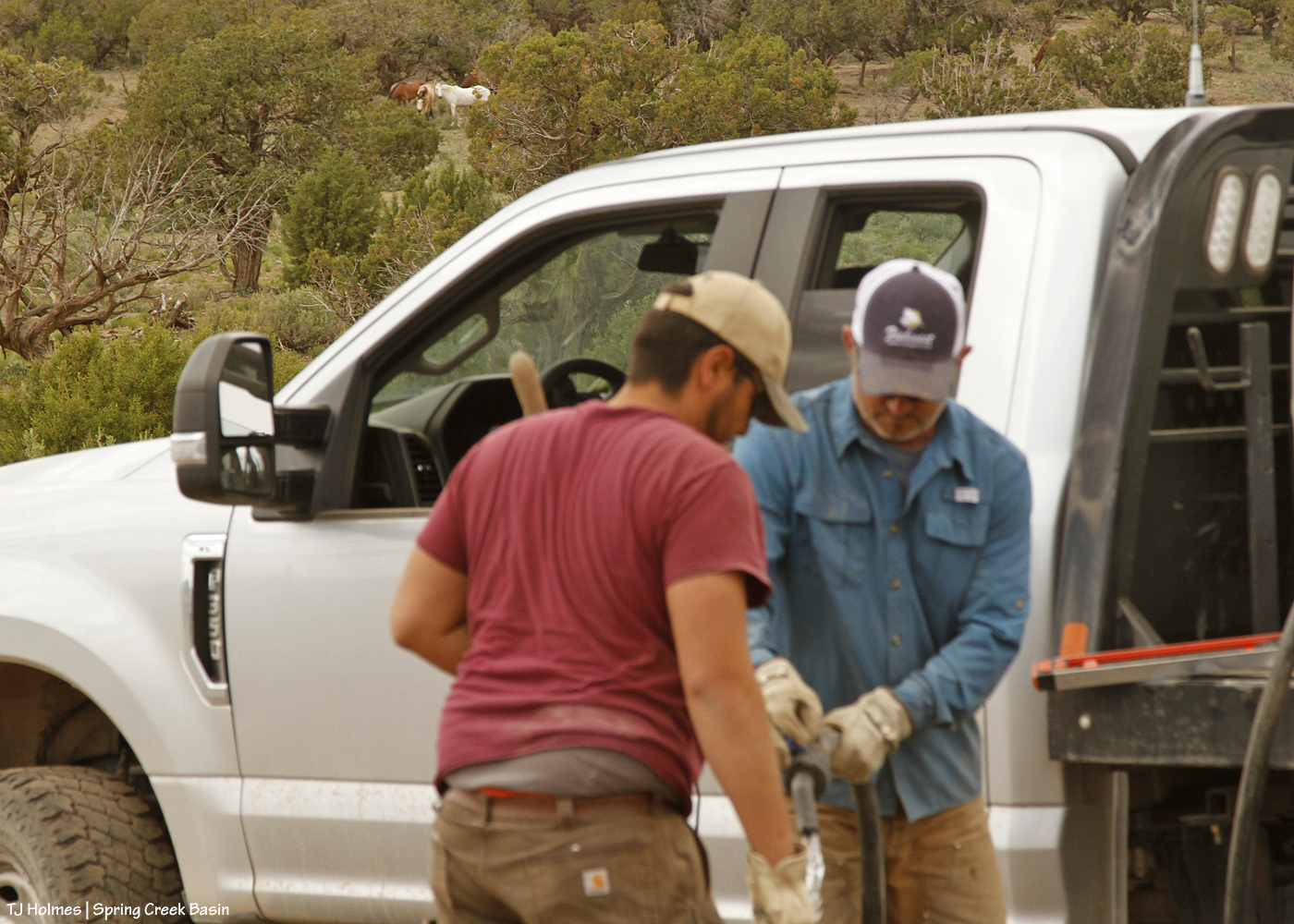
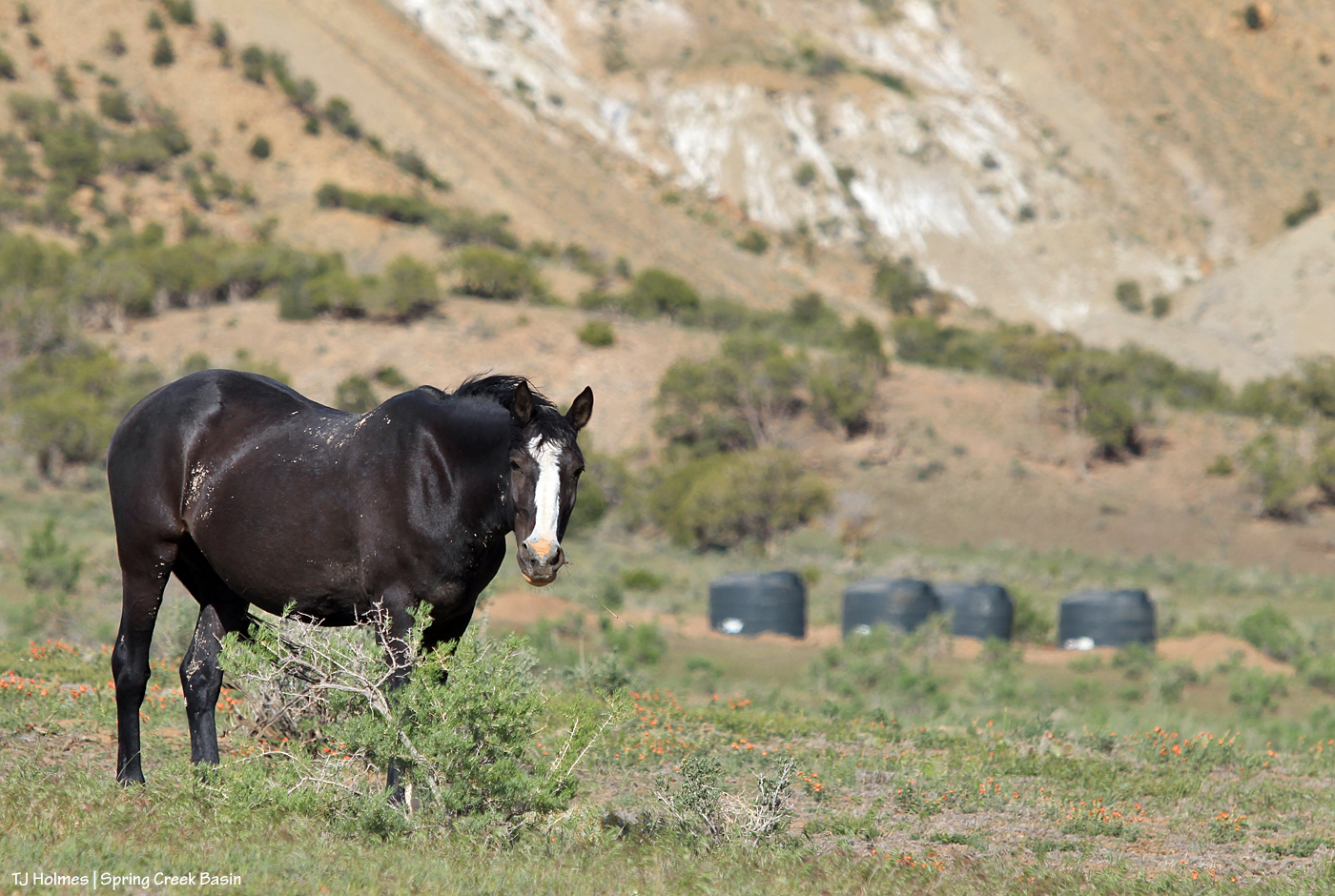
While the guys continued to set posts and pour concrete, they acquired a bit of an audience. Do you see them?
How ’bout now? 🙂
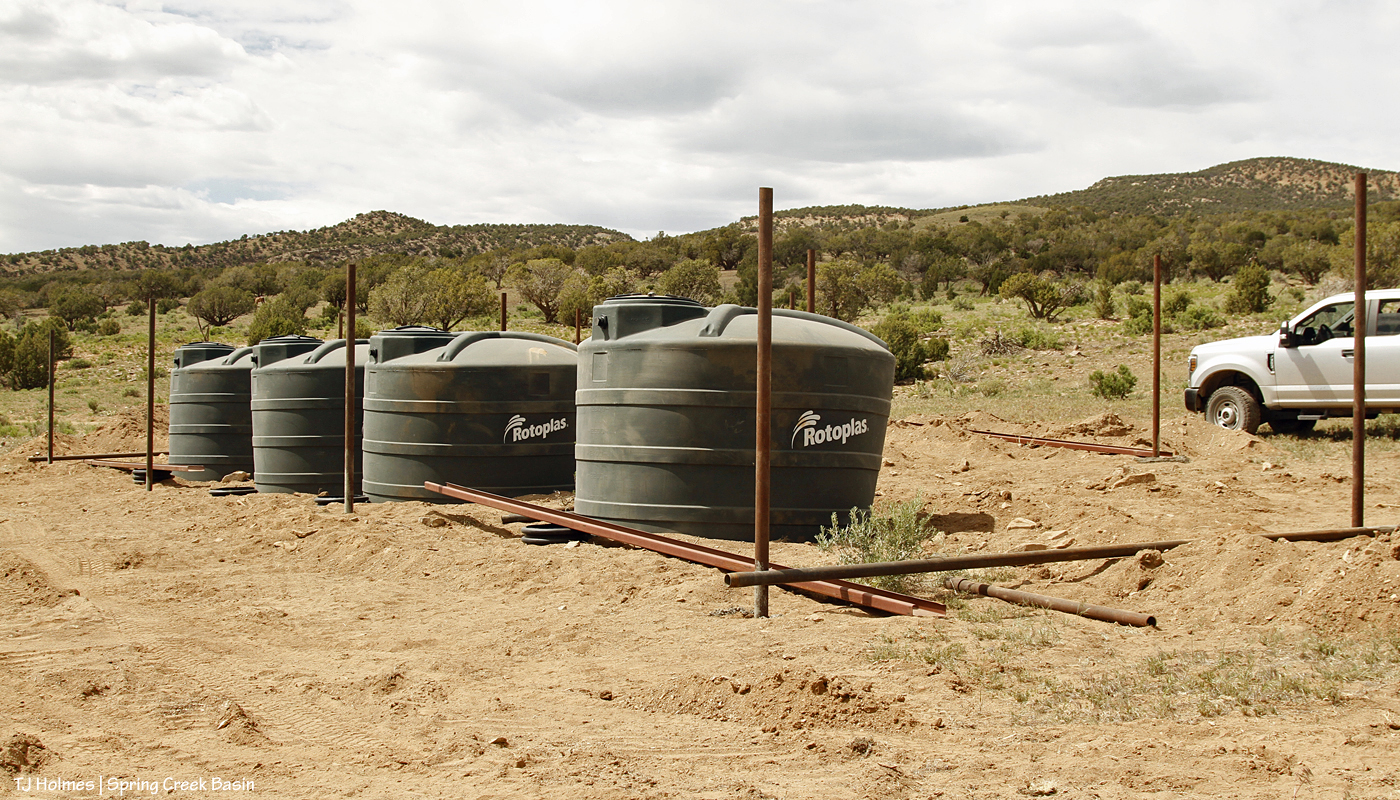
The posts are in. Next, the purlins have to be welded in place to complete the structure for the roof panels. As it happens, I’ll document it!
Our range guys were back in Spring Creek Basin last week for some more work on the water-catchment project, this time, to start on the support structure for the roof that will eventually go over the tanks to catch rain and snow (no snow for a while … we have a few 100-plus-degree days on tap!).
I took at least one billion and one half pix (if you know me, you know that’s really not a ginormous exaggeration), so while I’ll try to keep the images to a minimum, I’m also so proud of our guys and this project that I want to highlight it. That said, I’m going to stretch the post into two days.
The day started with measuring. When you’re this far out from Ace Depot Lowe’s Improvement Store (aka *civilization*), you measure LOTS and then cut confidently (if you’re our dream team; if you’re me, you rely on your dream team!). First, they set rebar stakes and ran strings and measured up and down and side to side and in between so they could start with a square-angled rectangle frame to then be able to augur holes for the steel-pipe posts.
Garth and Mike – the young guys – watch Mike dig out the hole they just drilled with the augur. The dirt is soft and dry, and the (dreaded) post-hole digger wasn’t a whole heckuva lotta help.
The first pipe is in!
Daniel has a well-known aversion to working in gloves. … But those pipes were HOT. I helped carry a few of them, WITH gloves, and my gloves were only barely a protection against the heat from that steel.
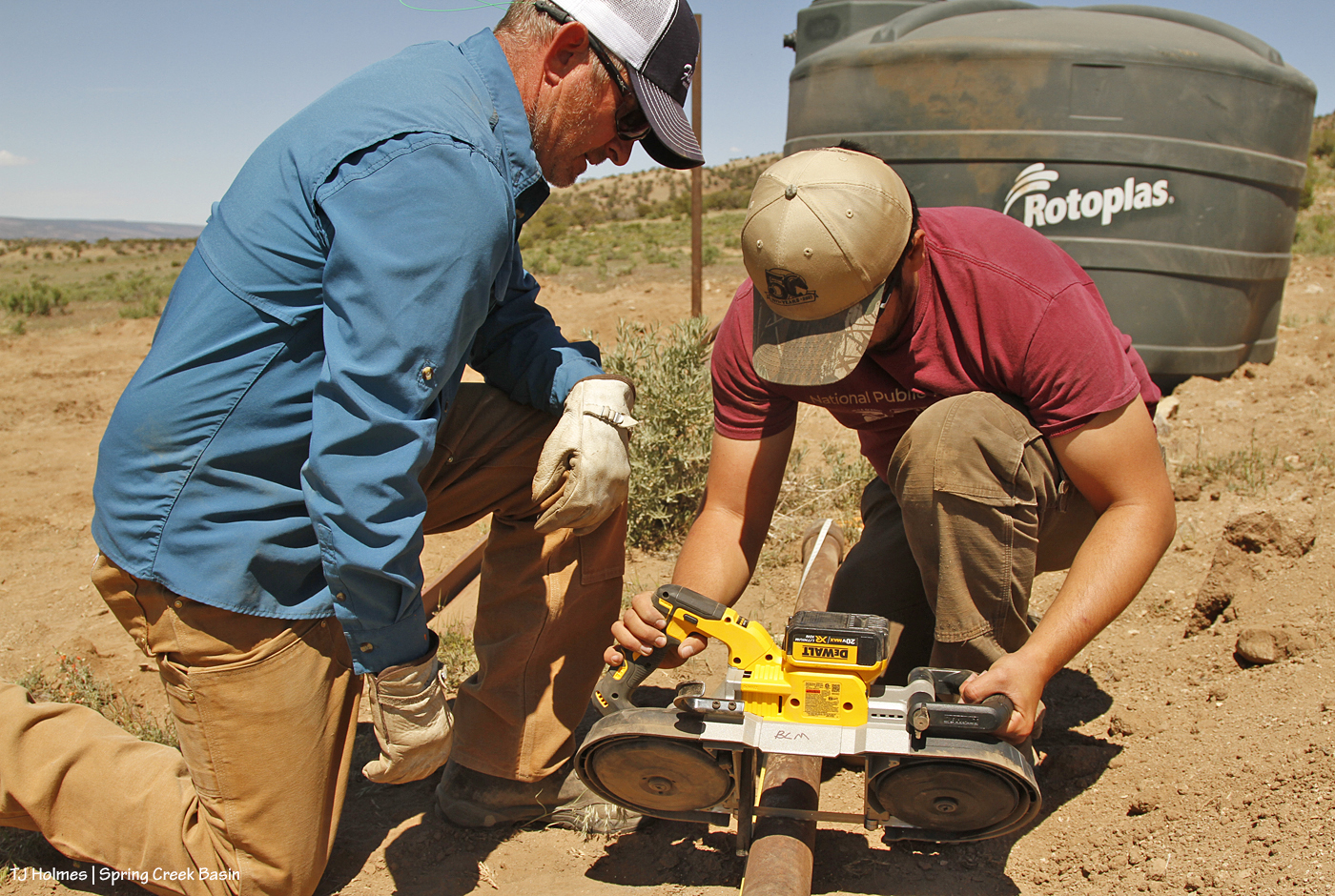
The guys were all in love with THIS particular tool – a battery-powered band saw. It cut through that steel pipe … if not like butter, pretty darn well.
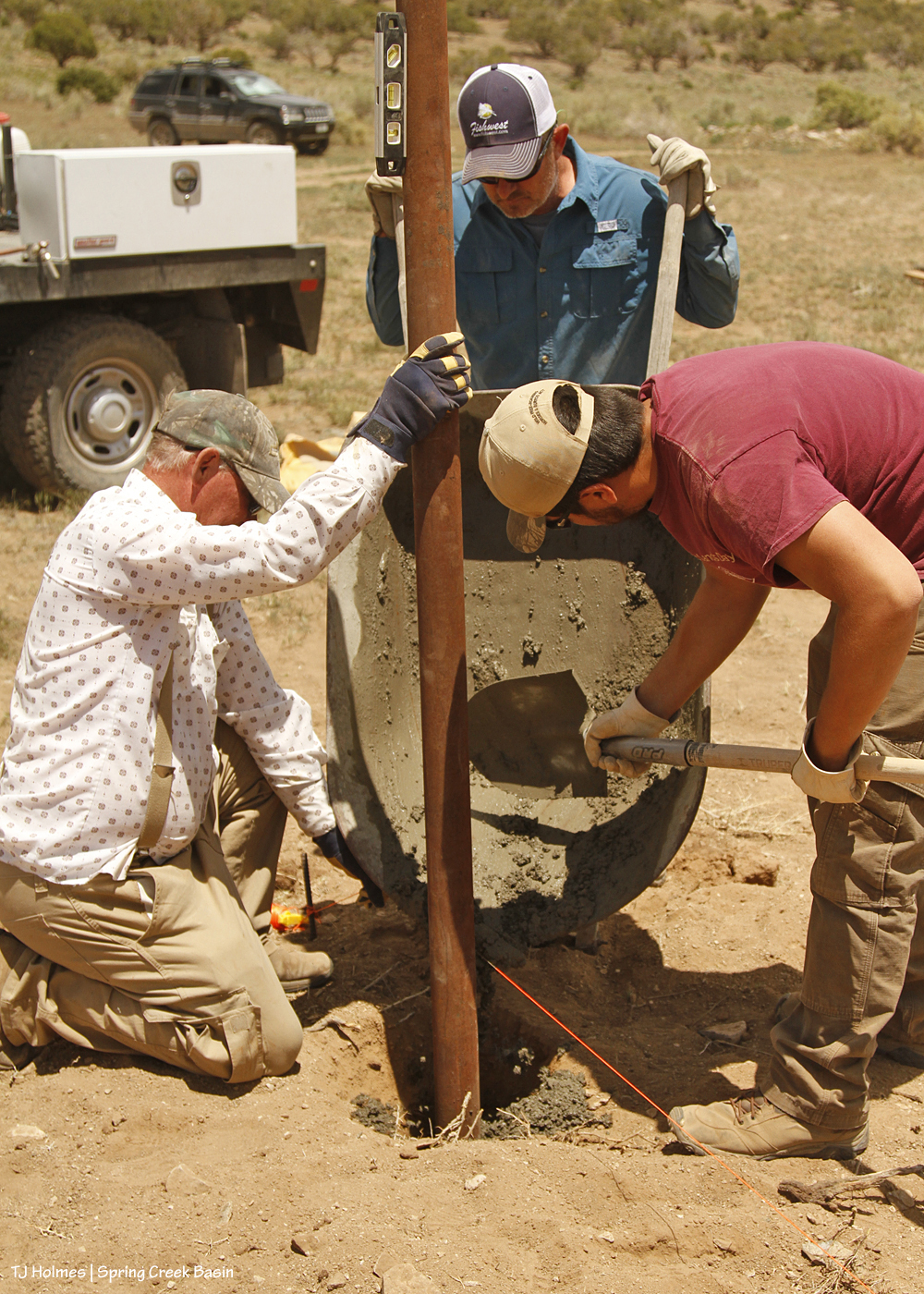
They brought a supply of water to mix with cement to make concrete to pour in the holes to hold the pipes (at least partly because the soil is so dry and soft and crumbly).
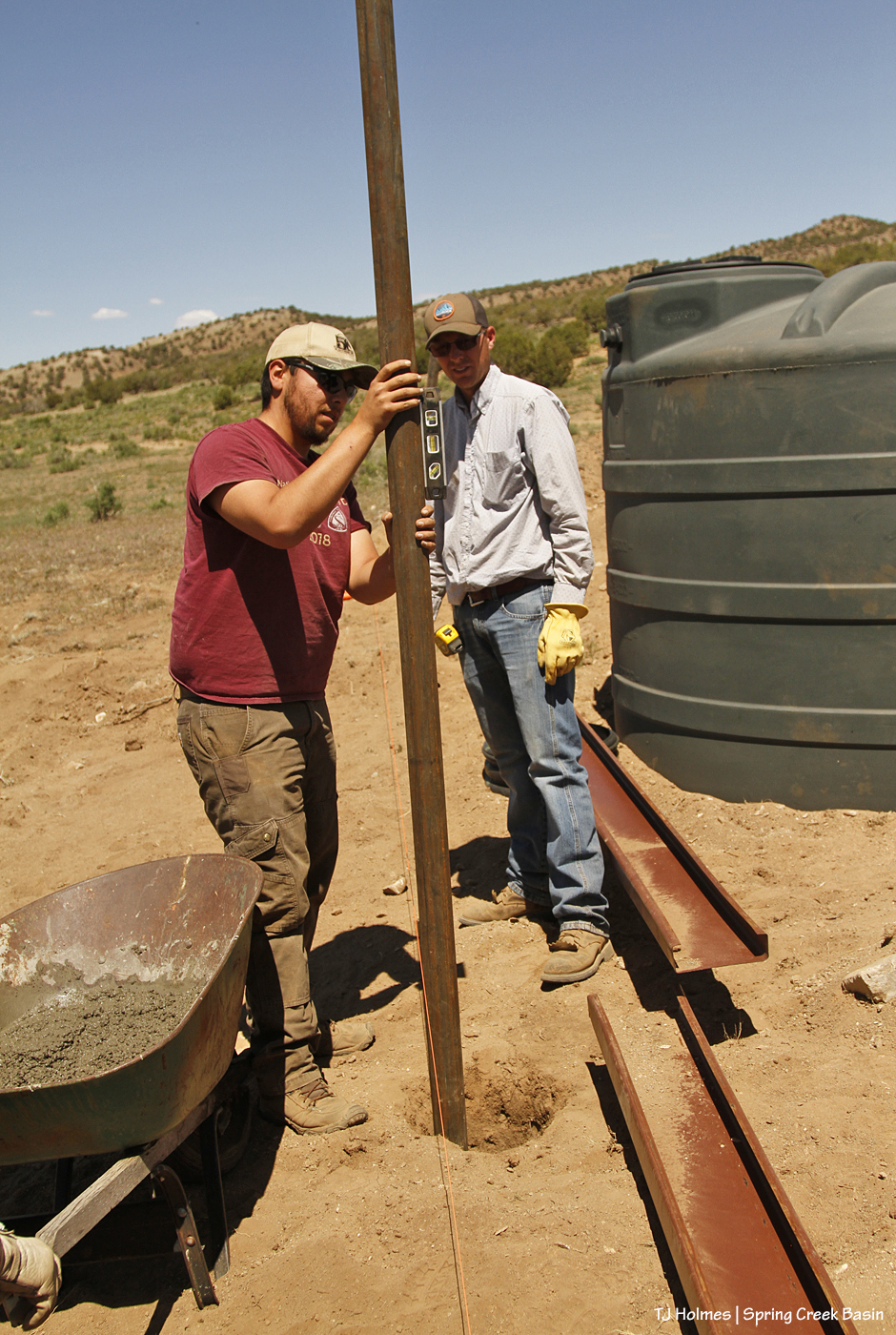
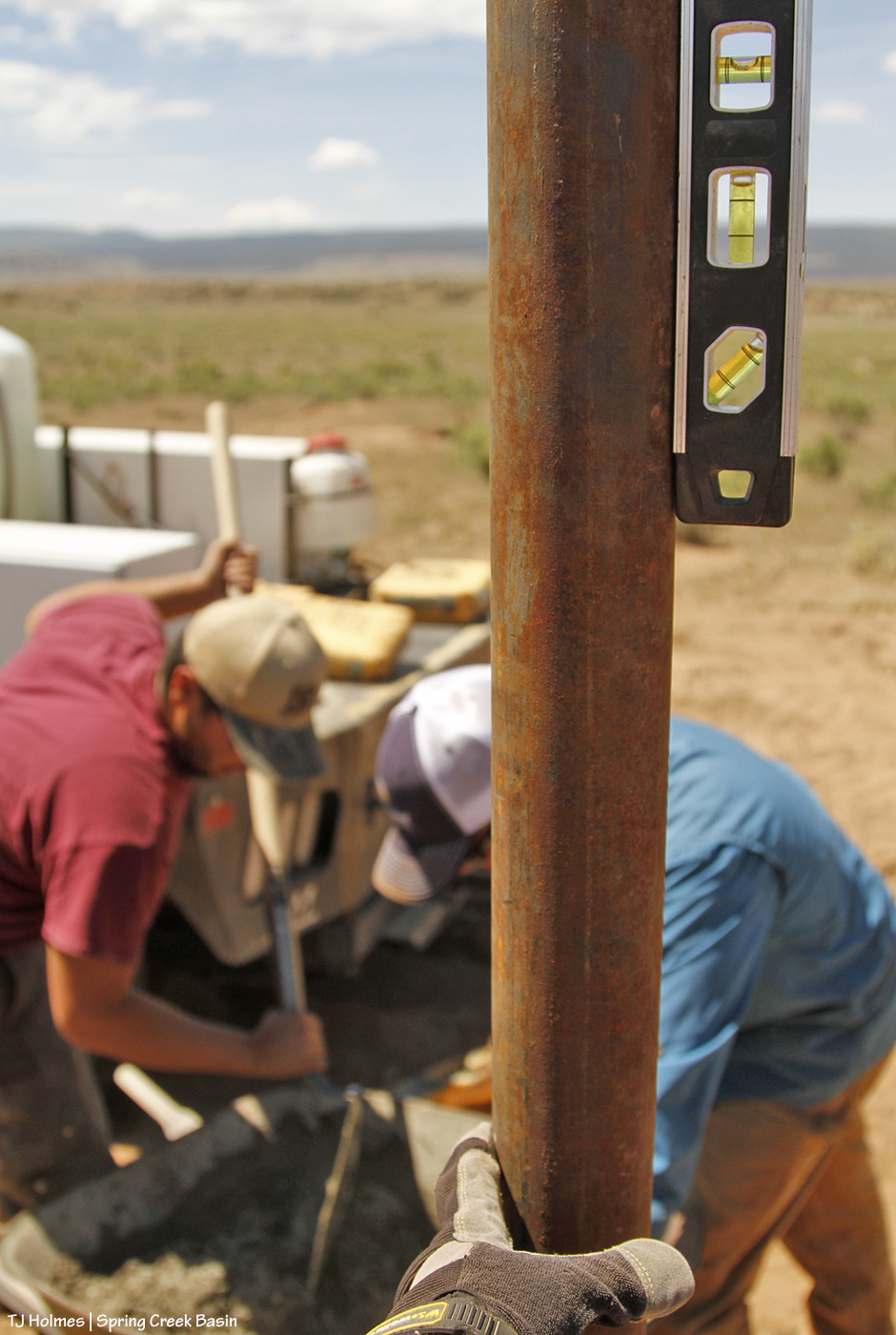
This little tool, a magnetic level, turned out to be one of the main tools of the day and was used to ensure all the pipes were straight.
Glop! They put two bags worth of concrete in each hole to hold the pipes.
Jim was in the basin, too, and he was out spraying weeds along the roads and some of the ponds, so I got to be in charge of pole leveling duty for a bit.
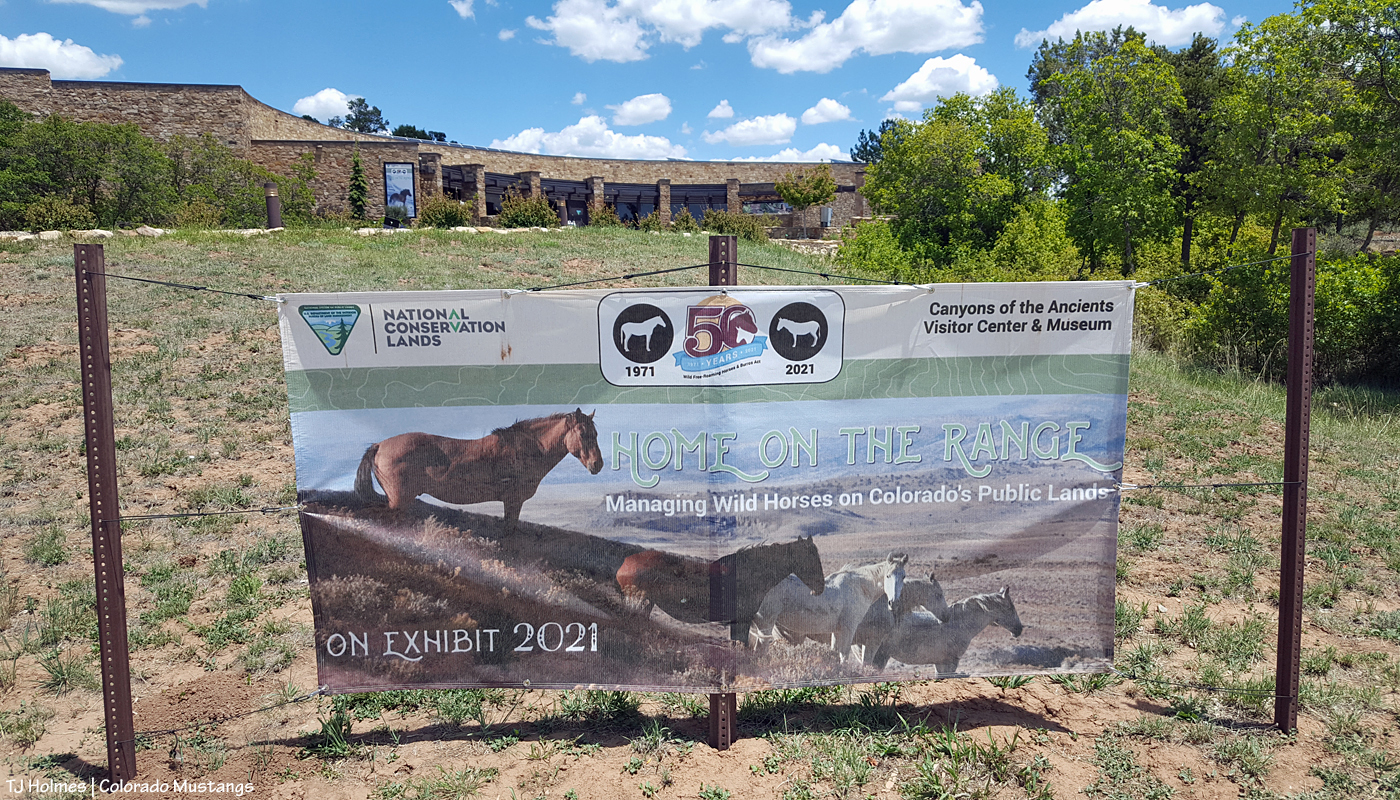
On the heels of this week’s feel-good good-news stories, here’s another one to end your week on a high: Through the end of the year, Canyons of the Ancients Visitor Center and Museum (formerly called Anasazi Heritage Center) will host “Home on the Range: Managing Wild Horses on Colorado’s Public Lands,” an exhibit to celebrate the 50th anniversary of the Wild Free-Roaming Horses and Burros Act. Images and information about Colorado’s three herd management areas (Spring Creek Basin, Sand Wash Basin and Piceance-East Douglas) and one wild horse range (Little Book Cliffs) are included in the exhibit, as well as an adopters corner, which highlights a few awesome adopters of some of Spring Creek Basin’s awesome mustangs with a poster and short video. (Thank you to Tif Rodriguez and Whisper, Keith Bean and Skipper, Alice Billings and Liberty, Steve and Teresa Irick and Breeze and Sage, and Olivia Winter Holm and Ellie!)
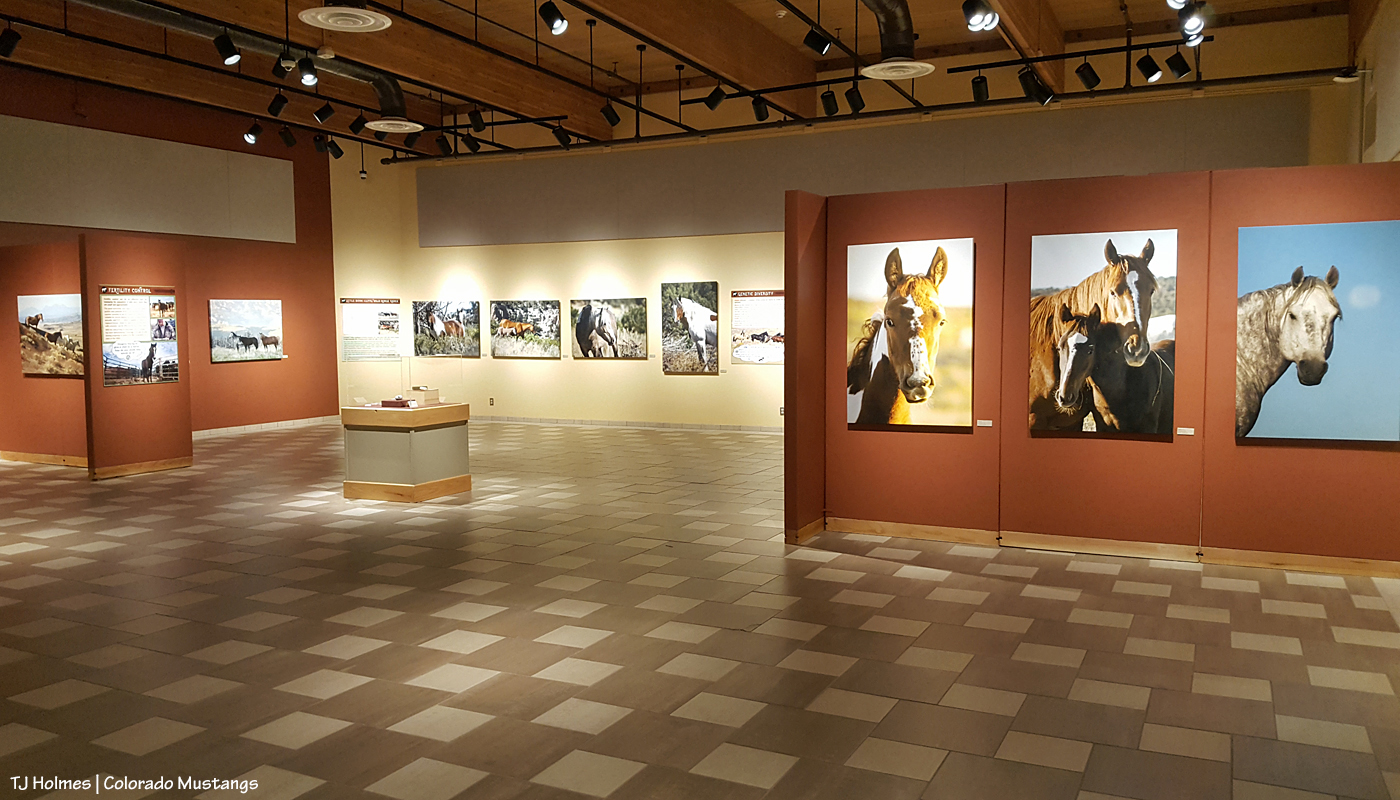
The exhibit is a collaboration between CANM (Bridget Ambler), our local Tres Rios Field Office (Mike Jensen and Connie Clementson) and Colorado BLM’s Wild Horse and Burro Program (Ben Smith and Eric Coulter). I can’t begin to describe how incredible it looks. I walked through the doors, stopped dead in my tracks and burst into happy tears! The poor CANM employee who showed me in waited ever-so-politely for me to regain my senses (it took a little while). It’s THAT beautiful!
The center/museum is located on Colorado Highway 184 above the town of Dolores and McPhee Reservoir. If you’re in Southwest Colorado this year, please stop by to view the exhibit and the rest of the museum for a glimpse of ancient life here on the Colorado Plateau!
Below is a selection of photos of the exhibit. Really, it’s best viewed in person!
If you know me, you know that I’m the biggest emotional softie when it comes to my mustangs. Therefore, it will surprise none of you to read that when I drove up the road to the parking area below the building and saw handsome Hollywood and his beautiful mares, that was the first burst-into-tears event of the visit. Notice also the vertical sign on the side of the building in the background – also Hollywood. (Really, this guy should have his own star on a walk of fame!)
This was the next – and biggest – burst-into-tears moment: when I first walked into the exhibit hall and saw all those beautiful mustang faces. At right: Sand Wash Basin mustangs. In the background: Little Book Cliffs mustangs. At farthest left: Spring Creek Basin mustangs (the pic they used on the outside banner). Piceance-East Douglas mustang fans, don’t worry; your ponies are around the Sand Wash Basin wall. And the little section out of frame to the far left is the rest of the Spring Creek Basin area.
Right around the corner from the doors into the exhibit hall, the adopters are featured. Belatedly, I realized the mistake about Steve’s and Teresa’s mustangs: They’re both geldings. But I love the photos and quotes from everyone! These people all recognize the beauty and value of America’s mustangs (particularly our Spring Creek Basin mustangs), and I’m so glad BLM wanted to highlight their horses and parts of their stories. (The mustangs were adopted in 2005, 2007 and 2011.)
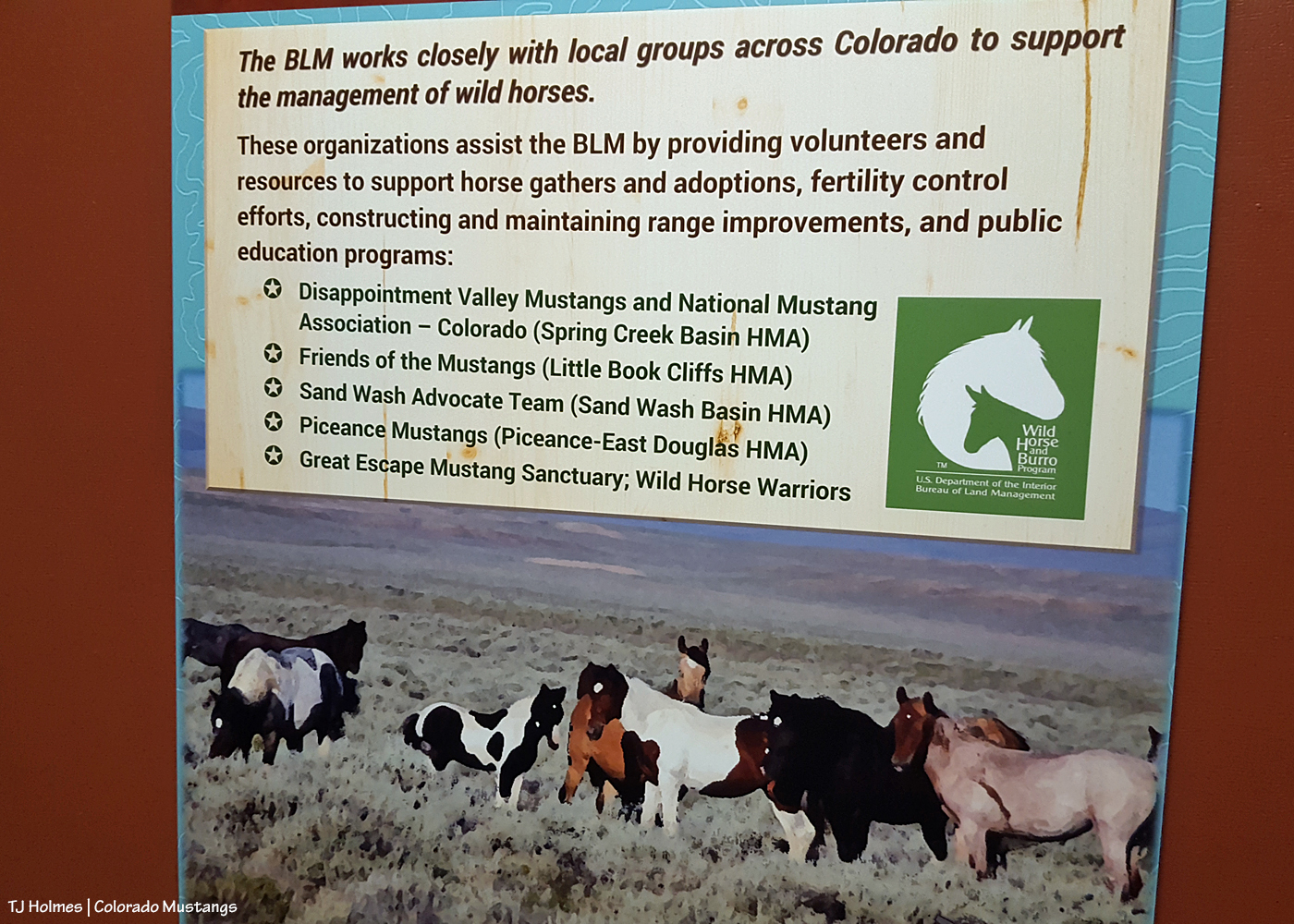
The exhibit also pays tribute to Colorado’s mustang advocacy groups – at least one for each herd in the state! Our mustangs are blessed to have people involved in every aspect of their observation and management (of course, we advocates know that WE are the blessed ones!).
No exhibit of mustang management in Colorado would be complete without a display of some of the tools of our fertility-control trade (on the wall across from this is an info-graphic panel about fertility control). We use CO2-powered darting rifles in Sand Wash Basin and in Spring Creek Basin, and they use .22-type rifles to dart in Little Book Cliffs. At upper left is a teeny branding tool for foals. Hopefully coming soon is a darting program in Piceance-East Douglas; all the pieces are being put in place.
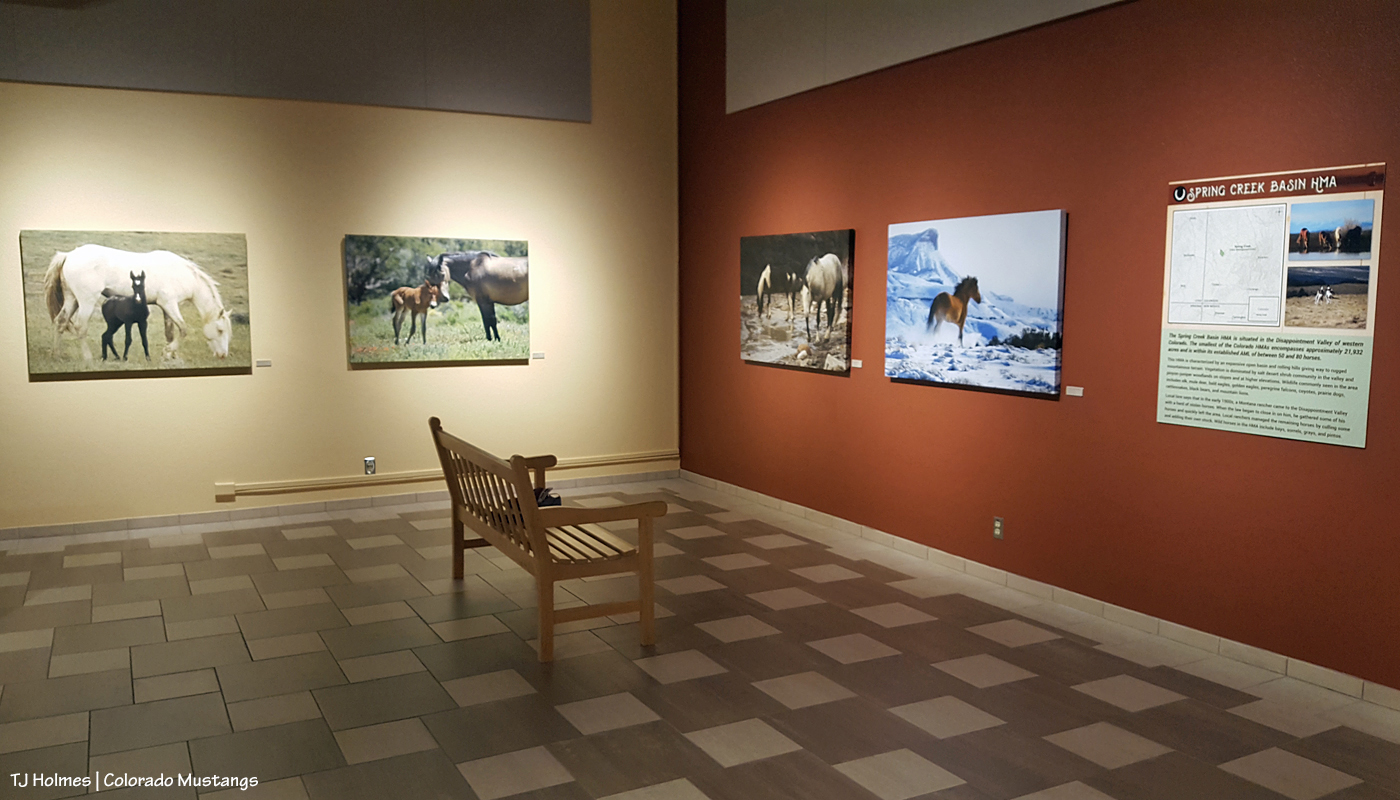
Let’s see some pix of the pix (they are beautifully printed on canvas; each of them will go to the respective offices (Tres Rios, Grand Junction, White River and Little Snake) when the exhibit closes at the end of the year):
One of the walls of Piceance-East Douglas beauties.
A cozy corner of Little Book Cliffs mustangs with some of the astounding scenery shown. Part of Little Book Cliffs also is a wilderness study area (like McKenna Peak in Spring Creek Basin).
Some lovelies of Sand Wash Basin.
And of course, my most-beloved Spring Creek Basin wildies.
Deep, heartfelt gratitude to Bridget and Mike and everyone who conceived of and then brought this exhibit to reality. It didn’t open in January as planned because, you know, Covid, but it’s been open since mid-April and will be open the rest of the year (check the link at top of the page for visitor center/museum hours). (As of this writing, they’re following safety protocols with limited capacity in the building and social distancing.)
If you’re coming to or through Southwest Colorado in 2021, please, please, pretty-pretty please make a stop at Canyons of the Ancients Visitor Center and Museum and take time to walk through, and/or sit, and very most definitely enjoy this exhibit of some of the mustangs that call Colorado home. We are SO proud of our mustangs!






























 Spring Creek Basin Mustangs