
He’s Master Hayden.
**********
And in case you missed it, here’s the link to my previous blog post about “Revising our HMAP.”
He’s Master Hayden.
**********
And in case you missed it, here’s the link to my previous blog post about “Revising our HMAP.”

Same basic, iconic view … different day, different grey!
**********
As most regular readers of this humble blog know, we have worked closely and for many years with BLM managers of Spring Creek Basin Herd Management Area. Our partnership is one to be envied; we have great respect for our BLM folks – especially herd manager Mike Jensen – and the health of our mustangs and the range they call home is directly because of that partnership.
We have accomplished almost everything on our big-goal to-do list for Spring Creek Basin’s mustangs, including the commitment to using bait-trapping if/when we need to remove horses in the future and our successful fertility-control program using native PZP. How successful is it? We’re celebrating our NINTH year of NO roundups and removals in Spring Creek Basin. I’d say that qualifies. 🙂
All of the things we have done and are doing – and the fact that our current one is 26 years old – means we’ve come to another big goal: updating Spring Creek Basin’s herd management area plan. Mike Jensen has been working on that for a while now, and a LOT goes into it.
So to *start* the process (see above where I note that a LOT goes into it, including time in the field doing vegetation monitoring over the last few years, archaeological-site assessments, ongoing data collection about our PZP program, etc.), we come to the scoping process for updating the herd management area plan, otherwise known as the HMAP.
Here, you will find that scoping letter on BLM’s eplanning website.
At the left side of the page, click the “Documents” link. On the next page, under “Document Name,” click the link for “Spring Creek Basin HMA Interested Parties Letter.”
At the first link, read the information (the other two links will take you directly to the page to access the document link and the comment link, and the letter itself):
“The BLM is preparing an Environmental Assessment (EA) pursuant to the National Environmental Policy Act of 1969, as amended (NEPA) to analyze the proposed action and alternatives to that action.
“What: Name/Type of Proposed Project: Spring Creek Basin Herd Management Area Plan (HMAP) Revision.
“Where: General and Legal: This Spring Creek Basin Herd Management Area (HMA) is located within the Spring Creek Basin portion of Disappointment Valley in Southwest Colorado. The HMA is approximately 21,932 acres is size and lies within both Dolores and San Miguel Counties.
“Disturbance: Estimated Disturbance (acres/area) Description: The HMAP Revision will include the proposal for constructing two water catchment structures which will result in approximately 1.0 acres of total of ground disturbance.
“When: Expected Implementation and Duration: The Herd Management Area Plan would be implemented immediately following the issuance of the Final Decision.”
**********
On to the letter.
What it’s TELLING you is that Tres Rios Field Office (where Mike is employed as a rangeland management specialist and Spring Creek Basin’s herd manager) is “seeking input on a proposal to revise the 1994 Spring Creek Basin Herd Management Area Plan (I just realized, on typing that, that they swapped a couple of words) for the Spring Creek Basin Wild Horse Herd Management Area in Dolores and San Miguel Counties, Colorado. …”
In addition to advising interested parties about potential disturbance of about an acre of land total for the construction of two (more) water-catchment structures, this is the stated “purpose and need” of the HMAP revision:
“The BLM is proposing to revise the 1994 Spring Creek Basin HMAP. Herd Area Management Plans (again, word swap!) identify specific management actions, goals, objectives and monitoring for managing wild horses and /or burro herds and their habitat. Therefore, the proposed HMAP revision will identify goals, objectives and monitoring to address 1) existing appropriate management level (AML) of wild horses; 2) rangeland health conditions; 3) population control measures; 4) removal criteria and gather techniques; 5) genetics; 6) population dynamics; 7) range improvements; and 8) sustaining healthy populations of wild horses.”
What it’s ASKING is for the public to offer comments about those issues along the lines of answering these basic questions:
Do you agree with those topics/issues BLM has identified?
Are there additional topics/issues you might like to see identified/addressed in the revised HMAP?
The comment deadline is Feb. 19, and as you’ll see in the letter, there are a variety of ways of delivering those comments: There’s a “Comment on Document” button on one of the pages linked above; send an email to Mike (address in the letter); send your comments via USPS mail to the office (address in the letter).
**********
Now some suggestions.
First of all, do we want Spring Creek Basin’s HMAP revised and updated? Yes, please! 🙂
Do we want a couple of new water-catchment structures? Yes, please!
So let’s look at each of the topics from the letter.
Regarding the disturbance expected for approximately 1 acre for the proposed construction of two water guzzlers/catchment structures: Herd manager Mike Jensen explored two potential sites with an archaeologist from Tres Rios Field Office and found no cultural resources at either site, leading to acknowledgement of both sites as good for guzzler placements. In addition to providing two additional sources of clean water for the mustangs, siting the guzzlers in those locations will help with the dispersal of the horses to currently under-used grazing areas within Spring Creek Basin.
**********

If you made it this far, you deserve another pic of our beauties. 🙂
Thank you for reading this far!
To reiterate a very important fact: We work very closely with Mike Jensen and our Tres Rios BLM folks for the good management of our Spring Creek Basin mustangs, and have for a very long time.
Much of that work is the fun stuff: In-the-field, boots-on-the-dry/dusty/muddy/snowy-ground, mustangs-near-and-far, under-blue-sky-in-the-great-wide-open awesomeness. Some of that work involves paper (and computer) work.
We thank you for following along with our Spring Creek Basin mustangs and for your support during these many years. If you’d take a few moments to send comments to Mike about this scoping letter, we’d sure appreciate it! If you’ve visited Spring Creek Basin and the mustangs, say so. If you know the horses and our advocacy work through this blog or elsewhere, say so. Say that these mustangs are important to you, and please say how much you appreciate BLM’s partnership with advocates on behalf of Spring Creek Basin’s mustangs.
Thank you all in advance for helping us achieve our goals for our beloved mustangs. We know how much you love them, too!
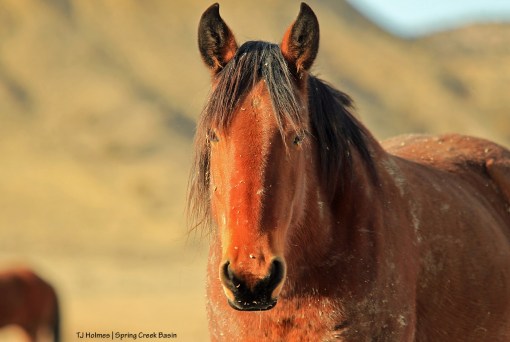

The fog wasn’t nearly as heavy or as long-lasting this time as it was last time.
Also like last time, I couldn’t find a single cooperative pony to photograph!
**********
In other news:
The Bureau of Land Management seeks public comment on wild horse fertility control study.
Article about it in the Las Vegas Sun.
I’m not really sure what to think about this, let alone what to say about it. While BLM continues to search for and research various ways to limit or stop reproduction in wild horses and burros, the fact remains that PZP is a tried and true vaccine (with more than 30 years of research and use) to limit reproduction in horses and burros. PZP works where it’s used. When it’s used, PZP works. Why not use it? Why keep complaining that there’s nothing to do but round up and remove? Why wait to use what exists and works??
Yes, please: Continue to research other, *humane* ways of reducing fertility in wild horses and burros, ways that work longer and are “easier” to deploy (than native PZP).
But in the meantime, PZP WORKS. USE IT.
A very good, very effective tool exists. When it’s used, it works. When it’s not used, it’s difficult to listen to the complaints about the consequences of its lack of use.
I would love to offer support to another tool in the goal to reduce reproduction – in turn reducing the need for roundups and removals – and I really hope PZP would get the support and use our wild horses and burros deserve.
Disclaimer: We have used PZP in Spring Creek Basin since the roundup in 2011. We haven’t had a roundup since 2011, and no roundups are planned. Reason? PZP, plain and simple.
From BLM’s release at the link above:
A 15-day public comment period on the preliminary environmental assessment is set for December 5 – 19, 2019. The public is encouraged to review DOI-BLM-NV-0000-2020-001-EA (Oocyte Growth Factor Vaccine Study), located at: https://go.usa.gov/xpEvc and provide comments or concerns, prior to 4:30 p.m. (PST) on December 19, 2019. Comments and concerns may be emailed to blm_nv_nvso_research@blm.gov or sent in writing to the BLM Nevada State Office, Attention: Ruth Thompson, Wild Horse and Burro Project Coordinator, 1340 Financial Boulevard, Reno, NV 89502.
If you’re moved to comment, I would encourage readers to offer respectful comments that support continued research of humane fertility-control options. I also would encourage readers to point to the long-known success of PZP and encourage BLM to make use of it.

This was the second of the three bands I saw in Piceance-East Douglas. They were quite a bit more wary than the first band, so I didn’t get to spend much time with them.
Notice the haze in the background; a prescribed burn was going on nearby. It was not close enough to be a danger to the herd, and the area received rain the night before, which served to cool temperatures for the first time in a long time.
It was a beautiful day on the range. Although I didn’t see many horses (the third band was far away across a road, arroyo and sagebrush-and-rabbitbrush sea), this is such a beautiful area that the looking made it all worthwhile. 🙂 And the horses just happen to be as gorgeous as any mustangs I’ve ever seen!
(The yellow-flowering vegetation behind the horses is rabbitbrush, also called chamisa. The rabbitbrush in Piceance was ahead of ours here in Disappointment Valley.)

This handsome guy is – in fact – Guy, band stallion in Piceance-East Douglas Herd Management Area near Meeker. My friend Pam Nickoles gave me the ID after confirming with her friend Dona Hilkey.
Isn’t he a beefcake? I couldn’t get over how stout and SHINY these horses all were.
The horses pictured are just part of his band; he had another mare and foal pair, and another single mare. Gorgeous family!

One last look from the littlest members of the band. 🙂
What an absolute gift to spend time with these mustangs near the top of Green Mountain in Wyoming! Many, many thanks again to Lynn for map, directions and info. Thank you, thank you for sharing these amazing, wild Wyoming mustangs!

Finally, it was nap time for the whole band, but instead of lying down, they congregated under this gorgeous pine tree on the far edge of the meadow from where they’d been when I first saw them. … Oddly enough, the presence of my Jeep, parked nearby (I was not aware that this was their favorite tree in the whole meadow!), didn’t deter them.

This was my cue to take my leave of these gorgeous wild lovelies in their stunning mountain home.
Almost. 🙂

Sweet babies know they’re safe with Daddy patrolling their nap zone.

And not too much later, Daddy himself laid down for a roll and a quick shut-eye. 🙂

THIS gorgeous girl was like the prettiest little wild Welsh pony mare on the planet. Isn’t she lovely?
P.S. I’m still on sitting on the same rock … 🙂

Big daddy was OK with me being the subject of his band’s curiosity … but he kept an eye on me, all the same. 🙂
His resemblance to our Comanche was really striking.

