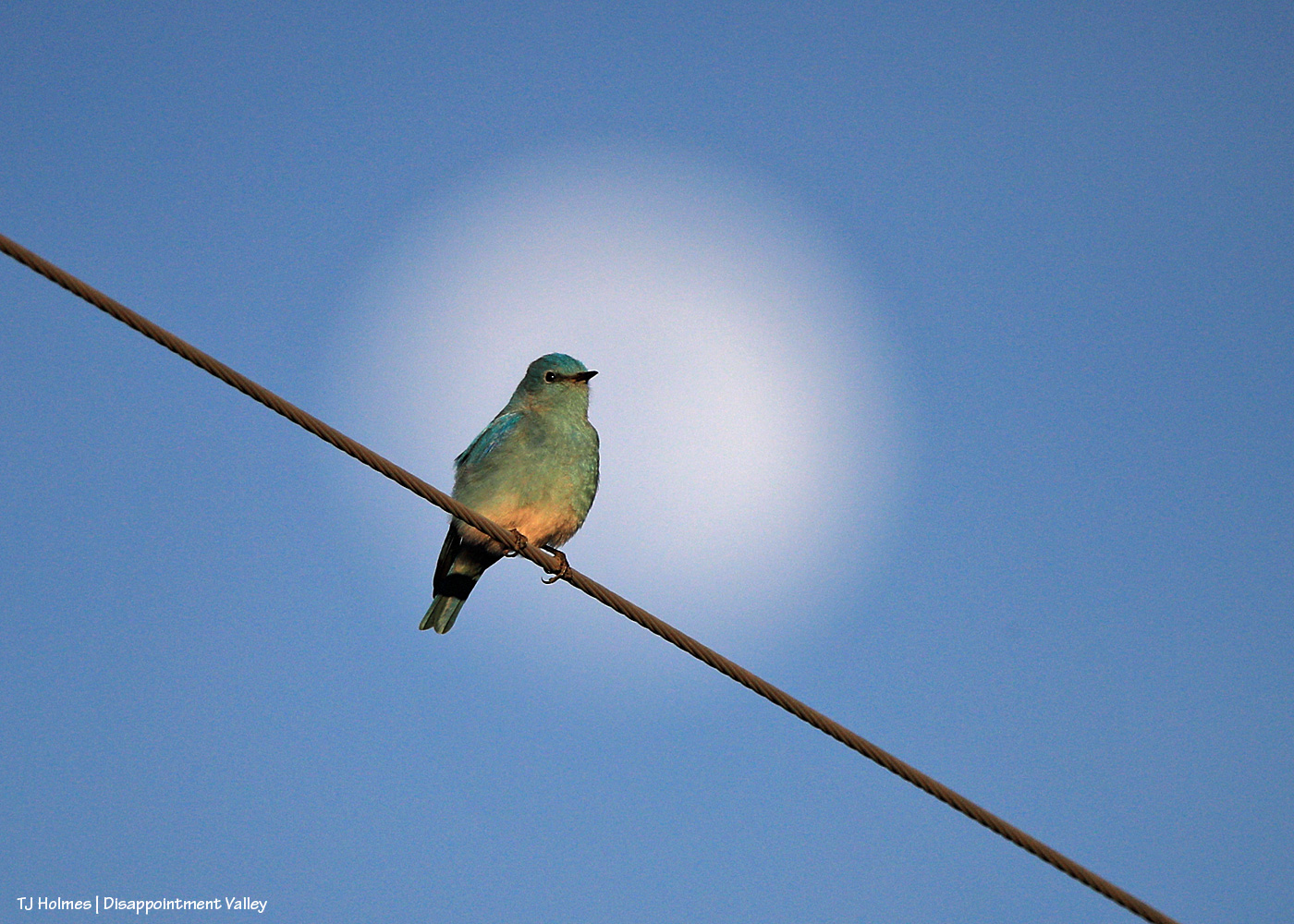
Merlin (the app) tells me this is, in fact, a mountain bluebird. I know it looks green. Pretty sure it’s not the camera/lens/white balance/color cast because it looked green in person!
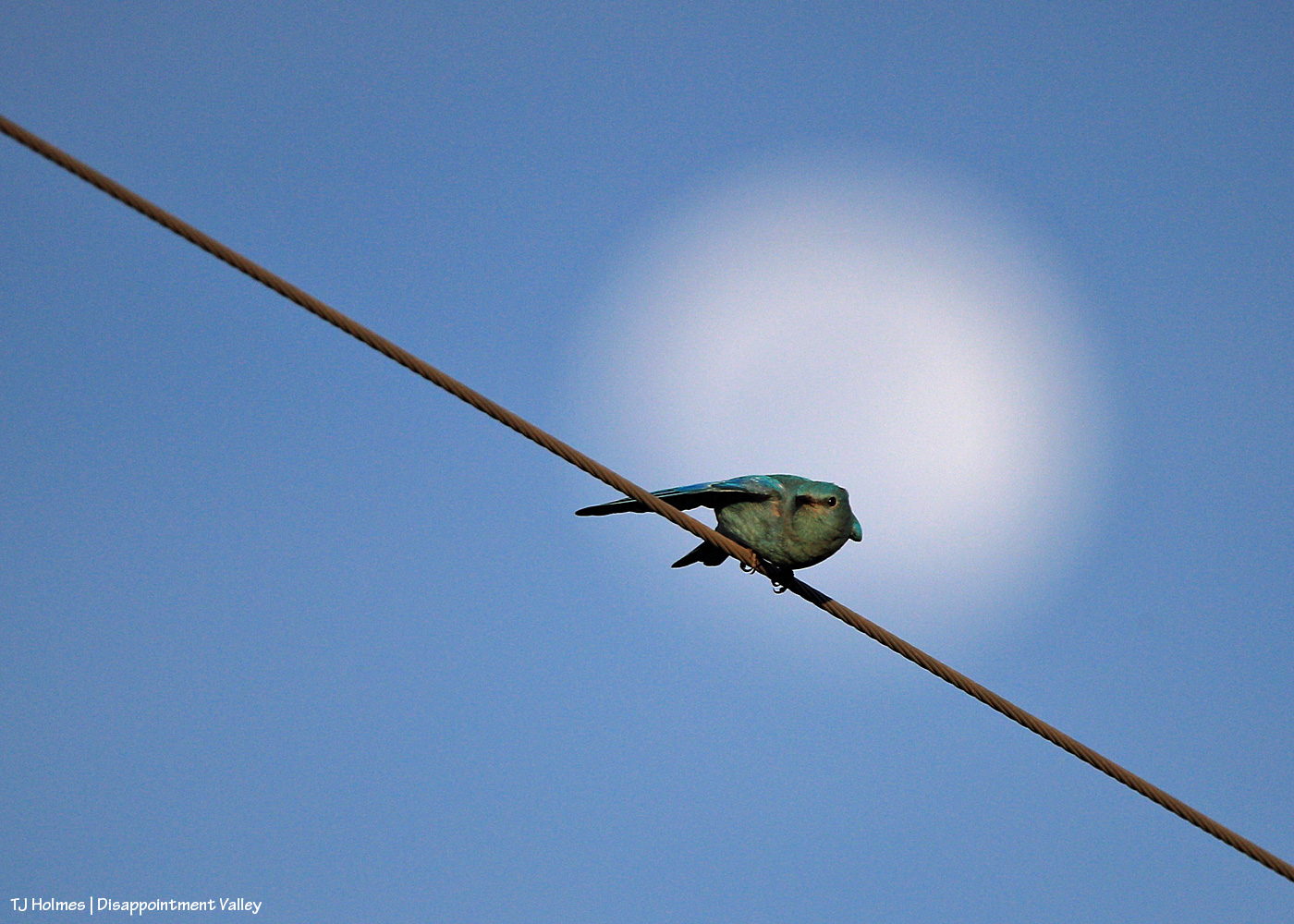
That big white disc behind it is the MOON!
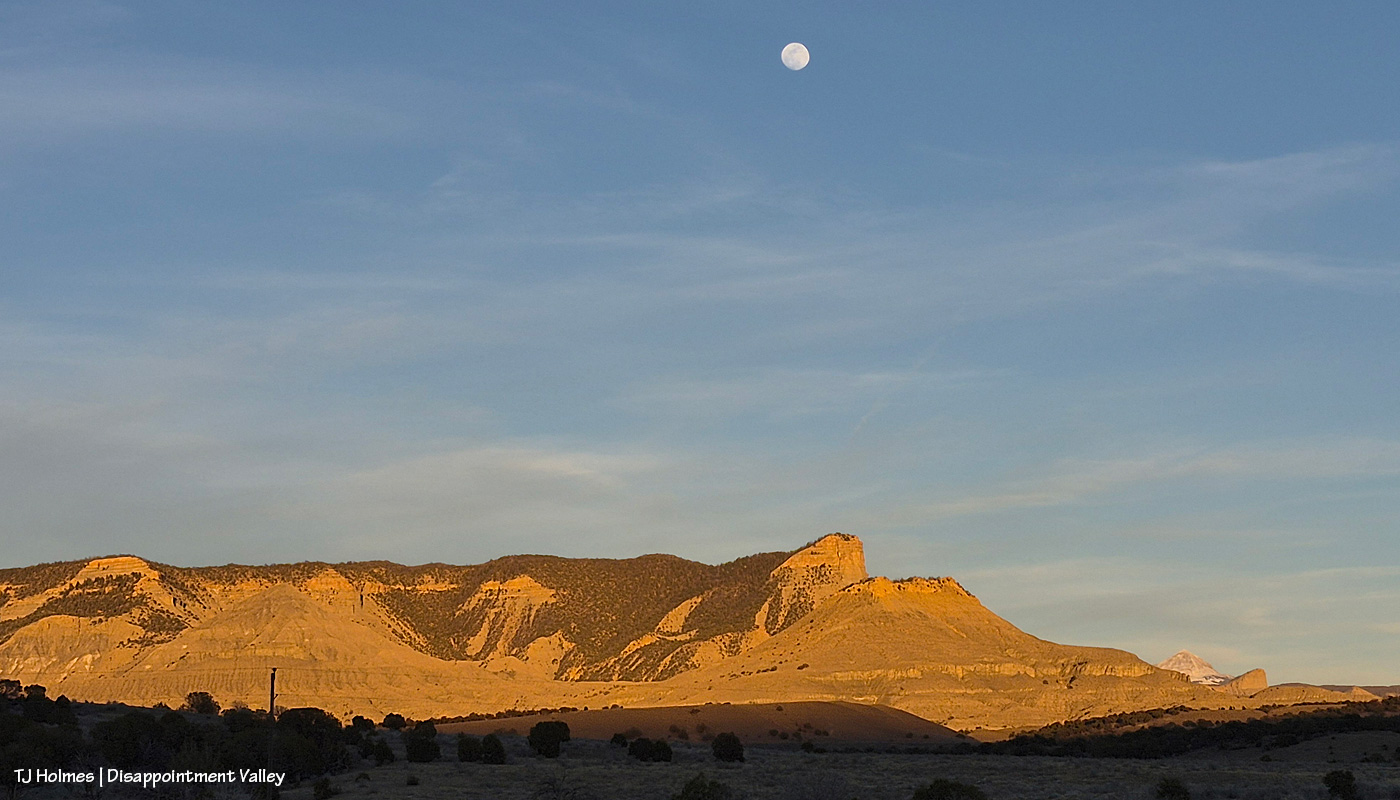
I got kinda skunked again trying to photograph it rising because of thin clouds that were just enough to block/blend the moon as it rose behind the eastern(ish) ridges. When I got back to my buggy from a fairly long walk into Spring Creek Basin looking for the *right* place to stand and shoot (spoiler: I didn’t actually find it), this beautiful fellow flew in to check me out from the utility wire right above me and the road. How sweet! How did it know I needed a pick-me-up? 🙂 These bright blue flashes of gorgeousity are everywhere right now. … I’m not sure whether they’re early … or right on time. The temp hit 68 insane degrees yesterday.
He gave me enough time to unpack my camera from my bag, fiddle faddle around and change some settings from moon-shooting … and of course, he posed like the gorgeous creature he is (see top pic) … before he flew off. I got this pic (above), and then everything else was a green blur (pretty sure that’s a superhero character: “The Green Blur”).
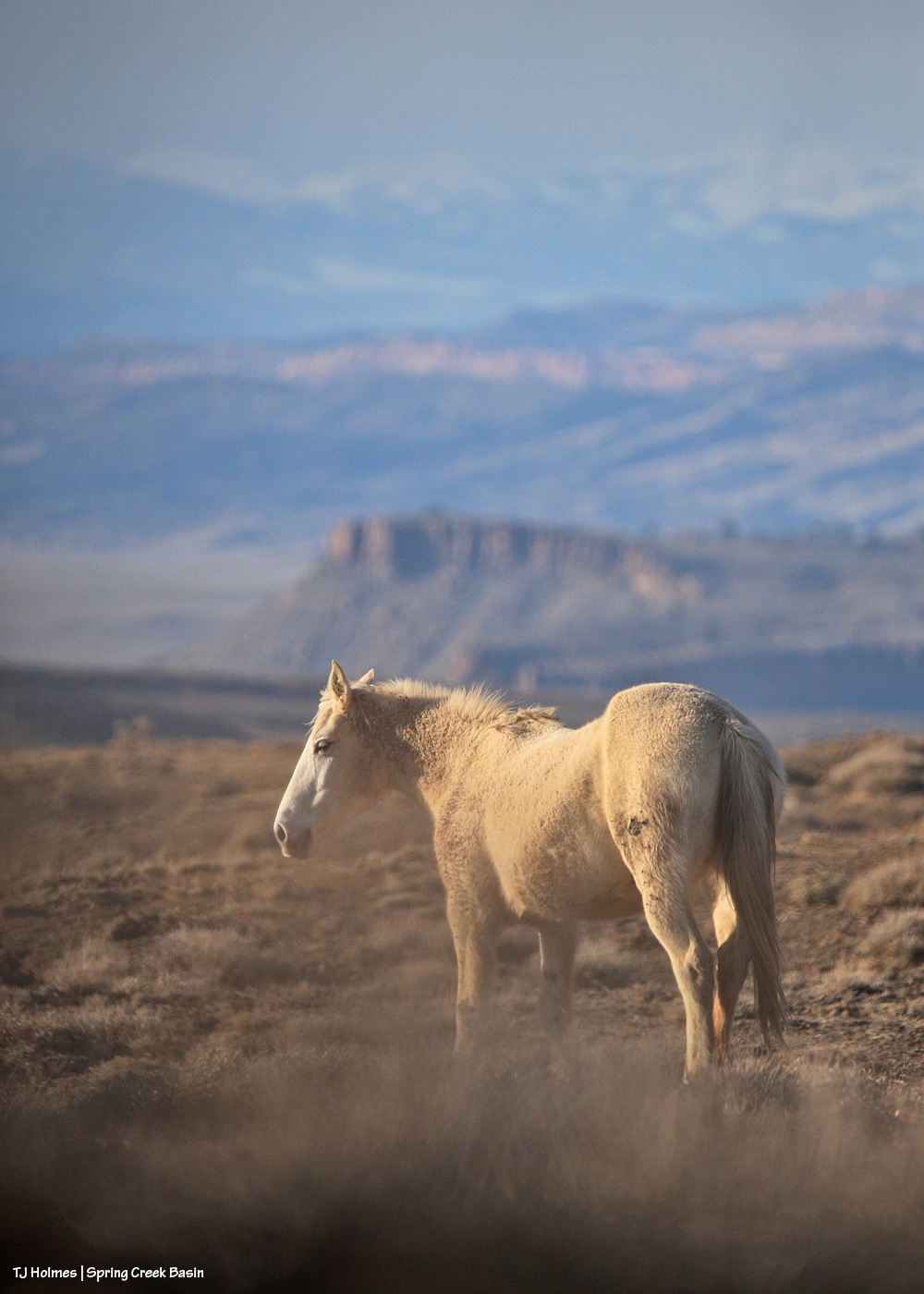
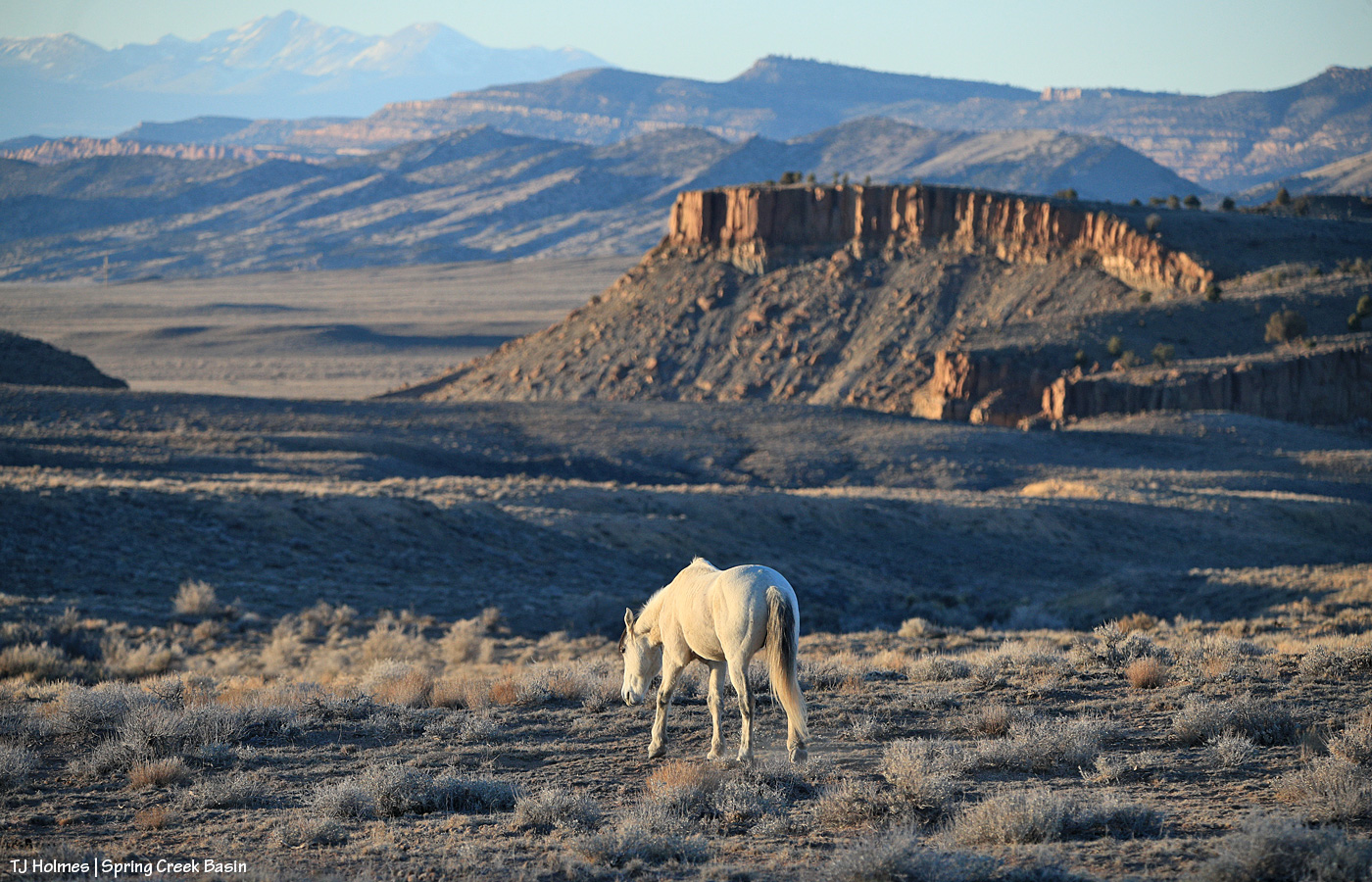
Back to current conditions, though this pic of Winona was taken the day before the snow-that-stuck-day (as opposed to the blowing-snow-didn’t-stick-at-all-days).
So peaceful … but we need a lot more of those snow-sticking days for the good of the rest of our year!
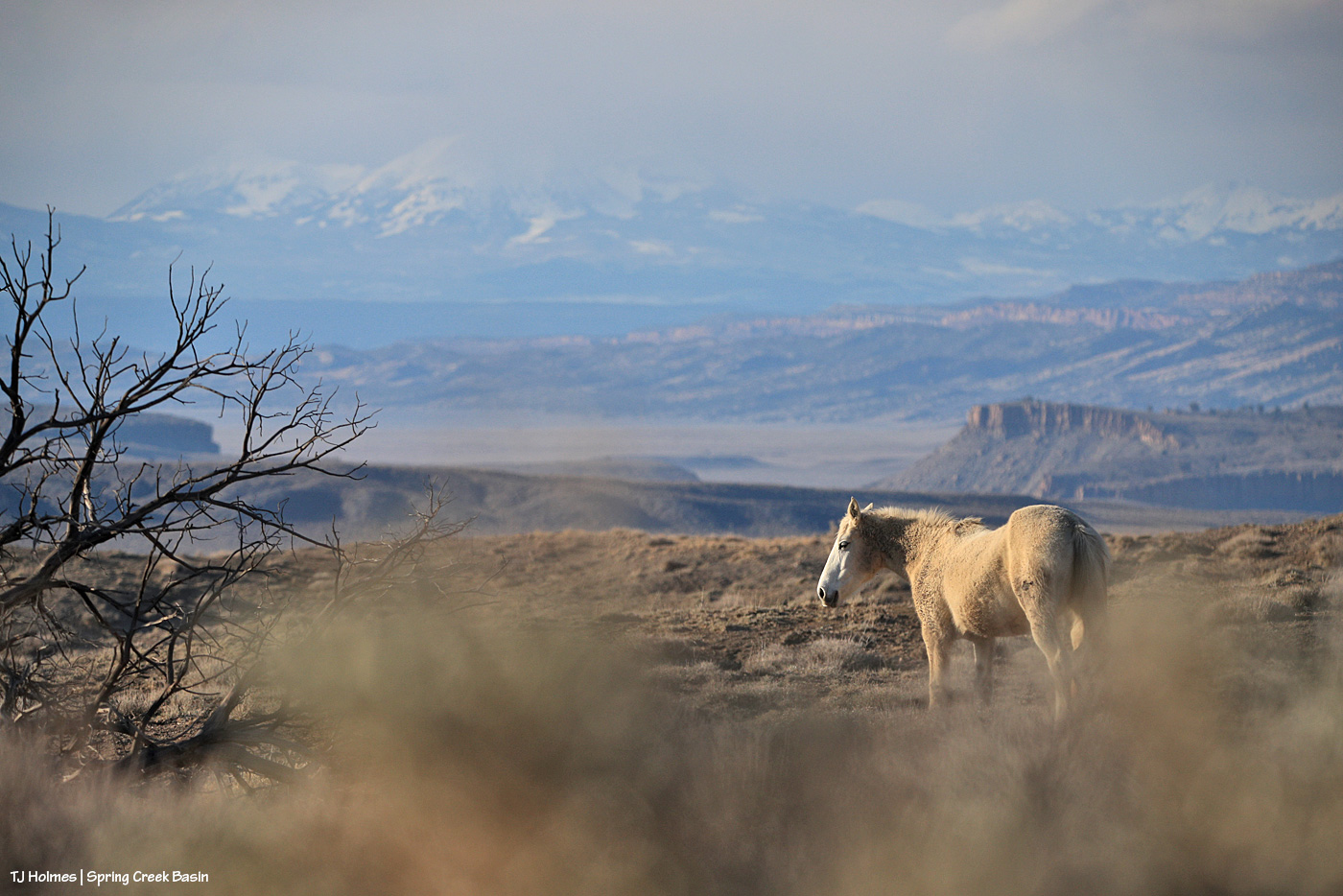
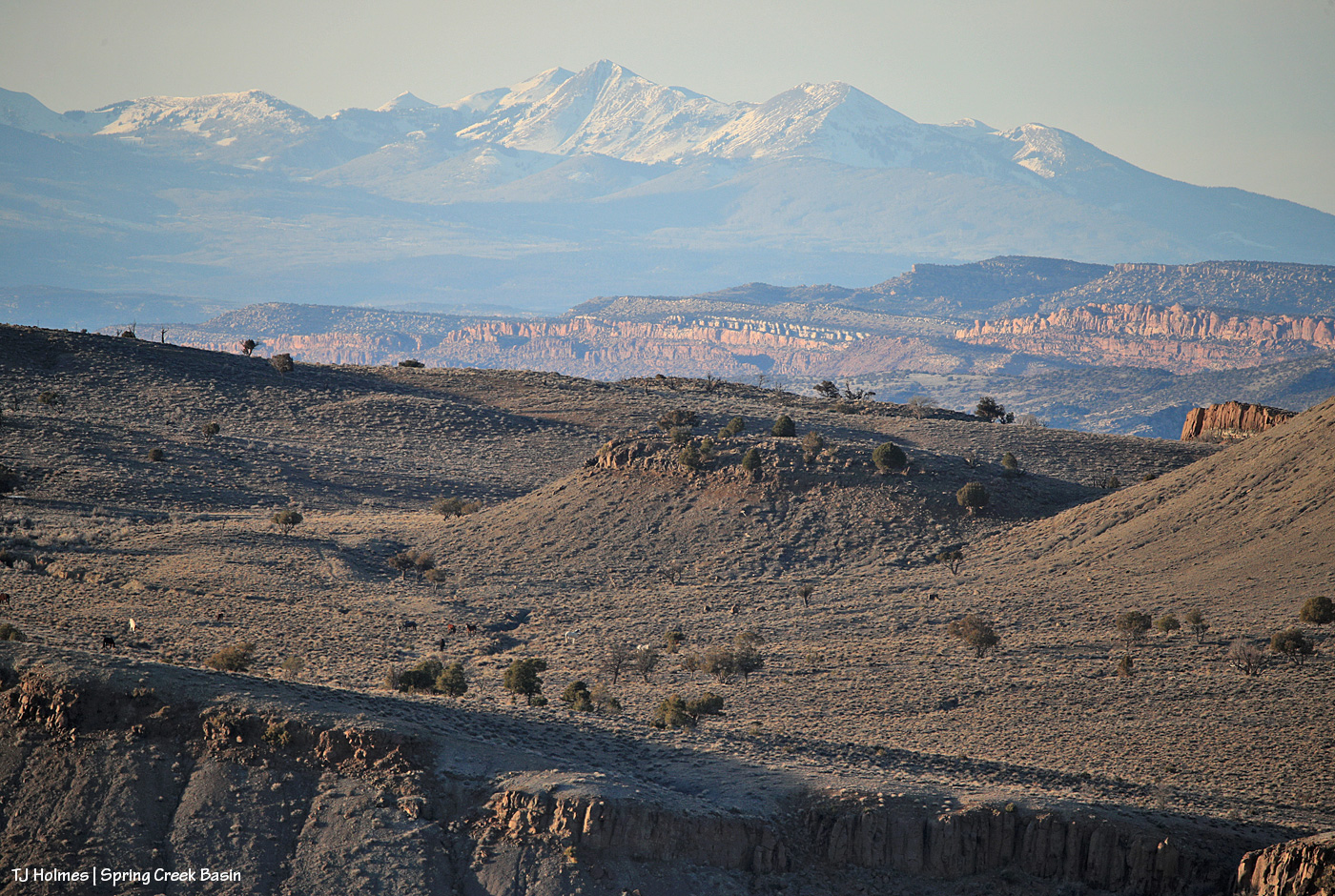
The above pic of Winona looking slightly muddy and very peaceful is the day after the day of windblown snow (also known as yesterday). Yeah. That’s about how much snow actually landed (yes, I know it’s very brown, and most of the mud was already dry or drying, thanks to the sunshine and less but not gone breeze). We’re looking northwestish across the rimrocks of Spring Creek Basin’s canyon, across lower Disappointment Valley and out to our horizon of Utah’s La Sal Mountains … looking here like they were anticipating this morning’s snow (? that’s a hopeful statement as I’m typing this Thursday night).
Behind me is Flat Top, and there were patches of snow on its sides and base, contributing moisture to the soil as it melted. So that was nice.
And, really, how ’bout that view? I dunno about you, but Winona makes it perfect. 🙂
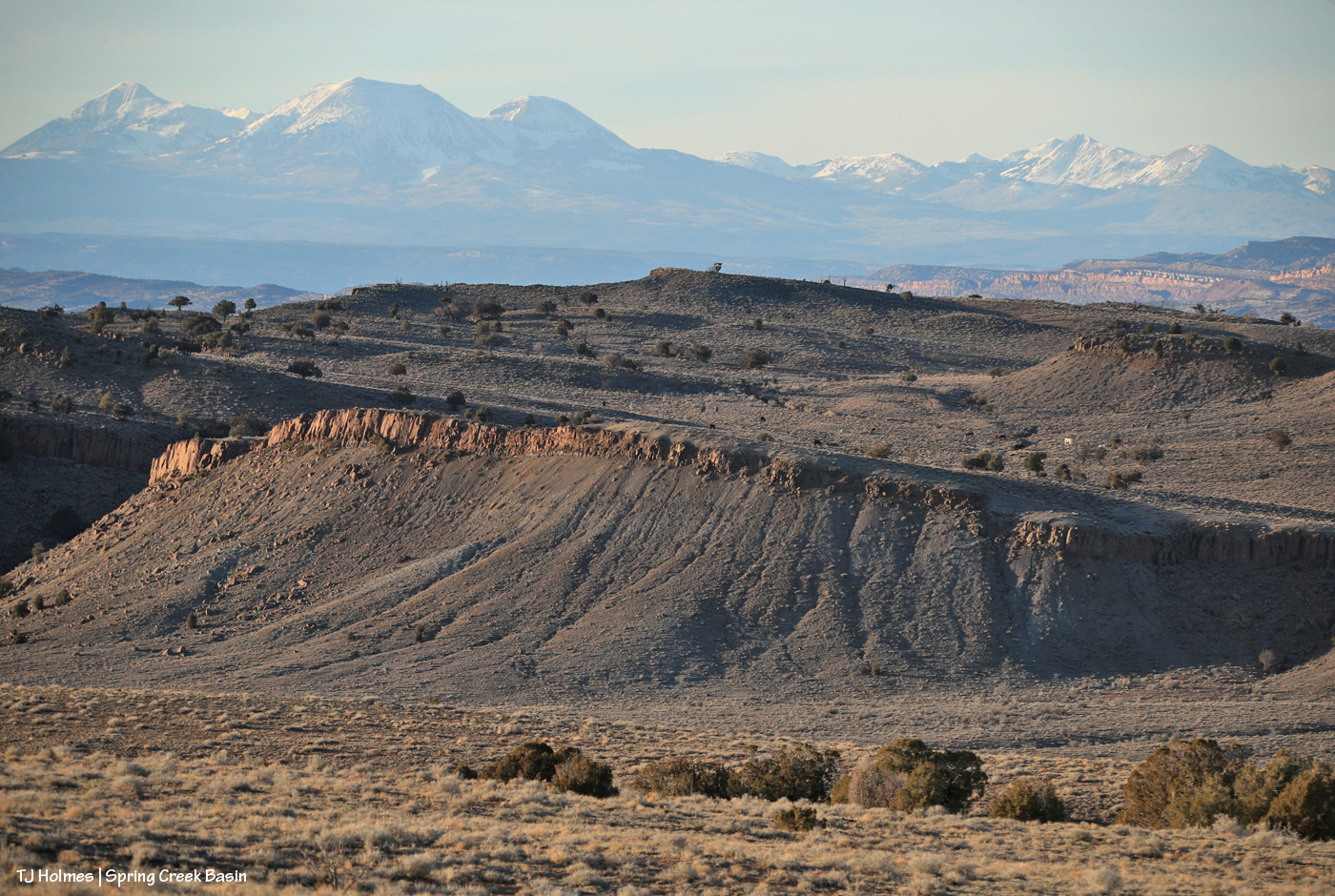
See ’em? 🙂 Look for the white spot, above the ridge of rimrocks … then note the dark spots (that aren’t trees) spread out to the left.
That’s Temple’s and Madison’s group. Out of sight to the right (northish) is Filly Peak and the main interior of (and main entrance to) Spring Creek Basin. FROM that interior, where I’d been 15 or 20 minutes earlier, I couldn’t see the mustangs from the other side of Filly Peak (familiar visitors will know that the road runs along the north/northeastish side of Filly Peak). But I saw Buckeye’s, which led me to leave the interior, drive out and around and hike up what I call corral hill, which is where I was when I took this pic, looking northwestish toward Utah’s La Sal Mountains. This is one of my favorite views in the basin (*note: like mustangs, you can’t have just one *favorite* view?!?!). And then I spotted the ponies. You couldn’t have seen them at all from the interior road, but they’re no more than a 15-or-so-minute walk from that road. From this vantage, though, Buckeye’s were less than five minutes below me back to the right(ish).
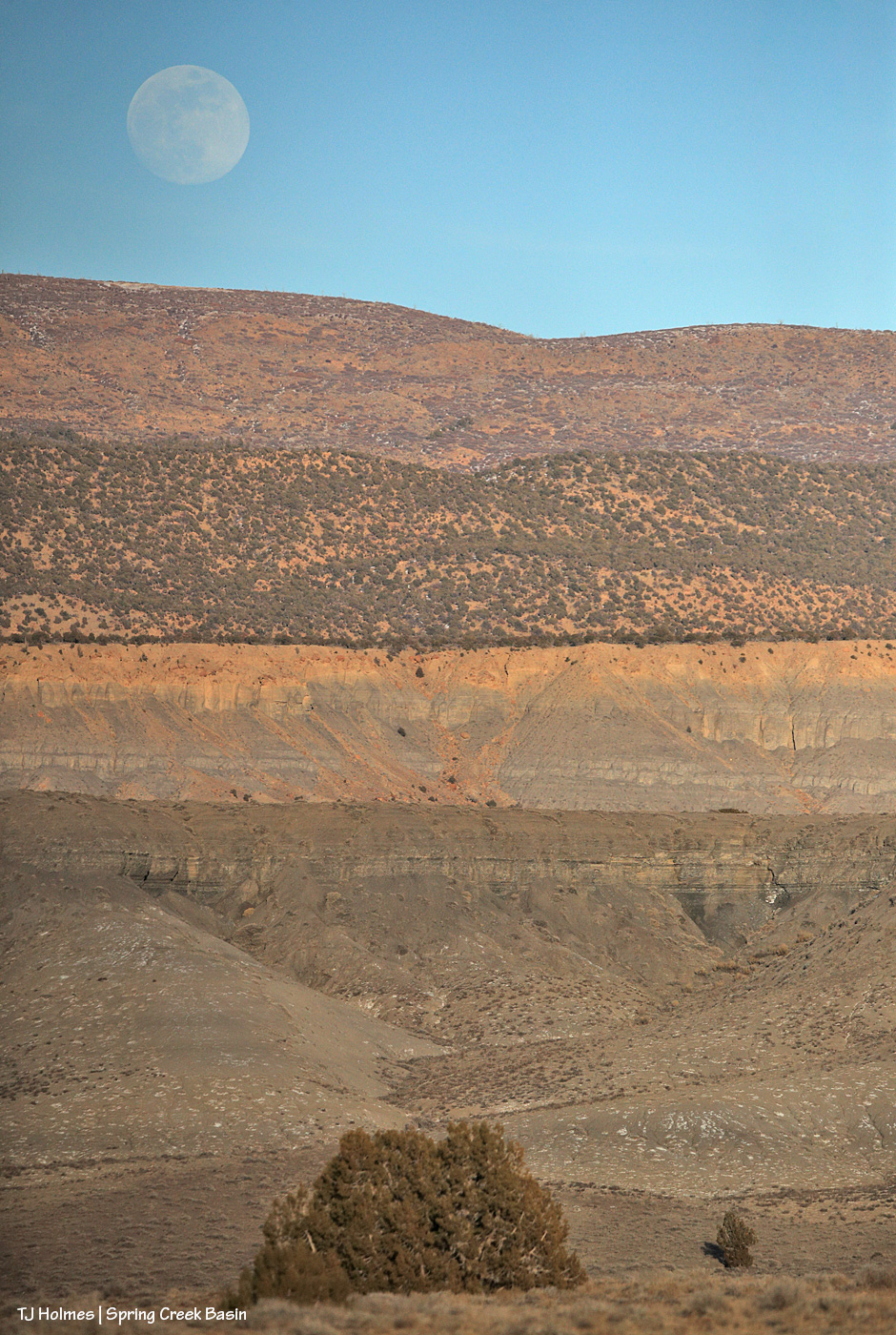
In addition to wanting to see Buckeye’s band, I hoofed it up the hill to try to catch this rising before it got too high:
This is what Google AI has to say about the February full moon (it’s actually full on Sunday, Feb. 1):
The February full moon is most commonly known as the Full Snow Moon because February typically brings the heaviest snowfalls of the year in North America. Other traditional names, often rooted in Native American, Colonial American, and European traditions, include the Hunger Moon, Bear Moon, and Eagle Moon.
Key Facts About February’s Moon:
Alternative Names: According to The Old Farmer’s Almanac, other names include the Bald Eagle Moon (Cree), Bear Moon (Ojibwe), and Raccoon Moon (Dakota).
Significance: It reflects a time of cold, deep winter, limited food sources, and the need for endurance.
2026 Timing: The 2026 Full Snow Moon peaks on February 1 at 5:09 p.m. EST.
Other, less common names for this lunar cycle include the Wind Strong Moon (Pueblo) and the Goose Moon (Haida).
***
Yes, I almost did fall off my chair laughing when I read that the February full moon is “most commonly known as the ‘Full Snow Moon.'” I mean, really? 🙂 Errrrrrrrrrrrrrrrrrrrrrrr. Not to mention arrrrrrrrrrrrrrrrrrrrrrrrrrrrrrrrgh! If you look really closely, you can see some lingering patches of snow in the above pic, and that’s several layers (what I like most about the pic) rising to the final ridge, which is actually outside/beyond Spring Creek Basin, but you’ve gotta look *really* hard.
The first layer of grey Mancos shale is the south end of what I call bachelor ridge, then the sandstoney-topped mesa known as Knife Edge, then the actual piñon-juniper-topped ridge that is a north/northeastish boundary ridge of the basin, then the ridge with its old burn scar(s) most commonly and easily accessed from Dry Creek Basin (can you imagine anyone calling Dry Creek Basin “Dry Creek” like some people refer to Spring Creek Basin as “Spring Creek” (which, as we all know, with its tributary arroyos, drains Spring Creek *Basin*)? (how’s that for a whole lotta parentheses?? :))).
How about a new name this year (which may or may not echo Februarys past … and presage Februarys future): Deep-Anxiety-Inducing No-Snow Moon? Bummer.
But to end on a happy note, another glimpse of the ponies on the “bench”:
Let alone the wild ones, how ’bout THEM layers? 🙂 Interestingly (?), the part(s) that look like people’s idea of Utah are in Colorado, and the parts that look like people’s idea of Colorado are in Utah. Yay, Southwest! 🙂
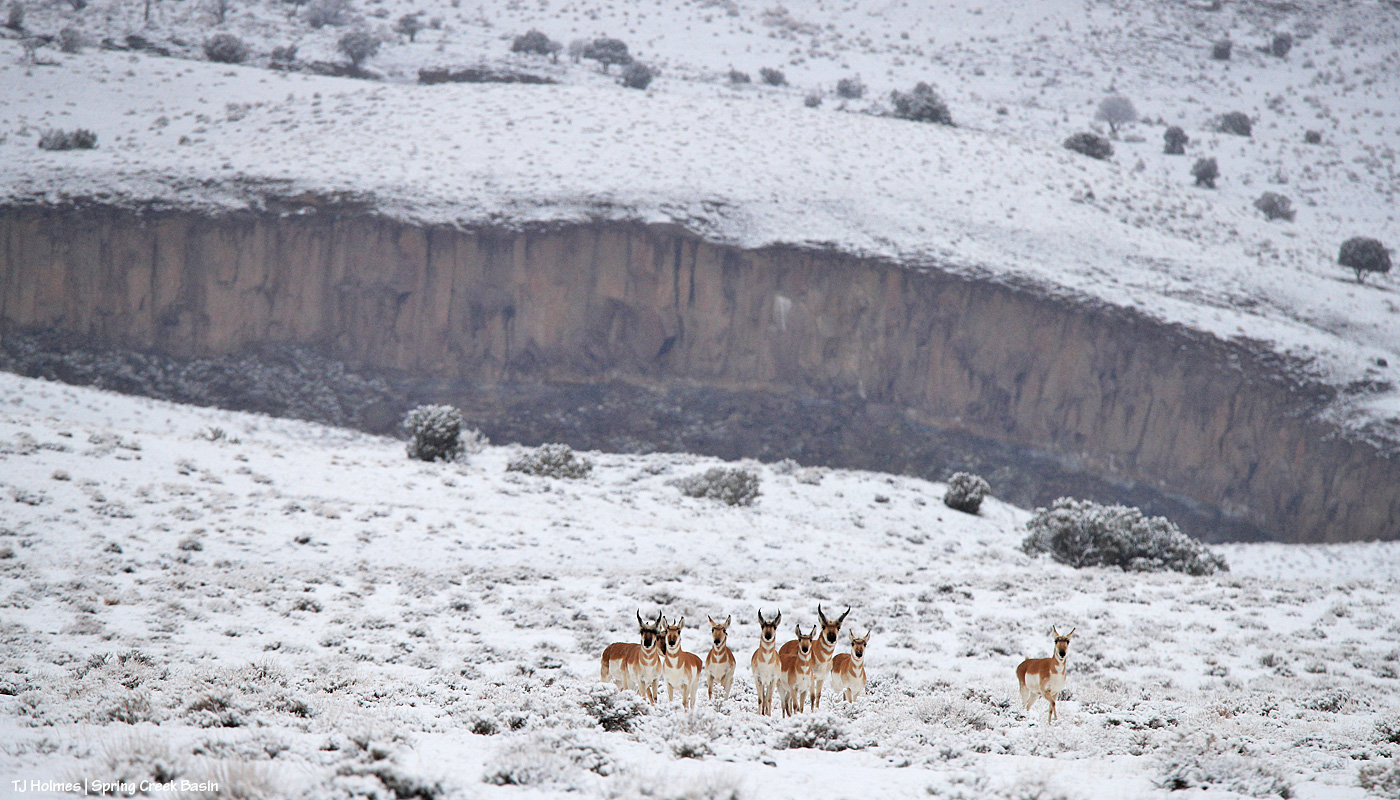
The snow Saturday morning lured me into Spring Creek Basin twice that day. The first time was shortly after sunrise, and while the mustangs were frustratingly far from any accessible areas, the pronghorns were fascinatingly cooperative! While that sort of looks like a giant cave opening behind them, that’s the north rim of Spring Creek canyon (viewed from the southeastish). The pic of Chipeta yesterday was taken much later in the day; compare the melting that had been at work.
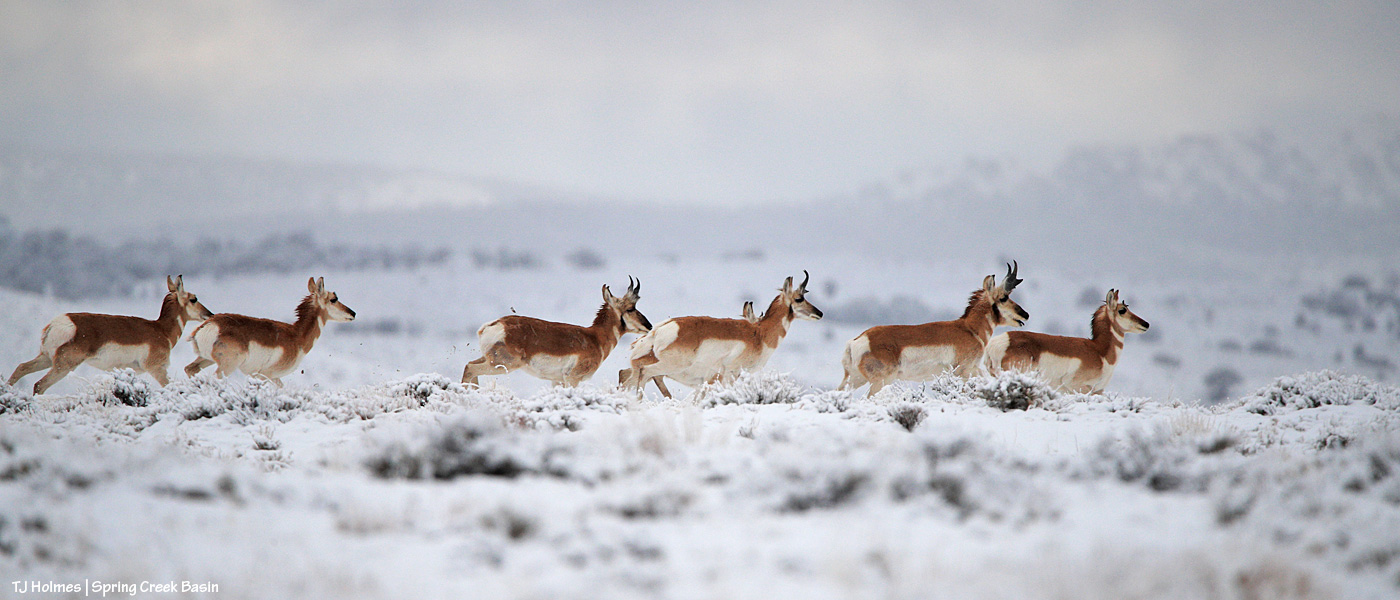
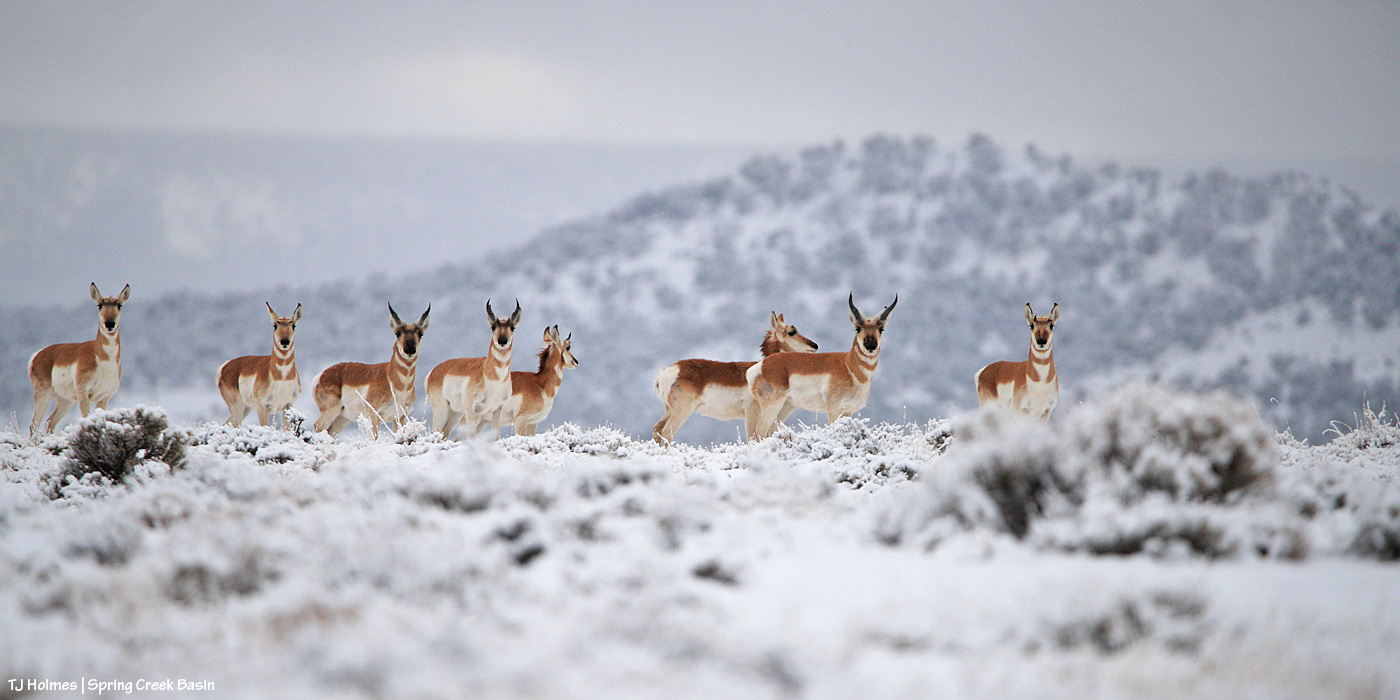
Pronghorns (not actually antelope) are North America’s fastest land mammals. Here, they were just moseying. When they *really* run, they are FAST!
They’re more sprinters than marathon runners … and thankfully for me and my camera, they’re wonderfully curious. 🙂
(Note that the landscape doesn’t look like that AT ALL by this morning (or even by yesterday morning). It was cold (high of 34F?), but in Colorado, sunlight means even more than temperature.)
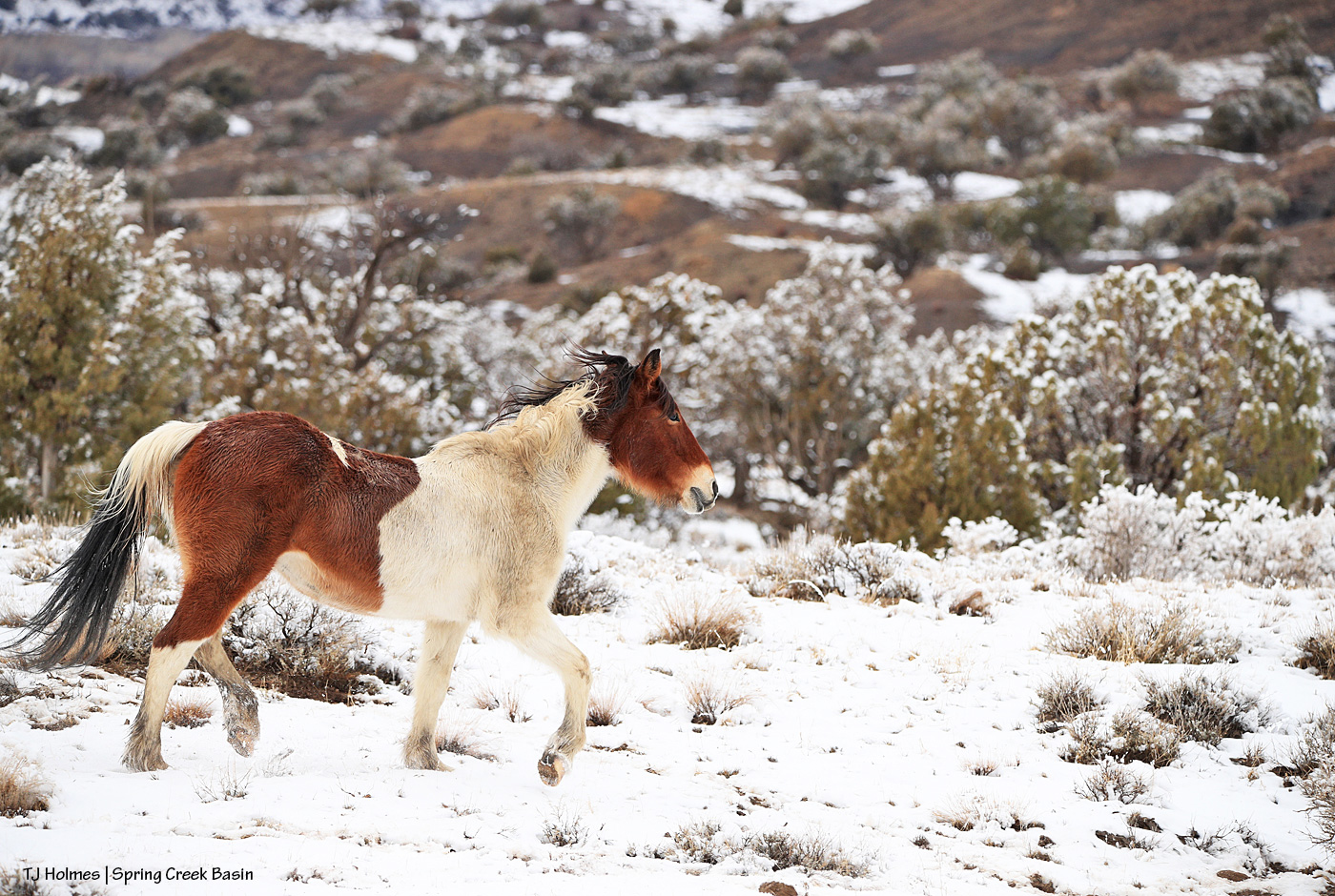
Who better than a pinto girl to show off our snow … and how much had already melted by late afternoon?
Thanks, Chipeta. We appreciate your lovely cooperation!
Fascinating mix of snow on the ground and still on some tree branches while south-facing slopes have nearly all slurped up all that snowy-good moisture (despite the lack of sunshine most of the day). We got maybe an inch … 2 max. It was melting while it was falling. Eh. We’re desperate for ANY moisture. I think the temp hit 40F. … The forecasters claim this morning’s low temp will be 7 or thereabouts. Yeesh. But it’ll keep some of that snow on the ground and soaking in slowly, under another full-blue Colorado sky.
Elk attention-getter squeaky toy now available online!
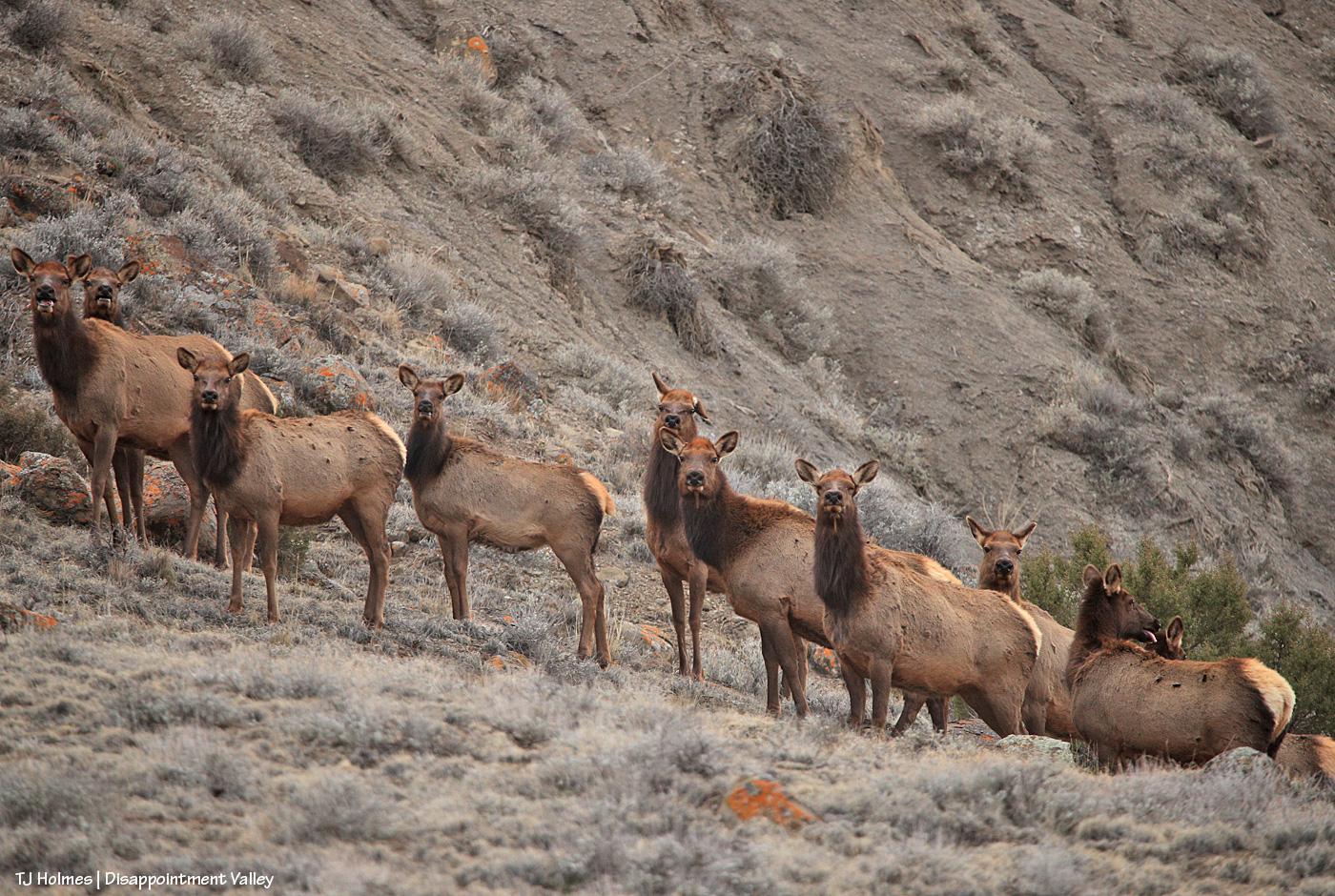
Juuuuuuuuuuuuuuuuuuuuuuust kidding. 🙂 I didn’t use any squeaky toy or other artificial attractant. They were immediately west of the west boundary entrance to/from Spring Creek Basin, and clearly, I was the most fascinating thing they’d seen all day!
Note Ms. Grumpypants in the middle with the broken ear? I could see even at a distance that something was odd with her ear. Even zooming in, I’m not sure why she has the white hair at the base of each ear.
(If something looks odd about the font, I apologize. It looks different from usual, but in the drafting mode, I can’t tell exactly what (a serif font as opposed to sans serif?), and I’m not sure whether it’s something I did or WordPress doing another one of its odd “updates.”)
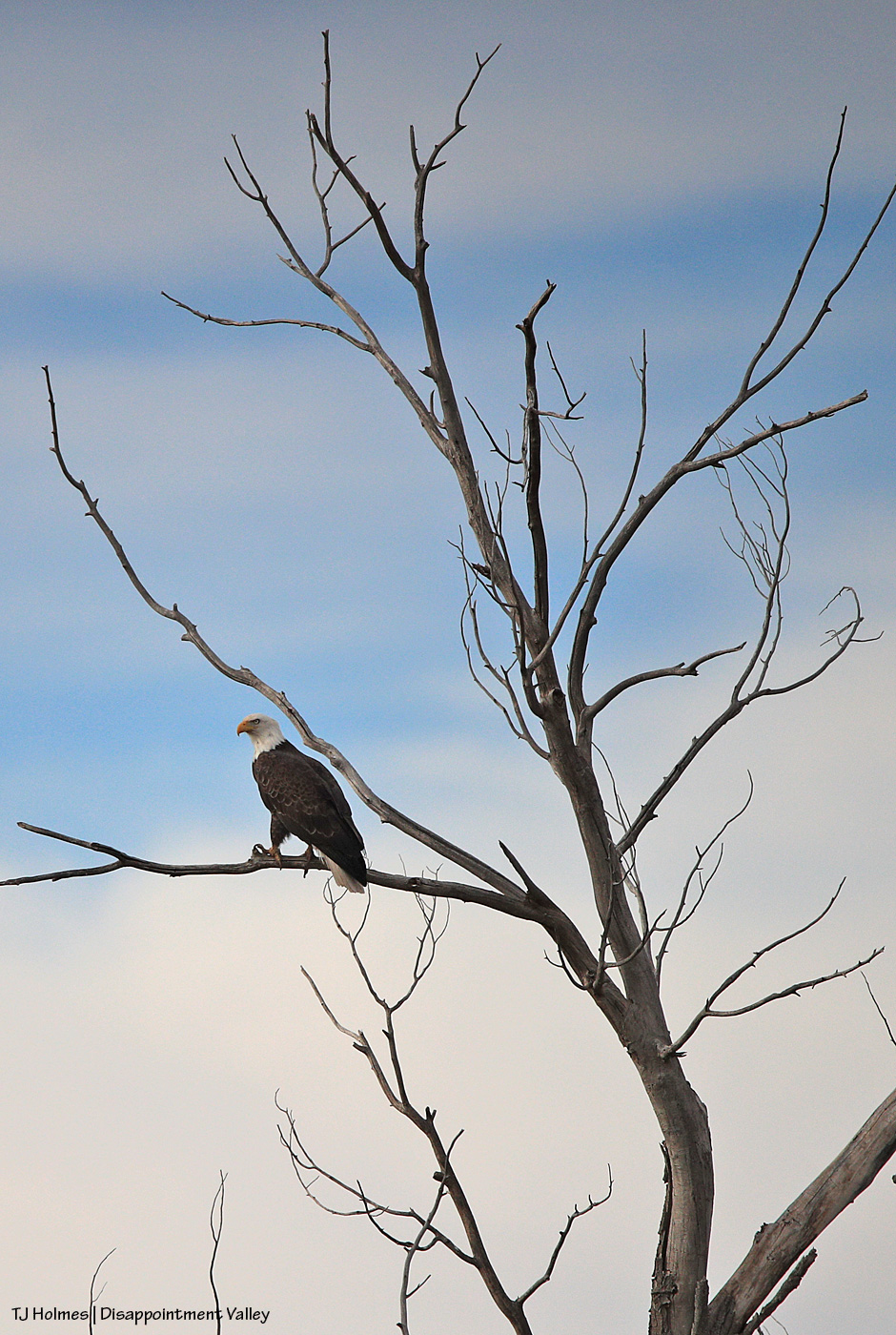
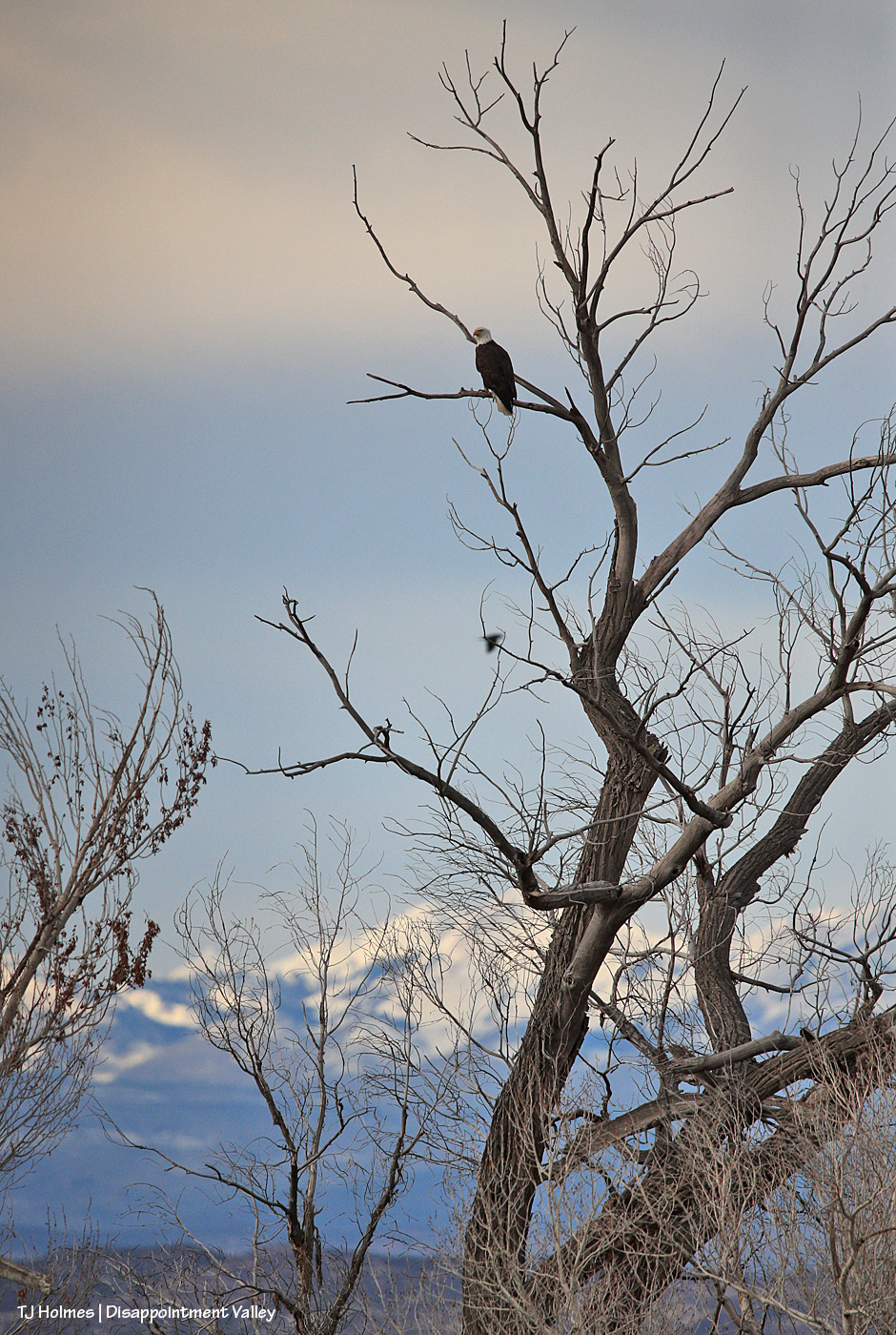
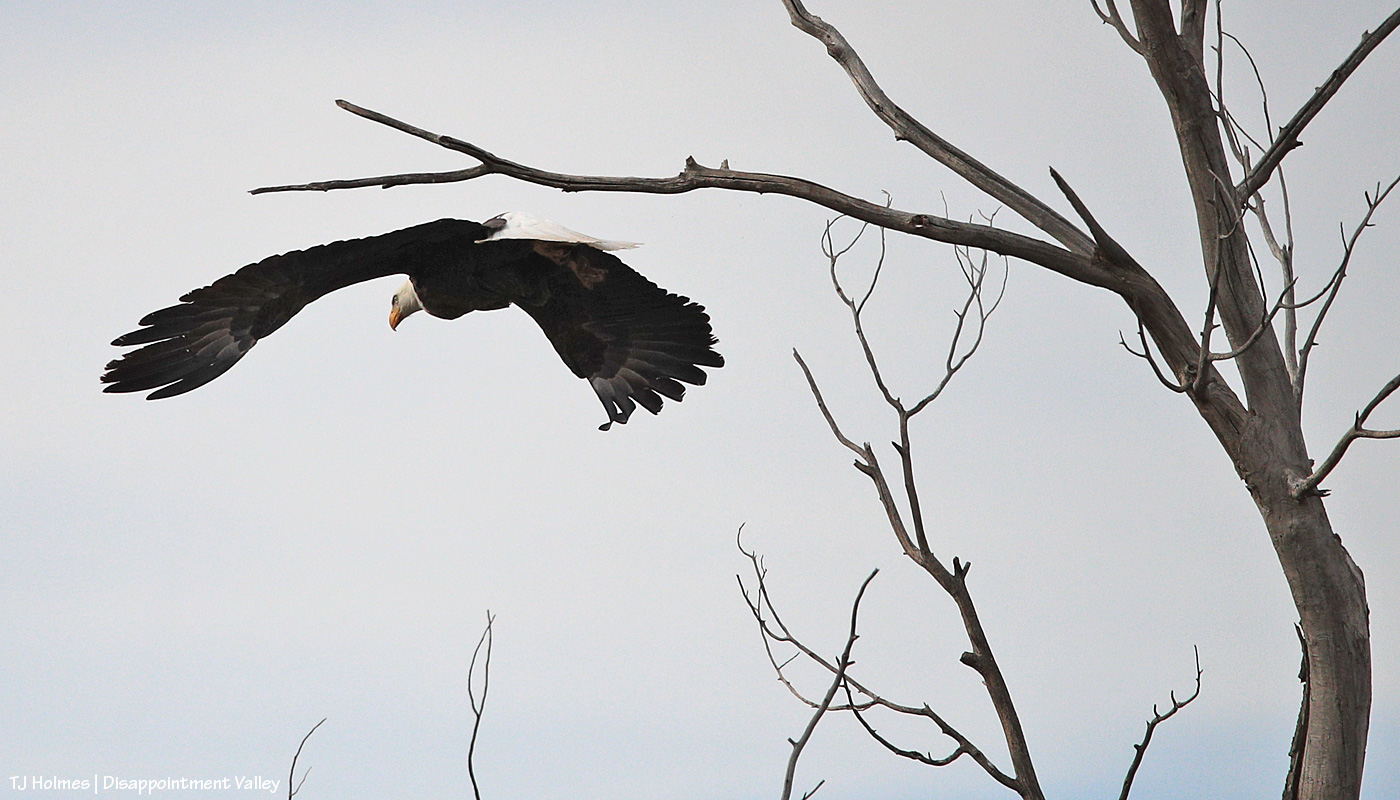
I saw TWO bald eagles that day (about a week ago now), as well as two golden eagles or juvenile bald eagles; I didn’t have my binoculars then, and I couldn’t tell from a distance. When I went back much later with my big gun (as opposed to my wimpy phone), one bald eagle was in that tree, which seems to be the favorite tree (and why not, with that perfect stick, err, branch?).
Non-moisture-bearing clouds were overhead, but in the distance, a bit of sunlight was shining on Utah’s La Sal Mountains. Bit of a messy cottonwood foreground, but you get the idea. 🙂 (Who spotted the raven doing a photobomb flyby in the middle background?)
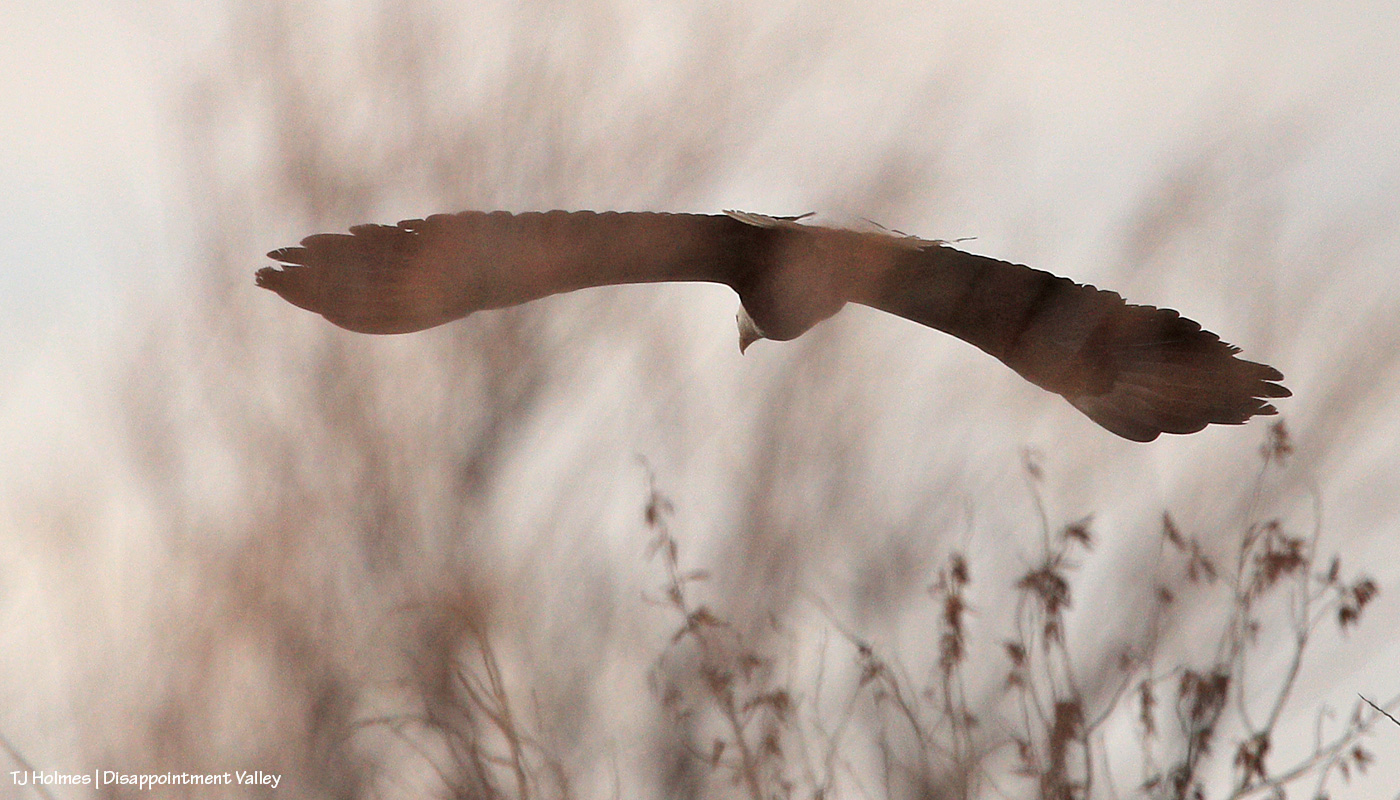
This is a strange image, I know, but I was zoomed in as I initially scrolled through the pix on the computer (culling out-of-focus ones), and when this pic came up, it was cropped like that, and I liked it. 🙂 To each, their own, eh?
A more typical eagle-launch image. Too bad s/he flew away from me, but it was warm-ish, critters were out, and eagle had other fish to fry (not in dry Disappointment Creek, though) and things to do!
Wow, do I love seeing them. 🙂
(The title is a reference to a phrase I sometimes see about “bird-on-a-stick” pix: portrait shots of birds perched on branches. As a non-bird photographer, I figure I haven’t yet gotten bored with shooting birds or raptors of any kind on sticks or branches of any kind!)
Question: Is Mysterium posing, or is she alert to something?
Hint: She does love her naps, when it might look like she’s “posing,” but she really doesn’t do posing. 🙂
Whaaaaaaaaaaaaaaaaaaaaaaaat?!?!?!!!!
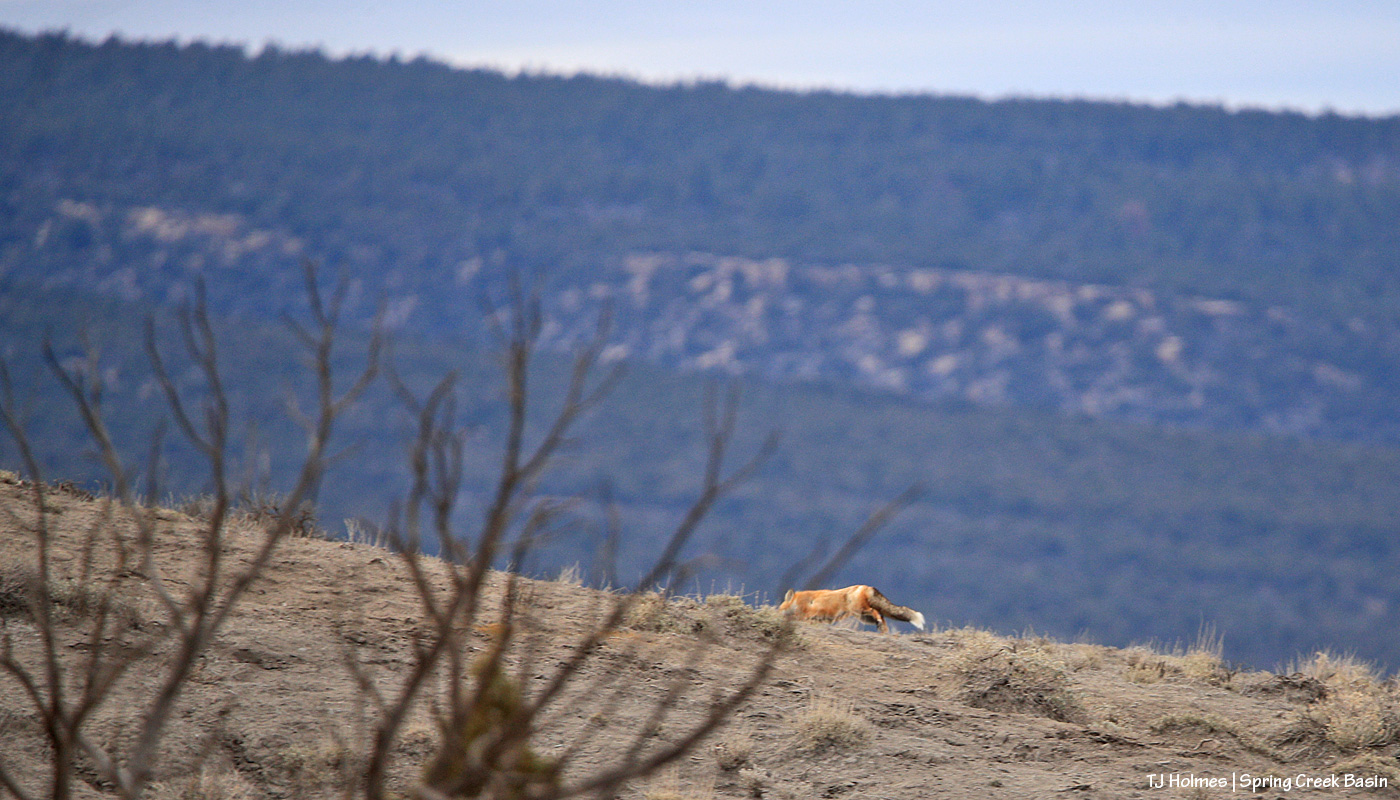
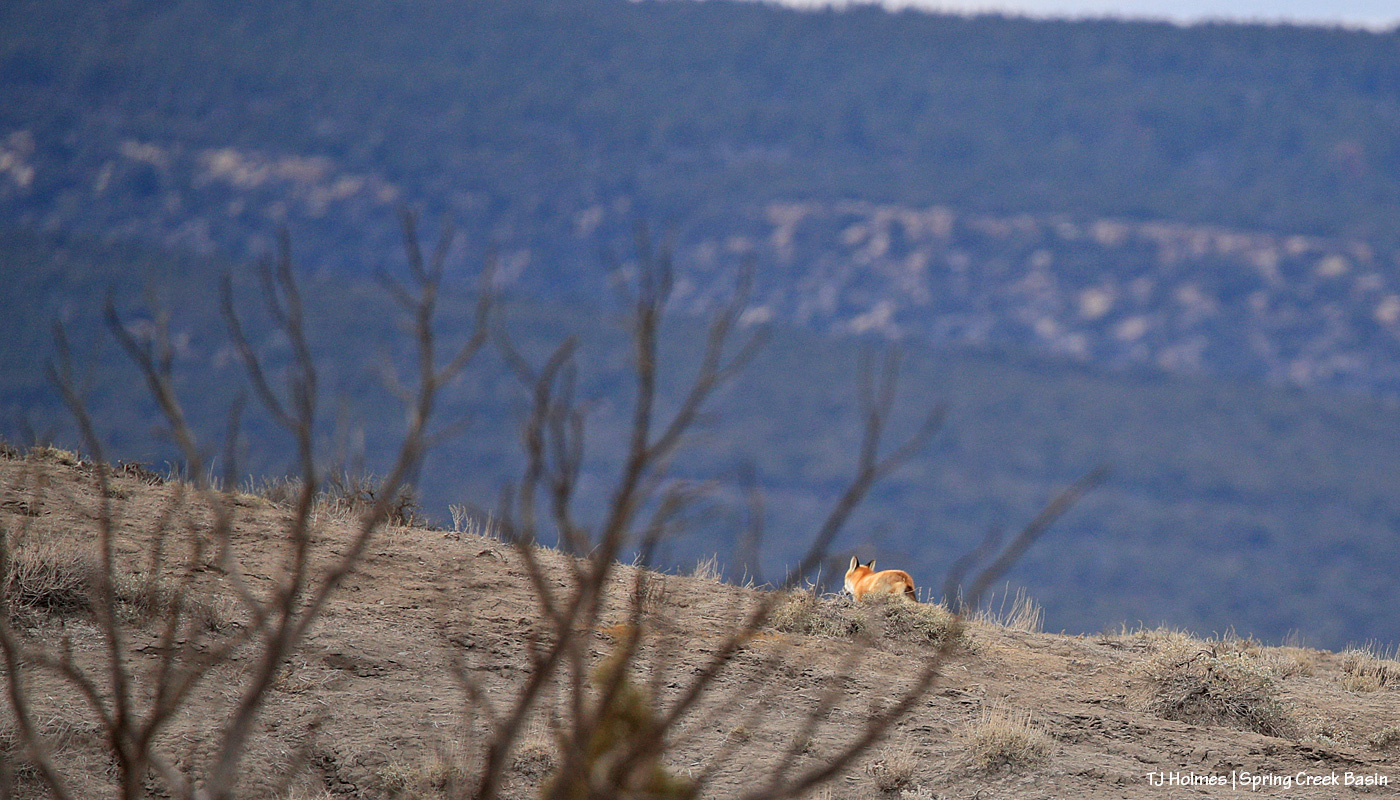
I was sitting on the ground, lens trained on some horses, when I heard them spook and looked up to see that something had caught their attention. THEY didn’t go far at all (more a spook-in-place kind of thing), and then I saw a flash of moving-red … FOX! Wow. It must have been in one of the little/shallow curvy arroyos nearby, and I’m not sure what spooked IT. I must have walked semi-past it earlier to go uphill of where the horses were (note the view beyond Mysterium!).
Unfortunately, there was a tree between us, and then it disappeared into one of the drainage folds … and when I caught sight of it next, it was nearly over the ridge. I wish it had stopped to give us a quick look, but nope.
Wowowowowow! I think the mustangs were just as thrilled (OK, interested) as I was. I doubt they see many flashy red foxes around. (We weren’t super far from where I found the fox last year, but we weren’t close, either. I don’t know what kind of territory a fox covers?)