Recap of 2025

31 12 2025

To remember how I did this post last year, I had to go all the way back to Valentine’s Day to find the post recapping the previous year (2024, then) in images. This year (for 2025), I’m happy to announce that for once, though I procrastinated, it wasn’t THAT long, and it was in plenty of time (OK, one day to spare) to make the Dec. 31 deadline.

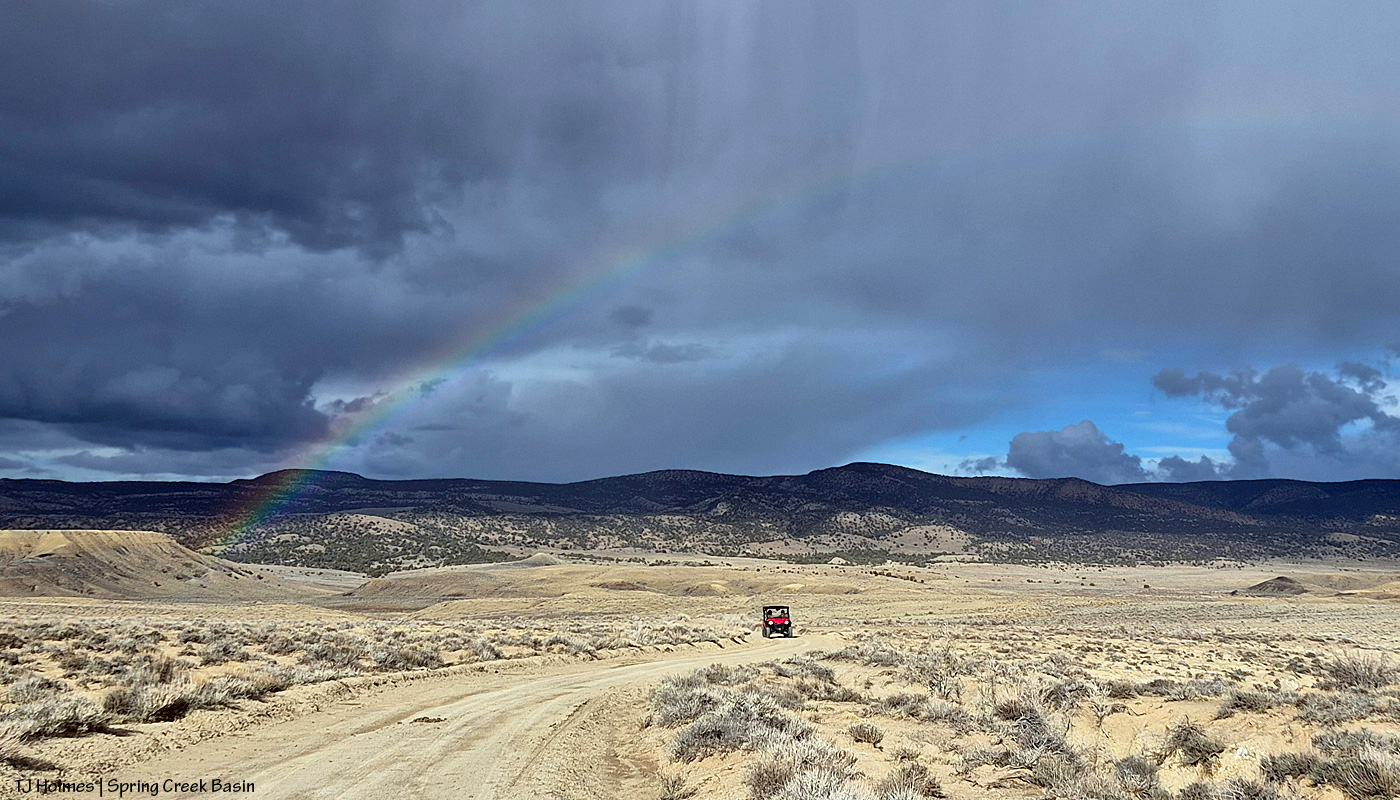
Deep breath: This was a hard year. Last winter was rough (read: bad dry), which meant the rest of the year was rough (read: really bad horrible awful dry) in terms of drought. Monsoons didn’t hit their stride over Southwest Colorado, so we didn’t get much rain, either. Federal employees were hard hit, too, and one of our young BLM’ers was illegally fired from the new job he loved.

But we also had some good-news happenings: Thankfully, he was reinstated, and we have a strong range team in Ryan, Anton and Laura. We got some new signs installed, including the replacement of the old, sun-bleached, weather-beaten interpretive sign for the new information “kiosk” that greets visitors upon entering Spring Creek Basin. Fertility control (native PZP) continues to be an extraordinary benefit to our herd in terms of management and keeping roundups and removals at bay.

In wider Colorado mustang news, the BLM short-term holding facility at the CaΓ±on City prison complex closed in November, BLM and Colorado Department of Corrections being unable to reach a contract agreement. That’s not-great news in terms of uncertainty for rounded up and removed Colorado mustangs. Where will they go? In semi-balanced decent news (?), all of the Colorado mustangs that were in holding there (about 100 at the time) were adopted or went to private sanctuary or are currently in foster situations for a planned adoption in March (and that all happened despite federal employees, including BLM’ers, being out of work (or working without pay) because of the government shutdown).

What follows is a pic from each month of the past year and a bit of reminiscence of what was happening when I captured the image of a mustang or mustangs. Many of these pix have been featured previously on the blog; some haven’t. If you make it to the end, there’s a bonus pic … one of my favorite of the past year.
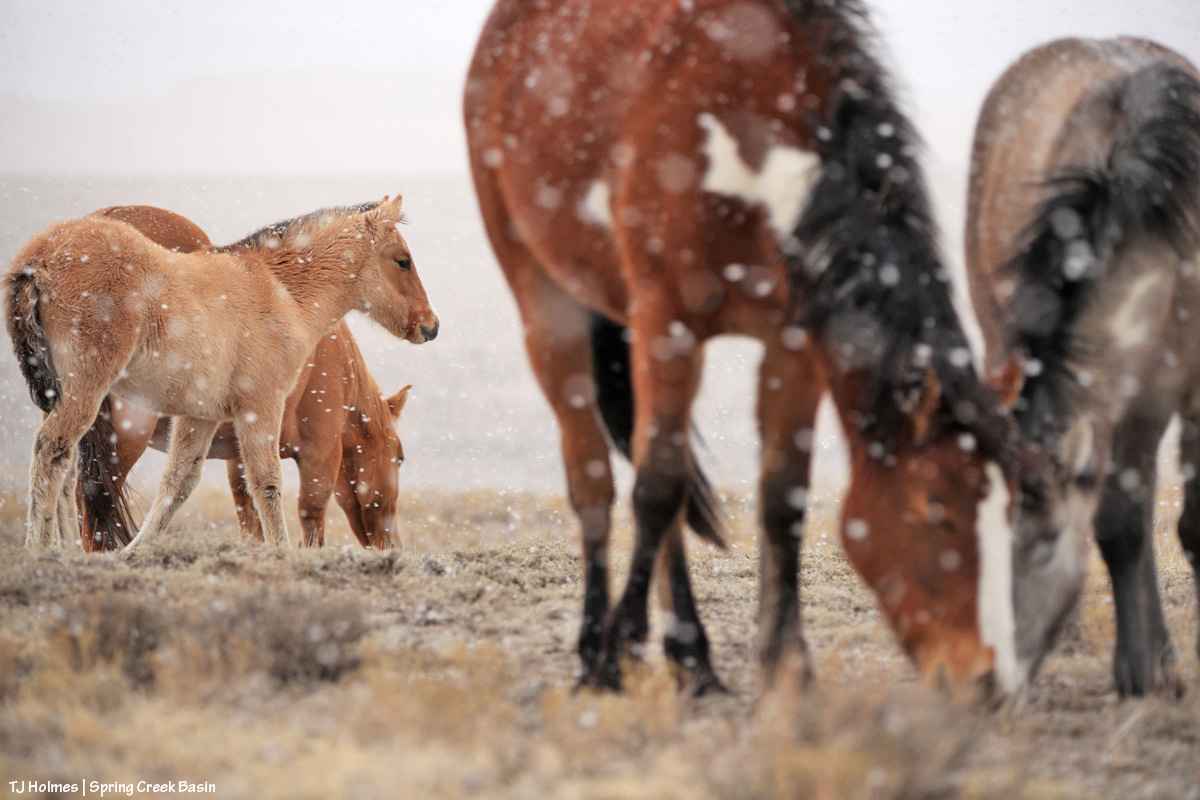
This is one of my very most favorite pix of the entire year. I love it so much, it’s the background image on my computer. I’m aware that I likely post a lot of images of Buckeye’s family; you won’t be surprised to know that they’re among my most favorite mustangs. I considered this image as the *bonus* image … but it was one wildly beautiful day of snow (well, I was out with the horses, watching the snow coming for at least two hours before it finally reached us), and it didn’t match the otherwise very dry *year*. … So it gets the January title.
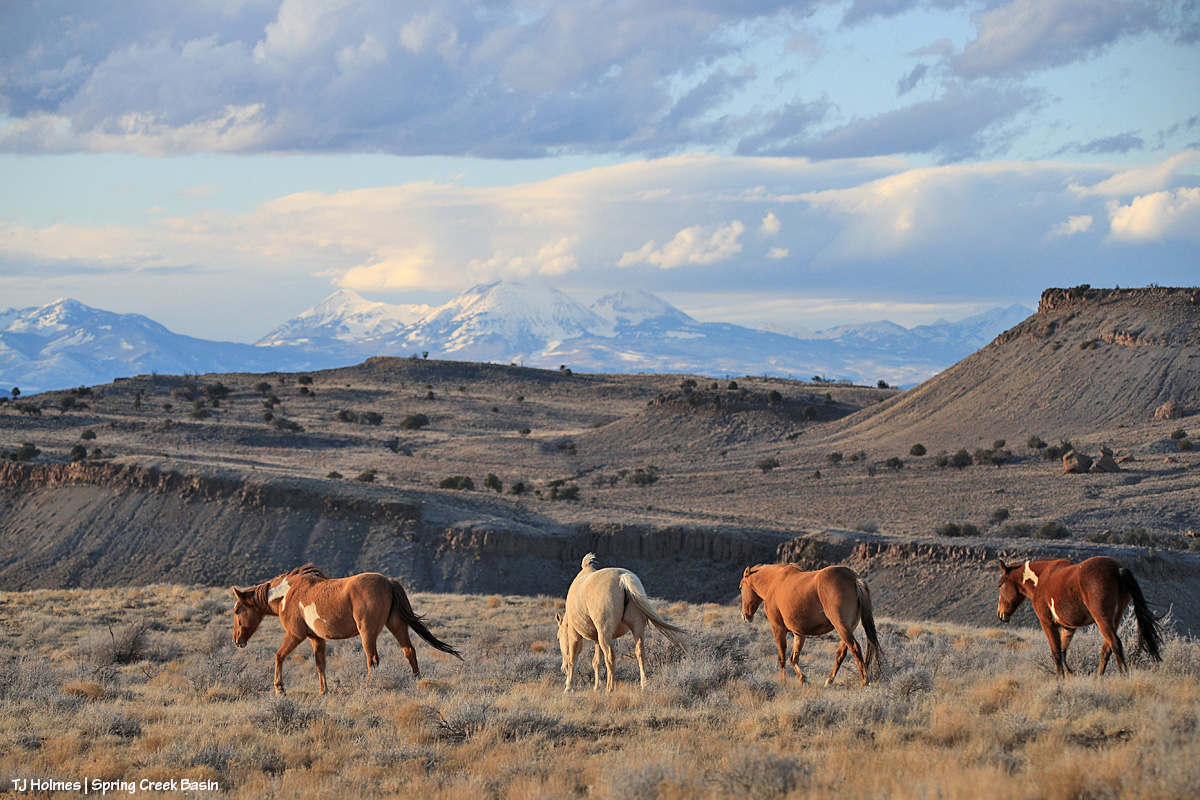
Did I say that I love Buckeye’s family? You can forgive me for singling them out, right? The three mares weren’t born here, but gosh, they are treasures from our sister herd in Sand Wash Basin, and I’m so grateful that we have them. And yes, that was February. Utah’s La Sal Mountains may not have been the *closest* snow, but we sure didn’t have much.

March is still fuzzy-coat weather with signs of approaching spring, especially in the high desert of Southwest Colorado. Fortunately, we had ponds early in the year. They’d all go dry before some rain this past fall put water back in a couple of them, including the one pictured above with Chipeta. This pond is nicely full currently – and has mustangs taking advantage of its water.
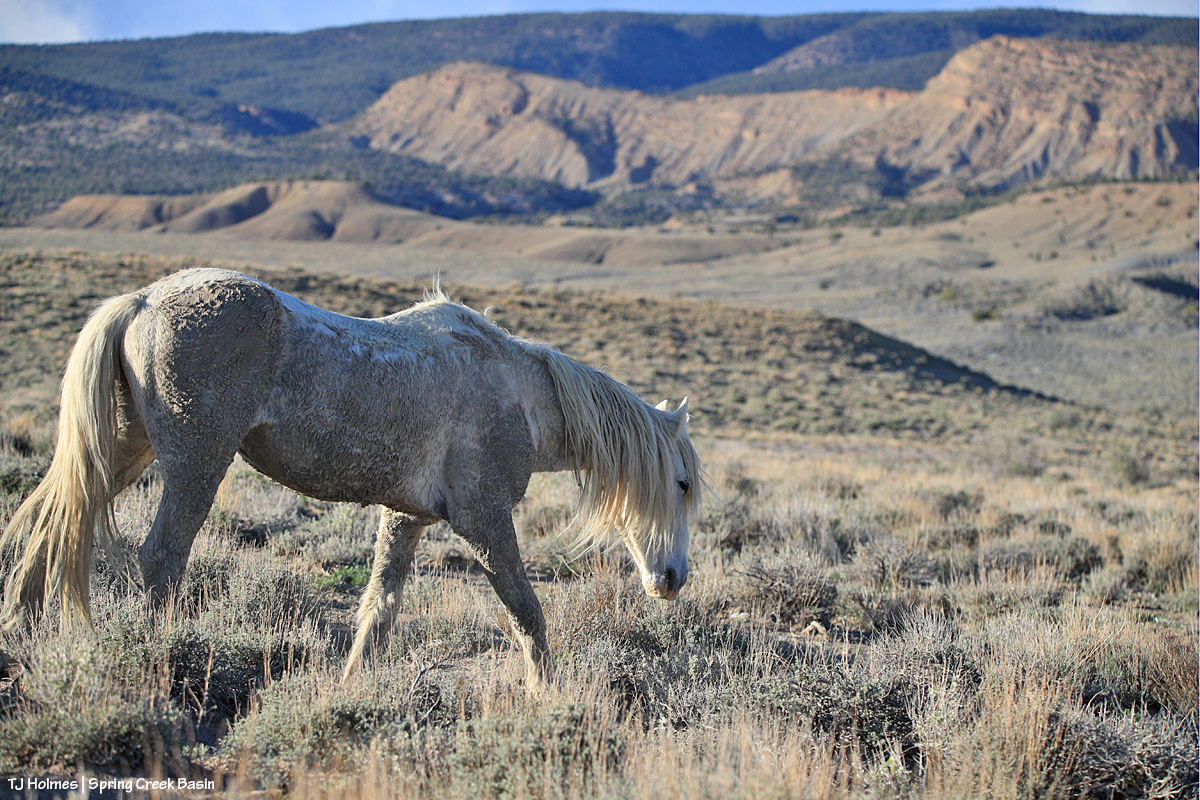
April found Sundance not far from the pond pictured above, and he still had his band at that time. Later in the year, he lost them, and he’s been by himself since then. He has wandered a bit, following vegetation and available water. The stately ol’ guy is still around … I see him now and then, napping in the sunshine or grazing on the side of a ridge.
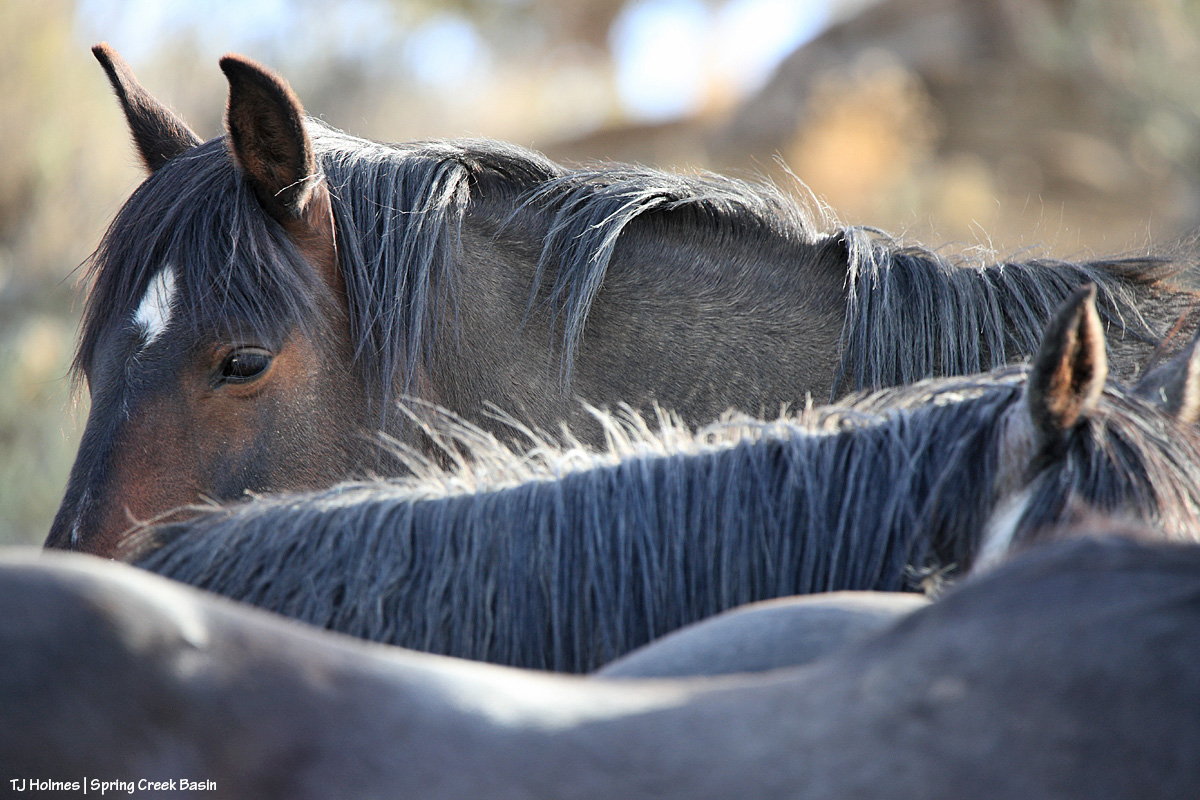
This wasn’t especially the best pic I took in May, but I love both the perspective and the sort of inside joke that Cassidy Rain always likes to be the farthest away from the two-legged. That day was a pretty warm one, and the band was in an area of basin where I rarely find them. It’s not a place with a lot of trees (in fact, there are very few), but they had found a couple, and were comfortable together in the shade near sunset.

My best boy Storm made a brief appearance in the northern part of the basin in June … one of the first times I’d seen him since he’d lost his band the previous autumn. Bittersweet. I haven’t seen him since about July, when he was at a water source with another band as I was trying to shoot the rising moon.
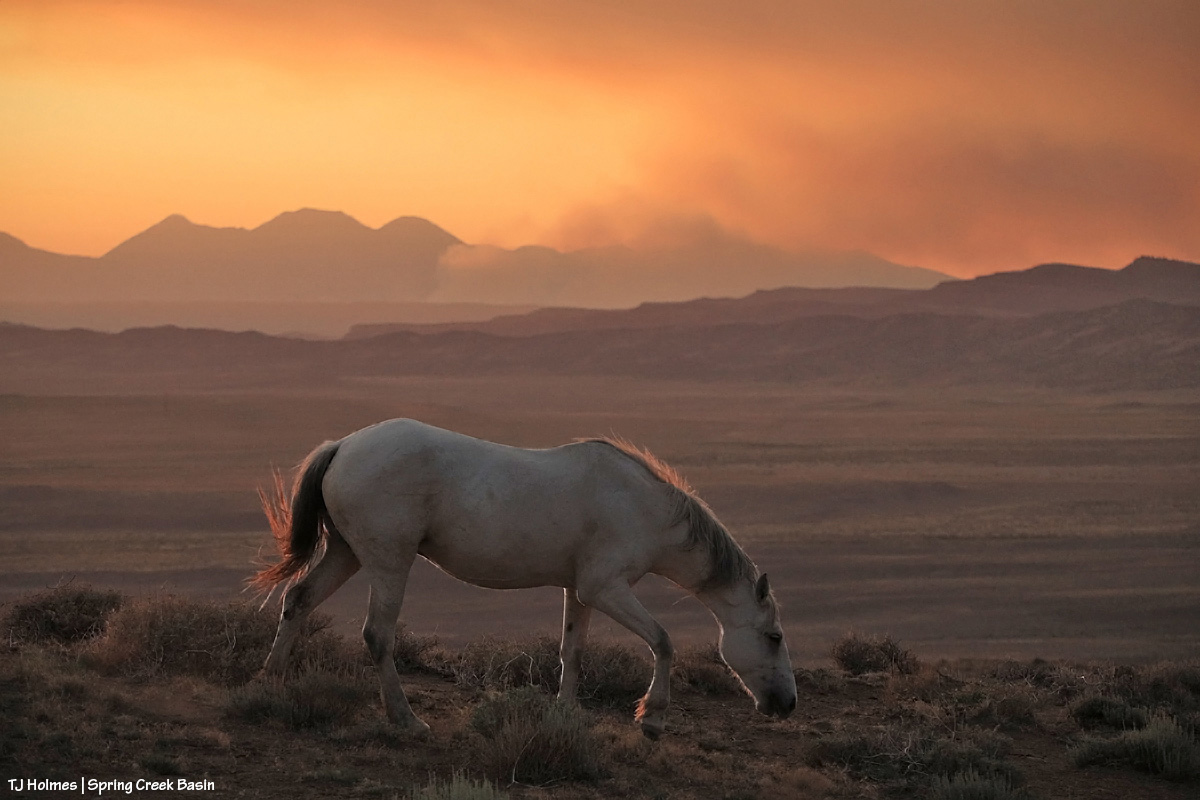
Ah, July, the month the Deer Creek Fire at the base of Utah’s La Sal Mountains sparked. It wasn’t the biggest wildfire of the season, and it wasn’t even the biggest with smoke visible from Spring Creek Basin and Disappointment Valley, but it was uncomfortably close to home. It was a reminder (as if we need any more) that it’s hotter and dryer out there, and we all need to be super aware and careful.
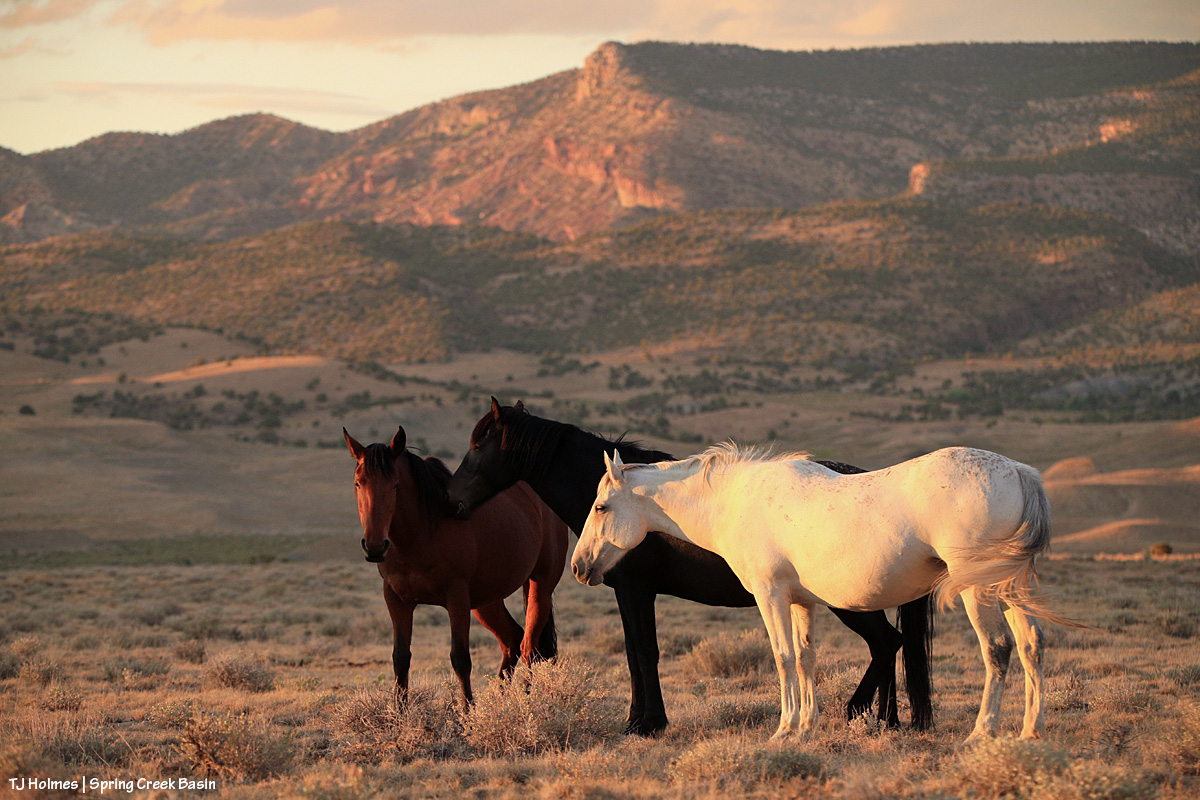
Fortunately, the mustangs live in the moment (while the humans obsess over the wildfire updates), and they still enjoyed peaceful days such as this: Three mares content with their world and each other.
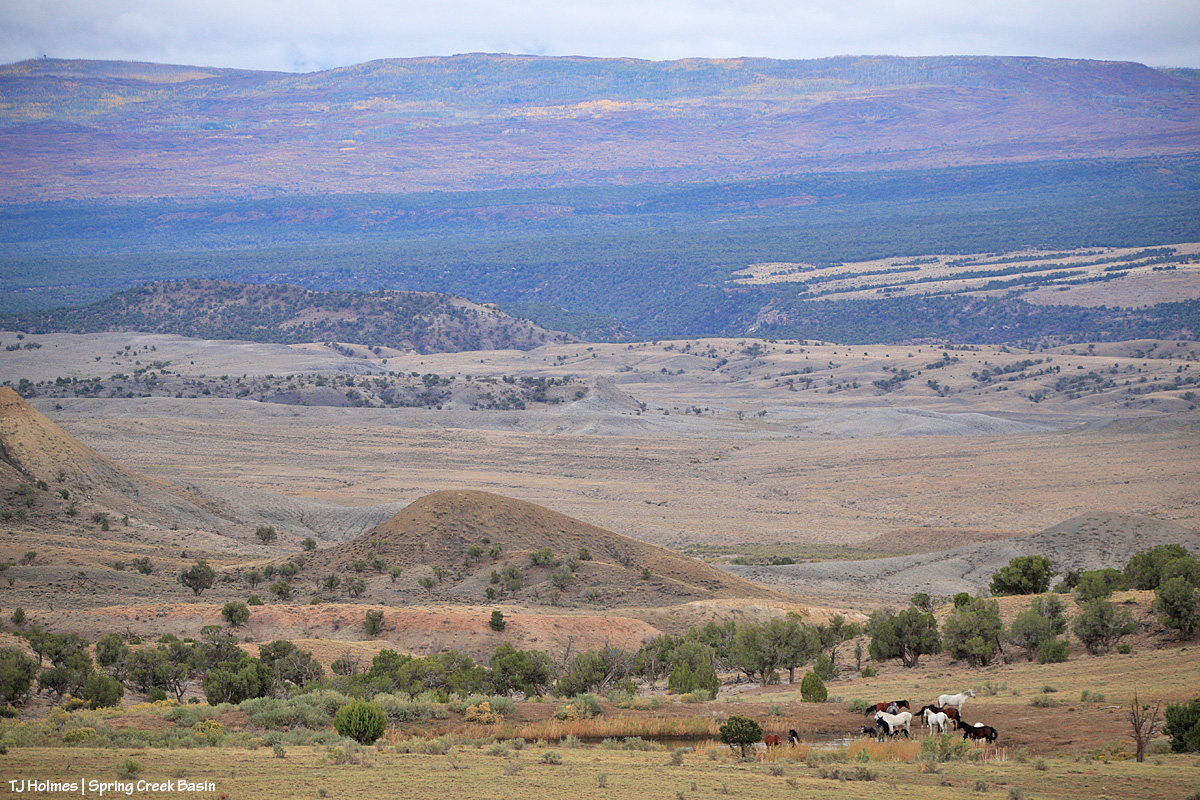
Finally, as summer gave way to fall, Mother Nature cried her best tears and filled some ponds for the mustangs. THAT brought huge relief to us all (if I may speak for my four-legged friends as well as myself). Interestingly, visible at upper left in this image is Benchmark Lookout, a U.S. Forest Service wildfire-watch tower staffed during the critical seasons of the year (which includes September). In this backcountry, we are massively grateful for those who watch for and provide critical information about wildfires, as well as those who work to contain them, allowing them to provide some benefit in some cases while trying to keep property and lives intact.
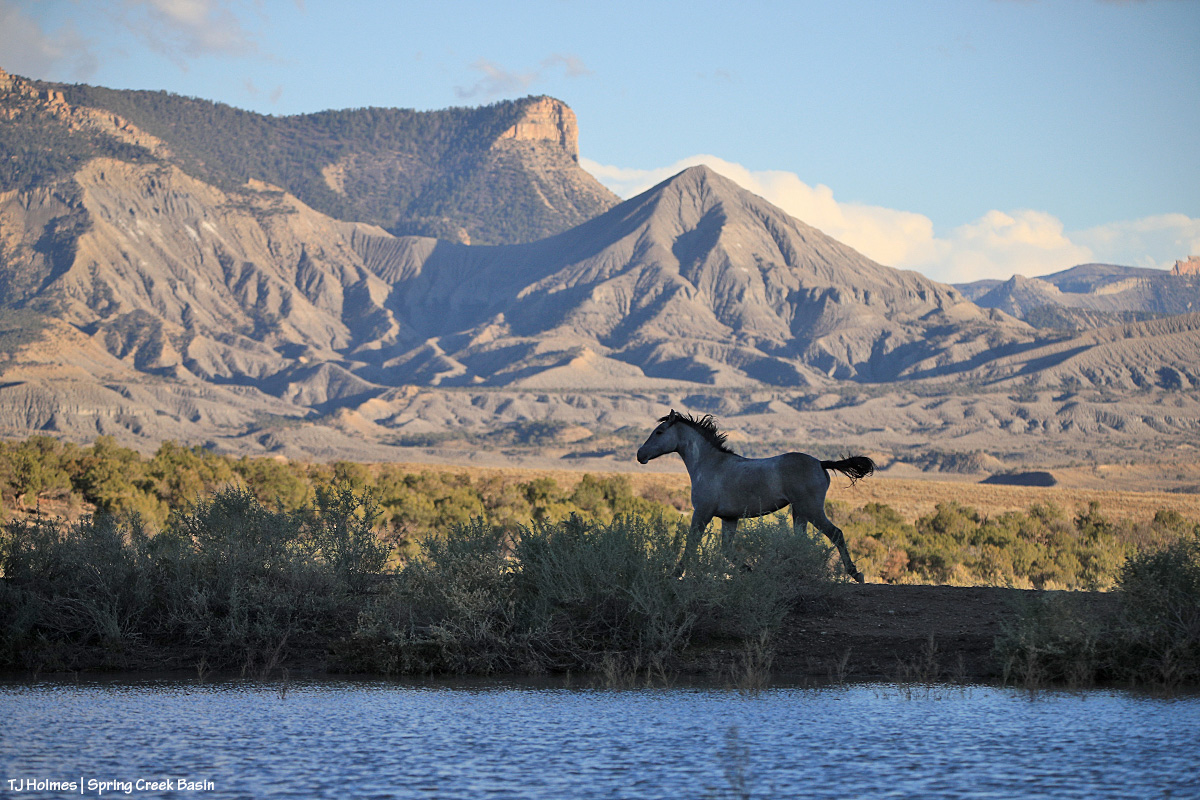
It might be about now in the list that you’re thinking, “for talking about dry it was, she sure included a lot of pix of ponds.” It’s not because we had so much water; it’s because we’re massively grateful for the water we had.
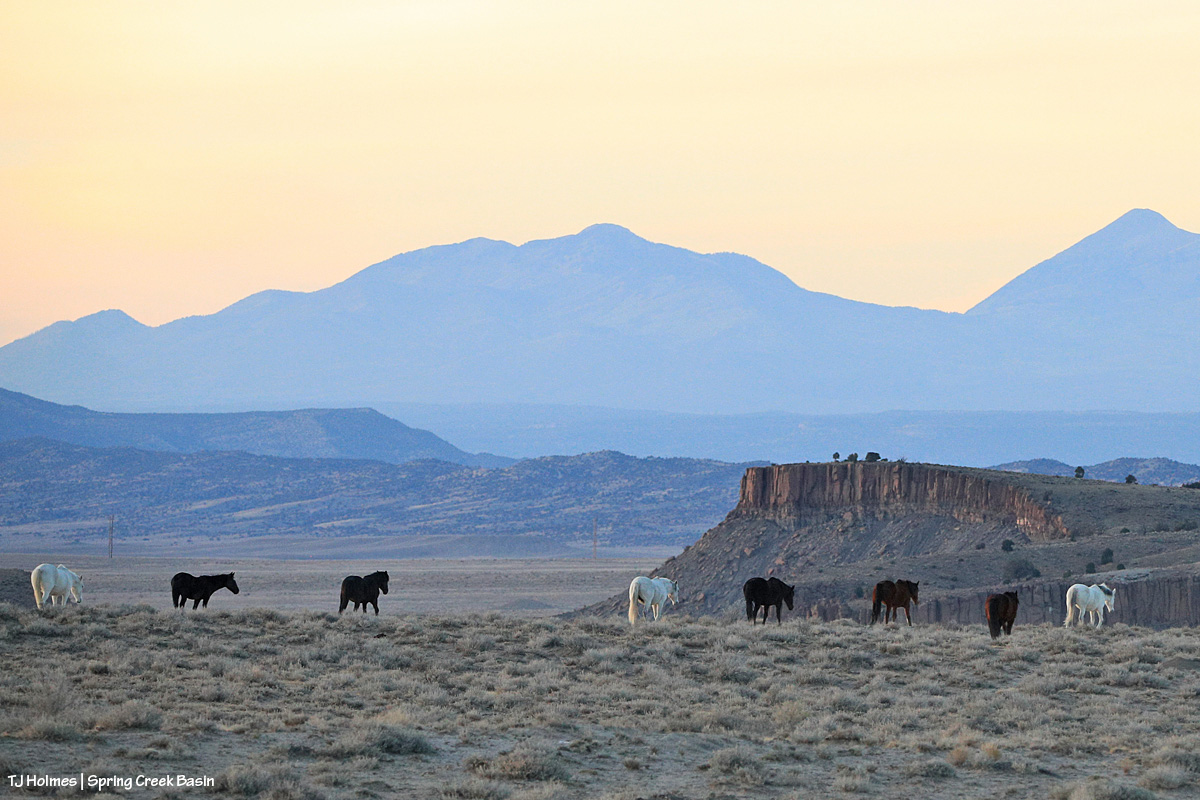
There’s no water in this image – and it was November, before snow graced the peaks on our northwestern horizon – but the ponies are lined out on their way out to graze after drinking at a little place I call the marsh. This is post-sunset, but wow was it gorgeous under the autumn light. … And it’s not UNgorgeous at blue hour.
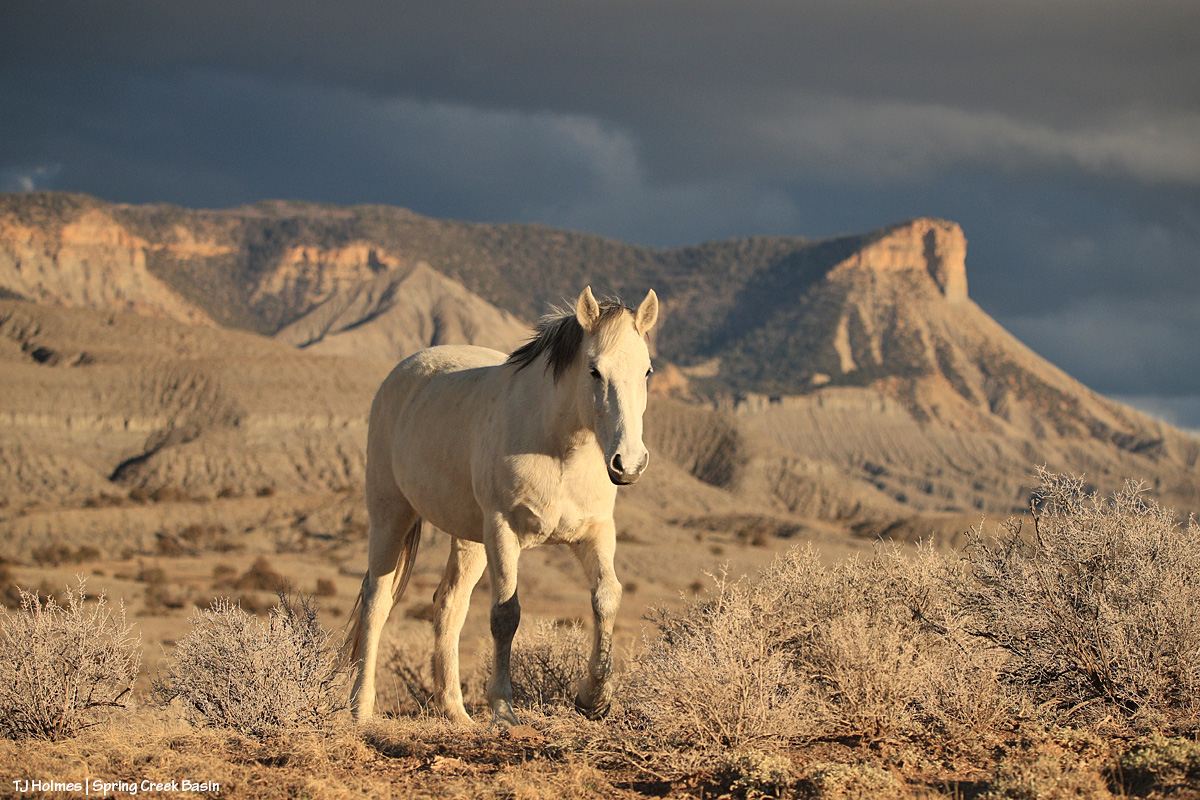
You’ve just seen this image of Temple with Temple (yes, the same) Butte and McKenna Peak in the background under a stream of stormy-looking (they didn’t produce a drop over us) clouds. I decided not to choose a pic from the bit of snow we got at the very beginning of December because the above is what we saw the whole rest of the month. The weather has been warm and dry … and that’s awfully nice for getting around and playing outdoors (60s! in Colorado!! in December!!?!) … but if things don’t change in the next few months, I’m going to be singing the same ol’ why-won’t-it-snow song that seems to be stuck on repeat.

And your bonus:
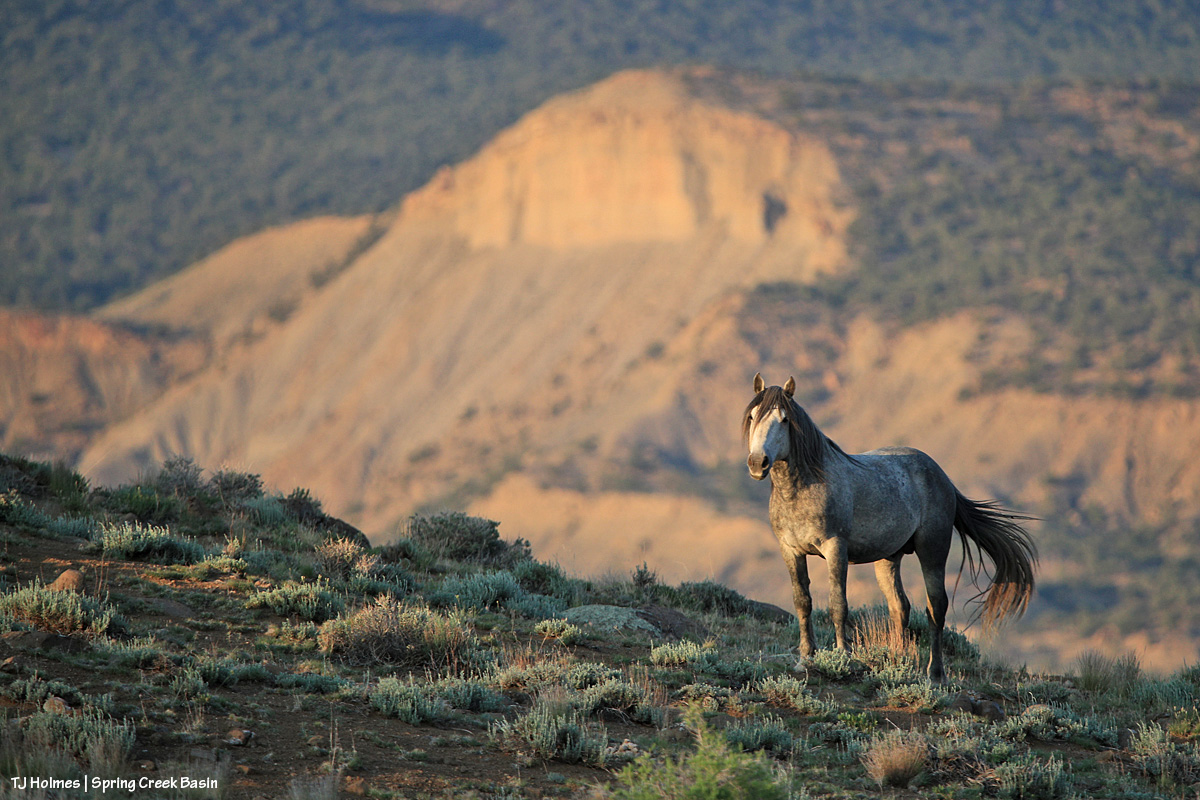
This was an evening in June. Nobody wanted to pose much, and I was going bananas, trying to get somebody – anybody – in front of that background in that subtle, delicious light. Finally, this young stallion obliged. And it seems to sum things up a bit: Hot this year? Yes. Dry? Gosh, yeah. Anxiety-inducing? Pretty much like always … with an extra edge. But! Beautiful, peaceful, a place of escape from the world’s ills (at least the headline type). Kind of a promise that it’s there … out there … and sometimes we don’t have to search all that far for it.

And there you (kinda) have it: 2025 in the rearview. It’s always hard to select just one pic for each month (plus a bonus!), but I hope you enjoyed this little recap.

In best-of-all news, I spent a lot of time (again) with my beloved mustangs in the best place on Earth (in my ever-so-humble opinion). πŸ™‚

And close to that is my gratitude for all of you readers who follow the mustangs and our pictorial journal of peaceful, wild, beautiful life here in Spring Creek Basin. Thank you so much, and I hope you all have a peaceful, wild, beautiful 2026 (with lots more moisture!!!!!!!!!!!!!)!

Be kind to each other! πŸ™‚


Remembering a giant

16 12 2025

Today is the 10th anniversary of the passing of Dr. Jay Kirkpatrick, beloved fertility-control advocate (and so much more) for wild horses and burros (many species of wildlife, actually). I remember that when I got the news in an email from a friend, though it was December, I thought it was some kind of cruel April Fool’s joke.

I met Dr. Jay in August 2010, when I showed up at the Science and Conservation Center in Billings, Montana, for a PZP training course. I also remember that it took me a long time to work up the courage to follow the advice of a couple of friends and contact him; he was a rock star to me. Legendary. Untouchable. Unapproachable!

Except that neither of those last two words was true.

I finally worked up the gumption to email him … and sign up for training – BEFORE we got approval to implement a PZP program in Spring Creek Basin. I tentatively approached the lab, on the grounds of ZooMontana, the day before the class officially started, to see what I was getting myself into. When Jay appeared, I didn’t ask for an autograph (!), I asked if I could give him a hug. I still remember that, while he laughed, he indulged me. … Wow, I miss him.

Jay was one of the friendliest, most down-to-earth people I’ve ever met, all the more amazing because he was also one of the very most obviously crazy-intelligent people I’ve ever met (to this day). He had this way of making everyone welcome and like you were IN ON IT with him, even as he explained his “why wouldn’t you do it this way” philosophy surrounding better management … some of which you might never quite have thought of but was so wonderfully simple – and, according to his same philosophy, attainable.

Dr. Jay was one of the best, most inspiring, most humble, most committed and dedicated people I’ve ever known, and I feel so blessed to have known him, even briefly. He trained me not only to mix and dart with PZP, the *why* behind doing it, the keeping of records (back at a time when it was particularly challenging for us in Spring Creek Basin) but also the importance of having optimism and a plan … and persevering.

I got to know him for five years, and he encouraged me through the sometimes rocky start of Spring Creek Basin’s PZP program. Even now, 14 years and only one roundup later (in 2011, when we started our PZP program), I think of him quite a lot. He’s one of the three (at least) angels watching over Spring Creek Basin, and I hope he’s proud of what we’ve accomplished here.

Friends Celeste Carlisle and Kayla Grams, along with Melissa Esser (whom I haven’t yet met but already greatly respect) visited Rocky Mountain National Park during their trip to Colorado for the Pathways 2025 Human Dimensions of Wildlife conference. Celeste wrote this blog post for Return to Freedom.


Day of gratitude, early

21 11 2025

How good are *my* BLM folks? THIS GREAT *arms spread wide*!

Allow me to highlight:

Days before the end of the shutdown, toward the end of third rifle season, when I was feeling very tired and hard done by at the sheer volume of humanity in a usually very quiet, very peaceful place, one of our law-enforcement rangers, Matt Abraham, came into Disappointment Valley to check on Spring Creek Basin. Um, wow! But that’s who these guys are and have been since I started volunteering 18 years ago (I’ve known at least five).

The day (?) the shutdown ended, herd manager Anton Rambur was out in Disappointment Valley to check on things. The muddy road prevented him from accessing Spring Creek Basin, but that this was one of his priorities at his return to work … ???!!! He wanted to know what was happening and what I needed.

Later that afternoon, I got a call from the other range specialist, Ryan Schroeder, asking – again – what HE could do for ME and the MUSTANGS/BASIN.

Upon returning to the computer, I had an email from range tech Laura Heaton asking what SHE could do for us!

Like, um, I don’t even have words to express my crazy-level appreciation and gratitude for these excellent human beings!

One of my mentions to all three of them was that it would be great to have (more) signs to deter the illegal route-making in the basin – as reader Sue calls them, “rogue roads.” I had one very particular place in mind (and have for the two years people have been driving around a particular washout … only to get stymied within half a mile by a washout they CAN’T cross …). …

The following day, I had a message from BLM park ranger Jon Whitehead asking for details about what signs we need! And Wednesday, he and Ryan brought promised signs and stickers to Spring Creek Basin to erect in areas to hopefully stop already-done resource damage and continue to prevent it in places where the signs, with their sun-faded stickers, have worked for nearly or more than 18 years.

Please follow along in pix:

We have to start at the start: That’s Jon driving and Ryan riding shotgun (unfortunately, both Anton and Laura had duties elsewhere that day) at Road 19Q (behind them – and look! it’s being graded! thanks, Denny from San Miguel County!) and Road K20E to Spring Creek Basin. (Also note the water at right; that’s from Sunday’s rain.) Safety first!

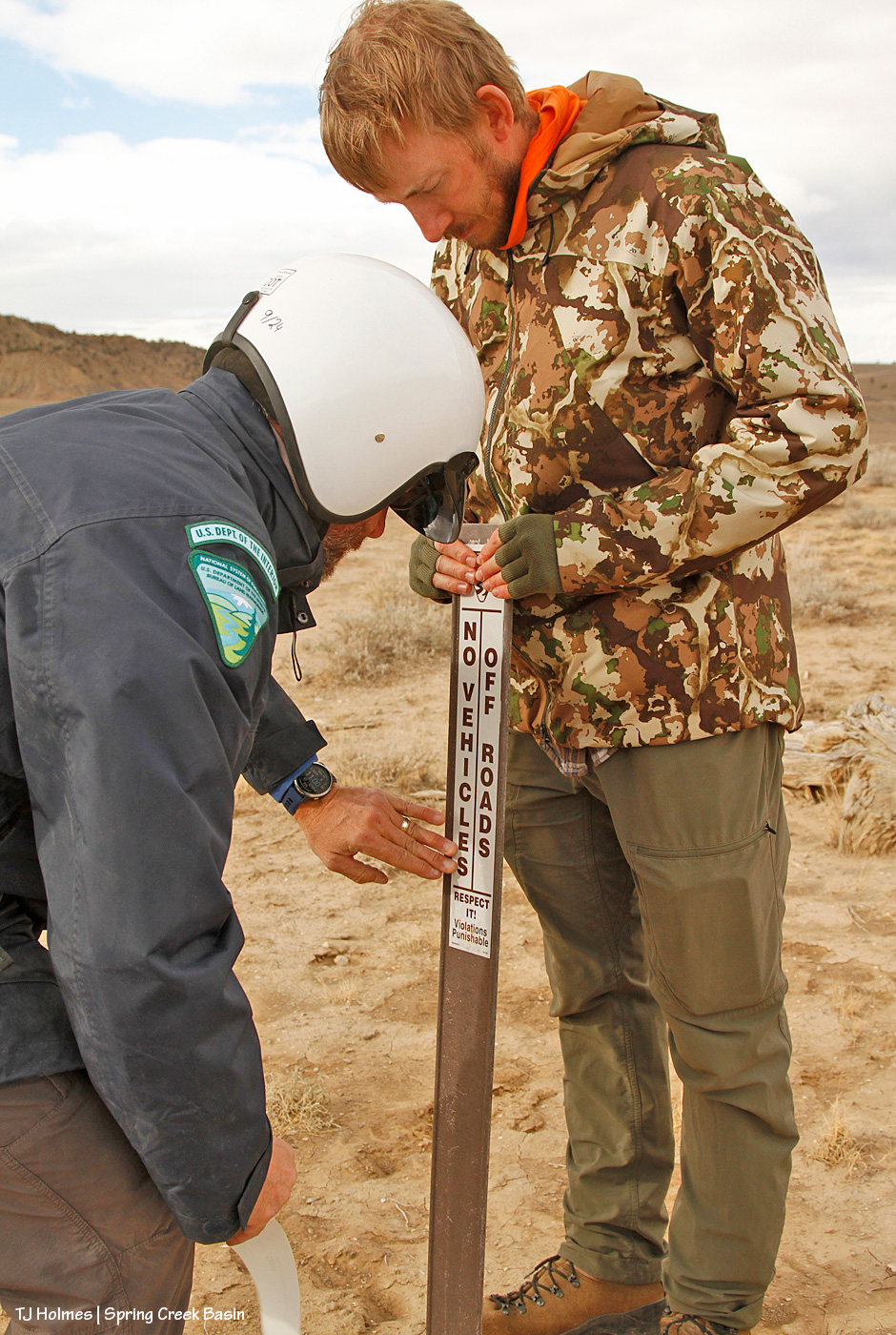
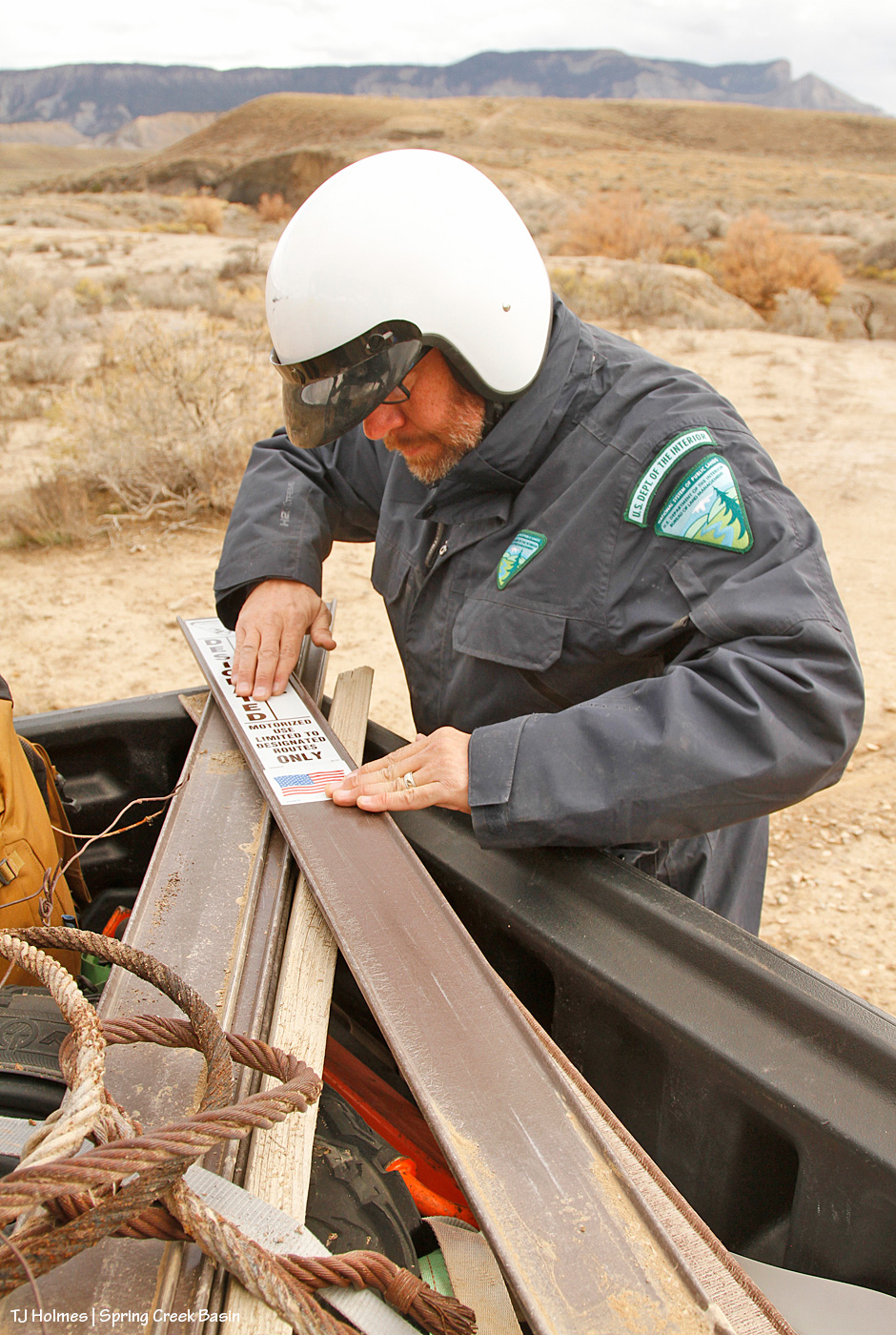
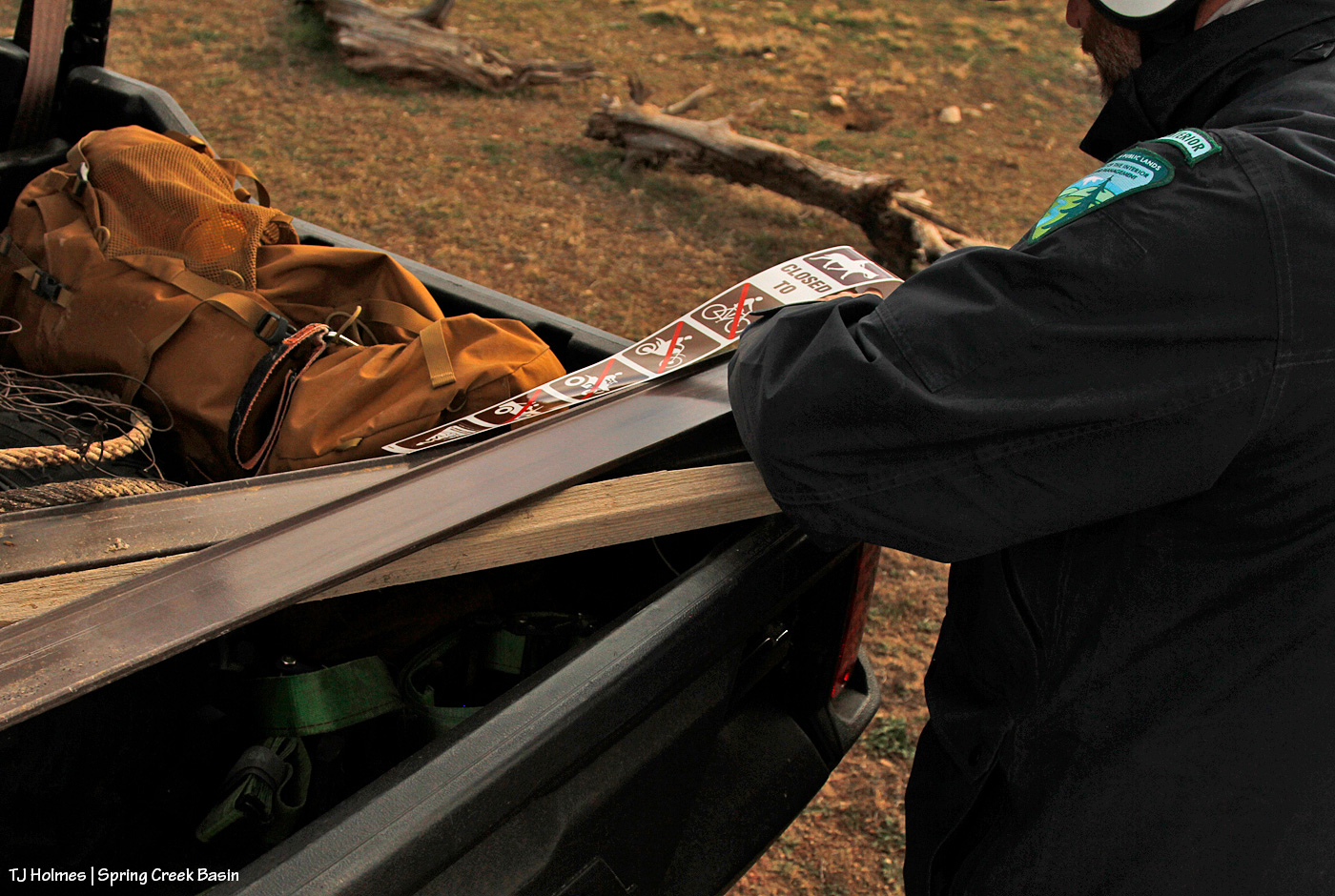
The *serious* BLM faces as they’re about to prep an existing carsonite sign for a new sticker. …

They couldn’t maintain those stoic faces for more than a couple of seconds. πŸ™‚ We shouldn’t have so much fun “working” … should we?? πŸ˜‰ Note the snow over the Glade in the background! We got a drizzle later, but we agreed that was likely snow at higher elevation.

Wonder what “carsonite” is? Apparently, it’s a brand, which means that I should be capitalizing it, but I think I’m going to leave it because we refer to it somewhat generically. It’s like fiberglass, and as Jon will tell you, don’t (try not to) touch it with your bare hands/fingers.

And on goes the new sticker over the old, faded one!

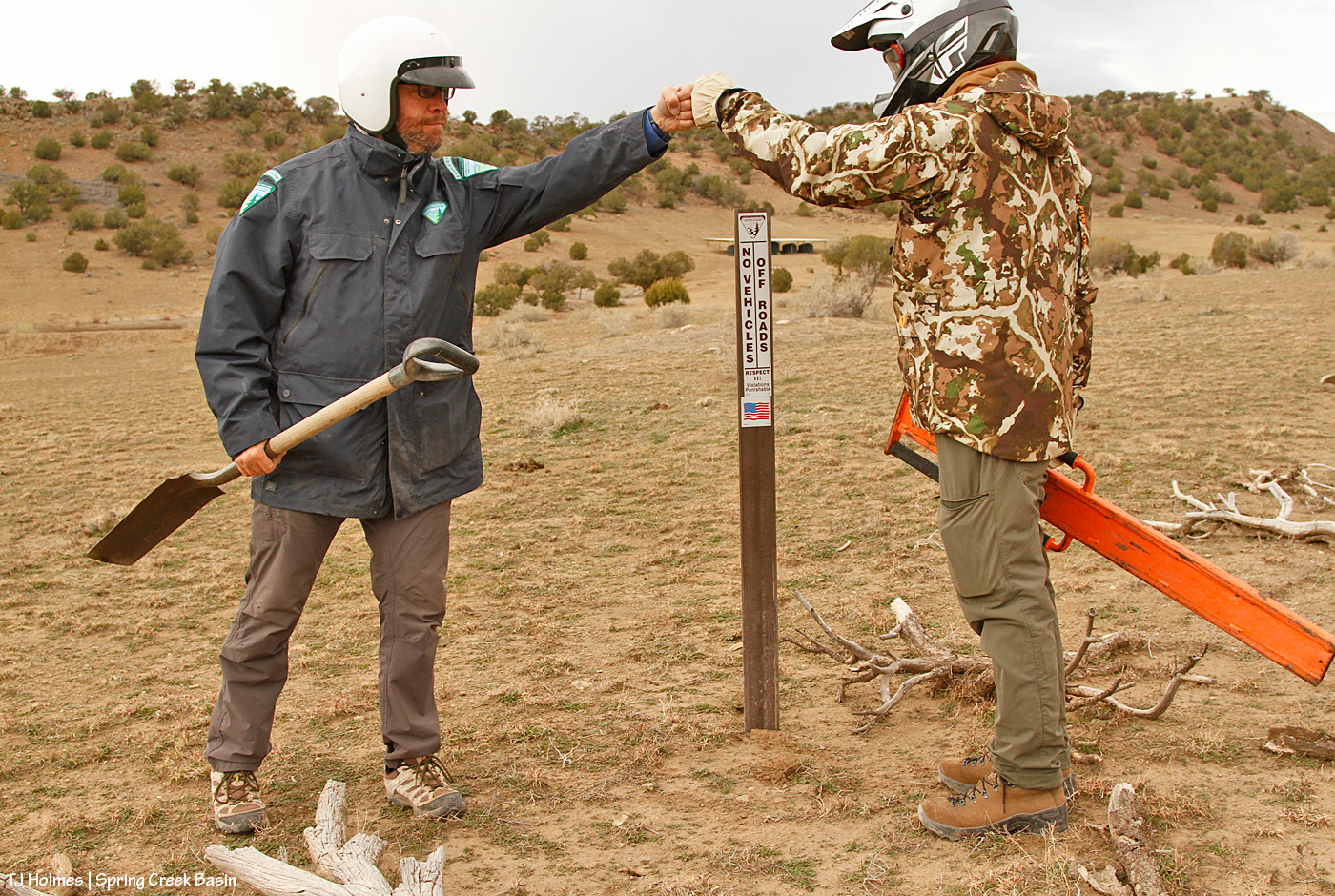
This is a place on a curve in the road, and the edge of this level of ground is less than 50 yards away. … But it had been just too tempting for people to DRIVE over there to look over the edge as opposed to leaving their vehicles or buggies at the road, getting off their butts and WALKING over to look over the edge. So that’s why we had placed the sign there years ago – and why I’d “reinforced” the message with the old branches you see on the ground. There are any number of places in the basin where I have seen tire tracks that lead from the road to the edge of a ridge or place where the ground falls off, including this last driving (aka “hunting”) season. It makes me craaaaaaaaaaaaaazy.

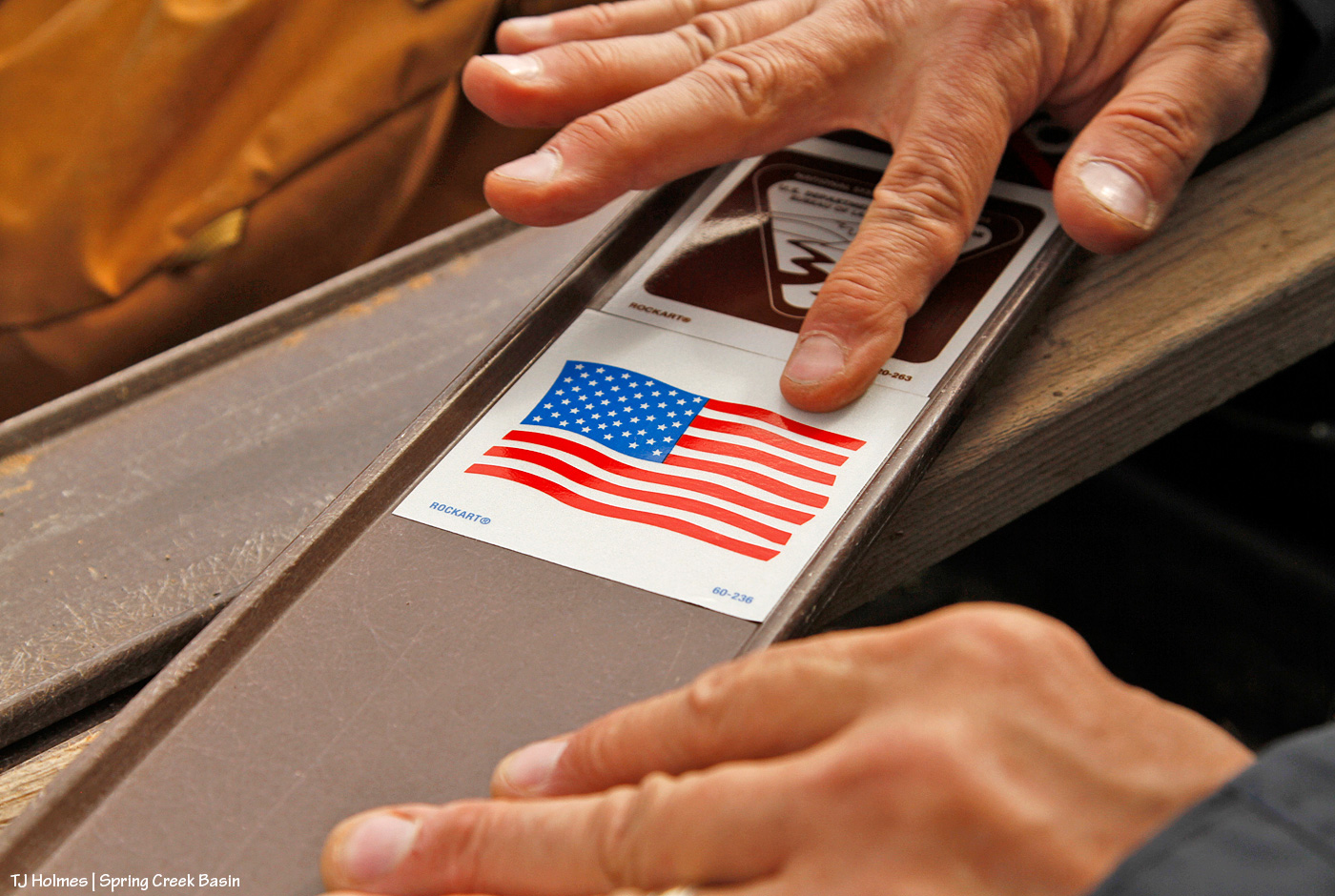
No less important in terms of the sign stickers and their meanings: the American flag. These are America’s public lands! Respect them, no matter how you use them!

On to our next location, a reminder to not handle these signs with bare hands: splinters! This is the location of an old “Y,” driven in by people too lazy to use the actual road (up the hill) to get to the main road, which comes out not even 75 yards away. Interestingly, this is the site of one of my very first volunteer projects for BLM in Spring Creek Basin; shout out to Kathe Hayes, retired long-time volunteer coordinator for San Juan Mountains Association, who spent countless hours shepherding excellent projects in the basin (including the much-loved alternative spring break program with University of Missouri students). You might have heard that Colorado gets 300 days of sunshine every year. In Disappointment Valley, we take pride in the fact that we likely get about *600* days a year of sunshine (har har). Remember the faded information board that led to the installation (with our most-excellent BLM folks!) of the new kiosk earlier this year? Yeah. You laugh, but we know how much sunshine we get! These signs were due for updated and easier-to-read stickers.

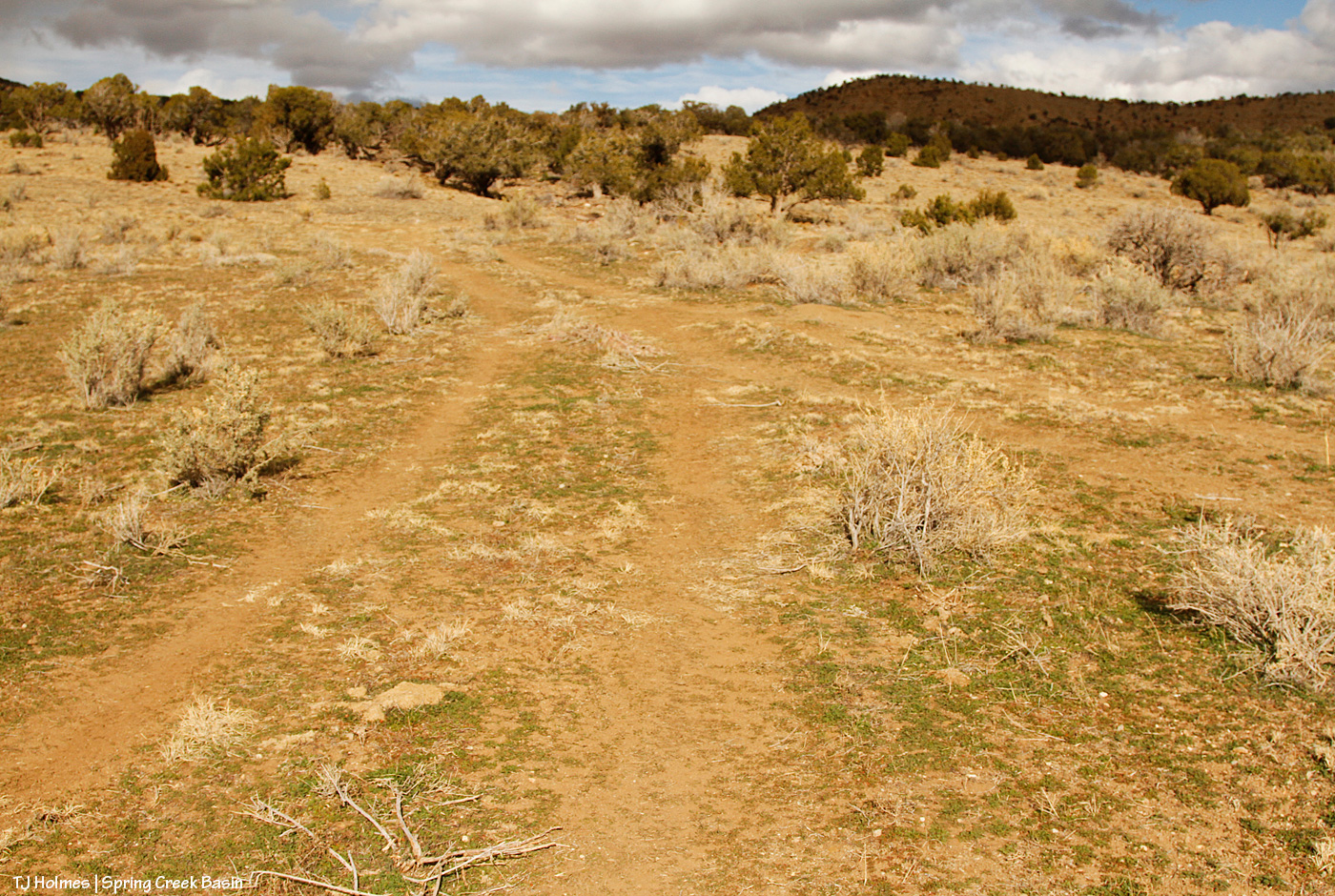
This image really illustrates why it’s so important to protect the resources of Spring Creek Basin, specifically, and many of the West’s drought-fragile landscapes in general: We closed this route 17-18 years ago? It STILL bears the traces of the drivers who ignored that fragility and made a new route because they were too lazy to use the established road – a “designated route,” as BLM calls them.

Every illegal “Y” has its other end, so here are the guys adhering a new sticker to the carsonite sign at the top of the hill. The actual road is right behind Jon.

On to our next location! This was the first installation of the day of a new sign, and we put it at the dugout intersection, which marks the start (or end, or both!) of “the loop,” which is no longer completable (is that a word?!) by vehicle or even most UTVs/ATVs because of washouts (which was the main impetus behind the day and the signs, as you’ll see later). Note the rusty old cable; a bonus to attaching the new stickers to the signs at either end of the old “Y” was that I spotted both old wire clumps and this length of old cable, starting to erode out of the soil, where it had been for … decades? At least nearly 18 years.

This sign, at an intersection, reminds travelers to stay on designated routes. Jon lamented this need, as there are no fewer than THREE big signs from just south of the highway to just before to just inside Spring Creek Basin’s western boundary (and main entrance) that warn that exact message (along with similar signs all along Disappointment Road). … I think of them as just another pretty-please reminder.

Wonder how the heck one of those narrow, flimsy signs is installed, aka pounded into the ground?

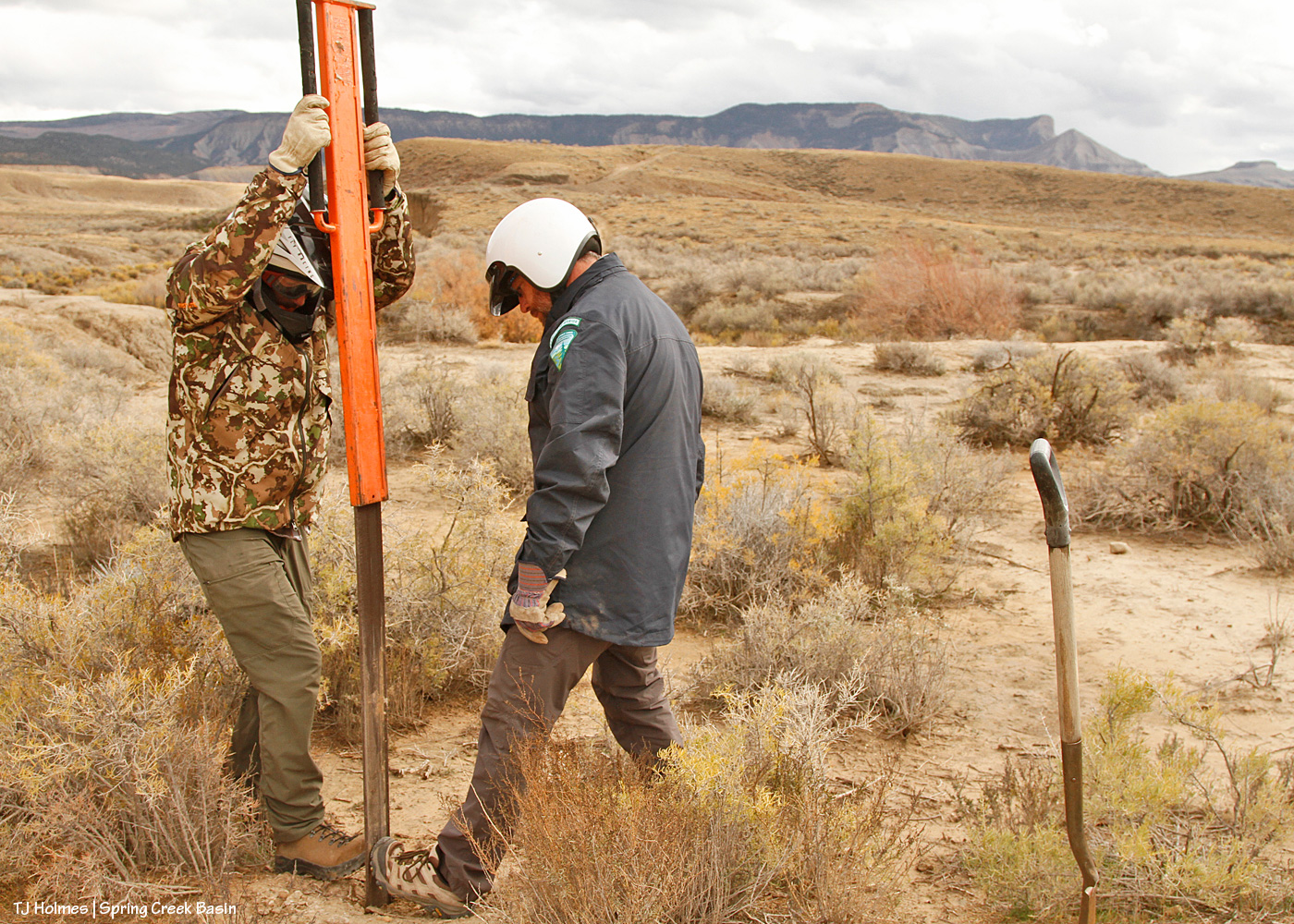
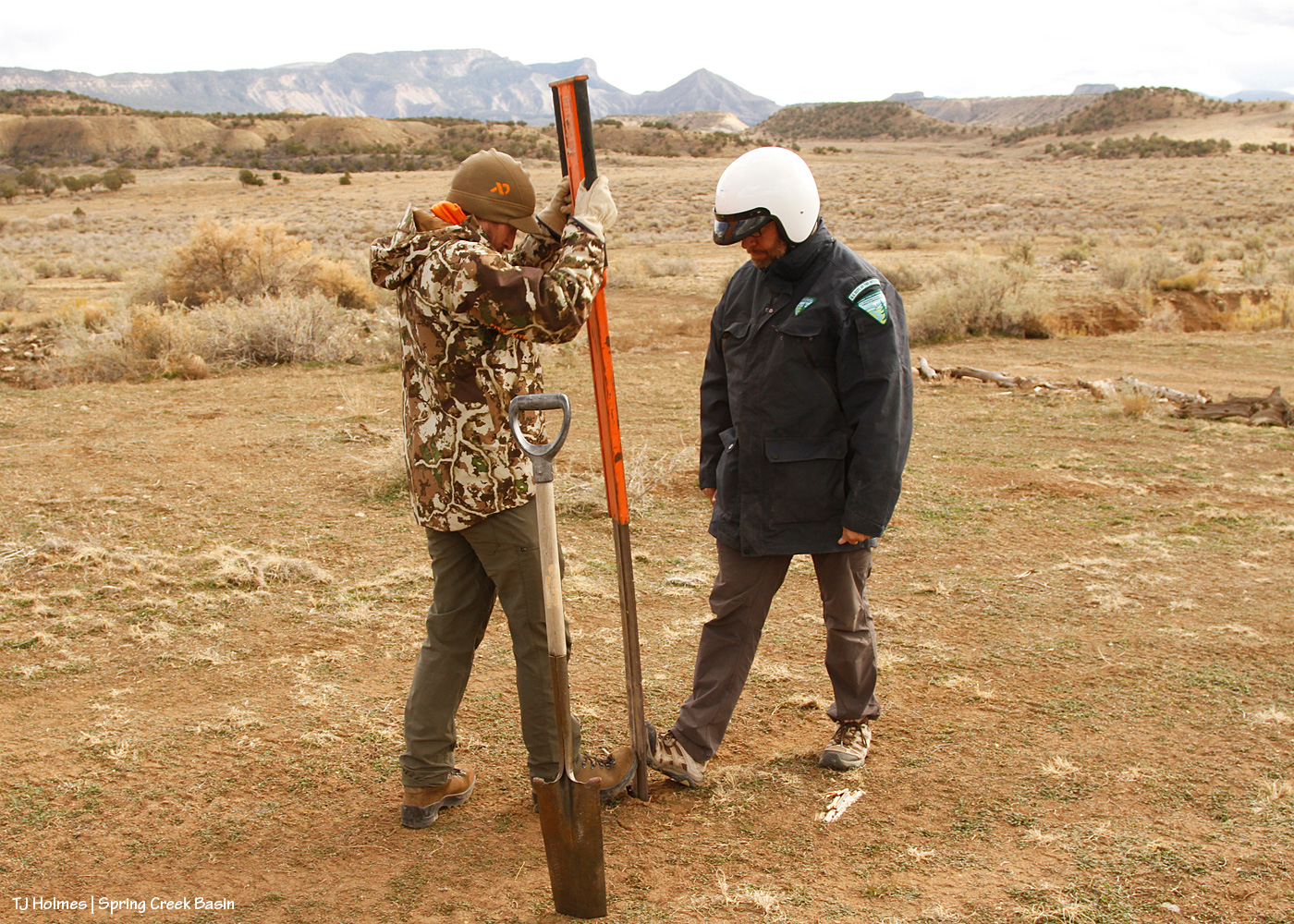
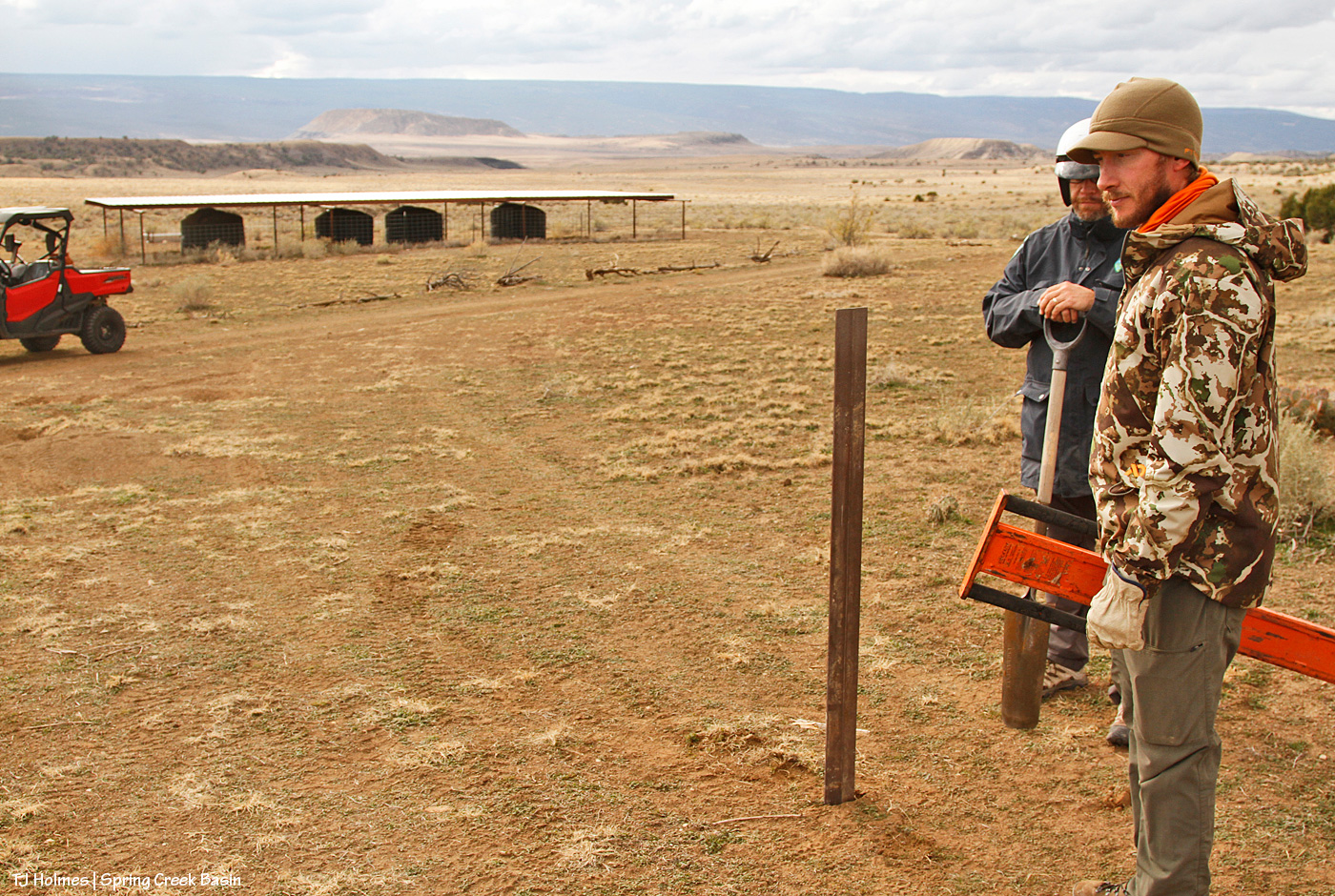
It requires a specialized “pounder.” First, you need the “tile spade” pictured at right, to create a “slit” in the ground and test for out-of-sight rocks (and with our recent rain, the damp ground was very accommodating!) to ensure you *don’t* hit rock. As Jon said, if you pound that flimsy, floppy carsonite sign and it hits rock, the whole thing is wrecked. Then the pounder does the rest. I’ve wielded my fair (or more than fair?!) share of T-post pounders, where you have to hold the post steady or have an unflinching friend do it so it doesn’t twist. Note the men’s toe-to-toe technique on either side of the base of the carsonite; that was to prevent it buckling as it entered the ground.

Now we’re getting to the new water catchments and where I really, really wanted the signs. This one, pictured, was the second one built by Mike Jensen, Garth Nelson, Daniel Chavez and me (the first one included Jim Cisco), in 2022. People really can’t help themselves (!) from driving where they shouldn’t, including over not only fragile ground that doesn’t recover quickly (see above) but also the very limited vegetation on which the mustangs AND deer AND elk AND pronghorn graze and browse. You can see by the wood scattered around that I’ve tried to block it using natural means; people just drive across the ground from somewhere else (at least three other places that I’ve tried to block at this location). And not only directly to the water trough and tanks but to the pond (which, thankfully, is holding water!). … Like, WHY??? I get the curiosity; but have some respect and WALK.

And now we’ve reached the last stop, and, to/for me, the most important.

The 2021 water catchment is behind Jon, not 50 yards away. See the wood on the ground behind him? Over the last two years, I’ve dragged a number of old branches and trunks down from the trees up the hill to line the edge of the road to prevent lookie-loos from lazily driving down to and around the water trough, downhill from the roofed catchment tanks. It has mostly worked, though I’ve had to add more as people, too lazy to even move the blocks, find a “hole” and think that’s OK to drive past/through/around. (And we still found old tracks that indicate people are still doing it. Sigh.)

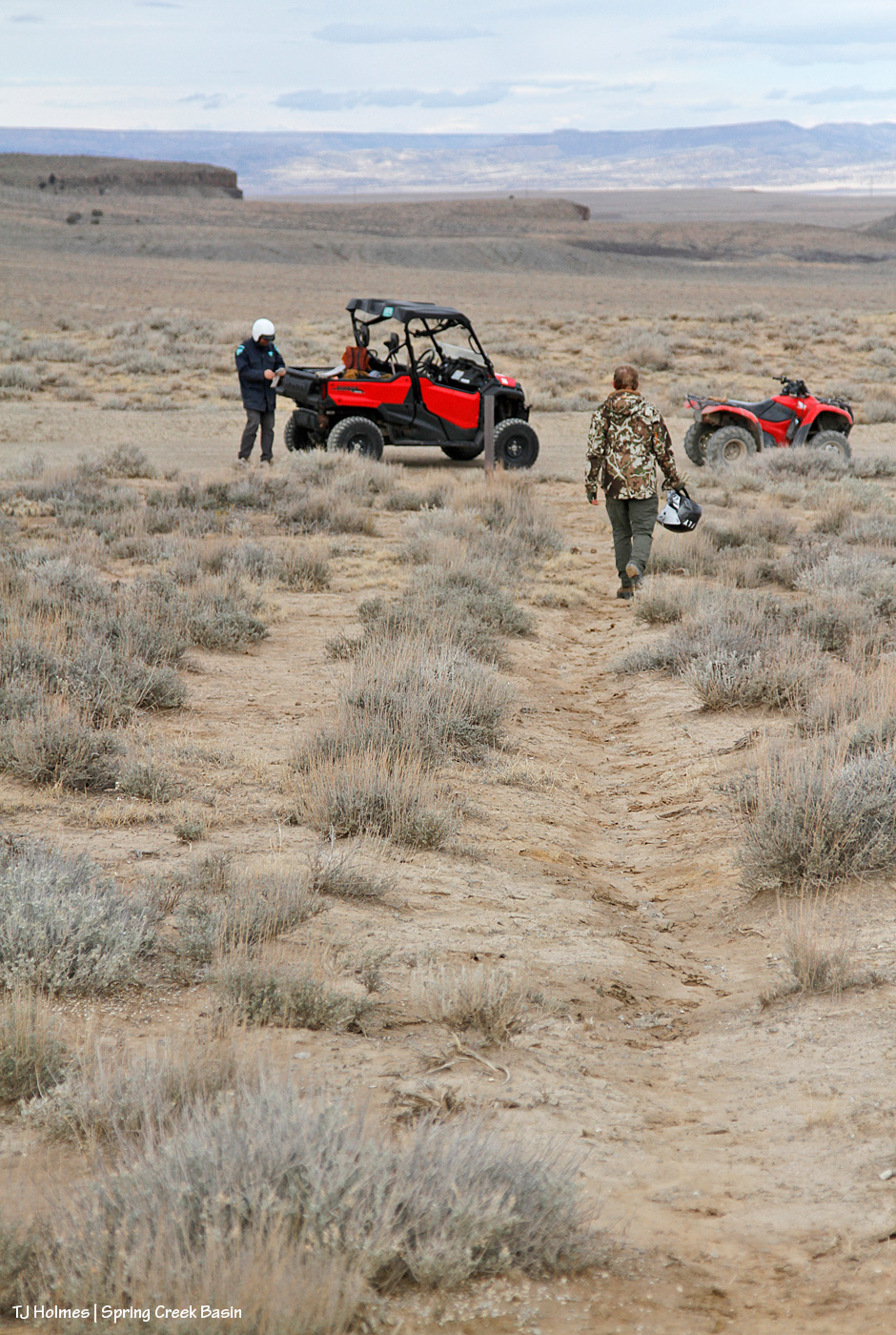
But in 2024, when we had big, flooding rains in early summer, the road, directly ahead of the UTV in the pic, washed out, leaving a gaping chasm where the road had been (you can see the line of it in the pic). That, effectively, ended the road right there. … Until hunting season, which was wet last year, and people repeatedly drove around the washout to continue, driving-in a rogue and illegal route and damaging resources – again, the vegetation upon which the wildlife depend. I literally cried. And put up more blockade branches and trunks on that side … which people continued to ignore and drove either over or past.

When we arrived at the location, which I hadn’t visited at all this past hunting season as my heart just couldn’t take it, sure enough, people had left my last blockade intact … and just created yet another new route to get around the washout – which is even worse now and even washed away their “shorter shortcut” (which I’d also attempted repeatedly to block).

But I didn’t cry at the destruction this time because I had guys with me who were about to justify my upsettedness at the lazy-ness of man (to be fair, most of them have been men), and we were about to proclaim in more certain terms than dead-pinon/juniper trunks/branches and big rocks that YOU SHALL NOT PASS! (I do love a fellow LOTR fan! Thanks, Ryan!)

The sticker going on the carsonite for the sign you saw in yesterday’s post.

Along with:

I really kinda love this pic. Those are hands that belong to someone who cares deeply about our public lands, their value and their sacredness. And though they’re the hands of only one, *I* know, and I tell you with all sincerity, that hands just like that belong to every person at Tres Rios Field Office (at least).

Sign inserted into pounder; check. Note the tire marks Jon and Ryan are standing on. The road is immediately behind Jon.

Pounding commencing; check. At right, you can see my blockade – untouched because the drivers just shifted to driving where Jon and Ryan are installing the sign – and above that, the washout. It starts at the left (literally) and runs right/south/downhill to join a bigger arroyo/drainage downhill of the catchment.

Now looking back to the road (on which the UTV is parked), my blockade along the road to try to protect the water catchment. The silver trough is just visible to the left of the leftmost tank. Yes, it’s THAT close to the road. NO need to drive down there when it’s so easily walkable to get a better/closer look! The tire tracks on the rogue route are really distinct in this image.

For a better look at the rogue route and the resource damage caused (after only two years):

The track at right is where people first started driving off the road to get around the washout. Directly ahead is where they shifted so as to ignore the blockade that plainly (!?) was meant to deter people from driving illegally over our precious and drought-limited grasses and other vegetation (cacti and four-wing saltbush are among the most destroyed).

From where they crossed the “head” of the washout, over bedrock, to return to the actual road, which is semi-visible along where this illegal route makes its last curve.

Why ELSE is this rogue route so infuriating (as if destruction of resources and the vegetation the mustangs and other wildlife depend on weren’t enough)? Within a short distance (less than a quarter-mile?) is another, bigger drainage and semi-washout (that has been hunter-filled with rocks to make it crossable). But just another quarter-or-less-mile past THAT is a washout that isn’t crossable except by walking, riding a bike or a horse or a motorbike or perhaps jigging a relatively small ATV around – and that was the last time I saw it. With the more recent rains, it’s possible that even jigging isn’t possible anymore. Either way, it’s a risky or not-possible-to-cross washout, so why destroy resources just to continue driving another half-mile??? ARGH! It has made me craaaaaaaaaaaaazy!

While out in wildcat valley a few days ago, during third rifle season, I sat with a band and literally watched a truck drive up to the washout, see the washout, back up and drive around the washout to continue on … to the washout they couldn’t pass. … Then return. Following the tracks made by others. I know these people are *just* trying to access public lands, and I am not inherently anti-hunting (though I am very against the *driving* culture that seems to be “the way to do it” out here). I believe *respect* is key, and animals are trying to survive on this fragile landscape. Please, please respect the land AND the wildlife!

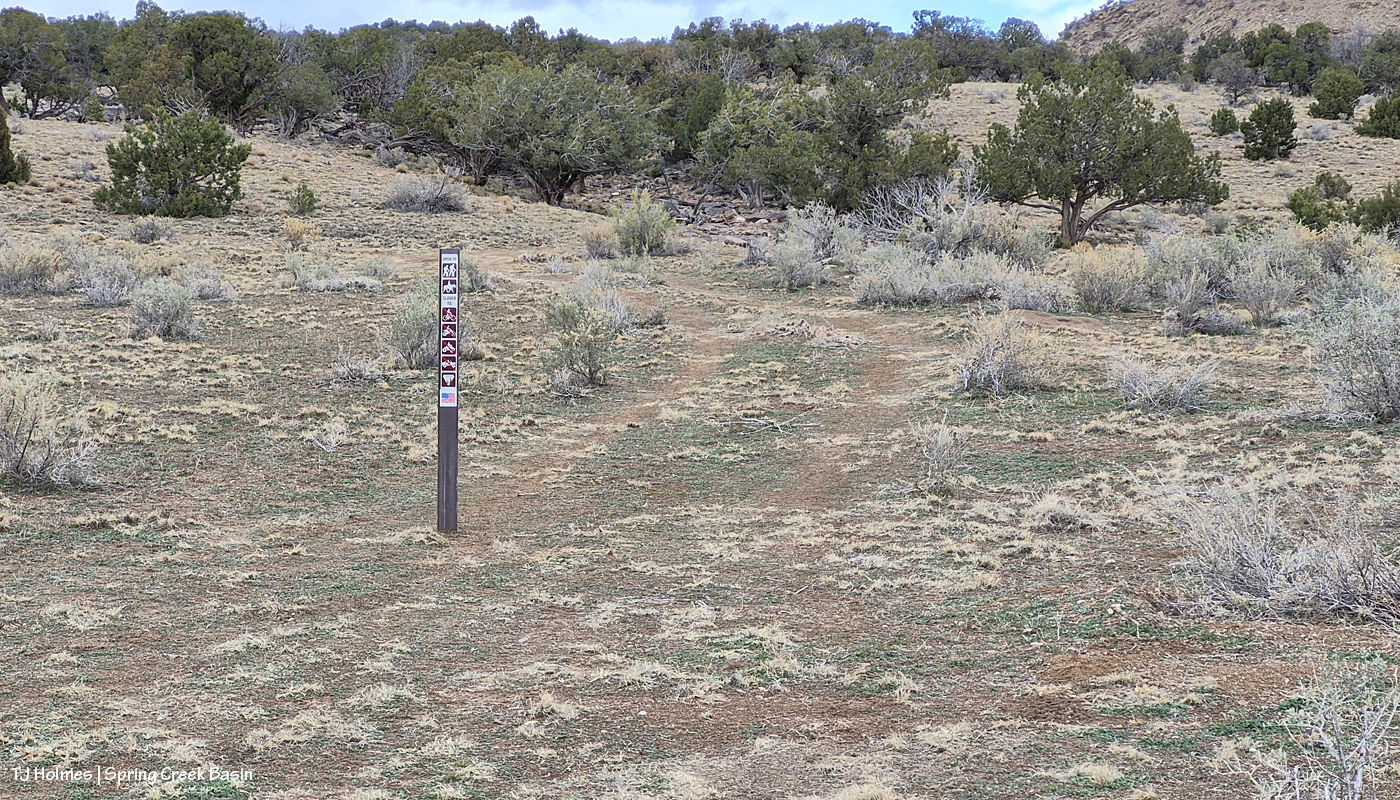
I am keen to say that I’ve noticed that other signs such as those we put up Wednesday have been very much honored in the basin regarding non-designated and please-don’t-drive-on routes. I hope these signs also are honored, and I hope it indicates to visitors that we have land managers here who give a damn about the land and the herd and the way our natural resources are treated.

No joke: THIS happened over Jon and Ryan as we were leaving. πŸ™‚ AND I found an old horseshoe while we were installing another sign (I didn’t think to take a pic, but it was a much better find than the rusty old wire and rusty old cable). If those aren’t *signs* that Mother Nature herself is happy with our work, I sure don’t know what are.

Absolute heartfelt gratitude to all who made this happen, including and hugely Jon and Ryan! This was a very long post about seemingly very little things, but those little signs have the potential to signal big impacts for the preservation of Spring Creek Basin and its vegetation resources for generations to come of mustangs (as well as deer, elk and pronghorns, and no, I do NOT apologize for hammering this point!), not to mention all those living their best lives right now. πŸ™‚

Thank you, thank you, THANK YOU!!!


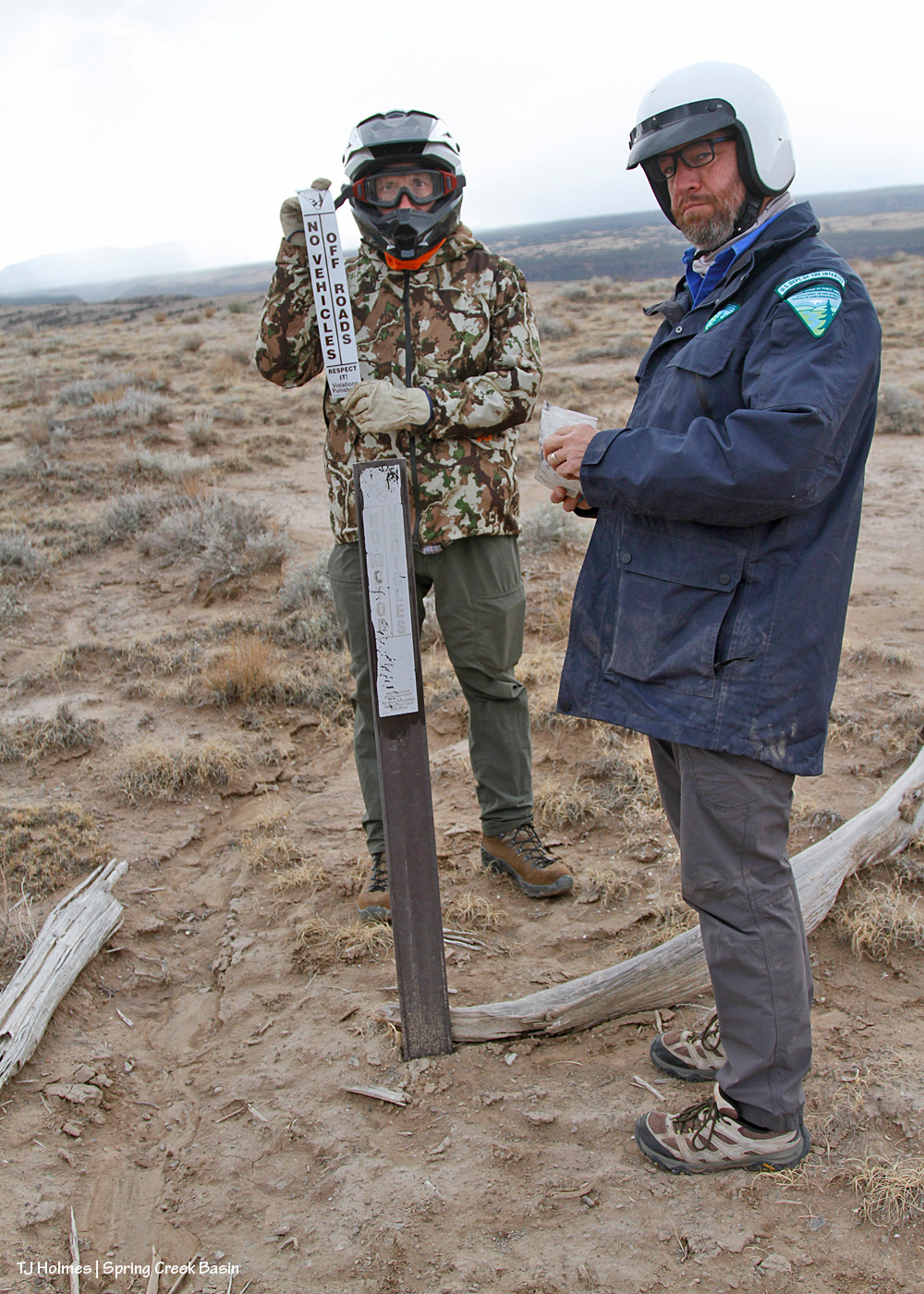
‘You shall not pass!’

20 11 2025

Thanksgiving came early, along with the gratitude. πŸ™‚

Teaser pic for a longer post tomorrow. … What do YOU think is going on here? Let me know!

(Thanks to Gandalf … and Ryan … for the post title!)


‘The Last Cows’

2 11 2025

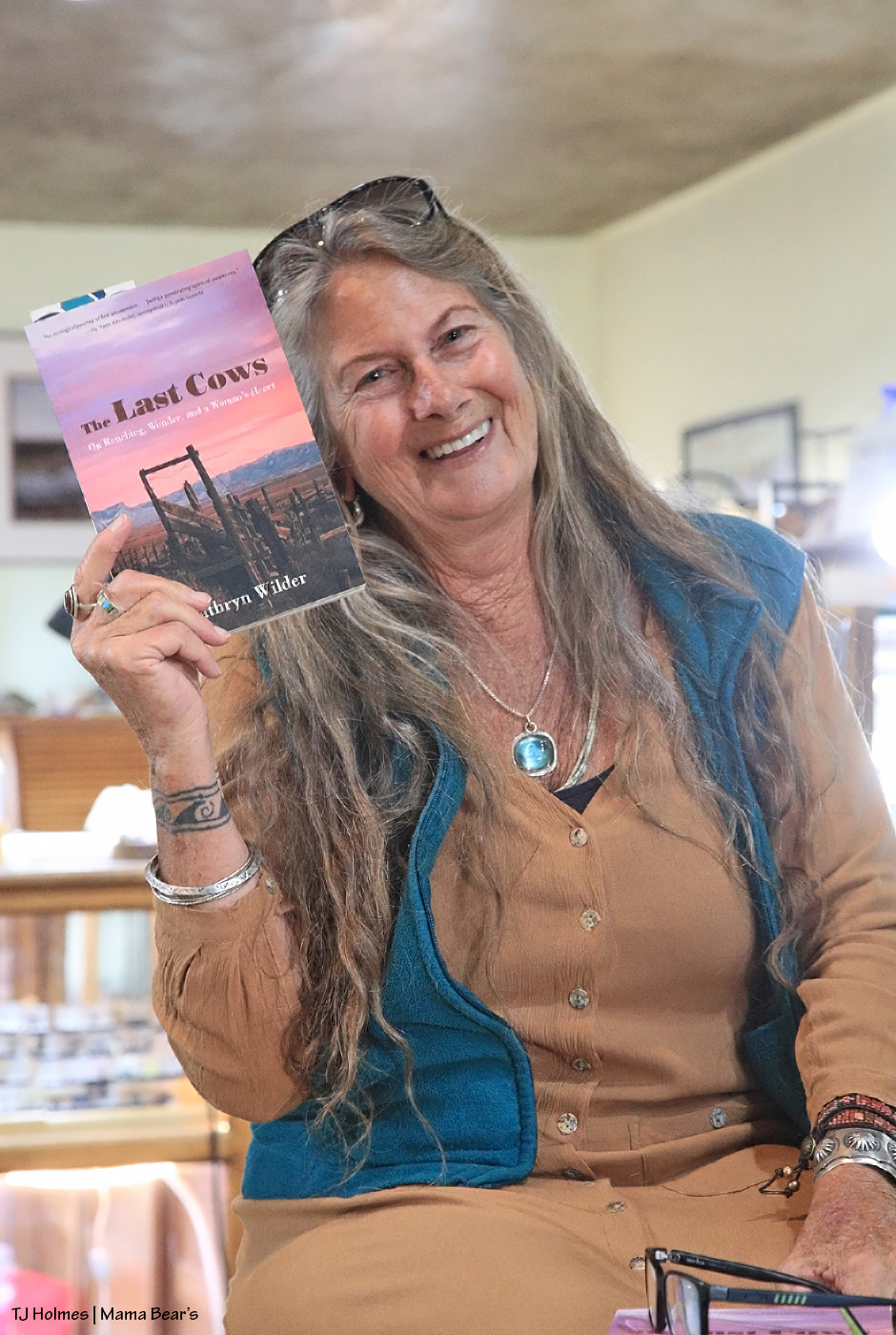
Something a little different today. My friend, writer (author!), rancher AND mustang advocate (and mom and grandma, titles she might be most proud of? :)) Kathryn Wilder has a new book on shelves right now!

Saturday evening, at Mama Bear’s Bakery and Books in Dolores, Colorado, Kat held a “birthday party” for her new book, The Last Cows: On Ranching, Wonder, and a Woman’s Heart.

They had a feast of a spread, Kat’s daughter-in-law served coffee and chai and other drinks the bakery is well known for brewing, and Kat’s sons, Ken and Tyler, and grandchildren, Lacey and Lucas, were in attendance among friends and customer-friends!

Kat read from her new book, answered questions and had folks laughing and commiserating with her narrative prose.

The Durango Herald had a fantastic review recently, and if you are local (or are passing through at the right time), Kat will be doing readings Tuesday evening at Maria’s Bookshop in Durango and Thursday evening at Back of Beyond Books in Moab.

More cows than mustangs, but if you read Desert Chrome and fell in love with Kat’s lyrical writing style and stories from the sage country (and above and below), read The Last Cows. You will NOT be disappointed (Disappointment Valley, get it? :)).


Hope and future

3 10 2025

Ladies ‘n lads, there’s a whole lot going on in the world right now.

None of you need me to tell you that.

What I do want to tell you is that there is a hard-working core group of folks (some of whom don’t even know and/or aren’t involved with each others’ work … and many working in great collaborations) who are dedicated to Colorado’s mustangs, on and off their home ranges. I can list our on-range groups easily (Friends of the Mustangs, Little Book Cliffs; Sand Wash Advocate Team and Wild Horse Warriors for Sand Wash Basin, Sand Wash Basin; Piceance Mustangs, Piceance-East Douglas), but I don’t want to try with the off-range-focused groups for fear of leaving some/any out. Believe me: They are out there, and they are dedicated.

As much as so many are divided these days, we mustang advocates are united in our love of our mustangs and goals of securing good management or good off-range lives – and sometimes both at the same time.

This post is late because I forgot to schedule one ahead of time (and/or I may have thought I’d have time to do it when I got home …), but I was just visiting a sanctuary and herd in northwestern Colorado where beautiful mustangs roam, and there are people as dedicated to protecting them and providing safety and wild futures for them as I am here for my Spring Creek Basin beauties.

The trip renewed my sense of hope that, at least in this, we have options and opportunities to continue the important work of advocating for our mustangs, wherever they might be in Colorado, with people who are united in doing the same (however differently).

That’s pretty cool.

(This golden eagle indulged our visit right along the road for many wonderful moments, and s/he seemed to be an excellent example of the sentiment of hope that goes with this post.)


Book recommendations

15 05 2025

After posting the information about Kathryn Wilder’s forthcoming (in November) book, The Last Cows, I thought I’d do a “pay it forward” post and recommend another couple of books that I’ve recently added to my library.

I’ve been lucky enough to know Barb Kiipper for many years during our mustang advocacy journeys. She’s the founder and director of Jicarilla Mustang Heritage Alliance, a group that advocates for the mustangs of the Carson National Forest’s Jicarilla Wild Horse Territory in northwestern New Mexico. She has poured heart, sweat, blood and tears into the challenge of working toward good management for that herd, getting many, many mustangs adopted to good homes along the way. I met Michele Bell only recently and have been inspired about her approach to taming and training mustangs from a variety of places (the Jicarilla, BLM-managed herds and Mesa Verde National Park).

Why A Mustang is part memoir of their journeys, part philosophy about working with mustangs and what these amazing horses have taught these women about themselves and mustangs, specifically and in general. It’s a bit of an addictive read (and if you’ve been involved with horses and/or mustangs as long as I have, absolutely fascinating with insights about behaviors and taming/training techniques), and I highly recommend it.

Also …

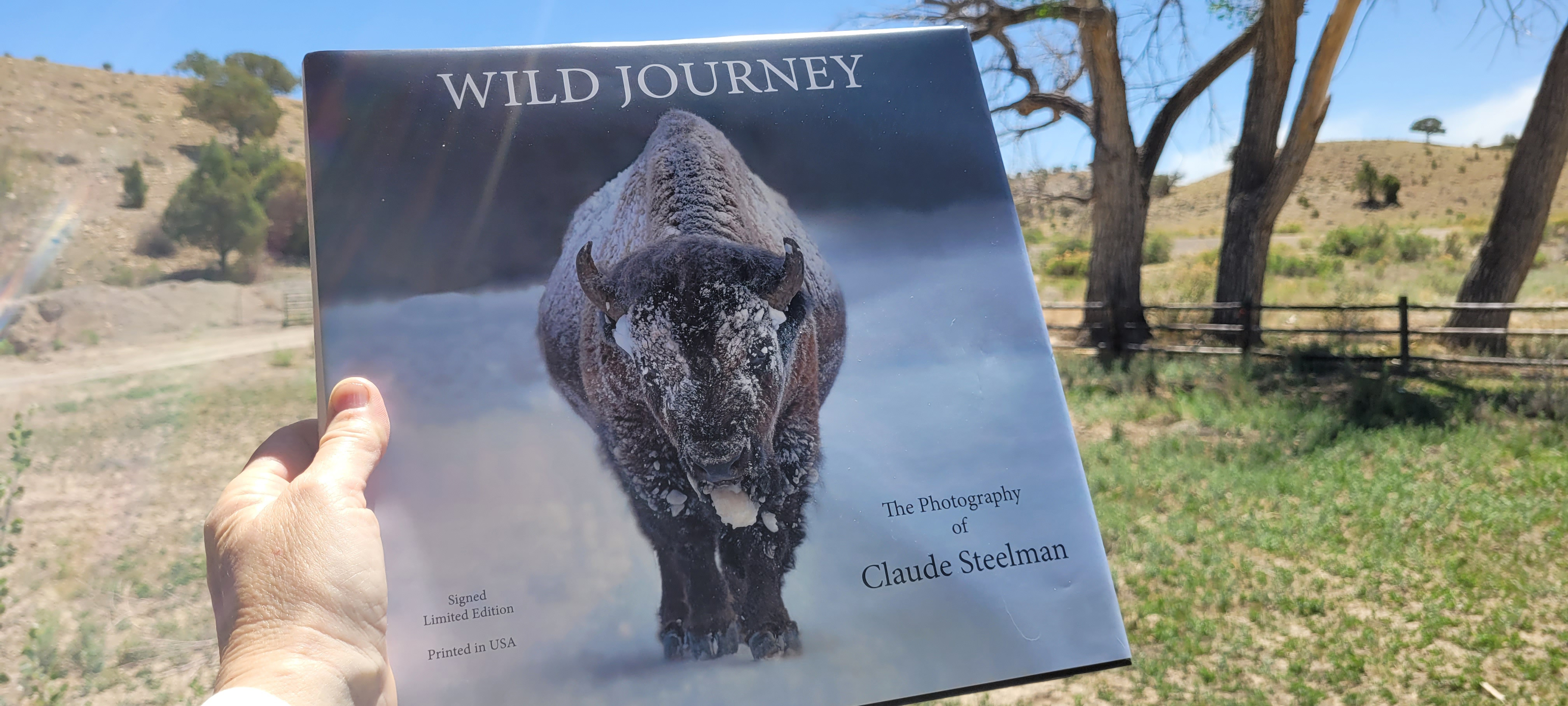
Long-time friend and amazing nature/wildlife photographer Claude Steelman visited the other day on his way to Spring Creek Basin, and he gifted me a copy of his newest book, Wild Journey: The Photography of Claude Steelman. I don’t see this book on his website, so I’m not sure of its availability. Claude had a gallery in Durango for a number of years and currently has downsized to a studio just above Main Avenue – so he can be out shooting more! This wonderful book is a sort of compendium of his travels and experiences across the West (and beyond) during his 40-plus years (!) as a photographer chasing natural light and wildness. Mostly images, only a little text; his photography truly speaks volumes.

As you would expect from the photographer who published Colorado’s Wild Horses, there’s a section in this book about mustangs, which includes images from Spring Creek Basin, including the above gorgeous scene. πŸ™‚

Claude says people ask him when he’s going to retire, and I love his phrase at the end of the book that indicates that if he retired, he’d “just go take pictures, so why bother” retiring!? Find your passion, indeed!

I have been so fortunate along this journey to not only meet and spend time with “my” own mustangs but also many like-minded humans. The mustangs and these people keep me grounded on my own path.


Sign history

5 04 2025

This is what the original interpretive sign looked like (I know you were wondering!), courtesy of Kathe Hayes, who retired a few years ago after working many years for San Juan Mountains Association as the volunteer coordinator. Long-time readers will remember Kathe’s name associated especially with the alternative spring break program, which brought in college students from the University of Missouri every year to work on various projects in Spring Creek Basin and other public lands (both BLM and U.S. Forest Service) around Southwest Colorado.

When Kathe read about the new kiosk installation, she sent me a text and some emails about the history of the FIRST sign installation at the west basin boundary:

“Excited to see that Laura [Heaton] was involved in the installation of the new sign in Spring Creek Basin. As you know as a child, she was involved in the installation of the first sign along with a group of college students from the University of Missouri and Ranger Rick from BLM. I remember Laura and I climbing up the side of the hill and rolling large rocks down so that we could surround the sign so cars would not drive over the sign. A lot of hard work and dedication went into the original sign, and I was sad to see that it had disintegrated. But I am grateful for the new sign and the information it portrays about the wonderful Spring Creek Basin. Thanks for your help in this, TJ.”

Also:

“I was really excited to read about the installation of the new sign. I believe the old one was installed around 2008. It prompted me to resurrect a photo of the original. Laura was involved in the installation of the original sign, as a young kid working alongside the University of Missouri students and Ranger Rick Ryan (BLM). Wow, such good memories for me.

“Attached is the originalΒ sign photo. It was a lot of work back then, getting that sign created and approved.”

Not much has changed in that respect. πŸ˜‰ I asked Kathe if I could share the image of the original sign and her words about the history of it.

“I remember this about installing the original sign. Rick Ryan (Ranger Rick) had been mixing cement in a wheelbarrow and then pouring it into the hole to secure the base of the sign as we all watched curiously as to how this was all going to work. Laura said that that’s not how my dad would do it [Laura’s dad is well-known rancher Al Heaton; their family is well respected in the entire region of Southwest Colorado. She is, quite literally, a local!] and I just laughed. Lauraβ€˜s family was instrumental in the success of the Alternative Spring break program. I doubt I would have continued without their support. And Laura was my little shadow since she was about 6 years old. Her parents let me drag her all over the place. She loved being with the college students who loved playing games especially spoons.”

Wild and crazy how things come back around full circle, eh? πŸ™‚

Thanks so much for the history, Kathe! We miss the alternative spring break program (I think it lasted almost 20 years with Kathe’s guidance?), but we sure loved each year’s crop of students and all the work they did for us in Spring Creek Basin! And we now have Laura as one of our BLM range team members, carrying on that good work!


Here’s yer sign!

3 04 2025

[Nate West, Brian Yaquinto, Jon Whitehead, Laura Heaton, Anton Rambur, Ryan Schroeder, TJ Holmes]

I cannot begin to tell you all how much I *LOVE* this new information/map sign kiosk JUST installed at the western entrance/boundary of Spring Creek Basin.

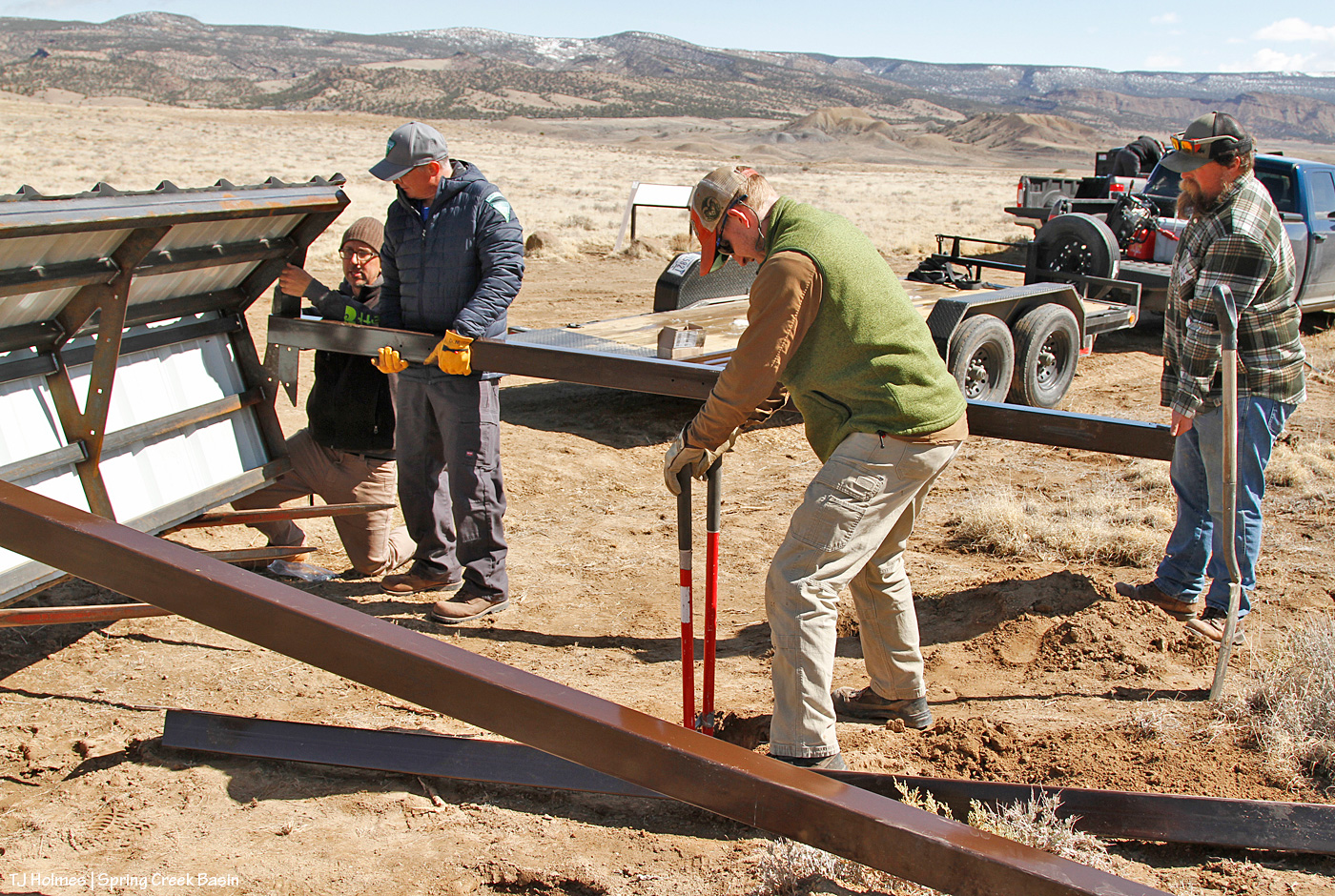
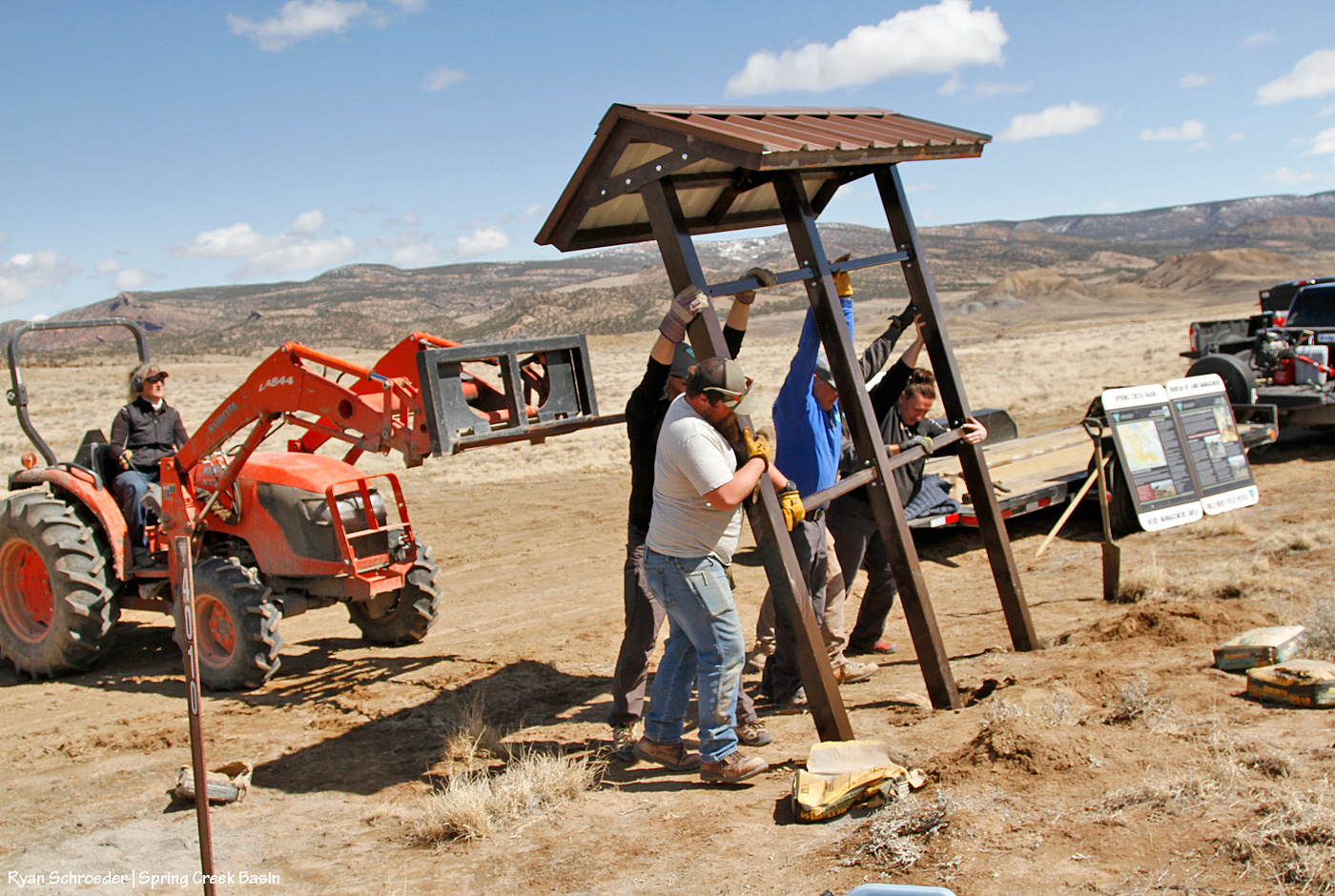
It has been in the works for at least the last year. On April Fool’s Day, rangeland management specialists Ryan Schroeder and Anton Rambur came out to augur and dig out the holes for the three posts for the kiosk (in the snow and greasy-muddy road, I might add). The day after April Fool’s Day (gorgeous but nippy), we were joined by Laura Heaton (range tech), Nate West (wildlife biologist), Brian Yaquinto (archaeologist) and Jon Whitehead (recreation) to put the whole thing together and set it upright in the holes (shout-out to my awesome little Kubota tractor!) and cement it in place.

Let me also mention that this was Ryan’s third day back to work. I never anticipated that I’d be RE-introducing him when I introduced our new range team, but there it is, and here they are. πŸ™‚ I’m so stoked to be working now – again – with all three of them.

A couple of (OK, several) images of the construction and installation of our brand-spanking-new, kick-ass kiosk in Spring Creek Basin:

Actually, let’s start with the old interpretive sign, familiar to anyone who has driven into Spring Creek Basin. You might think the sign looks white because of glare or overexposure by the camera. …

But no. It really is that blank. The high-elevation, Southwest Colorado sunshine will do a number on just about anything. … Hence the new sign. πŸ™‚ (Note the scratches at the top and (at least) left side. What made those scratches, you ask? Horse teeth, I tell you.)

Laura and Ryan check out the new map and info signs. OMG! They are SOOO COOL!

Who took the images for the signs? I’m so glad you asked. πŸ™‚ I am BEYOND proud! (While all of the BLM folks were gathered around to look at the signs, I ID’d for them all the mustangs in the pix. Above: Hollywood, Shane, Houdini, Alegre and Maia. I’m also hugely grateful that our dearly retired herd manager, Mike Jensen, and the BLM’er who put the signs together, Jason Byrd, allowed me to dust off my copy-editing skills in service of both the info panel and the map. I realize now that I didn’t take a close-up pic, but Temple Butte is noted on the map, the first time I’ve seen the name on any map since we got it officially named by USGS in late 2018.)

While Ryan digs out the edges of the middle post hole just a little bit more, Brian, Nate and Anton started attaching the posts to the roof structure, resting on the forks of the tractor.

With all the vertical posts attached to the roof structure and the cross pieces (to which the sign boards would bolt), Jon arrived with the Qwikcrete and water to mix into a slurry in the post holes to help support the posts for a very long time to come.

And up she goes! OK, this doesn’t really show the tractor doing the heavy lifting, but it did. πŸ™‚ Thanks, Ryan, for taking the camera while I worked the tractor!

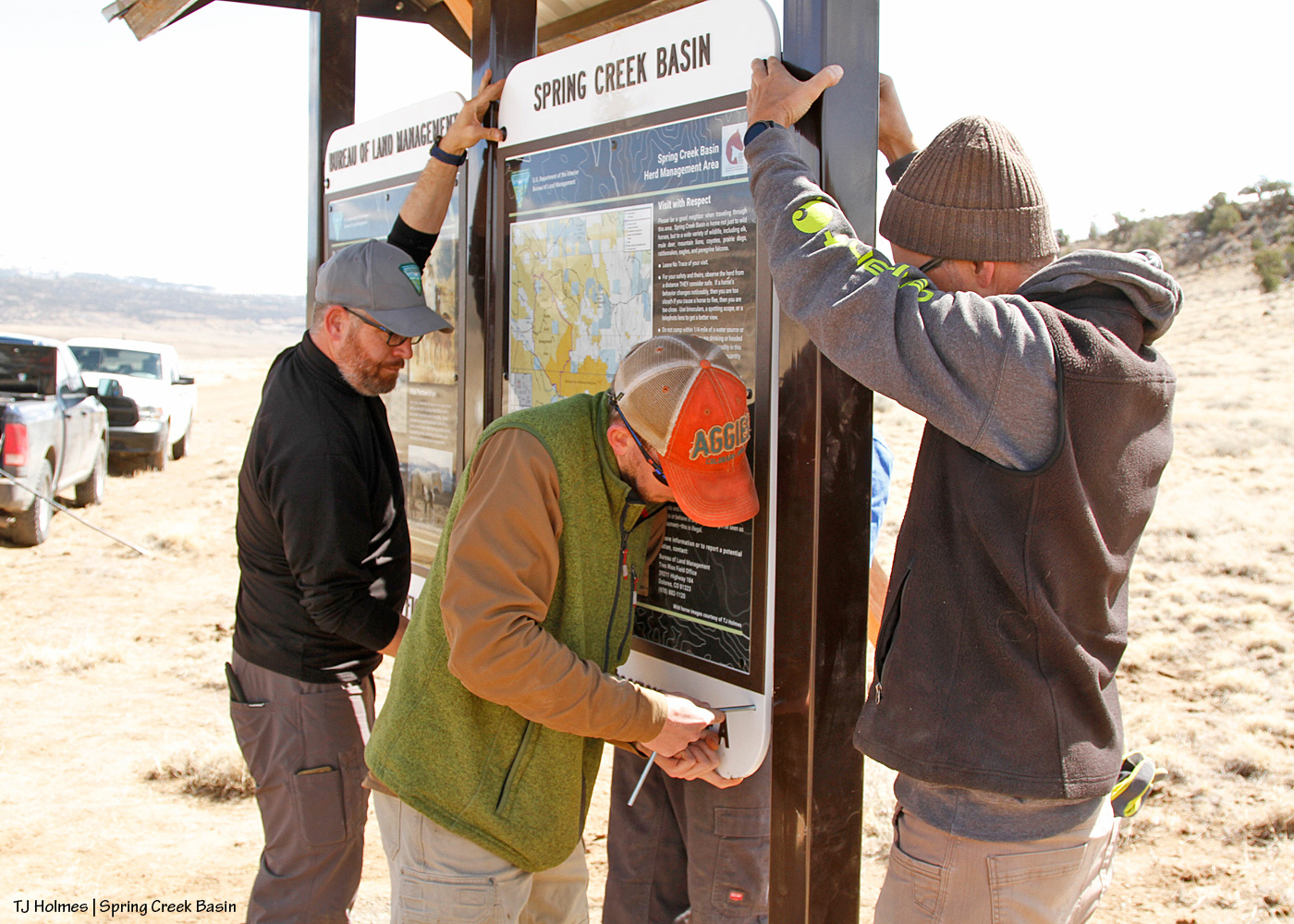
In go the bolts for the first sign panel! (Yes, we did joke about how many BLM’ers it takes to screw bolts into a sign. πŸ™‚ You almost can’t see him, but Jon is holding the sign behind Brian while he and Ryan thread the first bolts and Anton holds the left side of the sign.)

Anton holds the second panel while Jon (left) and Brian insert bolts to attach the sign to the frame.

Eagle-eyed readers will note that the sign very correctly welcomes visitors to Spring Creek *Basin*!

I want to express my enthusiastic gratitude to our particularly awesome BLM’ers for making this new info/map kiosk come to life in Spring Creek Basin. It has been, I think, a little more than a year from conception to standing tall at the west basin boundary to greet visitors to Spring Creek Basin, magical home of our mustangs. Pictured, left to right: Nate West, Brian Yaquinto, Jon Whitehead, Laura Heaton, Anton Rambur, Ryan Schroeder and yours truly (I actually brought my tripod so I could be part of the picture record!).

Huge gratitude also to Mike Jensen (retired but never forgotten), who offered me the opportunity to share some of my favorite images of the mustangs and my copy-editing skills (and texted this in reply to telling him about the new sign: “Wow awesome that looks great. See no worries I left you in good hands.” :)); Doug Vilsack, Colorado BLM director, who agreed that we needed a new sign when he first visited Spring Creek Basin in 2023; Derek Padilla, Tres Rios Field Office manager, who has been super supportive of Spring Creek Basin from the get-go; Joe Manning, TRFO assistant manager, also incredibly supportive and who agreed that it was a project worthy of funding; and Jason Byrd, recreation specialist (?) at TRFO who designed the signs with my images and all my edits and made the most gorgeous informative panels in all of BLM-dom.

Thank you, ALL! And now, when any of you visit Spring Creek Basin, you know the story of how our fabulous mustang kiosk came to be!


Playing in the soil

2 04 2025

I am giddy with excitement and anticipation. πŸ™‚ First of all, we have our full BLM range team back together again! As of Monday, rangeland management specialist Ryan Schroeder is fully reinstated and back to work with range specialist Anton Rambur and range tech Laura Heaton at Tres Rios Field Office. And he got to get his hands dirty – literally – with Anton (Laura was under the weather) out in Spring Creek Basin yesterday to …

…uh … just what the heck WERE these guys doing?!

A hint is in the background. πŸ™‚

Leave a guess in the comments and let me know just what the heck you think these funny guys were doing!

All will be revealed soon, and it’s going to be awesome!