On the rocks

4 07 2012

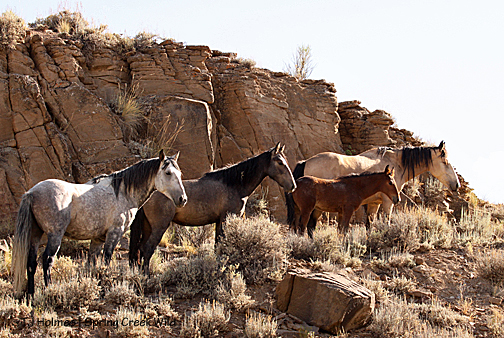
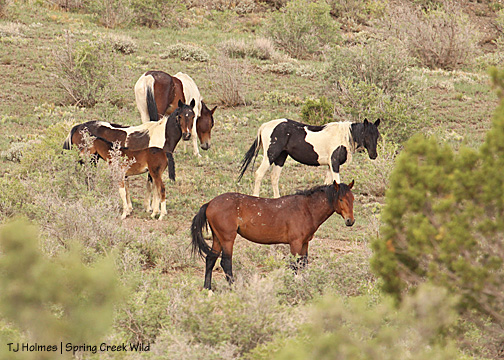
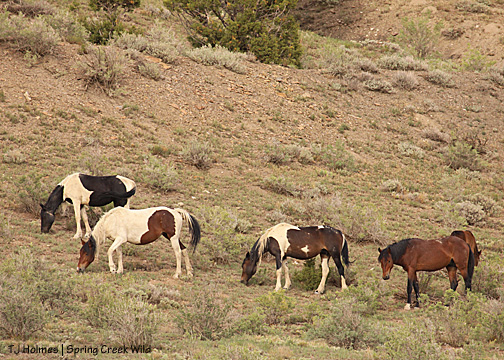
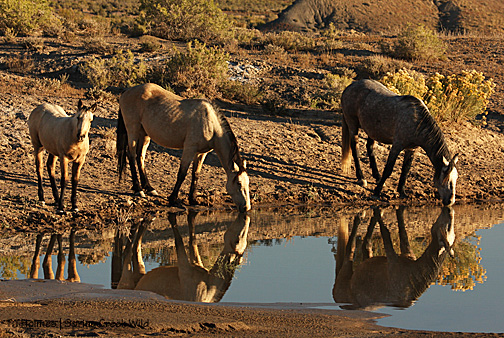
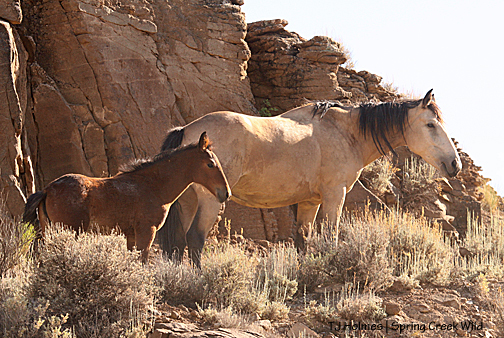
Comanche’s band sticks pretty close to Hollywood’s band. The stallions zealously guard their mares – and if the mares get out of line, they send them back! Interesting to watch. Duke and Seven also are with the band most of the time, and this day, Kreacher’s little band (he got Roja and Killian) also was nearby and drank from a different part of the canyon.

Kestrel and Madison, taking the high ground as Kreacher’s band pushed in behind them.

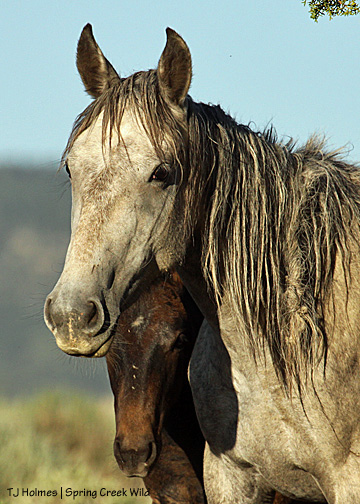
While it’s totally human of me, I’m so glad to see Kestrel and Comanche and the girls reunited.

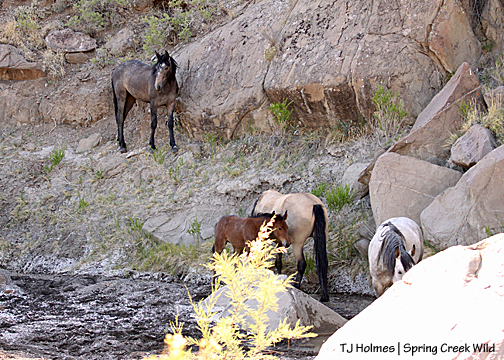
Juniper shows off her mad mountain goat skillz on the side of Spring Creek Canyon.

It doesn’t look like much, but yes, there’s water.

Comanche stretches his big trot on his way to catching up with his family after warning Kreacher’s not to get too close.

Adios!


Looking for – and finding – water

28 06 2012

FS range guy HP and I did some more riding to GPS water seeps in some of the main arroyos, trying to get an idea of water availability for the horses. There is good news to report: Three ponds still have water – though one is much shallower than a week ago. And we have GPS’d at least half a dozen places where water seeps up or percolates down in various arroyos across the basin. The horses continue to be in good condition.

Pix of our pony partners:

Fox trotter Pinch and HP.

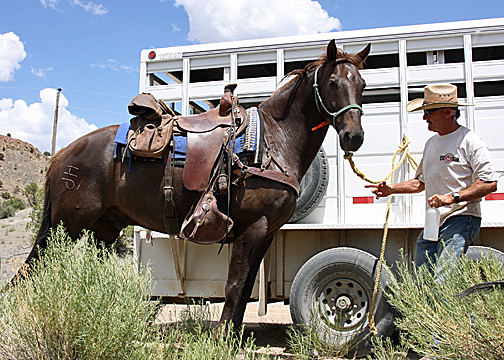
HP’s other fox trotter Jammer, my partner for the trek.

Handsome and smart and willing! These guys went everywhere they were pointed. I think the only time Jammer’s pointy ears were less than full forward was during our lunch stop! HP wrangles and rides Forest Service horses in the course of his duties, too, but Pinch and Jammer belong to HP.

These with my cell phone (so I didn’t have to carry my big camera). Sorry about the quality!

HP riding Pinch near the weeping wall. The white is salt from the alkaline soil. Almost everywhere there’s water, there’s salt in abundance. I don’t think I’ve ever seen so much salt coming to the surface of the ground. We found water in an eighth- to a quarter-mile stretch through this arroyo. Clearly getting active horse traffic.

Jammer, left, helps HP and Pinch check out the old guzzler. It’s dead dry. We’re not sure why. (Note the shade of cloud cover – ahhh!)

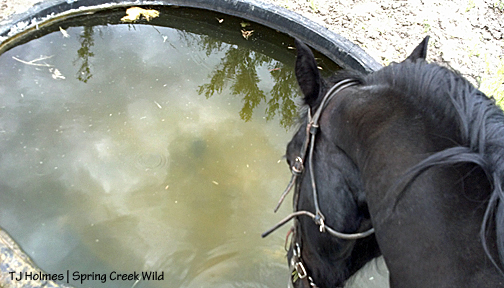
Jammer drinks from water in a tire tank near a natural seep. The first time I found this area, a few years ago, the tire was full of water and the seep was producing water. Every visit since then, the tire has been dry. Now, the seep is nearly dry, but the tire is full and trickling over. Hmmmm??

Thanks again to HP for his work and horses! And thanks to BLM’s Tres Rios Field Office management and our herd manager, Kiley Whited, who is spearheading these projects!


Tackling the trickle

28 06 2012

Clouds = relief.

If it’s not too much to ask … some rain??

At last count, there were 23 wildfires burning in Southwest Colorado (this doesn’t include the fires elsewhere in Colorado). It is supremely, horribly dry. Please be careful, no matter where you are! And please send positive thoughts and prayers to the firefighters and people evacuated from their homes as well as those who have lost their homes (none that I know of in SW Colorado).

Forest Service range guy HP was back in the basin this week to honcho the task at “the trickle,” an overflow pipe at an existing well that apparently used to support a drinking trough. We didn’t quite get accomplished our original goal, which was to dig down and install a drinking trough that would be filled by water from the trickle (just too rocky for shovels). But we did get the water flowing through a hose to fill the existing little pool, which we then dammed to try to hold better water there.

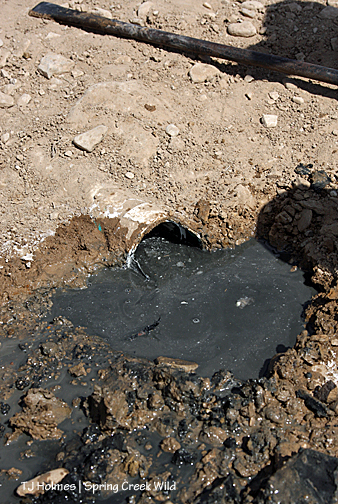
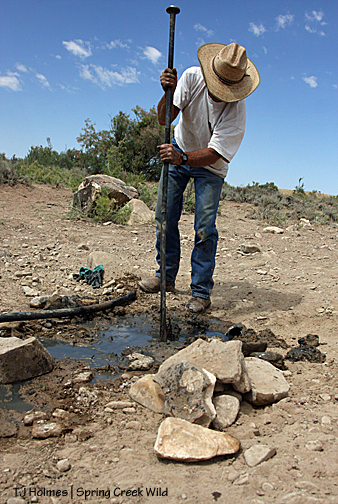
This is the end of the source pipe after we pried off the end-cap filter, which, because of mud and silt, was acting as a solid cap. There’s also mud backed up inside the pipe, and we’ve been playing in the mud to clear as much of it as we can reach, so yes, it looks pretty black and yucky.

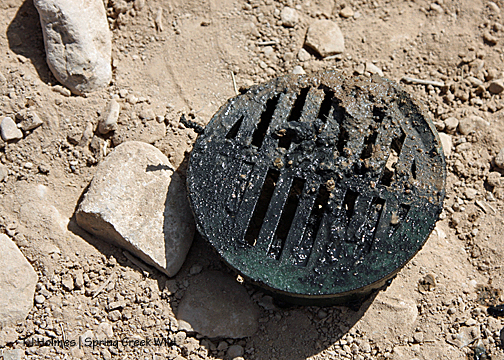
The filter that had capped the source pipe. The pipe had been broken above where this fit inside, and the littlest trickle of water was flowing out (hence the name). Despite the poor quality and low quantity, the horses drink here, so we’re trying to make it better.

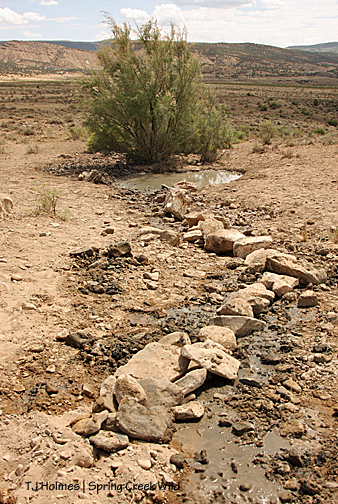
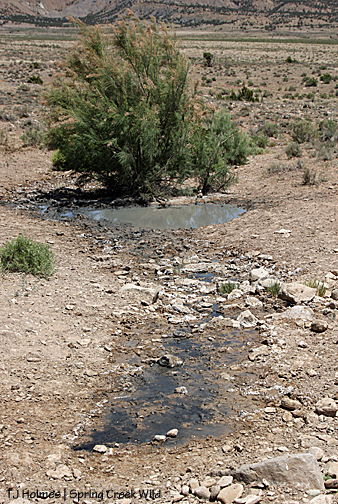
The water flowed downhill, caught in that little pool at the base of the tamarisk, then flowed on around and down until it just ran out.  The light-colored dirt at lower left is what we gathered to pack in around a plastic hose/pipe that we inserted into the source pipe, wedged with rocks and then packed with sand/clay/mud to force the water into the hose to run downhill. The line of rocks covers the hose from hoof traffic, and I’ll keep an eye on it until we can come up with another solution.

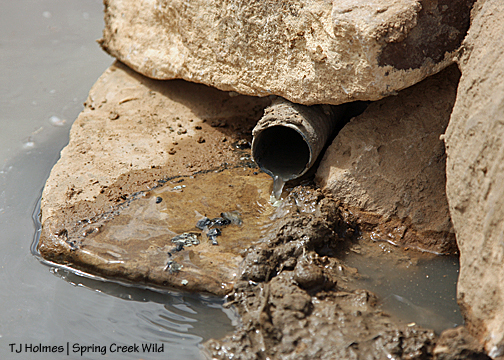
The end of the hose, with clear water continuing to trickle out. The water has been tested in the past, and although it’s salty, the horses clearly take advantage of it. (And all the water in the basin – except at the water catchment – is salty because of the alkaline soil.) We’re hoping this mucky little pool will clear up a bit and offer the horses a better source of water.

Apparently, some years in the past, the well fed a drinking trough that has since been removed for unknown reasons. That’s what we’re trying to restore.

Many thanks to HP of the Forest Service in Dolores, who supplied tools, muscle and know-how! He’s using his tamp bar to pry up rocks below the source pipe. The original well is up the hill behind him and the tamarisk you see in the background. Even though someone decided tamarisk is now OK, as it’s habitat for birds, we’re still on a mission to remove as much as we can from the basin, especially near water sources – which is exactly where it likes to grow.

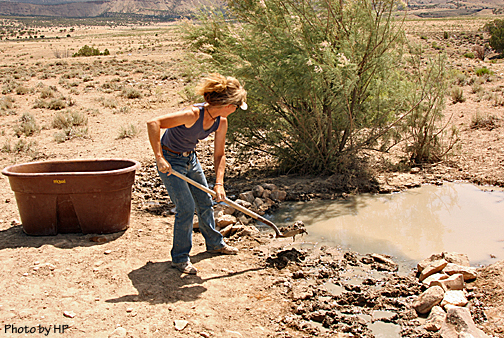
Yours truly, captured by HP, who stole my camera to take this shot. 🙂 I’m shoveling mud into a little dam we made with rocks to hold the water in this little pool. (Note another tamarisk that needs to go bye-bye.) The trickle hose comes out at lower right. The trough we’d hoped to install is behind me.

To come: some poor-quality cellphone pix from riding the arroyos to GPS water seeps. We made some interesting discoveries. While there’s not a lot of water, there IS water, and the horses continue to be in excellent condition.

Rain dances encouraged and welcome.


More water for mustangs in Colorado

22 06 2012

June 20, 2012

Contact: Christopher B. Joyner, Public Affairs Specialist, (970) 210-2126

BLM conducts emergency water operations; closes public lands for drought stricken wild horses

MEEKER, Colo. – The Bureau of Land Management recently began delivering water to wild horses in several areas in western Colorado in response to extreme drought conditions. Today BLM also issued an emergency closure for areas in the vicinity of Texas Mountain south of Rangely to further protect wild horses where the situation is particularly severe.

BLM is closely monitoring the wild horse herds it manages in Colorado and has begun supplementing natural water sources in three of the four wild horse herd management areas in the state, including the Piceance-East Douglas southwest of Meeker, the Sand Wash near Maybell, and the Spring Creek outside of Dolores. These are areas BLM manages specifically to maintain healthy wild horse herds in balance with other uses of the land. BLM is also closely monitoring the water situation in the Little Books Cliffs Wild Horse Range outside of DeBeque, which currently is not requiring supplemental water.

BLM issued the closure prohibiting public access south of Rangley in the West Douglas Herd Area, which is an area not planned for continued management of wild horses because it is not as suitable an area. BLM recently discovered a group of approximately 40 to 50 wild horses completely lacking any natural source of water. In addition to providing a large, temporary water tank and three water troughs, BLM is closing this area to reduce disturbance while the horses adjust to a new water source. The affected closed area is on or near Texas Mountain east of BLM Road 1214 and east of BLM Road 1063. Livestock are not currently in this specific area or using this water source.

BLM is closely monitoring the situation in the closure area and in the remainder of the West Douglas area, which holds an estimated 135 additional wild horses.

“BLM is committed to maintaining healthy wild horses in the White River Field Office and in Colorado,” said Kent Walter, White River Field Office manager. “We will continue to monitor the situation here and elsewhere, and may need to take additional steps to ensure the wild horses are cared for humanely.”

According to Walter, hauling water to such a remote location is not likely a sustainable, long-term solution.

*******************************************************

This is what I call “the trickle” in Spring Creek *Basin* (why do people always leave out the “basin” part?). Right above the S in Spring in my signature (and yes, I know, but Spring Creek Basin Wild was a long URL) is a pipe out of which water flows from an old well. It’s not much, it’s salty, it smells like sulphur. But the horses drink here when the drinking gets scarce. By the end of next week, we plan to install a pipeline and a drinking trough. The new line will run downhill to the new trough, which will sit where the pool of water currently is accumulating, right in front of the big tamarisk. Water will be controlled by a float instead of trickling on down into oblivion.

In addition to BLM’s green light (Tres Rios Field Office, Dolores), Disappointment Wild Bunch Partners partnership and (BLM) Director’s Challenge funding, the project involves Forest Service labor from the Dolores Public Lands Office. Thank you to all involved! (And many thanks to the Forest Service’s HP, who brought handsome Jammer for me to ride while we GPS’d water seeps in the Spring Creek (arroyo) and another main arroyo this week in the basin – and more next week!)


Water delivery, part 2

18 06 2012

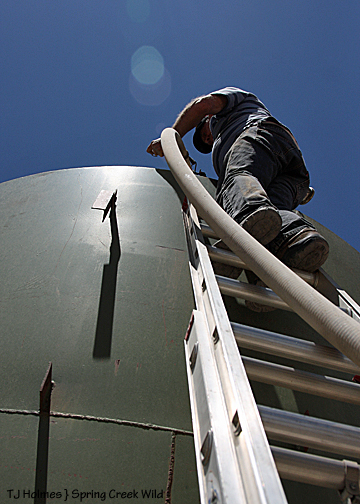
Today was the second delivery of water to the catchment – and this time, it went directly into the storage tank.

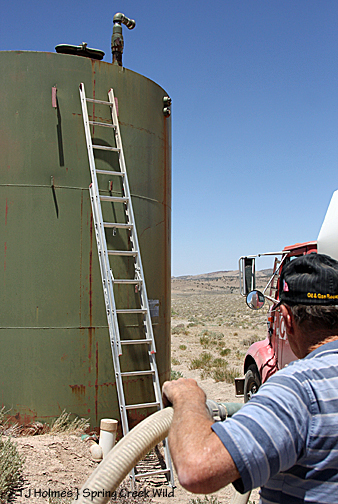
Cecil Foster of Foster’s Water prepares to carry his water hose up his ladder to pump water into the tank.

Cecil at the top of the ladder.

A closer look at the drinking troughs.

View at the top: the water hose inside the hatch on top of the storage tank. See the glitter? That’s the water! The tank is now nearly full!

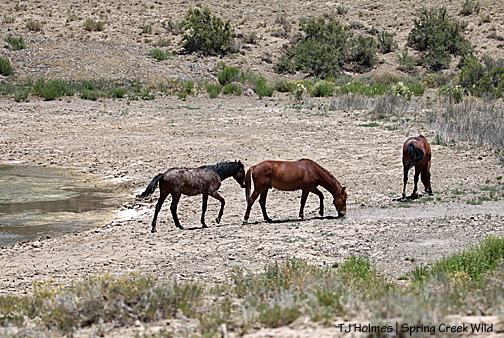
I should have taken pix of Chrome’s band on our way in; they were right off the road. They had moved away by the time we headed out. But close enough to take advantage of this good water.


Playing in water

16 06 2012

And now some light-hearted water fun. 🙂

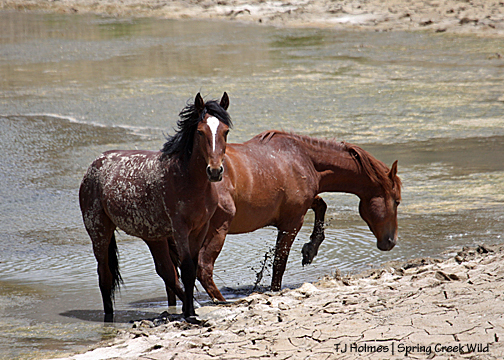
Apollo gets ready to walk out of the pond while Hayden tests the splashability. I’m taking this from my Jeep up on the road. This is the Sorrel Flats pond back in the eastern part of the basin.

Zoomed out to show more of the pond. As part of my documentation of the horses these last few years, I keep track of how much water the ponds have and when they go dry – and when they fill back up with the summer rains. Now that we have a herd manager who is interested, I share that information with him. The pond just north of here – the east-pocket pond – went dry just a week or so ago, just a few days after our herd manager saw it with very shallow water.

Apollo, Hayden and Tenaz grazing on the flats just above the pond. I should have some better photos of these boys soon tweaked and posted.There’s not a lot of surface area here, but the middle is a little deeper than it seems.

Storm has hooked up with the boys (though possibly not permanently; he wasn’t with them the other day). He followed them out of the wooded “island” and down to the pond to drink. I’ll have more pix of him soon, too.


Water for mustangs

16 06 2012

It’s dry out there, folks.

That’s neither new news nor surprising news.

We haven’t had any rain since late April, and the forecast for the forseeable future shows perfect yellow balls of sunshine and highs in the 90s. On July 1, we’re supposed to hit 99.

Bleak. That’s what I call that forecast.

Three ponds have water. Wildcat Spring has water. The trickle is trickling. There are random seeps and springs around in arroyos – all small, all not-so-good to poor quality. The ponds all have gone dry in previous years – last year, the year before, that I’ve documented – but the monsoons always come. Some years better than others, but they always come. This year promises to get worse before we get those monsoons.

Our BLM folks at the Tres Rios Field Office in Dolores are well aware of the drought conditions and are taking steps to ensure the horses have water to get through the worst of the dry season.

Among the things our recently awarded Director’s Challenge grant money will fund here: water enhancement projects. From 2009 to 2010, five ponds were dug out (made deeper; they silt in – get shallow – because of the erodable soil), and two more are scheduled to be dug out this year (hopefully before the monsoons come!). We’re talking about water guzzlers, solar pumps on wells (something we’re looking at to enhance “the trickle” into something with a bit more flow) and possibly a second water catchment.

I get a lot of questions about our water catchment. What it is, how it works, how it benefits the horses.

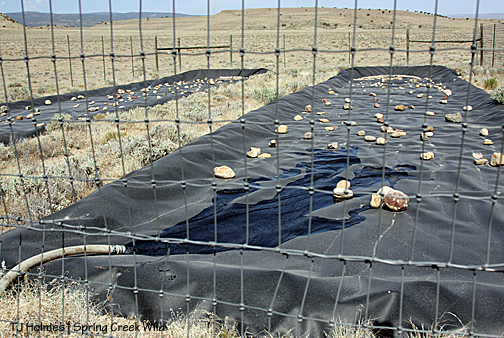
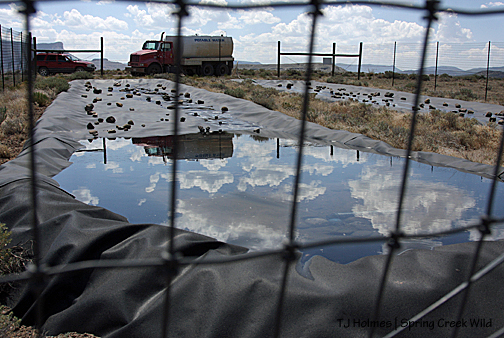
Two aprons are laid out on a slope and fenced (to keep sharp-hooved wildlife out). Water in the form of rain or snow falls on the aprons and drains down to filters, then into a pipeline that runs down to a 16,000-gallon storage tank. From there, lines carry water to two troughs, which hold water controlled by floats. I turn the valve on when the weather starts warming up in early spring, and I turn it off when it starts to freeze at the start of winter (so the lines don’t freeze and break).

This is the only clean water to which the horses have access.

Because of the alkaline quality of the soil, the water is highly saline. I also get questions about the “white soil.” That’s salt on the surface of the soil. Crazy but true. The horses, of course, have adapted. It’s also muddy, and at times like this, sure, there are seeps – where the water comes up and fills salty, muddy hoof-print-size puddles. Not a lot of quantity, let alone quality.

Are you still with me?

This weekend, BLM ordered the first delivery of 4,000 gallons (what the truck holds; more coming) to the catchment, which is about a quarter full after the mild winter and no rain since April and horses drinking.

Can I get a yahooooooooooooooooooooooo? 🙂
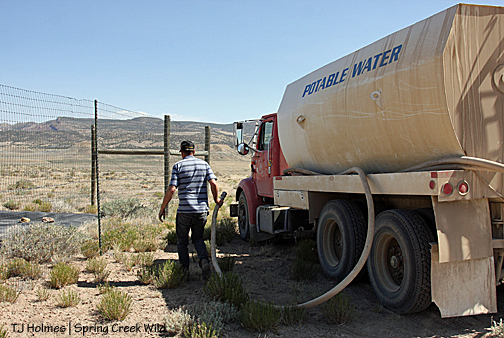
Here’s Cecil Foster of Foster’s Water preparing to drain water onto one of the aprons. Cecil has been hauling water to the catchment for years. In recent years, deliveries were paid for by the National Mustang Association, Colorado chapter. NMA/CO paid for the water catchment to be built more than a decade ago, and there are a couple of signs on the fence that say so. (Remember Pati and David Temple, for whom baby Temple is named? This is one of many projects they have honcho’d over the years through NMA/CO.)

Water starting to flow. This pic shows both aprons.
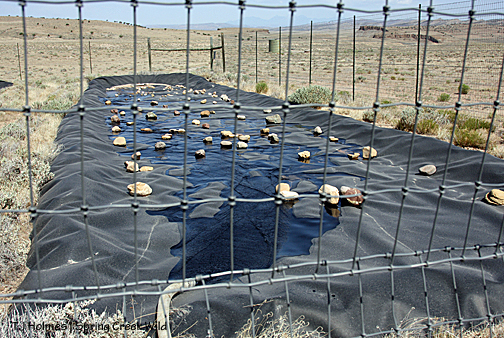
In this pic, you can see the green storage tank and the drinking troughs (very small in this image, barely visible – they’re to the right of the tank) in the background.

This is the perspective from the lower end looking up toward the road. The filters are apparently a little clogged; the water shouldn’t pool so much before draining. We need to get them cleaned out before the rains DO hit. The rocks on the aprons are just to hold it down.
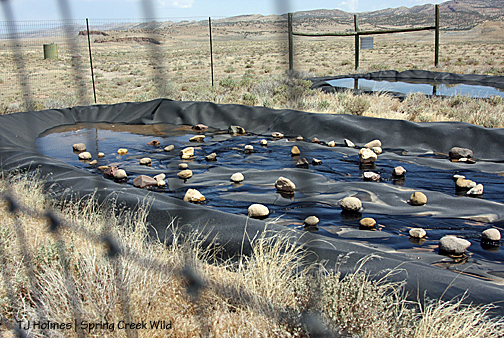
Looking across the aprons to the northwest. One of the troughs is a little more visible in this image.
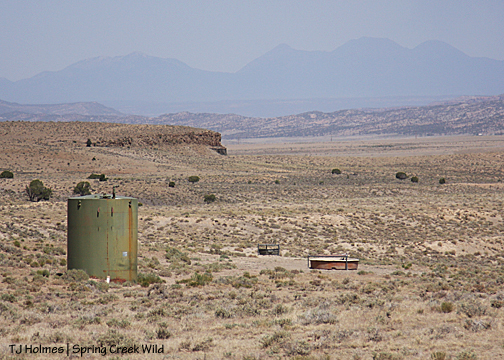
And a better view of the tank and troughs.
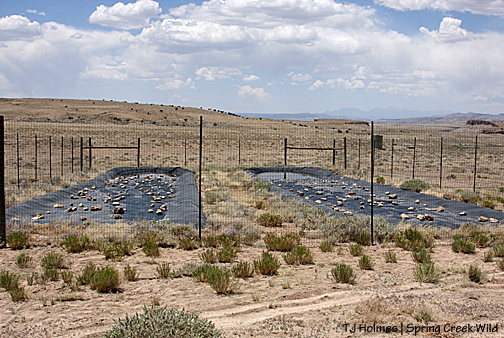
The two aprons of the catchment, side by side.

So that’s what they are, how they work and how they benefit the horses. One slight negative is the location – most of the horses are not in this area. Chrome’s band has consistently called this area home for the last couple of years, and they’re the only ones I know of that drink here consistently. That’s good, but it’s also one of the reasons we’re looking at potential locations for a second catchment (and have been the last several years).

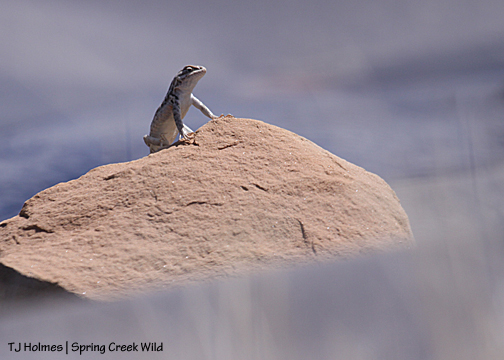
Good water benefits more wildlife than just the horses. 🙂 This little guy (gal?) is perched on a rock on one of the aprons. In the foreground is the blurred berm of the apron; just behind the lizard’s rock is the water from Cecil’s truck flowing down to the filter on its way to the tank to become drinking water for the horses.

Good stuff. Thanks, BLM. 🙂


Reflections

14 10 2010


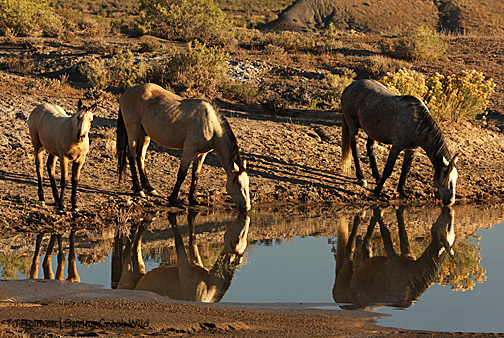
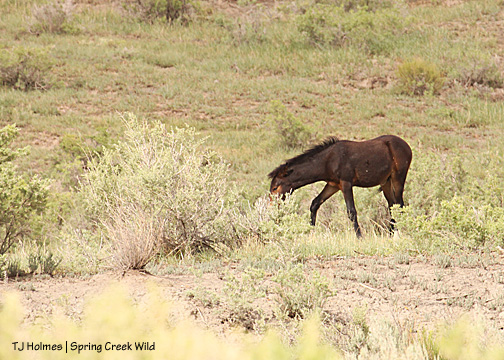
This morning … Baby ‘Nona was playing with a twig from the bush in front of her that she bit off to entertain herself while mama and Comanche had their morning drink.

Do you love their reflections in one of our lovely ponds? (Not one that was dug out.) They all still have water. It amazes me. We’ve had great rain this year – so glad BLM got those ponds dug out!


Mosquitoes, mushrooms and more!

13 08 2010

Or: August = green!

Or: Holy grass!

Or: Monsoon madness!

This morning, when the sun broke through the cloud bank and turned the basin into a shimmering emerald jewel, I thought I’d been transported to Ireland. It is THAT green out there, people.

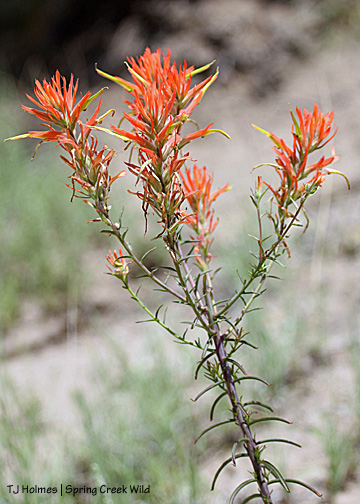
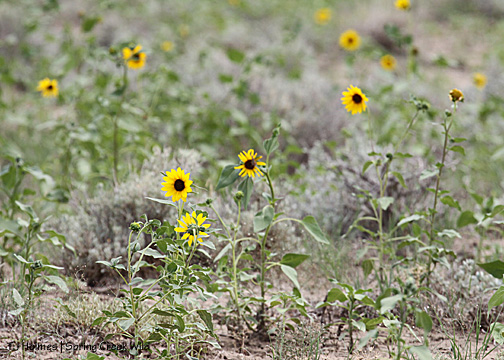
I had to fend off mosquitoes while photographing Chrome’s band, and mushrooms are growing in this crazy newly-wet beautiful Spring Creek Basin, not to mention one of the invasive types of “sunflowers.” Missing the paintbrush this spring? Not to worry, now they’re growing in bushes 2 feet tall with dozens of “flowers” on every “stalk”! I’m pretty sure they’re paintbrush, but I don’t think I’ve ever seen it grow like that before, and certainly not in the basin.

I wish I could describe it in all the exquisite detail it deserves, but not even my photos come close to illustrating the green-tinged curves of hills, the grass in bunches the horses seem lazily content with – like it will last all the rest of the summer – the whole marvelous wonder of it all.

Looking south from the northwestish – Filly Peak at far right.

Looking up to the far northwest, near Klondike Basin.

From the northwest looking southeast: unnamed promontory and McKenna Peak (“pyramid”) at upper right.

Between the road and Filly Peak …

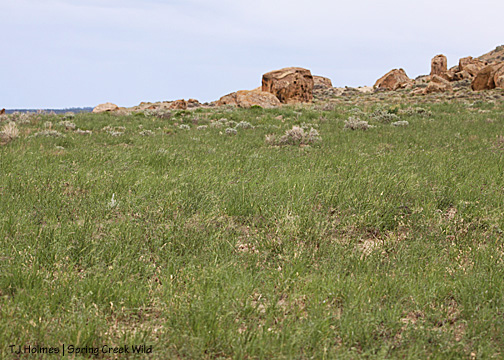
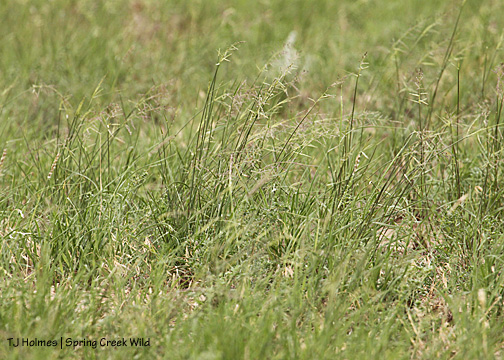
You know it’s crazy when I take pictures of actual grass!

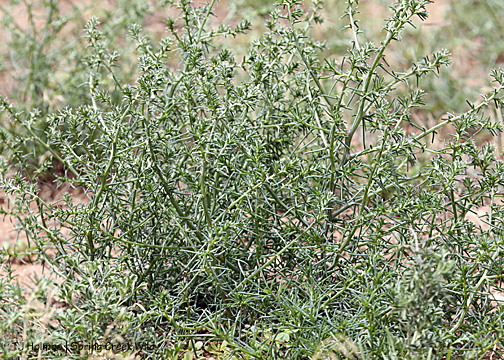
Also a lot of this yuckiness adding to the greenness …

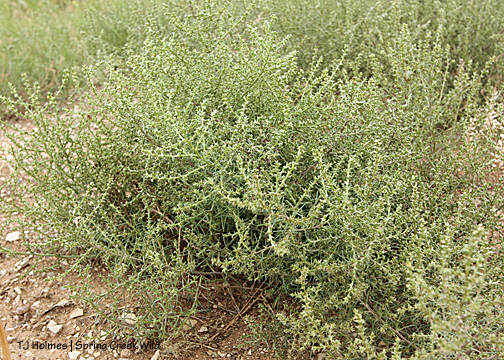
I think this is what someone told me will become tumbleweeds.

All of that, and two ponds are still dry. The kicker is that they’re not even on BLM’s list of ponds to dig out this year – hopefully, they can. The day’s miraculous forecast was for sunshine (been “thunderstorms likely” for three weeks now), and we’re in the middle of monsoon season, which happens every year in Colorado, and I had to leave the basin three times for rain – the third time finally kicked me out for good near the end of the day.

Here, although there’s not a horse in *sight,* they ARE there – out there! – it sums up my weekend:

Gorgeous with a touch of danger. That’s Filly Peak from the outside looking in when I had to leave for good in the evening – life-giving rain filling all the background, which is Spring Creek Basin to the faint ridge outline in the background – covered by a wildly vibrant rainbow (even with a polarizer hastily attached, the colors here aren’t nearly as magnificent as they were in person … or maybe it’s my “rose-colored glasses” … ;)). And do you see the lightning strike? Yes, OK, so it could strike a tree (or worse), but talk about lucky: That’s handheld. It’s not nearly as shocking (sorry) as it really was, either.

In addition to the shining green all around (I’ll tell ya, it makes my head spin), there are some surprises in the herd. Unfortunately, I don’t have pictures (!) because I watched from a distance because a few bands had gotten together, and I didn’t want to add to the chaos. Cinch has Liberty, and Twister is with – drum roll, please! – Cuatro! They ended up playing with Ze and Sage for a little bit. Not sure why year-and-3-month-old Cuatro struck out on his own. Did he get kicked out already? His mama has a foal, and the other mare in his band (Jif) isn’t due for a month. Another dysfunctionality of our tiny herd. (I can’t explain why young Cuatro – and others as young – have left their mothers/bands and horses like Butch and Sundance – at least 4 now? – stayed with their bands.)

And because no post would be complete without the reason for this whole blog:

Two Boots and Rio.

More to come.


Wet and dry, green and rain

6 08 2010

The basin is greener than I think I’ve ever seen it – even in spring. And it’s not just the “false” green, looking over the countryside and seeing the green of greasewood and saltbush and pinon/juniper – there’s also grass. Bright green tufts of it. Everywhere. Evidence of insane amounts of carving water iseverywhere – in some places, it was at least 3 feet deep. It’s been over the county road – and a(t least one) big mud flow prevents safe travel into the basin.

But hiking in from dysfunction junction was no problem. Not totally dry, but much drier than I had warned visitors it was likely to be!

Our wonderful friends Karen Keene Day (see her website in the blog roll) and her husband, F, and their friends R&K (and collectors of their art) visited the basin this week – from the lowlands of South Carolina! K&R said their house is at 16 feet. The basin is roughly 6,000 feet higher than that! I’m pretty sure I swatted at four mosquitoes.

I should have taken more pix of the wild and awesome evidence of the power of Ma Nature, but we were late to the basin already, and I wanted very much for them to see horses – if any kind of luck was with us.

The last time I was out – also with Karen – I was driving along the herd area, marveling at the water running in arroyos, thinking “look at this water! I wish horses were here to take advantage …” – and shazam – there were Shadow and Wind and David!

Would you believe luck struck again? I was thinking, “Please be visible for these folks from South Carolina. They really want to see you, and so do I …” – Can I say it again? It’s so much fun! SHAZAM!

David, our David. Isn’t he a handsome boy?

Shadow was perfectly content on the other side of the big arroyo, “hiding” behind greasewood, and this is the only time while we watched that I saw her actually look at us; I never saw her even lift her head.

Neither did Wind! I can’t believe how much he looks like Liberty, in color, at least.

There was still a possibility we’d see the pintos up the next drainage … and as we proceeded down the road, I spotted a pinto I thought at first was Corazon. But when I looked through the binocs, I realized it was Bruiser! He’s still by himself … but Lady Luck was completely on our side, and the pinto band was nearby. He’s keeping his distance, but he’s also keeping an eye on them.

With the second storm wave since Karen and I arrived passing across the north end of the basin (rain might have fallen on the north hills), and lightning flashing – but us in partial sunshine – we hiked in – on dry land. The side arroyos were dry, but the big arroyo that comes through that drainage was still muddy. No standing water that we saw in our brief glimpses, but I’d be astounded to learn that any possible “pond” in the basin is not holding water right now. We’re right smack dab in the middle of our normal monsoon season … but this isn’t quite normal!

We got up to within hailing distance of the ponies, and Ty, then Mesa finally saw us as they trailed after the band, slowing grazing along the base of “their” hill (really, aren’t all the hills theirs?!). Mesa came out between us and the band, not alarmed, and Corazon, before he knew what Mesa was looking at, came out to meet him.

Kiowa finally saw us – Maiku took advantage of her pause to grab a snack. Copper in the foreground, Chipeta behind Kiowa and Spook at right.

Back to grazing.

No foal yet from Chipeta …

Bruiser stayed near the base of the hill across the arroyo where I found the band last time, just watching.

We kept our eyes on the lightning and pretty soon decided to head back.

No agenda; just luck. Amazing.

Just amazing.

It started raining about dawn the next morning, and two hours later, it was still raining, so I thanked my lucky stars and headed home. A few weeks ago, it was so dry, all the ponds were dry, and the horses were relying on little trickles in secret pockets for their water. Now, it’s like a second spring in August. Monsoons in a Colorado summer – gotta love ’em!

Teaser:

Disappointment Creek (outside the herd area)