SCC working for our mustangs

27 10 2015

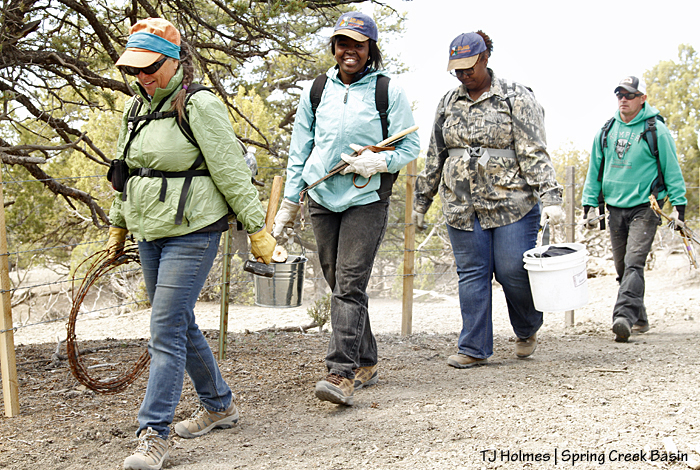
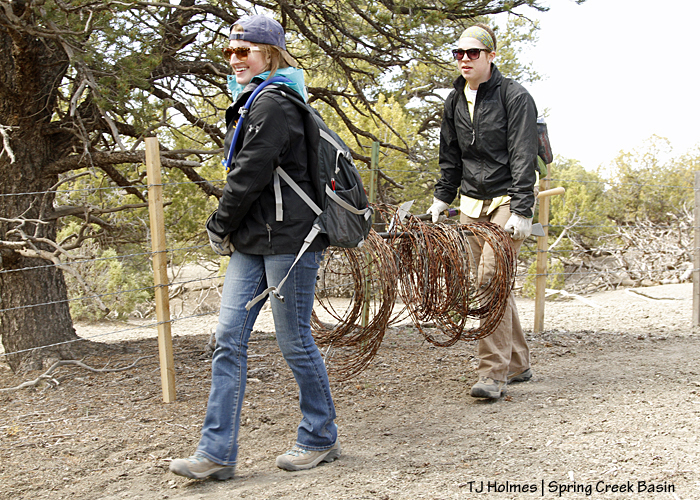
Here in Spring Creek Basin, we are incredibly lucky to have the benefit of multiple partnerships that work for the well-being of our mustangs. Our newest partnership is with Southwest Conservation Corps, based in Durango. Thanks to the diligence of San Juan Mountains Association‘s Kathe Hayes and Tres Rios Field Office range specialist Mike Jensen, we have an SCC crew tackling an especially difficult section of fence: across an arroyo and up a steep, shaley hill.

Long-time readers know about our wonderful alternative spring break program with University of Missouri students and that, for the last four years, students have been rebuilding the basin’s southeastern fence line. The SCC crew, which has spent the summer building trails, building fences and planting trees, is jumping ahead a bit to the steep section.

As we are with every bit of help that comes our way for the benefit of the mustangs, we are hugely grateful for their work!

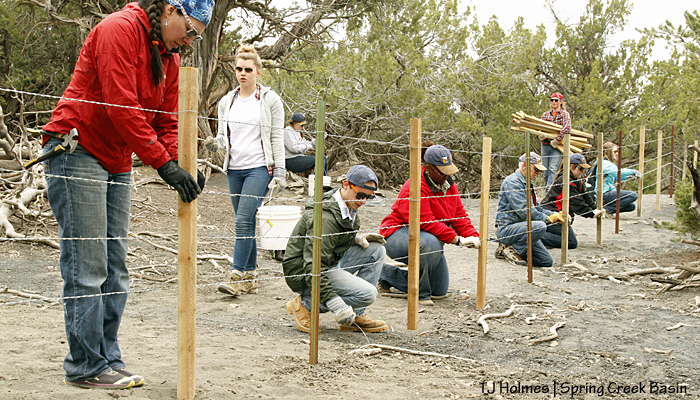
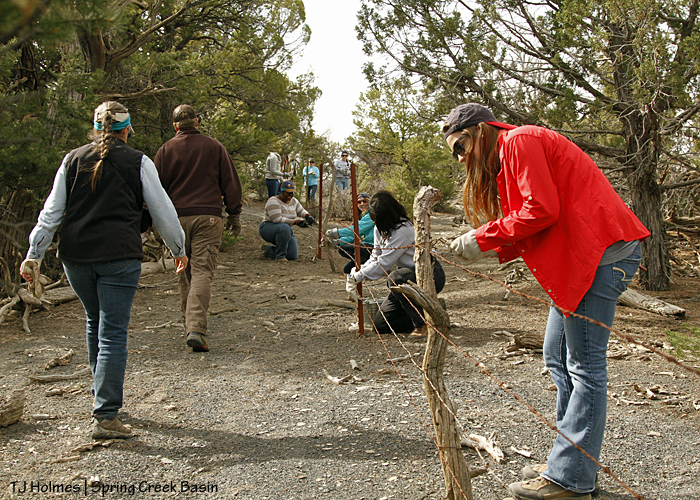
Southwest Conservation Corps' Jordan explains previous fence building by University of Missouri students to SCC crew members along Spring Creek Basin's southeastern fence line. The SCC crew is on site to replace a difficult section of the fence that goes up a steep hill.

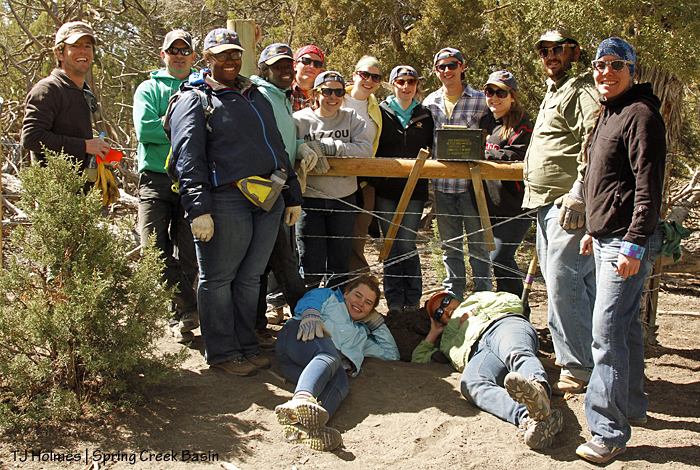
Jordan explains previous fence building by Mizzou students to SCC crew members, starting the first day of their hitch in Spring Creek Basin. Mizzou students and BLM employees and volunteers have set the bar high with the new fence! From left: Sarah, Eric, Jordan, Abby, Aaron, Toby behind Dillon, Dillon and Zoe.

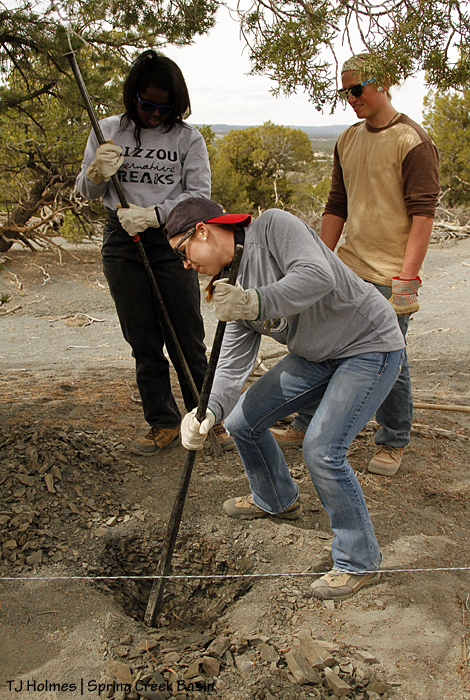
Southwest Conservation Corps' Jordan stands by with a shovel whie Eric takes his turn at digging a post hole for an H-brace in Spring Creek Basin's southeastern fence line.

Jordan stands by with a shovel while Eric digs a post hole for their first H-brace.

Southwest Conservation Corps crew members Dillon, Jordan and Zoe place protective staves around a tree that will serve as half of an H-brace in Spring Creek Basin's southeastern fence line.

Co-crew leader Dillon helps Jordan and Zoe protect a tree with staves around which to wrap wire. The Mizzou students this spring ended their two days of work with an H-brace on the other side of this tree.

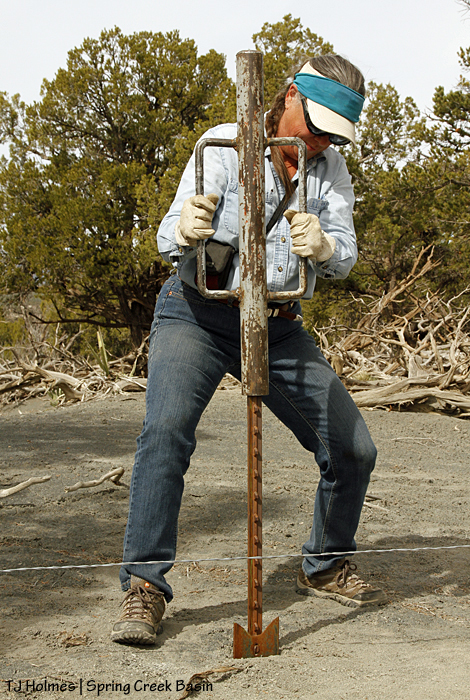
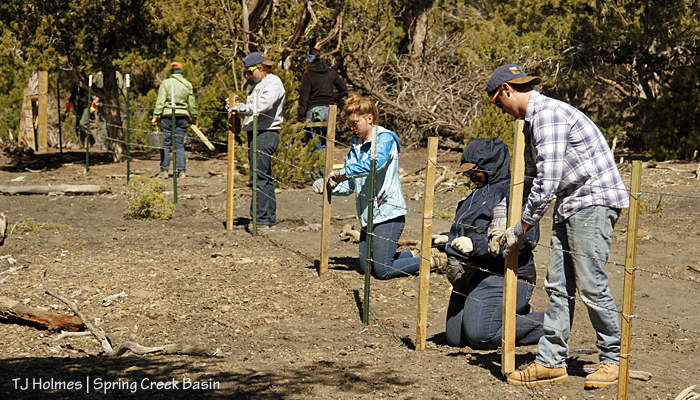
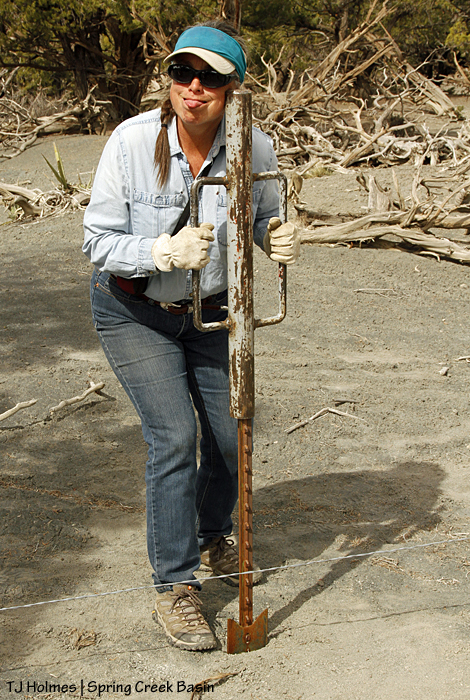
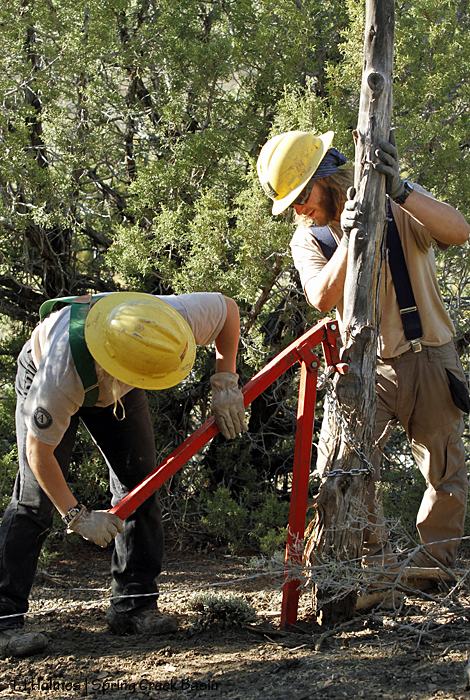
Southwest Conservation Corps crew members Abby and Aaron use the post puller to remove a rotted post in Spring Creek Basin's southeastern fence line.

Crew members Sarah and Aaron work together to pull out an old fence post that had a rotten bottom from being in the ground for who knows how many decades.

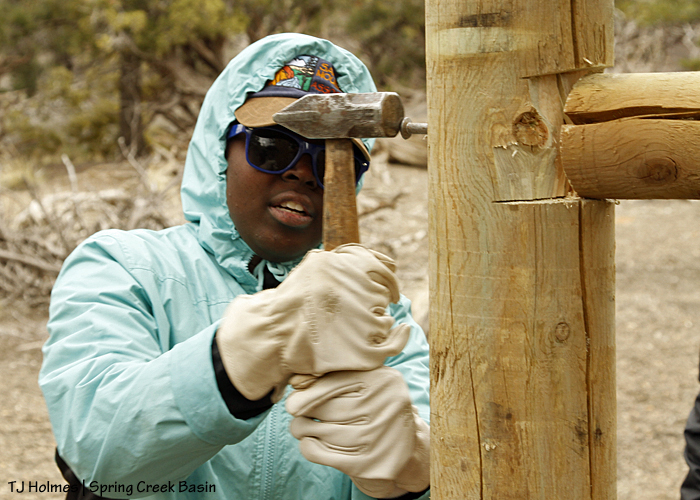
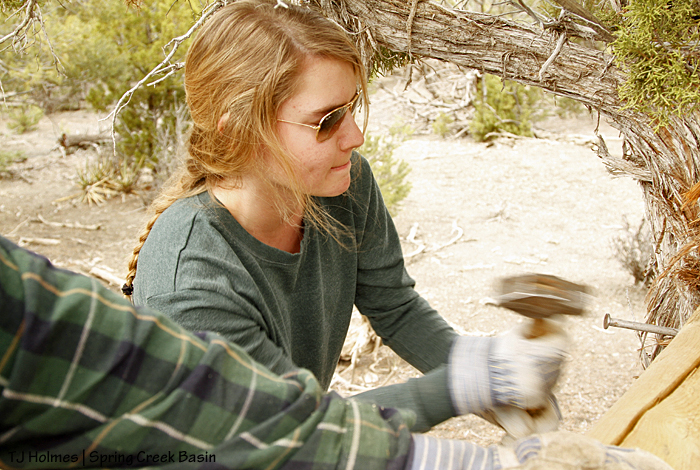
Southwest Conservation Corps co-crew leader Dillon checks the level of the cross post on an H-brace installed by crew members including Abby and Eric (shown) in an H-brace they installed in Spring Creek Basin's southeastern fence line.

Crew members Abby and Eric, who helped dig the hole for the H-brace post, watch as Dillon checks the level of the cross post.

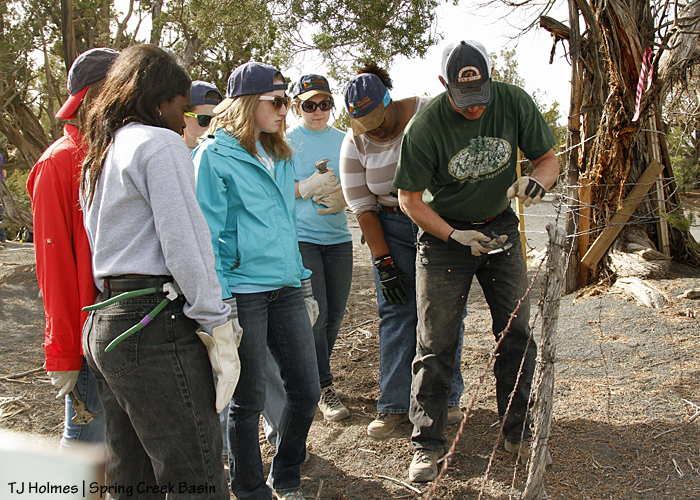
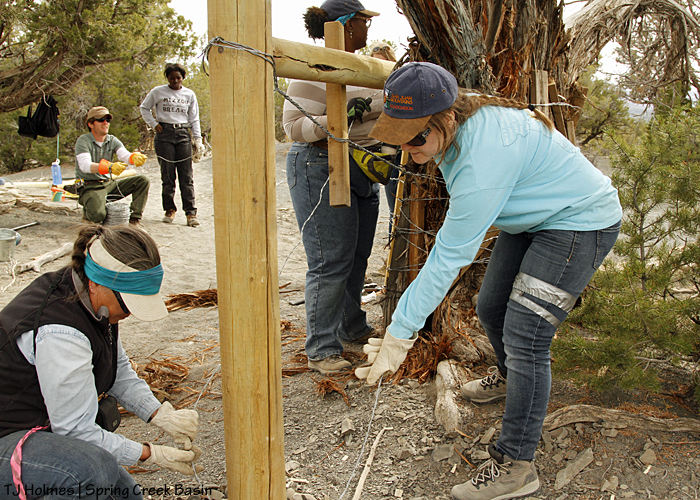
Southwest Conservation Corps crew members Sarah, Zoe, Aaron and Eric watch Jordan as he shows them how to twist staves in crossed wires to pull together an H-brace they installed in Spring Creek Basin's southeastern fence line.

Co-crew leader Sarah (there are two Sarahs on this crew) and crew members Toby, Aaron and Eric watch Jordan show them the twisting technique of the staves in the cross wires that bind the H-brace together.

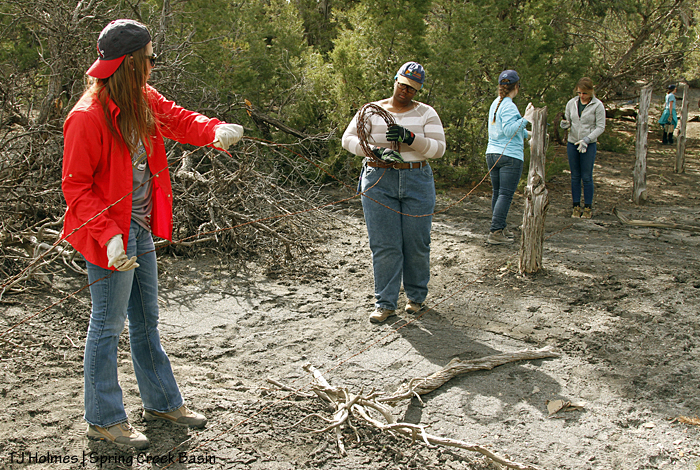
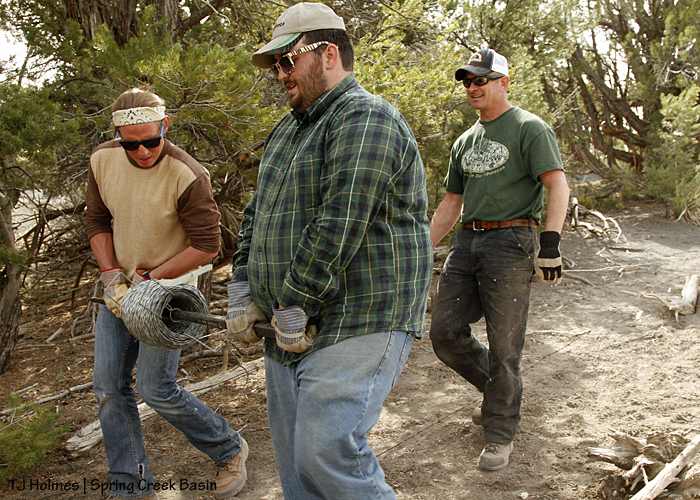
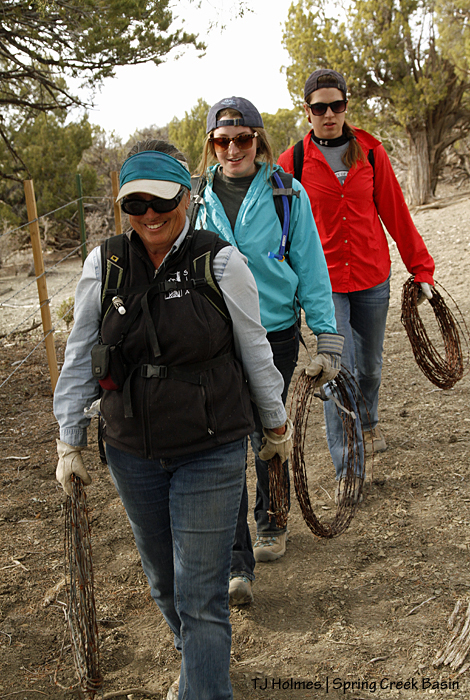
The crew finished the H-brace and strung strands of wire on their first day of work … which started with about a quarter of an inch of rain! As you can see, the day ended with beautiful sunshine.

One of the coolest part of the day? Seeing the pintos as we drove to the work site and again as we returned to the camp site. 🙂 The horses are the reason for the work, the partnerships … the tramping through mud carrying heavy posts and fencing tools. They’re absolutely the reason we do all that with smiles!


Partners for mustangs

3 10 2015

Wednesday, I partnered with folks from BLM, the Forest Service, San Juan Mountains Association and Southwest Conservation Corps to haul fence materials into Spring Creek Basin. Long-time readers of this blog are familiar with the outstanding alternative spring break program that brings a group of enthusiastic University of Missouri students to Southwest Colorado each year (look under the March links in the blog roll). In addition to working in Spring Creek Basin, students work on other areas of San Juan public lands for a week before heading back to class in Columbia, Mo. After four years, students have rebuilt quite a long stretch of our southeastern boundary fence – carrying materials in by manual labor because of its location in McKenna Peak Wilderness Study Area (no motor vehicles allowed).

Now that we’re pretty far in, and a steep bit of shale hill is coming up (literally), SJMA’s Kathe Hayes and BLM’s range specialist/herd manager Mike Jensen got the attention of the SCC (based in Durango) to give us a hand. While we want to give the Mizzou students a spring break they won’t soon forget, we don’t want to get too crazy. 🙂 Next spring, they’ll continue to rebuild fence from where the last group left off this past spring toward the base of the hill. This fall, the SCC crew will leapfrog where this spring’s students finished to start rebuilding a section from close to the base of the hill UP the hill.

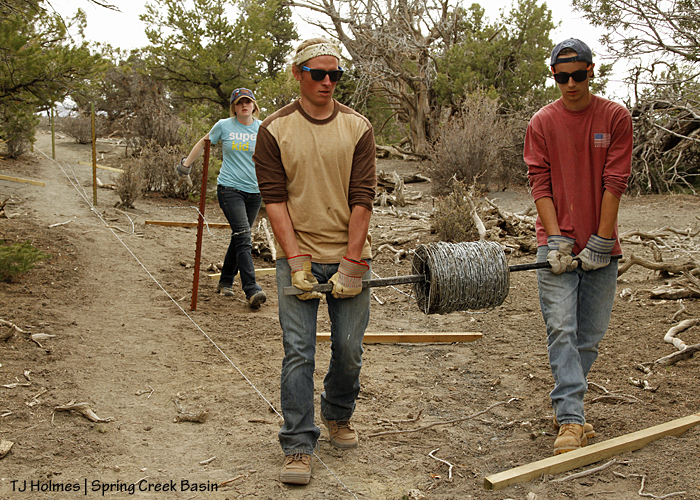
To ease the workload of both crews, our little group hauled fence supplies this week: wooden posts (for H-braces), T-posts (to replace worn/bent/warped ones), lots and lots of staves (to stabilize the wires between T-posts), and rolls of smooth-twisted and barbed wire (to create wild-horse/life-friendly fencing that cattle won’t want to mess with from the outside) – to a site convenient for both the SCC crew this fall and Mizzou students in the spring.

Many, many thanks to BLM’s Mike Jensen, Justin Hunt and Garth Nelson, SJMA’s Kathe Hayes, the Forest Service’s Harold Park, SCC’s Jordan and BLM/SCC’s Lauren for providing the human labor (including hours of scheduling and logistics!).

Huge, huge thanks to our four-legged crew: Traveler (who packed posts), Trapper (who packed staves and T-posts), Pinch (who packed wire and spikes and Lauren :)) and Zip (who packed staves), as well as Jammer (who packed Harold) and Sneakers (who packed Kathe). These seasoned Forest Service veterans made our job much easier – and they worked for apples!*

BLM range tech Justin Hunt leads Forest Service pack horse Trapper with a load of T-posts while Lauren leads Pinch toward the dropoff point along the southeastern boundary fence of Spring Creek Basin Herd Management Area. A Southwest Conservation Corps crew will be in the basin in October to replace a steep section of the fence, which has been worked on for four years by University of Missouri students during alternative spring break.

Here’s a teaser pic of Justin leading Trapper after Lauren and Pinch on the way to the cache site, following Kathe and Harold, who led the other two pack horses. For more pix of a great day of work that benefits Spring Creek Basin’s beloved mustangs, check out SJMA’s photostream on Flicker.

* Jammer and Pinch are Harold’s personal horses, and Sneakers belongs to Kathe.


‘Keep the Wild Horses Wild’

13 09 2015

LynnHansonCWAMflier

Passing on good works: Mustang photographers and advocates Lynn Hanson and Carol Walker will present a film night featuring “American Mustang” at 6:30 p.m. Wednesday, Sept. 16, at the Natrona County Public Library in Casper, Wyo.

From the library’s website about the event:

“The Natrona County Public Library and Casper College will host Colorado Author and Wild Horse Photographer Carol Walker as well as feature a screening of the documentary ‘American Mustang’ on Wednesday, September 16 at 6:30 p.m. in the Crawford Room. The event is free and open to the public. The goal of the evening is to raise awareness and to promote a deeper understanding of the troubles currently facing wild horses in America.

“The evening will begin with a screening of “American Mustang,” a nature documentary with character-driven narrative. Shot in eight Western states, ‘American Mustang’ reveals the majestic wild horses of the American West by taking audiences on a journey through a landscape dotted by ranchers, wild horse advocates, government agencies and the public. The evening will conclude with a question and answer forum led by Carol Walker. Walker will address many of the controversies highlighted in ‘American Mustang.’ She will also discuss how wild horses are in danger of being displaced from the range by agricultural and energy interests. Copies of Walker’s book, ‘Wild Hoofbeats: America’s Vanishing Wild Horses,’ will be available for purchase, which she will sign following her talk.

“In collaboration with the event, local Wild Horse Photographers Chad and Lynn Hanson’s exhibition ‘Landscapes with Wild Horses,’ featuring years of exploration and iconic photography, opens Saturday, August 22 in the Library’s atrium. Showcasing the beauty of Central Wyoming’s wild horses at liberty, the exhibition consists of photographic images and statistics that transport visitors to a fragile slice of land where hundreds of wild horses make their home. ‘Landscapes with Wild Horses’ runs through Wednesday, September 30 and can be viewed by the public during regular library hours.”

If you’re in Wyoming, please plan to attend in order to encourage and support these advocates and their work to educate the public about mustangs!


Special visitors

31 05 2015
Katie and Ben Masters in Spring Creek Basin with Chrome's band.

Katie and Ben Masters in Spring Creek Basin.

The “Unbranded” crew may not have ridden through Colorado, but ahead of Telluride’s Mountainfilm festival last weekend, Ben Masters and his very lovely wife, Katie, came to Spring Creek Basin to see our “beautiful” mustangs.

We talked about wild horses and wild burros and public lands and challenges and solutions. As you might imagine, Ben’s mustangs, partners in his and friends’ trip of a lifetime, have made him a mustang advocate. “Unbranded” has catapulted him into a unique position of being respected by a variety of disparate interests.

Ben Masters checks out the NMA/CO sign on the water catchment in Spring Creek Basin with wife Katie. Chrome's band is beyond.

Ben checks out the NMA/CO sign on the water catchment in Spring Creek Basin with Katie.

One does not travel from Mexico to Canada with mustangs and friends alone. It requires preparation and support from numerous people along the way. When traveling across public lands with a pack string and a camera man (at least one), one needs permits from the government: the Forest Service, the Bureau of Land Management, the National Park Service. Observant travelers notice the tread of others on those lands, and Ben and Ben and Thomas and Jonny were no different. To say they made the most of their observations and appreciation of America’s remarkable public lands is a huge understatement.

Katie and Ben Masters in Spring Creek Basin's east pocket with Comanche's, Aspen's and Hollywood's bands.

Katie and Ben enjoy a wonderful visit with beautiful mustangs in the basin.

“Unbranded” is a journey story, and like all good journeys, it includes challenges and obstacles and perseverance and education. While their physical journey may have ended at the Canada border, their education is ongoing, and their search for solutions for America’s wild horses and burros likewise is ongoing.

Ben Masters with Chrome's band in Spring Creek Basin.

Ben was pretty stoked by his visit with our mustangs!

Not surprisingly to the sold-out crowds fortunate enough to see “Unbranded” in Telluride (350 people in line were turned away from the Saturday showing after the theater filled), the film won the Audience Award.

This was the second film festival for “Unbranded”; it was the second Audience Award. Ahhhhhhhhhh-mazing!

When you get the chance to see “Unbranded,” see it. It’s not the typical mustang film. It will leave you wanting more – more mustangs, more conservation of public lands, more involvement, more “what can I do.”

Ben Masters with Chrome's band in Spring Creek Basin.

Ben … mustangs … a wide-open place.

We were so fortunate to meet Ben and Katie Masters and some of the rest of the “Unbranded” crew. What an amazing film. They’re carrying an important message, as Ben says, to show the worth of America’s mustangs.


Fence work, Mizzou style

26 03 2015

Amazingly, all 10 Missourians came back yesterday for their second day of work on Spring Creek Basin’s southeastern boundary fence line. Actually, it’s no surprise! Students returned bundled up against the brisk wind and gathered beneath the Temple-Butte-dominated horizon – dusted with snow! – to gather tools and supplies and head back up the trail. Smiling. 🙂

032515ASB10

Day 2 was more of the same: Taking out old wire, stringing new wire, installing staves to keep the wires stable. Here, MK Thompson (SJMA), Evan, Aloe, Tom West (SJMA), Jordyn and Mary wire in staves while Jessi carries a bucket containing more cut-wire pieces and Zach carries more staves.

032515ASB9

Two more H-braces were built – Miranda pounds in the spike to attach cross post to brace post.

032515ASB8

More wire was tightened to hold H-braces in place – Aloe twisted the post with help from student leader Chalen (far right) and BLM range tech Justin Hunt.

032515ASB7

Did someone mention all the staves wired in place? Evan, Aloe, Jessi and Lauren complete the task, which is the last step in each fence section.

But this group did something a liiiiiittle bit differently this year.

032515ASB6

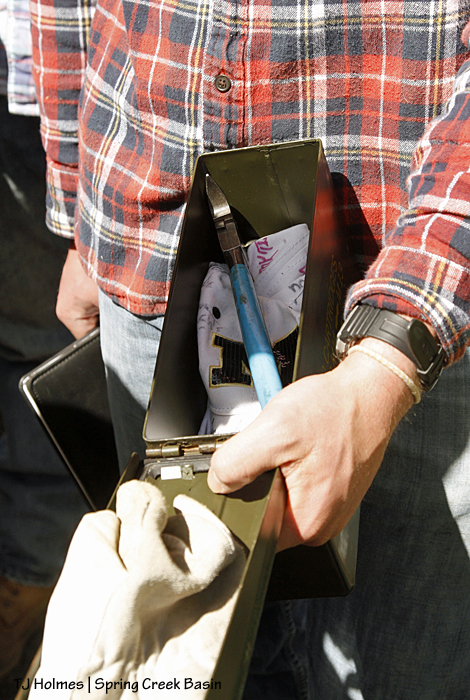
They put items in an ammo box designed to serve as a time capsule, to commemorate their time in Southwest Colorado and Spring Creek Basin. Items included notes written to future fence-builders (or themselves in 20 years?!), a Mizzou ball cap signed by students, BLM and volunteers, an SJMA bandana, a pair of watermelon-colored sunglasses similar to the protective eyewear issued to students without their own shades and – appropriately – a pair of fencing pliers.

032515ASB4

To end the day, students took turns pounding a “golden” spike into their last H-brace post …

032515ASB3

… then gathered ’round to collectively feel the good vibe!

032515ASB1

Of course, the very last task is to carry out old wire and tools.

032515ASB2

It was the girls – Mary and Sarah – who still had the strength to carry the lion’s share of old wire on one of the heavy tamp bars.

Young ladies and gents, sincere, heart-felt and appreciative THANK YOU for your work to help rebuild our fence and keep our mustangs safe! At the end of the day, we drove into Spring Creek Basin to see those for which we labor with such good cheer: the mustangs. We saw several bands and got to see some of the horses “running with the wind.” They make all our labors worthwhile!

032515ASB5

Justin, Mike, Aloe, Miranda, Zach, Lauren, Sarah, Mary, Evan, Jordyn, Chalen, Jessi, Kathe and MK (and Tom and Dave) … thank you, thank you, thank you! (The box on the cross post is the time capsule, and it was buried in the hole Jessi and Kathe are *not* falling into!)

Mizzou, every spring, you send us a crew of brilliant, enthusiastic, kind, productive, hard-working and happy young people. Hopefully we send them back to Columbia with one-of-a-kind memories of an experience that will stick with them for the next 20 years. We think our fence will last at least double that, but we’ll see you in 2035 to find out!

Thank you, truly, for your exceptional work for our mustangs. 🙂


Putting the fun in alternative spring break

25 03 2015

It is alternative spring break time again in Missouri and Colorado! This is the awesome time of year when the weather is fabulous and the University of Missouri sends us several of their marvelous students to do good work on San Juan public lands. This includes Spring Creek Basin Herd Management Area, managed out of Tres Rios Field Office in Dolores.

This is the fourth year students have helped us rebuild the basin’s southeastern boundary fence. Here are some more stats: This is the third straight year for student leader Chalen (who got married right before coming to Colorado – congrats!). It’s the 19th year of the alternative spring break program here; that means next year will be the 20th year! Wow. Kathe Hayes, leader extraordinaire and volunteer coordinator with San Juan Mountains Association, has been organizing this program for “16 or 17 years.” She may have said 17 years last year, so she may be underestimating her dedication to this super program.

Chalen said Mizzou sent 138 crews out of Missouri this school year for projects in the USA and abroad. Wow again!

As always, we are incredibly appreciative and wonderfully humbled by the students’ enthusiasm and get-‘er-done attitudes. Most come with little or no fence-building experience, but as Kathe noted at the start of the day, they all came equipped with excellent footwear!

Let’s take a look at their progress Tuesday:

032415ASB32

Zach and Evan were two of three boys (including Chalen) on the crew this year. Here, they’re carrying a roll of wire and a tamp bar to the start of the to-be-worked-on fence (we should measure this – probably half a mile from the road? – and it ain’t flat). Jessi follows them with buckets of tools. Check out the awesome fence beside them, built by last year’s crew.

032415ASB31

Putting their muscles to work right off the bat. It is NOT easy to carry those wire rolls.
032415ASB30

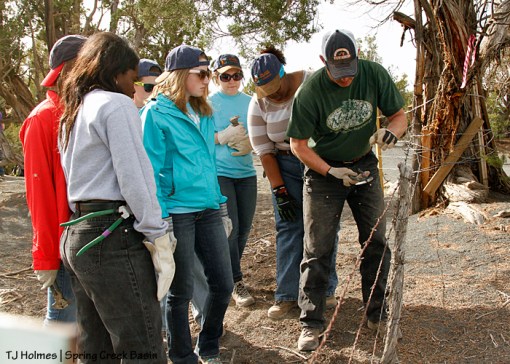
BLM herd manager Mike Jensen demonstrates the use of fencing pliers to the girls: Miranda, Sarah, Mary, Lauren, Jordyn and Aloe.
032415ASB29

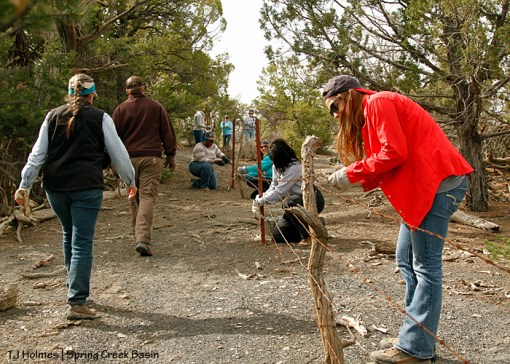
SJMA’s Kathe Hayes and BLM’s Dave Sanders walk along the fence where Sarah, Miranda, Mary and Aloe are undoing the wire pieces that hold old barbed wire strands to fence posts.
032415ASB28

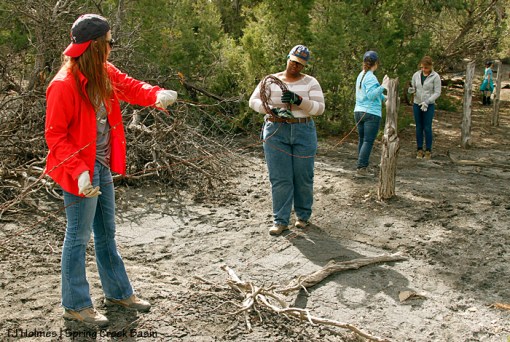
After they removed the wire, they had to roll the wire – again, NOT easy. Sarah, Aloe, Jordyn and Jessi keep their strands untangled.
032415ASB27

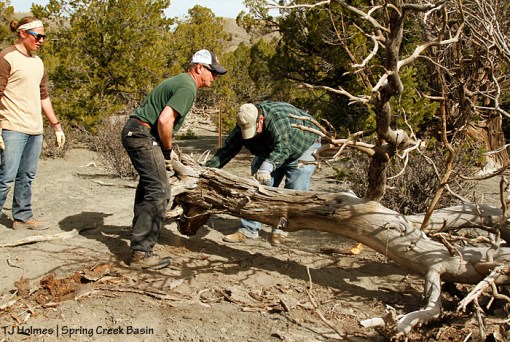
It’s hard to tell what’s going on here, but Mike and Chalen are moving an old tree away from the fence line. It fell in such a way that previous fencers used one spike of a root to stabilize wires. It was cool! But ultimately not very appropriate. Sigh. If you must …!
032415ASB26

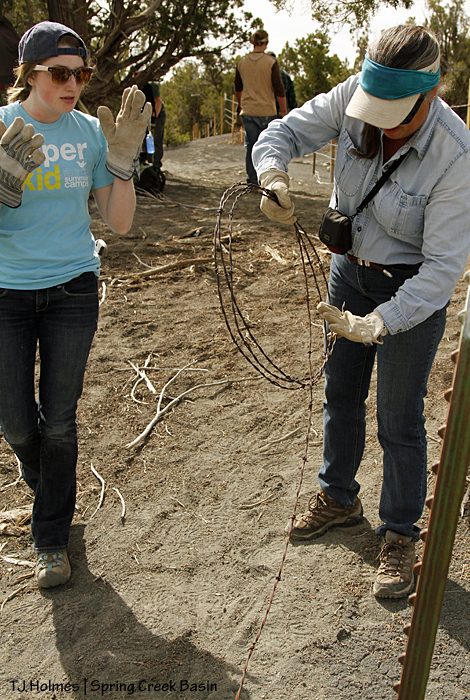
Kathe demonstrates the start of the wire roll to Mary.

032415ASB25

On any fence-building project, there’s a little bit of this – carrying rolls from brace to brace. Chalen and Zach carry the wire while Mike follows to keep it smooth.

032415ASB24

Before the new wire gets strung, the old wire must be rolled. Lauren shows off a perfect roll!

032415ASB23

Do these girls know how to have fun or what? Lauren (right) and MK rolled one strand of wire from either end and met in the middle, where Miranda stepped in to separate the two.

032415ASB22

Sarah shows off her wire roll while Miranda prepares to photobomb!

032415ASB21

Kathe heckles the photographer …

032415ASB20

… then shows off her mad fence-post-pounding skills!

032415ASB19

It’s not ALL about work. We do allow a few minutes for lunch, during which, we got to know a little more about the students and what they’re studying at Mizzou. This year, students span all classes – from freshmen to seniors – and have a variety of majors: accounting, photography, journalism, forestry, exercise science, health science, anthropology/international studies. Most are from Missouri, but others are from Illinois and Texas (interestingly enough, a town in the same county as yours truly’s parents call home).

032415ASB18

After lunch, it was right back to work. Sarah, Miranda and Zach (and others) took turns pounding through shale to dig a hole for a new brace post. Talk about sweat equity!

032415ASB17

Students coined a new term this year: fox-holing. Instead of using what was decided to be the most inefficient tool of all time – the post-hole digger – students shoveled dirt and shale out by hand.
032415ASB16

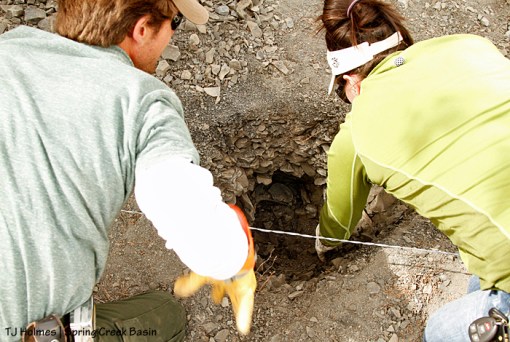
Hole-digging is an arduous process, especially through rock. Justin Hunt (BLM range tech) and MK Thompson (SJMA) double their digging.

032415ASB15

Mike drills a hole for a spike to be pounded to attach the brace post to the tree while Chalen steadies the post. Readers may remember that the southeastern fence line is wholly within McKenna Peak Wilderness Study Area, where no mechanized or motorized tools are allowed.

032415ASB14

After the hole is drilled, Jessi pounds the spike. The drilled hole eases the way, but it still requires some muscle!
032415ASB12

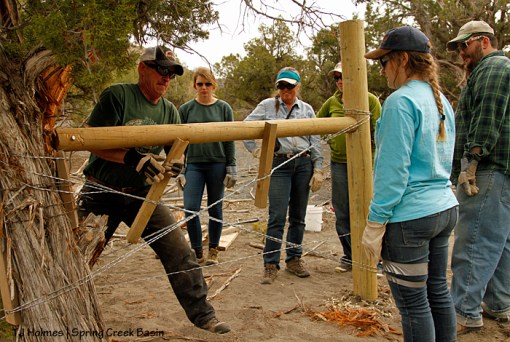
Tightening the wires on the braces is fascinating stuff! Go, Mike! Jessi, Kathe, MK, Chalen and Jordyn appreciate the effort. Note the fancy duct-tape circling Jordyn’s jeans-clad leg, which fell prey to a barbed-wire barb – a hazard of working with the stuff.

032415ASB11

Yep, there was more of this with Zach and Evan doing the heavy lifting and Mary keeping the wire flowing free.

032415ASB10

The students built two braces yesterday. Jordyn, Kathe and Aloe help Mike (out of sight behind the tree) while Justin and Miranda (background) feed the wire from the roll.
032415ASB9

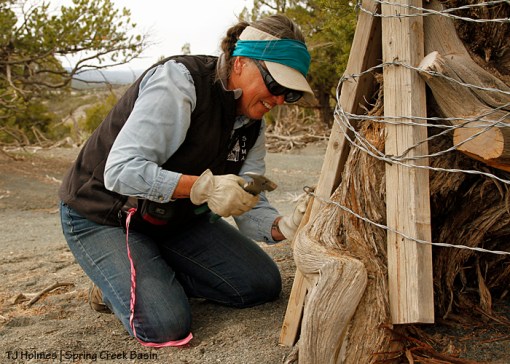
Kathe pounds a staple to attach wire around a tree at a brace (out of sight to the right). She soon switched from fencing pliers to a bigger mallet.

032415ASB8

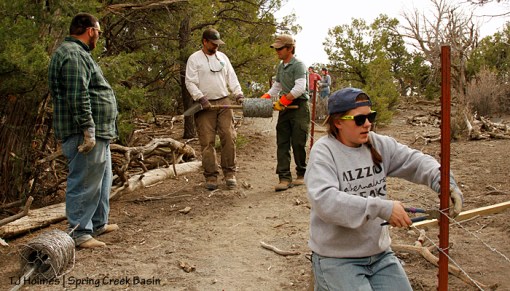
This post was pretty wobbly with a rotten bottom. MK rocked it out of the ground, and Dave sawed the rotten bottom off with help from Evan. When they flipped it (the former top went bottom-down in the new hole), they wanted it to look pretty for the mustangs! Always thinking about the horses – love it!
032415ASB7

Old wire out (and rolled) – check. Braces built – check. New wire strung – check. Clips attaching wire strands to T-posts (and staples to wood posts) – check. More new wire strung – check!

032415ASB6

Sore arms are a given after a day on the fence line (and they’re coming back today!). Sore cheeks from smiling? Yep, those, too. MK and Justin attach wire to the tree to run to the next brace.

032415ASB5

Jordyn and Mary use a measuring stick to attach the top wire of the new fence. Students are following wildlife-friendly fence-building concepts; the top and bottom strands are smooth-twisted wire (for wildlife), and the middle two strands are barbed (to deter cattle). The bottom strand is 16 inches off the ground to allow fawn and (elk) calf movement, and the top and second-from-top strands are wider spaced to prevent legs from getting twisted in the wire when jumping the fence. Note the helpful “UP” note on the measuring stick.

032415ASB4

Note the great smiles! In the background, Mike and Kathe admire the students’ handiwork.

032415kathemarysarah

Kathe, Mary and Sarah carry old-wire rolls back to the trucks at the end of the day.

032415ASBgroup1

By the time we got organized enough to take a group pic with the wire proof of their labors, Evan, Aloe and Jordyn already had headed for the trucks. We’ll get a group pic today with everyone! Front row from left: Kathe, Sarah, Lauren and Mary. Back row from left: Justin, Chalen, Miranda, Dave, Zach, Jessi, Mike and MK.

THANK YOU, Mizzou students! Every year, you impress us with your energy and ability to make a mundane, labor-intensive job a whole lot of fun. This year is no exception, and we so appreciate that you chose to come to Southwest Colorado for your spring break, to work instead of party – though we hope you have a lot of fun!


Little Book Cliffs darting team earns kudos

3 02 2015

And rightly so!

The Daily Sentinel in Grand Junction did a story about BLM’s team of volunteer PZP darters and the benefits they (and PZP) bring to the mustangs of Little Book Cliffs Wild Horse Range: “Wild-horse control; dart shooters help manage fertility of herd in canyons behind Bookcliffs.”

The overall article is about the benefits of and process behind using PZP to manage a wild horse herd. This nugget is a little bit buried, but check it out: “The result [of the PZP program] has been a smaller, more manageable herd, longer lives for mares and, this year, recognition by the head of the Colorado office of the BLM of the team as its volunteer of the year. The award, which was presented on Thursday by Ruth Welch, the BLM state director, means the team is a nominee for the agency’s national award for volunteerism.”

Marty Felix and Billie Hutchings are among my original inspirations. This award could go to no better team and for no better reason. Ditto the national award for which they’re now nominated.

Best of luck! I’m going to speak right up for Colorado mustang advocates and say we’re behind ya’ll!

Drummer and Kestrel, stallion and mare in Little Book Cliffs Wild Horse Range.


Scoping period’s deadline extended to Feb. 28

9 01 2015

Kudos to all who already have sent letters and emails in response to BLM’s request for comments about future bait trapping in Spring Creek Basin! We are so appreciative.
For you procrastinators out there (you’re in good company with yours truly), BLM has extended the deadline to comment. It’s now Feb. 28.

To repeat some information, the scoping letter and National Mustang Association/Colorado chapter- and Disappointment Wild Bunch Partners-submitted bait-trapping proposal are linked at NMA/CO’s website.

When you comment, please consider including your address to be added to BLM’s mailing list for future contact about issues related to our Spring Creek Basin mustangs – including the forthcoming EA. The scoping notice is the step that will lead to an EA that should include the potential to use bait trapping in Spring Creek Basin – in the future, when needed.

It is important to know that NO ROUNDUP is scheduled in Spring Creek Basin this year, and with the success of our PZP program, we shouldn’t need one for at least a year or two.

This is a very positive step forward in the evolution of good management of Spring Creek Basin’s mustangs. We already are using native PZP to slow the population growth of the herd. Bait trapping will provide a means of safe “gathering” and removal of horses when needed to keep the herd’s size in balance with the resources of Spring Creek Basin. In our fragile, high-desert environment, we must protect the range for the good of all generations of our mustangs.

Please pass the word, and send those comments! Thank you!

Maia, Alegre and Houdini


Tell BLM …

5 01 2015

… you want to see bait trapping in the future in Spring Creek Basin.

Today, BLM sent a scoping letter to gauge the public’s interest in doing bait trapping there in the future as opposed to helicopter-driven roundups. I think you’ll all agree that we want bait trapping instead of a helicopter. It was very successful in Little Book Cliffs in 2013, and we’re confident it can be successful in Spring Creek Basin – when needed.

The scoping letter (and bait-trapping proposal submitted by our groups to BLM last year) can be found through links on NMA/CO’s website.

It is important to note that there will NOT be a roundup in Spring Creek Basin this year. Our population is below the appropriate management level of 35 to 65 adult horses, and the use of native PZP has slowed population growth. Apparently, all of Colorado’s wild horse herds were put on the “2015 gather list,” but none were approved because of lack of funding and lack of corral space (this information is as of November 2014).

Note that the name of our herd management area is Spring Creek Basin Herd Management Area. Also note that Spring Creek Basin is in Disappointment Valley (there’s no such thing as Disappointment Basin – at least not locally).

Please submit respectful and positive comments by Jan. 30. Members of the Colorado chapter of the National Mustang Association, Four Corners Back Country Horsemen and Mesa Verde Back Country Horsemen (a coalition known as Disappointment Wild Bunch Partners) have established a long-term working partnership with Tres Rios Field Office managers with regard to managing our Spring Creek Basin mustangs well. Our network of mustang advocates helps reinforce this partnership.

Thank you for your support of our mustangs in Spring Creek Basin!

Comanche, Piedra and Aurora


SCC crew cutting tamarisk

1 06 2014

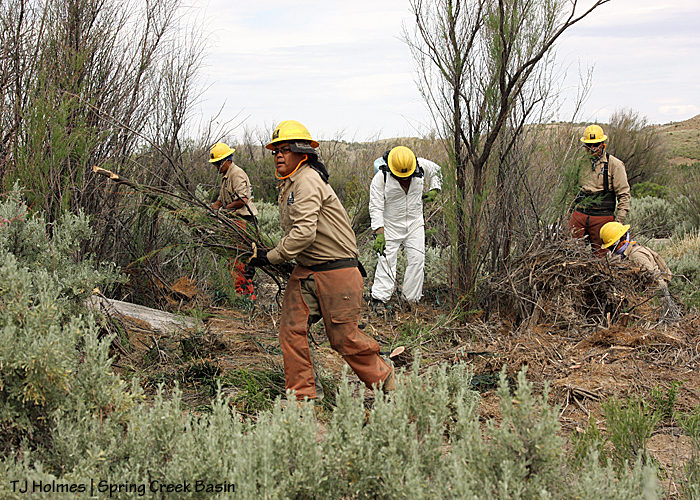
Last week, a Southwest Conservation Corps crew spent four days in Spring Creek Basin cutting and spraying tamarisk. Kathe Hayes with San Juan Mountains Association played a big part in getting the crew here for this project, which – I think – was funded out of the Director’s Challenge grant our Tres Rios Field Office was awarded a couple of years ago.

Crew members are from Fort Defiance, Ariz. Several of them have been together since March, and a couple of them volunteered to join the crew for this project in the basin. Crew leader Lance Hubbard said this is his fourth or fifth season with SCC. Most of those have been spent doing irrigation, wash restoration and trail work; this was his first season to do chainsaw work. From here, they’ll head back to Ganado, Ariz., for all of the above.

Tamarisk eradication has been done off and on for many years in the basin. Some of our University of Missouri students have worked on it during alternative spring breaks with Kathe. Also working in the basin last week was a Forest Service sprayer, Gary, working in some of the main arroyos.

052914SCCfive

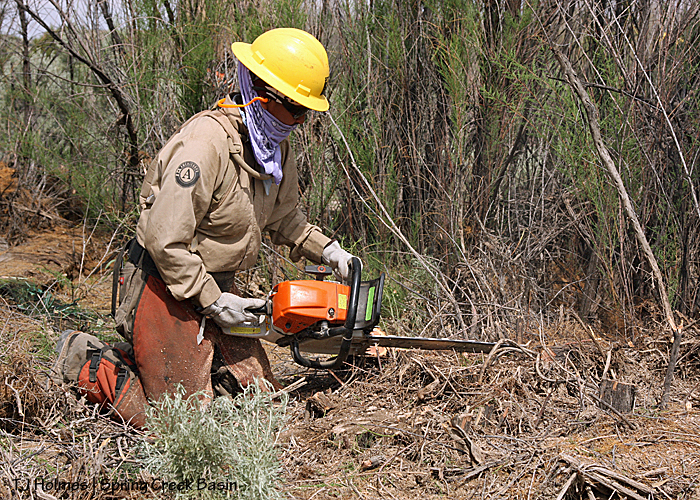
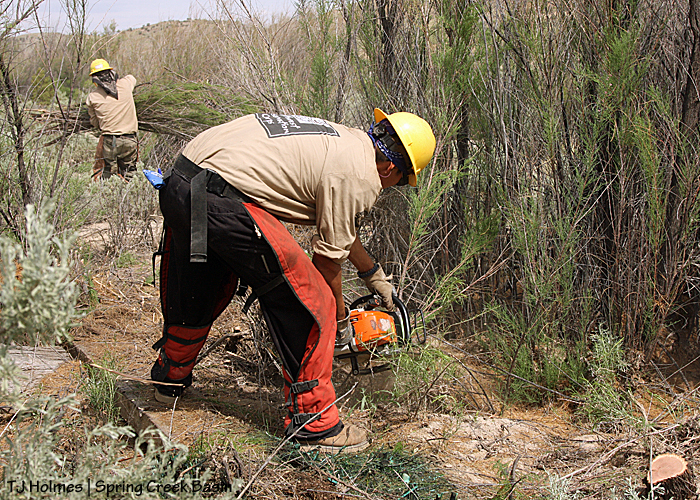
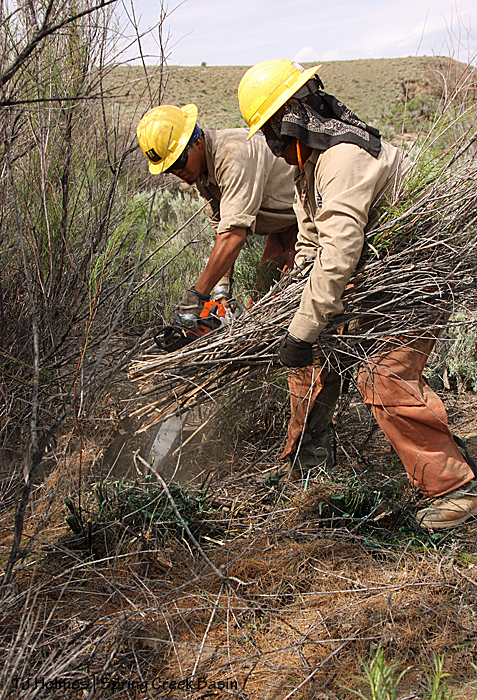
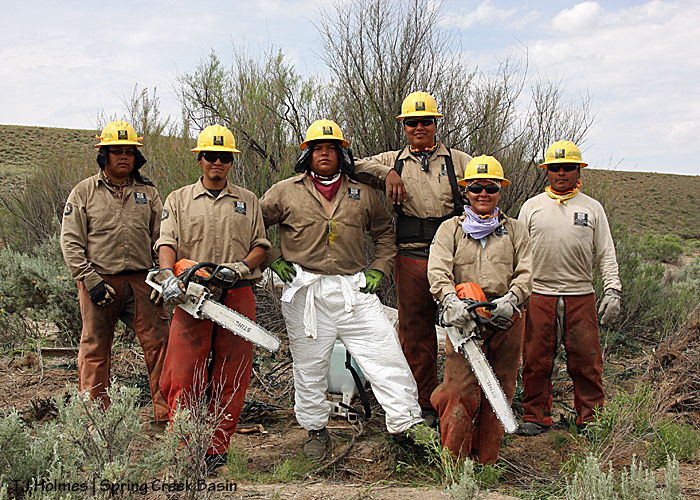
Five guys and one woman, ranging in age from 20 to 25, were on the crew (I couldn’t get them all in one frame until I made them pose for me at the end because they were all constantly in motion). Two wielded chain saws, cutting tamarisk as close to the ground as possible so the stumps would pose as little hazard as possible to the horses. Three cleared the branches and carried them to slash piles for later burning. And one sprayed the stumps with “Habitat” to prevent the tamarisk from growing back. Crew members traded spraying, carrying and cutting duties each day.

052914SCCshoanyah1

Shoanyah Halwood wielded one of the chainsaws. My back ached just watching her!

052914SCCmatthewadrian

Matthew Begay wielded the other chainsaw. Adrian Benally was his partner to clear and carry branches to the slash piles.

052914SCCadrianmatthew

Another one of Adrian and Matthew working together. Sprayed stumps are visible in the foreground.

Alonzo Moses, 23, carries cut tamarisk branches to a pile to be burned later.

Alonzo Moses carries branches that Shoanyah cut to a slash pile.

052914SCClance

Crew leader Lance Hubbard also carried branches to slash piles.

052914SCCrolando

Rolando Billie handled spraying duties on the crew’s last day in the basin. It was pretty warm during their week, but they had a little bit of cloud cover toward the end that helped.

052914SCCcrew1

From left: Adrian, Matthew, Rolando, Lance, Shoanyah and Alonzo. They’re standing where a big clump (grove?) of tamarisk once grew.

Getting rid of moisture-leaching, salt-depositing tamarisk is a big, worthwhile project in Spring Creek Basin, and we appreciate their work on behalf of our mustangs! They did see a couple of bands during the week and thought the horses were pretty cool. 🙂 Thanks to this hard-working crew!