Little Book Cliffs darting team earns kudos

3 02 2015

And rightly so!

The Daily Sentinel in Grand Junction did a story about BLM’s team of volunteer PZP darters and the benefits they (and PZP) bring to the mustangs of Little Book Cliffs Wild Horse Range: “Wild-horse control; dart shooters help manage fertility of herd in canyons behind Bookcliffs.”

The overall article is about the benefits of and process behind using PZP to manage a wild horse herd. This nugget is a little bit buried, but check it out: “The result [of the PZP program] has been a smaller, more manageable herd, longer lives for mares and, this year, recognition by the head of the Colorado office of the BLM of the team as its volunteer of the year. The award, which was presented on Thursday by Ruth Welch, the BLM state director, means the team is a nominee for the agency’s national award for volunteerism.”

Marty Felix and Billie Hutchings are among my original inspirations. This award could go to no better team and for no better reason. Ditto the national award for which they’re now nominated.

Best of luck! I’m going to speak right up for Colorado mustang advocates and say we’re behind ya’ll!

Drummer and Kestrel, stallion and mare in Little Book Cliffs Wild Horse Range.


Scoping period’s deadline extended to Feb. 28

9 01 2015

Kudos to all who already have sent letters and emails in response to BLM’s request for comments about future bait trapping in Spring Creek Basin! We are so appreciative.

For you procrastinators out there (you’re in good company with yours truly), BLM has extended the deadline to comment. It’s now Feb. 28.

To repeat some information, the scoping letter and National Mustang Association/Colorado chapter- and Disappointment Wild Bunch Partners-submitted bait-trapping proposal are linked at NMA/CO’s website.

When you comment, please consider including your address to be added to BLM’s mailing list for future contact about issues related to our Spring Creek Basin mustangs – including the forthcoming EA. The scoping notice is the step that will lead to an EA that should include the potential to use bait trapping in Spring Creek Basin – in the future, when needed.

It is important to know that NO ROUNDUP is scheduled in Spring Creek Basin this year, and with the success of our PZP program, we shouldn’t need one for at least a year or two.

This is a very positive step forward in the evolution of good management of Spring Creek Basin’s mustangs. We already are using native PZP to slow the population growth of the herd. Bait trapping will provide a means of safe “gathering” and removal of horses when needed to keep the herd’s size in balance with the resources of Spring Creek Basin. In our fragile, high-desert environment, we must protect the range for the good of all generations of our mustangs.

Please pass the word, and send those comments! Thank you!

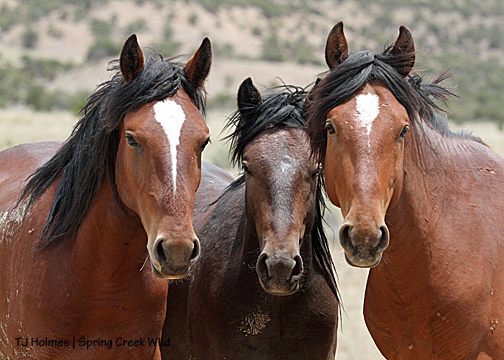
Maia, Alegre and Houdini


Tell BLM …

5 01 2015

… you want to see bait trapping in the future in Spring Creek Basin.

Today, BLM sent a scoping letter to gauge the public’s interest in doing bait trapping there in the future as opposed to helicopter-driven roundups. I think you’ll all agree that we want bait trapping instead of a helicopter. It was very successful in Little Book Cliffs in 2013, and we’re confident it can be successful in Spring Creek Basin – when needed.

The scoping letter (and bait-trapping proposal submitted by our groups to BLM last year) can be found through links on NMA/CO’s website.

It is important to note that there will NOT be a roundup in Spring Creek Basin this year. Our population is below the appropriate management level of 35 to 65 adult horses, and the use of native PZP has slowed population growth. Apparently, all of Colorado’s wild horse herds were put on the “2015 gather list,” but none were approved because of lack of funding and lack of corral space (this information is as of November 2014).

Note that the name of our herd management area is Spring Creek Basin Herd Management Area. Also note that Spring Creek Basin is in Disappointment Valley (there’s no such thing as Disappointment Basin – at least not locally).

Please submit respectful and positive comments by Jan. 30. Members of the Colorado chapter of the National Mustang Association, Four Corners Back Country Horsemen and Mesa Verde Back Country Horsemen (a coalition known as Disappointment Wild Bunch Partners) have established a long-term working partnership with Tres Rios Field Office managers with regard to managing our Spring Creek Basin mustangs well. Our network of mustang advocates helps reinforce this partnership.

Thank you for your support of our mustangs in Spring Creek Basin!

Comanche, Piedra and Aurora


Alternative spring break – day 2

27 03 2014

Not only are these University of Missouri students good workers, they’re good luck!

They arrived with smiles and good cheer and high energy, and we know why.

Chalen was the group leader for the second year this year. Last year, rumor had it that Chalen was up at 4 at least one morning (!) to cook breakfast for his crew. Kyla confirmed that while most UM alternative spring break groups are eating Cheerios and granola for breakfast and scrounging dinner on their own, Chalen is making sure his charges not only eat, they eat well! Kathe Hayes, with San Juan Mountains Association, sets up a couple of dinners for the students during the week each year, but I have it on good authority that the kids dined on steaks last night, courtesy of Chef Chalen. Niiiiice! (They deserve it!)

Wednesday’s stretch of fence work was fairly short, especially compared with Tuesday’s stretch. The goal was to finish relatively early, then take the students to the interior of Spring Creek Basin to see the reason for the work: the mustangs!

Tuesday’s work ended at a little arroyo that flows (when it rains) under the fence. The approach is fairly flat, but the north side is steep – and shaley (read: slippery). Tuesday, students built an H-brace on the flat side.

032614relay1

Wednesday, students ran wire up the steep slope to a newly-built H-brace (pictured is the brace built Tuesday). Students set up an impromptu relay system while carrying staves up the hill. Jake to Kyla in front, Sam to Dustin below, Casey and Chase bringing up the rear. It worked!
032614kevinchriskyla

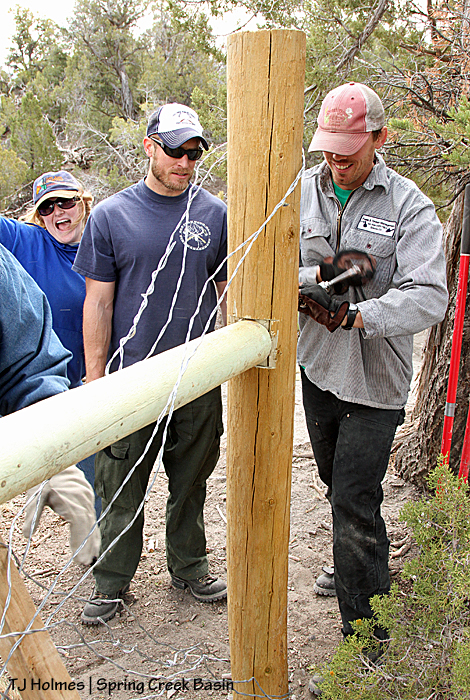
Forest Service firefighters Kevin and Chris helped with the work Wednesday. Kyla photobombed. Again. 🙂

032614tifkathemk

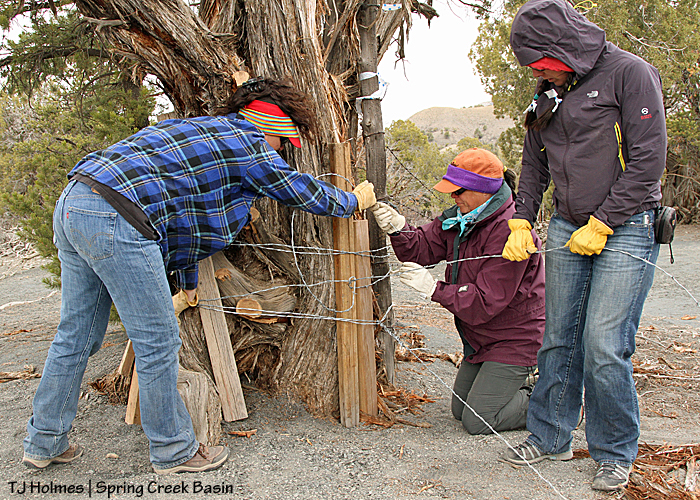
From there, students removed wire and ran new wire to the next stop – a big juniper that students padded with 2-by-4s (to protect it from wire). This photo actually shows the female fence leadership in place Wednesday: Tif, Kathe and MK. They tied off the second strand of wire (you can see the first, bottom strand already in place and tight). Go, girls!

Removed wire: Check.

032614mktom

Ran new wire, four strands: Check. MK and Tom, both with San Juan Mountains Association, ran the last strand of wire from the padded tree to the H-brace while Grace, back right, helps channel the wire.
032614chalenchris

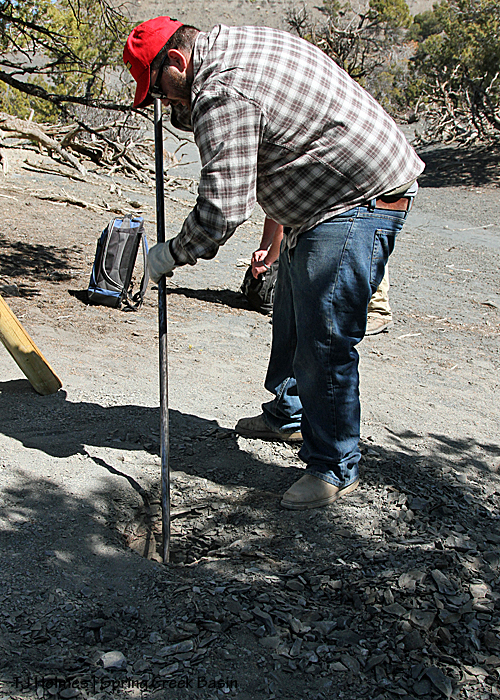
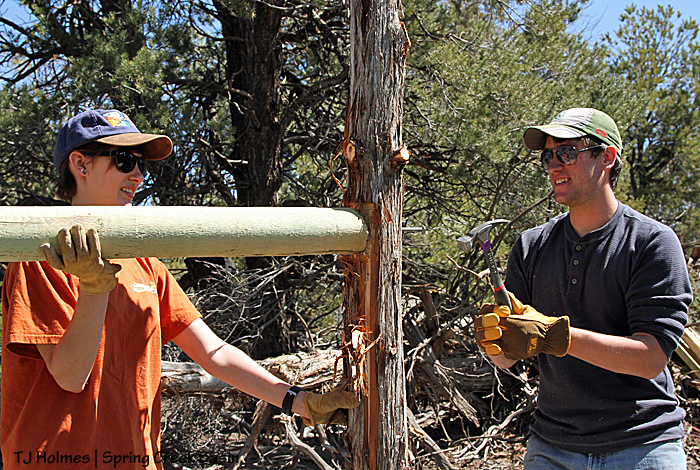
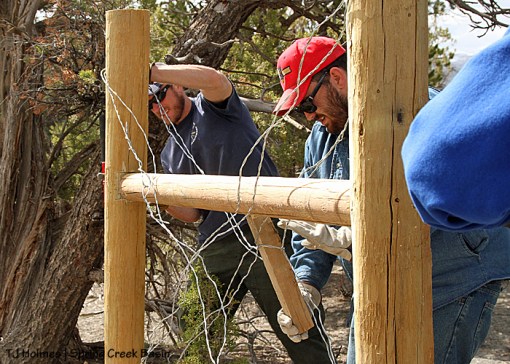
Dug post holes and built another H-brace: Check (oh yeah, and they carried these two thick, treated posts from the road just for this brace, at the top of the steep arroyo hill, to anchor the rest of the fence). Check, check! Here’s Chalen tightening the cross wires to strengthen the brace and Chris pounding in a spike (in a hole drilled earlier by Kevin) to secure the post to the cross piece.
032614kevinchristif

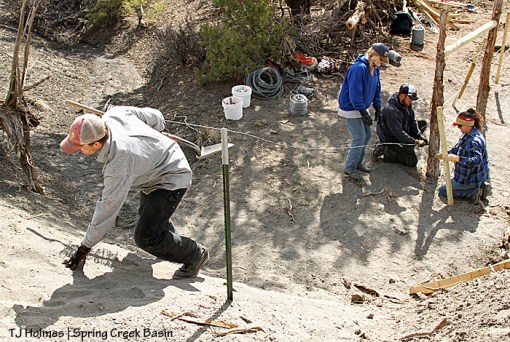
Ran wire up the steep arroyo hill to then tighten and attach to T-posts: Check and check. Kevin carries the wire up the hill while Tif, Chris and Kyla tie it off at the H-brace below.
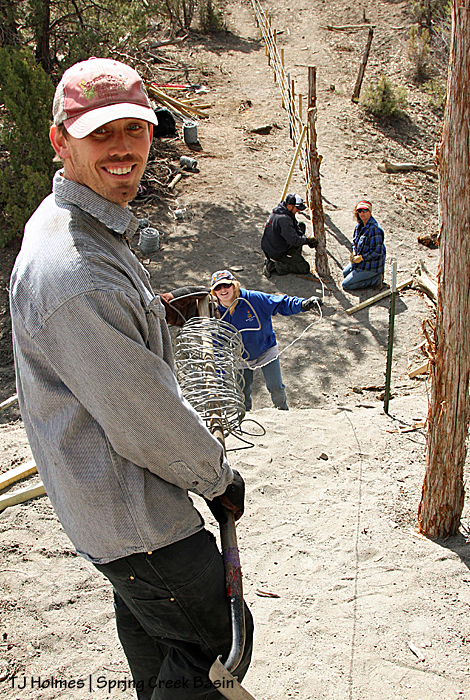
032614kevinwire

One more to show the steepness of the hill. Thank goodness it was just a short stretch!

032614marksophiakyla

Installed staves: Check. Mark, Sophia and Kyla made quick work of it.
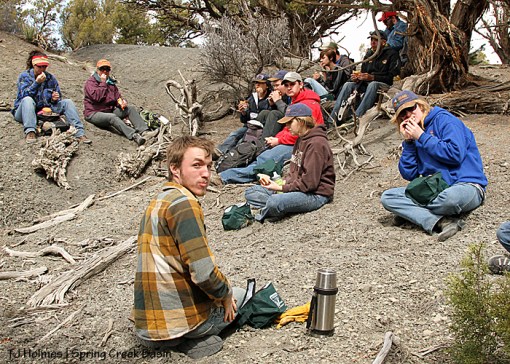
032614lunchbreak

Stopped for lunch: Check! 🙂

032614mkchasetom

Here’s a shot of MK standing right in the bottom of the little arroyo while she attaches a stave to the wires. Tom and Chase are just up the slope. It’s just a narrow little thing, as you can see from the edge of the H-brace at the right edge of the photo.

032614tomchasemark

And one more project to finish off the whole deal: Dustin, Chase and Tom installed a “dead person.” Back story: Most fence-building crews call these a “dead man” – “dead men”? But being the modern folks we are, and not to exclude an entire gender, in the last couple of years, with fence-building guru Tom Kelly – recently retired from the Forest Service – we started calling them “dead persons.” We’re innovative like that. This old tree trunk fit the bill perfectly; it will block the gap below the wire, and it will swing with any seasonal flows that wash through the arroyo.

Fairly early in the work, we had a couple of visitors:

032614kathekevinSCC

Kevin Heiner with Southwest Conservation Corps brought his daughter, Mariah, to check a potential work project for one of his crews next year in Spring Creek Basin. Kathe Hayes with San Juan Mountains Association is trying to raise funds to bring a crew here to tackle a VERY steep – and long – hill coming up on the fence line. The hope is that the SCC crew might work at the same time as next year’s alternative spring break crew from Mizzou in order to add another dimension to the partnership.
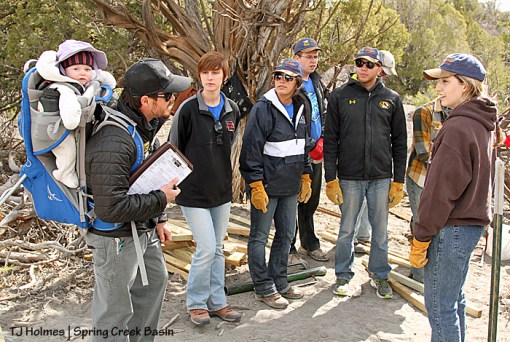
032614kevinUMstudents

While they were here, Kevin and his “executive director” also talked to students (Casey, Sophia, Mark, Chase and Grace pictured) about internship opportunities. Baby Mariah looks like a future outdoorswoman who will complete numerous projects on our public lands, doesn’t she?

032614finale

Grand finale: Tif and Kathe follow the students to the vehicles after two days of work well done. How awesome is that fence??

Wednesday’s weather was quite a bit different than Tuesday’s: Somewhat cloudy, windy, cooler. Grey skies greeted us as we drove east with the idea to drive into the basin to look for mustangs to show the students. We saw Ty’s band at a distance from the road. By the time we got to Road K20E, we decided that the grey we were seeing was dust, not rain, so in we went. Chrome’s band delighted us by being a little closer to view!

And here’s where the good luck comes in. While it cut short our potential viewing of wild horses, the wind that stirred the dust also brought rain. Just a little. Enough to make the road the tiniest bit tacky. That’s more than we’ve had for weeks. Niiiiiiiiiiiiiiice!

So, dear students, thank you, thank you again, from all of us, on behalf of our mustangs – which belong to all of you, too! Please enjoy the rest of your stay – Sand Canyon today? Travel safely back to Missouri. Come back and see us! We so appreciate all your hard work!

032614asbfencecrew

Back row from left: Mark, Kathe, Chalen, Chase, Casey, Dustin and Sam. Front row from left: Damon, Grace, Sophia, Tif, Jake and Kyla.

Thanks. 🙂 You all rock!


Alternative spring break – 2014

26 03 2014

We had sunshine. We had short sleeves. We had the flush of sunburn on winter-white arms and faces. We had, uh, shale?

No beaches, but we had hard workers and fantastic attitudes. As usual, Mizzou sent some – 10 – excellent students to continue the fence-rebuilding project on Spring Creek Basin’s southeastern fence line as part of alternative spring break. Leader Chalen said the number of groups working this spring break is 52 – up from 38 last year. If all you’ve heard about the next generation is a not-so-hearty endorsement, these students made myth of such statements.

They ranged from freshmen to seniors, from undecided majors to finance, to animal science/pre-vet to fisheries and wildlife, to journalism.

Every year, we’re grateful and excited to welcome them, and every year, a new group of students humbles us with their willingness to work on public lands very far from their Missouri campus.

032514haulingposts

The sweatshirts didn’t last long. It was a gorgeous day in Disappointment Valley, and we were down to T-shirts in no time at all. Right to left: Grace, Sam, Chase, Sophia, Casey and Kyla.

032514mikejakecross

BLM range specialist and former herd manager Mike Jensen helps Mizzou student Jake set a cross piece into an H-brace at the start of the project.

032514chasemark

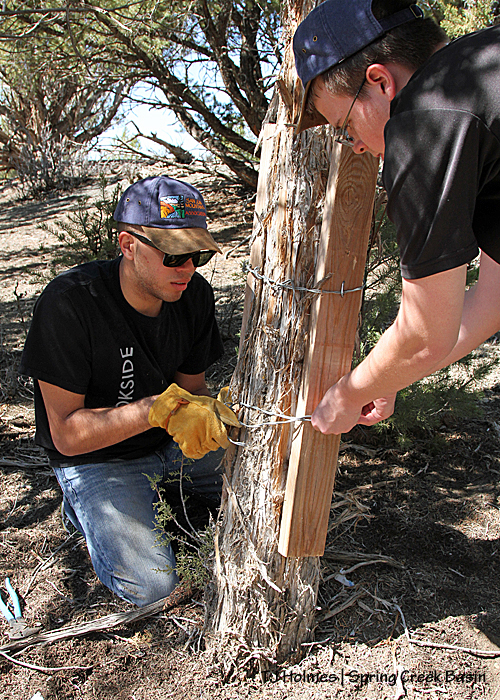
Students Chase, left, and Mark attach boards to a tree to protect it from wire fence strands biting into it. This is just up the line from the H-brace Mike and Jake are working on in the previous pic.

032514chalenposthole

Student leader Chalen – who also was last year’s group leader – drew the short straw in digging this post hole with Sam. See all that rock? See the tamp bar? The only other tool they used was a post-hole digger.

032514sophiachalensam

Same post hole – post in! Sam, right, tamps it in while Chalen and fellow student Sophia admire the work.

032514mkwirerolls

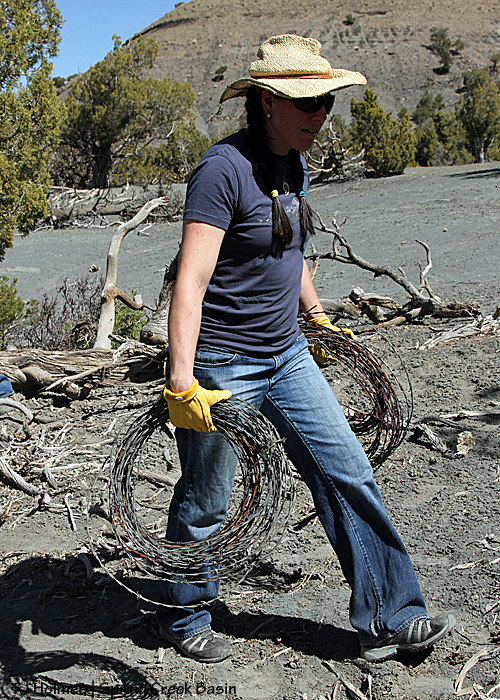
MK Thompson with San Juan Mountains Association carries out old wire strands that the students removed and rolled. A local Girl Scouts troop will pick up the old wire to recycle and earn some money! How about that for both recycling and partnership among local groups?

032514damonpost

Herd manager Damon Corley pounded his fair share of T-posts. Part of the fence line was relocated to a straighter route, so posts were lifted out and reused or replaced. The lower wire strand was left in place temporarily to help align the new posts.

032514kyladustin

Sorry, Dustin! While he was hard at work with a shorty tamp bar, Kyla bombed his photo – but gave his hard work an enthusiastic thumbs-up! They and Casey (whose foot appears at bottom left)  – and Sophia helped, too – dug two holes for an H-brace at the bottom of this steep little arroyo toward the end of the day’s work project.

032514kylasophiabrace

Sophia, right, and Kyla set the cross piece into the notches of the posts they dug holes to place. Kathe Hayes, mastermind of the alternative spring break week for many, many years (did I hear 17 years, Kathe??), supervises.

032514dustintomdrill

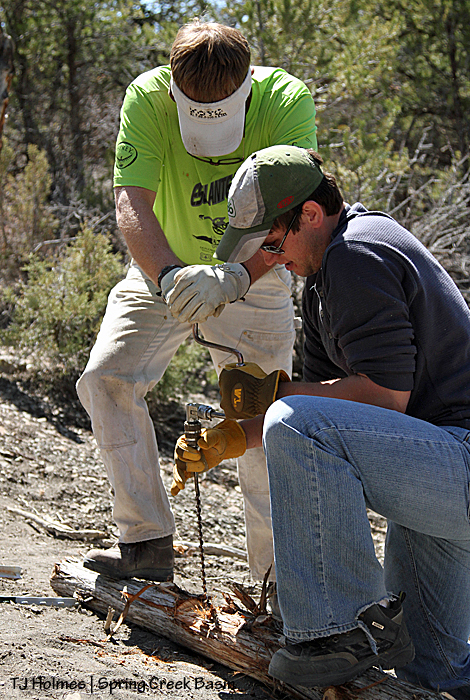
The Forest Service’s Tom Rice helps Dustin drill a hole for a spike to secure the soon-to-be-upright juniper post to the cross piece, as seen in the previous pic. Remember, in McKenna Peak Wilderness Study Area, no mechanized tools are allowed.

032514caseydustinbrace

On this end of the brace, Dustin hammers home the spike while Casey steadies the cross piece.

032514tiffence

NMA/CO executive director and volunteer Tif attaches a clip to a T-post to secure a wire strand. Only the top strand to go! The top and bottom strands are smooth twisted wire, and the the middle strands are barbed.

032514caseyjakemeasure

We’re using wildlife-friendly wire spacing on this entire line (I think that’s usual now for Forest Service and BLM fences). Jake holds one of the measuring sticks used by students to  attach the wires at the right spacing while Casey attaches a strand to the T-post with a metal clip.

032514fencework

The students were so “on the ball” that hardly had a wire strand been tightened and tied off at the H-brace than they were attaching the strands to posts and staves to wire. Wow, they were fast! Some of the students have fence-building experience, but most don’t. Quick learners, these college students!

032514fencework-v

This shot is a little out of order, but it’s a good contrast to the previous pic, which shows the nearly-finished fence. In this pic, taken from about halfway up the steep bank of the arroyo at the end of the day’s work section, you can see Kyla and Tom drilling a hole in one of the juniper H-brace posts while Dustin, Kathe, Casey and Sophia have set their post and are getting ready to tamp dirt in around it. When the H-brace is completed, wire will be strung – from the bottom wire up – clips will be placed, staves will be set, and we’ll call it a day well spent!

032514sophiagracedamonpost

One of the last things to do was to dig a hole and place this tall, stout juniper post (cut Saturday during work prep) about midway up that steep arroyo bank. Sophia, Grace and Damon carried it to its place, and they and other students dug the hole and placed it and tamped it steady before we hit the trail for the trucks …

032514ASBcrew1

… where we took the obligatory group shot. Back row from left: Damon, Mike, Kyla, Sophia, Dustin, Casey, Chase, Grace, Chalen, Sam, Mark and Jake. Front row from left: Tom, Connie, Kathe, Tif and MK.

We really can’t say “thank you” too many times. Mike, Tom and Connie won’t be joining us for the second day of work, but the students, Kathe, Tif and MK will return along with a couple of wildland firefighters Kathe conned encouraged to come.


National Academy of Sciences report on BLM’s management of wild horses and burros

7 06 2013

It’s out. The National Academy of Sciences has completed its report about wild horses and burros, and BLM’s management of them.

Some links to reports about the study:

“New report offers science-based strategies for management of Western free-ranging horses and burros; ‘business-as-usual’ practices will be increasingly expensive and unproductive for BLM”: http://www8.nationalacademies.org/onpinews/newsitem.aspx?RecordID=13511

Th National Academy of Sciences link (above) includes a link to the brief summary of the report: http://dels.nas.edu/resources/static-assets/materials-based-on-reports/reports-in-brief/wild-horses-report-brief-final.pdf

*** Updated to add this link, by the always-thought-provoking Andrew Cohen of The Atlantic: http://www.theatlantic.com/national/archive/2013/06/after-wild-horse-report-jewell-faces-first-moment-of-truth-at-interior/276545/

http://bigstory.ap.org/article/independent-panel-readies-review-blm-mustangs

http://www.returntofreedom.org/national-coalition-calls-on-interior-secretary-to-halt-wild-horse-roundups-in-wake-of-scathing-independent-report/

http://m.sltrib.com/sltrib/mobile3/56416617-219/horse-report-wild-horses.html.csp

http://www.usatoday.com/story/news/nation/2013/06/05/horse-burro-blm-nrc/2388947/

http://hsus.typepad.com/wayne/2013/06/nrc-gets-it-right-in-panning-blm-wild-horse-program.html

Apollo, Killian and Tenaz

Practically speaking, what will it mean? Time will tell.


Pati Temple Memorial Benefit Bash

5 06 2013

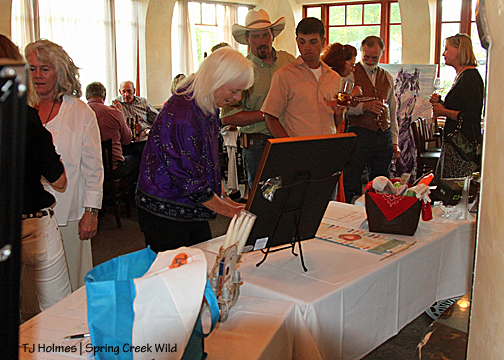
Monday’s event to honor the National Mustang Association, Colorado chapter’s Pati Temple was a great success! A huge, heart-felt thank you to all the friends and family of Pati – and David – Temple who donated items to the silent auction and/or attended the bash. Your attendance and contributions go a long way toward helping us continue our advocacy on behalf of our Spring Creek Basin mustangs!

060313claudesarahr

Durango photographer Claude Steelman donated a print of his outstanding photo of our handsome Traveler (left) and two of his photography books, including Wildshots, pictured. Bayfield artist Sarah Rose donated a print of her beautiful painting of Spring Creek Basin’s Aspen, right.

060313karenstraveler

NMA/CO board member Karen Keene Day donated this stunning painting of Traveler. It’s based on a photo she took of him and his band in 2004.

060313susant

Susan Thomas and NMA/CO board member Nancy Schaufele (in purple) check out silent auction items.

060313nancys

Nancy marks the final bids at the end of the silent auction. Kennebec Cafe, one of Pati’s favorite restaurants, provided a really beautiful setting for our event; many thanks for the great food and wonderful setup!

060313katheh

Kathe Hayes with San Juan Mountains Association shows off Alice Billings’ donated painting of Temple, wild filly in Spring Creek Basin named in honor of Pati and David. Kathe was the high bidder on the painting!

In addition to Nancy and Karen, many thanks to NMA/CO board members Tif Rodriguez and Lynda Larsen – and, always, David Temple – as well as our event planner, Tina Roth, for making this such a memorable and successful event in Pati’s memory.

Pati was an exceptional woman who fought for the well-being of animals and people whenever she saw a wrong. We think she would have loved this party. The worst part of it was that she wasn’t there to enjoy it with us.


How does your donation to NMA/CO help the Spring Creek Basin mustangs?

28 05 2013

This question was asked recently, and answering it gives me another chance to let local folks know about the Pati Temple Memorial Benefit Bash we will hold next week, Monday, June 3, at the Kennebec Cafe in Hesperus, Colo. Follow that link for the details and to purchase tickets if you haven’t and plan to attend.

NMAPosterFinal3(100)

Now, on to an answer(s) to the question!

First, see this page, compiled last year by Pati, for a list of the National Mustang Association, Colorado chapter’s past accomplishments: http://www.nationalmustangassociationcolorado.org/nmaco-accomplishments.html

As it says, NMA/CO has spent nearly $100,000 to date on projects that directly benefit the mustangs of Spring Creek Basin! We rarely do fundraisers, relying mostly on memberships and donations. Administrative expenses are low, mostly what we put toward mailing newsletters. We had T-shirts and hats printed for the adoption in 2011, and we’ll soon have a link to purchase them through the website.

Fence repair and maintenance is ongoing through volunteer labor. As a result of their partnership with us as part of Disappointment Wild Bunch Partners, BLM received $25,000 last year through the Director’s Challenge grant, which purchased some materials to be used in a project on the basin’s southeastern boundary line (read about alternative spring break and University of Missouri students’ work here – https://springcreekwild.wordpress.com/2013/03/26/alternative-spring-break-day-1/ – and here – https://springcreekwild.wordpress.com/2013/03/27/12368/). I fix fences as needed while I’m in the basin doing documentation. Sometimes we use materials provided by BLM, other times by ourselves.

We also are continually encouraging BLM to look at water-enhancement projects. More than a decade ago, NMA/CO paid for a water catchment to be built in Spring Creek Basin, and it supplies the mustangs’ only clean source of water (all others being extremely alkaline, at least). We have a signed agreement from about 12 or 13 years ago with BLM to construct at least one more catchment, but it has never been built. I think the catchment cost about $10,000. Several years ago, we also started talking to BLM about water guzzlers (such as those installed on Pryor Mountain Wild Horse Range) to add to the horses’ quality of water. Those are about $8,000-plus. NMA/CO also has purchased parts for the catchment’s troughs, which work on floats.

NMA/CO contributes funds to combat noxious/invasive weeds in Spring Creek Basin (knapweed, tamarisk, musk thistle, etc.).

A decade or more ago, NMA/CO was able to purchase the cattle AUMs from one of the two ranchers who held permits in Spring Creek Basin. With the help of the National Mustang Association, we were able to retire those AUMs permanently. In the process, BLM conducted a grazing EA (not sure the exact reference) and then drastically reduced the remaining AUMs and changed the timing to dormant-season grazing only – Dec. 1 through Feb. 28. For the last several years, NMA/CO has been trying to buy or trade for the permit in Spring Creek Basin to also retire those AUMs, with the goal of no cattle grazing in the basin. As BLM itself says, managing wild horses is easier when the mustangs are the priority. The permittee is willing, so we are trying to work with BLM to accomplish this goal.

NMA/CO also is asking BLM to consider the use of bait trapping in the basin, instead of helicopter-driven roundups to complement the use of fertility control. We submitted a proposal for a program using native PZP that was implemented at the 2011 roundup. To bait trap requires the use of a facility in which to hold horses as they are trapped. This facility requires a chute and pens. We recently purchase a chute ($18,000) with donated funds from the National Mustang Association (of which we are a chapter). Our primary goal in fundraising currently is to purchase the required infrastructure for this facility so BLM won’t have only the option of using a helicopter and won’t need to transport one or two horses at a time – as they’re trapped – to Canon City, which is full, as most/all of BLM’s facilities seem to be. NOTE: NO ROUNDUP CURRENTLY IS PLANNED FOR SPRING CREEK BASIN. We are planning this now to have the facility in place so a future EA can include it in the planning process. As BLM said in 2011, bait trapping was not considered because it wasn’t in the EA. It wasn’t in the EA because no facility was available. However, note that we started asking specifically for bait trapping in 2008.

Enhancing water sources, retiring the remaining cattle AUMs, establishing a fertility control program and making bait trapping the priority for roundups all were Pati Temple’s goals for the Spring Creek Basin herd. In addition to the accomplishments made for the mustangs during Pati’s lifetime, we plan to accomplish these goals in her honor.


Facing national scrutiny …

17 05 2013

These articles/news segment are musts to read/watch.

WARNING: Some photos/clips are extremely graphic of horses badly injured during roundups.

Facing national scrutiny, BLM struggles to explain wild horse and burro program

Cruel or necessary? The true cost of wild horse roundups

In the grand scheme of things and in wide comparison, Spring Creek Basin Herd Management Area and its mustangs are in a fairly enviable position.

Our range condition is not great. Our water sources are widely spaced (ensuring grazing dispersal) but of poor (salty, at least) quality. But, because of recent roundups and a dedicated group of local advocates, our current population ensures both healthy horses and decent, if not great, forage, even in these drought conditions.

A fertility control program using native (one-year) PZP was implemented with the 2011 roundup. This is the first year we’ll start to see results.

There has been no cattle grazing in Spring Creek Basin for two seasons (permitted through BLM for dormant-season only: Dec. 1 through Feb. 28). That likely will continue for at least the next two seasons until drought and/or regulations necessitate a change (for continued grazing or continued lack thereof).

I certainly don’t have large-scale answers, but in this little corner of the wild world, our mustangs seem to be doing pretty well. I hope we can find solutions for all our mustangs.

042913gps1


La Fragua bachelors

5 05 2013

Young bachelor stallions in sage flats, La Fragua Canyon.

These bachelors were in an area called La Fragua Canyon (or very close). Family bands and at least one lone bachelor (Anthony’s “favorite” bay stallion!) also were in the area.

I was intrigued by the “white” horses with a few bands. They seemed young to be so completely “greyed out.” So I walked out into this sage flat to get a better look … and I discovered that the “white” horses actually are pintos.

White pinto with La Fragua bachelors.

Do you see the darker shading on his cheek? Pink skin on his muzzle. Black hairs in the middle of his tail.

White pinto with La Fragua bachelors.

This side, no pigment on his face.

This made me realize in a flash that the “grey” pinto stallion isn’t grey at all. I’m not sure what you’d call this pattern? The white gene clearly is dominant over the dark/black color gene? (**Update: See the comments for a website link to more color info. This color pattern likely is “sabino white” or sabino “maximum white.”)

Of all the horses we saw – 105 – only one looked like a true grey. Quite a difference from grey-dominated Spring Creek Basin.

Colorwise, the Jicarilla has many bays (all shades), sorrels (at least one handsome boy I’d call a liver chestnut) and blacks, some duns and buckskins and palominos. Lots of pintos.