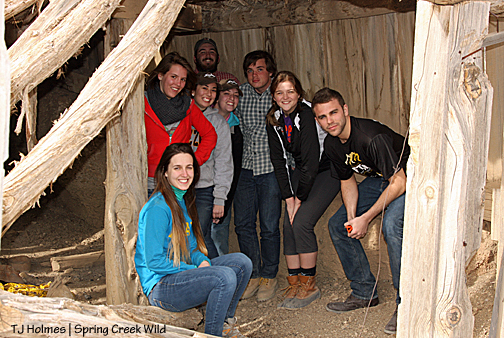
Rain water for mustangs

1 07 2016

It takes a village … to manage a mustang herd. And for Spring Creek Basin’s mustangs, our village includes Mike Jensen, Garth Nelson and Justin Hunt with BLM’s Tres Rios Field Office.

We are so grateful to have an excellent partnership with BLM and Disappointment Wild Bunch Partners (which includes the Colorado chapter of the National Mustang Association, Four Corners Back Country Horsemen and Mesa Verde Back Country Horsemen), as well as unaffiliated advocates who simply love the mustangs. We do a lot of small projects for the horses – water enhancement, fence repair and rebuilding, trash pickup, etc. – and now and then, we do something big.

Last weekend, we did something big that, as NMA/CO president David Temple noted, was about 20 years in the making.

Spring Creek Basin has a water catchment. Actually, we have two – and the second one is the subject of this post. But let me explain the first catchment first: Twenty or so years ago, NMA/CO and then-Spring Creek Basin herd manager Wayne Werkmeister partnered to install a couple of water-storage tanks that were provided by an oil-and-gas company. At the catchment in the main area of Spring Creek Basin, volunteers and BLM also installed two heavy-plastic “aprons,” laid out on a slope to catch rain and snow and funnel it to the tank, and from there to a float-controlled trough from which the horses can drink. That catchment system (aprons to tank to trough) provides the horses’ only clean water in the basin.

The second catchment consisted of a water-storage tank and a big tractor tire-as-trough (bentonite was mixed with the soil at the bottom to keep water in the tire). Water had to come from a truck delivery – or not at all. And it hadn’t come for all the years I’ve been involved.

Our existing catchment has been hugely beneficial to the horses; now our second catchment has its own apron to deliver water to the tank and from there to a new trough. NMA/CO purchased the supplies, including the apron and pipe, and BLM purchased the new trough. Labor during the weekend project was provided by BLM range staff, Wild Bunch volunteers and unaffiliated advocates.

Read on for pix from the first day of our big weekend of work, and please join me in sending huge thanks to our BLM range staff and our volunteers – all of whom are working together for the benefit of our beloved mustangs of Spring Creek Basin!
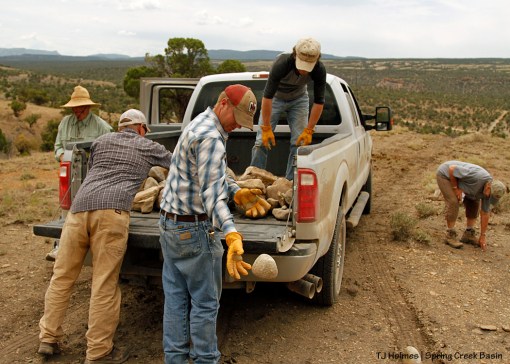
062416unloadingrocks1

When you grow up in Texas, you grow up with these words: “Don’t put your hands where you can’t see them.” That translates to “watch out for snakes in rocks.” Mike found a snake while we were collecting these rocks to eventually place on top of the apron; fortunately, a red-tailed hawk already had gotten to it.

062416davidpipeunload1

Some people – David – show off a little when you point a camera in their direction. 🙂 All that pipe would eventually go in the ground to carry water from the apron downhill to the tank.
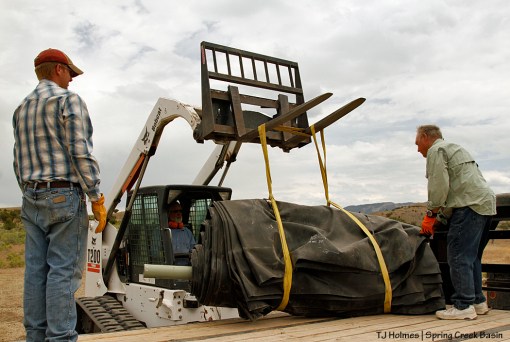
062416garthdavidfrank1

The rolled-up apron, custom made in Mancos, Colo., weighs 1,000 pounds.

062416safetytalk1

We can’t start work without the obligatory safety talk. David Temple, left, talks to Garth Nelson, Pat Amthor, Justin Hunt, Mike Jensen and Frank Amthor.

062416davidmike1

Who says safety talks can’t be fun? (Note Temple Butte in the background.)

062416daviddirtwork1

It wasn’t all sitting around watching David move dirt with his awesome little Bobcat. On day 2, we did a lot of shovel work and pipe-fitting and more shovel work, and remember that 1,000-pound apron? We spread it out and (wo)manhandled it into position.
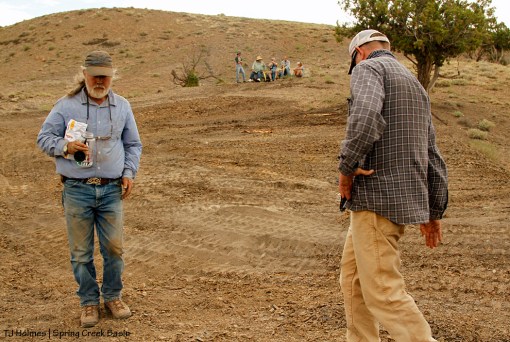
062416davidmikedirtsite1

David takes a drink-n-snack break from dirt work to discuss the site layout with Mike.

062416BLMvolunteers1

Well, hello, awesome BLM’ers and volunteers! From left, Justin Hunt (BLM range tech), Frank and Pat Amthor (4CBCH), Garth Nelson (BLM range specialist) and advocate Kat Wilder. Note that they’re sitting on the rolled-up apron – the foundation of the whole fabulous project.

Huge, huge, HUGE thanks to all of you!

Day 2 pix and report to come as soon as I can get through the photos!


Alternatively …

31 03 2016

Once upon a time in a place far, far away from civilization – better known as Spring Creek Basin – it snowed during alternative spring break. And then we had many, many years of pretty excellent weather, during which we completed many projects for the benefit of our mustangs that call this faraway place their home on the range.

Brumley Point forms part of Spring Creek Basin's southeastern boundary.

Tuesday would have been the first day of the annual two-day work project for alternative-spring-break partiers in Spring Creek Basin. However, Ma Nature had other plans, and she sent howling winds and blowing snow to this southwestern corner of Colorado.

033016brumleytemplebsnow

Yesterday was the second day of our Spring Creek Basin project. Despite a light skiff of snow on the ground in the morning, we got a fairly decent start, and students carried several loads of materials and tools to the work site – which now is about mile from the road up the southeastern fence line.

033016safetytalk

BLM range tech Justin Hunt gives a safety talk before Mizzou students carry tools and supplies to the work site.

033016supplypickup

University of Missouri students pick up materials to carry to the work site from BLM range specialist Garth Nelson.

033016libbynina

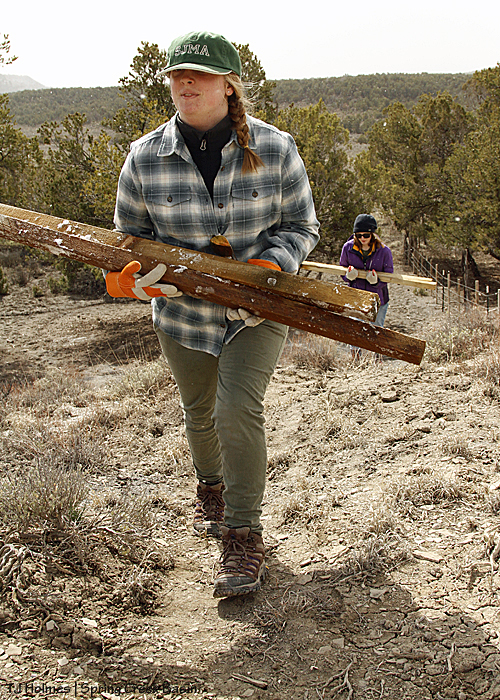
Libby and Nina carry staves up the big hill.

033016ninakathelead

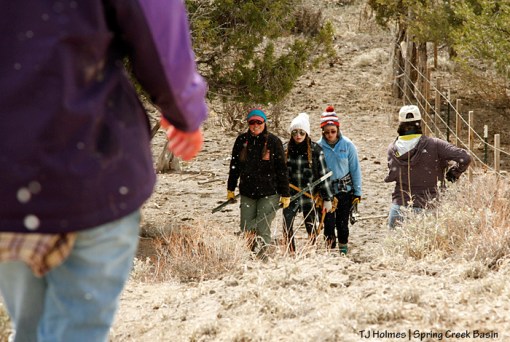
Nina (left) walks back to the truck for more supplies while SJMA’s Kathe Hayes leads Jenna and Bailey to the work site  with a second load of tools. SJMA’s MK Gunn is at far right.

And then it snowed again.

At first, they were lovely little flakes floating on the breeze.

Then those flakes got bigger and heavier, and they started sticking to the ground, and the dirt started getting damp and started sticking to the bottoms of our hiking boots.

033016chalenjoshsean

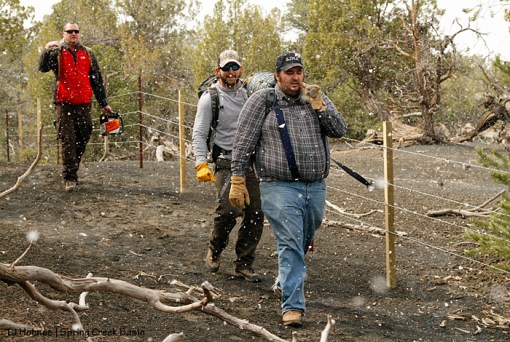
Mizzou’s Chalen helps Southwest Conservation Corps-BLM GIS intern Josh Ryan carry wire to the work site along Spring Creek Basin’s southeastern boundary during alternative spring break. BLM’s Sean Waggoner follows with the chainsaw and T-posts.

033016lukejessicastaves1

University of Missouri students Luke and Jessica carry staves about a mile to the work site while snowflakes start to fall.

About noon, we made the decision to call it a day. By the time we got back to the road, the snow had stopped … but the next wave was on its way.

Between the waves of snow, students carried armloads of T-posts and staves, buckets of tools and handfuls of tools, stretched a string to straighten the next section of fence, built an H-brace, pounded T-posts and cut wood away from the path of the new fence line (actually done by our BLM range tech). A couple of them even got as far as dropping posts and staves along the line. But we didn’t have time to take down old wire and string and stretch new wire.

033016garthchalenbrace1

Garth pounds a spike into a cross brace held by Chalen in the H-brace built before the snow really came down.

033016garthchalenlukebrace1

Garth helps Chalen and Luke tighten the wire holding an H-brace together.

033016justinsaw1

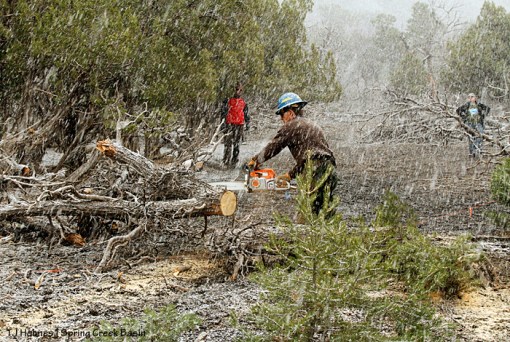
Justin cuts a tree away from the fence. Sean and Mizzou’s Megan serve as safety spotters. We learned that while we can’t cut even dead trees to use as posts in McKenna Peak Wilderness Study Area, we can use chainsaws to clear such trees from a fence line.

033016ninameganseanwire

Sean holds wire while Nina and Megan attach strands to a T-post when the snowfall got heavy.

We’ll continue this project on other (sunny) days. 🙂

We sincerely thank this year’s Mizzou crew for being hearty and willing to brave the elements to tackle this ongoing project! It was great to meet you all … and there’s always next year! We also thank SJMA’s Kathe Hayes for her ever-cheerful organizational skills and taking care of the students, as well as members of the Colorado chapter of the National Mustang Association and Disappointment Wild Bunch Partners (who represent NMA/CO, Four Corners Back Country Horsemen and Mesa Verde Back Country Horsemen) for helping with funding.

033016asbgroup1

University of Missouri students gather with BLM and SJMA employees in front of Temple Butte, just outside Spring Creek Basin in McKenna Peak Wilderness Study Area, during alternative spring break. From left to right: Justin Hunt, Bailey, MK Gunn, Josh Ryan, Jenna, Nina, Jessica, Megan, Luke, Libby, Kathe Hayes, Garth Nelson, Chalen and Sean Waggoner.


Scoping period’s deadline extended to Feb. 28

9 01 2015

Kudos to all who already have sent letters and emails in response to BLM’s request for comments about future bait trapping in Spring Creek Basin! We are so appreciative.

For you procrastinators out there (you’re in good company with yours truly), BLM has extended the deadline to comment. It’s now Feb. 28.

To repeat some information, the scoping letter and National Mustang Association/Colorado chapter- and Disappointment Wild Bunch Partners-submitted bait-trapping proposal are linked at NMA/CO’s website.

When you comment, please consider including your address to be added to BLM’s mailing list for future contact about issues related to our Spring Creek Basin mustangs – including the forthcoming EA. The scoping notice is the step that will lead to an EA that should include the potential to use bait trapping in Spring Creek Basin – in the future, when needed.

It is important to know that NO ROUNDUP is scheduled in Spring Creek Basin this year, and with the success of our PZP program, we shouldn’t need one for at least a year or two.

This is a very positive step forward in the evolution of good management of Spring Creek Basin’s mustangs. We already are using native PZP to slow the population growth of the herd. Bait trapping will provide a means of safe “gathering” and removal of horses when needed to keep the herd’s size in balance with the resources of Spring Creek Basin. In our fragile, high-desert environment, we must protect the range for the good of all generations of our mustangs.

Please pass the word, and send those comments! Thank you!
Maia, Alegre and Houdini


Tell BLM …

5 01 2015

… you want to see bait trapping in the future in Spring Creek Basin.

Today, BLM sent a scoping letter to gauge the public’s interest in doing bait trapping there in the future as opposed to helicopter-driven roundups. I think you’ll all agree that we want bait trapping instead of a helicopter. It was very successful in Little Book Cliffs in 2013, and we’re confident it can be successful in Spring Creek Basin – when needed.

The scoping letter (and bait-trapping proposal submitted by our groups to BLM last year) can be found through links on NMA/CO’s website.

It is important to note that there will NOT be a roundup in Spring Creek Basin this year. Our population is below the appropriate management level of 35 to 65 adult horses, and the use of native PZP has slowed population growth. Apparently, all of Colorado’s wild horse herds were put on the “2015 gather list,” but none were approved because of lack of funding and lack of corral space (this information is as of November 2014).

Note that the name of our herd management area is Spring Creek Basin Herd Management Area. Also note that Spring Creek Basin is in Disappointment Valley (there’s no such thing as Disappointment Basin – at least not locally).

Please submit respectful and positive comments by Jan. 30. Members of the Colorado chapter of the National Mustang Association, Four Corners Back Country Horsemen and Mesa Verde Back Country Horsemen (a coalition known as Disappointment Wild Bunch Partners) have established a long-term working partnership with Tres Rios Field Office managers with regard to managing our Spring Creek Basin mustangs well. Our network of mustang advocates helps reinforce this partnership.

Thank you for your support of our mustangs in Spring Creek Basin!

Comanche, Piedra and Aurora


4CBCH annual wild horse count

30 05 2014

On May 17, members of the Four Corners Back Country Horsemen came to Spring Creek Basin for their annual wild horse count. This was their 14th year!

This is an important, ongoing partnership between 4CBCH and BLM. In addition to counting mustangs in Spring Creek Basin and getting an idea of the makeup of bands, members traditionally complete a work project during the weekend. Previous projects have included fence maintenance, packing out old wire and weed surveys. The last couple of years, the Forest Service has sent a weed-spraying crew to the basin to spray some of the locations we’ve surveyed.

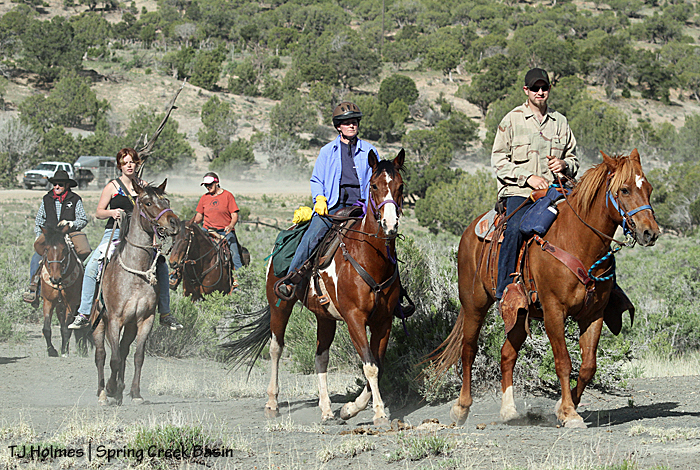
In years past, horseless members of the group would drive to the base of Round Top and hike to the summit, then use binoculars and spotting scopes to search for mustangs. Radio communication between horseback groups and the hikers would help with locations and identifications. Now, we have horseback folks and folks who take “horseless carriages” around the loop road in the basin to look for horses, completing projects on the way.

Again this year, we surveyed ponds for the presence of knapweed and musk thistle. Fortunately, we found little of either type of weed at all the locations we checked.

Between the riders and the drivers, we saw almost all the horses! And a few of the bands put on a show by being in close proximity to each other, which was great for everyone to see so many of our mustangs!

Pat (president of 4CBCH) and Frank Amthor were the weekend’s leaders, as usual, and as always, they hosted a wonderful event full of horses, stories of past mustang sightings and terrific food. A highlight this year was meeting a Spring Creek Basin mustang, Tipi (spelling?), adopted in 2005. He reminded me completely of Bruiser – minus the spots!

Lisa Cribbs, Travis, Cathy Roberts, Cindy, Adrian and Mikayla

Lisa and her son, Travis, lead the way into the basin from the campsite off the Disappointment Road. Travis has attended most counts since he was 6 years old!

Travis, Cathy Roberts, Mikayla, Adrian, Kat Wilder

Eva Duvillard and Tipi

Eva and her Spring Creek Basin mustang, Tipi. (Yes, the gnats are out!)

Adrian and mustang Reno

Eva’s husband, Adrian, also rode a mustang, Reno. They recently adopted a third mustang. These are true mustang supporters!

Cathy Roberts and Shenoah (sp?)

Cathy is 4CBCH’s vice president; this was her first count. Her lovely mom, Millie, came from California and joined us to see mustangs from the vehicles.

Cindy

This also was the first count for Cindy and her daughter.

Mikayla and Saphira

Daughter Mikayla (sp?) and her little mare Sapphira made a great pair.

Lisa Cribbs on Bullseye

Lisa is a past 4CBCH president, and she has attended numerous counts – and has lots of great stories about the mustangs they’ve encountered!

Travis, Lisa Cribbs, Cathy Roberts and Mikayla

As noted, Travis has been coming to Spring Creek Basin since he  was 6. He’s now 20!

Bob Volger on Buckley

Bob is another past 4CBCH president who has ridden in the basin several times. He also has packed old wire out using his horses.

Kat Wilder on Kua

Kat is one of our NMA/CO board members, and this was her first count. It probably won’t be her last!

Thank you to all involved for your camaraderie and super enthusiasm for our Spring Creek Basin mustangs! We’ll see you next spring!


Under a sparkling sky

14 12 2013

Bounce under a little iridescence in the sky.

Do you see it? High in the sky above Bounce? Slightly left of center?

This fall, friend Pat Amthor, one of our Disappointment Wild Bunch Partners representatives (from Four Corners Back Country Horsemen), visited the basin, and we saw two of these, one on either side of the setting sun. This one is faint, but it’s there. Bounce was overlooking three bands, who are below him, grazing through the snow. Duke, Kreacher and Hayden also were nearby.

Does anyone know what that iridescence in the sky is called? Pat and I were calling them sun dogs, but I’m not sure that’s right.


How does your donation to NMA/CO help the Spring Creek Basin mustangs?

28 05 2013

This question was asked recently, and answering it gives me another chance to let local folks know about the Pati Temple Memorial Benefit Bash we will hold next week, Monday, June 3, at the Kennebec Cafe in Hesperus, Colo. Follow that link for the details and to purchase tickets if you haven’t and plan to attend.

NMAPosterFinal3(100)

Now, on to an answer(s) to the question!

First, see this page, compiled last year by Pati, for a list of the National Mustang Association, Colorado chapter’s past accomplishments: http://www.nationalmustangassociationcolorado.org/nmaco-accomplishments.html

As it says, NMA/CO has spent nearly $100,000 to date on projects that directly benefit the mustangs of Spring Creek Basin! We rarely do fundraisers, relying mostly on memberships and donations. Administrative expenses are low, mostly what we put toward mailing newsletters. We had T-shirts and hats printed for the adoption in 2011, and we’ll soon have a link to purchase them through the website.

Fence repair and maintenance is ongoing through volunteer labor. As a result of their partnership with us as part of Disappointment Wild Bunch Partners, BLM received $25,000 last year through the Director’s Challenge grant, which purchased some materials to be used in a project on the basin’s southeastern boundary line (read about alternative spring break and University of Missouri students’ work here – https://springcreekwild.wordpress.com/2013/03/26/alternative-spring-break-day-1/ – and here – https://springcreekwild.wordpress.com/2013/03/27/12368/). I fix fences as needed while I’m in the basin doing documentation. Sometimes we use materials provided by BLM, other times by ourselves.

We also are continually encouraging BLM to look at water-enhancement projects. More than a decade ago, NMA/CO paid for a water catchment to be built in Spring Creek Basin, and it supplies the mustangs’ only clean source of water (all others being extremely alkaline, at least). We have a signed agreement from about 12 or 13 years ago with BLM to construct at least one more catchment, but it has never been built. I think the catchment cost about $10,000. Several years ago, we also started talking to BLM about water guzzlers (such as those installed on Pryor Mountain Wild Horse Range) to add to the horses’ quality of water. Those are about $8,000-plus. NMA/CO also has purchased parts for the catchment’s troughs, which work on floats.

NMA/CO contributes funds to combat noxious/invasive weeds in Spring Creek Basin (knapweed, tamarisk, musk thistle, etc.).

A decade or more ago, NMA/CO was able to purchase the cattle AUMs from one of the two ranchers who held permits in Spring Creek Basin. With the help of the National Mustang Association, we were able to retire those AUMs permanently. In the process, BLM conducted a grazing EA (not sure the exact reference) and then drastically reduced the remaining AUMs and changed the timing to dormant-season grazing only – Dec. 1 through Feb. 28. For the last several years, NMA/CO has been trying to buy or trade for the permit in Spring Creek Basin to also retire those AUMs, with the goal of no cattle grazing in the basin. As BLM itself says, managing wild horses is easier when the mustangs are the priority. The permittee is willing, so we are trying to work with BLM to accomplish this goal.

NMA/CO also is asking BLM to consider the use of bait trapping in the basin, instead of helicopter-driven roundups to complement the use of fertility control. We submitted a proposal for a program using native PZP that was implemented at the 2011 roundup. To bait trap requires the use of a facility in which to hold horses as they are trapped. This facility requires a chute and pens. We recently purchase a chute ($18,000) with donated funds from the National Mustang Association (of which we are a chapter). Our primary goal in fundraising currently is to purchase the required infrastructure for this facility so BLM won’t have only the option of using a helicopter and won’t need to transport one or two horses at a time – as they’re trapped – to Canon City, which is full, as most/all of BLM’s facilities seem to be. NOTE: NO ROUNDUP CURRENTLY IS PLANNED FOR SPRING CREEK BASIN. We are planning this now to have the facility in place so a future EA can include it in the planning process. As BLM said in 2011, bait trapping was not considered because it wasn’t in the EA. It wasn’t in the EA because no facility was available. However, note that we started asking specifically for bait trapping in 2008.

Enhancing water sources, retiring the remaining cattle AUMs, establishing a fertility control program and making bait trapping the priority for roundups all were Pati Temple’s goals for the Spring Creek Basin herd. In addition to the accomplishments made for the mustangs during Pati’s lifetime, we plan to accomplish these goals in her honor.


Fence work, round 2

25 04 2013

Time to choose: Cheesecake or fence work.

Dessert in the office or working off the cheesecake you could have had.

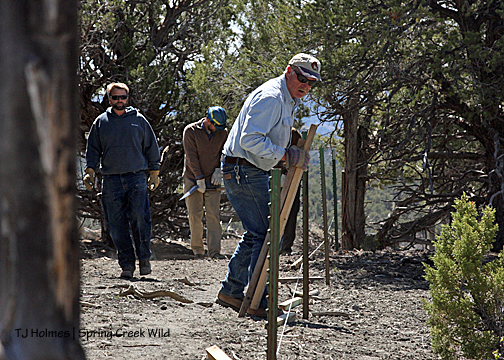
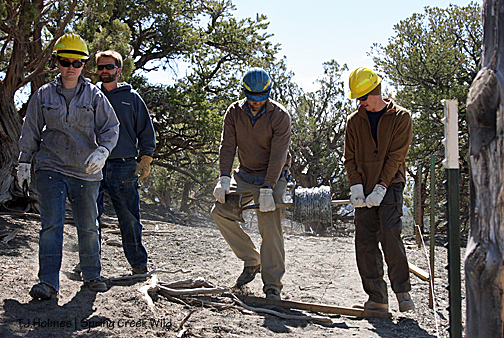
Lucky for us – the mustangs – a six-man, one-woman Forest Service crew and one BLM’er voluntarily gave up cheesecake to build fence with the Forest Service’s Tom Kelly and San Juan Mountains Association’s Kathe Hayes on Spring Creek Basin’s southeastern boundary fence.

Sound familiar? It should. This section is north of the section of southeastern boundary fence the University of Missouri students rebuilt when they were here on alternative spring break at the end of March. We had hoped to knock it all out while they were here, but while we rebuilt a good section of fence, and built the H-braces for this last section, we didn’t have time then to remove the old wire, restring the new wire and insert staves in the last section Kathe had scouted.

So on a beautiful day in Disappointment Valley, that last bit was what this crew finished.

Let me introduce ya’ll to the cast of characters:

042413group1

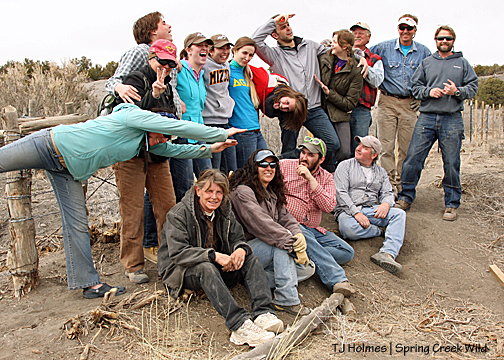
Front row from left: Sara, Dave, Kathe and Derrick. Back row from left: Tom, Kevin, Kevin, Paul and Sean. Derrick was the group’s lone BLM’er.

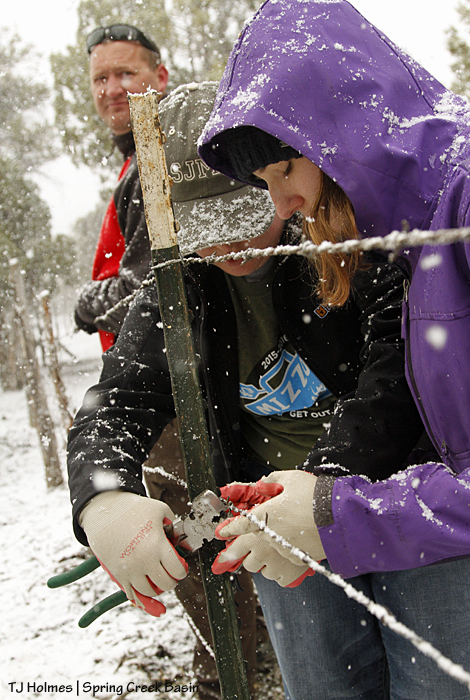
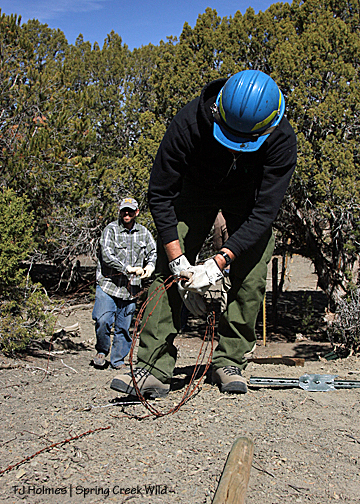
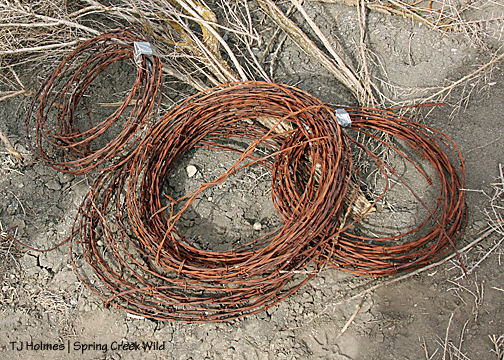
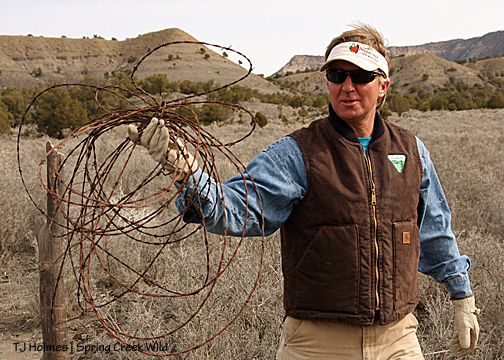
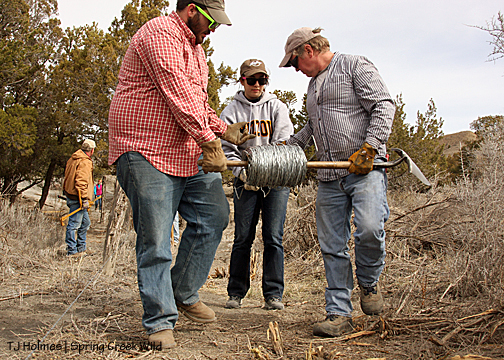
To get started (and thank you, Mizzou students, for building the braces a month ago!), the crew unstapled and unwired the old barbed wire strands, then rolled that wire. Perfect wreaths were insisted upon. No one wanted to be “that guy” with sloppy wreaths. Happily, we had a crew of perfect-wire-wreath-rolling-peeps!

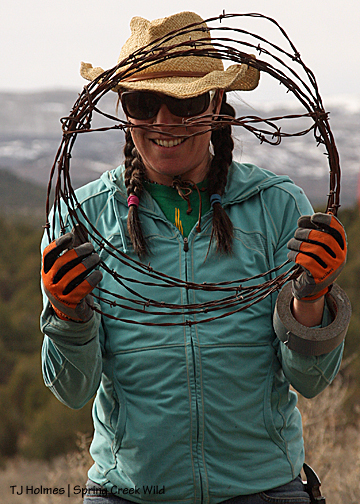
Kathe Hayes rolls a perfect barbed wire wreath.

Kathe perfects her wreath roll.

Paul and Derrick roll old barbed wire to pack out.

Paul demonstrates his on-the-ground roll technique while Derrick finishes a rolled wreath.

That was the un-building. Then the crew moved to re-building:

042413tomkellyfence

Tom, our fence-building guru, checked the straightness of the fence …

042413fencepdfoto

Derrick pounded re-aligned T-posts while Kevin, right, and Paul, left, looked on supervised and Kathe documented …

042413unrollingwire

Sara and Dave walked with Sean and Kevin to unroll new wire for the fence …

042413kathepaulwire

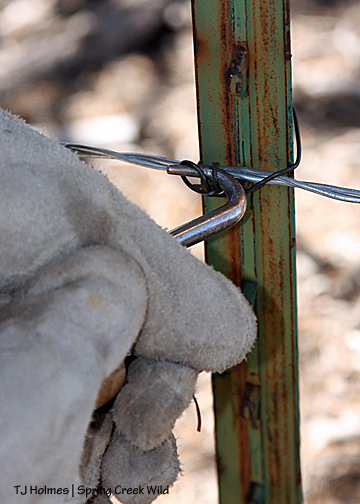
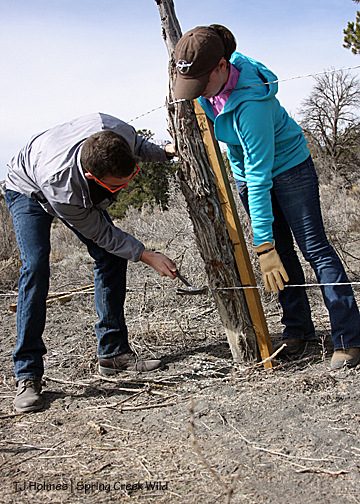
Kathe and Paul used the miracle swizzler to attach wire strands to the T-posts …

Miracle tool.

Ahhh … two twists’ll tighten!

And …

042413wiringstaves

Kevin, Kevin, Sean and Sara wired wooden staves between the T- and wooden posts.

Voila! What a crew!

Tom said the second-best part of the work day is lunch. One of the Kevins (Sara/h and Kevin: names of the month), naturally and without missing a beat, noted that the best part of the work day is – of course! – quitting time. I was too busy eating lunch to take pix of everyone eating lunch (the most interesting included cold pizza and a tuna salad avalanche with Doritos primer), so here are two pix of quitting time:

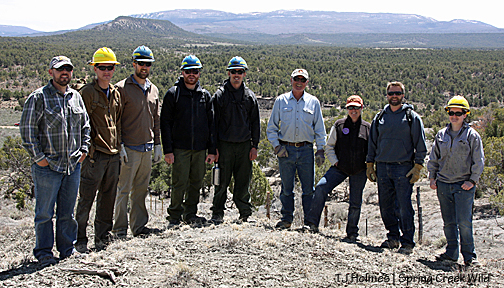
Derrick (BLM), Kevin, Sean, Paul, Kevin, Tom Kelly, Kathe Hayes, Dave and Sara.

Photo suggestion by Tom to show the view looking southish toward the Glade. If you look closely, you can see the fire lookout tower – Benchmark Lookout. It’s on the farthest hill basically between Sean’s and Paul’s helmets (and yes, managers, we received the safety talk(s)). From left: Derrick, Kevin, Sean, Paul, Kevin, Tom, Kathe, Dave and Sara.

Dave, Derrick (BLM), Tom Kelly, Kathe Hayes, Kevin, Kevin, Paul, Sara and Sean.

Then I made ’em all smile again – say mustang! – so I could take their pic looking southeastish and showing off the new fence. (Disclaimer: This actually is part of the section the students rebuilt, but there were more trees in the section these guys rebuilt, and this had the more open view!) The previous pic was taken just up the hill to the left looking out to the right.

Thanks for your marvelous work, guys and gals! It was a fun day, and hopefully it beat the cheesecake (though I hope your co-workers saved you some … or Kathe makes another one just for you all!).


Boundary fence – aka the fruit of the students’ labor!

28 03 2013

When the students finished work on the fence Tuesday, I was so excited, I forgot to take pix of said finished fence! So yesterday, on a near-perfect spring day in Disappointment Valley, I straddled my mountain bike for the first day this year and pedaled up to the boundary. I haven’t figured out a decent way to carry my camera while biking (it’s not little), so I apologize in advance for the crappy quality of these cell-phone images. But I believe they show the excellent quality of our new, student-built fence!

032713fence1

I say, isn’t that a rockin’ mountain bike! Oh, wait, I mean, isn’t that a *tight* H-brace! This is at the road (the cattle guard  is immediately to the left), and the brace was loose. Despite the poor image quality, I think you can see the shiny new wire. The sign says something about no motorized vehicle access (because it’s McKenna Peak Wilderness Study Area).

032713fence2

This was shot from in front of my bike looking up the fence line. Does it rock or what?!

Compare the above shot – brand-new fence – with the one below, the original fence, photo taken the previous weekend when the crew cleared the greasewood and other brush from the fence line so the students could build:

031613lynkathe

This is from the other (west) side of the fence, looking back toward the road, but it’s the same section of fence.

WHAT A DIFFERENCE!

032713fence3

The shadows don’t allow for much detail in this shot, but this is the first H-brace the students built, using the tree as the anchor. Notice the extra “padding” around the tree.

032713fence4

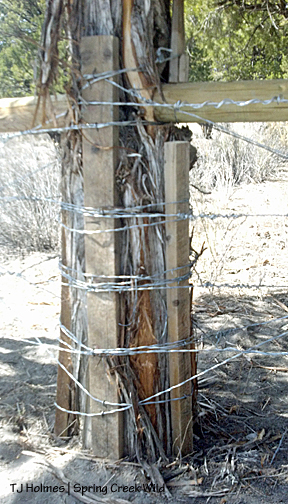
Here’s a closer view. The staves protect the tree from wire biting into the bark – thank you (again), Tom Kelly, Forest Service fence-builder extraordinaire!

032713fence6

This is the brace just to the left of the tree and shows – I hope – the somewhat intricate weaving of the wrap, which holds it all together.

032713fence5

And here’s the fence continuing on up the hill.

Kudos again to the students for building this wildlife-friendly, mustang-protecting fence!


Alternative spring break – day 2

27 03 2013

We must not have worn out the Mizzou students Monday because they came back Tuesday! (All except one of the Sarahs – who came up sick – and Tori, who stayed with her. Sarah, feel better soon!)

With the H-braces set in place, the day’s plan was to take out the old wire and string new wire. Following wildlife-friendly strand spacing, the top wire is smooth twisted wire and 42 inches above the ground. The bottom wire is smooth twisted and 18 inches above the ground. The middle two strands are barbed wire. Deer and elk can jump over, fawns and calves can crawl under, and cattle hopefully will respect the barbed.

So we had to cut wire pieces off the existing fence strands and pull staples and roll barbed wire. Gloves and shades were must-have accessories. Once again, fence-building guru Tom Kelly showed the most jaded of us, who thought we knew a thing or three about fence building, a new technique to tighten the wire fence strands to T-posts (metal) and staves (between T-posts or wood posts).

032613tifTKtool

Tif watches Tom demonstrate the new-to-us tool to attach a wire fence strand to a metal T-post. She’s holding a stave on which she has marked the heights of the wire fence strands.

032613MKtool

MK took over this “wonder tool,” and I’m not sure she ever let it go! Instead of a traditional “clip,” this is a short piece of wire with loops on both ends. The hook goes through both ends, you swivel it, and voila! Your wire strand is tight to the post!

032613emeraldwire

But I’m getting excited and ahead of myself. First, we had to get rid of the old wire. Here, Emerald demonstrates careful barbed-wire-rolling technique.

032613mkwire

MK and a “barbed wire wreath”!

032613oldwire

More perfect rolls.

032613TRwire

BLM guy Tom with his, uh, not-so-perfect “roll.” Lesson: Don’t let BLM roll up your fences! Fortunately, he redeemed his agency’s good name later with his wire-strand tightening skills.

032613marissastaves

Marissa carries wooden staves to drop off along the fence line. These help stabilize the wire and keep the spacing even. Note the colorful eyewear, courtesy of SJMA. This was to protect against the potential boinging – Kathe’s word! – of broken wire. (Note: As far as I’m aware, there was no boinging of wire or injury to students!) Right in front of Emerald’s shins, note the strand of wire. This is how it got there:

032613chsakeunroll

Students Chalen and Marissa help volunteer Keith unroll smooth twisted wire. Note the wire strand in the bottom left corner of the pic. It started at the road, tied off at the H-brace there, and was unrolled up to the first H-brace, which is just beyond Tom Kelly (back left), where the trees start. Then another strand is tied off there and the roll walked back to the road and that brace. The process is repeated with the barbed wire in this section, and then with the smooth and barbed wire strands from the H-brace behind these guys up the hill to the next brace.

032613keithTRchwire

Keith carries rolls of old wire to the trucks while Tom and Chalen carry good wire to the next H-brace to string it from there to the third brace. Note the very valuable set of fencing pliers sticking out of Keith’s pocket. Students were well-acquainted with these tools after two days in Spring Creek Basin!

032613sarahaaronfence

Here, the bottom and top strands are in place and have been stretched (tightened). In this pic, Sarah and Aaron are measuring and stapling the strands of fence wire for the rebuilt fence. Note the marks on the stave Sarah is holding. The marks are at 18 inches, 23 inches, 30 inches and 42 inches. Marking staves made it easy for students to work in pairs: measure and staple.

032613emelcormkfence

Emerald and Ellen, foreground, and Corrie and MK measure and staple fence strands to posts. Ellen and Emerald are at the next H-brace, up the hill.

032613mizzougrpasb

Mizzou students are the epitome of seriousness after day 2 of fence work on Spring Creek Basin’s southeastern boundary line. In the background, our excellent new fence! I can’t believe I didn’t take a pic of the finished product; to come. (It looks excellent!)

Front row from left: volunteers Corrie and Tif, Mizzou site leader Chalen and volunteer Keith. Standing: MK (diving) and Kathe with SJMA, students Marshal, Sarah, Marissa, Kara, Ellen, Aaron and Emerald, Tom Kelly with the Forest Service, BLM’s Tom Rice and Dave with the Forest Service.

An important side note, Corrie, Tif and Keith all adopted Spring Creek Basin mustangs in 2011/2012.

After their work on the fence, we took the students into the basin to scout mustangs. We saw Chrome’s band, Duke and Kreacher, Hollywood’s and Comanche’s bands with Bounce, and bachelor boys Aspen, Hayden, Tenaz and Apollo. Those boys were very accommodating for students’ pix!

On our way out, we stopped to investigate the dugout, likely used during construction (way back when?!) of the defunct Custer dam.

Chalen takes a break in the old dugout in Spring Creek Basin.

Chalen taking a well-deserved break. Word Monday was that he would be awake at 4:30 a.m. (!) Tuesday to cook breakfast.

032613sdtsdugout

Students gather for a group photo op in the dugout. Are those some happy faces or what?

Today – Wednesday – the students will work with Kathe and MK and my friend Sam on one of my favorite mountain bike trails in Southwest Colorado: Phil’s World, just east of Cortez. It’s a not-so-secret course anymore. Thursday, they’ll work at Sand Canyon, part of Canyons of the Ancients National Monument, west of Cortez.

Once again, huge thanks to these fantastic university students! We so appreciate your willing and enthusiastic work to help protect our Spring Creek Basin mustangs. We hope you had fun to balance the work and that you’ll enjoy your next work projects as much as we enjoyed having you work with us! Come back soon to our corner of Colorado!