Mountain riches

18 12 2013

Storm, Gaia, Cassidy Rain and Mysterium

Storm and his band beneath the La Sal Mountains. Those patches of brown may soon disappear under white again if the forecast holds true and we get snow toward the end of this week. Gaia’s coat just glows in the late light, doesn’t it?

These are the riches we should strive for in support of America’s wildness. Celebrate the 42nd anniversary of the Wild Free-Roaming Wild Horses and Burros Act; celebrate the “tonic of wildness” that we have and must not lose.


RIP Mr. Mandela

6 12 2013

“It always seems impossible until it’s done.” ~ Nelson Mandela

Kilian

And so we continue to strive for things that are important, no matter the adversity we face. The simple things we each value are things that, at some level, are important to all living beings. Thank you, Nelson Mandela, for proving that even the impossible can be achieved.


Water for mustangs

30 06 2013

Not elephants. Although, as this drought continues, it’s beginning to look a lot like the sere plains of Africa out here.

I call this photo “La Sals, Imagination”:

062813greyswatch

Whaddya mean you can’t see the mountains … through the smoke? Use your imagination. 🙂 Although Grey/Traveler’s band seems to also be looking for the mountains, they were watching Chrome’s band walking toward them on their way to the water catchment.

Smoke from this fire – way, way, way east of here – apparently has drifted into New Mexico then blown back north and west into Colorado. But it’s not the only fire burning in the region.

Earlier, Grey/Traveler’s band had been drinking at the water catchment’s trough:

062813greystrough

Maia, clearly at her leisure, worried me; I thought the worst, that the storage tank had drained and the trough was empty, and she was waiting for someone to come fill it, darnit!

Not to fear.

Water trough at the catchment in Spring Creek Basin, looking toward the road.

The trough was full of water. Whew. (The big green tank is the storage tank that holds water from either rain or snow or direct-fill.)

Because of the drought, BLM has been checking to ensure that the horses have enough water sources, and we – National Mustang Association/Colorado – recently got the green light to deliver a load of water – 4,000 gallons – to the catchment tank. Donors and silent-auction-item buyers at the Pati Temple Memorial Benefit Bash, this is the first use of the money you helped us raise! Interestingly, the area of the catchment is used primarily by Chrome’s band and rarely by other bands. But some other bands have started to find the water – and the good forage in this area. Water is a good way to disperse the horses’ grazing and get them to use under-used areas.

062813chromesdrink1

Chrome’s band at the catchment trough, drinking clean water. This is an important water source because it’s the only clean source of water in the basin. The others are high in alkalinity and salt because of the basin’s soils. The dusky, hazy color cast is because of the smoke.

The temperature hit 110 degrees Friday. On Thursday, the high was 108. Smoke, wind, heat, zero moisture = ugh.

Cecil Foster, owner of Foster’s Water, to the rescue.

062813watertank2

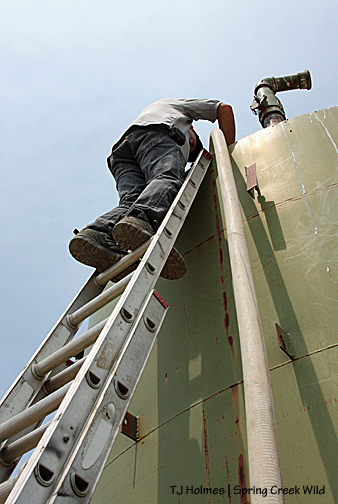
The storage tank is about 15 feet tall, so Cecil brings his ladder to access the hatch at the top. At right is the hose from his water truck.

062813watertank3

Seen here are his water truck, the hose to the tank and the water trough in the background at right.

062813watertank1

Thanks, Cecil! He also donated a load of water for the benefit’s silent auction. Cecil is a super nice man, and a friend of the mustangs of Spring Creek Basin.

Thank you, NMA/CO, for the delivery of water to the mustangs!


National Academy of Sciences report on BLM’s management of wild horses and burros

7 06 2013

It’s out. The National Academy of Sciences has completed its report about wild horses and burros, and BLM’s management of them.

Some links to reports about the study:

“New report offers science-based strategies for management of Western free-ranging horses and burros; ‘business-as-usual’ practices will be increasingly expensive and unproductive for BLM”: http://www8.nationalacademies.org/onpinews/newsitem.aspx?RecordID=13511

Th National Academy of Sciences link (above) includes a link to the brief summary of the report: http://dels.nas.edu/resources/static-assets/materials-based-on-reports/reports-in-brief/wild-horses-report-brief-final.pdf

*** Updated to add this link, by the always-thought-provoking Andrew Cohen of The Atlantic: http://www.theatlantic.com/national/archive/2013/06/after-wild-horse-report-jewell-faces-first-moment-of-truth-at-interior/276545/

http://bigstory.ap.org/article/independent-panel-readies-review-blm-mustangs

http://www.returntofreedom.org/national-coalition-calls-on-interior-secretary-to-halt-wild-horse-roundups-in-wake-of-scathing-independent-report/

http://m.sltrib.com/sltrib/mobile3/56416617-219/horse-report-wild-horses.html.csp

http://www.usatoday.com/story/news/nation/2013/06/05/horse-burro-blm-nrc/2388947/

http://hsus.typepad.com/wayne/2013/06/nrc-gets-it-right-in-panning-blm-wild-horse-program.html

Apollo, Killian and Tenaz

Practically speaking, what will it mean? Time will tell.


Pati Temple Memorial Benefit Bash

5 06 2013

Monday’s event to honor the National Mustang Association, Colorado chapter’s Pati Temple was a great success! A huge, heart-felt thank you to all the friends and family of Pati – and David – Temple who donated items to the silent auction and/or attended the bash. Your attendance and contributions go a long way toward helping us continue our advocacy on behalf of our Spring Creek Basin mustangs!

060313claudesarahr

Durango photographer Claude Steelman donated a print of his outstanding photo of our handsome Traveler (left) and two of his photography books, including Wildshots, pictured. Bayfield artist Sarah Rose donated a print of her beautiful painting of Spring Creek Basin’s Aspen, right.

060313karenstraveler

NMA/CO board member Karen Keene Day donated this stunning painting of Traveler. It’s based on a photo she took of him and his band in 2004.

060313susant

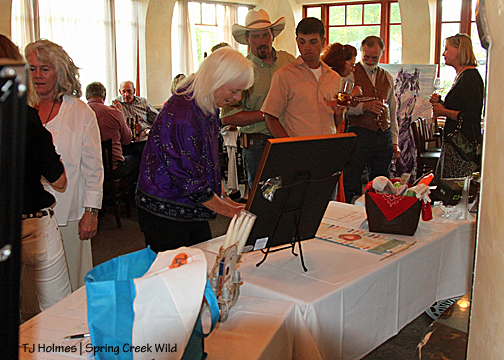
Susan Thomas and NMA/CO board member Nancy Schaufele (in purple) check out silent auction items.

060313nancys

Nancy marks the final bids at the end of the silent auction. Kennebec Cafe, one of Pati’s favorite restaurants, provided a really beautiful setting for our event; many thanks for the great food and wonderful setup!

060313katheh

Kathe Hayes with San Juan Mountains Association shows off Alice Billings’ donated painting of Temple, wild filly in Spring Creek Basin named in honor of Pati and David. Kathe was the high bidder on the painting!

In addition to Nancy and Karen, many thanks to NMA/CO board members Tif Rodriguez and Lynda Larsen – and, always, David Temple – as well as our event planner, Tina Roth, for making this such a memorable and successful event in Pati’s memory.

Pati was an exceptional woman who fought for the well-being of animals and people whenever she saw a wrong. We think she would have loved this party. The worst part of it was that she wasn’t there to enjoy it with us.


How does your donation to NMA/CO help the Spring Creek Basin mustangs?

28 05 2013

This question was asked recently, and answering it gives me another chance to let local folks know about the Pati Temple Memorial Benefit Bash we will hold next week, Monday, June 3, at the Kennebec Cafe in Hesperus, Colo. Follow that link for the details and to purchase tickets if you haven’t and plan to attend.

NMAPosterFinal3(100)

Now, on to an answer(s) to the question!

First, see this page, compiled last year by Pati, for a list of the National Mustang Association, Colorado chapter’s past accomplishments: http://www.nationalmustangassociationcolorado.org/nmaco-accomplishments.html

As it says, NMA/CO has spent nearly $100,000 to date on projects that directly benefit the mustangs of Spring Creek Basin! We rarely do fundraisers, relying mostly on memberships and donations. Administrative expenses are low, mostly what we put toward mailing newsletters. We had T-shirts and hats printed for the adoption in 2011, and we’ll soon have a link to purchase them through the website.

Fence repair and maintenance is ongoing through volunteer labor. As a result of their partnership with us as part of Disappointment Wild Bunch Partners, BLM received $25,000 last year through the Director’s Challenge grant, which purchased some materials to be used in a project on the basin’s southeastern boundary line (read about alternative spring break and University of Missouri students’ work here – https://springcreekwild.wordpress.com/2013/03/26/alternative-spring-break-day-1/ – and here – https://springcreekwild.wordpress.com/2013/03/27/12368/). I fix fences as needed while I’m in the basin doing documentation. Sometimes we use materials provided by BLM, other times by ourselves.

We also are continually encouraging BLM to look at water-enhancement projects. More than a decade ago, NMA/CO paid for a water catchment to be built in Spring Creek Basin, and it supplies the mustangs’ only clean source of water (all others being extremely alkaline, at least). We have a signed agreement from about 12 or 13 years ago with BLM to construct at least one more catchment, but it has never been built. I think the catchment cost about $10,000. Several years ago, we also started talking to BLM about water guzzlers (such as those installed on Pryor Mountain Wild Horse Range) to add to the horses’ quality of water. Those are about $8,000-plus. NMA/CO also has purchased parts for the catchment’s troughs, which work on floats.

NMA/CO contributes funds to combat noxious/invasive weeds in Spring Creek Basin (knapweed, tamarisk, musk thistle, etc.).

A decade or more ago, NMA/CO was able to purchase the cattle AUMs from one of the two ranchers who held permits in Spring Creek Basin. With the help of the National Mustang Association, we were able to retire those AUMs permanently. In the process, BLM conducted a grazing EA (not sure the exact reference) and then drastically reduced the remaining AUMs and changed the timing to dormant-season grazing only – Dec. 1 through Feb. 28. For the last several years, NMA/CO has been trying to buy or trade for the permit in Spring Creek Basin to also retire those AUMs, with the goal of no cattle grazing in the basin. As BLM itself says, managing wild horses is easier when the mustangs are the priority. The permittee is willing, so we are trying to work with BLM to accomplish this goal.

NMA/CO also is asking BLM to consider the use of bait trapping in the basin, instead of helicopter-driven roundups to complement the use of fertility control. We submitted a proposal for a program using native PZP that was implemented at the 2011 roundup. To bait trap requires the use of a facility in which to hold horses as they are trapped. This facility requires a chute and pens. We recently purchase a chute ($18,000) with donated funds from the National Mustang Association (of which we are a chapter). Our primary goal in fundraising currently is to purchase the required infrastructure for this facility so BLM won’t have only the option of using a helicopter and won’t need to transport one or two horses at a time – as they’re trapped – to Canon City, which is full, as most/all of BLM’s facilities seem to be. NOTE: NO ROUNDUP CURRENTLY IS PLANNED FOR SPRING CREEK BASIN. We are planning this now to have the facility in place so a future EA can include it in the planning process. As BLM said in 2011, bait trapping was not considered because it wasn’t in the EA. It wasn’t in the EA because no facility was available. However, note that we started asking specifically for bait trapping in 2008.

Enhancing water sources, retiring the remaining cattle AUMs, establishing a fertility control program and making bait trapping the priority for roundups all were Pati Temple’s goals for the Spring Creek Basin herd. In addition to the accomplishments made for the mustangs during Pati’s lifetime, we plan to accomplish these goals in her honor.

Facing national scrutiny …

17 05 2013

These articles/news segment are musts to read/watch.

WARNING: Some photos/clips are extremely graphic of horses badly injured during roundups.

Facing national scrutiny, BLM struggles to explain wild horse and burro program

Cruel or necessary? The true cost of wild horse roundups

In the grand scheme of things and in wide comparison, Spring Creek Basin Herd Management Area and its mustangs are in a fairly enviable position.

Our range condition is not great. Our water sources are widely spaced (ensuring grazing dispersal) but of poor (salty, at least) quality. But, because of recent roundups and a dedicated group of local advocates, our current population ensures both healthy horses and decent, if not great, forage, even in these drought conditions.

A fertility control program using native (one-year) PZP was implemented with the 2011 roundup. This is the first year we’ll start to see results.

There has been no cattle grazing in Spring Creek Basin for two seasons (permitted through BLM for dormant-season only: Dec. 1 through Feb. 28). That likely will continue for at least the next two seasons until drought and/or regulations necessitate a change (for continued grazing or continued lack thereof).

I certainly don’t have large-scale answers, but in this little corner of the wild world, our mustangs seem to be doing pretty well. I hope we can find solutions for all our mustangs.

042913gps1


La Fragua bachelors

5 05 2013

Young bachelor stallions in sage flats, La Fragua Canyon.

These bachelors were in an area called La Fragua Canyon (or very close). Family bands and at least one lone bachelor (Anthony’s “favorite” bay stallion!) also were in the area.

I was intrigued by the “white” horses with a few bands. They seemed young to be so completely “greyed out.” So I walked out into this sage flat to get a better look … and I discovered that the “white” horses actually are pintos.

White pinto with La Fragua bachelors.

Do you see the darker shading on his cheek? Pink skin on his muzzle. Black hairs in the middle of his tail.

White pinto with La Fragua bachelors.

This side, no pigment on his face.

This made me realize in a flash that the “grey” pinto stallion isn’t grey at all. I’m not sure what you’d call this pattern? The white gene clearly is dominant over the dark/black color gene? (**Update: See the comments for a website link to more color info. This color pattern likely is “sabino white” or sabino “maximum white.”)

Of all the horses we saw – 105 – only one looked like a true grey. Quite a difference from grey-dominated Spring Creek Basin.

Colorwise, the Jicarilla has many bays (all shades), sorrels (at least one handsome boy I’d call a liver chestnut) and blacks, some duns and buckskins and palominos. Lots of pintos.


Inclusive exclosure

4 05 2013

050213exclosure1

Sean Kelly, wild horse coordinator for the Carson National Forest’s Jicarilla and Jarita Mesa wild horse territories, points out plant usage to New Mexico volunteer Tyler Sharpe while Farmington BLM rangeland management specialist Jeff Tafoya talks to volunteer and advocate Barb Kiiper with the Jicarilla Mustang Heritage Alliance at one of the exclosures in Spring Creek Basin during our tour this week. There are five of these in the basin, as well as some smaller “cages.” They fence off a small section of land so range folks can determine impacts of grazing – and not.

I need about 13 more hours in the day to get to more photos from these tour swaps – which were fantastic! We met lots of people and learned some of the challenges our respective herds face. The New Mexico herds – BLM and Forest Service – apparently are way over AML. They’re seeing effects on both the horses’ condition and condition of the ranges because of it. The Jicarilla and Carracas Mesa ranges are rugged, and that’s being gentle. They need to remove hundreds of horses, but BLM’s Canon City short-term holding facility can’t take them – no room at the inn. They are removing some horses periodically; the Jicarilla Mustang Heritage Alliance recently adopted four to train and adopt to permanent homes. The biggest question they all seem to face is this: They know a roundup and removal of many, many horses is needed, but what to do with all those horses?

There’s apparently quite a bit of controversy around the removal of horses there to get to a balanced herd population, and I’ll be the first to admit I don’t know or understand all the details. To start the learning process was one of the goals of this tour swap. And it was good to meet the knowledgeable, caring folks on the front lines and hear their concerns and challenges.


Addition

3 05 2013

Mare and foal on the Jicarilla Wild Horse Territory.

Mare with a days-old foal at the Jicarilla Wild Horse Territory in northern New Mexico.