Editor’s note (warning): This is a fairly long post – all words, no pix. It combines some realities with some hopes, and hopefully, the overall message is, in fact, one of optimism. It’s a little “news” and a little “response” to “just leave them alone.” Again, I am no particular expert. I hold no degree in the areas of wild horse or range management (though I was briefly a range mgmt major). And I certainly have no expertise whatsoever about herd management areas other than Spring Creek Basin. For Spring Creek Basin, however, I will defend my extensive knowledge of both the range and the horses, based on near-weekly visits for almost the last four years. Sometimes you preach to the choir … and sometimes you have visitors. I do hope this doesn’t come across as preaching but rather my continuing dedication to education. Perhaps in wanting to avoid “preaching,” I’ve slacked on education, as I’ve heard that some don’t understand what we’re trying to do here. That does seem to make me appear an “expert” – in my own mind, at least – but other than my own common sense and observations, I really can’t claim that moniker.
The Jeep, my chariot of freedom, had a two-day stint at the mechanic’s last week, but I don’t think I’d have gone to the basin if I could have. Some emotions still too raw, the nature of Twister’s injury too … just *too much,* maybe. How could I go back and enjoy the others, knowing he wasn’t part of the whole, that which I enjoy so fiercely?
For part of my part in the coming roundup, I’m working on an ID book for BLM, with photos of each horse and basic info. Having as many photos as I do of everybody, it seems like it would be an easy task, but although I started my documentation project (how formal a description that seems now) with the goal of getting full photos of each horse showing markings and mane orientations, my photos in more recent years have left that goal far behind – and become somewhat unnecessary as I know each horse on sight and can specify most even from a considerable distance. I’ve been saving particular photos as I go along in a particular file, but I’m not THAT organized, so the labor in this ID book is to go back through photos – mostly using my blog-photo files to jog my memory and then finding the original photo from the date taken.
The days I wasn’t in the basin, before I got back the almost-fixed Jeep (it IS 11 years old, and it does have 280K miles on it, and I can’t bear the thought of parting with it) and drove into the mountains out my back door (which I’ve done only once this year?), I worked on the “book,” and I went through photos, and I think that process – those reminiscences of not only the horses themselves but the times spent with the horses – was a bigger healing help than I could have anticipated. Pictures are worth so ever much more than simply 1,000 words.
Time marches on … The roundup is less than two months away. I thought I was preparing myself for that particular loss … and then unexpected Twister … We take what comes, we find the good, the positive, and we move on. The horses would understand that, if we can’t.
I want people to know – again – that the roundup and removal of some Spring Creek Basin mustangs is necessary: Because of past management, because of current conditions, because we hope to institute better – sustainable – management with this event that eases the future and provides more for the well-being of the horses than for the convenience of humans. Because a roundup now, while the horses are in good condition, is better for them than going to the point where they are NOT in good condition (such as was the case last time). It’s also better for the finite range that sustains them – that will continue to sustain them.
The day of the evening I found Twister was a big day in Spring Creek Basin. Twelve people toured the basin with me, all but four of us BLM or Forest Service (management of San Juan Public Lands is “Service First,” which includes both Forest Service and BLM). This cannot be other than public information, so I’m “announcing” it here (it’s in the preliminary EA): Jim Dollerschell, manager of the Little Book Cliffs herd – the roundup of which was CANCELED this year because of the successful annual PZP darting program there – will be in charge of our roundup, the “contracting officer,” I think, is the particular title. I can’t tell you how relieved I am about this. Also, Wayne Werkmeister, much-vaunted former Spring Creek Basin herd manager from about 1990 to about 2000, will be involved closely with the roundup. Wayne is currently the Grand Junction Field Office’s associate field manager, so knows and works closely with Jim. The acting manager/district ranger of the Dolores Public Lands Office/Dolores District is Connie Clementson – also coming from the Grand Junction Field Office. Her insights about the ponds in Spring Creek Basin mirrored my own uneducated thoughts, and I’m also glad to have her involved with the office and this roundup. And of course, Tom Rice, associate manager/deputy district ranger of the Dolores Public Lands Office/Dolores District, will be in charge of the overall roundup/adoption activities. We haven’t known him long, but he has proved caring and capable, and we are thankful to be working with him.
Those folks and more attended the basin tour almost two weeks ago, along with two of our NMA/CO board members (plus me, la presidente) and two other members of Disappointment Wild Bunch Partners. Another thing that I particularly want people to be aware of is that our group(s) is working specifically and directly with BLM – as they are welcoming our knowledge – to make this roundup as smooth-running and safe as possible. Following the precedent(s) set by Friends of the Mustangs (Little Book Cliffs), Pryor Mountain Wild Mustang Center (Pryor Mountain) and Friends Of A Legacy (McCullough Peaks) – at least – so is Disappointment Wild Bunch Partners (National Mustang Association/Colorado, Four Corners Back Country Horsemen, Mesa Verde Back Country Horsemen and San Juan Mountains Association) working with BLM to ensure the long-term protection of the Spring Creek Basin herd of wild horses.
Our biggest accomplishment to date is the coming implementation of an annual PZP darting program in Spring Creek Basin – along the lines of the programs in place in the above-mentioned herds.
Warning: Here’s where I might start to get a little preachy: If you think wild horses – particularly those on particularly small, fenced, finite parcels of dry, dusty, wind-blown geography with poor vegetation and even poorer water quality and quantity – should be “left alone,” please think about it again – and rationally. Not just one elderly, poor-condition horse starves from lack of forage and/or water – they all do. Not just one part of an originally-poor range suffers the effects of overgrazing and erosion – it all does. The horses are in great condition, with no need to remove some? Would you instead wish the roundup on horses in poor condition – as was the case in 2007, with nearly 120 horses on the range – some of which were apparently so desperate for water and/or forage that they pushed through/over fences in search of those things necessary to their survival? Would you instead wish an “emergency roundup” on even more horses, say, 130 – as was the case in the 1990s, when the horses were so stressed by lack of forage that the added stress of a roundup killed many of them? Wayne is haunted by that. I am haunted by his telling.
Our groups have worked – intensely and often with massive frustration – since early 2008 to effect change for the Spring Creek Basin herd (and NMA/CO and 4CBCH have been working much longer than that). Sustainable management is not unattainable. It does take work – and preparation. We couldn’t accomplish all we set out to do (mineral bait trapping was high on our list) … but now that IS high on the list – BLM’s list. Roundups are costly, high-profile affairs that don’t often produce “good” news. With our help, the Dolores Public Lands Office is saying it wants sustainable management for the Spring Creek Basin herd – and it’s willing to accept the help we offer to get there.
That, my friends, is progress.
And with every start and stop along the loop, horses here, horses there, we proved it – and BLM, by their very presence and invitation to us a reaching out, proved it back.
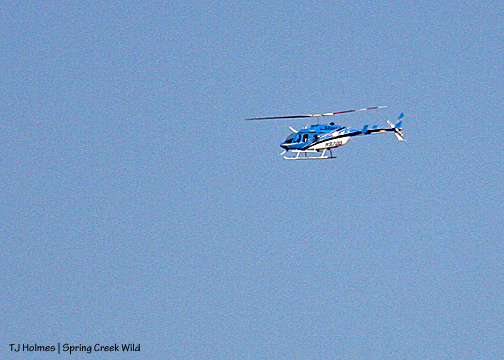
I will relate one particular incident that I believe captured BLM’s attention. Early in the morning, before anyone else arrived, a helicopter flew low over the basin. I was visiting with Grey/Traveler’s band, who were napping under trees near the road in the north hills. When the sound of the helicopter reached us, the horses bolted. That’s something I can tell people … but until they see it for themselves …
Early in the tour, an hour and a half or so later, we were standing above Spring Creek Canyon and the trapsite when the helicopter flew back over the basin. Low enough to see, comment on.
About midway through the tour, we paused in the east pocket to look out at Bounce’s band … and Grey’s. While our caravan was stopped. Grey’s took off running again. “Do you think they’re running because of us?” No, no, it must be the proximity of Bounce’s band. Bounce’s band was much closer to Grey than we were – both bands at a considerable distance from us on the road.
Other horses were on the old (and now illegal) WSA road past Sorrel Flats – Iya and Cougar with Poco and Roach. When we drove on, Grey’s appeared around the back side of the “tree island.” Hmm. Because of us? Because of the line of vehicles (four, including my Jeep)? Surely not. I’ve never seen him do such a thing (though I must say I’m almost never in the company of other vehicles, let alone three others). We got stopped at an arroyo; Grey’s kept running south.
Down past the double ponds, up onto the S saddle that returns the view of the rest of the basin … and there they were again – still running. And I finally had to admit it was us – and the helicopter. On they went toward Round Top. Not a comfortable view of the basin’s most famous stallion and his family. (The next day, I finally saw his band as I was leaving – they were all the way over on the west side of Flat Top. I know these descriptions won’t mean much to most of you, but the point is that his band traveled an enormous distance, and though they didn’t run at the sight of me, they were still moving …)
Does that change my mind about the coming roundup? No. In fact, it hardens me to the necessity of it. Because without a roundup this year, when the horses are in good condition, we’d have one next year, when they’d probably NOT be in such good condition (and back in the 120-130 population range) – and what good would that be for THEM or for the range? And without starting a program to limit reproduction among the basin’s mares, we’d see this scenario play out again in just another few years – like it has all the previous times. And THAT is what I am trying to prevent: helicopters chasing horses and families being torn apart with frequent regularity.
Little Book Cliffs STOPPED its roundup because of its program to limit reproduction. Spring Creek Basin can – will – do the same. And in the future, mineral bait trapping is an effective way to selectively remove horses that, because of the lengthy period between roundups, will hopefully come to have a particular market.
The preliminary EA states: “Population modeling reflects that the implementation of fertility control and selective removal would result in slightly reduced growth rates of the wild horse population in the Spring Creek Basin HMA, when compared to selective removal alone. The model indicates that growth rates would not be so low as to cause risk to the population should fertility control be implemented. …” It goes on to compare native PZP and PZP-22 with no real understanding of the actual differences of the two outcomes – as demonstrated by studies of both native PZP and of PZP-22. It also seems to forget that native PZP has been in use far longer than BLM has been using it – and working to great efficacy … definitely greater than the “model” used for this EA.
Fertility control – in the form of native PZP (and, eventually, mineral bait trapping to selectively remove fewer horses) – can actually quite effectively reduce the growth rate of the wild horse population in Spring Creek Basin – compared or not with “selective removal,” which in this case isn’t particularly selective at all, requiring the helicopter-driven capture of most of the horses to make good choices about who to remove and who to leave to carry on the herd’s legacy. PZP darting and mineral bait trapping, therefore, can drive a sustainable management goal of less-frequent roundups as well as the removal of fewer horses – becoming the preferred management process for BLM’s Wild Horse & Burro Program, and we are optimistically involved in helping that dream become a reality.
Relationships between civilian advocates and BLM can be and are proving successful. On behalf of NMA/CO and the Wild Bunch, I am thankful to our local government officials who think so, too.
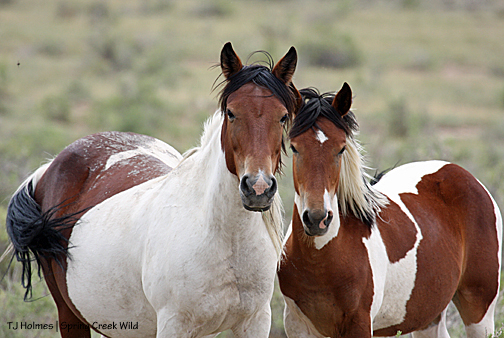
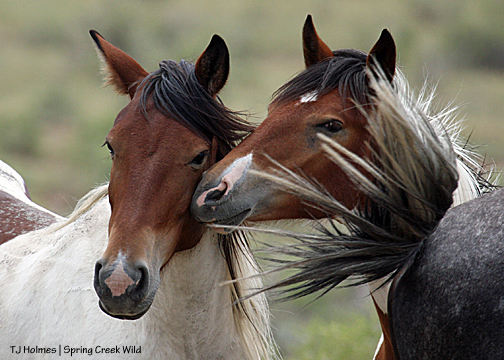
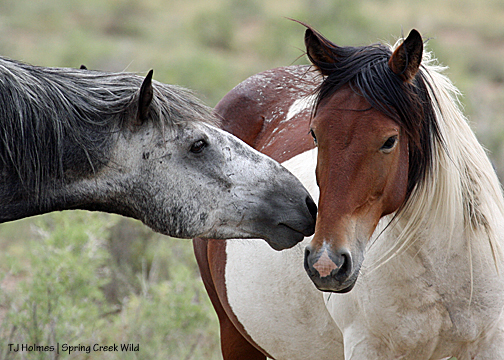


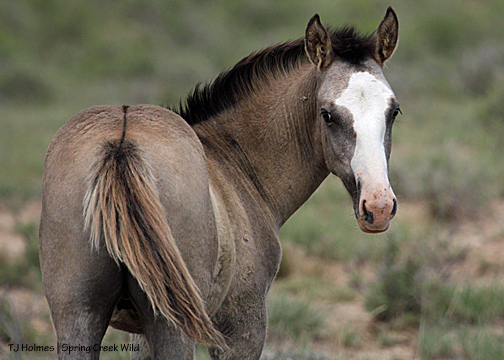












 Spring Creek Basin Mustangs