http://www.katu.com/news/national/123199993.html
Are wild horses native to the U.S.? BLM roundups challenged
RENO, Nev. (AP) – American history textbooks teach generation after generation that the wild horses roaming the Western plains originated as a result of the European explorers and settlers who first ventured across the ocean and into the frontier.
But that theory is being challenged more strongly than ever before at archaeological digs, university labs and federal courtrooms as horse protection advocates battle the U.S. government over roundups of thousands of mustangs they say have not only a legal right but a native claim to the rangeland.
The group In Defense of Animals and others are pressing a case in the 9th U.S. Circuit Court of Appeals that maintains wild horses roamed the West about 1.5 million years ago and didn’t disappear until as recently as 7,600 years ago. More importantly, they say, a growing stockpile of DNA evidence shows conclusively that today’s horses are genetically linked to those ancient ancestors.
The new way of thinking could carry significant ramifications across hundreds millions of acres in the West where the U.S. Bureau of Land Management divides up livestock grazing allotments based partly on the belief the horses are no more native to those lands than are the cattle brought to North America centuries ago.
Rachel Fazio, a lawyer for the plaintiffs, told a three-judge appellate panel in San Francisco earlier this year that the horses are “an integral part of the environment.”
“As much as the BLM would like to see them as not, they are actually a native species. They are tied to this land,” she said. “There would not be a horse but for North America. Every single evolutionary iteration of the horse is found here and only here.”
Judge Mary Schroeder, former chief of the circuit, asked: “Just like polar bears?”
“Yes,” Fazio answered, “they belong there.”
The lawsuit cites researchers who say the most recent science backs her up and that the concept is widely accepted by most of the scientific community, with the most notable exception being the BLM itself.
“It’s significant because BLM treats the wild horses like they are an invasive species that is not supposed to be out there,” Fazio said in a recent interview with The Associated Press.
A reversal of that long-held belief could have the effect of moving the native horses to the front of the line when divvying up the precious water and forage in the arid West.
BLM maintains the horse advocates are perpetuating a myth and many ranchers claim it’s part of a ploy to push livestock off public lands.
“There are plenty of horses out in the Nevada desert,” said Tom Collins, a Clark County commissioner who has a ranch outside of Las Vegas and has run cattle on U.S. lands in Arizona, Idaho and Utah.
“Most of these folks, maybe their father slapped them or their mother didn’t love them, so now they are in love with these wild horses that aren’t really wild,” he said
BLM devotes “Myth No. 11” on its Web site to the “false claim” that wild horses are native to the United States.
“American wild horses are descended from domestic horses, some of some of which were brought over by European explorers in the late 15th and 16th centuries, plus others that were imported from Europe and were released or escaped captivity in modern times,” it says.
“The disappearance of the horse from the Western Hemisphere for 10,000 years supports the position that today’s wild horses cannot be considered `native’ in any meaningful historical sense,” BLM explains. It acknowledges the horses have adapted successfully to the Western range, but biologically they did not evolve on the North American continent
Jay F. Kirkpatrick, a leader in horse reproduction research who directs ZooMontana’s Science and Conservation Center in Billings, Mont., is among those who say BLM’s view is outdated.
“On the face of the science, it is just absolutely incorrect,” said Kirkpatrick, who has studied reproductive physiology for decades since earning his degree at the College of Veterinary Medicine at Cornell University.
“It wasn’t the predominant horse on the continent but it was here. It is native to North America,” he told AP.
Kirkpatrick, who actually supports roundups as a necessary tool to control herd populations, said the key to determining if an animal is native is where it originated and whether or not it co-evolved with its habitat.
The mustangs “did both, here in North America,” he said, beginning about 1.4 million years ago. He said they eventually crossed the Siberian land bridge into Asia before going extinct locally as recently as 7,600 years ago.
“This isn’t about history, it’s about biology,’ Kirkpatrick said. “The Spanish were bringing them home.”
Ross MacPhee, curator of the Department of Mammalogy at the American Museum of Natural History in New York, agrees. He said the mustangs are classified as Equus caballus, which “evolved from more primitive forebears” in North America.
“There is therefore no question that it is `native’ within any reasonable meaning of that word – much more so than bison, for example, whose immediate ancestry is Asian,” MacPhee said. “Yes, it disappeared from our shores for a few thousand years, but that has no bearing scientifically on whether it is historically `native.”
BLM officials said they can’t comment on pending litigation, but referred AP to their Web site descriptions and a leading scientist who agrees the agency’s version is closer to the truth.
“Horses did evolve in North America but they went extinct 10,000 years ago,” said Michael Hutchins, executive director of the Wildlife Society, a nonprofit scientific and educational association in Bethesda, Md.
Today’s mustangs are “a domesticated, feral version that had gone through many, many generations of selective breeding to use as beasts of burden and were brought back to North America,” he told AP. “They are a mishmash of domestic horses. They are not native. They are not wild horses.”
If they are native, then so too are camels, cheetahs and lions that roamed the continent before extinction about the same time, Hutchins said. But they are not, he said, partly because the same ecological conditions no longer exist, the climate changed and most big predators gone.
Kirkpatrick said Europe’s domestication of the horse over about 6,000 years may have changed the nuclear makeup of some genes but “it remains the same species and retains the same social organization and social behaviors that evolved over 1.4 million years.”
“It matters not a Tinker’s Damn if the ecology has changed,” he said. “E. Caballus is the same species that disappeared.”
The case pending in the 9th Circuit could go a long way toward determining future management of the animals and has the potential to send BLM back to the scientific drawing board before it can resume seasonal roundups of thousands of mustangs it says are damaging the environment.
The case already has cleared an unprecedented legal hurdle in that the appellate court is entertaining arguments about the merits of the law at all.
In previous similar challenges, courts have denied requests for emergency injunctions to block pending roundups based on conclusions plaintiffs failed to prove significant harm was imminent and/or they were likely to ultimately succeed in proving the government broke the law.
Then in a sort of “Catch-22,” by the time a non-emergency hearing arrives, the BLM already has completed the roundup and persuades the judge the case is moot, any damage already done.
But that may be changing.
David Schildton, a Justice Department lawyer representing BLM, was following that script when he told the Ninth Circuit panel in January that “a live controversy” would have to exist for the court to act.
“And since the gather has already occurred and approximately seven horses were humanely destroyed because of pre-existing conditions, I don’t know that there is effective relief,” he said.
Not necessarily, said Judge Johnnie Rawlinson.
“The remainder of the horses could be returned,” she said. “The overall claim for relief is these horses were being taken from their native habitat. If the horses are being housed at a long-term or short-term facility, they could be reinstated to their native habitat.”
The 9th Circuit ruling is still pending. But the judge in Sacramento who denied the original bid in September to block a 1,700-horse roundup in the Twin Peaks area along the California-Nevada line adopted a similar position in April when he refused BLM’s request to dismiss the case.
U.S. District Judge Morrison England Jr. ruled it could go forward because “effective relief can still be granted” if plaintiffs prove BLM violated the National Environmental Policy Act or the Wild and Free-Roaming Horses and Burros Act of 1971.
“This court could conceivably provide relief in the form of an order returning all animals in … holding facilities to either Twin Peaks or the West until all requirements of NEPA are met,” he said.
BLM agrees Congress wants the horses treated as part of the environment, Schildton said, but the focus should be on protecting the land itself not affording the horses special treatment.
“They are not an endangered species,” Schildton said. “The effect on the horses themselves would be part of the environmental study… but the ultimate question is, `Does this proposal bring about a significant environmental impact?”‘
Fazio said BLM misinterprets the law.
“The whole purpose of this act is to protect the wild horses from capture, harassment, branding and death,” she said. “Multiple use if fine, but where lands are designated for horses – this icon of the West, this embodiment of freedom – you have to make a priority out of protecting them.”




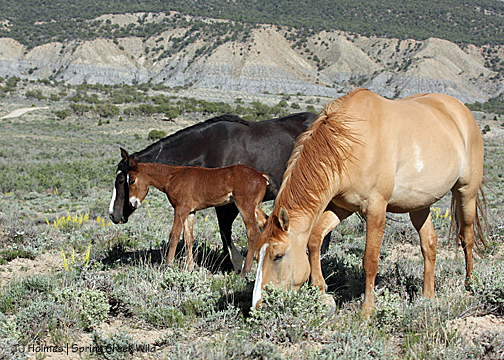
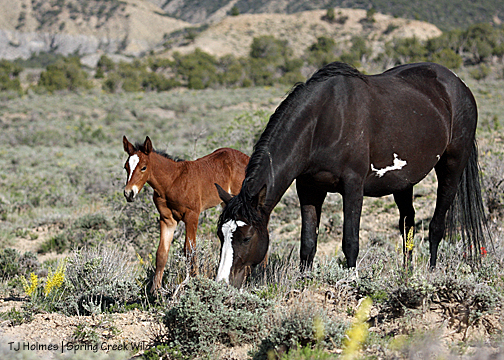
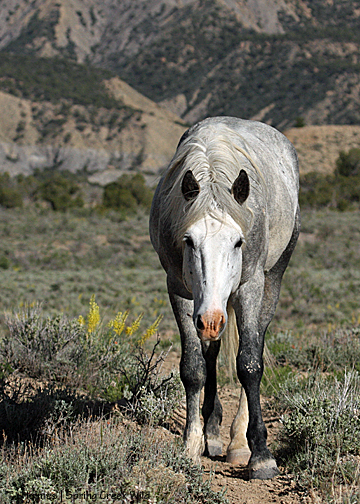


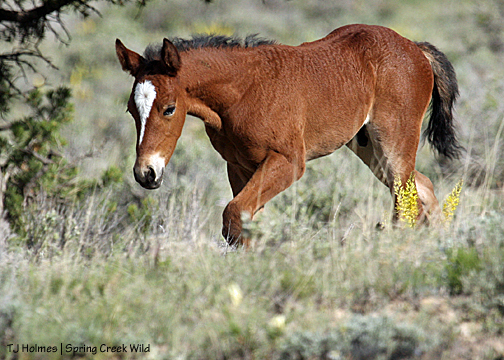

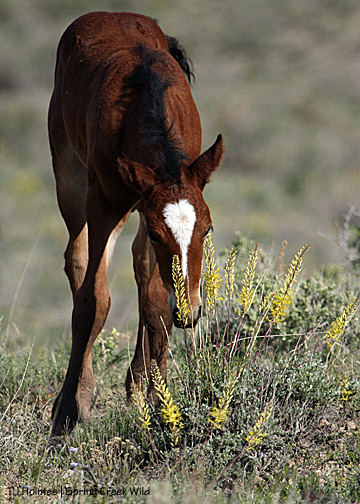

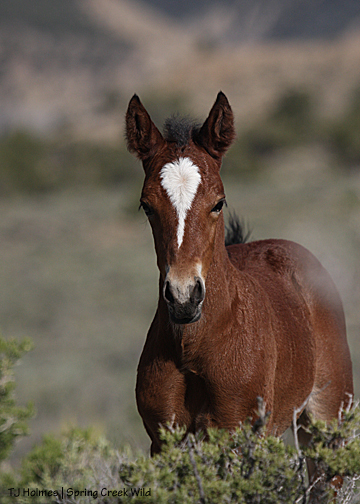
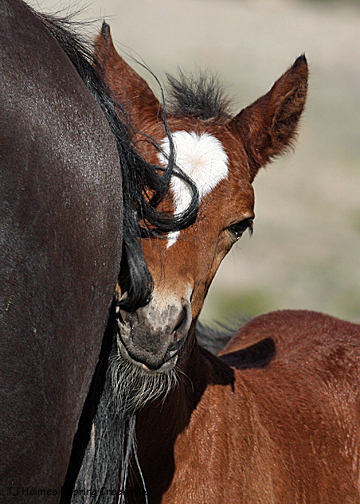
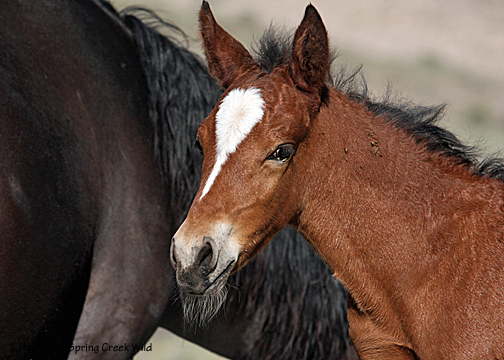
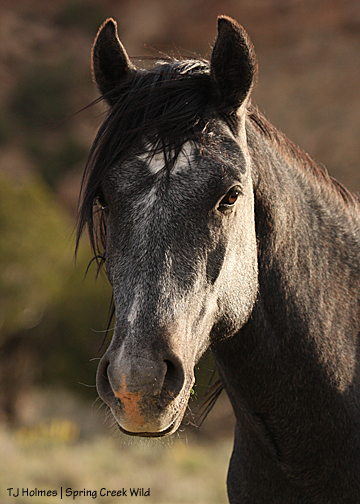
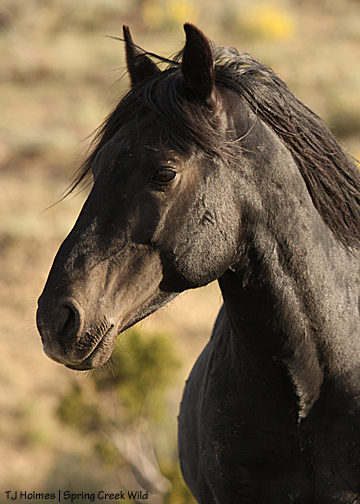

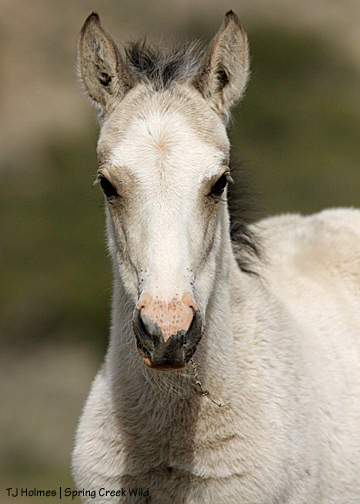


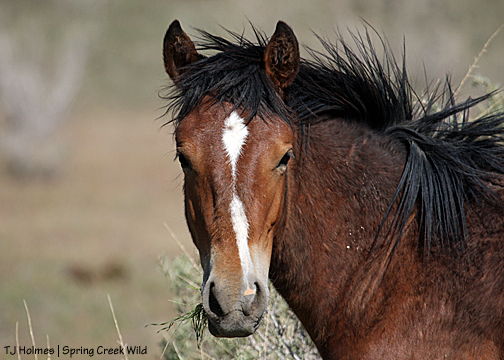
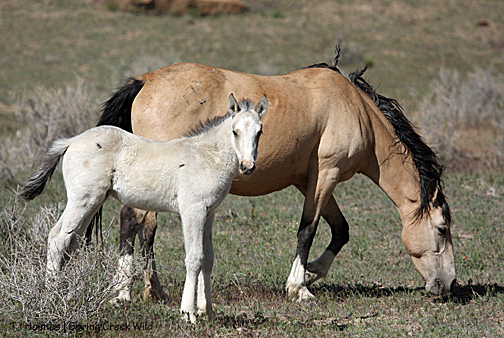

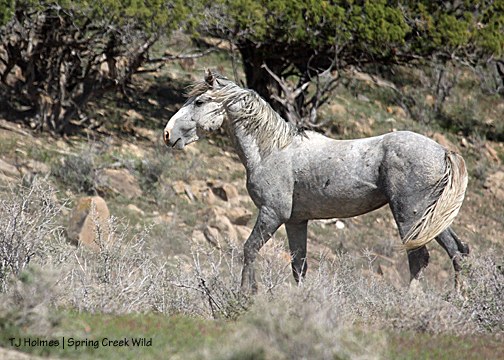
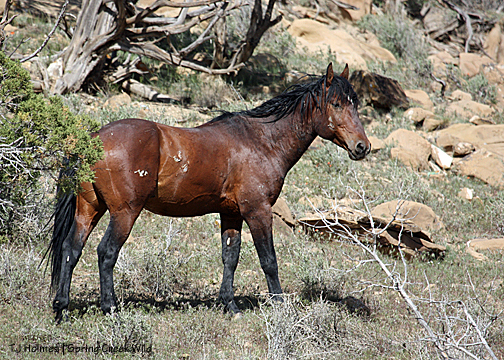
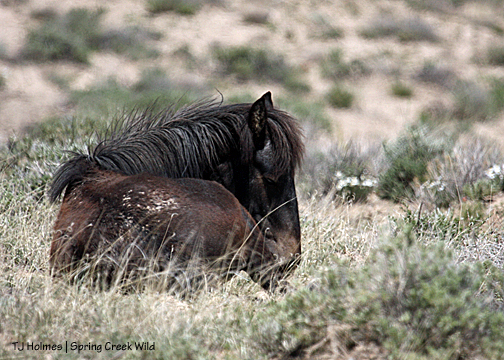
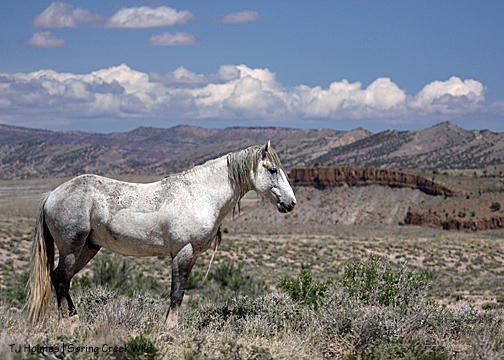

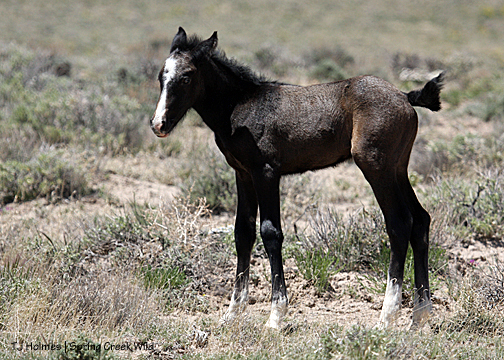


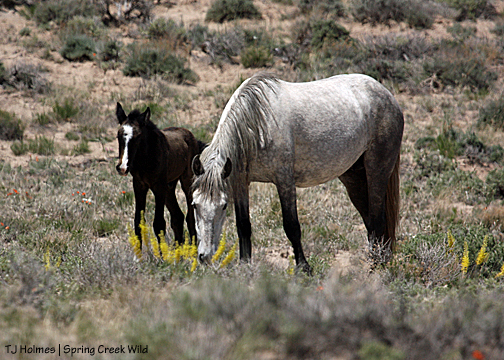


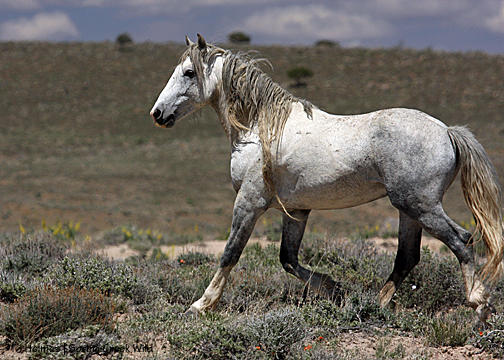






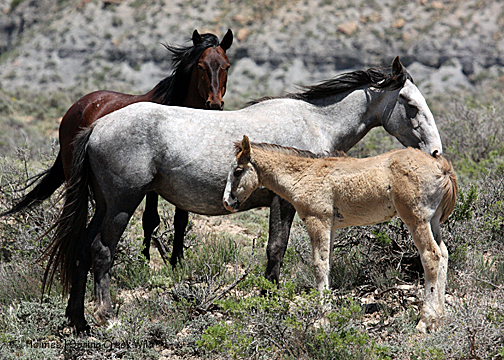
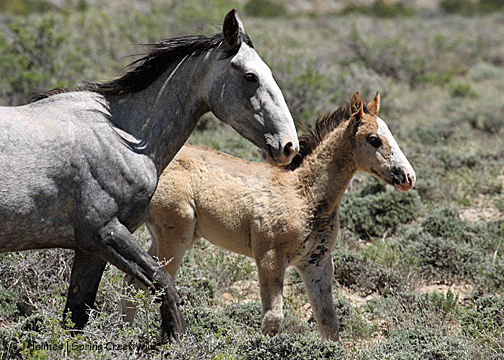
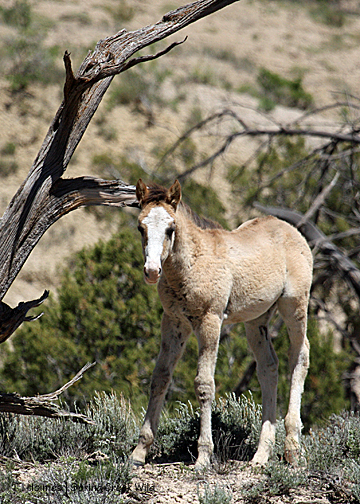

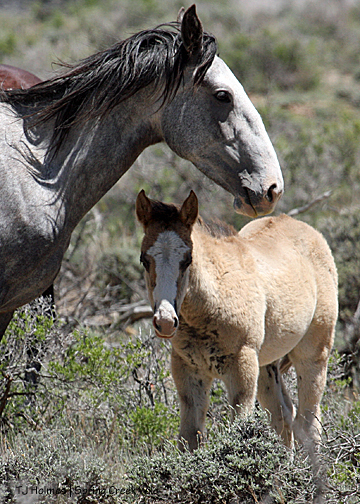
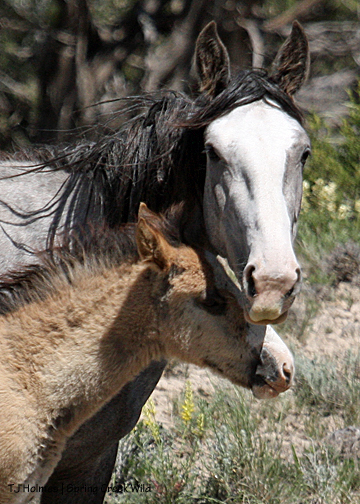
 Spring Creek Basin Mustangs