More water work for mustangs

3 07 2016

Welcome back! The following is the report of work on the second day of our apron-installation project in Spring Creek Basin. (Day 3 was just some finish work; no photos.)

Make sure you have plenty of water or Gatorade, a hat, sunscreen, lip balm, more water, neck rag or shirt to soak for evaporative coolness, more water to drink – it’s HOT out there! – and let’s get started. We have a lot of ground to cover – literally!
062516siteprep1

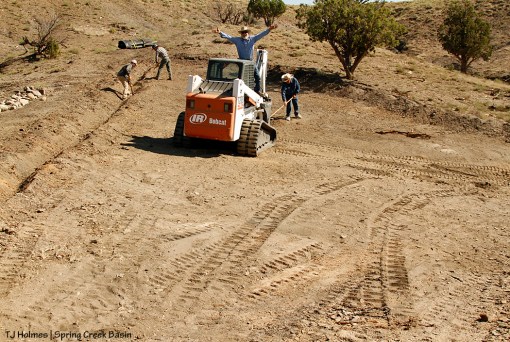
To reintroduce you to some of our cast of characters, that’s NMA/CO president David Temple atop the Bobcat, mugging for the camera again; Mike Jensen and Justin Hunt, BLM range specialist/herd manager and range tech, respectively; and Four Corners Back Country Horsemen/Wild Bunch volunteer Frank Amthor. Did I mention that this was *weekend* work? The BLM guys are cleaning up the trench that the edges of the apron will go over and be buried into, and Frank is helping David dig out the stump of the lone (small) tree that had been standing in the way of progress.
062516davidworkgrin

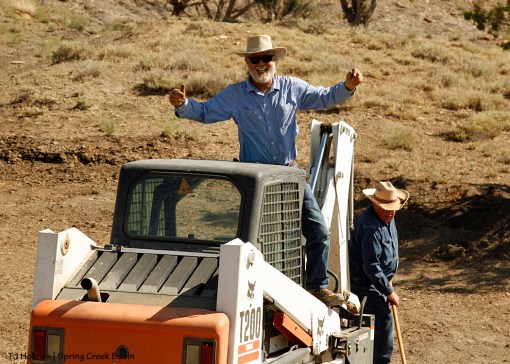
Let’s take a closer look at that big ’ol mustang-love grin. 🙂 David has been waiting a long time to make this project happen for Spring Creek Basin mustangs!
062516davidmikefrankmeasure

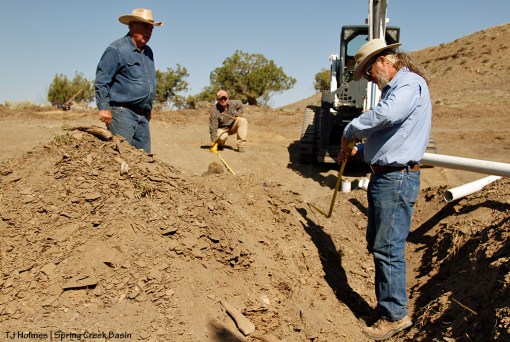
There was a lot of measuring going on. The apron was 40 feet by 100 feet and consisted of narrow strips seamed together. The edges go over dirt berms and are then buried in dirt along those outer edges. The site was irregular because of the hill, which made for a good place of drainage with a couple of points from which water could hit and drain to the lowest point.
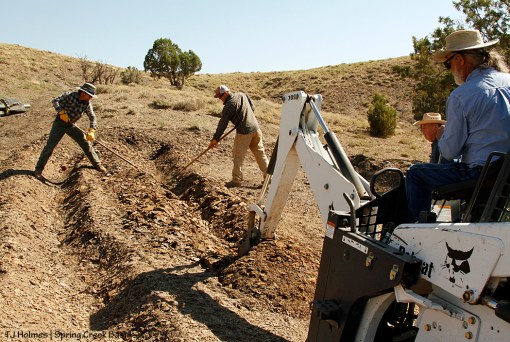
062516davidmikejustintrench

That irregular hill also made for some challenging measurements, and the guys decided to dig a second trench along one side to ensure apron coverage. This was hot, dusty work, and we went through gallons of water and Gatorade.
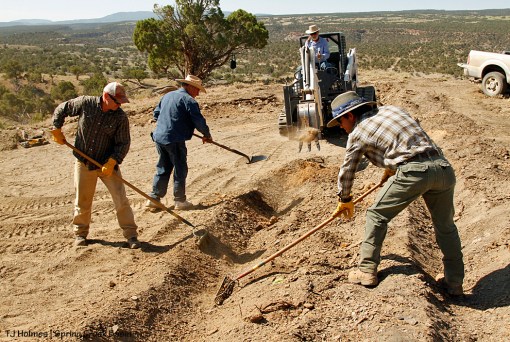
062516justinmikefrankdavidtrench

Here’s another view of the trench work. Yours truly did put down the camera and make use of the shovel in my other hand, but someone has to pull double duty and document the awesomeness! 🙂 Multitasking, don’cha know!
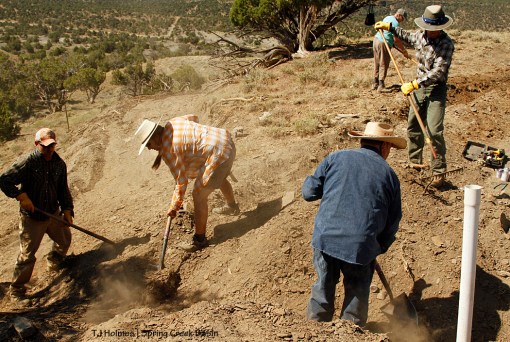
062516shovelworkdrainside1

Yet another view and additions to our cast of characters: Advocate Kat Wilder in the center and 4CBCH volunteer/Wild Bunch rep Pat Amthor at back upper right. The pipe standing vertically at lower right is the location of the drain in the apron. When all was said and done, the pipe wasn’t that tall, of course. Behind Kat is the eventual trail of the pipe down the hill to the water tank. Please allow me this moment to point out that Pat will be 70 in a couple of months, and Frank is 73. Our volunteers rock!

062516katmikedavidfrank1

Here, we’re looking back up the hill while David fills in the berm around the drain pipe. This is a good opportunity to mention that David is an absolute wizard with that machine. He joked that he needed the last 20 years to perfect his technique and be ready for this project, but that’s all to say that he has had LOTS of experience. We’d consider hiring him out if he wasn’t already so darn busy. 🙂
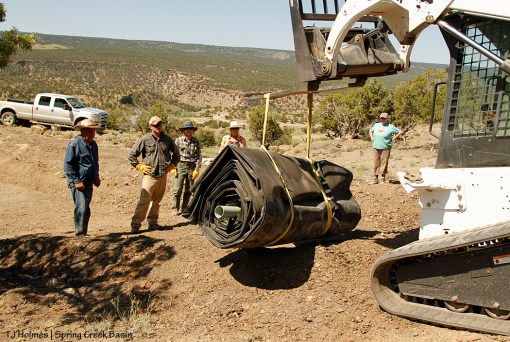
062516apronalmost

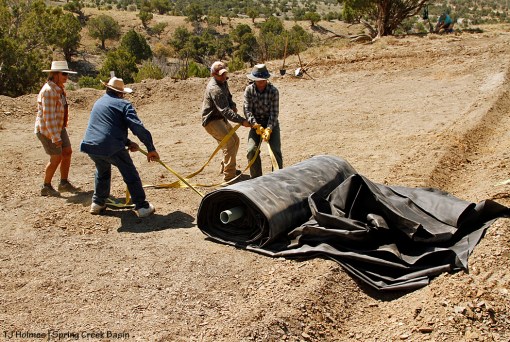
There’s still a lot of work to be done at this point, but this was a pretty big moment: The apron ready to be unrolled and positioned on the site. Then the big question: In which direction does it unroll??

062516mikefrankkatunroll1

As it turned out, not this direction. But we didn’t get too far along before we realized it. At right, Justin is handing the all-important “boot” – for the drain pipe – to Pat for safekeeping.

062516apronalmost2

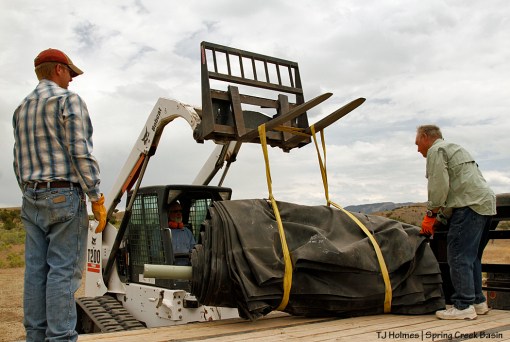
Did I mention that the whole thing weighs 1,000 pounds?
062516apronunroll1

Now we’re cookin’ in the right direction.

062516apronunroll2

While photo-documenting, I might have shed a few tears of sheer happiness at the sight of this apron moving into place. The water it will provide for our mustangs in this area of Spring Creek Basin will have a hugely positive impact on their ability to comfortably graze this area.

062516apronunroll3

For good measure, here’s one more photo of the unrolling process.
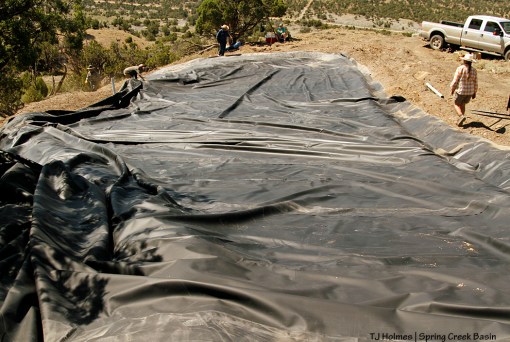
The apron covers the site at the catchment project in Spring Creek Basin.

Then it was all hands on deck to (wo)manhandle the giant apron into place so it covered the whole site – yes, it was heavy, and yes, that black plastic got hot fast. The perspective: I’m at the top of the hill, Kat is walking downhill along the edge opposite the drain, Frank is at the bottom – which has a slight slope from which rain water also can drain – and Mike and Justin are at the drain-side edge. The pipe was then fitted together and laid into a trench around the side of the hill (behind Justin) and down to the tank.
062516tylerkatkenapron1

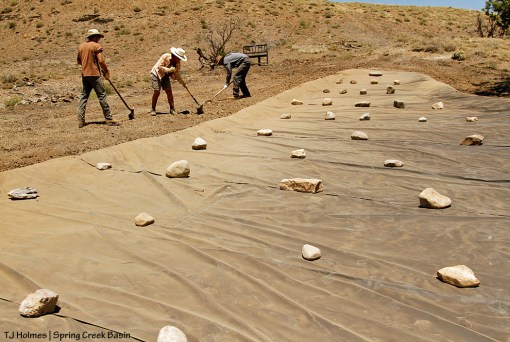
Fast forward through the work of spreading and flattening and placing rocks and filling trenches to cover apron edges … and also introducing additional volunteers: Kat Wilder’s sons, Tyler (left) and Ken Lausten. This perspective is taken from the bottom (where Frank was in the previous photo) looking uphill. The drain is to the right.
062516justinfrankboot1

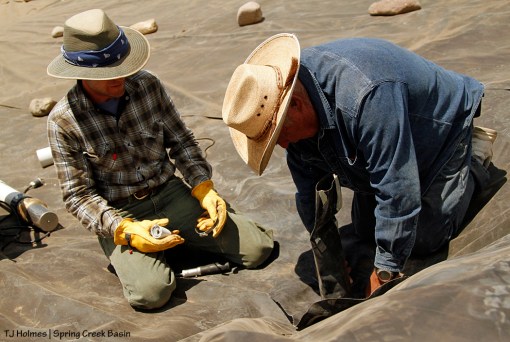
Now Justin and Frank start the process of measuring the “boot” to fit over the drain pipe (which has been cut down to size in this photo – remember it very tall in earlier photos?). Behind Justin is the filter that will attach to the top of the pipe and allow water down the pipe but keep out other debris.

062516kendavidtylertrench1

David starts digging the trench from the apron to the water-storage tank while Ken and Tyler are at the ready to do finer shovel work. At right, out of the frame, Justin and Frank are working on the drain pipe in the apron.
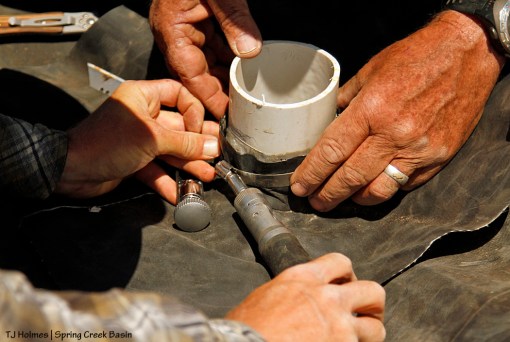
062516frankjustinpipe1

Old hands and young hands. Volunteer hands and BLM hands. Hands doing work for mustangs. YEAH! (Those helping hands are the property of Frank Amthor and Justin Hunt. 🙂 )

062516apron1

We love it when a plan comes together! Justin and Frank are working on the drain pipe in the apron; Ken, David, Mike and Tyler are working on the trench to hold the pipe that will carry the water; and Kat and Pat are supervising. (And I’m loving the whole blessed project!)

062516davidheckles1

As volunteer photo-documenter and volunteer shoveler, one of my most solemn multitasking duties is to accept heckling – and then put it on the blog for all to see. 🙂 Fabulous job, David, Ken and Tyler!
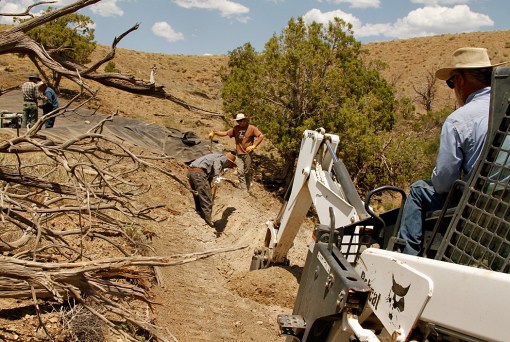
062516trenchdig1

Because, really, we absolutely cannot let all this hard, hot, dry, amazing and amazingly appreciated work go unnoticed or undocumented! We do small projects for the horses throughout the year every year that are documented for our local folks, but this was big – and it was huge – and let me say again how incredibly appreciative we are of our BLM folks and all our advocates and volunteers who make projects like this happen – through funding, through buckets of sweat (it’s “dry” heat, right?!) and through lots of tears of happiness while we try to make sure photos are in focus. 🙂
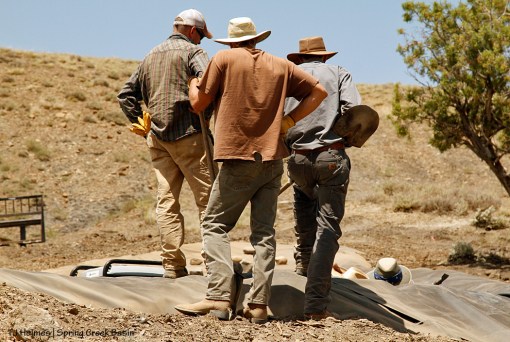
062516miketylerkenwatch1

Because people are watching to see how we have made Spring Creek Basin’s mustang-management style a model. It takes hard work, but it IS possible to work in partnership for our mustangs – and we’re proving it – and our horses are worth every bit of that effort.
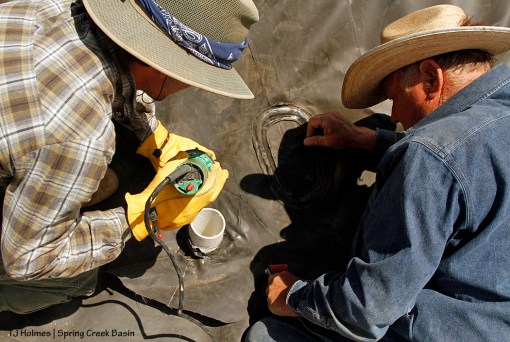
062516justinfrankboot2

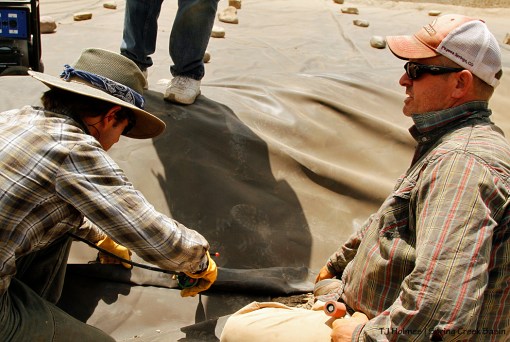
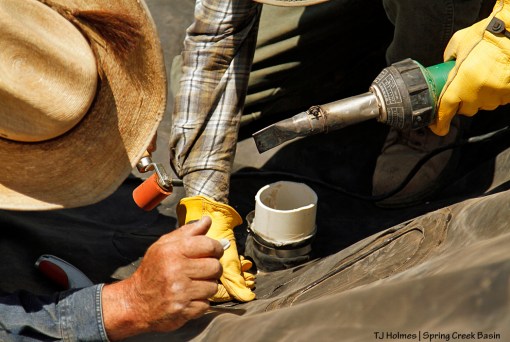
This work was hard to illustrate. The “boot” had to be sealed to the apron liner so water will go through the filter to the pipe, not leak out around the edges where the pipe comes through the apron. Justin is using a tool that directs heat (it’s plugged into a portable generator), and Frank is using a little roller to press the heated boot plastic to the apron plastic. As if it weren’t hot enough (did anyone actually look? the air temp may have been in the upper 90s, but on that black plastic, it probably was at least 115 degrees), they’re applying *more* heat. All in the name of gettin’ ’er done for our mustangs.

062516katfrankjustinumbrella1

Ahh! Thanks, Kat! Pat brought the umbrella … and no, we were not expecting rain.
062516justinfrankboot3

This angle shows a little better what’s going on with that plastic boot and the heat gun.
062516kentyler1

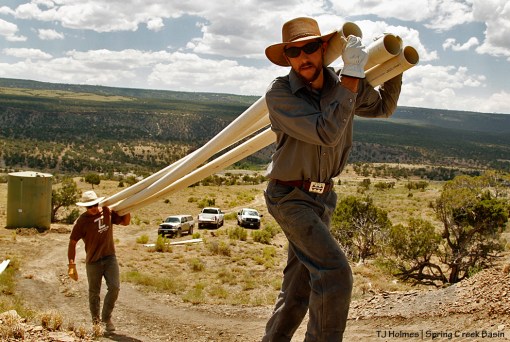
Meanwhile, work on the trench had progressed to the point that allowed Ken and Tyler to start carrying lengths of pipe up the hill to glue together and place in the trench. In this view, you can see the water-storage tank. Also hard to illustrate is just how steep is this part of the hill. Barely in view down the hill at left are the pipes Ken and Tyler carried on their *other* shoulders to that point from the pile in front of the trucks farther downhill.

062516tylerkenpipe1

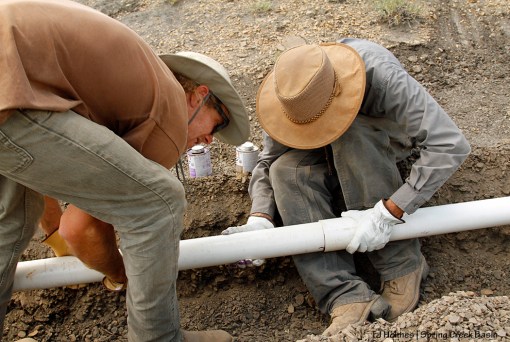
Ken and Tyler get right to work gluing pipe together for the long run to the tank.
062516mikedavidtrench1

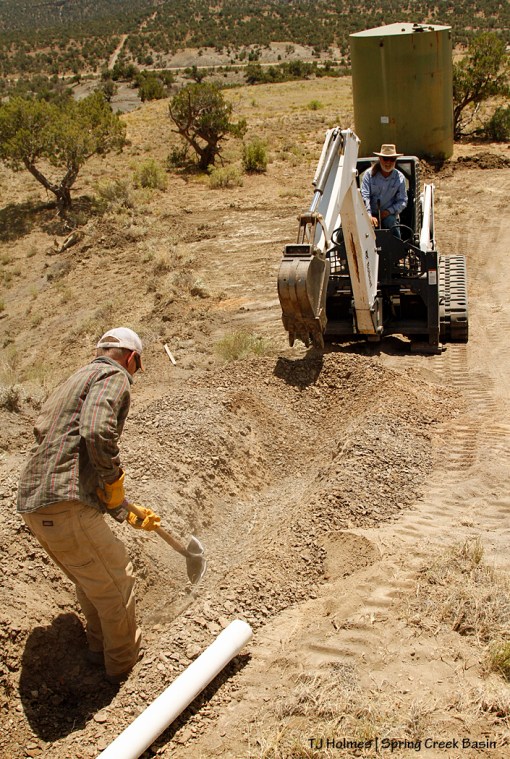
And David and Mike continue digging the trench down the hill to the tank.
062516tylerkenpipe2

And Tyler and Ken glue more pipe.

062516justinmikeseam

Using the technique perfected by Justin and Frank, Mike helps Justin attach another section of apron to the main apron in order to have more surface to bury over the berm in the trench. Because our site isn’t rectangular, we trimmed plastic in a couple of areas and added those pieces to a couple of areas for mo’ bettah coverage in places where needed.
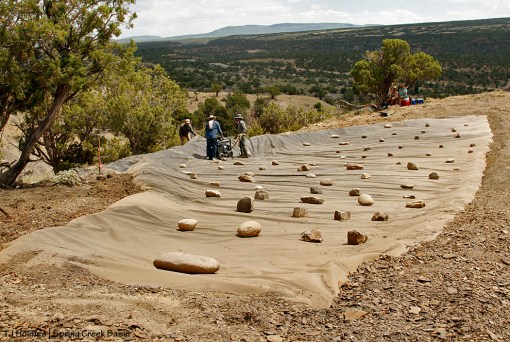
062516justinmikefrankend1

My oh mustang my! Doesn’t that look like it will catch and carry a lotta water for our wild ponies??
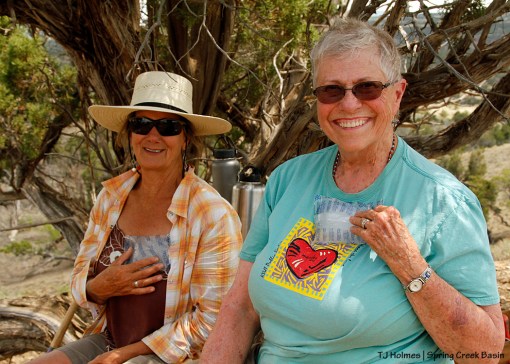
062516patkat1

It hasn’t yet been mentioned how HOT it was (! OK, it miiiiiight have been mentioned) during this weekend work project. It hadn’t rained in weeks (possibly close to two months), and it was as hot and dry as Southwest Colorado can be (and given our location as high-elevation desert, it can be pretty toasty with temps into the 100s, which we’ve seen already). Fortunately, it was generally breezy enough to keep the gnats at bay. Here, awesome lady advocates Pat and Kat are using ice packs to stay cool under the shade of a handy juniper at the work site.
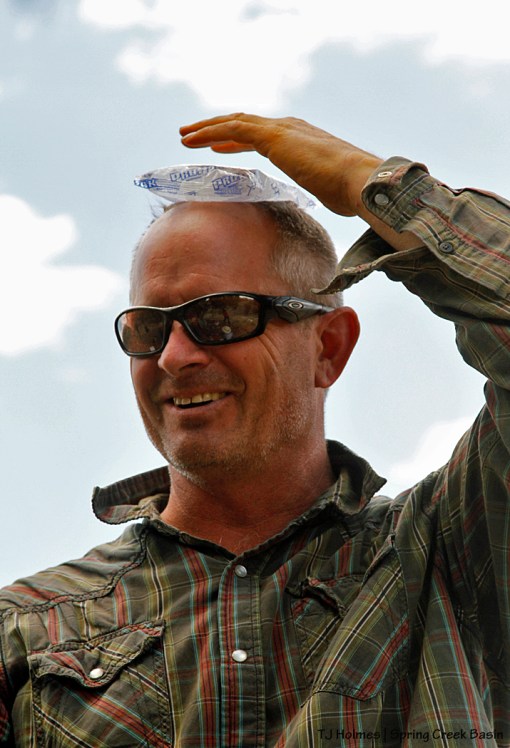
062516mikeicepack

Mike also thought that was a pretty terrific idea.
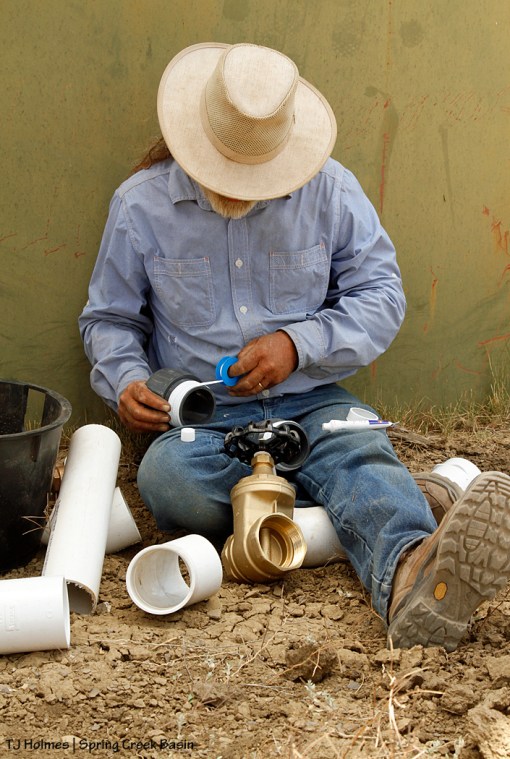
062516davidvalveparts1

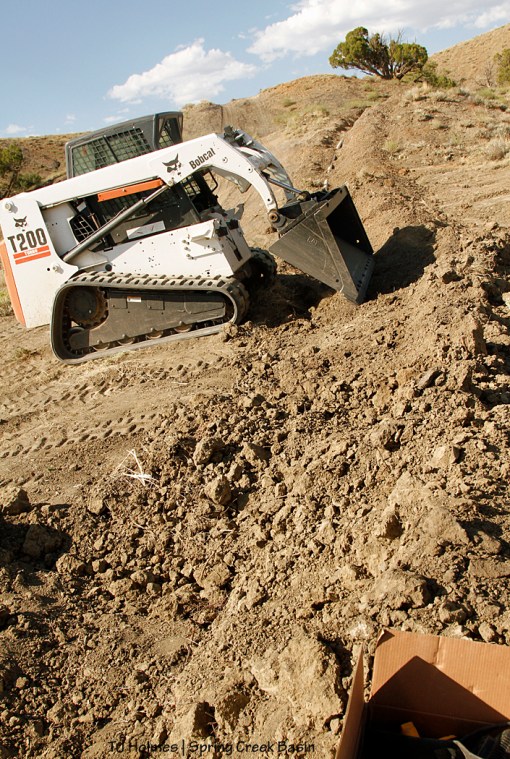
David was glad to get off of his bucking Bobcat and start putting together valve parts in the shade of the water tank. The pipe-filled trench gets to the tank immediately to the right of where he’s sitting.
062516davidbobcatcover

Of course, he had to get right back on that pony – err, Bobcat – and finish the job to end the ride on a positive note: filling the trench and covering the new pipeline, which is worth its (considerable) weight in gold.

Camera-holding and other hands were needed to wrestle the final pipe sections into place to get in line with the tank’s existing steel fitting, so the photos end here. David did quite a bit more work around the apron and installed some water-erosion ditches on the access road this day and the next (third) day, and we also removed the tractor tire (which had served as a trough with a bentonite-and-soil bottom) to put in place a new water trough provided by BLM. As it turned out (after we got our first little rain showers to test – yahoo!), the steel fitting that was at the tank had cracked and was leaking a bit (Colorado’s freeze-and-thaw action at work), so we’ll replace that as well.

After the holiday, BLM folks and volunteers will return to the site of our big achievement to replace that steel fitting, scatter seeds of native grasses around the apron and along the covered pipeline (disturbed areas), and install the new trough to the existing pipeline downhill from the tank.

And once again, it’s imperative that we thank all the people who provided all the hands and funds and supportive efforts that made this water project happen for our Spring Creek Basin mustangs: BLM range staff, Wild Bunch members, unaffiliated advocates and family members (including the ones who allowed us weekend time with their husbands and daddies). Specifically, for your labor and engineering and exemplary work ethic, thank you to Mike Jensen, Justin Hunt, Garth Nelson, David Temple, Pat and Frank Amthor, Kat Wilder, Ken Lausten and Tyler Lausten. For your organization and funding and support behind the scenes, thank you to Connie Clementson, Tif Rodriguez, Lyn Rowley, Lynda Larsen, Sandie Simons, Nancy Schaufele, Karen Keene Day, David and Nancy Holmes, and the Serengeti Foundation.

In spirit, always, thank you, Pati Temple, for our cherished memories of your mustang advocacy and for continuing to watch over and guide us in this work. (I’m pretty sure you had a hand in the recent, blessed rains we have received!)

Everyone, we appreciate your planning, your work, your funding, your organization and your love for our most beloved Spring Creek Basin mustangs.

THANK YOU!!!!!!!!!!!!!!!!!!!!!!!!!!!!!!!!!!!!!!!!!!!!!!!!!!!!!!


Rain water for mustangs

1 07 2016

It takes a village … to manage a mustang herd. And for Spring Creek Basin’s mustangs, our village includes Mike Jensen, Garth Nelson and Justin Hunt with BLM’s Tres Rios Field Office.

We are so grateful to have an excellent partnership with BLM and Disappointment Wild Bunch Partners (which includes the Colorado chapter of the National Mustang Association, Four Corners Back Country Horsemen and Mesa Verde Back Country Horsemen), as well as unaffiliated advocates who simply love the mustangs. We do a lot of small projects for the horses – water enhancement, fence repair and rebuilding, trash pickup, etc. – and now and then, we do something big.

Last weekend, we did something big that, as NMA/CO president David Temple noted, was about 20 years in the making.

Spring Creek Basin has a water catchment. Actually, we have two – and the second one is the subject of this post. But let me explain the first catchment first: Twenty or so years ago, NMA/CO and then-Spring Creek Basin herd manager Wayne Werkmeister partnered to install a couple of water-storage tanks that were provided by an oil-and-gas company. At the catchment in the main area of Spring Creek Basin, volunteers and BLM also installed two heavy-plastic “aprons,” laid out on a slope to catch rain and snow and funnel it to the tank, and from there to a float-controlled trough from which the horses can drink. That catchment system (aprons to tank to trough) provides the horses’ only clean water in the basin.

The second catchment consisted of a water-storage tank and a big tractor tire-as-trough (bentonite was mixed with the soil at the bottom to keep water in the tire). Water had to come from a truck delivery – or not at all. And it hadn’t come for all the years I’ve been involved.

Our existing catchment has been hugely beneficial to the horses; now our second catchment has its own apron to deliver water to the tank and from there to a new trough. NMA/CO purchased the supplies, including the apron and pipe, and BLM purchased the new trough. Labor during the weekend project was provided by BLM range staff, Wild Bunch volunteers and unaffiliated advocates.

Read on for pix from the first day of our big weekend of work, and please join me in sending huge thanks to our BLM range staff and our volunteers – all of whom are working together for the benefit of our beloved mustangs of Spring Creek Basin!
062416unloadingrocks1

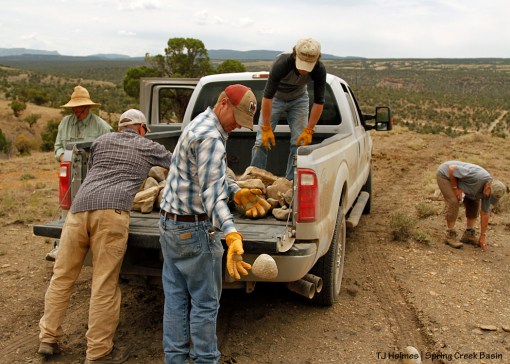
When you grow up in Texas, you grow up with these words: “Don’t put your hands where you can’t see them.” That translates to “watch out for snakes in rocks.” Mike found a snake while we were collecting these rocks to eventually place on top of the apron; fortunately, a red-tailed hawk already had gotten to it.

062416davidpipeunload1

Some people – David – show off a little when you point a camera in their direction. 🙂 All that pipe would eventually go in the ground to carry water from the apron downhill to the tank.

062416garthdavidfrank1

The rolled-up apron, custom made in Mancos, Colo., weighs 1,000 pounds.

062416safetytalk1

We can’t start work without the obligatory safety talk. David Temple, left, talks to Garth Nelson, Pat Amthor, Justin Hunt, Mike Jensen and Frank Amthor.

062416davidmike1

Who says safety talks can’t be fun? (Note Temple Butte in the background.)

062416daviddirtwork1

It wasn’t all sitting around watching David move dirt with his awesome little Bobcat. On day 2, we did a lot of shovel work and pipe-fitting and more shovel work, and remember that 1,000-pound apron? We spread it out and (wo)manhandled it into position.

062416davidmikedirtsite1

David takes a drink-n-snack break from dirt work to discuss the site layout with Mike.

062416BLMvolunteers1

Well, hello, awesome BLM’ers and volunteers! From left, Justin Hunt (BLM range tech), Frank and Pat Amthor (4CBCH), Garth Nelson (BLM range specialist) and advocate Kat Wilder. Note that they’re sitting on the rolled-up apron – the foundation of the whole fabulous project.

Huge, huge, HUGE thanks to all of you!

Day 2 pix and report to come as soon as I can get through the photos!


Alternatively …

31 03 2016

Once upon a time in a place far, far away from civilization – better known as Spring Creek Basin – it snowed during alternative spring break. And then we had many, many years of pretty excellent weather, during which we completed many projects for the benefit of our mustangs that call this faraway place their home on the range.

Brumley Point forms part of Spring Creek Basin's southeastern boundary.

Tuesday would have been the first day of the annual two-day work project for alternative-spring-break partiers in Spring Creek Basin. However, Ma Nature had other plans, and she sent howling winds and blowing snow to this southwestern corner of Colorado.

033016brumleytemplebsnow

Yesterday was the second day of our Spring Creek Basin project. Despite a light skiff of snow on the ground in the morning, we got a fairly decent start, and students carried several loads of materials and tools to the work site – which now is about mile from the road up the southeastern fence line.

033016safetytalk

BLM range tech Justin Hunt gives a safety talk before Mizzou students carry tools and supplies to the work site.

033016supplypickup

University of Missouri students pick up materials to carry to the work site from BLM range specialist Garth Nelson.

033016libbynina

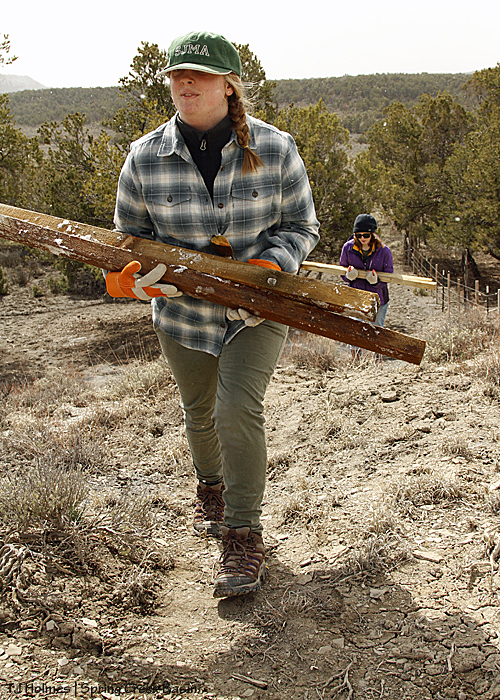
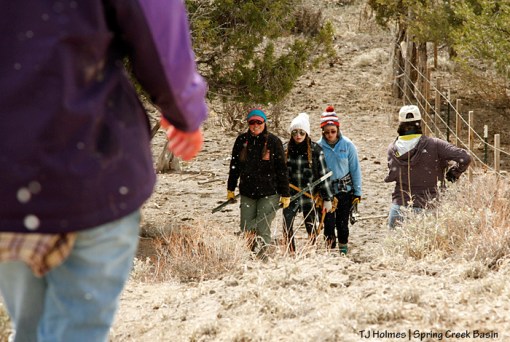
Libby and Nina carry staves up the big hill.

033016ninakathelead

Nina (left) walks back to the truck for more supplies while SJMA’s Kathe Hayes leads Jenna and Bailey to the work site  with a second load of tools. SJMA’s MK Gunn is at far right.

And then it snowed again.

At first, they were lovely little flakes floating on the breeze.

Then those flakes got bigger and heavier, and they started sticking to the ground, and the dirt started getting damp and started sticking to the bottoms of our hiking boots.

033016chalenjoshsean

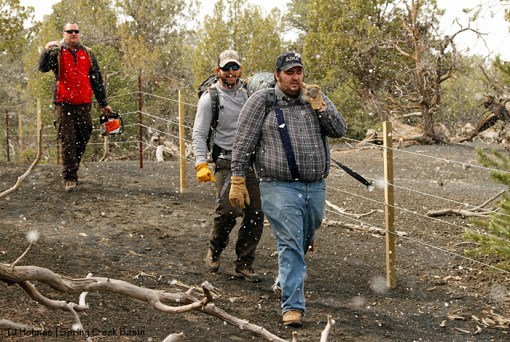
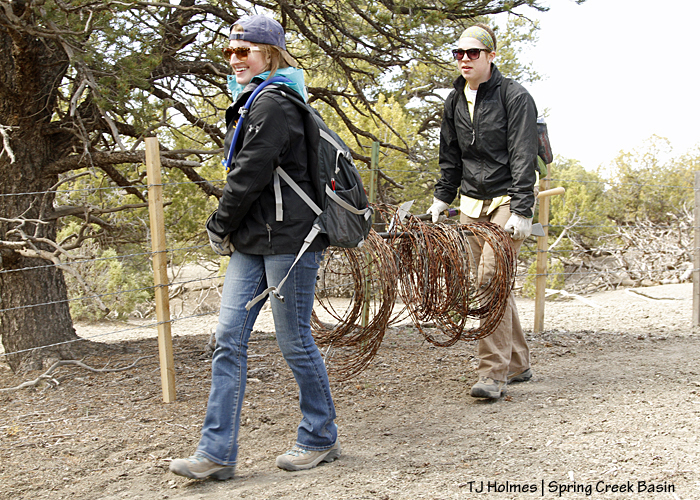
Mizzou’s Chalen helps Southwest Conservation Corps-BLM GIS intern Josh Ryan carry wire to the work site along Spring Creek Basin’s southeastern boundary during alternative spring break. BLM’s Sean Waggoner follows with the chainsaw and T-posts.

033016lukejessicastaves1

University of Missouri students Luke and Jessica carry staves about a mile to the work site while snowflakes start to fall.

About noon, we made the decision to call it a day. By the time we got back to the road, the snow had stopped … but the next wave was on its way.

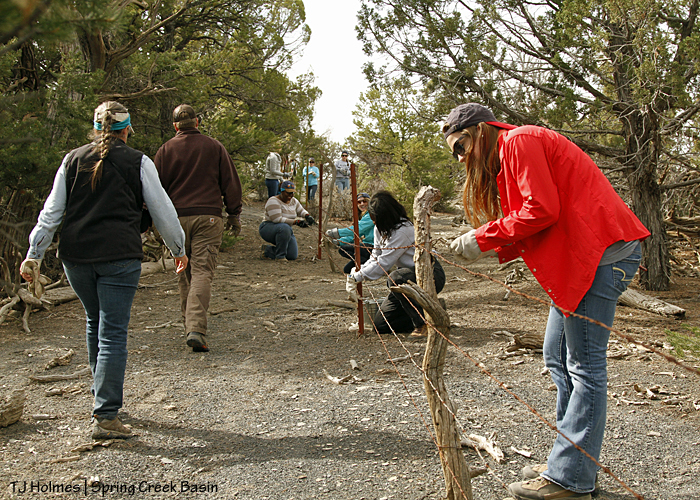
Between the waves of snow, students carried armloads of T-posts and staves, buckets of tools and handfuls of tools, stretched a string to straighten the next section of fence, built an H-brace, pounded T-posts and cut wood away from the path of the new fence line (actually done by our BLM range tech). A couple of them even got as far as dropping posts and staves along the line. But we didn’t have time to take down old wire and string and stretch new wire.

033016garthchalenbrace1

Garth pounds a spike into a cross brace held by Chalen in the H-brace built before the snow really came down.

033016garthchalenlukebrace1

Garth helps Chalen and Luke tighten the wire holding an H-brace together.

033016justinsaw1

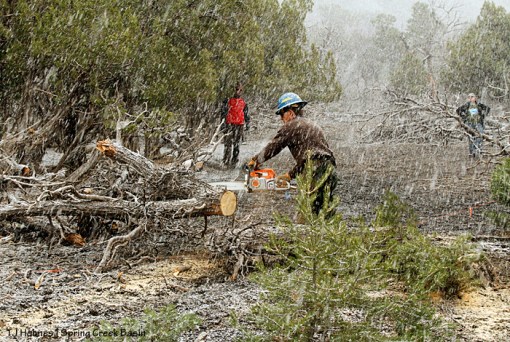
Justin cuts a tree away from the fence. Sean and Mizzou’s Megan serve as safety spotters. We learned that while we can’t cut even dead trees to use as posts in McKenna Peak Wilderness Study Area, we can use chainsaws to clear such trees from a fence line.

033016ninameganseanwire

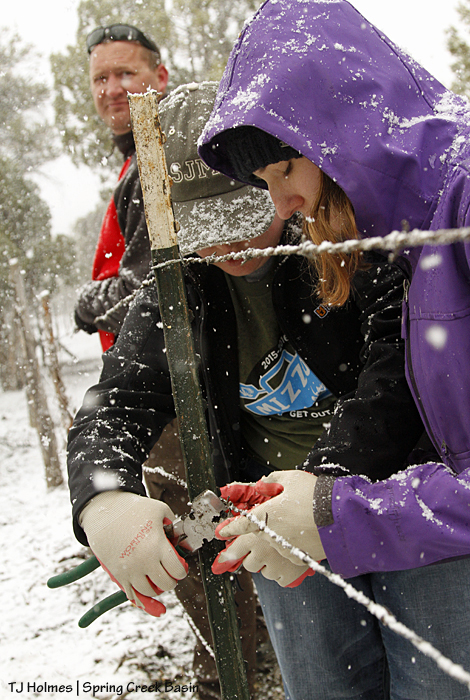
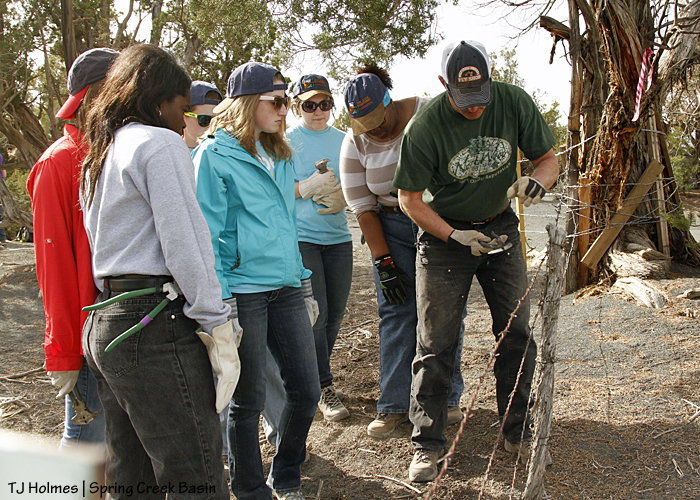
Sean holds wire while Nina and Megan attach strands to a T-post when the snowfall got heavy.

We’ll continue this project on other (sunny) days. 🙂

We sincerely thank this year’s Mizzou crew for being hearty and willing to brave the elements to tackle this ongoing project! It was great to meet you all … and there’s always next year! We also thank SJMA’s Kathe Hayes for her ever-cheerful organizational skills and taking care of the students, as well as members of the Colorado chapter of the National Mustang Association and Disappointment Wild Bunch Partners (who represent NMA/CO, Four Corners Back Country Horsemen and Mesa Verde Back Country Horsemen) for helping with funding.

033016asbgroup1

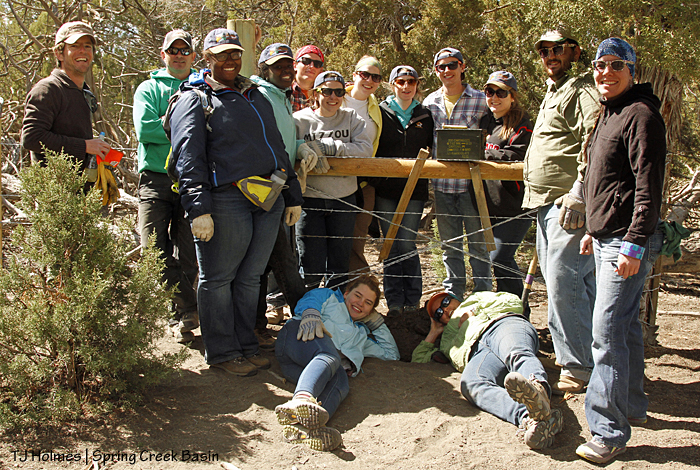
University of Missouri students gather with BLM and SJMA employees in front of Temple Butte, just outside Spring Creek Basin in McKenna Peak Wilderness Study Area, during alternative spring break. From left to right: Justin Hunt, Bailey, MK Gunn, Josh Ryan, Jenna, Nina, Jessica, Megan, Luke, Libby, Kathe Hayes, Garth Nelson, Chalen and Sean Waggoner.


Steep work, great views

31 10 2015

Caution: Scenery- and work-project-heavy post ahead.

Thursday was the last day of work for the SCC crew – a short amount of time for a big – steep – job.

The day started with some clouds, cleared to sunshine, then returned to clouds. (More) Rain started Thursday night. (Have we been blessed by rain the last couple of weeks or what?!) So the crew had good conditions for their final day of work on Spring Creek Basin’s southeastern boundary fence.

Southwest Conservation Corps crew members build H-braces on a steep hill along Spring Creek Basin's southeastern boundary. From this vantage, one looks across the last drainage in the basin toward Disappointment Road.

Let’s start with a scenic overview. There we were, on the basin’s far southeastern boundary looking southwestish over the basin’s “last” drainage toward Disappointment Road, the cottonwoods along Disappointment Creek and to more pinon-juniper covered BLM land beyond the basin to San Juan National Forest Service land to the horizon. Note the two groups, both working on H-braces on the near ridge – aka “the steep hill.” If you click to make the photo larger, you may be able to see the silver fence at the left; that’s the part of the fence that the crew already had rebuilt. It runs into the fence rebuilt by Mizzou students (we left a section for the students to work on in the spring).

Southwest Conservation Corps members are replacing this fence along Spring Creek Basin's southeastern boundary.

Next, let’s take a look at the sad old fence that serves as an example of what the Mizzou students and the SCC crew have rebuilt and are rebuilding. We figure that fence has been around for 40 or more years.

Southwest Conservation Corps crew members Toby and Zoe finish an H-brace at the base of the steep hill to along Spring Creek Basin's southeastern boundary.

Toby and Zoe tighten another wire strand to a corner H-brace. Their rebuilt fence comes in from straight ahead, up from the arroyo shown in the previous post; the steep hill starts steps to the left.

Southwest Conservation Corps members Eric and Aaron dig a hole while building an H-brace on the steep hill on Spring Creek Basin's southeastern boundary.

Meanwhile, up the steep hill (hey, it really IS steep), Aaron and Eric dug holes for another H-brace. If you look closely, you can see the H-brace Toby and Zoe were working on below the hill at right.

Southwest Conservation Corps member Aaron watches Sarah carry an H-brace post up the steep hill on Spring Creek Basin's southeastern boundary.

Photographic proof of the steepness (in a two-dimensional photo, it’s hard to convey just how steep this hill is): Sarah carries a post up the hill to the site of the next H-brace.

Southwest Conservation Corps members Eric and Aaron check the cross post while building an H-brace on the steep hill on Spring Creek Basin's southeastern boundary.

This photo does double duty: Partners Eric and Aaron measure the setting of an H-brace post with the cross post, AND you get another dose of scenery.

Southwest Conservation Corps members Toby, Sarah and Abby take turns digging a hole for an H-brace post on the steep hill on Spring Creek Basin's southeastern boundary.

Toby and Sarah stand ready as Abby uses the post-hole digger to dig yet another hole for yet another H-brace on their journey to the top of the steep hill. Eric and Aaron in the photos above are below on the hill. The scenery here is part of McKenna Peak Wilderness Study Area – which overlaps into Spring Creek Basin Herd Management Area; in this view, it’s all wilderness study area.

BLM range tech Justin Hunt helps dig a post hole for an H-brace on the steep hill with SCC crew members Toby and Abby on Spring Creek Basin's southeastern boundary.

Another view of the same H-brace site, this time with BLM range tech Justin Hunt helping to dig the second post hole. How steep is the hill? The H-brace Eric and Aaron are working on is 100 yards or less below this site – and completely out of view of this little knob in the hill.

The fence the Southwest Conservation Corps built. Up the hill in the foreground and across the small drainage in the lower background, beyond the photo, the crew left a section for the Mizzou students on alternative spring break next year.

From the side, here’s a view of Eric’s and Aaron’s H-brace. Abby and group are up the hill to the right. In the very first photo in this post, you can see both groups. Their rebuilt fence as it crosses the arroyo is very visible in this photo.

Southwest Conservation Corps members rebuild the fence up a steep hill on Spring Creek Basin's southeastern boundary.

Another gratuitous scenery shot – ain’t it grand?

Southwest Conservation Corps crew members Sarah, Aaron and Eric help co-crew leader Dillon complete an H-brace they built on a steep hill on Spring Creek Basin's southeastern boundary.

Returning to Eric’s and Aaron’s H-brace, now they have help from Sarah and co-crew leader Dillon to mark the first cross post. We had some debate about the levelness of these cross posts because the ground is so steep. Keeping the cross pieces strictly level would have had the post normal height on the downhill side of the brace but only about mid-thigh high on the uphill side! So crew members mirrored the slope a bit and cut their notches to reflect the angles of the posts’ ends.

Southwest Conservation Corps co-crew leader Dillon lends weight to the manual drill wielded by Eric as he drills a hole for a spike in the H-brace pictured. Aaron and Sarah, who dug the post holes, thread wire to anchor the braces on Spring Creek Basin's southeastern fence line.

It’s easy to ramble on about the partnerships we enjoy for the benefit of the basin’s mustangs, but here it is in living color: Dillon lends weight to Eric’s drill while he drills a hole in the H-brace into which he’ll later pound a spike. Ain’t it grand?! 🙂 Wrapping wires to create the “X” to further bind the brace posts together are Aaron and Sarah.

Southwest Conservation Corps crew member Sarah uses a chisel to create a notch for a cross bar in an H-brace in Spring Creek Basin's southeastern fence line.

Sarah chips out the notch that will hold the cross posts even steadier in the vertical H-brace posts.

In case the steepness of “the steep hill” hasn’t been mentioned or illustrated clearly, these next photos should do the trick:

Southwest Conservation Corps co-crew leader Sarah carries a post up the steep hill to build an H-brace in Spring Creek Basin's southeastern fence line. All smiles on Day 4!

Co-crew leader Sarah carries an H-brace post up the steep hill. She’s passing the first H-brace, and she’ll pass the next H-brace before getting to her destination – and they had at least one more H-brace to build after that. Still all-smiles on Day 4!

BLM range tech Justin Hunt carries a post up the steep hill behind SCC co-crew leader Sarah on the way to build a new H-brace above the one pictured, with co-crew leader Dillon, on Spring Creek Basin's southeastern boundary.

Justin follows Sarah on the way to the second H-brace up the steep hill, where Dillon is making cuts to start the notching process.

Southwest Conservation Corps crew member Zoe carries a post up the steep hill to use as part of an H-brace along Spring Creek Basin's southeastern fence line.

And here’s Zoe carrying another post from basically the base of the steep hill (scroll back up to the beginning of this post and the H-brace where she and Toby were tightening a strand of wire).

Southwest Conservation Corps crew members construct H-braces in the new fence along Spring Creek Basin's southeastern boundary. That steep hill is why they were hired!

From the bottom looking up.

Southwest Conservation Corps crew members construct a new fence along Spring Creek Basin's southeastern boundary. That steep hill is why they were hired!

And from down toward the arroyo looking up at the steep hill. Um, wowowow?! The wilderness study area’s namesake McKenna Peak shows its point at far right.

Sarah, Dillon, Eric, Aaron, Sarah, Zoe, Abby and Toby, we thank you, thank you, thank you for your service on behalf of our mustangs! We hope your last hitch of the season was your best. Thankfully, you saw some mustangs along the way between camp site and work site, and if you can, please come back soon to see more of the mustangs protected and kept safe by your work!

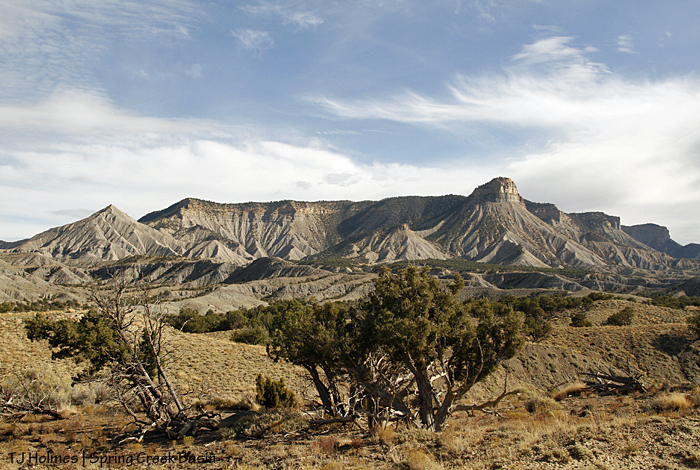
Beyond Spring Creek Basin in McKenna Peak Wilderness Study Area: McKenna Peak at far left and Temple Butte toward the right. Outside Spring Creek Basin, they are two of the basin's most recognizable landmarks.

View from the top. 🙂


Chocolate-chip cookies fuel fence work

29 10 2015

Kathe Hayes with San Juan Mountains Association offers homemade chocolate-chip cookies to Abby, working with Zoe to dig holes for an H-brace on Spring Creek Basin's southeastern boundary fence line.

Right here, this is the reason (OK, one reason) we love SJMA‘s Kathe Hayes: She brings homemade chocolate-chip cookies as mini mid-work thank-yous! Here she offers cookies to Abby as she and Zoe dig post holes for the next H-brace in the SCC crew’s brand-new fence section.

Southwest Conservation Corps co-crew leader Dillon and members Sarah and Aaron complete an H-brace (background) while Abby and Zoe dig post holes for the next H-brace - across a little arroyo - in Spring Creek Basin's southeastern fence line.

The crew has made excellent progress in their section of fence line – building five H-braces since Monday and working on the sixth as of the above photo. In the foreground, Abby and Zoe dig post holes for the next H-brace, while in the background, Aaron and Sarah and co-crew leader Dillon complete the previous H-brace. Harder to see is the little arroyo – no more than a few feet deep but steep-sided – between the two groups.

Southwest Conservation Corps co-crew leader Dillon and members Sarah and Aaron complete an H-brace in Spring Creek Basin's southeastern fence line while SJMA's Kathe Hayes offers them chocolate-chip cookies. On their third day of work, the crew is almost to the arroyo at the base of the steep hill.

Here’s a closer look at the arroyo. Note Kathe in the background, approaching with her awesome cookies.

Southwest Conservation Corps co-crew leader Dillon and member Sarah thread wire to complete an H-brace in Spring Creek Basin's southeastern fence line. SJMA's Kathe Hayes offers homemade chocolate chip cookies to Sarah, Aaron and Dillon.

Kathe makes her cookie offering while Dillon, Sarah and Aaron complete their H-brace. Eric and Toby and co-crew leader Sarah, not pictured because they were working on different sections of fence, also got cookies, hand-delivered by Kathe, and she left the whole bin. 🙂

Southwest Conservation Corps co-crew leader Dillon and member Sarah thread wire to complete an H-brace in Spring Creek Basin's southeastern fence line. At right, SJMA's Kathe Hayes shows crew member Aaron photos of the pack horses that carred fencing materals to the work site a few weeks ago.

Kathe shows Aaron photos of the pack horses that hauled fence supplies to the work site a few weeks ago while Sarah and Dillon finish their H-brace. Temple Butte watches over the crew from the background.

Southwest Conservation Corps co-crew leader Dillon and member Sarah thread wire to complete an H-brace in Spring Creek Basin's southeastern fence line.

This is where they are; that’s where they’re going! And that’s why they’re here. Mizzou students … you’re welcome! 🙂


SCC working for our mustangs

27 10 2015

Here in Spring Creek Basin, we are incredibly lucky to have the benefit of multiple partnerships that work for the well-being of our mustangs. Our newest partnership is with Southwest Conservation Corps, based in Durango. Thanks to the diligence of San Juan Mountains Association‘s Kathe Hayes and Tres Rios Field Office range specialist Mike Jensen, we have an SCC crew tackling an especially difficult section of fence: across an arroyo and up a steep, shaley hill.

Long-time readers know about our wonderful alternative spring break program with University of Missouri students and that, for the last four years, students have been rebuilding the basin’s southeastern fence line. The SCC crew, which has spent the summer building trails, building fences and planting trees, is jumping ahead a bit to the steep section.

As we are with every bit of help that comes our way for the benefit of the mustangs, we are hugely grateful for their work!

Southwest Conservation Corps' Jordan explains previous fence building by University of Missouri students to SCC crew members along Spring Creek Basin's southeastern fence line. The SCC crew is on site to replace a difficult section of the fence that goes up a steep hill.

Jordan explains previous fence building by Mizzou students to SCC crew members, starting the first day of their hitch in Spring Creek Basin. Mizzou students and BLM employees and volunteers have set the bar high with the new fence! From left: Sarah, Eric, Jordan, Abby, Aaron, Toby behind Dillon, Dillon and Zoe.

Southwest Conservation Corps' Jordan stands by with a shovel whie Eric takes his turn at digging a post hole for an H-brace in Spring Creek Basin's southeastern fence line.

Jordan stands by with a shovel while Eric digs a post hole for their first H-brace.

Southwest Conservation Corps crew members Dillon, Jordan and Zoe place protective staves around a tree that will serve as half of an H-brace in Spring Creek Basin's southeastern fence line.

Co-crew leader Dillon helps Jordan and Zoe protect a tree with staves around which to wrap wire. The Mizzou students this spring ended their two days of work with an H-brace on the other side of this tree.

Southwest Conservation Corps crew members Abby and Aaron use the post puller to remove a rotted post in Spring Creek Basin's southeastern fence line.

Crew members Sarah and Aaron work together to pull out an old fence post that had a rotten bottom from being in the ground for who knows how many decades.

Southwest Conservation Corps co-crew leader Dillon checks the level of the cross post on an H-brace installed by crew members including Abby and Eric (shown) in an H-brace they installed in Spring Creek Basin's southeastern fence line.

Crew members Abby and Eric, who helped dig the hole for the H-brace post, watch as Dillon checks the level of the cross post.

Southwest Conservation Corps crew members Sarah, Zoe, Aaron and Eric watch Jordan as he shows them how to twist staves in crossed wires to pull together an H-brace they installed in Spring Creek Basin's southeastern fence line.

Co-crew leader Sarah (there are two Sarahs on this crew) and crew members Toby, Aaron and Eric watch Jordan show them the twisting technique of the staves in the cross wires that bind the H-brace together.

The crew finished the H-brace and strung strands of wire on their first day of work … which started with about a quarter of an inch of rain! As you can see, the day ended with beautiful sunshine.

One of the coolest part of the day? Seeing the pintos as we drove to the work site and again as we returned to the camp site. 🙂 The horses are the reason for the work, the partnerships … the tramping through mud carrying heavy posts and fencing tools. They’re absolutely the reason we do all that with smiles!


Partners for mustangs

3 10 2015

Wednesday, I partnered with folks from BLM, the Forest Service, San Juan Mountains Association and Southwest Conservation Corps to haul fence materials into Spring Creek Basin. Long-time readers of this blog are familiar with the outstanding alternative spring break program that brings a group of enthusiastic University of Missouri students to Southwest Colorado each year (look under the March links in the blog roll). In addition to working in Spring Creek Basin, students work on other areas of San Juan public lands for a week before heading back to class in Columbia, Mo. After four years, students have rebuilt quite a long stretch of our southeastern boundary fence – carrying materials in by manual labor because of its location in McKenna Peak Wilderness Study Area (no motor vehicles allowed).

Now that we’re pretty far in, and a steep bit of shale hill is coming up (literally), SJMA’s Kathe Hayes and BLM’s range specialist/herd manager Mike Jensen got the attention of the SCC (based in Durango) to give us a hand. While we want to give the Mizzou students a spring break they won’t soon forget, we don’t want to get too crazy. 🙂 Next spring, they’ll continue to rebuild fence from where the last group left off this past spring toward the base of the hill. This fall, the SCC crew will leapfrog where this spring’s students finished to start rebuilding a section from close to the base of the hill UP the hill.

To ease the workload of both crews, our little group hauled fence supplies this week: wooden posts (for H-braces), T-posts (to replace worn/bent/warped ones), lots and lots of staves (to stabilize the wires between T-posts), and rolls of smooth-twisted and barbed wire (to create wild-horse/life-friendly fencing that cattle won’t want to mess with from the outside) – to a site convenient for both the SCC crew this fall and Mizzou students in the spring.

Many, many thanks to BLM’s Mike Jensen, Justin Hunt and Garth Nelson, SJMA’s Kathe Hayes, the Forest Service’s Harold Park, SCC’s Jordan and BLM/SCC’s Lauren for providing the human labor (including hours of scheduling and logistics!).

Huge, huge thanks to our four-legged crew: Traveler (who packed posts), Trapper (who packed staves and T-posts), Pinch (who packed wire and spikes and Lauren :)) and Zip (who packed staves), as well as Jammer (who packed Harold) and Sneakers (who packed Kathe). These seasoned Forest Service veterans made our job much easier – and they worked for apples!*

BLM range tech Justin Hunt leads Forest Service pack horse Trapper with a load of T-posts while Lauren leads Pinch toward the dropoff point along the southeastern boundary fence of Spring Creek Basin Herd Management Area. A Southwest Conservation Corps crew will be in the basin in October to replace a steep section of the fence, which has been worked on for four years by University of Missouri students during alternative spring break.

Here’s a teaser pic of Justin leading Trapper after Lauren and Pinch on the way to the cache site, following Kathe and Harold, who led the other two pack horses. For more pix of a great day of work that benefits Spring Creek Basin’s beloved mustangs, check out SJMA’s photostream on Flicker.

* Jammer and Pinch are Harold’s personal horses, and Sneakers belongs to Kathe.


Fence work, Mizzou style

26 03 2015

Amazingly, all 10 Missourians came back yesterday for their second day of work on Spring Creek Basin’s southeastern boundary fence line. Actually, it’s no surprise! Students returned bundled up against the brisk wind and gathered beneath the Temple-Butte-dominated horizon – dusted with snow! – to gather tools and supplies and head back up the trail. Smiling. 🙂

032515ASB10

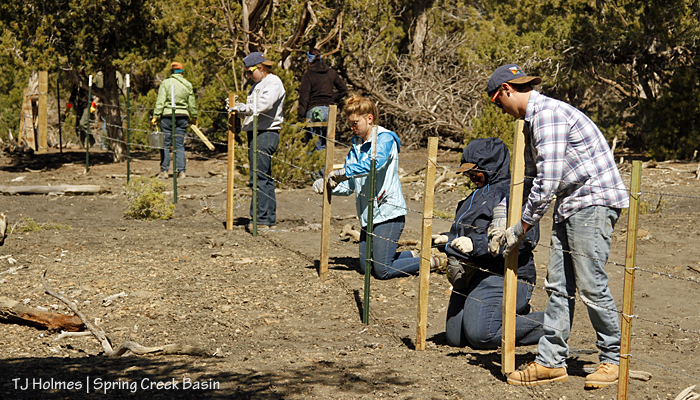
Day 2 was more of the same: Taking out old wire, stringing new wire, installing staves to keep the wires stable. Here, MK Thompson (SJMA), Evan, Aloe, Tom West (SJMA), Jordyn and Mary wire in staves while Jessi carries a bucket containing more cut-wire pieces and Zach carries more staves.

032515ASB9

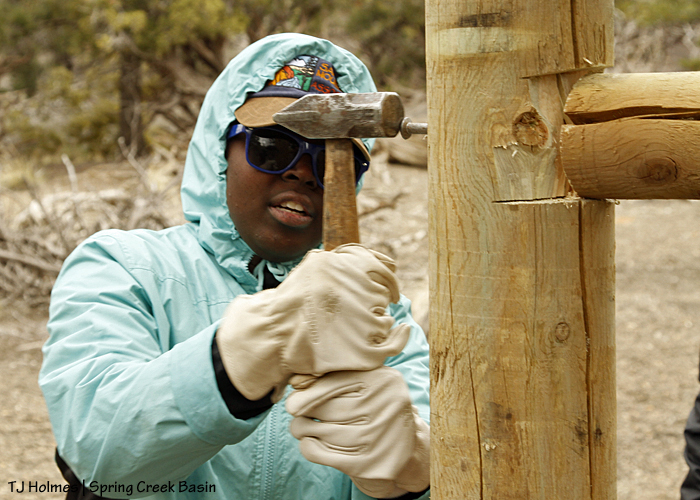
Two more H-braces were built – Miranda pounds in the spike to attach cross post to brace post.

032515ASB8

More wire was tightened to hold H-braces in place – Aloe twisted the post with help from student leader Chalen (far right) and BLM range tech Justin Hunt.

032515ASB7

Did someone mention all the staves wired in place? Evan, Aloe, Jessi and Lauren complete the task, which is the last step in each fence section.

But this group did something a liiiiiittle bit differently this year.

032515ASB6

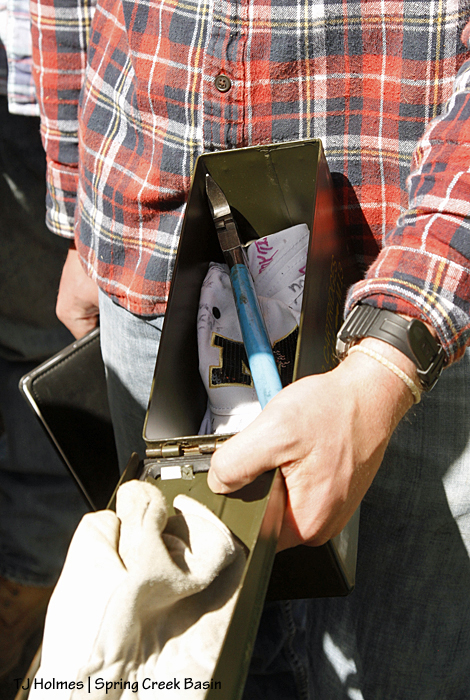
They put items in an ammo box designed to serve as a time capsule, to commemorate their time in Southwest Colorado and Spring Creek Basin. Items included notes written to future fence-builders (or themselves in 20 years?!), a Mizzou ball cap signed by students, BLM and volunteers, an SJMA bandana, a pair of watermelon-colored sunglasses similar to the protective eyewear issued to students without their own shades and – appropriately – a pair of fencing pliers.

032515ASB4

To end the day, students took turns pounding a “golden” spike into their last H-brace post …

032515ASB3

… then gathered ’round to collectively feel the good vibe!

032515ASB1

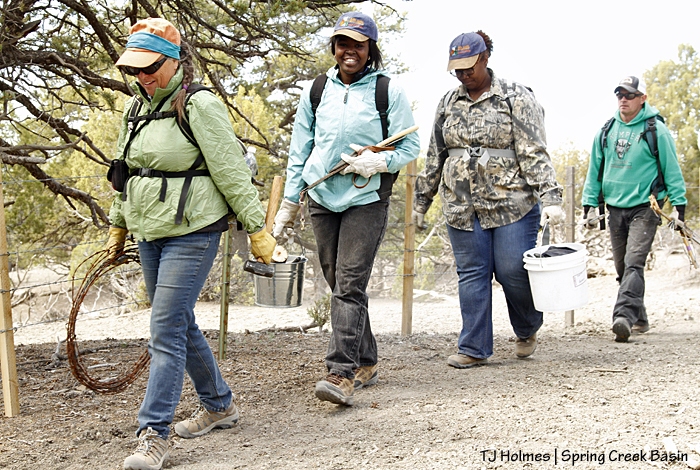
Of course, the very last task is to carry out old wire and tools.

032515ASB2

It was the girls – Mary and Sarah – who still had the strength to carry the lion’s share of old wire on one of the heavy tamp bars.

Young ladies and gents, sincere, heart-felt and appreciative THANK YOU for your work to help rebuild our fence and keep our mustangs safe! At the end of the day, we drove into Spring Creek Basin to see those for which we labor with such good cheer: the mustangs. We saw several bands and got to see some of the horses “running with the wind.” They make all our labors worthwhile!

032515ASB5

Justin, Mike, Aloe, Miranda, Zach, Lauren, Sarah, Mary, Evan, Jordyn, Chalen, Jessi, Kathe and MK (and Tom and Dave) … thank you, thank you, thank you! (The box on the cross post is the time capsule, and it was buried in the hole Jessi and Kathe are *not* falling into!)

Mizzou, every spring, you send us a crew of brilliant, enthusiastic, kind, productive, hard-working and happy young people. Hopefully we send them back to Columbia with one-of-a-kind memories of an experience that will stick with them for the next 20 years. We think our fence will last at least double that, but we’ll see you in 2035 to find out!

Thank you, truly, for your exceptional work for our mustangs. 🙂


Putting the fun in alternative spring break

25 03 2015

It is alternative spring break time again in Missouri and Colorado! This is the awesome time of year when the weather is fabulous and the University of Missouri sends us several of their marvelous students to do good work on San Juan public lands. This includes Spring Creek Basin Herd Management Area, managed out of Tres Rios Field Office in Dolores.

This is the fourth year students have helped us rebuild the basin’s southeastern boundary fence. Here are some more stats: This is the third straight year for student leader Chalen (who got married right before coming to Colorado – congrats!). It’s the 19th year of the alternative spring break program here; that means next year will be the 20th year! Wow. Kathe Hayes, leader extraordinaire and volunteer coordinator with San Juan Mountains Association, has been organizing this program for “16 or 17 years.” She may have said 17 years last year, so she may be underestimating her dedication to this super program.

Chalen said Mizzou sent 138 crews out of Missouri this school year for projects in the USA and abroad. Wow again!

As always, we are incredibly appreciative and wonderfully humbled by the students’ enthusiasm and get-‘er-done attitudes. Most come with little or no fence-building experience, but as Kathe noted at the start of the day, they all came equipped with excellent footwear!

Let’s take a look at their progress Tuesday:

032415ASB32

Zach and Evan were two of three boys (including Chalen) on the crew this year. Here, they’re carrying a roll of wire and a tamp bar to the start of the to-be-worked-on fence (we should measure this – probably half a mile from the road? – and it ain’t flat). Jessi follows them with buckets of tools. Check out the awesome fence beside them, built by last year’s crew.

032415ASB31

Putting their muscles to work right off the bat. It is NOT easy to carry those wire rolls.

032415ASB30

BLM herd manager Mike Jensen demonstrates the use of fencing pliers to the girls: Miranda, Sarah, Mary, Lauren, Jordyn and Aloe.

032415ASB29

SJMA’s Kathe Hayes and BLM’s Dave Sanders walk along the fence where Sarah, Miranda, Mary and Aloe are undoing the wire pieces that hold old barbed wire strands to fence posts.

032415ASB28

After they removed the wire, they had to roll the wire – again, NOT easy. Sarah, Aloe, Jordyn and Jessi keep their strands untangled.

032415ASB27

It’s hard to tell what’s going on here, but Mike and Chalen are moving an old tree away from the fence line. It fell in such a way that previous fencers used one spike of a root to stabilize wires. It was cool! But ultimately not very appropriate. Sigh. If you must …!

032415ASB26

Kathe demonstrates the start of the wire roll to Mary.

032415ASB25

On any fence-building project, there’s a little bit of this – carrying rolls from brace to brace. Chalen and Zach carry the wire while Mike follows to keep it smooth.

032415ASB24

Before the new wire gets strung, the old wire must be rolled. Lauren shows off a perfect roll!

032415ASB23

Do these girls know how to have fun or what? Lauren (right) and MK rolled one strand of wire from either end and met in the middle, where Miranda stepped in to separate the two.

032415ASB22

Sarah shows off her wire roll while Miranda prepares to photobomb!

032415ASB21

Kathe heckles the photographer …

032415ASB20

… then shows off her mad fence-post-pounding skills!

032415ASB19

It’s not ALL about work. We do allow a few minutes for lunch, during which, we got to know a little more about the students and what they’re studying at Mizzou. This year, students span all classes – from freshmen to seniors – and have a variety of majors: accounting, photography, journalism, forestry, exercise science, health science, anthropology/international studies. Most are from Missouri, but others are from Illinois and Texas (interestingly enough, a town in the same county as yours truly’s parents call home).

032415ASB18

After lunch, it was right back to work. Sarah, Miranda and Zach (and others) took turns pounding through shale to dig a hole for a new brace post. Talk about sweat equity!

032415ASB17

Students coined a new term this year: fox-holing. Instead of using what was decided to be the most inefficient tool of all time – the post-hole digger – students shoveled dirt and shale out by hand.

032415ASB16

Hole-digging is an arduous process, especially through rock. Justin Hunt (BLM range tech) and MK Thompson (SJMA) double their digging.

032415ASB15

Mike drills a hole for a spike to be pounded to attach the brace post to the tree while Chalen steadies the post. Readers may remember that the southeastern fence line is wholly within McKenna Peak Wilderness Study Area, where no mechanized or motorized tools are allowed.

032415ASB14

After the hole is drilled, Jessi pounds the spike. The drilled hole eases the way, but it still requires some muscle!

032415ASB12

Tightening the wires on the braces is fascinating stuff! Go, Mike! Jessi, Kathe, MK, Chalen and Jordyn appreciate the effort. Note the fancy duct-tape circling Jordyn’s jeans-clad leg, which fell prey to a barbed-wire barb – a hazard of working with the stuff.

032415ASB11

Yep, there was more of this with Zach and Evan doing the heavy lifting and Mary keeping the wire flowing free.

032415ASB10

The students built two braces yesterday. Jordyn, Kathe and Aloe help Mike (out of sight behind the tree) while Justin and Miranda (background) feed the wire from the roll.

032415ASB9

Kathe pounds a staple to attach wire around a tree at a brace (out of sight to the right). She soon switched from fencing pliers to a bigger mallet.

032415ASB8

This post was pretty wobbly with a rotten bottom. MK rocked it out of the ground, and Dave sawed the rotten bottom off with help from Evan. When they flipped it (the former top went bottom-down in the new hole), they wanted it to look pretty for the mustangs! Always thinking about the horses – love it!

032415ASB7

Old wire out (and rolled) – check. Braces built – check. New wire strung – check. Clips attaching wire strands to T-posts (and staples to wood posts) – check. More new wire strung – check!

032415ASB6

Sore arms are a given after a day on the fence line (and they’re coming back today!). Sore cheeks from smiling? Yep, those, too. MK and Justin attach wire to the tree to run to the next brace.

032415ASB5

Jordyn and Mary use a measuring stick to attach the top wire of the new fence. Students are following wildlife-friendly fence-building concepts; the top and bottom strands are smooth-twisted wire (for wildlife), and the middle two strands are barbed (to deter cattle). The bottom strand is 16 inches off the ground to allow fawn and (elk) calf movement, and the top and second-from-top strands are wider spaced to prevent legs from getting twisted in the wire when jumping the fence. Note the helpful “UP” note on the measuring stick.

032415ASB4

Note the great smiles! In the background, Mike and Kathe admire the students’ handiwork.

032415kathemarysarah

Kathe, Mary and Sarah carry old-wire rolls back to the trucks at the end of the day.

032415ASBgroup1

By the time we got organized enough to take a group pic with the wire proof of their labors, Evan, Aloe and Jordyn already had headed for the trucks. We’ll get a group pic today with everyone! Front row from left: Kathe, Sarah, Lauren and Mary. Back row from left: Justin, Chalen, Miranda, Dave, Zach, Jessi, Mike and MK.

THANK YOU, Mizzou students! Every year, you impress us with your energy and ability to make a mundane, labor-intensive job a whole lot of fun. This year is no exception, and we so appreciate that you chose to come to Southwest Colorado for your spring break, to work instead of party – though we hope you have a lot of fun!


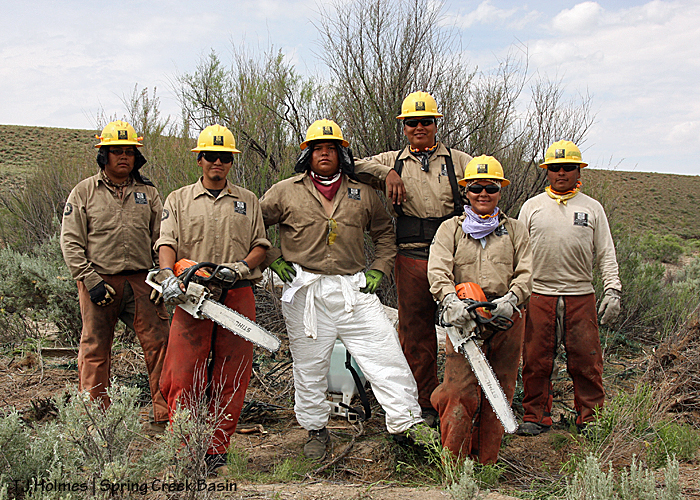
SCC crew cutting tamarisk

1 06 2014

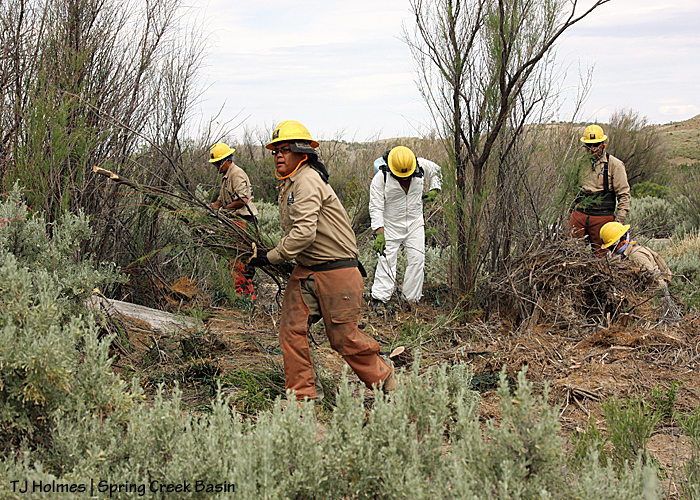
Last week, a Southwest Conservation Corps crew spent four days in Spring Creek Basin cutting and spraying tamarisk. Kathe Hayes with San Juan Mountains Association played a big part in getting the crew here for this project, which – I think – was funded out of the Director’s Challenge grant our Tres Rios Field Office was awarded a couple of years ago.

Crew members are from Fort Defiance, Ariz. Several of them have been together since March, and a couple of them volunteered to join the crew for this project in the basin. Crew leader Lance Hubbard said this is his fourth or fifth season with SCC. Most of those have been spent doing irrigation, wash restoration and trail work; this was his first season to do chainsaw work. From here, they’ll head back to Ganado, Ariz., for all of the above.

Tamarisk eradication has been done off and on for many years in the basin. Some of our University of Missouri students have worked on it during alternative spring breaks with Kathe. Also working in the basin last week was a Forest Service sprayer, Gary, working in some of the main arroyos.

052914SCCfive

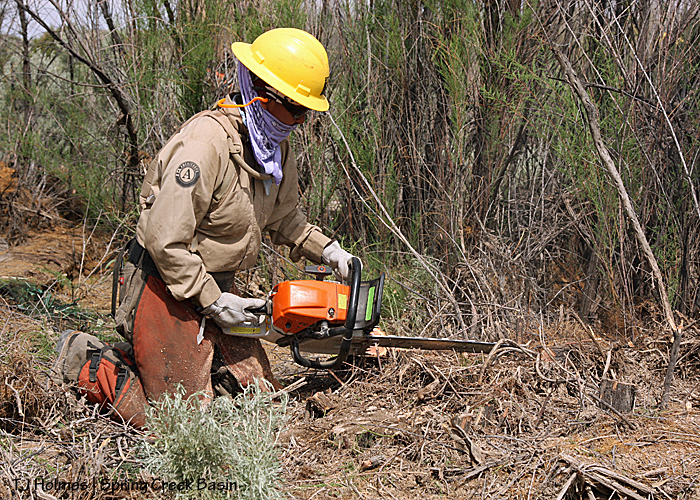
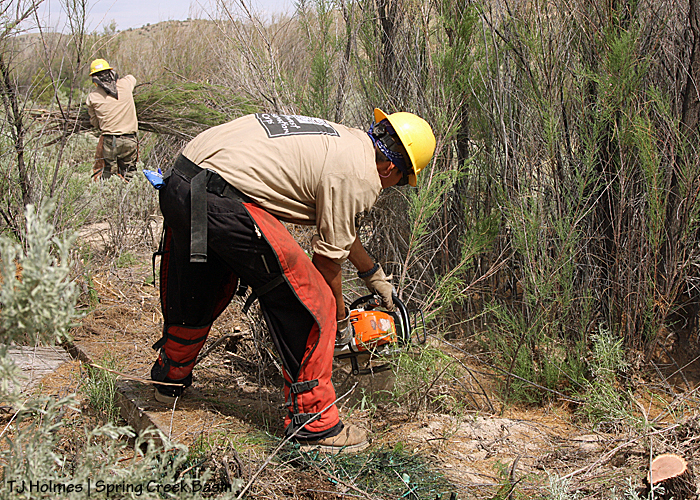
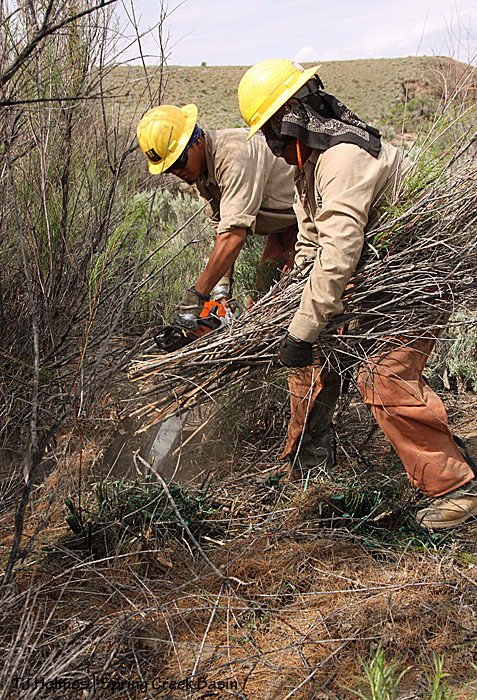
Five guys and one woman, ranging in age from 20 to 25, were on the crew (I couldn’t get them all in one frame until I made them pose for me at the end because they were all constantly in motion). Two wielded chain saws, cutting tamarisk as close to the ground as possible so the stumps would pose as little hazard as possible to the horses. Three cleared the branches and carried them to slash piles for later burning. And one sprayed the stumps with “Habitat” to prevent the tamarisk from growing back. Crew members traded spraying, carrying and cutting duties each day.

052914SCCshoanyah1

Shoanyah Halwood wielded one of the chainsaws. My back ached just watching her!

052914SCCmatthewadrian

Matthew Begay wielded the other chainsaw. Adrian Benally was his partner to clear and carry branches to the slash piles.

052914SCCadrianmatthew

Another one of Adrian and Matthew working together. Sprayed stumps are visible in the foreground.

Alonzo Moses, 23, carries cut tamarisk branches to a pile to be burned later.

Alonzo Moses carries branches that Shoanyah cut to a slash pile.

052914SCClance

Crew leader Lance Hubbard also carried branches to slash piles.

052914SCCrolando

Rolando Billie handled spraying duties on the crew’s last day in the basin. It was pretty warm during their week, but they had a little bit of cloud cover toward the end that helped.

052914SCCcrew1

From left: Adrian, Matthew, Rolando, Lance, Shoanyah and Alonzo. They’re standing where a big clump (grove?) of tamarisk once grew.

Getting rid of moisture-leaching, salt-depositing tamarisk is a big, worthwhile project in Spring Creek Basin, and we appreciate their work on behalf of our mustangs! They did see a couple of bands during the week and thought the horses were pretty cool. 🙂 Thanks to this hard-working crew!