
This …

and this …

led to a little of this yesterday afternoon. 🙂 Note the rain in the background. We did get a little dampness.
This …
and this …
led to a little of this yesterday afternoon. 🙂 Note the rain in the background. We did get a little dampness.
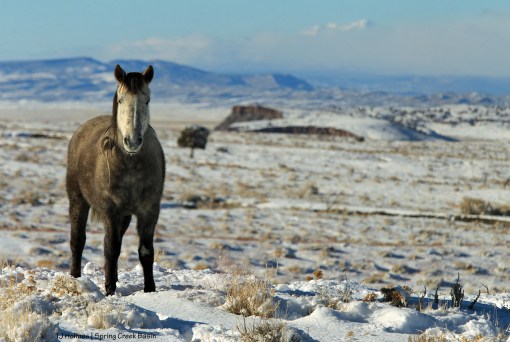
It’s here! 2020!
Much of our current technology makes our lives easier or better, but the things most lacking in technology still might be the ones that bring us the most peace and happiness. Spending time in the natural world, on trails, not roads, with mustangs, not on social media, brings me the most peace and happiness.
When I scrolled down through the blog posts from the last year, it became apparent that I tend to repeat a few basic words:
Beauty.
Moisture.
Gratitude.
Beauty = It surrounds me. It lifts me. It is a constant in my life. From the mustangs themselves to this little paradise in southwestern Colorado, beauty permeates my life.
Moisture = We always seem to need it … and more of it. 🙂 When we’re lacking it, we worry. When we receive it, we’re grateful.
Gratitude = The most important aspect of appreciating all that surrounds us in this life, the challenges as well as the blessings.
There’s a lot going on in the world today. Many headlines are negative and, in some cases, downright terrifying. There tends to be a feeling of dismay, of crushing hopelessness, the thought that any one of us can’t do anything against the onslaught of doom.
And yet light shines. Possibly – probably – in more places than we realize. For all the negative headlines, there are stories that don’t make headlines, that go unnoticed except by the people involved.
We have a pretty good story going here in Spring Creek Basin. Our partnership with BLM has resulted in a mustang herd that is well-managed and cherished.
Our horses are beautiful. We have moisture.
We are grateful.
Here’s to more of the same in 2020. 🙂
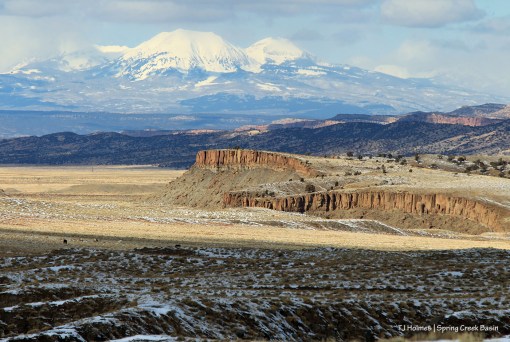
Don’t miss the mustangs for the mountains. 🙂
Hint: They’re just inside the line of shade at middle-left in the photo. In the middle-ground of the photo is the north rim of Spring Creek canyon. The farthest “point” forms part of Spring Creek Basin’s western boundary.
Disappointment Valley got a varying amount of snow – about an inch in the basin.
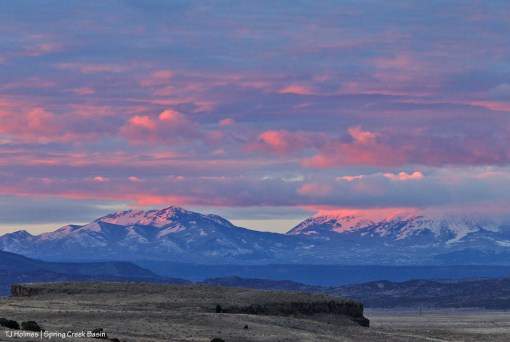
Part 1: I kinda forgot to do a blog post last night for this morning.
Part 2: Disappointment Valley woke up to a dusting of snow, and I didn’t really have a pic to fit the scene.
The above photo shows sunset a couple of evenings ago over the La Sal Mountains, to our northwest. The south rim of Spring Creek canyon can be seen in the foreground. We didn’t get nearly the moisture from this system that was a) forecast or b) expected by those of us always wishing and hoping for moisture forecasts to be true.
It’s a very dry snow, so not much moisture, but it’s pretty, and if it lasts long enough, I won’t forget a pic for tomorrow’s post! Well, I won’t forget in either case!

When I first saw this handsome boy, he was on the Spring Creek Basin side of the fence along Disappointment Road.
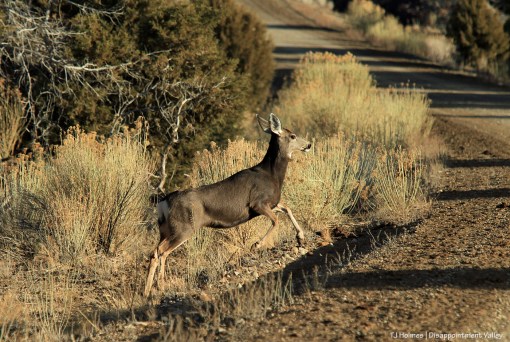
He was courting this very lovely lady.
The basin is to the left in the pic above. After moseying through the trees along the fence, they jumped it, and he’s behind her, about to follow her across the road.

Mostly, he kept her on the move, but he did stop to give me a pose.
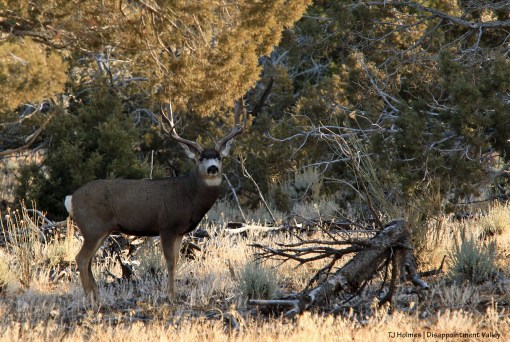
Spectacular!

If you said even a little prayer for rain in Southwest Colorado, thank you. Sincerely. 🙂
We got a really good, soft, fairly long, wonderfully welcome shower yesterday evening. The ground is sighing in gratitude, and so are we all.
Family members and friends of Pati Temple drove into Disappointment Valley yesterday to celebrate a woman who changed all our lives for the better. To her, we dedicated the now-officially named Temple Butte.
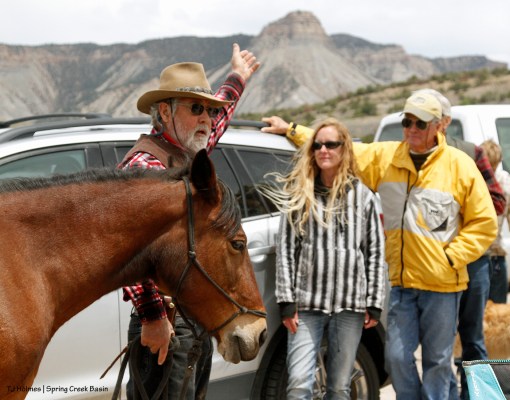
David Temple led the ceremony with Marona, the first mustang he and Pati adopted. She’s a Spring Creek Basin native. 🙂 Pati’s sister Marcie is in the striped jacket, and long-time family friend Mark is in the yellow jacket.
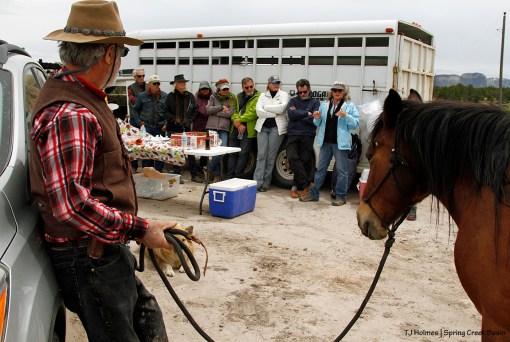
Long-time friend Sara Staber (in blue) speaks about Pati, telling the story about how Pati successfully fought to return Traveler to Spring Creek Basin after he was removed during the 2007 roundup.


Kat Wilder talked about the impact Pati had on her … though she never met Pati.

Former San Miguel County Commissioner Art Goodtimes served with Pati years ago on BLM Colorado’s Southwest District RAC. He spoke about how she inspired everyone with her passion for public lands. She was Art’s introduction to the mustangs of Spring Creek Basin.
(Note: Temple Butte is in San Miguel County. It’s just outside Spring Creek Basin Herd Management Area, which straddles San Miguel and Dolores counties.)


Marona, about 21 years old, loved the attention.
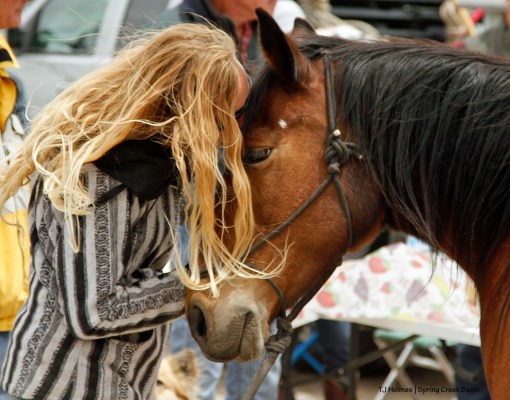
The feelings were mutual. 🙂

Our sincere thanks to everyone who came from far and wide to honor Pati Temple and her dedication to Spring Creek Basin’s mustangs!

A special dedication to a special lady.
Today in Disappointment Valley, we’re having a ceremony to dedicate Temple Butte in honor of our dear and much-missed friend – and friend of mustangs – Pati Temple.
Last year, just before Christmas, we learned that the U.S. Board of Geographic Names had granted our request to officially name Temple Butte. It was an arduous application process, and we are tremendously thankful to Ann Bond for her commitment to the paperwork and seeing it through to the successful end.
San Miguel County commissioners (Kris Holstrom, Hilary Cooper and Joan May) wrote a letter of support for our application, and we thank them, especially past and present members who knew Pati personally.
Pati worked tirelessly with local BLM employees to get things done for Spring Creek Basin’s herd, and Wayne Werkmeister, herd manager in the 1990s who played a vital role in the creation of the Colorado chapter of the National Mustang Association, wrote a letter of support for Temple Butte. He’s currently the associate field manager at the Grand Junction Field Office (out of which the Little Book Cliffs herd is managed). At Pati’s insistence (one of her best traits was her absolute refusal to take no for an answer!), Wayne was here for our 2011 (last) roundup, during which we implemented our PZP program.
Mike Jensen, current Spring Creek Basin herd manager who also knew Pati, had this to say: “I really see it as fitting to have that beautiful butte which looks down on the HMA named in honor of Pati. Her passion for those horses was a driving force in where we are today in the management of the HMA.”
During her many years of involvement with Spring Creek Basin and its mustangs, Pati made sure that we partnered with BLM instead of fighting with the agency. That philosophy continues … and look at the good it has generated for our mustangs!
Pati touched the lives of humans and animals alike during her life, and it is fitting for those of us who knew her to continue to advocate for all those who need a helping hand and a word of encouragement.
Thank you, Pati. Thank you to all who made this happen.
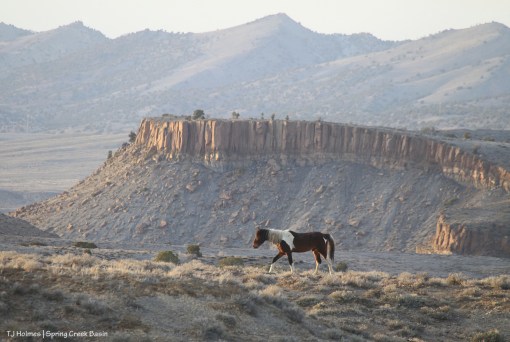
Really. One word. And they all mean “gorgeous”!
The curve of rimrock is the north rim of Spring Creek canyon (through which Spring Creek is STILL flowing). Beyond is more of Disappointment Valley (Spring Creek Basin is a tucked-away little paradise in Disappointment Valley). The mustangs can’t go beyond the rimrocks.

The little blue “square” in the middle is just east of McKenna Peak Wilderness Study Area (labeled), which is east of and in the eastern part of Spring Creek Basin Herd Management Area.
I’m wearing a smile as big and broad as lower Disappointment Valley. 🙂

