Big boy bold!

6 10 2012

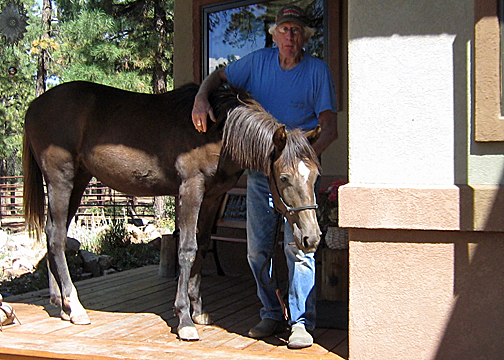
Asher, adopted by local mustang advocate Tif last year after the roundup, has grown into an amazing young mustang.

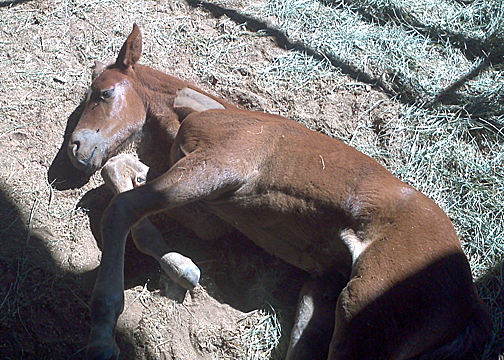
The day after Tif took Asher home.

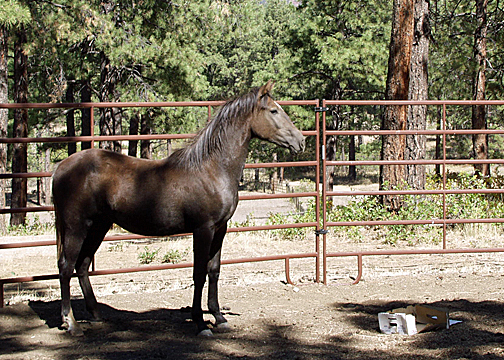
Asher, a few days ago.

In Tif’s words:
“I made the decision several months ago that I had done what I could for Asher. He had become so strong, so confident, that he needed someone that was dedicated, loving and most of all had the time that I didn’t have. Some very good people, very good friends that I’ve come to know over the years came to my mind as possible adopters for Asher. It was a difficult decision for me to make, but a decision that I had to make for him to continue to grow and flourish.

Vern and Jeri with Asher.

“What an incredibly right decision it was. Asher went to his new home for a trial run several months ago. He weighed about 515 pounds. BLM was notified of an address change. I still held title, as is required. We all wanted to make sure that it was the right fit for all parties. I remember loading him up to take him to Vern and Jeri’s house, and man, was that hard. I trailered him over with Pepper, his surrogate mom. I knew she would keep him calm and secure. He responded like he had been trailered many times before. As I left his new home, I bawled like a baby. My head knew it was the right decision, but my heart was aching. I love that little guy so much.

He’s big: 14 hands as a yearling.

“Vern and Jeri have done an incredible job with Asher, as I knew they would. They’ve had some losses recently, and it gave me some comfort that Asher was able to ease some of their pain. They’ve provided Asher with a home that I only dreamed he could have. If we had homes like theirs for all of our mustangs, the world would be a better place.

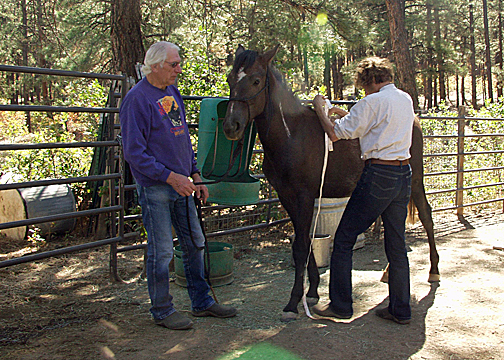
Not afraid of the stick-and-bag; note the lariat on Asher’s butt.

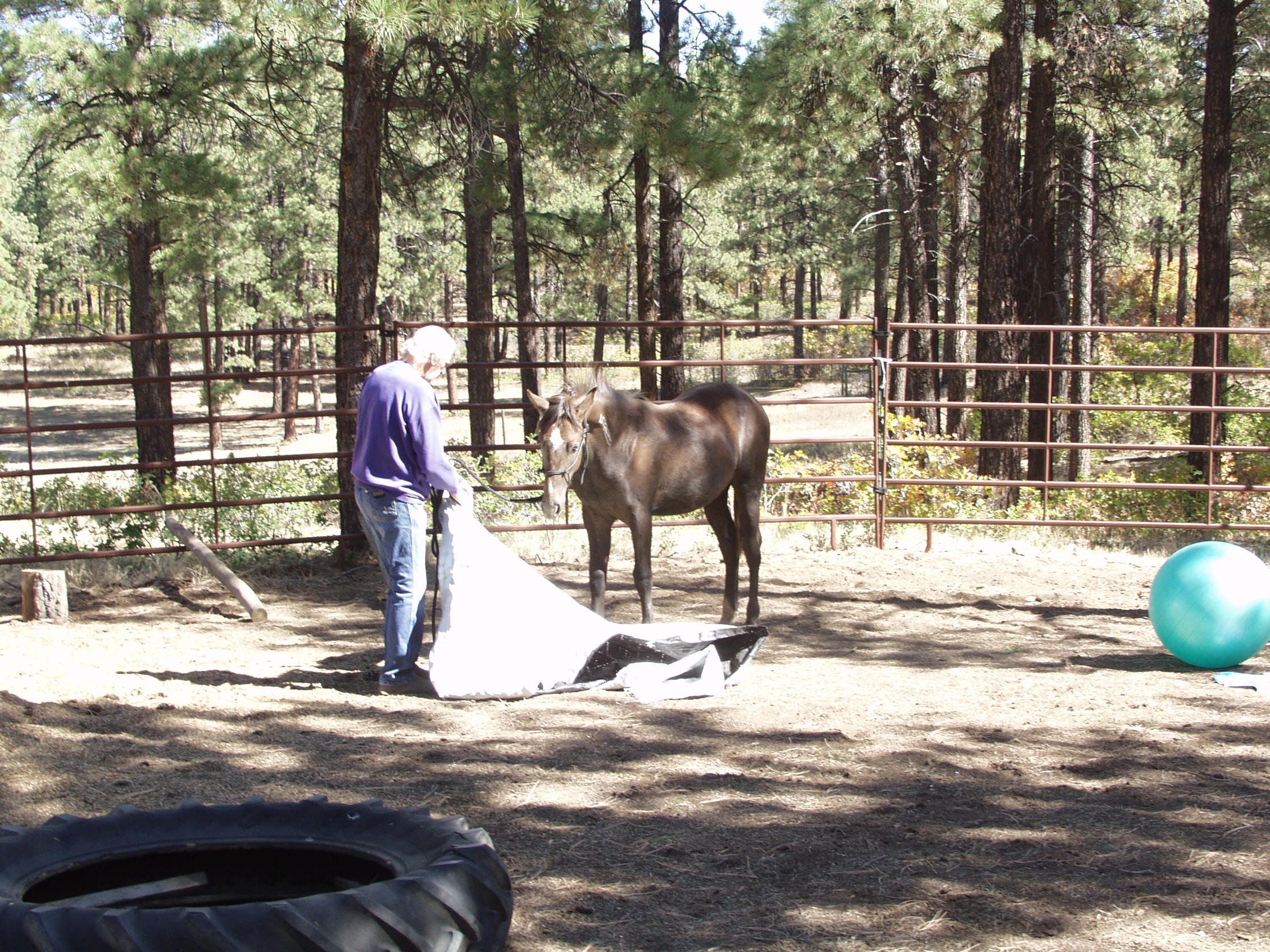
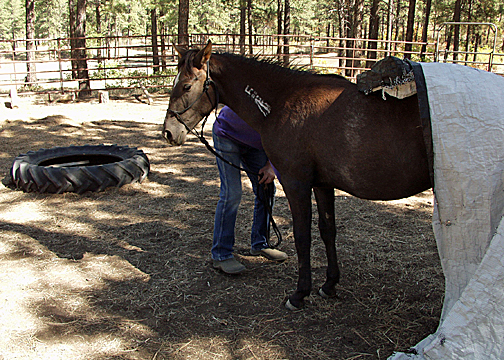
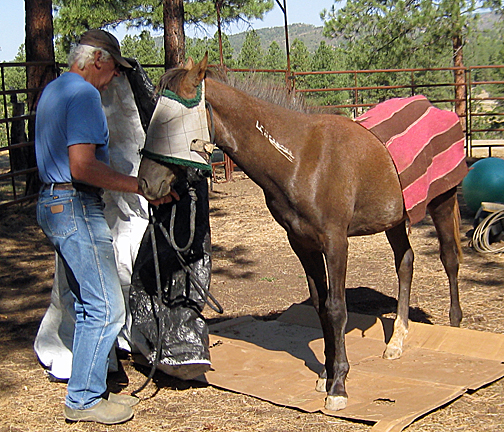
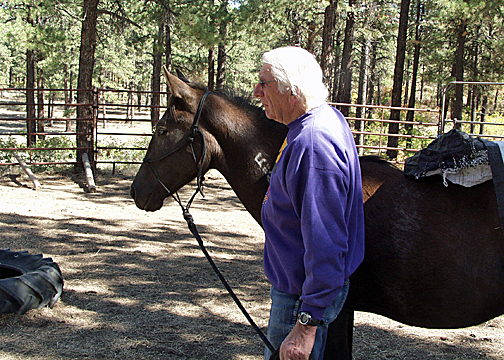
“Vern and Jeri have kept me posted on Asher’s progress. I’ve been out there several times to check on him, see how he’s doing, visit, as I have unlimited visitation rights. 🙂 I went out this past weekend and was absolutely blown away. My little orphan has grown into an elegant young horse. See for yourself. He now weighs about 780 pounds and stands about 14 hands tall. Vern and Jeri demonstrated all of the things they do with him, from free working in their round pen, to jumping over logs and barrels, wearing and walking with a tarp, fly mask, ropes, walking up stairs onto their front porch, checking things out in the garage, giving hugs and hoof shakes, and afraid of a bag on the end of a stick? No way.

Sniffing the tarp.

Wearing the tarp.

Wearing a fly mask and blanket.

Checking out the big rubber ball!

Exploring the garage.

Enjoying a siesta on the porch.

Who’s afraid of a lariat on his head? Not Asher!

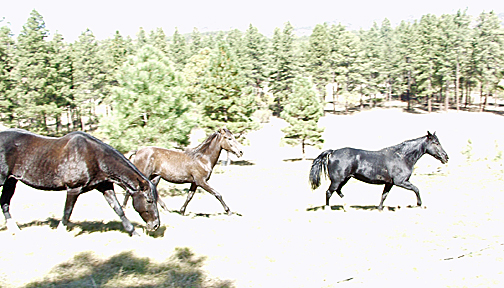
“He has two stable mates that he runs and plays with when they’re turned out together. Vern said that he’s very independent, venturing off on his own while grazing. Jeri is proud of his BLM freeze brand, as it’s a testament to what our mustangs can do.

Pasture pals.

“People are often asking what do you do with them? Everything. They are productive members of every family they belong to. They do everything a horse should do. They are amazing animals, and although they may take a bit longer to come around, some more than others, when they do come around, you have a companion for life. Truly amazing our mustangs. Asher has some baby habits still, but he’ll grow out of them. After all, he’s a yearling. Vern doesn’t let him get away with anything, and that’s as it should be.

Vern and Asher

“Thank you, Vern and Jeri, for providing the best home possible. Tears in my eyes at our visit because I know I made the right decision. Although I wish I could have him here with me, he’s so much better off under your careful training and guidance. You have brought him so far. Your kind hands and warm home have been exactly what he needed.”


Die, thistle, die!

6 10 2012

To follow up from the knapweed spraying seen at the northwest pond, here are some pix of sprayed musk thistle at the east-pocket pond:

On the western edge of the pond.

On the south edge of the pond – and dying already! (Note the water.)

Dying musk thistle, full pond – what’s not to love?

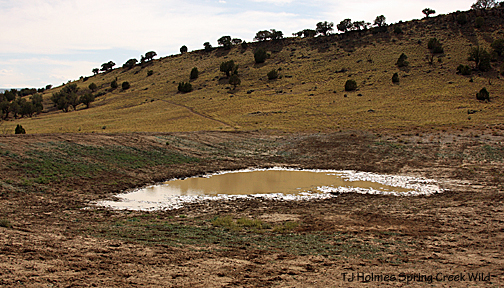
Did I mention full pond? The east-pocket pond now is one of only two ponds in the basin that have not gotten dug out in recent years. It did go dry this year but rebounded (a couple of times) with rain. And the Sorrel Flats pond, which was dug out in 2010, is just to the south.

Thank you to the Forest Service and BLM for your continued partnership with Four Corners Back Country Horsemen and Disappointment Wild Bunch Partners in managing Spring Creek Basin Herd Management Area to the best of its potential! It’s fantastic to come back and see the fruits of our labors – GPS’ing sites in the spring – come to fruition in the fall!


Knapweed spraying

5 10 2012

For two days this week, a Forest Service crew directed by BLM has sprayed Russian knapweed around all the ponds in Spring Creek Basin. In May, Four Corners Back Country Horsemen members and guests GPS’d several sites (including ponds) of weed infestation to help BLM identify sites for future spraying. This is all part of the Director’s Challenge grant, which was awarded to the Tres Rios Field Office based on its affiliation with Disappointment Wild Bunch Partners.

We happened to catch G, with the Forest Service, leaving the basin after his second day of spraying and got the scoop.

After visiting with Duke and Kreacher in the northwest “meadow,” we surveyed the northwest pond and spraying activity.

This was a fitting day to get the news about weed spraying; Pat Amthor, who, with her husband, Frank, has honcho’d 13 years worth of wild horse counts in Spring Creek Basin with Four Corners Back Country Horsemen, was visiting. From our vantage with the boys, it was Pat who spied water in the pond.

The vegetation around the pond is the particularly nasty Russian knapweed, noted in a previous post about the pond and it being dug out this summer (also with Director’s Challenge funds). If the green looks a little unnatural, that’s OK – that’s the chemical spray.

Note: Russian knapweed is toxic to horses if ingested in great enough quantity. The good thing is that horses rarely eat it if other forage is available. And we have plenty of other forage available, especially this year.

As we continued around the basin, we did note that all the ponds we saw showed signs of having been sprayed. Yay!

As a side note, we ended up seeing every single horse in Spring Creek Basin, including – again – the elusive Mr. Poco.


Art for mustangs

18 09 2012

Saturday was the opening reception for an art show at the Ridgway (Colorado) library featuring paintings by Alice Billings and Karen Keene Day.

The door counter registered 180 people coming to view and appreciate the art these talented women have created of mustangs – current and removed – of Spring Creek Basin.

From left: Alice, yours truly, Karen and Martha (librarian) in front of Alice’s (behind me and Alice) and Karen’s paintings in the entryway.

Behind Alice, a little piece of Maia, then Jif’s foal (Jif was found to be branded and ended up being sold through – and rescued from – the sale barn and lives now south of Ridgway) and the noses of Kwana and Terra. Alice adopted Liberty, who lives with her and her herd in Ridgway.

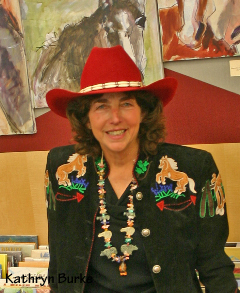
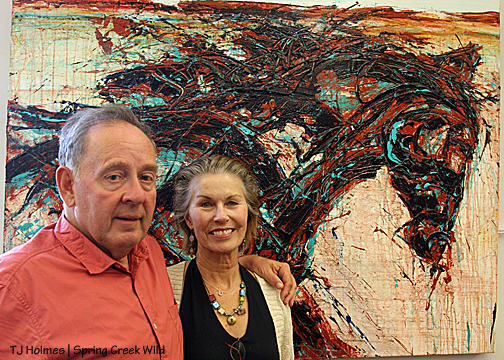
Karen and her husband, Floyd, in front of my favorite of her paintings: “Return To  Disappointment Valley @2008,” a tribute to all who were rounded up in 2007 in Spring Creek Basin. (I want to mention that Floyd, who started life as an engineer, is an accomplished artist in his own right. He likes to paint cows found in the mountain meadows of the San Juans, but we won’t hold that against him! One of his paintings of a cow and calf was used as the centerpiece for a quilt for the Ouray Historical Society this year.) And I’d like to point out Karen’s necklace – pieced together by her farflung grandchildren!

Three of Karen’s paintings. In the middle is her stunning tribute to Steeldust. On the right is one of Karen’s “oil-pan paintings.” It literally starts life as the metal pan under her canvas to catch the oil paint drops. The horses she finds in this “discarded” paint is simply fascinating! I have one of these, a gift after the roundup and adoption last year. Treasured.

Alice also has painted tributes to our Spring Creek Basin horses here now in spirit. These are Cinch (left) and Hook, from my photos.

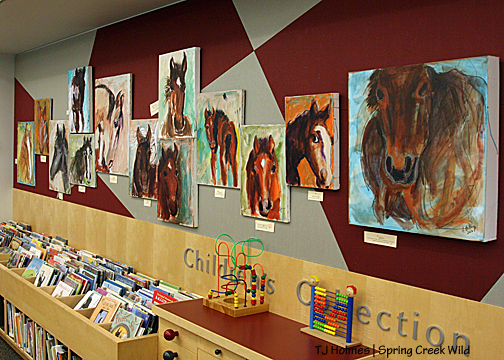
Alice painted portraits of all the foals (current as well as some not still in the basin). I thought it was awesome that they were arranged on the wall by the children’s section in the library.

She nailed cheeky Skywalker, didn’t she!

A close-up view of Temple. Each of the paintings had cards by them to identify the mustang with a short description.

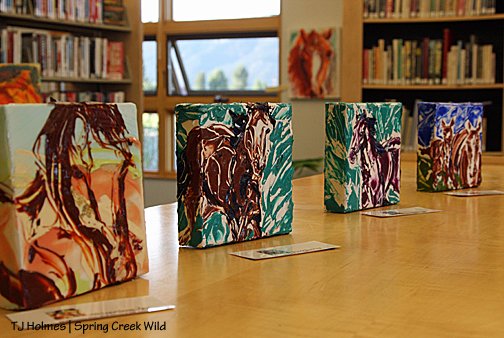
In addition to her large canvases, Karen paints these 8-inch by 8-inch pieces. I have one she did of Bounce. She’s talking with Mary, a friend of Alice’s who provided beautiful guitar music throughout the reception.

A second group of Karen’s smaller paintings with one by Alice in the background by the window.

“Mainstream” artists, these ladies are not! I love the spirit and movement they each manage to coax from their chosen mediums, each reflecting the joy and beauty of our mustangs. What I really love is the aspect of education both feel compelled to impart through their paintings.

Karen’s and Alice’s art will hang at the Ridgway library until Nov. 9. Stop in and see it for yourself if you’re in the area!


Kids and mustangs

17 09 2012

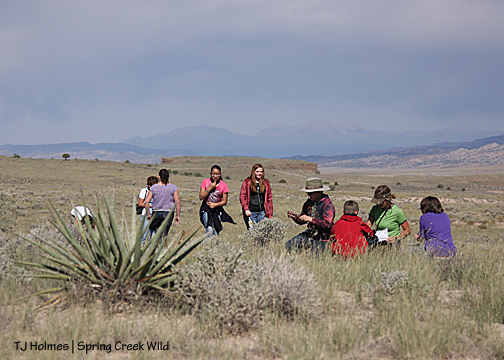
Today, 15 seventh-graders from Naturita came with their science teacher to Spring Creek Basin for a wild horse educational unit set up by Alessandra and Laura of the Telluride Institute.

Kiley Whited, our herd manager based at the Tres Rios Field Office in Dolores, and Kathe Hayes, volunteer program coordinator with San Juan Mountains Association, offered the students a fantastic hands-on activity checking plant inventory along a transect Kiley set up near the water catchment. Students learned about grasses such as blue grama, galleta and Indian ricegrass and shrubs such as shadscale and greasewood, and how those form part of the horses’ diet – and how BLM managers inventory the range to know the appropriate population range – appropriate management level – a given area can support.

The range is looking fantastic now with a lower population level after the roundup and less pressure on the range, despite a significant lack of rain this year. But the little rain we have had has really brought up the vegetation!

Kiley talks about vegetation within the frame along the transect with a Naturita student.

Four groups of students worked along four transects to identify and weigh plant material.

Painted fingernails and a mustang hoof. Kathe Hayes brought this hoof and leg found in the basin several years ago to demonstrate how veterinarians and others are learning about good hoof construction from the hooves of mustangs. The kids thought it was “grody” but kinda cool!

Some “juicy” words the kids used to describe the mustangs: Majestic (love this one!), pretty, field trip!

We had lunch near Seven, Kreacher and Duke, Hayden, Tenaz and Apollo, and also got to see Chrome’s band with little Kwana during our trip.

Thanks all around to everyone who made this trip possible – including the parents who transported the kids! Hopefully we can make this an annual event. The Naturita Colts certainly deserve to learn about the mustangs in their backyard!


Sister, brother

13 09 2012

Always handsome, this pair.

Skywalker with big sister Mysterium.

This band has been relatively elusive lately; this photo is from late August. I last saw them last week, way up high above the northwest valley toward Klondike Basin. A couple of Forest Service folks – H and W – brought Pinch and Jammer and Traveler (!), and we rode some fence and fixed some fence. It was a great couple of days, and the mustangs are safer because of it!


Mustang art in Ridgway (CO)

11 09 2012

If you’re in Southwest Colorado, consider stopping by the Ridgway library on Saturday to see a show by Ouray/South Carolina artist Karen Keene Day and Ridgway artist Alice Billings.
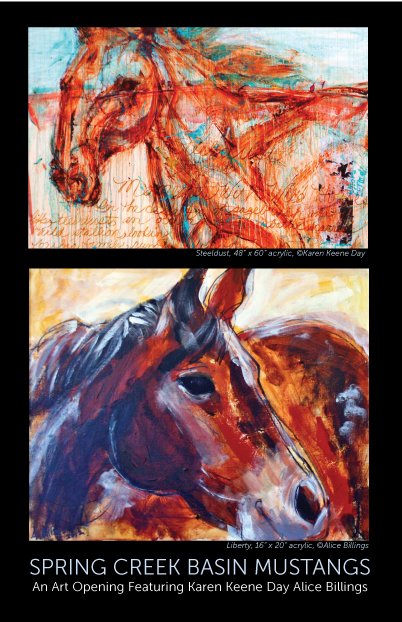
The top painting, by Karen, features Steeldust. The lower painting features Liberty, adopted by Alice.

The art opening will be held from 4 to 7 p.m. Saturday at the library in Ridgway. The art will hanging in the library until Nov. 9. (I’m not sure this side of the card is legible, but I don’t have it in high resolution.)

This local art show featuring the work of local artists of our Spring Creek Basin mustangs aims to raise awareness of our local wild horses. The artistic tribute paid to our horses by these special women is best seen in person. If you’re in the area, stop in and say hello!


Northwest and done

20 07 2012

Three images stitched together in Photoshop. Ragged lines. Photoshop is not my forte!

Now we just need rain to fill it up!


Not-so-big dig

18 07 2012

The Big Dig, it ain’t. But I’m still excited about it!

It represents potentially more water for the horses and increased grazing in an area the horses don’t use a lot because there’s not often water there. And it represents BLM keeping our mustangs’ welfare a priority, especially in this hot and dry year.

We went from this:

To this today:

It’s not done yet! This is looking from the “spillway” across the pond to the west – the same perspective as the photo above. Many thanks to C and J from the Forest Service who are honchoin’g the project and doing the dirt work!

C and J discussing the finer points of pond clean-out. C also was involved in coordinating the contractor hired to dig out the Round Top pond and the one double pond in 2009.

This is what I call simply the northwest pond, it being in the northwestern corner of Spring Creek Basin. This is looking southeastish across the basin. In the middle ground, you can see the twin buttes and part of Flat Top. Just left of the juniper tree in the foreground is the spillway from which I took the first two pix.

J pushing dirt.

There are basically two drainages that feed this pond, and he’s cleaning out in front of the smaller one, which you can see in front of the dozer. The other one is behind him, out of the picture.

Work should be finished on this pond tomorrow! I’ll post another pic or more later.

Also scheduled for dig-out is – at least – the trapsite pond, which is above Spring Creek Canyon (site of previous roundups). The roadside pond, which was about half dug out in 2010 (because it rained before it was completed), will get dug out if there’s time and/or it dries out more. The dirt of that pond, which went dry a month or so ago, is still damp about 4 inches down where the water dried up last. The Flat Top pond, which has been our priority to dig out since 2009, ends up holding some water when the monsoons kick in again. We’ll try to move that up to a June time-frame for next year; if the roadside pond doesn’t get dug out this year, there’s next year.

Director’s Challenge funds, awarded because of the Tres Rios Field Office’s partnership with Disappointment Wild Bunch Partners, are paying for this work!


Rain: falling, filling

13 07 2012

Aspen against a rainy sky a few nights ago.

The recent rains DID, in fact, put water in some of the ponds. Some went from very shallow to quite a bit fuller. Some went from dry to this:

The Flat Top pond. It (likely) won’t get dug out this year, but it’s good to see it with water again.

The northwest pond, however, should get dug out next week – it’s still dry. Or was; the basin got rain again this afternoon after a dry spell of a few days.

The east-pocket pond has water again. The Sorrel Flats pond has way more water (it was getting pretty shallow). And those are just the ones I’ve looked at, being more concerned with pony doings. What can I say, I get distracted easily. 🙂

I should have – but didn’t – take pix of the first Spring Creek arroyo crossing. No more water flowing, but the rocks the water pushed along was awe-inspiring (as always). Water is a driving force in this “Disappointment Country” – and the lack of it just as much, if not more so.

And I’ll leave ya’ll with this pretty sunset over the La Sal Mountains (to the northwest of the basin, in Utah):

It’s good to have rain. 🙂