Preparing for fence work

17 03 2013

In a couple of weeks, it will be spring break time again. And here, alternative spring break comes in late March, courtesy of San Juan Mountains Association, which has brought University of Missouri students to Spring Creek Basin Herd Management Area (and other places on San Juan public lands) for something like 10 years now!

Yesterday, a crew of volunteers helped SJMA’s Kathe Hayes clear greasewood and saltbush and small pinon/juniper trees and a small, interwoven shrub we couldn’t identify away from the southeastern boundary fence so the students can start rebuilding the fence from the road with BLM, Forest Service, SJMA and Disappointment Wild Bunch Partners help. For the second year, the students will work for the basin’s mustangs for two days (previous years have had them in the basin one day), and not for the first year, we’re excited to welcome them!

Some pix from our work:

031613tifmadi

Tif and her daughter, Madison (yes, our Madison is named after *this* Madison!), cut and toss greasewood away from the fence near the road.
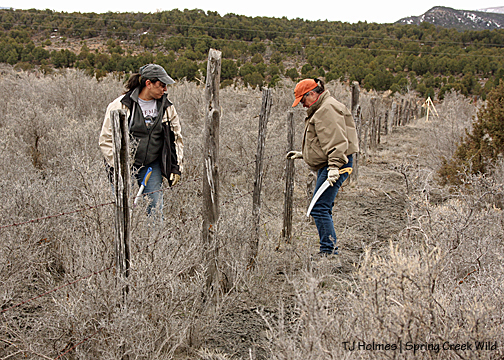
031613lynkathe

Kathe and Lyn clear the fence of greasewood. This shot is looking back toward the road; you can see the metal supports of the cattle guard in the distance. Note Kathe’s handsaw; this part of the basin also is part of McKenna Peak Wilderness Study Area, meaning no motorized travel or mechanized tools – like chainsaws. Kathe and other volunteers cut some trees on another day for the students to use to make H-braces; those also were cut using handsaws.
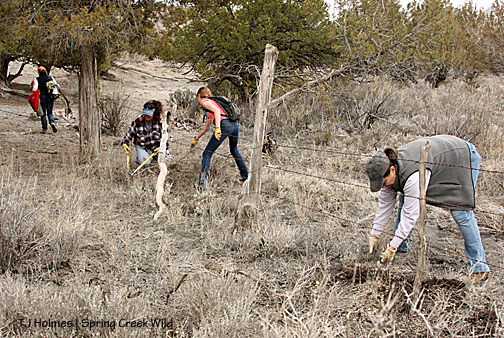
031613fenceclearing

Lyn, Madison and Tif clear brush while Kathe moves on to the next bush in need of clearing. Lyn is clearing the last bit of saltbush; the ground here was moist enough that we were mostly able to pull it up through the soil.
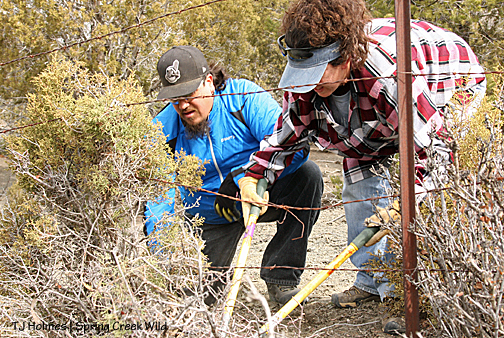
031613tifcurly

The couple that saws together stays together! Tif and her husband (and Madi’s dad), Curly, cut and saw a small juniper tree out of the fence line.

031613curlymadi

Curly and Madison head back to the truck after an excellent day’s work. The family that volunteers together … is super fun to have on your work crew!
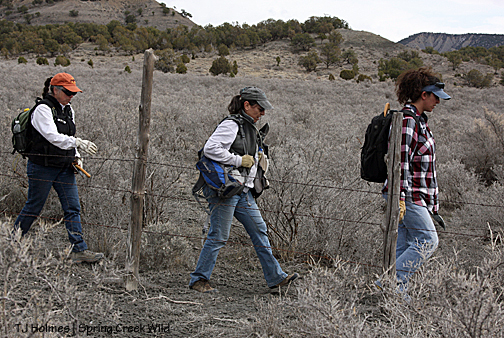
031613tiflynkathe

Tif, her mom, Lyn (Madison’s grandma), and Kathe walk back to the truck along the newly cleared fenceline boundary of Spring Creek Basin.

In other good news, about 37 drops of rain fell while we were working. 🙂


Pati Temple

5 02 2013

012113temple-72

Mustang angel and lover of all wild life Pati Temple passed away yesterday evening.

Look out, God, whirlwind coming your way!

Pati was one of the most influential people in my life, despite having known her for just the last few years. Words cannot come close to describing the dynamo that was Pati, and at this point, the heartbreak is too raw to try.

God speed, Pati, on the wings of your beloved mustangs. You are much loved and will be most incredibly missed.


‘Unbranded’

15 01 2013

With all the craziness surrounding the wild horse “issue,” here’s something that looks pretty cool:

http://www.unbrandedthefilm.com/

From the email that alerted me to this endeavor:

Backcountry  Horsemen,

This is Ben Masters. Myself and three friends are training 11 mustangs and riding them 3,000 miles from Mexico to Canada starting in March. Our route will take six months through Arizona, Utah, Idaho, Wyoming and Montana. We’re making a documentary: Unbranded that aims to promote conservation of open spaces, inspire mustang adoptions and get people outside horseback.

We’re trying to promote our journey and documentary. We need your help by pledging your support and sending the information to others who like horses, the backcountry and conservation. Here is the video, it’ll put a smile on your face:

http://www.kickstarter.com/projects/1978488989/unbranded?ref=live

For more info, our website is http://www.unbrandedthefilm.com/

Western Horseman’s blog over our trip: http://blogs.westernhorseman.com/unbranded/

Thank you,

Ben Masters

benmasters@unbrandedthefilm.com

Check out their story; I’m sure you’ll follow them as I will! Have I ever mentioned I’m an Aggie? Gig ’em, Ags. What a ride it will be!


Dr. Jay

15 01 2013

Here’s another nudge for Wild Horse Scientists – and a guest post on Kay Frydenborg’s blog by Dr. Jay Kirkpatrick!

My copy arrived last week, and I wholeheartedly give it two thumbs up. It’s an excellent resource for information about PZP and how fertility control is helping wild horses, particularly on Assateague Island and Pryor Mountain.  It’s a “children’s book” in the sense that we’re all learning and have much to learn. It’s truly appropriate for ALL ages.

Well-researched, well-written, beautiful photographs, and I absolutely enjoyed reading it.

This is a book that should not languish below the radar!


Assateague & Chincoteague

8 01 2013

In the interest of clearing up what may be common confusion about Chincoteague and Assateauge islands and the wild horses that live there, Kay Frydenborg, author of Wild Horse Scientists, agreed to write a guest post about the topic. Yes, these East Coast islands are most of a continent and a world away from the West’s wild horses, but population management and fertility control are common topics. So here we go. I hope you’ll leave any questions for Kay in the comments!

Sorting Out the Wild Horses of Assateague Island

Since writing Wild Horse Scientists, I’ve run into a lot of folks who are a bit confused about the famous Chincoteague ponies, and that confusion is well-founded. It is confusing. For starters, the animals most people think of when they think of Chincoteague ponies are not ponies, technically, but small horses. And except for a few days each July during Pony Penning (which many people know about from Marguerite Henry’s classic children’s book Misty of Chincoteague and the movie that was adapted from the book), the wild ponies don’t live on the island of Chincoteague, but rather on the larger, uninhabited nearby island of Assateague.

To further complicate things, Assateague Island straddles two states (Maryland and Virginia), and two different federal agencies are in charge of overseeing the wild horses in each state (National Park Service in Maryland, U.S. Fish & Wildlife Service in Virginia). On top of that, the wild “ponies” on the Virginia side of the island are legally the property of the Chincoteague Volunteer Fire Company, which has been running the famous round-up, the swim across the channel to Chincoteague, and the foal auction for many years.  The horses are not only rounded up for this annual event (which provides needed funds for the fire company and much tourism for the town), but they are also gathered at other times and given routine immunizations and veterinary and farrier care. Their population is kept at a maximum of about 150 by means of the foal auction alone; no contraceptives are used to limit the herd size in Virginia.

On the Maryland side of Assateague, home of the Assateague Island National Seashore (as well as a Maryland state park within the national park!), the wild horses are managed quite differently. They’re called horses here, not ponies, and managed in a mostly hands-off manner, with no human handling and no roundups. Unless a horse becomes gravely ill or injured and the Park Service determines urgent medical care or euthanasia is required to spare undue suffering, the only human intervention in the lives of these horses is the remote darting (via special rifles) of the contraceptive PZP. Over the 25-plus years that PZP has been used as the sole management tool, the numbers of horses has gradually stabilized to sustainable levels. At the same time, these horses are observed closely from a distance, and careful records are kept for the purposes of effective management of the PZP program and ensuring that a viable gene pool is maintained among the horses.

Though all of the wild horses of Assateague Island descend from the same original herd, after the island was split with the National Seashore designation in 1962, these different management strategies on the two sides of Assateague have resulted in some real differences in the makeup of the herds. You can read much more about these differences, and the 300-plus year history of these unique wild horses, in my book. I hope you’ll check it out!


Wild Horse Scientists

6 01 2013

wildhorsecover-300

Behind the scenes and out of the public spotlight – the way they like it – are a number of people – scientists – working to improve wild horse management. A new book by Kay Frydenborg, Wild Horse Scientists, published in November by Houghton Mifflin, looks at a couple of these scientists: Dr. Jay Kirkpatrick and Dr. Ron Keiper.

Dr. Kirkpatrick is director of the Science and Conservation Center in Billings, Mont., where PZP is made and darters are trained. His work has proved especially invaluable with the wild horses managed on Assateague Island National Seashore. Dr. Keiper came up with a system of identifying the Assateague Island horses when research and fertility control started there around 25 years ago.

The book is aimed at children 10 and older, but given the myths and misconceptions I still hear about fertility control and wild horses, it’s likely appropriate for all age levels. Also, the idea that science IS being applied to the management of wild horses – particularly on Assateague, where the population is controlled only by the use of fertility control and a roundup hasn’t been conducted in many years (?) – is important and has applications that readers of all ages can appreciate.

Hoping to get more kids aware of the mustangs of Spring Creek Basin, our National Mustang Association/Colorado chapter and Disappointment Wild Bunch Partners are working with the Telluride Institute to get schoolkids to the basin. This book could become an important part of their unit about good, in-the-wild management of these horses.

For more information, see Kay’s website: http://www.kayfrydenborg.com/

From her website:

“Dr. Ron Keiper and Dr. Jay Kirkpatrick have both, in their own unique way, made the wild horses of Assateague Island, Maryland their lives’ work. Experience Dr. Keiper’s handwritten notes—taken over countless watchful hours in the field—which are both a diary and a scientific log that chart the lives of his equine subjects, some of nature’s greatest survivors. And follow Dr. Kirkpatrick from the lab to the field as he works tirelessly to find a way to manage the horse population with a birth control vaccine, and helps keep the precarious balance of Assateague’s ecosystem intact.

“Descriptive prose meets solid science as author Kay Frydenborg offers a rare glimpse into the wild herds of Assateague, sharing beautiful photos of the Assateague herds in their island home and of both of the scientists at work—some of them never seen before.”

Also visit the website where Houghton Mifflin promotes authors, photographers and conservationists who highlight all kinds of topics to get kids interested in science: http://www.sciencemeetsadventure.com/

Find the book on Amazon. I just ordered mine.


From tragedy …

15 12 2012

Seneca

Tragic, senseless heartbreak. Unimaginable to think about what drove anyone to do something so horrific.


Rockin’ steady

13 12 2012

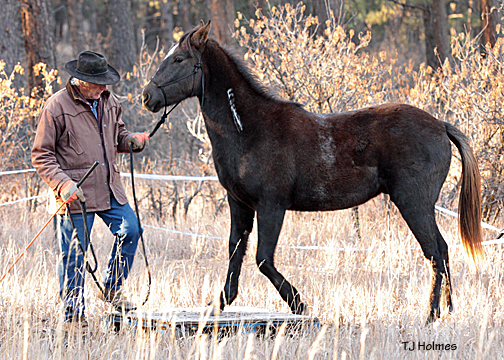
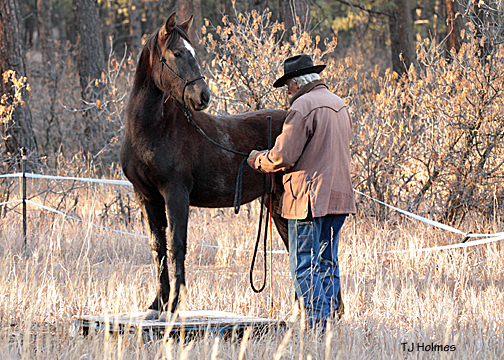
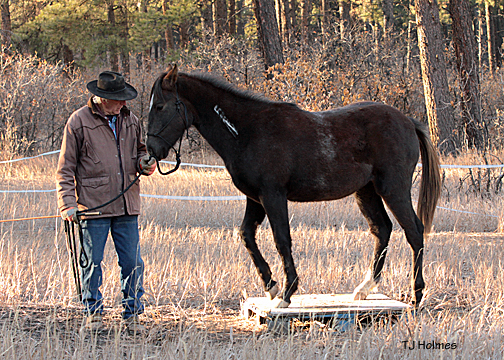
We pick up our story of Asher and Vern after they had left the round pen and walked through the pine forest to the “arena,” which contains obstacles from a past Craig Cameron “cowboy race” in the area. I had heard that Vern had had Asher on the “teeter-totter” and thought, “WOW! Have I got to see THAT!”

But first:

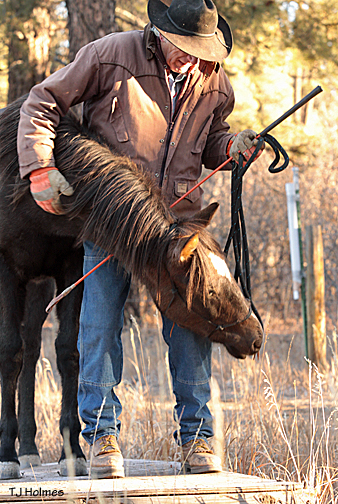
Asher and Vern on the pallet.

Put your left foot in … or up, as the case may be. Vern shows Asher how to step up on the pallet.

Asher and Vern on the pallet.

There’s a little mister proud of himself and looking back to mama Jeri (Vern’s wife, Jeri) for approval!

Asher and Vern on the pallet.

That’s it, kid!

You can really see his grey streak in these pix. It’s only on this side, not his other side.

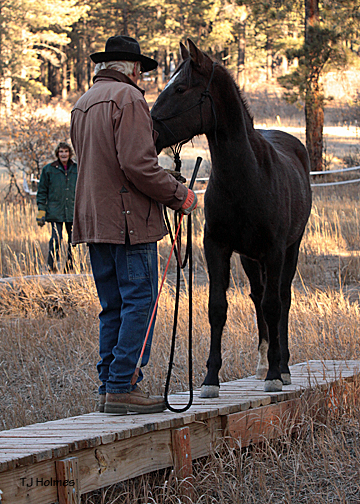
Asher and Vern on the bridge.

Next, it was on to the “bridge.” Vern coaxes him onto the surface step by step.

Asher and Vern on the bridge.

And he’s up! That’s Jeri in the background.

And then, the moment I was waiting for: the teeter-totter!

Asher and Vern on the teeter-totter.

Watch the end closest to the camera …

Asher and Vern on the teeter-totter.

It’s not a huge teeter.

Asher and Vern on the teeter-totter.

Almost all on board.

Asher and Vern on the teeter-totter.

Watch the end of the teeter again.

Asher and Vern on the teeter-totter.

Back and forth, up and down. Asher rode it like a pro!

Asher and Vern on the teeter-totter.

Are they cute or what? 🙂

Asher and Vern on the teeter-totter.

Asher: I’m sure you didn’t feed me enough for breakfast.

Asher and Vern

Jeri wanted me to see Asher show off his tail-flagging trot, so Vern released him in the pasture. His gal pals, Vern and Jeri’s Rocky Mountain mares, were still in their pen up the hill by the barn. This little mister, like little misters everywhere, is a slave to his belly. He much preferred eating to showing off, but we did get to see some moves.

Asher

Super cute!

Asher

He kept coming back to Vern.

Asher

Morning sunshine!

Asher

Asher

There’s our little show-off!

Asher and Vern

And he was no trouble at all to catch.

Asher and Vern

Love.

Asher and Vern

Love these two. 🙂


Asher in the round pen

11 12 2012

Horses know dragons exist. Humans call them tarps, but horses know better.

With Vern’s help, Asher has conquered the dragon:

Vern puts a tarp on Asher's back. Asher is completely unphased.

Vern puts a tarp on Asher's back. Asher is completely unphased.

Vern puts a tarp on Asher's back. Asher is completely unphased.

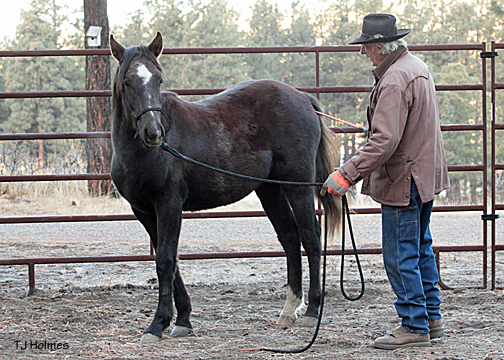
Note Vern’s relaxed hold on the lead rope. Asher wasn’t bothered in the slightest.

Vern leads Asher with a tarp on his back. Asher is completely unphased.

Even walking around the pen with the dragon – err, tarp – flapping against his legs!

120812ropebelly

Here, Vern’s tugging on the rope around Asher’s belly to simulate tightening the cinch. He has had a lightweight saddle on Asher.

120812tailwhip

With his original mustang, Miss Dolly, Vern was part of the Range Riders program at Lone Mesa State Park, where they helped move cattle. Any good ranch pony needs to be desensitized to the feeling of something – like a rope – under his tail. He’s ready to rope a cow, Vern figures!

Asher checks out his saddle.

Vern shows Asher his saddle.

Asher checks out his saddle.

Asher: Are you sure you gave me enough for breakfast?

Asher backs up with the saddle on.

Backing up. He didn’t think he wanted to do this at first, but Vern was patient. Eventually, all Vern had to do was wave his index finger back and forth, and back Asher would go.

Asher shakes with Vern.

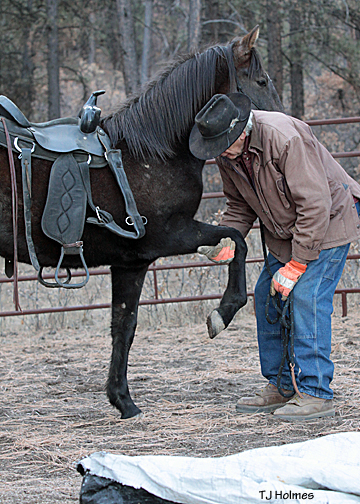
Asher and Vern shake. Vern taps his shoulder and says, “Shake.” After a little bit, Asher lifted his leg to shake!

120812vernhatash

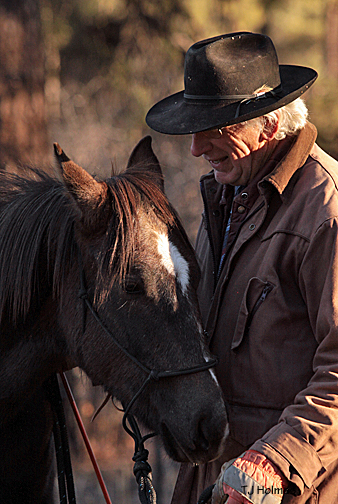
Having fun! Apparently, Asher likes to steal Vern’s hat. Vern pre-empted his thieving ways by giving Asher his hat before he could steal it!

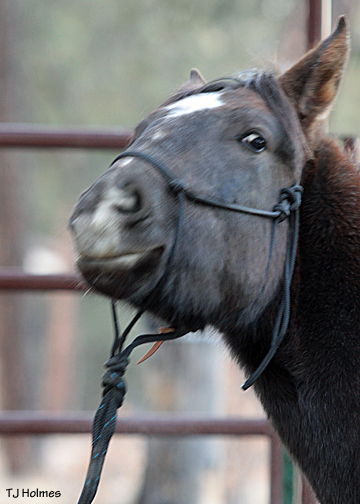
Asher makes a funny face during his workout with Vern.

We’re laughing WITH you, Asher! Such a good boy!

Part II will include some pix of Vern and Asher on the teeter-totter!


The Amazing Asher

9 12 2012

And he IS – amazing, that is.

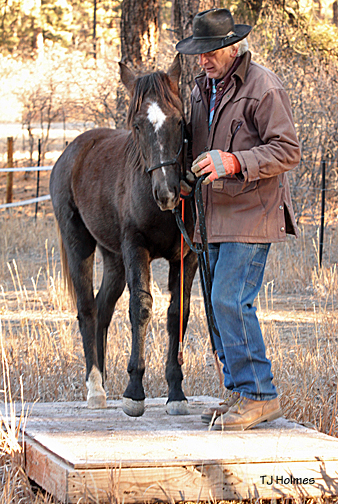
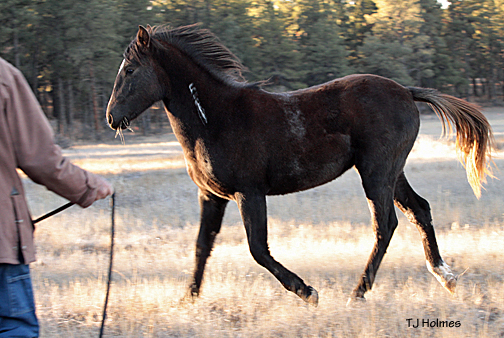
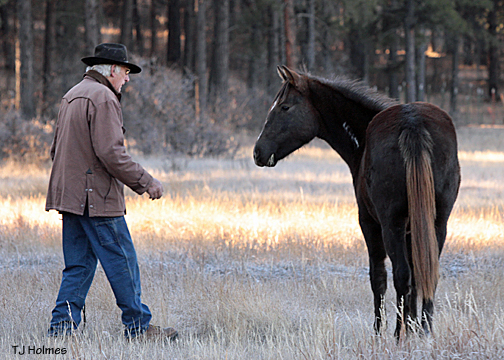
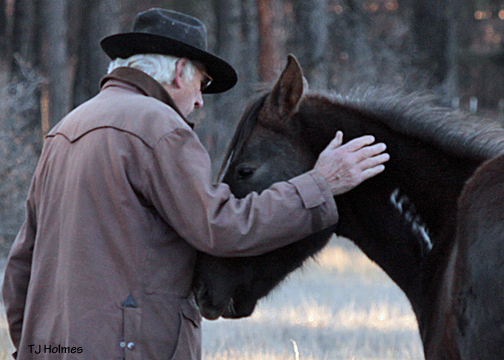
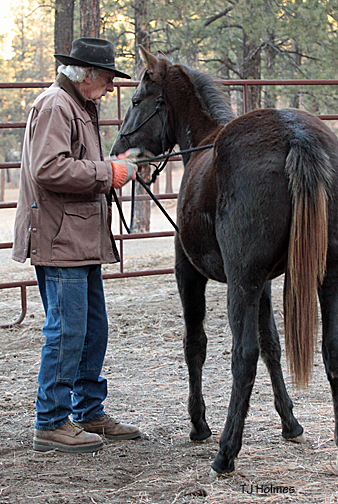
Vern Friesen and Asher

This man and this horse …

Each wonderful. Together, amazing.

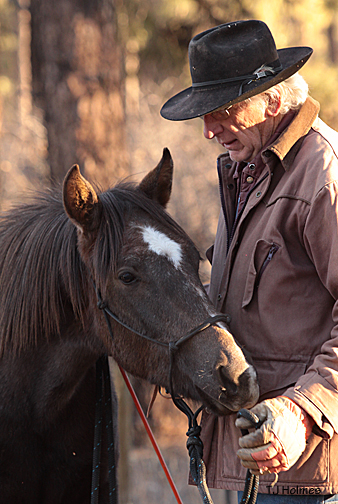
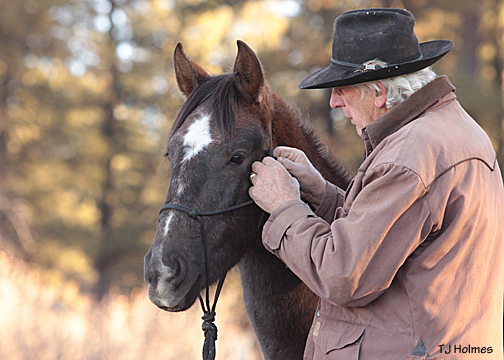
These faces:

Vern Friesen and Asher

Vern Friesen and Asher

Vern Friesen and Asher

Those faces!

One full of promise (and maybe a little mischief!).

One full of experience (and brimming with kindness).

Asher having fun in the pasture first thing in the morning.

One will have his hands full with the other one. 🙂

From Jeri, Vern’s wife: “I want people to know the potential of these mustangs.”

This crowd knows she’s right!

More to come from a visit this weekend where I was treated to an exhibition of Asher’s talents, including his ability to “shake”!