On this Thanksgiving, we have much for which to be thankful.
Our mustangs and wild burros found heroes in the Senate.

On this Thanksgiving, we have much for which to be thankful.
Our mustangs and wild burros found heroes in the Senate.

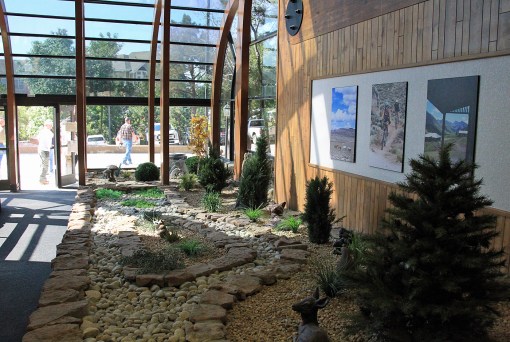
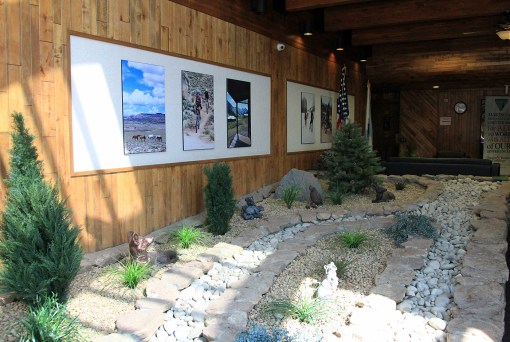
Earlier this week, I visited the BLM state office in Denver (Lakewood). As we walked into the entry way … I was drawn to the photo of mustangs on the wall (naturally, right?!).

Photos also were on the opposite wall, but the mustangs catch your eye (of course!). (Above: Already out the door is BLM’s Ben Smith, wild horse and burro specialist based in Grand Junction, and holding the door while yours truly geeked out taking photos of a mustang photo is Jim Hyrup, president of Friends of the Mustangs, which is the group that advocates for Little Book Cliffs mustangs near Grand Junction.)

This is the view of the photo as we walked into the building. It’s the view EVERYONE has as they walk into BLM’s state office!
I stopped to look closer … and was about to ask if anyone recognized the horses … when *I* suddenly did.
I might have gotten a little loud. 🙂
Pictured are Hayden, Jif, Chrome, Two Boots and Rio (now named Legado, owned by an NMA/CO board member). The BLM people didn’t know who took the photo, but it had to have been taken in 2010.
Because our wild beautiful ponies are just that famous. 🙂
In other pretty awesome news, we were there to support friends who advocate and volunteer and partner and collaborate with BLM for the good management of our Colorado mustangs on Colorado’s herd management areas and wild horse range: Sand Wash Basin, Little Book Cliffs, Spring Creek Basin (specifically) and Piceance-East Douglas (coming soon, we hope!). BLM folks, including Laria Lovec (on-range management), Steve Leonard (off-range management) and Ben Smith (wild horse and burro specialist based in Grand Junction), were there to recognize folks including Michelle Sander and Aleta Wolf (with Great Escape Mustang Sanctuary and Sand Wash Advocate Team), and Jim Hyrup (president of Friends of the Mustangs).
FOM has been involved with Little Book Cliffs mustangs for more than 30 years and have been using PZP for more than a decade. SWAT and GEMS are about 5 years old, and advocates have been darting in Sand Wash Basin for at least the last three years. We are so happy and proud to support their efforts and call them friends and heroes/heroines for mustangs!

Left to right: Steve Leonard, Laria Lovec, moi, Michelle Sander, Aleta Wolf, Jim Hyrup and Ben Smith.
Many of our valued volunteers couldn’t attend the meeting, but Stella Trueblood and Connie Wagner (SWAT), Marty Felix and Billie Hutchings (FOM), and Pat and Frank Amthor and Kat Wilder (Disappointment Wild Bunch Partners) are standout folks who spend hours working for our mustangs – and have done so for years and years. Marty earns the longevity award for more than FORTY years with Little Book Cliffs’ mustangs! Pat and Frank Amthor have logged TWENTY years supporting Spring Creek Basin’s mustangs!
In the “coming soon” category, Dona Hilkey and Pam and Tom Nickoles have been visiting, photographing and documenting Piceance-East Douglas’ mustangs for at least 12 years. They’ve been working closely with BLM, and folks are close to forming an advocacy group for that herd (and perhaps casting an umbrella over West Douglas as well). When that happens, it will mean every mustang herd in Colorado will have the support of volunteer advocates!
THANK YOU to every one of our dedicated volunteers!
And THANK YOU to BLM for recognizing and appreciating their work for our Colorado mustangs!

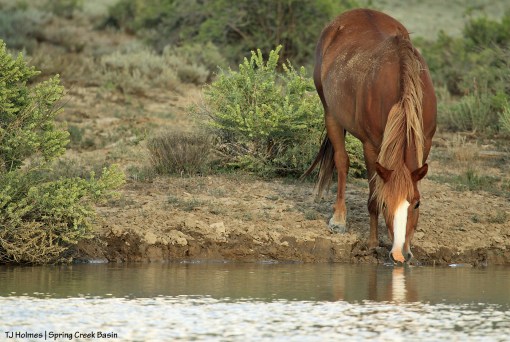
Ah … full pond. 🙂
‘Nuff said!
*********************************************
Happy birthday to mustang volunteer extraordinaire, Frank Amthor! Thank you for all you do for our mustangs in Spring Creek Basin!
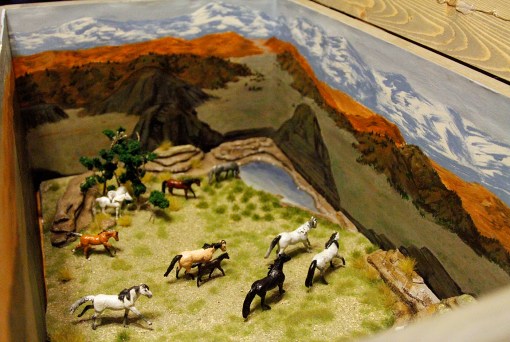
Friend and mustang lover Bebe June Mantooth created this AMAZING scale model of Spring Creek Basin mustangs, and my folks brought it to me during a visit from Texas (where they and Bebe live). It was the first time I’d seen it (not even pictures), and to say it was a “pleasant surprise” is the understatement of the year!
The photos really don’t do it justice. It’s simply spectacular. Specific mustangs in Spring Creek Basin – including horses in two bands and several bachelor stallions – are memorialized in this model (contained in a box that is painted inside – also by Bebe) that I will treasure forever.

This is the view through the looking glass (window) in one end of the box. Bachelors are in the foreground, and two bands are in the distance (middle ground and back). Can you identify anybody? 🙂

Looking straight into the box of beautiful. You can see the window at right. Not shown in any of the pictures is the lid, which is lined with tiny lights, so when the lid is closed, you can look in on the mustangs’ tiny little magical world. 🙂

Another view that shows some of the topographic detail. Don’t miss the grey mares under the juniper trees.

A closer view of the bands – and look! They’re going to water! Which is awesomely awesome because we’ve just had some more incredible rain, which was a pond-filling gift from heaven!

A better look at the bachelor boys. Surely readers will recognize some of the horses? 🙂

Through the looking glass again. Below the window is the little plaque my mom and dad had made for it. 🙂
HUGE THANKS to artist Bebe for the skill and love that went into creating this one-of-a-kind mustang masterpiece! I can’t even begin to tell you all how meaningful and incredible this is!

On the anniversary of America’s independence and declaration of freedom, our wild horses and burros are under attack as never before.
It’s hard to even fathom that the widescale slaughter of tens of thousands of these beautiful wild animals could happen in America, but please make your voices heard – and tell your legislators that YOU don’t agree. Our wild ones are counting on us.
Yesterday was Day 2 of the Land Health Assessment in Spring Creek Basin.
Yep, it was hot. Yep, the gnats were still bad (but yours truly remembered her head net).
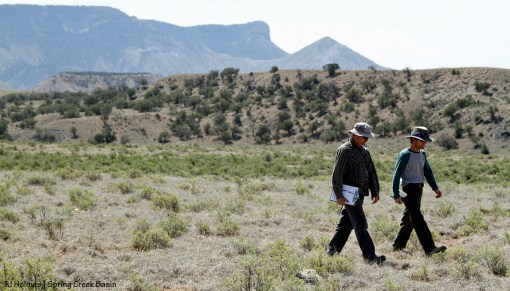
Mike Jensen, Justin Hunt and Nate West were back to assess more of Spring Creek Basin’s land health. We did some great sites, and a couple of them were higher, which allowed for great views!

BLM range management specialist Mike Jensen and range tech Justin Hunt walk a site in Spring Creek Basin with views of McKenna Peak and Temple Butte.

At the end of each site assessment, Justin and Mike took pix in two directions for future comparisons.

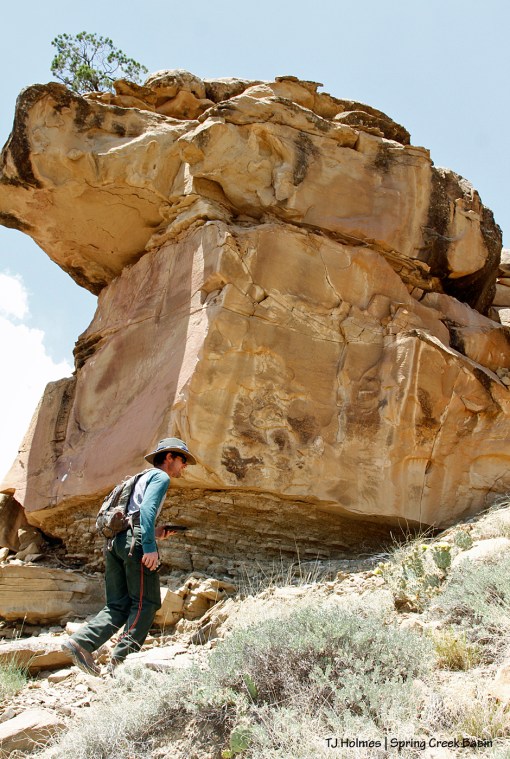
We don’t have many trees in Spring Creek Basin, so many of the sites were the wide-open places (as in the photos above). But we had a couple of sites that were in pinon-juniper woodlands. This site (and the one pictured above) had really great grass.

And then we headed uphill for our last site of the day.

Which led to an amazing view. Straight ahead is Brumley Point, and at the farthest left is one side of McKenna Peak.

Those who go up must go down! Especially when the truck is at the bottom. 🙂

Big thanks to BLM’s Mike Jensen, Justin Hunt and Nate West for persevering on these hot days to assess the land health of Spring Creek Basin. Again, as far as I can tell, we’re in pretty good shape.

We think this little guy (gal?) might agree. 🙂
Baby, it’s hot out there.
The mercury hit at least 100 degrees Tuesday in Disappointment Valley. Might be hotter today.
But we don’t shirk our duties when it comes to assessing the health of our range – which directly affects the health of our mustangs – in Spring Creek Basin. 🙂

Don’t let the long sleeves fool you. This was our last site of the day, and it was toasty out there. We were glad for every bit of brief cloud cover that came our way. On the right is our excellent herd manager, Mike Jensen (rangeland management specialist), and on the left is wildlife biologist Nate West, both with Tres Rios Field Office. In the background, of course, are McKenna Peak and Temple Butte.

Here, Mike and Nate – and our range tech, Justin Hunt – are checking examples of particular things that we were looking for, depending on what kind of site we were assessing – here, “basin shale.”
At each of the five sites we did (we have more to do), we completed a 17-point checklist to assess such things as “presence of water flow patterns,” “bare ground,” “amount of litter movement,” “effect of plant community composition and spatial distribution on infiltration and runoff,” “functional/structural groups” (what kinds of plants – annual/perennial grasses, shrubs, forbs – we should expect to find), “expected annual production” (which we are supporting with actual vegetation monitoring studies) and “potential invasive (including noxious) species (native and nonnative).” Each site has a list of expected standards that we should find according to soil types, including “basin shale,” “clayey salt desert” and “salt flats.”
Pretty fascinating, really! For the most part, my civilian observation is that our range is pretty healthy in Spring Creek Basin.
Our mustangs do seem to support that assessment. 🙂
Thanks to Mike, Justin and Nate for trekking to the basin on the hottest days of the year to perform these assessments that positively affect the good management of our mustangs!

Elder Mr. Bounce is lean these days, but he’s shiny, and he still loves the girls, though he doesn’t have any now.
He’s hanging with the band – and I hope ya’ll are, too!
Not being a hashtag kinda person, I may not have done that right, but I hope ya’ll are with the band!

By now, you all must have heard about the explosion of disbelief and outrage about the 2018 budget proposal. No one seems to be happy … and wild horse and burro advocates are no exception.
My friend Pam Nickoles has a succinct post with pertinent links on her blog.
More information is available on all the major advocacy sites, and news sites are covering the issue as well.
Surely we can work together for better treatment and management for our wildlife.
Last weekend, BLM folks from the White River Field Office in Meeker hosted a “celebration” of the mustangs in the Piceance (“pee-antz”)-East Douglas Herd Management Area. An unofficial count of around 40 people made the trip to talk to each other and BLM range specialists and managers, and take tours of this amazing – 190,000-plus acres! – range in northwestern Colorado.
The wildlife in this area of the state is abundant and varied. It also – until recently – had a widespread oil-and-gas presence (still there, just not as widespread). Interestingly, friends say that those workers are among the friendliest they encounter while looking for mustangs, and they’re always happy to point out the locations of horses for my friends to find and photograph. Cattle and sheep ranching also is abundant in the area, and my friends pass on information about livestock and fences to the ranchers via BLM.
During this celebration, three tours were offered throughout the day, and we had the opportunity to speak with people from all backgrounds: oil-and-gas workers, ranchers, mustang advocates, local and not-so-local BLM employees, and others. We all have a stake in preserving Colorado’s public lands and wild places, and the wildlife those lands shelter, so it was a good coming together of people and ideas and planning to see how those interests can merge and move forward for the benefit of all involved.
This wasn’t my first visit to Piceance-East Douglas, and it certainly won’t be the last. BLM does want to conduct a roundup and removal of horses here (population estimate is 400-plus horses). But it also wants to start a PZP program, which would mean that – at that point – all of Colorado’s mustang herds would be managed with scientifically-sound fertility control, enabling more horses to live wild and free on their home ranges.
My friends Tom and Pam Nickoles have been visiting the area since 2006, learning about the mustangs, learning about the area … learning all the intricacies. They work closely with the BLM range specialist and herd manager, Melissa Kindall, as well as a local woman who has been documenting the mustangs for many years, Dona Hilkey. Friends of the Mustangs, the advocacy group that helps BLM with the Little Book Cliffs herd near Grand Junction, also had members present, and they might be able to provide human power and some funding to help establish a local advocacy group for the Piceance-East Douglas mustangs.
Good things are going on in Piceance-East Douglas and all around Colorado!
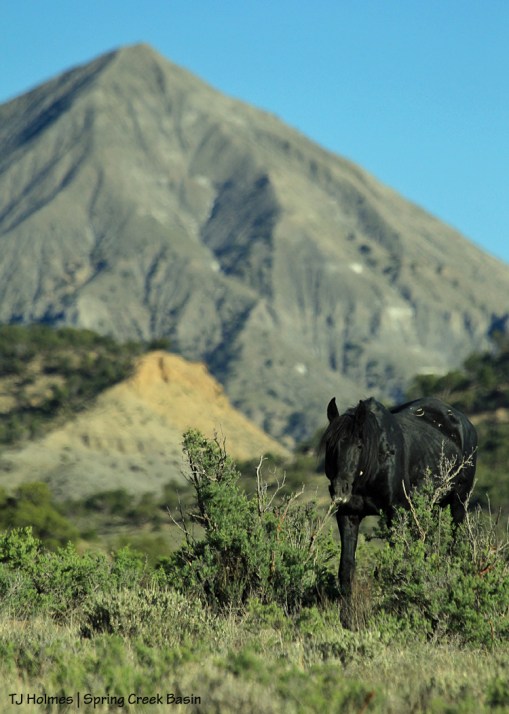
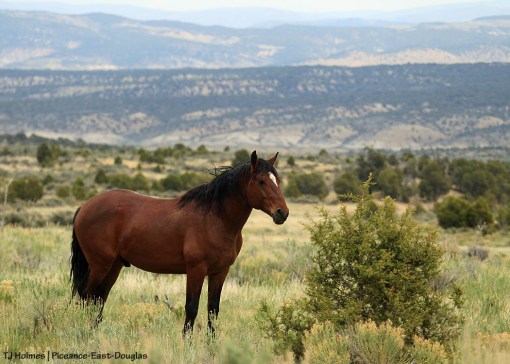
Not too many photos from this last visit, as I was more interested in looking wide-eyed at everything, but here are a few of the gorgeous mustangs that call Piceance-East Douglas home:

This handsome guy was with a young grey stallion and an older sorrel mare. This was the only photo I came away with that shows some of the long views available from this herd management area.

This is the young grey friend of the above stallion, showing the *short* sagebrush. Most of the sage in this region is TALL – as in, jungle-tall. Sometimes it’s hard to see any more of horses (or cows) than their ears. No pix of the mare because – ironically – she was too close for my lens. Most of the Piceance-East Douglas mustangs are extremely wild and wary, which is awesome! But challenging for photos. 🙂

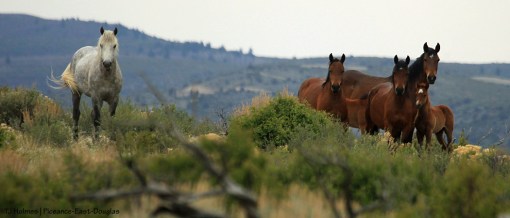
Case in point: This handsome family was pretty OK to watch us from a distance while we stood at the Jeep, photographing from the road. But when I took a few steps away from the vehicle, to get a better view across/over the sage and other vegetation, that was enough of a trigger for them to bid us farewell.

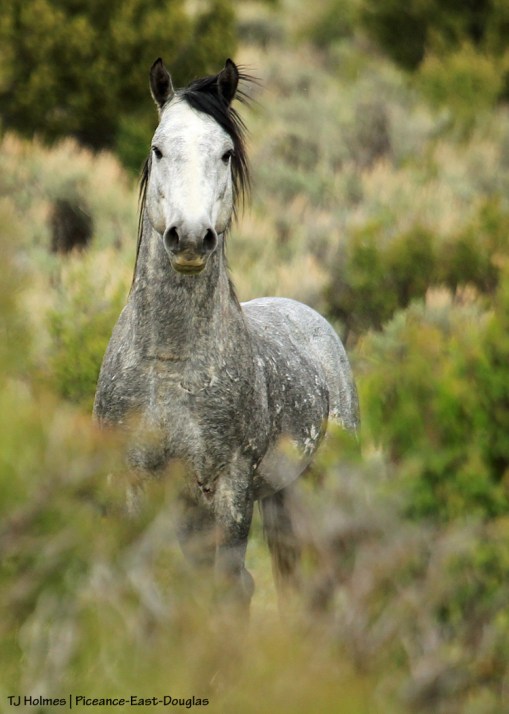
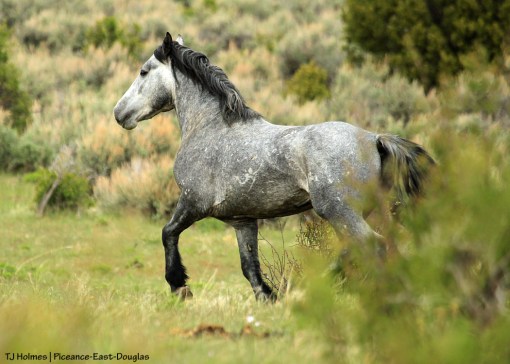
This hunky young guy was all alone. We walked out into the sage a short distance (also mindful of ticks!), and he came to investigate …

… then high-tailed it away from the two clicky ladies. 🙂 Isn’t he magnificent?
Some take-away facts from Piceance-East Douglas Herd Management Area: