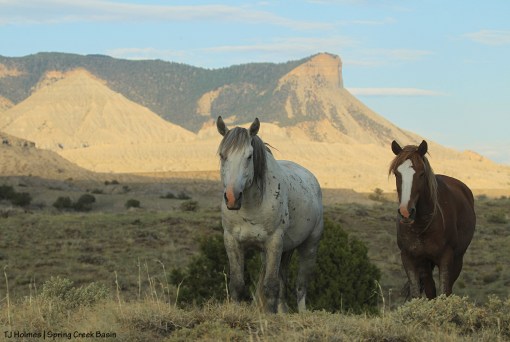
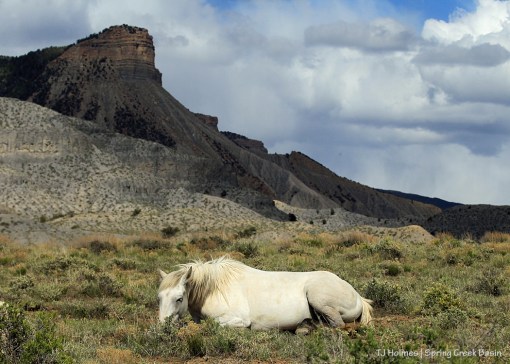
Storm and Gaia take a quick pony nap in a rare bit of cloud-induced shade while Temple Butte and McKenna Peak are shining in the sunlight. Clouds are in short supply, and we relish every bit of shade that comes our way.
Storm and Gaia take a quick pony nap in a rare bit of cloud-induced shade while Temple Butte and McKenna Peak are shining in the sunlight. Clouds are in short supply, and we relish every bit of shade that comes our way.
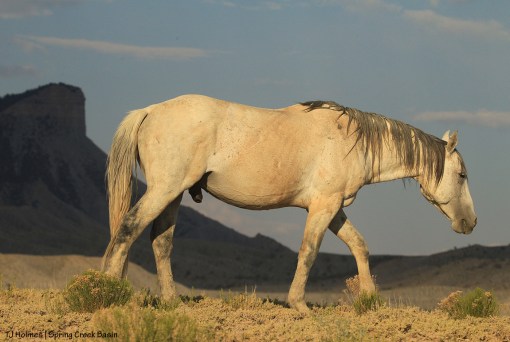
Big boy Comanche has a bit of a belly. Must be goooooooood livin’. 🙂

… watch the pot of gold?
With love and respect to Dolly Parton, who said, “The way I see it, if you want the rainbow, you gotta put up with the rain,” we don’t always get the rain.
Not that we don’t desperately WANT and NEED the rain! We do! But the pictured rainbow appeared with nary a drop to the ground.
While trying to find Dolly’s exact quote, here’s another one with no credit given:
“Everybody wants happiness, no one wants pain, but you can’t have a rainbow without a little rain.”
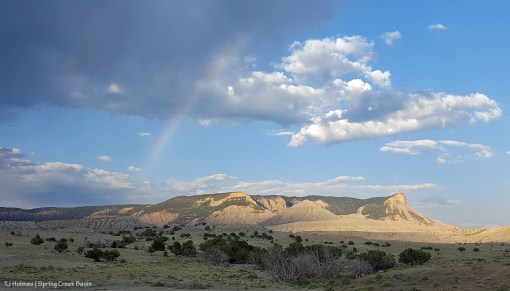
Except when you’re in the desert Southwest, on the high Colorado Plateau, specifically in a region that hasn’t had measurable, hit-the-ground (or a rain gauge) moisture for 33 days and counting … where we have tantalizing, tempting, teasing virga.
I had just been visiting with a few bands of mustangs … and was on my back-to-the-Jeep hike when the rainbow appeared. Of course. 🙂 Still, we all know the composition of our “pot of gold” in Spring Creek Basin!
Yesterday was Day 2 of the Land Health Assessment in Spring Creek Basin.
Yep, it was hot. Yep, the gnats were still bad (but yours truly remembered her head net).
Mike Jensen, Justin Hunt and Nate West were back to assess more of Spring Creek Basin’s land health. We did some great sites, and a couple of them were higher, which allowed for great views!
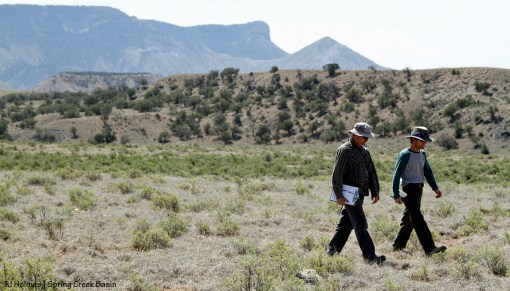
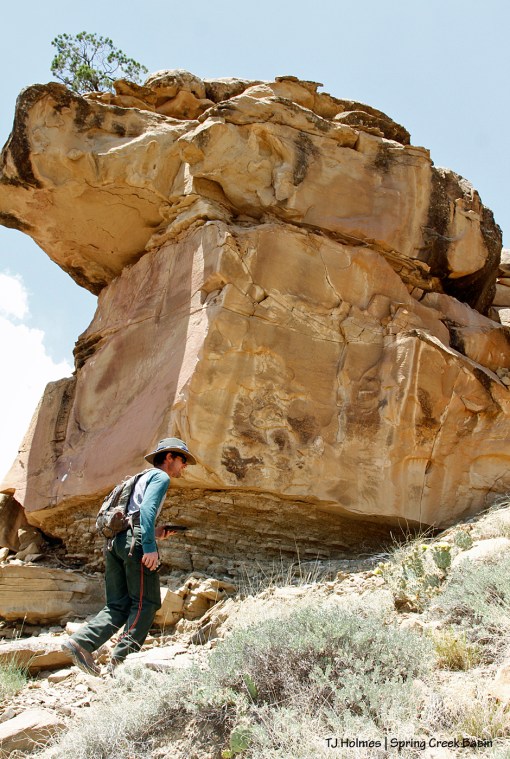
BLM range management specialist Mike Jensen and range tech Justin Hunt walk a site in Spring Creek Basin with views of McKenna Peak and Temple Butte.

At the end of each site assessment, Justin and Mike took pix in two directions for future comparisons.

We don’t have many trees in Spring Creek Basin, so many of the sites were the wide-open places (as in the photos above). But we had a couple of sites that were in pinon-juniper woodlands. This site (and the one pictured above) had really great grass.
And then we headed uphill for our last site of the day.

Which led to an amazing view. Straight ahead is Brumley Point, and at the farthest left is one side of McKenna Peak.

Those who go up must go down! Especially when the truck is at the bottom. 🙂

Big thanks to BLM’s Mike Jensen, Justin Hunt and Nate West for persevering on these hot days to assess the land health of Spring Creek Basin. Again, as far as I can tell, we’re in pretty good shape.

We think this little guy (gal?) might agree. 🙂
Baby, it’s hot out there.
The mercury hit at least 100 degrees Tuesday in Disappointment Valley. Might be hotter today.
But we don’t shirk our duties when it comes to assessing the health of our range – which directly affects the health of our mustangs – in Spring Creek Basin. 🙂

Don’t let the long sleeves fool you. This was our last site of the day, and it was toasty out there. We were glad for every bit of brief cloud cover that came our way. On the right is our excellent herd manager, Mike Jensen (rangeland management specialist), and on the left is wildlife biologist Nate West, both with Tres Rios Field Office. In the background, of course, are McKenna Peak and Temple Butte.

Here, Mike and Nate – and our range tech, Justin Hunt – are checking examples of particular things that we were looking for, depending on what kind of site we were assessing – here, “basin shale.”
At each of the five sites we did (we have more to do), we completed a 17-point checklist to assess such things as “presence of water flow patterns,” “bare ground,” “amount of litter movement,” “effect of plant community composition and spatial distribution on infiltration and runoff,” “functional/structural groups” (what kinds of plants – annual/perennial grasses, shrubs, forbs – we should expect to find), “expected annual production” (which we are supporting with actual vegetation monitoring studies) and “potential invasive (including noxious) species (native and nonnative).” Each site has a list of expected standards that we should find according to soil types, including “basin shale,” “clayey salt desert” and “salt flats.”
Pretty fascinating, really! For the most part, my civilian observation is that our range is pretty healthy in Spring Creek Basin.
Our mustangs do seem to support that assessment. 🙂
Thanks to Mike, Justin and Nate for trekking to the basin on the hottest days of the year to perform these assessments that positively affect the good management of our mustangs!
Hot days ahead. We have relief and cooler temps at night, but sunlight hours are toasty
Stay cool out there, folks.

It’s nice to be the band stallion when you have a lieutenant to fight your battles for you. 🙂

Sure, it’s May.
It’s also Colorado. 🙂
And at its heart … it’s essentially WILD.
Mysterium and her band had a little nap – as they do multiple times a day. This one was shared with yours truly. With the sunshine and breeze, it was hard to keep our eyes open! (Some of us didn’t!)
Parts of Colorado (including our part) are under a freeze warning. … We’re really hoping that the chance of rain actually materializes over Disappointment Valley and Spring Creek Basin.

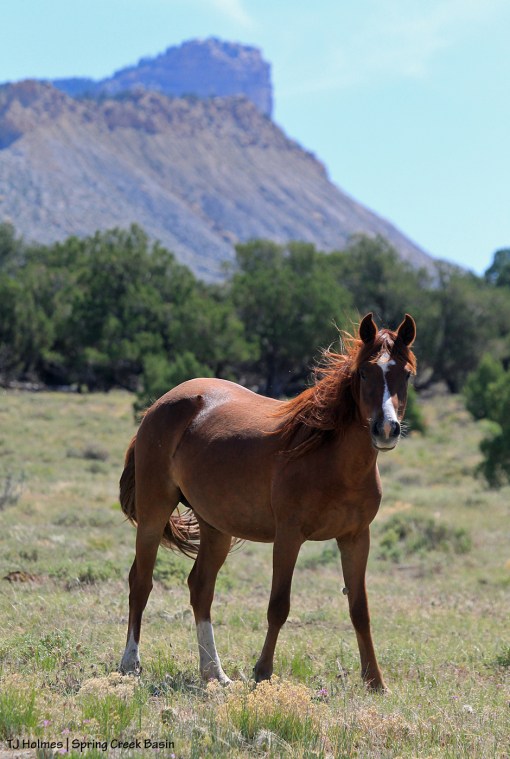
Handsome bay boy Copper also is feeling spring in the air.
Those clouds did eventually bring us some rain, and we were grateful to get it!
 Spring Creek Basin Mustangs