Alternative spring break – day 2

27 03 2013

We must not have worn out the Mizzou students Monday because they came back Tuesday! (All except one of the Sarahs – who came up sick – and Tori, who stayed with her. Sarah, feel better soon!)

With the H-braces set in place, the day’s plan was to take out the old wire and string new wire. Following wildlife-friendly strand spacing, the top wire is smooth twisted wire and 42 inches above the ground. The bottom wire is smooth twisted and 18 inches above the ground. The middle two strands are barbed wire. Deer and elk can jump over, fawns and calves can crawl under, and cattle hopefully will respect the barbed.

So we had to cut wire pieces off the existing fence strands and pull staples and roll barbed wire. Gloves and shades were must-have accessories. Once again, fence-building guru Tom Kelly showed the most jaded of us, who thought we knew a thing or three about fence building, a new technique to tighten the wire fence strands to T-posts (metal) and staves (between T-posts or wood posts).

032613tifTKtool

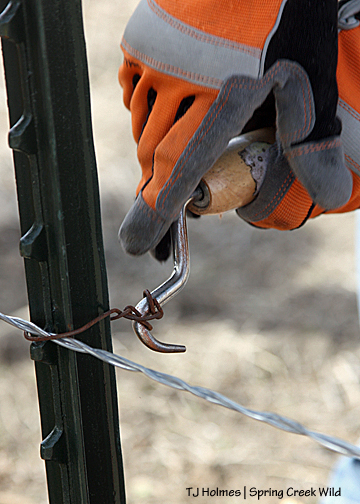
Tif watches Tom demonstrate the new-to-us tool to attach a wire fence strand to a metal T-post. She’s holding a stave on which she has marked the heights of the wire fence strands.
032613MKtool

MK took over this “wonder tool,” and I’m not sure she ever let it go! Instead of a traditional “clip,” this is a short piece of wire with loops on both ends. The hook goes through both ends, you swivel it, and voila! Your wire strand is tight to the post!

032613emeraldwire

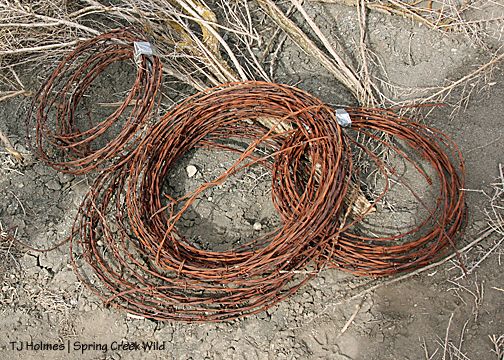
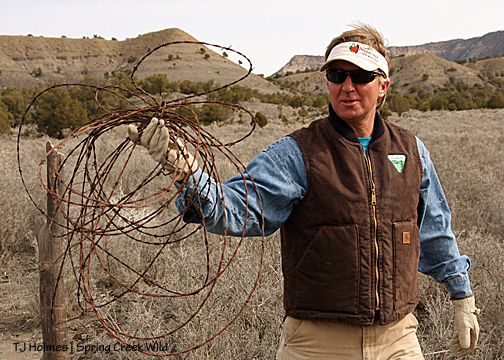
But I’m getting excited and ahead of myself. First, we had to get rid of the old wire. Here, Emerald demonstrates careful barbed-wire-rolling technique.
032613mkwire

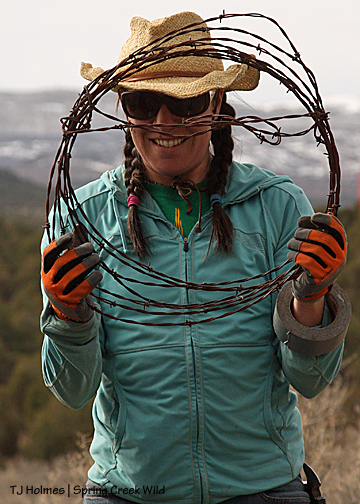
MK and a “barbed wire wreath”!

032613oldwire

More perfect rolls.

032613TRwire

BLM guy Tom with his, uh, not-so-perfect “roll.” Lesson: Don’t let BLM roll up your fences! Fortunately, he redeemed his agency’s good name later with his wire-strand tightening skills.

032613marissastaves

Marissa carries wooden staves to drop off along the fence line. These help stabilize the wire and keep the spacing even. Note the colorful eyewear, courtesy of SJMA. This was to protect against the potential boinging – Kathe’s word! – of broken wire. (Note: As far as I’m aware, there was no boinging of wire or injury to students!) Right in front of Emerald’s shins, note the strand of wire. This is how it got there:
032613chsakeunroll

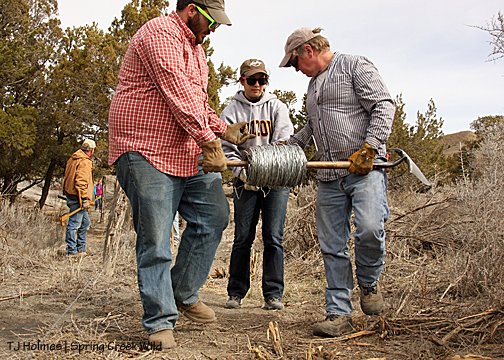
Students Chalen and Marissa help volunteer Keith unroll smooth twisted wire. Note the wire strand in the bottom left corner of the pic. It started at the road, tied off at the H-brace there, and was unrolled up to the first H-brace, which is just beyond Tom Kelly (back left), where the trees start. Then another strand is tied off there and the roll walked back to the road and that brace. The process is repeated with the barbed wire in this section, and then with the smooth and barbed wire strands from the H-brace behind these guys up the hill to the next brace.

032613keithTRchwire

Keith carries rolls of old wire to the trucks while Tom and Chalen carry good wire to the next H-brace to string it from there to the third brace. Note the very valuable set of fencing pliers sticking out of Keith’s pocket. Students were well-acquainted with these tools after two days in Spring Creek Basin!
032613sarahaaronfence

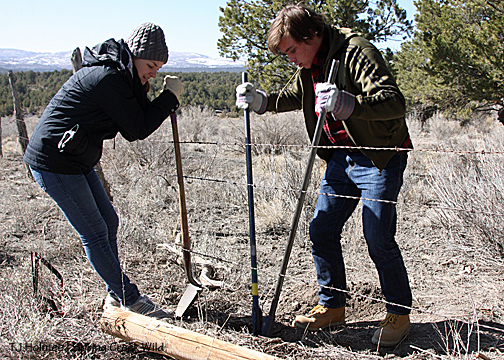
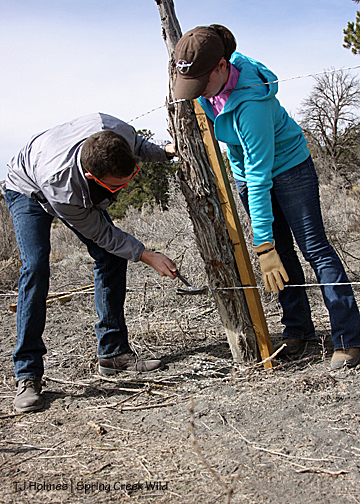
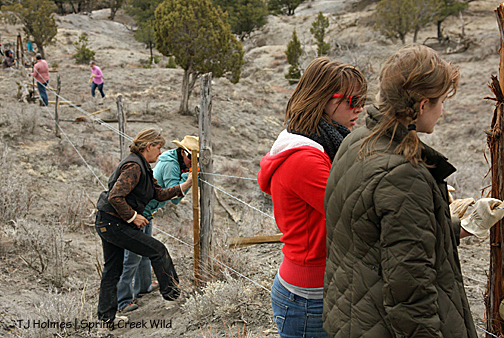
Here, the bottom and top strands are in place and have been stretched (tightened). In this pic, Sarah and Aaron are measuring and stapling the strands of fence wire for the rebuilt fence. Note the marks on the stave Sarah is holding. The marks are at 18 inches, 23 inches, 30 inches and 42 inches. Marking staves made it easy for students to work in pairs: measure and staple.
032613emelcormkfence

Emerald and Ellen, foreground, and Corrie and MK measure and staple fence strands to posts. Ellen and Emerald are at the next H-brace, up the hill.

032613mizzougrpasb

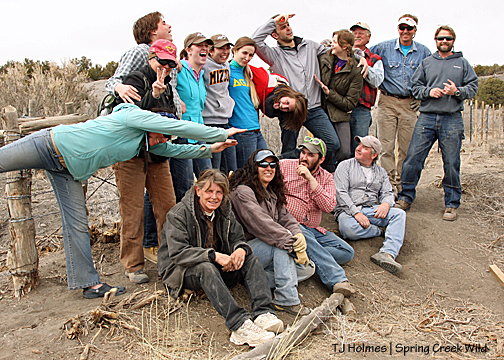
Mizzou students are the epitome of seriousness after day 2 of fence work on Spring Creek Basin’s southeastern boundary line. In the background, our excellent new fence! I can’t believe I didn’t take a pic of the finished product; to come. (It looks excellent!)

Front row from left: volunteers Corrie and Tif, Mizzou site leader Chalen and volunteer Keith. Standing: MK (diving) and Kathe with SJMA, students Marshal, Sarah, Marissa, Kara, Ellen, Aaron and Emerald, Tom Kelly with the Forest Service, BLM’s Tom Rice and Dave with the Forest Service.

An important side note, Corrie, Tif and Keith all adopted Spring Creek Basin mustangs in 2011/2012.

After their work on the fence, we took the students into the basin to scout mustangs. We saw Chrome’s band, Duke and Kreacher, Hollywood’s and Comanche’s bands with Bounce, and bachelor boys Aspen, Hayden, Tenaz and Apollo. Those boys were very accommodating for students’ pix!

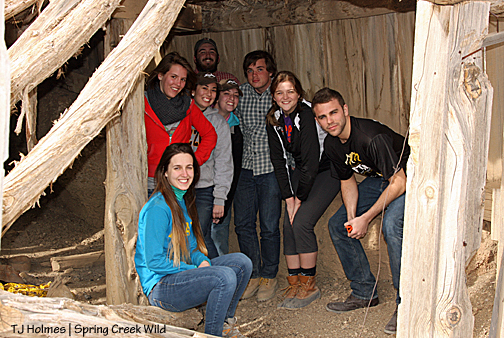
On our way out, we stopped to investigate the dugout, likely used during construction (way back when?!) of the defunct Custer dam.

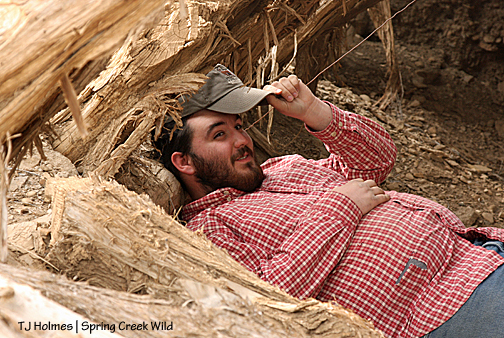
Chalen takes a break in the old dugout in Spring Creek Basin.

Chalen taking a well-deserved break. Word Monday was that he would be awake at 4:30 a.m. (!) Tuesday to cook breakfast.
032613sdtsdugout

Students gather for a group photo op in the dugout. Are those some happy faces or what?

Today – Wednesday – the students will work with Kathe and MK and my friend Sam on one of my favorite mountain bike trails in Southwest Colorado: Phil’s World, just east of Cortez. It’s a not-so-secret course anymore. Thursday, they’ll work at Sand Canyon, part of Canyons of the Ancients National Monument, west of Cortez.

Once again, huge thanks to these fantastic university students! We so appreciate your willing and enthusiastic work to help protect our Spring Creek Basin mustangs. We hope you had fun to balance the work and that you’ll enjoy your next work projects as much as we enjoyed having you work with us! Come back soon to our corner of Colorado!



Alternative spring break – day 1

26 03 2013

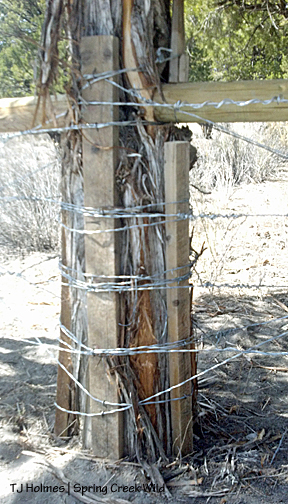
Monday was the first day of work for 10 students (including two site leaders) from the University of Missouri, here to work on public lands in Southwest Colorado on alternative spring break. Instead of going to Cancun or Fort Lauderdale or South Padre Island, these young men and women pursue service opportunities across the country. For more than a decade (13 years now?), San Juan Mountains Association, a nonprofit partner with BLM and the Forest Service on San Juan public lands, has organized work projects that always include at least one day in Spring Creek Basin Herd Management Area. This year and last year, students will be and were here for two days. This year, as last year, students worked on the southeastern boundary fence. Last year, they rebuilt a section of fence that had been vandalized before the roundup (someone cut it in several places); this year, they’re installing braces, tightening some wire and replacing some other wire – maintenance projects much-needed on that fence line.

Volunteers from Mesa Verde and Four Corners Back Country Horsemen and the Colorado chapter of the National Mustang Association also are helping with the project. Some or all of the materials were purchased with funds from last year’s Director’s Challenge, awarded because of BLM’s partnership with Disappointment Wild Bunch Partners, made up of representatives from 4CBCH, MVBCH and NMA/CO.

From SJMA, Kathe Hayes and MK Thompson, from the Forest Service, Tom Kelly, and from BLM, Tom Rice, were overseeing the project.

032513sarahmarshaldig

Sarah holds the wire strands to give Marshal room to dig a hole for a post as the first step toward building an H-brace.

032513bvemellbrace

Four Corners BCH volunteer Bob Volger and student Emerald watch student Ellen pound in a stake to hold an H-brace to the post set in the hole dug by Marshal in the first photo.

032513caratiftktamp

Student Kara helps Mesa Verde BCH and NMA/CO volunteer Tif Rodriguez tamp dirt around a post set at another H-brace while Forest Service fence-builder extraordinaire Tom Kelly supervises.

032513chmaraarsaw

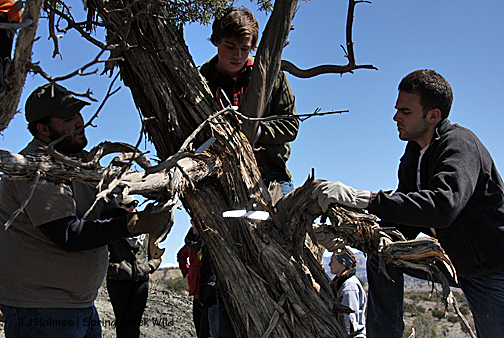
From left, Chalen, Marshal and Aaron saw limbs off a juniper to make way for building braces using the tree. Of the 10 students on the trip, these are the group’s only guys. Chalen is one of the site leaders.

032513mkstaples

SJMA’s MK painstakingly removes staples from wire embedded in the juniper tree seen in the previous photo. Moving forward, each tree used for braces will get protective staves to prevent this from happening (thanks, Tom Kelly!).

032513caratifdrill

Tif watches while Kara drills a hole for a spike through the brace and tree for stability.

032513emeralddrill

Emerald drills the way for another spike in another brace. Altogether, three sections of braces had posts dug and posts set in place. Because this area of Spring Creek Basin Herd Management Area also is part of McKenna Peak Wilderness Study Area, all the work had to be done by hand – no mechanical help such as chainsaws.

032513sarahbvtoriwire

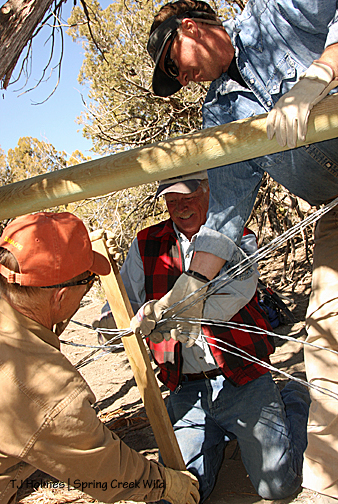
Sarah holds wire while Bob, Tom Kelly and Tori (also a site leader) wrap wire around the H-brace and tree (with staves) to tighten.

032513bvtktrbrace

Bob, Tom Kelly and Tom Rice do the last bit of work for the day: tightening the wire around the farthest H-brace for stability.

Today, we’ll tighten and replace wire strands.

Thank you to everyone who is helping with this project! We so appreciate your work ethic and commitment to our public lands!


Pati Temple

5 02 2013

012113temple-72

Mustang angel and lover of all wild life Pati Temple passed away yesterday evening.

Look out, God, whirlwind coming your way!

Pati was one of the most influential people in my life, despite having known her for just the last few years. Words cannot come close to describing the dynamo that was Pati, and at this point, the heartbreak is too raw to try.

God speed, Pati, on the wings of your beloved mustangs. You are much loved and will be most incredibly missed.


‘Unbranded’

15 01 2013

With all the craziness surrounding the wild horse “issue,” here’s something that looks pretty cool:

http://www.unbrandedthefilm.com/

From the email that alerted me to this endeavor:

Backcountry  Horsemen,

This is Ben Masters. Myself and three friends are training 11 mustangs and riding them 3,000 miles from Mexico to Canada starting in March. Our route will take six months through Arizona, Utah, Idaho, Wyoming and Montana. We’re making a documentary: Unbranded that aims to promote conservation of open spaces, inspire mustang adoptions and get people outside horseback.

We’re trying to promote our journey and documentary. We need your help by pledging your support and sending the information to others who like horses, the backcountry and conservation. Here is the video, it’ll put a smile on your face:

http://www.kickstarter.com/projects/1978488989/unbranded?ref=live

For more info, our website is http://www.unbrandedthefilm.com/

Western Horseman’s blog over our trip: http://blogs.westernhorseman.com/unbranded/

Thank you,

Ben Masters

benmasters@unbrandedthefilm.com

Check out their story; I’m sure you’ll follow them as I will! Have I ever mentioned I’m an Aggie? Gig ’em, Ags. What a ride it will be!


Dr. Jay

15 01 2013

Here’s another nudge for Wild Horse Scientists – and a guest post on Kay Frydenborg’s blog by Dr. Jay Kirkpatrick!

My copy arrived last week, and I wholeheartedly give it two thumbs up. It’s an excellent resource for information about PZP and how fertility control is helping wild horses, particularly on Assateague Island and Pryor Mountain.  It’s a “children’s book” in the sense that we’re all learning and have much to learn. It’s truly appropriate for ALL ages.

Well-researched, well-written, beautiful photographs, and I absolutely enjoyed reading it.

This is a book that should not languish below the radar!


Assateague & Chincoteague

8 01 2013

In the interest of clearing up what may be common confusion about Chincoteague and Assateauge islands and the wild horses that live there, Kay Frydenborg, author of Wild Horse Scientists, agreed to write a guest post about the topic. Yes, these East Coast islands are most of a continent and a world away from the West’s wild horses, but population management and fertility control are common topics. So here we go. I hope you’ll leave any questions for Kay in the comments!

Sorting Out the Wild Horses of Assateague Island

Since writing Wild Horse Scientists, I’ve run into a lot of folks who are a bit confused about the famous Chincoteague ponies, and that confusion is well-founded. It is confusing. For starters, the animals most people think of when they think of Chincoteague ponies are not ponies, technically, but small horses. And except for a few days each July during Pony Penning (which many people know about from Marguerite Henry’s classic children’s book Misty of Chincoteague and the movie that was adapted from the book), the wild ponies don’t live on the island of Chincoteague, but rather on the larger, uninhabited nearby island of Assateague.

To further complicate things, Assateague Island straddles two states (Maryland and Virginia), and two different federal agencies are in charge of overseeing the wild horses in each state (National Park Service in Maryland, U.S. Fish & Wildlife Service in Virginia). On top of that, the wild “ponies” on the Virginia side of the island are legally the property of the Chincoteague Volunteer Fire Company, which has been running the famous round-up, the swim across the channel to Chincoteague, and the foal auction for many years.  The horses are not only rounded up for this annual event (which provides needed funds for the fire company and much tourism for the town), but they are also gathered at other times and given routine immunizations and veterinary and farrier care. Their population is kept at a maximum of about 150 by means of the foal auction alone; no contraceptives are used to limit the herd size in Virginia.

On the Maryland side of Assateague, home of the Assateague Island National Seashore (as well as a Maryland state park within the national park!), the wild horses are managed quite differently. They’re called horses here, not ponies, and managed in a mostly hands-off manner, with no human handling and no roundups. Unless a horse becomes gravely ill or injured and the Park Service determines urgent medical care or euthanasia is required to spare undue suffering, the only human intervention in the lives of these horses is the remote darting (via special rifles) of the contraceptive PZP. Over the 25-plus years that PZP has been used as the sole management tool, the numbers of horses has gradually stabilized to sustainable levels. At the same time, these horses are observed closely from a distance, and careful records are kept for the purposes of effective management of the PZP program and ensuring that a viable gene pool is maintained among the horses.

Though all of the wild horses of Assateague Island descend from the same original herd, after the island was split with the National Seashore designation in 1962, these different management strategies on the two sides of Assateague have resulted in some real differences in the makeup of the herds. You can read much more about these differences, and the 300-plus year history of these unique wild horses, in my book. I hope you’ll check it out!


Wild Horse Scientists

6 01 2013

wildhorsecover-300

Behind the scenes and out of the public spotlight – the way they like it – are a number of people – scientists – working to improve wild horse management. A new book by Kay Frydenborg, Wild Horse Scientists, published in November by Houghton Mifflin, looks at a couple of these scientists: Dr. Jay Kirkpatrick and Dr. Ron Keiper.

Dr. Kirkpatrick is director of the Science and Conservation Center in Billings, Mont., where PZP is made and darters are trained. His work has proved especially invaluable with the wild horses managed on Assateague Island National Seashore. Dr. Keiper came up with a system of identifying the Assateague Island horses when research and fertility control started there around 25 years ago.

The book is aimed at children 10 and older, but given the myths and misconceptions I still hear about fertility control and wild horses, it’s likely appropriate for all age levels. Also, the idea that science IS being applied to the management of wild horses – particularly on Assateague, where the population is controlled only by the use of fertility control and a roundup hasn’t been conducted in many years (?) – is important and has applications that readers of all ages can appreciate.

Hoping to get more kids aware of the mustangs of Spring Creek Basin, our National Mustang Association/Colorado chapter and Disappointment Wild Bunch Partners are working with the Telluride Institute to get schoolkids to the basin. This book could become an important part of their unit about good, in-the-wild management of these horses.

For more information, see Kay’s website: http://www.kayfrydenborg.com/

From her website:

“Dr. Ron Keiper and Dr. Jay Kirkpatrick have both, in their own unique way, made the wild horses of Assateague Island, Maryland their lives’ work. Experience Dr. Keiper’s handwritten notes—taken over countless watchful hours in the field—which are both a diary and a scientific log that chart the lives of his equine subjects, some of nature’s greatest survivors. And follow Dr. Kirkpatrick from the lab to the field as he works tirelessly to find a way to manage the horse population with a birth control vaccine, and helps keep the precarious balance of Assateague’s ecosystem intact.

“Descriptive prose meets solid science as author Kay Frydenborg offers a rare glimpse into the wild herds of Assateague, sharing beautiful photos of the Assateague herds in their island home and of both of the scientists at work—some of them never seen before.”

Also visit the website where Houghton Mifflin promotes authors, photographers and conservationists who highlight all kinds of topics to get kids interested in science: http://www.sciencemeetsadventure.com/

Find the book on Amazon. I just ordered mine.


Congratulations!

2 12 2012

The Tres Rios Field Office in Dolores, Colo., has honored Pati and David Temple with an award that recognizes their dedication during the last 15 years to the mustangs of Spring Creek Basin.

In 1997, Pati and David joined the board of the newly formed Colorado chapter of the National Mustang Association. They have served continuously on the board since then.

Some major projects have been completed in Spring Creek Basin Herd Management Area at Pati and David’s urging:

* The water catchment in the basin was funded by NMA/CO – about $18,000. Although there are several ponds and seeps/springs, the catchment provides the horses with the only clean water source in Spring Creek Basin (the others being, at the least, very salty because of the alkaline soil).

* About a decade ago, NMA/CO raised $40,000 to buy cattle AUMs from a rancher who held grazing rights in the basin and, after a five-year struggle, succeeded in retiring those AUMs. Not only that, a grazing EA was prompted, which reduced the remaining AUMs and changed the grazing season to dormant-season grazing only (Dec. 1 until Feb. 28). The National Mustang Association, based in Utah, was instrumental in finally accomplishing this goal.

* Because of Pati and David, magazine subscriptions, horsemanship training videos and countless pairs of boots have been donated by NMA/CO to the inmate training program at the Canon City prison facility, where BLM has a short-term holding facility.

* Pati and David have assisted with the removal of old fences and wire from within the basin as well as construction of new boundary fences and the repair and maintenance of fences.

* For close to a decade, San Juan Mountains Association has hosted University of Missouri students during alternative spring break, which has included projects in the basin. David is an arborist, and NMA/CO regularly has funded chemical spray (Garlon) for tamarisk removal. David (pictured below at right) also has volunteered his time and expertise to help with eradication efforts.

0323asb-group

* Because of Pati’s single-minded determination and her refusal to give up on him, when Grey/Traveler was sent to Canon City at the end of the 2007 roundup, we got him back. Pati and David hosted him at their ranch for three weeks (quarantine) until he could be returned to Spring Creek Basin (pictured below). Long-time readers of this blog will know that he not only rebuilt a band, he has the largest band in the basin at the tender age of “aged,” as aged at the last (2011) roundup.

0919greygone

* Pati and David represent NMA/CO in our coalition advocacy group Disappointment Wild Bunch Partners. They bring to Wild Bunch – and BLM – all their historical knowledge of BLM management of Spring Creek Basin Herd Management Area, as well as modern visions that fit with our advocacy goals, which they use to encourage new projects to benefit the horses. With the previous herd manager, one project Pati and David suggested and we convinced BLM to undertake was digging out ponds to increase storage capacity. Some hadn’t been dug out since the 1980s. In 2009, two ponds were dug out. In 2010, three ponds were dug out. In 2012, three ponds were dug out. All but two ponds in the basin have been dug out, and at least one of those still is on the priority list to BE dug out. Currently, in a desperately dry year, all but three ponds have water. To further illustrate how impressive this is – how visionary – ranchers throughout the region are hauling water to their cattle because water sources on their grazing allotments are dry.

112112doublepond

* Also as members of Wild Bunch, Pati and David are an integral part of the partnership with BLM that resulted in the Tres Rios Field Office being awarded $25,000 as part of the Director’s Challenge this year.

* NMA/CO always has championed the use of fertility control. In 2007, NMA/CO paid for five doses of PZP-22 to be administered to the released mares. In 2010, NMA/CO signed on to the proposal submitted to BLM for the implementation of a program to use native PZP in Spring Creek Basin to slow population growth and reduce the need for frequent roundups. Also in 2010, NMA/CO paid for my PZP training at the Science and Conservation Center in Billings, Mont. Then they paid for the darting rifle. When fertility control using native PZP was approved for the Spring Creek Basin herd ahead of the 2011 roundup, we were ready to volunteer.

* Pati and David have adopted several mustangs over many years (including those they’re riding in the photo of the plaque above). In 2011, they adopted yearling Rio (Grey/Traveler or Twister x Two Boots) and renamed him Sherwood, in honor of one of the founding members of NMA/CO. Pati is a genius at groundwork, and at 2 years old, Sherwood loads readily into a trailer and accepts a cinched saddle, among other things.

sherwood2

* In 2012, Hollywood and Piedra had a filly. She was named Temple in honor of Pati and David.

Temple, foreground; Madison, background.

Pati and David are true mustang angels in every sense of the words. Their passion about and commitment to mustangs, particularly Spring Creek Basin mustangs, is legendary in our part of the world. Personally, I am grateful to Pati and David a million-fold for their support and friendship. Their work has laid the foundation for the excellent health of the herd today and into the future. This list hits just the highlights, but I hope it conveys how inspiring they are and should be to mustang advocates everywhere. In addition, they are two of the nicest, most generous people you’ll ever know.

The plaque reads: Presented to David and Pati Temple. Thank you for your many years of unselfish commitment and dedication to the Spring Creek Basin Wild Horses and the Herd Management Area. The support that you have provided to the BLM has been invaluable to the long-term goal of a sustainable and healthy herd area in Disappointment Valley. Without your devotion to the horses, advocacy, hard work and persistence, many maintenance, enhancement and fertility control projects would not have been accomplished. November 2012. Bureau of Land Management Tres Rios Field Office.

The photo on the plaque, taken by Durango photographer Claude Steelman and featured in his book Colorado’s Wild Horses, shows Pati on Bandolier and David on Concho, their Sulphur Springs mustangs.

With appreciation beyond words and always grateful for you both, thank you, Pati and David, for your generosity, commitment and passion. It is contagious and has infected us all! And thank you, Tres Rios, for honoring Pati and David for all they have done for our mustangs.


Art for mustangs

18 09 2012

Saturday was the opening reception for an art show at the Ridgway (Colorado) library featuring paintings by Alice Billings and Karen Keene Day.

The door counter registered 180 people coming to view and appreciate the art these talented women have created of mustangs – current and removed – of Spring Creek Basin.

From left: Alice, yours truly, Karen and Martha (librarian) in front of Alice’s (behind me and Alice) and Karen’s paintings in the entryway.

Behind Alice, a little piece of Maia, then Jif’s foal (Jif was found to be branded and ended up being sold through – and rescued from – the sale barn and lives now south of Ridgway) and the noses of Kwana and Terra. Alice adopted Liberty, who lives with her and her herd in Ridgway.

Karen and her husband, Floyd, in front of my favorite of her paintings: “Return To  Disappointment Valley @2008,” a tribute to all who were rounded up in 2007 in Spring Creek Basin. (I want to mention that Floyd, who started life as an engineer, is an accomplished artist in his own right. He likes to paint cows found in the mountain meadows of the San Juans, but we won’t hold that against him! One of his paintings of a cow and calf was used as the centerpiece for a quilt for the Ouray Historical Society this year.) And I’d like to point out Karen’s necklace – pieced together by her farflung grandchildren!

Three of Karen’s paintings. In the middle is her stunning tribute to Steeldust. On the right is one of Karen’s “oil-pan paintings.” It literally starts life as the metal pan under her canvas to catch the oil paint drops. The horses she finds in this “discarded” paint is simply fascinating! I have one of these, a gift after the roundup and adoption last year. Treasured.

Alice also has painted tributes to our Spring Creek Basin horses here now in spirit. These are Cinch (left) and Hook, from my photos.

Alice painted portraits of all the foals (current as well as some not still in the basin). I thought it was awesome that they were arranged on the wall by the children’s section in the library.

She nailed cheeky Skywalker, didn’t she!

A close-up view of Temple. Each of the paintings had cards by them to identify the mustang with a short description.

In addition to her large canvases, Karen paints these 8-inch by 8-inch pieces. I have one she did of Bounce. She’s talking with Mary, a friend of Alice’s who provided beautiful guitar music throughout the reception.

A second group of Karen’s smaller paintings with one by Alice in the background by the window.

“Mainstream” artists, these ladies are not! I love the spirit and movement they each manage to coax from their chosen mediums, each reflecting the joy and beauty of our mustangs. What I really love is the aspect of education both feel compelled to impart through their paintings.

Karen’s and Alice’s art will hang at the Ridgway library until Nov. 9. Stop in and see it for yourself if you’re in the area!


Kids and mustangs

17 09 2012

Today, 15 seventh-graders from Naturita came with their science teacher to Spring Creek Basin for a wild horse educational unit set up by Alessandra and Laura of the Telluride Institute.

Kiley Whited, our herd manager based at the Tres Rios Field Office in Dolores, and Kathe Hayes, volunteer program coordinator with San Juan Mountains Association, offered the students a fantastic hands-on activity checking plant inventory along a transect Kiley set up near the water catchment. Students learned about grasses such as blue grama, galleta and Indian ricegrass and shrubs such as shadscale and greasewood, and how those form part of the horses’ diet – and how BLM managers inventory the range to know the appropriate population range – appropriate management level – a given area can support.

The range is looking fantastic now with a lower population level after the roundup and less pressure on the range, despite a significant lack of rain this year. But the little rain we have had has really brought up the vegetation!

Kiley talks about vegetation within the frame along the transect with a Naturita student.

Four groups of students worked along four transects to identify and weigh plant material.

Painted fingernails and a mustang hoof. Kathe Hayes brought this hoof and leg found in the basin several years ago to demonstrate how veterinarians and others are learning about good hoof construction from the hooves of mustangs. The kids thought it was “grody” but kinda cool!

Some “juicy” words the kids used to describe the mustangs: Majestic (love this one!), pretty, field trip!

We had lunch near Seven, Kreacher and Duke, Hayden, Tenaz and Apollo, and also got to see Chrome’s band with little Kwana during our trip.

Thanks all around to everyone who made this trip possible – including the parents who transported the kids! Hopefully we can make this an annual event. The Naturita Colts certainly deserve to learn about the mustangs in their backyard!