Alternative spring break – day 1

26 03 2013

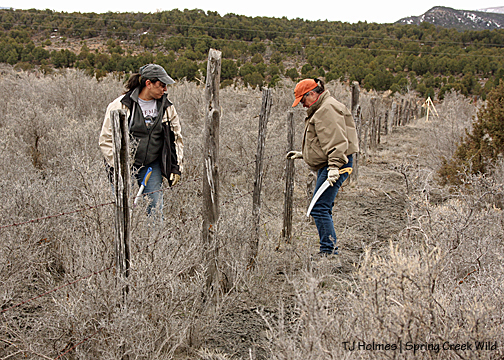
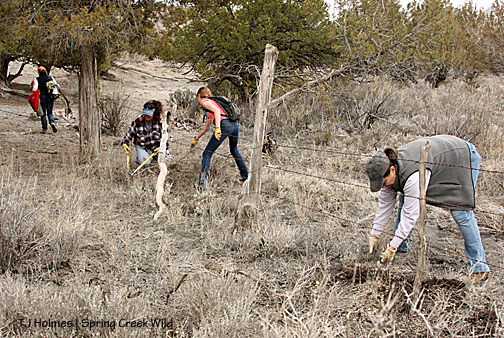
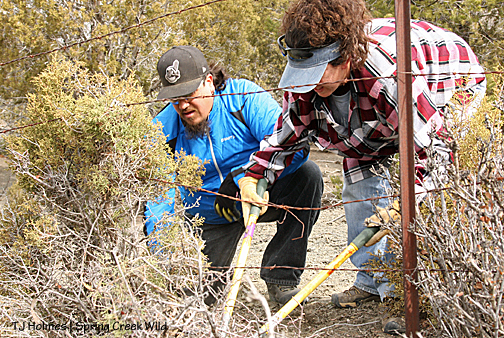
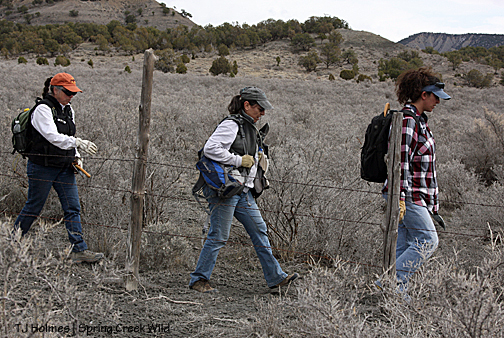
Monday was the first day of work for 10 students (including two site leaders) from the University of Missouri, here to work on public lands in Southwest Colorado on alternative spring break. Instead of going to Cancun or Fort Lauderdale or South Padre Island, these young men and women pursue service opportunities across the country. For more than a decade (13 years now?), San Juan Mountains Association, a nonprofit partner with BLM and the Forest Service on San Juan public lands, has organized work projects that always include at least one day in Spring Creek Basin Herd Management Area. This year and last year, students will be and were here for two days. This year, as last year, students worked on the southeastern boundary fence. Last year, they rebuilt a section of fence that had been vandalized before the roundup (someone cut it in several places); this year, they’re installing braces, tightening some wire and replacing some other wire – maintenance projects much-needed on that fence line.

Volunteers from Mesa Verde and Four Corners Back Country Horsemen and the Colorado chapter of the National Mustang Association also are helping with the project. Some or all of the materials were purchased with funds from last year’s Director’s Challenge, awarded because of BLM’s partnership with Disappointment Wild Bunch Partners, made up of representatives from 4CBCH, MVBCH and NMA/CO.

From SJMA, Kathe Hayes and MK Thompson, from the Forest Service, Tom Kelly, and from BLM, Tom Rice, were overseeing the project.
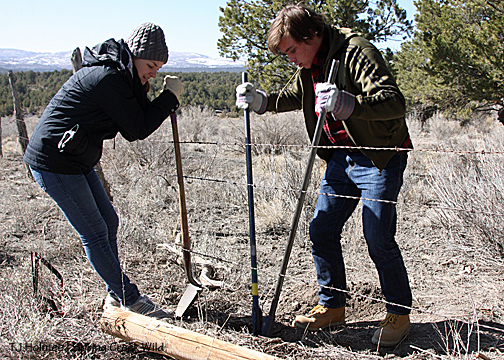
032513sarahmarshaldig

Sarah holds the wire strands to give Marshal room to dig a hole for a post as the first step toward building an H-brace.

032513bvemellbrace

Four Corners BCH volunteer Bob Volger and student Emerald watch student Ellen pound in a stake to hold an H-brace to the post set in the hole dug by Marshal in the first photo.

032513caratiftktamp

Student Kara helps Mesa Verde BCH and NMA/CO volunteer Tif Rodriguez tamp dirt around a post set at another H-brace while Forest Service fence-builder extraordinaire Tom Kelly supervises.
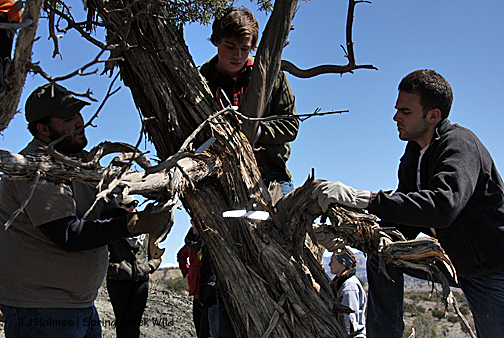
032513chmaraarsaw

From left, Chalen, Marshal and Aaron saw limbs off a juniper to make way for building braces using the tree. Of the 10 students on the trip, these are the group’s only guys. Chalen is one of the site leaders.

032513mkstaples

SJMA’s MK painstakingly removes staples from wire embedded in the juniper tree seen in the previous photo. Moving forward, each tree used for braces will get protective staves to prevent this from happening (thanks, Tom Kelly!).

032513caratifdrill

Tif watches while Kara drills a hole for a spike through the brace and tree for stability.

032513emeralddrill

Emerald drills the way for another spike in another brace. Altogether, three sections of braces had posts dug and posts set in place. Because this area of Spring Creek Basin Herd Management Area also is part of McKenna Peak Wilderness Study Area, all the work had to be done by hand – no mechanical help such as chainsaws.

032513sarahbvtoriwire

Sarah holds wire while Bob, Tom Kelly and Tori (also a site leader) wrap wire around the H-brace and tree (with staves) to tighten.
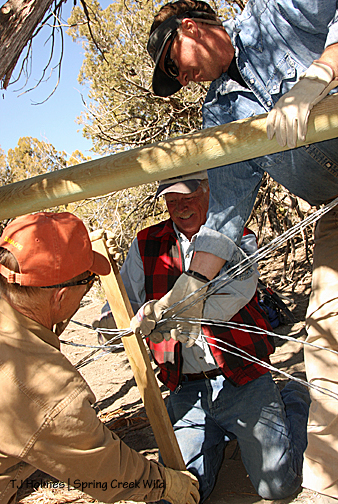
032513bvtktrbrace

Bob, Tom Kelly and Tom Rice do the last bit of work for the day: tightening the wire around the farthest H-brace for stability.

Today, we’ll tighten and replace wire strands.

Thank you to everyone who is helping with this project! We so appreciate your work ethic and commitment to our public lands!


Preparing for fence work

17 03 2013

In a couple of weeks, it will be spring break time again. And here, alternative spring break comes in late March, courtesy of San Juan Mountains Association, which has brought University of Missouri students to Spring Creek Basin Herd Management Area (and other places on San Juan public lands) for something like 10 years now!

Yesterday, a crew of volunteers helped SJMA’s Kathe Hayes clear greasewood and saltbush and small pinon/juniper trees and a small, interwoven shrub we couldn’t identify away from the southeastern boundary fence so the students can start rebuilding the fence from the road with BLM, Forest Service, SJMA and Disappointment Wild Bunch Partners help. For the second year, the students will work for the basin’s mustangs for two days (previous years have had them in the basin one day), and not for the first year, we’re excited to welcome them!

Some pix from our work:

031613tifmadi

Tif and her daughter, Madison (yes, our Madison is named after *this* Madison!), cut and toss greasewood away from the fence near the road.

031613lynkathe

Kathe and Lyn clear the fence of greasewood. This shot is looking back toward the road; you can see the metal supports of the cattle guard in the distance. Note Kathe’s handsaw; this part of the basin also is part of McKenna Peak Wilderness Study Area, meaning no motorized travel or mechanized tools – like chainsaws. Kathe and other volunteers cut some trees on another day for the students to use to make H-braces; those also were cut using handsaws.

031613fenceclearing

Lyn, Madison and Tif clear brush while Kathe moves on to the next bush in need of clearing. Lyn is clearing the last bit of saltbush; the ground here was moist enough that we were mostly able to pull it up through the soil.

031613tifcurly

The couple that saws together stays together! Tif and her husband (and Madi’s dad), Curly, cut and saw a small juniper tree out of the fence line.

031613curlymadi

Curly and Madison head back to the truck after an excellent day’s work. The family that volunteers together … is super fun to have on your work crew!

031613tiflynkathe

Tif, her mom, Lyn (Madison’s grandma), and Kathe walk back to the truck along the newly cleared fenceline boundary of Spring Creek Basin.

In other good news, about 37 drops of rain fell while we were working. 🙂


Pati Temple

5 02 2013

012113temple-72

Mustang angel and lover of all wild life Pati Temple passed away yesterday evening.

Look out, God, whirlwind coming your way!

Pati was one of the most influential people in my life, despite having known her for just the last few years. Words cannot come close to describing the dynamo that was Pati, and at this point, the heartbreak is too raw to try.

God speed, Pati, on the wings of your beloved mustangs. You are much loved and will be most incredibly missed.


Congratulations!

2 12 2012

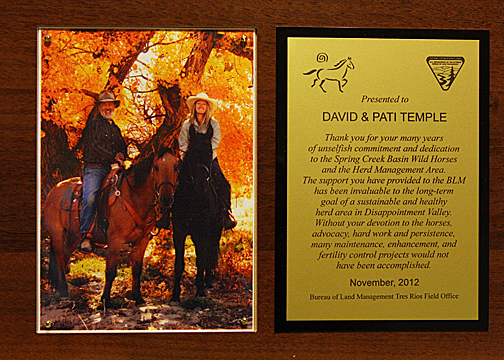
The Tres Rios Field Office in Dolores, Colo., has honored Pati and David Temple with an award that recognizes their dedication during the last 15 years to the mustangs of Spring Creek Basin.

In 1997, Pati and David joined the board of the newly formed Colorado chapter of the National Mustang Association. They have served continuously on the board since then.

Some major projects have been completed in Spring Creek Basin Herd Management Area at Pati and David’s urging:

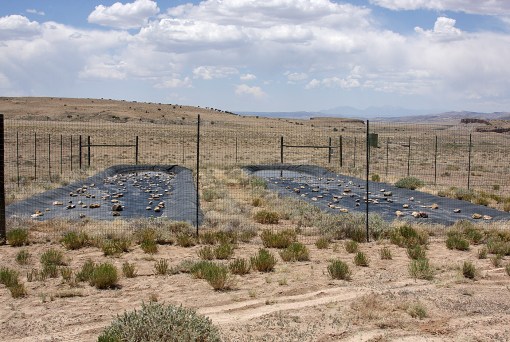
* The water catchment in the basin was funded by NMA/CO – about $18,000. Although there are several ponds and seeps/springs, the catchment provides the horses with the only clean water source in Spring Creek Basin (the others being, at the least, very salty because of the alkaline soil).

* About a decade ago, NMA/CO raised $40,000 to buy cattle AUMs from a rancher who held grazing rights in the basin and, after a five-year struggle, succeeded in retiring those AUMs. Not only that, a grazing EA was prompted, which reduced the remaining AUMs and changed the grazing season to dormant-season grazing only (Dec. 1 until Feb. 28). The National Mustang Association, based in Utah, was instrumental in finally accomplishing this goal.

* Because of Pati and David, magazine subscriptions, horsemanship training videos and countless pairs of boots have been donated by NMA/CO to the inmate training program at the Canon City prison facility, where BLM has a short-term holding facility.

* Pati and David have assisted with the removal of old fences and wire from within the basin as well as construction of new boundary fences and the repair and maintenance of fences.

* For close to a decade, San Juan Mountains Association has hosted University of Missouri students during alternative spring break, which has included projects in the basin. David is an arborist, and NMA/CO regularly has funded chemical spray (Garlon) for tamarisk removal. David (pictured below at right) also has volunteered his time and expertise to help with eradication efforts.

0323asb-group

* Because of Pati’s single-minded determination and her refusal to give up on him, when Grey/Traveler was sent to Canon City at the end of the 2007 roundup, we got him back. Pati and David hosted him at their ranch for three weeks (quarantine) until he could be returned to Spring Creek Basin (pictured below). Long-time readers of this blog will know that he not only rebuilt a band, he has the largest band in the basin at the tender age of “aged,” as aged at the last (2011) roundup.

0919greygone

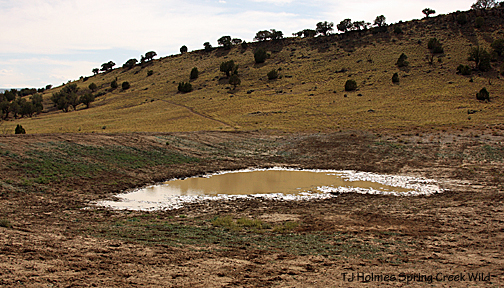
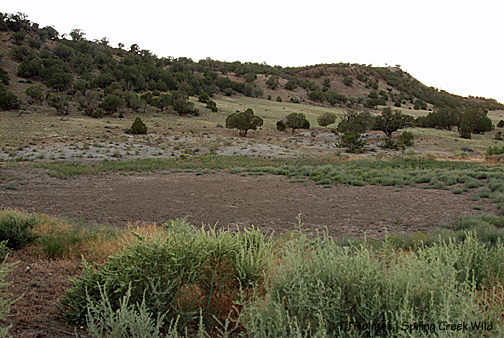
* Pati and David represent NMA/CO in our coalition advocacy group Disappointment Wild Bunch Partners. They bring to Wild Bunch – and BLM – all their historical knowledge of BLM management of Spring Creek Basin Herd Management Area, as well as modern visions that fit with our advocacy goals, which they use to encourage new projects to benefit the horses. With the previous herd manager, one project Pati and David suggested and we convinced BLM to undertake was digging out ponds to increase storage capacity. Some hadn’t been dug out since the 1980s. In 2009, two ponds were dug out. In 2010, three ponds were dug out. In 2012, three ponds were dug out. All but two ponds in the basin have been dug out, and at least one of those still is on the priority list to BE dug out. Currently, in a desperately dry year, all but three ponds have water. To further illustrate how impressive this is – how visionary – ranchers throughout the region are hauling water to their cattle because water sources on their grazing allotments are dry.

112112doublepond

* Also as members of Wild Bunch, Pati and David are an integral part of the partnership with BLM that resulted in the Tres Rios Field Office being awarded $25,000 as part of the Director’s Challenge this year.

* NMA/CO always has championed the use of fertility control. In 2007, NMA/CO paid for five doses of PZP-22 to be administered to the released mares. In 2010, NMA/CO signed on to the proposal submitted to BLM for the implementation of a program to use native PZP in Spring Creek Basin to slow population growth and reduce the need for frequent roundups. Also in 2010, NMA/CO paid for my PZP training at the Science and Conservation Center in Billings, Mont. Then they paid for the darting rifle. When fertility control using native PZP was approved for the Spring Creek Basin herd ahead of the 2011 roundup, we were ready to volunteer.

* Pati and David have adopted several mustangs over many years (including those they’re riding in the photo of the plaque above). In 2011, they adopted yearling Rio (Grey/Traveler or Twister x Two Boots) and renamed him Sherwood, in honor of one of the founding members of NMA/CO. Pati is a genius at groundwork, and at 2 years old, Sherwood loads readily into a trailer and accepts a cinched saddle, among other things.

sherwood2

* In 2012, Hollywood and Piedra had a filly. She was named Temple in honor of Pati and David.

Temple, foreground; Madison, background.

Pati and David are true mustang angels in every sense of the words. Their passion about and commitment to mustangs, particularly Spring Creek Basin mustangs, is legendary in our part of the world. Personally, I am grateful to Pati and David a million-fold for their support and friendship. Their work has laid the foundation for the excellent health of the herd today and into the future. This list hits just the highlights, but I hope it conveys how inspiring they are and should be to mustang advocates everywhere. In addition, they are two of the nicest, most generous people you’ll ever know.

The plaque reads: Presented to David and Pati Temple. Thank you for your many years of unselfish commitment and dedication to the Spring Creek Basin Wild Horses and the Herd Management Area. The support that you have provided to the BLM has been invaluable to the long-term goal of a sustainable and healthy herd area in Disappointment Valley. Without your devotion to the horses, advocacy, hard work and persistence, many maintenance, enhancement and fertility control projects would not have been accomplished. November 2012. Bureau of Land Management Tres Rios Field Office.

The photo on the plaque, taken by Durango photographer Claude Steelman and featured in his book Colorado’s Wild Horses, shows Pati on Bandolier and David on Concho, their Sulphur Springs mustangs.

With appreciation beyond words and always grateful for you both, thank you, Pati and David, for your generosity, commitment and passion. It is contagious and has infected us all! And thank you, Tres Rios, for honoring Pati and David for all they have done for our mustangs.


Die, thistle, die!

6 10 2012

To follow up from the knapweed spraying seen at the northwest pond, here are some pix of sprayed musk thistle at the east-pocket pond:

On the western edge of the pond.

On the south edge of the pond – and dying already! (Note the water.)

Dying musk thistle, full pond – what’s not to love?

Did I mention full pond? The east-pocket pond now is one of only two ponds in the basin that have not gotten dug out in recent years. It did go dry this year but rebounded (a couple of times) with rain. And the Sorrel Flats pond, which was dug out in 2010, is just to the south.

Thank you to the Forest Service and BLM for your continued partnership with Four Corners Back Country Horsemen and Disappointment Wild Bunch Partners in managing Spring Creek Basin Herd Management Area to the best of its potential! It’s fantastic to come back and see the fruits of our labors – GPS’ing sites in the spring – come to fruition in the fall!


Knapweed spraying

5 10 2012

For two days this week, a Forest Service crew directed by BLM has sprayed Russian knapweed around all the ponds in Spring Creek Basin. In May, Four Corners Back Country Horsemen members and guests GPS’d several sites (including ponds) of weed infestation to help BLM identify sites for future spraying. This is all part of the Director’s Challenge grant, which was awarded to the Tres Rios Field Office based on its affiliation with Disappointment Wild Bunch Partners.

We happened to catch G, with the Forest Service, leaving the basin after his second day of spraying and got the scoop.

After visiting with Duke and Kreacher in the northwest “meadow,” we surveyed the northwest pond and spraying activity.

This was a fitting day to get the news about weed spraying; Pat Amthor, who, with her husband, Frank, has honcho’d 13 years worth of wild horse counts in Spring Creek Basin with Four Corners Back Country Horsemen, was visiting. From our vantage with the boys, it was Pat who spied water in the pond.

The vegetation around the pond is the particularly nasty Russian knapweed, noted in a previous post about the pond and it being dug out this summer (also with Director’s Challenge funds). If the green looks a little unnatural, that’s OK – that’s the chemical spray.

Note: Russian knapweed is toxic to horses if ingested in great enough quantity. The good thing is that horses rarely eat it if other forage is available. And we have plenty of other forage available, especially this year.

As we continued around the basin, we did note that all the ponds we saw showed signs of having been sprayed. Yay!

As a side note, we ended up seeing every single horse in Spring Creek Basin, including – again – the elusive Mr. Poco.


Northwest and done

20 07 2012

Three images stitched together in Photoshop. Ragged lines. Photoshop is not my forte!

Now we just need rain to fill it up!


Not-so-big dig

18 07 2012

The Big Dig, it ain’t. But I’m still excited about it!

It represents potentially more water for the horses and increased grazing in an area the horses don’t use a lot because there’s not often water there. And it represents BLM keeping our mustangs’ welfare a priority, especially in this hot and dry year.

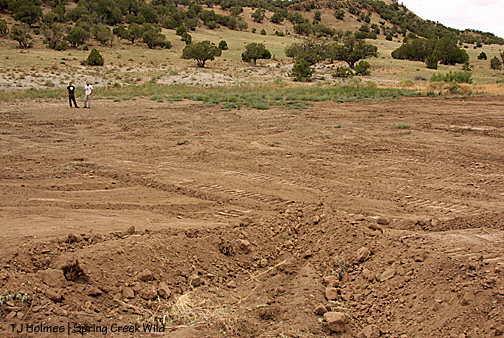
We went from this:

To this today:

It’s not done yet! This is looking from the “spillway” across the pond to the west – the same perspective as the photo above. Many thanks to C and J from the Forest Service who are honchoin’g the project and doing the dirt work!

C and J discussing the finer points of pond clean-out. C also was involved in coordinating the contractor hired to dig out the Round Top pond and the one double pond in 2009.

This is what I call simply the northwest pond, it being in the northwestern corner of Spring Creek Basin. This is looking southeastish across the basin. In the middle ground, you can see the twin buttes and part of Flat Top. Just left of the juniper tree in the foreground is the spillway from which I took the first two pix.

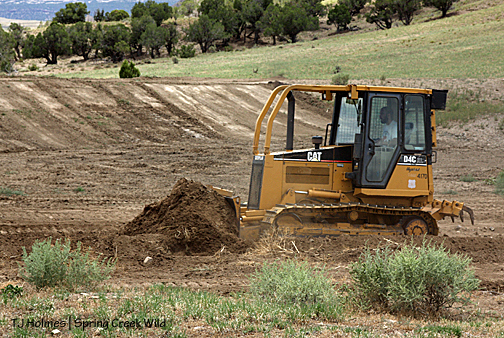
J pushing dirt.

There are basically two drainages that feed this pond, and he’s cleaning out in front of the smaller one, which you can see in front of the dozer. The other one is behind him, out of the picture.

Work should be finished on this pond tomorrow! I’ll post another pic or more later.

Also scheduled for dig-out is – at least – the trapsite pond, which is above Spring Creek Canyon (site of previous roundups). The roadside pond, which was about half dug out in 2010 (because it rained before it was completed), will get dug out if there’s time and/or it dries out more. The dirt of that pond, which went dry a month or so ago, is still damp about 4 inches down where the water dried up last. The Flat Top pond, which has been our priority to dig out since 2009, ends up holding some water when the monsoons kick in again. We’ll try to move that up to a June time-frame for next year; if the roadside pond doesn’t get dug out this year, there’s next year.

Director’s Challenge funds, awarded because of the Tres Rios Field Office’s partnership with Disappointment Wild Bunch Partners, are paying for this work!


Tackling the trickle

28 06 2012

Clouds = relief.

If it’s not too much to ask … some rain??

At last count, there were 23 wildfires burning in Southwest Colorado (this doesn’t include the fires elsewhere in Colorado). It is supremely, horribly dry. Please be careful, no matter where you are! And please send positive thoughts and prayers to the firefighters and people evacuated from their homes as well as those who have lost their homes (none that I know of in SW Colorado).

Forest Service range guy HP was back in the basin this week to honcho the task at “the trickle,” an overflow pipe at an existing well that apparently used to support a drinking trough. We didn’t quite get accomplished our original goal, which was to dig down and install a drinking trough that would be filled by water from the trickle (just too rocky for shovels). But we did get the water flowing through a hose to fill the existing little pool, which we then dammed to try to hold better water there.

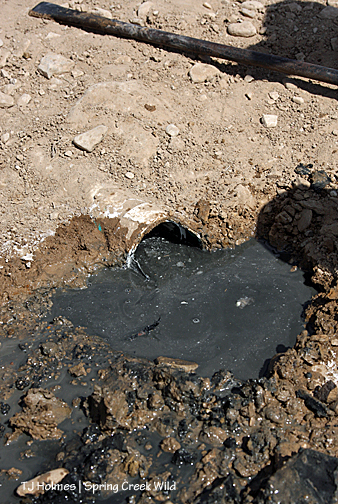
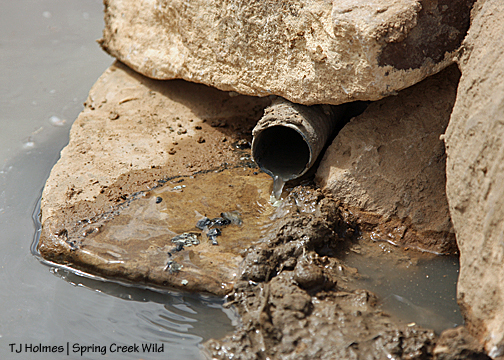
This is the end of the source pipe after we pried off the end-cap filter, which, because of mud and silt, was acting as a solid cap. There’s also mud backed up inside the pipe, and we’ve been playing in the mud to clear as much of it as we can reach, so yes, it looks pretty black and yucky.

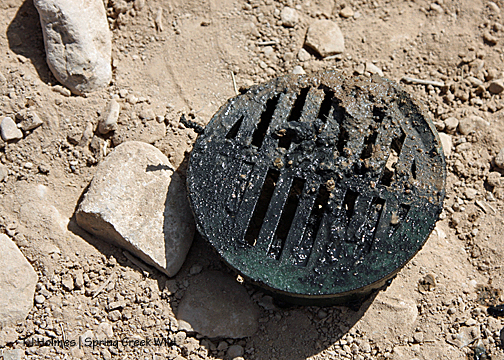
The filter that had capped the source pipe. The pipe had been broken above where this fit inside, and the littlest trickle of water was flowing out (hence the name). Despite the poor quality and low quantity, the horses drink here, so we’re trying to make it better.

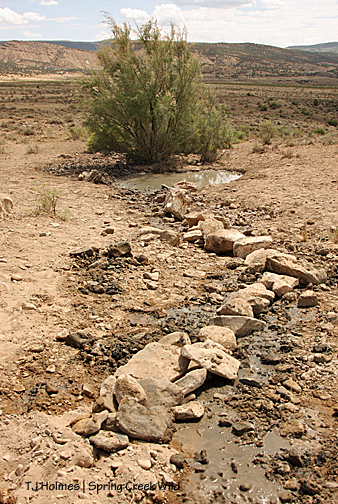
The water flowed downhill, caught in that little pool at the base of the tamarisk, then flowed on around and down until it just ran out.  The light-colored dirt at lower left is what we gathered to pack in around a plastic hose/pipe that we inserted into the source pipe, wedged with rocks and then packed with sand/clay/mud to force the water into the hose to run downhill. The line of rocks covers the hose from hoof traffic, and I’ll keep an eye on it until we can come up with another solution.

The end of the hose, with clear water continuing to trickle out. The water has been tested in the past, and although it’s salty, the horses clearly take advantage of it. (And all the water in the basin – except at the water catchment – is salty because of the alkaline soil.) We’re hoping this mucky little pool will clear up a bit and offer the horses a better source of water.

Apparently, some years in the past, the well fed a drinking trough that has since been removed for unknown reasons. That’s what we’re trying to restore.

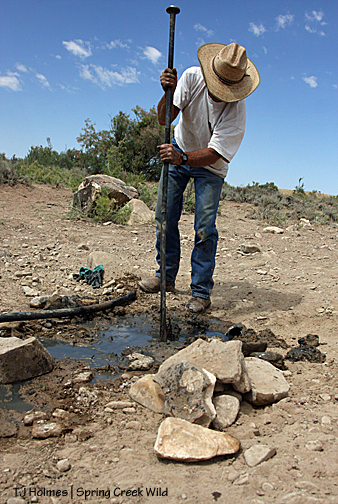
Many thanks to HP of the Forest Service in Dolores, who supplied tools, muscle and know-how! He’s using his tamp bar to pry up rocks below the source pipe. The original well is up the hill behind him and the tamarisk you see in the background. Even though someone decided tamarisk is now OK, as it’s habitat for birds, we’re still on a mission to remove as much as we can from the basin, especially near water sources – which is exactly where it likes to grow.

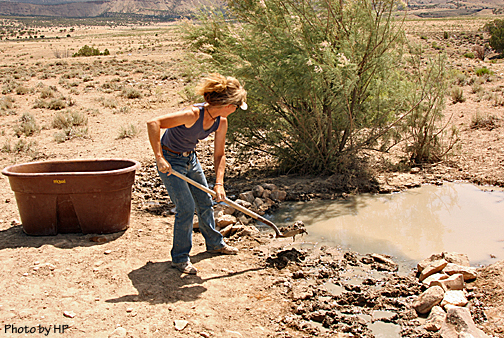
Yours truly, captured by HP, who stole my camera to take this shot. 🙂 I’m shoveling mud into a little dam we made with rocks to hold the water in this little pool. (Note another tamarisk that needs to go bye-bye.) The trickle hose comes out at lower right. The trough we’d hoped to install is behind me.

To come: some poor-quality cellphone pix from riding the arroyos to GPS water seeps. We made some interesting discoveries. While there’s not a lot of water, there IS water, and the horses continue to be in excellent condition.

Rain dances encouraged and welcome.


More water for mustangs in Colorado

22 06 2012

June 20, 2012

Contact: Christopher B. Joyner, Public Affairs Specialist, (970) 210-2126

BLM conducts emergency water operations; closes public lands for drought stricken wild horses

MEEKER, Colo. – The Bureau of Land Management recently began delivering water to wild horses in several areas in western Colorado in response to extreme drought conditions. Today BLM also issued an emergency closure for areas in the vicinity of Texas Mountain south of Rangely to further protect wild horses where the situation is particularly severe.

BLM is closely monitoring the wild horse herds it manages in Colorado and has begun supplementing natural water sources in three of the four wild horse herd management areas in the state, including the Piceance-East Douglas southwest of Meeker, the Sand Wash near Maybell, and the Spring Creek outside of Dolores. These are areas BLM manages specifically to maintain healthy wild horse herds in balance with other uses of the land. BLM is also closely monitoring the water situation in the Little Books Cliffs Wild Horse Range outside of DeBeque, which currently is not requiring supplemental water.

BLM issued the closure prohibiting public access south of Rangley in the West Douglas Herd Area, which is an area not planned for continued management of wild horses because it is not as suitable an area. BLM recently discovered a group of approximately 40 to 50 wild horses completely lacking any natural source of water. In addition to providing a large, temporary water tank and three water troughs, BLM is closing this area to reduce disturbance while the horses adjust to a new water source. The affected closed area is on or near Texas Mountain east of BLM Road 1214 and east of BLM Road 1063. Livestock are not currently in this specific area or using this water source.

BLM is closely monitoring the situation in the closure area and in the remainder of the West Douglas area, which holds an estimated 135 additional wild horses.

“BLM is committed to maintaining healthy wild horses in the White River Field Office and in Colorado,” said Kent Walter, White River Field Office manager. “We will continue to monitor the situation here and elsewhere, and may need to take additional steps to ensure the wild horses are cared for humanely.”

According to Walter, hauling water to such a remote location is not likely a sustainable, long-term solution.

*******************************************************

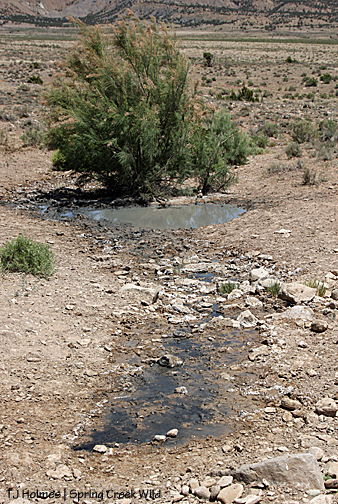
This is what I call “the trickle” in Spring Creek *Basin* (why do people always leave out the “basin” part?). Right above the S in Spring in my signature (and yes, I know, but Spring Creek Basin Wild was a long URL) is a pipe out of which water flows from an old well. It’s not much, it’s salty, it smells like sulphur. But the horses drink here when the drinking gets scarce. By the end of next week, we plan to install a pipeline and a drinking trough. The new line will run downhill to the new trough, which will sit where the pool of water currently is accumulating, right in front of the big tamarisk. Water will be controlled by a float instead of trickling on down into oblivion.

In addition to BLM’s green light (Tres Rios Field Office, Dolores), Disappointment Wild Bunch Partners partnership and (BLM) Director’s Challenge funding, the project involves Forest Service labor from the Dolores Public Lands Office. Thank you to all involved! (And many thanks to the Forest Service’s HP, who brought handsome Jammer for me to ride while we GPS’d water seeps in the Spring Creek (arroyo) and another main arroyo this week in the basin – and more next week!)