Alternatively …

31 03 2016

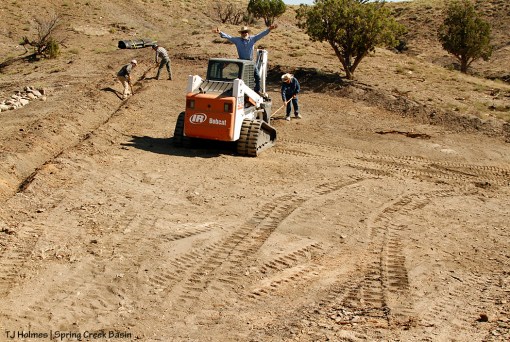
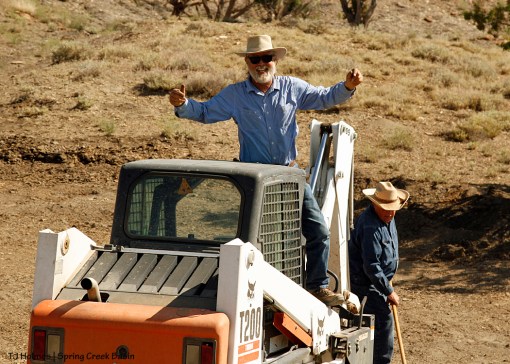
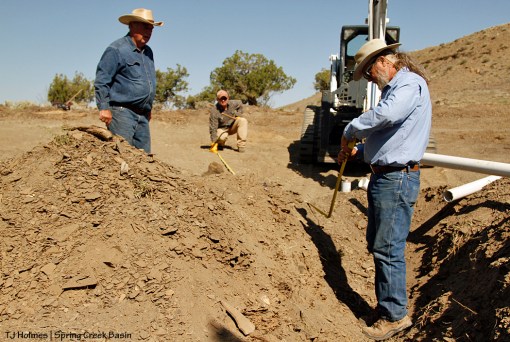
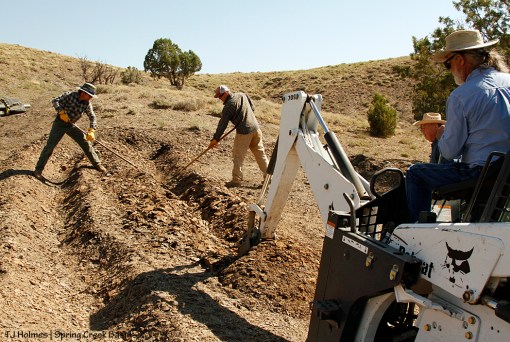
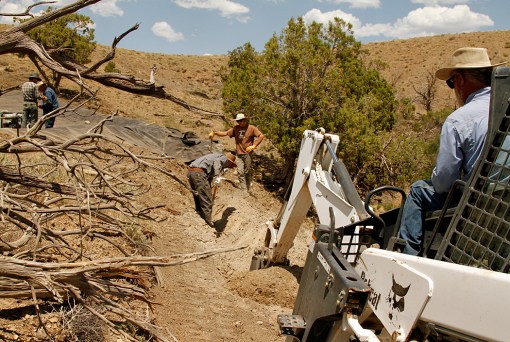
Once upon a time in a place far, far away from civilization – better known as Spring Creek Basin – it snowed during alternative spring break. And then we had many, many years of pretty excellent weather, during which we completed many projects for the benefit of our mustangs that call this faraway place their home on the range.

Brumley Point forms part of Spring Creek Basin's southeastern boundary.

Tuesday would have been the first day of the annual two-day work project for alternative-spring-break partiers in Spring Creek Basin. However, Ma Nature had other plans, and she sent howling winds and blowing snow to this southwestern corner of Colorado.

033016brumleytemplebsnow

Yesterday was the second day of our Spring Creek Basin project. Despite a light skiff of snow on the ground in the morning, we got a fairly decent start, and students carried several loads of materials and tools to the work site – which now is about mile from the road up the southeastern fence line.

033016safetytalk

BLM range tech Justin Hunt gives a safety talk before Mizzou students carry tools and supplies to the work site.

033016supplypickup

University of Missouri students pick up materials to carry to the work site from BLM range specialist Garth Nelson.

033016libbynina

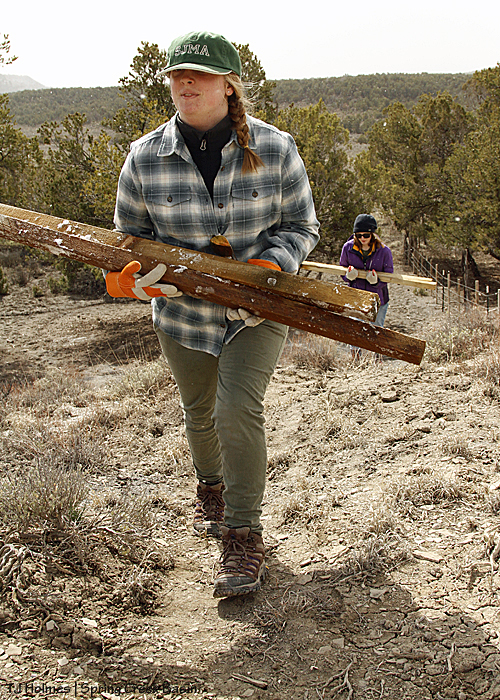
Libby and Nina carry staves up the big hill.

033016ninakathelead

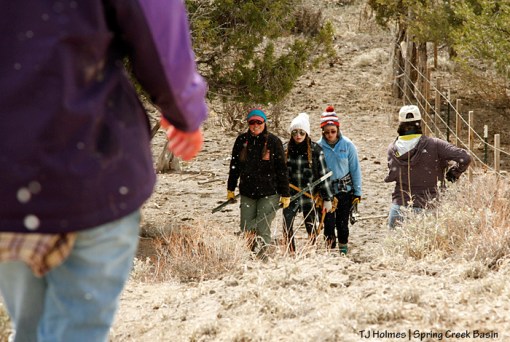
Nina (left) walks back to the truck for more supplies while SJMA’s Kathe Hayes leads Jenna and Bailey to the work site  with a second load of tools. SJMA’s MK Gunn is at far right.

And then it snowed again.

At first, they were lovely little flakes floating on the breeze.

Then those flakes got bigger and heavier, and they started sticking to the ground, and the dirt started getting damp and started sticking to the bottoms of our hiking boots.

033016chalenjoshsean

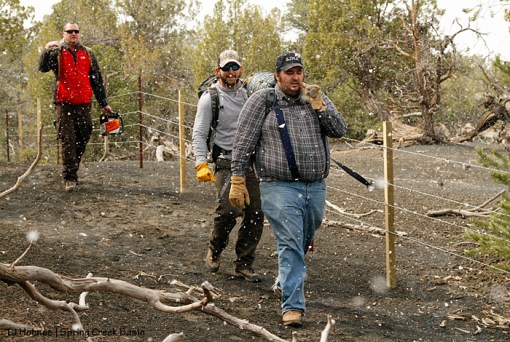
Mizzou’s Chalen helps Southwest Conservation Corps-BLM GIS intern Josh Ryan carry wire to the work site along Spring Creek Basin’s southeastern boundary during alternative spring break. BLM’s Sean Waggoner follows with the chainsaw and T-posts.

033016lukejessicastaves1

University of Missouri students Luke and Jessica carry staves about a mile to the work site while snowflakes start to fall.

About noon, we made the decision to call it a day. By the time we got back to the road, the snow had stopped … but the next wave was on its way.

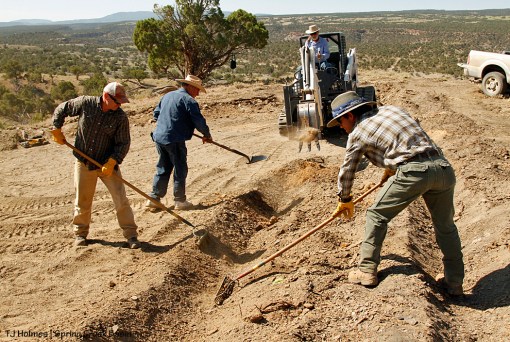
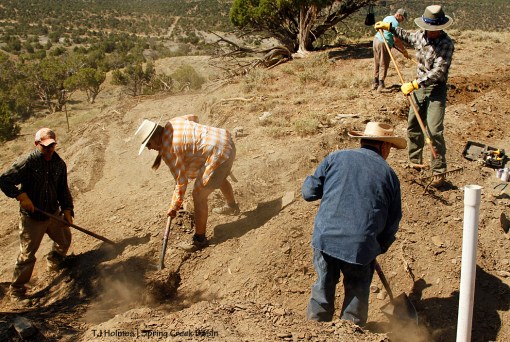
Between the waves of snow, students carried armloads of T-posts and staves, buckets of tools and handfuls of tools, stretched a string to straighten the next section of fence, built an H-brace, pounded T-posts and cut wood away from the path of the new fence line (actually done by our BLM range tech). A couple of them even got as far as dropping posts and staves along the line. But we didn’t have time to take down old wire and string and stretch new wire.

033016garthchalenbrace1

Garth pounds a spike into a cross brace held by Chalen in the H-brace built before the snow really came down.

033016garthchalenlukebrace1

Garth helps Chalen and Luke tighten the wire holding an H-brace together.

033016justinsaw1

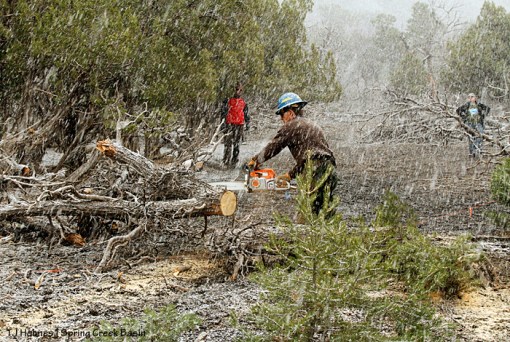
Justin cuts a tree away from the fence. Sean and Mizzou’s Megan serve as safety spotters. We learned that while we can’t cut even dead trees to use as posts in McKenna Peak Wilderness Study Area, we can use chainsaws to clear such trees from a fence line.

033016ninameganseanwire

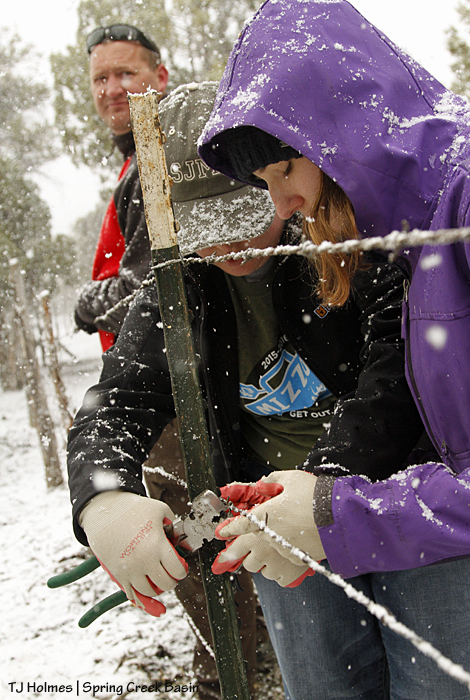
Sean holds wire while Nina and Megan attach strands to a T-post when the snowfall got heavy.

We’ll continue this project on other (sunny) days. 🙂

We sincerely thank this year’s Mizzou crew for being hearty and willing to brave the elements to tackle this ongoing project! It was great to meet you all … and there’s always next year! We also thank SJMA’s Kathe Hayes for her ever-cheerful organizational skills and taking care of the students, as well as members of the Colorado chapter of the National Mustang Association and Disappointment Wild Bunch Partners (who represent NMA/CO, Four Corners Back Country Horsemen and Mesa Verde Back Country Horsemen) for helping with funding.

033016asbgroup1

University of Missouri students gather with BLM and SJMA employees in front of Temple Butte, just outside Spring Creek Basin in McKenna Peak Wilderness Study Area, during alternative spring break. From left to right: Justin Hunt, Bailey, MK Gunn, Josh Ryan, Jenna, Nina, Jessica, Megan, Luke, Libby, Kathe Hayes, Garth Nelson, Chalen and Sean Waggoner.


‘PZP: Where hope, science and mustangs meet’

6 01 2016

Thanks to Kat Wilder for her Writers on the Range op-ed in High Country News. 🙂

It’s getting harder and harder to deny PZP and its success!

Houdini

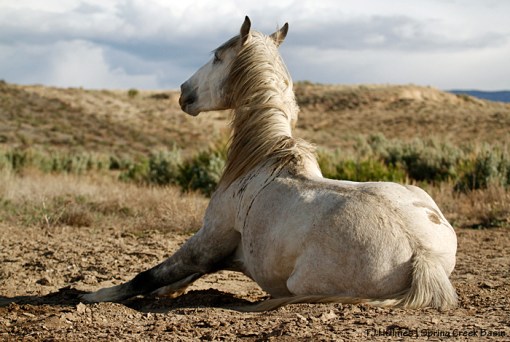
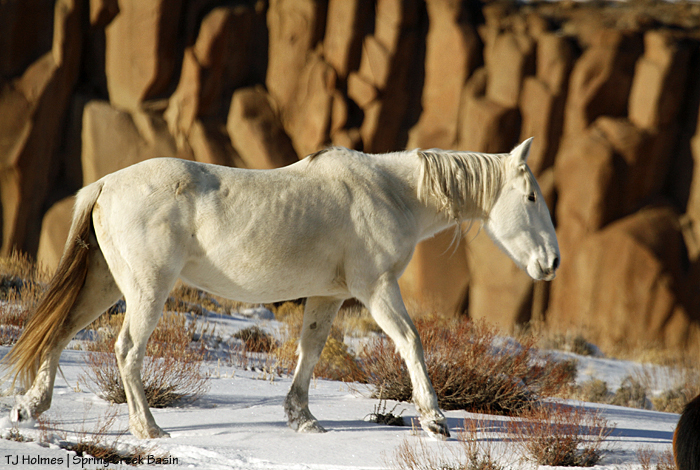
This is Houdini, who, at best guess, is somewhere north of 25 years old. She shows her age but otherwise looks great. She has contributed her genetics to Spring Creek Basin and has daughters and granddaughters and grandsons (at least) still wild in Spring Creek Basin.

I’ve known at least two elder mares that have had foals in the spring and died that fall, leaving their weanlings as orphans. Houdini has contributed her genetics and deserves a long, healthy life  as the wild, wise mustang mare she is, adding her knowledge to the whole herd.

PZP makes that possible.


Rest in peace well deserved, Dr. Jay Kirkpatrick

19 12 2015

Winona

From American Wild Horse Preservation Campaign:

“It is with deep sadness that we inform you of the passing of Dr. Jay Kirkpatrick, a true pioneer in the field of humane wildlife management. Dr. Kirkpatrick, the founder of the Science and Conservation Center, passed away earlier this week from a brief but serious illness. He will be greatly missed.

“His passing is a terrible loss for the wild horse community. Our deepest condolences go to his wife and his colleagues at the Science and Conservation Center who are like family to AWHPC, as Dr. Kirkpatrick was.

“Jay was a rare ‘scientist with a heart’ and he dedicated his life to reducing the suffering of wild animals by developing a humane alternative to lethal management practices. The PZP fertility control vaccine that he developed and perfected (as affirmed by 30 years of published science) has kept countless wild animals – from wild horses to deer to bison and even elephants – wild and free by protecting them from capture and killing.

“‘I’m not a bunny hugger, but I’ll never attend another gather as long as I live. They’re flat-out inhumane,’ he told National Geographic in 2009 describing BLM wild horse roundups. ‘There are three reasons why these gathers are an unsatisfactory solution to the problem of numbers. Firstly, it’s genetically irresponsible to be constantly pulling off young horses whose genes will never get expressed; secondly, every time you pull horses out, the reproductive efficiency of the horses that remain increases. And thirdly, the behavioral consequences for the horses are profound.’

“Jay was a visionary, a humanitarian and a shining example of what one person can accomplish in his lifetime. We are so proud to have called him a friend and a colleague. Measures have been taken by the Science and Conservation Center to prepare for this transition and the seamless continuation of the work that he was dedicated to for 45 years.”

Godspeed, Dr. Jay. You trained many angels, and we honor you and your legacy to preserve mustangs and wild burros with every dart we fire.

Thank you, thank you, thank you.


Steep work, great views

31 10 2015

Caution: Scenery- and work-project-heavy post ahead.

Thursday was the last day of work for the SCC crew – a short amount of time for a big – steep – job.

The day started with some clouds, cleared to sunshine, then returned to clouds. (More) Rain started Thursday night. (Have we been blessed by rain the last couple of weeks or what?!) So the crew had good conditions for their final day of work on Spring Creek Basin’s southeastern boundary fence.

Southwest Conservation Corps crew members build H-braces on a steep hill along Spring Creek Basin's southeastern boundary. From this vantage, one looks across the last drainage in the basin toward Disappointment Road.

Let’s start with a scenic overview. There we were, on the basin’s far southeastern boundary looking southwestish over the basin’s “last” drainage toward Disappointment Road, the cottonwoods along Disappointment Creek and to more pinon-juniper covered BLM land beyond the basin to San Juan National Forest Service land to the horizon. Note the two groups, both working on H-braces on the near ridge – aka “the steep hill.” If you click to make the photo larger, you may be able to see the silver fence at the left; that’s the part of the fence that the crew already had rebuilt. It runs into the fence rebuilt by Mizzou students (we left a section for the students to work on in the spring).

Southwest Conservation Corps members are replacing this fence along Spring Creek Basin's southeastern boundary.

Next, let’s take a look at the sad old fence that serves as an example of what the Mizzou students and the SCC crew have rebuilt and are rebuilding. We figure that fence has been around for 40 or more years.

Southwest Conservation Corps crew members Toby and Zoe finish an H-brace at the base of the steep hill to along Spring Creek Basin's southeastern boundary.

Toby and Zoe tighten another wire strand to a corner H-brace. Their rebuilt fence comes in from straight ahead, up from the arroyo shown in the previous post; the steep hill starts steps to the left.

Southwest Conservation Corps members Eric and Aaron dig a hole while building an H-brace on the steep hill on Spring Creek Basin's southeastern boundary.

Meanwhile, up the steep hill (hey, it really IS steep), Aaron and Eric dug holes for another H-brace. If you look closely, you can see the H-brace Toby and Zoe were working on below the hill at right.

Southwest Conservation Corps member Aaron watches Sarah carry an H-brace post up the steep hill on Spring Creek Basin's southeastern boundary.

Photographic proof of the steepness (in a two-dimensional photo, it’s hard to convey just how steep this hill is): Sarah carries a post up the hill to the site of the next H-brace.

Southwest Conservation Corps members Eric and Aaron check the cross post while building an H-brace on the steep hill on Spring Creek Basin's southeastern boundary.

This photo does double duty: Partners Eric and Aaron measure the setting of an H-brace post with the cross post, AND you get another dose of scenery.

Southwest Conservation Corps members Toby, Sarah and Abby take turns digging a hole for an H-brace post on the steep hill on Spring Creek Basin's southeastern boundary.

Toby and Sarah stand ready as Abby uses the post-hole digger to dig yet another hole for yet another H-brace on their journey to the top of the steep hill. Eric and Aaron in the photos above are below on the hill. The scenery here is part of McKenna Peak Wilderness Study Area – which overlaps into Spring Creek Basin Herd Management Area; in this view, it’s all wilderness study area.

BLM range tech Justin Hunt helps dig a post hole for an H-brace on the steep hill with SCC crew members Toby and Abby on Spring Creek Basin's southeastern boundary.

Another view of the same H-brace site, this time with BLM range tech Justin Hunt helping to dig the second post hole. How steep is the hill? The H-brace Eric and Aaron are working on is 100 yards or less below this site – and completely out of view of this little knob in the hill.

The fence the Southwest Conservation Corps built. Up the hill in the foreground and across the small drainage in the lower background, beyond the photo, the crew left a section for the Mizzou students on alternative spring break next year.

From the side, here’s a view of Eric’s and Aaron’s H-brace. Abby and group are up the hill to the right. In the very first photo in this post, you can see both groups. Their rebuilt fence as it crosses the arroyo is very visible in this photo.

Southwest Conservation Corps members rebuild the fence up a steep hill on Spring Creek Basin's southeastern boundary.

Another gratuitous scenery shot – ain’t it grand?

Southwest Conservation Corps crew members Sarah, Aaron and Eric help co-crew leader Dillon complete an H-brace they built on a steep hill on Spring Creek Basin's southeastern boundary.

Returning to Eric’s and Aaron’s H-brace, now they have help from Sarah and co-crew leader Dillon to mark the first cross post. We had some debate about the levelness of these cross posts because the ground is so steep. Keeping the cross pieces strictly level would have had the post normal height on the downhill side of the brace but only about mid-thigh high on the uphill side! So crew members mirrored the slope a bit and cut their notches to reflect the angles of the posts’ ends.

Southwest Conservation Corps co-crew leader Dillon lends weight to the manual drill wielded by Eric as he drills a hole for a spike in the H-brace pictured. Aaron and Sarah, who dug the post holes, thread wire to anchor the braces on Spring Creek Basin's southeastern fence line.

It’s easy to ramble on about the partnerships we enjoy for the benefit of the basin’s mustangs, but here it is in living color: Dillon lends weight to Eric’s drill while he drills a hole in the H-brace into which he’ll later pound a spike. Ain’t it grand?! 🙂 Wrapping wires to create the “X” to further bind the brace posts together are Aaron and Sarah.

Southwest Conservation Corps crew member Sarah uses a chisel to create a notch for a cross bar in an H-brace in Spring Creek Basin's southeastern fence line.

Sarah chips out the notch that will hold the cross posts even steadier in the vertical H-brace posts.

In case the steepness of “the steep hill” hasn’t been mentioned or illustrated clearly, these next photos should do the trick:

Southwest Conservation Corps co-crew leader Sarah carries a post up the steep hill to build an H-brace in Spring Creek Basin's southeastern fence line. All smiles on Day 4!

Co-crew leader Sarah carries an H-brace post up the steep hill. She’s passing the first H-brace, and she’ll pass the next H-brace before getting to her destination – and they had at least one more H-brace to build after that. Still all-smiles on Day 4!

BLM range tech Justin Hunt carries a post up the steep hill behind SCC co-crew leader Sarah on the way to build a new H-brace above the one pictured, with co-crew leader Dillon, on Spring Creek Basin's southeastern boundary.

Justin follows Sarah on the way to the second H-brace up the steep hill, where Dillon is making cuts to start the notching process.

Southwest Conservation Corps crew member Zoe carries a post up the steep hill to use as part of an H-brace along Spring Creek Basin's southeastern fence line.

And here’s Zoe carrying another post from basically the base of the steep hill (scroll back up to the beginning of this post and the H-brace where she and Toby were tightening a strand of wire).

Southwest Conservation Corps crew members construct H-braces in the new fence along Spring Creek Basin's southeastern boundary. That steep hill is why they were hired!

From the bottom looking up.

Southwest Conservation Corps crew members construct a new fence along Spring Creek Basin's southeastern boundary. That steep hill is why they were hired!

And from down toward the arroyo looking up at the steep hill. Um, wowowow?! The wilderness study area’s namesake McKenna Peak shows its point at far right.

Sarah, Dillon, Eric, Aaron, Sarah, Zoe, Abby and Toby, we thank you, thank you, thank you for your service on behalf of our mustangs! We hope your last hitch of the season was your best. Thankfully, you saw some mustangs along the way between camp site and work site, and if you can, please come back soon to see more of the mustangs protected and kept safe by your work!

Beyond Spring Creek Basin in McKenna Peak Wilderness Study Area: McKenna Peak at far left and Temple Butte toward the right. Outside Spring Creek Basin, they are two of the basin's most recognizable landmarks.

View from the top. 🙂


Chocolate-chip cookies fuel fence work

29 10 2015

Kathe Hayes with San Juan Mountains Association offers homemade chocolate-chip cookies to Abby, working with Zoe to dig holes for an H-brace on Spring Creek Basin's southeastern boundary fence line.

Right here, this is the reason (OK, one reason) we love SJMA‘s Kathe Hayes: She brings homemade chocolate-chip cookies as mini mid-work thank-yous! Here she offers cookies to Abby as she and Zoe dig post holes for the next H-brace in the SCC crew’s brand-new fence section.

Southwest Conservation Corps co-crew leader Dillon and members Sarah and Aaron complete an H-brace (background) while Abby and Zoe dig post holes for the next H-brace - across a little arroyo - in Spring Creek Basin's southeastern fence line.

The crew has made excellent progress in their section of fence line – building five H-braces since Monday and working on the sixth as of the above photo. In the foreground, Abby and Zoe dig post holes for the next H-brace, while in the background, Aaron and Sarah and co-crew leader Dillon complete the previous H-brace. Harder to see is the little arroyo – no more than a few feet deep but steep-sided – between the two groups.

Southwest Conservation Corps co-crew leader Dillon and members Sarah and Aaron complete an H-brace in Spring Creek Basin's southeastern fence line while SJMA's Kathe Hayes offers them chocolate-chip cookies. On their third day of work, the crew is almost to the arroyo at the base of the steep hill.

Here’s a closer look at the arroyo. Note Kathe in the background, approaching with her awesome cookies.

Southwest Conservation Corps co-crew leader Dillon and member Sarah thread wire to complete an H-brace in Spring Creek Basin's southeastern fence line. SJMA's Kathe Hayes offers homemade chocolate chip cookies to Sarah, Aaron and Dillon.

Kathe makes her cookie offering while Dillon, Sarah and Aaron complete their H-brace. Eric and Toby and co-crew leader Sarah, not pictured because they were working on different sections of fence, also got cookies, hand-delivered by Kathe, and she left the whole bin. 🙂

Southwest Conservation Corps co-crew leader Dillon and member Sarah thread wire to complete an H-brace in Spring Creek Basin's southeastern fence line. At right, SJMA's Kathe Hayes shows crew member Aaron photos of the pack horses that carred fencing materals to the work site a few weeks ago.

Kathe shows Aaron photos of the pack horses that hauled fence supplies to the work site a few weeks ago while Sarah and Dillon finish their H-brace. Temple Butte watches over the crew from the background.

Southwest Conservation Corps co-crew leader Dillon and member Sarah thread wire to complete an H-brace in Spring Creek Basin's southeastern fence line.

This is where they are; that’s where they’re going! And that’s why they’re here. Mizzou students … you’re welcome! 🙂


SCC working for our mustangs

27 10 2015

Here in Spring Creek Basin, we are incredibly lucky to have the benefit of multiple partnerships that work for the well-being of our mustangs. Our newest partnership is with Southwest Conservation Corps, based in Durango. Thanks to the diligence of San Juan Mountains Association‘s Kathe Hayes and Tres Rios Field Office range specialist Mike Jensen, we have an SCC crew tackling an especially difficult section of fence: across an arroyo and up a steep, shaley hill.

Long-time readers know about our wonderful alternative spring break program with University of Missouri students and that, for the last four years, students have been rebuilding the basin’s southeastern fence line. The SCC crew, which has spent the summer building trails, building fences and planting trees, is jumping ahead a bit to the steep section.

As we are with every bit of help that comes our way for the benefit of the mustangs, we are hugely grateful for their work!

Southwest Conservation Corps' Jordan explains previous fence building by University of Missouri students to SCC crew members along Spring Creek Basin's southeastern fence line. The SCC crew is on site to replace a difficult section of the fence that goes up a steep hill.

Jordan explains previous fence building by Mizzou students to SCC crew members, starting the first day of their hitch in Spring Creek Basin. Mizzou students and BLM employees and volunteers have set the bar high with the new fence! From left: Sarah, Eric, Jordan, Abby, Aaron, Toby behind Dillon, Dillon and Zoe.

Southwest Conservation Corps' Jordan stands by with a shovel whie Eric takes his turn at digging a post hole for an H-brace in Spring Creek Basin's southeastern fence line.

Jordan stands by with a shovel while Eric digs a post hole for their first H-brace.

Southwest Conservation Corps crew members Dillon, Jordan and Zoe place protective staves around a tree that will serve as half of an H-brace in Spring Creek Basin's southeastern fence line.

Co-crew leader Dillon helps Jordan and Zoe protect a tree with staves around which to wrap wire. The Mizzou students this spring ended their two days of work with an H-brace on the other side of this tree.

Southwest Conservation Corps crew members Abby and Aaron use the post puller to remove a rotted post in Spring Creek Basin's southeastern fence line.

Crew members Sarah and Aaron work together to pull out an old fence post that had a rotten bottom from being in the ground for who knows how many decades.

Southwest Conservation Corps co-crew leader Dillon checks the level of the cross post on an H-brace installed by crew members including Abby and Eric (shown) in an H-brace they installed in Spring Creek Basin's southeastern fence line.

Crew members Abby and Eric, who helped dig the hole for the H-brace post, watch as Dillon checks the level of the cross post.

Southwest Conservation Corps crew members Sarah, Zoe, Aaron and Eric watch Jordan as he shows them how to twist staves in crossed wires to pull together an H-brace they installed in Spring Creek Basin's southeastern fence line.

Co-crew leader Sarah (there are two Sarahs on this crew) and crew members Toby, Aaron and Eric watch Jordan show them the twisting technique of the staves in the cross wires that bind the H-brace together.

The crew finished the H-brace and strung strands of wire on their first day of work … which started with about a quarter of an inch of rain! As you can see, the day ended with beautiful sunshine.

One of the coolest part of the day? Seeing the pintos as we drove to the work site and again as we returned to the camp site. 🙂 The horses are the reason for the work, the partnerships … the tramping through mud carrying heavy posts and fencing tools. They’re absolutely the reason we do all that with smiles!


NMA/CO to show ‘Unbranded’

16 10 2015

2015unbranded

The Colorado chapter of the National Mustang Association will feature a showing of “Unbranded” at 5:30 p.m. Monday, Oct. 26, at the Sunflower Theatre in Cortez, Colo. See the above for more information. If you’re local, we’d love to see you there!

Visit NMA/CO’s website to purchase tickets online.

“Unbranded” is the story of four Texas Aggies and their 16 mustangs on a journey across some of America’s most stunning public lands, from Mexico to Canada. It’s a must-see testament to the mustangs that represent the freedom and pioneering spirit on which America was built.


Partners for mustangs

3 10 2015

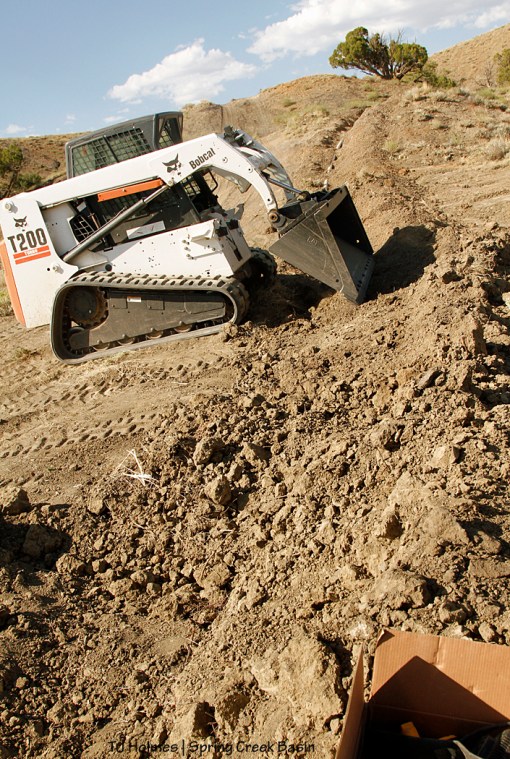
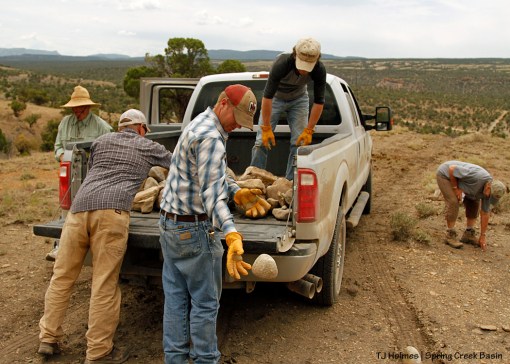
Wednesday, I partnered with folks from BLM, the Forest Service, San Juan Mountains Association and Southwest Conservation Corps to haul fence materials into Spring Creek Basin. Long-time readers of this blog are familiar with the outstanding alternative spring break program that brings a group of enthusiastic University of Missouri students to Southwest Colorado each year (look under the March links in the blog roll). In addition to working in Spring Creek Basin, students work on other areas of San Juan public lands for a week before heading back to class in Columbia, Mo. After four years, students have rebuilt quite a long stretch of our southeastern boundary fence – carrying materials in by manual labor because of its location in McKenna Peak Wilderness Study Area (no motor vehicles allowed).

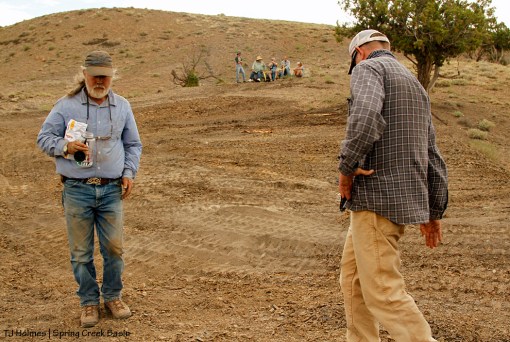
Now that we’re pretty far in, and a steep bit of shale hill is coming up (literally), SJMA’s Kathe Hayes and BLM’s range specialist/herd manager Mike Jensen got the attention of the SCC (based in Durango) to give us a hand. While we want to give the Mizzou students a spring break they won’t soon forget, we don’t want to get too crazy. 🙂 Next spring, they’ll continue to rebuild fence from where the last group left off this past spring toward the base of the hill. This fall, the SCC crew will leapfrog where this spring’s students finished to start rebuilding a section from close to the base of the hill UP the hill.

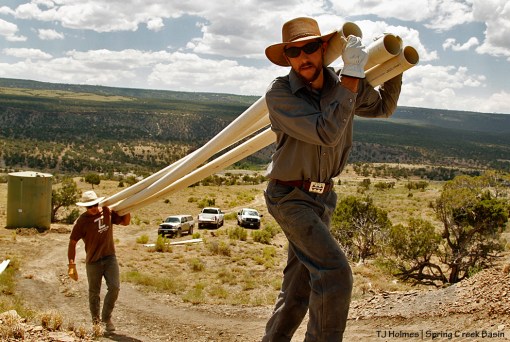
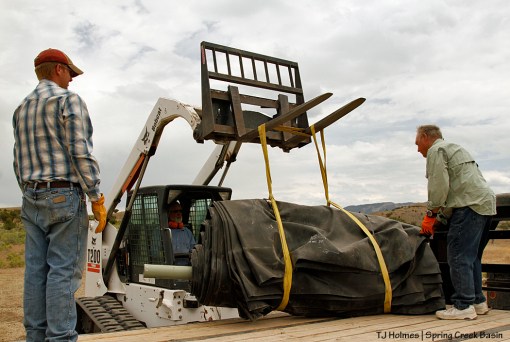
To ease the workload of both crews, our little group hauled fence supplies this week: wooden posts (for H-braces), T-posts (to replace worn/bent/warped ones), lots and lots of staves (to stabilize the wires between T-posts), and rolls of smooth-twisted and barbed wire (to create wild-horse/life-friendly fencing that cattle won’t want to mess with from the outside) – to a site convenient for both the SCC crew this fall and Mizzou students in the spring.

Many, many thanks to BLM’s Mike Jensen, Justin Hunt and Garth Nelson, SJMA’s Kathe Hayes, the Forest Service’s Harold Park, SCC’s Jordan and BLM/SCC’s Lauren for providing the human labor (including hours of scheduling and logistics!).

Huge, huge thanks to our four-legged crew: Traveler (who packed posts), Trapper (who packed staves and T-posts), Pinch (who packed wire and spikes and Lauren :)) and Zip (who packed staves), as well as Jammer (who packed Harold) and Sneakers (who packed Kathe). These seasoned Forest Service veterans made our job much easier – and they worked for apples!*

BLM range tech Justin Hunt leads Forest Service pack horse Trapper with a load of T-posts while Lauren leads Pinch toward the dropoff point along the southeastern boundary fence of Spring Creek Basin Herd Management Area. A Southwest Conservation Corps crew will be in the basin in October to replace a steep section of the fence, which has been worked on for four years by University of Missouri students during alternative spring break.

Here’s a teaser pic of Justin leading Trapper after Lauren and Pinch on the way to the cache site, following Kathe and Harold, who led the other two pack horses. For more pix of a great day of work that benefits Spring Creek Basin’s beloved mustangs, check out SJMA’s photostream on Flicker.

* Jammer and Pinch are Harold’s personal horses, and Sneakers belongs to Kathe.


‘Keep the Wild Horses Wild’

13 09 2015

LynnHansonCWAMflier

Passing on good works: Mustang photographers and advocates Lynn Hanson and Carol Walker will present a film night featuring “American Mustang” at 6:30 p.m. Wednesday, Sept. 16, at the Natrona County Public Library in Casper, Wyo.

From the library’s website about the event:

“The Natrona County Public Library and Casper College will host Colorado Author and Wild Horse Photographer Carol Walker as well as feature a screening of the documentary ‘American Mustang’ on Wednesday, September 16 at 6:30 p.m. in the Crawford Room. The event is free and open to the public. The goal of the evening is to raise awareness and to promote a deeper understanding of the troubles currently facing wild horses in America.

“The evening will begin with a screening of “American Mustang,” a nature documentary with character-driven narrative. Shot in eight Western states, ‘American Mustang’ reveals the majestic wild horses of the American West by taking audiences on a journey through a landscape dotted by ranchers, wild horse advocates, government agencies and the public. The evening will conclude with a question and answer forum led by Carol Walker. Walker will address many of the controversies highlighted in ‘American Mustang.’ She will also discuss how wild horses are in danger of being displaced from the range by agricultural and energy interests. Copies of Walker’s book, ‘Wild Hoofbeats: America’s Vanishing Wild Horses,’ will be available for purchase, which she will sign following her talk.

“In collaboration with the event, local Wild Horse Photographers Chad and Lynn Hanson’s exhibition ‘Landscapes with Wild Horses,’ featuring years of exploration and iconic photography, opens Saturday, August 22 in the Library’s atrium. Showcasing the beauty of Central Wyoming’s wild horses at liberty, the exhibition consists of photographic images and statistics that transport visitors to a fragile slice of land where hundreds of wild horses make their home. ‘Landscapes with Wild Horses’ runs through Wednesday, September 30 and can be viewed by the public during regular library hours.”

If you’re in Wyoming, please plan to attend in order to encourage and support these advocates and their work to educate the public about mustangs!


NMA/CO fundraiser

13 07 2015

The Colorado chapter of the National Mustang Association held a fundraiser Friday night to benefit wild horses in Southwest Colorado. Held at the Sunflower Theatre in Cortez, the event featured a silent auction and the film “Roaming Wild,” after which, people could ask questions about PZP, bait trapping and other wild-horse-and-burro issues.

The place was packed. On behalf of Spring Creek Basin’s mustangs and other wild horses, on behalf of the NMA/CO board, who did an enormous amount of work for this event (in particular, executive director Tif Rodriguez), thank you to all of our wonderful donors and ticket buyers! You made our night a huge success, and you made our work for the horses easier.

NMA/CO fundraiser

NMA/CO executive director Tif Rodriguez and president David Temple welcomed people to the fundraiser event.

NMA/CO fundraiser

People started to fill the theater even before 5:30 p.m. This was a great time to catch up with old friends and make new ones. We are so thankful to everyone who attended to support our mustangs!

NMA/CO fundraiser

Many locals donated items for the silent auction. The donations were excellent, and we thank all the donors for their generosity!

Kathe Hayes arranges food at the NMA/CO fundraiser at the Sunflower Theatre in Cortez.

Kathe Hayes was in charge of food and did a fantastic job. She made some and picked some up from local eateries. She didn’t seem to have much to pack up at the end of the night!

Again, thank you so much. Our mustangs thank you! 🙂