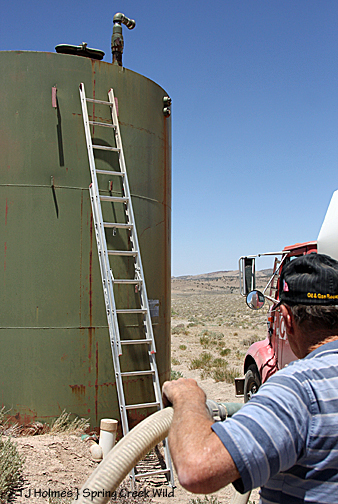
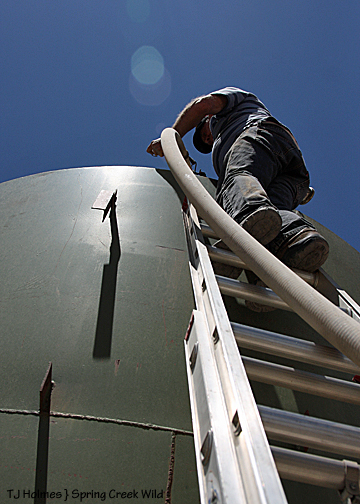
Knapweed spraying

5 10 2012

For two days this week, a Forest Service crew directed by BLM has sprayed Russian knapweed around all the ponds in Spring Creek Basin. In May, Four Corners Back Country Horsemen members and guests GPS’d several sites (including ponds) of weed infestation to help BLM identify sites for future spraying. This is all part of the Director’s Challenge grant, which was awarded to the Tres Rios Field Office based on its affiliation with Disappointment Wild Bunch Partners.

We happened to catch G, with the Forest Service, leaving the basin after his second day of spraying and got the scoop.

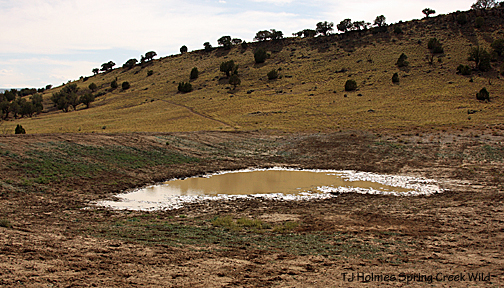
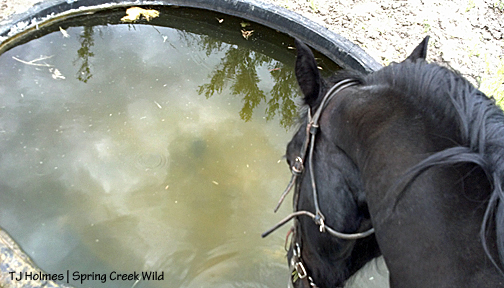
After visiting with Duke and Kreacher in the northwest “meadow,” we surveyed the northwest pond and spraying activity.

This was a fitting day to get the news about weed spraying; Pat Amthor, who, with her husband, Frank, has honcho’d 13 years worth of wild horse counts in Spring Creek Basin with Four Corners Back Country Horsemen, was visiting. From our vantage with the boys, it was Pat who spied water in the pond.

The vegetation around the pond is the particularly nasty Russian knapweed, noted in a previous post about the pond and it being dug out this summer (also with Director’s Challenge funds). If the green looks a little unnatural, that’s OK – that’s the chemical spray.

Note: Russian knapweed is toxic to horses if ingested in great enough quantity. The good thing is that horses rarely eat it if other forage is available. And we have plenty of other forage available, especially this year.

As we continued around the basin, we did note that all the ponds we saw showed signs of having been sprayed. Yay!

As a side note, we ended up seeing every single horse in Spring Creek Basin, including – again – the elusive Mr. Poco.


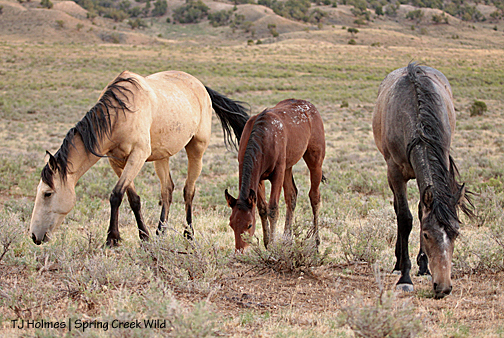
Sister, brother

13 09 2012

Always handsome, this pair.

Skywalker with big sister Mysterium.

This band has been relatively elusive lately; this photo is from late August. I last saw them last week, way up high above the northwest valley toward Klondike Basin. A couple of Forest Service folks – H and W – brought Pinch and Jammer and Traveler (!), and we rode some fence and fixed some fence. It was a great couple of days, and the mustangs are safer because of it!


Water, blessed

1 09 2012

Oh, peeps. What a summer. No rain for months. Then rain. Ponds – three – dug out. Then no rain – again. Did I mention heat? Drying wind.

We got a big rain last week. I couldn’t wait to get back in the basin to check ponds. But I’ve been distracted – by Terra’s new baby, by checking Chipeta (no baby today). The day I found Terra’s baby boy, I got stopped at the first Spring Creek crossing by a big wash of rock, some still-not-dry mud (which kinda IS mud, eh) and a tall/deep “step” of dirt/mud at the far side. It wasn’t much changed today. It took one aborted attempt in regular four-wheel drive then four-wheel-low to get up and over it today.

But this stopped me:

The old washout, washed out again. But this time, it’s all the way across the road. I hate to think what mess the hunters will make trying to get past it.

Did I say it stopped me? Welllll. It stopped the Jeep. Bike to the rescue. I hit the road, to this destination:

Is this not a glorious sight?! This is the roadside pond, full to the brim! OK, maybe not quite to the brim – you can see how high the water got. The spillway is at back right, but it doesn’t look like much water went over there.

Back on the bike. Back to the Jeep. Back to check the northwest pond.

Did I say the other photo, of a brim-full pond, was a glorious sight? Nah. (Well, yeah.) But this, folks … this is what it’s all about. 🙂

Not full at all. In fact, just a puddle compared with roadside and trapsite (which also is full), but Hollywood’s band was there (Mona and Shane seen above). Comanche’s band was there. Duke was there. Bounce was there with Seven and Kreacher. The young misters Hayden, Tenaz and Apollo were there.

That is there. See it? The green stuff? Not in the foreground (BLM, that’s weeds again already, and not the good kind; good thing BLM is set to spray weeds this fall from the coordinates we GPS’d during the Four Corners Back Country Horsemen’s project this spring!). Where the horses are. Comanche’s closest; Hollywood’s a little farther and to the left. Duke was in there, too, I think.

That, my friends, is lovely, life-sustaining grass.

Oh, what a difference, rain.

Glorious rain. Valuable, wonderful rain. We had a little more last night. Despite the promising clouds, none tonight.

(Pond notes: The northwest, trapsite and roadside ponds all got dug out this year, courtesy of the Forest Service and Director’s Challenge money, which our Tres Rios Field Office was awarded based on partnership with our Disappointment Wild Bunch Partners. The east-pocket pond had gone dry, then had water again, then gone dry again. I wasn’t able to get back and check it, but based on roadside’s full status, I’d bet it has water again. All the other ponds have water. Grass is amazing. Horses are fabulous!)


Horses of different colors

30 07 2012

Mama Kestrel and her girls Madison, 2 1/2 months old, and Juniper, yearling. Her first daughter, Winona, is buckskin. Juni is going grey like her daddy, Comanche, and baby Madi is bay like … ? Her daddy also is Comanche; his background unknown.

Great news on the pond front: The trapsite pond has about 3 feet of water as of today! Thanks to C (and intern from South Carolina D) for the great news! The Forest Service dozer operator still was working on it some but had to abandon. J will finesse the spillways of the northwest and roadside ponds and then be done with those two. They look great – nice and deep. We had amazing rains yesterday and Saturday – particularly Saturday. Disappointment Creek started flowing again (not that it helps the horses because it doesn’t flow through the herd area, but it’s a marker for the overall valley).

The hills are green – for the first time this year really. So amazing to see what some good rain can do for this high desert environment!

This was taken at the northwest pond late last week looking northish. Sundance’s band is in the scene; can you spot them? Trick question. 🙂 They’re really not visible in this image, especially at this size. But they are there. See the promontory at the top of the image? Below that, on the open hill, the trees? The horses are near/under the leftmost of those trees. I kept looking up there, thinking I saw something … and telling myself “no way.” But I *have* seen horses up there before … and sure enough, when I finally went for the binocs, Sundance’s band. Those mountain goat-ponies. 🙂

But really, look at the foreground: grass! This area was seriously *burnt* as recently as a week or two ago (I hate it when people say/write “burnt” when they mean burned, but this area was seriously crispy, and there’s really just not another word for it).

This is looking northwestish from the middle-ish area of the basin. Duke is there.

Rain. Green. Love.


Not-so-big dig

18 07 2012

The Big Dig, it ain’t. But I’m still excited about it!

It represents potentially more water for the horses and increased grazing in an area the horses don’t use a lot because there’s not often water there. And it represents BLM keeping our mustangs’ welfare a priority, especially in this hot and dry year.

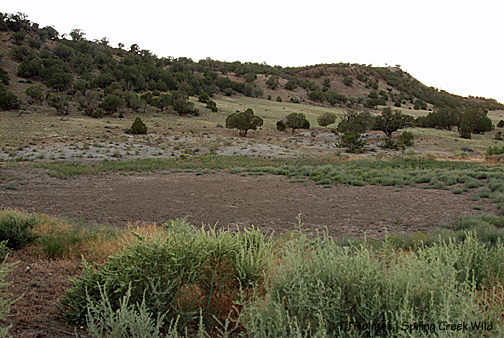
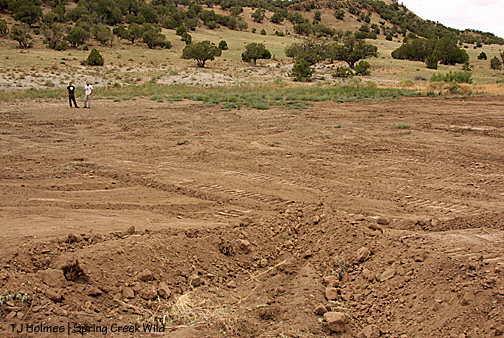
We went from this:

To this today:

It’s not done yet! This is looking from the “spillway” across the pond to the west – the same perspective as the photo above. Many thanks to C and J from the Forest Service who are honchoin’g the project and doing the dirt work!

C and J discussing the finer points of pond clean-out. C also was involved in coordinating the contractor hired to dig out the Round Top pond and the one double pond in 2009.

This is what I call simply the northwest pond, it being in the northwestern corner of Spring Creek Basin. This is looking southeastish across the basin. In the middle ground, you can see the twin buttes and part of Flat Top. Just left of the juniper tree in the foreground is the spillway from which I took the first two pix.

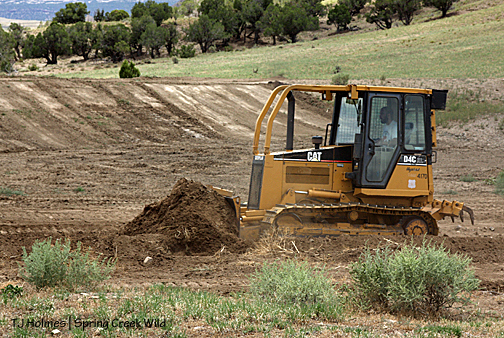
J pushing dirt.

There are basically two drainages that feed this pond, and he’s cleaning out in front of the smaller one, which you can see in front of the dozer. The other one is behind him, out of the picture.

Work should be finished on this pond tomorrow! I’ll post another pic or more later.

Also scheduled for dig-out is – at least – the trapsite pond, which is above Spring Creek Canyon (site of previous roundups). The roadside pond, which was about half dug out in 2010 (because it rained before it was completed), will get dug out if there’s time and/or it dries out more. The dirt of that pond, which went dry a month or so ago, is still damp about 4 inches down where the water dried up last. The Flat Top pond, which has been our priority to dig out since 2009, ends up holding some water when the monsoons kick in again. We’ll try to move that up to a June time-frame for next year; if the roadside pond doesn’t get dug out this year, there’s next year.

Director’s Challenge funds, awarded because of the Tres Rios Field Office’s partnership with Disappointment Wild Bunch Partners, are paying for this work!


Rain: falling, filling

13 07 2012

Aspen against a rainy sky a few nights ago.

The recent rains DID, in fact, put water in some of the ponds. Some went from very shallow to quite a bit fuller. Some went from dry to this:

The Flat Top pond. It (likely) won’t get dug out this year, but it’s good to see it with water again.

The northwest pond, however, should get dug out next week – it’s still dry. Or was; the basin got rain again this afternoon after a dry spell of a few days.

The east-pocket pond has water again. The Sorrel Flats pond has way more water (it was getting pretty shallow). And those are just the ones I’ve looked at, being more concerned with pony doings. What can I say, I get distracted easily. 🙂

I should have – but didn’t – take pix of the first Spring Creek arroyo crossing. No more water flowing, but the rocks the water pushed along was awe-inspiring (as always). Water is a driving force in this “Disappointment Country” – and the lack of it just as much, if not more so.

And I’ll leave ya’ll with this pretty sunset over the La Sal Mountains (to the northwest of the basin, in Utah):

It’s good to have rain. 🙂


Looking for – and finding – water

28 06 2012

FS range guy HP and I did some more riding to GPS water seeps in some of the main arroyos, trying to get an idea of water availability for the horses. There is good news to report: Three ponds still have water – though one is much shallower than a week ago. And we have GPS’d at least half a dozen places where water seeps up or percolates down in various arroyos across the basin. The horses continue to be in good condition.

Pix of our pony partners:

Fox trotter Pinch and HP.

HP’s other fox trotter Jammer, my partner for the trek.

Handsome and smart and willing! These guys went everywhere they were pointed. I think the only time Jammer’s pointy ears were less than full forward was during our lunch stop! HP wrangles and rides Forest Service horses in the course of his duties, too, but Pinch and Jammer belong to HP.

These with my cell phone (so I didn’t have to carry my big camera). Sorry about the quality!

HP riding Pinch near the weeping wall. The white is salt from the alkaline soil. Almost everywhere there’s water, there’s salt in abundance. I don’t think I’ve ever seen so much salt coming to the surface of the ground. We found water in an eighth- to a quarter-mile stretch through this arroyo. Clearly getting active horse traffic.

Jammer, left, helps HP and Pinch check out the old guzzler. It’s dead dry. We’re not sure why. (Note the shade of cloud cover – ahhh!)

Jammer drinks from water in a tire tank near a natural seep. The first time I found this area, a few years ago, the tire was full of water and the seep was producing water. Every visit since then, the tire has been dry. Now, the seep is nearly dry, but the tire is full and trickling over. Hmmmm??

Thanks again to HP for his work and horses! And thanks to BLM’s Tres Rios Field Office management and our herd manager, Kiley Whited, who is spearheading these projects!


Tackling the trickle

28 06 2012

Clouds = relief.

If it’s not too much to ask … some rain??

At last count, there were 23 wildfires burning in Southwest Colorado (this doesn’t include the fires elsewhere in Colorado). It is supremely, horribly dry. Please be careful, no matter where you are! And please send positive thoughts and prayers to the firefighters and people evacuated from their homes as well as those who have lost their homes (none that I know of in SW Colorado).

Forest Service range guy HP was back in the basin this week to honcho the task at “the trickle,” an overflow pipe at an existing well that apparently used to support a drinking trough. We didn’t quite get accomplished our original goal, which was to dig down and install a drinking trough that would be filled by water from the trickle (just too rocky for shovels). But we did get the water flowing through a hose to fill the existing little pool, which we then dammed to try to hold better water there.
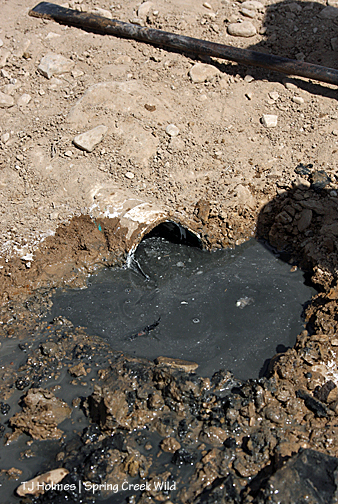
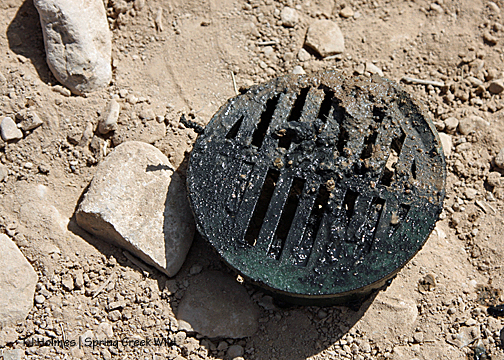
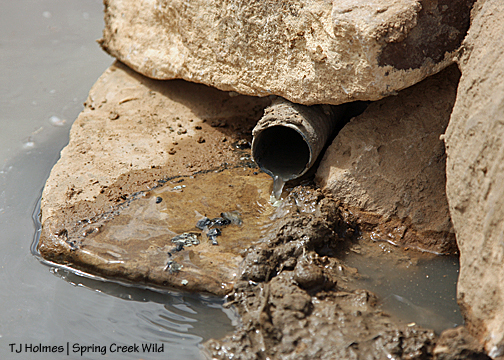
This is the end of the source pipe after we pried off the end-cap filter, which, because of mud and silt, was acting as a solid cap. There’s also mud backed up inside the pipe, and we’ve been playing in the mud to clear as much of it as we can reach, so yes, it looks pretty black and yucky.

The filter that had capped the source pipe. The pipe had been broken above where this fit inside, and the littlest trickle of water was flowing out (hence the name). Despite the poor quality and low quantity, the horses drink here, so we’re trying to make it better.
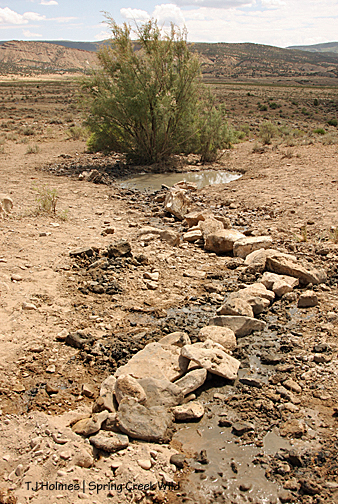
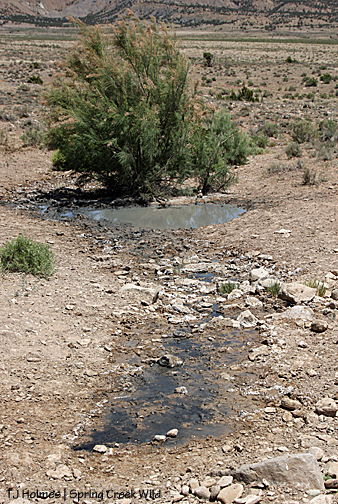
The water flowed downhill, caught in that little pool at the base of the tamarisk, then flowed on around and down until it just ran out.  The light-colored dirt at lower left is what we gathered to pack in around a plastic hose/pipe that we inserted into the source pipe, wedged with rocks and then packed with sand/clay/mud to force the water into the hose to run downhill. The line of rocks covers the hose from hoof traffic, and I’ll keep an eye on it until we can come up with another solution.

The end of the hose, with clear water continuing to trickle out. The water has been tested in the past, and although it’s salty, the horses clearly take advantage of it. (And all the water in the basin – except at the water catchment – is salty because of the alkaline soil.) We’re hoping this mucky little pool will clear up a bit and offer the horses a better source of water.

Apparently, some years in the past, the well fed a drinking trough that has since been removed for unknown reasons. That’s what we’re trying to restore.
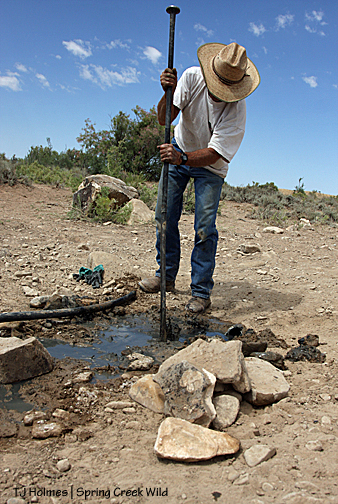
Many thanks to HP of the Forest Service in Dolores, who supplied tools, muscle and know-how! He’s using his tamp bar to pry up rocks below the source pipe. The original well is up the hill behind him and the tamarisk you see in the background. Even though someone decided tamarisk is now OK, as it’s habitat for birds, we’re still on a mission to remove as much as we can from the basin, especially near water sources – which is exactly where it likes to grow.
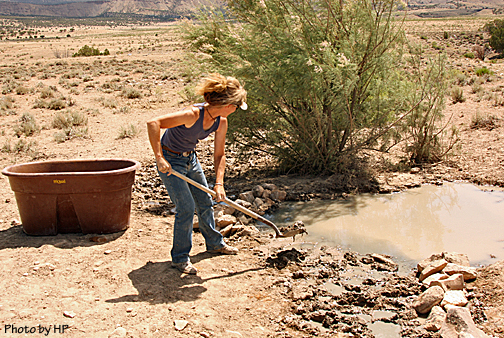
Yours truly, captured by HP, who stole my camera to take this shot. 🙂 I’m shoveling mud into a little dam we made with rocks to hold the water in this little pool. (Note another tamarisk that needs to go bye-bye.) The trickle hose comes out at lower right. The trough we’d hoped to install is behind me.

To come: some poor-quality cellphone pix from riding the arroyos to GPS water seeps. We made some interesting discoveries. While there’s not a lot of water, there IS water, and the horses continue to be in excellent condition.

Rain dances encouraged and welcome.


More water for mustangs in Colorado

22 06 2012

June 20, 2012

Contact: Christopher B. Joyner, Public Affairs Specialist, (970) 210-2126

BLM conducts emergency water operations; closes public lands for drought stricken wild horses

MEEKER, Colo. – The Bureau of Land Management recently began delivering water to wild horses in several areas in western Colorado in response to extreme drought conditions. Today BLM also issued an emergency closure for areas in the vicinity of Texas Mountain south of Rangely to further protect wild horses where the situation is particularly severe.

BLM is closely monitoring the wild horse herds it manages in Colorado and has begun supplementing natural water sources in three of the four wild horse herd management areas in the state, including the Piceance-East Douglas southwest of Meeker, the Sand Wash near Maybell, and the Spring Creek outside of Dolores. These are areas BLM manages specifically to maintain healthy wild horse herds in balance with other uses of the land. BLM is also closely monitoring the water situation in the Little Books Cliffs Wild Horse Range outside of DeBeque, which currently is not requiring supplemental water.

BLM issued the closure prohibiting public access south of Rangley in the West Douglas Herd Area, which is an area not planned for continued management of wild horses because it is not as suitable an area. BLM recently discovered a group of approximately 40 to 50 wild horses completely lacking any natural source of water. In addition to providing a large, temporary water tank and three water troughs, BLM is closing this area to reduce disturbance while the horses adjust to a new water source. The affected closed area is on or near Texas Mountain east of BLM Road 1214 and east of BLM Road 1063. Livestock are not currently in this specific area or using this water source.

BLM is closely monitoring the situation in the closure area and in the remainder of the West Douglas area, which holds an estimated 135 additional wild horses.

“BLM is committed to maintaining healthy wild horses in the White River Field Office and in Colorado,” said Kent Walter, White River Field Office manager. “We will continue to monitor the situation here and elsewhere, and may need to take additional steps to ensure the wild horses are cared for humanely.”

According to Walter, hauling water to such a remote location is not likely a sustainable, long-term solution.

*******************************************************

This is what I call “the trickle” in Spring Creek *Basin* (why do people always leave out the “basin” part?). Right above the S in Spring in my signature (and yes, I know, but Spring Creek Basin Wild was a long URL) is a pipe out of which water flows from an old well. It’s not much, it’s salty, it smells like sulphur. But the horses drink here when the drinking gets scarce. By the end of next week, we plan to install a pipeline and a drinking trough. The new line will run downhill to the new trough, which will sit where the pool of water currently is accumulating, right in front of the big tamarisk. Water will be controlled by a float instead of trickling on down into oblivion.

In addition to BLM’s green light (Tres Rios Field Office, Dolores), Disappointment Wild Bunch Partners partnership and (BLM) Director’s Challenge funding, the project involves Forest Service labor from the Dolores Public Lands Office. Thank you to all involved! (And many thanks to the Forest Service’s HP, who brought handsome Jammer for me to ride while we GPS’d water seeps in the Spring Creek (arroyo) and another main arroyo this week in the basin – and more next week!)


Water delivery, part 2

18 06 2012

Today was the second delivery of water to the catchment – and this time, it went directly into the storage tank.

Cecil Foster of Foster’s Water prepares to carry his water hose up his ladder to pump water into the tank.

Cecil at the top of the ladder.

A closer look at the drinking troughs.

View at the top: the water hose inside the hatch on top of the storage tank. See the glitter? That’s the water! The tank is now nearly full!

I should have taken pix of Chrome’s band on our way in; they were right off the road. They had moved away by the time we headed out. But close enough to take advantage of this good water.