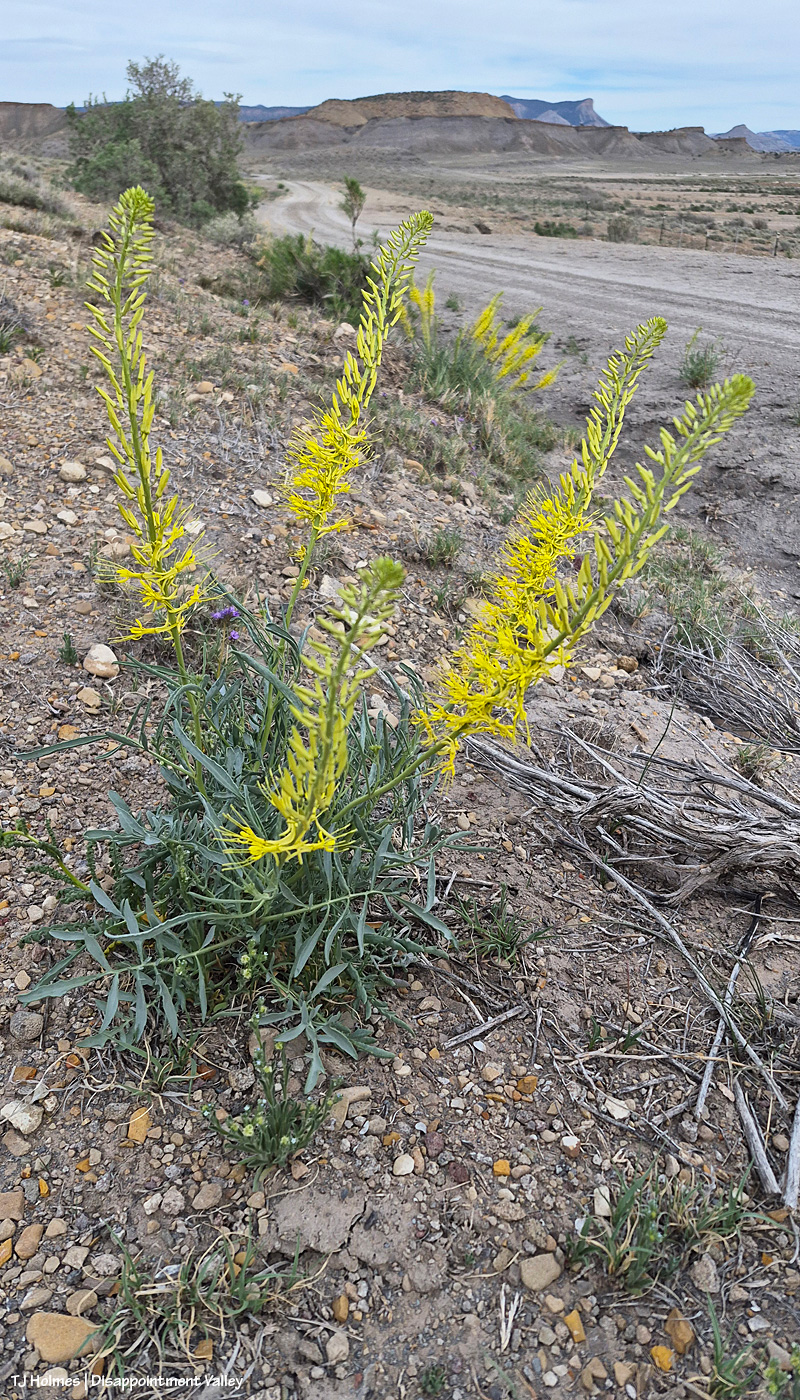
Heading TO Spring Creek Basin, I found the prince’s plume plants in full, crazy bloom. Why is this crazy, I hear you asking? Because they don’t usually bloom until May. IN Spring Creek Basin, the prince’s plumes I saw were a little behind these along Road K20E toward the basin, which makes sense as the basin is a bit higher elevation than along this road.
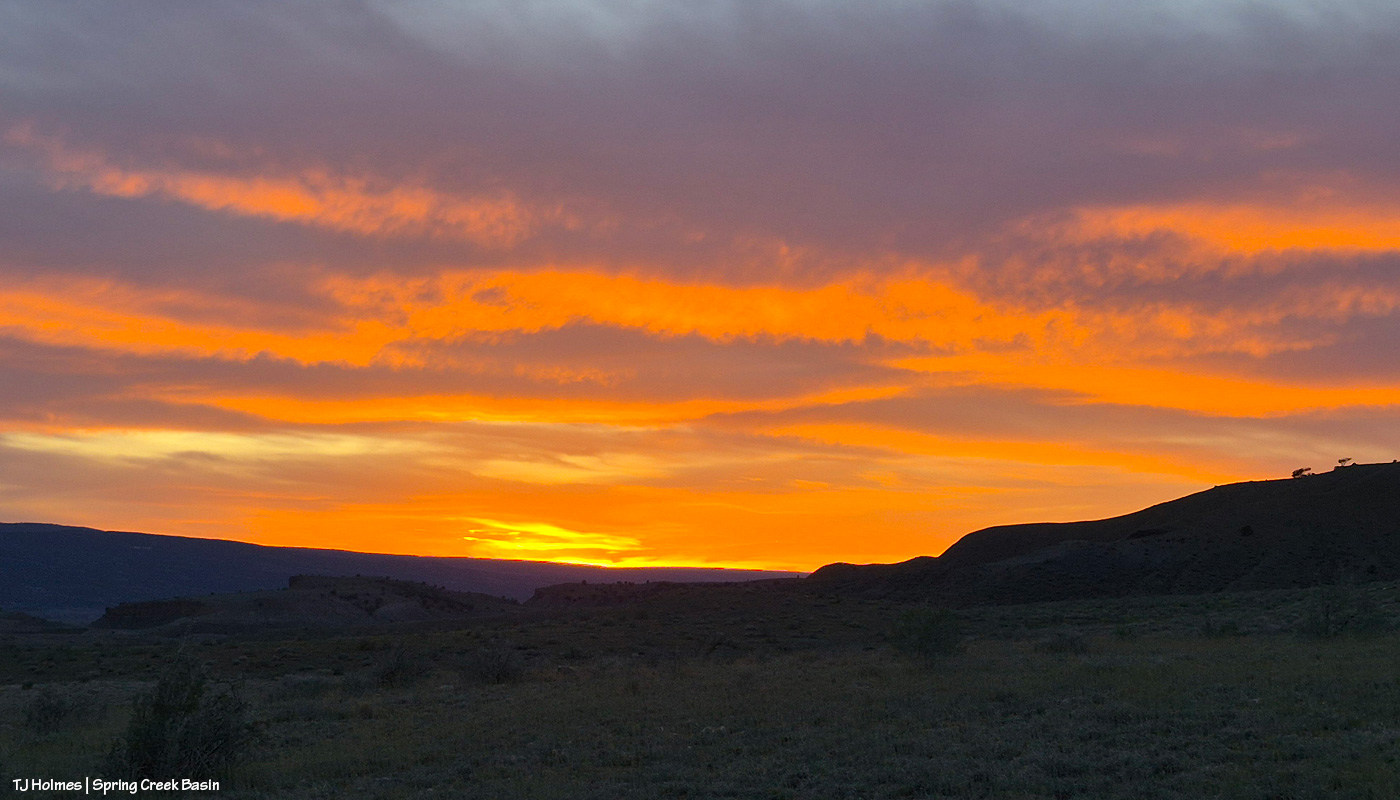
Heading OUT of Spring Creek Basin, the grey sky exploded with color at and post-sunset! Wowza. The weather wizards are giving us a whopping NINETY PERCENT chance of rain Wednesday. Do you know what Wednesday is? Wednesday is April 1, otherwise known as April Fools’ Day. Call me a fool a million times over, and please, please, PLEASE, let it RAINRAINRAIN!!!
With any hope at all, by the time you take a gander at this post this morning, our world will be white … according to the forecast Thursday afternoon! I’m not sure I believe it … but I’m hoping with all my might!
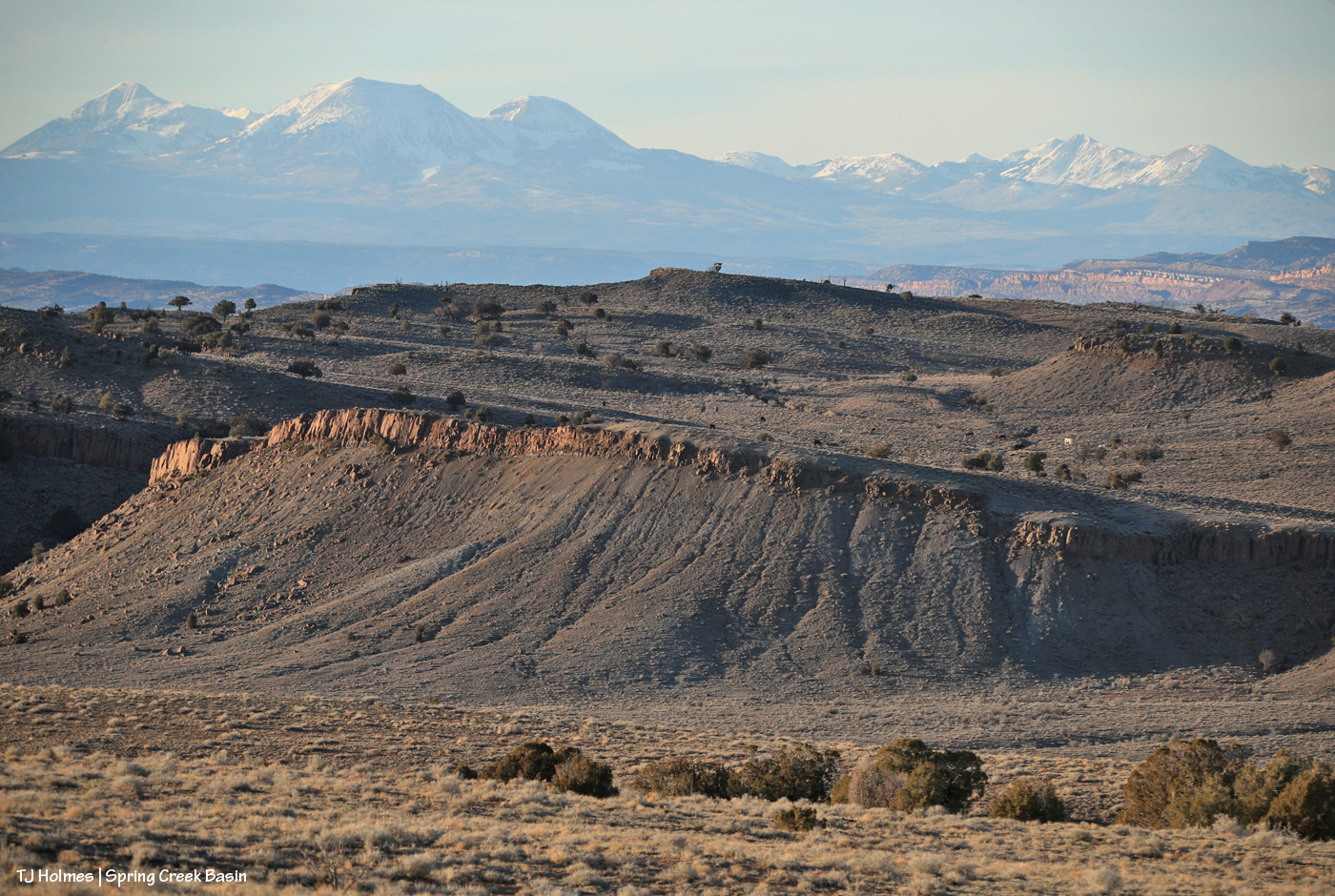
See ’em? 🙂 Look for the white spot, above the ridge of rimrocks … then note the dark spots (that aren’t trees) spread out to the left.
That’s Temple’s and Madison’s group. Out of sight to the right (northish) is Filly Peak and the main interior of (and main entrance to) Spring Creek Basin. FROM that interior, where I’d been 15 or 20 minutes earlier, I couldn’t see the mustangs from the other side of Filly Peak (familiar visitors will know that the road runs along the north/northeastish side of Filly Peak). But I saw Buckeye’s, which led me to leave the interior, drive out and around and hike up what I call corral hill, which is where I was when I took this pic, looking northwestish toward Utah’s La Sal Mountains. This is one of my favorite views in the basin (*note: like mustangs, you can’t have just one *favorite* view?!?!). And then I spotted the ponies. You couldn’t have seen them at all from the interior road, but they’re no more than a 15-or-so-minute walk from that road. From this vantage, though, Buckeye’s were less than five minutes below me back to the right(ish).
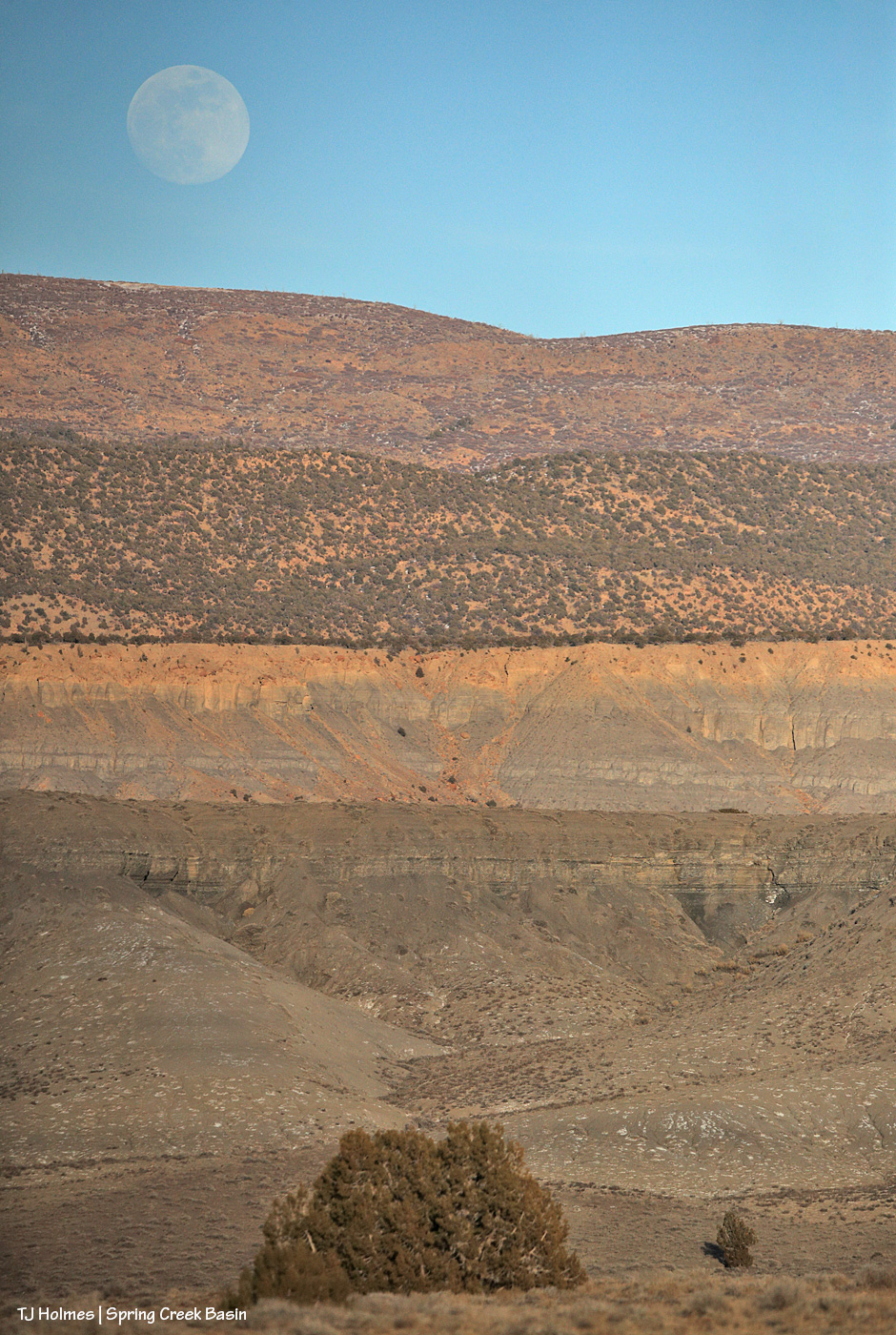
In addition to wanting to see Buckeye’s band, I hoofed it up the hill to try to catch this rising before it got too high:
This is what Google AI has to say about the February full moon (it’s actually full on Sunday, Feb. 1):
The February full moon is most commonly known as the Full Snow Moon because February typically brings the heaviest snowfalls of the year in North America. Other traditional names, often rooted in Native American, Colonial American, and European traditions, include the Hunger Moon, Bear Moon, and Eagle Moon.
Key Facts About February’s Moon:
Alternative Names: According to The Old Farmer’s Almanac, other names include the Bald Eagle Moon (Cree), Bear Moon (Ojibwe), and Raccoon Moon (Dakota).
Significance: It reflects a time of cold, deep winter, limited food sources, and the need for endurance.
2026 Timing: The 2026 Full Snow Moon peaks on February 1 at 5:09 p.m. EST.
Other, less common names for this lunar cycle include the Wind Strong Moon (Pueblo) and the Goose Moon (Haida).
***
Yes, I almost did fall off my chair laughing when I read that the February full moon is “most commonly known as the ‘Full Snow Moon.'” I mean, really? 🙂 Errrrrrrrrrrrrrrrrrrrrrrr. Not to mention arrrrrrrrrrrrrrrrrrrrrrrrrrrrrrrrgh! If you look really closely, you can see some lingering patches of snow in the above pic, and that’s several layers (what I like most about the pic) rising to the final ridge, which is actually outside/beyond Spring Creek Basin, but you’ve gotta look *really* hard.
The first layer of grey Mancos shale is the south end of what I call bachelor ridge, then the sandstoney-topped mesa known as Knife Edge, then the actual piñon-juniper-topped ridge that is a north/northeastish boundary ridge of the basin, then the ridge with its old burn scar(s) most commonly and easily accessed from Dry Creek Basin (can you imagine anyone calling Dry Creek Basin “Dry Creek” like some people refer to Spring Creek Basin as “Spring Creek” (which, as we all know, with its tributary arroyos, drains Spring Creek *Basin*)? (how’s that for a whole lotta parentheses?? :))).
How about a new name this year (which may or may not echo Februarys past … and presage Februarys future): Deep-Anxiety-Inducing No-Snow Moon? Bummer.
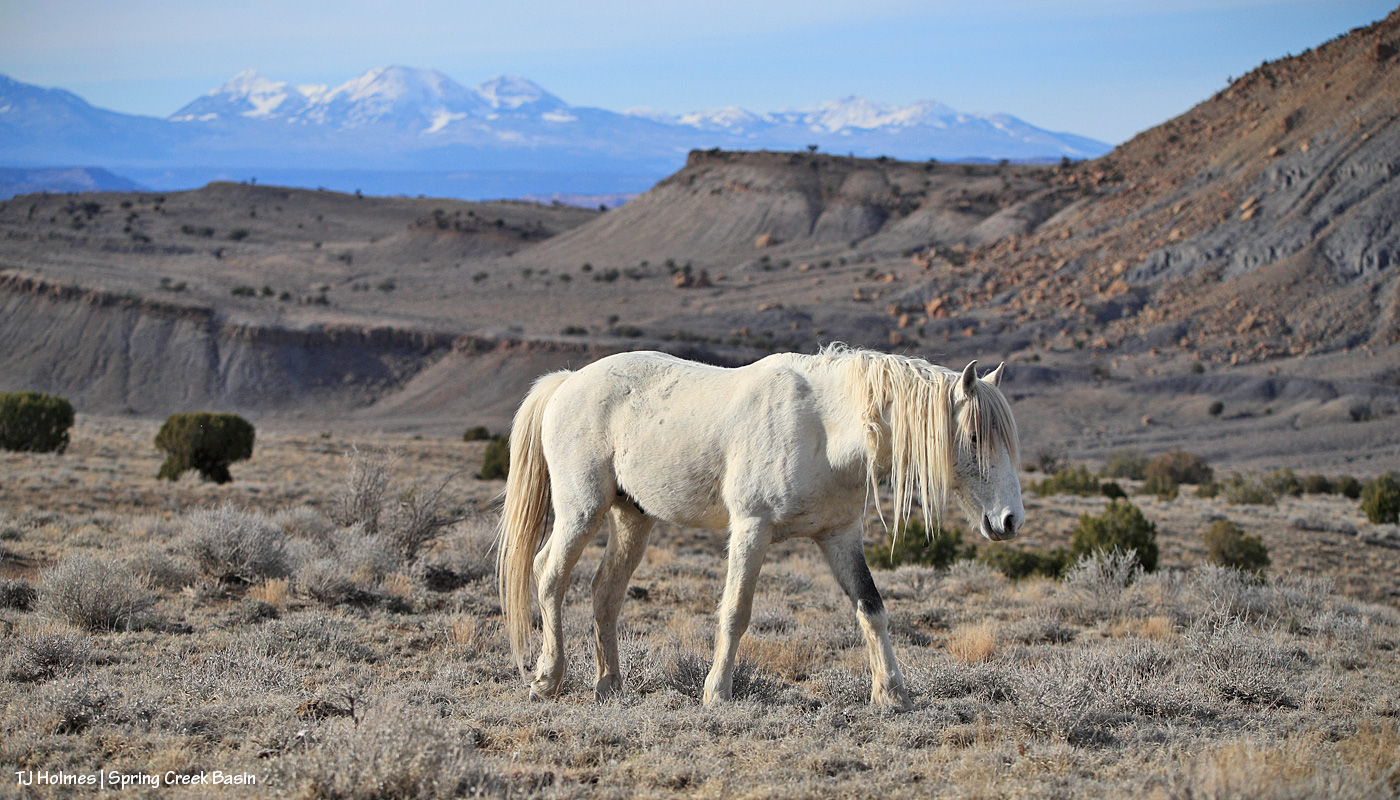
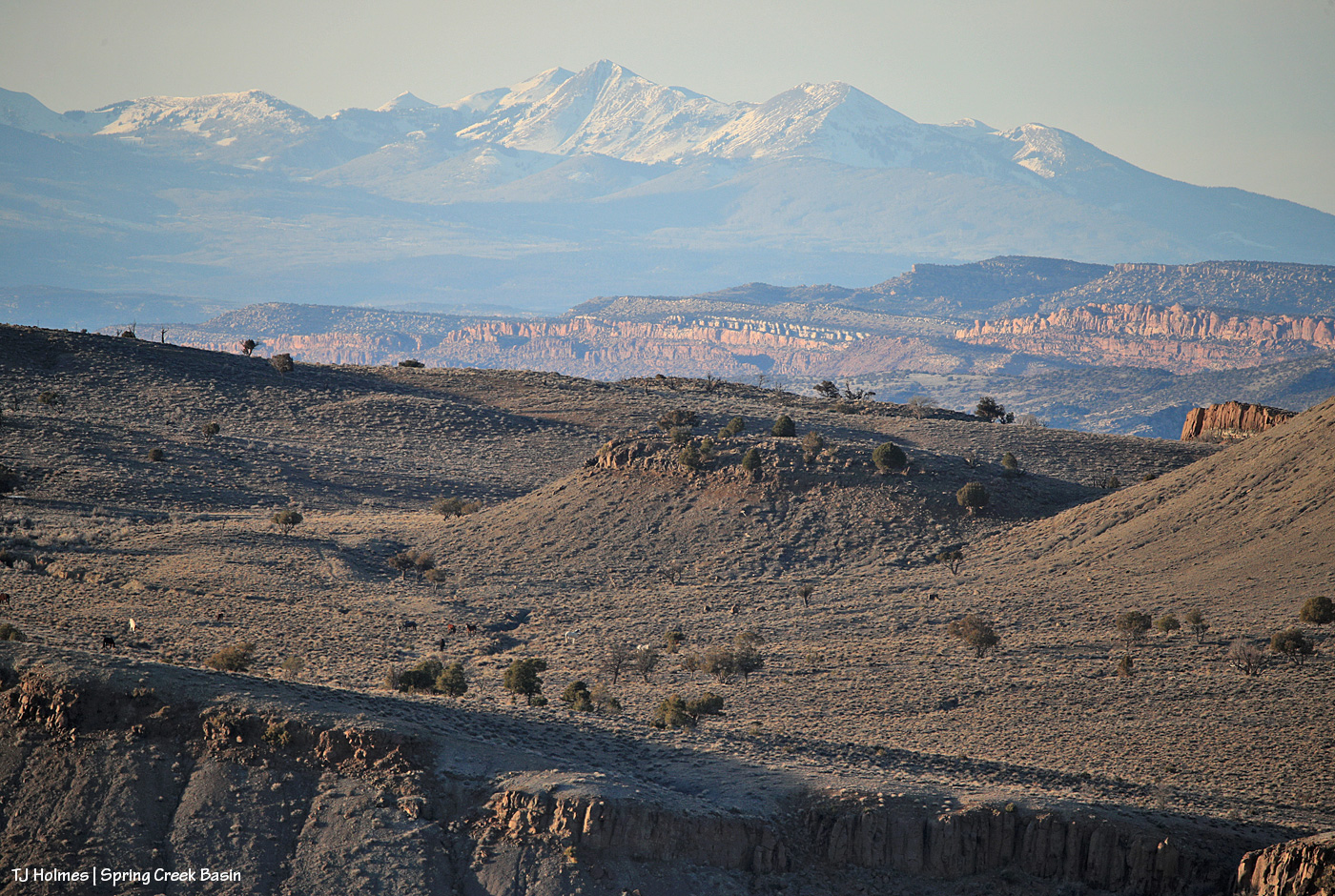
But to end on a happy note, another glimpse of the ponies on the “bench”:
Let alone the wild ones, how ’bout THEM layers? 🙂 Interestingly (?), the part(s) that look like people’s idea of Utah are in Colorado, and the parts that look like people’s idea of Colorado are in Utah. Yay, Southwest! 🙂
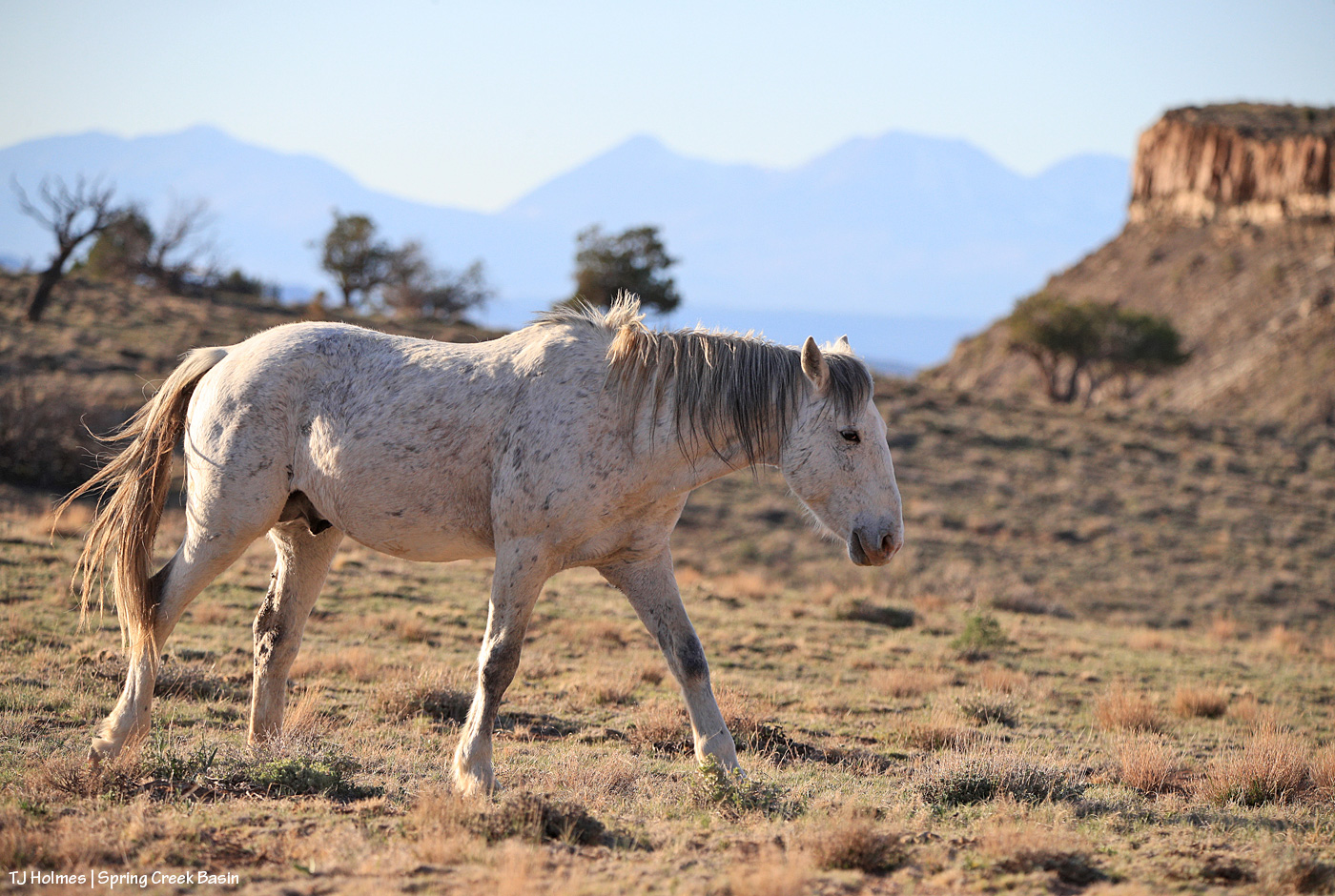
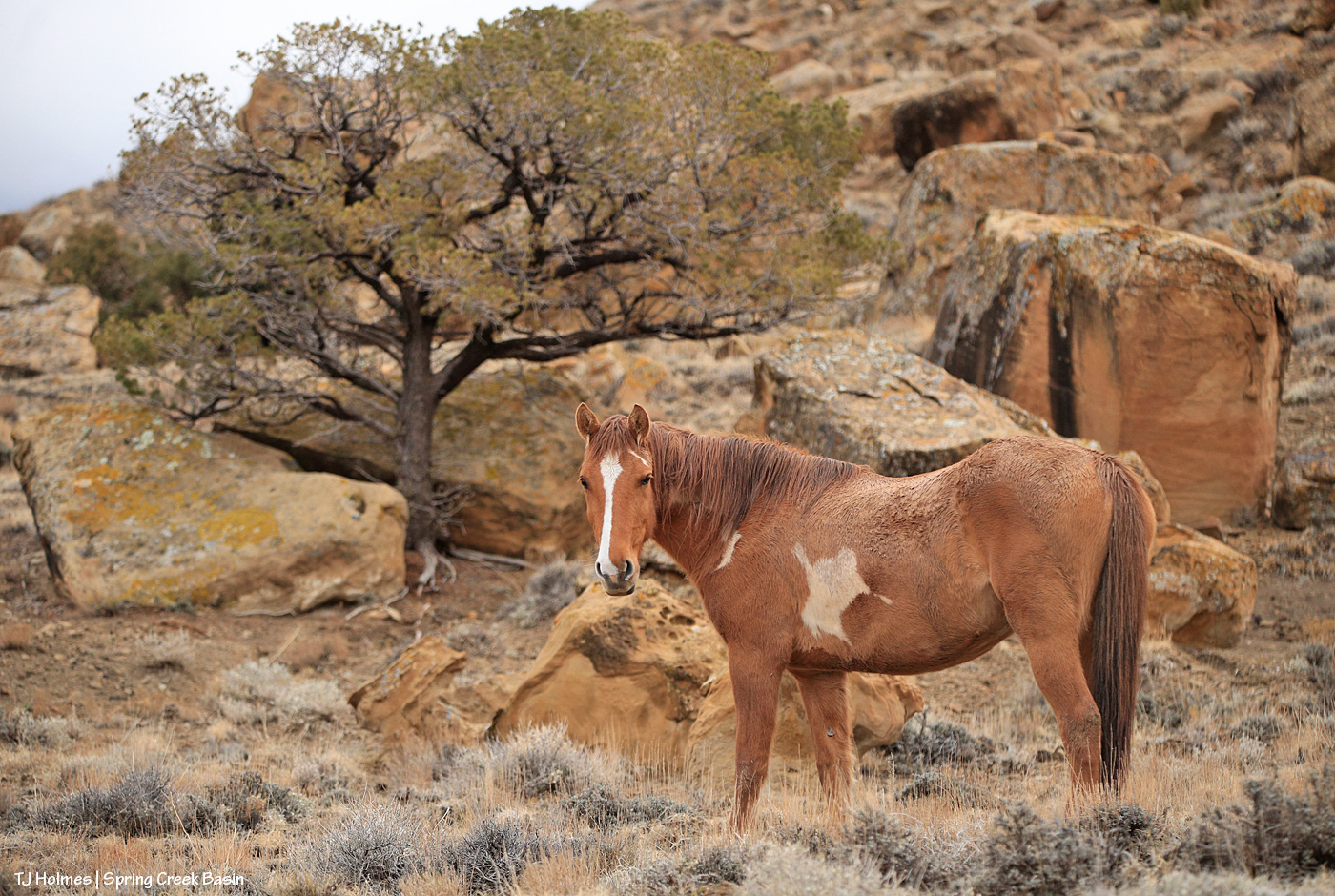
Pretty Aiyanna stopped in just the right place to show off the big, complementarily colored (!) boulders at the base of Filly Peak on New Year’s Day. … Notice the piñon tree growing between the two boulders behind her. It doesn’t look super healthy, but that’s probably more the ongoing drought than having sprouted up between two giant sandstones. Still, pretty cool … and it makes you (OK, at least me) wonder about the eons of history there.
Who else is feeling the need for a nap between Christmas and New Year’s Day? 🙂
It’s been blessedly quiet and peaceful in Disappointment Valley and Spring Creek Basin lately. The crazily unseasonal 60-degree temps are a thing of the past; today’s high temp is forecast to be a whopping 39F. Some places in Colorado are getting rain or snow from the storms that hit California (thank you, West Coast!). There’s an ever-so-slight possibility of “rain/snow showers” here next weekend. As always, our hopes are higher than the forecast percentages.
It’s been a crazy few days, and I’m almost over the rivers and past the mountains and down the plains and into the woods of home for Thanksgiving week.
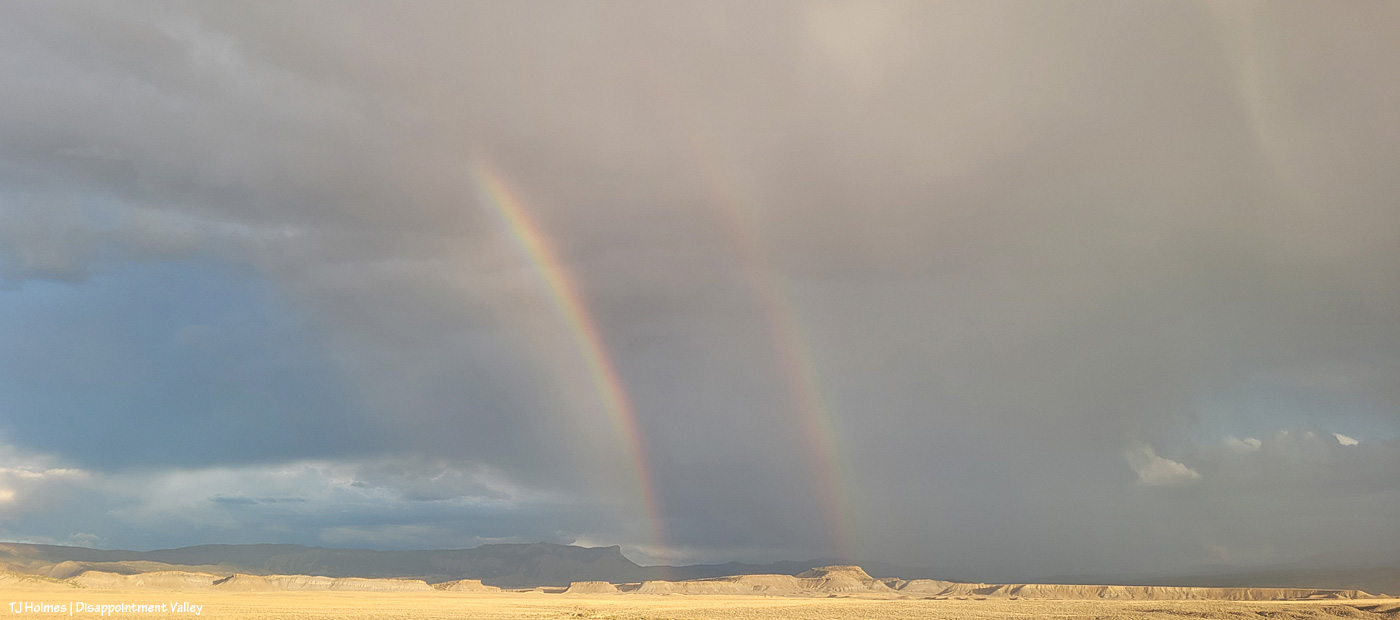
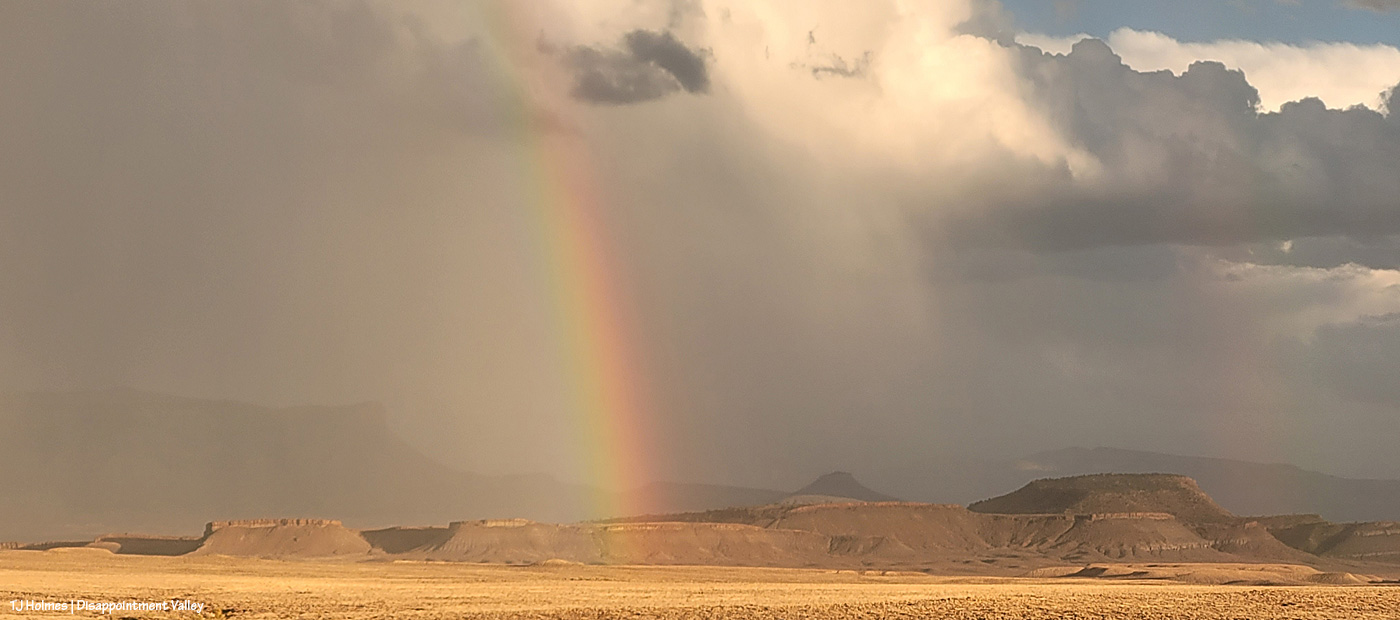
We rarely get morning rainbows; we rarely get morning rain (and even more rarely with sunshine).
Along with a lot of rain the last few days (about 2.56″), we’ve had a lot of sunshine.
This IS Colorado, after all!
Yeah, so THIS happened yesterday morning!
The cottonwoods along Disappointment Creek are starting to glow gold. And yes, it was sprinkling through the sunshine, which brought the magic. (The above pix are looking west; sun rising behind me above the rain clouds.)
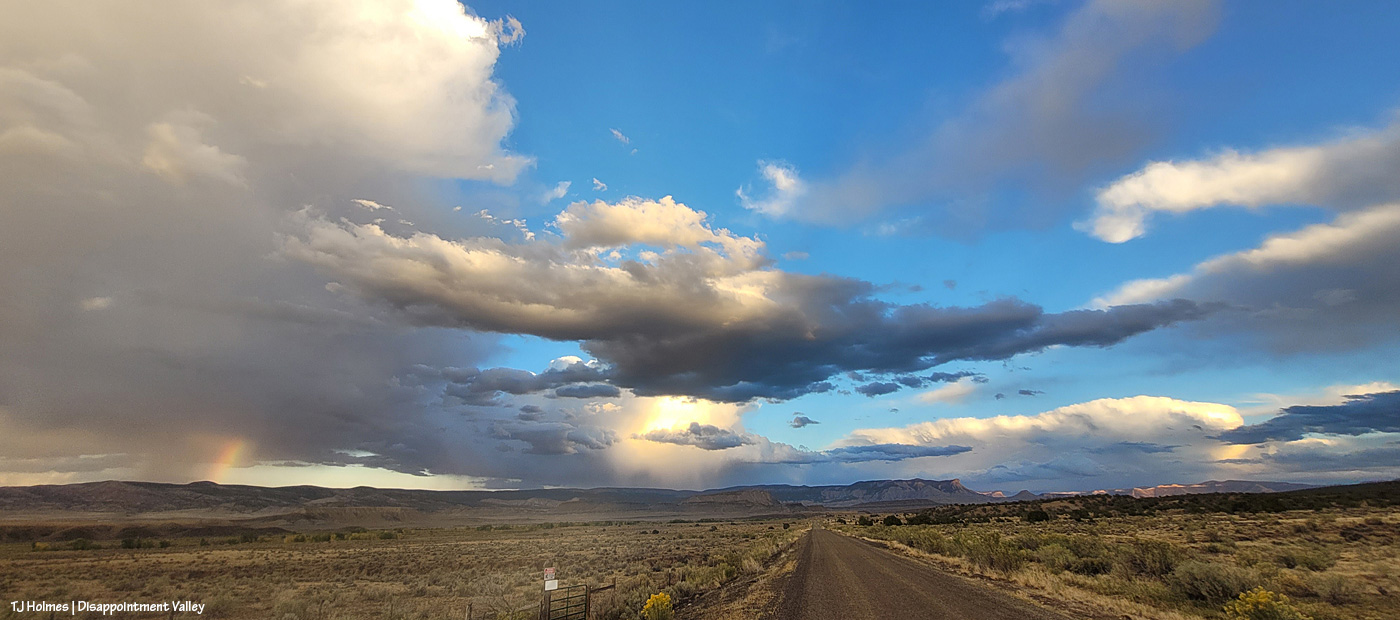
Wonder what it looked like back to the east? Here ya go! A lot different, eh? The sun was rising to upper right. This is Disappointment Road/Road 19Q looking toward Spring Creek Basin (not the road TO the basin).
Now I’m at 19Q looking west up Road K20W (not to be confused with K20E(ast) to Spring Creek Basin).
The sign struck me as funny under the rainbow. I mean, really, do you need a destination when the treasure is right in front of you??
Here we are at Road K20E looking eastish/southeastish toward Spring Creek Basin as the storm was passing to the north. (Sorry about the crazy glare-arrow; my phone’s camera lens is cracked.) Don’t make the mistake of driving this road for at least a few days! The cottonwoods at right line Disappointment Creek, which, yep, was running!
The rainbow (at least the main one) lasted somewhat longer than 30 minutes?!
It.
Was.
EXCEPTIONAL!
And when it finally faded, little curtains of rain were still moving south to north across the eastern(ish) part of the valley.
A person can never have too much magic in their lives. 🙂
Don’t hate me for making up spectacular words to match the gorgeousity of the magic scenery, painted by Mother Nature. … Anyone would (and should) do it. 🙂
(And yes, I did get semi-soaked!)
“It won’t rain.”
The rain came from behind-ish me (southish), and though it lasted (at a guess) less than five minutes, it soaked my right pant leg and right shoulder/arm and left water dripping down my leg inside my pants (!). These two pix (above) are looking north as the rain has mostly passed over me and is continuing north.
From the same spot as the first two pix, looking now eastish, I watched the moon rise over Temple Butte (promontory) and McKenna Peak (pyramid).
The moon was still barely visible when the light hit the passing rain and formed the prism, but while trying to decide between my phone and big camera, I think I missed it before it rose into the clouds (argh!).
With more dark clouds rising from the south and mustangs mostly far and scattered across the northern part of the basin, I decided to return another day. … (Note: It’s not a good idea to go into the basin if it’s going to rain. The road can get spectacularly bad when really, really, super wet.)
Wellllllll (a friend and a new friend will understand that heavily accented word 🙂 ) … when your gut tells you to turn around and make for the place where the rainbow will align with the pot of gold you know to be there (if you know, you know), be like Leroy Jethro Gibbs, and pay attention to your gut!
I stood in the sunshine along Disappointment Road while the second wave of rain passed from south to north across Spring Creek Basin (the rimrocks are Spring Creek Basin’s western boundary; the basin stretches away to the east in the northeasternish part of Disappointment Valley).
And the spectacularity JUST. GOT. BETTER.
End to end under the powerlines.
Temple Butte is visible again as the storm moves north.
This is NOT part of the original/above rainbows; it was a newly formed prism as the rain continued to pass and clear and the sun found space beneath the clouds above the western horizon. This stretch of Disappointment Road goes straight east.
After dark, we got yet another little wave of the good rain stuff. *Sigh of contentment*.
Maybe more overnight and in the morning. (Fingers and toes all crossed!)
I mean … RIGHT?! 🙂 Magic, folks. Pure magic. No artificial ingredients added. 🙂










 Spring Creek Basin Mustangs