La Fragua bachelors

5 05 2013

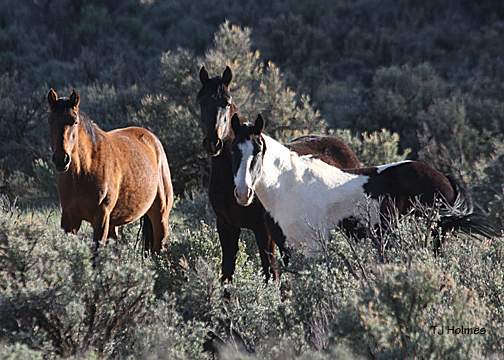
Young bachelor stallions in sage flats, La Fragua Canyon.

These bachelors were in an area called La Fragua Canyon (or very close). Family bands and at least one lone bachelor (Anthony’s “favorite” bay stallion!) also were in the area.

I was intrigued by the “white” horses with a few bands. They seemed young to be so completely “greyed out.” So I walked out into this sage flat to get a better look … and I discovered that the “white” horses actually are pintos.

White pinto with La Fragua bachelors.

Do you see the darker shading on his cheek? Pink skin on his muzzle. Black hairs in the middle of his tail.

White pinto with La Fragua bachelors.

This side, no pigment on his face.

This made me realize in a flash that the “grey” pinto stallion isn’t grey at all. I’m not sure what you’d call this pattern? The white gene clearly is dominant over the dark/black color gene? (**Update: See the comments for a website link to more color info. This color pattern likely is “sabino white” orย sabino “maximum white.”)

Of all the horses we saw – 105 – only one looked like a true grey. Quite a difference from grey-dominated Spring Creek Basin.

Colorwise, the Jicarilla has many bays (all shades), sorrels (at least one handsome boy I’d call a liver chestnut) and blacks, some duns and buckskins and palominos. Lots of pintos.


Inclusive exclosure

4 05 2013

050213exclosure1

Sean Kelly, wild horse coordinator for the Carson National Forest’s Jicarilla and Jarita Mesa wild horse territories, points out plant usage to New Mexico volunteer Tyler Sharpe while Farmington BLM rangeland management specialist Jeff Tafoya talks to volunteer and advocate Barb Kiiper with the Jicarilla Mustang Heritage Alliance at one of the exclosures in Spring Creek Basin during our tour this week. There are five of these in the basin, as well as some smaller “cages.” They fence off a small section of land so range folks can determine impacts of grazing – and not.

I need about 13 more hours in the day to get to more photos from these tour swaps – which were fantastic! We met lots of people and learned some of the challenges our respective herds face. The New Mexico herds – BLM and Forest Service – apparently are way over AML. They’re seeing effects on both the horses’ condition and condition of the ranges because of it. The Jicarilla and Carracas Mesa ranges are rugged, and that’s being gentle. They need to remove hundreds of horses, but BLM’s Canon City short-term holding facility can’t take them – no room at the inn. They are removing some horses periodically; the Jicarilla Mustang Heritage Alliance recently adopted four to train and adopt to permanent homes. The biggest question they all seem to face is this: They know a roundup and removal of many, many horses is needed, but what to do with all those horses?

There’s apparently quite a bit of controversy around the removal of horses there to get to a balanced herd population, and I’ll be the first to admit I don’t know or understand all the details. To start the learning process was one of the goals of this tour swap. And it was good to meet the knowledgeable, caring folks on the front lines and hear their concerns and challenges.


Addition

3 05 2013

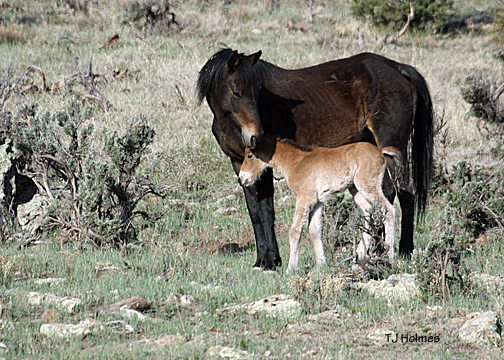
Mare and foal on the Jicarilla Wild Horse Territory.

Mare with a days-old foal at the Jicarilla Wild Horse Territory in northern New Mexico.


Jicarilla mares

2 05 2013

"Grey" and white pinto stallion's mares.

These mares belong to the pinto stallion I posted the pic of yesterday. He was on his way back to them after visiting “the dark band” and “the pinto band.” Note that the pinto mare has blue eyes. Not unusual there, apparently, with several blue-eyed pintos in the other band we saw.

Pretty girls. ๐Ÿ™‚


Jicarilla teaser

1 05 2013

042913gps2

Welcome to the Jicarilla Wild Horse Territory on the Carson National Forest in northern New Mexico! Isn’t this handsome boy stunning?

Seen during the Jicarilla part of a herd tour swap between the Jicarilla and Spring Creek Basin. Call it an education/info swap between herds in neighboring states with federal managing agencies and their partners/advocates.

The Jicarilla district is amazing, and its mustangs are beautiful (see above!). Next, we’ll bring our New Mexico neighbors to tour Spring Creek Basin. Look for more pix soon.


NMA/CO is on the Web

20 04 2013

NMACOhomepage2

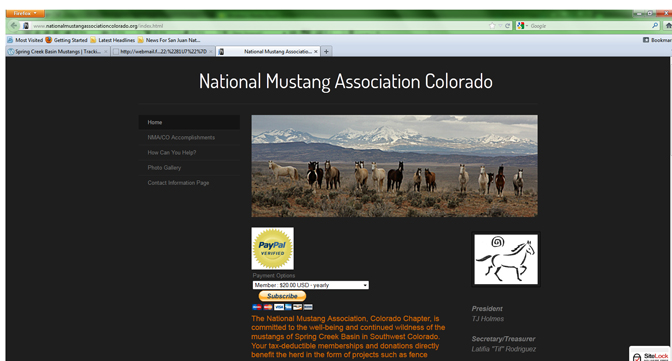
The National Mustang Association, Colorado chapter, is on the World Wide Web. Many thanks to NMA/CO secretary/treasurer Tif Rodriguez for bringing us into the modern age. ๐Ÿ™‚

People will be able to sign up for and renew memberships online, as well as make donations. Be sure to check out our “Accomplishments” page. I think I had an abbreviated version of it on the blog awhile back. It’s an impressive list. Pati and David Temple, of course, are responsible for much of it.

Our current fundraising efforts are directed toward infrastructure to enable BLM to pursue bait trapping instead of helicopter roundups in the future.

Check us out: http://www.nationalmustangassociationcolorado.org/index.html

Also note the link under the “blogroll” on the right side of this blog.

******************************

Locals who plan to attend the Pati Temple Memorial Benefit Bash on June 3 at Kennebec Cafe in Hesperus, Colo., can buy tickets in advance at this page.

The cafe will provide food and beverages for the ticket price. A silent auction will feature items such as a painting by NMA/CO’s Karen Keene Day, a print by Durango wild horse photographer Claude Steelman and a copy of his book Colorado’s Wild Horses, 40 bales of premium hay from David Temple, a print from Veryl Goodnight and more. Proceeds will directly benefit the wild horses of Spring Creek Basin through the advocacy efforts of NMA/CO.

Tickets will be available around the region (see the flier on the website for locations) and on the website at the above link.

Lovers of mustangs and friends of Pati are encouraged to bring their generosity and memories of our dearly missed mustang angel.


Boundary fence – aka the fruit of the students’ labor!

28 03 2013

When the students finished work on the fence Tuesday, I was so excited, I forgot to take pix of said finished fence! So yesterday, on a near-perfect spring day in Disappointment Valley, I straddled my mountain bike for the first day this year and pedaled up to the boundary. I haven’t figured out a decent way to carry my camera while biking (it’s not little), so I apologize in advance for the crappy quality of these cell-phone images. But I believe they show the excellent quality of our new, student-built fence!

032713fence1

I say, isn’t that a rockin’ mountain bike! Oh, wait, I mean, isn’t that a *tight* H-brace! This is at the road (the cattle guardย  is immediately to the left), and the brace was loose. Despite the poor image quality, I think you can see the shiny new wire. The sign says something about no motorized vehicle access (because it’s McKenna Peak Wilderness Study Area).

032713fence2

This was shot from in front of my bike looking up the fence line. Does it rock or what?!

Compare the above shot – brand-new fence – with the one below, the original fence, photo taken the previous weekend when the crew cleared the greasewood and other brush from the fence line so the students could build:

031613lynkathe

This is from the other (west) side of the fence, looking back toward the road, but it’s the same section of fence.

WHAT A DIFFERENCE!

032713fence3

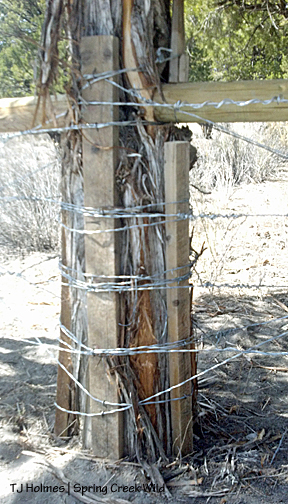
The shadows don’t allow for much detail in this shot, but this is the first H-brace the students built, using the tree as the anchor. Notice the extra “padding” around the tree.

032713fence4

Here’s a closer view. The staves protect the tree from wire biting into the bark – thank you (again), Tom Kelly, Forest Service fence-builder extraordinaire!

032713fence6

This is the brace just to the left of the tree and shows – I hope – the somewhat intricate weaving of the wrap, which holds it all together.

032713fence5

And here’s the fence continuing on up the hill.

Kudos again to the students for building this wildlife-friendly, mustang-protecting fence!


Alternative spring break – day 2

27 03 2013

We must not have worn out the Mizzou students Monday because they came back Tuesday! (All except one of the Sarahs – who came up sick – and Tori, who stayed with her. Sarah, feel better soon!)

With the H-braces set in place, the day’s plan was to take out the old wire and string new wire. Following wildlife-friendly strand spacing, the top wire is smooth twisted wire and 42 inches above the ground. The bottom wire is smooth twisted and 18 inches above the ground. The middle two strands are barbed wire. Deer and elk can jump over, fawns and calves can crawl under, and cattle hopefully will respect the barbed.

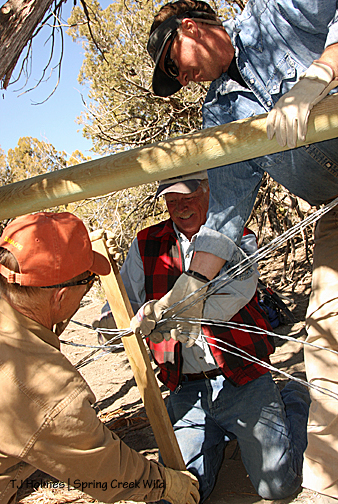
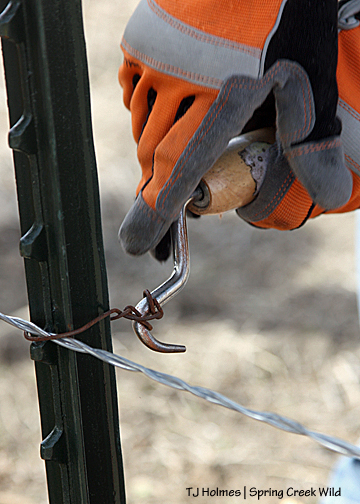
So we had to cut wire pieces off the existing fence strands and pull staples and roll barbed wire. Gloves and shades were must-have accessories. Once again, fence-building guru Tom Kelly showed the most jaded of us, who thought we knew a thing or three about fence building, a new technique to tighten the wire fence strands to T-posts (metal) and staves (between T-posts or wood posts).

032613tifTKtool

Tif watches Tom demonstrate the new-to-us tool to attach a wire fence strand to a metal T-post. She’s holding a stave on which she has marked the heights of the wire fence strands.
032613MKtool

MK took over this “wonder tool,” and I’m not sure she ever let it go! Instead of a traditional “clip,” this is a short piece of wire with loops on both ends. The hook goes through both ends, you swivel it, and voila! Your wire strand is tight to the post!

032613emeraldwire

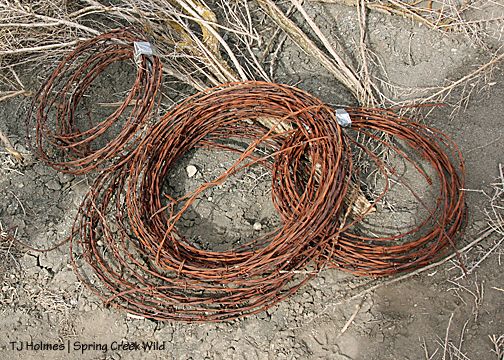
But I’m getting excited and ahead of myself. First, we had to get rid of the old wire. Here, Emerald demonstrates careful barbed-wire-rolling technique.
032613mkwire

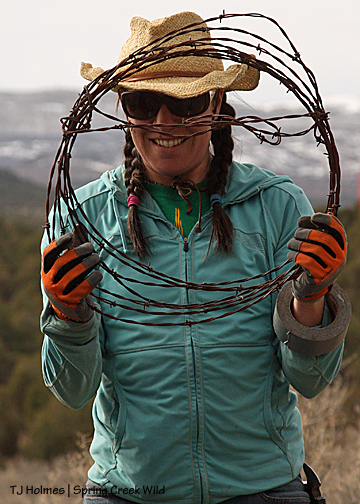
MK and a “barbed wire wreath”!

032613oldwire

More perfect rolls.

032613TRwire

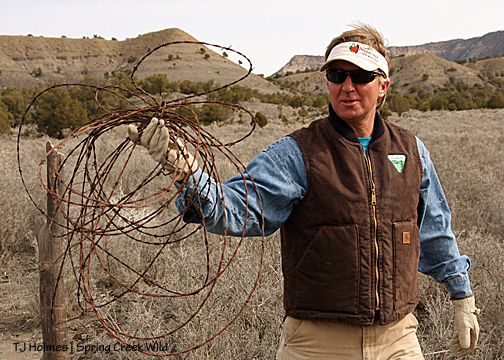
BLM guy Tom with his, uh, not-so-perfect “roll.” Lesson: Don’t let BLM roll up your fences! Fortunately, he redeemed his agency’s good name later with his wire-strand tightening skills.

032613marissastaves

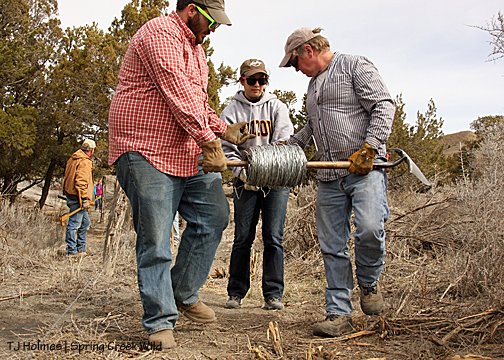
Marissa carries wooden staves to drop off along the fence line. These help stabilize the wire and keep the spacing even. Note the colorful eyewear, courtesy of SJMA. This was to protect against the potential boinging – Kathe’s word! – of broken wire. (Note: As far as I’m aware, there was no boinging of wire or injury to students!) Right in front of Emerald’s shins, note the strand of wire. This is how it got there:
032613chsakeunroll

Students Chalen and Marissa help volunteer Keith unroll smooth twisted wire. Note the wire strand in the bottom left corner of the pic. It started at the road, tied off at the H-brace there, and was unrolled up to the first H-brace, which is just beyond Tom Kelly (back left), where the trees start. Then another strand is tied off there and the roll walked back to the road and that brace. The process is repeated with the barbed wire in this section, and then with the smooth and barbed wire strands from the H-brace behind these guys up the hill to the next brace.

032613keithTRchwire

Keith carries rolls of old wire to the trucks while Tom and Chalen carry good wire to the next H-brace to string it from there to the third brace. Note the very valuable set of fencing pliers sticking out of Keith’s pocket. Students were well-acquainted with these tools after two days in Spring Creek Basin!
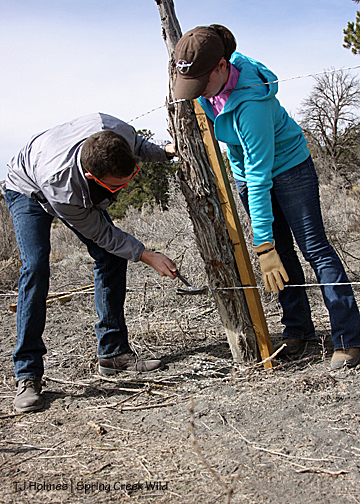
032613sarahaaronfence

Here, the bottom and top strands are in place and have been stretched (tightened). In this pic, Sarah and Aaron are measuring and stapling the strands of fence wire for the rebuilt fence. Note the marks on the stave Sarah is holding. The marks are at 18 inches, 23 inches, 30 inches and 42 inches. Marking staves made it easy for students to work in pairs: measure and staple.
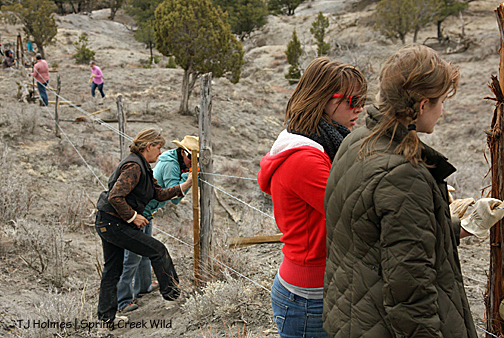
032613emelcormkfence

Emerald and Ellen, foreground, and Corrie and MK measure and staple fence strands to posts. Ellen and Emerald are at the next H-brace, up the hill.

032613mizzougrpasb

Mizzou students are the epitome of seriousness after day 2 of fence work on Spring Creek Basin’s southeastern boundary line. In the background, our excellent new fence! I can’t believe I didn’t take a pic of the finished product; to come. (It looks excellent!)

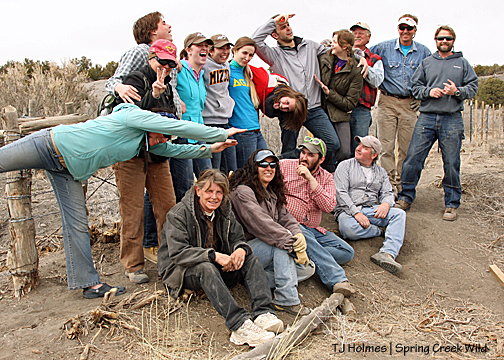
Front row from left: volunteers Corrie and Tif, Mizzou site leader Chalen and volunteer Keith. Standing: MK (diving) and Kathe with SJMA, students Marshal, Sarah, Marissa, Kara, Ellen, Aaron and Emerald, Tom Kelly with the Forest Service, BLM’s Tom Rice and Dave with the Forest Service.

An important side note, Corrie, Tif and Keith all adopted Spring Creek Basin mustangs in 2011/2012.

After their work on the fence, we took the students into the basin to scout mustangs. We saw Chrome’s band, Duke and Kreacher, Hollywood’s and Comanche’s bands with Bounce, and bachelor boys Aspen, Hayden, Tenaz and Apollo. Those boys were very accommodating for students’ pix!

On our way out, we stopped to investigate the dugout, likely used during construction (way back when?!) of the defunct Custer dam.

Chalen takes a break in the old dugout in Spring Creek Basin.

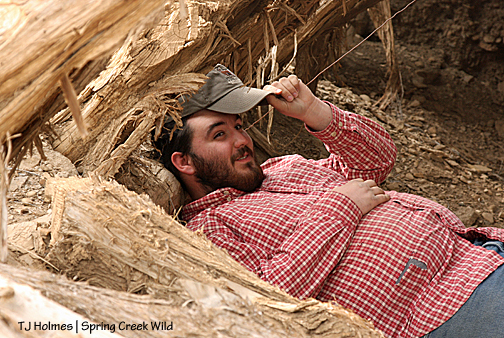
Chalen taking a well-deserved break. Word Monday was that he would be awake at 4:30 a.m. (!) Tuesday to cook breakfast.
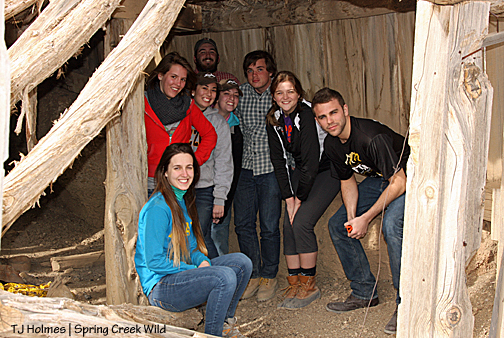
032613sdtsdugout

Students gather for a group photo op in the dugout. Are those some happy faces or what?

Today – Wednesday – the students will work with Kathe and MK and my friend Sam on one of my favorite mountain bike trails in Southwest Colorado: Phil’s World, just east of Cortez. It’s a not-so-secret course anymore. Thursday, they’ll work at Sand Canyon, part of Canyons of the Ancients National Monument, west of Cortez.

Once again, huge thanks to these fantastic university students! We so appreciate your willing and enthusiastic work to help protect our Spring Creek Basin mustangs. We hope you had fun to balance the work and that you’ll enjoy your next work projects as much as we enjoyed having you work with us! Come back soon to our corner of Colorado!


Alternative spring break – day 1

26 03 2013

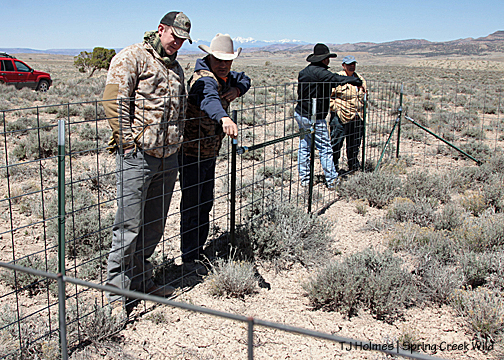
Monday was the first day of work for 10 students (including two site leaders) from the University of Missouri, here to work on public lands in Southwest Colorado on alternative spring break. Instead of going to Cancun or Fort Lauderdale or South Padre Island, these young men and women pursue service opportunities across the country. For more than a decade (13 years now?), San Juan Mountains Association, a nonprofit partner with BLM and the Forest Service on San Juan public lands, has organized work projects that always include at least one day in Spring Creek Basin Herd Management Area. This year and last year, students will be and were here for two days. This year, as last year, students worked on the southeastern boundary fence. Last year, they rebuilt a section of fence that had been vandalized before the roundup (someone cut it in several places); this year, they’re installing braces, tightening some wire and replacing some other wire – maintenance projects much-needed on that fence line.

Volunteers from Mesa Verde and Four Corners Back Country Horsemen and the Colorado chapter of the National Mustang Association also are helping with the project. Some or all of the materials were purchased with funds from last year’s Director’s Challenge, awarded because of BLM’s partnership with Disappointment Wild Bunch Partners, made up of representatives from 4CBCH, MVBCH and NMA/CO.

From SJMA, Kathe Hayes and MK Thompson, from the Forest Service, Tom Kelly, and from BLM, Tom Rice, were overseeing the project.

032513sarahmarshaldig

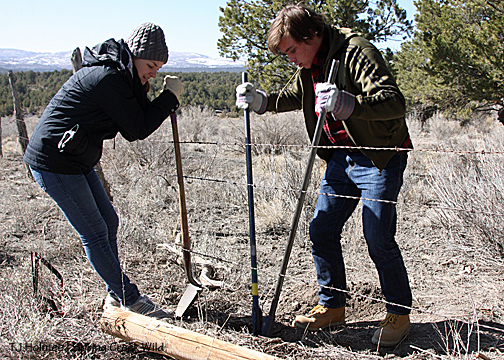
Sarah holds the wire strands to give Marshal room to dig a hole for a post as the first step toward building an H-brace.

032513bvemellbrace

Four Corners BCH volunteer Bob Volger and student Emerald watch student Ellen pound in a stake to hold an H-brace to the post set in the hole dug by Marshal in the first photo.

032513caratiftktamp

Student Kara helps Mesa Verde BCH and NMA/CO volunteer Tif Rodriguez tamp dirt around a post set at another H-brace while Forest Service fence-builder extraordinaire Tom Kelly supervises.

032513chmaraarsaw

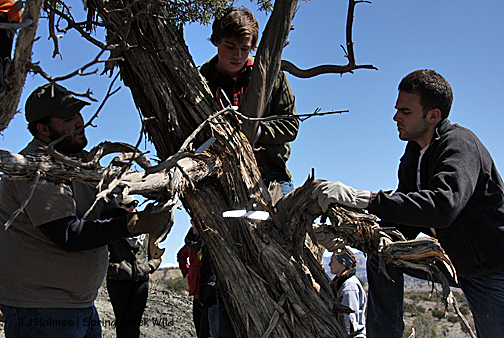
From left, Chalen, Marshal and Aaron saw limbs off a juniper to make way for building braces using the tree. Of the 10 students on the trip, these are the group’s only guys. Chalen is one of the site leaders.

032513mkstaples

SJMA’s MK painstakingly removes staples from wire embedded in the juniper tree seen in the previous photo. Moving forward, each tree used for braces will get protective staves to prevent this from happening (thanks, Tom Kelly!).

032513caratifdrill

Tif watches while Kara drills a hole for a spike through the brace and tree for stability.

032513emeralddrill

Emerald drills the way for another spike in another brace. Altogether, three sections of braces had posts dug and posts set in place. Because this area of Spring Creek Basin Herd Management Area also is part of McKenna Peak Wilderness Study Area, all the work had to be done by hand – no mechanical help such as chainsaws.

032513sarahbvtoriwire

Sarah holds wire while Bob, Tom Kelly and Tori (also a site leader) wrap wire around the H-brace and tree (with staves) to tighten.

032513bvtktrbrace

Bob, Tom Kelly and Tom Rice do the last bit of work for the day: tightening the wire around the farthest H-brace for stability.

Today, we’ll tighten and replace wire strands.

Thank you to everyone who is helping with this project! We so appreciate your work ethic and commitment to our public lands!


Pati Temple

5 02 2013

012113temple-72

Mustang angel and lover of all wild life Pati Temple passed away yesterday evening.

Look out, God, whirlwind coming your way!

Pati was one of the most influential people in my life, despite having known her for just the last few years. Words cannot come close to describing the dynamo that was Pati, and at this point, the heartbreak is too raw to try.

God speed, Pati, on the wings of your beloved mustangs. You are much loved and will be most incredibly missed.